EP0149050A2 - Facsimile Uebertragungssystem - Google Patents
Facsimile Uebertragungssystem Download PDFInfo
- Publication number
- EP0149050A2 EP0149050A2 EP84113739A EP84113739A EP0149050A2 EP 0149050 A2 EP0149050 A2 EP 0149050A2 EP 84113739 A EP84113739 A EP 84113739A EP 84113739 A EP84113739 A EP 84113739A EP 0149050 A2 EP0149050 A2 EP 0149050A2
- Authority
- EP
- European Patent Office
- Prior art keywords
- pels
- pel
- amplitude
- gii
- conversion table
- Prior art date
- Legal status (The legal status is an assumption and is not a legal conclusion. Google has not performed a legal analysis and makes no representation as to the accuracy of the status listed.)
- Granted
Links
Images


Classifications
-
- H—ELECTRICITY
- H04—ELECTRIC COMMUNICATION TECHNIQUE
- H04N—PICTORIAL COMMUNICATION, e.g. TELEVISION
- H04N1/00—Scanning, transmission or reproduction of documents or the like, e.g. facsimile transmission; Details thereof
- H04N1/41—Bandwidth or redundancy reduction
- H04N1/411—Bandwidth or redundancy reduction for the transmission or storage or reproduction of two-tone pictures, e.g. black and white pictures
- H04N1/413—Systems or arrangements allowing the picture to be reproduced without loss or modification of picture-information
- H04N1/4135—Systems or arrangements allowing the picture to be reproduced without loss or modification of picture-information in which a baseband signal showing more than two values or a continuously varying baseband signal is transmitted or recorded
-
- H—ELECTRICITY
- H04—ELECTRIC COMMUNICATION TECHNIQUE
- H04N—PICTORIAL COMMUNICATION, e.g. TELEVISION
- H04N1/00—Scanning, transmission or reproduction of documents or the like, e.g. facsimile transmission; Details thereof
- H04N1/41—Bandwidth or redundancy reduction
- H04N1/411—Bandwidth or redundancy reduction for the transmission or storage or reproduction of two-tone pictures, e.g. black and white pictures
- H04N1/413—Systems or arrangements allowing the picture to be reproduced without loss or modification of picture-information
- H04N1/415—Systems or arrangements allowing the picture to be reproduced without loss or modification of picture-information in which the picture-elements are subdivided or grouped into fixed one-dimensional [1D] or two-dimensional [2D] blocks
Definitions
- the invention relates to a method -and apparatus for transmitting and receiving data representing elements of an image (PELs), in which the size of said PELs is smaller than the size of PELs being transmitted.
- the vestigial side band amplitude modulation-phase modulation (AM-PM-VSB) has been recommended by C.C.I.T.T. for a facsimile transmission mode for the so-called GII mode facsimile terminal.
- the AM-PM-VSB uses an amplitude modulation which modulates the amplitude of a carrier signal in accordance with the amplitude of an input signal, and a phase modulation which inverts the phase when the amplitude of the input signal is equal to zero, the vestigial side-band (VSB) method being used for transmission.
- Digital facsimile terminals which are capable of operating in both GII mode and the so-called GIII mode have been recently developed.
- Scan density in the GII mode i.e. the number of scan lines per mm in a sub-scan or vertical direction
- scan density in the GIII mode is 7.7 lines/mm.
- the GII/GIII digital facsimile terminal has a scanner unit which includes a large number of scanning elements arranged in a line along a main scan or horizontal direction.
- Typical device used as the scanner unit is CCD (Charge Coupled Device) scanner unit.
- CCD elements Charge Coupled Device
- amplitude signals from the CCD elements representing the amount of reflected light from the original document are processed by the terminal.
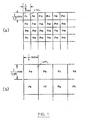
- the facsimile terminal handles the PEL as one GIII PEL, as shown in Fig. la.
- the facsimile terminal handles the four GIII PELs as one GII PEL, as shown in Fig. lb. That is, one GII PEL includes four GIII PELs.
- the GII/GIII digital facsimile terminal changes the size of a PEL in response to the selected operational mode.
- the PEL P a in the GII mode includes the PELs P 11 , P 12 , P 21 and P 22 .
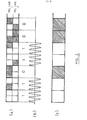
- the binary value, i.e. 1 or 0, of the GII mode PEL P a is determined by, for example, a majority decision of black PELs of the four GIII mode PELs P 11 , P 12 , P 21 and P 22 . Referring to (a) of Fig. 2, one ex- . ample of a distribution pattern of the black and white PELs of PEL line 1 and PEL line 2, which is detected by the scanner unit is shown.
- PEL size in the GII mode operation is shown by thick lines which form large GII mode PELs.
- Each GII mode PEL contains four GIII mode PELs.
- First, second, fourth and fifth GII mode PELs are determined as white level, i.e. binary 1, while third, sixth and seventh GII mode PELs are determined as black level, i.e. binary 0, due to the decision by majority.
- the waveform of the transmitted signal is shown in (b) of Fig. 2.
- the amplitude of the carrier signal is modulated in accordance with the determined binary values for each GII PEL.
- the reproduced image at the receiver facsimile terminal is shown in (c) of Fig. 2. Comparing the reproduced image (c) with the scanned_image (a) of Fig. 2, it is apparent that the reproduced image in the GII mode operation lacks the details of the scanned image, in spite of that the scanner unit provides the detailed GIII PEL image, (a) of Fig. 2.
- the invention resolves the above problem by transmitting the detailed GIII PEL information which was lost in the above prior technology, through the GII transmission line.
- the image is transmitted through the transmission line using AM-PM-VSB of the GII mode and correctly reproduces the scanned PEL images (a) of Fig. 2 at the receiver facsimile terminal.
- the large size PELs are GII PELs of the GII transmission mode using AM-PM-VSB
- the scanned PELs e.g. P 11 , P 12 , etc.
- the PELs of the transmission mode using AM-PM-VSB could include more GIII PELs than four, such as nine PELs, sixteen PELs, etc.
- the method according to the invention is characterized in claim 1.
- FIG. 3 block diagram of a transmitter facsimile terminal is shown in which a document 2 is moved across a scanner unit 1, e.g. CCD scanner unit. Successive PEL lines 3 are scanned during the movement of the document 2.
- the scanner unit 1 detects the light reflected from the document 2 with the high PEL density or resolution of the GIII mode, i.e. and produces binary signals 1 or 0 in accordance with the amount of the reflected light.
- the binary PEL data of one PEL line are serially supplied to serial/parallel conversion circuit 4, which converts the input serial data to a parallel data and supplies the parallel data to buffer 5.
- the two PEL line buffer 5 stores PEL data of two consecutive PEL lines.
- An example of the two PEL line data stored in the two PEL line buffer 5 is shown in (a) of Fig. 4, which is selected to be the same as that shown in (a) of Fig. 2, for the sake of understanding the invention.
- the sample window 21 (Fig. 4) is set up by address pointer 6.
- the size of the sample window 21 is selected to be equal to the PEL size of the GII transmission mode, i.e. and thus includes four GIII PELs.
- the first sample window samples PEL group 1, second sample window samples PEL group 2, third sample window samples PEL group 3, and so on.
- the address pointer 6 sequentially addresses the appropriate four bit positions in the two PEL line buffer 5 to shift the sample window through the PEL groups in buffer 5.
- the four bits enclosed by the sample window 21 are used to access a conversion table 7.
- the four bits in the sample window represent sixteen combinations of the positions of white or black PELs in one window, as shown in Fig. 5.
- the conversion table 7 stores sixteen values or entries (A) - (P) which represent the degree of amplitude modulation of the carrier signal.
- the output signal in the GII mode varies between 0 dB and -26 dB, and 0 dB signal could be deemed as white signal and -26 dB signal could be deemed as black signal, in accordance with C.C.I.T.T. proposal T3.
- the range 0 dB to -15 dB is selected.
- the range 0 dB to -15 dB is equally divided into the sixteen sub-ranges, and these sixteen sub-ranges are shown in the Fig. 5 as entries (A) - (P).
- the sixteen combinations of four white or black PELs, as described above, are assigned to the sixteen sub-ranges, respectively, as shown in Fig. 5.
- the PEL group 1 has all white bits. These four bits “1111” are supplied to the conversion table 7 to access the entry (A), shown in the Fig. 5, which indicates "0 dB", which is applied to GII modulator 8 to control the degree of the amplitude modulation of the carrier signal to "0 dB”.
- the PEL group 2 is used to control the degree of the amplitude modulation to "-1 dB", and so on, as shown in (b) of the Fig. 4.
- the transmitter terminal modulates the amplitude of the transmitted carrier signal, in accordance with-the bit combination sampled by the sample window 21, i.e. the distribution status or the position of black or white small size PELs enclosed by the sample window 21.
- a block diagram of the receiver facsimile terminal is shown.
- the transmitted signal with the amplitude modulation as shown in (b) of the Fig. 4 is supplied to GII demodulator 31.
- the GII demodulator 31 detects the amplitude of the received signal and produces a signal representing one of sixteen levels at its output in accordance with the detected amplitude of the received signal. For instance, a four bit signal is produced.
- the signal is applied to reverse conversion table 32,'which stores sixteen PEL groups as shown in Fig. 5, and is used to fetch one of the sixteen PEL groups.
- the PEL groups sequentially supplied by table 32 are assembled in two PEL line buffer 33 under the control of address pointer 34, so that the two PEL lines of the original document image shown in (a) of the Fig. 4 are reproduced in the 2 PEL line buffer 33.
- the address pointer 34 sequentially addresses bit positions in the two PEL line buffer 33 to sequentially store the four bit-PEL groups received from the reverse conversion table 32 into the two PEL line buffer 33.
- the assembled two PEL lines are supplied to printer 36 through parallel-serial conversion circuit 35 to print the original document image on a recording sheet.
- the exemplary range 0 dB to -15 dB has been described.
- another range such as -3dB to -18dB, -4dB to -19dB, could be used.
Landscapes
- Engineering & Computer Science (AREA)
- Multimedia (AREA)
- Signal Processing (AREA)
- Facsimile Scanning Arrangements (AREA)
- Facsimile Transmission Control (AREA)
Applications Claiming Priority (2)
| Application Number | Priority Date | Filing Date | Title |
|---|---|---|---|
| JP58218870A JPS60114088A (ja) | 1983-11-22 | 1983-11-22 | G2モードの伝送方法 |
| JP218870/83 | 1983-11-22 |
Publications (3)
| Publication Number | Publication Date |
|---|---|
| EP0149050A2 true EP0149050A2 (de) | 1985-07-24 |
| EP0149050A3 EP0149050A3 (en) | 1987-09-23 |
| EP0149050B1 EP0149050B1 (de) | 1990-08-08 |
Family
ID=16726590
Family Applications (1)
| Application Number | Title | Priority Date | Filing Date |
|---|---|---|---|
| EP84113739A Expired EP0149050B1 (de) | 1983-11-22 | 1984-11-14 | Facsimile Uebertragungssystem |
Country Status (4)
| Country | Link |
|---|---|
| US (1) | US4686578A (de) |
| EP (1) | EP0149050B1 (de) |
| JP (1) | JPS60114088A (de) |
| DE (1) | DE3482950D1 (de) |
Cited By (1)
| Publication number | Priority date | Publication date | Assignee | Title |
|---|---|---|---|---|
| DE3706470A1 (de) * | 1986-07-30 | 1988-02-11 | Toshiba Kawasaki Kk | Binaerdatenverdichtungs- und -dehnungs-verarbeitungsgeraet |
Families Citing this family (4)
| Publication number | Priority date | Publication date | Assignee | Title |
|---|---|---|---|---|
| GB2235076B (en) * | 1989-08-17 | 1994-05-04 | Asahi Optical Co Ltd | Camera data communication method and camera |
| US5070532A (en) * | 1990-09-26 | 1991-12-03 | Radius Inc. | Method for encoding color images |
| US5247589A (en) * | 1990-09-26 | 1993-09-21 | Radius Inc. | Method for encoding color images |
| US5359432A (en) * | 1991-11-25 | 1994-10-25 | Lexmark International, Inc. | Printer page composition with color and text |
Family Cites Families (6)
| Publication number | Priority date | Publication date | Assignee | Title |
|---|---|---|---|---|
| US3973079A (en) * | 1973-12-12 | 1976-08-03 | Hitachi, Ltd. | Two-level picture signal transmission system |
| US3893244A (en) * | 1974-07-15 | 1975-07-08 | Danford Jack D | Grain storage and shipping containers and method of using the same |
| JPS5941631B2 (ja) * | 1977-12-20 | 1984-10-08 | 沖電気工業株式会社 | 高能率書画電送方式 |
| JPS54150022A (en) * | 1978-05-18 | 1979-11-24 | Ricoh Co Ltd | Method and apparatus for picture encoding reproduction |
| US4366505A (en) * | 1978-09-20 | 1982-12-28 | Canon Kabushiki Kaisha | Information forming apparatus |
| US4261018A (en) * | 1979-06-18 | 1981-04-07 | Bell Telephone Laboratories, Incorporated | Progressive image transmission |
-
1983
- 1983-11-22 JP JP58218870A patent/JPS60114088A/ja active Granted
-
1984
- 1984-11-14 EP EP84113739A patent/EP0149050B1/de not_active Expired
- 1984-11-14 DE DE8484113739T patent/DE3482950D1/de not_active Expired - Lifetime
- 1984-11-16 US US06/672,011 patent/US4686578A/en not_active Expired - Fee Related
Cited By (1)
| Publication number | Priority date | Publication date | Assignee | Title |
|---|---|---|---|---|
| DE3706470A1 (de) * | 1986-07-30 | 1988-02-11 | Toshiba Kawasaki Kk | Binaerdatenverdichtungs- und -dehnungs-verarbeitungsgeraet |
Also Published As
| Publication number | Publication date |
|---|---|
| EP0149050B1 (de) | 1990-08-08 |
| JPH0149229B2 (de) | 1989-10-24 |
| JPS60114088A (ja) | 1985-06-20 |
| DE3482950D1 (de) | 1990-09-13 |
| EP0149050A3 (en) | 1987-09-23 |
| US4686578A (en) | 1987-08-11 |
Similar Documents
| Publication | Publication Date | Title |
|---|---|---|
| US4084196A (en) | Electronic half-tone generating means for facsimile reproduction system | |
| US4091424A (en) | Facsimile compression system | |
| US4905294A (en) | Image processing apparatus | |
| US4924509A (en) | Image processing apparatus | |
| US4698688A (en) | Image processing system | |
| US4571632A (en) | Alternate line interpolation method and apparatus | |
| US4517607A (en) | Method of and apparatus for compensating image in image reproduction system | |
| GB1573774A (en) | Facsimile compression system | |
| US3715475A (en) | Method and apparatus for electrically transmitting pictures | |
| US3775559A (en) | Aperture designs for facsimile scanning apparatus | |
| US5452107A (en) | Image processing apparatus providing a bilevel image signal by changing binarization threshold value based on densities of original image areas incuding target pixel and less than all surrounding pixels | |
| EP0149050B1 (de) | Facsimile Uebertragungssystem | |
| US4996602A (en) | Image-processing apparatus | |
| JPS6043715B2 (ja) | 狭帯域静止画像伝送方式 | |
| JPH0123820B2 (de) | ||
| EP0336403B1 (de) | Bildlesegerät | |
| US5278672A (en) | Image signal processing apparatus | |
| EP0195925A2 (de) | Verfahren zum Umwandeln von Bildgraupegeln | |
| JPS58119269A (ja) | フアクシミリ送信機 | |
| JPS62183265A (ja) | 画像デ−タ伝送システム | |
| JPS5813067B2 (ja) | シヨガデンソウホウシキ | |
| JPH01282967A (ja) | 濃淡画像データ処理方法 | |
| JPH0131344B2 (de) | ||
| JPS60160773A (ja) | 画像読取伝送記録方式 | |
| JPH05130403A (ja) | 副走査補正装置および副走査補正方法 |
Legal Events
| Date | Code | Title | Description |
|---|---|---|---|
| PUAI | Public reference made under article 153(3) epc to a published international application that has entered the european phase |
Free format text: ORIGINAL CODE: 0009012 |
|
| 17P | Request for examination filed |
Effective date: 19841211 |
|
| AK | Designated contracting states |
Designated state(s): DE FR GB |
|
| PUAL | Search report despatched |
Free format text: ORIGINAL CODE: 0009013 |
|
| RHK1 | Main classification (correction) |
Ipc: H04N 1/415 |
|
| AK | Designated contracting states |
Kind code of ref document: A3 Designated state(s): DE FR GB |
|
| 17Q | First examination report despatched |
Effective date: 19891115 |
|
| GRAA | (expected) grant |
Free format text: ORIGINAL CODE: 0009210 |
|
| AK | Designated contracting states |
Kind code of ref document: B1 Designated state(s): DE FR GB |
|
| REF | Corresponds to: |
Ref document number: 3482950 Country of ref document: DE Date of ref document: 19900913 |
|
| ET | Fr: translation filed | ||
| R20 | Corrections of a patent specification |
Effective date: 19900903 |
|
| PLBE | No opposition filed within time limit |
Free format text: ORIGINAL CODE: 0009261 |
|
| STAA | Information on the status of an ep patent application or granted ep patent |
Free format text: STATUS: NO OPPOSITION FILED WITHIN TIME LIMIT |
|
| 26N | No opposition filed | ||
| PGFP | Annual fee paid to national office [announced via postgrant information from national office to epo] |
Ref country code: GB Payment date: 19931019 Year of fee payment: 10 |
|
| PGFP | Annual fee paid to national office [announced via postgrant information from national office to epo] |
Ref country code: FR Payment date: 19931103 Year of fee payment: 10 |
|
| PGFP | Annual fee paid to national office [announced via postgrant information from national office to epo] |
Ref country code: DE Payment date: 19931118 Year of fee payment: 10 |
|
| PG25 | Lapsed in a contracting state [announced via postgrant information from national office to epo] |
Ref country code: GB Effective date: 19941114 |
|
| GBPC | Gb: european patent ceased through non-payment of renewal fee |
Effective date: 19941114 |
|
| PG25 | Lapsed in a contracting state [announced via postgrant information from national office to epo] |
Ref country code: FR Effective date: 19950731 |
|
| PG25 | Lapsed in a contracting state [announced via postgrant information from national office to epo] |
Ref country code: DE Effective date: 19950801 |
|
| REG | Reference to a national code |
Ref country code: FR Ref legal event code: ST |