EP0146975A2 - Kurzschlussauffinder für Proms - Google Patents
Kurzschlussauffinder für Proms Download PDFInfo
- Publication number
- EP0146975A2 EP0146975A2 EP84200830A EP84200830A EP0146975A2 EP 0146975 A2 EP0146975 A2 EP 0146975A2 EP 84200830 A EP84200830 A EP 84200830A EP 84200830 A EP84200830 A EP 84200830A EP 0146975 A2 EP0146975 A2 EP 0146975A2
- Authority
- EP
- European Patent Office
- Prior art keywords
- memory
- bit line
- transistor
- selected test
- receiving
- Prior art date
- Legal status (The legal status is an assumption and is not a legal conclusion. Google has not performed a legal analysis and makes no representation as to the accuracy of the status listed.)
- Withdrawn
Links
Images


Classifications
-
- G—PHYSICS
- G11—INFORMATION STORAGE
- G11C—STATIC STORES
- G11C29/00—Checking stores for correct operation ; Subsequent repair; Testing stores during standby or offline operation
- G11C29/02—Detection or location of defective auxiliary circuits, e.g. defective refresh counters
- G11C29/025—Detection or location of defective auxiliary circuits, e.g. defective refresh counters in signal lines
-
- G—PHYSICS
- G11—INFORMATION STORAGE
- G11C—STATIC STORES
- G11C29/00—Checking stores for correct operation ; Subsequent repair; Testing stores during standby or offline operation
- G11C29/02—Detection or location of defective auxiliary circuits, e.g. defective refresh counters
-
- G—PHYSICS
- G11—INFORMATION STORAGE
- G11C—STATIC STORES
- G11C29/00—Checking stores for correct operation ; Subsequent repair; Testing stores during standby or offline operation
- G11C29/04—Detection or location of defective memory elements, e.g. cell constructio details, timing of test signals
- G11C29/50—Marginal testing, e.g. race, voltage or current testing
-
- G—PHYSICS
- G11—INFORMATION STORAGE
- G11C—STATIC STORES
- G11C17/00—Read-only memories programmable only once; Semi-permanent stores, e.g. manually-replaceable information cards
- G11C17/14—Read-only memories programmable only once; Semi-permanent stores, e.g. manually-replaceable information cards in which contents are determined by selectively establishing, breaking or modifying connecting links by permanently altering the state of coupling elements, e.g. PROM
-
- G—PHYSICS
- G11—INFORMATION STORAGE
- G11C—STATIC STORES
- G11C29/00—Checking stores for correct operation ; Subsequent repair; Testing stores during standby or offline operation
- G11C29/04—Detection or location of defective memory elements, e.g. cell constructio details, timing of test signals
- G11C29/50—Marginal testing, e.g. race, voltage or current testing
- G11C2029/5006—Current
Definitions
- This invention relates to circuitry for the detection of shorts or leaky junctions in programmable read only memories (PROMs).
- PROMs programmable read only memories
- a programmable read only memory is a memory in which information is permanently stored in each memory cell of the memory by a programming process.
- the programming process is performed by the user after fabrication is complete, in contrast to the programming of ROMS by the manufacturer during the fabrication process.
- a short or a leaky junction in a PROM cannot be detected by existing design by the manufacturer prior to shipment.
- Such a short or leaky junction may cause under- programming, i.e., one or more memory cells may fail to program when the user attempts to program the PROM.
- Such a short or leaky junction may also cause overprogramming, i.e., when a programming current is applied to a selected memory cell, one or more different cells may be unintentionally programmed. Because-the programming of such PROMS is generally performed by the end user, the manufacturer may become aware of low yields only when the PROM's are rejected by the user.
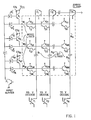
- each memory cell which includes the transistor x ij and its associated fuses f ij stores a logical 0, i.e., the fuse f ij is not open.
- a leaky base emitter junction of an NPN transistor or a short between a bit line and a word line may result in a fuse which fails to open when a programming current is attempted to be applied to the fuse.
- TiW titanium-tungsten
- Vcc maximum supply voltage
- one of the steps of the programming procedure is to raise the supply voltage Vcc to approximately 12 volts, well above the levels used during reading the PROM.
- a memory cell to be programmed containing the array transistor x ij is selected by selecting the word line W j and the bit line B i .
- the selected word line and thus the base of the selected transistor x ij is at approximately 8 volts, a voltage level determined by internal clamping circuitry (not shown).
- the remaining deselected word lines are at approximately 1 volt.
- the base emitter voltage, VBE, of the selected array transistor x ij at a base emitter current of 50 mA is approximately 1.5 volts.
- the bit line B i is held to approximately 7 volts, so that the voltage drop across the fuse f ij is insufficient to cause a current which will cause the fuse to open.
- the array transistor x.. provides to its associated fuse f ij a programming current of 50 mA by amplifying the base current supplied to it through transistor x. (the "word driver”). If an emitter-base (EB) junction of an array transistor x ij to be programmed is shorted or has a sufficiently large leakage current, or if there is a short between its word line W. and its bit line B i , the drive current supplied by word driver x j is not sufficient to provide enough current to cause the fuse to open.
- EB emitter-base
- a short between the base of an array transistor and its associated bit line may cause unintentional programming of another cell on the same bit line. For example, suppose there is a short between the base of transistor X IM (Shown in Fig.l) and bit line B 1 .
- fuse f 11 may unintentionally be opened by current flowing along the following path: from word line W 1 , through the base emitter junction of transistor x 11 , through fuse f l1 to bit line B 1 , from bit line B 1 through the short between bit line B 1 and the base of transistor x IM , to decode diode D* m , and from decode diode D* through buffer transistor F 1 to ground. This will cause the undesired programming (opening) of fuse f 11 .
- PROMs do not contain circuitry to detect the existence of these shorts and therefore since PROMs are typically programmed by the user, defective unprogrammed units may be shipped to the user. This problem does not arise for read-only-memories (ROMs) since these are typically programmed by a mask pattern as a part of the manufacturing process and hence can be tested by the manufacturer prior to shipment.
- ROMs read-only-memories
- This invention includes fault detection circuitry incorporated into a programmable read only memory so that a selected positive voltage can be applied across each memory cell to allow the detection, prior to programming, of shorts between bit lines and word lines and shorts or leaks in a memory cell. By measuring the current flowing into the bit lines, shorts or leaky junctions within memory cells can be detected in unprogrammed devices prior to shipment by the manufacturer.
- the fault detection circuitry is isolated from the memory during normal operation of the memory, thereby having no adverse effect on the operation of the device.
- the fuses f ij used in the memory array may be of any convenient type.
- titanium-tungsten, nickel- chromium, doped polycrystalline silicon, metal alloyed polycrystalline silicon, semiconductor junction fuses, and the like are used in various embodiments.
- a 10K resistor R is connected in series between the terminal T for receiving a test voltage and the anode of diode PD1 whose cathode is connected to the anode of diode PD2 whose cathode is connected to ground.
- the magnitude of the resistance of the resistor R is selected to appropriately limit the current flowing through diodes PD1 and PD2.
- the cathode of diode PD2 is connected to a means S for receiving a second voltage other than ground.
- the resistor R alone is connected between the terminal T and a terminal S for receiving a reference voltage.
- Testing for shorts or leakage in the memory array A shown in Figure 2 is performed in the following manner.
- a positive 3 volts is applied to the terminal T.
- the presence or absence of a short in one of the transistors x ij or between a word line and a bit line is determined by the amount of current flowing into the terminal T.
- the I-V characteristic curve for the circuit of Figure 2 which has no shorts or leakage is shown in Figure 3, and has a slope equal to the reciprocal of the value of resistor R.
- Current begins to flow into the terminal T when the voltage applied to T is approximately 1.6 volts, which is the minimum voltage required to turn on the diodes PD 1 and PD 2 .
Landscapes
- For Increasing The Reliability Of Semiconductor Memories (AREA)
- Read Only Memory (AREA)
- Techniques For Improving Reliability Of Storages (AREA)
Applications Claiming Priority (2)
| Application Number | Priority Date | Filing Date | Title |
|---|---|---|---|
| US564642 | 1983-12-22 | ||
| US06/564,642 US4595875A (en) | 1983-12-22 | 1983-12-22 | Short detector for PROMS |
Publications (2)
| Publication Number | Publication Date |
|---|---|
| EP0146975A2 true EP0146975A2 (de) | 1985-07-03 |
| EP0146975A3 EP0146975A3 (de) | 1988-04-20 |
Family
ID=24255309
Family Applications (1)
| Application Number | Title | Priority Date | Filing Date |
|---|---|---|---|
| EP84200830A Withdrawn EP0146975A3 (de) | 1983-12-22 | 1984-06-09 | Kurzschlussauffinder für Proms |
Country Status (3)
| Country | Link |
|---|---|
| US (1) | US4595875A (de) |
| EP (1) | EP0146975A3 (de) |
| JP (1) | JPS60136100A (de) |
Cited By (6)
| Publication number | Priority date | Publication date | Assignee | Title |
|---|---|---|---|---|
| EP0214914A3 (en) * | 1985-09-09 | 1989-05-03 | Fujitsu Limited | Test method for detecting faulty memory cells in a programmable semiconductor device |
| EP0228283A3 (en) * | 1985-12-27 | 1990-01-03 | Fujitsu Limited | Semiconductor memory circuit having inspection circuit |
| EP0451595A3 (en) * | 1990-04-10 | 1993-03-10 | National Semiconductor Corporation | Short circuit detector circuit for memory array |
| EP0568439A1 (de) * | 1992-04-30 | 1993-11-03 | STMicroelectronics S.A. | Detektionsverfahren und -schaltung für Stromverluste in einer Bitleitung |
| GB2308477A (en) * | 1995-12-21 | 1997-06-25 | Samsung Electronics Co Ltd | Standby current detecting circuit for use in a semiconductor memory device |
| WO1997037357A1 (de) * | 1996-03-28 | 1997-10-09 | Siemens Aktiengesellschaft | Schaltungsanordnung mit einer testschaltung |
Families Citing this family (23)
| Publication number | Priority date | Publication date | Assignee | Title |
|---|---|---|---|---|
| US4814646A (en) * | 1985-03-22 | 1989-03-21 | Monolithic Memories, Inc. | Programmable logic array using emitter-coupled logic |
| US4749947A (en) * | 1986-03-10 | 1988-06-07 | Cross-Check Systems, Inc. | Grid-based, "cross-check" test structure for testing integrated circuits |
| US4779041A (en) * | 1987-05-20 | 1988-10-18 | Hewlett-Packard Company | Integrated circuit transfer test device system |
| US5231637A (en) * | 1988-01-27 | 1993-07-27 | Oki Electric Industry Co., Ltd. | Apparatus for testing a PLA by measuring a current consumed by the PLO when activated with known codes |
| US5065090A (en) * | 1988-07-13 | 1991-11-12 | Cross-Check Technology, Inc. | Method for testing integrated circuits having a grid-based, "cross-check" te |
| US4969124A (en) * | 1989-03-07 | 1990-11-06 | National Semiconductor Corporation | Method for vertical fuse testing |
| JPH03205699A (ja) * | 1990-01-05 | 1991-09-09 | Sharp Corp | 半導体記憶装置 |
| KR920007535B1 (ko) * | 1990-05-23 | 1992-09-05 | 삼성전자 주식회사 | 식별회로를 구비한 반도체 집적회로 칩 |
| US5072175A (en) * | 1990-09-10 | 1991-12-10 | Compaq Computer Corporation | Integrated circuit having improved continuity testability and a system incorporating the same |
| JPH07123134B2 (ja) * | 1990-12-27 | 1995-12-25 | 株式会社東芝 | 半導体装置 |
| US5528600A (en) * | 1991-01-28 | 1996-06-18 | Actel Corporation | Testability circuits for logic arrays |
| US5544070A (en) * | 1991-07-31 | 1996-08-06 | Quicklogic Corporation | Programmed programmable device and method for programming antifuses of a programmable device |
| US5327024A (en) * | 1992-07-02 | 1994-07-05 | Quicklogic Corporation | Field programmable antifuse device and programming method therefor |
| US5162742A (en) * | 1992-01-29 | 1992-11-10 | International Business Machines Corporation | Method for locating electrical shorts in electronic substrates |
| US5400343A (en) * | 1992-02-28 | 1995-03-21 | Intel Corporation | Apparatus and method for defective column detection for semiconductor memories |
| US5293133A (en) * | 1992-08-27 | 1994-03-08 | Quicklogic Corporation | Method of determining an electrical characteristic of an antifuse and apparatus therefor |
| US5428621A (en) * | 1992-09-21 | 1995-06-27 | Sundisk Corporation | Latent defect handling in EEPROM devices |
| KR950015768A (ko) * | 1993-11-17 | 1995-06-17 | 김광호 | 불휘발성 반도체 메모리 장치의 배선단락 검출회로 및 그 방법 |
| US5965902A (en) * | 1995-09-19 | 1999-10-12 | Micron Technology | Method and apparatus for testing of dielectric defects in a packaged semiconductor memory device |
| US5657284A (en) | 1995-09-19 | 1997-08-12 | Micron Technology, Inc. | Apparatus and method for testing for defects between memory cells in packaged semiconductor memory devices |
| US5889410A (en) * | 1996-05-22 | 1999-03-30 | International Business Machines Corporation | Floating gate interlevel defect monitor and method |
| US5909049A (en) * | 1997-02-11 | 1999-06-01 | Actel Corporation | Antifuse programmed PROM cell |
| US6330697B1 (en) * | 1999-04-20 | 2001-12-11 | International Business Machines Corporation | Apparatus and method for performing a defect leakage screen test for memory devices |
Family Cites Families (6)
| Publication number | Priority date | Publication date | Assignee | Title |
|---|---|---|---|---|
| DE2061674A1 (de) * | 1969-12-30 | 1971-07-01 | Honeywell Inf Systems | Prufschaitung zum Überprüfen von elektronischen Speichern |
| US3636518A (en) * | 1970-03-18 | 1972-01-18 | Gte Automatic Electric Lab Inc | Arrangement for detecting shorted diodes in selection matrices in core memories |
| FR2296181A1 (fr) * | 1974-12-27 | 1976-07-23 | Constr Telephoniques | Systeme de test de matrice a diodes |
| US4191996A (en) * | 1977-07-22 | 1980-03-04 | Chesley Gilman D | Self-configurable computer and memory system |
| US4503538A (en) * | 1981-09-04 | 1985-03-05 | Robert Bosch Gmbh | Method and system to recognize change in the storage characteristics of a programmable memory |
| DE3276399D1 (en) * | 1982-09-22 | 1987-06-25 | Itt Ind Gmbh Deutsche | Electrically programmable memory matrix |
-
1983
- 1983-12-22 US US06/564,642 patent/US4595875A/en not_active Expired - Lifetime
-
1984
- 1984-06-09 EP EP84200830A patent/EP0146975A3/de not_active Withdrawn
- 1984-07-10 JP JP59141581A patent/JPS60136100A/ja active Pending
Cited By (12)
| Publication number | Priority date | Publication date | Assignee | Title |
|---|---|---|---|---|
| EP0214914A3 (en) * | 1985-09-09 | 1989-05-03 | Fujitsu Limited | Test method for detecting faulty memory cells in a programmable semiconductor device |
| EP0228283A3 (en) * | 1985-12-27 | 1990-01-03 | Fujitsu Limited | Semiconductor memory circuit having inspection circuit |
| EP0451595A3 (en) * | 1990-04-10 | 1993-03-10 | National Semiconductor Corporation | Short circuit detector circuit for memory array |
| EP0568439A1 (de) * | 1992-04-30 | 1993-11-03 | STMicroelectronics S.A. | Detektionsverfahren und -schaltung für Stromverluste in einer Bitleitung |
| FR2690751A1 (fr) * | 1992-04-30 | 1993-11-05 | Sgs Thomson Microelectronics | Procédé et circuit de détection de fuites de courant dans une ligne de bit. |
| US5351214A (en) * | 1992-04-30 | 1994-09-27 | Sgs-Thomson Microelectronics, S.A. | Memory with on-chip detection of bit line leaks |
| US5539694A (en) * | 1992-04-30 | 1996-07-23 | Sgs-Thomson Microelectronics, S.A. | Memory with on-chip detection of bit line leaks |
| US5602044A (en) * | 1992-04-30 | 1997-02-11 | Sgs-Thomson Microelectronics, S.A. | Memory with on-chip detection of bit line leaks |
| GB2308477A (en) * | 1995-12-21 | 1997-06-25 | Samsung Electronics Co Ltd | Standby current detecting circuit for use in a semiconductor memory device |
| GB2308477B (en) * | 1995-12-21 | 1998-02-25 | Samsung Electronics Co Ltd | Standby current detecting circuit for use in a semiconductor memory device |
| WO1997037357A1 (de) * | 1996-03-28 | 1997-10-09 | Siemens Aktiengesellschaft | Schaltungsanordnung mit einer testschaltung |
| RU2183361C2 (ru) * | 1996-03-28 | 2002-06-10 | Сименс Акциенгезелльшафт | Схемное устройство с испытательной схемой |
Also Published As
| Publication number | Publication date |
|---|---|
| US4595875A (en) | 1986-06-17 |
| JPS60136100A (ja) | 1985-07-19 |
| EP0146975A3 (de) | 1988-04-20 |
Similar Documents
| Publication | Publication Date | Title |
|---|---|---|
| US4595875A (en) | Short detector for PROMS | |
| US4638243A (en) | Short detector for fusible link array using single reference fuse | |
| KR910003147B1 (ko) | 반도체집적회로와 그 시험방법 | |
| US7136322B2 (en) | Programmable semi-fusible link read only memory and method of margin testing same | |
| EP0451595B1 (de) | Kurzschlussdetektor für Speichermatrix | |
| US6373762B2 (en) | Programmable voltage divider and method for testing the impedance of a programmable element | |
| JP3662254B2 (ja) | 有効クローズ、有効オープン又は無効のようなヒューズリンク状態をクラス分けするための確認回路を持つプログラム可能な論理装置 | |
| KR20000062687A (ko) | 퓨즈 검출 회로를 갖는 집적 회로 메모리 | |
| US4701695A (en) | Short detector for PROMS | |
| US4429388A (en) | Field programmable device with internal dynamic test circuit | |
| US4730273A (en) | On-chip programmability verification circuit for programmable read only memory having lateral fuses | |
| EP0192121B1 (de) | Prüfschaltung für eine kreuzgekoppelte Transistorspeicherzelle | |
| US4432070A (en) | High speed PROM device | |
| US7076699B1 (en) | Method for testing semiconductor devices having built-in self repair (BISR) memory | |
| US4862459A (en) | Test method for detecting faulty memory cell of a programmable device | |
| US4670708A (en) | Short detector for fusible link array using a pair of parallel connected reference fusible links | |
| US5379260A (en) | Memory cell having a super supply voltage | |
| JPS58189900A (ja) | 接合書込型リ−ドオンリ−メモリの書込方法 | |
| US4488261A (en) | Field programmable device | |
| US4731760A (en) | On-chip test circuitry for an ECL PROM | |
| US4199731A (en) | Reversable electrically alterable amplifier configurations | |
| US7482854B2 (en) | E-fuse circuit using leakage current path of transistor | |
| US5561635A (en) | PROM IC enabling a stricter memory cell margin test | |
| KR900002072B1 (ko) | 검사회로를 갖는 반도체 메모리 회로 | |
| JPS59919B2 (ja) | 半導体記憶装置 |
Legal Events
| Date | Code | Title | Description |
|---|---|---|---|
| PUAI | Public reference made under article 153(3) epc to a published international application that has entered the european phase |
Free format text: ORIGINAL CODE: 0009012 |
|
| AK | Designated contracting states |
Designated state(s): DE FR GB NL |
|
| PUAL | Search report despatched |
Free format text: ORIGINAL CODE: 0009013 |
|
| AK | Designated contracting states |
Kind code of ref document: A3 Designated state(s): DE FR GB NL |
|
| 17P | Request for examination filed |
Effective date: 19881007 |
|
| RAP1 | Party data changed (applicant data changed or rights of an application transferred) |
Owner name: ADVANCED MICRO DEVICES, INC. |
|
| 17Q | First examination report despatched |
Effective date: 19900313 |
|
| STAA | Information on the status of an ep patent application or granted ep patent |
Free format text: STATUS: THE APPLICATION IS DEEMED TO BE WITHDRAWN |
|
| 18D | Application deemed to be withdrawn |
Effective date: 19910928 |
|
| RIN1 | Information on inventor provided before grant (corrected) |
Inventor name: TSUI, CYRUS Inventor name: BOSNYAK, ROBERT J. Inventor name: GODDARD, DON Inventor name: FITZPATRICK MARK Inventor name: CHAN, ALBERT |