EP0143318A2 - Verwendung von Formaldehyd oder Paraformaldehyd zur Stabilisierung von Polyethylenthiuramdisulfid - Google Patents
Verwendung von Formaldehyd oder Paraformaldehyd zur Stabilisierung von Polyethylenthiuramdisulfid Download PDFInfo
- Publication number
- EP0143318A2 EP0143318A2 EP84112636A EP84112636A EP0143318A2 EP 0143318 A2 EP0143318 A2 EP 0143318A2 EP 84112636 A EP84112636 A EP 84112636A EP 84112636 A EP84112636 A EP 84112636A EP 0143318 A2 EP0143318 A2 EP 0143318A2
- Authority
- EP
- European Patent Office
- Prior art keywords
- temperature
- paraformaldehyde
- petd
- formaldehyde
- added
- Prior art date
- Legal status (The legal status is an assumption and is not a legal conclusion. Google has not performed a legal analysis and makes no representation as to the accuracy of the status listed.)
- Granted
Links
Classifications
-
- A—HUMAN NECESSITIES
- A01—AGRICULTURE; FORESTRY; ANIMAL HUSBANDRY; HUNTING; TRAPPING; FISHING
- A01N—PRESERVATION OF BODIES OF HUMANS OR ANIMALS OR PLANTS OR PARTS THEREOF; BIOCIDES, e.g. AS DISINFECTANTS, AS PESTICIDES OR AS HERBICIDES; PEST REPELLANTS OR ATTRACTANTS; PLANT GROWTH REGULATORS
- A01N25/00—Biocides, pest repellants or attractants, or plant growth regulators, characterised by their forms, or by their non-active ingredients or by their methods of application, e.g. seed treatment or sequential application; Substances for reducing the noxious effect of the active ingredients to organisms other than pests
- A01N25/22—Biocides, pest repellants or attractants, or plant growth regulators, characterised by their forms, or by their non-active ingredients or by their methods of application, e.g. seed treatment or sequential application; Substances for reducing the noxious effect of the active ingredients to organisms other than pests containing ingredients stabilising the active ingredients
-
- A—HUMAN NECESSITIES
- A01—AGRICULTURE; FORESTRY; ANIMAL HUSBANDRY; HUNTING; TRAPPING; FISHING
- A01N—PRESERVATION OF BODIES OF HUMANS OR ANIMALS OR PLANTS OR PARTS THEREOF; BIOCIDES, e.g. AS DISINFECTANTS, AS PESTICIDES OR AS HERBICIDES; PEST REPELLANTS OR ATTRACTANTS; PLANT GROWTH REGULATORS
- A01N47/00—Biocides, pest repellants or attractants, or plant growth regulators containing organic compounds containing a carbon atom not being member of a ring and having no bond to a carbon or hydrogen atom, e.g. derivatives of carbonic acid
- A01N47/08—Biocides, pest repellants or attractants, or plant growth regulators containing organic compounds containing a carbon atom not being member of a ring and having no bond to a carbon or hydrogen atom, e.g. derivatives of carbonic acid the carbon atom having one or more single bonds to nitrogen atoms
- A01N47/10—Carbamic acid derivatives, i.e. containing the group —O—CO—N<; Thio analogues thereof
- A01N47/26—Oxidation products of dithiocarbamic acid derivatives, e.g. thiuram sulfides
Definitions
- the present invention relates to the use of formaldehyde or paraformaldehyde for the stabilization of polyethylene thiuram disulfide and to processes for the preparation of stable polyethylene thiuram disulfide using formaldehyde or paraformaldehyde and stable polyethylene thiuram disulfide which has been prepared in this way.
- Polyethylene thiuram disulfide As a fungicide (R. Wegler, Chemistry of Plant Protection and Pest Control, Vol. 2, page 68 (1970)). Polyethylene thiurane disulfide is produced by the oxidation of ethylene bisdithiocarbamic acid or its water-soluble salts in aqueous solution. It has the disadvantage that it is not stable during long storage, in particular at elevated temperature, and decomposes.
- formaldehyde or paraformaldehyde stabilizes the polyethylene thiuram disulfide. This is done, for example, by mixing polyethylene thiuram disulfide with formaldehyde or paraformaldehyde.
- Formaldehyde and paraformaldehyde are substances that release formaldehyde. In this way, a stable polyethylene thiuram disulfide is obtained.
- the formaldehyde or paraformaldehyde can be used, for example, in amounts of 5 to 50% by weight, in particular 25% by weight, based on polyethylene thiuram disulfide to stabilize polyethylene thiuram disulfide.
- a mixture can also be stabilized which, in addition to polyethylene thiuram disulfide, also contains the zinc salt of ethylene bisdithiocarbamic acid (Zineb) or the corresponding ammonia complex salt (Zineb. 1NH 3 , Zineb. 2NH 3 ).
- Zineb zinc salt of ethylene bisdithiocarbamic acid
- Zineb. 1NH 3 Zineb. 2NH 3
- such a mixture contains 5 to 30% by weight of polyethylene thiuram disulfide and 95 to 70% by weight of zineb or its ammonia complex salt.
- zineb and its ammonia complex salts are zine salts.
- PETD dry polyethylene thiuram disulfide
- a very good effect is achieved if an aqueous PETD suspension of between 5 and 50% FA is added, preferably an admixture of a Quantity of 25% FA, based on PETD.
- An addition below 5% brings no significant improvement in storage. Additions above 50% adversely affect biological activity and create environmental problems during drying and storage.
- a stirring time of at least 1, better 2 hours is maintained before drying begins. The temperature during stirring is about 25 to 35 ° C. If the PA is added to the dry PETD, the compounds are expediently mixed intensively in order to produce a homogeneous mixture.
- the storage stability was assessed by determining the active substance content after storage at room temperature (20 to 25 ° C) and at 50 ° C in a climatic chamber, the size of sales packaging and in test tubes, with quantities of 30 g being used in the latter case.
- the content of ethylene thiourea serves as a further characteristic for assessing the stability, since this substance is produced as a decomposition product during degradation.
- the suspensions produced in this way are spray dried using a pilot machine (inlet temperature: 180 ° C, outlet temperature: 75 to 85 ° C).
- test tubes are filled with the corresponding products and sealed well with a rubber stopper and placed in a temperature cabinet of 50 ° C.
- the test glasses are opened and the contents analyzed at intervals of 1, 2 and 4 weeks.
- the active substance content is determined by means of removable CS 2 and the ethylene thiourea is checked by means of thin layer chromatography.
- the product When mixed with 5 and 10% FA, the product is fairly decomposed after 2 weeks. The product remains relatively stable with 15% FA for 4 weeks, while a 20% FA addition stabilizes the goods for 8 weeks.
- a spray suspension consisting of 420.0 kg of PETD and 6200 l of water is mixed with continuous stirring and at a temperature between 25 and 28 ° C. 210 kg of a 40% aqueous formaldehyde solution within 45 min. Allow to run in, then stir for a further 90 min.
- 25 kg of the dry mixture are filled in bags with polyethylene inner film and the shelf life is examined in a climatic chamber and at room temperature. In order to tighten the storage conditions, an additional load was placed on the individual bags with a weight of 125 kg per bag.
- Packaging storage test (sack with polyethylene inner film) starting material PETD (untreated)
- test tubes were filled to test their storage behavior and stored in a warming cabinet at 50 ° C.
- the suspensions produced in this way are spray dried using a pilot machine (inlet temperature: 200 ° C, outlet temperature: 80 to 85 ° C).
- test tubes are filled with the corresponding products and sealed well with a rubber stopper and placed in a temperature cabinet of 50 ° C.
- the test glasses are opened and the contents analyzed at intervals of 1, 2 and 4 weeks.
- the active ingredient When mixed with 0.5% FA, the active ingredient has decomposed in half after 2 to 4 weeks.
- the products remained stable with 1.5 and 2.5% FA for at least 4 weeks, while a 5% FA addition stabilized the goods for at least 8 weeks.
- the suspensions produced in this way are spray dried using a pilot plant (inlet temperature: 200 ° C, outlet temperature: 80 to 85 ° C).
- test tubes are filled with the corresponding products and sealed well with a rubber stopper and placed in a temperature cabinet of 50 ° C.
- the test glasses are opened and the contents analyzed at intervals of 1, 2 and 4 weeks.
- the suspensions produced in this way are spray dried using a pilot plant (inlet temperature: 200 ° C, outlet temperature: 80 to 85 ° C).
- test tubes are filled with the corresponding products and sealed well with a rubber stopper and placed in a temperature cabinet of 50 ° C.
- the test glasses are opened and the contents analyzed at intervals of 1, 2 and 4 weeks.
- the suspensions produced in this way are spray dried using a pilot plant (inlet temperature: 200 ° C, outlet temperature: 80 to 85 ° C).
- test tubes are filled with the corresponding products and sealed well with a rubber stopper and placed in a temperature cabinet of 50 ° C.
- the test glasses are opened and the contents analyzed at intervals of 1, 2 and 4 weeks.
- the suspensions produced in this way are spray dried using a pilot plant (inlet temperature: 200 ° C, outlet temperature: 80 to 85 ° C).
- test tubes are filled with the corresponding products and sealed well with a rubber stopper and placed in a temperature cabinet of 50 ° C.
- the test glasses are opened and the contents analyzed at intervals of 1, 2 and 4 weeks.
- the suspensions produced in this way are spray dried using a pilot plant (inlet temperature: 200 ° C, outlet temperature: 80 to 85 ° C).
- test tubes are filled with the corresponding products and sealed well with a rubber stopper and placed in a temperature cabinet of 50 ° C.
- the test glasses are opened and the contents analyzed at intervals of 1, 2 and 4 weeks.
- the suspensions produced in this way are spray dried using a pilot plant (inlet temperature: 200 ° C, outlet temperature: 80 to 85 ° C).
- test tubes are filled with the corresponding products and sealed well with a rubber stopper and placed in a temperature cabinet of 50 ° C.
- the test glasses are opened at intervals of 1, 2 and 4 weeks and the content is analyzed.
- the suspensions produced in this way are spray dried using a pilot plant (inlet temperature: 200 ° C, outlet temperature: 80 to 85 ° C).
- test tubes are filled with the corresponding products and sealed well with a rubber stopper and placed in a temperature cabinet of 50 ° C.
- the test glasses are opened and the contents analyzed at intervals of 1, 2 and 4 weeks.
- the suspensions produced in this way are spray dried using a pilot plant (inlet temperature: 200 ° C, outlet temperature: 80 to 85 ° C).
- test tubes are filled with the corresponding products and sealed well with a rubber stopper and placed in a temperature cabinet of 50 ° C.
- the test glasses are opened and the contents analyzed at intervals of 1, 2 and 4 weeks.
- the suspensions produced in this way are spray dried using a pilot plant (inlet temperature: 200 ° C, outlet temperature: 80 to 85 ° C).
- test tubes are filled with the corresponding products and sealed well with a rubber stopper and placed in a temperature cabinet of 50 ° C.
- the test glasses are opened and the contents analyzed at intervals of 1, 2 and 4 weeks.
- the suspensions produced in this way are spray dried using a pilot plant (inlet temperature: 200 ° C, outlet temperature: 80 to 85 ° C).
- test tubes are filled with the corresponding products and sealed well with a rubber stopper and placed in a temperature cabinet of 50 ° C.
- the test glasses are opened and the contents analyzed at intervals of 1, 2 and 4 weeks.
- the suspensions produced in this way are spray dried using a pilot plant (inlet temperature: 200 ° C, outlet temperature: 80 to 85 ° C).
- test tubes are filled with the corresponding products and sealed well with a rubber stopper and placed in a temperature cabinet of 50 ° C.
- the test glasses are opened and the contents analyzed at intervals of 1, 2 and 4 weeks.
- the suspensions produced in this way are spray dried using a pilot plant (inlet temperature: 200 ° C, outlet temperature: 80 to 85 ° C).
- test tubes are filled with the corresponding products and sealed well with a rubber stopper and placed in a temperature cabinet of 50 ° C.
- the test glasses are opened and the contents analyzed at intervals of 1, 2 and 4 weeks.
- 1 kg spray suspension consisting of 400 g PETD and 600 g water, is at a temperature of 30 ° C for 30 min. stirred and spray dried using a pilot plant (inlet temperature: 180 ° C, outlet temperature: 75 to 85 ° C).
- test tubes are filled with the corresponding products and sealed well with a rubber stopper and placed in a temperature cabinet of 50 ° C.
- the test glasses are opened and the contents analyzed at intervals of 1, 2 and 4 weeks.
- the active substance content is determined by means of removable CS 2 and the ethylene thiourea is checked by means of thin layer chromatography.
- 1 kg spray suspension consisting of 400 g P.C. (Zineb-PETD: 95: 5) and 600 g of water, is at a temperature of 30 ° C for 30 min. long stirred and then spray dried using a pilot machine (inlet temperature: 200 ° C, outlet temperature: 80 to 85 ° C).
- 1 kg spray suspension consisting of 400 g P.C. (Zineb-PETD: 90:10) and 600 g of water, is at a temperature of 30 ° C for 30 min. long stirred and then spray dried using a pilot machine (inlet temperature: 200 ° C, outlet temperature: 80 to 85 ° C).
- 1 kg spray suspension consisting of 400 g P.C. (Zineb-PETD: 80:20) and 600 g of water, is at a temperature of 30 ° C for 30 min. long stirred and then spray dried using a pilot machine (inlet temperature: 200 ° C, outlet temperature: 80 to 85 ° C).
- 1 kg spray suspension consisting of 400 g P.C. (Zineb-PETD: 70:30) and 600 g of water, is at a temperature of 30 ° C for 30 min. long stirred and then spray dried using a pilot machine (inlet temperature: 200 ° C, outlet temperature: 80 to 85 ° C).
- 1 kg spray suspension consisting of 400 g PC (Zineb.NH 3 -PETD: 95: 5) and 600 g water, is at a temperature of 30 ° C for 30 min. long stirred and then spray dried using a pilot machine (inlet temperature: 200 ° C, outlet temperature: 80 to 85 ° C).
- 1 kg spray suspension consisting of 400 g PC (Zineb.NH 3 -PETD: 90:10) and 600 g water, is at a temperature of 30 ° C for 30 min. long stirred and then spray dried using a pilot machine (inlet temperature: 200 ° C, outlet temperature: 80 to 85 ° C).
- 1 kg of spray suspension consisting of 400 g PC (Zineb.NH 3 -PETD: 80:20) and 600 g water, is at a temperature of 30 ° C for 30 min. long stirred and then spray dried using a pilot machine (inlet temperature: 200 ° C, outlet temperature: 80 to 85 ° C).
- 1 kg spray suspension consisting of 400 g PC (Zineb.NH 3 -PETD: 70:30) and 600 g water, is at a temperature of 30 ° C for 30 min. long stirred and then spray dried using a pilot machine (inlet temperature: 200 ° C, outlet temperature: 80 to 85 ° C).
- 1 kg spray suspension consisting of 400 g PC (Zineb.2NH 3 -PETD: 95: 5) and 600 g water, is at a temperature of 30 ° C for 30 min. long stirred and then spray dried using a pilot machine (inlet temperature: 200 ° C, outlet temperature: 80 to 85 ° C).
- 1 kg of spray suspension consisting of 400 g PC (Zineb.2NH 3 -PETD: 90:10) and 600 g water, is at a temperature of 30 ° C for 30 min. long stirred and then spray dried using a pilot machine (inlet temperature: 200 ° C, outlet temperature: 80 to 85 ° C).
- 1 kg spray suspension consisting of 400 g PC (Zineb.2NH 3 -PETD: 80:20) and 600 g water, is at a temperature of 30 ° C for 30 min. long stirred and then spray dried using a pilot machine (inlet temperature: 200 ° C, outlet temperature: 80 to 85 ° C).
- 1 kg of spray suspension consisting of 400 g PC (Zineb.2NH 3 -PETD: 70:30) and 600 g water, is at a temperature of 30 ° C for 30 min. long stirred and then spray dried using a pilot machine (inlet temperature: 200 ° C, outlet temperature: 80 to 85 ° C).
Landscapes
- Life Sciences & Earth Sciences (AREA)
- General Health & Medical Sciences (AREA)
- Health & Medical Sciences (AREA)
- Wood Science & Technology (AREA)
- Pest Control & Pesticides (AREA)
- Plant Pathology (AREA)
- Engineering & Computer Science (AREA)
- Dentistry (AREA)
- Agronomy & Crop Science (AREA)
- Zoology (AREA)
- Environmental Sciences (AREA)
- Toxicology (AREA)
- Agricultural Chemicals And Associated Chemicals (AREA)
- Compositions Of Macromolecular Compounds (AREA)
- Organic Low-Molecular-Weight Compounds And Preparation Thereof (AREA)
Abstract
Description
- Die vorliegende Erfindung betrifft die Verwendung von Formaldehyd oder Paraformaldehyd zur Stabilisierung von Polyethylenthiuramdisulfid sowie Verfahren zur Herstellung von stabilem Polyethylenthiuramdisulfid unter Verwendung von Formaldehyd oder Paraformaldehyd und stabiles Polyethylenthiuramdisulfid, das auf diese Weise hergestellt worden ist.
- Es ist bekannt, Polyethylenthiuramdisulfid als Fungizid zu verwenden (R. Wegler, Chemie der Pflanzenschutz- und Schädlingsbekämpfungsmittel, Bd. 2, Seite 68 (1970)). Polyethylenthiurandisulfid wird hergestellt durch Oxidation von Ethylenbisdithiocarbaminsäure oder ihren wasserlöslichen Salzen in wäßriger Lösung. Es hat den Nachteil, daß es bei längerer Lagerung, insbesondere bei erhöhter Temperatur, nicht stabil ist und sich zersetzt.
- Es wurde nun gefunden, daß durch Verwendung von Formaldehyd oder Paraformaldehyd das Polyethylenthiuramdisulfid stabilisiert wird. Dies erfolgt beispielsweise in der Weise, daß man Polyethylenthiuramdisulfid mit Formaldehyd oder Paraformaldehyd mischt. Formaldehyd und Paraformaldehyd sind Formaldehyd abgebende Substanzen. Auf diese Weise erhält man ein stabiles Polyethylenthiuramdisulfid. Der Formaldehyd oder Paraformaldehyd kann beispielsweise in Mengen von 5 bis 50 Gew.-%, insbesondere 25 Gew.-%, bezogen auf Polyethylenthiuramdisulfid zur Stabilisierung von Polyethylenthiuramdisulfid verwendet werden. Anstelle von Polyethylenthiuramdisulfid kann auch eine Mischung stabilisiert werden, die neben Polyethylenthiuramdisulfid noch das Zinksalz der Ethylenbisdithiocarbaminsäure (Zineb) oder das entsprechende Ammoniakkomplexsalz (Zineb . 1NH3, Zineb . 2NH3) enthält. Beispielsweise enthält eine solche Mischung 5 bis 30 Gew.% Polyethylenthiuramdisulfid und 95 bis 70 Gew.% Zineb oder sein Ammoniakkomplexsalz. Durch Mischen der obengenannten Mischung mit Formaldehyd oder Paraformaldehyd erhält man ebenfalls ein stabiles Produkt. Zineb und seine Ammoniakkomplexsalze sind Zinebsalze.
- Man kann beispielsweise einer wäßrigen Suspension oder dem trockenen Polyethylenthiuramdisulfid (PETD) von 5 bis 50 Gew.-% Formaldehyd (FA) oder Paraformaldehyd (PA), bezogen auf PETD zusetzen. Ein so behandeltes PETD zeigt eine wesentliche Verbesserung der Lagerstabilität (Erhaltung des Wirkstoffes) ohne Einbuße der biologischen Wirksamkeit.
- Eine sehr gute Wirkung wird erzielt, wenn man einer wäßrigen PETD-Suspension zwischen 5 und 50 % FA zugibt, wobei bevorzugt eine Zumischung einer Menge von 25 % FA, bezogen auf PETD erfolgt. Eine Zugabe unter 5 % bringt keine signifikante Lagerungsverbesserung. Zugaben über 50 % beeinflussen die biologische Aktivität nachteilig und erzeugen Umweltprobleme während der Trocknung und Lagerung. Nach der Stabilisatorzugabe in die wäßrige Suspension wird beispielsweise eine Rührzeit von mindestens 1, besser 2 Std. eingehalten, bevor die Trocknung beginnt. Die Temperatur beim Rühren beträgt etwa 25 bis 35°C. Falls das PA zu dem trockenen PETD zugesetzt wird, wird zweckmäßig eine intensive Vermischung der Verbindungen zwecks Herstellung einer homogenen Mischung vorgenommen.
- Die folgenden Beispiele zeigen die gute Wirkung von FA oder PA.
- Die Beurteilung der Lagerstabilität erfolgte durch die Bestimmung des Wirkstoffgehaltes nach Lagerung bei Raumtemperatur (20 bis 25°C) und bei 50°C in einer Klimakammer, in der Größe von Verkaufsverpackungen und in Reagenzgläsern, wobei im letzten Falle Mengen von 30 g eingesetzt wurden.
- Als ein weiteres Merkmal für die Beurteilung der Stabilität dient der Gehalt an Ethylenthioharnstoff, da diese Substanz als Zersetzungsprodukt beim Abbau entsteht.
- Zu 1 kg Sprühsuspension, bestehend aus 400 g PETD und 600 g Wasser werden unter starkem Rühren bei einer Anfangstemperatur von ca. 22°C 80 g einer 25 Xigen wäßrigen Formaldehydlösung zugegeben. Danach erhöht man die Temperatur auf max. 30°C und rührt 30 min weiter. Auf dieselbe Art werden durch Zugabe von jeweils 160, 240 und 320 g 25 %igem Formaldehyd drei weitere entsprechende Konzentrationen hergestellt.
- Die auf diese Weise hergestellten Suspensionen werden mittels eines Technikumgerätes sprühgetrocknet (Eingangs-Temperatur: 180°C, Ausgangs-Temperatur: 75 bis 85°C).
- Danach werden pro Beispiel verschiedene Reagenzgläser mit den entsprechenden Produkten gefüllt und mit einem Gummistopfen gut verschlossen und in einen Temperaturschrank von 50°C gebracht. In Abständen von 1, 2 und 4 Wochen werden die Versuchsgläser geöffnet und der Inhalt analysiert.
- Der Wirkstoffgehalt wird mittels abspaltbaren CS2 bestimmt und der Ethylenthioharnstoff mittels Dünnschichtchromatographie geprüft.

- Bei der Mischung mit 5 und 10 % FA ist das Produkt nach 2 Wochen ziemlich zersetzt. 4 Wochen relativ stabil bleibt das Produkt mit 15 % FA, während ein 20 %iger FA-Zusatz die Ware 8 Wochen lang stabilisiert.
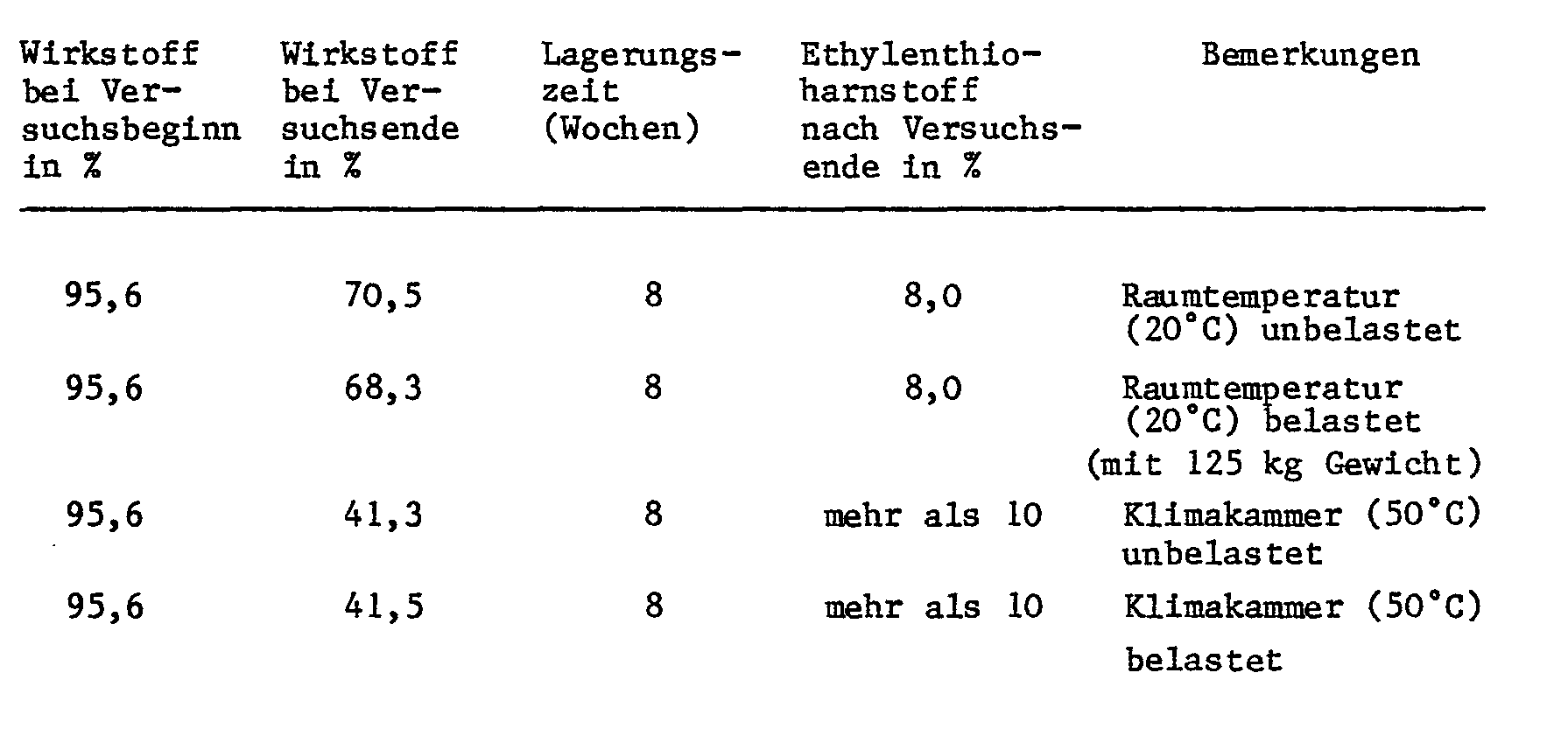
- Zu einer Sprühsuspension, bestehend aus 420,0 kg PETD und 6200 1 Wasser werden unter stetiger Rührung und bei einer Temperatur zwischen 25 und 28°C 210 kg einer 40 Xigen wäßrigen Formaldehydlösung innerhalb von 45 min. zulaufen lassen, anschließend wird noch 90 min nachgerührt. Nach der darauffolgenden Sprühtrocknung in entsprechenden Produktionsanlagen werden jeweils 25 kg der trockenen Mischung in Säcken mit Polyethyleninnenfolie abgefüllt und die Lagerfähigkeit in einer Klimakammer und bei Raumtemperatur untersucht. Zwecks Verschärfung der Lagerbedingungen erfolgte noch eine zusätzliche Belastung der einzelnen Säcke durch ein Gewicht von 125 kg je Sack.
- Zu frisch getrockneten 420 kg PETD werden 42 kg Paraformaldehyd zugemischt. Danach wird die Mischung gemahlen und homogenisiert. Anschließend wird das Produkt in Säcken mit Polyethyleninnenfolie abgefüllt und wie in Beispiel 2 auf die Lagerungsstabilität hin untersucht.
- PETD
- Verpackungslagerungstest (Sack mit Polyethyleninnenfolie) Ausgangsware PETD (unbehandelt)

-

- Wie Beispiel 2 und 3, nur wurden zur Testung des Lagerverhaltens Reagenzgläser gefüllt und in einem Wärmeschrank bei 50°C gelagert.
-

- In der Tabelle wird der Einfluß verschiedener Mengen Formaldehyd auf die Lagerungsstabilität von PETD dargestellt.
- Verschiedene Verpackungslagertests in der Klimakammer bei 50°C
-

- Zu 1 kg Sprühsuspension, bestehend aus 400 g P.C. und 600 g Wasser werden unter starkem Rühren bei einer Anfangstemperatur von ca. 22°C 8 g einer 25 %igen reinen wäßrigen Formaldehydlösung zugegeben. Danach erhöht man die Temperatur auf max. 30°C und rührt 30 min. weiter. Auf dieselbe beschriebene Art werden durch Zugabe von jeweils 24, 40, 80 und 160 g 25 %igem Formaldehyd vier weitere entsprechende Konzentratonen eingestellt.
- Die auf diese Weise hergestellten Suspensionen werden mittels eines Technikumgerätes sprühgetrocknet (Eingangs-Temperatur: 200°C, Ausgangs--Temperatur: 80 bis 85°C).
- Danach werden verschiedene Reagenzgläser mit den entsprechenden Produkten gefüllt und mit einem Gummistopfen gut verschlossen und in einen Temperaturschrank von 50°C gebracht. In Abständen von 1, 2 und 4 Wochen werden die Versuchsgläser geöffnet und der Inhalt analysiert.

- Bei der Mischung mit 0,5 % FA hat sich der Wirkstoff nach 2 bis 4 Wochen zur Hälfte zersetzt. Jeweils mindestens 4 Wochen stabil bleiben die Produkte mit 1,5 und 2,5 % FA, während ein 5 %iger FA-Zusatz die Ware mindestens 8 Wochen lang stabilisierte.
- Zu einer Sprühsuspension, bestehend aus 420,0 kg P.C. und 6200 1 Wasser werden unter stetiger Rührung und bei einer Temperatur zwischen 25 bis 28°C 477 1 einer 40 %igen wäßrigen Formaldehydlösung innerhalb von 45 min. zulaufen lassen, anschließend werden noch 90 min. nachgerührt. Nach der darauffolgenden Sprühtrocknung in entsprechenden Produktionsanlagen werden jeweils 25 kg der trockenen Mischung in Säcken ist PE-Innenfolie abgefüllt und die Lagerfähigkeit in einer Klimakammer und bei Raumtemperatur untersucht. Zwecks Verschärfung der Lagerbedingungen erfolgte noch eine zusätzliche Belastung der einzelnen Säcke durch entsprechende Gewichte von 125 kg je Sack.
- Wie Beispiel 7, nur werden jetzt 12,6 kg Paraformaldehyd zugesetzt.


- Die besten Werte erzielt man bei Zugabe von Formaldehyd. Auch die Zugabe von Paraformaldehyd bringt eine signifikante Lagerungsverbesserung wie man auch an dem niedrigen Ethylenthioharnstoffgehalt erkennen kann.
- Wie in den Beispielen 7 und 8, nur wurden zur Testung des Lagerverhaltens Reagenzgläser gefüllt und in einem Wärmeschrank bei 50°C gelagert.

- In der Tabelle wird der Einfluß verschiedener Mengen Formaldehyd auf die Lagerungsstabilität von P.C. dargestellt.

- Zu 1 kg Sprühsuspension, bestehend aus 400 g P.C. (Zineb-PETD: 95:5) und 600 g Wasser, werden unter starkem Rühren bei einer Anfangstemperatur von 22°C 8 g einer 25 %igen wäßrigen Formaldehydlösung zugegeben. Danach erhöht man die Temperatur auf max. 30°C und rührt 30 min. weiter. Auf dieselbe beschriebene Art werden durch Zugabe von jeweils 24 und 40 g 25 %iger Formaldehydlösung vier weitere entsprechende Konzentrationen hergestellt.
- Die auf diese Weise hergestellten Suspensionen werden mittels eines Technikumgerätes sprühgetrocknet (Eingangstemperatur: 200°C, Ausgangstemperatur: 80 bis 85°C).
- Danach werden verschiedene Reagenzgläser mit den entsprechenden Produkten gefüllt und mit einem Gummistopfen gut verschlossen und in einen Temperaturschrank von 50°C gebracht. In Abständen von 1, 2 und 4 Wochen werden die Versuchsgläser geöffnet und der Inhalt analysiert.


- Zu 1 kg Sprühsuspension, bestehend aus 400 g P.C. (Zineb-PETD: 90:10) und 600 g Wasser, werden unter starkem Rühren bei einer Anfangstemperatur von 22°C 8 g einer 25 %igen wäßrigen Formaldehydlösung zugegeben. Danach erhöht man die Temperatur auf max. 30°C und rührt 30 min. weiter. Auf dieselbe beschriebene Art werden durch Zugabe von jeweils 24, 40 und 80 g 25 %iger Formaldehydlösung vier weitere entsprechende Konzentrationen hergestellt.
- Die auf diese Weise hergestellten Suspensionen werden mittels eines Technikumgerätes sprühgetrocknet (Eingangstemperatur: 200°C, Ausgangstemperatur: 80 bis 85°C).
- Danach werden verschiedene Reagenzgläser mit den entsprechenden Produkten gefüllt und mit einem Gummistopfen gut verschlossen und in einen Temperaturschrank von 50°C gebracht. In Abständen von 1, 2 und 4 Wochen werden die Versuchsgläser geöffnet und der Inhalt analysiert.

- Zu 1 kg Sprühsuspension, bestehend aus 400 g P.C. (Zineb-PETD: 80:20) und 600 g Wasser, werden unter starkem Rühren bei einer Anfangstemperatur von 22°C 8 g einer 25 Xigen wäßrigen Formaldehydlösung zugegeben. Danach erhöht man die Temperatur auf max. 30°C und rührt 30 min. weiter. Auf dieselbe beschriebene Art werden durch Zugabe von jeweils 24, 40, 80 und 160 g 25 %iger Formaldehydlösung vier weitere entsprechende Konzentrationen hergestellt.
- Die auf diese Weise hergestellten Suspensionen werden mittels eines Technikumgerätes sprühgetrocknet (Eingangstemperatur: 200°C, Ausgangstemperatur: 80 bis 85°C).
- Danach werden verschiedene Reagenzgläser mit den entsprechenden Produkten gefüllt und mit einem Gummistopfen gut verschlossen und in einen Temperaturschrank von 50°C gebracht. In Abständen von 1, 2 und 4 Wochen werden die Versuchsgläser geöffnet und der Inhalt analysiert.

- Zu 1 kg Sprühsuspension, bestehend aus 400 g P.C. (Zineb-PETD: 70:30) und 600 g Wasser, werden unter starkem Rühren bei einer Anfangstemperatur von 22°C 8 g einer 25 %igen wäßrigen Formaldehydlösung zugegeben. Danach erhöht man die Temperatur auf max. 30°C und rührt 30 min. weiter. Auf dieselbe beschriebene Art werden durch Zugabe von jeweils 24, 40, 80 und 160 g 25 %iger Formaldehydlösung vier weitere entsprechende Konzentrationen hergestellt.
- Die auf diese Weise hergestellten Suspensionen werden mittels eines Technikumgerätes sprühgetrocknet (Eingangstemperatur: 200°C, Ausgangstemperatur: 80 bis 85°C).
- Danach werden verschiedene Reagenzgläser mit den entsprechenden Produkten gefüllt und mit einem Gummistopfen gut verschlossen und in einen Temperaturschrank von 50°C gebracht. In Abständen von 1, 2 und 4 Wochen werden die Versuchsgläser geöffnet und der Inhalt analysiert.


- Zu 1 kg Sprühsuspension, bestehend aus 400 g P.C. (Zineb.NH3-PETD: 95:5) und 600 g Wasser, werden unter starkem Rühren bei einer Anfangstemperatur von 22°C 8 g einer 25 %igen wäßrigen Formaldehydlösung zugegeben. Danach erhöht man die Temperatur auf max. 30°C und rührt 30 min. weiter. Auf dieselbe beschriebene Art werden durch Zugabe von jeweils 24 und 40 g 25 %iger Formaldehydlösung vier weitere entsprechende Konzentrationen hergestellt.
- Die auf diese Weise hergestellten Suspensionen werden mittels eines Technikumgerätes sprühgetrocknet (Eingangstemperatur: 200°C, Ausgangstemperatur: 80 bis 85°C).
- Danach werden verschiedene Reagenzgläser mit den entsprechenden Produkten gefüllt und mit einem Gummistopfen gut verschlossen und in einen Temperaturschrank von 50°C gebracht. In Abständen von 1, 2 und 4 Wochen werden die Versuchsgläser geöffnet und der Inhalt analysiert.


- Zu 1 kg Sprühsuspension, bestehend aus 400 g P.C. (Zineb.NH3-PETD: 90:10) und 600 g Wasser, werden unter starkem Rühren bei einer Anfangstemperatur von 22°C 8 g einer 25 %igen wäßrigen Formaldehydlösung zugegeben. Danach erhöht man die Temperatur auf max. 30°C und rührt 30 min. weiter. Auf dieselbe beschriebene Art werden durch Zugabe von jeweils 24, 40 und 80 g 25 Ziger Formaldehydlösung vier weitere entsprechende Konzentrationen hergestellt.
- Die auf diese Weise hergestellten Suspensionen werden mittels eines Technikumgerätes sprühgetrocknet (Eingangstemperatur: 200°C, Ausgangstemperatur: 80 bis 85°C).
- Danach werden verschiedene Reagenzgläser mit den entsprechenden Produkten gefüllt und mit einem Gummistopfen gut verschlossen und in einen Temperaturschrank von 50°C gebracht. In Abständen von 1, 2 und 4 Wochen werden die Versuchsgläser-geöffnet und der Inhalt analysiert.

- Zu 1 kg Sprühsuspension, bestehend aus 400 g P.C. (Zineb.NH3-PETD: 80:20) und 600 g Wasser, werden unter starkem Rühren bei einer Anfangstemperatur von 22°C 8 g einer 25 %igen wäßrigen Formaldehydlösung zugegeben. Danach erhöht man die Temperatur auf max. 30°C und rührt 30 min. weiter. Auf dieselbe beschriebene Art werden durch Zugabe von jeweils 24, 40, 80 und 160 g 25 %iger Formaldehydlösung vier weitere entsprechende Konzentrationen hergestellt.
- Die auf diese Weise hergestellten Suspensionen werden mittels eines Technikumgerätes sprühgetrocknet (Eingangstemperatur: 200°C, Ausgangstemperatur: 80 bis 85°C).
- Danach werden verschiedene Reagenzgläser mit den entsprechenden Produkten gefüllt und mit einem Gummistopfen gut verschlossen und in einen Temperaturschrank von 50°C gebracht. In Abständen von 1, 2 und 4 Wochen werden die Versuchsgläser geöffnet und der Inhalt analysiert.

- Zu 1 kg Sprühsuspension, bestehend aus 400 g P.C. (Zineb.NH3-PETD: 70:30) und 600 g Wasser, werden unter starkem Rühren bei einer Anfangstemperatur von 22°C 8 g einer 25 %igen wäßrigen Formaldehydlösung zugegeben. Danach erhöht man die Temperatur auf max. 30°C und rührt 30 min. weiter. Auf dieselbe beschriebene Art werden durch Zugabe von jeweils 24, 40 und 160 g 25 %iger Formaldehydlösung vier weitere entsprechende Konzentrationen hergestellt.
- Die auf diese Weise hergestellten Suspensionen werden mittels eines Technikumgerätes sprühgetrocknet (Eingangstemperatur: 200°C, Ausgangstemperatur: 80 bis 85°C).
- Danach werden verschiedene Reagenzgläser mit den entsprechenden Produkten gefüllt und mit einem Gummistopfen gut verschlossen und in einen Temperaturschrank von 50°C gebracht. In Abständen von 1, 2 und 4 Wochen werden die Versuchsgläser geöffnet und der Inhalt analysiert.


- Zu 1 kg Sprühsuspension, bestehend aus 400 g P.C. (Zineb.2NH3-PETD: 95:5) und 600 g Wasser, werden unter starkem Rühren bei einer Anfangstemperatur von 22°C 8 g einer 25 %igen wäßrigen Formaldehydlösung zugegeben. Danach erhöht man die Temperatur auf max. 30°C und rührt 30 min. weiter. Auf dieselbe beschriebene Art werden durch Zugabe von jeweils 24 und 40 g 25 %iger Formaldehydlösung vier weitere entsprechende Konzentrationen hergestellt.
- Die auf diese Weise hergestellten Suspensionen werden mittels eines Technikumgerätes sprühgetrocknet (Eingangstemperatur: 200°C, Ausgangstemperatur: 80 bis 85°C).
- Danach werden verschiedene Reagenzgläser mit den entsprechenden Produkten gefüllt und mit einem Gummistopfen gut verschlossen und in einen Temperaturschrank von 50°C gebracht. In Abständen von 1, 2 und 4 Wochen werden die Versuchsgläser geöffnet und der Inhalt analysiert.

- Zu 1 kg Sprühsuspension, bestehend aus 400 g P.C. (Zineb.2NH3-PETD: 90:10) und 600 g Wasser, werden unter starkem Rühren bei einer Anfangstemperatur von 22°C 8 g einer 25 %igen wäßrigen Formaldehydlösung zugegeben. Danach erhöht man die Temperatur auf max. 30°C und rührt 30 min. weiter. Auf dieselbe beschriebene Art werden durch Zugabe von jeweils 24, 40 und 80 g 25 %iger Formaldehydlösung vier weitere entsprechende Konzentrationen hergestellt.
- Die auf diese Weise hergestellten Suspensionen werden mittels eines Technikumgerätes sprühgetrocknet (Eingangstemperatur: 200°C, Ausgangstemperatur: 80 bis 85°C).
- Danach werden verschiedene Reagenzgläser mit den entsprechenden Produkten gefüllt und mit einem Gummistopfen gut verschlossen und in einen Temperaturschrank von 50°C gebracht. In Abständen von 1, 2 und 4 Wochen werden die Versuchsgläser geöffnet und der Inhalt analysiert.

- Zu 1 kg Sprühsuspension, bestehend aus 400 g P.C. (Zineb.2NH3-PETD: 80:20)und 600 g Wasser, werden unter starkem Rühren bei einer Anfangstemperatur von 22°C 8 g einer 25 %igen wäßrigen Formaldehydlösung zugegeben. Danach erhöht man die Temperatur auf max. 30°C und rührt 30 min. weiter. Auf dieselbe beschriebene Art werden durch Zugabe von jeweils 24, 40, 80 und 160 g 25 %iger Formaldehydlösung vier weitere entsprechende Konzentrationen hergestellt.
- Die auf diese Weise hergestellten Suspensionen werden mittels eines Technikumgerätes sprühgetrocknet (Eingangstemperatur: 200°C, Ausgangstemperatur: 80 bis 85°C).
- Danach werden verschiedene Reagenzgläser mit den entsprechenden Produkten gefüllt und mit einem Gummistopfen gut verschlossen und in einen Temperaturschrank von 50°C gebracht. In Abständen von 1, 2 und 4 Wochen werden die Versuchsgläser geöffnet und der Inhalt analysiert.


- Zu 1 kg Sprühsuspension, bestehend aus 400 g P.C. (Zineb.2NH3-PETD: 70:30) und 600 g Wasser, werden unter starkem Rühren bei einer Anfangstemperatur von 22°C 8 g einer 25 %igen wäßrigen Formaldehydlösung zugegeben. Danach erhöht man die Temperatur auf max. 30°C und rührt 30 min. weiter. Auf dieselbe beschriebene Art werden durch Zugabe von jeweils 24, 40, 80 und 160 g 25 Ziger Formaldehydlösung vier weitere entsprechende Konzentrationen hergestellt.
- Die auf diese Weise hergestellten Suspensionen werden mittels eines Technikumgerätes sprühgetrocknet (Eingangstemperatur: 200°C, Ausgangstemperatur: 80 bis 85°C).
- Danach werden verschiedene Reagenzgläser mit den entsprechenden Produkten gefüllt und mit einem Gummistopfen gut verschlossen und in einen Temperaturschrank von 50°C gebracht. In Abständen von 1, 2 und 4 Wochen werden die Versuchsgläser geöffnet und der Inhalt analysiert.


- 1 kg Sprühsuspension, bestehend aus 400 g PETD und 600 g Wasser, wird bei einer Temperatur von 30°C 30 min. gerührt und mittels eines Technikumgerätes sprühgetrocknet (Eingangstemperatur: 180°C, Ausgangstemperatur: 75 bis 85° C).
- Zu je 200 g dieser getrockneten Ware werden jeweils 10 g, 30 g, 50 g und 100 g Paraformaldehyd (PA) zugesetzt und mittels eines Mischers homogenisiert.
- Danach werden pro Beispiel verschiedene Reagenzgläser mit den entsprechenden Produkten gefüllt und mit einem Gummistopfen gut verschlossen und in einen Temperaturschrank von 50°C gebracht. In Abständen von 1, 2 und 4 Wochen werden die Versuchsgläser geöffnet und der Inhalt analysiert.
- Der Wirkstoffgehalt wird mittels abspaltbaren CS2 bestimmt und der Ethylenthioharnstoff mittels Dünnschichtchromatographie geprüft.
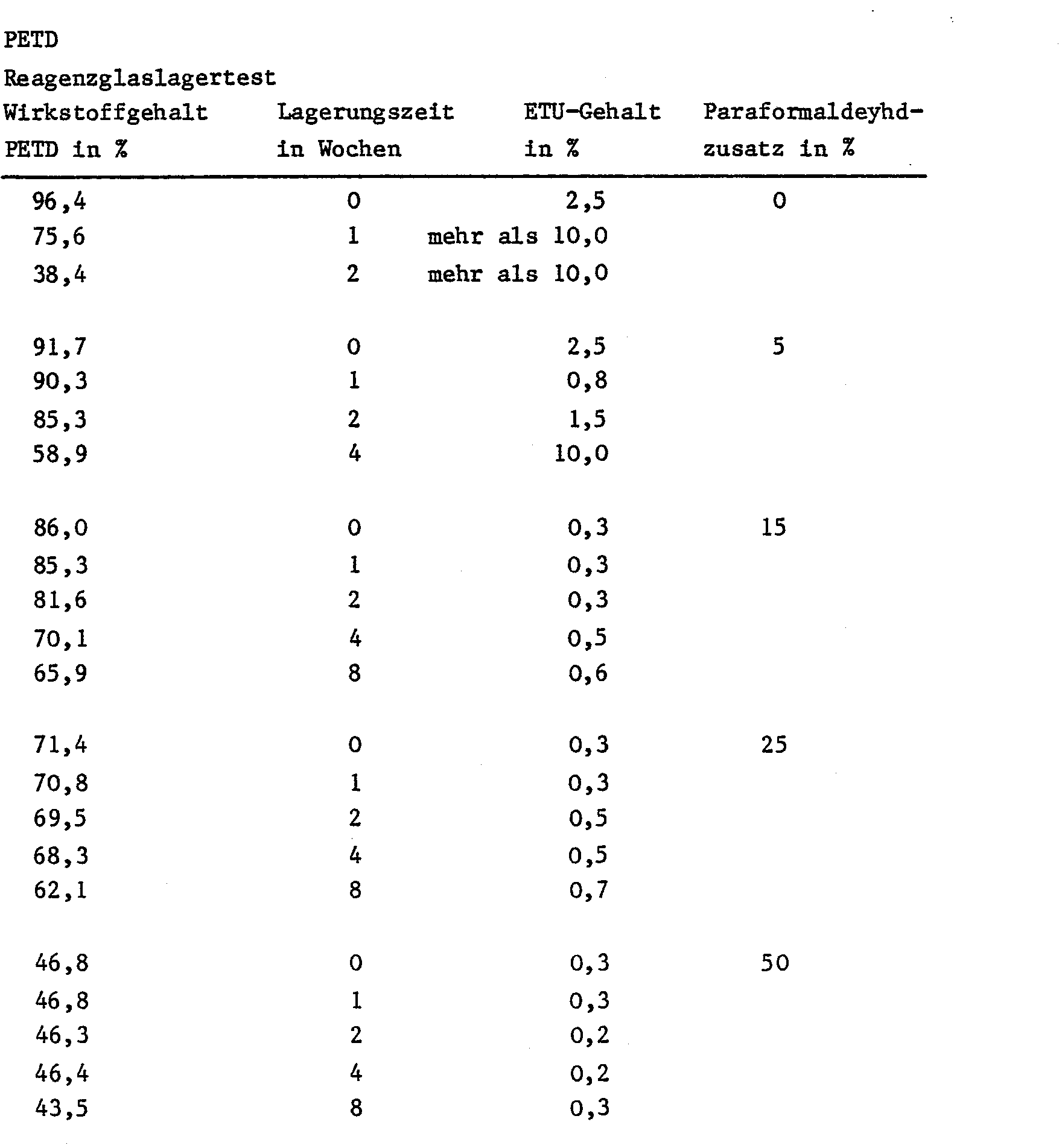
- Bei einer Zugabe von 15 % PA werden die besten Ergebnisse erzielt. Eine 5 %ige PA-Zugabe zeigt auch eine wesentliche Verbesserung des Stabilitätsverhaltens an.
- 1 kg Sprühsuspension, bestehend aus 400 g P.C. (Zineb-PETD: 95:5) und 600 g Wasser, wird bei einer Temperatur von 30°C 30 min. lang gerührt und anschließend mittels eines Technikumgerätes sprühgetrocknet (Eingangs- temperatur: 200°C, Ausgangstemperatur: 80 bis 85°C).
- Zu je 200 g dieser getrockneten Ware werden jeweils 1,5 g, 2,5 g und 5 g Paraformaldehyd zugesetzt und anschließend mittels eines Mischers homogenisiert.

- 1 kg Sprühsuspension, bestehend aus 400 g P.C. (Zineb-PETD: 90:10) und 600 g Wasser, wird bei einer Temperatur von 30°C 30 min. lang gerührt und anschließend mittels eines Technikumgerätes sprühgetrocknet (Eingangs- temperatur: 200°C, Ausgangstemperatur: 80 bis 85°C).
- Zu je 200 g dieser getrockneten Ware werden jeweils 1 g, 3 g, 5 g und 10 g Paraformaldehyd zugesetzt und anschließend mittels eines Mischers homogenisiert.
-

- 1 kg Sprühsuspension, bestehend aus 400 g P.C. (Zineb-PETD: 80:20) und 600 g Wasser, wird bei einer Temperatur von 30°C 30 min. lang gerührt und anschließend mittels eines Technikumgerätes sprühgetrocknet (Eingangs- temperatur: 200°C, Ausgangstemperatur: 80 bis 85°C).
- Zu je 200 g dieser getrockneten Ware werden jeweils 2 g, 6 g, 10 g und 20 g Paraformaldehyd zugesetzt und anschließend mittels eines Mischers homogenisiert.
-

- 1 kg Sprühsuspension, bestehend aus 400 g P.C. (Zineb-PETD: 70:30) und 600 g Wasser, wird bei einer Temperatur von 30°C 30 min. lang gerührt und anschließend mittels eines Technikumgerätes sprühgetrocknet (Eingangs- temperatur: 200°C, Ausgangstemperatur: 80 bis 85°C).
- Zu je 200 g dieser getrockneten Ware werden jeweils 3 g, 9 g, 15 g und 30 g Paraformaldehyd zugesetzt und anschließend mittels eines Mischers homogenisiert.

- 1 kg Sprühsuspension, bestehend aus 400 g P.C. (Zineb.NH3-PETD: 95:5) und 600 g Wasser, wird bei einer Temperatur von 30°C 30 min. lang gerührt und anschließend mittels eines Technikumgerätes sprühgetrocknet (Eingangs- temperatur: 200°C, Ausgangstemperatur: 80 bis 85°C).
- Zu je 200 g dieser getrockneten Ware werden jeweils 1,5 g, 2,5 g und 5 g Paraformaldehyd zugesetzt und anschließend mittels eines Mischers homogenisiert.

- 1 kg Sprühsuspension, bestehend aus 400 g P.C. (Zineb.NH3-PETD: 90:10) und 600 g Wasser, wird bei einer Temperatur von 30°C 30 min. lang gerührt und anschließend mittels eines Technikumgerätes sprühgetrocknet (Eingangstemperatur: 200°C, Ausgangstemperatur: 80 bis 85°C).
- Zu je 200 g dieser getrockneten Ware werden jeweils 1 g, 3 g, 5 g und 10 g Paraformaldehyd zugesetzt und anschließend mittels eines Mischers homogenisiert.


- 1 kg Sprühsuspension, bestehend aus 400 g P.C. (Zineb.NH3-PETD: 80:20) und 600 g Wasser, wird bei einer Temperatur von 30°C 30 min. lang gerührt und anschließend mittels eines Technikumgerätes sprühgetrocknet (Eingangstemperatur: 200°C, Ausgangstemperatur: 80 bis 85°C).
- Zu je 200 g dieser getrockneten Ware werden jeweils 2 g, 6 g, 10 g und 20 g Paraformaldehyd zugesetzt und anschließend mittels eines Mischers homogenisiert.


- 1 kg Sprühsuspension, bestehend aus 400 g P.C. (Zineb.NH3-PETD: 70:30) und 600 g Wasser, wird bei einer Temperatur von 30°C 30 min. lang gerührt und anschließend mittels eines Technikumgerätes sprühgetrocknet (Eingangstemperatur: 200°C, Ausgangstemperatur: 80 bis 85°C).
- Zu je 200 g dieser getrockneten Ware werden jeweils 3 g, 9 g, 15 g und 30 g Paraformaldehyd zugesetzt und anschließend mittels eines Mischers homogenisiert.


- 1 kg Sprühsuspension, bestehend aus 400 g P.C. (Zineb.2NH3-PETD: 95:5) und 600 g Wasser, wird bei einer Temperatur von 30°C 30 min. lang gerührt und anschließend mittels eines Technikumgerätes sprühgetrocknet (Eingangstemperatur: 200°C, Ausgangstemperatur: 80 bis 85°C).
- Zu je 200 g dieser getrockneten Ware werden jeweils 1,5 g, 2,5 g und 5 g Paraformaldehyd zugesetzt und anschließend mittels eines Mischers homogenisiert.


- 1 kg Sprühsuspension, bestehend aus 400 g P.C. (Zineb.2NH3-PETD: 90:10) und 600 g Wasser, wird bei einer Temperatur von 30°C 30 min. lang gerührt und anschließend mittels eines Technikumgerätes sprühgetrocknet (Eingangstemperatur: 200°C, Ausgangstemperatur: 80 bis 85°C).
- Zu je 200 g dieser getrockneten Ware werden jeweils 1 g, 3 g, 5 g und 10 g Paraformaldehyd zugesetzt und anschließend mittels eines Mischers homogenisiert.


- 1 kg Sprühsuspension, bestehend aus 400 g P.C. (Zineb.2NH3-PETD: 80:20) und 600 g Wasser, wird bei einer Temperatur von 30°C 30 min. lang gerührt und anschließend mittels eines Technikumgerätes sprühgetrocknet (Eingangstemperatur: 200°C, Ausgangstemperatur: 80 bis 85°C).
- Zu je 200 g dieser getrockneten Ware werden jeweils 2 g, 6 g, 10 g und 20 g Paraformaldehyd zugesetzt und anschließend mittels eines Mischers homogenisiert.


- 1 kg Sprühsuspension, bestehend aus 400 g P.C. (Zineb.2NH3-PETD: 70:30) und 600 g Wasser, wird bei einer Temperatur von 30°C 30 min. lang gerührt und anschließend mittels eines Technikumgerätes sprühgetrocknet (Eingangstemperatur: 200°C, Ausgangstemperatur: 80 bis 85°C).
- Zu je 200 g dieser getrockneten Ware werden jeweils 3 g, 9 g, 15 g und 30 g Paraformaldehyd zugesetzt und anschließend mittels eines Mischers homogenisiert.


Claims (8)
Priority Applications (1)
| Application Number | Priority Date | Filing Date | Title |
|---|---|---|---|
| AT84112636T ATE26704T1 (de) | 1983-10-27 | 1984-10-19 | Verwendung von formaldehyd oder paraformaldehyd zur stabilisierung von polyethylenthiuramdisulfid. |
Applications Claiming Priority (2)
| Application Number | Priority Date | Filing Date | Title |
|---|---|---|---|
| DE3338979 | 1983-10-27 | ||
| DE19833338979 DE3338979A1 (de) | 1983-10-27 | 1983-10-27 | Verwendung von formaldehyd oder paraformaldehyd zur stabilisierung von polyethylenthiuramdisulfid |
Publications (3)
| Publication Number | Publication Date |
|---|---|
| EP0143318A2 true EP0143318A2 (de) | 1985-06-05 |
| EP0143318A3 EP0143318A3 (en) | 1986-03-26 |
| EP0143318B1 EP0143318B1 (de) | 1987-04-22 |
Family
ID=6212865
Family Applications (1)
| Application Number | Title | Priority Date | Filing Date |
|---|---|---|---|
| EP84112636A Expired EP0143318B1 (de) | 1983-10-27 | 1984-10-19 | Verwendung von Formaldehyd oder Paraformaldehyd zur Stabilisierung von Polyethylenthiuramdisulfid |
Country Status (7)
| Country | Link |
|---|---|
| EP (1) | EP0143318B1 (de) |
| JP (1) | JPS60115561A (de) |
| AT (1) | ATE26704T1 (de) |
| DE (2) | DE3338979A1 (de) |
| HU (1) | HU194473B (de) |
| IL (1) | IL73306A (de) |
| ZA (1) | ZA848362B (de) |
Families Citing this family (1)
| Publication number | Priority date | Publication date | Assignee | Title |
|---|---|---|---|---|
| CA2374249C (en) | 1999-05-31 | 2008-08-12 | Basf Aktiengesellschaft | Dithiocarbamate liquid formulations |
Family Cites Families (1)
| Publication number | Priority date | Publication date | Assignee | Title |
|---|---|---|---|---|
| US3173832A (en) * | 1961-06-09 | 1965-03-16 | Du Pont | Paraformaldehyde stabilized fungicidal compositions |
-
1983
- 1983-10-27 DE DE19833338979 patent/DE3338979A1/de not_active Withdrawn
-
1984
- 1984-10-19 AT AT84112636T patent/ATE26704T1/de not_active IP Right Cessation
- 1984-10-19 EP EP84112636A patent/EP0143318B1/de not_active Expired
- 1984-10-19 DE DE8484112636T patent/DE3463267D1/de not_active Expired
- 1984-10-22 JP JP59220654A patent/JPS60115561A/ja active Granted
- 1984-10-24 IL IL73306A patent/IL73306A/xx not_active IP Right Cessation
- 1984-10-26 ZA ZA848362A patent/ZA848362B/xx unknown
- 1984-10-26 HU HU843993A patent/HU194473B/hu not_active IP Right Cessation
Also Published As
| Publication number | Publication date |
|---|---|
| JPS60115561A (ja) | 1985-06-22 |
| HU194473B (en) | 1988-02-29 |
| DE3338979A1 (de) | 1985-05-09 |
| IL73306A (en) | 1988-05-31 |
| ZA848362B (en) | 1985-06-26 |
| EP0143318B1 (de) | 1987-04-22 |
| ATE26704T1 (de) | 1987-05-15 |
| JPH0455189B2 (de) | 1992-09-02 |
| DE3463267D1 (en) | 1987-05-27 |
| EP0143318A3 (en) | 1986-03-26 |
| IL73306A0 (en) | 1985-01-31 |
| HUT36689A (en) | 1985-10-28 |
Similar Documents
| Publication | Publication Date | Title |
|---|---|---|
| DE2506690A1 (de) | Mittel zur entblaetterung von pflanzen | |
| DE1113607B (de) | Fungicides Mittel auf der Basis von Manganaethylenbisdithiocarbamat | |
| DE1108975B (de) | Fungicide Mittel auf der Basis von Anilinverbindungen | |
| DE965611C (de) | Selektiv wirkende Unkrautvertilgungsmittel | |
| EP0143318B1 (de) | Verwendung von Formaldehyd oder Paraformaldehyd zur Stabilisierung von Polyethylenthiuramdisulfid | |
| DE2920182A1 (de) | Salze von thiazolyliden-oxo-propionitrilen, insektizide mittel enthaltend diese salze sowie verfahren zu ihrer herstellung | |
| EP0437744B1 (de) | Fungizide Wirkstoffkombinationen | |
| DE69109539T2 (de) | Verminderung und Inhibition des Gehalts von Äthylenthioharnstoff in Alkylenbisdithiocarbamaten. | |
| DE1147796B (de) | Mittel zur Bekaempfung von pflanzenparasitaeren Nematoden | |
| EP0438712B1 (de) | Fungizide Wirkstoffkombinationen | |
| DE2713163A1 (de) | Fungizid | |
| DE2820409A1 (de) | Fungizide zusammensetzung | |
| DE69109900T2 (de) | Verbesserte Reduzierung und Inhibition des Gehaltes von Äthylenthioharnstoff in Alkylenbisthiocarbamaten. | |
| DE69103458T2 (de) | Verminderung und Verhinderung des ETU-Gehaltes in Alkylenbisdithiocarbamaten. | |
| DE3785704T2 (de) | Substituiertes benzimidazolfungizid. | |
| DE1618421C (de) | Stabilisiertes Manganäthylen-bisdithiocarbamat und dessen Verwendung | |
| DE3400803A1 (de) | Mittel zur regulierung des pflanzenwachstums | |
| DE3311894A1 (de) | Stabile zusammensetzungen auf der basis von fenarimol, ihre herstellung und verwendung | |
| DE2558385C3 (de) | Ertragssteigernde Mittel | |
| DE2512940C2 (de) | N-Benzoyl-N-halogenphenyl-2-aminopropionsäure-ester, Verfahren zu deren Herstellung und deren Verwendung | |
| DE963733C (de) | Mittel zum Beeinflussen der Wachstums- und Lebensaeusserungen, insbesondere zum Entblaettern von Pflanzen | |
| DE1812100C3 (de) | Substituierte i-Carbamoyl-2-carbalkoxyamlnobenzlmldazole | |
| DD247597A1 (de) | Mittel zur regulierung des pflanzenwachstums | |
| DE2200941A1 (de) | Mittel zur Beeinflussung des Wasserhaushaltes und zur Steigerung des Ertrages von Pflanzen | |
| DE1234087B (de) | Fungicide Mittel |
Legal Events
| Date | Code | Title | Description |
|---|---|---|---|
| PUAI | Public reference made under article 153(3) epc to a published international application that has entered the european phase |
Free format text: ORIGINAL CODE: 0009012 |
|
| AK | Designated contracting states |
Designated state(s): AT BE CH DE FR GB IT LI LU NL SE |
|
| RTI1 | Title (correction) | ||
| PUAL | Search report despatched |
Free format text: ORIGINAL CODE: 0009013 |
|
| AK | Designated contracting states |
Kind code of ref document: A3 Designated state(s): AT BE CH DE FR GB IT LI LU NL SE |
|
| 17P | Request for examination filed |
Effective date: 19860215 |
|
| 17Q | First examination report despatched |
Effective date: 19860728 |
|
| GRAA | (expected) grant |
Free format text: ORIGINAL CODE: 0009210 |
|
| AK | Designated contracting states |
Kind code of ref document: B1 Designated state(s): AT BE CH DE FR GB IT LI LU NL SE |
|
| REF | Corresponds to: |
Ref document number: 26704 Country of ref document: AT Date of ref document: 19870515 Kind code of ref document: T |
|
| ITF | It: translation for a ep patent filed | ||
| REF | Corresponds to: |
Ref document number: 3463267 Country of ref document: DE Date of ref document: 19870527 |
|
| ET | Fr: translation filed | ||
| PLBE | No opposition filed within time limit |
Free format text: ORIGINAL CODE: 0009261 |
|
| STAA | Information on the status of an ep patent application or granted ep patent |
Free format text: STATUS: NO OPPOSITION FILED WITHIN TIME LIMIT |
|
| 26N | No opposition filed | ||
| R20 | Corrections of a patent specification |
Effective date: 19880223 |
|
| ITTA | It: last paid annual fee | ||
| EPTA | Lu: last paid annual fee | ||
| EAL | Se: european patent in force in sweden |
Ref document number: 84112636.0 |
|
| PGFP | Annual fee paid to national office [announced via postgrant information from national office to epo] |
Ref country code: LU Payment date: 19960901 Year of fee payment: 13 |
|
| PGFP | Annual fee paid to national office [announced via postgrant information from national office to epo] |
Ref country code: FR Payment date: 19960920 Year of fee payment: 13 |
|
| PGFP | Annual fee paid to national office [announced via postgrant information from national office to epo] |
Ref country code: SE Payment date: 19960923 Year of fee payment: 13 |
|
| PGFP | Annual fee paid to national office [announced via postgrant information from national office to epo] |
Ref country code: NL Payment date: 19960930 Year of fee payment: 13 Ref country code: GB Payment date: 19960930 Year of fee payment: 13 |
|
| PGFP | Annual fee paid to national office [announced via postgrant information from national office to epo] |
Ref country code: AT Payment date: 19961002 Year of fee payment: 13 |
|
| PGFP | Annual fee paid to national office [announced via postgrant information from national office to epo] |
Ref country code: CH Payment date: 19961003 Year of fee payment: 13 |
|
| PGFP | Annual fee paid to national office [announced via postgrant information from national office to epo] |
Ref country code: BE Payment date: 19961010 Year of fee payment: 13 |
|
| PGFP | Annual fee paid to national office [announced via postgrant information from national office to epo] |
Ref country code: DE Payment date: 19961028 Year of fee payment: 13 |
|
| PG25 | Lapsed in a contracting state [announced via postgrant information from national office to epo] |
Ref country code: LU Free format text: LAPSE BECAUSE OF NON-PAYMENT OF DUE FEES Effective date: 19971019 Ref country code: GB Free format text: LAPSE BECAUSE OF NON-PAYMENT OF DUE FEES Effective date: 19971019 Ref country code: AT Free format text: LAPSE BECAUSE OF NON-PAYMENT OF DUE FEES Effective date: 19971019 |
|
| PG25 | Lapsed in a contracting state [announced via postgrant information from national office to epo] |
Ref country code: SE Free format text: LAPSE BECAUSE OF NON-PAYMENT OF DUE FEES Effective date: 19971020 |
|
| PG25 | Lapsed in a contracting state [announced via postgrant information from national office to epo] |
Ref country code: DE Effective date: 19971029 |
|
| PG25 | Lapsed in a contracting state [announced via postgrant information from national office to epo] |
Ref country code: LI Free format text: LAPSE BECAUSE OF NON-PAYMENT OF DUE FEES Effective date: 19971031 Ref country code: FR Free format text: THE PATENT HAS BEEN ANNULLED BY A DECISION OF A NATIONAL AUTHORITY Effective date: 19971031 Ref country code: CH Free format text: LAPSE BECAUSE OF NON-PAYMENT OF DUE FEES Effective date: 19971031 Ref country code: BE Free format text: LAPSE BECAUSE OF NON-PAYMENT OF DUE FEES Effective date: 19971031 |
|
| BERE | Be: lapsed |
Owner name: BASF A.G. Effective date: 19971031 |
|
| PG25 | Lapsed in a contracting state [announced via postgrant information from national office to epo] |
Ref country code: NL Free format text: LAPSE BECAUSE OF NON-PAYMENT OF DUE FEES Effective date: 19980501 |
|
| GBPC | Gb: european patent ceased through non-payment of renewal fee |
Effective date: 19971019 |
|
| REG | Reference to a national code |
Ref country code: CH Ref legal event code: PL |
|
| NLV4 | Nl: lapsed or anulled due to non-payment of the annual fee |
Effective date: 19980501 |
|
| EUG | Se: european patent has lapsed |
Ref document number: 84112636.0 |
|
| REG | Reference to a national code |
Ref country code: FR Ref legal event code: ST |