EP0139076B1 - Human-Parathyroidhormon (Human-PTH) produzierende Hybridvektor - Google Patents
Human-Parathyroidhormon (Human-PTH) produzierende Hybridvektor Download PDFInfo
- Publication number
- EP0139076B1 EP0139076B1 EP84104063A EP84104063A EP0139076B1 EP 0139076 B1 EP0139076 B1 EP 0139076B1 EP 84104063 A EP84104063 A EP 84104063A EP 84104063 A EP84104063 A EP 84104063A EP 0139076 B1 EP0139076 B1 EP 0139076B1
- Authority
- EP
- European Patent Office
- Prior art keywords
- human
- parathyroid hormone
- dna
- pth
- dna sequence
- Prior art date
- Legal status (The legal status is an assumption and is not a legal conclusion. Google has not performed a legal analysis and makes no representation as to the accuracy of the status listed.)
- Expired - Lifetime
Links
Classifications
-
- C—CHEMISTRY; METALLURGY
- C07—ORGANIC CHEMISTRY
- C07K—PEPTIDES
- C07K14/00—Peptides having more than 20 amino acids; Gastrins; Somatostatins; Melanotropins; Derivatives thereof
- C07K14/435—Peptides having more than 20 amino acids; Gastrins; Somatostatins; Melanotropins; Derivatives thereof from animals; from humans
- C07K14/575—Hormones
- C07K14/635—Parathyroid hormone, i.e. parathormone; Parathyroid hormone-related peptides
-
- A—HUMAN NECESSITIES
- A61—MEDICAL OR VETERINARY SCIENCE; HYGIENE
- A61K—PREPARATIONS FOR MEDICAL, DENTAL OR TOILETRY PURPOSES
- A61K38/00—Medicinal preparations containing peptides
Definitions
- Human parathyroid hormone regulates, among other things the installation and expansion of calcium in bones.
- the effects and functions of human parathyroid hormone and its agonists and antagonists are described by Dambacher, Praktician Osteologie, Thieme Verlag Stuttgart / New York 1982; Reeve et al., British Medical J. 1340 (1980) 1-11; and Potts et al., Advances in Protein Chemistry, 35 (1982) 323-395.
- the object of the invention is to provide biological material with which human parathyroid hormone (hPTH) can be produced industrially.
- hPTH human parathyroid hormone
- E. coli All cells in which hybrid vectors with the specified features can be cloned on an industrial scale to form human parathyroid hormone can be considered as prokaryotic cells. Details on cloning and expression of genes under the control of E. coli promoters (for example in Streptomyces) can be found in Chater, Nature, 299 (1982) 10 ff. Escherichia coli is particularly suitable. Examples of suitable promoters for E. coli can be found, for example, in Sengbusch, P. von, Molecular and Cell Biology, Springer-Verlag, Heidelberg etc. 1979. In E. coli, the ribosomal binding site (AB) can have the following DNA sequence, for example :
- the DNA sequence has an example of a start codon which can be used in E. coli ATG DAY
- the specific DNA sequence according to (f) can be replaced by a DNA sequence whose single strands can be hybridized with the single strands of the specific DNA sequence, the replacing DNA sequence also expressing human parathyroid hormone.
- one or more base triplets can be replaced by base triplets which encode the same amino acid.
- the parathyroid glands were operated on from freshly slaughtered pigs. MRNA was isolated from this glandular tissue. The isolated mRNA was cloned as a double-stranded complementary DNA (ds-cDNA) using a plasmid in E. coli. The hybrid plasmid DNAs were isolated from the hybrid clones obtained and fixed in their single-strand form to a support. MRNA isolated from the parathyroid glands was hybridized with fixed single-stranded DNA and removed and translated into the swine pre-pro-parathyroid hormone or swine parathyroid hormone in an in vitro translation system. The swine pre-pro parathyroid hormone or swine parathyroid hormone was detected by antibody precipitation.
- ds-cDNA double-stranded complementary DNA
- a DNA adapter was ligated to this PTH-DNA fragment treated in the manner indicated. As a result, the serine was preceded by a methionine codon "ATG". This codon is one of the important signals for the start of the synthesis of PTH in the microorganism (5).
- the PTH gene fragment constructed as described was subcloned into the ClaI site of pBR322. A clone was selected whose PTH gene was oriented counterclockwise in front of the HindIII cleavage site of pBR322 (6 to 7). This PTH clone was digested with HindIII (7). The "sticky ends" of this cleavage site caused filling reactions four different nucleotides too.
- the transformed E. coli cells were grown in the LB complete medium in the presence of ampicillin (50 ⁇ g / ml) up to the middle logarithmic phase and centrifuged.
- the pellet was suspended in a suspension buffer with guanidinium hydrochloride (3 M) (approximately 1010 cells / ml); then it was disrupted with ultrasound (sonifier) to an optical density (OD650), which corresponded to about 1/3 of the optical density at the beginning. This cell disruption was centrifuged off.
- the supernatant contained PTH.
- the protein was precipitated with 5 percent TCA and dissolved in 0.02N hydrochloric acid. TCA residues were washed out with ether. That from raw extract and after extraction PTH obtained was immunologically active against antibodies (specific to PTH fragments AS1-34, AS28-48 and AS48-68) (RIA) and was biologically active in the adenylcyclase test.
- the human parathyroid hormone gene was linked to a vector (pBR322 / SV40 derivative) and transformed into monkey kidney cells using calcium phosphate precipitation.
- PTH was obtained from 10 forcing cells by extraction; it was positive for antibodies in the RIA (specific for the PTH fragments AS28-48 and AS44-68).
- the human parathyroid hormone gene (lambda-human hybrid DNA) was transformed with the thymidine kinase gene from Herpes simplex by co-transformation into T3 cells; the integration of the human PTH gene was identified from the Tk+ clones by DNA hybridization.
- RS ribosomal binding site
Landscapes
- Health & Medical Sciences (AREA)
- Chemical & Material Sciences (AREA)
- Endocrinology (AREA)
- Life Sciences & Earth Sciences (AREA)
- Organic Chemistry (AREA)
- Genetics & Genomics (AREA)
- Molecular Biology (AREA)
- Biochemistry (AREA)
- Biophysics (AREA)
- General Health & Medical Sciences (AREA)
- Zoology (AREA)
- Medicinal Chemistry (AREA)
- Gastroenterology & Hepatology (AREA)
- Proteomics, Peptides & Aminoacids (AREA)
- Toxicology (AREA)
- Micro-Organisms Or Cultivation Processes Thereof (AREA)
- Preparation Of Compounds By Using Micro-Organisms (AREA)
- Peptides Or Proteins (AREA)
- Medicines Containing Material From Animals Or Micro-Organisms (AREA)
- Medicines That Contain Protein Lipid Enzymes And Other Medicines (AREA)
Description
- Human-Parathyroidhormon reguliert u.A. den Einbau und Ausbau von Calcium in Knochen. Die Wirkungen und Funktionen von Human-Parathyroidhormon und seinen Agonisten und Antagonisten werden von Dambacher, Praktische Osteologie, Thieme Verlag Stuttgart / New York 1982; Reeve et al., British Medical J. 1340 (1980) 1 - 11; und Potts et al., Advances in Protein Chemistry, 35 (1982) 323 - 395 beschrieben.
- In Int. Congr. Ser.-Excerpta Med., (1980) 5-18 wird die Expression von Pre-Pro-bPTH und Pro-bPTH beschrieben. In Proc. Natl. Acad. Sci. USA, 78 (1981) 7365-7369 wird die DNA-Sequenz von hPre-Pro-PTH beschrieben. Diese Beschreibung reichte jedoch nicht aus, um biologisch aktives hPTH zu exprimieren; vergl. Mol. Biol. Radiochem. Essays Calciotropic Horm. Sattelite Symp., (1984) S 80287.
- Aufgabe der Erfindung ist es, biologisches Material zur Verfügung zu stellen, mit dem Human-Parathyroidhormon (hPTH) technisch hergestellt werden kann.
- Gemäß der vorliegenden Erfindung wird diese Aufgabe durch einen in prokaryotischen Zellen klonierbaren Hybridvektor gelöst, der Human-Parathyroidhormon produziert und durch folgende Merkmale gekennzeichnet ist:
- (a) einen Promotor
- (b) einen sich an den Promotor anschließenden DNA-Bereich von 0 bis 1000 oder von 0 bis 200 Basenpaaren
- (c) eine ribosomale Bindungsstelle, die sich an den DNA-Bereich gemäß b oder sofern b fehlt, an den Promotor gemäß a anschließt;
- (d) einen sich an die ribosomale Bindungsstelle anschließenden DNA-Bereich von 4 bis 15 Basenoaaren,
- (e) ein sich an den DNA-Bereich gemäß (d) anschließendes Startcodon und
- (f) die folgende Human-Parathormon hyroid kodierende DNA-Sequenz:
- Als prokaryotische Zellen kommen alle Zellen in Betracht, in denen sich Hybridvektoren mit den angegebenen Merkmalen in technischem Maßstab unter Bildung von Human-Parathyroidhormon klonieren lassen. Einzelheiten zum Klonieren und zur Expression von Genen unter der Steuerung von E.-coli-Promotoren (beispielsweise in Streptomyces) lassen sich bei Chater, Nature, 299 (1982) 10 ff finden. Insbesondere kommt Escherichia coli in Betracht. Beispiele für geeignete Promotoren für E. coli finden sich beispielsweise bei Sengbusch, P. von, Molekular- und Zellbiologie, Springer-Verlag, Heidelberg etc. 1979. Bei E. coli kann die ribosomale Bindungsstelle (AB) beispielsweise die folgende DNA-Sequenz aufweisen:

- Ein Beispiel für ein bei E. coli verwendbares Startcodon hat die DNA-Sequenz
ATG
TAG - Gemäß einer speziellen Ausführungsform der Erfindung kann die spezifische DNA-Sequenz gemäß (f) durch eine DNA-Sequenz ersetzt sein, deren Einzelstränge mit den Einzelsträngen der spezifischen DNA-Sequenz hybridisiert werden können, wobei die ersetzende DNA-Sequenz gleichfalls Human-Parathyroidhormon exprimiert.
- Gemäß einer weiteren speziellen Ausführungsform der Erfindung können bei der spezifischen DNA-Sequenz gemäß (f) ein oder mehrere Basentripletts durch Basentripletts ersetzt sein, die die gleiche Aminosäure kodieren.
- Nachstehend wird die Herstellbarkeit des erfindungsgemäßen Hybridvektors an einem Beispiel und drei Schemata näher erläutert.
- Aus frisch geschlachteten Schweinen wurden die Nebenschilddrüsen operiert. Aus diesem Drüsengewebe wurde mRNA isoliert. Die isolierte mRNA wurde als doppelstrangige komplementäre DNA (ds-cDNA) mit Hilfe eines Plasmids in E. coli kloniert. Aus den erhaltenen Hybridklonen wurde die Hybrid-Plasmid-DNAs isoliert und in ihrer Einzelstrangform an einen Träger fixiert. Aus den Nebenschilddrüsen isolierte mRNA wurde mit fixierter Einzelstrang-DNA hybridisiert und entfernt und in einem In-Vitro-Translationssystem in das Schweine-Prä-Pro-Parathyroidhormon oder Schweine-Parathyroidhormon übersetzt. Das Schweine-Prä-Pro-Parathyroidhormon oder Schweine-Parathyroidhormom wurde durch Antikörperfällung nachgewiesen. Mit Hilfe einer "Hybrid-Arrested-Translation" und DNA-Sequenzanalyse konnten die Klone aufgefunden werden, die Schweine-Parathyroidhormonsequenzen enthielten. Aus den ermittelten Hybridklonen wurde Hybridplasmid-DNA, die das Schweine-cDNA Parathyroidhormongen (Schema 1) umfaßte, radioaktiv markiert (nick-translatiert) und zum Screenen von Humangenbänken verwendet. Auf diese Weise ermitteltes Human-Parathyroidhormongen wurde durch Subklonieren in einem Plasmid angereichert. Ein auf diese Weise angereichertes Human-Parathyroidhormongen wurde sequenziert. Die Sequenz des für die Expression von Human-Parathyroidhormon relevanten Abschnittes ist dem Schema 2 zu entnehmen. Die ermittelte Sequenz stimmte mit der bekannten cDNA-Sequenz und mit der bekannten Aminosäuresequenz des Human-Parathyroidhormons überein.
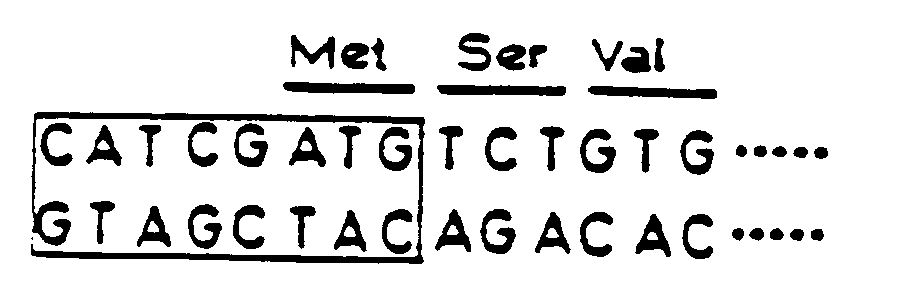
- Im folgenden wird Schema 3 erläutert. (1) In das weitere Verfahren wurde die zwischen zwei Eco RI-Schnittstellen liegende DNA-Sequenz eingesetzt, die die DNA-Sequenz des Schemas 2 umfaßt. Es wurde nun mit Hilfe der Restriktionsendonuklease Sau3A der Prä-Pro-Teil des PTH-Gens vom Gen des reifen 1-84-PTH getrennt (2). Durch Auffüllen von dATP und dGTP mit dem "Large fragment" der E.-coli-DNA-Polymerase-I (3) und anschließenden Abbau mit S1-Nuklease wurde der verbleibende Einzelstrangrest (GA) der klebrigen Enden (sticky ends) beseitigt, die vom Sau3A-Schnitt herrührten (GATC); dadurch wurde das Codon "TCT" für die Aminosäure 1 (Serin) des Human-PTH rekonstituiert (4). An dieses in der angegebenen Weise behandelte PTH-DNA-Fragment wurde ein DNA-Adaptor ligiert. Dadurch wurde dem Serin ein Methionin-Codon "ATG" direkt vorgeschaltet. Dieses Codon ist eines der wichtigen Signale für den Start der Synthese von PTH im Mikroorganismus (5). Das in der angegebenen Weise konstruierte PTH-Genfragment wurde in die ClaI-Spaltstelle von pBR322 subkloniert. Ausgewählt wurde ein Klon, dessen PTH-Gen vor der HindIII-Spaltstelle des pBR322 (6 bis 7) gegen den Uhrzeigersinn orientiert war. Dieser PTH-Klon wurde mit HindIII gespalten (7). Die "sticky ends" dieser Spaltstelle ließen Auffüllreaktionen mit vier verschiedenen Nukleotiden zu. In Kombination mit dem Abbau durch S1-Nuklease gelangte man zu Fragmenten mit aufgefüllten Enden (flush ends), deren Entfernung vom ATG-Codon 4 bis 10 Basenpaare betrug (8). Vor diese Variation an Fragmenten wurden zwei synthetische DNA-Adaptoren ligiert, und zwar /TCCCTAGGGA/+/TCCCTAGGGA/(9). Diese Linker enthielten die Sequenz der ribosomalen Bindungsstelle, ein weiteres wichtiges Signal für die Expression im Mikroorganismus. Dadurch entstand weiter eine BamHI-Spaltstelle (10). Diese war für die Klonierung hinter verschiedenen Promotoren (wie trp, tac,T5) beschriebener Vektoren geeignet (11).
- Die transformierten E. coli-Zellen wurden im LB-Vollmedium in Gegenwart von Ampicillin (50 µg/ml) bis zur mittleren logarithmischen Phase angezogen und abzentrifugiert. Das Pellet wurde in einem Suspensionspuffer mit Guanidiniumhydrochlorid (3 M) suspendiert (ungefähr 10¹⁰ Zellen/ml); danach wurde mit Ultraschall (Sonifier) bis zu einer optischen Dichte (OD₆₅₀) aufgeschlossen, die etwa 1/3 der optischen Dichte zu Beginn entsprach. Dieser Zellaufschluß wurde abzentrifugiert. Der Überstand enthielt PTH. Das Protein wurde mit 5-prozentigem TCA gefällt und in 0,02 n Salzsäure gelöst. TCA-Reste wurden mit Äther ausgewaschen. Das aus Rohextrakt und nach Extraktion gewonnene PTH war immunologisch gegen Antikörper (spezifisch zu PTH-Fragmenten AS1-34, AS28-48 und AS48-68) wirksam (RIA) und war im Adenylcyclase-Test biologisch aktiv.
- Das Human-Parathyroidhormongen wurde mit einem Vektor verknüpft (pBR322/SV40-Derivat) und mit Hilfe einer Calciumphosphat-Fällung in Affennierenzellen transformiert. Aus 10⁹ Zellen wurde PTH durch Extraktion gewonnen; es war im RIA positiv gegen Antikörper (spezifisch zu den PTH-Fragmenten AS28-48 und AS44-68).
- Außerdem wurde das Human-Parathyroidhormongen (lambda-Humanhybrid-DNA) mit dem Thymidinkinasegen von Herpes simplex durch Co-Transformation in T3-Zellen transformiert; aus den Tk⁺-Klonen wurde durch DNA-Hybridisieren die Integration des Human-PTH-Gens identifiziert.


-

-

-

-

-

-
-

-

-

-

- RS = ribosomale Bindungsstelle

-


Claims (4)
- Verfahren zur Herstellung eines in prokaryotischen Zellen klonierbaren und Human-Parathyroidhormon produzierenden Hybridvektors, dadurch gekennzeichnet , daß man einen Vektor mit folgenden Merkmalen versieht:(a) einen Promotor,(b) einen sich an den Promotor anschließenden DNA-Bereich von 0 bis 1000 oder von 0 bis 200 Basenpaaren,(c) eine sich an den DNA-Bereich gemäß (b) anschließende ribosomale Bindungsstelle,(d) einen sich an die ribosomale Bindungsstelle anschließenden DNA-Bereich von 4 bis 15 Basenpaaren,(e) ein sich an den DNA-Bereich gemäß (d) anschließendes Startkodon und(f) die folgende Human-Parathyroidhormon kodierende DNA-Sequenz:

- Verfahren nach Anspruch 1, dadurch gekennzeichnet, daß der Hybridvektor in E. coli klonierbar ist.
- Verfahren nach Anspruch 1 oder 2, dadurch gekennzeichnet , daß die spezifische DNA-Sequenz gemäß Anspruch 1 (f) durch eine DNA-Sequenz ersetzt ist, deren Einzelstränge mit den Einzelsträngen der spezifischen DNA-Sequenz hybridisiert werden können, wobei die ersetzende DNA-Sequenz gewünschte Produkte exprimieren kann.
- Verfahren nach Anspruch 1, 2 oder 3, dadurch gekennzeichnet, daß ein oder mehrere Basentripletts durch Synonyme ersetzt sind.
Priority Applications (1)
| Application Number | Priority Date | Filing Date | Title |
|---|---|---|---|
| AT84104063T ATE77834T1 (de) | 1983-04-11 | 1984-04-11 | Human-parathyroidhormon (human-pth) produzierende hybridvektor. |
Applications Claiming Priority (2)
| Application Number | Priority Date | Filing Date | Title |
|---|---|---|---|
| DE19833312928 DE3312928A1 (de) | 1983-04-11 | 1983-04-11 | Human-parathormon produzierende hybridvektoren und human-parathormongen |
| DE3312928 | 1983-04-11 |
Publications (3)
| Publication Number | Publication Date |
|---|---|
| EP0139076A2 EP0139076A2 (de) | 1985-05-02 |
| EP0139076A3 EP0139076A3 (en) | 1987-05-20 |
| EP0139076B1 true EP0139076B1 (de) | 1992-07-01 |
Family
ID=6195950
Family Applications (1)
| Application Number | Title | Priority Date | Filing Date |
|---|---|---|---|
| EP84104063A Expired - Lifetime EP0139076B1 (de) | 1983-04-11 | 1984-04-11 | Human-Parathyroidhormon (Human-PTH) produzierende Hybridvektor |
Country Status (5)
| Country | Link |
|---|---|
| EP (1) | EP0139076B1 (de) |
| JP (1) | JPS6034986A (de) |
| AT (1) | ATE77834T1 (de) |
| DE (2) | DE3312928A1 (de) |
| DK (1) | DK185484A (de) |
Cited By (1)
| Publication number | Priority date | Publication date | Assignee | Title |
|---|---|---|---|---|
| US7018982B2 (en) | 1997-06-19 | 2006-03-28 | Nps Allelix Corp. | Methods useful in the treatment of bone resorption diseases |
Families Citing this family (9)
| Publication number | Priority date | Publication date | Assignee | Title |
|---|---|---|---|---|
| US4753874A (en) * | 1985-07-08 | 1988-06-28 | Board Of Trustees Of The Leland Stanford Junior University | Rapid mutation testing system for human cells |
| US5420242A (en) * | 1986-10-22 | 1995-05-30 | Kaare M. Gautvik | Production of human parathyroid hormone from microorganisms |
| US5010010A (en) * | 1986-10-22 | 1991-04-23 | Selmer-Sande, A.S. | Production of human parathyroid hormone from microorganisms |
| EP0604706A1 (de) * | 1986-10-22 | 1994-07-06 | GAUTVIK, Kaare M., Dr. | Herstellung von humanem Parathormon mittels Mikroorganismen |
| DE3725320A1 (de) * | 1987-07-30 | 1989-02-09 | Biotechnolog Forschung Gmbh | Expressionsvektoren und verfahren unter deren verwendung zur gewinnung von cro/ss-galaktosidase/pth-fusionsproteinen und von pth |
| ATE152127T1 (de) * | 1991-08-07 | 1997-05-15 | Takeda Chemical Industries Ltd | Muteine des menschlichen parathormons und ihre herstellung |
| JPH05271279A (ja) * | 1991-08-07 | 1993-10-19 | Takeda Chem Ind Ltd | ヒト副甲状腺ホルモンムテインおよびその製造法 |
| KR100230578B1 (ko) * | 1997-07-25 | 1999-12-01 | 허영섭 | 포스포리불로키나제를 융합파트너로 이용하는 재조합 인간 부갑상선호르몬의 발현벡터 |
| CN1301740A (zh) * | 1999-12-24 | 2001-07-04 | 上海博德基因开发有限公司 | 一种新的多肽——甲状旁腺激素9和编码这种多肽的多核苷酸 |
Family Cites Families (4)
| Publication number | Priority date | Publication date | Assignee | Title |
|---|---|---|---|---|
| DE2963374D1 (en) * | 1978-10-10 | 1982-09-09 | Univ Leland Stanford Junior | Recombinant dna, method for preparing it and production of foreign proteins by unicellular hosts containing it |
| ZA811895B (en) * | 1980-04-07 | 1982-04-28 | Univ California | Expression of hormone genomic clones |
| US4338397A (en) * | 1980-04-11 | 1982-07-06 | President And Fellows Of Harvard College | Mature protein synthesis |
| WO1984001173A1 (en) * | 1982-09-15 | 1984-03-29 | Immuno Nuclear Corp | Production of mature proteins in transformed yeast |
-
1983
- 1983-04-11 DE DE19833312928 patent/DE3312928A1/de active Granted
-
1984
- 1984-04-10 DK DK185484A patent/DK185484A/da not_active Application Discontinuation
- 1984-04-11 JP JP59071041A patent/JPS6034986A/ja active Pending
- 1984-04-11 DE DE8484104063T patent/DE3485797D1/de not_active Expired - Fee Related
- 1984-04-11 AT AT84104063T patent/ATE77834T1/de not_active IP Right Cessation
- 1984-04-11 EP EP84104063A patent/EP0139076B1/de not_active Expired - Lifetime
Non-Patent Citations (6)
| Title |
|---|
| Chemical abstracts, Band 100, Nr. 3, 16. Januar 1984, Seite 148, Ref.Nr. 18646h, Columbus, Ohio, US, H. Mayer et al "Assignment of the human parathyroid hormone gene to chromosome 11" & Hum. Genet. 1983, 64(3), 283-5 * |
| Chemical abstracts, Band 94, Nr. 9, 2 März 1981, Seite 477, Ref.Nr. 62752w; Columbus, Ohio, US. H.M. Kronenberg et al "Cloning bovine and human parathyroid hormone DNA in bacteria" & Endocrinol. Proc. Int. Congr. Endocrinol., &th 1980, 508-11 * |
| Experientia, Band 39, Nr. 6 Juni 1983, Seite 659, Birkhäuser Verlag, Basel, CH. W. Born et al "Expression and processing of human preproparathyroid hormone in Escherichia coli" * |
| Int. Congr. Ser.- Excerpta Med. (1980), pp. 5-18 * |
| Proc. Natl. Acad. Sci. USA (1981), vol. 78, pp. 7365-7369 * |
| Proc. Natl. Acad. Sci. USA, Band 80, April 1983, Seiten 2127-2131, T.J. Vasicek et al "Nucleotide sequence of the human parathyroid hormone gene" * |
Cited By (1)
| Publication number | Priority date | Publication date | Assignee | Title |
|---|---|---|---|---|
| US7018982B2 (en) | 1997-06-19 | 2006-03-28 | Nps Allelix Corp. | Methods useful in the treatment of bone resorption diseases |
Also Published As
| Publication number | Publication date |
|---|---|
| DE3485797D1 (de) | 1992-08-06 |
| ATE77834T1 (de) | 1992-07-15 |
| DK185484D0 (da) | 1984-04-10 |
| EP0139076A3 (en) | 1987-05-20 |
| JPS6034986A (ja) | 1985-02-22 |
| DE3312928C2 (de) | 1987-08-27 |
| EP0139076A2 (de) | 1985-05-02 |
| DK185484A (da) | 1984-10-12 |
| DE3312928A1 (de) | 1984-11-22 |
Similar Documents
| Publication | Publication Date | Title |
|---|---|---|
| DE69034179T2 (de) | Expressionssysteme für ein amidierendes Enzym | |
| DE3485869T2 (de) | Herstellung heterodimerer menschlicher fruchtbarkeitshormone. | |
| DE69129990T3 (de) | Modifizierter menschlicher tumornekrosisfaktor-alpha-rezeptor | |
| DE69132823T2 (de) | Knochen- und knorpel-bildung hervorrufende proteine | |
| DE3850995T2 (de) | Sekretion eines dem Insulin ähnlichen Wachstumsfaktors in E. coli. | |
| DE69031939T2 (de) | Osteoinduktive zusammensetzungen | |
| DE60118067T2 (de) | Pharmazeutische Zusammensetzung mit Dystrophin Exon 45 zur Behandlung von Duchenne-Muskeldystrophie | |
| DE3688109T2 (de) | Fsh. | |
| DE69329031T2 (de) | Das dorsalgewebe beeinflussender faktor | |
| DE3486469T2 (de) | Herstellung heterodimirer menschlicher Fruchtbarkeitshormone | |
| DE3382575T2 (de) | Dna-sequenzen, rekombinante dna-molekuele und verfahren zur herstellung von schweinewachstumshormonaehnlichen polypeptiden. | |
| DD204494A5 (de) | Verfahren zum schneiden doppelstraengiger dns | |
| DE3689495T2 (de) | TGF-beta codierende Nucleinsäure und deren Verwendungen. | |
| LU83745A1 (de) | Hybride human-leukozyten-interferone | |
| DD212982A5 (de) | Verfahren zur herstellung von rinder-wachstumshormon-aehnlichen polypeptiden | |
| DE3687141T2 (de) | Verfahren zur herstellung von peptiden. | |
| DE69130494T2 (de) | Rekombinanter menschlicher Hepatozytwachstumsfaktor und Verfahren zu seiner Herstellung | |
| DE3312928C2 (de) | ||
| DE69221823T2 (de) | Oxytocin-Rezeptor, dafür kodierende DNS | |
| DE3789316T2 (de) | Herstellung von human-parathyroidhormon. | |
| DE68921665T2 (de) | Hemmer vom flüssigen kalziumerhöhenden Faktor. | |
| EP1000154A1 (de) | Identifizierung humaner zellinien zur produktion humaner proteine durch endogene genaktivierung | |
| DE3688816T2 (de) | Dns-sequenz. | |
| DE69534596T2 (de) | Epil/plazentin | |
| DE69112829T2 (de) | Einen hybriden rezeptor exprimierende säugerzellen. |
Legal Events
| Date | Code | Title | Description |
|---|---|---|---|
| PUAI | Public reference made under article 153(3) epc to a published international application that has entered the european phase |
Free format text: ORIGINAL CODE: 0009012 |
|
| AK | Designated contracting states |
Designated state(s): AT BE CH DE FR GB IT LI SE |
|
| PUAL | Search report despatched |
Free format text: ORIGINAL CODE: 0009013 |
|
| AK | Designated contracting states |
Kind code of ref document: A3 Designated state(s): AT BE CH DE FR GB IT LI SE |
|
| 17P | Request for examination filed |
Effective date: 19870916 |
|
| 17Q | First examination report despatched |
Effective date: 19890817 |
|
| GRAA | (expected) grant |
Free format text: ORIGINAL CODE: 0009210 |
|
| AK | Designated contracting states |
Kind code of ref document: B1 Designated state(s): AT BE CH DE FR GB IT LI SE |
|
| REF | Corresponds to: |
Ref document number: 77834 Country of ref document: AT Date of ref document: 19920715 Kind code of ref document: T |
|
| REF | Corresponds to: |
Ref document number: 3485797 Country of ref document: DE Date of ref document: 19920806 |
|
| ET | Fr: translation filed | ||
| ITF | It: translation for a ep patent filed | ||
| GBT | Gb: translation of ep patent filed (gb section 77(6)(a)/1977) | ||
| PGFP | Annual fee paid to national office [announced via postgrant information from national office to epo] |
Ref country code: GB Payment date: 19930401 Year of fee payment: 10 |
|
| PGFP | Annual fee paid to national office [announced via postgrant information from national office to epo] |
Ref country code: FR Payment date: 19930419 Year of fee payment: 10 |
|
| PGFP | Annual fee paid to national office [announced via postgrant information from national office to epo] |
Ref country code: SE Payment date: 19930422 Year of fee payment: 10 Ref country code: AT Payment date: 19930422 Year of fee payment: 10 |
|
| PGFP | Annual fee paid to national office [announced via postgrant information from national office to epo] |
Ref country code: DE Payment date: 19930428 Year of fee payment: 10 |
|
| PGFP | Annual fee paid to national office [announced via postgrant information from national office to epo] |
Ref country code: BE Payment date: 19930504 Year of fee payment: 10 |
|
| PLBE | No opposition filed within time limit |
Free format text: ORIGINAL CODE: 0009261 |
|
| STAA | Information on the status of an ep patent application or granted ep patent |
Free format text: STATUS: NO OPPOSITION FILED WITHIN TIME LIMIT |
|
| PGFP | Annual fee paid to national office [announced via postgrant information from national office to epo] |
Ref country code: CH Payment date: 19930519 Year of fee payment: 10 |
|
| 26N | No opposition filed | ||
| PG25 | Lapsed in a contracting state [announced via postgrant information from national office to epo] |
Ref country code: GB Effective date: 19940411 Ref country code: AT Effective date: 19940411 |
|
| PG25 | Lapsed in a contracting state [announced via postgrant information from national office to epo] |
Ref country code: SE Effective date: 19940412 |
|
| PG25 | Lapsed in a contracting state [announced via postgrant information from national office to epo] |
Ref country code: LI Effective date: 19940430 Ref country code: CH Effective date: 19940430 Ref country code: BE Effective date: 19940430 |
|
| BERE | Be: lapsed |
Owner name: G.- FUR BIOTECHNOLOGISCHE FORSCHUNG M.B.H. GBF Effective date: 19940430 |
|
| GBPC | Gb: european patent ceased through non-payment of renewal fee |
Effective date: 19940411 |
|
| PG25 | Lapsed in a contracting state [announced via postgrant information from national office to epo] |
Ref country code: FR Effective date: 19941229 |
|
| REG | Reference to a national code |
Ref country code: CH Ref legal event code: PL |
|
| PG25 | Lapsed in a contracting state [announced via postgrant information from national office to epo] |
Ref country code: DE Effective date: 19950103 |
|
| EUG | Se: european patent has lapsed |
Ref document number: 84104063.7 Effective date: 19941110 |
|
| REG | Reference to a national code |
Ref country code: FR Ref legal event code: ST |