EP0136636A2 - Nitromethylen-tetrahydropyrimidin-Derivate, Verfahren zu ihrer Herstellung sowie insektizide, mitizide, tickizide und nematizide Mittel - Google Patents
Nitromethylen-tetrahydropyrimidin-Derivate, Verfahren zu ihrer Herstellung sowie insektizide, mitizide, tickizide und nematizide Mittel Download PDFInfo
- Publication number
- EP0136636A2 EP0136636A2 EP84111316A EP84111316A EP0136636A2 EP 0136636 A2 EP0136636 A2 EP 0136636A2 EP 84111316 A EP84111316 A EP 84111316A EP 84111316 A EP84111316 A EP 84111316A EP 0136636 A2 EP0136636 A2 EP 0136636A2
- Authority
- EP
- European Patent Office
- Prior art keywords
- general formula
- und
- nitromethylene
- einem
- oder
- Prior art date
- Legal status (The legal status is an assumption and is not a legal conclusion. Google has not performed a legal analysis and makes no representation as to the accuracy of the status listed.)
- Withdrawn
Links
- 0 C1CC*CC1 Chemical compound C1CC*CC1 0.000 description 2
Classifications
-
- C—CHEMISTRY; METALLURGY
- C07—ORGANIC CHEMISTRY
- C07D—HETEROCYCLIC COMPOUNDS
- C07D239/00—Heterocyclic compounds containing 1,3-diazine or hydrogenated 1,3-diazine rings
- C07D239/02—Heterocyclic compounds containing 1,3-diazine or hydrogenated 1,3-diazine rings not condensed with other rings
- C07D239/06—Heterocyclic compounds containing 1,3-diazine or hydrogenated 1,3-diazine rings not condensed with other rings having one double bond between ring members or between a ring member and a non-ring member
-
- A—HUMAN NECESSITIES
- A01—AGRICULTURE; FORESTRY; ANIMAL HUSBANDRY; HUNTING; TRAPPING; FISHING
- A01N—PRESERVATION OF BODIES OF HUMANS OR ANIMALS OR PLANTS OR PARTS THEREOF; BIOCIDES, e.g. AS DISINFECTANTS, AS PESTICIDES OR AS HERBICIDES; PEST REPELLANTS OR ATTRACTANTS; PLANT GROWTH REGULATORS
- A01N43/00—Biocides, pest repellants or attractants, or plant growth regulators containing heterocyclic compounds
- A01N43/48—Biocides, pest repellants or attractants, or plant growth regulators containing heterocyclic compounds having rings with two nitrogen atoms as the only ring hetero atoms
- A01N43/54—1,3-Diazines; Hydrogenated 1,3-diazines
Definitions
- the present invention relates to new nitromethylene tetrahydropyrimidine derivatives, processes for their preparation and insecticidal, miticidal, tickicidal and nematicidal compositions which contain such derivatives as active compounds.
- nitromethylene tetrahydropyrimidine derivatives of formula (I) according to the present invention can be prepared by the following general method i), to which the present invention also extends.
- a process for the preparation of the nitromethylene tetrahydropyrimidine derivatives of the general formula (I) comprises the reaction of a compound of the general formula (II) in which X has the meaning given above, with 1-nitro-2,2-bis (methylthio) ethylene of the formula
- the present invention further relates to insecticidal, miticidal, tickicidal and nematicidal compositions which contain nitromethylene-tetrahydropyrimidine derivatives of the formula (I) as active ingredients.
- the DE-OS 25 14 402 known before the filing date of the present application states that 2-nitromethylene-imidazoline derivatives and 2-nitromethylene-hexahydropyrimidine derivatives of the following general formula show insecticidal activity.
- R 1 does not include a benzyl group with a substituent. It has now been found that the new nitromethylene tetrahydropyrimidine compounds of the general formula (I) have an excellent control action against harmful insects, mites, ticks and nematodes.
- Nitromethylene tetrahydropyrimidine derivatives of the present invention are not covered by the general formula described in the above-cited DE-OS, nor are they described anywhere else in the previously published technical literature.
- the compounds of the present invention are characterized by the fact that their chemical structure is 2-nitromethylene tetrahydropyrimidine as the basic skeleton and a halogen-substituted benzyl group is substituted on the nitrogen atom in the 1-position of the tetrahydropyrimidine ring.
- the phenyl nucleus is preferably substituted in the 3- or 4-position by halogen.
- the compounds of the present invention have a particularly outstanding control action against pests, that of the compounds of the formula (A-1) described in the above-mentioned DE-OS 25 14 402 and the compounds of the present invention most similar, far surpasses, and that the compounds of the present invention show a pronounced control action against insect pests which are insecticides of the organic phosphate and carbamate type.
- Type developed due to long-term use of the same resistance, especially against sucking insects such as cockroaches, lantern carriers and cicadas.
- the compounds of the present invention exhibit particularly superior control effects when applied to a water surface, and in relation to residual effects in water, those compounds which are very similar to the compounds of the present invention, for example the compounds of the formula given above (A-1), are far superior.
- An object of the present invention is to make the new nitromethylene tetrahydropyrimidine derivatives of the general formula (I), a process for their preparation and their use as insecticidal, miticidal, tickicidal and nematicidal agents available.
- Callosobruchus chinensis Sitophilus zeamais, Tribolium castaneum, Epilachna vigintioctomaculata, Agriotes fuscicollis, Anomala rufocuprea, Leptinotarsa decemlineata, Diabrotica spp., Monochamus alternatus, Lissorhoptus oryusophneus and Lyctophus.
- Lymantria dispar Malacosoma neustria, Pieris rapae, Spodoptera litura, Mamestra brassicae, Chilo suppressalis, Pyrausta nubilalis, Ephestia cautella, Adoxophyes orana, Carpocapsa pomonella, Agrotis fucosa, Galleria mellonella Plutella maculistennis and Phyll.
- Nephotettix cincticeps Nephotettix cincticeps, Nilaparvata lugens, Pseudococcus comstocki, Unaspis yanonensis, Myzus persicae, Aphis pomi, Aphis gossypii, Rhopalosiphum pseudobrassicas, Stephanitis nashi, Nazara spp., Cimex lectularius, Trialeuryls vaporariorum .. and Ps
- Musca domestica Aedes aegypti, Hylemia platura, Culex pipiens, Anopheles sinensis and Culex tritaeniorhynchus.
- the new compounds according to the present invention are effective against various harmful animal parasites (endo and ectoparasites) such as ticks, insects and worms. Examples of such animal parasites are given below.
- Gastrophilus spp. Stomoxys spp., Trichodectes spp. Rhodnius spp. and Ctenocephalidex canis
- insecticides Substances that have pesticidal activity against all of these pests are sometimes referred to simply as "insecticides" in the present application.
- nitromethylene tetrahydropyrimidine derivatives of the general formula (I) according to the present invention can be prepared in a simple manner, for example using the following process i).
- X denotes a halogen atom, especially a fluorine, chlorine, bromine or iodine atom.
- specific examples of the starting compound of the general formula (II) include N- (3-chlorobenzyl) trimethylene diamine, N- (4-chlorobenzyl) tri - methylenediamine, N- (4-bromobenzyl) trimethylene diamine and N- (4-fluorobenzyl) trimethylene diamine.
- solvents or diluents examples include water; aliphatic, alicyclic and aromatic hydrocarbons (which can optionally be chlorinated), such as hexane, cyclohexane, petroleum ether, ligroin, benzene, toluene, xylene, methylene chloride, chloroform, carbon tetrachloride, ethylene chloride, trichloroethylene and chlorobenzene, ethers such as diethyl ether, methyl ethyl ether, diisopropyl ether , Dibutyl ether, propylene oxide, dioxane and tetrahydrofuran, ketones such as acetone, methyl ethyl ketone, methyl isopropyl ketone and methyl isobutyl ketone, nitriles such as acetonitrile, propionitrile and acrylonitrile, alcohols such as methanol, ethanol, is
- the above process can be carried out over a wide temperature range. In general, it can be carried out at a temperature between -20 ° C and the boiling point of the mixture, advantageously at a temperature between about 0 ° C and about 100 ° C.
- the reaction is expediently carried out under normal atmospheric pressure, but it is also possible to work at elevated or reduced pressure.
- the compounds of the general formula (I) according to the present invention can also be prepared with the aid of another process ii) which is shown schematically below.
- X denotes a halogen atom, especially a fluorine, chlorine, bromine or iodine atom.
- the above reaction can be carried out in the presence of an acid-binding agent.
- the acid binding agent may include the hydroxides, carbonates, hydrogen carbonates and alcoholates of alkali metals, as well as tertiary amines such as triethylamine, diethylaniline and pyridine, all of which are generally used.
- process ii) can be carried out within a wide range of temperature and expediently under normal atmospheric pressure. It is also possible to work at elevated or reduced pressure.
- the compounds of the present invention can be used immediately after dilution with water or in the form of various formulations, such as those obtained using agriculturally acceptable auxiliaries, by processes which are used in the practical production of Agrochemicals are widely used. In practice, these various formulations are used either immediately or after dilution with water to the desired concentration.
- auxiliaries examples include diluents (solvents, extenders, carriers), surface-active agents (solubilizers, emulsifiers, dispersants, wetting agents), stabilizers, adhesives, aerosol propellants and synergistic agents.
- solvents examples include water and organic solvents, for example hydrocarbons [for example n-hexane, petroleum ether, petroleum fractions (for example paraffin waxes, kerosene, light oils, middle oils and heavy oils), benzene, toluene and xylenes 7, halogenated hydrocarbons (for example methylene chloride, carbon tetrachloride, Ethylene chloride, ethylene dibromide, chlorobenzene and chloroform), alcohols (e.g. methanol, ethanol, propanol and ethylene glycol), ethers (e.g. diethyl ethers, ethylene oxide and dioxane), alcohol ethers (e.g.
- hydrocarbons for example n-hexane, petroleum ether, petroleum fractions (for example paraffin waxes, kerosene, light oils, middle oils and heavy oils), benzene, toluene and xylenes 7, halogenated hydrocarbons (for
- ethylene glycol monomethyl ether ethylene glycol monomethyl ether
- ketones e.g. acetone and isophorone
- esters e.g. ethyl acetate and amyl acetate
- amides e.g. dimethylformamide and dimethylacetamide
- sulfoxides e.g. dimethyl sulfoxide
- the extenders or carriers include inorganic powders, for example hydrated lime, magnesium lime, gypsum, calcium carbonate, silicon dioxide, pearlite, pumice stone, calcite, diatomaceous earth, amorphous silicon dioxide, aluminum oxide, zeolites and clay minerals (for example pyrophyllite, talc, montmorillonite, beidellite, vermiculite, vermiculite and mica), vegetable powders such as cereal powder, starches, processed - te types of starch, sugar, glucose and crushed stalks of plants, and powders of synthetic resins such as phenol resins, urea resins, and vinyl chloride resins.
- inorganic powders for example hydrated lime, magnesium lime, gypsum, calcium carbonate, silicon dioxide, pearlite, pumice stone, calcite, diatomaceous earth, amorphous silicon dioxide, aluminum oxide, zeolites and clay minerals (for example pyrophyllite, talc, montmorillonite, beidellite,
- surfactants examples include anionic surfactants such as alkylsulfonic acid esters (for example sodium lauryl sulphate), arylsulfonic acids (for example, alkyl aryl sulfonic acid salts, and sodium alkylnaphthalenesulfonates), succinic acid salts and alkylaryl ethers, polyethylene glycol salts of Schwefelklareestern by, cationic surfactants such as alkylamines (such as laurylamine, stearyltrimethylammonium chloride and alkyldimethylbenzylammonium ) and polyoxyethylene alkyl amines, non-ionic surfactants such as polyoxyethylene glycol ethers (e.g.
- polyoxyethylene alkyl aryl ethers and their condensation products polyoxyethylene glycol esters (e.g. polyoxyethylene fatty acid esters) and esters of polyhydric alcohols (e.g. polyoxyethylene sorbitan monolaurate) and amphoteric surfactants.
- adjuvants examples include stabilizers, adhesives (e.g. agricultural soaps, casein lime, sodium alginate, polyvinyl alcohol, vinyl acetate type adhesives and acrylic adhesives), aerosol propellants (e.g. trichlorofluoromethane, dichlorofluoromethane, 1,2,2-trichloro-1 , 1,2-trifluoroethane, chlorobenzene, liquefied natural gas (LNG) and lower ethers), combustion control agents for fumigants (e.g. nitrites, zinc powder and dicyandiamide), oxygen-releasing agents (e.g. chlorates), action prolonging agents, dispersing agents Stabilizers (e.g. casein, tragacanth, carboxymethyl cellulose (CMC) and polyvinyl alcohol (PVA)) and synergistic agents.
- adhesives e.g. agricultural soaps, casein lime, sodium alginate, polyvinyl alcohol, vinyl acetate type adhesives and acrylic adhesives
- the compounds of the present invention can be formulated into various preparations by methods commonly used in the agrochemical field. Examples of such use forms are emulsifiable concentrates, oil preparations, wettable powders, soluble powders, suspensions, dusts, granules, powdery preparations, fumigants, tablets, aerosols, pastes and capsules.
- the insecticidal, miticidal or nematicidal agents according to the present invention can contain about 0.1 to about 95% by weight, preferably about 0.5 to 90% by weight, of the aforementioned active ingredient.
- the appropriate amount of the active compound in the aforesaid various formulations and ready to use preparations is generally from about 0.0001 to about 20 wt .-%, preferably about 0.005 to about 10 w .-% Ge.
- the content of the active ingredient can be varied in a suitable manner depending on the type of formulation, the process, purpose, time and place of use and the state of the occurrence of the harmful insects, mites or ticks and nematodes to be controlled.
- the compounds according to the present invention can also be used in combination with other agrochemicals, e.g. with other insecticides, fungicides, other miticides, other nematicides, anti-virus agents, herbicides, plant growth regulators and attractants / e.g. Organophosphate compounds, carbamate compounds, dithio (or thiol) carbamate compounds, organochlorine compounds, dinitro compounds, organic sulfur or organometallic compounds, antibiotics, substituted diphenyl ether compounds, urea compounds and triazine compounds_7 and / or fertilizers .
- agrochemicals e.g. with other insecticides, fungicides, other miticides, other nematicides, anti-virus agents, herbicides, plant growth regulators and attractants / e.g. Organophosphate compounds, carbamate compounds, dithio (or thiol) carbamate compounds, organochlorine compounds, dinitro compounds, organic sulfur or organometallic compounds, antibiotic
- Various agents and ready-to-use preparations containing the active substance referred to above can be applied by means of various methods which are generally used for the application of agrochemicals, for example by spraying (spraying liquids, atomizing, atomizing, dusting, scattering granules, water) -Surface treatment, casting etc.), smoking, floor treatment (mixing with the floor, spraying, steaming, casting etc.), surface application (e.g. coating, application in the form of tapes, powder coating, covering etc.), immersion and bait. You can also use the so-called ultra-low-volume Spraying method can be applied. According to this method, the active ingredient can even be incorporated in a concentration of 100%.
- the application rate per unit area is, for example, about 0.03 to about 10 kg / ha, preferably about 0.3 to about 6 kg / ha. In special cases, the application rates can or should even be outside the specified range.
- an insecticidal, miticidal, tickicidal or nematicidal agent can be made available which comprises the compound of the general formula (I) as well as a diluent (a solvent and / or an extender and / or a carrier) and / or contains a surfactant and, if necessary, a stabilizer, an adhesive, a synergistic agent, etc.
- the present invention further provides a method for controlling insects, mites or ticks and nematodes, which consists in that a compound of the general formula (I) alone or in the form of a mixture with a diluent (a solvent and / or an extender and / or a carrier) and / or a surface-active agent and, if necessary, a stabilizer, an adhesive, a synergistic agent, etc. is applied to harmful insects, mites or ticks and nematodes and / or their habitat or the place where they occur.
- a diluent a solvent and / or an extender and / or a carrier
- a surface-active agent a surface-active agent
- a stabilizer, an adhesive, a synergistic agent, etc. is applied to harmful insects, mites or ticks and nematodes and / or their habitat or the place where they occur.
- N- (4-Chlorobenzyl) trimethylene diamine (8.45 g) and 1-nitro-2,2-bis (methylthio) ethylene (6.60 g) were refluxed in 100 ml of ethanol for 16 hours.
- the reaction mixture was cooled to room temperature, and the precipitated crystals were collected by filtration and washed with a small amount of ethanol, whereby 1- (4-chlorobenzyl) -2- (nitromethylene) tetrahydropyrimidine (9.8 g) of the formula below was obtained .
- Table 1 below lists the compounds of the present invention which were synthesized from the corresponding starting materials in the same manner as in Example 1.
- Compound No. 1 of the invention 15 parts of Compound No. 1 of the invention, 80 parts of a mixture (1: 5) of powdery diatomaceous earth and clay powder, 2 parts of sodium alkylbenzenesulfonate and 3 parts of sodium alkylnaphthalenesulfonate / formaldehyde condensate are pulverized and mixed to form a wettable powder. This is diluted with water and sprayed onto harmful insects, mites or nematodes and / or their habitat or the place where they occur.
- Water becomes a mixture of 10 parts of Compound No. 2 of the invention, 30 parts of bentonite (Montmorillonite), 58 parts of talc and 2 parts of lignin sulfonate are added and the mixture is kneaded well.
- the mixture is processed by an extruder granulator into granules with a grain size of 0.43 to 2.0 mm (10 to 40 mesh), which is then dried at 40 ° C to 50 ° C, whereby a granulate is formed.
- the granules are spread over harmful insects, mites or nematodes and / or their habitat or the place where they occur.
- a rotary mixer is charged with 95 parts of clay mineral particles having a particle size distribution between 0.2 and 2 mm, and while rotating the mixer, 5 parts by weight of compound No. 3 of the invention are applied to the clay mineral particles for uniform wetting thereof sprayed on.
- the moist mixture is dried at 40 ° C to 50 ° C, whereby a granulate is formed.
- the granules are spread over harmful insects, mites or nematodes and / or their habitat or the place where they occur.
- Compound No. 1 of the invention (0.5 part) and 99.5 parts of kerosene are mixed together with stirring, thereby forming an oil preparation. This is sprayed onto harmful insects, mites or nematodes and / or their habitat or the place where they occur.
- Solvent xylene 3 parts by weight of emulsifier: polyoxyethylene - 1 part by weight of alkylphenyl ether
- the sprayed chemical was allowed to dry and a 7 cm diameter and 14 cm high wire basket was placed over the rice plants and exposed to 30 adult female specimens of Nephotettix cincticeps resistant to organophosphorus insecticides.
- the pots were each kept in a constant temperature room, and 24 hours later, the number of dead insects was determined and the extermination ratio was calculated.
Landscapes
- Chemical & Material Sciences (AREA)
- Organic Chemistry (AREA)
- Life Sciences & Earth Sciences (AREA)
- Agronomy & Crop Science (AREA)
- Pest Control & Pesticides (AREA)
- Plant Pathology (AREA)
- Health & Medical Sciences (AREA)
- Engineering & Computer Science (AREA)
- Dentistry (AREA)
- General Health & Medical Sciences (AREA)
- Wood Science & Technology (AREA)
- Zoology (AREA)
- Environmental Sciences (AREA)
- Agricultural Chemicals And Associated Chemicals (AREA)
- Pharmaceuticals Containing Other Organic And Inorganic Compounds (AREA)
Abstract
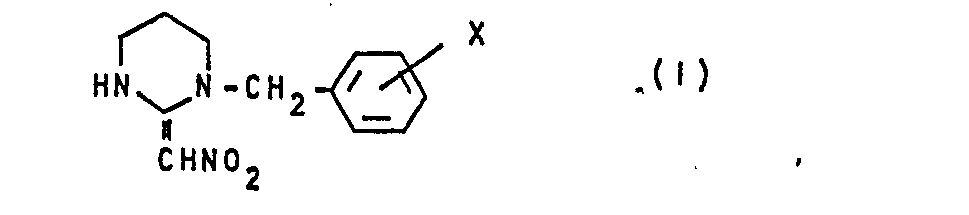
- (1) ein Nitromethylen-tetrahydropyrimidin-Derivat der allgemeinen Formel (I)
- (2) Verfahren zur Herstellung des Nitromethylen-tetrahydropyrimidin-Derivats der allgemeinen Formel (I),
- (3) insektizide, mitizide und nematizide Mittel, die als Wirkstoff das Nitromethylen-tetrahydropyrimidin-Derivat der allgemeinen Formel (I) enthalten, und
- (4) ein Verfahren zur Bekämpfung schädlicher Insekten, Milben oder Zecken und Nematoden, bei dem das Nitromethylen-tetrahydropyrimidin-Derivat der allgemeinen Formel (I) entweder allein oder in Kombination mit Verdünnungsmittel (einem Lösungsmittel und/oder einem Streckmittel und/oder einem Träger) und/oder einem oberflächenaktiven Mittel und, falls weiterhin erforderlich, einem Stabilisator, einem Haftmittel und einem synergistischen Mittel zur Einwirkung gebracht wird.
Description
- Die vorliegende Erfindung betrifft neue Nitromethylen-tetrahydropyrimidin-Derivate, Verfahren zu ihrer Herstellung sowie insektizide, mitizide, tickizide und nematizide Mittel, die solche Derivate als Wirkstoffe enthalten.
- Insbesondere betrifft die vorliegende Erfindung neue Nitromethylen-tetrahydropyrimidin-Derivate der nachstehenden allgemeinen Formel (I)

- X für Halogen steht.
- Die Nitromethylen-tetrahydropyrimidin-Derivate der Formel (I) gemäß der vorliegenden Erfindung können mittels des folgenden allgemeinen Verfahrens i) hergestellt werden, auf das sich die vorliegende Erfindung ebenfalls erstreckt.
- Ein Verfahren zur Herstellung der Nitromethylen-tetrahydropyrimidin-Derivate der allgemeinen Formel (I) umfaßt die Reaktion einer Verbindung der allgemeinen Formel (II)


- Die vorliegende Erfindung betrifft weiterhin insektizide, mitizide , tickizide und nematizide Mittel, die Nitrcmethylen-tetrahydropyrimidin-Derivate der Formel (I) als Wirkstoffe enthalten.
- Die vor dem Anmeldezeitpunkt der vorliegenden Anmeldung bekannte DE-OS 25 14 402 stellt fest, daß 2-Nitromethylen-imidazolin-Derivate und 2-Nitromethylen-hexahydropyrimidin-Derivate der nachstehenden allgemeinen Formel


- In der vorstehenden Formel schließt jedoch R1 nicht eine Benzyl-Gruppe mit einem Substituenten ein. Nunmehr wurde gefunden, daß die neuen Nitromethylen-tetrahydropyrimidin-Verbindungen der allgemeinen Formel (I) eine hervorragende Bekämpfungswirkung gegenüber schädlichen Insekten, Milben, Zecken und Nematoden besitzen.
- Die durch die obige allgemeine Formel (I) bezeichneten . Nitromethylen-tetrahydropyrimidin-Derivate der vorliegenden Erfindung werden weder von der in der oben zitierten DE-OS beschriebenen allgemeinen Formel erfaßt, noch sind sie irgendwo sonst in der früher erschienenen technischen Literatur beschrieben.
- Die Verbindungen der vorliegenden Erfindung sind gekennzeichnet durch die Tatsache, daß in ihrer chemischen Struktur 2-Nitromethylen-tetrahydropyrimidin als das Grundskelett vorliegt und eine halogen-substituierte Benzyl-Gruppe an dem Stickstoff-Atom in der 1-Stellung des Tetrahydropyrimidin-Rings substituiert ist. Der Phenyl-Kern ist durch Halogen vorzugsweise in der 3- oder der 4-Stellung substituiert.
- Es wurde außerdem gefunden, daß die Verbindungen der vorliegenden Erfindung eine besonders hervorragende Bekämpfungswirkung gegenüber Schädlingen besitzen, die diejenige der Verbindungen der Formel (A-1), die in der oben genannten DE-OS 25 14 402 beschrieben sind und den Verbindungen der vorliegenden Erfindung am ähnlichsten sind, weit übertrifft, und daß die Verbindungen der vorliegenden Erfindung eine ausgeprägte Bekämpfungswirkung gegen Schadinsekten zeigen, die gegenüber Insektiziden vom Typ organischer Phosphate und vom Carbamat-Typ aufgrund langdauernden Einsatzes derselben Resistenz entwickelt haben, insbesondere gegen saugende Insekten wie Schaben, Laternenträger und Zikaden.
- Weiterhin wurde gefunden, daß die Verbindungen der vorliegenden Erfindung besondere überlegene Bekämpfungswirkungen entfalten, wenn sie auf eine Wasseroberfläche aufgebracht werden, und in bezug auf Restwirkungen in Wasser solchen Verbindungen, die den Verbindungen der vorliegenden Erfindung sehr ähnlich sind, beispielsweise den Verbindungen der oben angegebenen Formel (A-1), weit überlegen sind.
- Ein Ziel der vorliegenden Erfindung ist es, die neuen Nitromethylen-tetrahydropyrimidin-Derivate der allgemeinen Formel (I), ein Verfahren zur Herstellung derselben sowie deren Verwendung als insektizide, mitizide, tickizide und nematizide Mittel verfügbar zu machen.
- Dieses sowie weitere Ziele und Vorteile der vorliegenden Erfindung werden aus der folgenden Beschreibung im einzelnen deutlich.
- Die aktiven Verbindungen gemäß der vorliegenden Erfindung zeigen eine genaue Bekämpfungswirkung gegen schädliche Insekten, Milben oder Zecken und Nematoden, ohne daß sie irgendeine Phytotoxizität gegenüber Kulturpflanzen entfalten. Des weiteren können die Verbindungen der vorliegenden Erfindung zur Bekämpfung und Ausrottung einer breiten Palette von Schädlingen eingesetzt werden, darunter saugenden Insekten, beißenden Insekten und anderen Pflanzenparasiten, Schädlingen von Lagergetreide und gesundheitsgefährdenden Schädlingen. Spezielle Beispiele für diese Schädlinge sind nachstehend aufgeführt:
- Zu Beispielen für Insekten zählen
- Callosobruchus chinensis, Sitophilus zeamais, Tribolium castaneum, Epilachna vigintioctomaculata, Agriotes fuscicollis, Anomala rufocuprea, Leptinotarsa decemlineata, Diabrotica spp., Monochamus alternatus, Lissorhoptus oryzophilus und Lyctus brunneus.
- Lymantria dispar, Malacosoma neustria, Pieris rapae, Spodoptera litura, Mamestra brassicae, Chilo suppressalis, Pyrausta nubilalis, Ephestia cautella, Adoxophyes orana, Carpocapsa pomonella, Agrotis fucosa, Galleria mellonella Plutella maculipennis und Phyllocnistis citrella.
- Nephotettix cincticeps, Nilaparvata lugens, Pseudococcus comstocki, Unaspis yanonensis, Myzus persicae, Aphis pomi, Aphis gossypii, Rhopalosiphum pseudobrassicas, Stephanitis nashi, Nazara spp., Cimex lectularius, Trialeurodes vaporariorum und Psylla spp..
- Blatella germanica, Periplaneta americana, Gryllotalpa africana und Locusta migratoria migratoriodes.
- Deucotermes speratus und Coptotermes formosanus.
- Musca domestica, Aedes aegypti, Hylemia platura, Culex pipiens, Anopheles sinensis und Culex tritaeniorhynchus.
- Tetranychus telarius, Panonychus citri, Aculus pelekassi und Torronomus spp..
- Meloidogyne incognita, Bursaphelenchus lignicolus Mamiya et Kiyohara, Aphelenchoides besseyi, Heterodera glycines und Pratylenchus spp..
- Auf dem Gebiet der Veterinärmedizin sind die neuen Verbindungen gemäß der vorliegenden Erfindung wirksam gegen verschiedene schädliche Tierparasiten (Endo- und Ektoparasiten) wie Zecken, Insekten und Würmer. Beispiele für solche Tierparasiten sind nachstehend angegeben.
- Oranithodoros spp., Ixodes spp. und Boophilus spp..
- Gastrophilus spp., Stomoxys spp., Trichodectes spp. Rhodnius spp. und Ctenocephalidex canis
- Substanzen, die eine pestizide Aktivität gegenüber all diesen Schädlingen aufweisen, werden in der vorliegenden Anmeldung gelegentlich einfach als "Insektizide" bezeichnet.
- Die Nitromethylen-tetrahydropyrimidin-Derivate der allgemeinen Formel (I) gemäß der vorliegenden Erfindung können in einfacher Weise hergestellt werden, beispielsweise mit Hilfe des folgenden Verfahrens i).
-

- (In den Formeln hat X die im Vorstehenden angegebene Bedeutung).
- In dem vorstehenden Reaktionsschema bezeichnet X ein Halogen-Atom, speziell ein Fluor-, Chlor-, Brom- oder Iod-Atom.
- In dem durch das obige Reaktionsschema dargestellten Verfahren zur Herstellung der Verbindung der allgemeinen Formel (I) zählen zu speziellen Beispielen für die Ausgangs-Verbindung der allgemeinen Formel (II) N-(3-Chlorobenzyl)trimethylendiamin, N-(4-Chlorobenzyl)tri- methylendiamin, N-(4-Bromobenzyl)trimethylendiamin und N-(4-Fluorobenzyl)trimethylendiamin.
- Das vorgenannte Verfahren wird durch das folgende typische Beispiel im einzelnen beschrieben.

- Zweckmäßigerweise kann das vorstehende Verfahren zur Herstellung der Verbindungen gemäß der vorliegenden Erfindung in einem Lösungsmittel oder Verdünnungsmittel durchgeführt werden. Zu diesem Zweck können sämtliche inerten Lösungsmittel oder Verdünnungsmittel verwendet werden.
- Beispiele für solche Lösungsmittel oder Verdünnungsmittel umfassen Wasser; aliphatische, alicyclische und aromatische Kohlenwasserstoffe (die gegebenenfalls chloriert sein können), wie Hexan, Cyclohexan, Petrolether, Ligroin, Benzol, Toluol, Xylol, Methylenchlorid, Chloroform, Kohlenstofftetrachlorid, Ethylenchlorid, Trichloroethylen und Chlorbenzol, Ether wie Diethylether, Methylethylether, Di-isopropylether, Dibutylether, Propylenoxid, Dioxan und Tetrahydrofuran, Ketone wie Aceton, Methylethylketon, Methylisopropylketon und Methylisobutylketon, Nitrile wie Acetonitril, Propionitril und Acrylnitril, Alkohole wie Methanol, Ethanol, Isopropanol, Butanol und Ethylenglycol, Ester wie Ethylacetat und Amylacetat, Säureamide wie Dimethylformamid und Dimethylacetamid, Sulfone und Sulfoxide wie Dimethylsulfoxid und Sulfolan sowie Basen wie Pyridin.
- Das obige Verfahren kann innerhalb eines breiten Temperaturbereichs durchgeführt werden. Im allgemeinen kann es bei einer Temperatur zwischen -20°C und dem Siedepunkt der Mischung, zweckmäßigerweise bei einer Temperatur zwischen etwa 0°C und etwa 100°C, durchgeführt werden. Zweckmäßigerweise wird die Reaktion unter normalem Atmosphärendruck durchgeführt, jedoch ist es ebenfalls möglich, bei erhöhtem oder vermindertem Druck zu arbeiten.
- Die Verbindungen der allgemeinen Formel (I) gemäß der vorliegenden Erfindung können auch mit Hilfe eines anderen, im Folgenden schematisch dargestellten Verfahrens ii) hergestellt werden.
-

- (In den Formeln hat X die im Vorstehenden angegebene Bedeutung, und Hal bezeichnet ein Halogen-Atom).
- In dem vorstehenden Reaktionsschema bezeichnet X ein Halogen-Atom, speziell ein Fluor-, Chlor-, Brom- oder Iod-Atom.
- In dem durch das obige Reaktionsschema dargestellten Verfahren zur Herstellung der Verbindung der allgemeinen Formel (I) zählen zu speziellen Beispielen für die Ausgangs-Verbindung der allgemeinen Formel (III) 3-Chlorobenzylchlorid, 4-Chlorobenzylchlorid, 4-Bromobenzylchlorid und 4-Fluorobenzylchlorid. Die entsprechenden Bromide sind ebenfalls zu nennen.
- Das vorgenannte Verfahren ii) wird durch das folgende Bezugsbeispiel im einzelnen beschrieben.
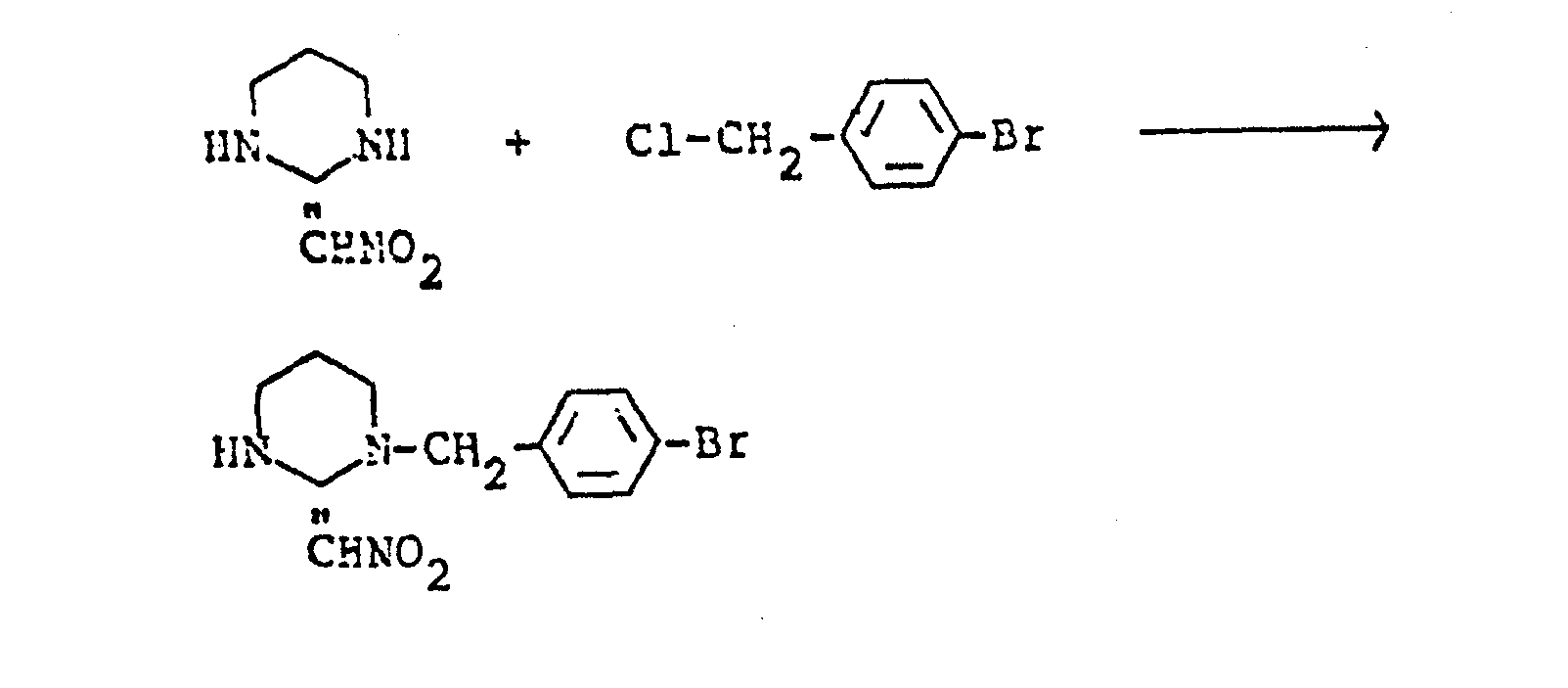
- Das vorstehende Verfahren kann unter Verwendung der gleichen Lösungsmittel oder Verdünnungsmittel durchgeführt werden, wie sie im Vorstehenden beispielhaft für das Verfahren i) aufgeführt sind.
- Die vorstehende Reaktion kann in Gegenwart eines säurebindenden Mittels durchgeführt werden. Beispiele für das säurebindende Mittel können die Hydroxide, Carbonate, Hydrogencarbonate und Alkoholate von Alkalimetallen sowie tertiäre Amine wie Triethylamin, Diethylanilin und Pyridin umfassen, die sämtlich im allgemeinen verwendet werden.
- Das Verfahren ii) kann wie im Fall des Verfahrens i) innerhalb eines weiten Bereichs der Temperatur und zweckmäßigerweise unter normalem Atmosphärendruck durchgeführt werden. Es ist ebenfalls möglich, bei erhöhtem oder vermindertem Druck zu arbeiten.
- Als insektizide, mitizide, tickizide und nematizide Mittel können die Verbindungen der vorliegenden Erfindung unmittelbar nach dem Verdünnen mit Wasser oder aber in Form verschiedenartiger Formulierungen zur Anwendung gebracht werden, wie sie unter Verwendung landwirtschaftlich unbedenklicher Hilfsstoffe durch Verfahren gewonnen werden, die bei der praktischen Herstellung von Agrochemikalien allgemein angewandt werden. Im praktischen Gebrauch werden diese verschiedenen Formulierungen entweder unmittelbar oder nach dem Verdünnen mit Wasser auf die gewünschte Konzentration eingesetzt.
- Beispiele für die hierin erwähnten landwirtschaftlich unbedenklichen Hilfsstoffe sind Verdünnungsmittel (Lösungsmittel, Streckmittel, Träger), oberflächenaktive Mittel (Lösungsvermittler, Emulgatoren, Dispergiermittel, Netzmittel), Stabilisatoren, Haftmittel, AerosolTreibmittel und synergistische Mittel.
- Beispiele für die Lösungsmittel sind Wasser und organische Lösungsmittel, beispielsweise Kohlenwasserstoffe [z.B. n-Hexan, Petrolether, Erdöl-Fraktionen (z.B. Paraffinwachse, Kerosin, Leichtöle, Mittelöle und Schweröle), Benzol, Toluol und Xylole_7, halogenierte Kohlenwasserstoffe (z.B. Methylenchlorid, Kohlenstofftetrachlorid, Ethylenchlorid, Ethylendibromid, Chlorbenzol und Chloroform), Alkohole (z.B. Methanol, Ethanol, Propanol und Ethylenglycol), Ether (z.B. Diethylether, Ethylenoxid und Dioxan), Alkohol-ether (z.B. Ethylenglycol-monomethylether), Ketone (z.B. Aceton und Isophoron), Ester (z.B. Ethylacetat und Amylacetat), Amide (z.B. Dimethylformamid und Dimethylacetamid) und Sulfoxide (z.B. Dimethylsulfoxid).
- Beispiele für die Streckmittel oder Träger umfassen anorganische Pulver, beispielsweise Löschkalk, Magnesiumkalk, Gips, Calciumcarbonat, Siliciumdioxid, Perlit, Bimsstein, Calcit, Diatomeenerde, amorphes Siliciumdioxid, Aluminiumoxid, Zeolithe und Tonminerale (z.B. Pyrophyllit, Talkum, Montmorillonit, Beidellit, Vermikulit, Kaolinit und Glimmer), pflanzliche Pulver wie beispielsweise Getreidepulver, Stärkearten, verarbeite- te Stärkearten, Zucker, Glucose und zerkleinerte Stengel von Pflanzen, sowie Pulver aus synthetischen Harzen wie Phenol-Harzen, Harnstoff-Harzen und Vinylchlorid-Harzen.
- Beispiele für die oberflächenaktiven Mittel umfassen anionische oberflächenaktive Mittel wie Alkylsulfonsäureester (z.B. Natriumlaurylsulfat), Arylsulfonsäuren (z.B. Alkylarylsulfonsäure-Salze und Natriumalkylnaphthalinsulfonate), Bernsteinsäure-Salze und Salze von Schwefelsäureestern von Polyethylenglycol-alkylarylethern, kationische oberflächenaktive Mittel wie Alkylamine (z.B. Laurylamin, Stearyltrimethylammoniumchlorid und Alkyldimethylbenzylammoniumchloride) und Polyoxyethylenalkylamine, nicht-ionische oberflächenaktive Mittel wie Polyoxyethylenglycolether (z.B. Polyoxyethylenalkylarylether und deren Kondensationsprodukte), Polyoxyethylenglycolester (z.B. Polyoxyethylenfettsäureester) und Ester mehrwertiger Alkohole (z.B. Polyoxyethylensorbitan-monolaurat) sowie amphotere oberflächenaktive Mittel.
- Beispiele für andere Hilfsstoffe umfassen Stabilisatoren, Haftmittel (z.B. landwirtschaftliche Seifen, Casein-Kalk, Natriumalginat, Polyvinylalkohol, Haftmittel vom Vinylacetat-Typ und Acryl-Haftmittel), Aerosol-Treibmittel (z.B. Trichlorofluoromethan, Dichlorofluoromethan, 1,2,2-Trichloro-1,1,2-trifluoroethan, Chlorbenzol, verflüssigtes Erdgas (LNG) und niedere Ether), die Verbrennung steuernde Mittel für Räuchermittel (z.B. Nitrite, Zink-Pulver und Dicyandiamid), sauerstoff-abgebende Mittel (z.B. Chlorate), wirkungsverlängernde Mittel, Dispersions-Stabilisatoren (z.B. Casein, Tragant, Carboxymethylcellulose (CMC) und Polyvinylalkohol (PVA)) und synergistische Mittel.
- Die Verbindungen der vorliegenden Erfindung können mittels der allgemein auf dem Gebiet der Agrochemikalien gebräuchlichen Verfahren zu verschiedenen Präparaten formuliert werden. Beispiele für solche Anwendungsformen sind emulgierbare Konzentrate, öl-Präparate, benetzbare Pulver, lösliche Pulver, Suspensionen, Stäubemittel, Granulate, pulvrige Präparate, Räuchermittel, Tabletten, Aerosole, Pasten und Kapseln.
- Die insektiziden, mitiziden oder nematiziden Mittel gemäß der vorliegenden Erfindung können etwa 0,1 bis etwa 95 Gew.-%, vorzugsweise etwa von 0,5 bis 90 Gew.-% des vorerwähnten Wirkstoffes enthalten.
- Für den praktischen Gebrauch beträgt die geeignete Menge der aktiven Verbindung in den vorgenannten verschiedenartigen Formulierungen und gebrauchsfertigen Präparaten im allgemeinen etwa 0,0001 bis etwa 20 Gew.-%, vorzugsweise etwa 0,005 bis etwa 10 Gew.-%.
- Der Gehalt des Wirkstoffs kann in geeigneter Weise je nach der Art der Formulierung, dem Verfahren, Zweck, der Zeit und dem Ort seiner Anwendung sowie dem Zustand des Auftretens der zu bekämpfenden schädlichen Insekten, Milben oder Zecken und Nematoden variiert werden.
- Erforderlichenfalls können die Verbindungen gemäß der vorliegenden Erfindung weiterhin auch in Kombination mit anderen Agrochemikalien verwendet werden, beispielsweise mit anderen Insektiziden, Fungiziden, anderen Mitiziden, anderen Nematiziden, Anti-Virus-Mitteln, Herbiziden, Pflanzen-Wachstumsregulatoren und Lockstoffen / z.B. Organophosphat-Verbindungen, Carbamat-Verbindungen, Dithio(oder thiol)carbamat-Verbindungen, Organochlor-Verbindungen, Dinitro-Verbindungen, organischen Schwefel- oder metallorganischen Verbindungen, Antibiotika, substituierten Diphenylether-Verbindungen, Harnstoff-Verbindungen und Triazin-Verbindungen_7 und/ oder Düngemitteln.
- Den im Vorstehenden bezeichneten Wirkstoff enthaltende verschiedenartige Mittel und gebrauchsfertige Präparate können mittels verschiedener Verfahren zur Anwendung gebracht werden, wie sie allgemein für das Aufbringen von Agrochemikalien gebräuchlich sind, beispielsweise durch Sprühen (Versprühen von Flüssigkeiten, Vernebeln, Zerstäuben, Stäuben, Streuen von Granulat, Wasser-Oberflächenbehandlung, Gießen etc.), Räuchern, Bodenbehandlung (Vermischen mit dem Boden, Spritzen, Bedampfen, Gießen etc.), Oberflächen-Anwendung (z.B. Beschichten, Aufbringen in Form von Bändern, Pulverbeschichten, Bedecken etc.), Eintauchen und Ködern. Sie können auch mittels des sogenannten Ultra-Low-Volume-Sprühverfahrens aufgebracht werden. Nach diesem Verfahren kann der Wirkstoff sogar in einer Konzentration von 100 % eingearbeitet sein.
- Die Aufwandmenge pro Flächeneinheit beträgt beispielsweise etwa 0,03 bis etwa 10 kg/ha, vorzugsweise etwa 0,3 bis etwa 6 kg/ha. In besonders gelagerten Fällen können oder sollten sogar die Aufwandmengen außerhalb des angegebenen Bereichs liegen.
- Gemäß der vorliegenden Erfindung kann ein insektizides, mitizides, tickizides oder nematizides Mittel zur Verfügung gestellt werden, das als Wirkstoff die Verbindung der allgemeinen Formel (I) sowie ein Verdünnungsmittel (ein Lösungsmittel und/oder ein Streckmittel und/oder einen Träger) und/oder ein oberflächenaktives Mittel und, falls weiterhin erforderlich, einen Stabilisator, ein Haftmittel, ein synergistisches Mittel etc. enthält.
- Die vorliegende Erfindung macht weiterhin ein Verfahren zur Bekämpfung von Insekten, Milben oder Zecken und Nematoden verfügbar, das darin besteht, daß eine Verbindung der allgemeinen Formel (I) allein oder in Form einer Mischung mit einem Verdünnungsmittel (einem Lösungsmittel und/ oder einem Streckmittel und/oder einem Träger) und/oder einem oberflächenaktiven Mittel und, falls weiterhin erforderlich, einem Stabilisator, einem Haftmittel, einem synergistischen Mittel etc. auf schädliche Insekten, Milben oder Zecken und Nematoden und/oder deren Lebensraum oder den Ort ihres Auftretens aufgebracht wird.
- Die vorliegende Erfindung wird durch die folgenden Beispiele im einzelnen erläutert, ist jedoch nicht auf diese speziellen Beispiele allein beschränkt.
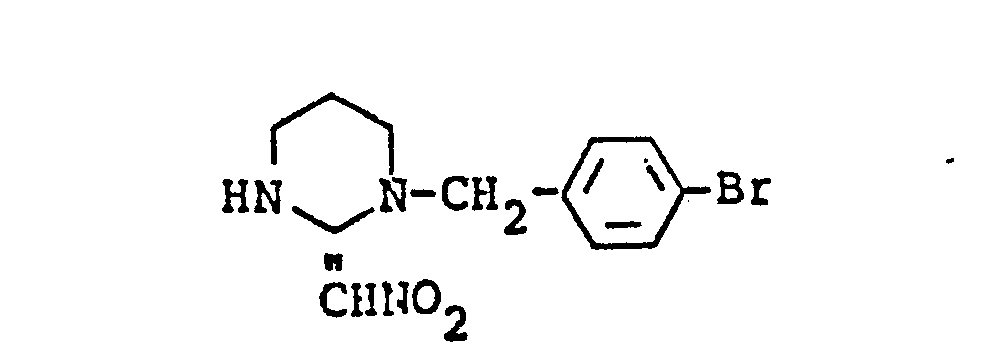
- N-(4-Chlorobenzyl)trimethylendiamin (8,45 g) und 1-Nitro-2,2-bis(methylthio)ethylen (6,60 g) wurden in 100 ml Ethanol 16 h unter Rückfluß erhitzt. Die Reaktionsmischung wurde auf Raumtemperatur abgekühlt, und die ausgefallenen Kristalle wurden durch Filtration gesammelt und mit einer kleinen Menge Ethanol gewaschen, wonach 1-(4-Chlorobenzyl)-2-(nitromethylen)-tetrahydropyrimidin (9,8 g) der nachstehenden Formel erhalten wurde. Schmelzpunkt: 172-174°C.

- Die nachstehende Tabelle 1 führt die Verbindungen der vorliegenden Erfindung auf, die aus den entsprechenden Ausgangsstoffen in gleicher Weise wie in Beispiel 1 synthetisiert wurden.

- 15 Teile der Verbindung Nr. 1 der Erfindung, 80 Teile eines Gemisches (1:5) aus pulvriger Diatomeenerde und Tonpulver, 2 Teile Natriumalkylbenzolsulfonat und 3 Teile Natriumalkylnaphthalinsulfonat/Formaldehyd-Kondensat werden pulverisiert und zu einem benetzbaren Pulver vermischt. Dieses wird mit Wasser verdünnt und auf schädliche Insekten, Milben oder Nematoden und/oder ihren Lebensraum oder den Ort ihres Auftretens aufgesprüht.
- 30 Teile der Verbindung Nr. 3 der Erfindung, 55 Teile Xylol, 8 Teile Polyoxyethylen-alkylphenylether und 7 Teile Calciumalkylbenzolsulfonat werden unter Rühren miteinander vermischt, wodurch ein emulgierbares Konzentrat hergestellt wird. Dieses wird mit Wasser verdünnt und auf schädliche Insekten, Milben oder Nematoden und/oder ihren Lebensraum oder den Ort ihres Auftretens aufgesprüht.
- 2 Teile der Verbindung Nr. 4 der Erfindung und 98 Teile Tonpulver werden pulverisiert und gemischt, wodurch ein Stäubemittel hergestellt wird. Dieses wird über schädlichen Insekten, Milben oder Nematoden und/oder ihrem Lebensraum oder dem Ort ihres Auftretens ausgestreut.
- Wasser (25 Teile) wird zu einer Mischung aus 10 Teilen der Verbindung Nr. 2 der Erfindung, 30 Teilen Bentonit (Montmorillonit), 58 Teilen Talkum und 2 Teilen Ligninsulfonat zugesetzt, und das Gemisch wird gut geknetet. Die Mischung wird mittels eines Extruder-Granulators zu einem Granulat mit einer Korngröße von 0,43 bis 2,0 mm (10 bis 40 mesh) verarbeitet, das dann bei 40°C bis 50°C getrocknet wird, wodurch ein Granulat gebildet wird. Das Granulat wird über schädlichen Insekten, Milben oder Nematoden und/oder ihrem Lebensraum oder dem Ort ihres Auftretens ausgestreut.
- Ein Drehmischer wird mit 95 Teilen Tonmineral-Teilchen mit einer Teilchengrößen-Verteilung zwischen 0,2 und 2 mm beschickt, und unter Drehen des Mischers werden 5 Gew.-Teile der Verbindung Nr. 3 der Erfindung auf die Tonmineral-Teilchen zur gleichmäßigen Benetzung derselben aufgesprüht. Die feuchte Mischung wird bei 40°C bis 50°C getrocknet, wodurch ein Granulat gebildet wird. Das Granulat wird über schädlichen Insekten, Milben oder Nematoden und/oder ihrem Lebensraum oder dem Ort ihres Auftretens ausgestreut.
- Die Verbindung Nr. 1 der Erfindung (0,5 Teile) und 99,5 Teile Kerosin werden unter Rühren miteinander vermischt, wodurch ein öl-Präparat gebildet wird. Dieses wird auf schädliche Insekten, Milben oder Nematoden und/oder ihren Lebensraum oder den Ort ihres Auftretens aufgesprüht.
- Lösungsmittel: Xylol 3 Gew.-Teile Emulgator: Polyoxyethylen- 1 Gew.-Teil alkylphenylether
- Zur Herstellung eines geeigneten Test-Präparats wurde 1 Gew.-Teil der aktiven Verbindung mit der oben bezeichneten Menge Lösungsmittel, das die oben angegebene Menge Emulgator enthielt, vermischt, und die Mischung wurde mit Wasser auf eine vorher festgesetzte Konzentration verdünnt.
- Auf Reispflanzen von etwa 10 cm Höhe, die jeweils in Töpfe von 12 cm Durchmesser gepflanzt waren, wurden pro Topf 10 ml der mit Wasser verdünnten, eine vorbestimmte Wirkstoff-Konzentration aufweisenden Lösungen, die wie oben angegeben hergestellt wurden, gesprüht. Die aufgesprühte Chemikalie wurde trocknen gelassen, und über die Reispflanzen wurde ein Drahtkorb von 7 cm Durchmesser und 14 cm Höhe gestülpt, unter dem 30 ausgewachsene weibliche Exemplare von Nephotettix cincticeps, die gegen Organophosphor-Insektizide resistent waren, ausgesetzt wurden. Die Töpfe wurden jeweils in einem Raum mit konstanter Temperatur aufbewahrt, und 24 Stunden später wurde die Zahl der toten Insekten bestimmt und das Vernichtungsverhältnis berechnet.
- Die Ergebnisse sind in Tabelle 2 aufgeführt.

- Gezüchtete grüne Pfirsichblattläuse wurden auf Setzlingen von Eierfrüchten (schwarzen länglichen Auberginen) von etwa 20 cm Höhe ausgesetzt, die in unglasierten Töpfen mit einem Durchmesser von 15 cm gezogen worden waren (etwa 200 Blattläuse pro Setzling). Einen Tag nach dem Aussetzen wurde eine wie in Beispiel 8 hergestellte wäßrige Verdünnung jeder der aktiven Verbindungen mit einer vorher festgelegten Konzentration in genügender Menge mit Hilfe einer Spritzpistole auf die Pflanzen aufgesprüht. Nach dem Sprühen wurden die Töpfe in einem Gewächshaus bei 28°C stehen gelassen. 24 Stunden nach dem Sprühen wurde das Vernichtungsverhältnis berechnet. Für jede Verbindung wurde der Test als Doppelbestimmung durchgeführt.
- Die Ergebnisse sind in Tabelle 3 aufgeführt.

Claims (7)




Applications Claiming Priority (2)
| Application Number | Priority Date | Filing Date | Title |
|---|---|---|---|
| JP58185854A JPH0629256B2 (ja) | 1983-10-06 | 1983-10-06 | ニトロメチレン−テトラヒドロピリミジン誘導体,その製法及び殺虫,殺ダニ,殺センチユウ剤 |
| JP185854/83 | 1983-10-06 |
Publications (2)
| Publication Number | Publication Date |
|---|---|
| EP0136636A2 true EP0136636A2 (de) | 1985-04-10 |
| EP0136636A3 EP0136636A3 (de) | 1986-01-02 |
Family
ID=16178038
Family Applications (1)
| Application Number | Title | Priority Date | Filing Date |
|---|---|---|---|
| EP84111316A Withdrawn EP0136636A3 (de) | 1983-10-06 | 1984-09-22 | Nitromethylen-tetrahydropyrimidin-Derivate, Verfahren zu ihrer Herstellung sowie insektizide, mitizide, tickizide und nematizide Mittel |
Country Status (10)
| Country | Link |
|---|---|
| US (1) | US4590272A (de) |
| EP (1) | EP0136636A3 (de) |
| JP (1) | JPH0629256B2 (de) |
| KR (1) | KR850003400A (de) |
| BR (1) | BR8405009A (de) |
| DD (1) | DD229014A5 (de) |
| DK (1) | DK479584A (de) |
| IL (1) | IL73120A0 (de) |
| PH (1) | PH19640A (de) |
| ZA (1) | ZA847831B (de) |
Cited By (8)
| Publication number | Priority date | Publication date | Assignee | Title |
|---|---|---|---|---|
| EP0199974A3 (de) * | 1985-04-02 | 1987-08-12 | Nihon Tokushu Noyaku Seizo K.K. | Nitromethylen-tetrahydropyrimidine |
| EP0259738A3 (en) * | 1986-09-10 | 1989-02-22 | Nihon Tokushu Noyaku Seizo K.K. | Heterocyclic compounds |
| EP0212600B1 (de) * | 1985-08-27 | 1991-11-27 | Nihon Bayer Agrochem K.K. | Neue Nitromethylen-Derivate |
| EP0623601A1 (de) * | 1993-04-30 | 1994-11-09 | Shell Internationale Researchmaatschappij B.V. | N-(3-Fluorbenzyl)heterocyclische Derivate und ihre Verwendung als Schädlingsbekämpfungsmittel |
| TR27478A (tr) * | 1993-04-30 | 1995-06-07 | Shell Int Research | Biosid etkinlige sahip yeni n-benzil heterosiklik bilesikler. |
| US6114362A (en) * | 1994-07-28 | 2000-09-05 | Bayer Aktiengesellschaft | Compositions for the control of plant pests |
| WO2002043494A2 (en) | 2000-11-30 | 2002-06-06 | Bayer Healthcare Llc | Compositions for enhanced acaricidal activity |
| US8268750B2 (en) | 2003-11-14 | 2012-09-18 | Bayer Cropscience Ag | Combination of active substances with insecticidal properties |
Families Citing this family (20)
| Publication number | Priority date | Publication date | Assignee | Title |
|---|---|---|---|---|
| JPH0784461B2 (ja) * | 1986-12-19 | 1995-09-13 | 日本バイエルアグロケム株式会社 | 殺虫性ニトロイミノ又はシアノイミノ化合物 |
| GB8612238D0 (en) * | 1986-05-20 | 1986-06-25 | Shell Int Research | Pesticidal nitromethy/lene derivatives |
| GB8915131D0 (en) * | 1989-06-30 | 1989-08-23 | Wyeth John & Brother Ltd | Substituted 1,3-diaminopropanes |
| DE4232561A1 (de) * | 1992-09-29 | 1994-03-31 | Bayer Ag | Bekämpfung von Fischparasiten |
| DE4414569A1 (de) * | 1994-04-27 | 1995-11-02 | Bayer Ag | Verwendung von substituierten Aminen zur Behandlung von Hirnleistungsstörungen |
| DE4417742A1 (de) | 1994-05-20 | 1995-11-23 | Bayer Ag | Nicht-systemische Bekämpfung von Parasiten |
| DE19622355A1 (de) | 1996-06-04 | 1997-12-11 | Bayer Ag | Formkörper die agrochemische Mittel freisetzen |
| DE19807630A1 (de) | 1998-02-23 | 1999-08-26 | Bayer Ag | Wasserhaltige Mittel zur Bekämpfung parasitierender Insekten und Milben an Menschen |
| DE19823396A1 (de) * | 1998-05-26 | 1999-12-02 | Bayer Ag | Synergistische insektizide Mischungen |
| DE19913174A1 (de) * | 1999-03-24 | 2000-09-28 | Bayer Ag | Synergistische insektizide Mischungen |
| DE19948129A1 (de) * | 1999-10-07 | 2001-04-12 | Bayer Ag | Wirkstoffkombinationen mit insektiziden und akariziden Eigenschaften |
| DE19953775A1 (de) | 1999-11-09 | 2001-05-10 | Bayer Ag | Wirkstoffkombinationen mit insektiziden und akariziden Eigenschaften |
| HK1049799A1 (zh) * | 1999-12-06 | 2003-05-30 | Euro-Celtique, S.A. | 具有类鸦片受体亲和力的三级氨基化合物 |
| DE10024934A1 (de) * | 2000-05-19 | 2001-11-22 | Bayer Ag | Wirkstoffkombinationen mit insektiziden akariziden Eigenschaften |
| DE10117676A1 (de) * | 2001-04-09 | 2002-10-10 | Bayer Ag | Dermal applizierbare flüssige Formulierungen zur Bekämpfung von parasitierenden Insekten an Tieren |
| US8232261B2 (en) | 2003-07-18 | 2012-07-31 | Bayer Cropscience Lp | Method of minimizing herbicidal injury |
| JP2007536917A (ja) * | 2004-05-13 | 2007-12-20 | バイエル・クロツプサイエンス・アクチエンゲゼルシヤフト | 植物成長の促進方法 |
| BRPI0514670A (pt) * | 2004-08-25 | 2008-06-17 | Bayer Cropscience Lp | processo de controle de cupins |
| DE102004054960A1 (de) * | 2004-11-13 | 2006-05-18 | Bayer Cropscience Ag | Fliegen-Gelköder |
| US9919979B2 (en) | 2005-01-21 | 2018-03-20 | Bayer Cropscience Lp | Fertilizer-compatible composition |
Family Cites Families (7)
| Publication number | Priority date | Publication date | Assignee | Title |
|---|---|---|---|---|
| DE2445421C2 (de) * | 1973-11-01 | 1985-07-11 | Shell Internationale Research Maatschappij B.V., Den Haag | 2-Nitromethylen-imidazolidin-Derivate und pestizide Mittel enthaltend diese Verbindungen |
| US3948934A (en) * | 1973-11-01 | 1976-04-06 | Shell Oil Company | 2-(Nitromethylene)-1,3-diazacycloalkane insect control agents |
| US4002765A (en) * | 1974-09-27 | 1977-01-11 | Shell Oil Company | 2-(Nitromethylene)-1,3-diazacycloalkane insect control agents |
| US3971774A (en) * | 1974-09-27 | 1976-07-27 | Shell Oil Company | 2-(Nitromethylene)-1,3-diazepines |
| US3969354A (en) * | 1974-09-27 | 1976-07-13 | Shell Oil Company | 2-(Nitromethylene)-hexahydropyrimidines |
| DE2514402A1 (de) * | 1975-04-02 | 1976-10-21 | Hoechst Ag | Insektizide mittel |
| GB1573905A (en) * | 1976-03-30 | 1980-08-28 | Shell Int Research | Heterocyclic oximes and their use as pesticides |
-
1983
- 1983-10-06 JP JP58185854A patent/JPH0629256B2/ja not_active Expired - Lifetime
-
1984
- 1984-09-22 EP EP84111316A patent/EP0136636A3/de not_active Withdrawn
- 1984-09-25 PH PH31266A patent/PH19640A/en unknown
- 1984-09-30 IL IL73120A patent/IL73120A0/xx unknown
- 1984-10-03 US US06/657,323 patent/US4590272A/en not_active Expired - Fee Related
- 1984-10-04 BR BR8405009A patent/BR8405009A/pt unknown
- 1984-10-04 DD DD84268007A patent/DD229014A5/de unknown
- 1984-10-05 KR KR1019840006159A patent/KR850003400A/ko not_active Withdrawn
- 1984-10-05 DK DK479584A patent/DK479584A/da not_active Application Discontinuation
- 1984-10-05 ZA ZA847831A patent/ZA847831B/xx unknown
Cited By (15)
| Publication number | Priority date | Publication date | Assignee | Title |
|---|---|---|---|---|
| EP0199974A3 (de) * | 1985-04-02 | 1987-08-12 | Nihon Tokushu Noyaku Seizo K.K. | Nitromethylen-tetrahydropyrimidine |
| EP0212600B1 (de) * | 1985-08-27 | 1991-11-27 | Nihon Bayer Agrochem K.K. | Neue Nitromethylen-Derivate |
| EP0259738A3 (en) * | 1986-09-10 | 1989-02-22 | Nihon Tokushu Noyaku Seizo K.K. | Heterocyclic compounds |
| US4882344A (en) * | 1986-09-10 | 1989-11-21 | Nihon Tokushu Noyaku Seizo K.K. | Pyridylmethyl-4-thiazolines |
| US4988712A (en) * | 1986-09-10 | 1991-01-29 | Nihon Tokushu Noyaku Seizo, K.K. | Insecticidal azolylmethyl-1,2-dihydropyridines |
| TR27478A (tr) * | 1993-04-30 | 1995-06-07 | Shell Int Research | Biosid etkinlige sahip yeni n-benzil heterosiklik bilesikler. |
| EP0623601A1 (de) * | 1993-04-30 | 1994-11-09 | Shell Internationale Researchmaatschappij B.V. | N-(3-Fluorbenzyl)heterocyclische Derivate und ihre Verwendung als Schädlingsbekämpfungsmittel |
| US6114362A (en) * | 1994-07-28 | 2000-09-05 | Bayer Aktiengesellschaft | Compositions for the control of plant pests |
| US7008903B2 (en) | 1994-07-28 | 2006-03-07 | Bayer Aktiengesellschaft | Pesticide |
| US7868025B2 (en) | 1994-07-28 | 2011-01-11 | Bayer Cropscience Ag | Pesticide |
| US7884049B2 (en) | 1994-07-28 | 2011-02-08 | Bayer Cropscience Ag | Compositions for the control of plant pests |
| US8410021B2 (en) | 1994-07-28 | 2013-04-02 | Bayer Cropscience Ag | Compositions for the control of plant pests |
| WO2002043494A2 (en) | 2000-11-30 | 2002-06-06 | Bayer Healthcare Llc | Compositions for enhanced acaricidal activity |
| US8268750B2 (en) | 2003-11-14 | 2012-09-18 | Bayer Cropscience Ag | Combination of active substances with insecticidal properties |
| US8993483B2 (en) | 2003-11-14 | 2015-03-31 | Bayer Intellectual Property Gmbh | Combination of active substances with insecticidal properties |
Also Published As
| Publication number | Publication date |
|---|---|
| JPS6078971A (ja) | 1985-05-04 |
| IL73120A0 (en) | 1984-12-31 |
| DK479584D0 (da) | 1984-10-05 |
| KR850003400A (ko) | 1985-06-17 |
| PH19640A (en) | 1986-06-04 |
| EP0136636A3 (de) | 1986-01-02 |
| BR8405009A (pt) | 1985-08-20 |
| ZA847831B (en) | 1985-05-29 |
| US4590272A (en) | 1986-05-20 |
| JPH0629256B2 (ja) | 1994-04-20 |
| DK479584A (da) | 1985-04-07 |
| DD229014A5 (de) | 1985-10-30 |
Similar Documents
| Publication | Publication Date | Title |
|---|---|---|
| EP0154178B1 (de) | Nitromethylen-Derivate, Verfahren zur ihrer Herstellung sowie insektizide, mitizide und nematizide Mittel | |
| EP0163855B1 (de) | Nitromethylen-Derivate, Zwischenprodukte für diese, Verfahren zu ihrer Herstellung sowie Insektizide | |
| DD229014A5 (de) | Insektizide, mitizide, tickizide und nematizide mittel | |
| EP0170842B1 (de) | N-Benzylcyclopropancarboxamid-Derivate, Verfahren zu ihrer Herstellung und Fungizide für Landwirtschaft und Gartenbau | |
| EP0196547A1 (de) | Neue Benzamide | |
| EP0007020B1 (de) | Organische Phosphorsäureester, Verfahren zu ihrer Herstellung, ihre Verwendung, Schädlingsbekämpfungsmittel und ihre Herstellung | |
| EP0141319B1 (de) | Substituierte Phenoxyalkancarbonsäureester | |
| EP0046928B1 (de) | Neue Organophosphate, Verfahren zu ihrer Herstellung und ihre Verwendung in Schädlingsbekämpfungsmitteln | |
| EP0153601B1 (de) | 2-Alkoxyaminosulfonylbenzolsulfonyl-harnstoff-Derivate | |
| EP0097270B1 (de) | Organophosphat-Derivate | |
| EP0119534B1 (de) | Phosphonsäureester | |
| EP0000528B1 (de) | Neue organische Phosphorsäureester, Verfahren zu ihrer Herstellung und ihre Verwendung als Insektizide, Akarizide und Nematozide | |
| DE2163392C3 (de) | Neue Phosphorsäureester sowie Verfahren zu deren Herstellung | |
| EP0143302A2 (de) | Neue Benzoylharnstoff-Derivate und Zwischenprodukte | |
| CH629084A5 (de) | Insektizide, akarizide und nematizide sowie verfahren zur herstellung neuer o-aethyl-s-n-propyl-0,2,2,2-trihalogen-aethylphosphorthiolate (oder -thionothiolate). | |
| EP0127049A2 (de) | Organische Phoshorsäureester | |
| EP0112524B1 (de) | Trichloroacryloyloxim-Verbindungen | |
| EP0097273B1 (de) | Benzylharnstoff-Derivate, Verfahren zu ihrer Herstellung und Fungizide für Landwirtschaft und Gartenbau | |
| EP0081151A1 (de) | Organophosphate, Verfahren zu ihrer Herstellung sowie diese enthaltende Schädlingsbekämpfungsmittel | |
| DE3208193C2 (de) | Neue organische Pyrophosphorsäureesterderivate, Verfahren zu ihrer Herstellung, sowie Pestizide die diese enthalten | |
| EP0204949B1 (de) | Phosphoroimidate | |
| EP0136640A2 (de) | Trichloroacryloyloxim-Derivate, Verfahren zu ihrer Herstellung und landwirtschaftliches Fungizid | |
| EP0137169A2 (de) | Cumalinsäureester, Verfahren zu ihrer Herstellung und landwirtschaftliche Fungizide | |
| EP0199974A2 (de) | Nitromethylen-tetrahydropyrimidine | |
| DE2316733A1 (de) | Dithio- und trithiophosphonsaeureester, verfahren zu ihrer herstellung und ihre verwendung als insektizide, akarizide und nematozide |
Legal Events
| Date | Code | Title | Description |
|---|---|---|---|
| PUAI | Public reference made under article 153(3) epc to a published international application that has entered the european phase |
Free format text: ORIGINAL CODE: 0009012 |
|
| 17P | Request for examination filed |
Effective date: 19840922 |
|
| AK | Designated contracting states |
Designated state(s): AT BE CH DE FR GB IT LI NL |
|
| RTI1 | Title (correction) | ||
| PUAL | Search report despatched |
Free format text: ORIGINAL CODE: 0009013 |
|
| AK | Designated contracting states |
Designated state(s): AT BE CH DE FR GB IT LI NL |
|
| STAA | Information on the status of an ep patent application or granted ep patent |
Free format text: STATUS: THE APPLICATION HAS BEEN WITHDRAWN |
|
| 18W | Application withdrawn |
Withdrawal date: 19860704 |
|
| RIN1 | Information on inventor provided before grant (corrected) |
Inventor name: SHINZO, KAGABU Inventor name: SHINICHI, TSUBOI Inventor name: KOZO, SHIOKAWA |