EP0132612B1 - Verfahren zur Herstellung flüssiger Kohlenwasserstoffe - Google Patents
Verfahren zur Herstellung flüssiger Kohlenwasserstoffe Download PDFInfo
- Publication number
- EP0132612B1 EP0132612B1 EP84107378A EP84107378A EP0132612B1 EP 0132612 B1 EP0132612 B1 EP 0132612B1 EP 84107378 A EP84107378 A EP 84107378A EP 84107378 A EP84107378 A EP 84107378A EP 0132612 B1 EP0132612 B1 EP 0132612B1
- Authority
- EP
- European Patent Office
- Prior art keywords
- solvent
- liquid hydrocarbons
- pressure
- toluene
- waste
- Prior art date
- Legal status (The legal status is an assumption and is not a legal conclusion. Google has not performed a legal analysis and makes no representation as to the accuracy of the status listed.)
- Expired
Links
- 229930195733 hydrocarbon Natural products 0.000 title claims abstract description 26
- 150000002430 hydrocarbons Chemical class 0.000 title claims abstract description 26
- 239000007788 liquid Substances 0.000 title claims abstract description 26
- 238000000034 method Methods 0.000 title claims abstract description 23
- 238000004519 manufacturing process Methods 0.000 title abstract description 4
- 239000002904 solvent Substances 0.000 claims abstract description 27
- 239000002699 waste material Substances 0.000 claims abstract description 26
- -1 polyethylene Polymers 0.000 claims abstract description 24
- 239000004698 Polyethylene Substances 0.000 claims abstract description 12
- 229920000573 polyethylene Polymers 0.000 claims abstract description 12
- 239000004743 Polypropylene Substances 0.000 claims abstract description 11
- 229920001155 polypropylene Polymers 0.000 claims abstract description 11
- 238000004821 distillation Methods 0.000 claims abstract description 7
- YXFVVABEGXRONW-UHFFFAOYSA-N Toluene Chemical compound CC1=CC=CC=C1 YXFVVABEGXRONW-UHFFFAOYSA-N 0.000 claims description 54
- UHOVQNZJYSORNB-UHFFFAOYSA-N Benzene Chemical compound C1=CC=CC=C1 UHOVQNZJYSORNB-UHFFFAOYSA-N 0.000 claims description 7
- YNQLUTRBYVCPMQ-UHFFFAOYSA-N Ethylbenzene Chemical compound CCC1=CC=CC=C1 YNQLUTRBYVCPMQ-UHFFFAOYSA-N 0.000 claims description 4
- XLYOFNOQVPJJNP-UHFFFAOYSA-N water Substances O XLYOFNOQVPJJNP-UHFFFAOYSA-N 0.000 claims description 3
- CTQNGGLPUBDAKN-UHFFFAOYSA-N O-Xylene Chemical compound CC1=CC=CC=C1C CTQNGGLPUBDAKN-UHFFFAOYSA-N 0.000 claims description 2
- 239000008096 xylene Substances 0.000 claims description 2
- 238000002360 preparation method Methods 0.000 claims 1
- 229920001971 elastomer Polymers 0.000 description 10
- 239000005060 rubber Substances 0.000 description 10
- 239000012071 phase Substances 0.000 description 9
- XLOMVQKBTHCTTD-UHFFFAOYSA-N Zinc monoxide Chemical compound [Zn]=O XLOMVQKBTHCTTD-UHFFFAOYSA-N 0.000 description 8
- 238000000197 pyrolysis Methods 0.000 description 8
- NINIDFKCEFEMDL-UHFFFAOYSA-N Sulfur Chemical compound [S] NINIDFKCEFEMDL-UHFFFAOYSA-N 0.000 description 6
- 238000009835 boiling Methods 0.000 description 6
- 239000003921 oil Substances 0.000 description 6
- 239000000047 product Substances 0.000 description 6
- 239000011593 sulfur Substances 0.000 description 6
- 229910052717 sulfur Inorganic materials 0.000 description 6
- 239000000945 filler Substances 0.000 description 5
- 239000007789 gas Substances 0.000 description 5
- KAKZBPTYRLMSJV-UHFFFAOYSA-N Butadiene Chemical compound C=CC=C KAKZBPTYRLMSJV-UHFFFAOYSA-N 0.000 description 4
- RRHGJUQNOFWUDK-UHFFFAOYSA-N Isoprene Chemical compound CC(=C)C=C RRHGJUQNOFWUDK-UHFFFAOYSA-N 0.000 description 4
- 229910052751 metal Inorganic materials 0.000 description 4
- 239000002184 metal Substances 0.000 description 4
- 239000002245 particle Substances 0.000 description 4
- 229920003023 plastic Polymers 0.000 description 4
- 239000004033 plastic Substances 0.000 description 4
- 239000011787 zinc oxide Substances 0.000 description 4
- 229910000831 Steel Inorganic materials 0.000 description 3
- 239000006229 carbon black Substances 0.000 description 3
- 239000000571 coke Substances 0.000 description 3
- 238000004939 coking Methods 0.000 description 3
- 150000001875 compounds Chemical class 0.000 description 3
- 239000000470 constituent Substances 0.000 description 3
- 239000004744 fabric Substances 0.000 description 3
- 238000010438 heat treatment Methods 0.000 description 3
- 150000002739 metals Chemical class 0.000 description 3
- 239000007787 solid Substances 0.000 description 3
- 239000010959 steel Substances 0.000 description 3
- ZAMOUSCENKQFHK-UHFFFAOYSA-N Chlorine atom Chemical compound [Cl] ZAMOUSCENKQFHK-UHFFFAOYSA-N 0.000 description 2
- 241000196324 Embryophyta Species 0.000 description 2
- VQTUBCCKSQIDNK-UHFFFAOYSA-N Isobutene Chemical compound CC(C)=C VQTUBCCKSQIDNK-UHFFFAOYSA-N 0.000 description 2
- QQONPFPTGQHPMA-UHFFFAOYSA-N Propene Chemical compound CC=C QQONPFPTGQHPMA-UHFFFAOYSA-N 0.000 description 2
- PPBRXRYQALVLMV-UHFFFAOYSA-N Styrene Chemical compound C=CC1=CC=CC=C1 PPBRXRYQALVLMV-UHFFFAOYSA-N 0.000 description 2
- 230000003712 anti-aging effect Effects 0.000 description 2
- 239000011324 bead Substances 0.000 description 2
- 125000004432 carbon atom Chemical group C* 0.000 description 2
- 239000007795 chemical reaction product Substances 0.000 description 2
- 239000003795 chemical substances by application Substances 0.000 description 2
- 239000000460 chlorine Substances 0.000 description 2
- 229910052801 chlorine Inorganic materials 0.000 description 2
- 238000002485 combustion reaction Methods 0.000 description 2
- 239000010791 domestic waste Substances 0.000 description 2
- 239000000446 fuel Substances 0.000 description 2
- 239000007791 liquid phase Substances 0.000 description 2
- 150000002894 organic compounds Chemical class 0.000 description 2
- 239000004014 plasticizer Substances 0.000 description 2
- 229920000642 polymer Polymers 0.000 description 2
- 230000000379 polymerizing effect Effects 0.000 description 2
- 239000011347 resin Substances 0.000 description 2
- 229920005989 resin Polymers 0.000 description 2
- 238000000926 separation method Methods 0.000 description 2
- 239000007858 starting material Substances 0.000 description 2
- 229920003051 synthetic elastomer Polymers 0.000 description 2
- 239000005061 synthetic rubber Substances 0.000 description 2
- 238000004073 vulcanization Methods 0.000 description 2
- VGGSQFUCUMXWEO-UHFFFAOYSA-N Ethene Chemical compound C=C VGGSQFUCUMXWEO-UHFFFAOYSA-N 0.000 description 1
- 244000043261 Hevea brasiliensis Species 0.000 description 1
- 238000004566 IR spectroscopy Methods 0.000 description 1
- 239000012190 activator Substances 0.000 description 1
- 150000001335 aliphatic alkanes Chemical class 0.000 description 1
- 150000001338 aliphatic hydrocarbons Chemical class 0.000 description 1
- 150000004945 aromatic hydrocarbons Chemical class 0.000 description 1
- 230000005540 biological transmission Effects 0.000 description 1
- 230000015572 biosynthetic process Effects 0.000 description 1
- 239000013064 chemical raw material Substances 0.000 description 1
- 150000008280 chlorinated hydrocarbons Chemical class 0.000 description 1
- 150000001805 chlorine compounds Chemical class 0.000 description 1
- 238000004587 chromatography analysis Methods 0.000 description 1
- 239000004020 conductor Substances 0.000 description 1
- 238000001816 cooling Methods 0.000 description 1
- 238000005336 cracking Methods 0.000 description 1
- 150000001924 cycloalkanes Chemical class 0.000 description 1
- 238000000354 decomposition reaction Methods 0.000 description 1
- 150000002148 esters Chemical class 0.000 description 1
- 238000009413 insulation Methods 0.000 description 1
- 229920002521 macromolecule Polymers 0.000 description 1
- 238000002156 mixing Methods 0.000 description 1
- 239000000203 mixture Substances 0.000 description 1
- 229920003052 natural elastomer Polymers 0.000 description 1
- 229920001194 natural rubber Polymers 0.000 description 1
- 150000007524 organic acids Chemical class 0.000 description 1
- 235000005985 organic acids Nutrition 0.000 description 1
- 239000003960 organic solvent Substances 0.000 description 1
- 150000002898 organic sulfur compounds Chemical class 0.000 description 1
- 239000003208 petroleum Substances 0.000 description 1
- 239000013502 plastic waste Substances 0.000 description 1
- 239000004800 polyvinyl chloride Substances 0.000 description 1
- 229920000915 polyvinyl chloride Polymers 0.000 description 1
- 239000004071 soot Substances 0.000 description 1
- 125000004434 sulfur atom Chemical group 0.000 description 1
- 229920002994 synthetic fiber Polymers 0.000 description 1
- 239000012209 synthetic fiber Substances 0.000 description 1
- 238000004056 waste incineration Methods 0.000 description 1
- 239000010920 waste tyre Substances 0.000 description 1
Images
Classifications
-
- C—CHEMISTRY; METALLURGY
- C10—PETROLEUM, GAS OR COKE INDUSTRIES; TECHNICAL GASES CONTAINING CARBON MONOXIDE; FUELS; LUBRICANTS; PEAT
- C10G—CRACKING HYDROCARBON OILS; PRODUCTION OF LIQUID HYDROCARBON MIXTURES, e.g. BY DESTRUCTIVE HYDROGENATION, OLIGOMERISATION, POLYMERISATION; RECOVERY OF HYDROCARBON OILS FROM OIL-SHALE, OIL-SAND, OR GASES; REFINING MIXTURES MAINLY CONSISTING OF HYDROCARBONS; REFORMING OF NAPHTHA; MINERAL WAXES
- C10G1/00—Production of liquid hydrocarbon mixtures from oil-shale, oil-sand, or non-melting solid carbonaceous or similar materials, e.g. wood, coal
- C10G1/10—Production of liquid hydrocarbon mixtures from oil-shale, oil-sand, or non-melting solid carbonaceous or similar materials, e.g. wood, coal from rubber or rubber waste
Definitions
- the invention relates to a process for producing liquid hydrocarbons from waste tires, cable, polyethylene and / or polypropylene waste, which is carried out at a temperature of 150 to 5000C.
- the liquid hydrocarbons which are produced by this process include alkanes, cycloalkanes and aromatics, which have a boiling point of 20 to approx. 350 ° C. and whose molecules contain 5 to approx. 30 carbon atoms.
- the liquid hydrocarbons produced by the process can contain organic sulfur and chlorine compounds.
- the liquid hydrocarbons can be used as heating oil or for blending heating oil or as a chemical raw material.
- Used tires belong to the waste products of the automotive industry and consist of one or more rubber compounds, a bead ring and a fabric.
- the rubber compound contains rubber, soot, oils and resins, zinc oxide, vulcanization accelerators, anti-aging agents and sulfur.
- the rubber consists of chain-shaped macromolecules that are intertwined and additionally linked by sulfur atoms.
- the tire is manufactured using natural rubber and synthetic rubber, the synthetic rubbers being produced by polymerizing isoprene, butadiene, chlorobutatia and copolymerizing butadiene with styrene or isobutene with isoprene.
- the carbon black serves as a filler and to improve the rubber properties, because it forms a very close bond with the rubber during tire manufacture.
- the oils and resins act as plasticizers and improve the processability of the rubber mixture.
- the zinc oxide serves as a filler and as an activator for the vulcanization accelerators.
- the bead ring stabilizes the tire against radial forces and is made of steel wire or steel cable.
- the fabric in the tire consists of synthetic fibers or steel wires.
- the weight proportion of the rubber compound in the old tires is usually between 75 and 80%.
- Cable waste arises from the processing and renewal of cables that consist of a metallic electrical conductor, a plastic insulation and a plastic jacket and are used for the transmission of messages or electrical energy.
- Polyethylene and polypropylene waste is produced in the manufacture and processing of plastics and accumulates there in a relatively pure form. These pure wastes can be processed into liquid hydrocarbons by the process according to the invention, while the polyethylene and polypropylene wastes contained in the household waste cannot be fed to the process according to the invention, since they are difficult to separate from the other plastics contained in the household waste, in particular polyvinyl chloride.
- Polyethylene and polypropylene are produced by polymerizing ethene or propene and, in addition to the polymers, also contain fillers.
- used tires are usually removed by incineration, which takes place either in specially designed ovens or in waste incineration plants.
- the exhaust gases from the incineration plants, in which used tires are burned, must be dedusted and desulphurized, in particular due to the high ZnO and S0 2 content.
- used tires can be removed by pyrolysis processes and processed into reusable products.
- the pyrolysis of old tires produces a pyrolysis coke, a flammable pyrolysis gas that mostly serves to cover the energy requirements of the pyrolysis process, and a pyrolysis oil that is used as heating oil.
- the polyethylene and polypropylene waste is mostly incinerated.
- the cable waste is usually deposited in a landfill.
- the combustion processes have the disadvantage that they are difficult to carry out due to the nature of the old tires and plastic waste and that the combustion exhaust gases have to be cleaned using complex processes.
- the disadvantage of the pyrolysis process is that a very large part of the organic compounds, which are valuable per se, is coked and thus converted into a less valuable state.
- DE-A-2 922 553 discloses a process for converting rubber waste into gaseous and liquid fuels, in which the rubber waste is dissolved or liquefied in residues from petroleum processing and then at temperatures of 450 to 580 ° C. and a pressure of 0. 5 to 11 at cracked to form coke.
- This method has the disadvantage that not only gaseous and liquid fuels, but also coke is produced in a considerable amount during cracking.
- the invention has for its object to provide a method with which old tires, cable, polyethylene and / or polypropylene waste can be removed without damage and processed into valuable reusable liquid hydrocarbons, the formation of gaseous and coke-like decomposition products should be largely avoided.
- the object on which the invention is based is achieved in that the comminuted waste materials are treated at a pressure of 2-30 x 10 6 Pa (20 to 300 bar) with petrol, benzene, toluene, xylene, ethylbenzene and / or water as solvent, where the weight ratio of waste to solvent is between 1: 3 and 1:30, that the solvent phase loaded with the liquid hydrocarbons from separated and broken down by distillation into their constituents by lowering the pressure or by lowering the pressure and temperature and that the solvent is circulated.
- the polymer molecules are cleaved under the influence of the high pressure and the high temperature, liquid hydrocarbons in particular having about 5 to 30 carbon atoms being formed without any noticeable coking occurring.
- the liquid hydrocarbons are absorbed and removed comparatively quickly by the solvent.
- the plasticizers and anti-aging agents are released from the solvent and only slightly decomposed under the influence of pressure and temperature.
- the carbon black, the fillers, the metals and the fabric remain as a solid, insoluble residue, which also contains the small amounts of coking products that may arise during the process.
- the process has the advantage that the majority of the organic compounds present in the waste materials are converted into liquid reusable hydrocarbons.
- the organic solvents to be used according to the invention have an optimal dissolving power for the liquid hydrocarbons formed, while the water to be used according to the invention provides products with a lower molecular weight.
- the pressure and temperature are reduced in several stages and that the constituents of the loaded solvent phase are obtained in several fractions.
- This procedure allows the liquid hydrocarbons to be broken down into fractions suitable for various purposes.
- a suitable fraction can be returned to the process according to the invention as a solvent.
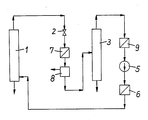
- the reactor 1 there is a bed of shredded old tires, cable, polyethylene and / or palypropylene waste.
- the sulfur and chlorine content of the old tires is advantageously diluted by the polyethylene and polypropylene waste.
- the solvent is heated in the heat exchanger 6 to the process temperature of 150 to 500 ° C and brought to a process pressure of 2-30 x 10 6 Pa (20 to 300 bar) by the compressor 5 and conveyed into the reactor 1.
- the solvent flows through the reactor 1 and removes the liquid hydrocarbons formed in the reactor 1 and the gaseous reaction products formed in a small amount.
- the solvent phase laden with the liquid hydrocarbons is removed, expanded in the expansion valve 2, cooled in the heat exchanger 7, freed of the gaseous reaction products in the separating vessel 8 and then fed to the distillation column 3.
- the higher-boiling hydrocarbons are taken off at the bottom of the distillation column 3, while the low-boiling hydrocarbons are taken off together with the solvent at the top of the distillation column 3.
- the low-boiling fraction is then cooled in the heat exchanger 9 and, after liquefaction, is returned from the compressor 5 to the reactor 1. It is possible to carry out the expansion and cooling of the solvent phase laden with the liquid hydrocarbons in several stages, which is not shown in the drawing.
- the solid residue which contains the insoluble constituents of the waste materials used and the coking products is removed from the reactor 1.
- Used tires and cable waste were shredded so that particles with an edge length of approx. 2 cm were obtained. 602 of these particles were treated with toluene at 350 ° C. and 8 ⁇ 10 6 Pa (80 bar) for 4 hours.
- the solvent phase loaded with the liquid hydrocarbons was then separated off and relaxed to 1 ⁇ 10 6 Pa (10 bar) and cooled to 310 ° C.
- a separation was carried out into a toluene-containing liquid phase and into a gas phase, which mainly consisted of toluene.
- the liquid phase, containing about 85% toluene was ated for separating the toluene and the low-boiling liquid hydrocarbons after depressurizing to atmospheric pressure Destil J.
- the viscosity of the extract was> 200 Pas (> 200,000 cP), the average molecular weight was 240 g / mol and the calorific value was determined to be 9,000 kcal / kg.
- the solid residue obtained after the toluene treatment was powdery and mainly consisted of carbon black, ZnO, other tire fillers and pieces of metal. Its sulfur content was 2.37%, while the sulfur content of the particles used was 1.70%.
- 12 kg of toluene were used for 1 kg of starting material, and these are largely recovered and recycled. can.
- the metals present in the starting material were found in the residue in unchanged form. This is an advantage over pyrolysis carried out at higher temperatures. There the metals in the old tires and cable waste melt in an undesirable manner, while in the method according to the invention with mechani. separation processes can be sorted out using little energy and recycled.
- 193 crushed polypropylene was treated at 10 x 106 Pa (100 bar) and 310 ° C for 4 hours with 3 kg / h of toluene. Almost all of the polypropylene was absorbed by the solvent. After the loaded solvent phase had been separated off, it was let down to 0.1 ⁇ 10 6 Pa (1 bar) and cooled to 85 ° C. and then distilled to remove the toluene. During the distillation, the toluene could be removed from the extract almost quantitatively and recovered.
Landscapes
- Chemical & Material Sciences (AREA)
- Engineering & Computer Science (AREA)
- Oil, Petroleum & Natural Gas (AREA)
- Life Sciences & Earth Sciences (AREA)
- Wood Science & Technology (AREA)
- Chemical Kinetics & Catalysis (AREA)
- General Chemical & Material Sciences (AREA)
- Organic Chemistry (AREA)
- Production Of Liquid Hydrocarbon Mixture For Refining Petroleum (AREA)
- Separation, Recovery Or Treatment Of Waste Materials Containing Plastics (AREA)
- Processes Of Treating Macromolecular Substances (AREA)
Description
- Die Erfindung bezieht sich auf ein Verfahren zur Herstellung flüssiger Kohlenwasserstoffe aus Altreifen, Kabel-, Polyäthylen- und/oder Polypropylen-abfällen, das bei einer Temperatur von 150 bis 5000C durchgeführt wird. Zu den flüssigen Kohlenwasserstoffen, die nach diesem Verfahren hergestellt werden, gehören Alkane, Cycloalkane und Aromaten, welche einen Siedepunkt von 20 bis ca. 350 °C haben und deren Moleküie 5 bis ca. 30 Kohlenstoffatome enthalten. Die nach dem Verfahren hergestellten flüssigen Kohlenwasserstoffe können je nach dem Schwefel- und Chlorgehalt der Altreifen organische Schwefel- und Chlorverbindungen enthalten. Die flüssigen Kohlenwasserstoffe können als Heizöl bzw. zum Verschneiden von Heizöl oder als Chemierohstoff verwendet werden.
- Altreifen gehören zu den Abfallprodukten des Kraftfahrzeuggewerbes und bestehen aus einer oder mehreren Gummimischungen, einem Wulstring und einem Gewebe. Die Gummimischung enthält Kautschuk, Ruß, Öle und Harze, Zinkoxid, Vulkanisationsbeschleuniger, Alterungsschutzmittel und Schwefel. Der Kautschuk besteht aus kettenförmigen Makromolekülen, die ineinander verschlungen und zusätzlich durch Schwefelatome verknüpft sind. Die Reifenherstellung erfolgt unter Verwendung von Naturkautschuk und synthetischem- Kautschuk, wobei die synthetischen Kautschuksorten durch Polymerisation von Isopren, Butadien, Chlorbutatien und Copolymerisation von Butadien mit Styrol oder iso-Buten mit Isopren erzeugt werden. Der Ruß dient als Füllstoff und zur Verbesserung der Kautschukeigenschaften, denn er geht bei der Reifenherstellung mit dem Kautschuk eine sehr enge Bindung ein. Die Öle und Harze wirken als Weichmacher und verbessern die Verarbeitbarkeit der Kautschukmischung. Das Zinkoxid dient als Füllstoff und als Aktivator für die Vulkanisationsbeschleuniger. Der Wulstring stabilisiert den Reifen gegen radiale Kräfte und besteht aus Stahldraht oder Stahlseil. Das im Reifen vorhandene Gewebe besteht aus Kunstfasern oder Stahldrähten. Der Gewichtsanteil der Gummimischung liegt in den Altreifen in der Regel zwischen 75 und 80 %.
- Kabelabfälle entstehen bei der Verarbeitung und Erneuerung von Kabeln, die aus einem metallischen elektrischen Leiter, einer Kunststoffisolierung sowie einem Kunststoffmantel bestehen und zur Übertragung von Nachrichten oder elektrischer Energie verwendet werden.
- Polyäthylen- und Polypropylenabfälle entstehen bei der Kunststoffherstellung und Kunststoffverarbeitung und fallen dort in verhältnismäßig reiner Form an. Diese reinen Abfälle können nach dem erfindungsgemäßen Verfahren zu flüssigen Kohlenwasserstoffen verarbeitet werden, während die im Hausmüll enthaltenen Polyäthylen- und Polypropylenabfälle dem erfindungsgemäßen Verfahren nicht zugeführt werden können, da sie nur schwer von den im Hausmüll enthaltenen anderen Kunststoffen, insbesondere Polyvinylchlorid, getrennt werden können. Polyäthylen und Polypropylen werden durch Polymerisation von Äthen bzw. Propen erzeugt und enthalten neben den Polymerisaten insbesondere noch Füllstoffe.
- Die schadlose Beseitigung der Altreifen ist schwierig und teuer. Altreifen werden heute in der Regel durch Verbrennung beseitigt, was entweder in besonders konstruierten Öfen oder in Müllverbrennungsanlagen erfolgt. Die Abgase der Verbrennungsanlagen, in denen Altreifen verbrannt werden, müssen insbesondere wegen des hohen ZnO- und S02-Gehalts entstaubt und entschwefelt werden. Außerdem ist bekannt, daß Altreifen durch Pyrolyseverfahren beseitigt und zu wiederverwendbaren Produkten verarbeitet werden können. Bei der Pyrolyse von Altreifen entsteht ein Pyrolysekoks, ein brennbares Pyrolysegas, das meist zur Deckung des Eigenenergiebedarfs des Pyrolyseverfahrens dient, und ein Pyrolyseöl, das als Heizöl eingesetzt wird. Die Polyäthylen- und Polypropylenabfälle werden meistens verbrannt. Die Kabelabfälle werden üblicherweise auf einer Mülldeponie abgelagert.
- Die Verbrennungsverfahren haben den Nachteil, daß sie wegen der Beschaffenheit der Altreifen und Kunststoffabfälle nur schwierig durchführbar sind und daß die Verbrennungsabgase mit aufwendigen Verfahren gereinigt werden müssen. Der Nachteil der Pyrolyseverfahren besteht darin, daß ein sehr großer Teil der an sich wertvollen organischen Verbindungen verkokt und damit in einen weniger wertvollen Zustand überführt wird.
- Aus der DE-A-2 922 553 ist ein Verfahren zur Umwandlung von Gummiabfällen in gasförmige und flüssige Brennstoffe bekannt, bei dem die Gummiabfälle in Rückständen der Erdölverarbeitung gelöst oder verflüssigt und anschließend bei Temperaturen von 450 bis 580 °C sowie einem Druck von 0,5 bis 11 at unter Bildung von Koks gekrackt werden. Dieses Verfahren hat den Nachteil, daß während des Krackens nicht nur gasförmige und flüssige Brennstoffe, sondern auch Koks in erheblicher Menge entsteht.
- Der Erfindung liegt die Aufgabe zugrunde, ein Verfahren zu schaffen, mit dem Altreifen, Kabel-, Polyäthylen- und/oder Polypropylenabfälle schadlos beseitigt und zu wertvollen wiederverwendbaren flüssigen Kohlenwasserstoffen verarbeitet werden können, wobei das Entstehen von gasförmigen und koksartigen Zersetzungsprodukten weitgehend vermieden werden soll.
- Die der Erfindung zugrundeliegende Aufgabe wird dadurch gelöst, daß die zerkleinerten Abfallstoffe bei einem Druck von 2-30 x 106 Pa (20 bis 300 bar) mit Benzin, Benzol, Toluol, Xylol, Äthylbenzol und/oder Wasser als Lösungsmittel behandelt werden, wobei das Gewichtsverhältnis der Abfallstoffe zum Lösungsmittel zwischen 1 : 3 und 1 : 30 liegt, daß die mit den flüssigen Kohlenwasserstoffen beladene Lösungsmittelphase abgetrennt sowie durch Druckerniedrigung oder durch Druck- und Temperaturerniedrigung destillativ in ihre Bestandteile zerlegt wird und daß das Lösungsmittel im Kreislauf geführt wird. Unter dem Einfluß des hohen Drucks und der hohen Temperatur erfolgt eine Spaltung der polymeren Moleküle, wobei insbesondere flüssige Kohlenwasserstoffe mit ca. 5 bis 30 Kohlenstoffatomen gebildet werden, ohne daß dabei eine merkliche Verkokung eintritt. Die flüssigen Kohlenwasserstoffe werden vom Lösungsmittel vergleichsweise schnell aufgenommen und abtransportiert. Die Weichmacher und Alterungsschutzmittel werden vom Lösungsmittel gelöst und unter dem Einfluß des Drucks und der Temperatur nur in geringem Umfang zersetzt. Der Ruß, die Füllstoffe, die Metalle und das Gewebe bleiben als fester unlöslicher Rückstand zurück, der auch die beim Verfahren eventuell entstehenden geringen Mengen der Verkokungsprodukte enthält. Das Verfahren hat den Vorteil, daß der größte Teil der in den Abfallstoffen vorhandenen organischen Verbindungen in flüssige wiederverwendbare Kohlenwasserstoffe umgewandelt wird. Die nach der Erfindung zu verwendenden organischen Lösungsmittel haben für die gebildeten flüssigen Kohlenwasserstoffe ein optimales Lösungsvermögen, während das nach der Erfindung zu verwendende Wasser Produkte mit niedrigerem Molekulargewicht liefert.
- In weiterer Ausgestaltung der Erfindung ist vorgesehen daß die Drück- und Temperaturerniedrigung in mehreren Stufen erfolgt und daß die Bestandteile der beladenen Lösungsmittelphase in mehreren Fraktionen anfallen. Durch diese Verfahrensführung ist es möglich, die flüssigen Kohlenwasserstoffe in für verschiedene Anwendungszwecke geeignete Fraktionen zu zerlegen. Außerdem kann eine geeignete Fraktion dem erfindungsgemäßen Verfahren als Lösungsmittel wieder zugeführt werden.
- Der Gegenstand der Erfindung wird nachfolgend anhand der Zeichnung und mehrerer Ausführungsbeispiele näher erläutert.
- Im Reaktor 1 befindet sich eine Schüttung aus zerkleinerten Altreifen, Kabel-, Polyäthylen und/ oder Palypropylenabfällen. Durch die polyäthylen- und Polypropylenabfälle wird der Schwefel-und Chlorgehalt der Altreifen in vorteilhafter Weise verdünnt. Das Lösungsmittel wird im Wärmeaustauscher 6 auf die Verfahrenstemperatur von 150 bis 500 °C erhitzt und vom Kompressor 5 auf den Verfahrensdruck von 2-30 x 106 Pa (20 bis 300 bar) gebracht sowie in den Reaktor 1 gefördert. Das Lösungsmittel durchströmt den Reaktor 1 und führt die im Reaktor 1 gebildeten flüssigen Kohlenwasserstoffe sowie die in geringer Menge entstehenden gasförmigen Reaktionsprodukte ab. Am Kopf des Reaktors 1 wird die mit den flüssigen Kohlenwasserstoffen beladene Lösungsmittelphase abgenommen, im Entspannungsventil 2 entspannt, im Wärmeaustauscher 7 abgekühlt, im Trenngefäß 8 von den gasförmigen Reaktionsprodukten befreit und anschließend der Destillationskolonne 3 zugeführt. Am Fuß der Destillationskolonne 3 werden die höher siedenden Kohlenwasserstoffe abgenommen, während die niedrig siedenden Kohlenwasserstoffe zusammen mit dem Lösungsmittel am Kopf der Destillationskolonne 3 abgezogen werden. Die niedrig siedende Fraktion wird anschließend im Wärmeaustauscher 9 abgekühlt und nach der Verflüssigung vom Kompressor 5 in den Reaktor 1 zurückgeführt. Es ist möglich, die Entspannung und Abkühlung der mit den flüssigen Kohlenwasserstoffen beladenen Lösungsmittelphase in mehreren Stufen durchzuführen, was in der Zeichnung nicht dargestellt ist. Aus dem Reaktor 1 wird der feste Rückstand entnommen, der die unlöslichen Bestandteile der eingesetzten Abfallstoffe sowie die Verkokungsprodukte enthält.
- Altreifen und Kabelabfälle wurden so zerkleinert, daß Teilchen mit einer Kantenlänge von ca. 2 cm anfielen. 602 dieser Teilchen wurden 4 Stunden mit Toluol bei 350 °C und 8 x 10⁶ Pa (80 bar) behandelt. Anschließend wurde die mit den flüssigen Kohlenwasserstoffen beladene Lösungsmittelphase abgetrennt und auf 1 x 10⁶ Pa (10 bar) entspannt sowie auf 310 °C abgekühlt. Dabei erfolgte eine Trennung in eine toluolhaltige flüssige Phase und in eine Gasphase, die in der Hauptsache aus Toluol bestand. Die flüssige Phase, die ca. 85 % Toluol enthielt, wurde zur Abtrennung des Toluols und der niedrig siedenden flüssigen Kohlenwasserstoffe nach Entspannen auf Atmosphärendruck destilJiert. Nach der weitgehend quantitativen Abtrennung des Toluols blieb ein Extrakt in einer Menge zurück, die 65,1 Gew.-% der eingesetzten Teilchen betrug. Der Extrakt bestand überwiegend aus aliphatischen und aromatischen Kohlenwasserstoffen und hatte einen Schwefelgehalt von 1,43 Gew.-%. Weder im toluolfreien Extrakt noch im abdestillierten Toluol waren Kohlenwasserstoffe mit einer Molekülgröße unter C10 enthalten, wie eine gasschromatographische Analyse zeigte. Bei der IR-spektroskopischen Untersuchung des Extrakts wurden geringe Mengen Chlorkohlenwasserstoffe sowie organische Säuren und Ester identifiziert. Die Viskosität des Extrakts lag bei > 200 Pas (> 200 000 cP), das mittlere Molekulargewicht betrug 240 g/mol und der Heizwert wurde mit 9 000 kcal/kg bestimmt. Der nach der Toluolbehandlung anfallende feste Rückstand war pulverförmig und bestand in der Hauptsache aus Ruß, ZnO, anderen Reifen-Füllstoffen und Metallstücken. Sein Schwefelgehalt betrug 2,37 %, während der Schwefelgehalt der eingesetzten Teilchen bei 1,70% lag. Bei der Toluolbehandlung wurden für 1 kg Ausgangsmaterial 12 kg Toluol eingesetzt, die weitgehend zurückgewonnen und im Kreislauf geführt werden . können. Die im Ausgangsmaterial vorhandenen Metalle wurden im Rückstand in unveränderter Form gefunden. Dies ist ein Vorteil gegenüber einer Pyrolyse, die bei höheren Temperaturen durchgeführt wird. Dort schmelzen die in den Altreifen und Kabelabfällen vorhandenen Metalle in unerwünschter Weise zusammen, während sie beim erfindungsgemäßen Verfahren mit mechani. schen Trennverfahren unter geringem Energieaufwand aussortiert und einer Verwertung zugeführt werden können.
- 233 g zerkleinertes Polyäthylen wurde während 4 Stunden mit 3 kg/h Toluol bei 8 x 10⁶ Pa (80 bar) und 315 °C behandelt. Dabei wurde nahezu die gesamte Polyäthylenmenge von der Lösungsmittelphase aufgenommen. Die Lösungsmittelphase wurde anschließend auf 0.1 x 10⁶ Pa (1 bar) entspannt sowie auf 90 °C abgekühlt und zur Abtrennung des Toluols sowie der niedrig siedenden flüssigen Kohlenwasserstoffe destilliert. Das Toluol konnte bei der Destillatipn nahezu quantitativ zurückgewonnen werden.
- 193 zerkleinertes Polypropylen wurde bei 10 x 106 Pa (100 bar) und 310 °C während 4 Stunden mit 3 kg/h Toluol behandelt. Nahezu das gesamte Polypropylen wurde dabei vom Lösungsmittel aufgenommen. Nach Abtrennung der beladenen LösUngsmittelphase wurde sie auf 0.1 x 10⁶ Pa (1 bar) entspannt sowie auf 85 °C abgekühlt und dann zur Abtrennung des Toluols destilliert. Bei der Destillation konnte das Toluol nahezu quantitativ aus dem Extrakt entfernt und zurückgewonnen werden.
Claims (2)
Priority Applications (1)
| Application Number | Priority Date | Filing Date | Title |
|---|---|---|---|
| AT84107378T ATE30045T1 (de) | 1983-07-21 | 1984-06-27 | Verfahren zur herstellung fluessiger kohlenwasserstoffe. |
Applications Claiming Priority (2)
| Application Number | Priority Date | Filing Date | Title |
|---|---|---|---|
| DE3326284A DE3326284C2 (de) | 1983-07-21 | 1983-07-21 | Verfahren zur Herstellung flüssiger Kohlenwasserstoffe |
| DE3326284 | 1983-07-21 |
Publications (2)
| Publication Number | Publication Date |
|---|---|
| EP0132612A1 EP0132612A1 (de) | 1985-02-13 |
| EP0132612B1 true EP0132612B1 (de) | 1987-09-30 |
Family
ID=6204535
Family Applications (1)
| Application Number | Title | Priority Date | Filing Date |
|---|---|---|---|
| EP84107378A Expired EP0132612B1 (de) | 1983-07-21 | 1984-06-27 | Verfahren zur Herstellung flüssiger Kohlenwasserstoffe |
Country Status (6)
| Country | Link |
|---|---|
| US (1) | US4642401A (de) |
| EP (1) | EP0132612B1 (de) |
| JP (1) | JPS6040193A (de) |
| AT (1) | ATE30045T1 (de) |
| DE (1) | DE3326284C2 (de) |
| ES (1) | ES534485A0 (de) |
Families Citing this family (83)
| Publication number | Priority date | Publication date | Assignee | Title |
|---|---|---|---|---|
| DE3710021A1 (de) * | 1987-03-30 | 1988-10-20 | Veba Oel Entwicklungs Gmbh | Verfahren zur hydrierenden konversion von schwer- und rueckstandsoelen |
| US5099086A (en) * | 1989-06-28 | 1992-03-24 | Universite Laval | Extraction of commercially valuable chemicals from tire-derived pyrolytic oils |
| US5158982A (en) * | 1991-10-04 | 1992-10-27 | Iit Research Institute | Conversion of municipal waste to useful oils |
| US5158983A (en) * | 1991-10-04 | 1992-10-27 | Iit Research Institute | Conversion of automotive tire scrap to useful oils |
| US5230777A (en) * | 1991-12-13 | 1993-07-27 | James Jarrell | Apparatus for producing fuel and carbon black from rubber tires |
| US5296515A (en) * | 1992-06-03 | 1994-03-22 | Phillips Petroleum Company | Hydrovisbreaking of hydrocarbon polymers |
| US5364996A (en) * | 1992-06-09 | 1994-11-15 | Texaco Inc. | Partial oxidation of scrap rubber tires and used motor oil |
| US5569801A (en) * | 1992-08-27 | 1996-10-29 | Fina Research, S.A. | Polymer conversion process |
| US5288934A (en) * | 1992-08-27 | 1994-02-22 | Petrofina, S.A. | Process for the conversion of polymers |
| US5301834A (en) * | 1993-01-21 | 1994-04-12 | The Lift Ticket | Card vending machine |
| US5406010A (en) * | 1993-01-28 | 1995-04-11 | Ponsford; Thomas E. | Method of reclaiming styrene and other products from polystyrene based products |
| US5799626A (en) * | 1993-01-28 | 1998-09-01 | Ponsford; Thomas E. | Methods for using styrene oil (as heat transfer fluid, hydraulic fluid, lubricant) |
| CA2157121A1 (en) * | 1993-03-10 | 1994-09-15 | Frank D. Guffey | Process for waste plastic recycling |
| DE4447937C2 (de) * | 1993-04-01 | 2002-12-05 | Nakamichi Yamasaki | Verfahren zur Umwandlung vulkanisierter Kautschuke in Öle unter Verwendung überkritischer wässriger Flüssigkeiten |
| DE4411483C2 (de) * | 1993-04-01 | 2002-10-24 | Nakamichi Yamasaki | Verfahren zur Entschwefelung von schwefelhaltigen Zusammensetzungen durch hydrothermale Reaktion |
| FR2706168B1 (fr) * | 1993-04-01 | 2003-04-04 | Nakamichi Yamasaki | Procédé pour la conversion en huiles de caoutchoucs vulcanisés. |
| US5639934A (en) * | 1993-04-01 | 1997-06-17 | Nakamichi Yamasaki | Process for the desulfurization of sulfur-containing compositions by hydrothermal reaction |
| US5395404A (en) * | 1993-08-27 | 1995-03-07 | The Jerrold Corporation | Apparatus for pyrolyzing tires |
| US5445659A (en) * | 1993-10-04 | 1995-08-29 | Texaco Inc. | Partial oxidation of products of liquefaction of plastic materials |
| US5827336A (en) * | 1993-10-04 | 1998-10-27 | Texaco Inc. | Liquefaction and partial oxidation of plastic materials |
| RU2151163C1 (ru) * | 1994-10-04 | 2000-06-20 | Феба Ель АГ | Способ использования пластмассовых вторичных материалов или отходов |
| GB2301112B (en) * | 1995-05-24 | 1998-12-16 | California Engineering Consult | Liquefaction of solid wastes and separation of solid inorganic matter therefrom |
| ES2119657B1 (es) * | 1995-09-25 | 1999-07-16 | Marin Victorino Luengo | Procedimiento e instalacion para la separacion y aprovechamiento de los componentes organicos e inorganicos de plasticos, cauchos y neumaticos, por disolucion calorifica con aceite y posteriormente en eter. |
| US5824193A (en) * | 1997-03-27 | 1998-10-20 | Edwards; Raymond S. | Method of thermally treating plastics material |
| US5977294A (en) * | 1997-05-13 | 1999-11-02 | Prs, Llc | Polymer deformulation by solvent solution filtration |
| US6078888A (en) * | 1997-07-16 | 2000-06-20 | Gilbarco Inc. | Cryptography security for remote dispenser transactions |
| US6861568B1 (en) | 1998-05-15 | 2005-03-01 | Wyoming Research Corporation | Process for waste plastic recycling |
| RU2153415C2 (ru) * | 1998-10-21 | 2000-07-27 | Апостолов Сергей Александрович | Способ утилизации отработанных шин и отходов резинотехнических изделий и устройство для его реализации |
| US6143940A (en) * | 1998-12-30 | 2000-11-07 | Chevron U.S.A. Inc. | Method for making a heavy wax composition |
| RU2156270C1 (ru) * | 2000-03-21 | 2000-09-20 | Общество с ограниченной ответственностью "Научно-экологические программы" | Способ переработки резиносодержащих и органических промышленных и бытовых отходов |
| JP2003041045A (ja) * | 2001-07-26 | 2003-02-13 | Yokohama Rubber Co Ltd:The | ゴム成形品からの材料回収方法および回収材料 |
| US7048832B2 (en) * | 2002-01-07 | 2006-05-23 | Material Conversion Corp. | Method and system for extracting hydrocarbon fuel products from plastic material |
| US6703535B2 (en) * | 2002-04-18 | 2004-03-09 | Chevron U.S.A. Inc. | Process for upgrading fischer-tropsch syncrude using thermal cracking and oligomerization |
| US6774272B2 (en) | 2002-04-18 | 2004-08-10 | Chevron U.S.A. Inc. | Process for converting heavy Fischer Tropsch waxy feeds blended with a waste plastic feedstream into high VI lube oils |
| US6822126B2 (en) * | 2002-04-18 | 2004-11-23 | Chevron U.S.A. Inc. | Process for converting waste plastic into lubricating oils |
| GB0211052D0 (en) * | 2002-05-15 | 2002-06-26 | Tucker Alan C N | Incineration of plastic waste suspended in paraffin gel |
| CA2426253A1 (en) * | 2003-04-22 | 2004-10-22 | Hurdon A. Hooper | Rubber reduction |
| DE10356245B4 (de) * | 2003-12-02 | 2007-01-25 | Alphakat Gmbh | Verfahren zur Erzeugung von Dieselöl aus kohlenwasserstoffhaltigen Reststoffen sowie eine Vorrichtung zur Durchführung dieses Verfahrens |
| EA010464B1 (ru) * | 2004-02-26 | 2008-08-29 | Игорь Антонович Рожновский | Устройство для переработки углеродсодержащих отходов |
| JP2007099850A (ja) * | 2005-10-03 | 2007-04-19 | Hoshun Tei | 廃プラスチックの油化方法およびその装置 |
| US7893307B2 (en) * | 2007-02-23 | 2011-02-22 | Smith David G | Apparatus and process for converting feed material into reusable hydrocarbons |
| US20090007484A1 (en) * | 2007-02-23 | 2009-01-08 | Smith David G | Apparatus and process for converting biomass feed materials into reusable carbonaceous and hydrocarbon products |
| US7834226B2 (en) * | 2007-12-12 | 2010-11-16 | Chevron U.S.A. Inc. | System and method for producing transportation fuels from waste plastic and biomass |
| US8664458B2 (en) * | 2010-07-15 | 2014-03-04 | Greenmantra Recycling Technologies Ltd. | Method for producing waxes and grease base stocks through catalytic depolymerisation of waste plastics |
| US9481833B2 (en) | 2011-01-05 | 2016-11-01 | Ignite Resources Pty Ltd | Processing of organic matter |
| US8480880B2 (en) | 2011-01-18 | 2013-07-09 | Chevron U.S.A. Inc. | Process for making high viscosity index lubricating base oils |
| AT511772B1 (de) | 2011-05-05 | 2018-03-15 | Omv Refining & Marketing Gmbh | Verfahren und vorrichtung zur energieeffizienten aufbereitung sekundärer lagerstätten |
| US10000715B2 (en) | 2013-01-17 | 2018-06-19 | Greenmantra Recycling Technologies Ltd. | Catalytic depolymerisation of polymeric materials |
| US10472487B2 (en) | 2015-12-30 | 2019-11-12 | Greenmantra Recycling Technologies Ltd. | Reactor for continuously treating polymeric material |
| ES2925008T3 (es) | 2016-02-13 | 2022-10-13 | Greenmantra Recycling Tech Ltd | Asfalto modificado con polímero con aditivo de cera |
| MX2018011492A (es) | 2016-03-24 | 2019-02-20 | Greenmantra Recycling Tech Ltd | Cera como modificador de flujo de fusion y adyuvante de procesamiento para polimeros. |
| CA3036136A1 (en) | 2016-09-29 | 2018-04-05 | Greenmantra Recycling Technologies Ltd. | Reactor for treating polystyrene material |
| EP3717559A4 (de) | 2017-11-28 | 2021-11-17 | GreenMantra Recycling Technologies Ltd | Verkapselung von modifikatoren in depolymerisierten produkten |
| BR112020024507A2 (pt) | 2018-05-31 | 2021-03-02 | Greenmantra Recycling Technologies Ltd. | látex, tinta, adesivo, revestimento, teste de imunoensaio e solução |
| US10723858B2 (en) | 2018-09-18 | 2020-07-28 | Greenmantra Recycling Technologies Ltd. | Method for purification of depolymerized polymers using supercritical fluid extraction |
| MX2022007132A (es) | 2019-12-23 | 2022-09-19 | Chevron Usa Inc | Economia circular para residuos plasticos en polipropileno a traves de craqueo catalitico de fluidos (fcc) de refineria y unidades de alquilacion. |
| US11584890B2 (en) | 2019-12-23 | 2023-02-21 | Chevron U.S.A. Inc. | Circular economy for plastic waste to polypropylene via refinery FCC unit |
| EP4081616A4 (de) | 2019-12-23 | 2024-02-28 | Chevron U.S.A. Inc. | Kreislaufwirtschaft für kunststoffabfälle zu polyethylen und chemikalien über raffinerierohstoffeinheit |
| US11518944B2 (en) | 2019-12-23 | 2022-12-06 | Chevron U.S.A. Inc. | Circular economy for plastic waste to polyethylene via refinery FCC and alkylation units |
| MX2022007240A (es) | 2019-12-23 | 2022-10-27 | Chevron Usa Inc | Economia circular para residuos plasticos en polietileno y aceite lubricante mediante crudo y unidades de desparafinado por isomerizacion. |
| CN114846117B (zh) | 2019-12-23 | 2023-12-12 | 雪佛龙美国公司 | 通过炼油厂fcc和异构化脱蜡单元将塑料废物转化为聚丙烯和润滑油的循环经济 |
| CA3164238A1 (en) | 2019-12-23 | 2021-07-01 | Chevron U.S.A. Inc. | Circular economy for plastic waste to polyethylene via refinery crude unit |
| EP4127102B1 (de) | 2020-03-30 | 2025-05-21 | Chevron U.S.A. Inc. | Kreislaufwirtschaft für kunststoffabfälle zu polyethylen über raffinerie-fcc- oder fcc-alkylierungsanlagen |
| US11306253B2 (en) | 2020-03-30 | 2022-04-19 | Chevron U.S.A. Inc. | Circular economy for plastic waste to polyethylene via refinery FCC or FCC/alkylation units |
| US11566182B2 (en) | 2020-03-30 | 2023-01-31 | Chevron U.S.A. Inc. | Circular economy for plastic waste to polyethylene via refinery FCC feed pretreater and FCC units |
| CN115427536A (zh) | 2020-04-22 | 2022-12-02 | 雪佛龙美国公司 | 经由炼油厂通过过滤和金属氧化物处理热解油来将废塑料转化成聚丙烯的循环经济 |
| WO2021216867A1 (en) | 2020-04-22 | 2021-10-28 | Chevron U.S.A. Inc. | Circular economy for plastic waste to polyethylene via oil refinery with filtering and metal oxide treatment of pyrolysis oil |
| WO2023192449A1 (en) | 2022-04-01 | 2023-10-05 | Chevron U.S.A. Inc. | Circular economy for plastic waste to polypropylene and base oil via refinery hydrocracking unit |
| KR20250033288A (ko) | 2022-07-08 | 2025-03-07 | 셰브런 유.에스.에이.인크. | 폐플라스틱과 바이오 공급물의 블렌드 및 제조 공정 |
| KR20250073086A (ko) | 2022-12-12 | 2025-05-27 | 셰브런 유.에스.에이.인크. | 오일 정제소 유닛에 공급하기 위한 폐플라스틱 및 석유 공급물의 안정적인 블렌드를 위한 공정 및 이를 제조하는 공정 |
| US12404458B2 (en) | 2022-12-12 | 2025-09-02 | Chevron U.S.A. Inc. | Process for stable blend of waste plastic with petroleum feed for feeding to oil refinery units and process of preparing same |
| KR20250127303A (ko) | 2022-12-23 | 2025-08-26 | 보레알리스 아게 | 플라스틱 리사이클링 공정 |
| JPWO2025033152A1 (de) * | 2023-08-04 | 2025-02-13 | ||
| CN121605159A (zh) * | 2023-08-04 | 2026-03-03 | 株式会社普利司通 | 再生炭黑、再生炭黑和液状聚合物的混合物、橡胶组合物和橡胶制品 |
| CN121620569A (zh) * | 2023-08-04 | 2026-03-06 | 株式会社普利司通 | 再生炭黑、再生炭黑和液状聚合物的混合物、橡胶组合物和橡胶制品 |
| JPWO2025033151A1 (de) * | 2023-08-04 | 2025-02-13 | ||
| WO2025033269A1 (ja) * | 2023-08-04 | 2025-02-13 | 株式会社ブリヂストン | 再生カーボンブラック、再生カーボンブラックと液状ポリマーとの混合体、ゴム組成物、及びゴム製品 |
| WO2025035099A1 (en) | 2023-08-09 | 2025-02-13 | Chevron U.S.A. Inc. | Enhanced circularity at enhanced ethylene yield |
| WO2025058925A1 (en) | 2023-09-12 | 2025-03-20 | ExxonMobil Technology and Engineering Company | Zeolitic materials in polyolefin decomposition via pyrolysis |
| WO2025144805A1 (en) | 2023-12-28 | 2025-07-03 | Chevron U.S.A. Inc. | Use of blend of polystyrene with hydrocarbon feedstock for gasoline and chemicals preparation |
| WO2025144802A1 (en) | 2023-12-28 | 2025-07-03 | Chevron U.S.A. Inc. | Process for stable blend of polystyrene plastic with hydrocarbon feed for feeding to oil refinery units and process of preparing same |
| WO2025144804A1 (en) | 2023-12-28 | 2025-07-03 | Chevron U.S.A. Inc. | Circular economy for waste polystyrene via refinery fcc unit |
| US20250263353A1 (en) | 2024-02-21 | 2025-08-21 | Chevron U.S.A. Inc. | Renewable ethylene at minimum carbon intensity |
Family Cites Families (15)
| Publication number | Priority date | Publication date | Assignee | Title |
|---|---|---|---|---|
| US3704108A (en) * | 1970-09-25 | 1972-11-28 | Hydrocarbon Research Inc | Hydroconversion of waste natural and synthetic rubbers |
| US3736271A (en) * | 1970-12-24 | 1973-05-29 | Exxon Research Engineering Co | Conversion of waste polymers to useful products |
| JPS4897972A (de) * | 1972-03-27 | 1973-12-13 | ||
| US3974206A (en) * | 1974-07-09 | 1976-08-10 | Mitsubishi Gas Chemical Company, Inc. | Process for the thermal decomposition of thermoplastic resins with a heat transfer medium |
| US4175211A (en) * | 1977-03-14 | 1979-11-20 | Mobil Oil Corporation | Method for treatment of rubber and plastic wastes |
| US4118281A (en) * | 1977-04-15 | 1978-10-03 | Mobil Oil Corporation | Conversion of solid wastes to fuel coke and gasoline/light oil |
| US4235676A (en) * | 1977-09-16 | 1980-11-25 | Deco Industries, Inc. | Apparatus for obtaining hydrocarbons from rubber tires and from industrial and residential waste |
| PL115716B1 (en) * | 1978-06-05 | 1981-04-30 | Biuro Projektow I Realizacji Inwestycji Rafinerii Nafty | Method of conversion of rubber scraps into gas and liquid fuels using cracking method |
| IT1123572B (it) * | 1979-09-10 | 1986-04-30 | Anic Spa | Procedimento per la preparazione di additivi miglioratori dell'indice di viscosita'di oli lubrificanti per cracking in fase liquida di gomme sintetiche |
| JPS56118431A (en) * | 1980-02-25 | 1981-09-17 | Bridgestone Corp | Decomposition method of vulcanized rubber |
| FR2490992A1 (fr) * | 1980-09-29 | 1982-04-02 | Inst Francais Du Petrole | Procede et installation pour la conversion thermique des pneus usages ou au rebut en matieres utilisables notamment comme combustibles |
| DE3037829C2 (de) * | 1980-10-07 | 1983-08-25 | Rütgerswerke AG, 6000 Frankfurt | Verfahren zur Herstellung modifizierter Peche und niedrigsiedender Aromaten oder Olefine und Verwendung dieser Peche |
| US4384150A (en) * | 1981-08-20 | 1983-05-17 | Lyakhevich Genrikh D | Method of making either a softener for rubber mixtures or a furnace fuel oil |
| US4463203A (en) * | 1981-11-13 | 1984-07-31 | Gi Kim D | Process for the preparation of fuel oil, fuel gas and pyrolysis coke by pyrolysis |
| US4552621A (en) * | 1983-06-17 | 1985-11-12 | Belorussky Politekhnichesky Institut | Apparatus for thermal decomposition of polymeric materials |
-
1983
- 1983-07-21 DE DE3326284A patent/DE3326284C2/de not_active Expired
-
1984
- 1984-06-27 AT AT84107378T patent/ATE30045T1/de not_active IP Right Cessation
- 1984-06-27 EP EP84107378A patent/EP0132612B1/de not_active Expired
- 1984-07-16 US US06/631,420 patent/US4642401A/en not_active Expired - Fee Related
- 1984-07-20 JP JP59149782A patent/JPS6040193A/ja active Pending
- 1984-07-20 ES ES534485A patent/ES534485A0/es active Granted
Also Published As
| Publication number | Publication date |
|---|---|
| JPS6040193A (ja) | 1985-03-02 |
| EP0132612A1 (de) | 1985-02-13 |
| ES8504897A1 (es) | 1985-04-16 |
| ES534485A0 (es) | 1985-04-16 |
| US4642401A (en) | 1987-02-10 |
| DE3326284A1 (de) | 1985-02-21 |
| ATE30045T1 (de) | 1987-10-15 |
| DE3326284C2 (de) | 1985-08-14 |
Similar Documents
| Publication | Publication Date | Title |
|---|---|---|
| DE3326284C2 (de) | Verfahren zur Herstellung flüssiger Kohlenwasserstoffe | |
| EP0182309B1 (de) | Verfahren zur hydrierenden Aufarbeitung von Kohlenstoff enthaltenden Abfällen synthetischen bzw. überwiegend synthetischen Ursprungs | |
| EP0710270B1 (de) | Verfahren zum recyclen von kunststoffabfällen in einem steamcracker | |
| EP0692009A1 (de) | Verfahren zur verarbeitung von alt- oder abfallkunststoffen | |
| EP0713906B1 (de) | Verfahren zum Recyclen von Kunststoffen in einem Steamcracker | |
| US5836524A (en) | Liquefaction of wastes with product oil recycling | |
| DE69205164T2 (de) | Durch Vakuumpyrolyse Rückgewinnung von Kraftfahrzeugzerkleinererrückstand. | |
| EP0717094B1 (de) | Verfahren zur Gewinnung von Hartparaffinen aus stark verunreinigten Pololefinabfällen | |
| EP3959294B1 (de) | Verölungsverfahren | |
| DE2621941C3 (de) | Verfahren zur Herstellung von Kohle und Kohlenwasserstoffdämpfen aus Gummi durch thermische Zersetzung | |
| WO2009062741A2 (de) | Verfahren zur technischen herstellung von calciumcarbid im elektroniederschachtofen | |
| DE3037829C2 (de) | Verfahren zur Herstellung modifizierter Peche und niedrigsiedender Aromaten oder Olefine und Verwendung dieser Peche | |
| US3117921A (en) | Production of hydrogen-enriched liquid fuels from coal | |
| EP0659867A2 (de) | Verfahren und Vorrichtung zur thermischen Depolymerisation von Kunststoffen | |
| US4171345A (en) | Method of manufacture of reinforcing carbon black | |
| DE4344846C1 (de) | Verfahren zur Gewinnung von festen und flüssigen Kohlenwasserstoffen aus Polyolefinen | |
| DE2530229A1 (de) | Verfahren zur umwandlung von altreifen, gummi und/oder anderen kunststoffen | |
| DE2922553A1 (de) | Verfahren zur umwandlung von gummiabfaellen in gasfoermige und fluessige brennstoffe durch kracken | |
| EP0291698B1 (de) | Verbessertes Verfahren zur hydrierenden Spaltung Kohlenstoff enthaltender synthetischer Abfälle | |
| KR20240073975A (ko) | 폐플라스틱의 처리 방법 | |
| DE4417386A1 (de) | Verfahren zur Herstellung destillierbarer Kohlenwasserstoffe | |
| DE102021105810A1 (de) | Verfahren und Anlage zur Depolymerisation von Kunststoffmaterial | |
| US20240158705A1 (en) | Method and Device for Refining Waste Plastic Pyrolysis Oil | |
| DE19707305B4 (de) | Verfahren zur Gewinnung von Mikrowachsen, Paraffinen und Ölen aus Altkunststoffen oder Altkunststoffgemischen | |
| DD214749A3 (de) | Verfahren zur hydrierenden spaltung von altgummi und gummiabfaellen |
Legal Events
| Date | Code | Title | Description |
|---|---|---|---|
| PUAI | Public reference made under article 153(3) epc to a published international application that has entered the european phase |
Free format text: ORIGINAL CODE: 0009012 |
|
| AK | Designated contracting states |
Designated state(s): AT BE CH FR GB IT LI NL |
|
| 17P | Request for examination filed |
Effective date: 19850619 |
|
| 17Q | First examination report despatched |
Effective date: 19860620 |
|
| GRAA | (expected) grant |
Free format text: ORIGINAL CODE: 0009210 |
|
| AK | Designated contracting states |
Kind code of ref document: B1 Designated state(s): AT BE CH FR GB IT LI NL |
|
| REF | Corresponds to: |
Ref document number: 30045 Country of ref document: AT Date of ref document: 19871015 Kind code of ref document: T |
|
| GBT | Gb: translation of ep patent filed (gb section 77(6)(a)/1977) | ||
| ITF | It: translation for a ep patent filed | ||
| ET | Fr: translation filed | ||
| PG25 | Lapsed in a contracting state [announced via postgrant information from national office to epo] |
Ref country code: AT Effective date: 19880627 |
|
| PG25 | Lapsed in a contracting state [announced via postgrant information from national office to epo] |
Ref country code: LI Effective date: 19880630 Ref country code: CH Effective date: 19880630 |
|
| PLBE | No opposition filed within time limit |
Free format text: ORIGINAL CODE: 0009261 |
|
| STAA | Information on the status of an ep patent application or granted ep patent |
Free format text: STATUS: NO OPPOSITION FILED WITHIN TIME LIMIT |
|
| 26N | No opposition filed | ||
| BERE | Be: lapsed |
Owner name: FRIED. KRUPP G.M.B.H. Effective date: 19880630 |
|
| PG25 | Lapsed in a contracting state [announced via postgrant information from national office to epo] |
Ref country code: NL Effective date: 19890101 |
|
| NLV4 | Nl: lapsed or anulled due to non-payment of the annual fee | ||
| PG25 | Lapsed in a contracting state [announced via postgrant information from national office to epo] |
Ref country code: FR Free format text: LAPSE BECAUSE OF NON-PAYMENT OF DUE FEES Effective date: 19890228 |
|
| REG | Reference to a national code |
Ref country code: CH Ref legal event code: PL |
|
| REG | Reference to a national code |
Ref country code: FR Ref legal event code: ST |
|
| PG25 | Lapsed in a contracting state [announced via postgrant information from national office to epo] |
Ref country code: GB Effective date: 19890627 |
|
| PG25 | Lapsed in a contracting state [announced via postgrant information from national office to epo] |
Ref country code: BE Effective date: 19890630 |
|
| GBPC | Gb: european patent ceased through non-payment of renewal fee |