EP0127877A2 - Verfahren zur Herstellung von phosphorhaltigen Cyanhydrinderivaten - Google Patents
Verfahren zur Herstellung von phosphorhaltigen Cyanhydrinderivaten Download PDFInfo
- Publication number
- EP0127877A2 EP0127877A2 EP84106149A EP84106149A EP0127877A2 EP 0127877 A2 EP0127877 A2 EP 0127877A2 EP 84106149 A EP84106149 A EP 84106149A EP 84106149 A EP84106149 A EP 84106149A EP 0127877 A2 EP0127877 A2 EP 0127877A2
- Authority
- EP
- European Patent Office
- Prior art keywords
- formula
- tert
- compounds
- radical
- isobutyl
- Prior art date
- Legal status (The legal status is an assumption and is not a legal conclusion. Google has not performed a legal analysis and makes no representation as to the accuracy of the status listed.)
- Granted
Links
Classifications
-
- C—CHEMISTRY; METALLURGY
- C07—ORGANIC CHEMISTRY
- C07F—ACYCLIC, CARBOCYCLIC OR HETEROCYCLIC COMPOUNDS CONTAINING ELEMENTS OTHER THAN CARBON, HYDROGEN, HALOGEN, OXYGEN, NITROGEN, SULFUR, SELENIUM OR TELLURIUM
- C07F9/00—Compounds containing elements of Groups 5 or 15 of the Periodic Table
- C07F9/02—Phosphorus compounds
- C07F9/28—Phosphorus compounds with one or more P—C bonds
- C07F9/30—Phosphinic acids [R2P(=O)(OH)]; Thiophosphinic acids ; [R2P(=X1)(X2H) (X1, X2 are each independently O, S or Se)]
- C07F9/32—Esters thereof
- C07F9/3205—Esters thereof the acid moiety containing a substituent or a structure which is considered as characteristic
- C07F9/3211—Esters of acyclic saturated acids which can have further substituents on alkyl
Definitions
- the process has the disadvantage that the purities of the products are unsatisfactory and that the yields based on (II) are insufficient.
- a further disadvantage is that excess methanephosphonous ester (II) contains impurity products which can only be removed again using complex methods.
- the radical starter substances are distinguished by the fact that they decompose at low temperatures into tertiary alkyl radicals which, in the temperature range claimed, have a high reactivity and a high selectivity in the hydrogen transfer reactions in the competitor system phosphonous ester (II) / acrolein cyanohydrin acetate (III).
- radical formers are not mentioned in European Patent Application No. 11,245. It was not to be expected that the radical formers of the formula (IV) to be used according to the invention are notable for high selectivity. In principle, an attack of the radical generated from the radical generator on the compounds of the formula (III) is possible as a side reaction with the formation of allyl radicals, which would inhibit the radical chain reaction. (See e.g. Vollmert, Grundriß der Makromolekularen Chemie, p. 58, Springer Verlag, 1962).
- radical generator of the formula (IV) is advantageously at low reaction temperatures between 50 0 and 100 ° C can be employed, disproportionation reactions of phosphorus component II can be suppressed. As a result, the yields with respect to component II and the purity of the product of the formula (I) are increased considerably in comparison with the known process.
- the yields by the process according to the invention are 95 to 99% with respect to component III and 89 to 95% with respect to component II.
- the purities of the products I are 92 to 95%.
- the starting compound (II) distilled off from the reaction solution can be reused for a new reaction without purification.
- the following compounds are preferably used as radical formers of the formula IV: tert-butyl perpivalate, tert-amyl perpivalate, tert-butyl perneodecanoate, tert-amyl perneodecanoate and cumyl perneodecanoate.
- the reaction is preferably carried out in the temperature range between 65 ° and 95 ° C., particularly preferably between 70 ° and 85 ° C.
- the process is expediently carried out in an inert atmosphere, for example using the protective gas nitrogen or argon. It is also possible, if not necessary, to work under reduced pressure.
- the process is advantageously carried out by mixing part of the free radical generator of the formula (IV) or instead a corresponding partial equivalent of a free radical initiator mentioned in European Patent Application No. 11,245 before the reaction with component II and then add component III together with the remaining amount of radical generator IV.
Landscapes
- Chemical & Material Sciences (AREA)
- Organic Chemistry (AREA)
- Health & Medical Sciences (AREA)
- Life Sciences & Earth Sciences (AREA)
- Biochemistry (AREA)
- General Health & Medical Sciences (AREA)
- Molecular Biology (AREA)
- Organic Low-Molecular-Weight Compounds And Preparation Thereof (AREA)
- Pharmaceuticals Containing Other Organic And Inorganic Compounds (AREA)
- Low-Molecular Organic Synthesis Reactions Using Catalysts (AREA)
Abstract
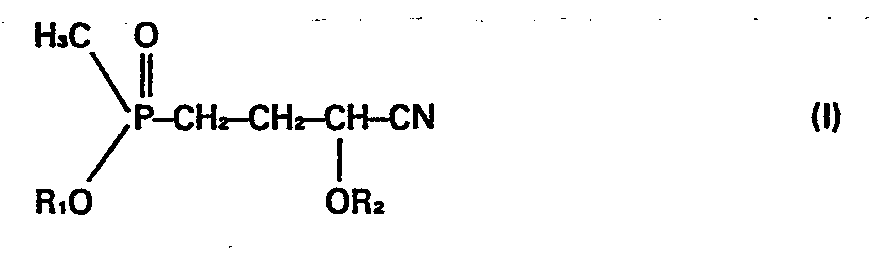
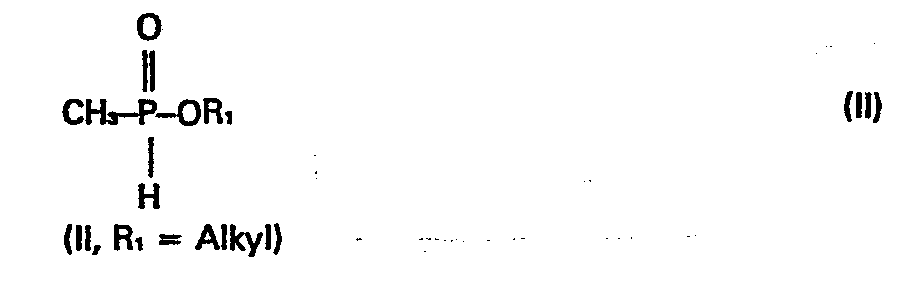
- worin R, =Alkyl und R2= H, Acetyl oder Propionyl bedeuten, durch Addition von Verbindungen der Formel II
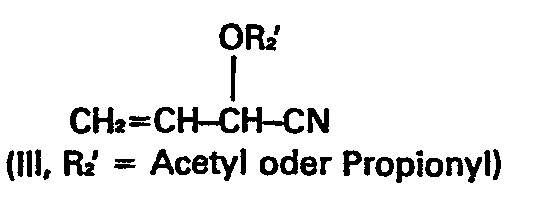
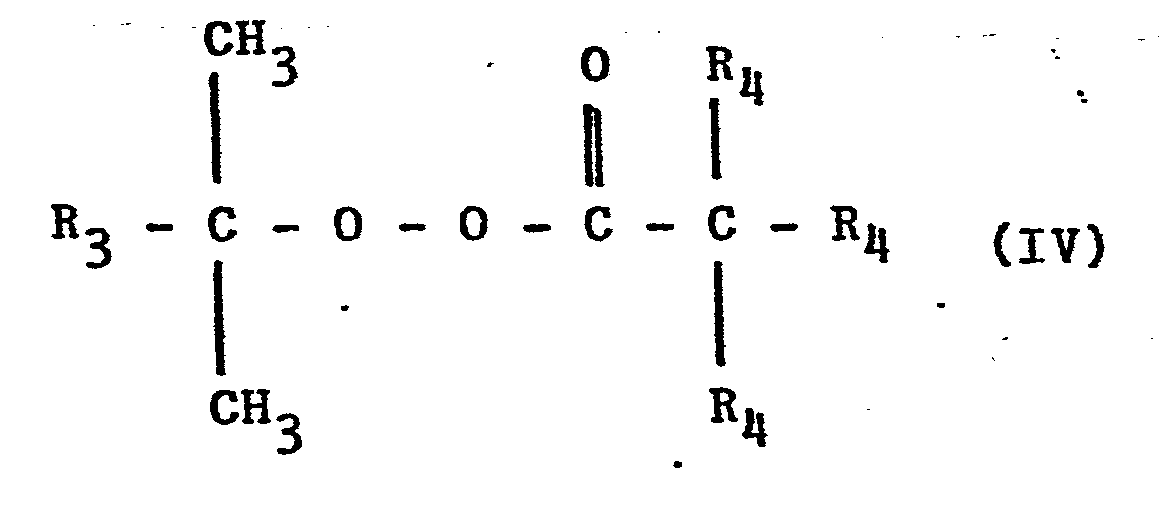
- an Verbindungen der Formel III unter Verwendung von Radikalbildnern, wobei man als Radikalbildner Verbindungen der allgemeinen Formel IV,

- worin R3 = Alkyl oder Phenyl und R4 = Alkyl bedeuten, einsetzt, die Reaktion bei Temperaturen im Bereich von 50 bis 100°C durchführt und zur Herstellung von Verbindungen der Formel I mit R2 = H anschließend den rest R2' abspaltet. Nach diesem verfahren werden die Verbindungen der Formel in hoher Ausbeute und besonderer Reinheit erhalten.
Description
- Gegenstand der vorliegenden Erfindung ist ein Verfahren zur Herstellung von Cyanhydrinen der Formel I, worin

- R1 = (C1-C6)Alkyl und
- R2 = Wasserstoff, Acetyl oder Propionyl bedeuten.
- Gemäß dieser europäischen Patentanmeldung ist auch bereits ein Verfahren zur Herstellung der Verbindungen der Formel I bekannt, nach welchem Methanphosphonigsäureester der Formel II unter radikalischer Katalyse an acylierte Acroleincyanhydrin-Verbindungen der Formel (III) angelagert werden.

- Die Ausbeuten bezogen auf (II) liegen bei dem bekannten Verfahren deshalb so niedrig, weil der Phosphonigester (II) Disproportionierungsreaktionen eingeht, die zu Ausbeuteverminderung an zurückgewonnenem Phosphonigester (II), Verminderung der Reinheit von (I) und zu einer starken Abgasbelastung durch die dabei freigesetzten Phosphine führt (K. Sasse in Houben-Weyl: Methoden der org. Chemie XII/1, S. 64 ff, Thieme Verlag, Stuttgart 1963).
- Diese Nachteile werden durch vorliegende Erfindung behoben. Gegenstand der vorliegenden Erfindung ist ein Verfahren zur Herstellung von Verbindungen der obengenannten Formel 1 durch Addition von Verbindungen der obengenannten Formel II an Verbindungen der obengenannten Formel III in Gegenwart von Radikalbildnern, dadurch gekennzeichnet, daß man als Radikalbildner Verbindungen der allgemeinen Formel IV, worin
- Prinzipiell können zur Herstellung von Verbindungen der Formel I mit R2 = H für R2 in Formel III auch andere Reste von Schutzgruppen wie der Trimethylsilylrest, die Methoxy- oder Äthoxycarbonylgruppe eingesetzt werden, die dann in gleicher Weise abgespaltet werden.
- Die Radikalstartersubstanzen zeichnen sich dadurch aus, daß sie bei niedrigen Temperaturen in tertiäre Alkyl-Radikale zerfallen, die im beanspruchten Temperaturbereich eine große Reaktivität und eine hohe Selektivität bei den Wasserstoff- übertragungsreaktionen im Konkurrenzsystem Phosphonigsäure- ester(II)/Acroleincyanhydrinacetat(III) besitzen.
- Derartige Radikalbildner werden in der europäischen Patentanmeldung Nr. 11 245 nicht erwähnt. Es war nicht zu erwarten, daß gerade die erfindungsgemäß einzusetzenden Radikalbildner der Formel (IV) sich durch hohe Selektivität auszeichnen. Grundsätzlich ist als Nebenreaktion ein Angriff des aus dem Radikalbildner generierten Radikals auf die Verbindungen der Formel (III) unter Bildung von Allylradikalen möglich, welche die Radikalkettenreaktion inhibieren würden. (s. z.B. Vollmert, Grundriß der Makromolekularen Chemie, S. 58, Springer Verlag, 1962).
- Dialkylperoxide, Dialkylperoxydicarbonate oder Azoiso- butyr.onitril, welche niedrige Dissoziationsenergien besitzen, so daß sie aus diesem Grunde im beanspruchten Temperaturbereich einsetzbar sein sollten, sind für das vorliegende Verfahren ungeeignet bzw. führen zu unbefriedigenden Ausbeuten.
- Da die Radikalbildner der Formel (IV) vorteilhaft bei niedrigen Reaktionstemperaturen zwischen 500 und 100°C eingesetzt werden können, werden Disproportionierungsreaktionen der Phosphorkomponente II unterdrückt. Hierdurch werden die Ausbeuten bezüglich der Komponente II und die Reinheit des Produkts der Formel (I) im Vergleich zum bekannten Verfahren beträchtlich erhöht..
- Die Ausbeuten nach dem erfindungsgemäßen Verfahren betragen bezüglich der Komponente III 95 bis 99 % und bezüglich der Komponente II 89 - 95 %. Die Reinheiten der Produkte I betragen 92 bis 95 %. Die aus der Reaktionslösung abdestillierte Ausgangsverbindung (II) kann ohne Reinigung für eine neue Reaktion wieder verwendet werden.
- Bevorzugt werden als Radikalbildner der Formel IV folgende Verbindungen eingesetzt: tert.-Butylperpivalat, tert.-Amylperpivalat, tert.-Butylperneodecanoat, tert.-Amylperneo- decanoat und Cumylperneodecanoat. Die genannten Perneodecanoate (Produkte der Firma Peroxid-Chemie GmbH) liegen als Gemische der folgenden Formel (IV) vor:

- Die Reaktion wird bevorzugt im Temperaturbereich zwischen 65° und 95°C, insbesondere bevorzugt zwischen 70° und 85°C durchgeführt. Das Verfahren wird zweckmäßigerweise in einer Inertatmosphäre beispielsweise unter Verwendung des Schutzgases Stickstoff oder Argon durchgeführt. Es ist ferner möglich, wenn auch nicht erforderlich, unter vermindertem Druck zu arbeiten.
- In besonderer Ausgestaltung der Erfindung wird das Verfahren vorteilhaft so durchgeführt, daß man ein Teil des Radikalbildners der Formel,(IV) oder stattdessen ein entsprechendes Teiläquivalent eines in der Europäischen Patentanmeldung Nr. 11 245 genannten Radikalstarters vor der Reaktion mit der Komponente II mischt und anschließend die Komponente III zusammen mit der Restmenge des Radikalbildners IV hinzufügt.
- Die Abspaltung: des Restes R2 zur Herstellung der Verbindungen der Formel I mit R2 = H erfolgt in saurem Medium nach bekannten Methoden(Mc Omie, "Protective Groups in Organic Chemistry", Plenum Press, London 1973).
- Nachfolgende Beispiele dienen zur Erläuterung der Erfindung.
- Herstellung von (3-Acetoxy-3-cyanopropyl)-methyl-phosphin- säure-n-pentylester
- 242,0 g Methanphosphonigsäure-n-pentylester werden unter Stickstoff auf 80°C erwärmt und mit 0,5 g tert.-Butylperpivalat versetzt. Zu dieser Lösung werden innerhalb von 2,25 Stunden 63,9 g Acroleincyanhydrinacetat auf 2,5 g tert.-Butylperpivalat getropft. Nach beendeter Reaktion wird für 5 min. nachgerührt und 161,5 g Methanphosphonigsäure-n-pentylester abdestilliert. (Reinheit: 91,2 %, Rückgewinnung: 93,4 %). Es verbleiben 142,1 g (3-Acetoxy-3-cyanopropyl)-methyl-phosphin- säure-n-pentylester (Reinheit 94 %; Ausbeute 97 %).
- Herstellung von (3-Acetoxy-3-cyanopropyl)-methyl-phosphin- säure-isobutylester
- a) 215,2 g Methanphosphonigsäureisobutylester werden in einem mit Stickstoff gespülten Kolben auf 80°C erwärmt. In diese Lösung werden 0,5 g tert.-Butylperpivalat gegeben und unter starkem Rühren bei 80°C innerhalb von 2 Stunden 63,9 g Acroleincyanhydrinacetat zugetropft, das 2,5 g tert.-Butylperpivalat enthält. Nach beendetem Zutropfen wird 5 min bei 80°C gerührt und anschließend der überschüssige Methanphosphonigsäureisobutylester im Hochvakuum entfernt. Nach Dünnschichtdestillation im Hochvakuum erhält man 134,8 g (3-Acetoxy-3-cyanopropyl)-methylphosphinsäureisobutylester mit einer Reinheit von 93,9 %, entsprechend einer Ausbeute von 97 %. Man gewinnt 142,2 g Methanphosphonigsäureisobutylester mit einer Reinheit von 96,3 %, entsprechend einer Ausbeute von 91,6 % zurück.
- b) Man erwärmt 215,2 g Methanphosphonigsäureisobutylester in einem mit Stickstoff gespülten Kolben auf 76°C und gibt 0,5 g tert.-Butylperpivalat hinzu und tropft innerhalb von 2,5 Stunden 63,9 g Acroleincyanhydrinacetat, worin 2,6 g tert.-Amylperpivalat gelöst sind, unter starkem Rühren bei 76°C zu. Nach beendeter Reaktion wird-5 Minuten bei 76°C nachgerührt. Der überschüssige Methanphosphonigsäureisobutylester wird im Hochvakuum entfernt. Man erhält 134,8 g (3-Acetoxy-3-cyanopropyl)-methylphosphinsäureisobutylester (Reinheit = 93 %; Ausbeute = 96 %). Es werden 142,9 g Methanphosphonigsäureisobutylester mit einer Ausbeute von 92 % zurückgewonnen.
- c) Es werden 215,2 g Methanphosphonigsäureisobutylester unter Stickstoff auf 72°C erwärmt und mit 0,5 g tert.-Amylperpivalat versetzt. Zu dieser Lösung werden innerhalb von 2,5 Stunden 63,9 g Acroleincyanhydrinacetat, indem 3,6 g tert.-Butylperneodecanoat gelöst sind, bei 72°C zugetropft. Nach beendeter Zugabe wird für 5 min. bei 72°C nachgerührt und 141,2 g Methanphosphonigsäureisobutylester im Hochvakuum abdestilliert (Rückgewinnung: 91 %). Es verbleiben 137,9 g 93,6%iger (3-Acetoxy-3-cyanopropyl)-methylphosphinsäure-isobutylester, entsprechend einer Ausbeute von 98,9 %.
- d) 216,0 g Methanphosphonigsäureisobutylester werden in einem mit Stickstoff gespülten Kolben auf 85°C erwärmt. Innerhalb von 2,75 Stunden werden 63,9 g Acroleincyanhydrinacetat, worin 2,5 g tert.-Butylperpivalat gelöst sind, zugetropft. Es wird für 5 min nachgerührt und 140,4 g Methanphosphonigsäureisobutylester abdestilliert (Rückgewinnung: 92,5 %).
Es verbleiben 137,1 g (3-Acetoxy-3-cyanopropyl)-methyl- phosphinsäureisobutylester (Ausbeute 97 %; Reinheit 92 %). - e) 208 g Methanphosphonigsäureisobutylester werden unter Stickstoff auf 80°C erwärmt. In die heiße Reaktionslösung werden 0,5 g tert.-Butylperpivalat gegeben und innerhalb 2,3 Stunden 63,9 g Acroleincyanhydrinacetat und 2,5 g tert.-Butylperpivalat zugetropft. Es werden 5 min. bei 80°C nachgerührt und im Hochvakuum 133,9 g Methanphosphonigsäureisobutylester abdestilliert (Rückgewinnung: 91,3 %; Reinheit: 97 %). Man erhält 134,6 g (3-Acetoxy-3-cyanopropyl)-methyl-phosphinsäure-isobutylester (Ausbeute: 97,8 %; Reinheit 95 %).
- f) 215,2 g Methanphcsphonigsäureisobutylester werden unter Stickstoff auf 70°C erwärmt und mit 0,5 g tert.-Butylperpivalat versetzt. Innerhalb von 2,5 Stunden werden 63,9 g Acroleincyanhydrinacetat und 4,5 g Cumylperneodecanoat zugetropft . Nach beendeter Reaktion wird für 5 min. nachgerührt und der überschüssige Methanphosphonigsäureisobutylester abdestilliert. Es werden 141,0 g Methanphosphonigsäureisobutylester erhalten (Rückgewinnung: 91,8 %).
Es verbleiben 136,1 g (3-Acetoxy-3-cyanopropyl)-methyl- phosphinsäureisobutylester (Ausbeute 98 %; Reinheit 94 %). - Herstellung von (3-Acetoxy-3-cyanopropyl)-methyl-phosphin- säureisopentylester
- a) Es werden 235,0 g Methanphosphonigsäure-isopentylester unter Stickstoff auf 72°C erwärmt. Zu dieser Lösung werden 0,5 g tert.-Amylperpivalat gegeben und unter starkem Rühren bei 720C innerhalb von 2,75 Stunden 63,9 g Acroleincyanhydrinacetat zugetropft, indem 3,6 g tert.-Butylperneodecanoat gelöst sind. Nach beendeter Reaktion wird für 5 min. bei 72°C nachgerührt und 154,8 g Methanphosphonigsäureisopentylester abdestilliert. (Rückgewinnung: 94,8 %). Man erhält 143,8 g 93,6 %igen (3-Acetoxy-3-cyanopropyl)-methyl-phosphinsäureisopentyl- ester (Ausbeute = 97,9 %).
- b) 235,0 g Methanphosphonigsäureisopentylester werden unter Stickstoff auf 80°C erwärmt und mit 0,5 g tert.-Butylperpivalat versetzt. Innerhalb von 3 Stunden werden 63,9 g Acroleincyanhydrinacetat und 2,5 g tert.-Butylperpivalat unter starkem Rühren bei 80°C zugetropft. Nach beendeter Reaktion werden 155,2 g 97,7%iger Methanphosphonigsäureisopentylester im Hochvakuum abdestilliert. (Rückgewinnung: 95 %). Es werden 141,8 g (3-Acetoxy-3-cyano- propyl)-methylphosphinsäureisopentylester erhalten (Ausbeute = 96,5 %; Reinheit = 93,6 %).
- Herstellung von (3-Acetoxy-3-cyanopropyl )-methylphosphinsäureisobutylester unter Verwendung von Di-n-butylperoxydicarbonat als Radikalstarter
- 208 g Methanphosphonigsäureisobutylester werden unter Stickstoff auf 75°C erwärmt und mit 0,5 g tert.-Butylperpivalat versetzt. Innerhalb von 2,5 Stunden werden 63,9 g Acroleincyanhydrinacetat, worin 2,3 g Di-n-butylperoxydicarbonat gelöst sind, zugetropft. Es werden 5 min. nachgerührt und der überschüssige Methanphosphonigsäureisobutylester abdestilliert. Es verbleiben 79,2 g (3-Acetoxy-3-cyano- propyl)-methylphosphinsäureisobutylester, entsprechend einer Ausbeute von 59,5 %.
- Herstellung von (3-Acetoxy-3-cyanopropyl)-methyl-phosphin- säure-isobutylester gemäß EP-A-11 245
- 210,5 g Methanphosphonigsäureisobutylester werden in einem gut mit Stickstoff gespülten Kolben auf 115°C erwärmt und dieser Lösung werden bei 115°C innerhalb von 2,5 Stunden 63,9 g Acroleincyanhydrinacetat zugetropft, das 2,5 g tert.-Butylperoctanoatenthält. Nach beendetem Zutropfen wird für 5 Min. bei 1150C nachgerührt und anschließend der überschüssige Methanphosphonigsäureisobutylester, abdestilliert. Man erhält 134,8 g (3-Acetoxy-3-cyanopropyl)-methylphosphin- säure-isobutylester, der 86,5 %ig ist, entsprechend einer Ausbeute von 89,4 % d.Th.. Man gewinnt 118,9 g Methanphosphonigsäureisobutylester zurück, entsprechend einer Ausbeute von 79,4 % d. Th..

Claims (5)


Priority Applications (1)
| Application Number | Priority Date | Filing Date | Title |
|---|---|---|---|
| AT84106149T ATE35417T1 (de) | 1983-06-01 | 1984-05-30 | Verfahren zur herstellung von phosphorhaltigen cyanhydrinderivaten. |
Applications Claiming Priority (2)
| Application Number | Priority Date | Filing Date | Title |
|---|---|---|---|
| DE3319850A DE3319850C2 (de) | 1983-06-01 | 1983-06-01 | Verfahren zur Herstellung von phosphorhaltigen Cyanhydrinderivaten |
| DE3319850 | 1983-06-01 |
Publications (3)
| Publication Number | Publication Date |
|---|---|
| EP0127877A2 true EP0127877A2 (de) | 1984-12-12 |
| EP0127877A3 EP0127877A3 (en) | 1985-08-28 |
| EP0127877B1 EP0127877B1 (de) | 1988-06-29 |
Family
ID=6200410
Family Applications (1)
| Application Number | Title | Priority Date | Filing Date |
|---|---|---|---|
| EP84106149A Expired EP0127877B1 (de) | 1983-06-01 | 1984-05-30 | Verfahren zur Herstellung von phosphorhaltigen Cyanhydrinderivaten |
Country Status (11)
| Country | Link |
|---|---|
| US (1) | US4599207A (de) |
| EP (1) | EP0127877B1 (de) |
| JP (1) | JPH0631274B2 (de) |
| AT (1) | ATE35417T1 (de) |
| AU (1) | AU562802B2 (de) |
| CA (1) | CA1224475A (de) |
| DD (1) | DD219775A5 (de) |
| DE (2) | DE3319850C2 (de) |
| HU (1) | HU190929B (de) |
| IL (1) | IL71958A (de) |
| ZA (1) | ZA844112B (de) |
Cited By (2)
| Publication number | Priority date | Publication date | Assignee | Title |
|---|---|---|---|---|
| WO2015173146A1 (de) * | 2014-05-13 | 2015-11-19 | Bayer Cropscience Ag | Verfahren zur herstellung von phosphorhaltigen cyanhydrinen |
| EP3392237A1 (de) | 2017-04-21 | 2018-10-24 | Evonik Degussa GmbH | Verfahren zur herstellung von acroleincyanhydrinen |
Families Citing this family (17)
| Publication number | Priority date | Publication date | Assignee | Title |
|---|---|---|---|---|
| DE3542645A1 (de) * | 1985-12-03 | 1987-06-04 | Hoechst Ag | Verfahren zur herstellung von l-homoalanin-4-yl(methyl)-phosphinsaeure sowie ihrer alkylester |
| US10334854B2 (en) | 2015-04-27 | 2019-07-02 | Bayer Cropscience Aktiengesellschaft | Herbicide combinations comprising glufosinate and indaziflam |
| CN104860988B (zh) * | 2015-05-11 | 2017-01-11 | 石家庄瑞凯化工有限公司 | 一种草铵膦的分离纯化方法 |
| BR112018004247A2 (pt) | 2015-09-02 | 2018-09-25 | Bayer Cropscience Aktiengesellschaft | método para produção de ésteres de cianidrina contendo fósforo. |
| MX2018002731A (es) | 2015-09-02 | 2018-04-13 | Bayer Cropscience Ag | Proceso para la elaboracion de esteres de cianohidrina que contienen fosforo. |
| JP2018526379A (ja) * | 2015-09-02 | 2018-09-13 | バイエル・クロップサイエンス・アクチェンゲゼルシャフト | リン含有シアノヒドリンエステルの製造方法 |
| KR20180048894A (ko) | 2015-09-02 | 2018-05-10 | 바이엘 크롭사이언스 악티엔게젤샤프트 | 인 함유 시아노하이드린 에스테르의 제조 방법 |
| JP6826110B2 (ja) | 2015-09-29 | 2021-02-03 | ビーエイエスエフ・ソシエタス・エウロパエアBasf Se | ホスフィネート類を製造する方法 |
| WO2018108794A1 (de) | 2016-12-15 | 2018-06-21 | Bayer Cropscience Aktiengesellschaft | Verfahren zur herstellung von d-glufosinat oder dessen salzen unter verwendung von ephedrin |
| WO2018108797A1 (de) | 2016-12-15 | 2018-06-21 | Bayer Cropscience Aktiengesellschaft | Verfahren zur herstellung von l-glufosinat oder dessen salzen unter verwendung von ephedrin |
| TW201840578A (zh) | 2017-02-22 | 2018-11-16 | 以色列商亞當阿甘公司 | 製備甲基膦酸丁基酯的方法 |
| JP7296936B2 (ja) | 2017-07-21 | 2023-06-23 | ビーエーエスエフ ソシエタス・ヨーロピア | n-ブチル(3-アミノ-3-シアノプロピル)メチルホスフィネート及び(3-アミノ-3-シアノプロピル)メチルホスフィン酸アンモニウム塩の混合物をもたらすための3-[n-ブトキシ(メチル)ホスホリル]-1-シアノプロピルアセテートの反応による、グルホシネートの製造 |
| CN111479816B (zh) | 2017-12-19 | 2023-10-27 | 巴斯夫欧洲公司 | 制备含磷α-氨基腈的方法 |
| CN110386950A (zh) * | 2019-07-18 | 2019-10-29 | 石家庄瑞凯化工有限公司 | 一种草铵膦铵盐的合成方法 |
| USD1077211S1 (en) * | 2021-04-08 | 2025-05-27 | MediVena Sp. z.o.o. | Safety mechanism for hypodermic needle |
| IL322824A (en) | 2023-02-23 | 2025-10-01 | Basf Se | Process for preparing L-glucosinate from cyanohydrin or cyanohydrin derivatives |
| AR132932A1 (es) | 2023-06-13 | 2025-08-13 | Basf Se | Síntesis de glufosinato mediante un proceso basado en amidasa |
Family Cites Families (9)
| Publication number | Priority date | Publication date | Assignee | Title |
|---|---|---|---|---|
| US4057567A (en) * | 1968-05-01 | 1977-11-08 | Argus Chemical Corporation | Polymerization method and t-alkyl peresters of t-hydroperoxides for use therein |
| US3726847A (en) * | 1968-05-01 | 1973-04-10 | Argus Chem | Polymerization method employing t-alkyl peresters of t-hydroperoxides |
| US4001352A (en) * | 1973-01-19 | 1977-01-04 | Hoechst Aktiengesellschaft | Process for the preparation of ethane-1,2-diphosphinic acid diesters |
| DE2504333A1 (de) * | 1975-02-01 | 1976-08-05 | Bayer Ag | Substituierte cyclische phosphinoxide |
| US4185031A (en) * | 1978-09-27 | 1980-01-22 | The United States Of America As Represented By The Secretary Of The Air Force | Fluorinated phosphinic acids |
| DE2849003A1 (de) * | 1978-11-11 | 1980-08-21 | Hoechst Ag | Phosphorhaltige cyanhydrinderivate und verfahren zu ihrer herstellung |
| JPS56132330U (de) * | 1980-03-07 | 1981-10-07 | ||
| JPS58138222A (ja) * | 1982-02-10 | 1983-08-17 | Hitachi Ltd | 排気タ−ビン過給機 |
| JPS60212623A (ja) * | 1984-04-09 | 1985-10-24 | Hitachi Ltd | 排気タ−ビン過給機 |
-
1983
- 1983-06-01 DE DE3319850A patent/DE3319850C2/de not_active Expired
-
1984
- 1984-05-25 HU HU842046A patent/HU190929B/hu unknown
- 1984-05-29 US US06/614,846 patent/US4599207A/en not_active Expired - Lifetime
- 1984-05-29 IL IL71958A patent/IL71958A/xx not_active IP Right Cessation
- 1984-05-30 ZA ZA844112A patent/ZA844112B/xx unknown
- 1984-05-30 DD DD84263574A patent/DD219775A5/de not_active IP Right Cessation
- 1984-05-30 DE DE8484106149T patent/DE3472407D1/de not_active Expired
- 1984-05-30 EP EP84106149A patent/EP0127877B1/de not_active Expired
- 1984-05-30 AT AT84106149T patent/ATE35417T1/de not_active IP Right Cessation
- 1984-05-31 CA CA000455523A patent/CA1224475A/en not_active Expired
- 1984-05-31 JP JP59109760A patent/JPH0631274B2/ja not_active Expired - Lifetime
- 1984-05-31 AU AU28916/84A patent/AU562802B2/en not_active Expired
Cited By (6)
| Publication number | Priority date | Publication date | Assignee | Title |
|---|---|---|---|---|
| WO2015173146A1 (de) * | 2014-05-13 | 2015-11-19 | Bayer Cropscience Ag | Verfahren zur herstellung von phosphorhaltigen cyanhydrinen |
| US9850263B2 (en) | 2014-05-13 | 2017-12-26 | Bayer Cropscience Aktiengesellschaft | Process for preparing phosphorus containing cyanohydrins |
| EA036169B1 (ru) * | 2014-05-13 | 2020-10-09 | Басф Се | Способ получения фосфорсодержащих циангидринов |
| US10961265B2 (en) | 2014-05-13 | 2021-03-30 | Basf Se | Process for preparing phosphorus containing cyanohydrins |
| EP3392237A1 (de) | 2017-04-21 | 2018-10-24 | Evonik Degussa GmbH | Verfahren zur herstellung von acroleincyanhydrinen |
| US10214484B2 (en) | 2017-04-21 | 2019-02-26 | Evonik Degussa Gmbh | Method for preparing acrolein cyanohydrins |
Also Published As
| Publication number | Publication date |
|---|---|
| AU562802B2 (en) | 1987-06-18 |
| DE3472407D1 (en) | 1988-08-04 |
| JPH0631274B2 (ja) | 1994-04-27 |
| IL71958A (en) | 1987-11-30 |
| EP0127877B1 (de) | 1988-06-29 |
| HUT34510A (en) | 1985-03-28 |
| AU2891684A (en) | 1984-12-06 |
| IL71958A0 (en) | 1984-09-30 |
| DD219775A5 (de) | 1985-03-13 |
| JPS59227891A (ja) | 1984-12-21 |
| ATE35417T1 (de) | 1988-07-15 |
| US4599207A (en) | 1986-07-08 |
| DE3319850C2 (de) | 1985-05-09 |
| CA1224475A (en) | 1987-07-21 |
| ZA844112B (en) | 1984-12-24 |
| EP0127877A3 (en) | 1985-08-28 |
| HU190929B (en) | 1986-12-28 |
| DE3319850A1 (de) | 1985-01-17 |
Similar Documents
| Publication | Publication Date | Title |
|---|---|---|
| EP0127877B1 (de) | Verfahren zur Herstellung von phosphorhaltigen Cyanhydrinderivaten | |
| DE19923617C2 (de) | Verfahren zur Herstellung von Phosphinsäureestern | |
| EP0150739B1 (de) | Verfahren zur Herstellung alkanphosphoniger Säuren | |
| DE2540283C3 (de) | Verfahren zur Herstellung von carboxylgruppenhaltigen organischen Phosphorverbindungen | |
| DE1902444C3 (de) | Verfahren zur Herstellung tertiärer Phosphinoxyde | |
| DE2643474C2 (de) | Verfahren zur Herstellung von Phosphitchloriden | |
| DE2127821B2 (de) | Verfahren zur Herstellung von Acyloxyalkanphosphonsäurediestern bzw. Acyloxyalkanphosphinsäureestern | |
| EP0024018B1 (de) | Verfahren zur Herstellung von alpha-Oxo-alpha-(3-alkoxycarbonyl-2,2-dimethyl-cycloprop-1-yl)-methan-phosphonsäureestern, neue Zwischenprodukte hierfür und Verfahren zu deren Herstellung | |
| DE2511932C2 (de) | Verfahren zur Herstellung von tert.-Hydroxyalkylphosphinoxiden | |
| DE2538310B2 (de) | Verfahren zur Herstellung von O.O-Dialkylthionophosphorsäurechloriden | |
| EP0329595B1 (de) | Verfahren zur Herstellung von Alkenylphosphinsäurealkylestern | |
| EP0022546A2 (de) | Verfahren zur Herstellung von 1-Oxophospholan-chlorhydrinen sowie einige spezielle dieser Verbindungen | |
| EP0115011A1 (de) | Verfahren zur Herstellung von Aryldichlorphosphanen | |
| EP0007008A1 (de) | Verfahren zur Herstellung von Halogenbutenylacrylaten | |
| DE2407460C2 (de) | Verfahren zur Herstellung von Methylphosphinoxiden | |
| EP0018540B1 (de) | Ester des Isocamphyl-guajakols, Verfahren zu ihrer Herstellung und ihre Verwendung zur Herstellung von 3-(Iso-camphyl-(5))-cyclohexanol | |
| EP0075201B1 (de) | Verfahren zur Herstellung von 1,1,1-Trichlormethylverbindungen | |
| DD222596A1 (de) | Verfahren zur herstellung reiner alkyl- oder aryldiester der phosphorigen saeure | |
| DE2040280A1 (de) | Verfahren zur Herstellung tertiaerer Phosphinoxyde | |
| DE1200819B (de) | Verfahren zur Herstellung von Estern der Pyrophosphorsaeure | |
| DE1252680B (de) | Verfahren zur Herstellung von Phosphinsäureestern | |
| EP0256319A1 (de) | Neue s-Butyl-di-n-alkylphosphane, -phosphanoxide und -phosphansulfide sowie Verfahren zu ihrer Herstellung | |
| EP0705840A1 (de) | Verfahren zur Herstellung von 0,0-Dialkyl-4-phosphono-2-methyl-2-butensäurealkylestern und 4-Halogen-2-methyl-2-butensäurealkylestern mit hohem Anteil an E-Isomeren | |
| EP0537197A1 (de) | Verfahren zur herstellung von phosphonigsäure-arylester- halogeniden. | |
| DE1139829B (de) | Verfahren zur Herstellung von O, O-Dimethyl-dithiophosphoryl-essigsaeure-N-methylamid |
Legal Events
| Date | Code | Title | Description |
|---|---|---|---|
| PUAI | Public reference made under article 153(3) epc to a published international application that has entered the european phase |
Free format text: ORIGINAL CODE: 0009012 |
|
| AK | Designated contracting states |
Designated state(s): AT BE CH DE FR GB IT LI NL SE |
|
| PUAL | Search report despatched |
Free format text: ORIGINAL CODE: 0009013 |
|
| AK | Designated contracting states |
Designated state(s): AT BE CH DE FR GB IT LI NL SE |
|
| 17P | Request for examination filed |
Effective date: 19851104 |
|
| 17Q | First examination report despatched |
Effective date: 19870729 |
|
| GRAA | (expected) grant |
Free format text: ORIGINAL CODE: 0009210 |
|
| AK | Designated contracting states |
Kind code of ref document: B1 Designated state(s): AT BE CH DE FR GB IT LI NL SE |
|
| REF | Corresponds to: |
Ref document number: 35417 Country of ref document: AT Date of ref document: 19880715 Kind code of ref document: T |
|
| ITF | It: translation for a ep patent filed | ||
| REF | Corresponds to: |
Ref document number: 3472407 Country of ref document: DE Date of ref document: 19880804 |
|
| GBT | Gb: translation of ep patent filed (gb section 77(6)(a)/1977) | ||
| ET | Fr: translation filed | ||
| PLBE | No opposition filed within time limit |
Free format text: ORIGINAL CODE: 0009261 |
|
| STAA | Information on the status of an ep patent application or granted ep patent |
Free format text: STATUS: NO OPPOSITION FILED WITHIN TIME LIMIT |
|
| 26N | No opposition filed | ||
| ITTA | It: last paid annual fee | ||
| EAL | Se: european patent in force in sweden |
Ref document number: 84106149.2 |
|
| REG | Reference to a national code |
Ref country code: GB Ref legal event code: IF02 |
|
| PGFP | Annual fee paid to national office [announced via postgrant information from national office to epo] |
Ref country code: DE Payment date: 20030314 Year of fee payment: 20 |
|
| PGFP | Annual fee paid to national office [announced via postgrant information from national office to epo] |
Ref country code: SE Payment date: 20030507 Year of fee payment: 20 |
|
| PGFP | Annual fee paid to national office [announced via postgrant information from national office to epo] |
Ref country code: FR Payment date: 20030508 Year of fee payment: 20 |
|
| PGFP | Annual fee paid to national office [announced via postgrant information from national office to epo] |
Ref country code: AT Payment date: 20030514 Year of fee payment: 20 |
|
| PGFP | Annual fee paid to national office [announced via postgrant information from national office to epo] |
Ref country code: GB Payment date: 20030528 Year of fee payment: 20 |
|
| PGFP | Annual fee paid to national office [announced via postgrant information from national office to epo] |
Ref country code: NL Payment date: 20030530 Year of fee payment: 20 |
|
| PGFP | Annual fee paid to national office [announced via postgrant information from national office to epo] |
Ref country code: CH Payment date: 20030531 Year of fee payment: 20 |
|
| PGFP | Annual fee paid to national office [announced via postgrant information from national office to epo] |
Ref country code: BE Payment date: 20030725 Year of fee payment: 20 |
|
| PG25 | Lapsed in a contracting state [announced via postgrant information from national office to epo] |
Ref country code: LI Free format text: LAPSE BECAUSE OF EXPIRATION OF PROTECTION Effective date: 20040529 Ref country code: GB Free format text: LAPSE BECAUSE OF EXPIRATION OF PROTECTION Effective date: 20040529 Ref country code: CH Free format text: LAPSE BECAUSE OF EXPIRATION OF PROTECTION Effective date: 20040529 |
|
| PG25 | Lapsed in a contracting state [announced via postgrant information from national office to epo] |
Ref country code: NL Free format text: LAPSE BECAUSE OF EXPIRATION OF PROTECTION Effective date: 20040530 Ref country code: AT Free format text: LAPSE BECAUSE OF EXPIRATION OF PROTECTION Effective date: 20040530 |
|
| BE20 | Be: patent expired |
Owner name: *HOECHST A.G. Effective date: 20040530 |
|
| REG | Reference to a national code |
Ref country code: GB Ref legal event code: PE20 |
|
| EUG | Se: european patent has lapsed | ||
| REG | Reference to a national code |
Ref country code: CH Ref legal event code: PL |
|
| NLV7 | Nl: ceased due to reaching the maximum lifetime of a patent |
Effective date: 20040530 |