EP0125617B1 - Verfahren zur Herstellung eines metallisierten Polymers aus der Polymerzusammensetzung - Google Patents
Verfahren zur Herstellung eines metallisierten Polymers aus der Polymerzusammensetzung Download PDFInfo
- Publication number
- EP0125617B1 EP0125617B1 EP19840105219 EP84105219A EP0125617B1 EP 0125617 B1 EP0125617 B1 EP 0125617B1 EP 19840105219 EP19840105219 EP 19840105219 EP 84105219 A EP84105219 A EP 84105219A EP 0125617 B1 EP0125617 B1 EP 0125617B1
- Authority
- EP
- European Patent Office
- Prior art keywords
- polymer
- film
- resin
- board
- rubber
- Prior art date
- Legal status (The legal status is an assumption and is not a legal conclusion. Google has not performed a legal analysis and makes no representation as to the accuracy of the status listed.)
- Expired - Lifetime
Links
- 229920000642 polymer Polymers 0.000 title claims description 119
- 239000000203 mixture Substances 0.000 title claims description 50
- 238000004519 manufacturing process Methods 0.000 title claims description 11
- 229910052751 metal Inorganic materials 0.000 claims description 141
- 239000002184 metal Substances 0.000 claims description 141
- 239000010408 film Substances 0.000 claims description 116
- 150000004696 coordination complex Chemical class 0.000 claims description 80
- 229920006254 polymer film Polymers 0.000 claims description 79
- KDLHZDBZIXYQEI-UHFFFAOYSA-N Palladium Chemical compound [Pd] KDLHZDBZIXYQEI-UHFFFAOYSA-N 0.000 claims description 68
- 238000000034 method Methods 0.000 claims description 68
- 239000010410 layer Substances 0.000 claims description 66
- 238000010438 heat treatment Methods 0.000 claims description 50
- RYGMFSIKBFXOCR-UHFFFAOYSA-N Copper Chemical compound [Cu] RYGMFSIKBFXOCR-UHFFFAOYSA-N 0.000 claims description 39
- 229910052802 copper Inorganic materials 0.000 claims description 37
- 239000010949 copper Substances 0.000 claims description 37
- 229910052763 palladium Inorganic materials 0.000 claims description 34
- 229920005989 resin Polymers 0.000 claims description 32
- 239000011347 resin Substances 0.000 claims description 32
- 229920002492 poly(sulfone) Polymers 0.000 claims description 25
- 239000011104 metalized film Substances 0.000 claims description 24
- -1 ethylene, propylene, isobutylene Chemical group 0.000 claims description 20
- 229920000139 polyethylene terephthalate Polymers 0.000 claims description 20
- 239000005020 polyethylene terephthalate Substances 0.000 claims description 20
- 239000004800 polyvinyl chloride Substances 0.000 claims description 19
- 229920000915 polyvinyl chloride Polymers 0.000 claims description 19
- 239000011521 glass Substances 0.000 claims description 14
- 229920001971 elastomer Polymers 0.000 claims description 12
- 238000001465 metallisation Methods 0.000 claims description 12
- PXHVJJICTQNCMI-UHFFFAOYSA-N Nickel Chemical compound [Ni] PXHVJJICTQNCMI-UHFFFAOYSA-N 0.000 claims description 10
- 239000005060 rubber Substances 0.000 claims description 9
- 229920002725 thermoplastic elastomer Polymers 0.000 claims description 9
- 239000003446 ligand Substances 0.000 claims description 8
- 229920001721 polyimide Polymers 0.000 claims description 7
- WEVYAHXRMPXWCK-UHFFFAOYSA-N Acetonitrile Chemical compound CC#N WEVYAHXRMPXWCK-UHFFFAOYSA-N 0.000 claims description 6
- 239000004743 Polypropylene Substances 0.000 claims description 6
- 229910052782 aluminium Inorganic materials 0.000 claims description 6
- XAGFODPZIPBFFR-UHFFFAOYSA-N aluminium Chemical group [Al] XAGFODPZIPBFFR-UHFFFAOYSA-N 0.000 claims description 6
- JFDZBHWFFUWGJE-UHFFFAOYSA-N benzonitrile Chemical compound N#CC1=CC=CC=C1 JFDZBHWFFUWGJE-UHFFFAOYSA-N 0.000 claims description 6
- 239000003822 epoxy resin Substances 0.000 claims description 6
- 239000004417 polycarbonate Substances 0.000 claims description 6
- 229920000515 polycarbonate Polymers 0.000 claims description 6
- 229920000647 polyepoxide Polymers 0.000 claims description 6
- 229920001155 polypropylene Polymers 0.000 claims description 6
- 229920001343 polytetrafluoroethylene Polymers 0.000 claims description 6
- 229910000881 Cu alloy Inorganic materials 0.000 claims description 5
- 239000004698 Polyethylene Substances 0.000 claims description 5
- 229910052759 nickel Inorganic materials 0.000 claims description 5
- 239000005011 phenolic resin Substances 0.000 claims description 5
- 229920000728 polyester Polymers 0.000 claims description 5
- 229920000573 polyethylene Polymers 0.000 claims description 5
- 239000004810 polytetrafluoroethylene Substances 0.000 claims description 5
- 229910052703 rhodium Inorganic materials 0.000 claims description 5
- 239000010948 rhodium Substances 0.000 claims description 5
- MHOVAHRLVXNVSD-UHFFFAOYSA-N rhodium atom Chemical compound [Rh] MHOVAHRLVXNVSD-UHFFFAOYSA-N 0.000 claims description 5
- KAKZBPTYRLMSJV-UHFFFAOYSA-N Butadiene Chemical compound C=CC=C KAKZBPTYRLMSJV-UHFFFAOYSA-N 0.000 claims description 4
- YLQBMQCUIZJEEH-UHFFFAOYSA-N Furan Chemical compound C=1C=COC=1 YLQBMQCUIZJEEH-UHFFFAOYSA-N 0.000 claims description 4
- XEEYBQQBJWHFJM-UHFFFAOYSA-N Iron Chemical compound [Fe] XEEYBQQBJWHFJM-UHFFFAOYSA-N 0.000 claims description 4
- 239000004952 Polyamide Substances 0.000 claims description 4
- JUJWROOIHBZHMG-UHFFFAOYSA-N Pyridine Chemical compound C1=CC=NC=C1 JUJWROOIHBZHMG-UHFFFAOYSA-N 0.000 claims description 4
- SMWDFEZZVXVKRB-UHFFFAOYSA-N Quinoline Chemical compound N1=CC=CC2=CC=CC=C21 SMWDFEZZVXVKRB-UHFFFAOYSA-N 0.000 claims description 4
- YTPLMLYBLZKORZ-UHFFFAOYSA-N Thiophene Chemical compound C=1C=CSC=1 YTPLMLYBLZKORZ-UHFFFAOYSA-N 0.000 claims description 4
- YRKCREAYFQTBPV-UHFFFAOYSA-N acetylacetone Chemical compound CC(=O)CC(C)=O YRKCREAYFQTBPV-UHFFFAOYSA-N 0.000 claims description 4
- ZSWFCLXCOIISFI-UHFFFAOYSA-N cyclopentadiene Chemical class C1C=CC=C1 ZSWFCLXCOIISFI-UHFFFAOYSA-N 0.000 claims description 4
- 230000001939 inductive effect Effects 0.000 claims description 4
- UHOVQNZJYSORNB-UHFFFAOYSA-N monobenzene Natural products C1=CC=CC=C1 UHOVQNZJYSORNB-UHFFFAOYSA-N 0.000 claims description 4
- BASFCYQUMIYNBI-UHFFFAOYSA-N platinum Chemical compound [Pt] BASFCYQUMIYNBI-UHFFFAOYSA-N 0.000 claims description 4
- 229920002647 polyamide Polymers 0.000 claims description 4
- 229920002857 polybutadiene Polymers 0.000 claims description 4
- 229920002379 silicone rubber Polymers 0.000 claims description 4
- 239000004945 silicone rubber Substances 0.000 claims description 4
- RXJKFRMDXUJTEX-UHFFFAOYSA-N triethylphosphine Chemical compound CCP(CC)CC RXJKFRMDXUJTEX-UHFFFAOYSA-N 0.000 claims description 4
- HVLLSGMXQDNUAL-UHFFFAOYSA-N triphenyl phosphite Chemical compound C=1C=CC=CC=1OP(OC=1C=CC=CC=1)OC1=CC=CC=C1 HVLLSGMXQDNUAL-UHFFFAOYSA-N 0.000 claims description 4
- RIOQSEWOXXDEQQ-UHFFFAOYSA-N triphenylphosphine Chemical compound C1=CC=CC=C1P(C=1C=CC=CC=1)C1=CC=CC=C1 RIOQSEWOXXDEQQ-UHFFFAOYSA-N 0.000 claims description 4
- ZAMOUSCENKQFHK-UHFFFAOYSA-N Chlorine atom Chemical compound [Cl] ZAMOUSCENKQFHK-UHFFFAOYSA-N 0.000 claims description 3
- BQCADISMDOOEFD-UHFFFAOYSA-N Silver Chemical compound [Ag] BQCADISMDOOEFD-UHFFFAOYSA-N 0.000 claims description 3
- 239000000460 chlorine Substances 0.000 claims description 3
- 229910052801 chlorine Inorganic materials 0.000 claims description 3
- 239000000806 elastomer Substances 0.000 claims description 3
- PCHJSUWPFVWCPO-UHFFFAOYSA-N gold Chemical compound [Au] PCHJSUWPFVWCPO-UHFFFAOYSA-N 0.000 claims description 3
- 229910052737 gold Inorganic materials 0.000 claims description 3
- 239000010931 gold Substances 0.000 claims description 3
- 229910052741 iridium Inorganic materials 0.000 claims description 3
- GKOZUEZYRPOHIO-UHFFFAOYSA-N iridium atom Chemical compound [Ir] GKOZUEZYRPOHIO-UHFFFAOYSA-N 0.000 claims description 3
- 150000002739 metals Chemical class 0.000 claims description 3
- 229910052709 silver Inorganic materials 0.000 claims description 3
- 239000004332 silver Substances 0.000 claims description 3
- 239000002344 surface layer Substances 0.000 claims description 3
- RRKODOZNUZCUBN-CCAGOZQPSA-N (1z,3z)-cycloocta-1,3-diene Chemical compound C1CC\C=C/C=C\C1 RRKODOZNUZCUBN-CCAGOZQPSA-N 0.000 claims description 2
- PMJHHCWVYXUKFD-SNAWJCMRSA-N (E)-1,3-pentadiene Chemical compound C\C=C\C=C PMJHHCWVYXUKFD-SNAWJCMRSA-N 0.000 claims description 2
- VYMPLPIFKRHAAC-UHFFFAOYSA-N 1,2-ethanedithiol Chemical compound SCCS VYMPLPIFKRHAAC-UHFFFAOYSA-N 0.000 claims description 2
- VZXTWGWHSMCWGA-UHFFFAOYSA-N 1,3,5-triazine-2,4-diamine Chemical compound NC1=NC=NC(N)=N1 VZXTWGWHSMCWGA-UHFFFAOYSA-N 0.000 claims description 2
- NIAAGQAEVGMHPM-UHFFFAOYSA-N 4-methylbenzene-1,2-dithiol Chemical compound CC1=CC=C(S)C(S)=C1 NIAAGQAEVGMHPM-UHFFFAOYSA-N 0.000 claims description 2
- NIXOWILDQLNWCW-UHFFFAOYSA-M Acrylate Chemical compound [O-]C(=O)C=C NIXOWILDQLNWCW-UHFFFAOYSA-M 0.000 claims description 2
- ROFVEXUMMXZLPA-UHFFFAOYSA-N Bipyridyl Chemical group N1=CC=CC=C1C1=CC=CC=N1 ROFVEXUMMXZLPA-UHFFFAOYSA-N 0.000 claims description 2
- WKBOTKDWSSQWDR-UHFFFAOYSA-N Bromine atom Chemical compound [Br] WKBOTKDWSSQWDR-UHFFFAOYSA-N 0.000 claims description 2
- UGFAIRIUMAVXCW-UHFFFAOYSA-N Carbon monoxide Chemical compound [O+]#[C-] UGFAIRIUMAVXCW-UHFFFAOYSA-N 0.000 claims description 2
- VYZAMTAEIAYCRO-UHFFFAOYSA-N Chromium Chemical compound [Cr] VYZAMTAEIAYCRO-UHFFFAOYSA-N 0.000 claims description 2
- 239000004641 Diallyl-phthalate Substances 0.000 claims description 2
- 244000043261 Hevea brasiliensis Species 0.000 claims description 2
- ZOKXTWBITQBERF-UHFFFAOYSA-N Molybdenum Chemical compound [Mo] ZOKXTWBITQBERF-UHFFFAOYSA-N 0.000 claims description 2
- 229920000459 Nitrile rubber Polymers 0.000 claims description 2
- 239000004696 Poly ether ether ketone Substances 0.000 claims description 2
- 229920001233 Poly-4-hydroxybenzoate Polymers 0.000 claims description 2
- 229930182556 Polyacetal Natural products 0.000 claims description 2
- 239000004962 Polyamide-imide Substances 0.000 claims description 2
- 239000005062 Polybutadiene Substances 0.000 claims description 2
- 239000004697 Polyetherimide Substances 0.000 claims description 2
- 239000004721 Polyphenylene oxide Substances 0.000 claims description 2
- 239000004734 Polyphenylene sulfide Substances 0.000 claims description 2
- 239000004793 Polystyrene Substances 0.000 claims description 2
- 229920001328 Polyvinylidene chloride Polymers 0.000 claims description 2
- KJTLSVCANCCWHF-UHFFFAOYSA-N Ruthenium Chemical compound [Ru] KJTLSVCANCCWHF-UHFFFAOYSA-N 0.000 claims description 2
- RTAQQCXQSZGOHL-UHFFFAOYSA-N Titanium Chemical compound [Ti] RTAQQCXQSZGOHL-UHFFFAOYSA-N 0.000 claims description 2
- 229920001807 Urea-formaldehyde Polymers 0.000 claims description 2
- 229920006311 Urethane elastomer Polymers 0.000 claims description 2
- QCWXUUIWCKQGHC-UHFFFAOYSA-N Zirconium Chemical compound [Zr] QCWXUUIWCKQGHC-UHFFFAOYSA-N 0.000 claims description 2
- XECAHXYUAAWDEL-UHFFFAOYSA-N acrylonitrile butadiene styrene Chemical compound C=CC=C.C=CC#N.C=CC1=CC=CC=C1 XECAHXYUAAWDEL-UHFFFAOYSA-N 0.000 claims description 2
- 239000004676 acrylonitrile butadiene styrene Substances 0.000 claims description 2
- 229920000122 acrylonitrile butadiene styrene Polymers 0.000 claims description 2
- 229920001893 acrylonitrile styrene Polymers 0.000 claims description 2
- 229920001895 acrylonitrile-acrylic-styrene Polymers 0.000 claims description 2
- GZCGUPFRVQAUEE-SLPGGIOYSA-N aldehydo-D-glucose Chemical compound OC[C@@H](O)[C@@H](O)[C@H](O)[C@@H](O)C=O GZCGUPFRVQAUEE-SLPGGIOYSA-N 0.000 claims description 2
- HSFWRNGVRCDJHI-UHFFFAOYSA-N alpha-acetylene Natural products C#C HSFWRNGVRCDJHI-UHFFFAOYSA-N 0.000 claims description 2
- 150000001555 benzenes Chemical class 0.000 claims description 2
- QUDWYFHPNIMBFC-UHFFFAOYSA-N bis(prop-2-enyl) benzene-1,2-dicarboxylate Chemical compound C=CCOC(=O)C1=CC=CC=C1C(=O)OCC=C QUDWYFHPNIMBFC-UHFFFAOYSA-N 0.000 claims description 2
- GDTBXPJZTBHREO-UHFFFAOYSA-N bromine Substances BrBr GDTBXPJZTBHREO-UHFFFAOYSA-N 0.000 claims description 2
- 229910052794 bromium Inorganic materials 0.000 claims description 2
- WWNGFHNQODFIEX-UHFFFAOYSA-N buta-1,3-diene;methyl 2-methylprop-2-enoate;styrene Chemical compound C=CC=C.COC(=O)C(C)=C.C=CC1=CC=CC=C1 WWNGFHNQODFIEX-UHFFFAOYSA-N 0.000 claims description 2
- 229920005549 butyl rubber Polymers 0.000 claims description 2
- 229910002091 carbon monoxide Inorganic materials 0.000 claims description 2
- 229910052804 chromium Inorganic materials 0.000 claims description 2
- 239000011651 chromium Substances 0.000 claims description 2
- 229910017052 cobalt Inorganic materials 0.000 claims description 2
- 239000010941 cobalt Substances 0.000 claims description 2
- GUTLYIVDDKVIGB-UHFFFAOYSA-N cobalt atom Chemical compound [Co] GUTLYIVDDKVIGB-UHFFFAOYSA-N 0.000 claims description 2
- KDUIUFJBNGTBMD-VXMYFEMYSA-N cyclooctatetraene Chemical compound C1=C\C=C/C=C\C=C1 KDUIUFJBNGTBMD-VXMYFEMYSA-N 0.000 claims description 2
- XYIBRDXRRQCHLP-UHFFFAOYSA-N ethyl acetoacetate Chemical compound CCOC(=O)CC(C)=O XYIBRDXRRQCHLP-UHFFFAOYSA-N 0.000 claims description 2
- 239000005038 ethylene vinyl acetate Substances 0.000 claims description 2
- 125000002534 ethynyl group Chemical group [H]C#C* 0.000 claims description 2
- 239000007849 furan resin Substances 0.000 claims description 2
- 229920000554 ionomer Polymers 0.000 claims description 2
- 229910052742 iron Inorganic materials 0.000 claims description 2
- FOSDKQXKZPWNNK-UHFFFAOYSA-N isocyanoethene Chemical compound C=C[N+]#[C-] FOSDKQXKZPWNNK-UHFFFAOYSA-N 0.000 claims description 2
- WPBNNNQJVZRUHP-UHFFFAOYSA-L manganese(2+);methyl n-[[2-(methoxycarbonylcarbamothioylamino)phenyl]carbamothioyl]carbamate;n-[2-(sulfidocarbothioylamino)ethyl]carbamodithioate Chemical compound [Mn+2].[S-]C(=S)NCCNC([S-])=S.COC(=O)NC(=S)NC1=CC=CC=C1NC(=S)NC(=O)OC WPBNNNQJVZRUHP-UHFFFAOYSA-L 0.000 claims description 2
- 229910052750 molybdenum Inorganic materials 0.000 claims description 2
- 239000011733 molybdenum Substances 0.000 claims description 2
- 229920003052 natural elastomer Polymers 0.000 claims description 2
- 229920001194 natural rubber Polymers 0.000 claims description 2
- 229910052762 osmium Inorganic materials 0.000 claims description 2
- SYQBFIAQOQZEGI-UHFFFAOYSA-N osmium atom Chemical compound [Os] SYQBFIAQOQZEGI-UHFFFAOYSA-N 0.000 claims description 2
- 230000000737 periodic effect Effects 0.000 claims description 2
- 239000013034 phenoxy resin Substances 0.000 claims description 2
- 229920006287 phenoxy resin Polymers 0.000 claims description 2
- 229910052697 platinum Inorganic materials 0.000 claims description 2
- 229920001084 poly(chloroprene) Polymers 0.000 claims description 2
- 229920001200 poly(ethylene-vinyl acetate) Polymers 0.000 claims description 2
- 229920005670 poly(ethylene-vinyl chloride) Polymers 0.000 claims description 2
- 229920003229 poly(methyl methacrylate) Polymers 0.000 claims description 2
- 229920002312 polyamide-imide Polymers 0.000 claims description 2
- 229920001230 polyarylate Polymers 0.000 claims description 2
- 229920001707 polybutylene terephthalate Polymers 0.000 claims description 2
- 229920002530 polyetherether ketone Polymers 0.000 claims description 2
- 229920001601 polyetherimide Polymers 0.000 claims description 2
- 239000009719 polyimide resin Substances 0.000 claims description 2
- 229920001195 polyisoprene Polymers 0.000 claims description 2
- 239000004926 polymethyl methacrylate Substances 0.000 claims description 2
- 229920000098 polyolefin Polymers 0.000 claims description 2
- 229920006324 polyoxymethylene Polymers 0.000 claims description 2
- 229920006380 polyphenylene oxide Polymers 0.000 claims description 2
- 229920000069 polyphenylene sulfide Polymers 0.000 claims description 2
- 229920002223 polystyrene Polymers 0.000 claims description 2
- 229920002635 polyurethane Polymers 0.000 claims description 2
- 239000004814 polyurethane Substances 0.000 claims description 2
- 239000011118 polyvinyl acetate Substances 0.000 claims description 2
- 229920002689 polyvinyl acetate Polymers 0.000 claims description 2
- 239000005033 polyvinylidene chloride Substances 0.000 claims description 2
- SCUZVMOVTVSBLE-UHFFFAOYSA-N prop-2-enenitrile;styrene Chemical compound C=CC#N.C=CC1=CC=CC=C1 SCUZVMOVTVSBLE-UHFFFAOYSA-N 0.000 claims description 2
- UMJSCPRVCHMLSP-UHFFFAOYSA-N pyridine Natural products COC1=CC=CN=C1 UMJSCPRVCHMLSP-UHFFFAOYSA-N 0.000 claims description 2
- 229910052707 ruthenium Inorganic materials 0.000 claims description 2
- 229920006132 styrene block copolymer Polymers 0.000 claims description 2
- 229920003048 styrene butadiene rubber Polymers 0.000 claims description 2
- FAGLEPBREOXSAC-UHFFFAOYSA-N tert-butyl isocyanide Chemical compound CC(C)(C)[N+]#[C-] FAGLEPBREOXSAC-UHFFFAOYSA-N 0.000 claims description 2
- 229920002803 thermoplastic polyurethane Polymers 0.000 claims description 2
- 229930192474 thiophene Natural products 0.000 claims description 2
- 229910052719 titanium Inorganic materials 0.000 claims description 2
- 239000010936 titanium Substances 0.000 claims description 2
- XTTGYFREQJCEML-UHFFFAOYSA-N tributyl phosphite Chemical compound CCCCOP(OCCCC)OCCCC XTTGYFREQJCEML-UHFFFAOYSA-N 0.000 claims description 2
- TUQOTMZNTHZOKS-UHFFFAOYSA-N tributylphosphine Chemical compound CCCCP(CCCC)CCCC TUQOTMZNTHZOKS-UHFFFAOYSA-N 0.000 claims description 2
- BDZBKCUKTQZUTL-UHFFFAOYSA-N triethyl phosphite Chemical compound CCOP(OCC)OCC BDZBKCUKTQZUTL-UHFFFAOYSA-N 0.000 claims description 2
- WFKWXMTUELFFGS-UHFFFAOYSA-N tungsten Chemical compound [W] WFKWXMTUELFFGS-UHFFFAOYSA-N 0.000 claims description 2
- 229910052721 tungsten Inorganic materials 0.000 claims description 2
- 239000010937 tungsten Substances 0.000 claims description 2
- 229920006337 unsaturated polyester resin Polymers 0.000 claims description 2
- 229910052720 vanadium Inorganic materials 0.000 claims description 2
- 229920001567 vinyl ester resin Polymers 0.000 claims description 2
- 229910052726 zirconium Inorganic materials 0.000 claims description 2
- 229920000877 Melamine resin Polymers 0.000 claims 1
- 239000002033 PVDF binder Substances 0.000 claims 1
- OIAUFEASXQPCFE-UHFFFAOYSA-N formaldehyde;1,3-xylene Chemical compound O=C.CC1=CC=CC(C)=C1 OIAUFEASXQPCFE-UHFFFAOYSA-N 0.000 claims 1
- 229920002981 polyvinylidene fluoride Polymers 0.000 claims 1
- 229920001169 thermoplastic Polymers 0.000 claims 1
- 239000004416 thermosoftening plastic Substances 0.000 claims 1
- LEONUFNNVUYDNQ-UHFFFAOYSA-N vanadium atom Chemical compound [V] LEONUFNNVUYDNQ-UHFFFAOYSA-N 0.000 claims 1
- HEDRZPFGACZZDS-UHFFFAOYSA-N Chloroform Chemical compound ClC(Cl)Cl HEDRZPFGACZZDS-UHFFFAOYSA-N 0.000 description 64
- VYXHVRARDIDEHS-UHFFFAOYSA-N 1,5-cyclooctadiene Chemical compound C1CC=CCCC=C1 VYXHVRARDIDEHS-UHFFFAOYSA-N 0.000 description 34
- 239000002904 solvent Substances 0.000 description 24
- 238000005266 casting Methods 0.000 description 23
- 239000002923 metal particle Substances 0.000 description 19
- 238000012360 testing method Methods 0.000 description 15
- 238000007747 plating Methods 0.000 description 12
- 229910001111 Fine metal Inorganic materials 0.000 description 11
- 239000000853 adhesive Substances 0.000 description 8
- 230000001070 adhesive effect Effects 0.000 description 8
- 239000000843 powder Substances 0.000 description 8
- 238000002360 preparation method Methods 0.000 description 8
- 230000008859 change Effects 0.000 description 7
- 239000002932 luster Substances 0.000 description 7
- 239000000463 material Substances 0.000 description 7
- ZMXDDKWLCZADIW-UHFFFAOYSA-N N,N-Dimethylformamide Chemical compound CN(C)C=O ZMXDDKWLCZADIW-UHFFFAOYSA-N 0.000 description 6
- 238000004220 aggregation Methods 0.000 description 6
- 230000002776 aggregation Effects 0.000 description 6
- 238000004544 sputter deposition Methods 0.000 description 6
- 239000000758 substrate Substances 0.000 description 6
- 238000001771 vacuum deposition Methods 0.000 description 6
- 238000006243 chemical reaction Methods 0.000 description 5
- 238000005530 etching Methods 0.000 description 5
- 239000011888 foil Substances 0.000 description 5
- 239000004642 Polyimide Substances 0.000 description 4
- 229910000831 Steel Inorganic materials 0.000 description 4
- 239000011248 coating agent Substances 0.000 description 4
- 238000000576 coating method Methods 0.000 description 4
- 239000006185 dispersion Substances 0.000 description 4
- 238000002156 mixing Methods 0.000 description 4
- 239000003973 paint Substances 0.000 description 4
- 239000002245 particle Substances 0.000 description 4
- 230000008569 process Effects 0.000 description 4
- 239000010959 steel Substances 0.000 description 4
- 238000005979 thermal decomposition reaction Methods 0.000 description 4
- CSCPPACGZOOCGX-UHFFFAOYSA-N Acetone Chemical compound CC(C)=O CSCPPACGZOOCGX-UHFFFAOYSA-N 0.000 description 3
- YMWUJEATGCHHMB-UHFFFAOYSA-N Dichloromethane Chemical compound ClCCl YMWUJEATGCHHMB-UHFFFAOYSA-N 0.000 description 3
- XEKOWRVHYACXOJ-UHFFFAOYSA-N Ethyl acetate Chemical compound CCOC(C)=O XEKOWRVHYACXOJ-UHFFFAOYSA-N 0.000 description 3
- YXFVVABEGXRONW-UHFFFAOYSA-N Toluene Chemical compound CC1=CC=CC=C1 YXFVVABEGXRONW-UHFFFAOYSA-N 0.000 description 3
- 239000012298 atmosphere Substances 0.000 description 3
- QVGXLLKOCUKJST-UHFFFAOYSA-N atomic oxygen Chemical compound [O] QVGXLLKOCUKJST-UHFFFAOYSA-N 0.000 description 3
- 239000003054 catalyst Substances 0.000 description 3
- 239000004020 conductor Substances 0.000 description 3
- 238000009826 distribution Methods 0.000 description 3
- 238000001035 drying Methods 0.000 description 3
- 238000001704 evaporation Methods 0.000 description 3
- 239000003960 organic solvent Substances 0.000 description 3
- 239000001301 oxygen Substances 0.000 description 3
- 229910052760 oxygen Inorganic materials 0.000 description 3
- 229920006268 silicone film Polymers 0.000 description 3
- 239000000126 substance Substances 0.000 description 3
- 238000009864 tensile test Methods 0.000 description 3
- 239000002699 waste material Substances 0.000 description 3
- 239000004912 1,5-cyclooctadiene Substances 0.000 description 2
- IJGRMHOSHXDMSA-UHFFFAOYSA-N Atomic nitrogen Chemical compound N#N IJGRMHOSHXDMSA-UHFFFAOYSA-N 0.000 description 2
- OKTJSMMVPCPJKN-UHFFFAOYSA-N Carbon Chemical compound [C] OKTJSMMVPCPJKN-UHFFFAOYSA-N 0.000 description 2
- 229920000742 Cotton Polymers 0.000 description 2
- MQIUGAXCHLFZKX-UHFFFAOYSA-N Di-n-octyl phthalate Natural products CCCCCCCCOC(=O)C1=CC=CC=C1C(=O)OCCCCCCCC MQIUGAXCHLFZKX-UHFFFAOYSA-N 0.000 description 2
- IAZDPXIOMUYVGZ-UHFFFAOYSA-N Dimethylsulphoxide Chemical compound CS(C)=O IAZDPXIOMUYVGZ-UHFFFAOYSA-N 0.000 description 2
- VEQPNABPJHWNSG-UHFFFAOYSA-N Nickel(2+) Chemical compound [Ni+2] VEQPNABPJHWNSG-UHFFFAOYSA-N 0.000 description 2
- XYFCBTPGUUZFHI-UHFFFAOYSA-N Phosphine Chemical compound P XYFCBTPGUUZFHI-UHFFFAOYSA-N 0.000 description 2
- 238000002441 X-ray diffraction Methods 0.000 description 2
- 238000000441 X-ray spectroscopy Methods 0.000 description 2
- 239000002390 adhesive tape Substances 0.000 description 2
- 230000015572 biosynthetic process Effects 0.000 description 2
- BJQHLKABXJIVAM-UHFFFAOYSA-N bis(2-ethylhexyl) phthalate Chemical compound CCCCC(CC)COC(=O)C1=CC=CC=C1C(=O)OCC(CC)CCCC BJQHLKABXJIVAM-UHFFFAOYSA-N 0.000 description 2
- 239000003990 capacitor Substances 0.000 description 2
- 150000001875 compounds Chemical class 0.000 description 2
- 239000011889 copper foil Substances 0.000 description 2
- 238000007872 degassing Methods 0.000 description 2
- 230000001419 dependent effect Effects 0.000 description 2
- 230000006866 deterioration Effects 0.000 description 2
- 230000000694 effects Effects 0.000 description 2
- 230000005611 electricity Effects 0.000 description 2
- 230000008020 evaporation Effects 0.000 description 2
- 230000001747 exhibiting effect Effects 0.000 description 2
- 239000004744 fabric Substances 0.000 description 2
- 238000000227 grinding Methods 0.000 description 2
- 230000005389 magnetism Effects 0.000 description 2
- 238000004949 mass spectrometry Methods 0.000 description 2
- 238000005259 measurement Methods 0.000 description 2
- 229910052987 metal hydride Inorganic materials 0.000 description 2
- 150000004681 metal hydrides Chemical class 0.000 description 2
- NFHFRUOZVGFOOS-UHFFFAOYSA-N palladium;triphenylphosphane Chemical compound [Pd].C1=CC=CC=C1P(C=1C=CC=CC=1)C1=CC=CC=C1.C1=CC=CC=C1P(C=1C=CC=CC=1)C1=CC=CC=C1.C1=CC=CC=C1P(C=1C=CC=CC=1)C1=CC=CC=C1.C1=CC=CC=C1P(C=1C=CC=CC=1)C1=CC=CC=C1 NFHFRUOZVGFOOS-UHFFFAOYSA-N 0.000 description 2
- 239000004014 plasticizer Substances 0.000 description 2
- 229920001296 polysiloxane Polymers 0.000 description 2
- 238000003825 pressing Methods 0.000 description 2
- 238000007650 screen-printing Methods 0.000 description 2
- 229920002050 silicone resin Polymers 0.000 description 2
- 238000004073 vulcanization Methods 0.000 description 2
- 239000013585 weight reducing agent Substances 0.000 description 2
- OHXAOPZTJOUYKM-UHFFFAOYSA-N 3-Chloro-2-methylpropene Chemical compound CC(=C)CCl OHXAOPZTJOUYKM-UHFFFAOYSA-N 0.000 description 1
- 239000004593 Epoxy Substances 0.000 description 1
- 239000004420 Iupilon Substances 0.000 description 1
- CTQNGGLPUBDAKN-UHFFFAOYSA-N O-Xylene Chemical compound CC1=CC=CC=C1C CTQNGGLPUBDAKN-UHFFFAOYSA-N 0.000 description 1
- 238000010521 absorption reaction Methods 0.000 description 1
- NIXOWILDQLNWCW-UHFFFAOYSA-N acrylic acid group Chemical group C(C=C)(=O)O NIXOWILDQLNWCW-UHFFFAOYSA-N 0.000 description 1
- 230000001464 adherent effect Effects 0.000 description 1
- 230000002411 adverse Effects 0.000 description 1
- 125000000217 alkyl group Chemical group 0.000 description 1
- 229920005601 base polymer Polymers 0.000 description 1
- 125000001797 benzyl group Chemical group [H]C1=C([H])C([H])=C(C([H])=C1[H])C([H])([H])* 0.000 description 1
- 239000006229 carbon black Substances 0.000 description 1
- 239000003795 chemical substances by application Substances 0.000 description 1
- 229960001701 chloroform Drugs 0.000 description 1
- 238000010924 continuous production Methods 0.000 description 1
- 238000007796 conventional method Methods 0.000 description 1
- 238000005520 cutting process Methods 0.000 description 1
- 238000000354 decomposition reaction Methods 0.000 description 1
- 230000007423 decrease Effects 0.000 description 1
- BXKDSDJJOVIHMX-UHFFFAOYSA-N edrophonium chloride Chemical compound [Cl-].CC[N+](C)(C)C1=CC=CC(O)=C1 BXKDSDJJOVIHMX-UHFFFAOYSA-N 0.000 description 1
- 229940093499 ethyl acetate Drugs 0.000 description 1
- 235000019439 ethyl acetate Nutrition 0.000 description 1
- WSFSSNUMVMOOMR-UHFFFAOYSA-N formaldehyde Substances O=C WSFSSNUMVMOOMR-UHFFFAOYSA-N 0.000 description 1
- 239000012634 fragment Substances 0.000 description 1
- 239000007789 gas Substances 0.000 description 1
- 239000008187 granular material Substances 0.000 description 1
- 239000011261 inert gas Substances 0.000 description 1
- 238000007733 ion plating Methods 0.000 description 1
- FBAFATDZDUQKNH-UHFFFAOYSA-M iron chloride Chemical compound [Cl-].[Fe] FBAFATDZDUQKNH-UHFFFAOYSA-M 0.000 description 1
- 238000010030 laminating Methods 0.000 description 1
- 238000003475 lamination Methods 0.000 description 1
- 230000007246 mechanism Effects 0.000 description 1
- 239000000155 melt Substances 0.000 description 1
- 229920005588 metal-containing polymer Polymers 0.000 description 1
- 125000005394 methallyl group Chemical group 0.000 description 1
- 229940073584 methylene chloride Drugs 0.000 description 1
- 229910052757 nitrogen Inorganic materials 0.000 description 1
- 239000012299 nitrogen atmosphere Substances 0.000 description 1
- 229910000510 noble metal Inorganic materials 0.000 description 1
- 229910003445 palladium oxide Inorganic materials 0.000 description 1
- PIBWKRNGBLPSSY-UHFFFAOYSA-L palladium(II) chloride Chemical compound Cl[Pd]Cl PIBWKRNGBLPSSY-UHFFFAOYSA-L 0.000 description 1
- JQPTYAILLJKUCY-UHFFFAOYSA-N palladium(ii) oxide Chemical compound [O-2].[Pd+2] JQPTYAILLJKUCY-UHFFFAOYSA-N 0.000 description 1
- 230000035699 permeability Effects 0.000 description 1
- 229910000073 phosphorus hydride Inorganic materials 0.000 description 1
- 229920005575 poly(amic acid) Polymers 0.000 description 1
- 229920000058 polyacrylate Polymers 0.000 description 1
- 229920000131 polyvinylidene Polymers 0.000 description 1
- 230000001376 precipitating effect Effects 0.000 description 1
- 230000005855 radiation Effects 0.000 description 1
- 238000011160 research Methods 0.000 description 1
- 229910052702 rhenium Inorganic materials 0.000 description 1
- WUAPFZMCVAUBPE-UHFFFAOYSA-N rhenium atom Chemical compound [Re] WUAPFZMCVAUBPE-UHFFFAOYSA-N 0.000 description 1
- 150000003839 salts Chemical class 0.000 description 1
- 238000009958 sewing Methods 0.000 description 1
- 229910000679 solder Inorganic materials 0.000 description 1
- 239000010935 stainless steel Substances 0.000 description 1
- 229910001220 stainless steel Inorganic materials 0.000 description 1
- 238000002076 thermal analysis method Methods 0.000 description 1
- 238000007669 thermal treatment Methods 0.000 description 1
- GPPXJZIENCGNKB-UHFFFAOYSA-N vanadium Chemical compound [V]#[V] GPPXJZIENCGNKB-UHFFFAOYSA-N 0.000 description 1
- XLYOFNOQVPJJNP-UHFFFAOYSA-N water Substances O XLYOFNOQVPJJNP-UHFFFAOYSA-N 0.000 description 1
- 239000008096 xylene Substances 0.000 description 1
Images

Classifications
-
- C—CHEMISTRY; METALLURGY
- C08—ORGANIC MACROMOLECULAR COMPOUNDS; THEIR PREPARATION OR CHEMICAL WORKING-UP; COMPOSITIONS BASED THEREON
- C08K—Use of inorganic or non-macromolecular organic substances as compounding ingredients
- C08K3/00—Use of inorganic substances as compounding ingredients
- C08K3/02—Elements
- C08K3/08—Metals
-
- C—CHEMISTRY; METALLURGY
- C08—ORGANIC MACROMOLECULAR COMPOUNDS; THEIR PREPARATION OR CHEMICAL WORKING-UP; COMPOSITIONS BASED THEREON
- C08K—Use of inorganic or non-macromolecular organic substances as compounding ingredients
- C08K5/00—Use of organic ingredients
- C08K5/0091—Complexes with metal-heteroatom-bonds
-
- H—ELECTRICITY
- H05—ELECTRIC TECHNIQUES NOT OTHERWISE PROVIDED FOR
- H05K—PRINTED CIRCUITS; CASINGS OR CONSTRUCTIONAL DETAILS OF ELECTRIC APPARATUS; MANUFACTURE OF ASSEMBLAGES OF ELECTRICAL COMPONENTS
- H05K3/00—Apparatus or processes for manufacturing printed circuits
- H05K3/10—Apparatus or processes for manufacturing printed circuits in which conductive material is applied to the insulating support in such a manner as to form the desired conductive pattern
- H05K3/105—Apparatus or processes for manufacturing printed circuits in which conductive material is applied to the insulating support in such a manner as to form the desired conductive pattern by conversion of non-conductive material on or in the support into conductive material, e.g. by using an energy beam
-
- H—ELECTRICITY
- H05—ELECTRIC TECHNIQUES NOT OTHERWISE PROVIDED FOR
- H05K—PRINTED CIRCUITS; CASINGS OR CONSTRUCTIONAL DETAILS OF ELECTRIC APPARATUS; MANUFACTURE OF ASSEMBLAGES OF ELECTRICAL COMPONENTS
- H05K2203/00—Indexing scheme relating to apparatus or processes for manufacturing printed circuits covered by H05K3/00
- H05K2203/11—Treatments characterised by their effect, e.g. heating, cooling, roughening
- H05K2203/1105—Heating or thermal processing not related to soldering, firing, curing or laminating, e.g. for shaping the substrate or during finish plating
-
- H—ELECTRICITY
- H05—ELECTRIC TECHNIQUES NOT OTHERWISE PROVIDED FOR
- H05K—PRINTED CIRCUITS; CASINGS OR CONSTRUCTIONAL DETAILS OF ELECTRIC APPARATUS; MANUFACTURE OF ASSEMBLAGES OF ELECTRICAL COMPONENTS
- H05K2203/00—Indexing scheme relating to apparatus or processes for manufacturing printed circuits covered by H05K3/00
- H05K2203/12—Using specific substances
- H05K2203/121—Metallo-organic compounds
-
- Y—GENERAL TAGGING OF NEW TECHNOLOGICAL DEVELOPMENTS; GENERAL TAGGING OF CROSS-SECTIONAL TECHNOLOGIES SPANNING OVER SEVERAL SECTIONS OF THE IPC; TECHNICAL SUBJECTS COVERED BY FORMER USPC CROSS-REFERENCE ART COLLECTIONS [XRACs] AND DIGESTS
- Y10—TECHNICAL SUBJECTS COVERED BY FORMER USPC
- Y10T—TECHNICAL SUBJECTS COVERED BY FORMER US CLASSIFICATION
- Y10T428/00—Stock material or miscellaneous articles
- Y10T428/31504—Composite [nonstructural laminate]
- Y10T428/31678—Of metal
Definitions
- the present invention relates to a method for producing a metallized polymer film from a polymer composition containing an organic metal complex.
- Metallized films are commonly employed for heat panels, printed circuit boards, electromagnet shielding plates, capacitors, acoustic diaphragms, heat-reflecting boards, antistatic boards, electrophotography etc.
- a method for metallizing a polymer film surface there has been known, for instance, lamination of a metal sheet or foil, wet metal plating, vacuum deposition, sputtering or electrically conductive paint coating.
- the wet plating method has disadvantages such that it involves rather complicated process steps, the metal layer-forming speed is slow, and there is a problem of how to dispose the waste treating solution. Thus, the method is costly.
- the vacuum deposition method is a good metallizing method.
- the adhesive strength of the metal layer with the base film is rather weak, and surface pretreatment of the base film will be required.
- a vacuum system since a vacuum system is employed, an apparatus capable of producing a film having a wide width will be expensive, and a high level of technical skill will be required.
- the sputtering method has disadvantages such that it is difficult to form a thick metal layer, and the production rate is slow.
- the electrically conductive paint coating is a simple metallizing method.
- the metal layer thereby formed tends to be peeled off as time passes, and it is thereby difficult to form a thin uniform metal layer on a base film.
- Japanese Unexamined Patent Publication No. 98879/1974 discloses a method for metallizing a polyimide film surface by treating a polyamic acid film surface with a metal complex, followed by a reaction at a high temperature to deposit the metal on the surface.
- the resin useful for this method is limited to the polyimide.
- a film having a metal layer pattern on its surface is widely used for printed circuit boards, connectors, heat panels or ornaments.
- a method for forming a metal layer pattern on a polymer film surface there has been known a method wherein a metal sheet or foil is applied on one surface of a polymer film and then chemically or physically removed except for the portions of a predetermined pattern, or a method wherein a metal layer is selectively applied in a predetermined pattern onto a polymer film surface by e.g. wet metal plating, vacuum deposition or sputtering.
- the method of applying a metal sheet or foil on a polymer film surface, followed by removing the metal layer except for the predetermined pattern, is widely used for the production of printed circuit boards.
- the process for the production of a printed circuit board comprises applying a copper foil onto a laminated board made of e.g. an epoxy resin or a phenol resin, or a film made of a polyimide or a polyester, then covering the necessary circuit portions with an etching resist such as a photo sensitive polymer, chemically removing the exposed copper portions with an etchant solution such as an iron chloride solution, and then removing the etching resist from the circuit portions to obtain a printed circuit board.
- an etching resist such as a photo sensitive polymer
- an etchant solution such as an iron chloride solution
- the method of selectively forming a metal layer in a predetermined pattern on a polymer film surface by e.g. wet metal plating, vacuum deposition or sputtering, is also employed for the preparation of printed circuit boards or ornaments.
- the wet metal plating is conducted in such a manner that catalysts for metal plating are applied to the portions where a metal layer is to be formed, or the portions where no metal layer is to be formed are covered with metal plating resist, prior to the formation of a metal layer.
- catalysts for metal plating are applied to the portions where a metal layer is to be formed, or the portions where no metal layer is to be formed are covered with metal plating resist, prior to the formation of a metal layer.
- the selective application of the catalysts for wet metal plating or the precise application of the plating resist involves technical difficulties. Besides, the process steps are rather complicated, the metal layer-forming speed is rather slow, and there is a problem of how to dispose the waste plating solution. Thus, the wet metal plating method is costly.
- the vacuum deposition and sputtering are excellent as a method for forming a metal layer.
- other portions must be covered.
- a vacuum system or an inert atmosphere is employed, and accordingly a difficult high technique will be requried for a continuous process and the apparatus will be expensive.
- Conventional pressure-sensitively conductive rubber-like polymer films are usually prepared by blending and dispersing into a rubber-like base material, a conductive powder as a conductive material, for instance, a carbon powder such as carbon black or graphite powder, or a metal powder such as gold, silver, nickel, stainless steel or copper stabilized with a noble metal.
- a conductive powder as a conductive material, for instance, a carbon powder such as carbon black or graphite powder, or a metal powder such as gold, silver, nickel, stainless steel or copper stabilized with a noble metal.
- the conductive powder is mechanically dispersed into the rubber-like polymer by means of e.g. a ball mill, a roll mill, a Banbury mixer or a screw extruder.
- the degree of dispersion is largely dependent on the dispersing method and the dispersing conditions. Accordingly, it has been difficult to obtain pressure-sensitively conductive rubber-like polymer films which are capable of providing predetermined characteristics consistently. Further, the selection of the conductive powder is also important. Even when the same kind of the conductive powder is used, the pressure-sensitive conductivity or the durability for repeated use, varies to a large extent depending upon the shape, particle size or particle size distribution of the conductive powder.
- the conventional pressure-sensitively conductive rubber-like polymer film With the conventional pressure-sensitively conductive rubber-like polymer film, it is intended to utilize the change of electric resistance casued by a strain exerted to the film. However, it used to be difficult to optionally control the electric resistance to change in proportion to the strain. Nevertheless, the pressure-sensitively conductive rubber-like polymer film is preferably used for various switches, such as switches for automatic doors, mat switches of electro-motive sewing machines, etc. in view of the merits that it contains no mechanical driving parts and thus is free from an electric noise, and it is thereby possible to substantially reduce the size and the weight. Accordingly, such a pressure-sensitively conductive film is expected to find a wider range of applications.
- a metal-containing polymer is usually intended for the utilization of the nature of the metal i.e. the characteristics of the metal against e.g. electricity, magnetism, heat, light, sound, chemical or radiation.
- a polymer in which fine metal particles are uniformly dispersed is of great interest.
- As a method for producing a polymer containing a metal it is known to mix a polymer with metal powder.
- the size of the metal particles which can be mixed and dispersed with the polymer For instance, it is practically difficult to uniformly disperse metal particles having a size of not greater than 10 ⁇ m, in a polymer, and a shaped article thereby obtained tends to be inferior in its mechanical strength.
- metal particles are to be dispersed into the polymer in a high concentration according to these methods, the metal particles are likely to contact one another, and accordingly the amount of the metal particles to be incorporated is limited to a certain level.
- Japanese Unexamined Patent Publication No. 63594/1978 proposes a process for precipitating a metal in a resin by using the pyrolytic characteristics of metal hydrides.
- the metal hydrides have a low pyrolytic temperature and are susceptible to moisture.
- US-A-3,438,805 describes a method of chemically metallizing a substrate by heating a metal salt/phosphine complex in the presence of the substrate. An adherent coating on the substrate is obtained.
- the present inventors have conducted extensive researches, and have found that an organic metal complex can readily be dispersed or dissolved in a polymer and the polymer composition containing such an organic metal complex can readily be metallized by heat treatment.
- the present invention is based on these discoveries.
- the present invention provides a method for producing a polymer film having a metallized surface layer, characterized by the following steps:
- polymer film having a metallized surface layer includes a polymer film with a metalllized surface, a polymer having a metal layer of a predetermined pattern on its surface and a pressure-sensitively conductive rubber-like polymer film with a metallized surface.
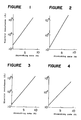
- Figures 1 to 6 are graphs showing the relationship between the stretching rate extent of elongation and the electric resistance with respect to the metallized films obtained by Examples 25 to 30, respectively.
- organic metal complex to be used in the present invention is selected from those which are soluble in an organic solvent and capable of freeing the metal when heated.
- organic metal complexes may be represented by the general formula M m L n where m is an integer of from 1 to 4, n is an integer of from 2 to 12, M is a metal and L is a ligand.
- Metal M may be at least one metal selected from metals of Groups IV-A, V-A, VI-A, VII-A, VIII and I-B of the Periodic Law Table.
- the ligand L may be at least one ligand selected from triphenylphosphine, tributylphosphine, triethylphosphine, triphenylphosphite, tributylphosphite, triethylphosphite, carbon monoxide, cyclooctadiene, a substituted or unsubstituted cyclopentadiene, cyclooctatetraene, butadiene, pentadiene, a substituted or unsubstituted benzene, acetonitrile, benzonitrile, a compound having a lower alkyl group or a benzyl group, ethylene, propylene, isobutylene, t-butyl-isonitrile, vinyl-isonitrile, benzo-isonitrile, a substituted or unsubstituted acetylene, acetylacetone, ethyl acetyl
- the central metal of the organic metal complex to be used in the present invention titanium, zirconium, vanadium, chromium, molybdenum, tungsten, manganese, rhenium, iron, cobalt, nickel, ruthenium, iridium, rhodium, palladium, osmium, platinum, copper, silver and gold, are preferred.
- the organic metal complex containing such metals is preferably stable against oxygen or moisture.
- the present invention can be practiced irrespective of the stability of the organic metal complex against oxygen or moisture so long as the preparation of the polymer composition containing such an organic metal complex, and the casting or coating of the composition and drying the solvent therefrom, are conducted in an inert atmosphere, for example, in a dried nitrogen stream.
- the heat treatment may be conducted in the atmospheric air or in an inert gas atmosphere. However, it is usual to conduct the heat treatment in the atmospheric air.
- an ionomer resin an acrylonitrile-acrylic-styrene resin, an acrylonitrile-styrene resin, an acrylonitrile-butadiene-styrene resin, a methylmethacrylate-butadiene-styrene resin, a phenoxy resin, an ethylene-vinylchloride copolymer, an ethylene-vinylacetate copolymer, a polystyrene, a polyvinylidene chloride, a polyvinyl acetate, a polyethylene, a polypropylene, a polybutadiene, a polyvinylidene flouride, a polytetraflouroethylene, a polyacetal, a polyamide, a polyamide-imide, a polyarylate, a polyether-imide, a polyether-ether ketone, a polyethylenetere
- These polymers may be used alone or in combination as a mixture. Further, these polymers may be used in the form of a powder, granules or a mass, or may be used in the form of a dispersion or a solution of a polymer in a proper solvent.
- the polymers to be used for the preparation of a film having a metallized surface or a film having a metal layer pattern on its surface are required to be soluble in an organic solvent.
- the rubber-like polymer useful for the present invention.
- a styrene-butadiene rubber a polybutadiene rubber, a polyisoprene rubber, an acrylonitrile-butadiene rubber, a polychloroprene rubber, a butyl rubber, a urethane rubber, an acrylate rubber, a silicone rubber, a fluorinated rubber, a styrene-block copolymer, a thermoplastic elastomer polyolefin, a thermoplastic elastomer polyvinylchloride, a thermoplastic elastomer polyurethane, a thermoplastic elastomer polyester, a thermopolastic elastomer polyamide, a thermoplastic elastomer fluorinated resin and a natural rubber.
- the rubber-like polymer is preferably the one which is soluble in a solvent in an unvulcanized state.
- a rubber-like polymer which is durable for repeated deformations and which has excellent heat resistance.
- the solvents may be used alone or in combination as a mixture of solvents. For instance, there may be mentioned chloroform, methylenechloride, trichloroethylene, tetra-chloroethylene, benzene, toluene, xylene, acetone, ethylacetate, dimethylformamide and dimethylsulfoxide. These solvents are used for the preparation of a polymer composition wherein an organic metal complex is uniformly dispersed or for the control of the viscosity of such a composition to provide it with proper processability.
- the method for the production of a metallized polymer film according to the present invention comprises heat-treating the polymer composition comprising a polymer and an organic metal complex.
- the heat treatment is conducted at a temperature sufficient to let the organic metal complex free the metal. Therefore, the temperature may not necessarily be as high as the decomposition temperature of the organic metal complex.
- the temperature for the heat treatment is usually selected within a range of from 50 to 400°C, preferably from 100 to 350°C so that the polymer does not undergo thermal deterioration.
- the heating time may optionally be selected depending upon the particular purpose. It is usually from a few minutes to several tens minutes.
- the polymer composition to be heat-treated comprises a polymer and an organic metal complex usually in a weight ratio of the polymer to the metal of the complex within a range of from 99.9:0,1 to 80:20.
- the polymer concentration in the solution is usually from 1 to 50% by weight, preferably from 5 to 30% by weight.
- the polymer composition used in the present invention is obtainable by preparing a uniform solution or a uniform dispersion of the polymer and the organic metal complex in a solvent, and removing the solvent therefrom.
- the polymer composition containing the organic metal complex uniformly distributed may be obtained by thoroughly mixing the solution.
- a uniform composition comprising a polymer and an organic metal complex may readily be prepared by a method wherein a polymer and an organic metal complex solution are mixed by means of a mixer, followed by removing the solvent, or by a method wherein a polymer solution and an organic metal complex solution are uniformly mixed, followed by the removal of the solvent.
- the solution of the polymer composition containing the organic metal complex may be cast on a casting board to form a film.
- the film of a polymer composition containing the organic metal complex, thus prepared, is then treated in various manners in accordance with the present invention depending upon the particular purpose
- a polymer film with a metallized surface will be obtained by heat-treating a film made of the above-mentioned polymer composition More specifically, a solution of the polymer composition containing the organic metal complex is cast on a casting board or coated on a substrate, and the film thereby formed is then subjected to heat treatment with a metallizing board(specific board for metallization) intimately placed on its surface, whereby the surface which is in contact with the metallizing board will selectively be metallized to form a metallized film having superior adhesive strength with the base polymer.
- the solution of the polymer composition may be applied directly onto the metallizing board to form a film thereon, which is then subjected to the heat treatment.
- the metallizing board to be used in this embodiment is important for the formation of a metal layer on the polymer film. Namely, even if the film formed by the casting of the solution of the polymer composition containing the organic metal complex, is subjected to heat treatment without being brought in contact with the metallizing board, the film surface will not be metallized. On the other hand, it is also impossible to obtain a metallized film even if the film is subjected to heat treatment under such condition that it is intimately in contact with a resin substrate made of e.g. polyethyleneterephthalate, polyacrylate, polycarbonate, polytetrafluoroethylene, silicone rubber, polyethylene or polypropylene or a substrate made of copper, copper alloy, aluminum or glass coated on its surface with such a resin.
- a resin substrate made of e.g. polyethyleneterephthalate, polyacrylate, polycarbonate, polytetrafluoroethylene, silicone rubber, polyethylene or polypropylene or a substrate made of copper, copper alloy, aluminum or glass coated
- the polymer film containing the organic metal complex is intimately in contact with the metallizing board during the heat treatment.
- the casting method includes a method of metallizing the front surface of the film, a method of metallizing the back surface of the film and a method of metallizing both surfaces of the film.
- the metallizing board is brought in contact with the film surface on which the metal layer is to be formed, followed by the heat treatment.
- the metallizing board is required to be made of a material which has adequate heat resistance at the temperature of the heat treatment and which can be readily released from the metallized film. For example, there may be mentioned copper, a copper alloy, aluminum, glass and a resin such as polyethyleneterephthalate pretreated to have a thin layer of an organic metal complex solution on its surface.
- the casting board may be made of any material so long as it is durable against the solution of the polymer composition containing the organic metal complex and is readily releasable from the film.
- any material so long as it is durable against the solution of the polymer composition containing the organic metal complex and is readily releasable from the film.
- steel chrome-plated steel, polyester, polytetrachloroethylene, silicone rubber, polyethylene and polypropylene.
- a metallizing board may be used as the casting board, and the material for the metallizing board is as specified above.
- the metallizing board may be used as the casting board, so that the film formed on the board can be subjected to the heat treatment as it is. Otherwise, the formed film may be peeled off from the casting board, and then subjected to the heat treatment by bringing it in contact with a metallizing board.
- the kind of the organic metal complex, the metal content in the complex and the concentration of the polymer composition containing the organic metal complex depending upon the particular applications e.g. as a heat-reflecting boards, a heat panel, a printed circuit board or a capacitor having a semispecular metal surface.
- the formed metal can be identified and the formed state of the metal can be investigated by an X-ray diffractometer, an X-ray spectroscopy or a scanning electron microscope.
- the metal formed by the heat treatment of the organic metal complex is localized in its substantial entirety on the surface of the film which is in contact with the metallizing board and the metal is integral with the polymer and thus has strong adhesion strength.
- a polymer film having a metal layer of a predetermined pattern on its surface is obtained by heat-treating the polymer composition in the same manner as described above, except that a pattern-forming board is used in place of the metallizing board. Namely, the polymer film is subjected to heat treatment under such condition that it is brought in contact with the pattern-forming board.
- a pattern-forming board there may be mentioned a board made of a material capable of inducing the metallization as mentioned above and partially coated with a resin which does not induce the metallization, for instance, a board made of copper, a copper alloy, aluminum or glass, on which a film of e.g.
- the pattern-forming board is not restricted to such boards.
- a resin board made of e.g. polyethyleneterephthalate on which an organic metal complex solution has been applied in the predetermined pattern by means of e.g. screen printing, or a resin board made of a resin which does not induce the metallization, such as polyethyleneterephthalate, an epoxy resin or a phenol resin, on which a material capable of inducing the metallization, such as copper, a copper alloy, aluminum or glass, is formed in the predetermined pattern, for instance, a copper printed epoxy resin or phenol resin board, or a flexible printed polyimide or polyethyleneterephthalate board.
- a solution of the polymer composition containing the organic metal complex is cast on a casting board made of e.g. polyethyleneterephthalate, polyethylene, polypropylene or polytetrafluoroethylene which does not induce the metallization and which is durable against the solvent used for the preparation of the polymer composition, and adjusted to a predetermined film thickness by means of e.g. a doctor knife. After removing the solvent by heating at a temperature which does not brings about the thermal decomposition of the organic metal complex, the formed film is peeled off from the casting board, whereby a polymer film containing the organic metal complex is obtained.
- a casting board made of e.g. polyethyleneterephthalate, polyethylene, polypropylene or polytetrafluoroethylene which does not induce the metallization and which is durable against the solvent used for the preparation of the polymer composition, and adjusted to a predetermined film thickness by means of e.g. a doctor knife. After removing the solvent by heating at a temperature which does not brings about the thermal
- the polymer film is brought in contact with the above-mentionied specific pattern-forming board and subjected to heat treatment, whereby a film having a metal layer of a predetermined pattern formed only on the surface which is incontact with the pattern-forming board, is obtainable.
- metal layer patterns on both sides of the polymer film by subjecting the polymer film to the heat treatment under such condition that the both surfaces of the polymer film are in contact with the pattern-forming boards. Further, it is also possible to cast the solution of the polymer composition containing the organic metal complex directly on the pattern-forming boards and subject it to the heat treatment after removal of the solvent, whereby a film having a metal layer pattern formed only on the surface which is in contact with the pattern-forming board, is obtainable.
- a pressure-sensitively conductive rubber-like polymer film is obtained by heat-treating a polymer composition comprising a rubber-like polymer containing an organic metal complex.
- a polymer composition comprising a rubber-like polymer containing an organic metal complex.
- an unvulcanized rubber-like polymer solution containing an organic metal complex is cast on a prescribed metallizing board, and after the removal of the solvent, subjected to heat treatment, whereby only the surface which is in contact with the metallizing board, will be metallized.
- the unvulcanized rubber-like polymer solution containing the organic metal complex is cast on a prescribed casting board, and after the removal of the solvent, subjected to heat treatment with a metallizing board placed intimately on the formed film, whereby only the surface which is in contact with the metallizing board will be metallized.
- a pressure-sensitively conductive rubber-like polymer film having a metallized surface will be obtained.
- the rubber-like polymer film containing the organic metal complex is intimately in contact with the metallizing board during the heat treatment.
- the metallizing board the same metallizing board as used for the preparation of the above-mentioned metallized polymer film, may be employed so long as it has adequate heat resistance at the temperature of the heat treatment and it can readily be peeled from the metallized rubber-like polymer film.
- the same casting board as used for the preparation of the polymer film having a metallized surface or the film having a metal layer of a predetermined pattern may be employed.
- the casting board there is no particular restriction to the casting board so long as it is durable against the solvent used, and can readily be peeled from the rubber-like polymer film.
- the rubber-like polymer film is vulcanized at a temperature lower than the temperature at which the organic metal complex liberates the metal, to such an extent that it presents adequate releasing nature from the casting board, or to the complete vulcanization. Then, the rubber-like polymer film is peeled off from the casting board, and it is brought in close contact with the metallizing board and subjected to heat treatment, whereby a pressure-sensitively conductive rubber-like polymer film metallized on the surface contacting the metallizing board, will be obtained. If the heat treatment is conducted under such condition that both surfaces of the film are in contact with the metallizing boards, a rubber-like polymer film metallized on both surfaces, will be obtained.
- the unvulcanized rubber-like polymer solution containing the organic metal complex is molded by casting and then subjected to heat treatment.
- This heat treatment is conducted at a temperature which is sufficiently high to let the organic metal complex free the metal under the heating. Further, it is possible to complete the vulcanization of rubber at a temperature at which no adequate reaction of the organic metal complex to free the metal by the heating will proceed, and then conduct the metallization treatment at a temperature sufficient for the reaction.
- the metallized layer is composed of a highly densed aggregation of very fine metal particles and usually constitutes a layer having a thickness of from 1 to 20 ⁇ m depending upon the production conditions.
- the metallized layer is integral with the rubber-like polymer and firmly bonded to the rubber-like polymer. In this state, the metal layer on the surface conducts electricity and exhibits a certain conductivity.
- the metal layer on the surface deforms along with the deformation of the rubber-like polymer film, and accordingly, the state of contact of the fine metal particles changes, whereby the conductivity decreases depending upon the degree of the deformation of the metal layer on the surface.
- the change of the state of contact of the fine metal particles resulting from the deformation of the rubber-like polymer film is very well reproducible and highly dependent on the deformation, and thus is excellently interrelated with the change of the conductivity or the electric resistance.
- the state of contact of the fine metal particles likewise returns to the initial state and thus presents the same level of electric conductivity as was prior to the deformation.
- the degree of the deformation of the pressure-sensitively conductive rubber-like polymer film varies depending upon the conditions for the production of the film, such as the type of the organic metal complex, the metal content, the type of the rubber-like polymer, the thickness of the rubber-like polymer film containing the organic metal complex or the conditions of the heat treatment.
- the film has extremely good reproducibility for repeated use usually at a stretching rate upto 50%, preferably upto 20%.
- the state of aggregation of the fine metal particles changes in proportion to the degree of the deformation of the rubber-like polymer film, whereby the state of contact of the particles changes correspondingly, and no breakage of the state of aggregation of the fine metal particles takes place. Therefore, there will be no practical problem in the durability for repeated use within this range.
- the pressure-sensitively conductive rubber-like polymer film of the present invention is a conductor at the normal state, and its elecric resistance increases as it deforms and finally reaches to an insulated state, and upon release from the deformation, it returns to the initial conductor.
- the metal layer on the surface of the pressure-sensitively conductive rubber-like polymer film may be coated with e.g. a rubber-like polymer for the purpose of improving the durability under various environments. In such a case, there will be no change in the intrinsic properties of the pressure-sensitively conductive rubber-like polymer film.
- the degree of the metallization of the surface of the polymer film containing the organic metal complex may be optionally adjusted by properly selecting various conditions such as the metal content in the organic metal complex, the amount of the complex to be incorporated in the polymer, the type of the metallizing board or the casting board, the material of the pattern-forming portion of the pattern-forming board and the heating condition, considering the fact that the pyrolytic reaction of the organic metal complex is utilized to form fine metal particles in the polymer.
- the weight ratio of the polysulphone to palladium metal was 8:2.
- the solution of the polymer composition containing the organic metal complex thus obtained was cast on a copper plate in a thickness of 0.4 mm by means of a doctor-knife. After removing the chloroform solvent adequately by evaporation in air, the formed film was subjected to heat treatment in a electric oven at 175°C for 5 minutes under atmospheric air, and the resulting film was peeled off from the copper plate, whereby a one-side metallized film having a metallic luster only on the surface which was in contact with the copper plate, was obtained.
- the surface resistance of the surface exhibiting the metallic luster was 1.2 ⁇ / ⁇ .
- the surface which was not in contact with the copper plate and the film in the direction of its thickness were electrically non-conductive and showed a resistance of at least 1010 ⁇ cm.
- the film thickness was found to be 25 ⁇ m, the thickness of the metallic luster portion was 5 ⁇ m.
- the distribution of the metal element was determined by the scanning type electron microscope and an energy dispersion-type X-ray spectrometry, whereby it was found that palladium was localized at the portion which was in contact with the copper plate, i.e. at the portion in the depth of 5 ⁇ m from the surface exhibiting the metallic luster, and the distribution of palladium at other portions was slight.
- the metallized film obtained by this Example was dissolved in chloroform, and its composition was investigated, whereby it was found that the metallized film was composed solely of palladium metal and the polysulphone, thus indicating that there was no chemical reaction between the di- ⁇ -chloro-bis( ⁇ -2-methylallyl) dipalladium (II) and the polysulphone and that the organic metal complex underwent thermal decomposition and released the metal.
- the polysulphone containing the di- ⁇ -chloro-bis( ⁇ -2-methylallyl)dipalladium (II) complex used in this Example was analyzed by a direct-feeding-type mass-spectrometry, whereby a base peak was observed at m/e 55 and M+ was observed at m/e 90.
- the intensity ratio of m/e 90 to 92 was 3:1. Namely, it is considered that chlorine and the 2-methylallyl group as ligands of the complex dissipated in the form of 2-methylallyl chloride from the film during the thermal treatment.
- the palladium metal is localized at the film surface, and accordingly the metallized film has excellent flexibility and strength. Further, the metal layer on the surface is integral with the polymer, and it was not peeled even when subjected to a peeling test by means of an adhesive tape and no metal fragments fell off even when subjected to a rubbing test by mean of cotton cloth. No change was observed in the conductivity after these tests.
- the metallized film obtained by this Example exhibited metallic luster on its surface, and the surface resistance was 107 ⁇ / ⁇ .
- the surface had a nature to reflect infrared rays and the permeability of visible rays was 60%.
- the weight ratio of the polycarbonate polymer to the palladium metal was 8:2.
- the solution thus prepared was cast on a glass base plate to form a film, followed by heat treatment, in accordance with the method of Example 1, whereby a metallized film of the polycarbonate was obtained.
- the surface resistance of the metallized surface was 3.7 ⁇ / ⁇ .
- the solution was cast on a glass base plate in accordance with the method of Example 1, followed by drying at 100°C for 60 minutes and heat treatment at 175°C for 5 minutes, whereby a film metallized only on the surface which was in contact with the base plate was obained.
- the surface resistance of the metallized surface was 8 ⁇ / ⁇ .
- the weight ratio of the polysulphone to the palladium metal was 9:1.
- This solution was filmed in accordance with the method of Example 1, followed by heat treatment at 250°C for 10 minutes, whereby a metallized film was obtained.
- the surface resistance of the metallized film surface was 20 ⁇ / ⁇ .
- the weight ratio of the polymer to the rhodium metal in the solution was 9:1.
- the solution thus prepared was cast on a glass plate in accordance with the method of Example 1, followed by drying in air and heat treatment at 150°C for 5 minutes, whereby a film metallized only on the surface which was in contact with the glass plate, was obtained.
- the surface resistance of the metallized surface was 90 ⁇ / ⁇ .
- the film containing the metal complex was peeled from the glass plate and sandwiched by a pair of copper plates, followed by heat pressing treatment at 160°C under a pressure of 10 kg/cm2 for 5 minutes, whereby a film having a thickness of 20 ⁇ m and metallized on both surfaces, was obtained.
- the both surfaces of the film thus obtained showed a resistance of 10 ⁇ / ⁇ , and no conductivity was observed in the direction of the thickness.
- Di- ⁇ -chloro-bis( ⁇ -2-methylallyl)dipalladium (II) as an organic metal complex and polysulphone as a polymer were dissolved in chloroform in a weight ratio of the polymer to the palladium metal of 9:1, to obtain a chloroform solution having a concentration of 7% by weight.
- the solution was coated on polyethyleneterephthalate plate and dried in air in the same manner as in Example 1, and a copper plate was intimately placed on the upper surface of the polymer film containing the organic metal complex thus obtained, followed by heat pressing treatment at 160°C under a pressure of 10 kg/cm2 for 5 minutes, whereby a film metallized and being electrically conductive only on the surface which was in contact with the copper plate, was obtained.
- the surface resistance of the metallized surface was 4.0 ⁇ / ⁇ , and no conductivity in the direction of the thickness was observed.
- the solution was coated on a polyethyleneterephthalate plate and dried in air in the same manner as in Example 1, and then another polyethyleneterephthalate plate which was preliminarily heat-treated at a temperature of 180°C for 5 minutes after an application of a chloroform solution containing 1% by weight of the complex, was intimately placed on the upper surface of the polymer film containing the organic metal complex so that the pre-treated surface of the polyethyleneterephthalate plate was in contact with the upper surface of the polymer film, followed by heat pressure treatment at 180°C under a pressure of 10 kg/cm2 for 5 minutes, whereby a film metallized and being electrically conductive only on the surface which was incontact with the pre-treated polyethyleneterephthalate plate, was obtained.
- the surface resistance of the metallized surface of the film thus obtained was 5 ⁇ / ⁇ .
- Di- ⁇ -chloro-bis( ⁇ -2-methylallyl)dipalladium (II) as an organic metal complex and polysulphone as a polymer were dissolved in chloroform in a weight ratio of the polymer to the palladium metal of 9:1 to obtain a chloroform solution having a concentration of 7% by weight.
- the solution was cast on a polytetrafluoroethylene plate and dried in air in the same manner as in Example 1, and then a copper plate was intimately placed on the upper surface of the polymer film containing the organic metal complex, followed by heat pressure treatment at 160°C under a pressure of 10 kg/cm2 for 5 minutes, whereby a film metallized and being electrically conductive only on the surface which was in contact with the copper plate, was obtained.
- the surface resistance of the metallized surface was 4 ⁇ / ⁇ , and no conductivity was observed in the direction of the thickness.
- the solution of the polymer composition containing the di- ⁇ -chloro-bis( ⁇ -2-methylallyl)dipalladium (II) complex was cast on a polyethyleneterephthalate plate in a thickness of 0.4 mm by means of a doctor-knife, and after evaporating the chloroform solvent in air, dried at 60°C for 2 hours, whereby a polymer film having a thickness of 35 ⁇ m and containing the di- ⁇ -chloro-bis( ⁇ -methylallyl)dipalladium (II) complex, was obatained.
- the polymer film was overlaid on a copper plate covered with a polyethyleneterephthalate film having a thickness of 15 ⁇ m with a zig-zag pattern punched out with a width of 1 mm, and subjected to heat pressure treatment at 160°C under a pressure of 10 kg/cm2 for 5 minutes, whereby a film having a palladium metal layer formed in the zig-zag pattern with a width of 1 mm on the surface which was in contact with the copper plate, was obtained.
- the metal layer portion of the film with the palladium metal layer thus obtained had a resistance of 2.6 ⁇ / ⁇ , and no conductivity and a resistance of at least 1010 ⁇ cm were observed at the portion other than the metal layer and in the direction of the thickness.
- the metal layer is integral with the polymer, and the metal layer was not peeled by a peeling test by means of an adhesive tape or did not fall off by a rubbing test by means of cotton cloth. No change in the conductivity was observed after these tests.
- the metal layer portion of the film with the rhodium metal layer pattern thus obtained showed a resistance of 3.7 ⁇ / ⁇ , and no conductivity and a resistance of at least 1010 ⁇ cm were observed at the portion other than the metal layer pattern and in the direction of the thickness.
- organic metal complex 0.0874 g of a di- ⁇ -chloro-bis(1,5-cyclooctadiene)diiridium (II) complex, 0.327 g of a di-chloro-bis(triphenylphosphine)palladium (II) complex or 0.313 g of a di-chloro-bis(triethylphosphine) nickel (II) complex, was mixed in 5 g of polysulphone and 45 g of chloroform, and dissolved to obtain a solution of each polymer composition.
- polymer films containing the organic metal complexes were prepared in accordance with the method of Example 14, and then subjected to heat-pressure treatment at 180°C under a pressure of 10 kg/cm2 for 5 minutes, whereby films having a zig-zag metal layer pattern with a width of 1 mm were obtained, i.e. a film with an iridium metal layer pattern, a film with a palladium metal layer pattern and a film with a nickel metal layer pattern.
- the film with the nickel metal layer pattern showed magnetism.
- the polymer film containing the di- ⁇ -chloro-bis( ⁇ -2-methylallyl)dipalladium (II) complex obtained in Example 14 was overlaid on a copper plate coated with an acrylic paint except for a zig-zag pattern portion with a width of 1 mm, and subjected to heat pressure treatment at 160°C under a pressure of 10 kg/cm2 for 5 minutes, whereby a film with a palladium metal layer pattern wherein the palladium metal precipitated in the zig-zag pattern with a width of 1 mm, was obtained.
- a zig-zag pattern with a width of 2 mm was drawn with a chloroform solution containing 1% by weight of a di- ⁇ -chloro-bis( ⁇ -2-methylallyl)dipalladium (II) complex, followed by heat treatment at 180°C for 5 minutes to obtain a pattern-forming board.
- a chloroform solution containing 1% by weight of a di- ⁇ -chloro-bis( ⁇ -2-methylallyl)dipalladium (II) complex followed by heat treatment at 180°C for 5 minutes to obtain a pattern-forming board.
- the formed film was subjected to heat treatment in an electric oven at 175°C for 5 minutes under atmospheric air, and the resulting film was peeled off from the pattern-forming polyethyleneterephthalate board, whereby a film with a palladium metal layer pattern wherein the palladium metal precipitated in a zig-zag pattern with a width of 2 mm, was obtained.
- a copper clad glass reinforced epoxy laminated board was subjected to etching treatment to remove copper except for four-linear patterns having a length of 30 mm and a width of 3 mm, 2 mm, 1 mm and 0.1 mm, respectively, and thereby to obtain a pattern-forming board.
- a polyvinyl chloride paste sol was prepared by mixing 100 g of a polyvinyl chloride paste (Zeon® 121, manufactured by Nippon Zeon Co., Ltd.) and 65 g of a dioctylphthalate plasticizer.
- the film thus formed on the copper plate was heated at 180°C for 5 minutes in atmospheric air, and then peeled off from the copper plate, whereby a film with a palladium metal layer pattern wherein the palladium metal precipitated in a zig-zag pattern with a width of 1 mm, was obtained.
- the solution of the polymer composition was coated on a polyethyleneterephthalate plate in a thickness of 0.1 mm by means of a doctor-knife and then dried in air, and a copper plate covered with a polyethyleneterephthalate film having a thickness of 15 ⁇ m with a zig-zag pattern punched out with a width of 1 mm, was overlaid thereon, followed by heat pressure treatment at 160°C under a pressure of 10 kg/cm2 for 5 minutes, whereby a film with a palladium metal layer pattern wherein the palladium metal precipitated in a zig-zag pattern with a width of 1 mm on the film of the polymer composition containing the di- ⁇ -chloro-bis( ⁇ -2-methylallyl)dipalldium (II) complex, was obtained.
- the polymer film containing the di- ⁇ -chloro-bis( ⁇ -2-methylallyl)dipalladium (II) complex obtained in Example 14 was sandwiched between a pair of copper plates each covered with a polyethyleneterephthalate film having a thickness of 15 mm with a zig-zag pattern punched out with a width of 1 mm, and subjected to heat pressure treatment at 160°C under a pressure of 10 kg/cm2 for 5 minutes, whereby a film with a palladium metal layer pattern wherein the palladium metal precipitated on each surface of the polymer film containing the di- ⁇ -chloro-bis( ⁇ -2-methylallyl)dipalldium (II) complex, was obtained.
- the metal layer portions on both sides of the film thus obtained showed a resistance of 10 ⁇ / ⁇ , and no conductivity was observed at other portions than the metal layer patterns and in the direction of the thickness of the film.
- a polyvinyl chloride paste sol was prepared by mixing 100 parts by weight of a polyvinyl chloride paste with 65 parts by weight of a dioctylphthalate plasticizer.
- the film thus formed on the copper plate was heated at 180°C for 5 minutes in atmospheric air, and then peeled from the copper plate, whereby a pressure-sensitively conductive polyvinyl chloride film having a thickness of 290 ⁇ m and metallized on one surface, was obtained.
- a sample having a length of 50 mm and a width of 8 mm was taken from the film, and a pair of copper wires having a diameter of 0.2 mm were attached to the center portion of the sample by means of an electroconductive silver-type adhesive (Eccobond® Solder 56C, manufactured by Emerson & Cuming Japan K.K.) with a distance of 20 mm in the longitudinal direction of the sample to form fixed electrodes extending in parallel with each other and perpendicular to the film surface.
- an electroconductive silver-type adhesive Eccobond® Solder 56C, manufactured by Emerson & Cuming Japan K.K.
- the sample provided with the electrodes was mounted on a tensile test machine (Tensilon® UTM-5, manufactured by Toyo Baldwin Co., Ltd.), and the electrodes were connected to an electric resistance meter (LCR meter AG-4311, manufactured by Ando Electric Co., Ltd.) by means of lead wires.
- the sample was stretched to a predetermined extent, and the length between the electrodes at that time was measured and divided by the initial length, whereby the value obtained by the division was taken as a stretching rate. Further, the electric resistance at that time was measured.
- the film stretching was stopped at a stretching rate of 8%, and while permitting the stretched film to return to the initial state, the stretching rates and the corresponding electric resistance values were measured, whereby the results as shown in Figure 1 were obtained.
- the measurements were repeated 1000 times by repeating the stretching and releasing of the film, whereby the same electric resistance values were obtained at the same stretching rates.
- Example 25 To 100 parts by weight of the polyvinyl chloride paste sol prepared in Example 25, 1.85 parts by weight of a di- ⁇ -chloro-bis( ⁇ -2-methylallyl)dipalladium (II) complex dissolved in a small amount of chloroform, was added and thoroughly stirred and mixed, and then the mixture was treated in the same manner as in Example 25 to obtain a polyvinyl chloride paste sol containing the di- ⁇ -chloro-bis( ⁇ -2-methylallyl)dipalladium (II) complex, which was then formed into a pressure-sensitively conductive polyvinylchloride film having a thickness of 300 ⁇ m and metallized on one surface, in the same manner as in Example 25.
- a di- ⁇ -chloro-bis( ⁇ -2-methylallyl)dipalladium (II) complex dissolved in a small amount of chloroform
- the measurements were repeated 1000 times by repeating the stretching and releasing of the film, whereby the same electric resistance values were obtained at the same stretching rates.
- Pressure-sensitively conductive polyvinyl chloride films metallized on one surface were prepared in the same manner as in Example 25 except that the polyvinyl chloride paste sol prepared in Example 25 was combined with a di- ⁇ -chloro-tetracarbonyl dirhodium (I) complex, a di-chloro-bis(1,5-cyclooctadiene)diiridium (I) complex, a di-chloro-bis(triphenylphosphine)palladium (II) complex, and di-chloro-bis(triethylphosphine)nickel (II) complex, respectively, dissolved in a small amount of chloroform.
- Table 2 The working conditions and the results are shown in Table 2.
- the pressure-sensitively conductive polyvinyl chloride film metallized on one surface, prepared in Example 25, was mounted on a tensile test machine, and subjected to a durability test by repeating a repeating cycle of 0.5 Hz at a stretching rate of 10% for 500,000 times.
- the electric resistance value of the film at the stretching rate of 0% prior to the test was 23 ⁇
- the electric resistance value of the film at the stretching rate of 0% after the repeating test of 500,000 times was 28 ⁇ . This indicates that no falling of the formed aggregation of fine metal particles from the polyvinylchloride film or no breakage of the aggregation of the fine metal particles took place by the repeated stretching operations.
- Example 25 the mixture was cast on a copper plate in the same manner as in Example 25, dried at room temperature for 1 hour in air, then dried at 40°C for 2 hours under reduced pressure and heat-treated at 180°C for 5 minutes in atmospheric air, and the film thereby formed was peeled off from the copper plate, whereby a pressure-sensitively conductive silicone film having a thickness of 250 ⁇ m and metallized on one surface was obtained.
- Example 25 In the same manner as in Example 25, the film was mounted on a tensile test machine and subjected to a durability test by repeating a repeating cycle of 0.4 Hz at a stretching rate of 15% for 500,000 times.
- the electric resistance value of the film at a stretching rate of 0% prior to the test was 18 ⁇
- the electric resistance value of the film at a stretching rate of 0% after the test of the repeating operation of 500,000 times was 22 ⁇ .
Landscapes
- Chemical & Material Sciences (AREA)
- Health & Medical Sciences (AREA)
- Chemical Kinetics & Catalysis (AREA)
- Medicinal Chemistry (AREA)
- Polymers & Plastics (AREA)
- Organic Chemistry (AREA)
- Engineering & Computer Science (AREA)
- Manufacturing & Machinery (AREA)
- Microelectronics & Electronic Packaging (AREA)
- Laminated Bodies (AREA)
- Compositions Of Macromolecular Compounds (AREA)
- Manufacture Of Macromolecular Shaped Articles (AREA)
Claims (14)
- Verfahren zur Herstellung einer Polymerfolie mit einer metallisierten Oberflächenschicht, gekennzeichnet durch die nachstehenden Schritte:(a) Inkontaktbringen einer Metallisierungsplatte und einer Polymerfolie, umfassend ein Polymer und einen organischen Metallkomplex, der bei Kontakt mit der Metallisierungsplatte in der Wärme zersetzbar ist;(b) Hitzebehandlung der in Kontakt stehenden Polymerfolie und der Metallisierungsplatte von Schritt (a) zur Freisetzung des Metalls aus dem organischen Matallkomplex und dessen selektives Abscheiden auf dem Oberflächenteil, der mit der Metallisierungsplatte in Kontakt steht; und(c) Entfernen der hitzebehandelten Polymerfolie von Schritt (b) von der Metallisierungsplatte, wobei die Metallisierungsplatte derart ausgewählt ist, daß sie leicht von der metallisierten Folie abgelöst werden kann.
- Verfahren nach Anspruch 1, wobei eine aus der Polymerzusammensetzung hergestellte Folie unter Verwendung einer musterbildenden Platte als Metallisierungsplatte unter Erhalt einer entfernbaren Polymerfolie mit einer Metallschicht eines vorbestimmten Musters auf deren Oberfläche hitzebehandelt wird.
- Verfahren nach Anspruch 1, wobei eine aus einem kautschukähnlichen Polymer mit einem organischen Metallkomplex hergestellte Folie unter Erhalt einer entfernbaren, druckempfindlichen, leitfähigen, kautschukähnlichen Polymerfolie mit metallisierter Oberfläche hitzebehandelt wird.
- Verfahren nach Anspruch 1, wobei eine Metallisierungsplatte aus Kupfer oder einer Kupferlegierung verwendet wird.
- Verfahren nach Anspruch 1, wobei eine Metallisierungsplatte aus Aluminium oder Glas verwendet wird.
- Verfahren nach Anspruch 1, wobei die Metallisierungsplatte eine Harzplatte ist mit einem organischen Metallkomplex in einem vorbestimmten Muster darauf.
- Verfahren nach Anspruch 1, wobei die Metallisierungsplatte teilweise mit einem Harz beschichtet ist, das nicht in der Lage ist, die Metallisierung einzuleiten.
- Verfahren nach Anspruch 7, wobei die Oberfläche des hergestellten metallisierten Polymers ein Muster enthält.
- Verfahren nach Anspruch 1, wobei das Gewichtsverhältnis des Polymers zu dem Metall des organischen Metallkomplexes innerhalb eines Bereichs von 99,9:0,1 bis 80:20 liegt.
- Verfahren nach Anspruch 1, wobei das Zentralmetallatom des organischen Metallkomplexes mindestens ein Metallatom, ausgewählt aus Metallen der Gruppe IV-A, V-A, VII-A, VIII und I-B des Periodensystems der Elemente, ist.
- Verfahren nach Anspruch 10, wobei das Zentralmetallatom mindestens ein Metallatom, ausgewählt aus Titan, Zirkon, Vanadin, Chrom, Molybdän, Wolfram, Mangan, Eisen, Cobalt, Nickel, Ruthenium, Rhodium, Iridium, Palladium, Osmium, Platin, Kupfer, Silber und Gold ist.
- Verfahren nach Anspruch 1, wobei der Ligand des organischen Metallkomplexes mindestens ein Ligand, ausgewählt aus Triphenylphosphin, Tributylphosphin, Triethylphosphin, Triphenylphosphit, Tributylphosphit, Triethylphosphit, Kohlenmonoxid, Cyclooctadien, substituiertem oder nichtsubstituiertem Cyclopentadien, Cyclooctatetraen, Butadien, Pentadien, einem substituierten oder nichtsubstituierten Benzol, Acetonitril, Benzonitril, Ethylen, Propylen, Isobutylen, t-Butylisonitril, Vinylisonitril, Benzoisonitril, einem substituierten oder nichtsubstituierten Acetylen, Acetylaceton, Ethylacetylacetonat, Pyridin, Thiophen, Chinolin, Furan, 2,2'-Di-pyridyl, Ethylendithiol, Toluol-3,4-dithiol, Chlor und Brom, ist.
- Verfahren nach Anspruch 1, wobei das Polymer mindestens ein Polymer, ausgewählt aus einem ionomeren Harz, einem Acrylnitril-Acryl-Styrol-Harz, einem Acrylnitril-Styrol-Harz, einem Acrylnitril-Butadien-Styrol-Harz, einem Methylmethacrylat-Butadien-Styrol-Harz, einem Phenoxyharz, einem Ethylen-Vinylchlorid-Copolymer, einem Ethylen-Vinylacetat-Copolymer, einem Polystyrol, einem Polyvinylidenchlorid, einem Polyvinylacetat, einem Polyethylen, einem Polypropylen, einem Polybutadien, einem Polyvinylidenfluorid, einem Polytetrafluorethylen, einem Polyacetal, einem Polyamid, einem Polyamid-Imid, einem Polyarylat, einem Polyether-Imid, einem Polyether-Etherketon, einem Polyethylenterephthalat, einem Polybutylenterephthalat, einem Polycarbonat, einem Polysulfon, einem Polyethersulfon, einem Polyphenylenoxid, einem Polyphenylensulfid, einem Polymethylmethacrylat, einem Guanaminharz, einem Diallylphthalatharz, einem Vinylesterharz, einem Phenolharz, einem ungesättigten Polyesterharz, einem Furanharz, einem Polyimidharz, einem Poly-p-hydroxybenzoat, einem Urethanharz, einem Melamin-Formaldehyd-Harz, einem Harnstoff-Formaldehyd-Harz, einem Epoxidharz und einem Xylol-Formaldehyd-Harz ist.
- Verfahren nach Anspruch 1, wobei das Polymer mindestens ein kautschukähnliches Polymer, ausgewählt aus Styrol-Butadien-Kautschuk, einem Polybutadienkautschuk, einem Polyisoprenkautschuk, einem Acrylnitril-Butadien-Kautschuk, einem Polychloroprenkautschuk, einem Butylkautschuk, einem Urethankautschuk, einem Acrylatkautschuk, einem Siliconkautschuk, einem fluorierten Kautschuk, einem Styrol-Blockcopolymer, einem thermoplastischen elastomeren Polyolefin, einem thermoplastischen elastomeren Polyvinylchlorid, einem thermoplastischen elastomeren Polyurethan, einem thermoplastischen elastomeren Polyester, einem thermoplastischen elastomeren Polyamid, einem thermoplastischen elastomeren fluorierten Harz und einem Naturkautschuk ist.
Applications Claiming Priority (10)
| Application Number | Priority Date | Filing Date | Title |
|---|---|---|---|
| JP8217083A JPS59207944A (ja) | 1983-05-11 | 1983-05-11 | 微細に分散した金属を含む重合体組成物の製造方法 |
| JP8217183A JPS59207938A (ja) | 1983-05-11 | 1983-05-11 | 金属化フイルムの製造方法 |
| JP82171/83 | 1983-05-11 | ||
| JP82170/83 | 1983-05-11 | ||
| JP55566/84 | 1984-03-23 | ||
| JP5556584A JPS60199642A (ja) | 1984-03-23 | 1984-03-23 | 感圧導電性ゴム状重合体フイルム |
| JP5556684A JPS60199063A (ja) | 1984-03-23 | 1984-03-23 | 高誘電性組成物 |
| JP55565/84 | 1984-03-23 | ||
| JP65627/84 | 1984-04-02 | ||
| JP6562784A JPS60208891A (ja) | 1984-04-02 | 1984-04-02 | 金属層パタ−ンの形成方法 |
Publications (3)
| Publication Number | Publication Date |
|---|---|
| EP0125617A2 EP0125617A2 (de) | 1984-11-21 |
| EP0125617A3 EP0125617A3 (en) | 1985-10-09 |
| EP0125617B1 true EP0125617B1 (de) | 1993-12-08 |
Family
ID=27523232
Family Applications (1)
| Application Number | Title | Priority Date | Filing Date |
|---|---|---|---|
| EP19840105219 Expired - Lifetime EP0125617B1 (de) | 1983-05-11 | 1984-05-08 | Verfahren zur Herstellung eines metallisierten Polymers aus der Polymerzusammensetzung |
Country Status (3)
| Country | Link |
|---|---|
| US (2) | US4604303A (de) |
| EP (1) | EP0125617B1 (de) |
| DE (1) | DE3486253T2 (de) |
Cited By (1)
| Publication number | Priority date | Publication date | Assignee | Title |
|---|---|---|---|---|
| DE102012004132A1 (de) * | 2012-02-29 | 2013-08-29 | Friedrich-Schiller-Universität Jena | Kohlenstoffmonoxid freisetzende Materialien und deren Verwendung |
Families Citing this family (74)
| Publication number | Priority date | Publication date | Assignee | Title |
|---|---|---|---|---|
| GB8511905D0 (en) * | 1985-05-10 | 1985-06-19 | Akzo Nv | Metallizing polymeric materials |
| DE3667800D1 (de) * | 1985-08-23 | 1990-02-01 | Ciba Geigy Ag | Mischung aus olefin und dibenzalaceton-palladiumkomplex und deren verwendung. |
| EP0233145B1 (de) * | 1986-01-30 | 1989-10-18 | Ciba-Geigy Ag | Polymerzusammensetzungen enthaltend einen gelösten Dibenzalaceton-Palladiumkomplex |
| DE3609814A1 (de) * | 1986-03-22 | 1987-09-24 | Basf Ag | Elektromagnetische strahlung absorbierende kunststoffmischungen, die ferro- und/oder piezoelektrische stoffe enthalten |
| DE3625587A1 (de) * | 1986-07-29 | 1988-02-04 | Bayer Ag | Verfahren zur verbesserung der haftfestigkeit von stromlos abgeschiedenen metallschichten auf kunststoffoberflaechen |
| DE3627256A1 (de) * | 1986-08-12 | 1988-02-18 | Bayer Ag | Verfahren zur verbesserung der haftfestigkeit von stromlos abgeschiedenen metallschichten auf kunststoffoberflaechen |
| US5182135A (en) * | 1986-08-12 | 1993-01-26 | Bayer Aktiengesellschaft | Process for improving the adherency of metallic coatings deposited without current on plastic surfaces |
| JPS6357286A (ja) * | 1986-08-28 | 1988-03-11 | Fuji Photo Film Co Ltd | 情報記録媒体 |
| FR2613372B1 (fr) * | 1987-04-03 | 1989-06-09 | Rhone Poulenc Chimie | Particules composites polymere/metal compactes, dispersions aqueuses desdites particules, leur procede de preparation et leur application en biologie |
| EP0297437B1 (de) * | 1987-06-27 | 1993-09-01 | Shimadzu Corporation | Flexibles Replika-Gitter und optischer Multiplexer/Demultiplexer mit Anwendung eines solchen Gitters |
| DE3743780A1 (de) * | 1987-12-23 | 1989-07-06 | Bayer Ag | Verfahren zur verbesserung der haftfestigkeit von stromlos abgeschiedenen metallschichten auf polyimidoberflaechen |
| US5238702A (en) * | 1988-10-27 | 1993-08-24 | Henning Giesecke | Electrically conductive patterns |
| US5030742A (en) * | 1988-12-16 | 1991-07-09 | Ciba-Geigy Corporation | Ultrathin layers of palladium(O) complexes |
| US5213715A (en) * | 1989-04-17 | 1993-05-25 | Western Digital Corporation | Directionally conductive polymer |
| US5418056A (en) * | 1989-11-24 | 1995-05-23 | Mitsuboshi Belting Ltd. | Polymer composite with dispersed fine grains and a method for manufacturing the same |
| JPH0699585B2 (ja) * | 1989-11-24 | 1994-12-07 | 三ツ星ベルト株式会社 | 微粒子を分散させた高分子複合物とその製造方法 |
| JPH04232271A (ja) * | 1990-07-27 | 1992-08-20 | Kali Chem Ag | 銅を含有する層の基板上への析出方法 |
| US5178914A (en) * | 1990-10-30 | 1993-01-12 | International Business Machines Corp. | Means of seeding and metallizing polymide |
| US5731075A (en) * | 1990-11-21 | 1998-03-24 | Mitsuboshi Belting Ltd. | Colorant for a transparent substrate and method of making the colorant |
| WO1992019391A1 (en) * | 1991-04-29 | 1992-11-12 | Benmin Gong | Method of forming metal oxide coatings |
| US5229239A (en) * | 1991-12-30 | 1993-07-20 | Xerox Corporation | Substrate for electrostatographic device and method of making |
| US5314727A (en) * | 1992-07-28 | 1994-05-24 | Minnesota Mining & Mfg. Co./Regents Of The University Of Minnesota | Chemical vapor deposition of iron, ruthenium, and osmium |
| EP0598472B1 (de) * | 1992-08-20 | 1997-06-18 | Mitsuboshi Belting Ltd. | Glasartiger Werkstoff mit ultrafeinen dispergierten Teilchen und Verfahren zu seiner Herstellung |
| US5441726A (en) * | 1993-04-28 | 1995-08-15 | Sunsmart, Inc. | Topical ultra-violet radiation protectants |
| US5391432A (en) * | 1993-04-28 | 1995-02-21 | Mitchnick; Mark | Antistatic fibers |
| WO1994025966A1 (en) * | 1993-04-28 | 1994-11-10 | Mark Mitchnick | Conductive polymers |
| FR2745124B1 (fr) * | 1996-02-15 | 1998-04-10 | Bocherens Eric | Bande parafoudre |
| US5844523A (en) * | 1996-02-29 | 1998-12-01 | Minnesota Mining And Manufacturing Company | Electrical and electromagnetic apparatuses using laminated structures having thermoplastic elastomeric and conductive layers |
| AU2001257393A1 (en) * | 2000-04-26 | 2001-11-07 | Robert R. Dutton | Enhanced anti-corrosive protective coverings and methods of use |
| JP5268216B2 (ja) * | 2000-06-12 | 2013-08-21 | 住友化学株式会社 | ポリマーマトリックス・エレクトロルミネッセンス材料及び装置 |
| US6569517B1 (en) | 2000-11-17 | 2003-05-27 | 3M Innovative Properties Company | Color tailorable pigmented optical bodies with surface metalization |
| CN1326435C (zh) * | 2001-07-05 | 2007-07-11 | Lpkf激光和电子股份公司 | 导体轨道结构的制造方法 |
| DE10132092A1 (de) * | 2001-07-05 | 2003-01-23 | Lpkf Laser & Electronics Ag | Leiterbahnstrukturen und Verfahren zu ihrer Herstellung |
| KR100502117B1 (ko) * | 2001-07-26 | 2005-07-20 | 정용득 | 금속 및 비금속 표면상에 코팅하는 고무코팅액 |
| US7026043B2 (en) * | 2001-10-12 | 2006-04-11 | Owens Corning Composites Sprl | Sheet molding compound having improved surface characteristics |
| EP1444055A4 (de) * | 2001-10-19 | 2007-04-18 | Superior Micropowders Llc | Bandförmige zusammensetzungen zur ablagerung elektronischer strukturen |
| KR100491179B1 (ko) * | 2001-11-21 | 2005-05-24 | 마츠시타 덴끼 산교 가부시키가이샤 | 박형 회로기판 및 박형 회로기판의 제조방법 |
| US7767068B2 (en) | 2002-12-02 | 2010-08-03 | Epocal Inc. | Heterogeneous membrane electrodes |
| US7842234B2 (en) | 2002-12-02 | 2010-11-30 | Epocal Inc. | Diagnostic devices incorporating fluidics and methods of manufacture |
| EP1733067A1 (de) * | 2003-11-17 | 2006-12-20 | Dow Corning Corporation | Verfahren zur metallisierung eines silikonkautschuksubstrats |
| US7368523B2 (en) * | 2004-11-12 | 2008-05-06 | Eastman Chemical Company | Polyester polymer and copolymer compositions containing titanium nitride particles |
| US20060051542A1 (en) * | 2004-09-03 | 2006-03-09 | Zhiyong Xia | Polyester polymer and copolymer compositions containing metallic molybdenum particles |
| US20060110557A1 (en) * | 2004-09-03 | 2006-05-25 | Zhiyong Xia | Polyester polymer and copolymer compositions containing metallic tungsten particles |
| US7662880B2 (en) * | 2004-09-03 | 2010-02-16 | Eastman Chemical Company | Polyester polymer and copolymer compositions containing metallic nickel particles |
| US20060105129A1 (en) * | 2004-11-12 | 2006-05-18 | Zhiyong Xia | Polyester polymer and copolymer compositions containing titanium carbide particles |
| US7300967B2 (en) * | 2004-11-12 | 2007-11-27 | Eastman Chemical Company | Polyester polymer and copolymer compositions containing metallic titanium particles |
| US20060122300A1 (en) * | 2004-12-07 | 2006-06-08 | Zhiyong Xia | Polyester polymer and copolymer compositions containing steel particles |
| US20060177614A1 (en) * | 2005-02-09 | 2006-08-10 | Zhiyong Xia | Polyester polymer and copolymer compositions containing metallic tantalum particles |
| US20060222795A1 (en) * | 2005-03-31 | 2006-10-05 | Howell Earl E Jr | Polyester polymer and copolymer compositions containing particles of one or more transition metal compounds |
| US7695647B2 (en) * | 2005-06-09 | 2010-04-13 | University Of Maryland | Electrically conductive metal impregnated elastomer materials and methods of forming electrically conductive metal impregnated elastomer materials |
| WO2006133440A2 (en) * | 2005-06-09 | 2006-12-14 | University Of Maryland | Electrically conductive metal impregnated elastomer materials and methods of forming electrically conductive metal impregnated elastomer materials |
| US8557950B2 (en) | 2005-06-16 | 2013-10-15 | Grupo Petrotemex, S.A. De C.V. | High intrinsic viscosity melt phase polyester polymers with acceptable acetaldehyde generation rates |
| US20060287471A1 (en) * | 2005-06-16 | 2006-12-21 | Schreiber Benjamin R | Accelerated acetaldehyde testing of polymers |
| US7838596B2 (en) | 2005-09-16 | 2010-11-23 | Eastman Chemical Company | Late addition to effect compositional modifications in condensation polymers |
| US7745512B2 (en) * | 2005-09-16 | 2010-06-29 | Eastman Chemical Company | Polyester polymer and copolymer compositions containing carbon-coated iron particles |
| US9267007B2 (en) | 2005-09-16 | 2016-02-23 | Grupo Petrotemex, S.A. De C.V. | Method for addition of additives into a polymer melt |
| US8431202B2 (en) | 2005-09-16 | 2013-04-30 | Grupo Petrotemex, S.A. De C.V. | Aluminum/alkaline or alkali/titanium containing polyesters having improved reheat, color and clarity |
| US7932345B2 (en) | 2005-09-16 | 2011-04-26 | Grupo Petrotemex, S.A. De C.V. | Aluminum containing polyester polymers having low acetaldehyde generation rates |
| US7655746B2 (en) | 2005-09-16 | 2010-02-02 | Eastman Chemical Company | Phosphorus containing compounds for reducing acetaldehyde in polyesters polymers |
| US7776942B2 (en) * | 2005-09-16 | 2010-08-17 | Eastman Chemical Company | Polyester polymer and copolymer compositions containing particles of titanium nitride and carbon-coated iron |
| TWI304620B (en) * | 2006-01-20 | 2008-12-21 | Ind Tech Res Inst | Dielectric layer, composition and method for forming the same |
| US20070243618A1 (en) * | 2006-04-11 | 2007-10-18 | Oxysense, Inc. | Device and method for non-invasive oxygen sensing of sealed packages |
| US20070260002A1 (en) * | 2006-05-04 | 2007-11-08 | Zhiyong Xia | Titanium nitride particles, methods of making them, and their use in polyester compositions |
| US7709593B2 (en) | 2006-07-28 | 2010-05-04 | Eastman Chemical Company | Multiple feeds of catalyst metals to a polyester production process |
| US7709595B2 (en) | 2006-07-28 | 2010-05-04 | Eastman Chemical Company | Non-precipitating alkali/alkaline earth metal and aluminum solutions made with polyhydroxyl ether solvents |
| US7745368B2 (en) | 2006-07-28 | 2010-06-29 | Eastman Chemical Company | Non-precipitating alkali/alkaline earth metal and aluminum compositions made with organic hydroxyacids |
| US20080058495A1 (en) * | 2006-09-05 | 2008-03-06 | Donna Rice Quillen | Polyester polymer and copolymer compositions containing titanium and yellow colorants |
| US8563677B2 (en) * | 2006-12-08 | 2013-10-22 | Grupo Petrotemex, S.A. De C.V. | Non-precipitating alkali/alkaline earth metal and aluminum solutions made with diols having at least two primary hydroxyl groups |
| GB0818556D0 (en) * | 2008-10-09 | 2008-11-19 | Cambridge Entpr Ltd | Method of production of a holographic sensor |
| KR20100060771A (ko) * | 2008-11-28 | 2010-06-07 | 삼성전자주식회사 | 가압 도전성 시트 |
| JP2014513196A (ja) | 2011-05-12 | 2014-05-29 | サビック・イノベーティブ・プラスチックス・アイピー・ベスローテン・フェンノートシャップ | コンデンサ用非晶性ポリカーボネートフィルム、その製造方法およびそれから製造される物品 |
| US10077345B2 (en) | 2013-05-31 | 2018-09-18 | Sabic Global Technologies B.V. | Capacitor films, methods of manufacture, and articles manufactured therefrom |
| US9659711B2 (en) | 2013-05-31 | 2017-05-23 | Sabic Global Technologies B.V. | Capacitor films, methods of manufacture, and articles manufactured therefrom |
| EP3455286B8 (de) | 2016-05-12 | 2021-03-10 | SHPP Global Technologies B.V. | Kondensatorfolien mit hoher temperaturleistung, verfahren zur herstellung und artikel daraus |
Family Cites Families (8)
| Publication number | Priority date | Publication date | Assignee | Title |
|---|---|---|---|---|
| NL284385A (de) * | 1961-10-17 | |||
| US3438805A (en) * | 1966-04-06 | 1969-04-15 | Du Pont | Chemical metallizing process |
| US3535146A (en) * | 1967-05-02 | 1970-10-20 | Aircraft Plating Inc | Diffusion coating |
| US4049618A (en) * | 1972-02-17 | 1977-09-20 | Syntex (U.S.A.) Inc. | Polyvinyl chloride composition containing ferrocene smoke suppressant additives |
| DE2331773A1 (de) * | 1973-06-22 | 1975-01-23 | Basf Ag | Polyolefin-formmassen, die unter lichteinwirkung beschleunigt abbauen |
| US4006047A (en) * | 1974-07-22 | 1977-02-01 | Amp Incorporated | Catalysts for electroless deposition of metals on comparatively low-temperature polyolefin and polyester substrates |
| US3937857A (en) * | 1974-07-22 | 1976-02-10 | Amp Incorporated | Catalyst for electroless deposition of metals |
| DE2451217C2 (de) * | 1974-10-29 | 1982-12-23 | Basf Ag, 6700 Ludwigshafen | Aktivierung von Substraten für die stromlose Metallisierung |
-
1984
- 1984-05-04 US US06/607,214 patent/US4604303A/en not_active Expired - Lifetime
- 1984-05-08 DE DE3486253T patent/DE3486253T2/de not_active Expired - Fee Related
- 1984-05-08 EP EP19840105219 patent/EP0125617B1/de not_active Expired - Lifetime
-
1985
- 1985-10-02 US US06/783,131 patent/US4666742A/en not_active Expired - Lifetime
Cited By (1)
| Publication number | Priority date | Publication date | Assignee | Title |
|---|---|---|---|---|
| DE102012004132A1 (de) * | 2012-02-29 | 2013-08-29 | Friedrich-Schiller-Universität Jena | Kohlenstoffmonoxid freisetzende Materialien und deren Verwendung |
Also Published As
| Publication number | Publication date |
|---|---|
| DE3486253D1 (de) | 1994-01-20 |
| DE3486253T2 (de) | 1994-06-30 |
| EP0125617A2 (de) | 1984-11-21 |
| US4666742A (en) | 1987-05-19 |
| EP0125617A3 (en) | 1985-10-09 |
| US4604303A (en) | 1986-08-05 |
Similar Documents
| Publication | Publication Date | Title |
|---|---|---|
| US4604303A (en) | Polymer composition containing an organic metal complex and method for producing a metallized polymer from the polymer composition | |
| US4795660A (en) | Metallized polymer compositions, processes for their preparation and their uses | |
| US4847139A (en) | Flexible circuits | |
| US5468918A (en) | Conductive member for electric circuit and electric circuit body, and method for fabricating them | |
| EP0082438B1 (de) | Verfahren zur Aktivierung von Substratoberflächen für die stromlose Metallisierung | |
| US4910072A (en) | Selective catalytic activation of polymeric films | |
| EP0271466B1 (de) | Selektive katalytische Aktivierung von Kunststoff-Filmen | |
| CA2426648C (en) | Plating method of metal film on the surface of polymer | |
| EP1491656A1 (de) | Katalysator und Methode zur stromlosen Abscheidung | |
| US5989653A (en) | Process for metallization of a substrate by irradiative curing of a catalyst applied thereto | |
| EP2302645A1 (de) | Transparente elektrisch leitfähige transferplatte und herstellungsverfahren dafür, transparente elektrisch leitfähige basis, verfahren zur herstellung einer transparenten elektrisch leitfähigen basis unter verwendung einer transparenten elektrisch leitfähigen transferplatte und eine transparente elektrisch leitfähige basis verwendender formartikel | |
| EP0756443A1 (de) | Eine Haftvermittelschicht enthaltende mehrschichtige Strukturen | |
| EP0834898A2 (de) | Elektromagnetische Abschirmung und deren Herstellungsverfahren | |
| US3058845A (en) | Process for metallizing polyacrylonitrile shaped article by treating with a water soluble metal salt and reducing the salt to the free metal | |
| CN101326306A (zh) | 钯配合物以及使用该配合物的催化剂赋予处理液 | |
| JPH05162237A (ja) | 複合積層板の製造方法 | |
| US5075037A (en) | Selective catalytic activation of polymeric films | |
| JPH05102630A (ja) | キヤリア付銅箔の製造方法及びそれを用いた銅張積層板 | |
| DE3510202A1 (de) | Elektrische leiterplatten | |
| JP7181141B2 (ja) | 下地塗料およびめっき物の製造方法 | |
| JPS59207938A (ja) | 金属化フイルムの製造方法 | |
| EP0203635A1 (de) | Metallisierte Polymerzusammensetzungen, Verfahren zu deren Herstellung und deren Verwendungen | |
| JPS5831075A (ja) | 局部無電解メツキ方法 | |
| JPS60208891A (ja) | 金属層パタ−ンの形成方法 | |
| JPS5856386A (ja) | 印刷配線板の製造法 |
Legal Events
| Date | Code | Title | Description |
|---|---|---|---|
| PUAI | Public reference made under article 153(3) epc to a published international application that has entered the european phase |
Free format text: ORIGINAL CODE: 0009012 |
|
| AK | Designated contracting states |
Designated state(s): BE CH DE FR GB IT LI NL |
|
| PUAL | Search report despatched |
Free format text: ORIGINAL CODE: 0009013 |
|
| AK | Designated contracting states |
Designated state(s): BE CH DE FR GB IT LI NL |
|
| 17P | Request for examination filed |
Effective date: 19851212 |
|
| 17Q | First examination report despatched |
Effective date: 19870716 |
|
| GRAA | (expected) grant |
Free format text: ORIGINAL CODE: 0009210 |
|
| AK | Designated contracting states |
Kind code of ref document: B1 Designated state(s): BE CH DE FR GB IT LI NL |
|
| PG25 | Lapsed in a contracting state [announced via postgrant information from national office to epo] |
Ref country code: NL Effective date: 19931208 Ref country code: LI Effective date: 19931208 Ref country code: IT Free format text: LAPSE BECAUSE OF FAILURE TO SUBMIT A TRANSLATION OF THE DESCRIPTION OR TO PAY THE FEE WITHIN THE PRESCRIBED TIME-LIMIT;WARNING: LAPSES OF ITALIAN PATENTS WITH EFFECTIVE DATE BEFORE 2007 MAY HAVE OCCURRED AT ANY TIME BEFORE 2007. THE CORRECT EFFECTIVE DATE MAY BE DIFFERENT FROM THE ONE RECORDED. Effective date: 19931208 Ref country code: CH Effective date: 19931208 Ref country code: BE Effective date: 19931208 |
|
| REF | Corresponds to: |
Ref document number: 3486253 Country of ref document: DE Date of ref document: 19940120 |
|
| ET | Fr: translation filed | ||
| REG | Reference to a national code |
Ref country code: CH Ref legal event code: PL |
|
| NLV1 | Nl: lapsed or annulled due to failure to fulfill the requirements of art. 29p and 29m of the patents act | ||
| PLBE | No opposition filed within time limit |
Free format text: ORIGINAL CODE: 0009261 |
|
| STAA | Information on the status of an ep patent application or granted ep patent |
Free format text: STATUS: NO OPPOSITION FILED WITHIN TIME LIMIT |
|
| 26N | No opposition filed | ||
| PGFP | Annual fee paid to national office [announced via postgrant information from national office to epo] |
Ref country code: GB Payment date: 19950427 Year of fee payment: 12 |
|
| PGFP | Annual fee paid to national office [announced via postgrant information from national office to epo] |
Ref country code: FR Payment date: 19950510 Year of fee payment: 12 |
|
| PGFP | Annual fee paid to national office [announced via postgrant information from national office to epo] |
Ref country code: DE Payment date: 19950511 Year of fee payment: 12 |
|
| PG25 | Lapsed in a contracting state [announced via postgrant information from national office to epo] |
Ref country code: GB Effective date: 19960508 |
|
| GBPC | Gb: european patent ceased through non-payment of renewal fee |
Effective date: 19960508 |
|
| PG25 | Lapsed in a contracting state [announced via postgrant information from national office to epo] |
Ref country code: FR Effective date: 19970131 |
|
| PG25 | Lapsed in a contracting state [announced via postgrant information from national office to epo] |
Ref country code: DE Effective date: 19970201 |
|
| REG | Reference to a national code |
Ref country code: FR Ref legal event code: ST |