EP0106209A2 - In Wasser leicht verteilbare Antischaummittel - Google Patents
In Wasser leicht verteilbare Antischaummittel Download PDFInfo
- Publication number
- EP0106209A2 EP0106209A2 EP83109448A EP83109448A EP0106209A2 EP 0106209 A2 EP0106209 A2 EP 0106209A2 EP 83109448 A EP83109448 A EP 83109448A EP 83109448 A EP83109448 A EP 83109448A EP 0106209 A2 EP0106209 A2 EP 0106209A2
- Authority
- EP
- European Patent Office
- Prior art keywords
- organopolysiloxane
- parts
- mixture
- filler
- carbon
- Prior art date
- Legal status (The legal status is an assumption and is not a legal conclusion. Google has not performed a legal analysis and makes no representation as to the accuracy of the status listed.)
- Granted
Links
Classifications
-
- B—PERFORMING OPERATIONS; TRANSPORTING
- B01—PHYSICAL OR CHEMICAL PROCESSES OR APPARATUS IN GENERAL
- B01D—SEPARATION
- B01D19/00—Degasification of liquids
- B01D19/02—Foam dispersion or prevention
- B01D19/04—Foam dispersion or prevention by addition of chemical substances
- B01D19/0404—Foam dispersion or prevention by addition of chemical substances characterised by the nature of the chemical substance
- B01D19/0409—Foam dispersion or prevention by addition of chemical substances characterised by the nature of the chemical substance compounds containing Si-atoms
-
- C—CHEMISTRY; METALLURGY
- C11—ANIMAL OR VEGETABLE OILS, FATS, FATTY SUBSTANCES OR WAXES; FATTY ACIDS THEREFROM; DETERGENTS; CANDLES
- C11D—DETERGENT COMPOSITIONS; USE OF SINGLE SUBSTANCES AS DETERGENTS; SOAP OR SOAP-MAKING; RESIN SOAPS; RECOVERY OF GLYCEROL
- C11D3/00—Other compounding ingredients of detergent compositions covered in group C11D1/00
- C11D3/0005—Other compounding ingredients characterised by their effect
- C11D3/0026—Low foaming or foam regulating compositions
-
- C—CHEMISTRY; METALLURGY
- C11—ANIMAL OR VEGETABLE OILS, FATS, FATTY SUBSTANCES OR WAXES; FATTY ACIDS THEREFROM; DETERGENTS; CANDLES
- C11D—DETERGENT COMPOSITIONS; USE OF SINGLE SUBSTANCES AS DETERGENTS; SOAP OR SOAP-MAKING; RESIN SOAPS; RECOVERY OF GLYCEROL
- C11D3/00—Other compounding ingredients of detergent compositions covered in group C11D1/00
- C11D3/16—Organic compounds
- C11D3/20—Organic compounds containing oxygen
- C11D3/2068—Ethers
-
- C—CHEMISTRY; METALLURGY
- C11—ANIMAL OR VEGETABLE OILS, FATS, FATTY SUBSTANCES OR WAXES; FATTY ACIDS THEREFROM; DETERGENTS; CANDLES
- C11D—DETERGENT COMPOSITIONS; USE OF SINGLE SUBSTANCES AS DETERGENTS; SOAP OR SOAP-MAKING; RESIN SOAPS; RECOVERY OF GLYCEROL
- C11D3/00—Other compounding ingredients of detergent compositions covered in group C11D1/00
- C11D3/16—Organic compounds
- C11D3/37—Polymers
- C11D3/3703—Macromolecular compounds obtained otherwise than by reactions only involving carbon-to-carbon unsaturated bonds
- C11D3/373—Macromolecular compounds obtained otherwise than by reactions only involving carbon-to-carbon unsaturated bonds containing silicones
Definitions
- Antifoam agents based on organopolysiloxane, filler and dispersant which are relatively easy to distribute in water are already known.
- the U.S. Patent Appln. No. 114,874, filed January 24, 1980, E. Pirson et al. corresponds, referred.
- the anti-foaming agents according to the invention are easier to distribute in water than such known anti-foaming agents.
- the invention relates to easily dispersible antifoams based on organopolysiloxane, filler and dispersant in water, characterized in that in at least part of the organopolysiloxane, in addition to the SiC-bonded organic radicals, identical or different, SiOC-bonded, carbon and hydrogen atoms and / or from carbon, hydrogen and at least 2 oxygen atoms per residue and optionally also at least one Si atom with each having at least 6 carbon atoms per residue, the dispersants are at least partly surfactants and these antifoams in addition to organopolysiloxane, filler and dispersant contain 2,2,4-trimethyl-1,3-diisobutyryloxypentane as at least one further substance.
- the organopolysiloxane of the anti-foaming agents according to the invention is preferably composed of units of the formula R 2 SiO and R 2 (R'0) - SiO 1/2 and optionally at least one of the units of the formula R 3 SiO 1/2 , RSiO 3/2 , R (R'0) SiO, Si 0 4/2 and R'OSiO 3/2 .
- R denotes the same or different, monovalent, optionally substituted hydrocarbon radicals, which preferably have 1 to 18 carbon atoms per radical, and R 'consists of carbon and hydrogen atoms or of carbon, hydrogen and at least 2 oxygen atoms per radical and optionally also at least one Si atom-built, SiOC-bound radicals with at least 6 carbon atoms per radical.
- hydrocarbon radicals R are alkyl radicals such as the methyl, ethyl, n-propyl, isopropyl, n-butyl and sec-butyl radical and octadecyl radicals; Alkenyl residues, such as the vinyl residue; Cycloalkyl radicals, such as the cyclohexyl radical and methylcyclohexyl radicals; Aryl radicals, such as the phenyl radical; Aralkyl radicals, such as the 2-phenylpropyl radical and alkaryl radicals, such as tolyl radicals.
- alkyl radicals such as the methyl, ethyl, n-propyl, isopropyl, n-butyl and sec-butyl radical and octadecyl radicals
- Alkenyl residues such as the vinyl residue
- Cycloalkyl radicals such as the cyclohexyl radical and methylcyclohexyl radicals
- substituted hydrocarbon radicals R are in particular halogenated hydrocarbon radicals, such as the 3,3,3-trifluoropropyl radical and o-, p- and m-chlorophenyl radicals.
- At least 80% of the number of SiC-bound residues in the organopolysiloxanes of the antifoam agents according to the invention are preferably methyl residues.
- SiOC-bonded radicals each composed of carbon and hydrogen atoms and / or of carbon, hydrogen and at least 2 oxygen atoms per radical and optionally also at least one Si atom, each having at least 6 carbon atoms per radical, are monovalent. But they can also be bivalent.
- the SiOC-bound radicals composed of carbon and hydrogen atoms preferably contain at least 6 Koh Lenstoffatomen per radical at most 30 carbon atoms per radical. It is further preferred that these radicals are alkyl radicals, such as the n-hexyl, 2-ethylhexyl, lauryl, isotridecyl and 2-0c-tyldodecyl radical, or cycloalkyl radicals, such as methylcyclohexyl radicals.
- radicals can also, for example, radicals composed of carbon and hydrogen atoms with aliphatic multiple bonds, such as the oleyl radical; Aryl radicals, such as the phenyl radical; Aralkyl radicals, such as the benzyl radical; or alkaryl groups such as tolyl groups.
- the SiOC-bonded residues composed of carbon, hydrogen and at least 2 oxygen atoms per residue and optionally also at least one Si atom with at least 6 carbon atoms per residue, at least 2 of the oxygen atoms are ether oxygen atoms. It is further preferred that these residues have a molecular weight of 100 to 20,000.
- SiOC-bonded radicals composed of carbon, hydrogen and at least 2 oxygen atoms per radical and optionally also at least one Si atom with at least 6 carbon atoms per radical are polyethylene glycols, polypropylene glycols and copolymers of ethylene oxide and propylene oxide units, these different units exist in blocks or can be statistically distributed.
- the oxygen atom which is at the end other than the oxygen atom linked to a Si atom is preferably to an alkyl radical, such as the methyl or n or tert .-Butyl radical, bound. But it can also e.g. to an acyl group such as the acetyl group or e.g. be bound to a trimethylsilyl radical.
- the production of the organopolysiloxanes in which, in addition to the SiC-bonded organic radicals, the same or different, SiOC-bonded, carbon and hydrogen Atoms and / or from carbon, hydrogen and at least 2 oxygen atoms per residue and optionally also at least one Si atom, each with at least 6 carbon atoms per residue, can be present in a known or known manner, for example by condensation of Si -bound hydroxyl-containing organopolysiloxanes with alcohols of the general formula where R 'has the meaning given above, in the presence of acidic or alkaline catalysts, such as acid-treated bentonite or methanolic potassium hydroxide.
- acidic or alkaline catalysts such as acid-treated bentonite or methanolic potassium hydroxide.
- a type of organopolysiloxane in which SiOC-bonded organic radicals of the type defined above are present can be used to prepare the antifoam agents according to the invention.
- the anti-foaming agents according to the invention can also contain at least two different types of organopolysiloxanes with such SiOC-bonded residues.
- the units in the organopolysiloxane in which SiOC-bonded radicals of the type defined above are present are preferably at least 90% of their number those of the formula R 2 SiO and R 2 (R'O) SiO 1/2 , where R and R 'in each case have the meaning given above. It is further preferred that such organopolysiloxane has an average viscosity of 5 to 5000 mm 2 ⁇ s -1 .
- the proportion of organopolysiloxane in which, in addition to the SiC-bonded organic residues, SiOC-bonded., Of carbon and hydrogen atoms and / or of carbon, hydrogen and at least 2 oxygen atoms per residue and optionally also at least one Si atom built-up residues, each with at least 6 carbon atoms per residue, is preferably 5 to 70 percent by weight, based on the total weight of all in the respective anti Organopolysiloxanes present in the foaming agent, of filler, dispersant and 2,2,4-trimethyl-1,3-diisobutyryloxypentane.
- the proportion of surfactants is preferably 5 to 50 percent by weight, based on the total weight of all organopolysiloxanes present in the respective antifoam, of filler, dispersant and 2,2,4-trimethyl-1,3-diisobutyryloxypentane.
- the proportion of surfactants is preferably 5 to 50 percent by weight, based on the total weight of all organopolysiloxanes present in the respective antifoam, of filler, dispersant and 2,2,4-trimethyl-1,3-diisobutyryloxypentane.
- the actual percentages by weight of organopolysiloxane, filler, dispersant and 2,2,4-trimethyl-1,3-diisobutyryloxypentane are within the specified ranges. naturally have to add 100 percent by weight.
- surfactants are adducts of ethylene oxide with linear or branched alkanols or arylphenols having 8 to 20 carbon atoms, such as isotridecylpolyoxyethylene glycol ether, stearylpolyoxyethylene glycol ether, cetylpolyoxyethylene glycol ether, trimethylnonylpolyoxyethylene glycol ether and nonylphenol ether polyoxyethylene glycol products, and nonylphenol polyoxyethylene anoxyglycol stock, as well as nonylphenol ether polyoxyethylene glycol products.
- Such addition products preferably contain 2 to 15 ethylene oxide units per molecule.
- Examples of preferred surfactants are also polyoxyethylene glycol sorbitan esters or polyoxyethylene glycol sorbitol esters with HLB values (cf. US 4076648, issued February 28, 1978, MR Rosen, Union Carbide Corporation, column 4, line 51 to column 6, line 2) from 8 to 14, as Polyoxyethylene glycol sorbitan hexaoleate or polyoxyethylene sorbitol hexaoleate.
- examples of preferred surfactants are also fatty acid mono-, di- and polyglycerides and sodium or calcium stearoyl lactate, diglycerol stearic acid esters and sorbitan monostearate.
- the anti-foaming agents according to the invention can contain a type of surfactant. However, the anti-foaming agents according to the invention can also contain mixtures of at least two different types of surfactants.
- 2,2,4-trimethyl-1,3-diisobutyryloxypentane which is also referred to as "2,2,4-trimethyl-1) 3-pentanediol, diisobutyrate"
- 2,2,4-trimethyl-1,3-diisobutyryloxypentane which is also referred to as "2,2,4-trimethyl-1) 3-pentanediol, diisobutyrate"
- the proportion of 2,2,4-trimethyl-1,3-diisobutyryloxypentane is preferably 10 to 90 percent by weight, based on the total weight of all organopolysiloxanes present in the respective antifoam, of filler, dispersant and 2,2,4-trimethyl-1, 3-diisobutyryloxypentane.
- the fillers in the anti-foaming agents according to the invention can be the same fillers that could also be present in the previously known anti-foaming agents.
- Examples of such fillers are hydrophilic and hydrophobic oxides of silicon, magnesium or zinc, these oxides preferably each having a surface area of at least 50 m 2 / g, salts of elements of II or III.
- Group of the periodic table according to Mendeleeff with an atomic number of 12 to 30 with 12 to 22 carbon atoms per molecule aliphatic monobasic carboxylic acids or hydroxycarboxylic acids, such as calcium stearate or calcium 12-hydroxystearate, as well as products which are solid at least at the respective application temperature of the antifoam and by reacting at least one mono- or polyvalent isocyanate with at least one organic compound which contains at least one hydrogen atom which is reactive toward the isocyanate group, such as the product of the reaction of naphthylene diisocyanate with cyclohexylamine.
- fillers is preferably produced in the presence of at least one of the organopolysiloxanes used to produce the antifoam agents according to the invention.
- Further examples of fillers in the An according to the invention Table foam agents are lithium stearate, magnesium silicate and magnesium aluminum silicate. Pyrogenically produced or precipitated silicon dioxide with a surface area of at least 50 m 2 / g is particularly preferred.
- the anti-foaming agents according to the invention can contain a type of filler. However, the anti-foaming agents according to the invention can also contain mixtures of at least two different types of fillers.
- the proportion of filler is preferably 2 to 8 percent by weight, based on the total weight of all organopolysiloxanes present in the respective antifoam, of filler, dispersant and 2,2,4-trimethyl-1,3-diisobutyryloxypentane.
- the antifoam agents according to the invention can contain further organopolysiloxanes.
- further organopolysiloxanes are dimethylpolysiloxanes endblocked by trimethylsiloxy groups or copolymers of dimethylsiloxane and diphenylsiloxane and / or phenylmethylsiloxane units endblocked by trimethylsiloxy groups. 35 to 100,000 mm 2 ⁇ s -1 at 25 ° C, preferably 50 to 50,000 mm 2 ⁇ s -1 at 25 ° C.
- organopolysiloxanes solid at room temperature as well, from (CH 3) 3 SiO 1/2 -and- Si0 4/2 units constructed organopolysiloxane with 0.25 to 1.25 (CH 3) 3 SiO 1/2 units per SiO 4/2 unit, which is expediently mixed in the form of its solutions in organic solvent with the organopolysiloxane which, in addition to the SiC-bonded organic radicals, contains SiOC-bonded organic radicals of the type defined above, after which the mixture thus obtained Mixture the solvent is distilled off.
- organopolysiloxanes are also a viscosity of 100,000 to 500,000 mm 2 .s -1 at 25 ° C., consisting of CH 3 SiO 1/2 - and (CH 3 ) 2 SiO units Organopolysiloxane resins with 0.8 to 2 CH 3 SiO 3/2 units per (CH 3 ) 2 SiO unit.
- examples of additional organopolysiloxanes present are also composed of CH 3 SiO 3/2 , (CH 3 ) 3 SiO 1/2 and (CH 3 ) 2 SiO units, for example in a molar ratio of 0.5: 0.45: 0.05, the order of these numbers corresponding to the order of siloxane units given above, built-up organopolysiloxanes with at least 2 percent by weight, based on their weight, of Si-ge. bound hydroxyl groups and a viscosity of 30 to 2000; mm 2 ⁇ s -1 , in particular 80 to 200 mm 2 .s 4 at 25 ° C.
- Such relatively large amounts of Si-bonded hydroxyl groups and low-viscosity organopolysiloxanes are particularly preferred if the proportion of organopolysiloxane which is in addition to the SiC bound residues SiOC-bound residues of the type defined above, should be kept as low as possible.
- organopolysiloxane which contains SiOC-bound organic radicals of SiOC-bound organic radicals of the type defined above
- the proportion of such further organopolysiloxane is preferably 5 to 95 percent by weight , based on the total weight of all organopolysiloxanes present in the respective antifoam.
- the anti-foaming agents according to the invention can contain further substances which could previously also be used in the processing of anti-foaming agents based on defoaming organopolysiloxane and filler.
- additional substances are mineral oils, vegetable oils, higher alcohols, glycols and ethylene oxide-propylene oxide block copolymers.
- the antifoam agents according to the invention are preferably prepared by first mixing organopolysiloxane and filler and then adding the remaining constituents to the mixture thus obtained.
- the antifoam agents according to the invention can be used not only, but in particular on or in aqueous solutions to prevent or control foam, e.g. as additives to detergents or one or more constituents of the detergents, such as sodium tripolyphosphate or sodium perborate or a mixture of such sodium compounds, further e.g.
- the organopolysiloxane mixture thus obtained has a viscosity of 84 mm 2 ⁇ s -1 at 25 ° C.
- a finely dispersed emulsion with constituents evenly distributed therein can easily be produced from the mixture thus obtained using a paddle stirrer or simply by stirring with a rod.
- 0.4 g of an emulsion of 15 parts of the mixture prepared according to 1 d) and 85 parts of water have an SRF value of 700. This emulsion has an excellent shelf life.
- a finely dispersed emulsion with constituents evenly distributed therein can easily be produced from the mixture thus obtained using a paddle stirrer or even simply by stirring with a stick.
- the mishap When poured into water, the mishap immediately forms a finely dispersed emulsion.
Landscapes
- Chemical & Material Sciences (AREA)
- Chemical Kinetics & Catalysis (AREA)
- Organic Chemistry (AREA)
- Engineering & Computer Science (AREA)
- Oil, Petroleum & Natural Gas (AREA)
- Wood Science & Technology (AREA)
- Life Sciences & Earth Sciences (AREA)
- Health & Medical Sciences (AREA)
- Emergency Medicine (AREA)
- Toxicology (AREA)
- Dispersion Chemistry (AREA)
- Degasification And Air Bubble Elimination (AREA)
- Compositions Of Macromolecular Compounds (AREA)
Abstract
Description
- In Wasser verhältnismäßig leicht verteilbare Antischaummittel auf Grundlage von Organopolysiloxan, Füllstoff und Dispergiermittel sind bereits bekannt. Hierzu wird z.B. auf DE-OS 29 03 423 (offengelegt 7. August 1980, Wacker-Chemie GmbH), die U.S. Patent Appln. No. 114 874, angemeldet 24. Januar 1980, E. Pirson et al. entspricht, verwiesen. Die erfindangsgemäßen Antischaummittel sind leichter in Wasser verteilbar als derartige bekannte Antischaummittel.
- Gegenstand der Erfindung sind in Wasser leicht verteilbare Antischaummittel auf Grundlage von Organopolysiloxan, Füllstoff und Dispergiermittel, dadurch gekennzeichnet, daß in mindestens einem Teil des Organopolysiloxans zusätzlich zu den SiC-gebundenen organischen Resten gleiche oder verschiedene, SiOC-gebundene, aus Kohlenstoff- und Wasserstoffatomen und/oder aus gohlenstoff-, Wasserstoff- und mindestens 2 Sauerstoffatomen je Rest sowie gegebenenfalls auch mindestens einem Si-Atom aufgebaute Reste mit jeweils mindestens 6 Kohlenstoffatomen je Rest vorliegen, die Dispergiermittel mindestens zum Teil Tenside sind und diese Antischaummittel zusätzlich zu Organopolysiloxan, Füllstoff und Dispergiermittel als mindestens einen weiteren Stoff 2,2,4-Trimethyl-1,3-diisobutyryloxypentan enthalten.
- Vorzugsweise ist das Organopolysiloxan der erfindungsgemäßen Antischaummittel aus Einheiten der Formel R2SiO und R2(R'0)- SiO1/2 sowie gegebenenfalls mindestens einer der Einheiten der Formel R3SiO1/2, RSiO3/2, R(R'0)SiO, Si0 4/2 und R'OSiO3/2 aufgebaut.
- In allen vorstehenden Formeln bedeutet R gleiche oder verschiedene, einwertige, gegebenenfalls substituierte Kohlenwasserstoffreste, die vorzugsweise 1 bis 18 Kohlenstoffatome je Rest aufweisen,und R' die aus Kohlenstoff- und Wasserstoffatomen oder aus Kohlenstoff-, Wasserstoff- und mindestens 2 Sauerstoffatomen je Rest sowie gegebenenfalls auch mindestens einem Si-Atom aufgebauten, SiOC-gebundenen Reste mit mindestens 6 Kohlenstoffatomen je Rest.
- Beispiele für Kohlenwasserstoffreste R sind Alkylreste, wie der Methyl-, Ethyl-, n-Propyl-, Isopropyl-, n-Butyl- und sec.-Butylrest sowie Octadecylreste; Alkenylreste, wie der Vinylrest; Cycloalkylreste, wie der Cyclohexylrest und Methylcyclohexylreste; Arylreste, wie der Phenylrest; Aralkylreste, wie der 2-Phenylpropylrest und Alkarylreste, wie Tolylreste.
- Beispiele für substituierte Kohlenwasserstoffreste R sind insbesondere halogenierte Kohlenwasserstoffreste, wie der 3,3,3-Trifluorpropylrest und o-, p- und m-Chlorphenylreste.
- Insbesondere wegen der leichteren Zugänglichkeit sind vorzugsweise mindestens 80 % der Anzahl der SiC-gebundenen Reste in den Organopolysiloxanen der erfindungsgemäßan Antischaummittel Methylreste.
- Vorzugsweise sind die aus Kohlenstoff- und Wasserstoffatomen und/oder aus Kohlenstoff-, Wasserstoff- und mindestens 2 Sauerstoffatomen je Rest sowie gegebenenfalls auch mindestens einem Si-Atom aufgebauten SiOC-gebundenen Reste mit jeweils mindestens 6 Kohlenstoffatomen je Rest einwertig. Sie können aber auch zweiwertig sein.
- Vorzugsweise enthalten die SiOC-gebundenen, aus Kohlenstoff-und Wasserstoffatomen aufgebauten Reste mit mindestens 6 Kohlenstoffatomen je Rest höchstens 30 Kohlenstoffatome je Rest. Weiterhin ist bevorzugt, daß diese Reste Alkylreste sind, wie der n-Hexyl-, 2-Ethylhexyl-, Lauryl-, Isotridecyl- und 2-0c-tyldodecylrest, oder Cycloalkylreste sind, wie Methylcyclohexylreste. Diese Reste können aber auch z.B. aus Kohlenstoff- und Wasserstoffatomen aufgebaute Reste mit aliphatischer Mehrfachbindung, wie der Oleylrest; Arylreste, wie der Phenylrest; Aralkylreste, wie der Benzylrest; oder Alkarylreste, wie Tolylreste, sein.
- Vorzugsweise sind in den SiOC-gebundenen, aus Kohlenstoff-, Wasserstoff- und mindestens 2 Sauerstoffatomen je Rest sowie gegebenenfalls auch mindestens einem Si-Atom aufgebauten Resten mit mindestens 6 Kohlenstoffatomen je Rest mindestens 2 der Sauerstoffatome Ethersauerstoffatome. Weiterhin ist bevorzugt, daß diese Reste ein Molekulargewicht von 100 bis 20 000 besitzen.
- Beispiele für SiOC-gebundene, aus Kohlenstoff-, Wasserstoff-und mindestens 2 Sauerstoffatomen je Rest sowie gegebenenfalls auch mindestens einem Si-Atom aufgebaute Reste mit mindestens 6 Kohlenstoffatomen je Rest sind Polyethylenglykole, Polypropylenglykole und Mischpolymerisate aus Ethylenoxyd- und Propylenoxydeinheiten, wobei diese verschiedenen Einheiten in Blöcken vorliegen oder statistisch verteilt sein können. Wenn diese Reste nicht zweiwertig sind, was ohnehin nicht bevorzugt ist, ist das Sauerstoffatom, das sich am anderen En- i de als das mit einem Si-Atom verknüpfte Sauerstoffatom befindet, vorzugsweise an einen Alkylrest, wie den Methyl-oder n- oder tert.-Butylrest, gebunden. Es kann aber auch z.B. an einen Acylrest, wie den Acetylrest, oder z.B. an einen Trimethylsilylrest gebunden sein.
- Die Herstellung der Organopolysiloxane, in denen zusätzlich zu den SiC-gebundenen organischen Resten gleiche oder verschiedene, SiOC-gebundene, aus Kohlenstoff- und Wasserstoffatomen und/oder aus Kohlenstoff-, Wasserstoff- und mindestens 2 Sauerstoffatomen je Rest sowie gegebenenfalls auch mindestens einem Si-Atom aufgebaute Reste mit jeweils mindestens 6 Kohlenstoff atomen je Rest vorliegen, kann in bekannter bzw. an sich bekannter Weise beispielsweise durch Kondensation von Si-gebundene Hydroxylgruppen aufweisenden Organopolysiloxanen mit Alkoholen der allgemeinen Formel

- Es kana eine Art von Organopolysiloxan, in dem SiOC-gebundene organische Reste der oben definierten Art vorliegen, zur Herstellung der erfindungsgemäßen Antischaummittel verwendet werden. Die erfindungsgemäßen Antischaummittel können aber auch mindestens zwei verschiedene Arten von Organopolysiloxanen-mit solchen SiOC-gebundenen Resten enthalten.
- Vorzugsweise sind die Einheiten im Organopolysiloxan, in dem SiOC-gebundene Reste der oben definierten Art vorliegen, mindestens zu 90 % ihrer Anzahl solche der Formel R2SiO und R2(R'O)SiO1/2, wobei R und R' jeweils die oben dafür angegebene Bedeutung haben. Weiterhin ist bevorzugt, daß derartiges Organopolysiloxan eine durchschnittliche Viskosität von 5 bis 5000 mm2·s-1 aufweist.
- Der Anteil vom Organopolysiloxan, in dem zusätzlich zu den SiC-gebundenen organischen Resten SiOC-gebundene., aus Kohlenstoff- und Wasserstoffatomen und/oder aus Kohlenstoff-, Wasserstoff- und mindestens 2 Sauerstoffatomen je Rest so- wie gegebenenfalls auch mindestens einem Si-Atom aufgebaute Reste mit jeweils mindestens 6 Kohlenstoffatomen je Rest vorliegen, beträgt vorzugsweise 5 bis 70 Gewichtsprozent, bezogen auf das Gesamtgewicht aller in dem jeweiligen Antischaummittel vorhandenen Organopolysiloxane, von Füllstoff, Dispergiermittel und 2,2,4-Trimethyl-1,3-diisobutyryloxypentan.
- Der Anteil der Tenside beträgt vorzugsweise 5 bis 50 Gewichtsprozent, bezogen auf das Gesamtgewicht aller in dem jeweiligen Antischaummittel vorhandenen Organopolysiloxane, von Füllstoff, Dispergiermittel und 2,2,4-Trimethyl-1,3-diisobutyryloxypen- tan. In diesem Zusammenhang sei bemerkt, daß sich die jeweils tatsächlich vorliegenden, in den angegebenen Bereichen liegenden Gewichtsprozentsätze von Organopolysiloxan, Füllstoff, Dispergiermittel und 2,2,4-Trimethyl-1,3-diisobutyryloxypentan. selbstverständlich zu 100 Gewichtsprozent ergänzen müssen.
- Beispiele für bevorzugte Tenside sind Anlagerungsprodukte von Ethylenoxyd an lineare oder verzweigte, 8 bis 20 Kohlenstoffatome je Molekül aufweisende Alkanole oder Arylphenole, wie Isotridecylpolyoxyethylenglykolether, Stearylpolyoxyethylenglykolether, Cetylpolyoxyethylenglykolether, Trimethylnonylpolyoxyethylenglykolether und Nonylphenolpolyoxyethylenglykolether, ferner Anlagerungsprodukte von Ethylenoxyd an lineare oder verzweigte Monocarbonsäuren. Vorzugsweise enthalten derartige Anlagerungsprodukte 2 bis 15 Ethylenoxydeinheiten je Molekül. Beispiele für bevorzngte Tenside sind ebenso Polyoxyethylenglykolsorbitanester oder Polyoxyethylenglykolsorbitolester mit HLB-Werten (vgl. US 4076648, ausgegeben 28. Februar 1978, M.R. Rosen, Union Carbide Corporation, Spalte 4, Zeile 51 bis Spalte 6, Zeile 2) von 8 bis 14, wie Polyoxyethylenglykolsorbitanhexaoleat oder Polyoxyethylensorbitolhexaoleat. Beispiel für bevorzugte Tenside sind schließlich ebenso Fettsäuremono-, di- und -polyglyceride und Natrium-oder Calciumstearoyllactat, Diglycerinstearinsäureester sowie Sorbitanmonostearat.
- Die erfindungsgemäßen Antischaummittel können eine Art von Tensid enthalten. Die erfindungsgemäßen Antischaummittel können aber auch Gemische aus mindestens zwei verschiedenen Arten von Tensiden enthalten.
- 2,2,4-Trimethyl-1,3-diisobutyryloxypentan, das auch als "2,2,4-Trimethyl-1)3-pentandiol, Diisobutyrat" bezeichnet wird, hat die Formel
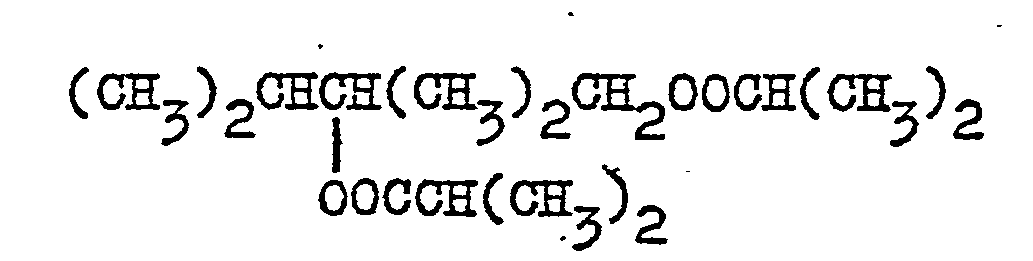
- Der Anteil von 2,2,4-Trimethyl-1,3-diisobutyryloxypentan beträgt vorzugsweise 10 bis 90 Gewichtsprozent, bezogen auf das Gesamtgewicht aller in dem jeweiligen Antischaummittel vorhandenen Organopolysiloxane,von Füllstoff, Dispergiermittel und 2,2,4-Trimethyl-1,3-diisobutyryloxypentan.
- Die Füllstoffe in den erfindungsgemäßen Antischaummitteln können die gleichen Füllstoffe sein, die auch in den bisher bekannten Antischaummitteln vorliegen konnten. Beispiele für solche Füllstoffe sind hydrophile und hydrophobe Oxyde von Silicium, Magaesium oder Zink, wobei diese Oxyde vorzugsweise jeweils eine Oberfläche von mindestens 50 m2/g aufweisen, Salze von Elementen der II. oder III. Gruppe des Periodensystems nach Mendeleeff mit einer Ordnungszahl von 12 bis 30 mit 12 bis 22 Kohlenstoffatome je Molekül aufweisenden, aliphatischen einbasischen Carbonsäuren oder Hydroxycarbonsäuren, wie Calciumstearat oder Calcium-12-hydroxy- stearat, sowie Produkte, die mindestens bei der jeweiligen Anwendungstemperatur des Antischaummittels fest und durch Umsetzumg von mindestens einem ein- oder mehrwertigem Isocyanat mit mindestens einer organischen Verbindung, die mindestens ein gegenüber der Isocyanatgruppe reaktionsfähiges Wasserstoffatom enthält, hergestellt worden sind, wie das Produkt der Umsetzung von Naphthylendiisocyanat mit Cyclohexylamin. Vorzugsweise ist die Herstellung der letztgenannten Art von Füllstoffen in Gegenwart von mindestens einem der zur Herstelluug der erfindungsgemäßen Antischaummittel eingesetzten Organopolysiloxane erfolgt. Weitere Beispiele für Füllstoffe in den erfindungsgemäBen Antischaummitteln sind Lithiumstearat, Magnesiumsilikat und Magnesiumaluminiumsilikat. Besonders bevorzugt sind pyrogen erzeugtes oder gefälltes Siliciumdioxyd mit einer Oberfläche von mindestens 50 m 2/g.
- Die erfindungsgemäBen Antischaummittel können eine Art von Füllstoff enthalten. Die erfindungsgemäßen Antischaummittel können aber auch Gemische aus mindestens zwei verschiedenen Arten von Füllstoffen enthalten.
- Der Anteil von Füllstoff beträgt vorzugsweise 2 bis 8 Gewichtsprozent, bezogen auf das Gesamtgewicht aller in dem jeweiligen Antischaummittel vorliegenden Organopolysiloxane, von Füllstoff, Dispergiermittel und 2,2,4-Trimethyl-1,3-di- isobutyryloxypentan.
- Zusätzlich zu Organopolysiloxan, das zusätzlich zu den SiC-gebundenen organischen Resten SiOC-gebundene organische Reste der oben definierten Art enthält, können die erfindungsgemäßen Antischaummittel weitere Organopolysiloxane enthalten. Beispiele für solche weiteren Organopolysiloxane sind durch Trimethylsiloxygruppen endblockierte Dimethylpolysiloxane oder durch Trimethylsiloxygruppen endblockierte Mischpolymerisate aus Dimethylsiloxan- und Diphenylsiloxan- und/ oder Phenylmethylsiloxaneinheiten mit einer Viskosität von. 35 bis 100 000 mm2·s-1 bei 25°C, vorzugsweise 50 bis 50 000 mm2· s-1 bei 25°C. Beispiele für solche weiteren Organopolysiloxane sind ebenso bei Raumtemperatur feste, aus (CH3)3SiO1/2-und Si04/2-Einheiten aufgebaute Organopolysiloxanharze mit 0,25 bis 1,25 (CH3)3SiO1/2-Einheiten je SiO4/2-Einheit, die zweckmäßig in Form ihrer Lösungen in organischem Lösungsmittel mit dem Organopolysiloxan, das zusätzlich zu den SiC-gebundenen organischen Resten SiOC-gebundene organische Reste der oben definierten Art enthält, vermischt werden, wonach dann aus der so erhaltenen Mischung das Lösungsmittel abdestilliertwird. Beispiele für solche weiteren Organopolysiloxane sind weiterhin ebenso eine Viskosität von 100 000 bis 500 000 mm2 · s-1 bei 25°C aufweisende, aus CH3SiO1/2- und (CH3)2SiO- Einheiten aufgebaute Organopolysiloxanharze mit 0,8 bis 2 CH3SiO3/2-Einheiten je (CH3)2SiO-Einheit. Beispiele für zusätzlich vorhandene weitere Organopolysiloxane sind schließlich ebenso aus CH3SiO3/2-, (CH3)3SiO1/2- und (CH3)2SiO-Einheiten, z.B. im Molverhältnis von 0,5 : 0,45 : 0,05, wobei die Reihenfolge dieser Zahlen der vorstehend angegebenen Reihenfolge von Siloxaneinheiten entspricht, aufgebaute Organopolysiloxane mit mindestens 2 Gewichtsprozent,bezogen auf ihr Gewicht,an Si-ge-. bundenen Hydroxylgruppen und einer Viskosität von 30 bis 2000; mm2·s-1,insbesondere 80 bis 200 mm2.s4bei 25°C.Solche ver- hältnismäßig viel Si-gebundene Hydroxylgruppen enthaltenden und niedrigviskosen Organopolysiloxane sind besonders bevorzugt, wenn der Anteil an Organopolysiloxan, das zusätzlich zu den SiC-gebundenen Resten SiOC-gebundene Reste der oben definierten Art, möglichst niedrig gehalten werden soll.
- Liegt zusätzlich zu Organopolysiloxan, das zusätzlich zu den SiC-gebundenen organischen Resten SiOC-gebundene organische Reste der oben definierten Art enthält, in den erfindungsgemäßen Antischaummitteln weiteres Organopolysiloxan vor, was bevorzugt ist, so beträgt der Anteil von solchem weiterem Organopolysiloxan vorzugsweise 5 bis 95 Gewichtsprozent, bezogen auf das Gesamtgewicht aller in dem jeweiligen Antischaummittel vorliegenden Organopolysiloxane.
- Zusätzlich zu Organopolysiloxan, Füllstoff, Dispergiermittel und 2,2,4-Trimethyl-1,3-diisobutyryloxypentan können die erfindungsgemäßen Antischaummittel weitere Stoffe enthalten, die auch bisher bei der Bearbeitung von Antischaummitteln auf Grundlage von entschäumend wirkendem Organopolysiloxan und Füllstoff verwendet werden konnten. Beispiele für derartige zusätzliche Stoffe sind Mineralöle, pflanzliche Öle, höhere Alkohole, Glykole und Ethylenoxyd-Propylenoxydblockmischpolymere.
- Die Herstellung der erfindungsgemäßen Antischaummittel erfolgt vorzugsweise so, daß zunächst.Organopolysiloxan und Füllstoff miteinander vermischt und dann die übrigen Bestandteile der so erhaltenen Mischung zugesetzt werden.
- Wie schon aus den Worten "in Wasser leicht verteilbare Antischaummittel" hervorgehen sollte, sind diese Mischungen vor ihrer endgültigen Verwendung zur Verhinderung oder Bekämpfung von Schaum zumindest im wesentlichen wasserfrei oder es können aus ihnen sehr leicht wäßrige Emulsionen hergestellt werden.
- Die erfindungsgemäßen Antischaummittel können zur Verhinderung oder Bekämpfung von Schaum nicht nur, jedoch insbesondere auf oder in wäßrigen Lösungen eingesetzt werden, z.B. als Zusätze zu Waschmitteln oder einem oder mehr Bestandteilen der Waschmittel, wie Natriumtripolyphosphat oder Natriumperborat oder einem Gemisch aus solchen Natriumverbindungen, weiterhin z.B. bei der Eindampfung von alkalischen Ablaugen der Papierindustrie, der Konzentrierung von Kautschuk-Latices, bei Schneidölemulsionen in der metallverarbeitenden Industrie, in Dispersionsfarben und anderen Anwendungen von Kunstharzdispersionen, in Wasserlacken, in Schmiermitteln, bei der Erdölförderung, Textilfärbung, einschließlich des HT-Verfahrens (englisch: high-temperature dying process ), und der Jet-Färbung, Abwasseraufbereitung, Gärprozessen, wie Antibiotika-Herstellung und Erzflotation.
- .In den folgenden Beispielen wird die Wirksamkeit der Antischaummittel jeweils durch eine Zahl wiedergegeben. Diese Zahl wird als "SRF"-Wert (SRF = Abkürzung für "Schaumresistenzfläche") bezeichnet und wie folgt bestimmt:
- In einem 800 ml-Becherglas mit einem Durchmesser von 9,5 cm und einer Höhe von 13 cm wird zu 200 ml einer 4 gewichtspro- . zentigen wäßrigen Lösung von Natrinm C14-15-Alkylsulfonat die im folgenden im Zusammenhang mit dem jeweiligen SRF-Wert angegebene Menge des zu untersuchenden Antischaummittels gegeben. Die so erhaltene Mischung wird durch 2 gegenläufige Rührer mit mehreren, jeweils in sich geschlossenen Armen bei 1000 Umdrehungen je Minute 1 Minute so verschäumt, daß keine homogene Flüssigkeit verbleibt. 4 Lichtschranken sind mit einem Abstand von jeweils 1,5 cm voneinander senkrecht entlang der Außenwand des Becherglases angebracht. Eine derartige Vorrichtung ist in DE-OS 25 51 260 (offengelegt 18. Mai 1977, Wacker-Chemie GmbH) wiedergegeben. Wenn der Schaum in sich zusammenfällt, werden die Lichtschranken eine nach der anderen freigegeben und es wird automatisch mit einem Schreiber ein Diagramm aufgezeichnet, das auf der Abszisse die Zeiten (1 cm = 10 Sekunden) wiedergibt, die bis zum Verschwinden vom Schaum bei der obersten, zweithöchsten, dritthöchsten und niedrigsten Lichtschranke verstreichen. 8 cm auf der Ordinate entsprechen der obersten Lichtschranke. Es wird eine Linie erhalten, die fast senkrecht vom Kreuzungspunkt von Abszisse und Ordinate 8 cm hochgeht, dann waagrecht bis zum Zeitpunkt der Freigabe der obersten Lichtschranke verläuft, bei diesem.Zeitpunkt senkrecht abfällt, wieder bis zum Zeitpunkt der Freigabe der zweithöchsten Lichtschranke waagrecht verläuft, bei diesem Zeitpunkt senkrecht abfällt u.s.w. In DE-OS 25 51 260 ist auch ein derartiges Diagramm wiedergegeben. Die Fläche, welche die so erhaltene Treppenlinie mit Abszisse und Ordinate bildet, wird vermessen und ergibt den SRF-Wert. Je kleiner dieser Wert ist, um so größer ist die Wirksamkeit des Antischaummittels.
- In den folgenden Beispielen beziehen sich alle Angaben von Teilen und Prozentsätzen auf das Gewicht, soweit nichts anderes angegeben ist.
- a) Ein Gemisch aus 750 g in den endständigen Einheiten je eine Si-gebundene Hydroxylgruppe aufweisendes Dimethylpolysiloxan mit einer Viskosität von 80 mm2·s-1 bei 25°C und 250 g 2-Octyldodekanol, das mit 5 ml 20 %-igem methanolischem Kaliumhydroxyd vermischt wurde, wird 4 Stunden auf 140°C unter Rühren erwärmt. Nach dem Abkühlen wird das Kaliumhydroxyd mit Dimetbyldichlorsilan neutralisiert. Dann werden die geringen Mengen flüchtiger Bestandteile abdestilliert.
- Es wird ein Ö1 mit einer Viskosität von 6 mm2·s-1 bei 25°C erhalten.
- b) Das so erhaltene Ö1 wird mit 300 g einer 50 %-igen Lösung eines bei Raumtemperatur festen, aus (CH3)3SiO1/2-und SiO4/2- Einheiten aufgebauten Organopolysiloxanharzes mit 0,56 (CH3)3SiO1/2-Einheiten je SiO4/2-Einheit in Toluol vermischt. Dann wird das Lösungsmittel beim Druck der umgebenden Atmosphäre bis etwa 16 mbar (abs.) und 120°C abdestilliert.
- Die so erhaltene Organopolysiloxanmischung hat eine Viskosität von 84 mm2·s-1 bei 25°C.
- c) 94 Teile der gemäß 1 b) hergestellten Organopolysiloxanmischung werden mit 3 Teilen hydrophilem gefälltem Siliciumdioxyd mit einer Oberfläche von 90 m2/g und 3 Teilen hydrophobem, pyrogen erzeugtem Siliciumdioxyd mit einer Oberflä- .ehe von 150 m2/g mittels eines Dreiwalzenstuhls vermischt.
- d) 50 Teile der gemäß 1 c) hergestellten Mischung aus Organopolysiloxan und Füllstoff werden in eine bei 80°C befindliche Schmelze aus.6 Teilen Stearylpolyoxyethylenglykolether mit 4 bis 6 Ethylenoxydeinheiten je Molekül, 9 Teilen Polyoxyethylenglykolsorbitolhexaoleat (mit einem HLB-Wert von etwa 11), 17 Teilen Natriumstearoyllactat und 18 Teilen 2,2,4-Trimethyl-1,3-diisobutyryloxypentan eingemischt.
- Mit einem Flügelrührer oder auch nur durch Umrühren mit einen Stab läßt sich aus der so erhaltenen Mischung leicht eine feindisperse Emulsion mit gleichmäßig darin verteilten Be- standteilen herstellen. 0,4 g einer Emulsion aus 15 Tei- len der gemäß 1 d) hergestellten Mischung und 85 Teilen Wasser haben einen SRF-Wert von 700. Diese Emulsion besitzt eine ausgezeichnete Lagerbeständigkeit.
- 40 Teile einer Mischung, die ihrerseits aus 20 % der gemäß Beispiel 1 c) hergestellten Mischung und 80 % eines Gemisches aus 8 Teilen hydrophilem Siliciumdioxyd mit einer Oberfläche von 150 m2/g und 92 Teilen eines aus 5 Molprozent Dimethylsiloxan-Einheiten, 45 Molprozent Trimethylsiloxan-Einheiten und 5 Molprozent Monomethylsiloxan-Einheiten aufgebauten Organopolysiloxans mit 2 % Si-gebundenen Hydroxylgruppen und einer Viskosität von 150 mm2 · s -1 bei 25°C besteht, werden zu einer Mischung aus 30 Teilen Isotridecylpolyoxyethylenglykolether mit 5 Ethylenoxydeinheiten je Molekül, 15 Teilen 2,2,4-Trimethyl-1,3-diiso- butyryloxypentan und 15 Teilen Weißöl ( = Mineralölsorte) gegeben. 0,2 g dieser Mischung haben einen SRF-Wert von 800.
- Beim Eingießen in Wasser bildet die Mischung sofort eine feindisperse Emulsion mit gleichmäßig darin verteilten Bestandteilen. Aus einer Emulsion aus 1 Teil der Mischung,' deren Herstellung vorstehend beschrieben wurde, und 99 Teilen Wasser scheidet sich auch beim Kochen keine ölige Phase ab.
- Ein Gemisch aus 80 % durch Trimethylsiloxygruppen endblockiertem Dimethylpolysiloxan mit einer Viskosität von 100 mm2·s-1 und 20 % hydrophilem, pyrogen erzeugtem Siliciumdioxyd mit einer Oberfläche von 200 m2/g wird 8 Stunden auf 200°C erwärmt und nach dem Abkühlen werden 8 Teile dieses Gemisches mit 2 Teilen eines auf einem Dreiwalzenstuhl hergestellten
- Gemisches das aus 94 Teilen des gemäß Beispiel 1 a) . hergestellten Organopolysiloxans mit SiOC-gebundenen Alkylgruppen, 3 Teilen hydrophilem gefälltem Siliciumdioxyd mit einer Oberfläche von 90 m2/g und 3 Teilen hydrophobem pyrogen erzeugtem Siliciumdioxyd mit einer Oberfläche von 150 m2 besteht, 64 Teilen 2,2,4-Trimethyl-1,3-diisobutyryl- oxypentan,.20 Teilen Weißöl und 6 Teilen Polyoxyethylenglykolsorbitanhexaoleat mit einem HLB-Wert von etwa 11 vermischt. 0,2 g dieser Mischung haben einen SRF-Wert von 500.
- Mit einem Flügelrührer oder auch nur durch Rühren mit einem Stab läßt sich aus der so erhaltenen Mischung leicht eine feindisperse Emulsion mit gleichmäßig darin verteilten Bestandteilen herstellen.
-
- a) Ein Gemisch aus 750 g eines in den endständigen Einheiten je eine Si-gebundene Hydroxylgruppe aufweisenden Dimethylpolysiloxans mit einer Viskosität von 100 mm2 · s-1 bei 25°C, 250 g Polypropylenglykol mit einem Molekulargewicht von etwa 2000 und 30 g säurebehandeltem Bentonit wird 5 Stunden unter Rühren auf 150°C erwärmt. Nach dem Abtrennen vom Feststoff werden die flüchtigen Bestandteile abdestilliert.
- b) Das so erhaltene Öl wird bei der in Beispiel 1 b) beschriebenen Arbeitsweise anstelle des gemäß Beispiel 1 a) hergestellten Organopolysiloxans mit SiOC-gebundenen Alkylgruppen eingesetzt. Die so erhaltene Organopolysiloxanmischung hat eine Viskosität von 150 mm2 · s-1 bei 25°C.
- c) 20 Teile der gemäß 4 b) hergestellten Organopolysiloxanmischung werden mit 20 Teilen einer Mischung aus 92 % durch Trimethylsiloxygruppen endblockiertem Dimethylpolysiloxan mit einer Viskosität von 5000 mm2 · s-1 bei 25°C, 2% Calciumstearat, 2 % Calcium-12-hydrozystearat und 4 % hydrophilem, pyrogen erzeugtem Siliciumdioxyd mit einer Oberfläche von 130 m2/g mittels eines Dreiwalzenstuhls vermischt.
- d) Nach Verdünnen mit 20 Teilen Sojaöl wird die gemäß 4 c) hergestellte Mischung aus Organopolysiloxan und Füllstoff in eine bei 65°C befindliche Mischung aus 5 Teilen Anlagerungsprodukt von Ethylenoxyd an Stearinsäure mit 4 Ethylenoxydeinheiten je Molekül und 7 Teilen Natriumstearoyllactat eingemischt. Zu dieser Mischung werden zunächst 10 Teile Polyoxyethylensorbitolhexaoleat (mit einem HLB-Wert von etwa 11) und dann unter Rühren 15 Teile aliphatisches, von Mehrfachbindnngen freies Mineralöl mit einer Viskosität von 320 mm2 · s-1 bei 20°C und 13 Teile 2,2,4-Trimethyl-1,3-di- isobutyryloxypentan eingemischt. 0,2 g der so erhaltenen Mischung haben einen SRF-Wert von 350. Die Mischung läßt sich leicht in Wasser verteilen.
-
- a) Ein Gemisch aus 500 g eines in den endständigen Einheiten je eine Si-gebundene Hydroxylgruppe aufweisenden Dimethylpolysiloxans mit einer Viskosität von 80 mm2 · s-1 bei 25°C und 500 g Polypropylenglykolmonomethylether mit einem Molekulargewicht von 2000, das mit 5 ml 20 %-igem methanolischem Kaliumhydroxyd vermischt wurde, wird 4 Stunden auf 140°C unter Rühren erwärmt. Das so erhaltene Ö1 hat eine Viskosität von 170 mm2 · s-1 bei 25°C.
- b) 50 Teile des gemäß 5 a) hergestellten Öls werden mit 5 Teilen hydrophobem, pyrogen erzeugtem Siliciumdioxyd mit einer Oberfläche von 200 m2/g mittels eines Dreiwalzenstuhls vermischt. Diese Mischung wird mit einer Mischung aus 10 Teilen des in Beispiel 2 näher beschriebenen Organopolysiloxans aus Dimethylsiloxan-, Trimethylsiloxan- und Monomethylsiloxan-Einheiten und 2 Teilen Lithiumstearat vermischt.
- c) In die gemäß 5 b) hergestellte Mischung aus Organopolysiloxan und Füllstoff werden mittels eines im Frequenzbereich von Schall bis Ultraschall betreibbaren Mischgerätes (erhältlich unter dem registrierten Warenzeichen "Ultra-Turrax") zunächst 10 Teile Isotridecylpolyoxyethylenglykolether mit 5 Ethylenoxydeinheiten je Molekül und dann 23 Teile 2,2,4-Trimethyl-1,3-diisobutyryloxypentan eingemischt. 0,2 g der so erhaltenen Mischung haben einen SRF-Wert von etwa 300.
- Die Misschung bildet beim Eingießen.in Wasser sofort eine feindisperse Emulsion.
-
- a) Bei der in Beispiel 5 a ) angegebenen Arbeitsweise werden die 500 g Polypropylenglykolmonomethylether durch 500 g Polypropylenglykolmono-n-butylether mit einem Molekulargewicht von 700 ersetzt.
- b) Das so erhaltene Öl wird bei der in Beispiel 1 b) beschriebenen Arbeitsweise anstelle des gemäß Beispiel 1 a) hergestellten Organopolysiloxans mit SiOC-gebundenen Alkylgruppen eingesetzt. Die so erhaltene Organopolysiloxanmischung hat eine Viskosität von 200 mm2 · s-1 bei 25°C.
- c) 15 Teile der gemäß 6 b) hergestellten Organopolysiloxanmischung werden zunächst mit 5 Teilen eines durch Trimethylsiloxygruppen endblockierten Diorganopolysiloxans aus 90 Molprozent Dimethylsiloxaneinheiten und 10 Molprozent Diphenylsiloxaneinheiten mit einer Viskosität von 300 mm2 s-1 bei 25°C und dann mit 25 Teilen 2,2,4-Trimethyl-1,3-diiso- butyryloxypentan vermischt. Nach Verdünnen mit 17 Teilen naphtenischen Mineralöls mit einer Viskosität von 70 mm 2 ·s-1 bei 20°C werden in diese Mischung mittels des im Frequenzbereich von Schall bis Ultraschall betreibbaren Mischgerätes 8 Teile eines Gemisches aus gleichen Gewichtsteilen hydrophobem, pyrogen erzeugtem Siliciumdioxyd mit einer Oberfläche von 180 m2/g und hydrophobem, pyrogen erzeugtem Siliciumdioxyd mit einer Oberfläche von 300 m2/g eingemischt. Die so erhaltene Mischung wird in ein auf 45°C erwärmtes Gemisch aus 10 Teilen Isotridecylpolyoxyethylenglykolether mit 5 Ethylenoxydeinheiten je Molekül und 15 Teilen Polyoxyethylensorbitolhexaoleat eingemischt. 0,2 g der so erhaltenen Mischung haben einen SRF-Wert von etwa 500. Die Mischung läßt sich leicht in Wasser verteilen.
Claims (2)
Applications Claiming Priority (2)
| Application Number | Priority Date | Filing Date | Title |
|---|---|---|---|
| DE3235256 | 1982-09-23 | ||
| DE19823235256 DE3235256A1 (de) | 1982-09-23 | 1982-09-23 | In wasser leicht verteilbare antischaummittel |
Publications (3)
| Publication Number | Publication Date |
|---|---|
| EP0106209A2 true EP0106209A2 (de) | 1984-04-25 |
| EP0106209A3 EP0106209A3 (en) | 1984-11-14 |
| EP0106209B1 EP0106209B1 (de) | 1986-12-03 |
Family
ID=6173974
Family Applications (1)
| Application Number | Title | Priority Date | Filing Date |
|---|---|---|---|
| EP83109448A Expired EP0106209B1 (de) | 1982-09-23 | 1983-09-22 | In Wasser leicht verteilbare Antischaummittel |
Country Status (5)
| Country | Link |
|---|---|
| US (1) | US4477371A (de) |
| EP (1) | EP0106209B1 (de) |
| JP (1) | JPS5955318A (de) |
| CA (1) | CA1214374A (de) |
| DE (2) | DE3235256A1 (de) |
Cited By (2)
| Publication number | Priority date | Publication date | Assignee | Title |
|---|---|---|---|---|
| EP0301531A3 (en) * | 1987-07-30 | 1990-08-01 | Wacker Chemie Gmbh | Anti-foam agent |
| WO1996015312A1 (de) * | 1994-11-10 | 1996-05-23 | Wacker-Chemie Gmbh | Verfahren zur gewinnung von zellstoff |
Families Citing this family (22)
| Publication number | Priority date | Publication date | Assignee | Title |
|---|---|---|---|---|
| DE3319788A1 (de) * | 1983-06-01 | 1984-12-06 | Th. Goldschmidt Ag, 4300 Essen | Mit organischen gruppen modifizierte kieselsaeure, deren herstellung und verwendung zur spaltung von emulsionen |
| DE3427499A1 (de) * | 1984-07-26 | 1986-02-13 | Bayer Ag, 5090 Leverkusen | Elektroviskose fluessigkeiten |
| US4798679A (en) * | 1987-05-11 | 1989-01-17 | The Procter & Gamble Co. | Controlled sudsing stable isotropic liquid detergent compositions |
| JPH07107134B2 (ja) * | 1988-05-30 | 1995-11-15 | 信越化学工業株式会社 | シリコーンエマルジョン組成物 |
| JPH0820060B2 (ja) * | 1992-01-27 | 1996-03-04 | 財団法人工業技術研究院 | 二種燃料低窒素酸化物バーナ |
| US5371129A (en) * | 1993-10-26 | 1994-12-06 | Phillips Petroleum Company | Poly(mono-1-olefin) compositions |
| US5538668A (en) * | 1994-04-19 | 1996-07-23 | Betz Paperchem Inc. | Antifoam composition for aqueous starch and paper coating systems |
| US5632860A (en) * | 1995-07-05 | 1997-05-27 | Betzdearborn Inc. | Method of controlling foam in aqueous systems |
| DE19538751A1 (de) * | 1995-10-18 | 1997-04-24 | Huels Chemische Werke Ag | Entschäumerdispersionen für wäßrige Tensidsysteme |
| US5846454A (en) * | 1997-05-23 | 1998-12-08 | Osi Specialties, Inc. | Water dispersible antifoam concentrates |
| US6004918A (en) * | 1998-10-16 | 1999-12-21 | Wacker Silicones Corporation | Liquid detergents containing defoamer compositions and defoamer compositions suitable for use therein |
| DE19922218A1 (de) | 1999-05-14 | 2001-02-15 | Goldschmidt Ag Th | Verwendung wasserunlöslicher poly(oxy-1,4-butandiyl)haltiger Polyoxyalkylen-Polysiloxan-Blockmischcopolymerisate zur Entschäumung wäßriger Medien |
| DE19922915A1 (de) * | 1999-05-19 | 2000-11-23 | Wacker Chemie Gmbh | Siliconentschäumer enthaltende wäßrige Polymerisatdispersion |
| US7125833B2 (en) * | 2003-03-24 | 2006-10-24 | Wacker Chemie Ag | Cyclodextrin laundry detergent additive complexes and compositions containing same |
| DE102004040263A1 (de) * | 2004-08-19 | 2006-02-23 | Wacker-Chemie Gmbh | Entschäumerzusammensetzungen |
| DE102008043032A1 (de) * | 2008-10-22 | 2010-04-29 | Evonik Goldschmidt Gmbh | Entschäumer zur Entschäumung von Lacken |
| US10252189B2 (en) * | 2011-10-24 | 2019-04-09 | San Nopco Ltd. | Defoaming agent |
| WO2014066308A1 (en) * | 2012-10-24 | 2014-05-01 | The Procter & Gamble Company | Anti foam compositions comprising aryl bearing polyorganosilicons |
| WO2014066309A1 (en) * | 2012-10-24 | 2014-05-01 | The Procter & Gamble Company | Anti foam compositions comprising partly phenyl bearing polyorganosilicons |
| CN104120624B (zh) | 2013-04-28 | 2016-08-24 | 埃科莱布美国股份有限公司 | 生物柴油基的乳液型消泡剂及其制备方法 |
| US20240191155A1 (en) * | 2021-04-12 | 2024-06-13 | Wacker Chemie Ag | Foam control composition |
| EP4370229A1 (de) | 2021-07-16 | 2024-05-22 | Wacker Chemie AG | Entschäumerzusammensetzungen mit polydimethylsiloxane, organopolysiloxanharze, alkylether und ohne 2,2,4-trimethyl-1,3-diisobutyryloxypentan |
Family Cites Families (8)
| Publication number | Priority date | Publication date | Assignee | Title |
|---|---|---|---|---|
| GB1385026A (en) * | 1972-02-18 | 1975-02-26 | Paisley College Of Technology | Lubricants and methods of lubrication |
| US4076648A (en) * | 1976-06-01 | 1978-02-28 | Union Carbide Corporation | Self-dispersible antifoam compositions |
| US4090402A (en) * | 1977-06-20 | 1978-05-23 | Alburger James R | Slow-solubility inspection penetrant composition containing a solubility accelerator |
| US4110539A (en) * | 1977-07-13 | 1978-08-29 | Eastman Kodak Company | Process for the preparation of 2,2,4-trimethyl-1,3-pentanediol diisobutyrate |
| DE3011304A1 (de) * | 1980-03-24 | 1981-10-08 | Henkel KGaA, 4000 Düsseldorf | Schaumdaempfungsmittel und dessen verwendung in kunstharz-, lack- und farbdispersionen |
| DE3038983A1 (de) * | 1980-10-15 | 1982-05-27 | Bayer Ag, 5090 Leverkusen | Entschaeumer fuer kontinuierliche faerbeprozesse |
| US4316987A (en) * | 1981-01-09 | 1982-02-23 | Tennecochemicals, Inc. | Partial (2,2,4-trimethylpentane-1,3-diol monoisobutyrate) esters of polycarboxylic acids and water-soluble salts of said partial esters |
| DE3102826A1 (de) * | 1981-01-29 | 1982-08-26 | Hoechst Ag, 6000 Frankfurt | "verfahren zur herstellung von 2,2,4-trimethyl-1,3-pentandioldiisobutyrat" |
-
1982
- 1982-09-23 DE DE19823235256 patent/DE3235256A1/de not_active Withdrawn
-
1983
- 1983-07-15 JP JP58128084A patent/JPS5955318A/ja active Granted
- 1983-07-29 US US06/518,787 patent/US4477371A/en not_active Expired - Lifetime
- 1983-08-02 CA CA000433681A patent/CA1214374A/en not_active Expired
- 1983-09-22 DE DE8383109448T patent/DE3368015D1/de not_active Expired
- 1983-09-22 EP EP83109448A patent/EP0106209B1/de not_active Expired
Cited By (3)
| Publication number | Priority date | Publication date | Assignee | Title |
|---|---|---|---|---|
| EP0301531A3 (en) * | 1987-07-30 | 1990-08-01 | Wacker Chemie Gmbh | Anti-foam agent |
| WO1996015312A1 (de) * | 1994-11-10 | 1996-05-23 | Wacker-Chemie Gmbh | Verfahren zur gewinnung von zellstoff |
| US6521084B1 (en) | 1994-11-10 | 2003-02-18 | Wacker-Chemie Gmbh | Chemical digestion process using organosiloxane compounds |
Also Published As
| Publication number | Publication date |
|---|---|
| US4477371A (en) | 1984-10-16 |
| JPS6256766B2 (de) | 1987-11-27 |
| EP0106209A3 (en) | 1984-11-14 |
| CA1214374A (en) | 1986-11-25 |
| JPS5955318A (ja) | 1984-03-30 |
| DE3235256A1 (de) | 1984-03-29 |
| DE3368015D1 (en) | 1987-01-15 |
| EP0106209B1 (de) | 1986-12-03 |
Similar Documents
| Publication | Publication Date | Title |
|---|---|---|
| EP0106209B1 (de) | In Wasser leicht verteilbare Antischaummittel | |
| EP0301531B1 (de) | Verwendung einer Zusammensetzung als Antischaummittel | |
| EP1781393B1 (de) | Entschäumerzusammensetzungen | |
| EP1618936B1 (de) | Entschäumerzusammensetzungen | |
| DE60305710T2 (de) | Schaumregulatorzusammensetzungen auf silikonbasis | |
| EP1681083B1 (de) | Entschäumerzusammensetzungen | |
| EP2846891B1 (de) | Entschäumerformulierungen enthaltend organopolysiloxane | |
| DE1619859B2 (de) | Verfahren zum verhindern und/oder vermindern der schaumbildung in waesserigen systemen | |
| EP1807164B1 (de) | Entschäumerzusammensetzungen | |
| EP3007793B1 (de) | Verfahren zum entschäumen von wässrigen, tenside enthaltenden zusammensetzungen, und entschäumerformulierungen | |
| DE2925722A1 (de) | Mittel zum entschaeumen fluessiger medien | |
| EP0014419B1 (de) | Im wesentlichen wasserfreie Antischaummittel | |
| EP0726086B1 (de) | Hydrophobe Kieselsäuren enthaltende Entschäumerzubereitungen auf der Basis von Siloxanen | |
| EP0014421B1 (de) | Antischaummittel | |
| DE69522503T2 (de) | Schaumregulierendes Mittel | |
| WO2003029338A1 (de) | Zusammensetzungen auf basis von polyorganosiloxanen, verfahren zur herstellung davon und ihre verwendung | |
| EP0658361A1 (de) | Entschäumeremulsion auf der Basis organofunktionell modifizierter Polysiloxane | |
| EP1533333B1 (de) | Emulgatorfreie Öl in Wasser-Emulsionen von Organopolysiloxanen und deren Verwendung in technischen Anwendungen | |
| DE4223768A1 (de) | Entschäumungsmittel auf der Basis organofunktionell modifizierter Organopolysiloxane | |
| EP0597320B1 (de) | Schutzkolloid enthaltende Entschäumeremulsion | |
| DE2720512A1 (de) | Antischaummittel | |
| US2809168A (en) | Defoaming composition and process | |
| DE3541515A1 (de) | Perfluoralkylgruppen enthaltende verbindungen, deren herstelllung und verwendung als entschaeumungsmittel fuer waessrige polymerdispersionen | |
| DE1619938C3 (de) | Verfahren zur Herstellung V0n Antischaummittel | |
| DE1619938B2 (de) | Verfahren zur Herstellung von Antischaummittel |
Legal Events
| Date | Code | Title | Description |
|---|---|---|---|
| PUAI | Public reference made under article 153(3) epc to a published international application that has entered the european phase |
Free format text: ORIGINAL CODE: 0009012 |
|
| 17P | Request for examination filed |
Effective date: 19830922 |
|
| AK | Designated contracting states |
Designated state(s): BE DE FR GB IT NL |
|
| PUAL | Search report despatched |
Free format text: ORIGINAL CODE: 0009013 |
|
| AK | Designated contracting states |
Designated state(s): BE DE FR GB IT NL |
|
| GRAA | (expected) grant |
Free format text: ORIGINAL CODE: 0009210 |
|
| AK | Designated contracting states |
Kind code of ref document: B1 Designated state(s): BE DE FR GB IT NL |
|
| REF | Corresponds to: |
Ref document number: 3368015 Country of ref document: DE Date of ref document: 19870115 |
|
| ITF | It: translation for a ep patent filed | ||
| ET | Fr: translation filed | ||
| PLBE | No opposition filed within time limit |
Free format text: ORIGINAL CODE: 0009261 |
|
| STAA | Information on the status of an ep patent application or granted ep patent |
Free format text: STATUS: NO OPPOSITION FILED WITHIN TIME LIMIT |
|
| 26N | No opposition filed | ||
| ITTA | It: last paid annual fee | ||
| PGFP | Annual fee paid to national office [announced via postgrant information from national office to epo] |
Ref country code: NL Payment date: 20010831 Year of fee payment: 19 Ref country code: FR Payment date: 20010831 Year of fee payment: 19 Ref country code: DE Payment date: 20010831 Year of fee payment: 19 |
|
| PGFP | Annual fee paid to national office [announced via postgrant information from national office to epo] |
Ref country code: GB Payment date: 20010904 Year of fee payment: 19 |
|
| PGFP | Annual fee paid to national office [announced via postgrant information from national office to epo] |
Ref country code: BE Payment date: 20010926 Year of fee payment: 19 |
|
| REG | Reference to a national code |
Ref country code: GB Ref legal event code: IF02 |
|
| PG25 | Lapsed in a contracting state [announced via postgrant information from national office to epo] |
Ref country code: GB Free format text: LAPSE BECAUSE OF NON-PAYMENT OF DUE FEES Effective date: 20020922 |
|
| PG25 | Lapsed in a contracting state [announced via postgrant information from national office to epo] |
Ref country code: BE Free format text: LAPSE BECAUSE OF NON-PAYMENT OF DUE FEES Effective date: 20020930 |
|
| BERE | Be: lapsed |
Owner name: *WACKER-CHEMIE G.M.B.H. Effective date: 20020930 |
|
| PG25 | Lapsed in a contracting state [announced via postgrant information from national office to epo] |
Ref country code: NL Free format text: LAPSE BECAUSE OF NON-PAYMENT OF DUE FEES Effective date: 20030401 Ref country code: DE Free format text: LAPSE BECAUSE OF NON-PAYMENT OF DUE FEES Effective date: 20030401 |
|
| GBPC | Gb: european patent ceased through non-payment of renewal fee |
Effective date: 20020922 |
|
| PG25 | Lapsed in a contracting state [announced via postgrant information from national office to epo] |
Ref country code: FR Free format text: LAPSE BECAUSE OF NON-PAYMENT OF DUE FEES Effective date: 20030603 |
|
| REG | Reference to a national code |
Ref country code: FR Ref legal event code: ST |