EP0105285B2 - Strecktexturierter, basisch färbbarer polyesterfaden - Google Patents
Strecktexturierter, basisch färbbarer polyesterfaden Download PDFInfo
- Publication number
- EP0105285B2 EP0105285B2 EP83900833A EP83900833A EP0105285B2 EP 0105285 B2 EP0105285 B2 EP 0105285B2 EP 83900833 A EP83900833 A EP 83900833A EP 83900833 A EP83900833 A EP 83900833A EP 0105285 B2 EP0105285 B2 EP 0105285B2
- Authority
- EP
- European Patent Office
- Prior art keywords
- filaments
- textured
- yarn
- compound
- polyester
- Prior art date
- Legal status (The legal status is an assumption and is not a legal conclusion. Google has not performed a legal analysis and makes no representation as to the accuracy of the status listed.)
- Expired - Lifetime
Links
- 229920000728 polyester Polymers 0.000 title claims description 26
- 229940126062 Compound A Drugs 0.000 claims abstract description 16
- NLDMNSXOCDLTTB-UHFFFAOYSA-N Heterophylliin A Natural products O1C2COC(=O)C3=CC(O)=C(O)C(O)=C3C3=C(O)C(O)=C(O)C=C3C(=O)OC2C(OC(=O)C=2C=C(O)C(O)=C(O)C=2)C(O)C1OC(=O)C1=CC(O)=C(O)C(O)=C1 NLDMNSXOCDLTTB-UHFFFAOYSA-N 0.000 claims abstract description 16
- 229910052708 sodium Inorganic materials 0.000 claims abstract description 3
- 238000005809 transesterification reaction Methods 0.000 claims description 10
- 230000032050 esterification Effects 0.000 claims description 8
- 238000005886 esterification reaction Methods 0.000 claims description 8
- 239000000126 substance Substances 0.000 claims description 7
- 229920001223 polyethylene glycol Polymers 0.000 claims description 5
- 239000004952 Polyamide Substances 0.000 claims description 3
- 239000002202 Polyethylene glycol Substances 0.000 claims description 3
- 229920002647 polyamide Polymers 0.000 claims description 3
- CARJPEPCULYFFP-UHFFFAOYSA-N 5-Sulfo-1,3-benzenedicarboxylic acid Chemical compound OC(=O)C1=CC(C(O)=O)=CC(S(O)(=O)=O)=C1 CARJPEPCULYFFP-UHFFFAOYSA-N 0.000 claims description 2
- 229920000742 Cotton Polymers 0.000 claims description 2
- 229920000297 Rayon Polymers 0.000 claims description 2
- 229920001451 polypropylene glycol Polymers 0.000 claims description 2
- 239000011734 sodium Substances 0.000 claims description 2
- 210000002268 wool Anatomy 0.000 claims description 2
- 239000000470 constituent Substances 0.000 claims 2
- NIXOWILDQLNWCW-UHFFFAOYSA-N acrylic acid group Chemical group C(C=C)(=O)O NIXOWILDQLNWCW-UHFFFAOYSA-N 0.000 claims 1
- 159000000000 sodium salts Chemical class 0.000 claims 1
- 229910052751 metal Inorganic materials 0.000 abstract description 8
- 239000002184 metal Substances 0.000 abstract description 8
- BDHFUVZGWQCTTF-UHFFFAOYSA-M sulfonate Chemical compound [O-]S(=O)=O BDHFUVZGWQCTTF-UHFFFAOYSA-M 0.000 abstract description 5
- 125000001273 sulfonato group Chemical group [O-]S(*)(=O)=O 0.000 abstract 1
- 229920000642 polymer Polymers 0.000 description 24
- LYCAIKOWRPUZTN-UHFFFAOYSA-N Ethylene glycol Chemical compound OCCO LYCAIKOWRPUZTN-UHFFFAOYSA-N 0.000 description 20
- -1 polyethylene terephthalate Polymers 0.000 description 14
- 229920001515 polyalkylene glycol Polymers 0.000 description 12
- 238000000034 method Methods 0.000 description 11
- KKEYFWRCBNTPAC-UHFFFAOYSA-N Terephthalic acid Chemical compound OC(=O)C1=CC=C(C(O)=O)C=C1 KKEYFWRCBNTPAC-UHFFFAOYSA-N 0.000 description 10
- 238000004519 manufacturing process Methods 0.000 description 10
- 229920000139 polyethylene terephthalate Polymers 0.000 description 9
- 239000005020 polyethylene terephthalate Substances 0.000 description 9
- 238000007792 addition Methods 0.000 description 8
- 150000001875 compounds Chemical class 0.000 description 8
- WOZVHXUHUFLZGK-UHFFFAOYSA-N dimethyl terephthalate Chemical compound COC(=O)C1=CC=C(C(=O)OC)C=C1 WOZVHXUHUFLZGK-UHFFFAOYSA-N 0.000 description 8
- 238000009987 spinning Methods 0.000 description 7
- OKKJLVBELUTLKV-UHFFFAOYSA-N Methanol Chemical compound OC OKKJLVBELUTLKV-UHFFFAOYSA-N 0.000 description 6
- 239000000981 basic dye Substances 0.000 description 6
- 150000002334 glycols Chemical class 0.000 description 6
- 239000000047 product Substances 0.000 description 6
- 230000000052 comparative effect Effects 0.000 description 5
- 235000014113 dietary fatty acids Nutrition 0.000 description 5
- 229930195729 fatty acid Natural products 0.000 description 5
- 239000000194 fatty acid Substances 0.000 description 5
- 150000004665 fatty acids Chemical class 0.000 description 5
- 239000000835 fiber Substances 0.000 description 5
- 239000000203 mixture Substances 0.000 description 5
- GWEVSGVZZGPLCZ-UHFFFAOYSA-N Titan oxide Chemical compound O=[Ti]=O GWEVSGVZZGPLCZ-UHFFFAOYSA-N 0.000 description 4
- WNLRTRBMVRJNCN-UHFFFAOYSA-N adipic acid Chemical compound OC(=O)CCCCC(O)=O WNLRTRBMVRJNCN-UHFFFAOYSA-N 0.000 description 4
- MTHSVFCYNBDYFN-UHFFFAOYSA-N diethylene glycol Chemical compound OCCOCCO MTHSVFCYNBDYFN-UHFFFAOYSA-N 0.000 description 4
- 239000000539 dimer Substances 0.000 description 4
- WGCNASOHLSPBMP-UHFFFAOYSA-N hydroxyacetaldehyde Natural products OCC=O WGCNASOHLSPBMP-UHFFFAOYSA-N 0.000 description 4
- 238000002360 preparation method Methods 0.000 description 4
- PEDCQBHIVMGVHV-UHFFFAOYSA-N Glycerine Chemical compound OCC(O)CO PEDCQBHIVMGVHV-UHFFFAOYSA-N 0.000 description 3
- 230000008092 positive effect Effects 0.000 description 3
- QPFMBZIOSGYJDE-UHFFFAOYSA-N 1,1,2,2-tetrachloroethane Chemical compound ClC(Cl)C(Cl)Cl QPFMBZIOSGYJDE-UHFFFAOYSA-N 0.000 description 2
- IJGRMHOSHXDMSA-UHFFFAOYSA-N Atomic nitrogen Chemical compound N#N IJGRMHOSHXDMSA-UHFFFAOYSA-N 0.000 description 2
- VMHLLURERBWHNL-UHFFFAOYSA-M Sodium acetate Chemical compound [Na+].CC([O-])=O VMHLLURERBWHNL-UHFFFAOYSA-M 0.000 description 2
- 239000000654 additive Substances 0.000 description 2
- ADCOVFLJGNWWNZ-UHFFFAOYSA-N antimony trioxide Chemical compound O=[Sb]O[Sb]=O ADCOVFLJGNWWNZ-UHFFFAOYSA-N 0.000 description 2
- WERYXYBDKMZEQL-UHFFFAOYSA-N butane-1,4-diol Chemical compound OCCCCO WERYXYBDKMZEQL-UHFFFAOYSA-N 0.000 description 2
- 125000003178 carboxy group Chemical group [H]OC(*)=O 0.000 description 2
- 239000003054 catalyst Substances 0.000 description 2
- 238000001816 cooling Methods 0.000 description 2
- 150000001991 dicarboxylic acids Chemical class 0.000 description 2
- 239000000986 disperse dye Substances 0.000 description 2
- 238000009826 distribution Methods 0.000 description 2
- 239000000975 dye Substances 0.000 description 2
- 229910001651 emery Inorganic materials 0.000 description 2
- QQVIHTHCMHWDBS-UHFFFAOYSA-N isophthalic acid Chemical compound OC(=O)C1=CC=CC(C(O)=O)=C1 QQVIHTHCMHWDBS-UHFFFAOYSA-N 0.000 description 2
- BDJRBEYXGGNYIS-UHFFFAOYSA-N nonanedioic acid Chemical compound OC(=O)CCCCCCCC(O)=O BDJRBEYXGGNYIS-UHFFFAOYSA-N 0.000 description 2
- 229920000233 poly(alkylene oxides) Polymers 0.000 description 2
- 238000006068 polycondensation reaction Methods 0.000 description 2
- 230000000717 retained effect Effects 0.000 description 2
- 239000001632 sodium acetate Substances 0.000 description 2
- 235000017281 sodium acetate Nutrition 0.000 description 2
- 150000003460 sulfonic acids Chemical class 0.000 description 2
- KKEYFWRCBNTPAC-UHFFFAOYSA-L terephthalate(2-) Chemical compound [O-]C(=O)C1=CC=C(C([O-])=O)C=C1 KKEYFWRCBNTPAC-UHFFFAOYSA-L 0.000 description 2
- 239000004408 titanium dioxide Substances 0.000 description 2
- XLYOFNOQVPJJNP-UHFFFAOYSA-N water Substances O XLYOFNOQVPJJNP-UHFFFAOYSA-N 0.000 description 2
- DNIAPMSPPWPWGF-VKHMYHEASA-N (+)-propylene glycol Chemical compound C[C@H](O)CO DNIAPMSPPWPWGF-VKHMYHEASA-N 0.000 description 1
- YPFDHNVEDLHUCE-UHFFFAOYSA-N 1,3-propanediol Substances OCCCO YPFDHNVEDLHUCE-UHFFFAOYSA-N 0.000 description 1
- GAWIXWVDTYZWAW-UHFFFAOYSA-N C[CH]O Chemical group C[CH]O GAWIXWVDTYZWAW-UHFFFAOYSA-N 0.000 description 1
- 229920001634 Copolyester Polymers 0.000 description 1
- PIICEJLVQHRZGT-UHFFFAOYSA-N Ethylenediamine Chemical compound NCCN PIICEJLVQHRZGT-UHFFFAOYSA-N 0.000 description 1
- ISWSIDIOOBJBQZ-UHFFFAOYSA-N Phenol Chemical compound OC1=CC=CC=C1 ISWSIDIOOBJBQZ-UHFFFAOYSA-N 0.000 description 1
- 229920003171 Poly (ethylene oxide) Polymers 0.000 description 1
- KEAYESYHFKHZAL-UHFFFAOYSA-N Sodium Chemical class [Na] KEAYESYHFKHZAL-UHFFFAOYSA-N 0.000 description 1
- ORLQHILJRHBSAY-UHFFFAOYSA-N [1-(hydroxymethyl)cyclohexyl]methanol Chemical compound OCC1(CO)CCCCC1 ORLQHILJRHBSAY-UHFFFAOYSA-N 0.000 description 1
- 239000002253 acid Substances 0.000 description 1
- 230000002378 acidificating effect Effects 0.000 description 1
- 150000007513 acids Chemical class 0.000 description 1
- 239000001361 adipic acid Substances 0.000 description 1
- 235000011037 adipic acid Nutrition 0.000 description 1
- 125000003158 alcohol group Chemical group 0.000 description 1
- 125000005907 alkyl ester group Chemical group 0.000 description 1
- 239000003963 antioxidant agent Substances 0.000 description 1
- 125000004432 carbon atom Chemical group C* 0.000 description 1
- 239000003795 chemical substances by application Substances 0.000 description 1
- 239000013065 commercial product Substances 0.000 description 1
- 238000009833 condensation Methods 0.000 description 1
- 230000005494 condensation Effects 0.000 description 1
- 238000000113 differential scanning calorimetry Methods 0.000 description 1
- 150000002009 diols Chemical class 0.000 description 1
- 238000001035 drying Methods 0.000 description 1
- 150000002148 esters Chemical class 0.000 description 1
- 150000002170 ethers Chemical class 0.000 description 1
- 238000001125 extrusion Methods 0.000 description 1
- 125000003827 glycol group Chemical group 0.000 description 1
- 239000008187 granular material Substances 0.000 description 1
- 238000010438 heat treatment Methods 0.000 description 1
- XXMIOPMDWAUFGU-UHFFFAOYSA-N hexane-1,6-diol Chemical compound OCCCCCCO XXMIOPMDWAUFGU-UHFFFAOYSA-N 0.000 description 1
- 239000012535 impurity Substances 0.000 description 1
- 229940071125 manganese acetate Drugs 0.000 description 1
- UOGMEBQRZBEZQT-UHFFFAOYSA-L manganese(2+);diacetate Chemical compound [Mn+2].CC([O-])=O.CC([O-])=O UOGMEBQRZBEZQT-UHFFFAOYSA-L 0.000 description 1
- 239000000155 melt Substances 0.000 description 1
- 238000002844 melting Methods 0.000 description 1
- 230000008018 melting Effects 0.000 description 1
- OJURWUUOVGOHJZ-UHFFFAOYSA-N methyl 2-[(2-acetyloxyphenyl)methyl-[2-[(2-acetyloxyphenyl)methyl-(2-methoxy-2-oxoethyl)amino]ethyl]amino]acetate Chemical compound C=1C=CC=C(OC(C)=O)C=1CN(CC(=O)OC)CCN(CC(=O)OC)CC1=CC=CC=C1OC(C)=O OJURWUUOVGOHJZ-UHFFFAOYSA-N 0.000 description 1
- 229910052757 nitrogen Inorganic materials 0.000 description 1
- 229920001281 polyalkylene Polymers 0.000 description 1
- 229920006149 polyester-amide block copolymer Polymers 0.000 description 1
- 229920000570 polyether Polymers 0.000 description 1
- 229920000151 polyglycol Polymers 0.000 description 1
- 239000010695 polyglycol Substances 0.000 description 1
- 229920000909 polytetrahydrofuran Polymers 0.000 description 1
- 229920000166 polytrimethylene carbonate Polymers 0.000 description 1
- RPACBEVZENYWOL-XFULWGLBSA-M sodium;(2r)-2-[6-(4-chlorophenoxy)hexyl]oxirane-2-carboxylate Chemical compound [Na+].C=1C=C(Cl)C=CC=1OCCCCCC[C@]1(C(=O)[O-])CO1 RPACBEVZENYWOL-XFULWGLBSA-M 0.000 description 1
- 239000003381 stabilizer Substances 0.000 description 1
- 150000003871 sulfonates Chemical class 0.000 description 1
- ISIJQEHRDSCQIU-UHFFFAOYSA-N tert-butyl 2,7-diazaspiro[4.5]decane-7-carboxylate Chemical compound C1N(C(=O)OC(C)(C)C)CCCC11CNCC1 ISIJQEHRDSCQIU-UHFFFAOYSA-N 0.000 description 1
- 150000003512 tertiary amines Chemical class 0.000 description 1
- 239000004753 textile Substances 0.000 description 1
Classifications
-
- D—TEXTILES; PAPER
- D01—NATURAL OR MAN-MADE THREADS OR FIBRES; SPINNING
- D01F—CHEMICAL FEATURES IN THE MANUFACTURE OF ARTIFICIAL FILAMENTS, THREADS, FIBRES, BRISTLES OR RIBBONS; APPARATUS SPECIALLY ADAPTED FOR THE MANUFACTURE OF CARBON FILAMENTS
- D01F6/00—Monocomponent artificial filaments or the like of synthetic polymers; Manufacture thereof
- D01F6/88—Monocomponent artificial filaments or the like of synthetic polymers; Manufacture thereof from mixtures of polycondensation products as major constituent with other polymers or low-molecular-weight compounds
- D01F6/92—Monocomponent artificial filaments or the like of synthetic polymers; Manufacture thereof from mixtures of polycondensation products as major constituent with other polymers or low-molecular-weight compounds of polyesters
-
- C—CHEMISTRY; METALLURGY
- C08—ORGANIC MACROMOLECULAR COMPOUNDS; THEIR PREPARATION OR CHEMICAL WORKING-UP; COMPOSITIONS BASED THEREON
- C08G—MACROMOLECULAR COMPOUNDS OBTAINED OTHERWISE THAN BY REACTIONS ONLY INVOLVING UNSATURATED CARBON-TO-CARBON BONDS
- C08G63/00—Macromolecular compounds obtained by reactions forming a carboxylic ester link in the main chain of the macromolecule
- C08G63/68—Polyesters containing atoms other than carbon, hydrogen and oxygen
- C08G63/688—Polyesters containing atoms other than carbon, hydrogen and oxygen containing sulfur
- C08G63/6884—Polyesters containing atoms other than carbon, hydrogen and oxygen containing sulfur derived from polycarboxylic acids and polyhydroxy compounds
- C08G63/6886—Dicarboxylic acids and dihydroxy compounds
-
- C—CHEMISTRY; METALLURGY
- C08—ORGANIC MACROMOLECULAR COMPOUNDS; THEIR PREPARATION OR CHEMICAL WORKING-UP; COMPOSITIONS BASED THEREON
- C08L—COMPOSITIONS OF MACROMOLECULAR COMPOUNDS
- C08L67/00—Compositions of polyesters obtained by reactions forming a carboxylic ester link in the main chain; Compositions of derivatives of such polymers
- C08L67/02—Polyesters derived from dicarboxylic acids and dihydroxy compounds
-
- D—TEXTILES; PAPER
- D01—NATURAL OR MAN-MADE THREADS OR FIBRES; SPINNING
- D01F—CHEMICAL FEATURES IN THE MANUFACTURE OF ARTIFICIAL FILAMENTS, THREADS, FIBRES, BRISTLES OR RIBBONS; APPARATUS SPECIALLY ADAPTED FOR THE MANUFACTURE OF CARBON FILAMENTS
- D01F6/00—Monocomponent artificial filaments or the like of synthetic polymers; Manufacture thereof
- D01F6/78—Monocomponent artificial filaments or the like of synthetic polymers; Manufacture thereof from copolycondensation products
- D01F6/84—Monocomponent artificial filaments or the like of synthetic polymers; Manufacture thereof from copolycondensation products from copolyesters
Definitions
- the invention relates to a stretch-textured, basic dyeable polyester thread with improved strength.
- Polyester filaments with an affinity for basic dyes are already known and z. B. according to CH-A-373 559 obtained by adding metal sulfonates. Such polyesters can even be melt spun according to US-A-3 772 872 in a rapid spinning process.
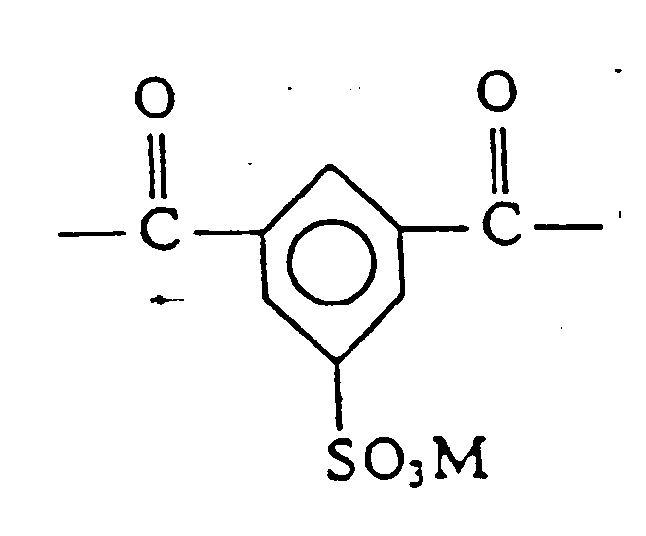
- the preferred additives are sulfonic acid salts, which are the grouping contain, where M is a monovalent metal, and are added in the preparation of the polyethylene terephthalate.
- polyester filaments have the disadvantage that their mechanical properties, particularly their strength, are poor, especially if they have been subjected to a false twist stretch texturing operation. As a result, they are difficult to process on their own or together with other synthetic and / or natural fibers or filaments.
- copolyesters containing both a metal sulfonate compound and a polyalkylene oxide contain a polyethylene oxide of molecular weight 500-6000, or a glycol of the general formula HO (CH 2 ) n OH with 2 ⁇ n ⁇ 10, have better affinities against basic and disperse dyes.
- the three patents mentioned above are limited to smooth yarns, where only the dye affinity, but not the texturing behavior and the processing of the thread, have been taken into account.
- the object of the present invention is to produce a stretch-textured, basic dyeable polyester thread which has a higher strength and is easier to process.
- stretch textured refers to yarns that are obtained by false twisting in the usual way.
- the higher strength of the thread according to the invention is particularly pronounced in false twist stretch texturing of fast-spun POY threads.
- the stretch texturing can be carried out with both magnetic spindle and friction units.
- the titer of the thread is not critical.
- the thread according to the invention can also be swirled subsequently or simultaneously.
- the invention relates to a stretch-tested, basic dyeable polyester thread with improved strength, which is characterized in that it contains 3.0-3.4 mol% of a metal sulfonate with the following structural unit where M is Na or K, and 4.0-6.0% by weight of a compound A with the following structural units -0- (C x1 H 2x1 O) y1 -, where x1 2 2 and x1 y 1 20 20 , which were added before the start of the esterification / transesterification.
- the additives with the structural units mentioned above are incorporated into the polyester chain in an esterification or transesterification reaction.
- This polyester thread modified according to the invention shows a surprisingly high strength, which is good processing, alone or together with other synthetic and / or natural filaments or the like yarn, allowed.
- This modified thread is also white and has good textile properties and a particularly good affinity for basic dyes. It also shows a greater depth of color when colored with disperse dyes.
- Filament or thread here means a yarn with several individual filaments.
- the polyester can be prepared in a conventional manner, e.g. B. in the case of the production of copolester with polyethylene terephthalate, either by direct condensation of ethylene glycol and terephthalic acid or by transesterification of dimethyl terephthalate with ethylene glycol and subsequent polycondensation of the diglycol terephthalate initially formed.
- ethylene glycol other diols such as 1,3-propanediol, 1,4-butanediol, 1,6-hexanediol or cyclohexane-dimethanol and in addition to terephthalic acid or. of the dimethyl terephthalate still other dicarboxylic acids such as isophthalic acid, adipic acid, azelaic acid, dimer fatty acid or. the alkyl esters of these acids can also be used.
- the amount of metal sulfonate added is between 3.0 and 3.4 mol%.
- the metal sulfonate used is preferably the sulfonate of 3,5-isophthalic acid, if the polyester is prepared by an esterification process, or. of 3,5-isophthalic acid dimethyl ester if the polyester is produced by a transesterification process.
- the Na salt is preferably used.
- the amount of compound A added is between 4.0 and 6.0% by weight.
- Compound A is preferably a polyalkylene glycol.
- the polyalkylene glycols are also referred to as polyglycols or as polyalkylene ethers or as polyoxyalkylene glycols or as polyalkylene oxide glycols.
- the polyethylene glycols are preferred and are commercially available as CARBOWAX @ or POLYOX @. Their average molecular weight can be between 400 and 50,000.
- Other polyalkylene glycols, the polypropylene glycols, the polytetrahydrofurans, also called polytetramethylene glycols, e.g. the POLYRAN @ products from BAYER, as well as statistical copolyalkylene glycols such as the polyethylene propylene glycols are also commercially available.
- the molecular weight distribution in these polyalkylene glycols is relatively broad. Products with a narrow molecular weight distribution, free of undyed or acidic impurities, are preferred.
- the compound A can be bis (hydroxyethyl) dimer fatty acid having the following chemical composition be used.
- the latter product is used both in an esterification and transesterification process in polyester production.
- the compounds A which according to the invention can still be used, are compounds which have both a grouping - (CH 2 ) y- and the grouping -O- (C x1 H 2x1 O) y1 -, where x 1 ⁇ 2, y ä 20 and x 1 . y 1 ⁇ 20 are included.
- the polyalkylene glycol esters thus obtained are e.g. B.
- the products UNEM 9991 and UE 80385 with the following chemical composition wherein in the first product the polyalkylene glycol with molecular weight 1500, ie y 1 equal to 33, and in the second product the polyalkylene glycol with molecular weight 1000, ie y 1 equal to 22, was used.
- polyalkylene glycol esters other dicarboxylic acids, such as adipic or terephthalic acid, can also be used instead of fatty acid.
- Compounds A which contain both groups - (CH 2 ) y- and - (C x1 H 2x1 O) y1 , also include the polyalkylene glycol ester amides.
- the thread according to the invention contains 5 to 100% of the basic dyeable polyester filament, i.e. between 0 and 95% of a second component.
- the modified polyester is spun quickly, i.e. between 2700 and 4000 m / min and then false twist stretch textured.
- the thread according to the invention contains less than 100% basic dyeable polyester filaments
- manufacturing processes such. B. according to EP 22 065 used.
- the basic dyeable polyester is spun together with a second artificial polymer such as polyester or polyamide and then stretch-textured. It is also possible to spin the two polymers separately and to combine them only when stretch texturing.
- the filaments thus produced can be used as such or are woven into threads with artificial filaments or staple fiber yarns made of polyester, polyacrylic, viscose or polyamide, or natural fibers made of wool or cotton.
- Stabilizers such as sodium acetate and special antioxidants such as IRGANOXO 1222 or IRGANOXO 259 from Ciba-Geigy can be added to the modified basic dyeable polyester to improve the melt and thermo-oxidative resistance. A more or less pronounced matting is obtained by adding up to 2% of anatase-type titanium dioxide.
- the following substances are added in succession at 230 ° C.: 3 g of phosphorous acid, 50 g of titanium dioxide and 3.5 g of antimony trioxide.
- the pressure is reduced to below 0.5 mbar.
- the vacuum is broken by introducing nitrogen, the polyethylene terephthalate melt is discharged from the autoclave in tape form, cooled and the solidified polymer is cut.
- the granules have a melting point of 250 ° C. and a diethylene glycol content of 1.2% by weight.
- the polymer is white and has a carboxyl end group concentration of 30 mol / t.
- the intrinsic viscosity measured at 25 ° C in a mixture of phenol / tetrachloroethane 1: 1 according to H. Frind, Faserforschung (1954), p. 296 is 0.62.
- the polyester After drying under vacuum or with hot air to a water content of less than 0.01% by weight, the polyester is spun in a known manner through spinnerets according to the following examples.
- Examples 1 to 2 describe the production of uniform threads from basic dyeable, stretch-textured filaments.
- Example 1 is made according to the prior art, while the filament of Example 2 is made according to the invention.
- the polymers were extruded on a conventional spinning machine, then cooled, converged, provided with preparation and wound up at 3100 m / min.
- the filaments consisted of 12 individual filaments and had a titer of 100 dtex. These filaments were then submitted to a magnetic spindle stretch texturing machine and false twist stretch textured with a draw ratio of 1.45 with a false twist of 3500 T / m at a temperature of 190 ° C. and at a speed of 85 m / min.
- the stretch-textured filaments were tested for strength using a TEXTIMAT tensile tester from ZWICK, Ulm (FRG). The measured strengths are listed in Table 1 as relative strength based on the strength of comparative example 1, which was assumed to be 100%. Table 1 shows a higher strength than the comparative example 1 for the filament of example 2 produced according to the invention.
- the filament can be dyed well with basic dyes.
- Examples 3 to 7 describe the production of mixed filaments from base-dyeable and non-base-dyeable filaments, which are brought together before the stretch texturing and at the same time stretch-textured.
- Examples 3 to 5 are not in accordance with the invention, while filaments of Examples 6 and 7 are made in accordance with the invention.
- the polymers were spun in the same way as in Examples 1 and 2 to form filaments with 100 dtex and 12 individual filaments.
- Polyethylene terephthalate polymer was then spun on the same spinning machine without the addition of SIP and compound A to filaments with a titer of 150 dtex and 36 individual filaments at a spinning speed which was 0-40% lower than 3100 m / min.
- the filaments with titer 100 f 12 were each presented to a magnetic spindle stretch texturing machine together with a filament with titer 150 f 36, the two filaments being brought together before stretch texturing and stretch textured together.
- the setting of the stretch texturing machine corresponded to that of Examples 1 and 2 with the exception of the false twist, which was reduced to 2514 T / m.
- the stretch-textured mixed filaments consisting of both parts were tested for strength using the same tensile tester, the measured relative strengths being listed in Table 2.
- Table 2 shows that compared to Comparative Examples 3 to 5, the filaments of Examples 6 and 7 according to the invention have higher relative strength.
- Examples 8 to 13 describe the production of mixed filaments from base-dyeable filaments and non-base-dyeable filaments, which are already brought together after extrusion and cooling and then stretch-textured.
- Example 8 is made according to the prior art, while the filaments of Examples 9 to 13 are made according to the invention.
- the polymers were dried and extruded on a spinning machine to simultaneously process 2 polymers into filaments.
- This machine co-spinning machine
- This machine has 2 separate lines E and F, which lead to a common spinneret plate, where polymer is extruded from line E from a portion of the capillary on the spinneret and from another portion and capillary polymer from line F.
- the filaments are converged to a mixed filament, provided with preparation and wound up at 3300 m / min.
- the polymers according to Table 3 were each extruded in line E, while in line F polyethylene terephthalate was processed without the addition of SIP and compound A.
- the mixed filament obtained had a titer of 235 dtex and 48 individual filaments.
- the mixed filaments with polymer E and with polymer F from examples 8 to 11 were textured on a magnetic spindle stretch texturing machine, the stretch ratio being reduced to 1.35 compared to the setting in examples 3 to 7.
- the mixed filaments with polymer F according to Examples 12 and 13 were textured on a friction drawing texturing machine with a drawing ratio of 1.48, temperature 190 ° C. and a speed of 600 m / min.
- the strength of the mixed filaments obtained was checked with a Textimat tensile tester.
- the relative strengths are shown in Table 3.
- the threads produced according to the invention from examples 9 to 13 have higher strengths.
- the filaments made of polymers according to Table 3 can be dyed well with basic dyes and do not result in any difficulties in further processing.
- the positive properties of the filaments according to the invention are retained if the filaments are fixed in a second heater after the stretch texturing and / or are swirled with an appropriate air nozzle. Likewise, the positive properties of the filaments according to the invention are retained if other titers or other spinning speeds and drawing texturing speeds are used. The positive properties are also preserved if these filaments are filament-wound with filaments or staple fiber yarns made of synthetic or natural fibers.
Landscapes
- Chemical & Material Sciences (AREA)
- Chemical Kinetics & Catalysis (AREA)
- General Chemical & Material Sciences (AREA)
- Engineering & Computer Science (AREA)
- Textile Engineering (AREA)
- Health & Medical Sciences (AREA)
- Medicinal Chemistry (AREA)
- Polymers & Plastics (AREA)
- Organic Chemistry (AREA)
- Artificial Filaments (AREA)
- Yarns And Mechanical Finishing Of Yarns Or Ropes (AREA)
Description
- Die Erfindung betrifft einen strecktexturierten, basisch färbbaren Polyesterfaden mit verbesserter Festigkeit.
- Polyesterfilamente mit Affinität für basische Farbstoffe sind schon bekannt und werden z. B. gemäß CH-A-373 559 durch Zusatz von Metallsulfonaten erhalten. Solche Polyester können gemäß US-A-3 772 872 sogar in einem Schnellspinnprozeß schmelzgesponnen werden. Die bevorzugten Zusatzstoffe sind Sulfonsäuresalze, welche die Gruppierung

- Diese Polyesterfilamente haben jedoch den Nachteil, daß ihre mechanischen Eigenschaften, namentlich ihre Festigkeit, besonders wenn sie einer Falschdrallstrecktexturieroperation unterworfen wurden, schlecht sind. Dadurch sind sie allein oder zusammen mit anderen synthetischen und/oder natürlichen Fasern oder Filamenten schlecht verarbeitbar.
- Aus US-A-3 725 351 ist bekannt, daß Copolyester, die sowohl eine Metallsulfonatverbindung als auch ein Polyalkylenoxid, resp. ein Polyethylenoxid vom Molekulargewicht 500-6000, oder ein Glykol der allgemeinen Formel HO(CH2)nOH mit 2 < n < 10 enthalten, bessere Affinitäten gegen basische und Dispersionsfarbstoffe aufweisen. Ebenfalls ist aus US-A-3 745 141 bekannt, daß wenn man arylaliphatische sulfonierte Polyether dem Polyester zumischt, die Farbstoffaffinität der hergestellten glatten Fäden erhöht wird. Die drei oben erwähnten Patente beschränken sich auf glatte Garne, wo man nur die Farbstoffaffinität, nicht aber das Texturierverhalten und die Weiterverarbeitung des Fadens in Betracht gezogen hat.
- Die Aufgabe dervorliegenden Erfindung ist es, einen strecktexturierten, basisch färbbaren Polyesterfaden herzustellen, der eine höhere Festigkeit aufweist und sich besser verarbeiten läßt.
- Der Begriff »strecktexturiert« bezieht sich auf Garne, die durch Falschzwirnen auf übliche Art erhalten werden. Die höhere Festigkeit des erfindungsgemäßen Fadens ist bei Falschzwirn-Strecktexturierung von schnellgesponnenen POY-Fäden besonders ausgeprägt. Die Strecktexturierung kann sowohl mit Magnetspindel- als auch mit Friktions-Aggregaten durchgeführt werden. Der Titer des Fadens ist nicht kritisch. Der erfindungsgemäße Faden kann auch anschließend oder gleichzeitig verwirbelt werden.
- Gegenstand der Erfindung ist ein strecktesturierter, basisch färbbarer Polyesterfaden mit verbesserter Festigkeit, der dadurch gekennzeichnet ist, dass er 3,0 - 3,4 Mol.-% eines Metallsulfonats mit folgender Struktureinheit

- Die Zusätze mit den obenerwähnten Struktureinheiten werden bei einer Veresterungs- oder Umesterungsreaktion in die Polyesterkette eingebaut.
- Dieser erfindungsgemäß modifizierte Polyesterfaden zeigt eine überraschend hohe Festigkeit, die eine gute Verarbeitung, allein oder zusammen mit anderen synthetischen und/oder natürlichen Filamenten oder Fasergarnen, erlaubt. Dieser modifizierte Faden ist außerdem weiß und besitzt neben guten textiltechnischen Eigenschaften eine besonders gute Affinität für basische Farbstoffe. Weiter zeigt er bei Färbung mit Dispersionsfarbstoffen eine größere Farbtiefe.
- Unter Filament oder Faden versteht man hier ein Garn mit mehreren Einzelfilamenten.
- Die Herstellung der Polyester kann in üblicher Weise erfolgen, z. B. im Falle der Herstellung von Copolgestern mit Polyethylenterephthalat, entweder durch Direktkondensation von Ethylenglykol und Terephthalsäure oder durch Umesterung von Dimethylterephthalat mit Ethylenglykol und anschließende Polykondensation des zunächst gebildeten Diglykolterephthalates. Anstelle von Ethylenglykol können noch andere Diole wie 1,3-Propandiol, 1,4-Butandiol, 1,6-Hexandiol oder Cyclohexan-Dimethanol und neben der Terephthalsäure resp. des Dimethylterephthalates noch andere Dicarbonsäuren wie Isophthalsäure, Adipinsäure, Azelainsäure, Dimerfettsäure resp. die Alkylester dieser Säuren zusätzlich eingesetzt werden.
- Die Zugabe des Sulfonsäuresalzes sowie der Verbindung Aerfolgtvor Beginn der Veresterung der Terephthalsäure resp. Umesterung des Dialkylterephtalates mit dem Glycol. Das Freisetzen des Wassers, resp. Methanols bei der Ver- resp. Umesterung sowie des Glycols bei der anschließenden Polykondensation erfolgt nach bekannter Weise mittels Katalysatoren und bei höheren Temperaturen wie für die Herstellung des Homopolyesters.
- Die zugesetzte Menge des Metallsulfonats liegt zwischen 3.0 und 3.4 Mol-%. Als Metallsulfonatverwendet man bevorzugt das Sulfonat der 3,5-lsophthalsäure, wenn der Polyester nach einem Veresterungsverfahren hergestellt wird, resp. des 3,5-Isophthalsäure-Dimethylesters, wenn der Polyester nach einem Umesterungsverfahren hergestellt wird. Es wird vorzugsweise das Na-Salz eingesetzt.
- Die zugesetzte Menge der Verbindung A liegt zwischen 4.0 und 6.0 Gew.-%.
- Die Verbindung A ist bevorzugt ein Polyalkylenglykol. Die Polyalkylenglykole werden auch als Polyglykole oder als Polyalkylenether oder als Polyoxyalkylenglykole oder auch als Polyalkylenoxidglykole bezeichnet. Die Polyethylenglykole werden bevorzugt eingesetzt und sind als CARBOWAX@ oder POLYOX@ kommerziell erhältlich. Ihr mittleres Molekular gewicht kann zwischen 400 und 50 000 liegen. Andere Polyalkylenglykole, die Polypropylenglykole, die Polytetrahydrofurane, auch Polytetramethylenglykole genannt, z.B. die POLYRAN@-Produkte von BAYER, sowie statistische Copolyalkylenglykole, wie die Polyethylen-propylenglykole sind ebenfalls kommerziell erhätlich. Die Molekulargewichtsverteilung ist bei diesen Polyalkylenglykolen relativ breit. Produkte mit enger Molekulargewichtsverteilung, frei von ungefärbten oder säurehaltigen Verunreinigungen, werden bevorzugt eingesetzt.
- Als Verbindung A, kann erfindungsgemäß die Bis(hydroxyethyl)-Dimerfettsäure mit folgender chemischer Zusammensetzung

- Bei den Verbindungen A, welche erfingungsgemäß noch eingesetzt werden können, handelt es sich um Verbindungen die sowohl eine Gruppierung -(CH2)y- wie die Gruppierung -O-(Cx1 H2x1O)y1-, wobei x1 ≧ 2, y ä 20 und x1 . y1 ≧ 20 sind, enthalten. Solche Verbindungen werden z. B. auch von Unilever Emery mit der Dimerfettsäure und mit Polyalkylenglykolen mit x, = 2 und x1. y1≧ 20 nach bekannten Veresterungsverfahren hergestellt und eingesetzt. Die so erhaltenen Polyalkylenglykolester sind z. B. die Produkte UNEM 9991 und UE 80385 mit folgender chemischer Zusammensetzunq

- Zu den Verbindungen A, die beide Gruppierungen -(CH2)y- und -(Cx1H2x1O)y1 enthalten, gehören auch die Polyalkylenglykolesteramide. Für die Herstellung von diesen Verbindungen, z. B. des Handelsprodukt UNEM 9993 von Unilever Emery werden neben Dimerfettsäure mit y = 34 und Polyethylenglykol mit x1 = 2 und y1 22, noch Ethylendiamin als Bindungsglied eingesetzt.
- Andere Verbindungen A, welche gemäß Erfindung ebenfalls eingesetzt werden können und Polyalkylenglykol-Gruppierungen enthalten, sind z. B. des ethoxylierte Triricinoleat des Glycerins mit 12 bis 60 Kohlenstoffatomen oder ethoxylierte tertiare Amine mit folgender chemischer Zusammensetzung

- Dem Rest, welcher das Polyalkylenglykol trägt wird solange erkurzkettig ist, wenig Bedeutung zugeschrieben. Er darf jedoch die üblichen Fadeneigenschaften wie Reißkraft, Weißgrad nicht zusätzlich verschlechtern. Er erlaubt nur das Einbringen der erfindungsgemäßen Gruppierungen in die Polymerkette. So werden allgemein bei der Herstellung von Polyethylenterephthalat resp. des basisch färbbaren Polyesters Derivate eingesetzt, die Carboxylendgruppen im Falle des Veresterungsverfahrens mit Terephthalsäure oder Ester- bzw. Alkohol-Endgruppen im Falle des Umesterungsverfahrens mit Dimethylterephthalat enthalten.
- Der Faden gemäß Erfindung enthält 5 bis 100% des basisch färbbaren Polyesterfilamentes, d.h. zwischen 0 und 95% einer zweiten Komponente.
- Im Falle, wo der erfindungsgemäße Faden aus 100% basisch färbbaren Polyesterfilamenten besteht, wird der modifizierte Polyester schnellgesponnen, d.h. zwischen 2700 und 4000 m/min aufgewickelt und danach falschdrallstrecktexturiert.
- Im Falle, wo der erfingungsgemäße Faden weniger als 100% basisch färbbare Polyesterfilamente enthält, werden Herstellungsverfahren, wie z. B. gemäß EP 22 065, eingesetzt. In diesem Falle wird der basisch färbbare Polyester zusammen mit einem zweiten künstlichen Polymer, wie Polyester oder Polyamid gesponnen und anschließend strecktexturiert. Es ist auch möglich, die beiden Polymere separat zu spinnen und erst bei der Strecktexturierung zusammenzuführen. Die so hergestellten Filamente sind als solche verwendbar oder werden mit künstlichen Filamenten oder Stapelfasergarnen aus Polyester, Polyacryl, Viskose oder Polyamid, oder natürlichen Fasern aus Wolle oder Baumwolle zu Fäden gefachtet.
- Dem modifizierten basisch färbbaren Polyester können zur Verbesserung der schmelze- und thermooxydativen Beständigkeit Stabilisatoren wie Natriumacetat und besondere Antioxydantien wie IRGANOXO 1222 oder IRGANOXO 259 von Ciba-Geigy zugegeben werden. Eine mehr oder weniger ausgeprägte Mattierung wird durch Zusatz von bis 2% eines Titandioxide vom Anatas-Typ erhalten.
- Im folgenden werden Einzelheiten über Herstellung und chemische Eigenschaften des Polymers, welches für Fäden gemäß Erfindung eingesetzt wird, beschrieben.
- In einem Laborautoklaven gibt man 6,2 kg Ethylenglycol und 10 kg Dimethylterephthalat sowie 300 g des Mononatriumsalzes des 3,5-Sulfoisophthalsäure-Dimethylesters (SIP) und 300 g eines Polyethylenglykols mit Molmasse 4000 als Verbindung A. Als Umesterungskatalysatorwerden 5 g kristallisiertes Manganacetat sowie 13 g kristallisiertes Natriumacetat zugegeben. Die Mischung ist im Laufe von 2,5 Stunden auf 230°C erhitzt, wobei das freiwerdende Methanol und der Glykolüberschuß unter Normaldruck abdestillieren. Bei 230°C gibt man nacheinander die folgenden Substanzen zu: 3 g phosphorige Säure, 50 g Titandioxid und 3,5 g Antimontrioxid. Beim Aufheizen bis 280°C wird der Druck bis unter 0,5 mbar gesenkt. Nach 3,5 h wird durch Einleiten von Stickstoff das Vakum gebrochen, die Polyethylenterephthalat-Schmelze aus dem Autoklaven in Bandform ausgetragen, gekühlt und das erstarrte Polymer geschnitten.
- Das Granulat zeigt bei der DSC-Analyse einen Schmelzpunkt von 250°C und einen Diethylenglykol-Gehalt von 1,2 Gew.-%. Das Polymer ist weiß und weist eine Carboxylendgruppen-Konzentration von 30 mol/t auf. Die Grenzviskosität gemessen bei 25°C in einem Gemisch von Phenol/Tetrachlorethan 1:1 gemäß H. Frind, Faserforschung (1954), S. 296, beträgt 0,62.
- Nach dem Trocknen unter Vakuum oder mit heißer Luft auf einen Wassergehalt von weniger als 0,01 Gew.- %, wird der Polyester in bekannter Weise durch Spinndüsen gemäß folgenden Beispielen versponnen.
- Die Beispiele 1 bis 2 beschreiben die Herstellung von einheitlichen Fäden aus basisch färbbaren, strecktexturierten Filamenten.
- In Anlehnung an das obenbeschriebe Vorgehen wurden 2 verschiedene Polymere aus Polyethylenterephthalat und Zusätzen von SIP und Verbindung A gemäß Tabelle 1 hergestellt.

- Das Filament von Beispiel 1 ist gemäß dem bisherigen Stand der Technik hergestellt, währenddem das Filament des Beispiels 2 gemäß der Erfindung hergestellt ist.
- Die Polymere wurden auf einer üblichen Spinnmaschine extrudiert, anschließend gekühlt, konvergiert, mit Präparation versehen und bei 3100 m/min aufgewickelt. Die Filamente bestanden aus 12 Einzelfilamenten und wiesen einen Titer von 100 dtex auf. Diese Filamente wurden anschließend einer Magnetspindel-Strecktexturiermaschine vorgelegt und mit einem Streckverhältnis von 1,45 mit einem Falschzwirn von 3500 T/m bei einer Temperatur von 190°C und bei einer Geschwindigkeit von 85 m/min falschzwirnstrecktexturiert. Die strecktexturierten Filamente wurden mit einem Zugprüfgerät TEXTIMAT der Firma ZWICK, Ulm (BRD), auf Festigkeit geprüft. Die gemessenen Festigkeiten sind bezogen auf die Festigkeit von Vergleichsbeispeil 1, welche als 100% angenommen wurde, als relative Festigkeit in Tabelle 1 aufgeführt. Tabelle 1 zeigt für das gemäß der Erfindung hergestellte Filament von Beispiel 2 eine höhere Festigkeit als Vergleichsbeispiel 1. Das Filament ist gut mit basischen Farbstoffen färbbar.
- Die Beispiele 3 bis 7 beschreiben die Herstellung von Mischfilamenten aus basisch färbbaren und nicht basisch färbbaren Filamenten, die vor der Strecktexturierung zuzammengeführt und gleichzeitig strecktexturiert werden.
- Die Charakteristik der eingesetzten Polymere aus Polyethylenterephthalat und Zusätzen von SIP und Verbindung A zeigt Tabelle 2:

- Beispiele 3 bis 5 sind nicht gemäß der Erfindung, während Filamente der Beispiele 6 und 7 gemäß der Erfindung hergestellt sind.
- Die Polymere wurden in gleicher Weise wie bei den Beispielen 1 und 2 zu Filamenten mit 100 dtex und 12 Einzelfilamenten versponnen. Auf dergleichen Spinnmaschine wurde anschließend Polyethylenterephthalat-Polymer ohne Zusätze von SIP und Verbindung A zu Filamenten mit Titer 150 dtex und 36 Einzelfilamenten bei einer Spinngeschwindigkeit versponnen, die 0-40% niedriger liegt als 3100 m/min. Die Filamente mit Titer 100 f 12 wurden jeweils zusammen mit einem Filament mit Titer 150 f 36 einer Magentspindel-Strecktexturiermaschine vorgelegt, wobei die beiden Filamente vor dem Strecktexturieren zusammengeführt und gemeinsam strecktexturiert wurden. Die Einstellung der Strecktexturiermaschine entsprach derjenigen von den Beispielen 1 und 2 mit Ausnahme des Falschzwirns, derauf 2514 T/m reduziert wurde. Die aus beiden Teilen bestehenden strecktexturierten Mischfilamente wurden mit dem gleichen Zugprüfgerät auf Festigkeit geprüft, wobei die gemessenen relativen Festigkeiten in Tabelle 2 aufgeführt sind. Tabelle 2 zeigt, daß gegenüber den Vergleichsbeispielen 3 bis 5 die erfindungsgemäßen Filamente von Beispiel 6 und 7 höhere relative Festigkeit aufweisen.
- Alle Mischfilamente wurden mit basischen Farbstoffen Basacrylblau GL der BASF AG und Zusatz eines Carriers Carolied der Tanatex Chem. Corp. gefärbt, wobei die Filamente aus Polymeren mit Zusätzen von SIP eine tiefblaue Färbung zeigten, während die Teilfäden aus Polymeren ohne SIP nicht angefärbt wurden, wodurch zweifarbige Mischfilamente erhalten wurden. Während die Filamente der Vergleichsbeispiele 3 bis 5 bei der Weiterverarbeitung zu Schwierigkeiten führten, waren die Filamente der erfindungsgemäßen Beispiele 6 und 7 dank ihrer höheren Festigkeit problemlos zu verarbeiten.
- Die Beispiele 8 bis 13 beschreiben die Herstellung von Mischfilamenten aus basisch färbbaren Filamenten und nicht basisch färbbaren Filamenten, die bereits nach dem Extrudieren und Abkühlen zusammengeführt and anschließend strecktexturiert werden.
- Für diese Beispiele wurden die in Tabelle 3 angegebenen Polymere aus Polyethyleneterephthalat und Zusätze von SIP und Verbindung A eingesetzt.

- Das Filament von Beispiel 8 ist gemäß bisherigem Stand der Technik hergestellt, währenddem die Filamente der Beispiele 9 bis 13 gemäß der Erfindung hergestellt sind.
- Die Polymere wurden getrocknet und auf einer Spinnmaschine zur gleichzeitigen Verarbeitung von 2 Polymeren zu Filamenten extrudiert. Diese Maschine (Cospinnmaschine) besitzt 2 separate Leitungen E und F, die zu einer gemeinsamen Spinndüsenplatte führen, wo aus einem Anteil an auf der Spinndüse vorhandenen Kappillaren Polymer aus Leitung E und aus einem anderen Anteil and Kapillaren Polymer aus Leitung F extrudiert wird. Nach Abkühlung werden die Filamente zu einem Mischfilament konvergiert, mit Präparation versehen und bei 3300 m/min aufgewickelt.
- Die Polymere gemäß Tabelle 3 wurden jeweils in Leitung E extrudiert, während in Leitung F Polyethylenterephthalat ohne Zusätze von SIP und Verbindung A verarbeiteit wurde. Das erhaltene Mischfilament hatte einen Titer von 235 dtex und 48 Einzelfilamente.
- Die Mischfilamente mit Polymer E und mit Polymer F aus den Beispielen 8 bis 11 wurden auf einer Magnetspindel-Strecktexturiermaschine texturiert, wobei gegenüber der Einstellung bei Beispielen 3 bis 7 das Streckverhältnis auf 1,35 reduziert wurde. Die Mischfilamente mit Polymer F gemäß Beispielen 12 und 13 wurden auf einer Friktions-Strecktexturiermaschine mit Streckverhältnis 1,48, Temperatur 190°C und einer Geschwindigkeit von 600 m/min texturiert.
- Die Festigkeit der erhaltenen Mischfilamente wurde mit einem Zugprüfgerät Textimat geprüft. Die relativen Festigkeiten sind in Tabelle 3 aufgeführt. Gegenüber Vergleichsbeispiel 8 weisen die gemäß der Erfindung hergestellten Fäden aus Beispielen 9 bis 13 höhere Festigkeiten auf. Die Filamente aus Polymeren gemäß Tabelle 3 sind gut mit basischen Farbstoffen färbbar und ergeben keine Schwierigkeiten bei der Weiterverarbeitung.
- Die positiven Eigenschaften der erfindungsgemäßen Filamente bleiben erhalten, wenn die Filamente im Anschluß an die Strecktexurierung in einem zweiten Heizer fixiert werden und/oder mit einer entsprechenden Luftdüse verwirbelt werden. Ebenso bleiden die positiven Eigenschaften der erfindungsgemäßen Filamente erhalten, wenn andere Titer oder andere Spinngeschwinkigkeiten und Strecktexturiergeschwindigkeiten angewendet werden. Die positiven Eigenschaften bleiden ebenso erhalten, wenn diese Filamente mit Filamenten oder Stapelfasergarnen aus synthetischen oder natürlichen Fasern zu Fäden gefachtet werden.
Claims (8)
HOCH2CH2O0C-C34H68-COOCH2CH2OH
oder
HOCH2CH2OOC-C34H68-COO-(CH2CH2O)Y1-COC34H68COOCH2CH2OH,
wobei y1 gleich 22, 23 oder 90 ist.
Priority Applications (1)
| Application Number | Priority Date | Filing Date | Title |
|---|---|---|---|
| AT83900833T ATE15915T1 (de) | 1982-03-30 | 1983-03-16 | Strecktexturierter, basisch faerbbarer polyesterfaden. |
Applications Claiming Priority (2)
| Application Number | Priority Date | Filing Date | Title |
|---|---|---|---|
| CH1935/82 | 1982-03-30 | ||
| CH1935/82A CH671133B5 (de) | 1982-03-30 | 1982-03-30 |
Publications (3)
| Publication Number | Publication Date |
|---|---|
| EP0105285A1 EP0105285A1 (de) | 1984-04-18 |
| EP0105285B1 EP0105285B1 (de) | 1985-10-02 |
| EP0105285B2 true EP0105285B2 (de) | 1992-12-02 |
Family
ID=4222039
Family Applications (1)
| Application Number | Title | Priority Date | Filing Date |
|---|---|---|---|
| EP83900833A Expired - Lifetime EP0105285B2 (de) | 1982-03-30 | 1983-03-16 | Strecktexturierter, basisch färbbarer polyesterfaden |
Country Status (14)
| Country | Link |
|---|---|
| US (1) | US4496716A (de) |
| EP (1) | EP0105285B2 (de) |
| AR (1) | AR242272A1 (de) |
| CA (1) | CA1225191A (de) |
| CH (1) | CH671133B5 (de) |
| DE (1) | DE3360916D1 (de) |
| DK (1) | DK157200C (de) |
| ES (1) | ES8406575A1 (de) |
| FI (1) | FI72537C (de) |
| IE (1) | IE54014B1 (de) |
| IT (1) | IT1170350B (de) |
| PT (1) | PT76446B (de) |
| WO (1) | WO1983003432A1 (de) |
| ZA (1) | ZA832223B (de) |
Families Citing this family (10)
| Publication number | Priority date | Publication date | Assignee | Title |
|---|---|---|---|---|
| JPS5926521A (ja) * | 1982-07-09 | 1984-02-10 | Toray Ind Inc | 改質ポリエステル繊維およびその製造方法 |
| EP0177014B1 (de) * | 1984-10-03 | 1991-01-02 | Teijin Limited | Faser aus modifiziertem Polyester und Verfahren zu deren Herstellung |
| DE3582234D1 (de) * | 1985-01-08 | 1991-04-25 | Toray Industries | Metallplattierter formgegenstand. |
| US4668453A (en) * | 1985-02-15 | 1987-05-26 | E. I. Du Pont De Nemours And Company | Cospinning process |
| US5053482A (en) * | 1990-05-11 | 1991-10-01 | E. I. Du Pont De Nemours And Company | Novel polyesters and their use in compostable products such as disposable diapers |
| DE19507111C1 (de) * | 1995-03-02 | 1996-10-02 | Akzo Nobel Nv | Polyesterfasern oder -fäden mit hoher Pillingresistenz und Verfahren zu deren Herstellung |
| KR100539423B1 (ko) * | 1998-01-15 | 2006-04-12 | 주식회사 코오롱 | 염기성 염료 가염성 공중합 폴리에스테르 조성물 |
| KR19990065965A (ko) * | 1998-01-20 | 1999-08-16 | 조민호 | 염기성 염료 가염성 폴리에스테르 수지 및 그의 제조방법 |
| EP2679709B1 (de) * | 2011-02-21 | 2016-04-06 | Kuraray Co., Ltd. | Kationische färbbare polyesterfaser und konjugatfaser |
| CN114000226B (zh) * | 2021-12-31 | 2022-03-15 | 江苏新视界先进功能纤维创新中心有限公司 | 一种阳离子可染阻燃高强聚酯纤维的制备方法 |
Family Cites Families (12)
| Publication number | Priority date | Publication date | Assignee | Title |
|---|---|---|---|---|
| US3018272A (en) * | 1955-06-30 | 1962-01-23 | Du Pont | Sulfonate containing polyesters dyeable with basic dyes |
| US3104450A (en) * | 1958-01-08 | 1963-09-24 | Du Pont | Textile material |
| DE1258545B (de) * | 1963-04-16 | 1968-01-11 | Eastman Kodak Co | Faeden und Fasern aus modifizierten Polyestern |
| FR2071317A6 (de) * | 1969-12-24 | 1971-09-17 | Cellophane Sa | |
| GB1238850A (de) * | 1967-12-05 | 1971-07-14 | ||
| FR1568976A (de) * | 1968-03-12 | 1969-05-30 | ||
| JPS528418B2 (de) * | 1973-12-13 | 1977-03-09 | ||
| US3922250A (en) * | 1974-09-03 | 1975-11-25 | Phillips Petroleum Co | Late addition of alkali metal sulfonate dye receptivity additive in polyesterification process |
| DE2737239A1 (de) * | 1977-08-18 | 1979-03-15 | Cassella Ag | Egalisiermittel und verfahren zum gleichmaessigen faerben von materialien aus synthesefasern |
| JPS575916A (en) * | 1980-06-13 | 1982-01-12 | Teijin Ltd | Polyester fiber with soft touch and production of knitted and woven fabrics therefrom |
| JPS5763325A (en) * | 1980-10-02 | 1982-04-16 | Toyobo Co Ltd | Copolyester |
| US4390687A (en) * | 1981-09-21 | 1983-06-28 | The Goodyear Tire & Rubber Company | High melt strength elastometric copolyesters |
-
1982
- 1982-03-30 CH CH1935/82A patent/CH671133B5/de unknown
-
1983
- 1983-03-14 IE IE549/83A patent/IE54014B1/en unknown
- 1983-03-16 US US06/556,247 patent/US4496716A/en not_active Expired - Lifetime
- 1983-03-16 EP EP83900833A patent/EP0105285B2/de not_active Expired - Lifetime
- 1983-03-16 WO PCT/CH1983/000035 patent/WO1983003432A1/de not_active Ceased
- 1983-03-16 DE DE8383900833T patent/DE3360916D1/de not_active Expired
- 1983-03-21 CA CA000424031A patent/CA1225191A/en not_active Expired
- 1983-03-24 PT PT76446A patent/PT76446B/pt not_active IP Right Cessation
- 1983-03-28 IT IT48008/83A patent/IT1170350B/it active
- 1983-03-29 ZA ZA832223A patent/ZA832223B/xx unknown
- 1983-03-29 ES ES521560A patent/ES8406575A1/es not_active Expired
- 1983-03-30 AR AR83292610A patent/AR242272A1/es active
- 1983-11-08 FI FI834082A patent/FI72537C/fi not_active IP Right Cessation
- 1983-11-29 DK DK546383A patent/DK157200C/da not_active IP Right Cessation
Also Published As
| Publication number | Publication date |
|---|---|
| AR242272A1 (es) | 1993-03-31 |
| FI834082L (fi) | 1983-11-08 |
| CH671133B5 (de) | 1990-02-15 |
| US4496716A (en) | 1985-01-29 |
| WO1983003432A1 (fr) | 1983-10-13 |
| DK546383A (da) | 1983-11-29 |
| IE54014B1 (en) | 1989-05-10 |
| CA1225191A (en) | 1987-08-04 |
| CH671133GA3 (de) | 1989-08-15 |
| FI834082A0 (fi) | 1983-11-08 |
| PT76446B (fr) | 1985-12-09 |
| ES521560A0 (es) | 1984-08-01 |
| IT1170350B (it) | 1987-06-03 |
| FI72537C (fi) | 1987-06-08 |
| EP0105285A1 (de) | 1984-04-18 |
| DK157200B (da) | 1989-11-20 |
| ES8406575A1 (es) | 1984-08-01 |
| PT76446A (fr) | 1983-04-01 |
| FI72537B (fi) | 1987-02-27 |
| IE830549L (en) | 1983-09-30 |
| DK157200C (da) | 1990-04-23 |
| DE3360916D1 (en) | 1985-11-07 |
| DK546383D0 (da) | 1983-11-29 |
| IT8348008A0 (it) | 1983-03-28 |
| ZA832223B (en) | 1983-12-28 |
| EP0105285B1 (de) | 1985-10-02 |
Similar Documents
| Publication | Publication Date | Title |
|---|---|---|
| EP0503421B1 (de) | Mit Carbodiimiden modifizierte Polyesterfasern und Verfahren zu ihrer Herstellung | |
| DE69637284T2 (de) | Verbesserungen von sulfonatgruppen enthaltenden polyestern, die mit basischen farbstoffen färbbar sind | |
| DE69817212T2 (de) | Copolyester-binderfasern | |
| DE3139127C2 (de) | Copolyester mit verbesserter Anfärbbarkeit | |
| DE69229854T2 (de) | Schwer entflammbare pillarme Polyesterfasern | |
| EP0631638B1 (de) | Polyesterfaser und verfahren zu deren herstellung | |
| DE60114954T2 (de) | Polytrimethylenterephthalatgarn | |
| DE2430533A1 (de) | Polyesterfaeden und verfahren zu deren herstellung | |
| DE2242002A1 (de) | Flammwidrige synthetische lineare polyester sowie geformte gebilde daraus | |
| DE69225172T2 (de) | Zusammengesetzte Faser welche ein feines anorganisches Pulver enthält | |
| DE19841375A1 (de) | Co-Polyesterfaser | |
| EP0105285B1 (de) | Strecktexturierter, basisch färbbarer polyesterfaden | |
| DE1285666C2 (de) | Kraeuselbare zusammengesetzte polyesterfaeden | |
| DE69830164T2 (de) | Polyethylennaphthalatfaser | |
| DE2113859A1 (de) | Faserbildende Polyestermasse,Polyesterfasern und Verfahren zu deren Herstellung | |
| DE69128230T2 (de) | Polyesterharze enthaltende schmelzklebende Verbundfäden | |
| EP0640638A2 (de) | Pillarm und schwer entflammbar modifizierte Polyester, Verfahren zu ihrer Herstellung und daraus geformte Gebilde | |
| DE1469143B2 (de) | Polyesterformmassen | |
| DE2046047B2 (de) | Verfahren zur Herstellung von Poly esterfäden mit einer hohen Affinitat für basische Farbstoffe | |
| EP0991689B1 (de) | Fadenbildende kettenverzweigte polyester und copolyester | |
| EP0648809A1 (de) | Pillarme und schwer entflammbare Mischungen aus einem Phosphor und einem Silizium enthaltenden Polyester | |
| DE1247542B (de) | Spinnmassen auf Grundlage von Gemischen, die lineare Polyester und Zusatzstoffe enthalten | |
| DE2411257A1 (de) | Polyesterfasern mit ausgezeichneter faerbbarkeit und verfahren zu ihrer herstellung | |
| DE1494631B2 (de) | Verfahren zur Herstellung von Polyesterfäden und -folien mit einer verbesserten Färbbarkeit | |
| DE2521352C2 (de) | Mehrkomponenten-stapelfasern |
Legal Events
| Date | Code | Title | Description |
|---|---|---|---|
| PUAI | Public reference made under article 153(3) epc to a published international application that has entered the european phase |
Free format text: ORIGINAL CODE: 0009012 |
|
| AK | Designated contracting states |
Designated state(s): AT BE DE FR GB NL |
|
| 17P | Request for examination filed |
Effective date: 19840331 |
|
| GRAA | (expected) grant |
Free format text: ORIGINAL CODE: 0009210 |
|
| AK | Designated contracting states |
Designated state(s): AT BE DE FR GB NL |
|
| REF | Corresponds to: |
Ref document number: 15915 Country of ref document: AT Date of ref document: 19851015 Kind code of ref document: T |
|
| REF | Corresponds to: |
Ref document number: 3360916 Country of ref document: DE Date of ref document: 19851107 |
|
| ET | Fr: translation filed | ||
| PLBI | Opposition filed |
Free format text: ORIGINAL CODE: 0009260 |
|
| 26 | Opposition filed |
Opponent name: HOECHST AKTIENGESELLSCHAFT, FRANKFURT Effective date: 19860628 Opponent name: ENKA AG Effective date: 19860627 |
|
| NLR1 | Nl: opposition has been filed with the epo |
Opponent name: HOECHST AKTIENGESELLSCHAFT Opponent name: ENKA AG |
|
| NLT1 | Nl: modifications of names registered in virtue of documents presented to the patent office pursuant to art. 16 a, paragraph 1 |
Owner name: RHONE-POULENC VISCOSUISSE SA TE EMMENBRUECKE, ZWIT |
|
| RAP2 | Party data changed (patent owner data changed or rights of a patent transferred) |
Owner name: RHONE-POULENC VISCOSUISSE SA |
|
| PLAB | Opposition data, opponent's data or that of the opponent's representative modified |
Free format text: ORIGINAL CODE: 0009299OPPO |
|
| R26 | Opposition filed (corrected) |
Opponent name: AKZO FASER AKTIENGESELLSCHAFT * 860628 HOECHST AKT Effective date: 19860627 |
|
| NLXE | Nl: other communications concerning ep-patents (part 3 heading xe) |
Free format text: IN PAT.BUL.18/86,CORR.:AKZO FASER AKTIENGESELLSCHAFT |
|
| PUAH | Patent maintained in amended form |
Free format text: ORIGINAL CODE: 0009272 |
|
| STAA | Information on the status of an ep patent application or granted ep patent |
Free format text: STATUS: PATENT MAINTAINED AS AMENDED |
|
| 27A | Patent maintained in amended form |
Effective date: 19921202 |
|
| AK | Designated contracting states |
Kind code of ref document: B2 Designated state(s): AT BE DE FR GB NL |
|
| NLR2 | Nl: decision of opposition | ||
| NLR3 | Nl: receipt of modified translations in the netherlands language after an opposition procedure | ||
| ET3 | Fr: translation filed ** decision concerning opposition | ||
| PGFP | Annual fee paid to national office [announced via postgrant information from national office to epo] |
Ref country code: FR Payment date: 19990301 Year of fee payment: 17 |
|
| PGFP | Annual fee paid to national office [announced via postgrant information from national office to epo] |
Ref country code: AT Payment date: 19990311 Year of fee payment: 17 |
|
| PGFP | Annual fee paid to national office [announced via postgrant information from national office to epo] |
Ref country code: GB Payment date: 19990318 Year of fee payment: 17 |
|
| PGFP | Annual fee paid to national office [announced via postgrant information from national office to epo] |
Ref country code: DE Payment date: 19990319 Year of fee payment: 17 |
|
| PGFP | Annual fee paid to national office [announced via postgrant information from national office to epo] |
Ref country code: NL Payment date: 19990329 Year of fee payment: 17 |
|
| PGFP | Annual fee paid to national office [announced via postgrant information from national office to epo] |
Ref country code: BE Payment date: 19990517 Year of fee payment: 17 |
|
| PG25 | Lapsed in a contracting state [announced via postgrant information from national office to epo] |
Ref country code: GB Free format text: LAPSE BECAUSE OF NON-PAYMENT OF DUE FEES Effective date: 20000316 Ref country code: AT Free format text: LAPSE BECAUSE OF NON-PAYMENT OF DUE FEES Effective date: 20000316 |
|
| PG25 | Lapsed in a contracting state [announced via postgrant information from national office to epo] |
Ref country code: BE Free format text: LAPSE BECAUSE OF NON-PAYMENT OF DUE FEES Effective date: 20000331 |
|
| BERE | Be: lapsed |
Owner name: S.A. RHONE-POULENC VISCOSUISSE Effective date: 20000331 |
|
| PG25 | Lapsed in a contracting state [announced via postgrant information from national office to epo] |
Ref country code: NL Free format text: LAPSE BECAUSE OF NON-PAYMENT OF DUE FEES Effective date: 20001001 |
|
| GBPC | Gb: european patent ceased through non-payment of renewal fee |
Effective date: 20000316 |
|
| PG25 | Lapsed in a contracting state [announced via postgrant information from national office to epo] |
Ref country code: FR Free format text: LAPSE BECAUSE OF NON-PAYMENT OF DUE FEES Effective date: 20001130 |
|
| NLV4 | Nl: lapsed or anulled due to non-payment of the annual fee |
Effective date: 20001001 |
|
| REG | Reference to a national code |
Ref country code: FR Ref legal event code: ST |
|
| PG25 | Lapsed in a contracting state [announced via postgrant information from national office to epo] |
Ref country code: DE Free format text: LAPSE BECAUSE OF NON-PAYMENT OF DUE FEES Effective date: 20010103 |
|
| APAH | Appeal reference modified |
Free format text: ORIGINAL CODE: EPIDOSCREFNO |