EP0095060B1 - Integrierter Impulsformer - Google Patents
Integrierter Impulsformer Download PDFInfo
- Publication number
- EP0095060B1 EP0095060B1 EP83104320A EP83104320A EP0095060B1 EP 0095060 B1 EP0095060 B1 EP 0095060B1 EP 83104320 A EP83104320 A EP 83104320A EP 83104320 A EP83104320 A EP 83104320A EP 0095060 B1 EP0095060 B1 EP 0095060B1
- Authority
- EP
- European Patent Office
- Prior art keywords
- transistor
- supply potential
- field
- effect transistor
- pulse
- Prior art date
- Legal status (The legal status is an assumption and is not a legal conclusion. Google has not performed a legal analysis and makes no representation as to the accuracy of the status listed.)
- Expired
Links
- 230000005669 field effect Effects 0.000 claims abstract description 81
- 239000003990 capacitor Substances 0.000 claims abstract description 33
- 230000000630 rising effect Effects 0.000 claims abstract description 20
- 238000005516 engineering process Methods 0.000 claims abstract description 8
- 230000000694 effects Effects 0.000 claims description 5
- 230000036316 preload Effects 0.000 claims 7
- 230000006399 behavior Effects 0.000 description 8
- 238000010586 diagram Methods 0.000 description 5
- 230000002123 temporal effect Effects 0.000 description 5
- 230000015654 memory Effects 0.000 description 4
- 230000008901 benefit Effects 0.000 description 3
- 230000001960 triggered effect Effects 0.000 description 3
- 240000003517 Elaeocarpus dentatus Species 0.000 description 2
- 230000009471 action Effects 0.000 description 2
- 238000007792 addition Methods 0.000 description 2
- 230000015572 biosynthetic process Effects 0.000 description 2
- 230000008859 change Effects 0.000 description 2
- 230000001934 delay Effects 0.000 description 2
- 230000003111 delayed effect Effects 0.000 description 2
- 230000002349 favourable effect Effects 0.000 description 2
- 238000000034 method Methods 0.000 description 2
- 230000004048 modification Effects 0.000 description 2
- 238000012986 modification Methods 0.000 description 2
- 230000000717 retained effect Effects 0.000 description 2
- 230000006870 function Effects 0.000 description 1
- 230000006872 improvement Effects 0.000 description 1
- 230000003993 interaction Effects 0.000 description 1
- 230000000737 periodic effect Effects 0.000 description 1
- 230000002028 premature Effects 0.000 description 1
- 230000008569 process Effects 0.000 description 1
- 239000004065 semiconductor Substances 0.000 description 1
- 239000013589 supplement Substances 0.000 description 1
Images


Classifications
-
- H—ELECTRICITY
- H03—ELECTRONIC CIRCUITRY
- H03K—PULSE TECHNIQUE
- H03K5/00—Manipulating of pulses not covered by one of the other main groups of this subclass
- H03K5/01—Shaping pulses
- H03K5/02—Shaping pulses by amplifying
- H03K5/023—Shaping pulses by amplifying using field effect transistors
Definitions
- the invention relates to an integrated pulse shaper, which is implemented in MIS circuit technology, connected to a first supply potential and to a second supply potential serving as reference potential and to which control pulses are applied by a pulse generator.
- MIS circuit technology is understood to mean a circuit technology with elements that correspond to the definition of“ MIS structure on page 130 in “Semiconductor Electronics”, Volume 2, Springer-Verlag Berlin-Heidelberg-New York 1973.
- MOS circuits refers to circuits whose transistors correspond to the MOS transistors defined on page 136 of the literature mentioned above.
- Such pulse shapers are often required for dynamic MOS circuits, in particular for RAM memories with one-transistor memory cells, for the operation control.
- the principle used in such pulse shapers is based on the fact that secondary pulses, which are then supplied for further use in the circuit to be supplied, are triggered in the pulse shaper due to the primary pulses supplied by the oscillator.
- the secondary pulses are generated in accordance with a time grid which is determined by the structure of the circuit for the pulse shaper.
- an existing time grid is practically only to defuse, ie to change, via wll changes to the MOS field-effect transistors used in the memory circuit or other integrated MOS circuit.
- this method can only be used to a limited extent because it affects the function of the converter, because it also increases the process dependency and changes the delay between the individual control pulse and the secondary pulse triggered by it, or even a complete absence Impulses can be the result.
- the specified possibility of influencing the time grid cannot be used if the delay of the secondary pulses received via the converter compared to the triggering primary pulses should be less than approximately 5 nsec.
- the invention now aims to derive a secondary pulse from a primary pulse E supplied by a pulse generator, the time delay of which relative to the generator pulse E is determined only by the switching time of a single transistor.
- the MIS field effect transistors used in the circuit in particular MOS field effect transistors, have the same conductivity type of their current-carrying channel. In the preferred embodiments, only normally-off field-effect transistors are used.
- the pulse generator shown in the above-mentioned reference “IEEE Journal of Solid-State Circuits on page 389 in the circuit diagram” can advantageously be used.
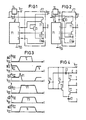
- FIG. 1 The simplest embodiment of a pulse converter according to the invention is shown in FIG. 1 and in FIG. 2 and the associated pulse diagram is shown in FIG.
- FIG. 4 shows a further design for the second mold part
- FIG. 5 brings the still further improved second mold part in connection with a favorable design for the first mold part
- FIG. 6 shows a time diagram belonging to the embodiment according to FIG. 5.
- the pulse generator IG which supplies the primary pulses, that is to say the control pulses E, is provided there both for controlling the first mold part F1 and the second mold part F2.
- the first former F1 has a first signal output 1 which carries a signal P1 and which is used to control the gate of the first field effect transistor T1.
- a second signal output 2 is used to control a second field effect transistor T2 and supplies a signal P2.
- the two field effect transistors T1 and T2 and the other MOS field effect transistors used in the circuit according to FIG. 1, in particular also the field effect transistor T3, are all self-blocking and are preferably of the n-channel type.
- an embodiment is also expedient in which the MOS field-effect transistors used are all of the p-channel type.
- the current paths of the first field effect transistor T1 and the second field effect transistor T2 are in series with one another, the signal output A of the second former F2 and thus the simpler form of the pulse shaper according to the invention being given by a node between the two transistors T1 and T2.
- the source of the second transistor T2 is connected directly to the first terminal of a capacitor C1 and is also connected to the source of the third field effect transistor T3 already mentioned.
- the second connection of the capacitor C1 is connected to the third signal output 3 of the first former F1.
- the gate of the third field effect transistor T3 is directly connected to the drain of this transistor and also to the first supply potential V cc .
- a connection between a supply connection of the second former part F2 and the second supply potential Vss which is connected as a reference potential, is not provided.
- control pulses E supplied by the pulse generator IG are both at a corresponding control input of the first former part F1 and at a control input of the second former part F2, which is given by the drain connection of the first transistor T1 in the second former part F2.
- the third transistor T3 is thus connected as a charging resistor for the capacitor C1.
- the state of charge of this capacitor C1 depends on the one hand on the behavior of the first and second field effect transistors T1 and T2 and on the signal state P3 at the third signal output 3 of the first former F1.
- the same obviously also applies to the signal state at signal output A of the circuit shown in FIG. 1 and thus to the secondary signal emitted by output A (and also denoted by “A”).
- FIG. 3 shows the time behavior of the control signals W, the potentials P1, P2, P3 at the first or at the second or at the third signal output of the first former F1 and the output signal A. Furthermore, FIG. 3 shows the time behavior of the precharge pulses V required in the embodiment according to FIG. 2 of the invention and in the formation of the first former part F1 according to FIG. 5 and which are otherwise common during the operation of dynamic memories.
- the following behavior of the circuit shown in FIG. 1 is triggered at the signal outputs 1, 2 and 3 of the first mold part F1.
- the capacitor C1 is charged to the voltage V cc - U T (T3), where U T (T3) means the threshold voltage for the third field effect transistor T3.
- U T (T3) means the threshold voltage for the third field effect transistor T3.
- the transistor T3 is conductive before the start of the rising edge of the control pulse E, so that the signal input to be applied to the control pulses of the mold part F2 (ie the drain of T1) is connected to the signal output A of F2.
- the voltage value of the signal P1 has the temporal behavior shown in FIG. 3 and corresponding to the definition of the invention (point a)).
- the potential at the source terminal of the second field effect transistor T2 is also increased via the capacitor C1 on the basis of the intended temporal behavior of the signal P3 to be output at the signal output 3 of the first mold part F1.
- the second transistor T2 thus becomes conductive, so that the signal output A of the second former F2 can now be increased to a voltage value above V cc -V ss - and at very high speed.
- the modification shown in FIG. 2 of the circuit of a pulse shaper according to the invention shown in FIG. 1 differs from the circuit according to FIG. 1 in that the third field effect transistor T3 (in contrast to the first transistor T1 and the second transistor T2) is of the self-conducting type and at its gate is controlled by the precharge pulses V (not introduced by the first supply potential V cc ), which have already been introduced and are also shown in FIG. 3 with regard to their time profile.
- These precharge pulses V which are limited exclusively to the pulse pauses between the control pulses E supplied by the pulse generator IG, are generated in a conventional manner.
- Suitable pulse generators of this type are e.g. B. described in DE-OS 2713 319.
- the modification shown in FIG. 2 compared to a circuit in accordance with FIG. 1 has the effect that the starting value at the source of the second transistor T2 is equal to the first supply potential V cc , as a result of which voltage losses at the output A of the second former F2 take place when the second transistor T2 is switched off the non-conductive to the conductive state (that is, at the moment the signal output A is connected to the source terminal of the second field effect transistor T2 and thus to the capacitor C1, whose potential is still at the value V CC - U T (T2)).
- V CC - U T (T2) the capacitor C1 whose potential is still at the value V CC - U T (T2)
- the third field effect transistor T3 is of the self-conducting type in this embodiment, its gate voltage is reduced during the rise in voltage at its source connection, so that part of the surge effect is not suppressed by connection to the first supply potential.
- FIG. 4 The embodiment of a pulse shaper according to the invention shown in FIG. 4 is further developed and improved compared to the embodiment according to FIG. 1.
- two further MOS field effect transistors T4 and T5 of the type of transistors T1, T2 and T3 and a second capacitor C2 are provided.
- the two additional transistors T4 and T5 have a drain at the first supply potential V cc and a source at the gate of the third field effect transistor T3.
- the gate of the fourth transistor T4 is connected to the first supply potential V cc and the gate of the fifth transistor T5 on the one hand also to the gate of the third field effect transistor T3 and on the other hand via the capacitor C2 to the drain of the first field effect transistor T1 and is therefore also directly connected to controlled by the control pulse E supplied by the pulse generator IG.
- this further embodiment according to FIG. 4 ensures that the potential at the source terminal of the second transistor T2 is raised to the value of the first supply potential V cc before the start of the rise of the individual control pulse E, so that thus the effect of the overall circuit of the circuit shown in FIG. 2 corresponds.
- the design of the third field effect transistor T3 provided there as a self-conducting field effect transistor and the control of this transistor T3 by the precharge pulses V is replaced by the design of the second former part F2 according to FIG. 4 in its effect by the action of the two additional field effect transistors T4 and T5.
- FIG. 5 shows the combination of a second shaped part F2 designed in accordance with FIG. 4 and supplemented on the output side by the transistor T6 already mentioned, with a configuration to be preferably used for the first shaped part F1.
- the pulses A occurring at the output A of the second former F2 can also be used with advantage, as already stated above.
- the sixth field effect transistor T6 which is controlled at its gate by the output A of a circuit according to FIG. 4 (or also according to FIG. 2), has its drain at the first supply potential V cc and with its source by means of the source-drain path of the seventh field effect transistor T7 mentioned Supply potential Vss.
- the secondary pulses occurring with an extremely short delay compared to the associated control pulses E can be removed.
- the gate of the seventh field effect transistor T7 is controlled by a node which is located between the two field effect transistors T8 and T9 which form the post-connection NA.
- the drain of one of these two series-connected transistors of the downstream circuit NA, namely the transistor T8, is at the first supply potential V cc and is controlled at its gate by the precharge pulses V which have already been mentioned repeatedly.
- the source of the second transistor T9 in the downstream circuit NA lies at the second supply potential V SS and is controlled at its gate by pulses E * .
- These pulses E * start somewhat earlier than the pulses E and are retained for their respective duration.
- the pulses E * can be generated by an inverter, the input of which is controlled by the precharge pulses V, provided the precharge pulses V and the immediately preceding and following control pulses E are each separated from one another by a voltage-free phase.
- the transistors T1 to T9 used in the former F2 according to FIG. 5 are of the same channel type and preferably all are self-blocking field-effect transistors, that is to say as field-effect transistors of the enhancement type.
- the additions to the second form part F2 shown in FIG. 5 ensure that an increasing potential curve appears at the signal output providing the output signals Q after the rising edge of the individual control pulses E, which is essentially only delayed by the action of the sixth field effect transistor T6, and which is retained even after the individual control pulse E is switched off again.
- the precharge pulse V restores the original state both in the first former F1 and in the second former F2 and in the downstream NA. However, this means the rapid rise at the output of the extended mold part, which supplies the secondary pulses Q.
- F2 is not hampered by the high gate voltage generated by the precharge, in that the transistor T7 remains in the conductive state longer, in the interest of taking advantage of the minimal delay between the Siouer pulse E and the associated secondary pulse -Q the gate of the seventh transistor T7 are blocked by a premature switching off of the voltage at the node between T8 and T9 by a pulse E * already appearing before the rising edge of E at the gate of T9, so that now the delay between the individual control pulses E and the one caused by them each by means of Transformer circuit generated secondary pulses Q is determined solely by the sixth field effect transistor T6 in the second former F2.
- FIG. 5 also contains details of an embodiment for the first former F1, which, as already mentioned, corresponds in its circuit structure to the known pulse shaper in accordance with the "IEEE Journal of Solid-State Circuits".
- the known circuit is used as a pulse generator and not as a first part F1 in the sense of the present invention due to the disclosures in the cited literature.
- the known pulse generator can be used to generate the control pulses E and also the precharge pulses V. For the generation of the precharge pulses V and the control pulses E z. B.
- the first former F1 in the embodiment according to FIG. 5 consists of eleven field effect transistors t1 to t11, which are of the same type as the transistors T1-T9 of the second circuit part, that is to say are generally self-blocking.
- a capacitor C * is also provided.
- the configuration of the circuit in MIS technology ie predominantly in MOS technology, corresponds to the fact that the capacitors C1, C2 and C * of the circuit are implemented by so-called MOS varactors (more generally by MIS varactors) and are integrated into the monolithically integrated one Circuit of the pulse shaper are included.
- the gate of the second transistor t2 is controlled via the seventh and the ninth transistor t7 and t9
- a series connection of two further transistors t3 and t4 corresponding to the two first-mentioned transistors t1 and t2 in the connection to the two supply potentials is connected to the one terminal of the capacitor C * with a circuit point between the two transistors t3 and t4. placed, the second connection both with the gate of the transistor t3 lying at the first supply potential V cc and also to the second signal output 2 and thus to the gate of the first transistor t1.
- the gate of the fourth transistor t4 connected to the second supply potential is directly connected to the gate of the second transistor t2 and is controlled together with the latter by means of the transistors t7 and t9.
- the second connection of said capacitor C * is finally connected via the source-drain path of the fifth field effect transistor t5 to the output of the pulse generator which supplies the control pulses E.
- the time course of the potential at the second connection of the capacitor C and thus at the second signal output 2 of the first former F1 is shown in the time diagram in FIG. 6. 6 also shows the course of the potential II at the connection of the capacitor C1 facing away from the third signal output 3 in the second former part F2, the temporal course of the output signals A and Q as well as the potential course I at the gate of the fifth transistor t5 in the first former part F1 .
- the course of the potential 11 is evidently the same as the course of the potential at the third signal output 3 and the course of the potential I is the same as the course of the potential at the first signal output 1 of the first mold part.
- the gate of the fifth transistor T5 in the first former part F1 is located both at the first signal output 1 of the first former and via the source-drain path of the sixth transistor T6 cc the first supply potential V and via the series circuit of the seventh and of the eighth transistor, that is, the two field effect transistors t7 and t8, also at the first supply potential V cc .
- the series circuit of the eighth transistor t8 with the ninth transistor t9 represents a connection between the gate of the fifth transistor t5 and the first signal output 1 with the reference potential V ss .
- a circuit point between the seventh transistor t7 controlled by the precharge pulses V and that by means of the tenth transistor t10 and the eleventh transistor t11 controlled ninth transistor t9 serves to provide the control potential for the gates of the second transistor t2 and the fourth transistor t4.
- Transistor t8 is controlled by control pulses E and transistor t6 by V.
- the tenth and eleventh transistors also form a series circuit, in which the drain of the gate through the control rimpulse E applied to the eleventh transistor t11 at the first supply potential V cc and the source of the tenth transistor t10 controlled by the precharge pulses V is at the second supply potential V ss .
- the circuit shown in FIG. 5 is thus completely described. It leads to the formation of secondary pulses with a fast positive edge at the signal output A or at the output of the second part of the mold which delivers the pulses Q.
- the individual precharge pulse V causes both the node between the seventh transistor t7 and the ninth transistor t9 and the node between the eighth transistor t8, the sixth transistor t6 and fifth transistor t5 and thus the first signal output 1 to the potential (V cc - U T ) precharged (U T is threshold voltage of t6).
- the gates of t9 and t3 and the node between t3 and t4, the node between t1 and t2 and the output for the secondary signal Q on the second former F2 are initially still at the value of the second supply potential V ss .
- the node located between the capacitor C1 and the two transistors T2 and T3 is charged to the potential (V cc - 2U T ) via these two transistors, U T of the transistors causing the charging (which are assumed to be the same for all transistors for the sake of simplicity is) means.
- the gates of transistors T1 and t5 are bootstrapped together via the channel capacitances of T1 and t5.
- the potential at the second signal output 2 of the first former F1 also goes up.
- the output Q is pulled up directly - specifically delayed by the switching time of T6, which is determined by the dimensioning of this transistor (w / I ratio) - while the potential at the gates of T1 and t5 and on the third Signal output 3 of the first former F1 is held at a value close to the value of the reference potential V ss .
- the value of the potential at the gate of the transistor T3 in the second former F2 is bootstrapped to the maximum value of (U cc + U T ).
- the value of the potential at the with the second transistor T2 and the third transistor as a consequence, preliminarily drawn T3 terminal of the first capacitor C1 connected in the second former F2 in the second former F2 through the intermediary of the third transistor T3 to the value of the first supply potential V cc .
- the potential at the gate of the second transistor T2 then rises above the value of the first supply potential V cc , as a result of which the transistor T2, which has now become conductive, connects the gate of the sixth transistor T6 to the first capacitor C1 in the second former part F2. Since at the same time the potential at the connection of the first capacitor C1 connected to the second transistor T2 and the third transistor T3 in the second former F2 is bootstrapped, an excessive level can reach the gate of the sixth transistor T6 via the node A, as a result of which the output Q lying signal potential assumes the value of the first supply potential V cc .
- the series connection NA consisting of the eighth transistor T8 and the ninth transistor T9 ensures that the output Q remains permanently at the value of the reference potential V ss even after the precharge pulse V has been switched off.
- the gate of the seventh transistor T7 in the second former part F2 via the ninth transistor T9 in the second former part F2 via the ninth transistor T9 has to be compared to the control pulse E somewhat earlier impulse E * can be killed.
- the pulse E * can easily be obtained with the aid of the individual precharge pulses V in a known manner by means of a delay element or an inverter.
- the precharge pulse V can also be applied to the gate of the seventh transistor T7, so that the transistors T8 and T9 can be omitted.
- control pulse can come from any pulse generator that supplies digital pulses. If such a generator delivers several secondary pulses at the same time, each of the signal outputs of the generator JG providing a pulse type can be assigned a converter circuit according to the invention.
Landscapes
- Physics & Mathematics (AREA)
- Nonlinear Science (AREA)
- Dc-Dc Converters (AREA)
- Logic Circuits (AREA)
- Manipulation Of Pulses (AREA)
- Electronic Switches (AREA)
- Surgical Instruments (AREA)
- Electrotherapy Devices (AREA)
Priority Applications (1)
| Application Number | Priority Date | Filing Date | Title |
|---|---|---|---|
| AT83104320T ATE23085T1 (de) | 1982-05-07 | 1983-05-02 | Integrierter impulsformer. |
Applications Claiming Priority (2)
| Application Number | Priority Date | Filing Date | Title |
|---|---|---|---|
| DE19823217264 DE3217264A1 (de) | 1982-05-07 | 1982-05-07 | Integrierter impulsformer |
| DE3217264 | 1982-05-07 |
Publications (3)
| Publication Number | Publication Date |
|---|---|
| EP0095060A2 EP0095060A2 (de) | 1983-11-30 |
| EP0095060A3 EP0095060A3 (en) | 1984-02-22 |
| EP0095060B1 true EP0095060B1 (de) | 1986-10-22 |
Family
ID=6163042
Family Applications (1)
| Application Number | Title | Priority Date | Filing Date |
|---|---|---|---|
| EP83104320A Expired EP0095060B1 (de) | 1982-05-07 | 1983-05-02 | Integrierter Impulsformer |
Country Status (5)
| Country | Link |
|---|---|
| US (1) | US4565933A (enExample) |
| EP (1) | EP0095060B1 (enExample) |
| JP (1) | JPS58205328A (enExample) |
| AT (1) | ATE23085T1 (enExample) |
| DE (2) | DE3217264A1 (enExample) |
Families Citing this family (2)
| Publication number | Priority date | Publication date | Assignee | Title |
|---|---|---|---|---|
| US8450827B2 (en) * | 2011-01-25 | 2013-05-28 | Taiwan Semiconductor Manufacturing Company, Ltd. | MOS varactor structure and methods |
| DE102018007284B4 (de) * | 2018-09-14 | 2020-04-02 | Diehl Metering Gmbh | Pulsgeber |
Family Cites Families (9)
| Publication number | Priority date | Publication date | Assignee | Title |
|---|---|---|---|---|
| US3988617A (en) * | 1974-12-23 | 1976-10-26 | International Business Machines Corporation | Field effect transistor bias circuit |
| IT1073440B (it) * | 1975-09-22 | 1985-04-17 | Seiko Instr & Electronics | Circuito elevatore di tensione realizzato in mos-fet |
| DE2713319C2 (de) * | 1977-03-25 | 1983-08-18 | Siemens AG, 1000 Berlin und 8000 München | Taktgeber für digitale Halbleiterschaltungen |
| DE2837855C2 (de) * | 1978-08-30 | 1984-03-29 | Siemens AG, 1000 Berlin und 8000 München | Impulswandler zur Taktversorgung von digitalen Halbleiterschaltungen |
| DE2851825C2 (de) * | 1978-11-30 | 1987-03-12 | Siemens AG, 1000 Berlin und 8000 München | Integrierte Halbleiterschaltung mit MIS-Feldeffekttransistoren |
| JPS5693422A (en) * | 1979-12-05 | 1981-07-29 | Fujitsu Ltd | Level-up circuit |
| US4431927A (en) * | 1981-04-22 | 1984-02-14 | Inmos Corporation | MOS Capacitive bootstrapping trigger circuit for a clock generator |
| US4472644A (en) * | 1981-12-10 | 1984-09-18 | Mostek Corporation | Bootstrapped clock driver including delay means |
| US4451748A (en) * | 1982-01-15 | 1984-05-29 | Intel Corporation | MOS High voltage switching circuit |
-
1982
- 1982-05-07 DE DE19823217264 patent/DE3217264A1/de not_active Withdrawn
-
1983
- 1983-05-02 EP EP83104320A patent/EP0095060B1/de not_active Expired
- 1983-05-02 AT AT83104320T patent/ATE23085T1/de not_active IP Right Cessation
- 1983-05-02 DE DE8383104320T patent/DE3367144D1/de not_active Expired
- 1983-05-05 US US06/491,986 patent/US4565933A/en not_active Expired - Lifetime
- 1983-05-06 JP JP58079189A patent/JPS58205328A/ja active Granted
Also Published As
| Publication number | Publication date |
|---|---|
| US4565933A (en) | 1986-01-21 |
| JPH0414804B2 (enExample) | 1992-03-16 |
| ATE23085T1 (de) | 1986-11-15 |
| JPS58205328A (ja) | 1983-11-30 |
| EP0095060A3 (en) | 1984-02-22 |
| EP0095060A2 (de) | 1983-11-30 |
| DE3367144D1 (en) | 1986-11-27 |
| DE3217264A1 (de) | 1983-11-10 |
Similar Documents
| Publication | Publication Date | Title |
|---|---|---|
| DE2541131C2 (de) | Schaltungsanordnung zum Konstanthalten der Schaltverzögerung von FET-Inverterstufen in einer integrierten Schaltung | |
| DE3888220T2 (de) | Datenausgabeschaltung. | |
| DE3782367T2 (de) | Mos-halbleiterschaltung. | |
| DE3686283T2 (de) | Hochgeschwindigkeits-cmos-schaltung mit kontrollierter anstiegszeit. | |
| DE3750463T2 (de) | Schalteinrichtung mit dynamischer Hysterese. | |
| DE69710522T2 (de) | Verfahren zur Erzeugung einer variablen Frequenz und variabele Verzögerungszelle zur Durchführung des Verfahrens | |
| DE3228013A1 (de) | Treiberschaltung fuer eine sammelleitung | |
| DE2553517B2 (de) | Verzögerungsschaltung mit Feldeffekttransistoren | |
| DE2659207A1 (de) | Taktgenerator und verzoegerungsstufe | |
| DE2359646A1 (de) | Integrierte treiberschaltung mit feldeffekttransistoren | |
| DE2415098C3 (de) | Amplitudendetektorschaltung | |
| DE3643546C2 (enExample) | ||
| DE1950191A1 (de) | Taktschaltung | |
| DE4117882C2 (enExample) | ||
| DE2623219A1 (de) | Leseverstaerkerschaltung fuer einen dynamischen mos-speicher | |
| EP0058243B1 (de) | Integrierte digitale Halbleiterschaltung | |
| DE3031197C2 (de) | Treiberschaltung mit Feldeffekttransistoren | |
| EP0095060B1 (de) | Integrierter Impulsformer | |
| EP0100432A2 (de) | Signal-Pegelwandler | |
| DE3030790C2 (enExample) | ||
| DE2727241C3 (de) | Durch Taktsignalquelle angesteuertes Logikgatter | |
| DE3203913A1 (de) | Impulsgenerator | |
| DE4004381A1 (de) | Eingangspuffer | |
| DE2053744C3 (de) | Inverterschaltung | |
| DE2657281C3 (de) | MIS-Inverterschaltung |
Legal Events
| Date | Code | Title | Description |
|---|---|---|---|
| PUAI | Public reference made under article 153(3) epc to a published international application that has entered the european phase |
Free format text: ORIGINAL CODE: 0009012 |
|
| AK | Designated contracting states |
Designated state(s): AT DE FR GB |
|
| PUAL | Search report despatched |
Free format text: ORIGINAL CODE: 0009013 |
|
| AK | Designated contracting states |
Designated state(s): AT DE FR GB |
|
| 17P | Request for examination filed |
Effective date: 19840329 |
|
| GRAA | (expected) grant |
Free format text: ORIGINAL CODE: 0009210 |
|
| AK | Designated contracting states |
Kind code of ref document: B1 Designated state(s): AT DE FR GB |
|
| REF | Corresponds to: |
Ref document number: 23085 Country of ref document: AT Date of ref document: 19861115 Kind code of ref document: T |
|
| REF | Corresponds to: |
Ref document number: 3367144 Country of ref document: DE Date of ref document: 19861127 |
|
| ET | Fr: translation filed | ||
| PLBE | No opposition filed within time limit |
Free format text: ORIGINAL CODE: 0009261 |
|
| STAA | Information on the status of an ep patent application or granted ep patent |
Free format text: STATUS: NO OPPOSITION FILED WITHIN TIME LIMIT |
|
| 26N | No opposition filed | ||
| PGFP | Annual fee paid to national office [announced via postgrant information from national office to epo] |
Ref country code: AT Payment date: 20010411 Year of fee payment: 19 |
|
| PGFP | Annual fee paid to national office [announced via postgrant information from national office to epo] |
Ref country code: GB Payment date: 20010511 Year of fee payment: 19 |
|
| PGFP | Annual fee paid to national office [announced via postgrant information from national office to epo] |
Ref country code: FR Payment date: 20010522 Year of fee payment: 19 |
|
| PGFP | Annual fee paid to national office [announced via postgrant information from national office to epo] |
Ref country code: DE Payment date: 20010720 Year of fee payment: 19 |
|
| REG | Reference to a national code |
Ref country code: GB Ref legal event code: IF02 |
|
| PG25 | Lapsed in a contracting state [announced via postgrant information from national office to epo] |
Ref country code: GB Free format text: LAPSE BECAUSE OF NON-PAYMENT OF DUE FEES Effective date: 20020502 Ref country code: AT Free format text: LAPSE BECAUSE OF NON-PAYMENT OF DUE FEES Effective date: 20020502 |
|
| PG25 | Lapsed in a contracting state [announced via postgrant information from national office to epo] |
Ref country code: DE Free format text: LAPSE BECAUSE OF NON-PAYMENT OF DUE FEES Effective date: 20021203 |
|
| GBPC | Gb: european patent ceased through non-payment of renewal fee |
Effective date: 20020502 |
|
| PG25 | Lapsed in a contracting state [announced via postgrant information from national office to epo] |
Ref country code: FR Free format text: LAPSE BECAUSE OF NON-PAYMENT OF DUE FEES Effective date: 20030131 |
|
| REG | Reference to a national code |
Ref country code: FR Ref legal event code: ST |