EP0091401A2 - Herstellung von Prepregs aus cellulosehaltigen Fasern unter Verwendung wässriger Harzzusammensetzungen - Google Patents
Herstellung von Prepregs aus cellulosehaltigen Fasern unter Verwendung wässriger Harzzusammensetzungen Download PDFInfo
- Publication number
- EP0091401A2 EP0091401A2 EP83810126A EP83810126A EP0091401A2 EP 0091401 A2 EP0091401 A2 EP 0091401A2 EP 83810126 A EP83810126 A EP 83810126A EP 83810126 A EP83810126 A EP 83810126A EP 0091401 A2 EP0091401 A2 EP 0091401A2
- Authority
- EP
- European Patent Office
- Prior art keywords
- group
- carbon atoms
- groups
- formula
- represent
- Prior art date
- Legal status (The legal status is an assumption and is not a legal conclusion. Google has not performed a legal analysis and makes no representation as to the accuracy of the status listed.)
- Granted
Links
- 0 CCC(*)(CC)N(C)*C(C)* Chemical compound CCC(*)(CC)N(C)*C(C)* 0.000 description 1
Classifications
-
- C—CHEMISTRY; METALLURGY
- C08—ORGANIC MACROMOLECULAR COMPOUNDS; THEIR PREPARATION OR CHEMICAL WORKING-UP; COMPOSITIONS BASED THEREON
- C08F—MACROMOLECULAR COMPOUNDS OBTAINED BY REACTIONS ONLY INVOLVING CARBON-TO-CARBON UNSATURATED BONDS
- C08F2/00—Processes of polymerisation
- C08F2/46—Polymerisation initiated by wave energy or particle radiation
- C08F2/48—Polymerisation initiated by wave energy or particle radiation by ultraviolet or visible light
-
- C—CHEMISTRY; METALLURGY
- C08—ORGANIC MACROMOLECULAR COMPOUNDS; THEIR PREPARATION OR CHEMICAL WORKING-UP; COMPOSITIONS BASED THEREON
- C08F—MACROMOLECULAR COMPOUNDS OBTAINED BY REACTIONS ONLY INVOLVING CARBON-TO-CARBON UNSATURATED BONDS
- C08F20/00—Homopolymers and copolymers of compounds having one or more unsaturated aliphatic radicals, each having only one carbon-to-carbon double bond, and only one being terminated by only one carboxyl radical or a salt, anhydride, ester, amide, imide or nitrile thereof
- C08F20/02—Monocarboxylic acids having less than ten carbon atoms, Derivatives thereof
- C08F20/10—Esters
- C08F20/34—Esters containing nitrogen, e.g. N,N-dimethylaminoethyl (meth)acrylate
- C08F20/36—Esters containing nitrogen, e.g. N,N-dimethylaminoethyl (meth)acrylate containing oxygen in addition to the carboxy oxygen, e.g. 2-N-morpholinoethyl (meth)acrylate or 2-isocyanatoethyl (meth)acrylate
-
- C—CHEMISTRY; METALLURGY
- C08—ORGANIC MACROMOLECULAR COMPOUNDS; THEIR PREPARATION OR CHEMICAL WORKING-UP; COMPOSITIONS BASED THEREON
- C08J—WORKING-UP; GENERAL PROCESSES OF COMPOUNDING; AFTER-TREATMENT NOT COVERED BY SUBCLASSES C08B, C08C, C08F, C08G or C08H
- C08J5/00—Manufacture of articles or shaped materials containing macromolecular substances
- C08J5/24—Impregnating materials with prepolymers which can be polymerised in situ, e.g. manufacture of prepregs
- C08J5/245—Impregnating materials with prepolymers which can be polymerised in situ, e.g. manufacture of prepregs using natural fibres
-
- G—PHYSICS
- G03—PHOTOGRAPHY; CINEMATOGRAPHY; ANALOGOUS TECHNIQUES USING WAVES OTHER THAN OPTICAL WAVES; ELECTROGRAPHY; HOLOGRAPHY
- G03F—PHOTOMECHANICAL PRODUCTION OF TEXTURED OR PATTERNED SURFACES, e.g. FOR PRINTING, FOR PROCESSING OF SEMICONDUCTOR DEVICES; MATERIALS THEREFOR; ORIGINALS THEREFOR; APPARATUS SPECIALLY ADAPTED THEREFOR
- G03F7/00—Photomechanical, e.g. photolithographic, production of textured or patterned surfaces, e.g. printing surfaces; Materials therefor, e.g. comprising photoresists; Apparatus specially adapted therefor
- G03F7/004—Photosensitive materials
- G03F7/027—Non-macromolecular photopolymerisable compounds having carbon-to-carbon double bonds, e.g. ethylenic compounds
Definitions
- the present invention relates to a process for producing heat-curable prepregs from cellulose-containing fibers and to composites obtained by heat curing such prepregs.
- thermosetting cellulosic prepregs are used industrially, for example in the production of base plates for printed circuits. These fiber reinforced materials are generally made by impregnating cellulosic fibers with an aqueous solution of a phenol / formaldehyde resin, heating the fibers to dry them, re-impregnating them with a solution of an epoxy resin in an organic solvent, and then forming a thermosetting prepreg dries. Finally, the prepreg is heated under pressure (usually in the form of layers arranged one above the other) in order to harden the epoxy resin and thus form a composite.
- epoxy resins are generally too hydrophobic for direct impregnation of cellulosic fibers; the fibers must first be made less hydrophilic by treatment with an aqueous phenolic resin solution.
- British Patent 1 006 587 describes adducts of diglycyl ether with (meth) acrylic acid.
- the disclosed adducts are those of the FormeL where R is a divalent aliphatic radical derived from an ALkandioL or PoLyaLkyLendiol and n is 0 to 20.
- the adducts are hot-polymerized and cured using peroxydimtiators.
- British Patent 1,139,100 describes polymerizable, terminally unsaturated and unreacted epoxy groups-free products which are obtained by reacting (a) 1 MoL of a diepoxide, (b) 0.5 to 0.9 MoL of a dicarboxylic acid and (c) 1.0 to 0.2 MoL acrylic, Me th- acrylic or crotonic acid or a half ester of fumaric or maleic acid are prepared.
- the reaction sequence preferably comprises an initial reaction between (a) and (b) to form a pre-extended epoxy resin and thereafter its reaction with the unsaturated monocarboxylic acid.
- the epoxy resin (a) is a DigLycidy ether of a divalent PhenoLs or ALkohoLs.
- the products are polymerized and hardened using peroxide initiators.
- British Patent 1,362,906 describes adducts of (meth) acrylic acid with epoxy resins which are obtained by pre-elongating an epoxy resin with a polyester having carboxy end groups.
- Oxide resin can be a diglycidyl ether, a diglycidyl ester or an N-heterocyclic polyglycidyl compound such as an N, N-diglycidylhydantoin.
- the adducts with (meth) acr y-latend groups can be polymerized with radical initiators and can be used for the production of moldings.
- British Patent 1,367,207 describes adducts of n mol (meth) acrylic acid with 1 mol of a polyglycidyl compound of the formula where A is a radical with at least one group of the form in which Z represents a divalent radical required to supplement a 5- or 6-membered heterocyclic ring, X represents -H or -CH 3 and n is 2 or 3.
- the preferred polyglycidyl compounds include diglycidyl derivatives of hydantoins.
- diacrylates are prepared by pre-extending 1-GLycidyl-3- (2'-glycidyloxy-n-propyl) -5,5-dimethylhydantoin with sebacic acid and reacting the pre-extended resin with acrylic acid.
- the adducts can be polymerized using Radika initiators.
- British Patent 1,399,135 discloses curing these adducts with ionizing radiation.
- This patent contains a generic disclosure with regard to the use of pre-extended epoxy resins, namely that polyglycidyl compounds containing more than two heterocyclic radicals can be prepared by reacting dicarboxylic acids with diglycidyl compounds in the corresponding molar ratio.
- British Patent 1,400,286 describes the curing of the (meth) acrylate adducts from British Patent 1,362,906 with ionizing radiation.
- the epoxy / ammonia and epoxy / amine products should be 2-hydroxypropyl ethers containing free epoxy groups. It is said that the coating compositions cure very quickly, even in the presence of atmospheric oxygen, especially when using ⁇ -substituted benzoins as photoinitiators, and that they are particularly suitable for paper and cardboard coatings.
- British Patent 1,489,425 discloses light curable resin compositions consisting of a modified epoxy resin and a photosensitizer.
- the modified epoxy resin has a molecular weight of 700 to 5000 and contains polymerizable unsaturated residues which are bonded to the main chain via ester bonds in order to give the resin a double bond equivalent weight of 200 to 3000, and also -COOH groups bonded to the main chain, so that Resin has an acid number in the range 30 to 150.
- One of the production routes given is the reaction of an epoxy resin with a dicarboxylic acid to produce a pre-extended resin, which is then reacted with (meth) acrylic acid to form a resin with (meth) acrylate end groups, which in turn (via its -OH groups) with a dicarbon acid anhydride is brought to reaction.
- Various saturated and unsaturated aliphatic acids mentioned, inter alia, are mentioned for the pre-elongation.
- a bisphenol A diglycidyl ether is pre-extended with adipic acid and the pre-extended resin is converted into an intermediate product with acrylic acid.
- British Patent 1,537,909 describes UV-crosslinkable urethane resins containing vinyl and carboxy groups, which are partially converted into these by converting an epoxy resin with (meth) acrylic acid so that 60X to 100% of the epoxy groups are converted into ⁇ -hydroxyester groups corresponding urethanes can be prepared by reaction with an isocyanate and reaction of the remaining hydroxy groups with a dicarboxylic acid anhydride.
- the epoxy resin can be reacted with e.g. aliphatic or aromatic diacids are pre-extended.
- a diglycidyl ether of bisphenol A is pre-extended with adipic acid and then converted into an intermediate product with acrylic acid.
- a radiation-curable liquid coating composition based on (a) an epoxy resin containing at least one (meth) acryloyl group, (b) a photoinitiator and (c) a crosslinking agent for the epoxy groups in (a) is known from European Patent 0 008 837.
- Resin (a) can be obtained by reacting an epoxy resin with a deficit of (i) (meth) acrylic acid or (ii) a half ester of a hydroxy-substituted (meth) acrylate and a polycarboxylic acid or anhydride.
- a resin based on hydantoin can be used as the epoxy resin are available. Numerous types of crosslinking agents (c) are indicated, preference being given to those which are active at room temperature.
- an emulsifier is added to the resin (a) so that it can be diluted with water after mixing with a suitable crosslinking agent such as a polyamine amide.
- the composition is cured in two stages: in the first stage it is irradiated with UV light, and in the second stage it is cured by reaction of the epoxy groups with (c).
- European patent specification 0 030 213 describes a photo-crosslinkable layer which can be developed after exposure to water and consists of a crosslinkable unsaturated monomer or oligomer based on (meth) acrylic acid-modified epoxy resins with an acid number of less than 0.2 and a photoinitiator .
- an adduct of acrylic acid with an epoxy resin obtained by pre-elongating neopentyl glycol diglycidyl ether with bisphenol A is used there.
- polyesters are generally made by reacting a heterocyclic diepoxide with a dicarboxylic acid; If an excess of diepoxide is used, polyesters with epoxy end groups are obtained which can be reacted with (meth) acrylic acid. Numerous diglycidyl derivatives of hydantoins are proposed for use as a heterocyclic diepoxide. Numerous saturated and unsaturated aliphatic and aromatic acids are mentioned as dicarboxylic acids. In order for the polyester to contain ⁇ -methylene groups, at least a part of the dicarboxylic acid component must be an ⁇ -methylene acid. The polyesters produced in the examples partly carry acrylic latend groups.
- a process has now been found for the preparation of prepregs in which cellulose-containing fibers are impregnated with an aqueous composition consisting of (a) a photopolymerizable resin and (b) an epoxy resin, preferably in the presence of a photosensitizer for (a) and a heat-activatable hardener for (b), and then exposing the impregnated fibers to actinic radiation so that (a) is photopolymerized, with (a) the form in which b is zero or 1 and e is an integer of at least 1, R 14 in each case for a hydrogen atom or a methyl group, R 15 in each case for the divalent radical of a compound having two directly on an oxygen, nitrogen or sulfur atom or -atom-bonded GLycidyL groups after removal of these two GLycidyL groups, R 16 each for the divalent radical of a divalent ALkohoL, a divalent phenol, a dicarboxylic acid or a compound containing two groups
- the resins of Form VIII VIII are not necessarily completely soluble in water, but they are miscible with them and thus promote the impregnation of the fibers with the epoxy resin.
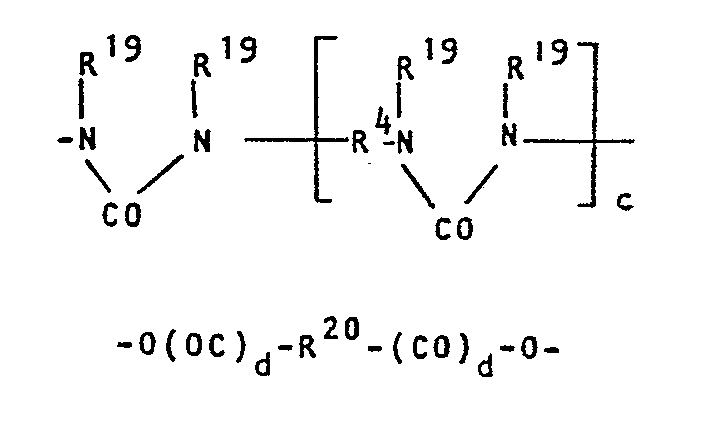
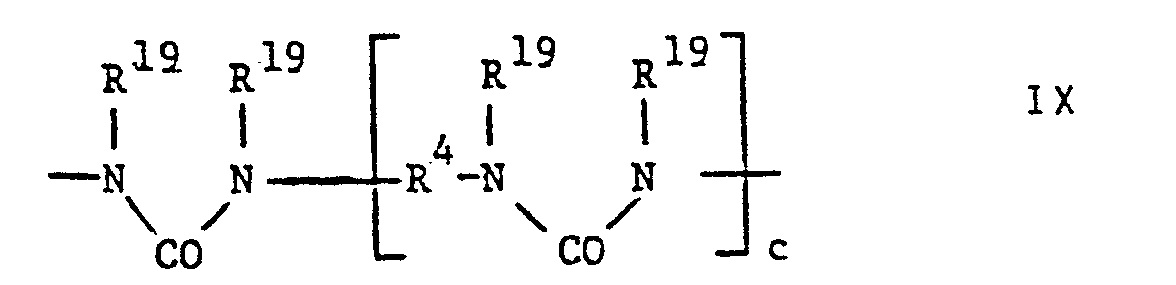
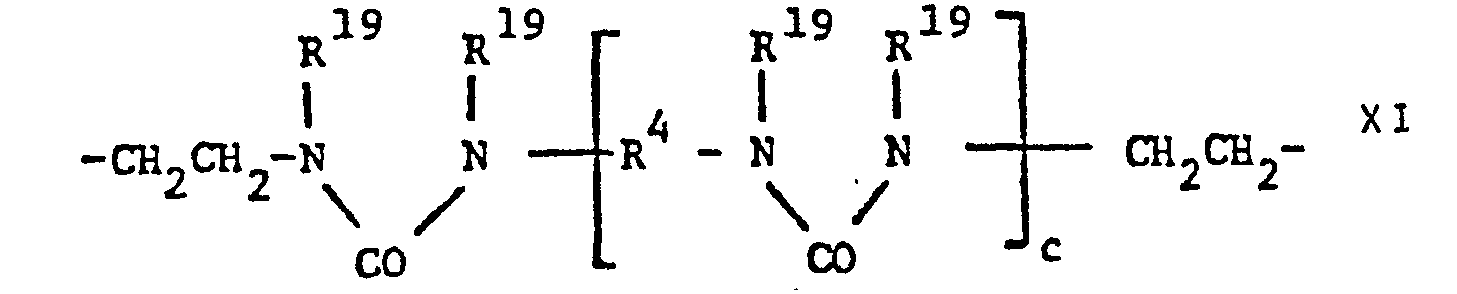
- R 15 and e R 16 groups represent a group of the formulas IX or X where d is 1 and represent at least 25% of the sum of the groups R 15 and R 16 either (i) an oxyaLkyLenoxy group with 2 to 40 carbon atoms optionally interrupted in the chain by one or more ether oxygen atoms, ie a group of the formula X where d is zero, or an oxyalkyLenoxy group with 21 to 40 carbon atoms which does not correspond to the formula IX or X or in particular (ii) an oxyarylenoxy group having 6 to 18 carbon atoms.
- compounds of formula VIII are preferred, wherein at least 25% of the groups R 15 and R 16 j e a Oxyalkyleneoxy group, the alkylene component of which is a chain having 3 to 6 successive carbon atoms or a chain of 4 to 28 carbon atoms interrupted by one or more ether oxygen atoms, an oxyphenyleneoxy group or a group of the formulas in which R 23 represents a carbon-carbon bond, an ether oxygen atom, a carbonyl group, a silicone group, a methyl group or an isopropylidene group.
- both R 17 aLs and R 18 preferably denote ALkyLen groups with 2 to 6 carbon atoms.
- R 20 preferably represents an alkyl group, optionally interrupted by one or more carbonyloxy groups or one or more ether oxygen atoms, with up to 9 carbon atoms.
- Resins which contain groups of the formula IX are particularly preferred, in which each pair R 19 denotes a group of the formula -C (R 21 R 22 ) CO-, where R 21 denotes a methyl, ethyl, n-propyl, n-PentyL, NeopentyL, sec.-AmyL or 2-AethyLhexyL distr and R 22 represent a methyl group or R 21 and R 22 together represent pentamethylene or hexamethylene.
- the groups of the formulas XIII to XXI represent the rest of the 5,5-dimethyLhydantoin, 5-AethyL-5-methyLhydantoin, imidazolidin-2-ones, 1,3-dimethyl urea, hexahydro-2H-pyrimidin-2-ones, 5 -Methyl-5- (2-ethylhexyl) hydantoins, 5,5-pentamethylene hydane toins, 4-methylimidazolidin-2-ones or 1,1'-methylene-bis- (5,5-dimethylhydantoins), while the groups of the formula XXII are the residues of succinic, GLutaric and adipic acids.
- the groups of formulas XXIII to XXVI represent the residues of AethyLengLykoL, butane-1,4-diol, a PoLy-Coxypropylene) glycol with an average molecular weight of 425 or 2,2-bis (4-hydroxyphenyL) propane.
- the resins of formula VIII, in which b is zero, can be produced in two stages.
- the first is the implementation of a dieme from FormeL with a dihydric alcohol, a dihydric phenol, a dicarboxylic acid or an amide or amide-imide of the formula to a pre-extended, linear diepoxide of the formula wherein e, R 15 and R 16 have the meanings given above.
- Such catalysts are, for example, ALkaLihydroxydes such as sodium hydroxide, ALkaLihaLogenide such as lithium chloride, potassium chloride and sodium chloride, bromide or fluoride, tertiary amines such as triethylamine, tri-n-propylamine, N-BenzyLdimethyLaminate, N, nanolammonyl amine such as N, N'-ammonium dimethylamine, N, N'-ammonium amine, N'-n-aminium-dimethylamine, , Quaternary ammonium salts such as tetramethylammonium chloride, tetraethylammonium chloride, benzyltrimethylammonium chloride, benzyltrimethylammonium acetate, and methyltrithylammonium chloride, and hydrazines with a tertiary nitrogen atom, such as 1,1-dimethylhydrazine, which can also be used in its qua
- the reaction sometimes proceeds quantitatively and so quickly that no additional catalyst is required. While the starting materials are generally mixed with one another at room temperature and then brought to the reaction temperature, it is advantageous in the case of components which are very reactive with one another if the diepoxide of formula XXVII is first heated alone to the required reaction temperature and then the remaining reactive components are gradually added small portions. The progress of the reaction until the final product is formed with a defined, essentially constant epoxy group content Can be followed by titration of the epoxy groups in samples taken during the reaction.
- the water-thinnable resin of formula VIII is obtained from the pre-extended diepoxide of formula XXIX by opening the terminal epoxy groups by reaction with acrylic acid or methacrylic acid.
- This reaction generally takes place at a temperature of 60 ° to 150 ° C., in particular at 100 ° to 130 ° C., in the presence of an inert polar solvent such as chloroform.
- the molar ratio of the pre-extended diepoxide of formula XXIX to acrylic acid or methacrylic acid preferably has such a value that essentially all of the GLycidyL groups specified are converted into (meth) acryLoyL-2-hydroxypropyl groups.
- a catalytic converter for the ring opening reaction is expediently present.
- This catalyst can be sodium acetate or preferably a tertiary amine such as one of the above, a quaternary ammonium salt such as one of the above or a salt of trivalent chromium with an alkanoic acid such as octanoic acid and 2-ethylhexanoic acid or an alkenic acid such as acrylic acid.
- a radical inhibitor such as hydroquinone or 2,6-di-tert-butyl-4-methylphenol can be used to counteract the occurrence of side reactions.
- Such inhibitors do not need to be removed after the reaction has taken place, since they do not prevent the polymerisation of the product when exposed to actinic radiation.
- the resins of formula VIII, in which b is 1, can be obtained from the pre-extended linear diepoxides of the formula XXIX by opening the terminal epoxy groups in the reaction with a dicarboxylic acid of the formula wherein R 17 has the meaning given above, or the anhydride of a diacid of formula XXX and subsequent esterification of the terminal carboxylic acid groups thus formed with a hydroxyl group-containing ester of acrylic or methacrylic acid of formula wherein R 14 and R 18 have the meanings given above, produce.
- the ring opening of the epoxy groups is generally carried out as described above for the ring opening of the diepoxides of formula XXIX with acrylic or methacrylic acid, that is, at a temperature of 60-150 0 C in the presence of a catalyst and optionally a free radical inhibitor under the same conditions.
- the esterification with a hydroxy ester of formula XXXI can be carried out under customary esterification conditions, in particular by heating at 60 ° to 150 ° C., especially at 100 ° to 130 ° C., optionally in an inert solvent, preferably water-immiscible, and optionally in the presence of a Perform dehydrating agents. Desired CASES These two steps can be carried out as a single reaction by mixing and heating the reactants in a single vessel.
- the epoxy resins suitable for use as component (b) in the process according to the invention include the diglycidyl ethers of polyvalent phenols such as bisphenol A (2,2-bis (4-hydroxyphenyL) propane) and tetrabromobisphenol A (2,2-bis (3, 5-dibromo-4-hydroxyphenyl) propane) and epoxy resins obtained by pre-extension of these diglycidyl ethers.
- the use of water-soluble N, N-diglycidyl compounds, especially N, N'-diglycidylhydantoins, as the Epoxy resin component is particularly preferred.
- the cellulose-containing fibers can be loose, as a woven sheet or as a non-woven fabric and preferably consist of cotton or paper.
- component (a), i.e. the resin of formula VIII, to component (b), i.e. the epoxy resin, can vary within wide limits, but is preferably in the range 1: 0.5-4.
- the fibers can be impregnated in the usual way.
- the water content is not of critical importance, but it should be limited, for example, to about 2 to 30% by weight, calculated on the aqueous composition, in order to avoid the need for drying.
- the absorption of the composition is usually 50 to 300% by weight, preferably 50 to 150% by weight, calculated on the fiber weight.
- the impregnation mixture can also contain conventional additives such as flame retardants.
- actinic radiation with a wavelength of 200 to 600 nm is preferably used.
- the impregnated fibers are preferably exposed to actinic radiation in the presence of a photosensitizer.
- the photosensitizer is expediently introduced into the impregnation composition.
- Suitable sensitizers include quinones, diphenylcarbinols, 5-nitroacenaphthene, 2-substituted thioxanthones, diphenyl methanes and ⁇ -haloacetophenones such as p-tert-butylphenyl-trichloromethyl ketone, photoredox catalysts such as a mixture of a phenothiazine blue dye or substituted methylene blue (e.g.
- an electron donor such as a sulfinic acid or its SaLz, a phosphine, arsine or thiourea
- benzophenones such as a sulfinic acid or its SaLz, a phosphine, arsine or thiourea
- benzophenones such as a sulfinic acid or its SaLz, a phosphine, arsine or thiourea
- benzophenones such as a sulfinic acid or its SaLz, a phosphine, arsine or thiourea
- benzophenones such as a sulfinic acid or its SaLz, a phosphine, arsine or thiourea
- benzophenones such as a sulfinic acid or its SaLz, a phosphine, arsine or thiourea
- benzophenones such as a sulfinic acid or
- Preferred sensitizers are MichLers ketone (ie 4,4'-bis- (dimethylamino) benzophenone), benzoin-n-butyl ether and mixtures of these two, mixed with a metal salt of the ToLuoL-p-suLfic acid, metal salts of 2- (m- or p -Methoxyphenyl) -quinoxaline-6'- or -7'-sulfonic acid, 1-phenylpropane-1,2-dione-2- (O-ethoxycarbonyl) -oxime, BenziLdimethyLketaL and mixtures of these two, and 2-chlorothioxanthone and its mixtures with BenziLdimethyLketal.
- Suitable actinic radiation sources include carbon arcs, mercury vapor arcs, fluorescent lamps with fluorescent light emitting uLtravioLettes, argon and xenon glow lamps, tungsten lamps and photographic flood lamps. Among them, mercury vapor arcs, in particular sunlamps, fluorescent sunlamps and metal halide lamps, are the most suitable.
- the time required to expose the impregnated fibers depends on various factors, including, for example, the component (a) used, the type of light source and its distance from the fibers, and can easily be determined by series tests.
- the invention further relates to a process for producing a composite article, which is characterized in that a prepreg produced by the process according to the invention is hot-hardened.
- the cellulose-containing fibers are preferably also impregnated with a heat-curing amount of a latent heat hardener for the epoxy resin (b).
- a latent heat hardener for the epoxy resin (b) include dicyandiamide (alone or as a mixture with an N, N-dimethyl-N'-arylurea such as bis- (N, N-dimethylureido) toluene or N, N-dimethyL-N '- (4-chlorophenyl) ) -urea), imidazole and amine complexes of boron trichloride or boron trifluoride. These agents are expediently contained in (a) and (b) incorporated aqueous composition.
- thermoset composite which is generally in the form of a laminated laminate, by conventional methods.
- the epoxy resins and photopolymerizable resins used in the examples are made as follows.
- the epoxy contents are determined by titration with 0.1 N-overchloric acid solution in glacial acetic acid in the presence of excess tetraethylammonium bromide with crystal violet as an indicator. Parts and percentages are always parts by weight and percentages by weight.
- N, N'-DigLycidyL-5,5'-dimethyLhydantoin epoxy content 8.04 val / kg, 100 g
- bisphenol A diglycidyl ether epoxide content 5.30 val / kg, 100 g
- 1.4- Butanediol 37.2 g
- N-phenylimidazole 0.2 g
- Another portion of 2-phenylimidazole (0.2 g) is added and the mixture is heated for a further 5 hours at 120 ° C. and then for 6 1/2 hours at 140 ° C., after which the epoxy content of the mixture is 2.44 vaL / kg.
- N, N'-Diglycidyl-5,5-dimethylhydantoin (epoxy content 8.04 vaL / kg, 100 g)
- the diglycidyl ether of a polyoxypropylene glycol with an average molecular weight of 425 (epoxide content 3.07 val / kg, 200 g)
- bisphenol-A are stirred -diglycidyl ether (epoxy content 5.30 vaL / kg, 100 g), bisphenol-A (100 g) and N-phenylimidazole (0.4 g) for 3 1/2 hours at 120 ° C, after which the epoxy content of the mixture 2.67 val / kg.
- N, N'-Diglycidyl-5,5-pentamethylene hydantoin epoxy content 6.23 eq / kg, 200 g
- 1,4-butanediol 36 g
- N-phenylimidazole 0.4 g 12 1/4 are stirred Hours at 140 ° C and then 3 3/4 hours at 160 ° C, after which the epoxy content has dropped to 2.35 eq / kg.
- Adipic acid (73 g) is added a little at a time, with stirring, to N, N'-diglycidyL-5,5-dimethyLhydantoin (epoxy content 8.04 eq / kg, 200 g) containing N-phenylimidazole (0.4 g), while maintaining the temperature holds at 100 ° C and the addition is carried out over the course of 40 minutes.
- the mixture is heated for a further 4 1/3 hours at 100 ° C., after which the epoxy content has dropped to 2.35 vaL / kg.
- 5.5-DimethyLhydantoin (77.4 g) is added in portions with stirring to a mixture of 1,4-butanediol diglycidyl ether (epoxy content 8.6 vaL / kg, 200 g), the tetramethylammonium chloride (0.25 g) as a pre-extension catalyst contains.
- the mixture is heated to 120 ° C, whereby an exothermic reaction sets in, which raises the temperature to 230 ° C. Then you cool to 100 ° C; the epoxy content is now 2.2 vaL / kg.
- 2,6-Di-t-butyl-4-methylphenol (0.44 g) is used as a polymerization inhibitor and then methacrylic acid (54.6 g) and 2,6-di-tert-butyl-4-methylphenol over an hour (0.88 g). The mixture is heated to 100 ° C. for 3 1/2 hours, after which its epoxy content has dropped to a low value (0.6 val / kg).
- This product corresponds essentially to the formula VIII, in which b is nuLL and R 14 each represents a methyl group, R 15 each represents a group of the formulas X XIV and R 16 each represents a group of the formula XIII.
- N, N'-DigLycidyL-5,5-dimethyLhydantoin (epoxy content 7.88 vaL / kg, 50 g) is heated, which contains 2 drops of a 5X solution of chromium-III-trisoctanoate in PetroLvonher as a catalyst for the subsequent reaction with acrylic acid , to 100 ° C and add adipic acid (14 g) over the course of 1 hour. After the addition is complete, the mixture is heated at 100 ° C. for a further 1 3/4 hours, after which the epoxy content is 3.96 eq / kg. The resin is placed at 100 ° C.
- Acrylic acid (20.8 g), 2,6-di-t-butyl-4-methylphenol (0.2 g) and a 5X solution of chromium III trisoctanoate in petroleum ether (0.1 g) are added in the course of 1/2 hour with stirring at 100 ° C. to epoxy resin A (118.6 g). After the addition is complete, the mixture is heated at 100 ° C. for a further 5 1/2 hours, after which the epoxy content has dropped to a negligible value (0.07 vaL / kg). Then water (23.1 g) is added.
- the product substantially corresponds to the formula VIII in which b is zero, some of the groups R correspond to 15 of the formula XIII and the radical of formula XXVI, the groups R 16 Ox yb u tyLeno x y jury and R 14 represents a hydrogen atom.
- Acrylic acid (50.3 g), 2,6-di-t-butyl-4-methylphenol (0.6 g) and a 5X solution of chromium III trisoctanoate in petroleum ether (0.3 g) are added in the course of 1/2 hour with stirring at 100 ° C. to epoxy resin B (261.5 g). The mixture is heated for a further 4 1/2 hours at 100 ° C., after which the epoxy content has fallen to a negligible value (0.08 val / kg).
- the product corresponds essentially to the formula VIII, in which b is zero, some of the groups R 15 of the form XIII, some of the form XXV and the rest of the form XXVI and the groups R 16 also correspond to the formula XXVI and R 14 denotes a hydrogen atom.
- Epoxy resin C (118 g) is stirred at 100 ° C. and a methacrylic acid (23.8 g), 2,6-di-t-butyl-4-methylphenol (0.4 g) and a 5X solution of chromium III are added -Trisoctanoate in a solution containing PetroLuschher (0.1 g) over the course of 1/2 hour. The mixture is heated for a further 4 1/3 hours at 100 ° C., after which the epoxy content has fallen to a negligible value (0.28 vaL / kg). Then water (45 g) is added.
- the product essentially corresponds to FormeL VIII, in which b is zero, R 14 each represents a methyl group, R 15 each represents a group of formulas XIX and R 16 each represents a group of formula XXIV.
- Epoxy resin D (273 g) is stirred at 100 ° C. and an acrylic acid (46.2 g), 2,6-di-t-butyl-4-methylphenol (0.6 g) and a 5X solution of chromium III are added -solution containing trisoctanoate in petroleum ether (0.3 g) over the course of 1/2 hour. The mixture is heated for a further 2 hours, after which the epoxy content has fallen to a negligible value (0.34 vaL / kg). Then water (30 g) is added.
- the product essentially corresponds to the formula VIII, in which b is nuLL, R 14 each represents a hydrogen atom, R 15 represents a group of formulas XIII and R 16 each represents a group of formulas XXII.
- Diglycidyl hexahydrophthalate (epoxy content 6.4 vaL / kg, 41.2 g) containing tetramethylammonium chloride (0.1 g) and heated to 100 ° C. is added in portions over the course of 1 hour with 5,5-dimethylhydantoin (10.2 g). The mixture is then stirred at 100 ° C. for 4 hours, after which the epoxy content has dropped to 2.45 vaL / kg.
- Succinic anhydride (30 g), 2-hydroxyethyl acrylate (34.2 g), tetramethylammonium chloride (0.2 g) and 2,6-di-t-butyl-4-methylphenol (0.15 g) 3 are stirred in a separate vessel Hours at 90 ° C and then cools down.
- the product, ie 3- (2- (acryloyloxy) ethoxycarbonyl) propion acid (27.2 g) is then mixed with 2,6-di-t-butyl-4-methylphenol (0.1 g) and added to the pre-extended resin over one hour at 100 ° C; the mixture is stirred for 4 1/2 hours at 100 ° C, after which its epoxy content is negligible.
- the product is diluted with 33% water.
- the product corresponds essentially to the formula VIII, in which b is 1, R 18 each represents -CH 2 CH 2 -, R 14 represents a hydrogen atom, R15 represents hexahydrophthaloyl and R 16 represents a group of the formula XIII.
- Photopolymerizable resin I (10 parts) is mixed with 40 parts of an epoxy resin, namely N, N'-diglycidyl-5,5-dimethylhydantoin (epoxy content 7.88 eq / kg), 2 parts of water, 0.5 part of benzyl dimethyl methyl and 1 part Boron trichloride / trimethylamine complex.
- an epoxy resin namely N, N'-diglycidyl-5,5-dimethylhydantoin (epoxy content 7.88 eq / kg)
- 2 parts of water 0.5 part of benzyl dimethyl methyl
- Boron trichloride / trimethylamine complex 0.5 part of benzyl dimethyl methyl and 1 part Boron trichloride / trimethylamine complex.
- the clear solution obtained is used to impregnate electrical quality kraft paper with a basis weight of 60 g / m 2 , the absorption being 100%, calculated on the weight of the paper.
- the impregnated paper is irradiated for 30 seconds on both sides with an 80 W / cm medium-pressure mercury lamp at a distance of 25 cm, which results in a somewhat sticky prepreg.
- Four layers are placed one above the other, heat-cured in a press for 1 hour at 120 ° C under 7 MPa pressure and then post-cured by heating at 140 ° C for 2 hours.
- the laminate is hard and stiff and is not damaged by the puncture test specified in British Standard No. 5102: 1974, Appendix R.
- Photopolymerizable resin I (15 parts) is mixed with 20 parts each of the two epoxy resins N, N'-diglycidyl-5,5-dimethylhydantoin (epoxy content 7.88 val / kg) and with tetrabromobisphenol A to an epoxy content of 2.0 val / kg of pre-extended N, N'-diglycidyl-5,5-dimethylhydantoin, 2.0 parts of water, 0.5 parts of 2-chlorothioxanthone, 2.0 parts of dicyandiamide and 0.5 parts of N- (4-chlorophenyl) - N, N'-dimethylurea.
- This mixture is used to impregnate kraft paper as described in Example 1 and is irradiated on both sides with an 80 W / cm medium-pressure mercury lamp at a distance of 25 cm, which results in a somewhat sticky prepreg.
- Four layers of it are arranged one above the other and heat-cured in a press at 120 ° C. for 1 hour under 7 MPa pressure.
- the resulting, hardened laminate is hard and stiff and is not damaged by the puncture test specified above.
- Photopolymerizable resin II (20 parts) is mixed with 20 parts of an epoxy resin, ie N, N'-diglycidyL-5,5-dimethyLhydantoin, 10 parts of water, 0.2 parts each of BenziLdimethyLketaL and 1-phenyL-1,2-propanedione. 2- (0-ethoxycarbonyl) oxime, 2.6 parts of a mixture of 2,4- and 2,6-bis (N, N-dimethylureido) toluene and 0.65 part of dicyandiamide. When the mixture is heated to 60 ° C, a clear solution is formed.
- an epoxy resin ie N, N'-diglycidyL-5,5-dimethyLhydantoin
- 2- (0-ethoxycarbonyl) oxime 2- (0-ethoxycarbonyl) oxime
- 2- (0-ethoxycarbonyl) oxime 2.6 parts of a mixture of 2,4- and 2,6-bis
- Photopolymerizable resin VII (60 parts) is mixed with 45 parts of epoxy resin C, 5 parts of water, 0.6 part of benzil dimethyl ketal and 2 parts of boron trichloride / octyl dimethylamine complex.
- the clear solution obtained is used to impregnate electrical quality kraft paper with a basis weight of 75 g / m 2 , the absorption being 100%, calculated on the weight of the paper.
- the impregnated paper is irradiated for 3 seconds on both sides with an 80 W / cm medium-pressure mercury lamp at a distance of 25 cm, which results in a non-adhesive prepreg.
- Six layers of this are placed one above the other and heated in a press at 120 ° C for 1 hour under 7 MPa pressure.
- the resulting laminate is hard and stiff and is not damaged by the puncture test specified above.
- Photopolymerizable resin III (50 parts) is mixed with 25 parts of epoxy resin A, 5 parts of water, 0.5 part of benzyl dimethyl methyl and 1 part of boron trifluoride / monoethylamine complex.
- the clear solution obtained is used to impregnate electrical quality kraft paper with a basis weight of 75 g / m 2 , the absorption being 150%, calculated on the weight of the paper.
- the impregnated paper is irradiated for 5 seconds on both sides with an 80 W / cm medium pressure mercury lamp at a distance of 25 cm, which results in a tack-free prepreg.
- Eight layers of them are placed one above the other and heat-cured in a press at 120 ° C for 1 hour under 7 MPa pressure. The resulting laminate is well consolidated and is not damaged by the puncture test specified above.
- Photopolymerizable resin IV (40 parts) is mixed with 25 parts of epoxy resin B, 5 parts of water, 0.5 part of benzaldimethylketal and 0.5 part of N-phenylimidazole.
- the clear solution obtained is used to impregnate electrical quality kraft paper with a basis weight of 75 g / m 2 , the absorption being 200%, calculated on the weight of the paper.
- the impregnated paper is coated on both sides with an 80 W / cm center for 8 seconds pressure mercury lamp irradiated at a distance of 25 cm, which results in a somewhat sticky prepreg.
- Six layers of these are arranged one above the other and heat-cured in a press for 1 hour at 120 ° C. under 7 MPa pressure.
- the resulting laminate is hard and stiff and is not damaged by the puncture test specified above.
- Photopolymerizable resin V (30 parts) is mixed with 25 parts of epoxy resin B, 0.3 part of benzaldimethyl ketal and 0.3 part of boron trichloride / trimethylamine complex.
- the mixture is heated to 60 ° C. to obtain a clear solution which is used to impregnate a woven cotton cloth with a basis weight of 120 g / m 2 , the absorption being 275%, calculated on the weight of the cotton .
- the impregnated cotton is irradiated on both sides with an 80 W / cm medium-pressure mercury lamp at a distance of 25 cm for 2 seconds, which results in a tack-free prepreg.
- Six layers of these are arranged one above the other and heat-cured in a press for 1 hour at 120 ° C. under 7 MPa pressure.
- the resulting laminate is hard and flexible and is not damaged by the puncture test specified above.
- Photopolymerizable resin VI (30 parts) is mixed with 25 parts of epoxy resin B, 5 parts of water, 0.5 part of benzyl dimethyl methylene and 0.5 part of boron trichloride / trimethylamine complex.
- the clear solution obtained is used to impregnate a woven cotton cloth with a weight per unit area of 120 g / m 2 , the absorption being 50%, calculated on the weight of the cotton.
- the impregnated cotton is irradiated for 5 seconds on both sides with an 80 W / cm medium-pressure mercury lamp at a distance of 25 cm, which results in a tack-free prepreg.
- Four layers of it are arranged one above the other and heat-cured in a press for 1 hour at 120 ° C under 7 MPa pressure.
- the resulting laminate is hard and flexible and is made by the above specified puncture test not damaged.
Landscapes
- Chemical & Material Sciences (AREA)
- Health & Medical Sciences (AREA)
- Chemical Kinetics & Catalysis (AREA)
- Medicinal Chemistry (AREA)
- Polymers & Plastics (AREA)
- Organic Chemistry (AREA)
- Engineering & Computer Science (AREA)
- Materials Engineering (AREA)
- Physics & Mathematics (AREA)
- Manufacturing & Machinery (AREA)
- Spectroscopy & Molecular Physics (AREA)
- General Physics & Mathematics (AREA)
- Epoxy Resins (AREA)
- Macromonomer-Based Addition Polymer (AREA)
- Reinforced Plastic Materials (AREA)
Abstract

Description
- VorLiegende Erfindung betrifft ein Verfahren zur HersteLLung heisshärtbarer Prepregs aus cellulosehaltigen Fasern sowie durch Heisshärtung solcher Prepregs erhaltene Verbundstoffe.
- Aus heisshärtbaren ceLLuLosehaLtigen Prepregs hergestellte Laminate werden industriell verwendet, zum Beispiel bei der Erzeugung von Sockelplatten für gedruckte SchaLtungen. Diese faserverstärkten Materialien werden allgemein dadurch hergestellt, dass man cellulosehaltige Fasern mit einer wässrigen Lösung eines Phenol/Formaldehydharzes imprägniert, die Fasern erhitzt, um sie zu trocknen, sie mit einer Lösung eines Epoxidharzes in einem organischen Lösungsmittel nochmals imprägniert und dann unter Bildung eines heisshärtbaren Prepregs trocknet. SchLiessLich wird der Prepreg unter Druck (Üblicherweise in Form übereinander angeordneter Schichten) erhitzt, um das Epoxidharz zu härten und so einen Verbundstoff zu bilden.
- Der Grund für die Notwendigkeit, zwei getrennte Imprägnierungs- und Trocknungsstufen durchzuführen, besteht darin, dass Epoxidharze im allgemeinen für eine direkte Imprägnierung cellulosehaltiger Fasern zu hydrophob sind; die Fasern müssen zunächst durch BehandLung mit einer wässrigen Phenolharzlösung weniger hydrophil gemacht werden.
- Wegen der Notwendigkeit für zwei Imprägnierungsstufen und zwei Trocknungsstufen ist die Durchführung des Verfahrens verhältmsmässig teuer, Langsam und kompliziert. Es besitzt ferner den NachteiL, dass für die zweite Imprägnierung ein organisches LösungsmitteL erforderlich ist, wodurch mögliche Gefahren bezüglich Toxizität und Brennbarkeit sowie Kosten zur Rückgewinnung des organischen Lösungsmittels entstehen.
- Es wurde nun gefunden, dass man diese NachteiLe im wesentlichen durch die Anwendung eines Verfahrens Uberwinden kann, das eine einzige Imprägnierungsstufe mit einer wässrigen heisshärtbaren Formulierung umfasst, die ein Epoxidharz zusammen mit einem bestimmten photopolymerisierbaren Harz enthält.
- Die britische Patentschrift 1 006 587 beschreibt Addukte von Diglycldyläthern mit (Meth)acryLsäure. Unter den offenbarten Addukten finden sich solche der FormeL

- In der britischen Patentschrift 1 139 100 werden polymerisierbare, endständig ungesättigte und von nicht umgesetzten Epoxigruppen freie Produkte beschrieben, die durch Umsetzung von (a) 1 MoL eines Diepoxids, (b) 0,5 bis 0,9 MoL einer Dicarbonsäure und (c) 1,0 bis 0,2 MoL AcryL-, Meth- acryL- oder Crotonsäure oder eines HaLbesters der Fumar-oder MaLeinsäure hergestellt werden. Die Reaktionsfolge umfasst vorzugsweise eine anfängliche Reaktion zwischen (a) und (b) zur BiLdung eines vorverlängerten Epoxidharzes und danach dessen Reaktion mit der ungesättigten Monocarbonsäure. Das Epoxidharz (a) ist ein DigLycidyLäther eines zweiwertigen PhenoLs oder ALkohoLs. Die Produkte werden mittels Peroxydinitiatoren polymerisiert und gehärtet.
- In der britischen Patentschrift 1 362 906 sind Addukte aus (Meth)acryLsäure mit Epoxidharzen beschrieben, die man durch VorverLängerung eines Epoxidharzes mit einem PoLyester mit CarboxyLendgruppen erhält. ALs Ausgangsepoxidharz kann ein Diglycldyläther, ein Diglycidylester oder eine N-heterocyclische Polyglycidylverbindung wie ein N,N-Diglycidylhydantoin vorliegen. Die Addukte mit (Meth) acry-Latendgruppen Lassen sich mit Radikalinitiatoren polymerisieren und sind zur HersteLLung von Formkörpern verwendbar.
- Die britische Patentschrift 1 367 207 beschreibt Addukte von n Mol (Meth)acrylsäure mit 1 Mol einer PolyglycidyLverbindung der FormeL


- In der britischen Patentschrift 1 399 135 wird die Härtung dieser Addukte mit ionisierender StrahLung offenbart. Dieses Patent enthält eine gattungsmässige Offenbarung bezüglich der Verwendung vorverlängerter Epoxidharze, nämLich dass mehr als zwei heterocyclische Reste enthaltende PoLygLycidylverbindungen durch Umsetzung von Dicarbonsäuren mit Digtycidylverbindungen im entsprechenden MolverhäLtnis hergestellt werden können.
- In der britischen Patentschrift 1 400 286 wird die Härtung der (Meth)acryLataddukte aus der britischen Patentschrift 1 362 906 mit ionisierender StrahLung beschrieben.
- Aus der britischen Patentschrift 1 456 486 sind Lufttrocknende, Lichthärtbare Ueberzugszusammensetzungen auf GrundLage eines Produkts bekannt, das man durch Umsetzung von mindestens 60X der Epoxidgruppen eines PoLyepoxids mit 0,01 bis 0,5 NH-AequivaLenten Ammoniak, eines aLiphatischen oder cycloaliphatischen primären oder sekundären Amins oder eines Gemischs dieser Verbindungen pro EpoxidäquivaLent und anschLiessend mit 0,99 bis 0,5 Carboxyläquivalenten AcryL- und/oder MethacryLsäure erhält. SpezieLL erwähnte PoLyepoxide sind dabei die Glycidyläther mehrwertiger ALkohoLe (einschLiessLich 1,4-ButandioL) und PhenoLe sowie PolygLycidylester; aromatische PoLyepoxide werden bevorzugt. Die Epoxid/Ammoniak- und Epoxid/Aminprodukte soLLen freie Epoxidgruppen enthaltende 2-HydroxypropyLäther sein. Es heisst, dass die Ueberzugszusammensetzungen sehr rasch härten, sogar in Gegenwart von Luftsauerstoff, insbesondere bei Verwendung α-substituierter Benzoine als Photoinitiatoren, und dass sie sich besonders für Papier- und KartonUberzüge eignen.
- Die britische Patentschrift 1 489 425 offenbart Lichthärtbare, aus einem modifizierten Epoxidharz und einem PhotosensibiLisator bestehende Harzzusammensetzungen. Das modifizierte Epoxidharz besitzt ein MoLekuLargewicht von 700 bis 5000 und enthält polymerisierbare ungesättigte Reste, die Uber Esterbindungen an die Hauptkette gebunden sind, um dem Harz ein DoppeLbindungsäquivaLentgewicht von 200 bis 3000 zu verLeihen, sowie auch an die Hauptkette gebundene -COOH-Gruppen, damit das Harz eine SäurezahL im Bereich 30 bis 150 aufweist. Bei einem der angegebenen HersteLLungswege handelt es sich um die Reaktion eines Epoxidharzes mit einer Dicarbonsäure zur Erzeugung eines vorverlängerten Harzes, das dann mit (Meth)acrylsäure zu einem Harz mit (Meth)acrylatendgruppen umgesetzt wird, welches seinerseits (über seine -OH-Gruppen) mit einem Dicarbonsäureanhydrid zur Reaktion gebracht wird. Erwähnte zur VorverLängerung geeignete Dicarbonsäuren sind unter anderem verschiedene gesättigte und ungesättigte aliphatische Säuren erwähnt. In einem Beispiel wird ein Bisphenol-A-diglycidyläther mit Adipinsäure vorverlängert und das vorverLängerte Harz mit AcryLsäure zu einem Zwischenprodukt umgesetzt.
- Aus der britischen Patentschrift 1 521 933 sind Harze bekannt geworden, die vor der BeLichtung mit aktinischer StrahLung wasserlöslich sind, jedoch bei BeLichtung mit aktinischer StrahLung polymerisieren und wasserunltislich werden, wobei diese Harze der aLLgemeinen FormeL


- Die britische Patentschrift 1 537 909 beschreibt UV-vernetzbare, VinyL- und Carboxygruppen enthaltende Urethanharze, die durch Umsetzung eines Epoxidharzes mit (Meth)acryLsäure, so dass 60X bis 100% der Epoxidgruppen in β-Hydroxyestergruppen umgewandelt werden, teilweise Ueberführung dieser Hydroxygruppen in die entsprechenden Urethane durch Reaktion mit einem Isocyanat und Umsetzung der verbleibenden Hydroxygruppen mit einem Dicarbonsäureanhydrid hergestellt werden. Das Epoxidharz kann durch Reaktion mit z.B. aliphatischen oder aromatischen Disäuren vorverlängert werden. In einem BeispieL wird ein Diglycidyläther von BisphenoL A mit Adipinsäure vorverlängert und dann mit AcryLsäure zu einem Zwischenprodukt umgesetzt.
- Aus der europäischen Patentschrift 0 008 837 ist eine strahlungshärtbare flüssige Ueberzugszusammensetzung auf GrundLage (a) eines mindestens eine (Meth)acryloylgruppe enthaltenden Epoxidharzes, (b) eines Photoinitiators und (c) eines VernetzungsmitteLs für die Epoxidgruppen in (a) bekannt. Das Harz (a) ist durch Umsetzung eines Epoxidharzes mit einem Unterschuss von (i) (Meth)acryLsäure oder (ii) einem HaLbester eines hydroxysubstituierten (Meth)-acrylats und einer PoLycarbonsäure bzw. -anhydrid erhältLich. ALs Epoxidharz kann ein Harz auf HydantoingrundLage vorliegen. Zahlreiche Typen Vernetzungsmittel (c) werden angegeben, wobei die bei Raumtemperatur aktiven bevorzugt werden. In einer speziellen Ausführungsform wird dem Harz (a) ein EmuLgator zugesetzt, so dass es nach Vermischen mit einem geeigneten Vernetzungsmittel wie einem PoLyaminoamid mit Wasser verdünnt werden kann. Die Härtung der Zusammensetzung erfolgt in zwei Stufen: in der ersten Stufe wird sie mit UV-Licht bestrahlt, und in der zweiten Stufe erfolgt die Aushärtung durch Reaktion der Epoxidgruppen mit (c).
- Die europäische Patentschrift 0 030 213 beschreibt eine photovernetzbare Schicht, die nach BeLichtung mit Wasser entwickelt werden kann und aus einem vernetzbaren ungesättigten Monomer oder OLigomer auf GrundLage mit (Meth)-acrylsäure modifizierter Epoxidharze mit einer SäurezahL von weniger als 0,2 sowie einem Photoinitiator besteht. In einem Beispiel wird dort ein Addukt von Acrytsäure mit einem durch VorverLängerung von Neopentylglykoldiglycidyläther mit Bisphenol A erhaltenen Epoxidharz verwendet.
- Die U.S. Patentschrift 4 309 529 offenbart in Wasser dispergierbare, durch Energie härtbare PoLyester mit Hydantoingruppen sowie α-Methylengruppen (=CH2) an der "Hauptkette". Diese PoLyester enthalten wiederkehrende Einheiten der FormeL:
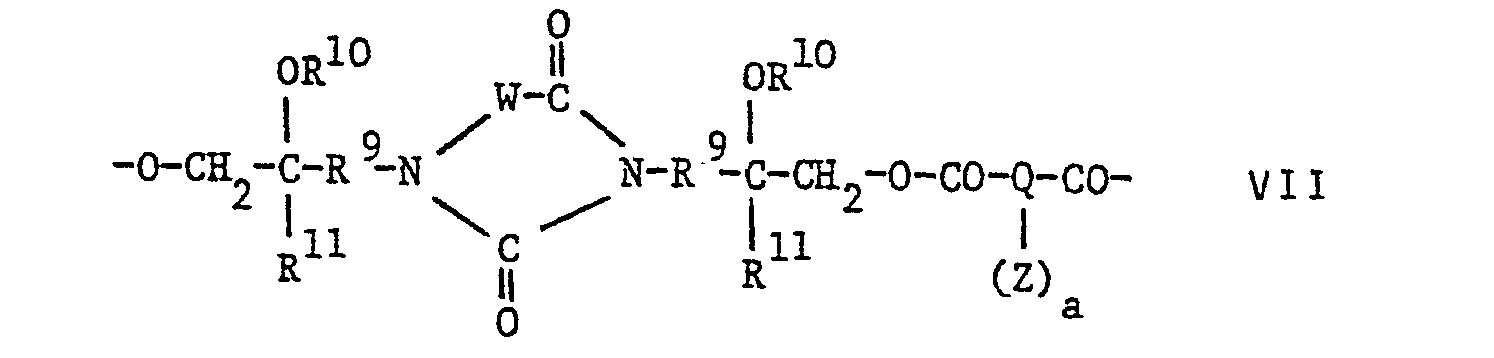
- In der erfindungswesentlichen Beschreibung wurde ausgeführt, dass mindestens 10 Mol-% der Säuren, von denen sich Q ableitet. α-Methylengruppen tragen soLLen. Die PoLyester werden allgemein durch Umsetzung eines heterocycLischen Diepoxids mit einer Dicarbonsäure hergesteLLt; wird ein Ueberschuss Diepoxid eingesetzt, so erhält man PoLyester mit Epoxidendgruppen, die mit (Meth)acryLsäure umgesetzt werden können. Dabei werden zahlreiche DigLycidyLderivate von Hydantoinen zur Verwendung als heterocyclisches Diepoxid vorgeschlagen. ALs Dicarbonsäuren werden unter anderem zahlreiche gesättigte und ungesättigte aliphatische und aromatische Säuren erwähnt. Damit die PoLyester α-Methylengruppen enthaLten, muss mindestens ein TeiL der Dicarbonsäurekomponente eine α-Methylensäure sein. Die in den BeispieLen hergesteLLten PoLyester tragen teilweise Acry-Latendgruppen.
- Es wurde nun ein Verfahren zur HersteLLung von Prepregs gefunden, bei dem man cellulosehaltige Fasern mit einer wässrigen Zusammensetzung imprägniert, die aus (a) einem photopolymerisierbaren Harz und (b) einem Epoxidharz, vorzugsweise in Gegenwart eines PhotosensibiLisators für (a) und eines hitzeaktivierbaren Härters für (b), besteht, und dann die imprägnierten Fasern mit aktinischer StrahLung beLichtet, so dass (a) photopolymerisiert wird, wobei (a) der FormeL



- Die Harze der FormeL VIII sind zwar nicht unbedingt völlig LösLich in Wasser, doch sind sie damit mischbar und fördern so die Imprägnierung der Fasern mit dem Epoxidharz.
- Bevorzugt werden solche Harze der FormeL VIII, worin e eine ganze Zahl von höchstens 10, insbesondere von 1 bis 5, ist. Vorzugsweise stellen höchstens 75% der Summe der (e+1) R15- und e R16-Gruppen eine Gruppe der FormeL IX oder X dar, worin d 1 ist, und mindestens 25% der Summe der Gruppen R15 und R16 bedeuten entweder (i) eine gegebenenfalls in der Kette durch ein oder mehrere Aethersauerstoffatome unterbrochene OxyaLkyLenoxygruppe mit 2 bis 40 KohLenstoffatomen, d.h. eine Gruppe der FormeL X, worin d null ist, oder eine nicht der FormeL IX oder X entsprechende OxyalkyLenoxygruppe mit 21 bis 40 KohLenstoffatomen oder insbesondere (ii) eine OxyaryLenoxygruppe mit 6 bis 18 KohLenstoffatomen.
- Ferner werden Verbindungen der FormeL VIII bevorzugt, worin mindestens 25% der Gruppen R15 und R16 je eine Oxyalkylenoxygruppe, deren Alkylenkomponente eine Kette mit 3 bis 6 aufeinanderfolgenden Kohlenstoffatomen oder eine durch ein oder mehrere Aethersauerstoffatome unterbrochene Kette von 4 bis 28 Kohlenstoffatomen ist, eine Oxyphenylenoxygruppe oder eine Gruppe der FormeL

- Ist b 1, so bedeuten sowohl R17 aLs auch R18 vorzugsweise ALkyLengruppen mit 2 bis 6 Kohlenstoffatomen.
- R20 steht vorzugsweise für eine gegebenenfalls durch eine oder mehrere CarbonyLoxygruppen oder ein oder mehrere Aethersauerstoffatome unterbrochene ALkyLengruppe mit bis zu 9 KohLenstoffatomen.
- Besonders bevorzugt sind solche Harze, die Gruppen der Formel IX enthalten, worin jedes Paar R19 eine Gruppe der FormeL -C(R21R22)CO- bedeutet, wobei R21 für eine MethyL-, AethyL-, n-PropyL-, n-PentyL-, NeopentyL-, sek.-AmyL- oder 2-AethyLhexyLgruppe und R22 für eine MethyLgruppe stehen oder R21 und R22 zusammen PentamethyLen oder HexamethyLen darsteLLen.
- SpezieLLe BeispieLe für als R15 und R16 geeignete Gruppen, wenn diese auch der FormeL IX entsprechen, sind
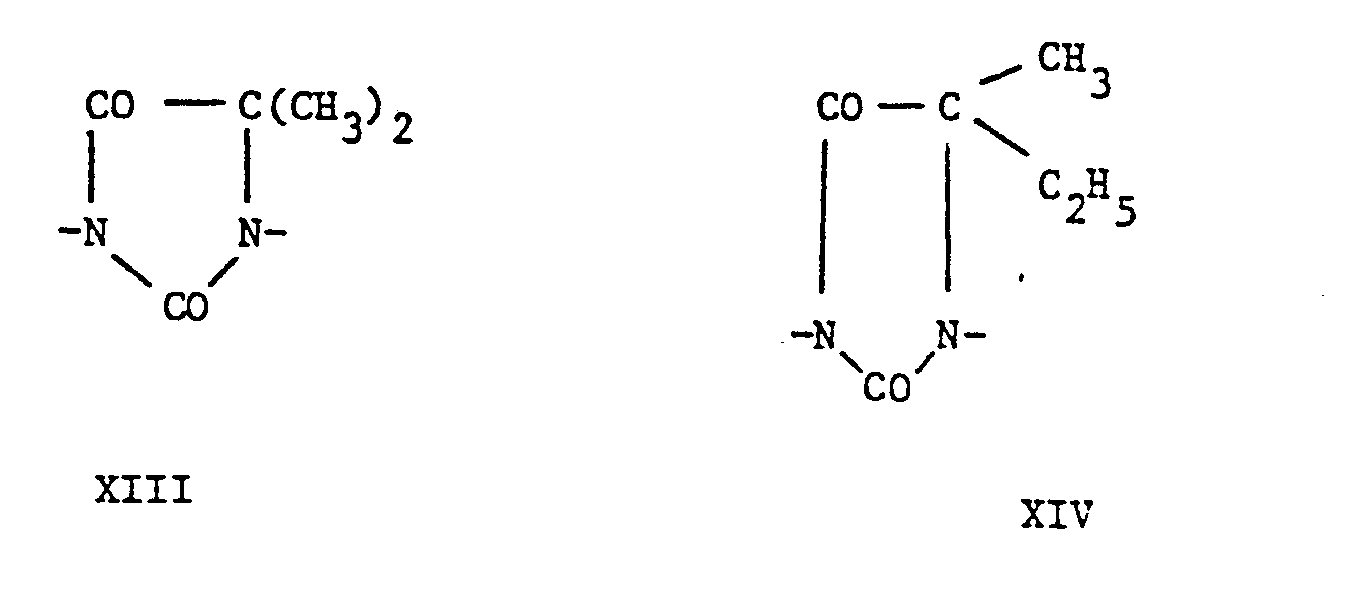
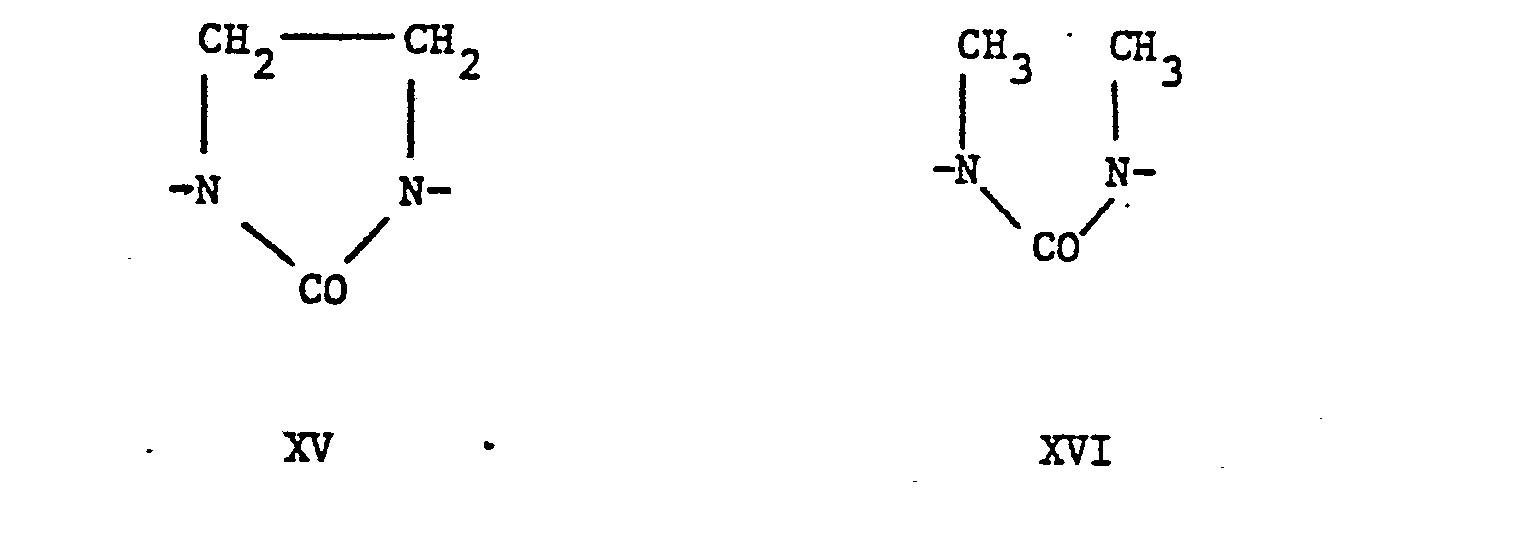
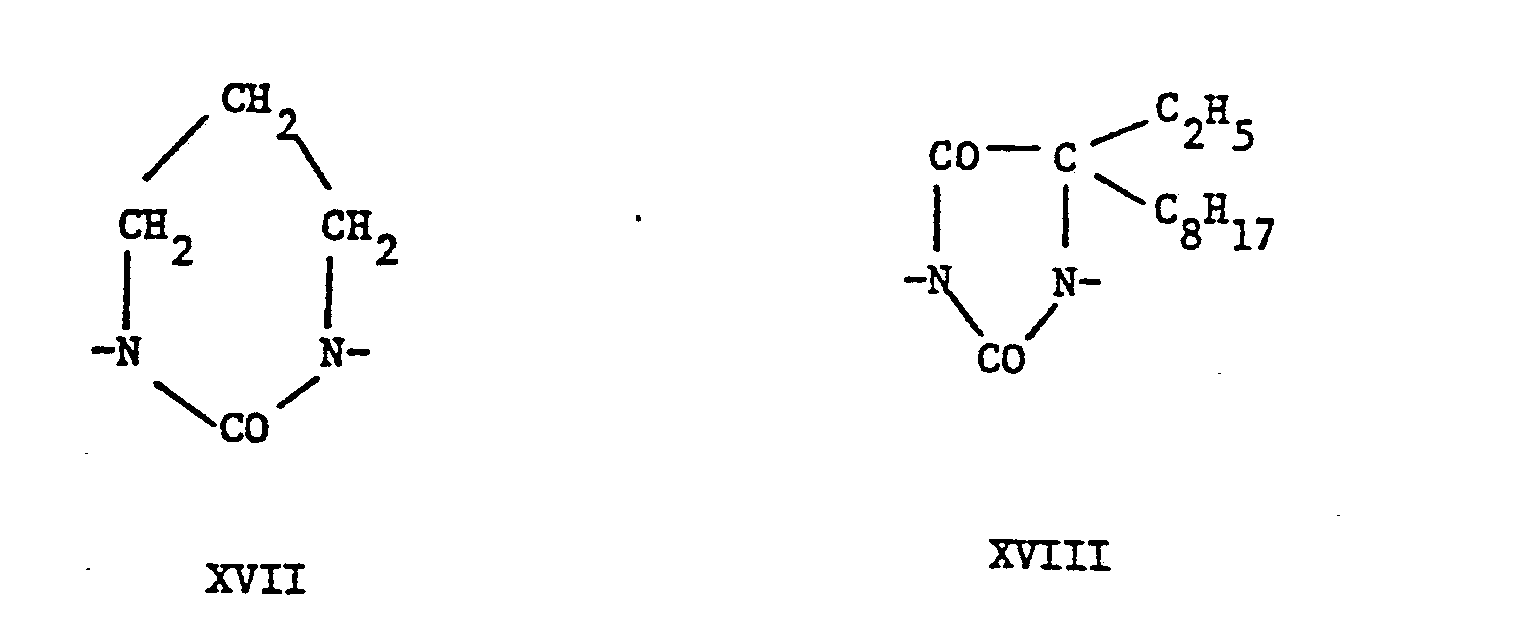
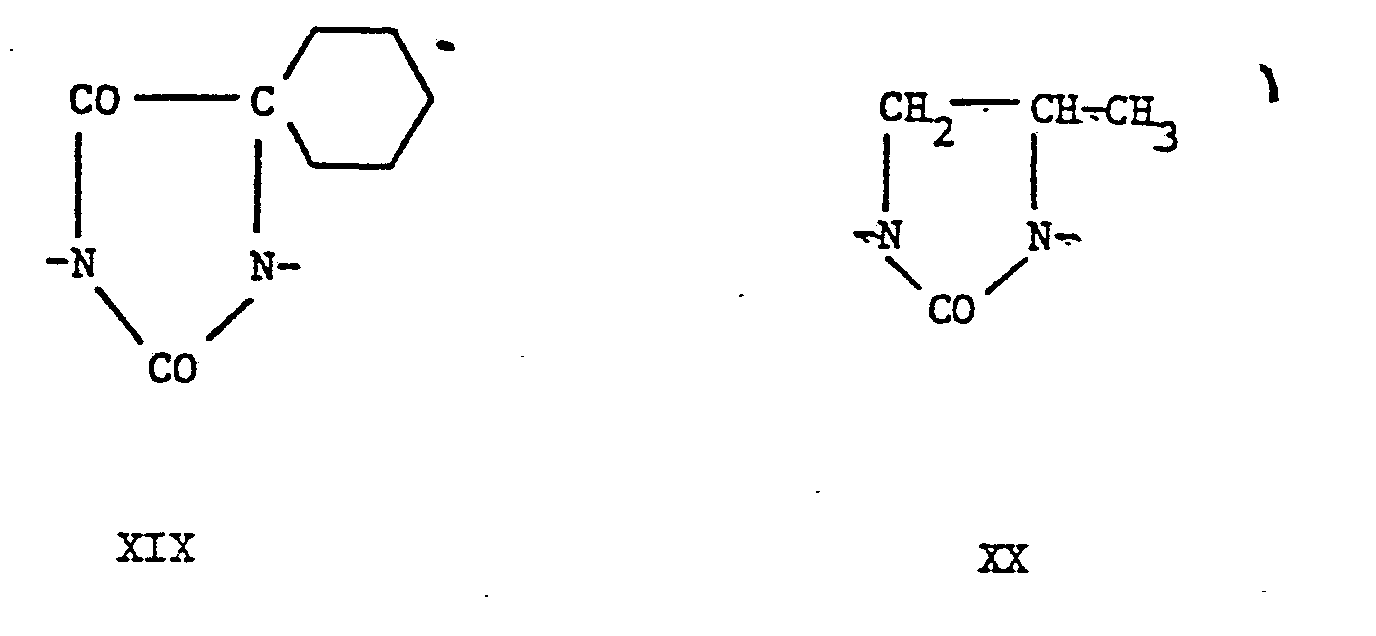
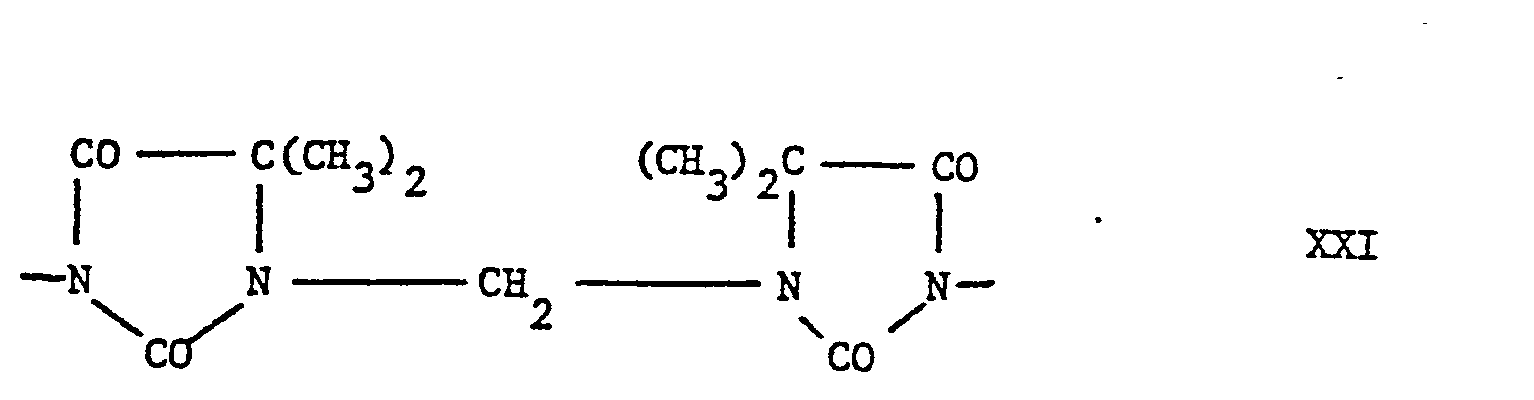

- Die Gruppen der FormeLn XIII bis XXI stellen den Rest des 5,5-DimethyLhydantoins, 5-AethyL-5-methyLhydan- toins, Imidazolidin-2-ons, 1,3-Dimethylnarnstoffs, Hexahydro-2H-pyrimidin-2-ons, 5-Methyl-5-(2-äthylhexyl)-hydantoins, 5,5-Pentamethylenhydantoins, 4-Methylimidazolidin-2-ons bzw. 1,1'-Methylen-bis-(5,5-dimethylhydantoins) dar, während die Gruppen der Formel XXII die Reste der Bernstein-, GLutar- und Adipinsäure sind.
- Weitere BeispieLe geeigneter Gruppen R15 und R16, falls diese auch der FormeL X entsprechen, sind solche der FormeLn


- SpezieLLe BeispieLe für geeignete Gruppen R 15 und R16, wenn diese nicht auch der FormeL IX oder X entsprechen, sind solche der FormeL


- Die Gruppen der FormeLn XXIII bis XXVI stellen die Reste des AethyLengLykoLs, Butan-1,4-diols, eines PoLy-Coxypropylen)-glykols vom DurchschnittsmoLekuLargewicht 425 bzw. 2,2-Bis-(4-hydroxyphenyL)-propans dar.
- Die Harze der FormeL VIII, worin b null ist, Lassen sich in zwei Stufen hersteLLen.
- Bei der ersten handelt es sich um die Umsetzung eines Diepoxids der FormeL



- UebLicherweise erhitzt man das Diepoxid der Formel XXVII mit der Verbindung der FormeL XXVIII auf eine Temperatur im Bereich 1200-210°C und insbesondere 140°-190°C. Die Reaktion Lässt sich durch Zusatz geeigneter Katalysatoren beschleunigen. SoLche KataLysatoren sind beispieLsweise ALkaLihydroxyde wie Natriumhydroxyd, ALkaLihaLogenide wie LithiumchLorid, Kaliumchlorid und Natriumchlorid, -bromid oder -fluorid, tertiäre Amine wie TriäthyLamin, Tri-n-propylamin, N-BenzyLdimethyLamin, N,N'-DimethyLanilin und Triäthanolamin, quartäre Ammoniumbasen wie BenzyLtrimethyLammoniumhydroxyd, quartäre AmmoniumsaLze wie TetramethyLammoniumchlorid, TetraäthyLammoniumchLorid, Benzyltrimethylammoniumchlorid, Benzyltrimethylammoniumatetat, und Methyltrithylammoniumchlorid, sowie Hydrazine mit einem tertiären Stickstoffatom, wie 1,1-DimethyLhydrazin, das auch in seiner quartärisierten Form eingesetzt werden kann. Je nach der Wahl der Ausgangsstoffe verLäuft die Reaktion manchmal quantitativ und so schnell, dass kein KataLysatorzusatz erforderlich ist. Während man im allgemeinen die Ausgangsstoffe bei Raumtemperatur miteinander vermischt und sie dann auf die Reaktionstemperatur bringt, ist es im FaLL miteinander sehr reaktionsfähiger Komponenten vorteilhaft, wenn man das Diepoxid der FormeL XXVII zunächst allein auf die erforderliche Reaktionstemperatur erhitzt und dann die übrigen reaktiven Komponenten allmählich in kleinen AnteiLen dazugibt. Das Fortschreiten der Reaktion bis zur BiLdung des Endprodukts mit einem definierten, im wesentlichen konstant bleibenden EpoxidgruppengehaLt Lässt sich durch Titration der Epoxidgruppen in während der Reaktion gezogenen Proben verfolgen.
- Derartige VorverLängerungsreaktionen sind bekannt (siehe z.B. die obenerwähnte britische Patentschrift Nr. 1 521 933).
- In der zweiten Stufe wird aus dem vorverlängerten Diepoxid der FormeL XXIX das mit Wasser verdünnbare Harz der Formel VIII durch Oeffnung der endständigen Epoxidgruppen durch Umsetzung mit AcryLsäure oder MethacryLsäure erhalten.
- Diese Reaktion erfolgt im aLLgemeinen bei einer Temperatur von 60° bis 150°C, insbesondere bei 100° bis 130°C, gegebenenfaLLs in Gegenwart eines inerten polaren LösungsmitteLs wie ChLoroform. Das MoLverhäLtnis des vorverlängerten Diepoxids der FormeL XXIX zu AcryLsäure oder MethacryLsäure hat vorzugsweise einen solchen Wert, dass im wesentlichen sämtLiche angegebenen GLycidyLgruppen in (Meth)acryLoyL-2-hydroxypropyLgruppen umgewandelt werden.
- Zweckmässig ist dabei ein KataLysator für die Ring- öffnungsreaktion vorhanden. Dieser KataLysator kann Natriumacetat oder vorzugsweise ein tertiäres Amin wie eines der oben angeführten, ein quartäres AmmoniumsaLz wie eines der oben angeführten oder ein SaLz des dreiwertigen Chroms mit einer ALkansäure wie Octansäure und 2-AethyLhexansäure oder einer Alkensäure wie AcryLsäure sein.
- GewünschtenfaLLs kann man einen RadikaLinhibitor wie Hydrochinon oder 2,6-Di-tert.-butyl-4-methylphenol mitverwenden, um dem Auftreten von Nebenreaktionen entgegenzuwirken. SoLche Inhibitoren brauchen nach erfolgter Reaktion nicht entfernt zu werden, da sie die PoLymerisation des Produkts bei BeLichtung mit aktinischer StrahLung nicht verhindern.
- Die Harze der FormeL VIII, in denen b 1 ist, Lassen sich aus den vorverlängerten Linearen Diepoxiden der Formel XXIX durch Oeffnung der endständigen Epoxidgruppen bei der Umsetzung mit einer Dicarbonsäure der Formel


- Die Ringöffnung der Epoxidgruppen erfolgt im aLLgemeinen unter denselben Bedingungen wie oben für die Ringöffnung der Diepoxide der FormeL XXIX mit AcryL- oder Methacrylsäure beschrieben, d.h. bei einer Temperatur von 60-1500C in Gegenwart eines KataLysators und gegebenenfalls eines Radikalinhibitors.
- Die Veresterung mit einem Hydroxyester der FormeL XXXI kann man unter üblichen Veresterungsbedingungen, insbesondere durch Erhitzen bei 60° bis 150°C, speziell bei 100° bis 130°C, gegebenenfalls in einem inerten, vorzugsweise mit Wasser nicht mischbaren LösungsmitteL sowie gegebenenfalls in Gegenwart eines wasserentziehenden MitteLs durchführen. GewünschtenfaLLs Lassen sich diese beiden Stufen als eine einzige Reaktion durchführen, indem man die Reaktionspartner in einem einzigen Gefäss vermischt und erhitzt.
- Zu den zur Verwendung als Komponente (b) beim erfindungsgemässen Verfahren geeigneten Epoxidharzen zählen die DigLycidyLäther mehrwertiger PhenoLe wie Bisphenol A (2,2-Bis-(4-hydroxyphenyL)-propan) und Tetrabrombisphenol A (2,2-Bis-(3,5-dibrom-4-hydroxyphenyl)-propan) sowie durch Vorverlängerung dieser Diglycidyläther erhaltene Epoxidharze. Der Einsatz von wasserlöslichen N,N-Diglycidylverbindungen, insbesondere N,N'-Diglycidylhydantoinen, als die Epoxidharzkomponente wird besonders bevorzugt.
- Die cellulosehaltigen Fasern können Lose, als gewebtes FLächengebiLde oder als FaservLies vorliegen und bestehen vorzugsweise aus BaumwoLLe oder Papier.
- Das Gewichtsverhältnis der Komponente (a), d.h. des Harzes der FormeL VIII, zu Komponente (b), d.h. dem Epoxidharz, kann in weiten Grenzen schwanken, Liegt aber vorzugsweise im Bereich 1:0,5-4.
- Die Fasern können auf übliche Weise imprägniert werden. Im allgemeinen hat der WasseranteiL keine entscheidende Bedeutung, doch sollte dieser beispielsweise auf etwa 2 bis 30 Gew.-X, berechnet auf die wässrige Zusammensetzung, beschränkt werden, um die Notwendigkeit einer Trocknung zu vermeiden. Die Aufnahme der Zusammensetzung beträgt üblicherweise 50 bis 300 Gew.-X, vorzugsweise 50 bis 150 Gew.-X, berechnet auf das Fasergewicht.
- Das Imprägniergemisch kann ferner übliche Zusätze wie FLammhemmstoffe enthalten.
- Bei dem erfindungsgemässen Verfahren wird vorzugsweise aktinische StrahLung einer WeLLenLänge von 200 bis 600 nm eingesetzt.
- Wie schon angegeben werden die imprägnierten Fasern vorzugsweise in Gegenwart eines PhotosensibiLisators mit aktinischer StrahLung belichtet. Zweckmässig wird der Photosensibilisator in der Imprägnierzusammensetzung eingebracht. ALs SensibiLisatoren eignen sich unter anderem Chinone, Diphenylcarbinole, 5-Nitroacenaphthen, 2-substituierte Thioxanthone, DiphenyLmethane und α-Halogenoacetophenone wie p-tert.-Butylphenyl-trichlormethylketon, Photoredoxkatalysatoren wie ein Gemisch aus einem Phenothiazinfarbstoff (z.B. Methylenblau) oder einem substituierten ChinoxaLin mit einem ELektronendonator (wie einer Sulfinsäure oder deren SaLz, einem Phosphin, Arsin oder Thioharnstoff), Benzophenone, Benzildialkylketale wie BenziLdimethylketal (d.h. α-Methoxybenzoinmethyläther), Benzoine, Benzoinalkyläther sowie O-Alkoxycarbonylderivate eines Oxims des Benzils oder 1-Phenylpropan-1,2-dions wie Benzil-(O-äthoxycarbonyl)-α-monoxim und 1-Phenylpropan-1,2-dion-2-(O-äthoxycarbonyl)-oxim. Bevorzugte SensibiLisatoren sind MichLers Keton (d.h. 4,4'-Bis-(dimethylamino)-benzophenon), Benzoin-n-butyLäther sowie Gemische dieser beiden, mit einem MetaLLsaLz der ToLuoL-p-suLfinsäure vermischte MetaLLsaLze der 2-(m- oder p-Methoxyphenyl)-chinoxalin-6'- oder -7'-sulfonsäure, 1-Phenylpropan-1,2-dion-2-(O-äthoxycarbonyl)-oxim, BenziLdimethyLketaL sowie Gemische dieser beiden, und 2-ChLorthioxanthon und dessen Gemische mit BenziLdimethyLketal. UebLicherweise werden 0,1 bis 20 und vorzugsweise 0,5 bis 15 Gew.-% SensibiLisator eingesetzt, berechnet auf das Gewicht der Komponente (a).
- ALs aktinische StrahLungsqueLLen eignen sich unter anderem Kohlelichtbögen, Quecksilberdampflichtbögen, FLuoreszenzlampen mit uLtravioLettes Licht ausstrahlenden Leuchtstoffen, Argon- und Xenonglimmlampen, Wolframlampen und photographische Flutlampen. Darunter sind QuecksiLberdampflichtbögen, insbesondere Höhensonnen, fluoreszierende Höhensonnen und Metallhalogenidlampen am besten geeignet. Die zur BeLichtung der imprägnierten Fasern erforderliche Zeit hängt von verschiedenen Faktoren ab, unter anderem beispielsweise der jeweils verwendeten Komponente (a), der Art der LichtqueLLe und deren Abstand von den Fasern, und lässt sich Leicht durch Serienversuche ermitteln.
- Gegenstand der Erfindung ist ferner ein Verfahren zur HersteLLung eines Verbundstoffartikels, welches dadurch gekennzeichnet ist, dass man einen nach dem erfindungsgemässen Verfahren hergesteLLten Prepreg heisshärtet.
- Wie ebenfalls schon angegeben,werden die cellulosehaltigen Fasern vorzugsweise auch mit einer heisshärtenden Menge eines Latenten Heisshärters für das Epoxidharz (b) imprägniert. SoLche MitteL sind wohlbekannt und umfassen Dicyandiamid (allein oder als Gemisch mit einem N,N-Dimethyl-N'-aryLharnstoff wie Bis-(N,N-dimethylureido)-toluol oder N,N-DimethyL-N'-(4-chLorphenyL)-harnstoff), ImidazoLe sowie AminkompLexe des BortrichLorids oder BortrifLuorids. Zweckmässig werden diese Mittel in die (a) und (b) enthaltende wässrige Zusammensetzung eingearbeitet.
- Der Fachmann in der Epoxidharztechnik kann die geeigneten,bei der BiLdung des heissgehärteten Verbundstoffs, der im allgemeinen in Form eines Laminierten Schichtkörpers vorliegt, anzuwendenden Hitze- und Druckbedingungen Leicht nach üblichen Methoden bestimmen.
- Die nachfolgenden BeispieLe dienen der ErLäuterung der Erfindung.
- Die in den BeispieLen verwendeten Epoxidharze und photopolymerisierbaren Harze werden wie folgt hergestellt. Die EpoxidgehaLte werden durch Titration mit 0,1 n-Ueberchlorsäurelösung in Eisessig in Gegenwart überschüssigen Tetraäthylammoniumbromids mit Kristallviolett als Indikator bestimmt. TeiLe und Prozentangaben sind stets Gewichtsteile und Gewichtsprozente.
- Man rührt N,N'-DigLycidyL-5,5'-dimethyLhydantoin (Epoxidgehalt 8,04 val/kg, 100 g), Bisphenol-A-diglycidyläther (Epoxidgehalt 5,30 val/kg, 100 g), 1,4-Butandiol (37,2 g) und N-Phenylimidazol (0,2 g) 5 Stunden bei 120°C. Man gibt einen weiteren AnteiL 2-Phenylimidazol (0,2 g) dazu und erhitzt noch weitere 5 Stunden bei 120°C und dann 6 1/2 Stunden bei 140°C, wonach der Epoxidgehalt des Gemischs 2,44 vaL/kg ist.
- Man rührt N,N'-Diglycidyl-5,5-dimethylhydantoin (Epoxidgehalt 8,04 vaL/kg, 100 g), den Diglycidyläther eines Polyoxypropylenglykols vom Durchschnittsmolekulargewicht 425 (Epoxidgehalt 3,07 val/kg, 200 g), Bisphenol-A-diglycidyläther (Epoxidgehalt 5,30 vaL/kg, 100 g), Bisphenol-A (100 g) und N-Phenylimidazol (0,4 g) 3 1/2 Stunden bei 120°C, wonach der Epoxidgehalt des Gemischs 2,67 val/kg beträgt.
- Man rührt N,N'-Diglycidyl-5,5-pentamethylenhydantoin (Epoxidgehalt 6,23 val/kg, 200 g), 1,4-Butandiol (36 g) und N-Phenylimidazol (0,4 g) 12 1/4 Stunden bei 140°C und dann 3 3/4 Stunden bei 160°C, wonach der EpoxidgehaLt auf 2,35 val/kg gefallen ist.
- Man gibt Adipinsäure (73 g) portionsweise unter Rühren zu N-PhenyLimidazoL (0,4 g) enthaltendem N,N'-DiglycidyL-5,5-dimethyLhydantoin (EpoxidgehaLt 8,04 val/kg, 200 g), wobei man die Temperatur auf 100°C hält und die Zugabe im VerLauf von 40 Minuten durchführt. Man erhitzt noch 4 1/3 Stunden weiter bei 100°C, wonach der EpoxidgehaLt auf 2,35 vaL/kg gefallen ist.
- Man gibt 5,5-DimethyLhydantoin (77,4 g) portionsweise unter Rühren zu einem Gemisch aus 1,4-ButandioL-digLycidyLäther (EpoxidgehaLt 8,6 vaL/kg, 200 g), der TetramethyLammoniumchlorid (0,25 g) als VorverLängerungskataLysator enthält. Das Gemisch wird auf 120°C erhitzt, wobei eine exotherme Reaktion einsetzt, welche die Temperatur auf 230°C steigert. Dann kühlt man auf 100°C ab; der EpoxidgehaLt ist nun 2,2 vaL/kg. Man setzt 2,6-Di-t-butyL-4-methyLphenoL (0,44 g) als PoLymerisationsinhibitor und danach im VerLauf einer Stunde MethacryLsäure (54,6 g) und 2,6-Di-t-butyL-4-methylphenol (0,88 g) dazu. Das Gemisch wird 3 1/2 Stunden auf 100°C erhitzt, wonach sein EpoxidgehaLt auf einen geringen Wert (0,6 val/kg) gefallen ist.
- Dieses Produkt entspricht im wesentlichen der Formel VIII, worin b nuLL ist und R14 jeweils für eine MethyLgruppe, R15 jeweils für eine Gruppe der FormeL XXIV und R 16 jeweils für eine Gruppe der Formel XIII stehen.
- Man erhitzt N,N'-DigLycidyL-5,5-dimethyLhydantoin (EpoxidgehaLt 7,88 vaL/kg, 50 g), das als KataLysator für die nachfolgende Reaktion mit AcryLsäure 2 Tropfen einer 5Xigen Lösung von Chrom-III-trisoctanoat in PetroLäther enthält, auf 100°C und gibt Adipinsäure (14 g) im VerLauf von 1 Stunde dazu. Nach vollendeter Zugabe erhitzt man weitere 1 3/4 Stunden auf 100°C, wonach der EpoxidgehaLt 3,96 val/kg ist. Im VerLauf von 30 Minuten setzt man dem Harz bei 100°C AcryLsäure (8,1 g) zu, die 0,1 g 2,6-Di-t-butyl-4-methylphenol und weitere 2 Tropfen der Chrom-III-trisoctanoat-Lösung enthält, und erhitzt weitere 6 1/2 Stunden bei 100°C. Der EpoxidgehaLt des Produkts ist 0,46 vaL/kg.
- Dieses Produkt entspricht im wesentlichen der FormeL VIII, worin b null ist und R14 jeweils für ein Wasserstoffatom, R15 jeweils für eine Gruppe der Formel XIII und R16 jeweils für eine Gruppe der FormeL XXII mit g = 4 stehen.
- Man gibt eine AcryLsäure (20,8 g), 2,6-Di-t-butyL-4-methylphenol (0,2 g) und eine 5Xige Lösung von Chrom-III-trisoctanoat in Petroläther (0,1 g) enthaltende Lösung im VerLauf von 1/2 Stunde unter Rühren bei 100°C zu Epoxidharz A (118,6 g). Nach voLLendeter Zugabe erhitzt man weitere 5 1/2 Stunden auf 100°C, wonach der EpoxidgehaLt auf einen vernachlässigbar kleinen Wert (0,07 vaL/kg) gefallen ist. Dann wird Wasser (23,1 g) dazugegeben.
- Das Produkt entspricht im wesentlichen der FormeL VIII, worin b null ist, einige der Gruppen R15 der FormeL XIII und der Rest der FormeL XXVI entsprechen, die Gruppen R 16 OxybutyLenoxygruppen sind und R14 ein Wasserstoffatom bedeutet.
- Man gibt eine AcryLsäure (50,3 g), 2,6-Di-t-butyl-4-methylphenol (0,6 g) and eine 5Xige Lösung von Chrom-III-trisoctanoat in Petroläther (0,3 g) enthaltende Lösung im VerLauf von 1/2 Stunde unter Rühren bei 100°C zu Epoxidharz B (261,5 g). Man erhitzt noch weitere 4 1/2 Stunden bei 100°C, wonach der EpoxidgehaLt auf einen vernachlässigbar kleinen Wert (0,08 val/kg) gefallen ist.
- Das Produkt entspricht im wesentlichen der Formel VIII, worin b null ist, einige der Gruppen R15 der FormeL XIII, einige der FormeL XXV und der Rest der FormeL XXVI und die Gruppen R16 ebenfalls der Formel XXVI entsprechen sowie R14 ein Wasserstoffatom bedeutet.
- Man rührt Epoxidharz C (118 g) bei 100°C und gibt eine MethacryLsäure (23,8 g), 2,6-Di-t-butyl-4-methylphenol (0,4 g) und eine 5Xige Lösung von Chrom-III-trisoctanoat in PetroLäther (0,1 g) enthaltende Lösung im VerLauf von 1/2 Stunde dazu. Man erhitzt noch weitere 4 1/3 Stunden bei 100°C, wonach der EpoxidgehaLt auf einen vernachlässigbaren Wert (0,28 vaL/kg) gefallen ist. Dann wird Wasser (45 g) dazugegeben.
- Das Produkt entspricht im wesentlichen der FormeL VIII, worin b null ist, R14 jeweils für eine MethyLgruppe, R 15 jeweils für eine Gruppe der FormeL XIX und R16 jeweils für eine Gruppe der Formel XXIV stehen.
- Man rührt Epoxidharz D (273 g) bei 100°C und gibt eine AcryLsäure (46,2 g), 2,6-Di-t-butyl-4-methylphenol (0,6 g) und eine 5Xige Lösung von Chrom-III-trisoctanoat in Petroläther (0,3 g) enthaltende Lösung im VerLauf von 1/2 Stunde dazu. Man erhitzt noch weitere 2 Stunden, wonach der EpoxidgehaLt auf einen vernachlässigbaren Wert (0,34 vaL/kg) gefallen ist. Dann wird Wasser (30 g) dazugegeben.
- Das Produkt entspricht im wesentlichen der Formel VIII, worin b nuLL ist, R14 jeweils für ein Wasserstoffatom, R15 für eine Gruppe der FormeL XIII und R16 jeweils für eine Gruppe der FormeL XXII stehen.
- Man versetzt Tetramethylammoniumchlorid (0,1 g) enthaltendes und auf 100°C erhitztes Diglycidylhexahydrophthalat (Epoxidgehalt 6,4 vaL/kg, 41,2 g) portionsweise im VerLauf von 1 Stunde mit 5,5-Dimethylhydantoin (10,2 g). AnschLiessend rührt man 4 Stunden bei 100°C, wonach der Epoxidgehalt auf 2,45 vaL/kg gefallen ist.
- In einem getrennten Gefäss rührt man Bernsteinsäureanhydrid (30 g), 2-Hydroxyäthylacrylat (34,2 g), Tetramethylammoniumchlorid (0,2 g) und 2,6-Di-t-butyl-4-methylphenol (0,15 g) 3 Stunden bei 90°C und kühlt dann ab. Das Produkt, d.h. 3-(2-(Acryloyloxy)-äthoxycarbonyl)-propionsäure (27,2 g) wird dann mit 2,6-Di-t-butyl-4-methylphenol (0,1 g) vermischt und im VerLauf einer Stunde bei 100°C zu dem vorverlängerten Harz gegeben; das Gemisch wird noch 4 1/2 Stunden bei 100°C gerührt, wonach sein EpoxidgehaLt vernachlässigbar ist. Das Produkt wird mit 33% Wasser verdünnt.
- Das Produkt entspricht im wesentlichen der Formel VIII, worin b 1 ist, Rund R18 je für -CH2CH2-, R14 für ein Wasserstoffatom, R15 für Hexahydrophthaloyl und R16 für eine Gruppe der Formel XIII stehen.
- Man vermischt photopolymerisierbares Harz I (10 Teile) mit 40 TeiLen eines Epoxidharzes, nämlich N,N'-Diglycidyl-5,5-dimethylhydantoin (Epoxidgehalt 7,88 val/kg), 2 TeiLen Wasser, 0,5 TeiLen BenziLdimethyLketaL und 1 Teil Bortrichlorid/Trimethylaminkomplex.
- Die erhaltene klare Lösung wird zum Imprägnieren von Kraftpapier von Elektroqualität mit einem FLächengewicht von 60 g/m2 verwendet, wobei die Aufnahme 100%, berechnet auf das Gewicht des Papiers,beträgt. Das imprägnierte Papier wird 30 Sekunden beidseitig mit einer 80 W/cm-Mitteldruckquecksilberlampe in 25 cm Abstand bestrahlt, was einen etwas klebrigen Prepreg ergibt. Vier Schichten davon werden übereinander angeordnet, in einer Presse 1 Stunde bei 120°C unter 7 MPa Druck heissgehärtet und dann durch 2 Stunden Erhitzen bei 140°C nachgehärtet. Der Schichtkörper ist hart und steif und wird durch die in der britischen Norm Nr. 5102:1974, Anhang R, angegebene DurchstichprUfung nicht beschädigt.
- Man vermischt photopolymerisierbares Harz I (15 Teile) mit je 20 TeiLen der beiden Epoxidharze N,N'-DigLycidyl-5,5-dimethylhydantoin (EpoxidgehaLt 7,88 val/kg) und mit Tetrabrombisphenol A auf einen EpoxidgehaLt von 2,0 val/kg vorverlängertes N,N'-Diglycidyl-5,5-dimethylhydantoin, 2,0 TeiLen Wasser, 0,5 TeiLen 2-Chlorthioxanthon, 2,0 TeiLen Dicyandiamid und 0,5 TeiLen N-(4-Chlorphenyl)-N,N'-dimethylharnstoff.
- Dieses Gemisch wird zum Imprägnieren von Kraftpapier wie in Beispiel 1 beschrieben verwendet und 10 Sekunden beidseitig mit einer 80 W/cm-Mitteldruckquecksilberlampe im Abstand von 25 cm bestrahlt, was einen etwas klebrigen Prepreg ergibt. Vier Schichten davon werden übereinander angeordnet und in einer Presse bei 120°C C 1 Stunde unter 7 MPa Druck heissgehärtet. Der entstandene, gehärtete Schichtkörper ist hart und steif und wird durch die oben angegebene DurchstichprUfung nicht beschädigt.
- Man vermischt photopolymerisierbares Harz II (20 TeiLe) mit 20 TeiLen eines Epoxidharzes, d.h. N,N'-DiglycidyL-5,5-dimethyLhydantoin, 10 TeiLen Wasser, je 0,2 TeiLen BenziLdimethyLketaL und 1-PhenyL-1,2-propandion-2-(0- äthoxycarbonyL)-oxim, 2,6 TeiLen eines Gemischs aus 2,4-und 2,6-Bis-(N,N-dimethylureido)-toluol sowie 0,65 TeiLen Dicyandiamid. Beim Erwärmen des Gemischs auf 60°C bildet sich eine klare Lösung. Mit dieser wird Kraftpapier vom Gewicht 350 g/m2 imprägniert, wobei die Aufnahme 100%, berechnet auf das Gewicht des Papiers, beträgt. Das imprägnierte Papier wird beidseitig 5 Sekunden mit der in Beispiel 1 verwendeten Lampe bestrahlt, wobei man einen kLebfreien Prepreg erhält. Vier Schichten des Prepregs werden übereinander angeordnet und dann 5 Minuten bei 120°C nur unter Nenndruck und anschLiessend bei 120°C weiter erhitzt, während der Schichtkörper für 3 Gänge von je 2 Minuten mit 7 MPa gepresst wird, wobei man den Druck jeweils 30 Sekunden zwischen den Gängen entspannt. Schliesslich wird der Schichtkörper 1 Stunde unter 7 MPa Druck erhitzt, wobei man ein gut verfestigtes Produkt erhält, in dem sich Löcher Leicht ohne Verformung stanzen Lassen; der HarzgehaLt be- trägt 41%.
- Man vermischt photopolymerisierbares Harz VII (60 TeiLe) mit 45 TeiLen Epoxidharz C, 5 TeiLen Wasser, 0,6 TeiLen Benzildimethylketal und 2 TeiLen Bortrichlorid/Octyldimethylaminkomplex.
- Die erhaltene klare Lösung wird zum Imprägnieren von Kraftpapier von Elektroqualität mit einem Flächengewicht von 75 g/m 2 verwendet, wobei die Aufnahme 100%, berechnet auf das Gewicht des Papiers, beträgt. Das imprägnierte Papier wird 3 Sekunden beidseitig mit einer 80 W/cm-Mitteldruckquecksilberlampe in 25 cm Abstand bestrahlt, was einen kLebfreien Prepreg ergibt. Sechs Schichten davon werden übereinander angeordnet und in einer Presse bei 120°C 1 Stunde unter 7 MPa Druck erhitzt. Der entstandene Schichtkörper ist hart und steif und wird durch die oben angegebene DurchstichprUfung nicht beschädigt.
- Man vermischt photopolymerisierbares Harz III (50 TeiLe) mit 25 TeiLen Epoxidharz A, 5 TeiLen Wasser, 0,5 TeiLen BenziLdimethyLketaL und 1 TeiL BortrifLuorid/Mono- äthylaminkomplex.
- Die erhaltene klare Lösung wird zum Imprägnieren von Kraftpapier von Elektroqualität mit einem FLächengewicht von 75 g/m2 verwendet, wobei die Aufnahme 150%, berechnet auf das Gewicht des Papiers beträgt. Das imprägnierte Papier wird 5 Sekunden beidseitig mit einer 80 W/cm-Mitteldruckquecksilberlampe in 25 cm Abstand bestrahlt, was einen klebfreien Prepreg ergibt. Acht Schichten davon werden übereinander angeordnet und in einer Presse bei 120°C 1 Stunde unter 7 MPa Druck heissgehärtet. Der entstandene Schichtkörper ist gut verfestigt und wird durch die oben angegebene DurchstichprUfung nicht beschädigt.
- Man vermischt photopolymerisierbares Harz IV (40 TeiLe) mit 25 TeiLen Epoxidharz B, 5 TeiLen Wasser, 0,5 TeiLen BenziLdimethyLketaL und 0,5 TeiLen N-Phenylimidazol.
- Die erhaltene klare Lösung wird zum Imprägnieren von Kraftpapier von Elektroqualität mit einem FLächengewicht von 75 g/m2 verwendet, wobei die Aufnahme 200%, berechnet auf das Gewicht des Papiers, beträgt. Das imprägnierte Papier wird 8 Sekunden beidseitig mit einer 80 W/cm-MitteLdruckquecksilberlampe in 25 cm Abstand bestrahlt, was einen etwas klebrigen Prepreg ergibt. Sechs Schichten davon werden übereinander angeordnet und in einer Presse 1 Stunde bei 120°C unter 7 MPa Druck heissgehärtet. Der entstandene Schichtkörper ist hart und steif und wird durch die oben angegebene DurchstichprUfung nicht beschädigt.
- Man vermischt photopolymerisierbares Harz V (30 TeiLe) mit 25 TeiLen Epoxidharz B, 0,3 TeiLen BenziLdimethylketal und 0,3 TeiLen Bortrichlorid/Trimethylaminkomplex.
- Man erwärmt das Gemisch auf 60°C, um eine klare Lösung zu erhalten, die dazu verwendet wird, ein gewebtes Baumwolltuch mit einem FLächengewicht von 120 g/m2 zu imprägnieren, wobei die Aufnahme 275%, berechnet auf das Gewicht der Baumwolle, beträgt. Die imprägnierte BaumwoLLe wird 2 Sekunden beidseitig mit einer 80 W/cm-Mitteldruckquecksilberlampe in 25 cm Abstand bestrahlt, was einen klebfreien Prepreg ergibt. Sechs Schichten davon werden übereinander angeordnet und in einer Presse 1 Stunde bei 120°C unter 7 MPa Druck heissgehärtet. Der entstandene Schichtkörper ist hart und biegsam und wird durch die oben angegebene Durchstichprüfung nicht beschädigt.
- Man vermischt photopolymerisierbares Harz VI (30 Teile) mit 25 TeiLen Epoxidharz B, 5 TeiLen Wasser, 0,5 TeiLen BenziLdimethyLketaL und 0,5 TeiLen BortrichLorid/ TrimethyLaminkompLex.
- Die erhaltene klare Lösung wird zum Imprägnieren eines gewebten BaumwoLLtuches mit einem FLächengewicht von 120 g/m2 verwendet, wobei die Aufnahme 50%, berechnet auf das Gewicht der BaumwoLLe,beträgt. Die imprägnierte Baumwolle wird 5 Sekunden beidseitig mit einer 80 W/cm-MitteldruckquecksiLberLampe in 25 cm Abstand bestrahlt, was einen klebfreien Prepreg ergibt. Vier Schichten davon werden Übereinander angeordnet und in einer Presse 1 Stunde bei 120°C unter 7 MPa Druck heissgehärtet. Der entstandene Schichtkörper ist hart und biegsam und wird durch die oben angegebene Durchstichprüfung nicht beschädigt.
Claims (10)





Applications Claiming Priority (4)
| Application Number | Priority Date | Filing Date | Title |
|---|---|---|---|
| GB8209955 | 1982-04-03 | ||
| GB8209955 | 1982-04-03 | ||
| GB8222600 | 1982-08-05 | ||
| GB8222600 | 1982-08-05 |
Publications (3)
| Publication Number | Publication Date |
|---|---|
| EP0091401A2 true EP0091401A2 (de) | 1983-10-12 |
| EP0091401A3 EP0091401A3 (en) | 1984-09-05 |
| EP0091401B1 EP0091401B1 (de) | 1986-11-20 |
Family
ID=26282466
Family Applications (1)
| Application Number | Title | Priority Date | Filing Date |
|---|---|---|---|
| EP83810126A Expired EP0091401B1 (de) | 1982-04-03 | 1983-03-25 | Herstellung von Prepregs aus cellulosehaltigen Fasern unter Verwendung wässriger Harzzusammensetzungen |
Country Status (4)
| Country | Link |
|---|---|
| US (1) | US4440802A (de) |
| EP (1) | EP0091401B1 (de) |
| CA (1) | CA1217453A (de) |
| DE (1) | DE3367781D1 (de) |
Families Citing this family (3)
| Publication number | Priority date | Publication date | Assignee | Title |
|---|---|---|---|---|
| US4612209A (en) * | 1983-12-27 | 1986-09-16 | Ciba-Geigy Corporation | Process for the preparation of heat-curable adhesive films |
| US6001300A (en) * | 1989-12-06 | 1999-12-14 | C.A. Lawton Company | Method for making rigid three-dimensional preforms using directed electromagnetic energy |
| US6436484B1 (en) * | 1997-12-09 | 2002-08-20 | Coats American, Inc. | Processes for coating sewing thread |
Family Cites Families (21)
| Publication number | Priority date | Publication date | Assignee | Title |
|---|---|---|---|---|
| US3373075A (en) * | 1961-12-18 | 1968-03-12 | Robertson Co H H | Diacrylate compositions, heat resistant polymers containing the same and method of making electrical laminates therefrom |
| GB1006587A (en) * | 1961-12-18 | 1965-10-06 | Robertson Co H H | Ethylenically unsaturated polyhydroxy diester polyethers |
| FR1415332A (fr) * | 1963-12-03 | 1965-10-22 | Shell Int Research | Procédé pour la préparation de brins de fibres pré-imprégnés et utilisation des produits résultants pour la production d'articles composites renforcés |
| US3256226A (en) * | 1965-03-01 | 1966-06-14 | Robertson Co H H | Hydroxy polyether polyesters having terminal ethylenically unsaturated groups |
| GB1139100A (en) * | 1966-05-20 | 1969-01-08 | Robertson Co H H | Ethylenically unsaturated polymers |
| US3600272A (en) * | 1968-08-29 | 1971-08-17 | Scott Paper Co | Polyethyleneimine cured epoxy-modified paper |
| US3808226A (en) * | 1971-01-15 | 1974-04-30 | Ciba Geigy Corp | Polyacrylates of n-heterocyclic compounds |
| CH545825A (de) * | 1971-03-30 | 1974-02-15 | ||
| CH546800A (de) * | 1971-07-09 | 1974-03-15 | Ciba Geigy Ag | Verfahren zum haerten von polyacrylaten mit ionisierenden strahlen. |
| CH545323A (de) * | 1971-09-03 | 1973-12-15 | Ciba Geigy Ag | Verfahren zum Härten von Acrylsäureaddukten mit ionisierenden Strahlen |
| US3895158A (en) * | 1973-08-15 | 1975-07-15 | Westinghouse Electric Corp | Composite glass cloth-cellulose fiber epoxy resin laminate |
| JPS5514087B2 (de) * | 1973-09-05 | 1980-04-14 | ||
| GB1464287A (en) * | 1974-02-22 | 1977-02-09 | Ciba Geigy Ag | Polymerisable esters |
| DE2429527C2 (de) * | 1974-06-20 | 1982-05-19 | Bayer Ag, 5090 Leverkusen | Verfahren zur Herstellung lufttrocknender Bindemittel |
| DE2557408C2 (de) * | 1975-12-19 | 1983-08-25 | Bayer Ag, 5090 Leverkusen | Verfahren zur Herstellung eines in organischen Lösungsmitteln löslichen, vernetzbaren Acryloyl- und/oder Methacryloylgruppen und Carboxylgruppen enthaltenden Urethanharzes und seine Verwendung |
| US4092443A (en) * | 1976-02-19 | 1978-05-30 | Ciba-Geigy Corporation | Method for making reinforced composites |
| US4108803A (en) * | 1976-03-23 | 1978-08-22 | Ciba-Geigy Corporation | Photopolymerizable epoxy resins containing pendant unsaturated ester or amidomethyl groups |
| DE2962710D1 (en) * | 1978-09-07 | 1982-06-24 | Akzo Nv | Radiation curable liquid coating composition based on an epoxy terminated compound and a process for coating a substrate with such a composition |
| US4323591A (en) * | 1979-06-25 | 1982-04-06 | Minnesota Mining And Manufacturing Company | Irradiation of polyacrylate films in air |
| US4309529A (en) * | 1980-05-12 | 1982-01-05 | Minnesota Mining And Manufacturing Company | Water-dispersible energy curable heterocyclic group-containing polyesters |
| US4392930A (en) * | 1981-07-09 | 1983-07-12 | Ciba-Geigy Corporation | Photopolymerizable resins |
-
1983
- 1983-03-25 DE DE8383810126T patent/DE3367781D1/de not_active Expired
- 1983-03-25 EP EP83810126A patent/EP0091401B1/de not_active Expired
- 1983-03-28 US US06/479,404 patent/US4440802A/en not_active Expired - Fee Related
- 1983-03-31 CA CA000425116A patent/CA1217453A/en not_active Expired
Also Published As
| Publication number | Publication date |
|---|---|
| EP0091401B1 (de) | 1986-11-20 |
| DE3367781D1 (en) | 1987-01-08 |
| CA1217453A (en) | 1987-02-03 |
| EP0091401A3 (en) | 1984-09-05 |
| US4440802A (en) | 1984-04-03 |
Similar Documents
| Publication | Publication Date | Title |
|---|---|---|
| DE2847796C3 (de) | Strahlungshärtbare Harzmasse | |
| DE2413768C2 (de) | Härtbares Material | |
| EP0012339B1 (de) | Strahlungshärtbare wässrige Bindemitteldispersionen, Verfahren zu deren Herstellung sowie deren Verwendung | |
| EP0057162B1 (de) | Verfahren zur Erzeugung von Abbildungen | |
| DE2553346A1 (de) | Durch bestrahlung polymerisierbare ester | |
| CH635613A5 (de) | Verfahren zum verkleben zweier oberflaechen mittels einer klebfolie. | |
| EP0661314A1 (de) | Wässrige, strahlenhärtbare Bindemitteldispersionen | |
| CH628362A5 (de) | Verfahren zur herstellung von prepregs. | |
| DE3706355A1 (de) | Additionsprodukte aus acrylaten und aminen sowie deren verwendung in strahlungshaertbaren massen | |
| EP0150674A2 (de) | Verfahren zur Herstellung von heisshärtbaren Klebefilmen | |
| EP0554215B1 (de) | Diacrylate und Dimethacrylate | |
| DE2643702A1 (de) | Ueberzugszusammensetzung | |
| EP0102921A2 (de) | Verfahren zur Erzeugung von Abbildungen aus flüssigen Massen | |
| EP0614122A1 (de) | Tetraacrylate enthaltende polymerisierbare Gemische | |
| DE3841422C2 (de) | ||
| DE2233328A1 (de) | Verfahren zum haerten von polyacrylaten mit ionisierenden strahlen | |
| DE2529584A1 (de) | Aktinisch induziertes polymerisationsverfahren | |
| EP0517657B1 (de) | Photoempfindliche Zusammensetzungen | |
| EP0447845B1 (de) | Strahlungshärtbare Amin- und Harnstoffgruppen enthaltende Urethanacrylatverbindungen | |
| EP0091401B1 (de) | Herstellung von Prepregs aus cellulosehaltigen Fasern unter Verwendung wässriger Harzzusammensetzungen | |
| DE3334329A1 (de) | Modifiziertes epoxy(meth)acrylatharz sowie eine dasselbe enthaltende haertbare harzzusammensetzung | |
| EP0126029B1 (de) | Verfahren zur Bilderzeugung | |
| DE2102382B2 (de) | Photopolymerisierbare, polyurethanformmassen einschliesslich ueberzugsmassen und klebemittel | |
| EP0738741B1 (de) | Epoxy(meth)acrylate, ein Verfahren zu ihrer Herstellung und ihre Verwendung | |
| EP0070253B1 (de) | Photopolymerisierbare Harze |
Legal Events
| Date | Code | Title | Description |
|---|---|---|---|
| PUAI | Public reference made under article 153(3) epc to a published international application that has entered the european phase |
Free format text: ORIGINAL CODE: 0009012 |
|
| 17P | Request for examination filed |
Effective date: 19830328 |
|
| AK | Designated contracting states |
Designated state(s): CH DE FR GB IT LI NL SE |
|
| PUAL | Search report despatched |
Free format text: ORIGINAL CODE: 0009013 |
|
| AK | Designated contracting states |
Designated state(s): CH DE FR GB IT LI NL SE |
|
| 17Q | First examination report despatched |
Effective date: 19860203 |
|
| GRAA | (expected) grant |
Free format text: ORIGINAL CODE: 0009210 |
|
| AK | Designated contracting states |
Kind code of ref document: B1 Designated state(s): CH DE FR GB IT LI NL SE |
|
| PG25 | Lapsed in a contracting state [announced via postgrant information from national office to epo] |
Ref country code: NL Effective date: 19861120 Ref country code: IT Free format text: LAPSE BECAUSE OF FAILURE TO SUBMIT A TRANSLATION OF THE DESCRIPTION OR TO PAY THE FEE WITHIN THE PRESCRIBED TIME-LIMIT;WARNING: LAPSES OF ITALIAN PATENTS WITH EFFECTIVE DATE BEFORE 2007 MAY HAVE OCCURRED AT ANY TIME BEFORE 2007. THE CORRECT EFFECTIVE DATE MAY BE DIFFERENT FROM THE ONE RECORDED. Effective date: 19861120 Ref country code: FR Free format text: THE PATENT HAS BEEN ANNULLED BY A DECISION OF A NATIONAL AUTHORITY Effective date: 19861120 |
|
| PG25 | Lapsed in a contracting state [announced via postgrant information from national office to epo] |
Ref country code: SE Effective date: 19861130 |
|
| REF | Corresponds to: |
Ref document number: 3367781 Country of ref document: DE Date of ref document: 19870108 |
|
| PG25 | Lapsed in a contracting state [announced via postgrant information from national office to epo] |
Ref country code: LI Effective date: 19870331 Ref country code: CH Effective date: 19870331 |
|
| EN | Fr: translation not filed | ||
| NLV1 | Nl: lapsed or annulled due to failure to fulfill the requirements of art. 29p and 29m of the patents act | ||
| PLBE | No opposition filed within time limit |
Free format text: ORIGINAL CODE: 0009261 |
|
| STAA | Information on the status of an ep patent application or granted ep patent |
Free format text: STATUS: NO OPPOSITION FILED WITHIN TIME LIMIT |
|
| 26N | No opposition filed | ||
| GBPC | Gb: european patent ceased through non-payment of renewal fee | ||
| REG | Reference to a national code |
Ref country code: CH Ref legal event code: PL |
|
| PG25 | Lapsed in a contracting state [announced via postgrant information from national office to epo] |
Ref country code: DE Effective date: 19871201 |
|
| PG25 | Lapsed in a contracting state [announced via postgrant information from national office to epo] |
Ref country code: GB Effective date: 19881122 |
|
| EUG | Se: european patent has lapsed |
Ref document number: 83810126.9 Effective date: 19861107 |