EP0082902A1 - Verfahren zum Anlöten von Stiften an Lötaugen von auf einem keramischen Substrat ausgebildeten Leitern - Google Patents
Verfahren zum Anlöten von Stiften an Lötaugen von auf einem keramischen Substrat ausgebildeten Leitern Download PDFInfo
- Publication number
- EP0082902A1 EP0082902A1 EP81430045A EP81430045A EP0082902A1 EP 0082902 A1 EP0082902 A1 EP 0082902A1 EP 81430045 A EP81430045 A EP 81430045A EP 81430045 A EP81430045 A EP 81430045A EP 0082902 A1 EP0082902 A1 EP 0082902A1
- Authority
- EP
- European Patent Office
- Prior art keywords
- balls
- eyelets
- solder
- flux
- spindle head
- Prior art date
- Legal status (The legal status is an assumption and is not a legal conclusion. Google has not performed a legal analysis and makes no representation as to the accuracy of the status listed.)
- Granted
Links
Images


Classifications
-
- H—ELECTRICITY
- H05—ELECTRIC TECHNIQUES NOT OTHERWISE PROVIDED FOR
- H05K—PRINTED CIRCUITS; CASINGS OR CONSTRUCTIONAL DETAILS OF ELECTRIC APPARATUS; MANUFACTURE OF ASSEMBLAGES OF ELECTRICAL COMPONENTS
- H05K3/00—Apparatus or processes for manufacturing printed circuits
- H05K3/30—Assembling printed circuits with electric components, e.g. with resistors
- H05K3/32—Assembling printed circuits with electric components, e.g. with resistors electrically connecting electric components or wires to printed circuits
- H05K3/34—Assembling printed circuits with electric components, e.g. with resistors electrically connecting electric components or wires to printed circuits by soldering
- H05K3/3447—Lead-in-hole components
-
- B—PERFORMING OPERATIONS; TRANSPORTING
- B23—MACHINE TOOLS; METAL-WORKING NOT OTHERWISE PROVIDED FOR
- B23K—SOLDERING OR UNSOLDERING; WELDING; CLADDING OR PLATING BY SOLDERING OR WELDING; CUTTING BY APPLYING HEAT LOCALLY, e.g. FLAME CUTTING; WORKING BY LASER BEAM
- B23K3/00—Tools, devices or special appurtenances for soldering, e.g. brazing, or unsoldering, not specially adapted for particular methods
- B23K3/06—Solder feeding devices; Solder melting pans
-
- H—ELECTRICITY
- H01—ELECTRIC ELEMENTS
- H01R—ELECTRICALLY-CONDUCTIVE CONNECTIONS; STRUCTURAL ASSOCIATIONS OF A PLURALITY OF MUTUALLY-INSULATED ELECTRICAL CONNECTING ELEMENTS; COUPLING DEVICES; CURRENT COLLECTORS
- H01R43/00—Apparatus or processes specially adapted for manufacturing, assembling, maintaining, or repairing of line connectors or current collectors or for joining electric conductors
- H01R43/02—Apparatus or processes specially adapted for manufacturing, assembling, maintaining, or repairing of line connectors or current collectors or for joining electric conductors for soldered or welded connections
- H01R43/0256—Apparatus or processes specially adapted for manufacturing, assembling, maintaining, or repairing of line connectors or current collectors or for joining electric conductors for soldered or welded connections for soldering or welding connectors to a printed circuit board
-
- H—ELECTRICITY
- H10—SEMICONDUCTOR DEVICES; ELECTRIC SOLID-STATE DEVICES NOT OTHERWISE PROVIDED FOR
- H10W—GENERIC PACKAGES, INTERCONNECTIONS, CONNECTORS OR OTHER CONSTRUCTIONAL DETAILS OF DEVICES COVERED BY CLASS H10
- H10W70/00—Package substrates; Interposers; Redistribution layers [RDL]
- H10W70/01—Manufacture or treatment
- H10W70/05—Manufacture or treatment of insulating or insulated package substrates, or of interposers, or of redistribution layers
- H10W70/095—Manufacture or treatment of insulating or insulated package substrates, or of interposers, or of redistribution layers of vias therein
-
- H—ELECTRICITY
- H05—ELECTRIC TECHNIQUES NOT OTHERWISE PROVIDED FOR
- H05K—PRINTED CIRCUITS; CASINGS OR CONSTRUCTIONAL DETAILS OF ELECTRIC APPARATUS; MANUFACTURE OF ASSEMBLAGES OF ELECTRICAL COMPONENTS
- H05K1/00—Printed circuits
- H05K1/02—Details
- H05K1/03—Use of materials for the substrate
- H05K1/0306—Inorganic insulating substrates, e.g. ceramic, glass
-
- H—ELECTRICITY
- H05—ELECTRIC TECHNIQUES NOT OTHERWISE PROVIDED FOR
- H05K—PRINTED CIRCUITS; CASINGS OR CONSTRUCTIONAL DETAILS OF ELECTRIC APPARATUS; MANUFACTURE OF ASSEMBLAGES OF ELECTRICAL COMPONENTS
- H05K2201/00—Indexing scheme relating to printed circuits covered by H05K1/00
- H05K2201/10—Details of components or other objects attached to or integrated in a printed circuit board
- H05K2201/10227—Other objects, e.g. metallic pieces
- H05K2201/10295—Metallic connector elements partly mounted in a hole of the PCB
- H05K2201/10303—Pin-in-hole mounted pins
-
- H—ELECTRICITY
- H05—ELECTRIC TECHNIQUES NOT OTHERWISE PROVIDED FOR
- H05K—PRINTED CIRCUITS; CASINGS OR CONSTRUCTIONAL DETAILS OF ELECTRIC APPARATUS; MANUFACTURE OF ASSEMBLAGES OF ELECTRICAL COMPONENTS
- H05K2203/00—Indexing scheme relating to apparatus or processes for manufacturing printed circuits covered by H05K3/00
- H05K2203/04—Soldering or other types of metallurgic bonding
- H05K2203/041—Solder preforms in the shape of solder balls
-
- H—ELECTRICITY
- H05—ELECTRIC TECHNIQUES NOT OTHERWISE PROVIDED FOR
- H05K—PRINTED CIRCUITS; CASINGS OR CONSTRUCTIONAL DETAILS OF ELECTRIC APPARATUS; MANUFACTURE OF ASSEMBLAGES OF ELECTRICAL COMPONENTS
- H05K2203/00—Indexing scheme relating to apparatus or processes for manufacturing printed circuits covered by H05K3/00
- H05K2203/04—Soldering or other types of metallurgic bonding
- H05K2203/0485—Tacky flux, e.g. for adhering components during mounting
-
- H—ELECTRICITY
- H05—ELECTRIC TECHNIQUES NOT OTHERWISE PROVIDED FOR
- H05K—PRINTED CIRCUITS; CASINGS OR CONSTRUCTIONAL DETAILS OF ELECTRIC APPARATUS; MANUFACTURE OF ASSEMBLAGES OF ELECTRICAL COMPONENTS
- H05K3/00—Apparatus or processes for manufacturing printed circuits
- H05K3/30—Assembling printed circuits with electric components, e.g. with resistors
- H05K3/32—Assembling printed circuits with electric components, e.g. with resistors electrically connecting electric components or wires to printed circuits
- H05K3/34—Assembling printed circuits with electric components, e.g. with resistors electrically connecting electric components or wires to printed circuits by soldering
- H05K3/3489—Composition of fluxes; Application thereof; Other processes of activating the contact surfaces
Definitions
- the present invention relates to the field of manufacturing electronic modules and more particularly to a method for soldering pin heads to conductor eyelets, formed according to a predetermined configuration on the surface of a ceramic substrate.
- the semiconductor integrated circuits industry is making increasing use of electronic modules to package silicon chips.
- These electronic modules in a current embodiment, essentially comprise a ceramic substrate coated with a determined configuration of metallic conductors which connect the solder pads of the chip to the pins (Technical Flip-Chip). These provide mechanical and electrical connections to the outside world.
- the assembly is generally protected by a metal or plastic cover.
- the conductors, at the pin locations, have eyelets.
- An important problem which arises on the production lines of these modules is to ensure good electrical and mechanical connections between the head of the spindle, generally swollen, and the part of the conductor in the form of an eyelet at this location.
- the state of the art comprises numerous methods which have been developed to provide the electrical connection between this eyelet and the spindle head.
- a first conventional method consists in applying a solder ring around the spindle head, and then passing the module through an oven.
- a description of this process can be found in an article entitled: "Solder Ring Application Tool” by R.F. Buczak et al published in the publication of the IBM Technical Disclosure Bulletin, Vol. 12, No. 1, June 1969, pages 15 and 16.
- the substrates can also be tinned by the well known dipping technique. This technique is very expensive in raw materials (flux, welding, perchlorethylene) and in labor (tinning and visual sorting).
- Yet another conventional technique consists in carrying out tinning using a solder paste dispensed at the time of placing the chip.
- This technique has two major drawbacks: dispensing the paste on the spindle heads is a difficult step in the production, and the frequent presence of solder residue is likely to cause short circuits between the conductors.
- the present process can be easily automated and demonstrates practically perfect reliability.
- FIG. 1 represents a partially exploded view of a portion of a conventional electronic module 10 from which the protective cover has been removed. It comprises a ceramic substrate 11 provided with a configuration of metallic conductors 12, which have an eyelet-shaped enlargement 13 at the location of the holes 14 where the connection pins 15 are inserted.
- Each pin 15 has a bulge 15a on its upper part which constitutes the head of the pin. After inserting the spindle into its hole, the head of the spindle 15a must be welded to the eyelet 13, this operation once completed leaves a solder pad 16.
- the present invention proposes to provide a new method for performing this welding operation, which ensures the mechanical and electrical connection of the spindle head with the eyelet of the corresponding conductor.
- the first step in this process consists in dispensing a droplet of flux above each spindle head.
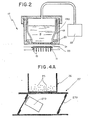
- the flow dispensing equipment 17 is shown diagrammatically in FIG. 2.
- the flow 18 (benzyl alpha 102-1500 or equivalent) is placed in a teflon tank 19, enclosed in a stainless steel cylinder 19a, the removable bottom of which constitutes the flux mask 20.
- This mask is pierced with holes 21 according to the configuration and the pitch of the pins.
- the pressure inside the reservoir 19 is controlled from a pneumatic system 22 controlled for example, from a logic circuit or from an analog output of a computer (not shown).
- the flow is maintained in the tank during the positioning phase, that is to say approaching and aligning the tank above the ceramic substrate 11, then is released by means of a pressure pulse supplied by the system. 22.
- the substrate 11 is placed in a substrate support 23 provided with alignment pins (not shown).
- a flux droplet 24 as can be seen in FIG. 3.
- the holes 21 must have a diameter of 0.4mm, while the thickness of the fabric constituting the flux mask is 1mm.
- the purpose of the second step is to define other equipment which can ensure the suction, the maintenance, and the release of a solder ball above each spindle head where it will be maintained by the adhesive action of the droplet of the flux deposited during the first step.
- the Pb / Sn 90/10 solder balls chosen for this application have a diameter of 0.7mm, they are also very light, we therefore planned to vibrate them, before sucking them up, that's the role of the equipment shown in Figures 4A.
- the balls 25 are agitated in a vibrating bowl 26 controlled by a vibrator 27.
- This vibrating bowl must be made with a sufficiently elastic material so that the solder balls can bounce on it.
- a vibrating bowl made of polyethylene was entirely satisfactory. Furthermore, the vibrations have been found to be insufficient in themselves to put the balls in agitation. It was shown that there was an optimum number of solder balls which actually corresponded to a monolayer of balls when the bowl was at rest.
- the vibrator 27 included a table resting on two oblique springs 27a, an electromagnet 27b ensuring the vibration of the assembly.
- the balls vibrated over a height of about 20mm.
- Other embodiments of stirring the balls can be envisaged, for example with a container whose bottom is porous and receives compressed air.
- FIG 4B there is shown an equipment 28 for suction and dispensing of solder balls, which sucks the moving balls in the vibrating bowl 26.
- This equipment comprises a soft iron frame 29 which can be circular in shape , and which defines a suction chamber 30 in connection, by a tube 31, with a controlled vacuum device (not shown).
- An electromagnet 32 is arranged along the tubing which constitutes its axis, it is controlled from the mains voltage (50 Hz) through a diode.
- the suction chamber is closed by a suction mask 33 provided with a rod 34, the other end of which is located in the air gap of the electromagnet.
- the mask consists of a 0.1mm thick beryllium copper membrane, pierced with holes according to the configuration of the pins on the substrate. The diameter of the suction holes is 0.4mm.
- the vibrator 27 is first set in motion to ensure the agitation of the balls 25 in the vibrating bowl 26.
- the equipment 28 previously connected at the source of vacuum, is immersed in the vibrating bowl so that the distance between the suction mask 33 and the bottom of the bowl is about 5mm.
- the time required to take all the balls is of the order of one second.
- the equipment 28 carrying the solder balls 25 is placed above the substrate 11 and arranged so that the configuration of balls and that of the pins are aligned with however preferably a slight offset so that the ball rests on at least one portion of the carnation.
- This alignment can be done thanks to the presence of alignment pins (not shown) on the module support, which receive corresponding recesses (not shown) made in the frame of the equipment 28 similar to that shown in the figure. 2.
- the solder balls are therefore brought into contact with the corresponding flux droplets.
- the vacuum is then cut; while the electromagnet is controlled for approximately 0.5 seconds. It has been noticed that the process was greatly improved by the vibration of the membrane. This has the effect of helping to loosen the balls which remain however maintained on the spindle heads thanks to the adhesive action of the flux.
- FIG. 5 represents the arrangement of the balls on the ceramic substrate.
- the existence of a slight difference between the spindle head 15a and the solder ball 25 is clearly highlighted in this figure. It has been noted that this offset provides better adhesion of the ball to the flow, and better welding between the spindle head and the eyelet. This results in better yields. It only remains, in a known manner, only to dispense flux (for example using equipment similar to that described in FIG. 2) on the fingers at the ends of the conductors at the location of the solder balls. of the silicon chip, and to place this chip.
- the ceramic substrate is finally introduced into a nitrogen atmosphere furnace having a temperature peak at 350 ° C., which melts the solder balls and which simultaneously ensures the bonding of the chip with the fingers of the conductors deposited on the substrate (technique said Flip-Chip) and the connection of the pin heads with the eyelets of said conductors.
Landscapes
- Engineering & Computer Science (AREA)
- Manufacturing & Machinery (AREA)
- Mechanical Engineering (AREA)
- Microelectronics & Electronic Packaging (AREA)
- Electric Connection Of Electric Components To Printed Circuits (AREA)
- Lead Frames For Integrated Circuits (AREA)
Priority Applications (4)
| Application Number | Priority Date | Filing Date | Title |
|---|---|---|---|
| EP81430045A EP0082902B1 (de) | 1981-12-29 | 1981-12-29 | Verfahren zum Anlöten von Stiften an Lötaugen von auf einem keramischen Substrat ausgebildeten Leitern |
| DE8181430045T DE3173078D1 (en) | 1981-12-29 | 1981-12-29 | Soldering method of pins to eyelets of conductors formed on a ceramic substrate |
| JP57162407A JPS58118131A (ja) | 1981-12-29 | 1982-09-20 | ボンデイング方法 |
| US06/452,530 US4462534A (en) | 1981-12-29 | 1982-12-23 | Method of bonding connecting pins to the eyelets of conductors formed on a ceramic substrate |
Applications Claiming Priority (1)
| Application Number | Priority Date | Filing Date | Title |
|---|---|---|---|
| EP81430045A EP0082902B1 (de) | 1981-12-29 | 1981-12-29 | Verfahren zum Anlöten von Stiften an Lötaugen von auf einem keramischen Substrat ausgebildeten Leitern |
Publications (2)
| Publication Number | Publication Date |
|---|---|
| EP0082902A1 true EP0082902A1 (de) | 1983-07-06 |
| EP0082902B1 EP0082902B1 (de) | 1985-11-27 |
Family
ID=8188606
Family Applications (1)
| Application Number | Title | Priority Date | Filing Date |
|---|---|---|---|
| EP81430045A Expired EP0082902B1 (de) | 1981-12-29 | 1981-12-29 | Verfahren zum Anlöten von Stiften an Lötaugen von auf einem keramischen Substrat ausgebildeten Leitern |
Country Status (4)
| Country | Link |
|---|---|
| US (1) | US4462534A (de) |
| EP (1) | EP0082902B1 (de) |
| JP (1) | JPS58118131A (de) |
| DE (1) | DE3173078D1 (de) |
Cited By (9)
| Publication number | Priority date | Publication date | Assignee | Title |
|---|---|---|---|---|
| FR2602920A1 (fr) * | 1986-04-24 | 1988-02-19 | Souriau & Cie | Connecteur a filtre d'attenuation incorpore |
| EP0263222A1 (de) * | 1986-10-08 | 1988-04-13 | International Business Machines Corporation | Verfahren zum Herstellen von Lötkontakten für ein keramisches Modul ohne Steckerstifte |
| EP0263221A1 (de) * | 1986-10-08 | 1988-04-13 | International Business Machines Corporation | Verfahren zum Herstellen von Lotpodesten auf Metallkontaktflächen eines Substrats |
| EP0447170A3 (en) * | 1990-03-14 | 1992-03-25 | Nippon Steel Corporation | Method of bonding bumps to leads of tab tape and an apparatus for arranging bumps used for the same |
| EP0463559A3 (en) * | 1990-06-25 | 1992-03-25 | Fujitsu Limited | Packaged semiconductor device and a manufacturing process therefor |
| EP0582375A1 (de) * | 1992-08-04 | 1994-02-09 | International Business Machines Corporation | Aufbringen von Lotteilchen |
| US5293072A (en) * | 1990-06-25 | 1994-03-08 | Fujitsu Limited | Semiconductor device having spherical terminals attached to the lead frame embedded within the package body |
| EP1617519A3 (de) * | 1996-10-10 | 2007-12-12 | Fci | Verbinder hoher Packungsdichte |
| CH698875B1 (de) * | 2007-07-25 | 2009-11-30 | Sauter Ag | Verfahren zur Bestückung einer Leiterplatte mit einem Stecker. |
Families Citing this family (64)
| Publication number | Priority date | Publication date | Assignee | Title |
|---|---|---|---|---|
| US4558812A (en) * | 1984-11-07 | 1985-12-17 | At&T Technologies, Inc. | Method and apparatus for batch solder bumping of chip carriers |
| US5917707A (en) | 1993-11-16 | 1999-06-29 | Formfactor, Inc. | Flexible contact structure with an electrically conductive shell |
| US4761699A (en) * | 1986-10-28 | 1988-08-02 | International Business Machines Corporation | Slider-suspension assembly and method for attaching a slider to a suspension in a data recording disk file |
| JPH0795554B2 (ja) * | 1987-09-14 | 1995-10-11 | 株式会社日立製作所 | はんだ球整列装置 |
| US5088639A (en) * | 1991-01-25 | 1992-02-18 | Motorola, Inc. | Soldering process |
| US5145104A (en) * | 1991-03-21 | 1992-09-08 | International Business Machines Corporation | Substrate soldering in a reducing atmosphere |
| US5205896A (en) * | 1992-02-03 | 1993-04-27 | Hughes Aircraft Company | Component and solder preform placement device and method of placement |
| US5788143A (en) * | 1992-04-08 | 1998-08-04 | International Business Machines Corporation | Solder particle deposition |
| US5284287A (en) * | 1992-08-31 | 1994-02-08 | Motorola, Inc. | Method for attaching conductive balls to a substrate |
| JPH0828583B2 (ja) * | 1992-12-23 | 1996-03-21 | インターナショナル・ビジネス・マシーンズ・コーポレイション | 多層プリント回路基板およびその製作方法、およびボール・ディスペンサ |
| US5323947A (en) * | 1993-05-03 | 1994-06-28 | Motorola, Inc. | Method and apparatus for use in forming pre-positioned solder bumps on a pad arrangement |
| US5345529A (en) * | 1993-07-06 | 1994-09-06 | At&T Bell Laboratories | Method for assembly of an optical fiber connective device |
| US5416872A (en) * | 1993-07-06 | 1995-05-16 | At&T Corp. | Arrangement for interconnecting an optical fiber an optoelectronic component |
| US20020053734A1 (en) | 1993-11-16 | 2002-05-09 | Formfactor, Inc. | Probe card assembly and kit, and methods of making same |
| US7073254B2 (en) | 1993-11-16 | 2006-07-11 | Formfactor, Inc. | Method for mounting a plurality of spring contact elements |
| US5820014A (en) | 1993-11-16 | 1998-10-13 | Form Factor, Inc. | Solder preforms |
| US5431332A (en) * | 1994-02-07 | 1995-07-11 | Motorola, Inc. | Method and apparatus for solder sphere placement using an air knife |
| JP3528264B2 (ja) * | 1994-08-19 | 2004-05-17 | ソニー株式会社 | ソルダーボールのマウント装置 |
| US5650595A (en) * | 1995-05-25 | 1997-07-22 | International Business Machines Corporation | Electronic module with multiple solder dams in soldermask window |
| TW267265B (en) * | 1995-06-12 | 1996-01-01 | Connector Systems Tech Nv | Low cross talk and impedance controlled electrical connector |
| US6939173B1 (en) * | 1995-06-12 | 2005-09-06 | Fci Americas Technology, Inc. | Low cross talk and impedance controlled electrical connector with solder masses |
| US5685477A (en) * | 1995-06-28 | 1997-11-11 | Intel Corporation | Method for attaching and handling conductive spheres to a substrate |
| US5899376A (en) * | 1995-07-11 | 1999-05-04 | Nippon Steel Corporation | Transfer of flux onto electrodes and production of bumps on electrodes |
| JP3120714B2 (ja) * | 1995-10-31 | 2000-12-25 | 松下電器産業株式会社 | 導電性ボールの搭載装置 |
| US5687901A (en) * | 1995-11-14 | 1997-11-18 | Nippon Steel Corporation | Process and apparatus for forming ball bumps |
| US8033838B2 (en) | 1996-02-21 | 2011-10-11 | Formfactor, Inc. | Microelectronic contact structure |
| US5994152A (en) | 1996-02-21 | 1999-11-30 | Formfactor, Inc. | Fabricating interconnects and tips using sacrificial substrates |
| US6024584A (en) * | 1996-10-10 | 2000-02-15 | Berg Technology, Inc. | High density connector |
| US6093035A (en) * | 1996-06-28 | 2000-07-25 | Berg Technology, Inc. | Contact for use in an electrical connector |
| TW406454B (en) | 1996-10-10 | 2000-09-21 | Berg Tech Inc | High density connector and method of manufacture |
| US6042389A (en) * | 1996-10-10 | 2000-03-28 | Berg Technology, Inc. | Low profile connector |
| US6241535B1 (en) | 1996-10-10 | 2001-06-05 | Berg Technology, Inc. | Low profile connector |
| US6139336A (en) | 1996-11-14 | 2000-10-31 | Berg Technology, Inc. | High density connector having a ball type of contact surface |
| US6441487B2 (en) | 1997-10-20 | 2002-08-27 | Flip Chip Technologies, L.L.C. | Chip scale package using large ductile solder balls |
| US6272741B1 (en) * | 1998-07-24 | 2001-08-14 | Autosplice, Inc. | Hybrid solder ball and pin grid array circuit board interconnect system and method |
| US6193143B1 (en) * | 1998-08-05 | 2001-02-27 | Matsushita Electric Industrial Co., Ltd. | Solder bump forming method and mounting apparatus and mounting method of solder ball |
| US6595408B1 (en) * | 1998-10-07 | 2003-07-22 | Micron Technology, Inc. | Method of attaching solder balls to BGA package utilizing a tool to pick and dip the solder ball in flux prior to placement |
| US6268275B1 (en) * | 1998-10-08 | 2001-07-31 | Micron Technology, Inc. | Method of locating conductive spheres utilizing screen and hopper of solder balls |
| US6711812B1 (en) | 1999-04-13 | 2004-03-30 | Unicap Electronics Industrial Corporation | Method of making metal core substrate printed circuit wiring board enabling thermally enhanced ball grid array (BGA) packages |
| US6675472B1 (en) | 1999-04-29 | 2004-01-13 | Unicap Electronics Industrial Corporation | Process and structure for manufacturing plastic chip carrier |
| US6589594B1 (en) * | 2000-08-31 | 2003-07-08 | Micron Technology, Inc. | Method for filling a wafer through-via with a conductive material |
| US6928727B2 (en) * | 2002-07-30 | 2005-08-16 | Avx Corporation | Apparatus and method for making electrical connectors |
| US6860741B2 (en) | 2002-07-30 | 2005-03-01 | Avx Corporation | Apparatus and methods for retaining and placing electrical components |
| US6851954B2 (en) | 2002-07-30 | 2005-02-08 | Avx Corporation | Electrical connectors and electrical components |
| US7537461B2 (en) * | 2003-07-16 | 2009-05-26 | Gryphics, Inc. | Fine pitch electrical interconnect assembly |
| KR101124015B1 (ko) * | 2003-07-16 | 2012-03-26 | 그리픽스, 인코포레이티드 | 상호 결합 접촉 시스템을 구비한 전기 상호 연결 조립체 |
| US7297003B2 (en) * | 2003-07-16 | 2007-11-20 | Gryphics, Inc. | Fine pitch electrical interconnect assembly |
| JP4370225B2 (ja) * | 2004-08-19 | 2009-11-25 | 住友電装株式会社 | プリント基板への端子実装方法、該方法で形成した端子実装プリント基板および該端子実装プリント基板を収容している電気接続箱 |
| US7684205B2 (en) * | 2006-02-22 | 2010-03-23 | General Dynamics Advanced Information Systems, Inc. | System and method of using a compliant lead interposer |
| US8044502B2 (en) | 2006-03-20 | 2011-10-25 | Gryphics, Inc. | Composite contact for fine pitch electrical interconnect assembly |
| US8366485B2 (en) | 2009-03-19 | 2013-02-05 | Fci Americas Technology Llc | Electrical connector having ribbed ground plate |
| CN102456958A (zh) * | 2010-10-23 | 2012-05-16 | 富士康(昆山)电脑接插件有限公司 | 电连接器及其制造方法 |
| EP2624034A1 (de) | 2012-01-31 | 2013-08-07 | Fci | Abbaubare optische Kupplungsvorrichtung |
| USD727852S1 (en) | 2012-04-13 | 2015-04-28 | Fci Americas Technology Llc | Ground shield for a right angle electrical connector |
| USD718253S1 (en) | 2012-04-13 | 2014-11-25 | Fci Americas Technology Llc | Electrical cable connector |
| US9257778B2 (en) | 2012-04-13 | 2016-02-09 | Fci Americas Technology | High speed electrical connector |
| US8944831B2 (en) | 2012-04-13 | 2015-02-03 | Fci Americas Technology Llc | Electrical connector having ribbed ground plate with engagement members |
| USD727268S1 (en) | 2012-04-13 | 2015-04-21 | Fci Americas Technology Llc | Vertical electrical connector |
| US9543703B2 (en) | 2012-07-11 | 2017-01-10 | Fci Americas Technology Llc | Electrical connector with reduced stack height |
| USD751507S1 (en) | 2012-07-11 | 2016-03-15 | Fci Americas Technology Llc | Electrical connector |
| USD745852S1 (en) | 2013-01-25 | 2015-12-22 | Fci Americas Technology Llc | Electrical connector |
| USD720698S1 (en) | 2013-03-15 | 2015-01-06 | Fci Americas Technology Llc | Electrical cable connector |
| US9138821B2 (en) * | 2014-01-17 | 2015-09-22 | Medtronic, Inc. | Methods for simultaneously brazing a ferrule and lead pins |
| US10727168B2 (en) * | 2014-09-15 | 2020-07-28 | Nxp B.V. | Inter-connection of a lead frame with a passive component intermediate structure |
Citations (2)
| Publication number | Priority date | Publication date | Assignee | Title |
|---|---|---|---|---|
| US3921285A (en) * | 1974-07-15 | 1975-11-25 | Ibm | Method for joining microminiature components to a carrying structure |
| US4206542A (en) * | 1978-03-13 | 1980-06-10 | General Dynamics Pomona Division | Solder preform loading method and apparatus |
Family Cites Families (6)
| Publication number | Priority date | Publication date | Assignee | Title |
|---|---|---|---|---|
| US3292240A (en) * | 1963-08-08 | 1966-12-20 | Ibm | Method of fabricating microminiature functional components |
| US3719981A (en) * | 1971-11-24 | 1973-03-13 | Rca Corp | Method of joining solder balls to solder bumps |
| SU651914A1 (ru) * | 1977-03-24 | 1979-03-15 | Предприятие П/Я Г-4097 | Устройство дл изготовлени печатных плат |
| US4332341A (en) * | 1979-12-26 | 1982-06-01 | Bell Telephone Laboratories, Incorporated | Fabrication of circuit packages using solid phase solder bonding |
| US4396140A (en) * | 1981-01-27 | 1983-08-02 | Bell Telephone Laboratories, Incorporated | Method of bonding electronic components |
| US4421266A (en) * | 1981-07-29 | 1983-12-20 | Western Electric Company, Inc. | Handling bodies containing bonding material |
-
1981
- 1981-12-29 DE DE8181430045T patent/DE3173078D1/de not_active Expired
- 1981-12-29 EP EP81430045A patent/EP0082902B1/de not_active Expired
-
1982
- 1982-09-20 JP JP57162407A patent/JPS58118131A/ja active Granted
- 1982-12-23 US US06/452,530 patent/US4462534A/en not_active Expired - Lifetime
Patent Citations (2)
| Publication number | Priority date | Publication date | Assignee | Title |
|---|---|---|---|---|
| US3921285A (en) * | 1974-07-15 | 1975-11-25 | Ibm | Method for joining microminiature components to a carrying structure |
| US4206542A (en) * | 1978-03-13 | 1980-06-10 | General Dynamics Pomona Division | Solder preform loading method and apparatus |
Non-Patent Citations (4)
| Title |
|---|
| IBM TECHNICAL DISCLOSURE BULLETIN, vol.12, no.1, juin 1969, New York (US) * |
| IBM TECHNICAL DISCLOSURE BULLETIN, vol.14, no.7, décembre 1971, New York (US) * |
| IBM TECHNICAL DISCLOSURE BULLETIN, vol.20, no.2, juillet 1977, New York (US) * |
| TECHNICAL DIGEST, no.55, juillet 1979, New York (US) * |
Cited By (11)
| Publication number | Priority date | Publication date | Assignee | Title |
|---|---|---|---|---|
| FR2602920A1 (fr) * | 1986-04-24 | 1988-02-19 | Souriau & Cie | Connecteur a filtre d'attenuation incorpore |
| EP0263222A1 (de) * | 1986-10-08 | 1988-04-13 | International Business Machines Corporation | Verfahren zum Herstellen von Lötkontakten für ein keramisches Modul ohne Steckerstifte |
| EP0263221A1 (de) * | 1986-10-08 | 1988-04-13 | International Business Machines Corporation | Verfahren zum Herstellen von Lotpodesten auf Metallkontaktflächen eines Substrats |
| EP0447170A3 (en) * | 1990-03-14 | 1992-03-25 | Nippon Steel Corporation | Method of bonding bumps to leads of tab tape and an apparatus for arranging bumps used for the same |
| EP0463559A3 (en) * | 1990-06-25 | 1992-03-25 | Fujitsu Limited | Packaged semiconductor device and a manufacturing process therefor |
| US5293072A (en) * | 1990-06-25 | 1994-03-08 | Fujitsu Limited | Semiconductor device having spherical terminals attached to the lead frame embedded within the package body |
| US5403776A (en) * | 1990-06-25 | 1995-04-04 | Fujitsu Limited | Process of using a jig to align and mount terminal conductors to a semiconductor plastic package |
| EP0582375A1 (de) * | 1992-08-04 | 1994-02-09 | International Business Machines Corporation | Aufbringen von Lotteilchen |
| US5445313A (en) * | 1992-08-04 | 1995-08-29 | International Business Machines Corporation | Solder particle deposition |
| EP1617519A3 (de) * | 1996-10-10 | 2007-12-12 | Fci | Verbinder hoher Packungsdichte |
| CH698875B1 (de) * | 2007-07-25 | 2009-11-30 | Sauter Ag | Verfahren zur Bestückung einer Leiterplatte mit einem Stecker. |
Also Published As
| Publication number | Publication date |
|---|---|
| EP0082902B1 (de) | 1985-11-27 |
| JPS58118131A (ja) | 1983-07-14 |
| JPS64819B2 (de) | 1989-01-09 |
| US4462534A (en) | 1984-07-31 |
| DE3173078D1 (en) | 1986-01-09 |
Similar Documents
| Publication | Publication Date | Title |
|---|---|---|
| EP0082902B1 (de) | Verfahren zum Anlöten von Stiften an Lötaugen von auf einem keramischen Substrat ausgebildeten Leitern | |
| US5447886A (en) | Method for mounting semiconductor chip on circuit board | |
| US7008817B2 (en) | Method for manufacturing micro electro-mechanical systems using solder balls | |
| EP0352183B1 (de) | Verfahren zum Montieren elektronischer Mikrokomponenten auf einer Unterlage und Zwischenprodukt | |
| FR2742687A1 (fr) | Procede de fourniture de soudure, appareil de fourniture de soudure et procede de soudage | |
| JPH0771743B2 (ja) | 溶融半田を射出成形する装置および方法 | |
| FR2759616A1 (fr) | Appareil d'empilage et de brasage automatise pour dispositifs de modules empiles tridimensionnels et procede de fabrication de celui-ci | |
| CA2348724A1 (fr) | Dispositif de mise a disposition de billes ou de preformes pour la fabrication de connexions a billes | |
| EP0922300A1 (de) | Halbleiteranordnung mit niedrig schmelzendem metallhöckern und herstellungsverfahren | |
| US6722557B2 (en) | Flux cleaning method and method of manufacturing semiconductor device | |
| FR2792861A1 (fr) | Procede de realisation de plots de soudure sur un substrat et guide pour la mise en oeuvre du procede | |
| EP0040669B1 (de) | Verfahren zum Eliminieren von Lothöckern, die auf einem keramischen Substrat nach der Entfernung eines Halbleiterchips zurückblieben, durch Absorption in einem porösen Kupferblock und Anwendung in der Wiederaufarbeitung von Modulen | |
| WO2000077729A1 (fr) | Dispositif et procede de fabrication de dispositifs electroniques comportant au moins une puce fixee sur un support | |
| FR2479639A1 (fr) | Dispositif d'assemblage entre composants electroniques de caracteristiques mecaniques differentes et son procede de realisation | |
| EP0793269B1 (de) | Halbleiteranordnung mit einem auf einen Träger gelöteten Chip mit Durchgangsleitungen und Herstellungsverfahren dafür | |
| JP4505783B2 (ja) | 半田バンプの製造方法及び製造装置 | |
| KR20190060287A (ko) | 마이크로 소자 어레이 전사방법 | |
| JPH10321671A (ja) | バンプ付きチップの実装構造および実装方法 | |
| JP2001223232A (ja) | 半導体装置の製造方法 | |
| EP0242667B1 (de) | Lötwerkzeug für elektronische Vorrichtungen | |
| JP2001144035A (ja) | 半導体装置の製造方法および半導体装置 | |
| JPH05347474A (ja) | 電子部品の仮止め用ピース | |
| JP3922768B2 (ja) | バンプ形成方法および装置 | |
| JPH11214569A (ja) | バンプ形成方法および装置 | |
| EP1314196A1 (de) | Herstellungsverfahren für einen auf einer oberfläche montierbaren integrierten schaltkreis und dadurch hergestellter schaltkreis |
Legal Events
| Date | Code | Title | Description |
|---|---|---|---|
| PUAI | Public reference made under article 153(3) epc to a published international application that has entered the european phase |
Free format text: ORIGINAL CODE: 0009012 |
|
| AK | Designated contracting states |
Designated state(s): DE FR GB |
|
| 17P | Request for examination filed |
Effective date: 19831021 |
|
| GRAA | (expected) grant |
Free format text: ORIGINAL CODE: 0009210 |
|
| AK | Designated contracting states |
Designated state(s): DE FR GB |
|
| REF | Corresponds to: |
Ref document number: 3173078 Country of ref document: DE Date of ref document: 19860109 |
|
| PLBE | No opposition filed within time limit |
Free format text: ORIGINAL CODE: 0009261 |
|
| STAA | Information on the status of an ep patent application or granted ep patent |
Free format text: STATUS: NO OPPOSITION FILED WITHIN TIME LIMIT |
|
| 26N | No opposition filed | ||
| PGFP | Annual fee paid to national office [announced via postgrant information from national office to epo] |
Ref country code: DE Payment date: 19951229 Year of fee payment: 15 |
|
| PGFP | Annual fee paid to national office [announced via postgrant information from national office to epo] |
Ref country code: GB Payment date: 19961126 Year of fee payment: 16 |
|
| PGFP | Annual fee paid to national office [announced via postgrant information from national office to epo] |
Ref country code: FR Payment date: 19961211 Year of fee payment: 16 |
|
| PG25 | Lapsed in a contracting state [announced via postgrant information from national office to epo] |
Ref country code: DE Effective date: 19970902 |
|
| PG25 | Lapsed in a contracting state [announced via postgrant information from national office to epo] |
Ref country code: GB Free format text: LAPSE BECAUSE OF NON-PAYMENT OF DUE FEES Effective date: 19971229 |
|
| PG25 | Lapsed in a contracting state [announced via postgrant information from national office to epo] |
Ref country code: FR Free format text: THE PATENT HAS BEEN ANNULLED BY A DECISION OF A NATIONAL AUTHORITY Effective date: 19971231 |
|
| GBPC | Gb: european patent ceased through non-payment of renewal fee |
Effective date: 19971229 |
|
| REG | Reference to a national code |
Ref country code: FR Ref legal event code: ST |