EP0077435A2 - Kurbeltrieb für eine Brennkraftmaschine - Google Patents
Kurbeltrieb für eine Brennkraftmaschine Download PDFInfo
- Publication number
- EP0077435A2 EP0077435A2 EP82105815A EP82105815A EP0077435A2 EP 0077435 A2 EP0077435 A2 EP 0077435A2 EP 82105815 A EP82105815 A EP 82105815A EP 82105815 A EP82105815 A EP 82105815A EP 0077435 A2 EP0077435 A2 EP 0077435A2
- Authority
- EP
- European Patent Office
- Prior art keywords
- flywheel
- crankshaft
- plane
- extensions
- recesses
- Prior art date
- Legal status (The legal status is an assumption and is not a legal conclusion. Google has not performed a legal analysis and makes no representation as to the accuracy of the status listed.)
- Granted
Links
Images

Classifications
-
- F—MECHANICAL ENGINEERING; LIGHTING; HEATING; WEAPONS; BLASTING
- F02—COMBUSTION ENGINES; HOT-GAS OR COMBUSTION-PRODUCT ENGINE PLANTS
- F02B—INTERNAL-COMBUSTION PISTON ENGINES; COMBUSTION ENGINES IN GENERAL
- F02B75/00—Other engines
- F02B75/06—Engines with means for equalising torque
-
- F—MECHANICAL ENGINEERING; LIGHTING; HEATING; WEAPONS; BLASTING
- F16—ENGINEERING ELEMENTS AND UNITS; GENERAL MEASURES FOR PRODUCING AND MAINTAINING EFFECTIVE FUNCTIONING OF MACHINES OR INSTALLATIONS; THERMAL INSULATION IN GENERAL
- F16F—SPRINGS; SHOCK-ABSORBERS; MEANS FOR DAMPING VIBRATION
- F16F15/00—Suppression of vibrations in systems; Means or arrangements for avoiding or reducing out-of-balance forces, e.g. due to motion
- F16F15/30—Flywheels
-
- Y—GENERAL TAGGING OF NEW TECHNOLOGICAL DEVELOPMENTS; GENERAL TAGGING OF CROSS-SECTIONAL TECHNOLOGIES SPANNING OVER SEVERAL SECTIONS OF THE IPC; TECHNICAL SUBJECTS COVERED BY FORMER USPC CROSS-REFERENCE ART COLLECTIONS [XRACs] AND DIGESTS
- Y10—TECHNICAL SUBJECTS COVERED BY FORMER USPC
- Y10T—TECHNICAL SUBJECTS COVERED BY FORMER US CLASSIFICATION
- Y10T74/00—Machine element or mechanism
- Y10T74/21—Elements
- Y10T74/2173—Cranks and wrist pins
- Y10T74/2183—Counterbalanced
-
- Y—GENERAL TAGGING OF NEW TECHNOLOGICAL DEVELOPMENTS; GENERAL TAGGING OF CROSS-SECTIONAL TECHNOLOGIES SPANNING OVER SEVERAL SECTIONS OF THE IPC; TECHNICAL SUBJECTS COVERED BY FORMER USPC CROSS-REFERENCE ART COLLECTIONS [XRACs] AND DIGESTS
- Y10—TECHNICAL SUBJECTS COVERED BY FORMER USPC
- Y10T—TECHNICAL SUBJECTS COVERED BY FORMER US CLASSIFICATION
- Y10T74/00—Machine element or mechanism
- Y10T74/21—Elements
- Y10T74/2173—Cranks and wrist pins
- Y10T74/2183—Counterbalanced
- Y10T74/2184—Vibration dampers
Definitions
- the invention relates to a crank mechanism for an internal combustion engine, in particular a four-cylinder type, which comprises a crankshaft connected to a flywheel.
- the object of the invention is to take such precautions on the crank mechanism of an internal combustion engine that the bending vibrations which occur are at least minimized.
- the main advantages achieved with the invention are that the rotationally asymmetrical distribution of the oscillating masses, for example on the flywheel, causes a shift in the lower resonance frequency upwards, specifically in the crank crank plane, while the resonance frequency is reduced in the normal plane of the crank shaft.
- shifting the lower resonance frequency is the shift A critical resonance increase - the latter can lead to a crankshaft break - is possible in such a way that an excitation of this resonance is avoided in the usable speed range (idling to maximum speed).
- the asymmetrical distribution on the flywheel can be achieved in a simple manner, for example by recesses in the cranking plane or extensions in the normal plane.
- the flywheel can be relieved in some areas by means of a recess on the edge of the flywheel which is assigned to the crankshaft and which extends along it in a ring-like manner.
- Corresponding measures can of course be carried out on other components connected to the crank mechanism, such as pulley, clutch or the like.
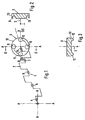
- a crank mechanism 1 of an internal combustion engine not shown in more detail - four cylinders in series - comprises a crankshaft 2 and a flywheel 3.
- the crankshaft 2 is mounted five times, for which bearings 4, 5, 6, 7, 8 are used.
- the flywheel 3 is formed by a circular cylindrical disk and is firmly connected to the crankshaft 2. To minimize the vibrations that occur during operation of the internal combustion engine, the crankshaft plane 2 of the crankshaft 2 on the flywheel 3 recesses 9, 10 are provided. In addition, extensions 11, 12 are attached to the flywheel 3 to maintain the polar moment of inertia in the normal plane BB of the crankshaft.
- the normal plane BB runs perpendicular to the offset plane AA.
- the recesses 9, 10 and extensions 11, 12 are arranged adjacent to an outer edge 13 of the flywheel 3.
- the weight achieved by the recesses 9, 10 corresponds approximately to that of the extensions 11, 12.
- the position of these recesses and extensions on opposite sides of the offset plane A-A or the normal plane B-B is the same.
- the cross-sectional shapes of the recesses or the extensions which are conical in the exemplary embodiment, match. Of course, other cross-sectional shapes are also conceivable.
- a flywheel 15 is also part of a friction clutch, not shown.
- the reduction in the vibrating mass of the flywheel 15 is formed by a recess 16 which runs on the side C facing the crankshaft 2 in a ring-like manner along an outer edge 17 of the flywheel 15. It is delimited by walls 18, 19 which lie on auxiliary lines 20, 21 of a circular section.
- the Winkelol of the auxiliary lines is 90 °, the offset plane A-A running as the bisector of the angle.
- the cross section of the recess 16 is angular. It is also possible to choose a different cross-sectional shape.
- the flywheel 15 is designed such that the weight removed in the offset plane A-A by the recess 16 is applied on both sides of the normal plane B-B.
Landscapes
- Engineering & Computer Science (AREA)
- General Engineering & Computer Science (AREA)
- Mechanical Engineering (AREA)
- Physics & Mathematics (AREA)
- Acoustics & Sound (AREA)
- Aviation & Aerospace Engineering (AREA)
- Chemical & Material Sciences (AREA)
- Combustion & Propulsion (AREA)
- Shafts, Cranks, Connecting Bars, And Related Bearings (AREA)
Abstract
Description
- Die Erfindung betrifft einen Kurbeltrieb für eine Brennkraftmaschine, insbesondere vierzylindriger Bauart, der eine mit einem Schwungrad verbundene Kurbelwelle umfasst.
- Brennkraftmaschinen der eingangs genannten Gattung haben in der Kröpfungsebene und in der zu dieser senkrecht verlaufenden Normalebene der Kurbelwelle verschiedene Massen- und Steifigkeitsverteilungen. Daraus resultieren bei korrespondierenden Biegeschwingungsformen unterschiedliche Resonanzfrequenzen, wobei die Resonanzfrequenzen der Kröpfungsebene grundsätzlich tiefer und damit ungünstiger liegen. Die bei diesen Resonanzfrequenzen auftretenden Schwingungsformen, werden durch unvermeidliche Gas- und Massenkräfte angeregt und können zu Kurbelwellenbrüchen führen oder zumindest Ursache für Motorgeräuschüberhöhungen sein.
- Aufgabe der Erfindung ist es, am Kurbeltrieb einer Brennkraftmaschine solche Vorkehrungen zu treffen, daß die auftretenden Biegeschwingungen zumindest minimiert werden.
- Erfindungsgemäß wird diese Aufgabe durch die kennzeichnenden Merkmale des Anspruches 1 gelöst. Weitere, die Erfindung in vorteilhafter Weise ausgestaltende Merkmale sind in den nachfolgenden Ansprüchen enthalten.
- Die mit der Erfindung hauptsächlich erzielten Vorteile sind darin zu sehen, daß die rotationsasymmetrische Verteilung der schwingenden Massen z.B. am Schwungrad eine Verschiebung der tieferen Resonanzfrequenz nach oben bewirkt und zwar in der Kröpfungsebene der Kurbelwelle, wogegen die Resonanzfrequenz in der Normalebene der Kurbelwelle abgesenkt wird. Durch Anhebungen der tieferen Resonanzfrequenz ist die Verschiebung einer kritischen Resonanzüberhöhung - letztere kann zu einem Kurbelwellenbruch führen - möglich und zwar so, daß eine Anregung dieser Resonanz im nutzbaren Drehzahlbereich (Leerlauf bis Höchstdrehzahl) vermieden wird. Die asymmetrische Verteilung am Schwungrad läßt sich auf einfache Weise verwirklichen, z.B. durch Ausnehmungen in der Kröpfungsebene bzw. Erweiterungen in der Normalebene. Ist das Schwungrad gleichzeitig Bestandteil einer Kupplung, so kann die bereichsweise vorgenommene Schwungraderleichterung durch eine der Kurbelwelle zugeordnete Ausnehmung am Rand des Schwungrades erfolgen, die sich ringartig entlang von diesem erstreckt. Selbstverständlich können entsprechende Maßnahmen an anderen mit dem Kurbeltrieb verbundenen Bauteilen wie Riemenscheibe, Kupplung oder dergleichen vorgenommen werden.
- In der Zeichnung sind Ausführungsbeispiele der Erfindung dargestellt, die nachstehend näher beschrieben werden.
- Es zeigt
- Fig. 1 eine prinzipielle Schrägansicht eines Kurbeltriebes einer Brennkraftmaschine,
- Fig. 2 einen Schnitt nach der Linie II-II der Fig. 1,
- Fig. 3 einen Schnitt nach der Linie III-III der Fig. 1,
- Fig. 4 eine Teilansicht der Fig. 1 einer weiteren Ausführungsform,
- Fig. 5 einen Schnitt nach der Linie V-V der Fig. 4.
- Ein Kurbeltrieb 1 einer nicht näher gezeigten Brennkraftmaschine - Vierzylinder in Reihe - umfasst eine Kurbelwelle 2 und ein Schwungrad 3. Die Kurbelwelle 2 ist fünffach gelagert, wofür Lager 4, 5, 6, 7, 8 dienen.
- Das Schwungrad 3 wird durch eine kreiszylindrische Scheibe gebildet und ist fest mit der Kurbelwelle 2 verbunden. Zur Minimierung der beim Betrieb der Brennkraftmaschine auftretenden Schwingungen sind in der Kröpfungsebene A-A der Kurbelwelle 2 am Schwungrad 3 Ausnehmungen 9, 10 vorgesehen. Außerdem sind zur Erhaltung des polaren Trägheitsmomentes in der Normalebene B-B der Kurbelwelle 2 am Schwungrad 3 Erweiterungen 11, 12 angebracht. Die Normalebene B-B verläuft senkrecht zur Kröpfungsebene A-A.
- Die Ausnehmungen 9, 10 und Erweiterungen 11, 12 sind benachbart einem äußeren Rand 13 des Schwungrades 3 angeordnet. Das Gewicht, das durch die Ausnehmungen 9, 10 erzielt wird, entspricht in etwa dem der Erweiterungen 11, 12. Auch ist die Lage dieser Ausnehmungen und Erweiterungen an gegenüberliegenden Seiten der Kröpfungsebene A-A bzw. der Normalebene B-B gleich. Ferner stimmen die Querschnittsformen der Ausnehmungen bzw. der Erweiterungen überein, die im Ausführungsbeispiel kegelig sind. Selbstverständlich sind auch andere Querschnittsformen denkbar.
- Gemäß Fig. 4 ist ein Schwungrad 15 gleichzeitig Bestandteil einer nicht gezeigten Reibungskupplung. Die Verkleinerung der schwingenden Masse des Schwungrades 15 wird durch eine Ausnehmung 16 gebildet, die an der der Kurbelwelle 2 zugekehrten Seite C ringartig entlang eines äußeren Randes 17 des Schwungrades 15 verläuft. Sie wird begrenzt von Wandungen 18, 19, die auf Hilfslinien 20, 21 eines Kreisausschnittes liegen. Der Winkelol der Hilfslinien beträgt 90°, wobei die Kröpfungsebene A-A als Winkelhalbierende verläuft. Der Querschnitt der Ausnehmung 16 ist winkelförmig. Es besteht auch die Möglichkeit, eine andere Querschnittsform zu wählen.
- Das Schwungrad 15 ist so ausgebildet, daß das in der Kröpfungsebene A-A durch die Ausnehmung 16 weggenommene Gewicht beidseitig der Normalebene B-B angesetzt ist.
Claims (5)
Applications Claiming Priority (2)
| Application Number | Priority Date | Filing Date | Title |
|---|---|---|---|
| DE3140951 | 1981-10-15 | ||
| DE19813140951 DE3140951A1 (de) | 1981-10-15 | 1981-10-15 | "kurbeltrieb fuer eine brennkraftmaschine" |
Publications (3)
| Publication Number | Publication Date |
|---|---|
| EP0077435A2 true EP0077435A2 (de) | 1983-04-27 |
| EP0077435A3 EP0077435A3 (en) | 1983-08-10 |
| EP0077435B1 EP0077435B1 (de) | 1986-01-29 |
Family
ID=6144163
Family Applications (1)
| Application Number | Title | Priority Date | Filing Date |
|---|---|---|---|
| EP82105815A Expired EP0077435B1 (de) | 1981-10-15 | 1982-06-30 | Kurbeltrieb für eine Brennkraftmaschine |
Country Status (3)
| Country | Link |
|---|---|
| US (1) | US4594917A (de) |
| EP (1) | EP0077435B1 (de) |
| DE (2) | DE3140951A1 (de) |
Families Citing this family (7)
| Publication number | Priority date | Publication date | Assignee | Title |
|---|---|---|---|---|
| US4788883A (en) * | 1987-11-12 | 1988-12-06 | Yasuyoshi Hashizume | Rotor for a driving device |
| US5259269A (en) * | 1990-04-03 | 1993-11-09 | Swenson Sr Roger M | Flywheel with adjustable weights |
| US5303681A (en) * | 1992-08-28 | 1994-04-19 | Cummins Engine Company, Inc. | Torsional tunable coupling for a diesel engine drive shaft |
| US5295411A (en) * | 1993-06-22 | 1994-03-22 | Speckhart Frank H | Torsional vibration absorber system |
| JP2606292Y2 (ja) * | 1993-08-18 | 2000-10-10 | ヴァレオユニシアトランスミッション株式会社 | フライホイール |
| US6412366B1 (en) * | 2000-07-05 | 2002-07-02 | Donald G. Leith | Engine counterweight |
| KR101755496B1 (ko) * | 2016-09-09 | 2017-07-10 | 현대자동차 주식회사 | 파워 트레인 |
Family Cites Families (6)
| Publication number | Priority date | Publication date | Assignee | Title |
|---|---|---|---|---|
| GB522554A (en) * | 1938-12-16 | 1940-06-20 | Noel Raymond Chandler | Improvements in fly wheels |
| US4351202A (en) * | 1969-11-24 | 1982-09-28 | Summers Robert F | Engine |
| US3679130A (en) * | 1970-10-30 | 1972-07-25 | Technicon Instr | Container holding rotatable body with adjustable balancing feature |
| JPS547008A (en) * | 1977-06-16 | 1979-01-19 | Aisin Seiki Co Ltd | Torsion-damer-added-flywheel |
| US4262548A (en) * | 1979-05-07 | 1981-04-21 | Outboard Marine Corporation | Flywheel overbalance |
| AU539346B2 (en) * | 1979-10-11 | 1984-09-20 | Davis Tool & Engineering Co. | Flywheel |
-
1981
- 1981-10-15 DE DE19813140951 patent/DE3140951A1/de not_active Withdrawn
-
1982
- 1982-06-30 DE DE8282105815T patent/DE3268791D1/de not_active Expired
- 1982-06-30 EP EP82105815A patent/EP0077435B1/de not_active Expired
-
1984
- 1984-12-12 US US06/680,606 patent/US4594917A/en not_active Expired - Fee Related
Also Published As
| Publication number | Publication date |
|---|---|
| DE3268791D1 (en) | 1986-03-13 |
| US4594917A (en) | 1986-06-17 |
| DE3140951A1 (de) | 1983-05-05 |
| EP0077435A3 (en) | 1983-08-10 |
| EP0077435B1 (de) | 1986-01-29 |
Similar Documents
| Publication | Publication Date | Title |
|---|---|---|
| DE3608402C2 (de) | Dämpfungsvorrichtung an einer Riemenscheibe einer Kurbelwelle einer Brennkraftmaschine eines Fahrzeugs | |
| DE3332789A1 (de) | Ventilsteuereinrichtung fuer eine brennkraftmaschine | |
| AT402088B (de) | Brennkraftmaschine mit in reihe angeordneten zylindern und einer obenliegenden nockenwelle zur betätigung der ein- und/oder auslassventile | |
| EP2198692A1 (de) | Heckenschere | |
| EP0237718B1 (de) | Kurbelwelle für Hubkolbenmaschinen | |
| EP0077435B1 (de) | Kurbeltrieb für eine Brennkraftmaschine | |
| EP0075659A2 (de) | Hubkolbenbrennkraftmaschine, vorzugsweise vierzylindriger Bauart | |
| EP0345424B1 (de) | Kurbelwelle | |
| DE3302364C2 (de) | Schwungrad für einen Vierzylinder-Reihenmotor | |
| EP0622534A1 (de) | Brennkraftmaschine mit zwei Zylinderreihen | |
| EP1024312A2 (de) | Hubkolben-Brennkraftmaschine | |
| EP1024276B1 (de) | Hubkolben-Brennkraftmaschine | |
| DE3224762A1 (de) | Einspritzpumpen-nockenwelle | |
| DE4017239C2 (de) | Nockenwelle | |
| DE19610872C1 (de) | Zylinderkurbelgehäuse für eine Brennkraftmaschine | |
| DE3545098C2 (de) | ||
| DE3520176C1 (en) | Reciprocating piston internal combustion engine | |
| EP0171505A2 (de) | Zündverteileranordnung an Brennkraftmaschinen | |
| DE3109655C2 (de) | Spritzzeitpunktversteller | |
| DE68903682T2 (de) | Ventilantrieb fuer eine v-typ brennkraftmaschine. | |
| DE69409888T2 (de) | Auswuchtmechanismus für eine Brennkraftmaschine | |
| DE2025305A1 (de) | Ventilsteuerung | |
| DE3814544C2 (de) | ||
| DE102004032598B4 (de) | Nebenaggregate-Antrieb | |
| DE19515350B4 (de) | Kraftfahrzeug-Antriebsanordnung |
Legal Events
| Date | Code | Title | Description |
|---|---|---|---|
| PUAI | Public reference made under article 153(3) epc to a published international application that has entered the european phase |
Free format text: ORIGINAL CODE: 0009012 |
|
| AK | Designated contracting states |
Designated state(s): DE FR GB IT |
|
| PUAL | Search report despatched |
Free format text: ORIGINAL CODE: 0009013 |
|
| AK | Designated contracting states |
Designated state(s): DE FR GB IT |
|
| 17P | Request for examination filed |
Effective date: 19830802 |
|
| ITF | It: translation for a ep patent filed | ||
| GRAA | (expected) grant |
Free format text: ORIGINAL CODE: 0009210 |
|
| AK | Designated contracting states |
Designated state(s): DE FR GB IT |
|
| REF | Corresponds to: |
Ref document number: 3268791 Country of ref document: DE Date of ref document: 19860313 |
|
| ET | Fr: translation filed | ||
| PLBE | No opposition filed within time limit |
Free format text: ORIGINAL CODE: 0009261 |
|
| STAA | Information on the status of an ep patent application or granted ep patent |
Free format text: STATUS: NO OPPOSITION FILED WITHIN TIME LIMIT |
|
| 26N | No opposition filed | ||
| ITTA | It: last paid annual fee | ||
| PGFP | Annual fee paid to national office [announced via postgrant information from national office to epo] |
Ref country code: FR Payment date: 19940629 Year of fee payment: 13 |
|
| PGFP | Annual fee paid to national office [announced via postgrant information from national office to epo] |
Ref country code: GB Payment date: 19950619 Year of fee payment: 14 |
|
| PGFP | Annual fee paid to national office [announced via postgrant information from national office to epo] |
Ref country code: DE Payment date: 19950626 Year of fee payment: 14 |
|
| PG25 | Lapsed in a contracting state [announced via postgrant information from national office to epo] |
Ref country code: FR Effective date: 19960229 |
|
| REG | Reference to a national code |
Ref country code: FR Ref legal event code: ST |
|
| PG25 | Lapsed in a contracting state [announced via postgrant information from national office to epo] |
Ref country code: GB Effective date: 19960630 |
|
| GBPC | Gb: european patent ceased through non-payment of renewal fee |
Effective date: 19960630 |
|
| PG25 | Lapsed in a contracting state [announced via postgrant information from national office to epo] |
Ref country code: DE Effective date: 19970301 |