EP0073232B1 - Verfahren und vorrichtung zum versprühen einer flüssigkeit oder suspension - Google Patents
Verfahren und vorrichtung zum versprühen einer flüssigkeit oder suspension Download PDFInfo
- Publication number
- EP0073232B1 EP0073232B1 EP82900942A EP82900942A EP0073232B1 EP 0073232 B1 EP0073232 B1 EP 0073232B1 EP 82900942 A EP82900942 A EP 82900942A EP 82900942 A EP82900942 A EP 82900942A EP 0073232 B1 EP0073232 B1 EP 0073232B1
- Authority
- EP
- European Patent Office
- Prior art keywords
- disk
- liquid
- spray cone
- spraying
- disk section
- Prior art date
- Legal status (The legal status is an assumption and is not a legal conclusion. Google has not performed a legal analysis and makes no representation as to the accuracy of the status listed.)
- Expired
Links
Images

Classifications
-
- B—PERFORMING OPERATIONS; TRANSPORTING
- B05—SPRAYING OR ATOMISING IN GENERAL; APPLYING FLUENT MATERIALS TO SURFACES, IN GENERAL
- B05B—SPRAYING APPARATUS; ATOMISING APPARATUS; NOZZLES
- B05B3/00—Spraying or sprinkling apparatus with moving outlet elements or moving deflecting elements
- B05B3/02—Spraying or sprinkling apparatus with moving outlet elements or moving deflecting elements with rotating elements
- B05B3/10—Spraying or sprinkling apparatus with moving outlet elements or moving deflecting elements with rotating elements discharging over substantially the whole periphery of the rotating member
- B05B3/1007—Spraying or sprinkling apparatus with moving outlet elements or moving deflecting elements with rotating elements discharging over substantially the whole periphery of the rotating member characterised by the rotating member
-
- F—MECHANICAL ENGINEERING; LIGHTING; HEATING; WEAPONS; BLASTING
- F26—DRYING
- F26B—DRYING SOLID MATERIALS OR OBJECTS BY REMOVING LIQUID THEREFROM
- F26B3/00—Drying solid materials or objects by processes involving the application of heat
- F26B3/02—Drying solid materials or objects by processes involving the application of heat by convection, i.e. heat being conveyed from a heat source to the materials or objects to be dried by a gas or vapour, e.g. air
- F26B3/10—Drying solid materials or objects by processes involving the application of heat by convection, i.e. heat being conveyed from a heat source to the materials or objects to be dried by a gas or vapour, e.g. air the gas or vapour carrying the materials or objects to be dried with it
- F26B3/12—Drying solid materials or objects by processes involving the application of heat by convection, i.e. heat being conveyed from a heat source to the materials or objects to be dried by a gas or vapour, e.g. air the gas or vapour carrying the materials or objects to be dried with it in the form of a spray, i.e. sprayed or dispersed emulsions or suspensions
Definitions
- the invention relates to a method for spraying a liquid or suspension by throwing off a spray cone of small droplets from a rotating centrifugal disc, and to a corresponding spray device with a drive shaft which can be set in rapid rotation by a drive device, at least one spray head arranged in a rotationally fixed manner with an essentially conical one Casing surface arranged throwing edge and a rotor connected to the spray head for common rotation.
- the diameter of the spray cone produced is influenced by the diameter of the centrifugal disc and its speed.
- a very uniform droplet size of, for example, 35 it can be achieved the hollow cone produced during spraying has a relatively large diameter of, for example, 100 to 120 cm, which is undesirable for many applications.
- an electrostatic paint spray gun of the type mentioned in which the spray head has a non-rotatably connected hub to a motor shaft, a conical lateral surface connected to it only by three radial arms with a flinging edge and an outside charging edge the hub is fitted with an axial fan with the conveying direction towards the workpiece and the paint mist sprayed from the centrifugal edge is deflected towards the workpiece by an axial air flow passing over the spray head on the outside. Since in this device, which works with compressed air supply and electrostatic voltage, the air moved by the axial fan in the direction of the workpiece is inevitably deflected outward in front of the workpiece, this results in an undesirable widening of the spray cone.
- a similar spray device in which a compressed air jet is permanently blown axially into the interior of a spray cone thrown from the flinging edge of a conical lateral surface through an air nozzle and a ring of bores in the direction of the workpiece.
- the blown-in compressed air has to leave the interior of the spray cone somewhere, which in turn leads to a radially outward air flow and a consequent widening of the spray cone.
- the object of the invention is to provide a method for spraying a liquid or suspension, a corresponding spraying device or a suitable centrifugal disc, which enables the production of a spray cone of smaller diameter in a simple manner without impairing the uniformity and the fineness of the droplet size achieved.
- the invention further relates to a spray device of the type mentioned at the outset, which is characterized by the features of patent claim 3.
- the invention also includes a centrifugal disc for a spray device according to the preamble of claim 3, which is equipped with the features of claim 7.
- the method and the spray device make it possible to reduce the diameter of the spray cone produced in a simple, uncomplicated manner without impairing the fineness and the uniformity of the droplet size.
- a centrifugal disc with an outer diameter of 5 cm can be used to produce a spray cone with a diameter of only 25 to 35 cm without impairing the fineness and uniformity of the droplet size.
- the method according to the invention and the spray devices according to the invention are particularly suitable where areas of relatively small dimensions are to be treated without the undesirable spraying of neighboring areas. This is the case, for example, when spraying goods moving on a relatively narrow conveyor belt, the diameter of the spray cone not to exceed the width of the conveyor belt.
- the spray device shown in Fig. 1 has a battery-powered drive motor 1, on the drive shaft 2, a centrifugal disc 3 is releasably attached.
- the centrifugal disc 3 has a substantially radially blue color Fenden disc section 4 and an obliquely angled edge skirt 5 on its outer edge, the outer spray edge 6 is formed in a manner known per se fine sawtooth-like (tooth width about 0.5 mm), which is not shown in the drawings for reasons of clarity.
- a propeller 10 is arranged, which is detachably connected to the centrifugal disc 3 and carries a plurality of propeller blades 11, which are shaped and aligned so that the propeller 10 when it rotates together with the The centrifugal disc 3 generates an air flow directed axially towards it and a vacuum zone 13 is formed on the vacuum side of the propeller 10 facing away from the centrifugal disc 3.
- a feed channel 7 for the spraying liquid is arranged in a stationary manner around the drive shaft 2.
- the liquid supplied by this is prevented by the annular apron 18 arranged on the centrifugal disk 3 from radially escaping and passes through through openings 8 arranged near the axis of the disk section 4 to the side of the disk section 4 facing the propeller 10, from where it occurs under the action of the centrifugal force the inner surface of the edge apron 5 is moved up to its sawtooth-like serrated spray edge 6 and is then thrown off by its pointed protrusions in the form of thin liquid jets that immediately disintegrate into droplets of practically the same size.
- the liquid droplets thrown off move radially outward under the action of the centrifugal force and at the same time fall down under the action of gravity, so that a hollow spray cone 12 is formed.
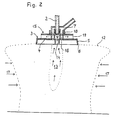
- an impeller 15 is provided on the centrifugal disc 3 instead of the propeller 10, which is arranged on the side facing away from the spray cone 12 and rotates with the centrifugal disc 3 and with its impeller blades 19 the air lying therebetween radially outwards Accelerated and thus constantly sucks air through the suction opening 14 communicating with the interior of the spray cone 12, so that a negative pressure zone 13 is formed there, which in turn causes a centripetal flow 17 directed towards this and thus a narrowing of the diameter of the spray cone 12 generated.
- passage channels 16 are provided which are arranged at uniform intervals over the circumference.
- gas passage openings 9 can be provided in the disc section 4 of the centrifugal disc 3 distributed over its circumference. These are expediently designed by inclined design of their walls so that the liquid to be sprayed is prevented from escaping through the gas passage openings 9. In certain cases, however, it may also be desirable to allow a portion of the liquid supplied to pass onto the outer surface of the centrifugal disc 3 by appropriately designing the gas passage openings. This applies in particular if it is provided there with a second edge apron 5 (not shown).
- the spray device explained above with reference to preferred embodiments can be modified by the person skilled in the art in various ways depending on the requirements of the individual case, provided that the use of a rotor for generating a vacuum zone 13 lying inside the spray cone 12 and a centripetal flow 17 is maintained.
- the diameter of the centrifugal disc 3, the design and the dimensions of the skirt 5, the propeller 10 or the impeller 15 and the arrangement and size of the passage openings 8 and any gas passage openings 9 should be based on the type and flow properties of the liquid or suspension to be sprayed Desired droplet size and the desired diameter of the spray cone 12 can be adjusted appropriately.
- the centrifugal disc is fastened in the usual way, for example by a clamping screw or by means of a thread on the drive shaft.
Landscapes
- Engineering & Computer Science (AREA)
- Life Sciences & Earth Sciences (AREA)
- Microbiology (AREA)
- Mechanical Engineering (AREA)
- General Engineering & Computer Science (AREA)
- Nozzles (AREA)
Description
- Die Erfindung betrifft ein Verfahren zum Versprühen einer Flüssigkeit oder Suspension durch Abschleudern eines Sprühkegels kleiner Tröpfchen von einer rotierenden Schleuderscheibe, sowie eine entsprechende Sprühvorrichtung mit einer durch eine Antriebsvorrichtung in schnelle Umdrehung versetzbaren Antriebswelle, mindestens einem an dieser drehfest angeordneten Sprühkopf mit an einer im wesentlichen konischen Mantelfläche angeordneten Abschleuderkante sowie einem mit dem Sprühkopf zu gemeinsamer Drehung verbundenen Rotor.
- Bei Sprühvorrichtungen dieser Art wird der Durchmesser des erzeugten Sprühkegels durch den Durchmesser der Schleuderscheibe und deren Drehzahl beeinflußt. Zur Erzielung einer hinreichend feinen und gleichmäßigen Tröpfchengröße ist es jedoch erforderlich, die Schleuderscheibe mit sehr hoher Drehzahl von beispielsweise 10 000 bis 15 000 U/min anzutreiben. Dabei kann zwar eine sehr gleichmäßige Tröpfchengröße von beispielsweise 35 it erreicht werden, jedoch besitzt der beim Versprühen erzeugte Hohlkegel einen relativ großen Durchmesser von beispielsweise 100 bis 120 cm, was für viele Anwendungszwecke unerwünscht ist.
- Aus der DE-A-1 933147 ist eine elektrostatische Farbspritzpistole der eingangs genannten Art bekannt, bei welcher der Sprühkopf eine drehfest mit einer Motorwelle verbundene Nabe, eine mit dieser nur durch drei radiale Arme verbundene Kegelmantelfläche mit einer Abschleuderkante und einer außenseitigen Aufladekante aufweist, an der Nabe ein Axiallüfter mit Förderrichtung auf das Werkstück zu angebracht ist und der von der Abschleuderkante versprühte Farbnebel durch einen den Sprühkopf außen überstreichenden axialen Luftstrom auf das Werkstück zu umgelenkt wird. Da bei dieser mit Druckluftzufuhr und elektrostatischer Spannung arbeitenden Vorrichtung die vom Axiallüfter in Richtung zum Werkstück bewegte Luft zwangsläufig vor dem Werkstück auswärts umgelenkt wird, ergibt sich eine unerwünschte Verbreiterung des Sprühkegels.
- Aus der NL-A-298 385 ist ferner eine ähnliche Sprühvorrichtung bekannt, bei welcher in den Innenraum eines von der Abschleuderkante einer Kegelmantelfläche abgeschleuderten Sprühkegels durch eine Luftdüse und einen Kranz von Bohrungen permanent ein Druckluftstrahl axial in Richtung zum Werkstück eingeblasen wird. Auch hierbei muß die eingeblasene Druckluft den Innenraum des Sprühkegels irgendwo verlassen, was wiederum zu einer radial auswärts gerichteten Luftströmung und einer dadurch bedingten Verbreiterung des Sprühkegels führt.
- Aufgabe der Erfindung ist es nun, ein Verfahren zum Versprühen einer Flüssigkeit oder Suspension, eine entsprechende Sprühvorrichtung bzw. eine hierfür geeignete Schleuderscheibe zu schaffen, die auf einfache Weise ohne Beeinträchtung der Gleichmäßigkeit und der Feinheit der erzielten Tröpfchengröße die Erzeugung eines Sprühkegels geringeren Druchmessers ermöglicht.
- Zur Lösung dieser Aufgabe ist das eingangs genannte Verfahren erfindungsgemäß gekennzeichnet durch die im Patentanspruch 1 genannten Merkmale.
- Eine vorteilhafte Ausgestaltung dieses Verfahrens ist im Patentanspruch 2 beschrieben.
- Gegenstand der Erfindung ist ferner eine Sprühvorrichtung der eingangs genannten Art, die gekennzeichnet ist durch die Merkmale des Patentanspruchs 3.
- Vorteilhafte Ausgestaltungen dieser Sprühvorrichtung sind in den Unteransprüchen 4 bis 6 beschrieben.
- Schließlich umfaßt die Erfindung auch eine Schleuderscheibe für eine Sprühvorrichtung nach dem Oberbegriff des Patentanspruchs 3, die mit den Merkmalen des Patentanspruchs 7 ausgestattet ist.
- Das Verfahren und die Sprühvorrichtung ermöglichen es, auf einfache unaufwendige Weise ohne Beeinträchtigung der Feinheit und der Gleichmäßigkeit der Tröpfchengröße den Durchmesser des erzeugten Sprühkegels wesentlich zu verringern. So kann beispielsweise mit einer Schleuderscheibe mit einem Außendurchmesser von 5 cm ein Sprühkegel mit einem Durchmesser von nur 25 bis 35 cm erzeugt werden, ohne die Feinheit und die Gleichmäßigkeit der Tröpfchengröße zu beeinträchtigen. Die Vorteile treten insbesondere beim Versprühen von relativ konzentrierten Lösungen oder Suspensionen hervor, bei denen sich Ungleichmäßigkeiten in der Tröpfchengröße durch ungleichmäßige Verteilung des Sprühguts auf den besprühten Gegenständen besonders nachteilig auswirken.
- Das erfindungsgemäße Verfahren und die erfindungsgemäßen Sprühvorrichtungen eignen sich insbesondere dort, wo Flächen relativ geringer Abmessungen ohne unerwünschtes Mitbesprühen von Nachbarbereichen behandelt werden sollen. Dies ist beispielsweise der Fall beim Besprühen von auf einem relativ schmalen Transportband bewegten Waren, wobei der Durchmesser des Sprühkegels die Breite des Transportbandes nicht übersteigen soll.
- Im folgenden werden bevorzugte Ausführungsformen der erfindungsgemäßen Sprühvorrichtung unter Bezugnahme auf die beigefügten Zeichnungen weiter erläutert.
- Es zeigen :
- Figur 1 einen schematischen Querschnitt durch eine Sprühvorrichtung und
- Figur 2 einen schematischen Querschnitt durch eine abgewandelte Sprühvorrichtung.
- Die in Fig. 1 dargestellte Sprühvorrichtung besitzt einen batteriegetriebenen Antriebsmotor 1, auf dessen Antriebswelle 2 eine Schleuderscheibe 3 lösbar befestigt ist. Die Schleuderscheibe 3 besitzt einen im wesentlichen radial verlaufenden Scheibenabschnitt 4 und eine an dessen Außenrand schräg abgewinkelte Randschürze 5, deren äußere Sprühkante 6 in an sich bekannter Weise fein sägezahnartig gezackt ausgebildet ist (Zackenbreite etwa 0,5 mm), was in den Zeichnungen aus Übersichtlichkeitsgründen nicht dargestellt ist. In dem von der Randschürze 5 umschlossenen Innenraum der Schleuderscheibe 3 ist ein Propeller 10 angeordnet, der mit der Schleuderscheibe 3 lösbar verbunden ist und eine Vielzahl von Propellerflügeln 11 trägt, die so geformt und ausgerichtet sind, daß der Propeller 10 bei seiner gemeinsamen Rotation mit der Schleuderscheibe 3 einen axial auf diese hin gerichteten Luftstrom erzeugt und sich auf der von der Schleuderscheibe 3 abgewandten Unterdruckseite des Propellers 10 eine Unterdruckzone 13 ausbildet.
- Um die Antriebswelle 2 herum ist ein Zuführkanal 7 für die versprühende Flüssigkeit ortsfest angeordnet. Die durch diesen zugeführte Flüssigkeit wird durch die an der Schleuderscheibe 3 angeordnete Ringschürze 18 am radialen Austreten gehindert und tritt durch im Scheibenabschnitt 4 achsnah angeordnete Durchlaßöffnungen 8 auf die dem Propeller 10 zugewandte Seite des Scheibenabschnitts 4 über, von wo sie unter der Einwirkung der Zentrifugalkraft auf die Innenfläche der Randschürze 5 bis zu deren sägezahnartig gezackter Sprühkante 6 bewegt und dann von deren spitz vorspringenden Zacken in Form von sogleich zu Tröpfchen praktisch gleicher Größe zerfallenden dünnen Flüssigkeitsstrahlen abgeschleudert wird. Die abgeschleuderten Flüssigkeitströpfchen bewegen sich einerseits unter der Einwirkung der Zentrifugalkraft radial auswärts und fallen dabei gleichzeitig unter der Einwirkung der Schwerkraft nach unten, so daß ein hohler Sprühkegel 12 entsteht.
- Infolge der durch die Rotation des Propellers 10 auf dessen Saugseite ausgebildeten Unterdruckzone 13 entsteht ein Druckgefälle, das ein im wesentlichen radial einwärts gerichtetes Zuströmen der seitlich außerhalb des Sprühkegels befindlichen Luft erzeugt. Diese Zentripetalströmung 17 führt dazu, daß der Durchmesser des Sprühkegels 12 im Vergleich zu herkömmlichen Vorrichtungen erheblich kleiner ist, ohne daß dadurch die Feinheit und die Gleichmäßigkeit der Tröpfchengröße irgendwie beeinträchtigt wird.
- Bei der in Fig. 2 dargestellten, abgewandelten Ausführungsform ist an der Schleuderscheibe 3 anstelle des Propellers 10 ein auf der vom Sprühkegel 12 abgewandten Seite angeordnetes Gebläserad 15 vorgesehen, das mit der Schleuderscheibe 3 rotiert und mit seinen Gebläseradschaufeln 19 die zwischen diesen liegende Luft radial auswärts beschleunigt und damit über die mit dem Innenraum des Sprühkegels 12 kommunizierende Ansaugöffnung 14 ständig Luft absaugt, so daß sich dort eine Unterdruckzone 13 ausbildet, die wiederum eine im wesentlichen auf diese hin gerichtete Zentripetalströmung 17 und damit eine Verengung des Durchmessers des erzeugten Sprühkegels 12 bewirkt.
- Damit die zu versprühende Flüssigkeit vom Zuführkanal 7 auf die dem Inneren des Sprühkegels 12 zugewandte Seite der Schleuderscheibe 3 übertreten kann, sind in gleichmässigen Abständen über den Umfang verteilt angeordnete Durchtrittskanäle 16 vorgesehen.
- Bei der in Fig. 1 dargestellten Ausführungsform wird die vom Propeller 10 in Richtung zur Schleuderscheibe 3 hin bewegte Luft am Scheibenabschnitt 4 und der Randschürze 5 so umgelenkt, daß sie in einer zur Richtung der in der Unterdruckzone 13 herrschenden axialen Strömung entgegengesetzten Richtung abströmt und durch das Druckgefälle allmählich einwärts umgelenkt wird. Zur Regulierung dieser Zirkulation können im Scheibenabschnitt 4 der Schleuderscheibe 3 über deren Umfang verteilt angeordnete Gasdurchtrittsöffnungen 9 vorgesehen sein. Diese werden zweckmäßig durch schräge Ausbildung ihrer Wandungen so ausgelegt, daß die zu versprühende Flüssigkeit an einem Austreten durch die Gasdurchtrittsöffnungen 9 gehindert wird. In bestimmten Fällen kann es jedoch auch erwünscht sein, durch entsprechende Ausbildung der Gasdurchtrittsöffnungen einen Teil der zugeführten Flüssigkeit auf die Außenfläche der Schleuderscheibe 3 übertreten zu lassen. Dies gilt insbesondere, wenn diese dort mit einer nicht dargestellten zweiten Randschürze 5 versehen ist.
- Die vorstehend an Hand bevorzugte Ausführungsformen erläuterte Sprühvorrichtung kann vom Fachmann je nach den Anforderungen des Einzelfalles in verschiedener Weise zweckentsprechend abgewandelt werden, sofern dabei die Mitverwendung eines Rotors zur Erzeugung einer im Inneren des Sprühkegels 12 liegenden Unterdruckzone 13 und einer Zentripetalströmung 17 beibehalten wird. Der Durchmesser der Schleuderscheibe 3, die Ausbildung und die Abmessungen der Randschürze 5, des Propellers 10 bzw. des Gebläserades 15 sowie die Anordnung und Größe der Durchlaßöffnungen 8 und etwaiger Gasdurchtrittsöffnungen 9 soll auf die Art und die Fließeigenschaften der zu versprühenden Flüssigkeit oder Suspension, die gewünschte Tröpfchengröße und den angestrebten Durchmesser des Sprühkegels 12 zweckentsprechend abgestimmt werden. Die Schleuderscheibe wird in üblicher Weise beispielsweise durch eine Klemmschraube oder mittels eines Gewindes auf der Antriebswelle befestigt.
Claims (8)
Priority Applications (1)
| Application Number | Priority Date | Filing Date | Title |
|---|---|---|---|
| AT82900942T ATE17194T1 (de) | 1981-03-05 | 1982-02-27 | Verfahren und vorrichtung zum verspruehen einer fluessigkeit oder suspension. |
Applications Claiming Priority (2)
| Application Number | Priority Date | Filing Date | Title |
|---|---|---|---|
| DE3108292A DE3108292C2 (de) | 1981-03-05 | 1981-03-05 | Verfahren und Vorrichtung zum Versprühen einer Flüssigkeit oder Suspension |
| DE3108292 | 1981-03-05 |
Publications (2)
| Publication Number | Publication Date |
|---|---|
| EP0073232A1 EP0073232A1 (de) | 1983-03-09 |
| EP0073232B1 true EP0073232B1 (de) | 1986-01-02 |
Family
ID=6126385
Family Applications (1)
| Application Number | Title | Priority Date | Filing Date |
|---|---|---|---|
| EP82900942A Expired EP0073232B1 (de) | 1981-03-05 | 1982-02-27 | Verfahren und vorrichtung zum versprühen einer flüssigkeit oder suspension |
Country Status (4)
| Country | Link |
|---|---|
| US (1) | US4562958A (de) |
| EP (1) | EP0073232B1 (de) |
| DE (2) | DE3108292C2 (de) |
| WO (1) | WO1982003026A1 (de) |
Families Citing this family (9)
| Publication number | Priority date | Publication date | Assignee | Title |
|---|---|---|---|---|
| FR2538795B1 (fr) * | 1982-12-30 | 1987-01-02 | Raffinage Cie Francaise | Perfectionnements aux dispositifs de remplissage d'une enceinte avec un solide sous forme particulaire |
| US5400608A (en) * | 1993-02-05 | 1995-03-28 | Ryan Instruments, L.P. | Humidity control system |
| DE4326714A1 (de) * | 1993-08-03 | 1995-02-09 | Mantis Ulv Spruehgeraete | Segmentrotationsdüse |
| DE10329813B4 (de) | 2003-07-01 | 2006-01-26 | Glatt Systemtechnik Gmbh | Vorrichtung zur Ausbildung von Umhüllungen auf Oberflächen fester Körper in einer Beschichtungskammer |
| USD596905S1 (en) | 2008-01-16 | 2009-07-28 | Sherrard James M | Cup with mist dispensing opening |
| DE102009045797A1 (de) * | 2009-10-19 | 2011-04-21 | Robert Bosch Gmbh | Elektrische Maschine, Hydraulikeinheit |
| IL247361A0 (en) * | 2016-08-18 | 2016-12-29 | Safepack Products Ltd | Spray head with uniform coverage |
| TWI915333B (zh) * | 2020-02-05 | 2026-02-21 | 德商拜耳廠股份有限公司 | 噴灑單元及噴灑載具 |
| CN117732627B (zh) * | 2024-02-21 | 2024-05-14 | 特丝丽化工有限公司 | 一种洗衣粉的喷射装置 |
Family Cites Families (11)
| Publication number | Priority date | Publication date | Assignee | Title |
|---|---|---|---|---|
| NL298385A (de) * | ||||
| FR551954A (fr) * | 1922-05-23 | 1923-04-18 | & Commerciale Du Midi Soc Ind | Procédé et appareil pour la désinfection et la destruction d'animaux nuisibles aumoyen d'anhydride sulfureux |
| GB288904A (en) * | 1926-08-31 | 1928-04-19 | Hundertfeuer Ges Fuer Moderne | Improvements in liquid spraying devices |
| US1973051A (en) * | 1931-07-09 | 1934-09-11 | Arthur K Doolittle | Atomizing disk |
| DE692808C (de) * | 1937-12-15 | 1940-06-27 | Kohlenscheidungs Ges M B H | Einrichtung zum Trocknen von Gut durch Zerstaeubung |
| GB665655A (en) * | 1949-04-06 | 1952-01-30 | Pest Control Ltd | Device for distributing liquid |
| GB751609A (en) * | 1954-01-15 | 1956-07-04 | Alfons Mauser | Improvements in spraying and atomising nozzles, particularly for plantprotecting media |
| NL283731A (de) * | 1961-09-27 | |||
| BE642144A (de) * | 1963-01-28 | 1964-05-04 | ||
| DE1933147A1 (de) * | 1969-06-30 | 1971-01-21 | Mueller Ernst Kg | Farbspritzpistole fuer das elektrostatische Farbspritzen |
| DE2237021A1 (de) * | 1972-07-12 | 1974-01-31 | Grolitsch Erhard Dipl Agr | Vorrichtung zum zerstaeuben von fluessigkeiten |
-
1981
- 1981-03-05 DE DE3108292A patent/DE3108292C2/de not_active Expired
-
1982
- 1982-02-27 US US06/438,898 patent/US4562958A/en not_active Expired - Lifetime
- 1982-02-27 DE DE8282900942T patent/DE3268212D1/de not_active Expired
- 1982-02-27 WO PCT/EP1982/000041 patent/WO1982003026A1/de not_active Ceased
- 1982-02-27 EP EP82900942A patent/EP0073232B1/de not_active Expired
Also Published As
| Publication number | Publication date |
|---|---|
| WO1982003026A1 (en) | 1982-09-16 |
| DE3108292A1 (de) | 1982-09-30 |
| US4562958A (en) | 1986-01-07 |
| DE3108292C2 (de) | 1986-05-07 |
| DE3268212D1 (en) | 1986-02-13 |
| EP0073232A1 (de) | 1983-03-09 |
Similar Documents
| Publication | Publication Date | Title |
|---|---|---|
| DE69120872T2 (de) | Verbesserungen zu den rotierenden Zerstäubern | |
| DE2837543C2 (de) | Dunstabzugsvorrichtung | |
| DE69002043T2 (de) | Rotationszerstäuber. | |
| DE69717416T2 (de) | Rotationszerstäubungskopf | |
| DE3627345A1 (de) | Zentrifugalzerstaeuber | |
| EP2855028A1 (de) | Verfahren zum betreiben eines rotationszerstäubers, düsenkopf und rotationszerstäuber mit einem solchen | |
| DE3912700C1 (en) | Rotary spray coater - has atomiser ring with solvent channels, and includes annular air inlets | |
| DE3108292C2 (de) | Verfahren und Vorrichtung zum Versprühen einer Flüssigkeit oder Suspension | |
| DE1206335B (de) | Zerstaeuberkopf zum elektrostatischen Zerstaeuben | |
| EP2460591B1 (de) | Düsenkopf und Rotationszerstäuber mit einem solchen | |
| US3556400A (en) | Appliance for the electrostatic coating of objects with coating materials in liquid or powder form | |
| EP2143500B1 (de) | Verfahren und Zerstäuber für die Serienbeschichtung von Werkstücken | |
| EP1917421A1 (de) | Verdichter, verdichterrad, reinigungsaufsatz und abgasturbolader | |
| DE2328019A1 (de) | Verfahren und vorrichtung zum granulieren von kunststoffen | |
| DE1933147A1 (de) | Farbspritzpistole fuer das elektrostatische Farbspritzen | |
| DE3201753A1 (de) | Verfahren und vorrichtung zum aufbringen von fluessiger farbe auf gegenstaende | |
| EP1072318B1 (de) | Sprühkopf für einen elektrostatischen Rotationszerstäuber | |
| DE2659428C2 (de) | Vorrichtung zum elektrostatischen Versprühen von auf Werkstücken aufzutragendem flüssigen Überzugsmaterial | |
| DE1162135B (de) | Brennkammer fuer Gasturbinenanlagen | |
| DE19632642C2 (de) | Sprühdüse und Verfahren zum Ausstoßen von Flüssigkeit in der Form kleiner Partikel | |
| DE3720200A1 (de) | Spruehbeschichtungseinrichtung mit einem rotationsspruehorgan | |
| DE19721615A1 (de) | Vorrichtung mit mindestens einem rotierbar gelagerten Hohlkörper | |
| DE911116C (de) | Fluessigkeitszerstaeuber | |
| DE3205759C1 (de) | Messerring-Zerspaner für Hackschnitzel | |
| DE1652390C3 (de) | Vorrichtung zum elektrostatischen Überziehen von Gegenständen mit flüssigem oder pulverförmigem Überzugsmaterial |
Legal Events
| Date | Code | Title | Description |
|---|---|---|---|
| PUAI | Public reference made under article 153(3) epc to a published international application that has entered the european phase |
Free format text: ORIGINAL CODE: 0009012 |
|
| 17P | Request for examination filed |
Effective date: 19821102 |
|
| AK | Designated contracting states |
Designated state(s): AT BE CH DE FR GB LI LU NL SE |
|
| GRAA | (expected) grant |
Free format text: ORIGINAL CODE: 0009210 |
|
| RAP1 | Party data changed (applicant data changed or rights of an application transferred) |
Owner name: MANTIS ULV-SPRUEHGERAETE GMBH |
|
| AK | Designated contracting states |
Designated state(s): AT BE CH DE FR GB LI LU NL SE |
|
| REF | Corresponds to: |
Ref document number: 17194 Country of ref document: AT Date of ref document: 19860115 Kind code of ref document: T |
|
| REF | Corresponds to: |
Ref document number: 3268212 Country of ref document: DE Date of ref document: 19860213 |
|
| ET | Fr: translation filed | ||
| PG25 | Lapsed in a contracting state [announced via postgrant information from national office to epo] |
Ref country code: LU Free format text: LAPSE BECAUSE OF NON-PAYMENT OF DUE FEES Effective date: 19860228 |
|
| PLBE | No opposition filed within time limit |
Free format text: ORIGINAL CODE: 0009261 |
|
| STAA | Information on the status of an ep patent application or granted ep patent |
Free format text: STATUS: NO OPPOSITION FILED WITHIN TIME LIMIT |
|
| 26N | No opposition filed | ||
| PG25 | Lapsed in a contracting state [announced via postgrant information from national office to epo] |
Ref country code: DE Effective date: 19881101 |
|
| PGFP | Annual fee paid to national office [announced via postgrant information from national office to epo] |
Ref country code: SE Payment date: 19890216 Year of fee payment: 8 |
|
| PGFP | Annual fee paid to national office [announced via postgrant information from national office to epo] |
Ref country code: LU Payment date: 19890222 Year of fee payment: 8 |
|
| PGFP | Annual fee paid to national office [announced via postgrant information from national office to epo] |
Ref country code: AT Payment date: 19890223 Year of fee payment: 8 |
|
| PGFP | Annual fee paid to national office [announced via postgrant information from national office to epo] |
Ref country code: BE Payment date: 19890405 Year of fee payment: 8 |
|
| PGFP | Annual fee paid to national office [announced via postgrant information from national office to epo] |
Ref country code: CH Payment date: 19890510 Year of fee payment: 8 |
|
| PG25 | Lapsed in a contracting state [announced via postgrant information from national office to epo] |
Ref country code: AT Effective date: 19900227 |
|
| PG25 | Lapsed in a contracting state [announced via postgrant information from national office to epo] |
Ref country code: SE Effective date: 19900228 Ref country code: LI Effective date: 19900228 Ref country code: CH Effective date: 19900228 Ref country code: BE Effective date: 19900228 |
|
| BERE | Be: lapsed |
Owner name: MANTIS ULV-SPRUHGERATE G.M.B.H. Effective date: 19900228 |
|
| REG | Reference to a national code |
Ref country code: CH Ref legal event code: PL |
|
| PGFP | Annual fee paid to national office [announced via postgrant information from national office to epo] |
Ref country code: FR Payment date: 19931231 Year of fee payment: 13 |
|
| EUG | Se: european patent has lapsed |
Ref document number: 82900942.2 Effective date: 19901107 |
|
| PGFP | Annual fee paid to national office [announced via postgrant information from national office to epo] |
Ref country code: GB Payment date: 19950209 Year of fee payment: 14 |
|
| PG25 | Lapsed in a contracting state [announced via postgrant information from national office to epo] |
Ref country code: FR Effective date: 19951031 |
|
| REG | Reference to a national code |
Ref country code: FR Ref legal event code: ST |
|
| PG25 | Lapsed in a contracting state [announced via postgrant information from national office to epo] |
Ref country code: GB Effective date: 19960227 |
|
| GBPC | Gb: european patent ceased through non-payment of renewal fee |
Effective date: 19960227 |
|
| PGFP | Annual fee paid to national office [announced via postgrant information from national office to epo] |
Ref country code: NL Payment date: 20010220 Year of fee payment: 20 |
|
| PG25 | Lapsed in a contracting state [announced via postgrant information from national office to epo] |
Ref country code: NL Free format text: LAPSE BECAUSE OF EXPIRATION OF PROTECTION Effective date: 20020227 |
|
| NLV7 | Nl: ceased due to reaching the maximum lifetime of a patent |
Effective date: 20020227 |