EP0072346B1 - Weitere neue Amidine, Verfahren zu ihrer Herstellung, diese enthaltende pharmazeutische Präparate und ihre Verwendung - Google Patents
Weitere neue Amidine, Verfahren zu ihrer Herstellung, diese enthaltende pharmazeutische Präparate und ihre Verwendung Download PDFInfo
- Publication number
- EP0072346B1 EP0072346B1 EP82810321A EP82810321A EP0072346B1 EP 0072346 B1 EP0072346 B1 EP 0072346B1 EP 82810321 A EP82810321 A EP 82810321A EP 82810321 A EP82810321 A EP 82810321A EP 0072346 B1 EP0072346 B1 EP 0072346B1
- Authority
- EP
- European Patent Office
- Prior art keywords
- formula
- salt
- compound
- acetic acid
- indole
- Prior art date
- Legal status (The legal status is an assumption and is not a legal conclusion. Google has not performed a legal analysis and makes no representation as to the accuracy of the status listed.)
- Expired
Links
- 238000000034 method Methods 0.000 title claims abstract description 42
- 150000001875 compounds Chemical class 0.000 title claims description 149
- 238000002360 preparation method Methods 0.000 title claims description 11
- 150000001409 amidines Chemical class 0.000 title abstract description 4
- -1 carboxylic acid amidines Chemical class 0.000 claims abstract description 194
- 150000003839 salts Chemical class 0.000 claims abstract description 101
- 229910052757 nitrogen Inorganic materials 0.000 claims abstract description 32
- 125000002030 1,2-phenylene group Chemical group [H]C1=C([H])C([*:1])=C([*:2])C([H])=C1[H] 0.000 claims abstract description 31
- 125000001997 phenyl group Chemical group [H]C1=C([H])C([H])=C(*)C([H])=C1[H] 0.000 claims abstract description 29
- 125000002057 carboxymethyl group Chemical group [H]OC(=O)C([H])([H])[*] 0.000 claims abstract description 26
- 125000004432 carbon atom Chemical group C* 0.000 claims abstract description 25
- 125000004433 nitrogen atom Chemical group N* 0.000 claims abstract description 24
- 125000003545 alkoxy group Chemical group 0.000 claims abstract description 23
- 125000000217 alkyl group Chemical group 0.000 claims abstract description 22
- 125000005678 ethenylene group Chemical group [H]C([*:1])=C([H])[*:2] 0.000 claims abstract description 21
- 229910052736 halogen Inorganic materials 0.000 claims abstract description 21
- 150000002367 halogens Chemical class 0.000 claims abstract description 21
- 125000005079 alkoxycarbonylmethyl group Chemical group 0.000 claims abstract description 8
- 125000004414 alkyl thio group Chemical group 0.000 claims abstract description 8
- 125000001544 thienyl group Chemical group 0.000 claims abstract description 6
- 125000004076 pyridyl group Chemical group 0.000 claims abstract description 5
- 239000003814 drug Substances 0.000 claims abstract description 3
- 125000003178 carboxy group Chemical group [H]OC(*)=O 0.000 claims description 46
- 239000003795 chemical substances by application Substances 0.000 claims description 28
- QTBSBXVTEAMEQO-UHFFFAOYSA-N Acetic acid Natural products CC(O)=O QTBSBXVTEAMEQO-UHFFFAOYSA-N 0.000 claims description 22
- 125000002887 hydroxy group Chemical group [H]O* 0.000 claims description 22
- 229910052731 fluorine Inorganic materials 0.000 claims description 14
- 239000011737 fluorine Substances 0.000 claims description 14
- 125000000175 2-thienyl group Chemical group S1C([*])=C([H])C([H])=C1[H] 0.000 claims description 12
- 125000004453 alkoxycarbonyl group Chemical group 0.000 claims description 11
- 239000001257 hydrogen Substances 0.000 claims description 11
- 229910052739 hydrogen Inorganic materials 0.000 claims description 11
- 238000003797 solvolysis reaction Methods 0.000 claims description 11
- 125000000956 methoxy group Chemical group [H]C([H])([H])O* 0.000 claims description 10
- 125000004172 4-methoxyphenyl group Chemical group [H]C1=C([H])C(OC([H])([H])[H])=C([H])C([H])=C1* 0.000 claims description 8
- XEKOWRVHYACXOJ-UHFFFAOYSA-N Ethyl acetate Natural products CCOC(C)=O XEKOWRVHYACXOJ-UHFFFAOYSA-N 0.000 claims description 8
- 125000001841 imino group Chemical group [H]N=* 0.000 claims description 8
- 230000003647 oxidation Effects 0.000 claims description 8
- 238000007254 oxidation reaction Methods 0.000 claims description 8
- PXGOKWXKJXAPGV-UHFFFAOYSA-N Fluorine Chemical compound FF PXGOKWXKJXAPGV-UHFFFAOYSA-N 0.000 claims description 7
- 125000004644 alkyl sulfinyl group Chemical group 0.000 claims description 7
- 125000002924 primary amino group Chemical group [H]N([H])* 0.000 claims description 6
- 125000001255 4-fluorophenyl group Chemical group [H]C1=C([H])C(*)=C([H])C([H])=C1F 0.000 claims description 5
- VGGSQFUCUMXWEO-UHFFFAOYSA-N Ethene Chemical compound C=C VGGSQFUCUMXWEO-UHFFFAOYSA-N 0.000 claims description 5
- 239000005977 Ethylene Substances 0.000 claims description 5
- LNDWMQWLWGXEET-UHFFFAOYSA-N 2-(1h-indol-5-yl)acetic acid Chemical compound OC(=O)CC1=CC=C2NC=CC2=C1 LNDWMQWLWGXEET-UHFFFAOYSA-N 0.000 claims description 4
- 238000006136 alcoholysis reaction Methods 0.000 claims description 4
- 125000003396 thiol group Chemical group [H]S* 0.000 claims description 4
- 241001465754 Metazoa Species 0.000 claims description 3
- 230000000202 analgesic effect Effects 0.000 claims description 3
- BBFZFOVPWAWNRA-UHFFFAOYSA-N ethyl 2-(1-thiophen-2-ylpyrimido[1,6-a]indol-5-yl)acetate Chemical compound N=1C=CC2=C(CC(=O)OCC)C3=CC=CC=C3N2C=1C1=CC=CS1 BBFZFOVPWAWNRA-UHFFFAOYSA-N 0.000 claims description 3
- VPFFCSWYDXSHJO-UHFFFAOYSA-N ethyl 2-(7-fluoro-1-phenylpyrimido[1,6-a]indol-5-yl)acetate Chemical compound N=1C=CC2=C(CC(=O)OCC)C3=CC(F)=CC=C3N2C=1C1=CC=CC=C1 VPFFCSWYDXSHJO-UHFFFAOYSA-N 0.000 claims description 3
- BMMWHLONFVRACH-UHFFFAOYSA-N ethyl 2-[7-methoxy-1-(pyridin-2-ylmethyl)pyrimido[1,6-a]indol-5-yl]acetate Chemical compound N=1C=CC2=C(CC(=O)OCC)C3=CC(OC)=CC=C3N2C=1CC1=CC=CC=N1 BMMWHLONFVRACH-UHFFFAOYSA-N 0.000 claims description 3
- 125000004435 hydrogen atom Chemical group [H]* 0.000 claims description 3
- 230000007062 hydrolysis Effects 0.000 claims description 3
- 238000006460 hydrolysis reaction Methods 0.000 claims description 3
- 125000003854 p-chlorophenyl group Chemical group [H]C1=C([H])C(*)=C([H])C([H])=C1Cl 0.000 claims description 3
- VGKWGHYHUAOYRU-UHFFFAOYSA-N 2-(1-phenylpyrimido[1,6-a]indol-5-yl)acetic acid Chemical compound N=1C=CC2=C(CC(=O)O)C3=CC=CC=C3N2C=1C1=CC=CC=C1 VGKWGHYHUAOYRU-UHFFFAOYSA-N 0.000 claims description 2
- QONDYZPOXVIVRI-UHFFFAOYSA-N 2-(1-thiophen-2-ylpyrimido[1,6-a]indol-5-yl)acetic acid Chemical compound N=1C=CC2=C(CC(=O)O)C3=CC=CC=C3N2C=1C1=CC=CS1 QONDYZPOXVIVRI-UHFFFAOYSA-N 0.000 claims description 2
- AUQVIHPADGHBLZ-UHFFFAOYSA-N 2-(7-fluoro-1-phenylpyrimido[1,6-a]indol-5-yl)acetic acid Chemical compound N=1C=CC2=C(CC(=O)O)C3=CC(F)=CC=C3N2C=1C1=CC=CC=C1 AUQVIHPADGHBLZ-UHFFFAOYSA-N 0.000 claims description 2
- VFSJRHHAMDLFFC-UHFFFAOYSA-N 2-[1-(4-fluorophenyl)-7-methoxypyrimido[1,6-a]indol-5-yl]acetic acid Chemical compound C=1C(OC)=CC=C(N23)C=1C(CC(O)=O)=C3C=CN=C2C1=CC=C(F)C=C1 VFSJRHHAMDLFFC-UHFFFAOYSA-N 0.000 claims description 2
- 230000004054 inflammatory process Effects 0.000 claims description 2
- 239000008194 pharmaceutical composition Substances 0.000 claims 3
- 239000003937 drug carrier Substances 0.000 claims 2
- 239000000546 pharmaceutical excipient Substances 0.000 claims 2
- PDMGSCUANDBAFH-UHFFFAOYSA-N 2-[7-methoxy-1-(pyridin-2-ylmethyl)pyrimido[1,6-a]indol-5-yl]acetic acid Chemical compound C=1C(OC)=CC=C(N23)C=1C(CC(O)=O)=C3C=CN=C2CC1=CC=CC=N1 PDMGSCUANDBAFH-UHFFFAOYSA-N 0.000 claims 1
- 239000002260 anti-inflammatory agent Substances 0.000 claims 1
- 230000001741 anti-phlogistic effect Effects 0.000 claims 1
- DJUMBLZQCZVBGN-UHFFFAOYSA-N ethyl 2-[7-fluoro-1-(4-methoxyphenyl)pyrimido[1,6-a]indol-5-yl]acetate Chemical compound N=1C=CC2=C(CC(=O)OCC)C3=CC(F)=CC=C3N2C=1C1=CC=C(OC)C=C1 DJUMBLZQCZVBGN-UHFFFAOYSA-N 0.000 claims 1
- 230000003301 hydrolyzing effect Effects 0.000 claims 1
- 238000002560 therapeutic procedure Methods 0.000 claims 1
- 239000004480 active ingredient Substances 0.000 abstract description 20
- 239000000825 pharmaceutical preparation Substances 0.000 abstract description 9
- 230000003110 anti-inflammatory effect Effects 0.000 abstract description 3
- 235000002639 sodium chloride Nutrition 0.000 description 78
- 239000002253 acid Substances 0.000 description 59
- RTZKZFJDLAIYFH-UHFFFAOYSA-N Diethyl ether Chemical compound CCOCC RTZKZFJDLAIYFH-UHFFFAOYSA-N 0.000 description 54
- VEXZGXHMUGYJMC-UHFFFAOYSA-N Hydrochloric acid Chemical compound Cl VEXZGXHMUGYJMC-UHFFFAOYSA-N 0.000 description 38
- LFQSCWFLJHTTHZ-UHFFFAOYSA-N Ethanol Chemical compound CCO LFQSCWFLJHTTHZ-UHFFFAOYSA-N 0.000 description 36
- 239000002585 base Substances 0.000 description 33
- 239000000243 solution Substances 0.000 description 33
- 150000007513 acids Chemical class 0.000 description 30
- 239000003054 catalyst Substances 0.000 description 30
- QAOWNCQODCNURD-UHFFFAOYSA-N Sulfuric acid Chemical compound OS(O)(=O)=O QAOWNCQODCNURD-UHFFFAOYSA-N 0.000 description 29
- KWYUFKZDYYNOTN-UHFFFAOYSA-M Potassium hydroxide Chemical compound [OH-].[K+] KWYUFKZDYYNOTN-UHFFFAOYSA-M 0.000 description 28
- HEMHJVSKTPXQMS-UHFFFAOYSA-M Sodium hydroxide Chemical compound [OH-].[Na+] HEMHJVSKTPXQMS-UHFFFAOYSA-M 0.000 description 26
- 229910052500 inorganic mineral Inorganic materials 0.000 description 26
- 235000010755 mineral Nutrition 0.000 description 26
- 239000011707 mineral Substances 0.000 description 26
- YXFVVABEGXRONW-UHFFFAOYSA-N Toluene Chemical compound CC1=CC=CC=C1 YXFVVABEGXRONW-UHFFFAOYSA-N 0.000 description 24
- 239000000203 mixture Substances 0.000 description 24
- XLYOFNOQVPJJNP-UHFFFAOYSA-N water Substances O XLYOFNOQVPJJNP-UHFFFAOYSA-N 0.000 description 24
- 125000004043 oxo group Chemical group O=* 0.000 description 19
- IJGRMHOSHXDMSA-UHFFFAOYSA-N Atomic nitrogen Chemical compound N#N IJGRMHOSHXDMSA-UHFFFAOYSA-N 0.000 description 18
- 238000006243 chemical reaction Methods 0.000 description 18
- XHXFXVLFKHQFAL-UHFFFAOYSA-N phosphoryl trichloride Chemical compound ClP(Cl)(Cl)=O XHXFXVLFKHQFAL-UHFFFAOYSA-N 0.000 description 18
- PEDCQBHIVMGVHV-UHFFFAOYSA-N Glycerine Chemical compound OCC(O)CO PEDCQBHIVMGVHV-UHFFFAOYSA-N 0.000 description 16
- ZMXDDKWLCZADIW-UHFFFAOYSA-N N,N-Dimethylformamide Chemical compound CN(C)C=O ZMXDDKWLCZADIW-UHFFFAOYSA-N 0.000 description 15
- VLKZOEOYAKHREP-UHFFFAOYSA-N n-Hexane Chemical compound CCCCCC VLKZOEOYAKHREP-UHFFFAOYSA-N 0.000 description 15
- 239000007858 starting material Substances 0.000 description 15
- 229910052783 alkali metal Inorganic materials 0.000 description 14
- CSCPPACGZOOCGX-UHFFFAOYSA-N Acetone Chemical compound CC(C)=O CSCPPACGZOOCGX-UHFFFAOYSA-N 0.000 description 13
- UHOVQNZJYSORNB-UHFFFAOYSA-N Benzene Chemical compound C1=CC=CC=C1 UHOVQNZJYSORNB-UHFFFAOYSA-N 0.000 description 13
- YMWUJEATGCHHMB-UHFFFAOYSA-N Dichloromethane Chemical compound ClCCl YMWUJEATGCHHMB-UHFFFAOYSA-N 0.000 description 13
- DGAQECJNVWCQMB-PUAWFVPOSA-M Ilexoside XXIX Chemical compound C[C@@H]1CC[C@@]2(CC[C@@]3(C(=CC[C@H]4[C@]3(CC[C@@H]5[C@@]4(CC[C@@H](C5(C)C)OS(=O)(=O)[O-])C)C)[C@@H]2[C@]1(C)O)C)C(=O)O[C@H]6[C@@H]([C@H]([C@@H]([C@H](O6)CO)O)O)O.[Na+] DGAQECJNVWCQMB-PUAWFVPOSA-M 0.000 description 13
- KDLHZDBZIXYQEI-UHFFFAOYSA-N Palladium Chemical compound [Pd] KDLHZDBZIXYQEI-UHFFFAOYSA-N 0.000 description 13
- 235000014113 dietary fatty acids Nutrition 0.000 description 13
- 239000000194 fatty acid Substances 0.000 description 13
- 229930195729 fatty acid Natural products 0.000 description 13
- QGZKDVFQNNGYKY-UHFFFAOYSA-N Ammonia Chemical compound N QGZKDVFQNNGYKY-UHFFFAOYSA-N 0.000 description 12
- JUJWROOIHBZHMG-UHFFFAOYSA-N Pyridine Chemical compound C1=CC=NC=C1 JUJWROOIHBZHMG-UHFFFAOYSA-N 0.000 description 12
- MVPPADPHJFYWMZ-UHFFFAOYSA-N chlorobenzene Chemical compound ClC1=CC=CC=C1 MVPPADPHJFYWMZ-UHFFFAOYSA-N 0.000 description 12
- USIUVYZYUHIAEV-UHFFFAOYSA-N diphenyl ether Chemical compound C=1C=CC=CC=1OC1=CC=CC=C1 USIUVYZYUHIAEV-UHFFFAOYSA-N 0.000 description 12
- JOXIMZWYDAKGHI-UHFFFAOYSA-N p-toluenesulfonic acid Substances CC1=CC=C(S(O)(=O)=O)C=C1 JOXIMZWYDAKGHI-UHFFFAOYSA-N 0.000 description 12
- 239000003826 tablet Substances 0.000 description 12
- 229920001223 polyethylene glycol Polymers 0.000 description 11
- HEDRZPFGACZZDS-UHFFFAOYSA-N Chloroform Chemical compound ClC(Cl)Cl HEDRZPFGACZZDS-UHFFFAOYSA-N 0.000 description 10
- NBIIXXVUZAFLBC-UHFFFAOYSA-N Phosphoric acid Chemical compound OP(O)(O)=O NBIIXXVUZAFLBC-UHFFFAOYSA-N 0.000 description 10
- 238000007792 addition Methods 0.000 description 10
- 229930195733 hydrocarbon Natural products 0.000 description 10
- 239000012442 inert solvent Substances 0.000 description 10
- ZWEHNKRNPOVVGH-UHFFFAOYSA-N 2-Butanone Chemical compound CCC(C)=O ZWEHNKRNPOVVGH-UHFFFAOYSA-N 0.000 description 9
- OKKJLVBELUTLKV-UHFFFAOYSA-N Methanol Chemical compound OC OKKJLVBELUTLKV-UHFFFAOYSA-N 0.000 description 9
- 229920002472 Starch Polymers 0.000 description 9
- 150000008044 alkali metal hydroxides Chemical class 0.000 description 9
- 150000001408 amides Chemical class 0.000 description 9
- 125000002485 formyl group Chemical group [H]C(*)=O 0.000 description 9
- 150000004820 halides Chemical class 0.000 description 9
- 150000002430 hydrocarbons Chemical class 0.000 description 9
- 239000011261 inert gas Substances 0.000 description 9
- 235000019698 starch Nutrition 0.000 description 9
- WYURNTSHIVDZCO-UHFFFAOYSA-N Tetrahydrofuran Chemical compound C1CCOC1 WYURNTSHIVDZCO-UHFFFAOYSA-N 0.000 description 8
- 230000002378 acidificating effect Effects 0.000 description 8
- 238000006356 dehydrogenation reaction Methods 0.000 description 8
- 235000011118 potassium hydroxide Nutrition 0.000 description 8
- 239000000126 substance Substances 0.000 description 8
- WEVYAHXRMPXWCK-UHFFFAOYSA-N Acetonitrile Chemical compound CC#N WEVYAHXRMPXWCK-UHFFFAOYSA-N 0.000 description 7
- UFHFLCQGNIYNRP-UHFFFAOYSA-N Hydrogen Chemical compound [H][H] UFHFLCQGNIYNRP-UHFFFAOYSA-N 0.000 description 7
- AFVFQIVMOAPDHO-UHFFFAOYSA-N Methanesulfonic acid Chemical compound CS(O)(=O)=O AFVFQIVMOAPDHO-UHFFFAOYSA-N 0.000 description 7
- ZLMJMSJWJFRBEC-UHFFFAOYSA-N Potassium Chemical compound [K] ZLMJMSJWJFRBEC-UHFFFAOYSA-N 0.000 description 7
- DNIAPMSPPWPWGF-UHFFFAOYSA-N Propylene glycol Chemical class CC(O)CO DNIAPMSPPWPWGF-UHFFFAOYSA-N 0.000 description 7
- 125000001153 fluoro group Chemical group F* 0.000 description 7
- 239000000543 intermediate Substances 0.000 description 7
- HQKMJHAJHXVSDF-UHFFFAOYSA-L magnesium stearate Substances [Mg+2].CCCCCCCCCCCCCCCCCC([O-])=O.CCCCCCCCCCCCCCCCCC([O-])=O HQKMJHAJHXVSDF-UHFFFAOYSA-L 0.000 description 7
- 125000002496 methyl group Chemical group [H]C([H])([H])* 0.000 description 7
- BXWNKGSJHAJOGX-UHFFFAOYSA-N n-hexadecyl alcohol Natural products CCCCCCCCCCCCCCCCO BXWNKGSJHAJOGX-UHFFFAOYSA-N 0.000 description 7
- 239000012071 phase Substances 0.000 description 7
- 239000002904 solvent Substances 0.000 description 7
- 239000008107 starch Substances 0.000 description 7
- 239000000454 talc Substances 0.000 description 7
- 229910052623 talc Inorganic materials 0.000 description 7
- 235000012222 talc Nutrition 0.000 description 7
- 125000000464 thioxo group Chemical group S=* 0.000 description 7
- GUBGYTABKSRVRQ-XLOQQCSPSA-N Alpha-Lactose Chemical compound O[C@@H]1[C@@H](O)[C@@H](O)[C@@H](CO)O[C@H]1O[C@@H]1[C@@H](CO)O[C@H](O)[C@H](O)[C@H]1O GUBGYTABKSRVRQ-XLOQQCSPSA-N 0.000 description 6
- IAZDPXIOMUYVGZ-UHFFFAOYSA-N Dimethylsulphoxide Chemical compound CS(C)=O IAZDPXIOMUYVGZ-UHFFFAOYSA-N 0.000 description 6
- GUBGYTABKSRVRQ-QKKXKWKRSA-N Lactose Natural products OC[C@H]1O[C@@H](O[C@H]2[C@H](O)[C@@H](O)C(O)O[C@@H]2CO)[C@H](O)[C@@H](O)[C@H]1O GUBGYTABKSRVRQ-QKKXKWKRSA-N 0.000 description 6
- 239000002202 Polyethylene glycol Substances 0.000 description 6
- ZMANZCXQSJIPKH-UHFFFAOYSA-N Triethylamine Chemical compound CCN(CC)CC ZMANZCXQSJIPKH-UHFFFAOYSA-N 0.000 description 6
- 235000011054 acetic acid Nutrition 0.000 description 6
- 150000001412 amines Chemical class 0.000 description 6
- 229910021529 ammonia Inorganic materials 0.000 description 6
- RDOXTESZEPMUJZ-UHFFFAOYSA-N anisole Chemical compound COC1=CC=CC=C1 RDOXTESZEPMUJZ-UHFFFAOYSA-N 0.000 description 6
- 125000001797 benzyl group Chemical group [H]C1=C([H])C([H])=C(C([H])=C1[H])C([H])([H])* 0.000 description 6
- 239000013078 crystal Substances 0.000 description 6
- 125000004093 cyano group Chemical group *C#N 0.000 description 6
- 239000003995 emulsifying agent Substances 0.000 description 6
- 235000011187 glycerol Nutrition 0.000 description 6
- LELOWRISYMNNSU-UHFFFAOYSA-N hydrogen cyanide Chemical compound N#C LELOWRISYMNNSU-UHFFFAOYSA-N 0.000 description 6
- 125000004029 hydroxymethyl group Chemical group [H]OC([H])([H])* 0.000 description 6
- 239000008101 lactose Substances 0.000 description 6
- 239000007788 liquid Substances 0.000 description 6
- 238000004519 manufacturing process Methods 0.000 description 6
- 150000007522 mineralic acids Chemical class 0.000 description 6
- 150000002825 nitriles Chemical class 0.000 description 6
- 125000000951 phenoxy group Chemical group [H]C1=C([H])C([H])=C(O*)C([H])=C1[H] 0.000 description 6
- 235000011007 phosphoric acid Nutrition 0.000 description 6
- UHZYTMXLRWXGPK-UHFFFAOYSA-N phosphorus pentachloride Chemical compound ClP(Cl)(Cl)(Cl)Cl UHZYTMXLRWXGPK-UHFFFAOYSA-N 0.000 description 6
- UMJSCPRVCHMLSP-UHFFFAOYSA-N pyridine Natural products COC1=CC=CN=C1 UMJSCPRVCHMLSP-UHFFFAOYSA-N 0.000 description 6
- JPJALAQPGMAKDF-UHFFFAOYSA-N selenium dioxide Chemical compound O=[Se]=O JPJALAQPGMAKDF-UHFFFAOYSA-N 0.000 description 6
- 239000011734 sodium Substances 0.000 description 6
- 229910052708 sodium Inorganic materials 0.000 description 6
- 238000003756 stirring Methods 0.000 description 6
- 239000000725 suspension Substances 0.000 description 6
- RYHBNJHYFVUHQT-UHFFFAOYSA-N 1,4-Dioxane Chemical compound C1COCCO1 RYHBNJHYFVUHQT-UHFFFAOYSA-N 0.000 description 5
- WKBOTKDWSSQWDR-UHFFFAOYSA-N Bromine atom Chemical compound [Br] WKBOTKDWSSQWDR-UHFFFAOYSA-N 0.000 description 5
- FBPFZTCFMRRESA-FSIIMWSLSA-N D-Glucitol Natural products OC[C@H](O)[C@H](O)[C@@H](O)[C@H](O)CO FBPFZTCFMRRESA-FSIIMWSLSA-N 0.000 description 5
- FBPFZTCFMRRESA-JGWLITMVSA-N D-glucitol Chemical compound OC[C@H](O)[C@@H](O)[C@H](O)[C@H](O)CO FBPFZTCFMRRESA-JGWLITMVSA-N 0.000 description 5
- 108010010803 Gelatin Proteins 0.000 description 5
- JLTDJTHDQAWBAV-UHFFFAOYSA-N N,N-dimethylaniline Chemical compound CN(C)C1=CC=CC=C1 JLTDJTHDQAWBAV-UHFFFAOYSA-N 0.000 description 5
- VYPSYNLAJGMNEJ-UHFFFAOYSA-N Silicium dioxide Chemical compound O=[Si]=O VYPSYNLAJGMNEJ-UHFFFAOYSA-N 0.000 description 5
- 150000001340 alkali metals Chemical class 0.000 description 5
- 229910000147 aluminium phosphate Inorganic materials 0.000 description 5
- 150000008064 anhydrides Chemical class 0.000 description 5
- GDTBXPJZTBHREO-UHFFFAOYSA-N bromine Substances BrBr GDTBXPJZTBHREO-UHFFFAOYSA-N 0.000 description 5
- 229910052794 bromium Inorganic materials 0.000 description 5
- 239000002775 capsule Substances 0.000 description 5
- 125000003917 carbamoyl group Chemical group [H]N([H])C(*)=O 0.000 description 5
- 229910052799 carbon Inorganic materials 0.000 description 5
- 150000001735 carboxylic acids Chemical class 0.000 description 5
- 230000032050 esterification Effects 0.000 description 5
- 238000005886 esterification reaction Methods 0.000 description 5
- 150000002191 fatty alcohols Chemical class 0.000 description 5
- 239000008273 gelatin Substances 0.000 description 5
- 229920000159 gelatin Polymers 0.000 description 5
- 229940014259 gelatin Drugs 0.000 description 5
- 235000019322 gelatine Nutrition 0.000 description 5
- 235000011852 gelatine desserts Nutrition 0.000 description 5
- 239000008187 granular material Substances 0.000 description 5
- 238000005984 hydrogenation reaction Methods 0.000 description 5
- 239000003701 inert diluent Substances 0.000 description 5
- 239000002674 ointment Substances 0.000 description 5
- 239000007800 oxidant agent Substances 0.000 description 5
- 150000003254 radicals Chemical class 0.000 description 5
- 235000011121 sodium hydroxide Nutrition 0.000 description 5
- 239000007787 solid Substances 0.000 description 5
- 239000000600 sorbitol Substances 0.000 description 5
- 235000010356 sorbitol Nutrition 0.000 description 5
- LSNNMFCWUKXFEE-UHFFFAOYSA-M Bisulfite Chemical compound OS([O-])=O LSNNMFCWUKXFEE-UHFFFAOYSA-M 0.000 description 4
- OKTJSMMVPCPJKN-UHFFFAOYSA-N Carbon Chemical compound [C] OKTJSMMVPCPJKN-UHFFFAOYSA-N 0.000 description 4
- MHAJPDPJQMAIIY-UHFFFAOYSA-N Hydrogen peroxide Chemical compound OO MHAJPDPJQMAIIY-UHFFFAOYSA-N 0.000 description 4
- ISWSIDIOOBJBQZ-UHFFFAOYSA-N Phenol Chemical compound OC1=CC=CC=C1 ISWSIDIOOBJBQZ-UHFFFAOYSA-N 0.000 description 4
- SMWDFEZZVXVKRB-UHFFFAOYSA-N Quinoline Chemical compound N1=CC=CC2=CC=CC=C21 SMWDFEZZVXVKRB-UHFFFAOYSA-N 0.000 description 4
- PMZURENOXWZQFD-UHFFFAOYSA-L Sodium Sulfate Chemical compound [Na+].[Na+].[O-]S([O-])(=O)=O PMZURENOXWZQFD-UHFFFAOYSA-L 0.000 description 4
- UIIMBOGNXHQVGW-UHFFFAOYSA-M Sodium bicarbonate Chemical compound [Na+].OC([O-])=O UIIMBOGNXHQVGW-UHFFFAOYSA-M 0.000 description 4
- 230000010933 acylation Effects 0.000 description 4
- 238000005917 acylation reaction Methods 0.000 description 4
- 239000000654 additive Substances 0.000 description 4
- 125000001931 aliphatic group Chemical group 0.000 description 4
- 125000004849 alkoxymethyl group Chemical group 0.000 description 4
- 150000003973 alkyl amines Chemical class 0.000 description 4
- 125000004429 atom Chemical group 0.000 description 4
- AGEZXYOZHKGVCM-UHFFFAOYSA-N benzyl bromide Chemical compound BrCC1=CC=CC=C1 AGEZXYOZHKGVCM-UHFFFAOYSA-N 0.000 description 4
- 238000009835 boiling Methods 0.000 description 4
- 230000003197 catalytic effect Effects 0.000 description 4
- 229960000541 cetyl alcohol Drugs 0.000 description 4
- 239000006071 cream Substances 0.000 description 4
- 239000003085 diluting agent Substances 0.000 description 4
- 150000002148 esters Chemical class 0.000 description 4
- 150000002170 ethers Chemical class 0.000 description 4
- 150000008282 halocarbons Chemical class 0.000 description 4
- 238000010438 heat treatment Methods 0.000 description 4
- 239000004615 ingredient Substances 0.000 description 4
- 235000019359 magnesium stearate Nutrition 0.000 description 4
- NUJOXMJBOLGQSY-UHFFFAOYSA-N manganese dioxide Chemical compound O=[Mn]=O NUJOXMJBOLGQSY-UHFFFAOYSA-N 0.000 description 4
- VNWKTOKETHGBQD-UHFFFAOYSA-N methane Chemical compound C VNWKTOKETHGBQD-UHFFFAOYSA-N 0.000 description 4
- GLDOVTGHNKAZLK-UHFFFAOYSA-N octadecan-1-ol Chemical compound CCCCCCCCCCCCCCCCCCO GLDOVTGHNKAZLK-UHFFFAOYSA-N 0.000 description 4
- 239000003921 oil Substances 0.000 description 4
- 125000001477 organic nitrogen group Chemical group 0.000 description 4
- TWNQGVIAIRXVLR-UHFFFAOYSA-N oxo(oxoalumanyloxy)alumane Chemical compound O=[Al]O[Al]=O TWNQGVIAIRXVLR-UHFFFAOYSA-N 0.000 description 4
- 229910052763 palladium Inorganic materials 0.000 description 4
- 229910052698 phosphorus Inorganic materials 0.000 description 4
- 239000011574 phosphorus Substances 0.000 description 4
- FAIAAWCVCHQXDN-UHFFFAOYSA-N phosphorus trichloride Chemical compound ClP(Cl)Cl FAIAAWCVCHQXDN-UHFFFAOYSA-N 0.000 description 4
- BASFCYQUMIYNBI-UHFFFAOYSA-N platinum Chemical compound [Pt] BASFCYQUMIYNBI-UHFFFAOYSA-N 0.000 description 4
- 229920000137 polyphosphoric acid Polymers 0.000 description 4
- 239000011591 potassium Substances 0.000 description 4
- 229910052700 potassium Inorganic materials 0.000 description 4
- BWHMMNNQKKPAPP-UHFFFAOYSA-L potassium carbonate Chemical compound [K+].[K+].[O-]C([O-])=O BWHMMNNQKKPAPP-UHFFFAOYSA-L 0.000 description 4
- 238000007363 ring formation reaction Methods 0.000 description 4
- ODZPKZBBUMBTMG-UHFFFAOYSA-N sodium amide Chemical compound [NH2-].[Na+] ODZPKZBBUMBTMG-UHFFFAOYSA-N 0.000 description 4
- 125000001424 substituent group Chemical group 0.000 description 4
- 150000005846 sugar alcohols Polymers 0.000 description 4
- 150000003460 sulfonic acids Chemical class 0.000 description 4
- 150000003512 tertiary amines Chemical class 0.000 description 4
- YLQBMQCUIZJEEH-UHFFFAOYSA-N tetrahydrofuran Natural products C=1C=COC=1 YLQBMQCUIZJEEH-UHFFFAOYSA-N 0.000 description 4
- WFDIJRYMOXRFFG-UHFFFAOYSA-N Acetic anhydride Chemical compound CC(=O)OC(C)=O WFDIJRYMOXRFFG-UHFFFAOYSA-N 0.000 description 3
- CPELXLSAUQHCOX-UHFFFAOYSA-M Bromide Chemical compound [Br-] CPELXLSAUQHCOX-UHFFFAOYSA-M 0.000 description 3
- BVKZGUZCCUSVTD-UHFFFAOYSA-L Carbonate Chemical compound [O-]C([O-])=O BVKZGUZCCUSVTD-UHFFFAOYSA-L 0.000 description 3
- VEXZGXHMUGYJMC-UHFFFAOYSA-M Chloride anion Chemical compound [Cl-] VEXZGXHMUGYJMC-UHFFFAOYSA-M 0.000 description 3
- ZAMOUSCENKQFHK-UHFFFAOYSA-N Chlorine atom Chemical compound [Cl] ZAMOUSCENKQFHK-UHFFFAOYSA-N 0.000 description 3
- FBPFZTCFMRRESA-KVTDHHQDSA-N D-Mannitol Chemical compound OC[C@@H](O)[C@@H](O)[C@H](O)[C@H](O)CO FBPFZTCFMRRESA-KVTDHHQDSA-N 0.000 description 3
- LYCAIKOWRPUZTN-UHFFFAOYSA-N Ethylene glycol Chemical compound OCCO LYCAIKOWRPUZTN-UHFFFAOYSA-N 0.000 description 3
- 239000004166 Lanolin Substances 0.000 description 3
- OFOBLEOULBTSOW-UHFFFAOYSA-N Malonic acid Chemical compound OC(=O)CC(O)=O OFOBLEOULBTSOW-UHFFFAOYSA-N 0.000 description 3
- 229930195725 Mannitol Natural products 0.000 description 3
- 206010030113 Oedema Diseases 0.000 description 3
- MUBZPKHOEPUJKR-UHFFFAOYSA-N Oxalic acid Chemical compound OC(=O)C(O)=O MUBZPKHOEPUJKR-UHFFFAOYSA-N 0.000 description 3
- 239000005662 Paraffin oil Substances 0.000 description 3
- RWRDLPDLKQPQOW-UHFFFAOYSA-N Pyrrolidine Chemical compound C1CCNC1 RWRDLPDLKQPQOW-UHFFFAOYSA-N 0.000 description 3
- KEAYESYHFKHZAL-UHFFFAOYSA-N Sodium Chemical compound [Na] KEAYESYHFKHZAL-UHFFFAOYSA-N 0.000 description 3
- WQDUMFSSJAZKTM-UHFFFAOYSA-N Sodium methoxide Chemical compound [Na+].[O-]C WQDUMFSSJAZKTM-UHFFFAOYSA-N 0.000 description 3
- 235000021355 Stearic acid Nutrition 0.000 description 3
- GWEVSGVZZGPLCZ-UHFFFAOYSA-N Titan oxide Chemical compound O=[Ti]=O GWEVSGVZZGPLCZ-UHFFFAOYSA-N 0.000 description 3
- 229910000272 alkali metal oxide Inorganic materials 0.000 description 3
- 229910001860 alkaline earth metal hydroxide Inorganic materials 0.000 description 3
- 125000005360 alkyl sulfoxide group Chemical group 0.000 description 3
- 150000008378 aryl ethers Chemical class 0.000 description 3
- PASDCCFISLVPSO-UHFFFAOYSA-N benzoyl chloride Chemical compound ClC(=O)C1=CC=CC=C1 PASDCCFISLVPSO-UHFFFAOYSA-N 0.000 description 3
- 230000015572 biosynthetic process Effects 0.000 description 3
- AXCZMVOFGPJBDE-UHFFFAOYSA-L calcium dihydroxide Chemical compound [OH-].[OH-].[Ca+2] AXCZMVOFGPJBDE-UHFFFAOYSA-L 0.000 description 3
- 239000000920 calcium hydroxide Substances 0.000 description 3
- 229910001861 calcium hydroxide Inorganic materials 0.000 description 3
- 150000004649 carbonic acid derivatives Chemical class 0.000 description 3
- KXZJHVJKXJLBKO-UHFFFAOYSA-N chembl1408157 Chemical compound N=1C2=CC=CC=C2C(C(=O)O)=CC=1C1=CC=C(O)C=C1 KXZJHVJKXJLBKO-UHFFFAOYSA-N 0.000 description 3
- 239000000460 chlorine Substances 0.000 description 3
- 229910052801 chlorine Inorganic materials 0.000 description 3
- KRKNYBCHXYNGOX-UHFFFAOYSA-N citric acid Chemical compound OC(=O)CC(O)(C(O)=O)CC(O)=O KRKNYBCHXYNGOX-UHFFFAOYSA-N 0.000 description 3
- 238000003776 cleavage reaction Methods 0.000 description 3
- 238000000576 coating method Methods 0.000 description 3
- 238000009833 condensation Methods 0.000 description 3
- 230000005494 condensation Effects 0.000 description 3
- 238000001816 cooling Methods 0.000 description 3
- 239000008298 dragée Substances 0.000 description 3
- 239000000839 emulsion Substances 0.000 description 3
- LFXYCEYUZCCZOS-UHFFFAOYSA-N ethyl 2-(1h-indol-5-yl)acetate Chemical compound CCOC(=O)CC1=CC=C2NC=CC2=C1 LFXYCEYUZCCZOS-UHFFFAOYSA-N 0.000 description 3
- 150000004665 fatty acids Chemical class 0.000 description 3
- 150000004678 hydrides Chemical class 0.000 description 3
- 150000003840 hydrochlorides Chemical class 0.000 description 3
- IXCSERBJSXMMFS-UHFFFAOYSA-N hydrogen chloride Substances Cl.Cl IXCSERBJSXMMFS-UHFFFAOYSA-N 0.000 description 3
- 229910000041 hydrogen chloride Inorganic materials 0.000 description 3
- 239000005457 ice water Substances 0.000 description 3
- 238000011065 in-situ storage Methods 0.000 description 3
- 238000011081 inoculation Methods 0.000 description 3
- 238000002955 isolation Methods 0.000 description 3
- 150000002576 ketones Chemical class 0.000 description 3
- 239000000594 mannitol Substances 0.000 description 3
- 235000010355 mannitol Nutrition 0.000 description 3
- 239000000463 material Substances 0.000 description 3
- 229910052751 metal Inorganic materials 0.000 description 3
- 239000002184 metal Substances 0.000 description 3
- 229910044991 metal oxide Inorganic materials 0.000 description 3
- 150000004706 metal oxides Chemical class 0.000 description 3
- 229940098779 methanesulfonic acid Drugs 0.000 description 3
- UZKWTJUDCOPSNM-UHFFFAOYSA-N methoxybenzene Substances CCCCOC=C UZKWTJUDCOPSNM-UHFFFAOYSA-N 0.000 description 3
- QIQXTHQIDYTFRH-UHFFFAOYSA-N octadecanoic acid Chemical compound CCCCCCCCCCCCCCCCCC(O)=O QIQXTHQIDYTFRH-UHFFFAOYSA-N 0.000 description 3
- OQCDKBAXFALNLD-UHFFFAOYSA-N octadecanoic acid Natural products CCCCCCCC(C)CCCCCCCCC(O)=O OQCDKBAXFALNLD-UHFFFAOYSA-N 0.000 description 3
- 235000019198 oils Nutrition 0.000 description 3
- 150000007524 organic acids Chemical class 0.000 description 3
- 238000007911 parenteral administration Methods 0.000 description 3
- 150000003003 phosphines Chemical class 0.000 description 3
- XYFCBTPGUUZFHI-UHFFFAOYSA-O phosphonium Chemical compound [PH4+] XYFCBTPGUUZFHI-UHFFFAOYSA-O 0.000 description 3
- 239000001267 polyvinylpyrrolidone Substances 0.000 description 3
- 235000013855 polyvinylpyrrolidone Nutrition 0.000 description 3
- 229920000036 polyvinylpyrrolidone Polymers 0.000 description 3
- 239000003755 preservative agent Substances 0.000 description 3
- 235000013772 propylene glycol Nutrition 0.000 description 3
- 230000007017 scission Effects 0.000 description 3
- 229910000104 sodium hydride Inorganic materials 0.000 description 3
- 239000012312 sodium hydride Substances 0.000 description 3
- 239000003381 stabilizer Substances 0.000 description 3
- 239000008117 stearic acid Substances 0.000 description 3
- 150000003462 sulfoxides Chemical class 0.000 description 3
- YBBRCQOCSYXUOC-UHFFFAOYSA-N sulfuryl dichloride Chemical compound ClS(Cl)(=O)=O YBBRCQOCSYXUOC-UHFFFAOYSA-N 0.000 description 3
- 230000000699 topical effect Effects 0.000 description 3
- 229910000314 transition metal oxide Inorganic materials 0.000 description 3
- 150000003626 triacylglycerols Chemical class 0.000 description 3
- 150000003751 zinc Chemical class 0.000 description 3
- DKVDSNMJXDQNCD-UHFFFAOYSA-N 1h-pyrrolo[2,3-f]quinazoline Chemical class N1=CN=CC2=C(NC=C3)C3=CC=C21 DKVDSNMJXDQNCD-UHFFFAOYSA-N 0.000 description 2
- HZNVUJQVZSTENZ-UHFFFAOYSA-N 2,3-dichloro-5,6-dicyano-1,4-benzoquinone Chemical compound ClC1=C(Cl)C(=O)C(C#N)=C(C#N)C1=O HZNVUJQVZSTENZ-UHFFFAOYSA-N 0.000 description 2
- LDBFJHDMODIWBQ-UHFFFAOYSA-N 2-[2-[2-(dibenzylamino)ethyl]-5-fluoro-1h-indol-3-yl]acetonitrile Chemical compound N#CCC=1C2=CC(F)=CC=C2NC=1CCN(CC=1C=CC=CC=1)CC1=CC=CC=C1 LDBFJHDMODIWBQ-UHFFFAOYSA-N 0.000 description 2
- 125000000954 2-hydroxyethyl group Chemical group [H]C([*])([H])C([H])([H])O[H] 0.000 description 2
- HIQIXEFWDLTDED-UHFFFAOYSA-N 4-hydroxy-1-piperidin-4-ylpyrrolidin-2-one Chemical compound O=C1CC(O)CN1C1CCNCC1 HIQIXEFWDLTDED-UHFFFAOYSA-N 0.000 description 2
- 239000005995 Aluminium silicate Substances 0.000 description 2
- NLXLAEXVIDQMFP-UHFFFAOYSA-N Ammonium chloride Substances [NH4+].[Cl-] NLXLAEXVIDQMFP-UHFFFAOYSA-N 0.000 description 2
- VHUUQVKOLVNVRT-UHFFFAOYSA-N Ammonium hydroxide Chemical compound [NH4+].[OH-] VHUUQVKOLVNVRT-UHFFFAOYSA-N 0.000 description 2
- WVDDGKGOMKODPV-UHFFFAOYSA-N Benzyl alcohol Chemical class OCC1=CC=CC=C1 WVDDGKGOMKODPV-UHFFFAOYSA-N 0.000 description 2
- KZMGYPLQYOPHEL-UHFFFAOYSA-N Boron trifluoride etherate Chemical compound FB(F)F.CCOCC KZMGYPLQYOPHEL-UHFFFAOYSA-N 0.000 description 2
- 239000004215 Carbon black (E152) Substances 0.000 description 2
- DHMQDGOQFOQNFH-UHFFFAOYSA-N Glycine Chemical compound NCC(O)=O DHMQDGOQFOQNFH-UHFFFAOYSA-N 0.000 description 2
- 239000002841 Lewis acid Substances 0.000 description 2
- FYYHWMGAXLPEAU-UHFFFAOYSA-N Magnesium Chemical compound [Mg] FYYHWMGAXLPEAU-UHFFFAOYSA-N 0.000 description 2
- LSDPWZHWYPCBBB-UHFFFAOYSA-N Methanethiol Chemical compound SC LSDPWZHWYPCBBB-UHFFFAOYSA-N 0.000 description 2
- ZOKXTWBITQBERF-UHFFFAOYSA-N Molybdenum Chemical compound [Mo] ZOKXTWBITQBERF-UHFFFAOYSA-N 0.000 description 2
- YNAVUWVOSKDBBP-UHFFFAOYSA-N Morpholine Chemical compound C1COCCN1 YNAVUWVOSKDBBP-UHFFFAOYSA-N 0.000 description 2
- MZRVEZGGRBJDDB-UHFFFAOYSA-N N-Butyllithium Chemical compound [Li]CCCC MZRVEZGGRBJDDB-UHFFFAOYSA-N 0.000 description 2
- 229910019142 PO4 Inorganic materials 0.000 description 2
- OAICVXFJPJFONN-UHFFFAOYSA-N Phosphorus Chemical compound [P] OAICVXFJPJFONN-UHFFFAOYSA-N 0.000 description 2
- NQRYJNQNLNOLGT-UHFFFAOYSA-N Piperidine Chemical compound C1CCNCC1 NQRYJNQNLNOLGT-UHFFFAOYSA-N 0.000 description 2
- 229920001214 Polysorbate 60 Polymers 0.000 description 2
- LCTONWCANYUPML-UHFFFAOYSA-N Pyruvic acid Chemical compound CC(=O)C(O)=O LCTONWCANYUPML-UHFFFAOYSA-N 0.000 description 2
- 208000025747 Rheumatic disease Diseases 0.000 description 2
- FEWJPZIEWOKRBE-UHFFFAOYSA-N Tartaric Acid Chemical compound [H+].[H+].[O-]C(=O)C(O)C(O)C([O-])=O FEWJPZIEWOKRBE-UHFFFAOYSA-N 0.000 description 2
- DTQVDTLACAAQTR-UHFFFAOYSA-M Trifluoroacetate Chemical compound [O-]C(=O)C(F)(F)F DTQVDTLACAAQTR-UHFFFAOYSA-M 0.000 description 2
- DTQVDTLACAAQTR-UHFFFAOYSA-N Trifluoroacetic acid Chemical compound OC(=O)C(F)(F)F DTQVDTLACAAQTR-UHFFFAOYSA-N 0.000 description 2
- XLOMVQKBTHCTTD-UHFFFAOYSA-N Zinc monoxide Chemical compound [Zn]=O XLOMVQKBTHCTTD-UHFFFAOYSA-N 0.000 description 2
- 150000008065 acid anhydrides Chemical class 0.000 description 2
- 239000003377 acid catalyst Substances 0.000 description 2
- 125000002252 acyl group Chemical group 0.000 description 2
- 150000001335 aliphatic alkanes Chemical class 0.000 description 2
- 150000001338 aliphatic hydrocarbons Chemical class 0.000 description 2
- 229910052784 alkaline earth metal Inorganic materials 0.000 description 2
- 150000001336 alkenes Chemical class 0.000 description 2
- 125000005907 alkyl ester group Chemical group 0.000 description 2
- 125000004390 alkyl sulfonyl group Chemical group 0.000 description 2
- 125000002947 alkylene group Chemical group 0.000 description 2
- 235000012211 aluminium silicate Nutrition 0.000 description 2
- 235000011114 ammonium hydroxide Nutrition 0.000 description 2
- 150000001450 anions Chemical class 0.000 description 2
- 239000007864 aqueous solution Substances 0.000 description 2
- 150000004945 aromatic hydrocarbons Chemical class 0.000 description 2
- 125000003118 aryl group Chemical group 0.000 description 2
- 125000004104 aryloxy group Chemical group 0.000 description 2
- QVGXLLKOCUKJST-UHFFFAOYSA-N atomic oxygen Chemical compound [O] QVGXLLKOCUKJST-UHFFFAOYSA-N 0.000 description 2
- DCBDOYDVQJVXOH-UHFFFAOYSA-N azane;1h-indole Chemical compound N.C1=CC=C2NC=CC2=C1 DCBDOYDVQJVXOH-UHFFFAOYSA-N 0.000 description 2
- TZCXTZWJZNENPQ-UHFFFAOYSA-L barium sulfate Chemical compound [Ba+2].[O-]S([O-])(=O)=O TZCXTZWJZNENPQ-UHFFFAOYSA-L 0.000 description 2
- 239000011230 binding agent Substances 0.000 description 2
- WTEOIRVLGSZEPR-UHFFFAOYSA-N boron trifluoride Chemical compound FB(F)F WTEOIRVLGSZEPR-UHFFFAOYSA-N 0.000 description 2
- 239000001506 calcium phosphate Substances 0.000 description 2
- 125000003739 carbamimidoyl group Chemical group C(N)(=N)* 0.000 description 2
- 125000001589 carboacyl group Chemical group 0.000 description 2
- 239000000969 carrier Substances 0.000 description 2
- 239000012876 carrier material Substances 0.000 description 2
- 239000001913 cellulose Substances 0.000 description 2
- 229920002678 cellulose Polymers 0.000 description 2
- 239000007910 chewable tablet Substances 0.000 description 2
- 238000002425 crystallisation Methods 0.000 description 2
- 230000008025 crystallization Effects 0.000 description 2
- 150000001991 dicarboxylic acids Chemical class 0.000 description 2
- WFPZPJSADLPSON-UHFFFAOYSA-N dinitrogen tetraoxide Chemical compound [O-][N+](=O)[N+]([O-])=O WFPZPJSADLPSON-UHFFFAOYSA-N 0.000 description 2
- YWEUIGNSBFLMFL-UHFFFAOYSA-N diphosphonate Chemical compound O=P(=O)OP(=O)=O YWEUIGNSBFLMFL-UHFFFAOYSA-N 0.000 description 2
- 230000000694 effects Effects 0.000 description 2
- 230000008030 elimination Effects 0.000 description 2
- 238000003379 elimination reaction Methods 0.000 description 2
- 238000004945 emulsification Methods 0.000 description 2
- DNJIEGIFACGWOD-UHFFFAOYSA-N ethanethiol Chemical compound CCS DNJIEGIFACGWOD-UHFFFAOYSA-N 0.000 description 2
- IFARLOKHPWIAOL-UHFFFAOYSA-N ethyl 2-[2-(2-aminoethyl)-5-fluoro-1h-indol-3-yl]acetate Chemical compound C1=C(F)C=C2C(CC(=O)OCC)=C(CCN)NC2=C1 IFARLOKHPWIAOL-UHFFFAOYSA-N 0.000 description 2
- RKMOLZVBNOBUGP-UHFFFAOYSA-N ethyl 2-[7-fluoro-1-(4-methylsulfinylphenyl)pyrimido[1,6-a]indol-5-yl]acetate Chemical compound N=1C=CC2=C(CC(=O)OCC)C3=CC(F)=CC=C3N2C=1C1=CC=C(S(C)=O)C=C1 RKMOLZVBNOBUGP-UHFFFAOYSA-N 0.000 description 2
- 125000004494 ethyl ester group Chemical group 0.000 description 2
- 125000001495 ethyl group Chemical group [H]C([H])([H])C([H])([H])* 0.000 description 2
- 238000001704 evaporation Methods 0.000 description 2
- 230000008020 evaporation Effects 0.000 description 2
- 239000010685 fatty oil Substances 0.000 description 2
- 239000000945 filler Substances 0.000 description 2
- 238000001914 filtration Methods 0.000 description 2
- 239000006260 foam Substances 0.000 description 2
- 239000003205 fragrance Substances 0.000 description 2
- 210000004051 gastric juice Anatomy 0.000 description 2
- 239000003906 humectant Substances 0.000 description 2
- 150000002431 hydrogen Chemical class 0.000 description 2
- 208000027866 inflammatory disease Diseases 0.000 description 2
- 238000002347 injection Methods 0.000 description 2
- 239000007924 injection Substances 0.000 description 2
- 150000007529 inorganic bases Chemical class 0.000 description 2
- 125000000959 isobutyl group Chemical group [H]C([H])([H])C([H])(C([H])([H])[H])C([H])([H])* 0.000 description 2
- 238000006317 isomerization reaction Methods 0.000 description 2
- 125000001449 isopropyl group Chemical group [H]C([H])([H])C([H])(*)C([H])([H])[H] 0.000 description 2
- NLYAJNPCOHFWQQ-UHFFFAOYSA-N kaolin Chemical compound O.O.O=[Al]O[Si](=O)O[Si](=O)O[Al]=O NLYAJNPCOHFWQQ-UHFFFAOYSA-N 0.000 description 2
- 235000019388 lanolin Nutrition 0.000 description 2
- 150000007517 lewis acids Chemical class 0.000 description 2
- 239000000314 lubricant Substances 0.000 description 2
- 229910052749 magnesium Inorganic materials 0.000 description 2
- 239000011733 molybdenum Substances 0.000 description 2
- 125000004108 n-butyl group Chemical group [H]C([H])([H])C([H])([H])C([H])([H])C([H])([H])* 0.000 description 2
- GOQYKNQRPGWPLP-UHFFFAOYSA-N n-heptadecyl alcohol Natural products CCCCCCCCCCCCCCCCCO GOQYKNQRPGWPLP-UHFFFAOYSA-N 0.000 description 2
- IPCSVZSSVZVIGE-UHFFFAOYSA-N n-hexadecanoic acid Natural products CCCCCCCCCCCCCCCC(O)=O IPCSVZSSVZVIGE-UHFFFAOYSA-N 0.000 description 2
- 125000004123 n-propyl group Chemical group [H]C([H])([H])C([H])([H])C([H])([H])* 0.000 description 2
- QJGQUHMNIGDVPM-UHFFFAOYSA-N nitrogen group Chemical group [N] QJGQUHMNIGDVPM-UHFFFAOYSA-N 0.000 description 2
- 239000012038 nucleophile Substances 0.000 description 2
- JRZJOMJEPLMPRA-UHFFFAOYSA-N olefin Natural products CCCCCCCC=C JRZJOMJEPLMPRA-UHFFFAOYSA-N 0.000 description 2
- 230000003287 optical effect Effects 0.000 description 2
- 235000005985 organic acids Nutrition 0.000 description 2
- 239000001301 oxygen Substances 0.000 description 2
- 229910052760 oxygen Inorganic materials 0.000 description 2
- 239000012188 paraffin wax Substances 0.000 description 2
- 235000019271 petrolatum Nutrition 0.000 description 2
- ORQWTLCYLDRDHK-UHFFFAOYSA-N phenylselanylbenzene Chemical compound C=1C=CC=CC=1[Se]C1=CC=CC=C1 ORQWTLCYLDRDHK-UHFFFAOYSA-N 0.000 description 2
- 235000021317 phosphate Nutrition 0.000 description 2
- VBQCHPIMZGQLAZ-UHFFFAOYSA-N phosphorane Chemical class [PH5] VBQCHPIMZGQLAZ-UHFFFAOYSA-N 0.000 description 2
- 150000003015 phosphoric acid halides Chemical class 0.000 description 2
- DLYUQMMRRRQYAE-UHFFFAOYSA-N phosphorus pentoxide Inorganic materials O1P(O2)(=O)OP3(=O)OP1(=O)OP2(=O)O3 DLYUQMMRRRQYAE-UHFFFAOYSA-N 0.000 description 2
- 229910052697 platinum Inorganic materials 0.000 description 2
- 229920000136 polysorbate Polymers 0.000 description 2
- 229910000343 potassium bisulfate Inorganic materials 0.000 description 2
- 229910000027 potassium carbonate Inorganic materials 0.000 description 2
- YPFDHNVEDLHUCE-UHFFFAOYSA-N propane-1,3-diol Chemical compound OCCCO YPFDHNVEDLHUCE-UHFFFAOYSA-N 0.000 description 2
- 125000001453 quaternary ammonium group Chemical group 0.000 description 2
- 238000001953 recrystallisation Methods 0.000 description 2
- 230000000552 rheumatic effect Effects 0.000 description 2
- 125000002914 sec-butyl group Chemical group [H]C([H])([H])C([H])([H])C([H])(*)C([H])([H])[H] 0.000 description 2
- 150000003335 secondary amines Chemical class 0.000 description 2
- 239000000741 silica gel Substances 0.000 description 2
- 229910002027 silica gel Inorganic materials 0.000 description 2
- 235000012239 silicon dioxide Nutrition 0.000 description 2
- 235000017557 sodium bicarbonate Nutrition 0.000 description 2
- 229910000030 sodium bicarbonate Inorganic materials 0.000 description 2
- 229910052938 sodium sulfate Inorganic materials 0.000 description 2
- 235000011152 sodium sulphate Nutrition 0.000 description 2
- 125000000446 sulfanediyl group Chemical group *S* 0.000 description 2
- 125000000472 sulfonyl group Chemical group *S(*)(=O)=O 0.000 description 2
- 239000000829 suppository Substances 0.000 description 2
- 239000002511 suppository base Substances 0.000 description 2
- 125000000999 tert-butyl group Chemical group [H]C([H])([H])C(*)(C([H])([H])[H])C([H])([H])[H] 0.000 description 2
- VZCYOOQTPOCHFL-UHFFFAOYSA-N trans-butenedioic acid Natural products OC(=O)C=CC(O)=O VZCYOOQTPOCHFL-UHFFFAOYSA-N 0.000 description 2
- 238000005809 transesterification reaction Methods 0.000 description 2
- IMFACGCPASFAPR-UHFFFAOYSA-N tributylamine Chemical compound CCCCN(CCCC)CCCC IMFACGCPASFAPR-UHFFFAOYSA-N 0.000 description 2
- QORWJWZARLRLPR-UHFFFAOYSA-H tricalcium bis(phosphate) Chemical class [Ca+2].[Ca+2].[Ca+2].[O-]P([O-])([O-])=O.[O-]P([O-])([O-])=O QORWJWZARLRLPR-UHFFFAOYSA-H 0.000 description 2
- RIOQSEWOXXDEQQ-UHFFFAOYSA-N triphenylphosphine Chemical compound C1=CC=CC=C1P(C=1C=CC=CC=1)C1=CC=CC=C1 RIOQSEWOXXDEQQ-UHFFFAOYSA-N 0.000 description 2
- LEONUFNNVUYDNQ-UHFFFAOYSA-N vanadium atom Chemical compound [V] LEONUFNNVUYDNQ-UHFFFAOYSA-N 0.000 description 2
- 239000000052 vinegar Substances 0.000 description 2
- 235000021419 vinegar Nutrition 0.000 description 2
- 239000001993 wax Substances 0.000 description 2
- BJEPYKJPYRNKOW-REOHCLBHSA-N (S)-malic acid Chemical compound OC(=O)[C@@H](O)CC(O)=O BJEPYKJPYRNKOW-REOHCLBHSA-N 0.000 description 1
- DDMOUSALMHHKOS-UHFFFAOYSA-N 1,2-dichloro-1,1,2,2-tetrafluoroethane Chemical compound FC(F)(Cl)C(F)(F)Cl DDMOUSALMHHKOS-UHFFFAOYSA-N 0.000 description 1
- VYMPLPIFKRHAAC-UHFFFAOYSA-N 1,2-ethanedithiol Chemical compound SCCS VYMPLPIFKRHAAC-UHFFFAOYSA-N 0.000 description 1
- 150000004057 1,4-benzoquinones Chemical class 0.000 description 1
- LMDZBCPBFSXMTL-UHFFFAOYSA-N 1-ethyl-3-(3-dimethylaminopropyl)carbodiimide Chemical class CCN=C=NCCCN(C)C LMDZBCPBFSXMTL-UHFFFAOYSA-N 0.000 description 1
- IXPNQXFRVYWDDI-UHFFFAOYSA-N 1-methyl-2,4-dioxo-1,3-diazinane-5-carboximidamide Chemical compound CN1CC(C(N)=N)C(=O)NC1=O IXPNQXFRVYWDDI-UHFFFAOYSA-N 0.000 description 1
- YQTCQNIPQMJNTI-UHFFFAOYSA-N 2,2-dimethylpropan-1-one Chemical group CC(C)(C)[C]=O YQTCQNIPQMJNTI-UHFFFAOYSA-N 0.000 description 1
- NJWIMFZLESWFIM-UHFFFAOYSA-N 2-(chloromethyl)pyridine Chemical compound ClCC1=CC=CC=N1 NJWIMFZLESWFIM-UHFFFAOYSA-N 0.000 description 1
- ZTDNQZNUONAEOW-UHFFFAOYSA-N 2-[7-fluoro-1-(4-methoxyphenyl)pyrimido[1,6-a]indol-5-yl]acetic acid Chemical compound C1=CC(OC)=CC=C1C1=NC=CC2=C(CC(O)=O)C3=CC(F)=CC=C3N12 ZTDNQZNUONAEOW-UHFFFAOYSA-N 0.000 description 1
- DECAHEFANNFWPL-UHFFFAOYSA-N 2-[7-fluoro-1-(4-methylsulfinylphenyl)pyrimido[1,6-a]indol-5-yl]acetic acid Chemical compound C1=CC(S(=O)C)=CC=C1C1=NC=CC2=C(CC(O)=O)C3=CC(F)=CC=C3N12 DECAHEFANNFWPL-UHFFFAOYSA-N 0.000 description 1
- SCVJRXQHFJXZFZ-KVQBGUIXSA-N 2-amino-9-[(2r,4s,5r)-4-hydroxy-5-(hydroxymethyl)oxolan-2-yl]-3h-purine-6-thione Chemical compound C1=2NC(N)=NC(=S)C=2N=CN1[C@H]1C[C@H](O)[C@@H](CO)O1 SCVJRXQHFJXZFZ-KVQBGUIXSA-N 0.000 description 1
- ZFFBIQMNKOJDJE-UHFFFAOYSA-N 2-bromo-1,2-diphenylethanone Chemical compound C=1C=CC=CC=1C(Br)C(=O)C1=CC=CC=C1 ZFFBIQMNKOJDJE-UHFFFAOYSA-N 0.000 description 1
- RLQZIECDMISZHS-UHFFFAOYSA-N 2-phenylcyclohexa-2,5-diene-1,4-dione Chemical compound O=C1C=CC(=O)C(C=2C=CC=CC=2)=C1 RLQZIECDMISZHS-UHFFFAOYSA-N 0.000 description 1
- JTNCEQNHURODLX-UHFFFAOYSA-N 2-phenylethanimidamide Chemical compound NC(=N)CC1=CC=CC=C1 JTNCEQNHURODLX-UHFFFAOYSA-N 0.000 description 1
- CVMNHSWRORYDDX-UHFFFAOYSA-N 2-pyrimido[1,6-a]indol-5-ylacetic acid Chemical compound C1=NC=CC=2N1C1=CC=CC=C1C=2CC(=O)O CVMNHSWRORYDDX-UHFFFAOYSA-N 0.000 description 1
- YNJSNEKCXVFDKW-UHFFFAOYSA-N 3-(5-amino-1h-indol-3-yl)-2-azaniumylpropanoate Chemical compound C1=C(N)C=C2C(CC(N)C(O)=O)=CNC2=C1 YNJSNEKCXVFDKW-UHFFFAOYSA-N 0.000 description 1
- 125000003349 3-pyridyl group Chemical group N1=C([H])C([*])=C([H])C([H])=C1[H] 0.000 description 1
- 125000001541 3-thienyl group Chemical group S1C([H])=C([*])C([H])=C1[H] 0.000 description 1
- QISOBCMNUJQOJU-UHFFFAOYSA-N 4-bromo-1h-pyrazole-5-carboxylic acid Chemical compound OC(=O)C=1NN=CC=1Br QISOBCMNUJQOJU-UHFFFAOYSA-N 0.000 description 1
- PVLSJNOHBYQCPD-UHFFFAOYSA-N 4-methylsulfinylbenzoyl chloride Chemical compound CS(=O)C1=CC=C(C(Cl)=O)C=C1 PVLSJNOHBYQCPD-UHFFFAOYSA-N 0.000 description 1
- VRJHQPZVIGNGMX-UHFFFAOYSA-N 4-piperidinone Chemical class O=C1CCNCC1 VRJHQPZVIGNGMX-UHFFFAOYSA-N 0.000 description 1
- 125000000339 4-pyridyl group Chemical group N1=C([H])C([H])=C([*])C([H])=C1[H] 0.000 description 1
- ZCYVEMRRCGMTRW-UHFFFAOYSA-N 7553-56-2 Chemical compound [I] ZCYVEMRRCGMTRW-UHFFFAOYSA-N 0.000 description 1
- YYVYAPXYZVYDHN-UHFFFAOYSA-N 9,10-phenanthroquinone Chemical compound C1=CC=C2C(=O)C(=O)C3=CC=CC=C3C2=C1 YYVYAPXYZVYDHN-UHFFFAOYSA-N 0.000 description 1
- 229920001817 Agar Polymers 0.000 description 1
- PNEYBMLMFCGWSK-UHFFFAOYSA-N Alumina Chemical compound [O-2].[O-2].[O-2].[Al+3].[Al+3] PNEYBMLMFCGWSK-UHFFFAOYSA-N 0.000 description 1
- 239000004475 Arginine Substances 0.000 description 1
- 241000416162 Astragalus gummifer Species 0.000 description 1
- 229910015900 BF3 Inorganic materials 0.000 description 1
- 239000004604 Blowing Agent Substances 0.000 description 1
- BTBUEUYNUDRHOZ-UHFFFAOYSA-N Borate Chemical compound [O-]B([O-])[O-] BTBUEUYNUDRHOZ-UHFFFAOYSA-N 0.000 description 1
- ZOXJGFHDIHLPTG-UHFFFAOYSA-N Boron Chemical compound [B] ZOXJGFHDIHLPTG-UHFFFAOYSA-N 0.000 description 1
- YBJPKOOYXZMTKK-UHFFFAOYSA-N C1=CC=NC=C1.S1P(S2)(=S)SP3(=S)SP1(=S)SP2(=S)S3 Chemical compound C1=CC=NC=C1.S1P(S2)(=S)SP3(=S)SP1(=S)SP2(=S)S3 YBJPKOOYXZMTKK-UHFFFAOYSA-N 0.000 description 1
- DKAILPOCEBZFOT-UHFFFAOYSA-N CCC1=C(C=CC2=C1C(=C(N2)CCN)CC(=O)O)F Chemical compound CCC1=C(C=CC2=C1C(=C(N2)CCN)CC(=O)O)F DKAILPOCEBZFOT-UHFFFAOYSA-N 0.000 description 1
- LWRFYJSMBPDPMA-UHFFFAOYSA-N CCC1=C(C=CC2=C1C(=C(N2)CCN)CC(=O)O)OC Chemical compound CCC1=C(C=CC2=C1C(=C(N2)CCN)CC(=O)O)OC LWRFYJSMBPDPMA-UHFFFAOYSA-N 0.000 description 1
- 244000060011 Cocos nucifera Species 0.000 description 1
- 235000013162 Cocos nucifera Nutrition 0.000 description 1
- RYGMFSIKBFXOCR-UHFFFAOYSA-N Copper Chemical compound [Cu] RYGMFSIKBFXOCR-UHFFFAOYSA-N 0.000 description 1
- XFXPMWWXUTWYJX-UHFFFAOYSA-N Cyanide Chemical compound N#[C-] XFXPMWWXUTWYJX-UHFFFAOYSA-N 0.000 description 1
- 229920002307 Dextran Polymers 0.000 description 1
- 239000004338 Dichlorodifluoromethane Substances 0.000 description 1
- RWSOTUBLDIXVET-UHFFFAOYSA-N Dihydrogen sulfide Chemical class S RWSOTUBLDIXVET-UHFFFAOYSA-N 0.000 description 1
- XTHFKEDIFFGKHM-UHFFFAOYSA-N Dimethoxyethane Chemical compound COCCOC XTHFKEDIFFGKHM-UHFFFAOYSA-N 0.000 description 1
- 241000790917 Dioxys <bee> Species 0.000 description 1
- LVGKNOAMLMIIKO-UHFFFAOYSA-N Elaidinsaeure-aethylester Natural products CCCCCCCCC=CCCCCCCCC(=O)OCC LVGKNOAMLMIIKO-UHFFFAOYSA-N 0.000 description 1
- OTMSDBZUPAUEDD-UHFFFAOYSA-N Ethane Chemical compound CC OTMSDBZUPAUEDD-UHFFFAOYSA-N 0.000 description 1
- IAYPIBMASNFSPL-UHFFFAOYSA-N Ethylene oxide Chemical class C1CO1 IAYPIBMASNFSPL-UHFFFAOYSA-N 0.000 description 1
- 208000009386 Experimental Arthritis Diseases 0.000 description 1
- 229930195212 Fischerindole Natural products 0.000 description 1
- VZCYOOQTPOCHFL-OWOJBTEDSA-N Fumaric acid Natural products OC(=O)\C=C\C(O)=O VZCYOOQTPOCHFL-OWOJBTEDSA-N 0.000 description 1
- 239000004471 Glycine Substances 0.000 description 1
- AVXURJPOCDRRFD-UHFFFAOYSA-N Hydroxylamine Chemical compound ON AVXURJPOCDRRFD-UHFFFAOYSA-N 0.000 description 1
- 206010061218 Inflammation Diseases 0.000 description 1
- 239000005909 Kieselgur Substances 0.000 description 1
- AHLPHDHHMVZTML-BYPYZUCNSA-N L-Ornithine Chemical compound NCCC[C@H](N)C(O)=O AHLPHDHHMVZTML-BYPYZUCNSA-N 0.000 description 1
- ODKSFYDXXFIFQN-BYPYZUCNSA-P L-argininium(2+) Chemical compound NC(=[NH2+])NCCC[C@H]([NH3+])C(O)=O ODKSFYDXXFIFQN-BYPYZUCNSA-P 0.000 description 1
- HNDVDQJCIGZPNO-YFKPBYRVSA-N L-histidine Chemical compound OC(=O)[C@@H](N)CC1=CN=CN1 HNDVDQJCIGZPNO-YFKPBYRVSA-N 0.000 description 1
- KDXKERNSBIXSRK-YFKPBYRVSA-N L-lysine Chemical compound NCCCC[C@H](N)C(O)=O KDXKERNSBIXSRK-YFKPBYRVSA-N 0.000 description 1
- KDXKERNSBIXSRK-UHFFFAOYSA-N Lysine Natural products NCCCCC(N)C(O)=O KDXKERNSBIXSRK-UHFFFAOYSA-N 0.000 description 1
- 239000004472 Lysine Substances 0.000 description 1
- PWHULOQIROXLJO-UHFFFAOYSA-N Manganese Chemical compound [Mn] PWHULOQIROXLJO-UHFFFAOYSA-N 0.000 description 1
- PHSPJQZRQAJPPF-UHFFFAOYSA-N N-alpha-Methylhistamine Chemical compound CNCCC1=CN=CN1 PHSPJQZRQAJPPF-UHFFFAOYSA-N 0.000 description 1
- MBBZMMPHUWSWHV-BDVNFPICSA-N N-methylglucamine Chemical compound CNC[C@H](O)[C@@H](O)[C@H](O)[C@H](O)CO MBBZMMPHUWSWHV-BDVNFPICSA-N 0.000 description 1
- GRYLNZFGIOXLOG-UHFFFAOYSA-N Nitric acid Chemical compound O[N+]([O-])=O GRYLNZFGIOXLOG-UHFFFAOYSA-N 0.000 description 1
- AHLPHDHHMVZTML-UHFFFAOYSA-N Orn-delta-NH2 Natural products NCCCC(N)C(O)=O AHLPHDHHMVZTML-UHFFFAOYSA-N 0.000 description 1
- UTJLXEIPEHZYQJ-UHFFFAOYSA-N Ornithine Natural products OC(=O)C(C)CCCN UTJLXEIPEHZYQJ-UHFFFAOYSA-N 0.000 description 1
- 240000007594 Oryza sativa Species 0.000 description 1
- 235000007164 Oryza sativa Nutrition 0.000 description 1
- 235000021314 Palmitic acid Nutrition 0.000 description 1
- 239000004264 Petrolatum Substances 0.000 description 1
- XYFCBTPGUUZFHI-UHFFFAOYSA-N Phosphine Chemical compound P XYFCBTPGUUZFHI-UHFFFAOYSA-N 0.000 description 1
- 229920003171 Poly (ethylene oxide) Polymers 0.000 description 1
- GOOHAUXETOMSMM-UHFFFAOYSA-N Propylene oxide Chemical compound CC1CO1 GOOHAUXETOMSMM-UHFFFAOYSA-N 0.000 description 1
- KJTLSVCANCCWHF-UHFFFAOYSA-N Ruthenium Chemical compound [Ru] KJTLSVCANCCWHF-UHFFFAOYSA-N 0.000 description 1
- BUGBHKTXTAQXES-UHFFFAOYSA-N Selenium Chemical compound [Se] BUGBHKTXTAQXES-UHFFFAOYSA-N 0.000 description 1
- DBMJMQXJHONAFJ-UHFFFAOYSA-M Sodium laurylsulphate Chemical compound [Na+].CCCCCCCCCCCCOS([O-])(=O)=O DBMJMQXJHONAFJ-UHFFFAOYSA-M 0.000 description 1
- NWGKJDSIEKMTRX-AAZCQSIUSA-N Sorbitan monooleate Chemical compound CCCCCCCC\C=C/CCCCCCCC(=O)OC[C@@H](O)[C@H]1OC[C@H](O)[C@H]1O NWGKJDSIEKMTRX-AAZCQSIUSA-N 0.000 description 1
- 240000006394 Sorghum bicolor Species 0.000 description 1
- CZMRCDWAGMRECN-UGDNZRGBSA-N Sucrose Chemical compound O[C@H]1[C@H](O)[C@@H](CO)O[C@@]1(CO)O[C@@H]1[C@H](O)[C@@H](O)[C@H](O)[C@@H](CO)O1 CZMRCDWAGMRECN-UGDNZRGBSA-N 0.000 description 1
- 229930006000 Sucrose Natural products 0.000 description 1
- LSNNMFCWUKXFEE-UHFFFAOYSA-N Sulfurous acid Chemical compound OS(O)=O LSNNMFCWUKXFEE-UHFFFAOYSA-N 0.000 description 1
- ATJFFYVFTNAWJD-UHFFFAOYSA-N Tin Chemical compound [Sn] ATJFFYVFTNAWJD-UHFFFAOYSA-N 0.000 description 1
- RTAQQCXQSZGOHL-UHFFFAOYSA-N Titanium Chemical compound [Ti] RTAQQCXQSZGOHL-UHFFFAOYSA-N 0.000 description 1
- 229920001615 Tragacanth Polymers 0.000 description 1
- GSEJCLTVZPLZKY-UHFFFAOYSA-N Triethanolamine Chemical compound OCCN(CCO)CCO GSEJCLTVZPLZKY-UHFFFAOYSA-N 0.000 description 1
- 235000021307 Triticum Nutrition 0.000 description 1
- 244000098338 Triticum aestivum Species 0.000 description 1
- HCHKCACWOHOZIP-UHFFFAOYSA-N Zinc Chemical compound [Zn] HCHKCACWOHOZIP-UHFFFAOYSA-N 0.000 description 1
- FGUZFFWTBWJBIL-XWVZOOPGSA-N [(1r)-1-[(2s,3r,4s)-3,4-dihydroxyoxolan-2-yl]-2-hydroxyethyl] 16-methylheptadecanoate Chemical compound CC(C)CCCCCCCCCCCCCCC(=O)O[C@H](CO)[C@H]1OC[C@H](O)[C@H]1O FGUZFFWTBWJBIL-XWVZOOPGSA-N 0.000 description 1
- SMEGJBVQLJJKKX-HOTMZDKISA-N [(2R,3S,4S,5R,6R)-5-acetyloxy-3,4,6-trihydroxyoxan-2-yl]methyl acetate Chemical compound CC(=O)OC[C@@H]1[C@H]([C@@H]([C@H]([C@@H](O1)O)OC(=O)C)O)O SMEGJBVQLJJKKX-HOTMZDKISA-N 0.000 description 1
- AQMHNCQZLQUNJI-UHFFFAOYSA-N [CH2]CCCCCC Chemical compound [CH2]CCCCCC AQMHNCQZLQUNJI-UHFFFAOYSA-N 0.000 description 1
- JFBZPFYRPYOZCQ-UHFFFAOYSA-N [Li].[Al] Chemical compound [Li].[Al] JFBZPFYRPYOZCQ-UHFFFAOYSA-N 0.000 description 1
- OZUYOAYCCAGYJQ-UHFFFAOYSA-L [O-]C(=O)C(F)(F)F.[O-]C(=O)C(F)(F)F.C=1C=CC=CC=1[Se+2]C1=CC=CC=C1 Chemical compound [O-]C(=O)C(F)(F)F.[O-]C(=O)C(F)(F)F.C=1C=CC=CC=1[Se+2]C1=CC=CC=C1 OZUYOAYCCAGYJQ-UHFFFAOYSA-L 0.000 description 1
- XOCUXOWLYLLJLV-UHFFFAOYSA-N [O].[S] Chemical class [O].[S] XOCUXOWLYLLJLV-UHFFFAOYSA-N 0.000 description 1
- 238000010521 absorption reaction Methods 0.000 description 1
- 235000010489 acacia gum Nutrition 0.000 description 1
- 239000001785 acacia senegal l. willd gum Substances 0.000 description 1
- DPXJVFZANSGRMM-UHFFFAOYSA-N acetic acid;2,3,4,5,6-pentahydroxyhexanal;sodium Chemical compound [Na].CC(O)=O.OCC(O)C(O)C(O)C(O)C=O DPXJVFZANSGRMM-UHFFFAOYSA-N 0.000 description 1
- 125000002777 acetyl group Chemical group [H]C([H])([H])C(*)=O 0.000 description 1
- 229940081735 acetylcellulose Drugs 0.000 description 1
- 125000003668 acetyloxy group Chemical group [H]C([H])([H])C(=O)O[*] 0.000 description 1
- 238000005903 acid hydrolysis reaction Methods 0.000 description 1
- 239000012445 acidic reagent Substances 0.000 description 1
- 150000008043 acidic salts Chemical class 0.000 description 1
- 239000013543 active substance Substances 0.000 description 1
- 125000004423 acyloxy group Chemical group 0.000 description 1
- 239000000443 aerosol Substances 0.000 description 1
- 239000008272 agar Substances 0.000 description 1
- 235000010419 agar Nutrition 0.000 description 1
- 150000001298 alcohols Chemical class 0.000 description 1
- 235000010443 alginic acid Nutrition 0.000 description 1
- 239000000783 alginic acid Substances 0.000 description 1
- 229920000615 alginic acid Polymers 0.000 description 1
- 229960001126 alginic acid Drugs 0.000 description 1
- 150000004781 alginic acids Chemical class 0.000 description 1
- 239000003513 alkali Substances 0.000 description 1
- 229910000102 alkali metal hydride Inorganic materials 0.000 description 1
- 150000008046 alkali metal hydrides Chemical class 0.000 description 1
- 239000012670 alkaline solution Substances 0.000 description 1
- 230000002152 alkylating effect Effects 0.000 description 1
- 230000029936 alkylation Effects 0.000 description 1
- 238000005804 alkylation reaction Methods 0.000 description 1
- 229910052782 aluminium Inorganic materials 0.000 description 1
- 150000001413 amino acids Chemical class 0.000 description 1
- 238000007098 aminolysis reaction Methods 0.000 description 1
- 238000005915 ammonolysis reaction Methods 0.000 description 1
- 229940035676 analgesics Drugs 0.000 description 1
- 150000001448 anilines Chemical class 0.000 description 1
- 239000000730 antalgic agent Substances 0.000 description 1
- 150000004056 anthraquinones Chemical class 0.000 description 1
- 230000002456 anti-arthritic effect Effects 0.000 description 1
- 229940124599 anti-inflammatory drug Drugs 0.000 description 1
- 230000003502 anti-nociceptive effect Effects 0.000 description 1
- 239000008346 aqueous phase Substances 0.000 description 1
- ODKSFYDXXFIFQN-UHFFFAOYSA-N arginine Natural products OC(=O)C(N)CCCNC(N)=N ODKSFYDXXFIFQN-UHFFFAOYSA-N 0.000 description 1
- 230000002917 arthritic effect Effects 0.000 description 1
- 206010003246 arthritis Diseases 0.000 description 1
- 125000005279 aryl sulfonyloxy group Chemical group 0.000 description 1
- 239000012298 atmosphere Substances 0.000 description 1
- 150000001540 azides Chemical class 0.000 description 1
- 235000013871 bee wax Nutrition 0.000 description 1
- 239000012166 beeswax Substances 0.000 description 1
- 150000008107 benzenesulfonic acids Chemical class 0.000 description 1
- KCXMKQUNVWSEMD-UHFFFAOYSA-N benzyl chloride Chemical compound ClCC1=CC=CC=C1 KCXMKQUNVWSEMD-UHFFFAOYSA-N 0.000 description 1
- 229940073608 benzyl chloride Drugs 0.000 description 1
- WGQKYBSKWIADBV-UHFFFAOYSA-N benzylamine Chemical class NCC1=CC=CC=C1 WGQKYBSKWIADBV-UHFFFAOYSA-N 0.000 description 1
- 229910052796 boron Inorganic materials 0.000 description 1
- MOOAHMCRPCTRLV-UHFFFAOYSA-N boron sodium Chemical compound [B].[Na] MOOAHMCRPCTRLV-UHFFFAOYSA-N 0.000 description 1
- SXDBWCPKPHAZSM-UHFFFAOYSA-N bromic acid Chemical compound OBr(=O)=O SXDBWCPKPHAZSM-UHFFFAOYSA-N 0.000 description 1
- 125000004106 butoxy group Chemical group [*]OC([H])([H])C([H])([H])C(C([H])([H])[H])([H])[H] 0.000 description 1
- FUFJGUQYACFECW-UHFFFAOYSA-L calcium hydrogenphosphate Chemical compound [Ca+2].OP([O-])([O-])=O FUFJGUQYACFECW-UHFFFAOYSA-L 0.000 description 1
- 235000011010 calcium phosphates Nutrition 0.000 description 1
- 159000000007 calcium salts Chemical class 0.000 description 1
- CJZGTCYPCWQAJB-UHFFFAOYSA-L calcium stearate Chemical compound [Ca+2].CCCCCCCCCCCCCCCCCC([O-])=O.CCCCCCCCCCCCCCCCCC([O-])=O CJZGTCYPCWQAJB-UHFFFAOYSA-L 0.000 description 1
- 235000013539 calcium stearate Nutrition 0.000 description 1
- 239000008116 calcium stearate Substances 0.000 description 1
- 150000001718 carbodiimides Chemical group 0.000 description 1
- 150000004651 carbonic acid esters Chemical class 0.000 description 1
- 150000003857 carboxamides Chemical class 0.000 description 1
- 239000001768 carboxy methyl cellulose Substances 0.000 description 1
- ZFTFAPZRGNKQPU-UHFFFAOYSA-L carboxylato carbonate Chemical compound [O-]C(=O)OC([O-])=O ZFTFAPZRGNKQPU-UHFFFAOYSA-L 0.000 description 1
- 150000001732 carboxylic acid derivatives Chemical class 0.000 description 1
- 235000010418 carrageenan Nutrition 0.000 description 1
- 229920001525 carrageenan Polymers 0.000 description 1
- 239000004359 castor oil Substances 0.000 description 1
- 235000019438 castor oil Nutrition 0.000 description 1
- 150000001768 cations Chemical class 0.000 description 1
- 229920002301 cellulose acetate Polymers 0.000 description 1
- 239000007795 chemical reaction product Substances 0.000 description 1
- 239000003638 chemical reducing agent Substances 0.000 description 1
- 150000001805 chlorine compounds Chemical class 0.000 description 1
- 125000004218 chloromethyl group Chemical group [H]C([H])(Cl)* 0.000 description 1
- ZCDOYSPFYFSLEW-UHFFFAOYSA-N chromate(2-) Chemical class [O-][Cr]([O-])(=O)=O ZCDOYSPFYFSLEW-UHFFFAOYSA-N 0.000 description 1
- 238000004587 chromatography analysis Methods 0.000 description 1
- 229940117975 chromium trioxide Drugs 0.000 description 1
- WGLPBDUCMAPZCE-UHFFFAOYSA-N chromium trioxide Inorganic materials O=[Cr](=O)=O WGLPBDUCMAPZCE-UHFFFAOYSA-N 0.000 description 1
- GAMDZJFZMJECOS-UHFFFAOYSA-N chromium(6+);oxygen(2-) Chemical compound [O-2].[O-2].[O-2].[Cr+6] GAMDZJFZMJECOS-UHFFFAOYSA-N 0.000 description 1
- 239000011248 coating agent Substances 0.000 description 1
- 239000003086 colorant Substances 0.000 description 1
- 239000000470 constituent Substances 0.000 description 1
- 150000001879 copper Chemical class 0.000 description 1
- 229910052802 copper Inorganic materials 0.000 description 1
- 239000010949 copper Substances 0.000 description 1
- 125000004122 cyclic group Chemical group 0.000 description 1
- HCAJEUSONLESMK-UHFFFAOYSA-N cyclohexylsulfamic acid Chemical compound OS(=O)(=O)NC1CCCCC1 HCAJEUSONLESMK-UHFFFAOYSA-N 0.000 description 1
- 230000018044 dehydration Effects 0.000 description 1
- 238000006297 dehydration reaction Methods 0.000 description 1
- 235000019700 dicalcium phosphate Nutrition 0.000 description 1
- PXBRQCKWGAHEHS-UHFFFAOYSA-N dichlorodifluoromethane Chemical compound FC(F)(Cl)Cl PXBRQCKWGAHEHS-UHFFFAOYSA-N 0.000 description 1
- 235000019404 dichlorodifluoromethane Nutrition 0.000 description 1
- 229940087091 dichlorotetrafluoroethane Drugs 0.000 description 1
- 125000004177 diethyl group Chemical group [H]C([H])([H])C([H])([H])* 0.000 description 1
- 125000006371 dihalo methyl group Chemical group 0.000 description 1
- LVTYICIALWPMFW-UHFFFAOYSA-N diisopropanolamine Chemical compound CC(O)CNCC(C)O LVTYICIALWPMFW-UHFFFAOYSA-N 0.000 description 1
- 229940043276 diisopropanolamine Drugs 0.000 description 1
- WEHWNAOGRSTTBQ-UHFFFAOYSA-N dipropylamine Chemical compound CCCNCCC WEHWNAOGRSTTBQ-UHFFFAOYSA-N 0.000 description 1
- 239000007884 disintegrant Substances 0.000 description 1
- 150000002023 dithiocarboxylic acids Chemical class 0.000 description 1
- GRWZHXKQBITJKP-UHFFFAOYSA-L dithionite(2-) Chemical compound [O-]S(=O)S([O-])=O GRWZHXKQBITJKP-UHFFFAOYSA-L 0.000 description 1
- 125000003438 dodecyl group Chemical group [H]C([H])([H])C([H])([H])C([H])([H])C([H])([H])C([H])([H])C([H])([H])C([H])([H])C([H])([H])C([H])([H])C([H])([H])C([H])([H])C([H])([H])* 0.000 description 1
- 238000001035 drying Methods 0.000 description 1
- 125000001033 ether group Chemical group 0.000 description 1
- 125000005745 ethoxymethyl group Chemical group [H]C([H])([H])C([H])([H])OC([H])([H])* 0.000 description 1
- XSXQGFPWDKNQOO-UHFFFAOYSA-N ethyl 2-(1-phenylpyrimido[1,6-a]indol-5-yl)acetate Chemical compound N=1C=CC2=C(CC(=O)OCC)C3=CC=CC=C3N2C=1C1=CC=CC=C1 XSXQGFPWDKNQOO-UHFFFAOYSA-N 0.000 description 1
- YWKSYOYUYPNWNA-UHFFFAOYSA-N ethyl 2-(7-fluoro-1-phenyl-3,4-dihydropyrimido[1,6-a]indol-5-yl)acetate Chemical compound N12C3=CC=C(F)C=C3C(CC(=O)OCC)=C2CCN=C1C1=CC=CC=C1 YWKSYOYUYPNWNA-UHFFFAOYSA-N 0.000 description 1
- GPBVYXQCXACERT-UHFFFAOYSA-N ethyl 2-[2-(2-amino-3-oxo-3-phenylpropyl)-5-fluoro-1H-indol-3-yl]acetate Chemical compound C(C)OC(CC1=C(NC2=CC=C(C=C12)F)CC(C(C1=CC=CC=C1)=O)N)=O GPBVYXQCXACERT-UHFFFAOYSA-N 0.000 description 1
- OFVGFTQAMFZGSC-UHFFFAOYSA-N ethyl 2-[2-(2-aminoethyl)-1h-indol-3-yl]acetate Chemical compound C1=CC=C2C(CC(=O)OCC)=C(CCN)NC2=C1 OFVGFTQAMFZGSC-UHFFFAOYSA-N 0.000 description 1
- OYJDTDIYHVIVAG-UHFFFAOYSA-N ethyl 2-[2-(2-benzamidoethyl)-5-fluoro-1h-indol-3-yl]acetate Chemical compound N1C2=CC=C(F)C=C2C(CC(=O)OCC)=C1CCNC(=O)C1=CC=CC=C1 OYJDTDIYHVIVAG-UHFFFAOYSA-N 0.000 description 1
- OMGSBEXMCKSFDN-UHFFFAOYSA-N ethyl 2-[2-(dibenzylamino)-5-fluoro-1h-indol-3-yl]acetate Chemical compound N1C2=CC=C(F)C=C2C(CC(=O)OCC)=C1N(CC=1C=CC=CC=1)CC1=CC=CC=C1 OMGSBEXMCKSFDN-UHFFFAOYSA-N 0.000 description 1
- LVGKNOAMLMIIKO-QXMHVHEDSA-N ethyl oleate Chemical compound CCCCCCCC\C=C/CCCCCCCC(=O)OCC LVGKNOAMLMIIKO-QXMHVHEDSA-N 0.000 description 1
- 229940093471 ethyl oleate Drugs 0.000 description 1
- 238000009472 formulation Methods 0.000 description 1
- FATAVLOOLIRUNA-UHFFFAOYSA-N formylmethyl Chemical group [CH2]C=O FATAVLOOLIRUNA-UHFFFAOYSA-N 0.000 description 1
- 238000001640 fractional crystallisation Methods 0.000 description 1
- 239000001530 fumaric acid Substances 0.000 description 1
- ZEMPKEQAKRGZGQ-XOQCFJPHSA-N glycerol triricinoleate Natural products CCCCCC[C@@H](O)CC=CCCCCCCCC(=O)OC[C@@H](COC(=O)CCCCCCCC=CC[C@@H](O)CCCCCC)OC(=O)CCCCCCCC=CC[C@H](O)CCCCCC ZEMPKEQAKRGZGQ-XOQCFJPHSA-N 0.000 description 1
- 150000002334 glycols Chemical class 0.000 description 1
- 125000004997 halocarbonyl group Chemical group 0.000 description 1
- 125000004970 halomethyl group Chemical group 0.000 description 1
- 125000004051 hexyl group Chemical group [H]C([H])([H])C([H])([H])C([H])([H])C([H])([H])C([H])([H])C([H])([H])* 0.000 description 1
- HNDVDQJCIGZPNO-UHFFFAOYSA-N histidine Natural products OC(=O)C(N)CC1=CN=CN1 HNDVDQJCIGZPNO-UHFFFAOYSA-N 0.000 description 1
- 150000004677 hydrates Chemical class 0.000 description 1
- 150000002429 hydrazines Chemical class 0.000 description 1
- BHEPBYXIRTUNPN-UHFFFAOYSA-N hydridophosphorus(.) (triplet) Chemical compound [PH] BHEPBYXIRTUNPN-UHFFFAOYSA-N 0.000 description 1
- 239000012433 hydrogen halide Substances 0.000 description 1
- 229910000039 hydrogen halide Inorganic materials 0.000 description 1
- 239000010512 hydrogenated peanut oil Substances 0.000 description 1
- 238000007327 hydrogenolysis reaction Methods 0.000 description 1
- XLYOFNOQVPJJNP-UHFFFAOYSA-M hydroxide Chemical compound [OH-] XLYOFNOQVPJJNP-UHFFFAOYSA-M 0.000 description 1
- 150000002440 hydroxy compounds Chemical class 0.000 description 1
- 229940031704 hydroxypropyl methylcellulose phthalate Drugs 0.000 description 1
- 229920003132 hydroxypropyl methylcellulose phthalate Polymers 0.000 description 1
- 150000003949 imides Chemical class 0.000 description 1
- 230000002401 inhibitory effect Effects 0.000 description 1
- 230000005764 inhibitory process Effects 0.000 description 1
- 229910052740 iodine Inorganic materials 0.000 description 1
- 239000011630 iodine Substances 0.000 description 1
- 238000002372 labelling Methods 0.000 description 1
- 239000004922 lacquer Substances 0.000 description 1
- 239000012280 lithium aluminium hydride Substances 0.000 description 1
- 239000011777 magnesium Substances 0.000 description 1
- 229910052943 magnesium sulfate Inorganic materials 0.000 description 1
- VZCYOOQTPOCHFL-UPHRSURJSA-N maleic acid Chemical compound OC(=O)\C=C/C(O)=O VZCYOOQTPOCHFL-UPHRSURJSA-N 0.000 description 1
- 239000011976 maleic acid Substances 0.000 description 1
- 229910052748 manganese Inorganic materials 0.000 description 1
- 239000011572 manganese Substances 0.000 description 1
- 239000000155 melt Substances 0.000 description 1
- 229910052987 metal hydride Inorganic materials 0.000 description 1
- 150000004681 metal hydrides Chemical class 0.000 description 1
- 125000005948 methanesulfonyloxy group Chemical group 0.000 description 1
- RIFHJAODNHLCBH-UHFFFAOYSA-N methanethione Chemical group S=[CH] RIFHJAODNHLCBH-UHFFFAOYSA-N 0.000 description 1
- 229920000609 methyl cellulose Polymers 0.000 description 1
- 239000001923 methylcellulose Substances 0.000 description 1
- 235000010981 methylcellulose Nutrition 0.000 description 1
- 229960002900 methylcellulose Drugs 0.000 description 1
- 125000002816 methylsulfanyl group Chemical group [H]C([H])([H])S[*] 0.000 description 1
- 244000005700 microbiome Species 0.000 description 1
- 238000002156 mixing Methods 0.000 description 1
- 229910052750 molybdenum Inorganic materials 0.000 description 1
- 229910000476 molybdenum oxide Inorganic materials 0.000 description 1
- 125000006372 monohalo methyl group Chemical group 0.000 description 1
- 150000002772 monosaccharides Chemical class 0.000 description 1
- ZUHZZVMEUAUWHY-UHFFFAOYSA-N n,n-dimethylpropan-1-amine Chemical compound CCCN(C)C ZUHZZVMEUAUWHY-UHFFFAOYSA-N 0.000 description 1
- WQEPLUUGTLDZJY-UHFFFAOYSA-N n-Pentadecanoic acid Natural products CCCCCCCCCCCCCCC(O)=O WQEPLUUGTLDZJY-UHFFFAOYSA-N 0.000 description 1
- 230000007935 neutral effect Effects 0.000 description 1
- ODUCDPQEXGNKDN-UHFFFAOYSA-N nitroxyl Chemical group O=N ODUCDPQEXGNKDN-UHFFFAOYSA-N 0.000 description 1
- 229910000510 noble metal Inorganic materials 0.000 description 1
- QGLKJKCYBOYXKC-UHFFFAOYSA-N nonaoxidotritungsten Chemical compound O=[W]1(=O)O[W](=O)(=O)O[W](=O)(=O)O1 QGLKJKCYBOYXKC-UHFFFAOYSA-N 0.000 description 1
- 150000004967 organic peroxy acids Chemical class 0.000 description 1
- 239000003960 organic solvent Substances 0.000 description 1
- 239000003791 organic solvent mixture Substances 0.000 description 1
- 229960003104 ornithine Drugs 0.000 description 1
- 125000002092 orthoester group Chemical group 0.000 description 1
- 150000002905 orthoesters Chemical class 0.000 description 1
- 235000006408 oxalic acid Nutrition 0.000 description 1
- 125000000913 palmityl group Chemical group [H]C([*])([H])C([H])([H])C([H])([H])C([H])([H])C([H])([H])C([H])([H])C([H])([H])C([H])([H])C([H])([H])C([H])([H])C([H])([H])C([H])([H])C([H])([H])C([H])([H])C([H])([H])C([H])([H])[H] 0.000 description 1
- 239000006072 paste Substances 0.000 description 1
- 125000001147 pentyl group Chemical group C(CCCC)* 0.000 description 1
- 230000002093 peripheral effect Effects 0.000 description 1
- 150000004968 peroxymonosulfuric acids Chemical class 0.000 description 1
- 229940066842 petrolatum Drugs 0.000 description 1
- 230000000144 pharmacologic effect Effects 0.000 description 1
- NHKJPPKXDNZFBJ-UHFFFAOYSA-N phenyllithium Chemical compound [Li]C1=CC=CC=C1 NHKJPPKXDNZFBJ-UHFFFAOYSA-N 0.000 description 1
- OOZCGWBPTPQVFX-UHFFFAOYSA-N phenylseleninylbenzene Chemical compound C=1C=CC=CC=1[Se](=O)C1=CC=CC=C1 OOZCGWBPTPQVFX-UHFFFAOYSA-N 0.000 description 1
- NBIIXXVUZAFLBC-UHFFFAOYSA-K phosphate Chemical compound [O-]P([O-])([O-])=O NBIIXXVUZAFLBC-UHFFFAOYSA-K 0.000 description 1
- 239000010452 phosphate Substances 0.000 description 1
- 150000003011 phosphor halogenides Chemical class 0.000 description 1
- 150000003013 phosphoric acid derivatives Chemical class 0.000 description 1
- 150000003016 phosphoric acids Chemical class 0.000 description 1
- 150000003018 phosphorus compounds Chemical class 0.000 description 1
- XNGIFLGASWRNHJ-UHFFFAOYSA-L phthalate(2-) Chemical compound [O-]C(=O)C1=CC=CC=C1C([O-])=O XNGIFLGASWRNHJ-UHFFFAOYSA-L 0.000 description 1
- 239000000049 pigment Substances 0.000 description 1
- 239000004014 plasticizer Substances 0.000 description 1
- 229920000223 polyglycerol Polymers 0.000 description 1
- XAEFZNCEHLXOMS-UHFFFAOYSA-M potassium benzoate Chemical compound [K+].[O-]C(=O)C1=CC=CC=C1 XAEFZNCEHLXOMS-UHFFFAOYSA-M 0.000 description 1
- CHKVPAROMQMJNQ-UHFFFAOYSA-M potassium bisulfate Chemical compound [K+].OS([O-])(=O)=O CHKVPAROMQMJNQ-UHFFFAOYSA-M 0.000 description 1
- NTTOTNSKUYCDAV-UHFFFAOYSA-N potassium hydride Chemical compound [KH] NTTOTNSKUYCDAV-UHFFFAOYSA-N 0.000 description 1
- 229910000105 potassium hydride Inorganic materials 0.000 description 1
- BDAWXSQJJCIFIK-UHFFFAOYSA-N potassium methoxide Chemical compound [K+].[O-]C BDAWXSQJJCIFIK-UHFFFAOYSA-N 0.000 description 1
- 239000012286 potassium permanganate Substances 0.000 description 1
- LPNYRYFBWFDTMA-UHFFFAOYSA-N potassium tert-butoxide Chemical compound [K+].CC(C)(C)[O-] LPNYRYFBWFDTMA-UHFFFAOYSA-N 0.000 description 1
- 229920001592 potato starch Polymers 0.000 description 1
- 229940116317 potato starch Drugs 0.000 description 1
- 239000000843 powder Substances 0.000 description 1
- NCNISYUOWMIOPI-UHFFFAOYSA-N propane-1,1-dithiol Chemical class CCC(S)S NCNISYUOWMIOPI-UHFFFAOYSA-N 0.000 description 1
- ZJLMKPKYJBQJNH-UHFFFAOYSA-N propane-1,3-dithiol Chemical compound SCCCS ZJLMKPKYJBQJNH-UHFFFAOYSA-N 0.000 description 1
- 125000001501 propionyl group Chemical group O=C([*])C([H])([H])C([H])([H])[H] 0.000 description 1
- 238000000746 purification Methods 0.000 description 1
- WDCPLBSPKVCZDV-UHFFFAOYSA-N pyrimido[1,6-a]indole Chemical compound C1=NC=CC2=CC3=CC=CC=C3N21 WDCPLBSPKVCZDV-UHFFFAOYSA-N 0.000 description 1
- 229940107700 pyruvic acid Drugs 0.000 description 1
- 150000004053 quinones Chemical class 0.000 description 1
- 238000010992 reflux Methods 0.000 description 1
- 230000001105 regulatory effect Effects 0.000 description 1
- 229910052703 rhodium Inorganic materials 0.000 description 1
- 239000010948 rhodium Substances 0.000 description 1
- MHOVAHRLVXNVSD-UHFFFAOYSA-N rhodium atom Chemical compound [Rh] MHOVAHRLVXNVSD-UHFFFAOYSA-N 0.000 description 1
- 235000009566 rice Nutrition 0.000 description 1
- 229940100486 rice starch Drugs 0.000 description 1
- 229910052707 ruthenium Inorganic materials 0.000 description 1
- CVHZOJJKTDOEJC-UHFFFAOYSA-N saccharin Chemical compound C1=CC=C2C(=O)NS(=O)(=O)C2=C1 CVHZOJJKTDOEJC-UHFFFAOYSA-N 0.000 description 1
- 229940081974 saccharin Drugs 0.000 description 1
- 235000019204 saccharin Nutrition 0.000 description 1
- 239000000901 saccharin and its Na,K and Ca salt Substances 0.000 description 1
- 229920006395 saturated elastomer Polymers 0.000 description 1
- 230000028327 secretion Effects 0.000 description 1
- 239000013049 sediment Substances 0.000 description 1
- 150000003342 selenium Chemical class 0.000 description 1
- 229910052711 selenium Inorganic materials 0.000 description 1
- 239000011669 selenium Substances 0.000 description 1
- 239000008159 sesame oil Substances 0.000 description 1
- 235000011803 sesame oil Nutrition 0.000 description 1
- RMAQACBXLXPBSY-UHFFFAOYSA-N silicic acid Chemical compound O[Si](O)(O)O RMAQACBXLXPBSY-UHFFFAOYSA-N 0.000 description 1
- 239000000377 silicon dioxide Substances 0.000 description 1
- FDNAPBUWERUEDA-UHFFFAOYSA-N silicon tetrachloride Chemical compound Cl[Si](Cl)(Cl)Cl FDNAPBUWERUEDA-UHFFFAOYSA-N 0.000 description 1
- 235000010413 sodium alginate Nutrition 0.000 description 1
- 239000000661 sodium alginate Substances 0.000 description 1
- 229940005550 sodium alginate Drugs 0.000 description 1
- 235000019812 sodium carboxymethyl cellulose Nutrition 0.000 description 1
- 229920001027 sodium carboxymethylcellulose Polymers 0.000 description 1
- 229940080236 sodium cetyl sulfate Drugs 0.000 description 1
- PXLIDIMHPNPGMH-UHFFFAOYSA-N sodium chromate Chemical compound [Na+].[Na+].[O-][Cr]([O-])(=O)=O PXLIDIMHPNPGMH-UHFFFAOYSA-N 0.000 description 1
- MNWBNISUBARLIT-UHFFFAOYSA-N sodium cyanide Chemical compound [Na+].N#[C-] MNWBNISUBARLIT-UHFFFAOYSA-N 0.000 description 1
- 235000019333 sodium laurylsulphate Nutrition 0.000 description 1
- GGHPAKFFUZUEKL-UHFFFAOYSA-M sodium;hexadecyl sulfate Chemical compound [Na+].CCCCCCCCCCCCCCCCOS([O-])(=O)=O GGHPAKFFUZUEKL-UHFFFAOYSA-M 0.000 description 1
- NWZBFJYXRGSRGD-UHFFFAOYSA-M sodium;octadecyl sulfate Chemical compound [Na+].CCCCCCCCCCCCCCCCCCOS([O-])(=O)=O NWZBFJYXRGSRGD-UHFFFAOYSA-M 0.000 description 1
- MWNQXXOSWHCCOZ-UHFFFAOYSA-L sodium;oxido carbonate Chemical compound [Na+].[O-]OC([O-])=O MWNQXXOSWHCCOZ-UHFFFAOYSA-L 0.000 description 1
- 239000007901 soft capsule Substances 0.000 description 1
- 229940057429 sorbitan isostearate Drugs 0.000 description 1
- 229950004959 sorbitan oleate Drugs 0.000 description 1
- 241000894007 species Species 0.000 description 1
- 125000003107 substituted aryl group Chemical group 0.000 description 1
- 239000005720 sucrose Substances 0.000 description 1
- IIACRCGMVDHOTQ-UHFFFAOYSA-N sulfamic acid group Chemical class S(N)(O)(=O)=O IIACRCGMVDHOTQ-UHFFFAOYSA-N 0.000 description 1
- 150000003457 sulfones Chemical class 0.000 description 1
- 150000003459 sulfonic acid esters Chemical class 0.000 description 1
- 150000003464 sulfur compounds Chemical class 0.000 description 1
- 239000010414 supernatant solution Substances 0.000 description 1
- 208000011580 syndromic disease Diseases 0.000 description 1
- 238000003786 synthesis reaction Methods 0.000 description 1
- UGNWTBMOAKPKBL-UHFFFAOYSA-N tetrachloro-1,4-benzoquinone Chemical compound ClC1=C(Cl)C(=O)C(Cl)=C(Cl)C1=O UGNWTBMOAKPKBL-UHFFFAOYSA-N 0.000 description 1
- 125000005300 thiocarboxy group Chemical group C(=S)(O)* 0.000 description 1
- BRNULMACUQOKMR-UHFFFAOYSA-N thiomorpholine Chemical compound C1CSCCN1 BRNULMACUQOKMR-UHFFFAOYSA-N 0.000 description 1
- QIQITDHWZYEEPA-UHFFFAOYSA-N thiophene-2-carbonyl chloride Chemical compound ClC(=O)C1=CC=CS1 QIQITDHWZYEEPA-UHFFFAOYSA-N 0.000 description 1
- 150000003582 thiophosphoric acids Chemical class 0.000 description 1
- 239000010936 titanium Substances 0.000 description 1
- 229910052719 titanium Inorganic materials 0.000 description 1
- 239000004408 titanium dioxide Substances 0.000 description 1
- OGIDPMRJRNCKJF-UHFFFAOYSA-N titanium oxide Inorganic materials [Ti]=O OGIDPMRJRNCKJF-UHFFFAOYSA-N 0.000 description 1
- 235000010487 tragacanth Nutrition 0.000 description 1
- 239000000196 tragacanth Substances 0.000 description 1
- 229940116362 tragacanth Drugs 0.000 description 1
- 229910052723 transition metal Inorganic materials 0.000 description 1
- 125000005270 trialkylamine group Chemical group 0.000 description 1
- DBGVGMSCBYYSLD-UHFFFAOYSA-N tributylstannane Chemical compound CCCC[SnH](CCCC)CCCC DBGVGMSCBYYSLD-UHFFFAOYSA-N 0.000 description 1
- 229940078499 tricalcium phosphate Drugs 0.000 description 1
- 235000019731 tricalcium phosphate Nutrition 0.000 description 1
- 229910000391 tricalcium phosphate Inorganic materials 0.000 description 1
- UFTFJSFQGQCHQW-UHFFFAOYSA-N triformin Chemical compound O=COCC(OC=O)COC=O UFTFJSFQGQCHQW-UHFFFAOYSA-N 0.000 description 1
- LENZDBCJOHFCAS-UHFFFAOYSA-N tris Chemical compound OCC(N)(CO)CO LENZDBCJOHFCAS-UHFFFAOYSA-N 0.000 description 1
- WFKWXMTUELFFGS-UHFFFAOYSA-N tungsten Chemical compound [W] WFKWXMTUELFFGS-UHFFFAOYSA-N 0.000 description 1
- 229910052721 tungsten Inorganic materials 0.000 description 1
- 239000010937 tungsten Substances 0.000 description 1
- 229910001930 tungsten oxide Inorganic materials 0.000 description 1
- 229910052720 vanadium Inorganic materials 0.000 description 1
- 229910001935 vanadium oxide Inorganic materials 0.000 description 1
- 229940099259 vaseline Drugs 0.000 description 1
- 239000003981 vehicle Substances 0.000 description 1
- 238000005406 washing Methods 0.000 description 1
- 238000005303 weighing Methods 0.000 description 1
- 229940100445 wheat starch Drugs 0.000 description 1
- 229910052725 zinc Inorganic materials 0.000 description 1
- 239000011701 zinc Substances 0.000 description 1
- 239000011787 zinc oxide Substances 0.000 description 1
Classifications
-
- C—CHEMISTRY; METALLURGY
- C07—ORGANIC CHEMISTRY
- C07D—HETEROCYCLIC COMPOUNDS
- C07D487/00—Heterocyclic compounds containing nitrogen atoms as the only ring hetero atoms in the condensed system, not provided for by groups C07D451/00 - C07D477/00
- C07D487/02—Heterocyclic compounds containing nitrogen atoms as the only ring hetero atoms in the condensed system, not provided for by groups C07D451/00 - C07D477/00 in which the condensed system contains two hetero rings
- C07D487/04—Ortho-condensed systems
-
- A—HUMAN NECESSITIES
- A61—MEDICAL OR VETERINARY SCIENCE; HYGIENE
- A61P—SPECIFIC THERAPEUTIC ACTIVITY OF CHEMICAL COMPOUNDS OR MEDICINAL PREPARATIONS
- A61P25/00—Drugs for disorders of the nervous system
- A61P25/04—Centrally acting analgesics, e.g. opioids
-
- A—HUMAN NECESSITIES
- A61—MEDICAL OR VETERINARY SCIENCE; HYGIENE
- A61P—SPECIFIC THERAPEUTIC ACTIVITY OF CHEMICAL COMPOUNDS OR MEDICINAL PREPARATIONS
- A61P29/00—Non-central analgesic, antipyretic or antiinflammatory agents, e.g. antirheumatic agents; Non-steroidal antiinflammatory drugs [NSAID]
-
- C—CHEMISTRY; METALLURGY
- C07—ORGANIC CHEMISTRY
- C07D—HETEROCYCLIC COMPOUNDS
- C07D209/00—Heterocyclic compounds containing five-membered rings, condensed with other rings, with one nitrogen atom as the only ring hetero atom
- C07D209/02—Heterocyclic compounds containing five-membered rings, condensed with other rings, with one nitrogen atom as the only ring hetero atom condensed with one carbocyclic ring
- C07D209/04—Indoles; Hydrogenated indoles
- C07D209/10—Indoles; Hydrogenated indoles with substituted hydrocarbon radicals attached to carbon atoms of the hetero ring
- C07D209/18—Radicals substituted by carbon atoms having three bonds to hetero atoms with at the most one bond to halogen, e.g. ester or nitrile radicals
Definitions
- the invention relates to new amidines, in particular N, N'-bridged carboxamides of the general formula wherein R, optionally in the p-position by lower alkylthio with up to and with 4 carbon atoms through lower alkanesulfinyl with up to and with 4 carbon atoms, lower alkoxy with up to and with 4 carbon atoms or halogen of atomic number up to and including 35 substituted phenyl, thienyl or pyridyl optionally substituted by lower alkyl with up to and with 4 C atoms, R 2 is carboxymethyl or secondarily lower alkoxycarbonylmethyl with up to and with 5 C atoms, Ph optionally in the p-position to the nitrogen atom by lower alkoxy with up to and with 4 C - Represents atoms or halogen of atom number up to and including 35 substituted 1,2-phenylene and alk means vinylene, and their salts, with the proviso that when R, p is methylthi
- lower organic radicals and compounds are preferably to be understood as meaning those which contain up to and with 7, especially up to and with 4 carbon atoms.
- Halogen is e.g. Halogen up to and with atomic number 35, such as fluorine, chlorine or bromine, also iodine.
- Lower alkyl is e.g. Methyl, ethyl, n-propyl, isopropyl, n-butyl, isobutyl, sec-butyl, tert-butyl, furthermore a pentyl, hexyl or heptyl radical.
- Thienyl is e.g. 2- or 3-thienyl and pyridyl 2-, 3- or 4-pyridyl.
- Lower alkoxycarbonyl is e.g. Methoxy, ethoxy, n-propyloxycarbonyl, furthermore a butyloxy, pentyloxy, hexyloxy or heptyloxycarbonyl radical.
- Salts of compounds of the formula according to the invention are preferably pharmaceutically usable salts, such as corresponding acid addition salts and / or, if R 2 is 1-carboxymethyl, internal salts or salts with bases.
- Suitable acid addition salts are, for example, salts with inorganic acids, such as mineral acids, or organic acids, such as sulfamic acids, for example cyclohexylsulfamic acid, optionally unsaturated dicarboxylic acids or optionally substituted by hydroxy or additionally containing oxo and / or carboxy-containing carboxylic acids, or sulfonic acids.
- Mineral acids are, for example, sulfuric acid or hydrohalic acids, such as bromic or hydrochloric acid.
- Suitable unsaturated dicarboxylic acids are oxalic acid, malonic, fumaric or maleic acid, and carboxylic acids optionally substituted by hydroxy or additionally containing oxo and / or carboxy are, for example, tartaric, apple, pyruvic or citric acid.
- Sulfonic acids are, for example, benzene, p-toluene or methanesulfonic acid.
- Suitable salts with bases are, for example, metal, such as alkali or alkaline earth metal salts, e.g. Sodium, potassium, magnesium or calcium salts, transition metal salts, such as zinc or copper salts, or salts with ammonia or substituted organic amines, such as morpholine, thiomorpholine, piperidine, pyrrolidine, such as mono-, di- or tri-lower alkylamines or mono- , Di- or trihydroxy-lower alkylamines, for example Mono-, di- or triethanolamine as well as tris (hydroxymethyl) methylamine or diisopropanolamine.
- Mono lower alkyl amines are e.g.
- salts can be formed with basic amino acids, such as lysine, arginine, histidine or ornithine, or with amines which are derived from monosaccharides, such as N-methyl-D-glucamine.
- the compounds of formula 1 have valuable pharmacological properties. In particular, they have a pronounced antinociceptive (analgesic) effect, which can be seen, for example, on the basis of the acetic acid writhing syndrome in the rat in the dose range from about 1 to about 30 mg / kg p.o. and in the phenyl-p-benzoquinone writhing test on the mouse in the dose range from about 1 to about 30 mg / kg p.o. shows.
- compounds of the formula I inhibit curative application when administered four times from about 10 to 100 mg / kg po. the adjuvant arthritis rat kaolin paw edema.
- the compounds of the formula are therefore particularly suitable as medicaments for the treatment of inflammatory diseases, especially those in the rheumatic or arthritic range, as anti-inflammatory drugs and / or as peripheral analgesics.
- EP patent application No. 35 474 also describes pyrimidoindole compounds having an analgesic and anti-inflammatory effect. In contrast, the last two compounds mentioned in Example II have a different activity behavior.
- the invention relates, for example, to compounds of the formula 1, in which R, optionally in the p-position by lower alkylthio having up to and with 4 carbon atoms, such as methylthio, by lower alkanesulfinyl having up to and with 4 carbon atoms, such as methanesulfinyl, lower alkoxy having up to and including 4 carbon atoms, such as methoxy, or halogen of atom number up to and including 35, such as fluorine, substituted phenyl, thienyl, such as 2-thienyl, or optionally pyridyl, substituted by lower alkyl having up to and with 4 carbon atoms, such as methyl 2-picolinyl, means R 2 is carboxymethyl or, secondly, lower alkoxycarbonylmethyl with up to and with 5 C atoms, such as ethoxycarbonylmethyl, Ph optionally in the p-position to the nitrogen atom by lower alkoxy with up to and with 4 C
- the invention preferably relates to compounds of the formula in which R 1 is unsubstituted phenyl, p-methoxyphenyl or p-methanesulfinyl, R 2 is in each case ethoxycarbonylmethyl, Ph in each case represents 1,2-phenylene substituted by fluorine in the p-position to the N atom, and alk in each case Vinylene is in which R is unsubstituted 2-thienyl, unsubstituted phenyl, p-methanesulfinylphenyl or p-methoxyphenyl, R 2 is carboxymethyl, Ph is 1,2-phenylene substituted by fluorine in each case in the p-position to the N atom, and alk is each vinylene, where R is unsubstituted 2-thienyl, R 2 is carboxymethyl or ethoxycarbonylmethyl, Ph is each unsubstituted 1,2-phenylene and alk is each vinylene where
- the invention preferably relates to compounds of the formula I in which R is unsubstituted phenyl, p-methoxyphenyl or p-methanesulfinyl, R 2 is in each case ethoxycarbonylmethyl, Ph in each case represents 1,2-phenylene substituted by fluorine in the p-position to the N atom, and alk is in each case vinylene, in which R 1 is unsubstituted phenyl, p-methanesulfinylphenyl or p-methoxyphenyl, R 2 is in each case carboxymethyl, Ph in each case represents 1,2-phenylene substituted by fluorine in the p-position to the N atom, and alk is in each case vinylene , where R 1 is unsubstituted thienyl, R 2 is carboxymethyl or ethoxycarbonylmethyl, Ph is each unsubstituted 1,2-phenylene and alk is each vinylene, where R 1
- the invention relates primarily to compounds of the formula I; wherein Ph is unsubstituted 1,2-phenylene and R 1 is phenyl and R 2 is carboxymethyl or R 1 is 2-thienyl and R 2 is carboxy- or ethoxycarbonylmethyl, or Ph is 1,2-phenylene substituted by fluorine in the p-position to the N atom and R 1 is phenyl, p-methanesulfinylphenyl or p-methoxyphenyl and R 2 is carboxy- or ethoxycarbonylmethyl, or Ph in the p-position to the N atom is methoxy-substituted 1,2-phenylene and R 1 is p-fluorophenyl or 2- Picolinyl and R 2 represents carboxy- or ethoxycarbonylmethyl, where alk in each case means vinylene, and their salts.
- the invention relates in particular to processes for the preparation of the compounds of the formula mentioned in the examples and their salts, in particular their pharmaceutically usable salts.
- the invention relates in particular to the compounds of the formula I mentioned in the examples and their salts, in particular their pharmaceutically usable salts.
- the compounds of formula I and their salts can be prepared by methods known per se, for example by using compounds of the general formula in which Z 1 optionally represents functionally modified hydroxy or the mercapto group, or salts thereof with the introduction of an additional bond HZ, and if desired a compound obtainable according to the invention into another compound of the formula or a free compound obtainable according to the invention into a salt or a salt obtainable according to the process converted into the free compound or into another salt.
- Functionally modified hydroxy is, for example, a lower alkanol, such as methanol or ethanol, or an optionally substituted aromatic alcohol, such as phenol, etherified hydroxy or with an inorganic acid, such as a mineral acid, e.g. Hydrohalic acid, such as hydrochloric acid, esterified hydroxy and means, for example, lower alkoxy, such as methoxy or optionally substituted aryloxy, such as phenoxy, or halogen, such as chlorine or bromine.
- a lower alkanol such as methanol or ethanol
- an optionally substituted aromatic alcohol such as phenol, etherified hydroxy or with an inorganic acid, such as a mineral acid, e.g.
- Hydrohalic acid such as hydrochloric acid, esterified hydroxy and means, for example, lower alkoxy, such as methoxy or optionally substituted aryloxy, such as phenoxy, or halogen, such as chlorine or bromine.
- H-Z is split off in the usual way, for example spontaneously, thermally, i.e. with heating, and / or in the presence of a catalytic agent.
- the thermal cleavage usually takes place in a temperature range from approximately 50 ° to approximately 200 ° C.
- the catalytic agent used is e.g. basic or acidic catalysts, the bases being, for example, alkali metal hydroxides, amides or hydrides, such as potassium hydroxide, sodium amide or sodium hydride, metal oxides, such as aluminum oxide, especially organic nitrogen bases, such as tertiary amines, e.g.
- an inert solvent or diluent in a closed vessel and / or under inert gas e.g. Nitrogen.
- Inert solvents or diluents are optionally substituted hydrocarbons, such as optionally halogenated aliphatic or aromatic hydrocarbons, e.g. Chloroform or chlorobenzene, ethers such as aliphatic, cycloaliphatic or aromatic ethers, e.g. Diethyl ether, dioxane, tetrahydrofuran, diphenyl ether or anisole, ketones such as aliphatic ketones, e.g. Acetone or methyl ethyl ketone, amides such as dialkylamides, e.g. Dimethylformamide, or sulfoxides such as di-lower alkyl sulfoxides, e.g. Dimethyl sulfoxide.
- hydrocarbons such as optionally halogenated aliphatic or aromatic hydrocarbons, e.g. Chloroform or chlorobenzene
- ethers such as aliphatic, cycloalipha
- Starting materials of the formula II can be prepared by processes known per se, preferably in situ.
- Functionally modified oxo is, for example, thioxo, ketalized or thioketalized oxo, esterified dioxy or imino.
- Ketalized oxo compounds are, for example, ketals with lower alkanols, such as methanol or ethanol, or lower alkanediols, such as ethylene glycol or propylene glycols, e.g. with 1,3-dihydroxypropane, and thioketals are, for example, thioketals with lower alkanethiols, e.g.
- Methanethiol or ethanethiol, or lower alkanedithiols such as 1,2-ethanethiol or propanedithiols, e.g. with propane-1,3-dithiol.
- Imino is, for example, imino optionally substituted by lower alkyl or phenyl, such as N-lower alkyl, e.g.
- a particularly advantageous embodiment of the above process using compounds of the formula II consists, for example, in that compounds of the formula wherein Bz is an optionally substituted a-phenyl-lower alkyl radical, preferably benzyl, in particular quaternized with benzyl bromide, using cyanides, such as alkali metal cyanides, for example sodium cyanide, which cleaves the bond to the quaternary nitrogen and in a compound of the formula IVe obtained
- the cyano group is solvolysed as desired, the benzyl groups are split off hydrogenolytically in the presence of a hydrogenation catalyst, for example palladium, and the now free amino compound with a compound of the formula wherein Z ', optionally functionally modified oxo and Hal means halogen, and finally using a cyclizing agent, preferably a mineral acid halide, such as phosphorus oxychloride or phosphorus chloride, ie phosphorus (III) or phosphorus (V) chloride, to give a compound of the formula 11, from which the corresponding compound of the formula is formed directly under the reaction conditions under condensation.
- a hydrogenation catalyst for example palladium
- this reaction is carried out in such a way that corresponding 3,4-dihydropyrimido [1,6-a] indole acetic acids or lower alkyl esters are formed. Accordingly, these dihydro derivatives must be dehydrated to the desired compounds of the formula in the manner set out below.
- the compounds of the formula or salts thereof can also be prepared by using compounds of the formula wherein R ' 2 is esterified carboxy and R 3 is hydrogen, as indicated under R 2 , or isomerizes salts thereof and, if desired, a free compound of the formula I thus obtainable into another free compound or into a salt thereof or a salt obtainable according to the process into free compound or transferred to another salt.
- the isomerization of compounds of formula V to compounds of formula I is carried out in the usual way, if necessary with the aid of acids, such as mineral acids, e.g. Sulfuric acid, of bases such as alkali metal hydroxides or carbonates, e.g. Sodium hydroxide or potassium carbonate, or as of organic amines, e.g. tertiary amines, such as pyridine, or by supplying energy, such as at temperatures above 100 ° C, optionally in the presence of a catalytic agent such as a borate or.
- Phosphates e.g. an alkali metal borate or phosphate and, if necessary, in a solvent or diluent, in a closed vessel and / or under inert gas, e.g. Nitrogen.
- Inert solvents or diluents are optionally substituted hydrocarbons, such as optionally halogenated aliphatic or aromatic hydrocarbons, e.g. Chloroform or chlorobenzene, ethers such as aliphatic, cycloaliphatic or aromatic ethers, e.g. Diethyl ether, dioxane, diphenyl ether or anisole, ketones such as aliphatic ketones, e.g. Acetone or methyl ethyl ketone, amides such as dialkylamides, e.g. Dimethylformamide, or sulfoxides such as di-lower alkyl sulfoxide, e.g. Dimethyl sulfoxide.
- hydrocarbons such as optionally halogenated aliphatic or aromatic hydrocarbons, e.g. Chloroform or chlorobenzene
- ethers such as aliphatic, cycloaliphatic or aromatic ethers, e
- Alkoxy is, for example, lower alkoxy, such as methoxy, ethoxy, propyloxy or a butyloxy.
- Optionally functionally modified oxo means oxo, thioxo or imino optionally substituted by lower alkyl or phenyl.
- the preparation of compounds of the formula V and the isomerization according to the invention can be carried out in situ.
- Z 4 -Z5 is split off in a conventional manner, for example by supplying energy, for example a reaction temperature of from about 50 ° to about 200 ° C., or in the presence of a catalytic agent.
- a catalytic agent for example, basic or acidic catalysts, the bases being, for example, alkali metal hydroxides, amides, carbonates or hydrides, such as potassium hydroxide, sodium amide, potassium carbonate or sodium hydride, metal oxides, such as aluminum oxide, or organic nitrogen bases, such as tertiary amines, for example pyridine , Quinoline or N, N-dimethylaniline, and as acidic catalysts, for example mineral acids, such as sulfuric acid, hydrogen sulfates, such as alkali metal hydrogen sulfates, for example potassium hydrogen sulfate, polyphosphoric acid, mineral acid anhydrides, such as phosphorus pentoxide, or mineral acid halides, such as sulfuric acid halides, for example sulfuryl
- compounds of the formulas Vla and Vlb can be prepared by analogous processes known per se, for example by using compounds of the formulas condensed in the presence of a condensing agent.
- Suitable condensing agents are, for example, acids, such as mineral acids, for example sulfuric acid, polyphosphoric acid, hydrogen halide, for example hydrochloric acid, or phosphoric acid halides, such as phosphorus oxychloride or phosphorus trichloride.
- Acyl is derived, for example, from a carboxylic acid, such as lower alkane carboxylic acid, and means, for example, lower alkanoyl, such as acetyl, propionyl or pivaloyl.
- Functionally modified hydroxy is, for example, lower alkanol, such as methanol or ethanol, or an optionally substituted aromatic alcohol, such as phenol, etherified hydroxy, or with a suitable anhydride, such as acetic anhydride, with an organic acid, such as sulfonic acid, e.g. Lower alkyl or optionally substituted arylsulfonic acid such as methanesulfonic acid or p-toluenesulfonic acid or with an inorganic acid such as a mineral acid e.g.
- Hydrohalic acid such as hydrochloric acid, esterified hydroxy and means, for example, lower alkoxy, such as methoxy, or optionally substituted aryloxy, such as phenoxy, or lower alkanoyloxy, such as acetyloxy, lower alkane sulfonyloxy or optionally substituted arylsulfonyloxy, such as methanesulfonyloxy or p-toluenesulfonyloxy, or halogen, such as chlorine or bromine .
- lower alkoxy such as methoxy
- optionally substituted aryloxy such as phenoxy
- lower alkanoyloxy such as acetyloxy, lower alkane sulfonyloxy or optionally substituted arylsulfonyloxy, such as methanesulfonyloxy or p-toluenesulfonyloxy
- halogen such as chlorine or bromine
- the cyclization takes place in a manner known per se, for example in the presence of a condensing agent such as an acidic condensing agent.
- a condensing agent such as an acidic condensing agent.
- the reaction is carried out, if necessary, in a solvent or diluent at a temperature range from about 20 ° to about 200 ° C, in a closed vessel and / or under inert gas, e.g. Nitrogen.
- Inert solvents or diluents are optionally substituted hydrocarbons, such as aliphatic or aromatic halogenated hydrocarbons, e.g. Chloroform or chlorobenzene, optionally mixed ethers such as aliphatic, cycloaliphatic or aromatic ethers, e.g. Diethyl ether, dioxane, diphenyl ether or anisole, ketones such as aliphatic ketones such as acetone or methyl ethyl ketone, amides such as dialkylamides, e.g. Dimethylformamide, or sulfoxides such as lower alkyl sulfoxides, e.g. Dimethyl sulfoxide.
- hydrocarbons such as aliphatic or aromatic halogenated hydrocarbons, e.g. Chloroform or chlorobenzene
- optionally mixed ethers such as aliphatic, cycloaliphatic or aromatic ethers, e.g. Die
- the starting materials of the formula VIII can be prepared by a procedure known per se, for example by working in compounds of the formula the primary amino group is substituted by means of alkali metal nitrites in the presence of acids by hydroxy, this is optionally reactively esterified, the indole nitrogen is acylated with a compound of the formula R 1 -COOH or a functionally modified derivative thereof and then the corresponding amidine is formed with ammonia.
- the indole nitrogen is acylated in a manner known per se, for example by reaction with optionally functionally modified carboxy derivatives, such as acids, acid anhydrides or activated esters.
- carboxy derivatives such as acids, acid anhydrides or activated esters.
- Anhydridized carboxy is used, for example, with inorganic acids, such as hydrohalic acid Hydrogen nitric acid, with hydrocyanic acid or with organic acids, such as lower alkanoic acids optionally substituted by halogen, for example acetic acid, anhydrideized.
- inorganic acids such as hydrohalic acid Hydrogen nitric acid
- hydrocyanic acid with organic acids, such as lower alkanoic acids optionally substituted by halogen, for example acetic acid, anhydrideized.
- acid halides for example acid chlorides, corresponding acid azides, acid nitriles or acyloxycarbonyl.
- the acylation with a compound of the formula R L -COOH or an optionally functionally modified derivative thereof is carried out in a conventional manner.
- an anhydride in particular an acid halide, it is preferably carried out in the presence of a strong base, for example an alkali metal hydride, for example sodium hydride, an alkali metal amide, for example sodium amide, or an alkali metal alcoholate, for example potassium methylate.
- a strong base for example an alkali metal hydride, for example sodium hydride, an alkali metal amide, for example sodium amide, or an alkali metal alcoholate, for example potassium methylate.
- the acylation as well as the subsequent reaction with ammonia is e.g. carried out in an inert solvent, such as in an alkylated amide, e.g. N, N-dimethylformamide, an optionally halogenated hydrocarbon, e.g. Chloroform or chlorobenzene, or a nitrile, e.g. Acetonitrile, or a mixture thereof, if necessary at reduced or elevated temperature and / or in an inert gas atmosphere.
- an alkylated amide e.g. N, N-dimethylformamide
- an optionally halogenated hydrocarbon e.g. Chloroform or chlorobenzene
- a nitrile e.g. Acetonitrile
- the compounds of formula IX can in turn be prepared by processes known per se, for example analogously to Fischer's indole synthesis by treating phenylhydrazones or correspondingly 1,3-substituted 4-piperidones with acids, such as with ethanolic hydrochloric acid, or by acylation and condensation of appropriately substituted a-hydroxy ketones with optionally substituted anilines.
- the compounds of formula IX can also be prepared in a preferred embodiment by, for example, compounds of the formula starts, in which Bz is an optionally substituted a-phenyl-lower alkyl, preferably benzyl, in particular with benzyl bromide, quaternized and by means of a nucleophile, preferably with cyanides, cleaves the bond to the quaternary nitrogen thus obtained and in a compound of the formula obtainable as an intermediate the cyano group is solvolysed as desired and the benzyl groups are split off, for example by hydrogenolysis, in the presence of a hydrogenation catalyst, for example palladium.
- a hydrogenation catalyst for example palladium.
- the compounds of the general formula or salts thereof can also be prepared by, for example, in a compound of the formula wherein R ° 2 is a convertible into the group R 2 radical, or salts thereof R ° solvolysis or oxidatively converted into the group R 2 2, and if desired, a thus obtainable free compound of formula into a different free compound or into a salt or a salt obtainable according to the process is converted into the free compound or into another salt.
- Esterified carboxy R " 2 is, for example, lower alkoxycarbonyl, which can be mono- or polysubstituted by optionally substituted aryl, such as phenyl or pyridyl, or mono- or polysubstituted by hydroxy, halogen or lower alkoxy, such as lower alkoxycarbonyl substituted by hydroxyl, lower alkoxy and / or halogen, for example Mono- or dihydroxy-lower alkoxy-, halogen- or lower alkoxy-lower alkoxycarbonyl, or phenyl-lower alkoxycarbonyl substituted by lower alkyl, lower alkoxy and / or halogen.
- Amidated carboxy R " 2 is, for example, carbamoyl, which may be mono- or di-fold by hydroxy or amino, mono- or di-fold by lower alkyl or hydroxyl-lower alkyl or phenyl-lower alkyl or by 4- to 7-membered lower alkylene or 3-oxa-, 3-thia - or 3-azaalkylene can be substituted twice: Examples include: carbamoyl, N-hydroxy, N-amino, N-mono- or N N-di-lower alkyl- or N-mono- or N, N-dihydroxyalkylcarbamoyl By 4- to 7-membered lower alkylene, twice N-substituted carbamoyl is, for example, pyrrolidino- or piperidinocarbonyl or morpholino-, thiomorpholino-, piperazino- or N-lower alkyl-, such as N-methylpiperazinocarbonyl.
- Methyl or functionally modified groups oxidized to the formyl level are, for example, optionally reactively esterified or etherified hydroxymethyl or optionally functionally modified formyl, such as hydroxymethyl, mono- or dihalomethyl, lower alkoxymethyl, formyl or formimino.
- Functionally modified carboxy compounds such as esterified or amidated carboxy, optionally functionally modified orthoesters, anhydridized carboxy or acyloxycarbonyl, can be solvolysed directly or in several solvolysis steps to give free or esterified carboxy R ' 2 .
- Esterified carboxy other than R ' 2 can be converted into esterified carboxy R' 2 by conventional transesterification.
- the solvolysis of R " 2 takes place in a known manner, for example by hydrolysis with water or by alcoholysis, for example of cyano or optionally substituted carbamoyl, to esterified carboxy R ' 2 with a corresponding alcohol.
- the transesterification is also carried out by alcoholysis with the desired alcohol.
- a catalyst in a solvent or diluent, in a closed vessel, in a temperature range from about 0 ° to about 150 ° C, and / or under inert gas, for example nitrogen.
- Catalysts are, for example, basic condensing agents such as alkali metal or alkaline earth metal hydroxides, e.g. Sodium, potassium or calcium hydroxide, or tertiary organic amines such as pyridine or trialkylamines, e.g. Triethylamine, or acidic hydrolysis agents such as mineral acids e.g. Hydrohalic acids such as hydrochloric acid, or organic carboxylic or sulfonic acids such as lower alkane carboxylic acids or optionally substituted benzenesulfonic acids, e.g. Acetic acid or p-toluenesulfonic acid.
- basic condensing agents such as alkali metal or alkaline earth metal hydroxides, e.g. Sodium, potassium or calcium hydroxide, or tertiary organic amines such as pyridine or trialkylamines, e.g. Triethylamine, or acidic hydrolysis agents such as mineral acids e
- methyl oxidized such as methyl, hydroxymethyl or formyl, or functionally modified derivatives thereof, such as halomethyl, for example.
- Chloromethyl, mercaptomethyl, thioformyl or optionally substituted formimino can, for example, be oxidized to carboxy directly or via several oxidation steps, optionally via hydroxymethyl or formyl.
- Etherified hydroxymethyl, preferably lower alkoxymethyl, e.g. Ethoxymethyl is oxidized to lower alkoxycarbonyl in the presence of an oxidizing agent.
- the conversion of formyl to carbamoyl is carried out, for example, with the aid of an amino compound in the presence of an oxidizing agent, such as a transition metal oxide, e.g. Manganese dioxide, and if necessary in the presence of a nucleophile, in particular a cyanide.
- an oxidizing agent such as a transition metal oxide, e.g. Manganese dioxide
- Oxidation of R " 2 is carried out in the usual way, for example using the customary oxidizing agents.
- these are optionally catalytically excited oxygen, alkali metal salts of chromates or manganates, such as sodium chromate or potassium permanganate, or transition metal oxides, such as manganese dioxide or chromium trioxide if necessary in an inert solvent, in a closed vessel and / or with cooling or heating, for example at about 0 ° to about 150 ° C.
- the reaction is usually carried out in an inert solvent, for example an optionally halogenated hydrocarbon, such as an aromatic, e.g. Benzene or toluene, an ether such as tetrahydrofuran or dioxane, or an amide, e.g. Dimethylformamide, in a temperature range from about 20 ° to about 150 ° C and / or optionally in the presence of a catalyst such as a base, e.g. an alkali metal alcoholate such as potassium tert-butoxide.
- an inert solvent for example an optionally halogenated hydrocarbon, such as an aromatic, e.g. Benzene or toluene, an ether such as tetrahydrofuran or dioxane, or an amide, e.g. Dimethylformamide, in a temperature range from about 20 ° to about 150 ° C and / or optionally in the presence of a catalyst such as a base, e.g.
- R a solvolysis or oxidation that can be converted into R 2 radical to the starting materials of formula X wherein R, and is, for example, from compounds of the formula from where Bz is an optionally substituted a-phenyl-lower alkyl radical, preferably benzyl, the tertiary nitrogen atom, especially with benzyl chloride, cleaves the bond to the quaternary nitrogen atom with the aid of a strong base, such as with cyanides, for example sodium cyanide, and converts it into one compound of the formula thus obtained the cyano group in R 0 2 , for example by solvolysis to carboxy or lower alkoxycarbonyl and subsequent reduction to hydroxymethyl or lower alkoxymethyl, splits off the Bz groups hydrogenolytically in the presence of a hydrogenation catalyst.
- Bz is an optionally substituted a-phenyl-lower alkyl radical, preferably benzyl, the tertiary nitrogen atom, especially with benzyl chlor
- the compound thus obtained is then set with a compound of the formula where Z ' 1 is optionally functionally modified oxo and Hal halogen, and carries out the cyclization to corresponding compounds of the formula X in the presence of a customary cyclizing agent, such as mineral acid halide, for example phosphorus oxychloride.
- a customary cyclizing agent such as mineral acid halide, for example phosphorus oxychloride.
- compounds of the formula X are formed without isolation of intermediates, in which alk 1,2-ethylene is and R 1 , R ° and Ph have the meanings given.
- those 3,4-dihydro compounds of the formula X are formed in which R 2 is lower alkoxycarbonylmethyl and alk 1,2- Is ethylene.
- the lower alkoxycarbonyl group is reduced to 2-hydroxyethyl R ° 2 in the next reaction step, for example using complex hydrides, such as lithium aluminum hydride, and the hydroxy group is etherified with a desired lower alkanol.
- the correspondingly obtainable compounds are then dehydrated in the manner described below.
- 2-Niederalkoxyethyl R ° 2 formed therefrom 2-hydroxyethyl and formylmethyl R ° 2 are finally indicated above is oxidized as in the desired manner to R.sub.2.
- the compounds of the formula are primarily prepared by using corresponding compounds of the formula wherein alk means ethylene with elimination of hydrogen and simultaneous formation of an additional bond dehydrated and, if desired, a compound obtainable according to the invention in another compound of the formula or a free compound of the formula obtainable according to the invention in a salt or a process-available saiz in the free compound of the formula or transferred to another salt.
- the dehydrogenation is carried out in a manner known per se, in particular at elevated temperature, for example in a temperature interval from room temperature, in particular from approximately 100 ° to approximately 300 ° C., and using a dehydrogenation agent.
- a dehydrogenation agent examples include dehydrogenation catalysts, e.g. Subgroup elements, preferably subgroup VIII, such as palladium or platinum, or their salts, such as ruthenium triphenylphosphid chloride, are considered, the catalysts optionally being supported on a suitable support material, such as carbon, aluminum oxide or silicon dioxide.
- Other dehydrating agents are, for example, quinones, such as p-benzoquinones, e.g.
- Preferred dehydrogenation catalysts are suitable selenium derivatives, in particular selenium dioxide or diphenylselenium bis (trifluoroacetate), and also diphenyl selenium oxide.
- this process is carried out using selenium dioxide as a catalyst at elevated temperature; when using diphenylselenium bis (trifluoroacetate), the dehydrogenation takes place at room temperature.
- reaction is carried out in an inert, optionally high-boiling solvent, such as an ether, e.g. Diphenyl ether, if necessary under pressure, in a closed vessel and / or under inert gas, e.g. Nitrogen.
- an inert optionally high-boiling solvent, such as an ether, e.g. Diphenyl ether, if necessary under pressure, in a closed vessel and / or under inert gas, e.g. Nitrogen.
- a compound of the formula obtainable according to the invention can be converted into another compound of the formula 1 in a manner known per se.
- group R 2 contains a free carboxy
- this can be converted into correspondingly esterified carboxy by esterification methods known per se, for example by optionally reacting modified carboxy or a salt thereof by alcoholysis with a desired alcohol, for example a reactive derivative thereof or a derivative thereof Olefin, or by alkylation with diazo-lower alkane.
- Suitable reactive functional carboxy derivatives are, for example, anhydrides, with mixed anhydrides, e.g. those with inorganic acids such as hydrohalic acids e.g. Hydrochloric acid such as hydrochloric or hydrocyanic acids, or with organic carboxylic acids such as lower alkanoic acids, e.g. Acetic acid.
- inorganic acids such as hydrohalic acids e.g. Hydrochloric acid such as hydrochloric or hydrocyanic acids
- organic carboxylic acids such as lower alkanoic acids, e.g. Acetic acid.
- Reactive derivatives of an alcohol are, for example, carbon, phosphorous, sulfurous or carbonic acid esters, e.g. Lower alkane carboxylic acid esters, tri-lower alkyl phosphite, di-lower alkyl sulfite or pyrocarbonate, or mineral or sulfonic acid esters, e.g. Chloric, bromine or sulfuric acid esters, benzene, toluene or methanesulfonic acid esters of the alcohol in question.
- carbon, phosphorous, sulfurous or carbonic acid esters e.g. Lower alkane carboxylic acid esters, tri-lower alkyl phosphite, di-lower alkyl sulfite or pyrocarbonate, or mineral or sulfonic acid esters, e.g. Chloric, bromine or sulfuric acid esters, benzene, toluene or methanesulfonic acid esters of the alcohol in question
- the esterification of free carboxy is carried out in the presence of a condensing agent.
- a condensing agent for example acids, for example, protonic acids such as hydrochloric, hydrobromic, Sc - hwefel-, phosphorus, boron, benzenesulfonic and / or Toluolsulfonklarc, or Lewis acids such as boron trifluoride etherate, in question.
- Common water-binding condensation agents are e.g.
- Condensing agents for esterification with reactive esters are basic condensing agents, such as inorganic bases, for example alkali metal or alkaline earth metal hydroxides or carbonates, such as sodium, potassium or calcium hydroxide or carbonate, such as organic nitrogen bases, for example tertiary organic amines, such as triethylamine or Pyridine.
- the esterification is advantageously carried out in an excess of the alcohol used.
- anhydrous medium if necessary in the presence of an inert solvent, such as in halogenated hydrocarbons, for example chloroform or chlorobenzene, in ethers, for example tetrahydrofuran or dioxane.
- an inert solvent such as in halogenated hydrocarbons, for example chloroform or chlorobenzene, in ethers, for example tetrahydrofuran or dioxane.
- the reaction with an olefin can be carried out, for example, in the presence of an acid catalyst, e.g. a Lewis acid, e.g. boron trifluoride, a sulfonic acid e.g. of p-toluenesulfonic acid, or especially a basic catalyst e.g. of sodium or potassium hydroxide, advantageously in an inert solvent such as an ether, e.g. in diethyl ether or tetrahydrofuran.
- an acid catalyst e.g. a Lewis acid, e.g. boron trifluoride, a sulfonic acid e.g. of p-toluenesulfonic acid, or especially a basic catalyst e.g. of sodium or potassium hydroxide, advantageously in an inert solvent such as an ether, e.g. in diethyl ether or tetrahydrofuran.
- an acid catalyst e.g. a
- free carboxy or reactive functional carboxy derivatives can be converted into a desired amidated form by solvolysis with ammonia or a primary or secondary amine, and hydroxylamine or hydrazines can also be used, in a customary manner with dehydration, optionally in the presence of a condensing agent .
- Bases are preferably used as the condensing agent, for example inorganic bases such as alkali metal hydroxides, e.g. Sodium or potassium hydroxide, organic nitrogen bases such as tertiary amines, e.g. Pyridine, tributylamine or N-dimethylaniline, or tetrahalosilanes, such as tetrachlorosilane.
- R 2 contains esterified carboxy as substituents
- a catalyst for example a strong base, such as an alkali metal hydroxide, amide or alcoholate, for example potassium hydroxide, sodium amide or methylate, or a strong acid, such as a mineral acid, for example sulfuric acid, phosphoric acid or hydrochloric acid, or an organic sulfonic acid, for example one aromatic sulfonic acid such as p-toluenesulfonic acid.
- a catalyst for example a strong base, such as an alkali metal hydroxide, amide or alcoholate, for example potassium hydroxide, sodium amide or methylate
- a strong acid such as a mineral acid, for example sulfuric acid, phosphoric acid or hydrochloric acid, or an organic sulfonic acid, for example one aromatic sulfonic acid such as p-toluenesulfonic acid.
- Esterified carboxy can furthermore be converted into the free carboxy group by known processes, for example by hydrolysis in the presence of a catalyst.
- Bases for example alkali metal hydroxides, such as sodium or potassium hydroxide, are preferably used as catalysts.
- Esterified carboxy can also be converted into amidated carboxy in a customary manner, for example by solvolysis, optionally in the presence of a catalyst, for example an acidic or basic agent, in carboxy, by ammonolysis or aminolysis with ammonia or with a primary or secondary amine.
- Alkali metal hydroxides, such as sodium or potassium hydroxides, for example are used as bases, and mineral acids, such as sulfuric acid, phosphoric acid or hydrochloric acid, are used as acids, for example.
- compounds of the formula wherein the group R 2 contains the substituent amidated carboxy which can be obtained according to the invention can be cleaved according to methods known per se and the carbamoyl can thus be converted into free carboxy.
- a catalyst for example a base, such as an alkali metal or alkaline earth metal hydroxide or carbonate, for example sodium, potassium or calcium hydroxide or carbonate, or an acid, such as a mineral acid, for example hydrochloric acid, sulfuric acid or phosphoric acid.
- the group R 2 of the formula I contains an esterified carboxy group, it can be converted into an amidated carboxy group, for example by conventional solvolysis, advantageously by an excess of ammonia or an amine containing at least one hydrogen atom, optionally in the presence of a catalyst.
- the catalysts used are, for example, acids, such as mineral acids, for example hydrochloric, sulfuric or phosphoric acid, or bases, such as alkali metal hydroxides, for example sodium or potassium hydroxide.
- group R 2 of the formula I contains amidated carboxy as a substituent, this can be converted into esterified carboxy, for example by conventional solvolysis with an alcohol in the presence of a catalyst.
- a catalyst for example, acid catalysts such as mineral acids, for example phosphoric acid, hydrochloric acid or sulfuric acid, are used.
- substituent R of formula 1 is substituted by lower alkylthio, it can be oxidized in a conventional manner to the corresponding lower alkane sulfinyl or sulfonyl.
- a suitable oxidizing agent persulfuric acid, organic peracids, such as corresponding percarbonate persulfonic acids, e.g. Performa, vinegar, trifluorine vinegar or Perbenzoic acid or p-toluenesulfonic acid, or mixtures of hydrogen peroxide and acids, e.g. Mixture of hydrogen peroxide with acetic acid.
- the oxidation is often carried out in the presence of suitable catalysts, with suitable acids, such as optionally substituted carboxylic acids, for example Acetic acid or trifluoroacetic acid, or transition metal oxides, such as oxides of elements of subgroup VII, for example vanadium, molybdenum or tungsten oxide, may be mentioned.
- suitable acids such as optionally substituted carboxylic acids, for example Acetic acid or trifluoroacetic acid, or transition metal oxides, such as oxides of elements of subgroup VII, for example vanadium, molybdenum or tungsten oxide, may be mentioned.
- suitable acids such as optionally substituted carboxylic acids, for example Acetic acid or trifluoroacetic acid
- transition metal oxides such as oxides of elements of subgroup VII, for example vanadium, molybdenum or tungsten oxide
- the oxidation to the sulfone stage can also be carried out appropriately with dinitrogen tetroxide as a catalyst in the presence of oxygen at low temperatures, as can the direct oxidation of the lower alkylthio to the lower alkanesulfonyl.
- the oxidizing agent is usually used in excess.
- R represents an aromatic radical substituted by lower alkylsulfinyl or sulfonyl
- Suitable reducing agents are, for example, catalytically activated hydrogen, noble metals or oxides such as palladium, platinum or rhodium or their oxides being used, if appropriate on a suitable carrier material such as activated carbon or barium sulfate.
- Reducing metal cations such as tin II, lead II, copper 1, manganese II, titanium II-m vanadium 11, molybdenum 111 or tungsten III compounds, hydrogen halides, such as hydrogen chloride, bromine or hydrogen iodine, Hydrides, such as complex metal hydrides, e.g. Lithium aluminum, sodium boron, tributyltin hydride, phosphorus compounds such as phosphorus halides, e.g.
- Phosphorus trichloride bromide, phosphorus pentachloride or phosphorus oxychloride, phosphines, such as triphenylphosphine, or phosphorus pentasulfide-pyridine, or sulfur compounds, such as mercaptans, thioacids, such as thiophosphoric acids or dithiocarboxylic acids, dithionite or sulfur-oxygen complexes, such as iodine-complex complex, in question.
- phosphines such as triphenylphosphine, or phosphorus pentasulfide-pyridine
- sulfur compounds such as mercaptans, thioacids, such as thiophosphoric acids or dithiocarboxylic acids, dithionite or sulfur-oxygen complexes, such as iodine-complex complex, in question.
- Salts obtained can be converted into the free compounds in a manner known per se, e.g. by treatment with an acidic reagent such as a mineral acid or a base, e.g. Alkaline solution.
- an acidic reagent such as a mineral acid or a base, e.g. Alkaline solution.
- the new compounds can be in the form of one of the possible isomers or as mixtures thereof, e.g. depending on the number of asymmetric carbon atoms, as pure optical isomers, such as antipodes, or as isomer mixtures, such as racemates, diastereoisomer mixtures or racemate mixtures.
- Obtained diastereomer mixtures and racemate mixtures can be separated into the pure isomers, diastereomers or racemates in a known manner, for example by chromatography and / or fractional crystallization, on account of the physico-chemical differences in the constituents.
- Racemates obtained can furthermore be broken down into the optical antipodes by known methods, for example by recrystallization from an optically active solvent, with the aid of microorganisms or by reacting an acidic end product with an optically active base which forms salts with the racemic acid and separating the in this way obtained salts, e.g. due to their different solubilities, broken down into the diastereomers from which the antipodes can be released by the action of suitable agents.
- the more effective of the two antipodes is advantageously isolated.
- the compounds, including their salts, can also be obtained in the form of their hydrates or include other solvents used for crystallization.
- the free compounds or their salts may also be taken to mean the corresponding salts or free compounds, if appropriate and appropriately.
- the invention also relates to those embodiments of the process according to which one starts from a compound obtainable as an intermediate at any stage of the process and carries out the missing steps or uses a starting material in the form of a salt or in particular forms under the reaction conditions.
- the pharmaceutical preparations according to the invention which contain compounds of formula 1 or pharmaceutically usable salts thereof, are those for enteral, such as oral or rectal, and parenteral administration and for topical use on warm-blooded animals, which alone or contain together with a pharmaceutically usable carrier material.
- the dosage of the active ingredient depends on the warm-blooded species, the age and the individual condition, as well as on the mode of administration. In normal cases, an approximate daily dose of approximately 30-300 mg, advantageously distributed in several equal divided doses, is to be estimated for a warm-blooded animal weighing approximately 75 kg when administered orally.
- the new pharmaceutical preparations contain, for example, from about 10% to about 80%, preferably from about 20% to about 60% of the active ingredient.
- Pharmaceutical according to the invention Preparations for enteral or parenteral administration are, for example, those in unit dose form, such as dragées, tablets, capsules or suppositories, and also ampoules. These are produced in a manner known per se, for example by means of conventional mixing, granulating, coating, dissolving or lyophilizing processes.
- pharmaceutical preparations for oral use can be obtained by combining the active ingredient with solid carriers, optionally granulating a mixture obtained, and processing the mixture or granules, if desired or necessary, into tablets or dragee cores after adding suitable auxiliaries .
- Suitable carriers are in particular fillers such as sugar, e.g. Lactose, sucrose, mannitol or sorbitol, cellulose preparations and / or calcium phosphates, e.g. Tricalcium phosphate or calcium hydrogen phosphate, further binders such as starch paste using e.g. Corn, wheat, rice or potato starch, gelatin, tragacanth, methyl cellulose and / or polyvinylpyrrolidone, and / or if desired, disintegrants, such as the above-mentioned starches, carboxymethyl starch, crosslinked polyvinylpyrrolidone, agar, alginic acid or a salt thereof, such as sodium alginate.
- fillers such as sugar, e.g. Lactose, sucrose, mannitol or sorbitol, cellulose preparations and / or calcium phosphates, e.g. Tricalcium phosphate or calcium hydrogen phosphate, further binders
- Dragee cores are provided with suitable, optionally gastric juice-resistant coatings, ua-concentrated sugar solutions, which optionally contain arabic gum, talc, polyvinylpyrrolidone, polyethylene glycol and / or titanium dioxide, lacquer solutions in suitable organic solvents or solvent mixtures or, for the production of gastric juice -resistant coatings, solutions of suitable cellulose preparations, such as acetyl cellulose phthalate or hydroxypropyl methyl cellulose phthalate, are used. Colorants or pigments, e.g. for identification or for labeling different doses of active ingredient.
- compositions are plug-in capsules made of gelatin, and soft, closed capsules made of gelatin and a plasticizer, such as glycerol or sorbitol.
- the capsules can contain the active ingredient in the form of granules, e.g. in a mixture with fillers such as lactose, binders such as starches and / or lubricants such as talc or magnesium stearate, and optionally stabilizers.
- the active ingredient is preferably dissolved or suspended in suitable liquids, such as fatty oils, paraffin oil or liquid polyethylene glycols, stabilizers also being able to be added.
- suppositories into consideration consist of a combination of the active ingredient with a suppository base.
- a suppository base e.g. natural or synthetic triglycerides, paraffinic hydrocarbons, polyethylene glycols or higher alkanols.
- Gelatin rectal capsules can also be used, which contain a combination of the active ingredient with a base material; as basic materials come e.g. liquid triglycerides, polyethylene glycols or paraffin hydrocarbons in question.
- aqueous solutions of an active ingredient in water-soluble form e.g. a water-soluble salt
- further suspensions of the active ingredient such as corresponding oily injection suspensions
- suitable lipophilic solvents or vehicles such as fatty oils, e.g. Sesame oil, or synthetic fatty acid esters, e.g. Ethyl oleate or triglycerides, or aqueous injection suspensions containing viscosity-increasing substances, e.g. Contain sodium carboxymethyl cellulose, sorbitol and / or dextran and optionally also stabilizers.
- topical pharmaceutical preparations that can be used are primarily cream, ointments, pastes, foams, tinctures and solutions, which contain from about 0.5 to about 20% of the active ingredient.
- Cream are oil-in-water emulsions that contain more than 50% water.
- Fatty alcohols e.g. Lauryl, cetyl or stearyl alcohol, fatty acids e.g. Palmitic or stearic acid, liquid to solid waxes, e.g. Isopropyl myristate, wool wax or beeswax, and / or hydrocarbons, e.g. Vaseline (petrolatum) or paraffin oil.
- Suitable emulsifiers are surface-active substances with predominantly hydrophilic properties, such as corresponding nonionic emulsifiers, e.g.
- Fatty acid esters of polyalcohols or ethylene oxide adducts thereof such as polyglycerol fatty acid esters or polyoxyethylene sorbitan fatty acid esters (Tweens), furthermore polyoxyethylene fatty alcohol ethers or fatty acid esters, or corresponding ionic emulsifiers, such as alkali metal salts of fatty alcohol sulfates, e.g. Sodium lauryl sulfate, sodium cetyl sulfate or sodium stearyl sulfate, which are commonly used in the presence of fatty alcohols, e.g. Cetyl alcohol or stearyl alcohol.
- Additions to the water phase include Agents that prevent the cream from drying out, e.g. Polyalcohols, such as glycerol, sorbitol, propylene glycol and / or polyethylene glycols, also preservatives, fragrances, etc.
- Ointments are water-in-oil emulsions that contain up to 70%, but preferably from about 20% to about 50%, water or aqueous phases
- Hydrocarbons for example petroleum jelly, paraffin oil and / or hard paraffins, which preferably contain suitable hydroxy compounds, such as fatty alcohols or esters thereof, for example cetyl alcohol or wool wax alcohols, or wool wax to improve the water-binding capacity.
- Emulsifiers are corresponding lipophilic substances, such as sorbitan fatty acid esters (spans), for example sorbitan oleate and / or sorbitan isostearate.
- Additives to the water phase include humectants, such as polyalcohols, for example glycerol, propylene glycol, sorbitol and / or polyethylene glycol, and preservatives, fragrances, etc.
- Fatty ointments are anhydrous and contain hydrocarbon, e.g. Paraffin, caseline and / or liquid paraffins, also natural or partially synthetic fat, e.g. Coconut fatty acid triglyceride, or preferably hardened oils, e.g. hydrogenated peanut or castor oil, also fatty acid partial esters of glycerin, e.g. Glycerol mono- and distearate, as well as e.g. the fatty alcohols, emulsifiers and / or additives mentioned in connection with the ointments which increase the water absorption capacity.
- hydrocarbon e.g. Paraffin, caseline and / or liquid paraffins
- natural or partially synthetic fat e.g.
- coconut fatty acid triglyceride or preferably hardened oils, e.g. hydrogenated peanut or castor oil, also fatty acid partial esters of glycerin, e.g. Glycerol mono- and distearate, as well as
- Pastes are cream and ointments with secretion-absorbing powder components, such as metal oxides, e.g. Titanium oxide or zinc oxide, also talc and / or aluminum silicates, which have the task of binding moisture or secretions.
- metal oxides e.g. Titanium oxide or zinc oxide
- talc and / or aluminum silicates which have the task of binding moisture or secretions.
- Foams are administered from pressurized containers and are liquid oil-in-water emulsions in aerosol form, with halogenated hydrocarbons such as chlorofluoro-lower alkanes e.g. Dichlorodifluoromethane and dichlorotetrafluoroethane can be used as blowing agents.
- the oil phase used includes Hydrocarbons, e.g. Paraffinol, fatty alcohols, e.g. Cetyl alcohol, fatty acid esters, e.g. Isopropyl myristate, and / or other waxes.
- the emulsifiers used include Mixtures of those with predominantly hydrophilic properties, such as polyoxyethylene sorbitan fatty acid esters (Tweens), and those with predominantly lipophilic properties, such as sorbutane fatty acid esters (Spans). In addition, there are the usual additives such as preservatives, etc.
- Tinctures and solutions mostly have a watery-ethanol base, which among other things Polyalcohols, e.g. Glycerin, glycols, and / or polyethylene glycol, as humectants to reduce evaporation and refatting substances, such as fatty acid esters with low polyethylene glycols, i.e. lipophilic substances soluble in the aqueous mixture as a substitute for the fatty substances extracted from the skin with the ethanol, and, if necessary, other auxiliaries and additives are added.
- Polyalcohols e.g. Glycerin, glycols, and / or polyethylene glycol
- humectants to reduce evaporation and refatting substances such as fatty acid esters with low polyethylene glycols, i.e. lipophilic substances soluble in the aqueous mixture as a substitute for the fatty substances extracted from the skin with the ethanol, and, if necessary, other auxiliaries and additives are added.
- the topical pharmaceutical preparations are prepared in a manner known per se, e.g. by dissolving or suspending the active ingredient in the base or in a part thereof, if necessary.
- the active ingredient is processed as a solution, it is usually dissolved by the emulsification in one of the two phases; when processed as a suspension, it is mixed with part of the base after the emulsification and then added to the rest of the formulation.
- the present invention also relates to the use of the compounds of the formulas and the salts of such compounds with salt-forming properties, preferably for the treatment of inflammation, primarily inflammatory diseases of the rheumatic type, in particular chronic arthritis.
- Example 5 In an analogous manner to that described in Example 5, starting from 7-fluoro-1- (p-methanesulfinylphenyl) pyrimido [1,6-a] indole-5-acetic acid ethyl ester, the 7-fluoro (p-methanesulfinylphenyl) pyrimido [ 1,6-a] indole-5-acetic acid, mp 218-224 ° (dec.).
- Tablets containing 25 mg of active ingredient e.g. 7-fluoro-1-phenyl-pyrimido [(1,6-a] indole-5-acetic acid or a salt, e.g. the hydrochloride thereof, can be prepared as follows:
- Tablets containing 25 mg each of another of the compounds of the formula 1 mentioned in Examples 1 to 12 can also be prepared in an analogous manner, the compounds also in the form of acid addition salts, such as hydrochlorides, and compounds in which R 2 is 1-carboxymethyl , can also be in the form of salts and bases, such as sodium, potassium or zinc salts.
- Chewable tablets containing 30 mg of active ingredient e.g. 7-fluoro-1-phenyl-pyrimido [1,6-a] indole-5-acetic acid or a salt, e.g. the hydrochloride thereof, e.g. are manufactured as follows:
- composition for 1000 tablets
- All solid ingredients are first passed through a sieve with a 0.25 mm mesh width.
- the mannitol and lactose are mixed, granulated, with the addition of gelatin solution, passed through a sieve with a 2 mm mesh size, dried at 50 ° and again passed through a sieve with a 1.7 mm mesh size.
- the active ingredient, the glycine and the saccharin are carefully mixed, the mannitol, the lactose granules, the stearic acid and the talc are added, the whole is mixed thoroughly and compressed to form concave tablets of about 10 mm in diameter with a broken groove on the top.
- Tablets containing 100 mg of active ingredient e.g. 7-Fiuor-1-phenyl-pyrimido [1,6-a] indole-5-acetic acid ethyl ester can be prepared as follows:
- composition for 1000 tablets
- the solid ingredients are first passed through a sieve with a mesh size of 0.6 mm. Then the active ingredient, lactose, talc, magnesium stearate and half of the starch are intimately mixed. The other half of the starch is suspended in 65 ml of water and this suspension is added to a boiling solution of the polyethylene glycol in 260 ml of water. The paste obtained is added to the powdery substances, the whole is mixed and granulated, if necessary with the addition of water. The granules are dried overnight at 35 °, passed through a sieve with a mesh size of 1.2 mm and pressed to give concave tablets of about 10 mm in diameter with a notch on the top.
- Tablets containing 100 mg of another compound of the formula according to Examples 1 to 12 can also be prepared in an analogous manner, compounds also in Form of acid addition salts, such as hydrochlorides, and compounds in which R 2 is 1-carboxymethyl, can also be in the form of salts with bases, such as sodium, potassium or zinc salts.
Landscapes
- Chemical & Material Sciences (AREA)
- Organic Chemistry (AREA)
- Health & Medical Sciences (AREA)
- Veterinary Medicine (AREA)
- Pain & Pain Management (AREA)
- General Chemical & Material Sciences (AREA)
- Medicinal Chemistry (AREA)
- Nuclear Medicine, Radiotherapy & Molecular Imaging (AREA)
- Chemical Kinetics & Catalysis (AREA)
- Pharmacology & Pharmacy (AREA)
- Life Sciences & Earth Sciences (AREA)
- Animal Behavior & Ethology (AREA)
- General Health & Medical Sciences (AREA)
- Public Health (AREA)
- Bioinformatics & Cheminformatics (AREA)
- Engineering & Computer Science (AREA)
- Rheumatology (AREA)
- Biomedical Technology (AREA)
- Neurology (AREA)
- Neurosurgery (AREA)
- Pharmaceuticals Containing Other Organic And Inorganic Compounds (AREA)
- Acyclic And Carbocyclic Compounds In Medicinal Compositions (AREA)
- Organic Low-Molecular-Weight Compounds And Preparation Thereof (AREA)
- Medicinal Preparation (AREA)
- Indole Compounds (AREA)
- Plural Heterocyclic Compounds (AREA)
- Nitrogen Condensed Heterocyclic Rings (AREA)
- Treating Waste Gases (AREA)
- Treatment Of Liquids With Adsorbents In General (AREA)
- Solid-Sorbent Or Filter-Aiding Compositions (AREA)
Description
- Die Erfindung betrifft neue Amidine, insbesondere N,N'-überbrückte Carbonsäureamidine der allgemeinen Formel

- In der vorliegenden Beschreibung sind unter "niederen" organischen Resten und Verbindungen vorzugsweise solche zu verstehen, die bis und mit 7, vor allem bis und mit 4 Kohlenstoffatome enthalten.
- Die vor- und nachstehend verwendeten Allgemeindefinitionen haben im Rahmen der vorliegenden Beschreibung in erster Linie die folgenden Bedeutungen.
- Niederalkylthio ist z.B. Methyl-, Ethyl-, n-Propyl-, Isopropyl-, n-Butyl-, Isobutyl-, sek.-Butyl-, tert.-Butyl-,
- n-Pentyl-, n-Hexyl- oder n-Heptylthio, Niederalkansulfinyl ist z.B. Methan-, Ethan- oder n-Propansulfinyl.
- Niederalkoxy ist z.B. Methoxy, Ethoxy, n-Propyloxy, lsopropyloxy, n-Butyloxy, Isobutyloxy, sek.-Butyloxy oder tert.-Butyloxy.
- Halogen ist z.B. Halogen bis und mit Atomnummer 35, wie Fluor, Chlor oder Brom, ferner Jod.
- Niederalkyl ist z.B. Methyl, Ethyl, n-Propyl, Isopropyl, n-Butyl, Isobutyl, sek.-Butyl, tert.-Butyl, ferner ein Pentyl-, Hexyl- oder Heptylrest.
- Thienyl ist z.B. 2- oder 3-Thienyl und Pyridyl 2-, 3- oder 4-Pyridyl.
- Niederalkoxycarbonyl ist z.B. Methoxy-, Ethoxy-, n-Propyloxycarbonyl, ferner ein Butyloxy-, Pentyloxy-, Hexyloxy- oder Heptyloxycarbonylrest.
- Salze von erfindungsgemässen Verbindungen der Formel sind vorzugsweise pharmazeutisch verwendbare Salze, wie entsprechende Säureadditionssalze und/oder, wenn R2 1-Carboxymethyl ist, innere Salze oder Salze mit Basen. Geeignete Säureadditionssalze sind beispielsweise Salze mit anorganischen Säuren, wie Mineralsäuren, oder organischen Säuren, wie Sulfaminsäuren, z.B. Cyclohexylsulfaminsäure, gegebenenfalls ungesättigten Dicarbonsäuren oder gegebenenfalls durch Hydroxy zusätzlich substituierten bzw. zusätzlich Oxo und/oder Carboxy aufweisenden Carbonsäuren, oder Sulfonsäuren. Mineralsäuren sind beispielsweise Schwefelsäure oder Halogenwasserstoffsäuren, wie Brom- oder Chlorwasserstoffsäure. Als gegebenenfalls ungesättigte Dicarbonsäuren kommen z.B. Oxalsäure, Malon-, Fumar- oder Maleinsäure in Betracht, als gegebenenfalls durch Hydroxy zusätzlich substituierte bzw. zusätzlich Oxo und/oder Carboxy aufweisende Carbonsäuren werden z.B. Wein-, Aepfel-, Brenztrauben- oder Citronensäure verwendet. Sulfonsäuren sind z.B. Benzol-, p-Toluol- oder Methansulfonsäure.
- Geeignete Salze mit Basen sind beispielsweise Metall-, wie Alkali- oder Erdalkalimetallsalze, z.B. Natrium-, Kalium-, Magnesium- oder Calciumsalze, Uebergangsmetallsalze, wie Zink-oder Kupfersalze, oder Salze mit Ammoniak oder von substituierten organischen Aminen, wie Morpholin, Thiomorpholin, Piperidin, Pyrrolidin, wie Mono-, Di- bzw. Triniederalkylaminen oder Mono-, Di- bzw. Trihydroxyniederalkylaminen, z.B. Mono-, Di- oder Triethanolamin sowie Tris-(hydroxymethyl)-methylamin oder Diisopropanolamin. Mononiederalkylamine sind z.B. Diethyl- oder Dipropylamin, und als Triniederalkylamine kommen z.B. Triethyl-, Tributylamin oder Dimethylpropylamin in Betracht. Weiterhin können Salze mit basischen Aminsäuren, wie Lysin, Arginin, Histidin oder Ornithin, oder mit Aminen gebildet werden, die sich von Monosacchariden ableiten, wie N-Methyl-D-glucamin.
- Die Verbindungen der Formel 1 weisen wertvolle pharmakologische Eigenschaften auf. Insbesondere besitzen sie eine ausgeprägte antinociceptive (analgetische) Wirkung, die sich beispielsweise anhand des Essigsäure-Writhing-Syndroms an der Ratte im Dosisbereich von etwa 1 bis etwa 30 mg/kg p.o. und im Phenyl-p-Benzochinon-Writhing-Test an der Maus im Dosisbereich von etwa 1 bis etwa 30 mg/kg p.o. zeigen lässt.
- Ferner weisen sie eine deutliche antiinflammatorische und antiarthritische Wirkung auf, die sich durch Hemmung des Kaolinpfotenoedems bei der Normalratte im Dosisbereich von etwa 10 bis 100 mg/kg p.o. nachweisen lässt und die sich zudem in der Hemmung des Carrageenin-Pfotenoedems an der Ratte analog der von Pasquale et al., Agents and Actions, 5, 256 (1976), beschriebenen Methode in Dosen von etwa 3 bis etwa 300 mg/kg p.o. zeigen lässt.
- Ausserdem hemmen Verbindungen der Formel I in kurativer Applikation bei viermaliger Gabe von etwa 10 bis 100 mg/kg p.o. das Kaolinpfotenoedem der Adjuvans-Arthritis-Ratte.
- Die Verbindungen der Formel sind deshalb vorzüglich geeignet als Arzneimittel zur Behandlung entzündlicher Erkrankungen, vor allem solcher des rheumatischen bzw. arthritischen Bereichs, als Antiphlogistika und/oder als periphere Analgetika.
- In der EP-Patentanmeldung Nr. 35 474 werden ebenfalls analgetisch und antiinflammatorisch wirksame Pyrimidoindol-Verbindungen beschrieben. Demgegenüber weisen die in Beispiel II genannten beiden letzten Verbindungen ein andersartiges Aktivitätsverhalten auf.
- Die Erfindung betrifft beispielsweise Verbindungen der Formel 1, worin R, gegebenenfalls in p-Stellung durch Niederalkylthio mit bis und mit 4 C-Atomen, wie Methylthio, durch Niederalkansulfinyl mit bis und mit 4 C-Atomen, wie Methansulfinyl, Niederalkoxy mit bis und mit 4 C-Atomen, wie Methoxy, oder Halogen der Atomnummer bis und mit 35, wie Fluor, substituiertes Phenyl, Thienyl, wie 2-Thienyl, oder gegebenenfalls durch Niederalkyl mit bis und mit 4 C-Atomen, wie Methyl, substituiertes Pyridyl, wie 2-Picolinyl, bedeutet, R2 Carboxymethyl oder in zweiter Linie Niederalkoxycarbonylmethyl mit bis und mit 5 C-Atomen, wie Ethoxycarbonylmethyl, ist, Ph gegebenenfalls in p-Stellung zum Stickstoffatom durch Niederalkoxy mit bis und mit 4 C-Atomen, wie Methoxy, oder Halogen der Atomnummer bis und mit 35, wie Fluor, substituiertes 1,2-Phenylen darstellt und alk Vinylen bedeutet, mit der Massgabe, dass, wenn R, p-Methylthiophenyl ist und Ph in p-Stellung zum N-Atom durch Fluor substituiertes 1,2-Phenylen bedeutet, R2 von Carboxymethyl oder Ethoxycarbonylmethyl verschieden ist, und der weiteren Massgabe, dass, wenn R, Phenyl ist und Ph unsubstituiertes 1,2-Phenylen bedeutet oder wenn R, p-Chlorphenyl ist und Ph in p-Stellung zum N-Atom durch Methoxy substituiertes 1,2-Phenylen darstellt, R2 jeweils von Ethoxycarbonylmethyl verschieden ist.
- Die Erfindung betrifft bevorzugt Verbindungen der Formel worin R1 unsubstituiertes Phenyl, p-Methoxyphenyl oder p-Methansulfinyl bedeutet, R2 jeweils Ethoxycarbonylmethyl ist, Ph jeweils in p-Stellung zum N-Atom durch Fluor substituiertes 1,2-Phenylen darstellt und alk jeweils Vinylen ist, worin R, unsubstituiertes 2-Thienyl, unsubstituiertes Phenyl, p-Methansulfinylphenyl oder p-Methoxyphenyl bedeutet, R2 jeweils Carboxymethyl ist, Ph jeweils in p-Stellung zum N-Atom durch Fluor substituiertes 1,2-Phenylen darstellt und alk jeweils Vinylen ist, worin R, jeweils unsubstituiertes 2-Thienyl bedeutet, R2 Carboxymethyl oder Ethoxycarbonylmethyl ist, Ph jeweils unsubstituiertes 1,2-Phenylen darstellt und alk jeweils Vinylen ist, worin RI unsubstituiertes Phenyl bedeutet, R2 Carboxymethyl ist, Ph unsubstituiertes 1,2-Phenylen darstellt und alk Vinylen ist, oder worin R, 2-Picolinyl oder p-Fluorphenyl bedeutet, R2 jeweils Carboxymethyl oder Ethoxycarbonylmethyl ist, Ph jeweils in p-Stellung zum N-Atom durch Methoxy substituiertes 1,2-Phenylen darstellt und alk jeweils Vinylen ist, und ihre Salze.
- Die Erfindung betrifft bevorzugt Verbindungen der Formel I, worin R, unsubstituiertes Phenyl, p-Methoxyphenyl oder p-Methansulfinyl bedeutet, R2 jeweils Ethoxycarbonylmethyl ist, Ph jeweils in p-Stellung zum N-Atom durch Fluor substituiertes 1,2-Phenylen darstellt und alk jeweils Vinylen ist, worin R1 unsubstituiertes Phenyl, p-Methansulfinylphenyl oder p-Methoxyphenyl bedeutet, R2 jeweils Carboxymethyl ist, Ph jeweils in p-Stellung zum N-Atom durch Fluor substituiertes 1,2-Phenylen darstellt und alk jeweils Vinylen ist, worin R1 jeweils unsubstituiertes Thienyl bedeutet, R2 Carboxymethyl oder Ethoxycarbonylmethyl ist, Ph jeweils unsubstituiertes 1,2-Phenylen darstellt und alk jeweils Vinylen ist, worin R1 unsubstituiertes Phenyl bedeutet, R2 Carboxymethyl ist, Ph unsubstituiertes 1,2-Phenylen darstellt und alk Vinylen ist, oder worin R1 2-Picolinyl oder p-Fluorphenyl bedeutet, R2 jeweils Carboxymethyl oder Ethoxycarbonylmethyl ist, Ph jeweils in p-Stellung zum N-Atom durch Methoxy substituiertes 1,2-Phenylen darstellt und alk jeweils Vinylen ist, und ihre Salze.
- Die Erfindung betrifft in allererster Linie Verbindungen der Formel I; worin Ph unsubstituiertes 1,2-Phenylen bedeutet und R1 Phenyl und R2 Carboxymethyl oder R1 2-Thienyl und R2 Carboxy- oder Ethoxycarbonylmethyl darstellt, oder Ph in p-Stellung zum N-Atom durch Fluor substituiertes 1,2-Phenylen bedeutet und R1 Phenyl, p-Methansulfinylphenyl oder p-Methoxyphenyl und R2 Carboxy- oder Ethoxycarbonylmethyl darstellt, oder Ph in p-Stellung zum N-Atom durch Methoxy substituiertes 1,2-Phenylen bedeutet und R1 p-Fluorphenyl oder 2-Picolinyl und R2 Carboxy- oder Ethoxycarbonylmethyl darstellt, wobei alk jeweils Vinylen bedeutet, und ihre Salze.
- Die Erfindung betrifft namentlich Verfahren zur Herstellung der in den Beispielen genannten Verbindungen der Formel und ihre Salze, insbesondere ihrer pharmazeutisch verwendbaren Salze.
- Die Erfindung betrifft namentlich die in den Beispielen genannten Verbindungen der Formel I und ihre Salze, insbesondere ihre pharmazeutisch verwendbaren Salze.
- Die Verbindungen der Formel I und ihre Salze können nach an sich bekannten Methoden hergestellt werden, beispielsweise indem man aus Verbindungen der allgemeinen Formel

- Funktionell abgewandeltes Hydroxy ist beispielsweise durch ein Niederalkanol, wie Methanol oder Ethanol, oder einen gegebenenfalls substituierten aromatischen Alkohol, wie Phenol, verethertes Hydroxy oder mit einer anorganischen Säure, wie einer Mineralsäure, z.B. Halogenwasserstoffsäure, wie Chlorwasserstoffsäure, verestertes Hydroxy und bedeutet beispielsweise Niederalkoxy, wie Methoxy oder gegebenenfalls substituiertes Aryloxy, wie Phenoxy, oder Halogen, wie Chlor oder Brom.
- Die Abspaltung von H-Z, erfolgt in üblicher Weise, beispielsweise spontan, thermisch, d.h. unter Erwärmen, und/oder in Gegenwart eines katalytischen Mittels. Die thermische Abspaltung verläuft üblicherweise in einem Temperaturbereich von etwa 50° bis etwa 200°c. Als katalytische Mittel verwendet man z.B. basische bzw. saure Katalysatoren, wobei als Basen beispielsweise Alkalimetallhydroxide, -amide bzw. -hydride, wie Kaliumhydroxid, Natriumamid bzw. Natriumhydrid, Metalloxide, wie Aluminiumoxid, vor allem organische Stickstoffbasen, wie tertiäre Amine, z.B. Pyridin, Chinolin oder N,N-Dimethylanilin, und als saure Katalysatoren beispielsweise Mineralsäuren oder saure Salze bzw. Anhydride davon, wie Schwefelsäure oder Phosphorsäuren, Hydrogensulfate, wie Alkalimetallhydrogensulfate, z.B. Kaliumhydrogensulfat, Phosphorpentoxid, oder Mineralsäurehalogenide, wie Phosphor(III)-, Phosphor(V)chlorid oder Phophoroxychlorid, Schwefelsäurehalogenide, z.B. Sulfurylchlorid, eingesetzt werden. Dabei arbeitet man erforderlichenfalls in Gegenwart eines inerten Lösungs- bzw. Verdünnungsmittels, in einem geschlossenen Gefäss und/oder unter Inertgas z.B. Stickstoff.
- Inerte Lösungs- bzw. Verdünnungsmittel sind gegebenenfalls substituierte Kohlenwasserstoffe, wie gegebenenfalls halogenierte aliphatische oder aromatische Kohlenwasserstoffe, z.B. Chloroform oder Chlorbenzol, Ether, wie aliphatische, cycloaliphatische oder aromatische Ether, z.B. Diethylether, Dioxan, Tetrahydrofuran, Diphenylether oder Anisol, Ketone, wie aliphatische Ketone, z.B. Aceton oder Methylethylketon, Amide, wie Dialkylamide, z.B. Dimethylformamid, oder Sulfoxide, wie Diniederalkylsulfoxide, z.B. Dimethylsulfoxid.
- Ausgangsstoffe der Formel II können nach an sich bekannten Verfahren hergestellt werden, vorzugsweise in situ. So kann man beispielsweise Verbindungen der Formel

- Funktionell abgewandeltes Oxo ist beispielsweise Thioxo, ketalisiertes oder thioketalisiertes Oxo, verestertes Dioxy oder Imino. Ketalisierte Oxoverbindungen sind beispielsweise Ketale mit Niederalkanolen, wie Methanol oder Ethanol, oder Niederalkandiolen, wie Ethylenglykol oder Propylenglykole, z.B. mit 1,3-Dihydroxypropan, und Thioketale sind beispielsweise Thioketale mit Niederalkanthiolen, z.B. Methanthiol oder Ethanthiol, oder Niederalkandithiolen, wie 1,2-Ethanthiol oder Propandithiolen, z.B. mit Propan-1,3-dithiol. lmino ist beispielsweise gegebenenfalls durch Niederalkyl oder Phenyl substituiertes Imino, wie N-Niederalkyl-, z.B.
- N-Propylimino.
- Die Cyclisierung erfolgt in bekannter Weise, beispielsweise in Gegenwart von Katalysatoren, wie sauren Katalysatoren. Solche sind beispielsweise Mineralsäuren, wie Schwefelsäure oder Polyphosphorsäure,
- Mineralsäurehalogenide, wie Sulfurylchlorid oder Phosphorhalogenide, z.B. Phosphorpentachlorid, oder organische Sulfonsäuren, wie Benzol-, p-Toluol- oder Methansulfonsäure. Dabei arbeitet man erforderlichenfalls in einem der oben erwähnten inerten Lösungs- bzw.
- Verdünnungsmittel, vorzugsweise unter Erwärmen, z.B. im Temperaturbereich von etwa 20° bis etwa 200° C, in einem geschlossenen Gefäss und/oder unter Inertgas, z.B. Stickstoff.
- In einer vorteilhaften Ausführungsform des vorstehend beschriebenen Verfahrens geht man von Verbindungen der Formel IV aus und führt die Cyclisierung zu Verbindungen der Formel II und die Abspaltung von H-Z, aus den Verbindungen der Formel II ohne Isolierung der Zwischenprodukte in situ durch.
- Eine besonders vorteilhafte Ausführungsform des vorstehenden, über Verbindungen der Formel II verlaufenden Verfahrens besteht beispielsweise darin, dass man Verbindungen der Formel
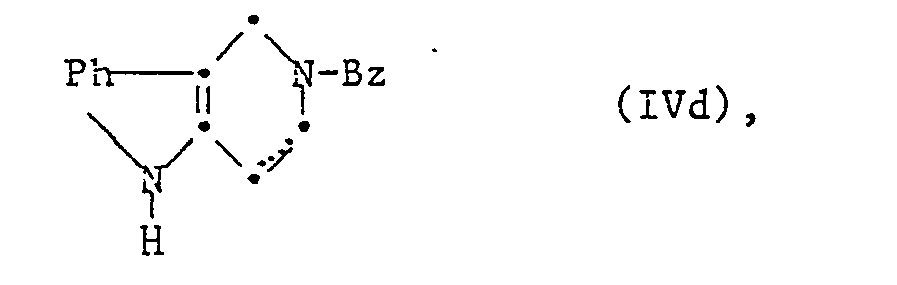

- die Cyanogruppe wie gewünscht solvolysiert, die Benzylgruppen hydrogenolytisch in Gegenwart eines Hydrierungskatalysators, z.B. von Palladium, abspaltet und die nunmehr freie Aninoverbindung mit einer Verbindung der Formel


- Die Isomerisierung von Verbindungen der Formel V zu Verbindungen der Formel I erfolgt in üblicher Weise, erforderlichenfalls mit Hilfe von Säuren, wie Mineralsäuren, z.B. Schwefelsäure, von Basen, wie von Alkalimetallhydroxiden bzw. - carbonaten, z.B. Natriumhydroxid bzw. Kaliumcarbonat, oder wie von organischen Aminen, z.B. tertiären Aminen, wie Pyridin, oder durch Zufuhr von Energie, wie bei Temperaturen über 100°C, gegebenenfalls in Gegenwart eines katalytischen Mittels, wie eines Borates oder . Phosphates, z.B. eines Alkalimetallborates oder - phosphates, und, wenn erforderlich, in einem Lösungs- bzw. Verdünnungsmittel, in einem geschlossenen Gefäss und/oder unter Inertgas, z.B. Stickstoff.
- Inerte Lösungs- bzw. Verdünnungsmittel sind gegebenenfalls substituierte Kohlenwasserstoffe, wie gegebenenfalls halogenierte aliphatische oder aromatische Kohlenwasserstoffe, z.B. Chloroform oder Chlorbenzol, Ether, wie aliphatische, cycloaliphatische oder aromatische Ether, z.B. Diethylether, Dioxan, Diphenylether oder Anisol, Ketone wie aliphatische Ketone, z.B. Aceton oder Methylethylketon, Amide, wie Dialkylamide, z.B. Dimethylformamid, oder Sulfoxide, wie Diniederalkylsulfoxid, z.B. Dimethylsulfoxid.
- Ausgangsstoffe der Formel V bzw. Salze davon . können nach an sich bekannten Methoden hergestellt werden, beispielsweise durch Umsetzung von Verbindungen der Formel

- worin X1 Oxo bzw. Thioxo bedeutet, mit Verbindungen der Formel P(Z2)3=C(R3)-R'2 bzw. X1 =P(Z3)2-CH(R3)-R'2. welche sowohl als Phosphonium-Ylide als auch als Phosphorane vorliegen können und worin Xi Oxo oder Thioxo, Z2 Alkyl und/oder Phenyl, Z3 Alkyl und/oder Phenyl bzw. Alkoxy und/oder Phenoxy und R3 Wasserstoff bedeutet. Ausgangsstoffe der Formel V bzw. deren Salze lassen sich z.B. ebenfalls herstellen durch Umsetzung von Verbindungen der Formel

- worin X2 eine Gruppe der Formel -C(R3)=X'2 und X'2 gegebenenfalls funktionell abgewandeltes Oxo bedeutet, mit Cyanwasserstoff oder einem Salz, z.B. einem Alkalimetallsalz, davon. Nach sich gegebenenfalls anschliessender Solvolyse spaltet man aus so erhältlichen Zwischenprodukten der Formel

- worin Z4 gegebenenfalls in Salzform vorliegendes Hydroxy bzw. Thio und Z5 ein Rest der Formel -p⊕(Z2)3 bzw. -p⊕(Z3)2-O⊖ Z4 Wasserstoff und Z5 Hydroxy bzw. Mercapto bedeuten, eine Verbindung der Formel Z4-Z5 ab.
- Alkoxy ist beispielsweise Niederalkoxy, wie Methoxy, Ethoxy, Propyloxy oder ein Butyloxy. Gegebenenfalls funktionell abgewandeltes Oxo bedeutet Oxo, Thioxo oder gegebenenfalls durch Niederalkyl oder Phenyl substituiertes lmino.
- In einer vorteilhaften Ausführungsform des obenstehend beschriebenen Verfahrens zur Herstellung von Verbindungen der Formel I, beispielsweise ausgehend von Verbindungen der Formel VII, kann die Herstellung von Verbindungen der Formel V und die erfindungsgemässe Isomerisierung in situ erfolgen.
- Die Abspaltung von Z4-Z5 erfolgt in üblicher Weise, beispielsweise durch Energiezufuhr, z.B. einer Reaktionstemperatur von etwa 50° bis etwa 200°C, oder in Gegenwart eines katalytischen Mittels. Solche sind beispielsweise basische bzw. saure Katalysatoren, wobei als Basen beispielsweise Alkalimetallhydroxide, -amide, - carbonate bzw. -hydride, wie Kaliumhydroxid, Natriumamid, Kaliumcarbonat bzw. Natriumhydrid, Metalloxide, wie Aluminiumoxid, oder organische Stickstoffbasen, wie tertiäre Amine, z.B. Pyridin, Chinolin oder N,N-Dimethylanilin, und als saure Katalysatoren beispielsweise Mineralsäuren, wie Schwefelsäure, Hydrogensulfate, wie Alkalimetallhydrogensulfate, z.B. Kaliumhydrogensulfat, Polyphosphorsäure, Mineralsäureanhydride, wie Phosphorpentoxid, oder Mineralsäurehalogenide, wie Schwefelsäurehalogenide, z.B. Sulfurylchlorid, eingesetzt werden.
- Bei der Verfahrensweise zur Bildung von Ausgangsstoffen der Formel V arbeitet man erforderlichenfalls in Gegenwart eines inerten Lösungs- bzw. Verdünnungsmittels, in einem geschlossenen Gefäss und/oder unter Inertgas, z.B. Stickstoff.
- Verbindungen der Formeln Vla und Vlb ihrerseits lassen sich nach an sich bekannten, analogen Verfahren herstellen, beispielsweise indem man Verbindungen der Formeln

- Phosphorane der Formel P(Z2)3=C(R3)-R'2 bzw. deren Phosphonium-Ylide können nach an sich beka-nten Methoden hergestellt werden, beispielsweise durch Umsetzung von Phosphinen der Formel P(Z2)3 mit quartären Ammoniumbasen der Formel R'2-CH(R3-N ⊕(alk')3B ⊖, worin alk' ein Alkylrest, wie ein Niederalkylrest, und B e ein Anion, wie Halogenid- oder ein Hydroxylanion, bedeutet, und durch anschliessende Reaktion mit starken Basen, wie Alkalimetalllorganylen, z.B. Butyllithium oder Phenyllithium. Zu den entsprechenden quartären Ammoniumbasen gelangt man ebenfalls durch Reaktion von Phosphinen P(Z2)3 mit bekannten Verbindungen der Formel R2-Halin Gegenwart von Basen, wie Alkalimetallhydroxiden, -niederalkanolaten, - hydriden oder -amiden, z.B. Natriumhydroxid, Natriummethylat, Kaliumhydrid oder Kaliumamid.
- Verbindungen der Formel X1 = P(Z3)2-CH(R3)-R'2 lassen sichbeispielsweise herstellen, indem man Verbindungen der Formel P(Z3)3, worin Z3 Alkoxy oder Phenoxy bedeutet, mit Verbindungen der Formel Hat-CH(R3)-R'2, worin Hal Halogen bedeutet, umsetzt.
- Verbindungen der Formel Vld sind erhältlich durch Acylierung von Verbindungen der Formel


- Acyl leitet sich beispielsweise von einer Carbonsäure, wie Niederalkancarbonsäure, ab und bedeutet beispielsweise Niederalkanoyl, wie Acetyl, Propionyl oder Pivaloyl.
- Die Verbindungen der Formel 1 bzw. Salze davon können ferner hergestellt werden, indem man beispielsweise eine Verbindung der allgemeinen Formel

- Funktionell abgewandeltes Hydroxy ist beispielsweise durch Niederalkanol, wie Methanol oder Ethanol, oder einen gegebenenfalls substituierten aromatischen Alkohol, wie Phenol, verethertes Hydroxy, oder mit einem geeigneten Anhydrid, wie Acetanhydrid, mit einer organischen Säure, wie Sulfonsäure, z.B. Niederalkyl- oder gegebenenfalls substituierte Arylsulfonsäure, wie Methansulfonsäure oder p-Toluolsulfonsäure, oder mit einer anorganischen Säure, wie einer Mineralsäure, z.B. Halogenwasserstoffsäure, wie Chlorwasserstoffsäure, verestertes Hydroxy und bedeutet beispielsweise Niederalkoxy, wie Methoxy, oder gegebenenfalls substituiertes Aryloxy, wie Phenoxy, bzw. Niederalkanoyloxy, wie Acetyloxy, Niederalkansulfonyloxy oder gegebenenfalls substituiertes Arylsulfonyloxy, wie Methansulfonyloxy oder p-Toluolsulfonyloxy, oder Halogen, wie Chlor oder Brom.
- Die Cyclisierung erfolgt in an sich bekannter Weise, beispielsweise in Gegenwart eines Kondensationsmittels, wie eines sauren Kondensationsmittels. Hierunter fallen beispielsweise Säuren, wie Mineralsäuren, z.B. Schwefelsäure oder Polyphosphorsäure, Mineralsäurehalogenide, wie Phosphorsäurehalogenide, z.B. Phosphoroxichlorid, Phosphortribromid oder Phosphorpentachlorid. Die Reaktion wird erfoderlichenfalls in einem Lösungs- bzw. Verdünnungsmittel bei einem Temperaturbereich von etwa 20° bis etwa 200° C, in einem geschlossenen Gefäss und/oder unter Inertgas, z.B. Stickstoff, durchgeführt.
- inerte Lösungs- bzw. Verdünnungsmittel sind gegebenenfalls substituierte Kohlenwasserstoffe, wie aliphatische oder aromatische Halogenkohlenwasserstoffe, z.B. Chloroform oder Chlorbenzol, gegebenenfalls gemischte Ether, wie aliphatische, cycloaliphatische oder aromatische Ether, z.B. Diethylether, Dioxan, Diphenylether oder Anisol, Ketone wie aliphatische Ketone, wie Aceton oder Methylethylketon, Amide wie Dialkylamide, z.B. Dimethylformamid, oder Sulfoxide, wie Niederalkylsulfoxide, z.B. Dimethylsulfoxid.
- Die Ausgangsstoffe der Formel VIII können mittels an sich bekannter Verfahrensweise hergestellt werden, beispielsweise indem man in Verbindungen der Formel

- Die Acylierung des Indolstickstoffs erfolgt nach an sich bekannter Weise, beispielsweise durch Umsetzung mit gegebenenfalls funktionell abgewandelten Carboxy-Derivaten, wie Säuren, Säureanhydriden oder aktivierten Estern. Anhydridisiertes Carboxy ist dabei z.B. mit anorganischen Säuren, wie Halogenwasserstoffsäure, mit Stickstoffwasserstoffsäure, mit Cyanwasserstoffsäure oder mit organischen Säuren, wie gegebenenfalls durch Halogen substituierte Niederalkansäuren, z.B. Essigsäure, anhydridisiert. Hierunter fallen z.B. Säurehalogenide, z.B. Säurechloride, entsprechende Säureazide, Säurenitrile oder Acyloxycarbonyl.
- Die Acylierung mit einer Verbindung der Formel RL-COOH bzw. einem gegebenenfalls funktionell abgewandelten Derivat davon erfolgt in üblicher Weise. Ausgehend von einem Anhydrid, insbesondere einem Säurehalogenid, wird sie bevorzugt in Anwesenheit einer starken Base, beispielsweise eines Alkalimetallhydrids, z.B. Natriumhydrid, eines Alkalimetallamids, z.B. Natriumamid, oder eines Alkalimetallalkoholats, z.B. Kaliummethylat, durchgeführt.
- Die Acylierung wie die anschliessende Umsetzung mit Ammoniak wird z.B. in einem inerten Lösungsmittel vorgenommen, wie in einem alkylierten Amid, z.B. N,N-Dimethylformamid, einem gegebenenfalls halogenierten Kohlenwasserstoff, z.B. Chloroform oder Chlorbenzol, oder einem Nitril, z.B. Acetonitril, oder einer Mischung davon, erforderlichenfalls bei erniedrigter oder erhöhter Temperatur und/oder in einer Inertgasatmosphäre.
- Die Verbindungen der Formel IX lassen sich ihrerseits nach an sich bekannten Verfahren herstellen, beispielsweise analog der Fischer'schen Indolsynthese durch Behandlung von Phenylhydrazonen bzw. entsprechend 1,3- substituierten 4-Piperidone mit Säuren, wie mit äthanolischer Salzsäure, oder durch Acylierung und Kondensation von entsprechend substituierten a-Hydroxyketonen mit gegebenenfalls substituierten Anilinen.
- Die Verbindungen der Formel IX lassen sich ausserdem in einer vorzugsweisen Ausführungsfrom herstellen, indem man beispielsweise von Verbindungen der Formel
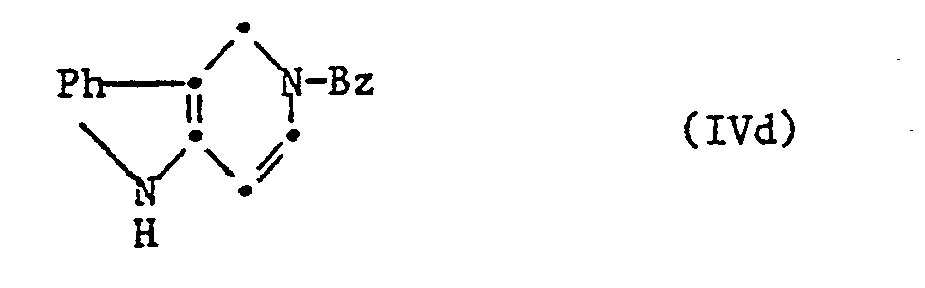

- Die Verbindungen der allgemeinen Formel bzw. Salze davon sind ferner herstellbar, indem man beispielsweise in einer Verbindung der Formel

- So ist beispielsweise R°2 eine Gruppe der Formel -CH(R3)-R"2, in der R3 Wasserstoff und R"2 von R'2 verschiedenes funktionell abgewandeltes Carboxy, eine Gruppe der Formel -C=O)-N⊕ 2B⊖, wobei Be das Anion einer Mineralsäure, z.B. Chlorid,Bromid, oder Tetrafluoroborat, und R'2 mit dem eingangs beschriebenen Carboxy- bzw. Niederalkoxycarbonyl-Teil von R2 identisch ist, oder gegebenenfalls bis zur Stufe des Formyl oxidiertes Methyl bedeutet.
- Funktionell abgewandelte und von R'2 verschiedene, funktionell abgewandelte Carboxy-Reste sind beispielsweise entsprechendes, verestertes oder amidiertes Carboxy, gegebenenfalls funktionell abgewandelte Orthoestergruppen, wie Trihalogen-, Halogendiniederalkoxy- bzw. Triniederalkoxymethylgruppen, anhydridisiertes Carboxy, wie Cyano, eine Gruppe der Formel =C=O, Cyano-, Azido- oder Halogencarbonyl, Acyloxycarbonyl, Niederalkanoyl-, wie z.B. Acetyloxycarbonyl, oder Derivate von Carboxy der Formel R', oder R"2, in denen Oxo gegebenenfalls durch Thio bzw. gegebenenfalls substituiertes lmino ersetzt ist, wie gegebenenfalls verestertes Thiocarboxy, wie Niederalkylthiocarboxy, z.B. Ethylthiocarboxy, amidiertes Thiocarboxyl, Iminoester, wie Imid- bzw. Amidhalogenidgruppierungen, z.B. Iminochlor- oder Aminodichlormethyl, Iminoethergruppierungen, wie Niederalkyl- oder Niederalkyleniminoethergruppierungen, z.B. Methoxy- oder Ethoxyiminomethylen, oder Amidinogruppen, wie Amidino oder Niederalkyl-, z.B. Methylamidino.
- Verestertes Carboxy R"2 ist beispielsweise Niederalkoxycarbonyl, welches durch gegebenenfalls substituiertes Aryl, wie Phenyl oder Pyridyl, einfach oder durch Hydroxy, Halogen bzw. Niederalkoxy ein- oder mehrfach substituiert sein kann, wie durch Hydroxy, Niederalkoxy und/oder Halogen substituiertes Niederalkoxycarbonyl, z.B. Mono- bzw. Dihydroxyniederalkoxy-, Halogen- oder Niederalkoxyniederalkoxycarbonyl, oder durch Niederalkyl, Niederalkoxy und/oder Halogen substituiertes Phenylniederalkoxycarbonyl.
- Amidiertes Carboxy R"2 ist beispielsweise Carbamoyl, welches gegebenenfalls durch Hydroxy bzw. Amino einfach, durch Niederalkyl bzw. Hydroxyniederalkyl bzw. Phenylniederalkyl ein- bzw. zweifach oder durch 4- bis 7-gliedriges Niederalkylen bzw. 3-Oxa-, 3-Thia- oder 3-Azaalkylen zwei fach substituiert sein kann. Als Beispiele seien genannt: Carbamoyl, N-Hydroxy-, N-Amino- N-Mono- bzw. N N-Diniederalkyl- oder N-Mono- bzw. N,N-Dihydroxyalkylcarbamoyl. Durch 4- bis 7-gliedriges Niederalkylen zweifach N-substituiertes Carbamoyl ist z.B. Pyrrolidino-oder Piperidinocarbonyl bzw. Morpholino-, Thiomorpholino-, Piperazino- oder N-Niederalkyl-, wie N-Methylpiperazino-carbonyl.
- Bis zur Stufe des Formyl oxidiertes Methyl bzw. funktionell abgewandelte Gruppen davon sind beispielsweise gegebenenfalls reaktionsfähig verestertes oder verethertes Hydroxymethyl bzw. gegebenenfalls funktionell abgewandeltes Formyl, wie Hydroxymethyl, Mono- oder Dihalogenmethyl, Niederalkoxymethyl, Formyl oder Formimino.
- Funktionell abgewandelte CarboxyVerbindungen, wie verestertes oder amidiertes Carboxy, gegebenenfalls funktionell abgewandelte Orthoester, anhydridisiertes Carboxy oder Acyloxycarbonyl, lassen sich direkt oder in mehreren Solvolyseschritten zu freiem oder verestertem Carboxy R'2 solvolysieren. Von R'2 verschiedenes verestertes Carboxy kann durch übliche Umesterung in verestertes Carboxy R'2 überführt werden.
- Die Solvolyse von R"2 erfolgt in bekannter Weise, beispielsweise durch Hydrolyse mit Wasser oder durch Alkoholyse, z.B. von Cyano oder gegebenenfalls substituiertem Carbamoyl, zu verestertem Carboxy R'2 mit einem entsprechenden Alkohol. Auch die Umesterung erfolgt durch Alkoholyse mit dem gewünschten Alkohol. Dabei wird jeweils, erforderlichenfalls in Gegenwart eines Katalysators, in einem Lösungs- bzw. Verdünnungsmittel, in einem geschlossenen Gefäss, in einem Temperaturbereich von etwa 0° bis etwa 150°C, und/oder unter Inertgas, z.B. Stickstoff, gearbeitet.
- Katalysatoren sind beispielsweise basische Kondensationsmittel, wie Alkalimetall- oder Erdalkalimetallhydroxide, z.B. Natrium-, Kaliumoder Calciumhydroxid, oder tertiäre organische Amine, wie Pyridin oder Trialkylamine, z.B. Triethylamin, oder saure Hydrolysemittel, wie Mineralsäuren, z.B. Halogenwasserstoffsäuren, wie Chlorwasserstoffsäure, oder organische Carbon- oder Sulfonsäuren, wie Niederalkancarbonsäuren oder gegebenenfalls substituierte Benzolsulfonsäuren, z.B. Essigsäure oder p-Toluolsulfonsäure.
- Gegebenenfalls bis zur Stufe des Formyl oxidiertes Methyl, wie Methyl, Hydroxymethyl oder Formyl, bzw. funktionell abgewandelte Derivate davon, wie Halogenmethyl, z-B. Chlormethyl, Mercaptomethyl, Thioformyl oder gegebenenfalls substituiertes Formimino, lassen sich beispielsweise direkt oder über mehrere Oxidationsschritte, gegebenenfalls über Hydroxymethyl oder Formyl, zu Carboxy oxidieren. Verethertes Hydroxymethyl, vorzugsweise Niederalkoxymethyl, z.B. Ethoxymethyl, wird in Gegenwart eines Oxidationsmittels zu Niederalkoxycarbonyl oxidiert. Die Umsetzung von Formyl zu Carbamoyl wird beispielsweise mit Hilfe einer Aminoverbindung in Gegenwart eines Oxidationsmittels, wie eines Uebergangsmetalloxides, z.B. Mangandioxid, und erfoderlichenfalls in Gegenwart eines Nucleophils, insbesondere eines Cyanids, durchgeführt.
- Oxidation von R"2 wird auf üblichem Wege durchgeführt, beispielsweise unter Verwendung der üblichen Oxidationsmittel. Solche sind z.B. gegebenenfalls katalytisch angeregter Sauerstoff, Alkalimetallsalze von Chromaten bzw. Manganaten, wie Natriumchromat oder Kaliumpermanganat, oder Uebergangsmetalloxide, wie Mangandioxid oder Chromtrioxid..Dabei arbeitet man erforderlichenfalls in einem inerten Lösungsmittel, in einem geschlossenen Gefäss und/oder unter Kühlen oder Erwärmen, z.B. bei etwa 0° bis etwa 150°C.
- Die Ausgangsstoffe der Formel X können nach analogen Verfahren hergestellt werden, beispielsweise indem man Verbindungen der Formel


- Die Umsetzung erfolgt üblicherweise in einem inerten Lösungsmittel, beispielsweise einem gegebenenfalls halogenierten Kohlenwasserstoff, wie einem Aromaten, z.B. Benzol oder Toluol, einem Ether, wie Tetrahydrofuran oder Dioxan, oder einem Amid, z.B. Dimethylformamid, in einem Temperaturbereich von etwa 20° bis etwa 150°C und/oder gegebenenfalls in Gegenwart eines Katalysators, wie einer Base, z.B. eines Alkalimetallalkoholats, wie Kalium-tert.-butylat.
- Insbesondere gelangt man zu den Ausgangsstoffen der Formel X worin R2 0 ein solvolytisch oder oxidativ in R2 überführbarer Rest ist, und geht beispielsweise von Verbindungen der Formel


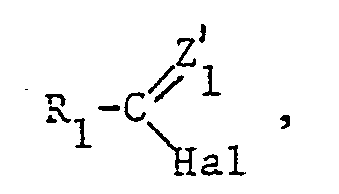
- Insbesondere werden entsprechende Verbindungen der Formel X, worin alk 1,2-Ethylen ist und RO 2 Cyanomethyl oder daraus gebildetes, gegebenenfalls substituiertes Carbamoylmethyl bedeutet zunächst analog der nachstehend beschriebenen Dehydrierung dehydriert und anschliessend wie gewünscht zu den Zielverbindungen der Formel 1 solvolysiert.
- Entsprechend werden unter Verwendung geeigneter Ausgangsstoffe der Formeln IVd, IVe und R1-C(=Z'1)-Hal ohne Isolierung von Zwischenprodukten solche 3,4-Dihydroverbindungen der Formel X gebildet, worin R2 Niederalkoxycarbonylmethyl bedeutet und alk 1,2-Ethylen ist. Die Niederalkoxycarbonylgruppe wird im nächsten Reaktionsschritt zu 2-Hydroxy-ethyl R°2 reduziert, beispielsweise unter Verwendung komplexer Hydride, wie Lithiumaluminiumhydrid, und die Hydroxygruppe mit einem gewünschten Niederalkanol verethert. Anschliessend werden die entsprechend erhältlichen Verbindungen in der nachstehend beschriebenen Art dehydriert. 2-Niederalkoxyethyl R°2, daraus gebildetes 2-Hydroxyethyl sowie Formylmethyl R°2 werden schliesslich wie vorstehend angegeben in der gewünschten Weise zu R2 oxidiert.
- Die Verbindungen der Formel werden in erster Linie hergestellt, indem man entsprechende Verbindungen der Formel

- Die Dehydrierung erfolgt in an sich bekannter Weise, insbesondere bei erhöhter Temperatur, beispielsweise in einem Temperaturintervall von Raumtemperatur, insbesondere von etwa 100° bis etwa 300°C, und unter Verwendung eines Dehydrierungsmittels. Als solche Mittel kommen beispielsweise Dehydrierungskatalysatoren, z.B. Nebengruppenelemente, vorzugsweise der Nebengruppe VIII, wie Palladium oder Platin, oder deren Salze, wie Ruthenium-triphenylphosphidchlorid, in Betracht, wobei die Katalysatoren gegebenenfalls auf geeignetem Trägermaterial, wie Kohle, Aluminiumoxid oder Siliziumdioxid, aufgezogen sind. Weitere Dehydrierungsmittel sind beispielsweise Chinone, wie p-Benzochinone, z.B. Tetrachlorp-benzochinon oder 2,3-Dichlor-5,6-dicyano-p-benzochinon, oder wie Anthrachinone,z.B. Phenanthren-9,10-chinon. Bevorzugte Dehydrierungskatalysatoren sind geeignete Selen-Derivate, insbesondere Selendioxid oder Diphenylselenium- bis(trifluoroacetat), ferner Diphenyl-selenoxid. In einer vorteilhaften Ausführungsform der vorstehend beschriebenen Dehydrierung wird dieser Prozess bei Verwendung von Selendioxid als Katalysator bei erhöhter Temperatur durchgeführt, bei Verwendung von Diphenylseleniumbis-(trifluoracetat) erfolgt die Dehydrierung bei Raumtemperatur.
- Die Umsetzung wird in einem inerten, gegebenenfalls hochsiedenden Lösungsmittel, wie einem Ether, z.B. Diphenylether, erforderlichenfalls unter Druck, in einem geschlossenen Gefäss und/oder unter Inertgas, z.B. Stickstoff durchgeführt.
- Die Herstellung von Ausgangsstoffen der Formel worin alk 1,2-Ethylen bedeutet, erfolgt analog der eingangs beschriebenen Ausführungsweise, wobei man von Verbindungen der Formeln 1Vd ausgeht, diese beispielsweise mit Benzylhalogenidem erschöpfend alkyliert und die Bindung am quartären N-Atom mit Alkalimetallcyaniden spaltet. In den so erhältlichen Verbindungen der Formel lVe kann die Cyanogruppe in ublicher Weise wie gewünscht solvolysiert werden, dabei wird die Ueberführung in Niederalkoxycarbonyl bevorzugt. Nach hydrogenolytischer Abspaltung der Benzylgruppen erfolgt die Umsetzung mit Verbindungen der Formel Rl-C(=Z'1)-Hal, wobei mit Hilfe von Cyclisierungsmitteln, wie Phosphoroxychlorid, unter den Reaktionsbedingungen entsprechende Verbindungen der Formel II gebildet werden, die direkt zu entsprechenden Verbindungen der Formel 1 führen, worin alk 1,2-Ethylen und R2 vorzugsweise Niederalkoxycarbonylmethyl bedeutet.
- Wird im Anschluss an die nachfolgende Dehydrierung die Herstellung von freien SäureDerivaten gewünscht werden erhaltene Niederalkylester vorteilhaft hydrolysiert.
- Eine erfindungsgemäss erhältliche Verbindung der Formel kann in an sich bekannter Weise in eine andere Verbindung der Formel 1 umgewandelt werden.
- Enthält die Gruppe R2 ein freies Carboxy so lässt sich dieses nach an sich bekannten Veresterungsmethoden in entsprechend verestertes Carboxy uberführen, beispielsweise indem man gegebenenfalls reaktionsfähiges abgewandeltes Carboxy oder ein Salz davon durch Alkoholyse mit einem gewunschten Alkohol, beispielsweise einem reaktionsfähigen Derivat davon oder einem davon abgeleiteten Olefin, umsetzt oder durch Alkylierung mit Diazoniederalkan.
- Geeignete reaktionsfähige funktionelle Carboxyderivate sind beispielsweise Anhydride, wobei als Anhydride insbesondere gemischte Anhydride, z.B. solche mit anorganischen Säuren, wie Halogenwasserstoffsauren, z.B. Chlorwasserstoffsäure wie Stickstoffwasserstoff-oder Cyanwasserstoffsäuren, oder mit organischen Carbonsäuren, wie Niederalkansäuren, z.B. Essigsäure, verwendet werden.
- Reaktionsfähige Derivate eines Alkohols sind beispielsweise Carbon-, Phosphorig- Schweflig-oder Kohlensäureester, z.B. Niederalkancarbonsäureester, Triniederalkylphosphit, Diniederalkylsulfit oder Pyrocarbonat, oder Mineral- bzw. Sulfonsäureester, z.B. Chlor-, Brom- oder Schwefelsäureester, Benzol-, Toluol- oder Methansulfonsäureester, des betreffenden Alkohols.
- Die Veresterung von freiem Carboxy wird in Gegenwart eines Kondensationsmittels durchgeführt. Als katalytisch wasserabspaltende Mittel für die Veresterung mit Alkoholen kommen z.B. Säuren, beispielsweise Protonsäuren, wie Chlorwasserstoff-, Bromwasserstoff-, Sc-hwefel-, Phosphor-, Bor-, Benzolsulfon- und/oder Toluolsulfonsäurc, bzw. Lewissäuren, wie Bortrifluorid-Etherat, in Frage. Uebliche wasserbindende Kondensationsmittel sind z'B' durch Kohlenwasserstoffreste substituierte Carbodiimide, beispielsweise N,N'-Diethyl-, N,N-Dicyclohexyl- oder N-Ethyl-N'-(3-dimethylaminopropyl)-carbodiimide. Kondensationsmittel für die Veresterung mit reaktionsfähigen Estern sind basische Kondensationsmittel, wie anorganische Basen, z.B. Alkalimetall- oder Erdalkalimetallhydroxide bzw. -carbonate, wie Natrium-, Kalium- oder Calciumhydroxid bzw. -carbonat, wie organische Stickstoffbasen, z.B. tertiäre organische Amine, wie Triethylamin oder Pyridin. Die Veresterung wird vorteilhaft in einem Ueberschuss an eingesetztem Alkohol durchgeführt. Dabei arbeitet man vorzugsweise in einem wasserfreien Medium, erforderlichenfalls in Gegenwart eines inerten Lösungsmittels, wie in halogenierten Kohlenwasserstoffen, z.B. Chloroform oder Chlorbenzol, in Ethern, z.B. Tetrahydrofuran oder Dioxan.
- Die Umsetzung mit einem Olefin kann beispielsweise in Gegenwart eines sauren Katalysators, z.B. einer Lewissäure, z.B. von Bortrifluorid, einer Sulfonsäure, z.B. von p-Toluolsulfonsäure, oder vor allem eines basischen Katalysators, z.B. von Natrium- oder Kaliumhydroxid, vorteilhaft in einem inerten Lösungsmittel, wie einem Ether, z.B. in Diethylether oder Tetrahydrofuran, erfolgen.
- Weiterhin kann man freies Carboxy bzw. reaktionsfähig funktionelle Carboxyderivate durch Solvolyse mit Ammoniak oder einem primären bzw. sekundären Amin, wobei auch Hydroxylamin bzw. Hydrazine eingesetzt werden können, in üblicher Weise unter Dehydratisierung, gegebenenfalls in Anwesenheit eines Kondensationsmittels,in eine gewünschte amidierte Form überführen. Als Kondensationsmittel werden vorzugsweise Basen verwendet, beispielsweise anorganische Basen, wie Alkalimetallhydroxide, z.B. Natrium- oder Kaliumhydroxid, organische Stickstoffbasen, wie tert.-Amine, z.B. Pyridin, Tributylamin oder N-Dimethylanilin, oder Tetrahalogensilane, wie Tetrachlorsilan.
- Ferner kann man erfindungsgemäss erhältliche Verbindungen der Formel worin R2 als Substituenten verestertes Carboxy enthält, in üblicher Weise umestern beispielsweise durch Reaktion mit einem entsprechenden Alkohol bzw. einem Metallsalz davon, wie einem Alkalimetallsalz, z.B. dem Natrium- oder Kaliumsalz, erforderlichenfalls in Gegenwart eines Katalysators, beispielsweise einer starken Base, wie eines Alkalimetallhydroxides, -amides oder -alkoholates, z.B. Kaliumhydroxid, - - Natriumamid oder -methylat, oder einer starken Säure, wie einer Mineralsäure, z.B. Schwefelsäure, Phosphorsäure oder Salzsäure, oder wie einer organischen Sulfonsäure, z.B. einer aromatischen Sulfonsäure, wie p-Toluolsulfonsäure.
- Verestertes Carboxy kann weiterhin nach bekannten Verfahren, z.B. durch Hydrolyse in Gegenwart eines Katalysators, in die freie Carboxygruppe überführt werden. Als Katalysatoren kommen vorzugsweise Basen, z.B. Alkalimetallhydroxide, wie Natrium- oder Kaliumhydroxid, in Frage. Verestertes Carboxy lässt sich ferner in üblicher Weise, beispielsweise durch Solvolyse, gegebenenfalls in Gegenwart eines Katalysators, beispielsweise eines sauren bzw. basischen Mittels, in Carboxy, durch Ammonolyse oder Aminolyse mit Ammoniak oder mit einem primären bzw. sekundären Amin, in amidiertes Carboxy umwandeln. Als Basen finden beispielsweise Alkalimetallhydroxide, wie Natrium- bzw. Kaliumhydroxide, und als Säuren beispielsweise Mineralsäuren, wie Schwefelsäure, Phosphorsäure oder Salzsäure, Verwendung. Ebenso kann man erfindungsgemäss erhältliche Verbindungen der Formel worin die Gruppe R2 den Substituenten amidiertes Carboxy enthält, nach an sich bekannten Methoden die Amidbindung spalten und so das Carbamoyl in freies Carboxy überführen. Hierzu arbeitet man in Gegenwart eines Katalysators, beispielsweise einer Base, wie eines Alkalimetall- oder Erdalkalimetallhydroxides oder -carbonates, z.B. Natrium-, Kalium- oder Calciumhydroxid oder -carbonat, oder einer Säure, wie einer Mineralsäure, z.B. Salzsäure, Schwefelsäure oder Phosphorsäure.
- Enthält die Gruppe R2 der Formel I eine veresterte Carboxygruppe, so kann man diese beispielsweise durch übliche Solvolyse, vorteilhaft durch einen Ueberschuss an Ammoniak oder mindestens ein Wasserstoffatom enthaltendes Amin, gegebenenfalls in Gegenwart eines Katalysators, in eine amidierte Carboxygruppe überführen. Dabei verwendet man als Katalysatoren beispielsweise Säuren, wie Mineralsäuren, z.B. Salz-, Schwefel- oder Phosphorsäure, oder Basen, wie Alkalimetallhydroxide, z.B. Natrium- oder Kaliumhydroxid.
- Enthält die Gruppe R2 der Formel I als Substituenten amidiertes Carboxy, so kann man dieses beispielsweise durch übliche Solvolyse mit einem Alkohol in Gegenwart eines Katalysators in verestertes Carboxy überführen. Dabei verwendet man beispielsweise saure Katalysatoren, wie Mineralsäuren, z.B. Phosphorsäure, Salzsäure oder Schwefelsäure.
- Falls der Substituent R, der Formel 1 durch Niederalkylthio substituiert ist, kann man diesen auf übliche Weise zu entsprechendem Niederalkansulfinyl bzw. -sulfonyl oxidieren. Als geeignetes Oxidationsmittel Perschwefelsäure, organische Persäuren, wie entsprechende Percarbonoer Persulfonsäuren, z.B. Perameisen-, Peressig-, Trifluorperessigbzw. Perbenzoesäure oder p-Toluolpersulfonsäure, oder Gemische aus Wasserstoffperoxid und Säuren, z.B. Gemisch aus Wasserstoffperoxid mit Essigsäure, in Betracht.
- Häufig führt man die Oxidation in Gegenwart von geeigneten Katalysatoren durch, wobei als Katalysatoren geeignete Säuren, wie gegebenenfalls substituierte Carbonsäuren, z.B. Essigsäure oder Trifluoressigsäure, oder Uebergangsmetalloxide, wie Oxide von Elementen der VII. Nebengruppe, z.B. Vanadium-, Molybdän- oder Wolframoxid, zu nennen sind. Die Oxidation wird unter milden Bedingungen, z.B. bei Temperaturen von etwa -50° bis etwa + 100°C, durchgeführt.
- Die Oxidation zur Sulfonstufe kann man auch mit Distickstofftetroxid als Katalysator in Gegenwart von Sauerstoff bei tiefen Temperaturen entsprechend durchführen, ebenso wie die direkte Oxidation des Niederalkylthio zum Niederalkansulfonyl. Jedoch setzt man hierbei üblicherweise das Oxidationsmittel im Ueberschuss ein.
- Verbindungen der Formel worin R, einen durch Niederalkylsulfinyl bzw. -sulfonyl substituierten aromatischen Rest darstellt, lassen sich nach an sich bekannten Methoden zu den entsprechenden Niederalkylthio-Verbindungen, von Niederalkansulfonyl-Derivaten ausgehend, auch zu Niederalkan-sulfinyl reduzieren. Als Reduktionsmittel eignen sich beispielsweise katalytisch aktivierter Wasserstoff, wobei Edelmetalle bzw. Oxide, wie Palladium, Platin oder Rhodium bzw. deren Oxide, verwendet werden, gegebenenfalls auf geeignetem Trägermaterial, wie Aktivkohle oder Bariumsulfat, aufgezogen. Weiterhin kommen reduzierende Metallkationen, wie Zinn II-, Blei ll-, Kupfer 1-, Mangan II-, Titan ll-m Vanadium 11-, Molybdän 111-oder Wolfram III-Verbindungen, Halogenwasserstoffe, wie Chlor-, Brom- oder Jodwasserstoff, Hydride, wie komplexe Metallhydride, z.B. Lithiumaluminium-, Natriumbor-, Tributylzinnhydrid, Phosphorverbindungen, wie Phosphorhalogenide, z.B. Phosphortrichlorid, -bromid, Phosphorpentachlorid oder Phosphoroxichlorid, Phosphine, wie Triphenylphosphin, oder Phosphorpentasulfid-Pyridin, oder Schwefelverbindungen, wie Mercaptane, Thiosäuren, wie Thiophosphorsäuren oder Dithiocarbonsäuren, Dithionit oder Schwefel-Sauerstoff-Komplexe, wie Jod-Pyridin-Schwefeldioxidkomplex, in Frage.
- Erhaltene Salze können in an sich bekannter Weise in die freien Verbindungen umgewandelt werden, z.B. durch Behandeln mit einem sauren Reagens, wie einer Mineralsäure, bzw. einer Base, z.B. Alkalilauge.
- Die neuen Verbindungen können, je nach der Wahl der Ausgangsstoffe und Arbeitsweisen, in Form eines der möglichen lsomeren oder als Gemische derselben, z.B. je nach der Anzahl der asymmetrischen Kohlenstoffatome, als reine optische Isomere, wie Antipoden oder als isomerengemische, wie Racemate, Diastereoisomerengemische oder Racematgemische, vorliegen.
- Erhaltene Diastereomerengemische und Racematgemische können auf Grund der physikalisch-chemischen Unterschiede der Bestandteile in bekannter Weise in die reinen Isomeren, Diastereomeren oder Racemate aufgetrennt werden, beispielsweise durch Chromatographie und/oder fraktionierte Kristallisation.
- Erhaltene Racemate lassen sich ferner nach bekannten Methoden in die optischen Antipoden zerlegen, beispielsweise durch Umkristallisation aus einem optisch aktiven Lösungsmittel, mit Hilfe von Mikroorganismen oder durch Umsetzung eines sauren Endstoffes mit einer mit der racemischen Säure Salze bildenden optisch aktiven Base und Trennung der auf diese Weise erhaltenen Salze, z.B. auf Grund ihrer verschiedenen Löslichkeiten, in die Diastereomeren, aus denen die Antipoden durch Einwirkung geeigneter Mittel freigesetzt werden können, zerlegt. Vorteilhaft isoliert man den wirksameren der beiden Antipoden.
- Die Verbindungen einschliesslich ihrer Salze können auch in Form ihrer Hydrate erhalten werden oder andere zur Kristallisation verwendete Lösungsmittel einschliessen.
- Infolge der engen Beziehung zwischen den neuen Verbindungen in freier Form und in Form ihrer Salze sind im vorausgegangenen und nachfolgend unter den freien Verbindungen oder ihren Salzen sinn- und zweckgemäss gegebenenfalls auch die entsprechenden Salze bzw. freien Verbindungen zu verstehen.
- Die Erfindung betrifft auch diejenigen Ausführunsformen des Verfahrens, nach denen man von einer auf irgendeiner Stufe des Verfahrens als Zwischenprodukt erhältlichen Verbindungen ausgeht und die fehlenden Schritte durchführt oder einen Ausgangsstoff in Form eines Salzes verwendet oder insbesondere unter den Reaktionsbedingungen bildet.
- Beim Verfahren der vorliegenden Erfindung werden vorzugsweise solche Ausgangsstoffe verwendet, welche zu den eingangs als besonders wertvoll geschilderten Verbindungen führen. Neue Ausgangsstoffe und Verfahren zu ihrer Herstellung bilden ebenfalls einen Gegenstand der Erfindung.
- . Bei den erfindungsgemässen pharmazeutischen Präparaten, welche Verbindungen der Formel 1 oder pharmazeutisch verwendbare Salze davon enthalten, handelt es sich um solche zur enteralen, wie oralen oder rektalen, und parenteralen Verabreichung sowie zur topischen Anwendung an Warmblüter(n), welche den pharmakologischen Wirkstoff allein oder zusammen mit einem pharmazeutisch anwendbaren Trägermaterial enthalten. Die Dosierung des Wirkstoffs hängt von den Warmblüter-Spezies, dem Alter und dem individuellen Zustand, sowie von der Applikationsweise ab. Im Normalfall ist für einen etwa 75 kg schweren Warmblüter bei oraler Applikation eine ungefähre Tagesdosis von etwa 30-300mg, vorteilhaft in mehreren gleichen Teildosen verteilt, zu veranschlagen.
- Die neuen pharmazeutischen Präparate enthalten z.B. von etwa 10% bis etwa 80%, vorzugsweise von etwa 20% bis etwa 60% des Wirkstoffs. Erfindungegemässe pharmazeutische Präparate zur enteralen bzw. parenteralen Verabreichung sind z.B. solche in Dosiseinheitsform, wie Dragees, Tabletten, Kapseln oder Suppositorien, ferner Ampullen. Diese werden in an sich bekannter Weise, z.B. mittel konventioneller Misch-, Granulier-, Dragier-, Lösungs- oder Lyophilisierungsverfahren hergestellt. So kann man pharmazeutische Präparate zur oralen Anwendung erhalten, indem man den Wirkstoff mit festen Trägerstoffen kombiniert, ein erhaltenes Gemisch gegebenenfalls granuliert, und das Gemisch bzw. Granulat, wenn erwünscht oder notwendig, nach Zugabe von geeigneten Hilfsstoffen, zu Tabletten oder Dragee-Kernen verarbeitet.
- Geeignete Trägerstoffe sind insbesondere Füllstoffe, wie Zucker, z.B. Lactose, Saccharose, Mannit oder Sorbit, Cellulosepräparate und/oder Calciumphosphate, z.B. Tricalciumphosphat oder CalciumHydrogenphosphat, ferner Bindemittel wie Stärkekleister unter Verwendung von z.B. Mais-, Weizen- Reis- oder Kartoffelstärke Gelatine, Tragakanth, Methylcellulose und/oder Polyvinylpyrrolidon, und/oder wenn erwünscht, Sprengmitteln, wie die obegenannten Stärken, ferner Carboxymethylstärke, quervernetztes Polyvinylpyrrolidon, Agar, Alginsäure oder ein Salz davon, wie Natriumalginat. Hilfsmittel sind in erster Linie Fliess-, Regulierund Schmiermittel, z.B. Kieselsäure, Talk, Stearinsäure oder Salze davon, wie Magnesium- oder Calciumstearat, und/oder Polyethylenglykol. Dragee-Kerne werden mit geeigneten, gegebenenfalls Magensaft-resistenten Ueberzügen versehen, wobei man u.a- konzentrierte Zuckerlösungen, welche gegebenenfalls arabischen Gummi, Talk, Polyvinylpyrrolidon, Polyethylenglykol und/oder Titandioxid enthalten, Lacklösungen in geeigneten organischen Lösungsmitteln oder Lösungsmittelgemischen oder, zur Herstellung von Magensaft-resistenten Ueberzügen, Lösungen von geeigneten Cellulosepräparaten, wie Acetylcellulosephthalat oder Hydroxypropylmethylcellulosephthalat, verwendet. Den Tabletten oder Dragee-Ueberzügen können Farbstoffe oder Pigmente, z.B. zur Identifierung oder zur Kennzeichnung verschiedener Wirkstoffdosen, beigefügt werden.
- Weitere oral anwendbare pharmazeutische Präparate sind Steckkapseln aus Gelatine, sowie weiche, geschlossene Kapseln aus Gelatine und einem Weichmacher, wie Glycerin oder Sorbitol. Die Steckkapseln können den Wirkstoff in Form eines Granulats, z.B. im Gemisch mit Füllstoffen, wie Lactose, Bindemitteln, wie Stärken und/oder Gleitmitteln, wie Talk oder Magnesiumstearat, und gegebenenfalls von Stabilisatoren, enthalten. In weichen Kapseln ist der Wirkstoff vorzugsweise in geeigneten Flussigkeiten, wie fetten Oelen, Paraffinöl oder flüssigen Polyethylenglykolen, gelöst oder suspendiert, wobei ebenfalls Stabilisatoren zugefügt sein können.
- Als rektal anwendbare pharmazeutische Präparate kommen z.B. Suppositorien in Betracht, welche aus einer Kombination des Wirkstoffes mit einer Suppositoriengrundmasse bestehen. Als Suppositoriengrundmasse einen sich z.B. naturliche oder synthetische Triglyceride, Paraffin kohlenwasserstoffe Polyethylenglykole oder höhere Alkanole. Ferner können auch Gelatine-Rektalkapseln verwendet werden, die eine Kombination des Wirkstoffs mit einer Grundmasse enthalten; als Grundmassenstoffe kommen z.B. flüssige Triglyceride, Polyethylengylkole oder Paraffinkohlenwasserstoffe in Frage.
- Zur parenteralen Verabreichung eignen sich in erster Linie wässrige Lösungen eines Wirkstoffs in wasserlöslicher Form, z.B. eines wasserlöslichen Salzes, ferner Suspensionen des Wirkstoffes, wie entsprechende ölige Injektionssuspensionen, wobei man geeignete lipophile Lösungsmittel oder Vehikel, wie fette Oele, z.B. Sesamöl, oder synthetische Fettsäureester, z.B. Ethyloleat oder Triglyceride, verwendet oder wässrige Injektionssuspensionen, welche viskositätserhöhende Stoffe, z.B. Natriumcarboxymethylcellulose, Sorbit und/oder Dextran und gegebenenfalls auch Stabilisatoren enthalten.
- Als topisch anwendbare pharmazeutische Präparate kommen in erster Linie Creme, Salben, Pasten, Schäume, Tinkturen und Lösungen, in Frage, die von etwa 0,5 bis etwa 20% des Wirkstoffs enthalten.
- Creme sind Oel-in-Wasser Emulsionen, die mehr als 50% Wasser aufweisen. Als ölige Grundlage verwendet man in erster Linie Fettalkohole, z.B. Lauryl-, Cetyl- oder Stearylalkohol, Fettsäuren, z.B. Palmitin- oder Stearinsäure, flüssige bis feste Wachse, z.B. Isopropylmyristat, Wollwachs oder Bienenwachs, und/oder Kohlenwasserstoffe, z.B. Vaseline (Petrolatum) oder Paraffinöl. Als Emulgatoren kommen oberflächenaktive Substanzen mit vorwiegend hydrophilen Eigenschaften in Frage, wie entsprechende nichtionische Emulgatoren, z.B. Fettsäureester von Polyalkoholen oder Ethylenoxidaddukte davon, wie Polyglycerinfettsäureester oder Polyoxyethylensorbitanfettsäureester (Tweens), ferner Polyoxyethylenfettalkoholether oderfettsäureester, oder entsprechende ionische Emulgatoren, wie Alkalimetallsalze von Fettalkoholsulfaten, z.B. Natriumlaurylsulfat, Natriumcetylsulfat oder Natriumstearylsulfat, die man üblicherweise in Gegenwart von Fettalkoholen, z.B. Cetylalkohol oder Stearylalkohol, verwendet. Zusätze zur Wasserphase sind u.a. Mittel, welche die Austrocknung der Creme verhindern, z.B. Polyalkohole, wie Glycerin, Sorbit, Propylenglykol und/oder Polyethylenglykole, ferner Konservierungsmittel, Riechstoffe etc.
- Salben sind Wasser-in-Oel-Emulsionen, die bis zu 70%, vorzugsweise jedoch von etwa 20% bis etwa 50% Wasser oder wässrige Phasen enthalten' Als Fettphase kommen in erster Linie Kohlenwasserstoffe, z.B. Vaseline, Paraffinöl und/oder Hartparaffine in Frage, die zur Verbesserung des Wasserbindungsvermögens vorzugsweise geeignete Hydroxyverbindungen, wie Fettalkohole oder Ester davon, z.B. Cetylalkohol oder Wollwachsalkohole, bzw. Wollwachs enthalten. Emulgatoren sind entsprechende lipophile Substanzen, wie Sorbitanfettsäureester (Spans), z.B. Sörbitanoleat und/oder Sorbitanisostearat. Zusätze zur Wasserphase sind u.a. Feuchthaltungsmittel, wie Polyalkohole, z.B. Glycerin, Propylenglykol, Sorbit und/oder Polyethylenglykol, sowie Konservierungsmittel, Riechstoffe etc.
- Fettsalben sind wasserfrei und enthalten als Grundlage insbesondere Kohlenwasserstoff, z.B. Paraffin, Caseline und/oder flüssige Paraffine, ferner natürliches oder partialsynthetisches Fett, z.B. Kokosfettsäuretriglycerid, oder vorzugsweise gehärtete Oele, z.B. hydriertes Erdnussoder Rizinusöl, ferner Fettsäurepartialester des Glycerins, z.B. Glycerinmono- und distearat, sowie z.B. die im Zusammenhang mit den Salben erwähnten, die Wasseraufnahmefähigkeit steigernden Fettalkohole, Emulgatoren und/oder Zusätze.
- Pasten sind Creme und Salben mit sekretabsorbierenden Puderbestandteilen, wie Metalloxiden, z.B. Titanoxid oder Zinkoxid, ferner Talk und/oder Aluminiumsilikate, welche die Aufgabe haben, vorhandene Feuchtigkeit oder Sekrete zu binden.
- Schäume werden aus Druckbehältern verabreicht und sind in Aerosolform vorliegende flüssige Oel-in-Wasser-Emulsionen, wobei halogenierte Kohlenwasserstoffe, wie Chlorfluorniederalkane, z.B. Dichlordifluormethan und Dichlortetrafluorethan, als Treibmittel verwendet werden. Als Oelphase verwendet man u.a. Kohlenwasserstoffe, z.B. Paraffinol, Fettalkohole, z.B. Cetylalkohol, Fettsäureester, z.B. Isopropylmyristat, und/oder andere Wachse. Als Emulgatoren verwendet man u.a. Gemische von solchen mit vorwiegend hydrophilen Eigenschaften, wie Polyoxyethylen-sorbitanfettsäureester (Tweens), und solchen mit vorwiegend lipophilen Eigenschaften, wie Sorbutanfettsäureester (Spans). Dazu kommen die üblichen Zusätze, wie Konservierungsmittel, etc.
- Tinkturen und Lösungen weisen meistens eine wässrig-äthanolische Grundlage auf, der u.a. Polyalkohole, z.B. Glycerin, Glykole, und/oder Polyethylenglykol, als Feuchthaltemittel zur Herabsatzung der Verdunstung und rückfettende Substanzen, wie Fettsäureester mit niedrigen Polyethylenglykolen, d.h. im wässrigen Gemisch lösliche, lipophile Substanzen als Ersatz für die der Haut mit dem Aethanol entzogenen Fettsubstanzen, und, falls notwendig, andere Hilfs- und Zusatzmittel beigegeben sind.
- Die Herstellung der topisch verwendbaren pharmazeutischen Präparate erfolgt in an sich bekannter Weise, z.B. durch Lösen oder Suspendieren des Wirkstoffs in der Grundlage oder in einem Teil davon, falls notwendig. Bei Verarbeitung des Wirkstoffs als Lösung wird dieser in der Regel von der Emulgierung in einer der beiden Phasen gelöst; bei Verarbeitung als Suspension wird er nach der Emulgierung mit einem Teil der Grundlage vermischt und dann dem Rest der Formulierung beigegeben.
- Die vorliegende Erfindung betrifft ebenfalls die Verwendung der Verbindungen der Formeln und der Salze von solchen Verbindungen mit salzbildenden Eigenschaften, vorzugsweise zur Behandlung von Entzündungen, in erster Linie von entzündlichen Erkrankungen des rheumatischen Formenkreises, besonders der chronischen Arthritis.
- De nachfolgenden Beispiele illustrieren die oben beschriebene Erfindung; sie sollen jedoch diese in ihrem Umfang in keiner Weise einschränken. Temperaturen sind in Celsiusgraden angegeben.
- Die den Verbindungen der Formel zugrundeliegende Bezeichnung der Verknüpfungsstellen im Pyrimido-Indol-Rungsystem

- So werden die älteren Literaturstellen die Verknüpfungstellen im Ringsystem mit [3,4-a] bezeichnet während neuerdings die Bezeichnung [1,6-a] verwendet wird.
- Aus prinzipiellen Gründen wird nachfolgend für das vorstehend angegebene Ringgerüst folgende Nomenklatur vorgezogen:
- 38 g 7-F)our-1-pheny)-3,4-dihydro-pyrimido)[1,6-a] indol-5-essigsäureethylester werden in 200 ml Diphenyläther in Gegenwart von 10 g Palladiumkohle (10%ig) unter Rühren 50 Minuten auf 260° erhitzt. Man zieht den Diphenylether unter vermindertem Druck ab, nimmt den Eindampfrückstand in Diethylether auf, filtriert vom Katalysator ab und engt bis zur beginnenden Kristallisation ein. Dann verrührt man mit Hexan und wenig Diethylether und saugt ab. Man erhält den 7-Fluor-1-phenyl-pyrimido(1,6-a]indol-5- essigsäureethylester vom Smp. 91-93°'
- Das Ausgangsmaterial kann z.B. wie folgt hergestellt werden:
- a) 131 g (0,45 Mol) 3-Benzyl-6-fluor-tetrahydro- y-carbolin werden in 1300 ml Acetonitril bei 40° unter Rühren gelöst und innerhalb von 10 Minuten 94 g (0,55 Mol) Benzylbromid zugesetzt. Nach kurzer Zeit beginnt das Benzylammoniumderivat auszukristallisieren. Es wird noch ca. 15 Stunden bei Raumtemperatur weitergerührt, danach im Eisbad gekühlt und vom Kristallisat abgesaugt.
- b) 464 g (1 Mol) des so hergestellten N,N-Dibenzyl-6-fluor-tetrahydro-y-carbolininiumbromids werden in 4250 ml Methancl unter Erwärmen auf 65° gelöst und innerhaln von 5 Minuten eine Lösung von 196 g (4 Mol) Natriumcyanid in 500 ml Wasser unter Rühren zugesetzt. Die Lösung wird 3 Stunden unter Rückfluss zum Sieden erhitzt. Beim Abkühlen kristallisiert nach Animpfen 2-(Dibenzylamino-ethyl)-3-cyanomethyl-5-fluor- indol in farblosen Kristallen.
- c) 220 g (0,537 Mol) des nach b) hergestellten Nitrils werden in 300 ml abs. Ethanol gelöst und die Lösung bei -5° mit trockenem Chlorwasserstoff gesättigt. Anschliessend wird 5 1/2 Tage bei 20° gerührt. Man lässt die ausgeschiedenen Kristalle absitzen, dekantiert von der überstehenden Lösung ab, löst den Bodensatz in 2000 ml Eiswasser und rührt etwa 3 Stunden bei 20°. Dann wird unter Eiskühlung mit konz. Ammoniaklösung alkalisch gestellt und mit 1500 ml Toluol Eiswasser ausgerührt. Die abgetrennte Toluolphase wird mit Wasser gewaschen, über Natriumsulfat getrocknet und über 1000g Aluminiumoxid (Akt. Stufe 3) filtriert und mit Toluol nachgewaschen. Nach Abdestillieren des Toluols verbleibt ein hellbraunes Oel, das ohne weitere Reinigung der Hydrierung nach d) unterworfen wird.
- d) 181,3 g des nach c) erhaltenen 2-Dibenzylamino-5-fluor-indol-3- essigsäureethylesters werden in 1500 ml abs. Alkohol gelöst, und unter Zusatz von 18 g Pd/C (5%) bei Normaldruck und 20-35° hydriert. Nach Aufnahme von 12 500 ml H2 werden nochmals 18 g Katalysator zugesetzt und bis zum Stillstand der H2-Aufnahme von insgesamt 17 300 ml weiterhydriert. Nach Abfiltrieren vom Katalysator und Nachwaschen mit Methylenchlorid wird die Lösung zur Trockne eingedampft und der Rückstand in 250 ml Ether gelöst. Nach Animpfen kristallisiert der 2-Amino-ethyl-5-fluor-indol-3- essigsäureethylester in farblosen Kristallen.
- e) 61,7 g (0,223 Mol) des nach d) hergestellten 2-Aminoethyl-5-fluor-indol-3-essigsäureethylesters werden in 600 ml Methylenchlorid gelöst und die Lösung mit 150 ml 2N-Natronlauge überschichtet. Unter starkem Rühren wird bei 0-5° innerhalb 2 1/2 Stunden eine Lösung von 43 g (0,245 Mol) Benzoylchlorid zugesetzt und danach noch 1 Stunde ausgerührt. Die Methylenchloridphase wird dann abgetrennt, mit Wasser gewaschen, über MgS04 getrocknet und zur Trockne eingedampft. Der Rückstand kristallisiert beim Aufnehmen in Ether. Man erhält den 2-(2-Benzoyl-aminoethyl)-5-fluor-indol-3- essigsäureethylester.
- f) 37 g (0,154 Mol) 2-(2-Benzoylamino-ethyl)-5-fluor-indol-3-essigsäure-ethylester werden in 160 ml Phosphoroxychlorid 3 Stunden unter Rückfluss zum Sieden erhitzt. Das überschüssige Phosphoroxychlorid wird dann bei 60° im Vakuum abdestilliert und der Rückstand mit 650 ml Eiswasser verrührt. Die wässrige Lösung wird durch Filtrieren über Diatomeenerde geklärt, mit konzentrierter Ammoniaklösung alkalisch gemacht und mit 400 ml Ether extrahiert. Die Etherphase wird über Natriumsulfat getrocknet und zur Trockne eingeengt. Den Rückstand löst man in 150 ml Aceton und versetzt mit 16 ml einer etwa 4-normalen Chlorwasserstoff-Lösung in Ether, Nach Animpfen kristallisiert das Hydrochlorid des 7-Fluor-1-phenyl-3,4-dihydro- pyrimido[1,6-a]indol-5-essigsäure-ethylesters in gelblichen Kristallen,die aus 2N-Salzsäure umkristallisiert werden können. Die aus dem Salz freigesetzte Base schmilzt nach Umkristallisieren aus Ether bei 56-58°.
- In analoger Weise wie in Beispiel 1 beschrieben erhält man ausgehend von 2-Aminoethyl-5-fluor- indol-3-essigsäureethylester und p-Methansulfinylbenzoylchlorid über den 7-Fluor-1-(p-methansul-finylphenyl)-3,4-dihydro- pyrimido[1,6-ajindol-5-essigsäureethylester (Smp. des Hydrochlorids 208-210°) den 7-Fluor-1-(p-methansulfinyl-phenyl)-pyrimido[1,6-a]indol-5- essigsäureethylester vom Smp. 133-135°.
- In analoger Weise wie in Beispiel 1 beschrieben erhält man ausgehend von 2-Aminoethyl-indol-3- essigsäureethylester und 2-The-noylchlorid über den t-(2-Thienyl)-3,4-dihydro-pyrimido[1,6-a]indol-5-essigsäureethylester (Smp. des Hydrochlorids 153-157°) den 1-(2-Thie-nyl)-pyrimido[1,6-ajindol-5-essigsäureethylester vom Smp. 94-95°'
- In analoger Weise wie in Beispiel 1 beschrieben erhält man ausgehend von 2-Aminoethyl-5-methoxy-indol-3-essigsäureethylester und 2-Picolylchlorid über den 7-Methoxy-1-(2-picolinyl)-3,4-dihydro-pyrimido[1,6-a]indol-5- essigsäureethylester den 7-Methoxy-1-(2-picolinyl)-pyrimido[1,6-a]indol-5-essigsäureethylester vom Smp. 103-104°.
- 12,2 g 1-Phenyl-pyrimido[1,6-a]indol-5- essigsäureethylester (Smp. 59-62°), hergestellt aus 2-Aminoethyl-indol-3-essigsäure-ethylester und Benzoylchlorid über den 1 -Phenyl-3,4-dihyfro- pyrimido [1,6-a]indol-5-essigsäureethylester (Smp. 83-84°), werden mit 30 ml Ethanol und 40 ml 2N-Natronlauge 3 Stunden bei Raumtemperatur gerührt. Man säuert mit konzentrierter Salzsäure auf pH = 3 an und versetzt unter Rühren mit 30 ml Propylenoxid. Nach kurzer Zeit kristallisiert die 1-Phenyl-pyrimido[1,6-a]indol-5-essigsäure aus. Sie wird abfiltriert und aus 90%igem Ethanol umkristallisiert. Smp. 198-204° (Zers.).
- In analoger Weise wie in Beispiel 5 beschrieben erhält man ausgehend von 7-Fluor-1-(p-methansulfinylphenyl)-pyrimido[1,6-a] indol-5- essigsäureethylester die 7-Fluor-(p-methansulfinylphenyl)-pyrimido[1,6-a]indol-5- essigsäure vom Smp. 218-224° (Zers.).
- In analoger Weise wie in Beispiel 5 beschrieben erhält man ausgehend von 7-Fluor-1 -phenyl- pyrimido[1,6-a]indol-5-essigsäureethylester die 7-Fluor-1-phenyl-pyrimido[1,6-a]indol-5-essigsäure, Smp. 217-220°.
- In analoger Weise wie in Beispiel 5 beschrieben erhält man ausgehend von 1-(2-Thienyl)-pyrimido[1,6-a]indol-5-essigsäureethylester die 1-(2-Thienyl)-pyrimido[1,6-a]indol-5-essigsäure, Smp. 196-200° (Zers.).
- In analoger Weise wie in Beispiel 5 beschrieben erhält man ausgehend von 7-Methoxy-1-(2- picolinyl)-pyrimido[1,6-a]indol-5- essigsäureethylester die 7-Methoxy-1-(2- picolinyl)-pyrimido[1,6-a]indol-5-essigsäure, Smp. 201-206°.
- In analoger Weise wie in den Beispielen 1 und 5 beschrieben, erhält man ferner 7-Fluor-1-(p-methoxyphenyl)-pyrimido[1,6-a]indol-5-essigsäure, Smp. 220-225°, und deren Ethylester, 7-Methoxy-1-(p-fluorphenyl)-pyrimido[1,6-a]indol-5-essigsäure und deren Ethylester, sowie 7-Fluor-1-(2-thienyl)-pyrimido(1,6-a]indol-5- essigsäure, Smp.233-236°, 7-Fluor-1 -(2-thienyl)-pyrimido[1,6-a]in dol-5- essigsäureethylester.
- 3 g 7-Fluor-l-phenyl-3,4-dihydro-pyrimido[1,6- ajindol-5-essigsäureethylester werden mit 1 g Selendioxid in 50 ml Chlorbenzol dampft zur Trockne ein nimmt den Rückstand in 20 ml Essigsäureester auf, filtriert vom Selen ab, wäscht die Lösung mit Natriumbikarbonatlösung neutral und dampft zur Trockne ein. Der Rückstand wird in Ether aufgenommen und über 80 g Kieselgel chromatographiert. Der 7-Fluor-1-phenyl-pyrimido[1,6-a]indol-5- essigsäureethylester wird mit Hexan/ Essigester (4:1) eluiert und kristallisiert aus Ether/Hexan, Smp. 91-93°.
- Zu einer Lösung von 3,38 g 1-(2-Thienyl)-3,4-dihydro-pyrimido[1,6-a]indoi-5- essigsäureethylester in 20 ml Dimethoxyethan tropft man innerhalb von 0,5 Stunden eine Lösung von 0,01 Mol Diphenylselenium-bis-(trifluoracetat) (hergestellt nach J. Amer. Chem. Soc., 103, 4642 (1981)). Man lässt noch 3 Stunden bei Raumtemperatur stehen, 4' dampft zur Trockne ein, nimmt den Rückstand in Ether auf, wäscht mit Natriumbikarbonatlösung und chromatographiert über 80 g Kieselgel. Der 1-(2-Thienyl)-pyrimido[1,6-a]indol-5- essigsäureethylester wird mit Hexan/Essigester (4:1) eluiert und kristallisiert aus Ether/Hexan in gelben Kristallen, Smp. 94-95°'
- Tabletten, enthaltend 25 mg Wirkstoff, z.B. 7-Fluor-1-phenyl-pyrimido[(1,6-a]indol-5-essigsäure oder ein Salz, z.B. das Hydrochlorid davon, können folgendermassen hergestellt werden:
-


- Sämtliche festen Ingredienzien werden zunächst durch ein Sieb mit 0,6 mm Maschenweite getrieben. Dann wird der Wirkstoff, die Lactose, das Talkum, das Magnesiumstearat und die Hälfte der Stärke vermischt. Die andere Hälfte der Stärke wird in 40 ml Wasser suspendiert und diese Suspension zu einer siedenden Lösung des Polyethylenglykols in 100 ml Wasser hinzugegeben. Der erhaltene Stärkekleister wird zu der Hauptmenge hinzugegeben und das Gemisch, wenn nötig unter Hinzufügen von Wasser, granuliert. Das Granulat wird über Nacht bei 35° etrocknet, durch ein Sieb mit 1,2 mm Maschenweite getrieben und zu beidseitig konkaven Tabletten von etwa 6mm Durchmesser verpresst.
- In analoger Weise können auch Tabletten, enthaltend jeweils 25 mg einer anderen der in den Beispielen 1 bis 12 genannten Verbindungen der Formel 1 hergestellt werden, wobei die Verbindungen auch in Form von Säureadditionssalzen, wie Hydrochloriden, und Verbindungen, worin R2 1-Carboxymethyl ist, auch in Form von Salzen und Basen, wie Natrium-, Kalium- oder Zinksalzen vorliegen können.
- Kautabletten, enthaltend 30 mg Wirkstoff, z.B. 7-Fluor-1-phenyl-pyrimido[1,6-a]indol-5- essigsäure oder ein Salz, z.B. das Hydrochlorid davon, können z.B. folgendermassen hergestellt werden:
-

- Alle festen Ingredienzien werden zunächst durch ein Sieb mit 0,25 mm Maschenbreite getrieben. Der Mannit und die Lactose werden gemischt, unter Hinzufügen von Gelatinelösung granuliert durch ein Sieb mit 2 mm Maschenweite getrieben, bei 50° getrocknet und nochmals durch ein Sieb mit 1,7 mm Maschenweite getrieben. Der Wirkstoff, das Glycin und das Saccharin werden sorgfältig vermischt, der Mannit, das Lactosegranulat, die Stearinsäure und das Talkum hinzugegeben, das Ganze gründlich vermischt und zu beidseitig konkaven Tabletten von etwa 10 mm Durchmesser mit Bruchrille auf der Oberseite verpresst. In analoger Weise können auch Kautabletten enthaltend jeweils 30 mg einer anderen der in den Beispielen 1 bis 12 genannten Verbindungen der Formel I hergestellt werden, wobei die Verbindungen auch in Form von Säureadditionssalzen, wie Hydrochloriden, und Verbindungen, worin R2 1-Carboxymethyl ist, auch in Form von Salzen mit Basen, wie Natrium-, Kalium oder Zinksalzen vorliegen können.
- Tabletten enthaltend 100 mg Wirkstoff, z.B. 7-Fiuor-1 -phenyl-pyrimido[1,6-a]indol-5- essigsäureethylester können folgendermassen hergestellt werden:
-

- Die festen Ingredienzien werden zunächst durch ein Sieb mit 0,6 mm Maschenweite getrieben. Dann werden Wirkstoff, Lactose, Talkum, Magnesium-stearat und die Hälfte der Stärke innig vermischt. Die andere Hälfte der Stärke wird in 65 ml Wasser suspendiert und diese Suspension zu einer siedenden Lösung des Polyethylenglykols in 260 ml Wasser hinzugegeben. Der erhaltene Kleister wird zu den pulverförmigen Substanzen hinzugefügt, das Ganze vermischt und granuliert, erforderlichenfalls unter Zugabe von Wasser. Das Granulat wird über Nacht bei 35° getrocknet, durch ein Sieb mit 1,2 mm Maschenweite getrieben und zu beidseitig konkaven Tabletten von etwa 10 mm Durchmesser mit Bruchkerbe auf der Oberseite verpresst.
- In analoger Weise können auch Tabletten, enthaltend 100 mg einer anderen Verbindung der Formel gemäss den Beispielen 1 bis 12 hergestellt werden, wobei Verbindungen auch in Form von Säureadditionssalzen, wie Hydrochloriden, und Verbindungen, worin R2 1-Carboxymethyl ist, auch in Form von Salzen mit Basen, wie Natrium-, Kalium- oder Zinksalzen, vorliegen können.
Claims (28)


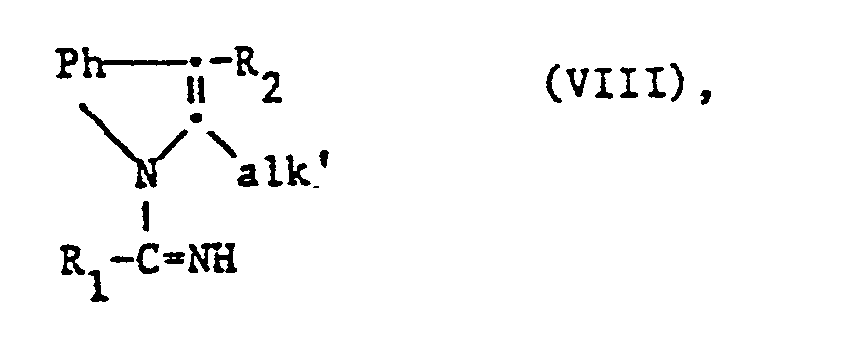


gewünschtenfalls in einer erfindungsgemäss erhältlichen Verbindung der Formel worin Ph, alk und R, die angegebenen Bedeutungen haben und R2 Niederalkoxycarbonyl-methyl bedeutet, Niederalkoxycarbonyl-methyl R2 zu Carboxymethyl R2 hydrolysiert.
Priority Applications (1)
| Application Number | Priority Date | Filing Date | Title |
|---|---|---|---|
| AT82810321T ATE19083T1 (de) | 1981-08-03 | 1982-07-28 | Weitere neue amidine, verfahren zu ihrer herstellung, diese enthaltende pharmazeutische praeparate und ihre verwendung. |
Applications Claiming Priority (2)
| Application Number | Priority Date | Filing Date | Title |
|---|---|---|---|
| CH5004/81 | 1981-08-03 | ||
| CH500481 | 1981-08-03 |
Publications (3)
| Publication Number | Publication Date |
|---|---|
| EP0072346A2 EP0072346A2 (de) | 1983-02-16 |
| EP0072346A3 EP0072346A3 (en) | 1983-06-01 |
| EP0072346B1 true EP0072346B1 (de) | 1986-04-09 |
Family
ID=4286279
Family Applications (1)
| Application Number | Title | Priority Date | Filing Date |
|---|---|---|---|
| EP82810321A Expired EP0072346B1 (de) | 1981-08-03 | 1982-07-28 | Weitere neue Amidine, Verfahren zu ihrer Herstellung, diese enthaltende pharmazeutische Präparate und ihre Verwendung |
Country Status (18)
| Country | Link |
|---|---|
| EP (1) | EP0072346B1 (de) |
| JP (1) | JPS5826889A (de) |
| KR (1) | KR890002759B1 (de) |
| AT (1) | ATE19083T1 (de) |
| AU (1) | AU566722B2 (de) |
| CA (1) | CA1216848A (de) |
| CY (1) | CY1423A (de) |
| DD (1) | DD203722A5 (de) |
| DE (1) | DE3270406D1 (de) |
| ES (2) | ES514638A0 (de) |
| GB (1) | GB2103215B (de) |
| GR (1) | GR81392B (de) |
| HK (1) | HK37688A (de) |
| HU (1) | HU190991B (de) |
| IE (1) | IE53643B1 (de) |
| NZ (1) | NZ201453A (de) |
| SG (1) | SG3388G (de) |
| ZA (1) | ZA825558B (de) |
Families Citing this family (1)
| Publication number | Priority date | Publication date | Assignee | Title |
|---|---|---|---|---|
| KR102267980B1 (ko) * | 2014-09-18 | 2021-06-22 | 주식회사 성우하이텍 | 핫스탬핑용 예열장치 |
Family Cites Families (2)
| Publication number | Priority date | Publication date | Assignee | Title |
|---|---|---|---|---|
| US4307234A (en) * | 1978-09-11 | 1981-12-22 | American Home Products Corp. | Pyrimido[1,6-a]indole derivatives |
| DE3170801D1 (en) * | 1980-03-04 | 1985-07-11 | Ciba Geigy Ag | Amidines, process for their production, pharmaceutical preparations containing them and their use |
-
1982
- 1982-07-28 AT AT82810321T patent/ATE19083T1/de active
- 1982-07-28 EP EP82810321A patent/EP0072346B1/de not_active Expired
- 1982-07-28 DE DE8282810321T patent/DE3270406D1/de not_active Expired
- 1982-07-29 GB GB08221882A patent/GB2103215B/en not_active Expired
- 1982-07-30 CA CA000408503A patent/CA1216848A/en not_active Expired
- 1982-07-30 IE IE1857/82A patent/IE53643B1/en unknown
- 1982-08-02 GR GR68929A patent/GR81392B/el unknown
- 1982-08-02 HU HU822482A patent/HU190991B/hu not_active IP Right Cessation
- 1982-08-02 ZA ZA825558A patent/ZA825558B/xx unknown
- 1982-08-02 DD DD82242187A patent/DD203722A5/de unknown
- 1982-08-02 ES ES514638A patent/ES514638A0/es active Granted
- 1982-08-02 AU AU86721/82A patent/AU566722B2/en not_active Ceased
- 1982-08-02 ES ES514639A patent/ES8506711A2/es not_active Expired
- 1982-08-02 KR KR8203455A patent/KR890002759B1/ko not_active Expired
- 1982-08-02 NZ NZ201453A patent/NZ201453A/en unknown
- 1982-08-03 JP JP57134800A patent/JPS5826889A/ja active Granted
-
1988
- 1988-01-08 SG SG33/88A patent/SG3388G/en unknown
- 1988-05-19 HK HK376/88A patent/HK37688A/xx unknown
- 1988-09-02 CY CY1423A patent/CY1423A/en unknown
Also Published As
| Publication number | Publication date |
|---|---|
| HU190991B (en) | 1986-12-28 |
| EP0072346A3 (en) | 1983-06-01 |
| GB2103215A (en) | 1983-02-16 |
| IE53643B1 (en) | 1989-01-04 |
| AU8672182A (en) | 1983-02-10 |
| ATE19083T1 (de) | 1986-04-15 |
| NZ201453A (en) | 1985-11-08 |
| ES8308564A2 (es) | 1983-08-01 |
| CA1216848A (en) | 1987-01-20 |
| AU566722B2 (en) | 1987-10-29 |
| JPS5826889A (ja) | 1983-02-17 |
| HK37688A (en) | 1988-05-27 |
| SG3388G (en) | 1988-06-17 |
| KR840001171A (ko) | 1984-03-28 |
| EP0072346A2 (de) | 1983-02-16 |
| GR81392B (de) | 1984-12-11 |
| JPH0340031B2 (de) | 1991-06-17 |
| ES514638A0 (es) | 1983-08-01 |
| ES514639A0 (es) | 1985-08-01 |
| ZA825558B (en) | 1983-03-30 |
| CY1423A (en) | 1988-09-02 |
| KR890002759B1 (ko) | 1989-07-27 |
| DD203722A5 (de) | 1983-11-02 |
| GB2103215B (en) | 1985-07-10 |
| DE3270406D1 (en) | 1986-05-15 |
| ES8506711A2 (es) | 1985-08-01 |
| IE821857L (en) | 1983-02-03 |
Similar Documents
| Publication | Publication Date | Title |
|---|---|---|
| DE3324034C2 (de) | ||
| DE69108138T2 (de) | Imidazopyridinderivate und ihre Verwendung. | |
| DE3851114T2 (de) | Trizyklische Verbindungen. | |
| EP0124476B1 (de) | Carboxamide, Verfahren zur Herstellung und pharmazeutische Präparate, die diese enthalten | |
| DE69622731T2 (de) | Tetrahydrochinoline als nmda antagonisten | |
| EP0078240A2 (de) | Lactone | |
| US5011847A (en) | 2,5-diaryl tetrahydrofurans and analogs thereof as PAF antagonists | |
| EP0716082A1 (de) | Heterocyclisch substituierte Oxy-phenyl-(phenyl) glycinolamide mit antiatherosklerotischer Wirkung | |
| FI75560C (fi) | Foerfarande foer framstaellning av nya terapeutiskt anvaendbara 4-(hydroxialkyltiometyl)pyridiner. | |
| DE68924221T2 (de) | Imidazolderivate. | |
| EP0072346B1 (de) | Weitere neue Amidine, Verfahren zu ihrer Herstellung, diese enthaltende pharmazeutische Präparate und ihre Verwendung | |
| EP0035474B1 (de) | Neue Amidine, Verfahren zu ihrer Herstellung, diese enthaltende pharmazeutische Präparate und ihre Verwendung | |
| DE3132915A1 (de) | 1,5-diphenylpyrazolin-3-on-verbindungen sowie verfahren und zwischenprodukte zu ihrer herstellung und diese verbindungen enthaltende arzneimittel | |
| CH618165A5 (en) | Process for the preparation of novel dibenzofuran derivatives and their salts | |
| DE69412980T2 (de) | Eburnan-Derivate, Verfahren zur ihrer Herstellung und diese enthaltende pharmazeutische Zusammensetzungen | |
| DE2316851A1 (de) | Neue pyridincarbonsaeureester | |
| EP0046451A2 (de) | Neue Diaryl-Imidazol-Verbindungen, Verfahren zu ihrer Herstellung, diese enthaltende pharmazeutische Präparate und ihre Verwendung | |
| EP0156091B1 (de) | Beta-Oxo-alpha-carbamoyl-pyrrolpropionitrile, Verfahren zu ihrer Herstellung, pharmazeutische Präparate enthaltend diese Verbindungen, sowie ihre therapeutische Verwendung | |
| DE3505576A1 (de) | Vorwirkstoffe entzuendungshemmender oxicame und solche vorwirkstoffe enthaltende pharmazeutische zusammensetzungen | |
| EP0088323B1 (de) | Imidazothiadiazolalkencarbonsäureamide, neue Zwischenprodukte zu ihrer Herstellung, ihre Herstellung und ihre Verwendung in Arzneimitteln | |
| EP0162217A1 (de) | 1,2,4-Triazacycloalkadienderivate | |
| EP0187619A2 (de) | 1,3-disubstituierte Tetrahydropyridine | |
| EP0157259A1 (de) | 3-Mercapto-1,2,4-triazacycloalkadienderivate | |
| DD235870A5 (de) | Verfahren zur herstellung von 3-substituierten thiopyronen | |
| DE3421252A1 (de) | 1-phenoxy-3- hydroxyindolylalkylamino-3-propanolverbindungen, verfahren zu ihrer herstellung und pharmazeutische mittel, die diese verbindungen enthalten |
Legal Events
| Date | Code | Title | Description |
|---|---|---|---|
| PUAI | Public reference made under article 153(3) epc to a published international application that has entered the european phase |
Free format text: ORIGINAL CODE: 0009012 |
|
| 17P | Request for examination filed |
Effective date: 19820730 |
|
| AK | Designated contracting states |
Designated state(s): AT BE CH DE FR IT LI LU NL SE |
|
| PUAL | Search report despatched |
Free format text: ORIGINAL CODE: 0009013 |
|
| AK | Designated contracting states |
Designated state(s): AT BE CH DE FR IT LI LU NL SE |
|
| GRAA | (expected) grant |
Free format text: ORIGINAL CODE: 0009210 |
|
| AK | Designated contracting states |
Kind code of ref document: B1 Designated state(s): AT BE CH DE FR IT LI LU NL SE |
|
| REF | Corresponds to: |
Ref document number: 19083 Country of ref document: AT Date of ref document: 19860415 Kind code of ref document: T |
|
| ITF | It: translation for a ep patent filed | ||
| REF | Corresponds to: |
Ref document number: 3270406 Country of ref document: DE Date of ref document: 19860515 |
|
| ET | Fr: translation filed | ||
| PLBE | No opposition filed within time limit |
Free format text: ORIGINAL CODE: 0009261 |
|
| STAA | Information on the status of an ep patent application or granted ep patent |
Free format text: STATUS: NO OPPOSITION FILED WITHIN TIME LIMIT |
|
| 26N | No opposition filed | ||
| PGFP | Annual fee paid to national office [announced via postgrant information from national office to epo] |
Ref country code: FR Payment date: 19920525 Year of fee payment: 11 |
|
| PGFP | Annual fee paid to national office [announced via postgrant information from national office to epo] |
Ref country code: DE Payment date: 19920619 Year of fee payment: 11 Ref country code: AT Payment date: 19920619 Year of fee payment: 11 |
|
| PGFP | Annual fee paid to national office [announced via postgrant information from national office to epo] |
Ref country code: SE Payment date: 19920722 Year of fee payment: 11 |
|
| PGFP | Annual fee paid to national office [announced via postgrant information from national office to epo] |
Ref country code: LU Payment date: 19920729 Year of fee payment: 11 |
|
| ITTA | It: last paid annual fee | ||
| PGFP | Annual fee paid to national office [announced via postgrant information from national office to epo] |
Ref country code: NL Payment date: 19920731 Year of fee payment: 11 |
|
| PGFP | Annual fee paid to national office [announced via postgrant information from national office to epo] |
Ref country code: BE Payment date: 19920903 Year of fee payment: 11 |
|
| PGFP | Annual fee paid to national office [announced via postgrant information from national office to epo] |
Ref country code: CH Payment date: 19921015 Year of fee payment: 11 |
|
| EPTA | Lu: last paid annual fee | ||
| PG25 | Lapsed in a contracting state [announced via postgrant information from national office to epo] |
Ref country code: LU Free format text: LAPSE BECAUSE OF NON-PAYMENT OF DUE FEES Effective date: 19930728 Ref country code: AT Effective date: 19930728 |
|
| PG25 | Lapsed in a contracting state [announced via postgrant information from national office to epo] |
Ref country code: SE Effective date: 19930729 |
|
| PG25 | Lapsed in a contracting state [announced via postgrant information from national office to epo] |
Ref country code: LI Effective date: 19930731 Ref country code: CH Effective date: 19930731 Ref country code: BE Effective date: 19930731 |
|
| BERE | Be: lapsed |
Owner name: CIBA-GEIGY A.G. Effective date: 19930731 |
|
| PG25 | Lapsed in a contracting state [announced via postgrant information from national office to epo] |
Ref country code: NL Effective date: 19940201 |
|
| NLV4 | Nl: lapsed or anulled due to non-payment of the annual fee | ||
| PG25 | Lapsed in a contracting state [announced via postgrant information from national office to epo] |
Ref country code: FR Effective date: 19940331 |
|
| REG | Reference to a national code |
Ref country code: CH Ref legal event code: PL |
|
| PG25 | Lapsed in a contracting state [announced via postgrant information from national office to epo] |
Ref country code: DE Effective date: 19940401 |
|
| REG | Reference to a national code |
Ref country code: FR Ref legal event code: ST |
|
| EUG | Se: european patent has lapsed |
Ref document number: 82810321.8 Effective date: 19940210 |