EP0072218A2 - Herstellungsverfahren von Estern der Acryl- oder Methacrylsäure - Google Patents
Herstellungsverfahren von Estern der Acryl- oder Methacrylsäure Download PDFInfo
- Publication number
- EP0072218A2 EP0072218A2 EP82304150A EP82304150A EP0072218A2 EP 0072218 A2 EP0072218 A2 EP 0072218A2 EP 82304150 A EP82304150 A EP 82304150A EP 82304150 A EP82304150 A EP 82304150A EP 0072218 A2 EP0072218 A2 EP 0072218A2
- Authority
- EP
- European Patent Office
- Prior art keywords
- acrylic
- organic solvent
- methacrylic acid
- volume ratio
- esterification
- Prior art date
- Legal status (The legal status is an assumption and is not a legal conclusion. Google has not performed a legal analysis and makes no representation as to the accuracy of the status listed.)
- Ceased
Links
Images
Classifications
-
- C—CHEMISTRY; METALLURGY
- C07—ORGANIC CHEMISTRY
- C07C—ACYCLIC OR CARBOCYCLIC COMPOUNDS
- C07C57/00—Unsaturated compounds having carboxyl groups bound to acyclic carbon atoms
-
- C—CHEMISTRY; METALLURGY
- C07—ORGANIC CHEMISTRY
- C07C—ACYCLIC OR CARBOCYCLIC COMPOUNDS
- C07C69/00—Esters of carboxylic acids; Esters of carbonic or haloformic acids
- C07C69/52—Esters of acyclic unsaturated carboxylic acids having the esterified carboxyl group bound to an acyclic carbon atom
- C07C69/533—Monocarboxylic acid esters having only one carbon-to-carbon double bond
- C07C69/54—Acrylic acid esters; Methacrylic acid esters
-
- C—CHEMISTRY; METALLURGY
- C07—ORGANIC CHEMISTRY
- C07C—ACYCLIC OR CARBOCYCLIC COMPOUNDS
- C07C67/00—Preparation of carboxylic acid esters
- C07C67/08—Preparation of carboxylic acid esters by reacting carboxylic acids or symmetrical anhydrides with the hydroxy or O-metal group of organic compounds
Definitions
- the present invention relates to a process for esterifying acrylic acid or methacrylic acid [hereinafter the both are referred to as (meth)acrylic acid]. More particularly, the present invention relates to a process for esterifying (meth)acrylic acid in the presence of an acid catalyst in a liquid/ liquid heterogeneous system in the coexistence of a water-insoluble non-reactive organic solvent.
- the (meth)acrylic acid ester is important as a starting material of an acrylic resin or acrylic resin coating, an adhesive or the like.
- Japanese Patent Publication No. 41413/1974 discloses a process in which methacrylic acid is extracted with methyl methacrylate or ethyl methacrylate containing xylene, ethylbenzene or a mixture thereof, and the resulting extract is esterified in the coexistence of an acid catalyst and an alcohol while forming two phases of aqueous and organic phases, contacting the both phases with each other and heating.
- Japanese Patent Publication No. 3338/1981 discloses a process in which the esterification is carried out using a sulfuric acid catalyst in a liquid/liquid heterogeneous system in the coexistence of an organic solvent.
- Both of these processes are a process to carry out the esterification efficiently by forming two phases of aqueous and organic phases in the coexistence of an organic solvent whereby the resulting ester is extracted with the organic phase to make the reaction equilibrium favorable.
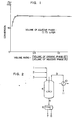
- Fig. 1 shows a relation between volume ratio and conversion in the methyl-esterification of methacrylic acid, and was obtained by plotting the results of Examples 1 to 5 and Comparative example 1, and its summary will be explained simply.
- the methyl-esterification of methacrylic acid was carried out using a sulfuric acid catalyst in the coexistence of xylene, and this diagram shows a change in the conversion of the esterification when the volume of aqueous phase in a reactor was kept constant while that of organic phase was progressively varied.
- the abscissa indicates the ratio of the volume of organic phase to that of aqueous phase, meaning that the volume of organic phase decreases as the value of the ratio approaches to zero.
- the abscissa is referred to as "volume ratio" for brevity, and the volume ratio is expressed by the following equation:
- a reduction of the conversion appears when the volume ratio approaches to a border line of approximately 0.1.
- This phenomenon may be considered to be that the effect of extracting the formed ester lowers according to an extreme reduction of the volume of organic phase, and as a result, that the concentration of the ester present in the aqueous phase increases to effect a shift of the reaction equilibrium.
- disadvantages such as reduction of the ester yield or increase in costs for the recovery of unreacted (meth)acrylic acid, are not avoidable.
- a reduction of the volume ratio leads to an increase of the flow amount of the acid catalyst-containing aqueous phase supplied to a reactor. That is to say, the flow amount of the organic phase flowing out of the reactor is constant if the conditions except the volume ratio are the same, and the volume ratio ought to be the same as the ratio of the flow amount of effluent organic phase to that of effluent aqueous phase, so that the flow amount of aqueous phase increases in inverse proportion to the volume ratio. Consequently, the discard of the effluent aqueous phase as it is leads to a great increase in the amount of acid catalyst consumed and in a cost required for making said aqueous phase harmless. Also, as disclosed, for example, in Japanese Patent Publication No.
- the capacity of esterification reactor can be made small by reducing the volume ratio, and the volume ratio is preferably 0.1 to 1.0, more preferably about 0.15 to about 0.5.
- an increase of the volume ratio is not desirable, as described hereinbefore, because it means the presence of organic solvent of larger amounts than required in the reaction system which is uneconomical, in other words, an increase in the capacity of reactor.
- the result of Fig. 1 was obtained when the volume of aqueous phase was 0.75 liter.
- the volume ratio is 1, the liquor volume in the reactor is 1.5 liters, while when the volume ratio is 2, the liquor volume clearly amounts to 2.25 liters, thus resulting really in a 50% increase in the capacity of reactor, nevertheless without improvement in the conversion of the esterification. It is therefore advantageous to make the volume ratio not more than 1, and a further reduction to not more than 0.5 can enhance the effect to a larger extent.
- organic solvent used in the present invention those which are insoluble in water and inactive to the esterification are selected. But solvents having a boiling point which differs more largely from that of the formed ester are more preferred, and for example, xylene, ethylbenzene, cumene, cymene and mixtures thereof are preferred.
- the present invention can be applied independently of the esterification temperature, but at temperatures less than 70°C, the reaction does not proceed sufficiently, while at those more than 100°C, a loss of (meth)acrylic acid caused by polymerization becomes unnegligible. Consequently, the present invention can effectively be carried out at a reaction temperature of from 70°C to 100°C, preferably from 75°C to 95°C.
- Fig. 2 shows one example of flow sheet for one embodiment of the present invention, and is not to be interpreted as limiting the present invention to it alone.
- 1, 2, 3, 5, 7, 8, 9 and 11 are lines
- 4 is a reactor
- 6 is a decanter
- 10 is a condenser.
- a mixture of (meth)acrylic acid as a starting material and a water-insoluble non-reactive organic solvent is supplied to a reactor 4 through the line 1, an alcohol as a starting material is supplied thereto through the line 2 and an acid catalyst is supplied through the line 3.
- the line 5 is a line of an effluent reaction liquor comprising an aqueous phase and an organic phase.
- the reaction liquor is separated into the aqueous and organic phases in a decanter 6, and the separated phases flow out of the decanter through lines 7 and 8, respectively.
- water formed by esterification flows out of the reactor by azeotropic distillation together with a part of the organic solvent or formed ester, and after being condensed by a condenser 10, is sent to the next step through the line 11.
- the acid catalyst supplied through the line 3 needs to be adjusted to a pre-determined concentration, and it is desirable that the aqueous phase having a definite acid catalyst concentration flowing out through the line 7, after freed from polymers and the like by filtration, is circulated to the reactor 4 through the line 3, and that a fresh acid catalyst is supplied through the line 3 to make up for a loss of acid catalyst.
- the whole amount of the reaction liquor may be streamed through the line 5 without setting up the lines 9 and 11 and the condenser 10.
- the aqueous phase flowing out through the line 7 contains water formed by reaction, it has a lowered concentration of acid catalyst. Consequently, it is a matter of course that the whole amount of the effluent aqueous phase can not be circulated, as it is, through the line 3, and that the formed water needs to be removed separately.
- the volume ratio becomes equal to the ratio of the flow amount of organic phase flowing out through the line 8 to that of aqueous phase flowing out through the line 7. Since the flow amount of organic'phase becomes definite under the same condition, the volume ratio can be decreased by increasing the flow amount of aqueous phase.
- Fig. 2 shows a process of esterification using a single vessel, and needless to say, the present invention is not limited to this method, but can also be carried out with the same effect by the use of a multi-stage reaction vessel for not less than two stages.
- Methacrylic acid was methyl-esterified using a 2-liter glass flask according to the flow sheet of Fig. 2 except that the whole amount of the aqueous phase flowing out through a line 7 was circulated through the line 3.
- the reaction system was operated under the conditions: The flow rate of a supplied xylene solution containing 50 wt% of methacrylic acid, 500 ml/Hr; flow rate of methanol supplied, 250 ml/Hr; volume of the aqueous phase in the flask, 0.75 liter; volume of the organic phase in the flask, 0.3 liter (that is, volume ratio, 0.4).
- the sulfuric acid concentration of the aqueous phase could be kept at 20 wt% at a temperature of 83°C, and the conversion of methacrylic acid at that time was 75.5%.
- Example 2 Operation was carried out in the same manner as in Example 1 except that a material comprising 50 wt% of methacrylic acid, 25 wt% of xylene and 25 wt% of ethylbenzene was supplied at a rate of 500 ml/Hr. As a result, the sulfuric acid concentration was kept at 20 wt% at a reaction temperature of 83°C, and the conversion of methacrylic acid was 76.0%.
Landscapes
- Chemical & Material Sciences (AREA)
- Organic Chemistry (AREA)
- Organic Low-Molecular-Weight Compounds And Preparation Thereof (AREA)
- Low-Molecular Organic Synthesis Reactions Using Catalysts (AREA)
Applications Claiming Priority (2)
| Application Number | Priority Date | Filing Date | Title |
|---|---|---|---|
| JP126440/81 | 1981-08-11 | ||
| JP56126440A JPS5826843A (ja) | 1981-08-11 | 1981-08-11 | アクリル酸エステルまたはメタクリル酸エステルの製造方法 |
Publications (2)
| Publication Number | Publication Date |
|---|---|
| EP0072218A2 true EP0072218A2 (de) | 1983-02-16 |
| EP0072218A3 EP0072218A3 (de) | 1983-05-25 |
Family
ID=14935252
Family Applications (1)
| Application Number | Title | Priority Date | Filing Date |
|---|---|---|---|
| EP82304150A Ceased EP0072218A3 (de) | 1981-08-11 | 1982-08-05 | Herstellungsverfahren von Estern der Acryl- oder Methacrylsäure |
Country Status (6)
| Country | Link |
|---|---|
| US (1) | US4474981A (de) |
| EP (1) | EP0072218A3 (de) |
| JP (1) | JPS5826843A (de) |
| KR (1) | KR840001120A (de) |
| CA (1) | CA1200819A (de) |
| MX (1) | MX161241A (de) |
Cited By (2)
| Publication number | Priority date | Publication date | Assignee | Title |
|---|---|---|---|---|
| EP0255773A3 (de) * | 1986-07-31 | 1989-02-22 | Amoco Corporation | Kontinuierliches Verfahren zur Herstellung des Methacrylsäureesters eines C1-4 aliphatischen Alkohols |
| EP0286981A3 (en) * | 1987-04-15 | 1989-10-11 | Hoechst Aktiengesellschaft | Method for the production of carboxylic acid methyl esters |
Families Citing this family (7)
| Publication number | Priority date | Publication date | Assignee | Title |
|---|---|---|---|---|
| JP3346822B2 (ja) * | 1993-03-31 | 2002-11-18 | 三菱化学株式会社 | アクリル酸エステル又はメタクリル酸エステルの製造法 |
| US6605738B1 (en) | 1996-05-29 | 2003-08-12 | Union Carbide Chemicals & Plastics Technology Corporation | Processes for refining butyl acrylate |
| JP4715106B2 (ja) * | 2004-04-01 | 2011-07-06 | 三菱化学株式会社 | (メタ)アクリル酸誘導体の製造方法 |
| KR100786945B1 (ko) | 2005-08-11 | 2007-12-17 | 주식회사 엘지화학 | (메타)아크릴 에스테르의 제조 방법 |
| CN101838376B (zh) * | 2010-05-11 | 2014-03-26 | 张春华 | 含柠檬酸衍生的支化的多官能(甲基)丙烯酸酯组合物 |
| FR2996147B1 (fr) * | 2012-10-03 | 2015-05-29 | Rhodia Operations | Procede de traitement d'acide fluore |
| EP2976320B1 (de) | 2013-03-18 | 2020-02-12 | Röhm GmbH | Verfahren zur herstellung von methacrylsäure und methacrylsäureester |
Family Cites Families (5)
| Publication number | Priority date | Publication date | Assignee | Title |
|---|---|---|---|---|
| JPS4842857B1 (de) * | 1969-07-17 | 1973-12-14 | ||
| JPS4941413B1 (de) * | 1970-12-28 | 1974-11-08 | ||
| JPS563338B2 (de) * | 1972-05-23 | 1981-01-24 | ||
| JPS5914018B2 (ja) * | 1976-08-10 | 1984-04-02 | ジェイエスアール株式会社 | メタクリル酸エステルの製造方法 |
| CA1131657A (en) * | 1978-02-28 | 1982-09-14 | Yasuhito Sakakibara | Recovery of methacrylic acid and alcohol in methacrylate production process |
-
1981
- 1981-08-11 JP JP56126440A patent/JPS5826843A/ja active Pending
-
1982
- 1982-08-05 EP EP82304150A patent/EP0072218A3/de not_active Ceased
- 1982-08-05 US US06/405,368 patent/US4474981A/en not_active Expired - Lifetime
- 1982-08-10 KR KR1019820003595A patent/KR840001120A/ko not_active Withdrawn
- 1982-08-10 MX MX193972A patent/MX161241A/es unknown
- 1982-08-10 CA CA000409104A patent/CA1200819A/en not_active Expired
Cited By (2)
| Publication number | Priority date | Publication date | Assignee | Title |
|---|---|---|---|---|
| EP0255773A3 (de) * | 1986-07-31 | 1989-02-22 | Amoco Corporation | Kontinuierliches Verfahren zur Herstellung des Methacrylsäureesters eines C1-4 aliphatischen Alkohols |
| EP0286981A3 (en) * | 1987-04-15 | 1989-10-11 | Hoechst Aktiengesellschaft | Method for the production of carboxylic acid methyl esters |
Also Published As
| Publication number | Publication date |
|---|---|
| EP0072218A3 (de) | 1983-05-25 |
| CA1200819A (en) | 1986-02-18 |
| US4474981A (en) | 1984-10-02 |
| MX161241A (es) | 1990-08-24 |
| JPS5826843A (ja) | 1983-02-17 |
| KR840001120A (ko) | 1984-03-28 |
Similar Documents
| Publication | Publication Date | Title |
|---|---|---|
| EP1061063B1 (de) | Verfahren zur Herstellung von Carbonsäure und Alkohol | |
| US4943354A (en) | Process for the continuous separation of water from methyl tert-butyl ether mixtures | |
| KR0174642B1 (ko) | 직접 에스테르화 반응에 의한 알킬 아크릴레이트의 제조 방법 | |
| US5386052A (en) | Process for producing acrylic or methacrylic esters | |
| US4857239A (en) | Process for the synthesis of (math)acrylic anhydrides | |
| US4474981A (en) | Process for preparing an acrylic or methacrylic acid ester | |
| US6458989B1 (en) | Method for producing (meth)acrylic acid and (meth)acrylic acid esters | |
| KR910008371B1 (ko) | 불포화 카르복실산 에스테르류의 제조방법 | |
| GB2305664A (en) | Process for purifying acetic acid | |
| EP0010953B2 (de) | Verfahren zur Herstellung von Methacrylsäureestern | |
| US4260821A (en) | Minimizing polymerization during recovery of methacrylic acid | |
| EP0255773A2 (de) | Kontinuierliches Verfahren zur Herstellung des Methacrylsäureesters eines C1-4 aliphatischen Alkohols | |
| US4733004A (en) | Continuous esterification of methacrylic acid and product recovery | |
| US3821286A (en) | Process for the production of methyl methacrylate | |
| US4076950A (en) | Process for manufacture of alkyl esters of aliphatic carboxylic acids | |
| JP2679954B2 (ja) | 不飽和カルボン酸エステル類の製造方法及び製造装置 | |
| CA2044306A1 (en) | Method for producing 4-hydroxybutyl (meth) acrylate | |
| JP3551621B2 (ja) | (メタ)アクリル酸エステルの製造方法 | |
| KR100492100B1 (ko) | 불포화 카르복실산 에스테르의 개선된 제조 방법 | |
| US20080161596A1 (en) | Method for Preparing (Meth) Acrylic Esters or Anhydrides | |
| JPS6320415B2 (de) | ||
| US4671857A (en) | Method for separating methacrylic acid from isobutyric acid | |
| JPH02279655A (ja) | アクリル酸エステルの製造方法 | |
| KR20230144064A (ko) | 고순도 알킬 아크릴레이트의 개선된 생산 공정 | |
| US4131741A (en) | Cobalt-catalyzed oxidation of C3 to C7 saturated aliphatic hydrocarbons to oxygenated products |
Legal Events
| Date | Code | Title | Description |
|---|---|---|---|
| PUAI | Public reference made under article 153(3) epc to a published international application that has entered the european phase |
Free format text: ORIGINAL CODE: 0009012 |
|
| AK | Designated contracting states |
Designated state(s): DE FR GB IT NL |
|
| PUAL | Search report despatched |
Free format text: ORIGINAL CODE: 0009013 |
|
| AK | Designated contracting states |
Designated state(s): DE FR GB IT NL |
|
| 17P | Request for examination filed |
Effective date: 19830927 |
|
| STAA | Information on the status of an ep patent application or granted ep patent |
Free format text: STATUS: THE APPLICATION HAS BEEN REFUSED |
|
| 18R | Application refused |
Effective date: 19860926 |
|
| RIN1 | Information on inventor provided before grant (corrected) |
Inventor name: KATO, MICHIO Inventor name: ABE, TADASHI Inventor name: MORIWAKI, MASANORI |