EP0071417B1 - Improvements in and relating to the cooling of flexible bags - Google Patents
Improvements in and relating to the cooling of flexible bags Download PDFInfo
- Publication number
- EP0071417B1 EP0071417B1 EP82303875A EP82303875A EP0071417B1 EP 0071417 B1 EP0071417 B1 EP 0071417B1 EP 82303875 A EP82303875 A EP 82303875A EP 82303875 A EP82303875 A EP 82303875A EP 0071417 B1 EP0071417 B1 EP 0071417B1
- Authority
- EP
- European Patent Office
- Prior art keywords
- cooling
- bag
- carriers
- tunnel
- carrier
- Prior art date
- Legal status (The legal status is an assumption and is not a legal conclusion. Google has not performed a legal analysis and makes no representation as to the accuracy of the status listed.)
- Expired
Links
- 238000001816 cooling Methods 0.000 title claims description 137
- 239000000463 material Substances 0.000 claims description 42
- 239000000969 carrier Substances 0.000 claims description 41
- XLYOFNOQVPJJNP-UHFFFAOYSA-N water Substances O XLYOFNOQVPJJNP-UHFFFAOYSA-N 0.000 claims description 34
- 239000012530 fluid Substances 0.000 claims description 24
- 239000002826 coolant Substances 0.000 claims description 16
- 230000009969 flowable effect Effects 0.000 claims description 14
- 239000011435 rock Substances 0.000 claims description 9
- 238000000034 method Methods 0.000 claims description 7
- 238000005507 spraying Methods 0.000 claims description 5
- 239000007788 liquid Substances 0.000 claims 3
- 239000000110 cooling liquid Substances 0.000 claims 1
- 238000001704 evaporation Methods 0.000 claims 1
- 230000008020 evaporation Effects 0.000 claims 1
- 235000013305 food Nutrition 0.000 description 30
- 239000007921 spray Substances 0.000 description 10
- 239000000047 product Substances 0.000 description 8
- 235000007688 Lycopersicon esculentum Nutrition 0.000 description 5
- 240000003768 Solanum lycopersicum Species 0.000 description 5
- 230000000694 effects Effects 0.000 description 5
- 230000003019 stabilising effect Effects 0.000 description 5
- 235000013399 edible fruits Nutrition 0.000 description 4
- 230000007246 mechanism Effects 0.000 description 4
- 235000013618 yogurt Nutrition 0.000 description 4
- 244000144730 Amygdalus persica Species 0.000 description 2
- 244000099147 Ananas comosus Species 0.000 description 2
- 235000007119 Ananas comosus Nutrition 0.000 description 2
- 239000004698 Polyethylene Substances 0.000 description 2
- 235000006040 Prunus persica var persica Nutrition 0.000 description 2
- 230000008901 benefit Effects 0.000 description 2
- 238000010438 heat treatment Methods 0.000 description 2
- 238000002156 mixing Methods 0.000 description 2
- 238000004806 packaging method and process Methods 0.000 description 2
- -1 polyethylene Polymers 0.000 description 2
- 229920000573 polyethylene Polymers 0.000 description 2
- 230000008569 process Effects 0.000 description 2
- 230000009467 reduction Effects 0.000 description 2
- 229910001220 stainless steel Inorganic materials 0.000 description 2
- 239000010935 stainless steel Substances 0.000 description 2
- 238000004659 sterilization and disinfection Methods 0.000 description 2
- 235000015113 tomato pastes and purées Nutrition 0.000 description 2
- 235000016068 Berberis vulgaris Nutrition 0.000 description 1
- 241000335053 Beta vulgaris Species 0.000 description 1
- 235000002767 Daucus carota Nutrition 0.000 description 1
- 244000000626 Daucus carota Species 0.000 description 1
- 235000011430 Malus pumila Nutrition 0.000 description 1
- 235000015103 Malus silvestris Nutrition 0.000 description 1
- 239000004677 Nylon Substances 0.000 description 1
- 235000014443 Pyrus communis Nutrition 0.000 description 1
- 238000013019 agitation Methods 0.000 description 1
- 229910052782 aluminium Inorganic materials 0.000 description 1
- XAGFODPZIPBFFR-UHFFFAOYSA-N aluminium Chemical compound [Al] XAGFODPZIPBFFR-UHFFFAOYSA-N 0.000 description 1
- 230000008878 coupling Effects 0.000 description 1
- 238000010168 coupling process Methods 0.000 description 1
- 238000005859 coupling reaction Methods 0.000 description 1
- 230000007423 decrease Effects 0.000 description 1
- 230000001419 dependent effect Effects 0.000 description 1
- 238000010586 diagram Methods 0.000 description 1
- 238000011156 evaluation Methods 0.000 description 1
- 230000001747 exhibiting effect Effects 0.000 description 1
- 239000002657 fibrous material Substances 0.000 description 1
- 239000000945 filler Substances 0.000 description 1
- 239000012467 final product Substances 0.000 description 1
- 239000011888 foil Substances 0.000 description 1
- 238000009432 framing Methods 0.000 description 1
- 235000015203 fruit juice Nutrition 0.000 description 1
- 235000015110 jellies Nutrition 0.000 description 1
- 229910052751 metal Inorganic materials 0.000 description 1
- 239000002184 metal Substances 0.000 description 1
- 229920001778 nylon Polymers 0.000 description 1
- 230000010355 oscillation Effects 0.000 description 1
- 238000012858 packaging process Methods 0.000 description 1
- 239000002245 particle Substances 0.000 description 1
- 229920005638 polyethylene monopolymer Polymers 0.000 description 1
- 230000000717 retained effect Effects 0.000 description 1
- 235000015067 sauces Nutrition 0.000 description 1
- 239000002002 slurry Substances 0.000 description 1
- 235000020357 syrup Nutrition 0.000 description 1
- 239000006188 syrup Substances 0.000 description 1
- 230000007704 transition Effects 0.000 description 1
- 239000011345 viscous material Substances 0.000 description 1
Images



Classifications
-
- F—MECHANICAL ENGINEERING; LIGHTING; HEATING; WEAPONS; BLASTING
- F25—REFRIGERATION OR COOLING; COMBINED HEATING AND REFRIGERATION SYSTEMS; HEAT PUMP SYSTEMS; MANUFACTURE OR STORAGE OF ICE; LIQUEFACTION SOLIDIFICATION OF GASES
- F25D—REFRIGERATORS; COLD ROOMS; ICE-BOXES; COOLING OR FREEZING APPARATUS NOT OTHERWISE PROVIDED FOR
- F25D13/00—Stationary devices, e.g. cold-rooms
- F25D13/06—Stationary devices, e.g. cold-rooms with conveyors carrying articles to be cooled through the cooling space
-
- A—HUMAN NECESSITIES
- A23—FOODS OR FOODSTUFFS; TREATMENT THEREOF, NOT COVERED BY OTHER CLASSES
- A23B—PRESERVATION OF FOODS, FOODSTUFFS OR NON-ALCOHOLIC BEVERAGES; CHEMICAL RIPENING OF FRUIT OR VEGETABLES
- A23B2/00—Preservation of foods or foodstuffs, in general
- A23B2/20—Preservation of foods or foodstuffs, in general by heating materials in packages which are progressively transported, continuously or stepwise, through the apparatus
- A23B2/22—Preservation of foods or foodstuffs, in general by heating materials in packages which are progressively transported, continuously or stepwise, through the apparatus with packages on endless chain or band conveyors
-
- F—MECHANICAL ENGINEERING; LIGHTING; HEATING; WEAPONS; BLASTING
- F25—REFRIGERATION OR COOLING; COMBINED HEATING AND REFRIGERATION SYSTEMS; HEAT PUMP SYSTEMS; MANUFACTURE OR STORAGE OF ICE; LIQUEFACTION SOLIDIFICATION OF GASES
- F25D—REFRIGERATORS; COLD ROOMS; ICE-BOXES; COOLING OR FREEZING APPARATUS NOT OTHERWISE PROVIDED FOR
- F25D2331/00—Details or arrangements of other cooling or freezing apparatus not provided for in other groups of this subclass
- F25D2331/80—Type of cooled receptacles
- F25D2331/801—Bags
-
- F—MECHANICAL ENGINEERING; LIGHTING; HEATING; WEAPONS; BLASTING
- F25—REFRIGERATION OR COOLING; COMBINED HEATING AND REFRIGERATION SYSTEMS; HEAT PUMP SYSTEMS; MANUFACTURE OR STORAGE OF ICE; LIQUEFACTION SOLIDIFICATION OF GASES
- F25D—REFRIGERATORS; COLD ROOMS; ICE-BOXES; COOLING OR FREEZING APPARATUS NOT OTHERWISE PROVIDED FOR
- F25D2400/00—General features of, or devices for refrigerators, cold rooms, ice-boxes, or for cooling or freezing apparatus not covered by any other subclass
- F25D2400/28—Quick cooling
-
- Y—GENERAL TAGGING OF NEW TECHNOLOGICAL DEVELOPMENTS; GENERAL TAGGING OF CROSS-SECTIONAL TECHNOLOGIES SPANNING OVER SEVERAL SECTIONS OF THE IPC; TECHNICAL SUBJECTS COVERED BY FORMER USPC CROSS-REFERENCE ART COLLECTIONS [XRACs] AND DIGESTS
- Y10—TECHNICAL SUBJECTS COVERED BY FORMER USPC
- Y10S—TECHNICAL SUBJECTS COVERED BY FORMER USPC CROSS-REFERENCE ART COLLECTIONS [XRACs] AND DIGESTS
- Y10S198/00—Conveyors: power-driven
- Y10S198/952—Heating or cooling
Definitions
- This invention relates generally to heating and cooling of fluids and more particularly, concerns a cooling arrangement for a heated fluid food material in a flexible bag.
- Typical products for such packaging include, for example, crushed pineapple, tomato paste, and diced tomatoes in the form of a viscous water- containing fluid.
- sterilisation both of the food and of the container in which it is packaged.
- Past practice in filling a flexible bag with a food product has been to first sterilise the bag and the food through heating. Subsequently, the food is cooled and the sterile bag is filled with cooled, sterile food under aseptic conditions.
- An alternate approach to bag filling is to separately sterilise the food and fill the bag while the food is still heated, subsequently completing the sterilisation of the bag by the product. The bag is then sealed and cooled.
- the advantage of this alternative approach is that the bag need not be filled in an aseptic environment using sophisticated bag filling equipment.
- Cooling the food in the flexible bag is somewhat more difficult than cooling the food before it is placed in the bag. This is primarily due to the greater difficulty in cooling the innermost portion of the food in the bag, particularly, when the food is viscous. Since the bag is sealed, the food material inside cannot be stirred, mixed or dispersed in the presence of a cooling medium to effect rapid and uniform cooling. In practice, a coolant such as chilled water is sprayed onto the bag more or less continuously for a period of time, but the efficiency of heat removal decreases as the outermost portions of the food in the bag become relatively cool, while the interior portion remains relatively hot. It would be desirable to improve the efficiency of this food packaging process by reducing the time necessary for cooling the bag and its contents after filling.
- a cooling apparatus for heated flowable material in a container in accordance with the invention comprises a carrier for each container, means to rock the carriers and means for cooling the containers in a cooling area characterised in that the rocking means are adapted to impart a rocking motion to the carriers adapted to support containers in the form of flexible bags (B) so that the flowable material flows to different areas in each bag, altering the shape of the bag, and thereby producing enhanced heat transfer and a more uniform temperature distribution throughout the material as it is cooled.
- the cooling area may be defined by a framework of pipes for a cooling medium which serve the additional function of a framework for the cooling area.
- the cooling effect may be enhanced by drawing air through a portion of the cooling area to enhance evaporative cooling of water on the bags and to lower the water temperature.
- a method for cooling a heated flowable material in a flexible bag comprises the steps of moving the bag in a carrier through a cooling area, dispensing a cooling medium about the bag as it is moved through the cooling area, and imparting a rocking motion to the bag by way of the carrier so that the flowable material flows to different areas in the bag, altering the shape of the bag, thereby producing enhanced heat transfer and a more uniform temperature distribution throughout the material as it is cooled.
- the material to be cooled may, of course, be other than food.
- the illustrated cooling apparatus for a heated fluid, or flowable, food material in a flexible bag includes a carrier for the bag and a cooling area containing a cooling medium and the carrier and bag, with means for imparting a rocking motion to the bag by way of the carrier so that the fluid food material flows to different areas in the bag, altering the shape of the bag, thereby producing enhanced cooling rates and a more uniform temperature distribution throughout the fluid as it is cooled.
- the cooling apparatus includes a pair of cooling tunnels which comprise the cooling area, in which the cooling tunnels comprise sheet metal panels which are structurally supported, at least in part, by pipes carrying water (to serve as a cooling medium) to and from the cooling tunnels.
- the cooling tunnels may be supplied with unchilled water and receive an enhanced cooling effect by drawing air through the tunnel to provide evaporative cooling of the cooling medium on the bag as well as a reduction in temperature of the cooling medium.
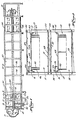
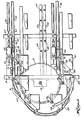
- the apparatus generally indicated at 10 has an upper horizontal cooling tunnel 11 and a lower horizontal cooling tunnel 12, both of generally rectangular cross-section through which filled flexible bags on carriers 13 are moved in a horizontal direction during a cooling operation.
- the carriers are loaded and unloaded with bags B (see Figure 10) at the left end of the apparatus and are moved, when loaded, from left to right through the upper cooling tunnel 11 and returned from right to left through the lower cooling tunnel 12.
- bags B see Figure 10
- they are attached to a pair of endless chains 15, 16 which are driven (clockwise as viewed in Figure 1) about two pairs of sprockets 17 and 18 mounted for rotation on horizontal shafts 17a and 18a.
- the cooling area consists of the upper and lower cooling tunnels 11, 12.
- water is sprayed on the bags as they move through the cooling tunnels.
- the water is distributed through a network of pipes which also serves as a significant portion of the framing structure for the cooling tunnels.
- Water for the upper cooling tunnel 11 is supplied under pressure through an inlet 19
- water for the lower cooling tunnel 12 is supplied under pressure through an inlet 21.
- the water for the upper cooling tunnel 11 is coupled through the inlet 19 to an upper manifold pipe 22 and a lower manifold pipe 23, each of which extend longitudinally along the upper cooling tunnel 11.
- each transverse spray pipe 27 has a series of spray nozzles 29 directed generally downwardly for spraying water onto the bags, and each transverse spray pipe 28 has a series of nozzles 31 generally upwardly directed for the same purpose.
- the lower cooling tunnel 12 has a similar transverse spray pipes 32 and 33 with nozzles for directing a water spray onto the bags in the carriers.
- Additional support for the cooling arrangement 10 is provided by a series of uprights 34, 36 which receive the longitudinal manifold pipes 22-26.
- the upper and lower cooling tunnels 11, 12 are enclosed by stainless steel panels indicated generally as 37 which are supported by the framework of water pipes.
- a run 38 for receiving the sprayed water which is directed to a drain line 39 for recirculation.
- a lower cooling tunnel run 41 directs the sprayed water from the lower cooling tunnel 12 to a drain-pipe 42.
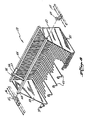
- a typical carrier 13 for one or more flexible bags is formed of a series of generally L-shaped hangers 43 attached to a transverse bar 44.
- Stainless steel end panels 46, 47 are attached to the two endmost hangers and to the transverse bar 44.
- a second transverse bar 48 attached at each end to one of the end plates 46, 47 is pivotally received in blocks 49, 51 which are rigidly attached to oppositely disposed links of the chains 15, 16, respectively.
- Driving one pair of sprockets, such as 18, therefore rotates the endless chains 15, 16 and moves the carriers through the cooling tunnels 11 and 12.
- connection point is horizontally spaced apart from the track 52 along the axis of the axle 54, with the other end of the arm 56 being rigidly attached to the bar 48 and the other end of the arm 57 being rigidly attached to the bar 44. Consequently, as the track 52 and axle 54 move vertically, since the bar 48 is retained within the blocks 49, 51, the carrier 13 rotates about the longitudinal axis of the bar 48. As illustrated in Figures 5 and 7, the track 52 is moved downwardly, and therefore the transverse bar 44 is moved downwardly relative to the transverse bar 48, rocking the carrier backwardly to a position as shown in Figure 10. Raising the track 52 rocks the carrier forwardly into a position generally as shown for the carriers in Figure 9.
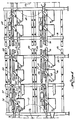
- the track 52 extends substantially for the length of the upper cooling tunnel 11 and is pivotally attached at points 59 to arms 58 of crank arrangements designated generally 61, which are pivotally attached for rotation about a horizontal axis at 62 to the uprights 34, 36.
- Another arm 63 of each crank arrangement 61 is pivotally attached at 64 to a linkage 66 extending generally parallel to and coextensive with the track 52.
- the linkage 66 is horizontally reciprocated by a pair of hydraulic cylinders 67, 68, which serve to raise and lower the track 52 above and below the position in which the carriers are untilted (which is illustrated in Figure 4).
- the bag loading and unloading area of the cooling arrangement 10 the roller 53 on each carrier is not yet in the vertically movable track 52 and is first received in a flared opening 69 of a fixed arcuate track section 71.
- an intermediate straight track section 72 is provided in order to interface between the fixed track section 71 and the vertically moving track 52.
- the intermediate track 72 is pivotally attached to a bracket 73 mounted on a linkage support 74.
- the linkage support 74 extends between the first pair of uprights 34, 36 and also supports the hydraulic cylinder 67 which drives the linkage 66.
- the other end of the intermediate track 72 is pivotally attached at 76 to an extending portion 77 of the track 52.
- a lower vertically movable track 78 corresponding to the track 52, provides the rocking motion for the carriers as they move through the lower horizontal cooling tunnel 12.
- the lower track 78 is terminated by intermediate tracks in the same manner as is the upper track 52, and it is also similarly hydraulically driven, although preferably the upper and lower hydraulic drives operate to rock the carriers in opposite directions.
- asymmetric stabilising rollers 79, 81 are provided at opposite sides of each carrier.
- the stabilising roller 79 is received in a flared opening 82 of a fixed arcuate track 83
- the stabilising roller 81 is received in a flared opening 84 of a fixed arcuate track 86.
- the asymmetrical positioning of the stabilising rollers provides the requisite stability for unloading the cooled bags from the carriers when they reach the unloading area.
- FIGs 11 and 1 1a there is illustrated an alternative, carrier drive and rocking arrangement.
- the bag-carrying portion of the carrier 87 is substantially the same as for the carrier 13.
- the carrier 87 has a transverse bar 88, extending across a cooling tunnel laterally, to which the remaining carrier elements are rigidly attached.
- the transverse bar 88 rotatably receives and is supported by a pair of rollers 89 which travel through the cooling tunnel on tracks 91.
- the shaft 88 is also rotatably received in a pair of blocks 92 which are rigidly attached to endless chain drives 93, substantially identical to the chain drives 15, 16.
- a crank arm 94 on one side of the carrier is fixed to an extension of the bar 88 and has a horizontal offset pin 96 terminating in a rotatable roller 97.
- the roller 97 is carried in a track 98, which extends horizontally through the cooling tunnel and which is vertically movable by a linkage arrangement 99. Vertical movement of the track 98 rotates the crank arm 94 and the bar 88 to effect rocking of the carrier 87.
- the linkage arrangement 99 in this instance is located generally below and laterally of the carriers and includes a horizontally reciprocal linkage 101.
- a series of right-angle crank elements are each pivotally attached for rotation about a horizontal axis at a point such as 102 to a different support post or other structural member of the cooling arrangement.
- Each crank element has a first arm 103 pivotally. attached to the linkage 101 and a second arm 104 pivotally attached to a pair of vertical legs 106 fixed to the track 98.
- the track 98 is raised and lowered, thereby turning each carrier crank arm 94 and rotating each carrier about its axis, the rod 88, counterclockwise and clockwise respectively, as viewed in Figure 11a.
- the track 98 is raised and lowered by longitudinally reciprocating the linkage 101 alternatively in opposite horizontal directions, which rotates each crank arm 104 in the series of crank elements along the track about its pivot 102. This rotation raises and lowers the end of the arm 104 and thus the track 98.
- FIGs 12 and 13 diagrammatically illustrate two possible forms for the distribution of a cooling medium to be sprayed into the cooling tunnels.
- the cooling medium is a water spray in an air environment.
- the water recovered from the cooling tunnels through the drains 39 and 42 is pumped through a chiller or other cooling arrangement and returned to both the upper and lower water inlets 19 and 21.
- chilled water is supplied to both cooling tunnels.
- a positive tilt angle for a carrier may be regarded as forward tilting (as illustrated in Figure 9).
- Rearward tilting may be regarded as a negative tilt angle.
- the amount of horizontal travel leftward and rightward of the linkage 66 is established.
- the positive and negative tilt angles are equal.
- the positive and negative tilt angles be the same; and while a linear transfer between positive and negative tilt angles has been illustrated, such linearity is not required.
- the transition between tilt angles should, however, be sufficiently smooth to permit the flow of the fluid material from a side of the bag at the positive tilt angle position (such as illustrated in Figure 9) to the opposite side of the bag at a negative tilt angle position (as illustrated in Figure 10).
- the ftow pattern achieved in preferred operation is in the nature of a "figure 8", laid on its side, as the fluid material in each bag flows and mixes during the rocking.
- the effectiveness of rocking increases also as the viscosity of the material in a bag being rocked increases.
- the longer dwell time for the higher viscosity fluid is required to permit time for the completion of the flow of the fluid to the lowered end of the bag after tilting.
- Figure 15 illustrates graphically the average final temperatures for two different bagged fluid food materials over a range of tilt angles.
- the two products are diced tomatoes and the more viscous yogurt fruit.
- the bag size and content volume as well as cooling conditions were substantially the same for the two products.
- the more viscous yogurt fruit completes the cooling process at a higher temperature than the less viscous diced tomatoes.
- a larger tilt angle is required.
- the two curves shown are typical of a family of curves representative of increasing viscosity, moving from the origin outwardly through the illustrated quadrant.
- a figure of merit, a heat transfer coefficient h may be derived from the following expression: In this formula, and the succeeding formulas, the terms have the meanings and units given in Table 1.
- the log mean temperature difference between the heated product and the cooling medium may be expressed as follows: Rearranging equation 1, and substituting for ⁇ T m from equation 2, yields: Equivalently, the cooling time t may be expressed as:
- the heat transfer coefficient h may be regarded as a rate of heat removal parameter, per log mean temperature differential.
- the coefficient h has significance in regard to the evaluation of the present cooling arrangement in that it is a quality factor of heat transfer efficiency which may be derived for a given set-up of the cooling arrangement.
- the heat transfer coefficient h is dependent upon the rate of air flow, the rate of water flow for the cooling spray, and the tilt angles, dwell times, and transfer times of the carriers. Variations in product weight and specific heat, water temperature and initial and final product temperatures, and cooling time are accounted for since they are factors of the equations.
- the described cooling apparatus is suitable for use for a variety of viscous materials.
- Three general material categories are particularly amenable to the described cooling techniques: 1) fluid food products, (e.g., tomato sauce, tomato paste, fruit juices, syrups), 2) particulate products in a slurry (e.g., yogurt fruits, jams, jellies, and 3) discrete product particles, (e.g. diced tomato, carrot, beet, peach or pineapple and sliced pear, peach or apple).
- a preferred bag for use in the described cooling arrangement is, when unfilled, rectangular, flat, and flexible, with a generally tubular fitment projecting from one wall through which the bag is filled and sealed with a suitable configured cap.
- rectangular bag walls of which there are two, are heat-sealed along their perimeter.
- Each wall includes three separate sheets.
- the outer sheet of each wall is in the form of a laminate consisting of .0006 inch thick biaxially-oriented Nylon on the outside, .002 inch thick nonoriented blown polyethylene homopolymer on the inside, and a layer of aluminum type-E foil .00035 inch thick in the middle.
- the inner two remaining sheets of the three-sheet wall are identical, physically separate, .002 inch thick nonoriented polyethylene sheets.
- the three-ply outer sheet, as well as the two nonlaminated separate polyethylene sheets are heat-sealed together about the rectangular periphery of the bag.
- viscosity has been used herein with regard to flowable materials to be cooled in the described cooling system, certain materials of a fibrous or pulpy nature, while not exhibiting high viscosity in a conventional sense, can be satisfactorily cooled in bags using the invention. Accordingly, the term viscosity, as used herein, shall be understood to include reference to pulpy and/or fibrous materials.
Landscapes
- Engineering & Computer Science (AREA)
- Chemical & Material Sciences (AREA)
- Life Sciences & Earth Sciences (AREA)
- Polymers & Plastics (AREA)
- Zoology (AREA)
- Food Science & Technology (AREA)
- Wood Science & Technology (AREA)
- Combustion & Propulsion (AREA)
- Physics & Mathematics (AREA)
- Mechanical Engineering (AREA)
- Thermal Sciences (AREA)
- General Engineering & Computer Science (AREA)
- Freezing, Cooling And Drying Of Foods (AREA)
Applications Claiming Priority (2)
| Application Number | Priority Date | Filing Date | Title |
|---|---|---|---|
| US06/286,065 US4384463A (en) | 1981-07-23 | 1981-07-23 | Flexible bag cooling arrangement |
| US286065 | 1981-07-23 |
Publications (2)
| Publication Number | Publication Date |
|---|---|
| EP0071417A1 EP0071417A1 (en) | 1983-02-09 |
| EP0071417B1 true EP0071417B1 (en) | 1985-01-23 |
Family
ID=23096917
Family Applications (1)
| Application Number | Title | Priority Date | Filing Date |
|---|---|---|---|
| EP82303875A Expired EP0071417B1 (en) | 1981-07-23 | 1982-07-22 | Improvements in and relating to the cooling of flexible bags |
Country Status (14)
| Country | Link |
|---|---|
| US (1) | US4384463A (enExample) |
| EP (1) | EP0071417B1 (enExample) |
| JP (1) | JPS5851882A (enExample) |
| AR (1) | AR231768A1 (enExample) |
| AU (1) | AU557452B2 (enExample) |
| BR (1) | BR8204314A (enExample) |
| CA (1) | CA1157282A (enExample) |
| DE (1) | DE3262048D1 (enExample) |
| ES (1) | ES8400016A1 (enExample) |
| GR (1) | GR76854B (enExample) |
| MX (1) | MX156930A (enExample) |
| NZ (1) | NZ201259A (enExample) |
| PT (1) | PT75287A (enExample) |
| ZA (1) | ZA824879B (enExample) |
Families Citing this family (22)
| Publication number | Priority date | Publication date | Assignee | Title |
|---|---|---|---|---|
| US4505670A (en) * | 1983-03-02 | 1985-03-19 | Imdec S.R.L | Apparatus for moving and thermally conditioning cylindrical containers |
| SE446931B (sv) * | 1985-02-18 | 1986-10-20 | Alfastar Ab | Anordning for transport och vermebehandling av produkter |
| US4666722A (en) * | 1985-03-18 | 1987-05-19 | Fmc Corporation | Sterile cooling method |
| US5214999A (en) * | 1992-03-30 | 1993-06-01 | Knud Simonsen Industries Limited | Zig-zag path processing facilities |
| US5370174A (en) * | 1993-06-02 | 1994-12-06 | Oak Park International, Ltd. | Method and apparatus for agitating and thermally conditioning filled containers |
| US5651191A (en) * | 1995-07-28 | 1997-07-29 | Wolverine Corporation | Material treatment system |
| US6073540A (en) | 1998-11-10 | 2000-06-13 | Fmc Corporation | Apparatus for heating or cooling product containers |
| US6142396A (en) * | 1999-03-26 | 2000-11-07 | Gallus; Timothy David | Nozzel assembly |
| US6340449B1 (en) * | 1999-03-26 | 2002-01-22 | Timothy David Gallus | System and method for heating or cooling contents of flexible containers |
| US6387322B1 (en) | 1999-03-26 | 2002-05-14 | Timothy David Gallus | System and method for heating and then cooling contents of flexible containers |
| US6301905B1 (en) | 1999-03-26 | 2001-10-16 | Timothy D. Gallus | Trough construction |
| AU3922800A (en) * | 1999-03-26 | 2000-10-16 | Timothy David Gallus | Trough construction |
| US6676541B2 (en) * | 2002-01-23 | 2004-01-13 | Acushnet Company | Co-injection molded double covered golf ball |
| US6698504B2 (en) * | 2002-04-16 | 2004-03-02 | Andrew E. Briesmeister | Apparatus and process for more rapidly cooling products contained in pouched or flexible containers |
| US7575043B2 (en) * | 2002-04-29 | 2009-08-18 | Kauppila Richard W | Cooling arrangement for conveyors and other applications |
| US20040055738A1 (en) * | 2002-04-29 | 2004-03-25 | Kauppila Richard W. | Conveyor with heat transfer arrangement |
| WO2004017000A1 (en) * | 2002-08-16 | 2004-02-26 | The Boc Group, Inc. | Method and apparatus for surface crust freezing of food products |
| US7464559B2 (en) * | 2005-10-07 | 2008-12-16 | Stokely-Van Camp, Inc. | Bottle cooler and method |
| US8177415B1 (en) | 2006-07-24 | 2012-05-15 | Tarpaulin.Com, Inc. | System for agitating pouched products |
| DE102009053321B4 (de) * | 2009-11-17 | 2013-11-07 | Thomas Völkl | Frostschrank |
| JP6012097B2 (ja) * | 2012-07-27 | 2016-10-25 | 旭工業株式会社 | 殺菌冷却装置 |
| GB201604062D0 (en) * | 2016-03-09 | 2016-04-20 | Cell Therapy Catapult Ltd | A device for heating or cooling a sample |
Family Cites Families (17)
| Publication number | Priority date | Publication date | Assignee | Title |
|---|---|---|---|---|
| US1835799A (en) * | 1928-05-14 | 1931-12-08 | Meyer Geo J Mfg Co | Dry heat sterilizer |
| US1948790A (en) * | 1930-09-10 | 1934-02-27 | E G Ballenger | Refrigeration system |
| US2254420A (en) * | 1939-01-24 | 1941-09-02 | Arthur L Layden | Refrigerating apparatus |
| US2454704A (en) * | 1944-10-02 | 1948-11-23 | Floyd J Mcmichael | Method and apparatus for cooling produce by alternate dipping and draining |
| FR1003745A (fr) * | 1947-02-20 | 1952-03-21 | Procédé et appareil continu pour la préparation des conserves de fruits ou analogues | |
| US2597223A (en) * | 1948-11-01 | 1952-05-20 | Hawaiian Pineapple Co Ltd | Treatment of food products packaged in cylindrical containers |
| US3052559A (en) * | 1959-08-17 | 1962-09-04 | Foremost Dairies Inc | Sterilizing process |
| FR1301810A (fr) * | 1960-12-08 | 1962-08-24 | Produit constitué par un récipient en une matière souple contenant des substances organiques liquides normalement périssables et procédés pour son obtention | |
| US3132688A (en) * | 1963-04-08 | 1964-05-12 | Welville B Nowak | Electronic cold and/or hot compress device |
| US3205543A (en) * | 1963-05-27 | 1965-09-14 | Rex Chainbelt Inc | Process and apparatus for cooling foundry sand on a vibratory conveyor |
| US3389568A (en) * | 1966-02-14 | 1968-06-25 | Carnation Co | Method and apparatus for removing processing heat from a food product in filled and closed containers |
| US3481688A (en) * | 1966-11-16 | 1969-12-02 | Reynolds Metals Co | Method and apparatus for autoclaving product-containing flexible pouch constructions or the like |
| US3464835A (en) * | 1968-05-29 | 1969-09-02 | Peregrino Mario Del Pilar Cast | Process for pasteurizing liquid products in a continuous line of plastic sachets |
| IL38326A (en) * | 1971-12-09 | 1975-03-13 | Nahir D | Method and apparatus for cooling containers containing a hot viscous comestible |
| GB1423791A (en) * | 1973-02-14 | 1976-02-04 | Stal Refrigeration Ab | Refrigeration plant |
| DE2413575A1 (de) * | 1974-03-21 | 1975-09-25 | Stahl Geb Quabeck Margarete | Verfahren und vorrichtung zum verpacken von schmelzbarem oder fluessigem material, insbesondere von geschmolzenem bitumen, in flexiblen, gegen wasser und gegen das geschmolzene material widerstandsfaehigen behaeltern |
| HU174290B (hu) * | 1976-09-23 | 1979-12-28 | Elelmezesipari Tervezoe Vallal | Sposob i ustanovka dlja nepreryvnogo gigiehnicheskogo predvaritel'nogo okhlazhdenija domashnikh ptic |
-
1981
- 1981-07-23 US US06/286,065 patent/US4384463A/en not_active Expired - Fee Related
-
1982
- 1982-07-07 CA CA000406782A patent/CA1157282A/en not_active Expired
- 1982-07-08 GR GR68694A patent/GR76854B/el unknown
- 1982-07-08 ZA ZA824879A patent/ZA824879B/xx unknown
- 1982-07-13 NZ NZ201259A patent/NZ201259A/en unknown
- 1982-07-21 PT PT75287A patent/PT75287A/pt unknown
- 1982-07-22 AU AU86337/82A patent/AU557452B2/en not_active Ceased
- 1982-07-22 JP JP57128315A patent/JPS5851882A/ja active Pending
- 1982-07-22 DE DE8282303875T patent/DE3262048D1/de not_active Expired
- 1982-07-22 MX MX193702A patent/MX156930A/es unknown
- 1982-07-22 EP EP82303875A patent/EP0071417B1/en not_active Expired
- 1982-07-23 AR AR290064A patent/AR231768A1/es active
- 1982-07-23 BR BR8204314A patent/BR8204314A/pt unknown
- 1982-07-23 ES ES514289A patent/ES8400016A1/es not_active Expired
Also Published As
| Publication number | Publication date |
|---|---|
| EP0071417A1 (en) | 1983-02-09 |
| NZ201259A (en) | 1986-06-11 |
| DE3262048D1 (en) | 1985-03-07 |
| AU557452B2 (en) | 1986-12-24 |
| ES514289A0 (es) | 1983-10-16 |
| AU8633782A (en) | 1983-01-27 |
| CA1157282A (en) | 1983-11-22 |
| JPS5851882A (ja) | 1983-03-26 |
| MX156930A (es) | 1988-10-17 |
| ZA824879B (en) | 1983-04-27 |
| GR76854B (enExample) | 1984-09-04 |
| AR231768A1 (es) | 1985-02-28 |
| ES8400016A1 (es) | 1983-10-16 |
| PT75287A (en) | 1982-08-01 |
| US4384463A (en) | 1983-05-24 |
| BR8204314A (pt) | 1983-07-19 |
Similar Documents
| Publication | Publication Date | Title |
|---|---|---|
| EP0071417B1 (en) | Improvements in and relating to the cooling of flexible bags | |
| US4437315A (en) | Flexible bag cooling arrangement | |
| US6194015B1 (en) | Method for heating or cooling product containers | |
| CA2357075C (en) | Packer apparatus packing conveyor, and method | |
| US8197117B2 (en) | Method for agitating pouched products | |
| JPH11103835A (ja) | 冷却コンベアを用いた袋詰め食品冷却方法 | |
| US5370174A (en) | Method and apparatus for agitating and thermally conditioning filled containers | |
| JP3527019B2 (ja) | 流動食品入り容器の殺菌方法及び殺菌装置 | |
| US2124010A (en) | Apparatus for treating canned materials | |
| RU2595736C2 (ru) | Стерилизация в упаковке неионизирующим электромагнитным излучением | |
| JPS62287833A (ja) | フランジ付き容器の搬送装置 | |
| JPS582666B2 (ja) | レトルト食品の殺菌方法及びその装置 | |
| WO1997002182A1 (en) | A method and a package for extending the shelf life of a food | |
| US3304689A (en) | Continuous chilling and vacuum packaging device | |
| JP3286561B2 (ja) | 容器詰め流動体の冷却装置 | |
| US2528680A (en) | Mechanism for filling, vacuumizing, and sealing containers | |
| CN216186631U (zh) | 一种袋装牛油冷凝输送系统 | |
| JP2676969B2 (ja) | 缶蓋滅菌装置 | |
| JPH0363056A (ja) | 物品を気体滅菌剤で滅菌する方法及び装置 | |
| CN104494870A (zh) | 一种食品中包机 | |
| US2573725A (en) | Tunnel freezing apparatus and method | |
| CN104494942B (zh) | 一种用于食品中包机的成型封口装置 | |
| US2295846A (en) | Means for processing canned foods | |
| CN100493999C (zh) | 罐装产品的冷却方法 | |
| US4836098A (en) | Method and apparatus for cooking and packing food in glass containers |
Legal Events
| Date | Code | Title | Description |
|---|---|---|---|
| PUAI | Public reference made under article 153(3) epc to a published international application that has entered the european phase |
Free format text: ORIGINAL CODE: 0009012 |
|
| AK | Designated contracting states |
Designated state(s): CH DE FR GB IT LI SE |
|
| 17P | Request for examination filed |
Effective date: 19830307 |
|
| ITF | It: translation for a ep patent filed | ||
| GRAA | (expected) grant |
Free format text: ORIGINAL CODE: 0009210 |
|
| AK | Designated contracting states |
Designated state(s): CH DE FR GB IT LI SE |
|
| REF | Corresponds to: |
Ref document number: 3262048 Country of ref document: DE Date of ref document: 19850307 |
|
| ET | Fr: translation filed | ||
| PLBE | No opposition filed within time limit |
Free format text: ORIGINAL CODE: 0009261 |
|
| STAA | Information on the status of an ep patent application or granted ep patent |
Free format text: STATUS: NO OPPOSITION FILED WITHIN TIME LIMIT |
|
| 26N | No opposition filed | ||
| PG25 | Lapsed in a contracting state [announced via postgrant information from national office to epo] |
Ref country code: GB Effective date: 19880722 |
|
| PG25 | Lapsed in a contracting state [announced via postgrant information from national office to epo] |
Ref country code: SE Effective date: 19880723 |
|
| PG25 | Lapsed in a contracting state [announced via postgrant information from national office to epo] |
Ref country code: LI Effective date: 19880731 Ref country code: CH Effective date: 19880731 |
|
| GBPC | Gb: european patent ceased through non-payment of renewal fee | ||
| PG25 | Lapsed in a contracting state [announced via postgrant information from national office to epo] |
Ref country code: FR Free format text: LAPSE BECAUSE OF NON-PAYMENT OF DUE FEES Effective date: 19890331 |
|
| REG | Reference to a national code |
Ref country code: CH Ref legal event code: PL |
|
| PG25 | Lapsed in a contracting state [announced via postgrant information from national office to epo] |
Ref country code: DE Effective date: 19890401 |
|
| REG | Reference to a national code |
Ref country code: FR Ref legal event code: ST |
|
| EUG | Se: european patent has lapsed |
Ref document number: 82303875.7 Effective date: 19890510 |