EP0065658A2 - Verwendung von Sulfenamiden als Lipoxygenasehemmer und diese enthaltende Arzneimittel - Google Patents
Verwendung von Sulfenamiden als Lipoxygenasehemmer und diese enthaltende Arzneimittel Download PDFInfo
- Publication number
- EP0065658A2 EP0065658A2 EP82103517A EP82103517A EP0065658A2 EP 0065658 A2 EP0065658 A2 EP 0065658A2 EP 82103517 A EP82103517 A EP 82103517A EP 82103517 A EP82103517 A EP 82103517A EP 0065658 A2 EP0065658 A2 EP 0065658A2
- Authority
- EP
- European Patent Office
- Prior art keywords
- carbon atoms
- alkyl
- aryl
- atoms
- radical
- Prior art date
- Legal status (The legal status is an assumption and is not a legal conclusion. Google has not performed a legal analysis and makes no representation as to the accuracy of the status listed.)
- Withdrawn
Links
- 239000003814 drug Substances 0.000 title claims abstract description 18
- 239000003795 chemical substances by application Substances 0.000 title description 4
- 239000000867 Lipoxygenase Inhibitor Substances 0.000 claims abstract description 4
- 238000002360 preparation method Methods 0.000 claims abstract description 4
- 125000004432 carbon atom Chemical group C* 0.000 claims description 67
- -1 cyano, carbamoyl Chemical group 0.000 claims description 52
- 150000003254 radicals Chemical class 0.000 claims description 32
- 125000003545 alkoxy group Chemical group 0.000 claims description 27
- 125000000217 alkyl group Chemical group 0.000 claims description 27
- 125000003118 aryl group Chemical group 0.000 claims description 27
- 125000004414 alkyl thio group Chemical group 0.000 claims description 26
- IJGRMHOSHXDMSA-UHFFFAOYSA-N Atomic nitrogen Chemical compound N#N IJGRMHOSHXDMSA-UHFFFAOYSA-N 0.000 claims description 24
- 125000000753 cycloalkyl group Chemical group 0.000 claims description 24
- 125000003710 aryl alkyl group Chemical group 0.000 claims description 18
- 125000004104 aryloxy group Chemical group 0.000 claims description 17
- 229910052739 hydrogen Inorganic materials 0.000 claims description 16
- 239000001257 hydrogen Substances 0.000 claims description 16
- UFHFLCQGNIYNRP-UHFFFAOYSA-N Hydrogen Chemical compound [H][H] UFHFLCQGNIYNRP-UHFFFAOYSA-N 0.000 claims description 14
- 125000005110 aryl thio group Chemical group 0.000 claims description 14
- 125000003342 alkenyl group Chemical group 0.000 claims description 12
- 229910052736 halogen Inorganic materials 0.000 claims description 12
- 150000002367 halogens Chemical class 0.000 claims description 12
- 125000001841 imino group Chemical group [H]N=* 0.000 claims description 12
- 229910052757 nitrogen Inorganic materials 0.000 claims description 12
- 125000002924 primary amino group Chemical group [H]N([H])* 0.000 claims description 12
- 125000001424 substituent group Chemical group 0.000 claims description 12
- 238000000034 method Methods 0.000 claims description 10
- 102000003820 Lipoxygenases Human genes 0.000 claims description 9
- 108090000128 Lipoxygenases Proteins 0.000 claims description 9
- NINIDFKCEFEMDL-UHFFFAOYSA-N Sulfur Chemical compound [S] NINIDFKCEFEMDL-UHFFFAOYSA-N 0.000 claims description 9
- 125000004093 cyano group Chemical group *C#N 0.000 claims description 9
- 229910052760 oxygen Inorganic materials 0.000 claims description 9
- 239000001301 oxygen Substances 0.000 claims description 9
- 125000002023 trifluoromethyl group Chemical group FC(F)(F)* 0.000 claims description 9
- 239000000460 chlorine Substances 0.000 claims description 8
- 229910052801 chlorine Inorganic materials 0.000 claims description 8
- 150000001875 compounds Chemical group 0.000 claims description 8
- 125000000623 heterocyclic group Chemical group 0.000 claims description 8
- WKBOTKDWSSQWDR-UHFFFAOYSA-N Bromine atom Chemical compound [Br] WKBOTKDWSSQWDR-UHFFFAOYSA-N 0.000 claims description 7
- ZAMOUSCENKQFHK-UHFFFAOYSA-N Chlorine atom Chemical compound [Cl] ZAMOUSCENKQFHK-UHFFFAOYSA-N 0.000 claims description 7
- GDTBXPJZTBHREO-UHFFFAOYSA-N bromine Substances BrBr GDTBXPJZTBHREO-UHFFFAOYSA-N 0.000 claims description 7
- 229910052794 bromium Inorganic materials 0.000 claims description 7
- 125000004659 aryl alkyl thio group Chemical group 0.000 claims description 6
- QVGXLLKOCUKJST-UHFFFAOYSA-N atomic oxygen Chemical compound [O] QVGXLLKOCUKJST-UHFFFAOYSA-N 0.000 claims description 6
- 125000000000 cycloalkoxy group Chemical group 0.000 claims description 6
- 125000005366 cycloalkylthio group Chemical group 0.000 claims description 6
- 150000002431 hydrogen Chemical class 0.000 claims description 6
- 229910052717 sulfur Inorganic materials 0.000 claims description 6
- 239000011593 sulfur Substances 0.000 claims description 6
- 125000003178 carboxy group Chemical group [H]OC(*)=O 0.000 claims description 5
- 125000000876 trifluoromethoxy group Chemical group FC(F)(F)O* 0.000 claims description 5
- PXGOKWXKJXAPGV-UHFFFAOYSA-N Fluorine Chemical compound FF PXGOKWXKJXAPGV-UHFFFAOYSA-N 0.000 claims description 4
- 150000005840 aryl radicals Chemical class 0.000 claims description 4
- 125000001797 benzyl group Chemical group [H]C1=C([H])C([H])=C(C([H])=C1[H])C([H])([H])* 0.000 claims description 4
- 125000005842 heteroatom Chemical group 0.000 claims description 4
- 125000004433 nitrogen atom Chemical group N* 0.000 claims description 4
- 125000004043 oxo group Chemical group O=* 0.000 claims description 4
- 125000004430 oxygen atom Chemical group O* 0.000 claims description 4
- 150000003839 salts Chemical class 0.000 claims description 4
- 125000004434 sulfur atom Chemical group 0.000 claims description 4
- 125000005108 alkenylthio group Chemical group 0.000 claims description 3
- 239000000969 carrier Substances 0.000 claims description 3
- 125000000392 cycloalkenyl group Chemical group 0.000 claims description 3
- 125000004438 haloalkoxy group Chemical group 0.000 claims description 3
- 125000001188 haloalkyl group Chemical group 0.000 claims description 3
- 125000004468 heterocyclylthio group Chemical group 0.000 claims description 3
- 125000004435 hydrogen atom Chemical group [H]* 0.000 claims description 3
- 230000002401 inhibitory effect Effects 0.000 claims description 3
- 125000000449 nitro group Chemical group [O-][N+](*)=O 0.000 claims description 3
- 125000000951 phenoxy group Chemical group [H]C1=C([H])C([H])=C(O*)C([H])=C1[H] 0.000 claims description 3
- 125000001997 phenyl group Chemical group [H]C1=C([H])C([H])=C(*)C([H])=C1[H] 0.000 claims description 3
- 230000008569 process Effects 0.000 claims description 3
- 125000000547 substituted alkyl group Chemical group 0.000 claims description 3
- 125000000472 sulfonyl group Chemical group *S(*)(=O)=O 0.000 claims description 3
- KKFDJZZADQONDE-UHFFFAOYSA-N (hydridonitrato)hydroxidocarbon(.) Chemical compound O[C]=N KKFDJZZADQONDE-UHFFFAOYSA-N 0.000 claims description 2
- 125000002947 alkylene group Chemical group 0.000 claims description 2
- 230000001088 anti-asthma Effects 0.000 claims description 2
- 230000000879 anti-atherosclerotic effect Effects 0.000 claims description 2
- 239000000924 antiasthmatic agent Substances 0.000 claims description 2
- 239000003435 antirheumatic agent Substances 0.000 claims description 2
- 125000000732 arylene group Chemical group 0.000 claims description 2
- 229910052731 fluorine Inorganic materials 0.000 claims description 2
- 239000011737 fluorine Substances 0.000 claims description 2
- 125000003709 fluoroalkyl group Chemical group 0.000 claims description 2
- MDQRDWAGHRLBPA-UHFFFAOYSA-N fluoroamine Chemical compound FN MDQRDWAGHRLBPA-UHFFFAOYSA-N 0.000 claims description 2
- 230000002178 gastroprotective effect Effects 0.000 claims description 2
- 125000004437 phosphorous atom Chemical group 0.000 claims description 2
- SMBZJSVIKJMSFP-UHFFFAOYSA-N trifluoromethyl hypofluorite Chemical compound FOC(F)(F)F SMBZJSVIKJMSFP-UHFFFAOYSA-N 0.000 claims description 2
- 125000000304 alkynyl group Chemical group 0.000 claims 1
- 230000003266 anti-allergic effect Effects 0.000 claims 1
- 230000003110 anti-inflammatory effect Effects 0.000 claims 1
- 230000002001 anti-metastasis Effects 0.000 claims 1
- 230000003356 anti-rheumatic effect Effects 0.000 claims 1
- 125000002993 cycloalkylene group Chemical group 0.000 claims 1
- YXFVVABEGXRONW-UHFFFAOYSA-N Toluene Chemical compound CC1=CC=CC=C1 YXFVVABEGXRONW-UHFFFAOYSA-N 0.000 description 15
- YZXBAPSDXZZRGB-DOFZRALJSA-N arachidonic acid Chemical class CCCCC\C=C/C\C=C/C\C=C/C\C=C/CCCC(O)=O YZXBAPSDXZZRGB-DOFZRALJSA-N 0.000 description 9
- 239000000203 mixture Substances 0.000 description 8
- ZMXDDKWLCZADIW-UHFFFAOYSA-N N,N-Dimethylformamide Chemical compound CN(C)C=O ZMXDDKWLCZADIW-UHFFFAOYSA-N 0.000 description 6
- MVPPADPHJFYWMZ-UHFFFAOYSA-N chlorobenzene Chemical compound ClC1=CC=CC=C1 MVPPADPHJFYWMZ-UHFFFAOYSA-N 0.000 description 6
- 230000000694 effects Effects 0.000 description 6
- 238000006243 chemical reaction Methods 0.000 description 5
- 230000005764 inhibitory process Effects 0.000 description 5
- HEMHJVSKTPXQMS-UHFFFAOYSA-M sodium hydroxide Inorganic materials [OH-].[Na+] HEMHJVSKTPXQMS-UHFFFAOYSA-M 0.000 description 5
- 239000002904 solvent Substances 0.000 description 5
- PEDCQBHIVMGVHV-UHFFFAOYSA-N Glycerine Chemical compound OCC(O)CO PEDCQBHIVMGVHV-UHFFFAOYSA-N 0.000 description 4
- 239000002253 acid Substances 0.000 description 4
- 229940114079 arachidonic acid Drugs 0.000 description 4
- 235000021342 arachidonic acid Nutrition 0.000 description 4
- 230000015572 biosynthetic process Effects 0.000 description 4
- HQKMJHAJHXVSDF-UHFFFAOYSA-L magnesium stearate Chemical compound [Mg+2].CCCCCCCCCCCCCCCCCC([O-])=O.CCCCCCCCCCCCCCCCCC([O-])=O HQKMJHAJHXVSDF-UHFFFAOYSA-L 0.000 description 4
- 150000003180 prostaglandins Chemical class 0.000 description 4
- 238000003786 synthesis reaction Methods 0.000 description 4
- XLYOFNOQVPJJNP-UHFFFAOYSA-N water Substances O XLYOFNOQVPJJNP-UHFFFAOYSA-N 0.000 description 4
- KUKJHGXXZWHSBG-GMPNNLDHSA-N 12-HHTrE Chemical compound CCCCCC(O)\C=C\C=C\C\C=C\CCCC(O)=O KUKJHGXXZWHSBG-GMPNNLDHSA-N 0.000 description 3
- KUKJHGXXZWHSBG-UHFFFAOYSA-N 12-Hydroxy-5,8,10-heptadecatrienoic acid Natural products CCCCCC(O)C=CC=CCC=CCCCC(O)=O KUKJHGXXZWHSBG-UHFFFAOYSA-N 0.000 description 3
- UHOVQNZJYSORNB-UHFFFAOYSA-N Benzene Chemical compound C1=CC=CC=C1 UHOVQNZJYSORNB-UHFFFAOYSA-N 0.000 description 3
- MYMOFIZGZYHOMD-UHFFFAOYSA-N Dioxygen Chemical compound O=O MYMOFIZGZYHOMD-UHFFFAOYSA-N 0.000 description 3
- LFQSCWFLJHTTHZ-UHFFFAOYSA-N Ethanol Chemical compound CCO LFQSCWFLJHTTHZ-UHFFFAOYSA-N 0.000 description 3
- OKKJLVBELUTLKV-UHFFFAOYSA-N Methanol Chemical group OC OKKJLVBELUTLKV-UHFFFAOYSA-N 0.000 description 3
- DNIAPMSPPWPWGF-UHFFFAOYSA-N Propylene glycol Chemical compound CC(O)CO DNIAPMSPPWPWGF-UHFFFAOYSA-N 0.000 description 3
- 102000004005 Prostaglandin-endoperoxide synthases Human genes 0.000 description 3
- 108090000459 Prostaglandin-endoperoxide synthases Proteins 0.000 description 3
- DBMJMQXJHONAFJ-UHFFFAOYSA-M Sodium laurylsulphate Chemical compound [Na+].CCCCCCCCCCCCOS([O-])(=O)=O DBMJMQXJHONAFJ-UHFFFAOYSA-M 0.000 description 3
- ZMANZCXQSJIPKH-UHFFFAOYSA-N Triethylamine Chemical compound CCN(CC)CC ZMANZCXQSJIPKH-UHFFFAOYSA-N 0.000 description 3
- 239000004480 active ingredient Substances 0.000 description 3
- 150000001412 amines Chemical class 0.000 description 3
- 230000037396 body weight Effects 0.000 description 3
- 239000003995 emulsifying agent Substances 0.000 description 3
- RTZKZFJDLAIYFH-UHFFFAOYSA-N ether Substances CCOCC RTZKZFJDLAIYFH-UHFFFAOYSA-N 0.000 description 3
- 238000009472 formulation Methods 0.000 description 3
- 230000004060 metabolic process Effects 0.000 description 3
- VLKZOEOYAKHREP-UHFFFAOYSA-N n-Hexane Chemical compound CCCCCC VLKZOEOYAKHREP-UHFFFAOYSA-N 0.000 description 3
- 229940094443 oxytocics prostaglandins Drugs 0.000 description 3
- 239000000454 talc Substances 0.000 description 3
- 235000012222 talc Nutrition 0.000 description 3
- 229910052623 talc Inorganic materials 0.000 description 3
- QGZKDVFQNNGYKY-UHFFFAOYSA-N Ammonia Chemical compound N QGZKDVFQNNGYKY-UHFFFAOYSA-N 0.000 description 2
- 101100116570 Caenorhabditis elegans cup-2 gene Proteins 0.000 description 2
- VTYYLEPIZMXCLO-UHFFFAOYSA-L Calcium carbonate Chemical compound [Ca+2].[O-]C([O-])=O VTYYLEPIZMXCLO-UHFFFAOYSA-L 0.000 description 2
- HEDRZPFGACZZDS-UHFFFAOYSA-N Chloroform Chemical compound ClC(Cl)Cl HEDRZPFGACZZDS-UHFFFAOYSA-N 0.000 description 2
- IAZDPXIOMUYVGZ-UHFFFAOYSA-N Dimethylsulphoxide Chemical compound CS(C)=O IAZDPXIOMUYVGZ-UHFFFAOYSA-N 0.000 description 2
- 101100116572 Drosophila melanogaster Der-1 gene Proteins 0.000 description 2
- XEKOWRVHYACXOJ-UHFFFAOYSA-N Ethyl acetate Natural products CCOC(C)=O XEKOWRVHYACXOJ-UHFFFAOYSA-N 0.000 description 2
- WQZGKKKJIJFFOK-GASJEMHNSA-N Glucose Chemical compound OC[C@H]1OC(O)[C@H](O)[C@@H](O)[C@@H]1O WQZGKKKJIJFFOK-GASJEMHNSA-N 0.000 description 2
- 241001465754 Metazoa Species 0.000 description 2
- OFBQJSOFQDEBGM-UHFFFAOYSA-N Pentane Chemical compound CCCCC OFBQJSOFQDEBGM-UHFFFAOYSA-N 0.000 description 2
- 229920003171 Poly (ethylene oxide) Polymers 0.000 description 2
- JUJWROOIHBZHMG-UHFFFAOYSA-N Pyridine Chemical compound C1=CC=NC=C1 JUJWROOIHBZHMG-UHFFFAOYSA-N 0.000 description 2
- SMWDFEZZVXVKRB-UHFFFAOYSA-N Quinoline Chemical compound N1=CC=CC2=CC=CC=C21 SMWDFEZZVXVKRB-UHFFFAOYSA-N 0.000 description 2
- VYPSYNLAJGMNEJ-UHFFFAOYSA-N Silicium dioxide Chemical compound O=[Si]=O VYPSYNLAJGMNEJ-UHFFFAOYSA-N 0.000 description 2
- 229920002472 Starch Polymers 0.000 description 2
- 150000007513 acids Chemical class 0.000 description 2
- 239000000654 additive Substances 0.000 description 2
- 229910001860 alkaline earth metal hydroxide Inorganic materials 0.000 description 2
- 150000008052 alkyl sulfonates Chemical class 0.000 description 2
- 230000000172 allergic effect Effects 0.000 description 2
- 208000010668 atopic eczema Diseases 0.000 description 2
- 239000002585 base Substances 0.000 description 2
- NEHMKBQYUWJMIP-UHFFFAOYSA-N chloromethane Chemical compound ClC NEHMKBQYUWJMIP-UHFFFAOYSA-N 0.000 description 2
- IJOOHPMOJXWVHK-UHFFFAOYSA-N chlorotrimethylsilane Chemical compound C[Si](C)(C)Cl IJOOHPMOJXWVHK-UHFFFAOYSA-N 0.000 description 2
- 239000002270 dispersing agent Substances 0.000 description 2
- 229940079593 drug Drugs 0.000 description 2
- 235000019441 ethanol Nutrition 0.000 description 2
- 235000011187 glycerol Nutrition 0.000 description 2
- 239000005457 ice water Substances 0.000 description 2
- 230000002757 inflammatory effect Effects 0.000 description 2
- 229920005610 lignin Polymers 0.000 description 2
- 239000000314 lubricant Substances 0.000 description 2
- 235000019359 magnesium stearate Nutrition 0.000 description 2
- 239000002207 metabolite Substances 0.000 description 2
- 229920000609 methyl cellulose Polymers 0.000 description 2
- 239000001923 methylcellulose Substances 0.000 description 2
- 235000010981 methylcellulose Nutrition 0.000 description 2
- 231100000252 nontoxic Toxicity 0.000 description 2
- 230000003000 nontoxic effect Effects 0.000 description 2
- 239000003960 organic solvent Substances 0.000 description 2
- 239000003208 petroleum Substances 0.000 description 2
- 229920000036 polyvinylpyrrolidone Polymers 0.000 description 2
- AOJFQRQNPXYVLM-UHFFFAOYSA-N pyridin-1-ium;chloride Chemical compound [Cl-].C1=CC=[NH+]C=C1 AOJFQRQNPXYVLM-UHFFFAOYSA-N 0.000 description 2
- 239000011435 rock Substances 0.000 description 2
- 235000019333 sodium laurylsulphate Nutrition 0.000 description 2
- 239000008107 starch Substances 0.000 description 2
- 235000019698 starch Nutrition 0.000 description 2
- 239000000126 substance Substances 0.000 description 2
- 239000000725 suspension Substances 0.000 description 2
- 239000003826 tablet Substances 0.000 description 2
- VZGDMQKNWNREIO-UHFFFAOYSA-N tetrachloromethane Chemical compound ClC(Cl)(Cl)Cl VZGDMQKNWNREIO-UHFFFAOYSA-N 0.000 description 2
- JUVCSTHXUUZSBW-UHFFFAOYSA-N 1-cyclohexylsulfanylbenzimidazole Chemical compound C1CCCCC1SN1C2=CC=CC=C2N=C1 JUVCSTHXUUZSBW-UHFFFAOYSA-N 0.000 description 1
- HYZJCKYKOHLVJF-UHFFFAOYSA-N 1H-benzimidazole Chemical compound C1=CC=C2NC=NC2=C1 HYZJCKYKOHLVJF-UHFFFAOYSA-N 0.000 description 1
- CZMRCDWAGMRECN-UHFFFAOYSA-N 2-{[3,4-dihydroxy-2,5-bis(hydroxymethyl)oxolan-2-yl]oxy}-6-(hydroxymethyl)oxane-3,4,5-triol Chemical compound OCC1OC(CO)(OC2OC(CO)C(O)C(O)C2O)C(O)C1O CZMRCDWAGMRECN-UHFFFAOYSA-N 0.000 description 1
- ULRPISSMEBPJLN-UHFFFAOYSA-N 2h-tetrazol-5-amine Chemical compound NC1=NN=NN1 ULRPISSMEBPJLN-UHFFFAOYSA-N 0.000 description 1
- XVMSFILGAMDHEY-UHFFFAOYSA-N 6-(4-aminophenyl)sulfonylpyridin-3-amine Chemical compound C1=CC(N)=CC=C1S(=O)(=O)C1=CC=C(N)C=N1 XVMSFILGAMDHEY-UHFFFAOYSA-N 0.000 description 1
- 240000002470 Amphicarpaea bracteata Species 0.000 description 1
- 235000019739 Dicalciumphosphate Nutrition 0.000 description 1
- 239000004097 EU approved flavor enhancer Substances 0.000 description 1
- 102000004190 Enzymes Human genes 0.000 description 1
- 108090000790 Enzymes Proteins 0.000 description 1
- 108010010803 Gelatin Proteins 0.000 description 1
- KFZMGEQAYNKOFK-UHFFFAOYSA-N Isopropanol Chemical group CC(C)O KFZMGEQAYNKOFK-UHFFFAOYSA-N 0.000 description 1
- JLTDJTHDQAWBAV-UHFFFAOYSA-N N,N-dimethylaniline Chemical compound CN(C)C1=CC=CC=C1 JLTDJTHDQAWBAV-UHFFFAOYSA-N 0.000 description 1
- VFAGLCVSCKZHHV-UHFFFAOYSA-N NBr(Cl)F Chemical compound NBr(Cl)F VFAGLCVSCKZHHV-UHFFFAOYSA-N 0.000 description 1
- 239000002202 Polyethylene glycol Substances 0.000 description 1
- 241000700159 Rattus Species 0.000 description 1
- PMZURENOXWZQFD-UHFFFAOYSA-L Sodium Sulfate Chemical compound [Na+].[Na+].[O-]S([O-])(=O)=O PMZURENOXWZQFD-UHFFFAOYSA-L 0.000 description 1
- 235000021355 Stearic acid Nutrition 0.000 description 1
- LSNNMFCWUKXFEE-UHFFFAOYSA-N Sulfurous acid Chemical compound OS(O)=O LSNNMFCWUKXFEE-UHFFFAOYSA-N 0.000 description 1
- 241000009298 Trigla lyra Species 0.000 description 1
- 239000000443 aerosol Substances 0.000 description 1
- 150000001298 alcohols Chemical class 0.000 description 1
- 239000003513 alkali Substances 0.000 description 1
- 125000006193 alkinyl group Chemical group 0.000 description 1
- 150000008055 alkyl aryl sulfonates Chemical class 0.000 description 1
- 229940045714 alkyl sulfonate alkylating agent Drugs 0.000 description 1
- 229910052782 aluminium Inorganic materials 0.000 description 1
- 235000012211 aluminium silicate Nutrition 0.000 description 1
- 229910021529 ammonia Inorganic materials 0.000 description 1
- QGZKDVFQNNGYKY-UHFFFAOYSA-O ammonium group Chemical group [NH4+] QGZKDVFQNNGYKY-UHFFFAOYSA-O 0.000 description 1
- 125000000129 anionic group Chemical group 0.000 description 1
- 229940124599 anti-inflammatory drug Drugs 0.000 description 1
- 239000000043 antiallergic agent Substances 0.000 description 1
- 239000002257 antimetastatic agent Substances 0.000 description 1
- 239000000010 aprotic solvent Substances 0.000 description 1
- 239000007900 aqueous suspension Substances 0.000 description 1
- 125000005228 aryl sulfonate group Chemical group 0.000 description 1
- 208000006673 asthma Diseases 0.000 description 1
- 238000000211 autoradiogram Methods 0.000 description 1
- CODNYICXDISAEA-UHFFFAOYSA-N bromine monochloride Chemical compound BrCl CODNYICXDISAEA-UHFFFAOYSA-N 0.000 description 1
- 229910052791 calcium Inorganic materials 0.000 description 1
- 239000011575 calcium Substances 0.000 description 1
- 229910000019 calcium carbonate Inorganic materials 0.000 description 1
- 239000001506 calcium phosphate Substances 0.000 description 1
- 239000002775 capsule Substances 0.000 description 1
- 150000001722 carbon compounds Chemical class 0.000 description 1
- 150000004649 carbonic acid derivatives Chemical class 0.000 description 1
- 239000012876 carrier material Substances 0.000 description 1
- 125000001309 chloro group Chemical group Cl* 0.000 description 1
- 239000003086 colorant Substances 0.000 description 1
- 229910052802 copper Inorganic materials 0.000 description 1
- 239000013078 crystal Substances 0.000 description 1
- 125000000113 cyclohexyl group Chemical group [H]C1([H])C([H])([H])C([H])([H])C([H])(*)C([H])([H])C1([H])[H] 0.000 description 1
- 230000007423 decrease Effects 0.000 description 1
- 238000001514 detection method Methods 0.000 description 1
- NEFBYIFKOOEVPA-UHFFFAOYSA-K dicalcium phosphate Chemical compound [Ca+2].[Ca+2].[O-]P([O-])([O-])=O NEFBYIFKOOEVPA-UHFFFAOYSA-K 0.000 description 1
- 229940038472 dicalcium phosphate Drugs 0.000 description 1
- 229910000390 dicalcium phosphate Inorganic materials 0.000 description 1
- 235000014113 dietary fatty acids Nutrition 0.000 description 1
- 239000003085 diluting agent Substances 0.000 description 1
- XXBDWLFCJWSEKW-UHFFFAOYSA-N dimethylbenzylamine Chemical compound CN(C)CC1=CC=CC=C1 XXBDWLFCJWSEKW-UHFFFAOYSA-N 0.000 description 1
- 239000008298 dragée Substances 0.000 description 1
- 229920001971 elastomer Polymers 0.000 description 1
- 230000008030 elimination Effects 0.000 description 1
- 238000003379 elimination reaction Methods 0.000 description 1
- 239000000839 emulsion Substances 0.000 description 1
- 239000000194 fatty acid Substances 0.000 description 1
- 229930195729 fatty acid Natural products 0.000 description 1
- 238000001914 filtration Methods 0.000 description 1
- 235000013312 flour Nutrition 0.000 description 1
- 235000019264 food flavour enhancer Nutrition 0.000 description 1
- 239000007789 gas Substances 0.000 description 1
- 231100000420 gastrotoxicity Toxicity 0.000 description 1
- 229920000159 gelatin Polymers 0.000 description 1
- 239000008273 gelatin Substances 0.000 description 1
- 235000019322 gelatine Nutrition 0.000 description 1
- 235000011852 gelatine desserts Nutrition 0.000 description 1
- 239000008103 glucose Substances 0.000 description 1
- 150000002334 glycols Chemical class 0.000 description 1
- 239000008187 granular material Substances 0.000 description 1
- 150000004820 halides Chemical class 0.000 description 1
- 150000002391 heterocyclic compounds Chemical class 0.000 description 1
- 239000012433 hydrogen halide Substances 0.000 description 1
- 229910000039 hydrogen halide Inorganic materials 0.000 description 1
- 238000000338 in vitro Methods 0.000 description 1
- 238000001727 in vivo Methods 0.000 description 1
- 239000003112 inhibitor Substances 0.000 description 1
- 150000007529 inorganic bases Chemical class 0.000 description 1
- PNDPGZBMCMUPRI-UHFFFAOYSA-N iodine Chemical group II PNDPGZBMCMUPRI-UHFFFAOYSA-N 0.000 description 1
- 229910052742 iron Inorganic materials 0.000 description 1
- 229910052745 lead Inorganic materials 0.000 description 1
- 239000007788 liquid Substances 0.000 description 1
- 229910052744 lithium Inorganic materials 0.000 description 1
- 229910052749 magnesium Inorganic materials 0.000 description 1
- 239000011777 magnesium Substances 0.000 description 1
- 229910052748 manganese Inorganic materials 0.000 description 1
- 229910052751 metal Inorganic materials 0.000 description 1
- 239000002184 metal Substances 0.000 description 1
- 229940050176 methyl chloride Drugs 0.000 description 1
- 235000013336 milk Nutrition 0.000 description 1
- 239000008267 milk Substances 0.000 description 1
- 210000004080 milk Anatomy 0.000 description 1
- 239000012452 mother liquor Substances 0.000 description 1
- AKKLBSKZQZRHSP-UHFFFAOYSA-N n-(trichloromethylsulfanyl)-2h-tetrazol-5-amine Chemical compound ClC(Cl)(Cl)SNC1=NN=NN1 AKKLBSKZQZRHSP-UHFFFAOYSA-N 0.000 description 1
- 230000007459 negative regulation of leukocyte migration Effects 0.000 description 1
- HCZKYJDFEPMADG-UHFFFAOYSA-N nordihydroguaiaretic acid Chemical compound C=1C=C(O)C(O)=CC=1CC(C)C(C)CC1=CC=C(O)C(O)=C1 HCZKYJDFEPMADG-UHFFFAOYSA-N 0.000 description 1
- QIQXTHQIDYTFRH-UHFFFAOYSA-N octadecanoic acid Chemical compound CCCCCCCCCCCCCCCCCC(O)=O QIQXTHQIDYTFRH-UHFFFAOYSA-N 0.000 description 1
- OQCDKBAXFALNLD-UHFFFAOYSA-N octadecanoic acid Natural products CCCCCCCC(C)CCCCCCCCC(O)=O OQCDKBAXFALNLD-UHFFFAOYSA-N 0.000 description 1
- 239000003921 oil Substances 0.000 description 1
- 235000019198 oils Nutrition 0.000 description 1
- 150000002894 organic compounds Chemical class 0.000 description 1
- 239000012074 organic phase Substances 0.000 description 1
- 230000037361 pathway Effects 0.000 description 1
- 239000000546 pharmaceutical excipient Substances 0.000 description 1
- 239000012071 phase Substances 0.000 description 1
- CMCWWLVWPDLCRM-UHFFFAOYSA-N phenidone Chemical compound N1C(=O)CCN1C1=CC=CC=C1 CMCWWLVWPDLCRM-UHFFFAOYSA-N 0.000 description 1
- 239000006187 pill Substances 0.000 description 1
- 229920001223 polyethylene glycol Polymers 0.000 description 1
- 239000001267 polyvinylpyrrolidone Substances 0.000 description 1
- 235000013855 polyvinylpyrrolidone Nutrition 0.000 description 1
- 229910052700 potassium Inorganic materials 0.000 description 1
- 229920001592 potato starch Polymers 0.000 description 1
- 239000000843 powder Substances 0.000 description 1
- 230000000770 proinflammatory effect Effects 0.000 description 1
- 239000002599 prostaglandin synthase inhibitor Substances 0.000 description 1
- UMJSCPRVCHMLSP-UHFFFAOYSA-N pyridine Natural products COC1=CC=CN=C1 UMJSCPRVCHMLSP-UHFFFAOYSA-N 0.000 description 1
- LJXQPZWIHJMPQQ-UHFFFAOYSA-N pyrimidin-2-amine Chemical compound NC1=NC=CC=N1 LJXQPZWIHJMPQQ-UHFFFAOYSA-N 0.000 description 1
- 239000011541 reaction mixture Substances 0.000 description 1
- 229920006395 saturated elastomer Polymers 0.000 description 1
- 239000008159 sesame oil Substances 0.000 description 1
- 235000011803 sesame oil Nutrition 0.000 description 1
- 150000004760 silicates Chemical class 0.000 description 1
- 239000000377 silicon dioxide Substances 0.000 description 1
- 239000011734 sodium Substances 0.000 description 1
- 229910052708 sodium Inorganic materials 0.000 description 1
- 239000001509 sodium citrate Substances 0.000 description 1
- NLJMYIDDQXHKNR-UHFFFAOYSA-K sodium citrate Chemical compound O.O.[Na+].[Na+].[Na+].[O-]C(=O)CC(O)(CC([O-])=O)C([O-])=O NLJMYIDDQXHKNR-UHFFFAOYSA-K 0.000 description 1
- 235000011121 sodium hydroxide Nutrition 0.000 description 1
- 229910052938 sodium sulfate Inorganic materials 0.000 description 1
- 235000011152 sodium sulphate Nutrition 0.000 description 1
- 239000007787 solid Substances 0.000 description 1
- 239000000243 solution Substances 0.000 description 1
- 239000008117 stearic acid Substances 0.000 description 1
- 230000000638 stimulation Effects 0.000 description 1
- 239000006188 syrup Substances 0.000 description 1
- 235000020357 syrup Nutrition 0.000 description 1
- 238000010998 test method Methods 0.000 description 1
- 239000010409 thin film Substances 0.000 description 1
- 238000004809 thin layer chromatography Methods 0.000 description 1
- XNRNNGPBEPRNAR-JQBLCGNGSA-N thromboxane B2 Chemical compound CCCCC[C@H](O)\C=C\[C@H]1OC(O)C[C@H](O)[C@@H]1C\C=C/CCCC(O)=O XNRNNGPBEPRNAR-JQBLCGNGSA-N 0.000 description 1
- 229910052718 tin Inorganic materials 0.000 description 1
- 125000004665 trialkylsilyl group Chemical group 0.000 description 1
- IMFACGCPASFAPR-UHFFFAOYSA-N tributylamine Chemical compound CCCCN(CCCC)CCCC IMFACGCPASFAPR-UHFFFAOYSA-N 0.000 description 1
- 125000003866 trichloromethyl group Chemical group ClC(Cl)(Cl)* 0.000 description 1
- 239000005051 trimethylchlorosilane Substances 0.000 description 1
- 235000015112 vegetable and seed oil Nutrition 0.000 description 1
- 239000008158 vegetable oil Substances 0.000 description 1
- 238000005406 washing Methods 0.000 description 1
- 229910052725 zinc Inorganic materials 0.000 description 1
Classifications
-
- C—CHEMISTRY; METALLURGY
- C07—ORGANIC CHEMISTRY
- C07D—HETEROCYCLIC COMPOUNDS
- C07D209/00—Heterocyclic compounds containing five-membered rings, condensed with other rings, with one nitrogen atom as the only ring hetero atom
- C07D209/02—Heterocyclic compounds containing five-membered rings, condensed with other rings, with one nitrogen atom as the only ring hetero atom condensed with one carbocyclic ring
- C07D209/44—Iso-indoles; Hydrogenated iso-indoles
- C07D209/48—Iso-indoles; Hydrogenated iso-indoles with oxygen atoms in positions 1 and 3, e.g. phthalimide
-
- A—HUMAN NECESSITIES
- A61—MEDICAL OR VETERINARY SCIENCE; HYGIENE
- A61P—SPECIFIC THERAPEUTIC ACTIVITY OF CHEMICAL COMPOUNDS OR MEDICINAL PREPARATIONS
- A61P1/00—Drugs for disorders of the alimentary tract or the digestive system
-
- A—HUMAN NECESSITIES
- A61—MEDICAL OR VETERINARY SCIENCE; HYGIENE
- A61P—SPECIFIC THERAPEUTIC ACTIVITY OF CHEMICAL COMPOUNDS OR MEDICINAL PREPARATIONS
- A61P11/00—Drugs for disorders of the respiratory system
-
- A—HUMAN NECESSITIES
- A61—MEDICAL OR VETERINARY SCIENCE; HYGIENE
- A61P—SPECIFIC THERAPEUTIC ACTIVITY OF CHEMICAL COMPOUNDS OR MEDICINAL PREPARATIONS
- A61P29/00—Non-central analgesic, antipyretic or antiinflammatory agents, e.g. antirheumatic agents; Non-steroidal antiinflammatory drugs [NSAID]
-
- A—HUMAN NECESSITIES
- A61—MEDICAL OR VETERINARY SCIENCE; HYGIENE
- A61P—SPECIFIC THERAPEUTIC ACTIVITY OF CHEMICAL COMPOUNDS OR MEDICINAL PREPARATIONS
- A61P37/00—Drugs for immunological or allergic disorders
- A61P37/08—Antiallergic agents
-
- A—HUMAN NECESSITIES
- A61—MEDICAL OR VETERINARY SCIENCE; HYGIENE
- A61P—SPECIFIC THERAPEUTIC ACTIVITY OF CHEMICAL COMPOUNDS OR MEDICINAL PREPARATIONS
- A61P43/00—Drugs for specific purposes, not provided for in groups A61P1/00-A61P41/00
-
- A—HUMAN NECESSITIES
- A61—MEDICAL OR VETERINARY SCIENCE; HYGIENE
- A61P—SPECIFIC THERAPEUTIC ACTIVITY OF CHEMICAL COMPOUNDS OR MEDICINAL PREPARATIONS
- A61P9/00—Drugs for disorders of the cardiovascular system
- A61P9/10—Drugs for disorders of the cardiovascular system for treating ischaemic or atherosclerotic diseases, e.g. antianginal drugs, coronary vasodilators, drugs for myocardial infarction, retinopathy, cerebrovascula insufficiency, renal arteriosclerosis
-
- C—CHEMISTRY; METALLURGY
- C07—ORGANIC CHEMISTRY
- C07C—ACYCLIC OR CARBOCYCLIC COMPOUNDS
- C07C313/00—Sulfinic acids; Sulfenic acids; Halides, esters or anhydrides thereof; Amides of sulfinic or sulfenic acids, i.e. compounds having singly-bound oxygen atoms of sulfinic or sulfenic groups replaced by nitrogen atoms, not being part of nitro or nitroso groups
- C07C313/08—Sulfenic acids; Derivatives thereof
- C07C313/18—Sulfenamides
- C07C313/26—Compounds containing any of the groups, X being a hetero atom, Y being any atom
- C07C313/30—Y being a hetero atom
- C07C313/34—Y being a hetero atom either X or Y, but not both, being nitrogen atoms, e.g. N-sulfenylureas
-
- C—CHEMISTRY; METALLURGY
- C07—ORGANIC CHEMISTRY
- C07D—HETEROCYCLIC COMPOUNDS
- C07D209/00—Heterocyclic compounds containing five-membered rings, condensed with other rings, with one nitrogen atom as the only ring hetero atom
- C07D209/02—Heterocyclic compounds containing five-membered rings, condensed with other rings, with one nitrogen atom as the only ring hetero atom condensed with one carbocyclic ring
- C07D209/04—Indoles; Hydrogenated indoles
- C07D209/30—Indoles; Hydrogenated indoles with hetero atoms or with carbon atoms having three bonds to hetero atoms with at the most one bond to halogen, directly attached to carbon atoms of the hetero ring
- C07D209/32—Oxygen atoms
- C07D209/38—Oxygen atoms in positions 2 and 3, e.g. isatin
-
- C—CHEMISTRY; METALLURGY
- C07—ORGANIC CHEMISTRY
- C07D—HETEROCYCLIC COMPOUNDS
- C07D209/00—Heterocyclic compounds containing five-membered rings, condensed with other rings, with one nitrogen atom as the only ring hetero atom
- C07D209/02—Heterocyclic compounds containing five-membered rings, condensed with other rings, with one nitrogen atom as the only ring hetero atom condensed with one carbocyclic ring
- C07D209/44—Iso-indoles; Hydrogenated iso-indoles
- C07D209/50—Iso-indoles; Hydrogenated iso-indoles with oxygen and nitrogen atoms in positions 1 and 3
-
- C—CHEMISTRY; METALLURGY
- C07—ORGANIC CHEMISTRY
- C07D—HETEROCYCLIC COMPOUNDS
- C07D209/00—Heterocyclic compounds containing five-membered rings, condensed with other rings, with one nitrogen atom as the only ring hetero atom
- C07D209/56—Ring systems containing three or more rings
- C07D209/58—[b]- or [c]-condensed
- C07D209/62—Naphtho [c] pyrroles; Hydrogenated naphtho [c] pyrroles
-
- C—CHEMISTRY; METALLURGY
- C07—ORGANIC CHEMISTRY
- C07D—HETEROCYCLIC COMPOUNDS
- C07D223/00—Heterocyclic compounds containing seven-membered rings having one nitrogen atom as the only ring hetero atom
- C07D223/02—Heterocyclic compounds containing seven-membered rings having one nitrogen atom as the only ring hetero atom not condensed with other rings
- C07D223/06—Heterocyclic compounds containing seven-membered rings having one nitrogen atom as the only ring hetero atom not condensed with other rings with hetero atoms or with carbon atoms having three bonds to hetero atoms with at the most one bond to halogen, e.g. ester or nitrile radicals, directly attached to ring carbon atoms
- C07D223/08—Oxygen atoms
- C07D223/10—Oxygen atoms attached in position 2
-
- C—CHEMISTRY; METALLURGY
- C07—ORGANIC CHEMISTRY
- C07D—HETEROCYCLIC COMPOUNDS
- C07D225/00—Heterocyclic compounds containing rings of more than seven members having one nitrogen atom as the only ring hetero atom
- C07D225/02—Heterocyclic compounds containing rings of more than seven members having one nitrogen atom as the only ring hetero atom not condensed with other rings
-
- C—CHEMISTRY; METALLURGY
- C07—ORGANIC CHEMISTRY
- C07D—HETEROCYCLIC COMPOUNDS
- C07D231/00—Heterocyclic compounds containing 1,2-diazole or hydrogenated 1,2-diazole rings
- C07D231/02—Heterocyclic compounds containing 1,2-diazole or hydrogenated 1,2-diazole rings not condensed with other rings
- C07D231/06—Heterocyclic compounds containing 1,2-diazole or hydrogenated 1,2-diazole rings not condensed with other rings having one double bond between ring members or between a ring member and a non-ring member
- C07D231/08—Heterocyclic compounds containing 1,2-diazole or hydrogenated 1,2-diazole rings not condensed with other rings having one double bond between ring members or between a ring member and a non-ring member with oxygen or sulfur atoms directly attached to ring carbon atoms
-
- C—CHEMISTRY; METALLURGY
- C07—ORGANIC CHEMISTRY
- C07D—HETEROCYCLIC COMPOUNDS
- C07D231/00—Heterocyclic compounds containing 1,2-diazole or hydrogenated 1,2-diazole rings
- C07D231/02—Heterocyclic compounds containing 1,2-diazole or hydrogenated 1,2-diazole rings not condensed with other rings
- C07D231/10—Heterocyclic compounds containing 1,2-diazole or hydrogenated 1,2-diazole rings not condensed with other rings having two or three double bonds between ring members or between ring members and non-ring members
- C07D231/12—Heterocyclic compounds containing 1,2-diazole or hydrogenated 1,2-diazole rings not condensed with other rings having two or three double bonds between ring members or between ring members and non-ring members with only hydrogen atoms, hydrocarbon or substituted hydrocarbon radicals, directly attached to ring carbon atoms
-
- C—CHEMISTRY; METALLURGY
- C07—ORGANIC CHEMISTRY
- C07D—HETEROCYCLIC COMPOUNDS
- C07D233/00—Heterocyclic compounds containing 1,3-diazole or hydrogenated 1,3-diazole rings, not condensed with other rings
- C07D233/54—Heterocyclic compounds containing 1,3-diazole or hydrogenated 1,3-diazole rings, not condensed with other rings having two double bonds between ring members or between ring members and non-ring members
- C07D233/56—Heterocyclic compounds containing 1,3-diazole or hydrogenated 1,3-diazole rings, not condensed with other rings having two double bonds between ring members or between ring members and non-ring members with only hydrogen atoms or radicals containing only hydrogen and carbon atoms, attached to ring carbon atoms
-
- C—CHEMISTRY; METALLURGY
- C07—ORGANIC CHEMISTRY
- C07D—HETEROCYCLIC COMPOUNDS
- C07D233/00—Heterocyclic compounds containing 1,3-diazole or hydrogenated 1,3-diazole rings, not condensed with other rings
- C07D233/54—Heterocyclic compounds containing 1,3-diazole or hydrogenated 1,3-diazole rings, not condensed with other rings having two double bonds between ring members or between ring members and non-ring members
- C07D233/66—Heterocyclic compounds containing 1,3-diazole or hydrogenated 1,3-diazole rings, not condensed with other rings having two double bonds between ring members or between ring members and non-ring members with hetero atoms or with carbon atoms having three bonds to hetero atoms with at the most one bond to halogen, e.g. ester or nitrile radicals, directly attached to ring carbon atoms
- C07D233/72—Two oxygen atoms, e.g. hydantoin
- C07D233/80—Two oxygen atoms, e.g. hydantoin with hetero atoms or acyl radicals directly attached to ring nitrogen atoms
-
- C—CHEMISTRY; METALLURGY
- C07—ORGANIC CHEMISTRY
- C07D—HETEROCYCLIC COMPOUNDS
- C07D235/00—Heterocyclic compounds containing 1,3-diazole or hydrogenated 1,3-diazole rings, condensed with other rings
- C07D235/02—Heterocyclic compounds containing 1,3-diazole or hydrogenated 1,3-diazole rings, condensed with other rings condensed with carbocyclic rings or ring systems
- C07D235/04—Benzimidazoles; Hydrogenated benzimidazoles
- C07D235/22—Benzimidazoles; Hydrogenated benzimidazoles with hetero atoms directly attached to ring nitrogen atoms
-
- C—CHEMISTRY; METALLURGY
- C07—ORGANIC CHEMISTRY
- C07D—HETEROCYCLIC COMPOUNDS
- C07D239/00—Heterocyclic compounds containing 1,3-diazine or hydrogenated 1,3-diazine rings
- C07D239/02—Heterocyclic compounds containing 1,3-diazine or hydrogenated 1,3-diazine rings not condensed with other rings
- C07D239/24—Heterocyclic compounds containing 1,3-diazine or hydrogenated 1,3-diazine rings not condensed with other rings having three or more double bonds between ring members or between ring members and non-ring members
- C07D239/28—Heterocyclic compounds containing 1,3-diazine or hydrogenated 1,3-diazine rings not condensed with other rings having three or more double bonds between ring members or between ring members and non-ring members with hetero atoms or with carbon atoms having three bonds to hetero atoms with at the most one bond to halogen, directly attached to ring carbon atoms
- C07D239/32—One oxygen, sulfur or nitrogen atom
- C07D239/42—One nitrogen atom
-
- C—CHEMISTRY; METALLURGY
- C07—ORGANIC CHEMISTRY
- C07D—HETEROCYCLIC COMPOUNDS
- C07D249/00—Heterocyclic compounds containing five-membered rings having three nitrogen atoms as the only ring hetero atoms
- C07D249/02—Heterocyclic compounds containing five-membered rings having three nitrogen atoms as the only ring hetero atoms not condensed with other rings
- C07D249/08—1,2,4-Triazoles; Hydrogenated 1,2,4-triazoles
-
- C—CHEMISTRY; METALLURGY
- C07—ORGANIC CHEMISTRY
- C07D—HETEROCYCLIC COMPOUNDS
- C07D249/00—Heterocyclic compounds containing five-membered rings having three nitrogen atoms as the only ring hetero atoms
- C07D249/02—Heterocyclic compounds containing five-membered rings having three nitrogen atoms as the only ring hetero atoms not condensed with other rings
- C07D249/08—1,2,4-Triazoles; Hydrogenated 1,2,4-triazoles
- C07D249/10—1,2,4-Triazoles; Hydrogenated 1,2,4-triazoles with hetero atoms or with carbon atoms having three bonds to hetero atoms with at the most one bond to halogen, e.g. ester or nitrile radicals, directly attached to ring carbon atoms
- C07D249/14—Nitrogen atoms
-
- C—CHEMISTRY; METALLURGY
- C07—ORGANIC CHEMISTRY
- C07D—HETEROCYCLIC COMPOUNDS
- C07D257/00—Heterocyclic compounds containing rings having four nitrogen atoms as the only ring hetero atoms
- C07D257/02—Heterocyclic compounds containing rings having four nitrogen atoms as the only ring hetero atoms not condensed with other rings
- C07D257/04—Five-membered rings
- C07D257/06—Five-membered rings with nitrogen atoms directly attached to the ring carbon atom
-
- C—CHEMISTRY; METALLURGY
- C07—ORGANIC CHEMISTRY
- C07D—HETEROCYCLIC COMPOUNDS
- C07D263/00—Heterocyclic compounds containing 1,3-oxazole or hydrogenated 1,3-oxazole rings
- C07D263/02—Heterocyclic compounds containing 1,3-oxazole or hydrogenated 1,3-oxazole rings not condensed with other rings
- C07D263/08—Heterocyclic compounds containing 1,3-oxazole or hydrogenated 1,3-oxazole rings not condensed with other rings having one double bond between ring members or between a ring member and a non-ring member
- C07D263/16—Heterocyclic compounds containing 1,3-oxazole or hydrogenated 1,3-oxazole rings not condensed with other rings having one double bond between ring members or between a ring member and a non-ring member with hetero atoms or with carbon atoms having three bonds to hetero atoms with at the most one bond to halogen, e.g. ester or nitrile radicals, directly attached to ring carbon atoms
- C07D263/18—Oxygen atoms
-
- C—CHEMISTRY; METALLURGY
- C07—ORGANIC CHEMISTRY
- C07D—HETEROCYCLIC COMPOUNDS
- C07D263/00—Heterocyclic compounds containing 1,3-oxazole or hydrogenated 1,3-oxazole rings
- C07D263/02—Heterocyclic compounds containing 1,3-oxazole or hydrogenated 1,3-oxazole rings not condensed with other rings
- C07D263/08—Heterocyclic compounds containing 1,3-oxazole or hydrogenated 1,3-oxazole rings not condensed with other rings having one double bond between ring members or between a ring member and a non-ring member
- C07D263/16—Heterocyclic compounds containing 1,3-oxazole or hydrogenated 1,3-oxazole rings not condensed with other rings having one double bond between ring members or between a ring member and a non-ring member with hetero atoms or with carbon atoms having three bonds to hetero atoms with at the most one bond to halogen, e.g. ester or nitrile radicals, directly attached to ring carbon atoms
- C07D263/18—Oxygen atoms
- C07D263/20—Oxygen atoms attached in position 2
- C07D263/26—Oxygen atoms attached in position 2 with hetero atoms or acyl radicals directly attached to the ring nitrogen atom
-
- C—CHEMISTRY; METALLURGY
- C07—ORGANIC CHEMISTRY
- C07D—HETEROCYCLIC COMPOUNDS
- C07D263/00—Heterocyclic compounds containing 1,3-oxazole or hydrogenated 1,3-oxazole rings
- C07D263/52—Heterocyclic compounds containing 1,3-oxazole or hydrogenated 1,3-oxazole rings condensed with carbocyclic rings or ring systems
- C07D263/54—Benzoxazoles; Hydrogenated benzoxazoles
- C07D263/58—Benzoxazoles; Hydrogenated benzoxazoles with hetero atoms or with carbon atoms having three bonds to hetero atoms with at the most one bond to halogen, e.g. ester or nitrile radicals, directly attached in position 2
-
- C—CHEMISTRY; METALLURGY
- C07—ORGANIC CHEMISTRY
- C07D—HETEROCYCLIC COMPOUNDS
- C07D265/00—Heterocyclic compounds containing six-membered rings having one nitrogen atom and one oxygen atom as the only ring hetero atoms
- C07D265/04—1,3-Oxazines; Hydrogenated 1,3-oxazines
- C07D265/12—1,3-Oxazines; Hydrogenated 1,3-oxazines condensed with carbocyclic rings or ring systems
- C07D265/14—1,3-Oxazines; Hydrogenated 1,3-oxazines condensed with carbocyclic rings or ring systems condensed with one six-membered ring
- C07D265/18—1,3-Oxazines; Hydrogenated 1,3-oxazines condensed with carbocyclic rings or ring systems condensed with one six-membered ring with hetero atoms directly attached in position 2
-
- C—CHEMISTRY; METALLURGY
- C07—ORGANIC CHEMISTRY
- C07D—HETEROCYCLIC COMPOUNDS
- C07D265/00—Heterocyclic compounds containing six-membered rings having one nitrogen atom and one oxygen atom as the only ring hetero atoms
- C07D265/04—1,3-Oxazines; Hydrogenated 1,3-oxazines
- C07D265/12—1,3-Oxazines; Hydrogenated 1,3-oxazines condensed with carbocyclic rings or ring systems
- C07D265/14—1,3-Oxazines; Hydrogenated 1,3-oxazines condensed with carbocyclic rings or ring systems condensed with one six-membered ring
- C07D265/24—1,3-Oxazines; Hydrogenated 1,3-oxazines condensed with carbocyclic rings or ring systems condensed with one six-membered ring with hetero atoms directly attached in positions 2 and 4
- C07D265/26—Two oxygen atoms, e.g. isatoic anhydride
-
- C—CHEMISTRY; METALLURGY
- C07—ORGANIC CHEMISTRY
- C07D—HETEROCYCLIC COMPOUNDS
- C07D277/00—Heterocyclic compounds containing 1,3-thiazole or hydrogenated 1,3-thiazole rings
- C07D277/60—Heterocyclic compounds containing 1,3-thiazole or hydrogenated 1,3-thiazole rings condensed with carbocyclic rings or ring systems
- C07D277/62—Benzothiazoles
- C07D277/68—Benzothiazoles with hetero atoms or with carbon atoms having three bonds to hetero atoms with at the most one bond to halogen, e.g. ester or nitrile radicals, directly attached in position 2
- C07D277/82—Nitrogen atoms
-
- C—CHEMISTRY; METALLURGY
- C07—ORGANIC CHEMISTRY
- C07D—HETEROCYCLIC COMPOUNDS
- C07D279/00—Heterocyclic compounds containing six-membered rings having one nitrogen atom and one sulfur atom as the only ring hetero atoms
- C07D279/04—1,3-Thiazines; Hydrogenated 1,3-thiazines
- C07D279/06—1,3-Thiazines; Hydrogenated 1,3-thiazines not condensed with other rings
-
- C—CHEMISTRY; METALLURGY
- C07—ORGANIC CHEMISTRY
- C07D—HETEROCYCLIC COMPOUNDS
- C07D285/00—Heterocyclic compounds containing rings having nitrogen and sulfur atoms as the only ring hetero atoms, not provided for by groups C07D275/00 - C07D283/00
- C07D285/01—Five-membered rings
- C07D285/02—Thiadiazoles; Hydrogenated thiadiazoles
- C07D285/04—Thiadiazoles; Hydrogenated thiadiazoles not condensed with other rings
- C07D285/08—1,2,4-Thiadiazoles; Hydrogenated 1,2,4-thiadiazoles
-
- C—CHEMISTRY; METALLURGY
- C07—ORGANIC CHEMISTRY
- C07D—HETEROCYCLIC COMPOUNDS
- C07D285/00—Heterocyclic compounds containing rings having nitrogen and sulfur atoms as the only ring hetero atoms, not provided for by groups C07D275/00 - C07D283/00
- C07D285/01—Five-membered rings
- C07D285/02—Thiadiazoles; Hydrogenated thiadiazoles
- C07D285/04—Thiadiazoles; Hydrogenated thiadiazoles not condensed with other rings
- C07D285/12—1,3,4-Thiadiazoles; Hydrogenated 1,3,4-thiadiazoles
- C07D285/125—1,3,4-Thiadiazoles; Hydrogenated 1,3,4-thiadiazoles with oxygen, sulfur or nitrogen atoms, directly attached to ring carbon atoms, the nitrogen atoms not forming part of a nitro radical
- C07D285/135—Nitrogen atoms
-
- C—CHEMISTRY; METALLURGY
- C07—ORGANIC CHEMISTRY
- C07D—HETEROCYCLIC COMPOUNDS
- C07D295/00—Heterocyclic compounds containing polymethylene-imine rings with at least five ring members, 3-azabicyclo [3.2.2] nonane, piperazine, morpholine or thiomorpholine rings, having only hydrogen atoms directly attached to the ring carbon atoms
- C07D295/22—Heterocyclic compounds containing polymethylene-imine rings with at least five ring members, 3-azabicyclo [3.2.2] nonane, piperazine, morpholine or thiomorpholine rings, having only hydrogen atoms directly attached to the ring carbon atoms with hetero atoms directly attached to ring nitrogen atoms
- C07D295/26—Sulfur atoms
Definitions
- the present invention relates to the use of partially known sulfenamides as medicaments, in particular their use as lipoxygenase inhibitors, medicaments containing them and their preparation.
- Some of the sulfenamides used according to the invention are already known as scorch retarders in the rubber field (cf. U.S. Patents 3,546,185, 3,562,225, 3,586,696, 3,645,987, 3,689,467, 3,725,361, 3,862,051, 3,872,061 , 3 915 940, 3 993 633, 4 156 680, 4 207 216, British Patent 1 345 1-44 and German Offenlegungsschriften (DOS) 1 620 822, 1 913 725, 2 117 615, 2 136 066, 2 136 090 , 2 142 648, 2 164 810, 2 305 555, 2 314 838, 2 337 642 and 2 339 986).
- DOS German Offenlegungsschriften
- Known lipoxygenase inhibitors such as nordihydroguaretic acid, 3- A mino-1- (3-trifluoromethylphenyl) pyrazoline, phenidone and 5,8,11,14-eikosatetrainoic acid are either simultaneously effective as cyclooxygenase inhibitors or only at very high concentrations.
- the inhibition of the enzyme cyclooxygenase of arachidonic acid metabolism leads to a global inhibition of prostaglandin synthesis and to a stimulation of the lipoxygenase pathway, which causes gastrotoxicity or proinflammatory and asthmatic effects (cf. SS Yen and W.
- the sulfenamides which can be used according to the invention inhibit lipoxygenase very specifically even in concentrations at which the cyclooxygenase is not influenced. Knowing the state of the art, this very strong and specific effect of the sulfenamides could not be expected.
- the sulfenamides inhibiting lipoxygenase according to the invention are thus used as medicaments in the treatment of inflammatory and allergic processes. They can be used in particular as anti-inflammatory drugs, anti-rheumatic drugs, anti-atherosclerotic drugs, anti-asthmatics, anti-allergic agents, anti-metastatic agents and gastroprotective agents.
- the compounds of the general formula (I) which can be used according to the invention are known or can be prepared by methods known from the literature, for example by reacting sulfenhalides of the formula R 1- SX ( II ) with amines of the formula Y-NR 2 R 3 (III) with elimination of Produce XY (see E.dee, The Chemistry of the Sulphenic Acids, Georg Thieme Verlag, Stuttgart 1973, pp. 83-91).
- the radical X represents chlorine, bromine or iodine, preferably chlorine.
- the radical Y which is split off in the reaction of the amine, preferably represents hydrogen, trialkylsilyl, a metal such as K, Na, Li, Mg, Ca, Ba, Ag, Cu, Zn, Fe, Mn, Pb, Sn or Al or an ammonium residue.
- Y is hydrogen
- the base may preferably be mentioned organic compounds such as triethylamine, tributylamine, benzyldimethylamine, dimethylaniline, pyridine or quinoline.
- the reaction is preferably carried out in the presence of an aprotic solvent such as hexane, ligroin, benzene, toluene, chlorobenzene, chloroform, carbon tetrachloride, dimethyl sulfoxide or dimethylformamide.
- inorganic bases can also be used as hydrogen halide scavengers, e.g. Alkali or alkaline earth metal hydroxides or carbonates.
- the reaction may be carried out at temperatures between -80 and + 1 50 ° C, are preferably carried out between 0 and 50 ° C.
- the amines of the general formula (III) suitable for carrying out the invention are known or can be prepared by known methods (literature: Houben-Weyl, Methods of Organic Chemistry, Vol. XI / 2, 4th edition, G. Thieme Verlag , Stuttgart 1958, pp. 3 ff; aminoheterocycles: see A. Weissberger, The Chemistry of Heterocyclic Compounds, Interscience, 1950-79; S. Coffey, Rodd's Chemistry of Carbon Compounds, 2nd ed. Vol. IV AK, Elsevier Publ ., Amsterdam-New York-London 1973-79).
- the sulfen halides of the general formula (II) which are suitable for carrying out the invention are known or can likewise be prepared by known methods (cf. E.dee, The Chemistry of the Sulphenic Acids, G. Thieme Verlag, Stuttgart 1973, pp. 2- 37).
- the detection of the lipoxygenase inhibiting properties of the sulfenamides is carried out analogously to the method of Bailey et al., J. Biol. Chem. 255, 5996, (1980) and according to RH Flower, Prostaglandins 16, 417 (1978).
- This test method examines the metabolism of radioactively labeled arachidonic acid on washed human platelets.
- the radioactively labeled metabolites are extracted from the reaction mixture and separated by thin layer chromatography. The autoradiogram is evaluated on the thin-film scanner. Under these test conditions, the labeled metabolites are separated from the unreacted arachidonic acid and can then be evaluated quantitatively.
- the inhibition of lipoxygenase in the sulfenamides which can be used according to the invention can be measured by the inhibition of HETE synthesis. It turns out that the synthesis of TXB 2 and HHT remains unaffected, while the arachidonic acid conversion decreases. As can be seen from the table below, the sulfenamides significantly inhibit platelet lipoxygenase (HETE synthesis).
- the sulfenamides according to the invention are also effective in vivo. This effect is demonstrated by measuring the inhibition of leukocyte migration according to methods known per se (cf. Higgs et al., Biochemical Pharmacology 28, 1959, (1979) and Eur. J. Pharmacol. 66, 81 (1980)). Table 2 below summarizes the effects of some exemplary sulfenamides after local application, by introducing a sponge soaked with active ingredient under the back skin of rats.
- the antiasthematic activity of the compound according to the invention can also be demonstrated by methods which are already known (cf. Samuelson et al., FEBS Letters, 110, 213 (1980) and Yen et al., Agents and Actions 10, 274 (1980)).
- the new active compounds can be converted into the customary formulations in a known manner, such as tablets, capsules, dragees, pills, granules, aerosols, syrups, emulsions, suspensions and solutions, using inert, non-toxic pharmaceutically suitable excipients or solvents.
- the therapeutically active compound should in each case be present in a concentration of about 0.5 to 90% by weight of the total mixture, i.e. in amounts sufficient to achieve the dosage range indicated.
- the formulations are prepared, for example, by stretching the active ingredients with solvents and / or carriers, optionally using emulsifiers and / or dispersants, e.g. if water is used as the diluent, organic solvents can optionally be used as auxiliary solvents.
- tablets can of course also contain additives such as sodium citrate, calcium carbonate and dicalcium phosphate together with various additives such as starch, preferably potato starch, gelatin and the like, in addition to the carrier substances mentioned.
- Lubricants such as magnesium stearate, sodium lauryl sulfate and talc can also be used for tableting.
- the active compounds can be used in addition to the above. Auxiliaries with different flavor enhancers or colorants are added.
- solutions of the active ingredients can be used using suitable liquid carrier materials.
- the dosage is about 0.05 to 100 mg / kg, preferably 0.1 to 10 mg / kg of body weight per day.
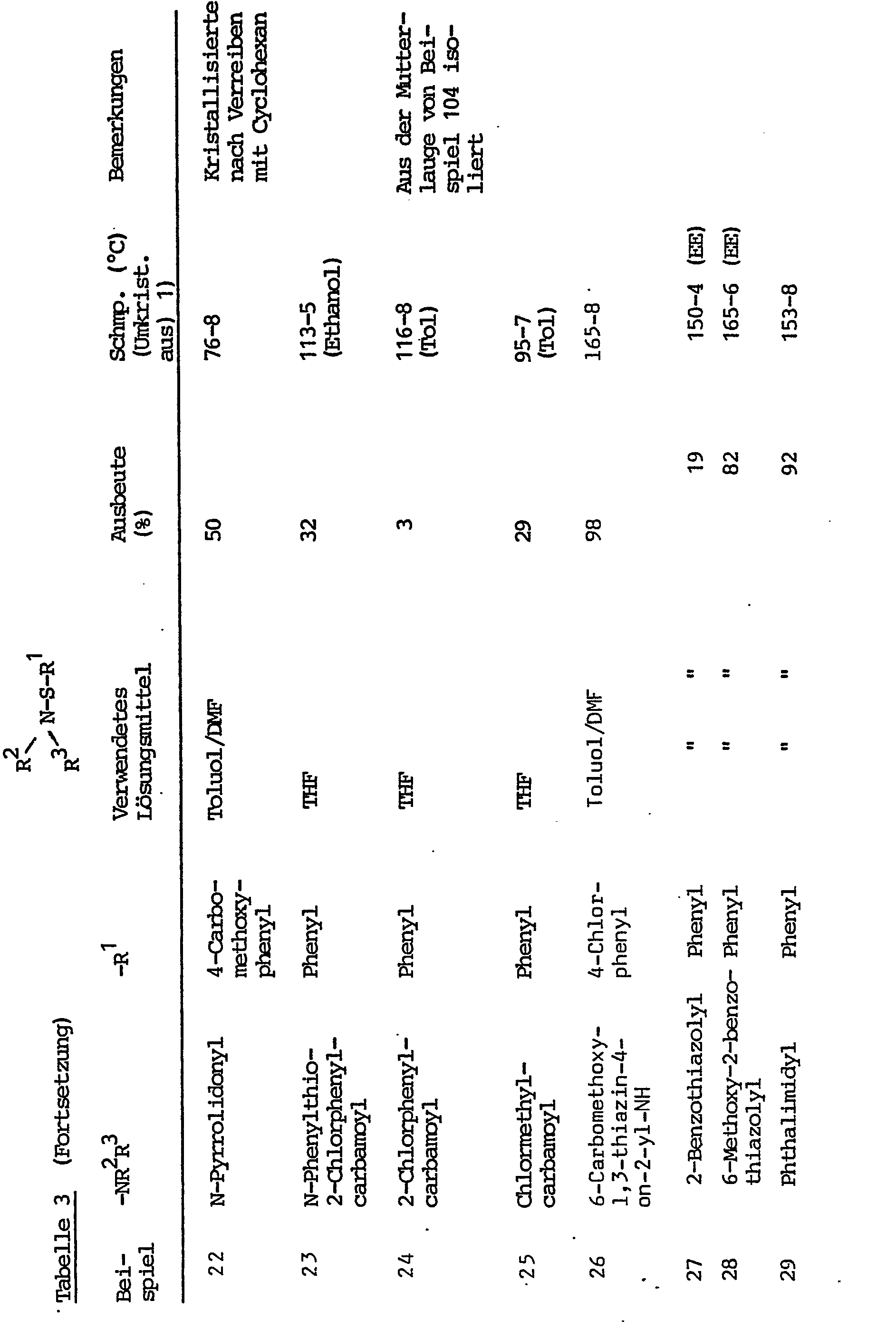
- Example 3 The following examples were obtained analogously to Example 1, see FIG. Table 3. In some cases the sulfenamides obtained were sparingly soluble so that they could be isolated by filtering and washing with ice water.
- Examples 81 to 86 were obtained analogously to Example 80, see FIG. Table 4.
Landscapes
- Chemical & Material Sciences (AREA)
- Organic Chemistry (AREA)
- Health & Medical Sciences (AREA)
- General Health & Medical Sciences (AREA)
- Veterinary Medicine (AREA)
- Bioinformatics & Cheminformatics (AREA)
- Chemical Kinetics & Catalysis (AREA)
- General Chemical & Material Sciences (AREA)
- Medicinal Chemistry (AREA)
- Nuclear Medicine, Radiotherapy & Molecular Imaging (AREA)
- Engineering & Computer Science (AREA)
- Pharmacology & Pharmacy (AREA)
- Life Sciences & Earth Sciences (AREA)
- Animal Behavior & Ethology (AREA)
- Public Health (AREA)
- Pulmonology (AREA)
- Pain & Pain Management (AREA)
- Urology & Nephrology (AREA)
- Vascular Medicine (AREA)
- Cardiology (AREA)
- Heart & Thoracic Surgery (AREA)
- Immunology (AREA)
- Rheumatology (AREA)
- Pharmaceuticals Containing Other Organic And Inorganic Compounds (AREA)
- Other In-Based Heterocyclic Compounds (AREA)
- Nitrogen Condensed Heterocyclic Rings (AREA)
- Heterocyclic Carbon Compounds Containing A Hetero Ring Having Nitrogen And Oxygen As The Only Ring Hetero Atoms (AREA)
- Acyclic And Carbocyclic Compounds In Medicinal Compositions (AREA)
- Pyridine Compounds (AREA)
Abstract
Die vorliegende Erfindung betrifft die Verwendung von teilweise bekannten Sulfenamiden der allgemeinen Formel I <IMAGE> worin R¹, R² und R³ die in der Beschreibung angegebene Bedeutung haben, als Arzneimittel, insbesondere ihre Verwendung als Lipoxygenasehemmer, diese enthaltende Arzneimittel und deren Herstellung.
Description
- Die vorliegende Erfindung betrifft die Verwendung von teilweise bekannten Sulfenamiden als Arzneimittel, insbesondere ihre Verwendung als Lipoxygenasehemmer, diese enthaltende Arzneimittel und deren Herstellung.
- Die erfindungsgemäß verwendeten Sulfenamide sind teilweise bereits bekannt als Anvulkanisationsverzögerer auf dem Kautschukgebiet (vgl. US-Patente 3 546 185, 3 562 225, 3 586 696, 3 645 987, 3 689 467, 3 725 361, 3 862 051, 3 872 061, 3 915 940, 3 993 633, 4 156 680, 4 207 216, Britisches Patent 1 345 1-44 und die Deutschen Offenlegungsschriften (DOS) 1 620 822, 1 913 725, 2 117 615, 2 136 066, 2 136 090, 2 142 648, 2 164 810, 2 305 555, 2 314 838, 2 337 642 und 2 339 986).
- Es ist ebenfalls bekannt, daß die durch das Enzym Lipoxygenase gebildeten Metaboliten der Arachidonsäure an der Entstehung von entzündlichen und allergischen Prozessen beteiligt sind (vgl. E.J. Goetzl, Immunology 40, 709-719 (1980); Ford-Hutchinson et al. J.Pharm.Pharmacol. 32,517 (1980) und Nature 286, 264 (1980) und Samuelsson, Trends in Pharmacol. Sci., Mai 1980, 227, Borgeat etal., J. Med. Chem. 24,121(1981».
- Bekannte Lipoxygenasehemmer wie Nordihydroguaretsäure, 3-Amino-1-(3-trifluormethylphenyl)-pyrazolin, Phenidon und 5,8,11,14-Eikosatetrainoicsäure sind entweder gleichzeitig als Cyclooxygenasehemmer oder erst bei sehr honen Konzentrationen wirksam. Die Hemmung des Enzyms Cyclooxygenase des Arachidonsäuremetabolismus führt zu einer globalen Prostaglandinsynthesehemmung und zu einer Stimulation des Lipoxygenaseweges, was eine Gastrotoxizität bzw. proinflammatorische und asthmatische Wirkungen verursacht (vgl. S.S. Yen und W. Kreutner, Agents and Actions, 10, 274 (1980) und G.J. Blackwell und R.J. Flower, Prostaglandins 16, 417 (1978); und vgl. ebenso Brune et al., J.Pharm.Pharmacol. 33, 127-128 (1981); Higgs et al., Eur. J. Pharmacol. 66, 81-86 (1980) und Piper et al, Prostaglandins 19, 371 (1980)). Es besteht ein dringendes Bedürfnis nach Verbindungen, die diese unerwünschten Nebenwirkungen nicht besitzen.
- überraschenderweise hemmen die erfindungsgemäß verwendbaren Sulfenamide die Lipoxygenase sehr spezifisch bereits in solchen Konzentrationen, bei denen die Cyclooxygenase nicht beeinflußt wird. Bei Kenntnis des Standes der Technik konnte diese sehr starke und spezifische Wirkung der Sulfenamide nicht erwartet werden. Die erfindungsgemäßen, Lipoxygenasehemmenden Sulfenamide sind somit als Arzneimittel bei der Behandlung von entzündlichen und allergischen Prozessen einsetzbar. Sie können insbesondere als Antiphlogistika, Antirheumatika, Antiatherosklerotika, Antiasthmatika, Antiallergika, Antimetastatika und Gastroprotektiva Verwendung finden.
- Die vorliegende Erfindung betrifft die Verwendung von Sulfenamiden der allgemeinen Formel

- R 1 für Alkyl mit 1 bis 18 C-Atomen, Alkenyl oder Alkinyl mit 2 bis 12 C-Atomen, Aralkyl mit 7 bis 11 C-Atomen, Cycloalkyl mit 5 bis 8 C-Atomen oder für Aryl mit 6 bis 14 C-Atomen steht, wobei diese Reste gegebenenfalls mit bis zu 5 gleichen oder verschiedenen Substituenten aus der Gruppe Alkoxy, Alkyl, Aralkyl, Cycloalkyl, Aryl, Aryloxy, Arylthio, Alkylthio, Carboxy, Carbalkoxy, Cyano, Carbamoyl, Sulfonyl, Halogenalkyl, Halogenalkoxy, Halogen, Amino ode substituiertes Amino substituiert sind, oder R 1 für einen der unter R2 genannten Reste steht, wobei R2 die unten angegebene Bedeutung hat, oder R1 für den Rest-Q-S-NR2R3 steht, wobei R 2 und R 3 die unten angegebene Bedeutung haben und
- Q für Alkylen mit 1 bis 12 C-Atomen, wobei der Alkylrest durch Sauerstoff, Schwefel oder Stickstoff ein- oder mehrfach unterbrochen sein kann, Cycloalkylen mit 5 bis 12 C-Atomen, Arylen mit 6 bis 10 C-Atomen, Alkylen-Cycloalkylen-Alkylen oder Alkylen-Arylen-Alkylen oder einen bivalenten Heterocyclus steht,
- R 2 einen elektronenziehenden Rest bedeutet, vorzugsweise aus der Gruppe
- a) -CO-R 4, worin R4 für Wasserstoff, Alkyl, Cycloalkyl, Alkenyl, Aralkyl, Aryl, Alkoxy, Aralkoxy, Aryloxy, Alkylthio, Aralkylthio, Arylthio oder -NR 3 R 5, worin R 3 die weiter unten angegebene Bedeutung hat und R5 Wasserstoff oder einen der unter R1 genannten Reste bedeutet, oder den Rest -W-CO-NR 3 R 5 bedeutet, wobei W für eine direkte Bindung, eine Disulfidbrücke oder für eines der oben unter Q genannten Brückenglieder steht,
- b) heterocyclischer Rest mit 5 bis 8 Ringgliedern, welcher 1 bis 4 Heteroatome aus der Gruppe Sauerstoff, Schwefel oder Stickstoff enthält, wobei dieser heterocyclische Rest gegebenenfalls mit einem Arylrest anelliert ist und bis zu 5 gleiche oder verschiedene Substituenten aus der Gruppe Halogen, Alkylthio, Cycloalkylthio, Aralkylthio, Arylthio, Alkoxy, Aryloxy, Cyano, Nitro, Cycloalkoxy, Aralkoxy, -NR3 R 5,-CO-R 4 '-S02R 6, -SR 1, Trifluormethyl, Trifluormethoxy, Oxo, Thiono, Imino oder substituiertes Imino enthalten kann, wobei als Substituenten der Iminogruppe die oben unter R1 genannten Reste oder ein Carbamoylrest, der am Stickstoff einen Substituenten aus der Gruppe Alkyl, Aryl oder Cycloalkyl trägt, genannt seien,
- c) SO2-R6, worin R für Fluoralkyl, einen der unter R 4 aufgeführten Reste oder für -W-SO2-NR3R5 steht, wobei R3, R5 und W die oben bzw. unten angegebene Bedeutung haben,
- d)

- R 3 für einen der unter R1 oder R2 aufgezählten Reste steht oder Wasserstoff, -S-R1 oder -NR2R5 bedeutet, wobei R 1, R 2 und R 5 die oben angegebene Bedeutung besitzen, oder
R 3 zusammen mit R 2 einen gegebenenfalls benz- oder heterocyclisch anellierten heterocyclischen Ring mit 5 bis 12 Ringgliedern bildet, der 1 bis 4 N-Atome, 1 oder 2 O-Atome, 1 oder 2 S-Atome enthalten kann und der durch Alkyl, Cycloalkyl, Alkenyl, Aralkyl, Aryl, Alkoxy, Aryloxy, Alkylmercapto, Mercapto, Amino, Cyano, Halogen, Carbalkoxy, 1 bis 3 Oxo-, 1 oder 2 Thiono- und/oder 1 oder 2 gegebenenfalls substituierte Iminogruppen substituiert sein kann,
- sowie ihrer pharmazeutisch unbedenklichen Additionssalze als Arzneimittel.
- Für diese Verwendung sind von besonderem Interesse Sulfenamide der allgemeinen Formel (I), in welcher
- R 1 für ebenfalls substituiertes Alkyl mit 1 bis 18 C-Atomen, Cycloalkyl mit 5 bis 8 C-Atomen oder für Aryl mit 6 bis 14 C-Atomen steht, wobei diese Reste gegebenenfalls mit bis zu 5 gleichen oder verschiedenen Substituenten aus der Gruppe Alkyl, Alkoxy mit jeweils 1 bis 4 Kohlenstoffatomen, Aralkyl mit 7 bis 10 Kohlenstoffatomen, Cycloalkyl mit 5 bis 7 Kohlenstoffatomen, Phenyl, Phenoxy, Phenylthio, Alkylthio mit 1 bis 4 Kohlenstoffatomen, Carboxy, Carbalkoxy mit 1 bis 4 Kohlenstoffatomen, Cyano, Trifluormethyl, Trifluormethoxy, Fluor, Chlor, Brom, Amino, Alkyl- oder Benzyl-substituiertes Amino, wobei die Alkylreste 1 bis 4 Kohlenstoffatome tragen, substituiert sind,
- R 2 einen elektronenziehenden Rest bedeutet aus der Gruppe.
- a) -CO-R 4, worin R 4 für Wasserstoff, Alkyl mit 1 bis 17 C-Atomen, Cycloalkyl mit 5 bis 8 C-Atomen, Aralkyl mit 7 bis 10 C-Atomen, Aryl mit 6 oder 10 C-Atomen, Alkoxy mit 1 bis 12 C-Atomen, Aralkoxy mit 7 bis 10 C-Atomen, Aryloxy mit 6 oder 10 C-Atomen, Alkylthio mit 1 bis 12 C-Atomen, Benzylthio, Arylthio mit 6 oder 10 C-Atomen oder -NR 3 R 5 steht, worin R3 die weiter unten angegebene Bedeutung hat und R5 Wasserstoff oder einen der unter R 1 genannten Reste bedeutet, oder den Rest -W-CO-NR 3 R 5 bedeutet, wobei W für eine direkte Bindung oder eine Disulfidbrücke steht,
- b) heterocyclischer Rest mit 5 bis 8 Ringgliedern, welcher 1 bis 4 Heteroatome aus der Gruppe Sauerstoff, Schwefel oder Stickstoff enthält, wobei dieser heterocyclische Rest gegebenenfalls mit einem Arylrest mit 6 bis 14 C-Atomen anelliert ist und bis zu 5 gleiche oder verschiedene Substituenten aus der Gruppe Fluor, Chlor, Brom, Alkylthio mit 1 bis 4 C-Atomen, Benzylthio, Phenylthio, Alkoxy mit 1 bis 4 C-Atomen, Phenoxy, Benzyloxy, einen der unter R1 genannten Reste, -NR3R5, -CO-R4, Trifluormethyl, Trifluormethoxy, Oxo oder Thiono enthalten kann und
- R 3 für einen der unter R 1 oder R 2 aufgezählten Reste steht oder Wasserstoff, -S-R1 oder -NHR2 bedeutet, wobei R1 und R2 die oben angegebene Bedeutung besitzen, oder
- R 3 zusammen mit R 2 einen gegebenenfalls benzanellierten heterocyclischen Ring mit 5 bis 12 Ringgliedern bildet, der 1 bis 4 N-Atome und . gegebenenfalls 1 oder 2 O-Atome und 1 oder 2 S-Atome enthält und der gegebenenfalls durch Alkyl mit 1 bis 4 C-Atomen, Benzyl, Aryl mit 6 oder 10 C-Atomen, Alkoxy mit 1 bis 4 C-Atomen, Phenoxy, Alkylmercapto mit 1 bis 4 C-Atomen, Amino, Fluor, Chlor, Brom, Carbalkoxy mit 1 bis 4 C-Atomen, 1 bis 3 Oxo-, 1 oder 2 Thiono- und/ oder 1 oder 2 Iminogruppen substituiert ist,
- Die erfindungsgemäß verwendbaren Verbindungen der allgemeinen Formel (I) sind bekannt bzw. lassen sich nach literaturbekannten Methoden, z.B. durch Umsetzung von Sulfenhalogeniden der Formel R1-S-X (II) mit Aminen der Formel Y-NR2R3 (III) unter Abspaltung von X-Y herstellen (vgl. E. Kühle, The Chemistry of the Sulphenic Acids, Georg Thieme Verlag, Stuttgart 1973, S. 83-91).
- Der Rest X steht für Chlor, Brom oder Jod, vorzugsweise für Chlor. Der Rest Y, welcher bei der Reaktion des Amins abgespalten wird, steht vorzugsweise für Wasserstoff, Trialkylsilyl, ein Metall wie K, Na, Li, Mg, Ca, Ba, Ag, Cu, Zn, Fe, Mn, Pb, Sn oder Al oder einen Ammonium-rest.
- Für den Fall, daß Y Wasserstoff bedeutet, ist es zweckmäßig, die Umsetzung in Gegenwart einer Base durchzuführen. Als Base seien vorzugsweise genannt organische Verbindungen wie Triethylamin, Tributylamin, Benzyldimethylamin, Dimethylanilin, Pyridin oder Chinolin. Die Reaktion wird vorzugsweise in Gegenwart eines aprotischen Lösungsmittels wie z.B. Hexan, Ligroin, Benzol, Toluol, Chlorbenzol, Chloroform, Tetrachlorkohlenstoff, Dimethylsulfoxid oder Dimethylformamid durchgeführt.
- Für den Fall, daß Y nicht,für einen Trialkylsilylrest steht, kann es vorteilhaft sein, die Herstellung in einem wäßrig-organischen Zweiphasenmedium durchzuführen. In diesem Falle können auch anorganische Basen als Halogenwasserstoff-Fänger-eingesetzt werden, wie z.B. Alkali- oder Erdalkalihydroxide oder -carbonate.
- Die Reaktion kann bei Temperaturen zwischen -80 und +150°C, vorzugsweise zwischen 0 und 50°C, durchgeführt werden.
- Die für die Durchführung der Erfindung geeigneten Amine der allgemeinen Formel (III) sind bekannt oder können nach bekannten Methoden hergestellt werden (Literatur: Houben-Weyl, Methoden der Organischen Chemie, Bd. XI/2, 4. Aufl., G. Thieme Verlag, Stuttgart 1958, S. 3 ff; Aminoheterocyclen: s. A. Weissberger, The Chemistry of Heterocyclic Compounds, Interscience, 1950-79; S. Coffey, Rodd's Chemistry of Carbon Compounds, 2. Aufl. Vol. IV A-K, Elsevier Publ., Amsterdam-New York-London 1973-79).
- Die für die Durchführung der Erfindung geeigneten Sulfenhalogenide der allgemeinen Formel (II) sind bekannt oder können ebenfalls nach bekannten Methoden hergestellt werden (vgl. E. Kühle, The Chemistry of the Sulphenic Acids, G. Thieme Verlag, Stuttgart 1973, S. 2-37).
- Der Nachweis der lipoxygenasehemmenden Eigenschaften der Sulfenamide erfolgt analog der Methode von Bailey et al., J. Biol. Chem. 255, 5996, (1980) und nach R.H. Flower, Prostaglandins 16, 417 (1978). Bei dieser Testmethode wird der Metabolismus radioaktiv markierter Arachidonsäure an gewaschenen Humanthrombozyten untersucht. Bei diesem in vitro Test werden die radioaktiv markierten Metaboliten aus dem Reaktionsansatz extrahiert und dünnschichtchromatographisch getrennt. Das Autoradiogramm wird am Dünnschicht-Scanner ausgewertet. Bei diesen Testbedingungen werden die markierten Metaboliten von der nicht umgesetzten Arachidonsäure getrennt und sind anschließend quantitativ auswertbar. Die Verteilung der Radioaktivität auf die während der Metabolisierung gebildeten Cyclooxygenaseprodukte Thromboxan B2 (TXB2) und 12-Hydroxy-5,8,10-heptadekatriensäure (HHT) bzw. das Lipoxygenaseprodukt 12-Hydroxy-5,8,11,14-eikosatetraen- säure (HETE) unter dem Einfluß der Inhibitoren stellt ein Maß für die Hemmung der Enzyme dar.
- Die Lipoxygenasehemmung der erfindungsgemäß verwendbaren Sulfenamide läßt sich an der Hemmung der HETE-Synthese messen. Es zeigt sich, daß die Synthese von TXB2 und von HHT unbeeinflußt bleibt, während der Arachidonsäureumsatz abnimmt. Wie aus der nachfolgenden Tabelle ersichtlich ist, bewirken die Sulfenamide eine signifikante Hemmung der Plättchenlipoxygenase (HETE-Synthese).
-


- Die antiasthematische Wirkung der erfindungsgemäßen Verbindung kann ebenfalls nach bereits bekannten Methoden nachgewiesen werden (vgl. Samuelson et al., FEBS Letters, 110, 213 (1980) und Yen et al., Agents and Actions 10, 274 (1980)).
- Die neuen Wirkstoffe können in bekannter Weise in die üblichen Formulierungen übergeführt werden, wie Tabletten, Kapseln, Dragees, Pillen, Granulate, Aerosole, Sirupe, Emulsionen, Suspensionen und Lösungen, unter Verwendung inerter, nicht-toxischer pharmazeutisch geeigneter Trägerstoffe oder Lösungsmittel. Hierbei soll die therapeutisch wirksame Verbindung jeweils in einer Konzentration von etwa 0,5 bis 90 Gew.-% der Gesamtmischung vorhanden sein, d.h. in Mengen, die ausreichend sind, um den angegebenen Dosierungsspielraum zu erreichen.
- Die Formulierungen werden beispielsweise hergestellt durch Verstrecken der Wirkstoffe mit Lösungsmitteln und/oder Trägerstoffen, gegebenenfalls unter Verwendung von Emulgiermitteln und/oder Dispergiermitteln, wobei z.B. im Fall der Benutzung von Wasser als Verdünnungsmittel gegebenenfalls organische Lösungsmittel als Hilfslösungsmittel verwendet werden können.
- Als Hilfsstoffe seien beispielhaft aufgeführt:
- Wasser, nicht-toxische organische Lösungsmittel, wie Paraffine (z.B. Erdölfraktionen), pflanzliche öle (z.B. Erdnuß-/Sesamöl), Alkohole (z.B. Ethylalkohol, Glycerin), Glykole (z.B. Propylenglykol, Polyethylenglykol), feste Trägerstoffe, wie z.B. natürliche Gesteinsmehle (z.B. Kaoline, Tonerden, Talkum, Kreide), synthetische Gesteinsmehle (z.B. hochdisperse Kieselsäure, Silikate), Zucker (z.B. Roh-, Milch- und Traubenzucker), Emulgiermittel, wie nicht-ionogene anionische Emulgatoren (z.B. Polyoxyethylen-FettsäureEster, Polyoxyethylen-Fettalkohol-Ether, Alkylsulfonate und Arylsulfonate), Dispergiermittel (z.B. Lignin, Sulfitablaugen, Methylcellulose, Stärke und Polyvinylpyrrolidon) und Gleitmittel (z.B. Magnesiumstearat, Talkum, Stearinsäure und Natriumlaurylsulfat).
- Die Applikation erfolgt in üblicher Weise, vorzugsweise oral oder parenteral, insbesondere perlingual oder intravenös. Im Falle der oralen Anwendung können Tabletten selbstverständlich außer den genannten Trägerstoffen auch Zusätze wie Natriumcitrat, Calciumcarbonat und Dicalciumphosphat zusammen mit verschiedenen Zuschlagstoffen, wie Stärke, vorzugsweise Kartoffelstärke, Gelatine und dergleichen enthalten. Weiterhin können Gleitmittel, wie Magnesiumstearat, Natriumlaurylsulfat und Talkum zum Tablettieren mitverwendet werden. Im Falle wäßriger Suspension und/oder Elixieren, die für orale Anwendungen gedacht .sind, können die Wirkstoffe außer mit den o.g. Hilfsstoffen mit verschiedenen Geschmacksaufbesserern oder Farbstoffen versetzt werden.
- Für den Fall der parenteralen Anwendung können Lösungen der Wirkstoffe unter Verwendung geeigneter flüssiger Trägermaterialien eingesetzt werden.
- Im allgemeinen hat es sich als vorteilhaft erwiesen, bei intravenöser Applikation Mengen von etwa 0,01 bis 10 mg/kg, vorzugsweise etwa 0,05 bis 5 mg/kg Körpergewicht pro Tag zur Erzielung wirksamer Ergebnisse zu verabreichen, und bei oraler Applikation beträgt die Dosierung etwa 0,05 bis 100 mg/kg, vorzugsweise 0,1 bis 10 mg/kg Körpergewicht pro Tag.
- Trotzdem kann es gegebenenfalls erforderlich sein, von den genannten Mengen abzuweichen, und zwar in Abhängigkeit vom Körpergewicht des Versuchstieres bzw. der Art des Applikationsweges, aber auch aufgrund der Tierart und deren individuellem Verhalten gegenüber dem Medikament bzw. der Art von dessen Formulierung und dem Zeitpunkt bzw. Intervall zu welchem die Verabreichung erfolgt. So kann es in einigen Fällen ausreichend sein, mit weniger als der vorgenannten Mindestmenge.auszukommen, während in anderen Fällen die genannte obere Grenze überschritten werden muß. Im Falle der Applikation größerer Mengen kann es empfehlenswert sein, diese in mehrere Einzelgaben über den Tag zu verteilen. Für die Applikation in der Humanmedizin ist der gleiche Dosierungsspielraum vorgesehen. Sinngemäß gelten hierbei auch die obigen Ausführungen. Die folgenden Beispiele sollen die Erfindung näher erläutern:
- Zur Suspension.von 47,5 g (0,5 Mol) 2-Pyrimidinamin und 44 g Pyridin in 100 ml trockenem Dimethylformamid tropft man eine Lösung von 0,5 Mol Trichloromethyl in 300 ml Methylchlorid. Man läßt 2 Stunden bei Raumtemperatur nachrühren, saugt vom ausgefallenen Pyridinhydrochlorid ab und schüttelt die Mutterlauge zweimal mit Eiswasser aus. Die organische Phase wird über Natriumsulfat getrocknet, das Lösungsmittel im Vakuum abqe-dampft und der Rückstand aus Toluol umkristallisiert. Man erhält 30 g N-2-Pyrimidin-trichlormethylsulfen- amid als weiße Kristalle vom Schmp. 178-179°C.
- Analog Beispiel 1 wurden die folgenden Beispiele erhalten, s. Tabelle 3. In einigen Fällen waren die erhaltenen Sulfenamide schwer löslich, so daß sie durch Abfiltrieren und Waschen mit Eiswasser isoliert werden konnten.
-




-
- 1)
- Cy = Cyclohexan
- EE = Essigsäureethylester iPr = i-Propanol
- Me = Methanol
- Tol = Toluol
- WB = Waschbenzin (Kp. 100-140°C)
- 42,5 g (0,5 Mol) 5-Aminotetrazol werden in 100 ml Wasser und 20 g (0,5 Mol) Natronlauge gelöst. Man gibt 100 ml Chlorbenzol zu und tropft dann bei +10°C eine Lösung aus 0,5 Mol Trichloromethylsulfenchlorid in 400 ml Chlorbenzol langsam zu. Nach beendeter Zugabe läßt man 30 Minuten nachrühren und nutscht dann ab. Der Rückstand wird mit Petrolether gewaschen und dann über P4010 getrocknet. Man erhält 66 % der Theorie an N-5-Tetrazolyl-trichloromethylsulfenamid mit Schmp. 117 to 118°C. (Zers.).
- Zu 80,4 g Trimethylchlorsilan in 500 ml trockenem Toluol leitet man bei 50 bis 60°C bis zur Sättigung NH3-Gas ein. Anschließend trägt man 59,1 g Benzimidazol ein und kocht 10 Stunden unter Rückfluß. Zur Entfernung von überschüssigem Ammoniak destilliert man im Vakuum 250 ml Toluol ab und tropft anschließend 0,5 Mol Cyclohexylsulfenchlorid in 500 ml Pentan zu.
- Man rührt 4 Stunden nach, filtriert und entfernt das Lösungsmittel im Vakuum. Man erhält 99 g 1-Cyclohexylthiobenzimidazol als rotbraunes öl.
- Analog Beispiel 80 wurden auch die Beispiele 81 bis 86 erhalten, s. Tabelle 4.

sowie ihre pharmazeutisch unbedenklischen Additionssalze.
Claims (9)
1) Sulfenamide der allgemeinen Formel (I)

in welcher
R 1 für Alkyl mit 1 bis 18 C-Atomen, Alkenyl oder Alkinyl mit 2 bis 12 C-Atomen, Aralkyl mit 7 bis 11 C-Atomen, Cycloalkyl mit 5 bis 8 C-Atomen oder für Aryl mit 6 bis 14 C-Atomen steht, wobei diese Reste gegebenenfalls mit bis zu 5 gleichen oder verschiedenen Substituenten aus der Gruppe Alkoxy, Alkyl, Aralkyl, Cycloalkyl, Aryl, Aryloxy, Arylthio, Alkylthio, Carboxy, Carbalkoxy, Cyano, Carbamoyl, Sulfonyl, Halogenalkyl, Halogenalkoxy, Halogen, Amino oder substituiertes Amino substituiert sind, oder R1 für einen der unter R2 genannten Reste steht, wobei R2 die unten angegebene Bedeutung hat, oder R1 für den Rest -Q-S-NR 2 R 3 steht, wobei
R 2 und R 3 die unten angegebene Bedeutung haben und
Q für Alkylen mit 1 bis 12 C-Atomen, wobei der Alkylenrest durch Sauerstoff, Schwefel oder Stickstoff ein- oder mehrfach unterbrochen sein kann, Cycloalkylen mit 5 bis 12 C-Atomen, Arylen mit 6 bis 10 C-Atomen, Alkylen-Cycloalkylen-Alkylen oder Alkylen-Arylen-Alkylen oder einen bivalenten Heterocyclus steht,
R 2 einen elektronenziehenden Rest bedeutet, vorzugsweise aus der Gruppe
a) -CO-R 4, worin R4 für Wasserstoff, Alkyl, Cycloalkyl, Alkenyl, Aralkyl, Aryl, Alkoxy, Aralkoxy, Aryloky, Alkylthio, Aralkylthio, Arylthio oder , -NR3R5, worin R3 die weiter unten angegebene Bedeutung hat und R5 Wasserstoff oder einen der unter R1 genannten Reste bedeutet, oder den Rest -W-CO-NR3R5 bedeutet, wobei W für eine direkte Bindung, eine Disulfidbrücke oder für eines der oben unter Q genannten Brückenglieder steht,
b) heterocyclischer Rest mit 5 bis 8 Ringgliedern, welcher 1 bis 4 Heteroatome aus der Gruppe Sauerstoff, Schwefel oder Stickstoff enthält, wobei dieser heterocyclische Rest gegebenenfalls mit einem Arylrest anelliert ist und bis zu 5 gleiche oder verschiedene Substituenten aus der Gruppe Halogen, Alkylthio, Cycloalkylthio, Aralkylthio, Arylthio, Alkoxy, Aryloxy, Cyano, Nitro, Cycloalkoxy, Aralkoxy, -NR3R5,-CO-R4 ,-SO2R6, -S-R 1, Trifluormethyl, Trifluormethoxy, Oxo, Thiono, Imino oder substituiertes Imino enthalten kann, wobei als Substituenten der Iminogruppe die oben unter R1 genannten Reste oder ein Carbamoylrest, der am Stickstoff einen Substituenten aus der Gruppe Alkyl, Aryl oder Cycloalkyl trägt, genannt seien,
c) SO2-R6, worin R6 für Fluoralkyl, einen der unter R4 aufgeführten Reste oder für -W-SO2-NR3R5 steht, wobei R3, R5 und W die oben bzw. unten angegebene Bedeutung haben,

worin R 7 und R8 gleich oder verschieden sind und jeweils für eine Gruppe der Formel -NR5-SR1 oder Wasserstoff oder Halogen oder gegebenenfalls substituiertes Alkyl, Alkenyl, Cycloalkenyl, Aryl, Alkoxy, Alkenoxy, Cycloalkoxy, Aryloxy, Alkylthio, Alkenylthio, Cycloalkylthio, Arylthio, Heterocyclylthio oder Amino stehen oder R7 und R8 gemeinsam mit dem Phosphoratom einen heterocyclischen Ring bilden und
R 3 für einen der unter R1 oder R2 aufgezählten Reste steht oder Wasserstoff, -S-R1, oder -NR 2 R 5 bedeutet, wobei R1, R 2 und R 5 die oben angegebene Bedeutung besitzen, oder
sowie ihrer pharmazeutisch unbedenklichen Additionssalze, zur Verwendung in Arzneimitteln.
R 3 zusammen mit R2 einen gegebenenfalls benz-oder heterocyclisch anellierten heterocyclischen Ring mit 5 bis 12 Ringgliedern bildet, der 1 bis 4 N-Atome, 1 oder 2 O-Atome, 1 oder 2 S-Atome enthalten kann und der durch Alkyl, Cycloalkyl, Alkenyl, Aralkyl, Aryl, Alkoxy, Aryloxy, Alkylmercapto, Mercapto, Amino, Cyano, Halogen, Carbalkoxy, 1 bis 3 Oxo-, 1 oder 2 Thiono- und/oder 1 oder 2 gegebenenfalls substituierte Iminogruppen substituiert sein kann,
sowie ihrer pharmazeutisch unbedenklichen Additionssalze, zur Verwendung in Arzneimitteln.
2) Sulfenamide der allgemeinen Formel (I), in welcher
sowie ihre pharmazeutisch unbedenklichen Additionssalze, zur Verwendung in Arzneimitteln.
R 1 für Alkyl mit 1 bis 18 C-Atomen, Cycloalkyl mit 5 bis 8 C-Atomen oder für Aryl mit 6 bis 14 C-Atomen steht, wobei diese Reste gegebenenfalls mit bis zu 5 gleichen oder verschiedenen Substituenten aus der Gruppe Alkyl, Alkoxy mit jeweils 1 bis 4 Kohlenstoffatomen, Aralkyl mit 7 bis 10 Kohlenstoffatomen, Cycloalkyl mit 5 bis 7 Kohlenstoffatomen, Phenyl, Phenoxy, Phenylthio, Alkylthio mit 1 bis 4 Kohlenstoffatomen, Carboxy, Carbalkoxy mit 1 bis 4 Kohlenstoffatomen, Cyano, Trifluormethyl, Trifluormethoxy, Fluor, Chlor, Brom, Amino, Alkyl- oder'Benzyl-substituiertes Amino, wobei die Alkylreste 1 bis 4 Kohlenstoffatome tragen, substituiert sind,
R 2 einen elektronenziehenden Rest bedeutet aus der Gruppe
a) -CO-R 4, worin R4 für Wasserstoff, Alkyl mit 1 bis 17 C-Atomen, Cycloalkyl mit 5 bis 8 C-Atomen, Aralkyl mit 7 bis 10 C-Atomen, Aryl mit 6 oder 10 C-Atomen, Alkoxy mit 1 bis 12 C-Atomen, Aralkoxy mit 7 bis 10 C-Atomen, Aryloxy mit 6 oder 10 C-Atomen, Alkylthio mit 1 bis 12 C-Atomen, Benzylthio, Arylthio mit 6 oder 10 C-Atomen, -NR 3 R 5, worin R3 die weiter unten angegebene Bedeutung hat und R Wasserstoff oder einen der unter R 1 genannten Reste bedeutet, oder den Rest -W-CO-NR3R5 bedeutet, wobei W für eine direkte Bindung oder eine Disulfidbrücke steht,
b) heterocyclischer Rest mit 5 bis 8 Ringgliedern, welcher 1 bis 4 Heteroatome aus der Gruppe Sauerstoff, Schwefel oder Stickstoff enthält, wobei dieser heterocyclische Rest gegebenenfalls mit einem Arylrest mit 6 bis 14 C-Atomen anelliert ist und bis zu 5 gleiche oder verschiedene Substituenten aus der Gruppe Fluor, Chlor, Brom, Alkylthio mit 1 bis 4 C-Atomen, Benzylthio, Phenylthio, Alkoxy mit 1 bis 4 C-Atomen, Phenoxy, Benzyloxy, einen der unter R 1 genannten Reste, -NR 3R5, -CO-R 4, Trifluormethyl, Trifluormethoxy, Oxo oder Thiono enthalten kann und
R 3 für einen der unter R 1 oder R 2 aufgezählten Reste steht oder Wasserstoff, -S-R 1 oder -NHR 2 bedeutet, wobei R 1 und R 2 die oben angegebene Bedeutung besitzen, oder
R 3 zusammen mit R 2 einen gegebenenfalls benzanellierten heterocyclischen Ring mit 5 bis 12 Ringgliedern bildet, der.1 bis 4 N-Atome, 1 oder 2 O-Atome oder 1 oder 2 S-Atome enthält und der gegebenenfalls durch Alkyl mit 1 bis 4 C-Atomen, Benzyl, Aryl mit 6 oder 10 C-Atomen, Alkoxy mit 1 bis 4 C-Atomen, Phenoxy, Alkylmercapto mit 1 bis 4 C-Atomen, Amino, Fluor, Chlor, Brom, Carbalkoxy mit 1 bis 4 C-Atomen, 1 bis 3 Oxo-, 1 oder 2 Thiono- und/ oder 1 oder 2 Iminogruppen substituiert ist,
sowie ihre pharmazeutisch unbedenklichen Additionssalze, zur Verwendung in Arzneimitteln.
3) Verwendung von Sulfenamiden als Arzneimittel.
4) Verwendung von Sulfenamiden der allgemeinen Formel (I) gemäß Anspruch 1 als Arzneimittel.
5) Verwendung von Sulfenamiden gemäß Anspruch 2 als Arzneimittel.
6) Verwendung von Sulfenamiden als Lipoxygenasehemmer.
7) Verwendung von Sulfenamiden gemäß Anspruch 1 als Antiphlogistika, Antirheumatika, Antiatherosklerotika, Antiasthmatika, Antiallergika, Antimetastatika und Gastroprotektiva.
8) Arzneimittel enthaltend mindestens eine Verbindung der allgemeinen Formel (I) gemäß Anspruch 1.
9) Arzneimittel mit Lipoxygenase-hemmender Wirkung, enthaltend mindestens eine Verbindung der allgemeinen Formel (I) gemäß Anspruch 1.
10) Verfahren zur Herstellung von Arzneimitteln, dadurch gekennzeichnet, daß man Sulfenamide der allgemeinen Formel (I) gemäß Anspruch 1, gegebenenfalls zusammen mit Hilfs- und Trägerstoffen in eine geeignete Applikationsform überführt.
Applications Claiming Priority (2)
| Application Number | Priority Date | Filing Date | Title |
|---|---|---|---|
| DE19813118126 DE3118126A1 (de) | 1981-05-07 | 1981-05-07 | Sulfenamide zur verwendung in arzneimitteln |
| DE3118126 | 1981-05-07 |
Publications (1)
| Publication Number | Publication Date |
|---|---|
| EP0065658A2 true EP0065658A2 (de) | 1982-12-01 |
Family
ID=6131707
Family Applications (1)
| Application Number | Title | Priority Date | Filing Date |
|---|---|---|---|
| EP82103517A Withdrawn EP0065658A2 (de) | 1981-05-07 | 1982-04-26 | Verwendung von Sulfenamiden als Lipoxygenasehemmer und diese enthaltende Arzneimittel |
Country Status (6)
| Country | Link |
|---|---|
| US (1) | US4447440A (de) |
| EP (1) | EP0065658A2 (de) |
| JP (1) | JPS57188516A (de) |
| AU (1) | AU8329682A (de) |
| DE (1) | DE3118126A1 (de) |
| DK (1) | DK205482A (de) |
Cited By (4)
| Publication number | Priority date | Publication date | Assignee | Title |
|---|---|---|---|---|
| EP0197189A3 (de) * | 1985-04-12 | 1987-05-27 | HEUMANN PHARMA GMBH & CO | 1,3,4-Thiadiazolderivate, Verfahren zu ihrer Herstellung und diese Verbindungen enthaltende Arzneimittel |
| EP1435964A4 (de) * | 2001-10-16 | 2005-01-19 | Univ Kansas | Neue prodrugs von n-h-bindung enthaltenden verbindungen und verfahren zu ihrer herstellung |
| US7067539B2 (en) | 2001-02-08 | 2006-06-27 | Schering Corporation | Cannabinoid receptor ligands |
| US7507767B2 (en) | 2001-02-08 | 2009-03-24 | Schering Corporation | Cannabinoid receptor ligands |
Families Citing this family (6)
| Publication number | Priority date | Publication date | Assignee | Title |
|---|---|---|---|---|
| US4469874A (en) * | 1980-05-22 | 1984-09-04 | Monsanto Company | Fragrant prevulcanization inhibitors |
| US4540707A (en) * | 1983-01-28 | 1985-09-10 | Bayer Aktiengesellschaft | Nafazatrom as a lipoxygenase inhibitor |
| DE3508665A1 (de) * | 1985-03-12 | 1986-09-18 | Hoechst Ag, 6230 Frankfurt | Heterocyclische sulfide und ihre anwendung als immunmodulatoren |
| JP4635178B2 (ja) * | 2004-09-14 | 2011-02-16 | 独立行政法人産業技術総合研究所 | 新規なn−スルフェニル置換複素環化合物およびその製造方法 |
| CN105294536B (zh) * | 2014-06-30 | 2018-06-29 | 中国科学院上海有机化学研究所 | 一种制备3-亚氨基异吲哚啉酮类化合物的方法 |
| CN110283141B (zh) * | 2019-07-08 | 2023-07-21 | 上海交通大学 | N-硫芳基/烷基邻磺酰苯酰亚胺及其制备方法和应用 |
-
1981
- 1981-05-07 DE DE19813118126 patent/DE3118126A1/de not_active Withdrawn
-
1982
- 1982-04-14 US US06/368,193 patent/US4447440A/en not_active Expired - Fee Related
- 1982-04-26 EP EP82103517A patent/EP0065658A2/de not_active Withdrawn
- 1982-05-05 AU AU83296/82A patent/AU8329682A/en not_active Abandoned
- 1982-05-06 JP JP57074671A patent/JPS57188516A/ja active Pending
- 1982-05-06 DK DK205482A patent/DK205482A/da not_active Application Discontinuation
Cited By (7)
| Publication number | Priority date | Publication date | Assignee | Title |
|---|---|---|---|---|
| EP0197189A3 (de) * | 1985-04-12 | 1987-05-27 | HEUMANN PHARMA GMBH & CO | 1,3,4-Thiadiazolderivate, Verfahren zu ihrer Herstellung und diese Verbindungen enthaltende Arzneimittel |
| US4738960A (en) * | 1985-04-12 | 1988-04-19 | Ludwig Heumann & Co. Gmbh | 1,3,4-Thiadiazole derivatives and pharmaceutical preparations useful as inhibitors for histamine-H2 receptors |
| US7067539B2 (en) | 2001-02-08 | 2006-06-27 | Schering Corporation | Cannabinoid receptor ligands |
| US7507767B2 (en) | 2001-02-08 | 2009-03-24 | Schering Corporation | Cannabinoid receptor ligands |
| US7718702B2 (en) | 2001-02-08 | 2010-05-18 | Schering Corporation | Cannabinoid receptor ligands |
| EP1435964A4 (de) * | 2001-10-16 | 2005-01-19 | Univ Kansas | Neue prodrugs von n-h-bindung enthaltenden verbindungen und verfahren zu ihrer herstellung |
| AU2002337861B2 (en) * | 2001-10-16 | 2009-04-02 | University Of Kansas | Novel prodrugs of N-H bond-containing compounds and methods of making thereof |
Also Published As
| Publication number | Publication date |
|---|---|
| US4447440A (en) | 1984-05-08 |
| AU8329682A (en) | 1982-11-11 |
| DK205482A (da) | 1982-11-08 |
| JPS57188516A (en) | 1982-11-19 |
| DE3118126A1 (de) | 1982-12-02 |
Similar Documents
| Publication | Publication Date | Title |
|---|---|---|
| DE3204126A1 (de) | Pyrazoloxazine, -thiazine, -chinoline, verfahren zu ihrer herstellung und ihre verwendung als arzneimittel | |
| EP0041215B1 (de) | Imidazoazolalkensäureamide, neue Zwischenprodukte zu ihrer Herstellung, ihre Herstellung und ihre Verwendung in Arzneimitteln | |
| EP0065658A2 (de) | Verwendung von Sulfenamiden als Lipoxygenasehemmer und diese enthaltende Arzneimittel | |
| DE3247615A1 (de) | Substituierte phenylsulfonyloxybenzimidazolcarbaminate, verfahren zu ihrer herstellung und ihre verwendung als arzneimittel | |
| DE2847792C2 (de) | ||
| DE2950838A1 (de) | Neue thiazolylmethylthioderivate, verfahren zu deren herstellung und arzneimittel | |
| DE2602643A1 (de) | 1,2-benzisothiazolinone-3, verfahren zu ihrer herstellung sowie ihre verwendung als arzneimittel | |
| EP0101898A1 (de) | Anellierte 4H-1,4-Benzothiazine, Verfahren zu ihrer Herstellung und ihre Verwendung als Arzneimittel | |
| DE3730748A1 (de) | Neue polyoxygenierte labdanderivate, ein verfahren zu ihrer herstellung und ihre verwendung als arzneimittel | |
| EP0064657B1 (de) | Ringförmige Sulfenamide, Verfahren zu ihrer Herstellung, sie enthaltende Arzneimittel und deren Herstellung | |
| AT339329B (de) | Verfahren zur herstellung von neuen n-(o-acylaminophenyl) -n'- acylisothioharnstoffathern | |
| DE3246148A1 (de) | Pyrazolo(4.3-b)(1.4)oxazine, verfahren zu ihrer herstellung und ihre verwendung als arzneimittel | |
| EP0065226A2 (de) | Neue Sulfenamide, Verfahren zu ihrer Herstellung, ihre Verwendung in Arzneimitteln und deren Herstellung | |
| EP0160173B1 (de) | Benzothiazolderivate, Verfahren zu ihrer Herstellung und diese Verbindungen enthaltendes Arzneimittel | |
| EP0428860B1 (de) | Substituierte (Chinolin-2-yl-methoxy)phenyl-carbonyl-harnstoffe | |
| DE1300117B (de) | 5-Sulfonyl-1, 2-dithiol-3-one | |
| DE3118128A1 (de) | Verwendung von disulfiden als lipoxygenasehemmer und diese enthaltende arzneimittel | |
| EP0100527B1 (de) | 4H-1,4-Benzothiazine zur Verwendung als Arzneimittel | |
| DE2656227C2 (de) | Basisch alkylierte Diphenyldisulfid-2,2'-biscarbonsäureamide, Verfahren zu ihrer Herstellung sowie ihre Verwendung als Arzneimittel | |
| EP0424722B1 (de) | Substituierte (Chinolin-2-yl-methoxy)phenyl-thioharnstoffe | |
| EP0158083A2 (de) | Arzneimittel | |
| DE2428640A1 (de) | Anthelmintische verbindungen und verfahren zu ihrer herstellung | |
| AT236981B (de) | Verfahren zur Herstellung von beispielsweise zur Schädlingsbekämpfung verwendbaren Organophosphorverbindungen | |
| EP0240680A1 (de) | Diarylsulfidderivate | |
| DE3540702A1 (de) | 1h-pyrido-(2,3-b) (1,4)-thiazine |
Legal Events
| Date | Code | Title | Description |
|---|---|---|---|
| PUAI | Public reference made under article 153(3) epc to a published international application that has entered the european phase |
Free format text: ORIGINAL CODE: 0009012 |
|
| 17P | Request for examination filed |
Effective date: 19820426 |
|
| AK | Designated contracting states |
Designated state(s): AT BE CH DE FR GB IT NL SE |
|
| STAA | Information on the status of an ep patent application or granted ep patent |
Free format text: STATUS: THE APPLICATION HAS BEEN WITHDRAWN |
|
| 18W | Application withdrawn |
Withdrawal date: 19850510 |
|
| RIN1 | Information on inventor provided before grant (corrected) |
Inventor name: BUSSE, WOLF-DIETER, DR. Inventor name: KRAUTHAUSEN, EDMUND, DR. Inventor name: MARDIN, MITHAT, DR. |