EP0100527B1 - 4H-1,4-Benzothiazine zur Verwendung als Arzneimittel - Google Patents
4H-1,4-Benzothiazine zur Verwendung als Arzneimittel Download PDFInfo
- Publication number
- EP0100527B1 EP0100527B1 EP83107419A EP83107419A EP0100527B1 EP 0100527 B1 EP0100527 B1 EP 0100527B1 EP 83107419 A EP83107419 A EP 83107419A EP 83107419 A EP83107419 A EP 83107419A EP 0100527 B1 EP0100527 B1 EP 0100527B1
- Authority
- EP
- European Patent Office
- Prior art keywords
- halogen
- aryl
- pyrimidyl
- pyridyl
- alkyl
- Prior art date
- Legal status (The legal status is an assumption and is not a legal conclusion. Google has not performed a legal analysis and makes no representation as to the accuracy of the status listed.)
- Expired
Links
- 0 CCN(C=C(*C)Sc1c2)c1cc(N(CC1)CCN1NC)c2[N+]([O-])=O Chemical compound CCN(C=C(*C)Sc1c2)c1cc(N(CC1)CCN1NC)c2[N+]([O-])=O 0.000 description 4
- SLFUQNHORKCXTB-UHFFFAOYSA-N CCN(C=C(C(OC)=O)Sc1c2)c1cc(N1CCN(C)CC1)c2N Chemical compound CCN(C=C(C(OC)=O)Sc1c2)c1cc(N1CCN(C)CC1)c2N SLFUQNHORKCXTB-UHFFFAOYSA-N 0.000 description 1
- RAOXHCTXBBGGGS-UHFFFAOYSA-N CCN(C=C(C(OC)=O)Sc1c2)c1cc(N1CCN(C)CC1)c2[N+]([O-])=O Chemical compound CCN(C=C(C(OC)=O)Sc1c2)c1cc(N1CCN(C)CC1)c2[N+]([O-])=O RAOXHCTXBBGGGS-UHFFFAOYSA-N 0.000 description 1
- DYPKCXBIXAAQKZ-UHFFFAOYSA-N CCN(C=C1C(OC)=O)c(ccc([N+]([O-])=O)c2)c2S1O Chemical compound CCN(C=C1C(OC)=O)c(ccc([N+]([O-])=O)c2)c2S1O DYPKCXBIXAAQKZ-UHFFFAOYSA-N 0.000 description 1
- WDSSVRRFORMSNN-UHFFFAOYSA-N CCN(C=C1C(OC)=O)c2cc(C)ccc2S1O Chemical compound CCN(C=C1C(OC)=O)c2cc(C)ccc2S1O WDSSVRRFORMSNN-UHFFFAOYSA-N 0.000 description 1
- PAJKDPBEABLDTF-UHFFFAOYSA-N CCN1c(ccc([N+]([O-])=O)c2)c2S(CC)C(C(OC)=O)=C1 Chemical compound CCN1c(ccc([N+]([O-])=O)c2)c2S(CC)C(C(OC)=O)=C1 PAJKDPBEABLDTF-UHFFFAOYSA-N 0.000 description 1
- WCYMTRDMEJAPLV-UHFFFAOYSA-N CN(C1)c2cc(Cl)ccc2S(O)=C1C(OC)=O Chemical compound CN(C1)c2cc(Cl)ccc2S(O)=C1C(OC)=O WCYMTRDMEJAPLV-UHFFFAOYSA-N 0.000 description 1
Classifications
-
- C—CHEMISTRY; METALLURGY
- C07—ORGANIC CHEMISTRY
- C07D—HETEROCYCLIC COMPOUNDS
- C07D279/00—Heterocyclic compounds containing six-membered rings having one nitrogen atom and one sulfur atom as the only ring hetero atoms
- C07D279/10—1,4-Thiazines; Hydrogenated 1,4-thiazines
- C07D279/14—1,4-Thiazines; Hydrogenated 1,4-thiazines condensed with carbocyclic rings or ring systems
- C07D279/16—1,4-Thiazines; Hydrogenated 1,4-thiazines condensed with carbocyclic rings or ring systems condensed with one six-membered ring
-
- A—HUMAN NECESSITIES
- A61—MEDICAL OR VETERINARY SCIENCE; HYGIENE
- A61P—SPECIFIC THERAPEUTIC ACTIVITY OF CHEMICAL COMPOUNDS OR MEDICINAL PREPARATIONS
- A61P11/00—Drugs for disorders of the respiratory system
-
- A—HUMAN NECESSITIES
- A61—MEDICAL OR VETERINARY SCIENCE; HYGIENE
- A61P—SPECIFIC THERAPEUTIC ACTIVITY OF CHEMICAL COMPOUNDS OR MEDICINAL PREPARATIONS
- A61P29/00—Non-central analgesic, antipyretic or antiinflammatory agents, e.g. antirheumatic agents; Non-steroidal antiinflammatory drugs [NSAID]
-
- A—HUMAN NECESSITIES
- A61—MEDICAL OR VETERINARY SCIENCE; HYGIENE
- A61P—SPECIFIC THERAPEUTIC ACTIVITY OF CHEMICAL COMPOUNDS OR MEDICINAL PREPARATIONS
- A61P35/00—Antineoplastic agents
-
- A—HUMAN NECESSITIES
- A61—MEDICAL OR VETERINARY SCIENCE; HYGIENE
- A61P—SPECIFIC THERAPEUTIC ACTIVITY OF CHEMICAL COMPOUNDS OR MEDICINAL PREPARATIONS
- A61P37/00—Drugs for immunological or allergic disorders
- A61P37/08—Antiallergic agents
-
- A—HUMAN NECESSITIES
- A61—MEDICAL OR VETERINARY SCIENCE; HYGIENE
- A61P—SPECIFIC THERAPEUTIC ACTIVITY OF CHEMICAL COMPOUNDS OR MEDICINAL PREPARATIONS
- A61P43/00—Drugs for specific purposes, not provided for in groups A61P1/00-A61P41/00
-
- A—HUMAN NECESSITIES
- A61—MEDICAL OR VETERINARY SCIENCE; HYGIENE
- A61P—SPECIFIC THERAPEUTIC ACTIVITY OF CHEMICAL COMPOUNDS OR MEDICINAL PREPARATIONS
- A61P7/00—Drugs for disorders of the blood or the extracellular fluid
- A61P7/02—Antithrombotic agents; Anticoagulants; Platelet aggregation inhibitors
-
- A—HUMAN NECESSITIES
- A61—MEDICAL OR VETERINARY SCIENCE; HYGIENE
- A61P—SPECIFIC THERAPEUTIC ACTIVITY OF CHEMICAL COMPOUNDS OR MEDICINAL PREPARATIONS
- A61P9/00—Drugs for disorders of the cardiovascular system
- A61P9/10—Drugs for disorders of the cardiovascular system for treating ischaemic or atherosclerotic diseases, e.g. antianginal drugs, coronary vasodilators, drugs for myocardial infarction, retinopathy, cerebrovascula insufficiency, renal arteriosclerosis
Definitions
- the present invention relates to 4H-1,4-benzothiazines for therapeutic use or for use as a medicament, in particular their use as lipoxygenase inhibitors, furthermore medicaments containing them and their preparation.
- Known lipoxygenase inhibitors such as nordihydroguaretic acid, 3-amino-1- (3-trifluoromethylphenyl) pyrazoline, phenindiones and 5,8,11,14-eikosatetraic acid are either simultaneously effective as cyclooxygenase inhibitors or only at very high concentrations.
- the inhibition of the enzyme cyclooxygenase of arachidonic acid metabolism leads to a global inhibition of prostaglandin synthesis and to a stimulation of the lipoxygenase pathway, which causes gastrotoxicity or pro-inflammatory and asthmatic effects.
- lipoxygenase inhibitors such as 3-amino-1- (m-trifluoromethylphenyl) pyrazoline-2 have toxic side effects when administered systemically (e.g. orally). There is therefore a need for orally active compounds that do not have these undesirable side effects.
- EP 0 061 082 describes a process for the preparation of benzothiazines which can be used as intermediates.
- the 4H-1,4-benzothiazines mentioned inhibit the lipoxygenase in such a concentration that the cyclooxygenase is little influenced.
- the compounds mentioned also surprisingly stimulate the synthesis of prostacyclin in arterial vessels in vitro, possibly as a result of their lipoxygenase-inhibiting properties.
- the compounds according to the invention are more potent than the known lipoxygenase inhibitor 3-amino-1- (m-trifluoromethylphenyl) pyrazoline-2 (Proc. Of British Pharmacological Society 920 P (1981).
- the compounds according to the invention also stimulate rabbit aorta strips prostacyclin synthesis.
- the compounds mentioned also have an anti-inflammatory effect in the carragenan-induced edema model if they are administered systemically, especially orally, and locally, particularly cutan. They also have an antimetastatic effect.
- the 4H-1,4-benzothiazines inhibiting lipoxygenase mentioned can thus be used as medicaments in the treatment of inflammatory and allergic processes. They can be used, in particular, as anti-inflammatory drugs, anti-rheumatic drugs, anti-atherosclerotic drugs, anti-thrombotic drugs, anti-arthro-drugs, anti-asthmatics tiallergika, antimetastatic and gastroprotective use.
- the substances of the general formula I can be prepared according to process variant 1 by reacting 2-aminothiophenols of the formula 11 with compounds of the formula III in dimethyl sulfoxide (cf. J. Chem. Soc. Perkin Trans. I, 1976, 1146- 49).
- the radicals R 1 to R 5 have the meanings given above.
- the compounds of the formulas II and III are either known from the literature or can be prepared analogously to compounds known from the literature.
- the reaction temperature can be between 50 ° C and 200 ° C, preferably between 100 ° C and 150 ° C. In some cases it is advisable to work in the absence of oxygen.
- the reaction can preferably also be carried out in the presence of an acid scavenger, such as, for example, triethylamine, K 2 CO 3 , Na 2 CO 3 , NaOH, NH 3 .
- an acid scavenger such as, for example, triethylamine, K 2 CO 3 , Na 2 CO 3 , NaOH, NH 3 .
- Possible solvents are: alcohols (e.g. methanol, ethanol), ethers (e.g. diethyl ether, THF, dioxane, dimethoxyethane, diethylene glycol dimethyl ether), hydrocarbons (e.g. benzene, toluene), chlorinated hydrocarbons (e.g. methylene chloride, chloroform, chlorobenzene), DMSO, DMF , Pyridine and water. In some cases it is advisable to work in the absence of oxygen.
- alcohols e.g. methanol, ethanol
- ethers e.g. diethyl ether, THF, dioxane, dimethoxyethane, diethylene glycol dimethyl ether
- hydrocarbons e.g. benzene, toluene
- chlorinated hydrocarbons e.g. methylene chloride, chloroform, chlorobenzene
- DMSO DMF
- Pyridine Pyr
- the reaction temperature can be between 0 ° C and 200 ° C, preferably between 35 ° C and 110 ° C.
- the substances of formula 1 can be prepared according to process variant 3 by reacting disulfides of formula V with carbonyl compounds of formula III [cf. Phosphorus and Sulfur 3, 308-314 (1977)] The reaction is catalyzed by acids (eg p-toluenesulfonic acid).
- Possible solvents are: benzene, toluene, pyridine, DMSO and DMF.
- the reaction temperature can be between 20 ° C and 180 ° C, preferably between 35 ° C and 110 ° C.
- reaction is usually carried out with equimolecular amounts of the starting materials, occasionally an excess (up to 110%) of carbonyl compound is used.
- the substances of formula 1 can be prepared according to process variant 4 by reacting disulfides of formula V with alkynes of formula VI [cf. J. Heterocyclic Chem. 17, 377 (1980)].
- the reaction is preferably carried out with equimolecular amounts of the starting materials, an excess (up to 110%) of alkyne (VI) is occasionally also used.
- Possible solvents are: alcohols (e.g. methanol, ethanol), ethers, hydrocarbons (e.g. benzene, toluene), chlorinated hydrocarbons, DMSO, DMF and pyridine.
- the reaction temperature is between 20 ° C and 180 ° C, preferably between 35 ° C and 120 ° C.
- Substances of the formula 1 in which R3 is alkyl (optionally substituted) can be prepared from the corresponding compounds in which R 3 is hydrogen by the customary alkylation methods, for example by reaction with CH 3 J, C 2 H 5 Br or ⁇ -bromoacetophenone.
- the detection of the lipoxygenase-inhibiting properties of the compounds according to the invention was carried out analogously to the method of Bailey et al., Journal of Biol. Chemistry 255, 5996, (1980) and according to Blackwell and Flower, Prostaglandins 16, 417 (1978).
- This test method uses the metabolism of radiolabelled arachidonic acid on washed human platelets.
- the radioactively labeled metabolites are extracted from the reaction mixture and separated by thin layer chromatography. The autoradiogram is evaluated on the thin-film scanner. Under these test conditions, the labeled metabolites are separated from the unreacted arachidonic acid and can then be evaluated quantitatively.
- TXB 2 cyclooxygenase products thromboxane B 2
- HHT 12-hydroxy-5,8, 10-heptadecatrienoic acid
- HETE lipoxygenase product 12-hydroxy-5,8,11,14-eikosatetraenoic acid formed during the metabolization
- the inhibition of lipoxygenase of the compound according to formula I can be measured by the inhibition of HETE synthesis. It can be seen that the synthesis of TXB 2 and HHT remains unaffected, while the arachidonic acid conversion decreases. As can be seen from the table below, compounds according to the formula significantly inhibit platelet lipoxygenase (HETE synthesis). (See Tab. 1)
- the lipoxygenase-inhibiting properties of the compounds of the formula can also be detected on leukocytes.
- the polymorphonuclear leukocytes of humans and rabbits metabolize arachidonic acid to 5-hydroxy-5,8,11,14-eikosatetraenoic acid (5-HETE) and leukotriene B 4 (5S, 12R-dihydroxy-6 cis, 8,10- trans-14 ciseicosatetraenoic acid).
- 5-HETE 5-hydroxy-5,8,11,14-eikosatetraenoic acid
- leukotriene B 4 5S, 12R-dihydroxy-6 cis, 8,10- trans-14 ciseicosatetraenoic acid.
- the inhibition of the release of 5-HETE and leukotriene B 4 from the leukocytes represents a measure of the lipoxygenase-inhibiting effect of the compounds according to formula I. (cf. Table 1)
- Prostacyclin-stimulating activity was demonstrated by determining the release of prostacyclin after incubation of rabbit aortic strips with the compounds according to the invention for one hour (analogously to Moncada et al., Lancet 1977, 18) and subsequent radioimmunological determination of the stable prostacyclin metabolite 6-keto-PGF 1 ( BM Peskar et al., FEBS Letters 121, 25, 1980).
- the compounds according to formula I are also active in vivo. This effect is demonstrated by measuring the inhibition of leukocyte migration according to methods known per se (cf. Higgs et al., Biochemical Pharmacology 28, 1959, (1979) and Eur. J. Pharmacol. 66, 81 (1981)).
- the active compounds according to the formula can be prepared in a known manner in the customary formulations, such as tablets, capsules, dragées, pills, granules, aerosols, syrups, emulsions, suspensions and solutions, using inert, non-toxic pharmaceutically suitable excipients Fe or solvents are transferred.
- the therapeutically active compound should in each case be present in a concentration of about 0.5 to 90% by weight of the total mixture, ie in amounts which are sufficient to achieve the desired dosage range.
- the formulations are prepared, for example, by stretching the active ingredients with solvents and / or carriers, optionally using emulsifiers and / or dispersants, e.g. if water is used as the diluent, organic solvents can optionally be used as auxiliary solvents.
- tablets can of course also contain additives such as sodium citrate, calcium carbonate and dicalcium phosphate together with various additives, such as starch, preferably potato starch, gelatin and the like, in addition to the carrier substances mentioned.
- Lubricants such as magnesium stearate, sodium lauryl sulfate and talc can also be used for tableting.
- the active ingredients can be mixed with various flavor enhancers or colored or coloring substances in addition to the abovementioned auxiliaries.
- solutions of the active ingredients can be used using suitable liquid carrier materials.
Landscapes
- Health & Medical Sciences (AREA)
- Chemical & Material Sciences (AREA)
- Organic Chemistry (AREA)
- Chemical Kinetics & Catalysis (AREA)
- General Chemical & Material Sciences (AREA)
- Medicinal Chemistry (AREA)
- Nuclear Medicine, Radiotherapy & Molecular Imaging (AREA)
- Pharmacology & Pharmacy (AREA)
- Life Sciences & Earth Sciences (AREA)
- Animal Behavior & Ethology (AREA)
- General Health & Medical Sciences (AREA)
- Public Health (AREA)
- Veterinary Medicine (AREA)
- Engineering & Computer Science (AREA)
- Bioinformatics & Cheminformatics (AREA)
- Pulmonology (AREA)
- Hematology (AREA)
- Vascular Medicine (AREA)
- Cardiology (AREA)
- Heart & Thoracic Surgery (AREA)
- Diabetes (AREA)
- Immunology (AREA)
- Pain & Pain Management (AREA)
- Rheumatology (AREA)
- Urology & Nephrology (AREA)
- Pharmaceuticals Containing Other Organic And Inorganic Compounds (AREA)
- Nitrogen- Or Sulfur-Containing Heterocyclic Ring Compounds With Rings Of Six Or More Members (AREA)
- Plural Heterocyclic Compounds (AREA)
- Nitrogen And Oxygen Or Sulfur-Condensed Heterocyclic Ring Systems (AREA)
- Dental Preparations (AREA)
- Optical Fibers, Optical Fiber Cores, And Optical Fiber Bundles (AREA)
- Measuring Pulse, Heart Rate, Blood Pressure Or Blood Flow (AREA)
- Heterocyclic Carbon Compounds Containing A Hetero Ring Having Nitrogen And Oxygen As The Only Ring Hetero Atoms (AREA)
Description
- Die vorliegende Erfindung betrifft 4H-1,4-Benzothiazine zur therapeutischen Verwendung bzw. zur Verwendung als Arzneimittel, insbesondere ihre Verwendung als Lipoxygenasehemmer, ferner diese enthaltende Arzneimittel und deren Herstellung.
- Es ist bekannt, dass die durch das Enzym Lipoxygenase gebildeten Metaboliten der Arachidonsäure-Leukotriene und slow reacting Substance of anaphylaxis (SRS-A) an der Entstehung von entzündlichen und allergischen Prozessen beteiligt sind (E.J. Goetzl, Immunology 40, 709 (1980) und Medical Clinics of North America 65, 809 (1981)).
- Bekannte Lipoxygenasehemmer wie Nordihydroguaretsäure, 3-Amino-1-(3-trifluormethylphenyl)-pyrazolin, Phenindione und 5,8,11,14-Eikosatetrainsäure sind entweder gleichzeitig als Cyclooxygenasehemmer oder erst bei sehr hohen Konzentrationen wirksam. Die Hemmung des Enzyms Cyclooxygenase des Arachidonsäuremetabolismus führt zu einer globalen Prostaglandinsynthesehemmung und zu einer Stimulation des Lipoxygenaseweges, was eine Gastrotoxizität bzw. pro-inflammatorische und asthmatische Wirkungen verursacht. Ausserdem haben schon bekannte Lipoxygenasehemmer wie 3-Amino-1-(m-trifluormethylphenyl)-pyrazolin-2 bei systemischer Verabreichung (z.B. oral) toxische Nebenwirkungen. Es besteht deshalb ein Bedarf nach oral wirksamen Verbindungen, die diese unerwünschten Nebenwirkungen nicht besitzen.
- Aus der EP 055 917 sind Benzothiazine bekannt, die bei Erkrankungen des Autoimmunsystems verwendet werden können.
- In der EP 0 061 082 wird ein Verfahren zur Herstellung von Benzothiazinen beschrieben, die als Zwischenprodukte verwendet werden können.
- In Liebigs Annalen der Chemie 744, 27 bis 32 (1971) werden Verfahren zur Herstellung von Benzothiazinen beschrieben.
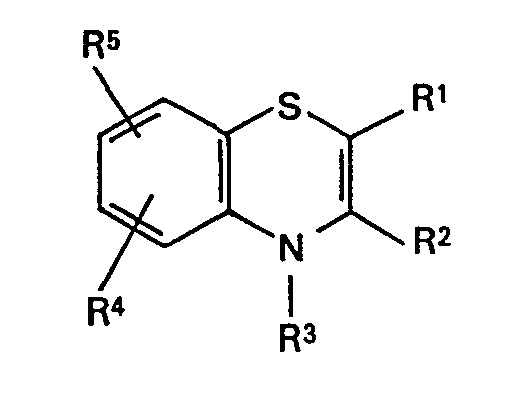
- Es wurden 4H-1,4-Benzothiazine der Formel

- R1 Wasserstoff, Aryl mit 6 bis 20 Kohlenstoffatomen, das gegebenenfalls ein- bis dreimal durch Halogen, Trifluormethyl oder Nitro substituiert sein kann, 2-Thienyl, 3-Thienyl, 2-Furyl, 3-Furyl, 2-Pyridyl,
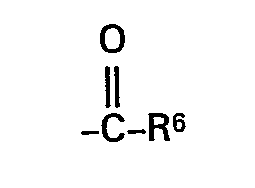
- 3-Pyridyl, 4-Pyridyl, 2-Pyrimidyl, 4-Pyrimidyl oder 5-Pyrimidyl, die gegebenenfalls durch Alkyl, Alkoxy, Hydroxy oder Halogen ein- oder mehrfach substituiert sein können, Cyano oder die Gruppe

- R6 für Alkyl (C1 bis C8), Aryl (C6 bis C20), Amino, Pyrrolidino, Piperidino, Morpholino, Cycloalkoxy oder für den Rest

- R8 geradkettiges oder verzweigtes Alkyl mit 1 bis 7 Kohlenstoffatomen, das gegebenenfalls ein- bis dreimal durch Halogen, C6 bis C20-Arxl, Hydroxy, Alkoxy, Alkylthio oder Cyano substituiert ist, bedeutet,
- R2 Alkyl (C1 bis C8) bedeutet, dass gegebenenfalls ein- bis dreimal durch Halogen, Pyrrolidino, Piperidino, Aryl (C1 bis C20) oder durch die Gruppe

- R7 für Aryl (Cs bis C20), Hydroxy, Amino, Dialkylamino, Pyrrolidino, Piperidino oder Morpholino steht, substituiert ist,
- R3 Wasserstoff oder eine der unter R2 genannten Gruppen bedeutet, und
- R4 und R5 gleich oder verschieden sind und Wasserstoff, Halogen, Hydroxy, Alkoxy, Nitro, Cyano, oder eine der unter R2 genannten Gruppen bedeuten, zur therapeutischen Behandlung gefunden.
- Überraschenderweise hemmen die genannten 4H-1,4-Benzothiazine die Lipoxygenase bereits in solcher Konzentration, bei denen die Cyclooxygenase wenig beeinflusst wird.
- Die genannten Verbindungen stimulieren überraschenderweise auch die Synthese von Prostacyclin in arteriellen Gefässen in vitro, möglicherweise als Folge ihrer lipoxygenasehemmenden Eigenschaft. Bezüglich dieser Wirkung sind die erfindungsgemässen Verbindungen stärker wirksam als der bekannte Lipoxygenasehemmer 3-Amino-1-(m-trifluor-methylphenyl)-pyrazolin-2 (Proc. of British Pharmacological Society 920 P (1981). Die erfindungsgemässen Verbindungen stimulieren auch an Kaninchenaortastreifen die Prostacyclin-Synthese.
- Die genannten Verbindungen besitzen auch eine antiphlogistische Wirkung im Carragenaninduzierten Ödemmodell, wenn sie systemisch, besonders oral, und lokal, besonders cutan, verabreicht werden. Sie besitzen ferner antimetastatische Wirkung.
- Die genannten lipoxygenasehemmenden 4H-1,4-Benzothiazine sind somit erfindungsgemäss als Arzneimittel bei der Behandlung von entzündlichen und allergischen Prozessen einsetzbar. Sie können insbesondere als Antiphlogistika, Antirheumatika, Antiatherosklerotika, Antithrombotika, Antiarthroika, Antiasthmatika, Antiallergika, Antimetastatika und Gastroprotektiva Verwendung finden.
- Es werden erfindungsgemäss zur therapeutischen Verwendung 1,4-Benzothiazine der allgemeinen Formel bevorzugt, worin
- R1 Wasserstoff, Phenyl, Naphthyl, gegebenenfalls ein- oder mehrfach durch Fluor und/oder Chlor substituiertes 2-Thienyl, 3-Thienyl, 2-Furyl, 3-Furyl, 2-Pyridyl, 3-Pyridyl, 4-Pyridyl, 2-Pyrimidyl, 4-Pyrimidyl oder 5-Pyrimidyl, ferner Cyano oder die Gruppe
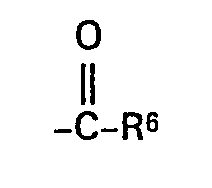
- R6 für Alkyl (C1 bis C4), Phenyl, Naphthyl, Amino, Pyrrolidino, Piperidino oder Morpholino oder für den Rest

- R8 geradkettiges oder verzweigtes Alkyl mit 1 bis 7 Kohlenstoffatomen bedeutet,
- R2 Alkyl (C1 bis C4), das gegebenenfalls durch Fluor und/oder Chlor substituiert ist, bedeutet,
- R3 Wasserstoff oder eine der unter R2 genannten Gruppen bedeutet, und
- R4 und R5 gleich oder verschieden sind und Wasserstoff, Halogen, Hydroxy, Cyano oder eine der unter R2 genannten Gruppen bedeuten.
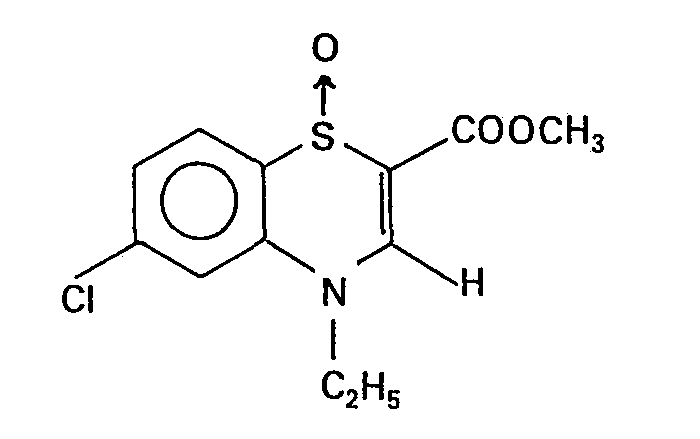
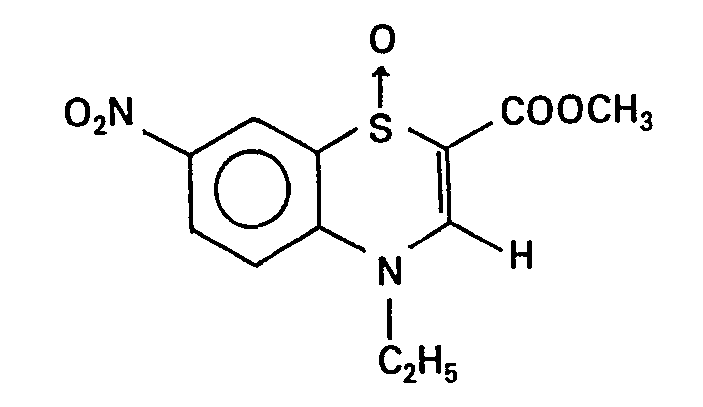
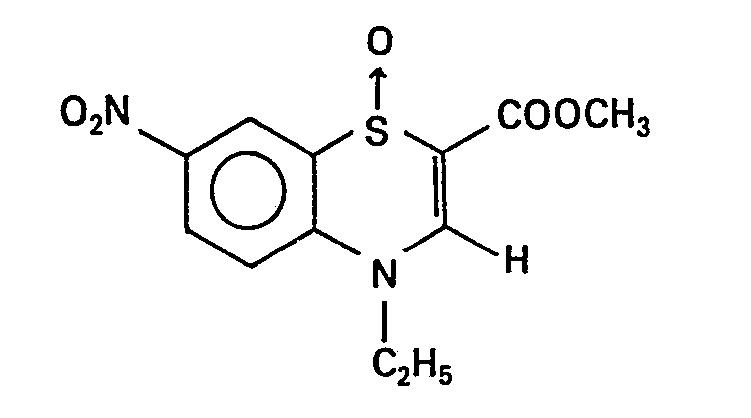
- Es wurden ausserdem noch 4H-1,4-Benzothiazine der Formeln


- Die Stoffe der allgemeinen Formel I lassen sich gemäss der Verfahrensvariante 1 herstellen, indem man 2-Aminothiophenole der Formel 11 mit Verbindungen der Formel III in Dimethylsulfoxid zur Reaktion bringt (vgl. J. Chem. Soc. Perkin Trans. I, 1976,1146-49).

- Die Verbindungen der Formeln II und III sind entweder literaturbekannt oder lassen sich in Analogie zu literaturbekannten Verbindungen herstellen. Die Reaktionstemperatur kann zwischen 50°C und 200°C liegen, vorzugsweise zwischen 100°C und 150°C. In einigen Fällen ist es zweckmässig unter Sauerstoffausschluss zu arbeiten.
- Die Stoffe der Formel I lassen sich nach Verfahrensvariante 2 herstellen, indem man 2-Aminothiophenole der Formel II mit Verbindungen der Formel IV zur Reaktion bringt (vgl. Ann. Chem. 744,20-32 (1971)).

- X = Halogen, vorzugsweise Cl, Br
- Y = Sauerstoff; Alkyl-N; Aryl-N.
- Die Reaktion kann vorzugsweise auch in Gegenwart eines Säurefängers, wie z.B. Triethylamin, K2C03, Na2C03, NaOH, NH3 durchgeführt werden.
- Als Lösungsmittel kommen in Frage: Alkohole (z.B. Methanol, Ethanol), Ether (z.B. Diethylether, THF, Dioxan, Dimethoxyethan, Diethylenglykoldimethylether), Kohlenwasserstoffe (z.B. Benzol, Toluol), chlorierte Kohlenwasserstoffe (z.B. Methylenchlorid, Chloroform, Chlorbenzol), DMSO, DMF, Pyridin und Wasser. In einigen Fällen ist es zweckmässig unter Sauerstoffausschluss zu arbeiten.
- Die Reaktionstemperatur kann zwischen 0°C und 200°C liegen, vorzugsweise zwischen 35°C und110°C.
- Die Stoffe der Formel 1 lassen sich nach Verfahrensvariante 3 herstellen, indem man Disulfide der Formel V mit Carbonylverbindungen der Formel III zur Reaktion bringt [vergl. Phosphorus and Sulfur 3, 308-314 (1977)]

- Als Lösungsmittel kommen in Frage: Benzol, Toluol, Pyridin, DMSO und DMF.
- Die Reaktionstemperatur kann zwischen 20°C und 180°C liegen, vorzugsweise zwischen 35°C und 110°C.
- Es ist zweckmässig unter Sauerstoffausschluss zu arbeiten.
- Die Reaktion wird meist mit äquimolekularen Mengen der Ausgangsmaterialien durchgeführt, gelegentlich wird auch ein Überschuss (bis zu 110%) an Carbonylverbindung verwendet.
- Die Stoffe der Formel 1 lassen sich nach Verfahrensvariante 4 herstellen, indem man Disulfide der Formel V mit Alkinen der Formel VI zur Reaktion bringt [vgl. J. Heterocyclic Chem. 17, 377 (1980)].

- Die Reaktion wird vorzugsweise mit äquimolekularen Mengen der Ausgangsmaterialien durchgeführt, gelegentlich wird auch ein Überschuss (bis zu 110%) an Alkin (VI) verwendet. Als Lösungsmittel kommen in Frage: Alkohole (z.B. Methanol, Ethanol), Ether, Kohlenwasserstoffe (z.B. Benzol, Toluol), chlorierte Kohlenwasserstoffe, DMSO, DMF und Pyridin. Die Reaktionstemperatur liegt zwischen 20°C und 180°C, vorzugsweise zwischen 35°C und 120°C.
- Es ist zweckmässig, unter Sauerstoffausschluss zu arbeiten.
- Stoffe der Formel 1, bei denen R3 für Alkyl (gegebenenfalls substituiertes) steht, lassen sich aus den entsprechenden Verbindungen, bei denen R3 für Wasserstoff steht, nach den üblichen Alkylierungsmethoden herstellen, z.B. durch Umsetzung mit CH3J, C2H5Br oder ω-Bromacetophenon.
- Der Nachweis der lipoxygenasehemmenden Eigenschaften der erfindungsgemässen Verbindungen erfolgte analog der Methode von Bailey et al., Journal of Biol. Chemistry 255, 5996, (1980) und nach Blackwell und Flower, Prostaglandins 16, 417 (1978). Bei dieser Testmethode wird der Metabolismus radioaktiv markierter Arachidonsäure an gewaschenen Humanthrombozyten herangezogen. Bei diesem in vitro Test werden die radioaktiv markierten Metaboliten aus dem Reaktionsansatz extrahiert und dünnschichtchromatographisch getrennt. Das Autoradiogramm wird am Dünnschicht-Scanner ausgewertet. Bei diesen Testbedingungen werden die markierten Metaboliten von der nicht umgesetzten Arachidonsäure getrennt und sind anschliessend quantitativ auswertbar. Die Verteilung der Radioaktivität auf die während der Metabolisierung gebildeten Cyclooxygenaseprodukte Thromboxan B2 (TXB2) und 12-Hydroxy-5,8, 10-heptadekatriensäure (HHT) bzw. das Lipoxygenaseprodukt 12-Hydroxy-5,8,11,14-eikosatetraensäure (HETE) unter dem Einfluss der Inhibitoren stellt ein Mass für die Hemmung der Enzyme dar.
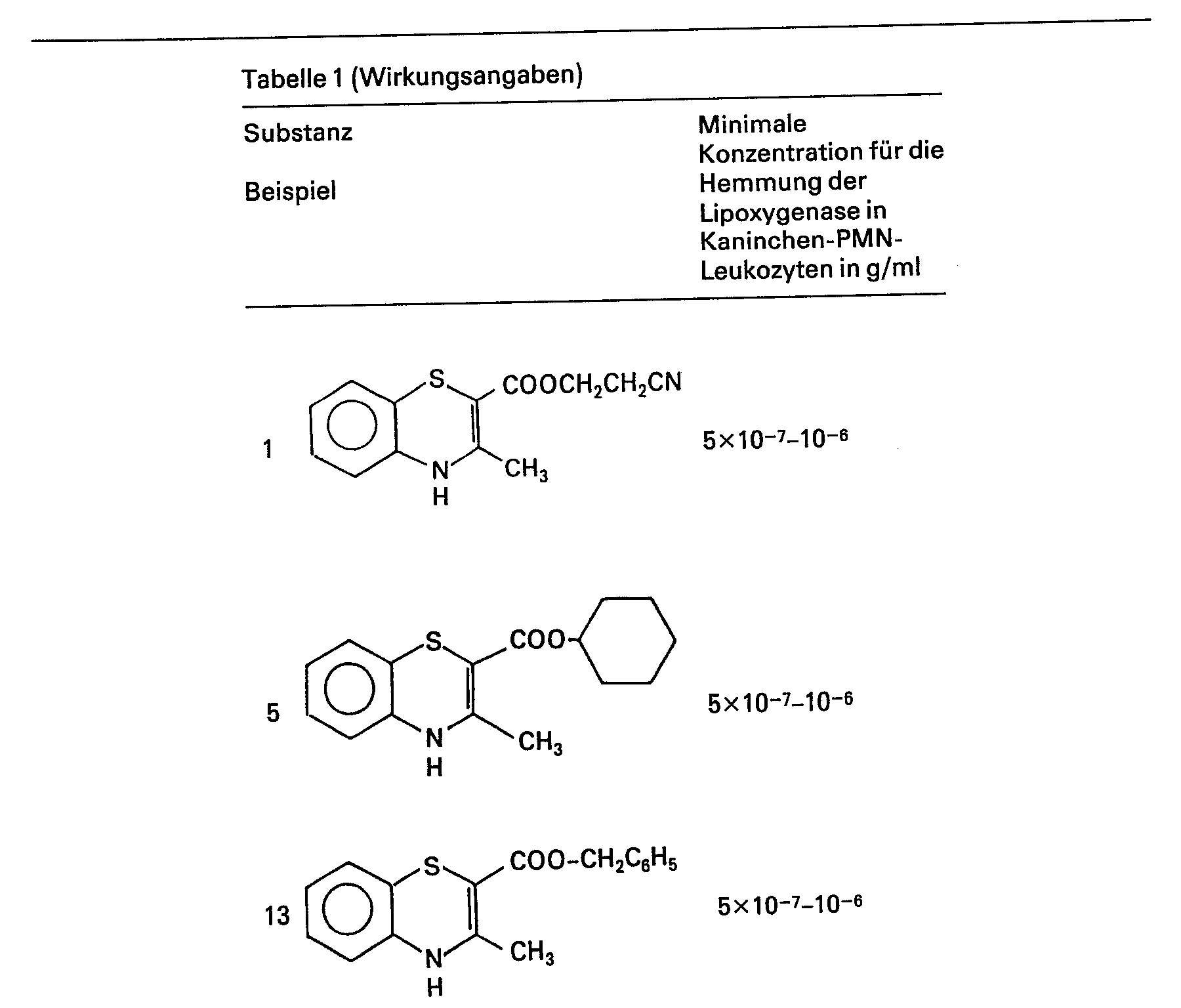
- Die Lipoxygenasehemmung der Verbindung gemäss Formel I lässt sich an der Hemmung der HETE-Synthese messen. Es zeigt sich, dass die Synthese von TXB2 und von HHT unbeeinflusst bleibt, während der Arachidonsäureumsatz abnimmt. Wie aus der nachfolgenden Tabelle ersichtlich ist, bewirken Verbindungen gemäss Formel eine signifikante Hemmung der Plättchenlipoxygenase (HETE-Synthese). (Vergl. Tab. 1)
- Analog den vorstehenden Ausführungen lassen sich die lipoxygenasehemmenden Eigenschaften der Verbindungen nach Formel auch an Leukozyten nachweisen.
- Die polymorphkernigen Leukozyten des Menschen und des Kaninchens metabolisieren die Arachidonsäure zu 5-Hydroxy-5,8,11,14-eikosate- traensäure (5-HETE) und Leukotrien B4 (5S, 12R-Dihydroxy-6 cis, 8,10-trans-14 ciseikosatetraensäure). Die Hemmung der Freisetzung von 5-HETE und Leukotrien B4 aus den Leukozyten stellt ein Mass für den lipoxygenasehemmenden Effekt der Verbindungen gemäss Formel I dar. (Vergl. Tab. 1)
- Der Test mit den Humanleukozyten wurde nach Borgeat und Samuelsson (j. Biol. Chem. 254; 2643, 1979 und Proc. Natl. Acad. Sci. USA, 76, 2148 1979), mit Kaninchenleukozyten nach Walker und Parish (Inter. Archs. Allergy appl. Immun. 66,83,1981) durchgeführt.
- Der Nachweis der Prostacyclin-stimulierenden Wirkung erfolgte durch Bestimmung der Freisetzung von Prostacyclin nach einstündiger Inkubation von Kaninchenaortenstreifen mit den erfindungsgemässen Verbindungen (analog nach Moncada et al., Lancet 1977, 18) und anschliessender radioimmunologischer Bestimmung des stabilen Prostacyclinmetaboliten 6-Keto-PGF 1 (B.M. Peskar et al., FEBS Letters 121,25,1980).
- Die Verbindungen gemäss Formel I sind auch in vivo wirksam. Diese Wirkung wird durch die Messung der Hemmung der Leukozytenmigration nach an sich bekannten Methoden nachgewiesen (vgl. Higgs et al., Biochemical Pharmacology 28, 1959, (1979) und Eur. J. Pharmacol. 66, 81 (1981)).
- Die Wirkstoffe gemäss Formel können in bekannter Weise in die üblichen Formulierungen, wie Tabletten, Kapseln, Dragees, Pillen, Granulate, Aerosole, Sirupe, Emulsionen, Suspensionen und Lösungen, unter Verwendung inerter, nichttoxischer pharmazeutisch geeigneter Trägerstoffe oder Lösungsmittel überführt werden. Hierbei sollte die therapeutisch wirksame Verbindung jeweils in einer Konzentration von etwa 0,5 bis 90 Gew.% der Gesamtmischung vorhanden sein, d.h. in Mengen, die ausreichend sind, um den angestrebten Dosierungsspielraum zu erreichen.
- Die Formulierungen werden beispielsweise hergestellt durch Verstrecken der Wirkstoffe mit Lösungsmitteln und/oderTrägerstoffen, gegebenenfalls unter Verwendung von Emulgiermitteln und/oder Dispergiermitteln, wobei z.B. im Falle der Benutzung von Wasser als Verdünnungsmittel gegebenenfalls organische Lösungsmittel als Hilfslösungsmittel verwendet werden können.
- Als Hilfsstoffe seien beispielhaft aufgeführt:
- Wasser, nicht-toxische organische Lösungsmittel, wie Paraffine (z.B. Erdölfraktionen), pflanzliche Öle, (z.B. Erdnuss-(Sesamöl), Alkohole (z.B. Ethylalkohol, Glycerin), Glykole (z.B. Propylenglykol, Polyethylenglykol), N-Alkylpyrrolidone, feste Trägerstoffe, wie z.B. natürliche Gesteinsmehle (z.B. Kaoline, Tonerden, Talkum, Kreide), synthetische Gesteinsmehle (z.B. hochdisperse Kieselsäure, Silikate), Zucker (z.B. Roh-, Milch- und Traubenzucker), Emulgiermittel, wie nicht-ionogene anionische Emulgatoren (z.B. Polyoxyethylen-Fettsäure-Ester, Polyoxyethylen-Fettalkohol-Ether, Alkylsulfonate und Arylsulfonate), Dispergiermittel (z.B. Lignin, Sulfitablaugen, Methylcellulose, Stärke und Polyvinylpyrrolidon) und Gleitmittel (z.B. Magnesiumstearat, Talkum, Stearinsäure und Natriumlaurylsulfat).
- Die Applikation erfolgt in üblicher Weise, vorzugsweise oral oder parenteral, insbesondere cutan. Im Falle der oralen Anwendung können Tabletten selbstverständlich ausser den genannten Trägerstoffen auch Zusätze wie Natriumcitrat, Calciumcarbonat und Dicalciumphosphat zusammen mit verschiedenen Zuschlagstoffen, wie Stärke, vorzugsweise Kartoffelstärke, Gelatine und dergleichen enthalten. Weiterhin können Gleitmittel, wie Magnesiumstearat, Natriumlaurylsulfat und Talkum zum Tablettieren mitverwendet werden. Im Falle wässriger Suspensionen und/oder Elixieren, die für orale Anwendungen gedacht sind, können die Wirkstoffe ausser mit den obengenannten Hilfsstoffen mit verschiedenen Geschmacksaufbesserern oder gefärbten bzw. farbgebenden Stoffen versetzt werden.
- Für den Fall der parenteralen Anwendung können Lösungen der Wirkstoffe unter Verwendung geeigneter flüssiger Trägermaterialien eingesetzt werden.
- Im allgemeinen hat es sich als vorteilhaft erwiesen, bei intravenöser Applikation Mengen von etwa 0,01 bis 10 mg/kg, vorzugsweise etwa 0,05 bis 5 mg/kg Körpergewicht pro Tag zur Erzielung wirksamer Ergebnisse zu verarbreichen, und bei oraler Applikation beträgt die Dosierung etwa 0,05 bis 100 mg/kg, vorzugsweise 0,1 bis 10 mg/kg Körpergewicht pro Tag.
- Trotzdem kann es gegebenenfalls erforderlich sein, von den genannten Mengen abzuweichen, und zwar in Abhängigkeit vom Körpergewicht bzw. der Art des Applikationsweges, aber auch aufgrund der Art und deren individuellem Verhalten gegenüber dem Medikament bzw. der Art von dessen Formulierung und dem Zeitpunkt bzw. Intervall, zu welchem die Verabreichung erfolgt. So kann es in einigen Fällen ausreichend sein, mit weniger als der vorgenannten Mindestmenge auszukommen, während in anderen Fällen die genannte obere Grenze überschritten werden muss. Im Falle der Applikation grösserer Mengen kann es empfehlenswert sein, diese in mehrere Einzelgaben über den Tag zu verteilen. Die obigen Ausführungen gelten für die Applikation sowohl in der Human- als auch in der Tiermedizin in sinngemäss gleicher Weise.
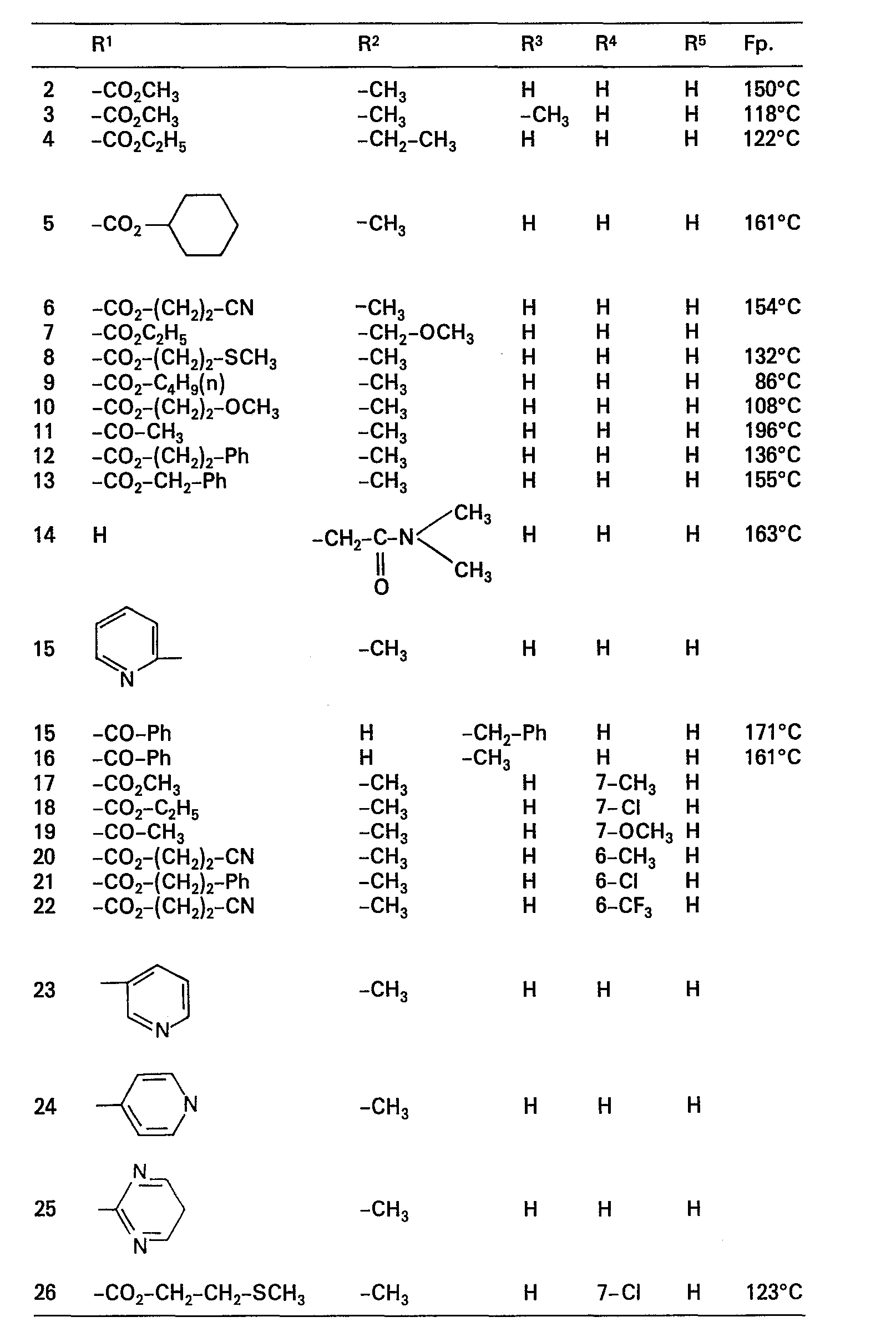
- Die folgenden Beispiele sollen die Erfindung näher erläutern (siehe auch Tabelle 1):
- 3-Methyl-4H-1,4-benzothiazin-2-carbonsäure-(2-cyanethyl)-ester

- Fp. 152-154°C
- Ausbeute: 8,2 g (39% d.Th.).
- In gleicher Weise liessen sich folgende Präparate herstellen:

- 3-Benzyl-4H-1,4-benzothiazin-2-carbonsäure- ethylester

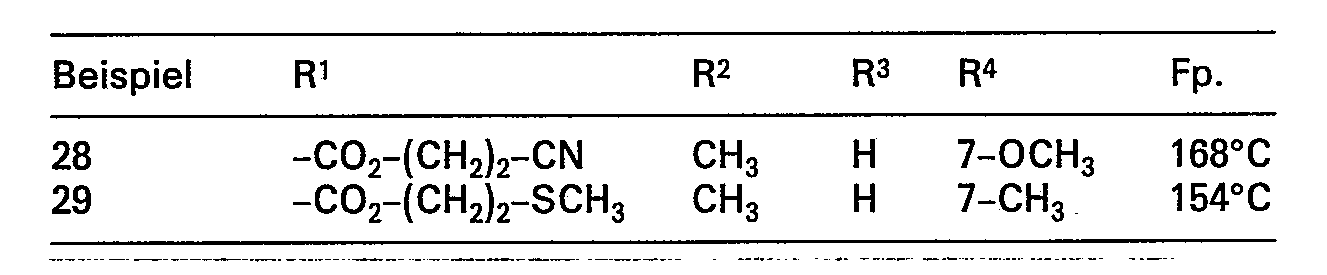
- Zu einer siedenden Lösung von 24,8 g (0,1 Mol) 2,2'-Dithiodianilin und 100 mg p-Toluolsulfonsäure in 300 ml Toluol wurde unter Stickstoff eine Lösung von 20,6 g (0,1 Mol) 4-Phenylacetessigsäureethylester in 100 ml Toluol getropft. Das Gemisch wurde 5 Stunden am Wasserabscheider gekocht. Nach dem Erkalten wurde mit Sodalösung gewaschen, die organische Phase abgetrennt, mit Na2S04 getrocknet und eingeengt.
- Der Rückstand wurde chromatographisch (Kieselgel 0,063-0,2) aufgetrennt. Es wurden 4,8 g vom Fp. 140-143°C erhalten.
- In gleicher Weise (wie Beispiel 27) liessen sich folgende Präparate herstellen:

- 7-Ethoxy-4H-1,4-benzothiazin-2-carbonsäure- ethylester
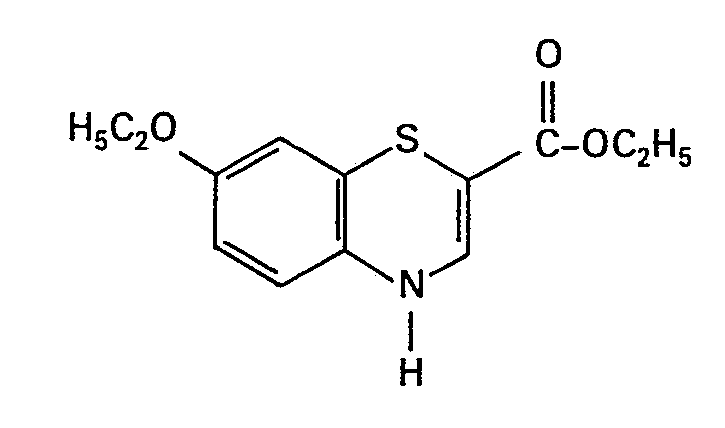
- Fp. 172°C
- Ausbeute: 2,3 g
- In gleicher Weise (wie Beispiel 30) liessen sich folgende Präparate herstellen:


-

- 3,15 g (0,01 Mol)
- 3,0 g (0,03 Mol) N-Methylpiperazin
- 50 ml DMSO
- Substanzen zusammengegeben und 1,5Std. bei 50°C laufen lassen. DMSO von der Ölpumpe abdest., Rückstand mit H20/CH2Cl2 extrahiert, org. Phase abgetrennt und eingeengt, Rückstand aus Aceton umkrist.
- Ausbeute: 1,4 g
- Fp.:156-159°C.
-

- 8,8 g (0,023 Mol)
- 250 ml als Methanol
- 880 mg Pd/Kohle
- Insgesamt 16 Std. bei RT H2 eingeleitet, Kontakt abgesaugt ML eingeengt, Rückstand aus Aceton/Ether umkrist.
- Ausbeute: 4,5 g
- Fp.:180-186°C
-

- 2,0 g (0,063 Mol)
- 20 ml Dioxan
- 20 ml 6%ige NaOH
- Substanzen zusammengeben und 4 Std. auf 50°C erwärmen. Dioxan am Rotowpor abziehen, mit wenig H20 verdünnt, filtriert. Filtrat mit HCI angesäuert, 24 Std. stehen lassen und abgesaugt.
- Ausbeute:1,5 g
- Fp.:176-180°C
-

- 2,0 g (0,0053 Mol)
- 20 ml Dioxan
- 20 ml 6%ige NaOH
- Substanzen zusammengegeben und 3 Std. bei 50°C laufen lassen, Dioxan am Rotowpor abgezogen, Rückstand in wenig H20 aufgenommen, filtriert. Filtrat mit HCI angesäuert, noch 24 Std. stehen, Kristalle abgesaugt.
- Ausbeute: 1,8 g
- Fp.: > 250°C
-

- 1,0 g (0,00357 Mol)
- 20 ml Dioxan/H20
- 0,143 g NaOH
- Substanzen zusammengegeben und 3 Std. auf RE erwärmt. Dioxan/H20 an der Ölpumpe abdest. Rückstand in wenig H20 aufgenommen, filtriert, mit HCI angesäuert und 24 h stehen lassen. Kristalle abgesaugt.
- Ausbeute: 0,4 g
- Fp.:193-195°C
-

- 3,15 g (0,01 Mol)
- 50 ml abs. Dioxan
- 1,57 g Pd/Kohle
- Im 100 ml bei RT hydrieren. Nach 3 Std. RT Kontakt abgesaugt, ML eingeengt, Rückstand in Petrolether aufgeschlämmt und abgesaugt.
- Ausbeute: 2,81 g ≅ 98,6% d.Th.
- Fp.: 147-150°C
- Man legt 0,01 Mol des σ-(subst.) Phenylsulfinyl-ß-ethylaminoacrylsäureesters in 50 ml abs. DMSO vor und gibt bei Raumtemperatur 0,01 Mol frisch sublimiertes Kalium-tert.-butylat portionsweise zu. Nach 8 Stunden bei 100°C wird das DMSO i.Vak. abgezogen, der Rückstand in Wasser/Dichloromethan aufgenommen und die organische Phase abgetrennt. Nach Einengen wird der Rückstand mit Ether kristallisiert.




Claims (12)


oder eine der unter R2 genannten Gruppen bedeuten, zur therapeutischen Verwendung.





Priority Applications (1)
| Application Number | Priority Date | Filing Date | Title |
|---|---|---|---|
| AT83107419T ATE24724T1 (de) | 1982-08-04 | 1983-07-28 | 4h-1,4-benzothiazine zur verwendung als arzneimittel. |
Applications Claiming Priority (2)
| Application Number | Priority Date | Filing Date | Title |
|---|---|---|---|
| DE3229121 | 1982-08-04 | ||
| DE19823229121 DE3229121A1 (de) | 1982-08-04 | 1982-08-04 | 4h-1,4-benzothiazine, verfahren zu ihrer herstellung und ihre verwendung als arzneimittel |
Publications (2)
| Publication Number | Publication Date |
|---|---|
| EP0100527A1 EP0100527A1 (de) | 1984-02-15 |
| EP0100527B1 true EP0100527B1 (de) | 1987-01-07 |
Family
ID=6170116
Family Applications (1)
| Application Number | Title | Priority Date | Filing Date |
|---|---|---|---|
| EP83107419A Expired EP0100527B1 (de) | 1982-08-04 | 1983-07-28 | 4H-1,4-Benzothiazine zur Verwendung als Arzneimittel |
Country Status (14)
| Country | Link |
|---|---|
| EP (1) | EP0100527B1 (de) |
| JP (1) | JPS5944368A (de) |
| KR (1) | KR840005727A (de) |
| AT (1) | ATE24724T1 (de) |
| AU (1) | AU1758683A (de) |
| DE (2) | DE3229121A1 (de) |
| DK (1) | DK354483A (de) |
| ES (1) | ES524708A0 (de) |
| FI (1) | FI832782A7 (de) |
| GR (1) | GR79356B (de) |
| IL (1) | IL69389A0 (de) |
| NO (1) | NO832664L (de) |
| PT (1) | PT77096B (de) |
| ZA (1) | ZA835674B (de) |
Families Citing this family (3)
| Publication number | Priority date | Publication date | Assignee | Title |
|---|---|---|---|---|
| DE3426564A1 (de) * | 1984-07-19 | 1986-01-30 | Bayer Ag, 5090 Leverkusen | Verwendung von 4h-1,4-benzothiazinen bei der prophylaxe und therapie von erkrankungen der atemwege, entzuendungen/rheuma, thromboembolischen erkrankungen, ischaemien und infarkten, herzrhythmusstoerungen, arteriosklerose und dermatosen, arzneimittel zu diesem zweck sowie wirkstoffe, die in diesen arzneimitteln enthalten sind |
| DE3540702A1 (de) * | 1985-11-16 | 1987-05-21 | Bayer Ag | 1h-pyrido-(2,3-b) (1,4)-thiazine |
| DE3545097A1 (de) * | 1985-12-19 | 1987-07-02 | Bayer Ag | 1-h-pyrido-(3,2-b)(1,4)-thiazine |
Family Cites Families (2)
| Publication number | Priority date | Publication date | Assignee | Title |
|---|---|---|---|---|
| US4397849A (en) * | 1980-12-30 | 1983-08-09 | Fujisawa Pharmaceutical Co., Ltd. | Benzothiazine derivatives |
| DE3111487A1 (de) * | 1981-03-24 | 1982-12-30 | Bayer Ag, 5090 Leverkusen | Verfahren zur herstellung von 2,3-dihydro-4h-1,4 dihydro-1,4-benzothiazinen |
-
1982
- 1982-08-04 DE DE19823229121 patent/DE3229121A1/de not_active Withdrawn
-
1983
- 1983-07-21 NO NO832664A patent/NO832664L/no unknown
- 1983-07-25 PT PT77096A patent/PT77096B/pt unknown
- 1983-07-28 AT AT83107419T patent/ATE24724T1/de not_active IP Right Cessation
- 1983-07-28 EP EP83107419A patent/EP0100527B1/de not_active Expired
- 1983-07-28 DE DE8383107419T patent/DE3368925D1/de not_active Expired
- 1983-08-01 IL IL69389A patent/IL69389A0/xx unknown
- 1983-08-02 FI FI832782A patent/FI832782A7/fi not_active Application Discontinuation
- 1983-08-02 GR GR72111A patent/GR79356B/el unknown
- 1983-08-03 JP JP58141253A patent/JPS5944368A/ja active Pending
- 1983-08-03 DK DK354483A patent/DK354483A/da not_active Application Discontinuation
- 1983-08-03 ZA ZA835674A patent/ZA835674B/xx unknown
- 1983-08-03 ES ES524708A patent/ES524708A0/es active Granted
- 1983-08-04 AU AU17586/83A patent/AU1758683A/en not_active Abandoned
- 1983-08-04 KR KR1019830003655A patent/KR840005727A/ko not_active Withdrawn
Non-Patent Citations (3)
| Title |
|---|
| Immunology 40, 709 (1980) * |
| Liebigs Annalen der Chemie 744, 27 (1971) * |
| Medical Clinics of North America 65, 809 (1981) * |
Also Published As
| Publication number | Publication date |
|---|---|
| DK354483A (da) | 1984-02-05 |
| JPS5944368A (ja) | 1984-03-12 |
| ATE24724T1 (de) | 1987-01-15 |
| AU1758683A (en) | 1984-02-09 |
| DK354483D0 (da) | 1983-08-03 |
| KR840005727A (ko) | 1984-11-16 |
| FI832782L (fi) | 1984-02-05 |
| DE3368925D1 (en) | 1987-02-12 |
| ZA835674B (en) | 1984-04-25 |
| ES8404682A1 (es) | 1984-05-01 |
| IL69389A0 (en) | 1983-11-30 |
| GR79356B (de) | 1984-10-22 |
| DE3229121A1 (de) | 1984-02-09 |
| NO832664L (no) | 1984-02-06 |
| FI832782A7 (fi) | 1984-02-05 |
| PT77096A (en) | 1983-08-01 |
| FI832782A0 (fi) | 1983-08-02 |
| EP0100527A1 (de) | 1984-02-15 |
| PT77096B (en) | 1986-03-12 |
| ES524708A0 (es) | 1984-05-01 |
Similar Documents
| Publication | Publication Date | Title |
|---|---|---|
| EP0085881A2 (de) | Pyrazolooxazine, -thiazine, -chinoline, Verfahren zu ihrer Herstellung und ihre Verwendung als Arzneimittel | |
| DE3784624T2 (de) | Benzimidazolderivate mit einer wirkung als ulkusmittel. | |
| EP0183159A2 (de) | 1-Heteroaryl-4-aryl-pyrazolin-5-one zur Verwendung als Arzneimittel | |
| EP0041215B1 (de) | Imidazoazolalkensäureamide, neue Zwischenprodukte zu ihrer Herstellung, ihre Herstellung und ihre Verwendung in Arzneimitteln | |
| EP0185909B1 (de) | 5-Alkyl-1-phenyl-2-piperazinoalkylpyrazolin-3-on-Verbindungen sowie Verfahren und Zwischenprodukte zu ihrer Herstellung und diese Verbindungen enthaltende Arzneimittel | |
| EP0101898A1 (de) | Anellierte 4H-1,4-Benzothiazine, Verfahren zu ihrer Herstellung und ihre Verwendung als Arzneimittel | |
| EP0004561B1 (de) | Harnstoff- und Amidoverbindungen, deren Herstellung, pharmazeutische Präparate enthaltend diese Verbindungen und deren Verwendung zur Zubereitung von pharmazeutischen Präparaten | |
| DE3927930A1 (de) | Cyclisch substituierte (chinolin-2-yl-methoxy)phenyl-essig-saeure-derivate | |
| DE2602643A1 (de) | 1,2-benzisothiazolinone-3, verfahren zu ihrer herstellung sowie ihre verwendung als arzneimittel | |
| DE3532279A1 (de) | 1,4-benzoxathiin-derivate | |
| EP0261478B1 (de) | Neue Derivate von 4,5-Dihydro-oxazolen, Verfahren zu ihrer Herstellung und ihre Verwendung | |
| EP0072960B1 (de) | 1,5-Diphenylpyrazolin-3-on-Verbindungen sowie Verfahren und Zwischenprodukte zu ihrer Herstellung und diese Verbindungen enthaltende Arzneimittel | |
| EP0065658A2 (de) | Verwendung von Sulfenamiden als Lipoxygenasehemmer und diese enthaltende Arzneimittel | |
| DE3246148A1 (de) | Pyrazolo(4.3-b)(1.4)oxazine, verfahren zu ihrer herstellung und ihre verwendung als arzneimittel | |
| DE3883164T2 (de) | Rhodanin-Derivate, Verfahren zu ihrer Herstellung, ihre Anwendung und pharmazeutische Zusammensetzungen, die sie enthalten. | |
| EP0100527A1 (de) | 4H-1,4-Benzothiazine zur Verwendung als Arzneimittel | |
| DE602005002138T2 (de) | Pentensäurederivate, verfahren zu deren herstellung, pharmazeutische zusammensetzungen, die diese enthalten, und deren therapeutische anwendung | |
| EP0211157B1 (de) | Isoxazolderivate, Verfahren zu ihrer Herstellung und diese enthaltende pharmazeutischen Präparate | |
| EP0088323B1 (de) | Imidazothiadiazolalkencarbonsäureamide, neue Zwischenprodukte zu ihrer Herstellung, ihre Herstellung und ihre Verwendung in Arzneimitteln | |
| DE3125059A1 (de) | Dioxybenzoletherderivate, diese enthaltende arzneimittel, verfahren zu ihrer herstellung und ihre verwendung | |
| EP0330940A2 (de) | Neue trisubstituierte Amine, Verfahren zu ihrer Herstellung sowie Arzneimittel, die diese Verbindungen enthalten | |
| DE2431734A1 (de) | Beta-ketopropan-sultone und -sultame | |
| EP0110219B1 (de) | Heterocyclisch substituierte Nitrile, ihre Herstellung und Verwendung als Arzneimittel | |
| DE3020421A1 (de) | Imidazoazolalkensaeureamide, neue zwischenprodukte zu ihrer herstellung, ihre herstellung und ihre verwendung in arzneimitteln | |
| EP0158083A2 (de) | Arzneimittel |
Legal Events
| Date | Code | Title | Description |
|---|---|---|---|
| PUAI | Public reference made under article 153(3) epc to a published international application that has entered the european phase |
Free format text: ORIGINAL CODE: 0009012 |
|
| 17P | Request for examination filed |
Effective date: 19830728 |
|
| AK | Designated contracting states |
Designated state(s): AT BE CH DE FR GB IT LI LU NL SE |
|
| GRAA | (expected) grant |
Free format text: ORIGINAL CODE: 0009210 |
|
| AK | Designated contracting states |
Kind code of ref document: B1 Designated state(s): AT BE CH DE FR GB IT LI LU NL SE |
|
| REF | Corresponds to: |
Ref document number: 24724 Country of ref document: AT Date of ref document: 19870115 Kind code of ref document: T |
|
| ET | Fr: translation filed | ||
| REF | Corresponds to: |
Ref document number: 3368925 Country of ref document: DE Date of ref document: 19870212 |
|
| ITF | It: translation for a ep patent filed | ||
| PG25 | Lapsed in a contracting state [announced via postgrant information from national office to epo] |
Ref country code: AT Effective date: 19870728 |
|
| PG25 | Lapsed in a contracting state [announced via postgrant information from national office to epo] |
Ref country code: SE Effective date: 19870729 |
|
| PG25 | Lapsed in a contracting state [announced via postgrant information from national office to epo] |
Ref country code: LU Free format text: LAPSE BECAUSE OF NON-PAYMENT OF DUE FEES Effective date: 19870731 Ref country code: LI Effective date: 19870731 Ref country code: CH Effective date: 19870731 |
|
| PLBE | No opposition filed within time limit |
Free format text: ORIGINAL CODE: 0009261 |
|
| STAA | Information on the status of an ep patent application or granted ep patent |
Free format text: STATUS: NO OPPOSITION FILED WITHIN TIME LIMIT |
|
| 26N | No opposition filed | ||
| BERE | Be: lapsed |
Owner name: BAYER A.G. Effective date: 19870731 |
|
| PG25 | Lapsed in a contracting state [announced via postgrant information from national office to epo] |
Ref country code: NL Effective date: 19880201 |
|
| NLV4 | Nl: lapsed or anulled due to non-payment of the annual fee | ||
| PG25 | Lapsed in a contracting state [announced via postgrant information from national office to epo] |
Ref country code: FR Free format text: LAPSE BECAUSE OF NON-PAYMENT OF DUE FEES Effective date: 19880331 |
|
| REG | Reference to a national code |
Ref country code: CH Ref legal event code: PL |
|
| PG25 | Lapsed in a contracting state [announced via postgrant information from national office to epo] |
Ref country code: DE Effective date: 19880401 |
|
| GBPC | Gb: european patent ceased through non-payment of renewal fee | ||
| REG | Reference to a national code |
Ref country code: FR Ref legal event code: ST |
|
| PG25 | Lapsed in a contracting state [announced via postgrant information from national office to epo] |
Ref country code: GB Free format text: LAPSE BECAUSE OF NON-PAYMENT OF DUE FEES Effective date: 19881122 |
|
| PG25 | Lapsed in a contracting state [announced via postgrant information from national office to epo] |
Ref country code: BE Effective date: 19890731 |
|
| EUG | Se: european patent has lapsed |
Ref document number: 83107419.0 Effective date: 19880901 |