EP0052859B1 - Selbsttätig schaltbarer Ventilator für Kühlsysteme von Verbrennungsmotoren - Google Patents
Selbsttätig schaltbarer Ventilator für Kühlsysteme von Verbrennungsmotoren Download PDFInfo
- Publication number
- EP0052859B1 EP0052859B1 EP81109753A EP81109753A EP0052859B1 EP 0052859 B1 EP0052859 B1 EP 0052859B1 EP 81109753 A EP81109753 A EP 81109753A EP 81109753 A EP81109753 A EP 81109753A EP 0052859 B1 EP0052859 B1 EP 0052859B1
- Authority
- EP
- European Patent Office
- Prior art keywords
- bellows
- front plate
- fan
- gas
- shell
- Prior art date
- Legal status (The legal status is an assumption and is not a legal conclusion. Google has not performed a legal analysis and makes no representation as to the accuracy of the status listed.)
- Expired
Links
- 238000001816 cooling Methods 0.000 title claims abstract description 26
- 238000002485 combustion reaction Methods 0.000 title claims description 11
- 239000012530 fluid Substances 0.000 claims abstract description 5
- 230000005540 biological transmission Effects 0.000 claims abstract description 4
- 238000010168 coupling process Methods 0.000 claims description 17
- 230000008878 coupling Effects 0.000 claims description 16
- 238000005859 coupling reaction Methods 0.000 claims description 16
- 239000002184 metal Substances 0.000 claims description 11
- 229910052751 metal Inorganic materials 0.000 claims description 11
- 230000001681 protective effect Effects 0.000 claims description 7
- 230000000694 effects Effects 0.000 claims description 2
- 230000000149 penetrating effect Effects 0.000 claims 1
- 239000007788 liquid Substances 0.000 description 13
- XLYOFNOQVPJJNP-UHFFFAOYSA-N water Substances O XLYOFNOQVPJJNP-UHFFFAOYSA-N 0.000 description 6
- 238000009835 boiling Methods 0.000 description 5
- 238000010276 construction Methods 0.000 description 5
- 238000005476 soldering Methods 0.000 description 5
- 238000003466 welding Methods 0.000 description 5
- 239000011888 foil Substances 0.000 description 4
- 238000004519 manufacturing process Methods 0.000 description 4
- 238000000034 method Methods 0.000 description 3
- 238000006073 displacement reaction Methods 0.000 description 2
- 239000011810 insulating material Substances 0.000 description 2
- 238000009413 insulation Methods 0.000 description 2
- 239000000463 material Substances 0.000 description 2
- 125000006850 spacer group Chemical group 0.000 description 2
- 230000003068 static effect Effects 0.000 description 2
- BOSAWIQFTJIYIS-UHFFFAOYSA-N 1,1,1-trichloro-2,2,2-trifluoroethane Chemical compound FC(F)(F)C(Cl)(Cl)Cl BOSAWIQFTJIYIS-UHFFFAOYSA-N 0.000 description 1
- AJDIZQLSFPQPEY-UHFFFAOYSA-N 1,1,2-Trichlorotrifluoroethane Chemical compound FC(F)(Cl)C(F)(Cl)Cl AJDIZQLSFPQPEY-UHFFFAOYSA-N 0.000 description 1
- RYGMFSIKBFXOCR-UHFFFAOYSA-N Copper Chemical compound [Cu] RYGMFSIKBFXOCR-UHFFFAOYSA-N 0.000 description 1
- 238000005266 casting Methods 0.000 description 1
- 239000004020 conductor Substances 0.000 description 1
- 239000002826 coolant Substances 0.000 description 1
- 229910052802 copper Inorganic materials 0.000 description 1
- 239000010949 copper Substances 0.000 description 1
- 230000001419 dependent effect Effects 0.000 description 1
- 230000009365 direct transmission Effects 0.000 description 1
- 239000013013 elastic material Substances 0.000 description 1
- 239000000945 filler Substances 0.000 description 1
- 230000017525 heat dissipation Effects 0.000 description 1
- 238000002347 injection Methods 0.000 description 1
- 239000007924 injection Substances 0.000 description 1
- 239000002655 kraft paper Substances 0.000 description 1
- 239000007769 metal material Substances 0.000 description 1
- 238000003825 pressing Methods 0.000 description 1
- 238000007789 sealing Methods 0.000 description 1
- 239000007787 solid Substances 0.000 description 1
- 238000003860 storage Methods 0.000 description 1
- 239000000126 substance Substances 0.000 description 1
- 239000010409 thin film Substances 0.000 description 1
Images



Classifications
-
- F—MECHANICAL ENGINEERING; LIGHTING; HEATING; WEAPONS; BLASTING
- F01—MACHINES OR ENGINES IN GENERAL; ENGINE PLANTS IN GENERAL; STEAM ENGINES
- F01P—COOLING OF MACHINES OR ENGINES IN GENERAL; COOLING OF INTERNAL-COMBUSTION ENGINES
- F01P7/00—Controlling of coolant flow
- F01P7/02—Controlling of coolant flow the coolant being cooling-air
- F01P7/08—Controlling of coolant flow the coolant being cooling-air by cutting in or out of pumps
- F01P7/081—Controlling of coolant flow the coolant being cooling-air by cutting in or out of pumps using clutches, e.g. electro-magnetic or induction clutches
- F01P7/082—Controlling of coolant flow the coolant being cooling-air by cutting in or out of pumps using clutches, e.g. electro-magnetic or induction clutches using friction clutches
- F01P7/085—Controlling of coolant flow the coolant being cooling-air by cutting in or out of pumps using clutches, e.g. electro-magnetic or induction clutches using friction clutches actuated by fluid pressure
-
- F—MECHANICAL ENGINEERING; LIGHTING; HEATING; WEAPONS; BLASTING
- F01—MACHINES OR ENGINES IN GENERAL; ENGINE PLANTS IN GENERAL; STEAM ENGINES
- F01P—COOLING OF MACHINES OR ENGINES IN GENERAL; COOLING OF INTERNAL-COMBUSTION ENGINES
- F01P7/00—Controlling of coolant flow
- F01P7/02—Controlling of coolant flow the coolant being cooling-air
- F01P7/08—Controlling of coolant flow the coolant being cooling-air by cutting in or out of pumps
- F01P7/081—Controlling of coolant flow the coolant being cooling-air by cutting in or out of pumps using clutches, e.g. electro-magnetic or induction clutches
- F01P7/082—Controlling of coolant flow the coolant being cooling-air by cutting in or out of pumps using clutches, e.g. electro-magnetic or induction clutches using friction clutches
- F01P7/087—Controlling of coolant flow the coolant being cooling-air by cutting in or out of pumps using clutches, e.g. electro-magnetic or induction clutches using friction clutches actuated directly by deformation of a thermostatic device
-
- F—MECHANICAL ENGINEERING; LIGHTING; HEATING; WEAPONS; BLASTING
- F01—MACHINES OR ENGINES IN GENERAL; ENGINE PLANTS IN GENERAL; STEAM ENGINES
- F01P—COOLING OF MACHINES OR ENGINES IN GENERAL; COOLING OF INTERNAL-COMBUSTION ENGINES
- F01P7/00—Controlling of coolant flow
- F01P7/02—Controlling of coolant flow the coolant being cooling-air
- F01P7/08—Controlling of coolant flow the coolant being cooling-air by cutting in or out of pumps
- F01P7/081—Controlling of coolant flow the coolant being cooling-air by cutting in or out of pumps using clutches, e.g. electro-magnetic or induction clutches
- F01P7/082—Controlling of coolant flow the coolant being cooling-air by cutting in or out of pumps using clutches, e.g. electro-magnetic or induction clutches using friction clutches
- F01P7/088—Controlling of coolant flow the coolant being cooling-air by cutting in or out of pumps using clutches, e.g. electro-magnetic or induction clutches using friction clutches actuated in response to driving speed, e.g. by centrifugal devices
-
- F—MECHANICAL ENGINEERING; LIGHTING; HEATING; WEAPONS; BLASTING
- F16—ENGINEERING ELEMENTS AND UNITS; GENERAL MEASURES FOR PRODUCING AND MAINTAINING EFFECTIVE FUNCTIONING OF MACHINES OR INSTALLATIONS; THERMAL INSULATION IN GENERAL
- F16D—COUPLINGS FOR TRANSMITTING ROTATION; CLUTCHES; BRAKES
- F16D43/00—Automatic clutches
- F16D43/02—Automatic clutches actuated entirely mechanically
- F16D43/25—Automatic clutches actuated entirely mechanically controlled by thermo-responsive elements
Definitions
- the invention relates to an automatically switchable fan for cooling systems of internal combustion engines with an annular thermostat swept in front of the cooling air, which is designed as a gas-tight container in the form of a bellows and has a rigid front plate facing the cooling air flow and an axially flexible wall and contains a medium which contains at a predetermined temperature increase acts on the flexible wall in the sense of coupling the fan to a drive shaft of the internal combustion engine, the front plate and the axially flexible wall made of metal and the front plate is connected to a hub part of the fan.
- the thermostat is designed as a gas-tight container with a rigid front panel facing the cooling air flow and an axially flexible wall in the form of a bellows.
- the flexible wall is connected gas-tight to the front panel.
- a liquid as a cooling medium which begins to boil at a higher temperature.
- the pressure in the thermostatic reservoir which increases during the boiling process, acts on a clutch plate, which is freely displaceable on the hub between the flexible wall of the thermostatic reservoir and the clutch disc of the drive shaft and presses the clutch plate against the clutch disc of the drive shaft.
- the torque of the drive shaft is transmitted to the fan alone with the aid of several projections located on the coupling plate, which engage in grooves on the fan part, so that the latter is rotated together with the thermostat firmly connected to it.
- a bellows with several shafts is also used in the embodiment of a switching device for a fan of internal combustion engines described in US Pat. No. 3,180,325.
- the movable front plate which is integral with the bellows, also only transmits the force to a separately guided pressure plate, which in turn only effects the coupling to the drive shaft of the internal combustion engine.
- manufacturing inaccuracies can lead to uncontrollable forces and vibrations of all frequencies and directions, together with the motor vibrations in the resonance range, acting so strongly on the coupling plate of the drive shaft that even without increasing the pressure in the thermostat container, that is without moving the resilient wall of the container, the clutch plate comes into contact with the clutch of the drive shaft, d. H. that the clutch switches on and off arbitrarily and thus undermines control by the cooling air temperature.
- the device described in US Pat. No. 3,797,316 is a temperature measuring instrument which is used to determine the temperature of a liquid enclosed in a bellows which expands more or less in accordance with the temperature of the medium flowing around the bellows wall Sensor activated. To improve the heat transfer, the wall surface of the container surrounding the liquid is enlarged by an element protruding into the bellows.
- the known temperature measuring device is not suitable to be used as a switching element for a fan of a drive motor, since it lacks the necessary coupling elements for this and also none Information is given on how and where such elements could be arranged.
- the thermostat described in US-A-2487946, which primarily serves as a switching element in circuits, is not suitable for use as a coupling element in a cooling system for internal combustion engines due to its design, although here too the switching process is affected by a change in temperature its volume changing liquid enclosed in a container is effected.
- a conductor made of copper is already welded into the switching element described here in the middle of the wall, which increasingly transfers the temperature to an additional pressure chamber enclosed by bimetallic strips, the temperature-dependent shape change of which the actual switching fluid is actuated.
- a construction is used which, moreover, does not fall under the category of the subject of the application in question.
- the heat controlled coupling described in GB-A-958138 comprises a container which is filled with a medium which initiates the coupling process when the temperature rises as a result of its expansion.
- the medium used here is a solid body, namely wax, which liquefies when the temperature rises.
- the invention is therefore based on the object of providing a thermostat which, in the case of economical production, optimally solves both the problem of gas tightness and the problem of heat transfer.
- the gas-tight connection between the front plate and the axially flexible wall for the direct transmission of a torque is designed to be non-rotatable, that the axially flexible wall when a corresponding internal pressure of the filling medium in the thermostat arises directly via a friction surface on a coupling part of the drive shaft of the Acting motor acts and transmits the torque of the drive shaft to the fan by friction, and that at least one heat-conducting element is provided, which is thermally connected to the front plate, extends into the cavity of the container and a selectable minimum distance between the front plate and the resilient wall of the container certainly.
- the one or more heat-conducting elements which are thermally conductively connected to the fixed front plate serve to improve the heat-conducting connection between the front plate of the thermostat facing the cooling air flow and the filling medium located in the bellows. Since they protrude into the cavity formed by the bellows, they accelerate the heat exchange with the filling medium.
- these elements determine a selectable minimum distance between the front plate and the flexible wall of the container.
- a bellows or the parts thereof are made of metal, is particularly well suited for creating a cavity with excellent gas tightness. Its edge areas can be connected to the fixed front plate facing the cooling air flow both gastight and with excellent thermal conductivity. Furthermore, the torque of the drive shaft can be transmitted to the fan through the flexible wall itself, that is to say without a separate clutch plate between the clutch disc of the drive shaft and the flexible wall of the container. Only in this way has it become possible to create a technically flawless, reliable, thermostatic coupling that can be controlled by the cooling air flow.
- the connection between the cavity and the fixed front plate facing the cooling air flow can be made, for example, by soldering or welding the edge regions. But also clamp connections of the edge area of the bellows with the inner hub of the fan have proven to be gas-tight. Such clamp connections can be additionally protected against heat loss by using brackets made of insulating material.
- the bellows is preferably formed from one or more shells, at least one of which has a gas-tight structure.
- the shell (s) can be combined with further shells arranged in layers, which in turn are provided with slots or openings.
- At least one of the shells with slots or openings can also be designed as a protective shell for the gas-tight shell in order to protect it along its outer surfaces against overpressures prevailing in the interior of the bellows.
- the bellows can preferably be designed as a bellows with one or more shafts.
- two gas-tight shells are designed in a ring shape and are joined along their edges to form a gas-tight cavity which is connected to the front plate in a heat-conducting manner.
- An annular shell can also be connected in a heat-conducting manner directly along its edge to the front panel.
- a housing 1 of a water pump is connected to a motor in a known manner.
- the water pump shaft 2 is mounted in the housing 1 by means of ball bearings 3.
- a pump impeller 4 is pressed onto the water pump shaft 2.
- a shaft seal 5 separates the water space from the bearing part.
- a hub 6 is also pressed onto the water pump shaft 2, on which a V-belt pulley consisting of parts 7 and 8 and a counter pulley 9 belonging to the coupling are fastened by means of rivets 10.
- a fan is freely rotatably mounted on an attached part 11 of the pump shaft 2. This storage can be carried out in various ways, for example a plain bearing or a needle bearing is possible.
- the fan consists of the inner hub part 18, which is mounted here on the part 11 of the pump shaft 2 via the ball bearings 12 and 13 and an annular outer hub part 19, which carries vanes 20 and 21.
- the number and design of the wings is generally known in practice.
- the hub part 19 with the wings is preferably made of plastic.
- the two ball bearings 12 and 13 are selected in the present example for better thermal insulation compared to part 11 of the pump shaft 2.
- a snap ring 14, a spacer ring 15 and an annular flange 16 of the inner hub part 18 of the fan form a clamp connection in order to secure the fan against axial displacement.
- the hub parts 18 and 19 of the fan are connected to a thermostat.
- the thermostat consists of a metallic front plate 22, a bellows 23 made of metal and a base plate 24, which is fixedly arranged on the end face and exposed to the cooling air flow.
- the bellows 23 creates a cavity between the front plate 22 and the base plate 24 into which the filling medium can be filled .
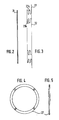
- the bellows 23, as shown in FIG. 3, is formed with an inner and an outer bellows part 23 a, b. These two parts 23 a, b are gas-tightly connected by means of the likewise metallic base plate 24 by welding or soldering.
- the metallic front plate 22 is connected to the bellows ends 32 and 33 (FIG. 3) in a gas-tight manner, preferably by soldering or welding.
- the inner bellows end 32 it is already sufficient, as shown, to connect it to the inner hub part 18 in a rotationally fixed and gas-tight manner together with the front plate 22 only by means of a clamp connection.
- the first ring 1 consists of a ring 26, a spring ring 27 (see also FIGS. 4 and 5) and a ring 28.
- the front plate 22 and the inner bellows edge 32 are together with the three rings 26, 27 and 28 mentioned clamped between an extension 25 of the inner hub part 18 and a snap ring 29.
- the thermostat 22, 23, 24 in the clamping device 25, 26, 27, 28, 29 is held in a pair of rings 37 made of insulating material.
- the described clamping device can also be replaced by a suitable screw connection.
- the ring 34 In addition to its task of conducting the heat from the front plate 22 well and quickly into the interior of the bellows 23, the ring 34 also has the task of preventing the bellows from being compressed inadmissibly. Its extension in the axial direction is therefore selected in accordance with the minimum permissible distance between the front plate 22 and base plate 24. So that the filling medium can communicate in front of and behind the spaces of the ring 34, the ring has notches 35 arranged distributed along its circumference.
- individual segments can also be arranged in a ring on the front plate 22.
- Other shapes, such as radial ribs (not shown) are also conceivable.
- the front plate 22 On its surface exposed to the cooling air flow, the front plate 22 carries cooling fins 36, which are also connected to the front plate 22 in a highly heat-conducting manner.
- the front plate 22 can be produced, for example together with the ring 34 and the cooling fins 36, in a pressing or casting process.
- the hub part 19 carrying the wings 20, 21 is injection molded onto the described thermostats 22, 23, 24.
- a friction lining 31 made of a material suitable for friction clutches is fastened on the base plate 24.
- a plate spring 30 Between a radially outwardly projecting ring flange of the ring 28 and the base plate 24 there is a plate spring 30. With this the pressure acting on the filling medium of the thermostat can be influenced and also the self-resilience of the bellows can be taken into account.
- the filling quantity of the liquid in the thermostat is chosen so that a certain amount of liquid remains in the thermostat without being evaporated over the entire working range, even at the highest operating temperatures, and is thus taken in rotation by the fan. This remaining amount of liquid should be such that the part of the contact pressure generated by its centrifugal force and acting axially on the coupling part alone is not sufficient to transmit the coupling and torque without a temperature-related gas pressure component.
- Trichlorotrifluoroethane (C 2 C1 3 F 3 ), which is known under the trade name «Frigen 113 " , can be used as the filling medium.
- the filling medium can also consist of two or more different liquids, but the boiling point of none of the substances is substantially below the desired switch-on temperature of the thermostat should be.
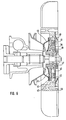
- a metal bellows is used in the embodiment of the fan according to the invention shown in FIG. 6, which bellows can be referred to as a bellows with a single shaft.
- the metal bellows shown in FIG. 6 is formed from two annular shells 38 and 39, the edges of which are connected in a gas-tight manner by soldering or welding, in order to create an annular cavity 40 concentrically surrounding the inner hub 18 of the fan.
- a ring 41 is provided as a good heat-conducting element, which is connected to the front plate 42 with good heat-conductivity, preferably also by soldering or welding.
- Grooves 43 are embedded on the circumference of the ring 41 in order to enable free circulation of the filling medium in the cavity 40.
- the fixed wall of the shell 38 is also connected to the front plate 42.
- a pressure plate 44 abutting against the resilient wall of the shell 39, the surface of which lies away from the shell is provided with a friction lining 45, is pressed against a counter disc 46 seated on the motor shaft 2 and so that the fan is coupled in the adhesion.
- the pressure plate 44 is axially displaceable on the inner fan hub 47 and is positively connected to it by means of teeth and grooves.
- the front plate 42 which is also fastened to the inner fan hub 47 and which is connected to the outer hub 48 which carries the fan blades, causes the fan blades to rotate when the pressure plate 44 and the counter disc 46 are coupled.
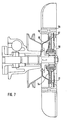
- the thermostat is formed by a bellows designed as an annular shell 61, the edges of which are directly soldered or welded to the front plate 50 in a gastight manner.
- the shell 61 in the exemplary embodiment comprises a very thin gas-tight metal foil (FIG. 8).
- This metal foil 51 is shell-shaped. However, it is extremely sensitive to pressure changes and must therefore be protected against overstress by support or protective shells.
- FIG. 10 shows a rigid, rigid support shell 52 for this purpose, the shape of which essentially corresponds to that of the shell 51. However, their surface is provided with slots 59 in order to ensure a good circulation of the filling medium in the bowl or. To allow bellows interior.
- the support shell 52 is also made of metal and at the same time fulfills the task of good heat transfer from the front plate 50 to the filling medium. It also serves as a spacer between the front plate 50 and the shell 51 in order to ensure a selectable minimum distance between the ring surface of the shell 51 and the front plate 50.
- the slots 59 of the shell 52 run in the radial direction and have the further task of reducing the rigidity of the support shell 52. Instead of the slots 59, however, openings of any shape and in any number and arrangement can also be selected.
- the support shell 52 has the task of securing the shell 51, which is formed from at least one very thin film, against overstressing from the outside, another ring-shaped shell 53, which is arranged as a protective shell on the outer surface of the shell 51, serves to overstress it to prevent the shell 51 by increased internal pressure.
- the shell 53 is also provided with radially extending slots 60 or other openings arranged as desired, but in contrast to the support shell 52 it can also consist of a plastic material, so that the stroke movement of the shell 51 required for the coupling when the filling medium is increased in pressure is not impeded becomes.
- the rigid support shell 52 has to resist the spring 54.
- the described, essentially mutually identical shells 53, 51 and 52 are pushed one above the other in the order mentioned and at their edges with the Front plate 50 united. At least the shells 51 and 52 formed from metal are soldered or welded gas-tight to the front plate 50 along their edge zones.
- one or more shells can also be made of plastic, provided that at least one shell 51 ensures a gas-tight connection to the front panel, which is achieved by choosing a metallic foil.
- the shell 53 since it has no sealing function, can also be made of plastic in order to achieve good elasticity. Only the plate 52, which in addition to its supporting function also has the task of good heat transfer from the front plate to the filling medium, should be made of a metallic material.
- a pressure plate 55 is also provided in the embodiment shown in FIG. 7, which is positively connected to the outer hub part 56 of the fan by means of teeth 57 and grooves 58.
- the mode of operation of the fan described in connection with FIG. 1 essentially corresponds to that of the training forms shown in FIGS. And 7, so that these no longer have to be discussed in detail.
Landscapes
- Engineering & Computer Science (AREA)
- General Engineering & Computer Science (AREA)
- Mechanical Engineering (AREA)
- Chemical & Material Sciences (AREA)
- Combustion & Propulsion (AREA)
- Physics & Mathematics (AREA)
- Fluid Mechanics (AREA)
- Structures Of Non-Positive Displacement Pumps (AREA)
- Control Of Positive-Displacement Air Blowers (AREA)
- Details Of Measuring And Other Instruments (AREA)
- Control Of Temperature (AREA)
- General Details Of Gearings (AREA)
Priority Applications (1)
| Application Number | Priority Date | Filing Date | Title |
|---|---|---|---|
| AT81109753T ATE19290T1 (de) | 1980-11-21 | 1981-11-19 | Selbsttaetig schaltbarer ventilator fuer kuehlsysteme von verbrennungsmotoren. |
Applications Claiming Priority (2)
| Application Number | Priority Date | Filing Date | Title |
|---|---|---|---|
| DE3043929 | 1980-11-21 | ||
| DE19803043929 DE3043929A1 (de) | 1980-11-21 | 1980-11-21 | "selbsttaetig schaltbarer ventilator fuer kuehlsysteme von verbrennungsmotoren" |
Publications (2)
| Publication Number | Publication Date |
|---|---|
| EP0052859A1 EP0052859A1 (de) | 1982-06-02 |
| EP0052859B1 true EP0052859B1 (de) | 1986-04-16 |
Family
ID=6117274
Family Applications (1)
| Application Number | Title | Priority Date | Filing Date |
|---|---|---|---|
| EP81109753A Expired EP0052859B1 (de) | 1980-11-21 | 1981-11-19 | Selbsttätig schaltbarer Ventilator für Kühlsysteme von Verbrennungsmotoren |
Country Status (5)
| Country | Link |
|---|---|
| EP (1) | EP0052859B1 (ref) |
| JP (1) | JPS57502010A (ref) |
| AT (1) | ATE19290T1 (ref) |
| DE (2) | DE3043929A1 (ref) |
| WO (1) | WO1982001740A1 (ref) |
Families Citing this family (2)
| Publication number | Priority date | Publication date | Assignee | Title |
|---|---|---|---|---|
| DE4035510A1 (de) * | 1990-04-12 | 1991-10-17 | Anton Ryba | Selbsttaetig schaltbarer ventilator fuer das kuehlsystem von kraftfahrzeugen |
| DE102006011119B4 (de) * | 2006-03-08 | 2016-05-25 | Karl Heinz Linnig Gmbh & Co. Kg | Kupplungsanordnung mit Wärmeausdehnungskupplung |
Family Cites Families (9)
| Publication number | Priority date | Publication date | Assignee | Title |
|---|---|---|---|---|
| US1233518A (en) * | 1916-04-18 | 1917-07-17 | Ross J Beatty | Automatically-controlled fan. |
| US2273306A (en) * | 1940-01-30 | 1942-02-17 | Clifford Mfg Co | Thermostatically controlled unit |
| US2487946A (en) * | 1945-06-14 | 1949-11-15 | Jurg A Senn | Thermal responsive device and mounting therefor |
| FR1261720A (fr) * | 1960-07-04 | 1961-05-19 | Thompson Ramo Wooldridge Inc | Accouplement sensible à la température |
| GB958138A (en) * | 1961-04-21 | 1964-05-13 | Smith & Sons Ltd S | Improvements in or relating to clutches controlled by heat responsive means |
| US3135495A (en) * | 1961-11-24 | 1964-06-02 | Kysor Heater Company | Thermostatic control valve |
| US3180325A (en) * | 1962-06-08 | 1965-04-27 | Roy L Neuhauser | Thermally responsive clutch assembly |
| US3797316A (en) * | 1971-12-22 | 1974-03-19 | Bailey Meter Co | Bellows temperature bulb sensor |
| AT369510B (de) * | 1975-10-22 | 1983-01-10 | Ryba Anton | Selbsttaetig schaltbarer ventilator fuer das kuehlsystem von verbrennungsmotoren |
-
1980
- 1980-11-21 DE DE19803043929 patent/DE3043929A1/de not_active Ceased
-
1981
- 1981-11-19 EP EP81109753A patent/EP0052859B1/de not_active Expired
- 1981-11-19 AT AT81109753T patent/ATE19290T1/de not_active IP Right Cessation
- 1981-11-19 JP JP56503684A patent/JPS57502010A/ja active Pending
- 1981-11-19 WO PCT/EP1981/000181 patent/WO1982001740A1/de not_active Ceased
- 1981-11-19 DE DE8181109753T patent/DE3174418D1/de not_active Expired
Also Published As
| Publication number | Publication date |
|---|---|
| EP0052859A1 (de) | 1982-06-02 |
| WO1982001740A1 (en) | 1982-05-27 |
| DE3043929A1 (de) | 1982-05-27 |
| JPS57502010A (ref) | 1982-11-11 |
| DE3174418D1 (en) | 1986-05-22 |
| ATE19290T1 (de) | 1986-05-15 |
Similar Documents
| Publication | Publication Date | Title |
|---|---|---|
| DE3739564C2 (ref) | ||
| DE2212367C3 (de) | Flüssigkeitsreibungskupplung, insbesondere für den Lüfterantrieb bei Brennkraftmaschinen | |
| DE3444928C2 (de) | Visko-Lüfterkupplung | |
| DE1575813C3 (de) | Bremsscheibe | |
| DE3938616C2 (de) | Temperaturabhängig gesteuerte Ventilatorflüssigkeitskuppung | |
| DE2635896C3 (de) | Selbsttätig schaltbarer Ventilator, insbesonders für Kühlsysteme von Verbrennungsmotoren | |
| DE4104928C2 (de) | Temperaturgesteuerte Ventilatorflüssigkeitskupplung | |
| DE2444843C2 (de) | Spiralförmige Drehdichtung mit einem Fluid zur Abdichtung einer rotierenden Welle | |
| DE1218227B (de) | Fluessigkeitsreibungskupplung | |
| DE3831832A1 (de) | Temperaturfuehlende ventilatorfluessigkeitskupplung | |
| DE1286842B (de) | Fluessigkeitsreibungskupplung | |
| DE4013216A1 (de) | Elektromagnetische steueranordnung fuer eine viskosfluid-geblaesekupplung | |
| DE2553661A1 (de) | Viskositaetskupplung | |
| DE1939402U (de) | Fluessigkeitskupplung. | |
| DE2602608B2 (de) | Temperaturabhaengig betaetigte hydraulische kupplung | |
| DE1284186B (de) | Fluessigkeitsreibungskupplung | |
| DE2637694C2 (de) | Flüssigkeitskupplung für den Antrieb eines Kühlgebläserades einer Brennkraftmaschine | |
| DE19635338C2 (de) | Wärmegenerator mit viskosem Fluid und optimaler Lagerschmierung | |
| EP0052859B1 (de) | Selbsttätig schaltbarer Ventilator für Kühlsysteme von Verbrennungsmotoren | |
| DE2814608B2 (de) | Flüssigkeitsreibungskupplung | |
| DE4125396A1 (de) | Temperaturgesteuerte fluidreibkupplung | |
| EP0134548B1 (de) | Flüssigkeitsreibungskupplung | |
| EP0451451B1 (de) | Selbsttätig schaltbarer Ventilator für das Kühlsystem von Kraftfahrzeugen | |
| DE4125397A1 (de) | Temperaturgesteuerte fluidreibkupplung | |
| DE69306731T2 (de) | Bei hohen Temperaturen ausschaltbare Flüssigkeitskupplung |
Legal Events
| Date | Code | Title | Description |
|---|---|---|---|
| PUAI | Public reference made under article 153(3) epc to a published international application that has entered the european phase |
Free format text: ORIGINAL CODE: 0009012 |
|
| AK | Designated contracting states |
Designated state(s): AT DE FR GB IT NL SE |
|
| 17P | Request for examination filed |
Effective date: 19820513 |
|
| GRAA | (expected) grant |
Free format text: ORIGINAL CODE: 0009210 |
|
| AK | Designated contracting states |
Kind code of ref document: B1 Designated state(s): AT DE FR GB IT NL SE |
|
| PG25 | Lapsed in a contracting state [announced via postgrant information from national office to epo] |
Ref country code: NL Effective date: 19860416 Ref country code: IT Free format text: LAPSE BECAUSE OF FAILURE TO SUBMIT A TRANSLATION OF THE DESCRIPTION OR TO PAY THE FEE WITHIN THE PRESCRIBED TIME-LIMIT;WARNING: LAPSES OF ITALIAN PATENTS WITH EFFECTIVE DATE BEFORE 2007 MAY HAVE OCCURRED AT ANY TIME BEFORE 2007. THE CORRECT EFFECTIVE DATE MAY BE DIFFERENT FROM THE ONE RECORDED. Effective date: 19860416 Ref country code: FR Free format text: THE PATENT HAS BEEN ANNULLED BY A DECISION OF A NATIONAL AUTHORITY Effective date: 19860416 |
|
| REF | Corresponds to: |
Ref document number: 19290 Country of ref document: AT Date of ref document: 19860515 Kind code of ref document: T |
|
| PG25 | Lapsed in a contracting state [announced via postgrant information from national office to epo] |
Ref country code: SE Effective date: 19860430 |
|
| REF | Corresponds to: |
Ref document number: 3174418 Country of ref document: DE Date of ref document: 19860522 |
|
| RAP2 | Party data changed (patent owner data changed or rights of a patent transferred) |
Owner name: AUVE PATENTVERWERTUNGS GMBH |
|
| EN | Fr: translation not filed | ||
| NLV1 | Nl: lapsed or annulled due to failure to fulfill the requirements of art. 29p and 29m of the patents act | ||
| PG25 | Lapsed in a contracting state [announced via postgrant information from national office to epo] |
Ref country code: AT Effective date: 19861119 |
|
| PLBE | No opposition filed within time limit |
Free format text: ORIGINAL CODE: 0009261 |
|
| STAA | Information on the status of an ep patent application or granted ep patent |
Free format text: STATUS: NO OPPOSITION FILED WITHIN TIME LIMIT |
|
| 26N | No opposition filed | ||
| GBPC | Gb: european patent ceased through non-payment of renewal fee | ||
| PG25 | Lapsed in a contracting state [announced via postgrant information from national office to epo] |
Ref country code: DE Effective date: 19870801 |
|
| PG25 | Lapsed in a contracting state [announced via postgrant information from national office to epo] |
Ref country code: GB Effective date: 19881118 |