EP0052376A2 - Gasentladungsanzeigetafel - Google Patents
Gasentladungsanzeigetafel Download PDFInfo
- Publication number
- EP0052376A2 EP0052376A2 EP81109741A EP81109741A EP0052376A2 EP 0052376 A2 EP0052376 A2 EP 0052376A2 EP 81109741 A EP81109741 A EP 81109741A EP 81109741 A EP81109741 A EP 81109741A EP 0052376 A2 EP0052376 A2 EP 0052376A2
- Authority
- EP
- European Patent Office
- Prior art keywords
- substrate
- electrode
- substrates
- face
- gas discharge
- Prior art date
- Legal status (The legal status is an assumption and is not a legal conclusion. Google has not performed a legal analysis and makes no representation as to the accuracy of the status listed.)
- Granted
Links
Images


Classifications
-
- H—ELECTRICITY
- H01—ELECTRIC ELEMENTS
- H01J—ELECTRIC DISCHARGE TUBES OR DISCHARGE LAMPS
- H01J11/00—Gas-filled discharge tubes with alternating current induction of the discharge, e.g. alternating current plasma display panels [AC-PDP]; Gas-filled discharge tubes without any main electrode inside the vessel; Gas-filled discharge tubes with at least one main electrode outside the vessel
Definitions
- This invention relates to a display panel utilizing gas discharge, particularly to a new Large size panel structure for the surface discharge type or monolithic type or planar type gas discharge panel.
- the surface discharge type monolithic type or planar type is employed as a kind of gas discharge panel.
- the gas discharge panel of this type as is well known, for example, from the U.S. patent no. 3,646,384 issued Feb. 29, 1972 to Frank M. Lay, provides the characteristic that the X electrodes and Y electrodes are Laid only on the one substrate among a pair of substrates arranged face-to-face via the gas fiLLed.space and the horizontal discharge is generated along the substrate surface in the area near to the intersecting points of both said electrodes.
- such a structure provides the advantages that the requirement on accuracy of the gap between paired substrates (discharge gap) is drastically alleviated as compared with the panel.having the face-to-face electrode structure, and moreover a conversion of the display color and a multi-coloration can be realized easily by providing the ultra-violet rays activation type fluorescent material at the internal side of the covering substrate.
- RecentLy it has been desired for the display device utilizing such a gas discharge panel to display Large size images and figures and a Large amount of characters and therefore the pertinent panel is in demand of increase in size.
- said surface discharge panel provides the advantage, as explained above, that the panels having the uniform discharge characteristic can easily be obtained depending on the flatness of the glass substrate used because a high discharge gap accuracy is not required. But even this surface discharge panel provides a problem that the probability of generating electrode disconnection and termination of electrode per substrate becomes high, as the panel size is enlarged and resuLtingLy the number of electrodes is increased, and as a result the yield of the panel production is drastically Lowered. In addition, such a panel provides a problem that a Large scale facility is required for the formation of the electrodes.
- the gas discharge panel of the present invention is characterized in that a plurality of electrode supporting substrates which support the electrode pairs of the specified pattern are combined in such a form that the side edge surface of the pertinent substrates arranged face-to-face and the single Large size covering substrate are arranged face-to-face at the upper side of this combined substrate via the specified gas discharge space.
- the fluorescent material is provided as required,opposing to the electrode pairs in view of obtaining the desired display order.
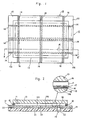
- the display panel 10 is basically composed of the flat type,hermeticaLLy sealed body consisting of a pair of Large size glass substrates 12 and 13 which are combined face-to-face via the discharge gas space 11.
- the one (upper) glass substrate 13 which functions as the cover substrate has the single plate structure
- the combination substrate is called hereafter"the combination substrate".
- Said four glass substrates 121, 122, 123, 124 respectively provide on the substrate a plurality of Y electrodes 14 extending in the horizontal direction and also provide thereon a plurality of X electrodes 15 extending in the vertical direction via the evaporated insulating film 15 consisting of the borosilicate glass.
- the dielectric Layer 17 consisting of the borosilicate glass or evaporated film such as aluminium oxide etc. is provided and moreover it is covered with the surface Layer consisting of the evaporated film of magnesium oxide (Mg0) which is not illustrated.
- the one end of the Y electrode group and X electrode group of said respective substrate is respectively aligned so that the pertinent electrodes are arranged in the Line bridging over the adjacent two substrates, as indicated below, and moreover the other end is respectively exposed to the outside so that it becomes the connecting terminal for the external drive circuit.
- the X electrodes and Y electrodes on the two sheets of substrate arranged on the same Line can be used respectively as a single X electrode and Y electrode when they are electrically connected at the inside or outside of the panel, or they can be used as an electrode having an independent function.
- Said Y, X electrodes 14, 16 are all formed by the method of patterning the evaporated conductive Layer of Cu-AL alloy etc. by the photo- exposing method.
- the seal material 18 consisting of a Low melting point glass etc. is provided at the circumference between the glass substrate 13 for covering and the combination substrate 12, and the mixed gas of Xe-He is supplied through the chip pipe 19 and exhaust port 20 and filled in the sealed gas space 11.
- a Large size supporting substrate 21 for reinforcing the panel is arranged at the Lower side of said combination substrate 12.
- the Low melting point glass 22 to be used for bonding purpose is also provided at the circumference and the corresponding areas of aligning portion of said electrode supporting substrates 121 to 124 on said supporting substrate 21 and this bonding material 22 realizes the junction for combining the four sheets of electrode supporting substrates and the aggregation between the pertinent combination substrate 12 and the supporting substrate 21.
- 23 is the through hole for accepting said chip pipe 19.
- Such a Large size display panel can be driven as explained below. NameLy, the matrix address drive at the entire part of thepanel becomes possible by electrically connecting the electrodes on the same Line of the adjacent two sheets of the electrode supporting substrates at the outside, and in the case that the electrodes are not electrically connected between the electrode substrates, the partial matrix address drive for each electrode supporting substrate becomes possible.
- the drive circuit can be simplified and in the Latter case, the drive circuit is complicated but the high speed address indication can be attained.
- the basic embodiment of the present invention is explained above but the subject matter of the present invention is not Limited only to this embodiment and allows diversified modification and expansion.
- the modification examples can be Listed as follows.
- the supporting substrate for reinforcing the panel described above is not always required. However, if it is not used, a thick electrode supporting substrate should be used. In addition, the Low-meLting point glass must be provided for the bonding purpose at the aligning portion of substrates (between the side edge surfaces). This bonding structure can also be adopted in case the supporting substrate for the panel reinforcement is used.
- the electrodes and dielectric Layers can be formed not only by said thin film technique but also by the thick film technique.
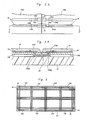
- the chip pipe 19' can be provided on said supporting substrate 21 as shown in the sectional view of Fig. 3 by hermeticaLLy sealing the circumference of the combination substrate 12 to the supporting substrate 21.
- the portion given the numbering 191 is the low-melting-point glass for bonding the chip pipe 19' to the supporting substrate 21.
- the space between the combination substrate 12 and the supporting substrate 21 is set to the same pneumatic pressure condition as the discharge gas filled space 11. Therefore, there is no fear of deforming said combination substrate 12 due to the external pneumatic pressure on the occasion of the baking after exhausting the pressure from the gas filled space 11 or at the time of actual display operation.
- this method has the following merits that the gap of the gas filled space 11 can be kept constant and the weight of panel as a whole can be reduced because a thin and Light weight material can be used for the electrode supporting substrate which configurates the-combination substrate 12.
- the practical values can be adopted as follows.
- the circumference of the panel must be sealed under the condition that the side edges of the electrode supporting substrates are hermetically sealed and in this case more reliable sealing between the electrode supporting substrate edges can be obtained as the electrode supporting substrate is thinner.
- the number of sheets of electrode supporting substrates combined is not Limited to the four explained above and more sheets of substrate can also be used.
- the electrodes Located on the same Line bridging over the adjacent substrates are electrically connected via the connecting wires by the well known bonding technique under the condition that these substrates are arranged face to face.
- Fig. 5A shows the plan view of the major portion indicating the connecting structure of the Y electrodes 14 on the same Line of the adjacent two sheets of the electrode supporting substrates 124, 128 in the horizontal direction
- Fig. 5B shows the sectional view along the Line V-V of Fig. 5A.
- 1241 and 1281 are through holes
- 1242 and 1282 are electrode Leadout conductors
- 31 is the electrode connecting conductor.
- alumina ceramic is used.
- a plurality of through holes 1241, 1281 in diameter of about 0,5 mm are bored by the Laser machining technique at the specified Locations of the edges of junction side with the other ceramic substrate (electrode substrate) of this ceramic substrate.
- an Au paste is printed in such a form as matching the Y electrode pattern respectively on the front and rear surfaces of the ceramic substrates on which said through holes are bored.
- the Au pastes printed at the front and rear sides of substrate become continuous.
- said Au paste is baked, and thereby said electrode Leadout conductors 1242, 1282 are formed.
- the evaporated conductive Layer of the Cu-AL alloy is coated in accordance with the Y electrode pattern on the surface of the ceramic substrate and the desired Y electrode 14 is formed. In this case, as shown in Fig. 5, the edge of the Y electrode is stacked at the one end of said electrode Leadout conductor and is electrically connected.
- the evaporated film 15 of the borosilicate glass is formed on the surface of the ceramic substrate. Succeedingly, the X electrode and its Leadout conductor, although they are not illustrated, are formed by the above mentioned production method.
- the above mentioned electrode supporting substrates 124, 128' are completed through the aforementioned production processes.
- such electrode supporting substrates are combined in the next step on the supporting substrate - 21 for reinforcement with the edge surfaces where the electrode Leadout conductors 1242, 1282 are formed and are mutualLy aligned face to face.
- the Au paste '31 for connecting said electrode Leadout conductors '1242, 1282 is printed previously at the specified position on the substrate mounting surface of said supporting substrate 21 for reinforcement.
- the electrode Leadout conductors 1242, 1282 are provided closely on the connecting conductor 31 consisting of the printed conductor paste. Thereafter, such a conductor is baked and melted. Thereby, both conductors 1242, 1282 are electrically connected.
- the electrodes in the same sequence on the same Line of the Y and X electrodes 14 and 16 of the combined nine sheets of electrode supporting substrates 121, 122, 123, 124, 125, 126, 127, 128 and 129 are electrically connected as shown in Fig. 4, and resultingly these function one by one as the matrix electrode of a Large size display panel.
- the chip pipe structure is not Limited to that indicated in this wiring example, but is recommended to have the structure shown in Fig. 3.
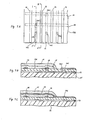
- the third wiring method the method effective for producing a rectangular Large size panel, which is composed of combined electrode supporting substrates arranged in two columns in thewertical direction as shown in Fig. 6, will be explained.
- this method is characterized in that the electrode supporting substrates 121, 122, 123, 124, 125, 126, 127 and 128 are independently driven in view of obtaining a high quality display by uniforming the operation margin of said electrode supporting substrates.
- the external connecting terminals of the X electrode and Y electrode are guided out from the remaining one side of central four electrode supporting substrates 122, 123, 126, 127 with three sides arranged face to face adjacently.
- FIG. 7A shows the plan view of the principal portion of the electrode supporting substrate 126 employing this method, while Fig. 7B and C respectively show the sectional views along the Lines I-I' and II-II' of Fig. 7A.
- 1261 is the through hole;
- 141 is the electrode Leadout conductor consisting of the Au paste for connecting the Y electrode 14 to the external drive circuit.
- the alumina ceramic material is used, and said through hole (1261) and said electrode Leadout conductor (141) of this ceramic substrate are formed by the method shown in Fig. 5.
- a Larger display panel can also be configurated by combining a plurality of Large size gas discharge panels shown in Fig. 1, Fig. 4, and Fig. 6. In this case, it is recommended for the method of combining the discrete panels to refer to the method described in the aforementioned U.S. patent no. 3,886,390.
- the color conversion or the multi-color display can be realized by providing the ultra-violet rays activation type fluorescent material having the specified display color within the gas filled space of the panel or at the outside of the panel.
- the fluorescent material 24 is provided at the internal surface of the covering glass substrate 13 as shown in Fig. 2. In this case, it is only required that the fluorescent material having the specified display color is formed on the entire portion of the internal wall of said substrate, if the panel is the single color display panel only intended to the color conversion.
- the fluorescent material which partially shows the display of blue, red and green is provided as required in said internal surface of the substrates respectively corresponding to the display areas being composed of the intersecting points of the Y electrode group 14 and X electrode group 16.
- the embodiment shown in Fig. 2 uses the mixed gas of Xe and He as the display gas and therefore (Y ⁇ Gd)BO 3 : Eu is recommended as the fluorescent material for the display in red, while BaMgAl 14 0 23 :Eu for the display in blue and Zn 2 SiO 4 :Eu for the display in green respectively are recommended.
- the fluorescent material 24 of said fluorescent material supporting substrate can be formed by the procedures explained previously.
- the portion 51 is the spacer and 52 is the bonding material.
- This embodiment provides a Large merit that the Large scale facility is not required for the processing of the fluorescent material for providing the Large size multi-color display panel.
- the third embodiment has the structure that the Large size fluorescent material supporting substrates 61 forming the fluorescent material 24 are arranged face to face at the external wall surface of said covering glass substrate 13.
- the fluorescent material is provided at the external side of the panel and in this case sufficient consideration must be paid for the Light emitting efficiency of the fluorescent material, the prevention of the optical crosstalk between the Light emitting points and the humidity proof of the fluorescent material.
- the mixed gas of Ar + N 2 is used as the discharge gas
- a glass material of corning 9-54, 9700 produced by Corning Corp. in the thickness of 1mm is used as the glass substrate for covering
- YO 2 S:Eu , ZnS:Ag, ZnS:Cu-AL as the fluorescent material, respectively, are used.
- the bored insulating substrate 62 for obtaining an independent discharge area is provided in the gas filled space 11, simultaneously the circumference of said fluorescent material supporting substrate 61 is sealed by the frit material 63 and the dry gas is filled into the sealed space between said substrate 61 and the covering glass substrate 13.
- a comparatively thick glass substrate of 2 mm is used for said fluorescent material supporting substrate 61 and this substrate shows the effect of reinforcing said covering glass substrate 13 in combination with said bored insulating substrate 62.
- This embodiment allows the fluorescent material to be provided after the completion of panel, following the assembling of the electrode supporting substrates and covering glass substrates and resuLtingLy offers the advantage that the flexibility of panel for the demand of display color increases. It is required to provide the pertinent fluorescent material only for the completed panel and therefore the production yield of multi-color display panel can fantastically be improved. i Other expansion examples are also Listed below.
- the matrix type electrode structure proposed in the U.S. patent no. 4,164,678 can also be used in addition to the above mentioned double Layered structure.
- This electrode structure will be briefly explained below.
- the electrode pad having a floating structure which capacitively couples with the Lower Layer electrode (Y eLectrode) is provided at the position near to the single side of the upper Layer electrode (X eLectrode) and a discharge is caused at the area between said upper Layer electrode and the pertinent electrode pad.
- the present invention is intended for a surface discharge type gas discharge panel which realizes a Large size display panel, and is characterized in that a plurality of small size electrode supporting substrates which can be produced comparatively easily with a high production yield is combined in such a form that the side edge surfaces of said substrates are aligned face to face and a single Large size cover substrate is also arranged face to face at the upper part of this combination substrate.
- a Large size gas discharge display panel having a high production yield can be produced without requiring a Large scale production facility.
- a Large size multi-color display panel can be obtained by providing the fluorescent material in the gas filled space specified by a pair of substrates arranged face to face or at the external wall surface of the substrate.
Landscapes
- Physics & Mathematics (AREA)
- Engineering & Computer Science (AREA)
- Plasma & Fusion (AREA)
- Gas-Filled Discharge Tubes (AREA)
- Devices For Indicating Variable Information By Combining Individual Elements (AREA)
Applications Claiming Priority (2)
| Application Number | Priority Date | Filing Date | Title |
|---|---|---|---|
| JP55163712A JPS5787048A (en) | 1980-11-19 | 1980-11-19 | Gas discharge panel |
| JP163712/80 | 1980-11-19 |
Publications (3)
| Publication Number | Publication Date |
|---|---|
| EP0052376A2 true EP0052376A2 (de) | 1982-05-26 |
| EP0052376A3 EP0052376A3 (en) | 1983-02-23 |
| EP0052376B1 EP0052376B1 (de) | 1987-02-11 |
Family
ID=15779198
Family Applications (1)
| Application Number | Title | Priority Date | Filing Date |
|---|---|---|---|
| EP81109741A Expired EP0052376B1 (de) | 1980-11-19 | 1981-11-17 | Gasentladungsanzeigetafel |
Country Status (4)
| Country | Link |
|---|---|
| US (1) | US4697123A (de) |
| EP (1) | EP0052376B1 (de) |
| JP (1) | JPS5787048A (de) |
| DE (1) | DE3175921D1 (de) |
Families Citing this family (16)
| Publication number | Priority date | Publication date | Assignee | Title |
|---|---|---|---|---|
| KR940004290B1 (ko) * | 1991-11-27 | 1994-05-19 | 삼성전관 주식회사 | 플라즈마 어드레스 방식의 액정표시소자와 그 제조 방법 |
| JPH0637092U (ja) * | 1992-10-27 | 1994-05-17 | ワン ソン−チン | 緩衝折畳み自転車 |
| JPH0730192U (ja) * | 1993-11-18 | 1995-06-06 | 水雲 林 | 折畳式自転車 |
| US6710525B1 (en) * | 1999-10-19 | 2004-03-23 | Candescent Technologies Corporation | Electrode structure and method for forming electrode structure for a flat panel display |
| US6570335B1 (en) | 2000-10-27 | 2003-05-27 | Science Applications International Corporation | Method and system for energizing a micro-component in a light-emitting panel |
| US6801001B2 (en) * | 2000-10-27 | 2004-10-05 | Science Applications International Corporation | Method and apparatus for addressing micro-components in a plasma display panel |
| US6764367B2 (en) * | 2000-10-27 | 2004-07-20 | Science Applications International Corporation | Liquid manufacturing processes for panel layer fabrication |
| US6796867B2 (en) * | 2000-10-27 | 2004-09-28 | Science Applications International Corporation | Use of printing and other technology for micro-component placement |
| US6762566B1 (en) | 2000-10-27 | 2004-07-13 | Science Applications International Corporation | Micro-component for use in a light-emitting panel |
| US6612889B1 (en) * | 2000-10-27 | 2003-09-02 | Science Applications International Corporation | Method for making a light-emitting panel |
| US6545422B1 (en) * | 2000-10-27 | 2003-04-08 | Science Applications International Corporation | Socket for use with a micro-component in a light-emitting panel |
| US6620012B1 (en) | 2000-10-27 | 2003-09-16 | Science Applications International Corporation | Method for testing a light-emitting panel and the components therein |
| US7288014B1 (en) | 2000-10-27 | 2007-10-30 | Science Applications International Corporation | Design, fabrication, testing, and conditioning of micro-components for use in a light-emitting panel |
| US6822626B2 (en) | 2000-10-27 | 2004-11-23 | Science Applications International Corporation | Design, fabrication, testing, and conditioning of micro-components for use in a light-emitting panel |
| US6935913B2 (en) * | 2000-10-27 | 2005-08-30 | Science Applications International Corporation | Method for on-line testing of a light emitting panel |
| US20050189164A1 (en) * | 2004-02-26 | 2005-09-01 | Chang Chi L. | Speaker enclosure having outer flared tube |
Family Cites Families (5)
| Publication number | Priority date | Publication date | Assignee | Title |
|---|---|---|---|---|
| NL6909119A (de) * | 1969-06-13 | 1970-12-15 | ||
| US3646384A (en) * | 1970-06-09 | 1972-02-29 | Ibm | One-sided plasma display panel |
| US4035689A (en) * | 1974-07-12 | 1977-07-12 | Burroughs Corporation | Panel-type display device |
| US3886390A (en) * | 1974-08-29 | 1975-05-27 | Burroughs Corp | Buttable, gaseous discharge, display panel including electrodes providing a dot matrix display |
| US4100456A (en) * | 1976-02-06 | 1978-07-11 | Nippon Electric Kagoshima, Ltd. | Luminescent display panel comprising a sealing mass for eliminating slow leaks along leads |
-
1980
- 1980-11-19 JP JP55163712A patent/JPS5787048A/ja active Granted
-
1981
- 1981-11-09 US US06/319,404 patent/US4697123A/en not_active Expired - Lifetime
- 1981-11-17 DE DE8181109741T patent/DE3175921D1/de not_active Expired
- 1981-11-17 EP EP81109741A patent/EP0052376B1/de not_active Expired
Also Published As
| Publication number | Publication date |
|---|---|
| DE3175921D1 (en) | 1987-03-19 |
| US4697123A (en) | 1987-09-29 |
| JPH0221093B2 (de) | 1990-05-11 |
| JPS5787048A (en) | 1982-05-31 |
| EP0052376A3 (en) | 1983-02-23 |
| EP0052376B1 (de) | 1987-02-11 |
Similar Documents
| Publication | Publication Date | Title |
|---|---|---|
| EP0052376B1 (de) | Gasentladungsanzeigetafel | |
| US5747931A (en) | Plasma display and method of making same | |
| US5925203A (en) | Method of making a plasma display | |
| US5493175A (en) | Plasma display panel | |
| JPH0217899B2 (de) | ||
| KR100334168B1 (ko) | 평면표시패널 | |
| KR100869109B1 (ko) | 얼라인 마크부를 가지는 플라즈마 디스플레이 패널과, 이의제조방법 | |
| US20080129657A1 (en) | Plasma display panel | |
| US4725255A (en) | Gas discharge display device | |
| JPS5871534A (ja) | ガス放電パネル | |
| CN1178265C (zh) | 单面装载驱动电路的等离子体显示器及其制造方法 | |
| JPS6178036A (ja) | 螢光表示管 | |
| JPS603487Y2 (ja) | 螢光表示管用基板装置 | |
| JPH05159707A (ja) | カラープラズマディスプレイパネル | |
| JPS5873941A (ja) | ガス放電パネル | |
| JPH05159706A (ja) | カラープラズマディスプレイパネル | |
| JPH0495330A (ja) | ガス放電パネル | |
| JPH034429A (ja) | ガス放電パネル | |
| JPH0318298B2 (de) | ||
| JPH01276537A (ja) | 厚膜導体及び薄膜導体の接続方法並びにプラズマ放電発光装置 | |
| JPH02144834A (ja) | 蛍光表示管 | |
| JP2002203485A (ja) | プラズマ表示装置用基板とその製造方法及びこれを用いたプラズマ表示装置 | |
| JPS6012734B2 (ja) | ガス放電パネル | |
| US20090015518A1 (en) | Plasma display panel |
Legal Events
| Date | Code | Title | Description |
|---|---|---|---|
| PUAI | Public reference made under article 153(3) epc to a published international application that has entered the european phase |
Free format text: ORIGINAL CODE: 0009012 |
|
| AK | Designated contracting states |
Designated state(s): DE FR GB NL |
|
| PUAL | Search report despatched |
Free format text: ORIGINAL CODE: 0009013 |
|
| AK | Designated contracting states |
Designated state(s): DE FR GB NL |
|
| 17P | Request for examination filed |
Effective date: 19830630 |
|
| GRAA | (expected) grant |
Free format text: ORIGINAL CODE: 0009210 |
|
| AK | Designated contracting states |
Kind code of ref document: B1 Designated state(s): DE FR GB NL |
|
| ET | Fr: translation filed | ||
| REF | Corresponds to: |
Ref document number: 3175921 Country of ref document: DE Date of ref document: 19870319 |
|
| PLBE | No opposition filed within time limit |
Free format text: ORIGINAL CODE: 0009261 |
|
| STAA | Information on the status of an ep patent application or granted ep patent |
Free format text: STATUS: NO OPPOSITION FILED WITHIN TIME LIMIT |
|
| 26N | No opposition filed | ||
| PGFP | Annual fee paid to national office [announced via postgrant information from national office to epo] |
Ref country code: NL Payment date: 19921130 Year of fee payment: 12 |
|
| PG25 | Lapsed in a contracting state [announced via postgrant information from national office to epo] |
Ref country code: NL Effective date: 19940601 |
|
| NLV4 | Nl: lapsed or anulled due to non-payment of the annual fee | ||
| PGFP | Annual fee paid to national office [announced via postgrant information from national office to epo] |
Ref country code: FR Payment date: 19981110 Year of fee payment: 18 |
|
| PGFP | Annual fee paid to national office [announced via postgrant information from national office to epo] |
Ref country code: GB Payment date: 19981120 Year of fee payment: 18 Ref country code: DE Payment date: 19981120 Year of fee payment: 18 |
|
| PG25 | Lapsed in a contracting state [announced via postgrant information from national office to epo] |
Ref country code: GB Free format text: LAPSE BECAUSE OF NON-PAYMENT OF DUE FEES Effective date: 19991117 |
|
| GBPC | Gb: european patent ceased through non-payment of renewal fee |
Effective date: 19991117 |
|
| PG25 | Lapsed in a contracting state [announced via postgrant information from national office to epo] |
Ref country code: FR Free format text: LAPSE BECAUSE OF NON-PAYMENT OF DUE FEES Effective date: 20000731 |
|
| PG25 | Lapsed in a contracting state [announced via postgrant information from national office to epo] |
Ref country code: DE Free format text: LAPSE BECAUSE OF NON-PAYMENT OF DUE FEES Effective date: 20000901 |
|
| REG | Reference to a national code |
Ref country code: FR Ref legal event code: ST |