EP0046953A2 - Aminosäurederivate, Verfahren zu ihrer Herstellung, diese enthaltende Mittel und deren Verwendung - Google Patents
Aminosäurederivate, Verfahren zu ihrer Herstellung, diese enthaltende Mittel und deren Verwendung Download PDFInfo
- Publication number
- EP0046953A2 EP0046953A2 EP81106535A EP81106535A EP0046953A2 EP 0046953 A2 EP0046953 A2 EP 0046953A2 EP 81106535 A EP81106535 A EP 81106535A EP 81106535 A EP81106535 A EP 81106535A EP 0046953 A2 EP0046953 A2 EP 0046953A2
- Authority
- EP
- European Patent Office
- Prior art keywords
- carbon atoms
- formula
- compound
- alkyl
- carboxylic acid
- Prior art date
- Legal status (The legal status is an assumption and is not a legal conclusion. Google has not performed a legal analysis and makes no representation as to the accuracy of the status listed.)
- Granted
Links
- RIRARCHMRDHZAR-PKPIPKONSA-N C[C@@H]1C(C)CCC1 Chemical compound C[C@@H]1C(C)CCC1 RIRARCHMRDHZAR-PKPIPKONSA-N 0.000 description 1
Classifications
-
- C—CHEMISTRY; METALLURGY
- C07—ORGANIC CHEMISTRY
- C07D—HETEROCYCLIC COMPOUNDS
- C07D209/00—Heterocyclic compounds containing five-membered rings, condensed with other rings, with one nitrogen atom as the only ring hetero atom
- C07D209/02—Heterocyclic compounds containing five-membered rings, condensed with other rings, with one nitrogen atom as the only ring hetero atom condensed with one carbocyclic ring
- C07D209/04—Indoles; Hydrogenated indoles
- C07D209/30—Indoles; Hydrogenated indoles with hetero atoms or with carbon atoms having three bonds to hetero atoms with at the most one bond to halogen, directly attached to carbon atoms of the hetero ring
- C07D209/42—Carbon atoms having three bonds to hetero atoms with at the most one bond to halogen, e.g. ester or nitrile radicals
-
- C—CHEMISTRY; METALLURGY
- C07—ORGANIC CHEMISTRY
- C07K—PEPTIDES
- C07K5/00—Peptides containing up to four amino acids in a fully defined sequence; Derivatives thereof
- C07K5/02—Peptides containing up to four amino acids in a fully defined sequence; Derivatives thereof containing at least one abnormal peptide link
- C07K5/022—Peptides containing up to four amino acids in a fully defined sequence; Derivatives thereof containing at least one abnormal peptide link containing the structure -X-C(=O)-(C)n-N-C-C(=O)-Y-; X and Y being heteroatoms; n being 1 or 2
- C07K5/0222—Peptides containing up to four amino acids in a fully defined sequence; Derivatives thereof containing at least one abnormal peptide link containing the structure -X-C(=O)-(C)n-N-C-C(=O)-Y-; X and Y being heteroatoms; n being 1 or 2 with the first amino acid being heterocyclic, e.g. Pro, Trp
-
- A—HUMAN NECESSITIES
- A61—MEDICAL OR VETERINARY SCIENCE; HYGIENE
- A61P—SPECIFIC THERAPEUTIC ACTIVITY OF CHEMICAL COMPOUNDS OR MEDICINAL PREPARATIONS
- A61P9/00—Drugs for disorders of the cardiovascular system
- A61P9/12—Antihypertensives
-
- C—CHEMISTRY; METALLURGY
- C07—ORGANIC CHEMISTRY
- C07D—HETEROCYCLIC COMPOUNDS
- C07D217/00—Heterocyclic compounds containing isoquinoline or hydrogenated isoquinoline ring systems
- C07D217/22—Heterocyclic compounds containing isoquinoline or hydrogenated isoquinoline ring systems with hetero atoms or with carbon atoms having three bonds to hetero atoms with at the most one bond to halogen, e.g. ester or nitrile radicals, directly attached to carbon atoms of the nitrogen-containing ring
- C07D217/26—Carbon atoms having three bonds to hetero atoms with at the most one bond to halogen
-
- C—CHEMISTRY; METALLURGY
- C07—ORGANIC CHEMISTRY
- C07D—HETEROCYCLIC COMPOUNDS
- C07D401/00—Heterocyclic compounds containing two or more hetero rings, having nitrogen atoms as the only ring hetero atoms, at least one ring being a six-membered ring with only one nitrogen atom
- C07D401/02—Heterocyclic compounds containing two or more hetero rings, having nitrogen atoms as the only ring hetero atoms, at least one ring being a six-membered ring with only one nitrogen atom containing two hetero rings
- C07D401/06—Heterocyclic compounds containing two or more hetero rings, having nitrogen atoms as the only ring hetero atoms, at least one ring being a six-membered ring with only one nitrogen atom containing two hetero rings linked by a carbon chain containing only aliphatic carbon atoms
-
- A—HUMAN NECESSITIES
- A61—MEDICAL OR VETERINARY SCIENCE; HYGIENE
- A61K—PREPARATIONS FOR MEDICAL, DENTAL OR TOILETRY PURPOSES
- A61K38/00—Medicinal preparations containing peptides
Definitions
- the 5- to 7-membered mono- or 9-, 10-membered bicyclic heterocycles can be unsubstituted, but can also carry one or more identical or different substituents such as halogen, oxygen (also sulfoxide or sulfone), hydroxyl, carboxy, carbonamido, sulfonamido , Nitro, alkyl and aralkyl with up to 9 carbon atoms, methoxy or ethoxy. In the case of substitution, mono- or disubstitution is preferred.
- R 3 Preferred meanings for R 3 are: hydrogen, ethyl, butyl, t-butyl, benzyl, p-nitrobenzyl.
- alkyl is preferably to be understood as straight-chain or branched alkyl having 1 to 6 carbon atoms.
- alkanoyl, alkylamino, alkylmercapto is preferably to be understood as straight-chain or branched alkyl having 1 to 6 carbon atoms.
- alkanoyl, alkylamino, alkylmercapto is preferably to be understood as straight-chain or branched alkyl having 1 to 6 carbon atoms.
- alkanoyl, alkylamino, alkylmercapto is preferably to be understood as straight-chain or branched alkyl having 1 to 6 carbon atoms.
- Aryl preferably means phenyl, phenyl or naphthyl substituted by halogen, alkyl or alkoxy. The same applies to aroyl, arylamino, arylmercapto.
- Aralkyl preferably comprises benzyl, phenethyl and the corresponding compounds substituted in the phenyl nucleus by halogen, nitro, alkyl or alkoxy. The same applies to aralkanoyl, aralkylamino, aralkylmercapto.
- R 1 represents the side chain of a naturally occurring L-amino acid, for example methyl, isobutyl, methylthioethyl, carboxymethyl, carboxyethyl, amino-n-butyl, guanido-n-propyl, imidazole-4-ethyl, benzyl , 4-hydroxybenzyl or 3-indolmethyl, and their functional derivatives such as ethers, esters or amides are particularly preferred.
- the radical R 1 can also be part of mercapto, hydroxy or amino acids that do not occur in nature.
- the compounds I can be prepared, for example, from 2-halocarboxylic acid derivatives II or III who react with nucleophiles. This reaction is preferably carried out in water-miscible organic solvents, if appropriate in the presence of water, an inorganic or tertiary or quaternary organic base being added. If the reactants are soluble in aprotic organic solvents, such a solvent is preferred, with a trialkylamine, tetraalkylammonium hydroxide or tetramethylguanidine or a suspension of an alkali or alkaline earth carbonate advantageously being added as the base.
- the starting products are prepared from the compounds of the formula VIII or IX by catalytic hydrogenation, preferably on rhodium catalysts.
- the protecting group will. split off after the condensation has ended.
- Benzyloxycarbonyl can be used as a protective group, for example.
- the condensation can be carried out not only with DCC / HOBt (dicyclohexylcarbodiimide / 1-hydroxybenzotriazole) but also with another suitable condensing agent e.g. that described in Houben-Weyl, volume 15.
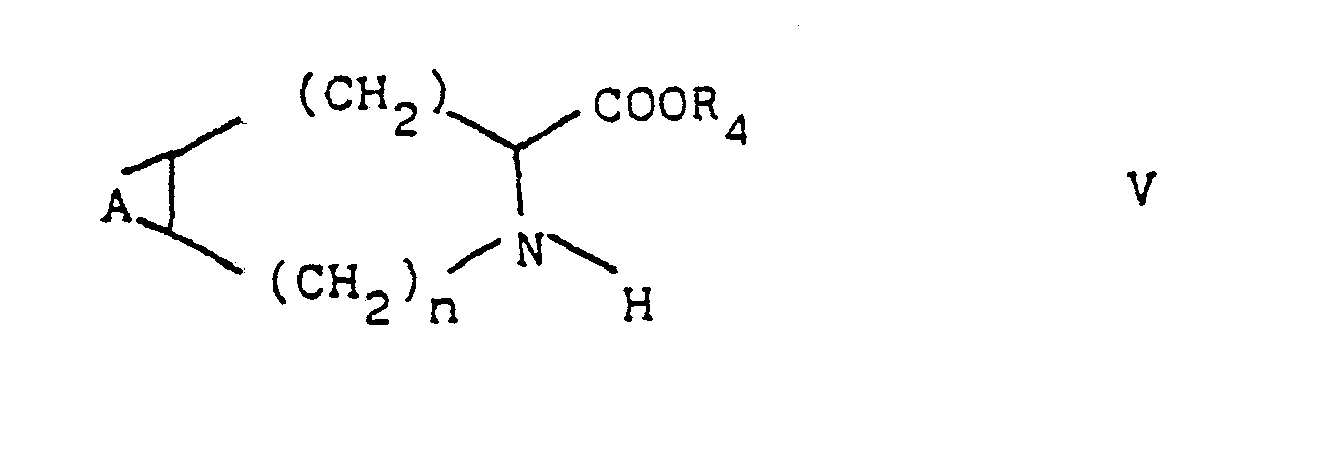
- R 1 and R 2 are identical, p can be hydrogen. It is then condensed, for example in the presence of dicyclohexylcarbodiimide, with one equivalent of a compound of the formula V and R 4 is split off in a known manner. The reaction may proceed via the isolable anhydride XII, which is then opened with a compound of formula V.
- radicals R 1 and R 2 in compound IV are unequal, preferably only one of the radicals P is hydrogen, the other should preferably have the meaning of R 3 or be tert-butyl. It is then condensed in the manner described with the compounds of the formula V and, if appropriate, one or both ester groups are converted into the carboxylic acids.
- the new compounds have, inter alia, 3 chiral centers on ( ⁇ -C atoms.
- the arrangement of the ligands preferably corresponds to the L configuration.
- sterically largely uniform compounds of the formula I can be obtained.
- Countercurrent distribution or preparative HPLC are preferred for Enrichment of sterically uniform forms.
- the new compounds of formula I have a long-lasting, intensive hypotensive effect.
- the dose for oral administration is 20 - 200 mg per single dose. It can also be increased in severe cases, as no toxic properties have been observed to date. A lowering of the dose is also possible and is particularly advisable if diuretics are administered at the same time.
- the single dose should be between 0.01 and 10 mg.
- the compounds of the formula I are in the form of internal salts. If both carboxyl groups are free, additional alkali and alkaline earth salts and those with physiologically acceptable amines can be formed. Furthermore, an existing free amino group can be reacted with a mineral acid or organic acid to form a salt.
- the other compounds of formula I can also be used in free form or as such salts.
- the product After drying over sodium sulfate, the product crystallizes from the ethyl acetate solution after concentration and rubbing. 1.5 liters of diisopropyl ether are added to the crystal suspension and the mixture is stirred for one hour at room temperature, suction filtered and the product is dried under high vacuum over phosphorus pentoxide.
- the tosylate can either be obtained by adding methanolic toluenesulfonic acid instead of methanolic hydrochloric acid during the hydrogenation, or the hydrochloride is dissolved in water, the calculated amount of sodium tosylate is added and the mixture is cooled to about 4 ° C. with inoculation and stirring. The tosylate precipitates in crystalline form. The crystals are filtered off, washed with water and dried.
- the product is dissolved in 20 ml of trifluoroacetic acid and stirred for 30 minutes at room temperature.
- the trifluoroacetic acid is distilled off in vacuo, distilled with toluene and chromatographed on silica gel in methylene chloride / methanol (10: 1).
- 250 g of L-1,2,3,4-tetrahydroisoquinoline-3-carboxylic acid are in 2 1 90 percent.
- Acetic acid suspended. 10 g of rhodium on carbon are added and the mixture is hydrogenated for 24 hours at 60-80 ° C. and 120 bar.
- the filtered solution is an g e-concentrated, the residue taken up in 200 ml Essigester and added dropwise with vigorous stirring in 2 1 of diisopropyl ether. Decant from the resinous residue, concentrate the solution in vacuo and repeat the same procedure with about 1/3 of the amount of solvent previously used.
- the resinous precipitates are combined and treated with hot ethyl acetate, with only a part going into solution.
- the material is used for the next stage without further cleaning.
- the free acids are obtained in a known manner by suspending the CA salts in water / ethyl acetate and acidifying with citric acid. The ethyl acetate phases are washed with a little water and concentrated. Z-Dic-OH is obtained as an oily residue.
- indole-2-carboxylic acid 45 g are mixed in 500 ml of 4 percent.
- Sodium hydroxide solution dissolved. 20 g of Raney nickel are added and the mixture is hydrogenated at 40 ° C. for 24 hours. It is filtered, acidified with conc. HCl, sucks off undissolved matter and extracts the aqueous phase several times with butanol. The organic phase is concentrated and chromatographed. (CHCl 3 / methanol / glacial acetic acid 50: 20: 5).
- the product is 30 min. dissolved in 20 ml of trifluoroacetic acid.
- the trifluoroacetic acid is distilled off in vacuo, redistilled with toluene and chromatographed on silica gel in methylene chloride / methanol (10: 1).
Landscapes
- Chemical & Material Sciences (AREA)
- Organic Chemistry (AREA)
- Health & Medical Sciences (AREA)
- Life Sciences & Earth Sciences (AREA)
- Medicinal Chemistry (AREA)
- General Health & Medical Sciences (AREA)
- Proteomics, Peptides & Aminoacids (AREA)
- Molecular Biology (AREA)
- Genetics & Genomics (AREA)
- Biophysics (AREA)
- Biochemistry (AREA)
- Veterinary Medicine (AREA)
- Pharmacology & Pharmacy (AREA)
- Animal Behavior & Ethology (AREA)
- Nuclear Medicine, Radiotherapy & Molecular Imaging (AREA)
- Public Health (AREA)
- General Chemical & Material Sciences (AREA)
- Chemical Kinetics & Catalysis (AREA)
- Heart & Thoracic Surgery (AREA)
- Cardiology (AREA)
- Bioinformatics & Cheminformatics (AREA)
- Engineering & Computer Science (AREA)
- Pharmaceuticals Containing Other Organic And Inorganic Compounds (AREA)
- Medicines That Contain Protein Lipid Enzymes And Other Medicines (AREA)
- Peptides Or Proteins (AREA)
- Other In-Based Heterocyclic Compounds (AREA)
- Indole Compounds (AREA)
- Organic Low-Molecular-Weight Compounds And Preparation Thereof (AREA)
- Furan Compounds (AREA)
- Acyclic And Carbocyclic Compounds In Medicinal Compositions (AREA)
- Plural Heterocyclic Compounds (AREA)
- Low-Molecular Organic Synthesis Reactions Using Catalysts (AREA)
Abstract
Description
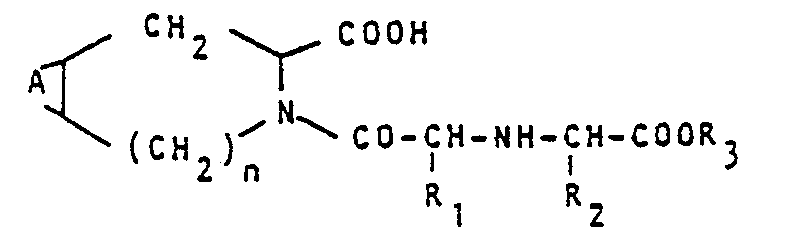
- Gegenstand der Erfindung ist eine Verbindung der Formel I

- R1 und R2, die gleich oder verschieden und auch ihrerseits substituiert sein können, je
- - Alkyl oder Alkenyl mit bis zu 6 C-Atomen,
- - Cycloalkyl oder Cycloalkenyl mit je 5 bis 7 C-Atomen,
- - Cycloalkylalkyl mit 7 bis 12 C-Atomen
- - Aryl oder teilhydriertes Aryl mit 6 bis 10 C-Atomen,
- - Aralkyl mit 7 bis 14 C-Atomen
- - ein mono- oder bicyclischer Heterocyclus mit 5 bis 7 bzw. 8 bis 10 Gliedern, davon 1 bis 2 -S- oder -0- und/oder bis zu 4 -N-Atomen,
- R3 Wasserstoff, Alkyl mit 1 bis 6 C-Atomen, Alkenyl mit 2 bis 6 C-Atomen oder Aralkyl mit 7 bis 14 C-Atomen,
- Die 5- bis 7-gliedrigen mono- oder 9-, 10-gliedrigen bicyclische Heterocyclen können unsubstituiert sein, aber auch einen oder mehrere gleiche oder verschiedene Substituenten tragen wie Halogen, Sauerstoff (auch Sulfoxid oder Sulfon), Hydroxy, Carboxy, Carbonamido, Sulfonamido, Nitro, Alkyl und Aralkyl mit bis zu 9 C-Atomen, Methoxy oder Ethoxy. Im Falle einer Substitution ist Mono- oder Disubstitution bevorzugt.
- Als bevorzugte Bedeutungen für R3 seien genannt: Wasserstoff, Ethyl, Butyl, t-Butyl, Benzyl, p-Nitrobenzyl.
- Die als Rloder R2 infragekommenden Alkyle oder Alkenyle können geradkettig oder verzweigt sein. Sie können einen oder mehrere gleiche oder verschiedene Substituenten tragen, insbesondere:
- Cycloalkyl oder Cycloalkenyl mit 5-7 C-Atomen, Hydroxy, Alkoxy mit 1 bis 2 C-Atomen, Aryloxy mit 1 bis 2 C-Atomen ,im Alkylteil, wobei der Alkylteil durch Methoxy, Ethoxy, Carboxy, Carbonamido, Amino oder Alkylamino und der Arylteil durch die genannten Substituenten und zusätzlich durch Halogen oder Nitro substituiert sein kann, Amino,
- Mono-, Di- oder Trialkyl- oder -cycloalkyl-amino mit bis zu insgesamt 7 C-Atomen in den Alkyl- oder Cycloalkylgruppen, das gegebenenfalls durch Hydroxy, Carboxy, Carbonamido, Carbethoxy, Amino, Alkyl- oder Dialkylamino, Piperidino oder Morpholino im Alkylrest substituiert sein kann,
- Alkyl-, Aryl-, Aralkyl-oxycarbonylamino oder -ureido, Formyl, Alkanoyl-, Aroyl- oder Aralkanoylamino mit bis zu 10 C-Atomen, Arylamino, Aralkylamino, in denen der Arylteil durch Alkyl oder Alkoxy mit 1 bis 2 C-Atomen, Methylendioxy, Amino, Hydroxy, Acetoxy, Carboxy, Carbonamido, Carbethoxy, Halogen, oder Nitro mono- oder disubstituiert sein kann,
- Alkyl-, Aryl- oder Aralkylmercapto mit bis zu 7 C-Atomen, wobei der Alkylteil durch Methoxy, Ethoxy, Hydroxy, Carboxy, Carbonamido, Carbethoxy, Amino oder Alkylamino und der Arylteil durch die genannten Reste und zusätzlich durch Halogen, Nitro oder Sulfonamido substituiert sein kann, ferner deren Sulfoxide und Sulfone,
- Carboxy, Carbethoxy, Carbonamido, Alkyl-, Cycloalkyl-, Cycloalkylen- oder Dialkylaminocarbonyl mit bis zu 6 C-Atomen, Aryl- oder Aralkylaminocarbonyl, Guanido,
- Phenyl, Naphthyl, Di- und Tetrahydronaphthyl, das durch Halogen, Hydroxy, Acetoxy, Carboxy, Carbonamido, Sulfonamido, Nitro, Methyl, Ethyl, Methoxy oder Ethoxy mono-oder disubstituiert sein kann,
- 5 bis 7-gliedrige mono- oder 9- bis 10-gliedrige bicyctische Heterocyclen, gegebenenfalls 1 bis 2 S- oder 0-Atome und/oder bis 4 N-Atome pro Ring enthaltend, die gegebenenfalls wie oben substituiert sein können.
- Unter Alkyl ist, falls im Einzelfall nichts anderes gesagt, vorzugsweise ein geradkettiges oder verzweigtes Alkyl mit 1 bis 6 C-Atomen zu verstehen. Gleiches gilt für Alkanoyl, Alkylamino, Alkylmercapto.
- Aryl bedeutet bevorzugt Phenyl, durch Halogen, Alkyl oder Alkoxy substituiertes Phenyl oder Naphthyl. Gleiches gilt für Aroyl, Arylamino, Arylmercapto.
- Aralkyl umfaßt bevorzugt Benzyl, Phenethyl und die entsprechenden, im Phenylkern mit Halogen, Nitro, Alkyl oder Alkoxy substituierten Verbindungen. Gleiches gilt für Aralkanoyl, Aralkylamino, Aralkylmercapto.
- Verbindungen der allgemeinen Formel I, in der R1 die Seitenkette einer natürlich vorkommenden L-Aminosäure darstellt, z.B. Methyl, Isobutyl, Methylthioethyl, Carboxymethyl, Carboxyethyl, Amino-n-butyl, Guanido-n-propyl, Imidazol-4-ethyl, Benzyl, 4-Hydroxybenzyl oder 3-Indolmethyl, sowie deren funktionelle Derivate wie Ether, Ester oder Amide sind besonders bevorzugt. Der Rest R1 kann aber auch Teil von Mercapto-, Hydroxy- oder Aminosäuren sein, die nicht in der Natur vorkommen.
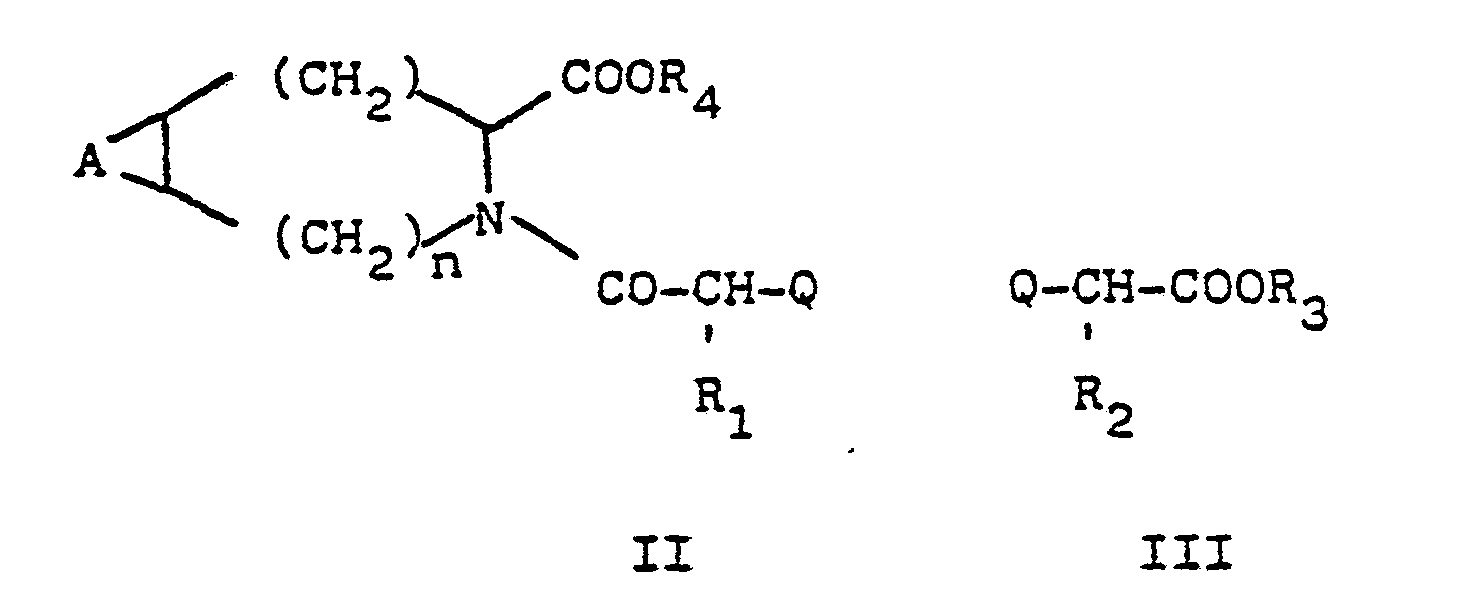
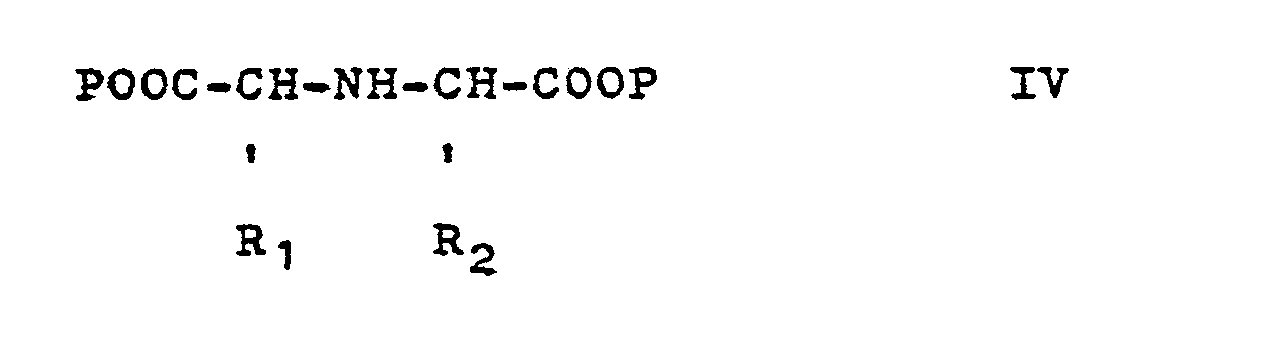
- Gegenstand der Erfindung ist ferner ein Verfahren zur Herstellung der Verbindungen der Formel I, das dadurch gekennzeichnet ist, daß man
- (a) eine Verbindung der Formel II mit einer Verbindung der Formel III umsetzt

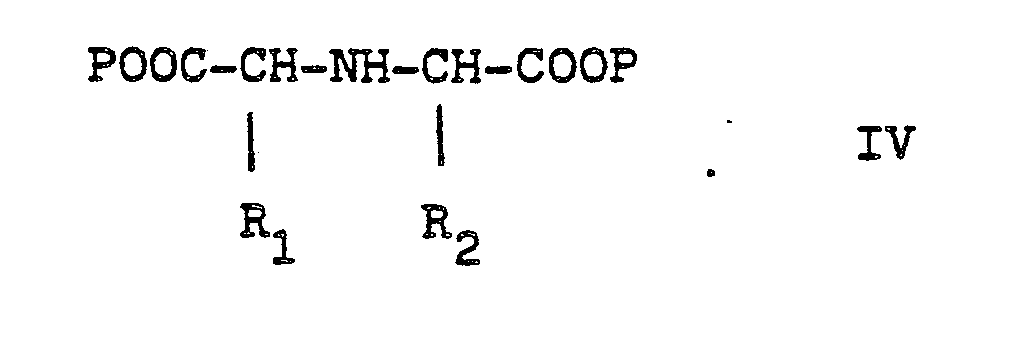
- (b) eine Verbindung der Formel IV

- (c) eine Verbindung der Formel VI mit einer Verbindung der Formel VII umsetzt

- Zur Herstellung der Verbindungen I kann man beispielsweise von 2-Halogencarbonsäurederivaten II oder III ausgehen, die mit Nucleophilen reagieren. Diese Reaktion wird bevorzugt in mit Wasser mischbaren organischen Lösungsmitteln, gegebenenfalls in Anwesenheit von Wasser, durchgeführt, wobei eine anorganische oder tertiäre oder quartäre organische Base zugegeben wird. Wenn die Reaktionspartner in aprotischen organischen Lösungsmitteln löslich sind, ist ein solches Lösungsmittel vorzuziehen, wobei als Base vorteilhaft ein Trialkylamin, Tetraalkylammoniumhydroxyd oder Tetramethylguanidin oder eine Suspension eines Alkali- oder Erdalkalicarbonats zugesetzt werden.
- Die Ausgangsprodukte

- Die Ausgangsprodukte

- Aus ihnen erhält man die Ester mit R4 in bekannter Weise und kondensiert sie mit Halogencarbonsäuren zu den Verbindungen II (Q = Halogen) entweder über die Säurechloride, gemischte Anhydride, Aktivester oder andere Methoden, wie sie in Houben-Weyl, Methoden der Organischen Chemie, Band 15, ausführlich beschrieben sind. Bei R1 = CH3 kann man z.B. von der aus L-Milchsäure leicht zugänglichen D-2-Chlorpropionsäure ausgehen.
- Die Zwischenprodukte der Formel II (Q = NH2) werden aus den Carbonsäureestern der allgemeinen Formel V durch Kondensation mit einer N-geschützten 2-Aminocarbonsäure erhalten. Die Schutzgruppe wird. nach beendeter Kondensation wieder abgespalten. Als Schutzgruppe kommt z.B. Benzyloxycarbonyl in Frage.
- Die Kondensation kann nicht nur mit DCC/HOBt (Dicyclohexylcarbodiimid/1-Hydroxybenzotriazol) sondern auch mit einem anderen gegeigneten Kondensationsmittel z.B. dem in Houben-Weyl, Band 15 beschriebenen, durchgeführt werden.
- Die Verfahrensweise (b) geht von Verbindungen der Formel IV aus.
- Sind R1 und R2 identisch, so kann p Wasserstoff sein. Man kondensiert dann z.B. in Gegenwart von Dicyclohexylcarbodiimid, mit einem Äquivalent einer Verbindung der Formel V und spaltet R4 in bekannter Weise ab. Die Reaktion verläuft möglicherweise über das isolierbare Anhydrid XII, das anschließend mit einer Verbindung der Formel V geöffnet wird.
-

- Die für T = NH2 in den Formeln VI bzw. VII. bedeutsame Kondensation mit 2-Ketocarbonsäuren bzw. deren Estern gemäß (c) führt in an sich bekannter Weise über Schiff'sche Basen z.B. nach Reduktion mit Natriumborhydrid oder Natriumcyanoborhydrid, durch katalytische Hydrierung oder elektrolytische Reduktion zu den entsprechenden Verbindungen der Formel I in guter Reinheit.
- Die neuen Verbindungen besitzen unter anderem 3 chirale Zentren an (α-C-Atomen. Die Anordnung der Liganden entspricht bevorzugt der L-Konfiguration. Im allgemeinen können durch Kristallisation sterisch weitgehend einheitliche Verbindungen der Formel I erhalten werden. Bevorzugt sind Gegenstromverteilung oder präparative HPLC zur Anreicherung sterisch einheitlicher Formen.
- Auf der Stufe der Zwischenprodukte X und XI kann man gegebenenfalls Diastereomere durch Kristallisation oder präparative HPLC trennen, so daß nach dem oben beschriebenen Verfahren Produkte der Formel I erhalten werden können, die an allen chiralen Zentren eine einheitliche sterische Anrodnung besitzen.
- Die neuen Verbindungen der Formel I besitzen eine langdauernde, intensive blutdrucksenkende Wirkung.
- Sie können zur Bekämpfung des Bluthochdrucks verschiedener Genese eingesetzt und für sich oder in Kombination mit anderen blutdrucksenkenden, gefäßerweiternden oder diuretisch wirksamen Verbindungen angewandt werden. Typische Vertreter dieser Wirkklassen sind z.B. in Erhar t-Ruschig, Arzneimittel, 2. Auflage, Weinheim 1972, beschreiben. Die Anwendung kann intravenös, subcutan oder peroral erfolgen.
- Die Dosierung bei peroraler Gabe liegt bei 20 - 200 mg je Einzeldosis. Sie kann in schweren Fällen auch erhöht werden, da toxische Eigenschaften bisher nicht beobachtet wurden. Auch eine Herabsetzung der Dosis ist möglich und vor allem dann angebracht, wenn gleichzeitig Diuretika verabreicht werden. Bei intravenöser oder subcutaner Verabreichung sollte die Einzeldosis zwischen 0,01 und 10 mg liegen.
- Die Verbindungen der Formel I liegen als innere Salze vor. Falls beide Carboxylgruppen frei sind, können zusätzlich Alkali- und Erdalkalisalze und solche mit physiologisch unbedenklichen Aminen gebildet werden. Ferner kann eine vorhandene freie Aminogruppe mit einer Mineralsäure oder organischen Säure zu einem Salz umgesetzt werden. Auch die anderen Verbindungen der Formel I können in freier Form oder als solche Salze angewandt werden.
- Die nachfolgenden Beispiele sollen die erfindungsgemäßen Verfahrensweisen erläutern, ohne die Erfindung auf die hier stellvertretend genannten Substanzen zu beschränken.
- Folgende Abkürzungen werden gebraucht:

- Soweit kein anderes Verfahren angegeben ist, werden die in den folgenden Beispielen beschriebenen Verbindungen zur Analyse und biologischen Bestimmung einer-HPLC-Reinigung . unterworfen.
- 188 g (1,05 Mol) 3-Carboxy-1,2,3,4- tetrahydroisochinolin gibt man bei. 0° zu 1050 ml 1 N.-NaOH, und tropft dann bei dieser Temperatur unter Rühren gleichzeitig 160 ml Chlorkohlensäurebenzylester und weitere 1050 ml 1N-NaOH ein. Anschließend rührt man 2 Stunden bei Raumtemperatur, Man extrahiert dreimal mit Ether und säuert die alkalisch-wässrige Phase mit konz. HCl auf pH 1 an. Das ausgefallende öl. wird in Essigester extrahiert. Man wäscht die Essigesterlösung mit Wasser, bis die Wasserphase ein pH von 3,0 zeigt. Nach Trocknung über Natriumsulfat kristallisiert das Produkt aus der Essigesterlösung nach Einengen und Anreiben. Man setzt 1,5 Liter Diisopropylether zu der Kristallsuspensicn und rührt eine Stunde bei Raumtemperatur, saugt ab, und trocknet das Produkt im Hochvakuum über Phosphorpentoxyd.
- Ausbeute: 256,7 g Schmp. 138-39 °C
- Zur Lösung von 248,8 g (0,8 Mol) 2-Carbobenzoxy-3-carboxy-1, 2, 3,4-tetrahydroisochinolin in 1600 ml Methylenchlorid gibt man 312 ml tert.-Butanol und 8 g 4-Dimethylaminopyridin. Man kühlt auf -5 °C und setzt dann portionsweise die Lösung von 176 g Dicyclohexylcarbodiimid in 350 ml Methylenchlorid zu. Man rührt 5 Stunden bei O° und läßt dann 16 Stunden bei Raumtemperatur stehen. Nach Ab-saugen vom Dicyclohexylharnstoff extrahiert man die Reaktionslösung dreimal mit gesättigter Natriumbicarbonatlösung. Man trocknet über Magnesiumsulfat, engt i.V bei Raumtemperatur bis zur öligen Konsistenz ein. Es verbleiben 286 g Produkt als gelbliches öl (97% d.Th.)
- 284 g 2-Carbobenzoxy-3-carboxy-1,2,3,4-tetrahydroisochinolin-tert.-butylester (0,775 Mol) löst man in 3 Liter Methanol, gibt 15 g 10 % Pd-Bariumsulfatkatalysator zu und hydriert mit Wasserstoff bei Normaldruck. Der pH-Wert der Lösung wird durch Zutropfen von 1 n methanolischer HC1 auf pH 4,0 (Glaselektrode) gehalten. Man saugt vom Katalysator ab und dampft die Lösung im Vakuum bei Raumtemperatur zur Trockne ein. Das kristallisierte Produkt wird mit wasserfreiemEther verrieben, abgesaugt und i.V. über Phosphorpentoxyd getrocknet.
- Ausbeute: 156 g Schmp. 180° (Zers.)
- Das Tosylat kann entweder durch Zugabe von methanolischer Toluolsulfosäure anstelle von methanolischer Salzsäure während der Hydrierung erhalten werden, oder man löst das Hydrochlorid in Wasser, versetzt mit der berechneten Menge Natriumtosylat und kühlt unter Animpfen und Rühren auf ca. 4 ° C ab. Dabei fällt das Tosylat in kristalliner Form aus. Die Kristalle werden abfiltriert, mit Wasser gewaschen und getrocknet.
- Schmp. 139 - 140 ° (Zers.)
- Man suspendiert 27 g (0,15 Mol) 3-Carboxy-1-,2,3,4-tetra-hydroisochi- nolin-tert-butylesterhydrochlorid in 200 ml Dimethylformamid, kühlt unter Rühren und Feuchtigkeitsausschluß auf -5 °C, und gibt 19 ml (0,15 Mol) N-Äthylmorpholin sowie die Lösung von 33,4 g Carbobenzoxyalanin, 20 g N-Hydroxybenzotriazol*in 100 ml Dimethylformamid zu. Man rührt eine Stunde bei O °C, läßt über Nacht bei +4 °C stehen und arbeitet dann nach einstündigem Rühren bei Raumtemperatur auf. Man saugt vom ausgeschiedenen Dicyclchexylharnstoff ab und bringt die Reaktionslösung im Hochvakuum bei Raumtemperatur zur Trockne. Das verbliebene öl nimmt man in 1 1 Essigester auf und wäscht dreimal mit je 150 ml gesättigter Satriumcarbcnatlösüng, 5 % Kaliumbisulfatlösung und einmal mit Wasser. Kach Trocknung über. wasserfreiem Natriumsulfat wird das Lösungsmittel i.V. bei Raumtemperatur abdestilliert.
- und 33 g Dicyclohexylcarbodiimid
- Ausbeute: 59g Oel L-Alanyl-3-carboxy-1 ,2,3,4-tetrahydroisochinolin-tert.-butylester- hydrochlorid (Ala-Tic-O-But)
- Man hydriert 15 g Carbobenzoxy-alanyl-3-carboxy-1,2,3,4-tetrahydro- isochinclin-tert.-butylester in 400 ml Methanol mit 8 g 10 % pd/ BariumsuLfatkatalysator. Das scheinbare pH der Lösung (Glaselektrode) wird durch Zugabe von 1 N methanolischer Salzsäure bei. 4,0 gehalten. Nach 8 Stunden saugt man vom Katalysator ab und dampft die Lösung i.V. bei Paumtemperatur zur Trockne. Den festen Rückstand digeriert man mit Diisopropyläther und trocknet i.V..
- Schmp. 110° (Zers.)
-


- 305 mg Alanyl-1,2,3,4-tetrahydroisochinolin-3-carbonsäurebutylester (Ala-Tic-OBut) und 445 mg 4-Phenyl-2-oxo-buttersäure werden, in 4 ml Methanol gelöst und mit wässriger 1 N NaOH auf pH 7,5 gebracht. Man fügt 200 mg Natriumcyanoborhydrid hinzu und läßt 36 Std. reagieren. Man engt zur Trockne ein und gewinnt die Substanz durch Säulenchromatographie an Kieselgel (Laufmittelsystem: Chloroform/Methanol/ Wasser/Eisessig 20+15+2+1).
- Ausbeute: 382 mg; Schmp. ab 120° Zers.
- 5 350 mg N-(1-Carboxy-3-phenylpropyl)-Ala-Tic-OBut werden in 3 ml wasserfreier Trifluoressigsäure gelöst und 30 Min. bei Raumtemperatur belassen. Man engt i.Vak. ein und verreibt das hinterbleibende öl mit kaltem Diisopropyläther und Petroläther.
- 10 Ausbeute 276 mg amorphe Substanz
- NMR:. 7.20 u. 7,10 (s); 4,3 (s, breit); 3,4-3,9 (m, breit); 1,23 u. 1,15 (d)
- Man löst 4,8 g H-Ala-Tic-0 But. Tos-OH in 40 ml absol. Ethanol, stellt mit KOH in Ethanol auf pH 7 und gibt 6,2 g 2-Oxo-4-phenylbuttersäure-ethylester zu und rührt in Anwesenheit von 9 g pulverisiertem Molekularsieb 4 A unter langsamer Zugabe von einer Lösungvon 2 g Natriumcyanoborhydrid in 15 ml absol. Ethanol. Nach etwa 20 h wird filtriert und das Lösungsmittel im Vakuum abdestilliert. Der Rückstand wird zwischen Essigester und Wasser verteilt, die Essigesterphase abgetrennt und im Vakuum zur Trockne gebracht. Der Rückstand wird an Silicagel im Laufmittel Essigester/Cyclohexan (1:2 bis 1:4) chromatographiert.
- Das Produkt wird in 20 ml Trifluoressigsäure gelöst und 30 Min. bei Raumtemperatur gerührt. Man destilliert die Trifluoressigsäure im Vakuum ab, destilliert mit Toluol nach und Chromatographiert über Kieselgel in Methylenchlorid/ Methanol (10 :1).
- Ausbeute: 2,2 g
- 1.2 g N-(1-Carboxy-5-Boc-aminopentyl)-L-alanyl-1,2,3,4-tetrahydroiscchinolin-3-carbonsäure werden mit 10 ml eiskalter Trifluoressicsäure übergossen und eine Stunde bei Raumtemperatur gerührt. Anschließend wird im Vakuum eingedampft. Der Rückstand wird in Wasser gelöst und einer Gefriertrocknung unterworfen.
- Ausbeute: 0.95 g
- 880 mp N-(1-Carbethoxy-3-phenyl-propyl) -L-alanyl-1, 2, 3, 4 - tetrahydroisochinolin-3-carbonsäure werden in 20 ml Dioxan Wasser (9 : 1) gelöst und bei Raumtemperatur mit 4.5..ml 1 n Natriumhydroxid-Lösung verseift. Nach einer Stunde wird die Lösung mit der äquivalenten Menge 1 n Salzsäure angesäuert und das Dioxan weitgehend abgedampft. Der Rückstand wird mehrfach mit Essigester extrahiert und die organische Phase nach Abziehen des Lösungsmittels über einen Kationenaustauscher (DOWEX 50) chromatographiert
- Ausbeute: 630 mg
- 1.1 g N-(1-Carbethoxy-3-enzoxycarbonylamino-propyl)-L-alanyl 1, 2, 3, 4-tetrahydroisachinolin-3-carbonasäure werden in 150 ml Methanol gelöst und in Gegenwart von 100 mg Palladium - Aktivkohle (10 %ig) bei 40° C unter Normaldruck hydriert. Nach Beendigung der Reaktion wird vom Katalysator abfiltriert und das Lösungsmittel im Vakuun abgezogen.
- Ausbeute: 0.79 g
- In eine auf -50 °C gekühlte Lösung von 700 mg Tic-OBut und 630 mg Dicyclohexylcarbodiimid in 15 ml wasserfreiem Chloroform wird eine gekühlte und frisch destillierte Lösung von 270 mg Brenztraubensäure in 5 ml Chloroform rasch eingerührt. Man beläßt 16 Std. im Tiefkühlschrank (-20 °C) und filtriert den ausgefallenen DC-Hamstoff ab. Die Lösung wird mit KHSO4- und anschließend mit KHCO4-Lösung gewaschen, über Na2SO4 getrocknet und i.Vak. eingeengt. Die Verbindung (1) enthält etwas Dicyclohexylharnstoff; sie wurde zur Analyse über Kieselgel im System CHCl3/CH3OH 15:1 chromatographiert.

- Analog der Kondensation Brenztraubensäure- mit Tic- OBut werden folgende Kondensationsprodukte aus Tic, Idc und der entsprechenden d-Ketocarbonsäure dargestellt.


- 1,52 g Pyruvyl-Tic-OBut und 394 mg S-Phenyl-cystein werden in 5 ml Methanol gelöst und mit 1N NaOH (wässrig) auf pH 7.0 gebracht. Man fügt 400 mg Natriumcyanoborhydrid zu und beläßt 24 Stdn. bei Raumtemperatur. Man engt i.Vak. ein, nimmt in Chloroform auf, trocknet über Natriumsulfat und engt ein. Das Produkt wird durch Kieselgelchromatographie (System CHCl3/CH3OH/HACO/H2O 50/20/5/1) rein erhalten.
- NMR: 7,3-7,0m (9H); 5,1-4,3m (3H); 3,9-3,Om (4H); 2,5m (2H) C.)
- 1 g Butylester aus Beispiel 6b wird in 5 ml Trifluoressigsäure gelöst. Man engt nach 30 Min. i.Vak. ein, digeriert den.Rüch- stand mit Diisopropyläther und trocknet über Kaliumhydroxyd.
- Ausbeute 0,95 g Trifluoracetat (hygroskopisch)
- NMR: 7,4-7,1m (9H); 5,2-4,4m (3H); 3,9-3,Om (4H); 2,5m (2H); 1,25m (3H)
- Zu einer unter Eiskühlung gerührten Mischung von 0,64 g Natriumperjodat und 20 ml Wasser werden 1,3 g N-(1-Carbethoxy-2-bensyl- thio-ethyl)-L-alanyl-L-1,2,3,4-tetrahydroisochinolin-3-carbonsäure gelöst in 20 ml Methanol gegeben. Man läßt die Reaktionsmischung für 24 Stunden bei O °C rühren und filtriert anschließend vom Natriumjodat ab. Das Filtrat wird mehrfach mit Methylenchlorid extrahiert. Nach Entfernen des Lösungsmittels erhält man 1,1 g des Sulfoxids. Im NMR-Spektrum werden folgende Signale beobachtet: 7,3-7.0m (9H); 5,1-4,3m (3H); 4, ls (2H); 3,9-3,0m (4H); 2,6m (2H); 1,2d (3h)
- 260 mg N-(1-Carbethoxym3-phenylthio®propyl)-L-alanyl-1,2,3,4-tetrahydroisochinolin-3-carbonsäure und 2o mg Natriumwolframat Dihydrat werden in 50 ml Wasser gegeben und tropfenweise mit 1 ml Perhydrol (30 %ig) versetzt. Die Mischung wird für 30 min auf 80 C erwärmt und anschließend eine Stunde bei Raumtemperatur gerührt. Das überschüssige Peroxid wird sodann mit Palladium auf Bariumsulfat zerstört und nach Beendigung der Sauerstoffentwicklung wird die Lösung vom Palladium iCatalysator abfiltriert und eingeengt. Das Rohprodukt wird durch Ionenaustauschchromatographie über DOWEX 50 H+- Form gereinigt.
- Ausbeute: 220 mg
- NMR: 7,7m (9H); 5,1-4,3m (3H); 3,9-3,Om (4H); 2,8m (2H); 1,5m (2H);
- 1,2d (3H)
- 2.2 g NB-Boc-α,β-Diaminobuttersäure, hergestellt nach Coll. czech. chem. Commun. 31, 2955 (1966) analog der NY-Boc-Verbindung, werden mit 2.4 g Pyruvyl-Tic-OBut, hergestellt nach Beispiel 6 a), in der in Beispiel 6b) beschriebenen weise umgesetzt. Die Boc-Schutzgruppe wird anschließend auf die in Beispiel 3- beschriebene weise abgespalten.
- Ausbeute: 2.6 g
- 250 g L-1,2,3,4-tetrahydroisochinolin-3-carbonsäure werden in 2 1 90-proz. Essigsäure suspendiert. Man gibt 10 g Rhodium auf Kohle zu und hydriert 24 Stunden bei 60-80°C und 120 bar. Die filtrierte Lösung wird einge-engt, der Rückstand in 200 ml Essigester aufgenommen und unter kräftigem Rühren in 2 1 Diisopropylether eingetropft. Man dekantiert vom harzigen Rückstand, engt die Lösung im Vakuum ein und wiederholt dieselbe Prozedur mit etwa 1/3 der vorher verwendeten Lösungsmittelmenge. Die harzigen Niederschläge werden vereinigt und mit heißem Essigester behandelt, wobei nur ein Teil in Lösung geht. Man läßt unter kräftigem Rühren in 3 1 Diethylether-Diisopropylether 1:1 einlaufen, wobei ein flockiger Niederschlag entsteht, der abfiltriert, mit Ether gewaschen und getrocknet wird. Ausbeute: 234 g; dünnschichtchromatographisch nicht einheitlich (Diastereoisomerengemisch). Nach UV-Spektrum und NMR kein Aromat mehr vorhanden, Elementaranalyse korrekt.
- Das Material wird ohne weitere Reinigung für die nächste Stufe eingesetzt.
- 58 g L-Dekahydroisochinolin-3-carbonsäure werden in 315 ml 1N NaOH gelöst. Unter kräftigem Rühren läßt man bei 0-5°C gleichzeitig 48 ml Benzyloxycarbonylchlorid und 370 ml 1N NaOH innerhalb einer Stunde zutropfen. Dabei fällt ein dicker Niederschlag aus. Man rührt nach beendeter Zugabe noch 2 Stdn. weiter, extrahiert dann mit Ether und filtriert den Niederschlag ab (=Natriumsalz eines Diastereoisomeren "A"; Ausbeute 43 g). Das Filtrat wird mit konz..HCl auf pH 1,5 - 2 gebracht, wobei sich ein öl absetzt. Es wird in Essigester aufgenommen. Die Wasserphase wird mit Essigester extrahiert, die vereinigten Essigesterlösungen werden mit Wasser gewaschen, über Natriumsulfat getrocknet und auf ein kleines Volumen (ca. 200 ml) eingeengt. Bei Zugabe von 15-18 ml Cyclohexylamin (CA) fällt ein Niederschlag aus, der nach Kühlen mit Eiswasser abfiltriert und mit wenig kaltem Essigester gewaschen und dann getrocknet wird. Ausbeute: 48 g, (CA-Salz des Isomerengemisches B). Das Natriumsalz von "A" wird wie folgt in das CA-Salz übergeführt: Man suspendiert die Verbindung in 500 ml Wasser, überschichtet mit 200 ml Essigester und säuert mit konz. HC1 bis pH 1,5 - 2 an.*Nach Ausschütteln trennt man die Essigesterphase ab, wäscht mit etwas Wasser und trocknet über Natriumsulfat. Man engt wie oben ein und versetzt mit 16 ml Cyclohexylamin. Das CA-Salz wird wie oben isoliert. Zur Reinigung wird das CA-Salz von "A" aus der achtfachen Menge Essigester umkristallisiert. Schmelzpunkt: 197 - 198°C, [αU]D = 7,5° (c = 1, in Methanol). Elementaranalyse korrekt.
- Das CA-Salz von"B" wird aus der vierfachen Menge Essigester umkristallisiert. Schmp.: 190° (sintert ab 187°) 1 [α]D = + 14,6° (c=1, in Methanol) Elementaranalyse korrekt.
- Die freien Säuren werden in bekannter Weise durch Suspendieren der CA-Salze in Wasser/Essigester und Ansäuern mit Citronensäure erhalten. Die Essigesterphasen werden mit wenig Wasser gewaschen und eingeengt. Man erhält Z-Dic-OH als öligen Rückstand.
- 41 g Z-Dic-OH ("A") werden in 350 ml Methylenchlorid gelöst. Man gibt 52 ml t-Butanol und 1,3 g 4-Dimethylaminopyridin zu, kühlt auf 0°C und tropft unter Rühren die Lösung von 29 g Dicyclohexylcarbodiimid (DCC) in 60 ml Methylenchlorid zu. Man rührt anschließend noch 20 min. bei 0°C und 5 h bei Raumtemperatur und filtriert den ausgefallenen Dicyclohexylharnstoff ab. Das Filtrat wird im Vakuum eingedampft, der Rückstand in Essigester aufgenommen, die Lösung nacheinander mit KHSO4/K2SO4-Lösung, Natriumhydrogencarbonat (nicht-umgesetztes Na-Salz von Z-Dic-OH fällt aus und wird abfiltriert) und Wasser gewaschen, getrocknet und im Vakuum zur Trockene gebracht. öliger Rückstand. Ausbeute: 38,5 g [α]D = -17,3° (c=1, in Methanol). Zur Gewinnung der analogen Verbindung von "B" geht man in derselben Weise vor. Ausbeute 38,1 g, [α]D= + 6,7° (c=1, in Methanol) _
- 27 g der nach Beispiel lOc hergestellten Verbindung von"A''werden in 250 ml Methanol unter Zutropfen von 4N TosOH in Methanol an Pd/Kohle bei pH 4,5 (pH-Stat) katalytisch hydriert. Dann engt man die filtrierte Lösung im Vakuum ein, digeriert den kristallinen Rückstand mit Ether und trocknet. Ausbeute: 22,6 g Zur Analyse wird aus Essigester umkristallisiert. Schmp.: 159-160°C; [α]D = -6,5° (C=1, in Methanol) . Elementaranalyse korrekt. Die Verbindung ist dünnschichtchromatographisch einheitlich.
- -Analog verfährt man mit der nach Beispiel 10e hergestellten Verbindung des Isomerengemisches"B": Dabei wird nach Umkristallisieren aus Essigester eine Substanz vom Schmp. 162-164°C, L d 7D = +4,4° (c=1, in Methanol) erhalten. Elementaranalyse korrekt.
- 12,4 g H-Dic-OBut· TosOH, hergestellt nach BeispiellOd mit Verbindung "A", werden in 250 ml Methylenchlorid gelöst. Man gibt 6,7 g Z-Ala-OH und 4,05 g 1-Hydroxybenzotriazol (HOBt) zu, versetzt mit 4,2 ml N-Ethylmorpholin und tropft unter Rühren bei 0° bis 4°C die Lösung von 6,6 g Dicyclohexylcarbodiimid (DCC) in 30 ml Methylenchlorid zu. Nach 5 Studen filtriert man, engt das Filtrat zur Trockene ein, nimmt den Rückstand in Essigester auf und wäscht unterhalb 5°C mit 10-prozentiger KHSO4/K-SO4 (1: 2), 1M Natriumhydrogencarbonat und Wasser, trocknet über Natriumsulfat und destilliert das Lösungsmittel ab. Harz, leicht löslich in allen organischen Lösungsmitteln. Ausbeute: 15,2 g. Analog verfährt man mit dem Isomerengemisch "B", das auf dieser Stufe mittels präparativer HPLC an Silicagel im Laufmittel Chloroform/Cyclohexan (9:1) aufgetrennt werden kann.
- 8,5 g der Z-Verbindung werden analog Beispiel 10d katalytisch hydriert. Der nach dem Abdestillieren des Lösungsmittels zunächst harzige Rückstand kristallisiert nach einiger Zeit oder beim Verreiben mit Essigester und wird zur Analyse aus Essigester umkristallisiert. Schmp.: 151-153° (Zers.), [α]D = -28,8° (c=1, in Methanol). Elementaranalyse korrekt. Analog wird mit dem Isomerengemisch'B''verfahren. Man erhält ein nichtkristallisierendes Harz; korrekte Elementaranalyse.
- Analog H-Ala-Dic-OBut werden Alanyl-oktahydroindol-2-
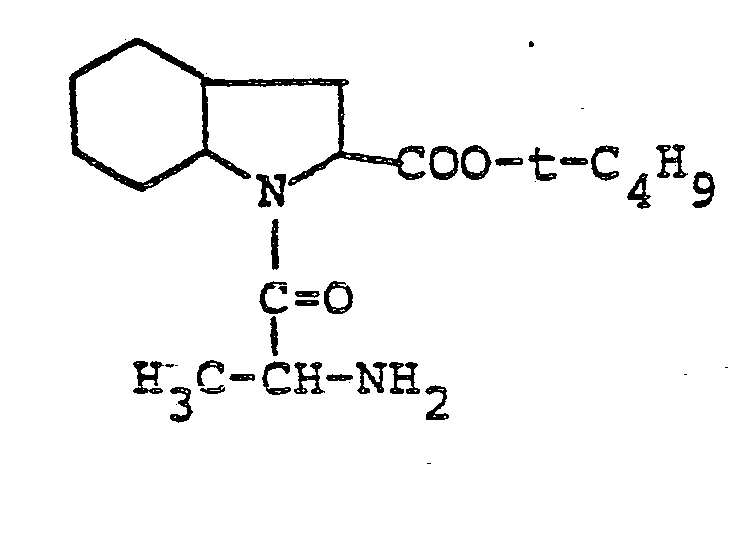
- Die Ausgangsaminocarbonsäure Oktahydroindol-2-carbonsäure wird wie folgt hergestellt:
- 45 g Indol-2-carbonsäure werden in 500 ml 4-proz. Natronlauge gelöst. Man setzt 20 g Raney-Nickel zu und hydriert 24 Stunden bei 40°C. Man filtriert, säuert mit konz. HCl an, saugt von Ungelöstem ab und extrahiert die wässrige Phase mehrfach mit Butanol. Die organische Phase wird eingeengt und chromatographiert. (CHCl3/Methanol/Eisessig 50:20:5).
- Ausbeute: 22 g
- Schmp.: 260°C.
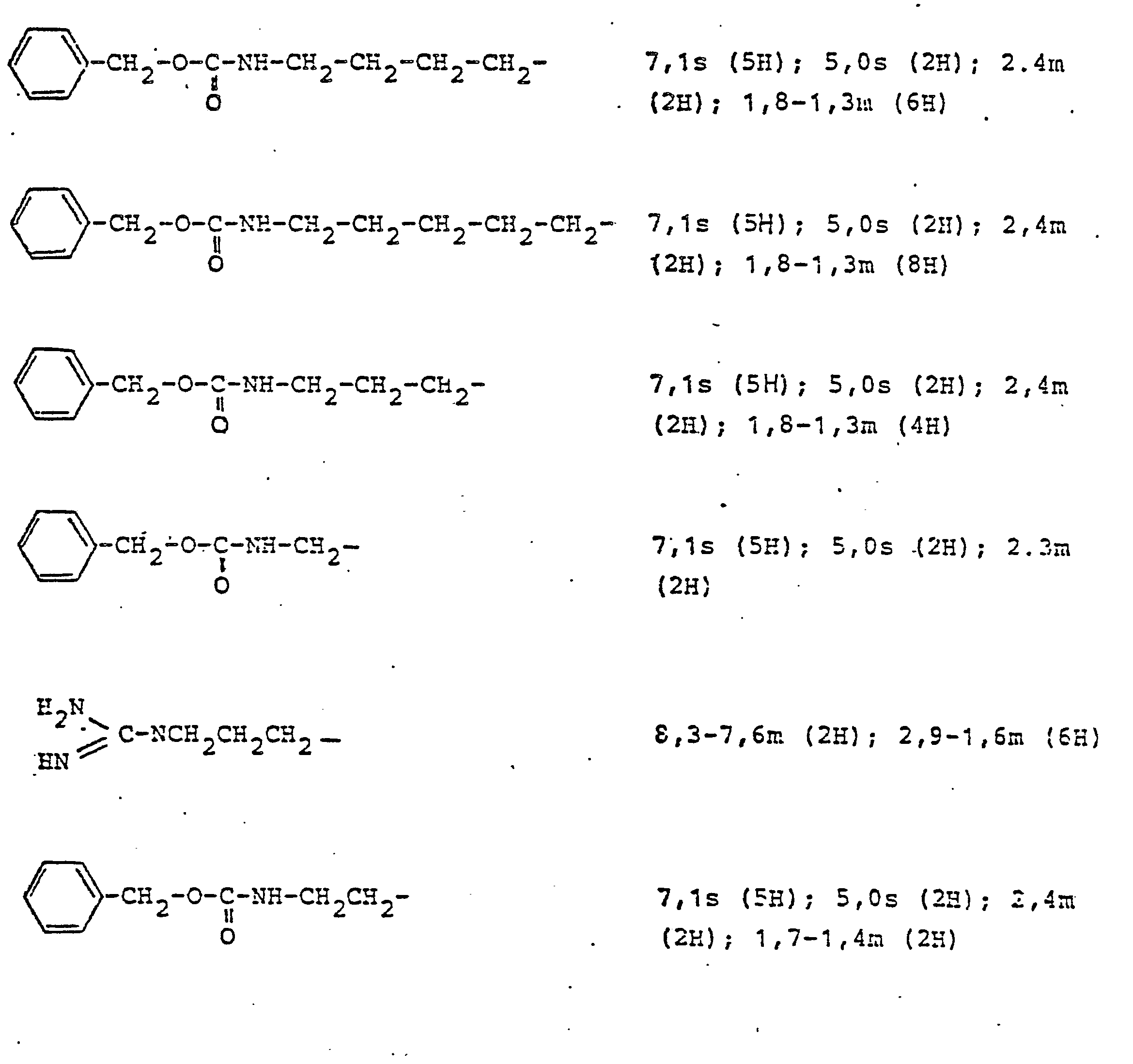
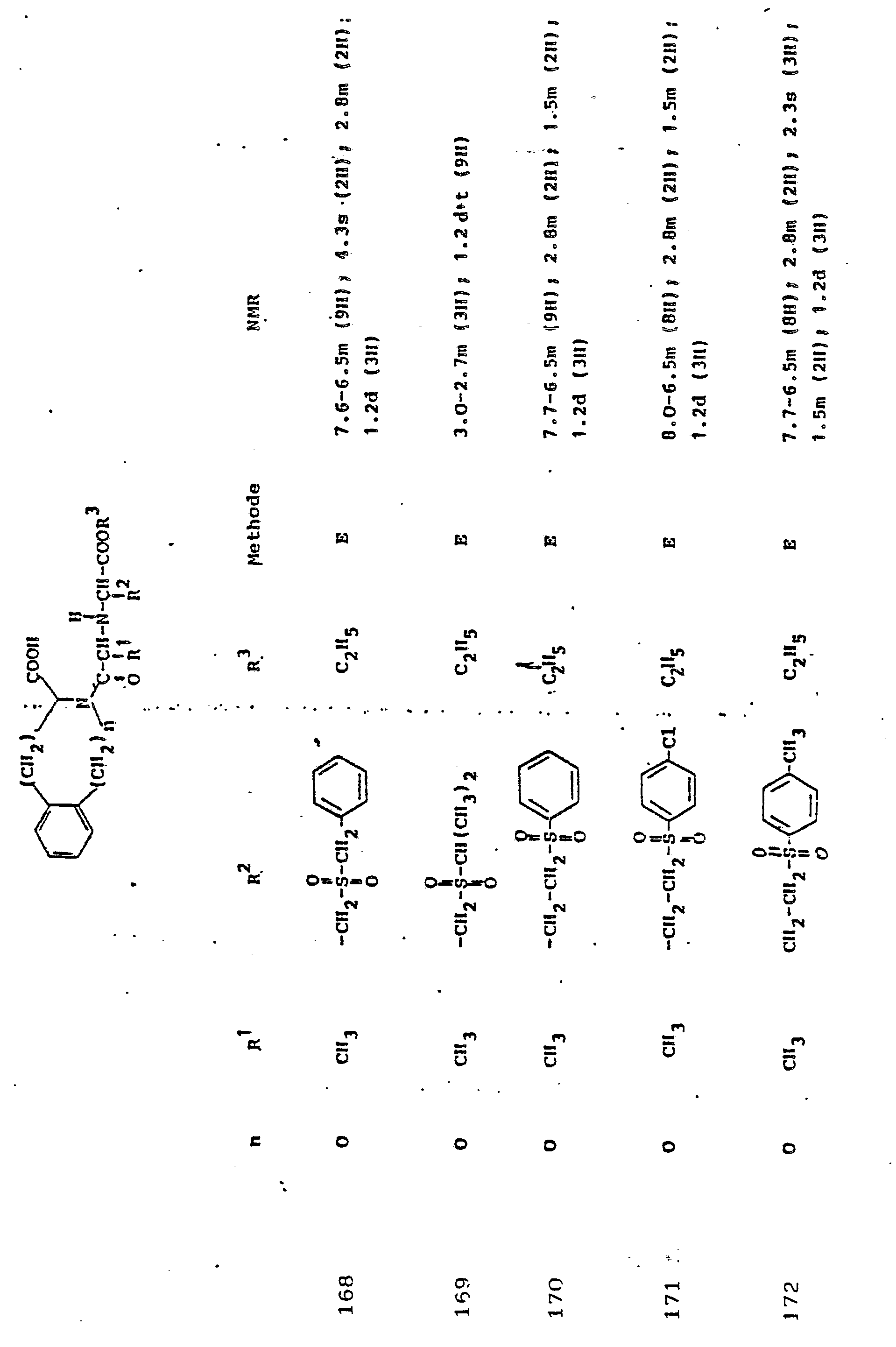
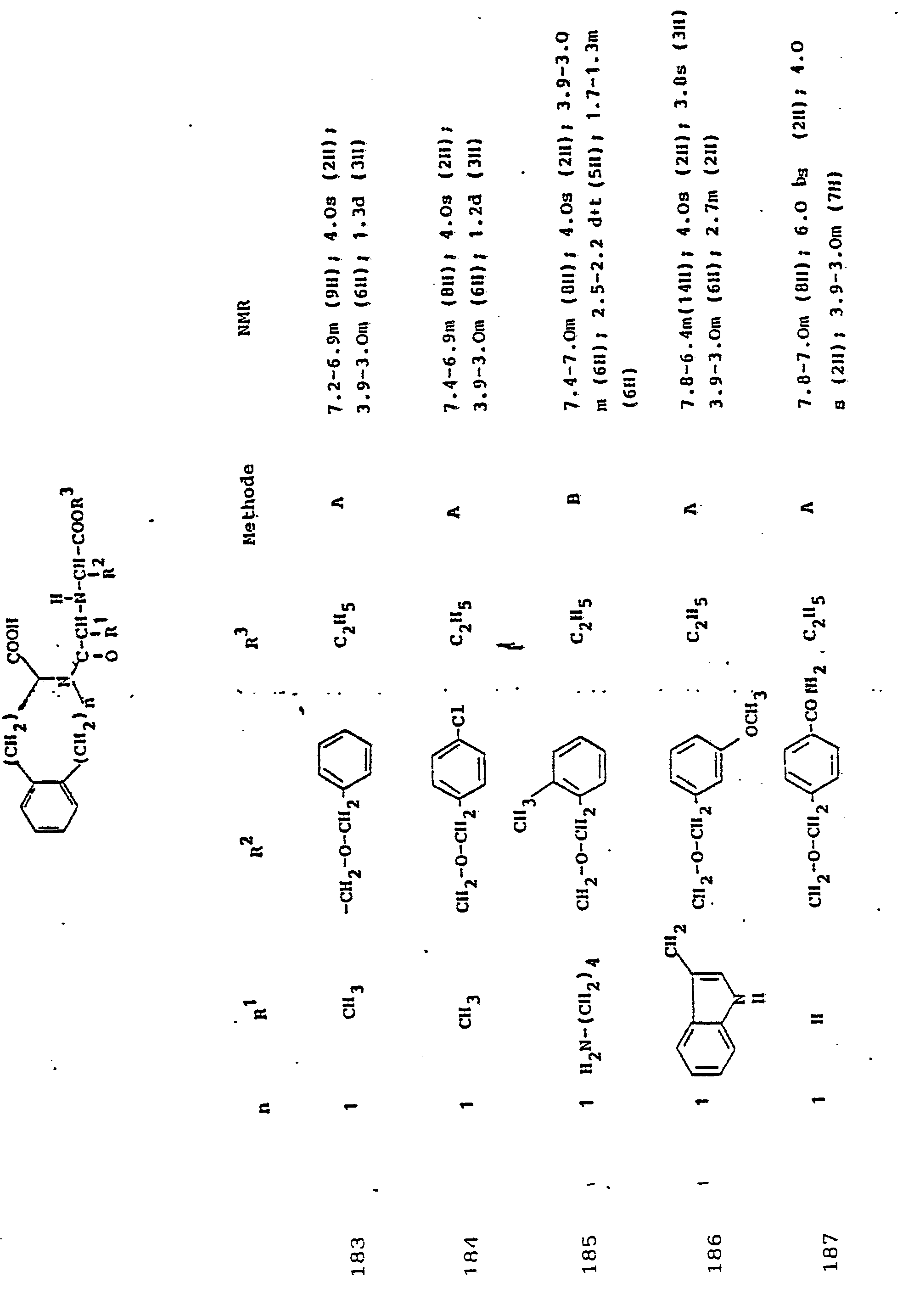
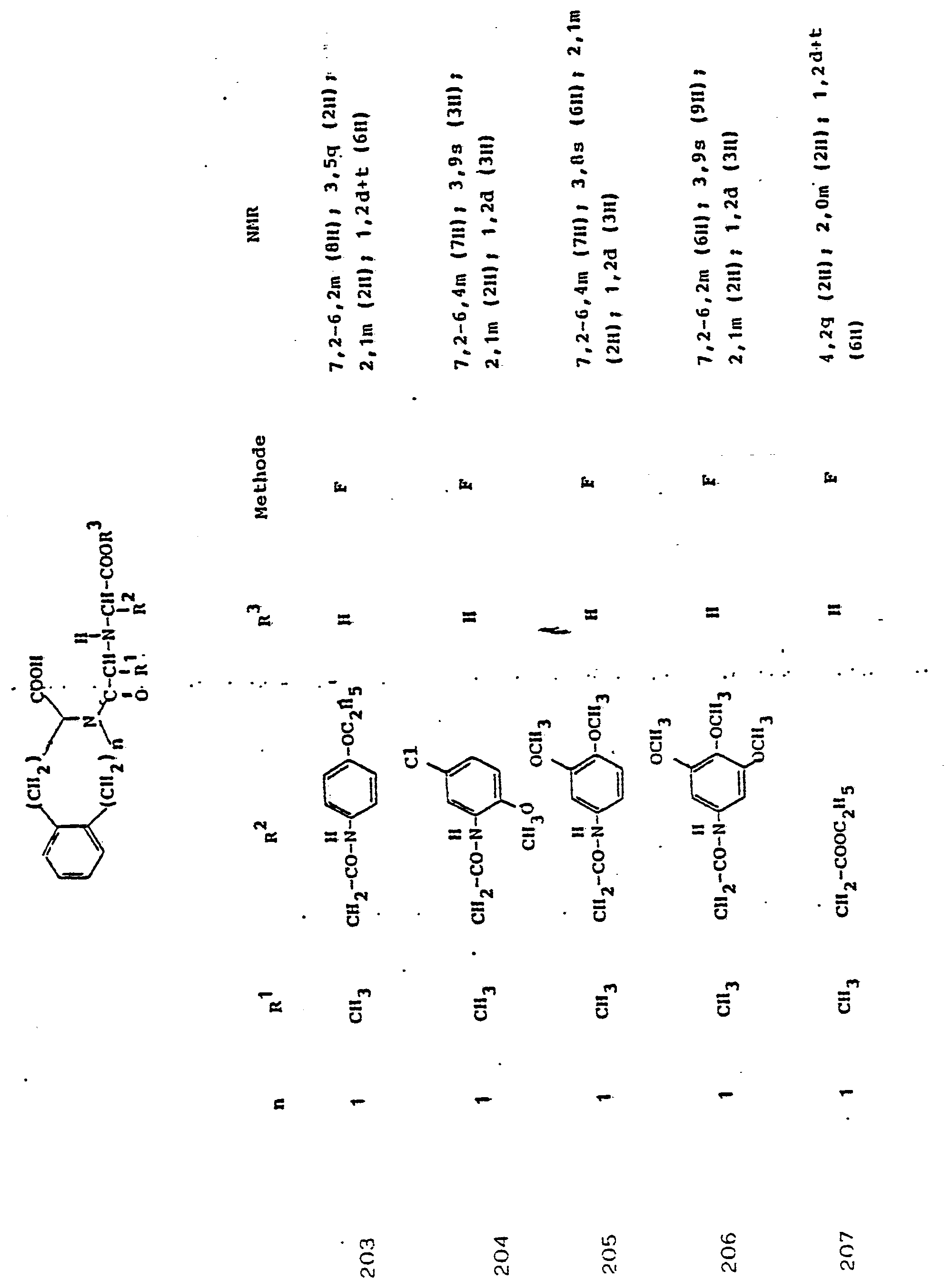
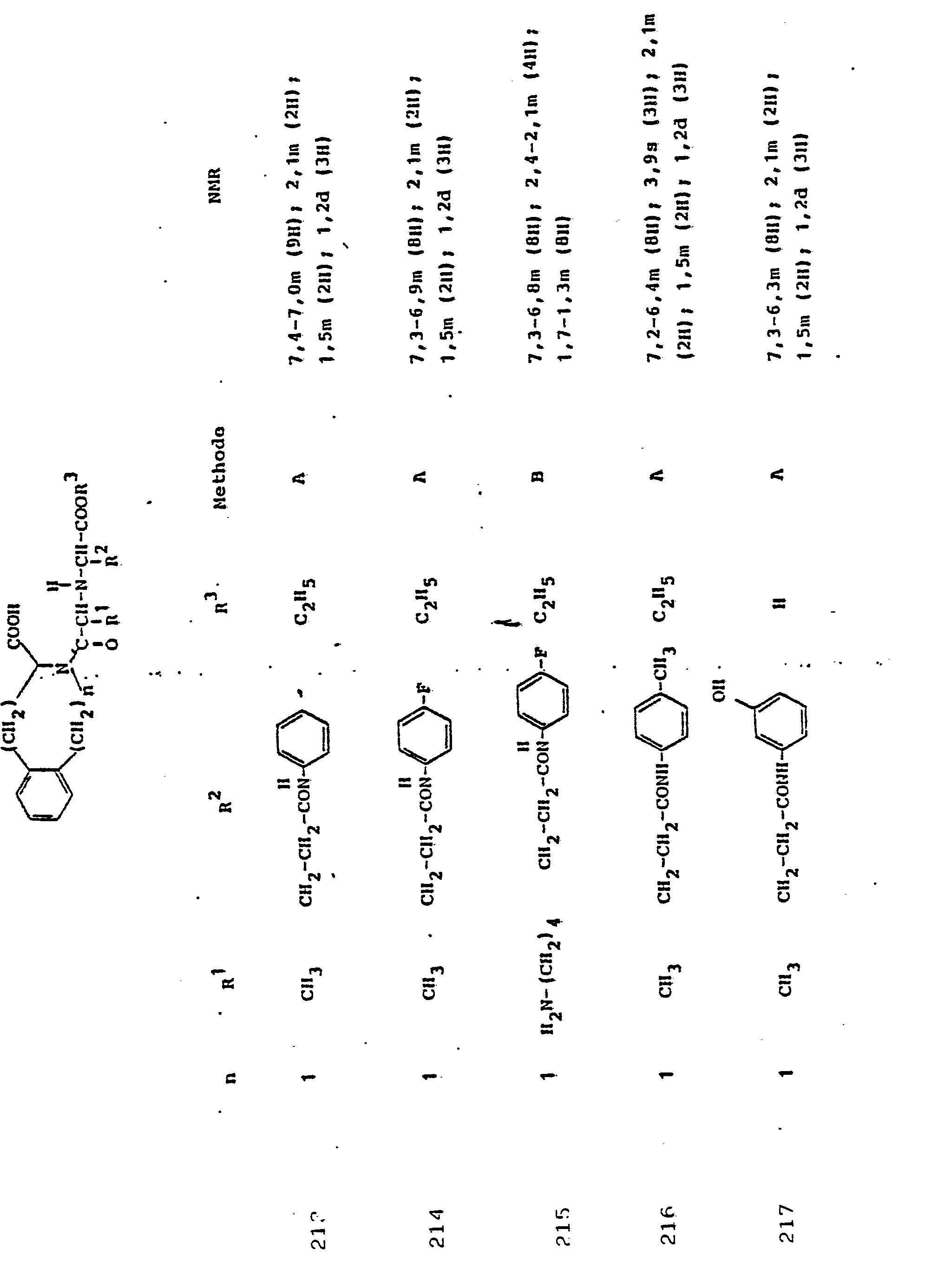
- Analog werden folgende Verbindungen hergestellt. Die Verbindungen zeigen die folgenden NMR-Signale:


- 305 mg Alanyl-dekahydroisochinolin-3-carbonsäure-t-butyl ester (Ala-Dic-OBut) und 445 mg 4-Phenyl-2-oxc-buttersäure werden in 4 ml Methanol gelöst und mit wässriger 1n-NaOH auf pH 7,5 gebracht. Man fügt 200 mg Natriumcyanoborhydrid hinzu und läßt 36 Stunden reagieren. Man engt zur Trockne ein und gewinnt die Substanz durch Säulenchromatographie an Kieselgel (Laufmittelsystem: Chloroform/Methanol/Wasser/Eisessig 20+15+2+1).
- Ausbeute: 376 mg; Schmp.: ab 123° Zers.
- 350 mg N-(1-Carboxy-3-phenylpropyl)-Ala-Dic-OBut werden in 3 ml wasserfreier Trifluoressigsäure gelöst und 30 Minuten bei Raumtemperatur belassen. Man engt im Vakuum ein und verreibt das hinterbleibende öl mit kaltem Diisopropyläther und Petroläther. Ausbeute: 226 mg amorphe Substanz
- NMR: 7,10 (s); 3,0-3,9 (m, breit);
- 1,23 und 1,15 (d); 2,0-1,0 (m, breit)
- Man löst 4,83 g H-Ala-Dic-OBut· TosOH in 40 ml absol. Ethanol, stellt mit KOH in Ethanol auf pE 7 und gibt 6,2 g 2-Oxo-4-phenylbuttersäure-ethylester zu und rührt in Anwesenheit von 9 g pulverisiertem Molekularsieb 4 Å unter langsamer Zugabe von einer Lösung von 2 g Natriumcyanoborhydrid in 15 ml absol. Ethanol. Nach etwa 20 h wird filtriert und das Lösungsmittel im Vakuum abdestilliert. Der Rückstand wird zwischen Essigester und Wasser verteilt, die Essigesterphase abgetrennt und im Vakuum zur Trockene gebracht. Der Rückstand wird an Silicagel im Laufmittel Essigester/Cyclohexan (1:2 bis 1:4) chromatographiert.
- Das Produkt wird 30 min. in 20 ml Trifluoressigsäure gelöst. Man destilliert die Trifluoressigsäure im Vakuum ab, destilliert mit Toluol nach und chromatographiert über Silicagel in Methylenchlorid/Methanol (10:1).
- Ausbeute: 1,8 g.
- In eine auf -50°C gekühlte Lösung von 700 mg Dic-OBut und 630 mg Dicyclohexylcarbodiimid in 15 ml wasserfreiem Chloroform wird eine gekühlte und frisch destillierte Lösung von 270 mg Brenztraubensäure in 5 ml Chloroform rasch eingerührt. Man beläßt 16 Stunden im Tiefkühlschrank (-20°C) und filtriert den ausgefallenen DC-Harnstoff ab. Die Lösung wird mit KHSO4- und anschließend mit KHCO3-Lösung gewaschen, über Na2SO4 getrocknet und im Vakuum eingeengt. Die Verbindung (Öl) enthält etwas Dicyclohexylharnstoff; sie wurde zur Analyse über Kieselgel im System CHCl3/CH3OH 15:1 chromatographiert.
- Analog der Kondensation Brenztraubensäure mit Dic-OBut werden folgende Kondensationsprodukte mit der entsprechenden α-Ketocarbonsäure dargestellt.


- 1,52 gPyruvyl-Dic-OBut und 394 mg S-Phenyl-cystein werden in 5 ml Methanol gelöst und mit 1n NaOH (wässrig) auf pH 7,0 gebracht. Man fügt 400 mg Natriumcyanoborhydrid zu und beläßt 24 Stunden bei Raumtemperatur. Man engt im Vakuum ein, nimmt in Chloroform auf, trocknet über Natriumsulfat und engt ein. Das Produkt wird durch Kieselgelchromatographie (System CHCl3/CH3OH/CH3COOH/H2O 50/20/5/1 ) rein erhalten.
- NMR: 7,3 m (5H); 5,1-4,8 m (1H); 3,9-3,0 m (4H); 2,5 m (2H)
- 1 g Butylester aus Beispiel 12b wird in 5 ml Trifluoressigsäure gelöst. Man engt nach 30 Minuten im Vakuum ein, digeriert den Rückstand mit Diisopropyläther und trocknet über Kaliumhydroxyd.
- Ausbeute: 0,95 g Trifluoracetat (hygroskopisch)
- NMR: 7,3 m (5H); 5,2-4,8 m (1H); 3,9-3,0 m (4H); 2,5 m (2H); 1,25 m (3H)
- 880 mg N-(1-Carbethoxy-3-phenyl-propyl)-L-alanyl-L-deka- hydroisochinolin-3-carbonsäure werden in 20 ml Dioxan/ Wasser (9:1) gelöst und bei Raumtemperatur mit 4,5 ml 1n Natriumhydroxid-Lösung verseift. Nach einer Stunde wird die Lösung mit der äquivalenten Menge 1 n Salzsäure angesäuert und das Dioxan weitgehend abgedampft. Der Rückstand wird mehrfach mit Essigester extrahiert und die organische Phase nach Abziehen des Lösungsmittels über einen Kationenaustauscher (DOWEX 50) chromatographiert.
- Ausbeute: 630 mg.
- 1,2 g N-(1-Carboxy-5-Boc-aminopentyl)-L-alanyl-L-deka- hydroisochinolin-3-carbonsäure werden mit 10 ml eiskalter Trifluoressigsäure übergossen und eine Stunde bei Raumtemperatur gerührt. Anschließend wird im Vakuum eingedampft. Der Rückstand wird in Wasser gelöst und einer Gefriertrocknung unterworfen.
- Ausbeute: 0,90 g.
- 1,1 g N-(1-Carbethoxy-3-benzoxycarbonylamino-propyl)-L-alanyl-L-dekahydroisochinolin-3-carbonsäure werden in 150 ml Methanol gelöst und in Gegenwart von 100 mg Palladium - Aktivkohle (10 %ig) bei 40°C unter Normaldruck hydriert. Nach Beendigung der Reaktion wird vom Katalysator abfiltriert und das Lösungsmittel im Vakuum abgezogen.
- Ausbeute: 0,79 g.
- NMR: 5,1-4,8 m (1H); 3,9-2,5 m (6H); 2,0-1,0 m (14H) 1,2 d (3H).
- Zu einer unter Eiskühlung gerührten Mischung von 0,64 g Natriumperjodat und 20 ml Wasser werden 1,3 g N-(1-Carbethoxy-2-benzyl-thio-ethyl)-L-alanyl-L-dekahydroiso- chinolin-3-carbonsäure gelöst in 20 ml Methanol gegeben. Man läßt die Reaktionsmischung für 24 Stunden bei 0°C rühren und filtriert anschließend vom Natriumjodat ab. Das Filtrat wird mehrfach mit Methylenchlorid extrahiert. Nach Entfernen des Lösungsmittels erhält man 1,1 g des Sulfoxids. Im NMR-Spektrum werden folgende Signale beobachtet:
- 7,3 m (5H); 5,1-4,8 m (1H); 4,1 s (1H); 3,9-3,0 m (4H); 2,6 m (2H); 1,2 d (3H)..
- 260 mg N-(1-Carbethoxy-3-phenylthio-propyl)-L-alanyl-L-dekahydroisochinolin-3-carbonsäure und 20 mg Natriumwolframat Dihydrat werden in 50 ml Wasser gegeben und tropfenweise mit 1 ml Perhydrol (30 %ig) versetzt. Die Mischung wird für 30 min auf 80°C erwärmt und anschließend eine Stunde bei Raumtemperatur gerührt. Das überschüssige Peroxid wird sodann mit Palladium auf Bariumsulfat zerstört und nach Beendigung der Sauerstoffentwicklung wird die Lösung vom Palladium Katalysator abfiltriert und eingeengt. Das Rohprodukt wird durch Ionenaustauschchromatographie über DOWEX 50 H+-Form gereinigt.
- Ausbeute: 220 mg
- NMR: 7,7 m (5H) ; 5,1-4,8 m (1H); 3,9-3,0 m (4H); 2,8 m (2H) 1,5 m (2H); 1,2 d (3H)
- 2,2 g NB-Boc-α,β-Diaminobuttersäure, hergestellt analog Coll. Czech chem. Commun. 31, 2955 (1966) werden mit 2,4 g Pyruvyl-Dic-OBut, hergestellt nach Beispiel 12a, in der in Beispiel 12 b beschriebenen weise umgesetzt. Die Boc-Schutzgruppe wird anschließend nach der in Beispiel 14 beschriebenen
- Weise abgespalten.
- Ausbeute: 2,6 g.
- NMR: 5,1-4,8 m (1H); 3,9-3,0 m (5H); 2,0-1,0 m (15H) 1,2 d (3H).
-
- a) 35 g N -Benzyloxycarbonyl-L-lysin-ethylester-hydrochlorid und 30,6 g α-Brompropionsäure werden in einer Mischung aus 350 ml Dioxan, 50 ml Ethanol und 75 ml 4N NaOH gelöst. Man rührt über Nacht bei Raumtemperatur unter Konstanthalten des pH bei 8.8-9 am Autotitrator, bringt dann mit wenig HCl auf pH 7-8 und destilliert das Lösungsmittel im Vakuum ab. Der Rückstand wird in möglichst wenig Wasser gelöst und die Lösung mit Salzsäure auf pH 5-6 gebracht.. Man kühlt mit Eis und filtriert den Niederschlag nach kurzem Stehen ab, wäscht mit wenig eiskaltem Wasser und Ether und trocknet, im Vakuum. Man kann die wässrige Lösung auch über schwach basischem Ionenaustauscher in das Zwitterion überführen und reinigen. Das Filtrat wird dann einfach lyophilisiert. Ausbeute: 12,9 g (52 %).
- b) Man löst die Verbindung in 100 ml Dimethylformamid und versetzt nacheinander bei Raumtemperatur mit 23 g H-Dic-OBzl; TosOH (in üblicher Weise aus der Aminosäure durch Kochen in Benzylalkohol-Toluol-Toluolsulfonsäure unter Rückfluß und Wasserabscheidung hergestellt), 6,5 ml N-Ethylmorpholin, 6,8 g 1-Hydroxybenzotriazol und 11 g Dicyclohexylcarbodiimid. Nach 4 h Rühren wird vom Harnstoff abfiltriert, das Lösungsmittel im Vakuum abdestilliert und der Rückstand in Cyclohexan-Essigester (4:1) an Silicagel chromatographiert. Dabei tritt Auftrennung der Diastereoisomeren ein. Die einheitlichen Fraktionen, welche die Titelverbindung enthalten, werden gesammtelt, das Lösungsmittel wird im Vakuum abdestilliert.
- c) Der Rückstand wird in Methanol aufgenommen, an Pd/Kohle katalytisch hydriert und ggfs. nach Abfiltrieren des Katalysators durch Einstellen des pH auf 3 in Hydrochlorid überführt. Abdestillieren des Lösungsmittels und Trocknen des Rückstandes im Vakuum.
-
- a) 55 g 2-Brom-4-phenyl-n-buttersäureäthylester, 14,5 g L-Alanin-t-butylester und 45 ml Triethylamin werden 24 h in Tetrahydrofuran aufbewahrt. Man destilliert das Lösungsmittel im Vakuum ab, verteilt den Rückstand zwischen Wasser und Essigester, trennt die Essigesterschicht ab, trocknet über Natriumsulfat und destilliert das Lösungsmittel im Vakuum ab. Der Rückstand wird in Cyclohexan-Essigester (4:1) über Silicagel chromatographiert, wobei neben der Reinigung auch Diastereoisomerentrennung eintritt. Nach Einengen der entsprechenden Fraktionen wird der t-Butylester durch 20 min. Aufbewahren der Verbindung in Trifluoressigsäure abgespalten. Man destilliert die Trifluoressigsäure im Vakuum ab und destilliert mit Toluol im Vakuum nach.
- b) Nun setzt man analog Beispiel 19b in Dimethylformamid mit 11 g Oktahydroindol-2-carbonsäure-benzylester- tosylat, 3,2 ml N-Ethylmorpholin, 3,3 g 1-Hydroxybenzotriazol und 5,5 g Dicyclohexylcarbodiimid um, arbeitet wie dort beschrieben auf und trennt die Diastereomeren durch Chromatographie an Silicagel im System Cyclohexan:Essigester (4:1) auf. Von der chromatographisch einheitlichen Verbindung wird der Benzylester durch katalytische Hydrierung abgespalten.
-
- a) 15,3 g cL-Brompropionsäure und 41,1 g H-Dic-OBut . TosOH werden in 300 ml Tetrahydrofuran in Anwesenheit von 12,8 ml N-Ethylmorpholin und 1,35 g 1-Hydroxybenzotriazol mittels 22 g Dicyclohexylcarbodiimid kondensiert. Nach 4 h wird der Harnstoff abfiltriert und das Lösungsmittel im Vakuum abdestilliert. Man nimmt den Rückstand in Essigester auf, wäscht die Lösung mit Natriumhydrogencarbonat- und Citronensäurelösung und mit Wasser, trocknet die Essigesterlösung über Natriumsulfat und destilliert das Lösungsmittel im Vakuum ab.
- b) 3,75 g α-Brompropionyl-Dic-OBut werden in 20 ml Tetrahydrofuran mit 2,5 g Nδ-(4,6-Dimethyl-pyrimidin-2-yl-L-ornithin-ethylester unter Zusatz von 1 ml Diisopropylethylamin bei Raumtemperatur umgesetzt. Nach 24 h wird das Lösungsmittel im Vakuum abdestilliert, der Rückstand in Essigester aufgenommen, die Lösung mit Wasser gewaschen, über Natriumsulfat getrocknet und im Vakuum eingeengt. Der Rückstand wird analog Beispiel (20b) unter Diastereoisomerentrennung chromatographiert. Der t-Butylester wird durch Lösen der Verbindung in Dioxan/HCl gespalten. Nach 10-15 min destilliert man das Lösungsmittel ab und trocknet den Rückstand scharf im Vakuum über KOH. Die Verbindung liegt als Hydrochlorid vor.
-
- a) N-(1-S-Carbethoxy -3-phenyl-propyl)-alanin-benzylester Durch Extraktion mit Essigester wird aus einer wässr. Sodalösung von 70 g Alanin-benzylester-Toluolsulfonat die freie Base gewonnen. Man versetzt die über wasserfreiem Natriumsulfat getrocknete organische Phase mit 200 ml Dimethylacetamid (DMA) und engt bei RT im Wasserstrahlvakuum ein. Nach Zugabe von 90 g α-Brom--phenyl-buttersäureethylester und 40 ml N-Äthylmorpholin wird die Lösung 4 Tage bei RT belassen. Die Reaktion wird dünnschichtchromatographisch auf Kieselgelplatten (System: Cyclohexan/Essigester 2:1) verfolgt. Man engt im Vakuum bis' fast zur Trockne ein, stellt mit 2n methanolischer Salzsäure auf pH 3 und setzt 10 ml Wasser zu. Man extrahiert überschüssigen Bromester und lipophile Produkte in Petroläther, engt die methanolische Phase ein, fügt 3 % Sodalösung (250 ml) zu und extrahiert die Reaktionsprodukte in ein. Essigester/Äther-Gemisch (1:1). Nach Trocknung über festem Natriumsulfat wird eingeengt und mit Hilfe einer Kieselgelchromatographie (System Cyclohexan/Essigester 4:1) eine Reinigung und Diastereomerentrennung vorgenommen. Die S,S-Verbindung weist einen niedrigeren Rf-Wert auf und fällt in überwiegender Menge an (48%). Die ölige Substanz wird sofort weiter verarbeitet.
- b) N·(1-S-Carbethoxy -3-phenyl-propyl) -S-alanin 37 g des Benzylesters werden in 250 ml Ethanol aufgenommen und mit 1 g Pd/Kohle (10 % Pd) bei Normaldruck in 2 Stunden hydrogenolytisch entbenzyliert. Man filtriert den Katalysator ab, engt im Vakuum fast zur Trockene ein und fällt durch Zusatz von Petroläther.
- Ausbeute: 33 g; amorph;
- NMR: 1,18 (d, 3H); 1,18 (t, 3H); 1,5-2,1 (m, 2H); 2,4-2,8 (m, 2H); 3,0-3,4 (2 m, je 1 H); 4,07 (q, 2H); 4,3-5,5 (b, 2H); 7,17 (s, 5H). DMSO-d6
- 5 g N-(1-S- Carbethoxy .-3-phenyl-propyl)-S-alanin werden in 20 ml DMF gelöst: Man fügt 2,45 g 1-Hydroxybenzotriazol, 5,1 g cis-Octahydroindol-R,S-carbonsäure- benzylester-hydrochlorid, 2,5 ml N-Ethylmorpholin sowie 4 g Dicyclohexylcarbodiimid zu und rührt 3 Stunden bei Raumtemperatur. Man verdünnt mit 30 ml Essigester und saugt vom Harnstoff ab. Nach Einengen im Vakuum wird in 100 ml Äther aufgenommen und mit wässr. Bicarbonatlösung 2 x extrahiert. Die über Natriumsulfat getrocknete und zur Trockene eingeengte organische Phase wird an Kieselgel chromatographiert. Man eluiert mit Essigester/Petroläther 4:3 und erhält 2 Fraktionen, aus denen durch Einengen im Vakuum farblose öle erhalten werden.
- Elementaranalyse: C H N
- ber. für C31H40N2O5 71.5 7.7 5.4 Ausb.
- Frakt. 1 71.3 7.8 5.3 3.3 g Frakt. 2 71.6 7.6 5.6 3.9 g
- 3 g des Benzylesters (Fraktion 2) werden in Ethanol gelöst und mit 200 mg 10 % Pd/Kohle bei Normaldruck hydrogenolytisch entbenzyliert. Nach beendeter Wasserstoffaufnahme (etwa 1 Stunde) wird vom Katalysator abfiltriert und die Lösung im Vakuum eingeengt. Man versetzt mit etwas Pentan, erwärmt auf etwa 45°C und legt ein kräftiges Vakuum an. Es bildet sich ein amorpher, fester Schaum. Ausb.: 2,4 g.
- NMR (CDC13): 1,20 (d, 3H); 1,23 (t, 3H); über Multiplett 1,0-2,9 (11H); 3,0-4,5 (m, 3H); 4,12 (q, 2H) ; 4,65 (b, 2H); 7,13 (s, 5H).
- a) N-tert.Butyloxycarbonyl-alanyl-octahydroindol-2-carbonsäure-benzylester (Boc-Ala-Oic-OBzl)
- 19 g Boc-Ala-OH werden in 100 ml DMF gelöst und mit 13 ml N-Ethylmorpholin, 13,5 g HOBt sowie 29,6 g Octahydroindol-2-carbonsäurebenzylester-hydrochlorid versetzt. Man kühlt im Eisbad, fügt 21 g Dicyclohexylcarbodiimid zu und läßt 15 Stunden bei Raumtemperatur rühren. Der ausgefallene Harnstoff wird abgesaugt, das Filtrat im Vakuum eingeengt und in Essigester aufgenommen. Man extrahiert je 3 x mit wässriger KHSO4-, KHCO3- und gesättigter NaCl-Lösung und engt die organische Phase im Vakuum ein. Ausbeute: 38.5 g.
- NMR: 1,26 (d, 3H); 1,40 (s, 9H) ; 1,1-2,4 (m, 12H); 3,2-3,9 (m, 2H); 5,28 (s, 2H); 7,31 (s, 5H).
- 21,5 g Boc-Ala-Oic-OBzl werden in 50 ml Trifluoressigsäure gelöst. Man engt im Vakuum ein, digeriert den Rückstand mehrfach mit Diisopropyläther und trocknet im Vakuum. Ausbeute: 21 g. Im NMR fehlt das Protonensignal für die tert. Butylgruppe vollständig.
- 11,1 g Ala-Oic-OBzI.TFA, 7 g α-Brom-phenylbuttersäureethylester und 3,3 ml N-Ethylmorpholin werden in 20 ml Dimethylacetamid 4 Tage bei Raumtemperatur gerührt. Man engt im Vakuum weitgehend ein, löst den Rückstand in Methanol, stellt mit wässr. 2n HC1 auf pH 2 und extrahiert lipophile Verbindungen mit Petroläther. Die methanolische Phase wird eingeengt, mit 5 % Sodalösung versetzt und das Reaktionsprodukt in Essigester extrahiert. Chromatographie über Kieselgel (System Essigester/ Petroläther 5:3) liefert die Titelverbindung als farbloses Oel.
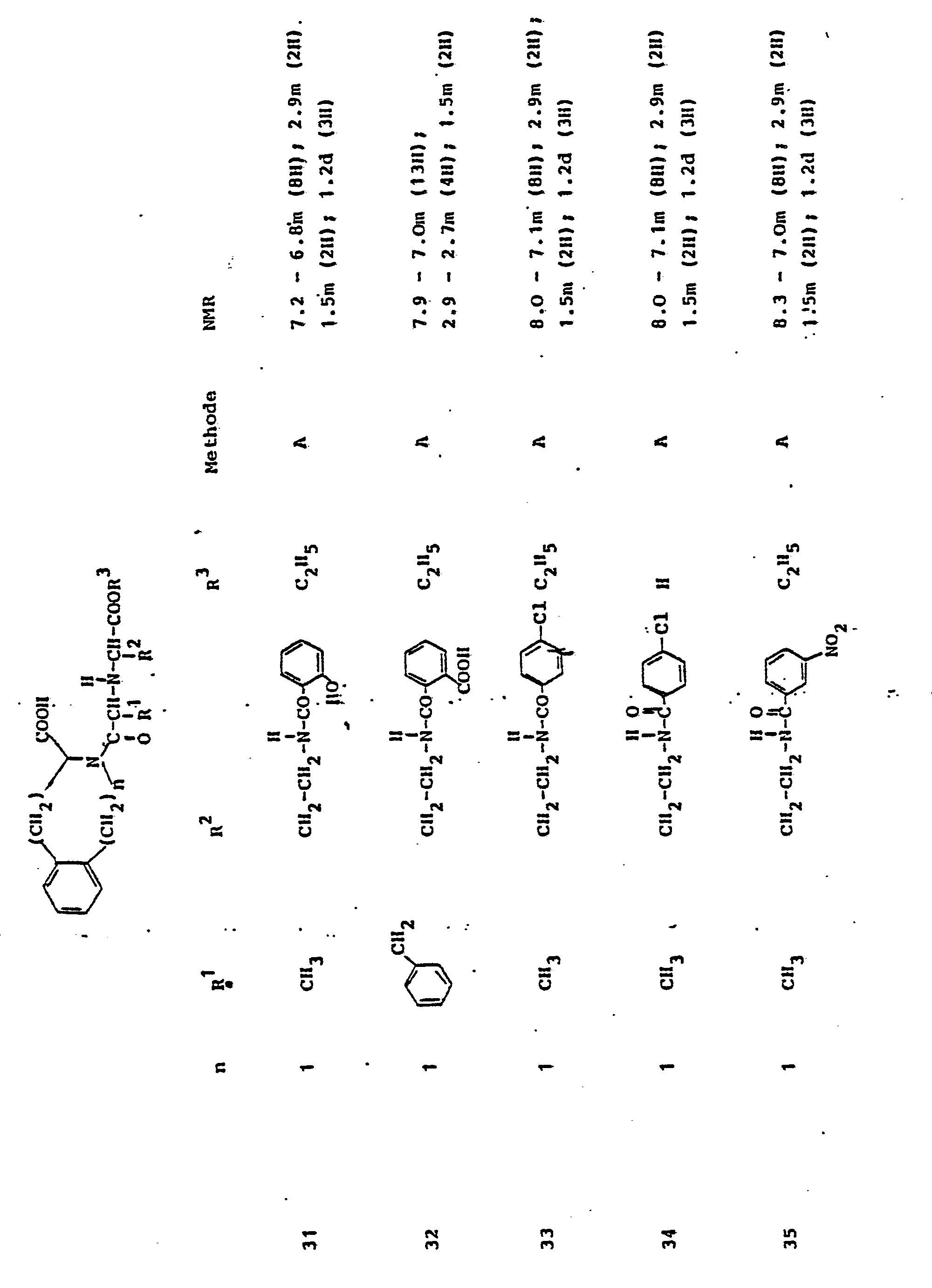
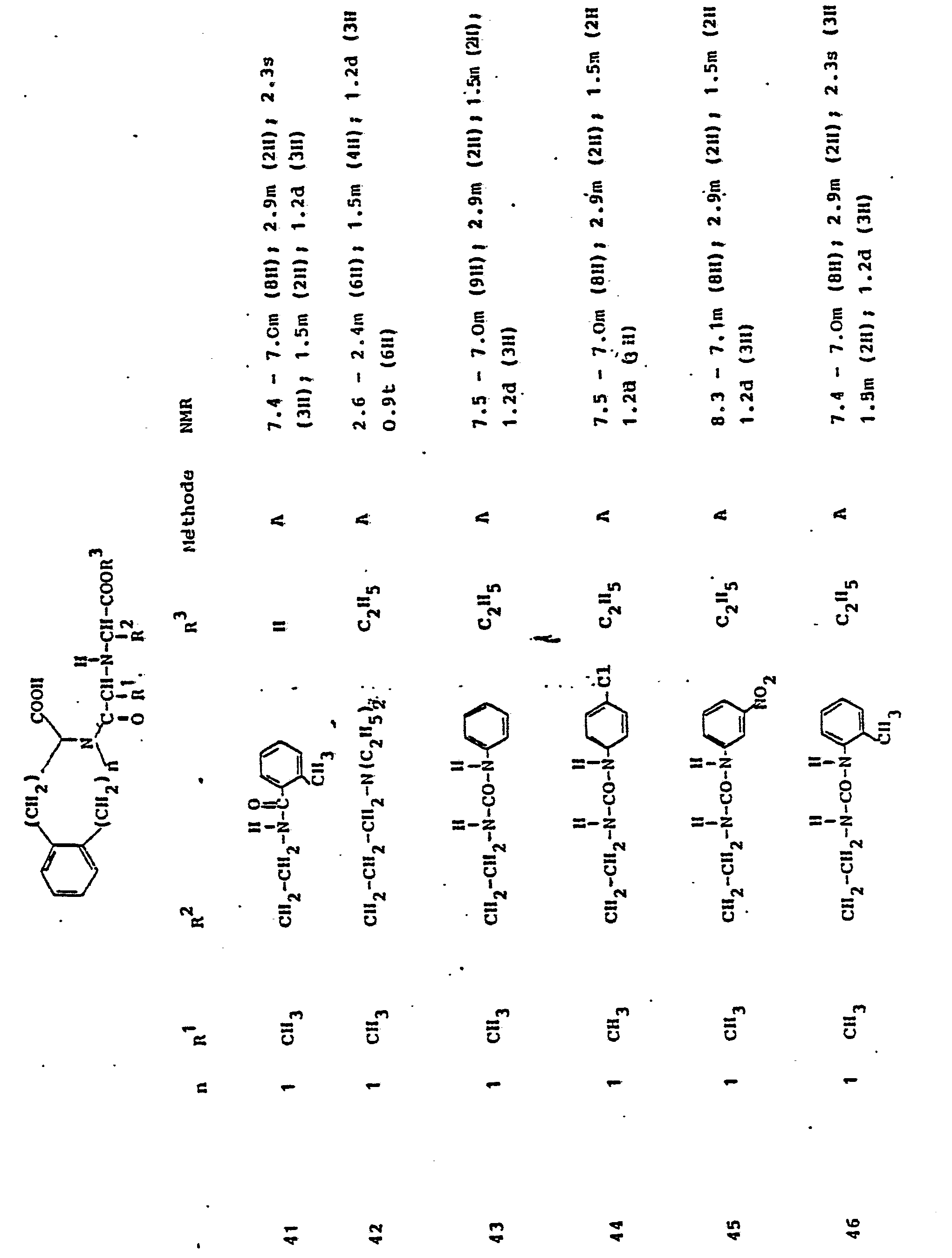
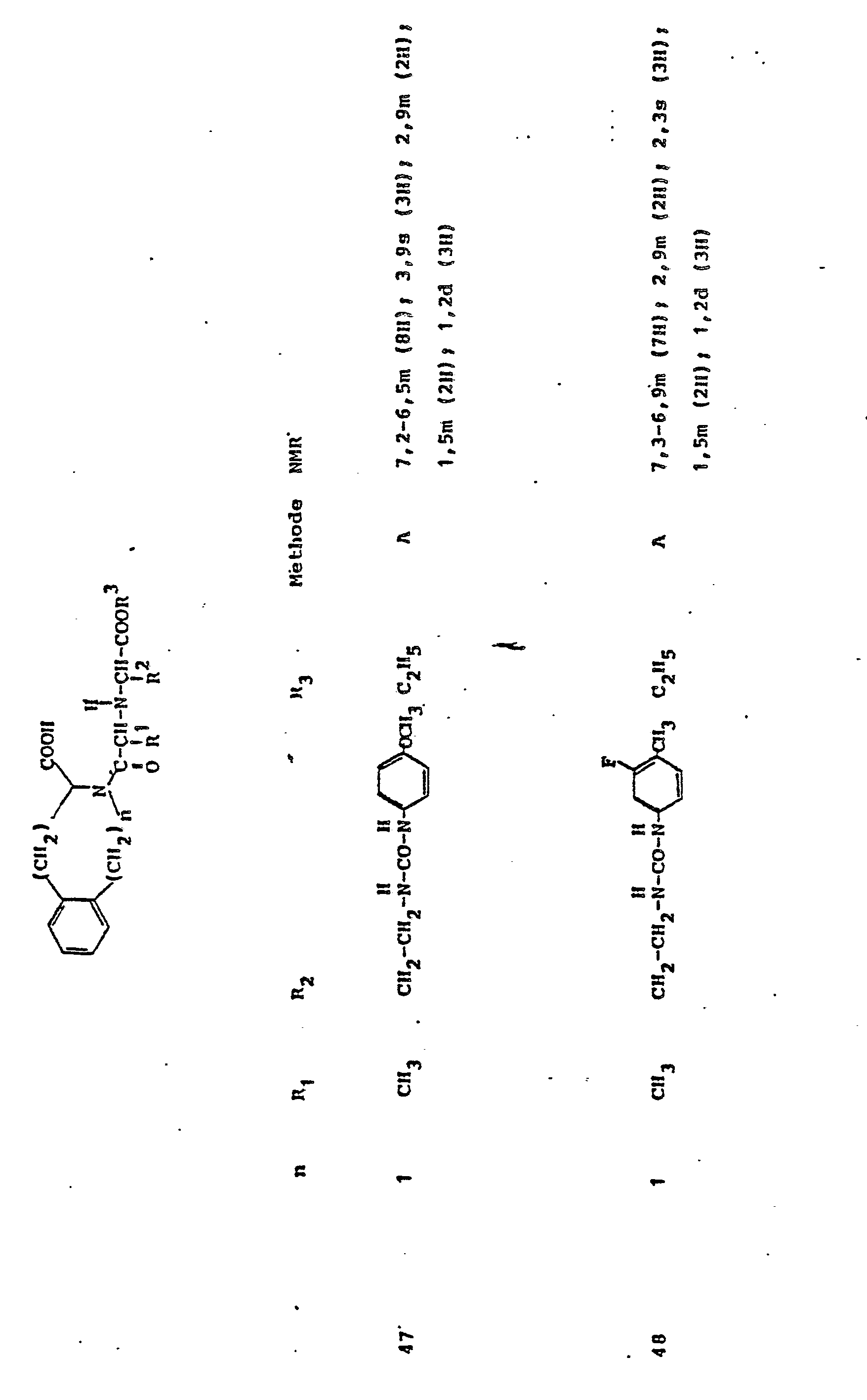
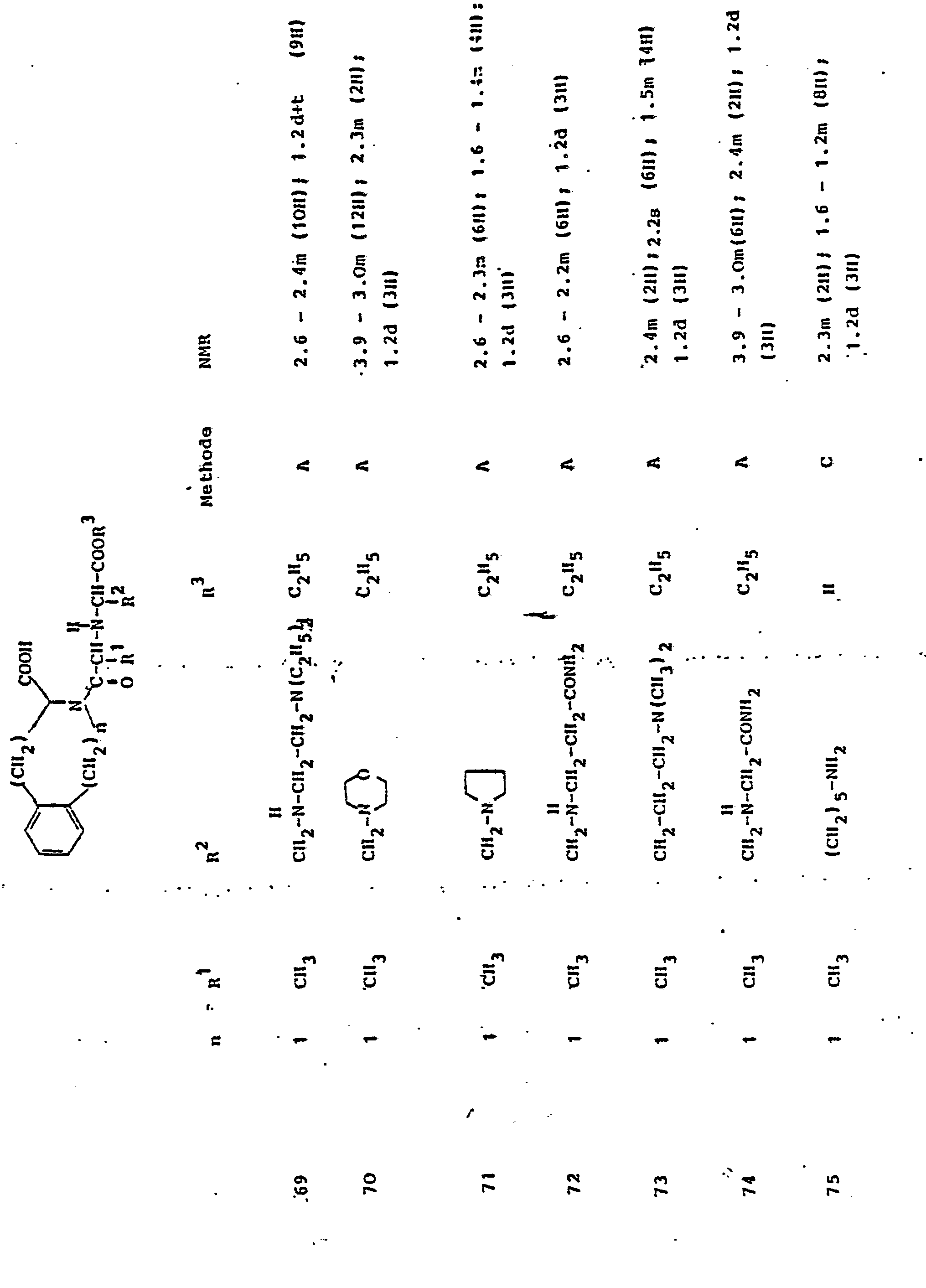
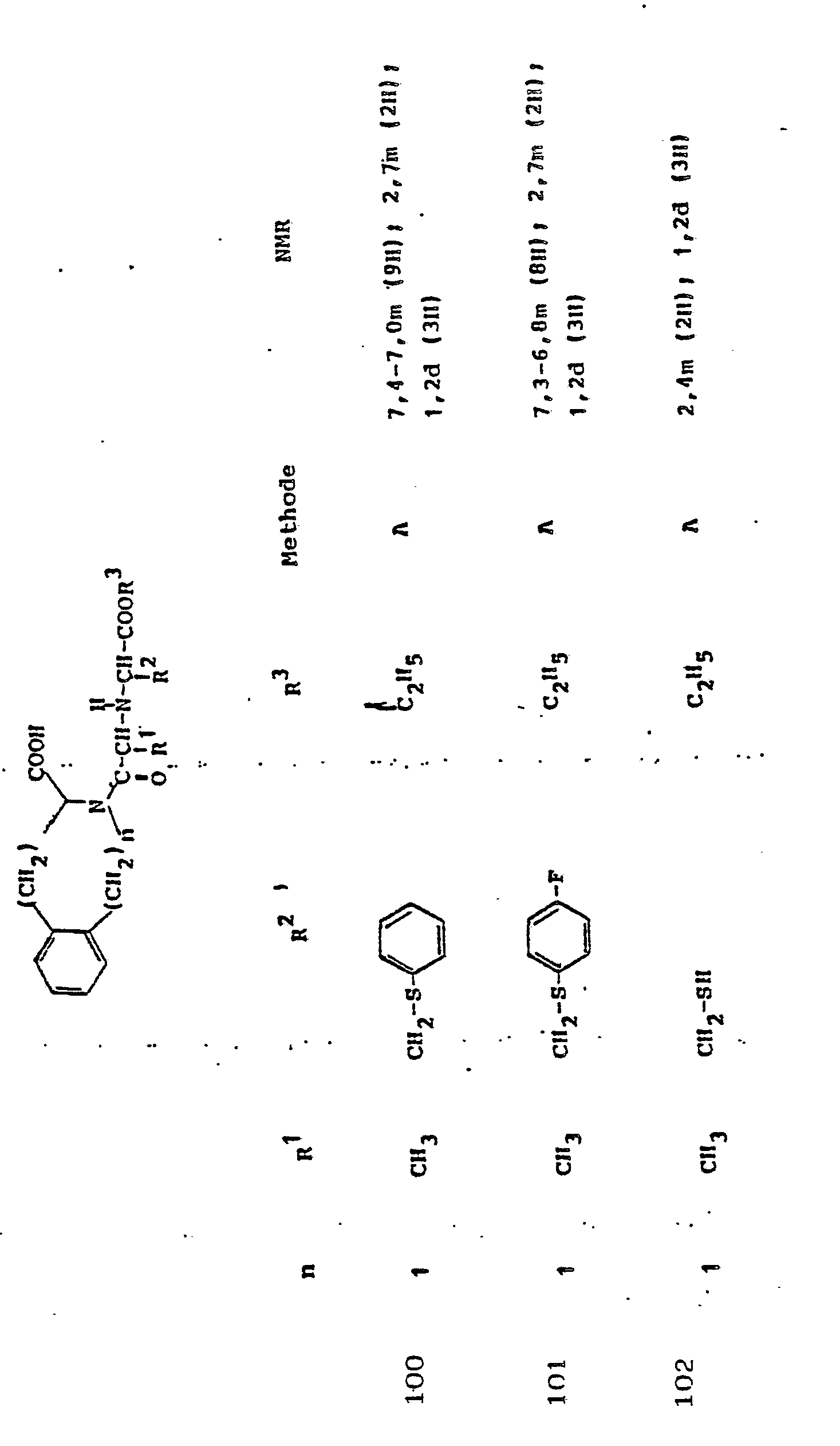
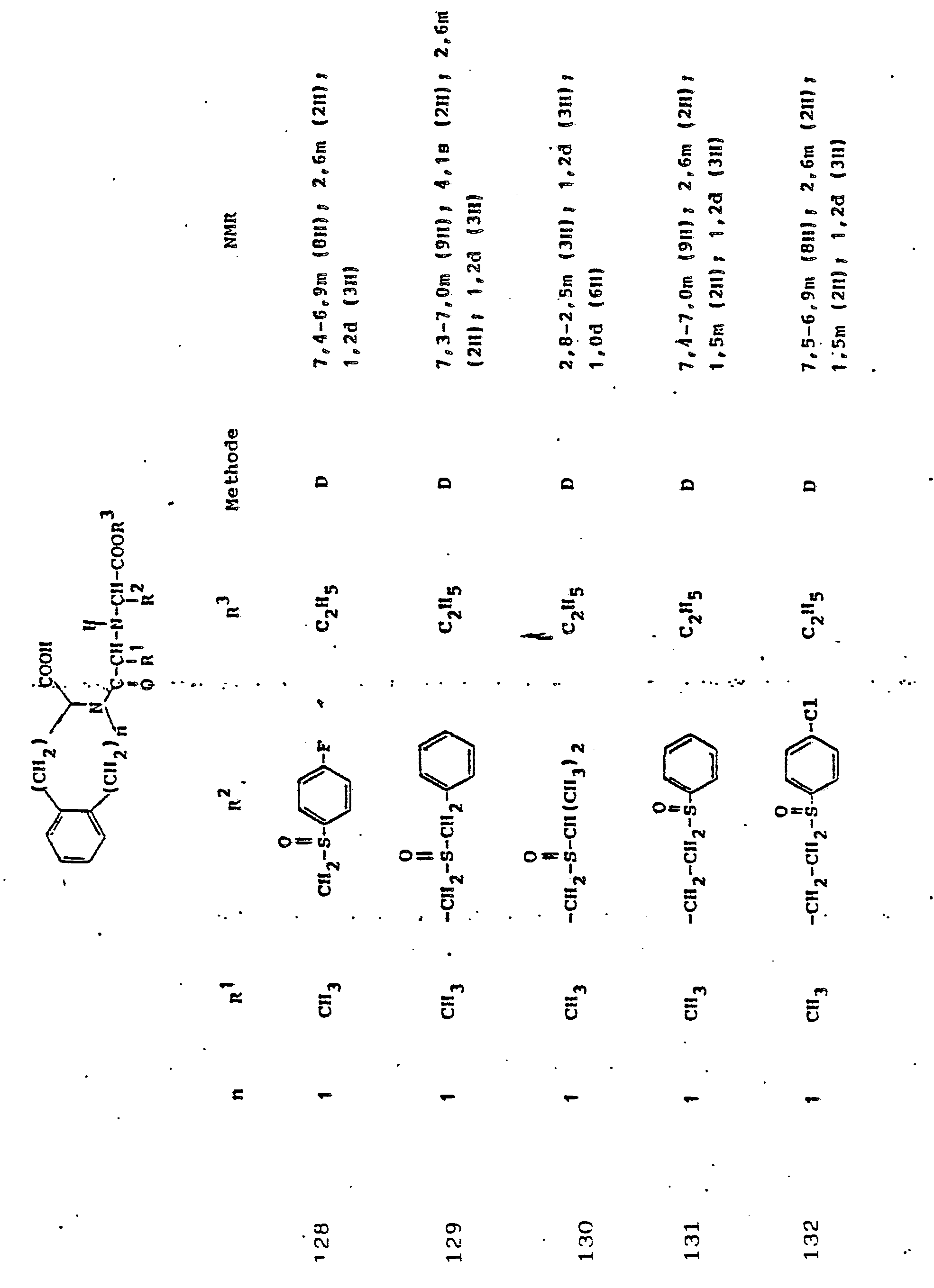
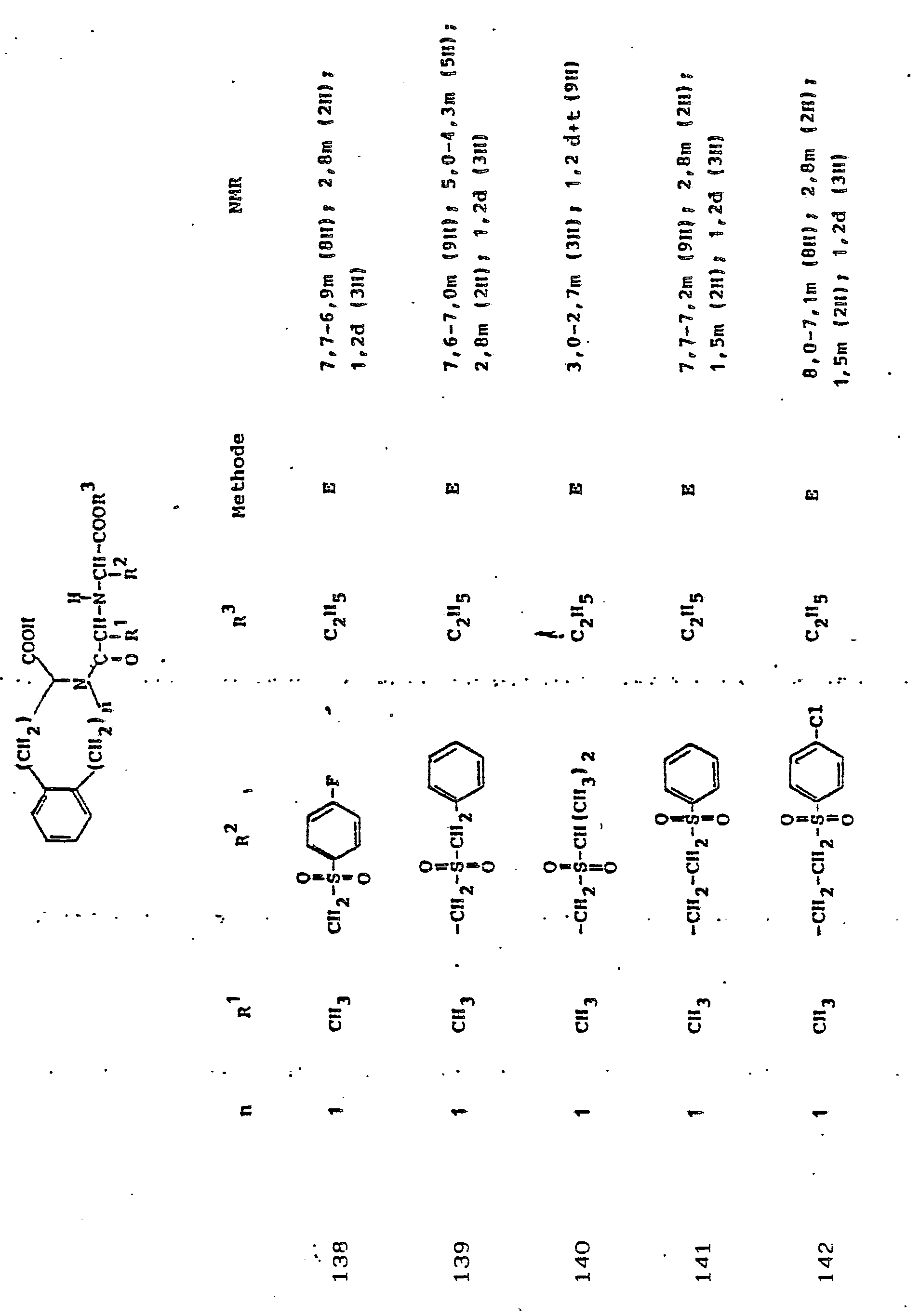
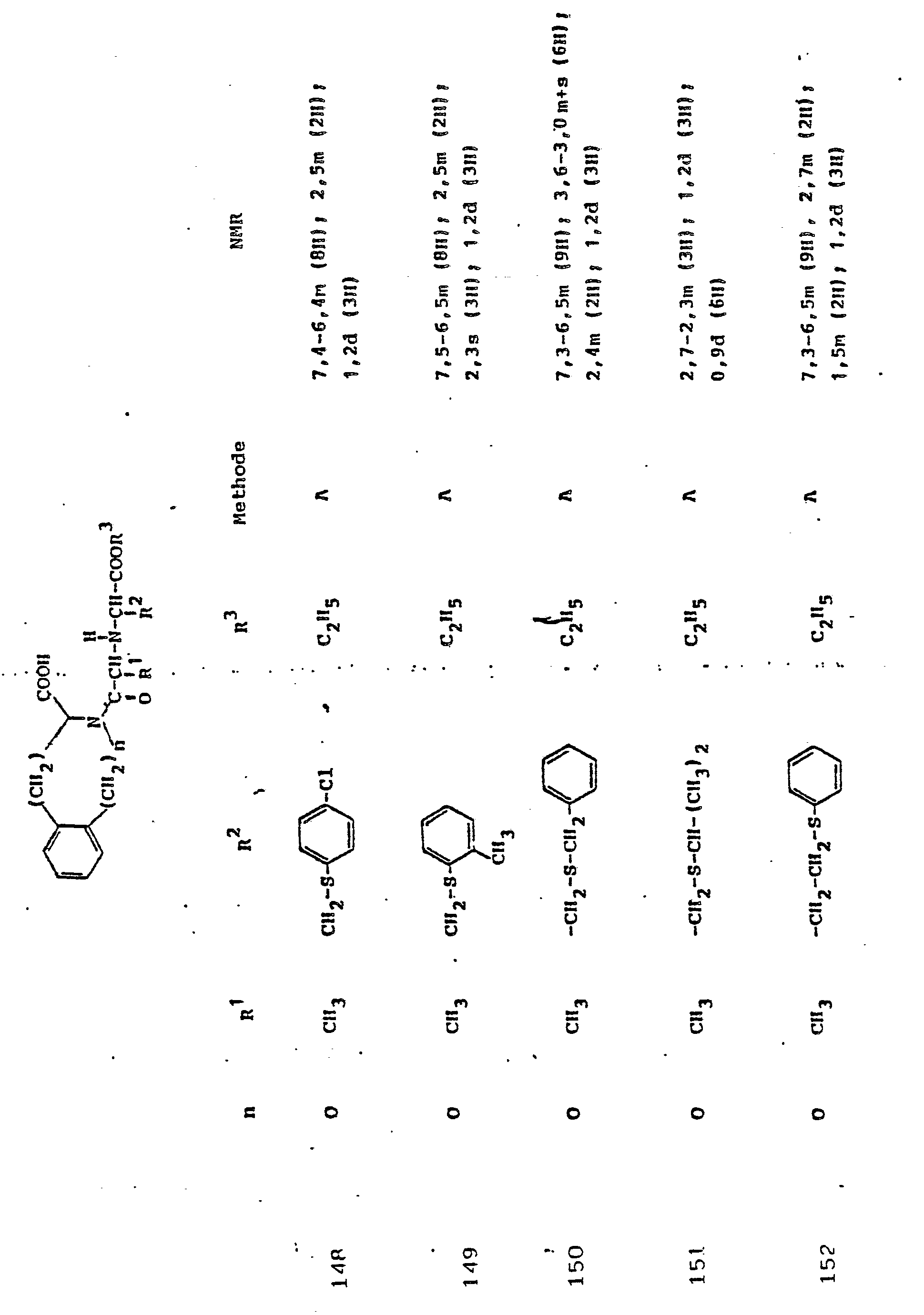
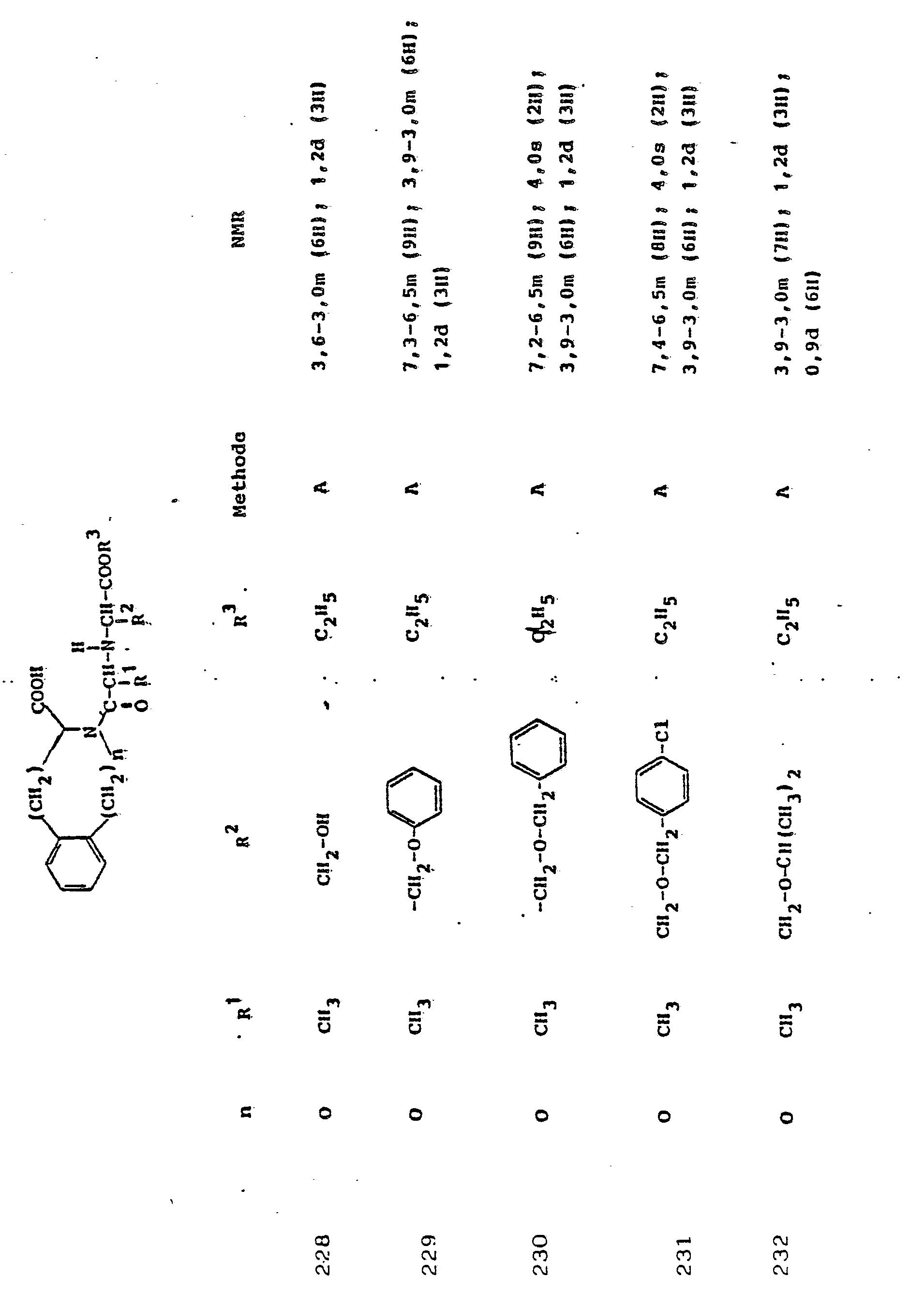
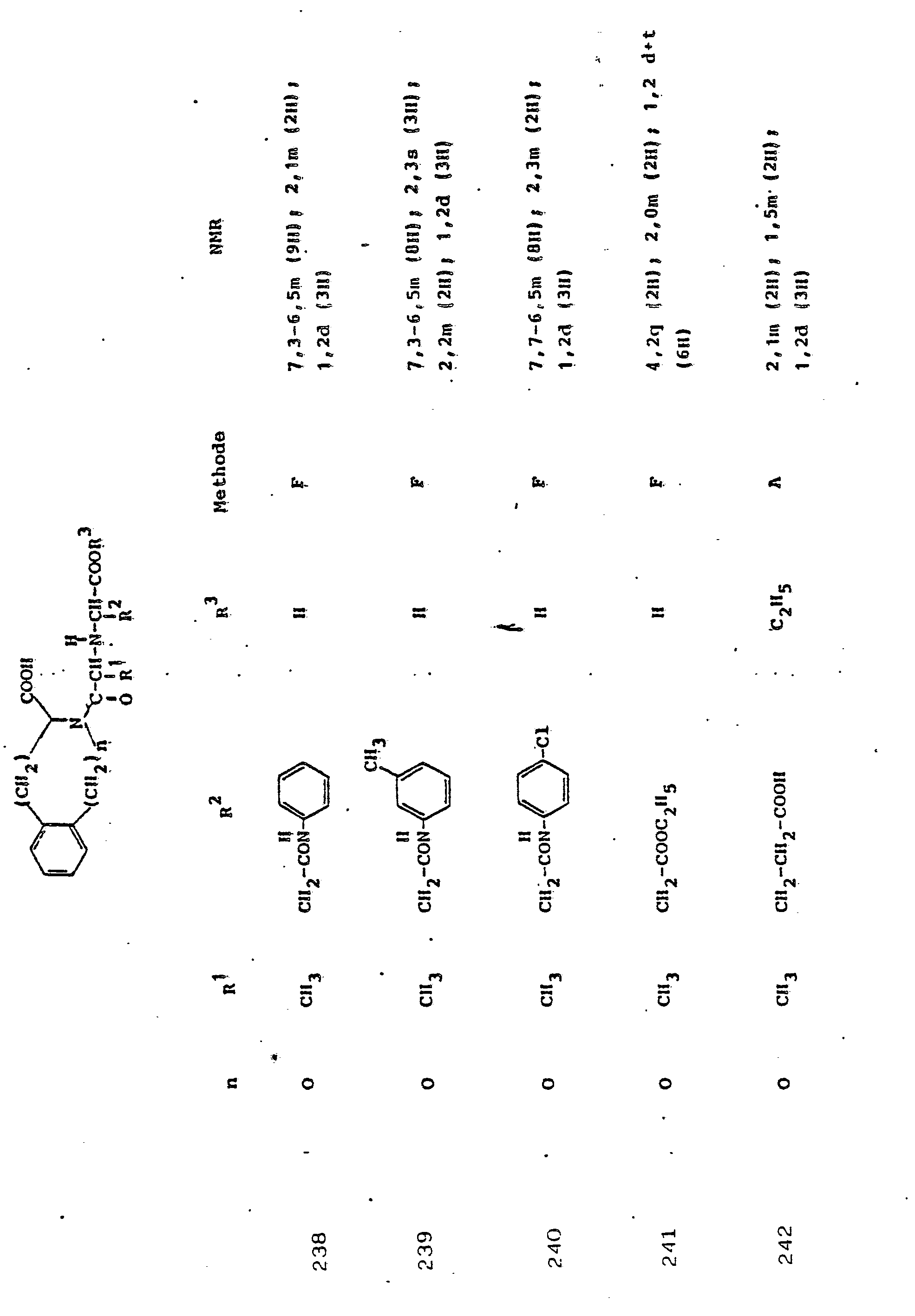
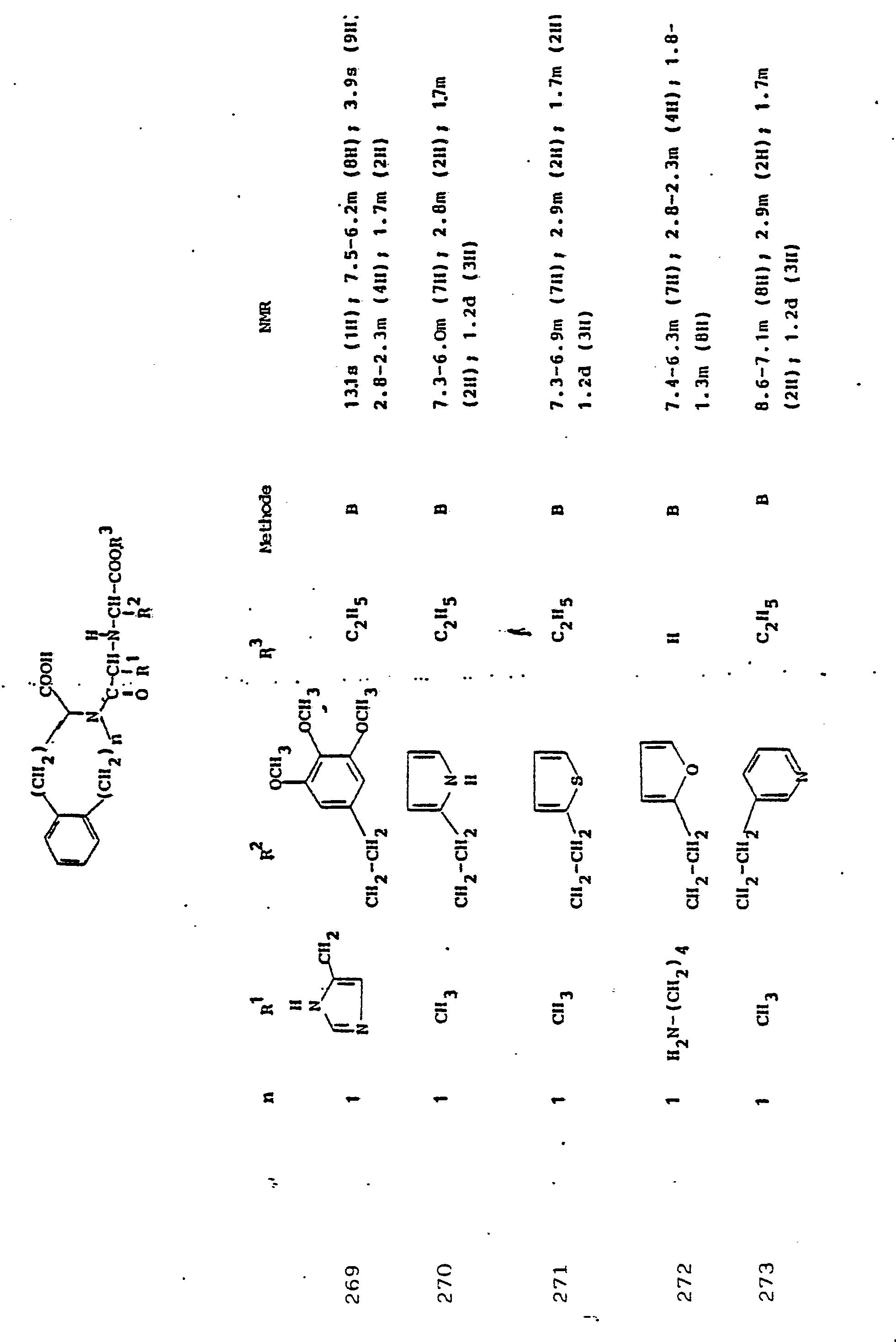
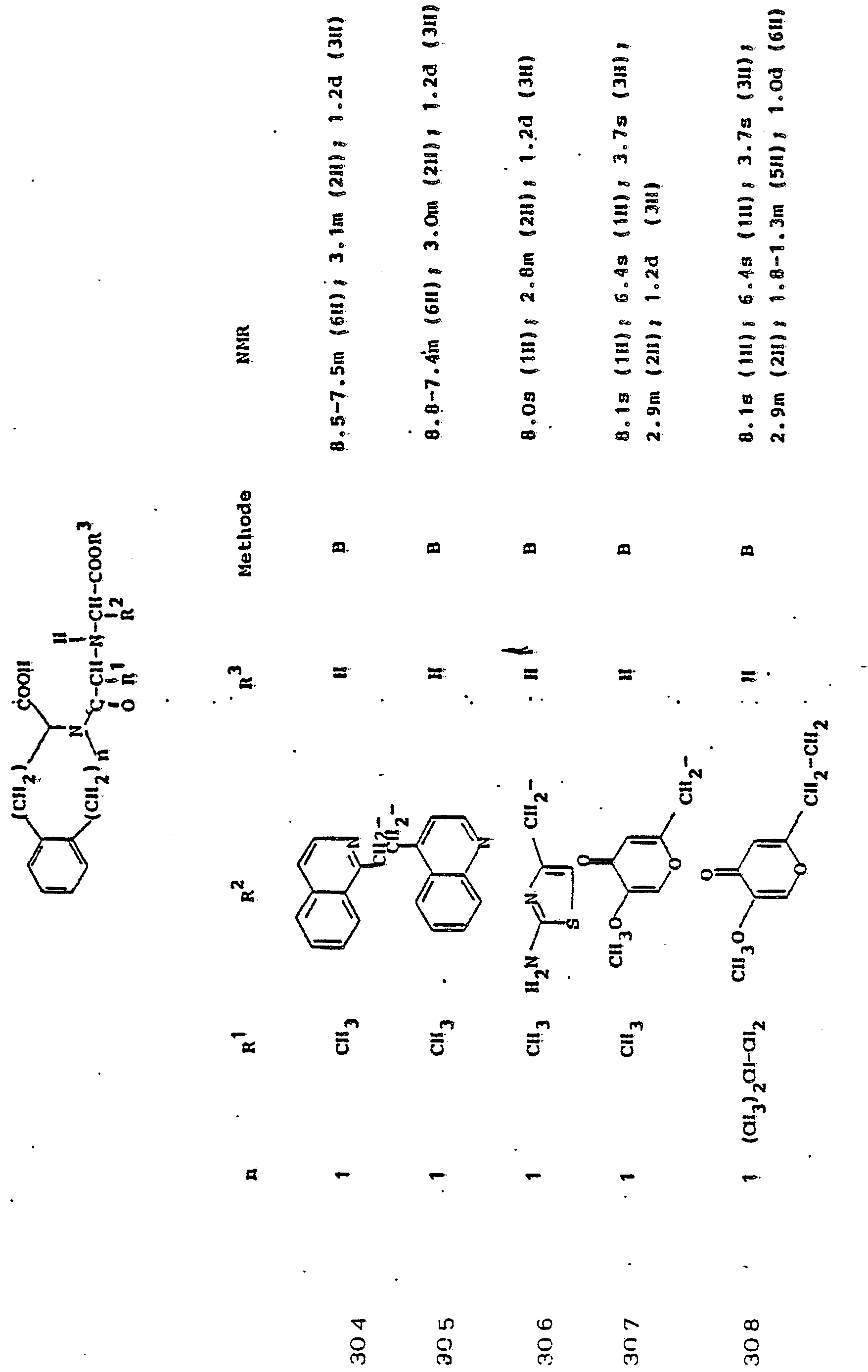
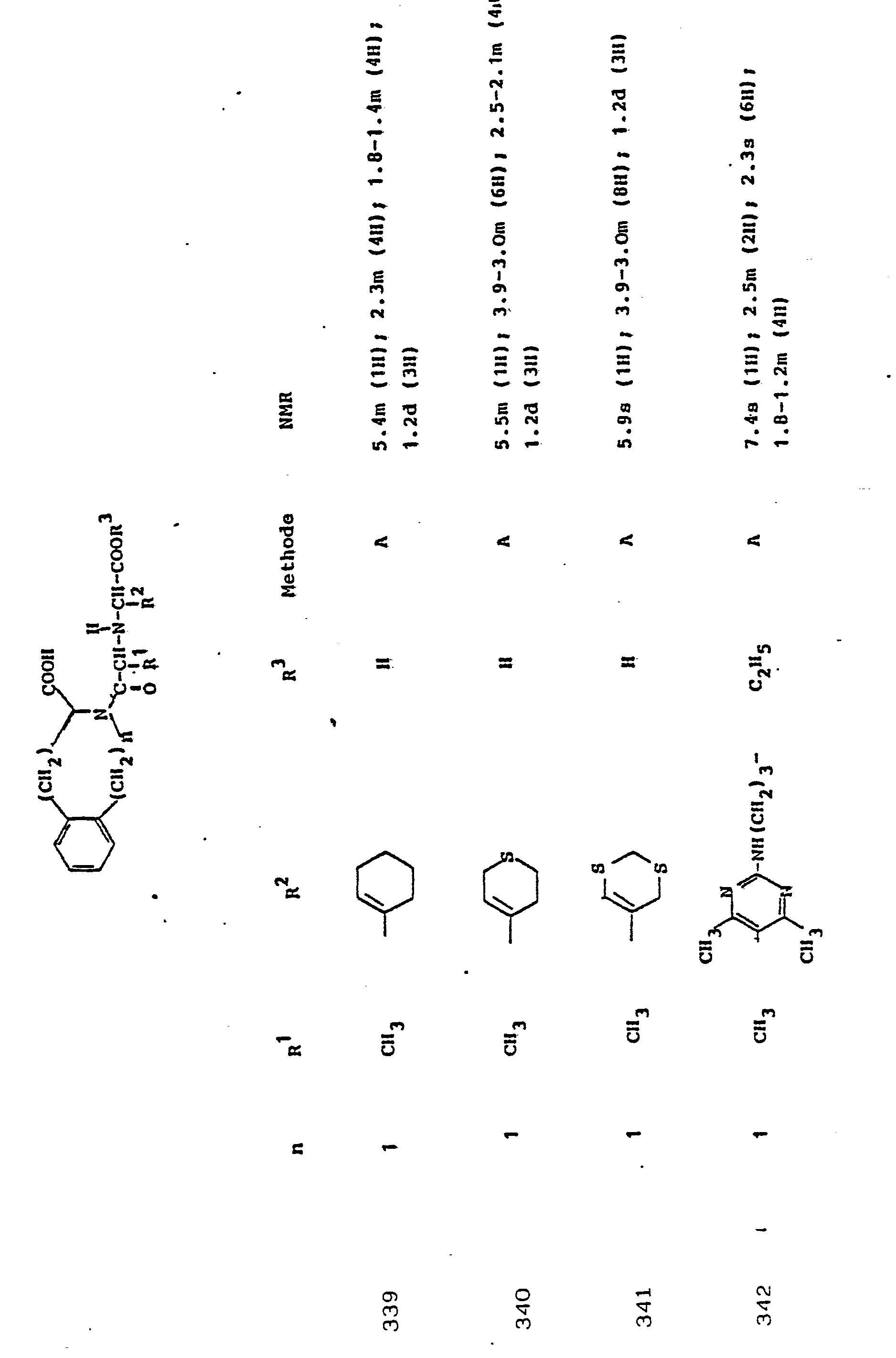
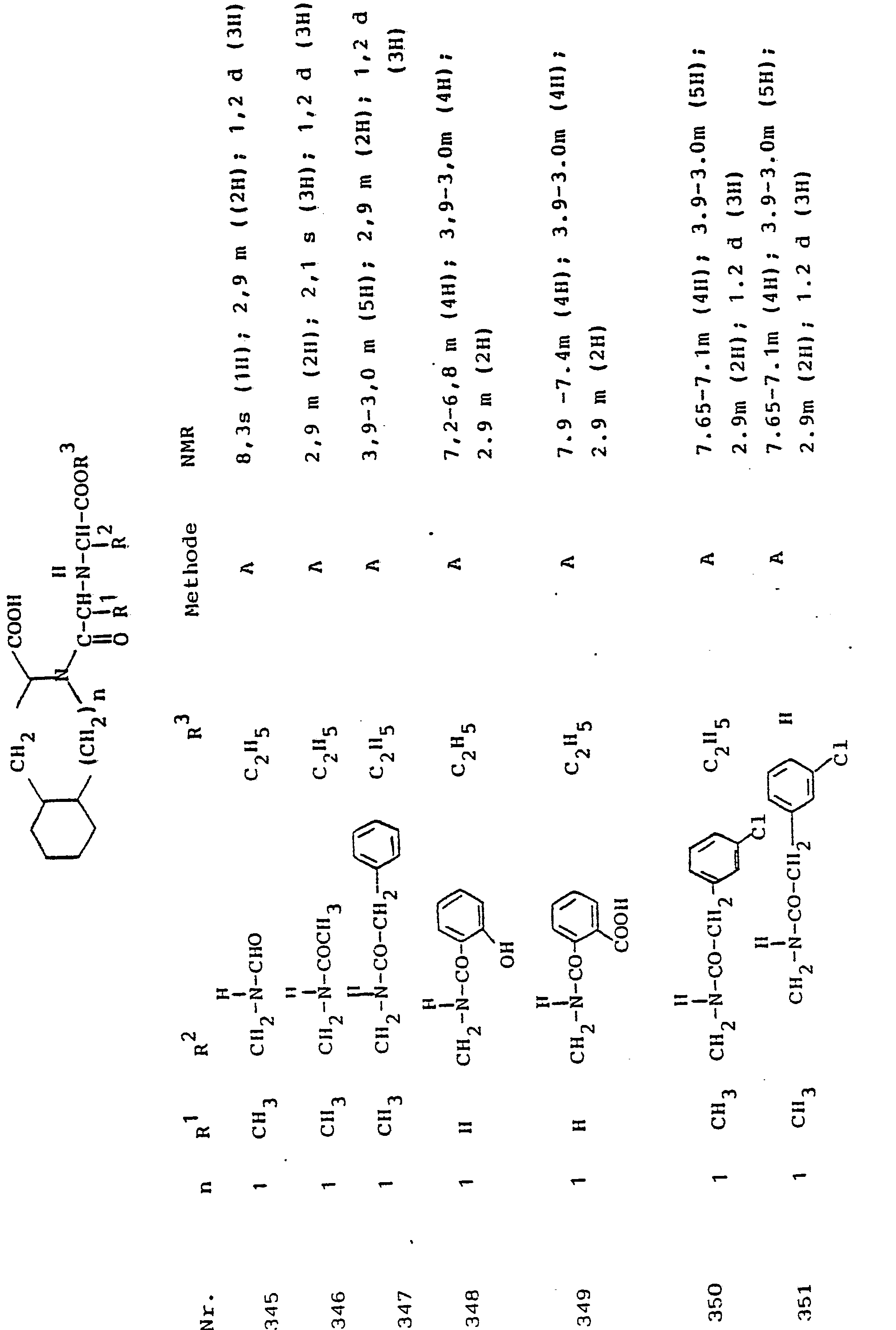
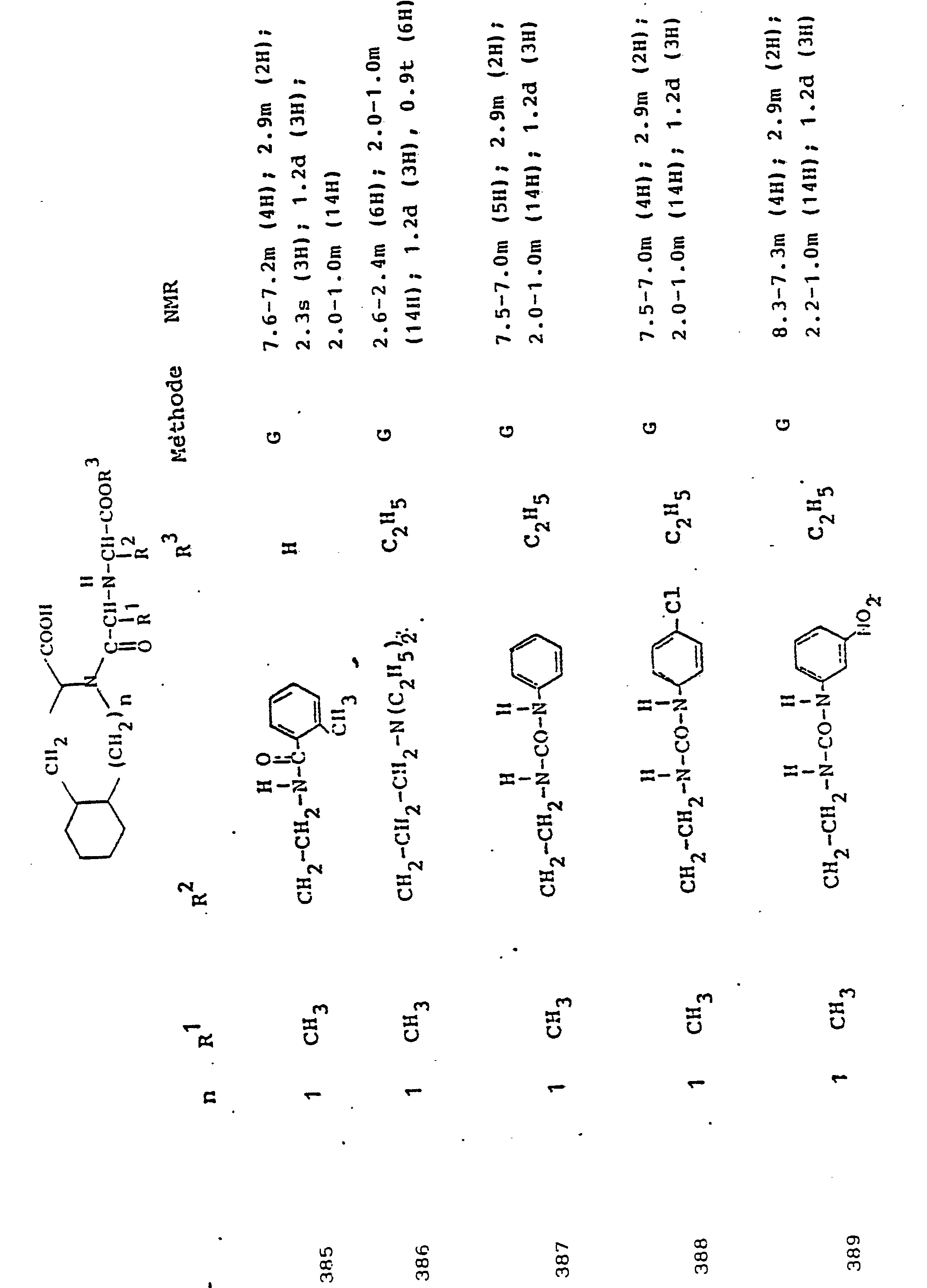
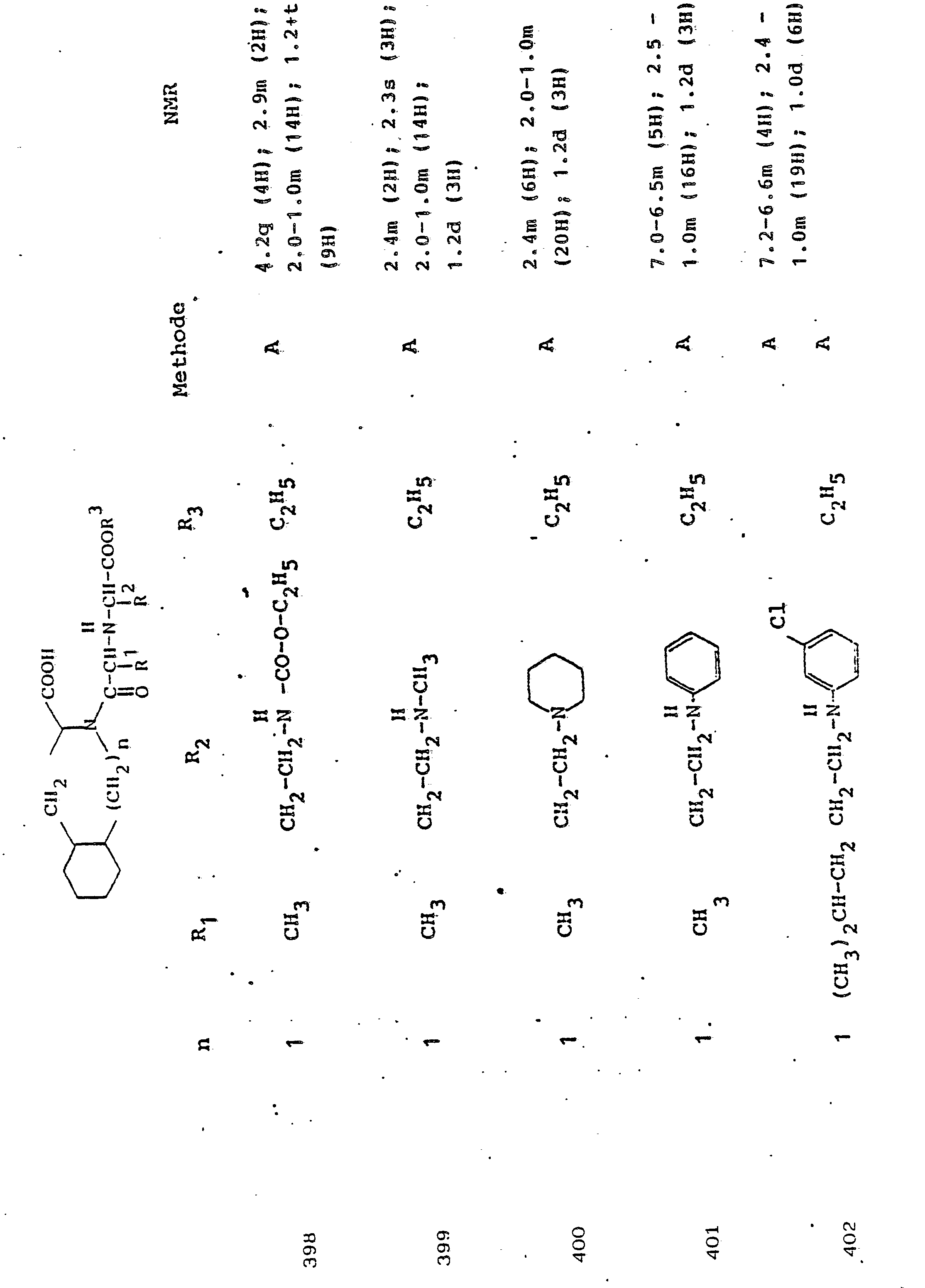
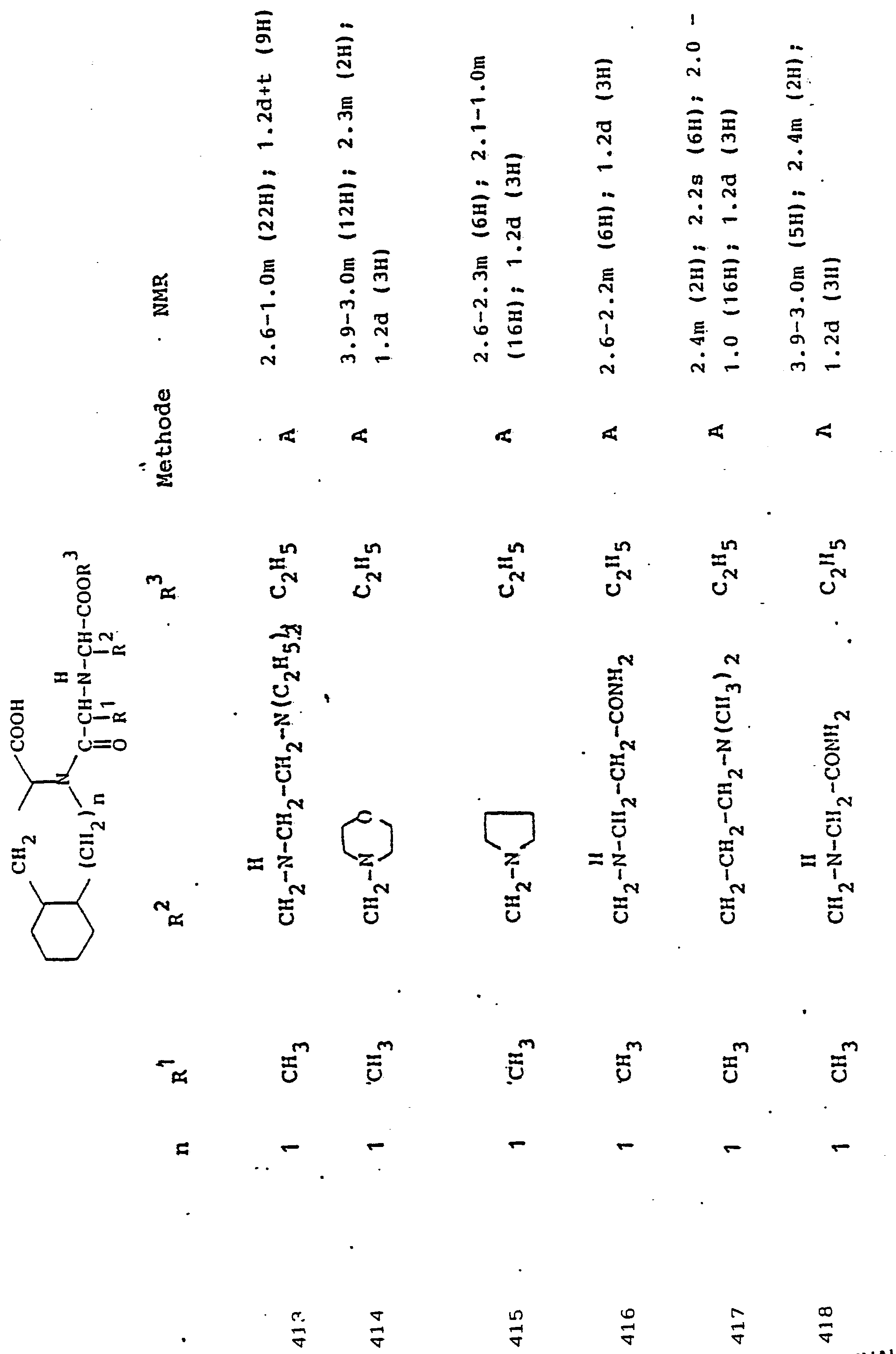
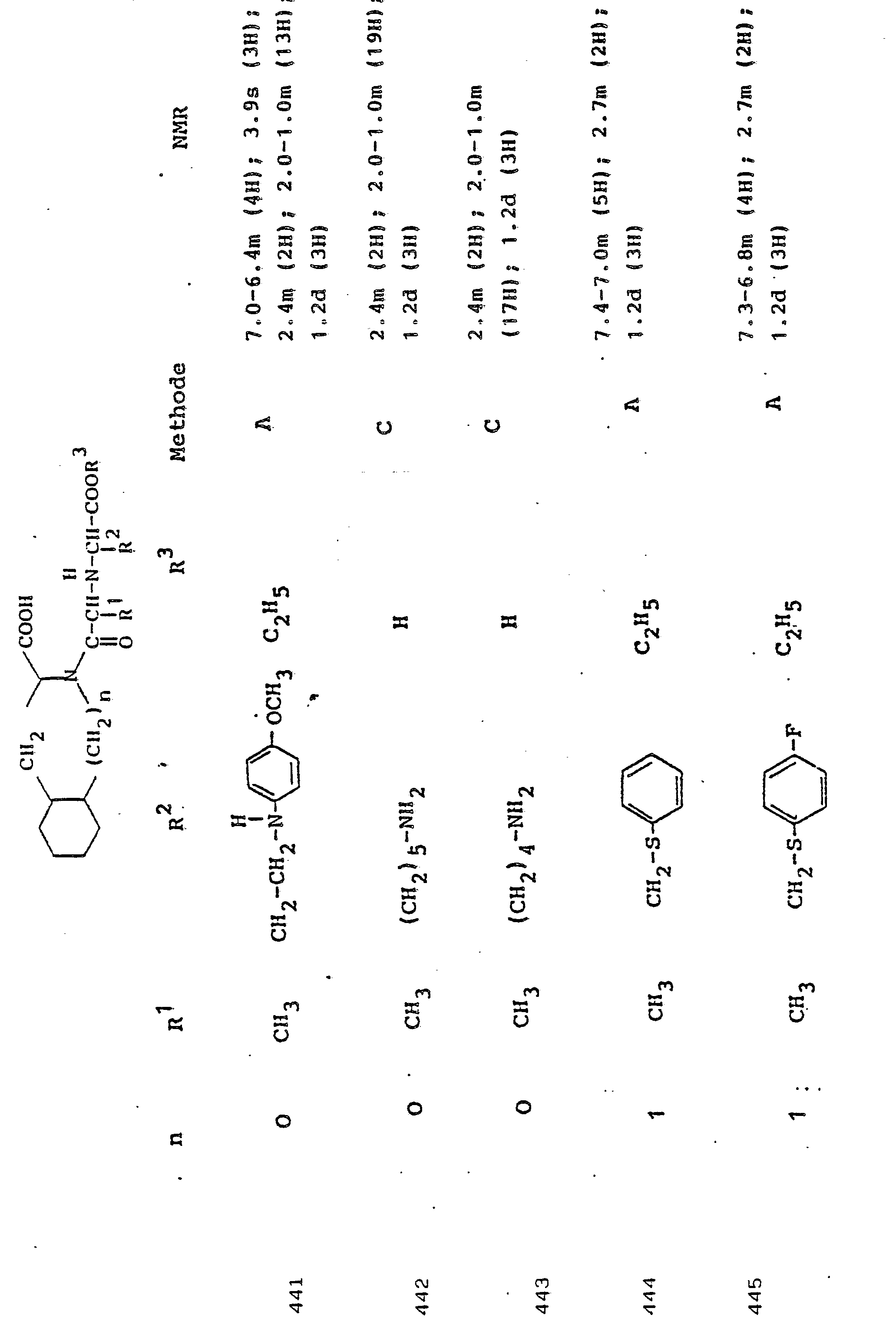
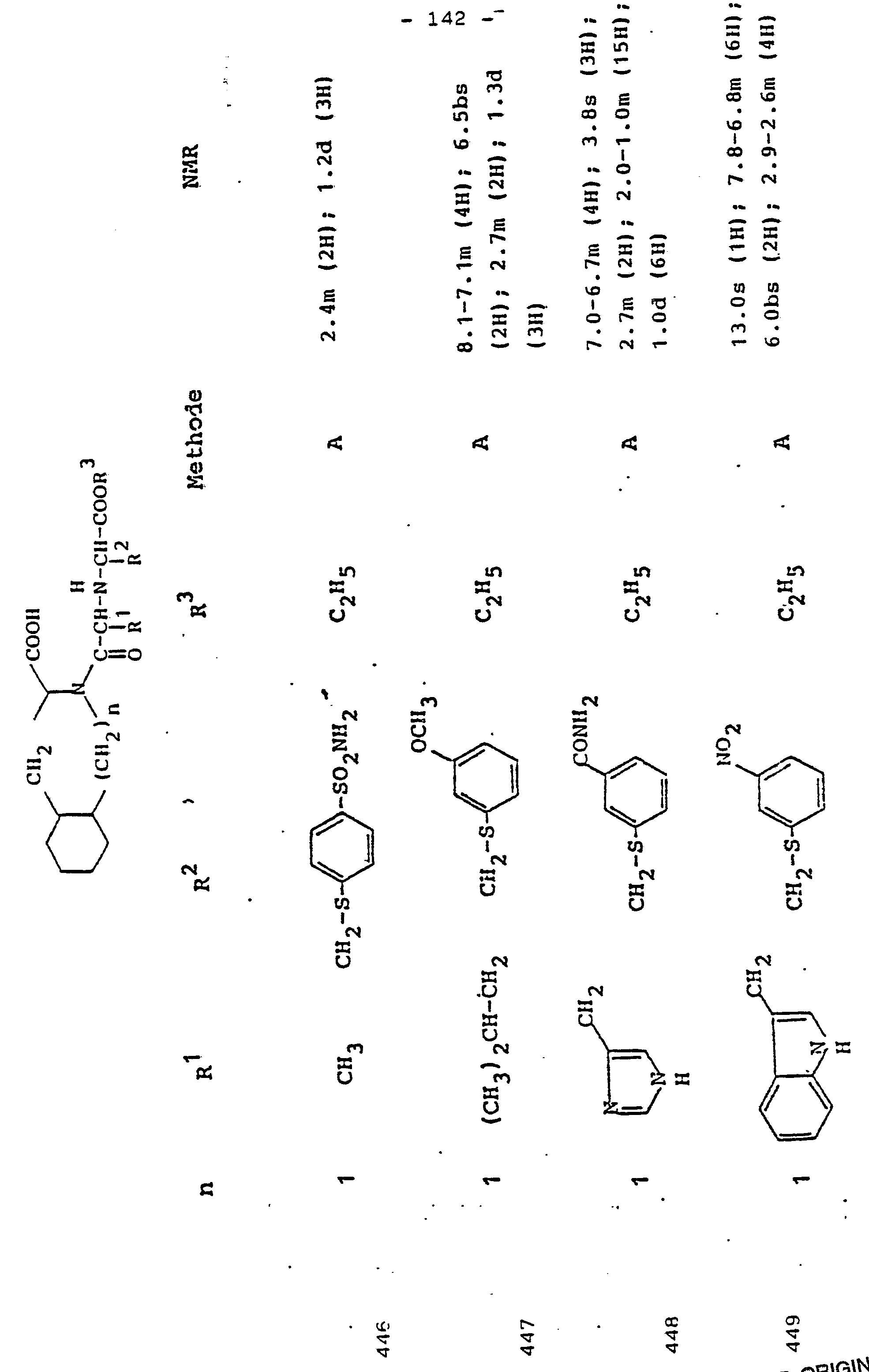
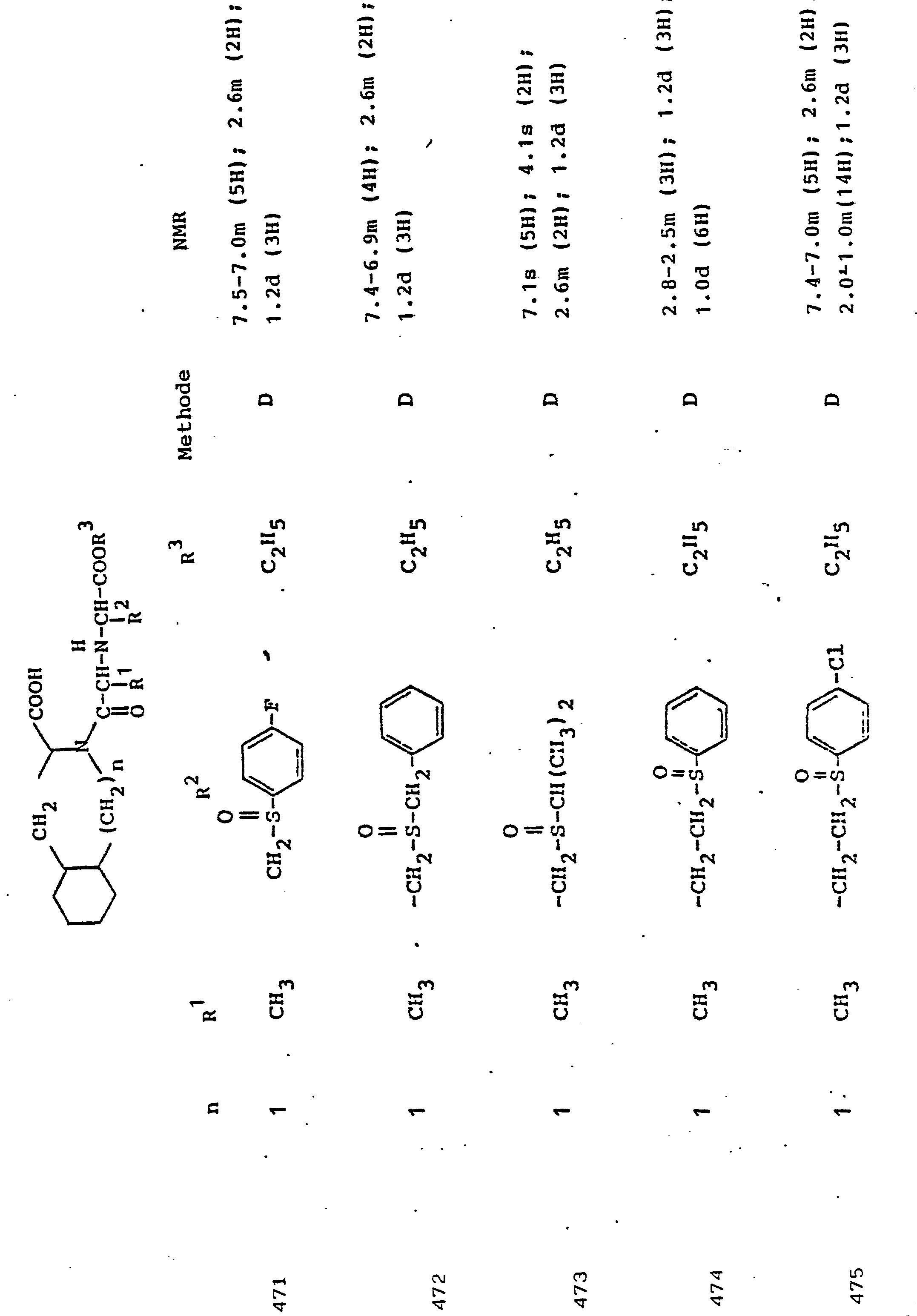
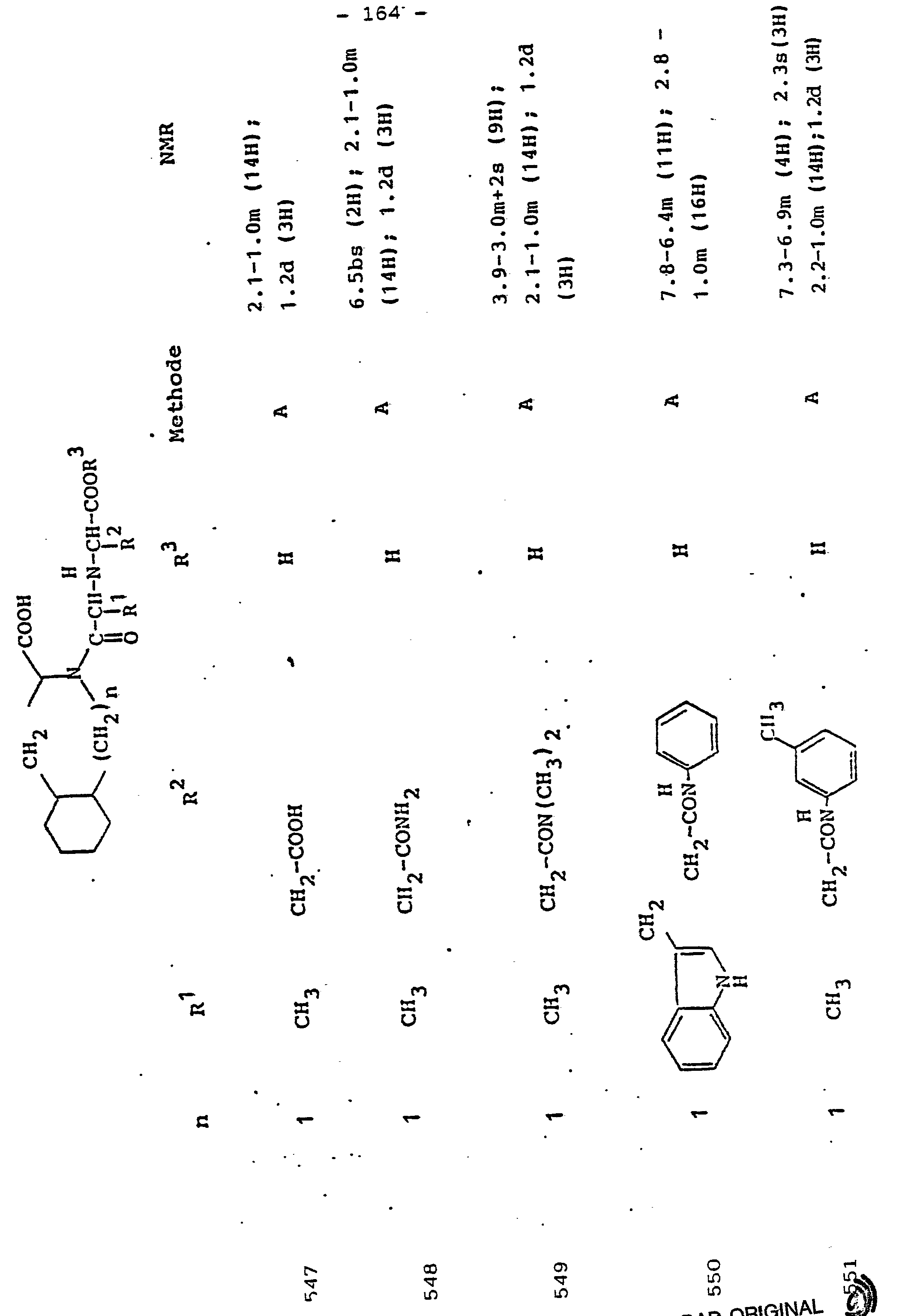
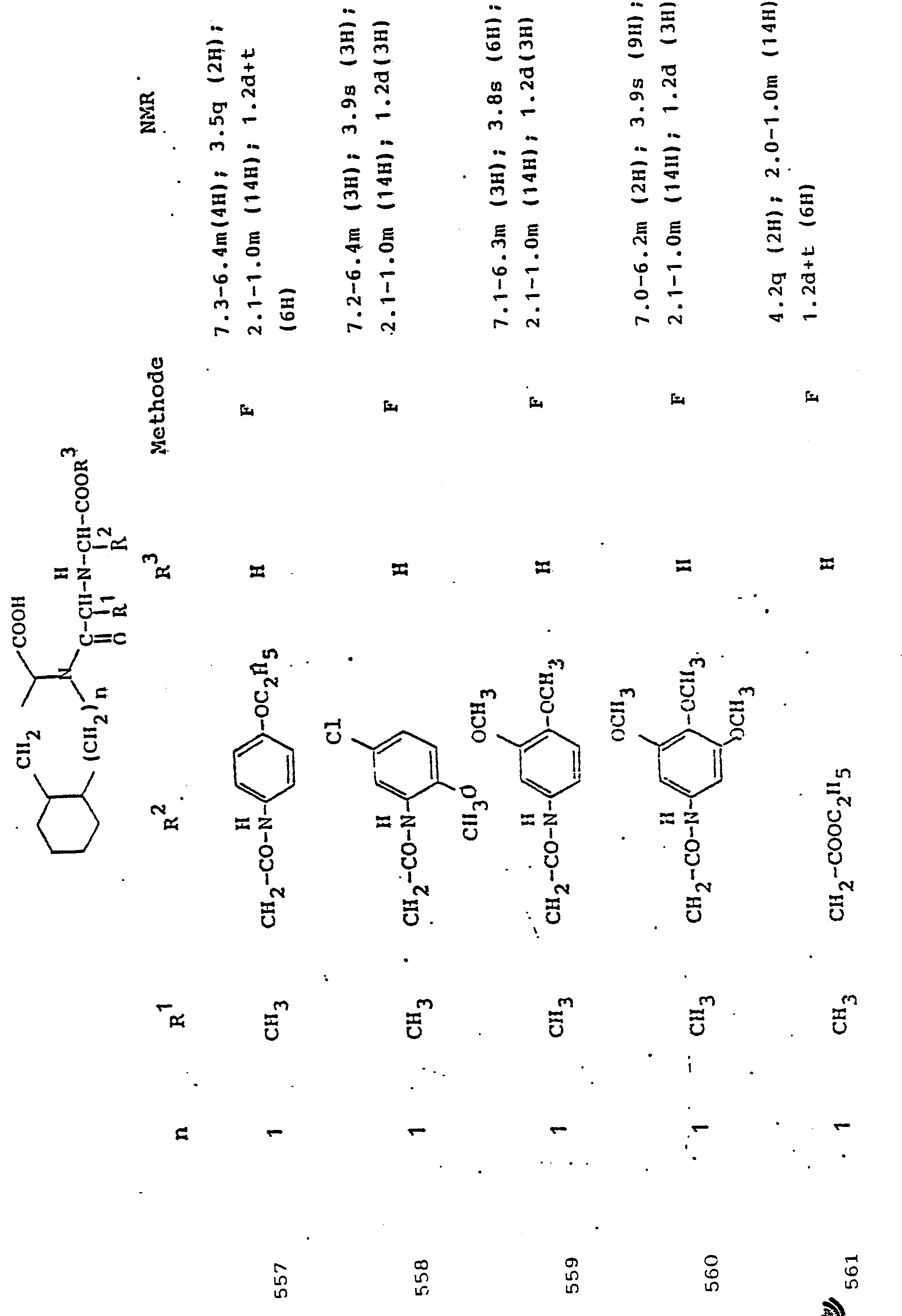
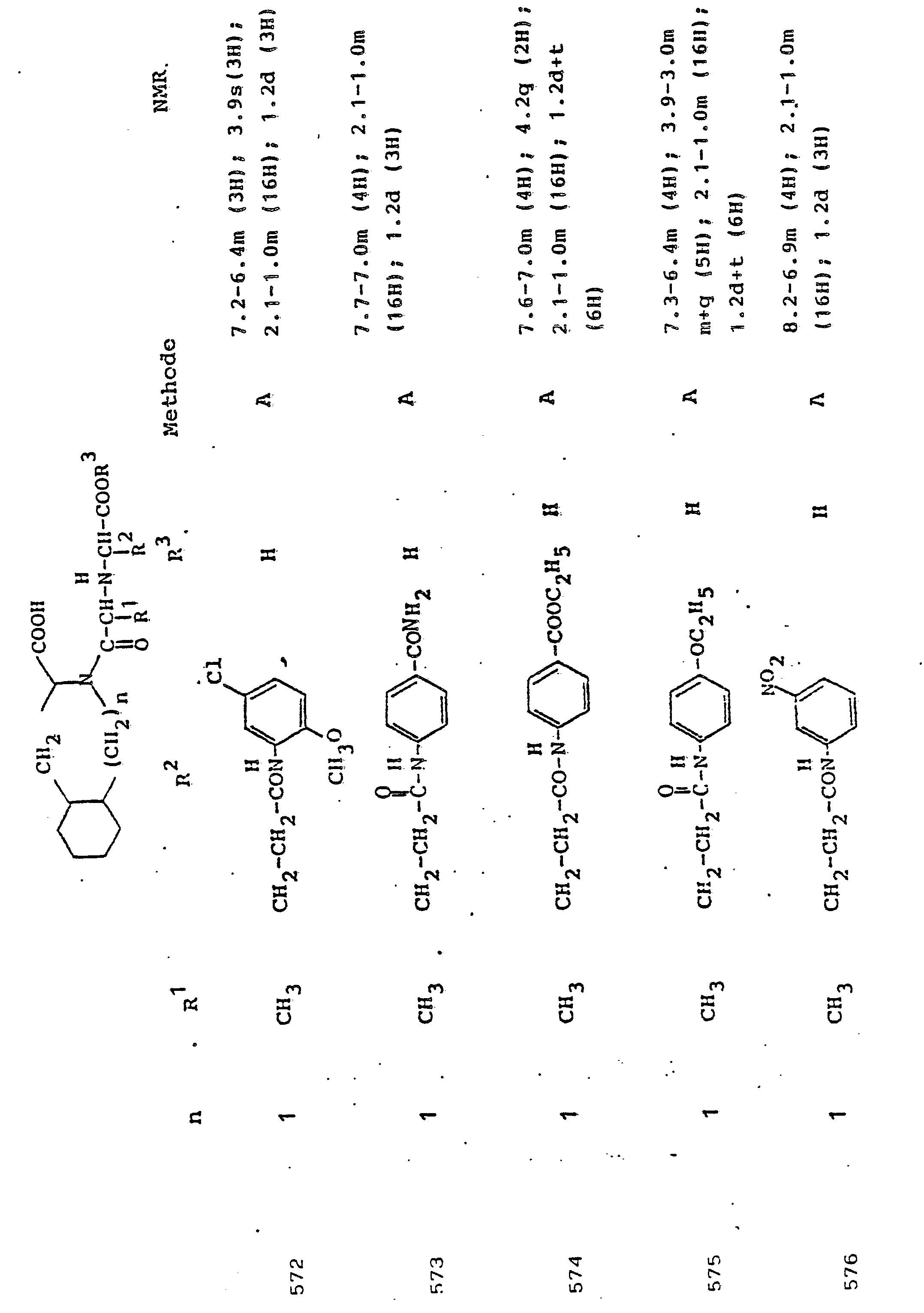
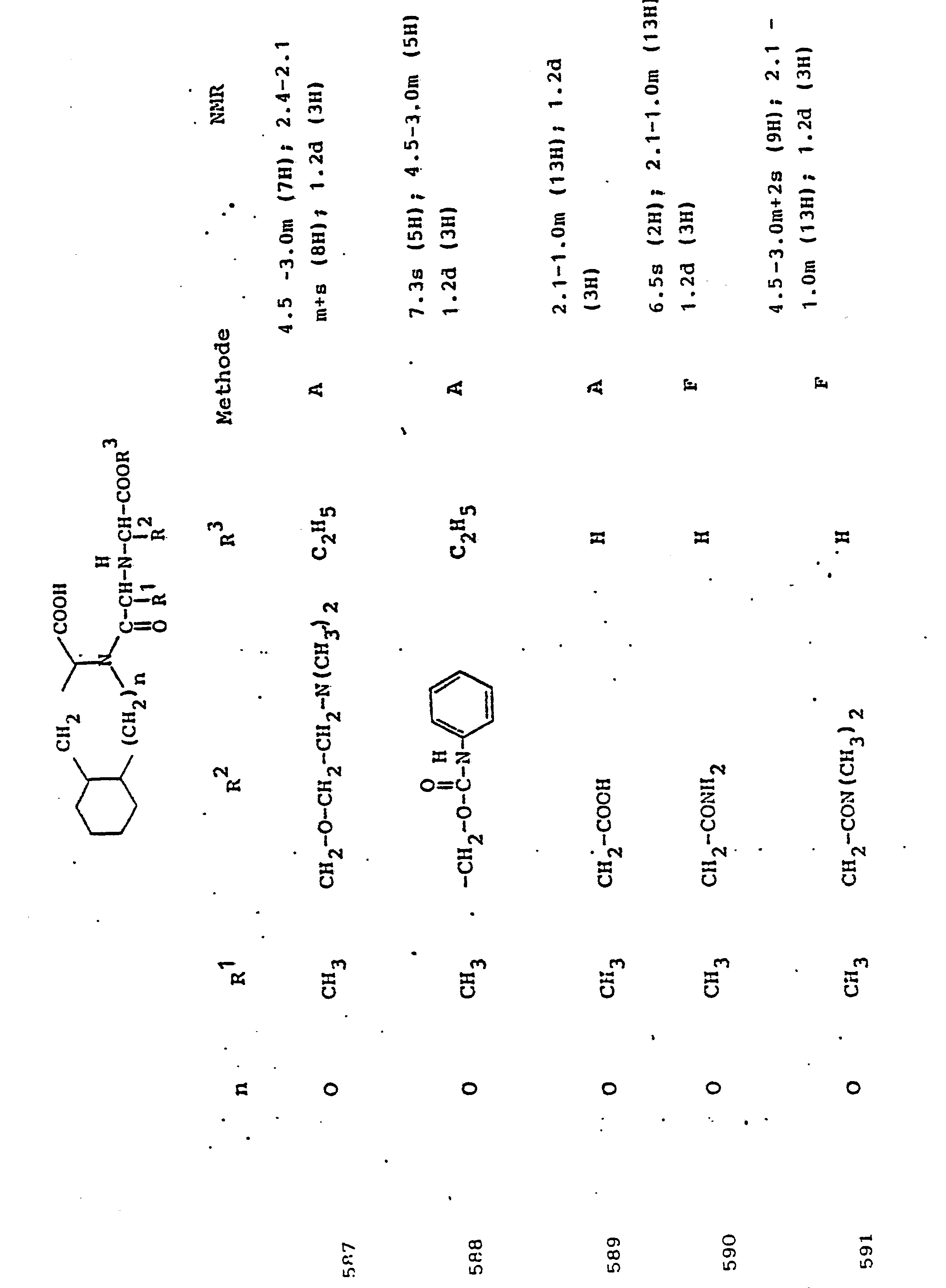
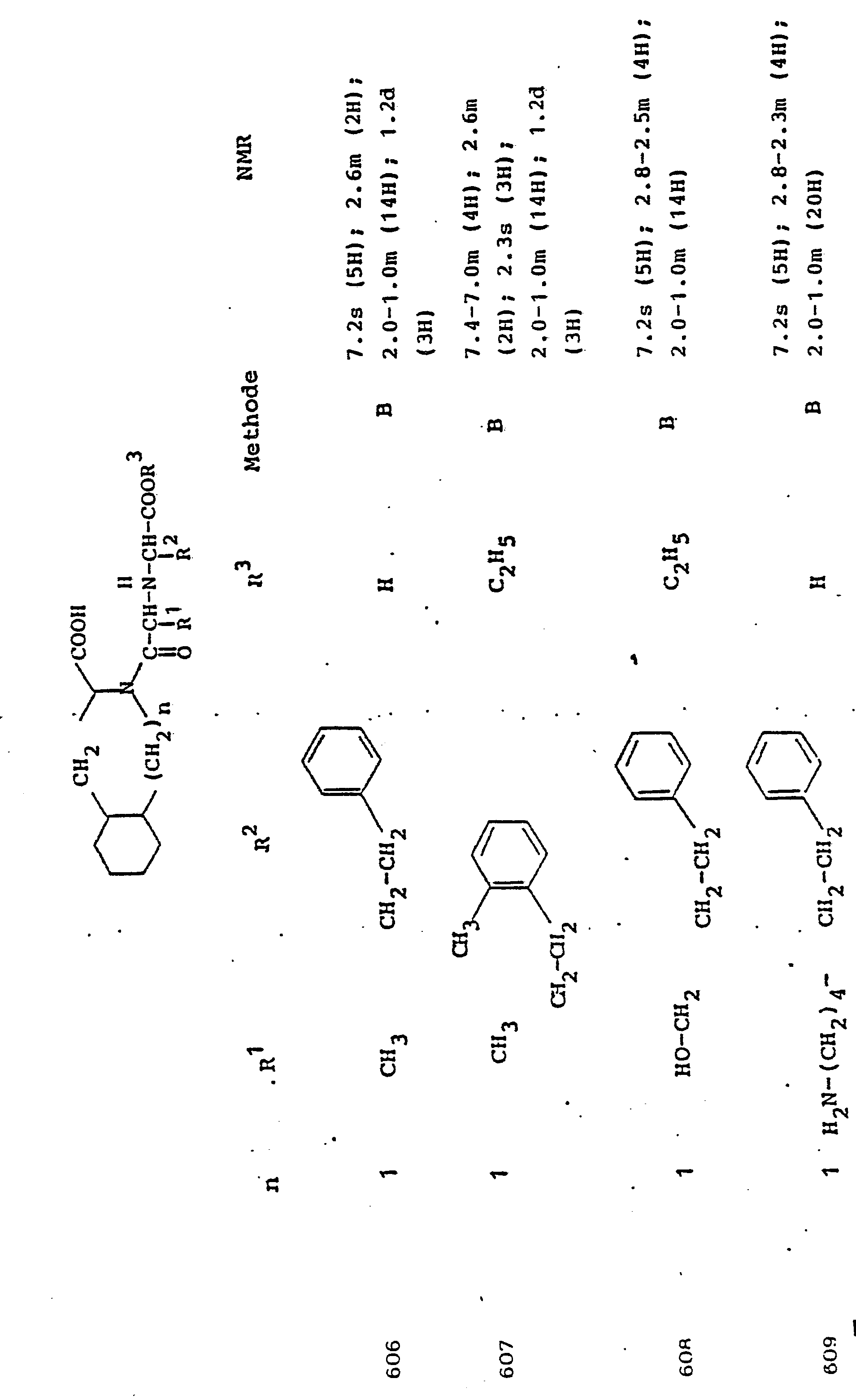
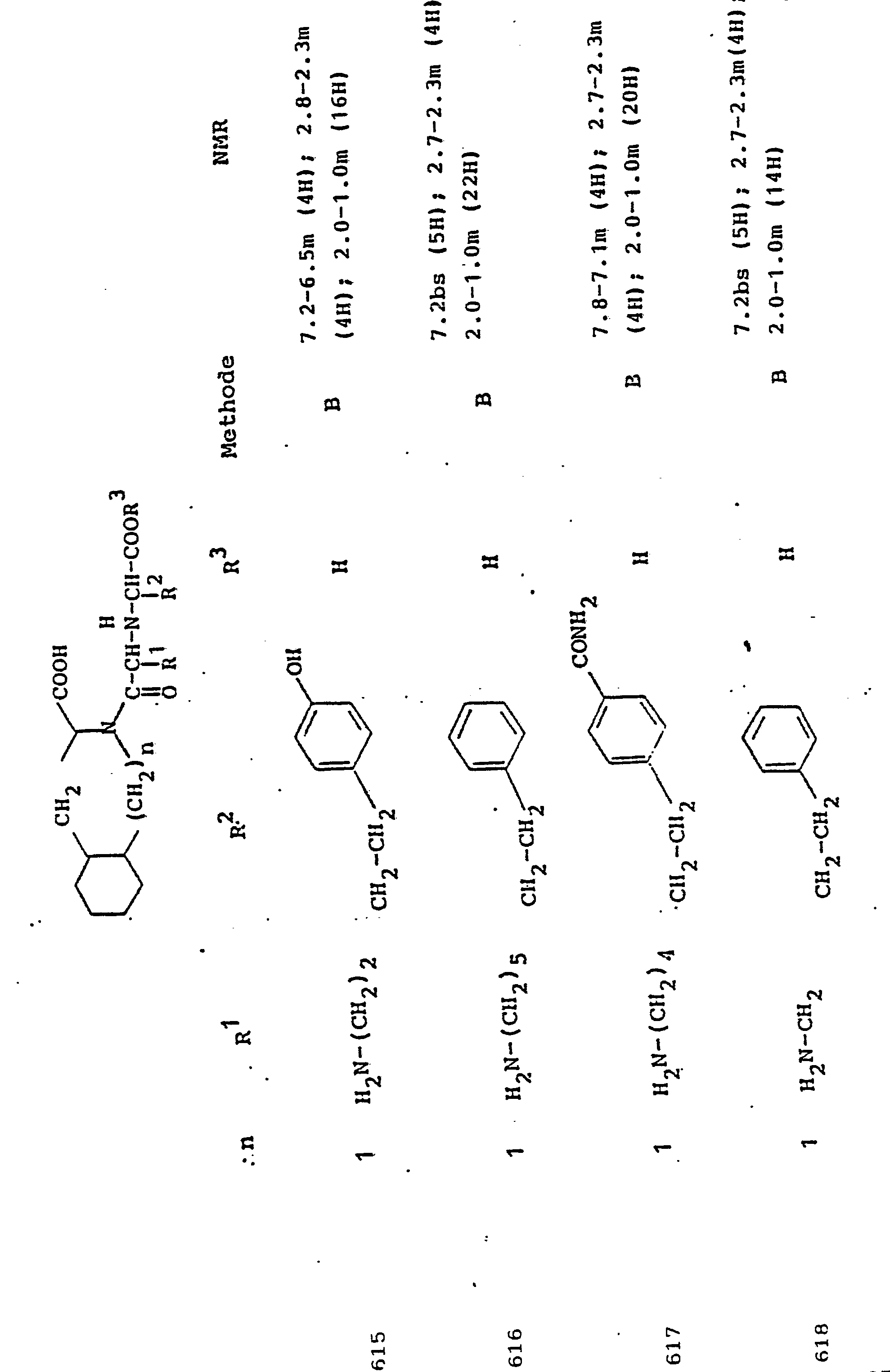
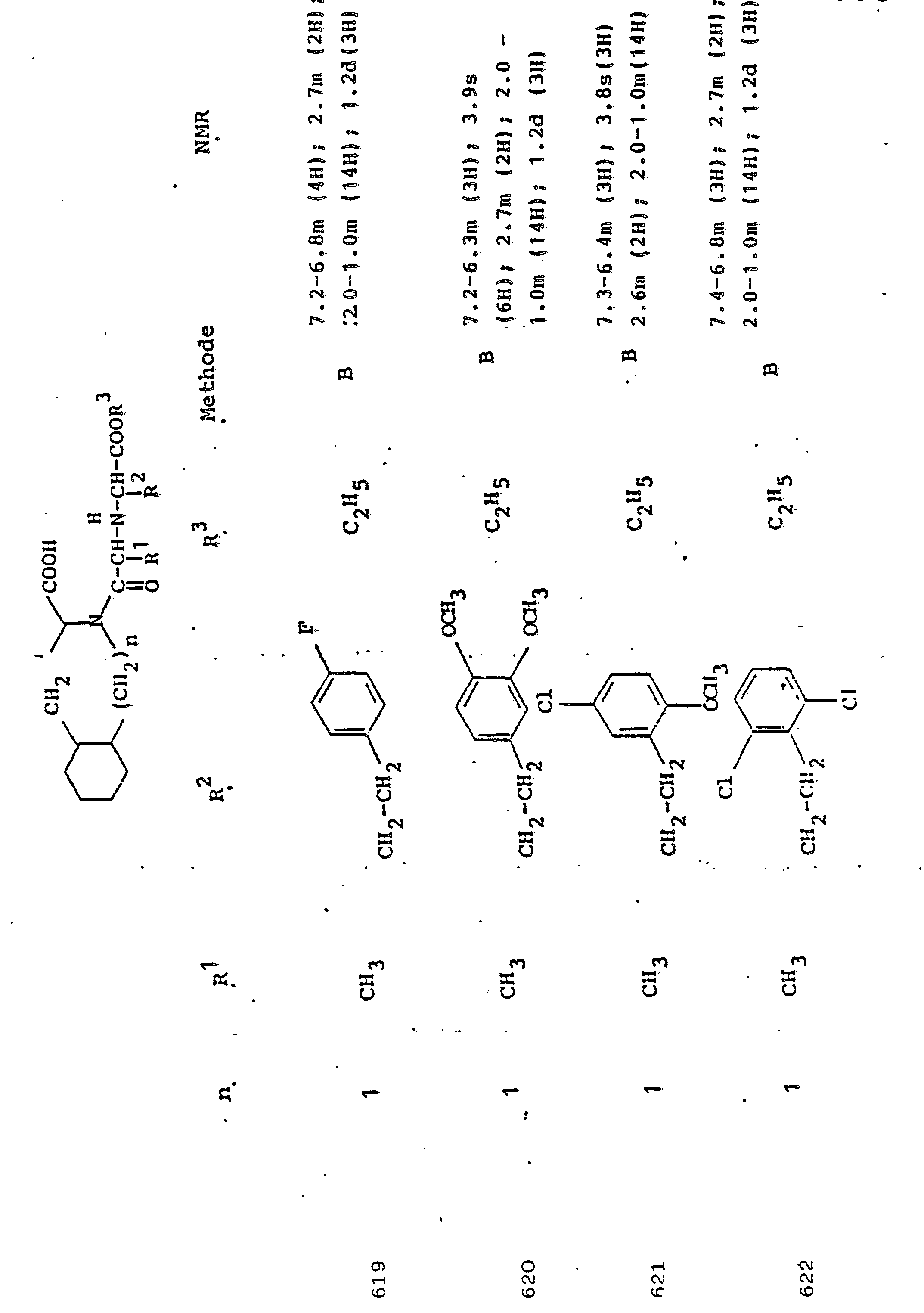
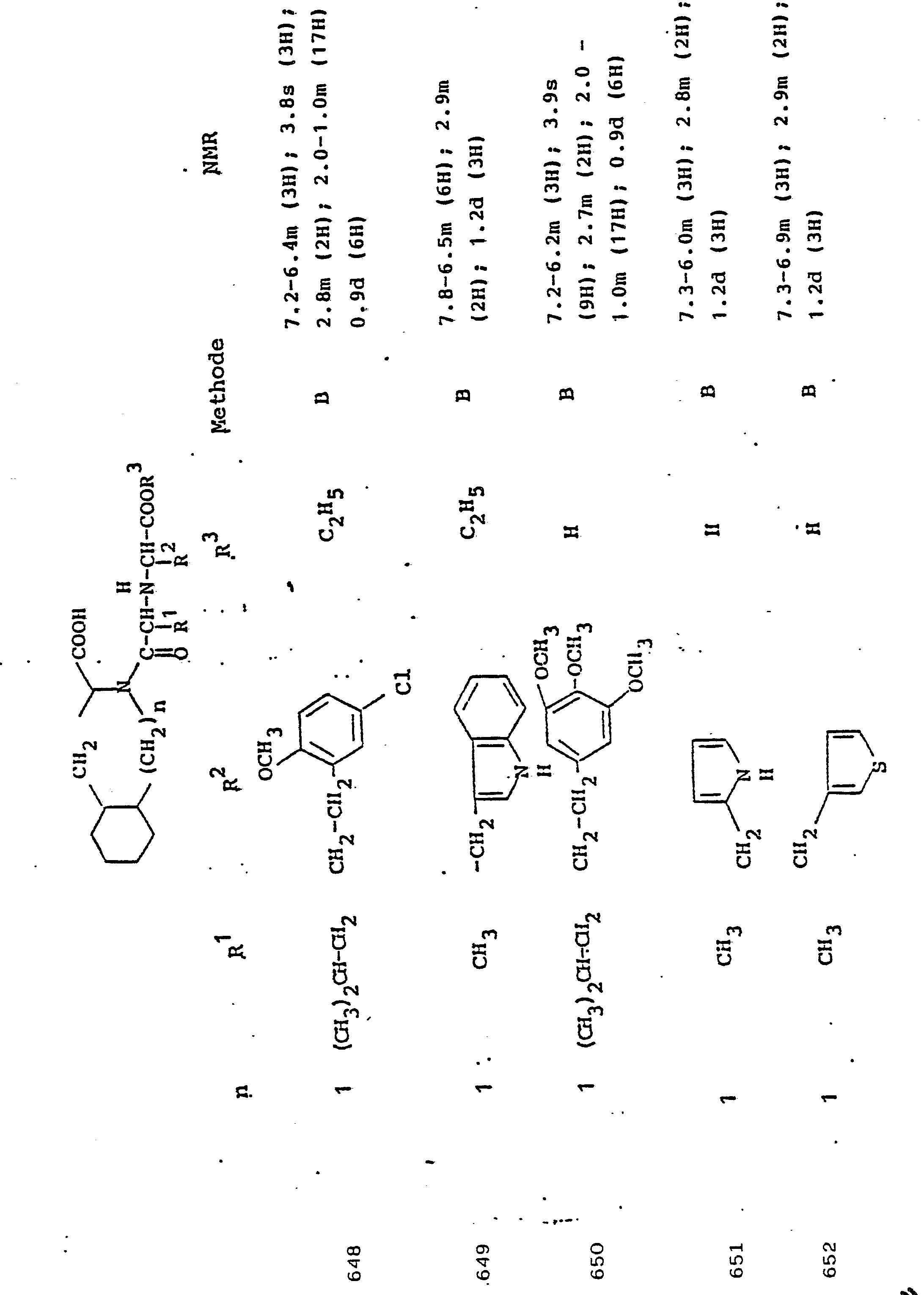
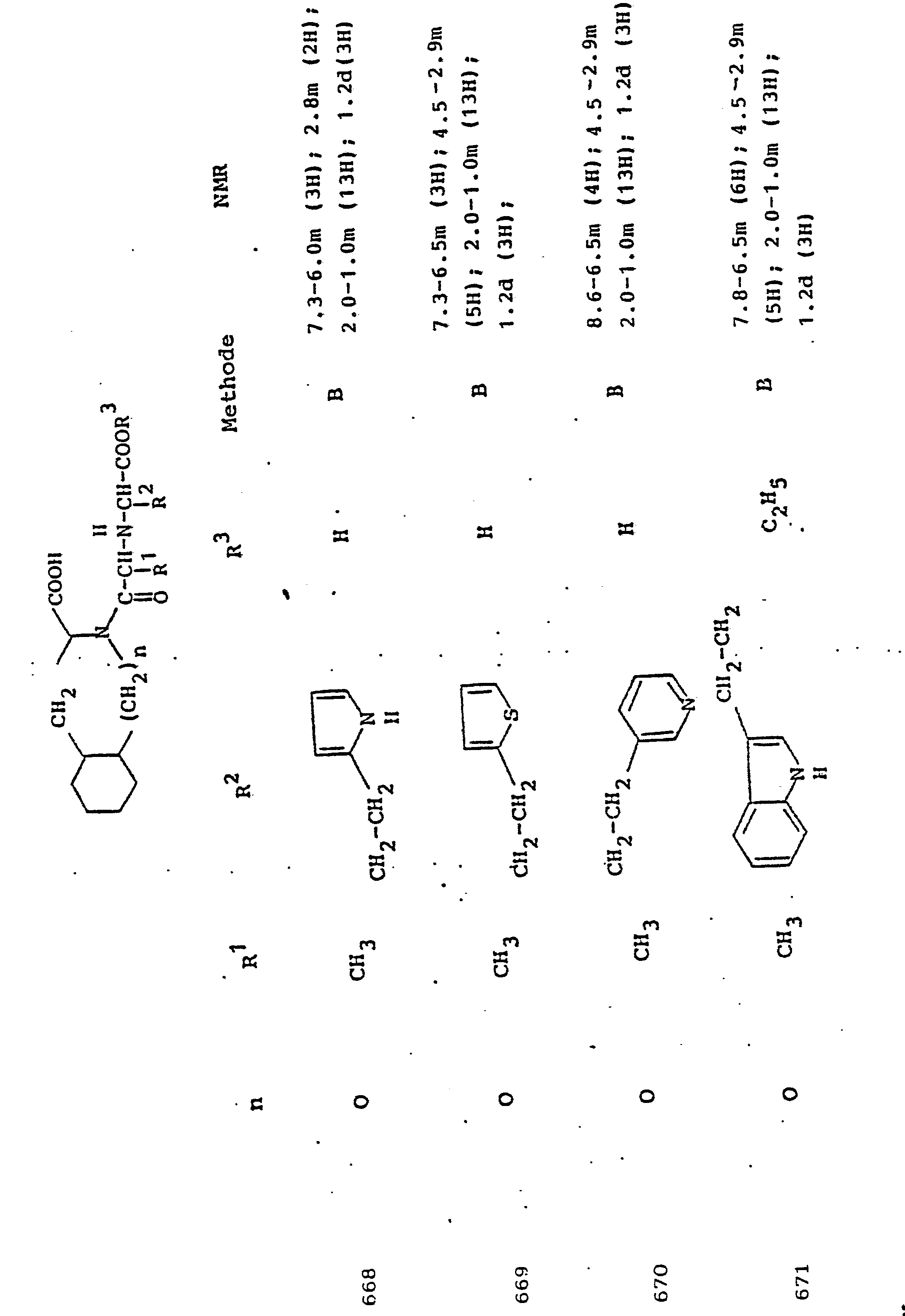
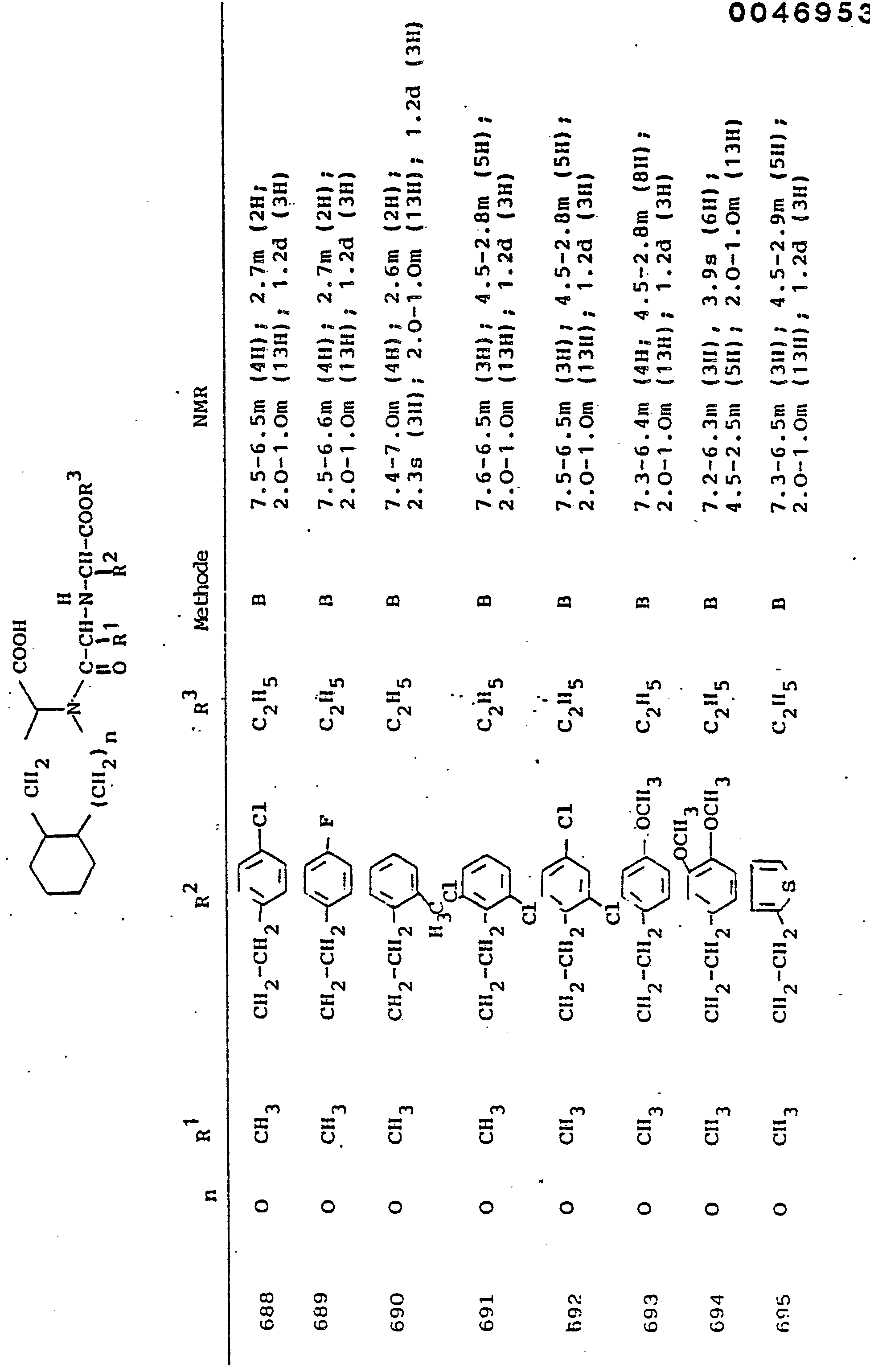
- Die nachstehend aufgeführten Beispiele sind nach einer der folgenden Methoden A - H hergestellt, wobei die bezeichneten Methoden wie folgt charakterisiert werden:
- Methode A: Reduktive Aminierung eines Kondensationsproduktes aus Tic oder Dic-OtC4Hg-Ester oder Benzylester bzw. Oic-OtC4H9-Ester oder Benzylester und einer entsprechenden α-Ketocarbonsäure, dargestellt nach Beispiel (6a oder 12a), mit einem entsprechenden Aminosäurederivat nach Beispiel (6b), Abspaltung der Schutzgruppen nach Beispiel (6c bzw. 12 c oder 22d) und gegebenenfalls Verseifung nach Beispiel (13).
- Methode B: Reduktive Aminierung eines Dipeptids-t-Butylesters, dargestellt nach Beispiel (le bzw. 10e,f), mit einem entsprechenden α-Ketocarbonsäurederivat nach Beispiel (lf, lOg, 11) und ggfs. Abspaltung der Schutzgruppen nach Beispiel (lOh bzw. 11) und/oder ggfs.nach Beispiel (13).
- Methode C: Reduktive Aminierung nach Methode A und mit einer ω-geschützten bifunktionellen Aminosäure, Abspaltung einer Schutzgruppe aus dem eingesetzten Aminosäurederivat nach Beispiel 3 bzw. 14.
- Methode D: Oxidation der zugrunde liegenden Schwefel-Verbindung zum Sulfoxid nach Beispiel 7 bzw. 16.
- Methode E: Oxidation der zugrunde liegenden Schwefel-Verbindung zum Sulfon nach Beispiel (8) bzw. (17).
- Methode F: Kondensation einer entsprechenden N-alkylierten α-Aminosäure (dargestellt nach Beispiel 19a) mit einem Aminosäureester (z.B. Dic-OBut oder Dic-OBzl bzw. Oic-OBut oder Oic-OBzl) nach Beispiel 19 b oder 22 c und Abspaltung der Schutzgruppe nach Beispiel 19 c oder 22 d.
- Methode G: Umsetzung eines N-acylierten Aminosäureesters, der im Acylteil in α-Position zur Amidfunktion eine nucleofuge Gruppe trägt (wie z.B. Halogen, Arylsulfonyl oder Alkylsulfonyl), dargestellt nach Beispiel 21a, mit einer entsprechenden Aminosäure oder einem entsprechenden Aminosäureester nach Beispiel 21 b und Abspaltung der Schutzgruppen.
- Methode H: Umsetzung eines Dipeptid-benzylesters, dargestellt nach Beispiel 23a, 23b, mit einer entsprechend substituierten α-Arylsulfonyl- oder α -Alkylsulfonyl- oder α-Halogen-carbonsäure bzw. Carbonsäureester, dargestellt nach Beispiel 23 c und Spaltung des Benzylesters zu Verbindungen der Formel 1 nach der in Beispiel 22d angegebenen Weise.
- Falls nicht'anders angegeben, gelten für die nachstehenden Verbindungen folgende NMR-Daten (δ -Werte in ppm; TMS als Standard):
- A = Benzolring:
- für n = 1 7.3s (4H), 5.1-4.3m (3H) 3.9-3.Om (4H)
- n = 0 7.2-6.5m (4H); 4.9t (1H) 3.6 - 3.Om (4H)
- A = Cyclohexanring:
- für n = 1 5.1-4.3m (2H); 3.9-3.Om (3H); 2:0-1.0m (12H)
- n = 0 4.9m (1H); 4.5-3.0m (3H), 2.0-1.0m (11H)
- Im Falle der Ethylester treten noch folgende Signale auf:
- 4.2 q 7 Hz (2H)
- 1.2 t 7 Hz (3H)






















































und deren physiologisch verträgliche Salze. Als bevorzugte Beispiele für R1 und R2 seien insbesondere genannt, Methyl, Ethyl, n-Propyl, Isopropyl, n-Butyl, Isobutyl, tert.-Butyl, sowie die geradkettigen und verzweigten Pentyle und Hexyle, ferner Cyclopentyl, Cyclohexyl, Cycloheptyl, Cyclopentenyl, Cyclohexenyl oder Cycloheptenyl, Phenyl, Naphthyl, Di- und Tetrahydronaphthyl, Benzyl, Phenethyl, p-Fluorphenethyl; o-Methylphenethyl, p-Methoxyphenethyl, 2,4-Dichlorphenethyl, Cyclohexyläthyl.
Claims (7)

oder -0- und/oder bis zu 4 -N-Atomen,
sowie deren physiologisch verträglichen Salzen, dadurch gekennzeichnet, daß man


oder -O- und/oder bis zu 4 -N-Atomen,
sowie deren physiologisch verträgliche Salze hergestellt werden.

oder -O- und/oder bis zu 4 -N-Atomen,
sowie deren physiologisch verträgliche Salze hergestellt werden.
Priority Applications (2)
| Application Number | Priority Date | Filing Date | Title |
|---|---|---|---|
| EP89105371A EP0328160B1 (de) | 1980-08-30 | 1981-08-22 | Aminosäurederivate, Verfahren zu ihrer Herstellung, diese enthaltende Mittel und deren Verwendung |
| AT81106535T ATE48415T1 (de) | 1980-08-30 | 1981-08-22 | Aminosaeurederivate, verfahren zu ihrer herstellung, diese enthaltende mittel und deren verwendung. |
Applications Claiming Priority (4)
| Application Number | Priority Date | Filing Date | Title |
|---|---|---|---|
| DE3032709 | 1980-08-30 | ||
| DE19803032709 DE3032709A1 (de) | 1980-08-30 | 1980-08-30 | Aminosaeurederivate, verfahren zu ihrer herstellung, diese enthaltende mittel und deren verwendung |
| DE3118191 | 1981-05-08 | ||
| DE19813118191 DE3118191A1 (de) | 1981-05-08 | 1981-05-08 | Aminosaeurederivate, verfahren zu ihrer herstellung, diese enthaltende mittel und deren verwendung |
Related Child Applications (3)
| Application Number | Title | Priority Date | Filing Date |
|---|---|---|---|
| EP89105371.2 Division-Into | 1981-08-22 | ||
| EP88102408A Division EP0278530A3 (de) | 1980-08-30 | 1981-08-22 | Aminosäurederivate, Verfahren zu ihrer Herstellung, diese enthaltende Mittel und deren Verwendung |
| EP88102408.7 Division-Into | 1981-08-22 |
Publications (3)
| Publication Number | Publication Date |
|---|---|
| EP0046953A2 true EP0046953A2 (de) | 1982-03-10 |
| EP0046953A3 EP0046953A3 (en) | 1982-05-05 |
| EP0046953B1 EP0046953B1 (de) | 1989-12-06 |
Family
ID=25787513
Family Applications (2)
| Application Number | Title | Priority Date | Filing Date |
|---|---|---|---|
| EP88102408A Ceased EP0278530A3 (de) | 1980-08-30 | 1981-08-22 | Aminosäurederivate, Verfahren zu ihrer Herstellung, diese enthaltende Mittel und deren Verwendung |
| EP81106535A Expired EP0046953B1 (de) | 1980-08-30 | 1981-08-22 | Aminosäurederivate, Verfahren zu ihrer Herstellung, diese enthaltende Mittel und deren Verwendung |
Family Applications Before (1)
| Application Number | Title | Priority Date | Filing Date |
|---|---|---|---|
| EP88102408A Ceased EP0278530A3 (de) | 1980-08-30 | 1981-08-22 | Aminosäurederivate, Verfahren zu ihrer Herstellung, diese enthaltende Mittel und deren Verwendung |
Country Status (18)
| Country | Link |
|---|---|
| US (2) | US5158959A (de) |
| EP (2) | EP0278530A3 (de) |
| JP (3) | JPS5777672A (de) |
| KR (3) | KR850001269B1 (de) |
| AR (2) | AR240949A1 (de) |
| AU (2) | AU599151B2 (de) |
| CS (1) | CS409491A3 (de) |
| DE (2) | DE3177311D1 (de) |
| DK (1) | DK169382B1 (de) |
| ES (3) | ES504955A0 (de) |
| FI (1) | FI90072C (de) |
| GR (1) | GR75331B (de) |
| HU (1) | HU189531B (de) |
| IE (1) | IE67438B1 (de) |
| NO (1) | NO812933L (de) |
| NZ (1) | NZ198195A (de) |
| PH (1) | PH16812A (de) |
| PT (1) | PT73584B (de) |
Cited By (51)
| Publication number | Priority date | Publication date | Assignee | Title |
|---|---|---|---|---|
| FR2502149A1 (fr) * | 1981-03-19 | 1982-09-24 | Usv Pharma Corp | Nouveaux amido-aminoacides, compositions pharmaceutiques les contenant et procede de preparation de ces amido-aminoacides |
| EP0065301A1 (de) * | 1981-05-18 | 1982-11-24 | Merck & Co. Inc. | Derivate der Isochinolin-Carbonsäuren, Verfahren zu ihrer Herstellung und diese enthaltendes Arzneimittel |
| EP0079522A1 (de) * | 1981-11-09 | 1983-05-25 | Merck & Co. Inc. | Antihypertonische N-Carboxymethyl(amidino)-lysyl-prolin-Wirkstoffe |
| EP0105102A1 (de) * | 1982-07-20 | 1984-04-11 | Hoechst Aktiengesellschaft | Neue Derivate der 2-Aza-bicyclo(2.2.2)octan-3-carbonsäure, Verfahren zu ihrer Herstellung, diese enthaltende Mittel und deren Verwendung sowie 2-Aza-bicyclo(2.2.2)octan-3-carbonsäure als Zwischenstufe und Verfahren zu deren Herstellung |
| EP0049658B1 (de) * | 1980-10-02 | 1984-06-13 | Adir | Substituierte Iminodisäuren, Verfahren zu ihrer Herstellung und diese enthaltende Arzneimittel |
| EP0117448A1 (de) | 1983-02-02 | 1984-09-05 | Hoechst Aktiengesellschaft | Verfahren zur Herstellung von N-alkylierten Aminosäuren und deren Estern |
| US4479963A (en) * | 1981-02-17 | 1984-10-30 | Ciba-Geigy Corporation | 1-Carboxyalkanoylindoline-2-carboxylic acids |
| EP0126986A1 (de) * | 1983-04-28 | 1984-12-05 | Hoechst Aktiengesellschaft | Verfahren zur Herstellung von N-alkylierten Dipeptiden und deren Estern |
| FR2546886A2 (fr) * | 1983-06-06 | 1984-12-07 | Adir | Derives d'acides isoindoledicarboxyliques, leur preparation et compositions pharmaceutiques les contenant |
| US4532342A (en) * | 1981-02-20 | 1985-07-30 | Warner-Lambert Company | N-substituted amino acids as intermediates in the preparation of acyl derivatives of 1,2,3,4-tetrahydroisoquinoline-3-carboxylic acids |
| EP0104546A3 (de) * | 1982-09-23 | 1985-07-31 | Usv Pharmaceutical Corporation | Therapeutische Dipeptiden |
| EP0158157A1 (de) * | 1984-03-23 | 1985-10-16 | Hoechst Aktiengesellschaft | Methode zur Behandlung des Glaukoms |
| EP0121830A3 (de) * | 1983-03-16 | 1986-02-05 | Usv Pharmaceutical Corporation | Substituierte Dipeptide als Antihypertensiva |
| EP0049605B1 (de) * | 1980-10-03 | 1987-03-18 | Warner-Lambert Company | Acyl-substituierte Derivate von 1,2,3,4-Tetrahydroisochinolin-3-carboxysäuren, ihre Salze, diese enthaltende Arzneimittel und Verfahren zu ihrer Herstellung |
| EP0254032A2 (de) | 1986-06-20 | 1988-01-27 | Schering Corporation | Hemmer der neutralen Metallendopeptidase zur Behandlung von Hypertension |
| EP0187037A3 (de) * | 1984-12-21 | 1988-03-23 | Takeda Chemical Industries, Ltd. | Piperidinderivate, deren Herstellung und Benützung |
| US4749688A (en) * | 1986-06-20 | 1988-06-07 | Schering Corporation | Use of neutral metalloendopeptidase inhibitors in the treatment of hypertension |
| EP0154886A3 (de) * | 1984-03-12 | 1988-07-20 | Hoechst Aktiengesellschaft | Carboxyalkyldipeptidderivate, Verfahren zu deren Herstellung, diese enthaltende Mittel und deren Verwendung |
| EP0174162A3 (de) * | 1984-09-01 | 1988-07-27 | The Wellcome Foundation Limited | Pharmazeutisch aktive Dipeptid-Derivate |
| WO1988009789A3 (en) * | 1987-06-03 | 1989-02-09 | Polifarma Spa | 3-indolepyruvic acid derivatives and pharmaceutical use thereof |
| EP0308339A1 (de) * | 1987-09-17 | 1989-03-22 | Adir Et Compagnie | Verfahren zur industriellen Herstellung von Perhydroindol Carboxy-2(2S,3aS,7aS)-Säure, Anwendung zur Herstellung von Carboxyalkyldipeptiden |
| US4933361A (en) * | 1981-12-29 | 1990-06-12 | Hoechst Aktiengesellschaft | Derivatives of bicyclic aminoacids agents containing these compounds and their use |
| US4977260A (en) * | 1986-11-21 | 1990-12-11 | Hoechst Aktiengesellschaft | Intermediates for preparing mono-, bi- and tricyclic amino acids |
| US5011940A (en) * | 1987-07-03 | 1991-04-30 | Hoechst Aktiengesellschaft | Process for the preparation of bicyclic amino carboxylic acids, intermediates in this process, and their use |
| US5055591A (en) * | 1983-09-16 | 1991-10-08 | Hoechst Aktiengesellschaft | Process for the preparation of octahydropenta(b)pyrrole carboxylates |
| US5061722A (en) * | 1981-11-05 | 1991-10-29 | Hoechst Ag | Cis, endo-2-azabicyclo-[3.3.0]-octane-3-carboxylic acids, a process for their preparation, agents containing these compounds and their use |
| US5068351A (en) * | 1983-09-16 | 1991-11-26 | Hoechst Aktiengesellschaft | Process for the preparation of n octahydropenta (6) pyrrole carboxylates |
| US5075302A (en) * | 1990-03-09 | 1991-12-24 | Schering Corporation | Mercaptoacyl aminolactam endopeptidase inhibitors |
| US5098910A (en) * | 1986-10-02 | 1992-03-24 | Hoechst Aktiengesellschaft | Combination of angiotensin-converting enzyme inhibitors with calcium antagonists as well as their use in drugs |
| US5173506A (en) * | 1990-08-16 | 1992-12-22 | Schering Corporation | N-(mercaptoalkyl)ureas and carbamates |
| US5175306A (en) * | 1983-01-31 | 1992-12-29 | Hoechst Aktiengesellschaft | Process for the resolution of racemates of optically active bicyclic imino-α-carboxylic esters |
| US5219886A (en) * | 1989-04-10 | 1993-06-15 | Schering Corporation | Mercapto-acylamino acids |
| US5231084A (en) * | 1986-03-27 | 1993-07-27 | Hoechst Aktiengesellschaft | Compounds having a cognition adjuvant action, agents containing them, and the use thereof for the treatment and prophylaxis of cognitive dysfuncitons |
| US5231080A (en) * | 1985-10-15 | 1993-07-27 | Hoechst Aktiengesellschaft | Method for the treatment of atherosclerosis, thrombosis, and peripheral vessel disease |
| EP0566157A1 (de) | 1986-06-20 | 1993-10-20 | Schering Corporation | Hemmer der neutralen Metalloendopeptidase zur Behandlung von Hypertension |
| US5262436A (en) * | 1987-03-27 | 1993-11-16 | Schering Corporation | Acylamino acid antihypertensives in the treatment of congestive heart failure |
| US5366994A (en) * | 1990-11-27 | 1994-11-22 | Hoechst Aktiengesellschaft | Use of a combination of angiotensin-converting enzyme inhibitor and calcium antagonist for the treatment of proteinuria |
| US5389610A (en) * | 1989-11-21 | 1995-02-14 | Schering Corporation | Carboxyalkylcarbonyl aminoacid endopeptidase inhibitors |
| US5403856A (en) * | 1984-04-12 | 1995-04-04 | Hoechst Aktiengesellschaft | Method of treating cardiac insufficiency using angiotensin-converting enzyme inhibitors |
| LT3872B (en) | 1993-12-06 | 1996-04-25 | Hoechst Ag | Novel peptides and pharmaceutical compositions containing them |
| US5550255A (en) * | 1984-08-28 | 1996-08-27 | Hoechst Aktiengesellschaft | Cis, endo-2-azabicycloalkane-3-carboxylic acid derivatives |
| EP0796855A1 (de) | 1996-03-20 | 1997-09-24 | Hoechst Aktiengesellschaft | Inhibitoren der Knochenresorption und Vitronectinrezeptor-Antagonisten |
| US5747504A (en) * | 1984-04-12 | 1998-05-05 | Hoechst Aktiengesellschaft | Method of treating cardiac insufficiency using angiotensin-converting enzyme inhibitors |
| EP0854140A2 (de) | 1996-12-20 | 1998-07-22 | Hoechst Aktiengesellschaft | Vitronectinrezeptor-Antagonisten, deren Herstellung sowie deren Verwendung |
| LT4535B (lt) | 1996-03-20 | 1999-08-25 | Roussel,Hoechst Marion | Tricikliai junginiai, pasižymintys specifiniu aktyvumu integrinams, būtent 3 integrinui, jų gavimo būdas, tarpiniai jungiai šiems junginiams gauti, jų panaudojimas vaistams ir farmacinės kompozicijos, į kurias įeina šie junginiai |
| US6034238A (en) * | 1997-09-23 | 2000-03-07 | Hoechst Marion Roussel Deutschland Gmbh | Heterocyclic compounds, their preparation and their use as leucocyte adhesion inhibitors and VLA-4-antagonists |
| WO2000018733A1 (en) * | 1998-09-30 | 2000-04-06 | The Procter & Gamble Company | Heterocyclic 2-substituted ketoamides useful for treating hair loss in mammals |
| US6323215B1 (en) | 1999-07-09 | 2001-11-27 | Ortho-Mcneil Pharmaceutical, Inc. | Neurotrophic tetrahydroisoquinolines and tetrahydrothienopyridines, and related compositions and methods |
| US6331552B1 (en) | 1997-11-19 | 2001-12-18 | Aventis Pharma Deutschland Gmbh | Substituted imidazolidine derivatives, their preparation, their use and pharmaceutical preparations including them |
| US6667334B1 (en) | 1998-05-14 | 2003-12-23 | Aventis Pharma Deutschland Gmbh | Imidazolidine derivatives, the production thereof, their use and pharmaceutical preparations containing the same |
| US6759424B2 (en) | 1997-09-18 | 2004-07-06 | Aventis Pharma Deutschland Gmbh | Imidazolidine derivatives, their preparation, their use, and pharmaceutical preparations comprising them |
Families Citing this family (39)
| Publication number | Priority date | Publication date | Assignee | Title |
|---|---|---|---|---|
| EP0278530A3 (de) * | 1980-08-30 | 1989-08-02 | Hoechst Aktiengesellschaft | Aminosäurederivate, Verfahren zu ihrer Herstellung, diese enthaltende Mittel und deren Verwendung |
| ZA817261B (en) * | 1980-10-23 | 1982-09-29 | Schering Corp | Carboxyalkyl dipeptides,processes for their production and pharmaceutical compositions containing them |
| DE19575012I2 (de) * | 1980-10-23 | 2002-01-24 | Schering Corp | Carboxyalkyl-Dipeptide Verfahren zu ihrer Herstellung und diese enthaltende Arzneimittel |
| JPS5833430A (ja) * | 1981-03-25 | 1983-02-26 | Showa Denko Kk | 吹込成形金型 |
| SU1327787A3 (ru) * | 1981-11-05 | 1987-07-30 | Хехст Аг (Фирма) | Способ получени цис,эндо-2-азабицикло-/3,3,0/-октан-3-карбоновых кислот или их кислотно-аддитивных солей |
| DE3302125A1 (de) * | 1983-01-22 | 1984-07-26 | Boehringer Ingelheim KG, 6507 Ingelheim | Aminosaeure-derivate, verfahren zu ihrer herstellung und verwendung |
| CA1313724C (en) * | 1987-02-19 | 1993-02-16 | Shizuo Saito | Aminoacid derivatives as antihypertensives |
| CN1312807A (zh) | 1998-06-19 | 2001-09-12 | 希龙公司 | 糖元合成酶激酶3的抑制剂 |
| US7045519B2 (en) | 1998-06-19 | 2006-05-16 | Chiron Corporation | Inhibitors of glycogen synthase kinase 3 |
| US6300341B1 (en) | 1998-09-30 | 2001-10-09 | The Procter & Gamble Co. | 2-substituted heterocyclic sulfonamides |
| US7230000B1 (en) | 1999-10-27 | 2007-06-12 | Cytokinetics, Incorporated | Methods and compositions utilizing quinazolinones |
| US6545004B1 (en) * | 1999-10-27 | 2003-04-08 | Cytokinetics, Inc. | Methods and compositions utilizing quinazolinones |
| EP1392639B1 (de) * | 2001-05-03 | 2008-09-17 | Galileo Laboratories, Inc. | Pyruvatderivate |
| RU2004117526A (ru) * | 2001-11-09 | 2005-04-10 | Авентис Фарма С.А. (Fr) | Применение производных 2-аминотиазолина в качестве ингибиторов индуцибельной no-синтазы |
| WO2003070701A2 (en) * | 2002-02-15 | 2003-08-28 | Cytokinetics, Inc. | Syntheses of quinazolinones |
| AU2003248584A1 (en) * | 2002-03-01 | 2003-09-16 | Warner-Lambert Company Llc | Method of treating osteoarthritis |
| ATE471931T1 (de) | 2002-04-17 | 2010-07-15 | Cytokinetics Inc | Verbindungen, zusammensetzungen und verfahren |
| AU2003270015A1 (en) | 2002-05-09 | 2003-12-02 | Cytokinetics, Inc. | Compounds, compositions, and methods |
| WO2003094839A2 (en) * | 2002-05-09 | 2003-11-20 | Cytokinetics, Inc. | Pyrimidinone compounds, compositions and methods |
| JP2005536475A (ja) * | 2002-05-23 | 2005-12-02 | サイトキネティクス・インコーポレーテッド | 化合物、組成物、および方法 |
| EP1556357A4 (de) * | 2002-06-14 | 2006-09-13 | Cytokinetics Inc | Verbindungen, zusammensetzungen und verfahren |
| WO2004006865A2 (en) * | 2002-07-17 | 2004-01-22 | Cytokinetics, Inc. | Compounds, compositions, and methods |
| EP1537089A4 (de) | 2002-07-23 | 2008-04-16 | Cytokinetics Inc | Verbindungen, zusammenstellungen und verfahren |
| AU2003262747A1 (en) * | 2002-08-21 | 2004-03-11 | Cytokinetics, Inc. | Compounds, compositions, and methods |
| JP2005539062A (ja) * | 2002-09-13 | 2005-12-22 | サイトキネティクス・インコーポレーテッド | 化合物、組成物および方法 |
| EP1558083A4 (de) | 2002-09-30 | 2008-04-16 | Cytokinetics Inc | Verbindungen, zusammensetzungen und verfahren |
| WO2005042697A2 (en) * | 2003-10-06 | 2005-05-12 | Cytokinetics, Inc. | Compounds, compositions and methods |
| WO2005041888A2 (en) * | 2003-11-03 | 2005-05-12 | Cytokinetics, Inc. | Pyrimidin-4-one compounds, compositions and methods |
| US20050148593A1 (en) * | 2003-11-07 | 2005-07-07 | Gustave Bergnes | Compounds, compositions, and methods |
| JP2007513154A (ja) * | 2003-12-08 | 2007-05-24 | サイトキネティクス・インコーポレーテッド | 化合物、組成物及び方法 |
| US7795448B2 (en) * | 2004-05-06 | 2010-09-14 | Cytokinetics, Incorporated | Imidazoyl-benzamide anti-cancer agents |
| US7618981B2 (en) * | 2004-05-06 | 2009-11-17 | Cytokinetics, Inc. | Imidazopyridinyl-benzamide anti-cancer agents |
| US7504413B2 (en) * | 2004-05-06 | 2009-03-17 | Cytokinetics, Inc. | N-(4-(imidazo[1,2A]pyridin-YL)phenethyl)benzamide inhibitors of the mitotic kinesin CENP-E for treating certain cellular proliferation diseases |
| EP1987828A1 (de) * | 2005-01-06 | 2008-11-05 | IPCA Laboratories Limited | perindopril-salzen und ihre verwendung bei der behandlung von hypertonie |
| EP1942899A4 (de) * | 2005-11-02 | 2010-04-28 | Cytokinetics Inc | Inhibitoren von mitotischem kinesin |
| CN101143846B (zh) * | 2006-09-12 | 2011-02-02 | 南京新港医药有限公司 | 喹那普利拉的金属盐 |
| WO2010068371A2 (en) * | 2008-12-11 | 2010-06-17 | University Of Georgia Research Foundation, Inc. | Preparation of alkenes by mild thermolysis of sulfoxides |
| WO2016178591A2 (en) * | 2015-05-05 | 2016-11-10 | Gene Predit, Sa | Genetic markers and treatment of male obesity |
| EP3818055B1 (de) | 2018-07-06 | 2022-02-16 | Respiratorius AB (Publ) | Neuartige bronchienerweiternde hetero-verknüpfte amide |
Family Cites Families (29)
| Publication number | Priority date | Publication date | Assignee | Title |
|---|---|---|---|---|
| US3501497A (en) * | 1964-02-19 | 1970-03-17 | Sterling Drug Inc | (1-indolinyl)-lower alkylamidoximes and -amidine |
| US3472872A (en) * | 1964-02-19 | 1969-10-14 | Sterling Drug Inc | Indolyl-lower-alkyl-amidoximes |
| JPS5572169A (en) * | 1978-11-27 | 1980-05-30 | Tanabe Seiyaku Co Ltd | Isoquinoline derivative and its preparation |
| US4461896A (en) * | 1979-02-07 | 1984-07-24 | Norwich Eaton Pharmaceuticals, Inc. | 1-[Acylthio) and (mercapto)-1-oxoalkyl]-1,2,3,4-tetrahydroquinoline-2-carboxylic acids |
| US4294832A (en) * | 1979-04-28 | 1981-10-13 | Tanabe Seiyaku Co., Ltd. | Tetrahydroisoquinoline compounds and a pharmaceutical composition thereof |
| US4303583A (en) * | 1979-08-13 | 1981-12-01 | American Home Products Corporation | 1H,5H-[1,4]Thiazepino[4,3-a]indole-1,5-diones |
| US4565819A (en) * | 1979-12-07 | 1986-01-21 | Adir | Substituted imino diacids, their preparation and pharmaceutical compositions which contain them |
| FR2487829A2 (fr) * | 1979-12-07 | 1982-02-05 | Science Union & Cie | Nouveaux imino acides substitues, leurs procedes de preparation et leur emploi comme inhibiteur d'enzyme |
| US4508729A (en) * | 1979-12-07 | 1985-04-02 | Adir | Substituted iminodiacids, their preparation and pharmaceutical compositions containing them |
| FR2503155A2 (fr) * | 1980-10-02 | 1982-10-08 | Science Union & Cie | Nouveaux imino diacides substitues, leurs procedes de preparation et leur emploi comme inhibiteur d'enzyme |
| FR2470767A1 (fr) * | 1979-12-07 | 1981-06-12 | Science Union & Cie | Nouveaux iminoacides substitues, leurs procedes de preparation et leur emploi comme inhibiteur d'enzymes |
| IE52663B1 (en) * | 1980-04-02 | 1988-01-20 | Warner Lambert Co | Substituted acyl derivatives of octahydro-1h-indole-2-carboxylic acids |
| ZA811493B (en) * | 1980-04-02 | 1982-03-31 | Warner Lambert Co | Substituted acyl derivatives of octahydro-1h-indole-2-carboxylic acids |
| US4350704A (en) * | 1980-10-06 | 1982-09-21 | Warner-Lambert Company | Substituted acyl derivatives of octahydro-1H-indole-2-carboxylic acids |
| US4350633A (en) * | 1980-07-01 | 1982-09-21 | American Home Products Corporation | N-(2-Substituted-1-oxoalkyl)-2,3-dihydro-1H-indole-2-carboxylic acid derivatives |
| EP0278530A3 (de) * | 1980-08-30 | 1989-08-02 | Hoechst Aktiengesellschaft | Aminosäurederivate, Verfahren zu ihrer Herstellung, diese enthaltende Mittel und deren Verwendung |
| US5162362A (en) * | 1980-08-30 | 1992-11-10 | Hoechst Aktiengesellschaft | Octahydroindole-2-carboxylic acids |
| US4344949A (en) * | 1980-10-03 | 1982-08-17 | Warner-Lambert Company | Substituted acyl derivatives of 1,2,3,4-tetrahydroisoquinoline-3-carboxylic acids |
| DE19575012I2 (de) * | 1980-10-23 | 2002-01-24 | Schering Corp | Carboxyalkyl-Dipeptide Verfahren zu ihrer Herstellung und diese enthaltende Arzneimittel |
| ZA817261B (en) * | 1980-10-23 | 1982-09-29 | Schering Corp | Carboxyalkyl dipeptides,processes for their production and pharmaceutical compositions containing them |
| US4374847A (en) * | 1980-10-27 | 1983-02-22 | Ciba-Geigy Corporation | 1-Carboxyalkanoylindoline-2-carboxylic acids |
| US4512979A (en) * | 1981-03-23 | 1985-04-23 | Merck & Co., Inc. | Dipeptides containing thialysine and related amino acids as antihypertensives |
| US4374817A (en) * | 1981-08-21 | 1983-02-22 | Fmc Corporation | Formulation of phosphate rock slurries |
| DE3134933A1 (de) * | 1981-09-03 | 1983-03-31 | Hoechst Ag, 6230 Frankfurt | "harnstoffderivate, verfahren zu ihrer herstellung und diese enthaltende medikamente sowie deren verwendung" |
| US4431645A (en) * | 1982-03-08 | 1984-02-14 | Schering Corporation | Antihypertensive agents |
| US4431644A (en) * | 1982-03-08 | 1984-02-14 | Schering Corporation | Antihypertensive agents |
| US4490386A (en) * | 1982-09-23 | 1984-12-25 | Warner-Lambert Company | Phosphate salts of 1-[2-[(1-alkoxycarbonyl-3-aralkyl)-amino]-1-oxoalkyl]octahydro-1H-indole-2-carboxylic acids, preparation of, and medical compositions thereof |
| US4500713A (en) * | 1982-09-23 | 1985-02-19 | Usv Pharmaceutical Corporation | Therapeutic dipeptides |
| US4468396A (en) * | 1982-12-20 | 1984-08-28 | Schering Corporation | Antihypertensive benzothiadiazines |
-
1981
- 1981-08-22 EP EP88102408A patent/EP0278530A3/de not_active Ceased
- 1981-08-22 EP EP81106535A patent/EP0046953B1/de not_active Expired
- 1981-08-22 DE DE3177311T patent/DE3177311D1/de not_active Expired - Lifetime
- 1981-08-22 DE DE8181106535T patent/DE3177130D1/de not_active Expired - Lifetime
- 1981-08-25 ES ES504955A patent/ES504955A0/es active Granted
- 1981-08-27 FI FI812652A patent/FI90072C/fi not_active IP Right Cessation
- 1981-08-27 HU HU812478A patent/HU189531B/hu unknown
- 1981-08-27 PT PT73584A patent/PT73584B/de unknown
- 1981-08-28 GR GR65886A patent/GR75331B/el unknown
- 1981-08-28 PH PH26117A patent/PH16812A/en unknown
- 1981-08-28 IE IE198681A patent/IE67438B1/en not_active IP Right Cessation
- 1981-08-28 AR AR286576A patent/AR240949A1/es active
- 1981-08-28 KR KR1019810003193A patent/KR850001269B1/ko not_active Expired
- 1981-08-28 NZ NZ198195A patent/NZ198195A/en unknown
- 1981-08-28 NO NO812933A patent/NO812933L/no unknown
- 1981-08-28 JP JP56134401A patent/JPS5777672A/ja active Pending
- 1981-08-28 DK DK383581A patent/DK169382B1/da active
- 1981-09-18 ES ES505605A patent/ES505605A0/es active Granted
- 1981-09-18 ES ES505604A patent/ES505604A0/es active Granted
-
1982
- 1982-06-29 AR AR28982682A patent/AR240702A1/es active
-
1983
- 1983-12-27 US US06/565,900 patent/US5158959A/en not_active Expired - Lifetime
-
1984
- 1984-09-27 KR KR1019840005957A patent/KR850001270B1/ko not_active Expired
- 1984-09-27 KR KR1019840006028A patent/KR850001288B1/ko not_active Expired
-
1987
- 1987-10-01 AU AU79284/87A patent/AU599151B2/en not_active Expired
-
1988
- 1988-08-25 JP JP63209625A patent/JPH0678355B2/ja not_active Expired - Lifetime
-
1989
- 1989-06-20 AU AU36625/89A patent/AU627741B2/en not_active Expired
-
1991
- 1991-03-18 JP JP3077208A patent/JPH07121955B2/ja not_active Expired - Lifetime
- 1991-12-27 CS CS914094A patent/CS409491A3/cs unknown
-
1994
- 1994-03-09 US US08/208,443 patent/US5401766A/en not_active Expired - Lifetime
Cited By (64)
| Publication number | Priority date | Publication date | Assignee | Title |
|---|---|---|---|---|
| EP0049658B1 (de) * | 1980-10-02 | 1984-06-13 | Adir | Substituierte Iminodisäuren, Verfahren zu ihrer Herstellung und diese enthaltende Arzneimittel |
| EP0049605B1 (de) * | 1980-10-03 | 1987-03-18 | Warner-Lambert Company | Acyl-substituierte Derivate von 1,2,3,4-Tetrahydroisochinolin-3-carboxysäuren, ihre Salze, diese enthaltende Arzneimittel und Verfahren zu ihrer Herstellung |
| US4479963A (en) * | 1981-02-17 | 1984-10-30 | Ciba-Geigy Corporation | 1-Carboxyalkanoylindoline-2-carboxylic acids |
| US4532342A (en) * | 1981-02-20 | 1985-07-30 | Warner-Lambert Company | N-substituted amino acids as intermediates in the preparation of acyl derivatives of 1,2,3,4-tetrahydroisoquinoline-3-carboxylic acids |
| FR2502149A1 (fr) * | 1981-03-19 | 1982-09-24 | Usv Pharma Corp | Nouveaux amido-aminoacides, compositions pharmaceutiques les contenant et procede de preparation de ces amido-aminoacides |
| EP0065301A1 (de) * | 1981-05-18 | 1982-11-24 | Merck & Co. Inc. | Derivate der Isochinolin-Carbonsäuren, Verfahren zu ihrer Herstellung und diese enthaltendes Arzneimittel |
| US5061722A (en) * | 1981-11-05 | 1991-10-29 | Hoechst Ag | Cis, endo-2-azabicyclo-[3.3.0]-octane-3-carboxylic acids, a process for their preparation, agents containing these compounds and their use |
| EP0079522A1 (de) * | 1981-11-09 | 1983-05-25 | Merck & Co. Inc. | Antihypertonische N-Carboxymethyl(amidino)-lysyl-prolin-Wirkstoffe |
| US4933361A (en) * | 1981-12-29 | 1990-06-12 | Hoechst Aktiengesellschaft | Derivatives of bicyclic aminoacids agents containing these compounds and their use |
| US5008400A (en) * | 1981-12-29 | 1991-04-16 | Hoechst Aktiengesellschaft | Bicyclic aminoacids as intermediates |
| EP0105102A1 (de) * | 1982-07-20 | 1984-04-11 | Hoechst Aktiengesellschaft | Neue Derivate der 2-Aza-bicyclo(2.2.2)octan-3-carbonsäure, Verfahren zu ihrer Herstellung, diese enthaltende Mittel und deren Verwendung sowie 2-Aza-bicyclo(2.2.2)octan-3-carbonsäure als Zwischenstufe und Verfahren zu deren Herstellung |
| EP0104546A3 (de) * | 1982-09-23 | 1985-07-31 | Usv Pharmaceutical Corporation | Therapeutische Dipeptiden |
| US5175306A (en) * | 1983-01-31 | 1992-12-29 | Hoechst Aktiengesellschaft | Process for the resolution of racemates of optically active bicyclic imino-α-carboxylic esters |
| EP0117448A1 (de) | 1983-02-02 | 1984-09-05 | Hoechst Aktiengesellschaft | Verfahren zur Herstellung von N-alkylierten Aminosäuren und deren Estern |
| EP0121830A3 (de) * | 1983-03-16 | 1986-02-05 | Usv Pharmaceutical Corporation | Substituierte Dipeptide als Antihypertensiva |
| EP0126986A1 (de) * | 1983-04-28 | 1984-12-05 | Hoechst Aktiengesellschaft | Verfahren zur Herstellung von N-alkylierten Dipeptiden und deren Estern |
| EP0129461A1 (de) * | 1983-06-06 | 1984-12-27 | Adir | Derivate von Isoindoldicarbosäuren, deren Herstellung und deren Zusammensetzungen |
| FR2546886A2 (fr) * | 1983-06-06 | 1984-12-07 | Adir | Derives d'acides isoindoledicarboxyliques, leur preparation et compositions pharmaceutiques les contenant |
| US5055591A (en) * | 1983-09-16 | 1991-10-08 | Hoechst Aktiengesellschaft | Process for the preparation of octahydropenta(b)pyrrole carboxylates |
| US5068351A (en) * | 1983-09-16 | 1991-11-26 | Hoechst Aktiengesellschaft | Process for the preparation of n octahydropenta (6) pyrrole carboxylates |
| EP0154886A3 (de) * | 1984-03-12 | 1988-07-20 | Hoechst Aktiengesellschaft | Carboxyalkyldipeptidderivate, Verfahren zu deren Herstellung, diese enthaltende Mittel und deren Verwendung |
| EP0158157A1 (de) * | 1984-03-23 | 1985-10-16 | Hoechst Aktiengesellschaft | Methode zur Behandlung des Glaukoms |
| US5403856A (en) * | 1984-04-12 | 1995-04-04 | Hoechst Aktiengesellschaft | Method of treating cardiac insufficiency using angiotensin-converting enzyme inhibitors |
| US5747504A (en) * | 1984-04-12 | 1998-05-05 | Hoechst Aktiengesellschaft | Method of treating cardiac insufficiency using angiotensin-converting enzyme inhibitors |
| US5550255A (en) * | 1984-08-28 | 1996-08-27 | Hoechst Aktiengesellschaft | Cis, endo-2-azabicycloalkane-3-carboxylic acid derivatives |
| EP0174162A3 (de) * | 1984-09-01 | 1988-07-27 | The Wellcome Foundation Limited | Pharmazeutisch aktive Dipeptid-Derivate |
| EP0187037A3 (de) * | 1984-12-21 | 1988-03-23 | Takeda Chemical Industries, Ltd. | Piperidinderivate, deren Herstellung und Benützung |
| US4954625A (en) * | 1984-12-21 | 1990-09-04 | Takeda Chemical Industries, Ltd. | Piperidine derivatives, their production and use |
| US4871842A (en) * | 1984-12-21 | 1989-10-03 | Takeda Chemical Industries, Ltd. | Piperidine derivatives |
| US4816466A (en) * | 1984-12-21 | 1989-03-28 | Takeda Chemical Industries, Ltd. | Piperidine derivatives |
| US5231080A (en) * | 1985-10-15 | 1993-07-27 | Hoechst Aktiengesellschaft | Method for the treatment of atherosclerosis, thrombosis, and peripheral vessel disease |
| US5231084A (en) * | 1986-03-27 | 1993-07-27 | Hoechst Aktiengesellschaft | Compounds having a cognition adjuvant action, agents containing them, and the use thereof for the treatment and prophylaxis of cognitive dysfuncitons |
| EP0254032A2 (de) | 1986-06-20 | 1988-01-27 | Schering Corporation | Hemmer der neutralen Metallendopeptidase zur Behandlung von Hypertension |
| US5061710A (en) * | 1986-06-20 | 1991-10-29 | Schering Corporation | Mercapto-acylamino acid antihypertensives |
| US4749688A (en) * | 1986-06-20 | 1988-06-07 | Schering Corporation | Use of neutral metalloendopeptidase inhibitors in the treatment of hypertension |
| EP0566157A1 (de) | 1986-06-20 | 1993-10-20 | Schering Corporation | Hemmer der neutralen Metalloendopeptidase zur Behandlung von Hypertension |
| US5098910A (en) * | 1986-10-02 | 1992-03-24 | Hoechst Aktiengesellschaft | Combination of angiotensin-converting enzyme inhibitors with calcium antagonists as well as their use in drugs |
| US5721244A (en) * | 1986-10-02 | 1998-02-24 | Hoechst Aktiengesellschaft | Combination of angiotensin-converting enzyme inhibitors with calcium antagonists as well as their use in drugs |
| US5500434A (en) * | 1986-10-02 | 1996-03-19 | Hoechst Aktiengesellschaft | Combination of angiotensin-converting enzyme inhibitors with calcium antagonists as well as their use in drugs |
| US4977260A (en) * | 1986-11-21 | 1990-12-11 | Hoechst Aktiengesellschaft | Intermediates for preparing mono-, bi- and tricyclic amino acids |
| US5262436A (en) * | 1987-03-27 | 1993-11-16 | Schering Corporation | Acylamino acid antihypertensives in the treatment of congestive heart failure |
| US5002963A (en) * | 1987-06-03 | 1991-03-26 | Giovanna De Luca | 3-indolepyruvic acid derivatives and pharmaceutical use thereof |
| WO1988009789A3 (en) * | 1987-06-03 | 1989-02-09 | Polifarma Spa | 3-indolepyruvic acid derivatives and pharmaceutical use thereof |
| US5011940A (en) * | 1987-07-03 | 1991-04-30 | Hoechst Aktiengesellschaft | Process for the preparation of bicyclic amino carboxylic acids, intermediates in this process, and their use |
| EP0308339A1 (de) * | 1987-09-17 | 1989-03-22 | Adir Et Compagnie | Verfahren zur industriellen Herstellung von Perhydroindol Carboxy-2(2S,3aS,7aS)-Säure, Anwendung zur Herstellung von Carboxyalkyldipeptiden |
| FR2620703A1 (fr) * | 1987-09-17 | 1989-03-24 | Adir | Procede de synthese industrielle de l'acide perhydroindole carboxylique - 2(2s, 3as, 7as). application a la synthese de carboxyalkyl dipeptides |
| US5219886A (en) * | 1989-04-10 | 1993-06-15 | Schering Corporation | Mercapto-acylamino acids |
| US5389610A (en) * | 1989-11-21 | 1995-02-14 | Schering Corporation | Carboxyalkylcarbonyl aminoacid endopeptidase inhibitors |
| US5075302A (en) * | 1990-03-09 | 1991-12-24 | Schering Corporation | Mercaptoacyl aminolactam endopeptidase inhibitors |
| US5173506A (en) * | 1990-08-16 | 1992-12-22 | Schering Corporation | N-(mercaptoalkyl)ureas and carbamates |
| US5356925A (en) * | 1990-08-16 | 1994-10-18 | Schering Corporation | N-(mercaptoalkyl)ureas and carbamates |
| US5366994A (en) * | 1990-11-27 | 1994-11-22 | Hoechst Aktiengesellschaft | Use of a combination of angiotensin-converting enzyme inhibitor and calcium antagonist for the treatment of proteinuria |
| LT3872B (en) | 1993-12-06 | 1996-04-25 | Hoechst Ag | Novel peptides and pharmaceutical compositions containing them |
| EP0796855A1 (de) | 1996-03-20 | 1997-09-24 | Hoechst Aktiengesellschaft | Inhibitoren der Knochenresorption und Vitronectinrezeptor-Antagonisten |
| LT4535B (lt) | 1996-03-20 | 1999-08-25 | Roussel,Hoechst Marion | Tricikliai junginiai, pasižymintys specifiniu aktyvumu integrinams, būtent 3 integrinui, jų gavimo būdas, tarpiniai jungiai šiems junginiams gauti, jų panaudojimas vaistams ir farmacinės kompozicijos, į kurias įeina šie junginiai |
| US6620820B2 (en) | 1996-03-20 | 2003-09-16 | Hoechst Aktiengesellschaft | Inhibitors of bone reabsorption and antagonists of vitronectin receptors |
| EP0854140A2 (de) | 1996-12-20 | 1998-07-22 | Hoechst Aktiengesellschaft | Vitronectinrezeptor-Antagonisten, deren Herstellung sowie deren Verwendung |
| US6759424B2 (en) | 1997-09-18 | 2004-07-06 | Aventis Pharma Deutschland Gmbh | Imidazolidine derivatives, their preparation, their use, and pharmaceutical preparations comprising them |
| US6034238A (en) * | 1997-09-23 | 2000-03-07 | Hoechst Marion Roussel Deutschland Gmbh | Heterocyclic compounds, their preparation and their use as leucocyte adhesion inhibitors and VLA-4-antagonists |
| US6331552B1 (en) | 1997-11-19 | 2001-12-18 | Aventis Pharma Deutschland Gmbh | Substituted imidazolidine derivatives, their preparation, their use and pharmaceutical preparations including them |
| US6521654B2 (en) | 1997-11-19 | 2003-02-18 | Aventis Pharma Deutschland Gmbh | Substituted imidazolidine derivatives, their preparation, their use and pharmaceutical preparations including them |
| US6667334B1 (en) | 1998-05-14 | 2003-12-23 | Aventis Pharma Deutschland Gmbh | Imidazolidine derivatives, the production thereof, their use and pharmaceutical preparations containing the same |
| WO2000018733A1 (en) * | 1998-09-30 | 2000-04-06 | The Procter & Gamble Company | Heterocyclic 2-substituted ketoamides useful for treating hair loss in mammals |
| US6323215B1 (en) | 1999-07-09 | 2001-11-27 | Ortho-Mcneil Pharmaceutical, Inc. | Neurotrophic tetrahydroisoquinolines and tetrahydrothienopyridines, and related compositions and methods |
Also Published As
Similar Documents
| Publication | Publication Date | Title |
|---|---|---|
| EP0046953A2 (de) | Aminosäurederivate, Verfahren zu ihrer Herstellung, diese enthaltende Mittel und deren Verwendung | |
| EP0119954B1 (de) | Gewisse 3-Amino-1-benzazepin-2-on-1-alkansäuren, Verfahren zu ihrer Herstellung, pharmazeutische Präparate enthaltend diese Verbindungen, sowie ihre therapeutische Verwendung | |
| DE3786250T2 (de) | Phosphinsäure-Derivate. | |
| EP0034259B1 (de) | Peptidester, Verfahren zur Herstellung derselben und diese enthaltende Arzneimittel beziehungsweise Diagnostica | |
| EP0119161B1 (de) | Gewisse Benzazocinon- und Benzazoninon-Derivate, Verfahren zu ihrer Herstellung, pharmazeutische Präparate enthaltend diese Verbindungen, sowie ihre therapeutische Verwendung | |
| EP0111873B1 (de) | Derivate der cis, endo-2-Azabicyclo-(5.3.0)-decan-3-carbonsäure, Verfahren zu ihrer Herstellung, diese enthaltende Mittel und deren Verwendung | |
| EP0150263A1 (de) | Derivate der cis, endo-2-Azabicyclo-[3.3.0]-octan-3-carbonsäure, Verfahren zu ihrer Herstellung, diese enthaltende Mittel und deren Verwendung | |
| EP0185390A2 (de) | Tripeptidyl-argininaldehyde, Verfahren zu ihrer Herstellung und diese enthaltende Arzneimittel sowie N-(Monoalkyl)- und N,N-Di-(alkyl)-Xxx-L-prolin-Dipeptide | |
| EP0089637A2 (de) | Neue Derivate bicyclischer Aminosäuren, Verfahren zu ihrer Herstellung, diese enthaltende Mittel und deren Verwendung sowie neue bicyclische Aminosäuren als Zwischenstufen und Verfahren zu deren Herstellung | |
| EP0029488A1 (de) | Aminosäurederivate, Verfahren zu ihrer Herstellung und ihre Verwendung zur Behandlung von Bluthochdruck | |
| EP0105102A1 (de) | Neue Derivate der 2-Aza-bicyclo(2.2.2)octan-3-carbonsäure, Verfahren zu ihrer Herstellung, diese enthaltende Mittel und deren Verwendung sowie 2-Aza-bicyclo(2.2.2)octan-3-carbonsäure als Zwischenstufe und Verfahren zu deren Herstellung | |
| CH650519A5 (de) | Auf das zentrale nervensystem wirkende tripeptide und verfahren zur herstellung derselben. | |
| DE3887362T2 (de) | Thymopentin-Retro-Inverso-Analoga und deren Fragmente, Verfahren zu deren Herstellung und so erhaltene Zwischenprodukte. | |
| EP0052870A1 (de) | Aminosäurederivate und Verfahren zu ihrer Herstellung | |
| DE2730549A1 (de) | Peptidderivate und deren herstellung | |
| EP0179332A2 (de) | Neue ZNS-aktive Peptide mit Wirkung auf das cholinerge System | |
| DE2740699C2 (de) | ||
| DE69015437T2 (de) | Amino-substituierte Heterocyclen als Renininhibitoren. | |
| DE1518133B1 (de) | Verfahren zur Herstellung eines neuen hypotensiv wirkenden Hendekapeptids | |
| EP0034260B1 (de) | Peptide, Verfahren zur Herstellung derselben und diese enthaltende Arzneimittel beziehungsweise Diagnostica | |
| DE3701209C2 (de) | ||
| EP0013891B1 (de) | Dipeptide zur Verwendung bei der Heilung von Krankheiten, einige neue Stoffe aus dieser Verbindungsgruppe, Dipeptide enthaltende Arzneimittel und deren Herstellung | |
| EP0203450B1 (de) | Neue Derivate bicyclischer Aminosäuren, Verfahren zu ihrer Herstellung, diese enthaltende Mittel und deren Verwendung | |
| EP0328160B1 (de) | Aminosäurederivate, Verfahren zu ihrer Herstellung, diese enthaltende Mittel und deren Verwendung | |
| DE3222779C2 (de) |
Legal Events
| Date | Code | Title | Description |
|---|---|---|---|
| PUAI | Public reference made under article 153(3) epc to a published international application that has entered the european phase |
Free format text: ORIGINAL CODE: 0009012 |
|
| PUAL | Search report despatched |
Free format text: ORIGINAL CODE: 0009013 |
|
| AK | Designated contracting states |
Designated state(s): AT BE CH DE FR GB IT LU NL SE |
|
| AK | Designated contracting states |
Designated state(s): AT BE CH DE FR GB IT LU NL SE |
|
| 17P | Request for examination filed |
Effective date: 19820921 |
|
| 17Q | First examination report despatched |
Effective date: 19871026 |
|
| GRAA | (expected) grant |
Free format text: ORIGINAL CODE: 0009210 |
|
| AK | Designated contracting states |
Kind code of ref document: B1 Designated state(s): AT BE CH DE FR GB IT LI LU NL SE |
|
| REF | Corresponds to: |
Ref document number: 48415 Country of ref document: AT Date of ref document: 19891215 Kind code of ref document: T |
|
| XX | Miscellaneous (additional remarks) |
Free format text: TEILANMELDUNG 88102408 EINGEREICHT AM 19.02.88. |
|
| REF | Corresponds to: |
Ref document number: 3177130 Country of ref document: DE Date of ref document: 19900111 |
|
| ITF | It: translation for a ep patent filed | ||
| ET | Fr: translation filed | ||
| GBT | Gb: translation of ep patent filed (gb section 77(6)(a)/1977) | ||
| PLBE | No opposition filed within time limit |
Free format text: ORIGINAL CODE: 0009261 |
|
| STAA | Information on the status of an ep patent application or granted ep patent |
Free format text: STATUS: NO OPPOSITION FILED WITHIN TIME LIMIT |
|
| 26N | No opposition filed | ||
| ITTA | It: last paid annual fee | ||
| REG | Reference to a national code |
Ref country code: FR Ref legal event code: CC Free format text: FRCC 92C0344, 920527 |
|
| REG | Reference to a national code |
Ref country code: FR Ref legal event code: CB Free format text: FRCB 92C0344, 810822 |
|
| MEDD | It: supplementary protection certificate for pharmaceutical products: granted |
Free format text: CCP 144, 19920423; HOECHST AG |
|
| REG | Reference to a national code |
Ref country code: FR Ref legal event code: CL |
|
| EPTA | Lu: last paid annual fee | ||
| EAL | Se: european patent in force in sweden |
Ref document number: 81106535.8 |
|
| PGFP | Annual fee paid to national office [announced via postgrant information from national office to epo] |
Ref country code: DE Payment date: 20000609 Year of fee payment: 20 |
|
| PGFP | Annual fee paid to national office [announced via postgrant information from national office to epo] |
Ref country code: NL Payment date: 20000615 Year of fee payment: 20 Ref country code: FR Payment date: 20000615 Year of fee payment: 20 Ref country code: AT Payment date: 20000615 Year of fee payment: 20 |
|
| PGFP | Annual fee paid to national office [announced via postgrant information from national office to epo] |
Ref country code: SE Payment date: 20000616 Year of fee payment: 20 |
|
| PGFP | Annual fee paid to national office [announced via postgrant information from national office to epo] |
Ref country code: GB Payment date: 20000619 Year of fee payment: 20 |
|
| PGFP | Annual fee paid to national office [announced via postgrant information from national office to epo] |
Ref country code: CH Payment date: 20000620 Year of fee payment: 20 |
|
| PGFP | Annual fee paid to national office [announced via postgrant information from national office to epo] |
Ref country code: LU Payment date: 20000726 Year of fee payment: 20 |
|
| PGFP | Annual fee paid to national office [announced via postgrant information from national office to epo] |
Ref country code: BE Payment date: 20000811 Year of fee payment: 20 |
|
| BE20 | Be: patent expired |
Free format text: 20010822 *HOECHST A.G. |
|
| REG | Reference to a national code |
Ref country code: CH Ref legal event code: PUE Owner name: HOECHST AKTIENGESELLSCHAFT TRANSFER- AVENTIS PHARM |
|
| PG25 | Lapsed in a contracting state [announced via postgrant information from national office to epo] |
Ref country code: LI Free format text: LAPSE BECAUSE OF EXPIRATION OF PROTECTION Effective date: 20010821 Ref country code: GB Free format text: LAPSE BECAUSE OF EXPIRATION OF PROTECTION Effective date: 20010821 Ref country code: CH Free format text: LAPSE BECAUSE OF EXPIRATION OF PROTECTION Effective date: 20010821 |
|
| PG25 | Lapsed in a contracting state [announced via postgrant information from national office to epo] |
Ref country code: NL Free format text: LAPSE BECAUSE OF EXPIRATION OF PROTECTION Effective date: 20010822 Ref country code: LU Free format text: LAPSE BECAUSE OF EXPIRATION OF PROTECTION Effective date: 20010822 Ref country code: AT Free format text: LAPSE BECAUSE OF EXPIRATION OF PROTECTION Effective date: 20010822 |
|
| PG25 | Lapsed in a contracting state [announced via postgrant information from national office to epo] |
Ref country code: SE Free format text: THE PATENT HAS BEEN ANNULLED BY A DECISION OF A NATIONAL AUTHORITY Effective date: 20010823 |
|
| REG | Reference to a national code |
Ref country code: GB Ref legal event code: PE20 Effective date: 20010821 |
|
| REG | Reference to a national code |
Ref country code: CH Ref legal event code: PL |
|
| NLV7 | Nl: ceased due to reaching the maximum lifetime of a patent |
Effective date: 20010822 |
|
| EUG | Se: european patent has lapsed |
Ref document number: 81106535.8 |
|
| REG | Reference to a national code |
Ref country code: FR Ref legal event code: TP |