EP0043465B1 - Reaktivfarbstoffe und ihre Verwendung zum Färben und Bedrucken hydroxylgruppenhaltiger oder stickstoffhaltiger Fasermaterialien - Google Patents
Reaktivfarbstoffe und ihre Verwendung zum Färben und Bedrucken hydroxylgruppenhaltiger oder stickstoffhaltiger Fasermaterialien Download PDFInfo
- Publication number
- EP0043465B1 EP0043465B1 EP81104530A EP81104530A EP0043465B1 EP 0043465 B1 EP0043465 B1 EP 0043465B1 EP 81104530 A EP81104530 A EP 81104530A EP 81104530 A EP81104530 A EP 81104530A EP 0043465 B1 EP0043465 B1 EP 0043465B1
- Authority
- EP
- European Patent Office
- Prior art keywords
- hydrogen
- alkyl
- halogen
- radicals
- dyes
- Prior art date
- Legal status (The legal status is an assumption and is not a legal conclusion. Google has not performed a legal analysis and makes no representation as to the accuracy of the status listed.)
- Expired
Links
- 238000004043 dyeing Methods 0.000 title claims description 12
- 239000000463 material Substances 0.000 title claims description 6
- 229910052757 nitrogen Inorganic materials 0.000 title claims description 3
- IJGRMHOSHXDMSA-UHFFFAOYSA-N Atomic nitrogen Chemical compound N#N IJGRMHOSHXDMSA-UHFFFAOYSA-N 0.000 title claims 4
- 239000000835 fiber Substances 0.000 title description 2
- 239000000975 dye Substances 0.000 claims description 99
- -1 sulpho Chemical class 0.000 claims description 62
- UFHFLCQGNIYNRP-UHFFFAOYSA-N Hydrogen Chemical compound [H][H] UFHFLCQGNIYNRP-UHFFFAOYSA-N 0.000 claims description 36
- 229910052739 hydrogen Inorganic materials 0.000 claims description 36
- 239000001257 hydrogen Substances 0.000 claims description 36
- 229910052736 halogen Chemical group 0.000 claims description 30
- 150000002367 halogens Chemical group 0.000 claims description 30
- 125000000217 alkyl group Chemical group 0.000 claims description 29
- 125000001424 substituent group Chemical group 0.000 claims description 18
- 125000003178 carboxy group Chemical group [H]OC(*)=O 0.000 claims description 15
- 239000000460 chlorine Substances 0.000 claims description 15
- 125000003118 aryl group Chemical group 0.000 claims description 13
- WKBOTKDWSSQWDR-UHFFFAOYSA-N Bromine atom Chemical compound [Br] WKBOTKDWSSQWDR-UHFFFAOYSA-N 0.000 claims description 12
- ZAMOUSCENKQFHK-UHFFFAOYSA-N Chlorine atom Chemical compound [Cl] ZAMOUSCENKQFHK-UHFFFAOYSA-N 0.000 claims description 12
- 229910052794 bromium Inorganic materials 0.000 claims description 12
- 229910052801 chlorine Inorganic materials 0.000 claims description 11
- 125000003545 alkoxy group Chemical group 0.000 claims description 10
- 125000003710 aryl alkyl group Chemical group 0.000 claims description 10
- 150000002431 hydrogen Chemical group 0.000 claims description 10
- 125000001072 heteroaryl group Chemical group 0.000 claims description 9
- GDTBXPJZTBHREO-UHFFFAOYSA-N bromine Substances BrBr GDTBXPJZTBHREO-UHFFFAOYSA-N 0.000 claims description 8
- 125000004435 hydrogen atom Chemical group [H]* 0.000 claims description 8
- 229910052804 chromium Inorganic materials 0.000 claims description 7
- 125000004432 carbon atom Chemical group C* 0.000 claims description 6
- 229910052802 copper Inorganic materials 0.000 claims description 6
- 125000000449 nitro group Chemical group [O-][N+](*)=O 0.000 claims description 5
- 125000000229 (C1-C4)alkoxy group Chemical group 0.000 claims description 4
- 229910006069 SO3H Inorganic materials 0.000 claims description 4
- 125000004442 acylamino group Chemical group 0.000 claims description 4
- 125000002887 hydroxy group Chemical group [H]O* 0.000 claims description 4
- 125000004178 (C1-C4) alkyl group Chemical group 0.000 claims description 3
- 125000004390 alkyl sulfonyl group Chemical group 0.000 claims description 3
- 125000001997 phenyl group Chemical group [H]C1=C([H])C([H])=C(*)C([H])=C1[H] 0.000 claims description 3
- 125000001931 aliphatic group Chemical group 0.000 claims description 2
- 125000006615 aromatic heterocyclic group Chemical group 0.000 claims description 2
- 239000000243 solution Substances 0.000 description 43
- CDBYLPFSWZWCQE-UHFFFAOYSA-L Sodium Carbonate Chemical compound [Na+].[Na+].[O-]C([O-])=O CDBYLPFSWZWCQE-UHFFFAOYSA-L 0.000 description 39
- XLYOFNOQVPJJNP-UHFFFAOYSA-N water Substances O XLYOFNOQVPJJNP-UHFFFAOYSA-N 0.000 description 29
- VEXZGXHMUGYJMC-UHFFFAOYSA-N Hydrochloric acid Chemical compound Cl VEXZGXHMUGYJMC-UHFFFAOYSA-N 0.000 description 24
- 230000008878 coupling Effects 0.000 description 23
- 238000010168 coupling process Methods 0.000 description 23
- 238000005859 coupling reaction Methods 0.000 description 23
- 229920000742 Cotton Polymers 0.000 description 19
- 210000002268 wool Anatomy 0.000 description 19
- CSCPPACGZOOCGX-UHFFFAOYSA-N Acetone Chemical compound CC(C)=O CSCPPACGZOOCGX-UHFFFAOYSA-N 0.000 description 18
- 229910000029 sodium carbonate Inorganic materials 0.000 description 16
- YLDULLMUNIUGHS-UHFFFAOYSA-N 3-(benzenesulfonyl)-3-chloropropanoyl chloride Chemical compound ClC(=O)CC(Cl)S(=O)(=O)C1=CC=CC=C1 YLDULLMUNIUGHS-UHFFFAOYSA-N 0.000 description 14
- VGCXGMAHQTYDJK-UHFFFAOYSA-N Chloroacetyl chloride Chemical compound ClCC(Cl)=O VGCXGMAHQTYDJK-UHFFFAOYSA-N 0.000 description 14
- 239000002253 acid Substances 0.000 description 14
- 238000006243 chemical reaction Methods 0.000 description 14
- WCUXLLCKKVVCTQ-UHFFFAOYSA-M Potassium chloride Chemical compound [Cl-].[K+] WCUXLLCKKVVCTQ-UHFFFAOYSA-M 0.000 description 12
- 125000000664 diazo group Chemical group [N-]=[N+]=[*] 0.000 description 12
- 229910052721 tungsten Inorganic materials 0.000 description 12
- 238000000034 method Methods 0.000 description 11
- 239000000203 mixture Substances 0.000 description 9
- LPXPTNMVRIOKMN-UHFFFAOYSA-M sodium nitrite Chemical compound [Na+].[O-]N=O LPXPTNMVRIOKMN-UHFFFAOYSA-M 0.000 description 9
- 0 CCN(C(C)*)N(*)* Chemical compound CCN(C(C)*)N(*)* 0.000 description 8
- 230000010933 acylation Effects 0.000 description 8
- 238000005917 acylation reaction Methods 0.000 description 8
- 125000002668 chloroacetyl group Chemical group ClCC(=O)* 0.000 description 8
- 239000000987 azo dye Substances 0.000 description 7
- JVMSQRAXNZPDHF-UHFFFAOYSA-N 2,4-diaminobenzenesulfonic acid Chemical compound NC1=CC=C(S(O)(=O)=O)C(N)=C1 JVMSQRAXNZPDHF-UHFFFAOYSA-N 0.000 description 6
- 229910052751 metal Inorganic materials 0.000 description 6
- 239000002184 metal Substances 0.000 description 6
- 239000001103 potassium chloride Substances 0.000 description 6
- 235000011164 potassium chloride Nutrition 0.000 description 6
- 238000003756 stirring Methods 0.000 description 6
- 239000000725 suspension Substances 0.000 description 6
- YMWUJEATGCHHMB-UHFFFAOYSA-N Dichloromethane Chemical compound ClCCl YMWUJEATGCHHMB-UHFFFAOYSA-N 0.000 description 5
- 239000003795 chemical substances by application Substances 0.000 description 5
- 239000011651 chromium Substances 0.000 description 5
- 239000010949 copper Substances 0.000 description 5
- 239000012954 diazonium Substances 0.000 description 5
- 150000001989 diazonium salts Chemical class 0.000 description 5
- NYGZLYXAPMMJTE-UHFFFAOYSA-M metanil yellow Chemical group [Na+].[O-]S(=O)(=O)C1=CC=CC(N=NC=2C=CC(NC=3C=CC=CC=3)=CC=2)=C1 NYGZLYXAPMMJTE-UHFFFAOYSA-M 0.000 description 5
- 125000000020 sulfo group Chemical group O=S(=O)([*])O[H] 0.000 description 5
- GVCWGXZCHQAODK-UHFFFAOYSA-N 4-amino-6-[(2-chloroacetyl)amino]benzene-1,3-disulfonic acid Chemical compound NC1=CC(NC(=O)CCl)=C(S(O)(=O)=O)C=C1S(O)(=O)=O GVCWGXZCHQAODK-UHFFFAOYSA-N 0.000 description 4
- LSNNMFCWUKXFEE-UHFFFAOYSA-M Bisulfite Chemical compound OS([O-])=O LSNNMFCWUKXFEE-UHFFFAOYSA-M 0.000 description 4
- 125000000751 azo group Chemical group [*]N=N[*] 0.000 description 4
- 239000002243 precursor Substances 0.000 description 4
- 235000010288 sodium nitrite Nutrition 0.000 description 4
- UHOVQNZJYSORNB-UHFFFAOYSA-N Benzene Chemical compound C1=CC=CC=C1 UHOVQNZJYSORNB-UHFFFAOYSA-N 0.000 description 3
- RYGMFSIKBFXOCR-UHFFFAOYSA-N Copper Chemical compound [Cu] RYGMFSIKBFXOCR-UHFFFAOYSA-N 0.000 description 3
- FAPWRFPIFSIZLT-UHFFFAOYSA-M Sodium chloride Chemical compound [Na+].[Cl-] FAPWRFPIFSIZLT-UHFFFAOYSA-M 0.000 description 3
- 125000002947 alkylene group Chemical group 0.000 description 3
- PYKYMHQGRFAEBM-UHFFFAOYSA-N anthraquinone Natural products CCC(=O)c1c(O)c2C(=O)C3C(C=CC=C3O)C(=O)c2cc1CC(=O)OC PYKYMHQGRFAEBM-UHFFFAOYSA-N 0.000 description 3
- 150000004056 anthraquinones Chemical class 0.000 description 3
- SRSXLGNVWSONIS-UHFFFAOYSA-N benzenesulfonic acid Chemical compound OS(=O)(=O)C1=CC=CC=C1 SRSXLGNVWSONIS-UHFFFAOYSA-N 0.000 description 3
- 150000001732 carboxylic acid derivatives Chemical group 0.000 description 3
- 150000001805 chlorine compounds Chemical class 0.000 description 3
- 230000005494 condensation Effects 0.000 description 3
- 125000004093 cyano group Chemical group *C#N 0.000 description 3
- 239000000543 intermediate Substances 0.000 description 3
- 239000000047 product Substances 0.000 description 3
- 239000000985 reactive dye Substances 0.000 description 3
- 235000017281 sodium acetate Nutrition 0.000 description 3
- 235000002639 sodium chloride Nutrition 0.000 description 3
- 239000007858 starting material Substances 0.000 description 3
- MAZKAODOCXYDCM-UHFFFAOYSA-N tetrazone Chemical group N\N=N\N MAZKAODOCXYDCM-UHFFFAOYSA-N 0.000 description 3
- ZNXSFVXZQBETRJ-UHFFFAOYSA-N (3-aminophenyl)urea Chemical compound NC(=O)NC1=CC=CC(N)=C1 ZNXSFVXZQBETRJ-UHFFFAOYSA-N 0.000 description 2
- XNXMBAKIESIIGI-UHFFFAOYSA-N 3-(benzenesulfonyl)-2-bromopropanoyl chloride Chemical compound ClC(=O)C(Br)CS(=O)(=O)C1=CC=CC=C1 XNXMBAKIESIIGI-UHFFFAOYSA-N 0.000 description 2
- ASDCXUUIDGOVIZ-UHFFFAOYSA-N 3-(benzenesulfonyl)-2-chloropropanoyl chloride Chemical compound ClC(=O)C(Cl)CS(=O)(=O)C1=CC=CC=C1 ASDCXUUIDGOVIZ-UHFFFAOYSA-N 0.000 description 2
- APRRQJCCBSJQOQ-UHFFFAOYSA-N 4-amino-5-hydroxynaphthalene-2,7-disulfonic acid Chemical compound OS(=O)(=O)C1=CC(O)=C2C(N)=CC(S(O)(=O)=O)=CC2=C1 APRRQJCCBSJQOQ-UHFFFAOYSA-N 0.000 description 2
- PAYRUJLWNCNPSJ-UHFFFAOYSA-N Aniline Chemical compound NC1=CC=CC=C1 PAYRUJLWNCNPSJ-UHFFFAOYSA-N 0.000 description 2
- 239000004952 Polyamide Substances 0.000 description 2
- VMHLLURERBWHNL-UHFFFAOYSA-M Sodium acetate Chemical compound [Na+].CC([O-])=O VMHLLURERBWHNL-UHFFFAOYSA-M 0.000 description 2
- 229910052799 carbon Inorganic materials 0.000 description 2
- 125000002843 carboxylic acid group Chemical group 0.000 description 2
- 150000001875 compounds Chemical class 0.000 description 2
- 238000009833 condensation Methods 0.000 description 2
- 239000007859 condensation product Substances 0.000 description 2
- 239000000986 disperse dye Substances 0.000 description 2
- 230000007935 neutral effect Effects 0.000 description 2
- QJGQUHMNIGDVPM-UHFFFAOYSA-N nitrogen group Chemical group [N] QJGQUHMNIGDVPM-UHFFFAOYSA-N 0.000 description 2
- ISWSIDIOOBJBQZ-UHFFFAOYSA-N phenol group Chemical group C1(=CC=CC=C1)O ISWSIDIOOBJBQZ-UHFFFAOYSA-N 0.000 description 2
- IEQIEDJGQAUEQZ-UHFFFAOYSA-N phthalocyanine Chemical compound N1C(N=C2C3=CC=CC=C3C(N=C3C4=CC=CC=C4C(=N4)N3)=N2)=C(C=CC=C2)C2=C1N=C1C2=CC=CC=C2C4=N1 IEQIEDJGQAUEQZ-UHFFFAOYSA-N 0.000 description 2
- 239000001007 phthalocyanine dye Substances 0.000 description 2
- 229920002647 polyamide Polymers 0.000 description 2
- 239000000843 powder Substances 0.000 description 2
- 238000002360 preparation method Methods 0.000 description 2
- 239000001632 sodium acetate Substances 0.000 description 2
- 239000011780 sodium chloride Substances 0.000 description 2
- 238000005670 sulfation reaction Methods 0.000 description 2
- 125000000542 sulfonic acid group Chemical group 0.000 description 2
- 239000004753 textile Substances 0.000 description 2
- 238000004809 thin layer chromatography Methods 0.000 description 2
- 239000001043 yellow dye Substances 0.000 description 2
- 125000004769 (C1-C4) alkylsulfonyl group Chemical group 0.000 description 1
- WZCQRUWWHSTZEM-UHFFFAOYSA-N 1,3-phenylenediamine Chemical compound NC1=CC=CC(N)=C1 WZCQRUWWHSTZEM-UHFFFAOYSA-N 0.000 description 1
- ZRHUHDUEXWHZMA-UHFFFAOYSA-N 1,4-dihydropyrazol-5-one Chemical compound O=C1CC=NN1 ZRHUHDUEXWHZMA-UHFFFAOYSA-N 0.000 description 1
- APWRZPQBPCAXFP-UHFFFAOYSA-N 1-(1-oxo-2H-isoquinolin-5-yl)-5-(trifluoromethyl)-N-[2-(trifluoromethyl)pyridin-4-yl]pyrazole-4-carboxamide Chemical compound O=C1NC=CC2=C(C=CC=C12)N1N=CC(=C1C(F)(F)F)C(=O)NC1=CC(=NC=C1)C(F)(F)F APWRZPQBPCAXFP-UHFFFAOYSA-N 0.000 description 1
- KJCVRFUGPWSIIH-UHFFFAOYSA-N 1-naphthol Chemical compound C1=CC=C2C(O)=CC=CC2=C1 KJCVRFUGPWSIIH-UHFFFAOYSA-N 0.000 description 1
- RUFPHBVGCFYCNW-UHFFFAOYSA-N 1-naphthylamine Chemical compound C1=CC=C2C(N)=CC=CC2=C1 RUFPHBVGCFYCNW-UHFFFAOYSA-N 0.000 description 1
- BDKLKNJTMLIAFE-UHFFFAOYSA-N 2-(3-fluorophenyl)-1,3-oxazole-4-carbaldehyde Chemical compound FC1=CC=CC(C=2OC=C(C=O)N=2)=C1 BDKLKNJTMLIAFE-UHFFFAOYSA-N 0.000 description 1
- FECNOIODIVNEKI-UHFFFAOYSA-N 2-[(2-aminobenzoyl)amino]benzoic acid Chemical class NC1=CC=CC=C1C(=O)NC1=CC=CC=C1C(O)=O FECNOIODIVNEKI-UHFFFAOYSA-N 0.000 description 1
- RCSKWERUNIWHAD-UHFFFAOYSA-N 2-amino-4-(methylaminomethyl)benzenesulfonic acid Chemical compound CNCC1=CC=C(S(O)(=O)=O)C(N)=C1 RCSKWERUNIWHAD-UHFFFAOYSA-N 0.000 description 1
- VCSGGRNEYSKATL-UHFFFAOYSA-N 2-amino-4-[(2-chloroacetyl)amino]benzenesulfonic acid Chemical compound NC1=CC(NC(=O)CCl)=CC=C1S(O)(=O)=O VCSGGRNEYSKATL-UHFFFAOYSA-N 0.000 description 1
- PRUBFRVIKDZCCS-UHFFFAOYSA-N 2-amino-5-(aminomethyl)naphthalene-1,7-disulfonic acid Chemical compound NC1=CC=C2C(CN)=CC(S(O)(=O)=O)=CC2=C1S(O)(=O)=O PRUBFRVIKDZCCS-UHFFFAOYSA-N 0.000 description 1
- WOOQIRNKPOIMAK-UHFFFAOYSA-N 2-amino-5-(aminomethylidene)-6H-naphthalene-1,7-disulfonic acid Chemical compound NC1=C(C=2C=C(CC(C=2C=C1)=CN)S(=O)(=O)O)S(=O)(=O)O WOOQIRNKPOIMAK-UHFFFAOYSA-N 0.000 description 1
- LDAZSVRDAYKFDR-UHFFFAOYSA-N 2-amino-5-[(2-chloroacetyl)amino]benzenesulfonic acid Chemical compound NC1=CC=C(NC(=O)CCl)C=C1S(O)(=O)=O LDAZSVRDAYKFDR-UHFFFAOYSA-N 0.000 description 1
- LTASFWDWBYFZQQ-UHFFFAOYSA-N 2-amino-5-nitrobenzenesulfonic acid Chemical compound NC1=CC=C([N+]([O-])=O)C=C1S(O)(=O)=O LTASFWDWBYFZQQ-UHFFFAOYSA-N 0.000 description 1
- QPKNFEVLZVJGBM-UHFFFAOYSA-N 2-aminonaphthalen-1-ol Chemical compound C1=CC=CC2=C(O)C(N)=CC=C21 QPKNFEVLZVJGBM-UHFFFAOYSA-N 0.000 description 1
- SYZRZLUNWVNNNV-UHFFFAOYSA-N 2-bromoacetyl chloride Chemical compound ClC(=O)CBr SYZRZLUNWVNNNV-UHFFFAOYSA-N 0.000 description 1
- BCHZICNRHXRCHY-UHFFFAOYSA-N 2h-oxazine Chemical compound N1OC=CC=C1 BCHZICNRHXRCHY-UHFFFAOYSA-N 0.000 description 1
- CNVFTBGOZJKBOV-UHFFFAOYSA-N 3-(benzenesulfonyl)-3-bromopropanoyl chloride Chemical compound ClC(=O)CC(Br)S(=O)(=O)C1=CC=CC=C1 CNVFTBGOZJKBOV-UHFFFAOYSA-N 0.000 description 1
- YADSWTKOIHUSDX-UHFFFAOYSA-N 4,6-diaminobenzene-1,3-disulfonic acid Chemical compound NC1=CC(N)=C(S(O)(=O)=O)C=C1S(O)(=O)=O YADSWTKOIHUSDX-UHFFFAOYSA-N 0.000 description 1
- GXAGGOUUTLWTGU-UHFFFAOYSA-N 4-[(3-aminobenzoyl)amino]-5-hydroxynaphthalene-1,7-disulfonic acid Chemical compound NC1=CC=CC(C(=O)NC=2C3=C(O)C=C(C=C3C(=CC=2)S(O)(=O)=O)S(O)(=O)=O)=C1 GXAGGOUUTLWTGU-UHFFFAOYSA-N 0.000 description 1
- BDHMHVFXQQVGII-UHFFFAOYSA-N 4-[(4-aminobenzoyl)amino]-5-hydroxynaphthalene-2,7-disulfonic acid Chemical compound C1=CC(N)=CC=C1C(=O)NC1=CC(S(O)(=O)=O)=CC2=CC(S(O)(=O)=O)=CC(O)=C12 BDHMHVFXQQVGII-UHFFFAOYSA-N 0.000 description 1
- YFCIFWOJYYFDQP-PTWZRHHISA-N 4-[3-amino-6-[(1S,3S,4S)-3-fluoro-4-hydroxycyclohexyl]pyrazin-2-yl]-N-[(1S)-1-(3-bromo-5-fluorophenyl)-2-(methylamino)ethyl]-2-fluorobenzamide Chemical compound CNC[C@@H](NC(=O)c1ccc(cc1F)-c1nc(cnc1N)[C@H]1CC[C@H](O)[C@@H](F)C1)c1cc(F)cc(Br)c1 YFCIFWOJYYFDQP-PTWZRHHISA-N 0.000 description 1
- ZUQOBHTUMCEQBG-UHFFFAOYSA-N 4-amino-5-hydroxynaphthalene-1,7-disulfonic acid Chemical compound OS(=O)(=O)C1=CC(O)=C2C(N)=CC=C(S(O)(=O)=O)C2=C1 ZUQOBHTUMCEQBG-UHFFFAOYSA-N 0.000 description 1
- WDJHALXBUFZDSR-UHFFFAOYSA-N Acetoacetic acid Natural products CC(=O)CC(O)=O WDJHALXBUFZDSR-UHFFFAOYSA-N 0.000 description 1
- HFOZCRFIURHBNY-JTEUHNOPSA-N CC(CCC1)(CC2C3CCCC2)[C@@H](C2C4)C=CCC24[C@]13/N=N\C(\C(/C)=N\C)=C(\C)/N Chemical compound CC(CCC1)(CC2C3CCCC2)[C@@H](C2C4)C=CCC24[C@]13/N=N\C(\C(/C)=N\C)=C(\C)/N HFOZCRFIURHBNY-JTEUHNOPSA-N 0.000 description 1
- ZQJZZPZCWCUYAV-UHFFFAOYSA-N CS1CCCCC1 Chemical compound CS1CCCCC1 ZQJZZPZCWCUYAV-UHFFFAOYSA-N 0.000 description 1
- BVKZGUZCCUSVTD-UHFFFAOYSA-L Carbonate Chemical compound [O-]C([O-])=O BVKZGUZCCUSVTD-UHFFFAOYSA-L 0.000 description 1
- 229920003043 Cellulose fiber Polymers 0.000 description 1
- VYZAMTAEIAYCRO-UHFFFAOYSA-N Chromium Chemical compound [Cr] VYZAMTAEIAYCRO-UHFFFAOYSA-N 0.000 description 1
- QXNVGIXVLWOKEQ-UHFFFAOYSA-N Disodium Chemical class [Na][Na] QXNVGIXVLWOKEQ-UHFFFAOYSA-N 0.000 description 1
- IOVCWXUNBOPUCH-UHFFFAOYSA-M Nitrite anion Chemical compound [O-]N=O IOVCWXUNBOPUCH-UHFFFAOYSA-M 0.000 description 1
- 239000002202 Polyethylene glycol Substances 0.000 description 1
- 229910018287 SbF 5 Inorganic materials 0.000 description 1
- 239000000370 acceptor Substances 0.000 description 1
- 239000000980 acid dye Substances 0.000 description 1
- 230000002378 acidificating effect Effects 0.000 description 1
- 150000007513 acids Chemical class 0.000 description 1
- 239000003513 alkali Substances 0.000 description 1
- 229910001854 alkali hydroxide Inorganic materials 0.000 description 1
- 150000008044 alkali metal hydroxides Chemical class 0.000 description 1
- 125000003282 alkyl amino group Chemical group 0.000 description 1
- 125000003368 amide group Chemical group 0.000 description 1
- 150000003927 aminopyridines Chemical class 0.000 description 1
- 125000004397 aminosulfonyl group Chemical group NS(=O)(=O)* 0.000 description 1
- 150000008064 anhydrides Chemical class 0.000 description 1
- 239000001000 anthraquinone dye Substances 0.000 description 1
- 239000012736 aqueous medium Substances 0.000 description 1
- 125000001691 aryl alkyl amino group Chemical group 0.000 description 1
- 125000001769 aryl amino group Chemical group 0.000 description 1
- SOYBJIUDKRLQTA-UHFFFAOYSA-N benzene;dinaphthalen-1-yldiazene Chemical class C1=CC=CC=C1.C1=CC=C2C(N=NC=3C4=CC=CC=C4C=CC=3)=CC=CC2=C1 SOYBJIUDKRLQTA-UHFFFAOYSA-N 0.000 description 1
- ZSNKCGPRFFDJIW-UHFFFAOYSA-N benzene;diphenyldiazene Chemical class C1=CC=CC=C1.C1=CC=CC=C1N=NC1=CC=CC=C1 ZSNKCGPRFFDJIW-UHFFFAOYSA-N 0.000 description 1
- 125000003785 benzimidazolyl group Chemical group N1=C(NC2=C1C=CC=C2)* 0.000 description 1
- 125000000499 benzofuranyl group Chemical group O1C(=CC2=C1C=CC=C2)* 0.000 description 1
- 125000001164 benzothiazolyl group Chemical group S1C(=NC2=C1C=CC=C2)* 0.000 description 1
- 125000003354 benzotriazolyl group Chemical group N1N=NC2=C1C=CC=C2* 0.000 description 1
- PASDCCFISLVPSO-UHFFFAOYSA-N benzoyl chloride Chemical compound ClC(=O)C1=CC=CC=C1 PASDCCFISLVPSO-UHFFFAOYSA-N 0.000 description 1
- WDEQGLDWZMIMJM-UHFFFAOYSA-N benzyl 4-hydroxy-2-(hydroxymethyl)pyrrolidine-1-carboxylate Chemical compound OCC1CC(O)CN1C(=O)OCC1=CC=CC=C1 WDEQGLDWZMIMJM-UHFFFAOYSA-N 0.000 description 1
- 150000001649 bromium compounds Chemical class 0.000 description 1
- 125000005521 carbonamide group Chemical group 0.000 description 1
- 125000003262 carboxylic acid ester group Chemical group [H]C([H])([*:2])OC(=O)C([H])([H])[*:1] 0.000 description 1
- 239000007795 chemical reaction product Substances 0.000 description 1
- 150000001868 cobalt Chemical class 0.000 description 1
- 239000003086 colorant Substances 0.000 description 1
- 230000009918 complex formation Effects 0.000 description 1
- 238000006482 condensation reaction Methods 0.000 description 1
- 150000004696 coordination complex Chemical class 0.000 description 1
- VMKJWLXVLHBJNK-UHFFFAOYSA-N cyanuric fluoride Chemical compound FC1=NC(F)=NC(F)=N1 VMKJWLXVLHBJNK-UHFFFAOYSA-N 0.000 description 1
- 125000002993 cycloalkylene group Chemical group 0.000 description 1
- 125000004956 cyclohexylene group Chemical group 0.000 description 1
- WOWBFOBYOAGEEA-UHFFFAOYSA-N diafenthiuron Chemical compound CC(C)C1=C(NC(=S)NC(C)(C)C)C(C(C)C)=CC(OC=2C=CC=CC=2)=C1 WOWBFOBYOAGEEA-UHFFFAOYSA-N 0.000 description 1
- 238000006193 diazotization reaction Methods 0.000 description 1
- FBCCMZVIWNDFMO-UHFFFAOYSA-N dichloroacetyl chloride Chemical compound ClC(Cl)C(Cl)=O FBCCMZVIWNDFMO-UHFFFAOYSA-N 0.000 description 1
- WSEFXLKPOBQART-UHFFFAOYSA-N dinaphthalen-1-yldiazene;naphthalene Chemical class C1=CC=CC2=CC=CC=C21.C1=CC=C2C(N=NC=3C4=CC=CC=C4C=CC=3)=CC=CC2=C1 WSEFXLKPOBQART-UHFFFAOYSA-N 0.000 description 1
- PPSZHCXTGRHULJ-UHFFFAOYSA-N dioxazine Chemical compound O1ON=CC=C1 PPSZHCXTGRHULJ-UHFFFAOYSA-N 0.000 description 1
- UWZDBZPEHOCLPU-UHFFFAOYSA-N diphenyldiazene stilbene Chemical class C=1C=CC=CC=1C=CC1=CC=CC=C1.C1=CC=CC=C1N=NC1=CC=CC=C1 UWZDBZPEHOCLPU-UHFFFAOYSA-N 0.000 description 1
- CDRJVFHKXDHCCI-UHFFFAOYSA-N diphenyldiazene;naphthalene Chemical class C1=CC=CC2=CC=CC=C21.C1=CC=CC=C1N=NC1=CC=CC=C1 CDRJVFHKXDHCCI-UHFFFAOYSA-N 0.000 description 1
- 239000002657 fibrous material Substances 0.000 description 1
- 239000012065 filter cake Substances 0.000 description 1
- 229910052731 fluorine Inorganic materials 0.000 description 1
- 150000002222 fluorine compounds Chemical class 0.000 description 1
- 150000004820 halides Chemical class 0.000 description 1
- 125000005843 halogen group Chemical group 0.000 description 1
- 125000001041 indolyl group Chemical group 0.000 description 1
- 239000013067 intermediate product Substances 0.000 description 1
- 229940018564 m-phenylenediamine Drugs 0.000 description 1
- 238000001465 metallisation Methods 0.000 description 1
- LVWZTYCIRDMTEY-UHFFFAOYSA-N metamizole Chemical compound O=C1C(N(CS(O)(=O)=O)C)=C(C)N(C)N1C1=CC=CC=C1 LVWZTYCIRDMTEY-UHFFFAOYSA-N 0.000 description 1
- VMGAPWLDMVPYIA-HIDZBRGKSA-N n'-amino-n-iminomethanimidamide Chemical compound N\N=C\N=N VMGAPWLDMVPYIA-HIDZBRGKSA-N 0.000 description 1
- LNOPIUAQISRISI-UHFFFAOYSA-N n'-hydroxy-2-propan-2-ylsulfonylethanimidamide Chemical compound CC(C)S(=O)(=O)CC(N)=NO LNOPIUAQISRISI-UHFFFAOYSA-N 0.000 description 1
- 150000002790 naphthalenes Chemical class 0.000 description 1
- 150000007524 organic acids Chemical class 0.000 description 1
- 239000003960 organic solvent Substances 0.000 description 1
- 229910052760 oxygen Inorganic materials 0.000 description 1
- RLOWWWKZYUNIDI-UHFFFAOYSA-N phosphinic chloride Chemical compound ClP=O RLOWWWKZYUNIDI-UHFFFAOYSA-N 0.000 description 1
- 229920000728 polyester Polymers 0.000 description 1
- 229920001223 polyethylene glycol Polymers 0.000 description 1
- 229920006306 polyurethane fiber Polymers 0.000 description 1
- LZMJNVRJMFMYQS-UHFFFAOYSA-N poseltinib Chemical compound C1CN(C)CCN1C(C=C1)=CC=C1NC1=NC(OC=2C=C(NC(=O)C=C)C=CC=2)=C(OC=C2)C2=N1 LZMJNVRJMFMYQS-UHFFFAOYSA-N 0.000 description 1
- 125000002924 primary amino group Chemical group [H]N([H])* 0.000 description 1
- 125000004076 pyridyl group Chemical group 0.000 description 1
- 125000000714 pyrimidinyl group Chemical group 0.000 description 1
- 125000005493 quinolyl group Chemical group 0.000 description 1
- 125000001567 quinoxalinyl group Chemical group N1=C(C=NC2=CC=CC=C12)* 0.000 description 1
- 238000004045 reactive dyeing Methods 0.000 description 1
- 230000009467 reduction Effects 0.000 description 1
- 238000006722 reduction reaction Methods 0.000 description 1
- 239000004627 regenerated cellulose Substances 0.000 description 1
- BOLDJAUMGUJJKM-LSDHHAIUSA-N renifolin D Natural products CC(=C)[C@@H]1Cc2c(O)c(O)ccc2[C@H]1CC(=O)c3ccc(O)cc3O BOLDJAUMGUJJKM-LSDHHAIUSA-N 0.000 description 1
- 150000003839 salts Chemical class 0.000 description 1
- 229940087562 sodium acetate trihydrate Drugs 0.000 description 1
- 159000000000 sodium salts Chemical class 0.000 description 1
- 229910052979 sodium sulfide Inorganic materials 0.000 description 1
- GRVFOGOEDUUMBP-UHFFFAOYSA-N sodium sulfide (anhydrous) Chemical compound [Na+].[Na+].[S-2] GRVFOGOEDUUMBP-UHFFFAOYSA-N 0.000 description 1
- WYSWTEPAYPNWDV-UHFFFAOYSA-M sodium;2,4-diaminobenzenesulfonate Chemical compound [Na+].NC1=CC=C(S([O-])(=O)=O)C(N)=C1 WYSWTEPAYPNWDV-UHFFFAOYSA-M 0.000 description 1
- 239000007787 solid Substances 0.000 description 1
- 229940124530 sulfonamide Drugs 0.000 description 1
- 150000003456 sulfonamides Chemical class 0.000 description 1
- 150000003457 sulfones Chemical class 0.000 description 1
- 150000003459 sulfonic acid esters Chemical group 0.000 description 1
- 229910052717 sulfur Inorganic materials 0.000 description 1
- 239000000979 synthetic dye Substances 0.000 description 1
- KKEYFWRCBNTPAC-UHFFFAOYSA-L terephthalate(2-) Chemical compound [O-]C(=O)C1=CC=C(C([O-])=O)C=C1 KKEYFWRCBNTPAC-UHFFFAOYSA-L 0.000 description 1
- 125000001544 thienyl group Chemical group 0.000 description 1
- 150000003568 thioethers Chemical class 0.000 description 1
- AAAQKTZKLRYKHR-UHFFFAOYSA-N triphenylmethane Chemical compound C1=CC=CC=C1C(C=1C=CC=CC=1)C1=CC=CC=C1 AAAQKTZKLRYKHR-UHFFFAOYSA-N 0.000 description 1
Classifications
-
- C—CHEMISTRY; METALLURGY
- C09—DYES; PAINTS; POLISHES; NATURAL RESINS; ADHESIVES; COMPOSITIONS NOT OTHERWISE PROVIDED FOR; APPLICATIONS OF MATERIALS NOT OTHERWISE PROVIDED FOR
- C09B—ORGANIC DYES OR CLOSELY-RELATED COMPOUNDS FOR PRODUCING DYES, e.g. PIGMENTS; MORDANTS; LAKES
- C09B62/00—Reactive dyes, i.e. dyes which form covalent bonds with the substrates or which polymerise with themselves
- C09B62/44—Reactive dyes, i.e. dyes which form covalent bonds with the substrates or which polymerise with themselves with the reactive group not directly attached to a heterocyclic ring
- C09B62/465—Reactive dyes, i.e. dyes which form covalent bonds with the substrates or which polymerise with themselves with the reactive group not directly attached to a heterocyclic ring the reactive group being an acryloyl group, a quaternised or non-quaternised aminoalkyl carbonyl group or a (—N)n—CO—A—O—X or (—N)n—CO—A—Hal group, wherein A is an alkylene or alkylidene group, X is hydrogen or an acyl radical of an organic or inorganic acid, Hal is a halogen atom, and n is 0 or 1
Definitions
- the invention furthermore relates to the use of the reactive dyes of the formula (I) for dyeing and printing hydroxyl-containing or nitrogen-containing fiber materials.
- DE-A 1 444 591 is to be regarded as the closest prior art with regard to the subject matter of the invention. (See there in particular p. 8, first connection). Compared to this prior art, the dyes according to the invention surprisingly have superior dyeing properties.
- alkyl groups are understood to mean in particular those with 1-4 C atoms which may have substituents, for example halogen such as CI and Br, OH, CN.
- Aryl groups are understood to mean, in particular, phenyl radicals which may have substituents, for example halogen such as CI and Br, C 1 -C 4 -alkyl, C 1 -C 4 -alkoxy, C 1 -C 4 -alkylsulfonyl, NO 2 , CN, CF 3 , SO 3 H, COOH.
- halogen such as CI and Br
- C 1 -C 4 -alkyl C 1 -C 4 -alkoxy
- C 1 -C 4 -alkylsulfonyl NO 2 , CN, CF 3 , SO 3 H, COOH.
- Aralkyl radicals are understood to mean in particular benzyl radicals which may optionally have the substituents mentioned for the phenyl radicals.
- Suitable hetaryl radicals are, for example, thiophenyl, benzthiophenyl, benzthiazolyl, benzimidazolyl, pyridyl, pyrimidyl, benzofuranyl, indolyl, quinolyl, carbazyl, quinoxalyl, benzotriazolyl.
- Halogen atoms which can preferably be removed are X 1 to X 4 or Y 1 to Y 4 .
- W and W 1 preferably represent a direct bond to a carbon atom of an aromatic-carbocyclic ring of the chromophore F.
- Suitable bridge members W and W 1 are for example: where R 1 is hydrogen or alkyl, in particular C 1 -C 4 alkyl and alkylene is an alkylene radical having 1-4 C atoms.
- the new dyes can belong to a wide variety of classes, e.g. B. the series of metal-free or metal-containing mono- or polyazo dyes, metal-free or metal-containing azaporphine dyes, such as copper or nickel phthalocyanine dyes, the anthraquinone, oxazine, dioxazine, triphenylmethane, nitro, azomethine, metal-free or metal-containing formazan dyes.
- B the series of metal-free or metal-containing mono- or polyazo dyes, metal-free or metal-containing azaporphine dyes, such as copper or nickel phthalocyanine dyes, the anthraquinone, oxazine, dioxazine, triphenylmethane, nitro, azomethine, metal-free or metal-containing formazan dyes.
- Preferred dyes are those with 1 to 6 sulfo groups.
- Suitable dye residues F or dyes on which the dyes (I) are based are described in very large numbers in the literature. Examples include: Belgian patent specification: 606 947; 617 435; 567 435; 701 273; 683 734; 683 735; 689 573; 693 749; 708 003; 707 307;
- German interpretation 242 553; 1 212 655; 1 225 322;
- German publication 2,633,255; 2,103,299; 2,305,206; 2418 283; 2,623,224; 1,809,388; 1,912,178; 2,057,867; 1,769,205; 2,107,427; 2,303,601; 2,600,490;
- D and K represent aromatic-carbocyclic or heterocyclic radicals, in particular D the residue of a carbocyclic diazo component of the benzene or naphthalene series, and K the residue of an enolic or phenolic coupling component, e.g. B. a 5-pyrazolone, a pyridone, an aminopyridine, an acetoacetic acid arylamide, an aminobenzene, a phenol, a hydroxynaphthalene, an aminonaphthalene or an aminohydroxynaphthalene.
- D and K can also have any substituents customary in azo dyes, including other azo groups; R and R represent a lower alkyl group or preferably a hydrogen atom.
- Particularly valuable dyes in this series are those which are water-soluble, and in particular those which have sulfonic acid and / or carboxylic acid groups.
- reactive disperse dyes of the azo series which are free from sulfone and carboxylic acid groups are also of interest.
- the azo dyes can be both metal-free and metal-containing, with the copper, chromium and cobalt complexes being of particular interest among the metal complexes.
- Important azo dyes are, for example, those of the benzene-azo-naphthalene series, the benzene-azo-1-phenyl-5-pyrazolone series, the benzene-azo-benzene series, the naphthalene-azo-benzene series, the benzene-azo-aminonaphthalene series, the naphthalene-azo -naphthalene series, the naphthalene-azo-1-phenylpyrazo-lon-5 series, the benzene-azo-pyridone series, the benzene-azo-aminopyridine series, the naphthalene-azo-pyridone series, the naphthatin-azo-aminopyridine series, and the Stilbene-azo-benzene series, the dyes containing sulfonic acid groups also being preferred here.
- the metal complex-bonded groups are preferably in the o-positions to the azo groups, e.g. B. in the form of o, o'-dihydroxy, o-hydroxy-o'-carboxy, o-carboxy-o'-amino and o-hydroxy-o'-amino-azo groups.
- W and W preferably represent C 1 -C 2 -alkylene or a direct bond
- alkylene preferably denotes C 1 -C 4 -alkylene
- cycloalkylene preferably represents optionally substituted cyclohexylene.
- W and W 1 are preferably a direct bond or C 1 ⁇ C 2 alkylene.
- the phthalocyanine radical Pc preferably carries 1-3 sulfonic acid and / or 1-2 sulfonic acid amide groups, such as ⁇ SO 2 NH 2 -, ⁇ SO 2 NH-alkyl ⁇ , ⁇ SO 2 N (alkyl) 2 - and -S0 2 as further substituents NH (aryl) groups.
- the new dyes can also have any substituents customary in dyes, such as sulfonic acid, carboxylic acid, sulfonamide and carbonamide groups, which may be further substituted on the amide nitrogen atom, sulfonic acid ester and carboxylic acid ester groups, alkyl, aralkyl and aryl residues, alkylamino, aralkylamino -, Arylamino, acylamino, nitro, cyano, halogen, such as Cl, Br and F, hydroxyl, alkoxy, thioether, azo groups and the like.
- substituents customary in dyes such as sulfonic acid, carboxylic acid, sulfonamide and carbonamide groups, which may be further substituted on the amide nitrogen atom, sulfonic acid ester and carboxylic acid ester groups, alkyl, aralkyl and aryl residues, alkylamino, aralkylamino -,
- Suitable reactive derivatives are, in particular, the anhydrides or acid halides, in particular the acid chlorides, acid fluorides and acid bromides.
- the reactive derivatives (XV) are obtained, for example, from the acids in a known manner, for example by reaction with organic and inorganic acid halides, for. B. SOCI 2 , POCl 3 , PBr 3 , SbF 5 , COCl 2 , benzoyl chloride or trifluorotriazine.
- the condensation products obtained are converted in a conventional manner into the desired end dyes.
- This process has preferred interest for the preparation of azo dyes, for example by first condensing a diazo and / or coupling component which has a reactive amino or amide group with the reactive component and then the intermediate product obtained by diazotization and / or coupling and / or Condensing converts to an azo dye.
- further conversion reactions can be carried out, as are common in azo dyes, for. B. acylation, condensation, reduction, metallization or sulfation reactions.
- the new dyes are extremely valuable products that are suitable for a wide variety of applications. You will find preferred interest for dyeing hydroxyl-containing and nitrogen-containing materials, in particular textile materials made from native and regenerated cellulose, also from wool, silk, synthetic polyamide and polyurethane fibers, and for dyeing paper.
- the dyes free from sulfonic acid groups are particularly suitable for dyeing polyester materials, in particular textile materials made from polyethylene glycol terephthalate.
- a dye of the formula is obtained which dissolves in water with a yellow color and gives yellow coloration on wool and cotton. If, instead of 3-chloro-3-phenylsulfonylpropionyl chloride, 2-chloro-3-phenylsulfonylpropionyl chloride or 37 g of 2-bromo-3-phenylsulfonylpropionyl chloride or 3-bromo-3-phenylsulfonylpropionyl chloride are used for acylation, dyes are obtained which Dye wool and cotton also in real yellow tones.
- diaminoazo dye of the formula 0.1 mol of the diaminoazo dye of the formula is dissolved obtained by coupling diazotized 3-amino-4-sulfobenzyl-N-methylamine with 1- (2'-methyl-3'-amino-5'-sulfophenyl) -3-methylpyrazolone- (5) in 2000 ml of water .
- the mixture is stirred for about 2 hours, the pH is adjusted to 7.5-8 and another 14 g of chloroacetyl chloride are added dropwise, and the pH is kept at 7.5-8 with sodium carbonate solution.
- the dye is isolated and dried in vacuo at 50-60 0 C. It dissolves in water with a yellow color and provides wet and lightfast dyeings on wool and cotton.
- the clear solution is concentrated in a mixture of about 150 g of ice, 70 ml. Hydrochloric acid and 15 g of potassium chloride, filtered and washed with sat. Potassium chloride solution washed. The moist paste is suspended in 400 ml of water and concentrated with 7 g of sodium nitrite and 28 ml. Hydrochloric acid diazotized. After the reaction has ended, the excess nitrite is destroyed with sulfamic acid. A cooled solution of 1- (2'-aminoethyl) -4-methyl-6-oxy-2-pyridone-3-carbonamide in 500 ml of water is added to this suspension of the diazo component. The following dye is created:
- the resulting solution is adjusted to pH 7.5-8.5 with sodium carbonate solution and mixed with 14 g of chloroacetyl chloride.
- the resulting acid is blunted with soda solution.
- the dye is isolated and dried in vacuo at 50-60 ° C.
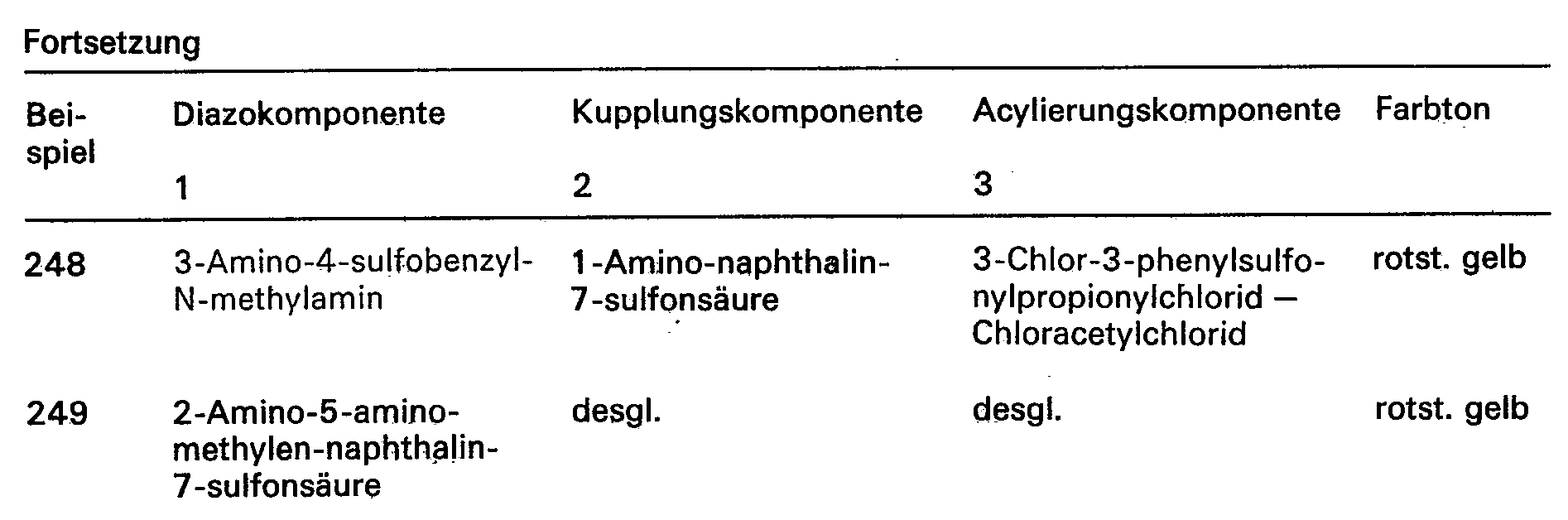
- the coupling components listed in column 2 of the following table and the diazo components listed in column 1 also provide dyes which dye wool and cotton in real tones using the same process.
- the coupling components listed in column 2 of the following table and the diazo components listed in column 1 also provide dyes which, after the acylation also described above, dye wool and cotton with good wet fastness properties using the acylating agents mentioned in column 3, using the same process.
- Dyes with similar properties are obtained if, instead of the 3-chloro-3-phenylsulfonylpropionyl derivatives, the corresponding 2-chloro-3-phenylsulfonylpropionyl, 3-bromo-3-phenylsulfonylpropionyl and 2-bromo-3-phenylsulfonylpropionyl derivatives and instead of the chloroacetyl derivatives, the corresponding dichloroacetyl or bromoacetyl derivatives are used.
- Example 86 0.1 mol of 3-amino-N-methyl-benzylamino-4-sulfonic acid is diazotized and 0.1 mol of 1- (3'-aminobenzoylamino) -8-hydroxynaphthalene-4,6-disulfonic acid Dye of the formula coupled.
- the salted-out, isolated dye is dissolved in 1000 ml of water and a solution of 30 g of 3-chloro-3-phenylsulfonylpropionyl chloride in 80 ml of acetone is added dropwise.
- the pH is obtained with soda solution at 6-7.
- the mixture is stirred for 2 hours.
- the pH is adjusted to 7.5-8, 15 g of chloroacetyl chloride are added dropwise, and this pH is maintained with sodium carbonate solution.
- the isolated dye is identical to that described in Example 86.
- the dye is salted out and isolated.
- the paste is dissolved in 750 ml of water and 15 g of chloroacetyl chloride are added at 0 ⁇ 5 ° C, the acid being released being constantly blunted to pH 7.5-8 with sodium carbonate solution. Stir, salt out and isolate.
- the dye dried in a vacuum at 50-60 ° C, gives bluish reddish dyeings on wool with good wet fastness properties.
- the coupling components listed in column 2 of the following table and the diazo components listed in column 1 also provide dyes by the same process, which after the acylation likewise described above dye wool and cotton in good wet fastness with the acylating agents mentioned in column 3.
- Dyes with similar properties are obtained if, instead of the 3-chloro-3-phenylsulfonylpropionyl derivatives, the corresponding 2-chloro-3-phenylsulfonylpropionyl, 3-bromo-3-phenylsulfonylpropionyl and 2-bromo-3-phenylsulfonylpropionyl derivatives and instead of the chloroacetyl derivatives, the corresponding dichloroacetyl or bromoacetyl derivatives are used.
- the dye of the formula is dissolved which was prepared by coupling the diazonium salt of 1-amino-4-nitro-benzene-2-sulfonic acid to 2- (2'-aminoethylamino) -8-hydroxynaphthalene-6-sulfonic acid and then reducing the nitro group with sodium sulfide in 750 ml of water and 29.4 g of 3-chloro-3-phenylsulfonylpropionyl chloride dissolved in 80 ml of acetone are added dropwise at 0-5 ° C. in the course of one hour, the hydrochloric acid liberated being continuously blunted to pH 5-6 with 10% sodium carbonate solution.
- 0.1 mol of the monoazo dye obtained by coupling diazotized 1-amino-5-chloroacetylaminobenzene-2,4-disulfonic acid to 3-aminophenylurea is dissolved in 900 ml of water.
- a temperature of 0 to 5 ° 29.4 g of 3-chloro-3-phenylsulfonylpropionyl chloride in 80 ml of acetone are added dropwise and a pH of 5-6 is maintained with sodium carbonate solution.
- the resulting dye is salted out with potassium chloride, suction filtered and dried in vacuo.
- the dye of the formula provides yellow dyeings on wool and cotton, which are characterized by good wet and light fastness.
- the coupling components listed in column 2 of the following table and the diazo component listed in column 1 also provide dyes which, after the acylation also described above, dye wool and cotton with good wet fastness properties using the acylating agents mentioned in column 3 by the same process.
- Dyes with similar properties are obtained if, instead of the 3-chloro-3-phenylsulfonylpropionyl derivatives, the corresponding 2-chloro-3-phenylsulfonylpropionyl, 3-bromo-3-phenylsulfonylpropionyl, 2-bromo-3-phenylsulfonylpropionyl derivatives and instead of the chloroacetyl derivatives, the corresponding dichloroacetyl or bromoacetyl derivatives are used.
- the coupling components listed in column 2 of the following table and the diazo component listed in column 1 also provide dyes which dye wool and cotton with good wet fastness properties by the same process.
- Dyes with similar properties are obtained if, instead of the 3-chloro-3-phenylsulfonylpropionyl derivatives, the corresponding 2-chloro-3-phenylsulfonylpropionyl, 3-bromo-3-phenylsulfonylpropionyl and 2-bromo-3-phenylsulfonylpropionyl derivatives and instead of the chloroacetyl derivatives, the corresponding dichloroacetyl or bromoacetyl derivatives are used.
- Example 2128 0.1 mol of 1-amino-5- (3'-chloro-3'-phenylsulfonylpropionylamino) benzene-2-sulfonic acid is coupled with 0.1 mol of diazotized 2-amino-5-aminomethyl-naphthalene-1 , 7-disulfonic acid.
- the resulting monoazo dye is isolated, dissolved in 1000 ml of water and mixed with 14 g of chloroacetyl chloride at a pH of 7.5-8.0 at 0-5 ° C. The released acid is blunted with soda solution. When the reaction is complete, the dye is isolated and dried in vacuo at 50-60 ° C.
- the coupling components listed in column 2 of the table below and the diazo components listed in column 1 also provide dyes which, after the acylation likewise described above, dye wool and cotton with good wet fastness properties using the acylating agents mentioned in column 3 by the same process.
- Dyes with similar properties are obtained if, instead of the 3-chloro-3-phenylsulfonylpropionyl derivatives, the corresponding 2-chloro-3-phenylsulfonylpropionyl, 3-bromo-3-phenylsulfonylpropionyl and 2-bromo-3-phenylsulfonylpropionyl derivatives and instead of the chloroacetyl derivatives, the corresponding dichloroacetyl or bromoacetyl derivatives are used.
- 0.1 mol of the monoazo dye obtained by coupling diazotized 2-amino-5-aminomethylene-naphthalene-1,7-disulfonic acid to 3-aminophenylurea are dissolved in 900 ml of water and at a temperature of 0-5 ° C. and a pH of 5-6 with 29.4 g of 3-chloro-3-phenylsulfonyl-propionyl chloride dissolved in 80 ml of acetone.
- the solution is brought to a pH of 7.5-8 and 14 g of chloroacetyl chloride are added.
- the acid produced is blunted to the respective pH in both stages with soda solution.
- the product is salted out, isolated and dried in vacuo at 50-60 ° C.
- the dye of the formula provides yellow dyeings on wool and cotton, which are characterized by good wet and light fastness.
- a dye with similar properties is obtained if the same monoazo dye is first acylated with chloroacetyl chloride and then with 3-chloro-3-phenylsulfonylpropionyl chloride.
- the coupling components listed in column 2 of the following table and the diazo component listed in column 1 also provide dyes which, after the acylation also described above, dye wool and cotton with good wet fastness properties using the acylating agents mentioned in column 3 by the same process.
- Dye with similar properties is obtained if, instead of the 3-chloro-3-phenylsulfonylpropionyl derivatives, the corresponding 2-chloro-3-phenylsulfonylpropionyl, 3-bromo-3-phenylsulfonylpropionyl and 2-bromo-3-phenylsulfonylpropionyl derivatives and instead of the chloroacetyl derivatives, the corresponding dichloroacetyl or bromoacetyl derivatives are used.
- a solution of 0.1 mol of acidic coupling product from 1-amino-8-hydroxynaphthalene-3,6-disulfonic acid and diazotized 1-amino-5-chloroacetylaminobenzene-2,4-disulfonic acid (Example 1) is added at pH 8 and 0-5 ° C a suspension of the diazonium salt from 1-amino-5- (3'-chloro-3'-phenylsulfonylpropionylamino) -benzene-2-sulfonic acid (prepared from 0.1 mol of 1,3-diaminobenzene-4-sulfonic acid according to Example 27) was added .
- a pH of 8 is maintained during the coupling and the pH is adjusted to 6 after the reaction has ended.
- the dye is salted out with 100 parts of common salt, suction filtered and dried in vacuo at 40 ° C. When dyeing from long liquors, a black color is obtained on cotton. A similar dye is obtained if 1-amino-8-hydroxynaphthalene-4,6-disulfonic acid is used instead of 1-amino-8-hydroxynaphthalene-3,6-disulfonic acid.
- Dyes with similar properties are obtained if, instead of the 3-chloro-3-phenylsulfonylpropionyl derivatives, the corresponding 2-chloro-3-phenylsulfonylpropionyl, 3-bromo-3-phenylsulfonylpropionyl and 2-bromo-3-phenylsulfonylpropionyl derivatives and instead of the chloroacetyl derivatives, the corresponding dichloroacetyl or bromoacetyl derivatives are used.
- Dyes with similar properties are obtained if instead of 3-chloro-3-phenylsulfonylpropionyl chloride instead of 3-chloro-3-phenylsulfonylpropionyl chloride, 2-chloro-3-phenylsulfonylpropionyl chloride and 2-bromo-3-phenylsulfonylpropionyl chloride, or instead of Chloroacetyl chloride, bromoacetyl chloride and dichloroacetyl chloride are used.
Landscapes
- Chemical & Material Sciences (AREA)
- Organic Chemistry (AREA)
- Coloring (AREA)
Description
- Gegenstand der vorliegenden Erfindung sind neue Reaktivfarbstoffe der Formel (I)

- F = Rest eines organischen Farbstoffs
- W und W1 = direkte Bindung oder Brückenglied
- R und R, = Wasserstoff oder Alkyl
- n und m = Zahl von 1 bis 4, vorzugsweise von 1 bis 2
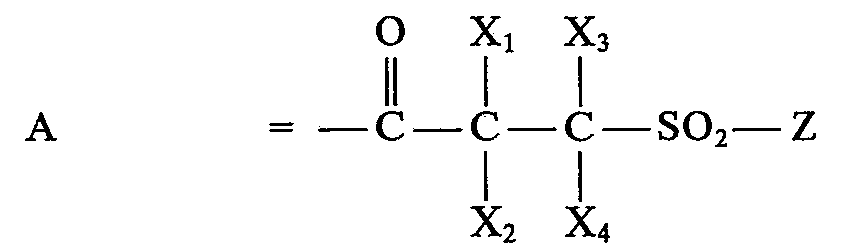
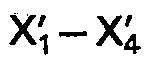
- X1―X4 = Wasserstoff oder abspaltbarer Rest, wobei mindestens ein Rest X1―X4 für einen abspaltbaren Rest steht,
- Z = gegebenenfalls substituiertes Phenyl,

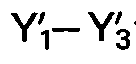
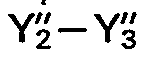
Wasserstoff oder abspaltbarer Rest, wobei mindestens ein Rest Y1―Y3 für einen abspaltbaren Rest steht und - Gegenstand der Erfindung ist weiterhin die Verwendung der Reaktivfarbstoffe der Formel (I) zum Färben und Bedrucken hydroxylgruppenhaltiger oder stickstoffhaltiger Fasermaterialien.
- Als im Hinblick auf den Erfindungsgegenstand nächster Stand der Technik ist DE-A 1 444 591 aufzufassen. (Siehe dort insbesondere S. 8, erste Verbindung). Gegenüber diesem Stand der Technik weisen die erfindungsgemäßen Farbstoffe in überraschendem Maße überlegene färberische Eigenschaften auf.
- Bevorzugte Reste A der Formel (I) sind folgende:

-

- wobei mindestens ein Rest

-


-


-

-

-

-

- Für die im vorliegenden Anmeldungstext aufgeführten Alkyl-, Aryl-, Aralkyl- und Hetarylreste gilt: Unter Alkylgruppen werden dabei insbesondere solche mit 1-4 C-Atomen verstanden, die gegebenenfalls Substituenten aufweisen können, beispielsweise Halogen wie CI und Br, OH, CN.
- Unter Arylruppen werden insbesondere Phenylreste verstanden, die gegebenenfalls Substituenten aufweisen, beispielsweise Halogen wie CI und Br, C1―C4-Alkyl, C1―C4-Alkoxy, C1―C4-Alkylsulfonyl, N02, CN, CF3, SO3H, COOH.
- Unter Aralkylresten werden insbesondere Benzylreste verstanden, die gegebenenfalls die für die Phenylreste genannten Substituenten aufweisen können.
- Geeignete Hetarylreste sind beispielsweise Thiophenyl, Benzthiophenyl, Benzthiazolyl, Benzimidazolyl, Pyridyl, Pyrimidyl, Benzofuranyl, Indolyl, Chinolyl, Carbazyl, Chinoxalyl, Benztriazolyl.
- Als abspaltbare Rest X1 bis X4 oder Y1 bis Y4 kommen vorzugsweise Halogenatome in Frage.
- Bevorzugte Reste B sind folgende:

-


-

-

-

-

- W und W1 stehen vorzugsweise für eine direkte Bindung an ein C-Atom eines aromatisch-carbocyclischen Ringes des Chromophors F.
- Geeignete Brückenglieder W und W1 sind beispielsweise:



- Die neuen Farbstoffe können den verschiedensten Klassen angehören, z. B. der Reihe der metallfreien oder metallhaltigen Mono- oder Polyazofarbstoffe, metallfreien oder metallhaltigen Azaporphinfarbstoffe, wie Kupfer- oder Nickelphthalocyaninfarbstoffe, der Anthrachinon-, Oxazin-, Dioxazin-, Triphenylmethan-, Nitro-, Azomethin-, metallfreien oder metallhaltigen Formazanfarbstoffe.
- Bevorzugte Farbstoffe sind solche mit 1 bis 6 Sulfogruppen.
- Geeignete Farbstoffreste F bzw. den Farbstoffen (I) zugrunde liegende aminogruppenhaltige Farbstoffe sind in der Literatur in sehr großer Zahl beschrieben. Beispielhaft erwähnt seien hier: Belgische Patentschrift: 606 947; 617 435; 567 435; 701 273; 683 734; 683 735; 689 573; 693 749; 708 003; 707 307;
- Deutsche Auslegeschrift: 242 553; 1 212 655; 1 225 322;
- Deutsche Offenlegungsschrift; 2 633 255; 2 103 299; 2 305 206; 2418 283; 2 623 224; 1 809 388; 1 912 178; 2 057 867; 1 769 205; 2 107 427; 2 303 601; 2 600 490;
- Schweizer Patentschrift: 536 353; 521 403;
- Britische Patentschrift: 1 299 881; 1 300 742 sowie Venkataraman: The Chemistry of Synthetic Dyes, Band VI, Kapitel II, Seite 211 bis 325, New York, London, 1972.
- Im Rahmen dieser Farbstoffe sind folgende bevorzugt:

- Besonders wertvolle Farbstoffe dieser Reihe sind solche, die wasserlöslich sind, und insbesondere solche, die Sulfonsäure- und/oder Carbonsäuregruppen aufweisen. Dabei besitzen aber auch sulfon-und carbonsäuregruppenfreie reaktive Dispersionsfarbstoffe der Azoreihe Interesse. Die Azofarbstoffe können sowohl metallfrei als auch metallhaltig sein, wobei unter den Metallkomplexen die Kupfer-, Chrom- und Kobaltkomplexe bevorzugtes Interesse haben.
- Wichtige Azofarbstoffe sind beispielsweise solche der Benzol-azo-naphthalinreihe, der Benzol-azo-1-phenyl-5-pyrazolonreihe, der Benzol-azo-benzolreihe, der Naphthalin-azo-benzolreihe, der Benzol-azo-aminonaphthalinreihe, der Naphthalin-azo-naphthalinreihe, der Naphthalin-azo-1-phenylpyrazo- lon-5-Reihe, der Benzol-azo-pyridonreihe, der Benzol-azo-aminopyridin-reihe, der Naphthalin-azo-pyridonreihe, der Naphthatin-azo-aminopyridinreihe, und der Stilben-azo-benzolreihe, wobei auch hier die sulfonsäuregruppenhaltigen Farbstoffe bevorzugt sind. Im Falle von Metallkomplexazofarbstoffen befinden sich die metallkomplexgebundenen Gruppen vorzugsweise in den o-Stellungen zur Azogruppen, z. B. in Form von o,o'-Dihydroxy-, o-Hydroxy-o'-carboxy-, o-Carboxy-o'-amino- und o-Hydroxy-o'- amino-azogruppierungen.
- Besonders hervorragende Typen werden durch die folgenden Formeln veranschaulicht:

- M = OH, NH2, NR3R4, OR3
- R2 = Alkyl, Alkoxy, Halogen, insbesondere Cl,
- R3 und R4 = Wasserstoff, Alkyl, Aryl, Hetaryl oder Aralkyl.
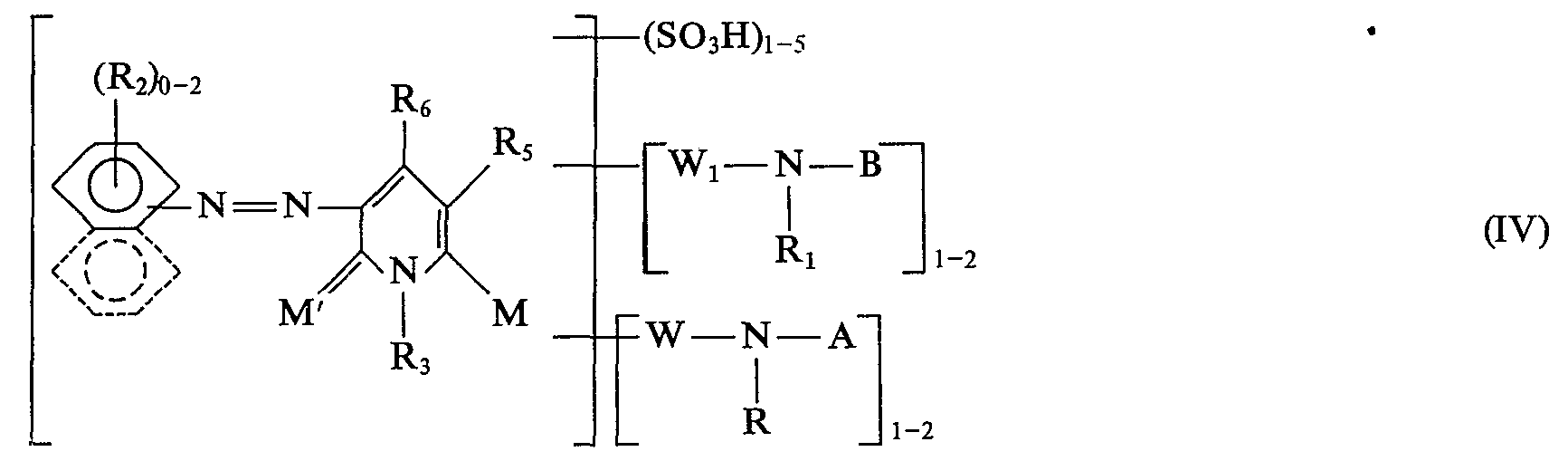
- R5 = ―COOR3, ―CONR3R4, ―CN, ―CH2―SO3H oder ―CH2―NR3R4
- R6 = ―M, ―R3 oder ―R5
- M' = O, NR3

- R7 = Wasserstoff, ―NR3―CO―R8, ―NR3―SO2―R8
- R8 = Alkyl, Aryl, Hetaryl und Aralkyl
- o = ortho-ständige Stellung der jeweiligen Reste

- (o, p) = ortho- oder paraständige Stellung der jeweiligen Reste
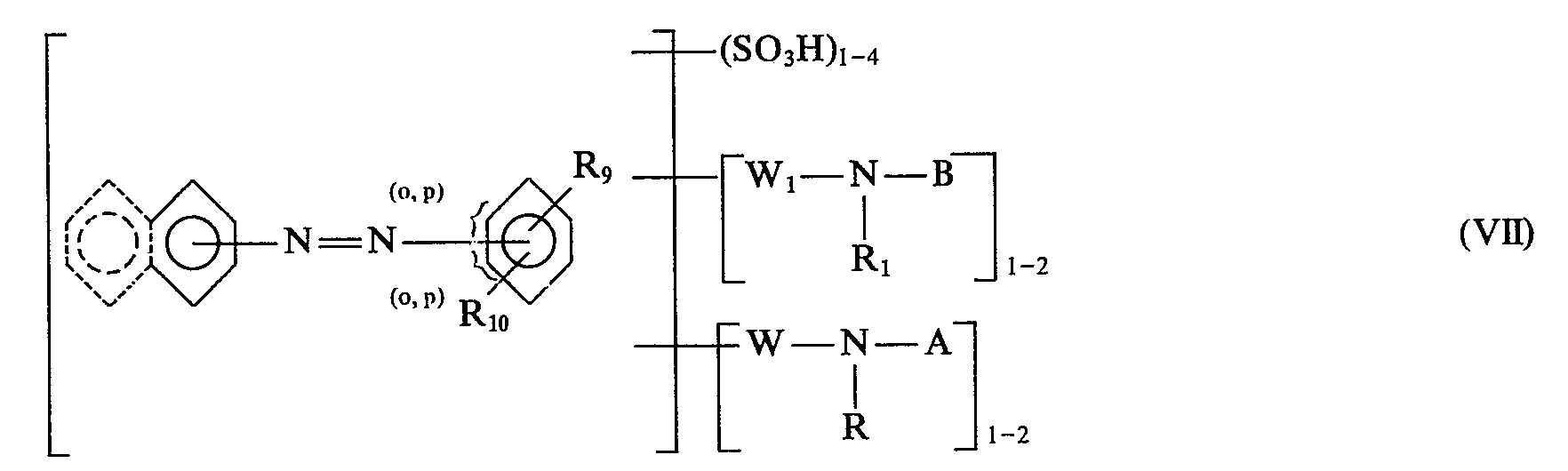
- R9 und R10 = Wasserstoff, R8, ―OR3, Halogen, ―NR3R4, ―COOR3, ―NR3―CO―R4, ―O―CO―R4, ―NR3―SO2―R4 ―O―SO2―R4, ―NR3―CO―NR3R4

- Me = Cu, Cr
- Q = Alkyl, Alkoxy, Halogen, ―NO2, Acylamino wie CH3―CO―NR3―, ―COOR3, ―CONR3R4, ―SO2―NR3R4
- r = 0-4

- Me = Co, Cr
- r = 0-8

- p = 0-4,
- L = Substituent, wie Sulfo oder Carboxy,
- U = gegebenenfalls durch O oder S unterbrochener, aliphatischer, cycloaliphatischer, araliphatischer oder aromatischer Rest
- U' = Wasserstoff oder U
- W und W, stehen vorzugsweise für C1―C2-Alkylen oder eine direkte Bindung, Alkylen bedeutet vorzugsweise C1―C4-Alkylen und Cycloalkylen steht vorzugsweise für gegebenenfalls substituiertes Cyclohexylen.
- Darüber hinaus besitzen auch noch sulfonsäure- und carbonsäuregruppenfreie reaktive Dispersionsfarbstoffe der Anthrachinonreihe Interesse.

- L = Substituent, insbesondere Sulfo oder Carboxy
- q = 0-4.
- W und W1 stehen vorzugsweise für eine direkte Bindung oder C1―C2-Alkylen. Der Phthalocyaninrest Pc trägt bevorzugt als weitere Substituenten 1-3 Sulfonsäure- und/oder 1-2 Sulfonsäureamidgruppe, wie ―SO2NH2―, ―SO2NH-alkyl―, ―SO2N(alkyl)2― und -S02NH-(aryl)-Gruppen.
- R und R, stehen vorzugsweise für Wasserstoff. Soweit nicht anders angegeben, haben die Alkyl-, Aryl-, Hetaryl- und Aralkylreste die oben angegebene Bedeutung.

- L = Substituent, insbesondere Halogen, C1―4Alkyl, C1―4-Alkoxy oder Carboxy
- t = 0 bis 3
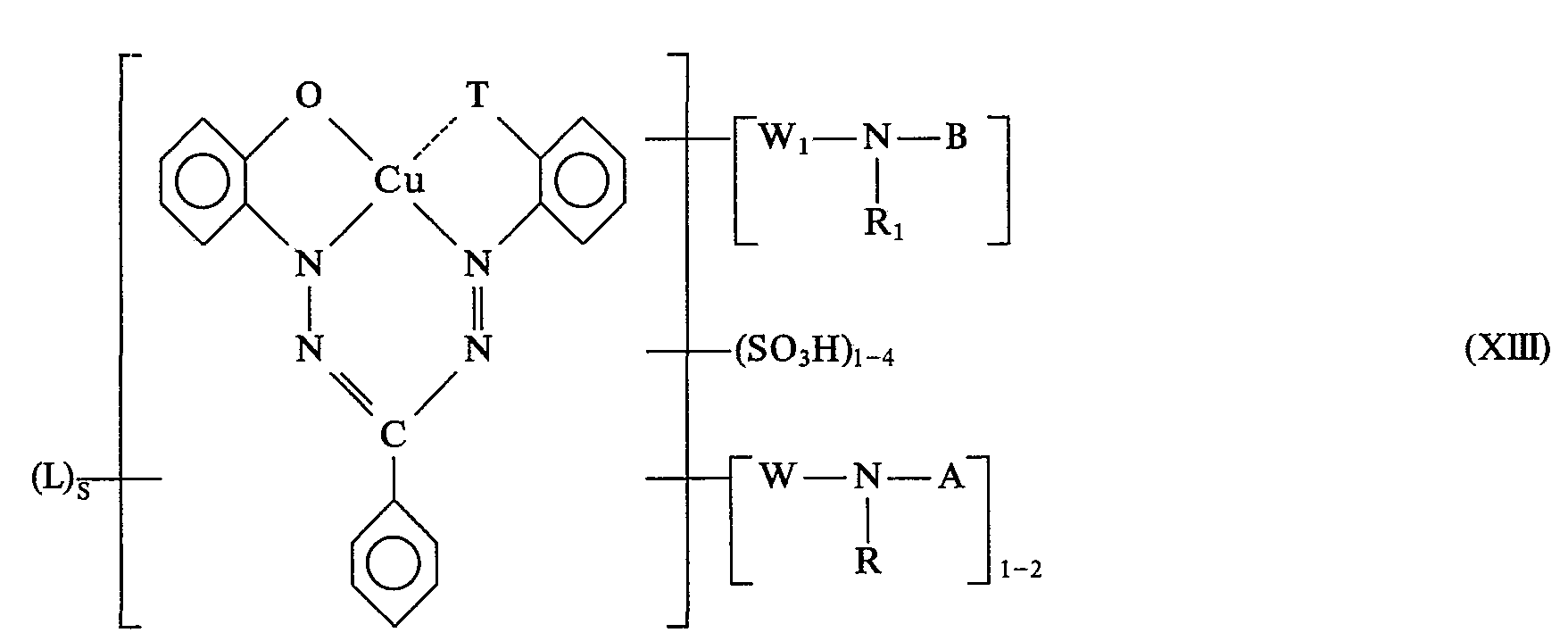
- L = Substituent, insbesondere Halogen, C1-4-Alkyl, C1―4-Alkoxy, Alkylsulfonyl, Aminosulfonyl, unkondensierte Phenylreste oder Carboxy
- S = 0-6
- T = zur Komplexbildung befähigte Gruppe, -OH, -COOH oder -SO3H
- Die neuen Farbstoffe können im übrigen beliebige in Farbstoffen übliche Substituenten aufweisen, wie Sulfonsäure-, Carbonsäure-, Sulfonamid- und Carbonamidgruppen, die am Amidstickstoffatom weiter substituiert sein können, Sulfonsäureester- und Carbonsäureestergruppen, Alkyl-, Aralkyl- und Arylreste, Alkylamino-, Aralkylamino-, Arylamino-, Acylamino-, Nitro-, Cyan-, Halogen-, wie Cl, Br und F, Hydroxy-, Alkoxy-, Thioether-, Azogruppierungen und dergleichen.
- Die Herstellung der neuen Farbstoffe (I) kann nach verschiedenen Verfahren erfolgen, beispielsweise durch Umsetzung von Farbstoffen der Formel:


wobei im Falle der Verwendung von Farbstoffvorprodukten diese in geeigneter Weise in die gewünschten Endfarbstoffe umgewandelt werden. - Die Umsetzung der Farbstoffe (XIV) bzw. der Farbstoffvorprodukte mit einer Gruppe

- Geeignete reaktive Derivate sind insbesondere die Anhydride oder Säurehalogenide, insbesondere die Säurechloride, Säurefluoride und Säurebromide.
- Die reaktiven Derivate (XV) erhält man beispielsweise aus den Säuren in bekannter Weise, so durch Umsetzung mit organischen und anorganischen Säurehalogeniden, z. B. SOCI2, POCl3, PBr3, SbF5, COCl2, Benzoylchlorid oder Trifluortriazin.
- Die Derivate der Formel XVI sind größtenteils bekannt.
- Ein weiteres Verfahren zur Herstellung von (I) besteht darin, daß man Farbstoffe der Formel


- T1-T4 = Wasserstoff oder abspaltbarer Rest, wobei mindestens ein Rest T1-T4 für einen abspaltbaren Rest steht und
- T5 = abspaltbarer Rest
- D1-D3 = Wasserstoff oder abspaltbarer Rest, wobei mindestens ein Rest D1-D3 für einen abspaltbaren Rest steht mit einer Verbindung der Formel HS02-Z umsetzt, und anschließend, falls erforderlich, in die Endfarbstoffe umwandelt.
- Dabei werden die Reste T5 und D3 gegen den Rest -S02-Z ausgetauscht.
- Bei Verwendung von Farbstoff-Zwischenprodukten werden die erhaltenen Kondensationsprodukte in an sich üblicher Weise in die gewünschten Endfarbstoffe umgewandelt. Dieses Verfahren hat bevorzugtes Interesse für die Darstellung von Azofarbstoffen, indem man beispielsweise eine Diazo- und/ oder Kupplungskomponente, die eine reaktionsfähige Amino- oder Amidgruppe aufweist, zunächst mit der Reaktivkomponente kondensiert und das erhaltene Zwischenprodukt anschließend durch Diazotieren und/oder Kuppeln und/oder Kondensieren in eine Azofarbstoff umwandelt. In diesem können nachträglich weitere Umwandlungsreaktionen vorgenommen werden, wie sie in Azofarbstoffen üblich sind, z. B. Acylierungs-, Kondensations-, Reduktions-, Metallisierungs- oder Sulfierungsreaktionen.
- Auch bei der Darstellung anderer Farbstoffe, insbesondere solcher der Phthalocyanin- und Anthrachinonreihe können nach der Reaktion des Farbstoffs mit reaktiven Derivaten (XV) und (XVI) weitere Umwandlungsreaktionen vorgenommen werden, z. B. Acylierungs-, Kondensations- und Sulfierungsreaktionen. Darüber hinaus kann die Kondensation der reaktiven Derivate (XV) und (XVI) zunächst mit einem Zwischenprodukt erfolgen, z. B. mit m-Phenylendiamin oder einer m-Phenylendiaminsulfonsäure, und das erhaltene Reaktionsprodukt anschließend mit einem Anthrachinonsulfonsäurehalogenid oder mit einem Kupfer- oder Nickelphthalocyaninsulfonsäurehalogenid zu einem reaktiven Phthalocyanin- oder Anthrachinonfarbstoff weiter umgesetzt werden.
- Die neuen Farbstoffe sind äußerst wertvolle Produkte, die sich für verschiedenste Anwendungszwecke eignen. Sie finden bevorzugtes Interesse für das Färben hydroxylgruppenhaltiger und stickstoffhaltiger Materialien, insbesondere von Textilmaterialien aus nativer und regenerierter Cellulose, ferner aus Wolle, Seide, synthetischen Polyamid- und Polyurethanfasern sowie zum Färben von Papier. Die sulfonsäuregruppenfreien Farbstoffe sind insbesondere zum Färben von Polyestermaterialien, insbesondere Textilmaterialien aus Polyethylenglykolterephthalat geeignet.
- In eine Lösung von 0.1 mol des Dinatriumsalzes der 1,5-Diaminobenzol-2,4-disulfonsäure in 300 ml Wasser werden bei 0-50 C unter gutem Rühren 14 g Chloracetylchlorid eingetropft. UnterAbstumpfen der freiwerdenden Salzsäure auf pH 5-6 mit 10%iger Sodalösung wird so lange gerührt bis dünnschichtchromatographisch keine Ausgangsverbindung mehr nachzuweisen ist. Nach Zugabe von Eis wird das entstandene Zwischenprodukt mit 28 ml Salzsäure und 7 g Natriumnitrit diazotiert. Zur Kupplung suspendiert man 19 g (0.1 Mol) 1-(3'-Aminophenyl)-3-methyl-pyrazolon-(5) in 140 ml Wasser und gibt diese Suspension zur Diazoniumsalz-Lösung. Mit festem Natriumacetat-Trihydrat wird ein pH-Wert von 4 eingestellt. Dabei entsteht eine hellbraune Lösung. Der Farbstoff wird aus dieser Lösung mit Kaliumchlorid ausgefällt und abgesaugt, der feuchte Filterkuchen in 250 ml Wasser suspendiert und bei 0-5° C unter gutem Rühren mit 32 g 3-Chlor-3-phenylsulfonylpropionylchlorid gelöst in 75 ml Aceton versetzt. Man rührt bis zur vollständigen Umsetzung und hält während dieser Zeit den pH-Wert der Lösung mit 10%iger Sodalösung bei 5-6. Der Farbstoff wird mit Kaliumchlorid ausgefällt, abgesaugt und im Vakuum bei 50-600 getrocknet.
- Man erhält einen Farbstoff der Formel

- Weitere gelbe Farbstoffe mit ähnlichen Eigenschaften erhält man, wenn man die in der folgenden Tabelle in Spalte 1 genannten Diazokomponenten mit der in Spalte 2 genannten Kupplungskomponente umsetzt und die erhaltenen Farbstoffe mit den in Spalte 3 genannten Kupplungskomponenten acyliert.


- Man löst 0,1 Mol des Diaminoazofarbstoffs der Formel

- In diese Lösung tropft man innerhalb einer Stunde bei 0-50 C 29 g 3-Chlor-3-phenylsulfonylpropio- nylchlorid in 70 ml Aceton, wobei die freiwerdende Salzsäure mit 10%iger Sodalösung ständig auf pH 5-6 abgestumpft wird.
- Man rührt ca. 2 Stunden nach, stellt den pH-Wert auf 7.5-8 und gibt nochmals 14 g Chloracetylchlorid tropfenweise zu und hält den pH-Wert mit Sodalösung bei 7.5-8. Nach beendeter Umsetzung wird der Farbstoff isoliert und im Vakuum bei 50-600 C getrocknet. Er löst sich in Wasser mit gelber Farbe und liefert naß- und lichtechte Färbungen auf Wolle und Baumwolle.
- Ähnliche Reaktivfarbstoffe erhält man, wenn man statt des oben genannten Diaminoazofarbstoffes einen aus den in der nachfolgenden Tabelle aufgeführten Komponenten (Spalte 1 und 2) aufgebauten Diaminoazofarbstoff mit den in Spalte 3 aufgeführten Säurechloriden acyliert.
-

- 0,1 Mol Natrium-1,3-diaminobenzol-4-sulfonat werden in 300 ml Wasser gelöst und bei 05° C unter gutem Rühren mit 29,4 g 3-Chlor-3-phenylsulfonylpropionylchlorid, gelöst in 80 ml Aceton, versetzt. Durch Zutropfen von 10%iger Sodalösung wird ein pH-Wert von 6-7 gehalten.
- Nach beendeter Reaktion wird die klare Lösung in eine Mischung von ca. 150 g Eis, 70 ml konz. Salzsäure und 15 g Kaliumchlorid gegeben, filtriert und mit ges. Kaliumchloridlösung gewaschen. Die feuchte Paste wird in 400 ml Wasser suspendiert und mit 7 g Natriumnitrit und 28 ml konz. Salzsäure diazotiert. Nach beendeter Reaktion wird der Nitritüberschuß mit Amidosulfonsäure zerstört. In diese Suspension der Diazokomponente gibt man eine gekühlte Lösung von 1-(2'-Aminoethyl)-4-methyl-6- oxy-2-pyridon-3-carbonamid in 500 ml Wasser. Es entsteht dabei der folgende Farbstoff:

- Die entstehende Lösung wird mit Sodalösung auf pH 7.5-8.5 gestellt und mit 14 g Chloracetylchlorid versetzt. Die entstehende Säure wird mit Sodalösung abgestumpft. Nach beendeter Reaktion wird der Farbstoff isoliert und im Vakuum bei 50-60° C getrocknet.
- Er färbt natürliche und künstliche Polyamidfasern und Cellulosefasern in reinen grünstichig gelben Nuancen.
- Verwendet man anstelle von 1-Amino-5-(3'-chlor-3'-phenylsulfonylpropionylamino)-benzol-2-sulfonsäure die äquivalente Menge 1-Amino-5-(3'-brom-3'-phenylsulfonylpropionylamino)-benzol-2-sulfonsäure oder 1-Amino-5-(2'-chlor-3'-phenylsulfonylpropionylamino)-benzol-2-sulfonsäure bzw. 1-Amino-5-(2'-3'-phenylsulfonylpropionyl-amino)-benzol-2-sulfonsäure, so erhält man Farbstoffe mit ganz ähnlichen Eigenschaften.
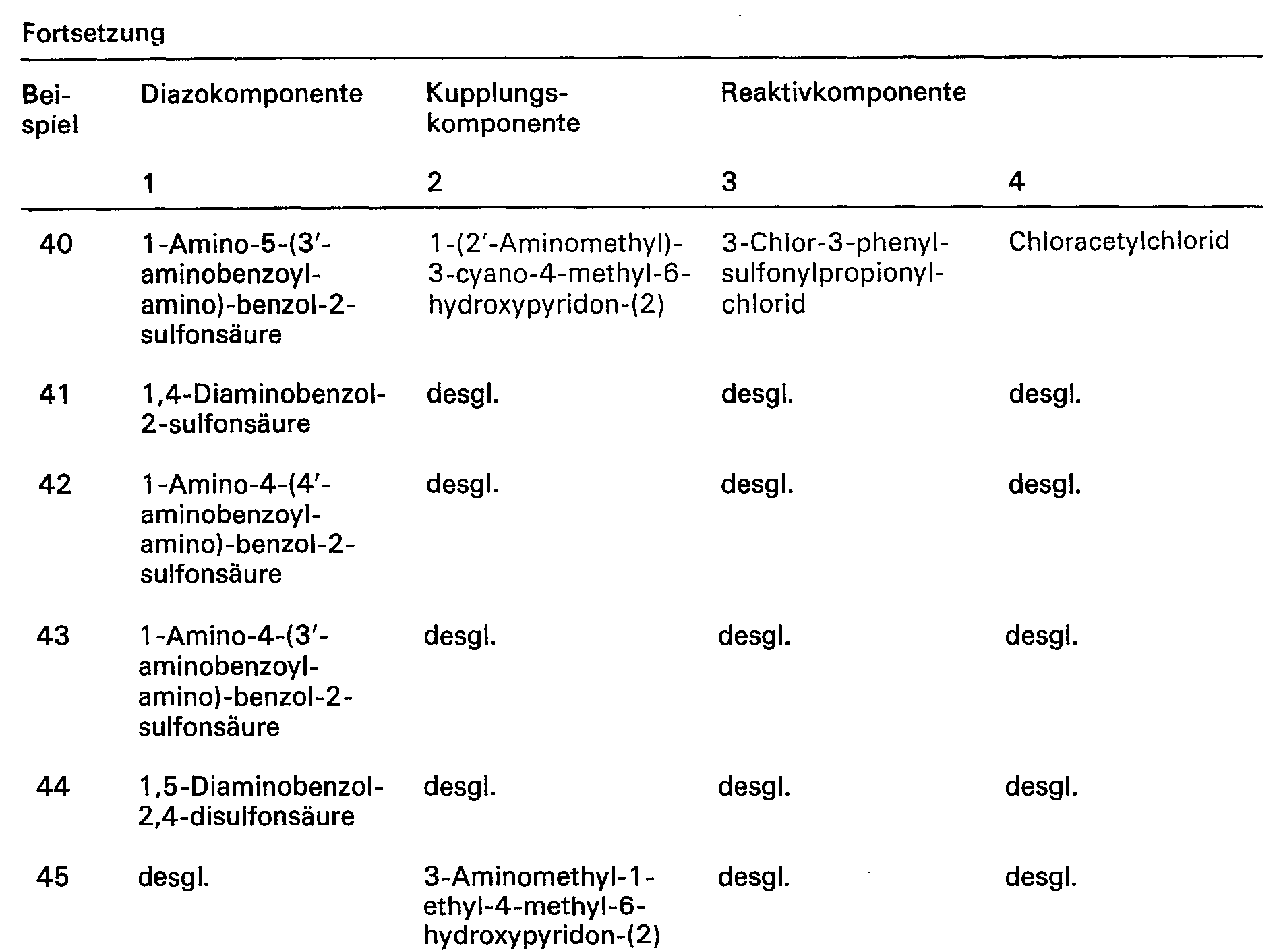
- Weitere gelbe Farbstoffe mit ähnlichen Eigenschaften erhält man, wenn man die in der folgenden Tabelle in Spalte 1 genannten Diazokomponenten mit den in Spalte 3 genannten Reaktivkomponenten acyliert, danach mit den in Spalte 2 genannten Kupplungskomponenten umsetzt und die entstandenen Farbstoffe mit den in Spalte 4 genannten Säurechloriden acyliert.

- 0,1 Mol 1-(4'-Aminobenzoylamino)-8-hydroxy-naphthalin-3,6-disulfonsäure werden in 600 Teilen Wasser mit Sodalösung bei pH 4,5 gelöst. In diese Lösung tropft man innerhalb einer Stunde bei 0-5° C 29,4 g 3-Chlor-3-phenyl-sulfonylpropionylchlorid in 80 ml Aceton ein, wobei die freiwerdende Salzsäure mit Sodalösung ständig auf pH 3,5-4 abgestumpft wird. Das acylierte Farbstoffzwischenprodukt wird mit Kaliumchlorid abgeschieden und isoliert. Die so erhaltene Paste wird in 700 Teilen Wasser angeschlagen und bei einem pH von 6-7 bei 0-5° C mit 0.1 Mol diazotierter 1-Amino-5-chloracetyla- minobenzol-2-sulfonsäure gekuppelt.
- Die Diazokomponente wird folgendermaßen hergestellt:
- In eine Lösung von 0.1 Mol des Natriumsalzes der 1,5-Diaminobenzol-2-sulfonsäure in 300 ml Wasser, werden bei 0-5° C unter gutem Rühren 14 g Chloracetylchlorid in 100 ml Methylenchlorid eingetropft. Unter Abstumpfen der freiwerdenden Salzsäure auf pH 5-6 mit 10%iger Sodalösung wird so lange gerührt, bis dünnschichtchromatographisch keine Ausgangsverbindung mehr nachweisbar ist. Das organische Lösungsmittel wird abgetrennt und die Lösung nach Zugabe von 28 ml Salzsäure mit 7 g Natriumnitrit versetzt. Man erhält einen Farbstoff der Formel

- Verwendet man anstelle von 1-Amino-5-(chloracetylamino)-benzol-2-sulfonsäure, 1-Amino-4-(chloracetylamino)-benzol-2-sulfonsäure, so erhält man einen Farbstoff, der Wolle und Baumwolle in echten blaustichig roten Tönen färbt.
- Nach dem gleichen Verfahren liefern auch die in Spalte 2 der folgenden Tabelle aufgeführten Kupplungskomponenten und die in Spalte 1 aufgeführten Diazokomponenten Farbstoffe, die Wolle und Baumwolle in echten Tönen färben.
- Statt der in der Tabelle erwähnten 3-Chlor-3-phenyl-sulfonylpropionylderivate können auch die entsprechenden 2-Chlor-3-phenylsulfonylpropionyl-, 3-Brom-3-phenyl-sulfonylpropionyl- und 2-Brom-3-phenyl-sulfonylpropionylderivate eingesetzt werden, statt der erwähnten Chloracetylderivate auch die entsprechenden Bromacetyl- oder Dichloracetylderivate.


- 0,1 Mol 3-Amino-N-methylbenzylamin-4-sulfonsäure werden in 200 ml Wasser heiß gelöst, auf 0-5° gekühlt und mit 35 ml konz. Salzsäure versetzt. Man diazotiert mit 7 g Natriumnitrit und tropft die Suspension des Diazoniumsalzes in eine neutrale auf 0-5° C gekühlte Suspension von 1-[3'-(3"-chlor-3"-phenylsulfonylpropionylamino)-benzoylamino]-8-hydroxynaphthalin-4,6-disulfonsäure in 600 ml Wasser. Der pH-Wert wird durch Eintropfen von Sodalösung auf 6-7 gehalten.
- Nach beendeter Kupplung stellt man mit Sodalösung einen pH-Wert von 7,5-8 ein und tropft langsam 14 g Chloracetylchlorid zu. Die freiwerdende Salzsäure wird mit Sodalösung neutralisiert. Man rührt bis zur vollständigen Umsetzung, isoliert und trocknet. Man erhält einen Farbstoff, der Wolle und Baumwolle in brillanten Rottönen färbt.
- Formel:
-

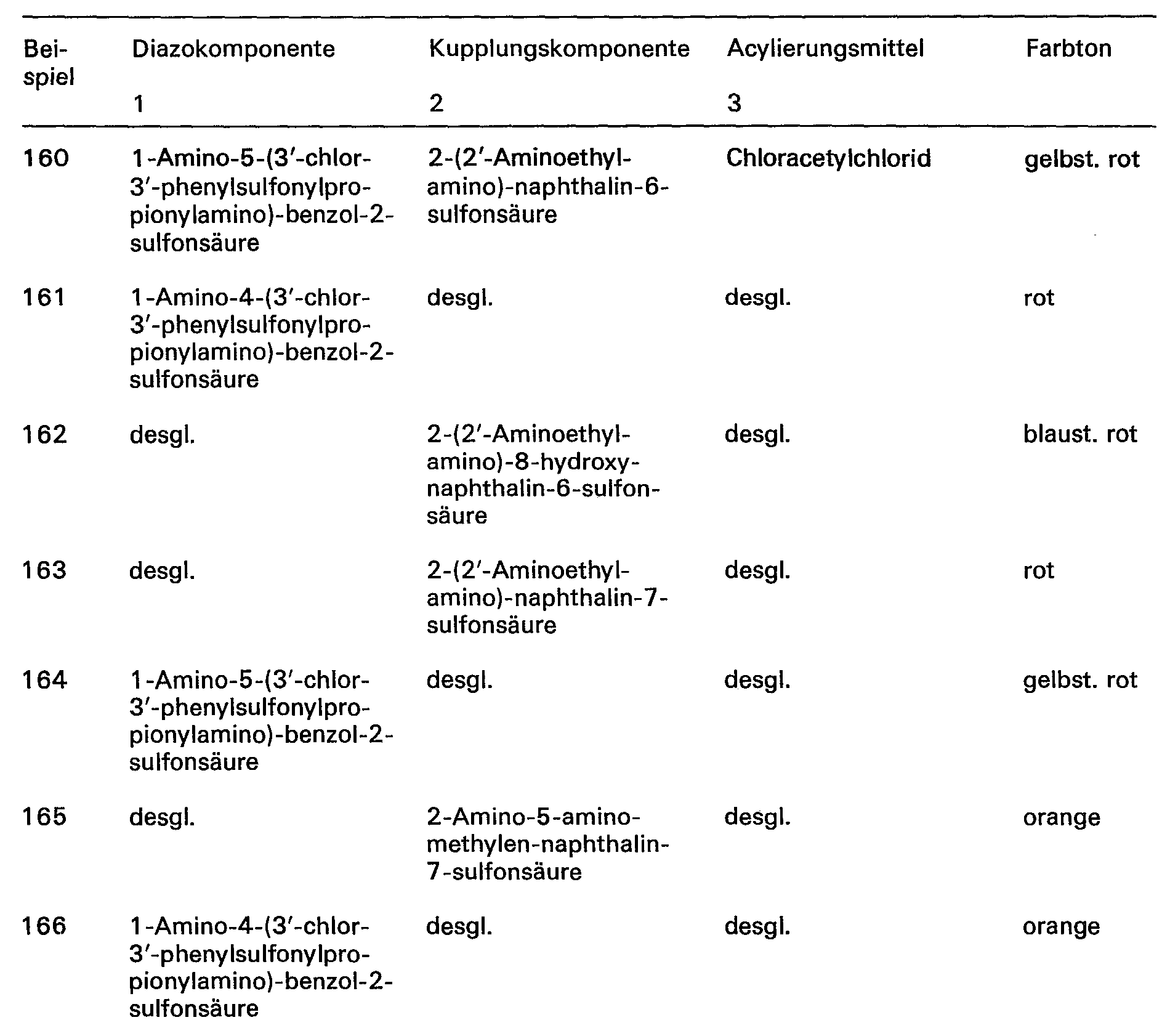
- Nach dem gleichen Verfahren liefern auch die in Spalte 2 der folgenden Tabelle aufgeführten Kupplungskomponenten und die in Spalte 1 aufgeführten Diazokomponenten Farbstoffe, die nach der ebenfalls oben beschriebenen Acylierung mit den in Spalte 3 genannten Acylierungsmitteln Wolle und Baumwolle in guten Naßechtheiten färben.
- Man erhält Farbstoffe mit ähnlichen Eigenschaften, wenn man statt der 3-Chlor-3-phenylsulfonyl- propionylderivate die entsprechenden 2-Chlor-3-phenylsulfonylpropionyl-, 3-Brom-3-phenylsulfonyl- propionyl- und 2-Brom-3-phenylsulfonylpropionylderivate und statt der Chloracetylderivate die entsprechenden Dichloracetyl- bzw. Bromacetylderivate einsetzt.


- Wie in Beispiel 86 beschrieben, werden 0,1 Mol 3-Amino-N-methyl-benzylamino-4-sulfonsäure diazotiert und mit 0,1 Mol 1-(3'-Aminobenzoylamino)-8-hydroxynaphthalin-4,6-disulfonsäure zum Farbstoff der Formel

- 0,1 Mol 1,3-Diaminobenzol-4-sulfonsäure werden wie in Beispiel 27 beschrieben, mit 3-Chlor-3-phenylsulfonylpropionylchlorid acyliert und diazotiert.
- In die Suspension des Diazoniumsalzes gibt man eine Lösung von 0.1 Mol 2-(2'-Aminoethylamino)-8-hydroxynaphthalin-6-sulfonsäure. Die freiwerdende Säure wird mit Natriumacetat abgefangen. Man erhält einen Farbstoff der Formel

- Nach beendeter Kupplung wird der Farbstoff ausgesalzen und isoliert. Die Paste wird in 750 ml Wasser gelöst und bei 0―5° C mit 15 g Chloracetylchlorid versetzt, wobei die freiwerdende Säure mit Sodalösung ständig auf pH 7.5-8 abgestumpft wird. Man rührt nach, salzt aus und isoliert. Der im Vakuum bei 50-60° C getrocknete Farbstoff liefert auf Wolle blaustichig rote Färbungen mit guten Naßechtheiten.
- Nach dem gleichen Verfahren liefern auch die in Spalte 2 der folgenden Tabelle aufgeführten Kupplungskomponenten und die in Spalte 1 aufgeführten Diazokomponente Farbstoffe, die nach der ebenfalls oben beschriebenen Acylierung mit den in Spalte 3 genannten Acylierungsmittein Wolle und Baumwolle in guten Naßechtheiten färben.
- Man erhält Farbstoffe mit ähnlichen Eigenschaften, wenn man statt der 3-Chlor-3-phenylsulfonyl- propionylderivate die entsprechenden 2-Chlor-3-phenylsulfonylpropionyl-, 3-Brom-3-phenylsulfonyl- propionyl- und 2-Brom-3-phenylsulfonylpropionylderivate und statt der Chloracetylderivate die entsprechenden Dichloracetyl- bzw. Bromacetylderivate einsetzt.

- Man löst 0,1 Mol des Farbstoffs der Formel

- 0.1 Mol des durch Kuppeln von diazotierter 1-Amino-5-chloracetylaminobenzol-2,4-disulfonsäure auf 3-Aminophenylharnstoff erhaltenen Monoazofarbstoffs werden in 900 ml Wasser gelöst. Bei einer Temperatur von 0 bis 5° werden 29,4 g 3-Chlor-3-phenylsulfonylpropionylchlorid in 80 ml Aceton zugetropft und mit Sodalösung ein pH-Wert von 5-6 gehalten. Nach beendeter Reaktion wird der entstandene Farbstoff mit Kaliumchlorid ausgesalzen, abgesaugt und im Vakuum getrocknet. Der Farbstoff der Formel

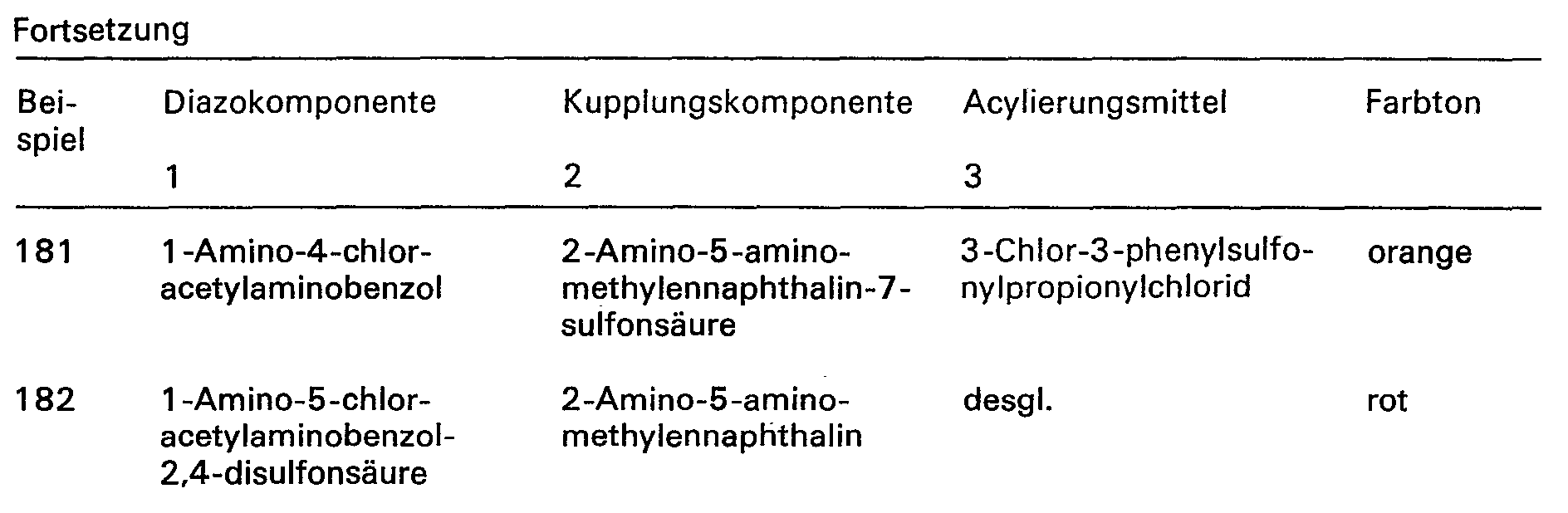
- Nach dem gleichen Verfahren liefern auch die in Spalte 2 der folgenden Tabelle aufgeführten Kupplungskomponenten und die in Spalte 1 aufgeführten Diazokomponente Farbstoffe, die nach der ebenfalls oben beschriebenen Acylierung mit den in Spalte 3 genannten Acylierungsmitteln Wolle und Baumwolle in guten Naßechtheiten färben.
- Man erhält Farbstoffe mit ähnlichen Eigenschaften, wenn man statt der 3-Chlor-3-phenylsulfonyl- propionylderivate die entsprechenden 2-Chlor-3-phenylsulfonylpropionyl-, 3-Brom-3-phenylsulfonyl- propionyl-, 2-Brom-3-phenylsulfonylpropionylderivate und statt der Chloracetylderivate die entsprechenden Dichloracetyl- bzw. Bromacetylderivate einsetzt.

- In eine neutrale Lösung von 0,1 Mol des nach den Angaben in Beispiel 27 hergestellten Kondensationsproduktes aus 1,3-Diamino-benzol-4-sulfonsäure und 3-Chlor-3-phenylsulfonylpropionylchlorid in 500 ml Wasser werden bei 10―15° C 0.1 Mol einer Lösung von diazotierter 1-Amino-5-chloracetyl- aminobenzol-2,4-disulfonsäure (Beispiel 1) gegeben. Das Gemisch wird mit 150 ml einer 20%igen Natriumacetatlösung versetzt. Die Kupplung verläuft bei pH 4 rasch und vollständig. Nach 15 Minuten scheidet sich der Farbstoff kristallin ab. Er wird isoliert und bei 30-40° C im Vakuum getrocknet. Der erhaltene Monoazofarbstoff entspricht der Formel

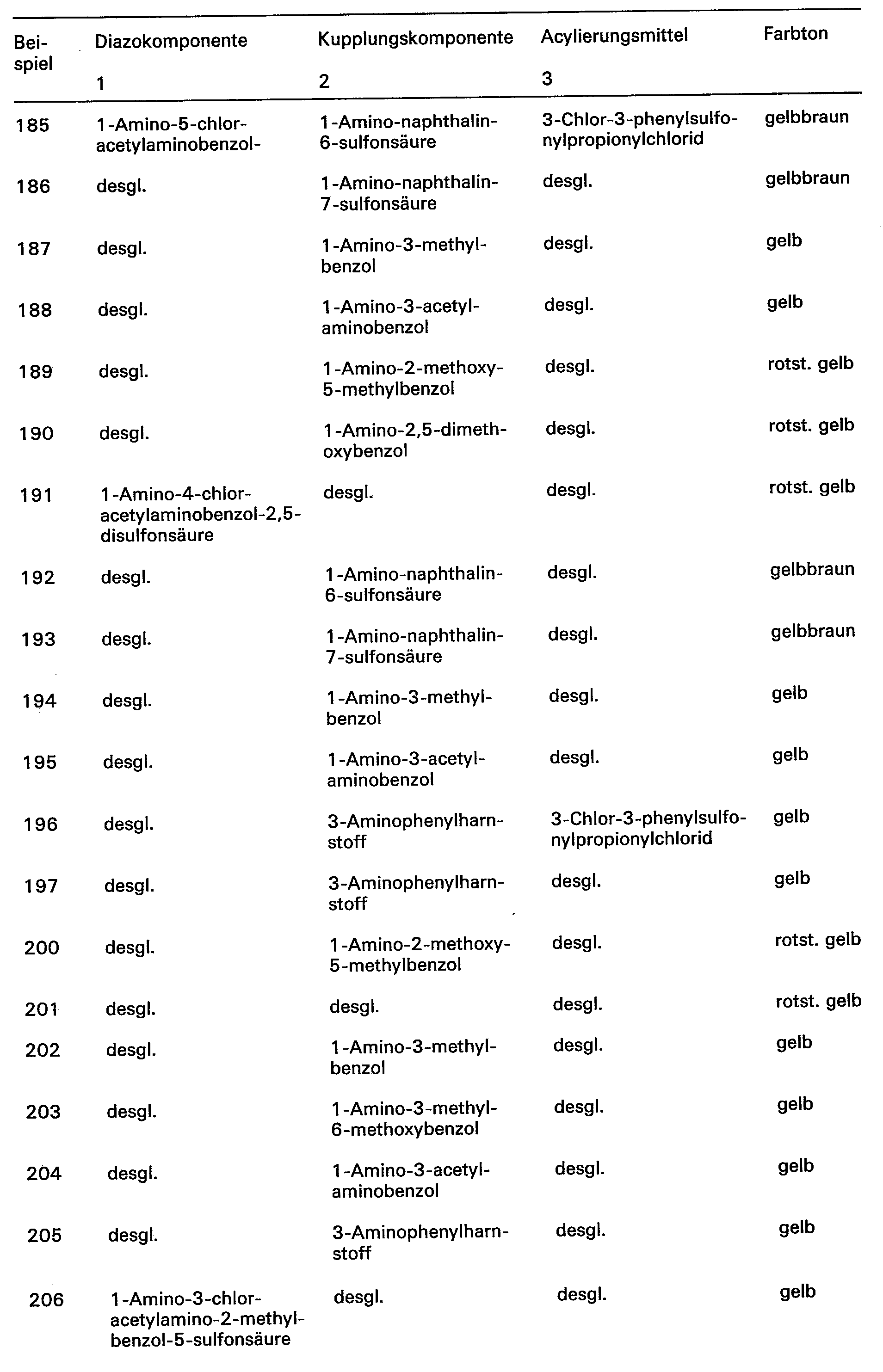
- Nach dem gleichen Verfahren liefern auch die in Spalte 2 der folgenden Tabelle aufgeführten Kupplungskomponenten und die in Spalte 1 aufgeführten Diazokomponente Farbstoffe, die Wolle und Baumwolle in guten Naßechtheiten färben.
- Man erhält Farbstoffe mit ähnlichen Eigenschaften, wenn man statt der 3-Chlor-3-phenylsulfonyl- propionylderivate die entsprechenden 2-Chlor-3-phenylsulfonylpropionyl-, 3-Brom-3-phenylsulfonyl- propionyl- und 2-Brom-3-phenylsulfonylpropionylderivate und statt der Chloracetylderivate die entsprechenden Dichloracetyl- bzw. Bromacetylderivate verwendet.
- Wie in Beispiel 218 beschrieben, kuppelt man 0.1 Mol 1-Amino-5-(3'-chlor-3'-phenylsulfonylpro- pionylamino)-benzol-2-sulfonsäure mit 0.1 Mol diazotierter 2-Amino-5-aminomethyl-naphthalin-1,7-disulfonsäure. Der entstandene Monoazofarbstoff wird isoliert, in 1000 ml Wasser gelöst und bei einem pH-Wert von 7.5-8.0 bei 0-5° C mit 14 g Chloracetylchlorid versetzt. Die freiwerdende Säure wird mit Sodalösung abgestumpft. Nach beendeter Reaktion wird der Farbstoff isoliert, im Vakuum bei 50-60° C getrocknet. Er hat die Formel

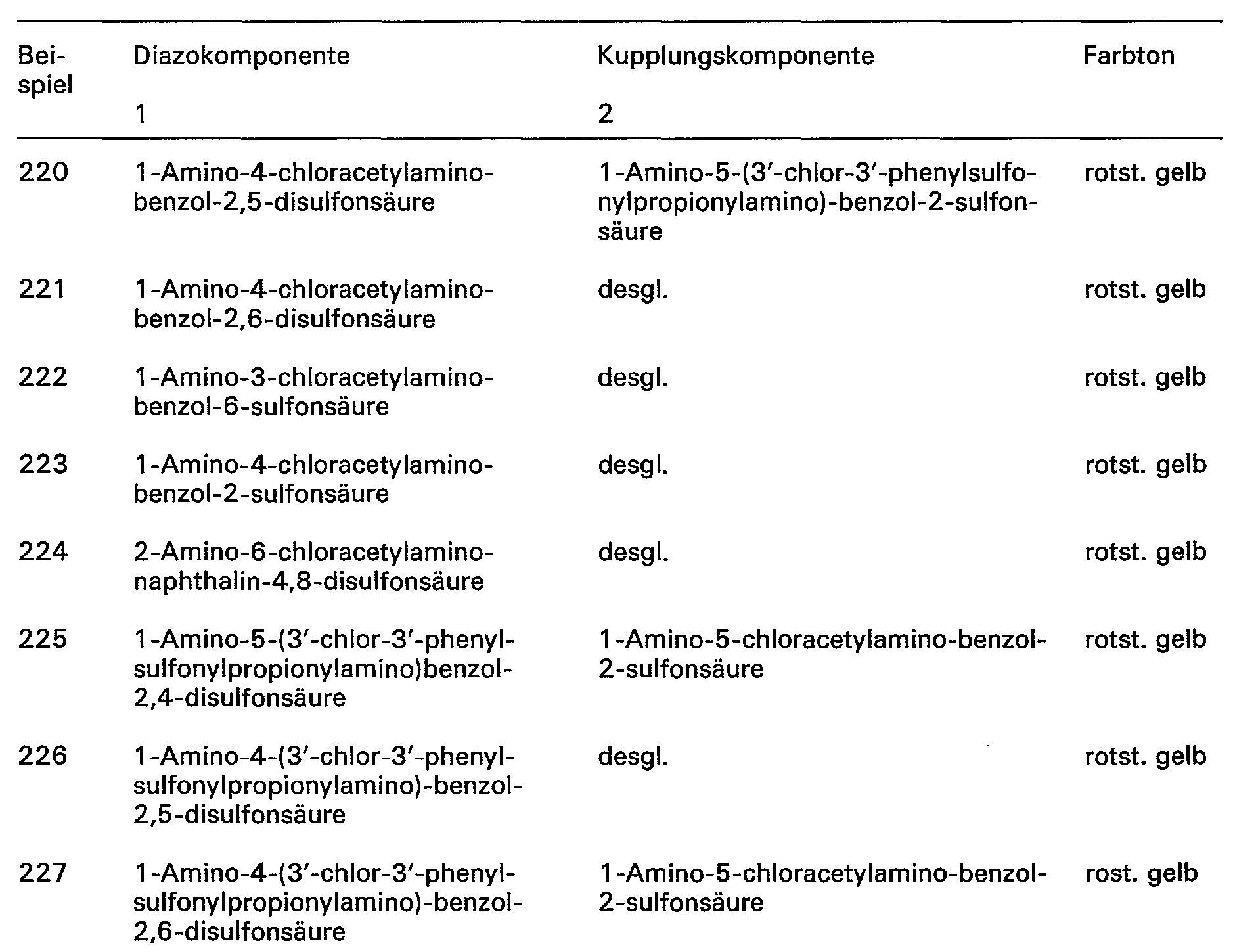
- Man erhält Farbstoffe mit ähnlichen Eigenschaften, wenn man statt der 3-Chlor-3-phenylsulfonyl- propionylderivate die entsprechenden 2-Chlor-3-phenylsulfonylpropionyl-, 3-Brom-3-phenylsulfonyl- propionyl- und 2-Brom-3-phenylsulfonylpropionylderivate und statt der Chloracetylderivate die entsprechenden Dichloracetyl- bzw. Bromacetylderivate einsetzt.

- 0.1 Mol des durch Kuppeln von diazotierter 2-Amino-5-aminomethylen-naphthalin-1,7-disulfonsäure auf 3-Aminophenylharnstoff erhaltene Monoazofarbstoff werden in 900 ml Wasser gelöst und bei einer Temperatur von 0-5° C und einem pH-Wert von 5-6 mit 29.4 g 3-Chlor-3-phenylsulfonyl- propionylchlorid gelöst in 80 ml Aceton versetzt. Nach beendeter Umsetzung wird die Lösung auf einen pH-Wert von 7.5-8 gestellt und mit 14 g Chloracetylchlorid versetzt. Die entstehende Säure wird in beiden Stufen mit Sodalösung auf den jeweiligen pH-Wert abgestumpft. Nach vollständiger Umsetzung wird ausgesalzen, isoliert und im Vakuum bei 50-60° C getrocknet. Der Farbstoff der Formel
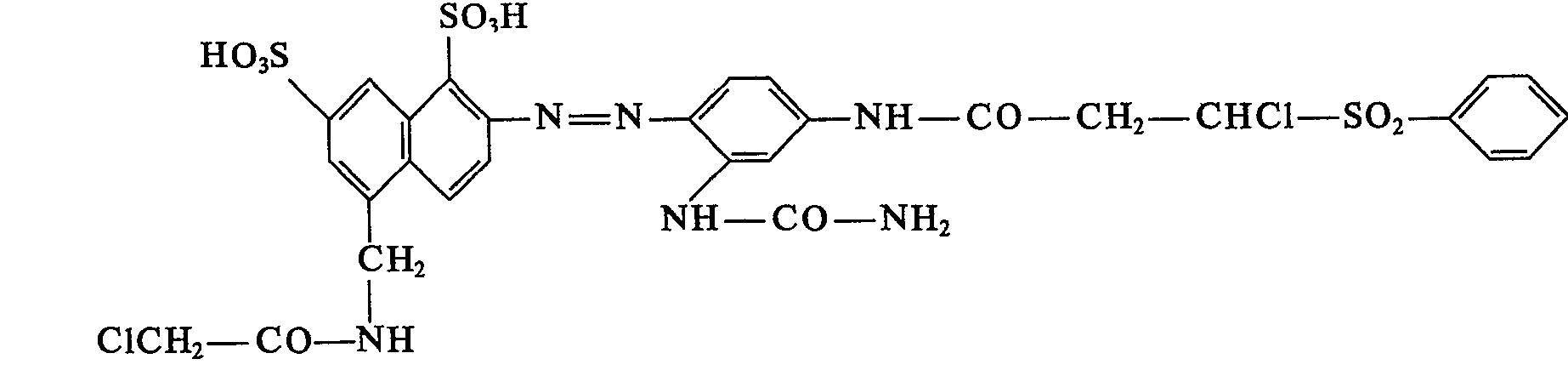
- Einen Farbstoff mit ähnlichen Eigenschaften erhält man, wenn man den gleichen Monoazofarbstoff zuerst mit Chloracetylchlorid und dann mit 3-chlor-3-phenylsulfonylpropionylchlorid acyliert.
- Nach dem gleichen Verfahren liefern auch die in Spalte 2 der folgenden Tabelle aufgeführten Kupplungskomponenten und die in Spalte 1 aufgeführten Diazokomponente Farbstoffe, die nach der ebenfalls oben beschriebenen Acylierung mit den in Spalte 3 genannten Acylierungsmitteln Wolle und Baumwolle in guten Naßechtheiten färben.
- Man erhält Farbstoff mit ähnlichen Eigenschaften, wenn man statt der 3-Chlor-3-phenylsulfonylpro- pionylderivate die entsprechenden 2-Chlor-3-phenylsulfonylpropionyl-, 3-Brom-3-phenylsulfonylpro- pionyl- und 2-Brom-3-phenylsulfonylpropionylderivate und statt der Chloracetylderivate die entsprechenden Dichloracetyl- bzw. Bromacetylderivate einsetzt.

- Zu einer Lösung von 0.1 Mol saurem Kupplungsprodukt aus 1-Amino-8-hydroxynaphthalin-3,6- disulfonsäure und diazotierter 1-Amino-5-chloracetylaminobenzol-2,4-disulfonsäure (Beispiel 1) wird bei pH 8 und 0-5° C eine Suspension des Diazoniumsalzes aus 1-Amino-5-(3'-chlor-3'-phenylsulfo- nylpropionylamino)-benzol-2-sulfonsäure (hergestellt aus 0.1 Mol 1,3-Diaminobenzol-4-sulfonsäure entsprechend Beispiel 27) zugegeben. Während der Kupplung hält man einen pH von 8 und stellt nach Beendigung der Reaktion auf pH 6.
- Der Farbstoff

- Man erhält Farbstoffe mit ähnlichen Eigenschaften, wenn man statt der 3-Chlor-3-phenylsulfonyl- propionylderivate die entsprechenden 2-Chlor-3-phenylsulfonylpropionyl-, 3-Brom-3-phenylsulfonyl- propionyl- und 2-Brom-3-phenylsulfonylpropionylderivate und statt der Chloracetylderivate die entsprechenden Dichloracetyl- bzw. Bromacetylderivate einsetzt.
- 0.1 Mol der Kupferkomplexverbindung der Formel
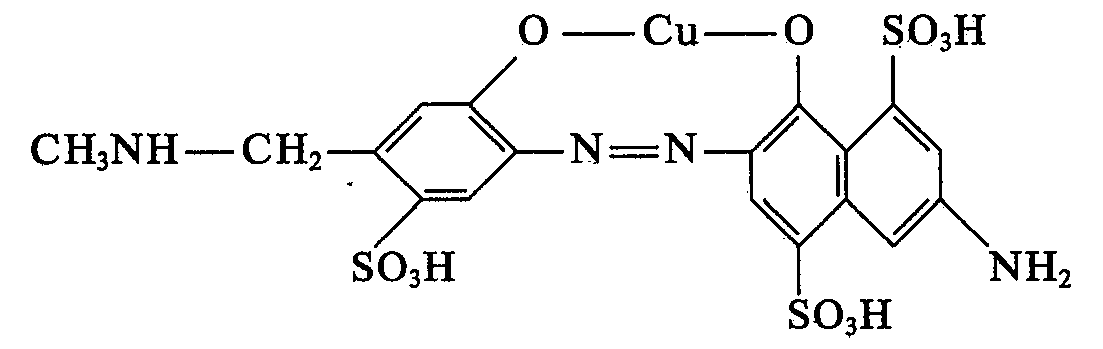
- Man erhält Farbstoffe mit ähnlichen Eigenschaften, wenn man zur Acylierung statt 3-Chlor-3-phenyl- sulfonylpropionylchlorid 3-Brom-3-phenylsulfonylpropionylchlorid, 2-Chlor-3-phenylsulfonylpropio- nylchlorid und 2-Brom-3-phenylsulfonylpropionylchlorid, bzw. statt Chloracetylchlorid Bromacetylchlorid und Dichloracetylchlorid verwendet.
wobei W und W1 an ein C-Atom eines aromatisch-carbocylischen oder aromatisch-heterocyclischen Ringes des Chromophors gebunden sind.
und Z die oben angegebene Bedeutung besitzt

und Z die oben angegebene Bedeutung besitzt

und Z die oben angegebene Bedeutung besitzt

und Z die oben angegebene Bedeutung besitzt.
und worin
Claims (7)
-
 F = Rest eines organischen FarbstoffsW und W1 = direkte Bindung oder BrückengliedR und R1 = Wasserstoff oder Alkyl
 X1―X4 = Wasserstoff oder abspaltbarer Rest, wobei mindestens ein Rest X1―X4 für einen abspaltbaren Rest steht,Z = gegebenenfalls substituiertes Phenyl,
 m und n = Zahl von 1 bis 4, vorzugsweise von 1 bis 2,
wobei W und W1 an ein C-Atom eines aromatisch-carbocyclischen oder aromatisch-heterocyclischen Ringes des Chromophors gebunden sind. - 2. Farbstoffe der Formeln
 M = OH, NH2, NR3R4. OR3,R2 = Alkyl, Alkoxy, Halogen, insbesondere CI,R3 und R4 = Wasserstoff, Alkyl, Aryl, Hetaryl oder Aralkyl,
und worin R, R1, W, W1, A und B die in Anspruch 1 angegebene Bedeutung besitzen, M' = O, NR3R5 = ―COOR3,―CONR3R4,―CN,―CW2―SO3H oder ―CH2―NR3R4R6 = ―M, ―R3 oder ―R5
und worin R, R1, W, W1, A, B, M, R2 und R3 die oben angegebene Bedeutung besitzen, R7 = Wasserstoff, - NR3―CO― R8, - NR3- SO2― R8R8 = Alkyl, Aryl, Hetaryl und Aralkylo = ortho-ständige Stellung der jeweiligen Reste
und worin R, R1, W, W1, A, B und R2 die oben angegebene Bedeutung besitzen, (o, p) = ortho- oder paraständige Stellung der jeweiligen Reste
und worin R, R1, W, W1, A, B, R2 und R3 die oben angegebene Bedeutung besitzen, R9 und R10 = Wasserstoff, R8, ―OR3, Halogen, ―NR3R4, -COOR3, -NR3-COR4, -NR3-COR4, ―O―COR4, ―NR3―SO2R4, ―O―SOR2R4, ―NR3―CO―NR3R4
und worin W, W1, R, R1, A, B, R3, R4 und R8 die oben angegebene Bedeutung besitzen, Me = Cu, CrQ = Alkyl, Alkoxy, Halogen, ―NO2, Acylamino wie CH3―CO―NR3―, ―COOR3, ―CONR3R4, ―SO2―NR3R4r = 0-4
und worin R, R1, R3, R4, W, W1, A und B die oben angegebene Bedeutung besitzen, Me = Co, Crr = 0-8o = ortho-ständige Stellung der jeweiligen Reste
und worin R, R1, W, W1, A, B und Q die oben angegebene Bedeutung besitzen,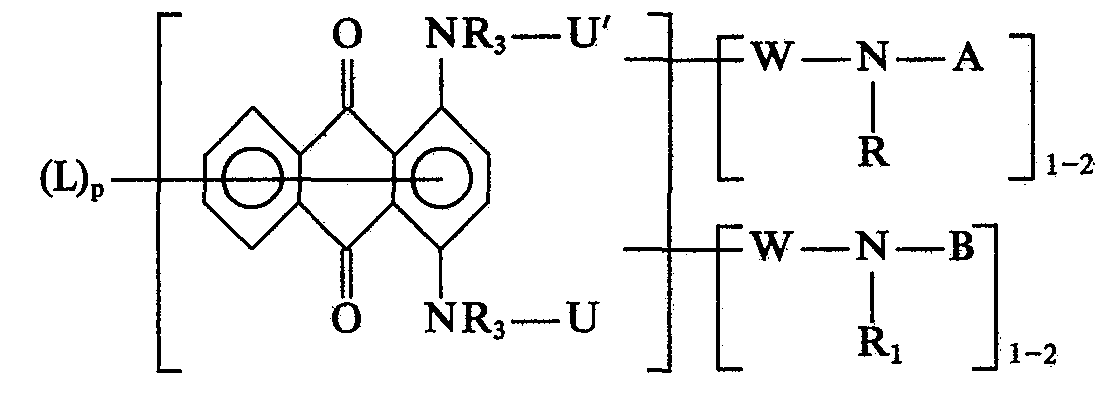 L = Substituent, wie Sulfo oder Carboxy,p = 0-4,U = gegebenenfalls durch O oder S unterbrochener, aliphatischer, cycloaliphatischer, araliphatischer oder aromatischer Rest,U' = Wasserstoff oder U
und worin W, W1, R, R1, A, B und R3 die oben angegebene Bedeutung besitzen, Pc = für einen Phthalocyanin-Rest stehtL = Substituent, insbesondere Sulfo oder Carboxyq = 0-4.
und worin R, R1, R3, R4, W, W1, A, B, m und n die oben angegebene Bedeutung besitzen, L = Substituent, insbesondere Halogen, C1_4-Alkyl, C1―4-Alkoxy oder Carboxyt = 0 bis 3
und worin W, W1, R, R1, A und B die oben angegebene Bedeutung besitzen, L = Substituent, insbesondere Halogen, C1―4-Alkyl, C1―4-Alkoxy, Alkylsulfonyl, Aminosulfonyl, unkondensierte Phenylreste oder CarboxyS = 0-6D = zur Komplexbildung befähigte Gruppe, ―OH, ―COOH oder ―SO3H,
und worin W, W1, R, R1, A und B die oben angegebene Bedeutung besitzen. - 3. Farbstoffe der Formel
 R = Wasserstoff oder AlkylR1 = Wasserstoff oder AlkylW und W1 = direkte Bindung oder BrückengliedR2 = Alkyl, Alkoxy, HalogenR7 = Wasserstoff, ―NR3―COR8, oder ―NR3―SO2―R8
wobeiR3 = Wasserstoff, Alkyl, Aryl, Hetaryl oder Aralkyl
undR8 = Alkyl, Aryl, Hetaryl oder Aralkyl
und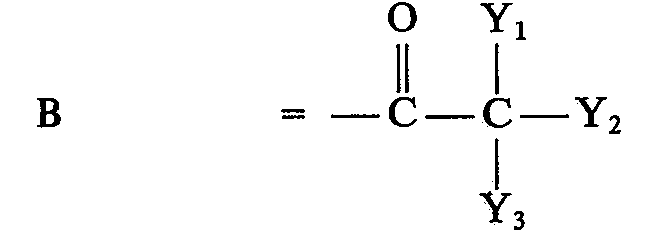
- 4. Farbstoffe der Ansprüche 1-3 mit


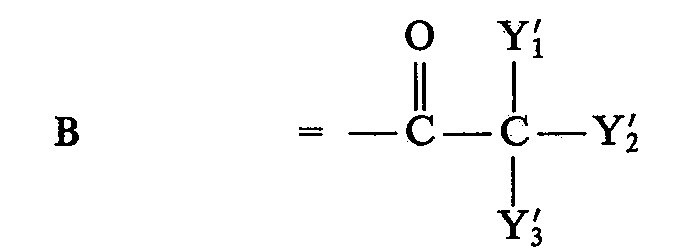


wobei Z die im Anspruch 1 angegebene Bedeutung besitzt. - 5. Farbstoffe der Ansprüche 1-3 mit


und


wobei Z die in Anspruch 1 angegebene Bedeutung besitzt. - 6. Farbstoffe der Ansprüche 1-3 mit
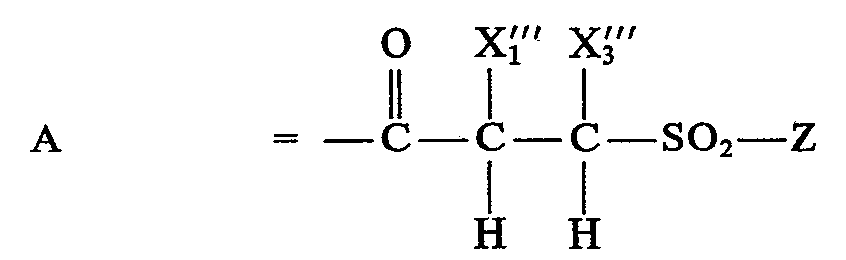


und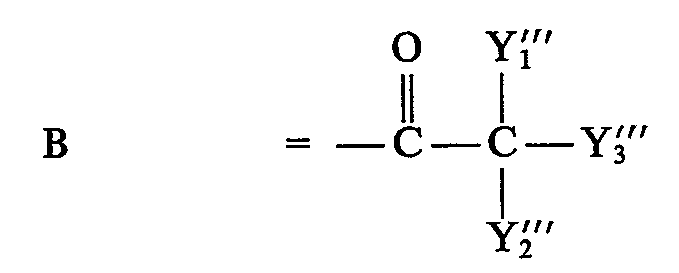

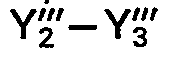
und worin Z die in Anspruch 1 angegebene Bedeutung besitzt. - 7. Verwendung der Farbstoffe der Ansprüche 1―6 zum Färben und Bedrucken von hydroxylgruppenhaltigen und stickstoffhaltigen Materialien.
Applications Claiming Priority (2)
| Application Number | Priority Date | Filing Date | Title |
|---|---|---|---|
| DE3023855 | 1980-06-25 | ||
| DE19803023855 DE3023855A1 (de) | 1980-06-25 | 1980-06-25 | Reaktivfarbstoffe, verfahren zu ihrer herstellung und ihre verwendung zum faerben und bedrucken hydroxylgruppenhaltiger oder stickstoffhaltiger fasermaterialien |
Publications (3)
| Publication Number | Publication Date |
|---|---|
| EP0043465A2 EP0043465A2 (de) | 1982-01-13 |
| EP0043465A3 EP0043465A3 (en) | 1982-08-11 |
| EP0043465B1 true EP0043465B1 (de) | 1984-05-16 |
Family
ID=6105463
Family Applications (1)
| Application Number | Title | Priority Date | Filing Date |
|---|---|---|---|
| EP81104530A Expired EP0043465B1 (de) | 1980-06-25 | 1981-06-12 | Reaktivfarbstoffe und ihre Verwendung zum Färben und Bedrucken hydroxylgruppenhaltiger oder stickstoffhaltiger Fasermaterialien |
Country Status (3)
| Country | Link |
|---|---|
| EP (1) | EP0043465B1 (de) |
| JP (1) | JPS5731961A (de) |
| DE (2) | DE3023855A1 (de) |
Families Citing this family (5)
| Publication number | Priority date | Publication date | Assignee | Title |
|---|---|---|---|---|
| DE3467907D1 (en) * | 1983-04-20 | 1988-01-14 | Ciba Geigy Ag | Process for dyeing silk or silk-containing fibrous material blends |
| US4560388A (en) * | 1983-04-20 | 1985-12-24 | Ciba-Geigy Corporation | Process for dyeing silk or fibre blends containing silk |
| EP0402318B1 (de) * | 1989-06-08 | 1994-04-20 | Ciba-Geigy Ag | Verfahren zur Herstellung von faserreaktiven Formazanverbindungen |
| EP0568876B1 (de) | 1992-05-04 | 1996-08-28 | Bayer Ag | Reaktivfarbstoffe, deren Herstellung und Verwendung |
| US5527829A (en) * | 1994-05-23 | 1996-06-18 | Agouron Pharmaceuticals, Inc. | HIV protease inhibitors |
Family Cites Families (4)
| Publication number | Priority date | Publication date | Assignee | Title |
|---|---|---|---|---|
| DE1444588A1 (de) * | 1962-01-27 | 1968-11-21 | Cassella Farbwerke Mainkur Ag | Verfahren zur Herstellung von neuen Monoazofarbstoffen |
| DE1444589A1 (de) * | 1962-01-27 | 1968-12-05 | Cassella Farbwerke Mainkur Ag | Verfahren zur Herstellung von neuen Monoazofarbstoffen |
| DE1444591A1 (de) * | 1962-02-02 | 1968-11-21 | Cassella Farbwerke Mainkur Ag | Verfahren zur Herstellung von neuen Monoazofarbstoffen |
| DE2935681A1 (de) * | 1979-09-04 | 1981-03-12 | Bayer Ag, 5090 Leverkusen | Reaktivfarbstoffe |
-
1980
- 1980-06-25 DE DE19803023855 patent/DE3023855A1/de not_active Withdrawn
-
1981
- 1981-06-12 EP EP81104530A patent/EP0043465B1/de not_active Expired
- 1981-06-12 DE DE8181104530T patent/DE3163607D1/de not_active Expired
- 1981-06-22 JP JP9542881A patent/JPS5731961A/ja active Pending
Also Published As
| Publication number | Publication date |
|---|---|
| EP0043465A2 (de) | 1982-01-13 |
| JPS5731961A (en) | 1982-02-20 |
| DE3023855A1 (de) | 1982-01-14 |
| EP0043465A3 (en) | 1982-08-11 |
| DE3163607D1 (en) | 1984-06-20 |
Similar Documents
| Publication | Publication Date | Title |
|---|---|---|
| DE2842640A1 (de) | Reaktivfarbstoffe | |
| DE2748929A1 (de) | Wasserloesliche farbstoffe, verfahren zu ihrer herstellung, deren verwendung als faserreaktive farbstoffe zum faerben und bedrucken von fasermaterialien und fasermaterialien, die mit ihnen gefaerbt wurden | |
| DE1289930B (de) | Verfahren zur Herstellung von Azofarbstoffen und deren Metallkomplexverbindungen | |
| EP0043465B1 (de) | Reaktivfarbstoffe und ihre Verwendung zum Färben und Bedrucken hydroxylgruppenhaltiger oder stickstoffhaltiger Fasermaterialien | |
| DE4423650A1 (de) | Azofarbstoffe mit einer faserreaktiven Gruppe | |
| EP0065479A2 (de) | Reaktivfarbstoffe, Verfahren zu ihrer Herstellung und ihre Verwendung zum Färben und Bedrucken von hydroxylgruppen- oder stickstoffhaltigen Materialien | |
| EP0024668B1 (de) | Reaktivfarbstoffe und deren Verwendung zum Färben und Bedrucken von hydroxylgruppen- und stickstoffhaltigen Materialien | |
| EP0168703A2 (de) | Reaktivfarbstoffe | |
| EP0258806B1 (de) | Wasserlösliche Disazoverbindungen, Verfahren zu ihrer Herstellung und ihre Verwendung als Farbstoffe | |
| EP0019785A2 (de) | Reaktivfarbstoffe, ihre Herstellung und Verwendung zum Färben und Bedrucken von Cellulose oder Polypeptiden | |
| EP0387589B1 (de) | Reaktivfarbstoffe, die drei reaktive Gruppen aufweisen | |
| DE4425619A1 (de) | Reaktivfarbstoffe, Verfahren zu deren Herstellung und deren Verwendung | |
| EP0455054B1 (de) | Polyazoreaktivfarbstoffe | |
| EP0125650B1 (de) | Reaktivfarbstoffe, Verfahren zu ihrer Herstellung und ihre Verwendung zum Färben und Bedrucken von Substraten | |
| DE2906191A1 (de) | Azoreaktivfarbstoffe | |
| EP0168739B1 (de) | Reaktivfarbstoffe | |
| DE1644151B2 (de) | Wasserlösliche Monoazoreaktivfarbstoffe, Verfahren zu deren Herstellung und deren Verwendung zum Färben und Bedrucken von Wolle, Seide, Polyamid - und Cellulosefaser™ | |
| DE866704C (de) | Verfahren zur Herstellung von Polyazofarbstoffen der Stilbenreihe | |
| DE1202415B (de) | Verfahren zur Herstellung von Reaktivfarbstoffen | |
| DE1644318A1 (de) | Verfahren zur Herstellung wasserloeslicher Reaktivfarbstoffe | |
| DE722906C (de) | Verfahren zur Herstellung von Azofarbstoffen | |
| AT259712B (de) | Verfahren zur Herstellung von neuen Azofarbstoffen und deren Metallkomplexverbindungen | |
| DE1177757B (de) | Verfahren zur Herstellung von Reaktivfarbstoffen | |
| EP0139248A2 (de) | Reaktivfarbstoffe | |
| DE1247511B (de) | Verfahren zur Herstellung von Disazofarbstoffen |
Legal Events
| Date | Code | Title | Description |
|---|---|---|---|
| PUAI | Public reference made under article 153(3) epc to a published international application that has entered the european phase |
Free format text: ORIGINAL CODE: 0009012 |
|
| 17P | Request for examination filed |
Effective date: 19810612 |
|
| AK | Designated contracting states |
Designated state(s): CH DE FR GB IT |
|
| PUAL | Search report despatched |
Free format text: ORIGINAL CODE: 0009013 |
|
| AK | Designated contracting states |
Designated state(s): CH DE FR GB IT |
|
| ITF | It: translation for a ep patent filed | ||
| GRAA | (expected) grant |
Free format text: ORIGINAL CODE: 0009210 |
|
| AK | Designated contracting states |
Designated state(s): CH DE FR GB IT LI |
|
| PGFP | Annual fee paid to national office [announced via postgrant information from national office to epo] |
Ref country code: DE Payment date: 19840526 Year of fee payment: 4 |
|
| PGFP | Annual fee paid to national office [announced via postgrant information from national office to epo] |
Ref country code: FR Payment date: 19840601 Year of fee payment: 4 |
|
| REF | Corresponds to: |
Ref document number: 3163607 Country of ref document: DE Date of ref document: 19840620 |
|
| ET | Fr: translation filed | ||
| PGFP | Annual fee paid to national office [announced via postgrant information from national office to epo] |
Ref country code: CH Payment date: 19840924 Year of fee payment: 4 |
|
| PLBE | No opposition filed within time limit |
Free format text: ORIGINAL CODE: 0009261 |
|
| STAA | Information on the status of an ep patent application or granted ep patent |
Free format text: STATUS: NO OPPOSITION FILED WITHIN TIME LIMIT |
|
| 26N | No opposition filed | ||
| PG25 | Lapsed in a contracting state [announced via postgrant information from national office to epo] |
Ref country code: GB Effective date: 19890612 |
|
| PG25 | Lapsed in a contracting state [announced via postgrant information from national office to epo] |
Ref country code: LI Effective date: 19890630 Ref country code: CH Effective date: 19890630 |
|
| GBPC | Gb: european patent ceased through non-payment of renewal fee | ||
| PG25 | Lapsed in a contracting state [announced via postgrant information from national office to epo] |
Ref country code: FR Free format text: LAPSE BECAUSE OF NON-PAYMENT OF DUE FEES Effective date: 19900228 |
|
| REG | Reference to a national code |
Ref country code: CH Ref legal event code: PL |
|
| PG25 | Lapsed in a contracting state [announced via postgrant information from national office to epo] |
Ref country code: DE Effective date: 19900301 |
|
| REG | Reference to a national code |
Ref country code: FR Ref legal event code: ST |