EP0040323B1 - Prüfverfahren für ferromagnetische Pulver - Google Patents
Prüfverfahren für ferromagnetische Pulver Download PDFInfo
- Publication number
- EP0040323B1 EP0040323B1 EP81102800A EP81102800A EP0040323B1 EP 0040323 B1 EP0040323 B1 EP 0040323B1 EP 81102800 A EP81102800 A EP 81102800A EP 81102800 A EP81102800 A EP 81102800A EP 0040323 B1 EP0040323 B1 EP 0040323B1
- Authority
- EP
- European Patent Office
- Prior art keywords
- sedimentation velocity
- aid
- relative sedimentation
- specimen
- heavy medium
- Prior art date
- Legal status (The legal status is an assumption and is not a legal conclusion. Google has not performed a legal analysis and makes no representation as to the accuracy of the status listed.)
- Expired
Links
- 239000000843 powder Substances 0.000 title claims abstract description 15
- 230000005294 ferromagnetic effect Effects 0.000 title claims abstract description 10
- 238000010998 test method Methods 0.000 title description 6
- 239000000725 suspension Substances 0.000 claims abstract description 17
- 230000005347 demagnetization Effects 0.000 claims abstract description 13
- 238000007885 magnetic separation Methods 0.000 claims abstract description 12
- 239000006148 magnetic separator Substances 0.000 claims abstract description 9
- 229910052500 inorganic mineral Inorganic materials 0.000 claims abstract description 7
- 230000005291 magnetic effect Effects 0.000 claims abstract description 7
- 239000011707 mineral Substances 0.000 claims abstract description 7
- 239000012535 impurity Substances 0.000 claims abstract description 6
- 238000000034 method Methods 0.000 claims abstract description 4
- 238000004062 sedimentation Methods 0.000 claims abstract 12
- 238000000746 purification Methods 0.000 claims abstract 5
- 238000010908 decantation Methods 0.000 claims abstract 4
- 238000012360 testing method Methods 0.000 claims description 5
- 230000003247 decreasing effect Effects 0.000 abstract description 2
- 239000000523 sample Substances 0.000 description 9
- 239000000126 substance Substances 0.000 description 8
- 238000004140 cleaning Methods 0.000 description 6
- 239000000463 material Substances 0.000 description 6
- 239000010802 sludge Substances 0.000 description 6
- 239000011521 glass Substances 0.000 description 5
- 229910000519 Ferrosilicon Inorganic materials 0.000 description 4
- 238000004519 manufacturing process Methods 0.000 description 3
- 238000000926 separation method Methods 0.000 description 3
- XEEYBQQBJWHFJM-UHFFFAOYSA-N Iron Chemical compound [Fe] XEEYBQQBJWHFJM-UHFFFAOYSA-N 0.000 description 2
- OAICVXFJPJFONN-UHFFFAOYSA-N Phosphorus Chemical compound [P] OAICVXFJPJFONN-UHFFFAOYSA-N 0.000 description 2
- 239000000356 contaminant Substances 0.000 description 2
- 239000000203 mixture Substances 0.000 description 2
- 229910052698 phosphorus Inorganic materials 0.000 description 2
- 239000011574 phosphorus Substances 0.000 description 2
- 238000002360 preparation method Methods 0.000 description 2
- 229910052710 silicon Inorganic materials 0.000 description 2
- OKTJSMMVPCPJKN-UHFFFAOYSA-N Carbon Chemical compound [C] OKTJSMMVPCPJKN-UHFFFAOYSA-N 0.000 description 1
- RYGMFSIKBFXOCR-UHFFFAOYSA-N Copper Chemical compound [Cu] RYGMFSIKBFXOCR-UHFFFAOYSA-N 0.000 description 1
- 238000006124 Pilkington process Methods 0.000 description 1
- 229910000831 Steel Inorganic materials 0.000 description 1
- 238000010521 absorption reaction Methods 0.000 description 1
- XAGFODPZIPBFFR-UHFFFAOYSA-N aluminium Chemical compound [Al] XAGFODPZIPBFFR-UHFFFAOYSA-N 0.000 description 1
- 229910052782 aluminium Inorganic materials 0.000 description 1
- 239000008346 aqueous phase Substances 0.000 description 1
- 239000007900 aqueous suspension Substances 0.000 description 1
- 238000000889 atomisation Methods 0.000 description 1
- 229910052799 carbon Inorganic materials 0.000 description 1
- 229910052802 copper Inorganic materials 0.000 description 1
- 239000010949 copper Substances 0.000 description 1
- 238000005260 corrosion Methods 0.000 description 1
- 230000007797 corrosion Effects 0.000 description 1
- 238000011049 filling Methods 0.000 description 1
- 238000001914 filtration Methods 0.000 description 1
- 230000005484 gravity Effects 0.000 description 1
- 238000000227 grinding Methods 0.000 description 1
- 229910052742 iron Inorganic materials 0.000 description 1
- SZVJSHCCFOBDDC-UHFFFAOYSA-N iron(II,III) oxide Inorganic materials O=[Fe]O[Fe]O[Fe]=O SZVJSHCCFOBDDC-UHFFFAOYSA-N 0.000 description 1
- 238000005259 measurement Methods 0.000 description 1
- 239000002245 particle Substances 0.000 description 1
- 230000000149 penetrating effect Effects 0.000 description 1
- 238000012113 quantitative test Methods 0.000 description 1
- 239000010703 silicon Substances 0.000 description 1
- 239000002002 slurry Substances 0.000 description 1
- 239000007787 solid Substances 0.000 description 1
- 239000007858 starting material Substances 0.000 description 1
- 239000010959 steel Substances 0.000 description 1
- XLYOFNOQVPJJNP-UHFFFAOYSA-N water Substances O XLYOFNOQVPJJNP-UHFFFAOYSA-N 0.000 description 1
Images
Classifications
-
- B—PERFORMING OPERATIONS; TRANSPORTING
- B03—SEPARATION OF SOLID MATERIALS USING LIQUIDS OR USING PNEUMATIC TABLES OR JIGS; MAGNETIC OR ELECTROSTATIC SEPARATION OF SOLID MATERIALS FROM SOLID MATERIALS OR FLUIDS; SEPARATION BY HIGH-VOLTAGE ELECTRIC FIELDS
- B03B—SEPARATING SOLID MATERIALS USING LIQUIDS OR USING PNEUMATIC TABLES OR JIGS
- B03B5/00—Washing granular, powdered or lumpy materials; Wet separating
- B03B5/28—Washing granular, powdered or lumpy materials; Wet separating by sink-float separation
- B03B5/30—Washing granular, powdered or lumpy materials; Wet separating by sink-float separation using heavy liquids or suspensions
- B03B5/44—Application of particular media therefor
-
- B—PERFORMING OPERATIONS; TRANSPORTING
- B03—SEPARATION OF SOLID MATERIALS USING LIQUIDS OR USING PNEUMATIC TABLES OR JIGS; MAGNETIC OR ELECTROSTATIC SEPARATION OF SOLID MATERIALS FROM SOLID MATERIALS OR FLUIDS; SEPARATION BY HIGH-VOLTAGE ELECTRIC FIELDS
- B03B—SEPARATING SOLID MATERIALS USING LIQUIDS OR USING PNEUMATIC TABLES OR JIGS
- B03B13/00—Control arrangements specially adapted for wet-separating apparatus or for dressing plant, using physical effects
- B03B13/005—Methods or arrangements for controlling the physical properties of heavy media, e.g. density, concentration or viscosity
-
- G—PHYSICS
- G01—MEASURING; TESTING
- G01N—INVESTIGATING OR ANALYSING MATERIALS BY DETERMINING THEIR CHEMICAL OR PHYSICAL PROPERTIES
- G01N15/00—Investigating characteristics of particles; Investigating permeability, pore-volume or surface-area of porous materials
- G01N15/04—Investigating sedimentation of particle suspensions
-
- G—PHYSICS
- G01—MEASURING; TESTING
- G01N—INVESTIGATING OR ANALYSING MATERIALS BY DETERMINING THEIR CHEMICAL OR PHYSICAL PROPERTIES
- G01N27/00—Investigating or analysing materials by the use of electric, electrochemical, or magnetic means
- G01N27/72—Investigating or analysing materials by the use of electric, electrochemical, or magnetic means by investigating magnetic variables
Definitions
- the present invention relates to a test method for ferromagnetic powders used in heavy turbidity for the preparation of minerals by the sinking and floating method with regard to the efficiency of their magnetic separation and demagnetization, in which the heavy turbidity after use is fed to a cleaning circuit having a magnetic separator.
- Sink-float treatment refers to the separation of minerals of different densities with the aqueous suspension of a heavy substance, the so-called heavy sludge, the specific weight of which lies between the densities of the minerals to be separated, which makes the lighter mixture when the mineral mixture is introduced into the heavy substance suspension Share swims up while the heavier share drops. Since part of the heavy substance suspension adheres to the floated and the sunken part, both parts are intensively consumed after their separation, so that the previously adhering heavy substance is recovered in the form of a diluted suspension. The separation of the heavy substance from this diluted suspension is not possible due to the small grain size of the heavy substance, for example by filtration.
- ferromagnetic powders are preferably used as heavy substances, which can be recovered from the diluted suspension by magnetic separation and, moreover, can be freed from non-magnetic impurities.
- Magnetite is primarily suitable for the production of heavy suspensions with low and ferrosilicon with 8 to 25% Si for the production of those with higher specific weight, the grain range of the heavy substances produced by atomization or grinding being between 0.001 and 0.4 mm .
- the recovered heavy materials, which are magnetized by the magnetic separation must be demagnetized before being used again to prepare heavy material suspensions, since magnetized powders do not form stable suspensions.
- the recovered heavy material is demagnetized by demagnetization in an alternating magnetic field (see "Steel and Iron", 74 [1954]), pages 1070 to 1075).
- alternating magnetic field see "Steel and Iron", 74 [1954]), pages 1070 to 1075.
- heavy-duty powders with more or less good magnetic properties can be produced, which affects their ability to be demagnetized in an alternating field.
- other components for example in the case of ferrosilicon besides carbon, phosphorus, copper, aluminum and the like. a., are added (cf. DE-C-972 687 and DE-C-2 222 657), a multicomponent system that is confusing with regard to its magnetic properties is produced.
- the maximum field strength of the alternating field can be 1.4 times the maximum field strength at the magnetic separator.
- a quantitative test can be made in a short test time using small sample quantities as to whether a ferromagnetic powder used in heavy turbidity is magnetizable enough on the one hand to be reliably separated from the aqueous phase by magnetic separation, and whether this powder on the other hand is magnetically soft enough to be demagnetized sufficiently.
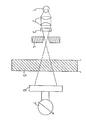
- the attached drawing schematically shows the structure of the sedimentometer used in the test method according to the invention.
- a collector system 2 consisting of several lenses. After passing through a heat absorption filter 3 and a slit diaphragm 4, the light beam leaving the collector system 2 strikes a glass cylinder 5, in which there is cloudy. The part of the light beam penetrating the glass cylinder 5 strikes a photocell 6, which is electrically conductively connected to a measuring instrument 7.
- the measuring instrument 7 begins to knock when the last ones Powder particles with the largest diameter have just fallen by.
- the distance between the slit aperture 4 and the level of the sludge in the glass cylinder 5 and the period from inserting the glass cylinder 5 filled with freshly shaken up sludge into the sedimentometer until reaching a defined deflection of the measuring instrument are used to determine the sinking speed 7 used.
- the defined deflection corresponds to 10% of the deflection on the measuring instrument 7, which is displayed when the glass cylinder 5 is filled with water free of solids.
- the relative sink rate of a turbidity sample from the cleaning cycle for heavy material after demagnetization was also determined or calculated to be 0.067 cm / s. Subsequently, after demagnetizing this sample in an alternating field, the maximum field strength of which was 1.4 times the field strength at the magnetic separator, the relative sink rate was determined or calculated to be 0.065.
- Example 1 was repeated, but the current consumption of the operational demagnetization coil in the demagnetization circuit was changed.
- the relative sinking speeds of 1 are more than ten times greater than those of 11 and the differences in the relative sinking speeds of II and III are less than 10%.
- the ferrosilicon heavy sludge in the cleaning circuit can be effectively magnetically separated and demagnetized with the selected settings for the current consumption of the operational demagnetizing coil.
Landscapes
- Chemical & Material Sciences (AREA)
- Pathology (AREA)
- Physics & Mathematics (AREA)
- Health & Medical Sciences (AREA)
- Life Sciences & Earth Sciences (AREA)
- Analytical Chemistry (AREA)
- Biochemistry (AREA)
- General Health & Medical Sciences (AREA)
- General Physics & Mathematics (AREA)
- Immunology (AREA)
- Electrochemistry (AREA)
- Chemical Kinetics & Catalysis (AREA)
- Dispersion Chemistry (AREA)
- Investigating Or Analyzing Materials By The Use Of Magnetic Means (AREA)
- Hard Magnetic Materials (AREA)
- Treatment Of Sludge (AREA)
- Medicines Containing Antibodies Or Antigens For Use As Internal Diagnostic Agents (AREA)
- Sampling And Sample Adjustment (AREA)
- Powder Metallurgy (AREA)
- Soft Magnetic Materials (AREA)
- Compounds Of Iron (AREA)
- Investigating Or Analysing Materials By Optical Means (AREA)
- Solid-Sorbent Or Filter-Aiding Compositions (AREA)
Description
- Die vorliegende Erfindung betrifft ein Prüfverfahren für in Schwertrüben zur Aufbereitung von Mineralien nach dem Sink- und Schwimmverfahren eingesetzte ferromagnetische Pulver in bezug auf die Effizienz ihrer Magnetscheidung und Entmagnetisierung, bei dem die Schwertrübe nach Gebrauch einem, einen Magnetabscheider aufweisenden Reinigungskreislauf zugeführt wird.
- Als Sink-Schwimm-Aufbereitung bezeichnet man die Trennung von Mineralien verschiedener Dichte mit der wässrigen Suspension eines Schwerstoffes, der sog. Schwertrübe, deren spezifisches Gewicht zwischen den Dichten der zu trennenden Mineralien liegt, wodurch beim Einbringen des Mineralgemenges in die Schwerstoff-Suspension der leichtere Anteil aufschwimmt, während der schwerere Anteil absinkt. Da ein Teil der Schwerstoff-Suspension am aufgeschwommenen und am abgesunkenen Anteil anhaftet, werden beide Anteile nach ihrer Trennung intensiv abgebraust, so dass der vorher anhaftende Schwerstoff in Form einer verdünnten Suspension zurückgewonnen wird. Die Abtrennung des Schwerstoffes aus dieser verdünnten Suspension ist wegen der geringen Korngrösse des Schwerstoffes beispielsweise durch Filtration nicht möglich. Deswegen werden als Schwerstoffe bevorzugt ferromagnetische Pulver verwendet,welche aus der verdünnten Suspension durch Magnetscheidung zurückgewonnen und darüberhinaus von unmagnetischen Verunreinigungen befreit werden können. So eignet sich in erster Linie Magnetit zur Herstellung von Schwerstoff-Suspensionen mit niedrigem und Ferrosilicium mit 8 bis 25% Si zur Herstellung von solchen mit höherem spezifischen Gewicht, wobei der Kornbereich der durch Verdüsen oder Vermahlen hergestellten Schwerstoffe zwischen 0,001 und 0,4 mm liegt. Die zurückgewonnenen Schwerstoffe, welche durch die Magnetscheidung magnetisiert werden, müssen vor ihrem erneuten Einsatz zur Bereitung von Schwerstoff-Suspensionen entmagnetisiert werden, da magnetisierte Pulver keine stabilen Suspensionen bilden. Die Entmagnetisierung des zurückgewonnenen Schwerstoffes erfolgt durch Abmagnetisierung im magnetischen Wechselfeld (vergl. «Stahl und Eisen», 74 [1954]), Seiten 1070 bis 1075). Je nach Produktionslage und in Abhängigkeit von Qualität und Menge der Ausgangsmaterialien können Schwerstoff-Pulver mit mehr oder weniger guten magnetischen Eigenschaften hergestellt werden, was Auswirkungen auf ihre Fähigkeit hat, im Wechselfeld entmagnetisiert zu werden. Besonders wenn zur Erhöhung der Korrosionsbeständigkeit des Schwerstoffes weitere Komponenten, beispielsweise bei Ferrosilicium ausser Kohlenstoff noch Phosphor, Kupfer, Aluminium u. a., zugesetzt werden (vergl. DE-C-972 687 und DE-C-2 222 657), entsteht ein bezüglich seiner magnetischen Eigenschaften un- übersichtliches Vielstoffsystem.
- Es ist daher Aufgabe der vorliegenden Erfindung, ein einen geringen Messaufwand erforderndes Prüfverfahren anzugeben, welches die Beurteilung von in Schwertrüben zur Aufbereitung von Mineralien nach dem Sink-Schwimm-Verfahren eingesetzten ferromagnetischen Pulvern in bezug auf die Effizienz ihrer Magnetscheidung und Entmagnetisierung erlaubt. Ein solches Verfahren ist erfindungsgemäss dadurch gekennzeichnet, dass man
- a) aus dem Reinigungskreislauf unmittelbar nach der Magnetscheidung Schwertrübe entnimmt und nach Dekantieren von Verunreinigungen die relative Sinkgeschwindigkeit dieser Trübe mit Hilfe eines Sedimentometers bestimmt;
- b) aus dem Reinigungskreislauf nach der Entmagnetisierung Schwertrübe entnimmt und nach Dekantieren von Verunreinigungen die relative Sinkgeschwindigkeit dieser Trübe mit Hilfe eines Sedimentometers bestimmt;
- c) die Schwertrübe nach b) in einem zyklisch abnehmenden magnetischen Wechselfeld mit einer maximalen Feldstärke, welche das 1,1 bis 1,5fache der maximalen Feldstärke am Magnetabscheider beträgt, entmagnetisiert und anschliessend die relative Sinkgeschwindigkeit mit Hilfe eines Sedimentometers bestimmt;
- wobei das eingesetzte ferromagnetische Pulver wirksam magnetscheidbar und mit Hilfe einer Entmagnetisierungseinrichtung wirkungsvoll entmagnetisierbar ist, wenn die relative Sinkgeschwindigkeit nach a) mindestens zehnmal grösser ist als die nach c) und die relative Sinkgeschwindigkeit nach c) höchstens 10% unter der von b) liegt.
- Dabei kann die maximale Feldstärke des Wechselfeldes das 1,4fache der maximalen Feldstärke am Magnetabscheider betragen.
- Mit dem Prüfverfahren gemäss der vorliegenden Erfindung kann in kurzer Prüfzeit unter Einsatz kleiner Probemengen eine quantitative Aussage gemacht werden, ob ein in Schwertrüben eingesetztes ferromagnetisches Pulver einerseits magnetisierbar genug ist, um durch Magnetscheidung zuverlässig von wässriger Phase abgetrennt werden zu können, und ob dieses Pulver andererseits magnetisch weich genug ist, um hinreichend entmagnetisiert werden zu können.
- In der beigefügten Zeichnung ist der Aufbau des beim erfindungsgemässen Prüfverfahren verwendeten Sedimentometers schematisch wiedergegeben.
- Von einer als Lichtquelle 1 dienenden Niedervoltlampe fällt Licht auf ein aus mehreren Linsen bestehendes Kollektorsystem 2. Der das Kollektorsystem 2 verlassende Lichtstrahl trifft nach Passieren eines Wärmeabsorptionsfilters 3 und einer Spaltblende 4 auf einen Glaszylinder 5, in welchem sich Trübe befindet. Der den Glaszylinder 5 durchdringende Teil des Lichtstrahls trifft auf eine Photozelle 6, welche mit einem Messinstrument 7 elektrisch leitend verbunden ist.
- In Abhängigkeit von der Sinkgeschwindigkeit des Pulvers in der Trübe beginnt das Messinstrument 7 dann auszuschlagen, wenn die letzten Pulverteilchen mit grösstem Durchmesser gerade vorbeigefallen sind.
- Beim Prüfverfahren gemäss der Erfindung werden zur Bestimmung der Sinkgeschwindigkeit der Abstand zwischen der Spaltblende 4 und dem Spiegel der Trübe im Glaszylinder 5 sowie der Zeitraum vom Einsetzen des mit unmittelbar vorher frisch aufgeschüttelter Trübe gefüllten Glaszylinders 5 in das Sedimentometer bis zum erreichen eines festgelegten Ausschlages des Messinstrumentes 7 herangezogen. Dabei entspricht der festgelegte Ausschlag 10% des Ausschlages am Messinstrument 7, welcher angezeigt wird, wenn der Glaszylinder 5 mit feststofffreiem Wasser gefüllt ist.
- Eine aus dem Reinigungskreislauf für Schwerstoff (Ferrosilicium mit 12,5% Silicium und 1% Phosphor) unmittelbar hinter der Magnetscheidung entnommene Trübeprobe wurde nach Dekantieren der Verunreinigungen aufgeschüttelt. Ein Teil dieser aufgeschüttelten Probe wurde in ein Reagenzglas von 18 cm Länge und 18 mm innerem Durchmesser bis zu einer Füllhöhe von 16cm eingefüllt. Vor dem Einsetzen des Reagenzglases in ein Sedimentometer wurde die Probe erneut aufgeschüttelt. 3 Sekunden nach Einsetzen des Reagenzglases wurde am Messinstrument des Sedimentometers ein Photostrom von 0,3 µA abgelesen. Aus diesem Wert und dem Abstand zwischen dem Trübespiegel und der Spaltblende von 8 cm wurde eine relative Sinkgeschwindigkeit von 2,7 cm/s errechnet.
- Ebenso wurde die relative Sinkgeschwindigkeit einer Trübeprobe aus dem Reinigungskreislauf für Schwerstoff nach der Entmagnetisierung zu 0,067 cm/s bestimmt bzw. errechnet. Anschliessend wurde nach Abmagnetisierung dieser Probe in einem Wechselfeld, dessen maximale Feldstärke das 1,4fache der Feldstärke am Magnetscheider betrug, deren relative Sinkgeschwindigkeit zu 0,065 bestimmt bzw. errechnet.
- Das Beispiel 1 wurde wiederholt, wobei jedoch die Stromaufnahme der betrieblichen Entmagnetisierungsspule im Entmagnetisierungskreislauf verändert wurde.
- In der folgenden Tabelle sind die Ergebnisse der Beispiele 1 bis 4 zusammengefasst, wobei als Mass für die Stromaufnahme der betrieblichen Entmagnetisierungsspule der Ausschlag ihres Ampere-Meters in Skalenteilen angegeben ist, und wobei grössere Skalenteile höheren Stromaufnahmen entsprechen. Im übrigen bedeutet in der Tabelle
- I Unmittelbar hinter der Magnetscheidung entnommene Trübeprobe,
- II hinter der Entmagnetisierungsspule entnommene Trübeprobe,
- III Probe zu II in einem Wechselfeld abmagnetisiert, dessen maximale Feldstärke das 1,4fache der maximalen Feldstärke am Magnetscheider betrug.
-

- Bei den Schwertrüben nach den Beispielen 1 bis 3 sind die relativen Sinkgeschwindigkeiten von 1 mehr als zehnmal grösser als von 11 und die Differenzen der relativen Sinkgeschwindigkeiten von II und III betragen weniger als 10%. Die im Reinigungskreislauf befindliche Ferrosilicium-Schwertrübe ist bei den gewählten Einstellungen der Stromaufnahme der betrieblichen Entmagnetisierungsspule wirksam magnetscheidbar und entmagnetisierbar.
- Im Gegensatz dazu ist bei der Schwertrübe nach Beispiel 4 die relative Sinkgeschwindigkeit von I nur neunmal grösser als die von II und die Differenz von II und III beträgt erheblich mehr als 10%. Mithin wird bei dieser Einstellung der Stromaufnahme der betrieblichen Entmagnetisierungseinrichtung die Schwertrübe nicht mehr ausreichend entmagnetisiert.
Claims (2)
Priority Applications (1)
| Application Number | Priority Date | Filing Date | Title |
|---|---|---|---|
| AT81102800T ATE9404T1 (de) | 1980-05-16 | 1981-04-11 | Pruefverfahren fuer ferromagnetische pulver. |
Applications Claiming Priority (2)
| Application Number | Priority Date | Filing Date | Title |
|---|---|---|---|
| DE19803018639 DE3018639A1 (de) | 1980-05-16 | 1980-05-16 | Pruefverfahren fuer ferromagnetische pulver |
| DE3018639 | 1980-05-16 |
Publications (2)
| Publication Number | Publication Date |
|---|---|
| EP0040323A1 EP0040323A1 (de) | 1981-11-25 |
| EP0040323B1 true EP0040323B1 (de) | 1984-09-12 |
Family
ID=6102494
Family Applications (1)
| Application Number | Title | Priority Date | Filing Date |
|---|---|---|---|
| EP81102800A Expired EP0040323B1 (de) | 1980-05-16 | 1981-04-11 | Prüfverfahren für ferromagnetische Pulver |
Country Status (13)
| Country | Link |
|---|---|
| US (1) | US4369649A (de) |
| EP (1) | EP0040323B1 (de) |
| AT (1) | ATE9404T1 (de) |
| AU (1) | AU538573B2 (de) |
| BR (1) | BR8103020A (de) |
| CA (1) | CA1158722A (de) |
| CS (1) | CS231176B2 (de) |
| DE (2) | DE3018639A1 (de) |
| ES (1) | ES8202266A1 (de) |
| GR (1) | GR78235B (de) |
| PL (1) | PL135299B1 (de) |
| YU (1) | YU123981A (de) |
| ZA (1) | ZA813241B (de) |
Families Citing this family (1)
| Publication number | Priority date | Publication date | Assignee | Title |
|---|---|---|---|---|
| CN115970866B (zh) * | 2023-01-16 | 2026-08-11 | 中冶长天国际工程有限责任公司 | 梯级耦合脱磁摇床及控制方法 |
Family Cites Families (4)
| Publication number | Priority date | Publication date | Assignee | Title |
|---|---|---|---|---|
| US3896660A (en) * | 1973-12-26 | 1975-07-29 | Univ Michigan Tech | Sedimentation device |
| SU488118A1 (ru) * | 1974-03-25 | 1975-10-15 | Институт автоматики и электрометрии СО АН СССР | Способ седиментационного анализа |
| US3985646A (en) * | 1974-08-08 | 1976-10-12 | J. M. Huber Corporation | Method for magnetic beneficiation of particle dispersions |
| SU623140A1 (ru) * | 1977-02-02 | 1978-09-05 | Ленинградский Государственный Научно-Исследовательский И Проектный Институт Основной Химической Промышленности | Способ опредеени характеристик процесса фильтровани |
-
1980
- 1980-05-16 DE DE19803018639 patent/DE3018639A1/de not_active Withdrawn
-
1981
- 1981-04-11 AT AT81102800T patent/ATE9404T1/de not_active IP Right Cessation
- 1981-04-11 DE DE8181102800T patent/DE3165936D1/de not_active Expired
- 1981-04-11 EP EP81102800A patent/EP0040323B1/de not_active Expired
- 1981-04-30 CA CA000376635A patent/CA1158722A/en not_active Expired
- 1981-05-06 ES ES501930A patent/ES8202266A1/es not_active Expired
- 1981-05-08 US US06/261,769 patent/US4369649A/en not_active Expired - Fee Related
- 1981-05-14 CS CS813577A patent/CS231176B2/cs unknown
- 1981-05-14 YU YU01239/81A patent/YU123981A/xx unknown
- 1981-05-15 PL PL1981231188A patent/PL135299B1/pl unknown
- 1981-05-15 ZA ZA00813241A patent/ZA813241B/xx unknown
- 1981-05-15 BR BR8103020A patent/BR8103020A/pt unknown
- 1981-05-15 AU AU70611/81A patent/AU538573B2/en not_active Ceased
- 1981-07-30 GR GR49578A patent/GR78235B/el unknown
Non-Patent Citations (2)
| Title |
|---|
| "Stahl und Eisen" 74 (1954), Seiten 1070 und 1071 (No. 17, 12 August) * |
| Sonderdruck aus der Zeitschrift für Erzbergbau undMetallhüttenwesen-Band XVIII(1965), Heft 4, Seiten 183-191/Akte S.39-47 * |
Also Published As
| Publication number | Publication date |
|---|---|
| CA1158722A (en) | 1983-12-13 |
| ES501930A0 (es) | 1982-02-01 |
| DE3165936D1 (en) | 1984-10-18 |
| GR78235B (de) | 1984-09-26 |
| EP0040323A1 (de) | 1981-11-25 |
| US4369649A (en) | 1983-01-25 |
| YU123981A (en) | 1983-12-31 |
| AU538573B2 (en) | 1984-08-16 |
| PL231188A1 (de) | 1982-02-01 |
| AU7061181A (en) | 1981-11-19 |
| ATE9404T1 (de) | 1984-09-15 |
| BR8103020A (pt) | 1982-02-09 |
| DE3018639A1 (de) | 1981-11-26 |
| PL135299B1 (en) | 1985-10-31 |
| ZA813241B (en) | 1982-06-30 |
| ES8202266A1 (es) | 1982-02-01 |
| CS231176B2 (en) | 1984-10-15 |
Similar Documents
| Publication | Publication Date | Title |
|---|---|---|
| EP0043826B1 (de) | Vorrichtung zur bestimmung des magnetit- und phoshorgehaltes von erzen | |
| EP0040323A1 (de) | Prüfverfahren für ferromagnetische Pulver | |
| EP0040322B1 (de) | Prüfverfahren zur Ermittlung der magnetischen Eigenschaften ferromagnetischer Pulver | |
| EP0035122B1 (de) | Prüfverfahren zur Ermittlung der magnetischen Eigenschaften ferromagnetischer Pulver | |
| WO2012175308A1 (de) | Verfahren zur gewinnung von nichtmagnetischen erzen aus einer erzpartikel-magnetpartikel-agglomerate enthaltenden suspension | |
| DE69803166T2 (de) | Verfahren und vorrichtung zum produzieren von suspensionen aus partikeln und flüssigkeit | |
| DE3921073C2 (de) | ||
| DE938362C (de) | Verfahren und Vorrichtung zum kontinuierlichen Trennen nach dem spezifischen Gewicht von Gemischen fester Teilchen in zwei Fraktionen mittels einer Trennungssuspension mit magnetischer Suszeptibilitaet | |
| DE958102C (de) | Verfahren und Vorrichtung zum mechanischen Auslesen von Kohlen, Erzen und anderen Mineralien | |
| DE3305517A1 (de) | Mittel und verfahren zur trennung von feststoffgemischen | |
| DE2908657C2 (de) | Verfahren zum Bestimmen des Zementgehaltes und des Gehaltes an Zuschlagstoffen von Frischbeton | |
| DE3613672A1 (de) | Verfahren zur abtrennung von tonen aus salzen | |
| DE1942118B2 (de) | Verfahren zur magnetscheidung magnetisch schwacher erze und materialien | |
| DE566024C (de) | Verfahren zur Behandlung, insbesondere auch Reinigung von Schwimmaufbereitungsschaeumen durch fein zerkleinerte kohlenstoffhaltige Stoffe | |
| DE3347098A1 (de) | Verfahren und vorrichtung zur abtrennung von verunreinigungen an materialien, insbesondere an zinnerz | |
| DE3324535A1 (de) | Verfahren zur magnetohydrostatischen trennung fester schuettstoffe | |
| DE102012213031A1 (de) | Verfahren zur Charakterisierung einer Sammlerreagenz | |
| DE102012217374A1 (de) | Anordnung und Verfahren zum Abtrennen eines erzhaltigen Wertstoffs | |
| DE2914673A1 (de) | Verfahren fuer die zurueckgewinnung von brauchbaren materialien aus metalle und nichtmetalle enthaltenden abfaellen | |
| DEH0023523MA (de) | ||
| DET0008842MA (de) | ||
| DE1252601B (de) |
Legal Events
| Date | Code | Title | Description |
|---|---|---|---|
| PUAI | Public reference made under article 153(3) epc to a published international application that has entered the european phase |
Free format text: ORIGINAL CODE: 0009012 |
|
| AK | Designated contracting states |
Designated state(s): AT DE FR GB IT |
|
| 17P | Request for examination filed |
Effective date: 19820323 |
|
| ITF | It: translation for a ep patent filed | ||
| GRAA | (expected) grant |
Free format text: ORIGINAL CODE: 0009210 |
|
| AK | Designated contracting states |
Designated state(s): AT DE FR GB IT |
|
| REF | Corresponds to: |
Ref document number: 9404 Country of ref document: AT Date of ref document: 19840915 Kind code of ref document: T |
|
| REF | Corresponds to: |
Ref document number: 3165936 Country of ref document: DE Date of ref document: 19841018 |
|
| ET | Fr: translation filed | ||
| PGFP | Annual fee paid to national office [announced via postgrant information from national office to epo] |
Ref country code: AT Payment date: 19850326 Year of fee payment: 5 |
|
| PLBE | No opposition filed within time limit |
Free format text: ORIGINAL CODE: 0009261 |
|
| STAA | Information on the status of an ep patent application or granted ep patent |
Free format text: STATUS: NO OPPOSITION FILED WITHIN TIME LIMIT |
|
| 26N | No opposition filed | ||
| PG25 | Lapsed in a contracting state [announced via postgrant information from national office to epo] |
Ref country code: AT Effective date: 19860411 |
|
| GBPC | Gb: european patent ceased through non-payment of renewal fee | ||
| PG25 | Lapsed in a contracting state [announced via postgrant information from national office to epo] |
Ref country code: FR Free format text: LAPSE BECAUSE OF NON-PAYMENT OF DUE FEES Effective date: 19861231 |
|
| PG25 | Lapsed in a contracting state [announced via postgrant information from national office to epo] |
Ref country code: DE Effective date: 19870101 |
|
| REG | Reference to a national code |
Ref country code: FR Ref legal event code: ST |
|
| PG25 | Lapsed in a contracting state [announced via postgrant information from national office to epo] |
Ref country code: GB Effective date: 19881118 |