EP0026489B1 - Aufbaugranulate wasserlöslicher Farbstoffe, Verfahren zur Herstellung und Verwendung zum Färben - Google Patents
Aufbaugranulate wasserlöslicher Farbstoffe, Verfahren zur Herstellung und Verwendung zum Färben Download PDFInfo
- Publication number
- EP0026489B1 EP0026489B1 EP80105853A EP80105853A EP0026489B1 EP 0026489 B1 EP0026489 B1 EP 0026489B1 EP 80105853 A EP80105853 A EP 80105853A EP 80105853 A EP80105853 A EP 80105853A EP 0026489 B1 EP0026489 B1 EP 0026489B1
- Authority
- EP
- European Patent Office
- Prior art keywords
- formula
- compound
- mixture
- process according
- dye
- Prior art date
- Legal status (The legal status is an assumption and is not a legal conclusion. Google has not performed a legal analysis and makes no representation as to the accuracy of the status listed.)
- Expired
Links
- 238000000034 method Methods 0.000 title claims description 37
- 238000004043 dyeing Methods 0.000 title claims description 5
- 239000008187 granular material Substances 0.000 title description 50
- 238000002360 preparation method Methods 0.000 title description 5
- 239000000470 constituent Substances 0.000 title 1
- 239000000975 dye Substances 0.000 claims description 84
- 239000000203 mixture Substances 0.000 claims description 37
- 150000001875 compounds Chemical class 0.000 claims description 33
- IAYPIBMASNFSPL-UHFFFAOYSA-N Ethylene oxide Chemical compound C1CO1 IAYPIBMASNFSPL-UHFFFAOYSA-N 0.000 claims description 16
- 125000004432 carbon atom Chemical group C* 0.000 claims description 12
- 239000000654 additive Substances 0.000 claims description 11
- XSQUKJJJFZCRTK-UHFFFAOYSA-N Urea Chemical compound NC(N)=O XSQUKJJJFZCRTK-UHFFFAOYSA-N 0.000 claims description 10
- 239000004202 carbamide Substances 0.000 claims description 10
- 239000004215 Carbon black (E152) Substances 0.000 claims description 9
- 229930195733 hydrocarbon Natural products 0.000 claims description 9
- 239000002245 particle Substances 0.000 claims description 8
- 238000002844 melting Methods 0.000 claims description 6
- 230000008018 melting Effects 0.000 claims description 6
- 238000002156 mixing Methods 0.000 claims description 6
- 239000007859 condensation product Substances 0.000 claims description 5
- ZQPPMHVWECSIRJ-KTKRTIGZSA-N oleic acid Chemical compound CCCCCCCC\C=C/CCCCCCCC(O)=O ZQPPMHVWECSIRJ-KTKRTIGZSA-N 0.000 claims description 5
- WRIDQFICGBMAFQ-UHFFFAOYSA-N (E)-8-Octadecenoic acid Natural products CCCCCCCCCC=CCCCCCCC(O)=O WRIDQFICGBMAFQ-UHFFFAOYSA-N 0.000 claims description 4
- LQJBNNIYVWPHFW-UHFFFAOYSA-N 20:1omega9c fatty acid Natural products CCCCCCCCCCC=CCCCCCCCC(O)=O LQJBNNIYVWPHFW-UHFFFAOYSA-N 0.000 claims description 4
- QSBYPNXLFMSGKH-UHFFFAOYSA-N 9-Heptadecensaeure Natural products CCCCCCCC=CCCCCCCCC(O)=O QSBYPNXLFMSGKH-UHFFFAOYSA-N 0.000 claims description 4
- 239000005642 Oleic acid Substances 0.000 claims description 4
- ZQPPMHVWECSIRJ-UHFFFAOYSA-N Oleic acid Natural products CCCCCCCCC=CCCCCCCCC(O)=O ZQPPMHVWECSIRJ-UHFFFAOYSA-N 0.000 claims description 4
- KBAYQFWFCOOCIC-GNVSMLMZSA-N [(1s,4ar,4bs,7s,8ar,10ar)-1,4a-dimethyl-7-propan-2-yl-2,3,4,4b,5,6,7,8,8a,9,10,10a-dodecahydrophenanthren-1-yl]methanol Chemical compound OC[C@@]1(C)CCC[C@]2(C)[C@H]3CC[C@H](C(C)C)C[C@H]3CC[C@H]21 KBAYQFWFCOOCIC-GNVSMLMZSA-N 0.000 claims description 4
- 125000001931 aliphatic group Chemical group 0.000 claims description 4
- QXJSBBXBKPUZAA-UHFFFAOYSA-N isooleic acid Natural products CCCCCCCC=CCCCCCCCCC(O)=O QXJSBBXBKPUZAA-UHFFFAOYSA-N 0.000 claims description 4
- 125000002496 methyl group Chemical group [H]C([H])([H])* 0.000 claims description 4
- 239000000985 reactive dye Substances 0.000 claims description 4
- 239000000835 fiber Substances 0.000 claims description 3
- 239000000374 eutectic mixture Substances 0.000 claims description 2
- 239000001257 hydrogen Substances 0.000 claims description 2
- 229910052739 hydrogen Inorganic materials 0.000 claims description 2
- 239000000463 material Substances 0.000 claims description 2
- 239000003085 diluting agent Substances 0.000 claims 1
- 125000004435 hydrogen atom Chemical group [H]* 0.000 claims 1
- 239000004753 textile Substances 0.000 claims 1
- 239000000428 dust Substances 0.000 description 21
- -1 fatty alcohol sulfate Chemical class 0.000 description 18
- XLYOFNOQVPJJNP-UHFFFAOYSA-N water Substances O XLYOFNOQVPJJNP-UHFFFAOYSA-N 0.000 description 16
- 239000007795 chemical reaction product Substances 0.000 description 11
- 238000005469 granulation Methods 0.000 description 10
- 230000003179 granulation Effects 0.000 description 10
- 229910052751 metal Inorganic materials 0.000 description 9
- 239000002184 metal Substances 0.000 description 9
- 238000010438 heat treatment Methods 0.000 description 7
- 239000000853 adhesive Substances 0.000 description 5
- 230000001070 adhesive effect Effects 0.000 description 5
- 239000000843 powder Substances 0.000 description 5
- 239000000047 product Substances 0.000 description 5
- LFQSCWFLJHTTHZ-UHFFFAOYSA-N Ethanol Chemical compound CCO LFQSCWFLJHTTHZ-UHFFFAOYSA-N 0.000 description 4
- PXHVJJICTQNCMI-UHFFFAOYSA-N Nickel Chemical compound [Ni] PXHVJJICTQNCMI-UHFFFAOYSA-N 0.000 description 4
- 125000005843 halogen group Chemical group 0.000 description 4
- 238000003801 milling Methods 0.000 description 4
- XMLQWXUVTXCDDL-UHFFFAOYSA-N oleyl alcohol Natural products CCCCCCC=CCCCCCCCCCCO XMLQWXUVTXCDDL-UHFFFAOYSA-N 0.000 description 4
- ALSTYHKOOCGGFT-KTKRTIGZSA-N (9Z)-octadecen-1-ol Chemical compound CCCCCCCC\C=C/CCCCCCCCO ALSTYHKOOCGGFT-KTKRTIGZSA-N 0.000 description 3
- 229920001353 Dextrin Polymers 0.000 description 3
- 239000004375 Dextrin Substances 0.000 description 3
- 150000001298 alcohols Chemical class 0.000 description 3
- 125000004429 atom Chemical group 0.000 description 3
- 239000011230 binding agent Substances 0.000 description 3
- 235000019425 dextrin Nutrition 0.000 description 3
- 238000010410 dusting Methods 0.000 description 3
- 238000004519 manufacturing process Methods 0.000 description 3
- 239000000434 metal complex dye Substances 0.000 description 3
- GLDOVTGHNKAZLK-UHFFFAOYSA-N n-octadecyl alcohol Natural products CCCCCCCCCCCCCCCCCCO GLDOVTGHNKAZLK-UHFFFAOYSA-N 0.000 description 3
- 229940055577 oleyl alcohol Drugs 0.000 description 3
- 239000000243 solution Substances 0.000 description 3
- GQEZCXVZFLOKMC-UHFFFAOYSA-N 1-hexadecene Chemical compound CCCCCCCCCCCCCCC=C GQEZCXVZFLOKMC-UHFFFAOYSA-N 0.000 description 2
- HFDVRLIODXPAHB-UHFFFAOYSA-N 1-tetradecene Chemical compound CCCCCCCCCCCCC=C HFDVRLIODXPAHB-UHFFFAOYSA-N 0.000 description 2
- IJGRMHOSHXDMSA-UHFFFAOYSA-N Atomic nitrogen Chemical compound N#N IJGRMHOSHXDMSA-UHFFFAOYSA-N 0.000 description 2
- LSNNMFCWUKXFEE-UHFFFAOYSA-M Bisulfite Chemical compound OS([O-])=O LSNNMFCWUKXFEE-UHFFFAOYSA-M 0.000 description 2
- ZAMOUSCENKQFHK-UHFFFAOYSA-N Chlorine atom Chemical compound [Cl] ZAMOUSCENKQFHK-UHFFFAOYSA-N 0.000 description 2
- 235000013162 Cocos nucifera Nutrition 0.000 description 2
- 244000060011 Cocos nucifera Species 0.000 description 2
- RYGMFSIKBFXOCR-UHFFFAOYSA-N Copper Chemical compound [Cu] RYGMFSIKBFXOCR-UHFFFAOYSA-N 0.000 description 2
- FBPFZTCFMRRESA-FSIIMWSLSA-N D-Glucitol Natural products OC[C@H](O)[C@H](O)[C@@H](O)[C@H](O)CO FBPFZTCFMRRESA-FSIIMWSLSA-N 0.000 description 2
- FBPFZTCFMRRESA-JGWLITMVSA-N D-glucitol Chemical compound OC[C@H](O)[C@@H](O)[C@H](O)[C@H](O)CO FBPFZTCFMRRESA-JGWLITMVSA-N 0.000 description 2
- UFHFLCQGNIYNRP-UHFFFAOYSA-N Hydrogen Chemical compound [H][H] UFHFLCQGNIYNRP-UHFFFAOYSA-N 0.000 description 2
- CDBYLPFSWZWCQE-UHFFFAOYSA-L Sodium Carbonate Chemical compound [Na+].[Na+].[O-]C([O-])=O CDBYLPFSWZWCQE-UHFFFAOYSA-L 0.000 description 2
- FAPWRFPIFSIZLT-UHFFFAOYSA-M Sodium chloride Chemical compound [Na+].[Cl-] FAPWRFPIFSIZLT-UHFFFAOYSA-M 0.000 description 2
- 239000002253 acid Substances 0.000 description 2
- 230000002378 acidificating effect Effects 0.000 description 2
- 125000002252 acyl group Chemical group 0.000 description 2
- 238000013019 agitation Methods 0.000 description 2
- 239000012752 auxiliary agent Substances 0.000 description 2
- 239000000987 azo dye Substances 0.000 description 2
- 230000015572 biosynthetic process Effects 0.000 description 2
- 150000001732 carboxylic acid derivatives Chemical class 0.000 description 2
- 125000002843 carboxylic acid group Chemical group 0.000 description 2
- 239000000460 chlorine Substances 0.000 description 2
- 229910052801 chlorine Inorganic materials 0.000 description 2
- 150000001844 chromium Chemical class 0.000 description 2
- 150000001868 cobalt Chemical class 0.000 description 2
- 229910052802 copper Inorganic materials 0.000 description 2
- 239000010949 copper Substances 0.000 description 2
- NOPFSRXAKWQILS-UHFFFAOYSA-N docosan-1-ol Chemical compound CCCCCCCCCCCCCCCCCCCCCCO NOPFSRXAKWQILS-UHFFFAOYSA-N 0.000 description 2
- 238000000227 grinding Methods 0.000 description 2
- 229910052736 halogen Inorganic materials 0.000 description 2
- 150000002367 halogens Chemical class 0.000 description 2
- 125000000623 heterocyclic group Chemical group 0.000 description 2
- 150000002505 iron Chemical class 0.000 description 2
- GOQYKNQRPGWPLP-UHFFFAOYSA-N n-heptadecyl alcohol Natural products CCCCCCCCCCCCCCCCCO GOQYKNQRPGWPLP-UHFFFAOYSA-N 0.000 description 2
- RQNVIKXOOKXAJQ-UHFFFAOYSA-N naphthazarin Chemical compound O=C1C=CC(=O)C2=C1C(O)=CC=C2O RQNVIKXOOKXAJQ-UHFFFAOYSA-N 0.000 description 2
- 229910052759 nickel Inorganic materials 0.000 description 2
- 125000000449 nitro group Chemical group [O-][N+](*)=O 0.000 description 2
- 230000003287 optical effect Effects 0.000 description 2
- 238000005453 pelletization Methods 0.000 description 2
- 238000007639 printing Methods 0.000 description 2
- 230000005855 radiation Effects 0.000 description 2
- 238000005096 rolling process Methods 0.000 description 2
- 150000003839 salts Chemical class 0.000 description 2
- 229920006395 saturated elastomer Polymers 0.000 description 2
- 159000000000 sodium salts Chemical class 0.000 description 2
- 239000007787 solid Substances 0.000 description 2
- 239000000600 sorbitol Substances 0.000 description 2
- 238000005507 spraying Methods 0.000 description 2
- 238000003756 stirring Methods 0.000 description 2
- 239000000126 substance Substances 0.000 description 2
- 235000000346 sugar Nutrition 0.000 description 2
- 150000008163 sugars Chemical class 0.000 description 2
- LMBFAGIMSUYTBN-MPZNNTNKSA-N teixobactin Chemical compound C([C@H](C(=O)N[C@@H]([C@@H](C)CC)C(=O)N[C@@H](CO)C(=O)N[C@H](CCC(N)=O)C(=O)N[C@H]([C@@H](C)CC)C(=O)N[C@@H]([C@@H](C)CC)C(=O)N[C@@H](CO)C(=O)N[C@H]1C(N[C@@H](C)C(=O)N[C@@H](C[C@@H]2NC(=N)NC2)C(=O)N[C@H](C(=O)O[C@H]1C)[C@@H](C)CC)=O)NC)C1=CC=CC=C1 LMBFAGIMSUYTBN-MPZNNTNKSA-N 0.000 description 2
- JNELGWHKGNBSMD-UHFFFAOYSA-N xanthone Chemical compound C1=CC=C2C(=O)C3=CC=CC=C3OC2=C1 JNELGWHKGNBSMD-UHFFFAOYSA-N 0.000 description 2
- CRSBERNSMYQZNG-UHFFFAOYSA-N 1 -dodecene Natural products CCCCCCCCCCC=C CRSBERNSMYQZNG-UHFFFAOYSA-N 0.000 description 1
- JYEUMXHLPRZUAT-UHFFFAOYSA-N 1,2,3-triazine Chemical group C1=CN=NN=C1 JYEUMXHLPRZUAT-UHFFFAOYSA-N 0.000 description 1
- HLZKNKRTKFSKGZ-UHFFFAOYSA-N 1-Tetradecanol Natural products CCCCCCCCCCCCCCO HLZKNKRTKFSKGZ-UHFFFAOYSA-N 0.000 description 1
- GKQHIYSTBXDYNQ-UHFFFAOYSA-M 1-dodecylpyridin-1-ium;chloride Chemical compound [Cl-].CCCCCCCCCCCC[N+]1=CC=CC=C1 GKQHIYSTBXDYNQ-UHFFFAOYSA-M 0.000 description 1
- FYELSNVLZVIGTI-UHFFFAOYSA-N 2-[4-[2-(2,3-dihydro-1H-inden-2-ylamino)pyrimidin-5-yl]-5-ethylpyrazol-1-yl]-1-(2,4,6,7-tetrahydrotriazolo[4,5-c]pyridin-5-yl)ethanone Chemical compound C1C(CC2=CC=CC=C12)NC1=NC=C(C=N1)C=1C=NN(C=1CC)CC(=O)N1CC2=C(CC1)NN=N2 FYELSNVLZVIGTI-UHFFFAOYSA-N 0.000 description 1
- 125000000954 2-hydroxyethyl group Chemical group [H]C([*])([H])C([H])([H])O[H] 0.000 description 1
- QOXOZONBQWIKDA-UHFFFAOYSA-N 3-hydroxypropyl Chemical group [CH2]CCO QOXOZONBQWIKDA-UHFFFAOYSA-N 0.000 description 1
- PIFPCDRPHCQLSJ-WYIJOVFWSA-N 4,8,12,15,19-Docosapentaenoic acid Chemical compound CC\C=C\CC\C=C\C\C=C\CC\C=C\CC\C=C\CCC(O)=O PIFPCDRPHCQLSJ-WYIJOVFWSA-N 0.000 description 1
- PIFPCDRPHCQLSJ-UHFFFAOYSA-N Clupanodonic acid Natural products CCC=CCCC=CCC=CCCC=CCCC=CCCC(O)=O PIFPCDRPHCQLSJ-UHFFFAOYSA-N 0.000 description 1
- SNRUBQQJIBEYMU-UHFFFAOYSA-N Dodecane Natural products CCCCCCCCCCCC SNRUBQQJIBEYMU-UHFFFAOYSA-N 0.000 description 1
- PXGOKWXKJXAPGV-UHFFFAOYSA-N Fluorine Chemical compound FF PXGOKWXKJXAPGV-UHFFFAOYSA-N 0.000 description 1
- MGJKQDOBUOMPEZ-UHFFFAOYSA-N N,N'-dimethylurea Chemical compound CNC(=O)NC MGJKQDOBUOMPEZ-UHFFFAOYSA-N 0.000 description 1
- 244000089486 Phragmites australis subsp australis Species 0.000 description 1
- ZLMJMSJWJFRBEC-UHFFFAOYSA-N Potassium Chemical compound [K] ZLMJMSJWJFRBEC-UHFFFAOYSA-N 0.000 description 1
- PMZURENOXWZQFD-UHFFFAOYSA-L Sodium Sulfate Chemical compound [Na+].[Na+].[O-]S([O-])(=O)=O PMZURENOXWZQFD-UHFFFAOYSA-L 0.000 description 1
- FLMIYUXOBAUKJM-ONSCTEFMSA-N [(1R,4aR,4bS,7R,10aR)-1,4a-dimethyl-7-propan-2-yl-2,3,4,4b,5,6,7,9,10,10a-decahydrophenanthren-1-yl]methanol Chemical compound OC[C@]1(C)CCC[C@]2(C)[C@H]3CC[C@H](C(C)C)C=C3CC[C@H]21 FLMIYUXOBAUKJM-ONSCTEFMSA-N 0.000 description 1
- KBAYQFWFCOOCIC-GJTWTXHOSA-N [(1r,4ar,4bs,10ar)-1,4a-dimethyl-7-propan-2-yl-2,3,4,4b,5,6,7,8,8a,9,10,10a-dodecahydrophenanthren-1-yl]methanol Chemical compound OC[C@]1(C)CCC[C@]2(C)[C@H]3CCC(C(C)C)CC3CC[C@H]21 KBAYQFWFCOOCIC-GJTWTXHOSA-N 0.000 description 1
- 238000005299 abrasion Methods 0.000 description 1
- 150000007513 acids Chemical class 0.000 description 1
- 150000001447 alkali salts Chemical class 0.000 description 1
- 125000000217 alkyl group Chemical group 0.000 description 1
- 125000004390 alkyl sulfonyl group Chemical group 0.000 description 1
- 125000003277 amino group Chemical group 0.000 description 1
- PYKYMHQGRFAEBM-UHFFFAOYSA-N anthraquinone Natural products CCC(=O)c1c(O)c2C(=O)C3C(C=CC=C3O)C(=O)c2cc1CC(=O)OC PYKYMHQGRFAEBM-UHFFFAOYSA-N 0.000 description 1
- 239000001000 anthraquinone dye Substances 0.000 description 1
- 150000004056 anthraquinones Chemical class 0.000 description 1
- 239000007864 aqueous solution Substances 0.000 description 1
- BTFJIXJJCSYFAL-UHFFFAOYSA-N arachidyl alcohol Natural products CCCCCCCCCCCCCCCCCCCCO BTFJIXJJCSYFAL-UHFFFAOYSA-N 0.000 description 1
- 125000001204 arachidyl group Chemical group [H]C([*])([H])C([H])([H])C([H])([H])C([H])([H])C([H])([H])C([H])([H])C([H])([H])C([H])([H])C([H])([H])C([H])([H])C([H])([H])C([H])([H])C([H])([H])C([H])([H])C([H])([H])C([H])([H])C([H])([H])C([H])([H])C([H])([H])C([H])([H])[H] 0.000 description 1
- 125000004391 aryl sulfonyl group Chemical group 0.000 description 1
- DMLAVOWQYNRWNQ-UHFFFAOYSA-N azobenzene Chemical compound C1=CC=CC=C1N=NC1=CC=CC=C1 DMLAVOWQYNRWNQ-UHFFFAOYSA-N 0.000 description 1
- 239000000981 basic dye Substances 0.000 description 1
- SOYBJIUDKRLQTA-UHFFFAOYSA-N benzene;dinaphthalen-1-yldiazene Chemical compound C1=CC=CC=C1.C1=CC=C2C(N=NC=3C4=CC=CC=C4C=CC=3)=CC=CC2=C1 SOYBJIUDKRLQTA-UHFFFAOYSA-N 0.000 description 1
- 125000001246 bromo group Chemical group Br* 0.000 description 1
- 125000000484 butyl group Chemical group [H]C([*])([H])C([H])([H])C([H])([H])C([H])([H])[H] 0.000 description 1
- 238000004532 chromating Methods 0.000 description 1
- 230000001427 coherent effect Effects 0.000 description 1
- 238000004040 coloring Methods 0.000 description 1
- 238000001816 cooling Methods 0.000 description 1
- 150000004696 coordination complex Chemical class 0.000 description 1
- 150000001879 copper Chemical class 0.000 description 1
- 238000002425 crystallisation Methods 0.000 description 1
- 230000008025 crystallization Effects 0.000 description 1
- 125000002704 decyl group Chemical group [H]C([H])([H])C([H])([H])C([H])([H])C([H])([H])C([H])([H])C([H])([H])C([H])([H])C([H])([H])C([H])([H])C([H])([H])* 0.000 description 1
- WSKGRAGZAQRSED-SLFFLAALSA-N dehydroabietadienol Chemical compound OC[C@]1(C)CCC[C@]2(C)C3=CC=C(C(C)C)C=C3CC[C@H]21 WSKGRAGZAQRSED-SLFFLAALSA-N 0.000 description 1
- 239000008367 deionised water Substances 0.000 description 1
- 229910021641 deionized water Inorganic materials 0.000 description 1
- 238000011161 development Methods 0.000 description 1
- 235000014113 dietary fatty acids Nutrition 0.000 description 1
- WSEFXLKPOBQART-UHFFFAOYSA-N dinaphthalen-1-yldiazene;naphthalene Chemical compound C1=CC=CC2=CC=CC=C21.C1=CC=C2C(N=NC=3C4=CC=CC=C4C=CC=3)=CC=CC2=C1 WSEFXLKPOBQART-UHFFFAOYSA-N 0.000 description 1
- BNIILDVGGAEEIG-UHFFFAOYSA-L disodium hydrogen phosphate Chemical compound [Na+].[Na+].OP([O-])([O-])=O BNIILDVGGAEEIG-UHFFFAOYSA-L 0.000 description 1
- 239000002270 dispersing agent Substances 0.000 description 1
- 239000006185 dispersion Substances 0.000 description 1
- 229960000735 docosanol Drugs 0.000 description 1
- 229940069096 dodecene Drugs 0.000 description 1
- 125000003438 dodecyl group Chemical group [H]C([H])([H])C([H])([H])C([H])([H])C([H])([H])C([H])([H])C([H])([H])C([H])([H])C([H])([H])C([H])([H])C([H])([H])C([H])([H])C([H])([H])* 0.000 description 1
- 238000001035 drying Methods 0.000 description 1
- 230000000694 effects Effects 0.000 description 1
- 238000005516 engineering process Methods 0.000 description 1
- 125000001495 ethyl group Chemical group [H]C([H])([H])C([H])([H])* 0.000 description 1
- 235000019197 fats Nutrition 0.000 description 1
- 239000000194 fatty acid Substances 0.000 description 1
- 229930195729 fatty acid Natural products 0.000 description 1
- 150000004665 fatty acids Chemical class 0.000 description 1
- 229910052731 fluorine Inorganic materials 0.000 description 1
- 239000011737 fluorine Substances 0.000 description 1
- 125000001153 fluoro group Chemical group F* 0.000 description 1
- NVVZQXQBYZPMLJ-UHFFFAOYSA-N formaldehyde;naphthalene-1-sulfonic acid Chemical compound O=C.C1=CC=C2C(S(=O)(=O)O)=CC=CC2=C1 NVVZQXQBYZPMLJ-UHFFFAOYSA-N 0.000 description 1
- 125000003055 glycidyl group Chemical group C(C1CO1)* 0.000 description 1
- 125000002768 hydroxyalkyl group Chemical group 0.000 description 1
- 230000005923 long-lasting effect Effects 0.000 description 1
- 239000000155 melt Substances 0.000 description 1
- 125000001434 methanylylidene group Chemical group [H]C#[*] 0.000 description 1
- 125000001421 myristyl group Chemical group [H]C([*])([H])C([H])([H])C([H])([H])C([H])([H])C([H])([H])C([H])([H])C([H])([H])C([H])([H])C([H])([H])C([H])([H])C([H])([H])C([H])([H])C([H])([H])C([H])([H])[H] 0.000 description 1
- VMGAPWLDMVPYIA-HIDZBRGKSA-N n'-amino-n-iminomethanimidamide Chemical compound N\N=C\N=N VMGAPWLDMVPYIA-HIDZBRGKSA-N 0.000 description 1
- 235000021290 n-3 DPA Nutrition 0.000 description 1
- AFFLGGQVNFXPEV-UHFFFAOYSA-N n-decene Natural products CCCCCCCCC=C AFFLGGQVNFXPEV-UHFFFAOYSA-N 0.000 description 1
- BXWNKGSJHAJOGX-UHFFFAOYSA-N n-hexadecyl alcohol Natural products CCCCCCCCCCCCCCCCO BXWNKGSJHAJOGX-UHFFFAOYSA-N 0.000 description 1
- 150000002815 nickel Chemical class 0.000 description 1
- 229910052757 nitrogen Inorganic materials 0.000 description 1
- 239000002736 nonionic surfactant Substances 0.000 description 1
- WWZKQHOCKIZLMA-UHFFFAOYSA-N octanoic acid Chemical compound CCCCCCCC(O)=O WWZKQHOCKIZLMA-UHFFFAOYSA-N 0.000 description 1
- 125000001117 oleyl group Chemical group [H]C([*])([H])C([H])([H])C([H])([H])C([H])([H])C([H])([H])C([H])([H])C([H])([H])C([H])([H])/C([H])=C([H])\C([H])([H])C([H])([H])C([H])([H])C([H])([H])C([H])([H])C([H])([H])C([H])([H])C([H])([H])[H] 0.000 description 1
- 239000003973 paint Substances 0.000 description 1
- IPCSVZSSVZVIGE-UHFFFAOYSA-N palmitic acid group Chemical group C(CCCCCCCCCCCCCCC)(=O)O IPCSVZSSVZVIGE-UHFFFAOYSA-N 0.000 description 1
- 125000000913 palmityl group Chemical group [H]C([*])([H])C([H])([H])C([H])([H])C([H])([H])C([H])([H])C([H])([H])C([H])([H])C([H])([H])C([H])([H])C([H])([H])C([H])([H])C([H])([H])C([H])([H])C([H])([H])C([H])([H])C([H])([H])[H] 0.000 description 1
- 239000001007 phthalocyanine dye Substances 0.000 description 1
- 238000005554 pickling Methods 0.000 description 1
- 235000013855 polyvinylpyrrolidone Nutrition 0.000 description 1
- 229920000036 polyvinylpyrrolidone Polymers 0.000 description 1
- 229910052700 potassium Inorganic materials 0.000 description 1
- 239000011591 potassium Substances 0.000 description 1
- 125000001436 propyl group Chemical group [H]C([*])([H])C([H])([H])C([H])([H])[H] 0.000 description 1
- 125000000714 pyrimidinyl group Chemical group 0.000 description 1
- IZMJMCDDWKSTTK-UHFFFAOYSA-N quinoline yellow Chemical compound C1=CC=CC2=NC(C3C(C4=CC=CC=C4C3=O)=O)=CC=C21 IZMJMCDDWKSTTK-UHFFFAOYSA-N 0.000 description 1
- 150000003254 radicals Chemical class 0.000 description 1
- 239000002994 raw material Substances 0.000 description 1
- 230000009257 reactivity Effects 0.000 description 1
- BOLDJAUMGUJJKM-LSDHHAIUSA-N renifolin D Natural products CC(=C)[C@@H]1Cc2c(O)c(O)ccc2[C@H]1CC(=O)c3ccc(O)cc3O BOLDJAUMGUJJKM-LSDHHAIUSA-N 0.000 description 1
- 229910000029 sodium carbonate Inorganic materials 0.000 description 1
- 239000011780 sodium chloride Substances 0.000 description 1
- 229910052938 sodium sulfate Inorganic materials 0.000 description 1
- 235000011152 sodium sulphate Nutrition 0.000 description 1
- 238000001694 spray drying Methods 0.000 description 1
- 125000004079 stearyl group Chemical group [H]C([*])([H])C([H])([H])C([H])([H])C([H])([H])C([H])([H])C([H])([H])C([H])([H])C([H])([H])C([H])([H])C([H])([H])C([H])([H])C([H])([H])C([H])([H])C([H])([H])C([H])([H])C([H])([H])C([H])([H])C([H])([H])[H] 0.000 description 1
- 125000001424 substituent group Chemical group 0.000 description 1
- 238000006277 sulfonation reaction Methods 0.000 description 1
- 150000003457 sulfones Chemical class 0.000 description 1
- 125000000542 sulfonic acid group Chemical group 0.000 description 1
- 150000003460 sulfonic acids Chemical class 0.000 description 1
- 229940095068 tetradecene Drugs 0.000 description 1
- 125000003396 thiol group Chemical group [H]S* 0.000 description 1
- 125000002889 tridecyl group Chemical group [H]C([*])([H])C([H])([H])C([H])([H])C([H])([H])C([H])([H])C([H])([H])C([H])([H])C([H])([H])C([H])([H])C([H])([H])C([H])([H])C([H])([H])C([H])([H])[H] 0.000 description 1
- AAAQKTZKLRYKHR-UHFFFAOYSA-N triphenylmethane Chemical compound C1=CC=CC=C1C(C=1C=CC=CC=1)C1=CC=CC=C1 AAAQKTZKLRYKHR-UHFFFAOYSA-N 0.000 description 1
- 239000000080 wetting agent Substances 0.000 description 1
Classifications
-
- C—CHEMISTRY; METALLURGY
- C09—DYES; PAINTS; POLISHES; NATURAL RESINS; ADHESIVES; COMPOSITIONS NOT OTHERWISE PROVIDED FOR; APPLICATIONS OF MATERIALS NOT OTHERWISE PROVIDED FOR
- C09B—ORGANIC DYES OR CLOSELY-RELATED COMPOUNDS FOR PRODUCING DYES, e.g. PIGMENTS; MORDANTS; LAKES
- C09B67/00—Influencing the physical, e.g. the dyeing or printing properties of dyestuffs without chemical reactions, e.g. by treating with solvents grinding or grinding assistants, coating of pigments or dyes; Process features in the making of dyestuff preparations; Dyestuff preparations of a special physical nature, e.g. tablets, films
- C09B67/0071—Process features in the making of dyestuff preparations; Dehydrating agents; Dispersing agents; Dustfree compositions
- C09B67/0092—Dyes in solid form
Definitions
- the invention relates to a process for the production of build-up granules of water-soluble dyes and, as an industrial product, the granules obtained by the process.
- DE-OS 26 16 639 describes a process for producing build-up granules of dyes or optical brighteners using a specific adhesive which softens or melts between 50 to 150 ° C.
- a specific adhesive which softens or melts between 50 to 150 ° C.
- the actual granulation process essentially consists of mixing the dyes or brighteners with the adhesive and, if appropriate, other additives and then heating the mixture with constant agitation, with the formation of granules.
- the granules obtained by this process do not meet practical requirements in terms of their wettability and solubility in cold water.
- FR-A-2 373 592 describes a process for producing low-dust dye and optical brightener preparations, according to which a long-lasting dust-binding effect is achieved by using a combination of auxiliaries, namely an adhesive and a dust-binding agent.
- auxiliaries namely an adhesive and a dust-binding agent.
- compounds such as sorbitol, urea or various sugars are mentioned as adhesives, while nonionic surfactants in particular are used as dust binders.
- the preparations are made here by intensive mixing of the components at room temperature.
- the object of the present invention is to obtain build-up granules which, if possible, have a bulk density which is at least approximately as high as that of the starting product and are otherwise sufficient in all respects for today's commercial forms.
- the compact build-up granules obtained according to the present invention surprisingly have good solubility in all respects, including solubility in cold water.
- the wettability and pasting or slurrying ability is very good.
- the additives used according to the invention also bring further advantages. Not only do they improve the solubility or dissolving speed of the granules, they also cause good dust binding and mechanical stability, properties which are very desirable in the form of granules.
- the granules are easily dispersible, lead to stable dispersions and result in level colorations.
- additives may also be present, such as coupants in particular in amounts of 0.1 to 50 percent by weight, based on the dye to be granulated, such as sodium chloride or sodium sulfate, or also wetting agents, dispersants and dust binders.
- the invention further relates to the dye granules obtained by the process according to the invention.
- Suitable water-soluble dyes are, for example, acidic and basic dyes, such as metal complex, chromating, development and pickling dyes and, above all, reactive dyes. These are, in particular, metal-free or metal-containing and metalizable and metallizable mono-, dis- and polyazo dyes containing sulfonic acid or carboxylic acid groups, formazan dyes, anthraquinone, nitro, methine, acidic triphenylmethane, xanthone, naphthazarin, quinophthalone and phthalocyanine dyes, and preferably such dyes which have at least one fiber-reactive radical in the dye molecule, such as, in particular, heterocyclic groups or an acyl group from a carboxylic acid, these groups having at least one halogen atom which can be removed under dyeing conditions.
- acidic and basic dyes such as metal complex, chromating, development and pickling dyes and, above all, reactive dyes.
- metal complex dyes come sulfonic acid or. metal complex dyes containing carboxylic acid groups, for example 1: 1 or 1: 2 metal complexes of azo or azomethine dyes or metallized phthalocyanines, in particular copper and nickel phthalocyanines.
- the 1: 1 and 1: 2 metal complexes are preferably 1: 1 nickel complexes, 1: 1 cobalt complexes, 1: 1 copper complexes, 1: 1 chromium complexes, 1: 1 iron complexes or symmetrical or asymmetric 1: 2 cobalt complexes, 1: 2 iron complexes or 1: 2 chromium complexes of in particular o-carboxy-o'-hydroxy, o-hydroxy-o'-amino or o, o'-dihydroxyazo dyes of benzene-azo -benzene, naphthalene-azo-naphthalene, benzene-azo-naphthalene, benzene-azo-pyrazolone, benzene-azo-pyridone or benzene-azo-acetoacetic acid amide type, these groups being unsubstituted or substituted.
- substituents are into consideration: optionally substituted sulfonic acid amides or s
- the copper and nickel phthalocyanines used according to the invention are derived from the customary mixtures of different degrees of sulfonation and preferably contain 2 to 3 or even 4 sulfated sulfonic acid- ⁇ - or -y-hydroxyalkylamide groups, but can also contain individual halogens and individual sulfonic acid amide groups, these sulfonic acid amide groups can be unsubstituted or substituted on the nitrogen, for example by lower alkyl, such as methyl, ethyl, propyl, butyl, or lower hydroxyalkyl groups, such as 2-hydroxyethyl, 2-hydroxypropyl, 3-hydroxypropyl.
- the azo dyes containing sulfonic acid groups are preferably used in the form of their metal salts, e.g. the potassium or especially sodium salts. They are preferably water-soluble reactive dyes, in particular reactive acid azo or anthraquinone dyes.
- Suitable fiber reactive groups are e.g. heterocyclic groups or an acyl group from a carboxylic acid, these groups having at least one removable halogen atom.
- These are, for example, the following groups: s-triazinyl radicals which carry one or two halogen atoms on the triazine ring, such as chlorine, fluorine or bromine atoms, pyrimidyl radicals which have one to three halogen atoms such as chlorine and / or fluorine atoms or one or two Arylsulfonyl or alkanesulfonyl groups on the pyrimidine ring, dichloroquinoxylinyl, 2-chlorobenzthiazolyl, chloroacetylamino groups or a, ß-dibromopropionylamino groups.
- fiber reactive groups e.g. still in question halocyclobutane, mono- or bis- ( ⁇ -halogen- ⁇ -hydroxypropyl) amino groups, ⁇ -haloethylsulfamide residues, ⁇ -haloethoxy groups, ⁇ -haloethyl mercapto groups, ⁇ -halo- ⁇ -hydroxy-propylsulfamide residues or 2,3-epoxypropyl groups.
- the dyes can optionally also be in mixtures with one another or optionally with dyes of another type.
- the dyes which can be used according to the invention are known and can be prepared by methods known per se.
- Aliphatic hydrocarbon radicals R and R 'of the granulation aids of the formula I are saturated or unsaturated, straight-chain or branched hydrocarbon radicals which are derived from aliphatic alcohols and acids having 8 to 22, preferably 8 to 20, carbon atoms.
- Alicyclic hydrocarbon radicals R are above all polycyclic radicals of alicyclic alcohols, such as hydroabietyl alcohol.
- a denotes the group RO- are reaction products of 10 to 200, preferably 20 to 150, mol of ethylene oxide with higher alcohols having 8 to 22 carbon atoms, such as decyl, lauryl, tridecyl, myristyl, cetyl , Stearyl, oleyl, arachidyl or behenyl alcohol; in particular reaction products of 35 to 80 moles of ethylene oxide with higher alcohols such as e.g.
- Straight-chain saturated or unsaturated alcohols containing 18 carbon atoms such as the reaction product of oleyl alcohol and 80 mol of ethylene oxide or of stearyl alcohol and 35 mol of ethylene oxide; further reaction products from alicyclic alcohols with 80 to 120 moles of ethylene oxide such as hydroabietyl alcohol etherified with 100 moles of ethylene oxide.
- Compounds of formula I in the A group means are reaction products of 10 to 200, preferably 20 to 150, mol of ethylene oxide with straight-chain aliphatic acids such as fatty acids, for example caprylic, capric, lauric, myristic, palmitic, stearic, arachine, behen, coconut fat ( C 8 ⁇ C 18 ), decene, dodecene, tetradecene, hexadecene, oleic, linoleic, linolenic, ricinoleic, eicotonic, docosonic or clupanodonic acid; especially the condensation product of oleic acid and 20 moles of ethylene oxide.
- straight-chain aliphatic acids such as fatty acids, for example caprylic, capric, lauric, myristic, palmitic, stearic, arachine, behen, coconut fat ( C 8 ⁇ C 18 ), decene, dodecene
- Compounds of the formula II are in particular polyvinylcaprolactam and preferably polyvinylpyrrolidones with a molecular weight of up to approximately 40,000 and compounds of the formula 111 are urea and N, N'-dimethylurea.
- auxiliary mixtures which can be used according to the invention are, for example, a mixture of a compound of the formula I in which A is the group R 'is an unsaturated, straight-chain, hydrocarbon radical having 8 to 22 carbon atoms and n 10 to 30, with urea, optionally in a mixture with additives which reduce the melting point, in particular a mixture of a condensation product of oleic acid with 20 mol of ethylene oxide with urea, if appropriate in Mixture with melting point-reducing additives or a mixture of a compound of formula II, wherein x is 3, and m has the meaning given above, with urea, optionally in a mixture with melting point-reducing additives.
- the dyes to be granulated must be in dry form e.g. as raw goods, as spray-dried or conventionally dried goods e.g. powder dried in the milling dryer.
- the particle size of all components is in a narrow range (e.g. 30 to 150 ⁇ m) in order to ensure a uniform grain structure.
- the granulating aid can be added to the dye powder in the solid state and then heated together with the dye with agitation above the softening point of the granulating aid, or the dye is heated to a temperature prior to the addition of the granulating aid such that the granulating aid softens after the addition.
- the melted granulation aid can also be added to the optionally heated dye, preferably by spraying or spraying.
- the size of the granules can be varied in the range from 90 ⁇ m to 20 mm, depending on the amount of granulation aid.
- the known, customary, continuous and discontinuous pelletizers such as, for example, pelletizing drums, pelletizing plates, such as e.g. EIRICH plates, and dryers, for example Conaform or tumble dryers.
- Suitable heating sources are radiant heating, such as microwave radiation or, in particular, IR radiation, or convection heating, such as jacket or stirring shaft heating.
- the process according to the invention is carried out at a temperature which is at least so high that the granulation aid begins to soften, but expediently at temperatures which are about 5-30 ° C. above.
- a gentle rotary movement with a circumferential speed of 0.3-2.2 m / sec, preferably of 0.5-2.0 m / sec. occur.
- water-soluble dyes in particular in powder form, with an initial fineness of about 1 to 150 microns m in a granular non-dusting form having a particle size of about 100 M to convert to 20 mm, a residual moisture content of approximately 2 to 10 Have weight percent.
- the granulating aid it is expedient to use 5-50 parts, preferably 10-30 parts, of the granulating aid per 100 parts of the raw dye to be granulated.
- the grain size of the granulating aid should be between 0.1 and 0.5 mm. If the grain size is smaller, there is no granulate and if the grain size is larger, a non-uniform granulate is obtained with poor quality grain yield. Good grain yield is understood to mean that portion of the granules obtained which has a grain diameter between 0.2 and 2 mm.
- the dye granules according to the invention are abrasion-resistant, free-flowing, not dusting, of high bulk density and, above all, very easily and quickly soluble in cold water. They are particularly suitable for the production of aqueous dyeing liquors and printing pastes, which can be used for dyeing and printing a wide variety of materials suitable for the respective dye class.
- parts mean parts by weight.
- the temperatures are given in degrees Celsius.
- the dyes are present as an alkali salt, especially as a sodium salt.
- low-dust in the preparations means that there are practically no particles with a size below 50 ⁇ m.
- the highest concentration of the dye in the water, which does not result in a filter residue, is rated as cold water solubility.
- Dry, spray-dried dye of the formula (Particle size 10 to 50 ⁇ m) is etherified with 15% by weight, based on the granules, of a reaction product made from technical hydroabietyl alcohol (a mixture of approx. 45% tetrahydroabietyl alcohol, 40% dihydroabietyl alcohol and 15% dehydroabietyl alcohol) with 100 mol ethylene oxide in the form of fine scales (softening point approx. 45 °) homogenized in a mixer (eg of the Lödige mixer type) for approx. 10 minutes and then heated to 80 ° within 30 minutes. After this temperature has been reached, the mixer is again cooled to room temperature while the mixer continues to run.
- technical hydroabietyl alcohol a mixture of approx. 45% tetrahydroabietyl alcohol, 40% dihydroabietyl alcohol and 15% dehydroabietyl alcohol
- 100 mol ethylene oxide in the form of fine scales (softening point approx. 45
- a low-dust dye granulate is obtained, which can be removed from the mixer without problems and, if necessary, can also be sighted in order to separate any small amounts of dust that may still be present.
- the granules surprisingly have a high bulk density (at least 700 g / t) and have good cold water solubility.
- the process is gentle on the reactive dye, which fully retains its reactivity.
- the dust test of the unsighted granules gives a dust value of 4-5 on a scale of 1 to 5, with 5 as the best grade.
- Dry dye of the formula given in Example 1 dried in a milling dryer, is further processed with about 12.5%, based on the granules, of a reaction product of oleyl alcohol with 80 mol of ethylene oxide (softening point about 50 °) in a Lödige mixer as in Example 1 .
- Dye granules having an average grain size of 850 ⁇ m, a bulk density of more than 700 g / l and a solubility in cold water (20 °) of 50 g / l are obtained.
- Dry dye of the formula given in Example 1 dried in a milling dryer, is processed in a Lödige mixer with about 17.5%, based on the granules, of the reaction product given in Example 1, as given in Example 1.
- Example 4 If the dye indicated in Example 1 by the dye of the formula which has been dried in a paint dryer, replaced, and otherwise works as described in Example 1, you get a low-dust dye granulate (dust rating 4) with an average grain size of approx. 620 ⁇ m, which has a very high bulk density (over 900 g / i).
- Example 2 If the dried dye indicated in Example 2 is replaced by the dye of the formula replaced and approx. 20%, based on the granulate, of the auxiliary agent specified there and otherwise used as described in Example 2, the result is a dye granulate with an average grain size of approx. 220 ⁇ m and with a very high bulk density ( over 800 g / l).
- Example 4 If the dried dye indicated in Example 4 by the dye of the formula replaced and used about 20%, based on the granules, of the auxiliary agent specified there, and otherwise as indicated in Example 4, you get a dye granules with an average grain size of 350 microns and a very high bulk density (over 800 g / l).
- Example 2 If the dried dye indicated in Example 2 by the dye of the formula replaced and otherwise as described in Example 2, you get a dye granules with an average grain size of 280 microns and a very high bulk density (over 800 g / l).
- Example 3 If the dried dye specified in Example 3 is replaced by the dye specified in Example 7 and the procedure is otherwise as in Example 3, the result is a dye granulate with an average grain size of approx. 500 ⁇ m and a very high bulk density (above 800 g / l).
- the filter press cake of the dye of the formula is mixed with an aqueous solution of about 10% dextrin, calculated on the dye, and dried on the grinding dryer to a powder with a bulk density of 650 g / l and an average grain size of 200 ⁇ m.
- the dye powder obtained in this way is then granulated with about 24%, calculated on the dye, of the granulating aid indicated in Example 1, as indicated in Example 1.
- Dye granules of the following composition are obtained:
- Dry, spray-dried dye of the formula is etherified with 6% by weight, based on the granules, of a reaction product of technical hydroabiethyl alcohol (a mixture of approx. 45% tetrahydroabiethyl alcohol, 40% dihydroabiethyl alcohol and 15% dehydroabiethyl alcohol) with 100 mol of ethylene oxide in the form of fine scales and approx. 9. 5% of a reaction product of oleyl alcohol with 80 mol of ethylene oxide in a mixer (for example of the Lödige mixer type) homogenized for about 10 minutes and then heated to 80 ° within 30 minutes. After this temperature has been reached, the mixer is again cooled to room temperature while the mixer continues to run.
- technical hydroabiethyl alcohol a mixture of approx. 45% tetrahydroabiethyl alcohol, 40% dihydroabiethyl alcohol and 15% dehydroabiethyl alcohol
- a low-dust dye granulate is obtained, which can be removed from the mixer without problems and, if necessary, can also be sighted in order to separate any small amounts of dust that may still be present.
- Dry, spray-dried 1: 2 co-complex of the dye of the formula is processed with about 5% urea, based on the granules and 7% of the reaction product specified in Example 2 as in Example 1 in a Lödige mixer.
- auxiliaries indicated in the examples above appropriate amounts of the auxiliaries listed in Table A below are used, with the procedure remaining the same, then granules with a high bulk density are obtained.
- Table B lists a 1: 2 complex dye which contains 2 molecules of the same dye bound to 1 metal atom.
- Table C lists 1: 2 mixed complexes which each contain 1 molecule of a dye from column III and column IV bound to 1 metal atom in column II.
- Table D lists 1: 1 complexes which contain 1 molecule of the dye complexed to 1 metal atom.
Landscapes
- Chemical & Material Sciences (AREA)
- Chemical Kinetics & Catalysis (AREA)
- Organic Chemistry (AREA)
- Coloring (AREA)
Description
- Die Erfindung betrifft ein Verfahren zur Herstellung von Aufbaugranulaten wasserlöslicher Farbstoffe, sowie als industrielles Erzeugnis, die gemäss dem Verfahren erhaltenen Granulate.
- In der DE-OS 26 16 639 ist ein Verfahren zur Herstellung von Aufbaugranulaten von Farbstoffen bzw. optischen Aufhellern unter Verwendung eines spezifischen Haftmittels, welches zwischen 50 bis 150°C erweicht oder schmilzt, beschrieben. Als Haftmittel werden Substanzen aus den verschiedensten Verbindungsklassen, wie beispielsweise Harnstoff, Dextrin, Sorbit, ferner äthoxyliertes Kokosfettalkoholsulfat, Laurylpyridiniumchlorid, verschiedene Zucker oder auch kristallwasserhaltige Salze, wie Natriumcarbonat-10-Hydrat genannt. Das eigentliche Granulierverfahren besteht im wesentlichen aus einem Vermischen der Farbstoffe bzw. Aufheller mit dem Haftmittel und gegebenenfalls weiteren Zusätzen und anschliessender Erwärmung des Gemisches unter ständiger Bewegung, wobei es zur Bildung von Granulaten kommt. Die nach diesem Verfahren erhaltenen Granulate genügen jedoch, was deren Benetzbarkeit und Löslichkeit in kaltem Wasser ambetrifft, nicht den Anforderungen der Praxis.
- Ferner ist in der FR-A-2 373 592 ein Verfahren zur Herstellung von staubarmen Farbstoff- und optischen Aufhellerpräparaten beschrieben, wonach eine lang anhaltende Staubbindewirkung durch die Verwendung einer Hilfsmittelkombination, nämlich eines Haftmittels und eines Staubbindemittels erreicht wird. Als Haftmittel sind wiederum Verbindungen wie Sorbit, Harnstoff oder verschiedene Zucker genannt, während als Staubbindemittel vor allem nichtionische Tenside zur Anwendung gelangen. Die Herstellung der Präparate erfolgt hier durch ein intensives Vermischen der Komponenten bei Raumtemperatur.
- Es ist bekannt, z.B aus dem Artikel von H.B. Ries, Aufbereitungs-Technik Nr. 11/1971, S. 675, pulverförmige Feststoffe durch Partikelvergrösserung, sogenannte Aufbaugranulierung, zu granulieren. Bei der Aufbaugranulierung von pulverförmigen Farbstoffen, wie sie im Anschluss an Mahl- und Mischverfahren oder über die Zerstäubungstrocknung erhalten werden, wird meistens das Schüttgewicht des Ausgangsprodukts nicht wieder erreicht, speziell bei den sprühgetrockneten Produkten.
- Die Aufgabe der vorliegenden Erfindung liegt darin, Aufbaugranulate zu erhalten, die möglichst ein Schüttgewicht aufweisen, das mindestens annähernd gleich hoch liegt wie dasjenige des Ausgangsproduktes und sonst den heutigen Handelsformen in jeder Hinsicht genügen.
- Es wurde nun gefunden, dass man gemäss vorliegender Erfindung Aufbaugranulate erhalten kann, die diese Anforderungen erfüllen. Bei zerstäubungsgetrockneten Produkten wird das Schüttgewicht sogar verbessert. Insbesondere weisen die gemäss vorliegender Erfindung erhaltenen kompakten Aufbaugranulate überraschenderweise eine in jeder Beziehung gute Löslichkeit inklusive der Löslichkeit in kaltem Wasser auf. Die Benetzbarkeit und Anteig- bzw. Anschlämmbarkeit ist sehr gut. Die erfindungsgemäss eingesetzten Additive bringen gleichzeitig weitere Vorteile mit sich. Sie verbessern nicht nur die Löslichkeit bzw. Lösegeschwindigkeit der Granulate sondern sie bewirken ausserdem gute Staubbindung und mechanische Stabilität, Eigenschaften die bei Granulathandelsformen sehr erwünscht sind. Die Granulate sind leicht dispergierbar, führen zu stabilen Dispersionen und ergeben egale Färbungen.
- Die Erfindung betrifft somit ein Verfahren zur Herstellung von Aufbaugranulaten wasserlöslicher Farbstoffe, in dem man mindestens einen wasserlöslichen Farbstoff im pulverförmigen Zustand mit einem Granulierhilfsmittel versetzt und das Gemisch unter Roll- und/oder Mischbewegung durch eine Partikelvergrösserung in eine körnige Form überführt, dadurch gekennzeichnet, dass man als Granulierhilfsmittel
- a) mindestens eine Verbindung der Formel I

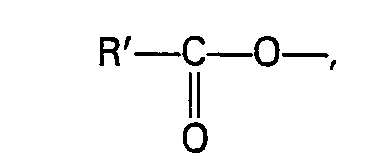
- b) eine Mischung aus einer Verbindung der Formel II


- c) eine Mischung einer Verbindung der Formel I mit mindestens einer Verbindung der Formel II oder 111 verwendet, und das Granulierhilfsmittel bzw.-Gilfsmittelgemisch über seinen Erweichungspunkt bzw. Erweichungsbereich erwärmt, wobei das Granulierhilfsmittel bzw.-Gilfsmittelgemisch einen Erweichungspunkt bzw. Erweichungsbereich zwischen 30 und 150°C, vorzugsweise zwischen 40 und 100°C aufweist und in Mengen von 5 bis 50, vorzugsweise 10 bis 30 Gew.%, bezogen auf den Farbstoff, verwendet wird.
- Neben diesen Granulierhilfsmitteln können auch weitere Zusätze vorhanden sein, wie insbesondere Coupagemittel in Mengen von 0,1 bis 50 Gewichtsprozent, bezogen auf den zu granulierenden Farbstoff, wie Natriumchlorid oder Natriumsulfat, oder auch Netzmittel, Dispergatoren und Staubbindemittel.
- Gegenstand der Erfindung sind ferner die nach dem erfindungsgemässen Verfahren erhaltenen Farbstoffgranulate.
- Als wasserlösliche Farbstoffe kommen beispielsweise saure und basische Farbstoffe, wie Metallkomplex-, Chromierungs-, Entwicklungs- und Beizenfarbstoffe sowie vor allem Reaktivfarbstoffe in Frage. Es handelt sich insbesondere um sulfosäure- bzw. carbonsäuregruppenhaltige metallfreie oder metallhaltige und metallisierbare Mono-, Dis- und Polyazofarbstoffe, Formazanfarbstoffe, Anthrachinon-, Nitro-, Methin-, sauer Triphenylmethan-, Xanthon-, Naphthazarin, Chinophthalon- und Phthalocyaninfarbstoffe, sowie vorzugsweise um solche Farbstoffe, die mindestens einen Faserreaktiven Rest im Farbstoffmolekül aufweisen, wie insbesondere heterocyclische Gruppen oder eine Acylgruppe von einer Carbonsäure, wobei diese Gruppen mindestens ein unter Färbebedingungen abspaltbares Halogenatom aufweisen.
- Als wasserlösliche Metallkomplexfarbstoffe kommen sulfonsäure-bzw. carbonsäuregruppenhaltige Metallkomplexfarbstoffe, beispielsweise 1:1- oder 1:2-Metallkomplexe von Azo- oder Azomethinfarbstoffen oder metallisierte Phthalocyanine, insbesondere Kupfer- und Nickelphthalocyanine, in Betracht. Bei den 1 :1- und 1 :2-Metallkomplexen handelt es sich vorzugsweise um 1:1-Nickelkomplexe, 1:1-Kobaltkomplexe, 1:1-Kupferkomplexe, 1:1-Chromkomplexe, 1:1-Eisenkomplexe oder um symmetrische oder asymmetrische 1 :2-Kobaltkomplexe, 1:2-Eisenkomplexe oder 1:2-Chromkomplexe von insbesondere o-Carboxy-o'-hydroxy-, o-Hydroxy-o'-amino- oder o,o'-Dihydroxyazofarbstoffen des Benzol-azo-benzol-, Naphthalin-azo-naphthalin-, Benzol-azo-naphthalin-, Benzol-azo-pyrazolon-, Benzol-azo-pyridon- oder Benzol-azo-acetessigsäureamid-Typs, wobei diese Gruppierungen unsubstituiert oder auch substituiert sein können. Als Substituenten kommen z.B. in Betracht: gegebenenfalls substituierte Sulfonsäureamide oder Sulfone, Halogen oder Nitro.
- Die erfindungsgemäss verwendeten Kupfer- und Nickelphthalocyanine leiten sich von den üblichen Gemischen verschiedener Sulfonierungsgrade ab und enthalten vorzugsweise 2 bis 3 oder auch 4 sulfatierte Sulfonsäure-ß- oder -y-hydroxyalkylamidgruppen, können daneben aber auch einzelne Halogene und einzelne Sulfonsäureamidgruppen enthalten, wobei diese Sulfonsäureamidgruppen am Stickstoff unsubstituiert oder substituiert sein können, beispielsweise durch nieder Alkyl, wie Methyl, Aethyl, Propyl, Butyl, oder niedere Hydroxyalkylgruppen, wie 2-Hydroxyäthyl, 2-Hydroxypropyl, 3-Hydroxypropyl.
- Beim vorliegenden Verfahren verwendet man die sulfonsäuregruppenhaltigen Azofarbstoffe vorzugsweise in Form ihrer Metallsalze, z.B. der Kalium- oder vor allem Natriumsalze. Vorzugsweise handelt es sich um wasserlösliche Reaktivfarbstoffe, insbesondere um reaktive saure Azo- oder Anthrachinonfarbstoffe.
- Geeignete faserreaktive Gruppen sind z.B. heterocyclische Gruppen oder eine Acylgruppe von einer Carbonsäure, wobei diese Gruppen mindestens ein abspaltbares Halogenatom aufweisen. Es handelt sich beispielsweise um die folgenden Gruppen: s-Triazinylreste, die am Triazinring ein oder zwei Halogenatome, wie Chlor-, Fluor- oder Bromatome tragen, Pyrimidylreste, die ein bis drei Halogenatome wie Chlor- und/oder Fluoratome bzw. eine oder zwei Arylsulfonyl- oder Alkansulfonylgruppen am Pyrimidinring tragen, Dichlorchinoxylinyl-, 2-Chlorbenzthiazolyl-, Chloracetylaminogruppen oder a,ß-Dibrompropionylaminogruppen.
- Desweiteren kommen als faserreaktive Gruppen z.B. noch in Frage Halogencyclobutan-, Mono-oder Bis-(γ-Halogen-β-hydroxypropyl)aminogruppen, β-Halogenäthylsulfamidreste, β-Halogenäthoxygruppen, β-Halogenäthylmercaptogruppen, γ-Halogen-β-hydroxy-propylsulfamidreste oder 2,3-Epoxypropylgruppen.
- Die Farbstoffe können gegebenenfalls auch in Mischungen miteinander oder gegebenenfalls mit Farbstoffen von einem anderen Typ vorliegen.
- Die erfindungsgemäss verwendbaren Farbstoffe sind bekannt und können nach an sich bekannten Methoden hergestellt werden.
- Aliphatische Kohlenwasserstoffreste R und R' der Granulierhilfsmittel der Formel I sind gesättigte oder ungesättigte, geradkettige oder verzweigte Kohlenwasserstoffreste, die sich von aliphatischen Alkoholen und Säuren mit 8 bis 22, vorzugsweise 8 bis 20 Kohlenstoffatomen ableiten.
- Alicyclische Kohlenwasserstoffreste R sind vor allem polycyclische Reste von alicyclischen Alkoholen, wie Hydroabietylalkohol.
- Verbindungen der Formel I in der A die Gruppe R-O- bedeutet, sind Umsetzungsprodukte aus 10 bis 200, vorzugsweise 20 bis 150 Mol Aethylenoxid mit höheren Alkoholen mit 8 bis 22 Kohlenstoffatomen, wie Decyl-, Lauryl-, Tridecyl-, Myristyl-, Cetyl-, Stearyl-, Oleyl-, Arachidyl- oder Behenylalkohol; insbesondere Umsetzungsprodukte aus 35 bis 80 Mol Aethylenoxid mit höheren Alkoholen wie z.B. 18 Kohlenstoffatome aufweisenden, geradkettigen gesättigten oder ungesättigten Alkohole, wie das Umsetzungsprodukt aus Oleylalkohol und 80 Mol Aethylenoxid oder aus Stearylalkohol und 35 Mol Aethylenoxid; ferner Umsetzungsprodukte aus alicyclischen Alkoholen mit 80 bis 120 Mol Aethylenoxid wie Hydroabietylalkohol veräthert mit 100 Mol Aethylenoxid.
- Verbindungen der Formel I in der A die Gruppe

- Verbindungen der Formel II sind insbesondere Polyvinylcaprolactam und vorzugsweise Polyvinylpyrrolidone mit einem Molgewicht bis ca. 40,000 und Verbindungen der Formel 111 sind Harnstoff und N,N'-Dimethylharnstoff.
- Als erfindungsgemäss verwendbare Granulierhilfsmittel verwendet man vorteilhaft Verbindungen der Formel I, allein oder im Gemisch mit einer verschiedenen Verbindung der Formel I oder mit einer Verbindung der Formel II oder 111 oder ein Gemisch einer Verbindung der Formel II mit einer Verbindung der Formel 111. Von besonderem Interesse sind diese Gemische wenn sie als eutektische Mischung vorliegen, wobei der Erweichungspunkt bzw. Erweichungsbereich der Mischung zwischen 30 und 150°C, vorzugsweise zwischen 40 und 100°C liegt. Bevorzugt sind Verbindungen der Formel I.
- Bei den erfindungsgemäss verwendbaren Hilfsmittelgemische handelt es sich z.B. um ein Gemisch aus einer Verbindung der Formel I, worin A die Gruppe

- Die zu granulierenden Farbstoffe müssen in trockener Form vorliegen z.B. als Rohware, als zerstäubungsgetrocknete oder in konventioneller Art getrocknete Ware z.B. im Mahltrockner getrocknete Pulver.
- Ferner ist es zweckmässig, dass die Partikelgrösse aller Komponenten in einem engen Bereich (z.B. 30 bis 150,um) liegt, um somit einen gleichmässigen Kornaufbau zu gewährleisten.
- Das Granulierhilfsmittel kann dem Farbstoffpulver in festem Zustand zugegeben werden und anschliessend unter Bewegung zusammen mit dem Farbstoff über den Erweichungspunkt des Granulierhilfsmittels erwärmt werden, oder man erwärmt den Farbstoff vor der Zugabe des Granulierhilfsmittels auf eine solche Temperatur, dass das Granulierhilfsmittel nach der Zugabe erweicht. Man kann aber auch das geschmolzene Granulierhilfsmittel zu dem gegebenenfalls erwärmten Farbstoff geben, vorzugsweise durch Aufsprühen oder Eindüsen.
- Das bevorzugte Verfahren der Partikelvergrösserung besteht dabei z.B. aus folgenden Operationen:
- - Herstellen der homogenen, granulierfähigen Mischung aus Farbstoff, Granulierhilfsmittel und gegebenenfalls den weiteren Zusätzen;
- - Erwärmen dieser Mischung unter mischender oder rollender Bewegung auf mindestens 40°C, vorzugsweise auf 50 bis 95°C, während etwa 5 bis 30 Minuten;
- - Zerkleinern der anfallenden Klumpen;
- - Abkühlen unter Bewegen der Granulate auf ca. 40-50°C.
- Die Granulatgrösse lässt sich dabei je nach Granulierhilfsmittelmenge in dem Bereich von 90 pm bis 20 mm variieren.
- Für die Durchführung des erfindungsgemässen Verfahrens verwendet man zweckmässig die bekannten, üblichen kontinuierlichen und diskontinuierlichen Granulierapparate, wie beispielsweise Granuliertrommel, Granulierteller, wie z.B. EIRICH-Teller, und Trockner, beispielsweise Conaform- oder Taumeltrockner.
- Geeignete Heizquellen sind Strahlungsheizung, wie Mikrowellenstrahlung oder insbesondere IR-Strahlung, oder Konvektionsheizung, wie Mantel- oder Rührwellenheizung.
- Das erfindungsgemässe Verfahren wird bei einer Temperatur durchgeführt, die mindestens so hoch liegt, dass das Granulierhilfsmittel zu erweichen beginnt, zweckmässig aber bei Temperaturen, die etwa 5-30°C darüber lieqen. Während der Erwärmung und bis zum Abschluss der Granulatbildung soll eine schonende Drehbewegung mit einer Umfangsgeschwindigkeit von 0,3-2,2 m/sec, vorzugsweise von 0,5-2,0 m/sec. stattfinden.
- Mittels dieses Verfahrens ist es somit möglich, wasserlösliche Farbstoffe, insbesondere in Pulverform, mit einer Anfangsfeinheit von etwa 1 bis 150µm in eine körnige nichtstaubende Form mit einer Korngrösse von etwa 100 Mm bis 20 mm überzuführen, die eine Restfeuchte von ca. 2 bis 10 Gewichtsprozent aufweisen.
- Man verwendet zweckmässig 5-50 Teile, vorzugsweise 10-30 Teile des Granulierhilfsmittels auf 100 Teile des zu granulierende Rohfarbstoffes. Die Korngrösse des Granulierhilfsmittels soll zwischen 0,1 und 0,5 mm liegen. Bei kleinerer Korngrösse entsteht kein Granulat und bei grösserer Korngrösse erhält man ein uneinheitliches Granulat hit schlechter Gutkornausbeute. Unter Gutkornausbeute versteht man denjenigen Anteil des erhaltenen Granulates, der einen Korndurchmesser zwischen 0,2 und 2 mm aufweist.
- Die erfindungsgemässen Farbstoff-Granulate sind abriebfest, rieselfähig, nicht stäubend, von hohem Schüttgewicht und vor allem in kaltem Wasser sehr leicht und schnell löslich. Sie sind besonders geeignet zur Herstellung von wässrigen Färbeflotten und Druckpasten, welche zum Färben und Bedrucken der verschiedensten für die jeweilige Farbstoffklasse geeigneten Materialien verwendet werden können.
- In den nachfolgenden Beispielen, welche die Erfindung erläutern, bedeuten Teile Gewichtsteile. Die Temperaturen sind in Grad Celsius angegeben. Die Farbstoffe liegen als Alkalisalz, vor allem als Natriumsalz vor. Die Bezeichnung staubarm bei den Präparaten bedeutet, dass praktisch keine Teilchen mit einer Grösse unter 50 µm vorhanden sind.
- Zur Bestimmung des Staubverhaltens wird folgender Staubtest durchgeführt:
- Auf einen Metallzylinder von 500 ccm Inhalt wird ein Metalltrichter mit einem lichten Durchmesser von 10 cm und einem Rohr (lichter Durchmesser 15 mm) gesetzt, dessen unteres Rohrende bis zur 200 ccm-Grenze des Zylinders reicht. Auf der Höhe von 400 ccm des Zylinders wird ein gelochter Papier-Rundfilter (Schleicher und Schüll LS14) befestigt, das mit Wasser derart angefeuchtet ist, dass das Filterpapier nur mässig feucht, aber nicht triefend nass ist. Dann werden 10 g der zu prüfenden Substanz durch den Trichter rasch eingeschüttet, 3 Minuten gewartet, der Trichter herausgenommen und das Papierrundfilter durch Durchschneiden entfernt. Dieses Filterpapier wird dann durch eine 5- stufige Bewertungsskala wie folgt bewertet:
- Note 1 = stark stäubend, wenn Papierrundfilter stark getönt bis intensiv gefärbt ist.
- Note 2 = erheblich stäubend, wenn Papierrundfilter schwach getönt ist,
- Note 3 = mässig stäubend, wenn sich auf dem Papierrundfilter viele Farbflecken, die sich teilweise berühren, befinden;
- Note 4 = schwach stäuben, wenn sich auf dem Papierrundfilter Farbstofftupfen, aber keine zusammenhängenden Farbflecken befinden;
- Note 5 = staubarm, wenn der Papierrundfilter eine kaum sichtbare Anfärbung oder höchstens vereinzelte Farbstofftupfen aufweist.
- Zur Bestimmung der Kaltwasserlöslichkeit der Farbstoff-Granulate wird folgender Test durchgeführt:
- Eine bestimmte Menge (in g) vom zu prüfenden Farbstoff-Granulat wird in 200 ml entsalztes Wasser bei 20°C in einem 400 ml Becherglas unter Rühren (magnetrührer bei 750 U/Min.) gegeben und 5 Minuten gerührt. Dann wird die Farbstoff-Lösung durch einen Papierfilter (SS 1450 CV Durchmesser 7 cm) filtriert und mit 50 ml entsalztem Wasser gespült.
- Als Kaltwasserlöslichkeit wird die höchste Konzentration des Farbstoffes im Wasser bewertet, die keinen Filterrückstand ergibt.
- Trockener, zerstäubungsgetrockneter Farbstoff der Formel

wird mit 15 Gew.%, bezogen auf das Granulat, eines Umsetzungsproduktes aus technischem Hydroabietylalkohol (ein Gemisch aus ca. 45% Tetrahydroabietylalkohol, 40% Dihydroabietylalkohol und 15% Dehydroabietylalkohol) veräthert mit 100 Mol Aethylenoxid in Form von feinen Schuppen (Erweichungspunkt ca. 45°) in einem Mixer (z.B. vom Typ Lödigemischer) ca. 10 Minuten homogenisiert und dann innerhalb 30 Minuten auf 80° erwärmt. Nach Erreichen dieser Temperatur wird während des Weiterlaufens des Mischers wiederum auf Raumtemperatur abgekühlt. - Man erhält ein staubarmes Farbstoff-Granulat, das problemlos aus dem Mischer entfernt und falls nötig noch gesichtet werden kann, um noch evtl. vorhandenen, geringen Staubanteil abzutrennen.
- Das Granulat hat überraschenderweise ein hohes Schüttgewicht (mindestens 700 g/t) und weist eine gute Kaltwasserlöslichkeit auf. Der Prozess verläuft unter Schonung des Reaktivfarbstoffes, der seine Reaktivität voll behält. Der Staubtest des ungesichteten Granulats ergibt einen Staubwert von 4-5 auf einer Skala von 1 bis 5, mit 5 als beste Note.

-

- Ausfärbung (nach dem üblichen Ausziehverfahren):
- Nuance gut, Reinheit gut, Stärke gut
- Trockener, in einem Mahltrockner getrockneter Farbstoff der im Beispiel 1 angegebenen Formel wird mit ca. 12,5%, bezogen auf das Granulat, eines Umsetzungsproduktes aus Oleylalkohol mit 80 Mol Aethylenoxid (Erweichungspunkt ca. 50°) in einem Lödigemischer wie im Beispeil 1 weiterverarbeitet. Man erhält ein Farbstoff-Granulat mit einer Durchschnittskorngrösse von 850,um, einem Schüttgewicht von über 700 g/I und einer Löslichkeit in kaltem Wasser (20°) von 50 g/I.
- Trockener, in einem Mahltrockner getrockneter Farbstoff der im Beispiel 1 angegebenen Formel wird mit ca. 17,5%, bezogen auf das Granulat, des im Beispiel 1 angegebenen Umsetzungsproduktes wie im Beispiel 1 angegeben in einem Lödigemischer verarbeitet.
- Man erhält ein Farbstoff-Granulat mit einer Durchschnittskorngrösse von etwa 1200 ,um, das sehr staubarm ist (Staubnote 5), welches eine Kaltwasserlöslichkeit von 50 g/I und einem Schüttgewicht von über 800 g/I aufweist.
- Wenn man den im Beispiel 1 angegebenen Farbstoff durch den Farbstoff der Formel


- Wenn man den im Beispiel 2 angegebenen, getrochneten Farbstoff durch den Farbstoff der Formel

- Wenn man den im Beispiel 4 angegebenen, getrockneten Farbstoff durch den Farbstoff der Formel

- Wenn man den im Beispiel 2 angegebenen, getrockneten Farbstoff durch den Farbstoff der Formel

- Wenn man den im Beispiel 3 angegebenen, getrockneten Farbstoff durch den im Beispiel 7 angegebenen Farbstoff ersetzt, und sonst wie im Beispiel 3 verfährt, so erhält man ein Farbstoff- Granulat mit einer Durchschnittskorngrösse von ca. 500,um und einem sehr hohen Schüttgewicht (über 800 g/I).
- Der Filterpresskuchen des Farbstoffs der Formel
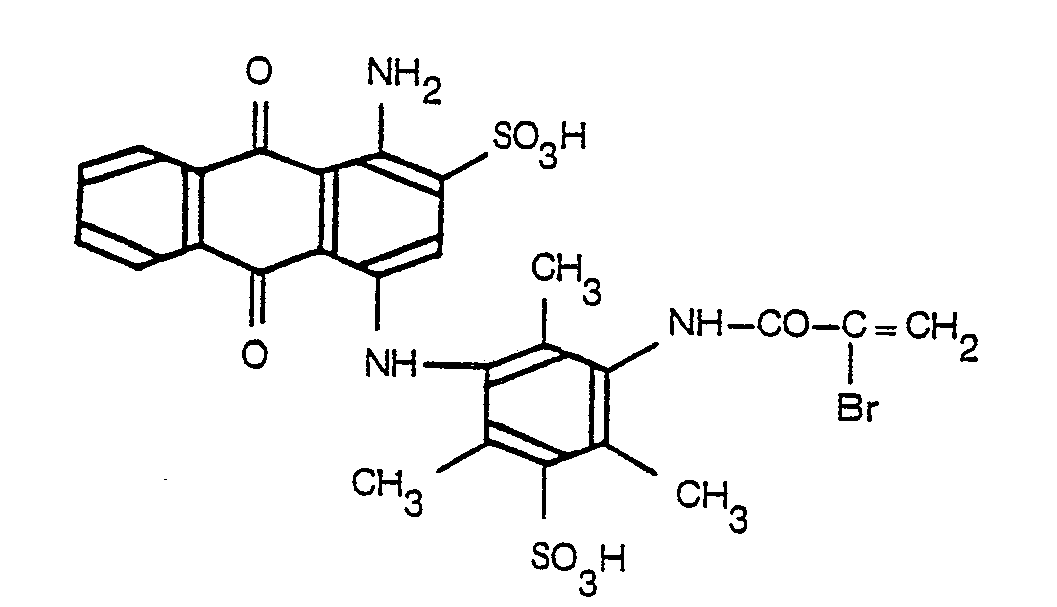
- Das so erhaltene Farbstoffpulver wird dann mit ca. 24%, berechnet auf den Farbstoff, des im Beispiel 1 angegebenen Granulierhilfsmittels wie im Beispiel 1 angegeben granuliert. Man erhält ein Farbstoffgranulat folgender Zusammensetzung:


- Wenn man den im Beispiel 9 angegebenen Farbstoff durch den Farbstoff der Formel


- Wenn man in den Beispielen 9 und 10 anstelle der Dextrinlösung Naphthalinsulfonsäure-Formaldehyd-Kondensationsprodukt und Dinatriumhydrogenphosphat vor der Trocknung im Mahltrockner zugibt und sonst wie in den Beispielen angegeben verfährt, so erhält man ähnliche Farbstoff- granulate folgender Zusammensetzung:
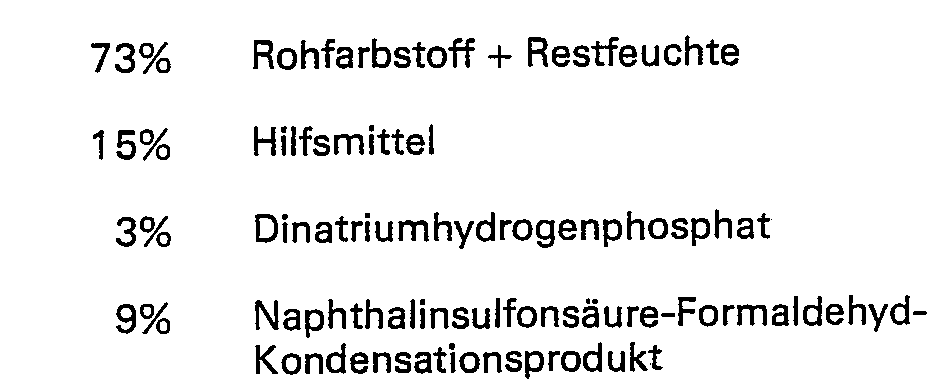
- Trockener, zerstäubungsgetrockneten Farbstoff der Formel

- Man erhält ein staubarmes Farbstoff-Granulat, das problemlos aus dem Mischer entfernt und falls nötig noch gesichtet werden kann, um noch evtl. vorhandenen, geringen Staubanteil abzutrennen.

- Trockener, zerstäubungsgetrockneter 1:2 Co-Komplex des Farbstoffs der Formel

- Man erhält ein Farbstoffgranulat folgender Zusammensetzung:

- Verwendet man anstelle der in den obigen Beispielen angegebenen Hilfsmittel entsprechende Mengen der in folgender Tabelle A aufgeführten Hilfsmittel bei im übrigen gleicher Arbeitsweise, so erhält man ebenbürtige Granulate mit hohem Schüttgewicht.

- Verwendet man anstelle der in den vorstehenden Beispielen verwendeten Farbstoffe die in den folgenden Tabellen B bis D angegebenen Metallkomplexfarbstoffe, bei gleicher Arbeitsweise, so erhält man Granulate ähnlicher Zusammensetzung, die ähnliche Eigenschaften aufweisen.
- In der Tabelle B ist ein 1 :2-Komplex-Farbstoff aufgeführt, der 2 Moleküle des gleichen Farbstoffes an 1 Metallatom komplex gebunden, enthält.
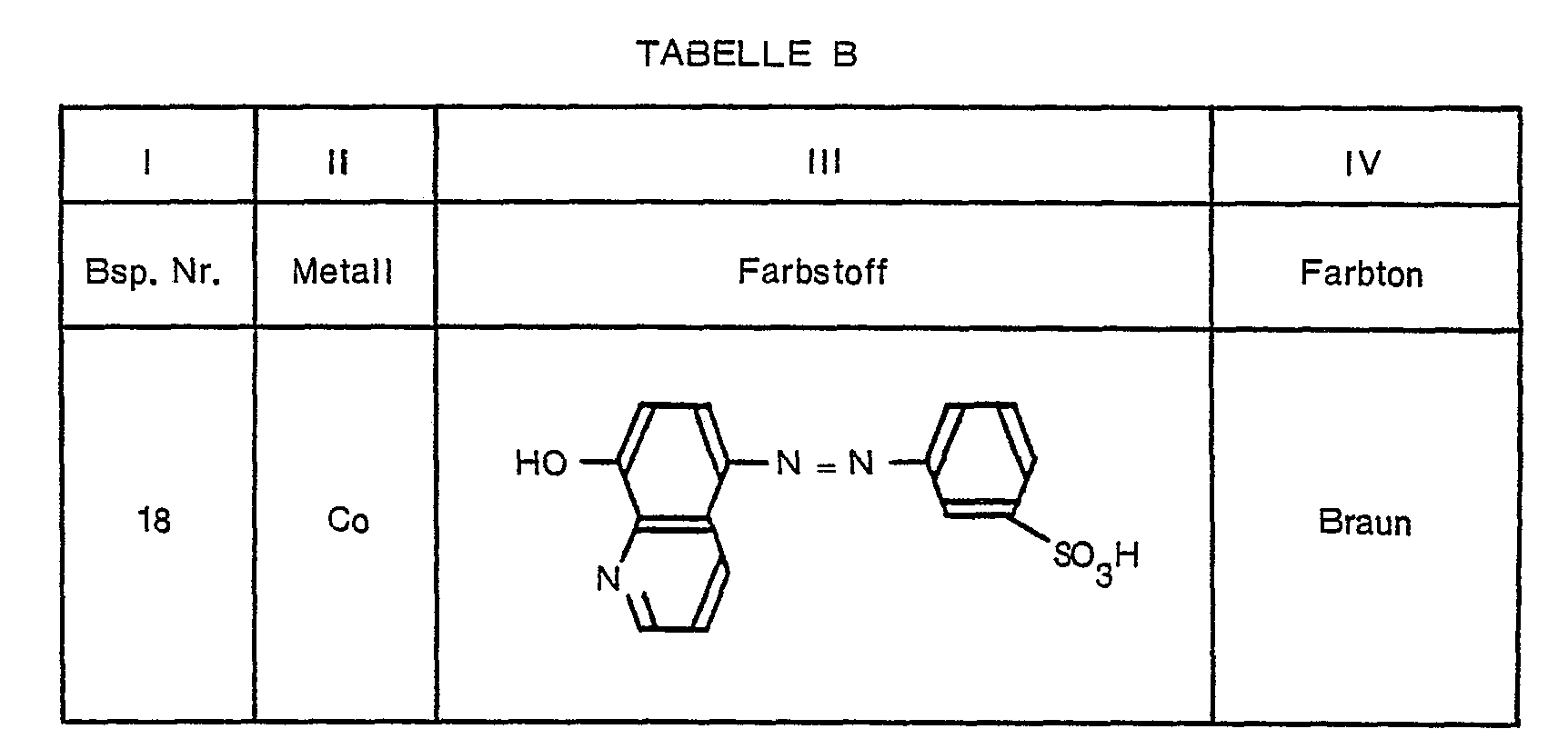
- In der Tabelle C sind 1:2-Mischkomplexe aufgeführt, die je 1 Molekül eines Farbstoffes der Kolonne III und der Kolonne IV an 1 Metallatom der Kolonne II komplex gebunden enthalten.

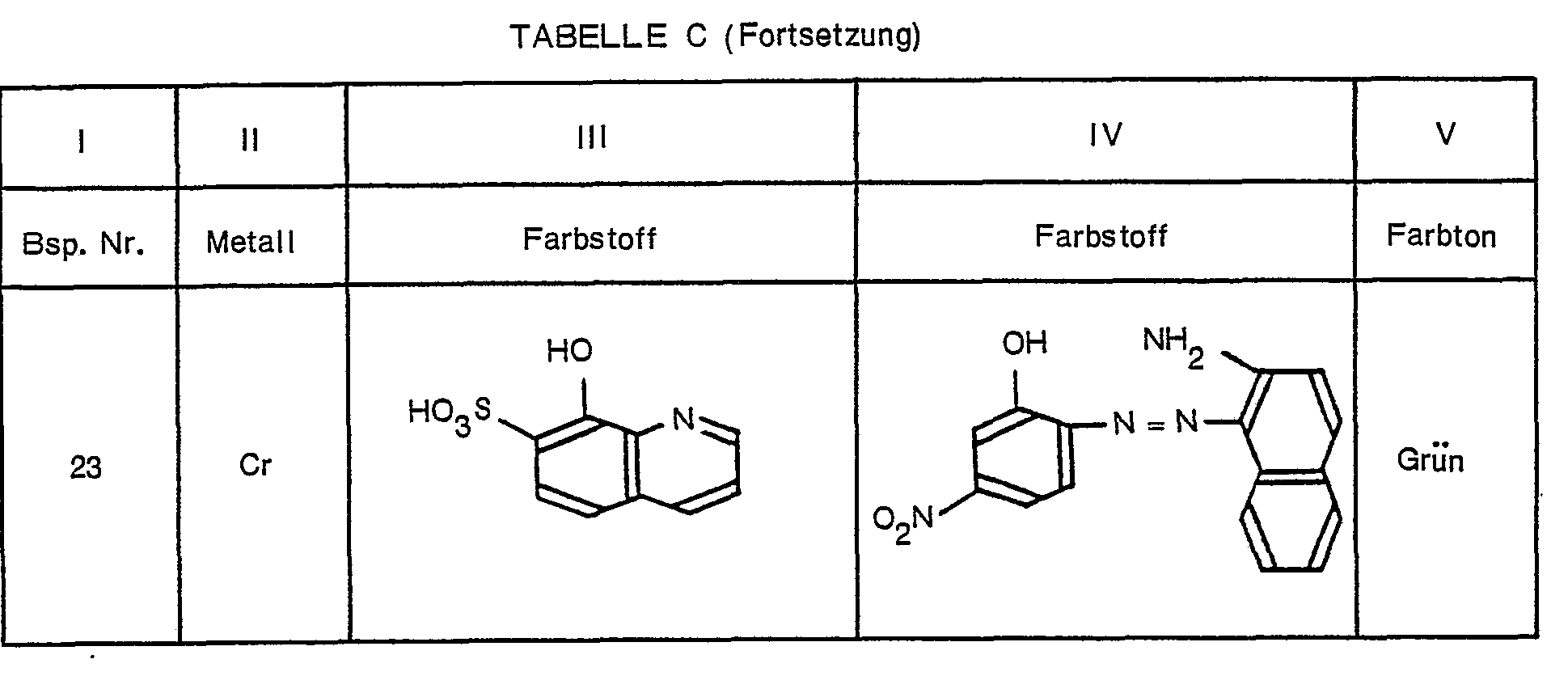
- In der Tabelle D sind 1:1-Komplexe aufgeführt, die 1 Molekül des Farbstoffes an 1 Metallatom komplex gebunden, enthalten.

Claims (15)



das Granulierhilfsmittel bzw. -hilfsmittelgemisch über seinen Erweichungspunkt bzw. Erweichungsbereich erwärmt, wobei das Granulierhilfsmittel bzw. -hilfsmittelgemisch einen Erweichungspunkt bzw. Erweichungsbereich zwischen 30 und 150°C aufweist und in Mengen von 5 bis 50 Gew.%, bezogen auf den Farbstoff, verwendet wird.


Applications Claiming Priority (2)
| Application Number | Priority Date | Filing Date | Title |
|---|---|---|---|
| CH888579 | 1979-10-02 | ||
| CH8885/79 | 1979-10-02 |
Publications (3)
| Publication Number | Publication Date |
|---|---|
| EP0026489A2 EP0026489A2 (de) | 1981-04-08 |
| EP0026489A3 EP0026489A3 (en) | 1981-05-06 |
| EP0026489B1 true EP0026489B1 (de) | 1984-05-02 |
Family
ID=4345843
Family Applications (1)
| Application Number | Title | Priority Date | Filing Date |
|---|---|---|---|
| EP80105853A Expired EP0026489B1 (de) | 1979-10-02 | 1980-09-26 | Aufbaugranulate wasserlöslicher Farbstoffe, Verfahren zur Herstellung und Verwendung zum Färben |
Country Status (5)
| Country | Link |
|---|---|
| US (1) | US4425134A (de) |
| EP (1) | EP0026489B1 (de) |
| JP (1) | JPS5670056A (de) |
| BR (1) | BR8006313A (de) |
| DE (1) | DE3067700D1 (de) |
Families Citing this family (7)
| Publication number | Priority date | Publication date | Assignee | Title |
|---|---|---|---|---|
| DE3344463A1 (de) * | 1983-12-02 | 1985-06-13 | Heubach Hans Dr Gmbh Co Kg | Dauerhaft staubungsfreie pigmentpraeparate |
| CH658066A5 (de) * | 1984-03-15 | 1986-10-15 | Ciba Geigy Ag | Verfahren zur herstellung von granulaten wasserloeslicher farbstoffe. |
| DE3416463A1 (de) * | 1984-05-04 | 1985-11-07 | Peter 7117 Bretzfeld Herrmann | Mehrhub-stellzylinder |
| US5248555A (en) * | 1990-09-29 | 1993-09-28 | Mitsubishi Paper Mills Limited | Heat-sensitive recording composition and process for producing same |
| US5611818A (en) * | 1991-05-23 | 1997-03-18 | Sandoz Ltd. | Dry leuco sulphur dyes in particulate form |
| RU2005122894A (ru) * | 2002-12-19 | 2006-01-20 | Каргес-Фолконбридж, Инк. (Us) | Способ жидкостной экстракции |
| US7776218B2 (en) * | 2003-12-19 | 2010-08-17 | Kfi Intellectual Properties L.L.C. | System for liquid extraction, and methods |
Family Cites Families (15)
| Publication number | Priority date | Publication date | Assignee | Title |
|---|---|---|---|---|
| FR1193828A (de) * | 1959-11-05 | |||
| GB614354A (en) | 1946-07-11 | 1948-12-14 | Derrick Fysh | Manufacture of water-soluble dyestuffs |
| US3086831A (en) | 1959-07-01 | 1963-04-23 | American Cyanamid Co | Compositions of a pyrazolone azo dye with polyvinylpyrrolidone |
| DE1816984B2 (de) | 1968-12-24 | 1973-05-30 | Farbwerke Hoechst AG, vormals Meister Lucius & Brüning, 6000 Frankfurt | Staubarme, pulverfoermige faerbepraeparate fuer die eisfarbenfaerberei |
| CH552042A (de) | 1970-12-10 | 1974-07-31 | Ciba Geigy Ag | Verfahren zur herstellung nichtstraeubender, wasserfreier, kationischer farbstoffpulver. |
| CH569772A5 (de) | 1972-05-05 | 1975-11-28 | Ciba Geigy Ag | |
| CH597335A5 (de) | 1973-09-14 | 1978-03-31 | Ciba Geigy Ag | |
| DE2348518B2 (de) | 1973-09-27 | 1978-06-29 | Basf Ag, 6700 Ludwigshafen | Pulverförmige, hochkonzentrierte und dispersionsstabile Farbstoffzubereitungen und Verfahren zu deren Herstellung |
| CH602894A5 (de) * | 1974-07-04 | 1978-08-15 | Ciba Geigy Ag | |
| CH615212A5 (en) * | 1975-04-18 | 1980-01-15 | Ciba Geigy Ag | Process for preparing dust-free dye or optical brightener granules |
| CH604880A5 (de) | 1976-05-25 | 1978-09-15 | Ciba Geigy Ag | |
| DE2656407C3 (de) * | 1976-12-13 | 1981-10-08 | CIBA-GEIGY AG, 4002 Basel | Verfahren zur Herstellung von staubarmen Farbstoff- und optischen Aufhellerpräparaten und deren Verwendung |
| DE2656408C2 (de) * | 1976-12-13 | 1983-12-15 | CIBA-GEIGY AG, 4002 Basel | Verfahren zur Herstellung von staubarmen Präparaten und deren Verwendung |
| DE2816306C3 (de) | 1977-04-18 | 1980-11-13 | Ciba-Geigy Ag, Basel (Schweiz) | Granulate von wasserlöslichen Farbstoffen bzw. optischen Aufhellern, ihre Herstellung und Verwendung |
| GB1590154A (en) * | 1977-04-19 | 1981-05-28 | Ici Ltd | Process for preparing low dusting granulated dyestuffs |
-
1980
- 1980-09-26 DE DE8080105853T patent/DE3067700D1/de not_active Expired
- 1980-09-26 EP EP80105853A patent/EP0026489B1/de not_active Expired
- 1980-10-01 BR BR8006313A patent/BR8006313A/pt unknown
- 1980-10-02 JP JP13682180A patent/JPS5670056A/ja active Granted
-
1982
- 1982-03-01 US US06/353,543 patent/US4425134A/en not_active Expired - Fee Related
Non-Patent Citations (1)
| Title |
|---|
| ENCYCLOPEDIA OF POLYMER SCIENCE AND TECHNOLOGY, VOL. 14, pages 244/245 * |
Also Published As
| Publication number | Publication date |
|---|---|
| BR8006313A (pt) | 1981-04-14 |
| JPH0237950B2 (de) | 1990-08-28 |
| EP0026489A3 (en) | 1981-05-06 |
| DE3067700D1 (en) | 1984-06-07 |
| JPS5670056A (en) | 1981-06-11 |
| EP0026489A2 (de) | 1981-04-08 |
| US4425134A (en) | 1984-01-10 |
Similar Documents
| Publication | Publication Date | Title |
|---|---|---|
| DE3344464C2 (de) | ||
| EP0037382B1 (de) | Farbstoffgranulate und Verfahren zu deren Herstellung | |
| EP0236270A2 (de) | Verfahren zur Herstellung von eine Wirksubstanz enthaltenden Körpern und deren Verwendung als Speckles | |
| DE2643076C3 (de) | Verfahren zur Herstellung und Verwendung leicht dispergierbarer Präparate aus Farbstoffen und Polyvinylacetalen | |
| DE2656408A1 (de) | Verfahren zur herstellung von staubarmen praeparaten | |
| EP0345765B1 (de) | Verfahren zur Herstellung von Granulaten | |
| DE2656407A1 (de) | Verfahren zur herstellung von staubarmen farbstoff- und optischen aufhellerpraeparaten | |
| DE3515797A1 (de) | Verfahren zur herstellung von farbstoffgranulaten | |
| EP0026489B1 (de) | Aufbaugranulate wasserlöslicher Farbstoffe, Verfahren zur Herstellung und Verwendung zum Färben | |
| DE2816306C3 (de) | Granulate von wasserlöslichen Farbstoffen bzw. optischen Aufhellern, ihre Herstellung und Verwendung | |
| EP0024654A1 (de) | Granulate von faserreaktiven Farbstoffen und Verfahren zu ihrer Herstellung | |
| EP0028379B1 (de) | Granulate wasserlöslicher Farbstoffe, Verfahren zur Herstellung und Verwendung zum Färben | |
| EP0095740B1 (de) | Feste Präparate von Metallkomplexfarbstoffen | |
| DE2322308A1 (de) | Rieselfaehige, leicht loesliche farbstoffgranulate von anionischen farbstoffen | |
| DE2616639C2 (de) | Verfahren zur Herstellung von staubfreien Farbstoff- bzw. optischen Aufheller-Granulaten und deren Anwendung | |
| EP0155239B2 (de) | Verfahren zur Herstellung von Farbstoffgranulaten | |
| EP0124866B1 (de) | Kaltwasserdispergierbare Farbstoffgranulate | |
| DE2656406A1 (de) | Verfahren zur herstellung von staubarmen praeparaten | |
| EP0544676B1 (de) | Staubarme oder staubfreie farbstoffpräparationen | |
| DE2732500C2 (de) | Verfahren zur Herstellung von in Wasser dispergierbaren pulverförmigen Farbstoffzubereitungen | |
| DE2459895C3 (de) | Zerstäubungsgetrocknete niedrigschmelzende basische Farbstoffe und Verfahren zu ihrer Herstellung | |
| DE2617437B2 (de) | Kaltwasserlösliches Präparat, Verfahren zu seiner Herstellung und seine Verwendung | |
| EP0148125B1 (de) | Feste Präparate von in Wasser schwerlöslichen bis unlöslichen Farbstoffen | |
| EP0024655A2 (de) | Granulate von Metallkomplexfarbstoffen und Verfahren zu ihrer Herstellung | |
| DE69127250T2 (de) | Körnchenförmige Reaktivfarbstoffzusammensetzungen und Herstellungsverfahren hierfür |
Legal Events
| Date | Code | Title | Description |
|---|---|---|---|
| PUAI | Public reference made under article 153(3) epc to a published international application that has entered the european phase |
Free format text: ORIGINAL CODE: 0009012 |
|
| PUAL | Search report despatched |
Free format text: ORIGINAL CODE: 0009013 |
|
| 17P | Request for examination filed |
Effective date: 19800926 |
|
| AK | Designated contracting states |
Designated state(s): BE CH DE FR GB |
|
| AK | Designated contracting states |
Designated state(s): BE CH DE FR GB |
|
| GRAA | (expected) grant |
Free format text: ORIGINAL CODE: 0009210 |
|
| AK | Designated contracting states |
Designated state(s): BE CH DE FR GB LI |
|
| REF | Corresponds to: |
Ref document number: 3067700 Country of ref document: DE Date of ref document: 19840607 |
|
| ET | Fr: translation filed | ||
| PLBE | No opposition filed within time limit |
Free format text: ORIGINAL CODE: 0009261 |
|
| STAA | Information on the status of an ep patent application or granted ep patent |
Free format text: STATUS: NO OPPOSITION FILED WITHIN TIME LIMIT |
|
| 26N | No opposition filed | ||
| PGFP | Annual fee paid to national office [announced via postgrant information from national office to epo] |
Ref country code: FR Payment date: 19910712 Year of fee payment: 12 |
|
| PGFP | Annual fee paid to national office [announced via postgrant information from national office to epo] |
Ref country code: GB Payment date: 19910719 Year of fee payment: 12 |
|
| PGFP | Annual fee paid to national office [announced via postgrant information from national office to epo] |
Ref country code: DE Payment date: 19910729 Year of fee payment: 12 |
|
| PGFP | Annual fee paid to national office [announced via postgrant information from national office to epo] |
Ref country code: CH Payment date: 19910924 Year of fee payment: 12 |
|
| PGFP | Annual fee paid to national office [announced via postgrant information from national office to epo] |
Ref country code: BE Payment date: 19910927 Year of fee payment: 12 |
|
| PG25 | Lapsed in a contracting state [announced via postgrant information from national office to epo] |
Ref country code: GB Effective date: 19920926 |
|
| PG25 | Lapsed in a contracting state [announced via postgrant information from national office to epo] |
Ref country code: LI Effective date: 19920930 Ref country code: CH Effective date: 19920930 Ref country code: BE Effective date: 19920930 |
|
| BERE | Be: lapsed |
Owner name: CIBA-GEIGY A.G. Effective date: 19920930 |
|
| GBPC | Gb: european patent ceased through non-payment of renewal fee |
Effective date: 19920926 |
|
| PG25 | Lapsed in a contracting state [announced via postgrant information from national office to epo] |
Ref country code: FR Effective date: 19930528 |
|
| REG | Reference to a national code |
Ref country code: CH Ref legal event code: PL |
|
| PG25 | Lapsed in a contracting state [announced via postgrant information from national office to epo] |
Ref country code: DE Effective date: 19930602 |
|
| REG | Reference to a national code |
Ref country code: FR Ref legal event code: ST |