EP0013397B1 - Procédé de préparation de polyesters insaturés contenant des groupes imides, et leur application - Google Patents
Procédé de préparation de polyesters insaturés contenant des groupes imides, et leur application Download PDFInfo
- Publication number
- EP0013397B1 EP0013397B1 EP79105285A EP79105285A EP0013397B1 EP 0013397 B1 EP0013397 B1 EP 0013397B1 EP 79105285 A EP79105285 A EP 79105285A EP 79105285 A EP79105285 A EP 79105285A EP 0013397 B1 EP0013397 B1 EP 0013397B1
- Authority
- EP
- European Patent Office
- Prior art keywords
- unsaturated
- groups
- oils
- imide groups
- anhydrides
- Prior art date
- Legal status (The legal status is an assumption and is not a legal conclusion. Google has not performed a legal analysis and makes no representation as to the accuracy of the status listed.)
- Expired
Links
- 125000005462 imide group Chemical group 0.000 title claims abstract description 20
- 238000000034 method Methods 0.000 title claims abstract description 12
- 229920006305 unsaturated polyester Polymers 0.000 title claims abstract description 9
- 238000002360 preparation method Methods 0.000 title description 6
- 150000001875 compounds Chemical class 0.000 claims abstract description 30
- 229920000728 polyester Polymers 0.000 claims abstract description 24
- 239000003921 oil Substances 0.000 claims abstract description 23
- 150000008064 anhydrides Chemical class 0.000 claims abstract description 13
- 125000002887 hydroxy group Chemical group [H]O* 0.000 claims abstract description 12
- 125000004432 carbon atom Chemical group C* 0.000 claims abstract description 9
- 238000004519 manufacturing process Methods 0.000 claims abstract description 7
- 150000001735 carboxylic acids Chemical class 0.000 claims abstract description 6
- 125000003178 carboxy group Chemical group [H]OC(*)=O 0.000 claims abstract description 5
- 229920006395 saturated elastomer Polymers 0.000 claims abstract description 5
- 125000001931 aliphatic group Chemical group 0.000 claims abstract description 4
- 125000005843 halogen group Chemical group 0.000 claims abstract description 4
- 125000002496 methyl group Chemical group [H]C([H])([H])* 0.000 claims abstract description 4
- 125000002950 monocyclic group Chemical group 0.000 claims abstract description 4
- 125000004356 hydroxy functional group Chemical group O* 0.000 claims abstract 3
- 239000007795 chemical reaction product Substances 0.000 claims description 10
- -1 methacryloyl Chemical group 0.000 claims description 7
- 229920005862 polyol Polymers 0.000 claims description 6
- 150000003077 polyols Chemical class 0.000 claims description 6
- 235000014113 dietary fatty acids Nutrition 0.000 claims description 5
- 229930195729 fatty acid Natural products 0.000 claims description 5
- 239000000194 fatty acid Substances 0.000 claims description 5
- 150000004665 fatty acids Chemical class 0.000 claims description 5
- 239000000047 product Substances 0.000 claims description 5
- 125000003903 2-propenyl group Chemical group [H]C([*])([H])C([H])=C([H])[H] 0.000 claims description 4
- 125000003647 acryloyl group Chemical group O=C([*])C([H])=C([H])[H] 0.000 claims description 4
- 125000000391 vinyl group Chemical group [H]C([*])=C([H])[H] 0.000 claims description 4
- 229920002554 vinyl polymer Polymers 0.000 claims description 4
- HOSGXJWQVBHGLT-UHFFFAOYSA-N 6-hydroxy-3,4-dihydro-1h-quinolin-2-one Chemical group N1C(=O)CCC2=CC(O)=CC=C21 HOSGXJWQVBHGLT-UHFFFAOYSA-N 0.000 claims description 3
- 229920000642 polymer Polymers 0.000 claims description 2
- 239000002253 acid Substances 0.000 description 12
- CTQNGGLPUBDAKN-UHFFFAOYSA-N O-Xylene Chemical compound CC1=CC=CC=C1C CTQNGGLPUBDAKN-UHFFFAOYSA-N 0.000 description 9
- 239000008096 xylene Substances 0.000 description 9
- 238000006243 chemical reaction Methods 0.000 description 8
- PEDCQBHIVMGVHV-UHFFFAOYSA-N Glycerine Chemical compound OCC(O)CO PEDCQBHIVMGVHV-UHFFFAOYSA-N 0.000 description 5
- 239000003054 catalyst Substances 0.000 description 5
- 229920001577 copolymer Polymers 0.000 description 5
- 238000009413 insulation Methods 0.000 description 5
- 229920005989 resin Polymers 0.000 description 5
- 239000011347 resin Substances 0.000 description 5
- PPBRXRYQALVLMV-UHFFFAOYSA-N Styrene Chemical compound C=CC1=CC=CC=C1 PPBRXRYQALVLMV-UHFFFAOYSA-N 0.000 description 4
- 150000007513 acids Chemical class 0.000 description 4
- 239000000203 mixture Substances 0.000 description 4
- 230000005855 radiation Effects 0.000 description 4
- 230000004580 weight loss Effects 0.000 description 4
- HZAXFHJVJLSVMW-UHFFFAOYSA-N 2-Aminoethan-1-ol Chemical compound NCCO HZAXFHJVJLSVMW-UHFFFAOYSA-N 0.000 description 3
- 125000003277 amino group Chemical group 0.000 description 3
- 150000001991 dicarboxylic acids Chemical class 0.000 description 3
- FPYJFEHAWHCUMM-UHFFFAOYSA-N maleic anhydride Chemical compound O=C1OC(=O)C=C1 FPYJFEHAWHCUMM-UHFFFAOYSA-N 0.000 description 3
- 239000000178 monomer Substances 0.000 description 3
- 238000006116 polymerization reaction Methods 0.000 description 3
- 230000009257 reactivity Effects 0.000 description 3
- NIDNOXCRFUCAKQ-UMRXKNAASA-N (1s,2r,3s,4r)-bicyclo[2.2.1]hept-5-ene-2,3-dicarboxylic acid Chemical compound C1[C@H]2C=C[C@@H]1[C@H](C(=O)O)[C@@H]2C(O)=O NIDNOXCRFUCAKQ-UMRXKNAASA-N 0.000 description 2
- KMOUUZVZFBCRAM-OLQVQODUSA-N (3as,7ar)-3a,4,7,7a-tetrahydro-2-benzofuran-1,3-dione Chemical compound C1C=CC[C@@H]2C(=O)OC(=O)[C@@H]21 KMOUUZVZFBCRAM-OLQVQODUSA-N 0.000 description 2
- RNFJDJUURJAICM-UHFFFAOYSA-N 2,2,4,4,6,6-hexaphenoxy-1,3,5-triaza-2$l^{5},4$l^{5},6$l^{5}-triphosphacyclohexa-1,3,5-triene Chemical compound N=1P(OC=2C=CC=CC=2)(OC=2C=CC=CC=2)=NP(OC=2C=CC=CC=2)(OC=2C=CC=CC=2)=NP=1(OC=1C=CC=CC=1)OC1=CC=CC=C1 RNFJDJUURJAICM-UHFFFAOYSA-N 0.000 description 2
- KXDHJXZQYSOELW-UHFFFAOYSA-N Carbamic acid Chemical class NC(O)=O KXDHJXZQYSOELW-UHFFFAOYSA-N 0.000 description 2
- LYCAIKOWRPUZTN-UHFFFAOYSA-N Ethylene glycol Chemical compound OCCO LYCAIKOWRPUZTN-UHFFFAOYSA-N 0.000 description 2
- VZCYOOQTPOCHFL-OWOJBTEDSA-N Fumaric acid Chemical compound OC(=O)\C=C\C(O)=O VZCYOOQTPOCHFL-OWOJBTEDSA-N 0.000 description 2
- 239000000654 additive Substances 0.000 description 2
- 150000001414 amino alcohols Chemical class 0.000 description 2
- 239000004359 castor oil Substances 0.000 description 2
- 235000019438 castor oil Nutrition 0.000 description 2
- 238000000576 coating method Methods 0.000 description 2
- 238000010276 construction Methods 0.000 description 2
- 230000000694 effects Effects 0.000 description 2
- JBKVHLHDHHXQEQ-UHFFFAOYSA-N epsilon-caprolactam Chemical compound O=C1CCCCCN1 JBKVHLHDHHXQEQ-UHFFFAOYSA-N 0.000 description 2
- 230000032050 esterification Effects 0.000 description 2
- 238000005886 esterification reaction Methods 0.000 description 2
- 230000002349 favourable effect Effects 0.000 description 2
- 239000003063 flame retardant Substances 0.000 description 2
- 235000011187 glycerol Nutrition 0.000 description 2
- ZEMPKEQAKRGZGQ-XOQCFJPHSA-N glycerol triricinoleate Natural products CCCCCC[C@@H](O)CC=CCCCCCCCC(=O)OC[C@@H](COC(=O)CCCCCCCC=CC[C@@H](O)CCCCCC)OC(=O)CCCCCCCC=CC[C@H](O)CCCCCC ZEMPKEQAKRGZGQ-XOQCFJPHSA-N 0.000 description 2
- 229910052736 halogen Inorganic materials 0.000 description 2
- 150000002367 halogens Chemical group 0.000 description 2
- 238000002955 isolation Methods 0.000 description 2
- XNGIFLGASWRNHJ-UHFFFAOYSA-N phthalic acid Chemical compound OC(=O)C1=CC=CC=C1C(O)=O XNGIFLGASWRNHJ-UHFFFAOYSA-N 0.000 description 2
- 239000002243 precursor Substances 0.000 description 2
- 239000007787 solid Substances 0.000 description 2
- 238000003756 stirring Methods 0.000 description 2
- KDYFGRWQOYBRFD-UHFFFAOYSA-N succinic acid Chemical compound OC(=O)CCC(O)=O KDYFGRWQOYBRFD-UHFFFAOYSA-N 0.000 description 2
- CNHDIAIOKMXOLK-UHFFFAOYSA-N toluquinol Chemical compound CC1=CC(O)=CC=C1O CNHDIAIOKMXOLK-UHFFFAOYSA-N 0.000 description 2
- VZCYOOQTPOCHFL-UHFFFAOYSA-N trans-butenedioic acid Natural products OC(=O)C=CC(O)=O VZCYOOQTPOCHFL-UHFFFAOYSA-N 0.000 description 2
- 239000002966 varnish Substances 0.000 description 2
- OYHQOLUKZRVURQ-NTGFUMLPSA-N (9Z,12Z)-9,10,12,13-tetratritiooctadeca-9,12-dienoic acid Chemical compound C(CCCCCCC\C(=C(/C\C(=C(/CCCCC)\[3H])\[3H])\[3H])\[3H])(=O)O OYHQOLUKZRVURQ-NTGFUMLPSA-N 0.000 description 1
- 0 *N(C(*1)=O)C1=O Chemical compound *N(C(*1)=O)C1=O 0.000 description 1
- JAHNSTQSQJOJLO-UHFFFAOYSA-N 2-(3-fluorophenyl)-1h-imidazole Chemical compound FC1=CC=CC(C=2NC=CN=2)=C1 JAHNSTQSQJOJLO-UHFFFAOYSA-N 0.000 description 1
- TXBCBTDQIULDIA-UHFFFAOYSA-N 2-[[3-hydroxy-2,2-bis(hydroxymethyl)propoxy]methyl]-2-(hydroxymethyl)propane-1,3-diol Chemical compound OCC(CO)(CO)COCC(CO)(CO)CO TXBCBTDQIULDIA-UHFFFAOYSA-N 0.000 description 1
- QNAYBMKLOCPYGJ-UHFFFAOYSA-N Alanine Chemical compound CC([NH3+])C([O-])=O QNAYBMKLOCPYGJ-UHFFFAOYSA-N 0.000 description 1
- WKBOTKDWSSQWDR-UHFFFAOYSA-N Bromine atom Chemical compound [Br] WKBOTKDWSSQWDR-UHFFFAOYSA-N 0.000 description 1
- ZAMOUSCENKQFHK-UHFFFAOYSA-N Chlorine atom Chemical compound [Cl] ZAMOUSCENKQFHK-UHFFFAOYSA-N 0.000 description 1
- 239000004606 Fillers/Extenders Substances 0.000 description 1
- OFOBLEOULBTSOW-UHFFFAOYSA-N Propanedioic acid Natural products OC(=O)CC(O)=O OFOBLEOULBTSOW-UHFFFAOYSA-N 0.000 description 1
- 241000219289 Silene Species 0.000 description 1
- ZJCCRDAZUWHFQH-UHFFFAOYSA-N Trimethylolpropane Chemical compound CCC(CO)(CO)CO ZJCCRDAZUWHFQH-UHFFFAOYSA-N 0.000 description 1
- DTOSIQBPPRVQHS-PDBXOOCHSA-N alpha-linolenic acid Chemical compound CC\C=C/C\C=C/C\C=C/CCCCCCCC(O)=O DTOSIQBPPRVQHS-PDBXOOCHSA-N 0.000 description 1
- 235000020661 alpha-linolenic acid Nutrition 0.000 description 1
- GDTBXPJZTBHREO-UHFFFAOYSA-N bromine Substances BrBr GDTBXPJZTBHREO-UHFFFAOYSA-N 0.000 description 1
- 229910052794 bromium Inorganic materials 0.000 description 1
- 239000003795 chemical substances by application Substances 0.000 description 1
- 229910052801 chlorine Inorganic materials 0.000 description 1
- 239000000460 chlorine Substances 0.000 description 1
- HNEGQIOMVPPMNR-IHWYPQMZSA-N citraconic acid Chemical compound OC(=O)C(/C)=C\C(O)=O HNEGQIOMVPPMNR-IHWYPQMZSA-N 0.000 description 1
- 229940018557 citraconic acid Drugs 0.000 description 1
- IFDVQVHZEKPUSC-UHFFFAOYSA-N cyclohex-3-ene-1,2-dicarboxylic acid Chemical compound OC(=O)C1CCC=CC1C(O)=O IFDVQVHZEKPUSC-UHFFFAOYSA-N 0.000 description 1
- 238000000354 decomposition reaction Methods 0.000 description 1
- 150000002009 diols Chemical class 0.000 description 1
- 238000001035 drying Methods 0.000 description 1
- 239000001530 fumaric acid Substances 0.000 description 1
- 238000010438 heat treatment Methods 0.000 description 1
- WGCNASOHLSPBMP-UHFFFAOYSA-N hydroxyacetaldehyde Natural products OCC=O WGCNASOHLSPBMP-UHFFFAOYSA-N 0.000 description 1
- 238000005470 impregnation Methods 0.000 description 1
- 238000011065 in-situ storage Methods 0.000 description 1
- 239000011261 inert gas Substances 0.000 description 1
- 238000009434 installation Methods 0.000 description 1
- ZFSLODLOARCGLH-UHFFFAOYSA-N isocyanuric acid Chemical compound OC1=NC(O)=NC(O)=N1 ZFSLODLOARCGLH-UHFFFAOYSA-N 0.000 description 1
- 150000003951 lactams Chemical class 0.000 description 1
- 229960004488 linolenic acid Drugs 0.000 description 1
- KQQKGWQCNNTQJW-UHFFFAOYSA-N linolenic acid Natural products CC=CCCC=CCC=CCCCCCCCC(O)=O KQQKGWQCNNTQJW-UHFFFAOYSA-N 0.000 description 1
- 239000007788 liquid Substances 0.000 description 1
- 238000011068 loading method Methods 0.000 description 1
- VZCYOOQTPOCHFL-UPHRSURJSA-N maleic acid Chemical compound OC(=O)\C=C/C(O)=O VZCYOOQTPOCHFL-UPHRSURJSA-N 0.000 description 1
- 239000011976 maleic acid Substances 0.000 description 1
- HNEGQIOMVPPMNR-NSCUHMNNSA-N mesaconic acid Chemical compound OC(=O)C(/C)=C/C(O)=O HNEGQIOMVPPMNR-NSCUHMNNSA-N 0.000 description 1
- 239000002184 metal Substances 0.000 description 1
- LVHBHZANLOWSRM-UHFFFAOYSA-N methylenebutanedioic acid Natural products OC(=O)CC(=C)C(O)=O LVHBHZANLOWSRM-UHFFFAOYSA-N 0.000 description 1
- HNEGQIOMVPPMNR-UHFFFAOYSA-N methylfumaric acid Natural products OC(=O)C(C)=CC(O)=O HNEGQIOMVPPMNR-UHFFFAOYSA-N 0.000 description 1
- KYTZHLUVELPASH-UHFFFAOYSA-N naphthalene-1,2-dicarboxylic acid Chemical group C1=CC=CC2=C(C(O)=O)C(C(=O)O)=CC=C21 KYTZHLUVELPASH-UHFFFAOYSA-N 0.000 description 1
- HRRDCWDFRIJIQZ-UHFFFAOYSA-N naphthalene-1,8-dicarboxylic acid Chemical compound C1=CC(C(O)=O)=C2C(C(=O)O)=CC=CC2=C1 HRRDCWDFRIJIQZ-UHFFFAOYSA-N 0.000 description 1
- 125000005608 naphthenic acid group Chemical class 0.000 description 1
- SLCVBVWXLSEKPL-UHFFFAOYSA-N neopentyl glycol Chemical compound OCC(C)(C)CO SLCVBVWXLSEKPL-UHFFFAOYSA-N 0.000 description 1
- 230000001590 oxidative effect Effects 0.000 description 1
- WXZMFSXDPGVJKK-UHFFFAOYSA-N pentaerythritol Chemical compound OCC(CO)(CO)CO WXZMFSXDPGVJKK-UHFFFAOYSA-N 0.000 description 1
- 239000000049 pigment Substances 0.000 description 1
- 238000006068 polycondensation reaction Methods 0.000 description 1
- 229920001225 polyester resin Polymers 0.000 description 1
- 239000004645 polyester resin Substances 0.000 description 1
- 230000000379 polymerizing effect Effects 0.000 description 1
- 125000002924 primary amino group Chemical group [H]N([H])* 0.000 description 1
- 230000002035 prolonged effect Effects 0.000 description 1
- 150000003839 salts Chemical class 0.000 description 1
- 238000002791 soaking Methods 0.000 description 1
- 125000001424 substituent group Chemical group 0.000 description 1
- 239000001384 succinic acid Substances 0.000 description 1
- UFDHBDMSHIXOKF-UHFFFAOYSA-N tetrahydrophthalic acid Natural products OC(=O)C1=C(C(O)=O)CCCC1 UFDHBDMSHIXOKF-UHFFFAOYSA-N 0.000 description 1
- 230000008646 thermal stress Effects 0.000 description 1
- 238000005809 transesterification reaction Methods 0.000 description 1
- UFTFJSFQGQCHQW-UHFFFAOYSA-N triformin Chemical compound O=COCC(OC=O)COC=O UFTFJSFQGQCHQW-UHFFFAOYSA-N 0.000 description 1
- QXJQHYBHAIHNGG-UHFFFAOYSA-N trimethylolethane Chemical compound OCC(C)(CO)CO QXJQHYBHAIHNGG-UHFFFAOYSA-N 0.000 description 1
- 238000004804 winding Methods 0.000 description 1
Classifications
-
- C—CHEMISTRY; METALLURGY
- C08—ORGANIC MACROMOLECULAR COMPOUNDS; THEIR PREPARATION OR CHEMICAL WORKING-UP; COMPOSITIONS BASED THEREON
- C08G—MACROMOLECULAR COMPOUNDS OBTAINED OTHERWISE THAN BY REACTIONS ONLY INVOLVING UNSATURATED CARBON-TO-CARBON BONDS
- C08G63/00—Macromolecular compounds obtained by reactions forming a carboxylic ester link in the main chain of the macromolecule
- C08G63/68—Polyesters containing atoms other than carbon, hydrogen and oxygen
- C08G63/685—Polyesters containing atoms other than carbon, hydrogen and oxygen containing nitrogen
- C08G63/6854—Polyesters containing atoms other than carbon, hydrogen and oxygen containing nitrogen derived from polycarboxylic acids and polyhydroxy compounds
- C08G63/6858—Polycarboxylic acids and polyhydroxy compounds in which at least one of the two components contains aliphatic unsaturation
Definitions
- the present invention relates to a process for the preparation of unsaturated polyesters containing imide groups by reacting compounds containing imide groups with unsaturated, optionally additionally with saturated polybasic carboxylic acids or their anhydrides, and compounds containing hydroxyl groups.
- the insulation of the prior art obtained in this way has good electrical values, but leaves something to be desired in terms of elasticity.
- the lack of elasticity has a particularly disadvantageous effect on sheaths of the leads to wire coils which are embedded in the impregnation or trickle insulation. If these leads are frequently bent back and forth during the later use of the coils, they break out piece by piece if the soaking or trickling insulation is insufficiently elastic. If one tries to modify the known products in such a way that aliphatic groups with relatively long chain lengths are incorporated in order to obtain an increased elasticity in this way, one finds that the weight losses under thermal stress increase undesirably.
- the object of the present invention is to obtain insulations which are superior in elasticity to known products, but at least not inferior to them in their other properties desired for this purpose.
- the present invention accordingly relates to the process for producing the polyester defined in claim 1.
- the invention furthermore relates to the polyesters obtained by this process and their use for the preparation of copolymers by polymerization with monomeric vinyl, acryloyl, methacryloyl and / or allyl compounds.
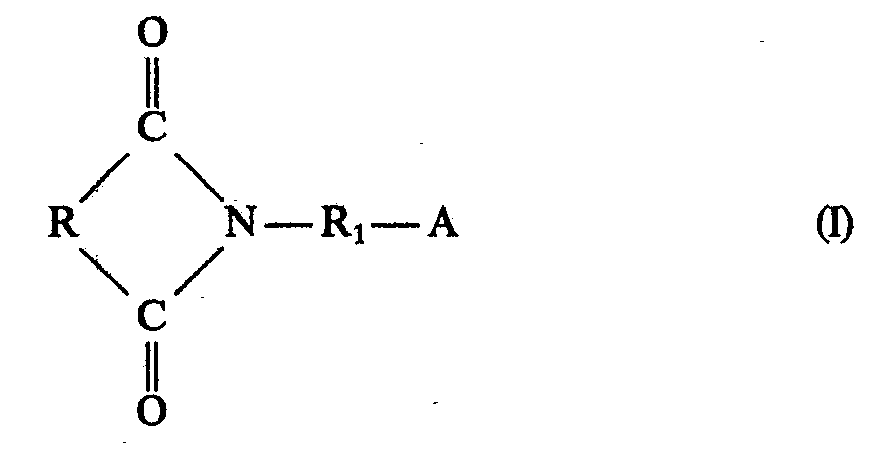
- the starting products of the formula I containing imide groups are those as used in the prior art for the preparation of unsaturated polyesters containing imide groups (DE-PS 1 770 386 and DE-PS 1 570 273). They are usually prepared by reacting amino alcohols or amino carboxylic acids with dicarboxylic acids or their anhydrides, the two carboxyl groups being in the ortho position with respect to one another so that five-membered imide rings can form. These compounds of the formula can be prepared in situ, as is also known in the prior art. This type of manufacture, i.e. H. the reaction with the other starting components is generally preferred since isolation of the compounds of the formula is not necessary and the reaction can be carried out in one operation.
- R represents a monocyclic or bicyclic radical. Those radicals are preferred which contain only carbon atoms.
- the endomethylene tetrahydrophthalic acid is understood in the sense of this definition as a bicyclic compound.
- An example of a bicyclic aromatic radical is that of naphthalene-1,8-dicarboxylic acid.
- the two carboxyl groups of this acid can form a six-membered imide ring with an amino group.
- the naphthalene-1,2-dicarboxylic acid forms a five-membered imide ring with amino groups.
- cycloaliphatic radicals are the corresponding fully or partially hydrogenated aromatic radicals, as defined above.
- aliphatic radicals are those with 2 or 3 carbon atoms, i.e. H.
- Succinic acid and its anhydride are particularly preferred because of their easy accessibility and good reactivity. All of the aforementioned compounds can carry methyl groups and / or halogen atoms as substituents on the carbon atoms. Halogen substituted compounds are particularly preferred when flame retardant properties of the end products are desired. Halogens in particular are chlorine and bromine.
- the group R 1 preferably represents aliphatic radicals with 2 to 5, particularly preferably 2 or 3 Carbon atoms. Monoethanolamine is preferred for ease of access. In principle, however, other corresponding amino compounds can also be used, in particular aminoethane carboxylic acid and the corresponding amino alcohols or amino carboxylic acids containing 3 or 4 CH 2 groups. As a compound with a larger number of carbon atoms, ⁇ -aminocarboxylic acid or the lactam of this acid caprolactam is particularly suitable because of the easy accessibility.
- phthalic acid tetrahydrophthalic acid and endomethylenetetrahydrophthalic acid or the corresponding partially or fully halogenated compounds (with flame retardant properties) are of practical importance as dicarboxylic acids or their anhydrides, other analogous dicarboxylic acids or their anhydrides can also be used, at least in part.
- Unsaturated aliphatic dicarboxylic acids or their anhydrides are mainly maleic acid, fumaric acid, citraconic acid, mesaconic acid and itaconic acid and their existing anhydrides in particular for reasons of easy accessibility and good reactivity.
- Saturated polyvalent carboxylic acids which can optionally be used for the construction of the polyester are those as mentioned above in connection with the compounds of formula 1. So these can additionally, d. H. not only condensed into the polyester molecule via the compounds of the formula.
- the compounds used according to the prior art for the production of polyesters can also be used as compounds containing hydroxyl groups (cf. DE-QS 1 770 386 and DE-AS 1 570 273 already mentioned above).
- Polyols are preferably those with 3 or 4 hydroxyl groups, such as glycerol, trimethylolpropane, trimethylolethane, pentaerythritol, dipentaerythritol, trishydroxyethyl isocyanurate.
- the polyesters according to the invention at least partially contain such polyols as hydroxyl-containing compounds. These then represent, as it were, the center of the individual polyester molecules. Diols can also be condensed into the chains attached to this center, in particular aliphatic diols having 2 to 6 carbon atoms, preferably glycol, neopentyl glycol.
- the essential component of the polyesters according to the invention are the chemically incorporated unsaturated oils.
- a group of such oils are the natural, hydroxy-functional oils, such as castor oil. As is well known, this is a triglyceride, i.e. that is, the glycerin can also be thought of as the center of the polyester molecule in the sense of the above. Esterification with the other starting components for producing the polyesters is achieved via the hydroxyl groups of these hydroxy-functional oils.
- Natural oils are generally preferred because of their easy access. It is also possible as oils, the reaction products of polyols having 3 to 6 hydroxyl groups and the isolated fatty acids be employed wiesieindennat- union oils are contained, or analogous fatty acids containing groups to the reactions with the other starting products for Her - wolfderPolyesterbeschreibtsind.
- isolated fatty acids are linoleic acid, linolenic acid, mixtures of all of these acids can be used.
- Natural unsaturated oils are particularly preferably used according to the invention as oils which have been transesterified with polyols. A partial transesterification is preferred. A part of the fatty acid is therefore split off from the natural oils and replaced by other acids. As such acids, all acids which are suitable for building up polyesters are in principle possible, in particular those as mentioned above.
- the unsaturated oils are used in an amount of 5 to 60% by weight, preferably at least 20% by weight and at most 50% by weight.
- the amount depends on the intended use and the desired properties of the end products. As already mentioned at the beginning, the installation of the oils leads to increased elasticity.
- the lower limit is determined by the degree of elasticity that is at least desired and the upper limit by the need to avoid softness or stickiness of the end products.
- the molecular weight of the polyester according to the invention suitably ranges from 1200 to 5000.
- the lower limit is preferably around 2000; the top purpose at about 4000.
- the preparation is carried out in a manner known per se by heating to temperatures from 130 ° C to 200 ° C.
- the upper limit is determined by avoiding decomposition reactions, the lower limit by adequate reaction in a reasonable time.
- the reaction can be carried out with or without the addition of entraining agents (e.g. xylene), as is also the case in the state of the art. is not usual. If appropriate, conventional esterification catalysts and / or other additives and auxiliaries can be used.
- the unsaturated imide group-containing polyesters made according to the invention have a relatively low average molecular weight and a low e inherent viscosity due to their structure. Your economic steri s cher structure and location of reactive double bonds ensure high reactivity and Vernet - zungsfreudtechnik with polymerizable monomers. The content of imide rings gives the end products an extraordinarily high temperature resistance.
- the polyesters produced according to the invention are preferably for the preparation of copolymers by polymerisation with monomeric vinyl, acryloyl, Me t hacryloyl- and / or allyl compounds.
- they are expediently dissolved in the monomer compounds mentioned, which are generally liquids.
- the polymerization can Room temperature or elevated temperature. It is preferably carried out in the presence of catalysts and / or accelerators known per se.
- the peroxidic catalysts known in this technical field are preferably used as catalysts and metal salts of naphthenic acids and the like are used as accelerators.
- the curing can also be accelerated by high-energy radiation, for example by cobalt-60- ⁇ radiation and / or electron radiation and UV radiation.
- polyesters produced according to the invention have the advantage that, when dissolved in the above-mentioned monomeric compounds, they have a low viscosity which is favorable for processing.
- the end products obtained by reaction with monomeric compounds are distinguished by a combination of various valuable properties. They have an extraordinarily high temperature resistance, but on the other hand are very elastic. The shrinkage is extremely low. A particular advantage is that the oxidative drying of the reaction products of the polyester with the monomeric compounds has a favorable effect on the surface properties. Despite the high oil content, the end products have excellent mechanical properties including sufficient hardness.
- the polyester produced according to the invention can be used in solution in the monomer compounds mentioned as an insulating impregnating or trickling resin or varnish in electrical machine and transformer construction, i. H. as insulation covers for all types of winding.
- the mixtures to be cured from the polyesters prepared according to the invention and the monomeric compounds may contain additives customary in this technical field, such as pigments, extenders and plasticizing components.
- additives customary in this technical field such as pigments, extenders and plasticizing components.
- a particular advantage, however, is that plasticizing components, which are not desirable per se, are not required due to the high elasticity-imparting properties of the polyesters.
- the polycondensation is stopped, the entrainer (xylene) is distilled off in vacuo, 230 mg of toluhydroquinone are added at 150 ° C and 545 g of styrene are added at 108 ° C.
- the resulting styrenic solution has a solids content of 70%, a viscosity of 690 mPa - s / 25 "C and an acid number of 10. It can be used as an impregnating resin and, after curing, gives insulating coatings with excellent mechanical and electrical properties.
- Example 2 Using the same procedure as described in Example 1, 205 g of monoethanolamine and 120 ml of xylene are reacted with 510 g of tetrahydrophthalic anhydride and condensed to an acid number of ⁇ 3 3. Then 119 g of maleic anhydride, 880 g of the precursor from Example 2 and 60 ml of xylene are added and esterified to an acid number of 17 at 185-190 ° C. The entrainer (xylene) is distilled off in vacuo. At 150 ° C is stabilized with 120 mg of toluhydroquinone and diluted at 104 ° C with 810 g of styrene.
- the styrenic solution obtained has a solids content of 65% and a viscosity of 250 mPa. s / 25 ° C and an acid number of 12. It can be used as an impregnating resin and, after curing, gives insulating coatings with excellent mechanical and electrical properties.
Landscapes
- Chemical & Material Sciences (AREA)
- Health & Medical Sciences (AREA)
- Chemical Kinetics & Catalysis (AREA)
- Medicinal Chemistry (AREA)
- Polymers & Plastics (AREA)
- Organic Chemistry (AREA)
- Polyesters Or Polycarbonates (AREA)
- Macromonomer-Based Addition Polymer (AREA)
- Indole Compounds (AREA)
Claims (6)
Priority Applications (1)
| Application Number | Priority Date | Filing Date | Title |
|---|---|---|---|
| AT79105285T ATE8150T1 (de) | 1978-12-23 | 1979-12-20 | Verfahren zur herstellung von ungesaettigten, imidgruppen enthaltenden polyestern und ihre verwendung. |
Applications Claiming Priority (2)
| Application Number | Priority Date | Filing Date | Title |
|---|---|---|---|
| DE2856050 | 1978-12-23 | ||
| DE2856050A DE2856050C2 (de) | 1978-12-23 | 1978-12-23 | Verfahren zur Herstellung von ungesättigten, Imidgruppen enthaltenden Polyestern und ihre Verwendung |
Publications (2)
| Publication Number | Publication Date |
|---|---|
| EP0013397A1 EP0013397A1 (fr) | 1980-07-23 |
| EP0013397B1 true EP0013397B1 (fr) | 1984-06-27 |
Family
ID=6058322
Family Applications (1)
| Application Number | Title | Priority Date | Filing Date |
|---|---|---|---|
| EP79105285A Expired EP0013397B1 (fr) | 1978-12-23 | 1979-12-20 | Procédé de préparation de polyesters insaturés contenant des groupes imides, et leur application |
Country Status (3)
| Country | Link |
|---|---|
| EP (1) | EP0013397B1 (fr) |
| AT (1) | ATE8150T1 (fr) |
| DE (1) | DE2856050C2 (fr) |
Cited By (1)
| Publication number | Priority date | Publication date | Assignee | Title |
|---|---|---|---|---|
| CN105612194B (zh) * | 2013-10-11 | 2018-12-14 | 帝斯曼知识产权资产管理有限公司 | 聚合物和组合物 |
Families Citing this family (4)
| Publication number | Priority date | Publication date | Assignee | Title |
|---|---|---|---|---|
| DE3230924A1 (de) * | 1982-08-20 | 1984-02-23 | Basf Ag, 6700 Ludwigshafen | Verfahren zur herstellung von ungesaettigten polyesterharzen |
| DE3443090A1 (de) * | 1984-11-27 | 1986-05-28 | Bayer Ag, 5090 Leverkusen | Aromatische polyester mit dimethylmaleinimid-endgruppen, ihre herstellung und verwendung |
| DE19920194A1 (de) * | 1999-05-03 | 2000-11-09 | Schramm Lacke Gmbh | Härtbare Harzmasse und deren Verwendung |
| CN102391123B (zh) * | 2011-08-31 | 2013-04-17 | 河南金誉包装科技股份有限公司 | 光固化四氢苯酐化桐油丙烯酸酯树脂的制备方法 |
Family Cites Families (3)
| Publication number | Priority date | Publication date | Assignee | Title |
|---|---|---|---|---|
| DE1495100B2 (de) * | 1961-11-02 | 1972-05-10 | Dr. Beck & Co Ag, 2000 Hamburg | Verfahren zur herstellung von polyesterimiden |
| FR1547106A (fr) * | 1967-02-02 | 1968-11-22 | Gen Precision Systems Inc | Matrice de mémoire |
| DE2460768C3 (de) * | 1974-12-21 | 1982-04-08 | Dr. Beck & Co Ag, 2000 Hamburg | Härtbare wärmebeständige ungesättigte Polyesterharze, insbesondere zur Verwendung in der Elektroindustrie |
-
1978
- 1978-12-23 DE DE2856050A patent/DE2856050C2/de not_active Expired - Fee Related
-
1979
- 1979-12-20 AT AT79105285T patent/ATE8150T1/de not_active IP Right Cessation
- 1979-12-20 EP EP79105285A patent/EP0013397B1/fr not_active Expired
Non-Patent Citations (1)
| Title |
|---|
| Journal of Paint Technology, 39 (506), pages 144-151 (1967) * |
Cited By (1)
| Publication number | Priority date | Publication date | Assignee | Title |
|---|---|---|---|---|
| CN105612194B (zh) * | 2013-10-11 | 2018-12-14 | 帝斯曼知识产权资产管理有限公司 | 聚合物和组合物 |
Also Published As
| Publication number | Publication date |
|---|---|
| DE2856050C2 (de) | 1995-01-19 |
| ATE8150T1 (de) | 1984-07-15 |
| EP0013397A1 (fr) | 1980-07-23 |
| DE2856050A1 (de) | 1980-07-10 |
Similar Documents
| Publication | Publication Date | Title |
|---|---|---|
| DE1770643B2 (de) | Verfahren zur herstellung von ungesaettigten polyestern | |
| DE1720323C3 (de) | Stickstoffhaltige ungesättigte Polyester und Verfahren zu ihrer Herstellung | |
| DE2717597A1 (de) | Elektrisch isolierendes harz | |
| EP0134513B1 (fr) | Masses d'imprégnation et procédé d'isolation d'enroulements électriques | |
| DE3028087A1 (de) | Zusammensetzung aus einem ungesaettigten polyesterharz | |
| DE2856050C2 (de) | Verfahren zur Herstellung von ungesättigten, Imidgruppen enthaltenden Polyestern und ihre Verwendung | |
| CH619808A5 (fr) | ||
| DE2900932A1 (de) | Verfahren zur herstellung von polyesteramiden | |
| DE3115380C2 (de) | Verfahren zur Herstellung ungesättigter Polyester | |
| DE2519672A1 (de) | Imid-modifizierte polyester und diese polyester enthaltende drahtlacke | |
| DE60204786T2 (de) | Verfahren zur herstellung von reaktiven ungesättigten polyesterharzen mit hilfe von 2-methyl-1,3-propandiol | |
| DE1769432A1 (de) | Zweikomponenten-UEberzugsmassen auf Polyurethanbasis | |
| DE1801839A1 (de) | Verfahren zur Herstellung von Alkydharzen | |
| DE1814497C3 (de) | Stickstoffhaltige Polykondensate und deren Verwendung für isolierende Überzüge auf elektrischen Leitern | |
| DE1083370B (de) | Elektrische Leiter mit Polyesterharz-Isolierungen und Verfahren zu deren Herstellung | |
| DE2137884C3 (de) | Verfahren zur Herstellung von stickstoffhaltigen modifizierten Polyesterharzen und diese enthaltende Einbrennlacke | |
| AT212898B (de) | Elektrische Leiter mit Polyesterharz-Isolierungen und Verfahren zu deren Herstellung | |
| EP0196458A2 (fr) | Polyétherpolyester | |
| DE2161253A1 (de) | Verfahren zur herstellung von alkydharzen | |
| AT404134B (de) | Neue polymere vom typ polybutylenterephthalat | |
| DE2460206C2 (de) | Harzmischung auf Polyester- und Polyhydantoinbasis und ihre Verwendung | |
| DE1959934A1 (de) | Ungesaettigte Polyester enthaltende Massen | |
| DE1770386B2 (de) | Verfahren zur Herstellung von Mischpolymerisaten | |
| EP0360188A2 (fr) | Procédé de production de liants durcissables à l'air de faible viscosité pour des peintures d'artistes et en bâtiments vite durcissables et très solides | |
| AT315989B (de) | Verfahren zur Herstellung von wärmehärtbaren Isoliermitteln, insbesondere Lacken |
Legal Events
| Date | Code | Title | Description |
|---|---|---|---|
| PUAI | Public reference made under article 153(3) epc to a published international application that has entered the european phase |
Free format text: ORIGINAL CODE: 0009012 |
|
| AK | Designated contracting states |
Designated state(s): AT BE CH FR GB IT LU NL SE |
|
| 17P | Request for examination filed |
Effective date: 19810114 |
|
| ET1 | Fr: translation filed ** revision of the translation of the patent or the claims | ||
| GRAA | (expected) grant |
Free format text: ORIGINAL CODE: 0009210 |
|
| AK | Designated contracting states |
Designated state(s): AT BE CH FR GB IT LU NL SE |
|
| PG25 | Lapsed in a contracting state [announced via postgrant information from national office to epo] |
Ref country code: SE Effective date: 19840627 Ref country code: NL Effective date: 19840627 Ref country code: IT Free format text: LAPSE BECAUSE OF FAILURE TO SUBMIT A TRANSLATION OF THE DESCRIPTION OR TO PAY THE FEE WITHIN THE PRESCRIBED TIME-LIMIT;WARNING: LAPSES OF ITALIAN PATENTS WITH EFFECTIVE DATE BEFORE 2007 MAY HAVE OCCURRED AT ANY TIME BEFORE 2007. THE CORRECT EFFECTIVE DATE MAY BE DIFFERENT FROM THE ONE RECORDED. Effective date: 19840627 Ref country code: FR Free format text: THE PATENT HAS BEEN ANNULLED BY A DECISION OF A NATIONAL AUTHORITY Effective date: 19840627 Ref country code: BE Effective date: 19840627 |
|
| REF | Corresponds to: |
Ref document number: 8150 Country of ref document: AT Date of ref document: 19840715 Kind code of ref document: T |
|
| NLV1 | Nl: lapsed or annulled due to failure to fulfill the requirements of art. 29p and 29m of the patents act | ||
| PG25 | Lapsed in a contracting state [announced via postgrant information from national office to epo] |
Ref country code: LU Free format text: LAPSE BECAUSE OF NON-PAYMENT OF DUE FEES Effective date: 19841231 |
|
| PLBE | No opposition filed within time limit |
Free format text: ORIGINAL CODE: 0009261 |
|
| STAA | Information on the status of an ep patent application or granted ep patent |
Free format text: STATUS: NO OPPOSITION FILED WITHIN TIME LIMIT |
|
| 26N | No opposition filed | ||
| GBPC | Gb: european patent ceased through non-payment of renewal fee | ||
| EN | Fr: translation not filed | ||
| PG25 | Lapsed in a contracting state [announced via postgrant information from national office to epo] |
Ref country code: GB Effective date: 19881118 |
|
| PGFP | Annual fee paid to national office [announced via postgrant information from national office to epo] |
Ref country code: AT Payment date: 19931217 Year of fee payment: 15 |
|
| PGFP | Annual fee paid to national office [announced via postgrant information from national office to epo] |
Ref country code: CH Payment date: 19931220 Year of fee payment: 15 |
|
| PG25 | Lapsed in a contracting state [announced via postgrant information from national office to epo] |
Ref country code: AT Effective date: 19941220 |
|
| PG25 | Lapsed in a contracting state [announced via postgrant information from national office to epo] |
Ref country code: CH Effective date: 19941231 |
|
| REG | Reference to a national code |
Ref country code: CH Ref legal event code: PL |