EP0011188B1 - Verfahren zur Herstellung von Cyanoaryläthern und Cyanoarylthioäthern - Google Patents
Verfahren zur Herstellung von Cyanoaryläthern und Cyanoarylthioäthern Download PDFInfo
- Publication number
- EP0011188B1 EP0011188B1 EP79104250A EP79104250A EP0011188B1 EP 0011188 B1 EP0011188 B1 EP 0011188B1 EP 79104250 A EP79104250 A EP 79104250A EP 79104250 A EP79104250 A EP 79104250A EP 0011188 B1 EP0011188 B1 EP 0011188B1
- Authority
- EP
- European Patent Office
- Prior art keywords
- cyanoaryl
- parts
- carbonate
- reaction
- ether
- Prior art date
- Legal status (The legal status is an assumption and is not a legal conclusion. Google has not performed a legal analysis and makes no representation as to the accuracy of the status listed.)
- Expired
Links
- -1 cyanoaryl ethers Chemical class 0.000 title claims description 31
- 238000004519 manufacturing process Methods 0.000 title claims description 3
- 150000003254 radicals Chemical class 0.000 claims description 18
- 238000000034 method Methods 0.000 claims description 12
- CSNIZNHTOVFARY-UHFFFAOYSA-N 1,2-benzothiazole Chemical compound C1=CC=C2C=NSC2=C1 CSNIZNHTOVFARY-UHFFFAOYSA-N 0.000 claims description 8
- 125000001931 aliphatic group Chemical group 0.000 claims description 7
- 125000000449 nitro group Chemical group [O-][N+](*)=O 0.000 claims description 6
- BVKZGUZCCUSVTD-UHFFFAOYSA-L Carbonate Chemical compound [O-]C([O-])=O BVKZGUZCCUSVTD-UHFFFAOYSA-L 0.000 claims description 4
- QVGXLLKOCUKJST-UHFFFAOYSA-N atomic oxygen Chemical group [O] QVGXLLKOCUKJST-UHFFFAOYSA-N 0.000 claims description 3
- 125000004093 cyano group Chemical group *C#N 0.000 claims description 3
- 229910052739 hydrogen Inorganic materials 0.000 claims description 3
- 239000001257 hydrogen Substances 0.000 claims description 3
- 229910052760 oxygen Chemical group 0.000 claims description 3
- 239000001301 oxygen Chemical group 0.000 claims description 3
- 125000001997 phenyl group Chemical class [H]C1=C([H])C([H])=C(*)C([H])=C1[H] 0.000 claims description 2
- 150000002431 hydrogen Chemical class 0.000 claims 2
- NINIDFKCEFEMDL-UHFFFAOYSA-N Sulfur Chemical group [S] NINIDFKCEFEMDL-UHFFFAOYSA-N 0.000 claims 1
- 239000005864 Sulphur Substances 0.000 claims 1
- 229910052736 halogen Inorganic materials 0.000 claims 1
- 150000002367 halogens Chemical class 0.000 claims 1
- 238000007086 side reaction Methods 0.000 claims 1
- OKKJLVBELUTLKV-UHFFFAOYSA-N Methanol Chemical compound OC OKKJLVBELUTLKV-UHFFFAOYSA-N 0.000 description 27
- 238000006243 chemical reaction Methods 0.000 description 23
- 239000007858 starting material Substances 0.000 description 23
- IEJIGPNLZYLLBP-UHFFFAOYSA-N dimethyl carbonate Chemical compound COC(=O)OC IEJIGPNLZYLLBP-UHFFFAOYSA-N 0.000 description 16
- RTZKZFJDLAIYFH-UHFFFAOYSA-N ether Substances CCOCC RTZKZFJDLAIYFH-UHFFFAOYSA-N 0.000 description 15
- 239000003054 catalyst Substances 0.000 description 10
- 125000004432 carbon atom Chemical group C* 0.000 description 8
- 239000000203 mixture Substances 0.000 description 7
- 230000007306 turnover Effects 0.000 description 7
- MCTWTZJPVLRJOU-UHFFFAOYSA-N 1-methyl-1H-imidazole Chemical compound CN1C=CN=C1 MCTWTZJPVLRJOU-UHFFFAOYSA-N 0.000 description 6
- LFQSCWFLJHTTHZ-UHFFFAOYSA-N Ethanol Chemical compound CCO LFQSCWFLJHTTHZ-UHFFFAOYSA-N 0.000 description 6
- JUJWROOIHBZHMG-UHFFFAOYSA-N Pyridine Chemical compound C1=CC=NC=C1 JUJWROOIHBZHMG-UHFFFAOYSA-N 0.000 description 6
- 239000007795 chemical reaction product Substances 0.000 description 6
- 239000002904 solvent Substances 0.000 description 6
- 125000003277 amino group Chemical group 0.000 description 5
- 125000004435 hydrogen atom Chemical group [H]* 0.000 description 5
- 229910052757 nitrogen Inorganic materials 0.000 description 5
- 150000004649 carbonic acid derivatives Chemical class 0.000 description 4
- 125000002924 primary amino group Chemical group [H]N([H])* 0.000 description 4
- GETQZCLCWQTVFV-UHFFFAOYSA-N trimethylamine Chemical compound CN(C)C GETQZCLCWQTVFV-UHFFFAOYSA-N 0.000 description 4
- PBKONEOXTCPAFI-UHFFFAOYSA-N 1,2,4-trichlorobenzene Chemical compound ClC1=CC=C(Cl)C(Cl)=C1 PBKONEOXTCPAFI-UHFFFAOYSA-N 0.000 description 3
- AOYOBWSGCQMROU-UHFFFAOYSA-N 2-sulfanylbenzonitrile Chemical class SC1=CC=CC=C1C#N AOYOBWSGCQMROU-UHFFFAOYSA-N 0.000 description 3
- PEDCQBHIVMGVHV-UHFFFAOYSA-N Glycerine Chemical compound OCC(O)CO PEDCQBHIVMGVHV-UHFFFAOYSA-N 0.000 description 3
- RWRDLPDLKQPQOW-UHFFFAOYSA-N Pyrrolidine Chemical compound C1CCNC1 RWRDLPDLKQPQOW-UHFFFAOYSA-N 0.000 description 3
- YXFVVABEGXRONW-UHFFFAOYSA-N Toluene Chemical compound CC1=CC=CC=C1 YXFVVABEGXRONW-UHFFFAOYSA-N 0.000 description 3
- 238000009835 boiling Methods 0.000 description 3
- 150000001875 compounds Chemical class 0.000 description 3
- VLKZOEOYAKHREP-UHFFFAOYSA-N n-Hexane Chemical compound CCCCCC VLKZOEOYAKHREP-UHFFFAOYSA-N 0.000 description 3
- 238000002360 preparation method Methods 0.000 description 3
- UMJSCPRVCHMLSP-UHFFFAOYSA-N pyridine Natural products COC1=CC=CN=C1 UMJSCPRVCHMLSP-UHFFFAOYSA-N 0.000 description 3
- 150000003839 salts Chemical class 0.000 description 3
- 0 *C1C(*SC2)=C2C(NI)=C(*)C1* Chemical compound *C1C(*SC2)=C2C(NI)=C(*)C1* 0.000 description 2
- LPUJHVNRGNTQPL-UHFFFAOYSA-N 1,2-benzothiazol-5-amine Chemical compound NC1=CC=C2SN=CC2=C1 LPUJHVNRGNTQPL-UHFFFAOYSA-N 0.000 description 2
- BBMCTIGTTCKYKF-UHFFFAOYSA-N 1-heptanol Chemical compound CCCCCCCO BBMCTIGTTCKYKF-UHFFFAOYSA-N 0.000 description 2
- QPUYECUOLPXSFR-UHFFFAOYSA-N 1-methylnaphthalene Chemical compound C1=CC=C2C(C)=CC=CC2=C1 QPUYECUOLPXSFR-UHFFFAOYSA-N 0.000 description 2
- JYYNAJVZFGKDEQ-UHFFFAOYSA-N 2,4-Dimethylpyridine Chemical compound CC1=CC=NC(C)=C1 JYYNAJVZFGKDEQ-UHFFFAOYSA-N 0.000 description 2
- TZYRSLHNPKPEFV-UHFFFAOYSA-N 2-ethyl-1-butanol Chemical compound CCC(CC)CO TZYRSLHNPKPEFV-UHFFFAOYSA-N 0.000 description 2
- YIWUKEYIRIRTPP-UHFFFAOYSA-N 2-ethylhexan-1-ol Chemical compound CCCCC(CC)CO YIWUKEYIRIRTPP-UHFFFAOYSA-N 0.000 description 2
- SZNYYWIUQFZLLT-UHFFFAOYSA-N 2-methyl-1-(2-methylpropoxy)propane Chemical compound CC(C)COCC(C)C SZNYYWIUQFZLLT-UHFFFAOYSA-N 0.000 description 2
- VHYFNPMBLIVWCW-UHFFFAOYSA-N 4-Dimethylaminopyridine Chemical compound CN(C)C1=CC=NC=C1 VHYFNPMBLIVWCW-UHFFFAOYSA-N 0.000 description 2
- AUYJMVMBVRSCMW-UHFFFAOYSA-N 5-nitro-1,2-benzothiazole Chemical compound [O-][N+](=O)C1=CC=C2SN=CC2=C1 AUYJMVMBVRSCMW-UHFFFAOYSA-N 0.000 description 2
- CURLTUGMZLYLDI-UHFFFAOYSA-N Carbon dioxide Chemical compound O=C=O CURLTUGMZLYLDI-UHFFFAOYSA-N 0.000 description 2
- OIFBSDVPJOWBCH-UHFFFAOYSA-N Diethyl carbonate Chemical compound CCOC(=O)OCC OIFBSDVPJOWBCH-UHFFFAOYSA-N 0.000 description 2
- XTHFKEDIFFGKHM-UHFFFAOYSA-N Dimethoxyethane Chemical compound COCCOC XTHFKEDIFFGKHM-UHFFFAOYSA-N 0.000 description 2
- YNQLUTRBYVCPMQ-UHFFFAOYSA-N Ethylbenzene Chemical compound CCC1=CC=CC=C1 YNQLUTRBYVCPMQ-UHFFFAOYSA-N 0.000 description 2
- LYCAIKOWRPUZTN-UHFFFAOYSA-N Ethylene glycol Chemical compound OCCO LYCAIKOWRPUZTN-UHFFFAOYSA-N 0.000 description 2
- KFZMGEQAYNKOFK-UHFFFAOYSA-N Isopropanol Chemical compound CC(C)O KFZMGEQAYNKOFK-UHFFFAOYSA-N 0.000 description 2
- BZLVMXJERCGZMT-UHFFFAOYSA-N Methyl tert-butyl ether Chemical compound COC(C)(C)C BZLVMXJERCGZMT-UHFFFAOYSA-N 0.000 description 2
- YNAVUWVOSKDBBP-UHFFFAOYSA-N Morpholine Chemical compound C1COCCN1 YNAVUWVOSKDBBP-UHFFFAOYSA-N 0.000 description 2
- LRHPLDYGYMQRHN-UHFFFAOYSA-N N-Butanol Chemical compound CCCCO LRHPLDYGYMQRHN-UHFFFAOYSA-N 0.000 description 2
- IMNFDUFMRHMDMM-UHFFFAOYSA-N N-Heptane Chemical compound CCCCCCC IMNFDUFMRHMDMM-UHFFFAOYSA-N 0.000 description 2
- URLKBWYHVLBVBO-UHFFFAOYSA-N Para-Xylene Chemical group CC1=CC=C(C)C=C1 URLKBWYHVLBVBO-UHFFFAOYSA-N 0.000 description 2
- NQRYJNQNLNOLGT-UHFFFAOYSA-N Piperidine Chemical compound C1CCNCC1 NQRYJNQNLNOLGT-UHFFFAOYSA-N 0.000 description 2
- SMWDFEZZVXVKRB-UHFFFAOYSA-N Quinoline Chemical compound N1=CC=CC2=CC=CC=C21 SMWDFEZZVXVKRB-UHFFFAOYSA-N 0.000 description 2
- DKGAVHZHDRPRBM-UHFFFAOYSA-N Tert-Butanol Chemical compound CC(C)(C)O DKGAVHZHDRPRBM-UHFFFAOYSA-N 0.000 description 2
- YUDRVAHLXDBKSR-UHFFFAOYSA-N [CH]1CCCCC1 Chemical compound [CH]1CCCCC1 YUDRVAHLXDBKSR-UHFFFAOYSA-N 0.000 description 2
- CIUQDSCDWFSTQR-UHFFFAOYSA-N [C]1=CC=CC=C1 Chemical compound [C]1=CC=CC=C1 CIUQDSCDWFSTQR-UHFFFAOYSA-N 0.000 description 2
- DZBUGLKDJFMEHC-UHFFFAOYSA-N acridine Chemical compound C1=CC=CC2=CC3=CC=CC=C3N=C21 DZBUGLKDJFMEHC-UHFFFAOYSA-N 0.000 description 2
- RDOXTESZEPMUJZ-UHFFFAOYSA-N anisole Chemical compound COC1=CC=CC=C1 RDOXTESZEPMUJZ-UHFFFAOYSA-N 0.000 description 2
- 150000001555 benzenes Chemical class 0.000 description 2
- 230000015572 biosynthetic process Effects 0.000 description 2
- 239000006227 byproduct Substances 0.000 description 2
- 229910052801 chlorine Inorganic materials 0.000 description 2
- MVPPADPHJFYWMZ-UHFFFAOYSA-N chlorobenzene Chemical compound ClC1=CC=CC=C1 MVPPADPHJFYWMZ-UHFFFAOYSA-N 0.000 description 2
- RWGFKTVRMDUZSP-UHFFFAOYSA-N cumene Chemical compound CC(C)C1=CC=CC=C1 RWGFKTVRMDUZSP-UHFFFAOYSA-N 0.000 description 2
- NNBZCPXTIHJBJL-UHFFFAOYSA-N decalin Chemical compound C1CCCC2CCCCC21 NNBZCPXTIHJBJL-UHFFFAOYSA-N 0.000 description 2
- PIZLBWGMERQCOC-UHFFFAOYSA-N dibenzyl carbonate Chemical compound C=1C=CC=CC=1COC(=O)OCC1=CC=CC=C1 PIZLBWGMERQCOC-UHFFFAOYSA-N 0.000 description 2
- HRKQOINLCJTGBK-UHFFFAOYSA-N dihydroxidosulfur Chemical compound OSO HRKQOINLCJTGBK-UHFFFAOYSA-N 0.000 description 2
- VAYGXNSJCAHWJZ-UHFFFAOYSA-N dimethyl sulfate Chemical compound COS(=O)(=O)OC VAYGXNSJCAHWJZ-UHFFFAOYSA-N 0.000 description 2
- VUPKGFBOKBGHFZ-UHFFFAOYSA-N dipropyl carbonate Chemical compound CCCOC(=O)OCCC VUPKGFBOKBGHFZ-UHFFFAOYSA-N 0.000 description 2
- LQZZUXJYWNFBMV-UHFFFAOYSA-N dodecan-1-ol Chemical compound CCCCCCCCCCCCO LQZZUXJYWNFBMV-UHFFFAOYSA-N 0.000 description 2
- 230000007613 environmental effect Effects 0.000 description 2
- 150000002170 ethers Chemical class 0.000 description 2
- JBTWLSYIZRCDFO-UHFFFAOYSA-N ethyl methyl carbonate Chemical compound CCOC(=O)OC JBTWLSYIZRCDFO-UHFFFAOYSA-N 0.000 description 2
- 229910052731 fluorine Inorganic materials 0.000 description 2
- 125000002887 hydroxy group Chemical group [H]O* 0.000 description 2
- INQOMBQAUSQDDS-UHFFFAOYSA-N iodomethane Chemical compound IC INQOMBQAUSQDDS-UHFFFAOYSA-N 0.000 description 2
- ZXEKIIBDNHEJCQ-UHFFFAOYSA-N isobutanol Chemical compound CC(C)CO ZXEKIIBDNHEJCQ-UHFFFAOYSA-N 0.000 description 2
- AWJUIBRHMBBTKR-UHFFFAOYSA-N isoquinoline Chemical compound C1=NC=CC2=CC=CC=C21 AWJUIBRHMBBTKR-UHFFFAOYSA-N 0.000 description 2
- 230000001035 methylating effect Effects 0.000 description 2
- UAEPNZWRGJTJPN-UHFFFAOYSA-N methylcyclohexane Chemical compound CC1CCCCC1 UAEPNZWRGJTJPN-UHFFFAOYSA-N 0.000 description 2
- DAZXVJBJRMWXJP-UHFFFAOYSA-N n,n-dimethylethylamine Chemical compound CCN(C)C DAZXVJBJRMWXJP-UHFFFAOYSA-N 0.000 description 2
- ZWRUINPWMLAQRD-UHFFFAOYSA-N nonan-1-ol Chemical compound CCCCCCCCCO ZWRUINPWMLAQRD-UHFFFAOYSA-N 0.000 description 2
- 125000004430 oxygen atom Chemical group O* 0.000 description 2
- 229920002717 polyvinylpyridine Polymers 0.000 description 2
- BDERNNFJNOPAEC-UHFFFAOYSA-N propan-1-ol Chemical compound CCCO BDERNNFJNOPAEC-UHFFFAOYSA-N 0.000 description 2
- XSCHRSMBECNVNS-UHFFFAOYSA-N quinoxaline Chemical compound N1=CC=NC2=CC=CC=C21 XSCHRSMBECNVNS-UHFFFAOYSA-N 0.000 description 2
- 239000011541 reaction mixture Substances 0.000 description 2
- 229910052717 sulfur Inorganic materials 0.000 description 2
- 125000004434 sulfur atom Chemical group 0.000 description 2
- IMNIMPAHZVJRPE-UHFFFAOYSA-N triethylenediamine Chemical compound C1CN2CCN1CC2 IMNIMPAHZVJRPE-UHFFFAOYSA-N 0.000 description 2
- QAWYXJLLFCHARM-UHFFFAOYSA-N 1,2-benzothiazole-4,7-diamine Chemical compound NC1=CC=C(N)C2=C1C=NS2 QAWYXJLLFCHARM-UHFFFAOYSA-N 0.000 description 1
- RFFLAFLAYFXFSW-UHFFFAOYSA-N 1,2-dichlorobenzene Chemical compound ClC1=CC=CC=C1Cl RFFLAFLAYFXFSW-UHFFFAOYSA-N 0.000 description 1
- ZPQOPVIELGIULI-UHFFFAOYSA-N 1,3-dichlorobenzene Chemical compound ClC1=CC=CC(Cl)=C1 ZPQOPVIELGIULI-UHFFFAOYSA-N 0.000 description 1
- RYHBNJHYFVUHQT-UHFFFAOYSA-N 1,4-Dioxane Chemical compound C1COCCO1 RYHBNJHYFVUHQT-UHFFFAOYSA-N 0.000 description 1
- OXHNLMTVIGZXSG-UHFFFAOYSA-N 1-Methylpyrrole Chemical compound CN1C=CC=C1 OXHNLMTVIGZXSG-UHFFFAOYSA-N 0.000 description 1
- DURPTKYDGMDSBL-UHFFFAOYSA-N 1-butoxybutane Chemical compound CCCCOCCCC DURPTKYDGMDSBL-UHFFFAOYSA-N 0.000 description 1
- PZHIWRCQKBBTOW-UHFFFAOYSA-N 1-ethoxybutane Chemical compound CCCCOCC PZHIWRCQKBBTOW-UHFFFAOYSA-N 0.000 description 1
- NVJUHMXYKCUMQA-UHFFFAOYSA-N 1-ethoxypropane Chemical compound CCCOCC NVJUHMXYKCUMQA-UHFFFAOYSA-N 0.000 description 1
- IPIZOWWDARWEHT-UHFFFAOYSA-N 1-methylsulfanylnaphthalene-2-carbonitrile Chemical compound C1=CC=C2C(SC)=C(C#N)C=CC2=C1 IPIZOWWDARWEHT-UHFFFAOYSA-N 0.000 description 1
- XTDQDBVBDLYELW-UHFFFAOYSA-N 2,2,3-trimethylpentane Chemical compound CCC(C)C(C)(C)C XTDQDBVBDLYELW-UHFFFAOYSA-N 0.000 description 1
- OKVWYBALHQFVFP-UHFFFAOYSA-N 2,3,3-trimethylpentane Chemical compound CCC(C)(C)C(C)C OKVWYBALHQFVFP-UHFFFAOYSA-N 0.000 description 1
- XNWFRZJHXBZDAG-UHFFFAOYSA-N 2-METHOXYETHANOL Chemical compound COCCO XNWFRZJHXBZDAG-UHFFFAOYSA-N 0.000 description 1
- PMOQQMPIMGZLDI-UHFFFAOYSA-N 2-chloro-6-methylsulfanylbenzonitrile Chemical compound CSC1=CC=CC(Cl)=C1C#N PMOQQMPIMGZLDI-UHFFFAOYSA-N 0.000 description 1
- ZNQVEEAIQZEUHB-UHFFFAOYSA-N 2-ethoxyethanol Chemical compound CCOCCO ZNQVEEAIQZEUHB-UHFFFAOYSA-N 0.000 description 1
- LTYIIDMVVUWOGP-UHFFFAOYSA-N 2-methoxy-5-nitrobenzonitrile Chemical compound COC1=CC=C([N+]([O-])=O)C=C1C#N LTYIIDMVVUWOGP-UHFFFAOYSA-N 0.000 description 1
- PXZSANDJGNKIIA-UHFFFAOYSA-N 2-methylsulfanylbenzonitrile Chemical compound CSC1=CC=CC=C1C#N PXZSANDJGNKIIA-UHFFFAOYSA-N 0.000 description 1
- QMJWPWCKRKHUNY-UHFFFAOYSA-N 2-phenylsulfanylacetonitrile Chemical class N#CCSC1=CC=CC=C1 QMJWPWCKRKHUNY-UHFFFAOYSA-N 0.000 description 1
- KKMLBQDVETVAIW-UHFFFAOYSA-N 3,6-bis(dimethylamino)-2-methylsulfanylbenzonitrile Chemical compound CSC1=C(N(C)C)C=CC(N(C)C)=C1C#N KKMLBQDVETVAIW-UHFFFAOYSA-N 0.000 description 1
- PYEWZDAEJUUIJX-UHFFFAOYSA-N 3-(dimethylamino)-2,2-dimethylpropan-1-ol Chemical compound CN(C)CC(C)(C)CO PYEWZDAEJUUIJX-UHFFFAOYSA-N 0.000 description 1
- BCPVKLRBQLRWDQ-UHFFFAOYSA-N 3-chloro-1,2-benzothiazole Chemical class C1=CC=C2C(Cl)=NSC2=C1 BCPVKLRBQLRWDQ-UHFFFAOYSA-N 0.000 description 1
- NPDACUSDTOMAMK-UHFFFAOYSA-N 4-Chlorotoluene Chemical compound CC1=CC=C(Cl)C=C1 NPDACUSDTOMAMK-UHFFFAOYSA-N 0.000 description 1
- DHLIRMWNYRKKPN-UHFFFAOYSA-N 4-chloro-1,2-benzothiazole Chemical compound ClC1=CC=CC2=C1C=NS2 DHLIRMWNYRKKPN-UHFFFAOYSA-N 0.000 description 1
- XDTUFZHKJPYGKG-UHFFFAOYSA-N 4-ethoxy-4-propoxy-3H-pyridine Chemical compound C(C)OC1(CC=NC=C1)OCCC XDTUFZHKJPYGKG-UHFFFAOYSA-N 0.000 description 1
- WVYWICLMDOOCFB-UHFFFAOYSA-N 4-methyl-2-pentanol Chemical compound CC(C)CC(C)O WVYWICLMDOOCFB-UHFFFAOYSA-N 0.000 description 1
- MQWCXKGKQLNYQG-UHFFFAOYSA-N 4-methylcyclohexan-1-ol Chemical compound CC1CCC(O)CC1 MQWCXKGKQLNYQG-UHFFFAOYSA-N 0.000 description 1
- JAWZAONCXMJLFT-UHFFFAOYSA-N 4-propylpyridine Chemical compound CCCC1=CC=NC=C1 JAWZAONCXMJLFT-UHFFFAOYSA-N 0.000 description 1
- NWASWUXAEVCBTL-UHFFFAOYSA-N 5-(dimethylamino)-2-methylsulfanylbenzonitrile Chemical compound CSC1=CC=C(N(C)C)C=C1C#N NWASWUXAEVCBTL-UHFFFAOYSA-N 0.000 description 1
- SSDTWVIEPBSVNE-UHFFFAOYSA-N 5-(methylamino)-2-methylsulfanylbenzonitrile Chemical compound CNC1=CC=C(SC)C(C#N)=C1 SSDTWVIEPBSVNE-UHFFFAOYSA-N 0.000 description 1
- ZVHAANQOQZVVFD-UHFFFAOYSA-N 5-methylhexan-1-ol Chemical compound CC(C)CCCCO ZVHAANQOQZVVFD-UHFFFAOYSA-N 0.000 description 1
- WKBOTKDWSSQWDR-UHFFFAOYSA-N Bromine atom Chemical group [Br] WKBOTKDWSSQWDR-UHFFFAOYSA-N 0.000 description 1
- UGFAIRIUMAVXCW-UHFFFAOYSA-N Carbon monoxide Chemical compound [O+]#[C-] UGFAIRIUMAVXCW-UHFFFAOYSA-N 0.000 description 1
- ZAMOUSCENKQFHK-UHFFFAOYSA-N Chlorine atom Chemical compound [Cl] ZAMOUSCENKQFHK-UHFFFAOYSA-N 0.000 description 1
- RYGMFSIKBFXOCR-UHFFFAOYSA-N Copper Chemical compound [Cu] RYGMFSIKBFXOCR-UHFFFAOYSA-N 0.000 description 1
- XFXPMWWXUTWYJX-UHFFFAOYSA-N Cyanide Chemical compound N#[C-] XFXPMWWXUTWYJX-UHFFFAOYSA-N 0.000 description 1
- XDTMQSROBMDMFD-UHFFFAOYSA-N Cyclohexane Chemical compound C1CCCCC1 XDTMQSROBMDMFD-UHFFFAOYSA-N 0.000 description 1
- AQZGPSLYZOOYQP-UHFFFAOYSA-N Diisoamyl ether Chemical compound CC(C)CCOCCC(C)C AQZGPSLYZOOYQP-UHFFFAOYSA-N 0.000 description 1
- ZAFNJMIOTHYJRJ-UHFFFAOYSA-N Diisopropyl ether Chemical compound CC(C)OC(C)C ZAFNJMIOTHYJRJ-UHFFFAOYSA-N 0.000 description 1
- PXGOKWXKJXAPGV-UHFFFAOYSA-N Fluorine Chemical compound FF PXGOKWXKJXAPGV-UHFFFAOYSA-N 0.000 description 1
- WRYCSMQKUKOKBP-UHFFFAOYSA-N Imidazolidine Chemical compound C1CNCN1 WRYCSMQKUKOKBP-UHFFFAOYSA-N 0.000 description 1
- NHTMVDHEPJAVLT-UHFFFAOYSA-N Isooctane Chemical compound CC(C)CC(C)(C)C NHTMVDHEPJAVLT-UHFFFAOYSA-N 0.000 description 1
- DJEQZVQFEPKLOY-UHFFFAOYSA-N N,N-dimethylbutylamine Chemical compound CCCCN(C)C DJEQZVQFEPKLOY-UHFFFAOYSA-N 0.000 description 1
- SVYKKECYCPFKGB-UHFFFAOYSA-N N,N-dimethylcyclohexylamine Chemical compound CN(C)C1CCCCC1 SVYKKECYCPFKGB-UHFFFAOYSA-N 0.000 description 1
- AMQJEAYHLZJPGS-UHFFFAOYSA-N N-Pentanol Chemical compound CCCCCO AMQJEAYHLZJPGS-UHFFFAOYSA-N 0.000 description 1
- YGYAWVDWMABLBF-UHFFFAOYSA-N Phosgene Chemical compound ClC(Cl)=O YGYAWVDWMABLBF-UHFFFAOYSA-N 0.000 description 1
- CZPWVGJYEJSRLH-UHFFFAOYSA-N Pyrimidine Chemical compound C1=CN=CN=C1 CZPWVGJYEJSRLH-UHFFFAOYSA-N 0.000 description 1
- 238000006887 Ullmann reaction Methods 0.000 description 1
- YDBQJGWNFSPUNX-UHFFFAOYSA-N [O-][N+](=O)BrC#N Chemical compound [O-][N+](=O)BrC#N YDBQJGWNFSPUNX-UHFFFAOYSA-N 0.000 description 1
- 125000003545 alkoxy group Chemical group 0.000 description 1
- 125000000217 alkyl group Chemical group 0.000 description 1
- 150000001412 amines Chemical class 0.000 description 1
- 150000004945 aromatic hydrocarbons Chemical class 0.000 description 1
- 125000001797 benzyl group Chemical group [H]C1=C([H])C([H])=C(C([H])=C1[H])C([H])([H])* 0.000 description 1
- UXXXZMDJQLPQPH-UHFFFAOYSA-N bis(2-methylpropyl) carbonate Chemical compound CC(C)COC(=O)OCC(C)C UXXXZMDJQLPQPH-UHFFFAOYSA-N 0.000 description 1
- 125000006309 butyl amino group Chemical group 0.000 description 1
- 229910002092 carbon dioxide Inorganic materials 0.000 description 1
- 239000001569 carbon dioxide Substances 0.000 description 1
- 229910002091 carbon monoxide Inorganic materials 0.000 description 1
- 239000003795 chemical substances by application Substances 0.000 description 1
- 239000000460 chlorine Substances 0.000 description 1
- 125000001309 chloro group Chemical group Cl* 0.000 description 1
- 229910052802 copper Inorganic materials 0.000 description 1
- 239000010949 copper Substances 0.000 description 1
- IBAHLNWTOIHLKE-UHFFFAOYSA-N cyano cyanate Chemical class N#COC#N IBAHLNWTOIHLKE-UHFFFAOYSA-N 0.000 description 1
- RFMQOHXWHFHOJF-UHFFFAOYSA-N cyano thiocyanate Chemical class N#CSC#N RFMQOHXWHFHOJF-UHFFFAOYSA-N 0.000 description 1
- HPXRVTGHNJAIIH-UHFFFAOYSA-N cyclohexanol Chemical compound OC1CCCCC1 HPXRVTGHNJAIIH-UHFFFAOYSA-N 0.000 description 1
- 125000000113 cyclohexyl group Chemical group [H]C1([H])C([H])([H])C([H])([H])C([H])(*)C([H])([H])C1([H])[H] 0.000 description 1
- 230000006735 deficit Effects 0.000 description 1
- 150000004985 diamines Chemical class 0.000 description 1
- QLVWOKQMDLQXNN-UHFFFAOYSA-N dibutyl carbonate Chemical compound CCCCOC(=O)OCCCC QLVWOKQMDLQXNN-UHFFFAOYSA-N 0.000 description 1
- NAPSCFZYZVSQHF-UHFFFAOYSA-N dimantine Chemical compound CCCCCCCCCCCCCCCCCCN(C)C NAPSCFZYZVSQHF-UHFFFAOYSA-N 0.000 description 1
- 229950010007 dimantine Drugs 0.000 description 1
- 150000002019 disulfides Chemical class 0.000 description 1
- 239000000975 dye Substances 0.000 description 1
- 150000002148 esters Chemical class 0.000 description 1
- 125000001495 ethyl group Chemical group [H]C([H])([H])C([H])([H])* 0.000 description 1
- CYEDOLFRAIXARV-UHFFFAOYSA-N ethyl propyl carbonate Chemical compound CCCOC(=O)OCC CYEDOLFRAIXARV-UHFFFAOYSA-N 0.000 description 1
- 239000011737 fluorine Substances 0.000 description 1
- 125000001153 fluoro group Chemical group F* 0.000 description 1
- 238000004508 fractional distillation Methods 0.000 description 1
- 239000003205 fragrance Substances 0.000 description 1
- 125000005843 halogen group Chemical group 0.000 description 1
- ZSIAUFGUXNUGDI-UHFFFAOYSA-N hexan-1-ol Chemical compound CCCCCCO ZSIAUFGUXNUGDI-UHFFFAOYSA-N 0.000 description 1
- 231100000086 high toxicity Toxicity 0.000 description 1
- 229930195733 hydrocarbon Natural products 0.000 description 1
- 150000002430 hydrocarbons Chemical class 0.000 description 1
- 150000002440 hydroxy compounds Chemical class 0.000 description 1
- WGCNASOHLSPBMP-UHFFFAOYSA-N hydroxyacetaldehyde Natural products OCC=O WGCNASOHLSPBMP-UHFFFAOYSA-N 0.000 description 1
- 229910017053 inorganic salt Inorganic materials 0.000 description 1
- 125000000959 isobutyl group Chemical group [H]C([H])([H])C([H])(C([H])([H])[H])C([H])([H])* 0.000 description 1
- 125000001449 isopropyl group Chemical group [H]C([H])([H])C([H])(*)C([H])([H])[H] 0.000 description 1
- UZKWTJUDCOPSNM-UHFFFAOYSA-N methoxybenzene Substances CCCCOC=C UZKWTJUDCOPSNM-UHFFFAOYSA-N 0.000 description 1
- GHDIHPNJQVDFBL-UHFFFAOYSA-N methoxycyclohexane Chemical compound COC1CCCCC1 GHDIHPNJQVDFBL-UHFFFAOYSA-N 0.000 description 1
- 125000002496 methyl group Chemical group [H]C([H])([H])* 0.000 description 1
- KKQAVHGECIBFRQ-UHFFFAOYSA-N methyl propyl carbonate Chemical compound CCCOC(=O)OC KKQAVHGECIBFRQ-UHFFFAOYSA-N 0.000 description 1
- GYNNXHKOJHMOHS-UHFFFAOYSA-N methyl-cycloheptane Natural products CC1CCCCCC1 GYNNXHKOJHMOHS-UHFFFAOYSA-N 0.000 description 1
- JJWRKQIITDNSSJ-UHFFFAOYSA-N n,n-didecylaniline Chemical compound CCCCCCCCCCN(CCCCCCCCCC)C1=CC=CC=C1 JJWRKQIITDNSSJ-UHFFFAOYSA-N 0.000 description 1
- ODKLEQPZOCJQMT-UHFFFAOYSA-N n,n-diethylpyridin-4-amine Chemical compound CCN(CC)C1=CC=NC=C1 ODKLEQPZOCJQMT-UHFFFAOYSA-N 0.000 description 1
- YWFWDNVOPHGWMX-UHFFFAOYSA-N n,n-dimethyldodecan-1-amine Chemical compound CCCCCCCCCCCCN(C)C YWFWDNVOPHGWMX-UHFFFAOYSA-N 0.000 description 1
- QERPFDRCBSOYMF-UHFFFAOYSA-N n,n-dipropylpyridin-4-amine Chemical compound CCCN(CCC)C1=CC=NC=C1 QERPFDRCBSOYMF-UHFFFAOYSA-N 0.000 description 1
- 125000004108 n-butyl group Chemical group [H]C([H])([H])C([H])([H])C([H])([H])C([H])([H])* 0.000 description 1
- 125000004123 n-propyl group Chemical group [H]C([H])([H])C([H])([H])C([H])([H])* 0.000 description 1
- QUSFOLYSOPZYIK-UHFFFAOYSA-N naphthalen-1-yl cyanate Chemical class C1=CC=C2C(OC#N)=CC=CC2=C1 QUSFOLYSOPZYIK-UHFFFAOYSA-N 0.000 description 1
- 238000006386 neutralization reaction Methods 0.000 description 1
- 125000004433 nitrogen atom Chemical group N* 0.000 description 1
- ZCYXXKJEDCHMGH-UHFFFAOYSA-N nonane Chemical compound CCCC[CH]CCCC ZCYXXKJEDCHMGH-UHFFFAOYSA-N 0.000 description 1
- 231100000252 nontoxic Toxicity 0.000 description 1
- 230000003000 nontoxic effect Effects 0.000 description 1
- BKIMMITUMNQMOS-UHFFFAOYSA-N normal nonane Natural products CCCCCCCCC BKIMMITUMNQMOS-UHFFFAOYSA-N 0.000 description 1
- TVMXDCGIABBOFY-UHFFFAOYSA-N octane Chemical compound CCCCCCCC TVMXDCGIABBOFY-UHFFFAOYSA-N 0.000 description 1
- 150000007524 organic acids Chemical class 0.000 description 1
- 235000005985 organic acids Nutrition 0.000 description 1
- 239000003208 petroleum Substances 0.000 description 1
- DLRJIFUOBPOJNS-UHFFFAOYSA-N phenetole Chemical compound CCOC1=CC=CC=C1 DLRJIFUOBPOJNS-UHFFFAOYSA-N 0.000 description 1
- 229920000642 polymer Polymers 0.000 description 1
- 239000011814 protection agent Substances 0.000 description 1
- USPWKWBDZOARPV-UHFFFAOYSA-N pyrazolidine Chemical compound C1CNNC1 USPWKWBDZOARPV-UHFFFAOYSA-N 0.000 description 1
- 150000003222 pyridines Chemical class 0.000 description 1
- JWVCLYRUEFBMGU-UHFFFAOYSA-N quinazoline Chemical compound N1=CN=CC2=CC=CC=C21 JWVCLYRUEFBMGU-UHFFFAOYSA-N 0.000 description 1
- 239000000376 reactant Substances 0.000 description 1
- 230000035484 reaction time Effects 0.000 description 1
- 238000007142 ring opening reaction Methods 0.000 description 1
- 238000000926 separation method Methods 0.000 description 1
- 239000000126 substance Substances 0.000 description 1
- 125000001424 substituent group Chemical group 0.000 description 1
- 238000006467 substitution reaction Methods 0.000 description 1
- 239000000725 suspension Substances 0.000 description 1
- 150000003512 tertiary amines Chemical class 0.000 description 1
- 125000001302 tertiary amino group Chemical group 0.000 description 1
- 150000003568 thioethers Chemical class 0.000 description 1
- PXXNTAGJWPJAGM-UHFFFAOYSA-N vertaline Natural products C1C2C=3C=C(OC)C(OC)=CC=3OC(C=C3)=CC=C3CCC(=O)OC1CC1N2CCCC1 PXXNTAGJWPJAGM-UHFFFAOYSA-N 0.000 description 1
Classifications
-
- C—CHEMISTRY; METALLURGY
- C07—ORGANIC CHEMISTRY
- C07C—ACYCLIC OR CARBOCYCLIC COMPOUNDS
- C07C323/00—Thiols, sulfides, hydropolysulfides or polysulfides substituted by halogen, oxygen or nitrogen atoms, or by sulfur atoms not being part of thio groups
Definitions
- the invention relates to a new process for the preparation of cyanoaryl ethers and cyanoaryl thioethers by reacting benzisothiazoles with diaralkyl carbonates or dialkyl carbonates at elevated temperature.
- the reaction can be represented by the following formulas:
- the method according to the invention provides cyanoaryl ether and thioether in a better yield and purity in a simpler and more economical way. Cumbersome separation and neutralization operations and the formation of disruptive by-products such as salts are avoided.
- the method according to the invention is thus more environmentally friendly than the known method.
- the alcohol released can in a known manner without phosgene again with CO and oxygen to give dialkyl carbonate or diaralkyl carbonate processed (German Offenlegungsschrift 23 34 736). All of these advantageous properties of the method according to the invention are surprising with regard to the prior art.
- the dialkyl carbonates can be prepared in a known manner, for example by the processes specified in German Offenlegungsschrift 21 60111 or more expediently, in particular for reasons of environmental protection, by reacting an alcohol with carbon monoxide and oxygen in the presence of copper catalysts, using the processes described in German Offenlegungsschrift 2334736, getting produced.
- Preferred starting materials 11 and 111 and accordingly preferred end products I are those in the formulas of which the individual radicals R 1 can be identical or different and each have a hydrogen atom, an alkyl radical with 1 to 7, advantageously 1 to 4 carbon atoms, a cyclohexyl radical, a phenyl radical, an aralkyl radical having 7 to 12 carbon atoms, a bromine atom, a fluorine atom, a chlorine atom, a cyano group, a nitro group, the radical R 3 -O-, the radical mean, in addition, two adjacent radicals R 1 are members of a fused benzene nucleus, the individual radicals R 2 may be the same or different and each an aralkyl radical with 7 to 12 carbon atoms or in particular an alkyl radical with 1 to 7, advantageously 1 to 4 carbon atoms denote that the individual radicals R 3 may be the same or different and each represent a hydrogen atom, a phenyl radical, an aralky
- Possible starting materials II are, for example: benzisothiazole; 1,2-naphthisothiazole, 2,3-naphthisothiazole, 3,4-naphthisothiazole; in 4-position, 5-position, 6-position and / or 7-position single, double, triple or quadruple with the same or different substituents through the methyl, ethyl, n-propyl, isopropyl, n-butyl , Isobutyl, sec.-butyl, tert.-butyl, cyclohexyl, benzyl, phenyl, cyano, nitro, bromine, fluorine, chlorine, hydroxy, amino, methylamino, ethylamino -, propylamino, isopropylamino, butylamino, sec.-butylamino, tert.butylamino, isobutylamino, cyclohexylamin
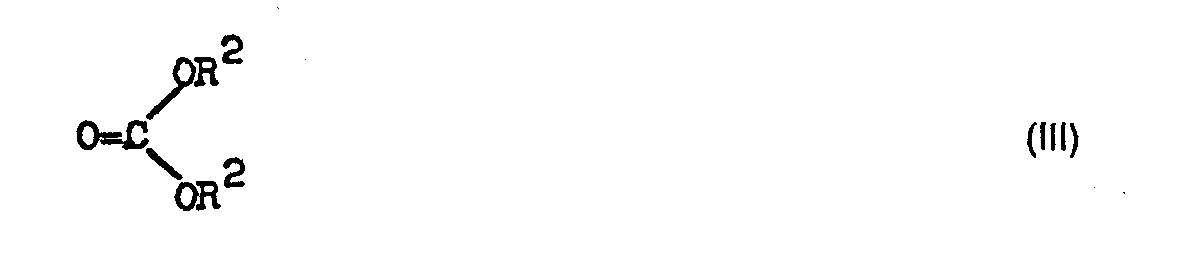
- Possible starting materials III are: dimethyl carbonate, diethyl carbonate, di-n-propyl carbonate, di-n-butyl carbonate, diisobutyl carbonate, dibenzyl carbonate, methyl ethyl carbonate, methyl propyl carbonate, ethyl propyl carbonate; dimethyl carbonate, diethyl carbonate, di-n-propyl carbonate, methyl ethyl carbonate, dibenzyl carbonate are preferred.
- the reaction gives mixtures of the correspondingly substituted 2-cyano-1-mercapto-benzenes and 2-cyano-1-oxy-benzenes or mixtures of the corresponding cyanomercapto- and cyanooxy-naphthalenes.
- the temperature and, if appropriate, the solvent one or the other mixture component is obtained as a by-product or even only in a practically negligible amount.
- Starting materials II containing nitro groups are generally converted more easily to cyanoaryl ethers I.
- the hydroxyl groups can also be converted Achieve amino groups and monosubstituted amino groups of the starting material II in ether, monosubstituted amino groups and disubstituted amino groups in the end product; the degree of substitution can be set as desired by appropriately controlling the temperature and the weight ratios of the reactants and the reaction time, the suitable conditions being easily determined by a few test attempts.
- the reaction is carried out at a temperature above 100.degree. C., generally between 100 and 350.degree. C., preferably from 110 to 250.degree.
- the starting materials II are reacted with the starting materials III in a stoichiometric amount or in excess or deficit, advantageously in the case of the reaction of hydroxy- and amino-free Compounds II from 1 to 10 moles, in particular from 1.2 to 5 moles of starting material III per mole of starting material II or with additional reaction of hydroxyl and / or amino groups in the case of the reaction of monosubstituted amino compounds II or hydroxy compounds II to disubstituted amino compounds 1 or ether compounds I from 2 to 50, in particular from 2.5 to 20, moles of starting material III per mole of starting material II, or in the case of the conversion of unsubstituted amino compounds II to disubstituted amino compounds I from 3 to 50, in particular from 3.5 to 20, moles of starting material III per mole Starting material II or in the case of the conversion of unsubstituted amino compounds II to monosubstituted amino compounds 1 from 0.5 to 3, in particular from 1 to 2 moles of starting material III per mole of starting material II
- the reaction is generally carried out under pressure or under pressure, preferably under that in the autoclave at the aforementioned temperatures the vapor pressure of the reaction mixture it, expediently from 1 to 250 bar, continuously or discontinuously.
- the reaction mixture expediently serves simultaneously as a solution medium or suspension medium. In such cases, it is sometimes advantageous to add an excess of starting material III and / or to add an amount of the alcohol or thioalcohol formed during the reaction. If appropriate, solvents which are inert under the reaction conditions can be used.
- solvents are: aromatic hydrocarbons, for example toluene, ethylbenzene, o-, m-, p-xylene, isopropylbenzene, methylnaphthalene, chlorobenzene, o- and m-dichlorobenzene, o-, m-, p-chlorotoluene, 1, 2,4-trichlorobenzene; Ether, for example ethyl propyl ether, methyl tert-butyl ether, n-butyl ethyl ether, di-n-butyl ether, diisobutyl ether, diisoamyl ether, diisopropyl ether, anisole, phenetol, cyclohexyl methyl ether, diethyl ether, ethylene glycol dimethyl ether, tetrahanethane; aliphatic or cycloaliphatic hydrocarbons,
- heptane nonane, gasoline fractions within a boiling point interval of 70 to 190 ° C, cyclohexane, methylcyclohexane, decalin, petroleum ether, hexane, ligroin, 2,2,4-trimethylpentane, 2,2,3-trimethylpentane, 2 , 3,3-trimethylpentane, octane; Alkanols and cycloalkanols such as ethanol, methanol, n-butanol, isobutanol, tert-butanol, glycol, glycerol, n-propanol, isopropanol, amyl alcohol, cyclohexanol, 2-methyl-4-pentanol, ethylene glycol monoethyl ether, 2-ethyl hexanol, methyl glycol, n -Hexanol, isohexyl alcohol, isoheptyl
- a tertiary amine is used as the catalyst, advantageously in an amount of 0.1 to 10, in particular 1 to 5, mol percent, based on starting material 11. Mixtures of the catalysts mentioned are also suitable for the reaction.
- the amine can also be used in the form of diamines, corresponding salts or a quaternary salt.
- Suitable catalysts are trimethylamine, dimethylamino-neopentanoi, N, N'-tetramethyl-diamino-neopentane, ethyldimethylamine, lauryldimethylamine, stearyldimethylamine, pyridine, a-, ⁇ - and y-picoline, quinoline, isoquinoline, quinazoline, quinoxaline, amyldimethylamine Propyldimethylamine, butyldimethylamine, N-methylimidazole, N-methylpyrrole, 2,6- and 2,4-lutidine, triethylenediamine, p-dimethylaminopyridine, N, N-dimethylcyclohexylamine, pyrimidine, acridine; Di- (methyl) -, di- (ethyl) -, di- (n-propyl) -, di- (n-butyl) -, di- (pentyl)
- the reaction can be carried out as follows: A mixture of the starting materials II, III and, if appropriate, the catalyst and the solvent is kept at the reaction temperature for 1 to 20 hours. The end product is then made from the mixture in a conventional manner, e.g. by fractional distillation.
- aralkylaryl and alkylaryl cyano-thioethers and ethers which can be prepared by the process of the invention are valuable starting materials for the production of dyes, crop protection agents and fragrances.
Landscapes
- Chemical & Material Sciences (AREA)
- Organic Chemistry (AREA)
- Organic Low-Molecular-Weight Compounds And Preparation Thereof (AREA)
Description
- Die Erfindung betrifft ein neues Verfahren zur Herstellung von Cyanoaryläthern und Cyanoarylthioäthern durch Umsetzung von Benzisothiazolen mit Diaralkylcarbonaten oder Dialkylcarbonaten bei erhöhter Temperatur.
- Es ist aus J. Chem Soc. 1971, Seiten 3 262 bis 3 265 bekannt, daß 3-Chlorbenzisothiazole unter dem Einfluß von Cyanidionen teilweise o-Thiocyanatobenzonitrile neben Bis-(o-cyanodiphenyl)-disulfiden bilden. Diese Stoffe können reduktiv in die entsprechenden o-Cyanophenylmercaptane überführt werden. Die o-Cyanophenylmercaptane können mit Estern starker organischer Säuren wie Methyljodid oder Dimethylsulfat in die entsprechenden 2-Cyanomethylthiobenzole umgewandelt werden (Houben-Weyl, Methoden der Organischen Chemie, Band 9, Seiten 112 bis 116).
- Diese Reaktionsschritte sind nun mit erheblichen Nachteilen verbunden. Die Ringöffnungsreaktion bei Benzisothiazolen ist uneinheitlich. Bei der Methylierung der o-Cyanopheny(mercaptane mit Methyljodid oder Dimethylsulfat fällt in stöchiometrischen Mengen anorganisches Salz an, dessen Beseitigung erhebliche Kosten verursacht. Auch sind wegen der hohen Toxizität der verwendeten Methylierungsmittel strenge Sicherheitsmaßnahmen zu beachten. Das Verfahren ist im Hinblick auf Ausbeute und Reinheit des Endstoffes, einfachen und wirtschaftlichen Betrieb sowie Betriebssicherheit und Umweltschutz unbefriedigend.
- Es wurde nun gefunden, daß man Cyanoaryläther und Cyanoarylthioäther der Formel


- Die Umsetzung kann für den Fall der Verwendung von Benzisothiazol bzw. 5-Nitro-benzisothiazol und Dimethylcarbonat durch die folgenden Formeln wiedergegeben werden :


- Die Dialkylcarbonate können in bekannter Weise, z.B. nach den in der deutschen Offenlegungsschrift 21 60111 angegebenen Verfahren oder zweckmäßiger, insbesondere aus Gründen des Umweltschutzes, durch Umsetzung eines Alkohols mit Kohlenmonoxid und Sauerstoff in Gegenwart von Kupferkatalysatoren, nach dem in der deutschen Offenlegungsschrift 2334736 beschriebenen Verfahren, hergestellt werden. Bevorzugte Ausgangsstoffe 11 und 111 und dementsprechend bevorzugte Endstoffe I sind solche, in deren Formeln die einzelnen Reste R1 gleich oder verschieden sein können und jeweils ein Wasserstoffatom, einen Alkylrest mit 1 bis 7, zweckmäßig 1 bis 4 Kohlenstoffatomen, einen Cyclohexylrest, einen Phenylrest, einen Aralkylrest mit 7 bis 12 Kohlenstoffatomen, ein Bromatom, ein Fluoratom, ein Chloratom, eine Cyangruppe, eine Nitrogruppe, den Rest R3-O-, den Rest

- Es kommen als Ausgansstoffe II beispielsweise in Frage : Benzisothiazol ; 1,2-Naphthisothiazol, 2,3-Naphthisothiazol, 3,4-Naphthisothiazol ; in 4-Stellung, 5-Stellung, 6-Stellung und/oder 7-Stellung einfach, zweifach, dreifach oder vierfach mit gleichen oder verschiedenen Substituenten durch die Methyl-, Äthyl-, n-Propyl-, Isopropyl-, n-Butyl-, Isobutyl-, sek.-Butyl-, tert.-Butyl-, Cyclohexyl-, Benzyl-, Phenyl-, Cyan-, Nitro-, Brom-, Fluor-, Chlor-, Hydroxy-, Amino-, Methylamino-, Äthylamino-, Propylamino-, Isopropylamino-, Butylamino-, sek.-Butylamino-, tert.-Butylamino-, Isobutylamino-, Cyclohexylamino-, Benzylamino-, Phenylamino-, Dimethylamino-, Diäthylamino-, Dipropylamino-, Diisopropylamino-, Dibutylamino-, Di-sek.-butylamino-, Di-tert.-butylamino-, Diisobutylamino-, Dicyclohexylamino-, Dibenzylamino-, Diphenylamino-, Methoxy-, Äthoxy-, Propoxy-, Isopropoxy-, Butoxy-, lsobutoxy-, sek.-Butoxy, tert.-Butoxy-gruppe substituiertes Benzisothiazol ; entsprechende, in 1,2-, 2,3- oder 3,4-Stellung oder jeweils in den 1-, 2-, 3- oder 4-Stellungen durch vorgenannte Gruppen einfach oder zweifach substituierte 1,2-, 2,3- oder 3,4-Naphthisothiazole

- Als Ausgangsstoffe III kommen in Betracht : Dimethylcarbonat, Diäthylcarbonat, Di-n-propylcarbonat, Di-n-butylcarbonat, Diisobutylcarbonat, Dibenzylcarbonat, Methyläthylcarbonat, Methylpropylcarbonat, Äthylpropylcarbonat; bevorzugt sind Dimethylcarbonat, Diäthylcarbonat, Di-n-propylcarbonat, Methyläthylcarbonat, Dibenzylcarbonat.
- Im allgemeinen erhält man bei der Reaktion Gemische der entsprechend substituierten 2-Cyano-1-mercapto-benzole und 2-Cyano-1-oxy-benzole bzw. Gemische der entsprechenden Cyanomercapto- und Cyanooxy-naphthaline. Je nach Wahl der Konstitution des Ausgangsstoffes, der Temperatur und gegebenenfalls des Lösungsmittels fällt die eine oder andere Gemischkomponente als Nebenprodukt oder sogar nur noch in praktisch vernachlässigbarer Menge an. Nitrogruppen-haltige Ausgangsstoffe II werden in der Regel leichter zu Cyanoaryläthern I umgesetzt. Geht man von Ausgangsstoffen aus, die ein oder mehrere Reste R3 in der Bedeutung Wasserstoff besitzen, so kann man durch Erhöhung der Temperatur und/oder der Menge an Ausgangsstoff 111 neben der Bildung der Gruppe -X-R2 im Endstoff I noch eine Umwandlung der Hydroxygruppen, Aminogruppen und monosubstituierten Aminogruppen des Ausgangsstoffes II in Äther, monosubstituierte Aminogruppen und disubstituierte Aminogruppen im Endstoff erzielen ; der Grad der Substituierung kann durch entsprechende Steuerung der Temperatur und der Gewichtsverhältnisse der Reaktionspartner sowie der Reaktionszeit beliebig eingestellt werden, wobei die geeigneten Bedingungen durch wenige Testversuche leicht festzustellen sind. Die Umsetzung wird bei einer Temperatur oberhalb 100 °C, im allgemeinen zwischen 100 und 350 °C, vorzugsweise von 110 bis 250 °C, im Falle der Herstellung von Cyano-thioäthern I vorteilhaft von 110 bis 230 °C, insbesondere von 130 bis 220 °C ; im Falle der Herstellung von Cyanoätherverbindungen I, ausgehend von nitrogruppenhaltigen Verbindungen II vorteilhaft von 110 bis 250°C, insbesondere von 130 bis 250 °C, ausgehend von nitrogruppenfreien Verbindungen II vorteilhaft von 180 bis 250 °C, insbesondere von 210 bis 250 °C, durchgeführt. Bevorzugt sind auch die in folgender Tabelle aufgeführten Temperaturintervalle.
-

- Die Ausgangsstoffe II werden mit den Ausgangsstoffen III in stöchiometrischer Menge oder im Überschuß oder Unterschuß umgesetzt, vorteilhaft im Falle der Umsetzung von hydroxy- und aminofreien Verbindungen II von 1 bis 10 Mol, insbesondere von 1,2 bis 5 Mol Ausgangsstoff III je Mol Ausgangsstoff II oder bei zusätzlicher Umsetzung von Hydroxy- und/oder Aminogruppen im Falle der Umsetzung von monosubstituierten Aminoverbindungen II oder Hydroxyverbindungen II zu disubstituierten Aminoverbindungen 1 oder Ätherverbindungen I von 2 bis 50, insbesondere von 2,5 bis 20 Mol Ausgangsstoff III je Mol Ausgangsstoff II oder im Falle der Umsetzung von unsubstituierten Aminoverbindungen II zu disubstituierten Aminoverbindungen I von 3 bis 50, insbesondere von 3,5 bis 20 Mol Ausgangsstoff III je Mol Ausgangsstoff II oder im Falle der Umsetzung von unsubstituierten Aminoverbindungen II zu monosubstituierten Aminoverbindungen 1 von 0,5 bis 3, insbesondere von 1 bis 2 Mol Ausgangsstoff III je Mol Ausgangsstoff II. Die Umsetzung erfolgt im allgemeinen drucklos oder unter Druck, vorzugsweise unter dem im Autoklaven bei vorgenannten Temperaturen sich einstellenden Dampfdruck des Reaktionsgemisches, zweckmäßig von 1 bis 250 bar, kontinuierlich oder diskontinuierlich. Zweckmäßig dient das Reaktionsgemisch gleichzeitig als Lösungsmedium bzw. Suspensionsmedium. In solchen Fällen ist es bisweilen vorteilhaft, einen Überschuß an Ausgangsstoff III und/oder schon am Anfang eine Zusatzmenge von dem bei der Reaktion sich bildenden Alkohol oder Thioalkohol zuzugeben. Gegebenenfalls können unter den Reaktionsbedingungen inerte Lösungsmittel verwendet werden. Als Lösungsmittel kommen z.B. in Frage : aromatische Kohlenwasserstoffe, z.B. Toluol, Äthylbenzol, o-, m-, p-Xylol, Isopropylbenzol, Methylnaphthalin, Chlorbenzol, o- und m-Dichlorbenzol, o-, m-, p-Chlortoluol, 1,2,4-Trichlorbenzol ; Äther, z.B. Äthylpropyläther, Methyltert.-butyläther, n-Butyläthyläther, Di-n-butyläther, Diisobutyläther, Diisoamyläther, Diisopropyläther, Anisol, Phenetol, Cyclohexylmethyläther, Diäthyläther, Äthylenglykoldimethyläther, Tetrahydrofuran, Dioxan ; aliphatische oder cycloaliphatische Kohlenwasserstoffe, z.B. Heptan, Nonan, Benzinfraktionen innerhalb eines Siedepunktintervalls von 70 bis 190 °C, Cyclohexan, Methylcyclohexan, Dekalin, Petroläther, Hexan, Ligroin, 2,2,4-Trimethylpentan, 2,2,3-Trimethylpentan, 2,3,3-Trimethylpentan, Octan ; Alkanole und Cycloalkanole wie Äthanol, Methanol, n-Butanol, Isobutanol, tert.-Butanol, Glykol, Glycerin, n-Propanol, Isopropanol, Amylalkohol, Cyclohexanol, 2-Methyi-4-pentanol, Äthylenglykolmonoäthyläther, 2-Äthylhexanol, Methylglykol, n-Hexanol, Isohexylalkohol, Isoheptylalkohol, n-Heptanol, Äthylbutanol, Nonylalkohol, Dodecylalkohol, Methylcyclohexanol, insbesondere solche mit 1 bis 4 Kohlenstoffatomen ; und entsprechende Gemische. Bevorzugt ist Methanol. Zweckmäßig verwendet man das Lösungsmittel in einer Menge von 100 bis 2 000 Gewichtsprozent, bezogen auf Ausgangsstoff III.
- Man verwendet gegebenenfalls als Katalysator ein tertiäres Amin, vorteilhaft in einer Menge von 0,1 bis 10, insbesondere von 1 bis 5 Molprozent, bezogen auf Ausgangsstoff 11. Auch Gemische der genannten Katalysatoren kommen für die Reaktion in Betracht. Das Amin kann auch in Gestalt von Diaminen, entsprechenden Salzen oder einem quaternären Salz verwendet werden. Geeignete Katalysatoren sind Trimethylamin, Dimethylamino-neopentanoi, N,N'-Tetramethyl-diamino-neopentan, Äthyldimethylamin, Lauryldimethylamin, Stearyldimethylamin, Pyridin, a-, β- und y-Picolin, Chinolin, Isochinolin, Chinazolin, Chinoxalin, Amyldimethyl-amin, Propyldimethylamin, Butyldimethylamin, N-Methylimidazol, N-Methylpyrrol, 2,6- und 2,4-Lutidin, Triäthylendiamin, p-Dimethylaminopyridin, N,N-Dimethylcyclohexylamin, Pyrimidin, Acridin ; Di-(methyl)-, Di-(äthyl)-, Di-(n-propyl)-, Di-(n-butyl)-, Di-(pentyl)-, Di(n-hexyl)-, Di-(n-heptyl)-, Di-(n-octyl)-, Di-(n-nonyl)-, Di-(n-decyl)-anilin und mit vorgenannten Resten am Stickstoffatom einfach substituiertes Pyrazolidin, Imidazolidin, Morpholin, Piperidin, Pyrrolidin ; entsprechende Katalysatoren mit 2 oder 3 vorgenannten, aber unterschiedlichen Resten, z.B. Dimethyl- äthylamin. Ebenfalls kommen auch tertiäre Aminogruppen enthaltende Polymere, z.B. 4-Polyvinylpyridin und Polyvinylimidazol-(N), in Frage.
- Besonders vorteilhaft sind Trimethylamin, Pyridin, y-Picolin, 4-Pyrrolidino-(1')-pyridin und andere Pyridinderivate wie o-Methyl-, m-Methyl-, o-Äthyl-, m-Äthyl-, p-Äthyl-, o-Propyl-, m-Propyl-, p-Propylpyridin, Dimethylamino-neopentanol, N,N'-Tetramethyldiamino-neopentan, p-Methoxy-, p-Äthoxy, p-Propoxy-pyridin, p-Dimethylaminopyridin, p-Diäthylaminopyridin, p-Dipropylaminopyridin, 4-Polyvinylpyridin, N-Methylimidazol.
- Die Umsetzung kann wie folgt durchgeführt werden : Ein Gemisch der Ausgangsstoffe II, III und gegebenenfalls des Katalysators und des Lösungsmittels wird während 1 bis 20 Stunden bei der Reaktionstemperatur gehalten. Aus dem Gemisch wird dann der Endstoff in üblicher Weise, z.B. durch fraktionierte Destillation, abgetrennt.
- Die nach dem Verfahren der Erfindung herstellbaren Aralkylaryl- und Alkylaryl-cyano-thioäther und -äther sind wertvolle Ausgangsstoffe für die Herstellung von Farbstoffen, Pflanzenschutzmitteln und Riechstoffen. Bezüglich der Verwendung wird auf vorgenannte Veröffentlichungen und Ullmanns Encyklopädie der technischen Chemie, Band 13, Seiten 450 bis 453, und Band 14, Seiten 760 bis 763, verwiesen.
- Die in den folgenden Beispielen aufgeführten Teile bedeuten Gewichtsteile.
- 15 Teile 5-Aminobenzisothiazol werden mit 18 Teilen Dimethylcarbonat in 100 Teilen Dioxan gelöst und auf 160 °C erhitzt. Nach 3 Stunden werden das Lösungsmittel und gebildetes Methanol abdestilliert und der Rückstand mit Äther ausgewaschen. Man erhält 5,6 Teile (68% der Theorie) 2-Cyano-4-methylamino-l-methylthiobenzol vom Fp 84 bis 88 °C. Der Umsatz beträgt 46 Prozent.
- 200 Teile 5-Aminobenzisothiazol werden mit 600 Teilen Dimethylcarbonat und 10 Teilen N-Methylimidazol als Katalysator 10 Stunden auf 200 °C gehalten. Nach beendeter Reaktion werden überschüssiges Dimethylcarbonat und Methanol abgezogen und der Rückstand destilliert. Man erhält 175 Teile (71 % der Theorie) 2-Cyano-4-dimethylamino-1-methylthiobenzol vom Fp 44 bis 46 °C. Der Umsatz beträgt 96 Prozent.
- 25 Teile 5-Nitrobenzisothiazol werden mit 63 Teilen Dimethylcarbonat 10 Stunden auf 200°C gehalten. Nach beendeter Reaktion werden überschüssiges Dimethylcarbonat und gebildetes Methanol abgezogen und der Rückstand mit Äther versetzt. Man erhält 15,7 Teile (87 % der Theorie) 2-Cyano-1-methoxy-4-nitrobenzol vom Fp 111 °C. Der Umsatz beträgt 73 Prozent.
- 10 Teile Benzisothiazol werden mit 66 Teilen Dimethylcarbonat und 0,5 Teilen N-Methylimidazol als Katalysator 5 Stunden auf 200°C gehalten. Nach beendeter Reaktion werden überschüssiges Dimethylcarbonat und Methanol abgezogen und der Rückstand destilliert. Man erhält 10,3 Teile (93 % der Theorie) 2-Cyano-1-methylthiobenzol vom Kp 106 °C (0,35 mbar). Der Umsatz ist praktisch quantitativ.
- 200 Teile 4,7-Diaminobenzisothiazol werden mit 1 300 Teilen Dimethylcarbonat 5 Stunden auf 220 °C gehalten. Nach beendeter Reaktion werden überschüssiges Dimethylcarbonat und Methanol abgezogen und der Rückstand destilliert. Man erhält 80 Teile (36 % der Theorie) 2-Cyano-3,6-bis(dimethylamino)-1-methylthiobenzol vom Kp 205 bis 210 °C (1,5 mbar). Der Umsatz beträgt 78 Prozent.
- 30 Teile 4-Chlorbenzisothiazol werden mit 80 Teilen Dimethylcarbonat und 1,5 Teilen N-Methylimidazol als Katalysator 5 Stunden auf 190 °C gehalten. Nach beendeter Reaktion werden überschüssiges Dimethylcarbonat und Methanol abdestilliert und der Rückstand destilliert. Man erhält 27,1 Teile (97 % der Theorie) 3-Chlor-2-cyano-1-methylthiobenzol vom Fp 91 °C. Der Umsatz beträgt 86 Prozent.
- 30 Teile 1,2-Naphthisothiazol werden mit 66 Teilen Dimethylcarbonat und 1,5 Teilen N-Methylimidazol als Katalysator 20 Stunden auf 210 °C gehalten. Nach beendeter Reaktion werden überschüssiges Dimethylcarbonat und Methanol abdestilliert und der Rückstand destilliert. Man erhält 18 Teile (96 % der Theorie) 2-Cyano-1-methylthionaphthalin vom Kp 135 bis 139°C (0,3 mbar). Der Umsatz beträgt 58 Prozent.
Claims (1)
- Verfahren zur Herstellung von Cyanoaryläthern und Cyanoarylthioäthern der Formel


Applications Claiming Priority (2)
| Application Number | Priority Date | Filing Date | Title |
|---|---|---|---|
| DE2848365 | 1978-11-08 | ||
| DE19782848365 DE2848365A1 (de) | 1978-11-08 | 1978-11-08 | Verfahren zur herstellung von cyanoarylaethern und cyanoarylthioaethern |
Publications (3)
| Publication Number | Publication Date |
|---|---|
| EP0011188A2 EP0011188A2 (de) | 1980-05-28 |
| EP0011188A3 EP0011188A3 (en) | 1980-07-23 |
| EP0011188B1 true EP0011188B1 (de) | 1982-04-28 |
Family
ID=6054111
Family Applications (1)
| Application Number | Title | Priority Date | Filing Date |
|---|---|---|---|
| EP79104250A Expired EP0011188B1 (de) | 1978-11-08 | 1979-10-31 | Verfahren zur Herstellung von Cyanoaryläthern und Cyanoarylthioäthern |
Country Status (2)
| Country | Link |
|---|---|
| EP (1) | EP0011188B1 (de) |
| DE (2) | DE2848365A1 (de) |
-
1978
- 1978-11-08 DE DE19782848365 patent/DE2848365A1/de not_active Withdrawn
-
1979
- 1979-10-31 EP EP79104250A patent/EP0011188B1/de not_active Expired
- 1979-10-31 DE DE7979104250T patent/DE2962642D1/de not_active Expired
Also Published As
| Publication number | Publication date |
|---|---|
| EP0011188A3 (en) | 1980-07-23 |
| EP0011188A2 (de) | 1980-05-28 |
| DE2962642D1 (en) | 1982-06-09 |
| DE2848365A1 (de) | 1980-05-22 |
Similar Documents
| Publication | Publication Date | Title |
|---|---|---|
| EP0471983A1 (de) | Verfahren zur N-Alkylierung von Harnstoffen | |
| CH506525A (de) | Verfahren zur Herstellung von aromatischen Äthern | |
| DE69917443T2 (de) | Methoden zur hochselektiven o-alkylierung von amiden mit hilfe von kupfersalzen | |
| DE916168C (de) | Verfahren zur Herstellung von Pyrrolidinoalkylphenothiazinen | |
| EP0011188A2 (de) | Verfahren zur Herstellung von Cyanoaryläthern und Cyanoarylthioäthern | |
| DE69300826T2 (de) | Hydrierung. | |
| EP0115295B1 (de) | Verbessertes Verfahren zur Herstellung von Riboflavin | |
| DE2655794C2 (de) | Verfahren zur Herstellung von Äthylencyanhydrin | |
| DE1218455B (de) | Verfahren zur Herstellung von basisch substituierten cyclischen Harnstoffen und ihren Salzen | |
| CH615438A5 (de) | ||
| EP2868652A1 (de) | Katalytische Hydrierung zur Herstellung von Aminen aus Amidacetalen, Keten-N,O-acetalen oder Esterimiden | |
| DE3816634A1 (de) | Cyclobuten-3,4-dion-zwischenverbindungen, verfahren zu ihrer herstellung und ihre verwendung | |
| EP0013408A1 (de) | 4-Aminopyridine, Verfahren zu ihrer Herstellung und diese enthaltende Arzneimittel | |
| DE942149C (de) | Verfahren zur Herstellung substituierter Glycinamide | |
| DE2653398C2 (de) | Verfahren zur Herstellung von 1-(Tetrahydro-2-furyl)-5-fluoruracil | |
| DE2334402A1 (de) | Verfahren zur herstellung von phosphornitrilatpolymerisaten | |
| DE838004C (de) | Verfahren zur Herstellung von Amiden aus Säurechl'oriden und Aminoalkoholen | |
| DE1097995B (de) | Verfahren zur Herstellung von Phenthiazinderivaten | |
| DE69207571T2 (de) | Verfahren zum Herstellen von Estern der Halomaleinsäure und Halofumarsäure | |
| EP2318383B1 (de) | Verfahren zur herstellung von cycloalkyl-substituierten piperazinverbindungen | |
| EP0057363B1 (de) | Verfahren zur Herstellung von Butadiendinitrilen | |
| AT266838B (de) | Verfahren zur Herstellung von Benzodiazepin-Derivaten | |
| DE1670223A1 (de) | Verfahren zur Herstellung von dithiocarbamidsauren Salzen | |
| DE1260468B (de) | Verfahren zur Herstellung von Aminonitrophenolen | |
| EP0083010A1 (de) | Diether von m- oder p-Hydroxyphenolen und Verfahren zur Herstellung der Diether oder Monoether von m- oder p-Hydroxyphenolen |
Legal Events
| Date | Code | Title | Description |
|---|---|---|---|
| PUAI | Public reference made under article 153(3) epc to a published international application that has entered the european phase |
Free format text: ORIGINAL CODE: 0009012 |
|
| PUAL | Search report despatched |
Free format text: ORIGINAL CODE: 0009013 |
|
| AK | Designated contracting states |
Designated state(s): BE CH DE FR GB |
|
| AK | Designated contracting states |
Designated state(s): BE CH DE FR GB |
|
| 17P | Request for examination filed |
Effective date: 19801210 |
|
| GRAA | (expected) grant |
Free format text: ORIGINAL CODE: 0009210 |
|
| AK | Designated contracting states |
Designated state(s): BE CH DE FR GB |
|
| REF | Corresponds to: |
Ref document number: 2962642 Country of ref document: DE Date of ref document: 19820609 |
|
| PGFP | Annual fee paid to national office [announced via postgrant information from national office to epo] |
Ref country code: FR Payment date: 19840924 Year of fee payment: 6 |
|
| PGFP | Annual fee paid to national office [announced via postgrant information from national office to epo] |
Ref country code: DE Payment date: 19840926 Year of fee payment: 6 |
|
| PGFP | Annual fee paid to national office [announced via postgrant information from national office to epo] |
Ref country code: CH Payment date: 19840927 Year of fee payment: 6 |
|
| PGFP | Annual fee paid to national office [announced via postgrant information from national office to epo] |
Ref country code: BE Payment date: 19840930 Year of fee payment: 6 |
|
| PG25 | Lapsed in a contracting state [announced via postgrant information from national office to epo] |
Ref country code: CH Effective date: 19871031 Ref country code: BE Effective date: 19871031 |
|
| PG25 | Lapsed in a contracting state [announced via postgrant information from national office to epo] |
Ref country code: DE Effective date: 19871113 |
|
| BERE | Be: lapsed |
Owner name: BASF A.G. Effective date: 19871031 |
|
| GBPC | Gb: european patent ceased through non-payment of renewal fee | ||
| PG25 | Lapsed in a contracting state [announced via postgrant information from national office to epo] |
Ref country code: FR Free format text: LAPSE BECAUSE OF NON-PAYMENT OF DUE FEES Effective date: 19880630 |
|
| REG | Reference to a national code |
Ref country code: CH Ref legal event code: PL |
|
| REG | Reference to a national code |
Ref country code: FR Ref legal event code: ST |
|
| PG25 | Lapsed in a contracting state [announced via postgrant information from national office to epo] |
Ref country code: GB Effective date: 19881118 |
|
| PLBE | No opposition filed within time limit |
Free format text: ORIGINAL CODE: 0009261 |
|
| STAA | Information on the status of an ep patent application or granted ep patent |
Free format text: STATUS: NO OPPOSITION FILED WITHIN TIME LIMIT |