EP0010607B1 - Triazolylstyryl-Verbindungen sowie deren Verwendung zum Weisstönen organischer Materialien - Google Patents
Triazolylstyryl-Verbindungen sowie deren Verwendung zum Weisstönen organischer Materialien Download PDFInfo
- Publication number
- EP0010607B1 EP0010607B1 EP79103522A EP79103522A EP0010607B1 EP 0010607 B1 EP0010607 B1 EP 0010607B1 EP 79103522 A EP79103522 A EP 79103522A EP 79103522 A EP79103522 A EP 79103522A EP 0010607 B1 EP0010607 B1 EP 0010607B1
- Authority
- EP
- European Patent Office
- Prior art keywords
- compounds
- triazolylstyryl
- formula
- organic materials
- whiteners
- Prior art date
- Legal status (The legal status is an assumption and is not a legal conclusion. Google has not performed a legal analysis and makes no representation as to the accuracy of the status listed.)
- Expired
Links
- 150000001875 compounds Chemical class 0.000 title claims description 13
- 239000011368 organic material Substances 0.000 title claims description 3
- 125000001997 phenyl group Chemical group [H]C1=C([H])C([H])=C(*)C([H])=C1[H] 0.000 claims description 13
- -1 biphenylyl Chemical group 0.000 claims description 7
- 125000005504 styryl group Chemical group 0.000 claims description 6
- 239000001257 hydrogen Substances 0.000 claims description 5
- 229910052739 hydrogen Inorganic materials 0.000 claims description 5
- 125000000113 cyclohexyl group Chemical group [H]C1([H])C([H])([H])C([H])([H])C([H])(*)C([H])([H])C1([H])[H] 0.000 claims description 3
- 125000003944 tolyl group Chemical group 0.000 claims description 3
- 125000005023 xylyl group Chemical group 0.000 claims description 3
- 125000000068 chlorophenyl group Chemical group 0.000 claims description 2
- 230000002087 whitening effect Effects 0.000 claims description 2
- 125000004435 hydrogen atom Chemical group [H]* 0.000 claims 2
- 125000004178 (C1-C4) alkyl group Chemical group 0.000 claims 1
- QTBSBXVTEAMEQO-UHFFFAOYSA-N Acetic acid Chemical compound CC(O)=O QTBSBXVTEAMEQO-UHFFFAOYSA-N 0.000 description 21
- ZMXDDKWLCZADIW-UHFFFAOYSA-N N,N-Dimethylformamide Chemical compound CN(C)C=O ZMXDDKWLCZADIW-UHFFFAOYSA-N 0.000 description 12
- 235000011054 acetic acid Nutrition 0.000 description 8
- WFDIJRYMOXRFFG-UHFFFAOYSA-N Acetic anhydride Chemical compound CC(=O)OC(C)=O WFDIJRYMOXRFFG-UHFFFAOYSA-N 0.000 description 6
- JUJWROOIHBZHMG-UHFFFAOYSA-N Pyridine Chemical compound C1=CC=NC=C1 JUJWROOIHBZHMG-UHFFFAOYSA-N 0.000 description 6
- ZMANZCXQSJIPKH-UHFFFAOYSA-N Triethylamine Chemical compound CCN(CC)CC ZMANZCXQSJIPKH-UHFFFAOYSA-N 0.000 description 6
- 238000006243 chemical reaction Methods 0.000 description 6
- 239000000203 mixture Substances 0.000 description 6
- XNWFRZJHXBZDAG-UHFFFAOYSA-N 2-METHOXYETHANOL Chemical compound COCCO XNWFRZJHXBZDAG-UHFFFAOYSA-N 0.000 description 5
- XLYOFNOQVPJJNP-UHFFFAOYSA-N water Substances O XLYOFNOQVPJJNP-UHFFFAOYSA-N 0.000 description 5
- IAZDPXIOMUYVGZ-UHFFFAOYSA-N Dimethylsulphoxide Chemical compound CS(C)=O IAZDPXIOMUYVGZ-UHFFFAOYSA-N 0.000 description 4
- CTQNGGLPUBDAKN-UHFFFAOYSA-N O-Xylene Chemical compound CC1=CC=CC=C1C CTQNGGLPUBDAKN-UHFFFAOYSA-N 0.000 description 4
- NQRYJNQNLNOLGT-UHFFFAOYSA-N Piperidine Chemical compound C1CCNCC1 NQRYJNQNLNOLGT-UHFFFAOYSA-N 0.000 description 4
- 125000000217 alkyl group Chemical group 0.000 description 4
- 239000003960 organic solvent Substances 0.000 description 4
- 239000008096 xylene Substances 0.000 description 4
- QBWUTXXJFOIVME-UHFFFAOYSA-N 4h-1,2-oxazol-5-one Chemical class O=C1CC=NO1 QBWUTXXJFOIVME-UHFFFAOYSA-N 0.000 description 3
- JPVYNHNXODAKFH-UHFFFAOYSA-N Cu2+ Chemical class [Cu+2] JPVYNHNXODAKFH-UHFFFAOYSA-N 0.000 description 3
- YMWUJEATGCHHMB-UHFFFAOYSA-N Dichloromethane Chemical compound ClCCl YMWUJEATGCHHMB-UHFFFAOYSA-N 0.000 description 3
- OKKJLVBELUTLKV-UHFFFAOYSA-N Methanol Chemical compound OC OKKJLVBELUTLKV-UHFFFAOYSA-N 0.000 description 3
- 238000009833 condensation Methods 0.000 description 3
- 230000005494 condensation Effects 0.000 description 3
- 239000000835 fiber Substances 0.000 description 3
- 229920000728 polyester Polymers 0.000 description 3
- UMJSCPRVCHMLSP-UHFFFAOYSA-N pyridine Natural products COC1=CC=CN=C1 UMJSCPRVCHMLSP-UHFFFAOYSA-N 0.000 description 3
- 150000003852 triazoles Chemical class 0.000 description 3
- IJGRMHOSHXDMSA-UHFFFAOYSA-N Atomic nitrogen Chemical compound N#N IJGRMHOSHXDMSA-UHFFFAOYSA-N 0.000 description 2
- CURLTUGMZLYLDI-UHFFFAOYSA-N Carbon dioxide Chemical compound O=C=O CURLTUGMZLYLDI-UHFFFAOYSA-N 0.000 description 2
- HEDRZPFGACZZDS-UHFFFAOYSA-N Chloroform Chemical compound ClC(Cl)Cl HEDRZPFGACZZDS-UHFFFAOYSA-N 0.000 description 2
- VEXZGXHMUGYJMC-UHFFFAOYSA-N Hydrochloric acid Chemical compound Cl VEXZGXHMUGYJMC-UHFFFAOYSA-N 0.000 description 2
- MHAJPDPJQMAIIY-UHFFFAOYSA-N Hydrogen peroxide Chemical compound OO MHAJPDPJQMAIIY-UHFFFAOYSA-N 0.000 description 2
- KFZMGEQAYNKOFK-UHFFFAOYSA-N Isopropanol Chemical compound CC(C)O KFZMGEQAYNKOFK-UHFFFAOYSA-N 0.000 description 2
- NBIIXXVUZAFLBC-UHFFFAOYSA-N Phosphoric acid Chemical compound OP(O)(O)=O NBIIXXVUZAFLBC-UHFFFAOYSA-N 0.000 description 2
- RSERZOZUJQOHLL-UHFFFAOYSA-N [N+]=1(NN=CC=1)[O-] Chemical class [N+]=1(NN=CC=1)[O-] RSERZOZUJQOHLL-UHFFFAOYSA-N 0.000 description 2
- 239000002253 acid Substances 0.000 description 2
- 230000009471 action Effects 0.000 description 2
- 150000001298 alcohols Chemical class 0.000 description 2
- 238000005282 brightening Methods 0.000 description 2
- 239000003795 chemical substances by application Substances 0.000 description 2
- 150000001805 chlorine compounds Chemical class 0.000 description 2
- XXBDWLFCJWSEKW-UHFFFAOYSA-N dimethylbenzylamine Chemical compound CN(C)CC1=CC=CC=C1 XXBDWLFCJWSEKW-UHFFFAOYSA-N 0.000 description 2
- 239000006185 dispersion Substances 0.000 description 2
- 239000011888 foil Substances 0.000 description 2
- 150000002431 hydrogen Chemical class 0.000 description 2
- 239000007800 oxidant agent Substances 0.000 description 2
- SCVFZCLFOSHCOH-UHFFFAOYSA-M potassium acetate Chemical compound [K+].CC([O-])=O SCVFZCLFOSHCOH-UHFFFAOYSA-M 0.000 description 2
- 239000002904 solvent Substances 0.000 description 2
- UOZWRAKQHGGHQC-UHFFFAOYSA-N 4-[2-(benzotriazol-2-yl)ethenyl]aniline Chemical class C1=CC(N)=CC=C1C=CN1N=C2C=CC=CC2=N1 UOZWRAKQHGGHQC-UHFFFAOYSA-N 0.000 description 1
- 0 C*C(C(*)=*1)=**1*1ccc(*)cc1 Chemical compound C*C(C(*)=*1)=**1*1ccc(*)cc1 0.000 description 1
- ZAMOUSCENKQFHK-UHFFFAOYSA-N Chlorine atom Chemical compound [Cl] ZAMOUSCENKQFHK-UHFFFAOYSA-N 0.000 description 1
- UFHFLCQGNIYNRP-UHFFFAOYSA-N Hydrogen Chemical compound [H][H] UFHFLCQGNIYNRP-UHFFFAOYSA-N 0.000 description 1
- DGAQECJNVWCQMB-PUAWFVPOSA-M Ilexoside XXIX Chemical compound C[C@@H]1CC[C@@]2(CC[C@@]3(C(=CC[C@H]4[C@]3(CC[C@@H]5[C@@]4(CC[C@@H](C5(C)C)OS(=O)(=O)[O-])C)C)[C@@H]2[C@]1(C)O)C)C(=O)O[C@H]6[C@@H]([C@H]([C@@H]([C@H](O6)CO)O)O)O.[Na+] DGAQECJNVWCQMB-PUAWFVPOSA-M 0.000 description 1
- 238000006000 Knoevenagel condensation reaction Methods 0.000 description 1
- 239000004952 Polyamide Substances 0.000 description 1
- ZLMJMSJWJFRBEC-UHFFFAOYSA-N Potassium Chemical compound [K] ZLMJMSJWJFRBEC-UHFFFAOYSA-N 0.000 description 1
- 238000006828 Rosenmund reduction reaction Methods 0.000 description 1
- 238000006007 Sommelet synthesis reaction Methods 0.000 description 1
- GSEJCLTVZPLZKY-UHFFFAOYSA-N Triethanolamine Chemical compound OCCN(CCO)CCO GSEJCLTVZPLZKY-UHFFFAOYSA-N 0.000 description 1
- SLINHMUFWFWBMU-UHFFFAOYSA-N Triisopropanolamine Chemical compound CC(O)CN(CC(C)O)CC(C)O SLINHMUFWFWBMU-UHFFFAOYSA-N 0.000 description 1
- XSQUKJJJFZCRTK-UHFFFAOYSA-N Urea Chemical compound NC(N)=O XSQUKJJJFZCRTK-UHFFFAOYSA-N 0.000 description 1
- HCHKCACWOHOZIP-UHFFFAOYSA-N Zinc Chemical compound [Zn] HCHKCACWOHOZIP-UHFFFAOYSA-N 0.000 description 1
- 150000001243 acetic acids Chemical class 0.000 description 1
- 150000008065 acid anhydrides Chemical class 0.000 description 1
- 238000007171 acid catalysis Methods 0.000 description 1
- 150000007513 acids Chemical class 0.000 description 1
- 229910000147 aluminium phosphate Inorganic materials 0.000 description 1
- 150000005840 aryl radicals Chemical class 0.000 description 1
- QVGXLLKOCUKJST-UHFFFAOYSA-N atomic oxygen Chemical compound [O] QVGXLLKOCUKJST-UHFFFAOYSA-N 0.000 description 1
- 230000008901 benefit Effects 0.000 description 1
- QRUDEWIWKLJBPS-UHFFFAOYSA-N benzotriazole Chemical compound C1=CC=C2N[N][N]C2=C1 QRUDEWIWKLJBPS-UHFFFAOYSA-N 0.000 description 1
- 239000012964 benzotriazole Substances 0.000 description 1
- 238000009835 boiling Methods 0.000 description 1
- BTANRVKWQNVYAZ-UHFFFAOYSA-N butan-2-ol Chemical compound CCC(C)O BTANRVKWQNVYAZ-UHFFFAOYSA-N 0.000 description 1
- AXCZMVOFGPJBDE-UHFFFAOYSA-L calcium dihydroxide Chemical compound [OH-].[OH-].[Ca+2] AXCZMVOFGPJBDE-UHFFFAOYSA-L 0.000 description 1
- 239000004202 carbamide Substances 0.000 description 1
- 239000001569 carbon dioxide Substances 0.000 description 1
- 229910002092 carbon dioxide Inorganic materials 0.000 description 1
- 239000003054 catalyst Substances 0.000 description 1
- 238000006555 catalytic reaction Methods 0.000 description 1
- 239000007795 chemical reaction product Substances 0.000 description 1
- 239000000460 chlorine Substances 0.000 description 1
- 229910052801 chlorine Inorganic materials 0.000 description 1
- 238000001816 cooling Methods 0.000 description 1
- 229910000365 copper sulfate Inorganic materials 0.000 description 1
- ARUVKPQLZAKDPS-UHFFFAOYSA-L copper(II) sulfate Chemical compound [Cu+2].[O-][S+2]([O-])([O-])[O-] ARUVKPQLZAKDPS-UHFFFAOYSA-L 0.000 description 1
- OPQARKPSCNTWTJ-UHFFFAOYSA-L copper(ii) acetate Chemical compound [Cu+2].CC([O-])=O.CC([O-])=O OPQARKPSCNTWTJ-UHFFFAOYSA-L 0.000 description 1
- HFDWIMBEIXDNQS-UHFFFAOYSA-L copper;diformate Chemical compound [Cu+2].[O-]C=O.[O-]C=O HFDWIMBEIXDNQS-UHFFFAOYSA-L 0.000 description 1
- 230000008878 coupling Effects 0.000 description 1
- 238000010168 coupling process Methods 0.000 description 1
- 238000005859 coupling reaction Methods 0.000 description 1
- 239000013078 crystal Substances 0.000 description 1
- 238000006210 cyclodehydration reaction Methods 0.000 description 1
- 238000006114 decarboxylation reaction Methods 0.000 description 1
- 210000003298 dental enamel Anatomy 0.000 description 1
- SBZXBUIDTXKZTM-UHFFFAOYSA-N diglyme Chemical compound COCCOCCOC SBZXBUIDTXKZTM-UHFFFAOYSA-N 0.000 description 1
- 230000000694 effects Effects 0.000 description 1
- 230000008030 elimination Effects 0.000 description 1
- 238000003379 elimination reaction Methods 0.000 description 1
- LYCAIKOWRPUZTN-UHFFFAOYSA-N ethylene glycol Natural products OCCO LYCAIKOWRPUZTN-UHFFFAOYSA-N 0.000 description 1
- 239000004744 fabric Substances 0.000 description 1
- 239000007789 gas Substances 0.000 description 1
- WGCNASOHLSPBMP-UHFFFAOYSA-N hydroxyacetaldehyde Natural products OCC=O WGCNASOHLSPBMP-UHFFFAOYSA-N 0.000 description 1
- 239000000543 intermediate Substances 0.000 description 1
- 239000012948 isocyanate Substances 0.000 description 1
- 150000002513 isocyanates Chemical class 0.000 description 1
- 229940102253 isopropanolamine Drugs 0.000 description 1
- 229910000464 lead oxide Inorganic materials 0.000 description 1
- ACKFDYCQCBEDNU-UHFFFAOYSA-J lead(2+);tetraacetate Chemical compound [Pb+2].CC([O-])=O.CC([O-])=O.CC([O-])=O.CC([O-])=O ACKFDYCQCBEDNU-UHFFFAOYSA-J 0.000 description 1
- 238000004519 manufacturing process Methods 0.000 description 1
- 239000000463 material Substances 0.000 description 1
- 239000000155 melt Substances 0.000 description 1
- 238000000034 method Methods 0.000 description 1
- 238000000465 moulding Methods 0.000 description 1
- 229910052757 nitrogen Inorganic materials 0.000 description 1
- YEXPOXQUZXUXJW-UHFFFAOYSA-N oxolead Chemical compound [Pb]=O YEXPOXQUZXUXJW-UHFFFAOYSA-N 0.000 description 1
- 239000001301 oxygen Substances 0.000 description 1
- 229910052760 oxygen Inorganic materials 0.000 description 1
- 239000003880 polar aprotic solvent Substances 0.000 description 1
- 229920002239 polyacrylonitrile Polymers 0.000 description 1
- 229920002647 polyamide Polymers 0.000 description 1
- 229920000098 polyolefin Polymers 0.000 description 1
- 229920000915 polyvinyl chloride Polymers 0.000 description 1
- 239000004800 polyvinyl chloride Substances 0.000 description 1
- 239000011591 potassium Substances 0.000 description 1
- 229910052700 potassium Inorganic materials 0.000 description 1
- 235000011056 potassium acetate Nutrition 0.000 description 1
- 238000002360 preparation method Methods 0.000 description 1
- 230000008569 process Effects 0.000 description 1
- 239000000047 product Substances 0.000 description 1
- 239000011541 reaction mixture Substances 0.000 description 1
- 238000001953 recrystallisation Methods 0.000 description 1
- 230000009467 reduction Effects 0.000 description 1
- 238000010992 reflux Methods 0.000 description 1
- 150000003333 secondary alcohols Chemical class 0.000 description 1
- 229910052708 sodium Inorganic materials 0.000 description 1
- 239000001632 sodium acetate Substances 0.000 description 1
- 235000017281 sodium acetate Nutrition 0.000 description 1
- 239000000243 solution Substances 0.000 description 1
- 238000009987 spinning Methods 0.000 description 1
- 239000007858 starting material Substances 0.000 description 1
- 238000003756 stirring Methods 0.000 description 1
- 239000000126 substance Substances 0.000 description 1
- 239000000725 suspension Substances 0.000 description 1
- 150000003512 tertiary amines Chemical class 0.000 description 1
Classifications
-
- C—CHEMISTRY; METALLURGY
- C08—ORGANIC MACROMOLECULAR COMPOUNDS; THEIR PREPARATION OR CHEMICAL WORKING-UP; COMPOSITIONS BASED THEREON
- C08K—Use of inorganic or non-macromolecular organic substances as compounding ingredients
- C08K5/00—Use of organic ingredients
- C08K5/16—Nitrogen-containing compounds
- C08K5/34—Heterocyclic compounds having nitrogen in the ring
- C08K5/3467—Heterocyclic compounds having nitrogen in the ring having more than two nitrogen atoms in the ring
- C08K5/3472—Five-membered rings
- C08K5/3475—Five-membered rings condensed with carbocyclic rings
-
- C—CHEMISTRY; METALLURGY
- C07—ORGANIC CHEMISTRY
- C07D—HETEROCYCLIC COMPOUNDS
- C07D249/00—Heterocyclic compounds containing five-membered rings having three nitrogen atoms as the only ring hetero atoms
- C07D249/16—Heterocyclic compounds containing five-membered rings having three nitrogen atoms as the only ring hetero atoms condensed with carbocyclic rings or ring systems
- C07D249/18—Benzotriazoles
-
- C—CHEMISTRY; METALLURGY
- C07—ORGANIC CHEMISTRY
- C07D—HETEROCYCLIC COMPOUNDS
- C07D249/00—Heterocyclic compounds containing five-membered rings having three nitrogen atoms as the only ring hetero atoms
- C07D249/16—Heterocyclic compounds containing five-membered rings having three nitrogen atoms as the only ring hetero atoms condensed with carbocyclic rings or ring systems
- C07D249/22—Naphthotriazoles
-
- D—TEXTILES; PAPER
- D06—TREATMENT OF TEXTILES OR THE LIKE; LAUNDERING; FLEXIBLE MATERIALS NOT OTHERWISE PROVIDED FOR
- D06L—DRY-CLEANING, WASHING OR BLEACHING FIBRES, FILAMENTS, THREADS, YARNS, FABRICS, FEATHERS OR MADE-UP FIBROUS GOODS; BLEACHING LEATHER OR FURS
- D06L4/00—Bleaching fibres, filaments, threads, yarns, fabrics, feathers or made-up fibrous goods; Bleaching leather or furs
- D06L4/60—Optical bleaching or brightening
Definitions
- alkyl groups mentioned are in particular CH 3 and C 2 H 5 .
- the new triazolylstyryl compounds can be prepared in various ways, for example by using benzotriazolylstyryloximinohydrazones of the formula either dehydrated directly to I or with dehydrating agents in the I-analogous triazole N-oxides of the formula converted and then reduced to triazoles I.
- cyclodehydration of II by the action of acid anhydrides such as acetic anhydride or other cyclizing agents such as urea or isocyanates in suitable solvents, e.g. excess acetic anhydride, dimethylformamide, dimethyl sulfoxide, glycol methyl ether acetate and other polar aprotic solvents.
- suitable solvents e.g. excess acetic anhydride, dimethylformamide, dimethyl sulfoxide, glycol methyl ether acetate and other polar aprotic solvents.
- bases such as sodium or potassium acetate, triethylamine, dimethylbenzylamine, pyridine and others is required.
- the cyclodehydrogenation of oximinohydrazone II to the relevant triazole-N-oxides III is carried out in solvents which are inert to the chosen oxidizing agents and reaction conditions, e.g. Pyridine, techn. Pyridine homologues, dimethylformamide, dimethyl sulfoxide, acetic acid and their mixtures with water.
- Possible oxidizing agents here are: copper (II) salts, such as copper acetate, copper formate, copper sulfate, complex copper (II) compounds, also lead oxide, lead tetraacetate, potassium hexacyanato ferrate, and hydrogen peroxide or atmospheric oxygen in combination with copper (II) compounds.
- the reduction of the triazole-N-oxides II to the triazoles I can easily be accomplished by the action of zinc dust in acetic acid or hydrochloric acid solution or suspension. Hydrogen activated by catalysis is also suitable under mild reaction conditions.
- the starting compounds II required for the reactions mentioned can be obtained by using 2- [4-hydrazinostyrene] arylotriazoles of the formula with a-oximinoketones of the formula condensed.
- This condensation is expediently carried out in organic solvents, in particular alcohols or water-containing alcohols, with acid catalysis (acetic acid, phosphoric acid, etc.) between room temperature and approx. 90 ° C.
- acid catalysis acetic acid, phosphoric acid, etc.
- Suitable oximinoketones are described, for example, in the patent literature cited above.
- the azo compounds (VIII) obtained as intermediates are dissolved or suspended in an organic solvent such as methylene chloride, chloroform or xylene and mixed to a 60-130 ° C mixture of a tertiary amine and a secondary alcohol, for example a mixture of isopropanol and Triethylamine or dropped from butanol-2 and dimethylbenzylamine; instead of such a mixture, 1-dimethylamino-propano-2 or tris-isopropanolamine can also be used.
- the desired reaction products I usually separate out in crystalline form when the reaction mixture is concentrated.
- triazolylbenzaldehydes are known from DOS 1917740 and DOS 2258276. All other triazolylbenzaldehydes can be prepared in an analogous manner, e.g. by Rosenmund reduction of the relevant triazolylbenzoyl chlorides or by Sommelet reaction of the relevant triazolylbenzyl chlorides.
- arylotriazolyl acetic acids X are also known or are obtainable in a manner known per se (cf. e.g. Tetrahedron 26, 497 f (1970) Japanese Patent Publications 47/34621 and 42/76310).
- the new v-triazolylstyryl-arylotriazole compounds 1 are yellowish or greenish-white to pale green crystalline substances which have a good affinity for high-molecular synthetic organic materials and dissolve colorlessly in organic solvents with strong blue to reddish blue fluorescence. They are therefore particularly suitable for lightening or whitening threads, fabrics, foils and other structures made of polyolefins, polyacrylonitrile, polyvinyl chloride, polyamides and especially of polyesters, e.g. Polyterephthalic acid glycol ester.
- the quantities to be used can easily be determined by preliminary tests; they are in the range of 0.01 to 0.5%, based on the weight of the material to be lightened.
- the triazolylstyryl compounds according to the invention are notable for the advantage of a better brightening effect on polyester fibers.
Landscapes
- Chemical & Material Sciences (AREA)
- Organic Chemistry (AREA)
- Health & Medical Sciences (AREA)
- Chemical Kinetics & Catalysis (AREA)
- Medicinal Chemistry (AREA)
- Polymers & Plastics (AREA)
- Engineering & Computer Science (AREA)
- Textile Engineering (AREA)
- Heterocyclic Carbon Compounds Containing A Hetero Ring Having Nitrogen And Oxygen As The Only Ring Hetero Atoms (AREA)
- Plural Heterocyclic Compounds (AREA)
Description
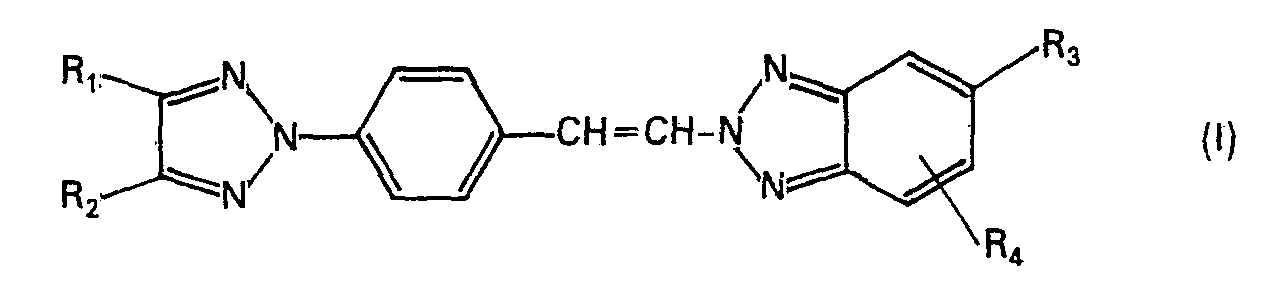
- Gegenstand der vorliegenden Erfindung sind Verbindungen der Formel

- R2 für Phenyl, Tolyl, Chlorphenyl, Cyclohexyl, Xylyl, Biphenylyl oder Styryl stehen, und
- R3 und R4 gemeinsam einen angular anellierten Benzolring bilden.
- Bei den genannten Alkylgruppen handelt es sich insbesondere um CH3 und C2H5.
- Besonders bevorzugte Verbindungen sind solche der Formel (I), in der R1 für Wasserstoff, C1-C2-Alkyl oder Phenyl,
- R2 für Phenyl oder Styryl stehen, und
- R3 und R4 gemeinsam für die restlichen Glieder eines ankondensierten Benzolrings stehen.
- Die neuen Triazolylstyrylverbindungen können auf verschiedene Weise hergestellt werden, indem man beispielsweise Benzotriazolylstyryl-oximinohydrazone der Formel


- Beide Reaktionen sind an sich bekannt (vgl. DE-OS 1917 740 = GB-PS 1289365 und DE-OS 2258276 = GP-PS 1422621).
- Beispielsweise wird die Cyclodehydratisierung von II durch Einwirkung von Säureanhydriden, wie Acetanhydrid oder sonstigen Cyclisierungsmitteln wie Harnstoff oder Isocyanaten in geeigneten Lösungsmitteln, z.B. überschüssigem Acetanhydrid, Dimethylformamid, Dimethylsulfoxid, Glykolmethylether-acetat und anderen polaren aprotonischen Lösungsmittel herbeigeführt. Erforderlich ist dabei die Anwesenheit von Basen wie Natrium- oder Kaliumacetat, Triethylamin, Dimethylbenzylamin, Pyridin u.a.
- Die Cyclodehydrierung der Oximinohydrazone II zu den betreffenden Triazol-N-oxiden III wird in solchen Lösungsmitteln ausgeführt, die gegenüber den jeweils gewählten Oxidationsmitteln und Reakionsbedingungen inert sind, z.B. Pyridin, techn. Pyridinhomologe, Dimethylformamid, Dimethylsulfoxid, Essigsäure und deren Gemische mit Wasser. Als Oxidationsmittel kommen hier in Frage: Kupfer-II-Salze, wie Kupferacetat, Kupferformiat, Kupfersulfat, komplexe Kupfer-II-Verbindungen, ferner Bleioxid, Bleitetraacetat, Kaliumhexacyanato-ferrat, sowie Wasserstoffperoxid oder Luftsauerstoff in Kombination mit Kupfer-II-Verbindungen. Die Reduktion der Triazol-N-oxide II zu den Triazolen I lässt sich leicht durch Einwirkung von Zinkstaub in essigsaurer oder salzsaurer Lösung bzw. Suspension bewerkstelligen. Auch durch Katalyse aktivierter Wasserstoff ist unter milden Reaktionsbedingungen geeignet.
- Die für die erwähnten Umsetzungen erforderlichen Ausgangsverbindungen II lassen sich dadurch erhalten, dass man 2-[4-Hydrazinostyrol]-arylotriazole der Formel


- Die Kupplung der gegebenenfalls im Benzolring des Benzotriazols substituierten 2-p-Aminostyrylbenzotriazole auf die durch R1 und R2 substituierten Isoxazolin-5-one (Vll) erfolgt zweckmässig in essigsaurem Milieu. Die dabei als Zwischenprodukte erhaltenen Azoverbindungen (VIII) werden in einem organischen Lösungsmittel wie Methylenchlorid, Chloroform oder Xylol gelöst bzw. suspendiert und zu einer 60-130°C warmen Mischung aus einem tertiären Amin und einem sekundären Alkohol, z.B. zu einer Mischung aus Isopropanol und Triethylamin oder aus Butanol-2 und Dimethylbenzylamin getropft; statt eines derartigen Gemisches kann man auch 1 -Dimethyiamino-propanoi-2 oder Tris-isopropanolamin verwenden. Die gewünschten Reaktionsprodukte I scheiden sich meist beim Konzentrieren der Reaktionsmischung kristallin ab.
- Ein vorteilhaftes Verfahren zur Herstellung von I ist ferner die Kondensation von v-Triazolylbenzaldehyden der Formel


- Die Triazolylbenzaldehyde sind z.T. aus der DOS 1917740 und der DOS 2258276 bekannt. Alle anderen Triazolylbenzaldehyde können in analoger Weise hergestellt werden, z.B. durch Rosenmund-Reduktion der betreffenden Triazolylbenzoylchloride oder durch Sommelet-Reaktion der betreffenden Triazolylbenzylchloride.
- Die Arylotriazolyl-essigsäuren X sind ebenfalls grösstenteils bekannt bzw. in an sich bekannter Weise erhältlich (vgl. z.B. Tetrahedron 26, 497 f (1970) japanische Patentpublikationen 47/34621 und 42/76310).
- Die neuen v-Triazolylstyryl-arylotriazolverbindungen 1 sind gelbstichig bzw. grünstichig-weisse bis blassgrüne kristalline Substanzen, die eine gute Affinität zu hochmolekularen synthetischen organischen Materialien aufweisen und sich in organischen Lösungsmitteln farblos mit starker blauer bis rotstichig blauer Fluoreszenz lösen. Sie eignen sich daher vorzüglich zum Aufhellen, bzw. Weisstönen von Fäden, Geweben, Folien und anderen Gebilden aus Polyolefinen, Polyacrylnitril, Polyvinylchlorid, Polyamiden und besonders von Polyestern, wie z.B. Polyterephthalsäureglykolester.
- Sie lassen sich in üblicher Weise anwenden, z.B. in Form wässriger Dispersionen oder Lösungen und Dispersionen in organischen Lösungsmitteln, wie z.B. Ethylenglykolmonomethylether, Dimethylformamid, Diglykolmethylether, Triethanolamin u.a.
- Ferner können sie in Schmelz- und Spinnmassen eingearbeitet werden, die zur Herstellung von Fasern, Folien und Formkörpern dienen. Die anzuwendenden Mengen lassen sich durch Vorversuche leicht ermitteln; sie liegen im Bereich von 0,01 bis 0,5%, bezogen auf das Gewicht des aufzuhellenden Materials.
- Gegenüber nächstvergleichbaren Verbindungen gemäss EP-A 0004897 zeichnen sich die erfindungsgemässen Triazolylstyrylverbindungen durch den Vorteil der besseren Aufhellwirkung auf Polyesterfasern aus.
- 132 g 4-[4-Phenyl-5-methyl-v-triazolyl-(2)j-benzaldehyd werden zusammen mit einer äquimolaren Menge an Naphthotriazolyl-(2)essigsäure in 300 ml trockenem techn. Xylol verrührt. Nach Zugabe von 8,5 g Piperidin und 6,0 g Essigsäure wird das Gemisch unter Rühren zunächst auf 100°, dann innerhalb von einer Stunde auf Siedetemperatur erhitzt, wobei man über einen Wasserabscheider unter Rückfluss des Xylols das Reaktionswasser abtrennt. Nach Beendigung der Wasserabspaltung (ca. 2 Stunden) destilliert man das Xylol unter langsamem Überleiten von Stickstoff ab, wobei man die Temperatur der Schmelze bis 170° steigen lässt. Man gibt weitere 8,5 g Piperidin hinzu und rührt bis zur Beendigung der Kohlendioxid-Entwicklung, die man durch Einleiten des Abgases in Calciumhydroxidlösung feststellt. Nach Abkühlen auf etwa 160° lässt man 80 ml Essigsäure und 170 ml Methylglykol einfliessen, wobei das gebildete Triazolylstyrol auskristallisiert. Man saugt das Produkt bei ca. 10° ab, wäscht es mit wenig kaltem Methylglykol und Methanol, reinigt es durch Umkristallisieren aus Methylglykol und trocknet. Man erhält weisse Kristalle der Formel

- Auf Polyesterfasern erhält man mit diesen Verbindungen Aufhellungen von guter Licht-, Nass-und Chloritechtheit.

Claims (3)
Applications Claiming Priority (2)
| Application Number | Priority Date | Filing Date | Title |
|---|---|---|---|
| DE2842686 | 1978-09-30 | ||
| DE19782842686 DE2842686A1 (de) | 1978-09-30 | 1978-09-30 | Triazolylstyrylverbindungen |
Publications (2)
| Publication Number | Publication Date |
|---|---|
| EP0010607A1 EP0010607A1 (de) | 1980-05-14 |
| EP0010607B1 true EP0010607B1 (de) | 1981-08-05 |
Family
ID=6050991
Family Applications (1)
| Application Number | Title | Priority Date | Filing Date |
|---|---|---|---|
| EP79103522A Expired EP0010607B1 (de) | 1978-09-30 | 1979-09-19 | Triazolylstyryl-Verbindungen sowie deren Verwendung zum Weisstönen organischer Materialien |
Country Status (3)
| Country | Link |
|---|---|
| EP (1) | EP0010607B1 (de) |
| JP (1) | JPS5549358A (de) |
| DE (2) | DE2842686A1 (de) |
Family Cites Families (4)
| Publication number | Priority date | Publication date | Assignee | Title |
|---|---|---|---|---|
| US3637673A (en) * | 1967-10-26 | 1972-01-25 | Mitsui Toatsu Chemicals | Optical bleaching of organic material |
| CH523901A (de) * | 1969-06-06 | 1972-06-15 | Sandoz Ag | Verfahren zur Herstellung neuer Triazolylstyrylverbindungen |
| BE758362A (fr) * | 1969-11-03 | 1971-04-16 | Bayer Ag | Eclaircissants de la serie des 2-styryl-5-phenyl-benzotriazols |
| DE2815956A1 (de) * | 1978-04-13 | 1979-10-18 | Bayer Ag | Verfahren zur herstellung von in 2-stellung substituierten triazolen-1,2,3 |
-
1978
- 1978-09-30 DE DE19782842686 patent/DE2842686A1/de not_active Withdrawn
-
1979
- 1979-09-19 EP EP79103522A patent/EP0010607B1/de not_active Expired
- 1979-09-19 DE DE7979103522T patent/DE2960581D1/de not_active Expired
- 1979-09-28 JP JP12430479A patent/JPS5549358A/ja active Pending
Also Published As
| Publication number | Publication date |
|---|---|
| JPS5549358A (en) | 1980-04-09 |
| EP0010607A1 (de) | 1980-05-14 |
| DE2842686A1 (de) | 1980-04-10 |
| DE2960581D1 (en) | 1981-11-05 |
Similar Documents
| Publication | Publication Date | Title |
|---|---|---|
| EP0252406B1 (de) | Verfahren zur Herstellung polycyclischer Verbindungen | |
| EP0003784B1 (de) | Distyryl-Verbindungen, sowie deren Herstellung und Verwendung als Weisstöner und Laserfarbstoff | |
| EP0014344B1 (de) | Cumarinverbindungen, Verfahren zu ihrer Herstellung und deren Verwendung als Weisstöner und Laserfarbstoffe | |
| DE2258276C3 (de) | Triazolyl-stilbene, sowie deren Herstellung und Verwendung als optische Aufheller | |
| EP0005172B1 (de) | Cumarin-Verbindungen und ihre Verwendung als Aufheller für organische hochmolekulare Materialien | |
| EP0504182A1 (de) | Verfahren zur herstellung von chinophthalonderivaten. | |
| EP0011824A1 (de) | Benzofuranyl-benzimidazole, Verfahren zu ihrer Herstellung sowie ihre Verwendung zum optischen Aufhellen von organischen Materialien | |
| DE1594835A1 (de) | Neue Tolanderivate und deren Verwendung als optische Aufhellmittel | |
| EP0010607A1 (de) | Triazolylstyryl-Verbindungen sowie deren Verwendung zum Weisstönen organischer Materialien | |
| DE2712942A1 (de) | Stilbene, verfahren zu deren herstellung und deren verwendung als opttische aufheller | |
| EP0327792B1 (de) | 3-(4-Amino-2-hydroxyphenyl)-1-oxoisoindolenine, Verfahren zu deren Herstellung und deren Verseifung zu 2-(4-Amino-2-hydroxybenzoyl)-benzoesäuren | |
| EP0019182B1 (de) | Benzofuranverbindungen sowie deren Verwendung als optische Aufheller | |
| EP0005465A1 (de) | Benzofuranyl-benzimidazole, Verfahren zu ihrer Herstellung sowie ihre Verwendung zum optischen Aufhellen von organischen Materialien | |
| EP0573999A1 (de) | Verfahren zur Herstellung von Tetronsäurealkylestern | |
| DE2607966C3 (de) | Benzothioxanthene, Verfahren zu ihrer Herstellung und ihre Verwendung als Fluoreszenzfarbstoffe | |
| DE1904653A1 (de) | Substituierte Benzthiazol-N-oxide | |
| DE2131788C3 (de) | Verfahren zur Herstellung von 7-Pyrazolylcumarinen | |
| DE2242784B2 (de) | Verfahren zur herstellung von 2-aryl-v-triazolen | |
| DE2029122A1 (de) | ||
| CH617669A5 (de) | ||
| CH405328A (de) | Verfahren zur Herstellung neuer Tetrahydrothiophenderivate | |
| DE2922374A1 (de) | Verfahren zur herstellung von benzoxanthen- und benzothioxanthenfarbstoffen | |
| DE2708143C3 (de) | 3-Carboxyphenylessigsäurederivate und Verfahren zu ihrer Herstellung | |
| DE2306515A1 (de) | Benzo-difuran-verbindungen | |
| DE2736258C2 (de) | Verfahren zur Herstellung von Estern der Cyclopropancarbonsäure |
Legal Events
| Date | Code | Title | Description |
|---|---|---|---|
| PUAI | Public reference made under article 153(3) epc to a published international application that has entered the european phase |
Free format text: ORIGINAL CODE: 0009012 |
|
| 17P | Request for examination filed | ||
| AK | Designated contracting states |
Designated state(s): CH DE FR GB |
|
| GRAA | (expected) grant |
Free format text: ORIGINAL CODE: 0009210 |
|
| AK | Designated contracting states |
Designated state(s): CH DE FR GB |
|
| REF | Corresponds to: |
Ref document number: 2960581 Country of ref document: DE Date of ref document: 19811105 |
|
| PGFP | Annual fee paid to national office [announced via postgrant information from national office to epo] |
Ref country code: FR Payment date: 19820909 Year of fee payment: 4 |
|
| PGFP | Annual fee paid to national office [announced via postgrant information from national office to epo] |
Ref country code: DE Payment date: 19820930 Year of fee payment: 4 Ref country code: CH Payment date: 19820930 Year of fee payment: 4 |
|
| PG25 | Lapsed in a contracting state [announced via postgrant information from national office to epo] |
Ref country code: CH Effective date: 19830930 |
|
| GBPC | Gb: european patent ceased through non-payment of renewal fee | ||
| PG25 | Lapsed in a contracting state [announced via postgrant information from national office to epo] |
Ref country code: FR Free format text: LAPSE BECAUSE OF NON-PAYMENT OF DUE FEES Effective date: 19840530 |
|
| REG | Reference to a national code |
Ref country code: CH Ref legal event code: PL |
|
| PG25 | Lapsed in a contracting state [announced via postgrant information from national office to epo] |
Ref country code: DE Effective date: 19840602 |
|
| REG | Reference to a national code |
Ref country code: FR Ref legal event code: ST |
|
| PG25 | Lapsed in a contracting state [announced via postgrant information from national office to epo] |
Ref country code: GB Effective date: 19881118 |
|
| PLBE | No opposition filed within time limit |
Free format text: ORIGINAL CODE: 0009261 |
|
| STAA | Information on the status of an ep patent application or granted ep patent |
Free format text: STATUS: NO OPPOSITION FILED WITHIN TIME LIMIT |