EP0003784B1 - Distyryl-Verbindungen, sowie deren Herstellung und Verwendung als Weisstöner und Laserfarbstoff - Google Patents
Distyryl-Verbindungen, sowie deren Herstellung und Verwendung als Weisstöner und Laserfarbstoff Download PDFInfo
- Publication number
- EP0003784B1 EP0003784B1 EP79100387A EP79100387A EP0003784B1 EP 0003784 B1 EP0003784 B1 EP 0003784B1 EP 79100387 A EP79100387 A EP 79100387A EP 79100387 A EP79100387 A EP 79100387A EP 0003784 B1 EP0003784 B1 EP 0003784B1
- Authority
- EP
- European Patent Office
- Prior art keywords
- formula
- denotes
- alkyl
- radical
- chlorine
- Prior art date
- Legal status (The legal status is an assumption and is not a legal conclusion. Google has not performed a legal analysis and makes no representation as to the accuracy of the status listed.)
- Expired
Links
- JFLKFZNIIQFQBS-FNCQTZNRSA-N trans,trans-1,4-Diphenyl-1,3-butadiene Chemical group C=1C=CC=CC=1\C=C\C=C\C1=CC=CC=C1 JFLKFZNIIQFQBS-FNCQTZNRSA-N 0.000 title claims description 9
- 239000000975 dye Substances 0.000 title description 2
- 239000007844 bleaching agent Substances 0.000 title 1
- 238000004519 manufacturing process Methods 0.000 title 1
- 150000001875 compounds Chemical class 0.000 claims description 36
- ZAMOUSCENKQFHK-UHFFFAOYSA-N Chlorine atom Chemical compound [Cl] ZAMOUSCENKQFHK-UHFFFAOYSA-N 0.000 claims description 16
- -1 C1-C4-alkoxycarbonyl Chemical group 0.000 claims description 15
- 125000001997 phenyl group Chemical group [H]C1=C([H])C([H])=C(*)C([H])=C1[H] 0.000 claims description 13
- 239000000460 chlorine Substances 0.000 claims description 11
- 229910052801 chlorine Inorganic materials 0.000 claims description 11
- 125000004093 cyano group Chemical group *C#N 0.000 claims description 10
- 125000003178 carboxy group Chemical group [H]OC(*)=O 0.000 claims description 8
- 229910052739 hydrogen Inorganic materials 0.000 claims description 8
- 239000001257 hydrogen Substances 0.000 claims description 8
- 238000000034 method Methods 0.000 claims description 8
- 150000003254 radicals Chemical class 0.000 claims description 8
- 125000004178 (C1-C4) alkyl group Chemical group 0.000 claims description 7
- 125000002496 methyl group Chemical group [H]C([H])([H])* 0.000 claims description 7
- 125000001797 benzyl group Chemical group [H]C1=C([H])C([H])=C(C([H])=C1[H])C([H])([H])* 0.000 claims description 6
- 125000002887 hydroxy group Chemical group [H]O* 0.000 claims description 6
- 125000000956 methoxy group Chemical group [H]C([H])([H])O* 0.000 claims description 6
- 125000000229 (C1-C4)alkoxy group Chemical group 0.000 claims description 5
- 125000001140 1,4-phenylene group Chemical group [H]C1=C([H])C([*:2])=C([H])C([H])=C1[*:1] 0.000 claims description 5
- 230000002087 whitening effect Effects 0.000 claims description 4
- ABLZXFCXXLZCGV-UHFFFAOYSA-N phosphonic acid group Chemical group P(O)(O)=O ABLZXFCXXLZCGV-UHFFFAOYSA-N 0.000 claims description 3
- 238000002360 preparation method Methods 0.000 claims description 3
- 150000003839 salts Chemical class 0.000 claims description 3
- 125000004959 2,6-naphthylene group Chemical group [H]C1=C([H])C2=C([H])C([*:1])=C([H])C([H])=C2C([H])=C1[*:2] 0.000 claims description 2
- 125000002485 formyl group Chemical group [H]C(*)=O 0.000 claims description 2
- 125000004435 hydrogen atom Chemical class [H]* 0.000 claims 4
- 150000005840 aryl radicals Chemical class 0.000 claims 1
- 125000001301 ethoxy group Chemical group [H]C([H])([H])C([H])([H])O* 0.000 claims 1
- 239000000463 material Substances 0.000 claims 1
- 230000005855 radiation Effects 0.000 claims 1
- ZMXDDKWLCZADIW-UHFFFAOYSA-N N,N-Dimethylformamide Chemical compound CN(C)C=O ZMXDDKWLCZADIW-UHFFFAOYSA-N 0.000 description 48
- YXFVVABEGXRONW-UHFFFAOYSA-N Toluene Chemical compound CC1=CC=CC=C1 YXFVVABEGXRONW-UHFFFAOYSA-N 0.000 description 12
- 239000000243 solution Substances 0.000 description 12
- QTBSBXVTEAMEQO-UHFFFAOYSA-N Acetic acid Chemical compound CC(O)=O QTBSBXVTEAMEQO-UHFFFAOYSA-N 0.000 description 11
- 239000013078 crystal Substances 0.000 description 9
- VZGDMQKNWNREIO-UHFFFAOYSA-N tetrachloromethane Chemical compound ClC(Cl)(Cl)Cl VZGDMQKNWNREIO-UHFFFAOYSA-N 0.000 description 8
- BDZBKCUKTQZUTL-UHFFFAOYSA-N triethyl phosphite Chemical compound CCOP(OCC)OCC BDZBKCUKTQZUTL-UHFFFAOYSA-N 0.000 description 8
- 238000006243 chemical reaction Methods 0.000 description 7
- KWYUFKZDYYNOTN-UHFFFAOYSA-M Potassium hydroxide Chemical compound [OH-].[K+] KWYUFKZDYYNOTN-UHFFFAOYSA-M 0.000 description 6
- 230000000694 effects Effects 0.000 description 6
- 239000000203 mixture Substances 0.000 description 6
- 239000002904 solvent Substances 0.000 description 6
- CTQNGGLPUBDAKN-UHFFFAOYSA-N O-Xylene Chemical compound CC1=CC=CC=C1C CTQNGGLPUBDAKN-UHFFFAOYSA-N 0.000 description 5
- XLYOFNOQVPJJNP-UHFFFAOYSA-N water Substances O XLYOFNOQVPJJNP-UHFFFAOYSA-N 0.000 description 5
- 239000008096 xylene Substances 0.000 description 5
- LFQSCWFLJHTTHZ-UHFFFAOYSA-N Ethanol Chemical compound CCO LFQSCWFLJHTTHZ-UHFFFAOYSA-N 0.000 description 4
- VEXZGXHMUGYJMC-UHFFFAOYSA-N Hydrochloric acid Chemical compound Cl VEXZGXHMUGYJMC-UHFFFAOYSA-N 0.000 description 4
- UFHFLCQGNIYNRP-UHFFFAOYSA-N Hydrogen Chemical compound [H][H] UFHFLCQGNIYNRP-UHFFFAOYSA-N 0.000 description 4
- 229960000583 acetic acid Drugs 0.000 description 4
- 150000002431 hydrogen Chemical class 0.000 description 4
- 238000001953 recrystallisation Methods 0.000 description 4
- 239000000126 substance Substances 0.000 description 4
- KUCOHFSKRZZVRO-UHFFFAOYSA-N terephthalaldehyde Chemical compound O=CC1=CC=C(C=O)C=C1 KUCOHFSKRZZVRO-UHFFFAOYSA-N 0.000 description 4
- PCLIMKBDDGJMGD-UHFFFAOYSA-N N-bromosuccinimide Chemical compound BrN1C(=O)CCC1=O PCLIMKBDDGJMGD-UHFFFAOYSA-N 0.000 description 3
- 239000004952 Polyamide Substances 0.000 description 3
- 239000003513 alkali Substances 0.000 description 3
- 238000004061 bleaching Methods 0.000 description 3
- 239000003795 chemical substances by application Substances 0.000 description 3
- 238000001035 drying Methods 0.000 description 3
- 239000000706 filtrate Substances 0.000 description 3
- 238000001914 filtration Methods 0.000 description 3
- 150000003018 phosphorus compounds Chemical class 0.000 description 3
- 229920002647 polyamide Polymers 0.000 description 3
- 229920000728 polyester Polymers 0.000 description 3
- KZNICNPSHKQLFF-UHFFFAOYSA-N succinimide Chemical compound O=C1CCC(=O)N1 KZNICNPSHKQLFF-UHFFFAOYSA-N 0.000 description 3
- 125000004769 (C1-C4) alkylsulfonyl group Chemical group 0.000 description 2
- OEFHKXOIXRPCTG-UHFFFAOYSA-N 1-(bromomethyl)-4-diethoxyphosphorylbenzene Chemical compound CCOP(=O)(OCC)C1=CC=C(CBr)C=C1 OEFHKXOIXRPCTG-UHFFFAOYSA-N 0.000 description 2
- QDXRPLLQNIZPEK-UHFFFAOYSA-N 1-[bis(ethylperoxy)phosphorylmethyl]-4-diethoxyphosphorylbenzene Chemical compound CCOOP(=O)(OOCC)CC1=CC=C(P(=O)(OCC)OCC)C=C1 QDXRPLLQNIZPEK-UHFFFAOYSA-N 0.000 description 2
- GAPPVLJOQUCQIB-UHFFFAOYSA-N 1-diethoxyphosphoryl-4-methylbenzene Chemical compound CCOP(=O)(OCC)C1=CC=C(C)C=C1 GAPPVLJOQUCQIB-UHFFFAOYSA-N 0.000 description 2
- OZAIFHULBGXAKX-UHFFFAOYSA-N 2-(2-cyanopropan-2-yldiazenyl)-2-methylpropanenitrile Chemical compound N#CC(C)(C)N=NC(C)(C)C#N OZAIFHULBGXAKX-UHFFFAOYSA-N 0.000 description 2
- KQJAWWYLJCTQNG-UHFFFAOYSA-N 4-diethoxyphosphorylbenzaldehyde Chemical compound CCOP(=O)(OCC)C1=CC=C(C=O)C=C1 KQJAWWYLJCTQNG-UHFFFAOYSA-N 0.000 description 2
- IJGRMHOSHXDMSA-UHFFFAOYSA-N Atomic nitrogen Chemical compound N#N IJGRMHOSHXDMSA-UHFFFAOYSA-N 0.000 description 2
- OMPJBNCRMGITSC-UHFFFAOYSA-N Benzoylperoxide Chemical compound C=1C=CC=CC=1C(=O)OOC(=O)C1=CC=CC=C1 OMPJBNCRMGITSC-UHFFFAOYSA-N 0.000 description 2
- OKTJSMMVPCPJKN-UHFFFAOYSA-N Carbon Chemical compound [C] OKTJSMMVPCPJKN-UHFFFAOYSA-N 0.000 description 2
- HEDRZPFGACZZDS-UHFFFAOYSA-N Chloroform Chemical compound ClC(Cl)Cl HEDRZPFGACZZDS-UHFFFAOYSA-N 0.000 description 2
- NBIIXXVUZAFLBC-UHFFFAOYSA-N Phosphoric acid Chemical compound OP(O)(O)=O NBIIXXVUZAFLBC-UHFFFAOYSA-N 0.000 description 2
- 229910052784 alkaline earth metal Inorganic materials 0.000 description 2
- 239000007795 chemical reaction product Substances 0.000 description 2
- 125000004218 chloromethyl group Chemical group [H]C([H])(Cl)* 0.000 description 2
- 238000004440 column chromatography Methods 0.000 description 2
- 239000012043 crude product Substances 0.000 description 2
- 239000000835 fiber Substances 0.000 description 2
- VKYKSIONXSXAKP-UHFFFAOYSA-N hexamethylenetetramine Chemical compound C1N(C2)CN3CN1CN2C3 VKYKSIONXSXAKP-UHFFFAOYSA-N 0.000 description 2
- GNOIPBMMFNIUFM-UHFFFAOYSA-N hexamethylphosphoric triamide Chemical compound CN(C)P(=O)(N(C)C)N(C)C GNOIPBMMFNIUFM-UHFFFAOYSA-N 0.000 description 2
- UAEPNZWRGJTJPN-UHFFFAOYSA-N methylcyclohexane Chemical compound CC1CCCCC1 UAEPNZWRGJTJPN-UHFFFAOYSA-N 0.000 description 2
- 239000000843 powder Substances 0.000 description 2
- 239000011541 reaction mixture Substances 0.000 description 2
- 238000010992 reflux Methods 0.000 description 2
- QDRKDTQENPPHOJ-UHFFFAOYSA-N sodium ethoxide Chemical compound [Na+].CC[O-] QDRKDTQENPPHOJ-UHFFFAOYSA-N 0.000 description 2
- 239000007858 starting material Substances 0.000 description 2
- NGQSLSMAEVWNPU-YTEMWHBBSA-N 1,2-bis[(e)-2-phenylethenyl]benzene Chemical class C=1C=CC=CC=1/C=C/C1=CC=CC=C1\C=C\C1=CC=CC=C1 NGQSLSMAEVWNPU-YTEMWHBBSA-N 0.000 description 1
- RYZJMMSKTYONHU-UHFFFAOYSA-N 1-[bis(ethylperoxy)phosphorylmethyl]-4-chlorobenzene Chemical compound CCOOP(=O)(OOCC)CC1=CC=C(Cl)C=C1 RYZJMMSKTYONHU-UHFFFAOYSA-N 0.000 description 1
- GTXVBJKAIHULCD-UHFFFAOYSA-N 2,6-bis[2-(2-bromophenyl)ethenyl]naphthalene Chemical compound BrC1=CC=CC=C1C=CC1=CC=C(C=C(C=CC=2C(=CC=CC=2)Br)C=C2)C2=C1 GTXVBJKAIHULCD-UHFFFAOYSA-N 0.000 description 1
- SRQLHQYQTLQJTI-UHFFFAOYSA-N 2,7-bis[bis(ethylperoxy)phosphorylmethyl]dibenzofuran Chemical compound C1=C(CP(=O)(OOCC)OOCC)C=C2C3=CC=C(CP(=O)(OOCC)OOCC)C=C3OC2=C1 SRQLHQYQTLQJTI-UHFFFAOYSA-N 0.000 description 1
- XNWFRZJHXBZDAG-UHFFFAOYSA-N 2-METHOXYETHANOL Chemical compound COCCO XNWFRZJHXBZDAG-UHFFFAOYSA-N 0.000 description 1
- SONFLWFSTUVGGK-UHFFFAOYSA-N 2-[bis(ethylperoxy)phosphorylmethyl]benzonitrile Chemical compound CCOOP(=O)(OOCC)CC1=CC=CC=C1C#N SONFLWFSTUVGGK-UHFFFAOYSA-N 0.000 description 1
- VGUWZCUCNQXGBU-UHFFFAOYSA-N 3-[(4-methylpiperazin-1-yl)methyl]-5-nitro-1h-indole Chemical compound C1CN(C)CCN1CC1=CNC2=CC=C([N+]([O-])=O)C=C12 VGUWZCUCNQXGBU-UHFFFAOYSA-N 0.000 description 1
- FEHLIYXNTWAEBQ-UHFFFAOYSA-N 4-(4-formylphenyl)benzaldehyde Chemical group C1=CC(C=O)=CC=C1C1=CC=C(C=O)C=C1 FEHLIYXNTWAEBQ-UHFFFAOYSA-N 0.000 description 1
- WKBOTKDWSSQWDR-UHFFFAOYSA-N Bromine atom Chemical compound [Br] WKBOTKDWSSQWDR-UHFFFAOYSA-N 0.000 description 1
- ULUYUVFACQSMLN-UHFFFAOYSA-N C(C)OP(=O)C1=CC=CC=C1.C(C)OOP(=O)(OOCC)CC1=CC=CC=C1 Chemical compound C(C)OP(=O)C1=CC=CC=C1.C(C)OOP(=O)(OOCC)CC1=CC=CC=C1 ULUYUVFACQSMLN-UHFFFAOYSA-N 0.000 description 1
- XMLSEFOPTCXDNK-UHFFFAOYSA-N C(CCC)OP(=O)C1=CC=CC=C1.C(C)OOP(=O)(OOCC)CC1=CC=CC=C1 Chemical compound C(CCC)OP(=O)C1=CC=CC=C1.C(C)OOP(=O)(OOCC)CC1=CC=CC=C1 XMLSEFOPTCXDNK-UHFFFAOYSA-N 0.000 description 1
- 229920000742 Cotton Polymers 0.000 description 1
- DGAQECJNVWCQMB-PUAWFVPOSA-M Ilexoside XXIX Chemical compound C[C@@H]1CC[C@@]2(CC[C@@]3(C(=CC[C@H]4[C@]3(CC[C@@H]5[C@@]4(CC[C@@H](C5(C)C)OS(=O)(=O)[O-])C)C)[C@@H]2[C@]1(C)O)C)C(=O)O[C@H]6[C@@H]([C@H]([C@@H]([C@H](O6)CO)O)O)O.[Na+] DGAQECJNVWCQMB-PUAWFVPOSA-M 0.000 description 1
- FXHOOIRPVKKKFG-UHFFFAOYSA-N N,N-Dimethylacetamide Chemical compound CN(C)C(C)=O FXHOOIRPVKKKFG-UHFFFAOYSA-N 0.000 description 1
- 229910021586 Nickel(II) chloride Inorganic materials 0.000 description 1
- OAICVXFJPJFONN-UHFFFAOYSA-N Phosphorus Chemical group [P] OAICVXFJPJFONN-UHFFFAOYSA-N 0.000 description 1
- CDBYLPFSWZWCQE-UHFFFAOYSA-L Sodium Carbonate Chemical class [Na+].[Na+].[O-]C([O-])=O CDBYLPFSWZWCQE-UHFFFAOYSA-L 0.000 description 1
- PMZURENOXWZQFD-UHFFFAOYSA-L Sodium Sulfate Chemical compound [Na+].[Na+].[O-]S([O-])(=O)=O PMZURENOXWZQFD-UHFFFAOYSA-L 0.000 description 1
- CIUQDSCDWFSTQR-UHFFFAOYSA-N [C]1=CC=CC=C1 Chemical compound [C]1=CC=CC=C1 CIUQDSCDWFSTQR-UHFFFAOYSA-N 0.000 description 1
- 229910001854 alkali hydroxide Inorganic materials 0.000 description 1
- 229910001860 alkaline earth metal hydroxide Inorganic materials 0.000 description 1
- 150000001342 alkaline earth metals Chemical class 0.000 description 1
- 125000000217 alkyl group Chemical group 0.000 description 1
- 229910000147 aluminium phosphate Inorganic materials 0.000 description 1
- 150000001408 amides Chemical class 0.000 description 1
- 239000000010 aprotic solvent Substances 0.000 description 1
- QVGXLLKOCUKJST-UHFFFAOYSA-N atomic oxygen Chemical group [O] QVGXLLKOCUKJST-UHFFFAOYSA-N 0.000 description 1
- 150000007514 bases Chemical class 0.000 description 1
- 235000019400 benzoyl peroxide Nutrition 0.000 description 1
- 230000001588 bifunctional effect Effects 0.000 description 1
- 238000005282 brightening Methods 0.000 description 1
- 230000031709 bromination Effects 0.000 description 1
- 238000005893 bromination reaction Methods 0.000 description 1
- GDTBXPJZTBHREO-UHFFFAOYSA-N bromine Substances BrBr GDTBXPJZTBHREO-UHFFFAOYSA-N 0.000 description 1
- 229910052794 bromium Inorganic materials 0.000 description 1
- RDHPKYGYEGBMSE-UHFFFAOYSA-N bromoethane Chemical compound CCBr RDHPKYGYEGBMSE-UHFFFAOYSA-N 0.000 description 1
- 125000005997 bromomethyl group Chemical group 0.000 description 1
- 239000003054 catalyst Substances 0.000 description 1
- 239000001913 cellulose Substances 0.000 description 1
- 229920002678 cellulose Polymers 0.000 description 1
- 238000009833 condensation Methods 0.000 description 1
- 230000005494 condensation Effects 0.000 description 1
- 238000004821 distillation Methods 0.000 description 1
- 239000004744 fabric Substances 0.000 description 1
- 239000002657 fibrous material Substances 0.000 description 1
- 239000012065 filter cake Substances 0.000 description 1
- 239000012362 glacial acetic acid Substances 0.000 description 1
- 125000005843 halogen group Chemical group 0.000 description 1
- 230000026030 halogenation Effects 0.000 description 1
- 238000005658 halogenation reaction Methods 0.000 description 1
- 125000004970 halomethyl group Chemical group 0.000 description 1
- 238000010438 heat treatment Methods 0.000 description 1
- 229910001385 heavy metal Inorganic materials 0.000 description 1
- 239000004312 hexamethylene tetramine Substances 0.000 description 1
- 235000010299 hexamethylene tetramine Nutrition 0.000 description 1
- 239000005457 ice water Substances 0.000 description 1
- 238000002955 isolation Methods 0.000 description 1
- 150000002605 large molecules Chemical class 0.000 description 1
- 239000000990 laser dye Substances 0.000 description 1
- GYNNXHKOJHMOHS-UHFFFAOYSA-N methyl-cycloheptane Natural products CC1CCCCCC1 GYNNXHKOJHMOHS-UHFFFAOYSA-N 0.000 description 1
- 230000005012 migration Effects 0.000 description 1
- 238000013508 migration Methods 0.000 description 1
- 230000004048 modification Effects 0.000 description 1
- 238000012986 modification Methods 0.000 description 1
- QMMRZOWCJAIUJA-UHFFFAOYSA-L nickel dichloride Chemical compound Cl[Ni]Cl QMMRZOWCJAIUJA-UHFFFAOYSA-L 0.000 description 1
- 229910052757 nitrogen Inorganic materials 0.000 description 1
- 239000011368 organic material Substances 0.000 description 1
- 239000012074 organic phase Substances 0.000 description 1
- 239000003960 organic solvent Substances 0.000 description 1
- 229910052760 oxygen Inorganic materials 0.000 description 1
- 239000001301 oxygen Substances 0.000 description 1
- 125000002467 phosphate group Chemical group [H]OP(=O)(O[H])O[*] 0.000 description 1
- 125000002270 phosphoric acid ester group Chemical group 0.000 description 1
- 150000003014 phosphoric acid esters Chemical class 0.000 description 1
- 229910052698 phosphorus Inorganic materials 0.000 description 1
- 239000011574 phosphorus Substances 0.000 description 1
- 229920000139 polyethylene terephthalate Polymers 0.000 description 1
- 239000005020 polyethylene terephthalate Substances 0.000 description 1
- 239000002244 precipitate Substances 0.000 description 1
- 238000006862 quantum yield reaction Methods 0.000 description 1
- 238000000926 separation method Methods 0.000 description 1
- 239000011734 sodium Substances 0.000 description 1
- 229910052708 sodium Inorganic materials 0.000 description 1
- 230000003595 spectral effect Effects 0.000 description 1
- 125000003107 substituted aryl group Chemical group 0.000 description 1
- 229960002317 succinimide Drugs 0.000 description 1
- 125000000542 sulfonic acid group Chemical group 0.000 description 1
- 239000000725 suspension Substances 0.000 description 1
- 238000005406 washing Methods 0.000 description 1
Classifications
-
- D—TEXTILES; PAPER
- D06—TREATMENT OF TEXTILES OR THE LIKE; LAUNDERING; FLEXIBLE MATERIALS NOT OTHERWISE PROVIDED FOR
- D06M—TREATMENT, NOT PROVIDED FOR ELSEWHERE IN CLASS D06, OF FIBRES, THREADS, YARNS, FABRICS, FEATHERS OR FIBROUS GOODS MADE FROM SUCH MATERIALS
- D06M13/00—Treating fibres, threads, yarns, fabrics or fibrous goods made from such materials, with non-macromolecular organic compounds; Such treatment combined with mechanical treatment
- D06M13/244—Treating fibres, threads, yarns, fabrics or fibrous goods made from such materials, with non-macromolecular organic compounds; Such treatment combined with mechanical treatment with compounds containing sulfur or phosphorus
- D06M13/282—Treating fibres, threads, yarns, fabrics or fibrous goods made from such materials, with non-macromolecular organic compounds; Such treatment combined with mechanical treatment with compounds containing sulfur or phosphorus with compounds containing phosphorus
- D06M13/288—Phosphonic or phosphonous acids or derivatives thereof
-
- C—CHEMISTRY; METALLURGY
- C07—ORGANIC CHEMISTRY
- C07F—ACYCLIC, CARBOCYCLIC OR HETEROCYCLIC COMPOUNDS CONTAINING ELEMENTS OTHER THAN CARBON, HYDROGEN, HALOGEN, OXYGEN, NITROGEN, SULFUR, SELENIUM OR TELLURIUM
- C07F9/00—Compounds containing elements of Groups 5 or 15 of the Periodic Table
- C07F9/02—Phosphorus compounds
- C07F9/28—Phosphorus compounds with one or more P—C bonds
- C07F9/30—Phosphinic acids [R2P(=O)(OH)]; Thiophosphinic acids ; [R2P(=X1)(X2H) (X1, X2 are each independently O, S or Se)]
- C07F9/32—Esters thereof
- C07F9/3205—Esters thereof the acid moiety containing a substituent or a structure which is considered as characteristic
- C07F9/3229—Esters of aromatic acids (P-C aromatic linkage)
-
- C—CHEMISTRY; METALLURGY
- C07—ORGANIC CHEMISTRY
- C07F—ACYCLIC, CARBOCYCLIC OR HETEROCYCLIC COMPOUNDS CONTAINING ELEMENTS OTHER THAN CARBON, HYDROGEN, HALOGEN, OXYGEN, NITROGEN, SULFUR, SELENIUM OR TELLURIUM
- C07F9/00—Compounds containing elements of Groups 5 or 15 of the Periodic Table
- C07F9/02—Phosphorus compounds
- C07F9/28—Phosphorus compounds with one or more P—C bonds
- C07F9/38—Phosphonic acids [RP(=O)(OH)2]; Thiophosphonic acids ; [RP(=X1)(X2H)2(X1, X2 are each independently O, S or Se)]
- C07F9/3804—Phosphonic acids [RP(=O)(OH)2]; Thiophosphonic acids ; [RP(=X1)(X2H)2(X1, X2 are each independently O, S or Se)] not used, see subgroups
- C07F9/3834—Aromatic acids (P-C aromatic linkage)
-
- C—CHEMISTRY; METALLURGY
- C07—ORGANIC CHEMISTRY
- C07F—ACYCLIC, CARBOCYCLIC OR HETEROCYCLIC COMPOUNDS CONTAINING ELEMENTS OTHER THAN CARBON, HYDROGEN, HALOGEN, OXYGEN, NITROGEN, SULFUR, SELENIUM OR TELLURIUM
- C07F9/00—Compounds containing elements of Groups 5 or 15 of the Periodic Table
- C07F9/02—Phosphorus compounds
- C07F9/28—Phosphorus compounds with one or more P—C bonds
- C07F9/38—Phosphonic acids [RP(=O)(OH)2]; Thiophosphonic acids ; [RP(=X1)(X2H)2(X1, X2 are each independently O, S or Se)]
- C07F9/40—Esters thereof
- C07F9/4003—Esters thereof the acid moiety containing a substituent or a structure which is considered as characteristic
- C07F9/4021—Esters of aromatic acids (P-C aromatic linkage)
-
- C—CHEMISTRY; METALLURGY
- C07—ORGANIC CHEMISTRY
- C07F—ACYCLIC, CARBOCYCLIC OR HETEROCYCLIC COMPOUNDS CONTAINING ELEMENTS OTHER THAN CARBON, HYDROGEN, HALOGEN, OXYGEN, NITROGEN, SULFUR, SELENIUM OR TELLURIUM
- C07F9/00—Compounds containing elements of Groups 5 or 15 of the Periodic Table
- C07F9/02—Phosphorus compounds
- C07F9/28—Phosphorus compounds with one or more P—C bonds
- C07F9/38—Phosphonic acids [RP(=O)(OH)2]; Thiophosphonic acids ; [RP(=X1)(X2H)2(X1, X2 are each independently O, S or Se)]
- C07F9/40—Esters thereof
- C07F9/4003—Esters thereof the acid moiety containing a substituent or a structure which is considered as characteristic
- C07F9/4056—Esters of arylalkanephosphonic acids
-
- C—CHEMISTRY; METALLURGY
- C07—ORGANIC CHEMISTRY
- C07F—ACYCLIC, CARBOCYCLIC OR HETEROCYCLIC COMPOUNDS CONTAINING ELEMENTS OTHER THAN CARBON, HYDROGEN, HALOGEN, OXYGEN, NITROGEN, SULFUR, SELENIUM OR TELLURIUM
- C07F9/00—Compounds containing elements of Groups 5 or 15 of the Periodic Table
- C07F9/02—Phosphorus compounds
- C07F9/28—Phosphorus compounds with one or more P—C bonds
- C07F9/50—Organo-phosphines
- C07F9/53—Organo-phosphine oxides; Organo-phosphine thioxides
- C07F9/5325—Aromatic phosphine oxides or thioxides (P-C aromatic linkage)
-
- H—ELECTRICITY
- H01—ELECTRIC ELEMENTS
- H01S—DEVICES USING THE PROCESS OF LIGHT AMPLIFICATION BY STIMULATED EMISSION OF RADIATION [LASER] TO AMPLIFY OR GENERATE LIGHT; DEVICES USING STIMULATED EMISSION OF ELECTROMAGNETIC RADIATION IN WAVE RANGES OTHER THAN OPTICAL
- H01S3/00—Lasers, i.e. devices using stimulated emission of electromagnetic radiation in the infrared, visible or ultraviolet wave range
- H01S3/14—Lasers, i.e. devices using stimulated emission of electromagnetic radiation in the infrared, visible or ultraviolet wave range characterised by the material used as the active medium
- H01S3/20—Liquids
-
- H—ELECTRICITY
- H01—ELECTRIC ELEMENTS
- H01S—DEVICES USING THE PROCESS OF LIGHT AMPLIFICATION BY STIMULATED EMISSION OF RADIATION [LASER] TO AMPLIFY OR GENERATE LIGHT; DEVICES USING STIMULATED EMISSION OF ELECTROMAGNETIC RADIATION IN WAVE RANGES OTHER THAN OPTICAL
- H01S3/00—Lasers, i.e. devices using stimulated emission of electromagnetic radiation in the infrared, visible or ultraviolet wave range
- H01S3/14—Lasers, i.e. devices using stimulated emission of electromagnetic radiation in the infrared, visible or ultraviolet wave range characterised by the material used as the active medium
- H01S3/20—Liquids
- H01S3/213—Liquids including an organic dye
Definitions
- the invention relates to phosphono-, phosphonyl- and phosphinyl-substituted distyryl compounds, processes for their preparation and their use as whiteners and as laser dyes.
- dialdehydes of the formula with monofunctional compounds of the formulas or monoaldehydes of the formulas with bifunctional compounds of the formula implement, where A, R 1 , R 2 , R 3 and R 4 have the meaning given and V or -CH 2 -P (R) 3 means.
- the phosphorus compounds of the formulas (Vla), (Vlb) and (VIII) required as starting materials are obtained by adding halomethyl compounds, preferably chloromethyl or bromomethyl compounds of the formulas respectively. and with phosphorus compounds P (OR) 3 , RP (OR) 2 , RO-P (R) 2 or P (R) 3 , where R has the meaning given.
- R is preferably C 1 -C 4 -alkyl bonded to oxygen, but phenyl bonded to phosphorus.
- the corresponding components are condensed in the presence of basic condensing agents in organic solvents.
- Dimethylformamide, dimethylacetamide and phosphoric acid tris-dialkylamide are preferred, alkyl being in particular C 1 -C 4 alkyl.
- Strongly basic compounds such as alkali or alkaline earth metal hydroxides, alkali or alkaline earth amides and alkali or alkaline earth metal alcoholates are suitable as condensing agents.
- Suitable condensation catalysts are heavy metal salts, CuCI, CuJ, CoCI 2 and NiCI 2 used.
- the reaction temperatures are preferably between 160 and 200 ° C.
- the compounds (I) according to the invention are also obtained if the corresponding aldehydanils are reacted with the corresponding methyl compounds in a dipolar aprotic solvent such as dimethylformamide in the presence of basic condensing agents. Further, known conversions can be carried out on the reaction products of the above processes, such as halogenations, functional modifications of carboxyl groups, introduction of chloromethyl groups or exchange of halogen atoms for cyano groups.
- the compounds of formula (I) show a very strong blue fluorescence in the dissolved or finely divided state. They are suitable individually or as mixtures for whitening a wide variety of synthetic, semi-synthetic or natural organic materials.
- the new compounds of formula I containing phosphoric acid ester groups are particularly suitable for whitening fiber materials based on polyesters and other synthetic organic high molecular weight compounds.
- the compounds of formula (I) which contain phosphonic acid groups are suitable for whitening cotton, cellulose and polyamides from washing liquors.
- Compounds of formula (I) with their large quantum yield and high light fastness can still be used as tunable dye lasers in the blue spectral range from 400 nm to 480 nm.
- the new white-tinting substances are characterized by particularly good heat resistance, light fastness, migration resistance and brightening effect. These effects do not have the same constitution in known white tones that can be compared to the same extent.
- the phosphoric acid ester types according to the invention have the surprising advantage over the similar phosphorus-free distyrylbenzene derivatives according to DE-AS 1108219 of producing an improved white effect on thermosol-dyed polyester fibers and on synthetic polyamide fibers.
- the new water-soluble types with a free phosphate group also unexpectedly outperform the whiteners known from Japanese patent publication 77/13522, which contain sulfonic acid groups as water-solubilizing residues, with regard to the white effect on synthetic polyamide fabrics.
- the compound of the formula is obtained from 39.6 g (0.1 mol) of (4-diethoxyphosphonomethylbenzene) phenylphosphinic acid ethyl ester and 6.7 g (0.05 mol) of terephthalaldehyde in the form of pale yellow crystals (toluene), the solution of which in dimethylformamide shows intense, reddish blue fluorescence.
- the compound of the structure is obtained from 2,6-di (2-bromostyryl) naphthalene by reaction with triethyl phosphite and potassium hydroxide in the form of light yellow crystals, which are recrystallized from dimethylformamide and show a strong blue fluorescence.
- reaction mixture is poured onto 500 ml of water and adjusted to pH 4-5 with acetic acid. It is extracted three times with 100 ml of chloroform. The organic phase is then washed with 100 ml of saturated sodium carbonate solution and 100 ml of water. After drying over anhydrous sodium sulfate and filtering off, the solvent is removed in vacuo. 50 ml of carbon tetrachloride are added to the residue. 18.8 g (53% of theory) of light yellow crystal powder of the compound of the formula are obtained which is purified by recrystallization from toluene. The substance fluoresces strong blue when dissolved in dimethylformamide and produces very good white effects with very good fastness properties on polyester in the pull-out process.
- terephthalaldehyde can also be used with the same success and reacted successively with the appropriate amounts of 2-diethoxyphosphonomethylbenzonitrile and 4-diethoxyphosphonomethylbenzenephosphonic acid diethyl ester.
- dimethylformamide hexamethylphosphoric triamide can also be used as the solvent. Isolation of unbalanced Compound of formula (8) from the mixture can be made by recrystallization or by column chromatography.
- Example 4 Analogously to Example 4, the compound of the formula is obtained from the corresponding dibromodistyryl compounds and triethyl phosphite as yellow crystals, which are recrystallized from xylene and fluoresce reddish blue in dimethylformamide.
- 4-Formyl-benzene-phosphonic acid diethyl ester was prepared in a known manner by bromination of 4-methyl-benzene-phosphonic acid diethyl ester and subsequent reaction with hexamethylenetetramine in acetic acid.
- Example 4 Analogously to Example 4, the compound of the formula is obtained from 2,7-di-2-bromostyryl) -9,10-dihydrophenanthrene and triethyl phosphite which recrystallized from xylene with the addition of bleaching earth and dissolved in dimethylformamide shows a strong blue fluorescence.
Landscapes
- Chemical & Material Sciences (AREA)
- Organic Chemistry (AREA)
- General Health & Medical Sciences (AREA)
- Health & Medical Sciences (AREA)
- Life Sciences & Earth Sciences (AREA)
- Biochemistry (AREA)
- Molecular Biology (AREA)
- Electromagnetism (AREA)
- Physics & Mathematics (AREA)
- Engineering & Computer Science (AREA)
- Plasma & Fusion (AREA)
- Optics & Photonics (AREA)
- Textile Engineering (AREA)
- Heat Sensitive Colour Forming Recording (AREA)
- Organic Low-Molecular-Weight Compounds And Preparation Thereof (AREA)
Description
- Die Erfindung betrifft phosphono-, phosphonyl- und phosphinyl-substituierte Distyryl-Verbindungen, Verfahren zu deren Herstellung sowie deren Verwendung als Weisstöner und als Laserfarbstoffe.
- Die neuen Verbindungen entsprechen der allgemeinen Formel

- B 1,4-Phenylen, 4,4'-Biphenylylen, 1,4- und 2,6-Naphthylen, 9,10-Dihydro-2,7-phenanthreny- len oder2,7-Dibenzofuranylen,
- R1 einen Rest der Formel

- R2 Wasserstoff, Chlor, C1-C4-Alkyl, Sulfo, Carboxy, C1-C4-Alkoxy, C1-C4-Alkoxycarbonyl, Cyano oder einen Rest der Formel

- R3 und R4 Wasserstoff, Chlor, C1-C4-Alkyl, gegebenenfalls durch Methyl, Methoxy oder Chlor substituiertes Phenyl, C1-C4-Alkoxy, C1-C4-Alkoxycarbonyl, Cyano, C1-C4-Alkylsulfonyl, C1-C4-Alkylcarbonyl, Hydroxy oder Carboxy,
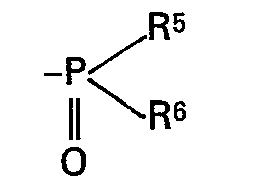
- R5 und R6 C1-C4-Alkyl, Benzyl, gegebenenfalls durch Methyl, Methoxy oder Chlor substituiertes Phenyl, eine Gruppe der Formel -0R7, oder einen Rest der Formel
- -(OCH2CH2)n-OR7,
- R7 Wasserstoff, CI-C4-Alkyl, Benzyl oder Phenyl und
- n eine ganze Zahl von 1 bis 7 bedeuten,
- wobei die Phosphonsäuregruppe auch als Salz vorliegen kann.
- Besonders wertvolle Verbindungen entsprechen der Formel
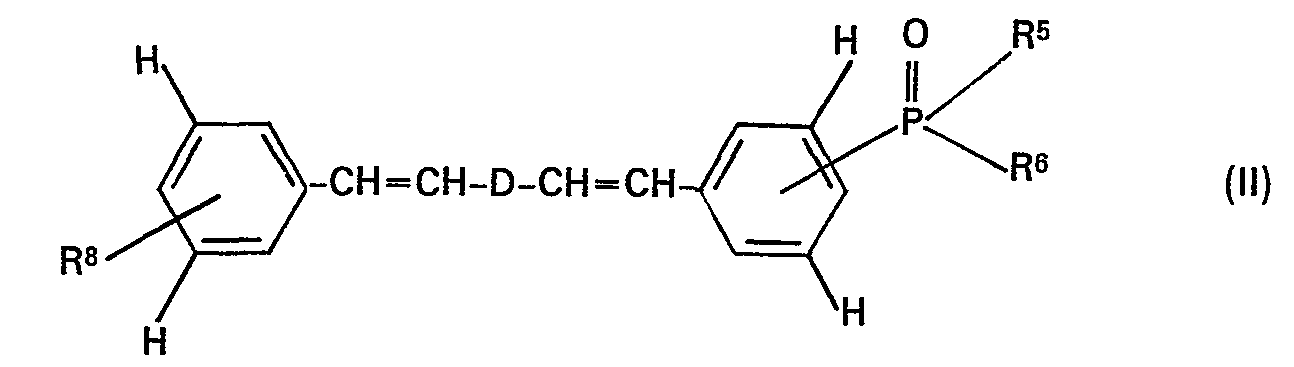
- D 1,4-Phenylen, 4,4'-Biphenylylen oder 9,10-Di- hydro-2,7-phenanthrenylen,
- R8 Wasserstoff, Chlor, C1-C4 Alkyl, Phenyl, C1-C4-Alkoxy, CI-C4-Alkoxycarbonyl, Cyano, C1-C4-Alkylcarbonyl, Hydroxy oder Carboxy oder einen Rest der Formel

- Die Distyryl-Verbindungen der Formel (I) können nach an sich bekannten Methoden dadurch hergestellt werden, dass man die Verbindung der Formel Z1-B-Z2 (III) im molaren Verhältnis 1:1:1 mit je einer Verbindung der Formeln


- R einen C1-C4-Alkyl, einen C5-C6-Cycloalkyl oder einen gegebenenfalls weitersubstituierten Arylrest, vorzugsweise einen Phenylrest, bedeutet.
- Auf diese Weise können symmetrische und unsymmetrische Verbindungen und Gemische aus symmetrischen und unsymmetrischen Verbindungen hergestellt werden.
- Demgemäss kann man beispielsweise Dialdehyde der Formel

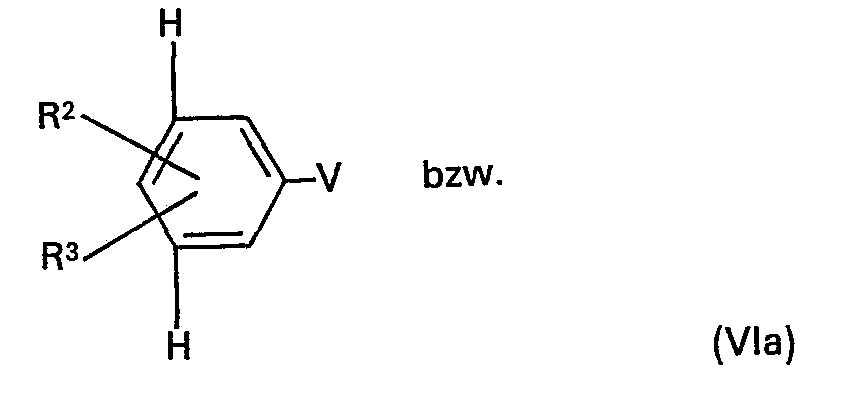


Die hierbei als Ausgangsstoffe benötigten Phosphorverbindungen der Formeln (Vla), (Vlb) und (VIII) werden erhalten, indem man Halogenmethylverbindungen, vorzugsweise Chlormethyl-oder Brommethylverbindungen der Formeln


- Zur Herstellung der Endstoffe kondensiert man die entsprechenden Komponenten in Gegenwart basischer Kondensationsmittel in organischen Lösungsmitteln.
- Als Lösungsmittel wählt man vorteilhaft indifferente Lösungsmittel. Bevorzugt sind Dimethylformamid, Dimethylacetamid und Phosphorsäure-tris-dialkylamide, wobei Alkyl insbesondere C1-C4-Alkyl ist.
- Als Kondensationsmittel kommen stark basische Verbindungen in Betracht wie Alkali- oder Erdalkalimetallhydroxide, Alkali- oder Erdalkaliamide und Alkali- oder Erdalkalimetallalkoholate.
- Man arbeitet bevorzugt im Temperaturbereich von 0 bis 120°C.
- Ein weiteres Verfahren zur Herstellung von Verbindungen der Formel (I) besteht darin, dass man die Bis-halogenverbindungen der Formel (XI)


- Geeignete Kondensationskatalysatoren sind Schwermetallsalze, CuCI, CuJ, CoCI2 und NiCI2 verwendet.
- Die Reaktionstemperaturen liegen vorzugsweise zwischen 160 und 200°C.
- Die Verbindungen der Formel (XI) sind nach bekannten Verfahren zugänglich.
- Die erfindungsgemässen Verbindungen (I) werden ebenfalls erhalten, wenn man die entsprechenden Aldehydanile in einem dipolar aprotischen Lösungsmittel wie Dimethylformamid in Gegenwart von basischen Kondensationsmitteln mit den entsprechenden Methylverbindungen umsetzt. An den Reaktionsprodukten der vorstehenden Verfahren können noch weitere, an sich bekannte Umwandlungen vorgenommen werden wie Halogenierungen, funktionelle Abwandlungen von Carboxylgruppen, Einführung von Chlormethylgruppen oder Austausch von Halogenatomen gegen Cyanogruppen.
- Die Verbindungen der Formel (I) zeigen im gelösten oder fein verteilten Zustand eine sehr starke blaue Fluoreszenz. Sie eignen sich einzeln oder als Mischungen zum Weisstönen der verschiedensten synthetischen, halbsynthetischen oder natürlichen organischen Materialien. Besonders geeignet sind die neuen Phosphorsäureester-Gruppen enthaltenden Verbindungen der Formel I zum Weisstönen von Fasermaterialien auf der Basis von Polyestern und anderen synthetischen organischen hochmolekularen Verbindungen. Andererseits eignen sich die Verbindungen der Formel (I), die Phosphonsäuregruppen enthalten, für das Weisstönen von Baumwolle, Cellulose und Polyamiden aus Waschflotten. Verbindungen der Formel (I) sind mit ihrer grossen Quantenausbeute und hohen Lichtechtheit weiterhin verwendbar als durchstimmbare Farbstofflaser im blauen Spektralbereich von 400 nm-480 nm.
- Die neuen weisstönenden Substanzen zeichnen sich durch besonders gute Hitzebeständigkeit, Lichtechtheit, Migrierbeständigkeit und Aufhellwirkung aus. Diese Effekte weisen konstitutionell nächstvergleichbare bekannte Weisstöner nicht im gleichen Masse auf.
- Beispielsweise zeigen die erfindungsgemässen Phosphorsäureester-Typen gegenüber den ähnlichen phosphorfreien Distyrylbenzolderivaten gemäss DE-AS 1108219 den überraschenden Vorteil, auf thermosolgefärbten Polyesterfasern sowie auf synthetischen Polyamidfasern einen verbesserten Weisseffekt zu erzeugen.
- Auch die neuen wasserlöslichen Typen mit freier Phosphatgruppe übertreffen unerwarteterweise die aus der japanischen Patentpublikation 77/13522 bekannten Weisstöner, welche Sulfonsäuregruppen als wasserlöslich-machende Reste tragen, hinsichtlich des Weisseffekts auf synthetischen Polyamidgeweben.
- Zu einer Lösung von 36,4 g (0,1 Mol) 4-Diäthoxyphosphonomethylbenzolphosphonsäure-diäthylester und 10,5 g (0,05 Mol) 4,4'-Diformylbi- phenyl in 50 ml Hexamethylphosphorsäuretriamid tropft man innerhalb von 30 Minuten 100 ml einer 1 molaren Natriumäthylat-Lösung in Äthanol so zu, dass die Temperatur nicht über 50°C steigt. Man lässt 4 Stunden bei 40 bis 50°C rühren, stellt mit Essigsäure auf pH 4 bis 5, destilliert den grössten Teil der Lösungsmittel im Vakuum ab und gibt den Rückstand auf 200 ml Eiswasser. Der gelbliche Niederschlag wird abgesaugt, mit Wasser gewaschen und getrocknet. Man erhält so 22,9 g (72,7% der Theorie) an Rohprodukt der Formel

- Die verwendete Diäthoxyphosphonomethyl-Verbindung der Formel
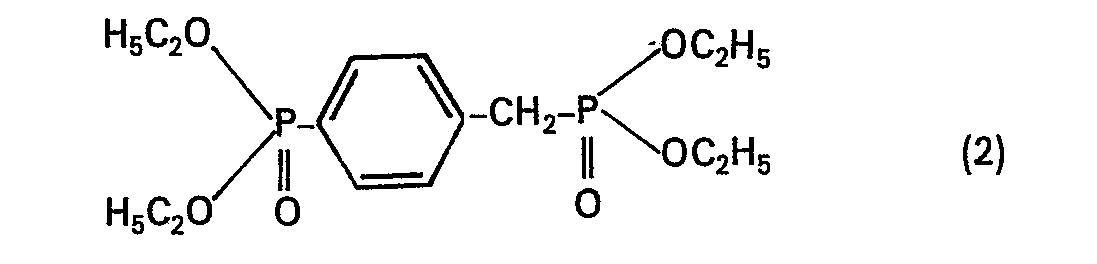
- Zu einer Lösung von 228 g (1 Mol) 4-Methylbenzolphosphonsäurediäthylester in 1000 ml wasserfreiem Tetrachlorkohlenstoff gibt man bei 60°C portionsweise eine Mischung aus 196 g (1,1 Mol) N-Bromsuccinimid, 1,33 g Dibenzoylperoxid und 1,33 g Azo-bis-isobutyronitril und rührt bei Rückflusstemperatur noch 4 Stunden. Danach wird Succinimid abfiltriert, der Filterkuchen mit 100 Tetrachlorkohlenstoff gewaschen und das Filtrat im Vakuum eingedampft. Das ölige Rohprodukt ist genügend rein und wird ohne Destillation weiterverarbeitet (Ausbeute 90% der Theorie).
- 61,4 g (0,2 Mol) roher 4-Brommethylbenzolphosphonsäurediäthylester wird bei 150°C zu 49,8 g (0,3 Mol) Triäthylphosphit getropft. Danach wird die Temperatur innerhalb von 3 Stunden langsam auf 180°C gesteigert und im Hochvakuum destilliert. Man erhält 60 g (82% der Theorie) vom Kpo,s 135 bis 150°C.
- Ebenso erhält man auch die entsprechenden meta- und ortho-Phosphonoderivate der Formel (2).
- Analog Beispiel 1 ergibt die Umsetzung von 4-Diäthoxyphosphonomethylbenzolphosphonsäurediäthylester mit Terephthalaldehyd 18,3 g (66% der Theorie) der Verbindung der Formel

- In gleicher Weise wie in Beispiel 1 erhält man aus 39,6 g (0,1 Mol) (4-Diäthoxyphosphonome- thylbenzol)-phenylphosphinsäureäthylester und 6,7 g (0,05 Mol) Terephthalaldehyd die Verbindung der Formel

- Zu einer Suspension von 0,6 g Nickel(II)-chlorid und 33,2 g (0,2 Mol) Triäthylphosphit gibt man bei 160°C 51,6 g (0,1 Mol) 4,4'-Di-(2-bromstyryl)-biphenyl so zu, dass das Äthylbromid gleichmässig abdestilliert und aufgefangen werden kann. Man erhitzt zur Vervollständigung der Reaktion noch ca. 2 bis 3 Stunden bei 200°C. Danach destilliert man den Überschuss Triäthylphosphit ab, lässt auf 100°C abkühlen, versetzt mit 50 ml Toluol, klärt mit Bleicherde und filtriert ab. Zum Filtrat gibt man 30 ml Methylcyclohexan und lässt die Substanz auskristallisieren. Ausbeute: 41 g (65% der Theorie) hellgelbe Kristalle der Verbindung der Formel

- 12,6 g (0,02 Mol) der Verbindung (5) werden mit 4,5 g (0,08 Mol) Kaliumhydroxid in 50 ml Methylglykol 10 Stunden am Rückfluss erhitzt. Danach wird das Lösungsmittel abdestilliert und der Rückstand in 100 ml dest. Wasser gelöst, heiss mit A-Kohle geklärt und abfiltriert. Das Filtrat wird dann mit konz. Salzsäure auf pH 2 gestellt. Nach Abfiltrieren und Trocknen erhält man 9,9 g (86,1% der Theorie) hellgelbe Kristalle einer Verbindung derwahrscheinlichen Struktur
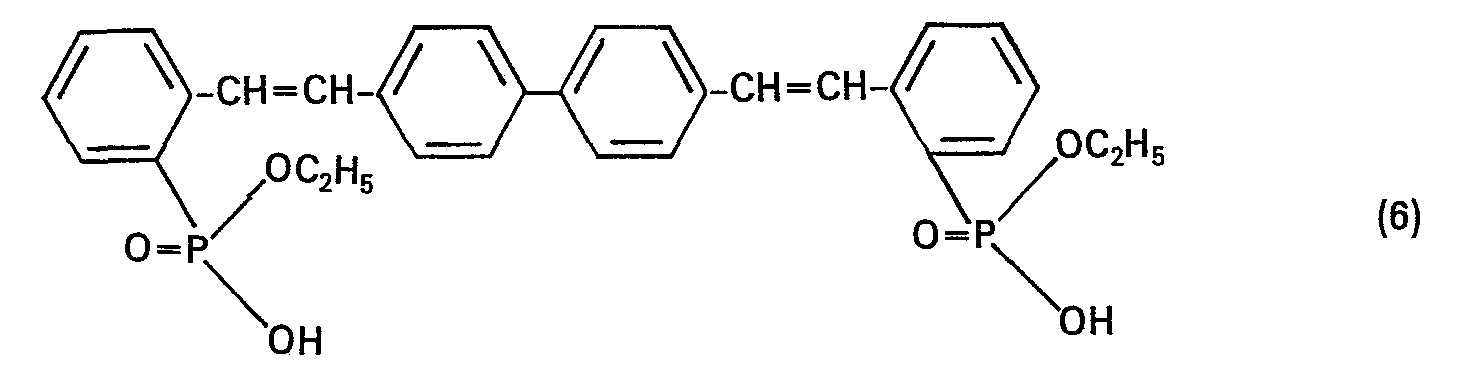

- In ähnlicher Weise erhält man aus 2,6-Di(2- bromstyryl)-naphthalin durch Umsetzung mit Triäthylphosphit und Kaliumhydroxid die Verbindung der Struktur

- 30,7 g (0,1 Mol) 4-Brommethylbenzolphosphonsäurediäthylester und 23,7 g (0,14 Mol) Triäthylphosphit werden bei Rückflusstemperatur 2 Stunden gerührt. Danach wird das überschüssige Triäthylphosphit im Vakuum abdestilliert und der Rückstand mit 100 ml wasserfreiem Dimethylformamid versetzt. Zu dieser Lösung gibt man 18,7 g (0,08 Mol) 4-Formy!-4'-cyano-stiiben und tropft bei 50°C innerhalb 30 Minuten eine Lösung aus 2,3 g Natrium in 50 ml Äthanol ein. Nachdem die Lösung unter Stickstoff 4 Stunden bei 50°C gerührt worden ist, wird das Reaktionsgemisch auf 500 ml Wasser ausgetragen und mit Essigsäure auf pH 4-5 gestellt. Es wird mit dreimal je 100 ml Chloroform extrahiert. Die organische Phase wird dann mit je einmal 100 ml gesättigter Natriumcarbonatlösung und 100 ml Wasser gewaschen. Nach Trocknen über wasserfreiem Natriumsulfat und Abfiltrieren wird das Lösungsmittel im Vakuum entfernt. Der Rückstand wird mit 50 ml Tetrachlorkohlenstoff versetzt. Man erhält 18,8 g (53% der Theorie) hellgelbes Kristallpulver der Verbindung der Formel

- Zur Herstellung der Verbindung (8) kann man mit dem gleichen Erfolg auch Terephthalaldehyd verwenden und nacheinander mit den entsprechenden Mengen 2-Diäthoxyphosphonomethylbenzonitril und 4-Diäthoxyphosphonomethylbenzolphosphonsäurediäthylester umsetzen. Als Lösungsmittel kann man anstelle von Dimethylformamid auch Hexamethylphosphorsäuretriamid verwenden. Die Isolierung der unsymmetrischen Verbindung der Formel (8) aus dem Gemisch kann durch Umkristallisieren oder durch säulenchromatographische Trennung erfolgen.
- In gleicher Weise wie in Beispiel 7 erhält man aus 13,2 g (0,05 Mol) 4-Diäthoxyphosphonomethylchlorbenzol, 21,2 g (0,05 Mol) (4-Diäthoxyphos- phonomethylbenzol)-phenylphosphinsäure-n-butylester und 3,35 g (0,025 Mol) Terephthalaldehyd die Verbindung der Formel

- Analog Beispiel 4 erhält man aus den entsprechenden Dibromdistyryl-Verbindungen und Triäthylphosphit die Verbindung der Formel

- In der nachstehenden Tabelle I werden weitere besonders wertvolle Verbindungen, welche der Formel
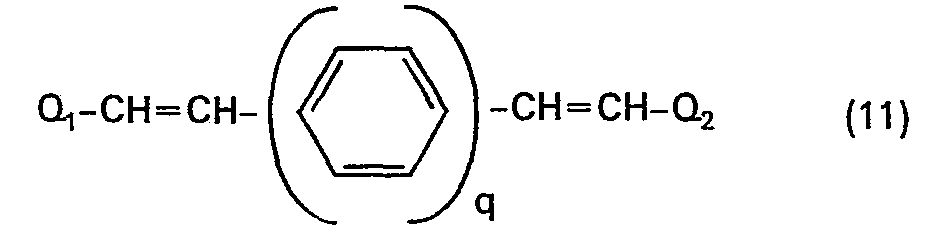

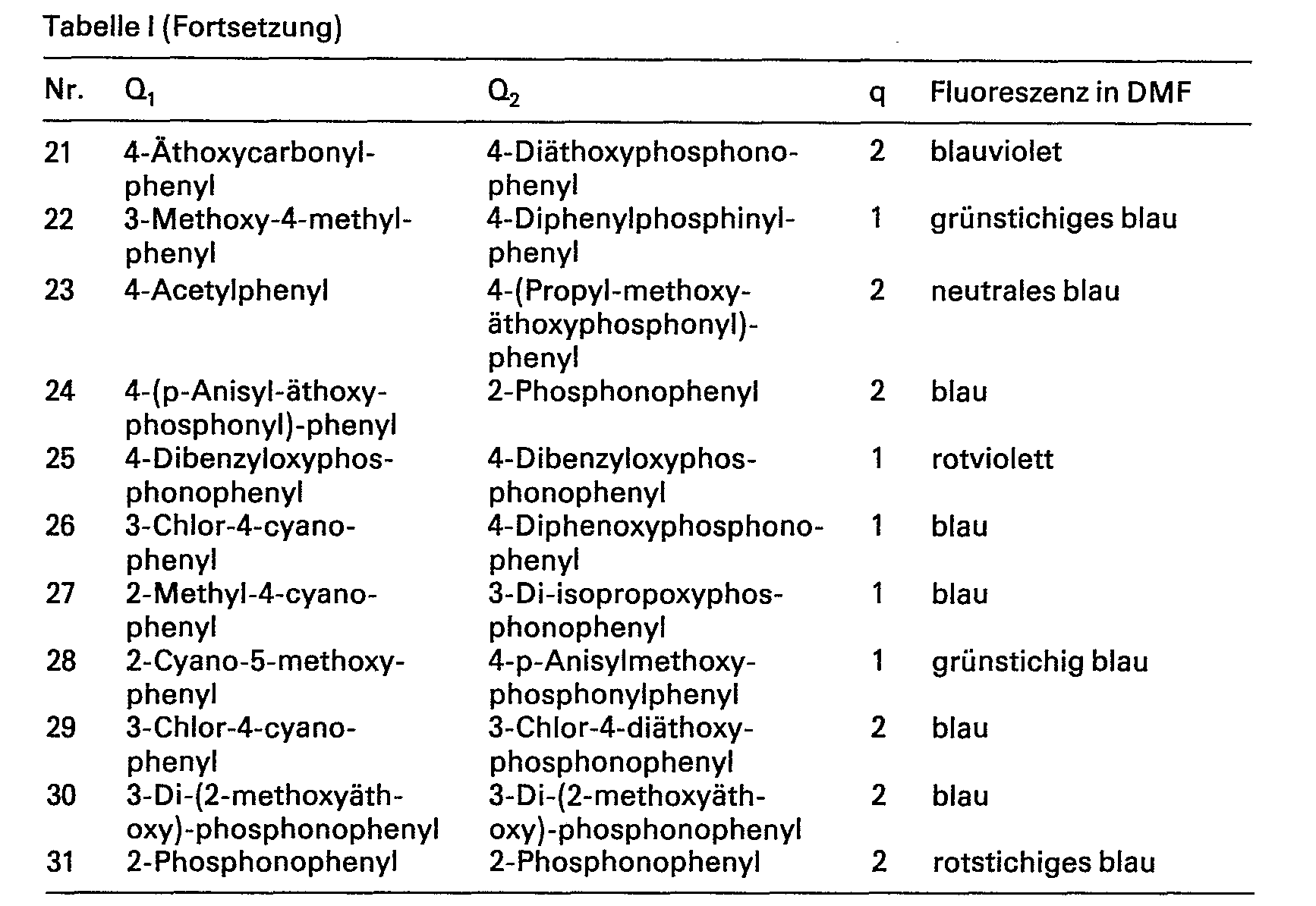
- Zu einer Lösung von 23,4 g (0,05 Mol) 2,7-Bis(diäthoxyphosphonomethyl)-dibenzofu- ran und 24,2 g (0,1 Mol) 4-Formylbenzolphosphonsäurediäthylester in 150 ml Dimethylformamid gibt man portionsweise innerhalb von 30 Minuten 13,6 g (0,2 Mol) Natriumäthylat. Dann wird 5 Stunden bei 50°C gerührt, das Reaktionsgemisch auf 500 ml Wasser ausgetragen und mit konz. Salzsäure neutral gestellt. Nach Abfiltrieren und Trocknen erhält man 23,5 g (73% der Theorie) der Verbindung der Formel

- Die Herstellung von 4-Formyl-benzolphosphonsäurediäthylester erfolgte in bekannter Weise durch Bromierung von 4-Methyl-benzolphosphonsäurediäthylester und nachfolgender Umsetzung mit Hexamethylentetramin in Essigsäure.
- Analog Beispiel 4 erhält man aus 2,7-Di-2- bromstyryl)-9,10-dihydrophenanthren und Triäthylphosphit die Verbindung der Formel

- In ähnlicher Weise werden auch die in der folgenden Tabelle II aufgeführten Distyryl-Verbindungen der allgemeinen Formel


Claims (6)




im molaren Verhältnis 1:1:1 mit je einer Verbindung der Formel


Applications Claiming Priority (2)
| Application Number | Priority Date | Filing Date | Title |
|---|---|---|---|
| DE19782807497 DE2807497A1 (de) | 1978-02-22 | 1978-02-22 | Distyryl-verbindungen |
| DE2807497 | 1978-02-22 |
Publications (2)
| Publication Number | Publication Date |
|---|---|
| EP0003784A1 EP0003784A1 (de) | 1979-09-05 |
| EP0003784B1 true EP0003784B1 (de) | 1981-01-28 |
Family
ID=6032603
Family Applications (1)
| Application Number | Title | Priority Date | Filing Date |
|---|---|---|---|
| EP79100387A Expired EP0003784B1 (de) | 1978-02-22 | 1979-02-12 | Distyryl-Verbindungen, sowie deren Herstellung und Verwendung als Weisstöner und Laserfarbstoff |
Country Status (6)
| Country | Link |
|---|---|
| US (1) | US4317782A (de) |
| EP (1) | EP0003784B1 (de) |
| JP (1) | JPS54122260A (de) |
| BR (1) | BR7901067A (de) |
| DE (2) | DE2807497A1 (de) |
| ES (1) | ES477939A1 (de) |
Families Citing this family (21)
| Publication number | Priority date | Publication date | Assignee | Title |
|---|---|---|---|---|
| DE2807497A1 (de) * | 1978-02-22 | 1979-08-23 | Bayer Ag | Distyryl-verbindungen |
| DE2901480A1 (de) * | 1979-01-16 | 1980-07-24 | Bayer Ag | 1,4-bis-(styryl)-benzolderivate |
| US4384121A (en) * | 1979-11-01 | 1983-05-17 | Ciba-Geigy Corporation | Cationic fluorescent whitening agents |
| EP0030917B2 (de) * | 1979-12-13 | 1991-03-20 | Ciba-Geigy Ag | Optische Aufheller aus Bis-styrylbenzolverbindungen, Verfahren zu deren Herstellung und deren Verwendung |
| DD160538A1 (de) * | 1980-11-26 | 1983-09-07 | Adw Ddr | Verfahren zum einbringen von hydrophoben fotografischen zusaetzen |
| DE3264631D1 (en) * | 1981-03-31 | 1985-08-14 | Ciba Geigy Ag | 4-halogenostilbene derivatives and process for their preparation |
| US4529556A (en) * | 1983-08-19 | 1985-07-16 | The Dow Chemical Company | Bis((aryl)vinyl)benzenes |
| US5389444A (en) * | 1991-09-18 | 1995-02-14 | Idemitsu Kosan Co., Ltd. | Organic electroluminescence device |
| ATE552120T1 (de) | 2001-12-24 | 2012-04-15 | L 1 Secure Credentialing Inc | Verdeckte variableninformationen auf id- dokumenten und verfahren zu ihrer herstellung |
| CA2470547C (en) | 2001-12-24 | 2008-05-20 | Digimarc Id Systems, Llc | Laser etched security features for identification documents and methods of making same |
| US7694887B2 (en) | 2001-12-24 | 2010-04-13 | L-1 Secure Credentialing, Inc. | Optically variable personalized indicia for identification documents |
| EP1550077B1 (de) * | 2001-12-24 | 2009-07-08 | Digimarc ID Systems, LLC | Lasergravierverfahren sowie mit lasergravur versehene artikel |
| US7728048B2 (en) | 2002-12-20 | 2010-06-01 | L-1 Secure Credentialing, Inc. | Increasing thermal conductivity of host polymer used with laser engraving methods and compositions |
| ATE555911T1 (de) * | 2001-12-24 | 2012-05-15 | L 1 Secure Credentialing Inc | Verfahren zur vollfarb-markierung von id- dokumenten |
| WO2003088144A2 (en) | 2002-04-09 | 2003-10-23 | Digimarc Id Systems, Llc | Image processing techniques for printing identification cards and documents |
| US7824029B2 (en) | 2002-05-10 | 2010-11-02 | L-1 Secure Credentialing, Inc. | Identification card printer-assembler for over the counter card issuing |
| GB0222091D0 (en) * | 2002-09-24 | 2002-10-30 | Boots Co Plc | Dental compositions and methods |
| AU2003298731A1 (en) | 2002-11-26 | 2004-06-18 | Digimarc Id Systems | Systems and methods for managing and detecting fraud in image databases used with identification documents |
| JP4580241B2 (ja) * | 2002-12-10 | 2010-11-10 | チバ ホールディング インコーポレーテッド | 蛍光増白剤の混合物 |
| US7763179B2 (en) * | 2003-03-21 | 2010-07-27 | Digimarc Corporation | Color laser engraving and digital watermarking |
| ATE491190T1 (de) | 2003-04-16 | 2010-12-15 | L 1 Secure Credentialing Inc | Dreidimensionale datenspeicherung |
Family Cites Families (6)
| Publication number | Priority date | Publication date | Assignee | Title |
|---|---|---|---|---|
| US3152104A (en) * | 1961-03-09 | 1964-10-06 | American Cyanamid Co | Novel phosphine and process of preparation |
| CH687372A4 (de) * | 1969-03-27 | 1976-04-15 | ||
| DE2060228A1 (de) * | 1970-12-08 | 1972-06-15 | Hoechst Ag | Monostyryl-naphthalin-Derivate,Verfahren zu deren Herstellung und ihre Verwendung als optische Aufhellungsmittel |
| CH574885A5 (de) * | 1971-12-30 | 1976-04-30 | Ciba Geigy Ag | |
| DE2700292C2 (de) * | 1977-01-05 | 1981-09-24 | Bayer Ag, 5090 Leverkusen | Verwendung von bestimmten Bisstyryl-phenyl- oder -biphenyl- Verbindungen sowie deren Metall- oder organischen Ammoniumsalzen zur Erzeugung einer kohärenten Laseremission |
| DE2807497A1 (de) * | 1978-02-22 | 1979-08-23 | Bayer Ag | Distyryl-verbindungen |
-
1978
- 1978-02-22 DE DE19782807497 patent/DE2807497A1/de active Pending
-
1979
- 1979-02-12 EP EP79100387A patent/EP0003784B1/de not_active Expired
- 1979-02-12 DE DE7979100387T patent/DE2960089D1/de not_active Expired
- 1979-02-20 JP JP1794679A patent/JPS54122260A/ja active Pending
- 1979-02-20 BR BR7901067A patent/BR7901067A/pt unknown
- 1979-02-21 ES ES477939A patent/ES477939A1/es not_active Expired
- 1979-02-22 US US06/013,894 patent/US4317782A/en not_active Expired - Lifetime
Also Published As
| Publication number | Publication date |
|---|---|
| DE2960089D1 (en) | 1981-03-19 |
| JPS54122260A (en) | 1979-09-21 |
| BR7901067A (pt) | 1979-10-02 |
| EP0003784A1 (de) | 1979-09-05 |
| ES477939A1 (es) | 1979-07-01 |
| US4317782A (en) | 1982-03-02 |
| DE2807497A1 (de) | 1979-08-23 |
Similar Documents
| Publication | Publication Date | Title |
|---|---|---|
| EP0003784B1 (de) | Distyryl-Verbindungen, sowie deren Herstellung und Verwendung als Weisstöner und Laserfarbstoff | |
| EP0014344B1 (de) | Cumarinverbindungen, Verfahren zu ihrer Herstellung und deren Verwendung als Weisstöner und Laserfarbstoffe | |
| DE2602750C2 (de) | ||
| EP0038296B1 (de) | Disazoverbindungen | |
| DE2346316C2 (de) | Verfahren zur Herstellung von 2-Furylbenzimidazolen | |
| DE1469207A1 (de) | Neue Bis-oxazolyl-stilbenverbindungen,Verfahren zu deren Herstellung und Verwendung | |
| EP0027897A1 (de) | Quaternierte, verbrückte Benzimidazolyl-benzimidazole, Verfahren zu deren Herstellung und deren Verwendung | |
| DE2929414A1 (de) | Pyrimido- eckige klammer auf 5',4' zu 5,6 eckige klammer zu -pyrido- eckige klammer auf 1,2-a eckige klammer zu -benzimidazole, verfahren zu ihrer herstellung und deren verwendung | |
| DE1119865B (de) | Verfahren zur Herstellung von ª‡, ª‰-Di-[aryloxazolyl-(2)]-aethylen-Verbindungen | |
| DE2258276C3 (de) | Triazolyl-stilbene, sowie deren Herstellung und Verwendung als optische Aufheller | |
| DE3138020C2 (de) | ||
| CH615209A5 (de) | ||
| DE2212480A1 (de) | Neue Triazolyl-aethenylphenylenverbindungen,deren Herstellung und Verwendung als optische Aufheller | |
| DE867892C (de) | Verfahren zur Herstellung von Bisoxazol-Kuepenfarbstoffen | |
| EP0198795B1 (de) | Verfahren zur Herstellung von 1,4-Diaminoanthrachinonen | |
| EP0150441B1 (de) | 1,4-Bis-(styryl)-benzole und deren Verwendung als optische Aufheller | |
| EP0036555A1 (de) | Neue Zinkchloridkomplexverbindungen, Verfahren zu ihrer Herstellung sowie ihre Verwendung und Verfahren zur Herstellung von Phenoxazinverbindungen | |
| DE2712942A1 (de) | Stilbene, verfahren zu deren herstellung und deren verwendung als opttische aufheller | |
| EP0045719B1 (de) | Kristalline Salze von Triazolfarbstoffen | |
| DE1444660A1 (de) | Azofarbstoffe | |
| DE1951708C3 (de) | Verfahren zur Herstellung von Pyranthrone n | |
| EP0261075B1 (de) | Verfahren zur Herstellung von Dispersionsfarbstoffen | |
| CH506588A (de) | Verfahren zur Herstellung von in Wasser schwerlöslichen Anthrachinonfarbstoffen | |
| EP0019182A1 (de) | Benzofuranverbindungen sowie deren Verwendung als optische Aufheller | |
| CH647774A5 (en) | Organic compounds and preparation and use thereof |
Legal Events
| Date | Code | Title | Description |
|---|---|---|---|
| PUAI | Public reference made under article 153(3) epc to a published international application that has entered the european phase |
Free format text: ORIGINAL CODE: 0009012 |
|
| 17P | Request for examination filed | ||
| AK | Designated contracting states |
Designated state(s): CH DE FR GB IT |
|
| ITF | It: translation for a ep patent filed | ||
| GRAA | (expected) grant |
Free format text: ORIGINAL CODE: 0009210 |
|
| AK | Designated contracting states |
Designated state(s): CH DE FR GB IT |
|
| REF | Corresponds to: |
Ref document number: 2960089 Country of ref document: DE Date of ref document: 19810319 |
|
| PGFP | Annual fee paid to national office [announced via postgrant information from national office to epo] |
Ref country code: FR Payment date: 19820216 Year of fee payment: 4 |
|
| PGFP | Annual fee paid to national office [announced via postgrant information from national office to epo] |
Ref country code: DE Payment date: 19820331 Year of fee payment: 4 |
|
| GBPC | Gb: european patent ceased through non-payment of renewal fee | ||
| PG25 | Lapsed in a contracting state [announced via postgrant information from national office to epo] |
Ref country code: FR Free format text: LAPSE BECAUSE OF NON-PAYMENT OF DUE FEES Effective date: 19831031 |
|
| PG25 | Lapsed in a contracting state [announced via postgrant information from national office to epo] |
Ref country code: DE Effective date: 19831101 |
|
| REG | Reference to a national code |
Ref country code: FR Ref legal event code: ST |
|
| PGFP | Annual fee paid to national office [announced via postgrant information from national office to epo] |
Ref country code: CH Payment date: 19840405 Year of fee payment: 6 |
|
| PG25 | Lapsed in a contracting state [announced via postgrant information from national office to epo] |
Ref country code: GB Effective date: 19881117 |
|
| PG25 | Lapsed in a contracting state [announced via postgrant information from national office to epo] |
Ref country code: CH Effective date: 19890228 |
|
| REG | Reference to a national code |
Ref country code: CH Ref legal event code: PL |
|
| PLBE | No opposition filed within time limit |
Free format text: ORIGINAL CODE: 0009261 |
|
| STAA | Information on the status of an ep patent application or granted ep patent |
Free format text: STATUS: NO OPPOSITION FILED WITHIN TIME LIMIT |