EP0009552B1 - In alpha-Stellung methylolierte Mono- und Oligosaccharide, Verfahren zu ihrer Herstellung und ihre Verwendung - Google Patents
In alpha-Stellung methylolierte Mono- und Oligosaccharide, Verfahren zu ihrer Herstellung und ihre Verwendung Download PDFInfo
- Publication number
- EP0009552B1 EP0009552B1 EP79102470A EP79102470A EP0009552B1 EP 0009552 B1 EP0009552 B1 EP 0009552B1 EP 79102470 A EP79102470 A EP 79102470A EP 79102470 A EP79102470 A EP 79102470A EP 0009552 B1 EP0009552 B1 EP 0009552B1
- Authority
- EP
- European Patent Office
- Prior art keywords
- sugars
- formaldehyde
- reaction
- sugar
- und
- Prior art date
- Legal status (The legal status is an assumption and is not a legal conclusion. Google has not performed a legal analysis and makes no representation as to the accuracy of the status listed.)
- Expired
Links
- 238000000034 method Methods 0.000 title claims description 114
- 238000002360 preparation method Methods 0.000 title claims description 7
- 229920001542 oligosaccharide Polymers 0.000 title description 15
- 150000002772 monosaccharides Chemical class 0.000 title description 13
- 150000002482 oligosaccharides Polymers 0.000 title description 13
- WSFSSNUMVMOOMR-UHFFFAOYSA-N Formaldehyde Chemical compound O=C WSFSSNUMVMOOMR-UHFFFAOYSA-N 0.000 claims description 267
- 235000000346 sugar Nutrition 0.000 claims description 148
- 230000008569 process Effects 0.000 claims description 78
- 238000006243 chemical reaction Methods 0.000 claims description 76
- XLYOFNOQVPJJNP-UHFFFAOYSA-N water Substances O XLYOFNOQVPJJNP-UHFFFAOYSA-N 0.000 claims description 72
- -1 methylol group Chemical group 0.000 claims description 70
- 239000000203 mixture Substances 0.000 claims description 69
- 150000008163 sugars Chemical class 0.000 claims description 69
- 239000003054 catalyst Substances 0.000 claims description 62
- 150000001875 compounds Chemical class 0.000 claims description 58
- WQZGKKKJIJFFOK-GASJEMHNSA-N Glucose Natural products OC[C@H]1OC(O)[C@H](O)[C@@H](O)[C@@H]1O WQZGKKKJIJFFOK-GASJEMHNSA-N 0.000 claims description 56
- 230000015572 biosynthetic process Effects 0.000 claims description 46
- 125000002915 carbonyl group Chemical group [*:2]C([*:1])=O 0.000 claims description 43
- 239000008103 glucose Substances 0.000 claims description 39
- 239000007789 gas Substances 0.000 claims description 35
- 229920001228 polyisocyanate Polymers 0.000 claims description 33
- 239000005056 polyisocyanate Substances 0.000 claims description 33
- 238000010521 absorption reaction Methods 0.000 claims description 32
- 150000005846 sugar alcohols Polymers 0.000 claims description 31
- 238000003786 synthesis reaction Methods 0.000 claims description 28
- 239000007788 liquid Substances 0.000 claims description 26
- 238000004519 manufacturing process Methods 0.000 claims description 22
- 239000007795 chemical reaction product Substances 0.000 claims description 20
- 229920003023 plastic Polymers 0.000 claims description 19
- 239000004033 plastic Substances 0.000 claims description 19
- 229920002635 polyurethane Polymers 0.000 claims description 16
- 239000004814 polyurethane Substances 0.000 claims description 16
- 229930006000 Sucrose Natural products 0.000 claims description 15
- CZMRCDWAGMRECN-UGDNZRGBSA-N Sucrose Chemical compound O[C@H]1[C@H](O)[C@@H](CO)O[C@@]1(CO)O[C@@H]1[C@H](O)[C@@H](O)[C@H](O)[C@@H](CO)O1 CZMRCDWAGMRECN-UGDNZRGBSA-N 0.000 claims description 14
- 125000004435 hydrogen atom Chemical group [H]* 0.000 claims description 14
- 239000000126 substance Substances 0.000 claims description 14
- 229960004793 sucrose Drugs 0.000 claims description 14
- 229920003180 amino resin Polymers 0.000 claims description 13
- WSFSSNUMVMOOMR-NJFSPNSNSA-N methanone Chemical compound O=[14CH2] WSFSSNUMVMOOMR-NJFSPNSNSA-N 0.000 claims description 13
- 239000000178 monomer Substances 0.000 claims description 13
- 239000000654 additive Substances 0.000 claims description 12
- 150000001299 aldehydes Chemical class 0.000 claims description 11
- 150000001241 acetals Chemical class 0.000 claims description 10
- 150000002576 ketones Chemical class 0.000 claims description 10
- 125000000468 ketone group Chemical group 0.000 claims description 9
- 229920001568 phenolic resin Polymers 0.000 claims description 9
- 239000002585 base Substances 0.000 claims description 8
- 239000004604 Blowing Agent Substances 0.000 claims description 7
- 229930194542 Keto Natural products 0.000 claims description 6
- DHKHKXVYLBGOIT-UHFFFAOYSA-N acetaldehyde Diethyl Acetal Natural products CCOC(C)OCC DHKHKXVYLBGOIT-UHFFFAOYSA-N 0.000 claims description 6
- 150000003512 tertiary amines Chemical class 0.000 claims description 6
- 230000001413 cellular effect Effects 0.000 claims description 5
- 150000007530 organic bases Chemical class 0.000 claims description 5
- 230000020477 pH reduction Effects 0.000 claims description 5
- OKTJSMMVPCPJKN-UHFFFAOYSA-N Carbon Chemical group [C] OKTJSMMVPCPJKN-UHFFFAOYSA-N 0.000 claims description 4
- 230000001476 alcoholic effect Effects 0.000 claims description 4
- 229910052783 alkali metal Inorganic materials 0.000 claims description 3
- 235000013681 dietary sucrose Nutrition 0.000 claims description 3
- 150000003141 primary amines Chemical class 0.000 claims description 3
- 125000001453 quaternary ammonium group Chemical group 0.000 claims description 3
- 150000003335 secondary amines Chemical class 0.000 claims description 3
- 150000007529 inorganic bases Chemical class 0.000 claims description 2
- 235000019256 formaldehyde Nutrition 0.000 description 81
- 239000000047 product Substances 0.000 description 62
- 239000000243 solution Substances 0.000 description 62
- WQZGKKKJIJFFOK-VFUOTHLCSA-N beta-D-glucose Chemical compound OC[C@H]1O[C@@H](O)[C@H](O)[C@@H](O)[C@@H]1O WQZGKKKJIJFFOK-VFUOTHLCSA-N 0.000 description 58
- 229960001031 glucose Drugs 0.000 description 54
- LYCAIKOWRPUZTN-UHFFFAOYSA-N Ethylene glycol Chemical compound OCCO LYCAIKOWRPUZTN-UHFFFAOYSA-N 0.000 description 37
- OKKJLVBELUTLKV-UHFFFAOYSA-N Methanol Chemical compound OC OKKJLVBELUTLKV-UHFFFAOYSA-N 0.000 description 35
- 125000002887 hydroxy group Chemical group [H]O* 0.000 description 34
- HEMHJVSKTPXQMS-UHFFFAOYSA-M Sodium hydroxide Chemical compound [OH-].[Na+] HEMHJVSKTPXQMS-UHFFFAOYSA-M 0.000 description 30
- CSCPPACGZOOCGX-UHFFFAOYSA-N Acetone Chemical compound CC(C)=O CSCPPACGZOOCGX-UHFFFAOYSA-N 0.000 description 26
- RFSUNEUAIZKAJO-ARQDHWQXSA-N Fructose Chemical compound OC[C@H]1O[C@](O)(CO)[C@@H](O)[C@@H]1O RFSUNEUAIZKAJO-ARQDHWQXSA-N 0.000 description 25
- 229920000570 polyether Polymers 0.000 description 24
- LFQSCWFLJHTTHZ-UHFFFAOYSA-N Ethanol Chemical compound CCO LFQSCWFLJHTTHZ-UHFFFAOYSA-N 0.000 description 22
- XSQUKJJJFZCRTK-UHFFFAOYSA-N Urea Chemical compound NC(N)=O XSQUKJJJFZCRTK-UHFFFAOYSA-N 0.000 description 21
- MTHSVFCYNBDYFN-UHFFFAOYSA-N diethylene glycol Chemical compound OCCOCCO MTHSVFCYNBDYFN-UHFFFAOYSA-N 0.000 description 21
- 239000006260 foam Substances 0.000 description 20
- 229920000728 polyester Polymers 0.000 description 18
- 229930091371 Fructose Natural products 0.000 description 17
- 239000005715 Fructose Substances 0.000 description 17
- PEDCQBHIVMGVHV-UHFFFAOYSA-N Glycerine Chemical compound OCC(O)CO PEDCQBHIVMGVHV-UHFFFAOYSA-N 0.000 description 17
- WFDIJRYMOXRFFG-UHFFFAOYSA-N Acetic anhydride Chemical compound CC(=O)OC(C)=O WFDIJRYMOXRFFG-UHFFFAOYSA-N 0.000 description 15
- ZMANZCXQSJIPKH-UHFFFAOYSA-N Triethylamine Chemical compound CCN(CC)CC ZMANZCXQSJIPKH-UHFFFAOYSA-N 0.000 description 15
- 238000005984 hydrogenation reaction Methods 0.000 description 15
- GOOHAUXETOMSMM-UHFFFAOYSA-N Propylene oxide Chemical compound CC1CO1 GOOHAUXETOMSMM-UHFFFAOYSA-N 0.000 description 14
- YXFVVABEGXRONW-UHFFFAOYSA-N Toluene Chemical compound CC1=CC=CC=C1 YXFVVABEGXRONW-UHFFFAOYSA-N 0.000 description 14
- 229920001282 polysaccharide Polymers 0.000 description 14
- 239000005017 polysaccharide Substances 0.000 description 14
- QAOWNCQODCNURD-UHFFFAOYSA-N Sulfuric acid Chemical compound OS(O)(=O)=O QAOWNCQODCNURD-UHFFFAOYSA-N 0.000 description 13
- 239000002253 acid Substances 0.000 description 13
- 150000004676 glycans Chemical class 0.000 description 13
- 239000004721 Polyphenylene oxide Substances 0.000 description 12
- DNIAPMSPPWPWGF-UHFFFAOYSA-N Propylene glycol Chemical compound CC(O)CO DNIAPMSPPWPWGF-UHFFFAOYSA-N 0.000 description 12
- 125000004432 carbon atom Chemical group C* 0.000 description 12
- 201000006747 infectious mononucleosis Diseases 0.000 description 12
- 239000012948 isocyanate Substances 0.000 description 12
- 150000002513 isocyanates Chemical class 0.000 description 12
- SVYKKECYCPFKGB-UHFFFAOYSA-N N,N-dimethylcyclohexylamine Chemical compound CN(C)C1CCCCC1 SVYKKECYCPFKGB-UHFFFAOYSA-N 0.000 description 11
- 230000002378 acidificating effect Effects 0.000 description 11
- WNLRTRBMVRJNCN-UHFFFAOYSA-N adipic acid Chemical compound OC(=O)CCCCC(O)=O WNLRTRBMVRJNCN-UHFFFAOYSA-N 0.000 description 11
- 150000002016 disaccharides Chemical class 0.000 description 11
- QTBSBXVTEAMEQO-UHFFFAOYSA-N Acetic acid Chemical compound CC(O)=O QTBSBXVTEAMEQO-UHFFFAOYSA-N 0.000 description 10
- GLUUGHFHXGJENI-UHFFFAOYSA-N Piperazine Chemical compound C1CNCCN1 GLUUGHFHXGJENI-UHFFFAOYSA-N 0.000 description 10
- 240000004808 Saccharomyces cerevisiae Species 0.000 description 10
- 235000014680 Saccharomyces cerevisiae Nutrition 0.000 description 10
- 239000007864 aqueous solution Substances 0.000 description 10
- 150000002148 esters Chemical class 0.000 description 10
- 229920005862 polyol Polymers 0.000 description 10
- 150000003077 polyols Chemical class 0.000 description 10
- ZWEHNKRNPOVVGH-UHFFFAOYSA-N 2-Butanone Chemical compound CCC(C)=O ZWEHNKRNPOVVGH-UHFFFAOYSA-N 0.000 description 9
- 150000001412 amines Chemical class 0.000 description 9
- 235000013877 carbamide Nutrition 0.000 description 9
- JBKVHLHDHHXQEQ-UHFFFAOYSA-N epsilon-caprolactam Chemical compound O=C1CCCCCN1 JBKVHLHDHHXQEQ-UHFFFAOYSA-N 0.000 description 9
- 150000002373 hemiacetals Chemical class 0.000 description 9
- 229920000642 polymer Polymers 0.000 description 9
- 239000011541 reaction mixture Substances 0.000 description 9
- IJGRMHOSHXDMSA-UHFFFAOYSA-N Atomic nitrogen Chemical compound N#N IJGRMHOSHXDMSA-UHFFFAOYSA-N 0.000 description 8
- HEDRZPFGACZZDS-UHFFFAOYSA-N Chloroform Chemical compound ClC(Cl)Cl HEDRZPFGACZZDS-UHFFFAOYSA-N 0.000 description 8
- RFSUNEUAIZKAJO-VRPWFDPXSA-N D-Fructose Natural products OC[C@H]1OC(O)(CO)[C@@H](O)[C@@H]1O RFSUNEUAIZKAJO-VRPWFDPXSA-N 0.000 description 8
- ZJCCRDAZUWHFQH-UHFFFAOYSA-N Trimethylolpropane Chemical compound CCC(CO)(CO)CO ZJCCRDAZUWHFQH-UHFFFAOYSA-N 0.000 description 8
- 150000001298 alcohols Chemical class 0.000 description 8
- 230000008030 elimination Effects 0.000 description 8
- 238000003379 elimination reaction Methods 0.000 description 8
- 229960004903 invert sugar Drugs 0.000 description 8
- 150000002500 ions Chemical class 0.000 description 8
- 229920005610 lignin Polymers 0.000 description 8
- ISWSIDIOOBJBQZ-UHFFFAOYSA-N phenol group Chemical group C1(=CC=CC=C1)O ISWSIDIOOBJBQZ-UHFFFAOYSA-N 0.000 description 8
- PAYRUJLWNCNPSJ-UHFFFAOYSA-N Aniline Chemical compound NC1=CC=CC=C1 PAYRUJLWNCNPSJ-UHFFFAOYSA-N 0.000 description 7
- IAYPIBMASNFSPL-UHFFFAOYSA-N Ethylene oxide Chemical compound C1CO1 IAYPIBMASNFSPL-UHFFFAOYSA-N 0.000 description 7
- 238000007259 addition reaction Methods 0.000 description 7
- 125000003277 amino group Chemical group 0.000 description 7
- 239000004202 carbamide Substances 0.000 description 7
- 229920002678 cellulose Polymers 0.000 description 7
- 235000010980 cellulose Nutrition 0.000 description 7
- 238000009833 condensation Methods 0.000 description 7
- JHIVVAPYMSGYDF-UHFFFAOYSA-N cyclohexanone Chemical compound O=C1CCCCC1 JHIVVAPYMSGYDF-UHFFFAOYSA-N 0.000 description 7
- 235000011187 glycerol Nutrition 0.000 description 7
- 230000007062 hydrolysis Effects 0.000 description 7
- 238000006460 hydrolysis reaction Methods 0.000 description 7
- 229910052757 nitrogen Inorganic materials 0.000 description 7
- 230000008707 rearrangement Effects 0.000 description 7
- OWEGMIWEEQEYGQ-UHFFFAOYSA-N 100676-05-9 Natural products OC1C(O)C(O)C(CO)OC1OCC1C(O)C(O)C(O)C(OC2C(OC(O)C(O)C2O)CO)O1 OWEGMIWEEQEYGQ-UHFFFAOYSA-N 0.000 description 6
- GUBGYTABKSRVRQ-XLOQQCSPSA-N Alpha-Lactose Chemical compound O[C@@H]1[C@@H](O)[C@@H](O)[C@@H](CO)O[C@H]1O[C@@H]1[C@@H](CO)O[C@H](O)[C@H](O)[C@H]1O GUBGYTABKSRVRQ-XLOQQCSPSA-N 0.000 description 6
- GUBGYTABKSRVRQ-CUHNMECISA-N D-Cellobiose Chemical compound O[C@@H]1[C@@H](O)[C@H](O)[C@@H](CO)O[C@H]1O[C@@H]1[C@@H](CO)OC(O)[C@H](O)[C@H]1O GUBGYTABKSRVRQ-CUHNMECISA-N 0.000 description 6
- FBPFZTCFMRRESA-FSIIMWSLSA-N D-Glucitol Natural products OC[C@H](O)[C@H](O)[C@@H](O)[C@H](O)CO FBPFZTCFMRRESA-FSIIMWSLSA-N 0.000 description 6
- FBPFZTCFMRRESA-JGWLITMVSA-N D-glucitol Chemical compound OC[C@H](O)[C@@H](O)[C@H](O)[C@H](O)CO FBPFZTCFMRRESA-JGWLITMVSA-N 0.000 description 6
- UFHFLCQGNIYNRP-UHFFFAOYSA-N Hydrogen Chemical compound [H][H] UFHFLCQGNIYNRP-UHFFFAOYSA-N 0.000 description 6
- DGAQECJNVWCQMB-PUAWFVPOSA-M Ilexoside XXIX Chemical compound C[C@@H]1CC[C@@]2(CC[C@@]3(C(=CC[C@H]4[C@]3(CC[C@@H]5[C@@]4(CC[C@@H](C5(C)C)OS(=O)(=O)[O-])C)C)[C@@H]2[C@]1(C)O)C)C(=O)O[C@H]6[C@@H]([C@H]([C@@H]([C@H](O6)CO)O)O)O.[Na+] DGAQECJNVWCQMB-PUAWFVPOSA-M 0.000 description 6
- GUBGYTABKSRVRQ-QKKXKWKRSA-N Lactose Natural products OC[C@H]1O[C@@H](O[C@H]2[C@H](O)[C@@H](O)C(O)O[C@@H]2CO)[C@H](O)[C@@H](O)[C@H]1O GUBGYTABKSRVRQ-QKKXKWKRSA-N 0.000 description 6
- GUBGYTABKSRVRQ-PICCSMPSSA-N Maltose Natural products O[C@@H]1[C@@H](O)[C@H](O)[C@@H](CO)O[C@@H]1O[C@@H]1[C@@H](CO)OC(O)[C@H](O)[C@H]1O GUBGYTABKSRVRQ-PICCSMPSSA-N 0.000 description 6
- ZMXDDKWLCZADIW-UHFFFAOYSA-N N,N-Dimethylformamide Chemical compound CN(C)C=O ZMXDDKWLCZADIW-UHFFFAOYSA-N 0.000 description 6
- PXHVJJICTQNCMI-UHFFFAOYSA-N Nickel Chemical compound [Ni] PXHVJJICTQNCMI-UHFFFAOYSA-N 0.000 description 6
- CZMRCDWAGMRECN-UHFFFAOYSA-N Rohrzucker Natural products OCC1OC(CO)(OC2OC(CO)C(O)C(O)C2O)C(O)C1O CZMRCDWAGMRECN-UHFFFAOYSA-N 0.000 description 6
- WQDUMFSSJAZKTM-UHFFFAOYSA-N Sodium methoxide Chemical compound [Na+].[O-]C WQDUMFSSJAZKTM-UHFFFAOYSA-N 0.000 description 6
- WYURNTSHIVDZCO-UHFFFAOYSA-N Tetrahydrofuran Chemical compound C1CCOC1 WYURNTSHIVDZCO-UHFFFAOYSA-N 0.000 description 6
- GUBGYTABKSRVRQ-QUYVBRFLSA-N beta-maltose Chemical compound OC[C@H]1O[C@H](O[C@H]2[C@H](O)[C@@H](O)[C@H](O)O[C@@H]2CO)[C@H](O)[C@@H](O)[C@@H]1O GUBGYTABKSRVRQ-QUYVBRFLSA-N 0.000 description 6
- ZTQSAGDEMFDKMZ-UHFFFAOYSA-N butyric aldehyde Natural products CCCC=O ZTQSAGDEMFDKMZ-UHFFFAOYSA-N 0.000 description 6
- 150000001735 carboxylic acids Chemical class 0.000 description 6
- 239000003795 chemical substances by application Substances 0.000 description 6
- 230000005494 condensation Effects 0.000 description 6
- 238000006297 dehydration reaction Methods 0.000 description 6
- LELOWRISYMNNSU-UHFFFAOYSA-N hydrogen cyanide Chemical compound N#C LELOWRISYMNNSU-UHFFFAOYSA-N 0.000 description 6
- 239000008101 lactose Substances 0.000 description 6
- 229910021645 metal ion Inorganic materials 0.000 description 6
- 150000002989 phenols Chemical class 0.000 description 6
- HKOOXMFOFWEVGF-UHFFFAOYSA-N phenylhydrazine Chemical compound NNC1=CC=CC=C1 HKOOXMFOFWEVGF-UHFFFAOYSA-N 0.000 description 6
- 229940067157 phenylhydrazine Drugs 0.000 description 6
- AQSJGOWTSHOLKH-UHFFFAOYSA-N phosphite(3-) Chemical class [O-]P([O-])[O-] AQSJGOWTSHOLKH-UHFFFAOYSA-N 0.000 description 6
- XNGIFLGASWRNHJ-UHFFFAOYSA-N phthalic acid Chemical compound OC(=O)C1=CC=CC=C1C(O)=O XNGIFLGASWRNHJ-UHFFFAOYSA-N 0.000 description 6
- 235000018102 proteins Nutrition 0.000 description 6
- 108090000623 proteins and genes Proteins 0.000 description 6
- 102000004169 proteins and genes Human genes 0.000 description 6
- 239000011734 sodium Substances 0.000 description 6
- 229910052708 sodium Inorganic materials 0.000 description 6
- 239000000600 sorbitol Substances 0.000 description 6
- 235000010356 sorbitol Nutrition 0.000 description 6
- ZIBGPFATKBEMQZ-UHFFFAOYSA-N triethylene glycol Chemical compound OCCOCCOCCO ZIBGPFATKBEMQZ-UHFFFAOYSA-N 0.000 description 6
- GETQZCLCWQTVFV-UHFFFAOYSA-N trimethylamine Chemical compound CN(C)C GETQZCLCWQTVFV-UHFFFAOYSA-N 0.000 description 6
- QGZKDVFQNNGYKY-UHFFFAOYSA-N Ammonia Chemical compound N QGZKDVFQNNGYKY-UHFFFAOYSA-N 0.000 description 5
- CURLTUGMZLYLDI-UHFFFAOYSA-N Carbon dioxide Chemical compound O=C=O CURLTUGMZLYLDI-UHFFFAOYSA-N 0.000 description 5
- 229920002261 Corn starch Polymers 0.000 description 5
- YMWUJEATGCHHMB-UHFFFAOYSA-N Dichloromethane Chemical compound ClCCl YMWUJEATGCHHMB-UHFFFAOYSA-N 0.000 description 5
- OAKJQQAXSVQMHS-UHFFFAOYSA-N Hydrazine Chemical compound NN OAKJQQAXSVQMHS-UHFFFAOYSA-N 0.000 description 5
- 229920001202 Inulin Polymers 0.000 description 5
- 208000007976 Ketosis Diseases 0.000 description 5
- WHXSMMKQMYFTQS-UHFFFAOYSA-N Lithium Chemical compound [Li] WHXSMMKQMYFTQS-UHFFFAOYSA-N 0.000 description 5
- 229920005830 Polyurethane Foam Polymers 0.000 description 5
- KWYUFKZDYYNOTN-UHFFFAOYSA-M Potassium hydroxide Chemical compound [OH-].[K+] KWYUFKZDYYNOTN-UHFFFAOYSA-M 0.000 description 5
- 229920002472 Starch Polymers 0.000 description 5
- 239000001361 adipic acid Substances 0.000 description 5
- 235000011037 adipic acid Nutrition 0.000 description 5
- 235000001014 amino acid Nutrition 0.000 description 5
- 150000001413 amino acids Chemical class 0.000 description 5
- 125000003118 aryl group Chemical group 0.000 description 5
- 125000004429 atom Chemical group 0.000 description 5
- IISBACLAFKSPIT-UHFFFAOYSA-N bisphenol A Chemical compound C=1C=C(O)C=CC=1C(C)(C)C1=CC=C(O)C=C1 IISBACLAFKSPIT-UHFFFAOYSA-N 0.000 description 5
- 125000003178 carboxy group Chemical group [H]OC(*)=O 0.000 description 5
- 238000006555 catalytic reaction Methods 0.000 description 5
- 239000001913 cellulose Substances 0.000 description 5
- 238000001816 cooling Methods 0.000 description 5
- 239000008120 corn starch Substances 0.000 description 5
- 230000018044 dehydration Effects 0.000 description 5
- 235000014113 dietary fatty acids Nutrition 0.000 description 5
- LXCYSACZTOKNNS-UHFFFAOYSA-N diethoxy(oxo)phosphanium Chemical compound CCO[P+](=O)OCC LXCYSACZTOKNNS-UHFFFAOYSA-N 0.000 description 5
- 239000003995 emulsifying agent Substances 0.000 description 5
- 229930195729 fatty acid Natural products 0.000 description 5
- 239000000194 fatty acid Substances 0.000 description 5
- 238000000855 fermentation Methods 0.000 description 5
- 230000004151 fermentation Effects 0.000 description 5
- 239000003063 flame retardant Substances 0.000 description 5
- 239000001257 hydrogen Substances 0.000 description 5
- 229910052739 hydrogen Inorganic materials 0.000 description 5
- WGCNASOHLSPBMP-UHFFFAOYSA-N hydroxyacetaldehyde Natural products OCC=O WGCNASOHLSPBMP-UHFFFAOYSA-N 0.000 description 5
- QQVIHTHCMHWDBS-UHFFFAOYSA-N isophthalic acid Chemical compound OC(=O)C1=CC=CC(C(O)=O)=C1 QQVIHTHCMHWDBS-UHFFFAOYSA-N 0.000 description 5
- 150000002584 ketoses Chemical class 0.000 description 5
- CRVGTESFCCXCTH-UHFFFAOYSA-N methyl diethanolamine Chemical compound OCCN(C)CCO CRVGTESFCCXCTH-UHFFFAOYSA-N 0.000 description 5
- 125000002496 methyl group Chemical group [H]C([H])([H])* 0.000 description 5
- 229910052760 oxygen Inorganic materials 0.000 description 5
- 229920006295 polythiol Polymers 0.000 description 5
- 239000011496 polyurethane foam Substances 0.000 description 5
- 229920001592 potato starch Polymers 0.000 description 5
- 230000009467 reduction Effects 0.000 description 5
- 238000006722 reduction reaction Methods 0.000 description 5
- 235000019698 starch Nutrition 0.000 description 5
- 239000005720 sucrose Substances 0.000 description 5
- 235000020357 syrup Nutrition 0.000 description 5
- ALQLPWJFHRMHIU-UHFFFAOYSA-N 1,4-diisocyanatobenzene Chemical compound O=C=NC1=CC=C(N=C=O)C=C1 ALQLPWJFHRMHIU-UHFFFAOYSA-N 0.000 description 4
- QBUDWHWPQWURCC-UHFFFAOYSA-N 1-(hydroxymethyl)azepan-2-one Chemical compound OCN1CCCCCC1=O QBUDWHWPQWURCC-UHFFFAOYSA-N 0.000 description 4
- HZAXFHJVJLSVMW-UHFFFAOYSA-N 2-Aminoethan-1-ol Chemical compound NCCO HZAXFHJVJLSVMW-UHFFFAOYSA-N 0.000 description 4
- QWGRWMMWNDWRQN-UHFFFAOYSA-N 2-methylpropane-1,3-diol Chemical compound OCC(C)CO QWGRWMMWNDWRQN-UHFFFAOYSA-N 0.000 description 4
- FBPFZTCFMRRESA-KVTDHHQDSA-N D-Mannitol Chemical compound OC[C@@H](O)[C@@H](O)[C@H](O)[C@H](O)CO FBPFZTCFMRRESA-KVTDHHQDSA-N 0.000 description 4
- LCGLNKUTAGEVQW-UHFFFAOYSA-N Dimethyl ether Chemical compound COC LCGLNKUTAGEVQW-UHFFFAOYSA-N 0.000 description 4
- BRLQWZUYTZBJKN-UHFFFAOYSA-N Epichlorohydrin Chemical compound ClCC1CO1 BRLQWZUYTZBJKN-UHFFFAOYSA-N 0.000 description 4
- XEKOWRVHYACXOJ-UHFFFAOYSA-N Ethyl acetate Chemical compound CCOC(C)=O XEKOWRVHYACXOJ-UHFFFAOYSA-N 0.000 description 4
- IAJILQKETJEXLJ-UHFFFAOYSA-N Galacturonsaeure Natural products O=CC(O)C(O)C(O)C(O)C(O)=O IAJILQKETJEXLJ-UHFFFAOYSA-N 0.000 description 4
- VEXZGXHMUGYJMC-UHFFFAOYSA-N Hydrochloric acid Chemical compound Cl VEXZGXHMUGYJMC-UHFFFAOYSA-N 0.000 description 4
- LRHPLDYGYMQRHN-UHFFFAOYSA-N N-Butanol Chemical compound CCCCO LRHPLDYGYMQRHN-UHFFFAOYSA-N 0.000 description 4
- SJRJJKPEHAURKC-UHFFFAOYSA-N N-Methylmorpholine Chemical compound CN1CCOCC1 SJRJJKPEHAURKC-UHFFFAOYSA-N 0.000 description 4
- OVRNDRQMDRJTHS-UHFFFAOYSA-N N-acelyl-D-glucosamine Natural products CC(=O)NC1C(O)OC(CO)C(O)C1O OVRNDRQMDRJTHS-UHFFFAOYSA-N 0.000 description 4
- OVRNDRQMDRJTHS-FMDGEEDCSA-N N-acetyl-beta-D-glucosamine Chemical compound CC(=O)N[C@H]1[C@H](O)O[C@H](CO)[C@@H](O)[C@@H]1O OVRNDRQMDRJTHS-FMDGEEDCSA-N 0.000 description 4
- OFOBLEOULBTSOW-UHFFFAOYSA-N Propanedioic acid Natural products OC(=O)CC(O)=O OFOBLEOULBTSOW-UHFFFAOYSA-N 0.000 description 4
- NBBJYMSMWIIQGU-UHFFFAOYSA-N Propionic aldehyde Chemical compound CCC=O NBBJYMSMWIIQGU-UHFFFAOYSA-N 0.000 description 4
- JUJWROOIHBZHMG-UHFFFAOYSA-N Pyridine Chemical compound C1=CC=NC=C1 JUJWROOIHBZHMG-UHFFFAOYSA-N 0.000 description 4
- SMWDFEZZVXVKRB-UHFFFAOYSA-N Quinoline Chemical compound N1=CC=CC2=CC=CC=C21 SMWDFEZZVXVKRB-UHFFFAOYSA-N 0.000 description 4
- 239000007868 Raney catalyst Substances 0.000 description 4
- 229910000564 Raney nickel Inorganic materials 0.000 description 4
- KKEYFWRCBNTPAC-UHFFFAOYSA-N Terephthalic acid Chemical compound OC(=O)C1=CC=C(C(O)=O)C=C1 KKEYFWRCBNTPAC-UHFFFAOYSA-N 0.000 description 4
- GSEJCLTVZPLZKY-UHFFFAOYSA-N Triethanolamine Chemical compound OCCN(CCO)CCO GSEJCLTVZPLZKY-UHFFFAOYSA-N 0.000 description 4
- YIMQCDZDWXUDCA-UHFFFAOYSA-N [4-(hydroxymethyl)cyclohexyl]methanol Chemical compound OCC1CCC(CO)CC1 YIMQCDZDWXUDCA-UHFFFAOYSA-N 0.000 description 4
- 230000021736 acetylation Effects 0.000 description 4
- 238000006640 acetylation reaction Methods 0.000 description 4
- 150000007513 acids Chemical class 0.000 description 4
- 150000001323 aldoses Chemical class 0.000 description 4
- 125000001931 aliphatic group Chemical group 0.000 description 4
- 239000003513 alkali Substances 0.000 description 4
- 125000000217 alkyl group Chemical group 0.000 description 4
- WQZGKKKJIJFFOK-DVKNGEFBSA-N alpha-D-glucose Chemical compound OC[C@H]1O[C@H](O)[C@H](O)[C@@H](O)[C@@H]1O WQZGKKKJIJFFOK-DVKNGEFBSA-N 0.000 description 4
- AEMOLEFTQBMNLQ-WAXACMCWSA-N alpha-D-glucuronic acid Chemical compound O[C@H]1O[C@H](C(O)=O)[C@@H](O)[C@H](O)[C@H]1O AEMOLEFTQBMNLQ-WAXACMCWSA-N 0.000 description 4
- 150000008064 anhydrides Chemical class 0.000 description 4
- QVGXLLKOCUKJST-UHFFFAOYSA-N atomic oxygen Chemical compound [O] QVGXLLKOCUKJST-UHFFFAOYSA-N 0.000 description 4
- 230000008901 benefit Effects 0.000 description 4
- 235000019438 castor oil Nutrition 0.000 description 4
- 239000004359 castor oil Substances 0.000 description 4
- 150000004985 diamines Chemical class 0.000 description 4
- QGBSISYHAICWAH-UHFFFAOYSA-N dicyandiamide Chemical compound NC(N)=NC#N QGBSISYHAICWAH-UHFFFAOYSA-N 0.000 description 4
- CZHYKKAKFWLGJO-UHFFFAOYSA-N dimethyl phosphite Chemical compound COP([O-])OC CZHYKKAKFWLGJO-UHFFFAOYSA-N 0.000 description 4
- 239000000975 dye Substances 0.000 description 4
- RTZKZFJDLAIYFH-UHFFFAOYSA-N ether Substances CCOCC RTZKZFJDLAIYFH-UHFFFAOYSA-N 0.000 description 4
- 150000004665 fatty acids Chemical class 0.000 description 4
- 239000004872 foam stabilizing agent Substances 0.000 description 4
- ZEMPKEQAKRGZGQ-XOQCFJPHSA-N glycerol triricinoleate Natural products CCCCCC[C@@H](O)CC=CCCCCCCCC(=O)OC[C@@H](COC(=O)CCCCCCCC=CC[C@@H](O)CCCCCC)OC(=O)CCCCCCCC=CC[C@H](O)CCCCCC ZEMPKEQAKRGZGQ-XOQCFJPHSA-N 0.000 description 4
- 239000003906 humectant Substances 0.000 description 4
- JYJIGFIDKWBXDU-MNNPPOADSA-N inulin Chemical compound O[C@H]1[C@H](O)[C@@H](CO)O[C@@]1(CO)OC[C@]1(OC[C@]2(OC[C@]3(OC[C@]4(OC[C@]5(OC[C@]6(OC[C@]7(OC[C@]8(OC[C@]9(OC[C@]%10(OC[C@]%11(OC[C@]%12(OC[C@]%13(OC[C@]%14(OC[C@]%15(OC[C@]%16(OC[C@]%17(OC[C@]%18(OC[C@]%19(OC[C@]%20(OC[C@]%21(OC[C@]%22(OC[C@]%23(OC[C@]%24(OC[C@]%25(OC[C@]%26(OC[C@]%27(OC[C@]%28(OC[C@]%29(OC[C@]%30(OC[C@]%31(OC[C@]%32(OC[C@]%33(OC[C@]%34(OC[C@]%35(OC[C@]%36(O[C@@H]%37[C@@H]([C@@H](O)[C@H](O)[C@@H](CO)O%37)O)[C@H]([C@H](O)[C@@H](CO)O%36)O)[C@H]([C@H](O)[C@@H](CO)O%35)O)[C@H]([C@H](O)[C@@H](CO)O%34)O)[C@H]([C@H](O)[C@@H](CO)O%33)O)[C@H]([C@H](O)[C@@H](CO)O%32)O)[C@H]([C@H](O)[C@@H](CO)O%31)O)[C@H]([C@H](O)[C@@H](CO)O%30)O)[C@H]([C@H](O)[C@@H](CO)O%29)O)[C@H]([C@H](O)[C@@H](CO)O%28)O)[C@H]([C@H](O)[C@@H](CO)O%27)O)[C@H]([C@H](O)[C@@H](CO)O%26)O)[C@H]([C@H](O)[C@@H](CO)O%25)O)[C@H]([C@H](O)[C@@H](CO)O%24)O)[C@H]([C@H](O)[C@@H](CO)O%23)O)[C@H]([C@H](O)[C@@H](CO)O%22)O)[C@H]([C@H](O)[C@@H](CO)O%21)O)[C@H]([C@H](O)[C@@H](CO)O%20)O)[C@H]([C@H](O)[C@@H](CO)O%19)O)[C@H]([C@H](O)[C@@H](CO)O%18)O)[C@H]([C@H](O)[C@@H](CO)O%17)O)[C@H]([C@H](O)[C@@H](CO)O%16)O)[C@H]([C@H](O)[C@@H](CO)O%15)O)[C@H]([C@H](O)[C@@H](CO)O%14)O)[C@H]([C@H](O)[C@@H](CO)O%13)O)[C@H]([C@H](O)[C@@H](CO)O%12)O)[C@H]([C@H](O)[C@@H](CO)O%11)O)[C@H]([C@H](O)[C@@H](CO)O%10)O)[C@H]([C@H](O)[C@@H](CO)O9)O)[C@H]([C@H](O)[C@@H](CO)O8)O)[C@H]([C@H](O)[C@@H](CO)O7)O)[C@H]([C@H](O)[C@@H](CO)O6)O)[C@H]([C@H](O)[C@@H](CO)O5)O)[C@H]([C@H](O)[C@@H](CO)O4)O)[C@H]([C@H](O)[C@@H](CO)O3)O)[C@H]([C@H](O)[C@@H](CO)O2)O)[C@@H](O)[C@H](O)[C@@H](CO)O1 JYJIGFIDKWBXDU-MNNPPOADSA-N 0.000 description 4
- 229940029339 inulin Drugs 0.000 description 4
- VNWKTOKETHGBQD-UHFFFAOYSA-N methane Chemical compound C VNWKTOKETHGBQD-UHFFFAOYSA-N 0.000 description 4
- BDAGIHXWWSANSR-UHFFFAOYSA-N methanoic acid Natural products OC=O BDAGIHXWWSANSR-UHFFFAOYSA-N 0.000 description 4
- VLKZOEOYAKHREP-UHFFFAOYSA-N n-Hexane Chemical compound CCCCCC VLKZOEOYAKHREP-UHFFFAOYSA-N 0.000 description 4
- 229950006780 n-acetylglucosamine Drugs 0.000 description 4
- 239000001301 oxygen Substances 0.000 description 4
- OJMIONKXNSYLSR-UHFFFAOYSA-N phosphorous acid Chemical compound OP(O)O OJMIONKXNSYLSR-UHFFFAOYSA-N 0.000 description 4
- 229920000768 polyamine Polymers 0.000 description 4
- 229920001748 polybutylene Polymers 0.000 description 4
- 239000004417 polycarbonate Substances 0.000 description 4
- 229920000515 polycarbonate Polymers 0.000 description 4
- 229920001223 polyethylene glycol Polymers 0.000 description 4
- 229920006324 polyoxymethylene Polymers 0.000 description 4
- NNFCIKHAZHQZJG-UHFFFAOYSA-N potassium cyanide Chemical compound [K+].N#[C-] NNFCIKHAZHQZJG-UHFFFAOYSA-N 0.000 description 4
- CXMXRPHRNRROMY-UHFFFAOYSA-N sebacic acid Chemical compound OC(=O)CCCCCCCCC(O)=O CXMXRPHRNRROMY-UHFFFAOYSA-N 0.000 description 4
- 239000003381 stabilizer Substances 0.000 description 4
- 239000008107 starch Substances 0.000 description 4
- 239000006188 syrup Substances 0.000 description 4
- 239000010409 thin film Substances 0.000 description 4
- UMGDCJDMYOKAJW-UHFFFAOYSA-N thiourea Chemical compound NC(N)=S UMGDCJDMYOKAJW-UHFFFAOYSA-N 0.000 description 4
- 238000005809 transesterification reaction Methods 0.000 description 4
- CYRMSUTZVYGINF-UHFFFAOYSA-N trichlorofluoromethane Chemical compound FC(Cl)(Cl)Cl CYRMSUTZVYGINF-UHFFFAOYSA-N 0.000 description 4
- IMNIMPAHZVJRPE-UHFFFAOYSA-N triethylenediamine Chemical compound C1CN2CCN1CC2 IMNIMPAHZVJRPE-UHFFFAOYSA-N 0.000 description 4
- 150000004043 trisaccharides Chemical class 0.000 description 4
- JOYRKODLDBILNP-UHFFFAOYSA-N urethane group Chemical group NC(=O)OCC JOYRKODLDBILNP-UHFFFAOYSA-N 0.000 description 4
- SPFMQWBKVUQXJV-BTVCFUMJSA-N (2r,3s,4r,5r)-2,3,4,5,6-pentahydroxyhexanal;hydrate Chemical compound O.OC[C@@H](O)[C@@H](O)[C@H](O)[C@@H](O)C=O SPFMQWBKVUQXJV-BTVCFUMJSA-N 0.000 description 3
- RNFJDJUURJAICM-UHFFFAOYSA-N 2,2,4,4,6,6-hexaphenoxy-1,3,5-triaza-2$l^{5},4$l^{5},6$l^{5}-triphosphacyclohexa-1,3,5-triene Chemical compound N=1P(OC=2C=CC=CC=2)(OC=2C=CC=CC=2)=NP(OC=2C=CC=CC=2)(OC=2C=CC=CC=2)=NP=1(OC=1C=CC=CC=1)OC1=CC=CC=C1 RNFJDJUURJAICM-UHFFFAOYSA-N 0.000 description 3
- RREANTFLPGEWEN-MBLPBCRHSA-N 7-[4-[[(3z)-3-[4-amino-5-[(3,4,5-trimethoxyphenyl)methyl]pyrimidin-2-yl]imino-5-fluoro-2-oxoindol-1-yl]methyl]piperazin-1-yl]-1-cyclopropyl-6-fluoro-4-oxoquinoline-3-carboxylic acid Chemical class COC1=C(OC)C(OC)=CC(CC=2C(=NC(\N=C/3C4=CC(F)=CC=C4N(CN4CCN(CC4)C=4C(=CC=5C(=O)C(C(O)=O)=CN(C=5C=4)C4CC4)F)C\3=O)=NC=2)N)=C1 RREANTFLPGEWEN-MBLPBCRHSA-N 0.000 description 3
- NLHHRLWOUZZQLW-UHFFFAOYSA-N Acrylonitrile Chemical compound C=CC#N NLHHRLWOUZZQLW-UHFFFAOYSA-N 0.000 description 3
- 229920000945 Amylopectin Polymers 0.000 description 3
- 0 C*(COC1(C(O)I)O)C1(N)O Chemical compound C*(COC1(C(O)I)O)C1(N)O 0.000 description 3
- 239000004971 Cross linker Substances 0.000 description 3
- ROSDSFDQCJNGOL-UHFFFAOYSA-N Dimethylamine Chemical compound CNC ROSDSFDQCJNGOL-UHFFFAOYSA-N 0.000 description 3
- PIICEJLVQHRZGT-UHFFFAOYSA-N Ethylenediamine Chemical compound NCCN PIICEJLVQHRZGT-UHFFFAOYSA-N 0.000 description 3
- VZCYOOQTPOCHFL-OWOJBTEDSA-N Fumaric acid Chemical compound OC(=O)\C=C\C(O)=O VZCYOOQTPOCHFL-OWOJBTEDSA-N 0.000 description 3
- 229920002527 Glycogen Polymers 0.000 description 3
- ZRALSGWEFCBTJO-UHFFFAOYSA-N Guanidine Chemical compound NC(N)=N ZRALSGWEFCBTJO-UHFFFAOYSA-N 0.000 description 3
- 229920002488 Hemicellulose Polymers 0.000 description 3
- IMNFDUFMRHMDMM-UHFFFAOYSA-N N-Heptane Chemical compound CCCCCCC IMNFDUFMRHMDMM-UHFFFAOYSA-N 0.000 description 3
- MUBZPKHOEPUJKR-UHFFFAOYSA-N Oxalic acid Chemical compound OC(=O)C(O)=O MUBZPKHOEPUJKR-UHFFFAOYSA-N 0.000 description 3
- RWRDLPDLKQPQOW-UHFFFAOYSA-N Pyrrolidine Chemical compound C1CCNC1 RWRDLPDLKQPQOW-UHFFFAOYSA-N 0.000 description 3
- VMHLLURERBWHNL-UHFFFAOYSA-M Sodium acetate Chemical compound [Na+].CC([O-])=O VMHLLURERBWHNL-UHFFFAOYSA-M 0.000 description 3
- KDYFGRWQOYBRFD-UHFFFAOYSA-N Succinic acid Natural products OC(=O)CCC(O)=O KDYFGRWQOYBRFD-UHFFFAOYSA-N 0.000 description 3
- 238000005903 acid hydrolysis reaction Methods 0.000 description 3
- 150000001447 alkali salts Chemical class 0.000 description 3
- 125000002947 alkylene group Chemical group 0.000 description 3
- 150000001450 anions Chemical class 0.000 description 3
- OHJMTUPIZMNBFR-UHFFFAOYSA-N biuret Chemical group NC(=O)NC(N)=O OHJMTUPIZMNBFR-UHFFFAOYSA-N 0.000 description 3
- WTEOIRVLGSZEPR-UHFFFAOYSA-N boron trifluoride Chemical compound FB(F)F WTEOIRVLGSZEPR-UHFFFAOYSA-N 0.000 description 3
- KDYFGRWQOYBRFD-NUQCWPJISA-N butanedioic acid Chemical compound O[14C](=O)CC[14C](O)=O KDYFGRWQOYBRFD-NUQCWPJISA-N 0.000 description 3
- VPKDCDLSJZCGKE-UHFFFAOYSA-N carbodiimide group Chemical group N=C=N VPKDCDLSJZCGKE-UHFFFAOYSA-N 0.000 description 3
- 229910002092 carbon dioxide Inorganic materials 0.000 description 3
- 230000003197 catalytic effect Effects 0.000 description 3
- OEYIOHPDSNJKLS-UHFFFAOYSA-N choline Chemical compound C[N+](C)(C)CCO OEYIOHPDSNJKLS-UHFFFAOYSA-N 0.000 description 3
- 229960001231 choline Drugs 0.000 description 3
- 239000007859 condensation product Substances 0.000 description 3
- 238000002425 crystallisation Methods 0.000 description 3
- 230000008025 crystallization Effects 0.000 description 3
- AVJBPWGFOQAPRH-FWMKGIEWSA-L dermatan sulfate Chemical compound CC(=O)N[C@H]1[C@H](O)O[C@H](CO)[C@H](OS([O-])(=O)=O)[C@@H]1O[C@H]1[C@H](O)[C@@H](O)[C@H](O)[C@H](C([O-])=O)O1 AVJBPWGFOQAPRH-FWMKGIEWSA-L 0.000 description 3
- XXBDWLFCJWSEKW-UHFFFAOYSA-N dimethylbenzylamine Chemical compound CN(C)CC1=CC=CC=C1 XXBDWLFCJWSEKW-UHFFFAOYSA-N 0.000 description 3
- 230000000694 effects Effects 0.000 description 3
- 230000002255 enzymatic effect Effects 0.000 description 3
- 230000007071 enzymatic hydrolysis Effects 0.000 description 3
- 238000006047 enzymatic hydrolysis reaction Methods 0.000 description 3
- DYDNPESBYVVLBO-UHFFFAOYSA-N formanilide Chemical compound O=CNC1=CC=CC=C1 DYDNPESBYVVLBO-UHFFFAOYSA-N 0.000 description 3
- 229940096919 glycogen Drugs 0.000 description 3
- 150000002334 glycols Chemical class 0.000 description 3
- LNEPOXFFQSENCJ-UHFFFAOYSA-N haloperidol Chemical compound C1CC(O)(C=2C=CC(Cl)=CC=2)CCN1CCCC(=O)C1=CC=C(F)C=C1 LNEPOXFFQSENCJ-UHFFFAOYSA-N 0.000 description 3
- 238000010438 heat treatment Methods 0.000 description 3
- XXMIOPMDWAUFGU-UHFFFAOYSA-N hexane-1,6-diol Chemical compound OCCCCCCO XXMIOPMDWAUFGU-UHFFFAOYSA-N 0.000 description 3
- 235000012907 honey Nutrition 0.000 description 3
- 150000007857 hydrazones Chemical class 0.000 description 3
- 238000005470 impregnation Methods 0.000 description 3
- 238000009776 industrial production Methods 0.000 description 3
- 238000011031 large-scale manufacturing process Methods 0.000 description 3
- 229910052744 lithium Inorganic materials 0.000 description 3
- 239000000155 melt Substances 0.000 description 3
- 238000002844 melting Methods 0.000 description 3
- 150000002924 oxiranes Chemical class 0.000 description 3
- 239000004014 plasticizer Substances 0.000 description 3
- 238000006116 polymerization reaction Methods 0.000 description 3
- 230000035484 reaction time Effects 0.000 description 3
- 229920006395 saturated elastomer Polymers 0.000 description 3
- 239000001632 sodium acetate Substances 0.000 description 3
- 235000017281 sodium acetate Nutrition 0.000 description 3
- 239000002904 solvent Substances 0.000 description 3
- 238000003756 stirring Methods 0.000 description 3
- 239000000725 suspension Substances 0.000 description 3
- 230000008961 swelling Effects 0.000 description 3
- UWHCKJMYHZGTIT-UHFFFAOYSA-N tetraethylene glycol Chemical compound OCCOCCOCCOCCO UWHCKJMYHZGTIT-UHFFFAOYSA-N 0.000 description 3
- RUELTTOHQODFPA-UHFFFAOYSA-N toluene 2,6-diisocyanate Chemical compound CC1=C(N=C=O)C=CC=C1N=C=O RUELTTOHQODFPA-UHFFFAOYSA-N 0.000 description 3
- VZCYOOQTPOCHFL-UHFFFAOYSA-N trans-butenedioic acid Natural products OC(=O)C=CC(O)=O VZCYOOQTPOCHFL-UHFFFAOYSA-N 0.000 description 3
- IMFACGCPASFAPR-UHFFFAOYSA-N tributylamine Chemical compound CCCCN(CCCC)CCCC IMFACGCPASFAPR-UHFFFAOYSA-N 0.000 description 3
- AVWRKZWQTYIKIY-UHFFFAOYSA-N urea-1-carboxylic acid Chemical group NC(=O)NC(O)=O AVWRKZWQTYIKIY-UHFFFAOYSA-N 0.000 description 3
- 239000002023 wood Substances 0.000 description 3
- ZWVMLYRJXORSEP-UHFFFAOYSA-N 1,2,6-Hexanetriol Chemical compound OCCCCC(O)CO ZWVMLYRJXORSEP-UHFFFAOYSA-N 0.000 description 2
- GIWQSPITLQVMSG-UHFFFAOYSA-N 1,2-dimethylimidazole Chemical compound CC1=NC=CN1C GIWQSPITLQVMSG-UHFFFAOYSA-N 0.000 description 2
- BGJSXRVXTHVRSN-UHFFFAOYSA-N 1,3,5-trioxane Chemical compound C1OCOCO1 BGJSXRVXTHVRSN-UHFFFAOYSA-N 0.000 description 2
- KBPLFHHGFOOTCA-UHFFFAOYSA-N 1-Octanol Chemical compound CCCCCCCCO KBPLFHHGFOOTCA-UHFFFAOYSA-N 0.000 description 2
- QWDQYHPOSSHSAW-UHFFFAOYSA-N 1-isocyanatooctadecane Chemical compound CCCCCCCCCCCCCCCCCCN=C=O QWDQYHPOSSHSAW-UHFFFAOYSA-N 0.000 description 2
- AXFVIWBTKYFOCY-UHFFFAOYSA-N 1-n,1-n,3-n,3-n-tetramethylbutane-1,3-diamine Chemical compound CN(C)C(C)CCN(C)C AXFVIWBTKYFOCY-UHFFFAOYSA-N 0.000 description 2
- BPRJQFIHEGORJE-UHFFFAOYSA-N 2-(1-hydroxypropan-2-yloxy)propan-1-ol 1-(2-hydroxypropoxy)propan-2-ol Chemical compound CC(O)COCC(C)O.CC(CO)OC(C)CO BPRJQFIHEGORJE-UHFFFAOYSA-N 0.000 description 2
- YIWUKEYIRIRTPP-UHFFFAOYSA-N 2-ethylhexan-1-ol Chemical compound CCCCC(CC)CO YIWUKEYIRIRTPP-UHFFFAOYSA-N 0.000 description 2
- LXBGSDVWAMZHDD-UHFFFAOYSA-N 2-methyl-1h-imidazole Chemical compound CC1=NC=CN1 LXBGSDVWAMZHDD-UHFFFAOYSA-N 0.000 description 2
- GMLDCZYTIPCVMO-UHFFFAOYSA-N 2-methylidenebutanal Chemical compound CCC(=C)C=O GMLDCZYTIPCVMO-UHFFFAOYSA-N 0.000 description 2
- RNLHGQLZWXBQNY-UHFFFAOYSA-N 3-(aminomethyl)-3,5,5-trimethylcyclohexan-1-amine Chemical compound CC1(C)CC(N)CC(C)(CN)C1 RNLHGQLZWXBQNY-UHFFFAOYSA-N 0.000 description 2
- ALRHLSYJTWAHJZ-UHFFFAOYSA-N 3-hydroxypropionic acid Chemical compound OCCC(O)=O ALRHLSYJTWAHJZ-UHFFFAOYSA-N 0.000 description 2
- YBRVSVVVWCFQMG-UHFFFAOYSA-N 4,4'-diaminodiphenylmethane Chemical compound C1=CC(N)=CC=C1CC1=CC=C(N)C=C1 YBRVSVVVWCFQMG-UHFFFAOYSA-N 0.000 description 2
- OSWFIVFLDKOXQC-UHFFFAOYSA-N 4-(3-methoxyphenyl)aniline Chemical compound COC1=CC=CC(C=2C=CC(N)=CC=2)=C1 OSWFIVFLDKOXQC-UHFFFAOYSA-N 0.000 description 2
- IKHGUXGNUITLKF-UHFFFAOYSA-N Acetaldehyde Chemical compound CC=O IKHGUXGNUITLKF-UHFFFAOYSA-N 0.000 description 2
- KWOLFJPFCHCOCG-UHFFFAOYSA-N Acetophenone Chemical compound CC(=O)C1=CC=CC=C1 KWOLFJPFCHCOCG-UHFFFAOYSA-N 0.000 description 2
- 238000003691 Amadori rearrangement reaction Methods 0.000 description 2
- 229910015900 BF3 Inorganic materials 0.000 description 2
- 229930185605 Bisphenol Natural products 0.000 description 2
- VTYYLEPIZMXCLO-UHFFFAOYSA-L Calcium carbonate Chemical compound [Ca+2].[O-]C([O-])=O VTYYLEPIZMXCLO-UHFFFAOYSA-L 0.000 description 2
- 239000004215 Carbon black (E152) Substances 0.000 description 2
- 229920002101 Chitin Polymers 0.000 description 2
- VOPWNXZWBYDODV-UHFFFAOYSA-N Chlorodifluoromethane Chemical compound FC(F)Cl VOPWNXZWBYDODV-UHFFFAOYSA-N 0.000 description 2
- XFXPMWWXUTWYJX-UHFFFAOYSA-N Cyanide Chemical compound N#[C-] XFXPMWWXUTWYJX-UHFFFAOYSA-N 0.000 description 2
- HMFHBZSHGGEWLO-SOOFDHNKSA-N D-ribofuranose Chemical compound OC[C@H]1OC(O)[C@H](O)[C@@H]1O HMFHBZSHGGEWLO-SOOFDHNKSA-N 0.000 description 2
- CZMRCDWAGMRECN-FBXJDJJESA-N D-sucrose Chemical compound O[C@@H]1[C@@H](O)[C@H](CO)O[C@]1(CO)O[C@H]1[C@@H](O)[C@H](O)[C@@H](O)[C@H](CO)O1 CZMRCDWAGMRECN-FBXJDJJESA-N 0.000 description 2
- 241000196324 Embryophyta Species 0.000 description 2
- VGGSQFUCUMXWEO-UHFFFAOYSA-N Ethene Chemical compound C=C VGGSQFUCUMXWEO-UHFFFAOYSA-N 0.000 description 2
- 239000005977 Ethylene Substances 0.000 description 2
- ZHNUHDYFZUAESO-UHFFFAOYSA-N Formamide Chemical group NC=O ZHNUHDYFZUAESO-UHFFFAOYSA-N 0.000 description 2
- DHMQDGOQFOQNFH-UHFFFAOYSA-N Glycine Chemical compound NCC(O)=O DHMQDGOQFOQNFH-UHFFFAOYSA-N 0.000 description 2
- AMIMRNSIRUDHCM-UHFFFAOYSA-N Isopropylaldehyde Chemical compound CC(C)C=O AMIMRNSIRUDHCM-UHFFFAOYSA-N 0.000 description 2
- 244000285963 Kluyveromyces fragilis Species 0.000 description 2
- 235000014663 Kluyveromyces fragilis Nutrition 0.000 description 2
- 238000005684 Liebig rearrangement reaction Methods 0.000 description 2
- 229930195725 Mannitol Natural products 0.000 description 2
- 229920000877 Melamine resin Polymers 0.000 description 2
- XUMBMVFBXHLACL-UHFFFAOYSA-N Melanin Chemical compound O=C1C(=O)C(C2=CNC3=C(C(C(=O)C4=C32)=O)C)=C2C4=CNC2=C1C XUMBMVFBXHLACL-UHFFFAOYSA-N 0.000 description 2
- HPEUJPJOZXNMSJ-UHFFFAOYSA-N Methyl stearate Chemical compound CCCCCCCCCCCCCCCCCC(=O)OC HPEUJPJOZXNMSJ-UHFFFAOYSA-N 0.000 description 2
- YNAVUWVOSKDBBP-UHFFFAOYSA-N Morpholine Chemical compound C1COCCN1 YNAVUWVOSKDBBP-UHFFFAOYSA-N 0.000 description 2
- KWYHDKDOAIKMQN-UHFFFAOYSA-N N,N,N',N'-tetramethylethylenediamine Chemical compound CN(C)CCN(C)C KWYHDKDOAIKMQN-UHFFFAOYSA-N 0.000 description 2
- OVRNDRQMDRJTHS-CBQIKETKSA-N N-Acetyl-D-Galactosamine Chemical compound CC(=O)N[C@H]1[C@@H](O)O[C@H](CO)[C@H](O)[C@@H]1O OVRNDRQMDRJTHS-CBQIKETKSA-N 0.000 description 2
- MBLBDJOUHNCFQT-UHFFFAOYSA-N N-acetyl-D-galactosamine Natural products CC(=O)NC(C=O)C(O)C(O)C(O)CO MBLBDJOUHNCFQT-UHFFFAOYSA-N 0.000 description 2
- MBLBDJOUHNCFQT-LXGUWJNJSA-N N-acetylglucosamine Natural products CC(=O)N[C@@H](C=O)[C@@H](O)[C@H](O)[C@H](O)CO MBLBDJOUHNCFQT-LXGUWJNJSA-N 0.000 description 2
- UEEJHVSXFDXPFK-UHFFFAOYSA-N N-dimethylaminoethanol Chemical compound CN(C)CCO UEEJHVSXFDXPFK-UHFFFAOYSA-N 0.000 description 2
- AKNUHUCEWALCOI-UHFFFAOYSA-N N-ethyldiethanolamine Chemical compound OCCN(CC)CCO AKNUHUCEWALCOI-UHFFFAOYSA-N 0.000 description 2
- IGFHQQFPSIBGKE-UHFFFAOYSA-N Nonylphenol Natural products CCCCCCCCCC1=CC=C(O)C=C1 IGFHQQFPSIBGKE-UHFFFAOYSA-N 0.000 description 2
- KDLHZDBZIXYQEI-UHFFFAOYSA-N Palladium Chemical compound [Pd] KDLHZDBZIXYQEI-UHFFFAOYSA-N 0.000 description 2
- YGYAWVDWMABLBF-UHFFFAOYSA-N Phosgene Chemical compound ClC(Cl)=O YGYAWVDWMABLBF-UHFFFAOYSA-N 0.000 description 2
- NQRYJNQNLNOLGT-UHFFFAOYSA-N Piperidine Chemical compound C1CCNCC1 NQRYJNQNLNOLGT-UHFFFAOYSA-N 0.000 description 2
- ZLMJMSJWJFRBEC-UHFFFAOYSA-N Potassium Chemical compound [K] ZLMJMSJWJFRBEC-UHFFFAOYSA-N 0.000 description 2
- WUGQZFFCHPXWKQ-UHFFFAOYSA-N Propanolamine Chemical compound NCCCO WUGQZFFCHPXWKQ-UHFFFAOYSA-N 0.000 description 2
- PYMYPHUHKUWMLA-LMVFSUKVSA-N Ribose Natural products OC[C@@H](O)[C@@H](O)[C@@H](O)C=O PYMYPHUHKUWMLA-LMVFSUKVSA-N 0.000 description 2
- KJTLSVCANCCWHF-UHFFFAOYSA-N Ruthenium Chemical compound [Ru] KJTLSVCANCCWHF-UHFFFAOYSA-N 0.000 description 2
- PPBRXRYQALVLMV-UHFFFAOYSA-N Styrene Chemical compound C=CC1=CC=CC=C1 PPBRXRYQALVLMV-UHFFFAOYSA-N 0.000 description 2
- MUPFEKGTMRGPLJ-UHFFFAOYSA-N UNPD196149 Natural products OC1C(O)C(CO)OC1(CO)OC1C(O)C(O)C(O)C(COC2C(C(O)C(O)C(CO)O2)O)O1 MUPFEKGTMRGPLJ-UHFFFAOYSA-N 0.000 description 2
- ISKQADXMHQSTHK-UHFFFAOYSA-N [4-(aminomethyl)phenyl]methanamine Chemical compound NCC1=CC=C(CN)C=C1 ISKQADXMHQSTHK-UHFFFAOYSA-N 0.000 description 2
- IKHGUXGNUITLKF-XPULMUKRSA-N acetaldehyde Chemical compound [14CH]([14CH3])=O IKHGUXGNUITLKF-XPULMUKRSA-N 0.000 description 2
- 230000009471 action Effects 0.000 description 2
- 125000003172 aldehyde group Chemical group 0.000 description 2
- 150000004705 aldimines Chemical class 0.000 description 2
- 238000005882 aldol condensation reaction Methods 0.000 description 2
- 150000001335 aliphatic alkanes Chemical class 0.000 description 2
- 150000001340 alkali metals Chemical class 0.000 description 2
- 150000001336 alkenes Chemical class 0.000 description 2
- HMFHBZSHGGEWLO-UHFFFAOYSA-N alpha-D-Furanose-Ribose Natural products OCC1OC(O)C(O)C1O HMFHBZSHGGEWLO-UHFFFAOYSA-N 0.000 description 2
- WQZGKKKJIJFFOK-PHYPRBDBSA-N alpha-D-galactose Chemical compound OC[C@H]1O[C@H](O)[C@H](O)[C@@H](O)[C@H]1O WQZGKKKJIJFFOK-PHYPRBDBSA-N 0.000 description 2
- 229910052782 aluminium Inorganic materials 0.000 description 2
- XAGFODPZIPBFFR-UHFFFAOYSA-N aluminium Chemical compound [Al] XAGFODPZIPBFFR-UHFFFAOYSA-N 0.000 description 2
- 150000001408 amides Chemical class 0.000 description 2
- 150000001409 amidines Chemical class 0.000 description 2
- 150000001414 amino alcohols Chemical class 0.000 description 2
- 229910021529 ammonia Inorganic materials 0.000 description 2
- 150000003863 ammonium salts Chemical class 0.000 description 2
- YZXBAPSDXZZRGB-DOFZRALJSA-N arachidonic acid Natural products CCCCC\C=C/C\C=C/C\C=C/C\C=C/CCCC(O)=O YZXBAPSDXZZRGB-DOFZRALJSA-N 0.000 description 2
- 150000004984 aromatic diamines Chemical class 0.000 description 2
- 239000000022 bacteriostatic agent Substances 0.000 description 2
- AYJRCSIUFZENHW-UHFFFAOYSA-L barium carbonate Chemical compound [Ba+2].[O-]C([O-])=O AYJRCSIUFZENHW-UHFFFAOYSA-L 0.000 description 2
- TZCXTZWJZNENPQ-UHFFFAOYSA-L barium sulfate Chemical compound [Ba+2].[O-]S([O-])(=O)=O TZCXTZWJZNENPQ-UHFFFAOYSA-L 0.000 description 2
- 125000001797 benzyl group Chemical group [H]C1=C([H])C([H])=C(C([H])=C1[H])C([H])([H])* 0.000 description 2
- 108010051210 beta-Fructofuranosidase Proteins 0.000 description 2
- 239000006227 byproduct Substances 0.000 description 2
- 150000001720 carbohydrates Chemical class 0.000 description 2
- 229910052799 carbon Inorganic materials 0.000 description 2
- 239000001569 carbon dioxide Substances 0.000 description 2
- 235000013339 cereals Nutrition 0.000 description 2
- KXZJHVJKXJLBKO-UHFFFAOYSA-N chembl1408157 Chemical compound N=1C2=CC=CC=C2C(C(=O)O)=CC=1C1=CC=C(O)C=C1 KXZJHVJKXJLBKO-UHFFFAOYSA-N 0.000 description 2
- 229910017052 cobalt Inorganic materials 0.000 description 2
- 239000010941 cobalt Substances 0.000 description 2
- GUTLYIVDDKVIGB-UHFFFAOYSA-N cobalt atom Chemical compound [Co] GUTLYIVDDKVIGB-UHFFFAOYSA-N 0.000 description 2
- JMFRWRFFLBVWSI-NSCUHMNNSA-N coniferol Chemical compound COC1=CC(\C=C\CO)=CC=C1O JMFRWRFFLBVWSI-NSCUHMNNSA-N 0.000 description 2
- 239000000470 constituent Substances 0.000 description 2
- 229920001577 copolymer Polymers 0.000 description 2
- 238000006199 crossed Cannizzaro oxidation reduction reaction Methods 0.000 description 2
- 125000000113 cyclohexyl group Chemical group [H]C1([H])C([H])([H])C([H])([H])C([H])(*)C([H])([H])C1([H])[H] 0.000 description 2
- DAMFDFKOXMYOTN-UHFFFAOYSA-N cyclohexyl(dimethyl)azanium;formate Chemical compound OC=O.CN(C)C1CCCCC1 DAMFDFKOXMYOTN-UHFFFAOYSA-N 0.000 description 2
- PAFZNILMFXTMIY-UHFFFAOYSA-N cyclohexylamine Chemical compound NC1CCCCC1 PAFZNILMFXTMIY-UHFFFAOYSA-N 0.000 description 2
- BGTOWKSIORTVQH-UHFFFAOYSA-N cyclopentanone Chemical compound O=C1CCCC1 BGTOWKSIORTVQH-UHFFFAOYSA-N 0.000 description 2
- 238000000354 decomposition reaction Methods 0.000 description 2
- JQVDAXLFBXTEQA-UHFFFAOYSA-N dibutylamine Chemical compound CCCCNCCCC JQVDAXLFBXTEQA-UHFFFAOYSA-N 0.000 description 2
- 150000001991 dicarboxylic acids Chemical class 0.000 description 2
- PXBRQCKWGAHEHS-UHFFFAOYSA-N dichlorodifluoromethane Chemical compound FC(F)(Cl)Cl PXBRQCKWGAHEHS-UHFFFAOYSA-N 0.000 description 2
- 125000000118 dimethyl group Chemical group [H]C([H])([H])* 0.000 description 2
- DLQDGVZAEYZNTG-UHFFFAOYSA-N dimethyl hydrogen phosphite Chemical compound COP(O)OC DLQDGVZAEYZNTG-UHFFFAOYSA-N 0.000 description 2
- WOZVHXUHUFLZGK-UHFFFAOYSA-N dimethyl terephthalate Chemical compound COC(=O)C1=CC=C(C(=O)OC)C=C1 WOZVHXUHUFLZGK-UHFFFAOYSA-N 0.000 description 2
- ROORDVPLFPIABK-UHFFFAOYSA-N diphenyl carbonate Chemical compound C=1C=CC=CC=1OC(=O)OC1=CC=CC=C1 ROORDVPLFPIABK-UHFFFAOYSA-N 0.000 description 2
- SZXQTJUDPRGNJN-UHFFFAOYSA-N dipropylene glycol Chemical compound OCCCOCCCO SZXQTJUDPRGNJN-UHFFFAOYSA-N 0.000 description 2
- 238000004821 distillation Methods 0.000 description 2
- UKMSUNONTOPOIO-UHFFFAOYSA-N docosanoic acid Chemical compound CCCCCCCCCCCCCCCCCCCCCC(O)=O UKMSUNONTOPOIO-UHFFFAOYSA-N 0.000 description 2
- LQZZUXJYWNFBMV-UHFFFAOYSA-N dodecan-1-ol Chemical compound CCCCCCCCCCCCO LQZZUXJYWNFBMV-UHFFFAOYSA-N 0.000 description 2
- 230000001804 emulsifying effect Effects 0.000 description 2
- 125000004185 ester group Chemical group 0.000 description 2
- 238000002474 experimental method Methods 0.000 description 2
- 230000002349 favourable effect Effects 0.000 description 2
- 239000000945 filler Substances 0.000 description 2
- 239000010408 film Substances 0.000 description 2
- 238000001914 filtration Methods 0.000 description 2
- 238000005187 foaming Methods 0.000 description 2
- 239000008098 formaldehyde solution Substances 0.000 description 2
- 235000019253 formic acid Nutrition 0.000 description 2
- 229960002737 fructose Drugs 0.000 description 2
- 230000001408 fungistatic effect Effects 0.000 description 2
- 229930182830 galactose Natural products 0.000 description 2
- 229930182470 glycoside Natural products 0.000 description 2
- 150000002338 glycosides Chemical class 0.000 description 2
- 238000010559 graft polymerization reaction Methods 0.000 description 2
- 125000000623 heterocyclic group Chemical group 0.000 description 2
- ACCCMOQWYVYDOT-UHFFFAOYSA-N hexane-1,1-diol Chemical compound CCCCCC(O)O ACCCMOQWYVYDOT-UHFFFAOYSA-N 0.000 description 2
- 150000002402 hexoses Chemical class 0.000 description 2
- 150000002429 hydrazines Chemical class 0.000 description 2
- 229930195733 hydrocarbon Natural products 0.000 description 2
- 150000004679 hydroxides Chemical class 0.000 description 2
- 238000007031 hydroxymethylation reaction Methods 0.000 description 2
- GTTBQSNGUYHPNK-UHFFFAOYSA-N hydroxymethylphosphonic acid Chemical class OCP(O)(O)=O GTTBQSNGUYHPNK-UHFFFAOYSA-N 0.000 description 2
- 239000011261 inert gas Substances 0.000 description 2
- 235000011073 invertase Nutrition 0.000 description 2
- IQPQWNKOIGAROB-UHFFFAOYSA-N isocyanate group Chemical group [N-]=C=O IQPQWNKOIGAROB-UHFFFAOYSA-N 0.000 description 2
- ZFSLODLOARCGLH-UHFFFAOYSA-N isocyanuric acid Chemical group OC1=NC(O)=NC(O)=N1 ZFSLODLOARCGLH-UHFFFAOYSA-N 0.000 description 2
- HJOVHMDZYOCNQW-UHFFFAOYSA-N isophorone Chemical compound CC1=CC(=O)CC(C)(C)C1 HJOVHMDZYOCNQW-UHFFFAOYSA-N 0.000 description 2
- NIMLQBUJDJZYEJ-UHFFFAOYSA-N isophorone diisocyanate Chemical compound CC1(C)CC(N=C=O)CC(C)(CN=C=O)C1 NIMLQBUJDJZYEJ-UHFFFAOYSA-N 0.000 description 2
- 150000004658 ketimines Chemical class 0.000 description 2
- 150000003951 lactams Chemical class 0.000 description 2
- VZCYOOQTPOCHFL-UPHRSURJSA-N maleic acid Chemical compound OC(=O)\C=C/C(O)=O VZCYOOQTPOCHFL-UPHRSURJSA-N 0.000 description 2
- 239000011976 maleic acid Substances 0.000 description 2
- 239000000594 mannitol Substances 0.000 description 2
- 235000010355 mannitol Nutrition 0.000 description 2
- 239000000463 material Substances 0.000 description 2
- 239000011159 matrix material Substances 0.000 description 2
- JDSHMPZPIAZGSV-UHFFFAOYSA-N melamine Chemical compound NC1=NC(N)=NC(N)=N1 JDSHMPZPIAZGSV-UHFFFAOYSA-N 0.000 description 2
- 150000002736 metal compounds Chemical class 0.000 description 2
- 229910000000 metal hydroxide Inorganic materials 0.000 description 2
- 150000004692 metal hydroxides Chemical class 0.000 description 2
- CKFGINPQOCXMAZ-UHFFFAOYSA-N methanediol Chemical compound OCO CKFGINPQOCXMAZ-UHFFFAOYSA-N 0.000 description 2
- TZIHFWKZFHZASV-UHFFFAOYSA-N methyl formate Chemical compound COC=O TZIHFWKZFHZASV-UHFFFAOYSA-N 0.000 description 2
- 230000004048 modification Effects 0.000 description 2
- 238000012986 modification Methods 0.000 description 2
- IJDNQMDRQITEOD-UHFFFAOYSA-N n-butane Chemical compound CCCC IJDNQMDRQITEOD-UHFFFAOYSA-N 0.000 description 2
- SLCVBVWXLSEKPL-UHFFFAOYSA-N neopentyl glycol Chemical compound OCC(C)(C)CO SLCVBVWXLSEKPL-UHFFFAOYSA-N 0.000 description 2
- 150000002825 nitriles Chemical class 0.000 description 2
- 239000012299 nitrogen atmosphere Substances 0.000 description 2
- BDJRBEYXGGNYIS-UHFFFAOYSA-N nonanedioic acid Chemical compound OC(=O)CCCCCCCC(O)=O BDJRBEYXGGNYIS-UHFFFAOYSA-N 0.000 description 2
- SNQQPOLDUKLAAF-UHFFFAOYSA-N nonylphenol Chemical compound CCCCCCCCCC1=CC=CC=C1O SNQQPOLDUKLAAF-UHFFFAOYSA-N 0.000 description 2
- 239000003921 oil Substances 0.000 description 2
- 238000005580 one pot reaction Methods 0.000 description 2
- 230000003287 optical effect Effects 0.000 description 2
- 230000003647 oxidation Effects 0.000 description 2
- 238000007254 oxidation reaction Methods 0.000 description 2
- 238000012856 packing Methods 0.000 description 2
- WXZMFSXDPGVJKK-UHFFFAOYSA-N pentaerythritol Chemical compound OCC(CO)(CO)CO WXZMFSXDPGVJKK-UHFFFAOYSA-N 0.000 description 2
- BASFCYQUMIYNBI-UHFFFAOYSA-N platinum Chemical compound [Pt] BASFCYQUMIYNBI-UHFFFAOYSA-N 0.000 description 2
- 229920002857 polybutadiene Polymers 0.000 description 2
- 229920000647 polyepoxide Polymers 0.000 description 2
- 229920005906 polyester polyol Polymers 0.000 description 2
- 229920006149 polyester-amide block copolymer Polymers 0.000 description 2
- 235000013824 polyphenols Nutrition 0.000 description 2
- 229920001451 polypropylene glycol Polymers 0.000 description 2
- 229910052700 potassium Inorganic materials 0.000 description 2
- 239000011591 potassium Substances 0.000 description 2
- SCVFZCLFOSHCOH-UHFFFAOYSA-M potassium acetate Chemical compound [K+].CC([O-])=O SCVFZCLFOSHCOH-UHFFFAOYSA-M 0.000 description 2
- BWHMMNNQKKPAPP-UHFFFAOYSA-L potassium carbonate Chemical compound [K+].[K+].[O-]C([O-])=O BWHMMNNQKKPAPP-UHFFFAOYSA-L 0.000 description 2
- 229910000027 potassium carbonate Inorganic materials 0.000 description 2
- BDERNNFJNOPAEC-UHFFFAOYSA-N propan-1-ol Chemical compound CCCO BDERNNFJNOPAEC-UHFFFAOYSA-N 0.000 description 2
- YPFDHNVEDLHUCE-UHFFFAOYSA-N propane-1,3-diol Chemical compound OCCCO YPFDHNVEDLHUCE-UHFFFAOYSA-N 0.000 description 2
- UMJSCPRVCHMLSP-UHFFFAOYSA-N pyridine Natural products COC1=CC=CN=C1 UMJSCPRVCHMLSP-UHFFFAOYSA-N 0.000 description 2
- 150000003856 quaternary ammonium compounds Chemical class 0.000 description 2
- 239000000376 reactant Substances 0.000 description 2
- 230000009257 reactivity Effects 0.000 description 2
- 238000006462 rearrangement reaction Methods 0.000 description 2
- 150000003839 salts Chemical class 0.000 description 2
- 238000007086 side reaction Methods 0.000 description 2
- 235000020374 simple syrup Nutrition 0.000 description 2
- MNWBNISUBARLIT-UHFFFAOYSA-N sodium cyanide Chemical compound [Na+].N#[C-] MNWBNISUBARLIT-UHFFFAOYSA-N 0.000 description 2
- NESLWCLHZZISNB-UHFFFAOYSA-M sodium phenolate Chemical compound [Na+].[O-]C1=CC=CC=C1 NESLWCLHZZISNB-UHFFFAOYSA-M 0.000 description 2
- 159000000000 sodium salts Chemical class 0.000 description 2
- 239000007787 solid Substances 0.000 description 2
- 239000007858 starting material Substances 0.000 description 2
- 238000003860 storage Methods 0.000 description 2
- TYFQFVWCELRYAO-UHFFFAOYSA-N suberic acid Chemical compound OC(=O)CCCCCCC(O)=O TYFQFVWCELRYAO-UHFFFAOYSA-N 0.000 description 2
- 239000001117 sulphuric acid Substances 0.000 description 2
- 229920001864 tannin Polymers 0.000 description 2
- 239000001648 tannin Substances 0.000 description 2
- 235000018553 tannin Nutrition 0.000 description 2
- YLQBMQCUIZJEEH-UHFFFAOYSA-N tetrahydrofuran Natural products C=1C=COC=1 YLQBMQCUIZJEEH-UHFFFAOYSA-N 0.000 description 2
- YODZTKMDCQEPHD-UHFFFAOYSA-N thiodiglycol Chemical compound OCCSCCO YODZTKMDCQEPHD-UHFFFAOYSA-N 0.000 description 2
- 229950006389 thiodiglycol Drugs 0.000 description 2
- 125000003396 thiol group Chemical group [H]S* 0.000 description 2
- 150000003606 tin compounds Chemical class 0.000 description 2
- IUTCEZPPWBHGIX-UHFFFAOYSA-N tin(2+) Chemical class [Sn+2] IUTCEZPPWBHGIX-UHFFFAOYSA-N 0.000 description 2
- 238000012546 transfer Methods 0.000 description 2
- BDZBKCUKTQZUTL-UHFFFAOYSA-N triethyl phosphite Chemical compound CCOP(OCC)OCC BDZBKCUKTQZUTL-UHFFFAOYSA-N 0.000 description 2
- ARCGXLSVLAOJQL-UHFFFAOYSA-N trimellitic acid Chemical compound OC(=O)C1=CC=C(C(O)=O)C(C(O)=O)=C1 ARCGXLSVLAOJQL-UHFFFAOYSA-N 0.000 description 2
- QXJQHYBHAIHNGG-UHFFFAOYSA-N trimethylolethane Chemical compound OCC(C)(CO)CO QXJQHYBHAIHNGG-UHFFFAOYSA-N 0.000 description 2
- LWIHDJKSTIGBAC-UHFFFAOYSA-K tripotassium phosphate Chemical compound [K+].[K+].[K+].[O-]P([O-])([O-])=O LWIHDJKSTIGBAC-UHFFFAOYSA-K 0.000 description 2
- 235000021122 unsaturated fatty acids Nutrition 0.000 description 2
- 150000004670 unsaturated fatty acids Chemical class 0.000 description 2
- 150000003672 ureas Chemical class 0.000 description 2
- PUPZLCDOIYMWBV-UHFFFAOYSA-N (+/-)-1,3-Butanediol Chemical compound CC(O)CCO PUPZLCDOIYMWBV-UHFFFAOYSA-N 0.000 description 1
- MTCFGRXMJLQNBG-REOHCLBHSA-N (2S)-2-Amino-3-hydroxypropansäure Chemical compound OC[C@H](N)C(O)=O MTCFGRXMJLQNBG-REOHCLBHSA-N 0.000 description 1
- KIUKXJAPPMFGSW-DNGZLQJQSA-N (2S,3S,4S,5R,6R)-6-[(2S,3R,4R,5S,6R)-3-Acetamido-2-[(2S,3S,4R,5R,6R)-6-[(2R,3R,4R,5S,6R)-3-acetamido-2,5-dihydroxy-6-(hydroxymethyl)oxan-4-yl]oxy-2-carboxy-4,5-dihydroxyoxan-3-yl]oxy-5-hydroxy-6-(hydroxymethyl)oxan-4-yl]oxy-3,4,5-trihydroxyoxane-2-carboxylic acid Chemical compound CC(=O)N[C@H]1[C@H](O)O[C@H](CO)[C@@H](O)[C@@H]1O[C@H]1[C@H](O)[C@@H](O)[C@H](O[C@H]2[C@@H]([C@@H](O[C@H]3[C@@H]([C@@H](O)[C@H](O)[C@H](O3)C(O)=O)O)[C@H](O)[C@@H](CO)O2)NC(C)=O)[C@@H](C(O)=O)O1 KIUKXJAPPMFGSW-DNGZLQJQSA-N 0.000 description 1
- JCZPMGDSEAFWDY-SQOUGZDYSA-N (2r,3s,4r,5r)-2,3,4,5,6-pentahydroxyhexanamide Chemical compound NC(=O)[C@H](O)[C@@H](O)[C@H](O)[C@H](O)CO JCZPMGDSEAFWDY-SQOUGZDYSA-N 0.000 description 1
- MUTGBJKUEZFXGO-OLQVQODUSA-N (3as,7ar)-3a,4,5,6,7,7a-hexahydro-2-benzofuran-1,3-dione Chemical compound C1CCC[C@@H]2C(=O)OC(=O)[C@@H]21 MUTGBJKUEZFXGO-OLQVQODUSA-N 0.000 description 1
- KMOUUZVZFBCRAM-OLQVQODUSA-N (3as,7ar)-3a,4,7,7a-tetrahydro-2-benzofuran-1,3-dione Chemical compound C1C=CC[C@@H]2C(=O)OC(=O)[C@@H]21 KMOUUZVZFBCRAM-OLQVQODUSA-N 0.000 description 1
- WRIDQFICGBMAFQ-UHFFFAOYSA-N (E)-8-Octadecenoic acid Natural products CCCCCCCCCC=CCCCCCCC(O)=O WRIDQFICGBMAFQ-UHFFFAOYSA-N 0.000 description 1
- ZBBLRPRYYSJUCZ-GRHBHMESSA-L (z)-but-2-enedioate;dibutyltin(2+) Chemical compound [O-]C(=O)\C=C/C([O-])=O.CCCC[Sn+2]CCCC ZBBLRPRYYSJUCZ-GRHBHMESSA-L 0.000 description 1
- SCYULBFZEHDVBN-UHFFFAOYSA-N 1,1-Dichloroethane Chemical compound CC(Cl)Cl SCYULBFZEHDVBN-UHFFFAOYSA-N 0.000 description 1
- LGXVIGDEPROXKC-UHFFFAOYSA-N 1,1-dichloroethene Chemical compound ClC(Cl)=C LGXVIGDEPROXKC-UHFFFAOYSA-N 0.000 description 1
- IFZHGQSUNAKKSN-UHFFFAOYSA-N 1,1-diethylhydrazine Chemical compound CCN(N)CC IFZHGQSUNAKKSN-UHFFFAOYSA-N 0.000 description 1
- TUMNHQRORINJKE-UHFFFAOYSA-N 1,1-diethylurea Chemical compound CCN(CC)C(N)=O TUMNHQRORINJKE-UHFFFAOYSA-N 0.000 description 1
- YBBLOADPFWKNGS-UHFFFAOYSA-N 1,1-dimethylurea Chemical compound CN(C)C(N)=O YBBLOADPFWKNGS-UHFFFAOYSA-N 0.000 description 1
- OYWRDHBGMCXGFY-UHFFFAOYSA-N 1,2,3-triazinane Chemical class C1CNNNC1 OYWRDHBGMCXGFY-UHFFFAOYSA-N 0.000 description 1
- JYEUMXHLPRZUAT-UHFFFAOYSA-N 1,2,3-triazine Chemical group C1=CN=NN=C1 JYEUMXHLPRZUAT-UHFFFAOYSA-N 0.000 description 1
- GBPHWHDTUTWCSH-UHFFFAOYSA-N 1,2,3-triethyltriazinane Chemical compound CCN1CCCN(CC)N1CC GBPHWHDTUTWCSH-UHFFFAOYSA-N 0.000 description 1
- DIIIISSCIXVANO-UHFFFAOYSA-N 1,2-Dimethylhydrazine Chemical compound CNNC DIIIISSCIXVANO-UHFFFAOYSA-N 0.000 description 1
- ZTNJGMFHJYGMDR-UHFFFAOYSA-N 1,2-diisocyanatoethane Chemical compound O=C=NCCN=C=O ZTNJGMFHJYGMDR-UHFFFAOYSA-N 0.000 description 1
- OZXIZRZFGJZWBF-UHFFFAOYSA-N 1,3,5-trimethyl-2-(2,4,6-trimethylphenoxy)benzene Chemical compound CC1=CC(C)=CC(C)=C1OC1=C(C)C=C(C)C=C1C OZXIZRZFGJZWBF-UHFFFAOYSA-N 0.000 description 1
- WNXJIVFYUVYPPR-UHFFFAOYSA-N 1,3-dioxolane Chemical group C1COCO1 WNXJIVFYUVYPPR-UHFFFAOYSA-N 0.000 description 1
- 229940008841 1,6-hexamethylene diisocyanate Drugs 0.000 description 1
- PJEXUIKBGBSHBS-UHFFFAOYSA-N 1-(hydroxymethyl)pyrrolidin-2-one Chemical compound OCN1CCCC1=O PJEXUIKBGBSHBS-UHFFFAOYSA-N 0.000 description 1
- ZMESHQOXZMOOQQ-UHFFFAOYSA-N 1-(naphthalen-1-ylmethyl)naphthalene Chemical class C1=CC=C2C(CC=3C4=CC=CC=C4C=CC=3)=CC=CC2=C1 ZMESHQOXZMOOQQ-UHFFFAOYSA-N 0.000 description 1
- RTBFRGCFXZNCOE-UHFFFAOYSA-N 1-methylsulfonylpiperidin-4-one Chemical compound CS(=O)(=O)N1CCC(=O)CC1 RTBFRGCFXZNCOE-UHFFFAOYSA-N 0.000 description 1
- GGPLWEZGITVTJX-UHFFFAOYSA-N 2,2,4-trimethyl-1,4,2-oxazasilinane Chemical compound CN1CCO[Si](C)(C)C1 GGPLWEZGITVTJX-UHFFFAOYSA-N 0.000 description 1
- XOUAQPDUNFWPEM-UHFFFAOYSA-N 2,3,4-tris(hydroxymethyl)phenol Chemical compound OCC1=CC=C(O)C(CO)=C1CO XOUAQPDUNFWPEM-UHFFFAOYSA-N 0.000 description 1
- QKKSKKMOIOGASY-UHFFFAOYSA-N 2,3-dibromobut-1-ene-1,1-diol Chemical compound CC(Br)C(Br)=C(O)O QKKSKKMOIOGASY-UHFFFAOYSA-N 0.000 description 1
- LDQMZKBIBRAZEA-UHFFFAOYSA-N 2,4-diaminobenzoic acid Chemical class NC1=CC=C(C(O)=O)C(N)=C1 LDQMZKBIBRAZEA-UHFFFAOYSA-N 0.000 description 1
- VOZKAJLKRJDJLL-UHFFFAOYSA-N 2,4-diaminotoluene Chemical compound CC1=CC=C(N)C=C1N VOZKAJLKRJDJLL-UHFFFAOYSA-N 0.000 description 1
- RZEWIYUUNKCGKA-UHFFFAOYSA-N 2-(2-hydroxyethylamino)ethanol;octadecanoic acid Chemical compound OCCNCCO.CCCCCCCCCCCCCCCCCC(O)=O RZEWIYUUNKCGKA-UHFFFAOYSA-N 0.000 description 1
- OEPOKWHJYJXUGD-UHFFFAOYSA-N 2-(3-phenylmethoxyphenyl)-1,3-thiazole-4-carbaldehyde Chemical compound O=CC1=CSC(C=2C=C(OCC=3C=CC=CC=3)C=CC=2)=N1 OEPOKWHJYJXUGD-UHFFFAOYSA-N 0.000 description 1
- ZUNMZYACEKOSPI-UHFFFAOYSA-N 2-(dihydroxymethyl)benzene-1,4-diol Chemical compound OC(O)C1=CC(O)=CC=C1O ZUNMZYACEKOSPI-UHFFFAOYSA-N 0.000 description 1
- YPFNIPKMNMDDDB-UHFFFAOYSA-K 2-[2-[bis(carboxylatomethyl)amino]ethyl-(2-hydroxyethyl)amino]acetate;iron(3+) Chemical compound [Fe+3].OCCN(CC([O-])=O)CCN(CC([O-])=O)CC([O-])=O YPFNIPKMNMDDDB-UHFFFAOYSA-K 0.000 description 1
- XGNSRHUZYQKHMB-UHFFFAOYSA-N 2-aminoethyl (2-carbamoylhydrazinyl) carbonate Chemical compound NCCOC(=O)ONNC(N)=O XGNSRHUZYQKHMB-UHFFFAOYSA-N 0.000 description 1
- ASJSAQIRZKANQN-CRCLSJGQSA-N 2-deoxy-D-ribose Chemical compound OC[C@@H](O)[C@@H](O)CC=O ASJSAQIRZKANQN-CRCLSJGQSA-N 0.000 description 1
- WBIQQQGBSDOWNP-UHFFFAOYSA-N 2-dodecylbenzenesulfonic acid Chemical class CCCCCCCCCCCCC1=CC=CC=C1S(O)(=O)=O WBIQQQGBSDOWNP-UHFFFAOYSA-N 0.000 description 1
- ZNQVEEAIQZEUHB-UHFFFAOYSA-N 2-ethoxyethanol Chemical compound CCOCCO ZNQVEEAIQZEUHB-UHFFFAOYSA-N 0.000 description 1
- IIFFFBSAXDNJHX-UHFFFAOYSA-N 2-methyl-n,n-bis(2-methylpropyl)propan-1-amine Chemical compound CC(C)CN(CC(C)C)CC(C)C IIFFFBSAXDNJHX-UHFFFAOYSA-N 0.000 description 1
- LQJBNNIYVWPHFW-UHFFFAOYSA-N 20:1omega9c fatty acid Natural products CCCCCCCCCCC=CCCCCCCCC(O)=O LQJBNNIYVWPHFW-UHFFFAOYSA-N 0.000 description 1
- IYGAMTQMILRCCI-UHFFFAOYSA-N 3-aminopropane-1-thiol Chemical compound NCCCS IYGAMTQMILRCCI-UHFFFAOYSA-N 0.000 description 1
- SYEOWUNSTUDKGM-YFKPBYRVSA-N 3-methyladipic acid Chemical compound OC(=O)C[C@@H](C)CCC(O)=O SYEOWUNSTUDKGM-YFKPBYRVSA-N 0.000 description 1
- UPMLOUAZCHDJJD-UHFFFAOYSA-N 4,4'-Diphenylmethane Diisocyanate Chemical compound C1=CC(N=C=O)=CC=C1CC1=CC=C(N=C=O)C=C1 UPMLOUAZCHDJJD-UHFFFAOYSA-N 0.000 description 1
- IBOFVQJTBBUKMU-UHFFFAOYSA-N 4,4'-methylene-bis-(2-chloroaniline) Chemical compound C1=C(Cl)C(N)=CC=C1CC1=CC=C(N)C(Cl)=C1 IBOFVQJTBBUKMU-UHFFFAOYSA-N 0.000 description 1
- QRQKCMFVJWNKQI-UHFFFAOYSA-N 4-(2-morpholin-4-ylethyl)morpholine Chemical compound C1COCCN1CCN1CCOCC1 QRQKCMFVJWNKQI-UHFFFAOYSA-N 0.000 description 1
- MERLDGDYUMSLAY-UHFFFAOYSA-N 4-[(4-aminophenyl)disulfanyl]aniline Chemical compound C1=CC(N)=CC=C1SSC1=CC=C(N)C=C1 MERLDGDYUMSLAY-UHFFFAOYSA-N 0.000 description 1
- OXSANYRLJHSQEP-UHFFFAOYSA-N 4-aminophthalic acid Chemical compound NC1=CC=C(C(O)=O)C(C(O)=O)=C1 OXSANYRLJHSQEP-UHFFFAOYSA-N 0.000 description 1
- GVWBJJLCTWNTRU-UHFFFAOYSA-N 4-benzylmorpholine Chemical compound C=1C=CC=CC=1CN1CCOCC1 GVWBJJLCTWNTRU-UHFFFAOYSA-N 0.000 description 1
- HVCNXQOWACZAFN-UHFFFAOYSA-N 4-ethylmorpholine Chemical compound CCN1CCOCC1 HVCNXQOWACZAFN-UHFFFAOYSA-N 0.000 description 1
- MWRVRCAFWBBXTL-UHFFFAOYSA-N 4-hydroxyphthalic acid Chemical compound OC(=O)C1=CC=C(O)C=C1C(O)=O MWRVRCAFWBBXTL-UHFFFAOYSA-N 0.000 description 1
- CEZWFBJCEWZGHX-UHFFFAOYSA-N 4-isocyanato-n-(oxomethylidene)benzenesulfonamide Chemical class O=C=NC1=CC=C(S(=O)(=O)N=C=O)C=C1 CEZWFBJCEWZGHX-UHFFFAOYSA-N 0.000 description 1
- FHQRDEDZJIFJAL-UHFFFAOYSA-N 4-phenylmorpholine Chemical compound C1COCCN1C1=CC=CC=C1 FHQRDEDZJIFJAL-UHFFFAOYSA-N 0.000 description 1
- KNDQHSIWLOJIGP-UHFFFAOYSA-N 826-62-0 Chemical compound C1C2C3C(=O)OC(=O)C3C1C=C2 KNDQHSIWLOJIGP-UHFFFAOYSA-N 0.000 description 1
- QSBYPNXLFMSGKH-UHFFFAOYSA-N 9-Heptadecensaeure Natural products CCCCCCCC=CCCCCCCCC(O)=O QSBYPNXLFMSGKH-UHFFFAOYSA-N 0.000 description 1
- HRPVXLWXLXDGHG-UHFFFAOYSA-N Acrylamide Chemical compound NC(=O)C=C HRPVXLWXLXDGHG-UHFFFAOYSA-N 0.000 description 1
- 241001136792 Alle Species 0.000 description 1
- ATRRKUHOCOJYRX-UHFFFAOYSA-N Ammonium bicarbonate Chemical compound [NH4+].OC([O-])=O ATRRKUHOCOJYRX-UHFFFAOYSA-N 0.000 description 1
- NLXLAEXVIDQMFP-UHFFFAOYSA-N Ammonium chloride Substances [NH4+].[Cl-] NLXLAEXVIDQMFP-UHFFFAOYSA-N 0.000 description 1
- VHUUQVKOLVNVRT-UHFFFAOYSA-N Ammonium hydroxide Chemical compound [NH4+].[OH-] VHUUQVKOLVNVRT-UHFFFAOYSA-N 0.000 description 1
- 239000004254 Ammonium phosphate Substances 0.000 description 1
- 239000004114 Ammonium polyphosphate Substances 0.000 description 1
- 229920000856 Amylose Polymers 0.000 description 1
- 239000004156 Azodicarbonamide Substances 0.000 description 1
- 235000021357 Behenic acid Nutrition 0.000 description 1
- 239000002028 Biomass Substances 0.000 description 1
- BTBUEUYNUDRHOZ-UHFFFAOYSA-N Borate Chemical compound [O-]B([O-])[O-] BTBUEUYNUDRHOZ-UHFFFAOYSA-N 0.000 description 1
- NLZUEZXRPGMBCV-UHFFFAOYSA-N Butylhydroxytoluene Chemical compound CC1=CC(C(C)(C)C)=C(O)C(C(C)(C)C)=C1 NLZUEZXRPGMBCV-UHFFFAOYSA-N 0.000 description 1
- FERIUCNNQQJTOY-UHFFFAOYSA-N Butyric acid Natural products CCCC(O)=O FERIUCNNQQJTOY-UHFFFAOYSA-N 0.000 description 1
- WTZRVYAYEXVURP-YURFNIAASA-N CCOC(C(C[C@H](N=O)[O]=C)O)O Chemical compound CCOC(C(C[C@H](N=O)[O]=C)O)O WTZRVYAYEXVURP-YURFNIAASA-N 0.000 description 1
- OYPRJOBELJOOCE-UHFFFAOYSA-N Calcium Chemical compound [Ca] OYPRJOBELJOOCE-UHFFFAOYSA-N 0.000 description 1
- 238000005705 Cannizzaro reaction Methods 0.000 description 1
- UGFAIRIUMAVXCW-UHFFFAOYSA-N Carbon monoxide Chemical compound [O+]#[C-] UGFAIRIUMAVXCW-UHFFFAOYSA-N 0.000 description 1
- 239000004970 Chain extender Substances 0.000 description 1
- VYZAMTAEIAYCRO-UHFFFAOYSA-N Chromium Chemical compound [Cr] VYZAMTAEIAYCRO-UHFFFAOYSA-N 0.000 description 1
- RYGMFSIKBFXOCR-UHFFFAOYSA-N Copper Chemical compound [Cu] RYGMFSIKBFXOCR-UHFFFAOYSA-N 0.000 description 1
- 244000019459 Cynara cardunculus Species 0.000 description 1
- 235000019106 Cynara scolymus Nutrition 0.000 description 1
- LKDRXBCSQODPBY-IANNHFEVSA-N D-sorbose Chemical compound OCC1(O)OC[C@@H](O)[C@H](O)[C@H]1O LKDRXBCSQODPBY-IANNHFEVSA-N 0.000 description 1
- 244000115658 Dahlia pinnata Species 0.000 description 1
- 235000012040 Dahlia pinnata Nutrition 0.000 description 1
- 239000004338 Dichlorodifluoromethane Substances 0.000 description 1
- MUPFEKGTMRGPLJ-OBAJZVCXSA-N Gentianose Natural products O(C[C@@H]1[C@@H](O)[C@H](O)[C@H](O)[C@@H](O[C@@]2(CO)[C@H](O)[C@H](O)[C@@H](CO)O2)O1)[C@H]1[C@@H](O)[C@@H](O)[C@H](O)[C@@H](CO)O1 MUPFEKGTMRGPLJ-OBAJZVCXSA-N 0.000 description 1
- 239000004471 Glycine Substances 0.000 description 1
- 102000003886 Glycoproteins Human genes 0.000 description 1
- 108090000288 Glycoproteins Proteins 0.000 description 1
- 240000008892 Helianthus tuberosus Species 0.000 description 1
- 235000003230 Helianthus tuberosus Nutrition 0.000 description 1
- HTTJABKRGRZYRN-UHFFFAOYSA-N Heparin Chemical compound OC1C(NC(=O)C)C(O)OC(COS(O)(=O)=O)C1OC1C(OS(O)(=O)=O)C(O)C(OC2C(C(OS(O)(=O)=O)C(OC3C(C(O)C(O)C(O3)C(O)=O)OS(O)(=O)=O)C(CO)O2)NS(O)(=O)=O)C(C(O)=O)O1 HTTJABKRGRZYRN-UHFFFAOYSA-N 0.000 description 1
- 238000004566 IR spectroscopy Methods 0.000 description 1
- 239000005909 Kieselgur Substances 0.000 description 1
- QNAYBMKLOCPYGJ-REOHCLBHSA-N L-alanine Chemical compound C[C@H](N)C(O)=O QNAYBMKLOCPYGJ-REOHCLBHSA-N 0.000 description 1
- KDXKERNSBIXSRK-YFKPBYRVSA-N L-lysine Chemical compound NCCCC[C@H](N)C(O)=O KDXKERNSBIXSRK-YFKPBYRVSA-N 0.000 description 1
- KZSNJWFQEVHDMF-BYPYZUCNSA-N L-valine Chemical compound CC(C)[C@H](N)C(O)=O KZSNJWFQEVHDMF-BYPYZUCNSA-N 0.000 description 1
- 240000003483 Leersia hexandra Species 0.000 description 1
- 239000002841 Lewis acid Substances 0.000 description 1
- OYHQOLUKZRVURQ-HZJYTTRNSA-N Linoleic acid Chemical compound CCCCC\C=C/C\C=C/CCCCCCCC(O)=O OYHQOLUKZRVURQ-HZJYTTRNSA-N 0.000 description 1
- KDXKERNSBIXSRK-UHFFFAOYSA-N Lysine Natural products NCCCCC(N)C(O)=O KDXKERNSBIXSRK-UHFFFAOYSA-N 0.000 description 1
- 239000004472 Lysine Substances 0.000 description 1
- FYYHWMGAXLPEAU-UHFFFAOYSA-N Magnesium Chemical compound [Mg] FYYHWMGAXLPEAU-UHFFFAOYSA-N 0.000 description 1
- CERQOIWHTDAKMF-UHFFFAOYSA-N Methacrylic acid Chemical class CC(=C)C(O)=O CERQOIWHTDAKMF-UHFFFAOYSA-N 0.000 description 1
- NTIZESTWPVYFNL-UHFFFAOYSA-N Methyl isobutyl ketone Chemical compound CC(C)CC(C)=O NTIZESTWPVYFNL-UHFFFAOYSA-N 0.000 description 1
- UIHCLUNTQKBZGK-UHFFFAOYSA-N Methyl isobutyl ketone Natural products CCC(C)C(C)=O UIHCLUNTQKBZGK-UHFFFAOYSA-N 0.000 description 1
- TXOFSCODFRHERQ-UHFFFAOYSA-N N,N-Dimethylphenethylamine Chemical compound CN(C)CCC1=CC=CC=C1 TXOFSCODFRHERQ-UHFFFAOYSA-N 0.000 description 1
- AMQJEAYHLZJPGS-UHFFFAOYSA-N N-Pentanol Chemical compound CCCCCO AMQJEAYHLZJPGS-UHFFFAOYSA-N 0.000 description 1
- 150000007945 N-acyl ureas Chemical group 0.000 description 1
- HQABUPZFAYXKJW-UHFFFAOYSA-N N-butylamine Natural products CCCCN HQABUPZFAYXKJW-UHFFFAOYSA-N 0.000 description 1
- CHJJGSNFBQVOTG-UHFFFAOYSA-N N-methyl-guanidine Natural products CNC(N)=N CHJJGSNFBQVOTG-UHFFFAOYSA-N 0.000 description 1
- 241001134446 Niveas Species 0.000 description 1
- AYRXSINWFIIFAE-UHFFFAOYSA-N O6-alpha-D-Galactopyranosyl-D-galactose Natural products OCC1OC(OCC(O)C(O)C(O)C(O)C=O)C(O)C(O)C1O AYRXSINWFIIFAE-UHFFFAOYSA-N 0.000 description 1
- QPONMYCKVFMNMD-UHFFFAOYSA-N OP(O)=O.NC1=CC=CC=C1N Chemical compound OP(O)=O.NC1=CC=CC=C1N QPONMYCKVFMNMD-UHFFFAOYSA-N 0.000 description 1
- REYJJPSVUYRZGE-UHFFFAOYSA-N Octadecylamine Chemical compound CCCCCCCCCCCCCCCCCCN REYJJPSVUYRZGE-UHFFFAOYSA-N 0.000 description 1
- 239000005642 Oleic acid Substances 0.000 description 1
- ZQPPMHVWECSIRJ-UHFFFAOYSA-N Oleic acid Natural products CCCCCCCCC=CCCCCCCCC(O)=O ZQPPMHVWECSIRJ-UHFFFAOYSA-N 0.000 description 1
- 102000015636 Oligopeptides Human genes 0.000 description 1
- 108010038807 Oligopeptides Proteins 0.000 description 1
- YIKSCQDJHCMVMK-UHFFFAOYSA-N Oxamide Chemical compound NC(=O)C(N)=O YIKSCQDJHCMVMK-UHFFFAOYSA-N 0.000 description 1
- CBENFWSGALASAD-UHFFFAOYSA-N Ozone Chemical compound [O-][O+]=O CBENFWSGALASAD-UHFFFAOYSA-N 0.000 description 1
- 229910019142 PO4 Inorganic materials 0.000 description 1
- 229930040373 Paraformaldehyde Natural products 0.000 description 1
- 229920002230 Pectic acid Polymers 0.000 description 1
- LGRFSURHDFAFJT-UHFFFAOYSA-N Phthalic anhydride Natural products C1=CC=C2C(=O)OC(=O)C2=C1 LGRFSURHDFAFJT-UHFFFAOYSA-N 0.000 description 1
- 229920003171 Poly (ethylene oxide) Polymers 0.000 description 1
- 239000004952 Polyamide Substances 0.000 description 1
- 239000005062 Polybutadiene Substances 0.000 description 1
- 229920000388 Polyphosphate Polymers 0.000 description 1
- 239000004793 Polystyrene Substances 0.000 description 1
- 108010009736 Protein Hydrolysates Proteins 0.000 description 1
- MUPFEKGTMRGPLJ-RMMQSMQOSA-N Raffinose Natural products O(C[C@H]1[C@@H](O)[C@H](O)[C@@H](O)[C@@H](O[C@@]2(CO)[C@H](O)[C@@H](O)[C@@H](CO)O2)O1)[C@@H]1[C@H](O)[C@@H](O)[C@@H](O)[C@@H](CO)O1 MUPFEKGTMRGPLJ-RMMQSMQOSA-N 0.000 description 1
- NPXOKRUENSOPAO-UHFFFAOYSA-N Raney nickel Chemical compound [Al].[Ni] NPXOKRUENSOPAO-UHFFFAOYSA-N 0.000 description 1
- MTCFGRXMJLQNBG-UHFFFAOYSA-N Serine Natural products OCC(N)C(O)=O MTCFGRXMJLQNBG-UHFFFAOYSA-N 0.000 description 1
- 241000270295 Serpentes Species 0.000 description 1
- VYPSYNLAJGMNEJ-UHFFFAOYSA-N Silicium dioxide Chemical compound O=[Si]=O VYPSYNLAJGMNEJ-UHFFFAOYSA-N 0.000 description 1
- UQZIYBXSHAGNOE-USOSMYMVSA-N Stachyose Natural products O(C[C@H]1[C@@H](O)[C@H](O)[C@H](O)[C@@H](O[C@@]2(CO)[C@H](O)[C@@H](O)[C@@H](CO)O2)O1)[C@@H]1[C@H](O)[C@@H](O)[C@@H](O)[C@H](CO[C@@H]2[C@@H](O)[C@@H](O)[C@@H](O)[C@H](CO)O2)O1 UQZIYBXSHAGNOE-USOSMYMVSA-N 0.000 description 1
- AWMVMTVKBNGEAK-UHFFFAOYSA-N Styrene oxide Chemical compound C1OC1C1=CC=CC=C1 AWMVMTVKBNGEAK-UHFFFAOYSA-N 0.000 description 1
- NINIDFKCEFEMDL-UHFFFAOYSA-N Sulfur Chemical compound [S] NINIDFKCEFEMDL-UHFFFAOYSA-N 0.000 description 1
- YSMRWXYRXBRSND-UHFFFAOYSA-N TOTP Chemical compound CC1=CC=CC=C1OP(=O)(OC=1C(=CC=CC=1)C)OC1=CC=CC=C1C YSMRWXYRXBRSND-UHFFFAOYSA-N 0.000 description 1
- GAMYVSCDDLXAQW-AOIWZFSPSA-N Thermopsosid Natural products O(C)c1c(O)ccc(C=2Oc3c(c(O)cc(O[C@H]4[C@H](O)[C@@H](O)[C@H](O)[C@H](CO)O4)c3)C(=O)C=2)c1 GAMYVSCDDLXAQW-AOIWZFSPSA-N 0.000 description 1
- ATJFFYVFTNAWJD-UHFFFAOYSA-N Tin Chemical compound [Sn] ATJFFYVFTNAWJD-UHFFFAOYSA-N 0.000 description 1
- SLINHMUFWFWBMU-UHFFFAOYSA-N Triisopropanolamine Chemical compound CC(O)CN(CC(C)O)CC(C)O SLINHMUFWFWBMU-UHFFFAOYSA-N 0.000 description 1
- 229920001807 Urea-formaldehyde Polymers 0.000 description 1
- KZSNJWFQEVHDMF-UHFFFAOYSA-N Valine Natural products CC(C)C(N)C(O)=O KZSNJWFQEVHDMF-UHFFFAOYSA-N 0.000 description 1
- FLUADVWHMHPUCG-OVEXVZGPSA-N Verbascose Natural products O(C[C@H]1[C@H](O)[C@H](O)[C@H](O)[C@@H](OC[C@@H]2[C@H](O)[C@H](O)[C@@H](O)[C@@H](O[C@@]3(CO)[C@H](O)[C@@H](O)[C@@H](CO)O3)O2)O1)[C@@H]1[C@H](O)[C@@H](O)[C@@H](O)[C@H](CO[C@@H]2[C@H](O)[C@@H](O)[C@@H](O)[C@H](CO)O2)O1 FLUADVWHMHPUCG-OVEXVZGPSA-N 0.000 description 1
- HCHKCACWOHOZIP-UHFFFAOYSA-N Zinc Chemical compound [Zn] HCHKCACWOHOZIP-UHFFFAOYSA-N 0.000 description 1
- UAOKXEHOENRFMP-ZJIFWQFVSA-N [(2r,3r,4s,5r)-2,3,4,5-tetraacetyloxy-6-oxohexyl] acetate Chemical compound CC(=O)OC[C@@H](OC(C)=O)[C@@H](OC(C)=O)[C@H](OC(C)=O)[C@@H](OC(C)=O)C=O UAOKXEHOENRFMP-ZJIFWQFVSA-N 0.000 description 1
- CQQXCSFSYHAZOO-UHFFFAOYSA-L [acetyloxy(dioctyl)stannyl] acetate Chemical compound CCCCCCCC[Sn](OC(C)=O)(OC(C)=O)CCCCCCCC CQQXCSFSYHAZOO-UHFFFAOYSA-L 0.000 description 1
- UKLDJPRMSDWDSL-UHFFFAOYSA-L [dibutyl(dodecanoyloxy)stannyl] dodecanoate Chemical compound CCCCCCCCCCCC(=O)O[Sn](CCCC)(CCCC)OC(=O)CCCCCCCCCCC UKLDJPRMSDWDSL-UHFFFAOYSA-L 0.000 description 1
- 125000004036 acetal group Chemical group 0.000 description 1
- 125000002777 acetyl group Chemical group [H]C([H])([H])C(*)=O 0.000 description 1
- 230000004913 activation Effects 0.000 description 1
- 238000005917 acylation reaction Methods 0.000 description 1
- 230000032683 aging Effects 0.000 description 1
- 239000003570 air Substances 0.000 description 1
- 235000004279 alanine Nutrition 0.000 description 1
- GZCGUPFRVQAUEE-SLPGGIOYSA-N aldehydo-D-glucose Chemical compound OC[C@@H](O)[C@@H](O)[C@H](O)[C@@H](O)C=O GZCGUPFRVQAUEE-SLPGGIOYSA-N 0.000 description 1
- 150000008044 alkali metal hydroxides Chemical class 0.000 description 1
- 238000005904 alkaline hydrolysis reaction Methods 0.000 description 1
- 229920000180 alkyd Polymers 0.000 description 1
- 150000005215 alkyl ethers Chemical class 0.000 description 1
- 125000004414 alkyl thio group Chemical group 0.000 description 1
- 125000003368 amide group Chemical group 0.000 description 1
- 150000003927 aminopyridines Chemical class 0.000 description 1
- 239000001099 ammonium carbonate Substances 0.000 description 1
- 235000012501 ammonium carbonate Nutrition 0.000 description 1
- 235000011114 ammonium hydroxide Nutrition 0.000 description 1
- 229910000148 ammonium phosphate Inorganic materials 0.000 description 1
- 235000019289 ammonium phosphates Nutrition 0.000 description 1
- 235000019826 ammonium polyphosphate Nutrition 0.000 description 1
- JFCQEDHGNNZCLN-UHFFFAOYSA-N anhydrous glutaric acid Natural products OC(=O)CCCC(O)=O JFCQEDHGNNZCLN-UHFFFAOYSA-N 0.000 description 1
- RWZYAGGXGHYGMB-UHFFFAOYSA-N anthranilic acid Chemical class NC1=CC=CC=C1C(O)=O RWZYAGGXGHYGMB-UHFFFAOYSA-N 0.000 description 1
- 230000002528 anti-freeze Effects 0.000 description 1
- 239000003963 antioxidant agent Substances 0.000 description 1
- 230000003078 antioxidant effect Effects 0.000 description 1
- 235000006708 antioxidants Nutrition 0.000 description 1
- 229940114079 arachidonic acid Drugs 0.000 description 1
- 235000021342 arachidonic acid Nutrition 0.000 description 1
- 235000016520 artichoke thistle Nutrition 0.000 description 1
- XOZUGNYVDXMRKW-AATRIKPKSA-N azodicarbonamide Chemical compound NC(=O)\N=N\C(N)=O XOZUGNYVDXMRKW-AATRIKPKSA-N 0.000 description 1
- 235000019399 azodicarbonamide Nutrition 0.000 description 1
- 229910052788 barium Inorganic materials 0.000 description 1
- DSAJWYNOEDNPEQ-UHFFFAOYSA-N barium atom Chemical compound [Ba] DSAJWYNOEDNPEQ-UHFFFAOYSA-N 0.000 description 1
- 150000007514 bases Chemical class 0.000 description 1
- 229940116226 behenic acid Drugs 0.000 description 1
- 235000021028 berry Nutrition 0.000 description 1
- 229910052790 beryllium Inorganic materials 0.000 description 1
- ATBAMAFKBVZNFJ-UHFFFAOYSA-N beryllium atom Chemical compound [Be] ATBAMAFKBVZNFJ-UHFFFAOYSA-N 0.000 description 1
- SYEOWUNSTUDKGM-UHFFFAOYSA-N beta-methyladipic acid Natural products OC(=O)CC(C)CCC(O)=O SYEOWUNSTUDKGM-UHFFFAOYSA-N 0.000 description 1
- JGCWKVKYRNXTMD-UHFFFAOYSA-N bicyclo[2.2.1]heptane;isocyanic acid Chemical class N=C=O.N=C=O.C1CC2CCC1C2 JGCWKVKYRNXTMD-UHFFFAOYSA-N 0.000 description 1
- 239000003124 biologic agent Substances 0.000 description 1
- RGAMPJYGTCSRAG-UHFFFAOYSA-N bis[2-(diethylamino)ethyl] hexanedioate Chemical compound CCN(CC)CCOC(=O)CCCCC(=O)OCCN(CC)CC RGAMPJYGTCSRAG-UHFFFAOYSA-N 0.000 description 1
- 238000007664 blowing Methods 0.000 description 1
- KGBXLFKZBHKPEV-UHFFFAOYSA-N boric acid Chemical compound OB(O)O KGBXLFKZBHKPEV-UHFFFAOYSA-N 0.000 description 1
- 239000004327 boric acid Substances 0.000 description 1
- 239000001273 butane Substances 0.000 description 1
- CDQSJQSWAWPGKG-UHFFFAOYSA-N butane-1,1-diol Chemical compound CCCC(O)O CDQSJQSWAWPGKG-UHFFFAOYSA-N 0.000 description 1
- JHIWVOJDXOSYLW-UHFFFAOYSA-N butyl 2,2-difluorocyclopropane-1-carboxylate Chemical compound CCCCOC(=O)C1CC1(F)F JHIWVOJDXOSYLW-UHFFFAOYSA-N 0.000 description 1
- 125000000484 butyl group Chemical group [H]C([*])([H])C([H])([H])C([H])([H])C([H])([H])[H] 0.000 description 1
- 235000010354 butylated hydroxytoluene Nutrition 0.000 description 1
- 229910052791 calcium Inorganic materials 0.000 description 1
- 239000011575 calcium Substances 0.000 description 1
- 229910000019 calcium carbonate Inorganic materials 0.000 description 1
- AXCZMVOFGPJBDE-UHFFFAOYSA-L calcium dihydroxide Chemical compound [OH-].[OH-].[Ca+2] AXCZMVOFGPJBDE-UHFFFAOYSA-L 0.000 description 1
- 239000000920 calcium hydroxide Substances 0.000 description 1
- 229910001861 calcium hydroxide Inorganic materials 0.000 description 1
- BRPQOXSCLDDYGP-UHFFFAOYSA-N calcium oxide Chemical compound [O-2].[Ca+2] BRPQOXSCLDDYGP-UHFFFAOYSA-N 0.000 description 1
- 239000000292 calcium oxide Substances 0.000 description 1
- ODINCKMPIJJUCX-UHFFFAOYSA-N calcium oxide Inorganic materials [Ca]=O ODINCKMPIJJUCX-UHFFFAOYSA-N 0.000 description 1
- ZMRQTIAUOLVKOX-UHFFFAOYSA-L calcium;diphenoxide Chemical compound [Ca+2].[O-]C1=CC=CC=C1.[O-]C1=CC=CC=C1 ZMRQTIAUOLVKOX-UHFFFAOYSA-L 0.000 description 1
- JOKMXCYLPPQNKV-UHFFFAOYSA-N carbamimidoylphosphonic acid Chemical compound NC(=N)P(O)(O)=O JOKMXCYLPPQNKV-UHFFFAOYSA-N 0.000 description 1
- XOZUGNYVDXMRKW-UHFFFAOYSA-N carbamoyliminourea Chemical compound NC(=O)N=NC(N)=O XOZUGNYVDXMRKW-UHFFFAOYSA-N 0.000 description 1
- 150000001719 carbohydrate derivatives Chemical class 0.000 description 1
- 229940077731 carbohydrate nutrients Drugs 0.000 description 1
- 235000014633 carbohydrates Nutrition 0.000 description 1
- 229910002091 carbon monoxide Inorganic materials 0.000 description 1
- BVKZGUZCCUSVTD-UHFFFAOYSA-N carbonic acid Chemical class OC(O)=O BVKZGUZCCUSVTD-UHFFFAOYSA-N 0.000 description 1
- 238000003763 carbonization Methods 0.000 description 1
- XEVRDFDBXJMZFG-UHFFFAOYSA-N carbonyl dihydrazine Chemical compound NNC(=O)NN XEVRDFDBXJMZFG-UHFFFAOYSA-N 0.000 description 1
- 150000007942 carboxylates Chemical group 0.000 description 1
- 150000001732 carboxylic acid derivatives Chemical class 0.000 description 1
- 210000000845 cartilage Anatomy 0.000 description 1
- 230000015556 catabolic process Effects 0.000 description 1
- 238000009903 catalytic hydrogenation reaction Methods 0.000 description 1
- 230000032823 cell division Effects 0.000 description 1
- 229940112021 centrally acting muscle relaxants carbamic acid ester Drugs 0.000 description 1
- 229910052804 chromium Inorganic materials 0.000 description 1
- 239000011651 chromium Substances 0.000 description 1
- 238000004140 cleaning Methods 0.000 description 1
- 238000003776 cleavage reaction Methods 0.000 description 1
- 239000003426 co-catalyst Substances 0.000 description 1
- 239000003245 coal Substances 0.000 description 1
- 238000000576 coating method Methods 0.000 description 1
- 229940119526 coniferyl alcohol Drugs 0.000 description 1
- 229910052802 copper Inorganic materials 0.000 description 1
- 239000010949 copper Substances 0.000 description 1
- 239000002537 cosmetic Substances 0.000 description 1
- 239000006071 cream Substances 0.000 description 1
- 238000004132 cross linking Methods 0.000 description 1
- 239000003431 cross linking reagent Substances 0.000 description 1
- 150000003983 crown ethers Chemical class 0.000 description 1
- XLJMAIOERFSOGZ-UHFFFAOYSA-N cyanic acid Chemical class OC#N XLJMAIOERFSOGZ-UHFFFAOYSA-N 0.000 description 1
- 238000007278 cyanoethylation reaction Methods 0.000 description 1
- 125000004122 cyclic group Chemical group 0.000 description 1
- 125000000753 cycloalkyl group Chemical group 0.000 description 1
- QSAWQNUELGIYBC-UHFFFAOYSA-N cyclohexane-1,2-dicarboxylic acid Chemical compound OC(=O)C1CCCCC1C(O)=O QSAWQNUELGIYBC-UHFFFAOYSA-N 0.000 description 1
- HPXRVTGHNJAIIH-UHFFFAOYSA-N cyclohexanol Chemical compound OC1CCCCC1 HPXRVTGHNJAIIH-UHFFFAOYSA-N 0.000 description 1
- 230000009849 deactivation Effects 0.000 description 1
- 229960002887 deanol Drugs 0.000 description 1
- 238000006731 degradation reaction Methods 0.000 description 1
- 238000006356 dehydrogenation reaction Methods 0.000 description 1
- 238000011033 desalting Methods 0.000 description 1
- 238000013461 design Methods 0.000 description 1
- 150000001973 desoxyriboses Chemical class 0.000 description 1
- JQZRVMZHTADUSY-UHFFFAOYSA-L di(octanoyloxy)tin Chemical compound [Sn+2].CCCCCCCC([O-])=O.CCCCCCCC([O-])=O JQZRVMZHTADUSY-UHFFFAOYSA-L 0.000 description 1
- PNOXNTGLSKTMQO-UHFFFAOYSA-L diacetyloxytin Chemical compound CC(=O)O[Sn]OC(C)=O PNOXNTGLSKTMQO-UHFFFAOYSA-L 0.000 description 1
- 125000004663 dialkyl amino group Chemical group 0.000 description 1
- MNNHAPBLZZVQHP-UHFFFAOYSA-N diammonium hydrogen phosphate Chemical compound [NH4+].[NH4+].OP([O-])([O-])=O MNNHAPBLZZVQHP-UHFFFAOYSA-N 0.000 description 1
- RJGHQTVXGKYATR-UHFFFAOYSA-L dibutyl(dichloro)stannane Chemical compound CCCC[Sn](Cl)(Cl)CCCC RJGHQTVXGKYATR-UHFFFAOYSA-L 0.000 description 1
- JGFBRKRYDCGYKD-UHFFFAOYSA-N dibutyl(oxo)tin Chemical compound CCCC[Sn](=O)CCCC JGFBRKRYDCGYKD-UHFFFAOYSA-N 0.000 description 1
- 239000012975 dibutyltin dilaurate Substances 0.000 description 1
- 235000019404 dichlorodifluoromethane Nutrition 0.000 description 1
- ZBCBWPMODOFKDW-UHFFFAOYSA-N diethanolamine Chemical compound OCCNCCO ZBCBWPMODOFKDW-UHFFFAOYSA-N 0.000 description 1
- 238000009792 diffusion process Methods 0.000 description 1
- WASQWSOJHCZDFK-UHFFFAOYSA-N diketene Chemical compound C=C1CC(=O)O1 WASQWSOJHCZDFK-UHFFFAOYSA-N 0.000 description 1
- 239000003085 diluting agent Substances 0.000 description 1
- 235000013870 dimethyl polysiloxane Nutrition 0.000 description 1
- SWSQBOPZIKWTGO-UHFFFAOYSA-N dimethylaminoamidine Natural products CN(C)C(N)=N SWSQBOPZIKWTGO-UHFFFAOYSA-N 0.000 description 1
- 239000012972 dimethylethanolamine Substances 0.000 description 1
- 150000002009 diols Chemical class 0.000 description 1
- 239000006185 dispersion Substances 0.000 description 1
- 239000004815 dispersion polymer Substances 0.000 description 1
- 238000010494 dissociation reaction Methods 0.000 description 1
- 230000005593 dissociations Effects 0.000 description 1
- QFTYSVGGYOXFRQ-UHFFFAOYSA-N dodecane-1,12-diamine Chemical compound NCCCCCCCCCCCCN QFTYSVGGYOXFRQ-UHFFFAOYSA-N 0.000 description 1
- PYBNTRWJKQJDRE-UHFFFAOYSA-L dodecanoate;tin(2+) Chemical compound [Sn+2].CCCCCCCCCCCC([O-])=O.CCCCCCCCCCCC([O-])=O PYBNTRWJKQJDRE-UHFFFAOYSA-L 0.000 description 1
- 229940060296 dodecylbenzenesulfonic acid Drugs 0.000 description 1
- 238000001035 drying Methods 0.000 description 1
- 239000000839 emulsion Substances 0.000 description 1
- 150000002081 enamines Chemical class 0.000 description 1
- 238000005516 engineering process Methods 0.000 description 1
- CAMHHLOGFDZBBG-UHFFFAOYSA-N epoxidized methyl oleate Natural products CCCCCCCCC1OC1CCCCCCCC(=O)OC CAMHHLOGFDZBBG-UHFFFAOYSA-N 0.000 description 1
- 239000003822 epoxy resin Substances 0.000 description 1
- 238000005886 esterification reaction Methods 0.000 description 1
- SWRGUMCEJHQWEE-UHFFFAOYSA-N ethanedihydrazide Chemical compound NNC(=O)C(=O)NN SWRGUMCEJHQWEE-UHFFFAOYSA-N 0.000 description 1
- CCGKOQOJPYTBIH-UHFFFAOYSA-N ethenone Chemical compound C=C=O CCGKOQOJPYTBIH-UHFFFAOYSA-N 0.000 description 1
- 125000001033 ether group Chemical group 0.000 description 1
- 238000006266 etherification reaction Methods 0.000 description 1
- 125000004494 ethyl ester group Chemical group 0.000 description 1
- 125000001495 ethyl group Chemical group [H]C([H])([H])C([H])([H])* 0.000 description 1
- SHZIWNPUGXLXDT-UHFFFAOYSA-N ethyl hexanoate Chemical compound CCCCCC(=O)OCC SHZIWNPUGXLXDT-UHFFFAOYSA-N 0.000 description 1
- 238000011156 evaluation Methods 0.000 description 1
- 238000001704 evaporation Methods 0.000 description 1
- 230000008020 evaporation Effects 0.000 description 1
- 150000002191 fatty alcohols Chemical class 0.000 description 1
- 239000000706 filtrate Substances 0.000 description 1
- 229930003944 flavone Natural products 0.000 description 1
- 150000002212 flavone derivatives Chemical class 0.000 description 1
- 235000011949 flavones Nutrition 0.000 description 1
- 230000009969 flowable effect Effects 0.000 description 1
- BJHIKXHVCXFQLS-UYFOZJQFSA-N fructose group Chemical group OCC(=O)[C@@H](O)[C@H](O)[C@H](O)CO BJHIKXHVCXFQLS-UYFOZJQFSA-N 0.000 description 1
- 239000001530 fumaric acid Substances 0.000 description 1
- 230000006870 function Effects 0.000 description 1
- 125000000524 functional group Chemical group 0.000 description 1
- 229960003082 galactose Drugs 0.000 description 1
- MUPFEKGTMRGPLJ-WSCXOGSTSA-N gentianose Chemical compound O[C@H]1[C@H](O)[C@@H](CO)O[C@@]1(CO)O[C@@H]1[C@H](O)[C@@H](O)[C@H](O)[C@@H](CO[C@H]2[C@@H]([C@@H](O)[C@H](O)[C@@H](CO)O2)O)O1 MUPFEKGTMRGPLJ-WSCXOGSTSA-N 0.000 description 1
- DLRVVLDZNNYCBX-CQUJWQHSSA-N gentiobiose Chemical compound O[C@@H]1[C@@H](O)[C@H](O)[C@@H](CO)O[C@H]1OC[C@@H]1[C@@H](O)[C@H](O)[C@@H](O)C(O)O1 DLRVVLDZNNYCBX-CQUJWQHSSA-N 0.000 description 1
- 125000002791 glucosyl group Chemical group C1([C@H](O)[C@@H](O)[C@H](O)[C@H](O1)CO)* 0.000 description 1
- VANNPISTIUFMLH-UHFFFAOYSA-N glutaric anhydride Chemical compound O=C1CCCC(=O)O1 VANNPISTIUFMLH-UHFFFAOYSA-N 0.000 description 1
- LTYRAPJYLUPLCI-UHFFFAOYSA-N glycolonitrile Chemical compound OCC#N LTYRAPJYLUPLCI-UHFFFAOYSA-N 0.000 description 1
- JMANVNJQNLATNU-UHFFFAOYSA-N glycolonitrile Natural products N#CC#N JMANVNJQNLATNU-UHFFFAOYSA-N 0.000 description 1
- VPVSTMAPERLKKM-UHFFFAOYSA-N glycoluril Chemical compound N1C(=O)NC2NC(=O)NC21 VPVSTMAPERLKKM-UHFFFAOYSA-N 0.000 description 1
- 150000002337 glycosamines Chemical class 0.000 description 1
- 229910052736 halogen Inorganic materials 0.000 description 1
- 125000005843 halogen group Chemical group 0.000 description 1
- 229920000669 heparin Polymers 0.000 description 1
- 229960002897 heparin Drugs 0.000 description 1
- RRAMGCGOFNQTLD-UHFFFAOYSA-N hexamethylene diisocyanate Chemical compound O=C=NCCCCCCN=C=O RRAMGCGOFNQTLD-UHFFFAOYSA-N 0.000 description 1
- TZMQHOJDDMFGQX-UHFFFAOYSA-N hexane-1,1,1-triol Chemical compound CCCCCC(O)(O)O TZMQHOJDDMFGQX-UHFFFAOYSA-N 0.000 description 1
- NAQMVNRVTILPCV-UHFFFAOYSA-N hexane-1,6-diamine Chemical class NCCCCCCN NAQMVNRVTILPCV-UHFFFAOYSA-N 0.000 description 1
- 229920002674 hyaluronan Polymers 0.000 description 1
- 229960003160 hyaluronic acid Drugs 0.000 description 1
- 150000004677 hydrates Chemical class 0.000 description 1
- 229940042795 hydrazides for tuberculosis treatment Drugs 0.000 description 1
- VUGKRGOUQYGVIR-UHFFFAOYSA-N hydrazinylurea Chemical class NNNC(N)=O VUGKRGOUQYGVIR-UHFFFAOYSA-N 0.000 description 1
- 230000003301 hydrolyzing effect Effects 0.000 description 1
- 230000002209 hydrophobic effect Effects 0.000 description 1
- XLYOFNOQVPJJNP-UHFFFAOYSA-M hydroxide Chemical compound [OH-] XLYOFNOQVPJJNP-UHFFFAOYSA-M 0.000 description 1
- 125000006289 hydroxybenzyl group Chemical group 0.000 description 1
- YAMHXTCMCPHKLN-UHFFFAOYSA-N imidazolidin-2-one Chemical compound O=C1NCCN1 YAMHXTCMCPHKLN-UHFFFAOYSA-N 0.000 description 1
- 238000011065 in-situ storage Methods 0.000 description 1
- 238000011835 investigation Methods 0.000 description 1
- 125000003010 ionic group Chemical group 0.000 description 1
- XEEYBQQBJWHFJM-UHFFFAOYSA-N iron Substances [Fe] XEEYBQQBJWHFJM-UHFFFAOYSA-N 0.000 description 1
- HZNPCLUBXJLRAA-UHFFFAOYSA-N iron;oxomolybdenum Chemical compound [Fe].[Mo]=O HZNPCLUBXJLRAA-UHFFFAOYSA-N 0.000 description 1
- VYFOAVADNIHPTR-UHFFFAOYSA-N isatoic anhydride Chemical compound NC1=CC=CC=C1CO VYFOAVADNIHPTR-UHFFFAOYSA-N 0.000 description 1
- 238000002955 isolation Methods 0.000 description 1
- 238000006317 isomerization reaction Methods 0.000 description 1
- QXJSBBXBKPUZAA-UHFFFAOYSA-N isooleic acid Natural products CCCCCCCC=CCCCCCCCCC(O)=O QXJSBBXBKPUZAA-UHFFFAOYSA-N 0.000 description 1
- 150000002596 lactones Chemical class 0.000 description 1
- 150000002605 large molecules Chemical class 0.000 description 1
- 239000011133 lead Substances 0.000 description 1
- 229910000464 lead oxide Inorganic materials 0.000 description 1
- 229910021514 lead(II) hydroxide Inorganic materials 0.000 description 1
- 235000021374 legumes Nutrition 0.000 description 1
- TWNIBLMWSKIRAT-VFUOTHLCSA-N levoglucosan Chemical compound O[C@@H]1[C@@H](O)[C@H](O)[C@H]2CO[C@@H]1O2 TWNIBLMWSKIRAT-VFUOTHLCSA-N 0.000 description 1
- 150000007517 lewis acids Chemical class 0.000 description 1
- OYHQOLUKZRVURQ-IXWMQOLASA-N linoleic acid Natural products CCCCC\C=C/C\C=C\CCCCCCCC(O)=O OYHQOLUKZRVURQ-IXWMQOLASA-N 0.000 description 1
- 235000020778 linoleic acid Nutrition 0.000 description 1
- XGZVUEUWXADBQD-UHFFFAOYSA-L lithium carbonate Chemical compound [Li+].[Li+].[O-]C([O-])=O XGZVUEUWXADBQD-UHFFFAOYSA-L 0.000 description 1
- 229910052808 lithium carbonate Inorganic materials 0.000 description 1
- XCOBTUNSZUJCDH-UHFFFAOYSA-B lithium magnesium sodium silicate Chemical compound [Li+].[Li+].[OH-].[OH-].[OH-].[OH-].[OH-].[OH-].[OH-].[OH-].[OH-].[OH-].[OH-].[OH-].[Na+].[Na+].[Mg+2].[Mg+2].[Mg+2].[Mg+2].[Mg+2].[Mg+2].[Mg+2].[Mg+2].[Mg+2].[Mg+2].[Mg+2].[Mg+2].[Mg+2].[Mg+2].[Mg+2].[Mg+2].O1[Si](O2)([O-])O[Si]3([O-])O[Si]1([O-])O[Si]2([O-])O3.O1[Si](O2)([O-])O[Si]3([O-])O[Si]1([O-])O[Si]2([O-])O3.O1[Si](O2)([O-])O[Si]3([O-])O[Si]1([O-])O[Si]2([O-])O3.O1[Si](O2)([O-])O[Si]3([O-])O[Si]1([O-])O[Si]2([O-])O3.O1[Si](O2)([O-])O[Si]3([O-])O[Si]1([O-])O[Si]2([O-])O3.O1[Si](O2)([O-])O[Si]3([O-])O[Si]1([O-])O[Si]2([O-])O3 XCOBTUNSZUJCDH-UHFFFAOYSA-B 0.000 description 1
- 229910003002 lithium salt Inorganic materials 0.000 description 1
- 159000000002 lithium salts Chemical class 0.000 description 1
- 229910052749 magnesium Inorganic materials 0.000 description 1
- 239000011777 magnesium Substances 0.000 description 1
- FPYJFEHAWHCUMM-UHFFFAOYSA-N maleic anhydride Chemical compound O=C1OC(=O)C=C1 FPYJFEHAWHCUMM-UHFFFAOYSA-N 0.000 description 1
- WPBNNNQJVZRUHP-UHFFFAOYSA-L manganese(2+);methyl n-[[2-(methoxycarbonylcarbamothioylamino)phenyl]carbamothioyl]carbamate;n-[2-(sulfidocarbothioylamino)ethyl]carbamodithioate Chemical compound [Mn+2].[S-]C(=S)NCCNC([S-])=S.COC(=O)NC(=S)NC1=CC=CC=C1NC(=S)NC(=O)OC WPBNNNQJVZRUHP-UHFFFAOYSA-L 0.000 description 1
- SHOJXDKTYKFBRD-UHFFFAOYSA-N mesityl oxide Natural products CC(C)=CC(C)=O SHOJXDKTYKFBRD-UHFFFAOYSA-N 0.000 description 1
- 229910052751 metal Inorganic materials 0.000 description 1
- 239000002184 metal Substances 0.000 description 1
- HOVAGTYPODGVJG-WLDMJGECSA-N methyl D-glucoside Chemical compound COC1O[C@H](CO)[C@@H](O)[C@H](O)[C@H]1O HOVAGTYPODGVJG-WLDMJGECSA-N 0.000 description 1
- 244000005700 microbiome Species 0.000 description 1
- 239000012764 mineral filler Substances 0.000 description 1
- 238000002156 mixing Methods 0.000 description 1
- 238000006011 modification reaction Methods 0.000 description 1
- 235000013379 molasses Nutrition 0.000 description 1
- 125000002950 monocyclic group Chemical group 0.000 description 1
- HDZGCSFEDULWCS-UHFFFAOYSA-N monomethylhydrazine Chemical compound CNN HDZGCSFEDULWCS-UHFFFAOYSA-N 0.000 description 1
- 238000000465 moulding Methods 0.000 description 1
- 125000001421 myristyl group Chemical group [H]C([*])([H])C([H])([H])C([H])([H])C([H])([H])C([H])([H])C([H])([H])C([H])([H])C([H])([H])C([H])([H])C([H])([H])C([H])([H])C([H])([H])C([H])([H])C([H])([H])[H] 0.000 description 1
- KMBPCQSCMCEPMU-UHFFFAOYSA-N n'-(3-aminopropyl)-n'-methylpropane-1,3-diamine Chemical compound NCCCN(C)CCCN KMBPCQSCMCEPMU-UHFFFAOYSA-N 0.000 description 1
- CIXSDMKDSYXUMJ-UHFFFAOYSA-N n,n-diethylcyclohexanamine Chemical compound CCN(CC)C1CCCCC1 CIXSDMKDSYXUMJ-UHFFFAOYSA-N 0.000 description 1
- XFLSMWXCZBIXLV-UHFFFAOYSA-N n,n-dimethyl-2-(4-methylpiperazin-1-yl)ethanamine Chemical compound CN(C)CCN1CCN(C)CC1 XFLSMWXCZBIXLV-UHFFFAOYSA-N 0.000 description 1
- MJNLXAZOTQSLTM-UHFFFAOYSA-N n-[[[ethylaminomethyl(dimethyl)silyl]oxy-dimethylsilyl]methyl]ethanamine Chemical compound CCNC[Si](C)(C)O[Si](C)(C)CNCC MJNLXAZOTQSLTM-UHFFFAOYSA-N 0.000 description 1
- ZWRDBWDXRLPESY-UHFFFAOYSA-N n-benzyl-n-ethylethanamine Chemical compound CCN(CC)CC1=CC=CC=C1 ZWRDBWDXRLPESY-UHFFFAOYSA-N 0.000 description 1
- HOKMYEORIPLLGI-KVVVOXFISA-N n-ethylethanamine;(z)-octadec-9-enoic acid Chemical compound CCNCC.CCCCCCCC\C=C/CCCCCCCC(O)=O HOKMYEORIPLLGI-KVVVOXFISA-N 0.000 description 1
- SZEGKVHRCLBFKJ-UHFFFAOYSA-N n-methyloctadecan-1-amine Chemical compound CCCCCCCCCCCCCCCCCCNC SZEGKVHRCLBFKJ-UHFFFAOYSA-N 0.000 description 1
- OFBQJSOFQDEBGM-UHFFFAOYSA-N n-pentane Natural products CCCCC OFBQJSOFQDEBGM-UHFFFAOYSA-N 0.000 description 1
- OLAPPGSPBNVTRF-UHFFFAOYSA-N naphthalene-1,4,5,8-tetracarboxylic acid Chemical compound C1=CC(C(O)=O)=C2C(C(=O)O)=CC=C(C(O)=O)C2=C1C(O)=O OLAPPGSPBNVTRF-UHFFFAOYSA-N 0.000 description 1
- 150000004780 naphthols Chemical class 0.000 description 1
- 239000005445 natural material Substances 0.000 description 1
- 229930014626 natural product Natural products 0.000 description 1
- 230000007935 neutral effect Effects 0.000 description 1
- 238000006386 neutralization reaction Methods 0.000 description 1
- 230000003472 neutralizing effect Effects 0.000 description 1
- 229910052759 nickel Inorganic materials 0.000 description 1
- QJGQUHMNIGDVPM-UHFFFAOYSA-N nitrogen group Chemical group [N] QJGQUHMNIGDVPM-UHFFFAOYSA-N 0.000 description 1
- 150000007523 nucleic acids Chemical class 0.000 description 1
- 102000039446 nucleic acids Human genes 0.000 description 1
- 108020004707 nucleic acids Proteins 0.000 description 1
- 235000015097 nutrients Nutrition 0.000 description 1
- IOQPZZOEVPZRBK-UHFFFAOYSA-N octan-1-amine Chemical compound CCCCCCCCN IOQPZZOEVPZRBK-UHFFFAOYSA-N 0.000 description 1
- WWZKQHOCKIZLMA-UHFFFAOYSA-N octanoic acid Chemical compound CCCCCCCC(O)=O WWZKQHOCKIZLMA-UHFFFAOYSA-N 0.000 description 1
- 235000019198 oils Nutrition 0.000 description 1
- ZQPPMHVWECSIRJ-KTKRTIGZSA-N oleic acid Chemical compound CCCCCCCC\C=C/CCCCCCCC(O)=O ZQPPMHVWECSIRJ-KTKRTIGZSA-N 0.000 description 1
- 235000006408 oxalic acid Nutrition 0.000 description 1
- DXFDDSCELFDREZ-BTVCFUMJSA-N oxalic acid;(2r,3s,4r,5r)-2,3,4,5,6-pentahydroxyhexanal Chemical compound OC(=O)C(O)=O.OC[C@@H](O)[C@@H](O)[C@H](O)[C@@H](O)C=O DXFDDSCELFDREZ-BTVCFUMJSA-N 0.000 description 1
- YEXPOXQUZXUXJW-UHFFFAOYSA-N oxolead Chemical compound [Pb]=O YEXPOXQUZXUXJW-UHFFFAOYSA-N 0.000 description 1
- 229910052763 palladium Inorganic materials 0.000 description 1
- IPCSVZSSVZVIGE-UHFFFAOYSA-N palmitic acid group Chemical group C(CCCCCCCCCCCCCCC)(=O)O IPCSVZSSVZVIGE-UHFFFAOYSA-N 0.000 description 1
- 125000000913 palmityl group Chemical group [H]C([*])([H])C([H])([H])C([H])([H])C([H])([H])C([H])([H])C([H])([H])C([H])([H])C([H])([H])C([H])([H])C([H])([H])C([H])([H])C([H])([H])C([H])([H])C([H])([H])C([H])([H])C([H])([H])[H] 0.000 description 1
- 229920002866 paraformaldehyde Polymers 0.000 description 1
- 239000001814 pectin Substances 0.000 description 1
- 229920001277 pectin Polymers 0.000 description 1
- 235000010987 pectin Nutrition 0.000 description 1
- UKODFQOELJFMII-UHFFFAOYSA-N pentamethyldiethylenetriamine Chemical compound CN(C)CCN(C)CCN(C)C UKODFQOELJFMII-UHFFFAOYSA-N 0.000 description 1
- ISWSIDIOOBJBQZ-UHFFFAOYSA-M phenolate Chemical compound [O-]C1=CC=CC=C1 ISWSIDIOOBJBQZ-UHFFFAOYSA-M 0.000 description 1
- 150000004707 phenolate Chemical class 0.000 description 1
- 239000010452 phosphate Substances 0.000 description 1
- NBIIXXVUZAFLBC-UHFFFAOYSA-K phosphate Chemical compound [O-]P([O-])([O-])=O NBIIXXVUZAFLBC-UHFFFAOYSA-K 0.000 description 1
- 235000011007 phosphoric acid Nutrition 0.000 description 1
- 150000003016 phosphoric acids Chemical class 0.000 description 1
- 239000000049 pigment Substances 0.000 description 1
- 229910052697 platinum Inorganic materials 0.000 description 1
- 229920000435 poly(dimethylsiloxane) Polymers 0.000 description 1
- 229920002647 polyamide Polymers 0.000 description 1
- 238000006068 polycondensation reaction Methods 0.000 description 1
- 230000000379 polymerizing effect Effects 0.000 description 1
- 229920001296 polysiloxane Polymers 0.000 description 1
- 229920002223 polystyrene Polymers 0.000 description 1
- 229920003226 polyurethane urea Polymers 0.000 description 1
- 235000011056 potassium acetate Nutrition 0.000 description 1
- 229910000160 potassium phosphate Inorganic materials 0.000 description 1
- 235000011009 potassium phosphates Nutrition 0.000 description 1
- 159000000001 potassium salts Chemical class 0.000 description 1
- ZGJADVGJIVEEGF-UHFFFAOYSA-M potassium;phenoxide Chemical compound [K+].[O-]C1=CC=CC=C1 ZGJADVGJIVEEGF-UHFFFAOYSA-M 0.000 description 1
- DWSGLSZEOZQMSP-UHFFFAOYSA-N potassium;sodium Chemical compound [Na+].[K+] DWSGLSZEOZQMSP-UHFFFAOYSA-N 0.000 description 1
- 239000000843 powder Substances 0.000 description 1
- 239000002244 precipitate Substances 0.000 description 1
- 239000002243 precursor Substances 0.000 description 1
- 238000012545 processing Methods 0.000 description 1
- ULWHHBHJGPPBCO-UHFFFAOYSA-N propane-1,1-diol Chemical compound CCC(O)O ULWHHBHJGPPBCO-UHFFFAOYSA-N 0.000 description 1
- 125000006239 protecting group Chemical group 0.000 description 1
- KIDHWZJUCRJVML-UHFFFAOYSA-N putrescine Chemical compound NCCCCN KIDHWZJUCRJVML-UHFFFAOYSA-N 0.000 description 1
- NWELCUKYUCBVKK-UHFFFAOYSA-N pyridin-2-ylhydrazine Chemical class NNC1=CC=CC=N1 NWELCUKYUCBVKK-UHFFFAOYSA-N 0.000 description 1
- HNJBEVLQSNELDL-UHFFFAOYSA-N pyrrolidin-2-one Chemical compound O=C1CCCN1 HNJBEVLQSNELDL-UHFFFAOYSA-N 0.000 description 1
- MUPFEKGTMRGPLJ-ZQSKZDJDSA-N raffinose Chemical compound O[C@H]1[C@H](O)[C@@H](CO)O[C@@]1(CO)O[C@@H]1[C@H](O)[C@@H](O)[C@H](O)[C@@H](CO[C@@H]2[C@@H]([C@@H](O)[C@@H](O)[C@@H](CO)O2)O)O1 MUPFEKGTMRGPLJ-ZQSKZDJDSA-N 0.000 description 1
- 229910052703 rhodium Inorganic materials 0.000 description 1
- 239000010948 rhodium Substances 0.000 description 1
- MHOVAHRLVXNVSD-UHFFFAOYSA-N rhodium atom Chemical compound [Rh] MHOVAHRLVXNVSD-UHFFFAOYSA-N 0.000 description 1
- WBHHMMIMDMUBKC-XLNAKTSKSA-N ricinelaidic acid Chemical compound CCCCCC[C@@H](O)C\C=C\CCCCCCCC(O)=O WBHHMMIMDMUBKC-XLNAKTSKSA-N 0.000 description 1
- FEUQNCSVHBHROZ-UHFFFAOYSA-N ricinoleic acid Natural products CCCCCCC(O[Si](C)(C)C)CC=CCCCCCCCC(=O)OC FEUQNCSVHBHROZ-UHFFFAOYSA-N 0.000 description 1
- 229960003656 ricinoleic acid Drugs 0.000 description 1
- 238000006798 ring closing metathesis reaction Methods 0.000 description 1
- 229910052707 ruthenium Inorganic materials 0.000 description 1
- 229930182490 saponin Natural products 0.000 description 1
- 150000007949 saponins Chemical class 0.000 description 1
- 235000017709 saponins Nutrition 0.000 description 1
- 230000007017 scission Effects 0.000 description 1
- UQDJGEHQDNVPGU-UHFFFAOYSA-N serine phosphoethanolamine Chemical compound [NH3+]CCOP([O-])(=O)OCC([NH3+])C([O-])=O UQDJGEHQDNVPGU-UHFFFAOYSA-N 0.000 description 1
- 229920002545 silicone oil Polymers 0.000 description 1
- 229910052709 silver Inorganic materials 0.000 description 1
- 239000004332 silver Substances 0.000 description 1
- 239000002002 slurry Substances 0.000 description 1
- 239000012279 sodium borohydride Substances 0.000 description 1
- 229910000033 sodium borohydride Inorganic materials 0.000 description 1
- 238000007614 solvation Methods 0.000 description 1
- 239000004071 soot Substances 0.000 description 1
- 238000004611 spectroscopical analysis Methods 0.000 description 1
- UQZIYBXSHAGNOE-XNSRJBNMSA-N stachyose Chemical compound O[C@H]1[C@H](O)[C@@H](CO)O[C@@]1(CO)O[C@@H]1[C@H](O)[C@@H](O)[C@H](O)[C@@H](CO[C@@H]2[C@@H]([C@@H](O)[C@@H](O)[C@@H](CO[C@@H]3[C@@H]([C@@H](O)[C@@H](O)[C@@H](CO)O3)O)O2)O)O1 UQZIYBXSHAGNOE-XNSRJBNMSA-N 0.000 description 1
- 229910001220 stainless steel Inorganic materials 0.000 description 1
- 239000010935 stainless steel Substances 0.000 description 1
- 229910052712 strontium Inorganic materials 0.000 description 1
- CIOAGBVUUVVLOB-UHFFFAOYSA-N strontium atom Chemical compound [Sr] CIOAGBVUUVVLOB-UHFFFAOYSA-N 0.000 description 1
- 239000000758 substrate Substances 0.000 description 1
- 150000003871 sulfonates Chemical class 0.000 description 1
- 150000003460 sulfonic acids Chemical class 0.000 description 1
- RWSOTUBLDIXVET-UHFFFAOYSA-O sulfonium Chemical compound [SH3+] RWSOTUBLDIXVET-UHFFFAOYSA-O 0.000 description 1
- 229910052717 sulfur Inorganic materials 0.000 description 1
- 239000011593 sulfur Substances 0.000 description 1
- KKEYFWRCBNTPAC-UHFFFAOYSA-L terephthalate(2-) Chemical compound [O-]C(=O)C1=CC=C(C([O-])=O)C=C1 KKEYFWRCBNTPAC-UHFFFAOYSA-L 0.000 description 1
- 238000012360 testing method Methods 0.000 description 1
- 150000005622 tetraalkylammonium hydroxides Chemical class 0.000 description 1
- AUHHYELHRWCWEZ-UHFFFAOYSA-N tetrachlorophthalic anhydride Chemical compound ClC1=C(Cl)C(Cl)=C2C(=O)OC(=O)C2=C1Cl AUHHYELHRWCWEZ-UHFFFAOYSA-N 0.000 description 1
- PCZOZSATUTWXIC-UHFFFAOYSA-N tetraethylazanium;cyanide Chemical compound N#[C-].CC[N+](CC)(CC)CC PCZOZSATUTWXIC-UHFFFAOYSA-N 0.000 description 1
- OSXXGBUMRXAAFP-UHFFFAOYSA-N tetramethylazanium;cyanide Chemical compound N#[C-].C[N+](C)(C)C OSXXGBUMRXAAFP-UHFFFAOYSA-N 0.000 description 1
- 125000000383 tetramethylene group Chemical group [H]C([H])([*:1])C([H])([H])C([H])([H])C([H])([H])[*:2] 0.000 description 1
- 150000004044 tetrasaccharides Chemical class 0.000 description 1
- 229910052716 thallium Inorganic materials 0.000 description 1
- BKVIYDNLLOSFOA-UHFFFAOYSA-N thallium Chemical compound [Tl] BKVIYDNLLOSFOA-UHFFFAOYSA-N 0.000 description 1
- 229910021515 thallium hydroxide Inorganic materials 0.000 description 1
- QGYXCSSUHCHXHB-UHFFFAOYSA-M thallium(i) hydroxide Chemical compound [OH-].[Tl+] QGYXCSSUHCHXHB-UHFFFAOYSA-M 0.000 description 1
- 239000012815 thermoplastic material Substances 0.000 description 1
- 150000003585 thioureas Chemical class 0.000 description 1
- SYRHIZPPCHMRIT-UHFFFAOYSA-N tin(4+) Chemical class [Sn+4] SYRHIZPPCHMRIT-UHFFFAOYSA-N 0.000 description 1
- 238000004448 titration Methods 0.000 description 1
- YFTHZRPMJXBUME-UHFFFAOYSA-N tripropylamine Chemical compound CCCN(CCC)CCC YFTHZRPMJXBUME-UHFFFAOYSA-N 0.000 description 1
- 238000011144 upstream manufacturing Methods 0.000 description 1
- HGBOYTHUEUWSSQ-UHFFFAOYSA-N valeric aldehyde Natural products CCCCC=O HGBOYTHUEUWSSQ-UHFFFAOYSA-N 0.000 description 1
- 239000004474 valine Substances 0.000 description 1
- 239000002966 varnish Substances 0.000 description 1
- 235000013311 vegetables Nutrition 0.000 description 1
- FLUADVWHMHPUCG-SWPIJASHSA-N verbascose Chemical compound O[C@H]1[C@H](O)[C@@H](CO)O[C@@]1(CO)O[C@@H]1[C@H](O)[C@@H](O)[C@H](O)[C@@H](CO[C@@H]2[C@@H]([C@@H](O)[C@@H](O)[C@@H](CO[C@@H]3[C@@H]([C@@H](O)[C@@H](O)[C@@H](CO[C@@H]4[C@@H]([C@@H](O)[C@@H](O)[C@@H](CO)O4)O)O3)O)O2)O)O1 FLUADVWHMHPUCG-SWPIJASHSA-N 0.000 description 1
- 229920002554 vinyl polymer Polymers 0.000 description 1
- ZTWTYVWXUKTLCP-UHFFFAOYSA-N vinylphosphonic acid Chemical class OP(O)(=O)C=C ZTWTYVWXUKTLCP-UHFFFAOYSA-N 0.000 description 1
- 235000008979 vitamin B4 Nutrition 0.000 description 1
- 239000011579 vitamin B4 Substances 0.000 description 1
- VHBFFQKBGNRLFZ-UHFFFAOYSA-N vitamin p Natural products O1C2=CC=CC=C2C(=O)C=C1C1=CC=CC=C1 VHBFFQKBGNRLFZ-UHFFFAOYSA-N 0.000 description 1
- 238000005406 washing Methods 0.000 description 1
- 239000000080 wetting agent Substances 0.000 description 1
- 238000010626 work up procedure Methods 0.000 description 1
- 229910052725 zinc Inorganic materials 0.000 description 1
- 239000011701 zinc Substances 0.000 description 1
- PAPBSGBWRJIAAV-UHFFFAOYSA-N ε-Caprolactone Chemical compound O=C1CCCCCO1 PAPBSGBWRJIAAV-UHFFFAOYSA-N 0.000 description 1
Images

Classifications
-
- C—CHEMISTRY; METALLURGY
- C07—ORGANIC CHEMISTRY
- C07H—SUGARS; DERIVATIVES THEREOF; NUCLEOSIDES; NUCLEOTIDES; NUCLEIC ACIDS
- C07H15/00—Compounds containing hydrocarbon or substituted hydrocarbon radicals directly attached to hetero atoms of saccharide radicals
- C07H15/02—Acyclic radicals, not substituted by cyclic structures
- C07H15/04—Acyclic radicals, not substituted by cyclic structures attached to an oxygen atom of the saccharide radical
-
- C—CHEMISTRY; METALLURGY
- C07—ORGANIC CHEMISTRY
- C07H—SUGARS; DERIVATIVES THEREOF; NUCLEOSIDES; NUCLEOTIDES; NUCLEIC ACIDS
- C07H15/00—Compounds containing hydrocarbon or substituted hydrocarbon radicals directly attached to hetero atoms of saccharide radicals
- C07H15/26—Acyclic or carbocyclic radicals, substituted by hetero rings
-
- C—CHEMISTRY; METALLURGY
- C07—ORGANIC CHEMISTRY
- C07H—SUGARS; DERIVATIVES THEREOF; NUCLEOSIDES; NUCLEOTIDES; NUCLEIC ACIDS
- C07H7/00—Compounds containing non-saccharide radicals linked to saccharide radicals by a carbon-to-carbon bond
- C07H7/02—Acyclic radicals
-
- C—CHEMISTRY; METALLURGY
- C08—ORGANIC MACROMOLECULAR COMPOUNDS; THEIR PREPARATION OR CHEMICAL WORKING-UP; COMPOSITIONS BASED THEREON
- C08B—POLYSACCHARIDES; DERIVATIVES THEREOF
- C08B37/00—Preparation of polysaccharides not provided for in groups C08B1/00 - C08B35/00; Derivatives thereof
-
- C—CHEMISTRY; METALLURGY
- C08—ORGANIC MACROMOLECULAR COMPOUNDS; THEIR PREPARATION OR CHEMICAL WORKING-UP; COMPOSITIONS BASED THEREON
- C08G—MACROMOLECULAR COMPOUNDS OBTAINED OTHERWISE THAN BY REACTIONS ONLY INVOLVING UNSATURATED CARBON-TO-CARBON BONDS
- C08G18/00—Polymeric products of isocyanates or isothiocyanates
- C08G18/06—Polymeric products of isocyanates or isothiocyanates with compounds having active hydrogen
- C08G18/28—Polymeric products of isocyanates or isothiocyanates with compounds having active hydrogen characterised by the compounds used containing active hydrogen
- C08G18/30—Low-molecular-weight compounds
- C08G18/32—Polyhydroxy compounds; Polyamines; Hydroxyamines
- C08G18/3203—Polyhydroxy compounds
- C08G18/3218—Polyhydroxy compounds containing cyclic groups having at least one oxygen atom in the ring
-
- C—CHEMISTRY; METALLURGY
- C08—ORGANIC MACROMOLECULAR COMPOUNDS; THEIR PREPARATION OR CHEMICAL WORKING-UP; COMPOSITIONS BASED THEREON
- C08G—MACROMOLECULAR COMPOUNDS OBTAINED OTHERWISE THAN BY REACTIONS ONLY INVOLVING UNSATURATED CARBON-TO-CARBON BONDS
- C08G18/00—Polymeric products of isocyanates or isothiocyanates
- C08G18/06—Polymeric products of isocyanates or isothiocyanates with compounds having active hydrogen
- C08G18/28—Polymeric products of isocyanates or isothiocyanates with compounds having active hydrogen characterised by the compounds used containing active hydrogen
- C08G18/40—High-molecular-weight compounds
- C08G18/48—Polyethers
- C08G18/4829—Polyethers containing at least three hydroxy groups
-
- C—CHEMISTRY; METALLURGY
- C08—ORGANIC MACROMOLECULAR COMPOUNDS; THEIR PREPARATION OR CHEMICAL WORKING-UP; COMPOSITIONS BASED THEREON
- C08G—MACROMOLECULAR COMPOUNDS OBTAINED OTHERWISE THAN BY REACTIONS ONLY INVOLVING UNSATURATED CARBON-TO-CARBON BONDS
- C08G65/00—Macromolecular compounds obtained by reactions forming an ether link in the main chain of the macromolecule
- C08G65/02—Macromolecular compounds obtained by reactions forming an ether link in the main chain of the macromolecule from cyclic ethers by opening of the heterocyclic ring
- C08G65/26—Macromolecular compounds obtained by reactions forming an ether link in the main chain of the macromolecule from cyclic ethers by opening of the heterocyclic ring from cyclic ethers and other compounds
- C08G65/2603—Macromolecular compounds obtained by reactions forming an ether link in the main chain of the macromolecule from cyclic ethers by opening of the heterocyclic ring from cyclic ethers and other compounds the other compounds containing oxygen
- C08G65/2606—Macromolecular compounds obtained by reactions forming an ether link in the main chain of the macromolecule from cyclic ethers by opening of the heterocyclic ring from cyclic ethers and other compounds the other compounds containing oxygen containing hydroxyl groups
Definitions
- the present invention relates to hitherto unknown C-methylolated C 6 -mono- and / or oligosaccharides in the ⁇ - and / or ⁇ -position relative to the carbonyl group (or carbonyl group blocked by cyclorenzacetal formation) with a molecular weight up to 2000. According to the invention under mono- and Oligosaccharides are to be understood as those which reduce Alberting's solution.
- the present invention further relates to a process for the preparation of the new C 6 sugar methylolated in the position relative to the carbonyl group and the use of the new substances according to the invention. This applies to both natural sugars and derivatives of natural sugars, such as. B.
- starch ie amylose and amylopectin
- cellulose inulin
- hemicelluloses and glycogen or from wood ie lignin-containing celluloses
- the invention thus relates to reaction products of natural, Fehling's solution reducing C 6 sugar and their oligomers with a molecular weight of up to 2,000, which are characterized in that they are in the a- and / or ⁇ '-position to the carbonyl group or cyclorenzacetal group of the C 6 sugar have at least one methylol group branching the carbon skeleton of the C 6 sugar.
- natural C 6 sugars are to be understood as meaning not only native mono-, di- and oligosaccharides but also Fehling's solution-reducing hydrolysates of native di- and polysaccharides.
- the invention also relates to a process for the preparation of the new reaction products of C 6 sugars and their oligomers with a molecular weight up to 2000, which is characterized in that a derivative of a natural C 6 sugar which reduces Fehling's solution, if appropriate in the presence of water and / or monohydric or polyhydric alcohols with a molecular weight between 32 and 10,000, at a temperature of 40-110 ° C, preferably 55-90 ° C, particularly preferably 80-85 ° C, and at a pH from 7.4 to 11, preferably 8-9, with 0.05 to 10 mol, preferably 0.2 to 5 mol, particularly preferably 1.0 to 1.5 mol and in particular 1.18 to 1.20 mol.
- the process according to the invention opens up a new class of substances of interesting, defined, branched, native mono- and oligosaccharides. It enables the modification of a wide variety of native sugars, aldoses and ketoses and their D, L-racemates.
- a CH 2 -OH group can be introduced into the following aldoses on the aC atoms indicated by the arrows:
- the additional primary hydroxyl group introduced into the sugar molecule according to the invention has essentially the same reactivity as the one already present and is amenable to the most varied modification reactions, as will be described in more detail below.
- new branched disaccharides with two reacting primary hydroxyl groups are obtained from native disaccharides after carrying out the aC-methylolation.
- oligosaccharides with sugar residues in a glycosidic bond e.g. B. in corn starch, potato starch or cereal hydrolyzates or in other enzymatically hydrolyzed polysaccharides, the number of CH 2 0H groups is thereby always increased by 1.
- the method according to the invention enables the introduction of up to 3 methylol groups, since both the ⁇ - and the ⁇ -carbon atoms in the ketoses are sufficiently activated for the addition of the formaldehyde, as is shown below for D-fructose and D-sorbose:
- a further proof of the a-branching of the sugars treated according to the invention is that the usual ozone formation of sugars (bonds of 2 moles of phenylhydrazine) does not occur; only 1 mol of phenylhydrazine can be bound to the sugars modified according to the invention to form the hydrazone.
- the economically most important disaccharide sucrose, ie the cane sugar or beet sugar of the constitution is initially not ⁇ -C-methylolatable in the pH range according to the invention and with the catalysts of the invention.
- acidic or enzymatic hydrolysis to invert sugar which can be carried out in a known manner (enzymatic cleavage with saccharases or invertases or, for example, H ⁇ -catalyzed heterogeneous hydrolysis on acidic ion exchangers), however, a new methylol group can be formed per glucose unit and a maximum of three new methylol groups per fructose unit , so that 4 moles of formaldehyde can be introduced according to the invention as methylol groups in the total balance per mole of cane sugar.
- the process according to the invention can be applied to any monomeric and polymeric sugar, to any D or L forms and their racemate mixtures .
- glycosides of the flavone series which occur in blue and red flower dyes and berry dyes, the class of so-called digitalisglucosides, also the sugar-containing components of the tannins from the tanning group, and also mucoitin-sulfuric acid, the molecular structure of which is similar to chondroitin-sulfuric acid, instead of N-acetyl -D-galactosamine, however, contains N-acetyl-D-glucosamine, as well as high molecular hyaluronic acid, which is alternately composed of condensed D-glucuronic acid and N-acetyl-D-glucosamine in a molar ratio of 1: 1.
- aC- or ⁇ , ⁇ '-C-methylolation are also accessible with mono- and oligomeric polysaccharides with other functional groups, e.g. B. sugar with carboxyl groups such as D-glucuronic acid their esters, alkali and ammonium salts, also N-acetylglucosamine and oligomers of N-acetylglucosamine.
- B. sugar with carboxyl groups such as D-glucuronic acid their esters, alkali and ammonium salts, also N-acetylglucosamine and oligomers of N-acetylglucosamine.
- saccharide derivatives which are amenable to the reaction according to the invention include sodium salts of glucopyranose-6-phosphoric acid esters and fructo-furanose-6-phosphoric acid esters and also partially (statistically in the 4, 5 or 6-position) acetalized or ketalized Hexoses, partially methylated or acetylated hexoses and their stereoisomers, provided the a-hydrogen atoms for the carbonyl group are still present in the sugar derivatives.
- the hydrolysis of the oligosaccharides and polysaccharides can be carried out in the form of the known methods of «wood saccharification according to Bergius or Willmaschiner and Zechmeister at low temperatures (e.g. with highly concentrated hydrochloric acid) or at elevated temperatures (e.g. with very dilute sulfuric acid) at normal or elevated pressure at 100 to 110 ° C) according to the Scholler-Tornesch method (cf. Langenbeck, textbook of the Org. Chemie 11/12 edition, p.291).
- the same methods can be applied to the hydrolytic degradation of bakery yeasts, for the fermentation of yeast types used, protein-rich nutritional yeasts etc. in order to release the sugar-containing cell contents.
- cyanohydrins ie products of addition of hydrocyanic acid to aldoses and ketoses of the idealized constitution the reaction according to the invention are accessible, with a partial elimination of the hydrocyanic acid with the formation of glycolonitrile HO-CH 2 CN from formaldehyde and hydrocyanic acid.
- organic bases such as trimethylamine, triethylamine, tri-n-propylamine, tri-n-butylamine, N, N-dialkylbenzylamines having 1 to 5, preferably 1 or 2, C atoms in the alkyl groups, N, N-dimethylcyclohexylamine are preferred according to the invention , 'N, N-diethylcyclohexylamine, N-alkylpiperidines, N-N'-dialkylpiperazines and N-alkylmorpholines each having 1 to 5, preferably 1 or 2 carbon atoms in the alkyl groups, N-phenylmorpholine, N-benzylmorpholine, 1 , 2-bis-morpholylethane and addition products of ethylene oxide and / or propylene oxide with morpholine or piperazine with a molecular weight of up to about 2,000, preferably up to about 1,000.
- organic bases such as trimethylamine, triethylamine, tri-n-propyl
- catalysts are also bicyclic amidines such.
- interesting catalysts in this group are also Mannich bases such as B.
- sodium hydroxide, sodium cyanide, sodium phenolate and sodium methylate are particularly preferred.
- organic basic catalysts dimethylcyclohexylamine, triethylamine, the cyanides of quaternary ammonium bases such as tetramethylammonium cyanide and tetraethylammonium cyanide and quaternary ammonium compounds of betaine-like character such as choline, which can be easily prepared from trimethylamine, ethylene oxide and 1 mol of water in a manner known per se, are particularly preferred.
- Choline cyanide is particularly preferred in this group.
- Strongly basic ion exchangers, e.g. B. those with groupings which are bound to an insoluble polystyrene matrix can be used, but in this case the reaction according to the invention is slower by a factor of 50 because the diffusion of the space-consuming sugar molecules to the basic centers of the matrix proceeds relatively slowly.
- Cyanides are particularly preferred when particularly pure and colorless branched sugars are to be produced in high yield.
- the source of formaldehyde used to carry out the process according to the invention is generally 10-70% by weight, preferably 20-65% by weight, particularly preferably 30 to 50% by weight, of aqueous and / or alcoholic formalin solutions and / or paraformaldehyde dispersions and / or compounds capable of transmethylolation, such as N-methylol-caprolactam, N-methylolpyrrolidone, N-methylolated ureas and thioureas, methylolated N, N-dimethylurea, methylolated dicyandiamide, methylolated melanin, ie generally N-methylol compounds of aminoplast monomers.
- aqueous and / or alcoholic formalin solutions and / or paraformaldehyde dispersions and / or compounds capable of transmethylolation such as N-methylol-caprolactam, N-methylolpyrrolidone, N-methylolated ureas and thi
- the process according to the invention can also be carried out with practically anhydrous hemiacetals of formaldehyde with monoalcohols such as methanol, ethanol and propanol or else with hemiacetals of polyalcohols such as ethylene glycol, propylene glycol, diethylene glycol, triethylene glycol, glycerine, N-methyldiethanolamine, dimethylethanolamine or triethanolamine or triethanolamine the use of basic alcohol hemiacetals, additional basic catalysts can be dispensed with.
- monoalcohols such as methanol, ethanol and propanol
- polyalcohols such as ethylene glycol, propylene glycol, diethylene glycol, triethylene glycol, glycerine, N-methyldiethanolamine, dimethylethanolamine or triethanolamine or triethanolamine
- Particularly preferred sources of formaldehyde are also the hot synthesis gases obtained in the industrial production of formaldehyde, which can be used directly for the a-C-methylolation reaction or a, a'-C-polymethylolation reaction.
- solutions of the sugars to be modified are used as absorption liquids for the formaldehyde at the pH values to be observed according to the invention, by using the sugar solutions preferably for countercurrent washing of the hot synthesis gases and either simultaneously the addition reaction, preferably at about 50-95 ° C. and a pH of 8-9, or, if the absorption liquid contains no catalyst, initiates the methylolation reaction by subsequent addition of the catalysts described above.
- Any synthesis gases can be used for the process according to the invention, as occur in the industrial production of formaldehyde.
- suitable catalysts for example silver or iron molybdenum oxide
- suitable catalysts for example silver or iron molybdenum oxide
- methane or ethylene or higher olefins or Dimethyl ether with air or oxygen or oxygen-containing gases on suitable catalysts.
- These technical synthesis gases generally contain 20 to 70% by volume nitrogen, 1 to 20% by volume formaldehyde, 1 to 10% by volume carbon dioxide as the main constituent and - depending on the manufacturing process - usually also larger amounts of water vapor, residual air, Carbon monoxide, hydrogen and residual amounts of starting products or by-products such.
- the synthesis gases obtained in the large-scale production of formaldehyde can, however, otherwise be raw, i. H. without any upstream cleaning stage, can be used in the process according to the invention, which is of particular advantage for economic reasons.
- the large amounts of carbon dioxide usually present in the synthesis gases do not interfere with the methylolation reaction according to the invention.
- the process variant according to the invention in which synthesis gases serve as a formaldehyde source, can be carried out both under normal pressure and under overpressure and under reduced pressure (with quenched synthesis gases).
- the absorption liquid consisting of a solution of the sugar to be methylolated, which optionally contains approximately 10 to 60% by weight of the mono- and polyalcohols described below with a molecular weight of 32 to 10000 and optionally 1 to 50% by weight of the likewise below Contains described aminoplast or phenoplast monomers, phosphites and / or a-methylolatable aldehydes and ketones is placed in a suitable absorption column and the synthesis gas at a temperature of about 90 to 250 ° C, preferably 100 to 140 ° C, in which to approx Absorption liquid held 70 to 110 ° C., preferably 80 to 85 ° C., is introduced continuously or discontinuously.
- the heat reservoir of the synthesis gases (which are quenched during their production at a temperature of approx. 300 ° C.) or the amount of heat that is released during the methylolation can be used in an energy-saving manner for the partial dewatering of the process products.
- the entrainer effect of the large inert gas volumes for water present in the synthesis gas is of great advantage.
- the amount of heat released can also be delivered to a wide variety of formaldehyde production cycles, e.g. B. to the evaporator circuits for methanol and / or water, so that the heat energy can be optimally used.
- the synthesis gas is passed through a column which is filled with the quiescent absorption liquid.
- the absorption column expediently contains packing elements with a large surface area of the type known per se, such as, for. B. Raschig rings, saddle rings, sieve trays or fine-mesh wire nets.
- the synthesis gas is passed through the absorption column until the absorption liquid is saturated, ie until larger amounts of formaldehyde escape together with the inert gases at the top of the column.
- the absorption liquid preferably already contains the catalyst required for the process according to the invention, so that the methylolation reaction already begins during the absorption of the formaldehyde.
- the process according to the invention it is particularly economical to design the process according to the invention continuously.
- a cycle of the absorption liquid is maintained and the absorption liquid is expediently countercurrently directed towards the hot synthesis gases.
- the average residence time of the synthesis gases containing formaldehyde in the absorption columns is generally between 0.3 and 10 seconds, preferably between 0.6 and 3 seconds, both in the continuous and in the discontinuous variant of the process according to the invention.
- FIG. 1 shows, in a highly simplified, schematic representation, an apparatus suitable for the continuous configuration of the process according to the invention:
- the hot synthesis gas containing formaldehyde is introduced at 1 into the absorption column A filled with absorption liquid.
- the sugar solution or additives such.
- the absorption liquid is pumped around via pump B and counter-flow to the synthesis gas.
- the gases freed from formaldehyde and containing water vapor leave the absorption column.
- C represents a heating or coolable residence time vessel in which the methylolation reaction can take place.
- reaction product leaves the apparatus.
- the basic catalyst can already be added to the absorption liquid (approx. 0.01 to 10% by weight, preferably 0.3 to 2% by weight), so that absorption of the formaldehyde and The formaldehyde is added to the sugar simultaneously; however, it is also possible to meter in the catalyst only after the product has been removed (for example in position 5 of FIG. 1), so that the methylolation takes place essentially outside the circuit.
- the absorption liquid does not contain a basic catalyst
- the hemiacetals of the hydroxyl compounds present in the absorption liquid are initially formed in equilibrium with formaldehyde dissolved in water:
- the branched sugar is formed extremely quickly from such mixtures after addition of the catalyst at 70 to 110 ° C., preferably 80 to 85 ° C.
- the reaction can be carried out according to the invention, for example, in continuously running stirred tank cascades.
- the residence time in the individual stirred kettles of the cascade the residual formaldehyde content can be set precisely in this process variant.
- the reaction of the formaldehyde according to the invention can take place at elevated temperatures (preferably 105 to 140 ° C.) instead of in stirred tank cascades in reaction tubes, for example in snake tube reactors under pressure (approx. 5 to 150 bar, preferably 10 to 70 bar).
- the amount of formaldehyde can be varied within wide limits.
- 0.05 to 10 mol, preferably 0.2 to 5 mol, particularly preferably 1.0 to 1.5 mol, of formaldehyde per equivalent of ⁇ or a '(that can be substituted by a methylol group) H is used -Atoms of the sugar or sugar derivative.
- unmodified sugars in particular glucose and / or sucrose
- a weight ratio of 5:95 to 95: 5, preferably 20:80 to 80:20 are therefore also an object of the present invention.
- reaction mixture is dewatered (preferably in a vacuum of approx 0.05-16 Torr) semi-acetals of the branched sugars according to the invention, which are optionally converted into new, branched or cross-linked whole acetals or polyacetals by acidification (pH 1-4) can.
- the branched sugars according to the invention are to be prepared in a particularly high purity, then 1.18 to 1.20 mol of formaldehyde per equivalent of ⁇ - or ⁇ '-hydrogen atoms in the sugar are preferably used and the reaction is terminated with a residual formaldehyde content in the reaction mixture from about 0.3 to 0.9% by weight by cooling and / or neutralizing.
- the process according to the invention can be carried out batchwise or continuously, at reduced pressure or at elevated pressure.
- the methylolation reaction is allowed to proceed in a cascade of stirred tanks.
- the degree of conversion in the addition of formaldehyde to the a- and a'-C atoms of the sugar or sugar derivatives preferably glucose, fructose, maltose, lactose
- Cellobiose and its mixtures, invert sugar, types of honey, "isosirupe", hydrolyzed cane sugar, hydrolyzed starch and saccharified cellulose can be carried out batchwise or continuously, at reduced pressure or at elevated pressure.
- the methylolation reaction is allowed to proceed in a cascade of stirred tanks.
- the degree of conversion in the addition of formaldehyde to the a- and a'-C atoms of the sugar or sugar derivatives preferably glucose, fructose, maltose, lactose
- the C-methylolations according to the invention do not require any catalyst deactivation, since the small amounts of catalyst which are preferably used usually differ towards the end of the reaction when the new, branched sugars have a residual formaldehyde content of about 0.3-0.9% by weight due to small amounts Forming formic acid or be deactivated by sugar acids and therefore the pH generally drops to 7-6.8 towards the end of the reaction. If desired, however, the reaction products can be desalted on acidic and basic ion exchangers.
- the invention is preferably carried out in the absence of metal ions (in particular polyvalent metal ions), that is to say using organic bases as the catalyst.
- Polyvalent metal ions catalyze the condensation of formaldehyde to polyhydroxyaldehydes and ketones (so-called formose synthesis). If the a, a'-C-methylolation according to the invention is carried out with excess formaldehyde, based on all aldo and keto equivalents of the native sugar or sugar derivative used in the presence of catalysts such as calcium hydroxide, lead hydroxide, calcium oxide, lead oxide, calcium phenolate, calcium carbonate, thallium hydroxide, etc.
- the reaction according to the invention is often advantageously carried out in the presence of low molecular weight, mono- or preferably polyhydric alcohols in order to obtain relatively low-viscosity, well-flowing reaction products which are easily dewatered in a thin-film evaporator.
- Low molecular weight polyhydroxyl compounds molecular weight up to 10000
- synthesis gases containing formaldehyde are used.
- Suitable mono- and polyalcohols are, for example, methanol, ethanol, propanol, butanol, amyl alcohol, and the polyhydroxyl compounds described in detail below in connection with the production of polyurethane plastics, in particular ethylene glycol, glycerol, trimethylolpropane, formites, diethylene glycol, triethylene glycol, propanediol (1,2 ), Propanediol- (1,3), butanediol- (1,4), N-methyl-diethanolamine, N-ethyl-diethanolamine, ethylated or propoxylated ethylene diamine, oxyethylated or propoxylated hydrazine or substituted hydrazine (e.g.
- N, N- Dimethyl- or diethylhydrazine as well as water-insoluble but emulsifiable polyalcohols such as castor oil, hexanetriol and 2-ethylhexanediol- (1,3) as well as oxyethylation and propoxylation products of all mentioned mono- and polyalcohols.
- the methylolation of sugars according to the invention can also be carried out in the presence of further C- or N-methylolatable compounds. In this case, process products which are more flowable, more easily dewatered and react more quickly with polyisocyanates and which are suitable for producing flame-retardant polyurethane plastics are obtained. Such reactive additives such. B.
- Non-sugar, a- or a'-methylolatable aldehydes and ketones can also be used in the process according to the invention.
- Examples include acetaldehyde, acetone, propionaldehyde, butyraldehyde, isobutyraldehyde, methyl ethyl ketone, cyclopentanone, cyclohexanone, mesityl oxide, isophorone, acetophenone and their methyl Oil derivatives, such as those obtainable by base-catalyzed partial aldolization with formaldehyde on the C atoms which are a to the keto group. Examples of this are the compounds of the formulas:
- methylolation reaction alkyl phosphites such as dimethyl phosphite, diethyl phosphite or triethyl phosphite.
- a base-catalyzed reaction with the formaldehyde produces a-hydroxylmethylphosphonic acid esters or transesterification products with the hydroxyl groups of the sugars.
- Other CH-acidic compounds such as malonic esters or acetoacetic esters react similarly.
- the sugars modified with alkyl phosphites represent a valuable starting material for the production of extremely flame-retardant polyurethane foams.
- branched sugars according to the invention dissolve in the phosphites mentioned, while glucose and other monosaccharides, but also cane sugar, are insoluble in the phosphites. Surprisingly, this gives solutions with an extremely reduced viscosity compared to unmodified sugars and improved emulsifiability or miscibility with a wide variety of low and high molecular weight polyhydroxyl compounds.
- the technically interesting mixtures of the branched sugars according to the invention and the optionally methylolated aminoplast and phenoplast monomers, aldehydes and ketones and phosphites in a weight ratio of 99: 1 to 5:95, preferably 98: 2 to 50:50, particularly preferably 95: 5 to 70: 3 are the subject of the invention, for example mixtures of the ⁇ - or ⁇ -methylolated sugars and dimethyl and / or diethyl phosphite; Caprolactam; N-methylolated caprolactam, pyrrolidone, urea, melamine, dicyandiamide, dimethyl and diethylurea condensation products from 1 mol of aniline and 1-5 mol of formaldehyde; Mono-, di- and trimethylolphenol; Resols; mono- and polymethylolated low molecular weight aldehydes and ketones such as cyclohexanone, acetaldehyde, propionalde
- An interesting variant of the process according to the invention is to bind the residual formaldehyde to a pH of about 1-3 by acidification, with intra- or intermolecular acetals being formed with elimination of water, optionally in the presence of boric acid as a catalyst.
- Such end products modified by acetal formation advantageously have low viscosities, which substantially improves their miscibility or: emulsifiability with the higher molecular weight polyhydroxyl compounds used in the production of polyurethane.
- polyhydric alcohols can optionally be obtained in a simple manner by reduction by processes known per se. So z. B. the reduction directly from the aqueous solution obtained at room temperature with sodium borohydride; but it can e.g. B. also done electrolytically. Catalytic hydrogenation with hydrogen is also possible. In principle, all methods which are state of the art in the reduction of sugars to sugar alcohols can be used for this. Hydrogenation with Raney nickel in amounts of 5-20% by weight, based on the sugar to be reduced, at hydrogen pressures of 50-200 kg / cm 2 and temperatures of 20-200 ° C. is particularly favorable, but can be carried out with similar good results Also successful are catalysts that contain nickel, cobalt, copper, platinum, rhodium or palladium on inert supports.
- the branched sugars produced according to the invention are interesting solubilizers or solvents for poorly soluble metal hydroxides, for example for the hydroxides of calcium, barium, rare earths, strontium, beryllium, zinc, magnesium, lead, thallium, divalent chromium, divalent manganese, divalent and trivalent iron , Aluminum, divalent tin and divalent and trivalent cobalt.
- Such sugar solutions enriched with a wide variety of metal hydroxides represent valuable catalysts for the reaction of isocyanates with water or polyhydroxyl compounds.
- the branched sugars according to the invention are in many cases uniform compounds; they are e.g. B. also suitable for the synthesis of biological agents, flame retardants and humic acid-like crosslinked high polymers of previously unknown constitution.
- the process products obtained according to the invention are particularly suitable as polyol components in the production of polyurethane plastics.
- triphenylmethane-4,4 ', 4 "-triisocyanate polyphenyl-polymethylene polyisocyanates, as obtained by aniline-formaldehyde condensation and subsequent phosgenation and, for example, in GB Patents 874 430 and 848 671 m- and p-isocyanatophenylsulfonyl isocyanates according to US Pat. No. 3,454,606, perchlorinated aryl polyisocyanates, such as are described, for example, in German Patent Application No. 1,157,601 (US Pat. No.
- polyisocyanates containing carbodiimide groups as described in German Patent 1,092,007 (US Patent 3152162) and in German Offenlegungsschriften 2,504,400, 2,537,685 and 2,552,350, norbornane diisocyanates in accordance with US Patent 3,492,330, polyisocyanates containing allophanate groups as described, for example, in GB 994890, BE 761 626 and NL patent application 7 102 524, polyisocyanates containing isocyanurate groups, as they e.g. B. in US Pat. No. 3,001,973, in DE Patents 1,022,789, 1,222,067 and 1,027,394 and in DE Patent Laid-Open Nos.
- polyisocyanates containing urethane groups as described, for example, in US Pat. B. be described in BE Patent 752 261 or in US Pat. Nos. 3,394,164 and 3,644,457, polyisocyanates containing acylated urea groups according to DE Patent 1 230778, biuret group-containing polyisocyanates as described, for example, in US Pat. B. in the US Pat. Nos. 3,124,605, 3,201,372 and 3,124,605 and in GB Patent Specification 889050, described by telomerization reactions, polyisocyanates, such as those described for. As described in US Pat. No.
- distillation residues obtained in the industrial production of isocyanate and containing isocyanate groups optionally dissolved in one or more of the aforementioned polyisocyanates. It is also possible to use any mixtures of the aforementioned polyisocyanates.
- the technically easily accessible polyisocyanates e.g. B. 2,4- and 2,6-tolylene diisocyanate and any mixtures of these isomers (“TDI”), polyphenylpolymethylene polyisocyanates, such as those produced by aniline-formaldehyde condensation and subsequent phosgenation (“crude MDI •) and carbodiimide groups, Polyisocyanates containing urethane groups, allophanate groups, isocyanurate groups, urea groups or biuret groups (“modified polyisocyanates •), in particular those modified polyisocyanates derived from 2,4- and / or 2,6-tolylene diisocyanate or from 4,4′- and / or 2, Derive 4'-diphenylmethane diisocyanate.
- TDI 2,4- and 2,6-tolylene diisocyanate and any mixtures of these isomers
- CAMDI • aniline-formaldehyde condensation and subsequent phosgenation
- polyhydroxyl compounds in which high molecular weight polyadducts or polycondensates or polymers are present in finely dispersed or dissolved form.
- polyhydroxyl compounds are e.g. B. obtained when polyaddition reactions (z. B. reactions between polyisocyanates and amino-functional compounds) or polycondensation reactions (z. B. between formaldehyde and phenols and / or amines) in situ in the above-mentioned, hydroxyl-containing compounds.
- Such methods are described, for example, in DE-Laid-Open Specification 1 168 075 and 1 260 142, and in DE-Laid-Open Nos.
- polyhydroxyl compounds such as z. B. by polymerization of styrene and acrylonitrile in the presence of polyethers (US Pat. Nos. 3,383,351, 3,304,273, 3523093, 3110695; DE Patent Specification 1,152,536) or polycarbonate polyols (DE Pat. No. 1,769,795; US Pat. No. 3,637 909) are suitable for the process according to the invention.
- plastics of particular flame resistance are obtained .
- Polyhydroxyl compounds into which carboxyl groups have been introduced by free-radical graft polymerization using unsaturated carboxylic acids and, if appropriate, further olefinically unsaturated monomers can be used with particular advantage in combination with mineral fillers.
- compounds with at least two isocyanate-reactive hydrogen atoms and a molecular weight of 32 to 400 this means hydroxyl groups and / or amino groups and / or thiol groups and / or carboxyl groups, preferably hydroxyl groups and / or amino groups containing compounds which serve as chain extenders or crosslinking agents.
- These compounds generally have 2 to 8, preferably 2 to 4, hydrogen atoms which are reactive toward isocyanates.
- mixtures of different compounds with at least two isocyanate-reactive hydrogen atoms with a molecular weight of 62 to 400 can be used.
- Aliphatic diamines suitable according to the invention are, for example, ethylenediamine, 1,4-tetramethylenediamine, 1,11-undecamethylenediamine, 1,12-dodecamethylenediamine and mixtures thereof, 1-amino-3,3,5-trimethyl-5-aminomethylcyclohexane (“isophoronediamine •), 2,4- and 2,6-hexahydrotoluenediamine and their mixtures perhydro-2,4'- and 4,4'-diaminodiphenylmethane, p-xylylenediamine, bis- (3-aminopropyl) methylamine, diamino-perhydroanthrazene (DE-Offenlegungsschrift 2638731 ) and cycloaliphatic triamines according to German Offenlegungsschrift 2614244.
- hydrazine and substituted hydrazines e.g. B. methylhydrazine, N, N'-dimethylhydrazine and their homologs and acid dihydrazides come into consideration according to the invention, for. B. carbodihydrazide, oxalic acid dihydrazide, the dihydrazides of malonic acid, succinic acid, glutaric acid, adipic acid, ⁇ -methyladipic acid, sebacic acid, hydracrylic acid and terephthalic acid; Semicarbazido alkylene hydrazides such as. B.
- aromatic diamines are bisanthranilic acid esters according to DE Offenlegungsschriften 2,040,644 and 2,160,590, 3,5- and 2,4-diaminobenzoic acid esters according to DE Offenlegungsschrift 2,025,900, which are described in DE Offenlegungsschriften 1 803 635 (US Pat. Nos. 3,681,290 and 3,736,350), 2,040,650 and 2,160,589 described diamines containing ester groups, the diamines containing ether groups in accordance with DE Offenlegungsschriften 1,770,525 and 1,809,172 (US Pat. Nos.
- compounds such as 1-mercapto-3-aminopropane, optionally substituted amino acids, e.g. As glycine, alanine, valine, serine and lysine and optionally substituted dicarboxylic acids, for example succinic acid, adipic acid, phthalic acid, 4-hydroxyphthalic acid and 4-aminophthalic acid can be used.
- amino acids e.g. As glycine, alanine, valine, serine and lysine
- dicarboxylic acids for example succinic acid, adipic acid, phthalic acid, 4-hydroxyphthalic acid and 4-aminophthalic acid
- monofunctional compounds in proportions of 0.01 to 10% by weight, based on polyurethane solids, can also be used as so-called chain terminators.
- Such monofunctional compounds are e.g. B. monoamines such as butyl and dibutylamine, octylamine, stearylamine, N-methylstearylamine, pyrrolidine, piperidine and cyclohexylamine, monoalcohols such as butanol, 2-ethylhexanol, octanol, dodecanol, the various amyl alcohols, cyclohexanol, ethylene glycol monoethyl ether.
- monoamines such as butyl and dibutylamine, octylamine, stearylamine, N-methylstearylamine, pyrrolidine, piperidine and cyclohexylamine
- monoalcohols such as butanol, 2-ethylhexanol, o
- tertiary amines as a catalyst are, for. B. triethanolamine, triisopropanolamine, N-methyl-diethanolamine, N-ethyl-diethanolamine, N, N-dimethylethanolamine, their reaction products with alkylene oxides such as propylene oxide and / or ethylene oxide and secondary tertiary amines according to DE-Offenlegungsschrift 2,732,292.
- Silaamines with carbon-silicon bonds such as z. B. are described in DE Patent 1,229,290 (corresponding to US Patent 3,620,984), in question, for. B. 2,2,4-trimethyl-2-silamorpholine and 1,3-diethylaminomethyl-tetramethyl-disiloxane.
- Suitable catalysts are also nitrogen-containing bases such as tetraalkylammonium hydroxides, alkali metal hydroxides such as sodium hydroxide, alkali phenolates such as sodium phenolate or alkali metal alcoholates such as sodium methylate. Hexahydrotriazines can also be used as catalysts (DE-Offenlegungsschrift 1 769 043).
- organic metal compounds in particular organic tin compounds
- organic tin compounds can also be used as catalysts.
- sulfur-containing compounds such as di-n-octyl-tin-mercaptide (DE-Auslegeschrift 1,769,367; US Pat. No. 3,645,927)
- the organic tin compounds which are preferably tin (II) salts of carboxylic acids such as tin (II) acetate and tin (II) octoate, tin (II) ethylhexoate and tin (II) laurate and the tin (IV) compounds, e.g. B. dibutyltin oxide, dibutyltin dichloride, dibutyltin diacetate, dibutyltin dilaurate, dibutyltin maleate or dioctyltin diacetate.
- the catalysts are generally used in an amount between about 0.001 and 10% by weight, based on the total amount of compounds having at least two hydrogen atoms which are reactive toward isocyanates.
- emulsifiers such as emulsifiers and foam stabilizers.
- emulsifiers such as emulsifiers and foam stabilizers.
- B the sodium salts of castor oil sulfonates or salts of fatty acids with amines such as oleic acid diethylamine or stearic acid diethanolamine in question.
- Alkali or ammonium salts of sulfonic acids such as, for example, dodecylbenzenesulfonic acid or dinaphthyl methane disulfonic acid or of fatty acids such as ricinoleic acid or of polymeric fatty acids can also be used as surface-active additives.
- Polyether siloxanes are particularly suitable as foam stabilizers. These compounds are generally designed so that a copolymer of ethylene oxide and propylene oxide is linked to a polydimethylsiloxane residue. Such foam stabilizers are such. Described in U.S. Patents 2,834,748, 2,917,480 and 3,629,308. Of particular interest are polysiloxane-polyoxyalkylene copolymers which are branched via allophanate groups in accordance with German Offenlegungsschrift 2,558,523.
- reaction retarders e.g. B. acidic substances such as hydrochloric acid or organic acid halides, cell regulators of the type known per se, such as paraffins or fatty alcohols or dimethylpolysiloxanes, and pigments or dyes and flame retardants of the type known per se, e.g. B. trischloroethyl phosphate, tricresyl phosphate or ammonium phosphate and polyphosphate, also stabilizers against aging and weathering effects; - plasticizers and fungistatic and bacteriostatic substances and fillers such as barium sulfate, diatomaceous earth, soot or chalk.
- B. acidic substances such as hydrochloric acid or organic acid halides
- cell regulators of the type known per se such as paraffins or fatty alcohols or dimethylpolysiloxanes
- pigments or dyes and flame retardants of the type known per se, e.g. B. trischloroethyl phosphat
- surface-active additives and foam stabilizers to be used according to the invention as well as cell regulators, reaction retarders, stabilizers, flame-retardant substances, plasticizers, dyes and fillers, as well as fungistatic and bacteriostatic substances, and details on the use and action of these additives are given in the Plastics Manual, Volume VII by Vieweg and Höchtlen, Carl-Hanser-Jerlag, Kunststoff 1966, z. B. described on pages 103 to 113.
- Foam production can also be carried out in closed molds.
- the reaction mixture is introduced into a mold.
- Metal e.g. As aluminum, or plastic, e.g. B. epoxy resin in question.
- the foamable reaction mixture foams in the mold and forms the shaped body.
- the molding can be carried out in such a way that the molded part has a cell structure on its surface, but it can also be carried out in such a way that the molded part has a compact skin and a cellular core. In this context, one can proceed in such a way that so much foamable reaction mixture is introduced into the mold that the foam formed just fills the mold. However, it is also possible to work by adding more foamable reaction mixture to the mold than is necessary to fill the interior of the mold with foam. In the latter case, overcharging is used; such a procedure is e.g. B. from US Pat. Nos. 3,178,490 and 3,182,104.
- cold-curing foams can also be produced (cf. GB patent specification 1 162 517, DE patent publication 2153086).
- foams can also be produced by block foaming or by the double conveyor belt process known per se.
- phthalic acid, isophthalic acid, terephthalic acid, tetra- and hexahydrophthalic acid, adipic acid or maleic acid by the usual methods of polyester condensation, as described for example in Houben-Weyl, Methods of Organic Chemistry Volume XIV / 12, p. 40, can be highly branched Synthesize polyesters which, as additives to alkyd resins, improve their hardness.
- the hydroxyl-containing polyesters which are preferably synthesized from the hydrogenated sugars according to the invention, can also be used as a starting component for the production of polyurethane plastics.
- the process products according to the invention and their hydrogenation products can also be very easily with long-chain, aliphatic monocarboxylic acids, such as caprylic, capric, lauric, myristic, palmitic, stearic, oil, linoleic, arachidonic or behenic acid, and their derivatives, such as. B. implement the methyl or ethyl esters or the anhydrides or mixed anhydrides to hydroxyl-containing esters.
- branched sugars according to the invention and their hydrogenation products can also be used as humectants in cosmetics and plastics. But you can e.g. B. also serve as an antifreeze.
- This example shows the conversion of D-glucose into a branched, previously unknown C 7 sugar containing 2 primary hydroxyl groups and which has a tertiary hydroxyl group.
- Variant C (preferred for high solids contents)
- Example 1 The procedure is as described in Example 1, variant B, but only 6 moles of formaldehyde are used and the reaction is stopped at a concentration of 0.8% by weight. After the acetylation of the product of the process, a mixture is obtained which consists of about 5 moles of the hexaacetylated a-aldolized glucose and one mole of pentaacetyl glucose.
- the non-acetylated process product is conveniently liquid, and can therefore be more easily propoxylated, oxyethylated, reacted with epichlorohydrin or with acetic anhydride. Even after 6 months of storage, the D-glucose does not crystallize out of the process product.
- Example 1 The procedure is exactly as described in Example 1, variant B, and only the 460 parts of water are replaced by 460 parts of ethylene glycol. After removing the water in a thin-film evaporator at 16 torr, a very low-viscosity solution of the process product is obtained.
- the mixture contains approx. 26.6% by weight of ethylene glycol and only has a viscosity of 3 800 m.Pa.s. at 25 ° C.
- the process gases are introduced into the absorption liquid via an inlet pipe which ends 0.5 cm above the bottom of a cylindrical reaction vessel. Although the absorption liquid is not pumped in countercurrent to the process gas and no packing is present, i. H. In terms of equipment less favorable than in a continuous procedure, about 98% of the formaldehyde is absorbed from the process gas and converted into a-C-methylolated glucose.
- the branched C 7 sugar is worked up and purified as described in Example 1.
- the reaction time is slowed down by a factor of 8 compared to the preferred pH control at 8.4-8.5.
- a process product with an extremely high concentration of the C 7 sugar is obtained in this way.
- the raw product still containing dimethylcyclohexylammonium formate at 25 ° C only has a viscosity of 28,300 m.Pa.s.
- the Amadori rearrangement, the Heyns rearrangement or Maillard reaction and then the C-methylolation according to the invention can also be carried out on Fehling's reducing mono- and disaccharides with amino acids or with primary amines in the first stage Carry out formaldehyde. Branched new sugars are also obtained which are only capable of phenylhydrazone formation with phenylhydrazine.
- Carbonyl equivalent 0.5, calculated on 100 g of anhydrous product.
- Example 11 variant b
- 13 mol of formaldehyde are used for 6 mol of the mixture consisting essentially of D-glucose and D-fructose, so that the D-fructose portion is three times ⁇ , ⁇ '-C-methylolated can.
- the catalysis, reaction temperature, pH control and workup are carried out as in Example 1, variant B).
- a 20% aqueous solution of a-aldolized glucose and essentially three times C-methylolated fructose has a viscosity of 24,800 m.Pa.s. at 25 ° C.
- the carbonyl equivalent found is 0.34, calculated on 100 g of anhydrous mixture.
- the D-glucose is actually C-methylolated once, while the D-fructose portion in the isosirup is a, a'-methylolated about three times.
- the trisaccharides (C 18 H 32 O 16 ) raffinose which is enriched in molasses, gentianose and melecitose, the tetrasaccharide stachyose which is found in the seeds of many legumes and the pentasaccharide verbascose do not reduce Fehling's solution and are the ⁇ - C-methylolation only accessible when z.
- B. in the form of a one-pot process, first the total or partial hydrolysis z. B. according to Example 11, variant c, in galactose, glucose and fructose or fructose and gentiobiose or glucose and fructose or galactose, glucose and fructose.
- the syrupy mixtures obtained according to a) and b) contain a broad spectrum of the most varied mono- and oligosaccharides.
- the branched sugars of Examples 1 to 15 can be foamed directly in an analogous manner, rigid foams having densities of 30-24 kg / m 3 being obtained.
- the new branched polyalcohol has 3 primary reactive hydroxyl groups and is a much more reactive crosslinker than sorbitol, for example in isocyanate reactions.
- the new sugar does not tend to crystallize completely.
- sorbitol melts with one mole of water of crystallization at approx. 100 ° C
- Residual carbonyl group content 0.016%.
- the product of the process is a highly viscous, non-crystallizing branched C 7 polyalcohol with good miscibility with ethylene glycol and can be adjusted to OH functionalities of 6-2.5 by adding ethylene glycol.
- the low content of reducing sugar content of only 3.1% shows that, surprisingly, the carbonyl groups in the process products were acetalized to a considerable extent during the propoxylation. Over 90% of the aldehyde groups present in the branched C 7 sugar are therefore acetalized.
- the new, branched polyethers are more compatible with high and low molecular weight polyhydroxyl compounds, but also with isocyanates, than dewatered starting polyalcohols.
- isocyanates than dewatered starting polyalcohols.
- the resulting branched polyether in their reaction with polyisocyanates produced are considerably more active than typically by OH s- catalysis in the presence of sodium or potassium hydroxide formose polyether.
- the alkaline polymer is neutralized with 284 g of 12.5% strength aqueous sulfuric acid (pH of the emulsion 6.8).
- the water is then distilled off in vacuo at 70 to 90 ° C. after the addition of filter aids (pulp powder and synthetic magnesium silicate) and an antioxidant (2,6-di-tert-butyl-p-cresol).
- filter aids pulp powder and synthetic magnesium silicate
- an antioxidant 2,6-di-tert-butyl-p-cresol
- the filtrate is then distilled off at 100-105 ° C. in vacuo.
- the almost colorless product obtained has the following physical data:
- the polyether polyol obtained in this way can be processed into a hard polyurethane foam. Due to the low viscosity of the polyether obtained, a improved fluidity of the reaction mixture compared to commercially available sucrose polyethers.
- the mixture is heated to 100 ° C. At this temperature, 281 g of stearyl isocyanate are added dropwise within 40 minutes and the mixture is stirred until no more isocyanate can be detected by means of IR spectroscopy. After cooling, a wax-like product with good surface-active properties is obtained, which is an excellent emulsifier for emulsifying water in polyisocyanates.
Landscapes
- Chemical & Material Sciences (AREA)
- Organic Chemistry (AREA)
- Health & Medical Sciences (AREA)
- Life Sciences & Earth Sciences (AREA)
- General Health & Medical Sciences (AREA)
- Polymers & Plastics (AREA)
- Medicinal Chemistry (AREA)
- Engineering & Computer Science (AREA)
- Biochemistry (AREA)
- Chemical Kinetics & Catalysis (AREA)
- Molecular Biology (AREA)
- Biotechnology (AREA)
- Genetics & Genomics (AREA)
- Crystallography & Structural Chemistry (AREA)
- Materials Engineering (AREA)
- Saccharide Compounds (AREA)
- Organic Low-Molecular-Weight Compounds And Preparation Thereof (AREA)
- Polyethers (AREA)
- Micro-Organisms Or Cultivation Processes Thereof (AREA)
- Polysaccharides And Polysaccharide Derivatives (AREA)
- Low-Molecular Organic Synthesis Reactions Using Catalysts (AREA)
Description
- Die vorliegende Erfindung betrifft bislang unbekannte, in α- und/oder ä-Stellung zur Carbonylgruppe (bzw. durch Cyclohalbacetalbildung verkappten Carbonylgruppe) C-methylolierte C6-Mono-und/oder Oligosaccharide mit einem Molekulargewicht bis 2000. wobei erfindungsgemäß unter Mono-und Oligosacchariden solche zu verstehen sind, welche Fehling'sche Lösung reduzieren. Die vorliegende Erfindung betrifft weiterhin ein Verfahren zur Herstellung der neuen in «-Stellung zur Carbonylgruppe methylolierten C6-Zucker sowie die Verwendung der neuen erfindungsgemäßen Stoffe. Dies betrifft sowohl natürliche Zucker als auch Derivate von natürlichen Zuckern, wie z. B. Aminozucker oder Monosaccharide, Disaccharide, Trisaccharide und oligomere Polysaccharide, welche durch partielle saure oder enzymatische Hydrolyse natürliche Polysaccharide, z. B. von Stärke (d. h. Amylose und Amylopektin), Cellulose, Inulin, Hemicellulosen und Glykogen oder aus Holz (d. h. Lignin enthaltenden Cellulosen) erhalten werden.
- Es ist bekannt, daß die verschiedensten, Cyclohalbacetal-Endgruppen aufweisenden und Fehling'sche Lösung reduzierenden Monosaccharide wie Traubenzucker (d. h. α- und ß-Glucose) und Fructose, Disacharide wie Maltose, Lactose, Cellobiose etc., sowie Tri- und Oligosaccharide in Gegenwart von Alkalien oder organischen Basen tiefgreifenden Umlagerungs- und Zersetzungsreaktionen unterliegen (vgl. Langenbeck, Lehrbuch der Org. Chemie (1952), S. 258 ff). Art und Ausmaß dieser oft unter starker Farbvertiefung ablaufenden Umlagerungs-, Karamelisierungs-, Dehydratisierungs- und Polymerisationsreaktionen, Vorstufen von Carbonisierungsreaktionen, sowie Cannizzaro-Reaktionen der Aldo- und Ketozucker untereinander im basischen Milieu sind weitgehend unbekannt, da die extrem schwierige Isolierung der Reaktions- und Zersetzungsprodukte und ihre ausschließliche Löslichkeit in Wasser die Anwendung aussagekräftiger spektroskopischer Methoden stark einschränkt oder ausschließt.
- Es ist ferner aus eigenen Untersuchungen bekannt, daß die oben beispielhaft angeführten Zucker in wäßriger Lösung mit Formaldehyd bevorzugt im pH-Bereich größer als 7 je nach Menge des Formaldehyds penta- bis octafunktionelle Zuckerhalbacetale der schematischen Struktur

- In Tetrahedron L. No.19, S. 1623 (1978) werden hydroxymethylierte C4- und Cs-Zucker beschrieben, die durch Umsetzung ihrer Acetalform mit Acetaldehyd bzw. Aceton als Schutzgruppe mit Formaldehyd und Kaliumcarbonat in Methanol in zweitägiger Reaktion entstanden.
- In FR 2 363 537 und FR 2 363 596 wird gezeigt, daß bei der als Formose-Reaktion bekannten Selbstkondensation des Formaldehyds am Ende der Reaktion zum Abreagieren des Formaldehyds auch Nebenreaktionen auftreten, bei denen in geringem Maße C-Hydroxymethylierungen vorkommen. Es handelt sich hierbei um Nebenreaktionen an synthetischen Sacchariden, bei denen solche Reaktionen offenbar wegen der beim Aufbau der Formosemoleküle noch vorhandenen offenkettigen Struktur und damit vorhandener aktivierter Aldehydgruppe möglich ist. Die Hauptmenge der Formosemoleküle erfahren eine solche C-Hydroxymethylierung nicht. Ebenso wurde nicht gefunden, daß die beispielsweise als Co-Katalysator mitverwendbare Glucose hydroxymethyliert wird. Dies letztere liegt wahrscheinlich an der im alkalischen Bereich sehr stabilen Cycloacetalbildung.
- Überraschenderweise wurde nun gefunden, daß es möglich ist, in Gegenwart von bevorzugt katalytischen Mengen an basischen Verbindungen der verschiedensten Art, im pH-Bereich 7,4 bis 11, bevorzugt im pH-Bereich 8 bis 9 und besonders bevorzugt bei pH = 8,4-8,6, natürliche, optisch aktive Zucker und deren Derivate wie a- und ß-D-Glucose, Fructose, Aminoglucose, Invertzucker, Maltose, Lactose, Cellobiose, Trisaccharide und höhermolekulare Oligosaccharide, sofern diese Zucker Cyclohalbacetalendgruppen besitzen, d. h. in der Lage sind, Fehling'sche Lösung zu reduzieren, in a-Stellung zur Carbonylgruppe ohne Dehydratisierungs-, Isomerisierungs- und andere stark farbvertiefend wirkende Reaktionen an ihren a-C-Atomen zu methylolieren, wobei thermisch und hydrolytisch äußerst beständige neue C-Bindungen in die Zucker eingeführt werden. Vorteilhafterweise wird dabei bei Aldozuckern die Funktionalität an primären Hydroxylgruppen um eine Einheit erhöht, während bei Ketozuckern die Zahl der primären Hydroxylgruppen je nach Position der Ketogruppe um 2 oder sogar 3 vermehrt werden kann.
- Gegenstand der Erfindung sind somit Umsetzungsprodukte natürlicher, Fehling'sche Lösung reduzierender C6-Zucker und ihrer Oligomeren mit einem Molekulargewicht bis zu 2 000, welche dadurch gekennzeichnet sind, daß sie in a- und/oder α'-Stellung zur Carbonylgruppe bzw. Cyclohalbacetalgruppe des C6-Zuckers mindestens eine, das Kohlenstoffgerüst des C6-Zuckers verzweigende, Methylolgruppe aufweisen.
- Wie schon erwähnt, sollen erfindungsgemäß unter « natürlichen C6-Zuckern » nicht nur native Mono-, Di- und Oligosaccharide sondern auch Fehling'sche Lösung reduzierende Hydrolysate nativer Di-und Polysaccharide verstanden werden.
- Gegenstand der Erfindung ist auch ein Verfahren zur Herstellung der neuen Umsetzungsprodukte von C6-Zuckern und ihrer Oligomeren mit einem Molekulargewicht bis zu 2000, welches dadurch gekennzeichnet ist, daß man ein Fehling'sche Lösung reduzierendes Derivat eines natürlichen C6-Zuckers gegebenenfalls in Anwesenheit von Wasser und/oder ein- oder mehrwertigen Alkoholen mit einem Molekulargewicht zwischen 32 und 10 000, bei einer Temperatur von 40-110 °C, vorzugsweise 55-90°C, besonders bevorzugt 80-85 °C, und bei einem pH-Wert von 7,4 bis 11, vorzugsweise 8-9, mit 0,05 bis 10 Mol, vorzugsweise 0,2 bis 5 Mol, besonders bevorzugt 1,0 bis 1,5 Mol und insbesondere 1,18 bis 1,20 Mol., bezogen auf die Äquivalente an zur Carbonylgruppe bzw. Cyclohalbacetalgruppe des Zuckers a- und a'-ständigen Wasserstoffatomen, an Formaldehyd umsetzt, wobei bevorzugt in Gegenwart von 0,01 bis 0,34 Äquivalenten, besonders bevorzugt 0,04 bis 0,06 Äquivalenten, bezogen auf a- und a'-ständige Wasserstoffatome, einer vorzugsweise organischen Base, sowie bevorzugt in Abwesenheit von Metallionen, besonders bevorzugt in Abwesenheit von mehrwertigen Metallionen, ganz besonders bevorzugt in Abwesenheit von zweiwertigen Metallionen, gearbeitet wird und wobei bevorzugt die Reaktion bei einem Restformaldehydgehalt von 0,3-0,9 Gew.-% im Reaktionsgemisch durch Ansäuern und/oder Kühlen abgebrochen wird.
- Das erfindungsgemäße Verfahren erschließt eine neue Stoffklasse interessanter, definiert verzweigter, nativer Mono- und Oligosaccharide. Es ermöglicht die Modifizierung der verschiedensten nativen Zucker, Aldosen und Ketosen und ihrer D, L-Racemate. Zum Beispiel gelingt es erfindungsgemäß, in die folgenden Aldosen an den durch Pfeile gekennzeichneten a-C-Atomen eine CH2-OH-Gruppe einzuführen :
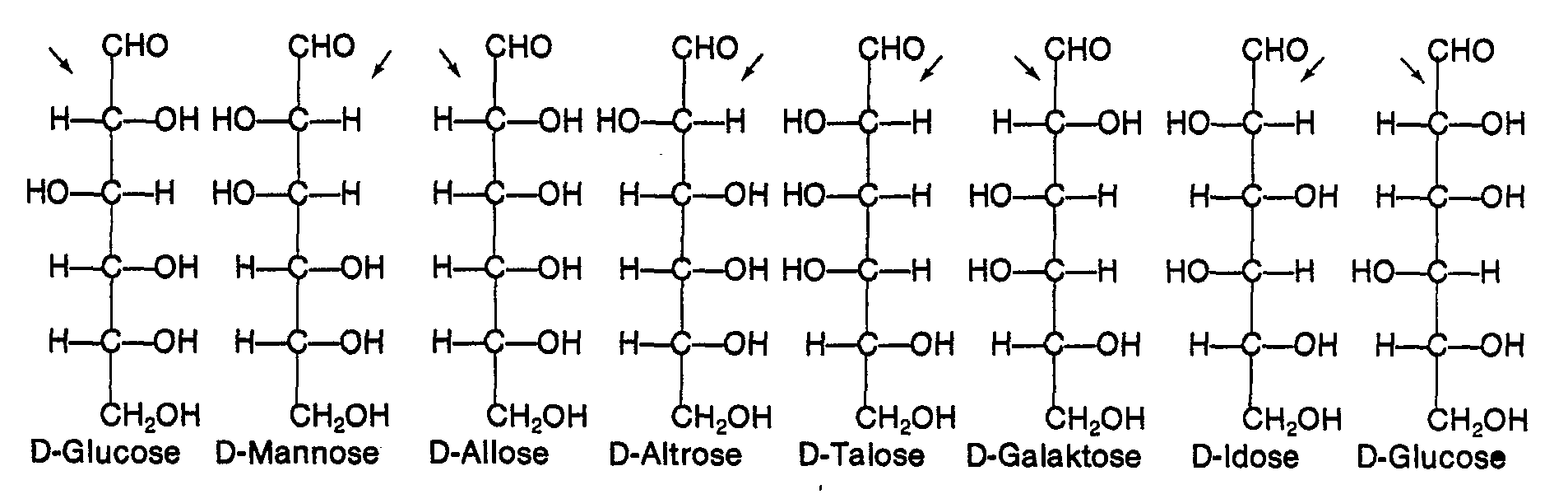
- Die erfindungsgemäß in das Zuckermolekül eingeführte zusätzliche primäre-Hydroxylgruppe hat im wesentlichen gleiche Reaktivität wie die bereits vorhandene und ist den verschiedenartigsten Modifizierungsreaktionen zugänglich, wie sie weiter unten näher beschrieben werden.
- Es ist wahrscheinlich, daß in den erfindungsgemäß modifizierten Zuckern Ringschluß aus der offenkettigen zur Cyclohalbacetalform eintritt, wie es für den Fall der a-C-methylolierten α-D-Glucose und ß-D-Glucose in den nachstehenden Formeln gezeigt ist :

- In entsprechender Weise werden auch aus nativen Disacchariden nach Durchführung der a-C-Methylolierung neue verzweigte Disaccharide mit zwei gleichwertig reagierenden primären Hydroxylgruppen erhalten. Bei Oligosacchariden mit Zuckerresten in glykosidischer Bindung, z. B. in Maisstärke-, Kartoffelstärke- oder Getreide-Hydrolysaten oder in anderen enzymatisch hydrolysierten Polysacchariden wird hierdurch die Zahl der CH20H-Gruppen stets um 1 erhöht.
- Im Falle der Ketosen ermöglicht das erfindungsgemäße Verfahren die Einführung von bis zu 3 Methylolgruppen, da sowohl die α- als auch die α-Kohlenstoffatome in den Ketosen für die Addition des Formaldehyds ausreichend aktiviert sind, wie es im folgenden für D-Fructose und D-Sorbose beispielhaft gezeigt wird :


- Von besonderem Vorteil ist, daß durch die erfindungsgemäße Einführung mindestens einer Methylolgruppe eine Verflüssigung der normalerweise kristallinen Zucker erreicht wird.
- Die überraschend leicht in hoher Ausbeute (94 bis 96 %) ablaufende neue Additionsreaktion ist für den Fachmann unerwartet, da bisher bekannt war, daß die Cyclohalbacetale der natürlichen Zucker, z. B.
-

- Überraschenderweise scheint aber trotzdem die im Gleichgewicht vorhandene (sehr geringe) Menge der offenkettigen Struktur ausreichend zu sein, um die Methylolierungsreaktion zu ermöglichen. Für den Fall der D-Glucose und ihrer optisch inaktiven Racemate kann der Reaktionsverlauf durch das folgende Reaktionsschema dargestellt werden :

- In welchem Maße bei der erfindungsgemäßen Additionsreaktion auch der optische Antipode, also die L-Form zu (A), entsteht, ist zur Zeit noch nicht bekannt. Lösungen von (A) sind in Wasser optisch aktiv und besitzen einen Drehwert von [ao] = + 31°. Die Entstehung des neuen a-C-methylolierten verzweigten C7-Zuckers (A) aus Glucose und Formaldehyd in 95 %iger Ausbeute bzw. die Bildung des Cyclohalbacetals wurde durch Herstellung des chloroform löslichen Hexaacetylderivates der Konstitution
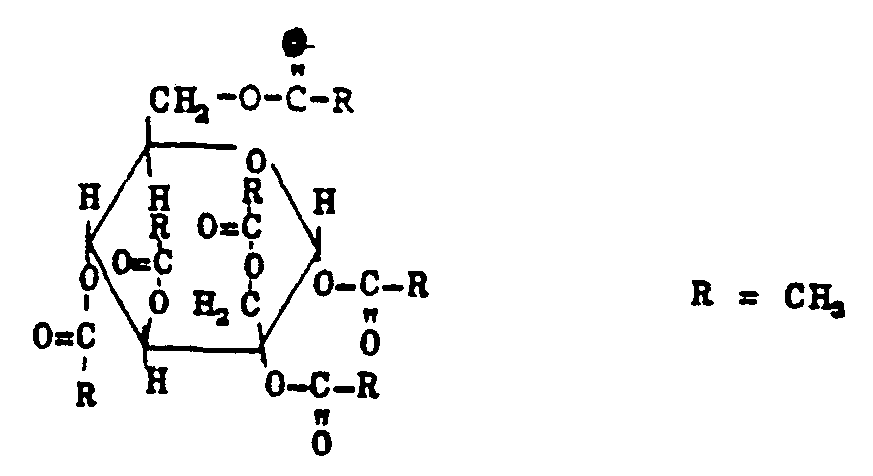
- Ein weiterer Beweis für die a-Verzweigung der erfindungsgemäß behandelten Zucker ist, daß die übliche Osazonbildung von Zuckern (Bindungen von 2 Mol Phenylhydrazin) nicht eintritt ; an die erfindungsgemäß modifizierten Zucker kann nur 1 Mol Phenylhydrazin unter Bildung des Hydrazons gebunden werden.
- Wie schon erwähnt, sind der erfindungsgemäßen Methylolierungsreaktion nur solche Zucker bzw. Zuckerderivate zugänglich, welche Fehling'sche Lösung reduzieren.
- In Lävoglucosan, einem Glucoseanhydrid, das durch Destillation von Glucose gemäß nachstehender Gleichung

- Das wirtschaftlich bedeutendste Disaccharid Saccharose, d. h. der Rohrzucker oder Rübenzucker der Konstitution

- Da in der a-Methylolierbarkeit von Aldosen bzw. in der α,α'-Methylolierbarkeit von Ketosen ein allgemein gültiges Prinzip erkannt wurde, ist das erfindungsgemäße Verfahren auf beliebige monomere und polymere Zucker, auf beliebige D- oder L-Formen und deren Racematmischungen übertragbar.
- Weitere wertvolle Ausgangssubstanzen aus der Reihe nativer hochmolekularer C6-Polysaccharide, die primär Fehling'sche Lösung nicht reduzieren, jedoch nach saurer Hydrolyse zu Mono- und Oligosacchariden und Umstellung des pH-Wertes auf bevorzugt pH 8-9 erfindungsgemäß C-methylolierbar sind, sind die folgenden : Glykoproteide, Saponine, das Inulin (C6H10O3)x, das insbesondere in Knollen von Dahlien, in Artischocken, Topinamburknollen etc. vorhanden ist und ein hochpolymeres Polysaccharid der Fructose darstellt, ferner Pektinstoffe (Polygalakturonsäuren), Naturstoffe wie Tannine, Chitin als Poly-N-Acetylglycosamin, stark Verzweigte Stärken wie Glykogen, ferner Amylopektine, Polymere aus D-Glucosamin-N-schwefelsäuren und D-Glucuronsäure (Heparin), sowie Chondroitinschwefelsäure, die - mit Proteinen verbunden - den Hauptbestandteil der Knorpelsubstanz darstellt und aus D-Glucuronsäure, N-Acetyl-D-Galactosamin und esterartig gebundener Schwefelsäure besteht. Interessante Ausgangssubstanzen, die primär hydrolysiert und dann α- und α'-C-methyloliert werden können, sind auch die verschiedensten in der belebten Natur vorkommenden Glycoside, d. h. Kondensationsprodukte von Mono- und Polysacchariden mit Alkoholen oder Phenolen, z. B. Glycoside der Flavonreihe, die in blauen und roten Blütenfarbstoffen und Beerenfarbstoffen vorkommen, die Klasse der sogenannten Digitalisglucoside, ferner die zuckerhaltigen Baukomponenten der Gerbstoffe aus der Tanningruppe, ferner Mucoitin-Schwefelsäure, dessen molekularer Aufbau der Chondroitinschwefelsäure ähnlich ist, das statt N-Acetyl-D-Galaktosamin jedoch N-Acetyl-D-Glucosamin enthält, ebenso hochmolekulare Hyaluronsäure, die im Molverhältnis 1 : 1 alternierend aus kondensierter D-Glucuronsäure und N-Acetyl-D-Glucosamin aufgebaut ist.
- Der erfindungsgemäßen a-C- bzw. α,α'-C-Methylolierung sind auch Mono- und oligomere Polysaccharide mit anderen funktionellen Gruppen zugänglich, z. B. Zucker mit Carboxylgruppen wie D-Glucuronsäure


- Als weitere Saccharid-Derivate, die der erfindungsgemäßen Reaktion zugänglich sind, sind zu nennen Natriumsalze der Gluco-pyranose-6-phosphorsäureester und Fructo-furanose-6-phosphorsäureester und ferner partiell (statistisch in 4, 5 oder 6-Stellung) acetalisierte oder ketalisierte Hexosen, partiell methylierte oder acetylierte Hexosen und ihre Stereoisomeren, sofern die a-Wasserstoffatome zur Carbonylgruppe in den Zucker-Derivaten noch vorhanden sind.
- Wie gefunden wurde, können insbesondere sehr hochmolekulare Polysaccharide wie Cellulose, Maisstärke, Kartoffelstärke, Getreidestärke, Amylopektin, Inulin, Chitin, Chondroitinschwefelsäure etc., aber auch die wichtigsten Disaccharide wie Rohr- und Rübenzucker, ferner Reservepolysaccharide der Pflanzen, Hemicellulosen, Glycogen etc., die Fehling'sche Lösung nicht reduzieren, leicht in Form eines Eintopfverfahrens der erfindungsgemäßen a- bzw. a,a'-Additionsreaktionen des Formaldehyds zu verzweigten Zuckern zugänglich gemacht werden, wenn die vorgenannten Produkte in einer ersten Stufe sauer oder enzymatisch (fermentativ) hydrolysiert und in C6-Oligosaccharide abgebaut werden, wodurch Fehling'sche Lösung reduzierende C6-Saccharide und C6-Oligosaccharide erhalten werden. Nach der Neutralisation sowie gegebenenfalls Entfernung der Anionen an Austauschersäulen und gegebenenfalls Entfernung von anderen Zellinhaltsstoffen, wie abgebauten und hydrolysierten Proteinen, sind die so erhaltenen, Fehling'sche Lösung reduzierenden Zuckergemische, die gegebenenfalls noch Aminosäuren und lösliche Oligopeptide gelöst enthalten können, mit Formaldehyd oder Formaldehyd enthaltenden Synthesegasen in einer zweiten Stufe erfindungsgemäß a- bzw. α,α'-C-methylolierbar.
- Die Hydrolyse der Oligo- und Polysaccharide kann dabei in Form der bekannten Verfahren der « Holzverzuckerung nach Bergius bzw. Willstätter und Zechmeister bei tiefen Temperaturen (z. B. mit hochkonz. Salzsäure) oder bei erhöhten Temperaturen (z. B. mit sehr verdünnter Schwefelsäure bei Normal- oder erhöhtem Druck bei 100 bis 110°C) nach dem Verfahren von Scholler-Tornesch (vgl. Langenbeck, Lehrbuch der Org. Chemie 11/12 Auflage, S.291) durchgeführt werden. Die gleichen Verfahren können auf den hydrolytischen Abbau von Bäckereihefen, zur Gärung verwendeter Hefearten, eiweißreicher Nährhefen etc. angewendet werden, um die zuckerhaltigen Zellinhaltsstoffe in Freiheit zu setzen.
- Von erheblichem Interesse ist, wie gefunden wurde, daß auch Cyanhydrine, d. h. Anlagerungsprodukte von Blausäure an Aldosen und Ketosen der idealisierten Konstitution

- Von Interesse und überraschend ist, daß die aus Glucose und Fructose erhaltenen verzweigten C7-Cg-Zucker mit üblichen Hefepräparaten vollständig vergärbar sind und die Geschwindigkeit der ,Äthanolbildung gemäß der Grundgleichung der Gärung

- Bevorzugte Ausgangssubstanzen für das erfindungsgemäße Verfahren sind :
- Naturprodukte wie a- und β-D-Glucose (Traubenzucker) ; sauer hydrolisierter oder enzymatisch hydrolysierter Rohrzucker (Invertzucker), hauptsächlich bestehend aus 1 Mol Glucose und 1 Mol Fructose ; Disaccharide wie Maltose, Lactose und Cellobiose ; handelsübliche hydrolysierte oder enzymatisch abgebaute Maisstärke und Kartoffelstärke in Form sogenannter Isosirupe ; natürliche Invertzucker, wie sie in den Honigsorten beliebiger Provenienz vorliegen ; sauer hydrolysierte Cellulose ; Hydrolyseprodukte des Inulins, die besonders reich an Fructose sind ; native Zucker, die,mit geeigneten Aminen die Amadori-Umlagerung, die Heyns-Umlagerung, Lobry de Bruyn-Umlagerung oder Maillard-Reaktionen (vgl. Advances in Protein Chemistry, Volume 29, 1975, S. 185-188, Academic Press) eingegangen sind ; ferner Lignin enthaltende hydrolytisch abgebaute Oligopolysaccharide und Glucosehaltige Zucker der Holzverzuckerung, wobei das Lignin als Polymeres des Coniferylalkohols

- Gegebenenfalls ist es auch möglich, das erfindungsgemäße Verfahren simultan mit den oben erwähnten Umlagerungen nach Amadori, Heyns und Lobry de Bruyn bzw. gekoppelt mit Maillard-Reaktionen ablaufen zu lassen, wobei interessante Gemische verschiedener verzweigter Zuckerderivate entstehen.
- Als basische Katalysatoren für die erfindungsgemäße, einheitliche Einführung von Formaldehyd in die a-Stellung bzw. a'-Stellung von nativen C6-Zuckern bzw. deren Derivate mit mindestens einer Cyclohalbacetalendgruppe oder offenkettigen Aldo- oder Ketofunktion sind zu nennen :
- Hydroxide des Lithiums, Natriums und Kaliums ; Natrium-, Kalium- und Lithiumcarbonat ; Na- und K-Borat ; Lithium-, Natrium- und Kaliumcyanid ; Kaliumacetat ; Natrium- und Kaliumphenolat ; Lithium-, Natrium- und Kaliumsalze von peralkylierten Aminosäuren, bevorzugt des Dimethylaminoglyzins

- Erfindungsgemäß bevorzugt sind jedoch organische Basen wie Trimethylamin, Triäthylamin, Tri-n-propylamin, Tri-n-butylamin, N,N-Dialkylbenzylamine mit 1 bis 5, vorzugsweise 1 oder 2, C-Atomen in den Alkylgruppen, N,N-Dimethylcyclohexylamin, 'N,N-Diäthylcyclohexylamin, N-Alkylpiperidine, N-N'-Di- alkylpiperazine und N-Alkylmorpholine mit jeweils 1 bis 5, vorzugsweise 1 oder 2 C-Atomen in den Alkylgruppen, N-Phenylmorpholin, N-Benzylmorpholin, 1,2-Bis-morpholyl-äthan sowie Anlagerungsprodukte von Äthylenoxid und/oder Propylenoxid an Morpholin oder Piperazin mit einem Molekulargewicht bis etwa 2 000, vorzugsweise bis ca. 1 000. Diese letztgenannten Verbindungen sind ebenso wie andere, für die Polyurethanherstellung an sich bekannte, basische Polyäther (Alkoxylierungsprodukte von Ammoniak, primären und sekundären Mono- oder Polyaminen) erfindungsgemäß von Interesse, weil sie auch in höheren Konzentrationen in den Verfahrensprodukten verbleiben können und später bei der Verwendung der Produkte als Ausgangskomponente zur Herstellung von Polyurethankunststoffen einbaubare Katalysatoren für die Polyisocyanat-Polyadditionsreaktion darstellen.
- Von Interesse als Katalysatoren sind auch bicyclische Amidine wie z. B.


- Eine weitere interessante Gruppe von Katalysatoren stellen auch bekannte Mono- und Polyepoxyde z. B. der Konstitution


- Beispiele für erfindungsgemäß besonders bevorzugte quartäre Ammoniumbasen sind 10 bis 20 %ige Lösungen von


- R1, R2, R3 und R4 für Alkyl-, Cycloalkyl- oder Aralkylreste mit 1 bis 10 C-Atomen, vorzugsweise für Methyl, Äthyl, Cyclohexyl oder Benzyl, und
- A für ein basisches Anion, vorzugsweise für ein Hydroxyl-, Acetat- oder Phenolation, besonders bevorzugt für ein Cyanidion.
- Beispiele für besonders bevorzugte ternäre Sulfoniumbasen sind solche der Formeln
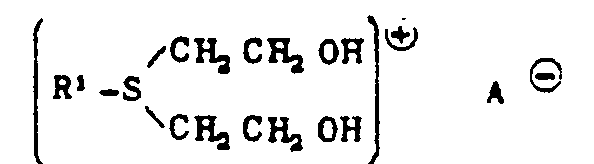

- In der Reihe der anorganischen Katalysatoren sind Natriumhydroxyd, Natriumcyanid, Natriumphenolat und Natriummethylat besonders bevorzugt.
- Unter den organischen basischen Katalysatoren sind besonders bevorzugt Dimethylcyclohexylamin, Triäthylamin, die Cyanide quartärer Ammoniumbasen wie Tetramethylammoniumcyanid und Tetraäthylammoniumcyanid und quartäre Ammoniumverbindungen betainartigen Charakters wie das Cholin, das aus Trimethylamin, Äthylenoxyd und 1 Mol Wasser in an sich bekannter Weise leicht hergestellt werden kann. Cholincyanid ist in dieser Gruppe besonders bevorzugt. Als unlösliche basische Katalysatoren sind auch stark basische Ionenaustauscher, z. B. solche mit Gruppierungen

- Cyanide (sowohl von Alkalimetallen als auch von quartären Ammoniumverbindungen) sind dann besonders bevorzugt, wenn besonders reine und farblose verzweigte Zucker mit hoher Ausbeute hergestellt werden sollen.
- Als Formaldehydquelle für die Durchführung des erfindungsgemäßen Verfahrens setzt man im allgemeinen 10-70 Gew.-%, vorzugsweise 20-65 Gew.-%, besonders bevorzugt 30 bis 50 Gew.-% Formaldehyd enthaltende wäßrige und/oder alkoholische Formalinlösungen und/oder Paraformaldehyddispersionen und/oder zur Transmethylolierung befähigte Verbindungen wie N-Methylol-caprolactam, N-Methylolpyrrolidon, N-methylolierte Harnstoffe und Thioharnstoffe, methylolierten N,N-Dimethylharnstoff, methyloliertes Dicyandiamid, methyloliertes Melanin, d. h. allgemein N-Methylolverbindungen von Aminoplastmonomeren ein. Gewünschtenfalls kann die erfindungsgemäße Reaktion auch in Gegenwart von Phenolen, Naphtholen, Bisphenol A, d. h. zur Phenoplastbildung befähigten Verbindungen durchgeführt werden, wobei Mischungen der erfindungsgemäßen Zucker mit nicht zur Transmethylolierung befähigten Hydroxybenzylalkoholen bzw. Hydroxybenzylpolyalkoholen erhalten werden, die gegebenenfalls durch anschließendes Ansäuern auf pH = 2-4 leicht mit den alkoholischen Hydroxylgruppen der neuen Zuckerderivate verätherbar sind.
- Selbstverständlich läßt sich das erfindungsgemäße Verfahren auch mit praktisch wasserfreien Halbacetalen des Formaldehyds mit Monoalkoholen wie Methanol, Äthanol und Propanol oder auch mit Halbacetalen von Polyalkoholen wie Äthylenglykol, Propylenglykol, Diäthylenglykol, Triäthylenglykol, Glyzerin, N-Methyldiäthanolamin, Dimethyläthanolamin oder Triäthanolamin durchführen, wobei im Falle der Verwendung basischer Alkohol-Halbacetale auf zusätzliche basische Katalysatoren verzichtet werden kann.
- Besonders bevorzugte Formaldehydquellen sind auch die bei der großtechnischen Herstellung von Formaldehyd anfallenden heißen Synthesegase, die direkt für die a-C-Methylolierungsreaktion bzw. a,a'-C-Polymethylolierungsreaktion eingesetzt werden können. Man setzt zu diesem Zweck Lösungen der zu modifizierenden Zucker bei den erfindungsgemäß einzuhaltenden pH-Werten als Absorptionsflüssigkeiten für den Formaldehyd ein, indem man die Zuckerlösungen vorzugsweise zur Gegenstromwäsche der heißen Synthesegase verwendet und entweder gleichzeitig die Additionsreaktion, vorzugsweise bei ca. 50-95 °C und einem pH-Wert von 8-9, ablaufen läßt oder, falls die Absorptionsflüssigkeit keinen Katalysator enthält, die Methylolierungsreaktion durch nachträglichen Zusatz der oben beschriebenen Katalysatoren initiiert.
- Für das erfindungsgemäße Verfahren sind beliebige Synthesegase einsetzbar, wie sie bei der technischen Herstellung von Formaldehyd anfallen. Beispiele für großtechnische Herstellungsverfahren von Formaldehyd sind die Dehydrierung von Methanol bzw. die Oxidation von Methanol an geeigneten Katalysatoren (beispielsweise Silber oder Eisenmolybdänoxid) in Gegenwart von Luft, gegebenenfalls Wasserdampf und Formaldehyd-Abgasen, sowie die Oxidation von Methan bzw. Äthylen oder höheren Olefinen oder Dimethyläther mit Luft oder Sauerstoff bzw. sauerstoffhaltigen Gasen an geeigneten Katalysatoren. Diese technischen Synthesegase enthalten im allgemeinen als Hauptbestandteil 20 bis 70 Vol.-% Stickstoff, 1 bis 20 Vol.-% Formaldehyd, 1 bis 10 Vol.-% Kohlendioxid sowie meist - je nach Herstellungsverfahren - auch größere Mengen an Wasserdampf, restlicher Luft, Kohlenmonoxid, Wasserstoff und Restmengen an Ausgangsprodukten oder auch Nebenprodukte wie z. B. Methanol, Methan, Äthylen, höhere Olefine, Methylformiat, Dimethyläther sowie Acetale und Halbacetale des Formaldehyds. Häufig neigen die Zucker in Anwesenheit von Sauerstoff zu Verbräunungsreaktionen ; Sauerstoff-freie Synthesegase sind daher erfindungsgemäß bevorzugt.
- Die bei der großtechnischen Herstellung von Formaldehyd anfallenden Synthesegase können jedoch im übrigen roh, d. h. ohne jede vorgeschaltete Reinigungsstufe, im erfindungsgemäßen Verfahren eingesetzt werden, was aus ökonomischen Gründen von besonderem Vorteil ist. Auch die üblicherweise in den Synthesegasen vorhandenen großen Mengen an Kohlendioxid stören die erfindungsgemäße Methylolierungsreaktion nicht.
- Die erfindungsgemäße Verfahrensvariante, bei welcher Synthesegase als Formaldehydquelle dienen, kann sowohl bei Normaldruck als auch bei Überdruck als auch bei vermindertem Druck (mit abgeschreckten Synthesegasen) ausgeführt werden. Die Absorptionsflüssigkeit, bestehend aus einer Lösung des zu methylolierenden Zuckers, welche gegebenenfalls ca. 10 bis 60Gew.-% der weiter unten beschriebenen Mono- und Polyalkohole mit einem Molekulargewicht von 32 bis 10000 sowie gegebenenfalls 1 bis 50 Gew.-% der ebenfalls weiter unten beschriebenen Aminoplast- oder Phenoplastmonomeren, Phosphite und/oder a-methylolierbaren Aldehyde und Ketone enthält, wird in einer geeigneten Absorptionskolonne vorgelegt und das Synthesegas mit einer Temperatur von ca. 90 bis 250°C, vorzugsweise 100 bis 140 °C, in die auf ca. 70 bis 110°C, vorzugsweise 80 bis 85°C, gehaltene Absorptionsflüssigkeit kontinuierlich oder diskontinuierlich eingeleitet.
- Man kann das Wärmereservoir der Synthesegase (die bei ihrer Herstellung auf eine Temperatur von ca. 300 °C abgeschreckt anfallen) bzw. die Wärmemenge, die bei der Methylolierung frei wird, in energiesparender Weise zur teilweisen Entwässerung der Verfahrensprodukte ausnützen. Von großem Vorteil ist in diesem Zusammenhang die Schleppmittelwirkung der im Synthesegas vorhandenen großen Inertgasvolumina für Wasser. Die freiwerdende Wärmemenge kann aber auch an die verschiedensten Kreisläufe der Formaldehydherstellung geliefert werden, z. B. an die Verdampferkreisläufe für Methanol und/oder Wasser, so daß die anfallende Wärmeenergie optimal ausgenützt werden kann.
- Bei der diskontinuierlichen Verfahrensvariante wird das Synthesegas durch eine Säule geleitet, welche mit der ruhenden Absorptionsflüssigkeit gefüllt ist. Um den Stoffaustausch zwischen den beiden Phasen zu beschleunigen, enthält dabei die Absorptionssäule zweckmäßigerweise Füllkörper mit großer Oberfläche der an sich bekannten Art wie z. B. Raschigringe, Sattelringe, Siebböden oder feinmaschige Drahtnetze. Das Synthesegas wird durch die Absorptionssäule bis zur Sättigung der Absorptionsflüssigkeit geleitet, d. h. bis am Kopf der Säule größere Mengen an Formaldehyd zusammen mit den Inertgasen austreten. Vorzugsweise enthält die Absorptionsflüssigkeit bereits den für das erfindungsgemäße Verfahren erforderlichen Katalysator, so daß die Methylolierungsreaktion schon während der Absorption des Formaldehyds beginnt. Der Vorteil dieser Arbeitsweise liegt darin, daß durch ein gegebenes Volumen von Absorptionsflüssigkeit eine größere Menge an Formaldehyd aufgenommen werden kann. Selbstverständlich ist es jedoch erfindungsgemäß möglich, die Synthesegase bis zur Sättigung in eine katalysatorfreie Absorptionsflüssigkeit einzuleiten und erst danach durch Zusatz des Katalysators die Reaktion zu starten.
- Besonders wirtschaftlich ist es jedoch, wie bereits erwähnt, das erfindungsgemäße Verfahren kontinuierlich zu gestalten. Man hält zu diesem Zweck einen Kreislauf der Absorptionsflüssigkeit aufrecht und führt die Absorptionsflüssigkeit zweckmäßigerweise im Gegenstrom den heißen Synthesegasen entgegen. Auch bei dieser bevorzugten Verfahrensvariante ist es von Vorteil, um den Stoffaustausch zu erleichtern, als Absorptionssäulen an sich bekannte Füllkörper-, Glockenboden-, Siebboden- oder Rieselfilmkolonnen einzusetzen ; selbstverständlich können auch Blasensäulen für das erfindungsgemäße Verfahren verwendet werden. Die durchschnittliche Verweilzeit der formaldehydhaltigen Synthesegase in den Absorptionskolonen liegt sowohl bei der kontinuierlichen als auch bei der diskontinuierlichen Variante des erfindungsgemäßen Verfahrens im allgemein zwischen 0,3 und 10 Sekunden, vorzugsweise zwischen 0,6 und 3 Sekunden.
- Figur 1 zeigt in stark vereinfachter, schematischer Darstellung eine für die kontinuierliche Ausgestaltung des erfindungsgemäßen Verfahrens geeignete Apparatur : In die mit Absorptionsflüssigkeit gefüllte Absorptionskolonne A wird bei 1 das heiße, Formaldehyd enthaltende Synthesegas eingeleitet. Bei 2 können die Zuckerlösung bzw. Zusätze wie z. B. Katalysator, Base, Alkohole, aldolisierbare Aldehyde bzw. Ketone, Aminoplastbildner etc. eingespeist werden. Über die Pumpe B wird die Absorptionsflüssigkeit umgepumpt und dem Synthesegas im Gegenstrom entgegengeführt. Bei 3 verlassen die von Formaldehyd befreiten, Wasserdampf enthaltenden Gase die Absorptionskolonne. C stellt ein heiz-bzw. kühlbares Verweilzeitgefäß dar, in welchem die Methylolierungsreaktion ablaufen kann. Bei 4 wird laufend ein Teil des Reaktionsproduktes und Restmengen an Formaldehyd enthaltenden Absorptionsflüssigkeit abgenommen und durch ein weiteres Verweilzeitgefäß D geleitet, in welches bei 5 nochmals verschiedene Zusatzstoffe (Katalysator, Aminoplastbildner etc) zudosiert werden können. Bei 6 verläßt das Reaktionsprodukt die Apparatur.
- Auch bei der kontinuierlichen Verfahrensweise kann, wie schon erwähnt, der basische Katalysator bereits der Absorptionsflüssigkeit zugesetzt werden, (ca. 0,01 bis 10Gew.-%, vorzugsweise 0,3 bis 2 Gew.-%), so daß Absorption des Formaldehyds und Anlagerung des Formaldehyds an den Zucker simultan erfolgen ; es ist aber auch möglich, den Katalysator erst nach der Produktabnahme (also beispielsweise in Position 5 von Figur 1) zuzudosieren, so daß die Methylolierung im wesentlichen erst außerhalb des Kreislaufes erfolgt.
- Enthält die Absorptionsflüssigkeit keinen basischen Katalysator, dann bilden sich zunächst im Gleichgewicht mit in Wasser gelöstem Formaldehyd die Halbacetale der in der Absorptionsflüssigkeit vorhandenen Hydroxylverbindungen, beispielsweise solche der nachstehenden Formel :

- Da sich in Gegenwart von Wasser das Dissoziationsgleichgewicht zwischen diesen Halbacetalen und freiem Formaldehyd sehr schnell einstellt, wird auch aus derartigen Gemischen nach Zusatzt des Katalysators bei 70 bis 110 °C, vorzugsweise 80 bis 85 °C, äußerst rasch der verzweigte Zucker gebildet.
- Findet die Methylolierungsreaktion ganz oder teilweise außerhalb des Kreislaufs der Absorptionsflüssigkeit statt, dann kann man erfindungsgemäß die Reaktion beispielsweise in kontinuierlich laufenden Rührkesselkaskaden stattfinden lassen. Durch Variation der Verweilzeit in den einzelnen Rührkesseln der Kaskade läßt sich bei dieser Verfahrensvariante der Restformaldehydgehalt exakt einstellen. Es ist auch möglich, die erfindungsgemäße Reaktion des Formaldehyds statt in Rührkesselkaskaden in Reaktionsröhren, beispielsweise in Schlangenrohrreaktoren unter Druck (ca. 5 bis 150 bar, vorzugsweise 10 bis 70 bar) bei erhöhten Temperaturen (vorzugsweise 105 bis 140 °C) ablaufen zu lassen.
- Im erfindungsgemäßen Verfahren kann die Menge an Formaldehyd in weiten Grenzen variiert werden. Im allgemeinen setzt man 0,05 bis 10 Mol, vorzugsweise 0,2 bis 5 Mol, besonders bevorzugt 1,0 bis 1,5 Mol, an Formaldehyd pro Äquivalent an α- oder a'-ständigen (d. h. durch eine Methylolgruppe substituierbaren) H-Atomen des Zuckers bzw. Zuckerderivats ein. Im Falle der Verwendung unterschüssiger Formaldehydmengen erhält man Gemische aus a- bzw. a'-methylolierten Zuckern und unmodifizierten Zuckern. Lösungen derartiger Gemische haben vorteilhafterweise gegenüber den Ausgangslösungen eine stark verminderte Viskosität und Kristallisationsneigung. Gemische der erfindungsgemäßen verzweigten Zucker mit unmodifizierten Zuckern (insbesondere Glucose und/oder Saccharose) im Gewichtsverhältnis 5 : 95 bis 95 : 5, vorzugsweise 20 : 80 bis 80 : 20, sind daher ebenfalls Gegenstand der vorliegenden Erfindung.
- Setzt man im erfindungsgemäßen Verfahren hingegen einen großen Überschuß an Formaldehyd ein (z. B. die ca. 5- bis 6-fache der theoretisch für die Methylolierung benötigten Menge), so erhält man nach der Entwässerung des Reaktionsgemisches (vorzugsweise in einem Vakuum von ca. 0,05-16 Torr) Halbacetale der erfindungsgemäßen verzweigten Zucker, welche gegebenenfalls durch Ansäuern (pH 1-4) zu neuartigen, verzweigten oder vernetzten Ganzacetalen oder Polyacetalen umgesetzt werden können.
- Will man hingegen die erfindungsgemäßen verzweigten Zucker in besonders hoher Reinheit herstellen, dann wendet man bevorzugt 1,18 bis 1,20 Mol Formaldehyd pro Äquivalent an α- bzw. α'- ständigen Wasserstoffatomen des Zuckers an und bricht die Reaktion bei einem Restformaldehydgehalt im Reaktionsgemisch von ca. 0,3 bis 0,9 Gew.-% durch Kühlen und/oder Neutralisieren ab.
- Das erfindungsgemäße Verfahren läßt sich diskontinuierlich oder kontinuierlich, bei vermindertem Druck oder bei Überdruck ausführen. Gemäß einer besonderen Variante läßt man die Methylolierungsreaktion in einer Rührkesselkaskade ablaufen. Durch Variation der Verweilzeit und des pH-Wertes in den einzelnen Rührkesseln läßt sich bei dieser Verfahrensvariante der Umsetzungsgrad in der Addition des Formaldehyds an die a- und a'-C-Atome der Zucker bzw. Zuckerderivate (bevorzugt Glucose, Fructose, Maltose, Lactose, Cellobiose und ihre Gemische, Invertzucker, Honigarten, « Isosirupe », hydrolysierter Rohrzucker, hydrolysierte Stärke und verzuckerte Cellulose) exakt einstellen. Auf diese Weise ist es daher ebenfalls möglich, auch nur partielle C-Methylolierungsreaktionen an einem nativen Zucker durchzuführen und z. B. Mischungen herzustellen, die aus einem Mol von a-methylolierter Glucose und einem Mol nichtumgesetzter Glucose bestehen, wodurch die Kristallisation der entwässerten Mischung extrem gestört wird und die Viskosität der wasserarmen Zuckermischungen stark gesenkt werden kann.
- Besonders hervorzuheben ist, daß bei der erfindungsgemäßen pH-Führung und bei Verwendung der bevorzugten basischen Katalysatoren im erfindungsgemäßen Verfahren gekreuzte Cannizzaro-Reaktionen des Formaldehyds extrem stark zurückgedrängt werden und die Zucker ohne Dehydratisierungsreaktionen wie auch ohne nennenswerte gekreuzte Cannizzaro-Reaktionen oder Aldolkondensationen der Zucker untereinander überraschend in 95-98 %iger Ausbeute erhalten werden können.
- Im allgemeinen erfordern die erfindungsgemäßen C-Methylolierungen keine Katalysatordesaktivierung, da die bevorzugt eingesetzten geringen Mengen an Katalysator meist gegen Ende der Reaktion bei einem Restformaldehydgehalt der neuen, verzweigten Zucker von ca. 0,3-0,9 Gew.-% durch kleine Mengen sich bildender Ameisensäure oder durch Zuckersäuren desaktiviert werden und daher gegen Ende der Reaktion der pH-Wert im allgemeinen auf 7-6,8 absinkt. Gewünschtenfalls können die Reaktionsprodukte jedoch an sauren und basischen Ionenaustauschern entsalzt werden.
- Vorzugsweise wird erfindungsgemäß, wie schon erwähnt, in Abwesenheit von Metallionen (insbesondere mehrwertiger Metallionen), also mit organischen Basen als Katalysator gearbeitet. Mehrwertige Metallionen katalysieren nämlich die Kondensation des Formaldehyds zu Polyhydroxyaldehyden und -ketonen (sogenannte Formosesynthese). Führt man die erfindungsgemäße a,a'-C-Methylolierung mit überschüssigem Formaldehyd, bezogen auf alle Aldo- und Keto-Äquivalente des verwendeten nativen Zuckers oder Zuckerderivats in Gegenwart von Katalysatoren wie Calciumhydroxyd, Bleihydroxyd, Calciumoxid, Bleioxid, Calciumphenolat, Calciumcarbonat, Thalliumhydroxid etc. aus, so entstehen daher neben den erfindungsgemäßen a,a'-C-methylolierten Zuckern Gemische von C3-C9-Po)yhydroxy- aldehyden, Polyhydroxyketonen und Polyalkoholen (Formosen) in Form ihrer optisch inaktiven D,L-Racemate.
- Die erfindungsgemäße Reaktion wird oft mit Vorteil in Gegenwart von niedermolekularen, ein- oder vorzugsweise mehrwertigen Alkoholen ausgeführt, um relativ niedrigviskose, gut flißende und leicht im Dünnschichtverdampfer entwässerbare Reaktionsprodukte zu erhalten. Auch höhermolekulare Polyhydroxylverbindungen (Molekulargewicht bis 10000) können gegebenenfalls mitverwendet werden, insbesondere wenn mit formaldehydhaltigen Synthesegasen gearbeitet wird.
- Geeignete Mono- und Polyalkohole sind beispielsweise Methanol, Äthanol, Propanol, Butanol, Amylalkohol, sowie die unten im Zusammenhang mit der Herstellung von Polyurethankunststoffen ausführlich beschriebenen Polyhydroxylverbindungen, insbesondere Äthylenglykol, Glycerin, Trimethylolpropan, Formite, Diäthylenglykol, Triäthylenglykol, Propandiol-(1,2), Propandiol-(1,3), Butandiol-(1,4), N-Methyldiäthanolamin, N-Äthyl-diäthanolamin, oxäthyliertes bzw. propoxyliertes Äthylendiamin, oxäthyliertes oder propoxyliertes Hydrazin oder substituiertes Hydrazin (z. B. N,N-Dimethyl- oder Diäthylhydrazin), sowie auch wasserunlösliche aber emulgierbare Polyalkohole wie Rizinusöl, Hexantriol und 2- Äthylhexandiol-(1,3) sowie Oxäthylierungs- und Propoxylierungsprodukte aller genannten Mono- und Polyalkohole. Die erfindungsgemäße Methylolierung von Zuckern kann auch in Gegenwart von weiteren C- bzw. N-methylolierbaren Verbindungen durchgeführt werden. Man erhält in diesem Falle besser fließfähige, leichter entwässerbare und mit Polyisocyanaten schneller reagierende Verfahrensprodukte, die sich zur Herstellung flammwidriger Polyurethankunststoffe eignen. Als derartige reaktive Zusätze kommen z. B. ganz allgemein primäre und/oder sekundäre Amine und/oder zur Aminoplast- bzw. Phenoplastbildung geeignete Stoffe bzw. deren Methylolierungsprodukte in Frage, wie sie beispielsweise in den DE-Offenlegungsschriften 2324134 und 2 639 254 beschrieben werden. Beispielhaft seien in diesem Zusammenhang genannt : Anilin, Harnstoff, symmetrisch oder asymmetrisch substituierte Harnstoffe wie N,N-Dimethyl (bzw. -Diäthyl oder -Dibutyl)-Harnstoff, Thioharnstoff, Dicyandiamid, Melamin, Oxamid, Äthylenharnstoff, e-Caprolactam Pyrro)idon-(2)-, Acetylendiurein und die N-Methylolverbindungen all dieser Aminoplastmonomeren, Phenole und methylolierte Phenole.
- Auch nicht zuckerartige, a- bzw. a'-methylolierbare Aldehyde und Ketone können im erfindungsgemäßen Verfahren mitverwendet werden.
- Beispiele hierfür sind Acetaldehyd, Aceton, Propionaldehyd, Butyraldehyd, Isobutyraldehyd, Methyläthylketon, Cyclopentanon, Cyclohexanon, Mesityloxid, Isophoron, Acetophenon sowie deren Methylolderivate, wie sie durch basenkatalysierte teilweise Aldolisierung mit Formaldehyd an den zur Ketogruppe a-ständigen C-Atomen erhältlich sind. Beispiele hierfür sind die Verbindungen der Formeln :


- Auch Nebenprodukte der technischen Trimethylolpropanherstellung aus Buttersäurealdehyd und Formaldehyd wie z. B. 2-Äthylacrolein können mitverwendet werden, wobei z. B. 2-Äthylacrolein in Gegenwart von tert. Aminkatalysatoren wie Triisobutylamin in 2,2-Dimethylolalkanol übergeführt wird :

- Auch diese methylolierten Aldehyde und Ketone führen zu einer vorteilhaften Erniedrigung der Viskosität der erfindungsgemäß hergestellten Zuckerderivate.
- Erfindungsgemäß ist es auch möglich, bei der Methylolierungsreaktion Alkylphosphite wie z. B. Dimethylphosphit, Diäthylphosphit oder Triäthylphosphit mitzuverwenden.
- Durch eine basenkatalysierte Reaktion mit dem Formaldehyd entstehen dabei a-Hydroxylmethylphosphonsäureester bzw. Umesterungsprodukte mit den Hydroxylgruppen der Zucker. Ähnlich reagieren auch andere CH-acide Verbindungen wie Malonsäureester oder Acetessigester. Insbesondere die mit Alkylphosphiten modifizierten Zucker stellen ein wertvolles Ausgangsmaterial für die Herstellung äußerst flammwidriger Polyurethanschaumstoffe dar.
- Es ist als besonders überraschend zu bezeichnen, daß sich die erfindungsgemäßen verzweigten Zucker in den genannten Phosphiten lösen, während Glucose und andere Monosaccharide, aber auch Rohrzucker, in den Phosphiten unlöslich sind. Überraschenderweise erhält man hierbei Lösungen mit gegenüber unmodifizierten Zuckern extrem reduzierter Viskosität und verbesserter Emulgierbarkeit bzw. Mischbarkeit mit den verschiedensten nieder- und höhermolekularen Polyhydroxylverbindungen.
- In den mit Dialkylphosphit modifizierten Zuckern bilden sich je nach Temperaturlage Gleichgewichte aus zwischen freiem Dialkylphosphit, Hydroxymethanphosphonsäureestern der Konstitution
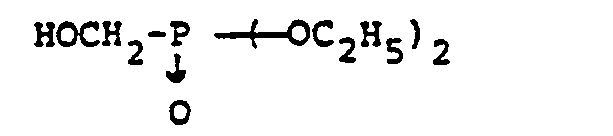
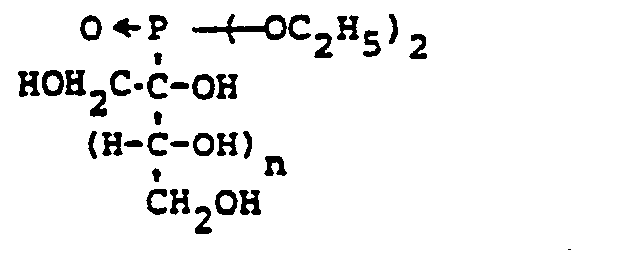
- Bei höheren Temperaturen (oberhalb ca. 35 °C) und insbesondere in Gegenwart von katalytischen Mengen an anorganischen Basen oder bevorzugt tertiären Aminen wie Triäthylamin oder Dimethylbenzylamin gehen diese Verbindungen Umlagerungsreaktionen und Umesterungsreaktionen unter Alkoholabspaltung ein und es entstehen cyclische Phosphite der Zucker bzw. über intermolekulare Verknüpfung von Zuckern höhermolekulare Polyphosphite bzw. Zucker-Ester der Hydroxymethylphosphonsäure. Je nach abgespaltener Alkoholmenge lassen sich beliebige Umesterungsgrade erzielen und damit z. B. Viskositäten von ca. 300 mPas bei 20 °C bis ca. 110000 mPas bei 20 °C einstellen.
- Alle eben beschriebenen gegenüber Formaldehyd reaktiven Verbindungen können aber gegebenenfalls auch im Anschluß an die erfindungsgemäße Methylolierungsreaktion zugesetzt werden, um freien Formaldehyd in den Verfahrensprodukten zu binden, wenn ein Überschuß an Formaldehyd eingesetzt worden war.
- Auch die technisch interessanten Gemische aus den erfindungsgemäßen verzweigten Zuckern und den eben beschriebenen gegebenenfalls methylolierten Aminoplast und Phenoplastmonomeren, Aldehyden und Ketonen sowie Phosphiten im Gewichtsverhältnis 99 : 1 bis 5 : 95, vorzugsweise 98 : 2 bis 50 : 50, besonders bevorzugt 95 : 5 bis 70 : 3, sind Gegenstand der Erfindung, beispielsweise Gemische aus den a- bzw. ä-methylolierten Zuckern und Dimethyl- und/oder Diäthylphosphit ; Caprolactam ; N-methyloliertem Caprolactam, Pyrrolidon, Harnstoff, Melamin, Dicyandiamid, Dimethyl- und Diäthylharnstoff Kondensationsprodukten aus 1 Mol Anilin und 1-5 Mol Formaldehyd ; Mono-, Di- und Trimethylolphenol ; Resolen ; mono- und polymethylolierten niedermolekularen Aldehyden und Ketonen wie Cyclohexanon, Acetaldehyd, Propionaldehyd, n-Butyraldehyd, Aceton, Methyläthylketon und Methylisobutylketon.
- Die erfindungsgemäßen, neuen verzweigten Zucker sind zahlreichen Reaktionen zu wertvollen technischen Zuckerderivaten zugänglich, z. B. Hydrierung zu verzweigten Alkoholen ; OH=- oder H°-katalysierte Umsetzungen (vorzugsweise mit Lewis-Säuren als Katalysator) mit Äthylenoxid, Propylenoxid oder Epichlorhydrin zu Polyäthern ; Herstellung von Polyestern ; inter- und intramolekulare Acetalbildung ; Acylierungsreaktion mit Essigsäureanhydrid, Keten oder Diketen ; Cyanäthylierung mit Acrylnitril und anschließende Hydrierungsreaktionen ; Herstellung von nichtionogenen oberflächenaktiven Verbindungen, z. B. durch Umsetzung mit Fettsäuren oder langkettigen aliphatischen Monoisocyanaten.
- Eine interessante Variante des erfindungsgemäßen Verfahrens besteht darin, den Restformaldehyd durch Ansäuern auf einen pH-Wert von ca. 1-3 zu binden, wobei unter Wasserabspaltung - gegebenenfalls in Gegenwart von Borsäure als Katalysator - intra- bzw. intermolekulare Acetale gebildet werden.
- Intermolekulare Acetalbildung (idealisiert) :

- Derartige durch Acetalbildung modifizierte Endprodukte haben vorteilhafterweise geringe Viskositäten, wodurch ihre Mischbarkeit bzw: Emulgierbarkeit mit den bei der Polyurethanherstellung eingesetzten höhermolekularen Polyhydroxylverbindungen wesenclich verbessert wird.
- Aus den erfindungsgemäßen verzweigten Zuckern können gegebenenfalls nach an sich bekannten Verfahren durch Reduktion in einfacher Weise mehrwertige Alkohole gewonnen werden. So gelingt z. B. die Reduktion direkt aus der erhaltenen wäßrigen Lösung schon bei Raumtemperatur mit Natriumborhydrid ; sie kann aber z. B. auch auf elektrolytischem Weg erfolgen. Auch die katalytische Hydrierung mit Wasserstoff ist möglich. Hierfür können prinzipiell alle Verfahren, die bei der Reduktion von Zuckern zu Zuckeralkoholen zum Stand der Technik gehören, angewandt werden. Besonders günstig ist die Hydrierung mit Raney-Nickel in Mengen von 5-20 Gew.-%, bezogen auf zu reduzierenden Zucker, bei Wasserstoffdrucken von 50-200 kg/cm2 und Temperaturen von 20-200 °C, jedoch können mit ähnlich gutem Erfolg auch Katalysatoren, die Nickel, Kobalt, kupfer, Platin, Rhodium oder Palladium auf inerten Trägern enthalten, verwendet werden.
- Die erfindungsgemäß hergestellten verzweigten Zucker sind interessante Lösungsvermittler bzw. Lösungsmittel für schwerlösliche Metallhydroxide, beispielsweise für die Hydroxide von Calcium, Barium, seltenen Erden, Strontium, Beryllium, Zink, Magnesium, Blei, Thallium, zweiwertigem Chrom, zweiwertigem Mangan, zwei- und dreiwertigem Eisen, Aluminium, zweiwertigem Zinn und zwei- und dreiwertigem Kobalt. Derartige mit Metallhydroxiden der verschiedensten Art angereicherte Zuckerlösungen stellen wertvolle Katalysatoren für die Reaktion von Isocyanaten mit Wasser bzw. Polyhydroxylverbindungen dar.
- Die erfindungsgemäßen verzweigten Zucker stellen in vielen Fällen einheitliche Verbindungen dar; sie sind z. B. auch zur Synthese von biologischen Wirkstoffen, Flammschutzmitteln und huminsäureartigen vernetzten Hochpolymeren bislang unbekannter Konstitution geeignet.
- Die erfindungsgemäß erhaltenen Verfahrensprodukte sind insbesondere als Polyolkomponente bei der Herstellung von Polyurethankunststoffen geeignet.
- Gegenstand der Erfindung ist somit auch die Verwendung der oben beschriebenen Umsetzungsprodukte von C6-Zuckern und ihrer Oligomeren mit einem Molekulargewicht bis zu 2 000 zur Herstellung von gegebenenfalls zellförmigen Polyurethankunststoffen durch Umsetzung von
- A) Polyisocyanaten mit
- B) Polyhydroxylverbindungen sowie gegebenenfalls
- C) weiteren, mindestens zwei aktive Wasserstoffatome aufweisenden Verbindungen mit einem Molekulargewicht zwischen 62 und 10 000, gegebenenfalls in Anwesenheit von
- D) Treibmitteln, Katalysatoren und weitem an sich bekannten Zusatzstoffen, welches dadurch gekennzeichnet ist, daß als Komponente B die erfindungsgemäßen Umsetzungsprodukte von C6-Zuckern bzw. ihrer Oligomeren mit einem Molekulargewicht bis zu 2 000 eingesetzt werden, wobei gegebenenfalls ein Teil oder die Gesamtmenge dieser Umsetzungsprodukte von C6-Zuckern bzw. ihrer Oligomeren zunächst hydriert und/oder oxalkyliert werden und dann als Komponente B eingesetzt werden.
- Für die Herstellung von Polyurethankunststoffen werden eingesetzt :
- 1. Als Ausgangskomponenten aliphatische, cycloaliphatische, araliphatische, aromatische und heterocyclische Polyisocyanate, wie sie z. B. von W. Siefken in Justus Liebigs Annalen der Chemie, 562, Seiten 75 bis 136 beschrieben werden, beispielsweise solche der Formel

- n = 2-4, vorzugsweise 2,
und- Q einen aliphatischen Kohlenwasserstoffrest mit 2-18, vorzugsweise 6-10 C-Atomen,
- einem cycloaliphatischen Kohlenwasserstoffrest mit 4-15, vorzugsweise 5-10 C-Atomen,
- einen aromatischen Kohlenwasserstoffrest mit 6-15, vorzugsweise 6-13 C-Atomen,
- oder einen araliphatischen Kohlenwasserstoffrest mit 8-15, vorzugsweise 8-13 C-Atomen, bedeuten, z. B. Äthylen-diisocyanat, 1,4-Tetramethylendiisocyanat, 1,6-Hexamethylendiisocyanat, 1,12-Dodecandiisocyanat, Cyclobutan-1,3-diisocyanat, Cyclohexan-1,3- und -1,4-diisocyanat sowie beliebige Gemische dieser Isomeren, 1-Isocyanato-3,3,5-trimethyl-5-isocyanatomethyl-cyclohexan (DE-Auslegeschrift 1 202 785, US-Patentschrift 3 401 190), 2,4- und 2,6-Hexahydrotoluylendiisocyanat sowie beliebige Gemische dieser Isomeren, Hexahydro-1,3- und/oder 1,4-phenylendiisocyanat, Perhydro-2,4'- und/oder -4,4'-diphenylmethan-diisocyanat, 1,3- und 1,4-Phenylendiisocyanat, 2,4- und 2,6-Toluylendiisocyanat sowie beliebige Gemische dieser Isomeren, Diphenylmethan-2,4' -und/oder -4,4'-diisocyanat und Naphthylen-1,5-diisocyanat.
- Ferner kommen beispielsweise erfindungsgemäß in Frage : Triphenylmethan-4,4', 4"-triisocyanat, Polyphenyl-polymethylenpolyisocyanate, wie sie durch Anilin-Formaldehyd-Kondensation und anschließende Phosgenierung erhalten und z. B. in den GB-Patentschriften 874 430 und 848 671 beschrieben werden, m- und p-Isocyanatophenylsulfonyl-isocyanate gemäß der US-Patentschrift 3 454 606, perchlorierte Arylpolyisocyanate, wie sie z. B. in der DE-Auslegeschrift 1 157 601 (US-Patentschrift 3277138) beschrieben werden, Carbodiimidgruppen aufweisende Polyisocyanate, wie sie in der DE-Patentschrift 1 092 007 (US-Patentschrift 3152162) sowie in den DE-Offenlegungsschriften 2 504 400, 2 537 685 und 2 552 350 beschrieben werden, Norbornan-Diisocyanate gemäß US-Patentschrift 3 492 330, Allophanatgruppen aufweisende Polyisocyanate, wie sie z. B. in der GB-Patentschrift 994890, der BE-Patentschrift 761 626 und der NL-Patentanmeldung 7 102 524 beschrieben werden, Isocyanuratgruppen aufweisende Polyisocyanate, wie sie z. B. in der US-Patentschrift 3 001 973, in den DE-Patentschriften 1 022 789, 1 222 067 und 1 027394 sowie in den DE-Offenlegungsschriften 1 929 034 und 2004048 beschrieben werden, Urethangruppen aufweisende Polyisocyanate, wie sie z. B. in der BE-Patentschrift 752 261 oder in den US-Patentschriften 3 394 164 und 3 644 457 beschrieben werden, acylierte Harnstoffgruppen aufweisende Polyisocyanate gemäß der DE-Patentschrift 1 230778, Biuretgruppen aufweisende Polyisocyanate, wie sie z. B. in den US-Patentschriften 3 124 605, 3 201 372 und 3 124 605 sowie in der GB-Patentschrift 889050 beschrieben werden, durch Telomerisationsreaktionen hergestellte, Polyisocyanate, wie sie z. B. in der US-Patentschrift 3 654 106 beschrieben werden, Estergruppen aufweisende Polyisocyanate, wie sie z. B. in den GB-Patentschriften 965 474 und 1 072 956, in der US-Patentschrift 3 567 763 und in der DE-Patentschrift 1 231 688 genannt werden, Umsetzungsprodukte der obengenannten Isocyanate mit Acetalen gemäß der DE-Patentschrift 1 072385 und polymere Fettsäureester enthaltende Polyisocyanate gemäß der US-Patentschrift 3 455 883.
- Es ist auch möglich, die bei der technischen Isocyanatherstellung anfallenden, Isocyanatgruppen aufweisenden Destillationsrückstände, gegebenenfalls gelöst in einem oder mehreren der vorgenannten Polyisocyanate, einzusetzen. Ferner ist es möglich, beliebige Mischungen der vorgenannten Polyisocyanate zu verwenden.
- Besonders bevorzugt werden in der Regel die technisch leicht zugänglichen Polyisocyanate, z. B. das 2,4- und 2,6-Toluylendiisocyanat sowie beliebige Gemische dieser Isomeren (« TDI »), Polyphenylpolymethylen-polyisocyanate, wie sie durch Anilin-Formaldehyd-kondensation und anschließende Phosgenierung hergestellt werden (« rohes MDI •) und Carbodiimidgruppen, Urethangruppen, Allophanatgruppen Isocyanuratgruppen, Harnstoffgruppen oder Biuretgruppen aufweisenden Polyisocyanate (« modifizierte Polyisocyanate •), insbesondere solche modifizierten Polyisocyanate, die sich vom 2,4-und/oder 2,6-Toluylendiisocyanat bzw. vom 4,4'- und/oder 2,4'-Diphenylmethandiisocyanat ableiten.
- 2. Als Ausgangskomponenten ferner gegebenenfalls Verbindungen mit mindestens zwei gegenüber Isocyanaten reaktionsfähigen Wasserstoffatomen von einem Molekulargewicht in der Regel von 400-10 000. Hierunter versteht man neben Aminogruppen, Thiolgruppen oder Carboxylgruppen aufweisenden Verbindungen vorzugsweise Hydroxylgruppen aufweisende Verbindungen, insbesondere zwei bis acht Hydroxylgruppen aufweisende Verbindungen, speziell solche vom Molekulargewicht 500 bis 7000, vorzugsweise 1 000 bis 5 000, z. B. mindestens zwei, in der Regel 2 bis 8, vorzugsweise aber 2 bis 4, Hydroxylgruppen aufweisende Polyester, Polyäther, Polythioäther, Polyacetale, Polycarbonate und Polyesteramide, wie sie für die Herstellung von homogenen und von zellförmigen Polyurethanen an sich bekannt sind :
- a) Die in Frage kommenden Hydroxylgruppen aufweisenden Polyester sind z. B. Umsetzungsprodukte von mehrwertigen, vorzugsweise zweiwertigen und gegebenenfalls zusätzlich dreiwertigen Alkoholen mit mehrwertigen, vorzugsweise zweiwertigen, Carbonsäuren. Anstelle der freien Polycarbonsäuren können auch die entsprechenden Polycarbonsäureanhydride oder entsprechende Polycarbonsäureester von niedrigen Alkoholen oder deren Gemische zur Herstellung der Polyester verwendet werden. Die Polycarbonsäuren können aliphatischer, cycloaliphatischer, aromatischer und/oder heterocyclischer Natur sein und gegebenenfalls, z. B. durch Halogenatome, substituiert und/oder ungesättigt sein.
- Als Beispiele für solche Carbonsäuren und deren Derivate seien genannt:
- Bernsteinsäure, Adipinsäure, Korksäure, Azelainsäure, Sebacinsäure, Phthalsäure, Isophthalsäure, Trimellitsäure, Phthalsäureanhydrid, Tetrahydrophthalsäureanhydrid, Hexahydrophthalsäureanhydrid, Tetrachlorphthalsäureanhydrid, Endomethylentetrahydrophthalsäureanhydrid, Glutarsäureanhydrid, Maleinsäure, Maleinsäureanhydrid, Fumarsäure, dimerisierte und trimerisierte ungesättigte Fettsäuren, gegebenenfalls in Mischung mit monomeren ungesättigten Fettsäuren, wie Ölsäure ; Terephthalsäuredimethylester und Terephthalsäure-bis-glykolester. Als mehrwertige Alkohole kommen z. B. Äthylenglykol, Propylenglykol-(1,2) und -(1,3), Butylenglykol-(1,4) und -(2,3), Hexandiol-(1,6), Octandiol-(1,8), Neopentylglykol, 1,4-Bis-hydroxymethylcyclohexan, 2-Methyl-1,3-propandiol, Glycerin, Trimethylolpropan, Hexantriol-(1,2,6), Butantriol-(1,2,4), Trimethyloläthan, Pentaerythrit, Chinit, Mannit und Sorbit, Formit, Methylglykosid, ferner Diäthylenglykol, Triäthylenglykol, Tetraäthylenglykol und höhere Polyäthylenglykole, Dipropylenglykol und höhere Polypropylenglykole sowie Dibutylenglykol und höhere Polybutylenglykole in Frage. Die Polyester können anteilig endständige Carboxylgruppen aufweisen. Auch Polyester aus Lactonen, z. B. e-Caprolacton, oder aus Hydroxycarbonsäuren, z. B. w-Hydroxycapronsäure, sind einsetzbar.
- b) Auch die erfindungsgemäß in Frage kommenden, mindestens zwei, in der Regel zwei bis acht, vorzugsweise zwei bis drei, Hydroxylgruppen aufweisenden Polyäther sind solche der an sich bekannten Art und werden z. B. durch Polymerisation von Epoxiden wie Äthylenoxid, Propylenoxid, Butylenoxid, Tetrahydrofuran, Styroloxid oder Epichlorhydrin mit sich selbst, z. B. in Gegenwart von Lewis-Katalysatoren wie BF3, oder durch Anlagerung dieser Epoxide, vorzugsweise von Äthylenoxid und Propylenoxid, gegebenenfalls im Gemisch oder nacheinander, an Startkomponenten mit reaktionsfähigen Wasserstoffatomen wie Wasser, Alkohole, Ammoniak oder Amine, z. B. Äthylenglykol, Propylenglykol-(1,3) oder -(1,2), Trimethylolpropan, Glycerin, Sorbit, 4,4'-Dihydroxy-diphenylpropan, Anilin, Äthanolamin oder Äthylendiamin hergestellt. Vielfach sind solche Polyäther bevorzugt, die überwiegend (bis zu 90 Gew.-%, bezogen auf alle vorhandenen OH-Gruppen im Polyäther) primäre OH-Gruppen aufweisen. Auch OH-Gruppen aufweisende Polybutadiene sind erfindungsgemäß geeignet.
- c) Unter den Polythioäthern seien insbesondere die Kondensationsprodukte von Thiodiglykol mit sich selbst und/oder mit anderen Glykolen, Dicarbonsäuren, Formaldehyd, Aminocarbonsäuren oder Aminoalkoholen angeführt. Je nach den Co-Komponenten handelt es sich bei den Produkten z. B. um Polythiomischäther, Polythioätherester oder Polythioätheresteramide.
- d) Als Polyacetale kommen z. B. die aus Glykolen, wie Diäthylenglykol, Triäthylenglykol, 4,4'-Dioxäthoxydiphenyldimethylmethan, Hexandiol und Formaldehyd herstellbaren Verbindungen in Frage. Auch durch Polymerisation cyclischer Acetale wie z. B. Trioxan (DE-Offenlegungsschrift 1 694128) lassen sich erfindungsgemäß geeignete Polyacetale herstellen.
- e) Als Hydroxylgruppen aufweisende Polycarbonate kommen solche der an sich bekannten Art in Betracht, die z. B. durch Umsetzung von Diolen wie Propandiol-(1,3), Butandiol-(1,4) und/oder Hexandiol-(1,6), Diäthylenglykol, Triäthylenglykol, Tetraäthylenglykol oder Thiodiglykol mit Diarylcarbonaten, z. B. Diphenylcarbonat, oder Phosgen hergestellt werden können (DE-Auslegeschriften 1 694 080, 1 915 908 und 2 221 751 ; DE-Offeniegungsschrift 2 605 024).
- f) Zu den Polyesteramiden und Polyamiden zählen z. B. die aus mehrwertigen gesättigten oder ungesättigten Carbonsäuren bzw. deren Anhydriden und mehrwertigen gesättigten oder ungesättigten Aminoalkoholen, Diaminen, Polyaminen und deren Mischungen gewonnenen, vorwiegend linearen Kondensate.
- g) Auch bereits Urethan- oder Harnstoffgruppen enthaltende Polyhydroxylverbindungen sowie gegebenenfalls modifizierte natürliche Polyole, wie Rizinusöl oder Kohlenhydrate, z. B. Stärke, sind verwendbar. Auch Anlagerungsprodukte von Alkylenoxiden an Phenol-Formaldehyd-Harze oder auch an Harnstoff-Formaldehydharze sind erfindungsgemäß einsetzbar.
- h) Die genannten Polyhydroxylverbindungen können vor ihrer Verwendung im Polyisocyanat-Polyadditionsverfahren noch in der verschiedensten Weise modifiziert werden : So läßt sich gemäß DE-Offenlegungsschriften 2 210 839 (US-Patentschrift 3 849 515) und 2 544 195 ein Gemisch aus verschiedenen Polyhydroxylverbindungen (z. B. aus einem Polyäther- und einem Polyesterpolyol) durch Verätherung in Gegenwart einer starken Säure zu einem höhermolekularen Polyol kondensieren, welches aus über Ätherbrücken verbundenen verschiedenen Segmenten aufgebaut ist. Es ist auch möglich, z. B. gemäß DE-Offenlegungsschrift 2559372 in die Polyhydroxylverbindungen Amidgruppen oder gemäß DE-Offenlegungsschrift2620487 durch Umsetzung mit polyfunktionellen Cyansäureestern Triazingruppen einzuführen. Durch Umsetzung eines Polyols mit einer weniger als äquivalenten Menge eines Diisocyanatocarbodiimids und anschließende Reaktion der Carbodiimidgruppe mit einem Amin, Amid, Phosphit oder einer Carbonsäure erhält man Guanidin-, Phosphonoformamidin-bzw. Acylharnstoffgruppen aufweisende Polyhydroxyl-verbindungen (DE-Offenlegungsschriften 2 714 289, 2714292 und 2 714 293). Von besonderem Interesse ist es in manchen Fällen, die höhermolekularen Polyhydroxylverbindungen durch Reaktion mit Isatosäureanhydrid vollständig oder teilweise in die entsprechenden Anthranilsäureester überzuführen, wie es in den DE-Offenlegungsschriften 2 019 432 und 2 619 840 bzw. den US-Patentschriften 3808250, 3 975 428 und 4 016 143 beschrieben ist. Man erhält auf diese Weise höhermolekulare Verbindungen mit endständigen aromatischen Aminogruppen.
- Durch Umsetzung von NCO-Präpolymeren mit Hydroxylgruppen aufweisenden Enaminen, Aldiminen oder Ketiminen und anschließende Hydrolyse erhält man gemäß DE-Offenlegungsschrift 2 546 536 bzw. US-Patentschrift 3865791 höhermolekulare, endständige Aminogruppen aufweisende Verbindungen. Weitere Herstellungsverfahren für höhermolekulare Verbindungen mit endständigen Aminogruppen oder Hydrazidgruppen werden in der DE-Offenlegungsschrift 1 694152 (US-Patentschrift 3 625 871) beschrieben.
- i) Erfindungsgemäß können gegebenenfalls auch Polyhydroxylverbindungen eingesetzt werden, in welchen hochmolekulare Polyaddukte bzw. Polykondensate oder Polymerisate in feindisperser oder gelöster Form enthalten sind. Derartige Polyhydroxylverbindungen werden z. B. erhalten, wenn man Polyadditionsreaktionen (z. B. Umsetzungen zwischen Polyisocyanaten und aminofunktionellen Verbindungen) bzw. Polykondensationsreaktionen (z. B. zwischen Formaldehyd und Phenolen und/oder Aminen) in situ in den oben genannten, Hydroxylgruppen aufweisenden Verbindungen ablaufen läßt. Derartige Verfahren sind beispielsweise in den DE-Auslegeschriften 1 168 075 und 1 260 142, sowie den DE-Offenlegungsschriften 2324134, 2423984, 2512385, 2513815, 2 550 796, 2550797, 2550833, 2550862, 2633293 und 2639254 beschrieben. Es ist aber auch möglich, gemäß US-Patentschrift 3869413 bzw. DE-Offenlegungsschrift 2550860 eine fertige wäßrige Polymerdispersion mit einer Polyhydroxylverbindung zu vermischen und anschließend aus dem Gemisch das Wasser zu entfernen.
- Auch durch Vinylpolymerisate modifizierte Polyhydroxylverbindungen, wie sie z. B. durch Polymerisation von Styrol und Acrylnitril in Gegenwart von Polyäthern (US-Patentschriften 3 383 351, 3 304 273, 3523093, 3110695; DE-Auslegeschrift 1 152 536) oder Polycarbonatpolyolen (DE-Patentschrift 1 769 795; US-Patentschrift 3 637 909) erhalten werden, sind für das erfindungsgemäße Verfahren geeignet. Bei Verwendung von Polyätherpolyolen, welche gemäß den DE-Offenlegungsschriften 2442101, 2 644 922 und 2646141 durch Pfropfpolymerisation mit Vinylphosphonsäureestern sowie gegebenenfalls (Meth)acrylnitril, (Meth)acrylamid oder OH-funktionellen (Meth)acrylsäureestern modifiziert wurden, erhält man Kunststoffe von besonderer Flammwidrigkeit. Polyhydroxylverbindungen, in welche durch radikalische Pfropfpolymerisation mittels ungesättigter Carbonsäuren sowie gegebenenfalls weiterer olefinisch ungesättigter Monomerer Carboxylgruppen eingeführt wurden (DE-Offenlegungsschriften 2 714 291, 2 739 620 und 2 654 746) können mit besonderem Vorteil in Kombination mit mineralischen Füllstoffen eingesetzt werden.
- Bei der Verwendung von modifizierten Polyhydroxylverbindungen der oben genannten Art als Ausgangskomponente im Polyisocyanat-Polyadditionsverfahren entstehen in vielen Fällen Polyurethankunststoffe mit wesentlich verbesserten mechanischen Eigenschaften.
- Vertreter der genannten erfindungsgemäß zu verwendenden Verbindungen sind z. B. in High Polymers, Vol. XVI, « Polyurethanes, Chemistry and Technology », verfaßt von Saunders-Frisch, Interscience Publishers, New York, London, Band I, 1962, Seiten 32-42 und Seiten 44-54 und Band II, 1964, Seiten 5-6 und 198-199, sowie im Kunststoff-Handbuch, Band VII, Vieweg-Höchtlen, Carl-Hanser-Verlag, München, 1966, z. B. auf den Seiten 45-71, beschrieben. Selbstverständlich können Mischungen der obengenannten Verbindungen mit mindestens zwei gegenüber Isocyanaten rekationsfähigen Wasserstoffatomen mit einem Molekulargewicht von 400-10000, z. B. Mischungen von Polyäthern und Polyestern, eingesetzt werden.
- Von besonderem Vorteil ist es dabei in manchen Fällen, niedrigschmelzende und hochschmelzende Polyhydroxylverbindungen miteinander zu kombinieren (DE-Offenlegungsschrift 2706297).
- 3. Gegebenenfalls als Ausgangskomponenten Verbindungen mit mindestens zwei gegenüber Isocyanaten reaktionsfähigen Wasserstoffatomen und einem Molekulargewicht von 32 bis 400. Auch in diesem Fall versteht man hierunter Hydroxylgruppen und/oder Aminogruppen und/oder Thiolgruppen und/oder Carboxylgruppen aufweisende Verbindungen, vorzugsweise Hydroxylgruppen und/oder Aminogruppen aufweisende Verbindungen, die als Kettenverlängerungsmittel oder Vernetzungsmittel dienen. Diese Verbindungen weisen in der Regel 2 bis 8, vorzugsweise 2 bis 4, gegenüber Isocyanaten reaktionsfähige Wasserstoffatome auf.
- Auf in diesem Fall können Mischungen von verschiedenen Verbindungen mit mindestens zwei gegenüber Isocyanaten reaktionsfähigen Wasserstoffatomen mit einem Molekulargewicht von 62 bis 400 verwendet werden.
- Als Beispiele für derartige Verbindungen seien genannt :
- Äthylenglykol, Propylenglykol-(1,2) und -(1,3), Butylenglykol-(1,4) und -(2,3), Pentandiol-(1,5), Hexandiol-(1,6), Octandiol-(1,8), Neopentylglykol, 1,4-Bis-hydroxymethyl-cyclohexan, 2-Methyl-1,3-propandiol, Dibrombutendiol (US-Patentschrift 3 723 392), Glyzerin, Trimethylolpropan, Hexantriol-(1,2,6), Trimethyloläthan, Pentaerythrit, Chinit, Mannit und Sorbit, Ricinusöl, Diäthylenglykol, Triäthylenglykol, Tetraäthylenglykol, höhere Polyäthylenglykole mit einem Molekulargewicht bis 400, Dipropylenglykol, höhere Polypropylenglykole mit einem Molekulargewicht bis 400, Dibutylenglykol, höhere Polybutylenglykole mit einem Molekulargewicht bis 400, 4,4'-Dihydroxy-diphenylpropan, Di-hydroxymethyl-hydrochinon, Äthanolamin, Diäthanolamin, N-Methyldiäthanolamin, Triäthanolamin und 3-Aminopropanol.
- Als Lösungen von Polyisocyanatpolyadditionsprodukten, insbesondere von ionische Gruppen aufweisenden Polyurethanharnstoffen und/oder von Polyhydrazodicarbonamiden, in niedermolekularen, mehrwertigen Alkoholen kommen erfindungsgemäß als Polyolkomponente in Betracht (DE-Offenlegungsschrift 2 638 759).
- Erfindungsgemaß geeignete aliphatische Diamine sind beispielsweise Äthylendiamin, 1,4-Tetramethylendiamin, 1,11-Undecamethylendiamin, 1,12-Dodecamethylendiamin sowie deren Gemische, 1-Amino-3,3,5-trimethyl-5-aminomethylcyclohexan (« Isophorondiamin •), 2,4- und 2,6-Hexahydrotoluylendiamin sowie deren Gemische Perhydro-2,4'- und 4,4'-diaminodiphenylmethan, p-Xylylendiamin, Bis-(3-aminopropyl)-methylamin, Diamino-perhydroanthrazene (DE-Öffenlegungsschrift 2638731) und cycloaliphatische Triamine gemäß DE-Offenlegungsschrift 2614244. Auch Hydrazin und substituierte Hydrazine, z. B. Methylhydrazin, N,N'-Dimethylhydrazin und deren Homologe sowie Säuredihydrazide kommen erfindungsgemäß in Betracht, z. B. Carbodihydrazid, Oxalsäuredihydrazid, die Dihydrazide von Malonsäure, Bernsteinsäure, Glutarsäure, Adipinsäure, β-Methyladipinsäure, Sebazinsäure, Hydracrylsäure und Terephthalsäure ; Semicarbazido-alkylen-hydrazide wie z. B. β-Semicarbazidopropionsäurehydrazid (DE-Offenlegungsschrift 1 770591), Semicarbazido-alkylencarbazinester wie z. B. 2-Semicarbazidoäthyl-carbazinester (DE-Offenlegungsschrift 1918504) oder auch Amino-semicarbazid-Verbindungen wie z. B. β-Aminoäthyl-semicarbazido-carbonat (DE-Offenlegungsschrift 1 902931). Zur Steuerung ihrer Reaktivität können die Aminogruppen ganz oder teilweise durch Aldimin-bzw. Ketimin-Gruppen blockiert sein (US-Patentschrift 3734894 ; DE-Offenlegungsschrift 2637115).
- Als Beispiele für aromatische Diamine seien Bisanthranilsäureester gemäß den DE-Offenlegungsschriften 2 040 644 und 2160590, 3,5- und 2,4-Diaminobenzoesäureester gemäß DE-Offenlegungsschrift 2 025 900, die in den DE-Offenlegungsschriften 1 803635 (US-Patentschriften 3681 290 und 3 736 350), 2 040 650 und 2160589 beschriebenen estergruppenhaltigen Diamine, die Äthergruppen aufweisenden Diamine gemäß DE-Offenlegungsschriften 1 770525 und 1 809172 (US-Patentschriften 3 654 364 und 3 736 295), gegebenenfalls in 5-Stellung substituierte 2-Halogen-1,3-Phenylendiamine (DE-Offenlegungsschriften 2001772, 2025896 und 2065869), 3,3'-Dichlor-4,4'-diamino-diphenylmethan, Toluylendiamin, 4,4'-Diaminodiphenylmethan, 4,4'-Diaminodiphenyldisulfide (DE-Offenlegungsschrift 2404976), Diaminodiphenyldithioäther (DE-Offenlegungsschrift 2509404), durch Alkylthiogruppen substituierte aromatische Diamine (DE-Offenlegungsschrift 2638760), Diaminobenzolphosphonsäureester (DE-Offenlegungsschrift 2459491), Sulfonat- oder Carboxylatgruppen enthaltende aromatische Diamine (DE-Offenlegungsschrift 2 720 166) sowie die in der DE-Offenlegungsschrift 2635400 aufgeführten hochschmelzenden Diamine genannt. Beispiele für aliphatisch-aromatische Diamine sind die Aminoalkylthioaniline gemäß DE-Offenlegungsschrift 2734574.
- Als Kettenverlängerungsmittel können erfindungsgemäß auch Verbindungen wie 1-Mercapto-3-aminopropan, gegebenenfalls substituierte Aminosäuren, z. B. Glycin, Alanin, Valin, Serin und Lysin sowie gegebenenfalls substituierte Dicarbonsäuren, beispielsweise Bernsteinsäure, Adipinsäure, Phthalsäure, 4-Hydroxyphthalsäure und 4-Aminophthalsäure verwendet werden.
- Ferner können gegenüber Isocyanaten monofunktionelle Verbindungen in Anteilen von 0,01 bis 10Gew.-%, bezogen auf Polyurethanfeststoff, als sogenannte Kettenabbrecher mitverwendet werden. Derartige monofunktionelle Verbindungen sind z. B. Monoamine wie Butyl- und Dibutylamin, Octylamin, Stearylamin, N-Methylstearylamin, Pyrrolidin, Piperidin und Cyclohexylamin, Monoalkohole wie Butanol, 2-Äthylhexanol, Octanol, Dodecanol, die verschiedenen Amylalkohole, Cyclohexanol, Äthylenglykolmonoäthyläther.
- 4. Gegebenenfalls als Hilfs- und Zusatzmittel :
- a) Wasser und/oder leicht flüchtige anorganische oder organische Substanzen als Treibmittel. Als organische Treibmittel kommen z. B. Aceton, Äthylacetat, halogensubstituierte Alkane wie Methylenchlorid, Chloroform, Äthylidenchlorid, Vinylidenchlorid, Monofluortrichlormethan, Chlordifluormethan, Dichlordifluormethan, ferner Butan, Hexan, Heptan oder Diäthyläther, als anorganische Treibmittel z. B. Luft, CO2 oder N2O, in Frage. Eine Treibwirkung kann auch durch Zusatz von bei Temperaturen über Raumtemperatur unter Abspaltung von Gasen, beispielsweise von Stickstoff, sich zersetzenden Verbindungen, z. B. Azoverbindungen wie Azodicarbonamid oder Azoisobuttersäurenitril, erzielt werden. Weitere Beispiele für Treibmittel sowie Einzelheiten über die Verwendung von Treibmitteln sind im Kunststoff-Handbuch, Band VII, herausgegeben von Vieweg und Höchtlen, Carl-Hanser-Verlag, München 1966, z. B. auf den Seiten 108 und 109, 453 bis 455 und 507 bis 510 beschrieben.
- b) Katalysatoren der an sich bekannten Art, z. B. tertiäre Amine, wie Triäthylamin, Tributylamin, N-Methyl-morpholin, N-Äthyl-morpholin, N,N,N',N'-Tetramethyl-äthylendiamin, Pentamethyl-diäthylentriamin und höhere Homologue (DE-Offenlegungsschriften 2 624 527 und 2 624 528), 1,4-Diazabicyclo-(2,2, 2)-octan, N-Methyl-N'-dimethylaminoäthylpiperazin, Bis-(dimethylaminoalkyl)-piperazine (DE-Offenlegungsschrift 2 636 787), N,N-Dimethylbenzylamin, N,N-Dimethylcyclohexylamin, N,N-Diäthylbenzylamin, Bis-(N,N-diäthylaminoäthyl)-adipat, N,N,N',N'-Tetramethyl-1,3-butandiamin, N,N-Dimethyl-ß-phenyläthyl- amin, 1,2-Dimethylimidazol, 2-Methylimidazol, monocyclische und bicyclische Amidine (DE-Offenlegungsschrift 1 720 633), Bis-(dialkylamino)alkyl-äther (US-Patentschrift 3 330 782, DE-Auslegeschrift 1 030 558, DE-Offenlegungsschriften 1 804 361 und 2 618 280) sowie Amidgruppen (vorzugsweise Formamidgruppen) aufweisende tertiäre Amine gemäß den DE-Offenlegungsschriften 2523633 und 2 732 292). Als Katalysatoren kommen auch an sich bekannte Mannichbasen aus sekundären Aminen, wie Dimethylamin, und Aldehyden, vorzugsweise Formaldehyd, oder Ketonen wie Aceton, Methyläthylketon oder Cyclohexanon und Phenolen, wie Phenol, Nonylphenol oder Bisphenol, in Frage.
- Gegenüber Isocyanatgruppen aktive Wasserstoffatome aufweisende tertiäre Amine als Katalysator sind z. B. Triäthanolamin, Triisopropanolamin, N-Methyl-diäthanolamin, N-Äthyl-diäthanolamin, N,N-Dimethyläthanolamin, deren Umsetzungsprodukte mit Alkylenoxiden wie Propylenoxid und/oder Äthylenoxid sowie sekundär-tertiäre Amine gemäß DE-Offenlegungsschrift 2 732 292.
- Als Katalysatoren kommen ferner Silaamine mit Kohlenstoff-Silizium-Bindungen, wie sie z. B. in der DE-Patentschrift 1 229 290 (entsprechend der US-Patentschrift 3 620 984) beschrieben sind, in Frage, z. B. 2,2,4-Trimethyl-2-silamorpholin und 1,3-Diäthylaminomethyl-tetramethyl-disiloxan.
- Als Katalysatoren kommen auch stickstoffhaltige Basen wie Tetraalkylammoniumhydroxide, ferner Alkalihydroxide wie Natriumhydroxid, Alkaliphenolate wie Natriumphenolat oder Alkalialkoholate wie Natriummethylat in Betracht. Auch Hexahydrotriazine können als Katalysatoren eingesetzt werden (DE-Offenlegungsschrift 1 769 043).
- Die Reaktion zwischen NCO-Gruppen und Zerewitinoffaktiven Wasserstoffatomen wird auch durch Lactame und Azalactame stark beschleunigt, wobei sich zunächst ein Assoziat zwischen dem Lactam und der Verbindung mit acidem Wasserstoff ausbildet. Derartige Assoziate und ihre katalytische Wirkung werden in den DE-Offenlegungsschriften 2062288, 2 062 289, 2 117 576 (US-Patentschrift 3 758 444), 2 129 198, 2 330 175 und 2 330 211 beschrieben.
- Erfindungsgemäß können auch organische Metallverbindungen, insbesondere organische Zinnverbindungen, als Katalysatoren, verwendet werden. Als organische Zinnverbindungen kommen neben schwefelhaltigen Verbindungen wie Di-n-octyl-zinn-mercaptid (DE-Auslegeschrift 1 769 367 ; US-Patentschrift 3 645 927) vorzugsweise Zinn(II)-salze von Carbonsäuren wie Zinn(II)-acetat, Zinn(II)-octoat, Zinn(II)-äthylhexoat und Zinn(II)-laurat und die Zinn(IV)-Verbindungen, z. B. Dibutylzinnoxid, Dibutylzinndichlorid, Dibutylzinndiacetat, Dibutylzinndilaurat, Dibutylzinnmaleat oder Dioctylzinndiacetat in Betracht.
- Selbstverständlich können alle obengenannten Katalysatoren als Gemische eingesetzt werden. Von besonderem Interesse sind dabei Kombinationen aus organischen Metallverbindungen und Amidinen, Aminopyridinen oder Hydrazinopyridinen (DE-Offenlegungsschriften 2434 185, 2 601 082 und 2 603 834).
- Weitere Vertreter von erfindungsgemäß zu verwendenden Katalysatoren sowie Einzelheiten über die Wirkungsweise der Katalysatoren sind im Kunststoff-Handbuch, Band VII, herausgegeben von Vieweg und Höchtlen, Carl-Hanser-Verlag, München 1966, z. B. auf den Seiten 96 bis 102 beschrieben.
- Die Katalysatoren werden in der Regel in einer Menge zwischen etwa 0,001 und 10 Gew.-%, bezogen auf die Gesamtmenge an Verbindungen mit mindestens zwei gegenüber Isocyanaten reaktionsfähigen Wasserstoffatomen, eingesetzt.
- c) Oberflächenaktive Zusatzstoffe, wie Emulgatoren und Schaumstabilisatoren. Als Emulgatoren kommen z. B. die Natriumsalze von Ricinusöl-sulfonaten oder Salze von Fettsäuren mit Aminen wie ölsaures Diäthylamin oder stearinsaures Diäthanolamin infrage. Auch Alkali- oder Ammoniumsalze von Sulfonsäuren wie etwa von Dodecylbenzolsulfonsäure oder Dinaphtyl-methandisulfonsäure oder von Fettsäuren wie Ricinolsäure oder von polymeren Fettsäuren können als oberflächenaktive Zusatzstoffe mitverwendet werden.
- Als Schaumstabilisatoren kommen vor allem Polyäthersiloxane, speziell wasserlösliche Vertreter, infrage. Diese Verbindungen sind im allgemeinen so aufgebaut, daß ein Copolymerisat aus Äthylenoxid und Propylenoxid mit einem Polydimethylsiloxanrest verbunden ist. Derartige Schaumstabilisatoren sind z. B. in den US-Patentschriften 2 834 748, 2 917 480 und 3 629 308 beschrieben. Von besonderem Interesse sind vielfach über Allophanatgruppen verzweigte Polysiloxan-Polyoxyalkylen-Copolymere gemäß DE-Offenlegungsschrift 2 558 523.
- d) Reaktionsverzögerer, z. B. sauer reagierende Stoffe wie Salzsäure oder organische Säurehalogenide, ferner Zellregler der an sich bekannten Art wie Paraffine oder Fettalkohole oder Dimethylpolysiloxane sowie Pigmente oder Farbstoffe und Flammschutzmittel der an sich bekannten Art, z. B. Trischloräthylphosphat, Trikresylphosphat oder Ammoniumphosphat und -polyphosphat, ferner Stabilisatoren gegen Alterungs- und Witterungseinflüsse;- Weichmacher und fungistatisch und bakteriostatisch wirkende Substanzen sowie Füllstoffe wie Bariumsulfat, Kieselgur, Ruß oder Schlämmkreide.
- Weitere Beispiele von gegebenenfalls erfindungsgemäß mitzuverwendenden oberflächenaktiven Zusatzstoffen und Schaumstabilisatoren sowie Zellreglern, Reaktionsverzögerern, Stabilisatoren, flammhemmenden Substanzen, Weichmachern, Farbstoffen und Füllstoffen sowie fungistatisch und bakteriostatisch wirksamen Substanzen sowie Einzelheiten über Verwendungs- und Wirkungsweise dieser Zusatzmittel sind im Kunststoff-Handbuch, Band VII, herausgegeben von Vieweg und Höchtlen, Carl-Hanser-Jerlag, München 1966, z. B. auf den Seiten 103 bis 113 beschrieben.
- Durchführung des Verfahrens zur Herstellung von Polyurethankunststoffen bei erfindungsgemäßer Verwendung der oben beschriebenen a-methylolierten C6-Zucker: Die Reaktionskomponenten werden nach dem an sich bekannten Einstufenverfahren, dem Prepolymerverfahren oder dem Semiprepolymerverfahren zur Umsetzung gebracht, wobei man sich oft maschineller Einrichtungen bedient, z. B. solcher, die in der US-Patentschrift 2 764 565 beschrieben werden. Einzelheiten über Verarbeitungseinrichtungen, die auch erfindungsgemäß infrage kommen, werden im Kunststoff-Handbuch, Band VII, herausgegeben von Vieweg und Höchtlen, Carl-Hanser-Verlag, München 1966, z. B. auf den Seiten 121 bis 205 beschrieben.
- Bei der Schaumstoffherstellung kann die Verschäumung auch in geschlossenen Formen durchgeführt werden. Dabei wird das Reaktionsgemisch in eine Form eingetragen. Als Formmaterial kommt Metall, z. B. Aluminium, oder Kunststoff, z. B. Epoxidharz, infrage. In der Form schäumt das schäumfähige Reaktionsgemisch auf und bildet den Formkörper. Die Formverschäumung kann dabei so durchgeführt werden, daß das Formteil an seiner Oberfläche Zellstruktur aufweist, sie kann aber auch so durchgeführt werden, daß das Formteil eine kompakte Haut und einen zelligen Kern aufweist. Man kann in diesem Zusammenhang so vorgehen, daß man in die Form so viel schäumfähiges Reaktionsgemisch einträgt, daß der gebildete Schaumstoff die Form gerade ausfüllt. Man kann aber auch so arbeiten, daß man mehr schäumfähiges Reaktionsgemisch in die Form einträgt, als zur Ausfüllung des Forminneren mit Schaumstoff notwendig ist. Im letztgenannten Fall wird somit unter « overcharging gearbeitet; eine derartige Verfahrensweise ist z. B. aus den US-Patentschriften 3 178 490 und 3182104 bekannt.
- Bei der Formverschäumung werden vielfach an sich bekannte « äußere Trennmittel », wie Siliconöle, mitverwendet. Man kann aber auch sogenannte « innere Trennmittel », gegebenenfalls im Gemisch mit äußeren Trennmitteln, verwenden, wie sie z. B. aus den DE-Offenlegungsschriften 2121670 und 2 307 589 bekanntgeworden sind.
- Erfindungsgemäß lassen sich auch kalthärtende Schaumstoffe herstellen (vgl. GB-Patentschrift 1 162 517, DE-Offenlegungsschrift 2153086).
- Selbstverständlich können aber auch Schaumstoffe durch Blockverschäumung oder nach dem an sich bekannten Doppeltransportbandverfahren hergestellt werden.
- Die Umsetzung der nach anschließender Hydrierung der Aldo- und Ketofunktionen erfindungsgemäß zugänglichen Polyhydroxylverbindungen (ohne Mitverwendung anderer gegenüber Isocyanaten reaktiver Komponenten) mit stark elastifizierenden Polyisocyanaten, wie z. B. Polyisocyanaten mit Biuretstruktur (DAS 1 543178) führt zu harten, lichtechten, kratz- und lösungsmittelfesten Beschichtungen und Lacken.
- Durch Propoxylierung und/oder Oxyäthylierung der erfindungsgemäßen Zucker und ihrer Hydrierungsprodukte lassen sich ferner Polyätheralkohole hoher Funktionalität gewinnen, die in hohen OH-Zahl-Bereichen für die Herstellung von harten bzw. halbharten zellförmigen Polyurethankunststoffen und bei niedrigen OH-Zahlen als Ausgangsmaterialen für hochelastische Polyurethanschaumstoffe Verwendung finden.
- Durch Umsetzung der erfindungsgemäß hergestellten Verfahrensprodukte und ihrer Hydrierungsprodukte mit Carbonsäuren der obengenannten Art, z. B. Phthalsäure, Isophthalsäure, Terephthalsäure, Tetra- und Hexahydrophthalsäure, Adipinsäure oder Maleinsäure nach den üblichen Verfahren der Polyesterkondensation, wie sie beispielsweise in Houben-Weyl, Methoden der organischen Chemie Band XIV/12, S. 40 beschrieben sind, lassen sich stark verzweigte Polyester synthetisieren, die als Zusätze zu Alkydharzen deren Härte verbessern. Insbesondere die Hydroxylgruppen enthaltenden Polyester, die bevorzugt aus den hydrierten erfindungsgemäßen Zuckern synthetisiert werden, sind ebenfalls als Ausgangskomponente zur Herstellung von Polyurethankunststoffen brauchbar.
- Die erfindungsgemäß hergestellten Verfahrensprodukte und ihre Hydrierungsprodukte lassen sich auch sehr leicht mit langkettigen, aliphatischen Monocarbonsäuren, wie Capryl-, Caprin-, Laurin-, Myristin-, Palmitin-, Stearin-, ÖI-, Linol-, Arachidon-, oder Behensäure, sowie deren Derivaten, wie z. B. den Methyl- oder Äthylestern oder auch den Anhydriden bzw. gemischten Anhydriden zu hydroxylgruppenhaltigen Estern umsetzen. Diese stellen ebenso wie Oxäthylierungsprodukte oder auch Umsetzungsprodukte der erfindungsgemäßen verzweigten Zucker und ihrer Hydrierungsprodukte mit langkettigen Monoisocyanaten, wie n-Octyl-, n-Decyl-, n-Dodecyl-, Myristyl-, Cetyl- oder Stearylisocyanat zu Carbamidsäureestern (siehe z. B. K. Lindner, Tenside Bd. 111, Wissenschaftliche Verlagsgesellschaft Stuttgart, 1964, S. 2336) nichtionogene, oberflächenaktive Verbindungen dar, die als wertvolle Emulgatoren, Netzmittel oder Weichmacher Verwendung finden können.
- Die erfindungsgemäßen verzweigten Zucker und ihre Hydrierungsprodukte kassen sich auch als Feuchthaltemittel in Kosmetika und Kunststoffen verwenden. Sie können aber z. B. auch als Gefrierschutzmittel dienen.
- Ebenso ist ihr Einsatz als kohlerihydrathaltiges Substrat in Nährböden von Mikroorganismen möglich. Hierzu haben sich besonders diejenigen Verfahrensprodukte bewährt, die hauptsächlich aus 5 bis 9 Kohlenstoffatome enthaltenden verzweigten Monosacchariden (verzweigte Aldo- bzw. Ketozucker) bestehen.
- Die folgenden Beispiele erläutern das erfindungsgemäße Verfahren. Wenn nicht anders vermerkt, sind Zahlenwerte als Gewichtsteile bzw. Gewichtsprozente zu verstehen.
- Dieses Beispiel zeigt die Umwandlung von D-Glucose in einen verzweigten, 2 primäre Hydroxylgruppen enthaltenden, bislang unbekannten C7-Zucker, der eine tertiäre Hydroxylgruppe besitzt.
- 1 188 Teile Glucose. 1 H20 (= 6 Mol Traubenzuckerhydrat) werden in 1812 Teilen Wasser bei 40 °C gelöst. Anschließend werden 710 Teile (7,1 Mol) einer 30%igen wäßrigen Formaldehydlösung (im folgenden « Formalinlösung genannt) in einem Guß zugegeben. Die klare Lösung wird unter intensivem Rühren auf 80 °C aufgeheizt. Hierauf werden 36 Teile N,N-Dimethylcyclohexylamin (0,283 Mol) zugegeben und ein pH-Wert von 9,5 eingestellt, der im Verlaufe der Formaldehyd-Addition innerhalb von 40 Minuten auf 7,8 abfällt. Nach diesen 40 Minuten Reaktionszeit sind, wie eine analytische Bestimmung des freien Formaldehyds zeigt, bereits 79,3 Gew.-% der eingesetzten D-Glucose a-C-methyloliert worden. Anschließend wird weitere 40 Minuten bei 84 °C nachgerührt, bis der freie Formaldehydgehalt der Lösung auf 0,87 % abgefallen ist und ein pH-Wert von 6,4 erreicht ist ; die a-C-Methylolierung ist zu diesem Zeitpunkt zu 94 % der Theorie beendet. Die erhaltene Lösung ist lediglich schwach gelb gefärbt. Man klärt mit 10 Teilen Aktivkohle und erhält nach der Wasserentfernung bei 15 Torr im Rotationsverdampfer 1 419 Teile eines verzweigten C7-Rohzuckers mit 7,6 Gew.-% Wassergehalt, welcher noch ca. 3,46 Gew.-% an Dimethylcyclohexylammoniumformiat enthält und der bei 70 °C vorteilhafterweise eine Viskosität von nur 4873 m.Pa.s besitzt, während D-Glucose bei dieser Temperatur noch kristallin ist und selbst als Glucosemonohydrat (mit ca. 9,2 Gew.-% Wassergehalt) nicht schmilzt. Durch Entsalzung an einem sauren und anschließend an einem basischen Ionenaustauscher wird der a-methylolierte, verzweigte C7-Zucker vom Katalysator und Ameisensäure befreit.
- Gefundenes Carbonyläquivalent : 0,45, berechnet auf wasserfreies Verfahrensprodukt.
- Der erhaltene verzweigte Zucker neigt bei 7,6 % Wassergehalt nicht zur Kristallisation. Seine optische Aktivität beträgt [αD] = + 31°.
- Man acetyliert das nichtentsalzte, 7,5 % Wasser enthaltende Verfahrensprodukt mit überschüssigem Essigsäureanhydrid und 1 Gew.-% Natriumacetat als Katalysator bei 70 °C, indem man in die vorgelegte Essigsäureanhydrid-Mischung langsam das in einem Tropftrichter auf 70 °C erwärmte Verfahrensprodukt im Verlaufe von 2 Stunden eintropft. Mit zunehmendem Acetylierungsgrad geht das Verfahrensprodukt exotherm in Lösung. Anschließend werden Essigsäure und überschüssiges Essigsäureanhydrid zunächst bei 15 Torr und anschließend bei 0,2 Torr bei einer Innentemperatur von 50 °C entfernt. Das so hergestellte Hexaacetat des C7-Zuckers ist in Chloroform bzw. Toluol oder Aceton löslich. Beim Aufnehmen des flüssigem Reaktionsproduktes in der gleichen Gewichtsmenge Aceton fällt das Natriumacetat aus. Man destilliert das Aceton im Vakuum ab, digeriert den wasserunlöslichen Zuckersirup 4 x mit je 500 Teilen Wasser zur Entfernung von kleinen Mengen Essigsäure und erhält hierdurch ein ausgezeichnet kristallisierendes Hexaacetat der a-C-methylolierten Glucose, das bei 89 °C schmilzt.
- Gefundenes Molekulargewicht in Toluol : 469
- Berechnetes Molekulargewicht: 462
- Phenylhydrazon des C7-Zuckers : Fp. : 198 °C.
- Man verfährt wie unter Variante A beschrieben, verwendet ebenfalls Dimethylcyclohexylamin als Katalysator, tropft aber den Katalysator im Verlaufe von 2 Stunden in die vorlegte Mischung so zu, daß der pH-Wert der Lösung etwa zwischen 8,3 und 8,4 konstant bleibt. Hierdurch wird die a-methylolierte Glucose in 96 %iger Ausbeute und maximaler Reinheit erhalten ; sie ist von einer hervorragenden farblichen Qualität und besitzt ein Carbonyläquivalent von 0,46, berechnet auf wasserfreies Verfahrensprodukt. Fp. des Hexaacetats : 89°C ; löslich in Chloroform und Toluol.
- Man verfährt wie bei Variante B beschrieben, verzichtet aber auf zusätzliches Wasser als Verdünnungsmittel und löst 594 Teile (3 Mol) kristallisiertes Glucose-Hydrat bei 55 °C in 360 Teilen 30 %iger Formalinlösung (3,6 Mol), d. h. man arbeitet bei.einer wesentlich höheren Konzentration der Reaktionspartner (etwa 68 %, wenn das durch Glucosehydrat eingeführte Wasser mitberücksichtigt wird). Anschließend erhöht man die Reaktionstemperatur auf 78-80 °C und leitet die exotherm verlaufende a-Additionsreaktion durch gleichmäßige Dosierung des Dimethylcyclohexylamins oder einer 30 %igen NaOH-Lösung zur pH-Steuerung zwischen 8,4-8,3, gegebenenfalls unter leichter Kühlung ein. Die a-Addition zur a-methylolierten Glucose ist bei dieser Variante bereits nach einer knappen Stunde, bei einem Formaldehyd-Endwert der Lösung von ca. 0,83 % beendet. Die erhaltene, ca. 69,3 %ige Lösung an a-C-methylolierter Glucose ist lediglich hellgelb gefärbt.
- Carbonyläquivalent des entsalzten Verfahrensproduktes : 0,455, bezogen auf wasserfreies Produkt.
- Ausbeute : 678 Teile (Wassergehalt 9,2 Gew.-%).
- Die Viskosität einer 68 %igen wäßrigen Lösung beträgt bei 20 °C lediglich 339 m.Pa.s.
- Die Viskosität des auf 9,2 % Wasser eingeengten Zuckersirups beträgt bei 50 °C 8 799 m.Pa.s
- η 60 °C = 2 905 m.Pa.s
- η 70 °C = 1 170 m.Pa.s
- Man verfährt wie in Beispiel 1, Variante B, beschrieben, verwendet jedoch nur 6 Mol an Formaldehyd und unterbricht die Reaktion bei einer Konzentration von 0,8 Gew.-%. Man erhält nach der Acetylierung des Verfahrensproduktes ein Gemisch, das aus ca. 5 Mol der hexaacetylierten a-aldolisierten Glucose und einem Mol von Pentaacetylglucose besteht.
- Fp. des Gemisches : 81 °C.
- Das nichtacetylierte Verfahrensprodukt ist günstigerweise flüssig, kann dadurch leichter propoxyliert, oxäthyliert, mit Epichlorhydrin oder mit Acetanhydrid umgesetzt werden. Selbst nach 6 monatiger Lagerzeit kristallisiert die D-Glucose aus dem Verfahrensprodukt nicht aus.
- Man verfährt genau wie in Beispiel 1, Variante B, beschrieben und ersetzt lediglich die 460 Teile Wasser durch 460 Teile Äthylenglykol. Nach der Wasserentfernung im Dünnschichtverdampfer bei 16 Torr erhält man eine sehr niedrigviskose Lösung des Verfahrensproduktes. Die Mischung enthält ca. 26,6 Gew.-% Äthylenglykol und besitzt bei 25 °C lediglich eine Viskosität von 3 800 m.Pa.s.
- Man verfährt wie in Beispiel 1, Variante C, beschrieben, und zwar mit 0,33 Mol 30 %iger NaOH als Katalysator, verwendet aber bei der Umsetzung anstatt 7 Mol Formaldehyd 37 Mol Formaldehyd in Form einer 37 %igen Formalinlösung (3 000 Teile).
- Durch Titration verfolgt man die Formaldehydabnahme. Nach 3 Stunden sind etwa 6 Mol an Formaldehyd verbraucht. Die erhaltene Lösung wird nun bei 0,4 Torr im Dünnschichtverdampfer eingeengt und man erhält das idealisierte Poly-Halbacetal des CrZuckers :

- Ausbeute : 2 350 g (bei einem Gehalt von 8 Gew.-% Wasser) ; Durchschnittsmolekulargewicht : 360.
- Durch Modellversuche wurde gefunden, daß die tert. Hydroxylgruppe am C2-Atom unter den angegebenen Bedingungen keine Halbacetalbildung eingeht.
- Man verfährt nach Beispiel 1, Verfahrensvariante B, verwendet aber als Formaldehydquelle ein Formaldehyd-Synthesegas, wie es bei der großtechnischen Produktion von Formaldehyd anfällt und das etwa folgende Zusammensetzung aufweist :

- Man führt die Reaktion mit dem Synthesegas diskontinuierlich bei 80-85 °C durch : 2,1 Stunden lang werden pro Stunde 426 I des Synthesegases, enthaltend etwa 102 g Formaldehyd, in 6 Mol der wäßrigen Glucose-Lösung des Beispiels 1 unter Rühren eingeleitet (insgesamt ca. 210 g = 7 mol absorbierter Formaldehyd). Die Prozeßgase werden über ein Einleitungsrohr, das 0,5 cm über dem Boden eines zylindrischen Reaktionsgefäßes endet, in die Absorptionsflüssigkeit eingeleitet. Obwohl die Absorptionsflüssigkeit nicht im Gegenstrom zum Prozeßgas umgepumpt wird und keine Füllkörper vorhanden sind, d. h. apparativ ungünstigere Verhältnisse vorliegen als bei kontinuierlicher Verfahrensweise, wird der Formaldehyd aus dem Prozeßgas zu etwa 98 % absorbiert und in a-C-methylolierte Glucose umgewandelt.
- Carbonyläquivalent der erhaltenen α-C-methylolierten Glucose : 0,465
- Man verfährt wie in Beispiel 1, Variante B, beschrieben, verwendet aber andere basische organische bzw. anorganische Katalysatoren in jeweils identischer molarer Menge :
- a) 0,28 Mol einer wäßrigen 30 %igen Trimethylaminlösung
- b) 0,28 Mol einer wäßrigen 50 %igen Triäthylaminlösung
- c) 0,28 Mol einer wäßrigen 50 %igen Endoäthylenpiperazinlösung
- d) 0,28 Mol einer 50 %igen wäßrigen Lösung des bicyclischen Amidins

- e) 0,28 Mol Cholin [(CH3)3N-CH2-CH2OH]⊕ OHs in ca. 8 %iger methanolischer Lösung
- f) 0,28 Mol einer 30 %igen NaOH-Lösung
- g) 0,28 Mol Natriumcyanid
- h) 0,28 Mol Kaliumcyanid
- Aufarbeitung und Reinigung der verzweigten C7-Zucker erfolgt wie in Beispiel 1 beschrieben.
- Bei den Versuchen a) bis h) werden folgende Carbonyläquivalente, bezogen auf 100 g wasserfreies Verfahrensprodukt, gefunden :
- a) Carbonyläquivalent : 0,45
- b) Carbonyläquivalent : 0,44
- c) Carbonyläquivalent : 0,45
- d) Carbonyläquivalent : 0,46
- e) Carbonyläquivalent : 0,46
- f) Carbonyläquivalent : 0,45
- g) Carbonyläquivalent : 0,468
- h) Carbonyläquivalent : 0,466
- Das theoretische Carbonyläquivalent der α-methylolierten D-Glucose beträgt : 0,476
- Die vollständige Acetylierung gemäß Beispiel 1 ergibt bei allen Proben in ca. 96 %iger Ausbeute das ausgezeichnete kristallisierende neue Hexaacetyl-Derivat, das bei 89 °C schmilzt. Die Umsetzung mit Phenylhydrazin liefert kein Osazon sondern das gut kristallisierende gelbe Hydrazon vom Fp. 198 °C der Konstitution :
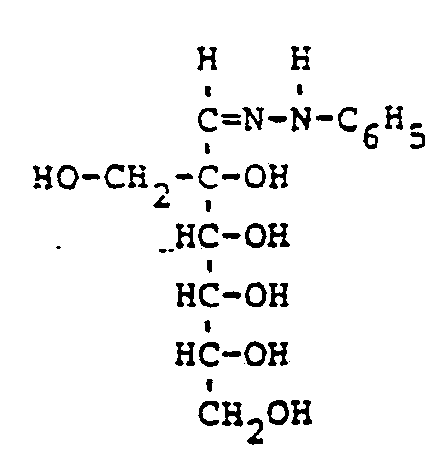
- Die Tatsache, daß die erfindungsgemäßen C7-Zucker mit Phenylhydrazin keine Osazone bilden, ist ein eindeutiger Konstitutionsbeweis für die a-Addition des Formaldehyds am C-Atom 2 der Glucose.
- Man verfährt wie in Beispiel 1, Variante B, beschrieben, verwendet aber als Katalysatoren

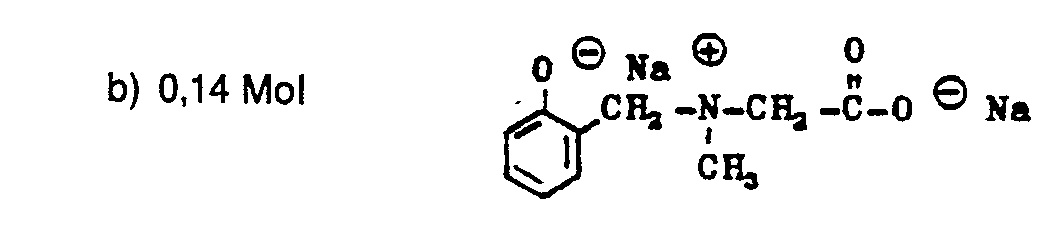


- Bei den Versuchen a) bis d) werden folgende Carbonyläquivalente, bezogen auf 100 g wasserfreies Verfahrensprodukt, gefunden :
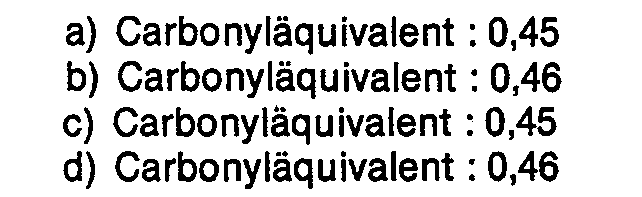
- Man verfährt nach Beispiel 1, Variante B, führt aber die α-Additionsreaktion des Formaldehyds an D-Glucose mit 30 %iger Natronlauge als Katalysator und statt bei pH = 8,4-8,5 etwa bei pH = 7,5 aus. Reaktionstemperatur : 82 °C.
- Die Reaktionsdauer der a-Addition beträgt bei pH = 7,5 bis zu einem Restgehalt von 0,8 % Formaldehyd 11 Stunden und 40 Minuten.
- Die Aufarbeitung erfolgt wie in Beispiel 1 beschrieben. Carbonyläquivalent, bezogen auf 100 g wasserfreies Verfahrensprodukt : 0,46.
- Durch den um ca. 1 Einheit verminderten pH-Wert wird also die Reaktionszeit gegenüber der bevorzugten pH-Führung bei 8,4-8,5 größenordnungsmäßig um den Faktor 8 verlangsamt.
- Man verfährt wie in Beispiel 1, Variante C, beschrieben, verkleinert jedoch den Ansatz und setzt lediglich 2 Mol D-Glucose, 120 Teile einer 70 °C heißen, 60 %igen wäßrigen Formaldehydlösung (2,4 Mol Formaldehyd) ein und verwendet 12 Teile Dimethylcyclohexylamin als Katalysator.
- Man erhält auf diese Weise ein Verfahrensprodukt mit extrem hoher Konzentration des C7-Zuckers. Bei einem Wassergehalt von etwa 16,5 % besitzt das noch Dimethylcyclohexylammoniumformiat enthaltende Rohprodukt bei 25 °C lediglich eine Viskosität von 28 300 m.Pa.s.
- Man verfährt nach Beispiel 1, Variante B, jedoch mit dem Unterschied, daß man die dort genannte Menge von Glucose in wäßriger Lösung zunächst nicht mit Formaldehyd versetzt, sondern 1 Stunde bei 85 °C mit 0,2 Mol Pyridin bei pH = 7,8 oder 0,2 Mol Chinolin bei pH = 8,3 verrührt, d. h. die Lobry de Bruyn und van Eckenstein-Umlagerung gemäß nachstehendem Formelschema ausführt (vgl. P. Karrer, Lehrbuch der Organischen Chemie, 13. Auflage, 1959, S. 368):

- Hierbei stellen sich Gleichgewichte zwischen den Monosacchariden I, II und III ein. Anschließend führt man gemäß Beispiel 1, Variante B, die a-Addition des Formaldehyds an den bei I, II und III durch Pfeilen gekennzeichneten Stellen bei pH = 8,3 mit Dimethylcyclohexylamin als Katalysator durch. Carbonyläquivalent des Verfahrensproduktes, bezogen auf wasserfreies C7-Zuckergemisch : 0,45.
- In gleicher Weise kann man auch an Fehling'sche Lösung reduzierenden Mono- und Disacchariden mit Aminosäuren bzw. mit primären Aminen in erster Stufe die Amadori-Umlagerung, die Heyns-Umlagerung oder Maillard-Reaktion und anschließend in zweiter Stufe die erfindungsgemäße C-Methylolierung mit Formaldehyd durchführen. Dabei werden ebenfalls verzweigte neue Zucker erhalten, die mit Phenylhydrazin lediglich zur Phenylhydrazonbildung befähigt sind.
- Das folgende Beispiel zeigt die Durchführbarkeit des erfindungsgemäßen Verfahrens an natürlichen und künstlichen Invertzuckern und technisch infolge ihrer Preiswürdigkeit besonders interessanten Isosirupen aus Maisstärke- bzw. Kartoffelstärke-Hydrolysaten, die im wesentlichen aus 1 Mol Glucose und 1 Mol Fructose bestehen. Man verfährt genau wie in Beispiel 1, Variante B, und verwendet :
- a) 6 Mol eines natürlichen Invertzuckers (Bienenhonig), der im wesentlichen aus D-Glucose und D-Fructose besteht, mit einem Wassergehalt von 19,1 %, einer Viskosität von 11 848 m.Pa.s. bei 20 °C und einem Carbonyläquivalent von 0,55, berechnet auf 100 wasserfreies Produkt.
- b) 6 Mol eines aus Maisstärke bzw. Kartoffelstärke durch enzymatische Hydrolyse hergestellten « Isosirups mit einem Wassergehalt von 15,2 % und einer Viskosität bei 25 °C von 26 169 m.Pa.s mit einem Carbonyläquivalent von 0,53, berechnet auf 100 g wasserfreies Produkt.
- c) 6 Mol eines künstlichen Invertzuckers, mit einem Wassergehalt von 20 %, der aus 3 Mol Saccharose ( = Rohrzucker) durch 7 stündige Hydrolyse mit einem stark sauren Ionenaustauscher bei 70 °C hergestellt wurde.
- Carbonyläquivalent : 0,5, berechnet auf 100 g wasserfreies Produkt.
- Die Reaktionsführung und Aufarbeitung erfolgt genau wie in Beispiel 1 beschrieben, d. h. es werden nur 7,1 Mol Formaldehyd verwendet, so daß auch an der Fructose lediglich C-Monomethylolierung eintritt.
- Gefundene Carbonyläquivalente pro 100 g wasserfreies Verfahrensprodukt :

- Man verfährt wie in Beispiel 11, Variante b) und verwendet für 6 Mol des im wesentlichen aus D-Glucose und D-Fructose bestehenden Gemisches 13 Mol Formaldehyd, so daß der D-Fructose-Anteil dreimal α,α'-C-methyloliert werden kann. In der Katalyse, Reaktionstemperatur, pH-Führung und Aufarbeitung verfährt man wie in Beispiel 1, Variante B).
- Eine 20 %ige wäßrige Lösung der a-aldolisierten Glucose und im wesentlichen dreimal C-methylolierten Fructose besitzt bei 25 °C eine Viskosität von 24 800 m.Pa.s. Das gefundene Carbonyläquivalent beträgt 0,34, berechnet auf 100 g wasserfreie Mischung.
- Berechnetes Carbonyläquivalent von 100 g einer Mischung aus 1 Mol methylolierter D-Glucose und 1 Mol trimethylolierter D-Fructose : 0,37.
- Im Mittel wird also tatsächlich die D-Glucose einmal C-methyloliert, während der D-Fructose-Anteil im Isosirup etwa dreimal a,a'-methyloliert wird.
- Die Acetylierung dieser C,-C9-Zuckergemische führt nach der im Beispiel 1 angeführten Methode zu kristallisierten, chloroformlöslichen Acetylderivaten.
- Das folgende Beispiel zeigt die Durchführung des erfindungsgemäßen Verfahrens an Disacchariden, die Fehling'sche Lösung reduzieren und zwar an
-

- Man verfährt genau wie in Beispiel 1, Variante B, beschrieben, verwendet aber lediglich jeweils 17,1 Teile der Disaccharide (0,05 Mol) und jeweils 3 Teile Formaldehyd (0,1 Mol) und 0,3 Teile Dimethylcyclohexylamin als Katalysator. Reaktionstemperatur : 82 °C, pH-Führung : 8,3 bis 8,5.
- Die gefundenen Carbonyläquivalente der a-C-methylolierten Disaccharide betragen :

- Die berechneten Carbonyläquivalente für a-C-methylolierte Maltose, Lactose und Cellobiose betragen 0,27.
- Die Verfahrensprodukte a), b) und c) geben mit Phenylhydrazin praktisch in quantitativer Ausbeute Hydrazone und keine Osazone, da, wie gefunden wurde, die tert. Hydroxylgruppe am C-Atom 2 die Osazon-Bildung verhindert.
- Die Trisaccharide (C18H32O16) Raffinose, die in der Melasse angereichert ist, Gentianose und Melecitose, das Tetrasaccharid Stachyose, die sich im Samen vieler Leguminosen findet und das Pentasaccharid Verbascose reduzieren Fehling'sche Lösung nicht und sind der erfindungsgemäßen α-C-Methylolierung erst dann zugänglich, wenn sie z. B. in Form eines Eintopfverfahrens, zunächst der totalen oder partiellen Hydrolyse z. B. gemäß Beispiel 11, Variante c, in Galactose, Glucose und Fructose bzw. Fructose und Gentiobiose bzw. Glucose und Fructose bzw. Galactose, Glucose und Fructose unterworfen werden.
- Dieses Beispiel zeigt die erfindungsgemäße a-bzw. α,α'-C-Methylolierung von pflanzlichen Hydrolysaten bzw. von Hydrolysaten von Biomassen wie z. B. von Bäckereihefen, Nährhefen oder Bierhefen, d. h. von Hefearten, die die alkoholische Gärung von D-Glucose, D-Fructose etc. bewirken.
- a) 165 Teile feuchtes, frisch geschnittenes Gras (Trockengewicht : 32 Teile) werden unter Druck bei 130 °C in 300 Teilen Wasser unter Zusatz von 0,4 Teilen Schwefelsäure im Verlaufe von 6 Stunden im Autoklaven hydrolysiert. Dabei werden die verschiedensten Polysaccharid-Reservestoffe, zuckerartigen Zellinhaltsstoffe, Cellulosen und Hemicellulosen, Proteine sowie Ribose und Desoxyribose enthaltenden Nucleinsäuren partiell hydrolysiert und in wasserlösliche Mono- und Oligosaccharide überführt. Nach Filtration, Entfernung der Schwefelsäure und aus dem Pflanzenmaterial stammender Säuren wie Phosphorsäuren etc. durch einen handelsüblichen basischen Ionenaustauscher und Einengen im Vakuum erhält man eine sirupöse Flüssigkeit. Die in ihr enthaltenen Anteile an hydrolysierten Aminosäuren bewirken im Verlaufe des Eindunstungsprozesses durch ihre Reaktion mit Keto- und Aldehydfunktionen der hydrolysierten Polysaccharide die Bildung gelbbrauner Produkte über ablaufende Maillard-Reaktionen. Ausbeute : 17 Teile ; Carbonyläquivalent : 0,38
- b) Man verfährt genau wie unter a) beschrieben, verwendet aber eine feuchte, ungetrocknete Bäckereihefe (150 Teile). Ausbeute : 19 Teile eines braunen Sirups. Carbonyläquivalent : 0,41
- Die gemäß a) und b) erhaltenen sirupösen Gemische enthalten ein breites Spektrum der verschiedensten Mono- und Oligosaccharide.
- Man methyloliert die Zuckergemische a) und b) nach den Angaben des Beispiels 1, Variante B, und zwar mit 20 Teilen einer 30%igen Formalinlösung (0,2 Mo) Formaldehyd), verwendet 1,06 Teile Dimethylcyclohexylamin als Katalysator und führt die C-Methylolierung bei 85°C im Verlaufe von 80 Minuten durch.
- Gefundenes Carbonyläquivalent bei a), bezogen auf 100 g wassertreies Produkt: 0,33
- Gefundenes Carbonyläquivalent bei b), bezogen auf 100 g wasserfreies Produkt: 0,35
- Dieses Beispiel zeigt, daß durch einfaches Abmischen der neuen C7-Zucker mit Aminoplastbildnern wie N-Methylolcaprolactam, s-Caprolactam, Harnstoff, Thioharnstoff, Dicyandiamid, etc., Phenoplastbildnern wie Phenol oder Dimethylphosphit und Diäthylphosphit extrem starke Viskositätsverminderungen erzielt werden können. Die Gemische können deshalb bereits bei Raumtemperatur mit den verschiedensten Reaktionspartnern, z. B. auch mit Polyisocyanaten vermischt und zur Reaktion gebracht werden.
- a) Eine Mischung aus 1 Mol a-C-methylolierter D-Glucose aus Beispiel 1, Variante B, und 2 Mol N-Methylolcaprolactam besitzt bei 35 °C lediglich eine Viskosität von 4 800 m Pa.s.
- b) Eine Mischung des besonders preiswerten a-C-methylolierten Isosirups aus Beispiel 12 und 2 Mol e-Caprolactam besitzt bei 35 °C eine Viskosität von lediglich 17 800 m Pa.s.
- c) Eine Mischung aus 1 Mol α-C-methyloliertem künstlichem Invertzucker (hergestellt gemäß Beispiel 11 c aus Saccharose) mit 1,5 Mol Harnstoff besitzt bei 35 °C eine Viskosität von 14 500 m Pa.s.
- d) α-C-methylolierte Glucose, z. B. aus Beispiel 1, und der technisch besonders interessante α,α'- polymethylolierte Isosirup der Beispiele 11 und 12 lassen sich in beliebigen Verhältnissen mit Dimethylphosphit, Diäthylphosphit und Triäthylphosphit zu extrem niedrigviskosen Lösungen vermischen und sind über Umesterungsreaktionen unter Abspaltung der Alkoholkomponente der Phosphite bereits bei 40-50 °C durch einfaches Anlegen eines Vakuums in vielfältiger Weise zu verestern. So besitzt eine Mischung aus 1 Mol der obigen methylolierten Zuckergemische
- a) mit 2 Mol Dimethylphosphit bei 25 °C lediglich eine Viskosität von 320 m Pa.s. und
- b) mit 2 Mol Diäthylphosphit bei 25 °C eine Viskosität von lediglich 450 m Pa.s.
- Verwendung erfindungsgemäß hergestellter a-methylolierter Isosirupe und ihrer Modifizierungsprodukte zur Herstellung von Hartschaumstoffen :
- Eine Mischung aus
- 100 Teilen des mit Raney-Nickel hydrierten Verfahrensproduktes des Beispiels 12b, das anschließend mit Natriumhydroxid und Propylenoxid zu einem Polyäther der OH-Zahl 480 umgesetzt wurde,
- 1,5 Teilen eines handelsüblichen Siliconstabilisators (Stabilisator OS 610 der Fa. Bayer AG),
- 0,5 Teilen Endoäthylenpiperazin,
- 4,5 Teilen einer flüssigen Assoziat-Mischung aus 2,5 Teilen e-Caprolactam und 2 Gew.-Teilen Wasser und
- 40 Teilen Monofluortrichlormethan
wird mit 152 Teilen eines technischen Phosgenierungsprodukts von Anilin-Formaldehyd-Kondensat (NCO-Gehalt: 29 %) intensiv vermischt. Es erfolgt eine zügige, gleichmäßige Schaumbildung. Der erhaltene geschlossenzellige Schaumstoff besitzt ein Raumgewicht von 38 kg/m3. - Sofern die Herstellung weitgehend offenzelliger, sehr flammwidriger Hartschaumstoffe erwünscht ist, kann man in analoger Weise die verzweigten Zucker der Beispiele 1 bis 15 direkt verschäumen, wobei Hartschaumstoffe mit Raumgewichten von 30-24 kg/m3 erhalten werden.
- Die hohe Flammwidrigkeit dieser Hartschaumstoffe, insbesondere aus Aminoplastmonomeren enthaltenden Mischungen, ist vermutlich auf Dehydratisierungswasser aus den Zuckern sowie auf Wasser, das durch Kondensation von Carbonylgruppen der a-methylolierten Zucker mit den Aminoplastmonomeren beim Brandvorgang entsteht, zurückzuführen.
- a) 212 Gew:-Teile einer wäßrigen, 50 %igen Lösung der in Beispiel 1, Variante A hergestellten, an lonenaustauschern entsalzten am a-C-Atom methylolierten Glucose werden zusammen mit 80 g Raney-Nickel in einem 0,7 Liter-Autoklaven bei 150 bar Wasserstoffdruck 4 Stunden bei 30 °C, dann 1 Stunde bei 60 °C und schließlich 1 Stunde bei 100 °C hydriert.
- Man erhält eine leicht gelbliche Lösung eines neuen, 7 Hydroxylgruppen enthaltenden Polyalkohols der Konstitution

- Der neue verzweigte Polyalkohol besitzt 3 primäre reaktive Hydroxylgruppen und ist beispielsweise bei Isocyanat-Reaktionen ein wesentlich reaktiverer Vernetzer als Sorbit. Der neue Zucker neigt nicht zur Durchkristallisation. Während Sorbit mit einem Mol Kristallwasser bei ca. 100 °C schmilzt, ist der erfindungsgemäße neue Polyalkohol mit einem Mol Kristallwasser (= ca. 5,6 Gew.-% H20) bei 50°C honigartig viskos und läßt sich bei 50 °C bereits mit anderen Polyalkoholen mischen und als Vernetzer für Isocyanatreaktionen oder Feuchthaltemittel verwenden, während dies bei Sorbit nicht möglich ist. Restcarbonylgruppengehalt : 0,016 %.
- b) Eine völlige Beseitigung des Restcarbonylgruppengehaltes ist auf folgende Weise möglich : In einem 3 Liter-Edelstahlautoklaven werden 100 g Katalysator (Raney-Ni/Fe im Verhältnis 85 : 15), suspendiert in 1 Liter Wasser, vorgelegt und auf Hydriertemperatur (150 °C) aufgeheizt. Dann wird das überstehende Volumen mit Wasserstoffgas bis zum Betriebsdruck von 150 bar gefüllt. 500 ml einer gemäß Beispiel 1, Variante A hergestellten, 50 %igen wäßrigen Lösung der α-C-methylolierten Glucose werden im Verlaufe von 7 Minuten in den Autoklaven eingepumpt.
- Dann läßt man 500 ml der hydrierten Lösung über ein Steigrohr mit Fritte, welche den Katalysator zurückhält, ab, pumpt die nächste Charge zu und hydriert sie wie die erste. Mit 5 weiteren Chargen von je 500 ml wird in gleicher Weise verfahren. Ein Katalysatorverlust ist nach dieser Zyklenzahl nicht festzustellen. Die hydrierten C7-Polyalkohol-Lösungen werden gesammelt, über Ionenaustauscher entsalzt und im Dünnschichtverdampfer von der Hauptmenge an Wasser befreit. Man erhält einen lediglich leicht gelbstichig gefärbten C7-Polyalkohol mit folgenden Eigenschaften :

- Das Verfahrensprodukt ist ein hochviskoser, nicht kristallisierender verzweigter C7-Polyalkohol guter Mischbarkeit mit Äthylenglykol und durch Zusatz von Äthylenglykol auf OH-Funktionalitäten von 6-2,5 einstellbar.
- c) Man verfährt wie unter b) beschrieben und führt eine diskontinuierliche Hydrierung mit Ruthenium als Katalysator durch.
- In einem 3 Liter Rührautoklaven werden 45 g Katalysator (5 % Ruthenium auf Kohle), suspendiert in 500 Wasser, bei 125 °C und 200 bar H2 innerhalb von 60 Minuten durch Hydrieren aktiviert. Nach Abkühlen der Suspension werden 1 500 g einer 30 %igen wäßrigen Lösung eines vollentsalzten verzweigten C7-Zuckers des Beispiel 1, Variante A, (pH = 6) zugegeben. Bei einem Anfangsdruck von 150 bar H2 wird das Gemisch über 30 Minuten auf die gewünschte Temperatur von 125 °C erwärmt. Bei 125 °C und 200 bar H2 wird noch 90 bis 120 Minuten weiterhydriert. Als Hydrierprodukt erhält man eine farblose Lösung von C7-Polyalkoholen, welche nach Abfiltrieren vom Katalysator zu einer sirupartigen Masse im Vakuum eingeengt wird.
- Ausbeute : 500 Gew.-Teile, enthaltend 5,5 Gew.-% Wasser.
- 212 Gew.-Teile des bei 60 °C gut rührbaren, verzweigten C7-Polyalkohols nach Beispiel 17 können mit 3 Mol Essigsäureanhydrid unter Zusatz von 0,4 Gew.-Teilen Natriumacetat partiell an den primären Hydroxylgruppen acetyliert werden. Man erhält ein mit Polyestern und Polyäthern gut mischbaren, partiell acetylierten, verzweigten Polyalkohol der idealisierten Konstitution

- a) 224,6 Gew.-Teile des in Beispiel 1, Variante A, hergestellten verzweigten C,-Zuckers mit einem Wassergehalt von 6,5 Gew.-% werden unter Stickstoffatmosphäre mit je 1,5 g eines Komplexes aus 1 Mol Bortrifluorid und 1 Mol Essigsäure bei Raumtemperatur unter Rühren vermischt. Der Ansatz wird unter Stickstoffatmosphäre gut gerührt und 406 Gew.-Teile ( = 7 Mol) Propylenoxid bei 49 °C im Verlauf von 2 Stunden gleichmäßig und langsam zugetropft. Nachdem mit Natronlauge oder wäßriger 25 %iger Ammoniaklösung ein pH-Wert von 7,2 eingestellt wurde, wird der Ansatz bei 50 °C im Vakuum von Spuren an Propylenoxid und kleinen Mengen an Wasser befreit. Man erhält verzweigte Polyäther mit überraschend niedriger Viskosität und geringem Anteil an reduzierend wirkenden Gruppen.
- Ausbeute : 612 g ; OH-Zahl : 635 ; Säurezahl 0,7 ; Viskosität 16000 mPas/35 °C.
- Der geringe Gehalt an reduzierend wirkenden Zuckeranteilen von lediglich 3,1 % zeigt, daß bei der Propoxylierung überrasenderweise die Carbonylgruppen in den Verfahrensprodukten in erheblichem Umfang acetalisiert wurden. Es werden daher über 90 % der im verzweigten C7-Zucker vorliegenden Aldehydgruppen acetalisiert.
- Die neuen, verzweigten Polyäther sind mit hoch- und niedermolekularen Polyhydroxylverbindungen, aber auch mit Isocyanaten besser verträglich als entwässerte Ausgangspolyalkohole. Von besonderer Bedeutung ist ferner, daß die erhaltenen verzweigten Polyäther bei ihrer Reaktion mit Polyisocyanaten wesentlich aktiver sind als üblicherweise durch OHs-Katalyse in Gegenwart von Natronlauge oder Kalilauge hergestellte Formose-Polyäther.
- c) Setzt man 224,6 Gew.-Teile des in Beispiel 17, Variante b, hydrierten Polyalkohols ein und verfährt genau wie bei a), erhält man einen nahezu farblosen Polyäther in einer Ausbeute von 616 g, der völlig frei von Dioxolaneinheiten und reduzierend wirkenden Anteilen ist.
- OH-Zahl 650.
- 2 240 g der in Beispiel 17, Variante b) beschriebenen mehrwertigen verzweigten Polyalkohols und 600 g Toluol werden bei Raumtemperatur vorgelegt. Durch zweimaliges Evakuieren und Wiederauffüllen des Reaktionsgefäßes mit Stickstoff wird der Luftsauerstoff entfernt. Nach Erwärmen auf 80 °C werden 80 g 50 %ige wäßrige Kalilauge zugegeben. Anschließend wird weiter erwärmt. Zwischen 100-115 °C werden 52,8 g Wasser (Lösungswasser und Reaktionswasser aus der Kalilauge) azeotrop abdestilliert. Nach beendeter Destillation werden zu dem sehr gut rührbaren Gemisch bei 100-105 °C und bei einem Druck von 0,4 bis 0,6 bar 6112 g Propylenoxid allmählich zudosiert (500 g/Stunde). Je nach Erfordernis wird durch Kühlen oder Heizen des Reaktionsgemisches die Reaktionstemperatur in diesem Bereich gehalten. Nach beendeter Propylenoxidzugabe wird noch weitere 3 Stunden bei 100-105 °C gerührt.
- Das alkalische Polymerisat wird nach Zugabe von 800 g Wasser mit 284 g 12,5 %iger wäßriger Schwefelsäure neutralisiert (pH-Wert der Emulsion 6,8). Anschließend wird bei 70 bis 90 °C nach Zugabe von Filtrierhilfsmitteln (Zellstoffpulver und synthetisches Magnesiumsilikat) und einem Antioxidans (2,6-Di-tert.-butyl-p-kresol) das Wasser im Vakuum abdestilliert. Bei einem Wassergehalt von 0,9 % werden die abgeschiedenen Salze und die Filtrierhilfsmittel abfiltriert.
- Zur vollständigen Entfernung des Wassers wird das Filtrat anschließend bei 100-105 °C im Vakuum ausdestilliert.
- Das erhaltene nahezu farblose Produkt hat die folgenden physikalischen Daten :

- Das auf diese Weise erhaltene Polyätherpolyol kann zu einem harten Polyurethanschaumstoff verarbeitet werden. Bedingt durch die geringe Viskosität des erhaltenen Polyäthers ergibt sich ein verbessertes Fließvermögen des Reaktionsgemisches gegenüber handelsüblichen Saccharose-Polyäthern.
- 424 Gew.-Teile des in Beispiel 6, Variante e), durch NaCN-Katalyse erhaltenen fast farblosen verzweigten CrZuckers werden mit 1 Mol Oxalsäure bereits bei 60 °C in rascher Veresterungsreaktion und ohne nennenswerte Dehydratisierung bevorzugt an ihren primären Hydroxylgruppen unter Abspaltung von 36 Gew.-Teilen Kondensationswasser verestert. Man erhält einen Polyester der idealisierten Konstitution

- a) 200 g des in Beispiel 17, Variante b) beschriebenen, verzweigten mehrwertigen Polyalkohols werden im Dünnschichtenverdampfer bei 100 °C und 0,06 Torr entwässert und mit 0,5 g Triäthylendiamin versetzt.
- Die Mischung wird auf 100 °C erwärmt. Bei dieser Temperatur werden innerhalb von 40 Minuten 281 g Stearylisocyanat zugetropft und die Mischung so lange nachgerührt, bis mit Hilfe der IR-Spektroskopie kein Isocyanat mehr nachzuweisen ist. Nach dem Abkühlen erhält man ein wachsartiges Produkt mit guten oberflächenaktiven Eigenschaften, das einen vorzüglichen Emulgator zur Emulgierung von Wasser in Polyisocyanaten darstellt.
- b) 424 g des verzweigten, mehrwertigen Polyalkohols (wie bei a) werden bei 100 °C bei 0,06 Torr entwässert. Das wasserfreie Gemisch wird mit 1 600 g Dimethylformamid und 562 g Stearinsäuremethylester versetzt. Zu der Mischung werden bei Raumtemperatur 70 g einer 30 %igen Natriummethylatlösung zugetropft und die Mischung anschließend bei 95-100 °C und 180 Torr solange gerührt, bis kein Methanol mehr abdestilliert.
- Nach Abdestillieren des Dimethylformamids erhält man eine wachsartige Masse, die durch Behandeln mit heißem Wasser von überschüssigem Polyalkoholgemisch befreit wird. Die wäßrige Aufschlämmung wird vom überschüssigen Wasser abgepreßt und im Vakuum getrocknet. Man erhält eine wachsartige Masse mit guten oberflächenaktiven Eigenschaften, die einen guten Emulgator zur Emulgierung von Wasser und wasserlöslichen Polyalkoholen in hydrophobe Polyäther darstellt.
-
- a) Gemäß der Verfahrensweise der DE-OS 2 031 160 und DE-OS 1 953347 (Imprägnierungsreaktionen) imprägniert man einen hydrophilen Polyurethan-Weichschaumstoff-Quader der Dimensionen 20 cm x 10 cm x5 cm = 1 000 cm3 Volumen, der in seinem Polyäther-Segmentanteil ca. 40 Gew.-% Polyäthylenoxid-Segmente enthält, mit einer 50 %igen wäßrigen Lösung eines Crverzweigten Alkohols, der gemäß Beispiel 1, Variante A und nachfolgender Hydrierung hergestellt wurde, wobei der Schaumstoff spontan gleichmäßig in den Dimensionen des Raumes stark quillt. Die erreichte Volumvergrößerung des Quaders beträgt nach dem Ausquetschen des Imprägnierungsmittels und Trocknen bei 30 °C im Vakuum 2 000 cm3, d. h. durch Imprägnierung und Quellung ist ein ΔV von etwa 1 000 cm3 erzeugt worden. Der so beladene Schaumstoff enthält ca. 30 Gew.-Teile an verzweigten hydrierten C7-Zuckern und es werden ca. 12 Gew.-Teiie Wasser durch das verwendete Feuchthaltemittel fixiert. Die starke Quellung des Schaumstoffs wird durch Solvation der Weichsegmente des Schaumstoffes bedingt. Bei langen Lagerzeiten von 2 Monaten wird das Wasser nicht abgegeben. Der Schaumstoff behält seinen wesentlich weicheren Griff gegenüber dem eingesetzten, nichtimprägnierten Schaumstoff. Folien aus derartigen, durch Quellvorgänge mit den erfindungsgemäßen Feuchthaltemitteln in ihrem Volumen vergrößerte Schaumstoffe besitzen einen sehr weichen, klebfreien Griff und eignen sich insbesondere als Wischtücher zur Verhinderung der Vereisung von Autofensterscheiben bei Minustemperaturen von ca. - 10 °C.
- b) Man verfährt wie bei a) und dispergiert vor der Imprägnierung
- 1) 20 Gew.-Teile an handelsüblicher Nivea-Creme in der erfindungsgemäßen Zuckerlösung
- 2) 20 Gew.-Teile einer handelsüblichen Schuhcreme in der erfindungsgemäßen Zuckerlösung.
- Die unter 1) und 2) genannten Zusatzmittel trocknen selbst nach 3 Monaten bei Lagerung an der Luft (22-25 °C) nicht ein.
- 100 Gew.-Teile eines 6 Gew.-% Wasser enthaltenden Zuckers der Konstitution

- Nach 4,5 Stunden ist die CO2-Entwicklung praktisch beendet und es sind 18,5 g CO2 entbunden und 20,6 g Äthanol entstanden.
- Die rechnerische Auswertung führt zu dem Ergebnis, daß die neuen verzweigten C7-Zucker ( = α-C-methylolierte Glucose) zur Hälfte im unteren Molekülteil enzymatisch gespalten wird


Claims (8)
dadurch gekennzeichnet, daß als Komponente B Umsetzungsprodukte von C6-Zuckern bzw. Ihrer Oligomeren mit einem Molekulargewicht bis zu 2000 gemäß Anspruch 1 eingesetzt werden, wobei gegebenenfalls ein Teil oder die Gesamtmenge dieser Umsetzungsprodukte von C6-Zuckern bzw. ihrer Oligomeren zunächst hydriert und/oder oxalkyliert werden und dann als Komponente B eingesetzt werden.
Applications Claiming Priority (2)
| Application Number | Priority Date | Filing Date | Title |
|---|---|---|---|
| DE2833138 | 1978-07-28 | ||
| DE19782833138 DE2833138A1 (de) | 1978-07-28 | 1978-07-28 | Methylolierte mono- und oligosaccharide |
Publications (3)
| Publication Number | Publication Date |
|---|---|
| EP0009552A2 EP0009552A2 (de) | 1980-04-16 |
| EP0009552A3 EP0009552A3 (en) | 1981-06-03 |
| EP0009552B1 true EP0009552B1 (de) | 1983-10-05 |
Family
ID=6045611
Family Applications (1)
| Application Number | Title | Priority Date | Filing Date |
|---|---|---|---|
| EP79102470A Expired EP0009552B1 (de) | 1978-07-28 | 1979-07-16 | In alpha-Stellung methylolierte Mono- und Oligosaccharide, Verfahren zu ihrer Herstellung und ihre Verwendung |
Country Status (5)
| Country | Link |
|---|---|
| US (1) | US4322523A (de) |
| EP (1) | EP0009552B1 (de) |
| JP (1) | JPS5520766A (de) |
| CA (1) | CA1121346A (de) |
| DE (2) | DE2833138A1 (de) |
Families Citing this family (39)
| Publication number | Priority date | Publication date | Assignee | Title |
|---|---|---|---|---|
| US4820520A (en) * | 1981-03-31 | 1989-04-11 | Asama Chemical Co., Ltd. | Antiseptic agent for food and drink and method of antiseptic treatment thereof |
| JPS5857393A (ja) * | 1981-10-02 | 1983-04-05 | Nippon Kasei Kk | Gp−11の合成方法 |
| DE3248404A1 (de) * | 1982-12-28 | 1984-06-28 | Süddeutsche Zucker AG, 6800 Mannheim | Derivate und reduktionsprodukte der d-glucopyranosyl-(alpha)(1->5)-d-arabonsaeure, deren herstellung und verwendung |
| US4801475A (en) * | 1984-08-23 | 1989-01-31 | Gregory Halpern | Method of hydrophilic coating of plastics |
| US4663233A (en) * | 1985-10-24 | 1987-05-05 | Universal High Technologies | Lens with hydrophilic coating |
| IT1198449B (it) * | 1986-10-13 | 1988-12-21 | F I D I Farmaceutici Italiani | Esteri di alcoli polivalenti di acido ialuronico |
| JPS63179884A (ja) * | 1987-01-17 | 1988-07-23 | Mitsubishi Kasei Corp | シヨ糖脂肪酸エステルの製造方法 |
| KR940000166B1 (ko) * | 1989-11-09 | 1994-01-08 | 니혼다바고 상교오 가부시기가이샤 | 신규 글루코사민 유도체 및 이것을 막 구성성분으로서 함유한 리포솜 |
| CA2059272A1 (en) * | 1990-04-12 | 1991-10-13 | Akira Hasegawa | 4,6-0-hydroxyphosphoryl-glucosamine derivatives |
| US8158778B2 (en) * | 2001-04-12 | 2012-04-17 | Mitsubishi Shoji Foodtech Co., Ltd. | Method for the desalting of saccharide solution and an anion exchanger |
| US7842382B2 (en) * | 2004-03-11 | 2010-11-30 | Knauf Insulation Gmbh | Binder compositions and associated methods |
| FR2883865B1 (fr) * | 2005-04-01 | 2007-05-18 | Saint Gobain Isover Sa | Laine minerale, produit isolant et procede de fabrication |
| FR2883866B1 (fr) * | 2005-04-01 | 2007-05-18 | Saint Gobain Isover Sa | Laine minerale, produit isolant et procede de fabrication |
| EP2433983A1 (de) * | 2005-07-26 | 2012-03-28 | Knauf Insulation GmbH | Bindemittel und damit hergestellte Materialien |
| EP2108026A1 (de) | 2007-01-25 | 2009-10-14 | Knauf Insulation Limited | Verundholzplatte |
| US20100086726A1 (en) | 2007-01-25 | 2010-04-08 | Roger Jackson | Mineral fibre board |
| SI2126179T1 (sl) * | 2007-01-25 | 2014-12-31 | Knauf Insulation | Izolacijski proizvod na osnovi mineralnih vlaken brez formaldehida |
| US9828287B2 (en) | 2007-01-25 | 2017-11-28 | Knauf Insulation, Inc. | Binders and materials made therewith |
| CA2683706A1 (en) * | 2007-04-13 | 2008-10-23 | Knauf Insulation Gmbh | Composite maillard-resole binders |
| EP2164883B1 (de) * | 2007-07-05 | 2013-09-25 | Knauf Insulation | Auf hydroxymonocarbonsäure basierendes maillard-bindemittel |
| GB0715100D0 (en) | 2007-08-03 | 2007-09-12 | Knauf Insulation Ltd | Binders |
| WO2011053341A2 (en) * | 2009-02-17 | 2011-05-05 | Mcalister Roy E | Electrolytic cell and method of use thereof |
| EP2462169B1 (de) | 2009-08-07 | 2019-02-27 | Knauf Insulation | Molassebindemittel |
| EP2566904B1 (de) | 2010-05-07 | 2021-07-14 | Knauf Insulation | Kohlenhydratpolyaminbinder und damit hergestellte materialien |
| KR101835899B1 (ko) | 2010-05-07 | 2018-03-07 | 크나우프 인설레이션, 인크. | 탄수화물 결합제 및 이를 이용하여 제조된 물질 |
| US20130082205A1 (en) | 2010-06-07 | 2013-04-04 | Knauf Insulation Sprl | Fiber products having temperature control additives |
| CA2834816C (en) | 2011-05-07 | 2020-05-12 | Knauf Insulation | Liquid high solids binder composition |
| GB201206193D0 (en) | 2012-04-05 | 2012-05-23 | Knauf Insulation Ltd | Binders and associated products |
| GB201214734D0 (en) | 2012-08-17 | 2012-10-03 | Knauf Insulation Ltd | Wood board and process for its production |
| EP2928936B1 (de) | 2012-12-05 | 2022-04-13 | Knauf Insulation SPRL | Bindemittel |
| CA2938154C (en) | 2014-02-07 | 2022-11-01 | Knauf Insulation, Inc. | Uncured articles with improved shelf-life |
| GB201408909D0 (en) | 2014-05-20 | 2014-07-02 | Knauf Insulation Ltd | Binders |
| GB201412709D0 (en) | 2014-07-17 | 2014-09-03 | Knauf Insulation And Knauf Insulation Ltd | Improved binder compositions and uses thereof |
| GB201517867D0 (en) | 2015-10-09 | 2015-11-25 | Knauf Insulation Ltd | Wood particle boards |
| GB201610063D0 (en) | 2016-06-09 | 2016-07-27 | Knauf Insulation Ltd | Binders |
| GB201701569D0 (en) | 2017-01-31 | 2017-03-15 | Knauf Insulation Ltd | Improved binder compositions and uses thereof |
| GB201804908D0 (en) | 2018-03-27 | 2018-05-09 | Knauf Insulation Ltd | Binder compositions and uses thereof |
| GB201804907D0 (en) | 2018-03-27 | 2018-05-09 | Knauf Insulation Ltd | Composite products |
| CN114276214B (zh) * | 2021-12-10 | 2024-06-25 | 湖北宜化化工科技研发有限公司 | 一种回收利用电石渣生产季戊四醇的生产方法 |
Citations (1)
| Publication number | Priority date | Publication date | Assignee | Title |
|---|---|---|---|---|
| EP0004543A2 (de) * | 1978-02-25 | 1979-10-17 | Bayer Ag | Verfahren zur Herstellung von niedermolekularen Polyhydroxylverbindungen und ihre Verwendung zur Herstellung von Polyurethankunststoffen |
Family Cites Families (22)
| Publication number | Priority date | Publication date | Assignee | Title |
|---|---|---|---|---|
| US1018736A (en) * | 1911-01-27 | 1912-02-27 | Johann Abraham Von Wueffing | Manufacture of formaldehyde compounds and products. |
| US2730505A (en) * | 1954-05-28 | 1956-01-10 | Gen Mills Inc | Increasing the viscosity of guar sols by reaction with formaldehyde |
| DE1196870B (de) * | 1959-10-02 | 1965-07-15 | Ici Ltd | Verfahren zur Herstellung von Polyaethern |
| NL258434A (de) * | 1959-11-27 | |||
| NL6413172A (de) * | 1963-11-14 | 1965-05-17 | ||
| US3419532A (en) * | 1964-01-02 | 1968-12-31 | Wyandotte Chemicals Corp | Polyhalogenous polyurethane products |
| US3455895A (en) * | 1966-10-10 | 1969-07-15 | Cons Paper Inc | Triazine derivatives of spent sulfite liquor |
| US3839173A (en) * | 1969-11-17 | 1974-10-01 | J Blaszczak | Polymerization product of formaldehyde and carbohydrates |
| US4056672A (en) * | 1973-03-22 | 1977-11-01 | Astra Lakemedel Aktiebolag | Polymer prepared by cyanhydrin method |
| DE2639083C2 (de) * | 1976-08-31 | 1983-02-10 | Bayer Ag, 5090 Leverkusen | Verfahren zur Herstellung von Polyätherpolyolen und ihre Verwendung als Ausgangsmaterialien für Polyurethankunststoffe |
| DE2639084C2 (de) * | 1976-08-31 | 1984-08-23 | Bayer Ag, 5090 Leverkusen | Verfahren zur Herstellung von Gemischen aus niedermolekularen Polyhydroxylverbindungen und ihre Verwendung zur Herstellung von Polyurethankunststoffen |
| DE2714084A1 (de) * | 1977-03-30 | 1978-10-12 | Bayer Ag | Verfahren zur herstellung von niedermolekularen polyhydroxylverbindungen |
| DE2738533A1 (de) * | 1977-08-26 | 1979-03-01 | Bayer Ag | Gegenueber isocyanaten reaktive gemische |
| DE2721186C2 (de) * | 1977-05-11 | 1986-04-24 | Bayer Ag, 5090 Leverkusen | Verfahren zur Herstellung eines Gemisches von niedermolekularen Polyhydroxylverbindungen |
| DE2737951A1 (de) * | 1977-08-23 | 1979-03-08 | Bayer Ag | Verfahren zur herstellung von polyaetherpolyolen |
| DE2738274A1 (de) * | 1977-08-25 | 1979-03-01 | Bayer Ag | Verfahren zur entfernung von bleiionen aus formose |
| DE2738512A1 (de) * | 1977-08-26 | 1979-03-08 | Bayer Ag | Verfahren zur herstellung von niedermolekularen polyhydroxylverbindungen |
| DE2756270A1 (de) * | 1977-12-16 | 1979-06-21 | Bayer Ag | Verfahren zur herstellung von niedermolekularen polyhydroxylverbindungen |
| DE2831659A1 (de) * | 1978-07-19 | 1980-02-07 | Bayer Ag | Verfahren zur herstellung von polyalkoholen |
| DE2831719A1 (de) * | 1978-07-19 | 1980-01-31 | Bayer Ag | Verfahren zur herstellung von niedermolekularen polyhydroxylverbindungen |
| DE2831656A1 (de) * | 1978-07-19 | 1980-02-07 | Bayer Ag | Verfahren zur herstellung von niedermolekularen polyhydroxylverbindungen |
| US4218583A (en) * | 1978-07-28 | 1980-08-19 | Bose Corporation | Varying loudspeaker spatial characteristics |
-
1978
- 1978-07-28 DE DE19782833138 patent/DE2833138A1/de not_active Withdrawn
-
1979
- 1979-07-16 EP EP79102470A patent/EP0009552B1/de not_active Expired
- 1979-07-16 DE DE7979102470T patent/DE2966257D1/de not_active Expired
- 1979-07-17 CA CA000332014A patent/CA1121346A/en not_active Expired
- 1979-07-25 US US06/060,241 patent/US4322523A/en not_active Expired - Lifetime
- 1979-07-26 JP JP9432379A patent/JPS5520766A/ja active Granted
Patent Citations (1)
| Publication number | Priority date | Publication date | Assignee | Title |
|---|---|---|---|---|
| EP0004543A2 (de) * | 1978-02-25 | 1979-10-17 | Bayer Ag | Verfahren zur Herstellung von niedermolekularen Polyhydroxylverbindungen und ihre Verwendung zur Herstellung von Polyurethankunststoffen |
Non-Patent Citations (1)
| Title |
|---|
| TETRAHEDRON LETTERS, Nr. 32, 1978, Pergamon Press Ltd, Oxford, GB, J.C. DEPEZAY et al.: "Sucres branchés: Epoxydation stéréospécifique de désoxy-2 méthylène-2C D-pentoses. Synthèse de méthyl glycosides de L'épihamamélose et de l'hamamélose", Seiten 2869-2872 * |
Also Published As
| Publication number | Publication date |
|---|---|
| JPH0134997B2 (de) | 1989-07-21 |
| EP0009552A2 (de) | 1980-04-16 |
| JPS5520766A (en) | 1980-02-14 |
| DE2966257D1 (en) | 1983-11-10 |
| EP0009552A3 (en) | 1981-06-03 |
| CA1121346A (en) | 1982-04-06 |
| DE2833138A1 (de) | 1980-02-07 |
| US4322523A (en) | 1982-03-30 |
Similar Documents
| Publication | Publication Date | Title |
|---|---|---|
| EP0009552A2 (de) | In alpha-Stellung methylolierte Mono- und Oligosaccharide, Verfahren zu ihrer Herstellung und ihre Verwendung | |
| DE2721186C2 (de) | Verfahren zur Herstellung eines Gemisches von niedermolekularen Polyhydroxylverbindungen | |
| DE2639084A1 (de) | Verfahren zur herstellung von niedermolekularen polyhydroxylverbindungen | |
| DE2639083C2 (de) | Verfahren zur Herstellung von Polyätherpolyolen und ihre Verwendung als Ausgangsmaterialien für Polyurethankunststoffe | |
| EP0002473B1 (de) | Verfahren zur Herstellung von niedermolekularen Polyhydroxylverbindungen und deren Verwendung zur Herstellung von Polyurethankunststoffen | |
| EP0010687A1 (de) | Verfahren zur Herstellung von Polyurethankunststoffen aus Toluylendiisocyanat-Rückständen und deren Verwendung zur Herstellung von Platten und Formteilen | |
| EP0121850A2 (de) | Verfahren zur Herstellung eines zelligen Polyurethans | |
| EP0000912B1 (de) | Verfahren zur Herstellung von niedermolekularen Polyhydroxylverbindungen | |
| EP0007102A2 (de) | Verfahren zur Herstellung von niedermolekularen Polyhydroxylverbindungen und ihre Verwendung | |
| DE2738154A1 (de) | Verfahren zur herstellung von niedermolekularen polyhydroxylverbindungen | |
| EP0001389B1 (de) | Verfahren zur Herstellung von Polyätherpolyolen und ihre Verwendung zur Herstellung von Polyurethanen | |
| EP0007100A2 (de) | Verfahren zur Herstellung von niedermolekularen Polyhydroxylverbindungen und ihre Verwendung | |
| EP0007101B1 (de) | Verfahren zur Herstellung von Polyalkoholen sowie Verfahren zur Herstellung von Polyurethan-Kunststoffen unter Verwendung dieser Polyalkohole | |
| US4187356A (en) | Condensation of formaldehyde hydrate to form mixtures which, together with monomers capable of aminoplast formation are useful in the preparation of polyurethane foams | |
| US4187354A (en) | Process for lowering the viscosity of formose or mixtures of formose in mono- and/or di-saccharides, products produced thereby, and the use thereof in producing polyurethane resins | |
| EP0001739A1 (de) | Gegenüber Isocyanaten reaktive Gemische, Verfahren zu deren Herstellung und deren Verwendung zur Herstellung von Aminoplastkunststoffen oder von Polyurethankunststoffen | |
| EP0036511A1 (de) | Verfahren zur Herstellung von Gemischen von niedermolekularen mehrwertigen Alkoholen | |
| EP0000911A1 (de) | Verfahren zur Erniedrigung der Viskosität von Formose, die dabei erhaltenen Gemische sowie deren Verwendung zur Herstellung von gegebenenfalls zellförmigen Polyurethankunststoffen sowie zur Herstellung von Phosphorigsäureestern von Formose | |
| EP0001210A1 (de) | Gegenüber Isocyanaten reaktive Gemische, Verfahren zu deren Herstellung un deren Verwendung in einem Verfahren zur Herstellung von Polyurethankunststoffen |
Legal Events
| Date | Code | Title | Description |
|---|---|---|---|
| PUAI | Public reference made under article 153(3) epc to a published international application that has entered the european phase |
Free format text: ORIGINAL CODE: 0009012 |
|
| 17P | Request for examination filed | ||
| AK | Designated contracting states |
Designated state(s): BE DE FR GB |
|
| PUAL | Search report despatched |
Free format text: ORIGINAL CODE: 0009013 |
|
| AK | Designated contracting states |
Designated state(s): BE DE FR GB |
|
| RBV | Designated contracting states (corrected) |
Designated state(s): BE DE FR GB |
|
| GRAA | (expected) grant |
Free format text: ORIGINAL CODE: 0009210 |
|
| AK | Designated contracting states |
Designated state(s): BE DE FR GB |
|
| ET | Fr: translation filed | ||
| REF | Corresponds to: |
Ref document number: 2966257 Country of ref document: DE Date of ref document: 19831110 |
|
| PLBE | No opposition filed within time limit |
Free format text: ORIGINAL CODE: 0009261 |
|
| STAA | Information on the status of an ep patent application or granted ep patent |
Free format text: STATUS: NO OPPOSITION FILED WITHIN TIME LIMIT |
|
| 26N | No opposition filed | ||
| PGFP | Annual fee paid to national office [announced via postgrant information from national office to epo] |
Ref country code: DE Payment date: 19900621 Year of fee payment: 12 |
|
| PGFP | Annual fee paid to national office [announced via postgrant information from national office to epo] |
Ref country code: FR Payment date: 19900628 Year of fee payment: 12 |
|
| PGFP | Annual fee paid to national office [announced via postgrant information from national office to epo] |
Ref country code: GB Payment date: 19900709 Year of fee payment: 12 |
|
| PGFP | Annual fee paid to national office [announced via postgrant information from national office to epo] |
Ref country code: BE Payment date: 19900718 Year of fee payment: 12 |
|
| PG25 | Lapsed in a contracting state [announced via postgrant information from national office to epo] |
Ref country code: GB Effective date: 19910716 |
|
| PG25 | Lapsed in a contracting state [announced via postgrant information from national office to epo] |
Ref country code: BE Effective date: 19910731 |
|
| BERE | Be: lapsed |
Owner name: BAYER A.G. Effective date: 19910731 |
|
| GBPC | Gb: european patent ceased through non-payment of renewal fee | ||
| PG25 | Lapsed in a contracting state [announced via postgrant information from national office to epo] |
Ref country code: FR Effective date: 19920331 |
|
| PG25 | Lapsed in a contracting state [announced via postgrant information from national office to epo] |
Ref country code: DE Effective date: 19920401 |
|
| REG | Reference to a national code |
Ref country code: FR Ref legal event code: ST |