EP0005259A1 - Système de climatisation d'un local fermé - Google Patents
Système de climatisation d'un local fermé Download PDFInfo
- Publication number
- EP0005259A1 EP0005259A1 EP79101318A EP79101318A EP0005259A1 EP 0005259 A1 EP0005259 A1 EP 0005259A1 EP 79101318 A EP79101318 A EP 79101318A EP 79101318 A EP79101318 A EP 79101318A EP 0005259 A1 EP0005259 A1 EP 0005259A1
- Authority
- EP
- European Patent Office
- Prior art keywords
- inner glazing
- sun
- glazing
- air
- distance
- Prior art date
- Legal status (The legal status is an assumption and is not a legal conclusion. Google has not performed a legal analysis and makes no representation as to the accuracy of the status listed.)
- Granted
Links
- 238000004378 air conditioning Methods 0.000 title claims description 5
- 230000005855 radiation Effects 0.000 claims abstract description 9
- 238000000605 extraction Methods 0.000 claims description 12
- 239000011248 coating agent Substances 0.000 claims description 4
- 238000000576 coating method Methods 0.000 claims description 4
- 230000000475 sunscreen effect Effects 0.000 abstract 5
- 239000000516 sunscreening agent Substances 0.000 abstract 5
- 238000009833 condensation Methods 0.000 description 3
- 230000005494 condensation Effects 0.000 description 3
- 238000010521 absorption reaction Methods 0.000 description 2
- 230000000694 effects Effects 0.000 description 2
- 238000010438 heat treatment Methods 0.000 description 2
- 241001295925 Gegenes Species 0.000 description 1
- 239000010408 film Substances 0.000 description 1
- 230000004313 glare Effects 0.000 description 1
- 239000011521 glass Substances 0.000 description 1
- 238000007789 sealing Methods 0.000 description 1
- 210000002023 somite Anatomy 0.000 description 1
- 239000010409 thin film Substances 0.000 description 1
- 238000009423 ventilation Methods 0.000 description 1
Images
Classifications
-
- E—FIXED CONSTRUCTIONS
- E06—DOORS, WINDOWS, SHUTTERS, OR ROLLER BLINDS IN GENERAL; LADDERS
- E06B—FIXED OR MOVABLE CLOSURES FOR OPENINGS IN BUILDINGS, VEHICLES, FENCES OR LIKE ENCLOSURES IN GENERAL, e.g. DOORS, WINDOWS, BLINDS, GATES
- E06B7/00—Special arrangements or measures in connection with doors or windows
- E06B7/02—Special arrangements or measures in connection with doors or windows for providing ventilation, e.g. through double windows; Arrangement of ventilation roses
- E06B7/10—Special arrangements or measures in connection with doors or windows for providing ventilation, e.g. through double windows; Arrangement of ventilation roses by special construction of the frame members
-
- E—FIXED CONSTRUCTIONS
- E06—DOORS, WINDOWS, SHUTTERS, OR ROLLER BLINDS IN GENERAL; LADDERS
- E06B—FIXED OR MOVABLE CLOSURES FOR OPENINGS IN BUILDINGS, VEHICLES, FENCES OR LIKE ENCLOSURES IN GENERAL, e.g. DOORS, WINDOWS, BLINDS, GATES
- E06B7/00—Special arrangements or measures in connection with doors or windows
- E06B7/02—Special arrangements or measures in connection with doors or windows for providing ventilation, e.g. through double windows; Arrangement of ventilation roses
-
- F—MECHANICAL ENGINEERING; LIGHTING; HEATING; WEAPONS; BLASTING
- F24—HEATING; RANGES; VENTILATING
- F24F—AIR-CONDITIONING; AIR-HUMIDIFICATION; VENTILATION; USE OF AIR CURRENTS FOR SCREENING
- F24F5/00—Air-conditioning systems or apparatus not covered by F24F1/00 or F24F3/00, e.g. using solar heat or combined with household units such as an oven or water heater
- F24F5/0075—Systems using thermal walls, e.g. double window
-
- F—MECHANICAL ENGINEERING; LIGHTING; HEATING; WEAPONS; BLASTING
- F24—HEATING; RANGES; VENTILATING
- F24F—AIR-CONDITIONING; AIR-HUMIDIFICATION; VENTILATION; USE OF AIR CURRENTS FOR SCREENING
- F24F7/00—Ventilation
- F24F7/04—Ventilation with ducting systems, e.g. by double walls; with natural circulation
-
- F—MECHANICAL ENGINEERING; LIGHTING; HEATING; WEAPONS; BLASTING
- F24—HEATING; RANGES; VENTILATING
- F24S—SOLAR HEAT COLLECTORS; SOLAR HEAT SYSTEMS
- F24S20/00—Solar heat collectors specially adapted for particular uses or environments
- F24S20/60—Solar heat collectors integrated in fixed constructions, e.g. in buildings
- F24S20/63—Solar heat collectors integrated in fixed constructions, e.g. in buildings in the form of windows
-
- E—FIXED CONSTRUCTIONS
- E06—DOORS, WINDOWS, SHUTTERS, OR ROLLER BLINDS IN GENERAL; LADDERS
- E06B—FIXED OR MOVABLE CLOSURES FOR OPENINGS IN BUILDINGS, VEHICLES, FENCES OR LIKE ENCLOSURES IN GENERAL, e.g. DOORS, WINDOWS, BLINDS, GATES
- E06B7/00—Special arrangements or measures in connection with doors or windows
- E06B7/02—Special arrangements or measures in connection with doors or windows for providing ventilation, e.g. through double windows; Arrangement of ventilation roses
- E06B2007/026—Special arrangements or measures in connection with doors or windows for providing ventilation, e.g. through double windows; Arrangement of ventilation roses with air flow between panes
-
- Y—GENERAL TAGGING OF NEW TECHNOLOGICAL DEVELOPMENTS; GENERAL TAGGING OF CROSS-SECTIONAL TECHNOLOGIES SPANNING OVER SEVERAL SECTIONS OF THE IPC; TECHNICAL SUBJECTS COVERED BY FORMER USPC CROSS-REFERENCE ART COLLECTIONS [XRACs] AND DIGESTS
- Y02—TECHNOLOGIES OR APPLICATIONS FOR MITIGATION OR ADAPTATION AGAINST CLIMATE CHANGE
- Y02A—TECHNOLOGIES FOR ADAPTATION TO CLIMATE CHANGE
- Y02A30/00—Adapting or protecting infrastructure or their operation
-
- Y—GENERAL TAGGING OF NEW TECHNOLOGICAL DEVELOPMENTS; GENERAL TAGGING OF CROSS-SECTIONAL TECHNOLOGIES SPANNING OVER SEVERAL SECTIONS OF THE IPC; TECHNICAL SUBJECTS COVERED BY FORMER USPC CROSS-REFERENCE ART COLLECTIONS [XRACs] AND DIGESTS
- Y02—TECHNOLOGIES OR APPLICATIONS FOR MITIGATION OR ADAPTATION AGAINST CLIMATE CHANGE
- Y02B—CLIMATE CHANGE MITIGATION TECHNOLOGIES RELATED TO BUILDINGS, e.g. HOUSING, HOUSE APPLIANCES OR RELATED END-USER APPLICATIONS
- Y02B10/00—Integration of renewable energy sources in buildings
- Y02B10/20—Solar thermal
-
- Y—GENERAL TAGGING OF NEW TECHNOLOGICAL DEVELOPMENTS; GENERAL TAGGING OF CROSS-SECTIONAL TECHNOLOGIES SPANNING OVER SEVERAL SECTIONS OF THE IPC; TECHNICAL SUBJECTS COVERED BY FORMER USPC CROSS-REFERENCE ART COLLECTIONS [XRACs] AND DIGESTS
- Y02—TECHNOLOGIES OR APPLICATIONS FOR MITIGATION OR ADAPTATION AGAINST CLIMATE CHANGE
- Y02B—CLIMATE CHANGE MITIGATION TECHNOLOGIES RELATED TO BUILDINGS, e.g. HOUSING, HOUSE APPLIANCES OR RELATED END-USER APPLICATIONS
- Y02B30/00—Energy efficient heating, ventilation or air conditioning [HVAC]
- Y02B30/90—Passive houses; Double facade technology
-
- Y—GENERAL TAGGING OF NEW TECHNOLOGICAL DEVELOPMENTS; GENERAL TAGGING OF CROSS-SECTIONAL TECHNOLOGIES SPANNING OVER SEVERAL SECTIONS OF THE IPC; TECHNICAL SUBJECTS COVERED BY FORMER USPC CROSS-REFERENCE ART COLLECTIONS [XRACs] AND DIGESTS
- Y02—TECHNOLOGIES OR APPLICATIONS FOR MITIGATION OR ADAPTATION AGAINST CLIMATE CHANGE
- Y02E—REDUCTION OF GREENHOUSE GAS [GHG] EMISSIONS, RELATED TO ENERGY GENERATION, TRANSMISSION OR DISTRIBUTION
- Y02E10/00—Energy generation through renewable energy sources
- Y02E10/40—Solar thermal energy, e.g. solar towers
Definitions
- the invention relates to a device for the air conditioning of a closed room, which has on its outside the outside glazing, which forms an exhaust air duct with a spacing from the inside of the inside of the room, with a sun blind being provided on the inside of the inside glazing.
- Such a device has become known from DE-OS 23 31 332.
- warm air from the room to be air-conditioned or air from an independent ventilation system should be introduced into the exhaust air duct via slot openings in such a way that a relatively thin film of air flows from the bottom to the top over the inner surface of the outer glazing, while the remaining air in the exhaust air duct the air film is to be set in motion in order to flow past the outside of the inner glazing in a slightly turbulent flow.
- Glare protection is to be achieved by using reflection glasses for the outer and inner glazing or through the sun blinds.
- the distance between the outer and inner glazing - as in the other known devices - is approximately 200 mm.
- the amount of fresh air required for the windows generally results in approximately 50 to 100 m 3 of air per hour and meter of window width. With these specified air volumes, no defined air flows are obtained in the relatively wide exhaust air duct. Rather, the air introduced into the exhaust air duct swirls in an uncontrolled manner. This is disadvantageous with regard to the condensation to be prevented under all circumstances on the inside of the outer glazing and with regard to the heat energy to be removed from the exhaust air duct in summer.
- the invention is therefore based on the object of improving the device described above in such a way that condensation on the inside of the outer glazing is reliably prevented and the air conditioning of the room is improved.
- the optimal distance between the exterior and interior glazing is calculated taking into account the lowest exterior temperature to be expected in winter, the desired relative humidity in the interior, the desired interior temperature, the air volume provided, the heat emission from the interior to the exterior, the desired surface temperature Sun blinds in winter, the desired or required air volumes in the interior and taking into account the location and the orientation of the room to be air-conditioned (climate of the country, orientation of the building facade, e.g. to the south or north, etc.).
- the surface temperature of the sun blind on the inside of the room should be as close as possible to the room temperature.
- the defined air flow through the exhaust air duct is sufficient to maintain a temperature of 19 ° C on the inner glazing at a room temperature of 22 ° C and an outside temperature of -15 ° C.
- the inner glazing heats up to e.g. through the solar radiation reflected by the sun blind or absorbed by the inner glazing 48 ° C. This leads to a temperature of about 32 ° C. on the surface of the sun blind. According to the invention, this temperature can now be reduced to approximately room temperature by suction of the air located between the inner glazing and the sun blind.
- the control of the suction cross-sections of the air suction openings for the space between the inner glazing and sun blinds can be done in different ways. So when lowering the sun blind, its weight in the end position of the Press sun blinds on a button or the like, which opens the air extraction openings via a linkage. The weight of the sun blind can also operate a switch that causes the air extraction openings to be opened electrically. When actuating the motor to lower the sun blind, electromagnets can be applied, which or the like via a linkage. open the air extraction openings. In the space between the inner glazing and sun blinds, an expansion rod, for example made of plastic, with a high expansion coefficient can be provided, which controls the suction cross section of the air suction openings via the space temperature. It is also possible to apply a servomotor to adjust the air extraction openings via a temperature sensor.
- the air extraction openings can be designed as slots and are preferably always installed where the air is most energetic.
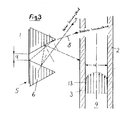
- the surface of the sun blind facing the inner glazing can have locally optimized sections which absorb solar radiation impinging in winter. This can e.g. can be achieved by means of profiles arranged on the surface of the sun blind facing the inner glazing, which reflect the incident sun rays directly or indirectly via adjacent profiles against the inner glazing, a selective coating being arranged between the profiles so that it is only exposed to sun rays when the sun is low.
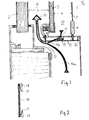
- a room 1 to be ventilated or air-conditioned has outer glazing 2 on its outside, which forms an exhaust air duct 4 with an inner glazing 3 arranged at a distance a from the inside of the room.
- a sun blind 5 is arranged at a distance b on the inside of the inner glazing 3.
- the sun rays 8 which fall in a correspondingly flat manner at a low position of the sun can impinge directly on the strip-shaped region 9, or else are reflected by the profiles 6 on this strip-shaped region 9. Because of the selective coating provided here, the strip-shaped regions 9 thus have a correspondingly increased absorption and thus a heating of the blinds, which can be used to heat the room 1.
- the distance a between outer glazing 2 and inner glazing 3 is dimensioned such that a defined, largely laminar air flow is established in the exhaust air duct 4.
- FIG. 1 shows that closable air suction openings 11 are provided in the space 10 formed between the inner glazing 3 and sun blinds 5, the opening of which is controlled as a function of the position of the sun blinds and / or the temperature in this space 10.
- the air suction openings 11 open into the intake duct 12 of the exhaust duct 4.
- the through the The exhaust air duct 4 flowing total air flow 13 is thus composed of a portion 13a that comes from the room 1 or a separate air conditioning system and a portion 13b extracted from the space 10.
- the energy between inner glazing 3 and sun blinds 5 is dissipated with the partial air flow 13b.
- FIG. 1 shows an example for controlling the air extraction openings 11.
- a weight 14 attached to its lower edge presses on a lever 15 which is pulled in the closed position by a spring 16 with a sealing strip 17 against the air extraction openings 11.
- the lever 15 is pressed down and thereby releases the air suction openings 11.
- FIG. 2 shows schematically a modified embodiment for a control of the air suction openings 11.
- the control consists of an expansion rod 18, which is arranged in the space 10 between the inner glazing 3 and sun blinds 5 and carries slide 19 which, depending on the expansion of the expansion rod 18, continuously the cross section of the Increase or decrease air extraction openings 11.
Landscapes
- Engineering & Computer Science (AREA)
- General Engineering & Computer Science (AREA)
- Chemical & Material Sciences (AREA)
- Combustion & Propulsion (AREA)
- Mechanical Engineering (AREA)
- Sustainable Development (AREA)
- Life Sciences & Earth Sciences (AREA)
- Civil Engineering (AREA)
- Structural Engineering (AREA)
- Physics & Mathematics (AREA)
- Sustainable Energy (AREA)
- Thermal Sciences (AREA)
- Blinds (AREA)
- Specific Sealing Or Ventilating Devices For Doors And Windows (AREA)
Priority Applications (1)
| Application Number | Priority Date | Filing Date | Title |
|---|---|---|---|
| AT79101318T ATE335T1 (de) | 1978-05-08 | 1979-05-02 | Einrichtung zur klimatisierung eines geschlossenen raumes. |
Applications Claiming Priority (2)
| Application Number | Priority Date | Filing Date | Title |
|---|---|---|---|
| DE19782819997 DE2819997A1 (de) | 1978-05-08 | 1978-05-08 | Einrichtung zur klimatisierung eines geschlossenen raumes |
| DE2819997 | 1978-05-08 |
Publications (2)
| Publication Number | Publication Date |
|---|---|
| EP0005259A1 true EP0005259A1 (fr) | 1979-11-14 |
| EP0005259B1 EP0005259B1 (fr) | 1981-10-21 |
Family
ID=6038847
Family Applications (1)
| Application Number | Title | Priority Date | Filing Date |
|---|---|---|---|
| EP79101318A Expired EP0005259B1 (fr) | 1978-05-08 | 1979-05-02 | Système de climatisation d'un local fermé |
Country Status (3)
| Country | Link |
|---|---|
| EP (1) | EP0005259B1 (fr) |
| AT (1) | ATE335T1 (fr) |
| DE (1) | DE2819997A1 (fr) |
Cited By (1)
| Publication number | Priority date | Publication date | Assignee | Title |
|---|---|---|---|---|
| FR2514814A1 (fr) * | 1981-10-21 | 1983-04-22 | Ing Coordination Const | Dispositif pour l'obturation de baies, a isolation amelioree |
Citations (5)
| Publication number | Priority date | Publication date | Assignee | Title |
|---|---|---|---|---|
| CH378496A (de) * | 1959-12-16 | 1964-06-15 | Holger Dr Lueder | Verfahren und Anordnung zur Klimatisierung eines Raumes durch Zuführung oder Entzug von Wärme grösstenteils im Strahlungsaustausch |
| DE1266472B (de) * | 1962-03-26 | 1968-04-18 | Otto Heinz Brandi Dipl Ing | Vorrichtung zur Klimatisierung von Innenraeumen mittels Zuluft |
| DE2518252A1 (de) * | 1975-04-24 | 1976-11-04 | Kalinna Erwin Fa | Fassade fuer gebaeude |
| DE2529932A1 (de) * | 1975-07-04 | 1977-01-27 | Rieth & Sohn | Luftfuehrendes fenster |
| DE2632669A1 (de) * | 1976-07-16 | 1978-01-19 | Rieth & Sohn | Lueftungsfenster |
-
1978
- 1978-05-08 DE DE19782819997 patent/DE2819997A1/de not_active Withdrawn
-
1979
- 1979-05-02 EP EP79101318A patent/EP0005259B1/fr not_active Expired
- 1979-05-02 AT AT79101318T patent/ATE335T1/de not_active IP Right Cessation
Patent Citations (5)
| Publication number | Priority date | Publication date | Assignee | Title |
|---|---|---|---|---|
| CH378496A (de) * | 1959-12-16 | 1964-06-15 | Holger Dr Lueder | Verfahren und Anordnung zur Klimatisierung eines Raumes durch Zuführung oder Entzug von Wärme grösstenteils im Strahlungsaustausch |
| DE1266472B (de) * | 1962-03-26 | 1968-04-18 | Otto Heinz Brandi Dipl Ing | Vorrichtung zur Klimatisierung von Innenraeumen mittels Zuluft |
| DE2518252A1 (de) * | 1975-04-24 | 1976-11-04 | Kalinna Erwin Fa | Fassade fuer gebaeude |
| DE2529932A1 (de) * | 1975-07-04 | 1977-01-27 | Rieth & Sohn | Luftfuehrendes fenster |
| DE2632669A1 (de) * | 1976-07-16 | 1978-01-19 | Rieth & Sohn | Lueftungsfenster |
Cited By (1)
| Publication number | Priority date | Publication date | Assignee | Title |
|---|---|---|---|---|
| FR2514814A1 (fr) * | 1981-10-21 | 1983-04-22 | Ing Coordination Const | Dispositif pour l'obturation de baies, a isolation amelioree |
Also Published As
| Publication number | Publication date |
|---|---|
| DE2819997A1 (de) | 1979-11-15 |
| EP0005259B1 (fr) | 1981-10-21 |
| ATE335T1 (de) | 1981-11-15 |
Similar Documents
| Publication | Publication Date | Title |
|---|---|---|
| DE3043783C2 (de) | Schall- und wärmeisolierendes Fenster mit Schalldämmlüftung | |
| DE2702214A1 (de) | Verbundfenster | |
| EP0093364B1 (fr) | Fenêtre composée insonorisante et calorifuge avec un dispositif d'aération | |
| EP0256441B1 (fr) | Elément de construction vitré | |
| DE2706968A1 (de) | Luftfuehrende fassade | |
| EP0692686A2 (fr) | Façade à double paroi | |
| DE3928259A1 (de) | Luftfuehrendes fensterelement | |
| DE3026635A1 (de) | Luftfuehrende fassade | |
| DE4431928A1 (de) | Wärmedämmendes Fenster | |
| DE10033535A1 (de) | Doppelfassade | |
| DE19963919B4 (de) | Verfahren und Einrichtung zum wärmeverlustarmen Belüften von Räumen über eine oder mehrere Fenster/Tür-Rollladenanordnungen | |
| EP0003725A1 (fr) | Fenêtre à double vitrage, aérée dans le sens de la longueur et avec un store à l'intérieur | |
| EP0005259B1 (fr) | Système de climatisation d'un local fermé | |
| DE4344750C2 (de) | Zweischalige Fassade | |
| DE2529932A1 (de) | Luftfuehrendes fenster | |
| DE202007011819U1 (de) | Lüftung an Doppelfassade | |
| DE9320324U1 (de) | Bedachung | |
| DE20301691U1 (de) | Einrichtung zum wärmeverlustarmen Belüften von Räumen über eine oder mehrere Fenster/Tür-Rolladen-Anordnung | |
| DE29615791U1 (de) | Zweischalige Gebäudefassade | |
| DE2808432A1 (de) | Luftfuehrende fassade | |
| DE2842476C2 (de) | Innenschattierung für Gewächshäuser | |
| CH655355A5 (en) | Facade element | |
| DE3938906A1 (de) | Vorrichtung zum abschirmen zwangsbeluefteter raeume | |
| DE3026845A1 (de) | System zur konditionierung der luft in gewaechshaeusern | |
| DE2517551A1 (de) | Einrichtung zum wahlweisen belueften und/oder beheizen von raeumen mit verminderten transmissionswaermeverlusten |
Legal Events
| Date | Code | Title | Description |
|---|---|---|---|
| PUAI | Public reference made under article 153(3) epc to a published international application that has entered the european phase |
Free format text: ORIGINAL CODE: 0009012 |
|
| AK | Designated contracting states |
Designated state(s): AT CH FR GB NL |
|
| 17P | Request for examination filed | ||
| GRAA | (expected) grant |
Free format text: ORIGINAL CODE: 0009210 |
|
| AK | Designated contracting states |
Designated state(s): AT CH FR GB NL |
|
| REF | Corresponds to: |
Ref document number: 335 Country of ref document: AT Date of ref document: 19811115 Kind code of ref document: T |
|
| PGFP | Annual fee paid to national office [announced via postgrant information from national office to epo] |
Ref country code: AT Payment date: 19840427 Year of fee payment: 6 |
|
| PGFP | Annual fee paid to national office [announced via postgrant information from national office to epo] |
Ref country code: FR Payment date: 19840511 Year of fee payment: 6 |
|
| PGFP | Annual fee paid to national office [announced via postgrant information from national office to epo] |
Ref country code: CH Payment date: 19840528 Year of fee payment: 6 |
|
| PGFP | Annual fee paid to national office [announced via postgrant information from national office to epo] |
Ref country code: NL Payment date: 19840531 Year of fee payment: 6 |
|
| PG25 | Lapsed in a contracting state [announced via postgrant information from national office to epo] |
Ref country code: AT Effective date: 19850502 |
|
| PG25 | Lapsed in a contracting state [announced via postgrant information from national office to epo] |
Ref country code: CH Effective date: 19850531 |
|
| PG25 | Lapsed in a contracting state [announced via postgrant information from national office to epo] |
Ref country code: NL Effective date: 19851201 |
|
| GBPC | Gb: european patent ceased through non-payment of renewal fee | ||
| NLV4 | Nl: lapsed or anulled due to non-payment of the annual fee | ||
| PG25 | Lapsed in a contracting state [announced via postgrant information from national office to epo] |
Ref country code: FR Free format text: LAPSE BECAUSE OF NON-PAYMENT OF DUE FEES Effective date: 19860131 |
|
| REG | Reference to a national code |
Ref country code: CH Ref legal event code: PL |
|
| REG | Reference to a national code |
Ref country code: FR Ref legal event code: ST |
|
| PG25 | Lapsed in a contracting state [announced via postgrant information from national office to epo] |
Ref country code: GB Effective date: 19881118 |
|
| PLBE | No opposition filed within time limit |
Free format text: ORIGINAL CODE: 0009261 |
|
| STAA | Information on the status of an ep patent application or granted ep patent |
Free format text: STATUS: NO OPPOSITION FILED WITHIN TIME LIMIT |