EP0005259A1 - Air conditioning system for a closed space - Google Patents
Air conditioning system for a closed space Download PDFInfo
- Publication number
- EP0005259A1 EP0005259A1 EP79101318A EP79101318A EP0005259A1 EP 0005259 A1 EP0005259 A1 EP 0005259A1 EP 79101318 A EP79101318 A EP 79101318A EP 79101318 A EP79101318 A EP 79101318A EP 0005259 A1 EP0005259 A1 EP 0005259A1
- Authority
- EP
- European Patent Office
- Prior art keywords
- inner glazing
- sun
- glazing
- air
- distance
- Prior art date
- Legal status (The legal status is an assumption and is not a legal conclusion. Google has not performed a legal analysis and makes no representation as to the accuracy of the status listed.)
- Granted
Links
- 238000004378 air conditioning Methods 0.000 title claims description 5
- 230000005855 radiation Effects 0.000 claims abstract description 9
- 238000000605 extraction Methods 0.000 claims description 12
- 239000011248 coating agent Substances 0.000 claims description 4
- 238000000576 coating method Methods 0.000 claims description 4
- 230000000475 sunscreen effect Effects 0.000 abstract 5
- 239000000516 sunscreening agent Substances 0.000 abstract 5
- 238000009833 condensation Methods 0.000 description 3
- 230000005494 condensation Effects 0.000 description 3
- 238000010521 absorption reaction Methods 0.000 description 2
- 230000000694 effects Effects 0.000 description 2
- 238000010438 heat treatment Methods 0.000 description 2
- 241001295925 Gegenes Species 0.000 description 1
- 239000010408 film Substances 0.000 description 1
- 230000004313 glare Effects 0.000 description 1
- 239000011521 glass Substances 0.000 description 1
- 238000007789 sealing Methods 0.000 description 1
- 210000002023 somite Anatomy 0.000 description 1
- 239000010409 thin film Substances 0.000 description 1
- 238000009423 ventilation Methods 0.000 description 1
Images
Classifications
-
- E—FIXED CONSTRUCTIONS
- E06—DOORS, WINDOWS, SHUTTERS, OR ROLLER BLINDS IN GENERAL; LADDERS
- E06B—FIXED OR MOVABLE CLOSURES FOR OPENINGS IN BUILDINGS, VEHICLES, FENCES OR LIKE ENCLOSURES IN GENERAL, e.g. DOORS, WINDOWS, BLINDS, GATES
- E06B7/00—Special arrangements or measures in connection with doors or windows
- E06B7/02—Special arrangements or measures in connection with doors or windows for providing ventilation, e.g. through double windows; Arrangement of ventilation roses
- E06B7/10—Special arrangements or measures in connection with doors or windows for providing ventilation, e.g. through double windows; Arrangement of ventilation roses by special construction of the frame members
-
- E—FIXED CONSTRUCTIONS
- E06—DOORS, WINDOWS, SHUTTERS, OR ROLLER BLINDS IN GENERAL; LADDERS
- E06B—FIXED OR MOVABLE CLOSURES FOR OPENINGS IN BUILDINGS, VEHICLES, FENCES OR LIKE ENCLOSURES IN GENERAL, e.g. DOORS, WINDOWS, BLINDS, GATES
- E06B7/00—Special arrangements or measures in connection with doors or windows
- E06B7/02—Special arrangements or measures in connection with doors or windows for providing ventilation, e.g. through double windows; Arrangement of ventilation roses
-
- F—MECHANICAL ENGINEERING; LIGHTING; HEATING; WEAPONS; BLASTING
- F24—HEATING; RANGES; VENTILATING
- F24F—AIR-CONDITIONING; AIR-HUMIDIFICATION; VENTILATION; USE OF AIR CURRENTS FOR SCREENING
- F24F5/00—Air-conditioning systems or apparatus not covered by F24F1/00 or F24F3/00, e.g. using solar heat or combined with household units such as an oven or water heater
- F24F5/0075—Systems using thermal walls, e.g. double window
-
- F—MECHANICAL ENGINEERING; LIGHTING; HEATING; WEAPONS; BLASTING
- F24—HEATING; RANGES; VENTILATING
- F24F—AIR-CONDITIONING; AIR-HUMIDIFICATION; VENTILATION; USE OF AIR CURRENTS FOR SCREENING
- F24F7/00—Ventilation
- F24F7/04—Ventilation with ducting systems, e.g. by double walls; with natural circulation
-
- F—MECHANICAL ENGINEERING; LIGHTING; HEATING; WEAPONS; BLASTING
- F24—HEATING; RANGES; VENTILATING
- F24S—SOLAR HEAT COLLECTORS; SOLAR HEAT SYSTEMS
- F24S20/00—Solar heat collectors specially adapted for particular uses or environments
- F24S20/60—Solar heat collectors integrated in fixed constructions, e.g. in buildings
- F24S20/63—Solar heat collectors integrated in fixed constructions, e.g. in buildings in the form of windows
-
- E—FIXED CONSTRUCTIONS
- E06—DOORS, WINDOWS, SHUTTERS, OR ROLLER BLINDS IN GENERAL; LADDERS
- E06B—FIXED OR MOVABLE CLOSURES FOR OPENINGS IN BUILDINGS, VEHICLES, FENCES OR LIKE ENCLOSURES IN GENERAL, e.g. DOORS, WINDOWS, BLINDS, GATES
- E06B7/00—Special arrangements or measures in connection with doors or windows
- E06B7/02—Special arrangements or measures in connection with doors or windows for providing ventilation, e.g. through double windows; Arrangement of ventilation roses
- E06B2007/026—Special arrangements or measures in connection with doors or windows for providing ventilation, e.g. through double windows; Arrangement of ventilation roses with air flow between panes
-
- Y—GENERAL TAGGING OF NEW TECHNOLOGICAL DEVELOPMENTS; GENERAL TAGGING OF CROSS-SECTIONAL TECHNOLOGIES SPANNING OVER SEVERAL SECTIONS OF THE IPC; TECHNICAL SUBJECTS COVERED BY FORMER USPC CROSS-REFERENCE ART COLLECTIONS [XRACs] AND DIGESTS
- Y02—TECHNOLOGIES OR APPLICATIONS FOR MITIGATION OR ADAPTATION AGAINST CLIMATE CHANGE
- Y02A—TECHNOLOGIES FOR ADAPTATION TO CLIMATE CHANGE
- Y02A30/00—Adapting or protecting infrastructure or their operation
-
- Y—GENERAL TAGGING OF NEW TECHNOLOGICAL DEVELOPMENTS; GENERAL TAGGING OF CROSS-SECTIONAL TECHNOLOGIES SPANNING OVER SEVERAL SECTIONS OF THE IPC; TECHNICAL SUBJECTS COVERED BY FORMER USPC CROSS-REFERENCE ART COLLECTIONS [XRACs] AND DIGESTS
- Y02—TECHNOLOGIES OR APPLICATIONS FOR MITIGATION OR ADAPTATION AGAINST CLIMATE CHANGE
- Y02B—CLIMATE CHANGE MITIGATION TECHNOLOGIES RELATED TO BUILDINGS, e.g. HOUSING, HOUSE APPLIANCES OR RELATED END-USER APPLICATIONS
- Y02B10/00—Integration of renewable energy sources in buildings
- Y02B10/20—Solar thermal
-
- Y—GENERAL TAGGING OF NEW TECHNOLOGICAL DEVELOPMENTS; GENERAL TAGGING OF CROSS-SECTIONAL TECHNOLOGIES SPANNING OVER SEVERAL SECTIONS OF THE IPC; TECHNICAL SUBJECTS COVERED BY FORMER USPC CROSS-REFERENCE ART COLLECTIONS [XRACs] AND DIGESTS
- Y02—TECHNOLOGIES OR APPLICATIONS FOR MITIGATION OR ADAPTATION AGAINST CLIMATE CHANGE
- Y02B—CLIMATE CHANGE MITIGATION TECHNOLOGIES RELATED TO BUILDINGS, e.g. HOUSING, HOUSE APPLIANCES OR RELATED END-USER APPLICATIONS
- Y02B30/00—Energy efficient heating, ventilation or air conditioning [HVAC]
- Y02B30/90—Passive houses; Double facade technology
-
- Y—GENERAL TAGGING OF NEW TECHNOLOGICAL DEVELOPMENTS; GENERAL TAGGING OF CROSS-SECTIONAL TECHNOLOGIES SPANNING OVER SEVERAL SECTIONS OF THE IPC; TECHNICAL SUBJECTS COVERED BY FORMER USPC CROSS-REFERENCE ART COLLECTIONS [XRACs] AND DIGESTS
- Y02—TECHNOLOGIES OR APPLICATIONS FOR MITIGATION OR ADAPTATION AGAINST CLIMATE CHANGE
- Y02E—REDUCTION OF GREENHOUSE GAS [GHG] EMISSIONS, RELATED TO ENERGY GENERATION, TRANSMISSION OR DISTRIBUTION
- Y02E10/00—Energy generation through renewable energy sources
- Y02E10/40—Solar thermal energy, e.g. solar towers
Definitions
- the invention relates to a device for the air conditioning of a closed room, which has on its outside the outside glazing, which forms an exhaust air duct with a spacing from the inside of the inside of the room, with a sun blind being provided on the inside of the inside glazing.
- Such a device has become known from DE-OS 23 31 332.
- warm air from the room to be air-conditioned or air from an independent ventilation system should be introduced into the exhaust air duct via slot openings in such a way that a relatively thin film of air flows from the bottom to the top over the inner surface of the outer glazing, while the remaining air in the exhaust air duct the air film is to be set in motion in order to flow past the outside of the inner glazing in a slightly turbulent flow.
- Glare protection is to be achieved by using reflection glasses for the outer and inner glazing or through the sun blinds.
- the distance between the outer and inner glazing - as in the other known devices - is approximately 200 mm.
- the amount of fresh air required for the windows generally results in approximately 50 to 100 m 3 of air per hour and meter of window width. With these specified air volumes, no defined air flows are obtained in the relatively wide exhaust air duct. Rather, the air introduced into the exhaust air duct swirls in an uncontrolled manner. This is disadvantageous with regard to the condensation to be prevented under all circumstances on the inside of the outer glazing and with regard to the heat energy to be removed from the exhaust air duct in summer.
- the invention is therefore based on the object of improving the device described above in such a way that condensation on the inside of the outer glazing is reliably prevented and the air conditioning of the room is improved.
- the optimal distance between the exterior and interior glazing is calculated taking into account the lowest exterior temperature to be expected in winter, the desired relative humidity in the interior, the desired interior temperature, the air volume provided, the heat emission from the interior to the exterior, the desired surface temperature Sun blinds in winter, the desired or required air volumes in the interior and taking into account the location and the orientation of the room to be air-conditioned (climate of the country, orientation of the building facade, e.g. to the south or north, etc.).
- the surface temperature of the sun blind on the inside of the room should be as close as possible to the room temperature.
- the defined air flow through the exhaust air duct is sufficient to maintain a temperature of 19 ° C on the inner glazing at a room temperature of 22 ° C and an outside temperature of -15 ° C.
- the inner glazing heats up to e.g. through the solar radiation reflected by the sun blind or absorbed by the inner glazing 48 ° C. This leads to a temperature of about 32 ° C. on the surface of the sun blind. According to the invention, this temperature can now be reduced to approximately room temperature by suction of the air located between the inner glazing and the sun blind.
- the control of the suction cross-sections of the air suction openings for the space between the inner glazing and sun blinds can be done in different ways. So when lowering the sun blind, its weight in the end position of the Press sun blinds on a button or the like, which opens the air extraction openings via a linkage. The weight of the sun blind can also operate a switch that causes the air extraction openings to be opened electrically. When actuating the motor to lower the sun blind, electromagnets can be applied, which or the like via a linkage. open the air extraction openings. In the space between the inner glazing and sun blinds, an expansion rod, for example made of plastic, with a high expansion coefficient can be provided, which controls the suction cross section of the air suction openings via the space temperature. It is also possible to apply a servomotor to adjust the air extraction openings via a temperature sensor.
- the air extraction openings can be designed as slots and are preferably always installed where the air is most energetic.
- the surface of the sun blind facing the inner glazing can have locally optimized sections which absorb solar radiation impinging in winter. This can e.g. can be achieved by means of profiles arranged on the surface of the sun blind facing the inner glazing, which reflect the incident sun rays directly or indirectly via adjacent profiles against the inner glazing, a selective coating being arranged between the profiles so that it is only exposed to sun rays when the sun is low.
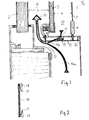
- a room 1 to be ventilated or air-conditioned has outer glazing 2 on its outside, which forms an exhaust air duct 4 with an inner glazing 3 arranged at a distance a from the inside of the room.
- a sun blind 5 is arranged at a distance b on the inside of the inner glazing 3.
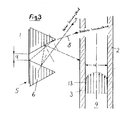
- the sun rays 8 which fall in a correspondingly flat manner at a low position of the sun can impinge directly on the strip-shaped region 9, or else are reflected by the profiles 6 on this strip-shaped region 9. Because of the selective coating provided here, the strip-shaped regions 9 thus have a correspondingly increased absorption and thus a heating of the blinds, which can be used to heat the room 1.
- the distance a between outer glazing 2 and inner glazing 3 is dimensioned such that a defined, largely laminar air flow is established in the exhaust air duct 4.
- FIG. 1 shows that closable air suction openings 11 are provided in the space 10 formed between the inner glazing 3 and sun blinds 5, the opening of which is controlled as a function of the position of the sun blinds and / or the temperature in this space 10.
- the air suction openings 11 open into the intake duct 12 of the exhaust duct 4.
- the through the The exhaust air duct 4 flowing total air flow 13 is thus composed of a portion 13a that comes from the room 1 or a separate air conditioning system and a portion 13b extracted from the space 10.
- the energy between inner glazing 3 and sun blinds 5 is dissipated with the partial air flow 13b.
- FIG. 1 shows an example for controlling the air extraction openings 11.
- a weight 14 attached to its lower edge presses on a lever 15 which is pulled in the closed position by a spring 16 with a sealing strip 17 against the air extraction openings 11.
- the lever 15 is pressed down and thereby releases the air suction openings 11.
- FIG. 2 shows schematically a modified embodiment for a control of the air suction openings 11.
- the control consists of an expansion rod 18, which is arranged in the space 10 between the inner glazing 3 and sun blinds 5 and carries slide 19 which, depending on the expansion of the expansion rod 18, continuously the cross section of the Increase or decrease air extraction openings 11.
Landscapes
- Engineering & Computer Science (AREA)
- Combustion & Propulsion (AREA)
- General Engineering & Computer Science (AREA)
- Mechanical Engineering (AREA)
- Chemical & Material Sciences (AREA)
- Civil Engineering (AREA)
- Structural Engineering (AREA)
- Life Sciences & Earth Sciences (AREA)
- Sustainable Development (AREA)
- Physics & Mathematics (AREA)
- Thermal Sciences (AREA)
- Sustainable Energy (AREA)
- Blinds (AREA)
- Specific Sealing Or Ventilating Devices For Doors And Windows (AREA)
Abstract
Description
Die Erfindung betrifft eine Einrichtung zur Klimatisierung eines geschlossenes Raumes, der auf seiner Wetteraußenseite eine Außenverglasung aufweist, die mit einer im Abstand von ihr rauminnenseitig angeordneten Innenverglasung einen Abluftkanal bildet, wobei auf der Rauminnenseite der Innenverglasung ein Sonnenstoren vorgesehen ist.The invention relates to a device for the air conditioning of a closed room, which has on its outside the outside glazing, which forms an exhaust air duct with a spacing from the inside of the inside of the room, with a sun blind being provided on the inside of the inside glazing.
Eine derartige Einrichtung ist durch die DE-OS 23 31 332 bekanntgeworden. Hier soll entweder warme Luft aus dem zu klimatisierenden Raum oder aber Luft von einer unabhängigen Lüftungsanlage- über Schlitzöffnungen so in den Abluftkanal eingeführt werden, daß ein relativ dünner Luftfilm über die Innenfläche der Außenverglasung von unten nach oben strömt, während die übrige Luft im Abluftkanal durch den Luftfilm in Bewegung gesetzt werden soll, um in einer leicht turbulenten Strömung an der Außenseite der Innenverglasung vorbeizuströmen. Hierdurch soll eine möglichst hohe wärmeisolierende Wirkung erzielt werden. Durch die Verwendung von Reflexionsgläsern für die Außen- und Innenverglasung bzw. durch den Sonnenstoren soll ein Blendschutz erzielt werden. Bei der vorstehend erläuterten Ausführungsform liegt der Abstand zwischen Außen- und Innenverglasung - ebenso wie bei den übrigen bekannten Einrichtungen - bei etwa 200 mm. Unter Berücksichtigung der üblichen Randbedingungen ergeben sich an benötigten Frischluftmengen für die Fenster in der Regel etwa 50 bis 100 m3 Luft pro Stunde und Meter Fensterbreite. Bei diesen vorgegebenen Luftmengen erhält man in dem verhältnismäßig breiten Abluftkanal keine definierten Luftströmungen. Vielmehr verwirbelt sich die in den Abluftkanal eingeführte Luft in unkontrollierter Weise. Dies ist nachteilig hinsichtlich der auf der Rauminnenseite der Außenverglasung unter allen Umständen zu verhindernden Kondensierung sowie hinsichtlich der im Sommer aus dem Abluftkanal abzutransportierenden Wärmeenergie.Such a device has become known from DE-OS 23 31 332. Here either warm air from the room to be air-conditioned or air from an independent ventilation system should be introduced into the exhaust air duct via slot openings in such a way that a relatively thin film of air flows from the bottom to the top over the inner surface of the outer glazing, while the remaining air in the exhaust air duct the air film is to be set in motion in order to flow past the outside of the inner glazing in a slightly turbulent flow. This is intended to achieve the highest possible heat-insulating effect. Glare protection is to be achieved by using reflection glasses for the outer and inner glazing or through the sun blinds. In the embodiment explained above, the distance between the outer and inner glazing - as in the other known devices - is approximately 200 mm. Taking into account the usual boundary conditions, the amount of fresh air required for the windows generally results in approximately 50 to 100 m 3 of air per hour and meter of window width. With these specified air volumes, no defined air flows are obtained in the relatively wide exhaust air duct. Rather, the air introduced into the exhaust air duct swirls in an uncontrolled manner. This is disadvantageous with regard to the condensation to be prevented under all circumstances on the inside of the outer glazing and with regard to the heat energy to be removed from the exhaust air duct in summer.
Bei hoher Sonneneinstrahlung erfolgt bei der vorstehend erläuterten bekannten Einrichtung auf der der Innenverglasung zugewandten Fläche des Sonnenstoren eine mehr oder weniger große Reflexion der Sonnenstrahlung, die wiederum zu einem mehr oder weniger großen Anteil von der Innenverglasung absorbiert wird. Dadurch erwärmt sich die Innenverglasung erheblich und heizt so die zwischen Innenverglasung und Sonnenstoren befindliche Luft auf. Dadurch erhält man in dem zu klimatisierenden Raum trotz der Luftströmung im Abluftkanal eine zu hohe Raumtemperatur.In the case of high solar radiation, in the known device explained above, a more or less large reflection of the solar radiation takes place on the surface of the sun blind facing the inner glazing, which in turn is absorbed to a greater or lesser extent by the inner glazing. As a result, the inner glazing heats up considerably and heats up the air between the inner glazing and sun blinds. As a result, the room to be air-conditioned maintains an excessively high room temperature despite the air flow in the exhaust air duct.
Der Erfindung liegt somit die Aufgabe zugrunde, die oben beschriebene Einrichtung so zu verbessern, daß eine Kondensierung auf der Rauminnenseite der Außenverglasung mit Sicherheit verhindert und die Klimatisierung des Raumes verbessert werden.The invention is therefore based on the object of improving the device described above in such a way that condensation on the inside of the outer glazing is reliably prevented and the air conditioning of the room is improved.
Diese Aufgabe wird gemäß der Erfindung durch folgende Merkmale gelöst:
- a) Der Abstand zwischen Außen- und Innenverglasung ist nur so groß, daß sich im Abluftkanal eine definierte, weitgehend laminare Luftströmung einstellt;
- b) die der Innenverglasung zugekehrte Fläche des Sonnenstoren ist so ausgebildet, daß ein möglichst großer Anteil der auftreffenden Sonnenstrahlung gegen die Innenverglasung reflektiert wird;
- c) in dem zwischen Innenverglasung und Sonnenstoren gebildeten Zwischenraum sind verschließbare Luftabsaugöffnungen vorgesehen, deren öffnung in Abhängigkeit von der Stellung des Sonnenstoren und/oder der Temperatur in diesem Zwischenraum gesteuert wird.
- a) The distance between the outer and inner glazing is only so large that a defined, largely laminar air flow occurs in the exhaust air duct;
- b) the surface of the sun blind facing the inner glazing is designed in such a way that the largest possible proportion of the incident solar radiation is reflected against the inner glazing;
- c) in the space formed between the inner glazing and sun blinds, closable air suction openings are provided, the opening of which is controlled as a function of the position of the sun blind and / or the temperature in this space.
Die Berechnung des optimalen Abstandes zwischen Außen- und Innenverglasung erfolgt unter Berücksichtigung der im Winter zu erwartenden tiefsten Außentemperatur, der gewünschten relativen Luftfeuchtigkeit im Innenraum, der gewünschten Innenraumtemperatur, der zur Verfügung gestellten Luftmengen, der Wärmeabgabe des Innenraumes an den Außenraum, der gewünschten Oberflächentemperatur des Sonnenstoren im Winter, der gewünschten bzw. erforderlichen Luftmengen im Innenraum sowie unter Berücksichtigung des Standortes sowie der Orientierung des zu klimatisierenden Raumes (Klima des Landes, Orientierung der Gebäudefassade z.B. nach Süden oder Norden u.dgl.).The optimal distance between the exterior and interior glazing is calculated taking into account the lowest exterior temperature to be expected in winter, the desired relative humidity in the interior, the desired interior temperature, the air volume provided, the heat emission from the interior to the exterior, the desired surface temperature Sun blinds in winter, the desired or required air volumes in the interior and taking into account the location and the orientation of the room to be air-conditioned (climate of the country, orientation of the building facade, e.g. to the south or north, etc.).
Als Richtwert für den Abstand zwischen Außen- und Innenverglasung ergibt sich ein Wert von etwa 40 mm. Dadurch erhält man gegenüber den vorbekannten Einrichtungen eine erheblich geringere Bautiefe, die zu entsprechenden Kosteneinsparungen führt. Außerdem aber erhält man eine definierte, weitgehend laminare Luftströmung (die turbulente Grenzströmung an den Wandungen des Abluftkanals kann hier unberücksichtigt bleiben). Hierdurch ergibt sich eine starke Verringerung des Energieverlustes der Luft im Winter. Außerdem erhält man ein definiertes Temperaturprofil von der Wetteraußenseite zur Rauminnenseite der Außenverglasung und kann dadurch in Verbindung mit der erhöhten Strömungsgeschwindigkeit eine Kondensatbildung auf der Innenseite der Außenverglasung sicher verhindern.As a guideline for the distance between the outer and inner glazing, there is a value of about 40 mm. This results in a considerably smaller overall depth compared to the previously known devices, which leads to corresponding cost savings. In addition, however, a defined, largely laminar air flow is obtained (the turbulent limit flow on the walls of the exhaust air duct can be disregarded here). This results in a strong one Reduction of energy loss in the air in winter. In addition, a defined temperature profile is obtained from the outside of the weather to the inside of the outer glazing and, in conjunction with the increased flow rate, can thereby reliably prevent condensation on the inside of the outer glazing.
Um eine optimale Behaglichkeit im Sommer und im Winter zu gewährleisten, sollte die Oberflächentemperatur des Sonnenstoren auf seiner Rauminnenseite möglichst nahe der Raumtemperatur liegen. Im Winter reicht zur Aufrechterhaltung einer Temperatur von 19° C auf der Innenverglasung bei einer Raumtemperatur von 22° C und einer Außentemperatur von -15° C die definierte Luftströmung durch den Abluftkanal aus. Bei hoher Sonneneinstrahlung erwärmt sich jedoch die Innenverglasung durch die von dem Sonnenstoren reflektierte bzw. die von der Innenverglasung absorbierte Sonnenstrahlung auf z.B. 48° C. Dies führt auf der Oberfläche des Sonnenstoren zu einer Temperatur von etwa 32° C. Diese Temperatur kann gemäß der Erfindung nunmehr auf annähernd Raumtemperatur gesenkt werden und zwar durch Absaugung der sich zwischen Innenverglasung und Sonnenstoren befindlichen Luft. Im Sommer wird diese Absaugung so erfolgen, daß in der aus dem genannten Zwischenraum abgesaugten Luft ein Maximum an Energie gewonnen wird. Im Winter soll hingegen möglichst wenig Energie von der Luftströmung im Abluftkanal zur Wetteraußenseite hin verlorengehen. Man kann daher die aus dem Zwischenraum zwischen Innenverglasung und Sonnenstoren abgesaugte Luft unter Umständen zu Heizzwecken verwenden.In order to ensure optimum comfort in summer and winter, the surface temperature of the sun blind on the inside of the room should be as close as possible to the room temperature. In winter, the defined air flow through the exhaust air duct is sufficient to maintain a temperature of 19 ° C on the inner glazing at a room temperature of 22 ° C and an outside temperature of -15 ° C. In the case of high solar radiation, however, the inner glazing heats up to e.g. through the solar radiation reflected by the sun blind or absorbed by the inner glazing 48 ° C. This leads to a temperature of about 32 ° C. on the surface of the sun blind. According to the invention, this temperature can now be reduced to approximately room temperature by suction of the air located between the inner glazing and the sun blind. In summer, this extraction will take place in such a way that a maximum of energy is obtained in the air extracted from the space mentioned. In winter, however, as little energy as possible should be lost from the air flow in the exhaust air duct to the outside of the weather. It is therefore possible to use the air extracted from the space between the interior glazing and sun blinds for heating purposes.
Die Steuerung der Absaugquerschnitte der Luftabsaugöffnungen für den Zwischenraum zwischen Innenverglasung und Sonnenstoren kann auf verschiedene Weise erfolgen. So kann beim Herablassen des Sonnenstoren dessen Beschwerungsgewicht in der Endstellung des Sonnenstoren auf einen Knopf oder dergleichen drücken, der über ein Gestänge die Luftabsaugöffnungen öffnet. Das Beschwerungsgewicht des Sonnenstoren kann aber auch einen Schalter betätigen, der eine elektrische öffnung der Luftabsaugöffnungen bewirkt. Beim Betätigen des Motors zum Herablassen des Sonnenstoren können Elektromagnete beaufschlagt werden, die über ein Gestänge o.dgl. die Luftabsaugöffnungen öffnen. In dem Zwischenraum zwischen Innenverglasung und Sonnenstoren kann auch ein z.B. aus Kunststoff bestehender Ausdehnungsstab mit hohem Ausdehnungskoeffizienten vorgesehen werden, der über die Zwischenraumtemperatur den Absaugquerschnitt der Luftabsaugöffnungen steuert. Ferner besteht die Möglichkeit, über einen Temperaturfühler einen Servomotor zur Verstellung der Luftabsaugöffnungen zu beaufschlagen.The control of the suction cross-sections of the air suction openings for the space between the inner glazing and sun blinds can be done in different ways. So when lowering the sun blind, its weight in the end position of the Press sun blinds on a button or the like, which opens the air extraction openings via a linkage. The weight of the sun blind can also operate a switch that causes the air extraction openings to be opened electrically. When actuating the motor to lower the sun blind, electromagnets can be applied, which or the like via a linkage. open the air extraction openings. In the space between the inner glazing and sun blinds, an expansion rod, for example made of plastic, with a high expansion coefficient can be provided, which controls the suction cross section of the air suction openings via the space temperature. It is also possible to apply a servomotor to adjust the air extraction openings via a temperature sensor.
Die Luftabsaugöffnungen können als Schlitze ausgebildet sein und sind vorzugsweise immer dort angebracht, wo die Luft am energiereichsten ist.The air extraction openings can be designed as slots and are preferably always installed where the air is most energetic.
In einer zweckmäßigen Ausführungsform kann die der Innenverglasung zugewandte Fläche des Sonnenstoren örtlich optimierte Sektionen aufweisen, die im Winter auftreffende Sonnenstrahlung absorbieren. Dies kann z.B. durch auf der der Innenverglasung zugewandten Fläche des Sonnenstoren angeordnete Profilierungen erreicht werden, die die auftreffenden Sonnenstrahlen unmittelbar oder mittelbar über benachbarte Profilierungen gegen die Innenverglasung reflektieren, wobei zwischen den Profilierungen eine Selektivbeschichtung so angeordnet ist, daß sie nur bei niedrigem Sonnenstand von Sonnenstrahlen beaufschlagt wird.In an expedient embodiment, the surface of the sun blind facing the inner glazing can have locally optimized sections which absorb solar radiation impinging in winter. This can e.g. can be achieved by means of profiles arranged on the surface of the sun blind facing the inner glazing, which reflect the incident sun rays directly or indirectly via adjacent profiles against the inner glazing, a selective coating being arranged between the profiles so that it is only exposed to sun rays when the sun is low.
In der Zeichnung sind einige als Beispiele dienende Ausführungsformen der Erfindung dargestellt. Es zeigen:
Figur 1 in schematischer Darstellung einen senkrecht zur Verglasung geführten Vertikalschnitt;Figur 2 eine Steuereinrichtung für Luftabsaugöffnungen undFigur 3 eine abgewandelte Ausführungsform in einem senkrecht zur Verglasung geführten Vertikalschnitt.
- Figure 1 is a schematic representation of a vertical section perpendicular to the glazing;
- Figure 2 shows a control device for air extraction openings and
- Figure 3 shows a modified embodiment in a vertical section perpendicular to the glazing.
Ein zu belüftender bzw. zu klimatisierender Raum 1 weist auf seiner Wetteraußenseite eine Außenverglasung 2 auf, die mit einer im Abstand a von ihr rauminnenseitig angeordneten Innenverglasung 3 einen Abluftkanal 4-bildet. Auf der Rauminnenseite der Innenverglasung 3 ist im Abstand b ein Sonnenstoren 5 angeordnet.A
Figur 3 zeigt eine spezielle Ausführungsform für den Sonnenstoren5. Dieser kann auf seiner der Innenverglasung 3 zugekehrten Oberfläche Profilierungen 6 aufweisen, die im Querschnitt angenähert dreieckförmig ausgebildet sind und zur Reflexion auftreffender Sonnenstrahlen 7,8 dienen. Diese Profilierungen 6 verlaufen horizontal und sind mit einem lotrechten Abstand voneinander angeordnet. Der so zwischen jeweils zwei Profilierungen 6 gebildete streifenförmige Bereich 9 des Sonnenstoren 5 ist auf seiner der Innenverglasung 3 zugewandten Seite mit einer Selektivbeschichtung versehen, die diesem streifenförmigen Bereich eine erhöhte Absorption und verringerte Reflexionseigenschaften verleiht. Durch diese Ausbildung der Sonnenstoren ergibt sich folgende Wirkung:
- Bei hohem Sonnenstand treffen die entsprechend steil einfallenden Sonnenstrahlen 7 nach Durchtritt durch die Außen- und Innenverglasung auf die
Profilierungen 6 auf, werden hier zum größten Teil reflektiert und zwar auf die benachbarte Profilierung und von dort wiederum reflektiert in Richtung auf dieInnenverglasung 3. Der überwiegende Anteil der steil einfallenden Sonnenstrahlen 7 wird somit wieder zur Wetteraußenseite reflektiert. Durch den lotrechten Abstand derProfilierungen 6 voneinander sowie durch die Höhe jeder einzelnen Profilierung ist ausgeschlossen, daß steil einfallende Sonnenstrahlen 7 unmittelbar oder mittelbar auf den selektiv beschichteten strahlenförmigen Bereich 9 desSonnenstoren 5 auftreffen.
- When the sun is high, the correspondingly steeply incident sun rays 7 hit the
profiles 6 after passing through the outer and inner glazing, are largely reflected here, namely to the neighboring profiling, and from there in turn reflected in the direction of theinner glazing 3. The predominant one Portion of the steeply incident sun rays 7 is thus reflected back to the outside of the weather. The vertical spacing of theprofiles 6 from one another and the height of each individual profile rule out the possibility that steeply incident sun rays 7 strike the selectively coated radiating region 9 of the sun blind 5 directly or indirectly.
Die bei niedrigem Sonnenstand entsprechend flach einfallenden Sonnenstrahlen 8 können hingegen unmittelbar auf den streifenförmigen Bereich 9 auftreffen, oder aber werden von den Profilierungen 6 auf diesen streifenförmigen Bereich 9 reflektiert. Aufgrund der hier vorgesehenen Selektivbeschichtung ergibt sich somit in den streifenförmigen Bereichen 9 eine entsprechend erhöhte Absorption und damit eine Aufheizung der Storen, die zur Erwärmung des Raumes 1 herangezogen werden kann.On the other hand, the sun rays 8 which fall in a correspondingly flat manner at a low position of the sun can impinge directly on the strip-shaped region 9, or else are reflected by the
Der Abstand a zwischen Außenverglasung 2 und Innenverglasung 3 ist so bemessen, daß sich im Abluftkanal 4 eine definierte, weitgehend laminare Luftströmung einstellt.The distance a between
Figur 1 läßt erkennen, daß in dem zwischen Innenverglasung 3 und Sonnenstoren 5 gebildeten Zwischenraum 10 verschließbare Luftabsaugöffnungen 11 vorgesehen sind, deren öffnung in Abhängigkeit von der Stellung des Sonnenstoren und/oder der Temperatur in diesem Zwischenraum 10 gesteuert wird. Die Luftabsaugöffnungen 11 münden in den Ansaugkanal 12 des Abluftkanals 4. Der durch den Abluftkanal 4 strömende Gesamtluftstrom 13 setzt sich somit zusammen aus einem Anteil 13a, der aus dem Raum 1 oder einer separaten Klimaanlage stammt sowie aus einem aus dem Zwischenraum 10 abgesaugten Anteil 13b. Mit dem Teilluftstrom 13b wird die Energie zwischen Innenverglasung 3 und Sonnenstoren 5 abgeführt.FIG. 1 shows that closable
Figur 1 zeigt ein Beispiel zur Steuerung der Luftabsaugöffnungen 11. Beim Herablassen des Sonnenstoren 5 drückt ein an dessen unterem Rand befestigtes Beschwerungsgewicht 14 auf einen Hebel 15, der in Schließstellung von einer Feder 16 mit einer Dichtungsleiste 17 gegen die Luftabsaugöffnungen 11 gezogen wird. Bei herabgelassenem Sonnenstoren 5 wird der Hebel 15 nach unten gedrückt und gibt dadurch die Luftabsaugöffnungen 11 frei.FIG. 1 shows an example for controlling the
Figur 2 zeigt schematisch eine abgewandelte Ausführungsform für eine Steuerung der Luftabsaugöffnungen 11. Die Steuerung besteht aus einem Ausdehnungsstab 18, der im Zwischenraum 10 zwischen Innenverglasung 3 und Sonnenstoren 5 angeordnet ist und Schieber 19 trägt, die je nach Ausdehnung des Ausdehnungsstabes 18 stufenlos den Querschnitt der Luftabsaugöffnungen 11 vergrößern oder verkleinern.Figure 2 shows schematically a modified embodiment for a control of the
Claims (6)
Priority Applications (1)
| Application Number | Priority Date | Filing Date | Title |
|---|---|---|---|
| AT79101318T ATE335T1 (en) | 1978-05-08 | 1979-05-02 | DEVICE FOR AIR CONDITIONING IN AN ENCLOSED SPACE. |
Applications Claiming Priority (2)
| Application Number | Priority Date | Filing Date | Title |
|---|---|---|---|
| DE19782819997 DE2819997A1 (en) | 1978-05-08 | 1978-05-08 | DEVICE FOR AIR CONDITIONING A CLOSED ROOM |
| DE2819997 | 1978-05-08 |
Publications (2)
| Publication Number | Publication Date |
|---|---|
| EP0005259A1 true EP0005259A1 (en) | 1979-11-14 |
| EP0005259B1 EP0005259B1 (en) | 1981-10-21 |
Family
ID=6038847
Family Applications (1)
| Application Number | Title | Priority Date | Filing Date |
|---|---|---|---|
| EP79101318A Expired EP0005259B1 (en) | 1978-05-08 | 1979-05-02 | Air conditioning system for a closed space |
Country Status (3)
| Country | Link |
|---|---|
| EP (1) | EP0005259B1 (en) |
| AT (1) | ATE335T1 (en) |
| DE (1) | DE2819997A1 (en) |
Cited By (1)
| Publication number | Priority date | Publication date | Assignee | Title |
|---|---|---|---|---|
| FR2514814A1 (en) * | 1981-10-21 | 1983-04-22 | Ing Coordination Const | Double glazing window unit - has openings in frame which communicate air gap with both interior and exterior |
Citations (5)
| Publication number | Priority date | Publication date | Assignee | Title |
|---|---|---|---|---|
| CH378496A (en) * | 1959-12-16 | 1964-06-15 | Holger Dr Lueder | Method and arrangement for air conditioning a room by supplying or withdrawing heat for the most part by means of radiation exchange |
| DE1266472B (en) * | 1962-03-26 | 1968-04-18 | Otto Heinz Brandi Dipl Ing | Device for air conditioning of interior rooms by means of supply air |
| DE2518252A1 (en) * | 1975-04-24 | 1976-11-04 | Kalinna Erwin Fa | Facing panel system with windows for buildings - has parapet panels combined with glazing panels and ventilating channels |
| DE2529932A1 (en) * | 1975-07-04 | 1977-01-27 | Rieth & Sohn | Treble pane ventilating window - has one frame leg of hollow section with duct connected air passages |
| DE2632669A1 (en) * | 1976-07-16 | 1978-01-19 | Rieth & Sohn | Room ventilation system for summer or winter - has collector box with thermostatically operated flap above double window |
-
1978
- 1978-05-08 DE DE19782819997 patent/DE2819997A1/en not_active Withdrawn
-
1979
- 1979-05-02 EP EP79101318A patent/EP0005259B1/en not_active Expired
- 1979-05-02 AT AT79101318T patent/ATE335T1/en not_active IP Right Cessation
Patent Citations (5)
| Publication number | Priority date | Publication date | Assignee | Title |
|---|---|---|---|---|
| CH378496A (en) * | 1959-12-16 | 1964-06-15 | Holger Dr Lueder | Method and arrangement for air conditioning a room by supplying or withdrawing heat for the most part by means of radiation exchange |
| DE1266472B (en) * | 1962-03-26 | 1968-04-18 | Otto Heinz Brandi Dipl Ing | Device for air conditioning of interior rooms by means of supply air |
| DE2518252A1 (en) * | 1975-04-24 | 1976-11-04 | Kalinna Erwin Fa | Facing panel system with windows for buildings - has parapet panels combined with glazing panels and ventilating channels |
| DE2529932A1 (en) * | 1975-07-04 | 1977-01-27 | Rieth & Sohn | Treble pane ventilating window - has one frame leg of hollow section with duct connected air passages |
| DE2632669A1 (en) * | 1976-07-16 | 1978-01-19 | Rieth & Sohn | Room ventilation system for summer or winter - has collector box with thermostatically operated flap above double window |
Cited By (1)
| Publication number | Priority date | Publication date | Assignee | Title |
|---|---|---|---|---|
| FR2514814A1 (en) * | 1981-10-21 | 1983-04-22 | Ing Coordination Const | Double glazing window unit - has openings in frame which communicate air gap with both interior and exterior |
Also Published As
| Publication number | Publication date |
|---|---|
| DE2819997A1 (en) | 1979-11-15 |
| ATE335T1 (en) | 1981-11-15 |
| EP0005259B1 (en) | 1981-10-21 |
Similar Documents
| Publication | Publication Date | Title |
|---|---|---|
| DE3043783C2 (en) | Sound and heat insulating window with sound insulation ventilation | |
| DE2702214A1 (en) | Double glazed window with enclosed sun blind - has blower drawing air up through space between panes and discharging it outside | |
| EP0093364B1 (en) | Sound absorbing and heat insulating compound window with a ventilating device | |
| EP0256441B1 (en) | Glazed building element | |
| DE2706968A1 (en) | AIR CONDUCTING FACADE | |
| EP0692686A2 (en) | Double wall façade | |
| DE3928259A1 (en) | Window component - has integral ducting and filtration built into frame posts, and contains roller sunblind assembly | |
| DE3026635A1 (en) | Ventilated double skinned facade window section - has movable heat screen -pened or closed between skins to duct air | |
| DE4431928A1 (en) | Window with heat and sound insulative properties for dwelling | |
| DE10033535A1 (en) | double facade | |
| DE19963919B4 (en) | Method and apparatus for venting rooms with low heat loss via one or more window / door roller shutter assemblies | |
| EP0003725A1 (en) | Longitudinally ventilated double-glazed window with interior curtain | |
| EP0005259B1 (en) | Air conditioning system for a closed space | |
| DE4344750C2 (en) | Double-skin facade | |
| DE2529932A1 (en) | Treble pane ventilating window - has one frame leg of hollow section with duct connected air passages | |
| DE202007011819U1 (en) | Ventilation on double façade | |
| DE9320324U1 (en) | Roofing | |
| DE20301691U1 (en) | Ventilator for room with window or door behind roller shutter blind links the room interior via shutter cassette to gap between door or window | |
| DE29615791U1 (en) | Double-skinned building facade | |
| DE2808432A1 (en) | Ventilated double skinned facade with heat conservation - has heat emitter between shells in condensation subjected area | |
| DE2842476C2 (en) | Interior shading for greenhouses | |
| CH655355A5 (en) | Facade element | |
| DE3938906A1 (en) | Sunlight protection for room - involves two roller blinds suspended in exhaust air channel | |
| DE3026845A1 (en) | Greenhouse air conditioning system - has roof outlet conduit connected by passages leading downwards to heat accumulator | |
| DE2517551A1 (en) | DEVICE FOR OPTIONAL VENTILATION AND / OR HEATING OF ROOMS WITH REDUCED TRANSMISSION HEAT LOSS |
Legal Events
| Date | Code | Title | Description |
|---|---|---|---|
| PUAI | Public reference made under article 153(3) epc to a published international application that has entered the european phase |
Free format text: ORIGINAL CODE: 0009012 |
|
| AK | Designated contracting states |
Designated state(s): AT CH FR GB NL |
|
| 17P | Request for examination filed | ||
| GRAA | (expected) grant |
Free format text: ORIGINAL CODE: 0009210 |
|
| AK | Designated contracting states |
Designated state(s): AT CH FR GB NL |
|
| REF | Corresponds to: |
Ref document number: 335 Country of ref document: AT Date of ref document: 19811115 Kind code of ref document: T |
|
| PGFP | Annual fee paid to national office [announced via postgrant information from national office to epo] |
Ref country code: AT Payment date: 19840427 Year of fee payment: 6 |
|
| PGFP | Annual fee paid to national office [announced via postgrant information from national office to epo] |
Ref country code: FR Payment date: 19840511 Year of fee payment: 6 |
|
| PGFP | Annual fee paid to national office [announced via postgrant information from national office to epo] |
Ref country code: CH Payment date: 19840528 Year of fee payment: 6 |
|
| PGFP | Annual fee paid to national office [announced via postgrant information from national office to epo] |
Ref country code: NL Payment date: 19840531 Year of fee payment: 6 |
|
| PG25 | Lapsed in a contracting state [announced via postgrant information from national office to epo] |
Ref country code: AT Effective date: 19850502 |
|
| PG25 | Lapsed in a contracting state [announced via postgrant information from national office to epo] |
Ref country code: CH Effective date: 19850531 |
|
| PG25 | Lapsed in a contracting state [announced via postgrant information from national office to epo] |
Ref country code: NL Effective date: 19851201 |
|
| GBPC | Gb: european patent ceased through non-payment of renewal fee | ||
| NLV4 | Nl: lapsed or anulled due to non-payment of the annual fee | ||
| PG25 | Lapsed in a contracting state [announced via postgrant information from national office to epo] |
Ref country code: FR Free format text: LAPSE BECAUSE OF NON-PAYMENT OF DUE FEES Effective date: 19860131 |
|
| REG | Reference to a national code |
Ref country code: CH Ref legal event code: PL |
|
| REG | Reference to a national code |
Ref country code: FR Ref legal event code: ST |
|
| PG25 | Lapsed in a contracting state [announced via postgrant information from national office to epo] |
Ref country code: GB Effective date: 19881118 |
|
| PLBE | No opposition filed within time limit |
Free format text: ORIGINAL CODE: 0009261 |
|
| STAA | Information on the status of an ep patent application or granted ep patent |
Free format text: STATUS: NO OPPOSITION FILED WITHIN TIME LIMIT |