EP0004643B1 - Aktive Korrosionsschutzpigmente auf Calciumoxid-, Aluminiumoxid- und Eisenoxidbasis, Verfahren zu ihrer Herstellung und ihre Verwendung - Google Patents
Aktive Korrosionsschutzpigmente auf Calciumoxid-, Aluminiumoxid- und Eisenoxidbasis, Verfahren zu ihrer Herstellung und ihre Verwendung Download PDFInfo
- Publication number
- EP0004643B1 EP0004643B1 EP79100945A EP79100945A EP0004643B1 EP 0004643 B1 EP0004643 B1 EP 0004643B1 EP 79100945 A EP79100945 A EP 79100945A EP 79100945 A EP79100945 A EP 79100945A EP 0004643 B1 EP0004643 B1 EP 0004643B1
- Authority
- EP
- European Patent Office
- Prior art keywords
- corrosion
- oxide
- mole
- pigment
- pigments
- Prior art date
- Legal status (The legal status is an assumption and is not a legal conclusion. Google has not performed a legal analysis and makes no representation as to the accuracy of the status listed.)
- Expired
Links
- 239000000049 pigment Substances 0.000 title claims description 68
- PNEYBMLMFCGWSK-UHFFFAOYSA-N Alumina Chemical compound [O-2].[O-2].[O-2].[Al+3].[Al+3] PNEYBMLMFCGWSK-UHFFFAOYSA-N 0.000 title claims description 8
- 238000000034 method Methods 0.000 title claims description 7
- 230000008569 process Effects 0.000 title claims description 7
- UQSXHKLRYXJYBZ-UHFFFAOYSA-N Iron oxide Chemical compound [Fe]=O UQSXHKLRYXJYBZ-UHFFFAOYSA-N 0.000 title description 17
- ODINCKMPIJJUCX-UHFFFAOYSA-N calcium oxide Inorganic materials [Ca]=O ODINCKMPIJJUCX-UHFFFAOYSA-N 0.000 title description 16
- 239000000292 calcium oxide Substances 0.000 title description 9
- 238000002360 preparation method Methods 0.000 title description 3
- BRPQOXSCLDDYGP-UHFFFAOYSA-N calcium oxide Chemical compound [O-2].[Ca+2] BRPQOXSCLDDYGP-UHFFFAOYSA-N 0.000 title description 2
- 238000005260 corrosion Methods 0.000 claims description 49
- 230000007797 corrosion Effects 0.000 claims description 42
- XEEYBQQBJWHFJM-UHFFFAOYSA-N Iron Chemical compound [Fe] XEEYBQQBJWHFJM-UHFFFAOYSA-N 0.000 claims description 32
- 238000012360 testing method Methods 0.000 claims description 16
- 229910052742 iron Inorganic materials 0.000 claims description 10
- 239000011572 manganese Substances 0.000 claims description 10
- 239000007858 starting material Substances 0.000 claims description 8
- 150000004679 hydroxides Chemical class 0.000 claims description 6
- JEIPFZHSYJVQDO-UHFFFAOYSA-N iron(III) oxide Inorganic materials O=[Fe]O[Fe]=O JEIPFZHSYJVQDO-UHFFFAOYSA-N 0.000 claims description 6
- NUJOXMJBOLGQSY-UHFFFAOYSA-N manganese dioxide Chemical compound O=[Mn]=O NUJOXMJBOLGQSY-UHFFFAOYSA-N 0.000 claims description 6
- 238000004519 manufacturing process Methods 0.000 claims description 4
- 229910044991 metal oxide Inorganic materials 0.000 claims description 4
- 150000004706 metal oxides Chemical class 0.000 claims description 4
- 239000003973 paint Substances 0.000 claims description 4
- 230000004580 weight loss Effects 0.000 claims description 4
- QVGXLLKOCUKJST-UHFFFAOYSA-N atomic oxygen Chemical compound [O] QVGXLLKOCUKJST-UHFFFAOYSA-N 0.000 claims description 3
- 229910052760 oxygen Inorganic materials 0.000 claims description 3
- 239000001301 oxygen Substances 0.000 claims description 3
- 239000011261 inert gas Substances 0.000 claims description 2
- 239000004922 lacquer Substances 0.000 claims description 2
- 229910001655 manganese mineral Inorganic materials 0.000 claims description 2
- 238000003786 synthesis reaction Methods 0.000 claims description 2
- 239000002699 waste material Substances 0.000 claims description 2
- GEYXPJBPASPPLI-UHFFFAOYSA-N manganese(III) oxide Inorganic materials O=[Mn]O[Mn]=O GEYXPJBPASPPLI-UHFFFAOYSA-N 0.000 claims 4
- 238000001354 calcination Methods 0.000 claims 3
- WAEMQWOKJMHJLA-UHFFFAOYSA-N Manganese(2+) Chemical compound [Mn+2] WAEMQWOKJMHJLA-UHFFFAOYSA-N 0.000 claims 1
- 150000001399 aluminium compounds Chemical class 0.000 claims 1
- 229940077746 antacid containing aluminium compound Drugs 0.000 claims 1
- 229910052593 corundum Inorganic materials 0.000 claims 1
- 229910001845 yogo sapphire Inorganic materials 0.000 claims 1
- 238000000137 annealing Methods 0.000 description 16
- 229910052782 aluminium Inorganic materials 0.000 description 8
- 235000013980 iron oxide Nutrition 0.000 description 8
- XAGFODPZIPBFFR-UHFFFAOYSA-N aluminium Chemical compound [Al] XAGFODPZIPBFFR-UHFFFAOYSA-N 0.000 description 7
- 150000004649 carbonic acid derivatives Chemical class 0.000 description 5
- 150000001875 compounds Chemical class 0.000 description 5
- XLYOFNOQVPJJNP-UHFFFAOYSA-N water Substances O XLYOFNOQVPJJNP-UHFFFAOYSA-N 0.000 description 5
- BVKZGUZCCUSVTD-UHFFFAOYSA-L Carbonate Chemical compound [O-]C([O-])=O BVKZGUZCCUSVTD-UHFFFAOYSA-L 0.000 description 4
- XLOMVQKBTHCTTD-UHFFFAOYSA-N Zinc monoxide Chemical compound [Zn]=O XLOMVQKBTHCTTD-UHFFFAOYSA-N 0.000 description 4
- 229910052748 manganese Inorganic materials 0.000 description 4
- 239000000243 solution Substances 0.000 description 4
- RTZKZFJDLAIYFH-UHFFFAOYSA-N Diethyl ether Chemical compound CCOCC RTZKZFJDLAIYFH-UHFFFAOYSA-N 0.000 description 3
- AZDRQVAHHNSJOQ-UHFFFAOYSA-N alumane Chemical class [AlH3] AZDRQVAHHNSJOQ-UHFFFAOYSA-N 0.000 description 3
- 239000011575 calcium Substances 0.000 description 3
- 239000003795 chemical substances by application Substances 0.000 description 3
- 230000000694 effects Effects 0.000 description 3
- XLYOFNOQVPJJNP-UHFFFAOYSA-M hydroxide Chemical compound [OH-] XLYOFNOQVPJJNP-UHFFFAOYSA-M 0.000 description 3
- 150000002506 iron compounds Chemical class 0.000 description 3
- 239000000843 powder Substances 0.000 description 3
- 238000001556 precipitation Methods 0.000 description 3
- 150000003839 salts Chemical class 0.000 description 3
- 239000007921 spray Substances 0.000 description 3
- OYPRJOBELJOOCE-UHFFFAOYSA-N Calcium Chemical compound [Ca] OYPRJOBELJOOCE-UHFFFAOYSA-N 0.000 description 2
- CWYNVVGOOAEACU-UHFFFAOYSA-N Fe2+ Chemical class [Fe+2] CWYNVVGOOAEACU-UHFFFAOYSA-N 0.000 description 2
- 229910002588 FeOOH Inorganic materials 0.000 description 2
- PWHULOQIROXLJO-UHFFFAOYSA-N Manganese Chemical compound [Mn] PWHULOQIROXLJO-UHFFFAOYSA-N 0.000 description 2
- CTQNGGLPUBDAKN-UHFFFAOYSA-N O-Xylene Chemical compound CC1=CC=CC=C1C CTQNGGLPUBDAKN-UHFFFAOYSA-N 0.000 description 2
- VYPSYNLAJGMNEJ-UHFFFAOYSA-N Silicium dioxide Chemical compound O=[Si]=O VYPSYNLAJGMNEJ-UHFFFAOYSA-N 0.000 description 2
- FAPWRFPIFSIZLT-UHFFFAOYSA-M Sodium chloride Chemical compound [Na+].[Cl-] FAPWRFPIFSIZLT-UHFFFAOYSA-M 0.000 description 2
- 229910000831 Steel Inorganic materials 0.000 description 2
- HCHKCACWOHOZIP-UHFFFAOYSA-N Zinc Chemical compound [Zn] HCHKCACWOHOZIP-UHFFFAOYSA-N 0.000 description 2
- 150000001242 acetic acid derivatives Chemical class 0.000 description 2
- 230000009471 action Effects 0.000 description 2
- 229920000180 alkyd Polymers 0.000 description 2
- 229910052791 calcium Inorganic materials 0.000 description 2
- 150000003841 chloride salts Chemical class 0.000 description 2
- 230000006378 damage Effects 0.000 description 2
- 230000029087 digestion Effects 0.000 description 2
- 150000004675 formic acid derivatives Chemical class 0.000 description 2
- 238000000227 grinding Methods 0.000 description 2
- 125000002887 hydroxy group Chemical group [H]O* 0.000 description 2
- 239000011872 intimate mixture Substances 0.000 description 2
- 239000001034 iron oxide pigment Substances 0.000 description 2
- BAUYGSIQEAFULO-UHFFFAOYSA-L iron(2+) sulfate (anhydrous) Chemical compound [Fe+2].[O-]S([O-])(=O)=O BAUYGSIQEAFULO-UHFFFAOYSA-L 0.000 description 2
- 229910000359 iron(II) sulfate Inorganic materials 0.000 description 2
- 239000000203 mixture Substances 0.000 description 2
- 150000002823 nitrates Chemical class 0.000 description 2
- 125000005474 octanoate group Chemical group 0.000 description 2
- 239000003921 oil Substances 0.000 description 2
- 150000003891 oxalate salts Chemical class 0.000 description 2
- 230000003647 oxidation Effects 0.000 description 2
- 238000007254 oxidation reaction Methods 0.000 description 2
- TWNQGVIAIRXVLR-UHFFFAOYSA-N oxo(oxoalumanyloxy)alumane Chemical compound O=[Al]O[Al]=O TWNQGVIAIRXVLR-UHFFFAOYSA-N 0.000 description 2
- 239000002994 raw material Substances 0.000 description 2
- 239000012266 salt solution Substances 0.000 description 2
- 239000010959 steel Substances 0.000 description 2
- 239000000725 suspension Substances 0.000 description 2
- 239000011787 zinc oxide Substances 0.000 description 2
- LRXTYHSAJDENHV-UHFFFAOYSA-H zinc phosphate Chemical compound [Zn+2].[Zn+2].[Zn+2].[O-]P([O-])([O-])=O.[O-]P([O-])([O-])=O LRXTYHSAJDENHV-UHFFFAOYSA-H 0.000 description 2
- 229910000165 zinc phosphate Inorganic materials 0.000 description 2
- NDKWCCLKSWNDBG-UHFFFAOYSA-N zinc;dioxido(dioxo)chromium Chemical compound [Zn+2].[O-][Cr]([O-])(=O)=O NDKWCCLKSWNDBG-UHFFFAOYSA-N 0.000 description 2
- RSWGJHLUYNHPMX-UHFFFAOYSA-N 1,4a-dimethyl-7-propan-2-yl-2,3,4,4b,5,6,10,10a-octahydrophenanthrene-1-carboxylic acid Chemical compound C12CCC(C(C)C)=CC2=CCC2C1(C)CCCC2(C)C(O)=O RSWGJHLUYNHPMX-UHFFFAOYSA-N 0.000 description 1
- 229910018072 Al 2 O 3 Inorganic materials 0.000 description 1
- 239000001293 FEMA 3089 Substances 0.000 description 1
- 239000004277 Ferrous carbonate Substances 0.000 description 1
- QAOWNCQODCNURD-UHFFFAOYSA-L Sulfate Chemical compound [O-]S([O-])(=O)=O QAOWNCQODCNURD-UHFFFAOYSA-L 0.000 description 1
- 239000003929 acidic solution Substances 0.000 description 1
- 239000003513 alkali Substances 0.000 description 1
- 150000008044 alkali metal hydroxides Chemical class 0.000 description 1
- 229910000287 alkaline earth metal oxide Inorganic materials 0.000 description 1
- WNROFYMDJYEPJX-UHFFFAOYSA-K aluminium hydroxide Chemical class [OH-].[OH-].[OH-].[Al+3] WNROFYMDJYEPJX-UHFFFAOYSA-K 0.000 description 1
- 235000012211 aluminium silicate Nutrition 0.000 description 1
- -1 aromatic nitro compounds Chemical class 0.000 description 1
- 239000011230 binding agent Substances 0.000 description 1
- 229910001593 boehmite Inorganic materials 0.000 description 1
- 150000007942 carboxylates Chemical class 0.000 description 1
- JOPOVCBBYLSVDA-UHFFFAOYSA-N chromium(6+) Chemical compound [Cr+6] JOPOVCBBYLSVDA-UHFFFAOYSA-N 0.000 description 1
- 239000003086 colorant Substances 0.000 description 1
- 238000010835 comparative analysis Methods 0.000 description 1
- 239000013078 crystal Substances 0.000 description 1
- 229910001648 diaspore Inorganic materials 0.000 description 1
- 235000014113 dietary fatty acids Nutrition 0.000 description 1
- 239000012895 dilution Substances 0.000 description 1
- 238000010790 dilution Methods 0.000 description 1
- 238000001035 drying Methods 0.000 description 1
- 239000000194 fatty acid Substances 0.000 description 1
- 229930195729 fatty acid Natural products 0.000 description 1
- 150000004665 fatty acids Chemical class 0.000 description 1
- RAQDACVRFCEPDA-UHFFFAOYSA-L ferrous carbonate Chemical compound [Fe+2].[O-]C([O-])=O RAQDACVRFCEPDA-UHFFFAOYSA-L 0.000 description 1
- 235000019268 ferrous carbonate Nutrition 0.000 description 1
- 239000011521 glass Substances 0.000 description 1
- FAHBNUUHRFUEAI-UHFFFAOYSA-M hydroxidooxidoaluminium Chemical compound O[Al]=O FAHBNUUHRFUEAI-UHFFFAOYSA-M 0.000 description 1
- 230000006872 improvement Effects 0.000 description 1
- 229910052500 inorganic mineral Inorganic materials 0.000 description 1
- 239000001023 inorganic pigment Substances 0.000 description 1
- VBMVTYDPPZVILR-UHFFFAOYSA-N iron(2+);oxygen(2-) Chemical class [O-2].[Fe+2] VBMVTYDPPZVILR-UHFFFAOYSA-N 0.000 description 1
- LIKBJVNGSGBSGK-UHFFFAOYSA-N iron(3+);oxygen(2-) Chemical compound [O-2].[O-2].[O-2].[Fe+3].[Fe+3] LIKBJVNGSGBSGK-UHFFFAOYSA-N 0.000 description 1
- 229910000015 iron(II) carbonate Inorganic materials 0.000 description 1
- 229910052745 lead Inorganic materials 0.000 description 1
- 150000002697 manganese compounds Chemical class 0.000 description 1
- PPNAOCWZXJOHFK-UHFFFAOYSA-N manganese(2+);oxygen(2-) Chemical class [O-2].[Mn+2] PPNAOCWZXJOHFK-UHFFFAOYSA-N 0.000 description 1
- 230000007246 mechanism Effects 0.000 description 1
- 235000010755 mineral Nutrition 0.000 description 1
- 239000011707 mineral Substances 0.000 description 1
- 231100000252 nontoxic Toxicity 0.000 description 1
- 230000003000 nontoxic effect Effects 0.000 description 1
- 150000002894 organic compounds Chemical class 0.000 description 1
- 150000002923 oximes Chemical class 0.000 description 1
- 230000019612 pigmentation Effects 0.000 description 1
- GQKCRUJOPUHISR-UHFFFAOYSA-M potassium;dizinc;dioxido(dioxo)chromium;hydroxide Chemical compound [OH-].[K+].[Zn+2].[Zn+2].[O-][Cr]([O-])(=O)=O.[O-][Cr]([O-])(=O)=O GQKCRUJOPUHISR-UHFFFAOYSA-M 0.000 description 1
- 230000001681 protective effect Effects 0.000 description 1
- 239000001054 red pigment Substances 0.000 description 1
- 230000009467 reduction Effects 0.000 description 1
- 238000011946 reduction process Methods 0.000 description 1
- 238000005070 sampling Methods 0.000 description 1
- 150000004760 silicates Chemical class 0.000 description 1
- 239000000377 silicon dioxide Substances 0.000 description 1
- 235000012239 silicon dioxide Nutrition 0.000 description 1
- 239000011780 sodium chloride Substances 0.000 description 1
- 238000005507 spraying Methods 0.000 description 1
- 239000000126 substance Substances 0.000 description 1
- 150000003467 sulfuric acid derivatives Chemical class 0.000 description 1
- 239000003784 tall oil Substances 0.000 description 1
- 239000002966 varnish Substances 0.000 description 1
- 239000008096 xylene Substances 0.000 description 1
- 229910052725 zinc Inorganic materials 0.000 description 1
- 239000011701 zinc Substances 0.000 description 1
Classifications
-
- C—CHEMISTRY; METALLURGY
- C09—DYES; PAINTS; POLISHES; NATURAL RESINS; ADHESIVES; COMPOSITIONS NOT OTHERWISE PROVIDED FOR; APPLICATIONS OF MATERIALS NOT OTHERWISE PROVIDED FOR
- C09D—COATING COMPOSITIONS, e.g. PAINTS, VARNISHES OR LACQUERS; FILLING PASTES; CHEMICAL PAINT OR INK REMOVERS; INKS; CORRECTING FLUIDS; WOODSTAINS; PASTES OR SOLIDS FOR COLOURING OR PRINTING; USE OF MATERIALS THEREFOR
- C09D5/00—Coating compositions, e.g. paints, varnishes or lacquers, characterised by their physical nature or the effects produced; Filling pastes
- C09D5/08—Anti-corrosive paints
- C09D5/082—Anti-corrosive paints characterised by the anti-corrosive pigment
- C09D5/084—Inorganic compounds
-
- C—CHEMISTRY; METALLURGY
- C01—INORGANIC CHEMISTRY
- C01F—COMPOUNDS OF THE METALS BERYLLIUM, MAGNESIUM, ALUMINIUM, CALCIUM, STRONTIUM, BARIUM, RADIUM, THORIUM, OR OF THE RARE-EARTH METALS
- C01F7/00—Compounds of aluminium
- C01F7/02—Aluminium oxide; Aluminium hydroxide; Aluminates
- C01F7/16—Preparation of alkaline-earth metal aluminates or magnesium aluminates; Aluminium oxide or hydroxide therefrom
- C01F7/164—Calcium aluminates
-
- C—CHEMISTRY; METALLURGY
- C01—INORGANIC CHEMISTRY
- C01G—COMPOUNDS CONTAINING METALS NOT COVERED BY SUBCLASSES C01D OR C01F
- C01G49/00—Compounds of iron
- C01G49/0018—Mixed oxides or hydroxides
- C01G49/0036—Mixed oxides or hydroxides containing one alkaline earth metal, magnesium or lead
-
- C—CHEMISTRY; METALLURGY
- C09—DYES; PAINTS; POLISHES; NATURAL RESINS; ADHESIVES; COMPOSITIONS NOT OTHERWISE PROVIDED FOR; APPLICATIONS OF MATERIALS NOT OTHERWISE PROVIDED FOR
- C09C—TREATMENT OF INORGANIC MATERIALS, OTHER THAN FIBROUS FILLERS, TO ENHANCE THEIR PIGMENTING OR FILLING PROPERTIES ; PREPARATION OF CARBON BLACK ; PREPARATION OF INORGANIC MATERIALS WHICH ARE NO SINGLE CHEMICAL COMPOUNDS AND WHICH ARE MAINLY USED AS PIGMENTS OR FILLERS
- C09C1/00—Treatment of specific inorganic materials other than fibrous fillers; Preparation of carbon black
- C09C1/0009—Pigments for ceramics
-
- C—CHEMISTRY; METALLURGY
- C09—DYES; PAINTS; POLISHES; NATURAL RESINS; ADHESIVES; COMPOSITIONS NOT OTHERWISE PROVIDED FOR; APPLICATIONS OF MATERIALS NOT OTHERWISE PROVIDED FOR
- C09C—TREATMENT OF INORGANIC MATERIALS, OTHER THAN FIBROUS FILLERS, TO ENHANCE THEIR PIGMENTING OR FILLING PROPERTIES ; PREPARATION OF CARBON BLACK ; PREPARATION OF INORGANIC MATERIALS WHICH ARE NO SINGLE CHEMICAL COMPOUNDS AND WHICH ARE MAINLY USED AS PIGMENTS OR FILLERS
- C09C1/00—Treatment of specific inorganic materials other than fibrous fillers; Preparation of carbon black
- C09C1/22—Compounds of iron
-
- C—CHEMISTRY; METALLURGY
- C09—DYES; PAINTS; POLISHES; NATURAL RESINS; ADHESIVES; COMPOSITIONS NOT OTHERWISE PROVIDED FOR; APPLICATIONS OF MATERIALS NOT OTHERWISE PROVIDED FOR
- C09C—TREATMENT OF INORGANIC MATERIALS, OTHER THAN FIBROUS FILLERS, TO ENHANCE THEIR PIGMENTING OR FILLING PROPERTIES ; PREPARATION OF CARBON BLACK ; PREPARATION OF INORGANIC MATERIALS WHICH ARE NO SINGLE CHEMICAL COMPOUNDS AND WHICH ARE MAINLY USED AS PIGMENTS OR FILLERS
- C09C1/00—Treatment of specific inorganic materials other than fibrous fillers; Preparation of carbon black
- C09C1/40—Compounds of aluminium
-
- C—CHEMISTRY; METALLURGY
- C01—INORGANIC CHEMISTRY
- C01P—INDEXING SCHEME RELATING TO STRUCTURAL AND PHYSICAL ASPECTS OF SOLID INORGANIC COMPOUNDS
- C01P2006/00—Physical properties of inorganic compounds
- C01P2006/12—Surface area
Definitions
- Active corrosion protection pigments which are of great practical importance, are red lead, zinc potassium chromate and zinc dust. Compared to the iron oxide pigments used in large quantities for corrosion protection, which are essentially inactive, the active corrosion protection pigments mentioned either have a significantly higher specific weight or are considerably more expensive. There has been no shortage of efforts to produce active corrosion protection pigments on the basis of the cheap and relatively specifically light aluminum and iron oxide raw materials. Attempts have been made to anneal zinc and alkaline earth oxides, hydroxides and carbonates with various types of iron compounds (oxide, oxide hydroxide, carbonate, sulfate, etc.) at temperatures of 650 to 1150 ° C to produce new iron oxide-based corrosion protection pigments. When testing these pigments for their corrosion protection effect, however, it was found that, although they bring about a slight improvement compared to commercially available iron oxide pigments, they do not match the active corrosion protection pigments mentioned at the beginning.
- the object of the present invention is to develop active anticorrosion pigments based on aluminum and iron oxide which are equivalent to the known anticorrosive pigments in terms of their anticorrosive action and do not have the disadvantages of the known anticorrosive pigments.
- the present invention relates to corrosion protection pigments consisting of 30.0 to 2.0 Mo% CaO and 70.0 to 98.0 Mol% Me 23 , where Me 2 0 3 for (1-x) Al 2 0 3 and x Fe 2 0 3 is and x can assume values from 0.01 to 0.95, where up to 25 mol% of Fe 2 0 3 can be replaced by the corresponding amount of Mn 2 0 3 , with a BET specific surface area between 0.1 and 200, preferably between 1.0 and 150 m 2 / g and which have a percentage weight loss per gram of pigment according to the Thompson corrosion test of less than 0.05%, preferably less than 0.03% per gram of pigment.
- the present invention furthermore relates to a process for the preparation of anti-corrosion pigments consisting of 30.0 to 2.0 mol% CaO and 70.0 to 98.0 mol% Me 2 03, where Me 2 0 3 for (1-x ) AI 2 0 3 and x Fe 2 0 3 and x can assume values from 0.01 to 0.95, where up to 25 mol% of Fe 2 0 3 can be replaced by the corresponding amount of Mn 2 0 3 , by annealing the corresponding metal oxides or starting materials resulting in the annealing of metal oxides, characterized in that the annealing at temperatures from 200 to 900 ° C, preferably 300 to 800 ° C, particularly preferably from 400 to 600 ° C, in the presence of oxygen-containing and / or inert Gases is carried out.
- the new active corrosion protection pigments based on calcium oxide, aluminum oxide and iron oxide are produced in such a way that intimate mixtures of 30.0 to 2.0 mol% of CaO or compounds which give it on annealing and 70.0 to 98.0 mol% of Me 2 0 3 , where Me 2 0 3 stands for (1-x)
- A1 2 0 3 and x Fe 2 0 3 and x can assume values from 0 to 1, preferably 0.01 to 0.95, with up to 25 mol % of the Fe 2 0 3 can be replaced by the corresponding amount of Mn 2 0 3 , prepared, then annealed in a certain temperature range, the annealing product ground intensively, optionally annealed again, cooled and ground.
- the annealing temperature is of crucial importance for the properties of the corrosion protection pigments.
- the annealing temperature is 200 to 700 ° C, preferably 300 to 600 ° C, particularly preferably between 400 and 600 ° C.
- annealing temperatures between 200 and 1100 ° C, preferably between 250 and 950 ° C, particularly preferably between 300 and 850 ° C are selected.
- the annealing time is usually between 0.1 and 20, preferably 0.5 to 10 hours.
- the corrosion protection pigments according to the invention have specific surfaces according to BET (G.Brunnauer, PH Emmet and H. Teller, J. Amer. Chem. Soc. 60, 309 [1938]) between 0.1 and 200, preferably between 1.0 and 150 m z / g.
- the corrosion protection pigments according to the invention show percent losses per gram of pigment of less than 0.05% per gram of corrosion protection pigment , preferably less than 0.03% per gram of anti-corrosion pigment.
- a corrosion protection pigment based on Pb 3 0 4 after the Thompson corrosion test shows a percent loss per gram of Pb 3 0 4 in the order of magnitude of 0.06%
- an active zinc oxide shows a percent loss per gram of zinc oxide of 0.08% (cf. Tab. 3).
- the starting compounds in the production of the corrosion protection pigments according to the invention can be the oxide for CaO, or compounds which provide it on annealing, such as hydroxides, hydroxy salts, carbonates, basic carbonates, nitrates, chlorides, formates, acetates, oxalates and other organic compounds of calcium.
- any aluminum and / or iron, optionally also manganese oxide compounds, or when annealing aluminum, and / or iron, optionally manganese oxide-providing compounds such as oxide hydroxides, hydroxides, hydroxy salts, carbonates, basic carbonates, nitrates, chlorides , Sulfates, formates, acetates, oxalates or organic carboxylates can be used.
- the corrosion protection pigment according to the invention must be annealed in an oxygen-containing atmosphere, preferably in air or 0 2 -enriched air.
- iron (III) oxide Other technically interesting raw materials for iron (III) oxide are the Fe 3 0 4 -, a-FeOOH and a-Fe 2 0 3 pigment sludges which result from the reduction of aromatic nitro compounds with iron in acidic solution or the air oxidation process with scrap iron or Fe (OH) 2 precipitation in the presence of nuclei-representable iron oxide yellow (a-FeOOH), iron oxide orange (y-FeOOH) and iron oxide red pigments (a-Fe 2 0 3 ).
- the red, brown and black iron oxides obtained from crystalline water-containing or crystal water-free iron (II) sulfate by roasting oxidation or roasting reduction processes are also suitable starting compounds for the production of the new active corrosion protection pigments.
- suitable aluminum compounds are boehmite and diaspore; Pure aluminum hydroxides extracted from digestion solutions, also mixtures of iron and aluminum compounds, such as the red mud of the aluminum industry that results from the digestion of aluminum ores and also aluminum oxide ores containing silicon dioxide or silicates (e.g. kaolins in the broadest sense).
- Starting compounds for manganese are naturally occurring manganese minerals or synthetically produced and / or as a waste product in organic syntheses of manganese dioxide which can be used alone or in combination with the iron and aluminum compounds mentioned for the preparation of the corrosion protection pigments according to the invention.
- oxidic starting materials for the new corrosion protection pigments is the complete or partial precipitation of calcium, iron (II) or Mn (II) salt solution and Me (III) salt solution (AI, Fe, Mn) with Alkali, alkaline earth hydroxide and / or carbonate solution.
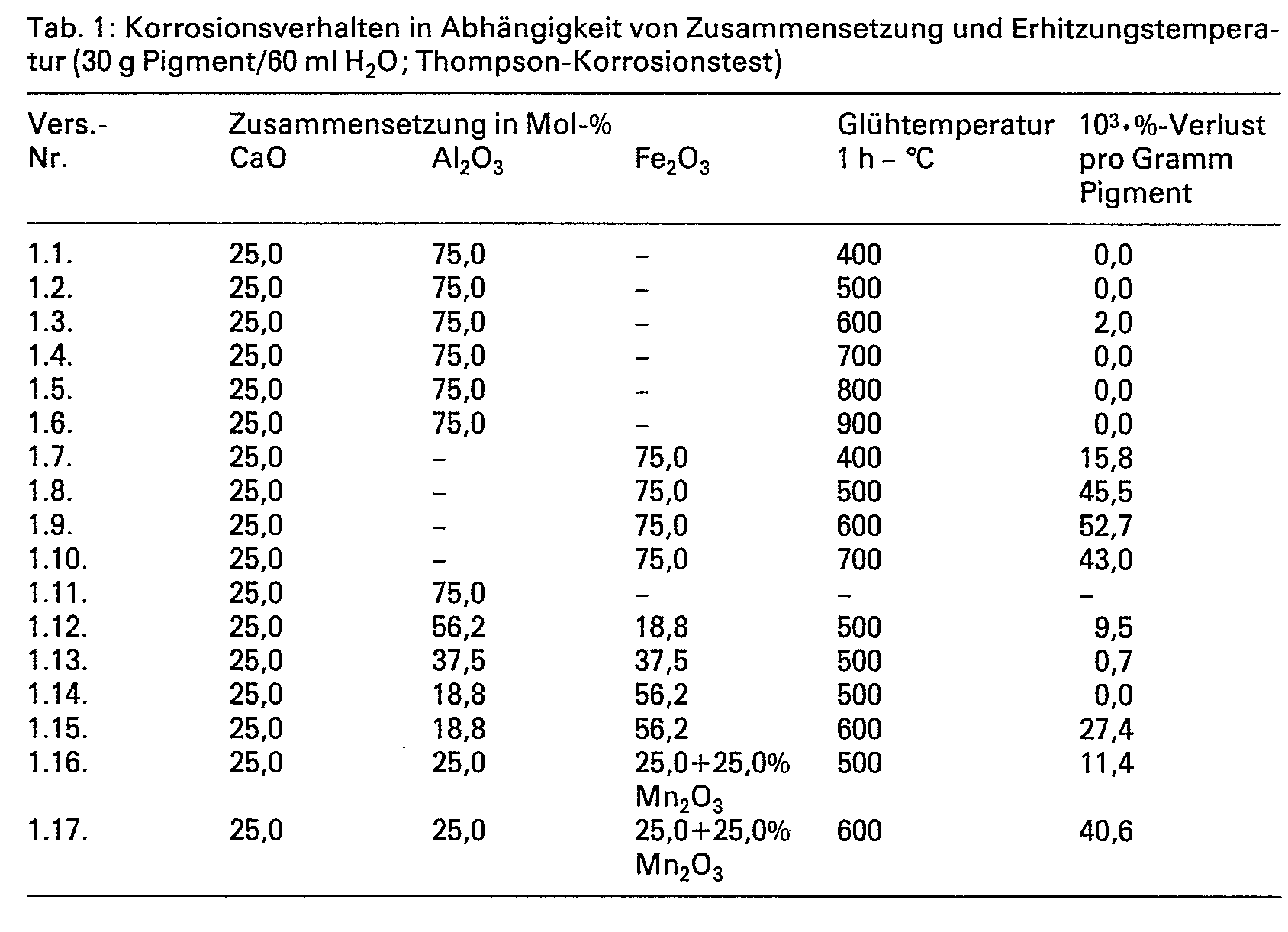
- the properties of various corrosion protection pigments according to the invention are summarized in the tables below as a function of composition and annealing temperature.
- the anticorrosive pigments are obtained in such a way that intimate mixtures of 30.0 to 2.0 mol% CaO or compounds which provide them on annealing with 70.0 to 98.0 mol% Me 2 0 3 , where Me 2 0 3 for ( 1-x) Al 2 0 3 and x Fe 2 0 3 and x can assume values from 0 to 1, preferably 0.01 to 0.95, with up to 25 mol% of Fe 2 0 3 due to the corresponding amount Mn 2 0 3 can be replaced, or these compounds produced during the annealing process, annealed to 100 ° C. below the end temperatures given in the tables, cooled and ground.
- the absolute quantities of the annealing products range from 50 to 100 g.
- the results of the pigment test can be found in Tables 1-2.
- the numerical values of the inorganic corrosion protection pigments used to date are all over 0.08% loss per gram of pigment.
- the pigments listed in this application all have numerical values which are less than 0.05%, preferably less than 0.03%, loss per gram of pigment.
- the new active corrosion protection pigments were tested in a long-oil alkyd resin based on tall oil fatty acid low in resin acid in comparison with commercially available zinc phosphate and zinc chromate.
- a pigment volume concentration (PVC) of 34% was chosen for the test.
- the grinding is carried out by grinding in laboratory vibrating ball mills for 5 hours.
- the primers are sprayed onto special steel sheets (Bonder 125 from Metallgesellschaft AG, Frankfurt / Main) in such a way that dry film thicknesses of approx. 45u result.
- the corrosion protection test is carried out with the salt spray test in accordance with DIN 53167 or ASTM B 287-61 (continuous spraying with 5% saline solution at 35 ⁇ 2 ° C).
Landscapes
- Chemical & Material Sciences (AREA)
- Organic Chemistry (AREA)
- Life Sciences & Earth Sciences (AREA)
- Inorganic Chemistry (AREA)
- Geology (AREA)
- Engineering & Computer Science (AREA)
- Ceramic Engineering (AREA)
- General Life Sciences & Earth Sciences (AREA)
- Materials Engineering (AREA)
- Wood Science & Technology (AREA)
- Paints Or Removers (AREA)
- Compounds Of Iron (AREA)
- Pigments, Carbon Blacks, Or Wood Stains (AREA)
Description
- Aktive Korrosionsschutzpigmente, denen grosse praktische Bedeutung zukommt, sind Bleimennige, Zinkkaliumchromat und Zinkstaub. Im Vergleich zu den in grossen Mengen verwendeten, für den Korrosionsschutz im wesentlichen inaktiven Eisenoxidpigmenten haben die erwähnten aktiven Korrosionsschutzpigmente entweder ein wesentlich höheres spezifisches Gewicht oder sind erheblich teurer. Es hat nicht an Bemühungen gefehlt, auf der Basis der wohlfeilen und relativ spezifisch leichten Aluminium- und Eisenoxidrohstoffe aktive Korrosionsschutzpigmente herzustellen. So wurde versucht, durch Zusammenglühen von Zink- und Erdalkalioxiden, -hydroxiden und -carbonaten mit verschiedenartigen Eisenverbindungen (Oxid, Oxidhydroxid, Carbonat, Sulfat usw.) bei Temperaturen von 650 bis 1150°C neue Korrosionsschutzpigmente auf Eisenoxidbasis herzustellen. Bei der Abprüfung dieser Pigmente auf ihre Korrosionsschutzwirkung zeigte sich aber, dass sie im Vergleich zu handelsüblichen Eisenoxidpigmenten zwar eine geringe Verbesserung bringen, dass sie aber nicht an die eingangs erwähnten aktiven Korrosionsschutzpigmente heranreichen.
- Aufgabe der vorliegenden Erfindung ist die Entwicklung aktiver Korrosionsschutzpigmente auf Aluminium- und Eisenoxidbasis, die hinsichtlich ihrer Korrosionsschutzwirkung den bekannten Korrosionsschutzpigmenten ebenbürtig sind und die Nachteile der bekannten Korrosionsschutzpigmente nicht aufweisen.
- Gegenstand der vorliegenden Erfindung sind Korrosionsschutzpigmente bestehend aus 30,0 bis 2,0 Mo-% CaO und 70,0 bis 98,0 Mol-% Me23, wobei Me203 für (1-x) AI203 und x Fe203 steht und x Werte von 0,01 bis 0,95 annehmen kann, wobei bis zu 25 Mol-% des Fe203 durch die entsprechende Menge Mn203 ersetzt sein können, mit einer spezifischen Oberfläche nach BET zwischen 0,1 und 200, bevorzugt zwischen 1,0 und 150 m2/g und die einen prozentualen Gewichtsverlust pro Gramm Pigment nach dem Thompson-Korrosionstest von weniger als 0,05%, vorzugsweise weniger als 0,03% pro Gramm Pigment aufweisen.
- Gegenstand der vorliegenden Erfindung istferner ein Verfahren zur Herstellung von Korrosionsschutzpigmenten, bestehend aus 30,0 bis 2,0 Mol-% CaO und 70,0 bis 98,0 Mol-% Me203, wobei Me203 für (1-x) AI203 und x Fe203 steht und x Werte von 0,01 bis 0,95 annehmen kann, wobei bis zu 25 Mol-% des Fe203 durch die entsprechende Menge Mn203 ersetzt sein können, durch Glühen der entsprechenden Metalloxide oder beim Glühen Metalloxide ergebenden Ausgangsstoffe, dadurch gekennzeichnet, dass die Glühung bei Temperaturen von 200 bis 900°C, vorzugsweise 300 bis 800°C, besonders bevorzugt von 400 bis 600°C, in Gegenwart sauerstoffhaltiger und/oder inerter Gase durchgeführt wird.
- Die neuen aktiven Korrosionsschutzpigmente auf Basis von Calciumoxid-, Aluminiumoxid und Eisenoxid werden so hergestellt, dass innige Mischungen von 30,0 bis 2,0 Mol-% CaO oder dieses beim Glühen liefernden Verbindungen und 70,0 bis 98,0 Mol-% Me203, wobei Me203 für (1-x) A1203 und x Fe203 steht und x Werte von 0 bis 1, vorzugsweise 0,01 bis 0,95 annehmen kann, wobei bis zu 25 Mol-% des Fe203 durch die entsprechende Menge Mn203 ersetzt sein können, bereitet, anschliessend in einem bestimmten Temperaturbereich geglüht, das Glühprodukt intensiv gemahlen, gegebenenfalls noch einmal geglüht, abgekühlt und gemahlen werden.
- Die Glühtemperatur ist von entscheidender Bedeutung für die Eigenschaften der entstehenden Korrosionsschutzpigmente. Bei an Aluminiumoxid armen Pigmenten liegt die Glühtemperatur bei 200 bis 700°C, vorzugsweise 300 bis 600°C, besonders bevorzugt zwischen 400 und 600°C. Für an Aluminiumoxid reichere Pigmente werden Glühtemperaturen zwischen 200 und 1100°C, vorzugsweise zwischen 250 und 950°C, besonders bevorzugt zwischen 300 und 850°C gewählt. Die Glühdauer liegt in der Regel zwischen 0,1 und 20, vorzugsweise 0,5 bis 10 Stunden. Die erfindungsgemässen Korrosionsschutzpigmente zeigen spezifische Oberflächen nach BET (G.Brunnauer, P. H. Emmet und H. Teller, J. Amer. Chem. Soc. 60, 309 [1938]) zwischen 0,1 und 200, vorzugsweise zwischen 1,0 und 150 mz/g.
- Die erfindungsgemässen Korrosionsschutzpigmente zeigen nach dem Thompson-Korrosionstest (H. A. Gardener, Physical and Chemical Examinations of Paints, Varnishes, Lacquers and Colors, 11. Auflage Bethesda 1950, S.339) Prozentverluste pro Gramm Pigment von weniger als 0,05% pro Gramm Korrosionsschutzpigment, vorzugsweise weniger als 0,03% pro Gramm Korrosionsschutzpigment. Im Vergleich zeigt ein Korrosionsschutzpigmet auf Basis Pb304 nach dem Thompson-Korrosionstest einen Prozentverlust pro Gramm Pb304 in der Grössenordnung von 0,06%, ein aktives Zinkoxid einen Prozentverlust pro Gramm Zinkoxid in Höhe von 0,08% (Vgl. Tab. 3).
- Als Ausgangsverbindungen bei der Herstellung der erfindungsgemässen Korrosionsschutzpigmente können für CaO das Oxid, bzw. dieses beim Glühen liefernde Verbindungen wie Hydroxide, Hydroxysalze, Carbonate, basische Carbonate, Nitrate, Chloride, Formiate, Acetate, Oxalate und andere organische Verbindungen des Calciums dienen. Für Me203 können beliebige Aluminium- und/oder Eisen-, gegebenenfalls auch Manganoxidverbindungen, oder beim Glühen Aluminium-, und/oder Eisen-, gegebenenfalls Manganoxid liefernde Verbindungen wie Oxidhydroxide, Hydroxide, Hydroxysalze, Carbonate, basische Carbonate, Nitrate, Chloride, Sulfate, Formiate, Acetate, Oxalate bzw. organische Carboxylate, eingesetzt werden. Werden Eisen- bzw. Manganverbindungen eingesetzt, die das Element nicht oder nicht ausschliesslich im dreiwertigen Zustand enthalten, so ist die Glühung des erfindungsgemässen Korrosionsschutzpigmentes in sauerstoffhaltiger Atmosphäre, vorzugsweise in Luft oder 02-angereicherter Luft, durchzuführen. Als besonders vorteilhaft erweisen sich bei den Eisenverbindungen Eisen(II)-hydroxid, Eisen(II)-carbonat oder basisches Carbonat, die man durch Alkalihydroxid- oder -carbonatfällung aus Eisen(II)-salzen, vorzugsweise Eisen(II)-sulfatlösung, gewinnen kann.
- Weitere technisch interessante Rohstoffe für Eisen(III)-oxid sind die bei der Reduktion aromatischen Nitroverbindungen mit Eisen in saurer Lösung anfallenden Fe304-, a-FeOOH-und a-Fe203-Pigmentschlämme oder die nach dem Luftoxidationsverfahren mit Eisenschrott oder Fe(OH)2-Fällung in Gegenwart von Keimen darstellbaren Eisenoxidgelb- (a-FeOOH), Eisenoxidorange-(y-FeOOH) und Eisenoxidrotpigmente (a-Fe203). Auch die aus kristallwasserhaltigem oder kristallwasserfreiem Eisen(II)-sulfat durch Röstoxidations- oder Röstreduktionsverfahren anfallenden roten, braunen und schwarzen Eisenoxide sind für die Herstellung der neuen aktiven Korrosionsschutzpigmente geeignete Ausgangsverbindungen.
- Geeignete Aluminiumverbindungen sind neben natürlich vorkommenden Aluminiummineralen Böhmit und Diaspor; aus Aufschlusslösungen ausgerührte reine Aluminiumhydroxide auch Mischungen von Eisen- mit Aluminiumverbindungen, wie die beim Aufschluss von Aluminiumerzen anfallende «Rotschlämme» der Aluminiumindustrie auch Siliciumdioxid oder Silikate enthaltende Erze des Aluminiumoxids (z.B. Kaoline in weitestem Sinne).
- Ausgangsverbindungen für Mangan sind natürlich vorkommende Mangan-Minerale oder synthetisch hergestellter und/oder als Abfallprodukt bei organischen Synthesen anfallender Braunstein, die allein oder in Kombination mit den erwähnten Eisen- und Aluminiumverbindungen zur Herstellung der erfindungsgemässen Korrosionsschutzpigmente verwendet werden können.
- Eine weitere Möglichkeit zur Herstellung der oxidischen Ausgangsstoffe für die neuen Korrosionsschutzpigmente besteht in einer vollständigen oder teilweisen gemeinsamen Ausfällung von Calcium-, Eisen(ll)oder Mn(II)-salzlösung und Me(III)-salzlösung (AI, Fe, Mn) mit Alkali-, Erdalkalihydroxid- und/oder -carbonatlösung.
- In den nachfolgenden Tabellen werden die Eigenschaften verschiedener erfindungsgemässer Korrosionsschutzpigmente in Abhängigkeit von Zusammensetzung und Glühtemperatur zusammengestellt. Die Korrosionsschutzpigmente werden so gewonnen, dass innige Mischungen von 30,0 bis 2,0 Mol-% CaO oder diese beim Glühen liefernden Verbindungen mit 70,0 bis 98,0 Mol-% Me203, wobei Me203 für (1-x) AI203 und x Fe203 steht und x Werte von 0 bis 1, vorzugsweise 0,01 bis 0,95 annehmen kann, wobei bis zu 25 Mol-% des Fe203 durch die entsprechende Menge Mn203 ersetzt sein können, oder diese beim Glühen liefernden Verbindungen hergestellt, eine Stunde auf eine 100°C unterhalb der in den Tabellen angegebenen Endtemperaturen geglüht, abgekühlt und gemahlen werden. Die absoluten Mengen der Glühprodukte bewegen sich im Bereich von 50 bis 100 g. Die Ergebnisse der Pigmentprüfung finden sich in den Tabellen 1-2.
- Der Thompson-Korrosionstest an den Pigmenten wurde wie folgt durchgeführt:
- In eine mit doppelt durchbohrtem Stopfen versehene 200 ml Pulverflasche wurden je nach Schüttgewicht 15 oder 30 g Pigment, 60 ml bidestilliertes Wasser und vier gereinigte und mit Äther entfettete, gewogene und mit Perlonfäden festgebundene, glänzend polierte Rasierklingen eingebracht. Durch Glasrohre wurden die einzelnen hintereinander gereihten Pulverflaschen mit den verschiedenen Pigmentsuspensionen unter Zwischenschaltung von leeren Pulverflaschen verbunden. Durch Einschalten des Laborvakuums wurde über ein Luftrotameter und einen .als Blasenzähler dienenden Erlenmeyerkolben im Verlauf von 10 Tagen ein gleichbleibender Luftstrom von 601/h durchgeleitet. Durch diesen Luftstrom wird die Pigmentsuspension ständig durchgewirbelt und kommt das Pigment ständig in Kontakt mit dem Wasser. Nach Ablauf von 10 Tagen wurden die Rasierklingen aus jeder Flasche herausgenommen, sorgfältig gereinigt, getrocknet und der Gewichtsverlust durch Rückwaage bestimmt. Der prozentuale Gewichtsverlust wird durch die eingesetzte Pigmentmenge dividiert. Der Prozentverlust/g Pigment stellt ein Mass für die Stärke der Korrosion dar. Je niederiger dieser Wert ist, um so grösser ist die Korrosion verhindernde Wirkung des Pigments. Da die so ermittelten Werte sehr klein sind, wurden sie zur Vereinfachung einer vergleichenden Betrachtung mit einem Faktor von 103 multipliziert. Diese Werte sind in den letzten Kolonnen der Tabellen 1 bis 3 angegeben.
- Zum Vergleich mit den erfindungsgemässen Korrosionsschutzpigmenten ist in der Tabelle 3 das Korrosionsverhalten von einigen anorganischen Pigmenten beim Thompson-Korrosionstest dargestellt.
- Wie man sieht, liegen die Zahlenwerte der aufgeführten bisher verwendeten anorganischen Korrosionsschutzpigmente alle über 0,08%-Verlust pro Gramm Pigment. Die in dieser Anmeldung aufgeführten Pigmente haben alle Zahlenwerte, die unter 0,05%, bevorzugt unter 0,03%-Verlust pro Gramm Pigment liegen.
- Da in vielen Fällen die Korrosionsschutzwerte nach dem Thompson-Test notwendige aber manchmal nicht ausreichende Bedingungen für den praktischen Einsatz von Korrosionsschutzpigmente darstellen, wurde ein Pigment aus dieser Reihe mit 14,3 Mol-% CaO und 85,7 Mol-% AI203 und einer Glühtemperatur von 500 bzw. 600°C in Anstrichen auf Stahlblechen dem Salzsprühtest nach DIN 53.167 bzw. ASTM-B 287-61 unterworfen.
- Die Prüfung der neuen aktiven Korrosionsschutzpigmente erfolgte in einem langöligen Alkydharz auf Basis harzsäurearmer Tallölfettsäure in Vergleich zu handelsüblichem Zinkphosphat und Zinkchromat. Für die Abprüfung wurde eine Pigmentvolumenkonzentration (PVK) von 34% gewählt.
- Grundrezeptur in Gew.-Teilen:
- 167,-- langöliges Alkydharz, 60%ig in Testbenzin
- 2,50 leichtflüchtiges Oxim als Hautverhinderungsmittel Ascinin®R 55 (Bayer A.G.)
- 4,-- Co-, Pb-, Mn-Octoat, 1 :2 in Xylol
- 1,25 Ca-octoat, 4%ig
- 25,25 Verdünnung Testbenzin/Terpentinöl 8:2 Menge Pigment nach gewählter Pigment-Volu-men-Konzentration (PVK).
- Die Anreibung erfolgt durch 5stündiges Mahlen in Labor-Kugelschwingmühlen.
- Zur Prüfung des Korrosionsschutzverhaltens der Pigmente werden die Grundierungen so auf gebonderte Stahlbleche (Bonder 125 der Metallgesellschaft AG, Frankfurt/Main) gespritzt, dass Trockenschichtdicken von ca. 45u entstehen. Nach einer Mindesttrockenzeit von 7 Tagen erfolgt die Korrosionsschutzprüfung mit dem Salzsprühtest nach DIN 53167 bzw. ASTM B 287-61 (Dauerbesprühung mit 5%iger Kochsalzlösung bei 35 ± 2°C).
- Nach 3, 8, 11, 18, 24, 31, 38, 45 und 52 Tagen werden die Prüfbleche abgemustert. Die Beurteilung erfolgt nach einem Benotungssystem, welches von 0 (= keine Beschädigung) bis 12 (= vollständige Zerstörung des Anstrichfilmes) reicht; diese Bewertung wurde von P. Kresse im XIII-Fatipec-Kongressbuch (Cannes 1976), S. 346-353 in «Der Mechanismus der Einwirkung von Salzlösungen auf anstrichbedecktes Eisen» beschrieben. Die Summe der Einzelnoten zu den oben genannten Abmusterungstagen bis zum 52. Tag für die einzelnen Pigmentierungssysteme wird als «Korrosionsgrad» bezeichnet. Je grösser diese Summe, d.h. je höher der Korrosionsgrad in einem gewählten Pigment-Bindemittelsystem, um so geringer ist die Korrosion verhindernde Wirkung des eingesetzten Korrosionsschutzpigmentes.
- Im Vergleich zum Zinkphosphat-Korrosionsschutzpigment des Handels mit seinen relativ schlechten Korrosionsschutzwerten sind die bei 500 und 600 °C geglühten Pigmente Nr. 2.2; 2.3 mit 14,3% CaO und 85,7 Mol-% AI203 wesentlich besser (Tab. 4). Innerhalb der Fehler des Salzsprühtestes sind diese ungiftigen Korrosionsschutzpigmente dieser Anmeldung in ihrer vor Korrosion schützenden Wirkung fast gleich gut wie die Chrom(VI)-ionen enthaltenden Zinkchromatpigmente des Handels.


Claims (5)
Applications Claiming Priority (2)
| Application Number | Priority Date | Filing Date | Title |
|---|---|---|---|
| DE2815306A DE2815306C2 (de) | 1978-04-08 | 1978-04-08 | Aktive Korrosionsschutzpigmente auf Calciumoxid-, Aluminiumoxidbasis und deren Verwendung |
| DE2815306 | 1978-04-08 |
Publications (3)
| Publication Number | Publication Date |
|---|---|
| EP0004643A2 EP0004643A2 (de) | 1979-10-17 |
| EP0004643A3 EP0004643A3 (en) | 1979-11-14 |
| EP0004643B1 true EP0004643B1 (de) | 1981-05-13 |
Family
ID=6036517
Family Applications (1)
| Application Number | Title | Priority Date | Filing Date |
|---|---|---|---|
| EP79100945A Expired EP0004643B1 (de) | 1978-04-08 | 1979-03-29 | Aktive Korrosionsschutzpigmente auf Calciumoxid-, Aluminiumoxid- und Eisenoxidbasis, Verfahren zu ihrer Herstellung und ihre Verwendung |
Country Status (4)
| Country | Link |
|---|---|
| US (1) | US4285726A (de) |
| EP (1) | EP0004643B1 (de) |
| JP (1) | JPS54137027A (de) |
| DE (2) | DE2815306C2 (de) |
Families Citing this family (20)
| Publication number | Priority date | Publication date | Assignee | Title |
|---|---|---|---|---|
| DE2815306C2 (de) * | 1978-04-08 | 1983-11-10 | Bayer Ag, 5090 Leverkusen | Aktive Korrosionsschutzpigmente auf Calciumoxid-, Aluminiumoxidbasis und deren Verwendung |
| US4469521A (en) * | 1982-09-29 | 1984-09-04 | Union Carbide Corporation | Corrosion inhibitive pigments |
| DE3510362A1 (de) * | 1985-03-22 | 1986-09-25 | Basf Ag, 6700 Ludwigshafen | Physikalisch trocknende korrosionsschutzfarben und verfahren zu deren herstellung |
| HU198523B (en) * | 1985-06-13 | 1987-08-28 | Magyar Aluminium | Active anticorrosion pigment composition for coating materials and process for its production |
| DE3636156A1 (de) * | 1986-10-24 | 1988-04-28 | Basf Ag | Plaettchenfoermige pigmente der allgemeinen formel mn(pfeil abwaerts)x(pfeil abwaerts)-al(pfeil abwaerts)y(pfeil abwaerts)fe(pfeil abwaerts)2(pfeil abwaerts)(pfeil abwaerts)-(pfeil abwaerts)(pfeil abwaerts)((pfeil abwaerts)(pfeil abwaerts)x(pfeil abwaerts)(pfeil abwaerts)+(pfeil abwaerts)(pfeil abwaerts)y(pfeil abwaerts)(pfeil abwaerts))(pfeil abwaerts)o(pfeil abwaerts)3(pfeil abwaerts) |
| DE3709217A1 (de) * | 1987-03-20 | 1988-09-29 | Basf Ag | Plaettchenfoermige pigmente auf basis eisenoxid |
| DE3926335C1 (de) * | 1989-08-09 | 1991-02-21 | Degussa Ag, 6000 Frankfurt, De | |
| DE4124630A1 (de) * | 1991-07-25 | 1993-02-11 | Starck H C Gmbh Co Kg | Farbiger korund, verfahren zu seiner herstellung sowie dessen verwendung |
| US6174360B1 (en) * | 1998-10-26 | 2001-01-16 | Ferro Corporation | Infrared reflective color pigment |
| EP1472319A1 (de) * | 2002-01-04 | 2004-11-03 | University Of Dayton | Nicht toxische korrosionsschutzpigmente auf cobaltbasis |
| US20040011252A1 (en) * | 2003-01-13 | 2004-01-22 | Sturgill Jeffrey A. | Non-toxic corrosion-protection pigments based on manganese |
| RU2309904C1 (ru) * | 2006-03-20 | 2007-11-10 | Юлия Алексеевна Щепочкина | Керамический пигмент |
| RU2306262C1 (ru) * | 2006-05-10 | 2007-09-20 | Юлия Алексеевна Щепочкина | Керамический пигмент |
| RU2329203C1 (ru) * | 2006-10-09 | 2008-07-20 | Юлия Алексеевна Щепочкина | Керамический пигмент |
| RU2329206C1 (ru) * | 2006-11-02 | 2008-07-20 | Юлия Алексеевна Щепочкина | Керамический пигмент темно-вишневый |
| RU2329204C1 (ru) * | 2006-11-07 | 2008-07-20 | Юлия Алексеевна Щепочкина | Шихта для получения коричневого пигмента |
| DE102013001520B4 (de) * | 2013-01-22 | 2015-11-12 | Fluorchemie Gmbh Frankfurt | Neuartiges anorganisches, halogenfreies Flammschutzmittel auf Basis von chemisch modifiziertem rekarbonisiertem Rotschlamm, dessen Herstellung und Verwendung sowie brandgeschütztes Stoffsystem |
| JP6987491B2 (ja) * | 2015-09-30 | 2022-01-05 | Hoya株式会社 | 紫外光照射装置用光学素子、紫外光照射装置用光学ユニットおよび紫外光照射装置 |
| EP3153554B1 (de) * | 2015-09-30 | 2018-07-04 | Hoya Candeo Optronics Corporation | Farbe zur absorption ultravioletter strahlung, folie zur absorption ultravioletter strahlung, lichtabsorbierende folie, optisches element, optische einheit und lichtbeleuchtungsvorrichtung |
| CN112723400B (zh) * | 2020-12-18 | 2022-02-11 | 中南大学 | 一种低镁铝灰同步活化惰化除杂熔制铝酸钙的方法 |
Family Cites Families (6)
| Publication number | Priority date | Publication date | Assignee | Title |
|---|---|---|---|---|
| DE1068836B (de) * | 1959-11-12 | Badische Bau- und Kunststoff G.m. b.H., Mannheim-Feudenheim | Verwendung im regulären Kristallsystem kristallisierter, spinellartiger Verbindungen als Pigmente oder Füller | |
| US3549315A (en) * | 1967-01-12 | 1970-12-22 | Fred F Lester | Complex oxidic compounds and process for their production |
| CA936676A (en) * | 1968-07-02 | 1973-11-13 | Courty Philippe | Preparation of homogeneous oxides of mixed metallic elements |
| US4156613A (en) * | 1976-06-05 | 1979-05-29 | Bayer Aktiengesellschaft | Anti-corrosion pigments |
| JPS5413542A (en) * | 1977-06-30 | 1979-02-01 | Toda Kogyo Corp | Aqueous corrosion preventive coating |
| DE2815306C2 (de) * | 1978-04-08 | 1983-11-10 | Bayer Ag, 5090 Leverkusen | Aktive Korrosionsschutzpigmente auf Calciumoxid-, Aluminiumoxidbasis und deren Verwendung |
-
1978
- 1978-04-08 DE DE2815306A patent/DE2815306C2/de not_active Expired
-
1979
- 1979-03-29 DE DE7979100945T patent/DE2960339D1/de not_active Expired
- 1979-03-29 EP EP79100945A patent/EP0004643B1/de not_active Expired
- 1979-04-06 JP JP4117979A patent/JPS54137027A/ja active Granted
-
1980
- 1980-07-10 US US06/168,221 patent/US4285726A/en not_active Expired - Lifetime
Also Published As
| Publication number | Publication date |
|---|---|
| JPS6248711B2 (de) | 1987-10-15 |
| DE2815306A1 (de) | 1979-10-18 |
| EP0004643A3 (en) | 1979-11-14 |
| DE2815306C2 (de) | 1983-11-10 |
| DE2960339D1 (en) | 1981-08-20 |
| EP0004643A2 (de) | 1979-10-17 |
| US4285726A (en) | 1981-08-25 |
| JPS54137027A (en) | 1979-10-24 |
Similar Documents
| Publication | Publication Date | Title |
|---|---|---|
| DE2815306C2 (de) | Aktive Korrosionsschutzpigmente auf Calciumoxid-, Aluminiumoxidbasis und deren Verwendung | |
| DE3751283T2 (de) | Verfahren und Produkte zur Oberflächenbehandlung. | |
| US4156613A (en) | Anti-corrosion pigments | |
| EP0290908B1 (de) | Neue farbreine Eisenoxidpigmente, Verfahren zu ihrer Herstellung und deren Verwenung | |
| CH673285A5 (de) | ||
| EP0440958A1 (de) | Verfahren zur Herstellung eines schwarzen Mangan-Eisenoxid-Pigmentes | |
| EP0068311A1 (de) | Plättchenförmige Pigmente auf Basis von Eisenoxyd, deren Herstellung und Verwendung | |
| EP0560144A1 (de) | Oberflächenmodifizierte Pigmente | |
| DE2537684C3 (de) | Aktive Korrosionsschutzpigmente auf Eisenoxidbasis | |
| DE2656779A1 (de) | Neue korrosionsschutzpigmente auf basis cazn tief 2 (po tief 4 ) tief 2 mal 2 h tief 2 o und deren herstellung | |
| DE69003798T2 (de) | Fungizide und korrosionshemmende Anstrichfarbepigmente. | |
| CA1112433A (en) | Anti-corrosive pigment and anti-corrosive aqueous paint | |
| EP0070455A1 (de) | Aktive Korrosionsschutzpigmente, Verfahren zu ihrer Herstellung und deren Verwendung | |
| DE19516960A1 (de) | Farbpigmente | |
| DE2625401C2 (de) | Aktive Korrosionsschutzpigmente auf Eisenoxidbasis und deren Verwendung | |
| US4211565A (en) | Iron oxide-based anti-corrosion pigments | |
| DE2560072C2 (de) | Verfahren zur Herstellung von Pigmenten auf Eisenoxidbasis und deren Verwendung für den Korrosionsschutz | |
| DE2642049C2 (de) | Aktive Korrosionsschutzpigmente auf Eisenoxidbasis und deren Verwendung | |
| DE3411215C2 (de) | ||
| DE2560073C2 (de) | Verwendung von zink- und eisenoxidhaltigen Pigmenten für den Korrosionsschutz | |
| EP0308820B1 (de) | Zink-, Blei- und/oder Calciumsalze von Carbonsäuren und deren Verwendung als Korrosionsschutzmittel | |
| DE1278047B (de) | Verfahren zur Herstellung eines Bleichromat-Bleisilikat-Kompositionspigments | |
| DE3046697A1 (de) | Korrosionsschutzpigmente sowie ihre verwendung in anstrichmitteln | |
| US4046589A (en) | Calcium-silico-zirconate primer pigment | |
| DE1952538A1 (de) | Verfahren zur Verbesserung der Licht- und Temperaturbestaendigkeit von bleichromathaltigen Pigmenten |
Legal Events
| Date | Code | Title | Description |
|---|---|---|---|
| PUAI | Public reference made under article 153(3) epc to a published international application that has entered the european phase |
Free format text: ORIGINAL CODE: 0009012 |
|
| PUAL | Search report despatched |
Free format text: ORIGINAL CODE: 0009013 |
|
| 17P | Request for examination filed | ||
| AK | Designated contracting states |
Designated state(s): DE FR GB IT |
|
| AK | Designated contracting states |
Designated state(s): DE FR GB IT |
|
| ITF | It: translation for a ep patent filed | ||
| GRAA | (expected) grant |
Free format text: ORIGINAL CODE: 0009210 |
|
| AK | Designated contracting states |
Designated state(s): DE FR GB IT |
|
| REF | Corresponds to: |
Ref document number: 2960339 Country of ref document: DE Date of ref document: 19810820 |
|
| PGFP | Annual fee paid to national office [announced via postgrant information from national office to epo] |
Ref country code: DE Payment date: 19840223 Year of fee payment: 6 |
|
| PGFP | Annual fee paid to national office [announced via postgrant information from national office to epo] |
Ref country code: FR Payment date: 19840327 Year of fee payment: 6 |
|
| GBPC | Gb: european patent ceased through non-payment of renewal fee | ||
| PG25 | Lapsed in a contracting state [announced via postgrant information from national office to epo] |
Ref country code: FR Free format text: LAPSE BECAUSE OF NON-PAYMENT OF DUE FEES Effective date: 19851129 |
|
| REG | Reference to a national code |
Ref country code: FR Ref legal event code: ST |
|
| PG25 | Lapsed in a contracting state [announced via postgrant information from national office to epo] |
Ref country code: DE Effective date: 19871201 |
|
| PG25 | Lapsed in a contracting state [announced via postgrant information from national office to epo] |
Ref country code: GB Effective date: 19881117 |
|
| PLBE | No opposition filed within time limit |
Free format text: ORIGINAL CODE: 0009261 |
|
| STAA | Information on the status of an ep patent application or granted ep patent |
Free format text: STATUS: NO OPPOSITION FILED WITHIN TIME LIMIT |