EP0002260A2 - Malonsäurederivate von sterisch gehinderten Piperidinen, Verfahren zu ihrer Herstellung und mit ihnen stabilisiertes organisches Material - Google Patents
Malonsäurederivate von sterisch gehinderten Piperidinen, Verfahren zu ihrer Herstellung und mit ihnen stabilisiertes organisches Material Download PDFInfo
- Publication number
- EP0002260A2 EP0002260A2 EP78101492A EP78101492A EP0002260A2 EP 0002260 A2 EP0002260 A2 EP 0002260A2 EP 78101492 A EP78101492 A EP 78101492A EP 78101492 A EP78101492 A EP 78101492A EP 0002260 A2 EP0002260 A2 EP 0002260A2
- Authority
- EP
- European Patent Office
- Prior art keywords
- atoms
- alkyl
- hydrogen
- benzyl
- group
- Prior art date
- Legal status (The legal status is an assumption and is not a legal conclusion. Google has not performed a legal analysis and makes no representation as to the accuracy of the status listed.)
- Granted
Links
- 150000002690 malonic acid derivatives Chemical class 0.000 title claims abstract description 21
- 238000000034 method Methods 0.000 title claims description 10
- 238000002360 preparation method Methods 0.000 title claims description 4
- 150000003053 piperidines Chemical class 0.000 title description 4
- 239000005416 organic matter Substances 0.000 title 1
- 239000011368 organic material Substances 0.000 claims abstract description 6
- 125000004432 carbon atom Chemical group C* 0.000 claims description 55
- 125000000217 alkyl group Chemical group 0.000 claims description 53
- 125000001797 benzyl group Chemical group [H]C1=C([H])C([H])=C(C([H])=C1[H])C([H])([H])* 0.000 claims description 48
- UFHFLCQGNIYNRP-UHFFFAOYSA-N Hydrogen Chemical compound [H][H] UFHFLCQGNIYNRP-UHFFFAOYSA-N 0.000 claims description 43
- 229910052739 hydrogen Inorganic materials 0.000 claims description 42
- 239000001257 hydrogen Substances 0.000 claims description 42
- -1 cycloaliphatic Chemical group 0.000 claims description 40
- 125000002496 methyl group Chemical group [H]C([H])([H])* 0.000 claims description 26
- 125000001997 phenyl group Chemical group [H]C1=C([H])C([H])=C(*)C([H])=C1[H] 0.000 claims description 26
- 150000001875 compounds Chemical class 0.000 claims description 25
- 125000003342 alkenyl group Chemical group 0.000 claims description 20
- 125000003903 2-propenyl group Chemical group [H]C([*])([H])C([H])=C([H])[H] 0.000 claims description 17
- 150000002431 hydrogen Chemical class 0.000 claims description 17
- 125000003545 alkoxy group Chemical group 0.000 claims description 15
- 125000005394 methallyl group Chemical group 0.000 claims description 13
- 125000001494 2-propynyl group Chemical group [H]C#CC([H])([H])* 0.000 claims description 9
- 125000002777 acetyl group Chemical group [H]C([H])([H])C(*)=O 0.000 claims description 9
- 125000003118 aryl group Chemical group 0.000 claims description 9
- 150000003839 salts Chemical class 0.000 claims description 9
- 125000002887 hydroxy group Chemical group [H]O* 0.000 claims description 8
- 229920000642 polymer Polymers 0.000 claims description 8
- 125000000113 cyclohexyl group Chemical group [H]C1([H])C([H])([H])C([H])([H])C([H])(*)C([H])([H])C1([H])[H] 0.000 claims description 7
- 125000001495 ethyl group Chemical group [H]C([H])([H])C([H])([H])* 0.000 claims description 7
- 229910052736 halogen Inorganic materials 0.000 claims description 7
- 125000001424 substituent group Chemical group 0.000 claims description 7
- PPBRXRYQALVLMV-UHFFFAOYSA-N Styrene Chemical compound C=CC1=CC=CC=C1 PPBRXRYQALVLMV-UHFFFAOYSA-N 0.000 claims description 6
- 125000002252 acyl group Chemical group 0.000 claims description 5
- 125000001931 aliphatic group Chemical group 0.000 claims description 5
- 125000003236 benzoyl group Chemical group [H]C1=C([H])C([H])=C(C([H])=C1[H])C(*)=O 0.000 claims description 5
- 125000000753 cycloalkyl group Chemical group 0.000 claims description 5
- 150000002367 halogens Chemical class 0.000 claims description 5
- 125000003647 acryloyl group Chemical group O=C([*])C([H])=C([H])[H] 0.000 claims description 4
- 125000003710 aryl alkyl group Chemical group 0.000 claims description 4
- 125000003884 phenylalkyl group Chemical group 0.000 claims description 4
- XLYOFNOQVPJJNP-UHFFFAOYSA-N water Substances O XLYOFNOQVPJJNP-UHFFFAOYSA-N 0.000 claims description 4
- 125000003282 alkyl amino group Chemical group 0.000 claims description 3
- 125000002490 anilino group Chemical group [H]N(*)C1=C([H])C([H])=C([H])C([H])=C1[H] 0.000 claims description 3
- 125000000051 benzyloxy group Chemical group [H]C1=C([H])C([H])=C(C([H])=C1[H])C([H])([H])O* 0.000 claims description 3
- 125000001589 carboacyl group Chemical group 0.000 claims description 3
- 125000004093 cyano group Chemical group *C#N 0.000 claims description 3
- 125000004663 dialkyl amino group Chemical group 0.000 claims description 3
- 125000002485 formyl group Chemical group [H]C(*)=O 0.000 claims description 3
- 125000000951 phenoxy group Chemical group [H]C1=C([H])C([H])=C(O*)C([H])=C1[H] 0.000 claims description 3
- 125000000286 phenylethyl group Chemical group [H]C1=C([H])C([H])=C(C([H])=C1[H])C([H])([H])C([H])([H])* 0.000 claims description 3
- 229920000098 polyolefin Polymers 0.000 claims description 3
- 229920002635 polyurethane Polymers 0.000 claims description 3
- 239000004814 polyurethane Substances 0.000 claims description 3
- 125000001731 2-cyanoethyl group Chemical group [H]C([H])(*)C([H])([H])C#N 0.000 claims description 2
- OGMKEDLHCZVOPB-UHFFFAOYSA-N bis[2-(2,2,6,6-tetramethylpiperidin-1-yl)ethyl] 2,2-dibenzylpropanedioate Chemical compound CC1(C)CCCC(C)(C)N1CCOC(=O)C(C(=O)OCCN1C(CCCC1(C)C)(C)C)(CC=1C=CC=CC=1)CC1=CC=CC=C1 OGMKEDLHCZVOPB-UHFFFAOYSA-N 0.000 claims description 2
- UUEVFMOUBSLVJW-UHFFFAOYSA-N oxo-[[1-[2-[2-[2-[4-(oxoazaniumylmethylidene)pyridin-1-yl]ethoxy]ethoxy]ethyl]pyridin-4-ylidene]methyl]azanium;dibromide Chemical compound [Br-].[Br-].C1=CC(=C[NH+]=O)C=CN1CCOCCOCCN1C=CC(=C[NH+]=O)C=C1 UUEVFMOUBSLVJW-UHFFFAOYSA-N 0.000 claims 1
- 230000000087 stabilizing effect Effects 0.000 claims 1
- 239000003381 stabilizer Substances 0.000 abstract description 18
- 230000015556 catabolic process Effects 0.000 abstract description 3
- 238000006731 degradation reaction Methods 0.000 abstract description 3
- 125000003386 piperidinyl group Chemical group 0.000 abstract description 3
- YXFVVABEGXRONW-UHFFFAOYSA-N Toluene Chemical compound CC1=CC=CC=C1 YXFVVABEGXRONW-UHFFFAOYSA-N 0.000 description 12
- 239000004033 plastic Substances 0.000 description 8
- 229920003023 plastic Polymers 0.000 description 8
- HEDRZPFGACZZDS-UHFFFAOYSA-N Chloroform Chemical compound ClC(Cl)Cl HEDRZPFGACZZDS-UHFFFAOYSA-N 0.000 description 6
- 239000003513 alkali Substances 0.000 description 6
- 238000006243 chemical reaction Methods 0.000 description 5
- 239000000203 mixture Substances 0.000 description 5
- 239000002253 acid Substances 0.000 description 4
- 239000011541 reaction mixture Substances 0.000 description 4
- 239000002904 solvent Substances 0.000 description 4
- AOVMIILTPIXHMA-UHFFFAOYSA-N 2-benzyl-2-(2-phenylpropan-2-yl)propanedioic acid Chemical compound C=1C=CC=CC=1CC(C(O)=O)(C(O)=O)C(C)(C)C1=CC=CC=C1 AOVMIILTPIXHMA-UHFFFAOYSA-N 0.000 description 3
- UHOVQNZJYSORNB-UHFFFAOYSA-N Benzene Chemical compound C1=CC=CC=C1 UHOVQNZJYSORNB-UHFFFAOYSA-N 0.000 description 3
- OKKJLVBELUTLKV-UHFFFAOYSA-N Methanol Chemical compound OC OKKJLVBELUTLKV-UHFFFAOYSA-N 0.000 description 3
- ZMXDDKWLCZADIW-UHFFFAOYSA-N N,N-Dimethylformamide Chemical compound CN(C)C=O ZMXDDKWLCZADIW-UHFFFAOYSA-N 0.000 description 3
- CTQNGGLPUBDAKN-UHFFFAOYSA-N O-Xylene Chemical compound CC1=CC=CC=C1C CTQNGGLPUBDAKN-UHFFFAOYSA-N 0.000 description 3
- OFOBLEOULBTSOW-UHFFFAOYSA-N Propanedioic acid Natural products OC(=O)CC(O)=O OFOBLEOULBTSOW-UHFFFAOYSA-N 0.000 description 3
- 150000007513 acids Chemical class 0.000 description 3
- 239000000654 additive Substances 0.000 description 3
- 125000005907 alkyl ester group Chemical group 0.000 description 3
- 125000004429 atom Chemical group 0.000 description 3
- 125000002915 carbonyl group Chemical group [*:2]C([*:1])=O 0.000 description 3
- 150000002148 esters Chemical class 0.000 description 3
- 239000011888 foil Substances 0.000 description 3
- 125000004123 n-propyl group Chemical group [H]C([H])([H])C([H])([H])C([H])([H])* 0.000 description 3
- 239000007858 starting material Substances 0.000 description 3
- 239000008096 xylene Substances 0.000 description 3
- 125000004400 (C1-C12) alkyl group Chemical group 0.000 description 2
- 125000004178 (C1-C4) alkyl group Chemical group 0.000 description 2
- 125000004209 (C1-C8) alkyl group Chemical group 0.000 description 2
- YSZJTDBKDUARSQ-UHFFFAOYSA-N 2,2-dibenzylpropanedioic acid Chemical compound C=1C=CC=CC=1CC(C(O)=O)(C(=O)O)CC1=CC=CC=C1 YSZJTDBKDUARSQ-UHFFFAOYSA-N 0.000 description 2
- ILQXKVXIJMSONR-UHFFFAOYSA-N 2-benzyl-3-[bis(1,2,2,6,6-pentamethylpiperidin-4-yl)amino]-3-oxopropanoic acid Chemical compound C1C(C)(C)N(C)C(C)(C)CC1N(C(=O)C(CC=1C=CC=CC=1)C(O)=O)C1CC(C)(C)N(C)C(C)(C)C1 ILQXKVXIJMSONR-UHFFFAOYSA-N 0.000 description 2
- QTBSBXVTEAMEQO-UHFFFAOYSA-N Acetic acid Chemical compound CC(O)=O QTBSBXVTEAMEQO-UHFFFAOYSA-N 0.000 description 2
- IJGRMHOSHXDMSA-UHFFFAOYSA-N Atomic nitrogen Chemical compound N#N IJGRMHOSHXDMSA-UHFFFAOYSA-N 0.000 description 2
- MUBZPKHOEPUJKR-UHFFFAOYSA-N Oxalic acid Chemical compound OC(=O)C(O)=O MUBZPKHOEPUJKR-UHFFFAOYSA-N 0.000 description 2
- NBIIXXVUZAFLBC-UHFFFAOYSA-N Phosphoric acid Chemical compound OP(O)(O)=O NBIIXXVUZAFLBC-UHFFFAOYSA-N 0.000 description 2
- 239000004721 Polyphenylene oxide Substances 0.000 description 2
- 239000004743 Polypropylene Substances 0.000 description 2
- KEAYESYHFKHZAL-UHFFFAOYSA-N Sodium Chemical compound [Na] KEAYESYHFKHZAL-UHFFFAOYSA-N 0.000 description 2
- PMZURENOXWZQFD-UHFFFAOYSA-L Sodium Sulfate Chemical compound [Na+].[Na+].[O-]S([O-])(=O)=O PMZURENOXWZQFD-UHFFFAOYSA-L 0.000 description 2
- 238000002835 absorbance Methods 0.000 description 2
- 229910052783 alkali metal Inorganic materials 0.000 description 2
- 150000001340 alkali metals Chemical class 0.000 description 2
- 150000001408 amides Chemical class 0.000 description 2
- 229910052794 bromium Inorganic materials 0.000 description 2
- 229910052801 chlorine Inorganic materials 0.000 description 2
- 239000000835 fiber Substances 0.000 description 2
- 125000005843 halogen group Chemical group 0.000 description 2
- 238000010348 incorporation Methods 0.000 description 2
- 125000001449 isopropyl group Chemical group [H]C([H])([H])C([H])(*)C([H])([H])[H] 0.000 description 2
- 125000000400 lauroyl group Chemical group O=C([*])C([H])([H])C([H])([H])C([H])([H])C([H])([H])C([H])([H])C([H])([H])C([H])([H])C([H])([H])C([H])([H])C([H])([H])C([H])([H])[H] 0.000 description 2
- AFRJJFRNGGLMDW-UHFFFAOYSA-N lithium amide Chemical compound [Li+].[NH2-] AFRJJFRNGGLMDW-UHFFFAOYSA-N 0.000 description 2
- 239000000463 material Substances 0.000 description 2
- 239000000155 melt Substances 0.000 description 2
- VNWKTOKETHGBQD-UHFFFAOYSA-N methane Chemical compound C VNWKTOKETHGBQD-UHFFFAOYSA-N 0.000 description 2
- VLKZOEOYAKHREP-UHFFFAOYSA-N n-Hexane Chemical compound CCCCCC VLKZOEOYAKHREP-UHFFFAOYSA-N 0.000 description 2
- 125000004108 n-butyl group Chemical group [H]C([H])([H])C([H])([H])C([H])([H])C([H])([H])* 0.000 description 2
- 125000002801 octanoyl group Chemical group C(CCCCCCC)(=O)* 0.000 description 2
- 229920000728 polyester Polymers 0.000 description 2
- 229920000570 polyether Polymers 0.000 description 2
- 229920001155 polypropylene Polymers 0.000 description 2
- 125000001501 propionyl group Chemical group O=C([*])C([H])([H])C([H])([H])[H] 0.000 description 2
- YGSDEFSMJLZEOE-UHFFFAOYSA-N salicylic acid Chemical compound OC(=O)C1=CC=CC=C1O YGSDEFSMJLZEOE-UHFFFAOYSA-N 0.000 description 2
- JHJLBTNAGRQEKS-UHFFFAOYSA-M sodium bromide Chemical compound [Na+].[Br-] JHJLBTNAGRQEKS-UHFFFAOYSA-M 0.000 description 2
- 229910000104 sodium hydride Inorganic materials 0.000 description 2
- 239000012312 sodium hydride Substances 0.000 description 2
- 229910052938 sodium sulfate Inorganic materials 0.000 description 2
- 235000011152 sodium sulphate Nutrition 0.000 description 2
- 125000004079 stearyl group Chemical group [H]C([*])([H])C([H])([H])C([H])([H])C([H])([H])C([H])([H])C([H])([H])C([H])([H])C([H])([H])C([H])([H])C([H])([H])C([H])([H])C([H])([H])C([H])([H])C([H])([H])C([H])([H])C([H])([H])C([H])([H])C([H])([H])[H] 0.000 description 2
- 238000003756 stirring Methods 0.000 description 2
- 229920001059 synthetic polymer Polymers 0.000 description 2
- JOXIMZWYDAKGHI-UHFFFAOYSA-N toluene-4-sulfonic acid Chemical compound CC1=CC=C(S(O)(=O)=O)C=C1 JOXIMZWYDAKGHI-UHFFFAOYSA-N 0.000 description 2
- 125000004169 (C1-C6) alkyl group Chemical group 0.000 description 1
- KKFDJZZADQONDE-UHFFFAOYSA-N (hydridonitrato)hydroxidocarbon(.) Chemical compound O[C]=N KKFDJZZADQONDE-UHFFFAOYSA-N 0.000 description 1
- CGXOAAMIQPDTPE-UHFFFAOYSA-N 1,2,2,6,6-pentamethylpiperidin-4-amine Chemical compound CN1C(C)(C)CC(N)CC1(C)C CGXOAAMIQPDTPE-UHFFFAOYSA-N 0.000 description 1
- OSYFOZGXFJJKJD-UHFFFAOYSA-N 1-(2,2,6,6-tetramethylpiperidin-1-yl)butan-2-ol Chemical compound CCC(O)CN1C(C)(C)CCCC1(C)C OSYFOZGXFJJKJD-UHFFFAOYSA-N 0.000 description 1
- NBRKAPCOWLGAHN-UHFFFAOYSA-N 1-(2,2,6,6-tetramethylpiperidin-1-yl)ethanol Chemical compound CC(O)N1C(C)(C)CCCC1(C)C NBRKAPCOWLGAHN-UHFFFAOYSA-N 0.000 description 1
- LYRHCEWVGXIFIN-UHFFFAOYSA-N 1-(2,2,6,6-tetramethylpiperidin-1-yl)propan-2-ol Chemical compound CC(O)CN1C(C)(C)CCCC1(C)C LYRHCEWVGXIFIN-UHFFFAOYSA-N 0.000 description 1
- VMKOFRJSULQZRM-UHFFFAOYSA-N 1-bromooctane Chemical compound CCCCCCCCBr VMKOFRJSULQZRM-UHFFFAOYSA-N 0.000 description 1
- KAPBNXIQDUKTCP-UHFFFAOYSA-N 1-phenyl-2-(2,2,6,6-tetramethylpiperidin-1-yl)ethanol Chemical compound CC1(C)CCCC(C)(C)N1CC(O)C1=CC=CC=C1 KAPBNXIQDUKTCP-UHFFFAOYSA-N 0.000 description 1
- RKMGAJGJIURJSJ-UHFFFAOYSA-N 2,2,6,6-Tetramethylpiperidine Substances CC1(C)CCCC(C)(C)N1 RKMGAJGJIURJSJ-UHFFFAOYSA-N 0.000 description 1
- RKWPRWIRXADTKS-UHFFFAOYSA-N 2,2-dibenzyl-3-[bis(1,2,2,6,6-pentamethylpiperidin-4-yl)amino]-3-oxopropanoic acid Chemical compound C1C(C)(C)N(C)C(C)(C)CC1N(C(=O)C(CC=1C=CC=CC=1)(CC=1C=CC=CC=1)C(O)=O)C1CC(C)(C)N(C)C(C)(C)C1 RKWPRWIRXADTKS-UHFFFAOYSA-N 0.000 description 1
- PSSLBMYQIQYEOY-UHFFFAOYSA-N 2-(3-phenylpentan-3-yl)propanedioic acid Chemical compound OC(=O)C(C(O)=O)C(CC)(CC)C1=CC=CC=C1 PSSLBMYQIQYEOY-UHFFFAOYSA-N 0.000 description 1
- JAEJSNFTJMYIEF-UHFFFAOYSA-N 2-benzylpropanedioic acid Chemical compound OC(=O)C(C(O)=O)CC1=CC=CC=C1 JAEJSNFTJMYIEF-UHFFFAOYSA-N 0.000 description 1
- 125000000954 2-hydroxyethyl group Chemical group [H]C([*])([H])C([H])([H])O[H] 0.000 description 1
- JDXYLFJGEQJBFM-UHFFFAOYSA-N 3-(2,2,6,6-tetramethylpiperidin-1-yl)propan-1-ol Chemical compound CC1(C)CCCC(C)(C)N1CCCO JDXYLFJGEQJBFM-UHFFFAOYSA-N 0.000 description 1
- PZMWHOITXWIHBP-UHFFFAOYSA-N 3-[hydroxy(phenyl)methoxy]-3-oxopropanoic acid Chemical class OC(=O)CC(=O)OC(O)C1=CC=CC=C1 PZMWHOITXWIHBP-UHFFFAOYSA-N 0.000 description 1
- OSWFIVFLDKOXQC-UHFFFAOYSA-N 4-(3-methoxyphenyl)aniline Chemical compound COC1=CC=CC(C=2C=CC(N)=CC=2)=C1 OSWFIVFLDKOXQC-UHFFFAOYSA-N 0.000 description 1
- 125000000242 4-chlorobenzoyl group Chemical group ClC1=CC=C(C(=O)*)C=C1 0.000 description 1
- WPYMKLBDIGXBTP-UHFFFAOYSA-N Benzoic acid Natural products OC(=O)C1=CC=CC=C1 WPYMKLBDIGXBTP-UHFFFAOYSA-N 0.000 description 1
- 239000004604 Blowing Agent Substances 0.000 description 1
- ASMQGLCHMVWBQR-UHFFFAOYSA-N Diphenyl phosphate Chemical compound C=1C=CC=CC=1OP(=O)(O)OC1=CC=CC=C1 ASMQGLCHMVWBQR-UHFFFAOYSA-N 0.000 description 1
- IYXGSMUGOJNHAZ-UHFFFAOYSA-N Ethyl malonate Chemical compound CCOC(=O)CC(=O)OCC IYXGSMUGOJNHAZ-UHFFFAOYSA-N 0.000 description 1
- 239000004594 Masterbatch (MB) Substances 0.000 description 1
- OAICVXFJPJFONN-UHFFFAOYSA-N Phosphorus Chemical compound [P] OAICVXFJPJFONN-UHFFFAOYSA-N 0.000 description 1
- 239000004793 Polystyrene Substances 0.000 description 1
- 239000000853 adhesive Substances 0.000 description 1
- 230000001070 adhesive effect Effects 0.000 description 1
- 238000005804 alkylation reaction Methods 0.000 description 1
- 229910052782 aluminium Inorganic materials 0.000 description 1
- XAGFODPZIPBFFR-UHFFFAOYSA-N aluminium Chemical compound [Al] XAGFODPZIPBFFR-UHFFFAOYSA-N 0.000 description 1
- 229910000147 aluminium phosphate Inorganic materials 0.000 description 1
- 230000002862 amidating effect Effects 0.000 description 1
- 239000003963 antioxidant agent Substances 0.000 description 1
- 239000002216 antistatic agent Substances 0.000 description 1
- QVGXLLKOCUKJST-UHFFFAOYSA-N atomic oxygen Chemical compound [O] QVGXLLKOCUKJST-UHFFFAOYSA-N 0.000 description 1
- WXBLLCUINBKULX-UHFFFAOYSA-N benzoic acid Chemical compound OC(=O)C1=CC=CC=C1.OC(=O)C1=CC=CC=C1 WXBLLCUINBKULX-UHFFFAOYSA-N 0.000 description 1
- AGEZXYOZHKGVCM-UHFFFAOYSA-N benzyl bromide Chemical compound BrCC1=CC=CC=C1 AGEZXYOZHKGVCM-UHFFFAOYSA-N 0.000 description 1
- 125000001584 benzyloxycarbonyl group Chemical group C(=O)(OCC1=CC=CC=C1)* 0.000 description 1
- 239000011230 binding agent Substances 0.000 description 1
- 125000000484 butyl group Chemical group [H]C([*])([H])C([H])([H])C([H])([H])C([H])([H])[H] 0.000 description 1
- 125000004063 butyryl group Chemical group O=C([*])C([H])([H])C([H])([H])C([H])([H])[H] 0.000 description 1
- 150000001732 carboxylic acid derivatives Chemical group 0.000 description 1
- 150000001733 carboxylic acid esters Chemical group 0.000 description 1
- 150000001735 carboxylic acids Chemical class 0.000 description 1
- 239000003054 catalyst Substances 0.000 description 1
- 150000001805 chlorine compounds Chemical class 0.000 description 1
- 238000001816 cooling Methods 0.000 description 1
- 229920001577 copolymer Polymers 0.000 description 1
- 238000004132 cross linking Methods 0.000 description 1
- 229920003020 cross-linked polyethylene Polymers 0.000 description 1
- 239000004703 cross-linked polyethylene Substances 0.000 description 1
- NKLCHDQGUHMCGL-UHFFFAOYSA-N cyclohexylidenemethanone Chemical group O=C=C1CCCCC1 NKLCHDQGUHMCGL-UHFFFAOYSA-N 0.000 description 1
- 125000000640 cyclooctyl group Chemical group [H]C1([H])C([H])([H])C([H])([H])C([H])([H])C([H])(*)C([H])([H])C([H])([H])C1([H])[H] 0.000 description 1
- 125000001511 cyclopentyl group Chemical group [H]C1([H])C([H])([H])C([H])([H])C([H])(*)C1([H])[H] 0.000 description 1
- FUTIQDVLZWEJKO-UHFFFAOYSA-N dimethyl 2,2-dibenzylpropanedioate Chemical compound C=1C=CC=CC=1CC(C(=O)OC)(C(=O)OC)CC1=CC=CC=C1 FUTIQDVLZWEJKO-UHFFFAOYSA-N 0.000 description 1
- 125000005982 diphenylmethyl group Chemical group [H]C1=C([H])C([H])=C(C([H])=C1[H])C([H])(*)C1=C([H])C([H])=C([H])C([H])=C1[H] 0.000 description 1
- BEQVQKJCLJBTKZ-UHFFFAOYSA-N diphenylphosphinic acid Chemical compound C=1C=CC=CC=1P(=O)(O)C1=CC=CC=C1 BEQVQKJCLJBTKZ-UHFFFAOYSA-N 0.000 description 1
- 238000002845 discoloration Methods 0.000 description 1
- 229920001971 elastomer Polymers 0.000 description 1
- 239000000806 elastomer Substances 0.000 description 1
- 238000005516 engineering process Methods 0.000 description 1
- 125000001301 ethoxy group Chemical group [H]C([H])([H])C([H])([H])O* 0.000 description 1
- 125000003754 ethoxycarbonyl group Chemical group C(=O)(OCC)* 0.000 description 1
- 238000001704 evaporation Methods 0.000 description 1
- 230000008020 evaporation Effects 0.000 description 1
- 238000000605 extraction Methods 0.000 description 1
- 239000000706 filtrate Substances 0.000 description 1
- 239000003063 flame retardant Substances 0.000 description 1
- 239000006260 foam Substances 0.000 description 1
- 150000004820 halides Chemical class 0.000 description 1
- 150000002366 halogen compounds Chemical class 0.000 description 1
- 125000003187 heptyl group Chemical group [H]C([*])([H])C([H])([H])C([H])([H])C([H])([H])C([H])([H])C([H])([H])C([H])([H])[H] 0.000 description 1
- 125000004051 hexyl group Chemical group [H]C([H])([H])C([H])([H])C([H])([H])C([H])([H])C([H])([H])C([H])([H])* 0.000 description 1
- 229920001903 high density polyethylene Polymers 0.000 description 1
- 239000004700 high-density polyethylene Substances 0.000 description 1
- 125000004435 hydrogen atom Chemical group [H]* 0.000 description 1
- 230000007062 hydrolysis Effects 0.000 description 1
- 238000006460 hydrolysis reaction Methods 0.000 description 1
- 229910052740 iodine Inorganic materials 0.000 description 1
- 125000000959 isobutyl group Chemical group [H]C([H])([H])C([H])(C([H])([H])[H])C([H])([H])* 0.000 description 1
- 125000005928 isopropyloxycarbonyl group Chemical group [H]C([H])([H])C([H])(OC(*)=O)C([H])([H])[H] 0.000 description 1
- 239000004922 lacquer Substances 0.000 description 1
- 239000004611 light stabiliser Substances 0.000 description 1
- 229920001684 low density polyethylene Polymers 0.000 description 1
- 239000004702 low-density polyethylene Substances 0.000 description 1
- 239000000314 lubricant Substances 0.000 description 1
- VZCYOOQTPOCHFL-UPHRSURJSA-N maleic acid Chemical compound OC(=O)\C=C/C(O)=O VZCYOOQTPOCHFL-UPHRSURJSA-N 0.000 description 1
- 238000010470 malonic ester synthesis reaction Methods 0.000 description 1
- 238000004519 manufacturing process Methods 0.000 description 1
- 239000006078 metal deactivator Substances 0.000 description 1
- AFVFQIVMOAPDHO-UHFFFAOYSA-N methanesulfonic acid Substances CS(O)(=O)=O AFVFQIVMOAPDHO-UHFFFAOYSA-N 0.000 description 1
- BDAGIHXWWSANSR-UHFFFAOYSA-N methanoic acid Natural products OC=O BDAGIHXWWSANSR-UHFFFAOYSA-N 0.000 description 1
- 125000000956 methoxy group Chemical group [H]C([H])([H])O* 0.000 description 1
- YACKEPLHDIMKIO-UHFFFAOYSA-N methylphosphonic acid Chemical compound CP(O)(O)=O YACKEPLHDIMKIO-UHFFFAOYSA-N 0.000 description 1
- 150000007522 mineralic acids Chemical class 0.000 description 1
- 238000002156 mixing Methods 0.000 description 1
- 229910052757 nitrogen Inorganic materials 0.000 description 1
- 125000002347 octyl group Chemical group [H]C([*])([H])C([H])([H])C([H])([H])C([H])([H])C([H])([H])C([H])([H])C([H])([H])C([H])([H])[H] 0.000 description 1
- 125000001117 oleyl group Chemical group [H]C([*])([H])C([H])([H])C([H])([H])C([H])([H])C([H])([H])C([H])([H])C([H])([H])C([H])([H])/C([H])=C([H])\C([H])([H])C([H])([H])C([H])([H])C([H])([H])C([H])([H])C([H])([H])C([H])([H])C([H])([H])[H] 0.000 description 1
- 229910052760 oxygen Inorganic materials 0.000 description 1
- 239000001301 oxygen Substances 0.000 description 1
- 239000003973 paint Substances 0.000 description 1
- 125000000913 palmityl group Chemical group [H]C([*])([H])C([H])([H])C([H])([H])C([H])([H])C([H])([H])C([H])([H])C([H])([H])C([H])([H])C([H])([H])C([H])([H])C([H])([H])C([H])([H])C([H])([H])C([H])([H])C([H])([H])C([H])([H])[H] 0.000 description 1
- FJKROLUGYXJWQN-UHFFFAOYSA-N papa-hydroxy-benzoic acid Natural products OC(=O)C1=CC=C(O)C=C1 FJKROLUGYXJWQN-UHFFFAOYSA-N 0.000 description 1
- 125000001147 pentyl group Chemical group C(CCCC)* 0.000 description 1
- 125000006678 phenoxycarbonyl group Chemical group 0.000 description 1
- UYWQUFXKFGHYNT-UHFFFAOYSA-N phenylmethyl ester of formic acid Natural products O=COCC1=CC=CC=C1 UYWQUFXKFGHYNT-UHFFFAOYSA-N 0.000 description 1
- 125000004344 phenylpropyl group Chemical group 0.000 description 1
- 229910052698 phosphorus Inorganic materials 0.000 description 1
- 239000011574 phosphorus Substances 0.000 description 1
- 239000000049 pigment Substances 0.000 description 1
- HDOWRFHMPULYOA-UHFFFAOYSA-N piperidin-4-ol Chemical class OC1CCNCC1 HDOWRFHMPULYOA-UHFFFAOYSA-N 0.000 description 1
- 239000004014 plasticizer Substances 0.000 description 1
- 238000006116 polymerization reaction Methods 0.000 description 1
- 229920005606 polypropylene copolymer Polymers 0.000 description 1
- 229920002223 polystyrene Polymers 0.000 description 1
- 239000000843 powder Substances 0.000 description 1
- 230000001681 protective effect Effects 0.000 description 1
- 238000000425 proton nuclear magnetic resonance spectrum Methods 0.000 description 1
- 239000012763 reinforcing filler Substances 0.000 description 1
- 239000012779 reinforcing material Substances 0.000 description 1
- 239000011347 resin Substances 0.000 description 1
- 229920005989 resin Polymers 0.000 description 1
- 229960004889 salicylic acid Drugs 0.000 description 1
- 238000007493 shaping process Methods 0.000 description 1
- 230000006641 stabilisation Effects 0.000 description 1
- 238000011105 stabilization Methods 0.000 description 1
- 125000003696 stearoyl group Chemical group O=C([*])C([H])([H])C([H])([H])C([H])([H])C([H])([H])C([H])([H])C([H])([H])C([H])([H])C([H])([H])C([H])([H])C([H])([H])C([H])([H])C([H])([H])C([H])([H])C([H])([H])C([H])([H])C([H])([H])C([H])([H])[H] 0.000 description 1
- 150000003460 sulfonic acids Chemical class 0.000 description 1
- 239000000725 suspension Substances 0.000 description 1
- 125000005425 toluyl group Chemical group 0.000 description 1
- VZCYOOQTPOCHFL-UHFFFAOYSA-N trans-butenedioic acid Natural products OC(=O)C=CC(O)=O VZCYOOQTPOCHFL-UHFFFAOYSA-N 0.000 description 1
- 125000002889 tridecyl group Chemical group [H]C([*])([H])C([H])([H])C([H])([H])C([H])([H])C([H])([H])C([H])([H])C([H])([H])C([H])([H])C([H])([H])C([H])([H])C([H])([H])C([H])([H])C([H])([H])[H] 0.000 description 1
- 125000000391 vinyl group Chemical group [H]C([*])=C([H])[H] 0.000 description 1
- 229920002554 vinyl polymer Polymers 0.000 description 1
Classifications
-
- C—CHEMISTRY; METALLURGY
- C07—ORGANIC CHEMISTRY
- C07D—HETEROCYCLIC COMPOUNDS
- C07D295/00—Heterocyclic compounds containing polymethylene-imine rings with at least five ring members, 3-azabicyclo [3.2.2] nonane, piperazine, morpholine or thiomorpholine rings, having only hydrogen atoms directly attached to the ring carbon atoms
- C07D295/04—Heterocyclic compounds containing polymethylene-imine rings with at least five ring members, 3-azabicyclo [3.2.2] nonane, piperazine, morpholine or thiomorpholine rings, having only hydrogen atoms directly attached to the ring carbon atoms with substituted hydrocarbon radicals attached to ring nitrogen atoms
- C07D295/08—Heterocyclic compounds containing polymethylene-imine rings with at least five ring members, 3-azabicyclo [3.2.2] nonane, piperazine, morpholine or thiomorpholine rings, having only hydrogen atoms directly attached to the ring carbon atoms with substituted hydrocarbon radicals attached to ring nitrogen atoms substituted by singly bound oxygen or sulfur atoms
- C07D295/084—Heterocyclic compounds containing polymethylene-imine rings with at least five ring members, 3-azabicyclo [3.2.2] nonane, piperazine, morpholine or thiomorpholine rings, having only hydrogen atoms directly attached to the ring carbon atoms with substituted hydrocarbon radicals attached to ring nitrogen atoms substituted by singly bound oxygen or sulfur atoms with the ring nitrogen atoms and the oxygen or sulfur atoms attached to the same carbon chain, which is not interrupted by carbocyclic rings
- C07D295/088—Heterocyclic compounds containing polymethylene-imine rings with at least five ring members, 3-azabicyclo [3.2.2] nonane, piperazine, morpholine or thiomorpholine rings, having only hydrogen atoms directly attached to the ring carbon atoms with substituted hydrocarbon radicals attached to ring nitrogen atoms substituted by singly bound oxygen or sulfur atoms with the ring nitrogen atoms and the oxygen or sulfur atoms attached to the same carbon chain, which is not interrupted by carbocyclic rings to an acyclic saturated chain
-
- C—CHEMISTRY; METALLURGY
- C07—ORGANIC CHEMISTRY
- C07D—HETEROCYCLIC COMPOUNDS
- C07D211/00—Heterocyclic compounds containing hydrogenated pyridine rings, not condensed with other rings
- C07D211/04—Heterocyclic compounds containing hydrogenated pyridine rings, not condensed with other rings with only hydrogen or carbon atoms directly attached to the ring nitrogen atom
- C07D211/06—Heterocyclic compounds containing hydrogenated pyridine rings, not condensed with other rings with only hydrogen or carbon atoms directly attached to the ring nitrogen atom having no double bonds between ring members or between ring members and non-ring members
- C07D211/36—Heterocyclic compounds containing hydrogenated pyridine rings, not condensed with other rings with only hydrogen or carbon atoms directly attached to the ring nitrogen atom having no double bonds between ring members or between ring members and non-ring members with hetero atoms or with carbon atoms having three bonds to hetero atoms with at the most one bond to halogen, e.g. ester or nitrile radicals, directly attached to ring carbon atoms
- C07D211/40—Oxygen atoms
- C07D211/44—Oxygen atoms attached in position 4
- C07D211/46—Oxygen atoms attached in position 4 having a hydrogen atom as the second substituent in position 4
-
- C—CHEMISTRY; METALLURGY
- C07—ORGANIC CHEMISTRY
- C07D—HETEROCYCLIC COMPOUNDS
- C07D211/00—Heterocyclic compounds containing hydrogenated pyridine rings, not condensed with other rings
- C07D211/04—Heterocyclic compounds containing hydrogenated pyridine rings, not condensed with other rings with only hydrogen or carbon atoms directly attached to the ring nitrogen atom
- C07D211/06—Heterocyclic compounds containing hydrogenated pyridine rings, not condensed with other rings with only hydrogen or carbon atoms directly attached to the ring nitrogen atom having no double bonds between ring members or between ring members and non-ring members
- C07D211/36—Heterocyclic compounds containing hydrogenated pyridine rings, not condensed with other rings with only hydrogen or carbon atoms directly attached to the ring nitrogen atom having no double bonds between ring members or between ring members and non-ring members with hetero atoms or with carbon atoms having three bonds to hetero atoms with at the most one bond to halogen, e.g. ester or nitrile radicals, directly attached to ring carbon atoms
- C07D211/56—Nitrogen atoms
- C07D211/58—Nitrogen atoms attached in position 4
-
- C—CHEMISTRY; METALLURGY
- C08—ORGANIC MACROMOLECULAR COMPOUNDS; THEIR PREPARATION OR CHEMICAL WORKING-UP; COMPOSITIONS BASED THEREON
- C08K—Use of inorganic or non-macromolecular organic substances as compounding ingredients
- C08K5/00—Use of organic ingredients
- C08K5/16—Nitrogen-containing compounds
- C08K5/34—Heterocyclic compounds having nitrogen in the ring
- C08K5/3412—Heterocyclic compounds having nitrogen in the ring having one nitrogen atom in the ring
- C08K5/3432—Six-membered rings
- C08K5/3435—Piperidines
-
- C—CHEMISTRY; METALLURGY
- C09—DYES; PAINTS; POLISHES; NATURAL RESINS; ADHESIVES; COMPOSITIONS NOT OTHERWISE PROVIDED FOR; APPLICATIONS OF MATERIALS NOT OTHERWISE PROVIDED FOR
- C09D—COATING COMPOSITIONS, e.g. PAINTS, VARNISHES OR LACQUERS; FILLING PASTES; CHEMICAL PAINT OR INK REMOVERS; INKS; CORRECTING FLUIDS; WOODSTAINS; PASTES OR SOLIDS FOR COLOURING OR PRINTING; USE OF MATERIALS THEREFOR
- C09D7/00—Features of coating compositions, not provided for in group C09D5/00; Processes for incorporating ingredients in coating compositions
- C09D7/40—Additives
- C09D7/48—Stabilisers against degradation by oxygen, light or heat
Definitions
- the present invention relates to new malonates, processes for their preparation, their use as stabilizers, and organic material stabilized with the aid of light-induced degradation.
- R 1 is branched or, in particular, unbranched alkyl, such as ethyl, n-propyl or n-butyl, but especially methyl.
- R 1 is preferably hydrogen. All substituents R 1 are the same.
- R 2 or R 3 is branched or unbranched alkyl as C 1 -C 12 alkyl, especially those with 2-8 C atoms, such as ethyl, n- or i-propyl, n- or i-butyl, a pentyl, hexyl , Heptyl or octyl, such as n- or i-octyl.
- R 4 as alkyl, R 5 , A, R 10 and R 11 as alkyl can also be, for example, tridecyl, hexadecyl or octadecyl.
- R 3 as C 3 -C 4 alkenyl is especially methallyl, especially allyl. The same applies to R 4 , R 5 , R 10 and R 11 .
- Alkenyl A is especially vinyl or allyl.
- R 2 is in particular that substituted by ethyl, n- or i-propyl, but especially by methyl, and as phenyl substituted by C 1 -C 8 alkoxy is substituted by ethoxy , n- or i-propoxy, but especially substituted by methoxy.
- phenyl R 2 is preferably unsubstituted.
- R 2 and R 3 are alkyl, then both should not have a tertiary aC atom at the same time.
- R 2 and R 3 being alkyl, at least one of them is one with a primary or secondary aC atom.
- R 11 and R 12 are phenylalkyl with 7-9 carbon atoms, for example benzyl, phenylethyl or phenylpropyl.
- R 5 as aralkyl with 7-14 C atoms can also be, for example, diphenylylmethyl, naphthylpropyl or diphenylmethyl.
- R 4 and / or R 9 represents a group A-CO-, depending on the meaning of A, this can be a carboxylic acid residue such as acetyl, propionyl, butyryl, capronyl, capryloyl, lauroyl, acryloyl, crotonoyl, phenylacetyl- , ⁇ - (3,5-di-tert-butyl-4-hydroxyphenyl) propionyl and acetyl or benzoyl; or a carbamoyl radical such as, for example, methylcarbamoyl, butylcarbamoyl, dodecylcarbamoyl, diethylcarbamoyl, dihexylcarbamoyl, dioctylcarbamoyl or phenylcarbamoyl; or a carboxylic ester residue such as, for example, ethoxycarbonyl, isopropoxycarbonyl
- R 10 and / or R 12 is an aliphatic, cycloaliphatic, aromatic or araliphatic acyl group with up to 18 carbon atoms, which is in the aromatic radical can be substituted by halogen, alkoxy, alkyl or OH, for example acetyl, propionyl, isobutyryl, capronyl, capryloyl, lauroyl, stearoyl, oleyl, cyclohexane carbonyl, benzoyl, 4-chlorobenzoyl, toluoyl, 3-methoxybenzoyl, 2 , 4-dichlorobenzoyl, 4-tert-butylbenzoyl, phenylacetyl, 3,5-di-tert-butyl-4-hydroxybenzoyl or 4-chlorophenylpropionyl.
- halogen alkoxy, alkyl or OH
- R 5 in the meaning of cycloalkyl having 5-8 C atoms can be, for example, cyclopentyl, cyclohexyl or cyclooctyl.
- R 12 as cycloalkyl can also be, for example, cyclodecyl or cyclododecyl.
- R 2 and R 3 benzyl are R 2 and R 3 benzyl.
- R 1 is also preferably hydrogen.
- malonates of the formula I can be seen from the exemplary embodiments. Above all, these are preferred.
- the present invention also encompasses the salts of compounds of the formula I which are formed by adding acids in amounts which are at most equivalent to the piperidine groups.
- acids can be inorganic acids, such as sulfuric, salt or phosphoric acid, organic carboxylic acids such as formic, acetic, oxalic, maleic, benzoic or salicylic acid, organic sulfonic acids such as methane or p- toluenesulfonic acid or organic phosphorus-containing acids, such as diphenylphosphoric acid, methanephosphonic acid or diphenylphosphinic acid.
- the compounds of the formula I can be prepared by various multistage processes, the individual process steps representing reactions which are known per se.
- the compounds of the formula I are preferably prepared from compounds of the formula CH 2 (-COZ) 2. In this one either introduces the substituent R 2 and then the substituent R 3 or one first introduces the substituent R 3 and then R 2 . If R 2 and R 3 are identical, both can be introduced in one step. f
- the starting materials CH 2 COZ) 2 can be prepared by reacting the corresponding lower alkyl esters CH 2 (COO-alkyl) 2 with the piperidine derivatives of the formula ZH.
- the latter compounds are 1,2,2,6,6-pentamethyl-4-aminopiperaline, 1-hydroxyethyl-2,2,6,6-tetramethyl-piperidine, 1- (-hydroxypropyl) -2,2,6, 6-tetramethyl-piperidine, or 1- (2-hydroxypropyl) -2,3,6-trimethyl-2,6-diethyl-4-acetoxypiperlin.
- the corresponding acid chlorides CH 2 (COCl) 2 can also be reacted with the piperidine derivatives.
- the substituent R 3 can be introduced by the classic method of C-alkylation of malonic acid derivatives, the alkali compound again being prepared first and then reacted with a halogen compound R 3 Hal.
- Hal again means Cl, Br or J.
- About one mole of a monohalide R 3 Hal is used per mole of alkali compound. Examples include alkyl, alkenyl or benzyl halides.
- R 4 can also take place together with the introduction of R 3 if R 4 and R 3 are identical, for example in their meaning as alkyl, alkenyl or benzyl.
- the above reaction of a malonic acid lower alkyl ester with a piperidine derivative can also be carried out with a malonic ester which is in the a position by R 2 and R 3 is substituted, the procedure being in particular as above.
- the starting materials are known or, if they are new, can be prepared by methods known per se and in analogy to known compounds.
- the compounds of the formula I can be used as stabilizers for plastics against their damage by the action of oxygen, heat and light.
- plastics are polyether polyester, as well as the polymers listed in DT-OS 2 456 864 on pages 12-14.
- polystyrene polymers and polyurethanes for which the compounds of the formula I are outstandingly suitable.
- examples include high and low density polyethylene.
- the stabilizers are added to the plastics in a concentration of 0.01 to 5% by weight based on the material to be stabilized. Preferably 0.03 to 1.5, particularly preferably 2 to 0.6% by weight of the compounds, calculated on the material to be stabilized, are incorporated therein.
- incorporation can take place after the polymerization, for example by mixing the compounds and, if appropriate, further additives into the melt according to the methods customary in industry, before or during shaping, or also by applying the dissolved or dispersed compounds to the polymer, optionally with subsequent addition Evaporation of the solvent.
- the new compounds can also be added to the plastics to be stabilized in the form of a masterbatch which contains these compounds, for example in a concentration of 2.5 to 25% by weight.
- the compounds are added before cross-linking.
- stabilizers can also be added to the plastics. This can e.g. Antioxidants, light stabilizers or metal deactivators, or also costabilizers such as those of the phosphorous ester type. Furthermore, other additives common in plastics technology such as Flame retardants, antistatic agents, plasticizers, lubricants, blowing agents, pigments, reinforcing materials or fillers can be added.
- the invention therefore also relates to the plastics stabilized by the addition of 0.01 to 5% by weight of a compound of the formula I, which may also contain other known and customary additives.
- the plastics stabilized in this way can be used in various forms, e.g. as foils, fibers, tapes, profiles or as binders for paints, adhesives or putties.
- the benzylmalonic acid bis- (1,2,2,6,6-pentamethyl-4-piperidinyl) amide used as the starting material can be obtained by amidating diethyl benzylmalonic acid with at least 2 equivalents of 4-amino-1,2,2,6 , 6-pentamethyl-piperidine at 130-150 ° in the presence of a basic catalyst, such as Lithium amide, manufacture, mp. 242-243 °.
- a basic catalyst such as Lithium amide, manufacture, mp. 242-243 °.
- Example 4 In an analogous manner to that of Example 4, ma obtained benzylmalonic acid bis- (1,2,2,6,6-pentamethyl-4-piperidinyl) -amide and n-octyl bromide to give benzyl-n-octyl-bis- (1,2 , 2,6,6-pentamethyl-4-piperidinyl) amide, mp 164-166 ° (stabilizer No. 5).
- dibenzylmalonic acid bis- [2 is obtained from dimethyl dibenzylmalonate and 1- (2-hydroxybutyl) -2,2,6,6-tetramethylpiperidine (mp .: 109-110 ° C) - (2,2,6,6-tetramethyl-1-piperidinyl) butyl] ester (mixture of diastereoisomers) as a colorless resin.
- the 1 H-NMR spectrum agrees well with the structure of the compound.
Landscapes
- Chemical & Material Sciences (AREA)
- Organic Chemistry (AREA)
- Health & Medical Sciences (AREA)
- Chemical Kinetics & Catalysis (AREA)
- Medicinal Chemistry (AREA)
- Polymers & Plastics (AREA)
- Life Sciences & Earth Sciences (AREA)
- Engineering & Computer Science (AREA)
- Materials Engineering (AREA)
- Wood Science & Technology (AREA)
- Hydrogenated Pyridines (AREA)
- Compositions Of Macromolecular Compounds (AREA)
Abstract
Description
- Die vorliegende Erfindung betrifft neue Malonate, Verfahren zu ihrer Herstellung, ihre Verwendung als Stabilisatoren, sowie mit ihrer Hilfe gegen lichtinduzierten Abbau stabilisiertes organisches Material.
- Malonate von sterisch gehinderten 4-Hydroxypiperidinen sind aus der US-PS 3,640,928 und der GB-PS 1.399.239 als Stabilisatoren für synthetische Polymere bekannt. Diese Stabilisatoren haben Eigenschaften, die sich bei der technischen Anwendung störend bemerkbar machen, so hinsichtlich Hydrolysestabilität, Flüchtigkeit, Extraktionsbeständigkeit und Exsudationsbeständigkeit. Ferner sind aus der DT-OS 2.456.864 sterisch gehinderte Hydroxybenzyl-malonate von sterisch gehinderten 4-Hydroxy-piperidinen als Stabilisatoren für synthetische Polymere bekannt. Bei der praktischen Anwendung dieser Stabilisatoren treten jedoch bei thermischer Ueberbeanspruchung, die auch unbeabsichtigt bei der Einarbeitung oder Verarbeitung auftreten kann, oder etwa bei Zumischung als Schmelze über eine Schnecke in den Extruder, Verfärbungen auf, die vielfach unerwünscht sind.
- Ausgehend von diesem Stand der Technik war es Aufgabe der Erfindung, Stabilisatoren für organisches Material zu schaffen, die die Nachteile der bisher bekannten Stabilisatoren nicht oder nur in wesentlich geringerem Masse haben.
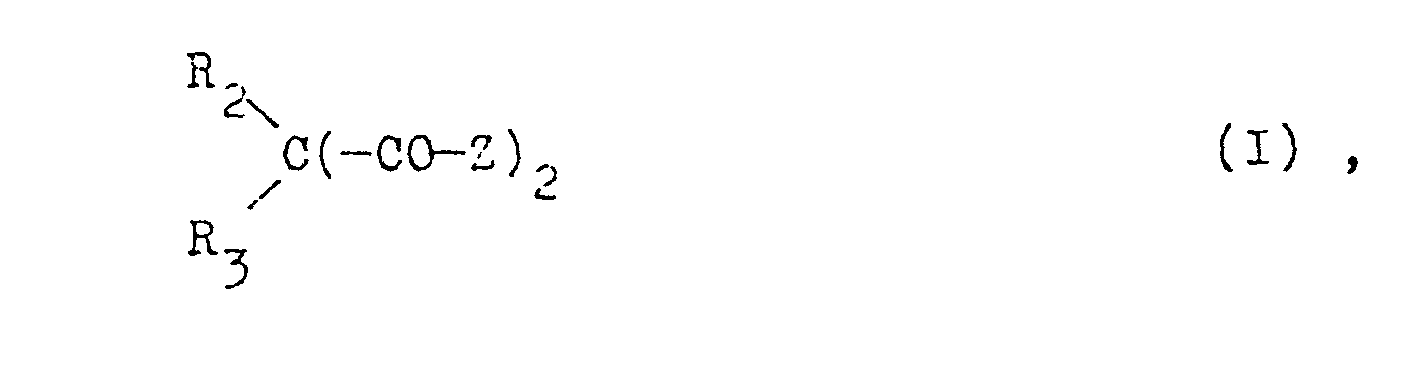
- Die Erfindung betrifft Malonsäurederivate der Formel I und deren Salze


- R1 Wasserstoff oder C1-C4 Alkyl ist,
- R 2 C1-C12 Alkyl, C3-C4 Alkenyl, Benzyl oder gegebenenfalls durch C1-C8 Alkyl oder C1-C8 Alkoxy substituiertes Phenyl oder Cyano ist,
- R3 C1-C12 Alkyl, C3-C4 Alkenyl oder Benzyl ist,
- R4 Wasserstoff, O', -OH, Alkyl mit 1-12 C-Atomen, Alkenyl mit 3 oder 4 C-Atomen, Propargyl, Benzyl oder eine Gruppe der Formel -CH2-CH(OR9)-R8 darstellt, worin R8 Wasserstoff, Methyl oder Phenyl und R9 Wasserstoff oder eine Gruppe A-CO- bedeuten; oder R4 eine Gruppe A-CO- bedeutet und in beiden Fällen A Alkyl mit 1-18 C-Atomen, Alkenyl mit 2 oder 3 C-Atomen, Cyclohexyl, Phenyl, Benzyl, eine durch 2 Alkylgruppen mit je 1-4 C-Atomen und eine Hydroxylgruppe substituierte Phenyl-, Phenylmethyl- oder Phenyläthylgruppe, Alkylamino mit 1-12 C-Atomen, Dialkylamino mit 2-16 C-Atomen, Anilino, Alkoxy mit 1-12 C-Atomen, Benzyloxy oder Phenoxy bedeutet,
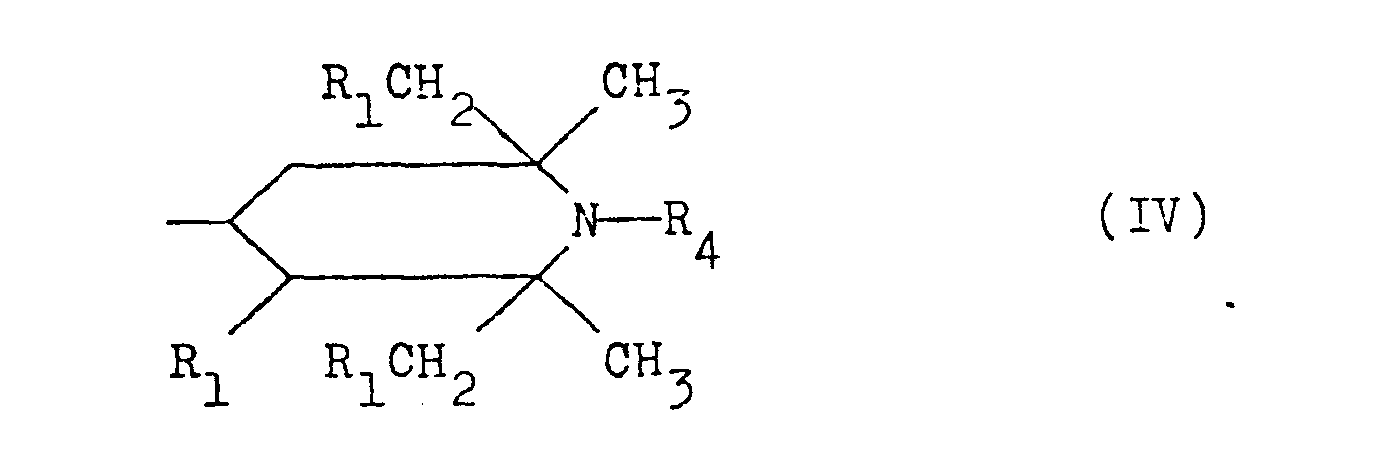
- 5 Wasserstoff, Alkyl mit 1-18 C-Atomen, Alkenyl mit 3-4 C-Atomen, Propargyl, Cycloalkyl mit 5-12 C-Atomen, Aralkyl mit 7-14 C-Atomen, das durch OH substituiert sein kann, oder eine Gruppe der Formel IV

- R6 Wasserstoff, Methyl, Aethyl oder Phenyl ist, .
- R7 Wasserstoff, -OR10 oder -N(R11)(R12) und R 10 Alkyl mit 1-18 C-Atomen, Alkenyl mit 3-4 C-Atomen, Benzyl, 2-Cyanoäthyl, eine aliphatische, cycloaliphatische, aromatische oder araliphatische Acylgruppe mit bis zu 18 C-Atomen, die im aromatischen Teil durch Halogen, Alkoxy mit 1-4 C-Atomen, Alkyl mit 1-4 C-Atomen und/oder Hydroxyl substituiert sein kann, bedeutet, R11 Alkyl mit 1-18 C-Atomen, Alkenyl mit 3-4 C-Atomen oder Phenylalkyl mit 7-9 C-Atomen ist und R12 dieselbe Bedeutung hat wie R11 oder eine aliphatische, cycloaliphatische, aromatische oder araliphatische Acylgruppe mit bis zu 18 C-Atomen darstellt, die im aromatischen Teil durch Halogen, Alkoxy mit 1-4 C-Atomen, Alkyl mit 1-4 C-Atomen und/oder Hydroxyl substituiert sein kann.
- R1 ist als C1-C4 Alkyl verzweigtes oder insbesondere unverzweigtes Alkyl, wie Aethyl, n-Propyl oder n-Butyl, vor allem aber Methyl. Bevorzugt ist R1 Wasserstoff. Alle Substituenten R1 sind gleich.
- R2 bzw. R3 ist als C1-C12 Alkyl verzweigtes oder unverzweigtes Alkyl, insbesondere solches mit 2-8 C-Atomen, wie Aethyl, n- oder i-Propyl, n- oder i-Butyl, ein Pentyl, Hexyl, Heptyl oder Octyl, wie'n- oder i-Octyl. Gleiches gilt für R4 als Alkyl, R5, A, R10 und R11 als Alkyl können zudem noch z.B. Tridecyl, Hexadecyl oder Octadecyl sein.
- R2 bzw. R3 ist als C3-C4 Alkenyl insbesondere Methallyl, vor allem Allyl. Gleiches gilt für R4, R5, R10 und R11. Alkenyl A ist insbesondere Vinyl oder Allyl.
- R2 ist als durch C1-C8 Alkyl substituiertes Phenyl insbesondere solches, das durch Aethyl, n- oder i-Propyl, vor allem aber durch Methyl substituiert ist und als durch C1-C8 Alkoxy substituiertes Phenyl solches, das durch Aethoxy, n- oder i-Propoxy, vor allem aber durch Methoxy substituiert ist. Bevorzugt ist Phenyl R2 aber unsubstituiert.
- Sind R2 und R3 Alkyl, so sollten nicht beide zugleich ein tertiäres a-C-Atom aufweisen. So ist im Fall von R2 und R3 gleich Alkyl mindestens eines davon ein solches mit einem primären oder sekundären a-C-Atom.
- R11 und R12 sind als Phenylalkyl mit 7-9 C-Atomen z.B. Benzyl, Phenyläthyl oder Phenylpropyl. R5 als Aralkyl mit 7-14 C-Atomen kann darüber hinaus auch z.B. Diphenylylmethyl, Naphthylpropyl oder Diphenylmethyl sein.
- Wenn R4 und/oder R9 eine Gruppe A-CO- darstellt, so kann dies, je nach der Bedeutung von A, ein Carbonsäurerest sein wie z.B. Acetyl, Propionyl, Butyryl, Capronyl, Capryloyl, Lauroyl, Acryloyl, Crotonoyl, Phenylacetyl-, β-(3,5-Di-tert.-butyl-4-hydroxyphenyl)-propionyl und -acetyl oder Benzoyl; oder ein Carbamoylrest wie z.B. Methylcarbamoyl, Butylcarbamoyl, Dodecylcarbamoyl, Diäthylcarbamoyl, Dihexylcarbamoyl, Dioctylcarbamoyl oder Phenylcarbamoyl; oder ein Carbonesterrest wie z.B. Aethoxycarbonyl-, Isopropoxycarbonyl, 2-Aethylhexyloxycarbonyl, Dodecyloxycarbonyl, Benzyloxycarbonyl oder Phenoxycarbonyl.
- Wenn R10 und/oder R12 eine aliphatische, cycloaliphatische, aromatische oder araliphatische Acylgruppe mit bis zu 18 C-Atomen darstellt, die im aromatischen Rest durch Halogen, Alkoxy, Alkyl oder OH substituiert sein kann, so kann es sich dabei beispielsweise um Acetyl, Propionyl, Isobutyryl, Capronyl, Capryloyl, Lauroyl, Stearoyl, Oleyl, Cyclohexancarbonyl, Benzoyl, 4-Chlorbenzoyl, Toluoyl, 3-Methoxybenzoyl, 2,4-Dichlorbenzoyl, 4-tert.-Butylbenzoyl, Phenylacetyl, 3,5-Di-tert.butyl-4-hydroxybenzoyl oder 4-Chlorphenylpropionyl handeln.
- R5 in der Bedeutung von Cycloalkyl mit 5-8 C-Atomen kann z.B. Cyclopentyl, Cyclohexyl oder Cyclooctyl sein. R12 als Cycloalkyl kann darüber binaus auch z.B. Cyclodecyl oder Cyclododecyl sein.
- Bevorzugt sind Malonate Ia der Formel I, worin
- R1 Wasserstoff oder Methyl ist,
- R2 C1-C8 Alkyl, Allyl, Methallyl, Benzyl oder Phenyl ist,
- R3 C2-C8 Alkyl, Allyl, Methallyl oder Benzyl ist,
- Z eine Gruppe der Formel II oder III ist,
- R4 Wasserstoff, O', Alkyl mit 1-8 C-Atomen, Allyl, Propargyl, Benzyl, Formyl, Acetyl, Acryloyl oder Crotonoyl,
- R5 Wasserstoff, Alkyl mit 1-12 C-Atomen, Cyclohexyl, Benzyl oder Phenyl,
- R6 Wasserstoff, Methyl oder Aethyl,
- R7 Wasserstoff oder -OR10 und R10 Wasserstoff, Alkyl mit 1-6 C-Atomen, Alkanoyl mit 2-12 C-Atomen, Benzoyl oder Fenzyl darstellt.
- Besonders bevorzugt sind Malonate Ib der Formel I, worin
- R1 Wasserstoff oder Methyl ist,
- R2 Cl-C8 Alkyl, Allyl, Methallyl, Benzyl oder Phenyl ist,
- R 3 C2-C8 Alkyl oder Benzyl ist,
- Z eine Gruppe der Formel II oder III ist,
- R4 Wasserstoff, Methyl, Benzyl oder Acetyl ist,
- R Wasserstoff oder C1-C4 Alkyl ist, und
- R6 und R7 Wasserstoff sind.
- Vor allem betrifft die Erfindung Malonate Ic der Formel I, worin
- R1 Wasserstoff oder Methyl ist,
- R2 C1-C6 Alkyl, Allyl, Methallyl oder Benzyl ist,
- R 3 Benzyl ist, und
- Z eine Gruppe der Formel II oder III ist,
- R4 Wasserstoff oder Methyl ist, und
- R5,R6undR7Wasserstoff sind.
- Bevorzugt ist in obigen Malonaten I und Ia-Ic R2 und R3 Benzyl. Bevorzugt ist zudem R1 Wasserstoff.
- Beispiele für Malonate der Formel I sind aus den Ausführungsbeispielen ersichtlich. Diese sind vor allem bevorzugt.
- Die vorliegende Erfindung umfasst auch die Salze von Verbindungen der Formel I, die durch Addition von Säuren in maximal den Piperidingruppen äquivalenten Mengen entstehen. Solche Säuren können anorganische Säuren sein, wie z.B. Schwefel-,Salz oder Phosphorsäure, organische Carbonsäuren wie Ameisen-, Essig-, Oxal-, Malein-, Benzoe- oder Salicylsäure, organische Sulfonsäuren wie Methan- oder p- Toluolsulfonsäure oder organische phosphorhaltige Säuren, wie Diphenylphosphorsäure, Methanphosphonsäure oder Diphenylphosphinsäure.
- Die Verbindungen der Formel I können nach verschiedenen mehrstufigen Verfahren hergestellt werden, wobei die einzelnen Verfahrensschritte an sich bekannte Reaktionen darstellen.
- Zur Herstellung der Verbindungen der Formel I geht man vorzugsweise von Verbindungen der;Formel CH2(-COZ)2 aus. In diese fÜhrt man entweder zuerst den Substituenten R2 und anschliessend den Substituenten R3 ein oder man führt zuerst den Substituenten R3 und anschliessend R2 ein. Sind R2 und R3 identisch, so können beide in einem Schritt eingeführt werden. f
- Die Ausgangsmaterialien CH2COZ)2 können durch Umsetzung der entsprechenden Niederakylester CH2(COO-Alkyl)2 mit den Piperidinderivaten der Formel ZH hergestellt werden. Beispiele für letztere Verbindungen sind 1,2,2,6,6-Pentamethyl-4-amninopiperälin, 1-Hydroxyäthyl-2,2,6,6-tetramethyl-piperidin, 1-( -Hydroxypropyl)-2,2,6,6-tetramethyl-piperidin, oder 1-(2-Hidroxypropyl)-2,3,6-trimethyl-2,6-diäthyl-4-acetoxypiperlin. Anstelle der Niederalkylester können auch die entsprichenden Säurechloride CH2(COCl)2 mit den Piperidinderi aten umgesetzt werden.
- Der Rest R2 kann nachart einer Malonestersynthese eingeführt werden, indem eine Verbindung CH2(-COZ)2 erst durch Reaktion mit einem Aequiy lent Alkalimetall, Alkalialkoholat, Alkaliamid, Alkalih irid oder einer ähnlichen basischen Alkaliverbindung in die Alkaliverbindung übergeführt wird und anschliessend at 1 Mol eines R2-Halogenides R2 Hal (Hal=Cl, Br oder J) in blicher Weise umgesetzt wird.
- Anschliessend muss in dieses R2-Malonsäurederivat der Substituent R3 eingeführt werden. Ist allerdings R2 gleich R3, so kann die Einführung beider Reste vorteilhaft gleichzeitig erfolgen.
- Die Einfiihrung des Substituenten R3 kann nach dei klassischen Methode der C-Alkylierung von Malonsäurederivaten geschehen, wobei wiederum zunächst die Alkaliverbindung hergestellt und dann mit einer Halogenverbindung R3Hal umgesetzt wird. Hierbei bedeutet Hal wieder Cl, Br oder J. Pro Mol Alkaliverbindung wird etwa ein Mol eines Monohalogenides R3Hal verwendet. Beispiele hierfür sind Alkyl-, Alkenyl- oder Benzylhalogenide.
- Schliesslich kann auch die Einführung von R4 zusammen mit der Einführung von R3 geschehen, wenn R4 und R3 identisch sind, z.B. in ihrer Bedeutung als Alkyl, Alkenyl oder Benzyl.
- Auf Grund dieser mannigfachen Möglichkeiten zur Durchführung der einzelnen Reaktionsschritte,
-
- Einführung des Piperidinylrestes,
- Einführung der Gruppe R2,
- Einführung der Gruppe R3,
- und gegebenenfalls Einführung von R4,
- Vorteilhaft kann man obige Umsetzung eines Malonsäureniederalkylesters mit einem Piperidinderivat auch mit einem Malonester durchführen, der in a-Stellung durch R2 und R3 substituiert ist, wobei man insbesondere wie oben vorgeht.
- Die Ausgangsstoffe sind bekannt oder können, sofern sie neu sind, nach an sich bekannten Methoden und in Analogie zu bekannten Verbindungen hergestellt werden.
- Die Verbindungen der Formel I können gemäss der vorliegenden Erfindung als Stabilisatoren für Kunststoffe gegen deren Schädigung durch Einwirkung von Sauerstoff, Wärme und Licht verwendet werden. Beispiele für solche Kunststoffe sind Polyäther-polyester, sowie die in der DT-OS 2 456 864 auf den Seiten 12-14 aufgeführten Polymeren.
- Von besonderer Bedeutung ist die Stabilisierung von Polyolefinen, Styrolpolymerisaten und von Polyurethanen, für die sich die Verbindungen der Formel I hervorragend eignen. Beispiele hierfür sind Polyäthylen hoher und niedriger Dichte. Polypropylen, Aethylen-Polypropflen-Copolymerisate, Polystyrol, Styrol-Butadien-Acrylnitril-Copolymerisate, Mischungen von Polyolefinen oder von Styrolpolymerisaten, Polyurethane auf Polyäther- oder Polyesterbasis in Form von Lacken, Elastomeren oder Schaumstoffen.
- Die Stabilisatoren werden den Kunststoffen in einer Konzentration von 0,01 bis 5 Gew.-% berechnet auf das zu stabilisierende Material, zugesetz . Vorzugsweise werden 0,03 bis 1,5, besonders bevorzugt ,2 bis 0,6 Gew.-% der Verbindungen, berechnet auf das zu siabilisierende Material, in dieses eingearbeitet.
- Die Einarbeitung kann nach der Polymerisation erfolgen, beispielsweise durch Einmischen der Verbindungen und gegebenenfalls weiterer Additive in die Schmelze nach den in der Technik üblichen Methoden, vor oder während der Formgebung, oder auch durch Aufbringen der gelösten oder dispergierten Verbindungen auf das Polymere, gegebenenfalls unter nachträglichem Verdunsten des Lösungsmittels.
- Die neuen Verbindungen können auch in Form eines Masterbatches, der diese Verbindungen beispielsweise in einer Konzentration von 2,5 bis 25 Gew.-% enthält, den zu stabilisierenden Kunststoffen zugesetzt werden.
- Im Falle von vernetztem Polyäthylen werden die Verbindungen vor der Vernetzung beigefügt.
- • Ausser den Verbindungen der Formel I können den Kunststoffen auch noch andere, bekannte Stabilisatoren zugesetzt werden. Dies können z.B. Antioxydantien, Lichtschutzmittel oder Metalldesaktivatoren sein, oder auch Costabilisatoren wie z.B·. solche vom Typ der Phosphorigsäureester. Weiterhin können sonstige in der Kunststofftechnologie übliche Zusatz wie z.B. Flammschutzmittel, Antistatika, Weichmacher, Gleitmittel, Treibmittel, Pigmente, Verstärkungsstoffe oder Füllstoffe zugesetzt werden.
- Die Erfindung betrifft daher auch die durch Zusatz von 0,01 bis 5 Gew.-% einer Verbindung der Formel I stabilisierten Kunststoffe, die gegebenenfalls noch andere bekannte und übliche Zusätze enthalten können. Die so stabilisierten Kunststoffe können in verschiedenster Form angewendet werden z.B. als Folien, Fasern, Bändchen, Profile oder als Bindemittel für Lacke, Klebemittel oder Kitte.
- Die Herstellung und Verwendung der erfindungsgemässen Verbindungen wird in den folgenden Beispielen näher beschrieben. Teile bedeuten darin Gewichtsteile und % Gewichtsprozente. Die Temperaturen sind in Celsius-Graden angegeben.
- Eine auf 125° erhitzte Lösung von 31,2 g Dibenzylmalonsäure-dimethylester (Smp. 60-61°) und 37,1 g 1-(2-Hydroxyäthyl)-2,?,6,6-tetramethyl-piperidin (Smp. 96-97°) in 300 ml wasserfreiem Xylol versetzt man unter Rühren mit 0,15 g Lithiumamid. Hierauf wird das Reaktionsgemisch unter gleichzeitigem Durchleiten eines schwachen Stickstoffstromes innerhalb von 3 Stunden bis auf 136°C erhitzt und über einen absteigenden Kühler das freigesetzte Methanol sowie auch Xylol abdestilliert. Die Innnentemperatur wird dann auf 150°C gesteigert und das Xylol weitgehend abdestilliert (Dauer ca. 4 Stunden). Nach dem Abkühlen wird das Reaktionsgemisch in Chloroform gelöst, wiederholt mit Wasser gewaschen, über Natriumsulfat getrocknet das Lösungsmittel im Vakuum vollständig abdestilliert und der Rückstand in n-Hexan kristallisiert, wodurch reiner Dibenzylmalonsäure-bis-[2-(2,2,6,6-tetramethyl-1-piperidinyl)-äthyl]-ester vom Smp. 77-78°C erhalten wurde (Stabilisator Nr. 1).
- In analoger Weise wie nach Beispiel 1 erhält man aus Dibenzylmalonsäure-dimethylester und 1-(2-Hydroxy-propyl)-2,2,6,6-tetramethyl-piperidin den Dibenzylmalonsäure- bis-(2-(2,2,6,6-tetramethyl-1-piperidinyl)-propylj]ester (Diastereoisomerengemisch), Smp. etwa 85° (Stabilisator Nr. 2).

- In analoger Weise wie nach Beispiel 1 erhäit man aus Dibenzylmalonsäure-dimethylester und 1-(2-Hydroxy-2-phenyl-äthyl)-2,2,6,6-tetramethyl-piperidin den Dibenzylmalonsäure-bis-[1-phenyl-2-(2,2,6,6-tetramethyl-1-piperidinyl)-äthyl)-ester (Diastereoisomerengemisch), Smp. etwa 140° (Stabilisator Nr. 3).

- Zu einer Suspension von ölfreiem Natriumhydrid (0,97 g) in Toluol ( 20 ml) tropft man unter Rühren innerhalb von ca. 1/2 Stunde bei 40° die Lösung von 20 g Benzylmalonsäure-bis-(l,2,2,6,6-pentamethyl-4-piperidinyl)-amid in 50 ml Toluol und 100 ml Dimethylformamid. Nach der Zugabe des Amids wird das Reaktionsgemisch für weitere 20 Stunden bei 60°C gerührt bis alles Natriumhydrid umgesetzt ist. Hierauf tropft man innerhalb von 40 Minuten bei Raumtemperatur die Lösung von 7,7 g Benzylbromid in 10 ml Toluol zum Reaktionsgemisch, erhöht anschliessend die Temperatur auf 70° und rührt weitere 12 Stunden bei dieser Temperatur. Zur Aufarbeitung wird die Reaktionslösung warm vom ausgefallenen Natriumbromid abfiltriert, der Rückstand mit Chloroform gut gewaschen und die vereinigten Filtrate am Rotationsverdampfer möglichst vollständig von allen Lösungsmitteln befreit. Den Rückstand löst man in 400 ml Chloroform, extrahiert die Lösung wiederholt mit Wasser, trocknet über Natriumsulfat und entfernt das Lösungsmittel im Vakuum. Der kristalline Rückstand wird einmal in Toluol und einmal in Benzol umkristallisiert, wodurch Dibenzylmalonsäure-bis-(1,2,2,6,6-pentamethyl-4-piperidinyl)-amid vom Smp. 275-277° erhalten wurde (Stabilisator Nr. 4).
- Das als Ausgangsmaterial verwendete Benzylmalonsäure-bis-(1,2,2,6,6-pentamethyl-4-piperidinyl)-amid lässt sich durch Amidierung von Benzylmalonsäure-diäthylester mit mindestens 2 Aequivalenten 4-Amino-1,2,2,6,6-pentamethyl-piperidin bei 130-150° in Gegenwart eines basischen Katalysators, wie z.B. Lithiumamid, herstellen, Smp. 242-243°.
- In analoger Weise wie nach Beispiel 4 erhält ma aus Benzylmalonsäure-bis-(1,2,2,6,6-pentamethyl-4-piperidinyl)-amid und n-Octylbromid das Benzyl-n-octyl-bis-(1,2,2,6,6-pentamethyl-4-piperidinyl)-amid, Smp. 164-166° (Stabilisator Nr. 5).
- 100 Teile Polypropylenpulver (Moplen. Fibre grade, der Firma Montedison) werden mit 0,2 Teilen β-(3,5-Di- tert.butyl-4-hydroxyphenyl)-propionsäure-octadecylester und 0,25 Teilen eines Stabilisators der folgenden Tabelle I im Brabenderplastographen bei 200°C während 10 Minuten homogenisiert. Die so erhaltene Masse wird möglichst rasch dem Kneter entnommen und in einer Kniehebelpresse zu einer 2-3 mm dicken Platte gepresst. Ein Teil des erhaltenen Rohpresslings wird ausgeschnitten und zwischen zwei Hochglanz-Hartaluminiunfolien mit einer Laborpresse während 6 Minuten bei 260° und 40 kg/cm2 Druck zu einer 0,1 mm dicken Folie gepresst, die unverzüglich in kaltem Wasser abgeschreckt wird. Aus dieser werden nun Abschnitte von je 60x44 mm gestanzt und mit der in der Tabelle I geweils erwähnten Belichtungsapparatur belichtet. In regelmässigen Zeitabständen werden diese Prüflinge aus dem Belichtungsapparat entnommen und in einem IR-Spektrophotometer auf ihren Carbonylgehalt geprüft. Die Zunahme der Carbonylextinktion bei 5.85 µ bei der Belichtung ist ein Mass für den photooxidativen Abbau des Polymeren (s. L. Balaban et al., H. Polymer Sci. Part C, 22, 1059-1071 (1969)) und ist erfahrungsgemäss mit einem Abfall der mechanischen Eigenschaften des Polymeren verbunden. So ist z.B. die Folie bei Erreichen einer Carbonylextinktion von ca. 0,300 vollständig brüchig.
- Die Schutzwirkung der Stabilisatoren gemäss Erfindung ist aus folgender Tabelle 1 ersichtlich:

- In analoger Weise wie nach Beispiel 1 erhält man aus Dibenzylmalonsäuredimethylester und 1-(2-Hydroxy-butyl)-2,2,6,6-tetramethyl-piperidin (Smp.: 109-110° C) den Dibenzylmalonsäure-bis-[2-(2,2,6,6-tetramethyl-1-piperidinyl)-butyl]-ester (Diastereoisomerengemisch) als farbloser Harz.

wird man die Reihenfolge der einzelnen Schritte so wählen, wie es im einzelnen Fall am zweckmässigsten erscheint.
Claims (9)

Applications Claiming Priority (2)
| Application Number | Priority Date | Filing Date | Title |
|---|---|---|---|
| CH1476977 | 1977-12-02 | ||
| CH14769/77 | 1977-12-02 |
Publications (3)
| Publication Number | Publication Date |
|---|---|
| EP0002260A2 true EP0002260A2 (de) | 1979-06-13 |
| EP0002260A3 EP0002260A3 (en) | 1979-06-27 |
| EP0002260B1 EP0002260B1 (de) | 1982-07-14 |
Family
ID=4403685
Family Applications (1)
| Application Number | Title | Priority Date | Filing Date |
|---|---|---|---|
| EP78101492A Expired EP0002260B1 (de) | 1977-12-02 | 1978-12-01 | Malonsäurederivate von sterisch gehinderten Piperidinen, Verfahren zu ihrer Herstellung und mit ihnen stabilisiertes organisches Material |
Country Status (4)
| Country | Link |
|---|---|
| US (1) | US4237297A (de) |
| EP (1) | EP0002260B1 (de) |
| JP (1) | JPS5498777A (de) |
| DE (1) | DE2861955D1 (de) |
Cited By (4)
| Publication number | Priority date | Publication date | Assignee | Title |
|---|---|---|---|---|
| FR2447912A1 (fr) * | 1979-02-01 | 1980-08-29 | Montedison Spa | Derives n-alkyl-piperidine de l'acide hydroxy-benzylmalonique et compositions de polymeres stabilisees en les employant |
| EP0119961A1 (de) * | 1983-03-21 | 1984-09-26 | Ciba-Geigy Ag | Oligoester mit Polyalkylpiperidingruppen |
| EP0303279A3 (de) * | 1987-08-12 | 1990-08-01 | Elf Atochem North America, Inc. | Reaktive Amin-Leuchtstabilisatoren |
| FR2652578A1 (fr) * | 1989-10-02 | 1991-04-05 | Rhone Poulenc Chimie | Nouvelles dihydropyridines a groupements amine encombree. |
Families Citing this family (25)
| Publication number | Priority date | Publication date | Assignee | Title |
|---|---|---|---|---|
| IT1165130B (it) * | 1979-06-28 | 1987-04-22 | Montedison Spa | Policondensati di piperidine sostituite e loro impiego come stabilizzanti per polimeri |
| JP3006060B2 (ja) * | 1990-09-13 | 2000-02-07 | 住友化学工業株式会社 | 2,2,6,6―テトラメチルピペリジン系光安定剤の造粒方法 |
| US9828324B2 (en) | 2010-10-20 | 2017-11-28 | Sirrus, Inc. | Methylene beta-diketone monomers, methods for making methylene beta-diketone monomers, polymerizable compositions and products formed therefrom |
| US10414839B2 (en) | 2010-10-20 | 2019-09-17 | Sirrus, Inc. | Polymers including a methylene beta-ketoester and products formed therefrom |
| US9249265B1 (en) | 2014-09-08 | 2016-02-02 | Sirrus, Inc. | Emulsion polymers including one or more 1,1-disubstituted alkene compounds, emulsion methods, and polymer compositions |
| US9279022B1 (en) | 2014-09-08 | 2016-03-08 | Sirrus, Inc. | Solution polymers including one or more 1,1-disubstituted alkene compounds, solution polymerization methods, and polymer compositions |
| US8884051B2 (en) | 2010-10-20 | 2014-11-11 | Bioformix Inc. | Synthesis of methylene malonates using rapid recovery in the presence of a heat transfer agent |
| MX360462B (es) | 2011-10-19 | 2018-11-05 | Sirrus Inc | Monomeros de metileno beta-dicetona, procedimientos de preparacion de monomeros de metileno beta-dicetona, composiciones polimerizables y productos formados a partir de ellos. |
| EP2831124B1 (de) | 2012-03-30 | 2016-10-05 | Sirrus, Inc. | Zusammengesetzte und laminierte artikel sowie polymerisierbare systeme zur herstellung davon |
| EP2831125B1 (de) | 2012-03-30 | 2016-10-05 | Sirrus, Inc. | Verfahren zur aktivierung von polymerisierbaren zusammensetzungen, polymerisierbare systeme und damit hergestellte produkte |
| WO2013149173A1 (en) | 2012-03-30 | 2013-10-03 | Bioformix Inc. | Ink and coating formulations and polymerizable systems for producing the same |
| US10047192B2 (en) | 2012-06-01 | 2018-08-14 | Sirrus, Inc. | Optical material and articles formed therefrom |
| CN105008438B (zh) | 2012-11-16 | 2019-10-22 | 拜奥福米克斯公司 | 塑料粘结体系及方法 |
| WO2014085570A1 (en) | 2012-11-30 | 2014-06-05 | Bioformix, Inc. | Composite compositions for electronics applications |
| CN110204441A (zh) | 2013-01-11 | 2019-09-06 | 瑟拉斯公司 | 经过双(羟甲基)丙二酸酯的途径获得亚甲基丙二酸酯的方法 |
| US9315597B2 (en) | 2014-09-08 | 2016-04-19 | Sirrus, Inc. | Compositions containing 1,1-disubstituted alkene compounds for preparing polymers having enhanced glass transition temperatures |
| US9416091B1 (en) | 2015-02-04 | 2016-08-16 | Sirrus, Inc. | Catalytic transesterification of ester compounds with groups reactive under transesterification conditions |
| US10501400B2 (en) | 2015-02-04 | 2019-12-10 | Sirrus, Inc. | Heterogeneous catalytic transesterification of ester compounds with groups reactive under transesterification conditions |
| US9334430B1 (en) | 2015-05-29 | 2016-05-10 | Sirrus, Inc. | Encapsulated polymerization initiators, polymerization systems and methods using the same |
| US9217098B1 (en) | 2015-06-01 | 2015-12-22 | Sirrus, Inc. | Electroinitiated polymerization of compositions having a 1,1-disubstituted alkene compound |
| US9518001B1 (en) | 2016-05-13 | 2016-12-13 | Sirrus, Inc. | High purity 1,1-dicarbonyl substituted-1-alkenes and methods for their preparation |
| US9617377B1 (en) | 2016-06-03 | 2017-04-11 | Sirrus, Inc. | Polyester macromers containing 1,1-dicarbonyl-substituted 1 alkenes |
| US10428177B2 (en) | 2016-06-03 | 2019-10-01 | Sirrus, Inc. | Water absorbing or water soluble polymers, intermediate compounds, and methods thereof |
| US10196481B2 (en) | 2016-06-03 | 2019-02-05 | Sirrus, Inc. | Polymer and other compounds functionalized with terminal 1,1-disubstituted alkene monomer(s) and methods thereof |
| US9567475B1 (en) | 2016-06-03 | 2017-02-14 | Sirrus, Inc. | Coatings containing polyester macromers containing 1,1-dicarbonyl-substituted 1 alkenes |
Family Cites Families (8)
| Publication number | Priority date | Publication date | Assignee | Title |
|---|---|---|---|---|
| US3640928A (en) * | 1968-06-12 | 1972-02-08 | Sankyo Co | Stabilization of synthetic polymers |
| BE792043A (fr) * | 1971-11-30 | 1973-05-29 | Ciba Geigy | Derives de la piperidine utilisables pour stabiliser des matieres organiques |
| CH589056A5 (de) * | 1973-12-10 | 1977-06-30 | Ciba Geigy Ag | |
| DE2647452A1 (de) * | 1975-11-07 | 1977-05-18 | Ciba Geigy Ag | Neue hydroxybenzylmalonsaeure-derivate |
| CH601232A5 (de) * | 1975-12-08 | 1978-06-30 | Ciba Geigy Ag | |
| DE2656769A1 (de) * | 1975-12-29 | 1977-07-14 | Ciba Geigy Ag | Neue phenol-stabilisatoren |
| DE2718458A1 (de) * | 1976-05-04 | 1977-11-24 | Ciba Geigy Ag | Neue stabilisatoren |
| DE2727385A1 (de) * | 1976-06-23 | 1977-12-29 | Ciba Geigy Ag | Neue diazocarbonsaeurederivate und ihre verwendung zum stabilisieren von polymeren |
-
1978
- 1978-12-01 EP EP78101492A patent/EP0002260B1/de not_active Expired
- 1978-12-01 DE DE7878101492T patent/DE2861955D1/de not_active Expired
- 1978-12-02 JP JP14958378A patent/JPS5498777A/ja active Pending
-
1979
- 1979-11-05 US US06/091,630 patent/US4237297A/en not_active Expired - Lifetime
Cited By (5)
| Publication number | Priority date | Publication date | Assignee | Title |
|---|---|---|---|---|
| FR2447912A1 (fr) * | 1979-02-01 | 1980-08-29 | Montedison Spa | Derives n-alkyl-piperidine de l'acide hydroxy-benzylmalonique et compositions de polymeres stabilisees en les employant |
| EP0119961A1 (de) * | 1983-03-21 | 1984-09-26 | Ciba-Geigy Ag | Oligoester mit Polyalkylpiperidingruppen |
| EP0303279A3 (de) * | 1987-08-12 | 1990-08-01 | Elf Atochem North America, Inc. | Reaktive Amin-Leuchtstabilisatoren |
| FR2652578A1 (fr) * | 1989-10-02 | 1991-04-05 | Rhone Poulenc Chimie | Nouvelles dihydropyridines a groupements amine encombree. |
| EP0421890A1 (de) * | 1989-10-02 | 1991-04-10 | Great Lakes Chemical France S.A. | Dihydropyridine mit gehinderten Aminogruppen |
Also Published As
| Publication number | Publication date |
|---|---|
| EP0002260A3 (en) | 1979-06-27 |
| US4237297A (en) | 1980-12-02 |
| DE2861955D1 (en) | 1982-09-02 |
| JPS5498777A (en) | 1979-08-03 |
| EP0002260B1 (de) | 1982-07-14 |
Similar Documents
| Publication | Publication Date | Title |
|---|---|---|
| EP0002260B1 (de) | Malonsäurederivate von sterisch gehinderten Piperidinen, Verfahren zu ihrer Herstellung und mit ihnen stabilisiertes organisches Material | |
| DE2647452C2 (de) | ||
| DE2718458C2 (de) | ||
| DE2760429C2 (de) | ||
| US4148784A (en) | Phenol stabilizers | |
| DE2730449A1 (de) | Neue 1,3-pyrimidine und 1,3,5-triazine | |
| US4238613A (en) | Polyalkylpiperidine derivatives | |
| DE2456864A1 (de) | Stabilisatoren fuer synthetische polymere | |
| CH645908A5 (de) | Verfahren zum stabilisieren von polymeren organischen materialien. | |
| EP0010518A1 (de) | Seitenständige N-heterocyclische Ringe tragende Copolymere, deren Verwendung und Verfahren zu deren Herstellung | |
| DE2654058A1 (de) | Hydroxybenzylmalonsaeurederivate | |
| EP0000352B1 (de) | Aromatische cyclische Phosphonigsäure-diester und mit diesen Verbindungen stabilisiertes organisches Material | |
| EP0213570A2 (de) | Glykolurilderivate und ihre Verwendung als Stabilisatoren für Polymere | |
| EP0013443B1 (de) | 2,2,6,6-Tetramethylpiperidin-Derivate, Verfahren zu ihrer Herstellung und mit ihrer Hilfe stabilisierte synthetische Polymere | |
| DE2721398A1 (de) | Alkylphenol-stabilisatoren | |
| EP0000487A1 (de) | Enolgruppen enthaltende Verbindungen, deren Metallchelate, deren Herstellung und Verwendung als Lichtschutzmittel insbesondere in hochmolekularen Verbindungen. | |
| DE2745058A1 (de) | Bis-polyalkylpiperidine | |
| DE2656999A1 (de) | Neue phosphite | |
| CH622536A5 (de) | ||
| EP0349862B1 (de) | 2,6-Polyalkyl-piperidin-4-amide, deren Verwendung als Stabilisatoren, insbesondere für Kunststoffe, sowie diese Amide enthaltendes organisches Material | |
| EP0374761A1 (de) | Verfahren zur Herstellung von phosphororganischen Derivaten des 2,4-Di-t-butylphenols, der 4,4'-Dihalogenmagnesium-Verbindungen des Biphenyls und die Verwendung der phosphororganischen Derivate zur Stabilisierung von Kunststoffen, insbesondere in Polyolefinformmassen | |
| DE2717087A1 (de) | Neue stabilisatoren | |
| EP0007533B1 (de) | Piperidin-Derivate, Verfahren zu ihrer Herstellung und ihre Verwendung als Stabilisatoren für synthetische Polymere | |
| DE2656766A1 (de) | Neue phosphit-stabilisatoren | |
| EP0017617A2 (de) | Polyalkylpiperidin-spirooxazolone, ihre Verwendung als Lichtschutzmittel und mit diesen Verbindungen stabilisierter Kunststoff |
Legal Events
| Date | Code | Title | Description |
|---|---|---|---|
| PUAI | Public reference made under article 153(3) epc to a published international application that has entered the european phase |
Free format text: ORIGINAL CODE: 0009012 |
|
| PUAL | Search report despatched |
Free format text: ORIGINAL CODE: 0009013 |
|
| AK | Designated contracting states |
Designated state(s): BE CH DE FR GB IT NL |
|
| AK | Designated contracting states |
Designated state(s): BE CH DE FR GB IT NL |
|
| 17P | Request for examination filed | ||
| ITF | It: translation for a ep patent filed | ||
| GRAA | (expected) grant |
Free format text: ORIGINAL CODE: 0009210 |
|
| AK | Designated contracting states |
Designated state(s): CH DE FR GB IT |
|
| RBV | Designated contracting states (corrected) |
Designated state(s): CH DE FR GB IT |
|
| REF | Corresponds to: |
Ref document number: 2861955 Country of ref document: DE Date of ref document: 19820902 |
|
| PGFP | Annual fee paid to national office [announced via postgrant information from national office to epo] |
Ref country code: CH Payment date: 19821231 Year of fee payment: 5 |
|
| PG25 | Lapsed in a contracting state [announced via postgrant information from national office to epo] |
Ref country code: CH Effective date: 19831231 |
|
| REG | Reference to a national code |
Ref country code: CH Ref legal event code: PL |
|
| PGFP | Annual fee paid to national office [announced via postgrant information from national office to epo] |
Ref country code: DE Payment date: 19841107 Year of fee payment: 7 |
|
| PGFP | Annual fee paid to national office [announced via postgrant information from national office to epo] |
Ref country code: FR Payment date: 19841112 Year of fee payment: 7 |
|
| GBPC | Gb: european patent ceased through non-payment of renewal fee | ||
| PG25 | Lapsed in a contracting state [announced via postgrant information from national office to epo] |
Ref country code: FR Free format text: LAPSE BECAUSE OF NON-PAYMENT OF DUE FEES Effective date: 19870831 |
|
| PG25 | Lapsed in a contracting state [announced via postgrant information from national office to epo] |
Ref country code: DE Effective date: 19870901 |
|
| REG | Reference to a national code |
Ref country code: FR Ref legal event code: ST |
|
| PG25 | Lapsed in a contracting state [announced via postgrant information from national office to epo] |
Ref country code: GB Free format text: LAPSE BECAUSE OF NON-PAYMENT OF DUE FEES Effective date: 19881117 |
|
| PLBE | No opposition filed within time limit |
Free format text: ORIGINAL CODE: 0009261 |
|
| STAA | Information on the status of an ep patent application or granted ep patent |
Free format text: STATUS: NO OPPOSITION FILED WITHIN TIME LIMIT |