EP0000719B1 - Neue 1,4-Epoxy-trimethyl-butenyliden-cyclohexane (I), Verfahren zu deren Herstellung, Verwendung von (I) als Riech- und/oder Geschmackstoffe, Riech- und/oder Geschmackstoffkompositionen mit einem Gehalt an den neuen Cyclohexanen - Google Patents
Neue 1,4-Epoxy-trimethyl-butenyliden-cyclohexane (I), Verfahren zu deren Herstellung, Verwendung von (I) als Riech- und/oder Geschmackstoffe, Riech- und/oder Geschmackstoffkompositionen mit einem Gehalt an den neuen Cyclohexanen Download PDFInfo
- Publication number
- EP0000719B1 EP0000719B1 EP78100472A EP78100472A EP0000719B1 EP 0000719 B1 EP0000719 B1 EP 0000719B1 EP 78100472 A EP78100472 A EP 78100472A EP 78100472 A EP78100472 A EP 78100472A EP 0000719 B1 EP0000719 B1 EP 0000719B1
- Authority
- EP
- European Patent Office
- Prior art keywords
- compounds
- formula
- trans
- fragrance
- trimethyl
- Prior art date
- Legal status (The legal status is an assumption and is not a legal conclusion. Google has not performed a legal analysis and makes no representation as to the accuracy of the status listed.)
- Expired
Links
Classifications
-
- C—CHEMISTRY; METALLURGY
- C07—ORGANIC CHEMISTRY
- C07D—HETEROCYCLIC COMPOUNDS
- C07D493/00—Heterocyclic compounds containing oxygen atoms as the only ring hetero atoms in the condensed system
- C07D493/02—Heterocyclic compounds containing oxygen atoms as the only ring hetero atoms in the condensed system in which the condensed system contains two hetero rings
- C07D493/08—Bridged systems
-
- C—CHEMISTRY; METALLURGY
- C07—ORGANIC CHEMISTRY
- C07C—ACYCLIC OR CARBOCYCLIC COMPOUNDS
- C07C29/00—Preparation of compounds having hydroxy or O-metal groups bound to a carbon atom not belonging to a six-membered aromatic ring
- C07C29/132—Preparation of compounds having hydroxy or O-metal groups bound to a carbon atom not belonging to a six-membered aromatic ring by reduction of an oxygen containing functional group
- C07C29/136—Preparation of compounds having hydroxy or O-metal groups bound to a carbon atom not belonging to a six-membered aromatic ring by reduction of an oxygen containing functional group of >C=O containing groups, e.g. —COOH
- C07C29/147—Preparation of compounds having hydroxy or O-metal groups bound to a carbon atom not belonging to a six-membered aromatic ring by reduction of an oxygen containing functional group of >C=O containing groups, e.g. —COOH of carboxylic acids or derivatives thereof
-
- C—CHEMISTRY; METALLURGY
- C07—ORGANIC CHEMISTRY
- C07C—ACYCLIC OR CARBOCYCLIC COMPOUNDS
- C07C403/00—Derivatives of cyclohexane or of a cyclohexene or of cyclohexadiene, having a side-chain containing an acyclic unsaturated part of at least four carbon atoms, this part being directly attached to the cyclohexane or cyclohexene or cyclohexadiene rings, e.g. vitamin A, beta-carotene, beta-ionone
- C07C403/06—Derivatives of cyclohexane or of a cyclohexene or of cyclohexadiene, having a side-chain containing an acyclic unsaturated part of at least four carbon atoms, this part being directly attached to the cyclohexane or cyclohexene or cyclohexadiene rings, e.g. vitamin A, beta-carotene, beta-ionone having side-chains substituted by singly-bound oxygen atoms
- C07C403/08—Derivatives of cyclohexane or of a cyclohexene or of cyclohexadiene, having a side-chain containing an acyclic unsaturated part of at least four carbon atoms, this part being directly attached to the cyclohexane or cyclohexene or cyclohexadiene rings, e.g. vitamin A, beta-carotene, beta-ionone having side-chains substituted by singly-bound oxygen atoms by hydroxy groups
-
- C—CHEMISTRY; METALLURGY
- C07—ORGANIC CHEMISTRY
- C07C—ACYCLIC OR CARBOCYCLIC COMPOUNDS
- C07C403/00—Derivatives of cyclohexane or of a cyclohexene or of cyclohexadiene, having a side-chain containing an acyclic unsaturated part of at least four carbon atoms, this part being directly attached to the cyclohexane or cyclohexene or cyclohexadiene rings, e.g. vitamin A, beta-carotene, beta-ionone
- C07C403/14—Derivatives of cyclohexane or of a cyclohexene or of cyclohexadiene, having a side-chain containing an acyclic unsaturated part of at least four carbon atoms, this part being directly attached to the cyclohexane or cyclohexene or cyclohexadiene rings, e.g. vitamin A, beta-carotene, beta-ionone having side-chains substituted by doubly-bound oxygen atoms
- C07C403/16—Derivatives of cyclohexane or of a cyclohexene or of cyclohexadiene, having a side-chain containing an acyclic unsaturated part of at least four carbon atoms, this part being directly attached to the cyclohexane or cyclohexene or cyclohexadiene rings, e.g. vitamin A, beta-carotene, beta-ionone having side-chains substituted by doubly-bound oxygen atoms not being part of —CHO groups
-
- C—CHEMISTRY; METALLURGY
- C07—ORGANIC CHEMISTRY
- C07C—ACYCLIC OR CARBOCYCLIC COMPOUNDS
- C07C45/00—Preparation of compounds having >C = O groups bound only to carbon or hydrogen atoms; Preparation of chelates of such compounds
- C07C45/27—Preparation of compounds having >C = O groups bound only to carbon or hydrogen atoms; Preparation of chelates of such compounds by oxidation
- C07C45/30—Preparation of compounds having >C = O groups bound only to carbon or hydrogen atoms; Preparation of chelates of such compounds by oxidation with halogen containing compounds, e.g. hypohalogenation
- C07C45/305—Preparation of compounds having >C = O groups bound only to carbon or hydrogen atoms; Preparation of chelates of such compounds by oxidation with halogen containing compounds, e.g. hypohalogenation with halogenochromate reagents, e.g. pyridinium chlorochromate
-
- C—CHEMISTRY; METALLURGY
- C07—ORGANIC CHEMISTRY
- C07C—ACYCLIC OR CARBOCYCLIC COMPOUNDS
- C07C47/00—Compounds having —CHO groups
- C07C47/38—Unsaturated compounds having —CHO groups bound to carbon atoms of rings other than six—membered aromatic rings
- C07C47/46—Unsaturated compounds having —CHO groups bound to carbon atoms of rings other than six—membered aromatic rings containing hydroxy groups
-
- C—CHEMISTRY; METALLURGY
- C11—ANIMAL OR VEGETABLE OILS, FATS, FATTY SUBSTANCES OR WAXES; FATTY ACIDS THEREFROM; DETERGENTS; CANDLES
- C11B—PRODUCING, e.g. BY PRESSING RAW MATERIALS OR BY EXTRACTION FROM WASTE MATERIALS, REFINING OR PRESERVING FATS, FATTY SUBSTANCES, e.g. LANOLIN, FATTY OILS OR WAXES; ESSENTIAL OILS; PERFUMES
- C11B9/00—Essential oils; Perfumes
- C11B9/0069—Heterocyclic compounds
- C11B9/0073—Heterocyclic compounds containing only O or S as heteroatoms
- C11B9/0076—Heterocyclic compounds containing only O or S as heteroatoms the hetero rings containing less than six atoms
-
- C—CHEMISTRY; METALLURGY
- C07—ORGANIC CHEMISTRY
- C07B—GENERAL METHODS OF ORGANIC CHEMISTRY; APPARATUS THEREFOR
- C07B2200/00—Indexing scheme relating to specific properties of organic compounds
- C07B2200/09—Geometrical isomers
-
- C—CHEMISTRY; METALLURGY
- C07—ORGANIC CHEMISTRY
- C07C—ACYCLIC OR CARBOCYCLIC COMPOUNDS
- C07C2601/00—Systems containing only non-condensed rings
- C07C2601/12—Systems containing only non-condensed rings with a six-membered ring
- C07C2601/14—The ring being saturated
-
- C—CHEMISTRY; METALLURGY
- C07—ORGANIC CHEMISTRY
- C07C—ACYCLIC OR CARBOCYCLIC COMPOUNDS
- C07C2601/00—Systems containing only non-condensed rings
- C07C2601/12—Systems containing only non-condensed rings with a six-membered ring
- C07C2601/16—Systems containing only non-condensed rings with a six-membered ring the ring being unsaturated
Definitions
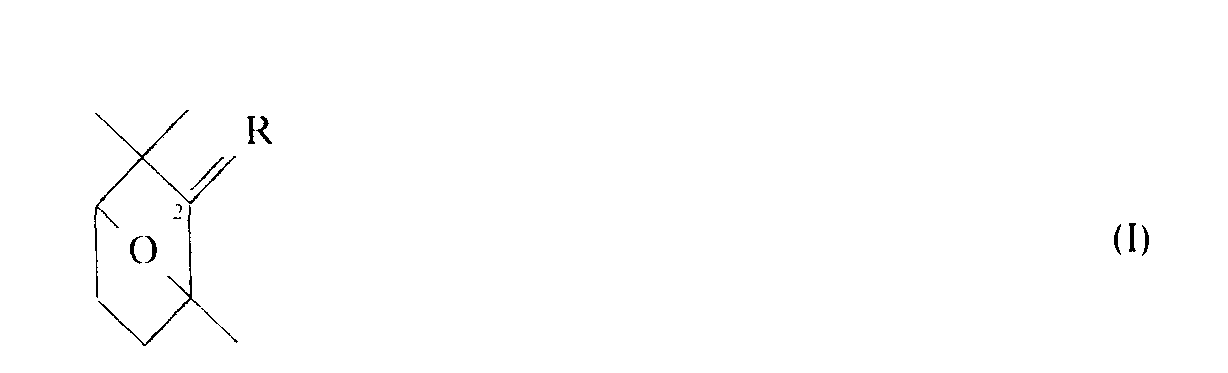
- the invention relates to new fragrances and / or flavors. These are the compounds of the formula wherein R represents the 2-cis or the 2-trans-buten-1-ylidene radical.
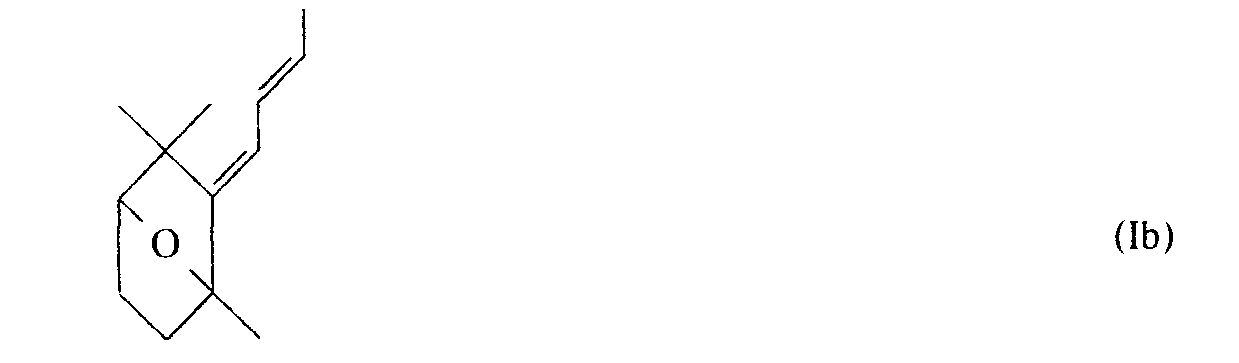
- the formula accordingly comprises the compounds of the formula -1,4-epoxy-1,3,3-trimethyl-2- (2-buten-1-ylidene) cyclohexane
- the invention further relates to a method for producing the compounds of the formula
- This process is characterized in that 1,3,3-trimethyl-2- (3-hydroxybutylidene) -6-cyclohexen-4-ol is reacted in an acidic medium.
- the acidic medium with the aid of mineral acids such as sulfuric acid or hydrochloric acid
- acidic salts such as bisulfates, for example KHS0 4
- acidic earths such as diatomaceous earth, for. B. Filtrol.
- Suitable organic acids such as medium to strong acids of this type, are also suitable. Examples include alkanesulfonic acids, such as methanesulfonic acid, p-toluenesulfonic acid or picric acid.
- the reaction temperature is not critical. It is expediently 20-200 ° C, preferably 60-130 ° C. It is expediently higher when using weaker acids and lower when using stronger acids.
- the reaction is preferably carried out with the aid of an organic solvent, in particular an aromatic solvent.
- organic solvent in particular an aromatic solvent. Examples are benzene, toluene and xylene.
- a mixture of la: Ib is obtained in an approximate ratio of 15:85. Traces of the cis / cis and trans / cis isomers can also be detected in the mixture.
- the separation of the isomer mixture can be carried out in a conventional manner, e.g. B. by means of column chromatography or preparative gas chromatography. As can be seen further below, the isomers do not differ fundamentally in their organoleptic properties, so that the isomer mixture can be used for economic reasons.
- the 1,3,3-trimethy) 2- (3 hydroxylbutylidene) -6-cyclohexen-4-ol referred to below and in Example 1 as compound 14 is a new compound. It can - as shown there - from the known 2-hydroxy-ß-ionon can be obtained.
- this 2-hydroxy- ⁇ -ionone is advantageously reacted with an enol acylate in the presence of one of the acids specified above; so z. B. dissolved in (an excess of) acetonenol acetate, mixed with a catalytic amount of p-toluenesulfonic acid and the reaction mixture kept at reflux temperature for 1-2 hours.
- the diacetate 13 obtained after working up can be converted directly into the diol 14 by treatment with a strong reducing agent, such as lithium aluminum hydride.
- Connection 13 is new.
- the compounds I have special organoleptic properties which make them particularly suitable as fragrances and / or flavors.
- the invention accordingly also relates to the use of the compounds I, in particular in practically pure form or in the form of mixtures (with the exception of natural mixtures containing 1) as fragrances and / or flavorings.
- Practically pure 1 should in particular be understood to mean those I which are free of accompanying substances, such as are present in addition to I in natural extracts.
- Practically pure I in the sense of the present invention should be understood to mean in particular synthetically produced I.
- the compounds I used according to the invention as fragrances and / or flavorings - in particular Ib [because of its greater diffusion and intensity] - are distinguished by fresh, green, spicy, very natural-looking, certain aspects of cassis buds and exotic fruits - such as mango, passion fruit , Guanabana - reminiscent of smells.
- the compounds can accordingly serve, for example, for perfuming or aromatizing products, such as cosmetics (soaps, salves, powders, toothpastes, mouthwashes, deodorants, shampoos, lotions, etc.), detergents or foods, luxury foods and beverages, the compounds preferably not used alone, but in the form of compositions with other fragrances or flavors.
- fragrance or flavoring compositions with a content of compounds I and their preparation in a manner known per se (addition of I to known fragrance or flavoring compositions or mixing of I with natural or suitable components of fragrance or flavoring positions synthetic compounds or mixtures) also forms the subject of the invention.
- fragrance compositions produced using compounds 1, in particular of the Chypre, Cologne, Muguet or generally floral and woody direction, are particularly spectacular due to their spectacular freshness and originality.
- fragrances can be used in a manner known to the perfumer, such as, for example, B. from W. A. Poucher, Perfumes, Cosmetics and Soaps 2, 7th edition, Chapman and Hall, London, 1974.
- the concentration of the compounds I can vary within wide limits, for example between about 0.01 (detergents) and about 15% by weight (alcoholic solutions).
- concentrations in perfume bases or concentrates can of course also be higher.
- the perfume bases can be used in the usual way for perfuming Eaux de Cologne, Eaux de toilette, lotions, creams, shampoos, soaps and detergents, etc.
- the compounds 1 can be used, for example, to produce or improve, enhance, increase or modify fruit or berry flavors in foods (yogurt, confectionery, etc.); be used in luxury foods (tea, etc.) and beverages (lemonades, etc.).
- a suitable dosage includes, for example, the range 0.1 ppm-100 ppm, preferably 1 ppm -20 ppm in the finished product, i. H. the flavored food, stimulant or drink.
- the compounds can be mixed in a customary manner with the constituents used for flavoring compositions or added to such flavors.
- the flavors used according to the invention are understood to mean flavoring compositions which can be diluted in a manner known per se or can be distributed in edible materials. They can be converted into the usual forms of use, such as solutions, pastes or powders, using methods known per se.
- the products can be spray dried, vacuum dried or lyophilized.
- Perfume composition (towards grapefruit, lemon peel)
- Perfumery composition (masculine chypre note)
- the two yoghurts were presented to the test panel (10 people) and evaluated in terms of their senses in comparison to a fresh mango fruit.
- test persons (6) found significantly more character of the fresh mango fruit in the additionally flavored yoghurt.
Landscapes
- Chemical & Material Sciences (AREA)
- Organic Chemistry (AREA)
- Chemical Kinetics & Catalysis (AREA)
- Life Sciences & Earth Sciences (AREA)
- Oil, Petroleum & Natural Gas (AREA)
- Wood Science & Technology (AREA)
- Engineering & Computer Science (AREA)
- Fats And Perfumes (AREA)
- Organic Low-Molecular-Weight Compounds And Preparation Thereof (AREA)
- Seasonings (AREA)
- Heterocyclic Carbon Compounds Containing A Hetero Ring Having Oxygen Or Sulfur (AREA)
- Cosmetics (AREA)
- Detergent Compositions (AREA)
Description
- Die Erfindung betrifft neue Riech- und/oder Geschmackstoffe. Es handelt sich dabei um die Verbindungen der Formel

- Die Formel umfaßt demgemäß die Verbindungen der Formel

- Die Formeln sollen außerdem je beide der im Hinblick auf die vorhandene cis/trans-Isomerie (2'-Stellung) möglichen geometrischen Isomeren umfassen.
- Die Erfindung betrifft ferner ein Verfahren zur Herstellung der Verbindungen der Formel
- Dieses Verfahren ist dadurch gekennzeichnet, daß man 1,3,3-Trimethyl-2-(3-hydroxybutyliden)-6-cyclohexen-4-ol in saurem Medium zur Reaktion bringt.
- Das saure Medium kann unter Zuhilfenahme von Mineralsäuren, wie Schwefelsäure oder Salzsäure, von sauren Salzen, wie Bisulfaten, beispielsweise KHS04, oder sauren Erden, wie Diatomeenerde, z. B. Filtrol, erzeugt werden. Aber auch geeignete organische Säuren, wie mittelstarke bis starke solcher Säuren kommen in Frage. Beispiele hierfür sind Alkansulfonsäuren, wie Methansulfonsäure, p-Toluolsulfonsäure oder Pikrinsäure.
- Die Reaktionstemperatur ist nicht kritisch. Sie beträgt zweckmäßigerweise 20-200°C, vorzugsweise 60-130°C. Sie liegt zweckmäßigerweise höher bei Verwendung schwächerer Säuren und niedriger bei Verwendung stärkerer Säuren.
- Die Umsetzung wird vorzugsweise unter Zuhilfenahme eines organischen Lösungsmittels, insbesondere eines aromatischen Lösungsmittels, durchgeführt. Beispiele sind Benzol, Toluol und Xylol.
- Nach dem erfindungsgemäßen Verfahren fällt ein Gemisch von la : Ib im ungefähren Verhältnis 15 : 85 an. Im Gemisch können ferner Spuren des cis/cis- und des trans/cis-Isomeren nachgewiesen werden. Die Trennung des Isomerengemisches kann auf übliche Weise, z. B. mittels Säulenchromatographie oder präparativer Gaschromatographie erfolgen. Wie weiter unten ersichtlich, unterscheiden sich die Isomeren in ihren organoleptischen Eigenschaften nicht grundlegend, sodaß aus wirtschaftlichen Gründen das Isomerengemisch verwendet werden kann.
- Das - weiter unten und im Beispiel 1 - als Verbindung 14 bezeichnete 1,3,3-Trimethy) 2-(3 hydro- xybutyliden)-6-cyclohexen-4-ol stellt eine neue Verbindung dar Es kann - wie dort gezeigt - aus dem bekannten 2-Hydroxy-ß-ionon erhalten werden.
- Zu diesem Zweck wird dieses 2-Hydroxy-ß-ionon zweckmäßigerweise mit einem Enolacylat in Anwesenheit einer der oben angegebenen Säuren umgesetzt; also z. B. in (einem Überschuß von) Acetonenolacetat gelöst, mit einer katalytischen Menge p-Toluolsulfonsäure versetzt und das Reaktionsgemisch während 1 -2 Stunden bei Rückflußtemperatur gehalten. Das nach Aufarbeitung erhaltene Diacetat 13 kann durch Behandlung mit einem starken Reduktionsmittel, wie Lithiumaluminiumhydrid, direkt in das Diol 14 übergeführt werden.

- Die Verbindung 13 ist neu.
- Die Verbindungen I weisen besondere organoleptische Eigenschaften auf, auf Grund derer sie sich vorzüglich als Riech- und/oder Geschmackstoffe eignen.
- Die Erfindung betrifft demgemäß auch die Verwendung der Verbindungen I, insbesondere in praktisch reiner Form oder in Form von Gemischen (mit Ausnahme von natürlichen, 1 enthaltenden Gemischen) als Riech- und/oder Geschmackstoffe.
- Unter praktisch reinen 1 sollen insbesondere solche I verstanden werden, die frei von Begleitstoffen sind, wie sie neben I in natürlichen Extrakten vorliegen. Als Praktisch reine I im Sinne der vorliegenden Erfindung sollen insbesondere synthetisch hergestellte I verstanden werden.
- Die natürlichen, I enthaltenden Gemische sollen darum ausgeschlossen sein, da im Zuge der vorliegenden Arbeiten gefunden wurde, daß la/lb, und zwar im Verhältnis von 1 : 5 im Osmanthus absolue enthalten sind.
- Die erfindungsgemäß als Riech- und/oder Geschmackstoffe verwendeten Verbindungen I - insbesondere Ib [wegen seiner größeren Diffusion und Intensität] - zeichnen sich durch frische, grüne, würzige, sehr natürlich wirkende, an gewisse Aspekte von Cassisknospen und exotische Früchte - wie Mango, Passionsfrucht, Guanabana - erinnernde Geruchsnuancen aus. Die Verbindungen können demgemäß beispielsweise zur Parfümierung bzw. Aromatisierung von Produkten, wie Kosmetika (Seifen, Saleben, Pudern, Zahnpasten, Mundwässern, Desodorantien, Shampoos, Lotionen, etc.), Detergentien, bzw. Nahrungsmitteln, Genußmitteln und Getränken dienen, wobei die Verbindungen vorzugsweise nicht allein, sondern in Form von Kompositionen mit ändern Riech- bzw. Geschmackstoffen eingesetzt werden. Solche Riech- bzw. Geschmackstoffkompositionen mit einem Gehalt an Verbindungen I und deren auf an sich bekannte Art erfolgende Herstellung (Zugabe von I zu bekannten Riech- bzw. Geschmackstoffkompositionen oder Vermischung von I mit als Bestandteil von Riech- bzw. Geschmackstoffkorr.positionen geeigneten natürlichen oder synthetischen Verbindungen oder Gemischen) bildet ebenfalls Gegenstand der Erfindung.
- Als Riechstoffe eignen sich die Verbindungen I, insbesondere Ib, auf Grund ihrer oben beschriebenen, originellen Noten, insbesondere in Kombination mit einer Reihe von natürlichen und synthetischen Riechstoffen wie z. B.
- - Galbanumöl, Mastixöl, Vetiveröl, Patchouliöl, Sandelholzöl, Mandarinenöl, Petitgrainöl, Ylang-Ylang-ÖI, Basilikumöl, Baummoos absolue, Patchouliblätteröl, Cedernöl, Fichtenöl, Lorbeeröl, Costuswurzelöl, Calmusöl, Beifußöl, Kamillenöl, Wermutöl, Wurmsamenöl, Selleriesamenöl, Angelikasamenöl, Sternanisöl, Thymianöl, Rosmarinöl, Lavendelöl, Lavandinöl, Aspiköl, Salbeiöl, Neroliöl, Bergamottöl, Citronenöl, Orangenöl, Grapefruitöl, Geraniumöl, Benzoeresinoid, Melilotus absolue, Jasmin absolue, Rosenöl, Canangaöl, Corianderöl, Cassie absolue, Narzissen absolue, Verveine absolue oder Öl, Veilchenblätter absolue, Tuberosen absolue usw.
- - Aldehyden wie Hydroxycitronellal, Zyklamenaldehyd, p-tert.-Butyl-α-methylhydrozimtaldehyd, alpha-Hexylzimtaldehyd, 3,5-Dimethyl-cyclohex-3-en-1-yl-carboxaldehyd, Citral, Citronellal, 2,6-Dimethyl-6-hepten-1-al, Isovaleraldehyd, trans-2-Hexenal, Sorbinaldehyd, trans-2-Octenal, n-Octanal, n-Nonanal, trans-2, -cis-6-Nonadienal, 2,4-Decadienal, Methylnonyl-acetaldehyd usw.
- - Ketonen wie alpha-lonon, beta-Ionon, Allylionon, Acetanisol, 4-(para-Hydroxyphenyl)-2-butanon, Campher, Menthon, Carvon, Pulegon usw.
- - Acetalen und Ketalen wie Phenylacetaldehyd-dimethylacetal, Phenylacetaldehyd-glycerinacetal, 2-Methyl-1,3-dioxolan-2-äthylacetat, Capronaldehyd-dimethylacetal usw.
- - Äthern wie Eugenolmethyläther, Methyl-1-methylcyclododecyläther, Anethol, Estragol usw.
- - Phenolkörpern wie Eugenol, Isoeugenol, Creosol usw.
- - Alkoholen wie Butanol, cis-3-Hexanol, trans-2,cis-6-Nonadienol, cis-6-Noneol, Linalool, Geraniol, Nerol, Citronellol, Nerolidol, Farnesol, Benzylalkohol, Phenyläthylalkohol, Zimtalkohol usw.
- - Estern wie Methyldihydrojasmonat, Linalylacetat, Geranylacetat, Cedrylacetat, Vetiverylacetat, Äthylisovalerat, Äthylcaproat, para-tert.-Butylcyclohexylacetat, ortho-tert.-Butylcyclohexylace- tat, MyraldylacetatR (Givaudan), Benzylacetat, Benzylsalicylat, Styrallylacetat, Äthyl-α-methylphenylglycidat, Äthyl-trans-2-hexenoat, Äthyl-trans-2-octenoat usw.
- - Lactone wie y-Undecalacton, y-Decalacton, y-Nonalacton, ö-Decalacton, ö-Octalacton, Cumarin usw.
- - Säuren wie Milchsäure, Buttersäure, α-Methylbuttersäure, trans-2-Hexensäure, trans-2-Octen- säure usw.
- - Moschus- und ambraartig riechenden Körpern wie Äthylenbrassylat, 4-Acetyl-6-tert.-butyl-1,1-dimethylindan, 12-Oxahexadecanolid, 8α,12-Oxido-13,14,15,16-tetranorlabdan usw.
- - schwefelhaltigen Verbindungen wie p-Menthan-8-thiol-3-on, Dimethylsulfid und anderen Sulfiden und Disulfiden usw.
- - stickstoffhaltigen Verbindungen wie Methylanthranilat, Indol, Isobutylchinolin, verschiedenen Pyrazinen, 5-Methyl-heptan-3-on-oxim usw.
- Die unter Verwendung von Verbindungen 1 hergestellten Riechstoffkompositionen, insbesondere vom Typ Chypre, Cologne, Muguet bzw. allgemein blumiger und holziger Richtung bestechen insbesondere durch ihre eindrückliche Frische und Originalität.
- Bei der Herstellung solcher Kompositionen können die oben aufgeführten bekannten Riechstoffe nach (dem Parfumeur bekannter) Art und Weise verwendet werden, wie z. B. aus W. A. Poucher, Perfumes, Cosmetics and Soaps 2, 7. Auflage, Chapman und Hall, London, 1974 hervorgehend.
- Es hat sich schließlich gezeigt, daß die Verbindungen la/lb auch bei der Rekonstitution einer Reihe von ätherischen Ölen oder Absolues, wie z. B. Mandarinenöl, Grapefruitöl, Cassis-Knospen absolue - in denen diese Verbindungen nie nachgewiesen wurden - verwendet werden können.
- Die Konzentration der Verbindungen I kann je nach dem Verwendungszweck innerhalb weiter Grenzen variieren, beispielsweise zwischen etwa 0,01 (Detergentien) und etwa 15 Gew.-% (alkoholische Lösungen). In Parfumbasen bzw. Konzentraten können die Konzentrationen selbstverständlich auch höher liegen. Die Parfumbasen können in üblicher Weise zur Parfümierung von Eaux de Cologne, Eaux de toilette, Lotionen, Cremes, Shampoos, Seifen und Detergentien, etc. verwendet werden.
- Als Geschmackstoffe können die Verbindungen 1 beispielsweise zur Erzeugung bzw. Verbesserung, Verstärkung, Steigerung oder Modifizierung von Frucht- oder Beerenaromen in Nahrungsmitteln (Joghurt, Süßwaren, etc.); in Genußmitteln (Tee, etc.) und Getränken (Limonaden etc.) verwendet werden.
- Die ausgeprägten geschmacklichen Qualitäten von insbesondere praktisch reinen, insbesondere von synthetisch hergestellten Verbindungen I ermöglichen die Verwendung in geringen Konzentrationen. Eine geeignete Dosierung umfaßt beispielsweise den Bereich von 0,1 ppm-100 ppm, vorzugsweise von 1 ppm -20 ppm im Fertigprodukt, d. h. dem aromatisierten Nahrungsmittel, Genußmittel oder Getränk.
- In derfolgenden Tabelle sind einige Effekte zusammengestellt, wie sie sich mit den Äthern! rzielen lassen.

- Die Verbindungen können auf übliche Weise mit den für Geschmackstoffkompositionen verwendeten Bestandteilen vermischt bzw. solchen Aromen zugesetzt werden Unter den erfindungsgemäß verwendeten Aromen werden Geschmackstoffkompositionen verstanden, die sich auf an sich bekannte Art verdünnen bzw. in eßbaren Materialien verteilen lassen. Sie können nach an sich bekannten Methoden in die üblichen Gebrauchsformen, wie Lösungen, Pasten oder Pulver übergeführt werden. Die Produkte können sprühgetrocknet, vakuumgetrocknet oder lyophilisiert werden.
- Die bei der Herstellung solcher Aromen zweckmäßigerweise verwendeten bekannten Aromastoffe sind entweder in der obigen Zusammenstellung bereits enthalten oder können leicht der Literatur entnommen werden, wie z. B. J. Merory, Food Flavorings, Composition, Manufacture and Use, Second Edition, The Avi Pbublishing Company, Inc., Westport, Conn. 1968, oder G. Fenaroli, Fenaroli's Handbook of Flavor Ingredients, Second Edition, Volume 2, CRC-Press, Inc. Cleveland, Ohio, 1975.
-
- 5 IR: 3460,1730,1336,1151,1049,1039,1029 cm-1;
- NMR: 0,92+0,98 (je 3H,s); 1,25 (3H,t,J-6,8Hz); 1,62 (3H); 2,76 (1H); 4,0 (1H,m); 4,08 (2H,q,J~6,8 Hz); 5,4 (m,1 H) δppm;
- MS: 212 (M+, 9); 194 (25), 166 (28), 141 (19), 139 (27), 123 (28), 121 (100), 113 (32), 107 (18), 95 (53), 43 (27)
- 6 IR: 3460,1720,1280,1235,1030 cm-1;
- NMR: 1,12 (6H,2s); 1,30 (3H,t,J - 6,8 Hz); 1,67 (3H,s); 3,52 (1 H,m); 4,20 (2H,q,J~6,8 Hz) δppm;
- MS: 212 (M+, 6); 169 (69), 139 (55), 125 (42), 123 (81), 121 (42), 96 (63), 95 (68), 79 (40), 67 (35), 55 (43), 43(100)
- 7 IR: 1730,1310,1216,1179,1119,1046,1000,871 cm-1;
- NMR: 0,98+1,21 (6H,2s); 1,24 (3H,t,J-6,8Hz); 1,45 (3H,s); 2,29 (1H); 3,90 (1H,d,J-4Hz); 4,11 (2H,q,J~6,8 Hz) δppm
- MS: 212 (M+, 15), 197 (45), 167 (64), 154 (76), 139 (50), 130 (84), 121 (65), 109 (36), 95 (52), 83 (44), 55 (39), 43 (100).
- Das obige Rohprodukt (32,0 g) - gelöst in 80 ml Tetrahydrofuran - ließ man im Verlaufe von 30 Minuten zu einer Suspension von 4,60 g (0,12 Mol) Lithiumaluminiumhydrid in 300 ml wasserfreiem Tetrahydrofuran zutropfen. Man rührte das entstandene Gemisch während 16 Stunden bei Rückflußtemperatur. Das auf 0° abgekühlte Reaktionsgemisch wurde vorsichtig mit Wasser, hierauf mit 2 N Salzsäurelösung versetzt, in 400 ml Äther aufgenommen und die ätherische Schicht mit Wasser gewaschen, getrocknet und eingeengt. Es verblieben 26,2 g Rohprodukt, welches gemäß gaschromatographischer Analyse 80% 2-Hydroxy-α-cyclogeraniol 8 enthielten.

- Eine aus Äther umkristallisierte Probe zeigte die folgenden spektroskopischen Daten:
- IR: 3615, 3450, 1175, 1068, 1037, 1018, 955, 845 cm-1 (als Lösung in CHCl3);
- NMR: 0,90+1,09 (je 3H,2s); 1,75 (3H); 3,80 (2H,d,J -4 Hz); 3,95 (1 H,m); 5,50 (1 H,m) δppm;
- MS: 170 (M+, 1), 152 (83), 121 (80), 109 (36), 107 (52), 95 (47), 93 (34), 81 (79), 72 (59), 55 (42), 43 (100), 41 (51);
- Smp. 103-104°.
- 15,0 g (0,088 Mol) rohes 2-Hydroxy-α-cyclogeraniol 8 wurden in 60 ml Methylchlorid gelöst und im Verlaufe von 10 Minuten so zu einer Lösung von 19,0 g (0,088 Mol) Pyridiniumchlorochromat (E. J. Corey, J. W. Suggs, Tet. Lett. 31. 2647 [1975]) in 250 ml Methylchlorid zugetropft, daß die Reaktionstemperatur zwischen 20 und 25° blieb. Anschließend rührte man noch während 20 Minuten bei Raumtemperatur, dekantierte die Reaktionslösung vom gebildeten Niederschlag ab, spülte den Niederschlag zweimal mit Methylenchlorid und wusch die kombinierten organischen Phasen mit Wasser, 2 N Salzsäure, Bicarbonatlösung nochmals mit Wasser. Nach dem Trocknen und Einengen verblieben 11,9 g Rohprodukt, welche die beiden Hydroxyaldehyde

Spektrale Daten: - 9 MS: 168 (M+, 23), 150 (14), 137 (38), 121 (55), 107 (42), 97 (59), 95 (44), 79 (28), 72 (30), 55 (40), 43 (10); 10 MS: 168 (M+, 16), 137 (100), 123 (15), 109 (31), 95 (11),81 (46), 79 (14), 70 (78), 67 (31), 55 (13), 41 (21)
- Für die Herstellung solcher üblicher Gebrauchsformen kommen beispielsweise folgende Trägermaterialien, Verdickungsmittel, Geschmackstoffverbesserer, Gewürze und Hilfsingredientien in Frage:
- Gummi arabicum, Tragant, Salze oder Brauereihefe, Alginate, Carrageen oder ähnliche Absorbentien; Indole, Maltol, Gewürzoleoresine, Raucharomen; Gewürznelken, Natriumcitrat; Mononatriumglutamat, Dinatrium-inosin-5'-monophosphat (IMP), Dinatriumguanosin-5-phosphat (GMP); oder spezielle Aromastoffe, Wasser, Äthanol, Propylenglykol, Glycerin.
- Eine Lösung von 25,0 g (0,129 Mol) α-Safransäureäthylester 2 und 0,25 g Bengalrosa in 300 ml Äthanol wurde in einer Belichtungsapparatur aus Pyrexglas bei gleichzeitigem Durchperlen von reinem Sauerstoff während 2 Stunden belichtet. Als Lichtquelle diente ein zentralangeordneter, wassergekühlter Quecksilber-Hochdruckstrahler Typ TQ-150 der Firma Hanau. Die mittlere Sauerstoffaufnahme betrug rund 30 ml/Minute. Der Reaktionsverlauf wurde auf gaschromatographischem Wege (Abnahme des Eduktes) verfolgt.

- Die so erhaltene ähtanolische Lösung des 1,4-Epidioxy-1,3,3-trimethyl-2-äthoxycarbonyl-5-cyclohexens 3 wurde mit 0,3 g Platin(IV)-oxyd versetzt und anschließend bei Normaldruck bis zur Sättigung hydriert. Der Wasserstoffverbrauch betrug 4,951 in 1,5 Stunden (77,5% der Theorie). Die Reaktionslösung wurde durch Filtration vom Katalysator befreit, eingeengt und die erhaltenen rohen 31 g Reaktionsprodukte an der 20fachen Menge Kieselgel chromatographiert. Die Elution mit Äther ergab 14,0 g cis-2,5-Dihydroxy-2,6,6-trimethylcyclohexancarbonsäureäthylester 4 vom Schmelzpunkt 92-94° (Ausbeute =51%, Reinheit > 98%).

- IR: 3600, 3450, 1720, 1333, 1142, 1031, 1025, 932, 891 cm-1 (als Lsg. in CHCl3);
- NMR: 1,02+1,18 (je 3H,s); 1,23 (3H,s); 1,28 (3H,t,J~6,8Hz); 2,57 (1H,s); 3,90 (1H,m,Jax-ax~8 Hz, Jax-eq -4 Hz); 4,15 (2H,q, J -6,8 Hz)δppm;
- MS: 212 (M+-H2O, 13), 166(34), 154(15), 129(100), 123(25), 113(15), 101 (68), 95 (24), 83 (43),43 (90).
- 34,9 g (0,152 Mol) des Dihydroxyesters 4 und 3,0 g p-Toluolsulfonsäure wurden in 250 ml Toluol gelöst und anschließend während 2 Stunden bei gleichzeitiger Entfernung des Reaktionswassers bei der Rückflußtemperatur des Reaktionsgemisches gerührt. Die abgekühlte Reaktionslösung verdünnte man mit 200 ml Äther, wusch je dreimal mit Sodalösung und Wasser, trocknete mit Natriumsulfat und engte ein. Es resultierten 32,0 g Rohprodukt, welche gemäß gaschromatographischer Analyse 83% bzw. 10% der 2-Hydroxy-α- und ß-cyclogeranium-säureester 5 und 6 enthielten. Als Nebenprodukt entstand zu 7% der 2,5-Oxaester 7.


- 11,9 des rohen Aldehydgemisches 9/10 wurden in 120 ml Aceton gelöst, mit 23 ml 10%iger wäßriger KOH-Lösung versetzt und anschließend während 19 Stunden bei Rückflußtemperatur gerührt. Die Hälfte des Acetons wurde unter vermindertem Druck abdestilliert, das Konzentrat in 200 ml Äther aufgenommen und die ätherische Lösung mit konzentrierter Kochsalzlösung gewaschen. Nach Trocknen und Einengen verblieben 12,5 g Rohprodukt, welche gemäß gaschromatographischer Analyse zu rund 40% aus den 2-Hydroxy-ß-iononen 11 und 12 im Verhältnis von 1 : 5 bestanden. Die säulenchromatographische Reinigung des Rohproduktes lieferte bei der Elution mit Hexan/Äther= 1 : 14,2 g 92%iges Gemisch der 2-Hydroxy-ionone 11 und 12.

- Zur spektroskopischen Charakterisierung gelangten Proben, welche mit Hilfe von präparativer Gaschromatographie auf eine Reinheit von > 95% gebracht wurden.
Spektrale Daten: - 11 IR: 3450, 1670, 1620, 1256, 1051, 989, 905, 815 cm-1;
- NMR: 0,96 (6H,2s); 1,58 (3H); 2,27 (3H,s); 2,54 (1H,d,J-10Hz); 3,68 (lH,dxd, Jax-ax~7Hz, Jax-eq~5Hz); 5,44(1H,m): 6,08 (1H,d,J~16Hz); 6,68 (1H,dxd,J1~16Hz), J2~10Hz)δppm;
- MS: 208 (M+, 1); 175 (51), 157 (10), 147 (19), 137 (26), 121 (43), 109 (13), 93 (51), 77 (14), 72 (21), 43 (100);
- 12 IR: 3460, 1665, 1608, 1256, 1190, 1175, 1115, 1042, 1005, 978 cm-1;
- NMR: 1,08+1,11 (je 3H,2s); 1,75 (3H); 2,29 (3H,s); 3,56 (1H,dxd, Jax-ax~7 Hz, Jax-eq-4,6 Hz), 6,10 (1 H,d,J - 16,5 Hz); 7,21 (1 H,d,J~16,5 Hz) δppm;
- MS: 208 (M+, 2), 193 (69), 175 (44), 157 (8), 149 (26), 147 (20), 121 (36), 105 (33), 83 (16), 81 (19), 79 (14), 43(100).
- 3,87 g der 2-Hydroxy-ionone 11 + 12 (1 : 5) wurden in 20 ml Acetonenolactat gelöst und anschließend in Gegenwart von 0,03 g p-Toluolsulfonsäure 2 Stunden bei Rückflußtemperatur gerührt. Das Reaktionsgemisch wurde abgekühlt, in 150 ml Äther aufgenommen, die ähterische Phase mit Bicarbonatlösung und Wasser gewaschen, getrocknet und eingeengt. Es verblieben 4,5 g des 4-Acetoxy-1,3,3-trimethyl-2-(3-acetoxy-2-butenyliden)-cyclohex-6-ens 13, welche wie folgt direkt zum Diol 14 weiterverarbeitet wurden:

- Eine Lösung von 3,9 g Diacetat 13 in 10 ml Äther ließ man im Verlaufe von 10 Minuten zu einer Suspension von 1,06 g Lithiumaluminiumhydrid in 70 ml Äther zutropfen, rührte das Reaktionsgemisch während einer Stunde bei Rückflußtemperatur, kühlte hierauf auf Raumtemperatur, zersetzte den Überschuß an Lithiumaluminiumhydrid vorsichtig mit Wasser, wusch die Ätherphase mit Wasser, trocknete und engte ein. Die verbliebenen 2,7 g Diol 14 löst man zusammen mit 0,05 g p-Toluolsulfonsäure in 25 ml Benzol und rührte das Gemisch anschließend während einer Stunde bei Rückflußtemperatur, verdünnte das abgekühlte Gemisch mit 50 ml Äther und wusch die Ätherphase mit Bicarbonatlösung und Wasser. Nach dem Trocknen und Einengen verblieben 2,3 g Rohprodukt, welche gemäß gaschromatographischer Analyse neben schwererflüchtigen Verbindungen zu rund 50% aus 1,4-Epoxy-1,3,3-trimethyl-2-(2-buten-1-yliden)-cyclohexan 1a a und 1b (Verhältnis cis/trans= 15 : 85) bestand.
- Durch Kugelrohrdestillation des Rohproduktes erhielt man 0,95 g Produkt, welches zu über 92% aus dem Isomerengemisch bestand. Das Gemisch besitzt einen frischen, grünen, würzigen, sehr natürlich wirkenden Geruch, der an gewisse Aspekte von Tomatenblättern, Cassisknospen und exotischen Früchten erinnert.
- Zur spektroskopischen Charakterisierung gelangten Proben der einzelnen Isomeren, welche durch Chromatographie an der 40fachen Menge Kieselgel (Hexan/Äther =30 : 1) auf eine Reinheit von über 98% gebracht worden waren.
Spektrale Daten: - 1a IR: 1410,1183,1118,1019,1002,990,961,928,878,833,770 cm-1;
- NMR: 1,04+1,13 (je 3H,s); 1,75 (3H,s); 1,78 (3H,d,J-7Hz); 3,93 (1H,d,J~4Hz); 5,55 (1H,dxq,J3',2' ~ 16 Hz, J3', CH3 ~ 7 Hz), ~5,55 (1H,d,J ~ 10 Hz), ~6,3 (1H,dxd, J2',3' ~ 16 Hz, J2''1' ~ 10 Hz);
- MS: 192 (M+, 24); 149 (16), 136 (22), 123 (45), 121 (35), 109 (49), 93 (26), 91 (32), 81 (44), 69 (86), 43 (100)
- 1b IR: 1421,1235,1195,1117,1021,1003,963,872,823 cm-1;
- NMR: 1,28 (6H,2s); 1,50 (3H,s); 1,78 (3H,d,J~7 Hz); 3,89 (1H,d,J~4 Hz); 5,55 (lH,dxq, J3',2'~16 Hz; J3',CH3~7 Hz); 5,65 (1H,d,J1',2'~10 Hz); 6,30 (1H,dxd,J2',3'~16 Hz; J2',1'~10 Hz);
- MS: 192 (M+, 24), 149 (12), 136 (12), 123 (39), 121 (22), 109 (36), 93 (18), 91 (18), 81 (33), 69 (82), 43 (100).
-

- Gibt man zu dieser konventionellen Grünbase (Richtung Salbei) 200 Teile der neuen Verbindung I'), wird die Base in Richtung Tomatenblätter und Cassis-Knospen sehr angenehm abgerundet. Die neue Substanz fügt sich sehr harmonisch in den Komplex ein und verleiht ihm eine frische, würzige etwas trockene und viel weniger süße Note.
-

- Werden 100 Teile der neuen Verbindung I zu dieser Base mit schwarzem Johannisbeer-Charakter gegeben, verschwindet die Cassis-Note zu Gunsten einer sehr angenehm frischen Note Richtung Rapefruit und Zitronenschale. Die Substanz verbindet sich, wie ersichtlich, sehr harmonisch mit schwefelhaltigen Verbindungen. Die neue Base erhält eine sehr natürliche Frische. Überraschenderweise wird dieser Frische-Effekt auch nach 24 Stunden noch sehr deutlich wahrgenommen.
- *) Unter »Verbindung I« wird in den Formulierungsbeispielen das im Beispiel 1 erhaltene Isomerengemisch verstanden.
-

- Gibt man zu dieser Grün-Base 40 Teile der neuen Verbindung I, so wirkt die Komposition viel diffusiver, frischer, natürlicher. Die Grün-Note erhält einen fruchtigen Aspekt Richtung Cassis-Knospen. Der - für die Grünnote wesentliche - Komplex von Galbanumöl und Methyldihydrojasmonat wird durch Zugabe von I in äußerst vorteilhafter Weise unterstrichen.
-

- Versetzt man diese Komposition (Chypre-Charakter) mit 20 Teilen der neuen Verbindung I, so wirkt die gesamte Komposition lebhafter, wirkt gleichzeitig abgerundeter, hat eindeutig mehr Charakter eines »fertigen« Cologne. Die neue Komposition eignet sich gut zur Herstellung eines maskulinen Herren-Cologne.
-

- Gewisse Aspekte des taufrischen Maiglöckchens kommen nun sehr schön zur Geltung.
- 1 Liter eines handelsüblichen Passionsfrucht-Saftes wurde mit 0,35 g einer 0,1%igen alkoholischen Lösung des 1,4-Epoxy-1,3,3-trimethyl-2-(2-butenyliden)-cyclohexanes versetzt. Entsprechend versetzte man 1 Liter Passionsfrucht-Saft mit 0,35 g reinem Alkohol. Die beiden Fruchtsäfte wurden einer Gruppe von 10 Testpersonen zur sensorischen Beurteilung vorgelegt. Die Mehrheit der Testpersonen (8) erklärte, daß in der zusätzlich aromatisierten Probe der angenehm süße, exotisch wirkende Geruchsaspekt der Passionsfrucht eindeutig besser zur Geltung käme.
- Analog dem vorgehenden Beispiel wurde 1 Liter Grapefruit-Saft mit 0,40 g einer 0,1%igen alkoholischen Lösung des 1,4-Epoxy-1,3,3-trimethyl-2-(2-butenyliden)-cyclohexanes versetzt. In diesem Falle wurde im Vergleich zur Blindprobe von der Mehrheit der Testpersonen (8) eine ausgeprägtere Holznote festgestellt, zudem wurde eine Assoziation an reife Grapefruit-Früchte äußerst positiv vermerkt.
- 1 kg Yoghurt »nature« wurde mit 100 g Mango-Fruchtpulpe und 80 g Saccharose versetzt. Zu 500 g dieses Mango-Yoghurts gab man J,25 g einer 0,1%igen alkoholischen Lösung des 1,4-Epoxy-1,3,3-trimethyl-2-(2-butenyliden)-cyclohexanes.
- Die beiden Yoghurts wurden dem Testpanel (10 Personen) vorgelegt und im Vergleich zu einer frischen Mangofruchtsensorisch beurteilt.
- Die Mehrheit der Testpersonen (6) fand im zusätzlich mit aromatisierten Yoghurt eindeutig wesentlich mehr Charakter der frischen Mango-Frucht.
Claims (10)

Applications Claiming Priority (4)
| Application Number | Priority Date | Filing Date | Title |
|---|---|---|---|
| LU77834A LU77834A1 (de) | 1977-07-25 | 1977-07-25 | Verfahren zur herstellung von neuen riech-und/oder geschmackstoffen |
| LU77834 | 1977-07-25 | ||
| CH546478 | 1978-05-19 | ||
| CH5464/78 | 1978-05-19 |
Publications (3)
| Publication Number | Publication Date |
|---|---|
| EP0000719A2 EP0000719A2 (de) | 1979-02-21 |
| EP0000719A3 EP0000719A3 (en) | 1979-06-27 |
| EP0000719B1 true EP0000719B1 (de) | 1981-05-20 |
Family
ID=25697750
Family Applications (1)
| Application Number | Title | Priority Date | Filing Date |
|---|---|---|---|
| EP78100472A Expired EP0000719B1 (de) | 1977-07-25 | 1978-07-21 | Neue 1,4-Epoxy-trimethyl-butenyliden-cyclohexane (I), Verfahren zu deren Herstellung, Verwendung von (I) als Riech- und/oder Geschmackstoffe, Riech- und/oder Geschmackstoffkompositionen mit einem Gehalt an den neuen Cyclohexanen |
Country Status (7)
| Country | Link |
|---|---|
| US (3) | US4225501A (de) |
| EP (1) | EP0000719B1 (de) |
| JP (1) | JPS5424893A (de) |
| DE (2) | DE2832137A1 (de) |
| FR (1) | FR2398751A1 (de) |
| GB (1) | GB2002364B (de) |
| NL (1) | NL7807609A (de) |
Cited By (2)
| Publication number | Priority date | Publication date | Assignee | Title |
|---|---|---|---|---|
| EP0168882A1 (de) * | 1984-07-13 | 1986-01-22 | The Procter & Gamble Company | Oxa-fenchole und Oxa-fenchylamine, geeignet zur Herstellung hochwirksamer Süssstoffe |
| EP0312412A1 (de) * | 1987-10-16 | 1989-04-19 | L'oreal | Norbornanabkömmlinge, Verfahren zu deren Herstellung und diese enthaltende kosmetische und Arzneimittelzusammensetzungen |
Families Citing this family (6)
| Publication number | Priority date | Publication date | Assignee | Title |
|---|---|---|---|---|
| JPS591415A (ja) * | 1982-06-28 | 1984-01-06 | Mochida Pharmaceut Co Ltd | 循環系疾患治療剤 |
| DE3470032D1 (en) * | 1983-01-20 | 1988-04-28 | Basf Ag | Racemic and optically actif 3-hydroxy-alpha-cyclocitral, their acetals and optically actif 3-oxo-alpha-cyclocitralacetals, and also the preparation and use of these compounds |
| US4868901A (en) * | 1987-10-13 | 1989-09-19 | Sci-Agra, Inc. | Reflected light detecting apparatus and method |
| FR2707630B1 (fr) * | 1993-07-13 | 1995-09-29 | Centre Nat Rech Scient | Dérivé du cyclohexèneméthanol, sa préparation et son emploi dans la synthèse de taxoïdes. |
| US6166371A (en) * | 1999-04-30 | 2000-12-26 | Beckman Coulter, Inc. | Diffuse reflective light curtain system |
| JP6496806B2 (ja) | 2015-03-06 | 2019-04-10 | 三井化学株式会社 | 架橋体および制振材 |
-
1978
- 1978-07-12 US US05/924,030 patent/US4225501A/en not_active Expired - Lifetime
- 1978-07-14 NL NL7807609A patent/NL7807609A/xx not_active Application Discontinuation
- 1978-07-21 EP EP78100472A patent/EP0000719B1/de not_active Expired
- 1978-07-21 DE DE19782832137 patent/DE2832137A1/de not_active Withdrawn
- 1978-07-21 DE DE7878100472T patent/DE2860714D1/de not_active Expired
- 1978-07-24 GB GB7830867A patent/GB2002364B/en not_active Expired
- 1978-07-24 JP JP8950978A patent/JPS5424893A/ja active Granted
- 1978-07-25 FR FR7821945A patent/FR2398751A1/fr active Pending
-
1979
- 1979-08-14 US US06/066,360 patent/US4258071A/en not_active Expired - Lifetime
- 1979-08-14 US US06/066,359 patent/US4250062A/en not_active Expired - Lifetime
Cited By (4)
| Publication number | Priority date | Publication date | Assignee | Title |
|---|---|---|---|---|
| EP0168882A1 (de) * | 1984-07-13 | 1986-01-22 | The Procter & Gamble Company | Oxa-fenchole und Oxa-fenchylamine, geeignet zur Herstellung hochwirksamer Süssstoffe |
| EP0312412A1 (de) * | 1987-10-16 | 1989-04-19 | L'oreal | Norbornanabkömmlinge, Verfahren zu deren Herstellung und diese enthaltende kosmetische und Arzneimittelzusammensetzungen |
| FR2621912A1 (fr) * | 1987-10-16 | 1989-04-21 | Oreal | Nouveaux derives du norbornane, leur procede de preparation et compositions cosmetique et medicamenteuse les contenant |
| US5047575A (en) * | 1987-10-16 | 1991-09-10 | L'oreal | Norbornene carboxylic acids and esters |
Also Published As
| Publication number | Publication date |
|---|---|
| EP0000719A3 (en) | 1979-06-27 |
| US4225501A (en) | 1980-09-30 |
| DE2860714D1 (en) | 1981-08-27 |
| FR2398751A1 (fr) | 1979-02-23 |
| GB2002364A (en) | 1979-02-21 |
| US4250062A (en) | 1981-02-10 |
| NL7807609A (nl) | 1979-01-29 |
| GB2002364B (en) | 1982-02-17 |
| EP0000719A2 (de) | 1979-02-21 |
| DE2832137A1 (de) | 1979-02-08 |
| JPS6159317B2 (de) | 1986-12-16 |
| US4258071A (en) | 1981-03-24 |
| JPS5424893A (en) | 1979-02-24 |
Similar Documents
| Publication | Publication Date | Title |
|---|---|---|
| DE60224180T2 (de) | Cycloalkancarbonsäurederivate als duftstoffe mit moschuscharakter | |
| DE2534162B2 (de) | l-Oxa-3-thiacyclopentane bzw. -cyclohexane sowie deren Verwendung als Aromastoffe | |
| DE2405568B2 (de) | Cycloaliphatische verbindungen und deren verwendung als riech- und geschmacksstoffe | |
| DE2812583C2 (de) | 2,4,4-Trimethyl-3-[but(-2-en; -1,3-dien)yl]-cyclohex-2-en-1-one, Verfahren zu deren Herstellung und sie enthaltende Riech- und Geschmackstoffkompositionen | |
| CH633508A5 (de) | Verfahren zur herstellung von neuen cycloaliphatischen gesaettigten und ungesaettigten ketonen, die als aroma- und duftstoffe brauchbar sind. | |
| EP0000719A2 (de) | Neue 1,4-Epoxy-trimethyl-butenyliden-cyclohexane (I), Verfahren zu deren Herstellung, Verwendung von (I) als Riech- und/oder Geschmackstoffe, Riech- und/oder Geschmackstoffkompositionen mit einem Gehalt an den neuen Cyclohexanen | |
| EP0010142B1 (de) | Als Einzelverbindungen oder in Form von Gemischen vorliegende sesquiterpenoide Tetrahydrofuranderivate (I), Verfahren und Ausgangsstoffe (V) zu deren Herstellung, Verwendung von (I) als Riech- und/oder Geschmackstoffe und Riech- und/oder Geschmackstoffkompositionen mit einem Gehalt an (I) | |
| DE2826302A1 (de) | Tricyclische derivate von norbornan, ihre herstellung und verwendung | |
| EP0513627B1 (de) | Tetrahydro-alpha-pyronderivat, Verfahren zu seiner Herstellung und dieses enthaltende Riech- und/oder Geschmackstoffkompositionen | |
| EP0021100B1 (de) | Als Einzelverbindungen (I) oder in Form von Gemischen mit (IV) vorliegende Cyclohexenderivate, Verfahren zur Herstellung von (I), Verwendung von (I) bzw. (I+IV) als Riech- und/oder Geschmackstoffe und Riech- und/oder Geschmackstoffkompositionen mit einem Gehalt an (I) bzw. (I+IV) | |
| EP0684299B1 (de) | Dihydrofarnesal | |
| CH640706A5 (de) | Stoffzubereitung, die mindestens ueberwiegend aus trans,trans-delta-damascon besteht. | |
| EP0045453A1 (de) | Neue Alkenole (I) und Verfahren zu deren Herstellung, Verwendung von (I) als Riech- und/oder Geschmackstoffe sowie Riech- und/oder Geschmackstoffkompositionen mit einem Gehalt an (I) | |
| EP0116277A2 (de) | Ketone von bicyclischen Verbindungen, Verfahren zu deren Herstellung und Riech- und/oder Geschmackstoffkompositionen mit einem Gehalt an solchen Verbindungen | |
| DE2504618C3 (de) | Spiranderivate, Verfahren zu deren Herstellung, und die Verwendung dieser Verbindungen als Riech- bzw Aromastoffe | |
| EP0260585B1 (de) | Bicyclische Ketone, Verfahren zu deren Herstellung und Riech- und/oder Geschmackstoffkompositionen mit einem Gehalt an diesen bicyclischen Ketonen | |
| EP0053704B1 (de) | Neue cyclische Ester (I), Verfahren zu deren Herstellung, Verwendung von I als Riech- und/oder Geschmackstoffe sowie Riech- und/oder Geschmackstoffkompositionen mit einem Gehalt an I | |
| DE2244680A1 (de) | Neue verbindungen und ihre herstellung | |
| EP0003515B1 (de) | Neue Megastigman-4,7-oxyde (I) und neue 7-Oxabicyclo(3.3.0)-octane (II), Verfahren zur Herstellung von (I) und (II), Verwendung von (I) und (II) als Riech- und/oder Geschmackstoffe sowie Riech- und/oder Geschmackstoffkompositionen mit einem Gehalt an (I) oder (II) | |
| EP0086944B1 (de) | Neue ungesättigte Aether (I), Verfahren zu deren Herstellung, Verwendung von (I) als Riech- und/oder Geschmackstoffe und Riech- und/oder Geschmackstoffkompositionen mit einem Gehalt an (I) | |
| EP0204952B1 (de) | Verfahren zur Herstellung von 4,4,7-Trimethyl-3,4,7,8,-tetrahydro-2(6H)-naphthalin-on in gereiniger Form oder im Gemisch mit 3,5,5-Trimethyl-4-butenyliden-cyclo-hex-2-en-1-onen, dabei erhaltene Produkte und Verwendung derselben als Riech- und Aromastoffe | |
| EP0773209B1 (de) | Ungesättigter Ester | |
| EP0006616B1 (de) | Neues Tiglat, Verfahren zu dessen Herstellung, dessen Verwendung und dieses enthaltende Kompositionen | |
| DE2802068A1 (de) | Neuer riech- und/oder geschmackstoff | |
| DE4138732A1 (de) | Cyclische isolongifolanon-ketale, ihre herstellung und ihre verwendung |
Legal Events
| Date | Code | Title | Description |
|---|---|---|---|
| PUAI | Public reference made under article 153(3) epc to a published international application that has entered the european phase |
Free format text: ORIGINAL CODE: 0009012 |
|
| AK | Designated contracting states |
Designated state(s): CH DE FR GB NL |
|
| PUAL | Search report despatched |
Free format text: ORIGINAL CODE: 0009013 |
|
| AK | Designated contracting states |
Designated state(s): CH DE FR GB NL |
|
| 17P | Request for examination filed | ||
| GRAA | (expected) grant |
Free format text: ORIGINAL CODE: 0009210 |
|
| AK | Designated contracting states |
Designated state(s): CH DE FR GB NL |
|
| REF | Corresponds to: |
Ref document number: 2860714 Country of ref document: DE Date of ref document: 19810827 |
|
| PGFP | Annual fee paid to national office [announced via postgrant information from national office to epo] |
Ref country code: FR Payment date: 19840628 Year of fee payment: 7 |
|
| PGFP | Annual fee paid to national office [announced via postgrant information from national office to epo] |
Ref country code: DE Payment date: 19840717 Year of fee payment: 7 |
|
| PGFP | Annual fee paid to national office [announced via postgrant information from national office to epo] |
Ref country code: CH Payment date: 19841029 Year of fee payment: 7 |
|
| PGFP | Annual fee paid to national office [announced via postgrant information from national office to epo] |
Ref country code: NL Payment date: 19870731 Year of fee payment: 10 |
|
| PG25 | Lapsed in a contracting state [announced via postgrant information from national office to epo] |
Ref country code: GB Effective date: 19880721 |
|
| PG25 | Lapsed in a contracting state [announced via postgrant information from national office to epo] |
Ref country code: CH Effective date: 19880731 |
|
| PG25 | Lapsed in a contracting state [announced via postgrant information from national office to epo] |
Ref country code: NL Effective date: 19890201 |
|
| NLV4 | Nl: lapsed or anulled due to non-payment of the annual fee | ||
| GBPC | Gb: european patent ceased through non-payment of renewal fee | ||
| PG25 | Lapsed in a contracting state [announced via postgrant information from national office to epo] |
Ref country code: FR Free format text: LAPSE BECAUSE OF NON-PAYMENT OF DUE FEES Effective date: 19890331 |
|
| REG | Reference to a national code |
Ref country code: CH Ref legal event code: PL |
|
| PG25 | Lapsed in a contracting state [announced via postgrant information from national office to epo] |
Ref country code: DE Effective date: 19890503 |
|
| REG | Reference to a national code |
Ref country code: FR Ref legal event code: ST |
|
| PLBE | No opposition filed within time limit |
Free format text: ORIGINAL CODE: 0009261 |
|
| STAA | Information on the status of an ep patent application or granted ep patent |
Free format text: STATUS: NO OPPOSITION FILED WITHIN TIME LIMIT |