WO2025141707A1 - リード線保持部構造及びモータ - Google Patents
リード線保持部構造及びモータ Download PDFInfo
- Publication number
- WO2025141707A1 WO2025141707A1 PCT/JP2023/046709 JP2023046709W WO2025141707A1 WO 2025141707 A1 WO2025141707 A1 WO 2025141707A1 JP 2023046709 W JP2023046709 W JP 2023046709W WO 2025141707 A1 WO2025141707 A1 WO 2025141707A1
- Authority
- WO
- WIPO (PCT)
- Prior art keywords
- recess
- component
- lead wire
- groove
- housing
- Prior art date
- Legal status (The legal status is an assumption and is not a legal conclusion. Google has not performed a legal analysis and makes no representation as to the accuracy of the status listed.)
- Pending
Links
Images



Classifications
-
- H—ELECTRICITY
- H05—ELECTRIC TECHNIQUES NOT OTHERWISE PROVIDED FOR
- H05K—PRINTED CIRCUITS; CASINGS OR CONSTRUCTIONAL DETAILS OF ELECTRIC APPARATUS; MANUFACTURE OF ASSEMBLAGES OF ELECTRICAL COMPONENTS
- H05K7/00—Constructional details common to different types of electric apparatus
- H05K7/14—Mounting supporting structure in casing or on frame or rack
-
- H—ELECTRICITY
- H02—GENERATION; CONVERSION OR DISTRIBUTION OF ELECTRIC POWER
- H02K—DYNAMO-ELECTRIC MACHINES
- H02K7/00—Arrangements for handling mechanical energy structurally associated with dynamo-electric machines, e.g. structural association with mechanical driving motors or auxiliary dynamo-electric machines
-
- H—ELECTRICITY
- H02—GENERATION; CONVERSION OR DISTRIBUTION OF ELECTRIC POWER
- H02G—INSTALLATION OF ELECTRIC CABLES OR LINES, OR OF COMBINED OPTICAL AND ELECTRIC CABLES OR LINES
- H02G3/00—Installations of electric cables or lines or protective tubing therefor in or on buildings, equivalent structures or vehicles
- H02G3/02—Details
-
- H—ELECTRICITY
- H02—GENERATION; CONVERSION OR DISTRIBUTION OF ELECTRIC POWER
- H02K—DYNAMO-ELECTRIC MACHINES
- H02K11/00—Structural association of dynamo-electric machines with electric components or with devices for shielding, monitoring or protection
- H02K11/30—Structural association with control circuits or drive circuits
- H02K11/33—Drive circuits, e.g. power electronics
-
- H—ELECTRICITY
- H02—GENERATION; CONVERSION OR DISTRIBUTION OF ELECTRIC POWER
- H02K—DYNAMO-ELECTRIC MACHINES
- H02K5/00—Casings; Enclosures; Supports
- H02K5/04—Casings or enclosures characterised by the shape, form or construction thereof
- H02K5/22—Auxiliary parts of casings not covered by groups H02K5/06-H02K5/20, e.g. shaped to form connection boxes or terminal boxes
-
- H—ELECTRICITY
- H02—GENERATION; CONVERSION OR DISTRIBUTION OF ELECTRIC POWER
- H02K—DYNAMO-ELECTRIC MACHINES
- H02K5/00—Casings; Enclosures; Supports
- H02K5/04—Casings or enclosures characterised by the shape, form or construction thereof
- H02K5/22—Auxiliary parts of casings not covered by groups H02K5/06-H02K5/20, e.g. shaped to form connection boxes or terminal boxes
- H02K5/225—Terminal boxes or connection arrangements
-
- H—ELECTRICITY
- H02—GENERATION; CONVERSION OR DISTRIBUTION OF ELECTRIC POWER
- H02K—DYNAMO-ELECTRIC MACHINES
- H02K2211/00—Specific aspects not provided for in the other groups of this subclass relating to measuring or protective devices or electric components
- H02K2211/03—Machines characterised by circuit boards, e.g. pcb
Definitions
- Patent Document 1 discloses an electric motor in which lead wires connected to a circuit board are drawn to the outside via a bushing.
- the bushing in Patent Document 1 has a pair of holding pieces that hold the lead wires by clamping them from both sides, one of which has a holding groove that holds each lead wire.
- the other holding piece has an engaging protrusion that firmly holds the lead wires by pressing a portion of the periphery of the lead wires housed in the holding groove.
- Aspect 2 In the above aspect 1, in the combined state, it is preferable that the lead wires are held by one or both of two opposing corner portions of the first recess and the second recess on one side and two opposing corner portions of the first recess and the second recess on the other side.
- Aspect 3. In the above aspect 1 or 2, it is preferable that one of the first recess and the second recess is provided on the first component side and the other is provided on the second component side, and the recess provided on the component side on which the lead wire is arranged, out of the first component and the second component, has a narrower groove width than the recess provided on the component side on which the lead wire is not arranged.
- the disclosed motor is a motor to which the lead wire holding portion structure according to any one of Aspects 1 to 6 above is applied, wherein the first component is a housing in which an object to which the lead wire is to be connected is disposed, and the second component is an end bell that is fitted into an opening of the housing.
- Aspect 8 it is preferable that the first recess and/or the second recess are integrally provided in the housing and/or the end bell.
- the disclosed lead wire holding structure and motor bend and hold the lead wire in place using the first and second recesses, preventing breakage of the lead wire even when a tensile force is applied in the extension direction (longitudinal direction) of the lead wire.
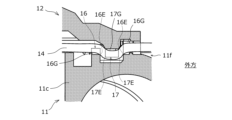
- FIG. 2 is a cross-sectional view for explaining the lead wire holding portion structure according to the embodiment, taken along the longitudinal direction of the lead wire.
- FIG. 2 is an exploded perspective view for explaining the lead wire holding portion structure according to the embodiment, in which the lead wires are omitted.
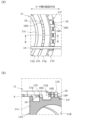
- 3A and 3B are diagrams showing a motor to which a lead wire holding portion structure according to an embodiment is applied, in which FIG. 3A is a plan view and FIG. 3B is a cross-sectional view taken along the line AA in FIG. 4A and 4B are diagrams showing a main part of the housing of the motor of FIG. 3, in which FIG. 4A is a plan view and FIG. 4B is a cross-sectional view taken along the line BB of FIG.
- Lead wire holding section structure] 1 and 2 are diagrams for explaining a lead wire holding structure (hereinafter referred to as a "holding structure").
- the holding structure is a structure in which a lead wire 4 is held between a first component 1 and a second component 2 combined with the first component 1, and the lead wire 4 is drawn out from inside the first component 1 and the second component 2 to the outside.
- the end 4a of the lead wire 4 is connected to a component (hereinafter referred to as a "connection object 5") arranged inside the first component 1 and the second component 2, for example.
- the number of lead wires 4 is not particularly limited. When one lead wire 4 is connected to the connection object 5, one holding structure is provided. When multiple lead wires 4 are connected to the connection object 5, the same number of holding structures as the number of lead wires 4 are provided. In other words, a holding structure is provided for each lead wire 4.
- the connection object 5 is a component to which the end 4a of the lead wire 4 is connected, and examples of such components include a coil and a circuit board.
- the first component 1 in this embodiment is a component on which the connection object 5 is placed (housed, attached).
- the second component 2 is a component that is combined (attached, engaged, attached) with the first component 1, and is a separate component from the first component 1.
- the connection object 5 may be placed on the second component 2 side.
- the mating surface 3 is formed by two surfaces of the two components 1 and 2 that face each other or contact each other (the surface on the first component 1 side and the surface on the second component 2 side).
- the mating surface 3 is diagrammatically shown by a two-dot chain line.
- the mating surface 3 is not limited to a flat surface, but may be a curved surface, and is not limited to being flush, but may be a stepped surface or an inclined surface.
- the retaining portion structure is provided, for example, on a part of the mating surface 3. In this case, a gap through which at least the lead wire 4 can be inserted is provided in this part.
- the retaining structure comprises two first recesses 6 arranged side by side and spaced apart from each other along the extension direction of the lead wire 4, and one second recess 7 located between the two first recesses 6 when the first component 1 and the second component 2 are combined.
- the "extension direction” here refers to the direction in which the lead wire 4 extends at the position where the retaining structure is provided when it is pulled outward from its end 4a (the longitudinal direction of the lead wire 4 at the position of the retaining structure). Since the second recess 7 is disposed between the two first recesses 6, the separation distance between the two first recesses 6 is set to be longer than the dimension of the second recess 7 in the extension direction.
- the two first recesses 6 are formed by cutting out a portion of a specified component (first component 1, second component 2, or a component other than these), and each has a groove 6G that extends in the extension direction and is open in the extension direction.
- the two first recesses 6 are formed so that each groove 6G is positioned on a substantially straight line.
- a lead wire 4 is placed in this groove 6G.
- each groove 6G is formed of two opposing side surfaces 6Gs and a bottom surface 6Gb.
- Each groove 6G shown in FIG. 2 has a shape in which the lower ends of the two planar side surfaces 6Gs in the figure are connected by a curved bottom surface 6Gb that is convex downwards. Note that the shape of the groove 6G is not limited to this.
- one of the first recess 6 and the second recess 7 is provided on the first component 1 side, and the other of the first recess 6 and the second recess 7 is provided on the second component 2 side.
- the recess 6 or 7 provided on the component on which the lead wire 4 is arranged (here, the first component 1) preferably has a narrower groove width than the recess 7 or 6 provided on the component on which the lead wire 4 is not arranged (here, the second component 2).
- the "groove width" here refers to the distance between the two side surfaces that form the groove.
- the second component 2 is assembled to the first component 1 with the lead wire 4 arranged in the groove of the recess on the first component 1 side (e.g., the first recess 6). Therefore, for example, if the groove width of the first recess 6 is narrower than the groove width of the recess on the second component 2 side (in this case, the second recess 7), the lead wire 4 will easily enter the groove 7G of the second recess 7 when bending the lead wire 4, improving assembly.
- the holding portion structure it is preferable that at least one of the first recess 6 and the second recess 7 has a protrusion 6P, 7P protruding from the inner surface of the groove 6G, 7G.
- the protrusion 6P, 7P has a function of holding the lead wire 4 more firmly by biting into the lead wire 4 arranged in the groove 6G, 7G (similar function to the corner portion 6E, 7E).
- the protrusion 6P is provided in one of the two first recesses 6 that is closer to the connection object 5, and the protrusion 7P is also provided in the second recess 7.
- the protrusion 6P is not present in the other first recess 6 that is farther from the connection object 5 (located further outward).
- the lead wire 4 located in the other first recess 6 that does not have the protrusion 6P can slide in the groove 6G, so bending deformation of the lead wire 4 is not hindered.
- the protrusion 6P is preferably provided on a portion of the inner surface of the groove 6G in the extension direction (the center portion in the extension direction in FIG. 2), and further preferably provided on one or both of the two opposing side surfaces 6Gs of the inner surface (in other words, not provided on the bottom surface 6Gb). This ensures that when the first component 1 and the second component 2 are combined (when the lead wire 4 is bent), the lead wire 4 is not pushed up from the bottom surface 6Gb, and therefore the second component 2 does not rise up relative to the first component 1, ensuring good assembly.
- the protrusion 6P is preferably tapered from the base end (the end that contacts the inner surface) to the tip. This makes it easier for the tip to bite into the lead wire 4, improving holding power.
- the protrusion 7P is preferably provided on a part of the inner surface of the groove 7G in the extension direction (the center in the extension direction in FIG. 2), and further preferably provided on one or both of the two opposing side surfaces 7Gs of the inner surface (not provided on the bottom surface 7Gb). Moreover, it is preferable that the protrusion 7P also has a tapered shape from the base end (the end that contacts the inner surface) to the tip. Note that the protrusion 6P may be provided on both of the two first recesses 6, or the protrusions 6P, 7P may be provided on only one of the first recess 6 and the second recess 7.
- the rotor 20 has a magnet 22 fixed to the shaft 21 and two balancers 23 that sandwich the magnet 22 in the axial direction, and is fixed rotatably relative to the housing 11 and the end bell 12 by bearings 24.
- the stator 30 has a stator core 31 fixed to the inner circumferential surface of the housing 11, and a coil 35 wound around the stator core 31 via an insulator 32. Lead wires 14 are connected to the ends of the coil 35.
- the housing 11 has a bottomed cylindrical portion 11A that forms an arrangement space for the rotor 20 and stator 30, and an annular portion 11B that forms an arrangement space for the impeller between it and a cover member (not shown).
- the annular portion 11B is formed continuously from the outer peripheral surface of the side wall portion 11c of the bottomed cylindrical portion 11A to the outside.
- the upper end of the annular portion 11B functions as a flange portion 11f that extends outward from the side wall portion 11c.
- the bottom 11d of the bottomed cylindrical portion 11A is provided with a through hole through which the shaft 21 is inserted, and a step 11e to which the bearing 24 and O-ring 25 are fixed.
- the opening of the bottomed cylindrical portion 11A (the opening formed by the upper edge of the side wall portion 11c) is covered by the end bell 12.
- the end bell 12 is a lid member that is combined with the housing 11. In this embodiment, the outer peripheral end portion 12a of the end bell 12 is placed on the flange portion 11f of the housing 11, and the end bell 12 is fixed to the housing 11.
- the housing 11 corresponds to the first part 1
- the end bell 12 that is combined with the opening of the housing 11 corresponds to the second part 2
- the lead wire 14 is held between the housing 11 and the end bell 12 and is drawn out from the inside of the housing 11 and the end bell 12 to the outside.
- the coil 35 to which the end of the lead wire 14 is connected corresponds to the connection object 5
- the opposing surfaces of the flange portion 11f and the outer peripheral end portion 12a correspond to the mating surface 3.
- the holding portion structure of this embodiment is provided on a circumferential portion of the opposing surfaces (the portion from which the lead wire 14 is drawn).
- five lead wires 14 are arranged in parallel, so five holding portion structures are arranged in parallel. Since all five holding portion structures are configured in the same way, in the following description, unless otherwise specified, one holding portion structure will be assigned a reference symbol.
- Figures 4(a) and (b) are a plan view and a cross-sectional view (cross-sectional view taken along the arrows B-B in Figure 4(a)) showing the main parts of the housing 11, and Figures 5(a) and (b) are a plan view and a cross-sectional view (cross-sectional view taken along the arrows C-C in Figure 5(a)) showing the main parts of the end bell 12.
- Figure 6 is a cross-sectional view showing the state in which the lead wire 14 is held by the retaining portion structure. Note that only one lead wire 14 is shown in Figure 4(a).
- the flange portion 11f of the housing 11 has an end face (top face in the figure) on the end bell 12 side that is not flat, but has an uneven surface in the axial direction.
- the surface on the end bell 12 side (surface facing the end bell 12) is referred to as the "upper end face”.
- two annular convex portions 11h are provided that protrude toward the end bell 12 side from the reference position X
- two annular concave portions 11g are provided that are recessed in a direction away from the end bell 12 with respect to the reference position X.
- each annular convex portion 11h and each annular concave portion 11g are concentric circular rings centered on the axis of the shaft 21, and are provided alternately in the order of annular concave portion 11g, annular convex portion 11h, annular concave portion 11g, and annular convex portion 11h from the radial inside (hereinafter simply referred to as the "inside")
- first recesses 16 corresponding to the above-mentioned first recesses 6 are formed in each of the two annular protrusions 11h. That is, the two first recesses 16 are integrally formed in the housing 11.
- one first recess 16 is formed by cutting out the upper end surface of the inner annular protrusion 11h
- the other first recess 16 is formed by cutting out the upper end surface of the outer annular protrusion 11h.
- Each first recess 16 has a groove 16G that extends in the extension direction of the lead wire 14.
Landscapes
- Engineering & Computer Science (AREA)
- Power Engineering (AREA)
- Microelectronics & Electronic Packaging (AREA)
- Architecture (AREA)
- Civil Engineering (AREA)
- Structural Engineering (AREA)
- Motor Or Generator Frames (AREA)
- Insertion, Bundling And Securing Of Wires For Electric Apparatuses (AREA)
Priority Applications (5)
| Application Number | Priority Date | Filing Date | Title |
|---|---|---|---|
| CN202380019503.0A CN118661362B (zh) | 2023-12-26 | 2023-12-26 | 引线保持部结构以及马达 |
| JP2024527669A JP7531758B1 (ja) | 2023-12-26 | 2023-12-26 | リード線保持部構造及びモータ |
| US18/838,235 US12414255B2 (en) | 2023-12-26 | 2023-12-26 | Lead holding portion structure and motor |
| DE112023000463.3T DE112023000463T5 (de) | 2023-12-26 | 2023-12-26 | Anschlussleitungshalteabschnittsstruktur und motor |
| PCT/JP2023/046709 WO2025141707A1 (ja) | 2023-12-26 | 2023-12-26 | リード線保持部構造及びモータ |
Applications Claiming Priority (1)
| Application Number | Priority Date | Filing Date | Title |
|---|---|---|---|
| PCT/JP2023/046709 WO2025141707A1 (ja) | 2023-12-26 | 2023-12-26 | リード線保持部構造及びモータ |
Publications (1)
| Publication Number | Publication Date |
|---|---|
| WO2025141707A1 true WO2025141707A1 (ja) | 2025-07-03 |
Family
ID=92174313
Family Applications (1)
| Application Number | Title | Priority Date | Filing Date |
|---|---|---|---|
| PCT/JP2023/046709 Pending WO2025141707A1 (ja) | 2023-12-26 | 2023-12-26 | リード線保持部構造及びモータ |
Country Status (5)
| Country | Link |
|---|---|
| US (1) | US12414255B2 (https=) |
| JP (1) | JP7531758B1 (https=) |
| CN (1) | CN118661362B (https=) |
| DE (1) | DE112023000463T5 (https=) |
| WO (1) | WO2025141707A1 (https=) |
Citations (2)
| Publication number | Priority date | Publication date | Assignee | Title |
|---|---|---|---|---|
| JP5967349B2 (ja) * | 2011-12-28 | 2016-08-10 | 株式会社富士通ゼネラル | 電動機 |
| CN106385130A (zh) * | 2016-10-19 | 2017-02-08 | 珠海格力节能环保制冷技术研究中心有限公司 | 一种自动折叠护套 |
Family Cites Families (14)
| Publication number | Priority date | Publication date | Assignee | Title |
|---|---|---|---|---|
| US4095043A (en) | 1976-05-14 | 1978-06-13 | Graber-Rogg, Inc. | Enclosure with strain relief |
| US5532703A (en) * | 1993-04-22 | 1996-07-02 | Valor Enterprises, Inc. | Antenna coupler for portable cellular telephones |
| JP2970338B2 (ja) * | 1993-09-22 | 1999-11-02 | 住友電装株式会社 | 電線接続部の自動防水処理装置 |
| JP2009201277A (ja) * | 2008-02-22 | 2009-09-03 | Mitsuba Corp | 減速機構付き電動モータ |
| JP5132631B2 (ja) * | 2009-05-25 | 2013-01-30 | 三菱電機株式会社 | 電動機の固定子及び電動機及び空気調和機及び電動機の製造方法 |
| JP2012015977A (ja) * | 2010-07-05 | 2012-01-19 | Panasonic Corp | 携帯無線機 |
| JP5518806B2 (ja) * | 2011-08-04 | 2014-06-11 | 株式会社ソニー・コンピュータエンタテインメント | 電子機器 |
| JP5377702B2 (ja) * | 2012-04-16 | 2013-12-25 | 三菱電機株式会社 | 回転電機およびその製造方法 |
| US20150101837A1 (en) | 2013-10-14 | 2015-04-16 | A. Raymond Et Cie | Enclosure for an electrical wire connection in an appliance |
| CN107528413B (zh) * | 2016-06-20 | 2019-09-17 | 马渊马达株式会社 | 引线引出部的构造以及马达 |
| JP2018057099A (ja) * | 2016-09-27 | 2018-04-05 | 日本電産サンキョー株式会社 | モータ |
| JP2020054137A (ja) * | 2018-09-27 | 2020-04-02 | 日本電産サンキョー株式会社 | モータ |
| JP2020137316A (ja) * | 2019-02-22 | 2020-08-31 | 日本電産サンキョー株式会社 | モータ |
| DE102021126730A1 (de) * | 2020-10-16 | 2022-04-21 | Illinois Tool Works Inc. | Leitungshalter |
-
2023
- 2023-12-26 JP JP2024527669A patent/JP7531758B1/ja active Active
- 2023-12-26 US US18/838,235 patent/US12414255B2/en active Active
- 2023-12-26 DE DE112023000463.3T patent/DE112023000463T5/de active Pending
- 2023-12-26 WO PCT/JP2023/046709 patent/WO2025141707A1/ja active Pending
- 2023-12-26 CN CN202380019503.0A patent/CN118661362B/zh active Active
Patent Citations (2)
| Publication number | Priority date | Publication date | Assignee | Title |
|---|---|---|---|---|
| JP5967349B2 (ja) * | 2011-12-28 | 2016-08-10 | 株式会社富士通ゼネラル | 電動機 |
| CN106385130A (zh) * | 2016-10-19 | 2017-02-08 | 珠海格力节能环保制冷技术研究中心有限公司 | 一种自动折叠护套 |
Also Published As
| Publication number | Publication date |
|---|---|
| US12414255B2 (en) | 2025-09-09 |
| CN118661362B (zh) | 2025-09-23 |
| DE112023000463T5 (de) | 2025-10-02 |
| CN118661362A (zh) | 2024-09-17 |
| US20250212350A1 (en) | 2025-06-26 |
| JPWO2025141707A1 (https=) | 2025-07-03 |
| JP7531758B1 (ja) | 2024-08-09 |
Similar Documents
| Publication | Publication Date | Title |
|---|---|---|
| JP7428099B2 (ja) | 軸流ファン | |
| JP5310816B2 (ja) | モールドモータ | |
| JP7114840B2 (ja) | モータ | |
| JP4573626B2 (ja) | モータ | |
| JP4701554B2 (ja) | モータ | |
| CN107896014B (zh) | 马达 | |
| JP7531758B1 (ja) | リード線保持部構造及びモータ | |
| JP4785852B2 (ja) | 電動モータ | |
| JP2003037954A (ja) | ロータ及びブラシレスモータ | |
| JP2006296020A (ja) | 回転電機のロータ及び回転電機 | |
| CN211018477U (zh) | 马达 | |
| JP5983245B2 (ja) | モールドモータ | |
| JP7155746B2 (ja) | モータ | |
| JP2019083611A (ja) | モータ | |
| JP7219138B2 (ja) | モータおよび弁体駆動装置 | |
| JP2009290915A (ja) | モータ | |
| JP2017067046A (ja) | 送風機および空気調和機 | |
| JP2017216794A (ja) | モータ | |
| JP2005073317A (ja) | ブラシ保持装置 | |
| JP6065541B2 (ja) | モールドモータ | |
| JP2003088053A (ja) | ブラシ装置及び該ブラシ装置を用いたモータ | |
| JP3655230B2 (ja) | モータ | |
| JPS6114280Y2 (https=) | ||
| KR101602321B1 (ko) | 스테핑 모터 | |
| JP2023060961A (ja) | モータおよび軸流ファン |
Legal Events
| Date | Code | Title | Description |
|---|---|---|---|
| ENP | Entry into the national phase |
Ref document number: 2024527669 Country of ref document: JP Kind code of ref document: A |
|
| WWE | Wipo information: entry into national phase |
Ref document number: 2024527669 Country of ref document: JP |
|
| WWE | Wipo information: entry into national phase |
Ref document number: 112023000463 Country of ref document: DE |
|
| 121 | Ep: the epo has been informed by wipo that ep was designated in this application |
Ref document number: 23963061 Country of ref document: EP Kind code of ref document: A1 |
|
| WWG | Wipo information: grant in national office |
Ref document number: 18838235 Country of ref document: US |
|
| WWG | Wipo information: grant in national office |
Ref document number: 202380019503.0 Country of ref document: CN |
|
| WWP | Wipo information: published in national office |
Ref document number: 112023000463 Country of ref document: DE |