WO2025041219A1 - Film de transfert et corps moulé utilisant ledit film de transfert, et composition de résine durcissable aux ultraviolets utilisée à cet effet - Google Patents
Film de transfert et corps moulé utilisant ledit film de transfert, et composition de résine durcissable aux ultraviolets utilisée à cet effet Download PDFInfo
- Publication number
- WO2025041219A1 WO2025041219A1 PCT/JP2023/029963 JP2023029963W WO2025041219A1 WO 2025041219 A1 WO2025041219 A1 WO 2025041219A1 JP 2023029963 W JP2023029963 W JP 2023029963W WO 2025041219 A1 WO2025041219 A1 WO 2025041219A1
- Authority
- WO
- WIPO (PCT)
- Prior art keywords
- layer
- hard coat
- ultraviolet
- transfer film
- transfer
- Prior art date
- Legal status (The legal status is an assumption and is not a legal conclusion. Google has not performed a legal analysis and makes no representation as to the accuracy of the status listed.)
- Ceased
Links
Images

Classifications
-
- B—PERFORMING OPERATIONS; TRANSPORTING
- B32—LAYERED PRODUCTS
- B32B—LAYERED PRODUCTS, i.e. PRODUCTS BUILT-UP OF STRATA OF FLAT OR NON-FLAT, e.g. CELLULAR OR HONEYCOMB, FORM
- B32B27/00—Layered products comprising a layer of synthetic resin
- B32B27/40—Layered products comprising a layer of synthetic resin comprising polyurethanes
-
- B—PERFORMING OPERATIONS; TRANSPORTING
- B41—PRINTING; LINING MACHINES; TYPEWRITERS; STAMPS
- B41M—PRINTING, DUPLICATING, MARKING, OR COPYING PROCESSES; COLOUR PRINTING
- B41M5/00—Duplicating or marking methods; Sheet materials for use therein
- B41M5/26—Thermography ; Marking by high energetic means, e.g. laser otherwise than by burning, and characterised by the material used
- B41M5/40—Thermography ; Marking by high energetic means, e.g. laser otherwise than by burning, and characterised by the material used characterised by the base backcoat, intermediate, or covering layers, e.g. for thermal transfer dye-donor or dye-receiver sheets; Heat, radiation filtering or absorbing means or layers; combined with other image registration layers or compositions; Special originals for reproduction by thermography
- B41M5/42—Intermediate, backcoat, or covering layers
-
- B—PERFORMING OPERATIONS; TRANSPORTING
- B41—PRINTING; LINING MACHINES; TYPEWRITERS; STAMPS
- B41M—PRINTING, DUPLICATING, MARKING, OR COPYING PROCESSES; COLOUR PRINTING
- B41M5/00—Duplicating or marking methods; Sheet materials for use therein
- B41M5/26—Thermography ; Marking by high energetic means, e.g. laser otherwise than by burning, and characterised by the material used
- B41M5/40—Thermography ; Marking by high energetic means, e.g. laser otherwise than by burning, and characterised by the material used characterised by the base backcoat, intermediate, or covering layers, e.g. for thermal transfer dye-donor or dye-receiver sheets; Heat, radiation filtering or absorbing means or layers; combined with other image registration layers or compositions; Special originals for reproduction by thermography
- B41M5/42—Intermediate, backcoat, or covering layers
- B41M5/44—Intermediate, backcoat, or covering layers characterised by the macromolecular compounds
Definitions
- the present invention relates to a transfer film that does not require post-processing such as topcoating with a hard coat paint or UV irradiation after transfer processing, a molded body using the transfer film, and a UV-curable resin composition used therein.
- a commonly used method has been to use a transfer film on which a release layer, a functional layer (protective layer, colored layer, printed layer, hard coat layer, anti-reflective layer, metal thin film layer, etc.), and an adhesive layer are successively formed on a substrate, and the functional layer and adhesive layer (hereinafter, these layers are collectively referred to as the transfer layer) formed on the release layer of the transfer film are transferred from the release layer of the transfer film to the surface of a resin molded product, forming a transfer layer on the surface of the resin molded product, thereby obtaining a molded product that has various surface properties such as metallic luster, design, hard coat properties, abrasion resistance, weather resistance, etc.
- These molded products are used in a variety of products such as home appliances, automobile parts, miscellaneous goods, paper containers, and labels.
- a conventional transfer film with a hard coat layer formed by completely curing an ultraviolet-curable resin composition can be used to obtain a molded product with surface properties.
- Conventional transfer films such as the transfer film described in Patent Document 1, can be used without any problems in practice when transferring to a resin molded product with a flat surface or a resin molded product with small surface irregularities (when the elongation of the transfer film is less than 5%).
- the transfer film is used to transfer to a resin molded product with large surface irregularities to obtain a molded product with a three-dimensional effect (when the elongation rate of the transfer film is 5% or more and less than 30%)
- the transfer film used is required to have high elongation, and if the elongation of the transfer film is insufficient, depending on the transfer processing conditions, cracks may occur in the hard coat layer.
- a transfer film that does not have a hard coat layer formed to impart design is first used to transfer a decorative layer such as a colored layer, a printed layer, or a metal thin film layer onto the surface of a resin molded product, and then a hard coat paint is applied on top of the transfer layer to obtain the desired surface performance.
- a decorative layer such as a colored layer, a printed layer, or a metal thin film layer
- a hard coat paint is applied on top of the transfer layer to obtain the desired surface performance.
- VOCs volatile organic compounds
- a method may be adopted in which the ultraviolet-curable resin composition used for the hard coat layer is not completely cured during the production of the transfer film, and an ultraviolet irradiation process is further performed after the transfer process to completely cure the ultraviolet-curable resin composition.
- the transfer film could not be produced stably because it was necessary to further perform ultraviolet irradiation processing after the transfer processing and it was necessary to control the amount of ultraviolet irradiation during the production of the transfer film.
- the present invention aims to solve all of the above problems and provide a transfer film that does not require post-processing (topcoating of hard coat paint, UV irradiation) after transfer processing, does not cause cracks in the hard coat layer, and does not cause defects in appearance or deterioration of surface performance, as well as a molded product obtained using the same, and a UV-curable resin composition that constitutes the hard coat layer formed on these.
- the present inventors have found that by using a transfer film having a hard coat layer formed by completely curing an ultraviolet-curable resin composition having specific characteristics, post-processing (topcoating of hard coat paint, ultraviolet irradiation) is not required after transfer processing, and cracks are not generated in the hard coat layer, making it possible to obtain a molded product that is free from defects in appearance and defects that reduce surface performance, and have completed the present invention.
- the transfer film of the present invention even when transferring to a resin molded product with large surface irregularities, post-processing (topcoating of hard coat paint, UV irradiation) is not required after transfer processing, cracks are not generated in the hard coat layer, and the molded product of the present invention without defects in appearance or defects that reduce surface performance can be obtained. Furthermore, even when transferring to a resin molded product with particularly large surface irregularities, by adjusting the transfer processing conditions, the molded product of the present invention without post-processing (topcoating of hard coat paint, UV irradiation) after transfer processing and without cracks in the hard coat layer can be obtained.
- the transfer film of the present invention is a transfer film in which at least a release layer, a hard coat layer, a primer layer, and an adhesive layer are formed in this order on a substrate, the hard coat layer having a thickness of 3 ⁇ m or more, and the hard coat layer is a layer of a fully cured ultraviolet-curable resin composition containing at least a urethane (meth)acrylate oligomer having a weight-average molecular weight (Mw) of 1,000 or more and a functionality of 3 or less, and a photopolymerization initiator.
- Mw weight-average molecular weight
- the present invention is also characterized in that in the transfer film having the above characteristics, at least one of a colored layer, a printed layer, a metal base layer, and a metal thin film layer is formed between the primer layer and the adhesive layer.
- the present invention is characterized in that in the transfer film having the above characteristics, the interlayer peel strength between the release layer and the hard coat layer is 0.001 N/mm or more and 0.008 N/mm or less.
- the molded product of the present invention is a molded product in which an adhesive layer, a primer layer, and a hard coat layer are formed in that order on a resin molded product, and is characterized in that the thickness of the hard coat layer is 3 ⁇ m or more, and that the hard coat layer is a layer of a completely cured ultraviolet-curable resin composition containing at least a urethane (meth)acrylate oligomer having a weight-average molecular weight (Mw) of 1,000 or more and a functionality of 3 or less, and a photopolymerization initiator.
- Mw weight-average molecular weight
- the present invention is characterized in that in the molded body having the above characteristics, at least one layer selected from the group consisting of a colored layer, a printed layer, a metal base layer, and a metal thin film layer is formed between the primer layer and the adhesive layer.
- the ultraviolet-curable resin composition of the present invention is an ultraviolet-curable resin composition for forming a hard coat layer formed on a transfer film or a molded body, having the above-mentioned characteristics, and is characterized in that the ultraviolet-curable resin composition contains at least a urethane (meth)acrylate oligomer having a weight-average molecular weight (Mw) of 1,000 or more and a functionality of 3 or less, and a photopolymerization initiator.
- Mw weight-average molecular weight
- the transfer film of the present invention in which a hard coat layer formed by completely curing an ultraviolet-curable resin composition having the above-mentioned specific characteristics is formed on a release layer, even when transferring to a resin molded product with large surface irregularities, post-processing (topcoating of hard coat paint, ultraviolet irradiation) is not required after transfer processing, and cracks do not occur in the hard coat layer, so that a molded product of the present invention can be reliably obtained that does not suffer from defects in appearance or defects that reduce surface performance.
- the molded body of the present invention has the above-mentioned specific characteristics, not only does it have strong adhesion between the resin molded product and the transfer layer, but it also has strong adhesion between each layer of the transfer layer, including the hard coat layer, and thus has excellent abrasion resistance in addition to hard coat properties. Furthermore, even when the transfer film of the present invention is used to transfer onto a resin molded product having particularly large surface irregularities, by adjusting the transfer processing conditions, it is possible to obtain a molded product of the present invention that does not require post-processing (topcoating of hard coat paint, ultraviolet irradiation processing) after the transfer processing and that does not develop cracks in the hard coat layer. In order to form a hard coat layer made of an ultraviolet-curable resin composition having specific characteristics formed on the transfer film or molded article of the present invention, it is optimal to use the ultraviolet-curable resin composition of the present invention.
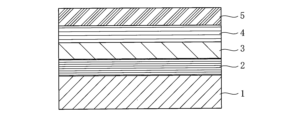
- FIG. 1 shows an example of the layer structure of a transfer film according to one embodiment of the present invention, in which a release layer 2, a hard coat layer 3, a primer layer 4, and an adhesive layer 5 are successively formed on a substrate 1.
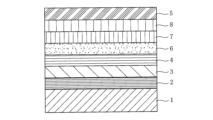
- This is a diagram showing an example of the layer structure of the transfer film of the present invention, which has a layer structure in which, in addition to the layers shown in Figure 1, a colored layer 6, a metal base layer 7, and a metal thin film layer 8 are added between the primer layer 4 and the adhesive layer 5.
- FIG. 2 is a diagram showing an example of the layer structure of a molded body of the present invention obtained using the transfer film of FIG.
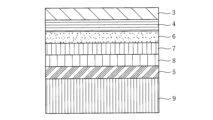
- FIG. 3 is a diagram showing an example of the layer structure of a molded body of the present invention obtained using the transfer film of FIG. 2, in which an adhesive layer 5, a metal thin film layer 8, a metal undercoat layer 7, a colored layer 6, a primer layer 4, and a hard coat layer 3 are formed in this order on the surface of a resin molded article 9 by transfer.
- the transfer film of the present invention capable of solving the above-mentioned problems includes the following configurations, but may have configurations other than those below.
- the substrate 1 used in the transfer film of the present invention can be any substrate that can form a release layer, etc. that constitutes the transfer film of the present invention when the transfer film of the present invention is used for transfer processing, and can be selected appropriately from paper, plastic film, etc., but it is preferable to use a plastic film because it is less likely to curl and less likely to develop creases during processing such as forming a release layer, etc. on the substrate 1.
- the plastic film used for the substrate 1 is not particularly limited as long as it is a plastic film generally used for transfer films, and various conventionally known plastic films such as polyethylene terephthalate film, polycarbonate film, polyethylene film, polypropylene film, and polyamide film can be used.
- the above plastic film may be unstretched, uniaxially stretched, or biaxially stretched, and may contain various additives such as antistatic agents, colorants, and heat stabilizers.
- the type of plastic film may be appropriately selected depending on the desired application and purpose.
- the surface of the substrate 1 (the surface on which the release layer is formed) may be subjected to various processes such as hairline processing, matte processing, embossing, etc.
- the thickness of the substrate 1 used in the transfer film of the present invention is not particularly limited, but is preferably 12 ⁇ m or more and 250 ⁇ m or less. In addition, when transferring to a resin molded product having particularly large surface irregularities, it is particularly preferable that the thickness of the substrate 1 be 25 ⁇ m or more and 50 ⁇ m or less. If the thickness of the substrate 1 is less than 12 ⁇ m, not only curling but also folding and wrinkling may occur when forming a release layer or the like on the substrate 1 or during the production of the transfer film of the present invention, which is not preferable.
- the substrate 1 becomes so-called stiff, and when performing transfer processing using the transfer film of the present invention, it may be difficult to closely contact the surface of a mold for producing a resin molded product, or it may be difficult to follow the surface unevenness of a resin molded product with particularly large surface unevenness, which is not preferable.
- the release layer 2 in the present invention is a layer formed on the substrate 1 for the purpose of facilitating peeling of the transfer layer from the release layer 2 of the transfer film of the present invention when the transfer film of the present invention is used for transfer processing. Furthermore, the release layer 2 is not transferred or formed on the surface of the resin molded product during transfer processing, but is removed from the resin molded product together with the substrate 1.
- the release layer 2 is a layer made of a resin.
- the resin used for the release layer 2 is not particularly limited as long as it can achieve the above-mentioned purpose, and conventionally known resins such as polyethylene resins, polypropylene resins, polystyrene resins, vinyl chloride resins, polyester resins, acrylic resins, urethane resins, melamine resins, and epoxy resins can be used. Any one of these resins or a mixture of two or more of them may be used, and the resin may be appropriately selected depending on the purpose.
- the hard coat layer 3 described below is a layer obtained by completely curing an ultraviolet-curable resin composition and is also a layer that has extensibility.
- this layer is more susceptible to foil burrs and foil scattering (a phenomenon in which part of the transfer layer peels off and falls off from the release layer during the production of the transfer film). Therefore, in order to prevent the occurrence of foil burrs or foil scattering, it is necessary to increase the interlayer peel strength between the release layer 2 and the hard coat layer 3. However, if the peel strength is too high, foil chipping (a phenomenon in which part or all of the transfer layer in the transfer portion does not peel off from the release layer during transfer processing, and part or all of the transfer layer is chipped) is more likely to occur.
- the interlayer peel strength between the release layer 2 and the hard coat layer 3 of the transfer film of the present invention is preferable to adjust the interlayer peel strength between the release layer 2 and the hard coat layer 3 of the transfer film of the present invention to a range of 0.001 N/mm or more and 0.008 N/mm or less, and in order to further suppress the occurrence of foil scattering, foil burrs, and foil chipping, it is more preferable to adjust it to a range of 0.001 N/mm or more and 0.005 N/mm or less.
- the interlayer peel strength can be adjusted by any method known in the art, if necessary.
- the thickness of the release layer 2 may be appropriately selected within a range that allows the above-mentioned object to be achieved, and is preferably in the range of 0.5 ⁇ m to 5 ⁇ m.
- the method for forming the release layer 2 may be a conventionally known coating method such as gravure coating, reverse coating, die coating, reverse gravure coating, or bar coating, and may be appropriately selected depending on the purpose.
- the hard coat layer 3 in the present invention is a layer formed by completely curing the ultraviolet-curable resin composition of the present invention, which contains at least a urethane (meth)acrylate oligomer having a weight-average molecular weight (Mw) of 1,000 or more and a functionality of 3 or less, and a photopolymerization initiator.
- Mw weight-average molecular weight
- (meth)acrylate refers to acrylate and/or methacrylate
- (meth)acryloyl group refers to acryloyl group and/or methacryloyl group
- (meth)acryloyloxy group refers to acryloyloxy group and/or methacryloyloxy group.
- Solid content refers to the ultraviolet-curable resin composition excluding volatile components such as solvent, and indicates the components that constitute the hard coat layer when completely cured.
- the ultraviolet-curable resin composition of the present invention is a layer made of a cured product obtained by crosslinking and curing a resin composition containing an ultraviolet-curable acrylate and/or methacrylate (hereinafter referred to as (meth)acrylate), and such a (meth)acrylate contains a urethane (meth)acrylate oligomer (a1) having a weight-average molecular weight (Mw) of 1,000 or more and a functionality of 3 or less.
- Component (a1) is a compound having a urethane bond (-NHCOO-) in the molecule and three or less (meth)acryloyl groups as functional groups in the molecule.
- This compound is, for example, a urethane reaction product of a polyisocyanate, a hydroxyl group-containing (meth)acrylate, and an optionally used polyol.
- an isocyanate group-containing urethane prepolymer may be synthesized from the polyisocyanate and the polyol, and a hydroxyl group-containing (meth)acrylate may be added thereto.
- an isocyanate group-containing (meth)acrylate for example, 2-(meth)acryloyloxyethyl isocyanate, may be used.
- polyisocyanate examples include aliphatic or alicyclic polyisocyanates, and specific examples thereof include aliphatic diisocyanates such as hexamethylene diisocyanate and pentamethylene diisocyanate; alicyclic polyisocyanates such as isophorone diisocyanate, norbornane diisocyanate, hydrogenated diphenylmethane diisocyanate, hydrogenated tolylene diisocyanate, hydrogenated xylylene diisocyanate, 1,3-bis(isocyanatomethyl)-cyclohexane and dicyclohexylmethane-4,4'-diisocyanate; biuret, isocyanurate or allophanate forms of these compounds; and compounds in which a portion of the isocyanate groups of these compounds are
- hydroxy group-containing (meth)acrylates include hydroxyalkyl group-containing monofunctional (meth)acrylates such as 2-hydroxyethyl (meth)acrylate, 2-hydroxypropyl (meth)acrylate, 4-hydroxybutyl (meth)acrylate, and 1,4-cyclohexanedimethanol mono(meth)acrylate; hydroxy group-containing polyfunctional (meth)acrylates such as glycerin di(meth)acrylate, trimethylolpropane di(meth)acrylate, pentaerythritol tri(meth)acrylate, and dipentaerythritol penta(meth)acrylate; and alkylene oxide- or caprolactone-modified versions of these.
- monofunctional (meth)acrylates such as 2-hydroxyethyl (meth)acrylate, 2-hydroxypropyl (meth)acrylate, 4-hydroxybutyl (meth)acrylate, and 1,4-cyclohexanedimethanol mono(meth)acryl
- polyols examples include aliphatic or alicyclic polyols such as 1,4-butanediol, 1,6-hexanediol, ethylene glycol, diethylene glycol, triethylene glycol, propylene glycol, trimethylolpropane, ditrimethylolpropane, pentaerythritol, dipentaerythritol, glycerin, and hydrogenated bisphenol A.
- the weight average molecular weight of component (a1) measured by GPC method is preferably 1,000 or more, more preferably 1,200 or more and 20,000 or less, even more preferably 1,500 or more and 15,000 or less, even more preferably 1,700 or more and 10,000 or less, and particularly preferably 1,700 or more and 4,500 or less. If the weight average molecular weight of component (a1) is within the above numerical range, the hard coat layer 3 can easily have the desired elongation, hard coat property, and abrasion resistance.
- the weight average molecular weight of component (a1) exceeds the above range, the hard coat property and abrasion resistance of the hard coat layer 3 may decrease, which is not preferable, and if it is below the above range, the elongation of the hard coat layer 3 may decrease, which is not preferable.
- the measurement conditions for the GPC method are described below. ⁇ Apparatus: Tosoh HLC-8120GPC Column: Tosoh Super H2000+H4000 (Inner diameter 6mm, length 15cm) Developing solvent: tetrahydrofuran (THF) Column thermostat temperature: 40°C ⁇ Flow rate: 0.5ml/min Control: Monodisperse polystyrene Detector: Refractive index detector
- the number of functional groups of the (meth)acryloyl group of component (a1) is 3 or less. If the number of functional groups exceeds 3, the hard coat properties of the resulting hard coat layer 3 are improved, but there is a risk that the desired elongation may not be obtained, which is not preferred. Also, if the number of functional groups of component (a1) is less than 2, there is a risk that the desired hard coat properties of the resulting hard coat layer 3 may not be obtained, which is not preferred. To ensure that the hard coat layer 3 has both the desired hard coat properties and elongation, it is preferable that component (a1) is trifunctional.
- the content of component (a1) is preferably 50% by weight or more and 95% by weight or less, more preferably 55% by weight or more and 90% by weight or less, and even more preferably 57% by weight or more and 85% by weight or less, based on the solid content of the ultraviolet-curable resin composition. If the content of component (a1) is within the above numerical range, the hard coat layer 3 can be easily provided with the desired elongation, hard coat properties, and abrasion resistance.
- the ultraviolet-curable (meth)acrylate contained in the ultraviolet-curable resin composition may contain a polyfunctional (meth)acrylate monomer (a2) other than the component (a1).
- a polyfunctional (meth)acrylate monomer refers to a compound having two or more (meth)acryloyl groups as functional groups in the molecule. Examples of such a component (a2) include a bifunctional (meth)acrylate monomer and a trifunctional or higher polyfunctional (meth)acrylate monomer.
- bifunctional (meth)acrylate monomer examples include alkylene glycol di(meth)acrylates such as ethylene glycol di(meth)acrylate, 1,3-butanediol di(meth)acrylate, 1,4-butanediol di(meth)acrylate, 1,6-hexanediol di(meth)acrylate, 1,9-nonanediol di(meth)acrylate, and neopentyl glycol di(meth)acrylate; diethylene glycol di(meth)acrylate, triethylene glycol di(meth)acrylate, dipropylene glycol di(meth)acrylate, tripropylene glycol di(meth)acrylate, polyethylene glycol di(meth)acrylate, and the like.
- alkylene glycol di(meth)acrylates such as ethylene glycol di(meth)acrylate, 1,3-butanediol di(meth)acrylate, 1,4-butanediol
- di(meth)acrylates of halogen-substituted alkylene glycols such as tetrafluoroethylene glycol di(meth)acrylate
- di(meth)acrylates of aliphatic polyols such as trimethylolpropane di(meth)acrylate, ditrimethylolpropane di(meth)acrylate, pentaerythritol di(meth)acrylate
- hydrogenated dicyclopentadienyl di(meth)acrylate tricyclodecane dimethanol di(meth)acrylate, etc.
- di(meth)acrylates of hydrogenated dicyclopentadiene or tricyclodecane dialkanol such as 1,3-dioxane-2,5-diyl di(meth)acrylate [also known as dioxane glycol di(meth)acrylate]; di(meth)acrylates of alkylene oxide adducts of bisphenol A or bisphenol F such as bisphenol A ethylene oxide adduct diacrylate and bisphenol F ethylene oxide adduct diacrylate; acrylic acid adduct of bisphenol A diglycidyl ether, bisphenol F diglycidyl ether
- di(meth)acrylates include epoxy di(meth)acrylates of bisphenol A or bisphenol F, such as acrylic acid adducts of bisphenol A or bisphenol F; silicone di(meth)acrylates; di(meth)acrylates of hydroxypivalic acid neopentyl glycol ester; 2,2-bis[4-(meth)acryloyloxyeth
- polyfunctional (meth)acrylate monomer having three or more functional groups include poly(meth)acrylates of aliphatic polyols having three or more functional groups, such as glycerin tri(meth)acrylate, trimethylolpropane tri(meth)acrylate, ditrimethylolpropane tri(meth)acrylate, ditrimethylolpropane tetra(meth)acrylate, pentaerythritol tri(meth)acrylate, pentaerythritol tetra(meth)acrylate, dipentaerythritol tetra(meth)acrylate, dipentaerythritol penta(meth)acrylate, and dipentaerythritol hexa(meth)acrylate.
- poly(meth)acrylates of aliphatic polyols having three or more functional groups such as glycerin tri(meth)acrylate, trimethylolpropane tri(meth)acryl
- pentaerythritol tri(meth)acrylate pentaerythritol tetra(meth)acrylate
- dipentaerythritol penta(meth)acrylate dipentaerythritol hexa(meth)acrylate, and the like.
- the content of component (a2) is preferably 35% by weight or less, more preferably 25% by weight or less, and even more preferably 20% by weight or less, based on the solid content of the ultraviolet-curable resin composition.
- the ultraviolet-curable resin composition does not need to contain component (a2).
- the photopolymerization initiator (component (b)) for crosslinking and curing the above-mentioned (meth)acrylate is not particularly limited, and a conventionally known photopolymerization initiator for ultraviolet curing can be used.
- the photopolymerization initiator include acylphosphine oxide-based photopolymerization initiators, alkylphenone-based photopolymerization initiators, benzoylformate-based polymerization initiators, thioxanthone-based polymerization initiators, oxime ester-based polymerization initiators, and benzophenone-based polymerization initiators.
- acylphosphine oxide photopolymerization initiator examples include 2,4,6-trimethylbenzoyldiphenylphosphine oxide and bis(2,4,6-trimethylbenzoyl)-phenylphosphine oxide.
- alkylphenone photopolymerization initiator examples include 1-hydroxycyclohexyl phenyl ketone, 2,2-dimethyl-2-phenylacetophenone, 2-hydroxy-2-methyl-1-phenylpropanone, 2-methyl-1-[4-(methylthio)phenyl]-2-morpholinopropan-1-one, 1-[4-(2-hydroxyethoxyl)-phenyl]-2-hydroxy-methylpropanone, 2-hydroxy-1-(4-(4-(2-hydroxy-2-methylpropionyl) benzyl)phenyl)-2-methylpropan-1-one, 2-benzyl-2-(dimethylamino)-4'-morpholinobutyrophenone, and 2-(dimethylamino)-2-[(4-
- Benzoyl formate-based photopolymerization initiators include methyl benzoyl formate and the like.
- An example of the thioxanthone-based photopolymerization initiator is isopropylthioxanthone.
- Examples of the oxime ester photopolymerization initiator include 1,2-octanedione, 1-[4-(phenylthio)-, 2-(O-benzoyloxime)], ethanone, 1-[9-ethyl-6-(2-methylbenzoyl)-9H-carbazol-3-yl]-, 1-(O-acetyloxime), and the like.
- Benzophenone-based photopolymerization initiators include benzophenone, 4-chlorobenzophenone, and 4,4'-diaminobenzophenone.
- the content of this photopolymerization initiator is preferably 0.1% by weight or more and 15.0% by weight or less, more preferably 0.5% by weight or more and 10.0% by weight or less, and even more preferably 1.0% by weight or more and 7.0% by weight or less, based on the solid content of the ultraviolet-curable resin composition. If the content of the photopolymerization initiator is within the above numerical range, the hard coat layer 3 can be easily provided with the desired hard coat properties and abrasion resistance.
- the ultraviolet-curable resin composition may further contain an ultraviolet absorbing compound to impart weather resistance.
- the ultraviolet absorbing compound is not particularly limited, and any conventionally known ultraviolet absorbent can be used. Examples of the ultraviolet absorbent include a benzotriazole-based ultraviolet absorbent, a hydroxyphenyltriazine-based ultraviolet absorbent, a benzophenone-based ultraviolet absorbent, etc. These ultraviolet absorbents may be used alone or in combination of two or more kinds.
- a compound having a functional group polymerizable with the (meth)acryloyl group of the component (a1) or the component (a2) and having an ultraviolet absorbing skeleton may be used.
- Examples of the functional group polymerizable with the (meth)acryloyl group of the component (a1) or the component (a2) include a (meth)acryloyl group, a (meth)acryloyloxy group, a vinyl group, and an allyl group
- examples of the ultraviolet absorbing skeleton include a benzotriazole skeleton, a benzophenone skeleton, an oxybenzophenone skeleton, a triazine skeleton, a phenyl salicylate skeleton, and a cyano(meth)acrylate skeleton.
- Such a compound may be an oligomer or a polymer. These compounds may be used alone or in combination of two or more kinds. It is more preferable to use a compound having a functional group copolymerizable with the component (a1) or the component (a2) and having an ultraviolet absorbing skeleton, because the ultraviolet absorbing compound is fixed to the hard coat layer to suppress bleeding out.
- an ultraviolet absorber When used as the ultraviolet absorbing compound, its content is preferably 0.1 to 10% by weight, more preferably 0.5 to 7% by weight, based on the solid content of the ultraviolet curable resin composition.
- the upper limit of the content is preferably 40% by weight or less, more preferably 35% by weight or less, based on the solid content of the ultraviolet curable resin composition, and the lower limit of the content is preferably 10% by weight or more, more preferably 15% by weight or more, based on the solid content of the ultraviolet curable resin composition.
- the content of the ultraviolet absorbing compound is within the above range, the curing property of the ultraviolet curable resin composition is not inhibited, and a cured coating film having good weather resistance can be obtained.
- the ultraviolet-curable resin composition may contain other components in addition to the above-mentioned components, as long as the object of the present invention is not impaired.
- the ultraviolet-curable resin composition of the present invention can be obtained by mixing and stirring the above-mentioned components using a conventionally known device such as a mixer, disperser, stirrer, etc.
- a conventionally known device such as a mixer, disperser, stirrer, etc.
- examples of such devices include a mixing/dispersing mill, a homodisper, a mortar mixer, a roll, a paint shaker, a homogenizer, etc.
- the ultraviolet-curable resin composition can be diluted with a solvent as necessary, for example, to adjust the viscosity to a level suitable for application.
- the solvent is not particularly limited as long as it dissolves the resin content in the ultraviolet-curable resin composition.
- Specific examples include aromatic hydrocarbons (e.g., toluene, xylene, and ethylbenzene), esters or ether esters (e.g., ethyl acetate, butyl acetate, and methoxybutyl acetate), ethers (e.g., diethyl ether, tetrahydrofuran, ethylene glycol monoethyl ether, ethylene glycol monobutyl ether, monomethyl ether of propylene glycol, and monoethyl ether of diethylene glycol), ketones (e.g., acetone, methyl ethyl ketone, methyl isobutyl ketone, di-n-butyl ket
- In-mold molding method In the in-mold molding method, first, an in-mold molding die having a cavity of a desired shape and a transfer film are prepared, and the transfer film is placed inside the die so that the adhesive layer faces the resin molded product. Then, suction is applied, the die is closed, and the transfer film is sandwiched inside the injection molding die, and then a thermoplastic resin is injected into the die, and the transfer layer of the transfer film is transferred to the surface of the resin molded product by heat and pressure. After cooling, the molded product is removed from the die, and a molded product with a transfer layer formed on the surface of the resin molded product can be obtained.
- the molded article of the present invention has a hard coat layer formed thereon that has the above-mentioned weather resistance characteristics, and therefore can be used in applications where weather resistance is required, such as automotive exterior applications, but it can also be used in applications where weather resistance is not required.
- the resin constituting the resin molded product 9 may be a conventionally known resin such as an acrylic resin, a polyethylene resin, a polypropylene resin, a polystyrene resin, a vinyl chloride resin, a polyester resin, a urethane resin, a vinyl acetate resin, an ABS resin, or a polycarbonate resin, depending on the desired purpose. It may also be a mixed resin of one or more of these resins, or a copolymer resin of two or more of these resins. These resins may be transparent or colored.
- Example 1 The ultraviolet-curable resin composition of the present invention of Example 1 was prepared by adding and mixing 100 parts by weight of an alkylphenone-based polymerization initiator (Omnirad 184, solid content 100%, manufactured by IGM RESINS) as a photopolymerization initiator (b) to 100 parts by weight of a urethane acrylate oligomer (EBECRYL8701, manufactured by Daicel Allnex, solid content 100%) having a weight average molecular weight of 2,000 and a functional group of 3 as a component (a1).
- an alkylphenone-based polymerization initiator (Omnirad 184, solid content 100%, manufactured by IGM RESINS)
- EBECRYL8701 urethane acrylate oligomer having a weight average molecular weight of 2,000 and a functional group of 3 as a component (a1).
- the reactive group is an acryloyl group, and 100 parts by weight of a compound A (solid content 55%, containing butyl acetate) having a benzotriazole skeleton as an ultraviolet absorbing skeleton as an ultraviolet absorbing component.
- the content of each component relative to the solid content in this composition was 62.5% by weight for component (a1), 3.1% by weight for component (b), and 34.4% by weight for the ultraviolet absorbing component.
- Example 2 10 parts by weight of pentaerythritol tri/tetraacrylate (PETIA manufactured by Daicel Allnex Corporation, solid content 100%) as component (a2) was further added to the ultraviolet-curable resin composition of the present invention of Example 1 to prepare an ultraviolet-curable resin composition of the present invention of Example 2.
- the content of each component relative to the solid content in this composition was 58.8% by weight for component (a1), 5.9% by weight for component (a2), 2.9% by weight for component (b), and 32.4% by weight for the ultraviolet-absorbing component.
- Example 3 20 parts by weight of pentaerythritol tri/tetraacrylate (PETIA manufactured by Daicel Allnex Corporation, solid content 100%) as component (a2) was further added to the ultraviolet-curable resin composition of the present invention of Example 1 to prepare an ultraviolet-curable resin composition of the present invention of Example 3.
- the content of each component relative to the solid content in this composition was 55.5% by weight for component (a1), 11.1% by weight for component (a2), 2.8% by weight for component (b), and 30.6% by weight for the ultraviolet-absorbing component.
- Example 4 The ultraviolet-curable resin composition of the present invention in Example 4 was prepared in the same manner as in Example 1, except that a urethane acrylate resin having a weight average molecular weight of 5,000 and a functional group number of 2 (EBECRYL230 manufactured by Daicel-Allnex Corporation, solid content 100%) was used instead of the component (a1) used in Example 1, and 10 weights of pentaerythritol tri/tetraacrylate (PETIA manufactured by Daicel-Allnex Corporation, solid content 100%) was further added as component (a2).
- EBECRYL230 manufactured by Daicel-Allnex Corporation, solid content 100%
- PETIA pentaerythritol tri/tetraacrylate
- each component relative to the solid content in this composition was 58.8 wt% for component (a1), 5.9 wt% for component (a2), 2.9 wt% for component (b), and 32.4 wt% for the ultraviolet-absorbing component.
- Example 5 The ultraviolet-curable resin composition of the present invention in Example 5 was prepared in the same manner as in Example 1, except that 2 parts by weight of a hydroxyphenyltriazine-based ultraviolet absorber (Tinuvin 400 manufactured by BASF Japan, solid content 85%, containing 1-methoxy-2-hydroxypropane) was added instead of the ultraviolet-absorbing component used in the ultraviolet-curable resin composition of the present invention in Example 1, and 20 parts by weight of pentaerythritol tri/tetraacrylate (PETIA manufactured by Daicel Allnex Corporation, solid content 100%) was further added as component (a2).
- the content of each component relative to the solid content in this composition was 78.9% by weight for component (a1), 15.8% by weight for component (a2), 4.0% by weight for component (b), and 1.3% by weight for the ultraviolet absorber.
- a UV-curable resin composition of Comparative Example 1 was prepared by adding and mixing 20 parts by weight of pentaerythritol tri/tetraacrylate (PETIA manufactured by Daicel-Allnex Corporation, solids content 100%) as component (a2), 5 parts by weight of an alkylphenone-based polymerization initiator (Omnirad 184 manufactured by IGM RESINS, solids content 100%) as a photopolymerization initiator (b), and 0.5 parts by weight of a hydroxyphenyltriazine-based UV absorber (Tinuvin 400 manufactured by BASF Japan, solids content 85%, containing 1-methoxy-2-hydroxypropane) as a UV-absorbing component to 100 parts by weight of a urethane acrylate oligomer (KRM8452 manufactured by Daicel-Allnex Corporation, solids content 100%) having a weight average molecular weight of 1,200 and a functional group number of 10.
- PETIA pentaerythritol tri/
- Comparative Example 2 An ultraviolet-curable resin composition of Comparative Example 2 was prepared in the same manner as in Comparative Example 1, except that 100 parts by weight of compound A (solid content 55%, containing butyl acetate) having an acryloyl group as a reactive group and a benzotriazole skeleton as an ultraviolet-absorbing skeleton was added as an ultraviolet-absorbing component instead of the ultraviolet-absorbing component used in the ultraviolet-curable resin composition of Comparative Example 1.
- the content of each component relative to the solid content in this composition was 55.5% by weight of oligomer, 11.1% by weight of component (a2), 2.8% by weight of component (b), and 30.6% by weight of ultraviolet-absorbing component.
- the ultraviolet-curable resin compositions of the present invention in Examples 1 to 5 and the ultraviolet-curable resin compositions of Comparative Examples 1 and 2 were used as ultraviolet-curable resin paints prepared by adding methyl ethyl ketone as a dilution solvent to adjust the solid content to 50%, and the properties of the ultraviolet-curable resin compositions were evaluated and measured using the following method.
- a 188 ⁇ m thick polyethylene terephthalate film is coated with an ultraviolet-curable resin coating by reverse coating, completely cured by irradiating ultraviolet light, and a 3 ⁇ m thick hard coat layer is formed.
- the film is punched out with a dumbbell-shaped No. 1 mold for tensile testing according to JIS K 6251, and two test samples are prepared.
- the test samples are then punched out with the dumbbell No. 1 mold, and the test samples are stretched to an elongation rate of 30% with a universal testing machine, and the occurrence of cracks in the hard coat layer or the occurrence of the detachment of the hard coat layer from the polyethylene terephthalate film is confirmed and evaluated.
- the evaluation results are shown in Table 1.
- a hard coat layer was formed on an ABS plate having a thickness of 1 mm by completely curing a 3 ⁇ m-thick ultraviolet-curable resin composition, and the film was used to test the abrasion resistance with a Taber abrasion tester according to JIS K 7204, using an abrasion wheel "CS10" and a load of 4.9 N, to measure the number of abrasions until the ABS plate was exposed. The measurement results are shown in Table 1.
- the ultraviolet-curable resin composition of the present invention used in Examples 1 to 5 satisfied all of the above-mentioned characteristics of elongation, hard coat properties, abrasion resistance, and weather resistance, and was optimal as the ultraviolet-curable resin composition to be used for the transfer film of the present invention and the hard coat layer of the molded product of the present invention.
- the ultraviolet-curable resin compositions used in Comparative Examples 1 and 2 had a surface hardness of 2H, and in the abrasion resistance test, the number of abrasions until the ABS plate was exposed was 1500 or more, so the above characteristics of hard coat property and abrasion resistance were satisfied.
- the ultraviolet-curable resin compositions used in Comparative Examples 1 and 2 did not satisfy all of the above-mentioned characteristics of elongation, hard coat properties, abrasion resistance, and weather resistance, and were therefore not suitable as ultraviolet-curable resin compositions to be used in the transfer film of the present invention and the hard coat layer of the molded product of the present invention.
- TM-REX JF-1 and TM-REX HF-1 both manufactured by Dainichiseika Color & Chemicals Mfg. Co., Ltd.
- Step 2 On the release layer, an ultraviolet-curable resin coating material prepared by adding methyl ethyl ketone as a dilution solvent to the ultraviolet-curable resin composition of the present invention in Example 1 to adjust the solid content to 50% was coated by a reverse coating method, and completely cured by irradiating with ultraviolet rays to form a hard coat layer having a thickness of 5 ⁇ m.
- Step 3 On the hard coat layer, a mixed paint containing 100 parts by weight of an acrylic polyol resin (TM-VMAC manufactured by Dainichiseika Chemicals Mfg.
- Step 4 On the above primer layer, a mixed paint containing 100 parts by weight of a mixed resin of a urethane resin and a copolymer resin of a vinyl chloride resin and a vinyl acetate resin, and 5 parts by weight of HDI polyisocyanate as a curing agent to which a black colorant was added was coated by a gravure coating method to form a colored layer having a thickness of 1 ⁇ m.
- Step 5 A mixed paint containing 100 parts by weight of a urethane resin (Olestar Q164 manufactured by Mitsui Chemicals, Inc.) and 10.8 parts by weight of a HDI polyisocyanate as a curing agent was coated on the colored layer by a gravure coating method to form a metal undercoat layer having a thickness of 1 ⁇ m.
- Step 6 Indium was formed on the metal underlayer by vacuum deposition to form a discontinuous indium thin film layer (metal thin film layer) having a thickness of 50 nm and called a sea-island structure.
- Step 7 A mixed resin of an acrylic resin and a copolymer resin of a vinyl chloride resin and a vinyl acetate resin was coated on the above-mentioned vapor-deposited protective layer by gravure coating to form an adhesive layer having a thickness of 1.5 ⁇ m.
- Examples 7 to 10 The transfer films of the present invention of Examples 7 to 10 were produced in the same manner as in Example 6, except that the ultraviolet-curable resin composition of the present invention of Examples 2 to 5 was used instead of the ultraviolet-curable resin composition of Example 1 used in (Step 2) of Example 6.
- TM-REX JF-1 manufactured by Dainichiseika Color & Chemicals Mfg. Co., Ltd.
- TM-REX HF-1 manufactured by Dainichiseika Color & Chemicals Mfg. Co., Ltd.
- Example 12 The transfer film of Example 12 of the present invention was produced in the same manner as in Example 6, except that in (Step 1) of Example 6, two types of thermosetting resins (TM-REX JF-1 manufactured by Dainichiseika Color & Chemicals Mfg. Co., Ltd. and TM-REX HF-1 manufactured by Dainichiseika Color & Chemicals Mfg. Co., Ltd.) mixed with an acrylic resin and a melamine resin were used, and a mixed paint was used in which the weight ratio of JF-1:HF-1 was mixed at 30:70.
- TM-REX JF-1 manufactured by Dainichiseika Color & Chemicals Mfg. Co., Ltd.
- TM-REX HF-1 manufactured by Dainichiseika Color & Chemicals Mfg. Co., Ltd.
- Example 13 A transfer film of the present invention of Example 13 was produced in the same manner as in Example 6, except that in (Step 2) of Example 6, the thickness of the hard coat layer was set to 3 ⁇ m.
- Example 14 A transfer film of the present invention of Example 14 was produced in the same manner as in Example 6, except that in (Step 2) of Example 6, the thickness of the hard coat layer was set to 10 ⁇ m.
- Example 15 A transfer film of Example 15 was produced in the same manner as in Example 6, except that in (Step 1) of Example 6, only a thermosetting resin (TM-REX JF-1 manufactured by Dainichiseika Chemicals Mfg. Co., Ltd.) made of a mixture of an acrylic resin and a melamine resin was used.
- TM-REX JF-1 manufactured by Dainichiseika Chemicals Mfg. Co., Ltd.
- Example 16 A transfer film of Example 16 was produced in the same manner as in Example 6, except that in (Step 1) of Example 6, only a thermosetting resin (TM-REX HF-1 manufactured by Dainichiseika Chemicals Mfg. Co., Ltd.) made of a mixture of acrylic resin and melamine resin was used.
- TM-REX HF-1 manufactured by Dainichiseika Chemicals Mfg. Co., Ltd.
- Comparative Example 5 A transfer film of Comparative Example 5 was produced in the same manner as in Example 6, except that in (Step 2) of Example 6, the thickness of the hard coat layer was set to 2 ⁇ m.
- the molded bodies obtained using the transfer films of the present invention in Examples 6 to 17 were rated as ⁇ or ⁇ in all of the moldability/appearance tests, abrasion resistance tests, and weather resistance tests, and all were suitable for practical use.
- the molded bodies obtained using the transfer films of Comparative Examples 3 to 5 were found to be unsuitable for practical use, with the moldability/appearance test, the abrasion resistance test, and the weather resistance test all resulting in a score of x.
- the transfer films of the present invention in Examples 6 to 14 all had an interlayer peel strength between the release layer and the hard coat, etc., of 0.001 N/mm or more and 0.005 N/mm or less, and the peelability evaluation was rated as ⁇ or ⁇ .
- the transfer films of Examples 15 and 16 had an interlayer peel strength between the release layer and the hard coat, etc., of 0.0005 N/mm and 0.010 N/mm, respectively, and as shown in Table 2, they were rated as ⁇ in all of the moldability/appearance test, abrasion resistance test, and weather resistance test, and were practically acceptable.
- some foil scattering occurred during the production of the transfer films of Examples 15 and 17, and some foil chipping occurred in the case of the transfer film of Example 16.
Landscapes
- Physics & Mathematics (AREA)
- Optics & Photonics (AREA)
- Laminated Bodies (AREA)
Abstract
La présente invention concerne : un film de transfert qui ne nécessite pas de post-traitement (revêtement de finition avec un matériau de revêtement dur et irradiation ultraviolette) après le processus de transfert ; un corps moulé qui utilise le film de transfert ; et une composition de résine durcissable aux ultraviolets. Un film de transfert selon la présente invention est utilisé pour le moulage dans le moule et est caractérisé en ce que : le film de transfert a une configuration de couche dans laquelle au moins une couche de démoulage, une couche de finition dure, une couche d'apprêt et une couche adhésive sont formées séquentiellement dans l'ordre indiqué sur un matériau de base ; la couche de finition dure a une épaisseur de couche d'au moins 3 µm ; et la couche de finition dure est obtenue en faisant durcir complètement une composition de résine durcissable aux ultraviolets qui contient au moins un initiateur de photopolymérisation et un oligomère de (méth)acrylate d'uréthane qui a une masse moléculaire moyenne en poids (Mw) d'au moins 1 000 et une fonctionnalité de 3 ou moins.
Priority Applications (2)
| Application Number | Priority Date | Filing Date | Title |
|---|---|---|---|
| JP2025541180A JPWO2025041219A1 (fr) | 2023-08-21 | 2023-08-21 | |
| PCT/JP2023/029963 WO2025041219A1 (fr) | 2023-08-21 | 2023-08-21 | Film de transfert et corps moulé utilisant ledit film de transfert, et composition de résine durcissable aux ultraviolets utilisée à cet effet |
Applications Claiming Priority (1)
| Application Number | Priority Date | Filing Date | Title |
|---|---|---|---|
| PCT/JP2023/029963 WO2025041219A1 (fr) | 2023-08-21 | 2023-08-21 | Film de transfert et corps moulé utilisant ledit film de transfert, et composition de résine durcissable aux ultraviolets utilisée à cet effet |
Publications (1)
| Publication Number | Publication Date |
|---|---|
| WO2025041219A1 true WO2025041219A1 (fr) | 2025-02-27 |
Family
ID=94731649
Family Applications (1)
| Application Number | Title | Priority Date | Filing Date |
|---|---|---|---|
| PCT/JP2023/029963 Ceased WO2025041219A1 (fr) | 2023-08-21 | 2023-08-21 | Film de transfert et corps moulé utilisant ledit film de transfert, et composition de résine durcissable aux ultraviolets utilisée à cet effet |
Country Status (2)
| Country | Link |
|---|---|
| JP (1) | JPWO2025041219A1 (fr) |
| WO (1) | WO2025041219A1 (fr) |
Citations (2)
| Publication number | Priority date | Publication date | Assignee | Title |
|---|---|---|---|---|
| WO2016072450A1 (fr) * | 2014-11-05 | 2016-05-12 | 大日本印刷株式会社 | Feuille de transfert et corps de revêtement dur utilisant celle-ci |
| WO2017057325A1 (fr) * | 2015-09-28 | 2017-04-06 | 大日本印刷株式会社 | Feuille de transfert |
-
2023
- 2023-08-21 JP JP2025541180A patent/JPWO2025041219A1/ja active Pending
- 2023-08-21 WO PCT/JP2023/029963 patent/WO2025041219A1/fr not_active Ceased
Patent Citations (2)
| Publication number | Priority date | Publication date | Assignee | Title |
|---|---|---|---|---|
| WO2016072450A1 (fr) * | 2014-11-05 | 2016-05-12 | 大日本印刷株式会社 | Feuille de transfert et corps de revêtement dur utilisant celle-ci |
| WO2017057325A1 (fr) * | 2015-09-28 | 2017-04-06 | 大日本印刷株式会社 | Feuille de transfert |
Also Published As
| Publication number | Publication date |
|---|---|
| JPWO2025041219A1 (fr) | 2025-02-27 |
Similar Documents
| Publication | Publication Date | Title |
|---|---|---|
| JP6491394B2 (ja) | 成形加飾用積層フィルム | |
| JP6597305B2 (ja) | 転写フィルム及びこれを用いた転写成形品 | |
| CN104995028B (zh) | 加饰用转印膜 | |
| US12044823B2 (en) | Layered film and layered member | |
| TWI411529B (zh) | A film for forming a molding, and a resin molded product using the same | |
| EP4005789B1 (fr) | Procédé de fabrication de film stratifié et procédé de fabrication d'élément stratifié | |
| JP6350184B2 (ja) | 化粧シート及び化粧板 | |
| WO2014083851A1 (fr) | Film de transfert | |
| JP2010248426A (ja) | 耐指紋性に優れた転写材及びその製造方法 | |
| CN115335227A (zh) | 薄膜嵌件成型品和薄膜嵌件成型品的制造方法 | |
| JP6206712B2 (ja) | 成型用ハードコートフィルム及びその製造方法 | |
| JP6183176B2 (ja) | 積層フィルムおよびその製造方法 | |
| US20230088428A1 (en) | Thermoforming laminate and method for molding laminate | |
| JP7497745B2 (ja) | 硬化性樹脂組成物及び積層体 | |
| JP7753652B2 (ja) | 活性エネルギー線硬化性組成物、硬化物、積層体 | |
| JP2022034529A (ja) | 硬化性樹脂組成物および積層フィルム | |
| JP2011224915A (ja) | 転写シート | |
| JP2020090084A (ja) | 加飾用積層部材及び加飾成形体の製造方法 | |
| JP2024179704A (ja) | 樹脂組成物、硬化被膜およびその製造方法 | |
| CN110446736A (zh) | 聚氨酯(甲基)丙烯酸酯聚合物 | |
| JP2018177827A (ja) | 加飾シート用組成物、加飾シート、および成型加工品 | |
| JP7707323B2 (ja) | 積層フィルムおよび物品 | |
| JP7830836B2 (ja) | 活性エネルギー線硬化性組成物、硬化物、積層体 | |
| WO2026105403A1 (fr) | Corps stratifié | |
| WO2026105841A1 (fr) | Composition de revêtement, stratifié et feuille décorative |
Legal Events
| Date | Code | Title | Description |
|---|---|---|---|
| 121 | Ep: the epo has been informed by wipo that ep was designated in this application |
Ref document number: 23949680 Country of ref document: EP Kind code of ref document: A1 |
|
| ENP | Entry into the national phase |
Ref document number: 2025541180 Country of ref document: JP Kind code of ref document: A |
|
| WWE | Wipo information: entry into national phase |
Ref document number: 2025541180 Country of ref document: JP |
|
| NENP | Non-entry into the national phase |
Ref country code: DE |