WO2025027816A1 - 生体電極および生体電極の製造方法 - Google Patents
生体電極および生体電極の製造方法 Download PDFInfo
- Publication number
- WO2025027816A1 WO2025027816A1 PCT/JP2023/028222 JP2023028222W WO2025027816A1 WO 2025027816 A1 WO2025027816 A1 WO 2025027816A1 JP 2023028222 W JP2023028222 W JP 2023028222W WO 2025027816 A1 WO2025027816 A1 WO 2025027816A1
- Authority
- WO
- WIPO (PCT)
- Prior art keywords
- conductive sheet
- bioelectrode
- sheet body
- conductive
- outer periphery
- Prior art date
- Legal status (The legal status is an assumption and is not a legal conclusion. Google has not performed a legal analysis and makes no representation as to the accuracy of the status listed.)
- Pending
Links
Images





Classifications
-
- A—HUMAN NECESSITIES
- A61—MEDICAL OR VETERINARY SCIENCE; HYGIENE
- A61B—DIAGNOSIS; SURGERY; IDENTIFICATION
- A61B5/00—Measuring for diagnostic purposes; Identification of persons
- A61B5/24—Detecting, measuring or recording bioelectric or biomagnetic signals of the body or parts thereof
- A61B5/25—Bioelectric electrodes therefor
- A61B5/251—Means for maintaining electrode contact with the body
- A61B5/256—Wearable electrodes, e.g. having straps or bands
Definitions
- the present invention relates to a bioelectrode and a method for manufacturing a bioelectrode.
- bioelectrodes for acquiring electrical signals from living organisms or applying electrical stimuli to living organisms are known to be either passive electrodes or active electrodes, which have been developed in recent years.
- Passive electrodes use conductive paste or conductive gel. For this reason, it can be difficult to place passive bioelectrodes between the hair covering the scalp, especially when measuring brain waves or event-related potentials in the head.
- Passive electrodes are also cumbersome, as they require washing or cleaning the hair to remove the conductive paste or gel after measurement.
- passive electrodes often cause measurement errors when the hair stands up, causing the electrode to float up.
- active electrodes due to the high internal resistance and high sensitivity of the amplifier, can measure brain waves and event-related potentials by inserting a metal or conductive rubber pin-shaped electrode between the hair and contacting it with the scalp without using conductive paste. That is, active electrodes can electrically create a high impedance close to the skin on the electrode side to prevent the occurrence of artifacts. This makes it possible for active electrodes to solve problems caused by high impedance on the skin surface and swinging electrode lead wires. Furthermore, active electrodes can acquire electrical signals derived from the body by inserting a pin-shaped electrode made of metal or conductive rubber between the hair and contacting it with the scalp without using conductive paste (see, for example, Non-Patent Documents 1 and 2).
- Non-Patent Documents 1 and 2 conventional active electrodes often have a sharp, pointed tip.
- conventional active electrodes have a small contact area with the skin, are bulky, and require strong pressure to stabilize the contact. This results in high contact pressure on the scalp, which can cause discomfort and many other problems, as well as many limitations in use.
- the present invention was made in consideration of the above-mentioned circumstances, and aims to provide a bioelectrode that can be brought into contact with the scalp and can eliminate any discomfort felt on the scalp, and a method for manufacturing the bioelectrode.
- a bioelectrode according to one embodiment of the present invention is a bioelectrode comprising a conductive sheet body, the conductive sheet body having an outer peripheral portion having a plurality of slits arranged radially outwardly and opening radially outward, and a central portion located radially inward from the outer peripheral portion, the outer peripheral portion being folded to one side in a first direction intersecting with the surface of the conductive sheet body around the entire circumference starting from the boundary between the outer peripheral portion and the central portion.
- a method for manufacturing a bioelectrode involves forming a plurality of radially outwardly opening slits on the outer periphery of a conductive sheet body, and folding the conductive sheet body starting from the boundary between the outer periphery and the center to one side in a first direction intersecting the surface of the conductive sheet body to form a bioelectrode.
- the present invention can be brought into contact with the scalp, eliminating any discomfort felt on the scalp.
- FIG. 1 is a side view showing a state in which a first biomeasurement system including a bioelectrode according to a first embodiment of the present invention is attached to a head.
- FIG. 2 is a side view showing a state in which the second biomeasurement system including the bioelectrode according to the first embodiment is attached to the head.
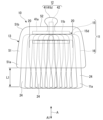
- FIG. 2 is a side view showing the bioelectrode according to the first embodiment.
- FIG. 2 is a photograph showing the bioelectrode according to the first embodiment, and is a perspective view seen from the metal contact side.
- FIG. 5 is a photograph showing the bioelectrode of FIG. 4, and is a perspective view showing the bioelectrode with the cover removed.
- FIG. 6 is a photograph showing the bioelectrode of FIG.
- FIG. 5 is a perspective view of the bioelectrode as viewed from the electrode portion side.
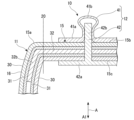
- FIG. 6 is a cross-sectional view of the bioelectrode of FIG. 5 with a main portion cut away.
- FIG. 2 is a cross-sectional view showing a developed state of a conductive sheet body in the bioelectrode according to the first embodiment.
- FIG. 2 is a plan view showing a deployed state of a core material in the bioelectrode according to the first embodiment.
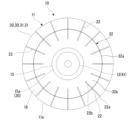
- FIG. 2 is a plan view showing a developed state of a conductive sheet body in the bioelectrode according to the first embodiment.
- FIGS. 1A to 1C are diagrams illustrating an example of overlapping a conductive sheet, a thermoplastic adhesive tape, and a core material and fixing them with metal contacts in a manufacturing method for a bioelectrode according to the first embodiment.
- 6 is a plan view illustrating an example of folding an outer periphery of a conductive sheet body in the manufacturing method of a bioelectrode according to the first embodiment.
- FIG. 4 is a cross-sectional view illustrating an example of fixing a conductive sheet body into a three-dimensional shape in the manufacturing method of the bioelectrode according to the first embodiment.
- FIG. FIG. 11 is a cross-sectional view showing a developed state of a conductive sheet body in a bioelectrode according to a second embodiment of the present invention.
- the first biomeasurement system 1A includes a head cap 2A, a plurality of bioelectrodes 10, and a measurement device 70.
- the head cap 2A is formed in a hemisphere so as to be placed over the head 4 from above.
- the head cap 2A has a stretchability that allows it to be crimped onto the entire head 4.
- a plurality of bioelectrodes 10 are provided on the inner peripheral surface of the head cap 2A.
- the plurality of bioelectrodes 10 can be freely installed on the inner peripheral surface of the head cap 2A, but the international standard 10-20 method or the like can also be used.
- the head cap 2A is pressed against the entire head 4, thereby enabling the plurality of bioelectrodes 10 to be in stable contact with the skin of the head 4. In this manner, by providing and integrating the plurality of bioelectrodes 10 in the head cap 2A, it is possible to quickly attach and detach the plurality of bioelectrodes 10.
- the plurality of bioelectrodes 10 are connected to a connector 6.
- the connector 6 is connected to a measuring device 70 via a wiring (harness) 7.
- the plurality of bioelectrodes 10 are connected to the connector 6, and are thus connected to the measuring device 70 via the connector 6 and the wiring 7.
- the wiring 7 is arranged to pass outside the head cap 2A, but the wiring 7 may be arranged to pass through the inside of the head cap 2A. By passing the wiring 7 through the head cap 2A, the first biomeasurement system 1A can be easily handled.
- the measuring device 70 records biosignals and provides electrical stimulation by acquiring electrical signals derived from the living body and applying electrical stimulation to the living body while multiple bioelectrodes 10 are in contact with the scalp of the head 4.
- the second biomeasurement system 1B includes a headband 2B instead of the head cap 2A, and the other configurations are the same as those of the first biomeasurement system 1A.
- the headband 2B is formed in a band shape so that it can be arranged around the head 4.
- the headband 2B has elasticity so that it can be pressed around the head 4.
- a plurality of bioelectrodes 10 are provided on the inner peripheral surface of the headband 2B.
- the plurality of bioelectrodes 10 can be freely arranged on the inner peripheral surface of the headband 2B, but the international standard 10-20 method or the like can also be used.
- the headband 2B can stably contact the multiple bioelectrodes 10 with the skin of the head 4 by pressing the periphery of the head 4. In this way, by providing and integrating the multiple bioelectrodes 10 on the headband 2B, it is possible to quickly attach and remove the multiple bioelectrodes 10.
- the bioelectrodes 10 of the first biomeasurement system 1A and the second biomeasurement system 1B are applied to the scalp of the head 4, but this is not limited thereto.
- the bioelectrodes 10 may be applied to measuring the electromyogram or electrocardiogram of the whole body of a subject with body hair.
- the bioelectrodes 10 may be applied to measuring electroencephalograms, event-related potentials, ocular (retinal) potentials, visual evoked potentials, auditory evoked potentials, myoelectric potentials, bioimpedance measurements, cardiac potentials, and the like, as well as electrical stimulation.
- the bioelectrode 10 is configured to be suitable as an active electrode for long hair, coarse hair, curly hair, etc.
- a bioelectrode 100 suitable as an active electrode for short hair, soft hair, etc. will be described in the second embodiment of FIG. 14. Note that the application of the bioelectrode 10 is not limited to humans, and it may be applied to animals other than humans.
- the bioelectrode 10 includes a conductive sheet body 11, a metal contact 12, and a cover 13.
- the bioelectrode 10 is formed so that a tip portion 11a of the conductive sheet body 11 contacts the skin of the head 4 (see FIGS. 1 and 2).
- the bioelectrode 10 is also formed so that the metal contact 12 is connected to the connector 6 (see FIGS. 1 and 2).
- the conductive sheet body 11 has a central portion 15 and an outer peripheral portion 16.
- the central portion 15 is formed in a circular shape at the center of the conductive sheet body 11.
- the outer peripheral portion 16 is integrally provided on the radially outer side of the central portion 15.
- the outer peripheral portion 16 is folded over the entire circumference starting from a boundary 20 (see also FIG. 13 ) between the outer peripheral portion 16 and the central portion 15 to one side A1 in a first direction A (thickness direction of the conductive sheet body 11) that intersects with the surface 11b of the conductive sheet body 11 (specifically, the central portion 15).
- the boundary 20 is as close as possible to the center of the conductive sheet body 11. By bringing the boundary 20 closer to the center of the conductive sheet body 11, it is possible to ensure a long electrode portion 24, which will be described later. By making the electrode portion 24 longer, it becomes easier to apply the electrode portion 24 appropriately, especially when the hair is voluminous.
- the outer peripheral portion 16 has a plurality of slits 22 arranged from the vicinity of the central portion 15 toward the tip end 11a of the conductive sheet body 11.
- a plurality of portions (hereinafter also referred to as electrode portions 24) located between adjacent slits 22 in the circumferential direction are formed in a comb-like, brush-like, or strip-like shape.
- the plurality of electrode portions 24 are arranged so as to overlap from the center side of the conductive sheet body 11 to the radially outer side.
- the electrode portions 24 arranged on the outer periphery among the plurality of electrode portions 24 may be arranged side by side on the same circumference.
- the electrode portions 24 are formed to have a wider circumferential width at the tip end 11a than at the base end. This allows the electrode portions 24 to be in stable contact with the skin of the head 4 (see FIGS. 1 and 2).
- the outer peripheral portion 16 is, for example, inserted into a cylindrical guide and bent at approximately 90°.
- the multiple electrode portions 24 are bent sequentially.
- the electrode portions 24 bent first are brought closer to the center by the electrode portions 24 bent later.
- the multiple electrode portions 24 are arranged so as to overlap on the radially outer side, and are arranged side by side on the same circumference on the outer periphery.
- all the electrode portions 24 may be arranged side by side on the same circumference.
- the conductive sheet body 11 includes two conductive sheets 30, two thermoplastic adhesives 31, and a core material 32.
- Figure 8 is a cross-sectional view showing the unfolded state of the conductive sheet body 11 before the outer periphery 16 is folded to one side A1 in the first direction A.
- the two conductive sheets 30 are located on both sides in the first direction A.
- the conductive sheet 30 is formed in a circular shape in an unfolded state.
- the conductive sheet 30 is made of a conductive fabric formed in a circular shape and imparted with electrical conductivity.
- the conductive fabric is, for example, a silver-plated fabric or a fabric coated with a conductive polymer.
- Examples of conductive materials that impart electrical conductivity to the fabric include conductive polymers, conductive particles, ions, and ionic liquids.
- Examples of the conductive particles include metal particles, carbon black, graphite, graphene, and carbon nanofibers.
- the two conductive sheets 30 are folded to one side A1 in the first direction A over the entire circumference starting from the boundary 20 between the outer periphery 16 and the center 15.
- a conductive fabric is used as the conductive sheet 30, but the present invention is not limited thereto.
- a sheet impregnated with a conductive liquid or gel or a laminated sheet can be used as the conductive sheet 30.
- Thermoplastic adhesives (e.g., hot melt tape, seam tape) 31 are attached to the mutually facing inner surfaces 30a of two conductive sheets (i.e., conductive fabrics) 30. That is, the two thermoplastic adhesives 31 are disposed between the two conductive sheets 30. The two thermoplastic adhesives 31 join the two conductive sheets 30 by thermocompression bonding in a state where they are superimposed in the first direction A.
- the thermoplastic adhesive 31 is made of a polymer or the like that melts and bonds with heat and hardens with cooling.
- thermoplastic adhesive 31 is laminated between two conductive sheets 30 as a core material for the two conductive sheets 30. This allows the polymer layer to maintain the three-dimensional shape of the folded two conductive sheets 30.
- the polymer layer maintains the flexibility of the two conductive sheets 30, and can stably maintain the three-dimensional shape of the two conductive sheets 30 folded starting from the boundary 20 between the outer periphery 16 and the center 15.
- the thermoplastic adhesive 31 may also be referred to as the "thermoplastic adhesive tape 31.”
- thermoplastic adhesive tape 31 When processing the outer periphery 16 of the conductive sheet body 11 into a three-dimensional shape by folding the outer periphery 16 to one side A1 in the first direction A starting from the boundary 20, the thermoplastic adhesive tape 31 is heated while the outer periphery 16 is folded. The thermoplastic adhesive tape 31 is then cooled to the ambient temperature (room temperature). This allows the two conductive sheets 30 to be fixed into a three-dimensional folded shape by the thermoplastic adhesive tape 31.
- the thermoplastic adhesive tape 31 i.e., the polymer layer
- the thermoplastic adhesive tape 31 has flexibility (flexibility). Therefore, the outer periphery 16 of the conductive sheet body 11 can be made flexible so that it can fit the head of a person with short hair or soft hair.
- a three-layer structure in which a polymer layer is added between two conductive sheets 30 may make it difficult to push the hair apart to reach the scalp. Therefore, in this embodiment, a core material 32 is added between the two conductive sheets 30.
- ⁇ Core material> 8 and 9 the core material 32 is laminated (disposed) between the thermoplastic adhesive tape 31 attached to the two conductive sheets 30.
- Figs. 8 and 9 are plan views showing the expanded state of the core material 32 before the outer periphery 16 of the conductive sheet body 11 is folded to one side A1 in the first direction A.
- the core material 32 is formed in a circular shape in an unfolded state, and is made of a polymer sheet made of, for example, flexible PET (polyethylene terephthalate), polystyrene, nylon, PVA (polyvinyl alcohol), or the like.
- the outer periphery 32a of the core material 32 is formed to have a larger diameter than the outer periphery 15a of the central portion 15 and a smaller diameter than the outer periphery of the outer periphery portion 16 (i.e., the tip portion 11a of the conductive sheet body 11).
- a plurality of slits 22 are formed in the outer peripheral portion 32b of the core material 32, together with the conductive sheet 30 and the thermoplastic adhesive tape 31.
- Fig. 10 is a plan view showing the developed state of the conductive sheet body 11 before the outer peripheral portion 16 is folded to one side A1 in the first direction A.
- the multiple slits 22 are formed radially toward the tip 11a of the conductive sheet body 11 on the outer periphery (part corresponding to the outer periphery 16) of the conductive sheet 30 and the outer periphery 32b of the core material 32.
- the multiple slits 22 are formed at intervals in the circumferential direction.
- the tips 22a of the multiple slits 22 are opened radially outward at the tip 11a of the conductive sheet body 11.
- the base ends 22b of the multiple slits 22 are located radially inward from the outer periphery 32b of the core material 32 and radially outward from the boundary 20 between the outer periphery 32b and the central portion 15.
- the core material 32 is folded along with the two conductive sheets 30 to one side A1 in the first direction A around the entire circumference starting from the boundary 20 between the outer periphery 16 and the central portion 15.
- the core material 32 is fixed between the thermoplastic adhesive tapes 31 (i.e., the polymer layers) by subjecting the two thermoplastic adhesive tapes 31 to a heat treatment and then cooling to the ambient temperature.
- the core material 32 maintains the flexibility of the two conductive sheets 30 and can stably hold the two conductive sheets 30 in the folded shape.
- the tension of the two conductive sheets 30 can be strengthened. Therefore, the conductive sheet body 11 can push the gap between the hairs and reach the scalp.
- the bioelectrode 10 to function as an active electrode for, for example, long hair, coarse hair, curly hair, etc.
- the outer periphery 32a of the core material 32 is formed to have a larger diameter than the outer periphery 15a of the central portion 15, and a smaller diameter than the outer periphery of the outer periphery portion 16 (the tip portion 11a of the conductive sheet body 11).
- the outer periphery 32a of the core material 32 is located closer to the central portion 15 than the tip portion 11a of the conductive sheet body 11.
- the tip portion 11a of the conductive sheet body 11 is the portion that comes into contact with the skin of the head 4. This keeps the tip portion 11a of the conductive sheet body 11 that comes into contact with the skin of the head 4 flexible. That is, the tip portion of the electrode portion 24 (see FIGS. 5 and 6) in the conductive sheet body 11 can be kept flexible.
- a metal contact 12 is provided in a central portion 15 of a conductive sheet body 11.
- a commonly known dot button is used as the metal contact 12, for example.
- the metal contact 12 is not limited to a dot button.
- the metal contact 12 includes a female portion 41 and a male portion 42.
- the female part 41 is a female button made of, for example, conductive stainless steel (SUS).
- the female part 41 has a base 41a with a circular outer periphery.
- the base 41a of the female part 41 is disposed on the outer surface 15b (one side) in the first direction A in the central part 15.
- the male part 42 is a male button made of, for example, conductive SUS.
- the male part 42 has a base 41a with a circular outer periphery.
- the base 42a of the male part 42 is disposed on the inner surface 15c (the other side) in the first direction A in the central part 15.
- the metal contact 12 is not limited to SUS.
- the female part 41 and the male part 42 are hammered in the first direction A so as to sandwich the central part 15 from both sides in the first direction A.
- the metal contact 12 is fixed to the central part 15 by hammering in and fitting the recess 41b of the female part 41 and the protrusion 42b of the male part 42.
- the metal contact 12 is arranged such that the female part 41 is located outside the central part 15.
- the recess 41b of the female part 41 protrudes outward from the base 41a.
- the connector 6 (see Figures 1 and 2) of the first biomeasurement system 1A and the second biomeasurement system 1B is connected from the outside to the recess 41b of the female part 41.
- the cover 13 is attached to the conductive sheet body 11.
- the cover 13 is made of, for example, a resin material and has a cylindrical shape.
- the cover 13 has a cover main body 51 and a reduced diameter portion 52.
- the cover body 51 is formed in a cylindrical shape so as to contact the outer periphery 16 from the outside in the radial direction and cover the outer periphery 16.
- the tip end 51a of the cover body 51 is located on the tip end 11a side of the conductive sheet body 11 in the first direction A.
- the tip end 51a of the cover body 51 is disposed on the central portion 15 side with a distance L1 from the tip end 11a of the conductive sheet body 11 in the first direction A.
- a reduced diameter portion 52 is integrally formed at the base end 51b of the cover body 51.
- the reduced diameter portion 52 protrudes radially inward from the base end portion 51b of the cover body 51 toward the metal contact 12 (specifically, the base 41a of the female portion 41).
- the reduced diameter portion 52 is formed in a ring shape so as to contact from the outside the radially outer edge portion 15d of the base 41a of the female portion 41 of the central portion 15 and cover the edge portion 15d.
- the cover 13 is formed so as to continuously cover from the outside from the edge portion 15d of the central portion 15 to partway up the outer periphery 16. This makes it easier to more stably secure the conductive sheet body 11 in the three-dimensional shape in which the outer periphery 16 of the conductive sheet body 11 is folded.
- the tip 11a of the conductive sheet 11, which comes into contact with the skin of the head 4 can be kept flexible. That is, the tip of the electrode portion 24 of the conductive sheet 11 can be kept flexible.
- a method for manufacturing the bioelectrode 10 will be described with reference to Fig. 5, Fig. 6, and Fig. 11 to Fig. 13. Specifically, as shown in Fig. 5 and Fig. 6, an example will be described in which the bioelectrode 10 is small, with a height H of about 1.0 cm, and the electrode portion 24 is formed in a wide comb shape (strip shape) with a circumferential length L2 of about 0.4 cm (see also Fig. 12 for the circumferential length L2).
- the outer diameter D1 of the conductive sheets 30 may be adjusted within a range of 2 to 5 cm depending on the application of the bioelectrode 10.
- Thermoplastic adhesive tapes 31 (only one of the thermoplastic adhesive tapes 31 is shown) are attached to the opposing inner surfaces of the two conductive sheets 30.
- a PET sheet is formed into a circle having an outer diameter D2 of 2.0 cm as the core material 32.
- the core material 32 is formed to have a diameter larger than the center portion 15 (see FIG. 5 ) and smaller than the conductive sheets 30.
- the core material 32 is placed between the thermoplastic adhesive tapes 31 attached to the two conductive sheets 30.
- the two conductive sheets 30, the two thermoplastic adhesive tapes 31, and the core material 32 are overlapped coaxially.
- the metal contact 12 is driven into and fixed at the center of the two conductive sheets 30, the two thermoplastic adhesive tapes 31, and the core material 32.
- the metal contact 12 has an outer diameter D3 of 0.9 cm.
- the laminate including the two conductive sheets 30, the two thermoplastic adhesive tapes 31, and the core material 32 may be heated to firmly bond the conductive sheets 30 and the core material 32 together using the thermoplastic adhesive tape 31.
- a plurality of slits 22 are formed radially on the outer periphery (parts corresponding to the outer periphery 16) of the two overlapping conductive sheets 30 and two thermoplastic adhesive tapes 31 and on the outer periphery 32b of the core material 32. That is, a plurality of slits 22 are formed radially on the outer periphery 16 of the conductive sheet body 11 in the developed state. It is preferable that the length L3 of the slits 22 is set in a range from the outer periphery of the conductive sheet 30 toward the inside in the radial direction so that (1) it reaches the outer periphery of the core material 32 and (2) it does not reach the outer periphery of the metal contact 12.
- the slits 22 have a length L3 of 0.3 to 0.7 cm.
- the length L3 is preferably 0.6 cm, but is not limited thereto.
- Sixteen slits 22 are formed at intervals in the circumferential direction.
- the number of slits 22 is described as 16, but this is not limited to this.
- Tips 22a of the plurality of slits 22 are opened radially outward at tip portion 11a of conductive sheet body 11.
- Base ends 22b of the plurality of slits 22 are disposed radially inward from outer periphery 32b of core material 32 and radially outward from boundary 20 between outer periphery 16 and central portion 15.
- the outer periphery 16 of the conductive sheet body 11 is folded as shown by the arrow in one side A1 (see FIG. 13 ) in the first direction A around the entire circumference starting from the boundary 20.
- the outer periphery 16 of the conductive sheet body 11 is folded as shown by the arrow from the boundary 20 to one side A1 in the first direction A, and the thermoplastic adhesive tape 31 is then heated.
- the thermoplastic adhesive tape 31 is then cooled to the ambient temperature. This allows the outer periphery 32b of the conductive sheet body 11 to be fixed into a folded three-dimensional shape.
- multiple slits 22 can be arranged in the outer periphery 16 in the radial direction from near the central portion 15 toward the tip (i.e., the tip 11a of the conductive sheet body 11). Therefore, in the outer periphery 16, the electrode portions 24 located between adjacent slits 22 in the circumferential direction can be formed in a comb shape (strip shape). This allows the bioelectrode 10 to be formed by the manufacturing method for the bioelectrode 10.
- There are 16 slits 22, and the length of the slits 22 is L3 0.3 to 0.7 cm.
- the bioelectrode 10 to be formed with a height H of approximately 1.0 cm. This allows the height (thickness) of the bioelectrode 10 to be kept small.
- the electrode portion 24 can be formed in a comb shape (strip shape) with a circumferential length L2 of approximately 4 mm, ensuring a wide circumferential width at the tip of the electrode portion 24. This allows the electrode portion 24 to be in stable contact with the skin of the head 4 (see Figures 1 and 2). The reason for keeping the height of the bioelectrode 10 small will be explained in detail later.
- the outer peripheral portion 16 is folded over the entire circumference starting from the boundary 20 between the outer peripheral portion 16 and the central portion 15 toward one side A1 in the first direction A. This allows the electrode portions 24 located between adjacent slits 22 in the circumferential direction in the outer peripheral portion 16 of the conductive sheet body 11 to function like a comb (brush). Therefore, the electrode portions 24 of the conductive sheet body 11 can be brought into contact with the scalp through the gaps in the hair.
- the bioelectrode 10 is also made of a conductive sheet body 11. This allows the tip 11a of the conductive sheet body 11, which comes into contact with the skin of the head 4, to be kept flexible. In other words, the tip of the electrode portion 24 on the conductive sheet body 11 can be kept flexible. This can eliminate any discomfort felt by the scalp when the electrode portion 24 comes into contact with it.
- the conductive sheet body 11 is provided with an appropriate hardness, and it becomes easier to secure the three-dimensional shape of the outer periphery 16 of the conductive sheet body 11 by folding it. This makes it possible to improve the durability and quality of the bioelectrode 10.
- the core material 32 has a smaller diameter than the outer periphery 16, flexibility can be ensured at the tip of the electrode portion 24 of the conductive sheet body 11. This can eliminate any discomfort felt by the scalp when the electrode portion 24 comes into contact with the scalp.
- a conductive fabric is used for the conductive sheet 30. This ensures good flexibility of the conductive sheet 30. This helps to eliminate any discomfort felt by the scalp when the electrode portion 24 comes into contact with it.
- a dot button is used for the metal contact 12, and the female part 41 on one side and the male part 42 on the other side are sandwiched from both sides of the conductive sheet body 11 and fixed to the center part 15. This makes it easy to fix the metal contact 12 to the center part 15 of the conductive sheet body 11.
- the bioelectrode 10 is provided with a cylindrical cover 13 that continuously covers the edge 15d of the central portion 15 to partway through the outer periphery 16.
- a cylindrical cover 13 that continuously covers the edge 15d of the central portion 15 to partway through the outer periphery 16.
- the bioelectrode 10 of the first embodiment is formed by folding the conductive sheet body 11, which is made by joining a thin flat sheet-like conductive fabric as the conductive sheet 30, to the minimum required length of the electrode portion 24. This makes it possible to keep the height of the bioelectrode 10 small. The wearing comfort of the bioelectrode 10 can be maintained well, and the influence of motion artifacts can be reduced.
- the conductive sheet body 11 is generally flexible (particularly the electrode portion 24). Therefore, by pressing the bioelectrode 10 from the outside with a head cap 2A or a headband 2B (both of which are shown in FIG. 1), the conductive sheet body 11 bends appropriately and sinks between the hair. This allows the height of the bioelectrode 10 to be further reduced. As a result, with the head cap 2A and the head band 2B attached to the head 4 (see FIG. 1), it is easy to wear a helmet, a hat, VR goggles, etc. over the head cap 2A and the head band 2B.
- the bioelectrode 10 also uses a conductive fabric as the conductive sheet 30.
- the conductive fabric has moisture retention properties. This allows the bioelectrode 10 to be used as a wet electrode (semi-dry electrode) impregnated with a conductive liquid or paste, enabling low-noise measurements, and also allowing measurements to be made with a conventional non-active electrode biomeasurement device.
- the bioelectrode 10 formed by the manufacturing method of the bioelectrode 10 allows the electrode portion 24 formed on the outer periphery 16 of the conductive sheet body 11 to function like a comb. Therefore, the electrode portion 24 can be brought into contact with the scalp through the gaps in the hair. Furthermore, the bioelectrode 10 is made of a conductive sheet body 11. Therefore, the tip portion 11a of the conductive sheet body 11 that contacts the skin of the head 4 can be kept flexible. In other words, the tip portion of the electrode portion 24 in the conductive sheet body 11 can be kept flexible. This can eliminate any discomfort felt by the scalp when the electrode portion 24 comes into contact with the scalp.
- bioelectrode 100 of the second embodiment is configured to be applicable as an active electrode to, for example, short hair, soft hair, etc.
- the bioelectrode 100 of the second embodiment is similar to that of the first embodiment, except that the conductive sheet body 11 of the first embodiment is replaced with a conductive sheet body 101.
- Fig. 14 is a cross-sectional view showing the conductive sheet body 101 in an unfolded state before folding the outer periphery 106 of the conductive sheet body 101 to one side A1 in the first direction A.
- the conductive sheet body 101 is obtained by removing the core material 32 from the conductive sheet body 11 of the first embodiment. That is, the conductive sheet body 101 includes two conductive sheets 30 and two thermoplastic adhesive tapes 31.
- the two conductive sheets 30 are located on both sides in the first direction A.
- the two thermoplastic adhesive tapes 31 are disposed between the two conductive sheets 30 and bond the two conductive sheets 30 together.
- the conductive sheet body 101 has a polymer layer of thermoplastic adhesive tape 31 laminated between two conductive sheets 30 as a core material for the two conductive sheets 30. This allows the polymer layer to maintain the three-dimensional shape of the folded two conductive sheets 30.
- the polymer layer of the conductive sheet 30 maintains the flexibility of the two conductive sheets 30, and can stably maintain the three-dimensional shape of the two conductive sheets 30 folded starting from the boundary 120 between the outer periphery 106 and the center 105.
- thermoplastic adhesive tape 31 When processing the outer periphery 106 of the conductive sheet body 101 into a three-dimensional shape by folding it from the boundary 120 to one side A1 in the first direction A, the thermoplastic adhesive tape 31 is heated while the outer periphery 106 is folded. The thermoplastic adhesive tape 31 is then cooled to ambient temperature. This allows the two conductive sheets 30 to be fixed into a three-dimensional folded shape by the thermoplastic adhesive tape 31.
- the thermoplastic adhesive tape 31 i.e., the polymer layer
- the thermoplastic adhesive tape 31 has flexibility (flexibility). This allows the outer periphery 16 of the conductive sheet body 11 to have flexibility so that it can fit a head with short hair, soft hair, or the like.
- thermoplastic adhesive tapes 31 can be cooled to the ambient temperature and hardened. This makes it easier to maintain the conductive sheet body 101 in a folded shape. This allows the electrode portion (not shown) of the conductive sheet body 101 to come into contact with the scalp through the gaps in the hair, as in the first embodiment.
- thermoplastic adhesive tape 31 is hardened in a flexible state at ambient temperature. This can eliminate discomfort on the scalp when the electrode portion (not shown) of the conductive sheet body 101 comes into contact with the scalp, as in the first embodiment.
- the conductive sheet bodies 11, 101 are formed from two conductive sheets 30 has been described, but this is not limiting.
- the conductive sheet bodies 11, 101 may be formed from a single conductive sheet 30.
Landscapes
- Life Sciences & Earth Sciences (AREA)
- Health & Medical Sciences (AREA)
- Medical Informatics (AREA)
- Biophysics (AREA)
- Pathology (AREA)
- Engineering & Computer Science (AREA)
- Biomedical Technology (AREA)
- Heart & Thoracic Surgery (AREA)
- Physics & Mathematics (AREA)
- Molecular Biology (AREA)
- Surgery (AREA)
- Animal Behavior & Ethology (AREA)
- General Health & Medical Sciences (AREA)
- Public Health (AREA)
- Veterinary Medicine (AREA)
- Measurement And Recording Of Electrical Phenomena And Electrical Characteristics Of The Living Body (AREA)
Priority Applications (2)
| Application Number | Priority Date | Filing Date | Title |
|---|---|---|---|
| JP2025538135A JPWO2025027816A1 (https=) | 2023-08-02 | 2023-08-02 | |
| PCT/JP2023/028222 WO2025027816A1 (ja) | 2023-08-02 | 2023-08-02 | 生体電極および生体電極の製造方法 |
Applications Claiming Priority (1)
| Application Number | Priority Date | Filing Date | Title |
|---|---|---|---|
| PCT/JP2023/028222 WO2025027816A1 (ja) | 2023-08-02 | 2023-08-02 | 生体電極および生体電極の製造方法 |
Publications (1)
| Publication Number | Publication Date |
|---|---|
| WO2025027816A1 true WO2025027816A1 (ja) | 2025-02-06 |
Family
ID=94396108
Family Applications (1)
| Application Number | Title | Priority Date | Filing Date |
|---|---|---|---|
| PCT/JP2023/028222 Pending WO2025027816A1 (ja) | 2023-08-02 | 2023-08-02 | 生体電極および生体電極の製造方法 |
Country Status (2)
| Country | Link |
|---|---|
| JP (1) | JPWO2025027816A1 (https=) |
| WO (1) | WO2025027816A1 (https=) |
Citations (5)
| Publication number | Priority date | Publication date | Assignee | Title |
|---|---|---|---|---|
| JPH08511438A (ja) * | 1993-03-16 | 1996-12-03 | イーピー テクノロジーズ,インコーポレイテッド | 複数電極支持機構 |
| JP2007517577A (ja) * | 2004-01-08 | 2007-07-05 | ニューロスカイ インコーポレイテッド | 生体電気の測定のための活性ドライセンサモジュール |
| JP3179460U (ja) * | 2012-08-22 | 2012-11-01 | 株式会社日本メディックス | 電気的刺激装置における電極装置 |
| JP2017524413A (ja) * | 2014-07-03 | 2017-08-31 | コーニンクレッカ フィリップス エヌ ヴェKoninklijke Philips N.V. | 医療電極 |
| JP2020195775A (ja) * | 2019-05-29 | 2020-12-10 | 東海光学株式会社 | 脳活動計測用電極、その電極を備えた頭部装着装置及び脳活動計測システム |
-
2023
- 2023-08-02 JP JP2025538135A patent/JPWO2025027816A1/ja active Pending
- 2023-08-02 WO PCT/JP2023/028222 patent/WO2025027816A1/ja active Pending
Patent Citations (5)
| Publication number | Priority date | Publication date | Assignee | Title |
|---|---|---|---|---|
| JPH08511438A (ja) * | 1993-03-16 | 1996-12-03 | イーピー テクノロジーズ,インコーポレイテッド | 複数電極支持機構 |
| JP2007517577A (ja) * | 2004-01-08 | 2007-07-05 | ニューロスカイ インコーポレイテッド | 生体電気の測定のための活性ドライセンサモジュール |
| JP3179460U (ja) * | 2012-08-22 | 2012-11-01 | 株式会社日本メディックス | 電気的刺激装置における電極装置 |
| JP2017524413A (ja) * | 2014-07-03 | 2017-08-31 | コーニンクレッカ フィリップス エヌ ヴェKoninklijke Philips N.V. | 医療電極 |
| JP2020195775A (ja) * | 2019-05-29 | 2020-12-10 | 東海光学株式会社 | 脳活動計測用電極、その電極を備えた頭部装着装置及び脳活動計測システム |
Also Published As
| Publication number | Publication date |
|---|---|
| JPWO2025027816A1 (https=) | 2025-02-06 |
Similar Documents
| Publication | Publication Date | Title |
|---|---|---|
| US8406841B2 (en) | Dry electrode for biomedical signal measuring sensor | |
| JP6077639B2 (ja) | トランスデューサアセンブリ | |
| CN101720202B (zh) | 快压eeg电极的方法和装置 | |
| JP6695321B2 (ja) | 生体用電極具 | |
| JP5476570B2 (ja) | 剣山型乾電極及びその作製方法 | |
| US9295400B2 (en) | Line-contact dry electrode | |
| EP3033994B1 (en) | Electrode for biopotential sensing | |
| US20220395402A1 (en) | Wearable medical devices and related systems and methods | |
| US20150201856A1 (en) | Electrode and measuring device for acquiring biomedical vital parameters | |
| JPS61249440A (ja) | シ−ルドした自己準備性電極 | |
| CN113261969B (zh) | 脑电极针体、脑电极单元及阵列化脑电极 | |
| Paul et al. | Integrated in-ear device for auditory health assessment | |
| JP2014200559A (ja) | 生体電極 | |
| WO2025027816A1 (ja) | 生体電極および生体電極の製造方法 | |
| TW202227015A (zh) | 腦波乾式電極 | |
| KR102397139B1 (ko) | 전도성 수지를 이용한 뇌파측정 헤드모듈 | |
| JP2015073623A (ja) | 生体電極 | |
| JP2008212489A (ja) | 生体情報測定用電極 | |
| JP5481682B2 (ja) | 乾電極及びその作製方法 | |
| JP2013248139A (ja) | 生体情報取得用電極 | |
| JPH0741442Y2 (ja) | 生体用電極保持体 | |
| JP6713921B2 (ja) | ウェアラブルデバイス | |
| US20230309888A1 (en) | Apparatus and method for hybrid biosensors | |
| CN111067519B (zh) | 用于采集肌电信号的弹力腕带及其制备方法 | |
| WO2024166828A1 (ja) | 生体センサ |
Legal Events
| Date | Code | Title | Description |
|---|---|---|---|
| 121 | Ep: the epo has been informed by wipo that ep was designated in this application |
Ref document number: 23947613 Country of ref document: EP Kind code of ref document: A1 |
|
| ENP | Entry into the national phase |
Ref document number: 2025538135 Country of ref document: JP Kind code of ref document: A |
|
| WWE | Wipo information: entry into national phase |
Ref document number: 2025538135 Country of ref document: JP |
|
| NENP | Non-entry into the national phase |
Ref country code: DE |