WO2025022709A1 - ケーブルセット - Google Patents
ケーブルセット Download PDFInfo
- Publication number
- WO2025022709A1 WO2025022709A1 PCT/JP2024/009445 JP2024009445W WO2025022709A1 WO 2025022709 A1 WO2025022709 A1 WO 2025022709A1 JP 2024009445 W JP2024009445 W JP 2024009445W WO 2025022709 A1 WO2025022709 A1 WO 2025022709A1
- Authority
- WO
- WIPO (PCT)
- Prior art keywords
- cable
- connector
- terminal
- cables
- cable set
- Prior art date
- Legal status (The legal status is an assumption and is not a legal conclusion. Google has not performed a legal analysis and makes no representation as to the accuracy of the status listed.)
- Pending
Links
Images




Classifications
-
- H—ELECTRICITY
- H01—ELECTRIC ELEMENTS
- H01B—CABLES; CONDUCTORS; INSULATORS; SELECTION OF MATERIALS FOR THEIR CONDUCTIVE, INSULATING OR DIELECTRIC PROPERTIES
- H01B7/00—Insulated conductors or cables characterised by their form
-
- H—ELECTRICITY
- H01—ELECTRIC ELEMENTS
- H01R—ELECTRICALLY-CONDUCTIVE CONNECTIONS; STRUCTURAL ASSOCIATIONS OF A PLURALITY OF MUTUALLY-INSULATED ELECTRICAL CONNECTING ELEMENTS; COUPLING DEVICES; CURRENT COLLECTORS
- H01R13/00—Details of coupling devices of the kinds covered by groups H01R12/70 or H01R24/00 - H01R33/00
- H01R13/58—Means for relieving strain on wire connection, e.g. cord grip, for avoiding loosening of connections between wires and terminals within a coupling device terminating a cable
-
- H—ELECTRICITY
- H01—ELECTRIC ELEMENTS
- H01R—ELECTRICALLY-CONDUCTIVE CONNECTIONS; STRUCTURAL ASSOCIATIONS OF A PLURALITY OF MUTUALLY-INSULATED ELECTRICAL CONNECTING ELEMENTS; COUPLING DEVICES; CURRENT COLLECTORS
- H01R31/00—Coupling parts supported only by co-operation with counterpart
- H01R31/06—Intermediate parts for linking two coupling parts, e.g. adapter
Definitions
- the present invention relates to a cable set that includes multiple cables and connectors connected to both ends of the cables.
- the cable connection structure for electronic devices described in Patent Document 1 includes multiple cables, a connector socket, and a bundling section.
- the multiple cables include multiple cables for actual wiring and multiple dummy cables.
- One end of the multiple actual wiring cables and one end of the multiple dummy cables are inserted into the connector socket and fixed.
- the multiple actual wiring cables and the multiple dummy cables are bundled together using a bundling section.
- the object of the present invention is therefore to provide a cable set that suppresses undesirable external stresses applied to a cable having an electrical connection function.
- a cable set according to one embodiment of the present invention includes a first connector, a second connector, a first cable, and a second cable.
- the first cable has a first terminal fixed to the first connector and a second terminal fixed to the second connector, providing electrical continuity between the first connector and the second connector.
- the second cable has a third terminal fixed to the first connector and a fourth terminal fixed to the second connector, providing no electrical continuity between the first connector and the second connector.
- the length between the third terminal and the fourth terminal of the second cable is shorter than the length between the first terminal and the second terminal of the first cable.
- This invention makes it possible to suppress undesirable external stresses on cables that have electrical connection functions.
- FIG. 1A is a plan view showing an example of a cable set according to a first embodiment
- FIG. 1B is an end view showing the example of the cable set according to the first embodiment
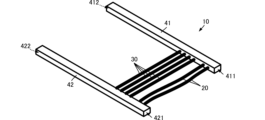
- FIG. 2 is an external perspective view illustrating an example of a cable set according to the first embodiment
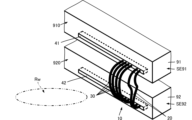
- FIG. 3 is a perspective view showing a portion of a power supply system in which a cable set according to an embodiment of the present invention is used.
- FIG. 4 is a plan view illustrating an example of a cable set according to the second embodiment.
- FIG. 5 is a plan view illustrating an example of a cable set according to the third embodiment.
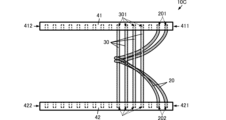
- FIG. 6 is a plan view illustrating an example of a cable set according to the fourth embodiment.
- FIG. 7 is a plan view of a structure including a cable set of a derivative example.
- FIG. 1(A) is a plan view showing an example of the cable set according to the first embodiment
- Fig. 1(B) is an end view showing an example of the cable set according to the first embodiment
- Fig. 2 is an external perspective view showing an example of the cable set according to the first embodiment.
- the cable set 10 includes a plurality of first cables 20, a plurality of second cables 30, a first connector 41, and a second connector 42.
- the multiple first cables 20 and the multiple second cables 30 have a structure in which a linear conductor is covered with an insulator.
- the multiple first cables 20 and the multiple second cables 30 are made of the same material.
- the multiple first cables 20 and the multiple second cables 30 may be made of different materials.
- the flexibility of each may be the same or different.
- the flexibility of the second cables 30 may be less than or equal to that of the first cables 20.
- the first connector 41 has an insulating main body.
- the main body is, for example, long in one direction, and has an end face 411 at one end in the longitudinal direction and an end face 412 at the other end.
- a plurality of conductive sockets (hereinafter simply referred to as sockets) are formed in the main body of the first connector 41.
- the multiple sockets are arranged at intervals along the longitudinal direction.
- the second connector 42 has the same structure as the first connector 41.
- the main body of the second connector 42 has an end face 421 at one end in the longitudinal direction and an end face 422 at the other end.
- the main body of the second connector 42 has a plurality of sockets formed therein, similar to the main body of the first connector 41.
- the plurality of sockets are arranged at intervals along the longitudinal direction.
- One linear end of each of the first cables 20 is electrically connected to each of the sockets of the first connector 41 and fixed to the sockets. More specifically, one linear end of each of the first cables 20 is connected to each of the sockets adjacent to the end face 411.
- the portion of the first cable 20 that is connected to and fixed to the first connector 41 is the first terminal 201 of the first cable 20.
- the other linear ends of the first cables 20 are electrically connected to the sockets of the second connector 42 and fixed to the sockets. More specifically, the other ends of the first cables 20 are connected to the sockets adjacent to the end face 421.
- the portion of the first cable 20 that is connected to and fixed to the second connector 42 is the second terminal 202 of the first cable 20.
- One linear end of the second cables 30 is fixed to a plurality of sockets of the first connector 41. More specifically, one linear end of the second cables 30 is connected to a plurality of sockets on the end face 412 side of the sockets to which the first cables 20 are fixed.
- the portion of the second cable 30 that is connected to and fixed to the first connector 41 is the third terminal 301 of the second cable 30.
- the other linear ends of the multiple second cables 30 are fixed to multiple sockets of the second connector 42. More specifically, the other ends of the multiple second cables 30 are connected to multiple sockets on the end face 422 side of the sockets to which the multiple first cables 20 are fixed.
- the portion of the second cable 30 that is connected to and fixed to the second connector 42 is the fourth terminal 302 of the second cable 30.
- FIG. 3 is a perspective view showing a portion of a power supply system in which a cable set according to an embodiment of the present invention is used.
- the power supply system includes a plurality of power supply shelves 91, 92.
- the plurality of power supply shelves 91, 92 are mounted on a rack (not shown).
- the power supply shelf 91 is positioned above the power supply shelf 92 by the rack.
- the rear surface 910 of the power shelf 91 and the rear surface 920 of the power shelf 92 are in approximately the same position in the horizontal direction.
- the side surface SE91 of the power shelf 91 and the side surface SE92 of the power shelf 92 are in approximately the same position in the horizontal direction.
- a concave connector is provided on the rear of power shelf 91, close to side surface SE91.
- a concave connector is provided on the rear of power shelf 92, close to side surface SE92.
- the first connector 41 of the cable set 10 is attached to the concave connector of the power shelf 91.
- the second connector 42 of the cable set 10 is attached to the concave connector of the power shelf 92.
- the power shelf 91 and the power shelf 92 are electrically connected through the multiple first cables 20. That is, the first cables 20 are cables used for the actual wiring that actually connects the power shelf 91 and the power shelf 92.
- the multiple second cables 30 are not involved in the electrical connection between the power shelf 91 and the power shelf 92. That is, the second cables 30 are dummy cables that are not used for the actual wiring that actually connects the power shelf 91 and the power shelf 92.
- the cable set 10 is attached to the power shelf 91 and the power shelf 92 so that the multiple first cables 20 are closer to the side SE91 and SE92 than the multiple second cables 30.
- the length (dummy wiring length) between the third terminal 301 and the fourth terminal 302 in the multiple second cables 30 is shorter than the length (actual wiring length) between the first terminal 201 and the second terminal 202 in the multiple first cables 20.
- the length (actual wiring length) between the first terminal 201 and the second terminal 202 in the multiple first cables 20 is longer than the length (dummy wiring length) between the third terminal 301 and the fourth terminal 302 in the multiple second cables 30.
- the second cable 30 is substantially the same as the first cable 20. Therefore, there is no need to prepare a separate member that is not necessary for electrical connection (e.g., a cable with higher rigidity) to suppress undesired tension on the first cable 20. Therefore, undesired tension applied to the first cable 20 can be suppressed with a simpler configuration.
- a separate member that is not necessary for electrical connection (e.g., a cable with higher rigidity) to suppress undesired tension on the first cable 20. Therefore, undesired tension applied to the first cable 20 can be suppressed with a simpler configuration.
- the multiple first cables 20 are arranged closer to the side surfaces SE91, SE92 on the rear surfaces 910, 920 than the multiple second cables 30.
- the multiple second cables 30 are arranged closer to the main working area Rw in which the worker works on the rear surfaces of the power supply shelves 91, 92 than the multiple first cables 20.
- the worker will first come into contact with the multiple second cables 30. This makes it possible to prevent undesired contact with the multiple first cables 20, and further prevent damage, etc.
- the multiple first cables 20 do not all need to be the same length. Also, the multiple second cables 30 do not all need to be the same length. In such cases, it is sufficient that the length of the longest second cable 30 is shorter than the length of the shortest first cable 20.
- first cables 20 and the number of second cables 30 are not limited to the numbers shown in each figure (two first cables 20 and four second cables 30).
- the number of first cables 20 is determined based on the specifications of the power supply system.
- the number of second cables 30 may be any number that can suppress damage to the first cables 20 as described above, and it is preferable that the number is equal to or greater than the number of first cables 20, for example.
- the length of the second cable 30 is 80% or more (less than 100%) of the length of the first cable 20. This prevents the first cable 20 from becoming undesirably long relative to the second cable 30. Therefore, it is possible to prevent the first cable 20 from being too long and touching the first cable 20 first, and the second cable 30 can more effectively prevent undesirable tension from being applied to the first cable 20.
- FIG. 4 is a plan view showing an example of the cable set according to the second embodiment.
- the cable set 10A according to the second embodiment differs from the cable set 10 according to the first embodiment in that it includes a plurality of second cables 30A that are severed midway, and an insulating cover member 50.
- the rest of the configuration of the cable set 10A is the same as that of the cable set 10, and a description of similar parts will be omitted.
- Cable set 10A includes a plurality of second cables 30A and an insulating cover member 50.
- Second cable 30A has a structure in which second cable 30 shown in the first embodiment is cut at a midpoint, and is composed of second cable 31 and second cable 32.
- the multiple second cables 31 are connected and fixed to the first connector 41, and have a third terminal 301 at the end connected and fixed to the first connector 41.
- the multiple second cables 32 are connected and fixed to the second connector 42, and have a fourth terminal 302 at the end connected and fixed to the second connector 42.
- the end of the second cable 31 opposite the third terminal 301 and the end of the second cable 32 opposite the fourth terminal 302 are separated in a state of close proximity and are not electrically connected.
- the portion where the second cable 31 and the second cable 32 are separated in a state of close proximity is the division portion of the second cable 30A.
- the insulating cover member 50 is formed to cover the ends of the plurality of second cables 31 on the side of the disconnected portion and the ends of the plurality of second cables 32 on the side of the disconnected portion. As a result, the ends of the plurality of second cables 31 on the side of the disconnected portion and the ends of the plurality of second cables 32 on the side of the disconnected portion are physically connected and fixed by the insulating cover member 50.
- the insulating cover member 50 is realized, for example, by a heat-shrinkable tube having insulating properties.
- cable set 10A has the same effect as cable set 10, and can more reliably block power and signals passing through second cable 30A between first connector 41 and second connector 42.
- the flexibility of the portion of the second cable 30A that is covered by the insulating cover member 50 is higher than the flexibility of the portion of the second cable 30A that is not covered by the insulating cover member.
- the width of the insulating cover member 50 (the length in the direction in which the multiple second cables 30A are arranged) be longer than the length of the multiple second cables 30A arranged in contact with each other.
- the insulating cover member 50 is susceptible to undesired contact and is prone to introducing undesired tension into the multiple second cables 30A. Therefore, the cable set 10A can more reliably suppress undesired tension in the multiple first cables 20.
- FIG. 5 is a plan view showing an example of the cable set according to the third embodiment.
- the cable set 10B according to the third embodiment differs from the cable set 10A according to the second embodiment in that a plurality of first cables 20 are adhered to an insulating cover member 50.
- the other configuration of the cable set 10B is the same as that of the cable set 10A, and a description of similar parts will be omitted.
- Cable set 10B includes a plurality of first cables 20B, a plurality of second cables 30B, and adhesive 500.
- the plurality of second cables 30B have the same configuration as the plurality of second cables 30A.
- the multiple first cables 20B are adhered to the insulating cover member 50 using adhesive 500. With this configuration, the cable set 10B can prevent the multiple first cables 20 from being subjected to undesirable tension individually.
- first cables 20B are not bonded to the insulating cover member at the shortest distance from the first terminal 201 and the second terminal 202, but are bonded to allow a certain degree of flexure. With this configuration, even if undesirable tension is applied to the insulating cover member 50 and the second cables 30B, tension can be prevented from being applied to the first cables 20.
- cable set 10B has the same effect as cable set 10A, and can prevent each of the first cables 20 from being subjected to undesirable tension.
- the adhesive 500 is a material capable of achieving elastic adhesion.
- Elastic adhesion means that the adhesive hardens and becomes, for example, a rubber-like elastic body, and is bonded. In other words, it is not a firm bond, but rather a bond with a certain degree of softness and flexibility.
- FIG. 6 is a plan view showing an example of the cable set according to the fourth embodiment.
- the cable set 10C according to the fourth embodiment differs from the cable set 10C according to the first embodiment in that a plurality of first cables 20 are wound around a plurality of second cables 30.
- the other configuration of the cable set 10C is the same as that of the cable set 10, and a description of similar parts will be omitted.
- the multiple first cables 20 are wound around the multiple second cables 30. At this time, the multiple first cables 20 are loosely wound around the multiple second cables 30. Loosely wound means that the multiple second cables 30 are not tightened, and tension is not immediately applied to the multiple first cables 20 even if the multiple second cables 30 are deformed.
- the cable set 10C can prevent the multiple first cables 20 from being subjected to undesirable tension on their own, and can prevent tension from being applied to the multiple first cables 20 even if undesirable tension is applied to the multiple second cables 30.
- the cable set main body is provided with various characteristic configurations.
- a configuration as shown in FIG. 7 may be added.
- FIG. 7 is a plan view of a structure including a cable set of a derived example. As shown in FIG. 7, the structure includes a cable set 10, a circuit board 981, and a circuit board 982.
- the first connector 41 of the cable set 10 is mounted or attached to the circuit board 981.
- a plurality of wiring conductor patterns 991 are formed on the circuit board 981.
- the circuit board 981 corresponds to the "first circuit board,” and the plurality of wiring conductor patterns 991 correspond to the "first wiring pattern.”
- the multiple wiring conductor patterns 991 are electrically connected to sockets in the first connector 41 to which the multiple first cables 20 are connected.
- the circuit board 981 does not have wiring conductor patterns formed thereon that are electrically connected to sockets in the first connector 41 to which the multiple second cables 30 are connected. In other words, the third terminals 301 of the multiple second cables 30 are electrically open.
- the second connector 42 of the cable set 10 is mounted or attached to the circuit board 982.
- a plurality of wiring conductor patterns 992 are formed on the circuit board 982.
- the circuit board 982 corresponds to the "second circuit board,” and the plurality of wiring conductor patterns 992 correspond to the "second wiring pattern.”
- the multiple wiring conductor patterns 992 are electrically connected to sockets in the second connector 42 to which the multiple first cables 20 are connected.
- the circuit board 982 does not have wiring conductor patterns formed thereon that are electrically connected to sockets in the second connector 42 to which the multiple second cables 30 are connected. In other words, the fourth terminals 302 of the multiple second cables 30 are electrically open.
- the structure including the cable set can suppress undesired tension applied to the multiple first cables 20, and can more reliably cut off power and signals passing through the second cables 30.
- a cable used for actual wiring is one that can pass the necessary signals/power
- a dummy cable is one that does not pass the necessary signals/power.
- a dummy cable may be insulated midway through the cable to prevent signals/power from passing, or the board to which the cable is connected may be left open to prevent signals/power from passing.
- a dummy cable being conductive is that unnecessary signals/power are transmitted. If a necessary signal is made conductive using a dummy cable, there is a disadvantage that the necessary signals/power cannot be transmitted if the dummy cable is subjected to tension and breaks. The dummy cable needs to be insulated somewhere along the cable or by the circuit board so that signals/power are not transmitted.
- ⁇ 2> The cable set of ⁇ 1>, in which the flexibility of the second cable is equal to or less than the flexibility of the first cable.
- ⁇ 3> A cable set according to ⁇ 1> or ⁇ 2>, in which the material of the first cable and the material of the second cable are the same.
- the second cable is electrically disconnected at a midpoint between the third terminal and the fourth terminal,
- ⁇ 6> A cable set according to ⁇ 4> or ⁇ 5>, in which the width of the insulating cover member is longer than the length of the second cables arranged in contact with each other.
- 10, 10A, 10B, 10C Cable set 20, 20B: First cable 30, 30A, 30B, 31, 32: Second cable 41: First connector 42: Second connector 50: Insulating cover member 91, 92: Power supply shelf 201: First terminal 202: Second terminal 301: Third terminal 302: Fourth terminal 411, 412, 421, 422: End face 500: Adhesive 910, 920: Back face 981, 982: Circuit board 991, 992: Wiring conductor pattern Rw: Working area SE91: Side face SE92: Side face
Landscapes
- Insulated Conductors (AREA)
Priority Applications (1)
| Application Number | Priority Date | Filing Date | Title |
|---|---|---|---|
| JP2025535562A JPWO2025022709A1 (https=) | 2023-07-26 | 2024-03-11 |
Applications Claiming Priority (2)
| Application Number | Priority Date | Filing Date | Title |
|---|---|---|---|
| JP2023-121765 | 2023-07-26 | ||
| JP2023121765 | 2023-07-26 |
Publications (1)
| Publication Number | Publication Date |
|---|---|
| WO2025022709A1 true WO2025022709A1 (ja) | 2025-01-30 |
Family
ID=94374649
Family Applications (1)
| Application Number | Title | Priority Date | Filing Date |
|---|---|---|---|
| PCT/JP2024/009445 Pending WO2025022709A1 (ja) | 2023-07-26 | 2024-03-11 | ケーブルセット |
Country Status (2)
| Country | Link |
|---|---|
| JP (1) | JPWO2025022709A1 (https=) |
| WO (1) | WO2025022709A1 (https=) |
Citations (4)
| Publication number | Priority date | Publication date | Assignee | Title |
|---|---|---|---|---|
| JPH0439818A (ja) * | 1990-06-04 | 1992-02-10 | Sumitomo Wiring Syst Ltd | 両端コネクタハーネス |
| JP2005174597A (ja) * | 2003-12-08 | 2005-06-30 | Fuji Xerox Co Ltd | ワイヤーハーネス接続構造 |
| JP2012220857A (ja) * | 2011-04-13 | 2012-11-12 | Furukawa Electric Co Ltd:The | ケーブル |
| JP3195062U (ja) * | 2014-10-14 | 2014-12-25 | Dnライティング株式会社 | 照明器具 |
-
2024
- 2024-03-11 JP JP2025535562A patent/JPWO2025022709A1/ja active Pending
- 2024-03-11 WO PCT/JP2024/009445 patent/WO2025022709A1/ja active Pending
Patent Citations (4)
| Publication number | Priority date | Publication date | Assignee | Title |
|---|---|---|---|---|
| JPH0439818A (ja) * | 1990-06-04 | 1992-02-10 | Sumitomo Wiring Syst Ltd | 両端コネクタハーネス |
| JP2005174597A (ja) * | 2003-12-08 | 2005-06-30 | Fuji Xerox Co Ltd | ワイヤーハーネス接続構造 |
| JP2012220857A (ja) * | 2011-04-13 | 2012-11-12 | Furukawa Electric Co Ltd:The | ケーブル |
| JP3195062U (ja) * | 2014-10-14 | 2014-12-25 | Dnライティング株式会社 | 照明器具 |
Also Published As
| Publication number | Publication date |
|---|---|
| JPWO2025022709A1 (https=) | 2025-01-30 |
Similar Documents
| Publication | Publication Date | Title |
|---|---|---|
| US8273990B2 (en) | Flexible flat circuit cable with gapped section | |
| JP2597461B2 (ja) | コネクタおよびその方法 | |
| US6171139B1 (en) | Right-angle connector unit having signal passes equal to one another in length | |
| KR950026056A (ko) | 플랫 케이블과 그 연결 도구 및 전기 회로 장치 | |
| JPWO2008072322A1 (ja) | 同軸ケーブルユニット、及び試験装置 | |
| KR200495243Y1 (ko) | 광원연결모듈 및 그 커넥터 | |
| US11245217B2 (en) | Electrical connector and manufacturing method thereof | |
| KR100779921B1 (ko) | 평면 가요성 케이블의 이중 나선형 리드 드레싱 | |
| JPH07288041A (ja) | フレキシブルフラットケーブル | |
| WO2025022709A1 (ja) | ケーブルセット | |
| JPS63231804A (ja) | 多重伝送用ケ−ブル | |
| US6769922B1 (en) | Auxillary connectors for connectors of liquid crystal display device | |
| JP2015046524A (ja) | フレキシブルプリント基板 | |
| EP0203013B1 (en) | Multi contact connector having ground terminal block connected with tape wires and method of connecting tape wires to multi contact connector | |
| JP2002216873A (ja) | ケーブルのシールド接続構造 | |
| JP2023544536A (ja) | 連結構造 | |
| JP3854140B2 (ja) | 配線材 | |
| US8517774B2 (en) | Connector with ground electrode terminals having different lengths | |
| KR100884881B1 (ko) | 회로기판 조립체 | |
| JP6635142B2 (ja) | 配線部材 | |
| JP3487542B2 (ja) | 屈曲配線板 | |
| TWI897627B (zh) | 電力線材 | |
| JP2000173686A (ja) | フラットハーネス用電気接続箱 | |
| JPH029588Y2 (https=) | ||
| JPH08330006A (ja) | 外部接続用コネクタの取付構造 |
Legal Events
| Date | Code | Title | Description |
|---|---|---|---|
| 121 | Ep: the epo has been informed by wipo that ep was designated in this application |
Ref document number: 24845094 Country of ref document: EP Kind code of ref document: A1 |
|
| ENP | Entry into the national phase |
Ref document number: 2025535562 Country of ref document: JP Kind code of ref document: A |
|
| NENP | Non-entry into the national phase |
Ref country code: DE |