WO2025005208A1 - 大豆含有乾燥麺類、麺セット及び大豆含有乾燥麺類の製造方法 - Google Patents
大豆含有乾燥麺類、麺セット及び大豆含有乾燥麺類の製造方法 Download PDFInfo
- Publication number
- WO2025005208A1 WO2025005208A1 PCT/JP2024/023442 JP2024023442W WO2025005208A1 WO 2025005208 A1 WO2025005208 A1 WO 2025005208A1 JP 2024023442 W JP2024023442 W JP 2024023442W WO 2025005208 A1 WO2025005208 A1 WO 2025005208A1
- Authority
- WO
- WIPO (PCT)
- Prior art keywords
- mass
- soybean
- dried noodles
- flour
- containing dried
- Prior art date
- Legal status (The legal status is an assumption and is not a legal conclusion. Google has not performed a legal analysis and makes no representation as to the accuracy of the status listed.)
- Ceased
Links
Images
Classifications
-
- A—HUMAN NECESSITIES
- A23—FOODS OR FOODSTUFFS; TREATMENT THEREOF, NOT COVERED BY OTHER CLASSES
- A23L—FOODS, FOODSTUFFS OR NON-ALCOHOLIC BEVERAGES, NOT OTHERWISE PROVIDED FOR; PREPARATION OR TREATMENT THEREOF
- A23L11/00—Pulses, i.e. fruits of leguminous plants, for production of food; Products from legumes; Preparation or treatment thereof
-
- A—HUMAN NECESSITIES
- A23—FOODS OR FOODSTUFFS; TREATMENT THEREOF, NOT COVERED BY OTHER CLASSES
- A23L—FOODS, FOODSTUFFS OR NON-ALCOHOLIC BEVERAGES, NOT OTHERWISE PROVIDED FOR; PREPARATION OR TREATMENT THEREOF
- A23L7/00—Cereal-derived products; Malt products; Preparation or treatment thereof
- A23L7/10—Cereal-derived products
- A23L7/109—Types of pasta, e.g. macaroni or noodles
Definitions
- the present invention relates to soy-containing dried noodles produced using ingredients containing soy flour, a noodle set including the soy-containing dried noodles, and a method for producing soy-containing dried noodles using ingredients containing soy flour.
- Patent Document 1 describes noodles that contain 15% to 22% by mass of whole wheat flour, 3% to 15% by mass of soy flour, and 3% to 6% by mass of rice bran.
- Patent Document 2 describes noodles that use a noodle composition that contains 3% by mass or more of particles with a particle size of 255 ⁇ m or more and 5% by mass or more of ground soybeans with a median diameter of less than 70 ⁇ m.
- Patent Document 3 describes soybean noodles that contain a soybean-derived protein-containing material and tapioca starch to suppress soybean odor and harshness, and the amount of the soybean-derived protein-containing material is 40 parts by mass or more per 100 parts by mass of the total amount of the soybean-derived protein-containing material and the starch raw material.
- Patent Document 4 describes soybean-containing noodles with good noodle-making suitability, which are produced using raw material flour that contains 7 to 50% by mass of soybean flour having an adhesiveness of 300 J/m3 or less as measured by a rheometer using a conical plunger with a diameter of 1.8 mm when a stirred mixture of water in an amount equal to 1:1 by mass of the soybean-containing noodles is mixed.
- soy-containing noodles With the conventional soy-containing noodles mentioned above, increasing the amount of soy flour in the raw material flour can produce noodles with higher protein and lower sugar content, but if the soy content is too high, there are issues such as the soy-specific smell (hereafter referred to as soy smell) becoming stronger, reducing flavor, or the noodles becoming too hard and deteriorating texture.
- soy smell soy-specific smell
- the present invention aims to provide soy-containing dried noodles, a noodle set, and a method for producing soy-containing dried noodles that have a suppressed soy odor and a good texture after rehydrating or boiling, even when the raw material flour contains 40% by mass or more of soy flour.
- the soy-containing dried noodles according to the present invention contain, relative to the total mass of the raw material flour, 40% by mass or more of soy flour, 0.01 to 2% by mass of kansui (water with alkaline water), and a total of 0.1 to 7% by mass of at least one polysaccharide selected from psyllium seed gum, propylene glycol alginate (PGA; hereinafter abbreviated as "alginate”), and hydroxypropyl methylcellulose (HPMC).
- psyllium seed gum propylene glycol alginate
- alginate propylene glycol alginate
- HPMC hydroxypropyl methylcellulose
- the soybean-containing dried noodles of the present invention may contain 0.02 to 4.14 parts by mass of the kansui and 0.2 to 14.5 parts by mass in total of at least one polysaccharide selected from psyllium seed gum, alginic acid ester, and hydroxypropyl methylcellulose per 100 parts by mass of the soybean flour.
- the kansui acts, for example, as a soybean odor suppressant.
- the soy flour content relative to the total mass of the raw material flour is x %
- the n-hexanal concentration determined from a measurement value obtained by headspace gas chromatography can be reduced to (0.27 x x) ppm or less.
- the soybean-containing dried noodles of the present invention can be boiled in boiling water having a thickness of 1.2 mm for 5 minutes, and then poured into a mesh strainer having 2 mm openings together with the boiling water and allowed to stand for 30 seconds to drain the water, resulting in boiled noodles with a mass that is 2.3 to 2.9 times the mass of the dried noodles before boiling.
- the noodle set according to the present invention comprises the soybean-containing dried noodles described above and a liquid seasoning.
- the method for producing soy-containing dried noodles according to the present invention includes a step of preparing dough using a raw material flour containing 40% by mass or more of soy flour, 0.01 to 2% by mass of kansui, and 0.1 to 7% by mass in total of at least one polysaccharide selected from psyllium seed gum, alginate ester, and hydroxypropyl methylcellulose, a noodle-making step of shaping the dough to obtain noodles, and a drying step of drying the noodles.
- the raw material flour can be, for example, one in which 0.02 to 4.14 parts by mass of the kansui and 0.2 to 14.5 parts by mass in total of at least one polysaccharide selected from psyllium seed gum, alginate ester, and hydroxypropyl methylcellulose are blended per 100 parts by mass of the soybean flour.
- the raw material powder contains at least an alginate ester, and may further contain hydroxypropyl methylcellulose or psyllium seed gum.
- soy-containing dried noodles when the soy flour content relative to the total mass of the raw material flour is x %, soy-containing dried noodles are obtained in which the n-hexanal concentration determined from a measurement value obtained by headspace gas chromatography is (0.27 x x) ppm or less.
- raw material flour includes all powdered raw materials, including soy flour, the main raw material, as well as secondary raw materials such as cereal flour other than soy flour, such as wheat flour, gluten flour, polysaccharides, starches, salt, kansui, vegetable powder, mannan powder, powdered oils and fats, thickening polysaccharides, colorants, amino acids, sugars, dextrin, dried egg white, pH adjusters, and shelf life enhancers.
- cereal flour other than soy flour
- cereal flour such as wheat flour, gluten flour, polysaccharides, starches, salt, kansui, vegetable powder, mannan powder, powdered oils and fats, thickening polysaccharides, colorants, amino acids, sugars, dextrin, dried egg white, pH adjusters, and shelf life enhancers.
- soy-containing dried noodles even when raw material flour containing 40% or more by mass of soy flour is used, it is possible to realize soy-containing dried noodles, a noodle set, and a method for producing soy-containing dried noodles that suppress the soy odor and provide noodles with a suitable softness and good texture by rehydrating or boiling.
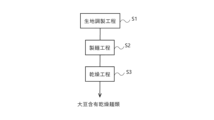
- FIG. 1 is a flowchart showing a method for producing soybean-containing dried noodles according to a first embodiment of the present invention.
- soybean-containing dried noodles (hereinafter simply referred to as "dried noodles") according to a first embodiment of the present invention.
- the dried noodles of this embodiment contain 40% by mass or more of soy flour, 0.01 to 2% by mass of kansui (water syrup) relative to the total mass of the raw material flour, and 0.1 to 7% by mass in total of at least one polysaccharide selected from psyllium seed gum, alginate ester, and hydroxypropyl methylcellulose.
- Soy flour is one of the main ingredients in the dried noodles of this embodiment, and is blended into the raw material flour at a content of 40% by mass or more.
- the soy flour content is set to 40% by mass or more. Note that, because the effect of suppressing the soybean odor is significantly noticeable, the present invention is particularly suitable when the soy flour content is 50% by mass or more.
- the upper limit of the amount of soy flour is not particularly limited, but if the soy flour content is 84% or more by mass relative to the total mass of the raw material flour, the noodle strings will lose their bond strength and become more likely to break. For this reason, the soy flour content in the raw material flour is preferably less than 84% by mass, more preferably 81% or less by mass, and even more preferably 70% or less by mass.
- the soy flour blended into the dried noodles of this embodiment may be either full-fat soy flour or defatted soy flour, or may be either heated soy flour or raw soy flour, but full-fat soy flour will improve the flavor of the noodles, while raw soy flour will improve the suitability for making noodles.
- the type of soybean is not particularly limited, and various types of soybeans such as yellow soybeans, black soybeans, red soybeans, green soybeans, white soybeans, large-grain soybeans, medium-grain soybeans, and small-grain soybeans may be used, and lipoxygenase-deficient soybeans may also be used.
- Kansui is an essential ingredient in the dried noodles of this embodiment, and has a soybean odor suppressing effect of suppressing the generation of n-hexanal, which is the cause of the soybean odor in soy-containing noodles, and an effect of improving water absorbency and softening the noodles after reconstitution or boiling (hereinafter referred to as "after boiling"). Therefore, by blending kansui with the raw material flour, it is possible to obtain noodles that have no soybean odor, have good water absorbency when reconstituted or boiled, and have a good texture after boiling, even if they contain 40% by mass or more of soy flour.
- the kansui content in the dried noodles is set to 0.01 to 2% by mass relative to the total mass of the raw material flour.
- the kansui content is preferably 0.02 to 1.2% by mass, and more preferably 0.13 to 0.19% by mass, relative to the total mass of the raw material flour.
- the content of kansui is preferably 0.02 to 4.14 parts by mass, and more preferably 0.25 to 1.63 parts by mass, per 100 parts by mass of soy flour.
- the kansui blended with the dried noodles of this embodiment is not particularly limited as long as it is approved as a food additive, and examples thereof include those containing carbonates such as potassium carbonate, sodium carbonate (anhydrous, crystalline) and sodium hydrogen carbonate as active ingredients, orthophosphates such as sodium dihydrogen phosphate (anhydrous, crystalline), potassium dihydrogen phosphate, disodium hydrogen phosphate (anhydrous, crystalline), dipotassium hydrogen phosphate, trisodium phosphate (anhydrous, crystalline) and tripotassium phosphate, and those containing condensed phosphates such as tetrasodium pyrophosphate (anhydrous, crystalline), tetrapotassium pyrophosphate, disodium dihydrogen pyrophosphate, sodium polyphosphate, potassium polyphosphate, sodium metaphosphate and potassium metaphosphate as active ingredients.
- These kansui may be used alone, or two or more types may be used in combination. When two or more types of
- “Kansui” can be either powdered or liquid, and either can be used for the dried noodles of this embodiment.
- the amount of liquid kansui can be converted into a dry mass to determine the total mass of the raw material flour and the kansui content, and it should be blended so that the dry mass is 0.01 to 2% by mass.
- Psyllium seed gum, alginate esters and HPMC have the effect of imparting an appropriate hardness to soybean-containing noodles.
- the texture of the soybean-containing noodles after boiling can be improved.
- the above-mentioned psyllium seed gum, alginate esters and HPMC also have the effect of improving the noodle-making suitability and binding property of the soybean-containing noodles.
- the total content of psyllium seed gum, alginate ester and HPMC is less than 0.1% by mass relative to the total mass of the raw material flour, the above-mentioned effects will not be fully achieved, and the texture after boiling will deteriorate, and the suitability for making noodles will decrease.
- the total content of psyllium seed gum, alginate ester and HPMC exceeds 7% by mass relative to the total mass of the raw material flour, the noodles will become too hard after boiling, resulting in a deteriorated texture. Therefore, in the dried noodles of this embodiment, at least one type of polysaccharide from among psyllium seed gum, alginate ester and HPMC is blended in the range of 0.1 to 7% by mass relative to the total mass of the raw material flour.
- the polysaccharide content is preferably 0.2 to 3.0% by mass, more preferably 0.5 to 1.9% by mass, based on the total mass of the raw material flour. By keeping the polysaccharide content within this range, soy-containing dried noodles with excellent texture and water absorbency can be obtained.
- the polysaccharide content here refers to the combined amount of psyllium seed gum, alginate ester, and HPMC.
- the amount of psyllium seed gum, alginate ester, and hydroxypropyl methylcellulose blended is preferably 0.2 to 14.5 parts by mass in total per 100 parts by mass of soy flour, and more preferably 0.9 to 14.3 parts by mass.
- the polysaccharide added to the dried noodles of this embodiment is preferably psyllium seed gum or HPMC, and more preferably a combination of psyllium seed gum or HPMC with an alginate ester.
- psyllium seed gum or HPMC to soybean-containing noodles improves the adhesiveness, resulting in noodles with a chewy texture.
- adding an alginate ester to soybean-containing noodles results in noodles with a smooth and silky texture.
- the types of psyllium seed gum, alginate ester, and HPMC are not particularly limited and can be appropriately selected depending on the amount of soy flour and other ingredients, the desired texture, etc., but for example, if one with a high viscosity (viscosity in solution) is used, the amount of polysaccharides can be reduced.
- [gluten] Gluten a protein contained in wheat, has the effect of improving the adhesiveness of the noodle strings, and is blended in as necessary in the dried noodles of this embodiment.
- gluten is added mainly as gluten powder, but when wheat flour is used as the raw material flour, it also includes the gluten (protein) in the wheat flour.
- gluten protein
- wheat flour is also included in the raw material flour, it is sufficient to mix it so that the total amount of protein in the gluten flour and the protein in the wheat flour are within the above-mentioned range.
- the raw material flour used for the dried noodles of this embodiment may contain cereal flours other than soy flour and starches.
- cereal flours other than soy flour include those produced by milling (powdering) flours obtained by, for example, cleaning, washing or polishing grains such as wheat, barley, rye, rice, buckwheat, corn, etc., which have been pregelatinized either raw or by thermal processing.
- flours can be selected appropriately according to the application and purpose, and may be used alone or in combination with other flours.
- wheat flour is used to make udon, hiyamugi, somen, Chinese noodles, and pasta
- buckwheat flour or buckwheat flour and wheat flour is used to make soba
- rice flour is used to make rice vermicelli and pho.
- starches include starches derived from corn starch, potato, sweet potato, tapioca, sago palm, wheat, rice, kudzu, bracken, lotus root, mung beans and other legumes, and in addition to raw starch, processed starches such as pregelatinized starch, acetylated starch, etherified starch and cross-linked starch may also be used. These starches are added as necessary for the purposes of improving the texture of the noodles, making the surface of the noodle strings smooth, shortening the boiling time during cooking, etc.
- the raw material flour may contain additives such as psyllium seed gum, thickening polysaccharides other than alginate esters and HPMC, salt, vegetable powder, mannan powder, powdered oils and fats, colorings, amino acids, sugars, dextrin, dried egg white, pH adjusters, and shelf life improvers.
- additives such as psyllium seed gum, thickening polysaccharides other than alginate esters and HPMC, salt, vegetable powder, mannan powder, powdered oils and fats, colorings, amino acids, sugars, dextrin, dried egg white, pH adjusters, and shelf life improvers.
- the dried noodles of this embodiment may contain, for example, water, brewed vinegar, alcohol, yeast, flavorings, soy sauce, soy milk, milk and its processed products, and dashi ingredients such as kelp and bonito.
- the ingredients other than the raw material flour and the amounts of them added can be selected and set appropriately depending on the type and purpose of the noodles.
- the thickness of the dried noodles of this embodiment is not particularly limited and can be selected appropriately depending on the purpose and cooking method, but it is preferable to set the noodle thickness to 1.5 mm or less, which enables short-time cooking and cooking in a microwave oven. Because the dried noodles of this embodiment have excellent suitability for noodle production, even if the noodle thickness is 1.5 mm or less, a noodle band can be formed by rolling, and the noodle strings are also well connected.
- Fig. 1 is a flow chart showing the method for producing soybean-containing dried noodles of this embodiment.
- the method for producing dried noodles of this embodiment includes a dough preparation step S1, a noodle-making step S2, and a drying step S3.
- dough preparation process S1 In the dough preparation step S1, other ingredients are added to the raw material flour and kneaded to prepare the dough. At that time, soy flour is 40% by mass or more, kansui is 0.01 to 2% by mass, psyllium seed gum, A raw material flour containing at least one polysaccharide selected from the group consisting of alginic acid ester and HPMC in a total amount of 0.1 to 7 mass % is used.
- the raw material flour preferably contains 0.02 to 4.14 parts by mass of kansui and a total of 0.2 to 14.5 parts by mass of at least one polysaccharide selected from psyllium seed gum, alginate ester, and hydroxypropyl methylcellulose per 100 parts by mass of soy flour.
- gluten may be blended into the raw material flour as long as it does not impair the effects of the present invention.
- gluten powder may be blended into the raw material flour, or wheat flour may be blended together with the gluten powder so that part of the gluten is derived from wheat flour.
- the method for preparing the dough in the dough preparation step S1 is not particularly limited, and known methods and devices can be used.
- the raw materials may be kneaded under reduced pressure.
- the dough prepared in the dough preparation step S1 is shaped to form noodles.
- the noodle-making method is not particularly limited and known techniques and devices can be used, but from the viewpoint of productivity, a method in which the dough is rolled to form a noodle band and noodle strands are cut out from the noodle band is preferable.
- the dough may be rolled in a single stage, or in multiple stages using multiple pairs of rollers.
- an extruder may be used to form noodle bands or noodle strands.
- the ingredients are kneaded using a vacuum extruder to prepare the dough, and then in the noodle making step S2, the dough is extruded from the vacuum extruder to form the noodle bands.
- drying step S3 In the drying step S3, the noodles obtained in the noodle-making step S2 are dried.
- the method for drying the noodles is not particularly limited, and can be appropriately selected from known methods such as hot air drying, low-temperature drying, high-temperature and high-velocity air current drying, fry-drying, and freeze-drying depending on the type of noodles and the cooking method.
- the method for producing dried noodles of this embodiment may also include an aging step in addition to the above-mentioned steps S1 to S3.
- an aging step in addition to the above-mentioned steps S1 to S3.
- the aging method and conditions can be selected appropriately depending on the type of noodle, and the aging step may be carried out under normal pressure, reduced pressure, or increased pressure.
- n-Hexanal concentration In the dried noodles of this embodiment, when the soy flour content relative to the total mass of the raw material flour is x% by mass, the n-hexanal concentration calculated from the value measured by headspace gas chromatography is (0.27 ⁇ x) ppm or less.
- n-Hexanal is an odor component that is believed to be the cause of soybean odor
- the n-hexanal concentration in the dried noodles increases as the amount of soy flour blended into the raw material flour increases, but by keeping the n-hexanal concentration at (0.27 ⁇ x) ppm or less, it is possible to realize soy-containing noodles that do not have a noticeable soybean odor, even if the soy flour content is 40% by mass or more relative to the total mass of the raw material flour.
- the dried noodles of this embodiment use kansui, which has a soybean odor suppressing effect, in combination with at least one polysaccharide selected from psyllium seed gum, alginate ester, and HPMC, which suppresses the generation of soybean odor even when the soy flour content in the raw material flour is 40% by mass or more, and improves water absorption during rehydration or boiling, imparting appropriate softness to the noodles after boiling and resulting in a good texture.
- the dried noodles of this embodiment are also excellent in suitability for noodle making, and the noodle strings are well connected.
- the dried noodles of this embodiment are particularly suitable for noodles that have a thin noodle thickness for the purpose of quick cooking or microwave cooking, and for noodles other than Chinese noodles.
- the noodle set of this embodiment includes the soybean-containing dried noodles of the first embodiment described above and a seasoning liquid.
- the noodles used in the noodle set of this embodiment may be the dried noodles of the first embodiment described above, and the type is not particularly limited. Various types of noodles such as udon, soba, pasta, and rice vermicelli can be used, but noodles other than Chinese noodles are preferred.
- the seasoning liquid may be any liquid that seasons noodles, such as noodle soup, concentrated soup, and pasta sauce, and may contain ingredients in addition to liquid components.
- the cooking method for dried noodles is not particularly limited, and can be selected appropriately depending on the type of noodles and the form of the noodle set, such as rehydrating or boiling. Furthermore, by using thin noodles, cooking in a short time or in a microwave oven is also possible.
- the noodle set of this embodiment uses soy-containing dried noodles that contain soy flour, kansui, and specific amounts of at least one polysaccharide selected from psyllium seed gum, alginate ester, and HPMC, so the noodles have a suppressed soy odor and a good texture after boiling.
- soy-containing dried noodles were produced using psyllium seed gum as the polysaccharide and varying the amount of kansui (water syrup) contained, and the flavor (presence or absence of soybean smell/kansui smell), water absorbency, and texture after boiling were evaluated.
- the noodles for evaluation were prepared by the method shown in FIG. 1. Specifically, the raw material compositions shown in Tables 1 to 3 below were mixed by hand for 1 minute, and the resulting dough was repeatedly rolled with a noodle roll to form a noodle band with a thickness of 1.3 mm. At that time, non-heated full-fat soy flour (soy flour A) and heated full-fat soy flour (soy flour B) were used as the soy flour, vital gluten with a protein content of 75% or more by mass in the dry state was used as the gluten flour, and strong flour with a protein content of 12% by mass in the dry state was used as the wheat flour.
- soy flour A non-heated full-fat soy flour
- si flour B heated full-fat soy flour
- vital gluten with a protein content of 75% or more by mass in the dry state was used as the gluten flour
- strong flour with a protein content of 12% by mass in the dry state was used as the wheat flour.
- disodium phosphate was used for sample No. 15, and a mixed powder of sodium carbonate and potassium carbonate was used for the other samples.
- psyllium seed gum a gum with a viscosity of 100 mPa ⁇ s in a 0.5% aqueous solution at 25°C was used.
- noodle strands were cut out from the rolled noodle band using a cutting blade and dried in a thermo-hygrostat to obtain dried noodles (noodle thickness: 1.2 mm) for the examples and comparative examples.
- Soybean odor was evaluated by a panel of 5 to 7 specialists (training period: 1 to 5 years) on a sensory evaluation scale using the following 5-point scale. A score of 4 or more was rated as ⁇ (good), a score of 2 to less than 4 was rated as ⁇ (passable), and a score of less than 2 was rated ⁇ (unacceptable). 5 points: No soybean scent at all. 4 points: A slight soybean scent is detectable (similar to a mixture of soybean flour and wheat flour in a mass ratio of 25:75). 3 points: A slight soybean scent is detectable (similar to a 50:50 mixture of soybean flour and wheat flour by mass). 2 points: The aroma of soybeans is detectable (similar to that of a mixture of soybean flour and wheat flour in a mass ratio of 75:25). 1 point: The soybean scent is strong (same as soybean flour itself).
- Kansui odor The "kansui odor" was evaluated by a panel of 5 to 7 specialists (training period: 1 to 5 years) on a sensory scale using the following three-point scale. A score of 2.5 or more was rated as ⁇ (good), a score of 1.5 to 2.5 was rated as ⁇ (passable), and a score of less than 1.5 was rated as ⁇ (unacceptable). 3 points: No smell of kansui at all. 2 points: The smell of kansui can be detected, but is within the acceptable range. 1 point: The smell of kansui is strong.
- Water absorption was measured by boiling 68 g of each of the dried noodles in the Examples and Comparative Examples in boiling water for 5 minutes, pouring the noodles together with the boiling water into a mesh strainer with 2 mm openings and leaving them to stand for 30 seconds to drain the water, and measuring the mass of the resulting boiled noodles.
- sample No. 1 which did not contain kansui, had a strong soybean smell, was slightly hard, and had a poor texture.
- Sample No. 12 which contained more than 2% kansui by mass, suppressed the soybean smell, but had a strong kansui smell and a poor flavor.
- the noodles of sample No. 12 were softer than the appropriate range after boiling, and had poor texture and water absorption.
- Sample No. 16 which did not contain added polysaccharides, suppressed the soybean smell, but the noodles of sample No. 12 were softer than the appropriate range after boiling, and had a poor texture.
- samples No. 2-11, 13-15, and 17-23 which contained 0.01-2% by mass of kansui and 0.2-7% by mass of psyllium seed gum, had a suppressed soybean odor and had good texture and water absorbency.
- soy-containing dried noodles were prepared by changing the type of polysaccharide, and the soybean odor, water absorbency, and texture of the noodles after boiling were evaluated. Specifically, evaluation noodles were prepared using the same method and conditions as in the first example described above, and the flavor (presence or absence of soybean odor/kansui odor), water absorbency, and texture after boiling were evaluated using the same method and criteria as in the first example.
- the polysaccharides used were psyllium seed gum with a viscosity of 100 mPa ⁇ s in a 0.5% aqueous solution at 25°C, HPMC with a viscosity of 75,000 to 140,000 mPa ⁇ s in a 2% aqueous solution at 20°C, and alginate ester with a viscosity of 100 to 150 mPa ⁇ s in a 1% aqueous solution at 20°C, and the other raw materials were the same as in the first example.
- the evaluation results are shown in Tables 4 and 5 below.
- sample No. 33 which contained more than 7% by mass of polysaccharides, had hard noodles after boiling and a poor texture.
- samples No. 30-32 and 34-37 which contained 0.01-2% by mass of kansui and a total of 0.1-7% by mass of at least one polysaccharide selected from psyllium seed gum, alginate ester, and hydroxypropyl methylcellulose, had a suppressed soybean odor and a good texture.
- the concentration of n-hexanal which is said to be the cause of the grassy smell of soybeans, was measured by headspace gas chromatography for soybean-containing dried noodles with different kansui contents (samples No. 1, and 4 to 8 in the first embodiment).
- Measurements were performed by sealing 1 g of crushed soybean-containing dried noodles and 3 ml of pure water in a 20 ml vial, setting the trap temperature to 40°C/240°C (desorption temperature), and using hydrogen as the carrier gas.
- a metal capillary column (MXT-5/MXT-WAX) was used, and the column heating conditions were an initial temperature of 40°C, an initial constant temperature time of 10 seconds, and a heating rate of 1.5°C/second from 40°C to 250°C, and detection was performed at an FID temperature of 260°C. This measurement was performed three times for the same sample, and the average value was taken.
- n-hexanal concentrations of each sample measured using this method are shown in Table 6 below.
Landscapes
- Life Sciences & Earth Sciences (AREA)
- Health & Medical Sciences (AREA)
- Nutrition Science (AREA)
- Chemical & Material Sciences (AREA)
- Engineering & Computer Science (AREA)
- Food Science & Technology (AREA)
- Polymers & Plastics (AREA)
- Agronomy & Crop Science (AREA)
- Botany (AREA)
- Noodles (AREA)
- Beans For Foods Or Fodder (AREA)
Abstract
原料粉に大豆粉が40質量%以上含まれていても、大豆臭が抑制され、食感が良好な大豆含有乾燥麺類、麺セット及び大豆含有乾燥麺類の製造方法を提供する。 大豆粉を40質量%以上と、かんすいを0.01~2質量%と、サイリウムシードガム、アルギン酸エステル及びヒドロキシプロピルメチルセルロースのうち少なくとも1種の多糖類を合計で0.1~7質量%含有する原料粉を用いて調製された生地を成形した後、乾燥させて大豆含有乾燥麺類とする。
Description
本発明は、大豆粉を含む原料を用いて製造された大豆含有乾燥麺類、この大豆含有乾燥麺類を備える麺セット及び大豆粉を含む原料を用いて大豆含有乾燥麺類を製造する方法に関する。
近年、健康志向の高まりから、高たんぱく低糖質の食品が求められており、麺類も原料粉に大豆粉を用いたものが提案されている(例えば、特許文献1~4参照。)。例えば、特許文献1には、小麦全粒粉を15質量%以上22質量%以下、大豆粉を3質量%以上15質量%以下、米糠を3質量%以上6質量%以下含有する麺が記載されている。また、特許文献2には、粒径255μm以上の粒子を3質量%以上含み、且つ中位径が70μm未満である大豆粉砕物を5質量%以上含む麺類用組成物を用いた麺類が記載されている。
更に、特許文献3には、大豆臭さやエグミを抑制するため、大豆由来たんぱく質含有材料と、タピオカ澱粉とを含み、大豆由来たんぱく質含有材料の量が、大豆由来たんぱく質含有材料と澱粉質原料との合計量100質量部に対して、40質量部以上である大豆麺が記載されている。一方、特許文献4には、大豆含有麺質量比で1倍量の水との攪拌混合物をレオメータにより直径1.8mmの円錐型プランジャーを用いて測定した付着性が300J/m3以下である大豆粉を7~50質量%の範囲で含有する原料穀粉を用いて製造することで、製麺適性を良好にした大豆含有麺が記載されている。
前述した従来の大豆含有麺類は、原料粉中の大豆粉量を多くすればより高たんぱくで低糖質な麺類が得られるが、大豆含有量が多くなると、大豆特有の臭い(以下、大豆臭という。)が強くなって風味が低下したり、硬くなりすぎて食感が劣化したりするといった課題がある。
そこで、本発明は、原料粉に大豆粉が40質量%以上含まれていても、大豆臭が抑制され、湯戻しや茹で調理後の食感が良好な大豆含有乾燥麺類、麺セット及び大豆含有乾燥麺類の製造方法を提供することを目的とする。
本発明に係る大豆含有乾燥麺類は、原料粉全質量に対して、大豆粉を40質量%以上と、かんすいを0.01~2質量%と、サイリウムシードガム、アルギン酸プロピレングリコールエステル(PGA:Propylene Glycol Alginate;以下、「アルギン酸エステル」と略す。)及びヒドロキシプロピルメチルセルロース(HPMC:Hydroxypropyl Methylcellulose)のうち少なくとも1種の多糖類を合計で0.1~7質量%含有する。
本発明の大豆含有乾燥麺類は、前記大豆粉100質量部あたり、前記かんすいを0.02~4.14質量部、サイリウムシードガム、アルギン酸エステル及びヒドロキシプロピルメチルセルロースのうち少なくとも1種の多糖類を合計で0.2~14.5質量部含有していてもよい。
本発明の大豆含有乾燥麺類は、少なくともアルギン酸エステルを含み、更に、ヒドロキシプロピルメチルセルロース又はサイリウムシードガムを含んでいてもよい。そして、サイリウムシードガムとアルギン酸エステルを含有する場合、その配合比を、質量比で、サイリウムシードガム:アルギン酸エステル=1:0.01~3とすることができる。また、ヒドロキシプロピルメチルセルロースとアルギン酸エステルを含有する場合、その配合比を、質量比で、ヒドロキシプロピルメチルセルロース:アルギン酸エステル=1:0.01~3とすることができる。
前記かんすいは、例えば大豆臭抑制剤として作用する。
本発明の大豆含有乾燥麺類は、原料粉全質量に対する大豆粉含有率をx質量%としたとき、ヘッドスペース・ガスクロマトグラフィー法による測定値から求めたn-ヘキサナール濃度を(0.27×x)ppm以下にすることができる。
本発明の大豆含有乾燥麺類は、厚さ1.2mmの乾燥麺類を沸騰した湯で5分間茹でた後、目開き2mmのメッシュのストレーナーにゆで汁ごとあけて30秒間静置することにより湯切りして得た茹で麺の質量を、茹でる前の乾燥麺類の質量の2.3~2.9倍とすることができる。
本発明の大豆含有乾燥麺類は、前記大豆粉100質量部あたり、前記かんすいを0.02~4.14質量部、サイリウムシードガム、アルギン酸エステル及びヒドロキシプロピルメチルセルロースのうち少なくとも1種の多糖類を合計で0.2~14.5質量部含有していてもよい。
本発明の大豆含有乾燥麺類は、少なくともアルギン酸エステルを含み、更に、ヒドロキシプロピルメチルセルロース又はサイリウムシードガムを含んでいてもよい。そして、サイリウムシードガムとアルギン酸エステルを含有する場合、その配合比を、質量比で、サイリウムシードガム:アルギン酸エステル=1:0.01~3とすることができる。また、ヒドロキシプロピルメチルセルロースとアルギン酸エステルを含有する場合、その配合比を、質量比で、ヒドロキシプロピルメチルセルロース:アルギン酸エステル=1:0.01~3とすることができる。
前記かんすいは、例えば大豆臭抑制剤として作用する。
本発明の大豆含有乾燥麺類は、原料粉全質量に対する大豆粉含有率をx質量%としたとき、ヘッドスペース・ガスクロマトグラフィー法による測定値から求めたn-ヘキサナール濃度を(0.27×x)ppm以下にすることができる。
本発明の大豆含有乾燥麺類は、厚さ1.2mmの乾燥麺類を沸騰した湯で5分間茹でた後、目開き2mmのメッシュのストレーナーにゆで汁ごとあけて30秒間静置することにより湯切りして得た茹で麺の質量を、茹でる前の乾燥麺類の質量の2.3~2.9倍とすることができる。
本発明に係る麺セットは、前述した大豆含有乾燥麺類と、調味液とを備える。
本発明に係る大豆含有乾燥麺類の製造方法は、大豆粉を40質量%以上と、かんすいを0.01~2質量%と、サイリウムシードガム、アルギン酸エステル及びヒドロキシプロピルメチルセルロースのうち少なくとも1種の多糖類を合計で0.1~7質量%を含有する原料粉を用いて生地を調製する工程と、該生地を成形して麺類を得る製麺工程と、前記麺類を乾燥させる乾燥工程とを行う。
前記原料粉は、例えば、前記大豆粉100質量部あたり、前記かんすいが0.02~4.14質量部、サイリウムシードガム、アルギン酸エステル及びヒドロキシプロピルメチルセルロースのうち少なくとも1種の多糖類が合計で0.2~14.5質量部配合されているものを用いることができる。
また、前記原料粉は、少なくともアルギン酸エステルを含み、更に、ヒドロキシプロピルメチルセルロース又はサイリウムシードガムを含んでいてもよい。例えば、前記原料粉がサイリウムシードガムとアルギン酸を含有する場合、その配合比を、質量比で、サイリウムシードガム:アルギン酸エステル=1:0.01~3とすることができる。又は、前記原料粉がヒドロキシプロピルメチルセルロースとアルギン酸を含有する場合、その配合比を、質量比で、ヒドロキシプロピルメチルセルロース:アルギン酸エステル=1:0.01~3とすることができる。
本発明の大豆含有乾燥麺類の製造方法では、原料粉全質量に対する大豆粉含有率をx質量%としたとき、ヘッドスペース・ガスクロマトグラフィー法による測定値から求めたn-ヘキサナール濃度が(0.27×x)ppm以下である大豆含有乾燥麺類が得られる。
前記原料粉は、例えば、前記大豆粉100質量部あたり、前記かんすいが0.02~4.14質量部、サイリウムシードガム、アルギン酸エステル及びヒドロキシプロピルメチルセルロースのうち少なくとも1種の多糖類が合計で0.2~14.5質量部配合されているものを用いることができる。
また、前記原料粉は、少なくともアルギン酸エステルを含み、更に、ヒドロキシプロピルメチルセルロース又はサイリウムシードガムを含んでいてもよい。例えば、前記原料粉がサイリウムシードガムとアルギン酸を含有する場合、その配合比を、質量比で、サイリウムシードガム:アルギン酸エステル=1:0.01~3とすることができる。又は、前記原料粉がヒドロキシプロピルメチルセルロースとアルギン酸を含有する場合、その配合比を、質量比で、ヒドロキシプロピルメチルセルロース:アルギン酸エステル=1:0.01~3とすることができる。
本発明の大豆含有乾燥麺類の製造方法では、原料粉全質量に対する大豆粉含有率をx質量%としたとき、ヘッドスペース・ガスクロマトグラフィー法による測定値から求めたn-ヘキサナール濃度が(0.27×x)ppm以下である大豆含有乾燥麺類が得られる。
ここで、本発明における「原料粉」には、粉状の全ての原料が含まれ、主原料である大豆粉の他に、小麦粉などの大豆粉以外の穀粉、グルテン粉、多糖類、澱粉類、食塩、かんすい、野菜粉末、マンナン粉、粉末油脂、増粘多糖類、色素、アミノ酸類、糖類、デキストリン、乾燥卵白、pH調整剤、日持向上剤など副原料も含む。
本発明によれば、大豆粉を40質量%以上含有する原料粉を用いても、大豆臭が抑制され、湯戻しや茹で調理を行うことにより適度な柔らかさで食感が良好な麺類が得られる大豆含有乾燥麺類、麺セット及び大豆含有乾燥麺類の製造方法を実現することができる。
以下、本発明を実施するための形態について、添付の図面を参照して詳細に説明する。なお、本発明は、以下に説明する実施形態に限定されるものではない。
(第1の実施形態)
先ず、本発明の第1の実施形態に係る大豆含有乾燥麺類(以下、単に「乾燥麺類」ともいう。)について説明する。本実施形態の乾燥麺類は、原料粉全質量に対して、大豆粉を40質量%以上、かんすいを0.01~2質量%含有すると共に、サイリウムシードガム、アルギン酸エステル及びヒドロキシプロピルメチルセルロースのうち少なくとも1種の多糖類を合計で0.1~7質量%含有する。
先ず、本発明の第1の実施形態に係る大豆含有乾燥麺類(以下、単に「乾燥麺類」ともいう。)について説明する。本実施形態の乾燥麺類は、原料粉全質量に対して、大豆粉を40質量%以上、かんすいを0.01~2質量%含有すると共に、サイリウムシードガム、アルギン酸エステル及びヒドロキシプロピルメチルセルロースのうち少なくとも1種の多糖類を合計で0.1~7質量%含有する。
[大豆粉]
大豆粉は、本実施形態の乾燥麺類における主原料の1つであり、原料粉中に40質量%以上配合されている。原料粉中の大豆粉量の下限値は、製麺適性や麺線の結着性の観点からは特に限定されるものではないが、大豆粉含有量が少ないと、大豆粉配合の効果(麺類の高たんぱく・低糖質化)が十分に得られないため、本実施形態の乾燥麺類では、原料粉全質量に対する大豆粉含有率は40質量%以上とする。なお、大豆臭抑制効果が顕著に感じられることから、本発明は大豆粉含有率が50質量%以上の場合に特に好適である。
大豆粉は、本実施形態の乾燥麺類における主原料の1つであり、原料粉中に40質量%以上配合されている。原料粉中の大豆粉量の下限値は、製麺適性や麺線の結着性の観点からは特に限定されるものではないが、大豆粉含有量が少ないと、大豆粉配合の効果(麺類の高たんぱく・低糖質化)が十分に得られないため、本実施形態の乾燥麺類では、原料粉全質量に対する大豆粉含有率は40質量%以上とする。なお、大豆臭抑制効果が顕著に感じられることから、本発明は大豆粉含有率が50質量%以上の場合に特に好適である。
また、大豆粉量の上限も、特に限定されるものではないが、原料粉全質量に対して大豆粉含有率が84質量%以上になると、つながり強度が低下して麺線が切れやすくなったりする。このため、原料粉における大豆粉含有率は84質量%未満が好ましく、より好ましくは81質量%以下、更に好ましくは70質量%以下である。
本実施形態の乾燥麺類に配合される大豆粉は、全脂大豆粉及び脱脂大豆粉のいずれでもよく、また、加熱大豆粉及び生大豆粉のいずれでもよいが、全脂大豆粉を用いると麺の風味が向上し、生大豆粉を用いると製麺適性が向上する。更に、大豆の種類も特に限定されるものではなく、黄大豆、黒大豆、赤大豆、青大豆、白大豆、大粒種、中粒種及び小粒種などの各種大豆を用いることができ、リポキシゲナーゼ欠失大豆を用いてもよい。
[かんすい]
かんすいは、本実施形態の乾燥麺類において必須の成分であり、大豆含有麺類において大豆臭の原因となるn-ヘキサナールの発生を抑制する大豆臭抑制作用と、吸水性を向上させて、湯戻しや茹で調理後(以下、「茹で上げ後」という。)の麺類を柔らかくする作用がある。このため、原料粉にかんすいを配合することで、大豆粉を40質量%以上含有していても、大豆臭がなく、湯戻しや茹で調理の際の吸水性が良好で、茹で上げ後に食感が良好な麺類が得られる。
かんすいは、本実施形態の乾燥麺類において必須の成分であり、大豆含有麺類において大豆臭の原因となるn-ヘキサナールの発生を抑制する大豆臭抑制作用と、吸水性を向上させて、湯戻しや茹で調理後(以下、「茹で上げ後」という。)の麺類を柔らかくする作用がある。このため、原料粉にかんすいを配合することで、大豆粉を40質量%以上含有していても、大豆臭がなく、湯戻しや茹で調理の際の吸水性が良好で、茹で上げ後に食感が良好な麺類が得られる。
ただし、乾燥麺類におけるかんすい含有率が原料粉全質量に対して0.01質量%未満の場合、前述した効果が十分に得られず、また、乾燥麺類におけるかんすい含有率が2質量%を超えると、かんすい臭が強くなって風味が低下する。そこで、本実施形態の乾燥麺類では、かんすい含有率を、原料粉全質量に対して0.01~2質量%とする。なお、かんすい含有率は、原料粉全質量に対して0.02~1.2質量%であることが好ましく、より好ましくは0.13~0.19質量%である。かんすい含有率をこの範囲にすることにより、大豆臭やかんすい臭が感じられず、食感や吸水性も良好な大豆含有乾燥麺類が得られる。
また、大豆臭抑制効果と茹で上げ後の麺類の食感向上の観点から、かんすい含有量は、大豆粉100質量部あたり0.02~4.14質量部であることが好ましく、0.25~1.63質量部であることがより好ましい。
本実施形態の乾燥麺類に配合されるかんすいは、食品添加物として認められているものであれば特に限定されるものではなく、炭酸カリウム、炭酸ナトリウム(無水、結晶)及び炭酸水素ナトリウムなどの炭酸塩を有効成分とするもの、リン酸二水素ナトリウム(無水、結晶)、リン酸二水素カリウム、リン酸水素二ナトリウム(無水、結晶)、リン酸水素二カリウム、リン酸三ナトリウム(無水、結晶)及びリン酸三カリウムなどの正リン酸塩、ピロリン酸四ナトリウム(無水、結晶)、ピロリン酸四カリウム、ピロリン酸二水素二ナトリウム、ポリリン酸ナトリウム、ポリリン酸カリウム、メタリン酸ナトリウム及びメタリン酸カリウムなどの縮合リン酸塩を有効成分とするものなどを用いることができる。これらのかんすいは単独で使用してもよく、2種以上を組み合わせて使用してもよい。2種以上のかんすいを使用する場合、その合計量が前述した範囲になるように配合すればよい。
また、「かんすい」には、粉末かんすいと液体かんすいがあり、本実施形態の乾燥麺類にはそのどちらを用いてもよい。液体かんすいを用いる場合、その配合量を乾燥質量に換算して原料粉全質量及びかんすい含有率を求めればよく、乾燥質量換算で0.01~2質量%となるよう配合すればよい。
[多糖類]
サイリウムシードガム、アルギン酸エステル及びHPMCには、大豆含有麺類に適度な硬さを付与する作用がある。そして、サイリウムシードガム、アルギン酸エステル及びHPMCから選択される1種又は2種以上の多糖類を、前述したかんすいと共に配合することで、茹で上げ後の大豆含有麺類の食感を良好にすることができる。更に、前述したサイリウムシードガム、アルギン酸エステル及びHPMCには、大豆含有麺類の製麺適性や結着性を向上させる作用もある。
サイリウムシードガム、アルギン酸エステル及びHPMCには、大豆含有麺類に適度な硬さを付与する作用がある。そして、サイリウムシードガム、アルギン酸エステル及びHPMCから選択される1種又は2種以上の多糖類を、前述したかんすいと共に配合することで、茹で上げ後の大豆含有麺類の食感を良好にすることができる。更に、前述したサイリウムシードガム、アルギン酸エステル及びHPMCには、大豆含有麺類の製麺適性や結着性を向上させる作用もある。
ただし、サイリウムシードガム、アルギン酸エステル及びHPMCの総含有率が原料粉全質量に対して0.1質量%未満の場合、前述した効果が十分に得られず、茹で上げ後の食感が低下したり、製麺適性が低下したりする。一方、サイリウムシードガム、アルギン酸エステル及びHPMCの総含有率が原料粉全質量に対して7質量%を超えると、茹で上げ後の麺類が硬くなりすぎて食感が低下する。そこで、本実施形態の乾燥麺類では、サイリウムシードガム、アルギン酸エステル及びHPMCのうち少なくとも1種の多糖類を、原料粉全質量に対して0.1~7質量%の範囲で配合する。
多糖類含有率は、原料粉全質量に対して0.2~3.0質量%が好ましく、より好ましくは0.5~1.9質量%である。多糖類含有率をこの範囲にすることにより、食感や吸水性に優れた大豆含有乾燥麺類が得られる。なお、ここでいう多糖類の含有率は、サイリウムシードガム、アルギン酸エステル及びHPMCの合計量である。
また、前述したかんすい配合量との関係から、サイリウムシードガム、アルギン酸エステル及びヒドロキシプロピルメチルセルロースの配合量は、大豆粉100質量部あたり合計で0.2~14.5質量部とすることが好ましく、より好ましくは0.9~14.3質量部である。サイリウムシードガム、アルギン酸エステル及びヒドロキシプロピルメチルセルロースの配合量をこの範囲にすることにより、大豆含有乾燥麺類の食感を更に向上させることができる。
本実施形態の乾燥麺類に添加される多糖類は、サイリウムシードガム又はHPMCが好ましく、サイリウムシードガム又はHPMCとアルギン酸エステルの併用がより好ましい。大豆含有麺類にサイリウムシードガムやHPMCを添加すると、結着性が向上し、コシのある食感が良好な麺類が得られる。一方、大豆含有麺類にアルギン酸エステルを添加すると、つるっとした滑らかな食感の麺類が得られる。
そして、大豆含有麺類にアルギン酸エステルと、サイリウムシードガム又はHPMCを組み合わせて使用すると、適度なコシとなめらかでつるっとした食感の麺類が得られる。具体的には、サイリウムシードガム又はHPMCとアルギン酸エステルを併用する場合、その配合比は、質量比で、サイリウムシードガム:アルギン酸エステル=1:0.01~3又はHPMC:アルギン酸エステル=1:0.01~3とすることが好ましく、これにより、茹で上げ後の大豆含有麺類の食感をより好適なものとすることができる。
また、サイリウムシードガム、アルギン酸エステル及びHPMCの種類は、特に限定されるものではなく、大豆粉配合量やその他の配合成分、求められる食感などに応じて適宜設定することができるが、例えば粘度(溶液での粘度)が高いものを用いると、多糖類の配合量を少なくすることができる。
[グルテン]
小麦に含まれるたんぱく質であるグルテンは、麺線の結着性を良好にする作用があり、本実施形態の乾燥麺類では、必要に応じて配合される。本実施形態の乾燥麺類におけるグルテン量は、特に限定されるものではないが、製麺適性向上の観点から、原料粉中に5~15質量%の割合で配合されているか、又は、前述した大豆粉100質量部に対して10~29質量部配合されていることが好ましい。
小麦に含まれるたんぱく質であるグルテンは、麺線の結着性を良好にする作用があり、本実施形態の乾燥麺類では、必要に応じて配合される。本実施形態の乾燥麺類におけるグルテン量は、特に限定されるものではないが、製麺適性向上の観点から、原料粉中に5~15質量%の割合で配合されているか、又は、前述した大豆粉100質量部に対して10~29質量部配合されていることが好ましい。
本実施形態の乾燥麺類においてグルテンは、主にグルテン粉として添加されるが、原料粉として小麦粉を配合する場合には、小麦粉中のグルテン(たんぱく質)も含む。グルテン粉のみ配合する(小麦粉が含まれない)場合は、グルテン粉中のたんぱく質の量が前述した範囲になるよう配合すればよく、更に原料粉に小麦粉が含まれる場合は、グルテン粉中のたんぱく質と小麦粉中のたんぱく質の総量が前述した範囲になるようにそれぞれ配合すればよい。
[その他の原料]
本実施形態の乾燥麺類に用いられる原料粉には、前述した各成分の他に、大豆粉以外の穀粉や澱粉類が配合されていてもよい。大豆粉以外の穀粉としては、例えば小麦、大麦及びライ麦などの麦類、米、蕎麦及びトウモロコシなどの穀物を、必要に応じて精選、洗浄又は精白し、生のまま又は熱加工してアルファー化した後、製粉(粉化)したものなどが挙げられる。
本実施形態の乾燥麺類に用いられる原料粉には、前述した各成分の他に、大豆粉以外の穀粉や澱粉類が配合されていてもよい。大豆粉以外の穀粉としては、例えば小麦、大麦及びライ麦などの麦類、米、蕎麦及びトウモロコシなどの穀物を、必要に応じて精選、洗浄又は精白し、生のまま又は熱加工してアルファー化した後、製粉(粉化)したものなどが挙げられる。
これらの穀粉は、用途や目的に応じて適宜選択して使用すればよく、単独で用いても、複数の穀粉を組み合わせて使用してもよい。例えばうどん、冷や麦、そうめん、中華麺及びパスタなどを製造する場合は小麦粉、そばを製造する場合はそば粉又はそば粉と小麦粉、ビーフンやフォーなどを製造する場合は米粉が用いられる。
また、澱粉類としては、例えばコーンスターチ、馬鈴薯、かんしょ、タピオカ、サゴ椰子、小麦、米、葛、わらび、蓮根、緑豆及びその他の豆類由来の澱粉が挙げられ、生澱粉の他、α化澱粉、アセチル化澱粉、エーテル化澱粉及び架橋澱粉などの加工澱粉でもよい。これらの澱粉類は、麺の食感改善、麺線の表面をなめらかにする、調理の際の茹で時間短縮などの目的で、必要に応じて添加される。
更に、原料粉には、サイリウムシードガム、アルギン酸エステル及びHPMC以外の増粘多糖類、食塩、野菜粉末、マンナン粉、粉末油脂、色素、アミノ酸類、糖類、デキストリン、乾燥卵白、pH調整剤、日持向上剤などが添加されていてもよい。
本実施形態の乾燥麺類には、前述した原料粉以外に、例えば、水、醸造酢、酒精、酵母、香料、しょうゆ、豆乳、牛乳及びその加工品、昆布やかつおなどのダシ原料が配合されていてもよい。原料粉以外の原料及びその配合量は、麺の種類や目的などに応じて適宜選択し設定することができる。
[麺厚]
本実施形態の乾燥麺類の厚さは、特に限定されるものではなく、目的や調理方法に応じて適宜選択することができるが、麺厚を1.5mm以下にすることが好ましく、これにより短時間調理や電子レンジ調理が可能となる。本実施形態の乾燥麺類は、製麺適性に優れるため、麺厚を1.5mm以下にしても圧延により麺帯を形成でき、麺線のつながりも良好である。
本実施形態の乾燥麺類の厚さは、特に限定されるものではなく、目的や調理方法に応じて適宜選択することができるが、麺厚を1.5mm以下にすることが好ましく、これにより短時間調理や電子レンジ調理が可能となる。本実施形態の乾燥麺類は、製麺適性に優れるため、麺厚を1.5mm以下にしても圧延により麺帯を形成でき、麺線のつながりも良好である。
[製造方法]
次に、本実施形態の乾燥麺類の製造方法について説明する。図1は本実施形態の大豆含有乾燥麺類の製造方法を示すフローチャートである。図1に示すように、本実施形態の乾燥麺類の製造方法では、生地調製工程S1と、製麺工程S2と、乾燥工程S3とを行う。
次に、本実施形態の乾燥麺類の製造方法について説明する。図1は本実施形態の大豆含有乾燥麺類の製造方法を示すフローチャートである。図1に示すように、本実施形態の乾燥麺類の製造方法では、生地調製工程S1と、製麺工程S2と、乾燥工程S3とを行う。
〔生地調製工程S1〕
生地調製工程S1では、原料粉にその他の原料を加えて混練し、生地を調製する。その際、大豆粉を40質量%以上と、かんすいを0.01~2質量%と、サイリウムシードガム、アルギン酸エステル及びHPMCのうち少なくとも1種の多糖類を合計で0.1~7質量%含有する原料粉を用いる。
生地調製工程S1では、原料粉にその他の原料を加えて混練し、生地を調製する。その際、大豆粉を40質量%以上と、かんすいを0.01~2質量%と、サイリウムシードガム、アルギン酸エステル及びHPMCのうち少なくとも1種の多糖類を合計で0.1~7質量%含有する原料粉を用いる。
原料粉は、大豆粉100質量部あたり、かんすいを0.02~4.14質量部、サイリウムシードガム、アルギン酸エステル及びヒドロキシプロピルメチルセルロースのうち少なくとも1種の多糖類を合計で0.2~14.5質量部含有するものが好ましい。また、原料粉に配合される多糖類としては、少なくともアルギン酸エステルを含み、更に、ヒドロキシプロピルメチルセルロース又はサイリウムシードガムを含むことが好ましく、特に、サイリウムシードガム又はHPMCとアルギン酸エステルを、質量比で、サイリウムシードガム:アルギン酸エステル=1:0.01~3又はHPMC:アルギン酸エステル=1:0.01~3の割合で配合した原料粉を用いることが好ましい。これにより、茹で上げ後の食感がより好適な大豆含有麺類が得られる。
本実施形態の乾燥麺類を製造する際は、本発明の効果を阻害しない範囲で、原料粉にグルテンを配合してもよい。その場合、原料粉にグルテン粉を配合してもよく、また、グルテン粉と共に、小麦粉を配合し、グルテンの一部を小麦粉由来のグルテンとしてもよい。
生地調製工程S1における生地の調製方法は、特に限定されるものではなく、公知の方法や装置を適用することができる。また、原料の混練は、減圧下で行ってもよい。
〔製麺工程S2〕
製麺工程S2では、生地調製工程S1で調製した生地を成形して麺類とする。製麺方法は、特に限定されるものではなく、公知の手法や装置を用いることができるが、生産性の観点から、生地を圧延して麺帯を形成し、該麺帯から麺線を切り出す方法が好適である。なお、生地の圧延は1段で行ってもよく、また、複数対のローラを用いて多段で行ってもよい。
製麺工程S2では、生地調製工程S1で調製した生地を成形して麺類とする。製麺方法は、特に限定されるものではなく、公知の手法や装置を用いることができるが、生産性の観点から、生地を圧延して麺帯を形成し、該麺帯から麺線を切り出す方法が好適である。なお、生地の圧延は1段で行ってもよく、また、複数対のローラを用いて多段で行ってもよい。
又は、圧延に代えて、押出機を用いて麺帯や麺線を形成してもよく、その場合、例えば、生地調製工程S1において真空押出機を用いて原料を混練して生地を調製し、引き続き、製麺工程S2において真空押出機から生地を押し出して麺帯を形成してもよい。
〔乾燥工程S3〕
乾燥工程S3では、製麺工程S2で得た麺類を乾燥させる。麺類の乾燥方法は、特に限定されるものではなく、麺類の種類や調理方法に応じて、熱風乾燥法、低温乾燥法、高温高速気流乾燥法、フライ乾燥法及びフリーズドライ法などの公知の方法から適宜選択することができる。
乾燥工程S3では、製麺工程S2で得た麺類を乾燥させる。麺類の乾燥方法は、特に限定されるものではなく、麺類の種類や調理方法に応じて、熱風乾燥法、低温乾燥法、高温高速気流乾燥法、フライ乾燥法及びフリーズドライ法などの公知の方法から適宜選択することができる。
〔その他の工程〕
本実施形態の乾燥麺類の製造方法では、前述したS1~S3の各工程に加えて、熟成工程を行ってもよい。熟成工程の時期及び回数は、特に限定されるものではなく、麺帯形成後に行ってもよく、また、麺線形成後に麺塊の状態で行ってもよい。熟成の方法及び条件は、麺の種類に応じて適宜選択することができ、常圧下、減圧下又は加圧下のいずれで行ってもよい。
本実施形態の乾燥麺類の製造方法では、前述したS1~S3の各工程に加えて、熟成工程を行ってもよい。熟成工程の時期及び回数は、特に限定されるものではなく、麺帯形成後に行ってもよく、また、麺線形成後に麺塊の状態で行ってもよい。熟成の方法及び条件は、麺の種類に応じて適宜選択することができ、常圧下、減圧下又は加圧下のいずれで行ってもよい。
[n-ヘキサナール濃度]
本実施形態の乾燥麺類は、原料粉全質量に対する大豆粉含有率をx質量%としたとき、ヘッドスペース・ガスクロマトグラフィー法により測定した値から求めたn-ヘキサナール濃度が(0.27×x)ppm以下である。n-ヘキサナールは、大豆臭の原因とされている臭気成分であり、原料粉に配合される大豆粉の量が多くなるほど、乾燥麺類におけるn-ヘキサナール濃度は高くなるが、n-ヘキサナール濃度を(0.27×x)ppm以下にすることで、大豆粉を原料粉全質量に対して40質量%以上含有していても、大豆臭が感じられない大豆含有麺類を実現することができる。
本実施形態の乾燥麺類は、原料粉全質量に対する大豆粉含有率をx質量%としたとき、ヘッドスペース・ガスクロマトグラフィー法により測定した値から求めたn-ヘキサナール濃度が(0.27×x)ppm以下である。n-ヘキサナールは、大豆臭の原因とされている臭気成分であり、原料粉に配合される大豆粉の量が多くなるほど、乾燥麺類におけるn-ヘキサナール濃度は高くなるが、n-ヘキサナール濃度を(0.27×x)ppm以下にすることで、大豆粉を原料粉全質量に対して40質量%以上含有していても、大豆臭が感じられない大豆含有麺類を実現することができる。
[吸水性]
本実施形態の乾燥麺類は、厚さ1.2mmの乾燥麺類を沸騰した湯で5分間茹でた後、目開き2mmのメッシュのストレーナーにゆで汁ごとあけて30秒間静置することにより湯切りして得た茹で麺の質量が、茹でる前の乾燥麺類の質量の2.3~2.9倍であることが好ましく、より好ましくは2.5~2.7倍である。茹で麺の質量がこの範囲になるようにすることで、短時間の茹で調理で良好な食感の茹で麺が得られる。なお、厚さが1.2mmでない乾燥麺類については、麺厚が1.2mmになるよう調整してから測定すればよい。
本実施形態の乾燥麺類は、厚さ1.2mmの乾燥麺類を沸騰した湯で5分間茹でた後、目開き2mmのメッシュのストレーナーにゆで汁ごとあけて30秒間静置することにより湯切りして得た茹で麺の質量が、茹でる前の乾燥麺類の質量の2.3~2.9倍であることが好ましく、より好ましくは2.5~2.7倍である。茹で麺の質量がこの範囲になるようにすることで、短時間の茹で調理で良好な食感の茹で麺が得られる。なお、厚さが1.2mmでない乾燥麺類については、麺厚が1.2mmになるよう調整してから測定すればよい。
以上詳述したように、本実施形態の乾燥麺類は、大豆臭抑制作用を有するかんすいと、サイリウムシードガム、アルギン酸エステル及びHPMCのうち少なくとも1種の多糖類を併用することにより、原料粉中の大豆粉含有率が40質量%以上であっても、大豆臭の発生が抑制されると共に、湯戻しや茹で調理の際の吸水性が向上し、茹で上げ後の麺類に適度な柔らかさが付与され、食感が良好になる。また、本実施形態の乾燥麺類は、製麺適性も優れ、麺線のつながりも良好である。そして、本実施形態の乾燥麺類は、短時間調理や電子レンジ調理を行うことを目的に麺厚を薄くした麺類や、中華麺以外の麺類に特に好適である。
(第2の実施形態)
次に、本実施形態の第2の実施形態に係る麺セットについて説明する。本実施形態の麺セットは、前述した第1の実施形態の大豆含有乾燥麺類と、調味液とを備える。本実施形態の麺セットに用いられる麺類は、前述した第1の実施形態の乾燥麺類であればよく、その種類は特に限定されず、うどん、そば、パスタ及びビーフンなどの各種麺類を用いることができるが、中華麺以外の麺類が好適である。また、調味液は、麺類を調味するものであればよく、めんつゆ、濃縮スープ、パスタソースなどが挙げられ、液体成分の他に具材を含んでいてもよい。
次に、本実施形態の第2の実施形態に係る麺セットについて説明する。本実施形態の麺セットは、前述した第1の実施形態の大豆含有乾燥麺類と、調味液とを備える。本実施形態の麺セットに用いられる麺類は、前述した第1の実施形態の乾燥麺類であればよく、その種類は特に限定されず、うどん、そば、パスタ及びビーフンなどの各種麺類を用いることができるが、中華麺以外の麺類が好適である。また、調味液は、麺類を調味するものであればよく、めんつゆ、濃縮スープ、パスタソースなどが挙げられ、液体成分の他に具材を含んでいてもよい。
また、乾燥麺類の調理方法も特に限定されるものではなく、湯戻しや茹で調理など麺類の種類や麺セットの形態に応じて、適宜選択することができる。また、麺厚が薄い麺類を用いることで、短時間調理や電子レンジでの調理も可能である。
本実施形態の麺セットは、大豆粉と共に、かんすいと、サイリウムシードガム、アルギン酸エステル及びHPMCのうち少なくとも1種の多糖類を特定量含有する大豆含有乾燥麺類を用いているため、その麺類は、大豆臭が抑制され、茹で上げ後の食感も良好である。
以下、実施例及び比較例を挙げて、本発明の効果について具体的に説明する。
(第1実施例)
本発明の第1実施例として、多糖類にサイリウムシードガムを用い、かんすいの含有率を変えて大豆含有乾燥麺を作製し、風味(大豆臭・かんすい臭の有無)、吸水性及び茹で上げ後の食感を評価した。
本発明の第1実施例として、多糖類にサイリウムシードガムを用い、かんすいの含有率を変えて大豆含有乾燥麺を作製し、風味(大豆臭・かんすい臭の有無)、吸水性及び茹で上げ後の食感を評価した。
<乾燥麺の作製方法>
評価用麺は、図1に示す方法で作製した。具体的には、先ず、下記表1~3に示す原料組成物を手で1分間攪拌混合し、得られた生地を製麺ロールにて圧延を繰り返し、1.3mmの厚さになるよう調整して麺帯を形成した。その際、大豆粉には非加熱の全脂大豆粉(大豆粉A)と加熱全脂大豆粉(大豆粉B)を用い、グルテン粉は乾燥状態でのたんぱく質含有量が75質量%以上のバイタルグルテン、小麦粉は乾燥状態でのたんぱく質含有量が12質量%の強力粉を用いた。かんすいは、No.15の試料はリン酸二ナトリウムを用い、その他の試料には炭酸ナトリウムと炭酸カリウムの混合粉末を用いた。サイリウムシードガムは、25℃の0.5%水溶液における粘度が100mPa・sのものを用いた。
評価用麺は、図1に示す方法で作製した。具体的には、先ず、下記表1~3に示す原料組成物を手で1分間攪拌混合し、得られた生地を製麺ロールにて圧延を繰り返し、1.3mmの厚さになるよう調整して麺帯を形成した。その際、大豆粉には非加熱の全脂大豆粉(大豆粉A)と加熱全脂大豆粉(大豆粉B)を用い、グルテン粉は乾燥状態でのたんぱく質含有量が75質量%以上のバイタルグルテン、小麦粉は乾燥状態でのたんぱく質含有量が12質量%の強力粉を用いた。かんすいは、No.15の試料はリン酸二ナトリウムを用い、その他の試料には炭酸ナトリウムと炭酸カリウムの混合粉末を用いた。サイリウムシードガムは、25℃の0.5%水溶液における粘度が100mPa・sのものを用いた。
次に、圧延成形した麺帯から麺線を切刃にて切り出し、恒温恒湿機により乾燥して実施例及び比較例の乾燥麺(麺厚:1.2mm)を得た。
<評価用試料の調製>
実施例及び比較例の各乾燥麺68gを、800ml~1Lのお湯で5分間茹でて評価用試料とした。
実施例及び比較例の各乾燥麺68gを、800ml~1Lのお湯で5分間茹でて評価用試料とした。
<評価方法>
(1)大豆臭
「大豆臭」の評価は、5~7名の専門パネル(訓練期間:1~5年)により下記の5段階で官能評価し、平均点が4点以上のものを○(良)、平均点が2点以上4点未満のものを△(可)、平均点が2点未満のものを×(不可)とした。
5点:大豆の香りが全く感じられない。
4点:大豆の香りがわずかに(大豆粉と小麦粉を、質量比で、25:75で混合したものと同程度)感じられる。
3点:大豆の香りがやや(大豆粉と小麦粉を、質量比で、50:50で混合したものと同程度)感じられる。
2点:大豆の香りが(大豆粉と小麦粉を、質量比で、75:25で混合したものと同程度)感じられる。
1点:大豆の香りが強く(大豆粉そのものと同程度)感じられる。
(1)大豆臭
「大豆臭」の評価は、5~7名の専門パネル(訓練期間:1~5年)により下記の5段階で官能評価し、平均点が4点以上のものを○(良)、平均点が2点以上4点未満のものを△(可)、平均点が2点未満のものを×(不可)とした。
5点:大豆の香りが全く感じられない。
4点:大豆の香りがわずかに(大豆粉と小麦粉を、質量比で、25:75で混合したものと同程度)感じられる。
3点:大豆の香りがやや(大豆粉と小麦粉を、質量比で、50:50で混合したものと同程度)感じられる。
2点:大豆の香りが(大豆粉と小麦粉を、質量比で、75:25で混合したものと同程度)感じられる。
1点:大豆の香りが強く(大豆粉そのものと同程度)感じられる。
(2)かんすい臭
「かんすい臭」の評価は、5~7名の専門パネル(訓練期間:1~5年)により下記の3段階で官能評価し、平均点が2.5点以上のものを○(良)、平均点が1.5点以上2.5点未満のものを△(可)、平均点が1.5点未満のものを×(不可)とした。
3点:かんすいの臭いが全くしない。
2点:かんすいの臭いが感じられるが、許容できる範囲内である。
1点:かんすいの臭いが強く感じられる。
「かんすい臭」の評価は、5~7名の専門パネル(訓練期間:1~5年)により下記の3段階で官能評価し、平均点が2.5点以上のものを○(良)、平均点が1.5点以上2.5点未満のものを△(可)、平均点が1.5点未満のものを×(不可)とした。
3点:かんすいの臭いが全くしない。
2点:かんすいの臭いが感じられるが、許容できる範囲内である。
1点:かんすいの臭いが強く感じられる。
(3)麺の食感
「食感」の評価は、城北麺工株式会社製 無塩 羽黒そば(以下、「基準麺」という。)68gを、800ml~1Lのお湯で所定時間茹でたものを基準として、下記の5段階で官能評価し、平均点が2.5点以上3.5点未満のものを○(良)、平均点が1.5点以上2.5点未満のもの及び平均点が3.5点以上4.5点未満のものを△(可)、平均点が1.5点未満及び平均点が4.5点以上のものを×(不可)とした。
5点:柔らかい(9分を超え10分以下の範囲で基準麺を茹でたときの食感と同程度)。
4点:やや柔らかい(8分を超え9分以下の範囲で基準麺を茹でたときの食感と同程度)。
3点:丁度よい硬さ(7分を超え8分以下の範囲で基準麺を茹でたときの食感と同程度)。
2点:やや硬い(5分を超え6分以下の範囲で基準麺を茹でたときの食感と同程度)。
1点:硬い(4分を超え5分以下の範囲で基準麺を茹でたときの食感と同程度)。
「食感」の評価は、城北麺工株式会社製 無塩 羽黒そば(以下、「基準麺」という。)68gを、800ml~1Lのお湯で所定時間茹でたものを基準として、下記の5段階で官能評価し、平均点が2.5点以上3.5点未満のものを○(良)、平均点が1.5点以上2.5点未満のもの及び平均点が3.5点以上4.5点未満のものを△(可)、平均点が1.5点未満及び平均点が4.5点以上のものを×(不可)とした。
5点:柔らかい(9分を超え10分以下の範囲で基準麺を茹でたときの食感と同程度)。
4点:やや柔らかい(8分を超え9分以下の範囲で基準麺を茹でたときの食感と同程度)。
3点:丁度よい硬さ(7分を超え8分以下の範囲で基準麺を茹でたときの食感と同程度)。
2点:やや硬い(5分を超え6分以下の範囲で基準麺を茹でたときの食感と同程度)。
1点:硬い(4分を超え5分以下の範囲で基準麺を茹でたときの食感と同程度)。
(4)吸水性
「吸水性」は、実施例及び比較例の各乾燥麺68gを沸騰した湯で5分間茹でた後、目開き2mmのメッシュのストレーナーにゆで汁ごとあけて30秒間静置することにより湯切りして、得られた茹で麺の質量を計測した。その結果、茹で麺の質量が茹でる前の乾燥麺類の質量の2.9倍を超えていたものは茹で伸びしているため×(不可)、2.7倍を超え2.9倍以下であったものはやや茹で伸びしているため△(可)、2.5倍以上2.7倍以下であったものは茹で加減が丁度よいので○(良)、2.3倍以上2.5倍未満であったものはやや芯が残っているため△(可)、2.3倍未満のものは芯が残っているため×(不可)とした。
「吸水性」は、実施例及び比較例の各乾燥麺68gを沸騰した湯で5分間茹でた後、目開き2mmのメッシュのストレーナーにゆで汁ごとあけて30秒間静置することにより湯切りして、得られた茹で麺の質量を計測した。その結果、茹で麺の質量が茹でる前の乾燥麺類の質量の2.9倍を超えていたものは茹で伸びしているため×(不可)、2.7倍を超え2.9倍以下であったものはやや茹で伸びしているため△(可)、2.5倍以上2.7倍以下であったものは茹で加減が丁度よいので○(良)、2.3倍以上2.5倍未満であったものはやや芯が残っているため△(可)、2.3倍未満のものは芯が残っているため×(不可)とした。
(5)総合評価
「総合評価」は、前述した「大豆臭」、「かんすい臭」、「食感」及び「吸水性」の評価点のうち、1つでも×があるものは×(不可)、×はないが△が3~4個のものを△(可)、×がなく△が1~2個のものを○(良)、全て○のものを◎(優)とした。
「総合評価」は、前述した「大豆臭」、「かんすい臭」、「食感」及び「吸水性」の評価点のうち、1つでも×があるものは×(不可)、×はないが△が3~4個のものを△(可)、×がなく△が1~2個のものを○(良)、全て○のものを◎(優)とした。
以上の結果を、下記表1~3に示す。

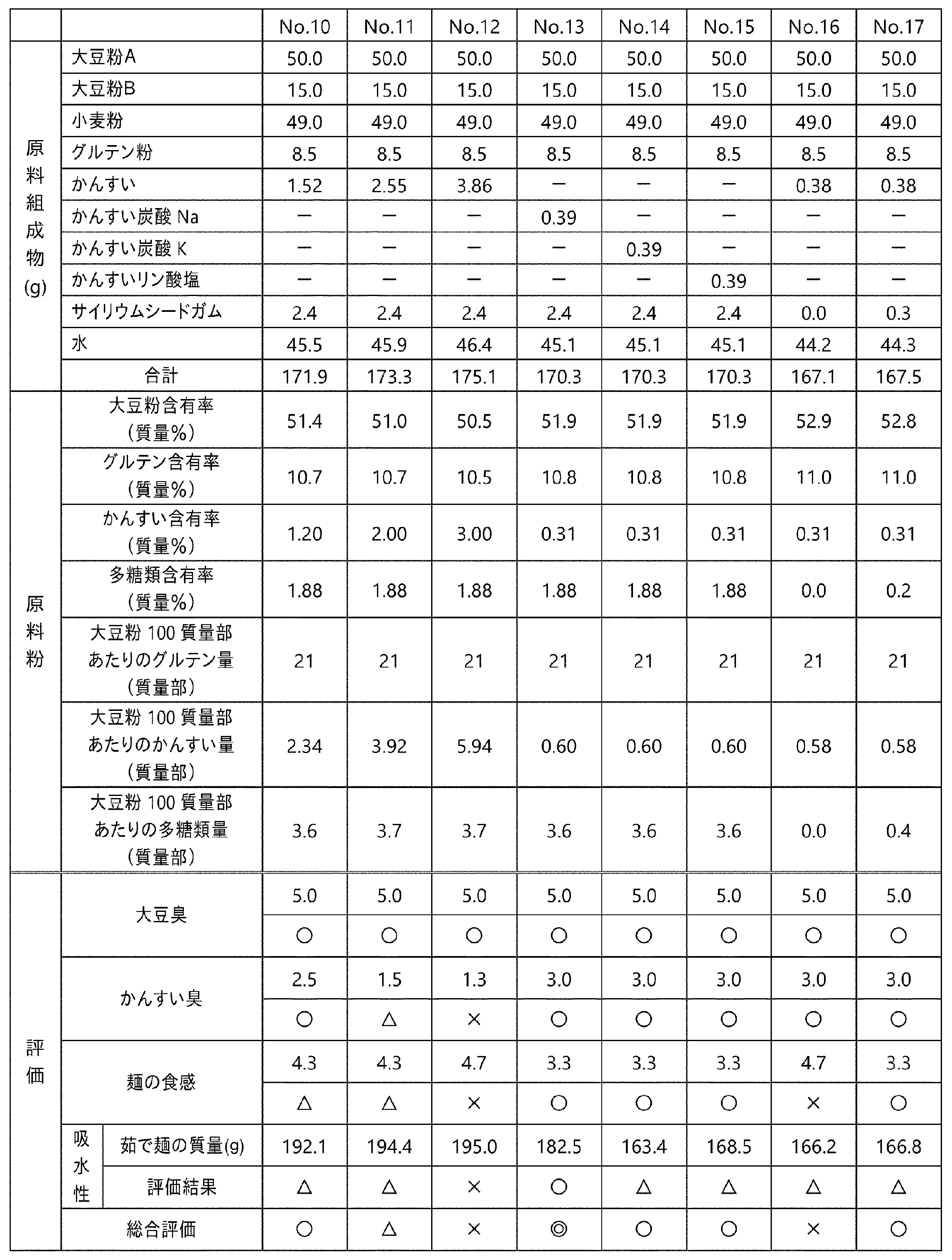
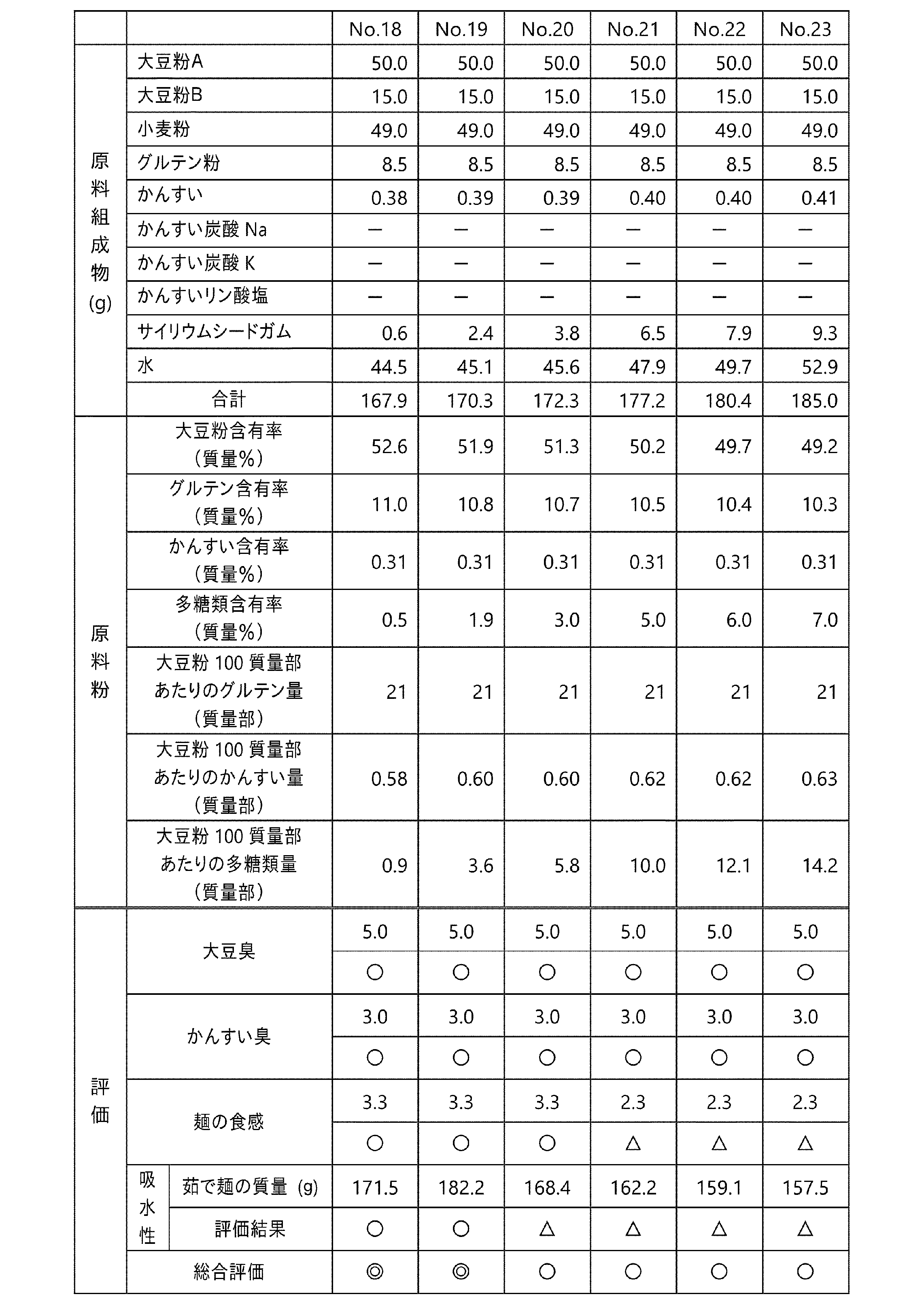
上記表1~3に示すように、かんすいを配合していないNo.1の試料は、大豆臭が強く、やや芯が残り、麺の食感も劣っていた。また、かんすい含有量が2質量%を超えているNo.12の試料は、大豆臭は抑制できたが、かんすい臭が強くなり、風味が劣っていた。また、No.12の試料は、茹で上げ後の麺が適性範囲よりも軟らかくなり、食感や吸水性も劣っていた。多糖類を添加していないNo.16の試料は、大豆臭は抑制できたが、茹で上げ後の麺が適性範囲よりも軟らかくなり、食感が劣っていた。
これに対して、かんすいを0.01~2質量%、サイリウムシードガムを0.2~7質量%の範囲で含有するNo.2~11,13~15,17~23の試料は、大豆臭が抑制され、食感も吸水性も良好であった。
(第2実施例)
本発明の第2実施例として、多糖類の種類を変えて大豆含有乾燥麺を作製し、大豆臭、吸水性及び茹で上げ後の麺類の食感を評価した。具体的には、前述した第1実施例と同様の方法及び条件で評価用麺を作製し、第1実施例と同様の方法及び基準で風味(大豆臭・かんすい臭の有無)、吸水性及び茹で上げ後の食感を評価した。
本発明の第2実施例として、多糖類の種類を変えて大豆含有乾燥麺を作製し、大豆臭、吸水性及び茹で上げ後の麺類の食感を評価した。具体的には、前述した第1実施例と同様の方法及び条件で評価用麺を作製し、第1実施例と同様の方法及び基準で風味(大豆臭・かんすい臭の有無)、吸水性及び茹で上げ後の食感を評価した。
その際、多糖類には、25℃の0.5%水溶液における粘度が100mPa・sのサイリウムシードガム、20℃の2%水溶液における粘度が75000~140000mPa・sのHPMC、20℃の1%水溶液における粘度が100~150mPa・sのアルギン酸エステルを用い、その他の原料は第1実施例と同じにした。その評価結果を、下記表4,5に示す。
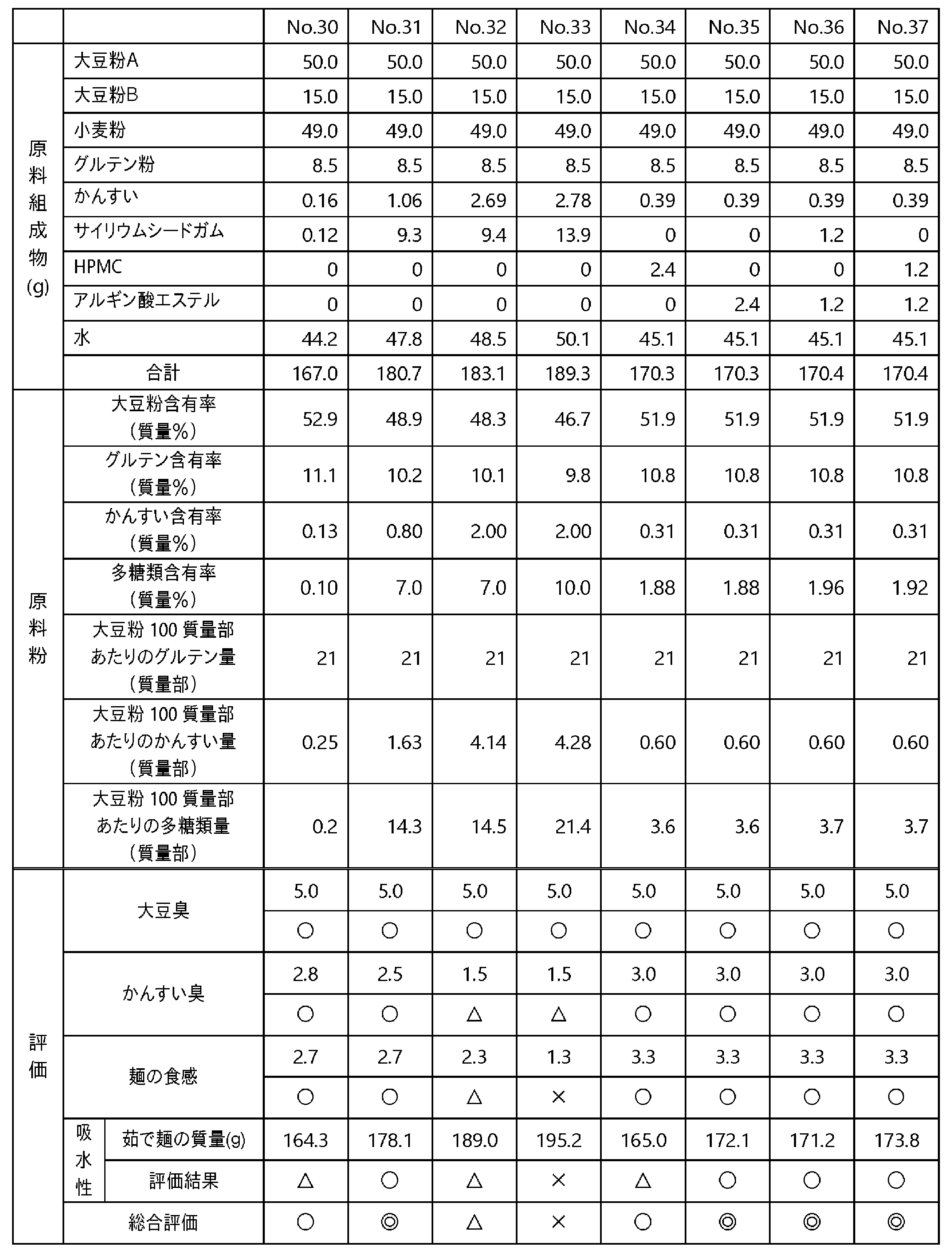

上記表4,5に示すように、7質量%を超えて多糖類を添加したNo.33の試料は、茹で上げ後の麺が硬く、食感が劣っていた。これに対して、かんすいを0.01~2質量%、サイリウムシードガム、アルギン酸エステル及びヒドロキシプロピルメチルセルロースのうち少なくとも1種の多糖類を合計で0.1~7質量%の範囲で含有するNo.30~32,34~37の試料は、大豆臭が抑制され、食感も良好であった。
また、サイリウムシードガム:アルギン酸エステル=1:0.01~3であるNo.36,42,43の試料、及び、ヒドロキシプロピルメチルセルロース:アルギン酸エステル=1:0.01~3であるNo.37,39,40,41の試料は、他の試料よりも麺のつるみが増し、もっちりとした食感であった。この結果から、サイリウムシードガム又はヒドロキシプロピルメチルセルロースとアルギン酸エステルの比を上記範囲にすることにより、茹で上げ後の大豆含有麺類の食感が更に好適なものとなることが確認された。
(第3実施例)
本発明の第3実施例として、かんすい含有率が異なる大豆含有乾燥麺類(第1実施例のNo.1,4~8の試料)について、ヘッドスペース・ガスクロマトグラフィー法により、大豆の青臭さの原因と言われている「n-ヘキサナール」の濃度を測定した。
本発明の第3実施例として、かんすい含有率が異なる大豆含有乾燥麺類(第1実施例のNo.1,4~8の試料)について、ヘッドスペース・ガスクロマトグラフィー法により、大豆の青臭さの原因と言われている「n-ヘキサナール」の濃度を測定した。
測定は、粉砕した大豆含有乾燥麺類1gと3mlの純水を20mlのバイアルに封入し、トラップ温度を40℃/240℃(脱離 温度)とし、キャリアガスは水素を用いて行った。カラムはメタルキャピラリーカラム(MXT-5・MXT-WAX)を用い、カラム昇温条件は初期温度40℃、初期恒温時間10秒、昇温速度は1.5℃/秒にて40℃から250℃に到達させ、FID温度は260℃にて検出を行った。この測定を同一サンプルについて3回ずつ行い、その平均値をとった。n-ヘキサナールの各濃度は、クロマトグラム上のピーク面積から、n-ヘキサナール標準品(Sigma-Aldrich社製)を外部標準とした検量線にて算出した。この方法で測定した各試料のn-ヘキサナール濃度を下記表6に示す。
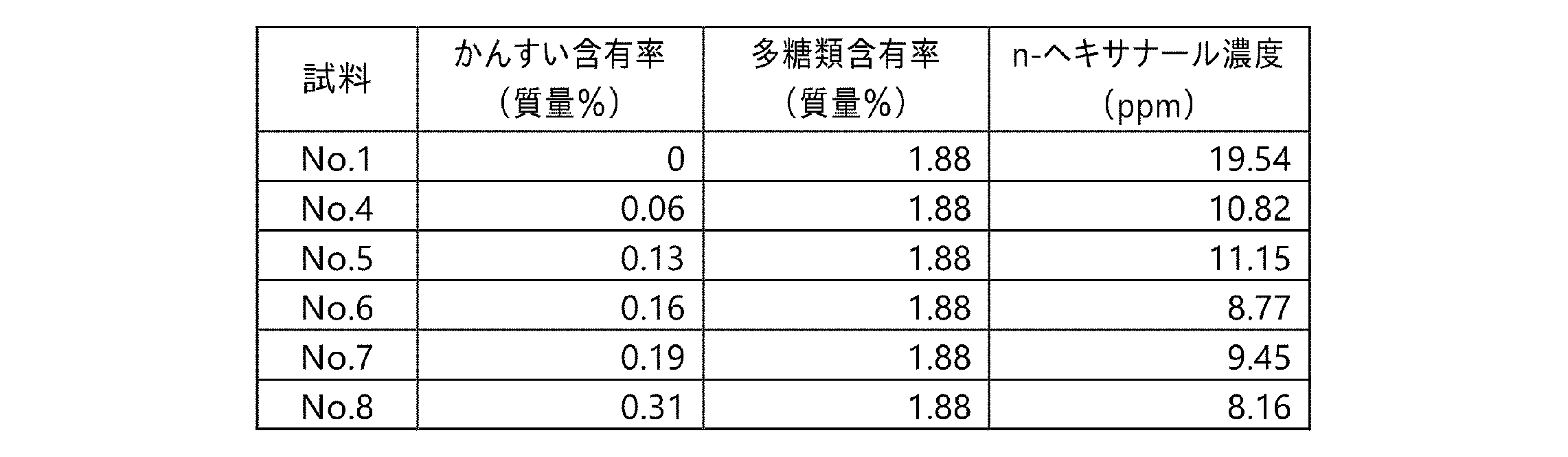
上記表6に示すように、多糖類と共に、かんすいを0.01~2質量%の範囲内で配合したNo.4~8の試料(大豆粉含有率:約52質量%)は、いずれもn-ヘキサノール濃度が0.27×52=14ppm以下であり、かんすいを配合していないNo.1の試料(大豆粉含有率:約52質量%)に比べてn-ヘキサノール濃度が低下していた。この結果から、かんすいの添加により大豆臭が抑制されていることが確認された。
以上の結果から、本発明によれば、原料粉に大豆粉が40質量%以上含まれていても、大豆臭が抑制され、茹で上げ後の食感が良好な大豆含有乾燥麺類が得られることが確認された。
Claims (15)
- 原料粉全質量に対して、
大豆粉を40質量%以上と、
かんすいを0.01~2質量%と、
サイリウムシードガム、アルギン酸エステル及びヒドロキシプロピルメチルセルロースのうち少なくとも1種の多糖類を合計で0.1~7質量%と
を含有する大豆含有乾燥麺類。 - 前記大豆粉100質量部あたり、前記かんすいを0.02~4.14質量部、サイリウムシードガム、アルギン酸エステル及びヒドロキシプロピルメチルセルロースのうち少なくとも1種の多糖類を合計で0.2~14.5質量部含有する請求項1に記載の大豆含有乾燥麺類。
- 少なくともアルギン酸エステルを含み、更に、ヒドロキシプロピルメチルセルロース又はサイリウムシードガムを含む請求項1又は2に記載の大豆含有乾燥麺類。
- サイリウムシードガムとアルギン酸エステルを含有し、
その配合比が、質量比で、サイリウムシードガム:アルギン酸エステル=1:0.01~3である請求項3に記載の大豆含有乾燥麺類。 - ヒドロキシプロピルメチルセルロースとアルギン酸エステルを含有し、
その配合比が、質量比で、ヒドロキシプロピルメチルセルロース:アルギン酸エステル=1:0.01~3である請求項3に記載の大豆含有乾燥麺類。 - 前記かんすいは大豆臭抑制剤として添加されている請求項1~5のいずれか1項に記載の大豆含有乾燥麺類。
- 原料粉全質量に対する大豆粉含有率をx質量%としたとき、ヘッドスペース・ガスクロマトグラフィー法による測定値から求めたn-ヘキサナール濃度が(0.27×x)ppm以下である請求項1~6のいずれか1項に記載の大豆含有乾燥麺類。
- 厚さ1.2mmの乾燥麺類を沸騰した湯で5分間茹でた後、目開き2mmのメッシュのストレーナーにゆで汁ごとあけて30秒間静置することにより湯切りして得た茹で麺の質量が、茹でる前の乾燥麺類の質量の2.3~2.9倍である請求項1~7のいずれか1項に記載の大豆含有乾燥麺類。
- 請求項1~8のいずれか1項に記載の大豆含有乾燥麺類と、調味液とを備える麺セット。
- 大豆粉を40質量%以上と、かんすいを0.01~2質量%と、サイリウムシードガム、アルギン酸エステル及びヒドロキシプロピルメチルセルロースのうち少なくとも1種の多糖類を合計で0.1~7質量%含有する原料粉を用いて生地を調製する工程と、
該生地を成形して麺類を得る製麺工程と、
前記麺類を乾燥させる乾燥工程と、
を有する大豆含有乾燥麺類の製造方法。 - 前記原料粉は、前記大豆粉100質量部あたり、前記かんすいが0.02~4.14質量部、サイリウムシードガム、アルギン酸エステル及びヒドロキシプロピルメチルセルロースのうち少なくとも1種の多糖類が合計で0.2~14.5質量部配合されている請求項10に記載の大豆含有乾燥麺類の製造方法。
- 前記原料粉は、少なくともアルギン酸エステルを含み、更に、ヒドロキシプロピルメチルセルロース又はサイリウムシードガムを含む請求項10又は11に記載の大豆含有乾燥麺類の製造方法。
- 前記原料粉は、サイリウムシードガムとアルギン酸エステルを含有し、その配合比が、質量比で、サイリウムシードガム:アルギン酸エステル=1:0.01~3である請求項12に記載の大豆含有乾燥麺類の製造方法。
- 前記原料粉は、ヒドロキシプロピルメチルセルロースとアルギン酸エステルを含有し、その配合比が、質量比で、ヒドロキシプロピルメチルセルロース:アルギン酸エステル=1:0.01~3である請求項12に記載の大豆含有乾燥麺類の製造方法。
- 原料粉全質量に対する大豆粉含有率をx質量%としたとき、ヘッドスペース・ガスクロマトグラフィー法による測定値から求めたn-ヘキサナール濃度が(0.27×x)ppm以下である大豆含有乾燥麺類を得る請求項10~14のいずれか1項に記載の大豆含有乾燥麺類の製造方法。
Applications Claiming Priority (4)
| Application Number | Priority Date | Filing Date | Title |
|---|---|---|---|
| JP2023-105513 | 2023-06-27 | ||
| JP2023105513 | 2023-06-27 | ||
| JP2024013108A JP7579468B1 (ja) | 2023-06-27 | 2024-01-31 | 大豆含有乾燥麺類、麺セット及び大豆含有乾燥麺類の製造方法 |
| JP2024-013108 | 2024-01-31 |
Publications (1)
| Publication Number | Publication Date |
|---|---|
| WO2025005208A1 true WO2025005208A1 (ja) | 2025-01-02 |
Family
ID=93332254
Family Applications (1)
| Application Number | Title | Priority Date | Filing Date |
|---|---|---|---|
| PCT/JP2024/023442 Ceased WO2025005208A1 (ja) | 2023-06-27 | 2024-06-27 | 大豆含有乾燥麺類、麺セット及び大豆含有乾燥麺類の製造方法 |
Country Status (2)
| Country | Link |
|---|---|
| JP (1) | JP7579468B1 (ja) |
| WO (1) | WO2025005208A1 (ja) |
Citations (6)
| Publication number | Priority date | Publication date | Assignee | Title |
|---|---|---|---|---|
| JP2007215415A (ja) * | 2006-02-14 | 2007-08-30 | Powder Techno Corporation Kk | 大豆めん及びその製造方法 |
| JP2009065946A (ja) * | 2007-09-18 | 2009-04-02 | Yasuhiro Sato | 大豆めんおよび大豆めんの製造方法 |
| JP2018057290A (ja) * | 2016-10-03 | 2018-04-12 | 日清製粉株式会社 | 麺類およびその製造方法 |
| JP2018074986A (ja) * | 2016-11-13 | 2018-05-17 | 有限会社佐藤商店 | 乾麺及び乾麺の製造方法 |
| JP2019129732A (ja) * | 2018-01-30 | 2019-08-08 | 日清製粉株式会社 | 麺類およびその製造方法 |
| JP2019129823A (ja) * | 2018-01-30 | 2019-08-08 | 日清製粉株式会社 | 麺類およびその製造方法 |
Family Cites Families (1)
| Publication number | Priority date | Publication date | Assignee | Title |
|---|---|---|---|---|
| JP7791647B2 (ja) * | 2020-12-21 | 2025-12-24 | 昭和産業株式会社 | 麺類用組成物、及び麺類 |
-
2024
- 2024-01-31 JP JP2024013108A patent/JP7579468B1/ja active Active
- 2024-06-27 WO PCT/JP2024/023442 patent/WO2025005208A1/ja not_active Ceased
Patent Citations (6)
| Publication number | Priority date | Publication date | Assignee | Title |
|---|---|---|---|---|
| JP2007215415A (ja) * | 2006-02-14 | 2007-08-30 | Powder Techno Corporation Kk | 大豆めん及びその製造方法 |
| JP2009065946A (ja) * | 2007-09-18 | 2009-04-02 | Yasuhiro Sato | 大豆めんおよび大豆めんの製造方法 |
| JP2018057290A (ja) * | 2016-10-03 | 2018-04-12 | 日清製粉株式会社 | 麺類およびその製造方法 |
| JP2018074986A (ja) * | 2016-11-13 | 2018-05-17 | 有限会社佐藤商店 | 乾麺及び乾麺の製造方法 |
| JP2019129732A (ja) * | 2018-01-30 | 2019-08-08 | 日清製粉株式会社 | 麺類およびその製造方法 |
| JP2019129823A (ja) * | 2018-01-30 | 2019-08-08 | 日清製粉株式会社 | 麺類およびその製造方法 |
Also Published As
| Publication number | Publication date |
|---|---|
| JP2025005369A (ja) | 2025-01-16 |
| JP7579468B1 (ja) | 2024-11-07 |
Similar Documents
| Publication | Publication Date | Title |
|---|---|---|
| JP2019162092A (ja) | 麺類用穀粉組成物及び麺類の製造方法 | |
| JP5431607B1 (ja) | 麺の製造方法および麺 | |
| JP7682673B2 (ja) | 大豆含有麺及び麺セット | |
| JP5855427B2 (ja) | 菓子類用ミックス | |
| US20180360051A1 (en) | Use of soluble tomato solids for reducing the salt content of food products | |
| JP2019140981A (ja) | 乳酸カリウム含む即席麺の製造方法 | |
| JP7579468B1 (ja) | 大豆含有乾燥麺類、麺セット及び大豆含有乾燥麺類の製造方法 | |
| JP7791647B2 (ja) | 麺類用組成物、及び麺類 | |
| JP2024136603A (ja) | 大豆含有乾燥麺類、麺セット及び大豆含有乾燥麺類の製造方法 | |
| JP7832820B2 (ja) | 穀物生地、麺及び麺セット | |
| JP2004350559A (ja) | デンプンを主原料とする麺類の製造方法 | |
| JP6855214B2 (ja) | 風味改善剤 | |
| JP7496457B1 (ja) | 大豆含有乾燥麺類、麺セット及び大豆含有乾燥麺類の製造方法 | |
| JP7461124B2 (ja) | 麺類生地の製造方法 | |
| JP6059234B2 (ja) | イネ科植物の緑葉とオリゴ糖を含有する麺 | |
| JP7596593B1 (ja) | 豆類含有麺類、麺セット及び豆類含有麺類の製造方法 | |
| WO2024203904A1 (ja) | 大豆含有乾燥麺類、麺セット及び大豆含有乾燥麺類の製造方法 | |
| JP7570938B2 (ja) | 即席麺の製造方法 | |
| JP2004135608A (ja) | パン類の製造方法 | |
| JP7673275B2 (ja) | 具材入り調味料、大豆たん白含有食品、大豆たん白含有食品の香味改善方法及び大豆たん白含有食品用香味改善剤 | |
| JP3843050B2 (ja) | 麺類 | |
| JP2019180305A (ja) | 即席麺用添加剤及び即席麺 | |
| JP6995610B2 (ja) | フライ麺類の製造方法およびフライ麺類の吸油を低減させる方法 | |
| JP2026067775A (ja) | 麺類の茹で伸び抑制剤、ならびにそれを用いた麺類およびその製造方法 | |
| CN120659548A (zh) | 低碳水化合物面条 |
Legal Events
| Date | Code | Title | Description |
|---|---|---|---|
| 121 | Ep: the epo has been informed by wipo that ep was designated in this application |
Ref document number: 24832066 Country of ref document: EP Kind code of ref document: A1 |
|
| NENP | Non-entry into the national phase |
Ref country code: DE |