WO2025004957A1 - ポリエステルマルチフィラメントおよび海島複合ポリエステル繊維 - Google Patents
ポリエステルマルチフィラメントおよび海島複合ポリエステル繊維 Download PDFInfo
- Publication number
- WO2025004957A1 WO2025004957A1 PCT/JP2024/022378 JP2024022378W WO2025004957A1 WO 2025004957 A1 WO2025004957 A1 WO 2025004957A1 JP 2024022378 W JP2024022378 W JP 2024022378W WO 2025004957 A1 WO2025004957 A1 WO 2025004957A1
- Authority
- WO
- WIPO (PCT)
- Prior art keywords
- polyester
- sea
- island
- fiber
- cross
- Prior art date
- Legal status (The legal status is an assumption and is not a legal conclusion. Google has not performed a legal analysis and makes no representation as to the accuracy of the status listed.)
- Ceased
Links
Images

Classifications
-
- D—TEXTILES; PAPER
- D01—NATURAL OR MAN-MADE THREADS OR FIBRES; SPINNING
- D01F—CHEMICAL FEATURES IN THE MANUFACTURE OF ARTIFICIAL FILAMENTS, THREADS, FIBRES, BRISTLES OR RIBBONS; APPARATUS SPECIALLY ADAPTED FOR THE MANUFACTURE OF CARBON FILAMENTS
- D01F6/00—Monocomponent artificial filaments or the like of synthetic polymers; Manufacture thereof
- D01F6/58—Monocomponent artificial filaments or the like of synthetic polymers; Manufacture thereof from homopolycondensation products
- D01F6/62—Monocomponent artificial filaments or the like of synthetic polymers; Manufacture thereof from homopolycondensation products from polyesters
-
- D—TEXTILES; PAPER
- D01—NATURAL OR MAN-MADE THREADS OR FIBRES; SPINNING
- D01F—CHEMICAL FEATURES IN THE MANUFACTURE OF ARTIFICIAL FILAMENTS, THREADS, FIBRES, BRISTLES OR RIBBONS; APPARATUS SPECIALLY ADAPTED FOR THE MANUFACTURE OF CARBON FILAMENTS
- D01F8/00—Conjugated, i.e. bi- or multicomponent, artificial filaments or the like; Manufacture thereof
- D01F8/04—Conjugated, i.e. bi- or multicomponent, artificial filaments or the like; Manufacture thereof from synthetic polymers
- D01F8/14—Conjugated, i.e. bi- or multicomponent, artificial filaments or the like; Manufacture thereof from synthetic polymers with at least one polyester as constituent
Definitions
- This disclosure relates to polyester multifilaments and sea-island composite polyester fibers.
- Fibers made from thermoplastic polymers such as polyester and polyamide have excellent mechanical properties and dimensional stability, and are therefore widely used not only for clothing applications but also for interior and vehicle interiors and industrial applications. As fiber applications become more diverse, the required properties also become more diverse, and technologies have been proposed to impart sensory effects such as texture and bulkiness depending on the cross-sectional form of the fiber. Among these, ultra-fine fiber technology has a large effect on the properties of the fiber itself and the properties after it is made into a fabric, and is the mainstream technology in terms of controlling the cross-sectional form of the fiber.
- the diameter of the fibers that can be obtained is limited to a few micrometers, so the islands-in-the-sea composite spinning method, which uses a composite spinneret to produce composite fibers, is often used.
- this composite spinning method multiple island component polymers made of slightly soluble components are arranged on a sea component polymer made of easily soluble components in the fiber cross section, and after forming a fiber or fiber product, the sea component polymer is removed to generate ultrafine fibers made of island component polymers.
- This composite spinning method is widely adopted in the manufacture of industrially produced ultrafine fibers because it can form a highly accurate yarn cross-sectional shape in the running direction of the yarn in a uniform and homogeneous manner.
- Well-known methods for easily producing ultrafine fibers include using islands-in-sea composite fibers, which contain sparingly soluble islands in a sea made of a soluble polymer, and split composite fibers, in which sparingly soluble ultrafine fibers are separated by soluble polymers. With these techniques, once the composite fiber has been wound up, the composite fiber or fabric product is immersed in a solvent to remove the soluble polymer, making it possible to obtain sparingly soluble ultrafine fibers.
- Fibers with extremely fine fibers can exhibit a soft touch and fineness that cannot be achieved with ordinary fibers, and are therefore widely used in clothing as suede-like fabrics and in industrial materials as wiping cloths.
- Patent Document 1 proposes that a sea-island composite fiber in which island components are composed of two or more types of polymers with differential shrinkage is fabricated into a fabric, and then the sea component polymer is dissolved and removed to produce ultrafine fibers suitable for use as a suede-like material with excellent openability and bulkiness due to the island components exhibiting differential shrinkage.
- Patent Document 2 proposes that a superfine fiber suitable for use as a wiper cloth or precision polishing cloth material for IT is produced by fabricating a sea-island composite fiber in which island components have irregular cross sections into a fabric, and then the sea component polymer is dissolved and removed to produce ultrafine fibers suitable for use as a wiper cloth or precision polishing cloth material for IT.
- the sea-island composite fiber described in Patent Document 1 produces a difference in yarn length after the sea component is removed, resulting in a fabric with excellent volume and supple drape, but it does not achieve a mild luster like silk or pearl luster, and therefore lacks "luster.” In addition, it has a sleek texture unique to suede.
- the composite fiber described in Patent Document 2 becomes a nano-level ultra-fine thread after the sea component is removed, but the fabric is too soft and has no stiffness, and does not have a supple drape and no sense of volume. It also has a unique slimy texture.
- the cross-sectional shape of the island part is a polygonal shape composed of straight lines, it has a glossy feel, but it is glittery and has an artificial luster, and lacks "luster.”
- the present disclosure aims to solve the above problems and provide polyester multifilament and sea-island composite polyester fiber that can produce fabrics with a mild luster, fluffy feel, and a soft, smooth texture.
- a polyester multifilament comprising two or more types of polyester fibers, the two or more types of polyester fibers having a multi-lobed cross-sectional shape having three or more protrusions, and a glossiness of 60 to 90.
- a sea-island composite polyester fiber containing a sea portion and two or more kinds of island portions, a sea-island composite polyester fiber, wherein the two or more kinds of island parts have a multi-lobal cross-sectional shape having three or more protrusions, the multi-lobal shape having an average irregularity (d/L) which is a ratio of a height d of the uneven parts to a distance L between adjacent vertices, is 0.05 to 0.3, and the mass proportion of the sea part is 10 to 30 mass%.
- d/L average irregularity
- the present disclosure relates to a polyester multifilament containing two or more types of polyester fibers, the cross-sectional shape of the two or more types of polyester fibers being multi-lobed with three or more protrusions, and having a gloss of 60 to 90.
- This polyester multifilament is, for example, a polyester multifilament obtained by dissolving and removing the sea component polymer of a sea-island composite polyester fiber, in which the cross-sectional shape of the polyester fibers derived from the island portions of the sea-island composite polyester fiber is multi-lobed with three or more protrusions.
- the fabric obtained from the polyester multifilament and sea-island composite polyester fiber of the present disclosure is excellent in mild gloss, fluffiness, and soft, smooth texture.
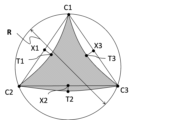
- FIG. 1 is a schematic diagram showing an example of the cross-sectional shape of an island portion of a sea-island composite polyester fiber of the present disclosure and an example of the cross-sectional shape of a polyester fiber of a polyester multifilament of the present disclosure.
- FIG. 2 is a schematic diagram of the cross-sectional shape of the sea-island composite polyester fiber of the present disclosure.
- the numerical range expressed by "to” is used to mean that the numerical range includes the numerical range before and after as the lower limit and upper limit.
- a ratio (percentage, part, etc.) based on weight is the same as a ratio (percentage, part, etc.) based on mass.
- polyester multifilament The polyester multifilament of the present disclosure includes two or more types of polyester fibers.
- the different types of polyester fibers may have different shrinkage rates, and may differ in components, intrinsic viscosity, molecular weight, and content of additives such as fine particles.
- polyester fibers that differ only in cross-sectional shape are the same type of polyester fibers.
- the polyester multifilament of the present disclosure may be composed of two or more types of polyester fibers with different shrinkage rates.
- the difference in shrinkage results in a difference in thread length, and the shrinkage of the entire fabric gives it a fluffy feel.
- the polyester referred to here is a polyester-based polymer such as polyethylene terephthalate (PET), polybutylene terephthalate (PBT), polytrimethylene terephthalate (PTT), and polylactic acid (PLA).
- the polyester multifilament of the present disclosure has a glossiness of 60 to 90 as measured by a variable angle glossmeter.
- the glossiness can be measured in accordance with JIS Z8741 (1997).
- the method for measuring glossiness in this specification is as follows. First, the polyester multifilament is wound 5 to 10 times around an appropriate aluminum plate having a width of about 6 cm, that is, the polyester multifilament is wound to a thickness such that the aluminum plate is not visible, to create a plate for measuring glossiness. Next, the glossiness is measured twice with a digital variable angle glossmeter (Glossmeter UGV-5DP, Suga Test Instruments Co., Ltd.) under conditions of a light receiving angle of 45° and an incident angle of 45°, and the average value is calculated and used as the glossiness. When polyester multifilament is used for the fabric, the fabric is decomposed into yarns and then used for the above measurement.
- gloss level By setting the gloss level within this range, moderate diffuse reflection of incident light occurs, resulting in a fine, soft, natural gloss (mild gloss). If the gloss level is less than 60, the incident light is diffused and the reflectance is low, resulting in no gloss being expressed, or a differentiated gloss compared to a typical round cross section cannot be obtained, and the glossiness cannot be felt. If the gloss level exceeds 90, the reflectance of the incident light becomes high, resulting in a glossy feel, but a glittery, artificial gloss.
- a gloss level of 70 to 85 is preferable for expressing a mild gloss such as pearl gloss. Furthermore, a gloss level of 70 to 75 is preferable for expressing a mild gloss such as silk-like gloss.
- polyester multifilament having a gloss level within the above range can be obtained by making the cross-sectional shape of the polyester fiber a multi-lobe shape with three or more protrusions, or by using two or more types of polyester fiber.
- the cross-sectional shape of the polyester fiber of the polyester multifilament disclosed herein is a multi-lobed shape having three or more protrusions.
- the protrusions referred to here refer to the areas that protrude from the inscribed circle in the cross section of the polyester fiber.
- the shapes of the protrusions may be rounded, sharp, or a mixture of rounded and sharp.
- the sides that make up the multi-lobed shape are not limited to being concave, convex, straight, etc., but are a shape that has at least one concave or convex side.
- a polygon i.e., a shape in which all sides are straight, the direction of light reflection is consistent, the bright lines are strong, and the resulting gloss is a strong, sparkling gloss, which is different from the mild gloss that is the objective of this disclosure.
- the cross-sectional shape of the polyester fiber a multi-lobed shape with three or more protrusions, the light is diffused and a gloss is generated.
- the cross-sectional shape has no bending direction, the fiber has a firmness and a fluffy feel.
- the unevenness of the fabric surface gives the fabric a smooth texture.
- the cross-sectional shape of the polyester fiber is a bilobal shape with two protrusions, such as a flat shape or a bale shape, the direction of light reflection is likely to be uniform, and the resulting gloss is a dazzling gloss with strong bright lines, which is different from the mild gloss that is the object of the present disclosure.
- the fiber is likely to bend in the long side direction in the cross-section, resulting in a fiber with no stiffness and lacking in a sense of volume. Furthermore, the unevenness of the fabric surface is less than that of a polyester fiber with a round cross-sectional shape, resulting in a slimy texture.
- the preferred number of protrusions for the multi-lobed cross-sectional shape of polyester fiber to produce a fine, soft, natural gloss is 3 to 5.
- the preferred number of protrusions for producing a mild gloss is 3.
- the cross-sectional shape of the polyester fiber of the polyester multifilament of the present disclosure may be a multi-lobe shape having three or more protrusions, but there are no limitations on the homogeneity (sameness) of the cross-sectional shape.
- the cross-sectional shape of the polyester fiber is a mixture of similar cross-sectional shapes.
- the mixture of similar cross-sectional shapes means, for example, a trilobe shape, as shown in Figure 2, but also a mixture of Y-shapes, sector shapes, and ⁇ -shapes.
- Fig. 1 is a schematic diagram of an example of the cross-sectional shape of the polyester fiber of the polyester multifilament of the present disclosure.
- the irregularity and circumscribed circle diameter when the cross section of the fiber is trilobal will be specifically described with reference to Fig. 1.
- the vertices C of the trilobal projections are determined (points C1, C2, and C3).
- a circumscribing circle is drawn that passes through three of the protrusion vertices C, and its diameter is defined as the circumscribing circle diameter R.
- the circumscribing circle of a multi-lobed shape with four or more protrusions passes through at least three of the protrusion vertices C, and the protrusion vertices that are not passed through by the circumscribing circle are located inside the circumscribing circle.
- intersection points X that perpendicularly intersect each line segment CC connecting the concave vertex T or convex vertex T to the adjacent protrusion vertices C (intersection points X1, X2, and X3).
- the maximum length (for example, line segment T3X3) is set to the height d of the uneven portion.
- the length of the line segment CC (e.g., line segment C1C3) connecting the protrusion vertices C from which the uneven portion height d was derived is defined as the distance L between adjacent vertices.
- the distance L between adjacent vertices can also be determined by the following procedure. Identify the intersection X, which is the end point of the line segment TX (e.g., line segment T3X3) whose length is the uneven portion height d. Identify the two protrusion vertices C, which are the end points on both sides of the line segment CC that includes this intersection X. Identify the length L of the line segment CC (e.g., line segment C1C3) connecting these two protrusion vertices C. This is the distance L between adjacent vertices. (9) The ratio (d/L) of the height d of the uneven portion to the distance L between adjacent vertices is defined as the irregularity.
- the average irregularity (d/L) is preferably 0.05 to 0.3.
- gloss is easily developed.
- the slimy (sucking) texture (suede-like) (feeling that clings to the hand) characteristic of ultrafine fibers disappears, resulting in a soft and smooth texture.
- the average irregularity 0.3 or less diffuse reflection of light increases. This phenomenon, combined with the loss of gloss due to ultrafine fiber and the increase in gloss due to differences in thread length, makes it easy to develop a mild gloss.
- the average value of the circumscribing circle diameter R is preferably 4.0 to 10.0 ⁇ m.
- the fiber specific surface area does not increase too much, the unevenness of the fabric surface is not noticeable, and diffuse reflection of light on the fabric surface is not promoted, so that a moderate gloss tends to be obtained.
- the fiber tends to be not too soft and has a moderate amount of stiffness, a fluffy feel tends to be obtained.
- the fiber tends not to have the slimy texture characteristic of ultrafine fibers. Therefore, by setting the average value of the circumscribing circle diameter R in this range, a mild gloss, a fluffy feel, and a soft and smooth texture can be obtained in a well-balanced manner.
- the average irregularity (d/L) and the average circumscribed circle diameter R can be calculated by the following procedure. First, the cross section of the polyester multifilament is embedded in epoxy resin and cut with a Reichert-Nissei ultracut N (ultramicrotome) equipped with a diamond knife. Then, the cut surface is photographed using a microscope VHX-2000 manufactured by Keyence Corporation. From the photograph obtained, the irregularity (d/L) and circumscribed circle diameter R are calculated for all single yarns. The average irregularity (d/L) and circumscribed circle diameter R of all the obtained numbers are calculated.
- the number of filaments of the two or more types of polyester fibers is preferably 200 to 800, and more preferably 260 to 600.
- the fiber surface area increases, causing diffuse reflection of light on the fabric surface and making it difficult to obtain gloss.
- it depends on the average circumscribed circle diameter of the fiber by setting the number of filaments to 200 to 800, a well-balanced mild gloss and a soft, smooth texture with a fluffy feel can be obtained.
- the irregularity variation CV (%) of the cross section of the polyester fiber is preferably 20% or more. This range indicates that fibers with different multi-lobed shapes are mixed in the multifilament, and when made into a fabric, fine gaps are generated between the fibers, promoting a sense of volume, and the direction of light reflection on the fabric surface becomes random, thereby exhibiting a mild gloss suitable for the purpose of the present disclosure.
- the upper limit of the irregularity variation in the present disclosure is preferably 50%.
- the yarn length difference is preferably 15-40%, and more preferably 20-35%.
- the yarn length difference 15% or more a fluffy feel can be obtained due to the shrinkage of the entire fabric.
- the yarn length difference 40% or less the deterioration of texture (rough feeling) due to the shrinkage of the entire fabric can be suppressed, and a high-quality soft fabric can be obtained.
- the above measurement can be performed by marking the fabric at a location approximately 15 cm in length, cutting a filament sample to obtain decomposed yarns, and further decomposing each filament using tweezers.
- the yarn length difference can be calculated by the following steps (a) to (c). (a) Take one filament of a sea-island composite polyester fiber sample having a length of 15 to 20 cm, mark it by tying it at two places about 5 cm apart, and tie and fix both ends of the filament to an appropriate metal frame having a length of about 10 cm.
- the polyester multifilament of the present disclosure may contain inorganic fine particles, such as titanium dioxide as a matting agent and silica fine particles as a lubricant, as necessary. These inorganic fine particles are not only used to adjust the gloss of the fiber, but are also commonly used for the purpose of stable spinnability and high-order passability by reducing friction. Therefore, they may be contained to an extent that does not inhibit the gloss, which is the objective of the present disclosure.
- the content of inorganic fine particles is preferably 0 to 0.1 mass % from the viewpoint of gloss expression.
- the ratio of the number of two or more types of polyester fibers having the above-mentioned multi-lobed cross-sectional shape having three or more protrusions to the total number of fibers contained in the polyester multifilament of the present disclosure is preferably 80% or more, more preferably 90% or more, even more preferably 95% or more, and particularly preferably 100%.
- the polyester multifilament of the present disclosure may contain polyester fibers other than the polyester fibers having a multi-lobal cross section with three or more projections as described above, fibers of components other than polyester, and the like.
- the island components of the sea-island composite polyester fiber of the present disclosure are polyester-based polymers.
- the polyester referred to here is a polyester-based polymer such as polyethylene terephthalate (PET), polybutylene terephthalate (PBT), polytrimethylene terephthalate (PTT), polylactic acid (PLA), and the like.
- polyesters may contain copolymerizable components in which the diol component and the acid component each have a proportion of 20 mol % or less, more preferably 10 mol % or less, capable of forming other ester bonds.
- copolymerizable compounds include dicarboxylic acids such as isophthalic acid, succinic acid, cyclohexanedicarboxylic acid, adipic acid, dimer acid, sebacic acid, and 5-sodium sulfoisophthalic acid, and diols such as ethylene glycol, diethylene glycol, butanediol, neopentyl glycol, cyclohexanedimethanol, polyethylene glycol, and polypropylene glycol.
- dicarboxylic acids such as isophthalic acid, succinic acid, cyclohexanedicarboxylic acid, adipic acid, dimer acid, sebacic acid, and 5-sodium sulfoisophthalic acid
- the sea-island composite polyester fiber of the present disclosure has a sea-island structure in which a sea portion and two or more different types of island portions are arranged in the same fiber cross section.
- the different types of island portions may have different island portion components, different intrinsic viscosities or molecular weights of the island portion components, or different contents of additives such as fine particles.
- polyester fibers having island portions that differ only in cross-sectional shape are the same type of island portions.
- the component constituting the sea part is also referred to as the sea component
- the component constituting the island part is also referred to as the island component.
- the sea component is removed by alkali treatment or the like (hereinafter referred to as sea-removal), and in some cases, a difference in yarn length is expressed by heat treatment, thereby obtaining the polyester multifilament of the present disclosure.
- One of the island components is preferably a homopolyester polymer, and the other component is preferably a copolymer polyester such as isophthalic acid.
- the polyester used in the present disclosure can be a recycled polymer recycled by any of chemical recycling, material recycling and thermal recycling.
- the sea component constituting the sea-island composite polyester fiber of the present disclosure is preferably mainly composed of polyester, since alkaline dissolution using caustic soda as a dissolving agent is widely used industrially. More preferably, a copolymer polyester is used in which isophthalic acid or its derivative having a metal sulfonate group is used in combination with polyalkylene glycol, and a combination of 5-sodium sulfoisophthalic acid and polyethylene glycol is particularly preferred.
- the content of isophthalic acid (SI component) having a metal sulfonate group is preferably 5.0 to 15.0 mol%. If the SI component content is 5.0 mol% or more, the dissolution of the sea part during sea-removal processing is improved, and fusion between single yarns due to undissolved sea component is suppressed. Furthermore, if the SI component content is 15 mol% or less, softening of the polymer is suppressed, and process passability during weaving and knitting is improved.
- the number average molecular weight of the polyalkylene glycol is preferably 500 to 2000.
- a number average molecular weight of 500 or more improves the solubility of the sea part during sea-removal processing, and suppresses fusion between single yarns due to undissolved sea component. Furthermore, the molecular mobility of the sea part during melt spinning is increased, making it easier to orient the island parts, and differences in yarn length are expressed, resulting in excellent openability and bulkiness, which is preferable.
- a number average molecular weight of the polyalkylene glycol of 2000 or less improves compatibility with polyester, resulting in excellent spinnability.
- the polyalkylene glycol content in the sea component polyester polymer is preferably 5.0 to 15.0% by mass. If the polyalkylene glycol content is 5.0% by mass or more, the dissolution of the sea part during sea removal is improved, and fusion between single yarns due to undissolved sea component is suppressed. Furthermore, the molecular mobility of the sea component during melt spinning is increased, making it easier to orient the island parts, and differences in yarn length are expressed, resulting in excellent openability and bulkiness, which is preferable. Even if the polyalkylene glycol content is greater than 15.0% by mass, the effect of improving the dissolution of the sea part reaches a plateau.
- a copolymerization component other than the above may be copolymerized in an amount of 10 mol % or less with each of the sea component polymer and the island component polymer.
- inorganic fine particles such as titanium dioxide as a matting agent and silica fine particles as a lubricant may be added to the island component.
- Inorganic fine particles such as titanium dioxide as a matting agent and silica fine particles as a lubricant are not only used to adjust the gloss of fibers, but are also commonly used for the purpose of stable spinnability and high-order passability by reducing friction. Therefore, inorganic fine particles may be contained to an extent that does not inhibit the gloss that is the object of this disclosure.
- the polyester multifilament of this disclosure may have a difference in yarn length due to shrinkage difference. In this case, many filaments consisting of low-shrinkage island components are present on the surface of the fabric, and the content of fine particles affects the gloss of the fabric. Therefore, the preferred content of fine particles in the low-shrinkage island components is 0 to 0.15%, and more preferably 0% (not contained).
- the mass proportion of the sea portion is preferably 10 to 30 mass%.
- the mass proportion of the sea portion in the sea-island composite polyester fiber is more preferably in the range of 15 to 25 mass%.
- the cross-sectional shape of the island portions is a multi-lobed shape having three or more protrusions, and it is preferable that the average irregularity (d/L), which is the ratio of the height d of the irregular portions to the distance L between adjacent vertices constituting the multi-lobed shape, is 0.05 to 0.3. It is also preferable that the average circumscribed circle diameter R of the cross-sectional shape of the island portions is 4.0 to 10.0 ⁇ m.
- FIG. 1 is also an example of the cross-sectional shape of the island portion of the sea-island composite polyester fiber of the present disclosure. Therefore, as a method for calculating the irregularity (d/L) and circumscribed circle diameter R of the cross-sectional shape of the polyester fiber of the polyester multifilament, the irregularity (d/L) and circumscribed circle diameter R of the island portion of the sea-island composite polyester fiber can be calculated using the same procedure as described above with reference to FIG. 1.
- the average irregularity (d/L) and the average circumscribed circle diameter R of the island parts of the sea-island composite polyester fiber of the present disclosure can be calculated by the following procedure. First, the cross section of the sea-island composite polyester fiber is embedded in epoxy resin and cut with a Reichert-Nissei ultracut N (ultramicrotome) equipped with a diamond knife. The cut surface is then photographed with a microscope VHX-2000 manufactured by Keyence Corporation. From the photograph obtained, five single yarns are randomly selected, and the irregularity (d/L) and circumscribed circle diameter R of the island parts are measured for half the number of islands per single yarn relative to the total number of islands. If the measured number is not an integer, it is rounded up to the nearest integer. The average irregularity (d/L) and circumscribed circle diameter R measured in this way are calculated.
- the irregularity variation CV (%) of the island portions is preferably 20% or more.
- a polyester multifilament can be obtained in which fibers with different multi-lobal shapes are mixed in the multifilament.
- the upper limit of the irregularity variation of the island portions in the sea-island composite polyester fiber of the present disclosure is preferably 50%.
- the island portions of the sea-island composite polyester fiber of the present disclosure are preferably arranged in a scattered manner in the sea portion, as shown in Figure 2, from the viewpoint of uniform fiber opening and bulkiness.
- Figure 2 shows an example in which two types of island portions (first island portion A and second island portion B) are arranged.
- the number of islands is preferably 12 to 432 islands per single yarn, and more preferably 24 to 144 islands.
- the number of islands per single yarn is 12 or more, it is possible to arrange the island parts in the sea part without any gaps, which is preferable since it increases the morphological stability of the composite fiber.
- the number of islands per single yarn is set to 432 islands or less, it is possible to avoid fusion defects in the island parts.
- the sea part when the sea part is dissolved and removed, the difference in contact time between the island parts in the surface layer and the inner layer of the composite fiber with the solvent is reduced, which reduces the fiber diameter variation of the fiber obtained from the island parts, making it possible to obtain a high-strength polyester multifilament.
- the ratio of the number of two or more types of island parts having a multi-lobal cross section having three or more protrusions to the total number of island parts in the sea-island composite polyester fiber of the present disclosure is preferably 80% or more, more preferably 90% or more, even more preferably 95% or more, and particularly preferably 100%.
- the islands contained in the sea-island composite polyester fiber of the present disclosure may include island parts other than the above-mentioned island parts having a multi-lobed cross section with three or more protrusions, such as island parts made of a polyester-based polymer and having a different cross section, or island parts made of a component other than a polyester-based polymer.
- the polyester polymer of the island portion has a different intrinsic viscosity (hereinafter also referred to as IV) for each type of island component, and the value obtained by dividing the highest IV by the lowest IV (hereinafter also referred to as intrinsic viscosity ratio or IV ratio) is 1.6 or less.
- IV ratio intrinsic viscosity ratio
- the IV of the sea component polymer is preferably 0.50 to 0.75. If the IV of the sea component polymer is 0.50 or more, the stress on the sea portion increases during spinning, and stress concentration on the island portions is suppressed, so that the increase in the shrinkage of the yarn is suppressed and a fabric of good quality can be obtained. On the other hand, if the IV of the sea component polymer is 0.75 or less, the stress concentration on the sea portion during spinning is suppressed and stress on the island portions increases, so that a yarn length difference appears and a raw yarn with excellent openability and bulkiness is obtained, which is preferable.
- the IV of the sea component polymer is more preferably 0.55 to 0.70.
- the IV of these polymers can be adjusted to the desired IV by adjusting the polymerization conditions, i.e., polymerization time and polymerization temperature.
- the IV of the polymer can also be adjusted by the amount of catalyst added, the addition ratio, the addition order, the addition interval, etc., and it is preferable to set conditions according to the polymer production method and produce a polymer with the desired IV.
- the method for producing the sea-island composite polyester fiber disclosed herein can be either a two-step method in which the extruded polymer is first wound as an undrawn yarn and then drawn to a predetermined breaking elongation using a normal drawing machine, or a one-step method in which drawing is performed continuously without winding.
- the direct spinning and drawing method is the most suitable.
- the spinneret used to manufacture the fibers can be an existing composite spinning spinneret, but it is preferable to use a composite spinneret described in JP 2011-174215 A, which is made up of three major layers of a metering plate, a distribution plate, and a discharge plate, as this allows for a stable production of sea-island composite fibers.
- the sea-island composite polyester fiber of the present disclosure it is preferable to manufacture the sea-island composite polyester fiber using a spinneret in which polymer discharge holes are arranged in consideration of the IV ratios of all the island components and the sea component polymer. This is because when the island component and sea component polymers join to form a composite polymer flow, unevenness in the polymer interface is formed due to the IV ratio and the distance between the discharge holes, and is preferable in that, for example, a polyester multifilament having a mixture of Y-shapes, fan shapes, and ⁇ -shapes can be obtained.
- the IV ratios of all the island component polymers to the sea component polymer are within the range of 0.8 to 1.3, which is preferable in terms of controlling unevenness in the polymer interface.
- the IV ratios of all the island component polymers to the sea component polymer are within the range of 0.8 to 1.3 means that when there are multiple types of island component polymers, the IV ratios of the island component polymers to the sea component polymer are within the above range for all types of island component polymers.
- the polyester multifilament of the present disclosure can be obtained, for example, by forming the sea-island composite polyester fiber of the present disclosure into a woven or knitted fabric, removing the sea component (sea-removal) by an alkali treatment, and, in some cases, expressing a yarn length difference by a heat treatment.
- the structure or material blend ratio of woven or knitted fabrics there are no particular limitations on the structure or material blend ratio of woven or knitted fabrics.
- woven fabrics there are several weaves, such as plain weave, twill weave, and satin weave, depending on the weft thread weaving method, and any of these can be selected depending on the purpose.
- a structure in which the sea-island composite polyester fiber of the present disclosure is distributed in large amounts on the surface of the fabric is preferred, as it is more likely to exhibit the characteristics of a mild luster and a smooth texture.
- the other fibers may be natural fibers, chemical fibers, etc., and are not particularly limited. The same applies to knitted fabrics.
- the sea-removal process is carried out using a batch-type processing tank in a general dyeing machine (such as a winch dyeing machine, jigger dyeing machine, beam dyeing machine, or liquid flow dyeing machine).
- a liquid flow dyeing machine is preferable, which is expected to create a "kneading" effect by stirring and flowing the fabric.
- the type of alkali can be strong alkali such as sodium hydroxide, potassium hydroxide, or lithium hydroxide, but it is preferable to use sodium hydroxide.
- the alkali concentration and temperature can be set as desired so that 95% or more of the sea component is dissolved. Since heat causes differences in thread length, the temperature is preferably 85°C or higher, and more preferably 90°C or higher.
- this specification discloses the following: ⁇ 1> A polyester multifilament comprising two or more types of polyester fibers, the two or more types of polyester fibers having a multi-lobed cross-sectional shape having three or more protrusions, and a glossiness of 60 to 90.
- ⁇ 4> The polyester multifilament according to any one of the above ⁇ 1> to ⁇ 3>, wherein an average value of a circumscribing circle diameter R of a cross section of the polyester fiber is 4.0 to 10.0 ⁇ m, and an average value of a degree of irregularity (d/L) which is a ratio of a height d of uneven portions to a distance L between adjacent vertices constituting the multilobal shape in the cross section of the polyester fiber is 0.05 to 0.3.
- d/L degree of irregularity
- polyester multifilament according to any one of the above ⁇ 1> to ⁇ 5> having a non-circularity variation CV of 20% or more.
- ⁇ 7> The polyester multifilament according to any one of the above ⁇ 1> to ⁇ 6>, wherein the content of the inorganic fine particles is 0 to 0.1 mass%.
- a sea-island composite polyester fiber containing a sea portion and two or more kinds of island portions
- a sea-island composite polyester fiber wherein the two or more kinds of island parts have a multi-lobal cross-sectional shape having three or more protrusions, the multi-lobal shape having an average irregularity (d/L) which is a ratio of a height d of the uneven parts to a distance L between adjacent vertices, is 0.05 to 0.3, and the mass proportion of the sea part is 10 to 30 mass%.
- d/L average irregularity
- Intrinsic viscosity IV > The intrinsic viscosity IV of the polymer was calculated from the following formula (2).
- the relative viscosity ⁇ r in formula (2) was calculated by dissolving 0.8 g of a sample polymer in 10 mL of O-chlorophenol (OCP) with a purity of 98% or higher, and measuring the viscosity at 25° C. with an Ostwald viscometer according to the following formula (3): ) was calculated.
- ⁇ is the viscosity of the polymer solution
- ⁇ 0 is the viscosity of the OCP
- t is the drop time of the polymer solution (seconds)
- d is the density of the polymer solution (g/cm 3 )
- t0 is the drop time of the OCP. (seconds)
- d0 is the density of the OCP (g/cm 3 ).
- the fiber sample was a sea-island composite polyester fiber
- the fiber sample was a polyester multifilament, all the single yarns were measured from the obtained photograph. The average values of the respective measured values were calculated for the case where the fiber sample was a sea-island composite polyester fiber and the case where the fiber sample was a polyester multifilament.
- ⁇ (a) Circumscribed circle diameter R The vertex C of the protrusion is determined, and a circumscribing circle is drawn that passes through at least three vertices C of the protrusion, and the diameter of the circumscribing circle is defined as the circumscribing circle diameter R. If there is a protrusion vertex that is not passed through by the circumscribing circle, the protrusion vertex is , so that it is located inside the circumscribing circle.
- a line segment CC is drawn connecting adjacent protrusion vertices C.
- the concave vertex T or convex vertex T of each side constituting the multi-lobed shape was determined.
- the midpoint T of the line segment was determined.
- an intersection point X perpendicular to each line segment was determined.
- the concave vertex T or the convex vertex T was connected to the intersection point X, and the length of the line segment TX was measured.
- the maximum length of each line segment TX was determined as the height d of the uneven portion.
- the fiber sample was a sea-island composite fiber
- the weight of 100 m of the sea-island composite fiber was measured under an atmosphere of a temperature of 25° C. and a humidity of 55% RH, and the weight was calculated by multiplying the weight by 100. This operation was repeated 10 times, and the simple average value was rounded off to the nearest whole number to obtain the fineness of the sea-island composite fiber.
- the fiber sample was a decomposed yarn from a fabric obtained by the procedure described below, the fiber sample was measured for weight per unit length under an atmosphere of 25° C. and 55% RH, and the weight equivalent to 10,000 m was calculated from the measured value. This measurement was repeated 10 times, and the simple average value was rounded off to the nearest whole number to obtain the fineness.
- the polyester multifilament fiber samples were prepared by disassembling yarns from fabrics obtained by the procedures described below, and were measured according to the procedures (a) and (b) below.
- a fiber sample was wrapped 5 to 10 times around a suitable aluminum plate about 6 cm wide (thick enough that the aluminum plate was not visible) to prepare a plate for measuring gloss.
- the gloss of the sample prepared in (b) was measured twice using a digital variable angle gloss meter (Gloss Meter UGV-5DP, manufactured by Suga Test Instruments Co., Ltd.) under conditions of a light receiving angle of 45° and an incident angle of 45°, and the average value was calculated and used as the gloss.
- Gloss Meter UGV-5DP manufactured by Suga Test Instruments Co., Ltd.
- Titanium oxide content (mass of sample after heating and ashing/mass of sample before heating and ashing) ⁇ 100 (8)
- Example 1 (Production of sea-island composite polyester fiber)
- a copolymerized polyethylene terephthalate (PET1) having an IV of 0.67 and a titanium oxide content of 0.05% was prepared by copolymerizing isophthalic acid and bisphenol A ethylene oxide adduct in amounts of 7.1 mol % and 4.4 mol % based on the total acid components.
- a polyethylene terephthalate (PET2) having an IV of 0.65 and a titanium oxide content of 0% was prepared.
- the intrinsic viscosity ratio (IV ratio) of the island component B polymer was set to 1.03.
- the island component A polymer, island component B polymer and sea component polymer were melted at 265°C, 280°C and 280°C, respectively, using an extruder, and then metered using a pump.
- the spinning temperature was set to 275°C, and the temperature was maintained as the spinning temperature, and the polymer was allowed to flow into the spinneret.
- the polymers merged inside the spinneret, and the island component polymers (island component A polymer, island component B polymer) were included in the sea component polymer, forming a composite shape with island A and island B mutually arranged, and the composite shape was discharged from the spinneret.
- the yarn discharged from the spinneret was cooled and solidified by an air-cooling device with a cooling start distance of 330 mm, then an oil agent was applied, and the yarn was taken up at a speed of 1200 m/min with a roll heated to 90°C, stretched at a ratio of 3.3, heat-set with a roll heated to 150°C, and then wound up with a winder at a speed of 3950 m/min to obtain a sea-island composite polyester fiber of 70 dtex-12 filaments.
- the number of filaments in the sea-island composite polyester fiber refers to the number of filaments in the sea-island composite polyester fiber itself.
- the evaluation results of the obtained sea-island composite polyester fiber are shown in Table 1.
- sea-island composite polyester fiber was then twisted in the S direction at 800 T/m using a double twister yarn twister, and then steam twist-set at 75°C for 30 minutes, and used for warping a fabric. Similarly, sea-island composite polyester fiber was used for the weft.
- a 5-ply satin weave was woven using an air jet loom at a green density (warp: 222 threads/2.45 cm (inch), weft: 97 threads/2.54 cm (inch)).
- the obtained woven fabric was continuously scoured at 98 ° C., then subjected to a liquid flow relaxation treatment at 130 ° C., and intermediate set at 180 ° C.
- this fabric was immersed in an aqueous sodium hydroxide solution (1 g / L) at 92 ° C. x 30 minutes, and a sea part weight of 95% or more was removed.
- the obtained woven fabric was subjected to a finishing set at 160 ° C.
- the obtained polyester multifilament had sufficient mechanical properties for clothing applications, such as a strength of 4.1 cN / dtex and an elongation of 43%, and the obtained satin woven fabric had a mild luster similar to silk-like luster.
- the evaluation results are shown in Table 1. The number of filaments in the polyester fibers of the polyester multifilament was 288.
- the number of filaments in the polyester fibers of the polyester multifilament is a value obtained by multiplying the number of islands contained in the sea-island composite fiber by the number of filaments in the sea-island composite fiber (the number of filaments in the sea-island composite polyester fiber itself).
- the results of evaluation of the obtained satin fabric and the polyester multifilament contained therein are shown in Table 1.
- Example 2 A 70 dtex, 12 filament sea-island composite polyester fiber was obtained in the same manner as in Example 1, except that the spinneret was changed to form a trilobal shape (not shown) in which each side of the island portion had only a convex portion in cross section, and a satin fabric was obtained.
- the obtained satin fabric had a mild luster similar to silk-like luster, but the fluffy feel was slightly inferior to that of Example 1.
- the evaluation results are shown in Table 1.
- the obtained satin fabric had a mild luster similar to pearl luster.
- the evaluation results are shown in Table 1.
- Example 4 A 70 dtex, 12 filament sea-island composite polyester fiber and a satin fabric were obtained in the same manner as in Example 1, except that the spinneret was changed to form a five-lobe shape (round star shape, not shown) in which each side was formed only with recesses in the cross section of the island parts. The evaluation results are shown in Table 1.
- Comparative Example 1 A 70 dtex, 12 filament sea-island composite polyester fiber was obtained in the same manner as in Example 1, except that the cross-sectional shape of the island portion was changed to a round shape by using a spinneret. A satin fabric was obtained. The obtained satin fabric did not have a glossy feel. In addition, the fabric had a slimy texture specific to ultrafine fibers. The evaluation results are shown in Table 1.
- Example 5 A 70 dtex sea-island composite polyester fiber and a satin fabric were obtained in the same manner as in Example 1, except that the number of filaments in the sea-island composite polyester fiber was changed to 24 filaments (Example 5) and 36 filaments (Comparative Example 2) and other conditions were set as shown in Table 2. The evaluation results are shown in Table 2.
- the satin fabric obtained in Comparative Example 2 had a large number of filaments and an increased fiber surface area, which resulted in a large amount of light being diffused relative to the incident light, resulting in a decrease in gloss and an unsightly glossiness.
- the satin fabric obtained in Comparative Example 3 had a small number of filaments and a reduced fiber surface area, which resulted in high light reflection relative to the incident light, so although it had a glossy feel, it was a sparkling, artificial gloss.
- Examples 7 to 9 A sea-island composite polyester fiber having 70 dtex and 12 filaments was obtained, and a satin fabric was obtained in the same manner as in Example 1, except that the island component A polymer for forming island portion A (PET3, PET4, PET5), the island component B polymer for forming island portion B (PET6), and the weight composite ratios of island portion A, island portion B and the sea portion were changed as shown in Table 3.
- the evaluation results are shown in Table 3.
- PET3 PET3 was an island component A polymer for forming island portion A, and was polyethylene terephthalate having an IV of 0.65 and containing 0.3% by mass of titanium oxide as inorganic particles.
- PET4 was an island component A polymer for forming island portion A, and was polyethylene terephthalate having an IV of 0.76 and containing 0.5% by mass of titanium oxide as inorganic particles.
- PET5 was an island component A polymer for forming island portion A, and was polyethylene terephthalate containing 0.1% by mass of titanium oxide as inorganic particles and having an IV of 0.72.
- PET6 was an island component B polymer for forming island B, and was polyethylene terephthalate containing 0.4 mass % titanium oxide as inorganic particles and having an IV of 0.51.
- Example 10 A sea-island composite polyester fiber having 70 dtex and 12 filaments was obtained, and a satin fabric was obtained in the same manner as in Example 1, except that the shape of the sea-island composite spinneret holes was changed to form a trilobal shape in which the cross-sectional shape of the island parts was a mixture of Y-shape, sector shape, and ⁇ -shape as exemplified in Fig. 2, and the non-circularity was changed to 0.06 (Example 10) or 0.28 (Example 11).
- the evaluation results are shown in Table 4.
- T concave or convex vertex of each side constituting the trefoil shape
- X intersection point perpendicular to the line segment connecting the concave or convex vertex to the adjacent protrusion vertex
- R circumscribed circle diameter
Landscapes
- Chemical & Material Sciences (AREA)
- Chemical Kinetics & Catalysis (AREA)
- General Chemical & Material Sciences (AREA)
- Engineering & Computer Science (AREA)
- Textile Engineering (AREA)
- Multicomponent Fibers (AREA)
- Chemical Or Physical Treatment Of Fibers (AREA)
Abstract
発明が解決しようとする課題は、マイルドな光沢、ふくらみ感、やわらかくてさらっとした風合いに優れた布帛が得られるポリエステルマルチフィラメント及び海島複合ポリエステル繊維を提供することである。本発明は、2種類以上のポリエステル繊維を含むポリエステルマルチフィラメントにおいて、前記2種類以上のポリエステル繊維の横断面形状が突起部を3個以上有する多葉形状であり、光沢度が60~90であるポリエステルマルチフィラメントに関する。
Description
本開示は、ポリエステルマルチフィラメントおよび海島複合ポリエステル繊維に関するものである。
ポリエステルやポリアミドなどの熱可塑性ポリマーを用いた繊維は力学特性や寸法安定性に優れるため、衣料用途のみならずインテリアや車両内装、産業用途等幅広く利用されている。繊維の用途が多様化し、その要求特性も多様なものとなり、繊維の断面形態によって風合い、嵩高性などといった感性的効果を付与する技術が提案されている。中でも、繊維の極細化は、繊維自体の特性や布帛とした後の特性に対する効果が大きく、繊維の断面形態制御という点で主流の技術である。
繊維の極細化には、単独ポリマーを紡糸した場合、その紡糸条件を高度に制御しても、得られる繊維の径を数μm程度とするのが限界であるので、複合口金により複合繊維を得る海島型の複合紡糸法がよく採用されている。
この複合紡糸法は、繊維断面において、易溶解成分からなる海成分ポリマーに難溶解成分からなる島成分ポリマーを複数配置しておき、繊維あるいは繊維製品とした後に、海成分ポリマーを除去することで、島成分ポリマーからなる極細繊維を発生させるものである。この複合紡糸法は、糸の走行方向において高精度な糸断面形態を均一かつ均質に形成できるため、工業的に生産されている極細繊維の製造において多く採用されている。
極細繊維を容易に製造する手法としては、易溶解性ポリマーからなる海部中に難溶解性の島部を含有する海島型複合繊維や、難溶解性の極細繊維が易溶解性ポリマーで仕切られた割繊型複合繊維を利用することが広く知られている。これらの技術では、一度、複合繊維として巻き取った後、溶解剤に複合繊維もしくは布帛製品を浸漬させることで易溶解性ポリマーを除去し、難溶解性の極細繊維を得ることが可能となる。
極限的な細さを有する繊維は、一般の繊維では得ることができない柔軟なタッチやきめ細やかさを発現できるので、衣料用途ではスエード調布帛として、産業資材用途ではワイピングクロスとして広く用いられている。
例えば、特許文献1には、島成分が収縮差を有する2種類以上のポリマーから構成された海島複合繊維を布帛にした後に海成分ポリマーを溶解除去することで、島部が収縮差を発現した開繊性と嵩高性に優れたスエード調素材として好適な極細繊維が提案されている。特許文献2には、島成分が異形断面である海島複合繊維を布帛にした後に海成分ポリマーを溶解除去することで、ワイパークロスやIT用の精密研磨布素材として好適な超極細繊維が提案されている。
衣料用途において、繊維の極細化は、フォーマル、スポーツ・カジュアル、インナーウエアなど、幅広く浸透し、さらなる高度化が求められている。特に、ブラウスやスカートなど感性的効果が要求される婦人衣料では、布帛表面の艶やかさ、着用したときのしなやかなドレープなど感性的要求が大きい。
しかしながら、極細繊維とすることで、艶やかさや、しなやかなドレープは失われてしまい、布帛表面の風合いも変わってしまう。特許文献1に記載の海島複合繊維は、脱海後、糸長差が発現して、ふくらみ感に優れる布帛が得られ、しなやかなドレープは得られるものの、シルク調光沢、パール調光沢のようなマイルドな光沢が得られず“艶やかさ”に欠ける。また、スエード調独特のぬめりのある風合いである。
また、特許文献2に記載の複合繊維は、脱海後、ナノレベルの超極細糸となるが、柔らかすぎてコシがない布帛となりしなやかなドレープは得られず、ふくらみ感がない。また、独特なぬめりのある風合いである。また、島部断面形状が直線から構成される多角形状のため、光沢感はあるが、キラキラ、ギラギラして人工的な光沢となり、“艶やかさ”に欠ける。
また、特許文献2に記載の複合繊維は、脱海後、ナノレベルの超極細糸となるが、柔らかすぎてコシがない布帛となりしなやかなドレープは得られず、ふくらみ感がない。また、独特なぬめりのある風合いである。また、島部断面形状が直線から構成される多角形状のため、光沢感はあるが、キラキラ、ギラギラして人工的な光沢となり、“艶やかさ”に欠ける。
本開示は、上記問題を解決するものであり、マイルドな光沢、ふくらみ感、やわらかくてさらっとした風合いに優れた布帛が得られるポリエステルマルチフィラメントおよび海島複合ポリエステル繊維を提供することを課題とする。
上記課題を解決するため、本開示は以下の構成を採用する。
(1)2種類以上のポリエステル繊維を含むポリエステルマルチフィラメントにおいて、前記2種類以上のポリエステル繊維の横断面形状が突起部を3個以上有する多葉形状であり、光沢度が60~90であるポリエステルマルチフィラメント。
(2)糸長差が15~40%である、上記(1)に記載のポリエステルマルチフィラメント。
(3)収縮率の異なる2種類以上のポリエステル繊維を含むマルチフィラメントにおいて、前記2種類以上のポリエステル繊維の横断面形状が突起部を3個以上有する多葉形状であり、光沢度が60~90であるポリエステルマルチフィラメント。
(4)前記ポリエステル繊維の横断面の外接円直径Rの平均値が4.0~10.0μmであり、前記ポリエステル繊維の横断面において、前記多葉形状を構成する、隣接頂点間距離Lに対する凹凸部高さdの比である異形度(d/L)の平均値が0.05~0.3である、上記(2)または(3)に記載のポリエステルマルチフィラメント。
(5)前記2種類以上のポリエステル繊維のフィラメント数が200~800本である、上記(2)または(3)に記載のポリエステルマルチフィラメント。
(6)異形度バラツキCVが20%以上である、上記(2)または(3)に記載のポリエステルマルチフィラメント。
(7)無機微粒子の含有量が0~0.1質量%である、上記(2)または(3)に記載のポリエステルマルチフィラメント。
(8)海部と2種類以上の島部を含む海島複合ポリエステル繊維において、
前記2種類以上の島部の横断面形状が突起部を3個以上有する多葉形状であり、前記多葉形状を構成する、隣接頂点間距離Lに対する凹凸部高さdの比である異形度(d/L)の平均値が0.05~0.3であり、前記海部が占める質量割合が10~30質量%である、海島複合ポリエステル繊維。
本開示は、2種類以上のポリエステル繊維を含むポリエステルマルチフィラメントにおいて、前記2種類以上のポリエステル繊維の横断面形状が突起部を3個以上有する多葉形状であり、光沢度が60~90であるポリエステルマルチフィラメントに関する。このポリエステルマルチフィラメントは、例えば、海島複合ポリエステル繊維の海成分ポリマーの溶解除去処理によって得られる、海島複合ポリエステル繊維の島部に由来するポリエステル繊維の横断面形状が突起部を3個以上有する多葉形状である、ポリエステルマルチフィラメントである。よって、本開示のポリエステルマルチフィラメントおよび海島複合ポリエステル繊維から得られる布帛は、マイルドな光沢、ふくらみ感、やわらかくてさらっとした風合いに優れる。
以下、本開示をさらに詳細に説明する。
なお、本明細書において「~」で表される数値範囲は、その前後の数値を下限値及び上限値として含む意味で使用される。
本明細書において、重量基準の割合(百分率、部など)は、質量基準の割合(百分率、部など)と同じである。
なお、本明細書において「~」で表される数値範囲は、その前後の数値を下限値及び上限値として含む意味で使用される。
本明細書において、重量基準の割合(百分率、部など)は、質量基準の割合(百分率、部など)と同じである。
[1.ポリエステルマルチフィラメント]
本開示のポリエステルマルチフィラメントは、2種類以上のポリエステル繊維を含む。ここで、異なる種類のポリエステル繊維とは、収縮率が異なってもよく、ポリエステル繊維の成分や固有粘度、分子量、微粒子等の添加剤の含有量が異なっていてもよい。なお、本明細書において、横断面形状のみが異なるポリエステル繊維は、同じ種類のポリエステル繊維である。
本開示のポリエステルマルチフィラメントは、2種類以上のポリエステル繊維を含む。ここで、異なる種類のポリエステル繊維とは、収縮率が異なってもよく、ポリエステル繊維の成分や固有粘度、分子量、微粒子等の添加剤の含有量が異なっていてもよい。なお、本明細書において、横断面形状のみが異なるポリエステル繊維は、同じ種類のポリエステル繊維である。
本開示のポリエステルマルチフィラメントは、収縮率の異なる2種類以上のポリエステル繊維から構成されていてもよい。この場合、収縮差によって糸長差が発現し、布帛全体の収縮によって、ふくらみ感が得られる。その結果、極細繊維化によって低減したコシを補足して、しなやかなドレープを奏する。ここでいうポリエステルとは、ポリエチレンテレフタレート(PET)、ポリブチレンテレフタレート(PBT)、ポリトリメチレンテレフタレート(PTT)、ポリ乳酸(PLA)などのポリエステル系ポリマーである。
本開示のポリエステルマルチフィラメントは、変角光沢計で測定した光沢度が60~90である。ここでいう光沢度とは、JIS Z8741(1997)に準じて測定することができる。本明細書における光沢度の測定方法は以下の通りである。まず、ポリエステルマルチフィラメントを幅6cm程の適当なアルミプレートへ5~10回巻き付けて、すなわちポリエステルマルチフィラメントをアルミプレートが透けない程度の厚さになるよう巻き付けて、光沢度測定用のプレートを作成する。次に、デジタル変角光沢計(スガ試験機株式会社 グロスメーターUGV-5DP)で受光角45°、入射角45°の条件で2回光沢度を測定し、平均値を求め、これを光沢度とする。
なお、ポリエステルマルチフィラメントが布帛に用いられている場合には、布帛を分解した糸の状態としてから、上記測定に用いる。
なお、ポリエステルマルチフィラメントが布帛に用いられている場合には、布帛を分解した糸の状態としてから、上記測定に用いる。
光沢度をかかる範囲とすることにより、入射光に対して適度な乱反射が起き、きめ細やかで、やわらかく自然な光沢(マイルドな光沢)が得られる。光沢度が60未満であると、入射光に対して光が拡散して反射率が低くなることから光沢が発現していないか、一般的な丸断面と比較して差別化された光沢が得られないなど、光沢感が感じ取れない。光沢度が90を超えると、入射光に対して反射率が高くなることから、光沢感はあるが、キラキラ、ギラギラして人工的な光沢となる。真珠光沢といったマイルドな光沢を好ましく発現する光沢度は70~85である。さらに、絹様光沢といったマイルドな光沢を好ましく発現する光沢度は70~75である。
後述するようにポリエステル繊維の横断面形状が突起部を3個以上有する多葉形状とすることや、2種類以上のポリエステル繊維を用いること等により、上記範囲の光沢度を有するポリエステルマルチフィラメントが得られる。
本開示のポリエステルマルチフィラメントのポリエステル繊維の横断面形状は、突起部を3個以上有する多葉形状である。
ここでいう突起部とは、ポリエステル繊維の横断面において、内接円から突出している領域を指す。また、突起部の形状は、丸味を帯びている、鋭利である、丸味と鋭利が混在しているなどが挙げられる。
本開示でいう多葉形状において、多葉形状を構成する各辺は、凹、凸、直線など限定しないが、少なくとも1辺は凹状または凸状の辺を有する形状である。多角形、すなわち各辺が全て直線から構成された形状では、光の反射の方向性が揃って輝線が強く、得られる光沢は大きなキラキラした光沢となり、本開示の目的であるマイルドな光沢とは異なるものである。
また、ポリエステル繊維の横断面形状を、突起部を3個以上有する多葉形状とすることにより、光の乱反射により光沢が発現する。また、横断面に曲げ方向性が無いため、コシのある繊維となり、ふくらみ感が得られる。また、布帛表面の凹凸によって、さらっとした風合いとなる。
一方、ポリエステル繊維の横断面形状が扁平形状や俵形状のような、突起部の個数が2個の二葉形状の場合では、光の反射の方向性が揃いやすく、得られる光沢は、輝線の強いギラギラした光沢となり、本開示の目的であるマイルドな光沢とは異なるものである。また、繊維横断面における長辺方向に曲がりやすくコシの無い繊維となり、ふくらみ感に欠ける。さらに、布帛表面の凹凸がポリエステル繊維の横断面形状が丸断面である場合よりも少なくなるため、ぬめり感のある風合いとなる。
一方、ポリエステル繊維の横断面形状が扁平形状や俵形状のような、突起部の個数が2個の二葉形状の場合では、光の反射の方向性が揃いやすく、得られる光沢は、輝線の強いギラギラした光沢となり、本開示の目的であるマイルドな光沢とは異なるものである。また、繊維横断面における長辺方向に曲がりやすくコシの無い繊維となり、ふくらみ感に欠ける。さらに、布帛表面の凹凸がポリエステル繊維の横断面形状が丸断面である場合よりも少なくなるため、ぬめり感のある風合いとなる。
艶消し剤等による光沢の調整度合いにもよるが、ポリエステル繊維の横断面形状の多葉形状において、きめ細やかでやわらかく自然な光沢、すなわちマイルドな光沢を発現させる、好ましい突起部個数は3~5個である。絹様光沢、真珠光沢といったマイルドな光沢を発現させる、好ましい突起部個数は3個である。
また、本開示のポリエステルマルチフィラメントのポリエステル繊維の横断面形状は、突起部を3個以上有する多葉形状であればよいが、断面形状の均質性(同一性)は限定しない。ポリエステル繊維の横断面形状は、きめ細やかでやわらかく自然な光沢(マイルドな光沢)を得るには、近似した断面形状が混在していることが好ましい。近似した断面形状が混在するとは、例えば、図2のとおり、三葉形状でありつつも、Y字形状、扇形状、γ字形状が混在していることである。
図1は、本開示のポリエステルマルチフィラメントのポリエステル繊維の横断面形状の一例の模式図である。繊維の横断面が三葉形状の場合の異形度および外接円直径について、図1に沿って具体的に説明する。
(1)三葉形状の突起部頂点Cを決める(点C1,点C2,点C3)。
(2)突起部頂点Cを3点通る外接円を描き、その直径を、外接円直径Rとする。なお、突起部4個以上の多葉形状の外接円は、突起部頂点Cの少なくとも3点を通るものであり、外接円の通らない突起部頂点は、外接円の内側に位置する。
(3)隣接する突起部頂点Cを結び線分CCを描く(線分C1C2、線分C2C3、線分C1C3)。
(4)三葉形状を構成する各辺の凸頂点Tまたは凹頂点Tを決める(頂点T1、頂点T2、頂点T3)。直線の場合は、線分の中点Tとする。
(5)凹頂点Tまたは凸頂点Tから、隣接する突起部頂点Cを結ぶ各線分CCに対して垂直に交わる交点Xを決める(交点X1、交点X2、交点X3)。
(6)凹頂点Tまたは凸頂点Tと、交点Xを結び、線分TXの長さを測定する。
(7)複数の線分TXの長さのうち、最大長さ(例えば線分T3X3)を、凹凸部高さdとする。
(8)凹凸部高さdを導き出した突起部頂点Cを結んだ線分CC(例えば線分C1C3)の長さを、隣接頂点間距離Lとする。隣接頂点間距離Lは、以下の手順でも特定できる。凹凸部高さdとした長さの線分TX(例えば線分T3X3)の端点である、交点Xを特定する。この交点Xを含む線分CCの両側の端点である、2つの突起部頂点Cを特定する。この2つの突起部頂点Cを結んだ線分CC(例えば線分C1C3)の長さLを特定する。これが隣接頂点間距離Lである。
(9)隣接頂点間距離Lに対する凹凸部高さdの比(d/L)を、異形度とする。
本開示のポリエステルマルチフィラメントのポリエステル繊維の横断面において、上記の異形度(d/L)の平均値が0.05~0.3であることが好ましい。異形度の平均値を0.05以上とすることにより、光沢が発現しやすい。また、布帛表面に凹凸が発現することによって、極細繊維特有のぬめり感(sucking)のある風合い(スエード調)(手にすいつくような感覚)が消失し、やわらかくてさらっとした風合いとなる。異形度の平均値を0.3以下とすることにより、光の乱反射が増す。この現象が、極細化に伴う光沢消失と糸長差による光沢増が相まって、マイルドな光沢が発現しやすい。
本開示のポリエステルマルチフィラメントのポリエステル繊維の横断面において、上記の外接円直径Rの平均値が4.0~10.0μmであることが好ましい。外接円直径Rの平均値が4.0μm以上であると、繊維比表面積が増加しすぎず布帛表面の凹凸が顕著となりにくく、布帛表面での光の乱反射が助長されにくいため、適度な光沢が得られる傾向がある。加えて、やわらかくなりすぎず、コシが適度に保たれた繊維になりやすいことから、ふくらみ感が得られる傾向がある。また、極細繊維特有のぬめり感のある風合いとなりにくい傾向がある。したがって、外接円直径Rの平均値をかかる範囲とすることにより、マイルドな光沢、ふくらみ感、やわらかくてさらりとした風合いがバランスよく得られる。
なお、上記した異形度(d/L)の平均値と外接円直径Rの平均値は、以下の手順で算出できる。
まず、ポリエステルマルチフィラメントの横断面をエポキシ樹脂で包埋し、ダイヤモンドナイフを具備したReichert-Nissei ultracut N(ウルトラミクロトーム)で切削する。その後、キーエンス株式会社製マイクロスコープVHX-2000を用いて切削面を撮影する。得られた写真から、単糸全数について、異形度(d/L)と外接円直径Rを算出する。得られた全数の異形度(d/L)と外接円直径Rの平均値を算出する。
まず、ポリエステルマルチフィラメントの横断面をエポキシ樹脂で包埋し、ダイヤモンドナイフを具備したReichert-Nissei ultracut N(ウルトラミクロトーム)で切削する。その後、キーエンス株式会社製マイクロスコープVHX-2000を用いて切削面を撮影する。得られた写真から、単糸全数について、異形度(d/L)と外接円直径Rを算出する。得られた全数の異形度(d/L)と外接円直径Rの平均値を算出する。
本開示のポリエステルマルチフィラメントにおいて、前記2種類以上のポリエステル繊維のフィラメント数は、200~800本であることが好ましく、より好ましくは260~600本である。上記フィラメント数が多くなるほど、繊維表面積が増加するため布帛表面での光の乱反射が起こり、光沢は得られにくくなる。繊維の外接円直径の平均値にもよるが、上記フィラメント数を200~800本とすることで、マイルドな光沢、ふくらみ感のあるやわらかくてさらりとした風合いがバランスよく得られる。
本開示のマルチフィラメントにおいて、ポリエステル繊維の横断面の異形度バラツキCV(%)は20%以上であることが好ましい。係る範囲であれば、多葉形状の異なる繊維がマルチフィラメント中に混在していることを指し、布帛とした際には繊維間に微細な空隙が生まれて膨らみ感を助長するとともに、布帛表面での光の反射の方向性がランダムになることで、本開示の目的に適したマイルドな光沢を発揮する。一方で、光の乱反射を抑え、光沢を損なわないようにするため、本開示における異形度バラツキの上限は50%であることが好ましい。
なお、本明細書において、異形度バラツキCVとは、上述した方法により算出した異形度(d/L)に基づき、以下の式(5)によって算出する値である。
異形度バラツキ=(異形度の標準偏差/異形度の平均値)×100 ・・・(5)
なお、本明細書において、異形度バラツキCVとは、上述した方法により算出した異形度(d/L)に基づき、以下の式(5)によって算出する値である。
異形度バラツキ=(異形度の標準偏差/異形度の平均値)×100 ・・・(5)
本開示のポリエステルマルチフィラメントにおいて、糸長差は、15~40%であることが好ましく、より好ましくは20~35%である。糸長差を15%以上とすることで、布帛全体の収縮によって、ふくらみ感が得られる。糸長差を40%以下とすることで、布帛全体の収縮による風合いの低下(粗剛感)が抑えられ、品位の良い柔らかい布帛とできる。
本明細書において、糸長差は、ポリエステルマルチフィラメントに含まれるポリエステル繊維(フィラメント)のうち、最も長いフィラメントの長さをL2、一番短いフィラメントの長さをL1とするときに、下記式(1)によって求められる値である。なお、フィラメントの長さ測定時、0.1g/dtexの荷重をかけて測定する。
糸長差(%)={(L2-L1)/L1}×100 ・・・(1)
糸長差は、例えば、ポリエステル繊維の収縮率の違いによって変動する値である。
糸長差(%)={(L2-L1)/L1}×100 ・・・(1)
糸長差は、例えば、ポリエステル繊維の収縮率の違いによって変動する値である。
なお、布帛に含まれるポリエステルマルチフィラメントの糸長差を算出する場合は、布帛に長さ約15cmの箇所に印をつけ、フィラメントサンプルをカットして分解糸を採取した糸とし、ピンセットを用いて各フィラメントにさらに分解することにより、上記測定を行い得る。
後述するように、海島複合ポリエステル繊維から得られるポリエステルマルチフィラメントの糸長差を算出する場合は、下記(a)~(c)の手順にて糸長差が算出できる。
(a)長さ15~20cmの海島複合ポリエステル繊維試料のフィラメント1本を採取し、間隔約5cmにて2箇所結んで印をつけ、フィラメントの両端を長さ10cm程度の適当な金属枠に結んで固定する。
(b)アルカリ溶液に、前記(a)で準備した金属枠を浸漬して海成分を除去する。脱海処理後、金属枠を取り出し、原水にてフィラメントサンプルを洗浄する。
(c)190℃の乾燥機にて1分熱処理し、放冷後、結び目2箇所に沿ってフィラメントサンプルをカットし、ピンセットを用いて単島を分解して、各島部を測定する。一番長い島部の長さをL2、一番短い島部の長さをL1とし、上記式(1)にて糸長差を算出する。糸の長さ測定時、荷重は0.1g/dtexの荷重をかけて測定する。
本開示のポリエステルマルチフィラメントは、必要に応じて、艶消し剤として二酸化チタンなど、滑剤としてシリカ微粒子など、無機微粒子を添加してもよい。これらの無機微粒子は、繊維の光沢調整として使用されるだけでなく、摩擦低減による安定した製糸性、高次通過性を目的として一般的に使用されている。従って、本開示の目的である光沢を阻害しない程度に含有してもよい。本開示のポリエステルマルチフィラメントにおいて、無機微粒子の含有量は0~0.1質量%であることが、光沢発現の観点から好ましい。
マルチフィラメントがマイルドな光沢を示すために、本開示のポリエステルマルチフィラメントに含まれる繊維の全数に対して、上述した横断面形状が突起部を3個以上有する多葉形状である、2種類以上のポリエステル繊維の本数の割合は、好ましくは80%以上、より好ましくは90%以上、さらに好ましくは95%以上であり、特に好ましくは100%である。
本開示のポリエステルマルチフィラメントは、上述した横断面形状が突起部を3個以上有する多葉形状であるポリエステル繊維以外のポリエステル繊維、ポリエステル以外の成分の繊維等を含んでいてもよい。
本開示のポリエステルマルチフィラメントは、上述した横断面形状が突起部を3個以上有する多葉形状であるポリエステル繊維以外のポリエステル繊維、ポリエステル以外の成分の繊維等を含んでいてもよい。
[2.海島複合ポリエステル繊維]
本開示の海島複合ポリエステル繊維の島成分は、ポリエステル系ポリマーである。
ここでいうポリエステルとは、ポリエチレンテレフタレート(PET)、ポリブチレンテレフタレート(PBT)、ポリトリメチレンテレフタレート(PTT)、ポリ乳酸(PLA)などのポリエステル系ポリマーである。
本開示の海島複合ポリエステル繊維の島成分は、ポリエステル系ポリマーである。
ここでいうポリエステルとは、ポリエチレンテレフタレート(PET)、ポリブチレンテレフタレート(PBT)、ポリトリメチレンテレフタレート(PTT)、ポリ乳酸(PLA)などのポリエステル系ポリマーである。
これらのポリエステルは、ジオール成分および酸成分の一部が各々、20mol%以下、より好ましくは10mol%以下の割合で他のエステル結合の形成が可能な共重合成分を含むものであってもよい。共重合可能な化合物として、例えばイソフタル酸、コハク酸、シクロヘキサンジカルボン酸、アジピン酸、ダイマ酸、セバシン酸、5-ナトリウムスルホイソフタル酸などのジカルボン酸類、エチレングリコール、ジエチレングリコール、ブタンジオール、ネオペンチルグリコール、シクロヘキサンジメタノール、ポリエチレングリコール、ポリプロピレングリコールなどのジオール類を挙げることができる。
本開示の海島複合ポリエステル繊維は、海部と2種類以上の異なる島部が同一の繊維横断面内に配置された海島構造を有する。ここで、異なる種類の島部とは、島部の成分が異なっていてもよく、島部の成分の固有粘度や分子量が異なっていてもよく、微粒子等の添加剤の含有量が異なっていてもよい。なお、本明細書において、島部の横断面形状のみが異なるポリエステル繊維は、同じ種類の島部である。
本明細書において、海部を構成する成分を海成分ともいい、島部を構成する成分を島成分ともいう。
本明細書において、海部を構成する成分を海成分ともいい、島部を構成する成分を島成分ともいう。
例えば、本開示の海島複合ポリエステル繊維において、アルカリ処理等によって海成分を除去(以下、脱海と称す)し、場合によっては熱処理によって糸長差を発現させることによって、上記する本開示のポリエステルマルチフィラメントが得られる。
島成分の一成分としては、ホモポリエステルポリマーが好適であり、他成分としては、イソフタル酸等の共重合ポリエステルが好ましい。
また、島成分として、植物由来のバイオポリマーやリサイクルポリマーを用いることは環境負荷低減の観点からも好適なことであり、上記した本開示に用いられるポリエステルは、ケミカルリサイクル、マテリアルリサイクルおよびサーマルリサイクルのいずれの手法で再資源化されたリサイクルポリマーを用いることができる。
また、島成分として、植物由来のバイオポリマーやリサイクルポリマーを用いることは環境負荷低減の観点からも好適なことであり、上記した本開示に用いられるポリエステルは、ケミカルリサイクル、マテリアルリサイクルおよびサーマルリサイクルのいずれの手法で再資源化されたリサイクルポリマーを用いることができる。
本開示の海島複合ポリエステル繊維を構成する海成分は、溶解剤として苛性ソーダによるアルカリ溶解が工業的に広く行われている点より、ポリエステルを主成分とすることが好ましい。さらに好ましくは、金属スルホネート基を有するイソフタル酸またはその誘導体とポリアルキレングリコールとを併用する共重合ポリエステルが好適であり、5-ナトリウムスルホイソフタル酸とポリエチレングリコールの組み合わせが特に好ましい。
海成分において、金属スルホネート基を有するイソフタル酸(SI成分)の含有量は5.0~15.0mol%であるのが好ましい。SI成分の含有量が5.0mol%以上であると、脱海処理時の海部の溶出性が向上し、海成分未溶出による単糸間の融着が抑制される。また、SI成分の含有量が15mol%以下であると、ポリマーの軟化を抑制し、製織・編立時の工程通過性が良好となる。
ポリアルキレングリコールの数平均分子量は500~2000が好ましい。数平均分子量が500以上であることにより、脱海処理時の海部の溶出性が向上し、海成分未溶出による単糸間の融着が抑制される。更には、溶融紡糸時の海成分の分子運動性が高まるため、島部の配向が進みやすくなり、糸長差が発現して開繊性・嵩高性に優れるため好ましい。ポリアルキレングリコールの数平均分子量が2000以下であることにより、ポリエステルとの相溶性が良好となり、製糸性に優れる。
また、ポリアルキレングリコールの含有量は、海成分ポリエステル系ポリマー中、5.0~15.0質量%であることが好ましい。ポリアルキレングリコールの含有量が5.0質量%以上であると、脱海時の海部の溶出性が向上し、海成分未溶出による単糸間の融着が抑制される。更には、溶融紡糸時の海成分の分子運動性が高まるため、島部の配向が進みやすくなり、糸長差が発現して開繊性・嵩高性に優れるため好ましい。ポリアルキレングリコールの含有量を15.0質量%より大きくしても、海部の溶出性の向上効果は頭打ちとなる。
本開示の目的を損なわない範囲において、海成分ポリマー、島成分ポリマーのそれぞれに対して、上記以外の共重合成分を10mol%以下で共重合してもよい。また、必要に応じて、艶消し剤として二酸化チタンなど、滑剤としてシリカ微粒子などの無機微粒子を島成分に添加してもよい。
艶消し剤として二酸化チタンなど、滑剤としてシリカ微粒子などの無機微粒子は、繊維の光沢調整として使用されるだけでなく、摩擦低減による安定した製糸性、高次通過性を目的として一般的に使用されている。従って、本開示の目的である光沢を阻害しない程度に無機微粒子を含有してもよい。本開示のポリエステルマルチフィラメントは収縮差によって糸長差が発現していてもよく、この場合、布帛表面には、低収縮島成分からなるフィラメントが多く存在することになり、微粒子の含有量は布帛の光沢度に影響を与える。そのため、低収縮島成分における微粒子の好ましい含有量は、0~0.15%であり、さらに好ましくは0%(含有しない)である。
また、本開示の海島複合ポリエステル繊維において、海部が占める質量割合は10~30質量%が好ましい。海部を10質量%以上含有することで、島部同士の融着を防ぐことができ、脱海処理の効率性に優れ、高強度かつ高品質な布帛を得ることができる。また、海部の含有量が30質量%以下であれば、海部の溶解除去時間を短縮することが可能であり、かつ溶出させるポリマー量も少なくなるため、ポリエステルマルチフィラメントの生産性を高くすることもできるので好ましい。海島複合ポリエステル繊維中の海部の質量割合は、より好ましい範囲が15~25質量%である。
本開示の海島複合ポリエステル繊維は、島部の横断面形状が突起部を3個以上有する多葉形状であり、多葉形状を構成する、隣接頂点間距離Lに対する凹凸部高さdの比である異形度(d/L)の平均値が0.05~0.3であることが好ましい。また、島部の横断面形状において、外接円直径Rの平均値が4.0~10.0μmであることが好ましい。かかる断面形状とすることで、上述した、本開示のポリエステルマルチフィラメントにおけるポリエステル繊維の横断面形状が得られる。
図1は、本開示の海島複合ポリエステル繊維の島部の横断面形状の一例でもある。このため、ポリエステルマルチフィラメントのポリエステル繊維の横断面形状の異形度(d/L)と外接円直径Rの算出方法として、図1に沿って上述した説明と同様の手順で、海島複合ポリエステル繊維の島部の異形度(d/L)と外接円直径Rを算出できる。
本開示の海島複合ポリエステル繊維の島部における、異形度(d/L)の平均値と外接円直径Rの平均値は、以下の手順で算出できる。
まず、海島複合ポリエステル繊維の横断面をエポキシ樹脂で包埋し、ダイヤモンドナイフを具備したReichert-Nissei ultracut N(ウルトラミクロトーム)で切削する。その後、キーエンス株式会社製マイクロスコープVHX-2000を用いて切削面を撮影する。得られた写真から、単糸を無作為に5本抽出し、単糸あたりの島総数に対して1/2の島数の、島部の異形度(d/L)と外接円直径Rを測定する。測定数が整数でない場合、小数点切り上げとする。こうして測定した異形度(d/L)と外接円直径Rの平均値を算出する。
まず、海島複合ポリエステル繊維の横断面をエポキシ樹脂で包埋し、ダイヤモンドナイフを具備したReichert-Nissei ultracut N(ウルトラミクロトーム)で切削する。その後、キーエンス株式会社製マイクロスコープVHX-2000を用いて切削面を撮影する。得られた写真から、単糸を無作為に5本抽出し、単糸あたりの島総数に対して1/2の島数の、島部の異形度(d/L)と外接円直径Rを測定する。測定数が整数でない場合、小数点切り上げとする。こうして測定した異形度(d/L)と外接円直径Rの平均値を算出する。
また、本開示の海島複合ポリエステル繊維において、島部の異形度バラツキCV(%)は20%以上が好ましい。係る範囲であれば、多葉形状形態の異なる繊維がマルチフィラメント中に混在したポリエステルマルチフィラメントが得られる。なお、上述した本開示のポリエステルマルチフィラメントにおけるポリエステル繊維の横断面形状を満足する範囲として、本開示の海島複合ポリエステル繊維における島部の異形度バラツキの上限は50%であることが好ましい。
本開示の海島複合ポリエステル繊維の各島部の配置は、図2に示すように、海部中に点在に配置されることが、均一な開繊性と嵩高さの観点からは好ましい。なお、図2では2種類の島部(第1島部Aと第2島部B)の場合を例に示している。
本開示の海島複合ポリエステル繊維において、島数は、単糸あたり12~432島であることが好ましく、さらに好ましくは24~144島である。単糸あたりの島数を12島以上にすると、島部を隙間なく海部中に配置させることが可能となるため、複合繊維の形態安定性が高くなるので好ましい。また、島数を単糸あたり432島以下とすることで、島部の融着欠点を回避させることが可能である。さらに海部を溶解除去時に複合繊維の表層と内層での島部の溶解剤への接触時間差が少なくなることで、島部から得られる繊維の繊維径バラツキが小さく、高強度なポリエステルマルチフィラメントを得ることが可能となる。
本開示の海島複合ポリエステル繊維により得られるマルチフィラメントがマイルドな光沢を示すために、本開示の海島複合ポリエステル繊維における島部の全数に対して、横断面形状が突起部を3個以上有する多葉形状である、2種類以上の島部の数の割合は、好ましくは80%以上、より好ましくは90%以上、さらに好ましくは95%以上であり、特に好ましくは100%である。
本開示の海島複合ポリエステル繊維が含有する島部は、上述した横断面形状が突起部を3個以上有する多葉形状である島部以外の島部、例えば、異なる横断面形状を有するポリエステル系ポリマーからなる島部や、ポリエステル系ポリマー以外の成分の島部等を含んでいてもよい。
本開示の海島複合ポリエステル繊維が含有する島部は、上述した横断面形状が突起部を3個以上有する多葉形状である島部以外の島部、例えば、異なる横断面形状を有するポリエステル系ポリマーからなる島部や、ポリエステル系ポリマー以外の成分の島部等を含んでいてもよい。
[3.海島複合ポリエステル繊維の製造方法]
次に本開示の海島複合ポリエステル繊維の製造方法の一例を、具体的に説明する。
次に本開示の海島複合ポリエステル繊維の製造方法の一例を、具体的に説明する。
2種類以上の異なる島成分としては、島部のポリエステルポリマーが各種の島成分ごとに異なる固有粘度(以下、IVとも称する)を持ち、最も高いIVを最も低いIVで割った値(以下、固有粘度比又はIV比とも称する)が1.6以下であることが好ましい。IV比が1.6以下であると、紡糸時に高粘度成分への応力集中が抑制され、糸の収縮性が大きくなることを抑制し、品位の良好な布帛とすることができる。
また、海部としてポリエステルを配する場合、海成分ポリマーのIVは0.50~0.75であることが好ましい。海成分ポリマーのIVが0.50以上であると紡糸時に海部への応力が大きくなり、島部への応力集中が抑制されることから、糸の収縮性が大きくなることを抑制し品位の良好な布帛とすることができる。一方、海成分ポリマーのIVが0.75以下であると紡糸時に海部への応力が集中することを抑制し、島部への応力が大きくなることから、糸長差が発現して開繊性及び嵩高性に優れた原糸となることから好ましい。より好ましい海成分ポリマーのIVは0.55~0.70である。
なお、これらポリマーのIVは、ポリマーの重合条件つまり重合時間や重合温度を調整することで所望とするIVにすることができる。また、触媒の添加量、添加量比、添加順序、添加間隔等でもポリマーのIVを調整することができ、ポリマー製造方法に応じて条件を設定し、所望のIVとなるポリマーを製造することが好ましい。
本開示の海島複合ポリエステル繊維の製造方法は、吐出されたポリマーを、一旦未延伸糸として巻き取った後、通常の延伸機で所定の破断伸度となるように延伸する2工程法、または一旦巻き取ることなく引き続き延伸を行う1工程法のいずれによっても製造することができる。但し、繊維長手方向での品質安定性、生産安定性を考慮すると、直接紡糸延伸法による生産が最も優れている。
繊維の製造に用いる口金は、既存の複合紡糸用口金を用いることができるが、日本国特開2011-174215号公報に記載されている計量プレート、分配プレート、吐出プレートの大きく3種類の部材が積層された複合口金を用いることで海島複合繊維を安定して得ることができるため好ましい。
本開示の海島複合ポリエステル繊維の島成分形状を精密に制御するという観点から、全ての島成分と海成分ポリマーのIV比を考慮してポリマー吐出孔を配置した口金を用いて海島複合ポリエステル繊維を製造することが好ましい。これは、島成分と海成分ポリマーが合流して複合ポリマー流を形成する際、IV比や吐出孔間距離に起因してポリマー界面の凹凸が形成されるためであり、例えば、Y字形状、扇形状、γ字形状が混在したポリエステルマルチフィラメントを得ることができるという点において好適となる。この観点から、海成分ポリマーに対する全ての島成分ポリマーのIV比は0.8~1.3の範囲内であることが好ましく、これはポリマー界面の凹凸を制御するという点において好ましい。ここで、海成分ポリマーに対する全ての島成分ポリマーのIV比が0.8~1.3の範囲内であるとは、島成分ポリマーが複数種類存在するときに、全ての種類の島成分ポリマーに関して、海成分ポリマーに対する島成分ポリマーのIV比が上記範囲内であることを意味する。
[4.ポリエステルマルチフィラメントの製造方法]
本開示のポリエステルマルチフィラメントは、例えば、本開示の海島複合ポリエステル繊維を織編物とし、アルカリ処理によって海成分を除去(脱海)しつつ、場合によっては熱処理によって糸長差を発現させることによって得られる。
本開示のポリエステルマルチフィラメントは、例えば、本開示の海島複合ポリエステル繊維を織編物とし、アルカリ処理によって海成分を除去(脱海)しつつ、場合によっては熱処理によって糸長差を発現させることによって得られる。
織編物の組織や素材混率は特に限定しない。例えば、織物の場合、緯糸の打ち込み法により、平組織、斜文組織(ツイル)、朱子組織(サテン)などのいくつかの織組織があるが目的に応じていずれをも選ぶことができる。布帛表面に本開示の海島複合ポリエステル繊維が多く配される組織がマイルドな光沢、さらっとした風合いがの特徴が現れ易く好ましい。また、経糸および緯糸については、本開示の海島複合ポリエステル繊維を少なくとも一部に使用すればよく、その他の繊維は天然繊維、化学繊維等、特に限定しない。編物も同様である。
脱海処理は、一般的な染色機(ウインス染色機、ジッガー染色機、ビーム染色機、液流染色機など)であるバッチ式の処理槽を用いて行う。好ましくは、布帛の攪拌・流動によって「揉み」が期待できる液流染色機が好ましい。アルカリの種類は、例えば、水酸化ナトリウム、水酸化カリウム、水酸化リチウムなど強アルカリが挙げられるが、水酸化ナトリウムを用いることが好ましい。また、アルカリ濃度、温度は、海成分が95%以上溶出されるよう任意設定することができる。また、熱によって糸長差が発現することから、温度は85℃以上が好ましく、さらに好ましくは90℃以上である。
以上のように、本明細書には以下の内容が開示されている。
<1>2種類以上のポリエステル繊維を含むポリエステルマルチフィラメントにおいて、前記2種類以上のポリエステル繊維の横断面形状が突起部を3個以上有する多葉形状であり、光沢度が60~90であるポリエステルマルチフィラメント。
<2>糸長差が15~40%である、上記<1>に記載のポリエステルマルチフィラメント。
<3>収縮率の異なる2種類以上のポリエステル繊維を含むマルチフィラメントにおいて、前記2種類以上のポリエステル繊維の横断面形状が突起部を3個以上有する多葉形状であり、光沢度が60~90であるポリエステルマルチフィラメント。
<4>前記ポリエステル繊維の横断面の外接円直径Rの平均値が4.0~10.0μmであり、前記ポリエステル繊維の横断面において、前記多葉形状を構成する、隣接頂点間距離Lに対する凹凸部高さdの比である異形度(d/L)の平均値が0.05~0.3である、上記<1>~<3>のいずれか1つに記載のポリエステルマルチフィラメント。
<5>前記2種類以上のポリエステル繊維のフィラメント数が200~800本である、上記<1>~<4>のいずれか1つに記載のポリエステルマルチフィラメント。
<6>異形度バラツキCVが20%以上である、上記<1>~<5>のいずれか1つに記載のポリエステルマルチフィラメント。
<7>無機微粒子の含有量が0~0.1質量%である、上記<1>~<6>のいずれか1つに記載のポリエステルマルチフィラメント。
<8>海部と2種類以上の島部を含む海島複合ポリエステル繊維において、
前記2種類以上の島部の横断面形状が突起部を3個以上有する多葉形状であり、前記多葉形状を構成する、隣接頂点間距離Lに対する凹凸部高さdの比である異形度(d/L)の平均値が0.05~0.3であり、前記海部が占める質量割合が10~30質量%である、海島複合ポリエステル繊維。
以下、実施例により本開示をさらに詳細に説明する。
<A.固有粘度IV>
下記式(2)よりポリマーの固有粘度IVを算出した。
式(2)中の相対粘度ηrは、純度98%以上のO-クロロフェノール(OCP)10mL中に試料ポリマーを0.8g溶かし、25℃の温度にてオストワルド粘度計を用いて下記式(3)により求めた。
固有粘度IV=0.0242ηr+0.2634 ・・・(2)
ηr=η/η0=(t×d)/(t0×d0) ・・・(3)
[式(3)中、ηはポリマー溶液の粘度、η0はOCPの粘度、tはポリマー溶液の落下時間(秒)、dはポリマー溶液の密度(g/cm3)、t0はOCPの落下時間(秒)、d0はOCPの密度(g/cm3)である。]
下記式(2)よりポリマーの固有粘度IVを算出した。
式(2)中の相対粘度ηrは、純度98%以上のO-クロロフェノール(OCP)10mL中に試料ポリマーを0.8g溶かし、25℃の温度にてオストワルド粘度計を用いて下記式(3)により求めた。
固有粘度IV=0.0242ηr+0.2634 ・・・(2)
ηr=η/η0=(t×d)/(t0×d0) ・・・(3)
[式(3)中、ηはポリマー溶液の粘度、η0はOCPの粘度、tはポリマー溶液の落下時間(秒)、dはポリマー溶液の密度(g/cm3)、t0はOCPの落下時間(秒)、d0はOCPの密度(g/cm3)である。]
<B.繊維横断面撮影、形状測定>
繊維試料の横断面をエポキシ樹脂で包埋し、ダイヤモンドナイフを具備したReichert-Nissei ultracut N(ウルトラミクロトーム)で切削した。その後、キーエンス株式会社製マイクロスコープVHX-2000を用いて切削面を撮影した。
繊維試料の横断面をエポキシ樹脂で包埋し、ダイヤモンドナイフを具備したReichert-Nissei ultracut N(ウルトラミクロトーム)で切削した。その後、キーエンス株式会社製マイクロスコープVHX-2000を用いて切削面を撮影した。
繊維試料が海島複合ポリエステル繊維の場合、得られた写真から、単糸を無作為に5本抽出し、単糸あたりの島総数に対して1/2の島数を測定した。測定数が整数でない場合、小数点切り上げとする。実施例1の場合、5本×24島/2=60島を測定した。
繊維試料がポリエステルマルチフィラメントの場合、得られた写真から、単糸全数測定した。
繊維試料が海島複合ポリエステル繊維の場合と、繊維試料がポリエステルマルチフィラメントの場合について、それぞれの各測定値の平均値を算出した。
繊維試料がポリエステルマルチフィラメントの場合、得られた写真から、単糸全数測定した。
繊維試料が海島複合ポリエステル繊維の場合と、繊維試料がポリエステルマルチフィラメントの場合について、それぞれの各測定値の平均値を算出した。
<(a)外接円直径R>
突起部頂点Cを決め、突起部頂点Cを少なくとも3点通る外接円を描き、その直径を、外接円直径Rとした。外接円の通らない突起部頂点が存在する場合、その突起部頂点は、外接円の内側に位置するようにした。
突起部頂点Cを決め、突起部頂点Cを少なくとも3点通る外接円を描き、その直径を、外接円直径Rとした。外接円の通らない突起部頂点が存在する場合、その突起部頂点は、外接円の内側に位置するようにした。
<(b)凹凸部高さd>
隣接する突起部頂点Cを結び線分CCを描いた。
多葉形状を構成する各辺の凹頂点Tまたは凸頂点Tを決めた。直線の場合は、線分の中点Tとした。
凹頂点Tまたは凸頂点Tから、各線分に対して垂直に交わる交点Xを決めた。
凹頂点Tまたは凸頂点Tと、交点Xを結び、線分TXの長さを測定した。
各線分TXの長さのうち、最大長さを、凹凸部高さdとした。
隣接する突起部頂点Cを結び線分CCを描いた。
多葉形状を構成する各辺の凹頂点Tまたは凸頂点Tを決めた。直線の場合は、線分の中点Tとした。
凹頂点Tまたは凸頂点Tから、各線分に対して垂直に交わる交点Xを決めた。
凹頂点Tまたは凸頂点Tと、交点Xを結び、線分TXの長さを測定した。
各線分TXの長さのうち、最大長さを、凹凸部高さdとした。
<(c)隣接頂点間距離L>
凹凸部高さdを導き出した突起部頂点Cを結んだ線分CCの長さを、隣接頂点間距離Lとした。
凹凸部高さdを導き出した突起部頂点Cを結んだ線分CCの長さを、隣接頂点間距離Lとした。
<(d)異形度(d/L)>
下記式(4)より異形度(d/L)を算出した。
異形度=凹凸部高さd/隣接頂点間距離L ・・・(4)
下記式(4)より異形度(d/L)を算出した。
異形度=凹凸部高さd/隣接頂点間距離L ・・・(4)
<(e)異形度バラツキCV(%)>
下記式(5)より異形度バラツキを算出した。
異形度バラツキ=(異形度の標準偏差/異形度の平均値)×100・・・(5)
下記式(5)より異形度バラツキを算出した。
異形度バラツキ=(異形度の標準偏差/異形度の平均値)×100・・・(5)
<C.強度、伸度>
後述する手順で得られた布帛からの分解した糸(繊維試料)を用いて、JIS L1013-2010 引張強さ及び伸び率に準じて繊維試料を測定し、引張強さ-伸び曲線を描いた。試験条件としては、試験機の種類は定速伸長形、つかみ間隔50cm、引張速度50cm/分にて行った。なお、切断時の引張強さが最高強さより小さい場合は、最高引張強さおよびそのときの伸びを測定した。繊度は下記項目Dの方法で算出した。
伸度及び強度は、それぞれ下記式(6)及び式(7)にて求めた。
伸度=切断時の伸長(%) ・・・(6)
強度=切断時の引張強さ(cN)/繊度(dtex) ・・・(7)
後述する手順で得られた布帛からの分解した糸(繊維試料)を用いて、JIS L1013-2010 引張強さ及び伸び率に準じて繊維試料を測定し、引張強さ-伸び曲線を描いた。試験条件としては、試験機の種類は定速伸長形、つかみ間隔50cm、引張速度50cm/分にて行った。なお、切断時の引張強さが最高強さより小さい場合は、最高引張強さおよびそのときの伸びを測定した。繊度は下記項目Dの方法で算出した。
伸度及び強度は、それぞれ下記式(6)及び式(7)にて求めた。
伸度=切断時の伸長(%) ・・・(6)
強度=切断時の引張強さ(cN)/繊度(dtex) ・・・(7)
<D.繊度>
繊維試料が海島複合繊維の場合、海島複合繊維を、温度25℃、湿度55%RHの雰囲気下で100m分の重量を測定し、その値を100倍した重量を算出した。この動作を10回繰り返して測定し、その単純平均値の小数点以下を四捨五入した値を海島複合繊維の繊度とした。
繊維試料が後述する手順で得られた布帛からの分解した糸の場合、繊維試料を、温度25℃、湿度55%RHの雰囲気下で単位長さ当たりの重量を測定し、その値から10000mに相当する重量を算出した。これを10回繰り返して測定し、その単純平均値の小数点以下を四捨五入した値を繊度とした。
繊維試料が海島複合繊維の場合、海島複合繊維を、温度25℃、湿度55%RHの雰囲気下で100m分の重量を測定し、その値を100倍した重量を算出した。この動作を10回繰り返して測定し、その単純平均値の小数点以下を四捨五入した値を海島複合繊維の繊度とした。
繊維試料が後述する手順で得られた布帛からの分解した糸の場合、繊維試料を、温度25℃、湿度55%RHの雰囲気下で単位長さ当たりの重量を測定し、その値から10000mに相当する重量を算出した。これを10回繰り返して測定し、その単純平均値の小数点以下を四捨五入した値を繊度とした。
<E.光沢度>
ポリエステルマルチフィラメントの繊維試料は、後述する手順で得られた布帛からの分解した糸とし、以下(a)、(b)の手順にて測定した。
(a)繊維試料を幅6cm程の適当なアルミプレートへ5~10回巻き付け(アルミ板が透けない厚さ)光沢度測定用のプレートを作成した。
(b)前記(b)で作成したサンプルを、デジタル変角光沢計(スガ試験機株式会社 グロスメーターUGV-5DP)で受光角45°、入射角45°の条件で2回光沢度を測定し、平均値を求め、これを光沢度とした。
ポリエステルマルチフィラメントの繊維試料は、後述する手順で得られた布帛からの分解した糸とし、以下(a)、(b)の手順にて測定した。
(a)繊維試料を幅6cm程の適当なアルミプレートへ5~10回巻き付け(アルミ板が透けない厚さ)光沢度測定用のプレートを作成した。
(b)前記(b)で作成したサンプルを、デジタル変角光沢計(スガ試験機株式会社 グロスメーターUGV-5DP)で受光角45°、入射角45°の条件で2回光沢度を測定し、平均値を求め、これを光沢度とした。
<F.糸長差>
ポリエステルマルチフィラメントの繊維試料は、布帛に長さ約15cmの箇所に印をつけ、フィラメントサンプルをカットして分解糸を採取した糸とした。ピンセットを用いて各フィラメントにさらに分解して、各フィラメントを測定した。一番長いフィラメントの長さをL2、一番短いフィラメントの長さをL1とし、下記式(1)にて糸長差を算出した。
糸長差(%)={(L2-L1)/L1}×100 ・・・(1) 。
ポリエステルマルチフィラメントの繊維試料は、布帛に長さ約15cmの箇所に印をつけ、フィラメントサンプルをカットして分解糸を採取した糸とした。ピンセットを用いて各フィラメントにさらに分解して、各フィラメントを測定した。一番長いフィラメントの長さをL2、一番短いフィラメントの長さをL1とし、下記式(1)にて糸長差を算出した。
糸長差(%)={(L2-L1)/L1}×100 ・・・(1) 。
<G.酸化チタン含有量>
ポリエステルマルチフィラメントに含まれる酸化チタン含有量は、以下の手順で算出した。
後述する手順で得られた布帛からの分解した糸(繊維試料)を用いて、繊維試料5gを秤量し、550℃の電気炉にて90分間加熱灰化した後、試料の残渣を秤量し、下記式(8)で算出した灰分率を酸化チタン含有量とした。
酸化チタン含有量=(加熱灰化した後の試料の質量/加熱灰化前の試料の質量)×100 ・・・(8)
ポリエステルマルチフィラメントに含まれる酸化チタン含有量は、以下の手順で算出した。
後述する手順で得られた布帛からの分解した糸(繊維試料)を用いて、繊維試料5gを秤量し、550℃の電気炉にて90分間加熱灰化した後、試料の残渣を秤量し、下記式(8)で算出した灰分率を酸化チタン含有量とした。
酸化チタン含有量=(加熱灰化した後の試料の質量/加熱灰化前の試料の質量)×100 ・・・(8)
<H.布帛評価>
(a)光沢感
サテン織物について、蛍光灯下で、熟練検査者(5人)による目視により、以下の基準で光沢感の評価を実施した。その結果は、各検査者の評価点の平均値をとり小数点以下は四捨五入して、平均値が、3点を○、2点を△、1点を×、とした。3点と2点を合格とした。
○(3点):真珠光沢、絹様光沢に似たマイルドな光沢を感じる
△(2点):きめ細やかでやわらかく自然な光沢(マイルドな光沢)を感じる
×(1点):光沢感はあるが、キラキラ、ギラギラして人工的な光沢を感じる
×(1点):光沢を感じとれない。
(a)光沢感
サテン織物について、蛍光灯下で、熟練検査者(5人)による目視により、以下の基準で光沢感の評価を実施した。その結果は、各検査者の評価点の平均値をとり小数点以下は四捨五入して、平均値が、3点を○、2点を△、1点を×、とした。3点と2点を合格とした。
○(3点):真珠光沢、絹様光沢に似たマイルドな光沢を感じる
△(2点):きめ細やかでやわらかく自然な光沢(マイルドな光沢)を感じる
×(1点):光沢感はあるが、キラキラ、ギラギラして人工的な光沢を感じる
×(1点):光沢を感じとれない。
(b)風合い
サテン織物について、熟練技術者(5人)の触感により、風合いの官能評価を以下の基準で実施した。その結果は、各検査者の評価点の平均値をとり小数点以下は四捨五入して、平均値が、3点を○、2点を△、1点を×、とした。3点と2点を合格とした。
サテン織物について、熟練技術者(5人)の触感により、風合いの官能評価を以下の基準で実施した。その結果は、各検査者の評価点の平均値をとり小数点以下は四捨五入して、平均値が、3点を○、2点を△、1点を×、とした。3点と2点を合格とした。
(b-1)平滑性
サテン織物表面に対して、タテ方向、ヨコ方向に手を滑らせたときの触感を以下の基準で実施した。
○:さらっとしている
△:なめらかである
×:ぬめっとしている(スエード調)
サテン織物表面に対して、タテ方向、ヨコ方向に手を滑らせたときの触感を以下の基準で実施した。
○:さらっとしている
△:なめらかである
×:ぬめっとしている(スエード調)
(b-2)やわらかさ
サテン織物を手で握ったときの触感を以下の基準で実施した。
○:とてもやわらかい
△:やややわらかい
×:やわらかくない
サテン織物を手で握ったときの触感を以下の基準で実施した。
○:とてもやわらかい
△:やややわらかい
×:やわらかくない
(b-3)ふくらみ感
サテン織物を手で握って持ち上げたときたときの触感を以下の基準で実施した。
○:ふくらみ感がある(コシがあってやや反発感がある)
△:ややふくらみ感がある(コシがある)
×:ふくらみ感がない(コシがない)
サテン織物を手で握って持ち上げたときたときの触感を以下の基準で実施した。
○:ふくらみ感がある(コシがあってやや反発感がある)
△:ややふくらみ感がある(コシがある)
×:ふくらみ感がない(コシがない)
(b-4)風合い総合評価
以下の基準に基づき、風合いを総合評価した。
○:全ての評価で2~3点であり、合計点が8~9点である。
△:全ての評価で2~3点であり、合計点が6~7点である。
×:少なくとも1つの評価項目で、1点の評価点がある。
以下の基準に基づき、風合いを総合評価した。
○:全ての評価で2~3点であり、合計点が8~9点である。
△:全ての評価で2~3点であり、合計点が6~7点である。
×:少なくとも1つの評価項目で、1点の評価点がある。
〔実施例1〕
(海島複合ポリエステル繊維の製造)
島部A形成用の島成分Aポリマーとしてイソフタル酸およびビスフェノールAエチレンオキサイド付加物を、全酸成分に対してそれぞれ7.1mol%および4.4mol%共重合した、IVが0.67、酸化チタン含有量が0.05%の共重合ポリエチレンテレフタレート(PET1)、島部B形成用の島成分Bポリマーとして、IVが0.65、酸化チタン含有量が0%のポリエチレンテレフタレート(PET2)を準備し、固有粘度比(IV比)が1.03となるようにした。
(海島複合ポリエステル繊維の製造)
島部A形成用の島成分Aポリマーとしてイソフタル酸およびビスフェノールAエチレンオキサイド付加物を、全酸成分に対してそれぞれ7.1mol%および4.4mol%共重合した、IVが0.67、酸化チタン含有量が0.05%の共重合ポリエチレンテレフタレート(PET1)、島部B形成用の島成分Bポリマーとして、IVが0.65、酸化チタン含有量が0%のポリエチレンテレフタレート(PET2)を準備し、固有粘度比(IV比)が1.03となるようにした。
易溶解性の海成分ポリマーとして5-ナトリウムスルホイソフタル酸を8.0mol%、数平均分子量1000のポリエチレングリコールを9.0重量%共重合した、IVが0.69のアルカリ易溶解性ポリエチレンテレフタレート(易溶解性PET)を準備した。
島成分Aポリマー、島成分Bポリマー及び海成分ポリマーをいずれもエクストルーダーを用いてそれぞれ265℃、280℃、280℃で溶融後、ポンプによる計量を行い、275℃を紡糸温度として、温度を保持したまま口金に流入させた。島部A、島部B及び海部の重量複合比は42/42/16とし、島数24島(島部A=12島、島部B=12島)、フィラメント数12、図2に例示したように、島部の横断面形状が突起部を3個有する、Y字形状、扇形状、γ字形状が混在する3葉形状を形成する海島複合用紡糸口金に流入させた。各ポリマーは、口金内部で合流し、海成分ポリマー中に島成分ポリマー(島成分Aポリマー、島成分Bポリマー)が包含され、島部Aと島部Bを相互配置した複合形態を形成し、口金から吐出された。口金から吐出された糸条は、冷却開始距離が330mmとなる空冷装置により冷却固化させたのち、油剤を付与し、速度1200m/分、90℃に加熱されたロールにて引き取り、倍率3.3倍にて延伸し、150℃にて加熱されたロールにて熱セット後、ワインダーにて3950m/分の速度にて巻取り、70dtex-12フィラメントの海島複合ポリエステル繊維を得た。ここで、海島複合ポリエステル繊維のフィラメント数とは、海島複合ポリエステル繊維自体の本数をいう。得られた海島複合ポリエステル繊維について評価した結果を表1に示す。
(サテン織物の製造)
次に海島複合ポリエステル繊維を、ダブルツイスター撚糸機を用いてS方向に800T/mで追撚を施し、その後75℃×30分のスチーム撚止めセットを実施し、織物整経に用いた。緯糸も同様に海島複合ポリエステル繊維を用いた。
次に海島複合ポリエステル繊維を、ダブルツイスター撚糸機を用いてS方向に800T/mで追撚を施し、その後75℃×30分のスチーム撚止めセットを実施し、織物整経に用いた。緯糸も同様に海島複合ポリエステル繊維を用いた。
これらの経糸と緯糸を用いて、5枚サテン組織でエアージェット織機を用い、生機密度(経糸:222本/2.45cm(inch)、緯糸:97本/2.54cm(inch))で製織した。次に、得られた製織生地を98℃で拡布連続精錬した後、130℃で液流リラックス処理を施し、180℃で中間セットを実施した。その後、この生地を水酸化ナトリウム水溶液(1g/L)中に92℃×30分間浸漬し、海部重量の95%以上の脱海加工を実施した。得られた織物を、160℃で仕上げセットを施し、サテン織物を得た。このサテン織物を、本明細書では「布帛」ともいう。得られたポリエステルマルチフィラメントは強度4.1cN/dtex、伸度43%と衣料用途向けとしては十分な力学特性を有しており、かつ得られたサテン織物は、絹様光沢に似たマイルドな光沢が得られた。評価した結果を表1に示す。
なお、ポリエステルマルチフィラメントのポリエステル繊維のフィラメント数は288であった。ここで、本明細書の実施例において、ポリエステルマルチフィラメントのポリエステル繊維のフィラメント数とは、海島複合繊維に含まれる島数と、海島複合繊維のフィラメント数(海島複合ポリエステル繊維自体の本数)を掛け合わせた値となる。
得られたサテン織物や、それに含まれるポリエステルマルチフィラメントについて評価した結果を表1に示す。
なお、ポリエステルマルチフィラメントのポリエステル繊維のフィラメント数は288であった。ここで、本明細書の実施例において、ポリエステルマルチフィラメントのポリエステル繊維のフィラメント数とは、海島複合繊維に含まれる島数と、海島複合繊維のフィラメント数(海島複合ポリエステル繊維自体の本数)を掛け合わせた値となる。
得られたサテン織物や、それに含まれるポリエステルマルチフィラメントについて評価した結果を表1に示す。
〔実施例2〕
島部の横断面形状を、各辺が凸部のみで形成された3葉形状(図示せず)を形成する口金に変更した以外は実施例1と同様の方法で、70dtex、12フィラメントの海島複合ポリエステル繊維を得、サテン織物を得た。得られたサテン織物は、絹様光沢に似たマイルドな光沢が得られたものの、ふくらみ感が実施例1と比較してやや劣っていた。評価結果を表1に示す。
島部の横断面形状を、各辺が凸部のみで形成された3葉形状(図示せず)を形成する口金に変更した以外は実施例1と同様の方法で、70dtex、12フィラメントの海島複合ポリエステル繊維を得、サテン織物を得た。得られたサテン織物は、絹様光沢に似たマイルドな光沢が得られたものの、ふくらみ感が実施例1と比較してやや劣っていた。評価結果を表1に示す。
〔実施例3〕
島部の横断面形状を、各辺が凹部のみで形成された4葉形状(図示せず、X字型)を形成する口金、島数20島(島部A=10島、島部B=10島)に変更した以外は実施例1と同様の方法で、70dtex、12フィラメントの海島複合ポリエステル繊維を得、サテン織物を得た。得られたサテン織物は、真珠光沢に似たマイルドな光沢が得られた。評価結果を表1に示す。
島部の横断面形状を、各辺が凹部のみで形成された4葉形状(図示せず、X字型)を形成する口金、島数20島(島部A=10島、島部B=10島)に変更した以外は実施例1と同様の方法で、70dtex、12フィラメントの海島複合ポリエステル繊維を得、サテン織物を得た。得られたサテン織物は、真珠光沢に似たマイルドな光沢が得られた。評価結果を表1に示す。
〔実施例4〕
島部の横断面形状を、各辺が凹部のみで形成された5葉形状(図示せず、丸星型)を形成する口金に変更した以外は実施例1と同様の方法で、70dtex、12フィラメントの海島複合ポリエステル繊維を得、サテン織物を得た。評価結果を表1に示す。
島部の横断面形状を、各辺が凹部のみで形成された5葉形状(図示せず、丸星型)を形成する口金に変更した以外は実施例1と同様の方法で、70dtex、12フィラメントの海島複合ポリエステル繊維を得、サテン織物を得た。評価結果を表1に示す。
〔比較例1〕
島部の横断面形状を、丸形状を形成する口金に変更した以外は実施例1と同様の方法で、70dtex、12フィラメントの海島複合ポリエステル繊維を得、サテン織物を得た。得られたサテン織物は、光沢感を感じとれなかった。また、極細繊維特有のぬめり感のある風合いとなった。評価結果を表1に示す。
島部の横断面形状を、丸形状を形成する口金に変更した以外は実施例1と同様の方法で、70dtex、12フィラメントの海島複合ポリエステル繊維を得、サテン織物を得た。得られたサテン織物は、光沢感を感じとれなかった。また、極細繊維特有のぬめり感のある風合いとなった。評価結果を表1に示す。
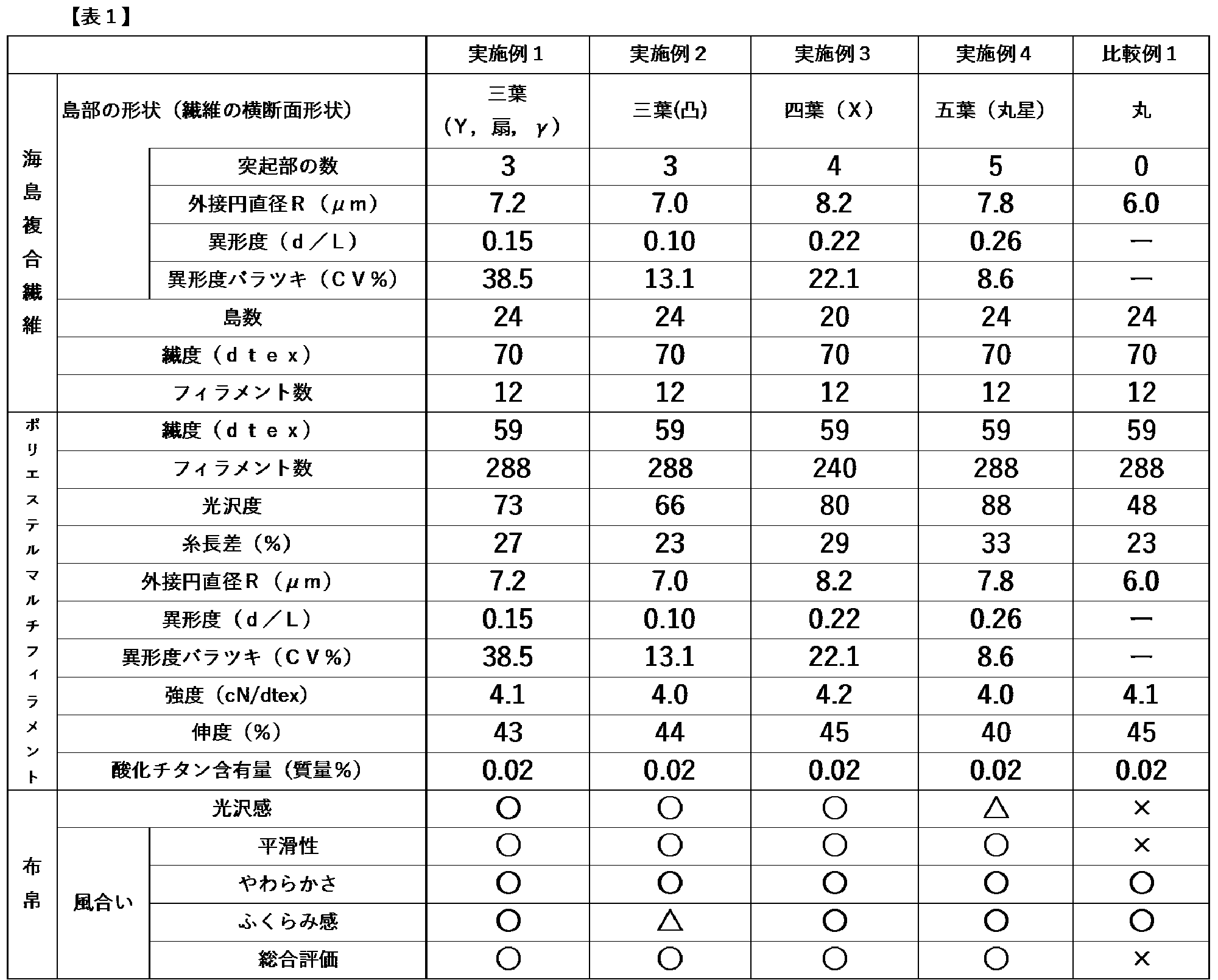
〔実施例5〕〔比較例2〕
海島複合ポリエステル繊維のフィラメント数を、24フィラメント(実施例5)、36フィラメント(比較例2)に変更するなど、表2に記載の条件とした以外は実施例1と同様の方法で、70dtexの海島複合ポリエステル繊維を得、サテン織物を得た。評価結果を表2に示す。
比較例2で得られたサテン織物は、フィラメント数が多く、繊維表面面積が増大したため、入射光に対して光が多く拡散して光沢度が低下し、光沢感が感じ取れなかった。
海島複合ポリエステル繊維のフィラメント数を、24フィラメント(実施例5)、36フィラメント(比較例2)に変更するなど、表2に記載の条件とした以外は実施例1と同様の方法で、70dtexの海島複合ポリエステル繊維を得、サテン織物を得た。評価結果を表2に示す。
比較例2で得られたサテン織物は、フィラメント数が多く、繊維表面面積が増大したため、入射光に対して光が多く拡散して光沢度が低下し、光沢感が感じ取れなかった。
〔実施例6〕〔比較例3〕
海島複合ポリエステル繊維の島数を、18島(島部A=9島、島部B=9島)(実施例6)、12島(島部A=6島、島部B=6島)(比較例3)に変更するなど、表2に記載の条件とした以外は実施例1と同様の方法で、70dtex、12フィラメントの海島複合ポリエステル繊維を得、サテン織物を得た。評価結果を表2に示す。
比較例3で得られたサテン織物は、フィラメント数が少なく、繊維表面面積が減少したため、入射光に対して光の反射が高くなることから、光沢感はあるが、キラキラした人工的な光沢であった。
海島複合ポリエステル繊維の島数を、18島(島部A=9島、島部B=9島)(実施例6)、12島(島部A=6島、島部B=6島)(比較例3)に変更するなど、表2に記載の条件とした以外は実施例1と同様の方法で、70dtex、12フィラメントの海島複合ポリエステル繊維を得、サテン織物を得た。評価結果を表2に示す。
比較例3で得られたサテン織物は、フィラメント数が少なく、繊維表面面積が減少したため、入射光に対して光の反射が高くなることから、光沢感はあるが、キラキラした人工的な光沢であった。
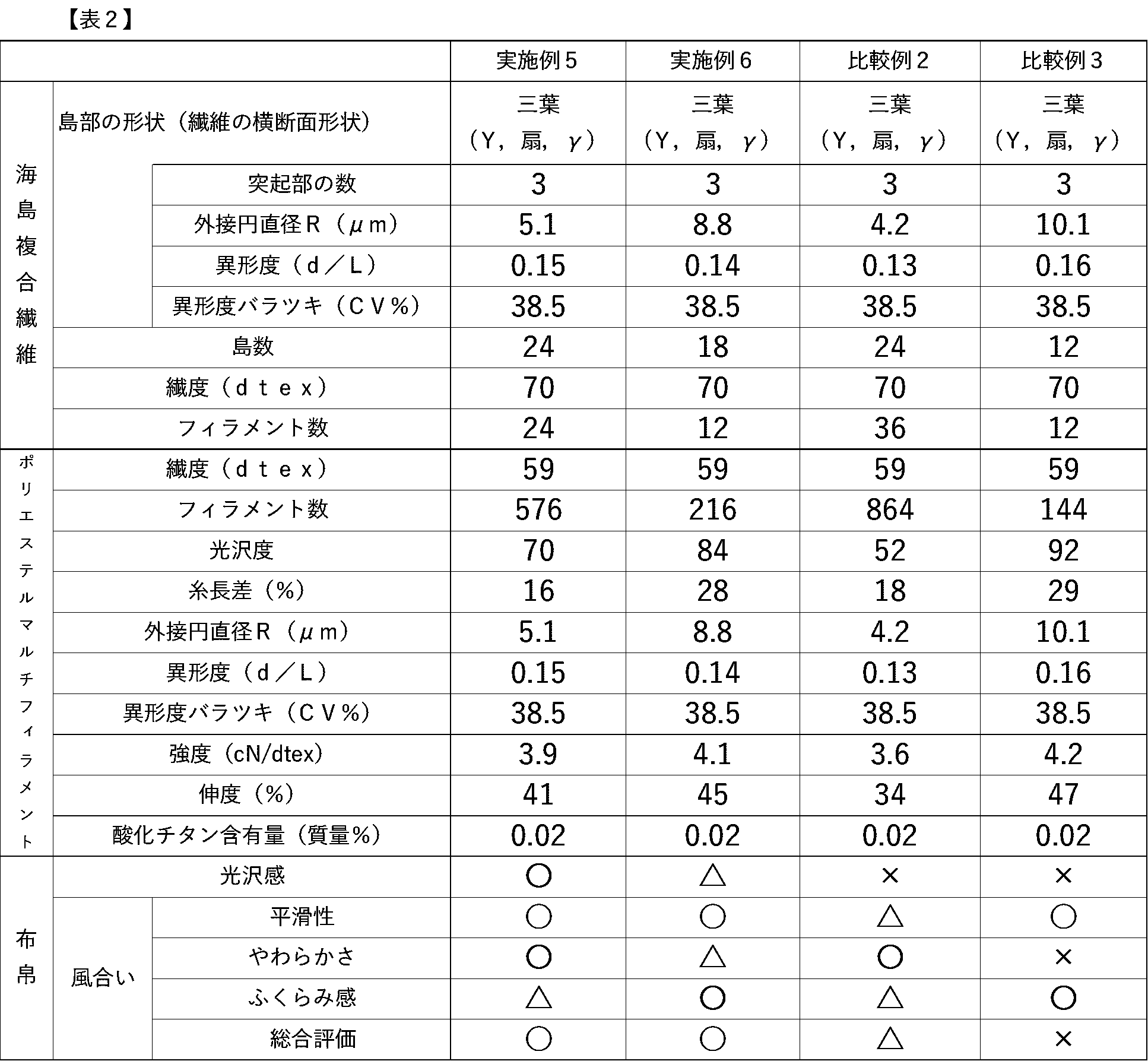
〔実施例7~9〕〔比較例4、5〕
島部A形成用の島成分Aポリマー(PET3、PET4、PET5)、島部B形成用の島成分Bポリマー(PET6)、島部A、島部B及び海部の重量複合比を表3記載のとおり変更した以外は実施例1と同様の方法で、70dtex、12フィラメントの海島複合ポリエステル繊維を得、サテン織物を得た。評価結果を表3に示す。
(PET3)
PET3は、島部A形成用の島成分Aポリマーとして、無機粒子として酸化チタンを0.3質量%含む、IVが0.65のポリエチレンテレフタレートとした。
(PET4)
PET4は、島部A形成用の島成分Aポリマーとして、無機粒子として酸化チタンを0.5質量%含む、IVが0.76のポリエチレンテレフタレートとした。
(PET5)
PET5は、島部A形成用の島成分Aポリマーとして、無機粒子として酸化チタンを0.1質量%含む、IVが0.72のポリエチレンテレフタレートとした。
(PET6)
PET6は、島部B形成用の島成分Bポリマーとして、無機粒子として酸化チタンを0.4質量%含む、IVが0.51のポリエチレンテレフタレートとした。
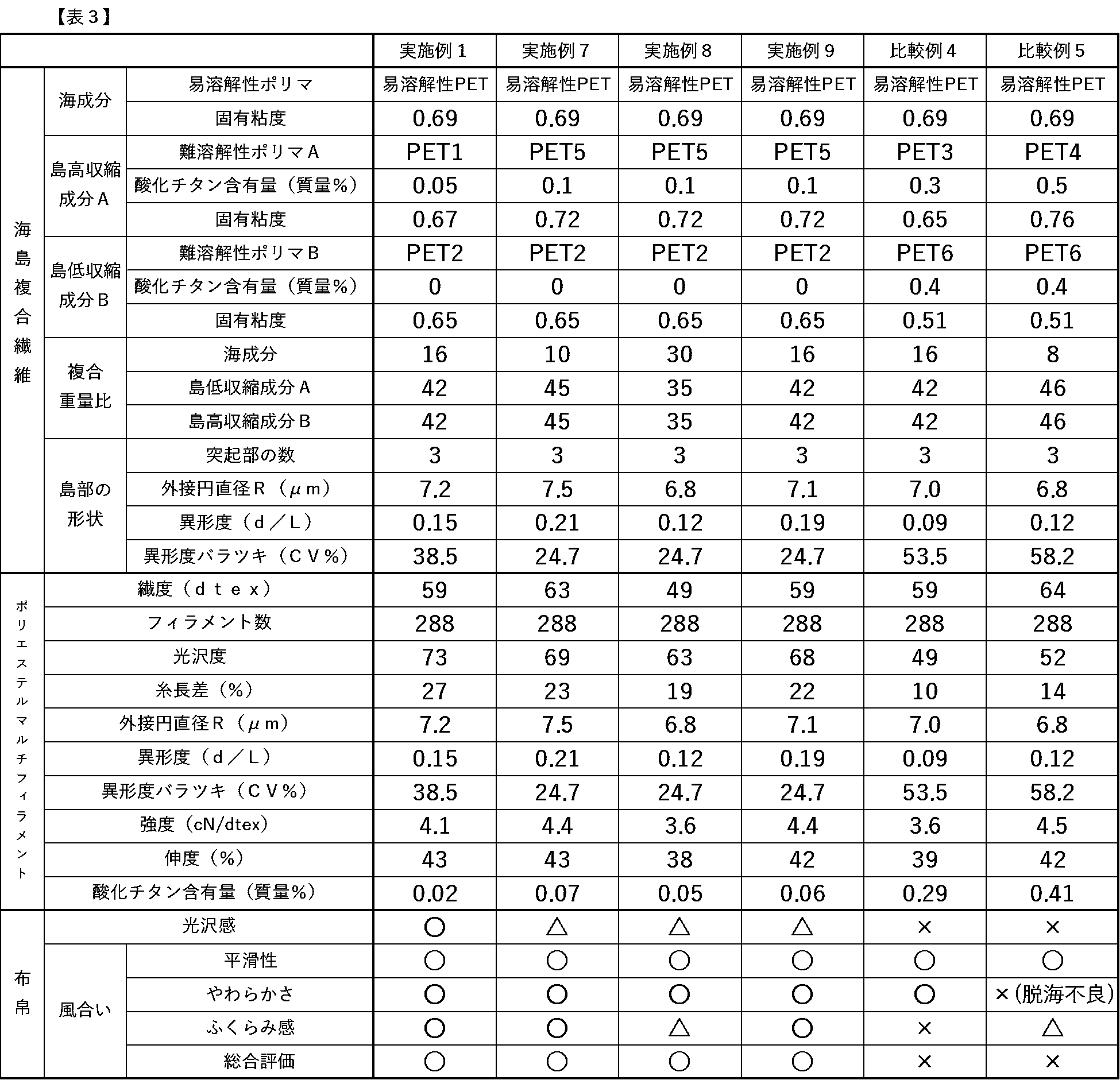
〔実施例10、11〕
島部の横断面形状を、図2に例示したY字型、扇形、γ字形状が混在する3葉形状を形成する海島複合用紡糸口金孔形状を変更し、異形度を0.06(実施例10)、0.28(実施例11)に変更した以外は実施例1と同様の方法で、70dtex、12フィラメントの海島複合ポリエステル繊維を得、サテン織物を得た。評価結果を表4に示す。
島部の横断面形状を、図2に例示したY字型、扇形、γ字形状が混在する3葉形状を形成する海島複合用紡糸口金孔形状を変更し、異形度を0.06(実施例10)、0.28(実施例11)に変更した以外は実施例1と同様の方法で、70dtex、12フィラメントの海島複合ポリエステル繊維を得、サテン織物を得た。評価結果を表4に示す。
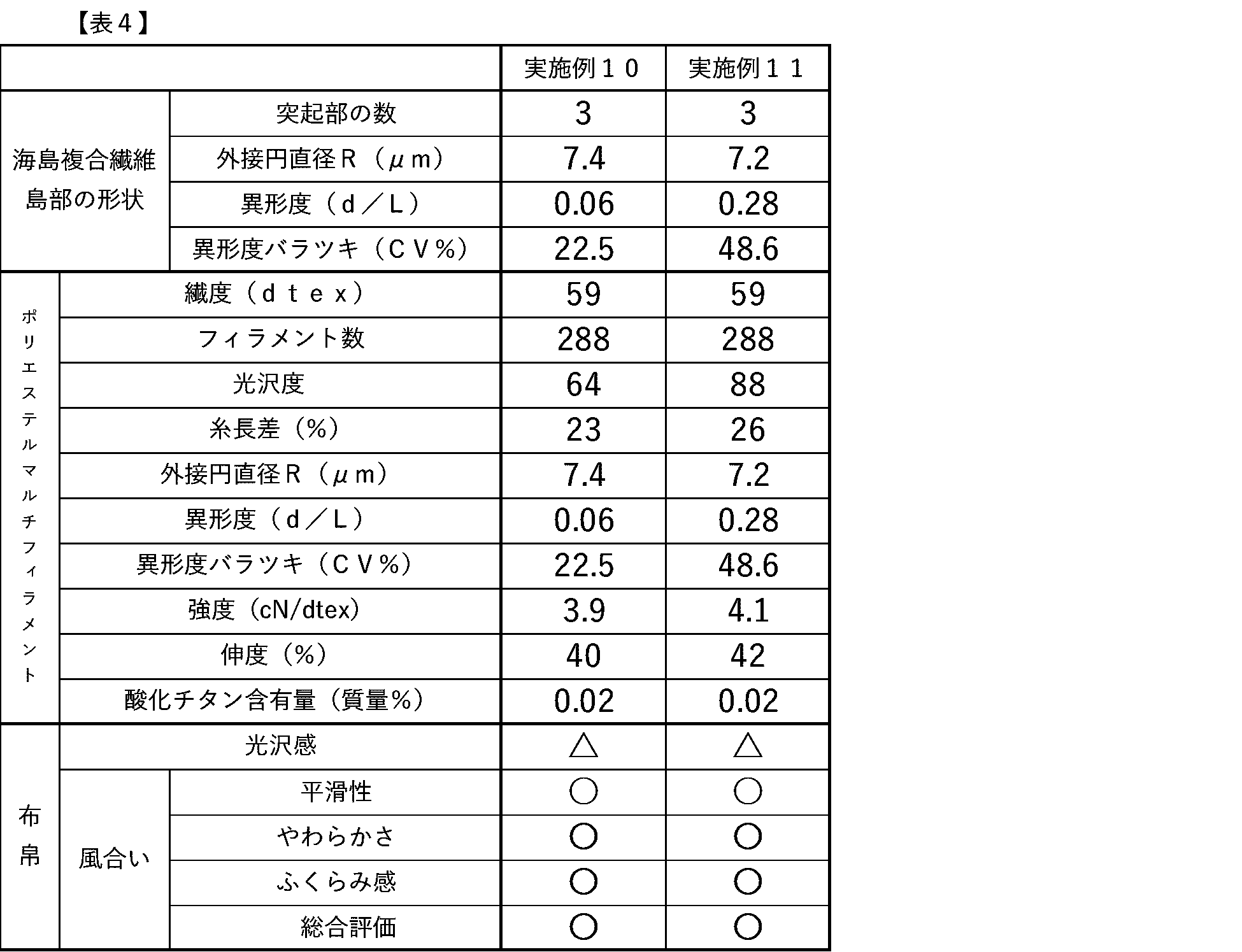
本発明を詳細にまた特定の実施形態を参照して説明したが、本発明の精神と範囲を逸脱することなく様々な変更や修正を加えることができることは当業者にとって明らかである。本出願は、2023年6月26日出願の日本特許出願(特願2023-104072)に基づくものであり、その内容はここに参照として取り込まれる。
C:三葉形状の突起部
T:三葉形状を構成する各辺の凹頂点又は凸頂点
X:凹頂点又は凸部頂点から、隣接する突起部頂点を結ぶ線分に対して垂直に交わる交点
R:外接円直径
A:第1島部
B:第2島部
U:海部
T:三葉形状を構成する各辺の凹頂点又は凸頂点
X:凹頂点又は凸部頂点から、隣接する突起部頂点を結ぶ線分に対して垂直に交わる交点
R:外接円直径
A:第1島部
B:第2島部
U:海部
Claims (8)
- 2種類以上のポリエステル繊維を含むポリエステルマルチフィラメントにおいて、前記2種類以上のポリエステル繊維の横断面形状が突起部を3個以上有する多葉形状であり、光沢度が60~90であるポリエステルマルチフィラメント。
- 糸長差が15~40%である、請求項1に記載のポリエステルマルチフィラメント。
- 収縮率の異なる2種類以上のポリエステル繊維を含むマルチフィラメントにおいて、前記2種類以上のポリエステル繊維の横断面形状が突起部を3個以上有する多葉形状であり、光沢度が60~90であるポリエステルマルチフィラメント。
- 前記ポリエステル繊維の横断面の外接円直径Rの平均値が4.0~10.0μmであり、前記ポリエステル繊維の横断面において、前記多葉形状を構成する、隣接頂点間距離Lに対する凹凸部高さdの比である異形度(d/L)の平均値が0.05~0.3である、請求項2または3に記載のポリエステルマルチフィラメント。
- 前記2種類以上のポリエステル繊維のフィラメント数が200~800本である、請求項2または3に記載のポリエステルマルチフィラメント。
- 異形度バラツキCVが20%以上である、請求項2または3に記載のポリエステルマルチフィラメント。
- 無機微粒子の含有量が0~0.1質量%である、請求項2または3に記載のポリエステルマルチフィラメント。
- 海部と2種類以上の島部を含む海島複合ポリエステル繊維において、
前記2種類以上の島部の横断面形状が突起部を3個以上有する多葉形状であり、前記多葉形状を構成する、隣接頂点間距離Lに対する凹凸部高さdの比である異形度(d/L)の平均値が0.05~0.3であり、前記海部が占める質量割合が10~30質量%である、海島複合ポリエステル繊維。
Priority Applications (2)
| Application Number | Priority Date | Filing Date | Title |
|---|---|---|---|
| JP2024541695A JPWO2025004957A1 (ja) | 2023-06-26 | 2024-06-20 | |
| CN202480040276.4A CN121358901A (zh) | 2023-06-26 | 2024-06-20 | 聚酯复丝及海岛复合聚酯纤维 |
Applications Claiming Priority (2)
| Application Number | Priority Date | Filing Date | Title |
|---|---|---|---|
| JP2023-104072 | 2023-06-26 | ||
| JP2023104072 | 2023-06-26 |
Publications (1)
| Publication Number | Publication Date |
|---|---|
| WO2025004957A1 true WO2025004957A1 (ja) | 2025-01-02 |
Family
ID=93938528
Family Applications (1)
| Application Number | Title | Priority Date | Filing Date |
|---|---|---|---|
| PCT/JP2024/022378 Ceased WO2025004957A1 (ja) | 2023-06-26 | 2024-06-20 | ポリエステルマルチフィラメントおよび海島複合ポリエステル繊維 |
Country Status (4)
| Country | Link |
|---|---|
| JP (1) | JPWO2025004957A1 (ja) |
| CN (1) | CN121358901A (ja) |
| TW (1) | TW202500823A (ja) |
| WO (1) | WO2025004957A1 (ja) |
Citations (3)
| Publication number | Priority date | Publication date | Assignee | Title |
|---|---|---|---|---|
| JPH05163615A (ja) * | 1991-12-18 | 1993-06-29 | Toray Ind Inc | 絹様の光学特性を有するポリエステル繊維 |
| JPH09241923A (ja) * | 1996-03-06 | 1997-09-16 | Toray Ind Inc | 有撚分繊用高光沢ポリエステルマルチフィラメント糸 |
| WO2021070740A1 (ja) * | 2019-10-08 | 2021-04-15 | 東レ株式会社 | 芯鞘複合繊維およびマルチフィラメント |
-
2024
- 2024-06-20 WO PCT/JP2024/022378 patent/WO2025004957A1/ja not_active Ceased
- 2024-06-20 JP JP2024541695A patent/JPWO2025004957A1/ja active Pending
- 2024-06-20 CN CN202480040276.4A patent/CN121358901A/zh active Pending
- 2024-06-24 TW TW113123388A patent/TW202500823A/zh unknown
Patent Citations (3)
| Publication number | Priority date | Publication date | Assignee | Title |
|---|---|---|---|---|
| JPH05163615A (ja) * | 1991-12-18 | 1993-06-29 | Toray Ind Inc | 絹様の光学特性を有するポリエステル繊維 |
| JPH09241923A (ja) * | 1996-03-06 | 1997-09-16 | Toray Ind Inc | 有撚分繊用高光沢ポリエステルマルチフィラメント糸 |
| WO2021070740A1 (ja) * | 2019-10-08 | 2021-04-15 | 東レ株式会社 | 芯鞘複合繊維およびマルチフィラメント |
Also Published As
| Publication number | Publication date |
|---|---|
| CN121358901A (zh) | 2026-01-16 |
| JPWO2025004957A1 (ja) | 2025-01-02 |
| TW202500823A (zh) | 2025-01-01 |
Similar Documents
| Publication | Publication Date | Title |
|---|---|---|
| CN100519864C (zh) | 聚酯共轭长丝粗细节花式纱织物及其生产方法 | |
| TW567257B (en) | Polytrimethyleneterephthalate modified cross section yarn | |
| EP4043623A1 (en) | Sheath-core composite fiber and multifilament | |
| JP2007262610A (ja) | 混繊糸 | |
| JP2016172945A (ja) | 凹凸表面を有する極細ポリエステル繊維ならびに海島型複合繊維 | |
| JP5718045B2 (ja) | 染色性に優れたポリエステル繊維および繊維集合体 | |
| JP3653842B2 (ja) | ナイロン中空繊維、その製造方法及びその用途 | |
| JP2021161559A (ja) | ポリエステル複合繊維 | |
| JPWO2019107111A1 (ja) | 高強力細繊度ポリエステルマルチフィラメント | |
| JP7823395B2 (ja) | 海島複合ポリエステル繊維 | |
| TW202500823A (zh) | 聚酯複絲及海島複合聚酯纖維 | |
| JP2565010B2 (ja) | 中空内外層複合繊維 | |
| JP2932721B2 (ja) | ポリエステル繊維およびその製造方法 | |
| JP4326456B2 (ja) | ポリエステル超極細繊維及びその製造方法 | |
| JP3564861B2 (ja) | ポリエステル繊維および異収縮混繊糸 | |
| JP3998667B2 (ja) | ポリトリメチレンテレフタレート異型糸 | |
| JP3802471B2 (ja) | ポリエステル複合マルチフィラメント繊維及びその製造方法並びにその織編物 | |
| JP7833856B2 (ja) | ポリエステル系複合混繊加工糸 | |
| JPH10266029A (ja) | ポリエステル収縮差混繊糸 | |
| EP2042627B1 (en) | False twist yarn and process for producing the same | |
| JP3333831B2 (ja) | ポリエステル太細糸 | |
| JPH09157958A (ja) | ポリエステル繊維およびその製造方法 | |
| JP2007023423A (ja) | ポリエステル異形断面糸 | |
| JPH07145514A (ja) | ポリエステル系3成分複合繊維 | |
| JPH11107089A (ja) | 光沢を有するポリエステル混繊糸 |
Legal Events
| Date | Code | Title | Description |
|---|---|---|---|
| WWE | Wipo information: entry into national phase |
Ref document number: 2024541695 Country of ref document: JP |
|
| 121 | Ep: the epo has been informed by wipo that ep was designated in this application |
Ref document number: 24831819 Country of ref document: EP Kind code of ref document: A1 |
|
| NENP | Non-entry into the national phase |
Ref country code: DE |
|
| 122 | Ep: pct application non-entry in european phase |
Ref document number: 24831819 Country of ref document: EP Kind code of ref document: A1 |