WO2024248021A1 - 膜形成用組成物、基板の製造方法、および膜形成用組成物の製造方法 - Google Patents
膜形成用組成物、基板の製造方法、および膜形成用組成物の製造方法 Download PDFInfo
- Publication number
- WO2024248021A1 WO2024248021A1 PCT/JP2024/019656 JP2024019656W WO2024248021A1 WO 2024248021 A1 WO2024248021 A1 WO 2024248021A1 JP 2024019656 W JP2024019656 W JP 2024019656W WO 2024248021 A1 WO2024248021 A1 WO 2024248021A1
- Authority
- WO
- WIPO (PCT)
- Prior art keywords
- film
- forming composition
- atoms
- general formula
- producing
- Prior art date
- Legal status (The legal status is an assumption and is not a legal conclusion. Google has not performed a legal analysis and makes no representation as to the accuracy of the status listed.)
- Ceased
Links
Images


Classifications
-
- C—CHEMISTRY; METALLURGY
- C09—DYES; PAINTS; POLISHES; NATURAL RESINS; ADHESIVES; COMPOSITIONS NOT OTHERWISE PROVIDED FOR; APPLICATIONS OF MATERIALS NOT OTHERWISE PROVIDED FOR
- C09K—MATERIALS FOR MISCELLANEOUS APPLICATIONS, NOT PROVIDED FOR ELSEWHERE
- C09K3/00—Materials not provided for elsewhere
- C09K3/18—Materials not provided for elsewhere for application to surfaces to minimize adherence of ice, mist or water thereto; Thawing or antifreeze materials for application to surfaces
-
- H—ELECTRICITY
- H10—SEMICONDUCTOR DEVICES; ELECTRIC SOLID-STATE DEVICES NOT OTHERWISE PROVIDED FOR
- H10P—GENERIC PROCESSES OR APPARATUS FOR THE MANUFACTURE OR TREATMENT OF DEVICES COVERED BY CLASS H10
- H10P52/00—Grinding, lapping or polishing of wafers, substrates or parts of devices
-
- H—ELECTRICITY
- H10—SEMICONDUCTOR DEVICES; ELECTRIC SOLID-STATE DEVICES NOT OTHERWISE PROVIDED FOR
- H10P—GENERIC PROCESSES OR APPARATUS FOR THE MANUFACTURE OR TREATMENT OF DEVICES COVERED BY CLASS H10
- H10P70/00—Cleaning of wafers, substrates or parts of devices
- H10P70/20—Cleaning during device manufacture
Definitions
- the present disclosure relates to a film-forming composition, a method for manufacturing a substrate, and a method for manufacturing a film-forming composition.
- Patent Document 1 describes a surface treatment agent containing a silylating agent containing at least one compound having a disilazane structure and a solvent.
- the following film-forming composition, method for manufacturing a substrate, and method for manufacturing a film-forming composition are provided.
- a film-forming composition used to form a water-repellent film (I) a silylating agent; (II) a silyl ester compound represented by the following general formula [2], (III) an aprotic solvent, A film-forming composition.
- R2 is a monovalent hydrocarbon group having 1 to 5 carbon atoms in which some or all of the hydrogen atoms have been replaced by chlorine atoms and the remaining hydrogen atoms may be partially or entirely replaced by fluorine atoms;
- R3 is each independently an organic group containing a monovalent hydrocarbon group having 1 to 18 carbon atoms in which some or all of the hydrogen atoms may be replaced by fluorine atoms or chlorine atoms;
- i is an integer from 1 to 3
- h is an integer from 1 to 3
- i+h is an integer from 2 to 4. 2.
- the film-forming composition according to 1. The film-forming composition, wherein the silylating agent contains a silicon compound represented by the following general formula [1]: R 1 a Si(H) b X 4-ab [1] (In the above general formula [1], R 1 is each independently an organic group containing a hydrocarbon group having 1 to 18 carbon atoms in which some or all of the hydrogen atoms may be replaced by fluorine atoms or chlorine atoms, Each X is independently a monovalent group in which the atom bonded to the Si atom is nitrogen, oxygen, carbon, or halogen; a is an integer from 1 to 3, b is an integer from 0 to 2, and the sum of a and b is 1 to 3. 3.
- the film-forming composition contains the silyl ester compound represented by -C q Y (2q+1-r) Cl r (wherein each Y is independently a hydrogen atom or a fluorine atom bonded to carbon, Cl is a chlorine atom, q is an integer of 1 to 5, and r is 1 to 2q). 4.
- the film-forming composition according to any one of 1 to 3 The aprotic solvent comprises one or more selected from the group consisting of hydrocarbons, esters, ethers, ketones, halogen atom-containing solvents, sulfoxide-based solvents, carbonate-based solvents, derivatives of polyhydric alcohols having no OH group, nitrogen atom-containing solvents having no N-H group, and silicone solvents. 5.
- the film-forming composition according to any one of 1 to 4 The film-forming composition, wherein the content of the silylating agent is 0.1% by mass or more and 35% by mass or less, based on 100% by mass of the film-forming composition. 6.
- the film-forming composition according to any one of 1 to 5 The film-forming composition, wherein the content of the silyl ester compound is 0.01% by mass or more and 10% by mass or less based on 100% by mass of the film-forming composition.
- the film-forming composition according to any one of 1 to 6 The film-forming composition has a water contact angle of 70° or more when the film is formed from the film-forming composition and measured in accordance with JIS R 3257:1999. 8.
- a film-forming composition comprising the aprotic solvent (III) having polarity.
- a film-forming composition comprising an amide compound having a structure in which, in the general formula [4], R b1 is a hydrocarbon group having no Cl 3 C moiety, Cl 2 HC moiety, or Cl 2 FC moiety. 11. The film-forming composition according to any one of 1.
- R b2 is a monovalent hydrocarbon group having 1 to 5 carbon atoms in which some or all of the hydrogen atoms are replaced by chlorine atoms and the remaining hydrogen atoms may be partially or entirely replaced by fluorine atoms
- R b3 each independently represents an organic group containing a monovalent hydrocarbon group having 1 to 18 carbon atoms in which some or all of the hydrogen atoms may be replaced by fluorine atoms or chlorine atoms
- j is an integer from 1 to 3
- t is an integer from 1 to 3
- j+t is an integer from 2 to 4.
- R b4 each independently represents an organic group containing a monovalent hydrocarbon group having 1 to 18 carbon atoms in which some or all of the hydrogen atoms may be replaced by fluorine atoms or chlorine atoms, u is an integer from 1 to 3, v is an integer from 0 to 2, and the sum of u and v is 1 to 3. 12.
- Preparing a substrate supplying a film-forming composition to the substrate to form a water-repellent film on at least a portion of a surface of the substrate,
- the film forming composition (I) a silylating agent; (II) a silyl ester compound represented by the following general formula [2], (III) an aprotic solvent.
- R2 is a monovalent hydrocarbon group having 1 to 5 carbon atoms in which some or all of the hydrogen atoms have been replaced by chlorine atoms and the remaining hydrogen atoms may be partially or entirely replaced by fluorine atoms;
- R3 is each independently an organic group containing a monovalent hydrocarbon group having 1 to 18 carbon atoms in which some or all of the hydrogen atoms may be replaced by fluorine atoms or chlorine atoms;
- i is an integer from 1 to 3
- h is an integer from 1 to 3
- i+h is an integer from 2 to 4. 13.
- a method for manufacturing a substrate according to 12. comprising the steps of: A method for producing a substrate, comprising the step of cleaning the substrate before supplying the film-forming composition. 14.
- a method for producing a film-forming composition comprising the step of mixing (I) a silylating agent, (II) a silyl ester compound, and (III) an aprotic solvent.
- a method for producing a film-forming composition comprising a reaction step of reacting (I) a silylating agent with a chlorocarboxylic acid compound containing at least one of a chlorocarboxylic acid and a chlorocarboxylic acid anhydride to obtain (II) a silyl ester compound. 16.
- a method for producing the film-forming composition according to 15. or 16. The method for producing a film-forming composition includes the chlorocarboxylic acid compound, which contains at least one of the chlorocarboxylic acid having a pKa of -0.2 or more and 4.5 or less, and an anhydride thereof. 18.
- a method for producing the film-forming composition according to any one of 15. to 17. comprising the steps of: The method for producing a film-forming composition, wherein the reaction step is carried out in an aprotic solvent (III). 19.
- the present disclosure provides a film-forming composition that can produce a new chemical solution containing a chlorine-containing accelerator, a method for manufacturing a substrate using the same, and a method for manufacturing the film-forming composition.
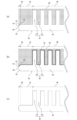
- FIG. 2 is a top view illustrating a schematic configuration of a substrate.
- FIG. 2 is a cross-sectional view illustrating a schematic configuration of a substrate.
- 1A to 1C are cross-sectional views illustrating process steps for manufacturing a substrate.
- the film-forming composition of the present embodiment contains (I) a silylation agent, (II) a silyl ester compound represented by the following general formula [2], and (III) an aprotic solvent.
- R 2 -C( O)O) i -Si(H) 4-i-h (R 3 ) h [2]
- R2 is a monovalent hydrocarbon group having 1 to 5 carbon atoms in which some or all of the hydrogen atoms have been replaced by chlorine atoms and the remaining hydrogen atoms may be partially or entirely replaced by fluorine atoms
- R3 is each independently an organic group containing a monovalent hydrocarbon group having 1 to 18 carbon atoms in which some or all of the hydrogen atoms may be replaced by fluorine atoms or chlorine atoms, i is an integer from 1 to 3, h is an integer from 1 to 3, and i+h is an integer from 2 to 4.
- the inventors have found that a film-forming composition containing the above-mentioned silylating agent, a chlorine-containing silyl ester compound, and an aprotic solvent can impart excellent water repellency to the substrate surface.
- the film-forming composition of the present embodiment is a surface-modifying chemical liquid used for forming a water-repellent film on at least a part of a substrate surface.
- the water repellency can be defined using as an index the water contact angle measured by the coupon test described below.
- the water-repellent film formed from the film-forming composition has a water contact angle, measured in accordance with JIS R 3257:1999, of, for example, 70° or more, preferably 75° or more, and more preferably 81° or more. (Procedure for coupon testing)
- a silicon wafer having no uneven pattern on its surface and a silicon oxide film with a thickness of 1 ⁇ m is cut to prepare coupons made of silicon substrates with dimensions of length, width and thickness of 4 cm, 1 cm and 0.75 mm.
- the coupon is immersed in 1% by weight hydrofluoric acid at room temperature, then in water at room temperature, then in 2-propanol at room temperature, and then in propylene glycol monomethyl ether acetate at room temperature to wash it, where "room temperature” is 25°C.
- An evaluation solution made of the film-forming composition was prepared, and the cleaned coupon was immersed in the evaluation solution at room temperature for 20 seconds.
- the coupon is removed from the evaluation solution and washed by immersing it in 2-propanol at room temperature, and then the surface of the coupon is dried with nitrogen gas. With the dried coupon placed on a horizontal surface, 2 ⁇ l of pure water is placed on the surface of the coupon on which the silicon oxide film is formed at room temperature, and the water contact angle (°) is measured in accordance with JIS R 3257:1999.
- Patent Document 2 discloses a chemical solution for forming a water-repellent protective film on at least the recessed surface of a fine uneven pattern when cleaning a wafer having a fine uneven pattern on its surface, at least a part of which contains silicon elements, the chemical solution containing a silicon compound A of a predetermined structure and an acid A, the acid A being at least one selected from the group consisting of trimethylsilyl trifluoroacetate, trimethylsilyl trifluoromethanesulfonate, dimethylsilyl trifluoroacetate, dimethylsilyl trifluoromethanesulfonate, butyldimethylsilyl trifluoroacetate, butyldimethylsilyl trifluoromethanesulfonate, octyldimethylsilyl trifluoroacetate, and octyldimethylsilyl trifluoromethanesulfonate.
- Patent Document 2 discloses that the use of a perfluoroalkyl derivative such as TMSTFA (trimethylsilyl trifluoroacetate) as an accelerator can provide excellent water repellency, but that the use of unsubstituted sulfuric acid, nitric acid, or acetic acid results in significantly inferior water repellency. From this, it was predicted that compounds such as trimethylsilyl chlorodifluoroacetate (TMSCDA) and trimethylsilyl dichlorofluoroacetate (TMSDFA), in which at least a part of the fluorine atoms of a perfluoroalkyl derivative are replaced by chlorine atoms, would have insufficient electron-attracting properties of the chlorine atoms, and would impart less water repellency.
- TMSCDA trimethylsilyl chlorodifluoroacetate
- TMSDFA trimethylsilyl dichlorofluoroacetate
- equivalent water repellency means that the water repellency is significantly superior to that of unsubstituted sulfuric acid, nitric acid or acetic acid, specifically, the water contact angle is 70° or more, which satisfies the water repellency standard.
- a film-forming composition having equivalent water repellency can be provided.
- water-repellent film refers to both a compound having a silyl group derived from a silylating agent that is chemically bonded to the substrate surface, and a group of such compounds, regardless of whether or not the compounds interact with each other or are bonded to each other.
- the above bonds do not have to be direct bonds, and also include cases where the bonds are formed via other elements or substituents, etc.
- silylation agent a known silylating agent can be used.
- the silylating agent may include, for example, a silicon compound represented by the following general formula [1]. These may be used alone or in combination of two or more kinds.
- R 1 is each independently an organic group containing a hydrocarbon group having 1 to 18 carbon atoms in which some or all of the hydrogen atoms may be replaced by fluorine atoms or chlorine atoms,
- Each X is independently a monovalent group in which the atom bonded to the Si atom is nitrogen, oxygen, carbon, or halogen; a is an integer of 1 to 3, b is an integer of 0 to 2, and the sum of a and b is 1 to 3.
- the above-mentioned hydrocarbon groups are still referred to as hydrocarbon groups even when all of the hydrogen atoms are replaced with atoms other than hydrogen atoms.
- R 1 in the above general formula [1] may contain not only hydrogen, carbon, nitrogen, oxygen, a fluorine atom, or a chlorine atom, but also silicon, sulfur, a halogen atom (other than fluorine), etc. Furthermore, R 1 in the above general formula [1] may contain an unsaturated bond, an aromatic ring, or a cyclic structure.
- R 1 in the above general formula [1] contains a silicon atom, it may have a structure represented by the following general formula [1-1].
- R 1 (wherein R 1 does not contain a silicon atom) and X are the same as those in the above general formula [1]
- m is an integer of 1 to 2
- n is an integer of 0 to 1
- the sum of m and n is 1 to 2
- p is an integer of 1 to 18, and the methylene chain represented by -(CH 2 ) p - may be substituted with a halogen atom.
- X is a monovalent group in which the atom bonded to the Si atom is nitrogen, oxygen, or carbon, and may contain not only hydrogen, carbon, nitrogen, and oxygen atoms, but also silicon, sulfur, halogen atoms, etc.
- R 4 is independently a group selected from the group consisting of a monovalent hydrocarbon group having 1 to 8 carbon atoms in which some or all of the hydrogen atoms may be replaced by fluorine atoms, and a fluorine atom
- R 5 is each independently a divalent hydrocarbon group having 1 to 8 carbon atoms in which some or all of the hydrogen atoms may be replaced by fluorine atoms.
- -N C(NR 6 2 ) 2
- R a1 and R a2 may be bonded to each other to form a saturated or unsaturated heterocycloalkyl group having a nitrogen atom.
- -N(R a3 )-Si(R a4 )(R a5 )(R a6 ) (wherein R a3 represents a hydrogen atom, a hydrocarbon group having 1 to 4 carbon atoms, a trimethylsilyl group, or a dimethylsilyl group, and R a4 , R a5 , and R a6 each independently represent a hydrogen atom or an organic group, and the total number of carbon atoms contained in R a4 , R a5, and R a6 is 1 or more; -N(R a7 )-C( ⁇ O)R a8 (wherein R a7 represents a hydrogen atom, a methyl group, a trimethylsilyl group, or a dimethylsilyl group, and R a8 represents a hydrogen atom
- Examples of the silylating agent in which X in the above general formula [1] is a monovalent group in which the atom bonded to the Si atom is nitrogen include CH3Si ( NH2 ) 3 , C2H5Si ( NH2 ) 3 , C3H7Si ( NH2 ) 3 , C4H9Si ( NH2 ) 3 , C5H11Si ( NH2 ) 3 , C6H13Si ( NH2 ) 3 , C7H15Si ( NH2 ) 3 , C8H17Si ( NH2 ) 3 , C9H19Si ( NH2 ) 3 , C10H21Si ( NH2 ) 3 , and C11H23 Si( NH2 ) 3 , C12H25Si(NH2) 3 , C13H27Si ( NH2 ) 3 , C14H29Si ( NH2 ) 3 , C15H31Si (
- R 5 is as described above.
- -N C(NR 6 2 ) 2
- hexamethyldisilazane N-methylhexamethyldisilazane, 1,1,3,3-tetramethyldisilazane, 1,3-dimethyldisilazane, 1,3-di-N-octyltetramethyldisilazane, 1,3-divinyltetramethyldisilazane, heptamethyldisilazane, N-allyl-N,N-bis(trimethylsilyl)amine, 1,3-diphenyltetramethyldisilazane, 1,1,3,3-tetraphenyl-1,3-dimethyldisilazane, nonamethyltrisilazane, pentamethylethyldisilazane, pentamethylvinyldisilazane, pentamethylpropyldisilazane, pentamethylethyldisilazane, pentamethyl-t-butyldisil
- N-trimethylsilylacetamide, N-trimethylsilyltrifluoroacetamide, N-methyl-N-trimethylsilylacetamide, N-methyl-N-trimethylsilyltrifluoroacetamide, bis(trimethylsilyl)acetamide, bis(trimethylsilyl)trifluoroacetamide, etc.) are exemplified.
- -O-C(R a12 ) N(R a13 ) (wherein R a12 represents a hydrogen atom, a saturated or unsaturated alkyl group, a fluorine-containing alkyl group, or a trialkylsilylamino group, and R a13 represents a hydrogen atom, an alkyl group, or a trialkylsilyl group),
- R a16 represents a saturated or unsaturated alkyl group, a saturated or unsaturated cycloalkyl group, or a fluorine-containing alkyl group.
- R a17 is an alkyl group having 1 to 6 carbon atoms, a perfluoroalkyl group, a phenyl group, a tolyl group, or an -O-Si(CH 3 ) 3 group.
- trimethylsilyl sulfonate trimethylsilyl benzene sulfonate, trimethylsilyl toluene sulfonate, trimethylsilyl trifluoromethane sulfonate, trimethylsilyl perfluorobutane sulfonate, bistrimethylsilyl sulfate, etc.), or one replaced with -O-P(-O-Si(CH 3 ) 3 ) 2 (for example, tristrimethylsilyl phosphite, etc.).
- silylating agent in which X in the above general formula [1] is a monovalent group in which the atom bonded to the Si atom is oxygen include hexamethyldisiloxane, 1,3-diphenyl-1,3-dimethyldisiloxane, 1,1,3,3-tetramethyldisiloxane, 1,1,1-triethyl-3,3-dimethyldisiloxane, 1,1,3,3-tetra-n-octyldimethyldisiloxane, bis(nonafluorohexyl)tetramethyldisiloxane, 1, 3-bis(trifluoropropyl)tetramethyldisiloxane, 1,3-di-n-butyltetramethyldisiloxane, 1,3-di-n-octyltetramethyldisiloxane, 1,3-diethyltetramethyldis
- examples of the silylating agent in which X in the above general formula [1] is a monovalent group in which the atom bonded to the Si atom is a halogen include those in which the amino group (—NH 2 group) of the above aminosilane is replaced with a chloro group, a bromo group, or an iodo group (e.g., chlorotrimethylsilane, bromotrimethylsilane, etc.).
- the above general formula [1] is preferably a silicon compound having a trialkylsilyl group.
- R1 is preferably a methyl group.
- b is preferably 0.
- X is more preferably a monovalent group in which the atom bonded to the Si atom is nitrogen or oxygen, and more preferably the atom bonded to the Si atom is nitrogen.
- silazane compounds include non-cyclic disilazane compounds such as hexamethyldisilazane, heptamethyldisilazane, tetramethyldisilazane, diethyltetramethyldisilazane, dipropyltetramethyldisilazane, dibutyltetramethyldisilazane, dihexyltetramethyldisilazane, dioctyltetramethyldisilazane, and didecyltetramethyldisilazane; cyclic disilazane compounds such as 2,2,5,5-tetramethyl-2,5-disila-1-azacyclopentane and 2,2,6,6-tetramethyl-2,6-disila-1
- suitable silylating agents include one or more selected from the group consisting of hexamethyldisilazane, heptamethyldisilazane, N-(trimethylsilyl)dimethylamine, bis(dimethylamino)dimethylsilane, bis(trimethylsilyl)trifluoroacetamide, N-methyl-N-trimethylsilyltrifluoroacetamide, N-trimethylsilylacetamide, N-trimethylsilylimidazole, trimethylsilyltriazole, bistrimethylsilyl sulfate, 2,2,5,5-tetramethyl-2,5-disila-1-azacyclopentane, and 2,2,4,4,6,6-hexamethylcyclotrisilazane.
- the content of the silylating agent in 100% by mass of the film-forming composition is not particularly limited as long as the desired water repellency can be imparted to the substrate.
- the lower limit of the content of the silylation agent may be, for example, 0.1 mass % or more, preferably 0.2 mass % or more, more preferably 0.3 mass % or more, and further preferably 0.5 mass % or more. This makes it easier to improve the water repellency of the substrate.
- the upper limit of the content of the silylation agent may be, for example, 35% by mass or less, preferably 33% by mass or less, and more preferably 30% by mass or less. By setting it within the above range, water repellency can be imparted more efficiently with respect to the content of the silylation agent.
- the total content of the silylating agents should be within the above range.
- a silylamide compound or an aminosilane compound described later is used in combination, it is preferable that the total content of the silylating agent, the silylamide compound, and the aminosilane compound is within the above range.
- the silyl ester compound is a chlorine-containing accelerator that acts as an accelerator in the chemical solution of the film-forming composition.
- R2 is a monovalent hydrocarbon group having 1 to 5 carbon atoms in which some or all of the hydrogen atoms have been replaced by chlorine atoms and the remaining hydrogen atoms may be partially or entirely replaced by fluorine atoms
- R3 is each independently an organic group containing a monovalent hydrocarbon group having 1 to 18 carbon atoms in which some or all of the hydrogen atoms may be replaced by fluorine atoms or chlorine atoms
- i is an integer of 1 to 3
- h is an integer of 1 to 3
- i+h is an integer of 2 to 4.
- the carbon number is 1 to 5, preferably 1 to 3, and more preferably 1 to 2. This enhances water repellency.
- R2 also includes the case where all hydrogen atoms are replaced by chlorine atoms, and the case where all hydrogen atoms are replaced by atoms other than hydrogen atoms is also described as a hydrocarbon group.
- R 2 is a hydrocarbon group having two or more carbon atoms, it is more preferable that at least one hydrogen atom of each hydrocarbon group is substituted with a chlorine atom.
- R 2 in the general formula [2] may be a group represented by -C q Y (2q+1-r) Cl r (wherein each Y is independently a hydrogen atom or a fluorine atom bonded to carbon, Cl is a chlorine atom, q is an integer of 1 to 5, and r is 1 to 2q).
- each Y is independently a hydrogen atom or a fluorine atom bonded to carbon
- Cl is a chlorine atom
- q is an integer of 1 to 5
- r is 1 to 2q.
- the total number of chlorine atoms and fluorine atoms bonded to the carbon atoms contained in R2 is greater than the total number of hydrogen atoms, since this makes it easier to improve the water repellency of the film forming composition.
- the atoms bonded to the carbon contained in R2 may be only fluorine atoms and chlorine atoms (however, R2 does not include -CF3 and -CF2- ), or the atoms bonded to the carbon contained in R2 may be only hydrogen atoms and chlorine atoms (however, the total number of chlorine atoms is greater than the total number of hydrogen atoms).
- R 2 may be, -CHClF, -CClF 2 , -CHCl 2 , -CCl 2 F, -CHClCH 3 , -CCl 2 CH 3 , -CH 2 CHCl 2 , -CHClCH 2 Cl, -CHClCCl 3 , -CCl 2 CHCl 2 , -CCl 2 CCl 3 , -CClFCF 3 , -CF 2 CClF 2 , CCl 2 CF 3 , -CClFCCl 2 F, -CF 2 CCl 3 , -CClFCCl 3 , -CCl 2 CCl 2 F, -CClFCH 3 , -CCl 2 CH 2 F, -CHFCHCl 2 , -CClFCH 2 Cl, -CClCHClF, -CCl 2 It is preferable to use CHClF, -CClF 2 , -CHCl 2 , -CC
- R3 in the general formula [2] may contain not only hydrogen, carbon, nitrogen, oxygen, a fluorine atom, or a chlorine atom, but also silicon, sulfur, a halogen atom (other than fluorine), etc. Furthermore, R3 in the general formula [2] may contain an unsaturated bond, an aromatic ring, or a cyclic structure.
- silyl ester compounds include trimethylsilyl chloroacetate, trimethylsilyl dichloroacetate, trimethylsilyl chlorodifluoroacetate, trimethylsilyl dichlorofluoroacetate, trimethylsilyl chlorofluoroacetate, dimethylsilyl chloroacetate, dimethylsilyl dichloroacetate, dimethylsilyl chlorodifluoroacetate, butyldimethylsilyl chloroacetate, trimethylsilyl-2-chloropropionate, trimethylsilyl-3-chloropropionate, trimethylsilyl-2,2-dichloropropionate, trimethylsilyl-2,3-dichloropropionate, triethylsilyl-2-chloropropionate, trimethylsilyl trichloroacetate, etc.
- trimethylsilyl dichloroacetate trimethylsilyl chlorodifluoroacetate, trimethylsilyl dichlorofluoroacetate, trimethylsilyl-2,2-dichloropropionate, and trimethylsilyl-2,3-dichloropropionate are more preferred.
- the content of the silyl ester compound in 100% by mass of the film-forming composition is not particularly limited as long as it can impart the desired water repellency to the substrate.
- the lower limit of the content of the silyl ester compound is, for example, 0.01 mass % or more, preferably 0.05 mass % or more, and more preferably 0.2 mass % or more.
- the upper limit of the content of the silyl ester compound is, for example, 10 mass % or less, preferably 5 mass % or less, and more preferably 3 mass % or less.
- the lower limit of CSi / Ces is, for example, 1.0 or more, preferably 5.0 or more, and more preferably 10 or more. This makes it possible to impart water repellency with a shorter treatment time.
- the upper limit of C Si /C es is not particularly limited as long as the desired water repellency is obtained, but it may be, for example, 40 or less, and is preferably 30 or less.
- the total amount of the silyl ester compounds contained in the film-forming composition is the amount of the silyl ester compounds.
- the silyl ester compound with the highest amount is trimethylsilyl chloroacetate, trimethylsilyl dichloroacetate, trimethylsilyl chlorodifluoroacetate, trimethylsilyl dichlorofluoroacetate, trimethylsilyl chlorofluoroacetate, dimethylsilyl chloroacetate, dimethylsilyl dichloroacetate, dimethylsilyl chlorodifluoroacetate, butyldimethylsilyl chloroacetate, trimethylsilyl-2-chloropropionate, trimethylsilyl-3-chloropropionate, trimethylsilyl-2,3-dichloropropionate, triethylsilyl-2-chloropropionate, or trimethyl
- trimethylsilyl dichloroacetate trimethylsilyl chlorodifluoroacetate, trimethylsilyl dichlorofluoroacetate, trimethylsilyl-2,2-dichloropropionate, and trimethylsilyl-2,3-dichloropropionate are more preferred.
- the aprotic solvent refers to a solvent that does not contain a group in which a hydrogen atom is bonded to an oxygen atom or a nitrogen atom, such as a hydroxyl group or an amino group, but the aprotic solvent is not particularly limited as long as it dissolves the silylating agent and the silyl ester compound.
- aprotic solvent may include one or more selected from the group consisting of hydrocarbons, esters, ethers, ketones, halogen atom-containing solvents, sulfoxide-based solvents, carbonate-based solvents, polyhydric alcohol derivatives having no OH group, nitrogen atom-containing solvents having no N—H group, and silicone solvents.
- hydrocarbons, esters, ethers, halogen atom-containing solvents, sulfoxide solvents, and polyhydric alcohol derivatives those having no OH group are preferred.
- hydrocarbons examples include linear, branched, or cyclic hydrocarbon solvents, aromatic hydrocarbon solvents, terpene solvents, etc., such as n-hexane, n-heptane, n-octane, n-nonane, n-decane, n-undecane, n-dodecane, n-tetradecane, n-hexadecane, n-octadecane, n-icosane, and branched hydrocarbons corresponding to the carbon numbers thereof (e.g., isododecane, isocetane, etc.), cyclohexane, These include methylcyclohexane, decalin, benzene, toluene, xylene, (ortho-, meta-, or para-)diethylbenzene, 1,3,5-trimethylbenzene, butylbenzene,
- esters examples include ethyl acetate, n-propyl acetate, i-propyl acetate, n-butyl acetate, i-butyl acetate, n-pentyl acetate, i-pentyl acetate, n-hexyl acetate, n-heptyl acetate, n-octyl acetate, n-pentyl formate, n-butyl propionate, ethyl butyrate, n-propyl butyrate, i-propyl butyrate, n-butyl butyrate, methyl n-octanoate, methyl decanoate, methyl pyruvate, ethyl pyruvate, n-propyl pyruvate, methyl acetoacetate, ethyl acetoacetate, ethyl 2-oxobutanoate, di
- lactone compounds such as lactone compounds may be used as the esters.
- lactone compounds include ⁇ -propiolactone, ⁇ -butyrolactone, ⁇ -valerolactone, ⁇ -hexanolactone, ⁇ -heptanolactone, ⁇ -octanolactone, ⁇ -nonanolactone, ⁇ -decanolactone, ⁇ -undecanolactone, ⁇ -dodecanolactone, ⁇ -valerolactone, ⁇ -hexanolactone, ⁇ -octanolactone, ⁇ -nonanolactone, ⁇ -decanolactone, ⁇ -undecanolactone, ⁇ -dodecanolactone, and ⁇ -hexanolactone.
- ethers examples include di-n-propyl ether, ethyl-n-butyl ether, di-n-butyl ether, ethyl-n-amyl ether, di-n-amyl ether, ethyl-n-hexyl ether, di-n-hexyl ether, di-n-octyl ether, as well as ethers with branched hydrocarbon groups such as diisopropyl ether and diisoamyl ether that correspond to the carbon numbers of these ethers, dimethyl ether, diethyl ether, methyl ethyl ether, methyl cyclopentyl ether, diphenyl ether, tetrahydrofuran, and dioxane.
- ketones examples include acetone, acetylacetone, methyl ethyl ketone, methyl propyl ketone, methyl butyl ketone, 2-heptanone, 3-heptanone, cyclohexanone, and isophorone.
- halogen atom-containing solvents examples include perfluorocarbons such as perfluorooctane, perfluorononane, perfluorocyclopentane, perfluorocyclohexane, and hexafluorobenzene, hydrofluorocarbons such as 1,1,1,3,3-pentafluorobutane, octafluorocyclopentane, 2,3-dihydrodecafluoropentane, and Zeorola H (manufactured by Zeon Corporation), methyl perfluoropropyl ether, methyl perfluoroisobutyl ether, methyl perfluorobutyl ether, ethyl perfluorobutyl ether, ethyl perfluoroisobutyl ether, methyl perfluorohexyl ether, ethyl perfluorohexyl ether, and Asahiklin AE-3.
- hydrofluoroethers such as 000 (manufactured by AGC Corporation), Novec HFE-7100, Novec HFE-7200, Novec 7300, and Novec 7600 (all manufactured by 3M Japan Ltd.), chlorocarbons such as tetrachloromethane, hydrochlorocarbons such as chloroform, chlorofluorocarbons such as dichlorodifluoromethane, hydrochlorofluorocarbons such as 1,1-dichloro-2,2,3,3,3-pentafluoropropane, 1,3-dichloro-1,1,2,2,3-pentafluoropropane, 1-chloro-3,3,3-trifluoropropene, and 1,2-dichloro-3,3,3-trifluoropropene, perfluoroethers, and perfluoropolyethers.
- chlorocarbons such as tetrachloromethane
- hydrochlorocarbons such as chloroform
- An example of the above sulfoxide solvent is dimethyl sulfoxide.
- Examples of the above carbonate solvents include dimethyl carbonate, ethyl methyl carbonate, diethyl carbonate, and propylene carbonate.
- Examples of derivatives of the above polyhydric alcohols that do not have an OH group include ethylene glycol dimethyl ether, ethylene glycol diethyl ether, ethylene glycol dibutyl ether, ethylene glycol monomethyl ether acetate, ethylene glycol monoethyl ether acetate, ethylene glycol monobutyl ether acetate, ethylene glycol diacetate, diethylene glycol dimethyl ether, diethylene glycol ethyl methyl ether, diethylene glycol diethyl ether, diethylene glycol butyl methyl ether, diethylene glycol dibutyl ether, diethylene glycol monomethyl ether acetate, diethylene glycol monoethyl ether acetate, diethylene glycol monobutyl ether acetate, diethylene ethylene glycol diacetate, triethylene glycol dimethyl ether, triethylene glycol diethyl ether, triethylene glycol dibutyl ether, triethylene glycol butyl methyl ether, triethylene
- non-cyclic nitrogen atom-containing solvents that do not have the above N-H group include N,N-dimethylacetamide and triethylamine.
- silicone solvents examples include hexamethyldisiloxane, octamethyltrisiloxane, decamethyltetrasiloxane, and dodecamethylpentasiloxane.
- polyhydric alcohol derivatives which do not have an OH group in the molecule
- polyhydric alcohol derivatives are preferred, such as diethylene glycol monoethyl ether acetate, ethylene glycol monomethyl ether acetate, propylene glycol monomethyl ether acetate, diethylene glycol dimethyl ether, diethylene glycol ethyl methyl ether, diethylene glycol diethyl ether, diethylene glycol monomethyl ether acetate, diethylene glycol diacetate, triethylene glycol dimethyl ether, ethylene glycol diacetate, ethylene glycol dimethyl ether, 3-methoxy-3-methyl-1-butyl acetate, propylene glycol At least one selected from the group consisting of propylene glycol dimethyl ether, propylene glycol diethyl ether, propylene glycol dibutyl ether, propylene glycol monoethyl ether acetate, propylene glycol monobutyl ether acetate, propylene glycol
- propylene carbonate linear or branched hydrocarbon solvents having 6 to 12 carbon atoms, p-menthane, diphenylmenthane, limonene, terpinene, bornane, norbornane, pinane, and the like.
- aprotic polar solvents those having polarity (hereinafter, sometimes referred to as aprotic polar solvents) may be used.
- aprotic polar solvent examples include non-cyclic nitrogen atom-containing solvents such as N,N-dimethylacetamide, lactone compounds such as ⁇ -butyrolactone, and sulfoxide solvents such as dimethyl sulfoxide.
- the solvent contained in the film-forming composition is preferably substantially only an aprotic solvent.
- multiple aprotic solvents may be used.
- 90 mass% or more is an aprotic solvent, more preferably 95 mass% or more, even more preferably 98 mass% or more, and even more preferably 99.5 mass% or more.
- aprotic solvent also includes aprotic polar solvents, and when there are two or more types of solvents, the total amount of the solvents is the aprotic solvent content.
- the film-forming composition is substantially free of water.
- a film-forming composition that is substantially free of water is more preferable, which is obtained by not adding water during preparation of the film-forming composition, or by using raw materials for each component that contain no water or have a low water content.
- the water content in the film-forming composition may be 0.3 mass % or less, preferably 0.1 mass % or less. It may also be less than the measurement limit of the Karl Fischer titration method, for example, less than 10 mass ppm.
- the film-forming composition may further contain one or more selected from the group consisting of a silylamide compound represented by the following general formula [5] and an aminosilane compound represented by the following general formula [6].
- a silylamide compound represented by the following general formula [5] and an aminosilane compound represented by the following general formula [6].
- the following general formula [5] and the following general formula [6] are included in the above-mentioned general formula [1] of the (I) silylating agent, and both can be used as the (I) silylating agent when used alone.
- the compound of the following general formula [6] may be generated by the contact of the film-forming composition of the present disclosure with a protic substance such as water. For example, it may be generated by moisture in the air when the film-forming composition is prepared under the air.
- a protic substance such as water.
- the silylating agent (I) is the "silylamide compound used in combination”
- the general formula [6] having a content less than the content of the compound used as the silylating agent (I) contained in the film-forming composition is the "aminosilane compound used in combination”.
- the film-forming composition corresponding to the general formula [6] having a content less than the content of the compound used as the silylating agent (I) contained in the film-forming composition as the "aminosilane compound used in combination” is preferable because it is easy to impart excellent water repellency to the substrate surface.
- R b2 is a monovalent hydrocarbon group having 1 to 5 carbon atoms in which some or all of the hydrogen atoms are replaced by chlorine atoms and the remaining hydrogen atoms may be partially or entirely replaced by fluorine atoms
- R b3 each independently represents an organic group containing a monovalent hydrocarbon group having 1 to 18 carbon atoms in which some or all of the hydrogen atoms may be replaced by fluorine atoms or chlorine atoms
- j is an integer of 1 to 3
- t is an integer of 1 to 3
- j+t is an integer of 2 to 4.
- R b4 each independently represents an organic group containing a monovalent hydrocarbon group having 1 to 18 carbon atoms in which some or all of the hydrogen atoms may be replaced by fluorine atoms or chlorine atoms, u is an integer of 1 to 3; v is an integer of 0 to 2; the sum of u and v is 1 to 3.
- R b2 in the above general formula [5] is the same as R 2 in the above general formula [2], and details are the same as those for R 2 , so a detailed explanation will be omitted below.
- R b3 in the general formula [5] is the same as R 3 in the above general formula [2], and details are the same as those for R 3 , so a detailed explanation will be omitted below.
- R b4 in the above general formula [6] is the same as R 1 in the above general formula [1], and details are similar to those of R 1 , so that the following description will be omitted.
- silylamide compounds represented by the general formula [5] include N-(trimethylsilyl)chloroacetamide, N-(trimethylsilyl)dichloroacetamide, N-(trimethylsilyl)-2-chloropropionamide, N-(trimethylsilyl)-3-chloropropionamide, N-(trimethylsilyl)-2,3-dichloropropionamide, N-(trimethylsilyl)-2,2-dichloropropionamide, and N-(trimethylsilyl)-2,2,3-trichloropropionamide.
- aminosilane compound represented by the general formula [6] include CH3Si ( NH2 ) 3 , C2H5Si ( NH2 ) 3 , C3H7Si (NH2) 3 , C4H9Si( NH2 ) 3 , C5H11Si ( NH2) 3 , C6H13Si ( NH2 ) 3 , C7H15Si(NH2) 3 , C8H17Si ( NH2 ) 3 , C9H19Si ( NH2 ) 3 , C10H21Si ( NH2 ) 3 , C11H23Si ( NH2 ) 3 , and C12H15Si ( NH2 ) 3 .
- the content of the above-mentioned silylamide compound and aminosilane compound used in combination with the silylating agent (I) is not particularly limited as long as it is within a range that does not impair the performance of the film-forming composition.
- the content of the silylamide compound and aminosilane compound used in combination with the silylating agent (I) may be 10 mass% or less, respectively, in 100 mass% of the film-forming composition.
- the lower limit is not particularly limited, but may be, for example, 0.01 mass% or more.
- the film-forming composition may become cloudy. Further investigation revealed that one of the causes of the cloudiness is the presence of some amide compounds (especially amide compounds having a hydrocarbon group with a Cl3C moiety, a Cl2HC moiety, or a Cl2FC moiety) in an insoluble state in the film-forming composition.
- some amide compounds especially amide compounds having a hydrocarbon group with a Cl3C moiety, a Cl2HC moiety, or a Cl2FC moiety
- the film-forming composition contains the above-mentioned silylamide compound
- some of the above-mentioned amide compounds especially amide compounds having a hydrocarbon group with a Cl3C moiety, a Cl2HC moiety, or a Cl2FC moiety
- amide compounds having a hydrocarbon group with a Cl3C moiety, a Cl2HC moiety, or a Cl2FC moiety which are presumed to be decomposition products from the above-mentioned silylamide compound may also be contained in the composition.
- amide compounds particularly, amide compounds having a hydrocarbon group with a Cl 3 C moiety, a Cl 2 HC moiety, or a Cl 2 FC moiety
- R b1 -C( O)N(H)Z [4]
- R b1 is a hydrocarbon group having a Cl 3 C moiety, a Cl 2 HC moiety, or a Cl 2 FC moiety
- Z is a hydrogen atom or a monovalent hydrocarbon group having 1 to 3 carbon atoms bonded to a nitrogen atom.
- the film-forming composition may contain one or more of the amide compounds represented by the general formula [4]. From the viewpoint of suppressing the clouding of the film-forming composition, however, it is preferable that the content of the amide compound represented by the general formula [4] in the film-forming composition is as small as possible.
- Examples of the amide compound represented by the general formula [4] include 2,2-dichloroacetamide, 2,2,2-trichloroacetamide, 2,3,3,3-tetrachloropropionamide, 2,2,3,3,3-pentachloropropionamide, 2,2-dichloro-2-fluoroacetamide, 3,3-dichloro-2,2-difluoropropionamide, 2,3,3-trichloro-2,3-difluoropropionamide, 3,3,3-trichloro-2,2-difluoropropionamide, 2,3,3,3-tetrachloro-2-fluoropropionamide, and 2,2,3,3-tetrachloro-3-fluoropropionamide.
- the film-forming composition does not contain the amide compound represented by the above general formula [4].
- An example of a process for producing a film-forming composition described below includes a reaction step (I) of reacting a silylating agent with a chlorocarboxylic acid compound to obtain a silyl ester compound (II).
- a chlorocarboxylic acid as the chlorocarboxylic acid compound, without using a chlorocarboxylic anhydride.
- a silylamide compound is not generated, and the amide compound represented by the above general formula [4], which is presumed to be a decomposition product of the silylamide compound, is not generated, so that the composition can be prevented from becoming cloudy.
- a silazane compound is not used as a silylating agent (I)
- a silylamide compound is not generated, and the amide compound represented by the above general formula [4], which is presumed to be a decomposition product of the silylamide compound, is not generated, so that the composition can be inhibited from becoming cloudy.
- the film-forming composition contains an aprotic solvent having a relatively high solubility for the amide compound represented by the general formula [4].
- the (III) aprotic solvent in the film-forming composition preferably contains the above aprotic polar solvent.
- all of the aprotic solvents contained in the film-forming composition may be the above-mentioned aprotic polar solvents, but the aprotic polar solvent may coexist with other solvents.
- the aprotic polar solvent is preferably 50% by mass or more, more preferably 70% by mass or more, and even more preferably 80% by mass or more.
- the solvent to be coexisted with the aprotic polar solvent is not particularly limited as long as it is an aprotic solvent that is compatible with the aprotic polar solvent.
- the film-forming composition contains an amide compound having a structure with high solvent solubility in place of at least a part or all of the amide compound represented by the general formula [4].
- the film-forming composition contains an amide compound having a structure in which the R b1 is a hydrocarbon group having no Cl 3 C moiety, Cl 2 HC moiety, or Cl 2 FC moiety, instead of the amide compound represented by the above general formula [4].
- the R b1 in the above general formula [4] a structure in which the R b1 is a hydrocarbon group having no Cl 3 C moiety, Cl 2 HC moiety, or Cl 2 FC moiety, it is possible to increase the solubility in aprotic solvents (III) more than the amide compound represented by the above general formula [4]. This makes it possible to suppress the composition from becoming cloudy.
- the content of the amide compound having the above-mentioned structure with high solvent solubility is, for example, preferably 3.0 mass% or less, more preferably 1.2 mass% or less, and even more preferably 1.0 mass% or less, based on 100 mass% of the film-forming composition.
- the content of the amide compound represented by the above general formula [4] in the film-forming composition is kept low.
- the film-forming composition may not contain the amide compound represented by the above general formula [4], or if it does contain the amide compound, the content of the amide compound may be 0.1 mass% or less relative to 100 mass% of the film-forming composition, thereby making it possible to suppress clouding of the composition.
- turbidity measured using a turbidimeter can be used as an index of the degree of white turbidity.
- the turbidity of the film forming composition without white turbidity is preferably 10 or less, more preferably 6 or less, and even more preferably 1.0 or less.
- the film-forming composition may contain other components in addition to the components described above, provided that the purpose of the present disclosure is not hindered.
- other components include oxidizing agents such as hydrogen peroxide and ozone, surfactants, and antioxidants such as BHT.
- One example of a method for producing a film-forming composition includes a step of mixing (I) a silylating agent, (II) a silyl ester compound, and (III) an aprotic solvent.
- the film-forming composition is obtained by mixing the above-mentioned components.
- the order in which different components are added or on the number of times the same component is added.
- Each component may be added to a solvent, or a solvent may be added to a mixture of components, or other components may be added to a mixture containing one or more components and a solvent.
- the temperature and atmosphere during mixing may be appropriately selected so as not to impair the performance of the film-forming composition.
- Another example of a method for producing a film-forming composition includes a reaction step in which (I) a silylating agent is reacted with (II') a chlorocarboxylic acid compound containing at least one of a chlorocarboxylic acid and a chlorocarboxylic acid anhydride to obtain (II) a silyl ester compound.
- a reaction liquid containing at least (I) the silylating agent and (II) the silyl ester compound.
- the reaction step may be carried out in (III) an aprotic solvent.
- the reaction liquid after the reaction step may include a step of adding (I) a silylation agent and/or (III) an aprotic solvent. It is preferable that the water content of (III) an aprotic solvent is adjusted to a predetermined amount or less before mixing with (I) a silylation agent, (II') a chlorocarboxylic acid compound, or (II) a silyl ester compound.
- the water content is not particularly limited as long as it does not impair the water repellency of the film-forming composition, but may be, for example, 0.3% by mass or less when (III) an aprotic solvent is taken as 100% by mass.
- the chlorocarboxylic acid may include one or more compounds represented by the following general formula [7].
- the chlorocarboxylic acid or chlorocarboxylic anhydride contains an atom other than a chlorine atom (for example, a fluorine atom)
- the chlorocarboxylic acid or chlorocarboxylic anhydride is referred to as a chlorocarboxylic acid or chlorocarboxylic anhydride in this specification.
- R C2 is a monovalent hydrocarbon group having 1 to 5 carbon atoms in which some or all of the hydrogen atoms are replaced by chlorine atoms and the other unreplaced hydrogen atoms may be partially or entirely replaced by fluorine atoms.
- R C2 is a monovalent hydrocarbon group having 1 to 5 carbon atoms in which some or all of the hydrogen atoms are replaced by chlorine atoms and the other unreplaced hydrogen atoms may be partially or entirely replaced by fluorine atoms.
- R C2 in the above general formula [7] and general formula [8] is the same as R 2 in the above general formula [2], and details are similar to those of R 2 , so that a detailed explanation will be omitted below.
- chlorocarboxylic acids examples include monochloroacetic acid, dichloroacetic acid, trichloroacetic acid, 2-chloropropionic acid, 3-chloropropionic acid, 2,3-dichloropropionic acid, 2,2-dichloropropionic acid, 2,2,3-trichloropropionic acid, 2,3,3,3-tetrachloropropionic acid, 2,2,3,3,3-pentachloropropionic acid, chlorodifluoroacetic acid, dichlorofluoroacetic acid, chlorofluoroacetic acid, 3-chloro-2,2-difluoropropionic acid, 3-chloro-2,2,3,3-tetrafluoropropionic acid, and 2-chloro-2,3,3,3-tetrafluoropropionic acid.
- pionic acid 2,3-dichloro-2,3-difluoropropionic acid, 3,3-dichloro-2,2-difluoropropionic acid, 2,2-dichloro-3,3,3-trifluoropropionic acid, 2,3-dichloro-2,3,3-trifluoropropionic acid, 2,2,3-trichloro-3,3-difluoropropionic acid, 2,3,3-trichloro-2,3-difluoropropionic acid, 3,3,3-trichloro-2,2-difluoropropionic acid, 2,3,3,3-tetrachloro-2-fluoropropionic acid, 2,2,3,3-tetrachloro-3-fluoropropionic acid, and the like.
- dichloroacetic acid trichloroacetic acid, 2,3-dichloropropionic acid, 2,2-dichloropropionic acid, 2,2,3-trichloropropionic acid, 2,3,3,3-tetrachloropropionic acid, chlorodifluoroacetic acid, dichlorofluoroacetic acid, 3-chloro-2,2-difluoropropionic acid, 2,3-dichloro-2,3-difluoropropionic acid, 3,3-dichloro-2,2-difluoropropionic acid, 2,2-dic 2,3-dichloro-2,3,3-trifluoropropionic acid, 2,2,3-trichloro-3,3-difluoropropionic acid, 2,3,3-trichloro-2,3-difluoropropionic acid, 3,3,3-trichloro-2,2-difluoropropionic acid, 2,3,3,3-tetrachloro-2-fluor
- dichloroacetic acid 2,3-dichloropropionic acid, 2,2-dichloropropionic acid, 2,2,3-trichloropropionic acid, 2,3,3,3-tetrachloropropionic acid, chlorodifluoroacetic acid, dichlorofluoroacetic acid, 3-chloro-2,2-difluoropropionic acid, 2,3-dichloro-2,3-difluoropropionic acid, 3,3-dichloro-2,2-difluoropropionic acid, 2,2-dichloro-3, 3,3-trifluoropropionic acid, 2,3-dichloro-2,3,3-trifluoropropionic acid, 2,2,3-trichloro-3,3-difluoropropionic acid, 2,3,3-trichloro-2,3-difluoropropionic acid, 3,3,3-trichloro-2,2-difluoropropionic acid, 2,3,3,3-te
- dichloroacetic acid 2,3-dichloropropionic acid, 2,2-dichloropropionic acid, chlorodifluoroacetic acid, and dichlorofluoroacetic acid may be used.
- chlorocarboxylic acid anhydride examples include the anhydrides of the chlorocarboxylic acids listed above.
- the chlorocarboxylic acid compound may include at least one of a chlorocarboxylic acid having a pKa of ⁇ 0.2 or more and 4.5 or less and an anhydride thereof.
- the lower limit of the pKa of the chlorocarboxylic acid may be, for example, ⁇ 0.2 or more, ⁇ 0.1 or more, 0 or more, or 0.2 or more.
- the upper limit may be, for example, 4.5 or less, 3.0 or less, 2.0 or less, or 1.5 or less.
- each step of producing the film-forming composition may be carried out in air or, if necessary, in an inert atmosphere such as a nitrogen atmosphere.
- an inert atmosphere such as a nitrogen atmosphere.
- chlorocarboxylic acid or chlorocarboxylic anhydride is highly reactive with moisture in the air, it is preferable to carry out each step in a humidity-controlled environment or in an inert atmosphere, since this prevents cloudiness during production.
- silylamide compound or aminosilane compound may be mixed in.
- a silylamide compound or an aminosilane compound may be generated as a by-product after mixing the respective raw materials, and these may be used as a component to be used in combination with the (I) silylating agent.
- a silazane compound is used as a raw material for the silylating agent (I) and a chlorocarboxylic anhydride is used as a raw material for the chlorocarboxylic acid compound (II')
- a silylamide compound may be obtained as a by-product of a silyl ester compound (II).
- an aminosilane compound may be obtained as a by-product of a silyl ester compound (II), or may be produced by a reaction between the silylating agent (I) and a component having an OH group (e.g., water, alcohol, various carboxylic acids, etc.) contained in the raw materials or composition.
- a component having an OH group e.g., water, alcohol, various carboxylic acids, etc.
- the mixture obtained in the above example and/or the reaction liquid obtained in the other examples may be purified using an adsorbent, filter, etc., as necessary. Also, each component may be purified in advance by distillation, and may be purified using an adsorbent, filter, etc.
- FIG. 1 is a top view of a substrate 10 as viewed from a direction perpendicular to a main surface 12 of the substrate.
- Figure 2 is a schematic diagram of a cross-section of the substrate 10 in a predetermined direction.
- Figures 3(a) to 3(c) are schematic diagrams of cross-sections of steps in the manufacturing process of the substrate 10.
- One example of a method for manufacturing a substrate includes a substrate preparation step of preparing a substrate 10 (semiconductor substrate), and a surface treatment step of supplying a film-forming composition 60 to the substrate 10 and forming a water-repellent film 70 on at least a portion of the surface (principal surface 12) of the substrate 10.
- a substrate 10 is prepared with a pattern (relief structure 20) formed on the main surface 12.
- the following method may be used. First, a resist is applied to the wafer surface, and then the resist is exposed through a resist mask, and the exposed or unexposed resist is removed to produce a resist having a desired uneven pattern. A resist having an uneven pattern can also be obtained by pressing a mold having a pattern against the resist. Next, the wafer is etched. At this time, the substrate surface corresponding to the concave portions of the resist pattern is selectively etched. Finally, the resist is peeled off to obtain a wafer (substrate 10) having an uneven structure 20 on its surface.
- the wafer on which the uneven structure 20 is formed and the material of the uneven structure 20 are not particularly limited.
- the wafer may be made of various materials, such as a silicon wafer, a silicon carbide wafer, a wafer made of a plurality of components including silicon element, a sapphire wafer, or a wafer made of various compound semiconductors.
- the material of the uneven structure 20 may include one or more selected from the group consisting of Si, Ti, Ge, W, and Ru, and oxides, nitrides, nitrogen oxides, carbonitrides, and carbon oxides containing at least one of these.
- the material of the uneven structure 20 may include silicon-based materials such as silicon oxide, silicon nitride, polycrystalline silicon, single crystal silicon, and silicon germanium, metal-based materials such as titanium nitride, tungsten, ruthenium, tantalum nitride, and tin, and combinations of these materials, resist (photoresist) materials, and the like.
- silicon-based materials such as silicon oxide, silicon nitride, polycrystalline silicon, single crystal silicon, and silicon germanium are more preferable.
- the substrate 10 in FIG. 1 may have, on the main surface 12, a pattern-formed region 30 in which a pattern (relief structure 20) is formed, and a pattern-unformed region 32 in which no pattern is formed. 1 may have a notch 14 formed in a portion of the periphery thereof.
- the notch 14 may be a straight notch that indicates the direction of the crystal axis and is called an orientation flat, or a V-shaped notch that is called a notch, for the purpose of positioning in an exposure device or the like.
- the pattern formation region 30 is a region in which one or more uneven structures 20 are formed when viewed from a direction perpendicular to the main surface 12, i.e., when viewed from above.
- the pattern formation region 30 may include an element formation region in which one or more semiconductor elements are formed.
- the uneven structure 20 may be configured, for example, as a three-dimensional structure having one or more structures arranged along the vertical direction of the main surface 12, and/or one or more structures arranged along a horizontal direction perpendicular to the vertical direction.
- three-dimensional structures may constitute at least a part of a logic device or memory device, such as a FinFET, a nanowire FET, a nanosheet FET, or other multi-gate type FET, a three-dimensional memory cell, etc.
- the pattern non-formation region 32 is a region that is formed in at least a part of the periphery or the entire periphery of the pattern formation region 30 when viewed from above.
- the pattern non-formation region 32 may be formed continuously with each other or may be formed in a plurality of partitions.
- the pattern non-forming region 32 has at least a part of a smooth surface region where the concave-convex structure 20 is not formed.
- One or more cut regions for dicing may be formed in the pattern forming region 30 and/or between the pattern forming region 30 and the non-pattern forming region 32.
- the pattern dimension of the unevenness structure 20 can be defined as at least one width dimension in the in-plane direction of the main surface 12 and/or at least one height dimension in a direction perpendicular to the main surface 12, as shown in FIG.
- the cross-sectional structure (in the thickness direction of the substrate) in the pattern of the unevenness structure 20 at least one of the pattern dimensions of the width and height, or in the three-dimensional structure (three-dimensional coordinates of XYZ) in the pattern of the unevenness structure 20, at least one of the pattern dimensions of the width (length in the X-axis direction), the height (length in the Y-axis direction), and the depth (length in the Z-axis direction) may be, for example, 30 nm or less, 20 nm or less, or 10 nm or less. This may be the interval between the patterns. Even when a substrate 10 having such a fine unevenness structure 20 is used, the film-forming composition of this embodiment can be applied.
- Such a film-forming composition is suitable for use in surface treatment of a substrate 10 having a relief structure 20 with a pattern dimension of 30 nm or less, preferably 20 nm or less.
- the aspect ratio of the protrusions 22 may be, for example, not less than 3, not less than 5, or not less than 10. Even in the concave-convex structure 20 having the protrusions 22 with a fragile structure, pattern collapse can be suppressed. On the other hand, the aspect ratio of the protrusion 22 is not particularly limited, but may be 100 or less. The aspect ratio of the protrusion 22 is expressed by the value obtained by dividing the height of the protrusion 22 by the width of the protrusion 22 .
- the substrate 10 may have a bevel region 50 formed on at least a portion of the edge of the substrate 10.
- the substrate 10 in the bevel region 50 may have an inclined surface (bevel) formed on the main surface 12, and may have, for example, a top edge 51, an upper bevel 52, a front shoulder 53, an end surface 54, and a lower bevel 55.
- the major surface 12 of the substrate 10 may be cleaned, such as by contacting it with an aqueous cleaning solution (cleaning step).
- aqueous cleaning solution examples include water, alcohol, an aqueous ammonium hydroxide solution, an aqueous tetramethylammonium solution, an aqueous hydrochloric acid solution, an aqueous hydrogen peroxide solution, an aqueous sulfuric acid solution, and an organic solvent, etc. These may be used alone or in combination of two or more kinds.
- the above cleaning step may be carried out once or twice or more before the surface treatment step or the first rinsing step. Between multiple cleaning steps, and between a cleaning step and a surface treatment step, other steps may be included.
- the first rinse solution may be a cleaning solution different from the aqueous cleaning solution, and may be, for example, water, an organic solvent, a mixture thereof, or a mixture of at least one of an acid, an alkali, a surfactant, and an oxidizing agent.
- the organic solvent used in the first rinse solution include hydrocarbons, esters, ethers, ketones, halogen-containing solvents, sulfoxide-based solvents, alcohols, polyhydric alcohol derivatives, nitrogen-containing solvents, etc.
- More than one type of first rinse solution may be used. For example, rinsing may be performed in the order of an acid or alkaline aqueous solution, followed by an organic solvent. Alternatively, an additional aqueous cleaning solution may be added, followed by a solution containing an acid or alkaline aqueous solution, followed by an aqueous cleaning solution, followed by an organic solvent.
- the above-mentioned first rinsing step may be carried out once or twice or more times after the cleaning step or before the surface treatment step. Other steps may be included between multiple first rinsing steps or between the first rinsing step and the surface treatment step.
- the film-forming composition 60 of this embodiment is supplied to the surface (main surface 12) of the substrate 10.
- the film forming composition 60 which is a liquid, is preferably supplied to the unevenness structure 20 formed on the surface of the substrate 10. At this time, the film forming composition 60 may be supplied so as to fill a part or all of the recesses 24 of the unevenness structure 20.
- the film-forming composition 60 may be supplied in a state where the first rinsing solution or the aqueous cleaning solution is held on the main surface 12. That is, by replacing the first rinsing solution or the aqueous cleaning solution with the film-forming composition 60, it becomes possible to carry out a surface treatment step before the surface of the concave-convex structure 20 on the main surface 12 of the substrate 10 becomes dry.
- the film-forming composition 60 can be supplied by any known means, and may be supplied in liquid form or gas form.
- a sheet-type method such as a spin method (spin coating method), in which a liquid composition is supplied near the center of rotation while holding each wafer almost horizontally and rotating it, replacing cleaning fluids and the like held in the uneven pattern of the wafer, and filling the wafer with the composition, or a batch method in which multiple wafers are immersed in a composition tank, replacing cleaning fluids and the like held in the uneven pattern of the wafer, and filling the wafer with the composition, may be used.
- a method in which vapor of the film-forming composition 60 is supplied to the uneven pattern of the wafer and condensed on the wafer may be used.
- the film-forming composition 60 is brought into contact with the main surface 12 of the substrate 10 , thereby forming a water-repellent film 70 on at least a portion of the main surface 12 .
- the film-forming composition 60 on the main surface 12 may be subjected to known means such as heating, reducing pressure, or drying to promote the formation of the water-repellent film 70 .
- the water-repellent film 70 is formed on at least the pattern-forming region 30 and the pattern-non-forming region 32 on the main surface 12 of the substrate 10.
- the water-repellent film 70 may be formed on the bevel region 50 on the main surface 12, or may be formed on the entire main surface 12.
- the main surface 12 on which the water-repellent film 70 is formed may be brought into contact with a second rinsing liquid (second rinsing step).
- second rinsing solution the same as those exemplified as the first rinsing solution can be used.
- rinsing can be performed in the order of water ⁇ organic solvent such as isopropanol, or in the order of an organic solvent such as isopropanol ⁇ water.
- the second rinsing step may be carried out once or twice or more times after the surface treatment step. Other steps may be included between multiple second rinsing steps or between the second rinsing step and the surface treatment step.
- a drying step may be carried out to dry the main surface 12 of the substrate 10 .
- the drying process can remove any liquid present on the major surface 12 of the substrate 10 .
- known means such as spin drying, IPA (2-propanol) vapor drying, Marangoni drying, heat drying, hot air drying, vacuum drying, etc. may be used.
- the above drying step may be performed once or twice or more, for example, after the surface treatment step or after the second rinsing step.
- the drying step and the second rinsing step may be repeated alternately.
- the water-repellent film 70 on the main surface 12 of the substrate 10 may be removed as shown in FIG. 3(c) (removal step).
- the removal means may include heating, UV irradiation, ozone exposure, plasma irradiation, corona discharge, etc.
- Treatment with a concentrated fluid such as a supercritical fluid (which may contain an acid, a base, or an oxidizing agent) or steam treatment may also be performed. These may be used alone or in combination of two or more. These treatments may be performed under atmospheric pressure or reduced pressure.
- the present invention is not limited to this, and the supplying step may be performed after various treatments performed on the concave-convex structure 20 .
- the method for manufacturing the substrate may include one or a combination of two or more known treatments.
- a surface treatment such as a plasma treatment may be performed after the above-mentioned removing step.
- the substrate manufacturing method of the present embodiment is intended for a resist pattern, and the film-forming composition of the present disclosure can be used in the cleaning and drying process to prevent the resist pattern from collapsing.
- the film-forming composition of the present embodiment can be used to suppress pattern collapse on a substrate surface, but the application is not limited thereto.
- the film-forming composition of the present embodiment can be used as a selective film. For example, by using the film-forming composition on two or more surfaces of different materials on a substrate surface, a water-repellent film can be formed to selectively impart water repellency to at least a part of the surface.
- a film-forming composition used to form a water-repellent film (I) a silylating agent; (II) a silyl ester compound represented by the following general formula [2], (III) an aprotic solvent, A film-forming composition.
- R2 is a monovalent hydrocarbon group having 1 to 5 carbon atoms in which some or all of the hydrogen atoms have been replaced by chlorine atoms and the remaining hydrogen atoms may be partially or entirely replaced by fluorine atoms;
- R3 is each independently an organic group containing a monovalent hydrocarbon group having 1 to 18 carbon atoms in which some or all of the hydrogen atoms may be replaced by fluorine atoms or chlorine atoms;
- i is an integer from 1 to 3
- h is an integer from 1 to 3
- i+h is an integer from 2 to 4. 2.
- the film-forming composition according to 1. The film-forming composition, wherein the silylating agent contains a silicon compound represented by the following general formula [1]: R 1 a Si(H) b X 4-ab [1] (In the above general formula [1], R 1 is each independently an organic group containing a hydrocarbon group having 1 to 18 carbon atoms in which some or all of the hydrogen atoms may be replaced by fluorine atoms or chlorine atoms, Each X is independently a monovalent group in which the atom bonded to the Si atom is nitrogen, oxygen, carbon, or halogen; a is an integer from 1 to 3, b is an integer from 0 to 2, and the sum of a and b is 1 to 3. 3.
- the film-forming composition contains the silyl ester compound represented by -C q Y (2q+1-r) Cl r (wherein each Y is independently a hydrogen atom or a fluorine atom bonded to carbon, Cl is a chlorine atom, q is an integer of 1 to 5, and r is 1 to 2q+1). 4.
- the film-forming composition according to any one of 1. to 3.,
- the aprotic solvent comprises one or more selected from the group consisting of hydrocarbons, esters, ethers, ketones, halogen atom-containing solvents, sulfoxide-based solvents, carbonate-based solvents, derivatives of polyhydric alcohols having no OH group, nitrogen atom-containing solvents having no N-H group, and silicone solvents.
- the film-forming composition according to any one of 1 to 4 The film-forming composition, wherein the content of the silylating agent is 0.1% by mass or more and 35% by mass or less, based on 100% by mass of the film-forming composition. 6.
- the film-forming composition according to any one of 1. to 5. The film-forming composition, wherein the content of the silyl ester compound is 0.01% by mass or more and 10% by mass or less based on 100% by mass of the film-forming composition.
- the film-forming composition according to any one of 1. to 6. The film-forming composition has a water contact angle of 70° or more when formed from the film-forming composition in accordance with JIS R 3257:1999. 8.
- a film-forming composition which does not contain an amide compound represented by the following general formula [4], or the content of the amide compound is 1.0 mass% or less based on 100 mass% of the film-forming composition: R b1 -C( O)N(H)Z [4]
- R b1 is a monovalent hydrocarbon group having 1 to 5 carbon atoms in which some or all of the hydrogen atoms have been replaced by chlorine atoms and the remaining hydrogen atoms may be partially or entirely replaced by fluorine atoms
- Z is a hydrogen atom or a monovalent hydrocarbon group having 1 to 3 carbon atoms bonded to a nitrogen atom.
- R b2 is a monovalent hydrocarbon group having 1 to 5 carbon atoms in which some or all of the hydrogen atoms are replaced by chlorine atoms and the remaining hydrogen atoms may be partially or entirely replaced by fluorine atoms
- R b3 each independently represents an organic group containing a monovalent hydrocarbon group having 1 to 18 carbon atoms in which some or all of the hydrogen atoms may be replaced by fluorine atoms or chlorine atoms
- j is an integer from 1 to 3
- t is an integer from 1 to 3
- j+t is an integer from 2 to 4.
- R b4 each independently represents an organic group containing a monovalent hydrocarbon group having 1 to 18 carbon atoms in which some or all of the hydrogen atoms may be replaced by fluorine atoms or chlorine atoms, u is an integer from 1 to 3, v is an integer from 0 to 2, and the sum of u and v is 1 to 3. 10.
- Preparing a substrate supplying a film-forming composition to the substrate to form a water-repellent film on at least a portion of a surface of the substrate,
- the film forming composition (I) a silylating agent; (II) a silyl ester compound represented by the following general formula [2], (III) an aprotic solvent.
- R2 is a monovalent hydrocarbon group having 1 to 5 carbon atoms in which some or all of the hydrogen atoms have been replaced by chlorine atoms and the remaining hydrogen atoms may be partially or entirely replaced by fluorine atoms;
- R3 is each independently an organic group containing a monovalent hydrocarbon group having 1 to 18 carbon atoms in which some or all of the hydrogen atoms may be replaced by fluorine atoms or chlorine atoms;
- i is an integer from 1 to 3
- h is an integer from 1 to 3
- i+h is an integer from 2 to 4. 11.
- a method for manufacturing a substrate according to 10. comprising the steps of: A method for producing a substrate, comprising the step of cleaning the substrate before supplying the film-forming composition. 12. A method for producing a film-forming composition, comprising the step of mixing (I) a silylating agent, (II) a silyl ester compound, and (III) an aprotic solvent. 13. A method for producing a film-forming composition, comprising a reaction step of reacting (I) a silylating agent with a chlorocarboxylic acid compound containing at least one of a chlorocarboxylic acid and a chlorocarboxylic acid anhydride to obtain (II) a silyl ester compound. 14.
- a method for producing the film-forming composition according to 13. or 14. The method for producing a film-forming composition includes the chlorocarboxylic acid compound, which contains at least one of the chlorocarboxylic acid having a pKa of -0.2 or more and 4.5 or less, and an anhydride thereof. 16.
- a method for producing the film-forming composition according to any one of 13. to 15. The method for producing a film-forming composition, wherein the reaction step is carried out in an aprotic solvent (III).
- the type and the content relative to the total amount of the film-forming composition are shown in Table 1, and when not contained, they are shown as "-" in Table 1.
- the aprotic solvents used before mixing all had a water content of 0.01 mass% or less.
- white turbidity was observed visually immediately after all the raw materials were mixed, so when various measurements and evaluations were performed, the white turbidity (solid matter) was filtered and removed from the measurement target.
- the content of each component other than (III) relative to the total amount of the film-forming composition was determined by the following gas chromatography measurement.
- Examples 32 to 34> A film-forming composition was obtained in the same manner as in Examples 1 to 31 using the raw materials in Table 1, except that the water content of the aprotic solvent (III) was 0.1 mass %.
- the aminosilane compound represented by general formula [6] presumably produced by the reaction of the raw material (I) silylating agent with water, was measured in the same manner as above, and the results are shown in Table 1.
- the silylamide compound contained in the film-forming composition was measured in the same manner as above, and the confirmed compounds are shown in Table 1.
- the amide compound represented by general formula [4] was also measured in the same manner as above, and the results are shown in Table 1.
- Example 35 Using the raw materials in Table 1, (I) a silylating agent, (II') a chlorocarboxylic acid compound, and (III) an aprotic solvent were mixed in a glove box under a nitrogen atmosphere at a liquid temperature of 25°C in a predetermined mass ratio, and stirred for 1 minute to obtain a film-forming composition containing (I) a silylating agent, (II) a silyl ester compound, and (III) an aprotic solvent in the mass ratio shown in Table 1.
- Example 35 by mixing under an inert atmosphere, the amide compound of the general formula [4] was not formed, and a film-forming composition that did not become cloudy like Example 31 was obtained.
- the content (mass%) of each component in the film-forming composition in Table 1 is determined by quantitative determination according to the absolute calibration curve method from the GC area of the obtained gas chromatography chart using gas chromatography under the following analytical conditions.
- the concentration of the aminosilane compound represented by the general formula [6] is shown in GC area% when the total area of each component is 100 GC area%.
- the detected GC area% is rounded off to the nearest digit. For example, 0.00% indicates less than 0.005 GC area%.
- TMSDMA N-(trimethylsilyl)dimethylamine Silylamide compounds, silylamide compounds according to reference examples TMSDCAAm: N-trimethylsilyldichloroacetamide TMSCDFAAm: N-trimethylsilylchlorodifluoroacetamide TMSDCFAAm: N-trimethylsilyldichlorofluoroacetamide TMSTFAAm: N-trimethylsilyltrifluoroacetamide TMSTFMSAAm: N-trimethylsilyltrifluoromethanesulfonamide
- TMSMCA trimethylsilyl chloroacetate
- TMSDCA trimethylsilyl dichloroacetate
- TMSCDFA trimethylsilyl chlorodifluoroacetate
- TMSDCFA trimethylsilyl dichlorofluoroacetate
- TMSCFA trimethylsilyl chlorofluoroacetate
- TMS2CP trimethylsilyl-2-chloropropionate
- TMS23DCP trimethylsilyl-2,3-dichloropropionate
- TMS22333PCP trimethylsilyl-2,2,3,3,3-pentachloropropionate
- TMS223TCP trimethylsilyl chloropropionate
- TMS3C2233TFP Trimethylsilyl-3-chloro-2,2,3,3-tetrafluoropropionate
- TMS2C2333TFP Trimethylsilyl-2-chloro-2,3,3,3
- pKa of chlorocarboxylic acids used in the examples and acid compounds used in the comparative examples was calculated based on a chemical substance search using CAS SciFinder.
- the pKa value calculated using Advanced Chemistry Development (ACD/Labs) Software V11.02 (Copyright 1994-2023 ACD/Labs) was used.
- the pKa values marked with * in Table 1 indicate those of the acids corresponding to the acid anhydrides.
- the obtained film-forming composition was evaluated for the following items:
- the turbidity was measured using a portable turbidity meter, 2100Q (manufactured by HACH), at room temperature after stirring the film-forming composition for 10 seconds.
- Example 35 was subjected to the coupon test under a nitrogen atmosphere, and the other Examples were subjected to the test under air.
- Process for coupon testing A silicon wafer having no uneven pattern on its surface and a 1 ⁇ m-thick silicon oxide film on its surface was cut to prepare coupons made of silicon substrates with dimensions of length, width and thickness of 4 cm, 1 cm and 0.75 mm.
- the coupon was immersed in 1% by weight hydrofluoric acid at room temperature, then in water at room temperature, then in 2-propanol at room temperature, and then in propylene glycol monomethyl ether acetate at room temperature for cleaning.
- the "room temperature” was 25° C.
- An evaluation solution made of a film-forming composition was prepared, and the cleaned coupon was immersed in the evaluation solution at room temperature for 20 seconds.
- the coupon was removed from the evaluation solution and washed by immersing it in 2-propanol at room temperature, and then the surface of the coupon was dried with nitrogen gas.
- Example 31 As the evaluation solution had deposits on its surface due to white turbidity, but these were removed during subsequent immersion in 2-propanol, and the coupon was then dried before measuring the water contact angle.
- a silicon substrate was prepared having a pattern formation area on whose surface a convex structure was formed having a plurality of approximately cylindrical convex portions having an aspect ratio of 22 in a cross-sectional view and a pattern width of 19 nm at a pitch of 90 nm (the total distance between the width of the convex portions and the distance between adjacent convex portions).
- the surface of the substrate was dry-cleaned by UV/ O3 irradiation.
- the surface of the substrate was oxidized to silicon oxide.
- the substrate was then placed on a spin coater, and while rotating the substrate at a speed of 200 rpm, 2-propanol (IPA), the film-forming composition shown in Table 1, and IPA were discharged in this order at a speed of 200 cc/min, and finally the substrate was dried while N2 was discharged onto the substrate.
- IPA 2-propanol
- the pattern formation region was observed under an electron microscope (SEM, SU8010 manufactured by Hitachi High-Technologies Corporation) at a magnification such that 500 to 600 convex portions were within the field of view, and the number of convex portions where pattern collapse had occurred was counted.
- the ratio of convex portions where collapse had occurred to all convex portions is shown in Table 1 as the pattern collapse rate (%). Furthermore, from the calculated values, evaluation was performed according to the following criteria, and the results are shown in Table 1.
- Example 31 was used as a film-forming composition, the composition was applied to the substrate surface after removing the cloudiness. ⁇ Evaluation criteria> Excellent: Pattern collapse rate is less than 10%. Fair: Pattern collapse rate is 10% or more but less than 30%. Poor: Pattern collapse rate is 30% or more.
- the film-forming compositions of Examples 1 to 44 showed results that they could impart excellent water repellency to the substrate surface, compared to Comparative Examples 1 to 4.
- the film-forming compositions of Examples 1 to 44 met the water repellency standard of a water contact angle of 70° or more, and it was confirmed that they had water repellency performance equivalent to that of Reference Examples 1 to 5, which used a perfluoroalkyl derivative as an accelerator.
- the pattern collapse rate was less than 30% in all of Examples 1 to 44, and pattern collapse could be effectively suppressed.
- the water contact angle was 81° or more, the pattern collapse rate was less than 10%, which showed that pattern collapse could be more easily suppressed.
- silylamide compounds were confirmed in Examples 6 to 9, 30, 31, 33, 34, 40, and 41, in which anhydrides were used as raw materials. These silylamide compounds are presumed to be by-products produced in the process of the reaction between the silylating agent of the silazane compound and the chlorocarboxylic acid anhydride. Furthermore, in Examples 1 to 34, 40, and 41, aminosilane compounds were observed. In addition, when comparing Example 31 prepared under air and Example 35 prepared under a nitrogen atmosphere (both using the same raw materials), it was shown that Example 31, in which an aminosilane compound is contained in the film-forming composition, can impart superior water repellency to the substrate surface.
- Substrate 12 Main surface Notch 16 Back surface 20 Concave-convex structure 22 Convex portion 24 Concave 30 Pattern-forming region 32 Pattern-non-forming region 50 Bevel region 51 Top edge 52 Upper bevel 53 Front shoulder 54 End surface 55 Lower bevel 60 Film-forming composition 70 Water-repellent film
Landscapes
- Chemical & Material Sciences (AREA)
- Engineering & Computer Science (AREA)
- Combustion & Propulsion (AREA)
- Materials Engineering (AREA)
- Organic Chemistry (AREA)
- Paints Or Removers (AREA)
- Application Of Or Painting With Fluid Materials (AREA)
- Materials Applied To Surfaces To Minimize Adherence Of Mist Or Water (AREA)
Priority Applications (3)
| Application Number | Priority Date | Filing Date | Title |
|---|---|---|---|
| JP2025524123A JPWO2024248021A1 (https=) | 2023-05-31 | 2024-05-29 | |
| CN202480033666.9A CN121153104A (zh) | 2023-05-31 | 2024-05-29 | 膜形成用组合物、基板的制造方法及膜形成用组合物的制造方法 |
| KR1020257043124A KR20260015280A (ko) | 2023-05-31 | 2024-05-29 | 막 형성용 조성물, 기판의 제조 방법, 및 막 형성용 조성물의 제조 방법 |
Applications Claiming Priority (2)
| Application Number | Priority Date | Filing Date | Title |
|---|---|---|---|
| JP2023090176 | 2023-05-31 | ||
| JP2023-090176 | 2023-05-31 |
Publications (1)
| Publication Number | Publication Date |
|---|---|
| WO2024248021A1 true WO2024248021A1 (ja) | 2024-12-05 |
Family
ID=93658061
Family Applications (1)
| Application Number | Title | Priority Date | Filing Date |
|---|---|---|---|
| PCT/JP2024/019656 Ceased WO2024248021A1 (ja) | 2023-05-31 | 2024-05-29 | 膜形成用組成物、基板の製造方法、および膜形成用組成物の製造方法 |
Country Status (5)
| Country | Link |
|---|---|
| JP (1) | JPWO2024248021A1 (https=) |
| KR (1) | KR20260015280A (https=) |
| CN (1) | CN121153104A (https=) |
| TW (1) | TW202503015A (https=) |
| WO (1) | WO2024248021A1 (https=) |
Citations (5)
| Publication number | Priority date | Publication date | Assignee | Title |
|---|---|---|---|---|
| WO2017217320A1 (ja) * | 2016-06-13 | 2017-12-21 | 富士フイルム株式会社 | 液体組成物が収容された収容容器及び液体組成物の保管方法 |
| JP2019123860A (ja) * | 2018-01-15 | 2019-07-25 | セントラル硝子株式会社 | 撥水性保護膜形成用薬液、及びウェハの表面処理方法 |
| JP2020512693A (ja) * | 2017-03-24 | 2020-04-23 | フジフイルム エレクトロニック マテリアルズ ユー.エス.エー., インコーポレイテッド | 表面処理方法およびそのための組成物 |
| WO2021235476A1 (ja) * | 2020-05-21 | 2021-11-25 | セントラル硝子株式会社 | 半導体基板の表面処理方法、及び表面処理剤組成物 |
| JP2021534570A (ja) * | 2018-07-30 | 2021-12-09 | フジフイルム エレクトロニック マテリアルズ ユー.エス.エー., インコーポレイテッド | 表面処理用組成物及び表面処理方法 |
Family Cites Families (2)
| Publication number | Priority date | Publication date | Assignee | Title |
|---|---|---|---|---|
| JP5663160B2 (ja) | 2009-09-28 | 2015-02-04 | 東京応化工業株式会社 | 表面処理剤及び表面処理方法 |
| SG185632A1 (en) | 2010-06-07 | 2012-12-28 | Central Glass Co Ltd | Liquid chemical for foaming protecting film |
-
2024
- 2024-05-29 JP JP2025524123A patent/JPWO2024248021A1/ja active Pending
- 2024-05-29 CN CN202480033666.9A patent/CN121153104A/zh active Pending
- 2024-05-29 WO PCT/JP2024/019656 patent/WO2024248021A1/ja not_active Ceased
- 2024-05-29 KR KR1020257043124A patent/KR20260015280A/ko active Pending
- 2024-05-31 TW TW113120280A patent/TW202503015A/zh unknown
Patent Citations (5)
| Publication number | Priority date | Publication date | Assignee | Title |
|---|---|---|---|---|
| WO2017217320A1 (ja) * | 2016-06-13 | 2017-12-21 | 富士フイルム株式会社 | 液体組成物が収容された収容容器及び液体組成物の保管方法 |
| JP2020512693A (ja) * | 2017-03-24 | 2020-04-23 | フジフイルム エレクトロニック マテリアルズ ユー.エス.エー., インコーポレイテッド | 表面処理方法およびそのための組成物 |
| JP2019123860A (ja) * | 2018-01-15 | 2019-07-25 | セントラル硝子株式会社 | 撥水性保護膜形成用薬液、及びウェハの表面処理方法 |
| JP2021534570A (ja) * | 2018-07-30 | 2021-12-09 | フジフイルム エレクトロニック マテリアルズ ユー.エス.エー., インコーポレイテッド | 表面処理用組成物及び表面処理方法 |
| WO2021235476A1 (ja) * | 2020-05-21 | 2021-11-25 | セントラル硝子株式会社 | 半導体基板の表面処理方法、及び表面処理剤組成物 |
Also Published As
| Publication number | Publication date |
|---|---|
| KR20260015280A (ko) | 2026-02-02 |
| TW202503015A (zh) | 2025-01-16 |
| JPWO2024248021A1 (https=) | 2024-12-05 |
| CN121153104A (zh) | 2025-12-16 |
Similar Documents
| Publication | Publication Date | Title |
|---|---|---|
| US8828144B2 (en) | Process for cleaning wafers | |
| KR20130088896A (ko) | 웨이퍼의 세정 방법 | |
| KR20140083046A (ko) | 보호막 형성용 약액의 조제 방법 | |
| EP4535406A1 (en) | Substrate processing method, and substrate manufacturing method | |
| EP4459666A1 (en) | Composition for film formation and method for producing substrate | |
| JP7727202B2 (ja) | 半導体基板の表面処理方法、及び表面処理剤組成物 | |
| JP5716527B2 (ja) | 撥水性保護膜形成用薬液と該薬液を用いたウェハの洗浄方法 | |
| JP6213616B2 (ja) | 保護膜形成用薬液の調製方法 | |
| WO2024248021A1 (ja) | 膜形成用組成物、基板の製造方法、および膜形成用組成物の製造方法 | |
| US20250343040A1 (en) | Substrate processing method and substrate production method | |
| US11817310B2 (en) | Bevel portion treatment agent composition and method of manufacturing wafer | |
| JP7727203B2 (ja) | 半導体基板の表面処理方法、及び表面処理剤組成物 | |
| WO2026063320A1 (ja) | ウェハの製造方法、加熱蒸散用の表面処理組成物、表面処理組成物の使用方法、蒸気組成物および蒸気組成物の製造方法 | |
| TWI918655B (zh) | 半導體基板的表面處理方法 | |
| WO2026014135A1 (ja) | 半導体装置の製造方法、基材、およびシリル化組成物 | |
| KR20250132506A (ko) | 기재의 처리 방법 및 기재의 제조 방법 | |
| WO2025182440A1 (ja) | 基材の製造方法、および含Ge酸化物用エッチング液 | |
| TW202607805A (zh) | 半導體裝置的製造方法、基材及矽化組成物 |
Legal Events
| Date | Code | Title | Description |
|---|---|---|---|
| 121 | Ep: the epo has been informed by wipo that ep was designated in this application |
Ref document number: 24815503 Country of ref document: EP Kind code of ref document: A1 |
|
| ENP | Entry into the national phase |
Ref document number: 2025524123 Country of ref document: JP Kind code of ref document: A |
|
| WWE | Wipo information: entry into national phase |
Ref document number: 2025524123 Country of ref document: JP |
|
| ENP | Entry into the national phase |
Ref document number: 1020257043124 Country of ref document: KR Free format text: ST27 STATUS EVENT CODE: A-0-1-A10-A15-NAP-PA0105 (AS PROVIDED BY THE NATIONAL OFFICE) |
|
| WWE | Wipo information: entry into national phase |
Ref document number: 1020257043124 Country of ref document: KR |
|
| NENP | Non-entry into the national phase |
Ref country code: DE |
|
| WWP | Wipo information: published in national office |
Ref document number: 1020257043124 Country of ref document: KR |