WO2024237154A1 - 熱可塑性樹脂及びそれを含む光学レンズ - Google Patents
熱可塑性樹脂及びそれを含む光学レンズ Download PDFInfo
- Publication number
- WO2024237154A1 WO2024237154A1 PCT/JP2024/017197 JP2024017197W WO2024237154A1 WO 2024237154 A1 WO2024237154 A1 WO 2024237154A1 JP 2024017197 W JP2024017197 W JP 2024017197W WO 2024237154 A1 WO2024237154 A1 WO 2024237154A1
- Authority
- WO
- WIPO (PCT)
- Prior art keywords
- carbon atoms
- thermoplastic resin
- group
- substituent
- general formula
- Prior art date
- Legal status (The legal status is an assumption and is not a legal conclusion. Google has not performed a legal analysis and makes no representation as to the accuracy of the status listed.)
- Ceased
Links
Classifications
-
- C—CHEMISTRY; METALLURGY
- C08—ORGANIC MACROMOLECULAR COMPOUNDS; THEIR PREPARATION OR CHEMICAL WORKING-UP; COMPOSITIONS BASED THEREON
- C08G—MACROMOLECULAR COMPOUNDS OBTAINED OTHERWISE THAN BY REACTIONS ONLY INVOLVING UNSATURATED CARBON-TO-CARBON BONDS
- C08G64/00—Macromolecular compounds obtained by reactions forming a carbonic ester link in the main chain of the macromolecule
- C08G64/16—Aliphatic-aromatic or araliphatic polycarbonates
-
- C—CHEMISTRY; METALLURGY
- C08—ORGANIC MACROMOLECULAR COMPOUNDS; THEIR PREPARATION OR CHEMICAL WORKING-UP; COMPOSITIONS BASED THEREON
- C08G—MACROMOLECULAR COMPOUNDS OBTAINED OTHERWISE THAN BY REACTIONS ONLY INVOLVING UNSATURATED CARBON-TO-CARBON BONDS
- C08G64/00—Macromolecular compounds obtained by reactions forming a carbonic ester link in the main chain of the macromolecule
- C08G64/04—Aromatic polycarbonates
- C08G64/06—Aromatic polycarbonates not containing aliphatic unsaturation
-
- C—CHEMISTRY; METALLURGY
- C08—ORGANIC MACROMOLECULAR COMPOUNDS; THEIR PREPARATION OR CHEMICAL WORKING-UP; COMPOSITIONS BASED THEREON
- C08G—MACROMOLECULAR COMPOUNDS OBTAINED OTHERWISE THAN BY REACTIONS ONLY INVOLVING UNSATURATED CARBON-TO-CARBON BONDS
- C08G63/00—Macromolecular compounds obtained by reactions forming a carboxylic ester link in the main chain of the macromolecule
- C08G63/64—Polyesters containing both carboxylic ester groups and carbonate groups
-
- C—CHEMISTRY; METALLURGY
- C08—ORGANIC MACROMOLECULAR COMPOUNDS; THEIR PREPARATION OR CHEMICAL WORKING-UP; COMPOSITIONS BASED THEREON
- C08G—MACROMOLECULAR COMPOUNDS OBTAINED OTHERWISE THAN BY REACTIONS ONLY INVOLVING UNSATURATED CARBON-TO-CARBON BONDS
- C08G63/00—Macromolecular compounds obtained by reactions forming a carboxylic ester link in the main chain of the macromolecule
- C08G63/66—Polyesters containing oxygen in the form of ether groups
- C08G63/668—Polyesters containing oxygen in the form of ether groups derived from polycarboxylic acids and polyhydroxy compounds
- C08G63/672—Dicarboxylic acids and dihydroxy compounds
-
- C—CHEMISTRY; METALLURGY
- C08—ORGANIC MACROMOLECULAR COMPOUNDS; THEIR PREPARATION OR CHEMICAL WORKING-UP; COMPOSITIONS BASED THEREON
- C08G—MACROMOLECULAR COMPOUNDS OBTAINED OTHERWISE THAN BY REACTIONS ONLY INVOLVING UNSATURATED CARBON-TO-CARBON BONDS
- C08G64/00—Macromolecular compounds obtained by reactions forming a carbonic ester link in the main chain of the macromolecule
- C08G64/04—Aromatic polycarbonates
-
- C—CHEMISTRY; METALLURGY
- C08—ORGANIC MACROMOLECULAR COMPOUNDS; THEIR PREPARATION OR CHEMICAL WORKING-UP; COMPOSITIONS BASED THEREON
- C08G—MACROMOLECULAR COMPOUNDS OBTAINED OTHERWISE THAN BY REACTIONS ONLY INVOLVING UNSATURATED CARBON-TO-CARBON BONDS
- C08G64/00—Macromolecular compounds obtained by reactions forming a carbonic ester link in the main chain of the macromolecule
- C08G64/20—General preparatory processes
- C08G64/30—General preparatory processes using carbonates
- C08G64/307—General preparatory processes using carbonates and phenols
-
- G—PHYSICS
- G02—OPTICS
- G02B—OPTICAL ELEMENTS, SYSTEMS OR APPARATUS
- G02B1/00—Optical elements characterised by the material of which they are made; Optical coatings for optical elements
- G02B1/04—Optical elements characterised by the material of which they are made; Optical coatings for optical elements made of organic materials, e.g. plastics
- G02B1/041—Lenses
-
- G—PHYSICS
- G02—OPTICS
- G02B—OPTICAL ELEMENTS, SYSTEMS OR APPARATUS
- G02B3/00—Simple or compound lenses
Definitions
- the present invention relates to a thermoplastic resin and an optical lens containing the same. More specifically, the present invention relates to a polycarbonate resin, a polyester carbonate resin, or a polyester resin, and an optical lens containing the same.
- Optical glass or optical resin is used as the material for the optical lenses used in the optical systems of various cameras, including cameras with built-in film and video cameras.
- Optical glass has excellent heat resistance, transparency, dimensional stability, chemical resistance, etc., but has problems such as high material costs, poor moldability, and low productivity.
- optical lenses made from optical resins have the advantage that they can be mass-produced by injection molding, and polycarbonate, polyester carbonate, polyester resin, etc. are used as high refractive index materials for camera lenses.
- optical resins are used as optical lenses, in addition to optical properties such as refractive index and Abbe number, they are required to have heat resistance, transparency, low water absorption, chemical resistance, low birefringence, and moist heat resistance.
- Patent Documents 1 to 5 there has been a demand for optical lenses with high refractive index and high heat resistance, and various resins have been developed.
- the objective of the present invention is to provide a thermoplastic resin with excellent optical properties, such as refractive index, Abbe number, and photoelastic coefficient, and an optical lens using the same.
- thermoplastic resins with excellent optical properties such as refractive index, Abbe number, and photoelastic coefficient
- each R 2 independently represents an alkylene group having 1 to 4 carbon atoms
- each R 3 independently represents a linear, branched, or cyclic alkyl group having 4 to 6 carbon atoms.
- R 1 , R 2 and R 3 are defined as in general formula (1).
- R 3 in the compound represented by general formula (1) is a t-butyl group or a cyclohexyl group.
- thermoplastic resin according to ⁇ 1> above wherein the thermoplastic resin is a polycarbonate resin, a polyester carbonate resin, or a polyester resin.
- thermoplastic resin contains a structural unit (B) derived from a monomer represented by the following general formula (6) and/or a structural unit (C) derived from a monomer represented by the following general formula (7):
- R a and R b are each independently selected from the group consisting of a hydrogen atom, a halogen atom, an alkyl group having 1 to 20 carbon atoms which may have a substituent, an alkoxyl group having 1 to 20 carbon atoms which may have a substituent, a cycloalkyl group having 5 to 20 carbon atoms which may have a substituent, a cycloalkoxyl group having 5 to 20 carbon atoms which may have a substituent, an aryl group having 6
- R c and R d are each independently selected from the group consisting of a hydrogen atom, a halogen atom, an alkyl group having 1 to 20 carbon atoms which may have a substituent, an alkoxyl group having 1 to 20 carbon atoms which may have a substituent, a cycloalkyl group having 5 to 20 carbon atoms which may have a substituent, a cycloalkoxyl group having 5 to 20 carbon atoms which may have a substituent, and an aryl group having 6 to 20 carbon atoms which may have a substituent;
- Y 1 is a single bond, a fluorene group which may have a substituent, or any one of the structural formulae represented by the following formulae (8) to (15),
- R 61 , R 62 , R 71 , R 72 , R 81 and R 82 each independently represent a hydrogen atom, a halogen atom, an alkyl group
- a and B each independently represent an alkylene group having 1 to 5 carbon atoms which may have a substituent; p and q each independently represent an integer of 0 to 4; a and b each independently represent an integer from 0 to 10.
- a and B each independently represent an alkylene group having 2 or 3 carbon atoms.
- the thermoplastic resin contains at least a structural unit derived from any one of BPEF, BNE, BNEF, DPBHBNA, BPM, and BCFL.
- thermoplastic resin according to ⁇ 1> above further comprising a structural unit derived from at least one monomer selected from the following monomer group: (In the above formula, R1 and R2 each independently represent a hydrogen atom, a methyl group, or an ethyl group, R3 and R4 each independently represent an aryl group, a hydrogen atom, a methyl group, an ethyl group, or an alkylene glycol having 2 to 5 carbon atoms, and i and ii each independently represent an integer of 1 to 3.) ⁇ 9> The thermoplastic resin according to ⁇ 1> above, wherein the thermoplastic resin has a weight average molecular weight (Mw) in terms of polystyrene of 10,000 to 100,000.
- Mw weight average molecular weight
- the present invention can provide a thermoplastic resin with excellent optical properties, such as refractive index, Abbe number, and photoelastic coefficient, and an optical lens containing the same.
- FIG. 1 is a chart showing differential scanning calorimetry (DSC) data of the crystals of bis[1-methyl-1-(4-hydroxyethoxy-3-cyclohexyl-6-methylphenyl)ethyl]benzene obtained in Synthesis Example 1.
- FIG. 2 is a chart showing a powder X-ray diffraction (PXRD) measurement of the crystals of bis[1-methyl-1-(4-hydroxyethoxy-3-cyclohexyl-6-methylphenyl)ethyl]benzene obtained in Synthesis Example 1.
- DSC differential scanning calorimetry
- PXRD powder X-ray diffraction
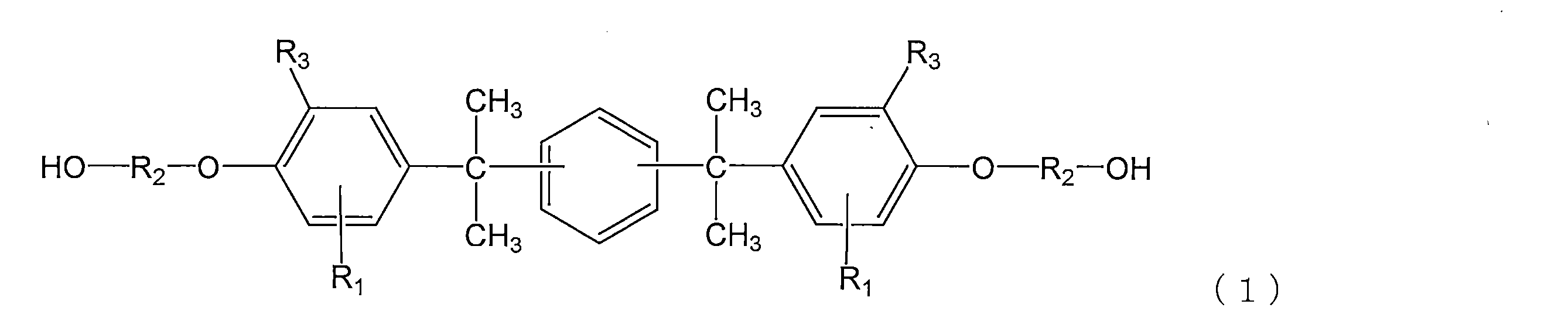
- thermoplastic resin containing a structural unit (A) derived from a compound represented by the following general formula (1).
- each R 1 independently represents a hydrogen atom or a linear or branched alkyl group having 1 to 4 carbon atoms
- each R 2 independently represents an alkylene group having 1 to 4 carbon atoms
- each R 3 independently represents a linear, branched, or cyclic alkyl group having 4 to 6 carbon atoms.
- R 1 in the general formula (1) examples include a methyl group, an ethyl group, an isopropyl group, and a t-butyl group.
- R 1 's each independently represent preferably a hydrogen atom, a methyl group, an ethyl group, an isopropyl group or a t-butyl group, more preferably a hydrogen atom or a methyl group, and particularly preferably both are a methyl group.
- the two R 1s are the same substituent.
- each R 2 is preferably independently a methylene group, a 1,2-ethylene group, a 1-methyl-1,2-ethylene group or a 2-methyl-1,2-ethylene group, and more preferably a 1,2-ethylene group.
- the two R 2 s are the same substituent.
- R3 is preferably each independently a branched or cyclic alkyl group having 4 to 6 carbon atoms, preferably each independently a branched tertiary alkyl group having 4 to 6 carbon atoms or a cyclic alkyl group having 5 or 6 carbon atoms, more preferably each independently a t-butyl group or a cyclohexyl group, and particularly preferably both are a cyclohexyl group.
- the two R 3 s are the same substituent.
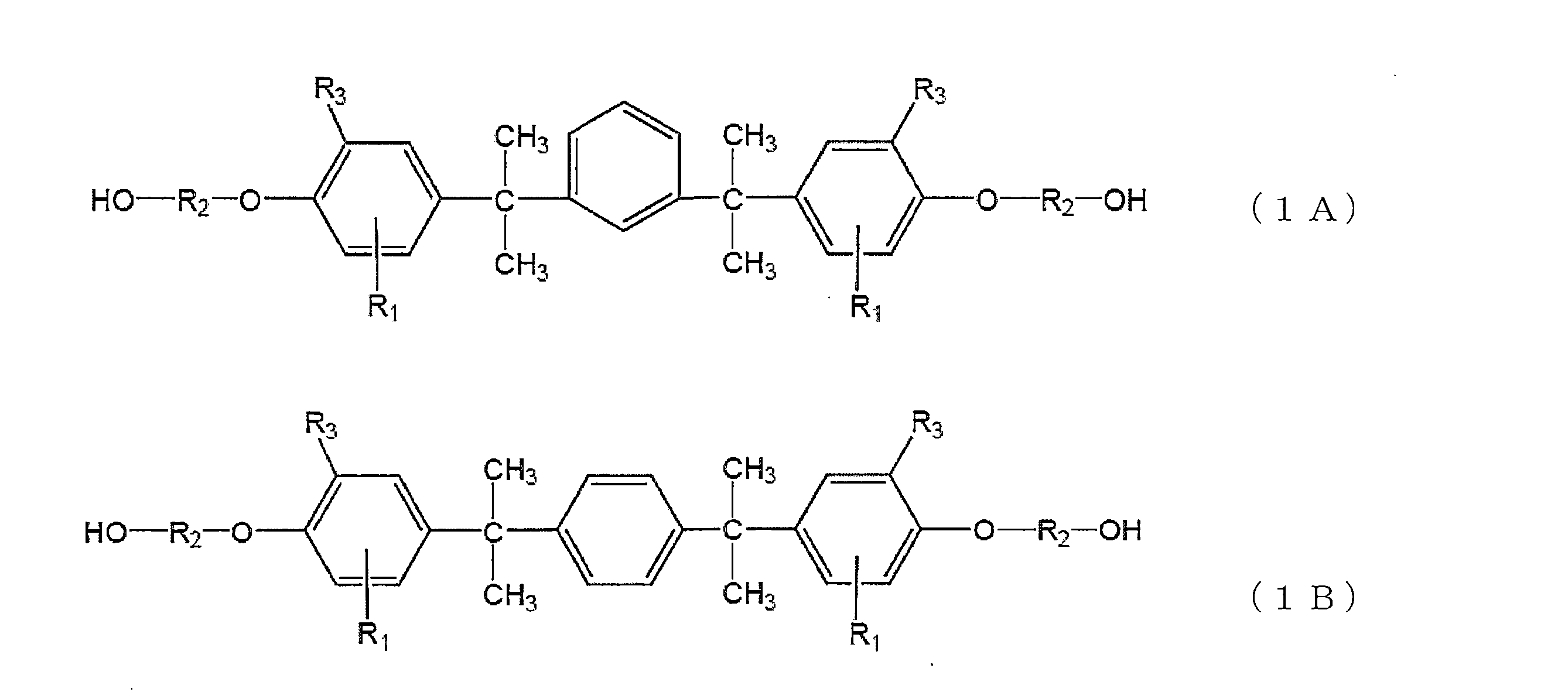
- the compound (1) of the present invention is preferably a compound represented by general formula (1A) (hereinafter may be referred to as compound (1A)) or a compound represented by general formula (1B) (hereinafter may be referred to as compound (1B)), and the compound represented by general formula (1A) is particularly preferred.
- R 1 , R 2 and R 3 are defined the same as in the general formula (1), and preferred embodiments are also the same.
- Specific examples of the compound (1) of the present invention include compounds represented by formulas (1-1) to (1-10).
- the compounds represented by formulas (1-1) to (1-5) are specific examples of compound (1A). Among them, compounds (1-1), (1-2), (1-4) and (1-5) are preferred, compounds (1-2), (1-4) and (1-5) are more preferred, compounds (1-2) and (1-4) are even more preferred, and compound (1-2) is particularly preferred.
- the compounds represented by formulas (1-6) to (1-10) are specific examples of compound (1B). Among them, compounds (1-6), (1-7), (1-9) and (1-10) are preferred, compounds (1-7), (1-9) and (1-10) are more preferred, compounds (1-7) and (1-9) are even more preferred, and compound (1-7) is particularly preferred.
- R1 and R3 are defined as in the general formula (1), and preferred embodiments are also the same.
- Compound (2) is preferably a compound represented by general formula (2A) (hereinafter may be referred to as compound (2A)) or a compound represented by general formula (2B) (hereinafter may be referred to as compound (2B)), and is particularly preferably a compound represented by general formula (2A).
- R1 and R3 are defined as in general formula (1).
- R1 and R3 in the general formula (2A) and the general formula (2B) are defined the same as in the general formula (1), and the preferred embodiments are also the same.
- Specific examples of the compound (2) include compounds represented by formulas (2-1) to (2-10).
- the compounds represented by formulas (2-1) to (2-5) are specific examples of compound (2A). Among them, compounds (2-1), (2-2), (2-4) and (2-5) are preferred, compounds (2-2), (2-4) and (2-5) are more preferred, compounds (2-2) and (2-4) are even more preferred, and compound (2-2) is particularly preferred.
- the compounds represented by the formulas (2-6) to (2-10) are specific examples of the compound (2B). Among them, the compounds (2-6), (2-7), (2-9) and (2-10) are preferred, the compounds (2-7), (2-9) and (2-10) are more preferred, the compounds (2-7) and (2-9) are even more preferred, and the compound (2-7) is particularly preferred.
- Examples of the hydroxyalkylene oxidizing agent that can be used depending on the target compound include carbonates (3) represented by the following general formula (3), such as ethylene carbonate and propylene carbonate; halogenated alcohols, such as 2-chloroethanol and 3-chloro-1-propanol; and alkylene oxides, such as ethylene oxide.
- carbonates (3) represented by the following general formula (3) such as ethylene carbonate and propylene carbonate
- halogenated alcohols such as 2-chloroethanol and 3-chloro-1-propanol
- alkylene oxides such as ethylene oxide.
- R2 in formula (3) is the same as in formula (1), and the preferred embodiments are also the same.
- reaction scheme for obtaining the compound used in the present invention when a carbonate (3) represented by the general formula (3) is used as the hydroxyalkylene oxidizing agent is exemplified below.
- a reaction scheme in which a hydroxyalkylene oxidizing reaction is carried out using compound (2-2) as compound (2) and ethylene carbonate as a hydroxyalkylene oxidizing agent to obtain compound (1-2) as compound (1) is illustrated.
- the method for producing the compound (1) when the carbonate (3) is used as the alkylene oxidizing agent as shown in the above reaction formula will be described below.
- the raw material molar ratio of compound (2) to carbonates (3), compound (2)/carbonates (3) is usually in the range of 1/2 to 1/5, preferably in the range of 1/2 to 1/4, more preferably in the range of 1/2 to 1/3, and particularly preferably in the range of 1/2 to 1/2.5.
- a basic catalyst In the above-mentioned production method, it is preferable to use a basic catalyst during the reaction, and as the basic catalyst, a generally known catalyst can be used. Specific examples include triorganophosphine compounds such as triphenylphosphine and tributylphosphine, amine catalysts such as 1-methylimidazole, and alkali catalysts such as potassium carbonate, calcium carbonate, magnesium carbonate, magnesium hydroxide, calcium hydroxide, sodium hydroxide, sodium hydrogen carbonate, methoxysodium, and phenoxysodium. These basic catalysts may be used alone or in combination of two or more. The amount of the basic catalyst used is 0.001 to 10% by weight, preferably 0.01 to 5% by weight, and more preferably 0.1 to 5% by weight, of the compound (2).
- triorganophosphine compounds such as triphenylphosphine and tributylphosphine
- amine catalysts such as 1-methylimidazole
- alkali catalysts
- reaction Solvent Although it is possible to carry out the reaction without a solvent by using an excess amount of the carbonate (3), it is usually preferable to carry out the reaction using an organic solvent from the viewpoints of economy and operability. When a reaction solvent is used, various known solvents that are inert to the reaction can be used.
- reaction solvents examples include aromatic hydrocarbon solvents such as toluene and xylene, ether solvents such as tetrahydrofuran, dioxane, and 1,2-dimethoxyethane, aliphatic ketone solvents such as acetone and methyl isobutyl ketone, halogenated hydrocarbon solvents such as chloroform and 1,2-dichloroethane, aliphatic alcohol solvents such as butanol and ethylene glycol, and polar solvents such as dimethylformamide and dimethylsulfoxide.
- aromatic hydrocarbon solvents having 6 to 9 carbon atoms or aliphatic ketone solvents having 3 to 9 carbon atoms are preferred.
- the amount of the reaction solvent used is not particularly limited, but is preferably in the range of 0.5 to 10 times by weight, more preferably 0.5 to 5 times by weight, based on the amount of compound (2).
- phase transfer catalyst In the above-mentioned production method, it is preferable to use a phase transfer catalyst during the reaction, and as the phase transfer catalyst, a generally known one can be used. Specific examples of the phase transfer catalyst that can be preferably used include quaternary ammonium salts or quaternary phosphonium salts, and quaternary ammonium salts are more preferable.
- phase transfer catalysts include tetrabutylammonium chloride, tetrabutylammonium bromide, tetraethylammonium chloride, tetraethylammonium bromide, tetramethylammonium chloride, and tetramethylammonium bromide.
- Specific examples of the quaternary phosphonium salts include tetrabutylphosphonium chloride, tetrabutylphosphonium bromide, and tetraphenylphosphonium bromide.
- phase transfer catalysts may be used alone or in combination of two or more kinds. The amount of the phase transfer catalyst used is in the range of 0.001 to 10% by weight of the compound (2), and preferably in the range of 0.01 to 1% by weight.
- reaction temperature is not particularly limited as long as the reaction proceeds at the temperature, but is usually carried out under heating.
- the reaction is usually carried out in the range of 50 to 250°C, preferably in the range of 70 to 200°C, and more preferably in the range of 100 to 180°C. It is more preferable to carry out the reaction under reflux of the solvent.
- the reaction time depends on the reaction temperature, the amounts and types of the compound (2), carbonates (3), basic catalyst, reaction solvent, and phase transfer catalyst used, etc., but is usually about 3 to 48 hours. In this reaction, the time when the generation of carbon dioxide gas ceases can be regarded as the target of reaction completion.
- a neutralization step in which the basic catalyst is neutralized by adding an acid-containing water (e.g., hydrochloric acid, sulfuric acid), acetic acid, propionic acid, etc. to the obtained reaction solution.
- This neutralization step may be carried out after the hydrolysis step described below.
- a water-washing step may be performed in which a solvent that dissolves compound (1) and separates from water (e.g., an aliphatic ketone solvent having 5 to 9 carbon atoms) is added to form a solution, and the solution is washed with water.
- a water-washing step may be performed, and is preferable.
- the liquid that has undergone the above steps can be subjected to steps such as crystallization, filtration, distillation, separation steps using column chromatography, etc., drying, etc., to obtain the target compound, Compound (1).
- further purification by distillation, recrystallization, or column chromatography may be performed in accordance with a conventional method.
- Another method for producing the bis[1-methyl-1-(4-hydroxyalkoxy-3-alkylphenyl)-1-methylethyl]benzene compound represented by the general formula (1) of the present invention includes a production method in which a 4-hydroxyalkoxy-3-alkylbenzene (benzene (4)) represented by the general formula (4) is reacted with a diol (5) represented by the general formula (5).
- benzene (4) 4-hydroxyalkoxy-3-alkylbenzene represented by the general formula (4)
- diol (5) represented by the general formula (5).
- R 1 , R 2 and R 3 are defined as in the general formula (1), and preferred embodiments are also the same.
- Specific examples of the benzenes (4) include compounds represented by the formulas (4-1) to (4-5). Among these, the compounds (4-1), (4-2), (4-4) and (4-5) are preferred, the compounds (4-1), (4-2) and (4-5) are more preferred, the compounds (4-1) and (4-2) are further preferred, and the compound (4-2) is particularly preferred.
- ⁇ Diol (5) represented by general formula (5)> Specific examples of the diol (5) include 1,4-di(2-hydroxyisopropyl)benzene, 1,3-di(2-hydroxyisopropyl)benzene, and 1,2-di(2-hydroxyisopropyl)benzene. Among these, 1,4-di(2-hydroxyisopropyl)benzene or 1,3-di(2-hydroxyisopropyl)benzene is preferred, and 1,3-di(2-hydroxyisopropyl)benzene is particularly preferred.
- the amount of benzenes (4) used is preferably in the range of 5 to 12 moles per mole of diol (5), more preferably in the range of 7 to 10 moles, and even more preferably 8 moles.
- the above-mentioned production method is preferably carried out in the presence of an acid catalyst.
- Preferred acid catalysts include concentrated hydrochloric acid, sulfuric acid, hydrochloric acid gas, etc., and among them, it is more preferable to use hydrochloric acid gas until it becomes saturated in the reaction liquid.
- the reaction is usually carried out in the presence of a solvent, which is not particularly limited as long as it does not inhibit the reaction.
- the above production method may be carried out either in air or in an inert gas atmosphere, but is preferably carried out in an inert gas atmosphere such as nitrogen or argon in order to suppress coloration of the reaction product.
- the reaction temperature is usually in the range of 20 to 60°C, preferably in the range of 20 to 40°C.
- the reaction may be carried out under normal pressure, elevated pressure, or reduced pressure, but is preferably carried out under normal pressure.
- the resulting reaction mixture can be separated and purified in a conventional manner to obtain compound (1) from the reaction mixture.
- ⁇ Crystal of the compound represented by formula (1-2)> the compound represented by formula (1-2) (compound (1-2): 1,3-bis[1-methyl-1- ⁇ 4-(2-hydroxyethoxy)-3-cyclohexyl-6-methylphenyl ⁇ ethyl]benzene crystals) are very useful in industrial production because compound (1-2) can be handled as a crystalline solid and is therefore excellent in handleability and transportability.
- the crystal of compound (1-2) used in the present invention has an endothermic peak top temperature in differential scanning calorimetry in the range of 205 to 215°C, more preferably in the range of 206 to 214°C, even more preferably in the range of 207 to 213°C, and particularly preferably in the range of 207 to 211°C.
- the crystal of compound (1-2) used in the present invention has diffraction peaks at diffraction angles 2 ⁇ of 7.1 ⁇ 0.2°, 14.6 ⁇ 0.2°, and 16.1 ⁇ 0.2° in the powder X-ray diffraction peak pattern using Cu-K ⁇ radiation.
- the diffraction angles 2 ⁇ have peaks at 20.4 ⁇ 0.2°, 21.4 ⁇ 0.2°, 22.0 ⁇ 0.2°, and 23.3 ⁇ 0.2°. In addition, it is even more preferable that the diffraction angles 2 ⁇ have peaks at 11.8 ⁇ 0.2°, 12.4 ⁇ 0.2°, and 18.5 ⁇ 0.2°.
- the purity of the crystals of compound (1-2) used in the present invention is preferably 90% or more, more preferably 93% or more, even more preferably 95% or more, and particularly preferably 98% or more, in terms of area percentage by liquid chromatography analysis.
- the crystals of the compound (1-2) used in the present invention can be obtained by precipitating the crystals from a solution containing the compound (1-2) and an aliphatic ketone solvent having 5 to 9 carbon atoms.
- the crystals of the compound (1-2) can be obtained by precipitating the crystals by cooling a solution in which the compound is dissolved in an aliphatic ketone solvent having 5 to 9 carbon atoms, or by distilling off the aliphatic ketone solvent having 5 to 9 carbon atoms from the solution, or by mixing a hydrocarbon solvent into the solution.
- Examples of the aliphatic ketone solvent having 5 to 9 carbon atoms include chain aliphatic ketone solvents having 5 to 9 carbon atoms, such as diethyl ketone (5 carbon atoms), methyl isobutyl ketone (6 carbon atoms), methyl amyl ketone (7 carbon atoms), and methyl hexyl ketone (8 carbon atoms), and cyclic aliphatic ketone solvents having 5 to 9 carbon atoms, such as cyclopentanone and cyclohexanone.
- chain aliphatic ketone solvents having 5 to 9 carbon atoms such as diethyl ketone (5 carbon atoms), methyl isobutyl ketone (6 carbon atoms), methyl amyl ketone (7 carbon atoms), and methyl hexyl ketone (8 carbon atoms
- cyclic aliphatic ketone solvents having 5 to 9 carbon atoms such as cyclopentanone and cycl
- cyclic aliphatic ketone solvents having 5 to 9 carbon atoms are preferred, cyclopentanone or cyclohexanone are more preferred, and cyclohexanone is particularly preferred.
- this cyclic aliphatic ketone solvent having 5 to 9 carbon atoms it is possible to wash the solution with water before precipitating crystals, and to remove water-soluble impurities such as the basic catalyst, salts produced in the neutralization step, and glycols produced in the hydrolysis step.
- the amount of the aliphatic ketone solvent used is preferably in the range of 1 to 20 times by weight, more preferably in the range of 2 to 15 times by weight, further preferably in the range of 2 to 10 times by weight, and particularly preferably in the range of 2 to 8 times by weight, relative to the weight of compound (1-2).
- aromatic hydrocarbon solvents having 6 to 9 carbon atoms include benzene, toluene, and xylene. Among these, aromatic hydrocarbon solvents having 7 or 8 carbon atoms are preferred, and toluene is particularly preferred.
- hydrocarbon solvents other than aromatic hydrocarbon solvents having 6 to 9 carbon atoms include linear or cyclic aliphatic hydrocarbon solvents having 5 to 10 carbon atoms.
- linear aliphatic hydrocarbon solvents having 6 to 8 carbon atoms or cyclic aliphatic hydrocarbon solvents having 5 or 6 carbon atoms are preferred, and heptane, octane, isooctane, cyclopentane, or cyclohexane are more preferred.
- the amount of the hydrocarbon solvent used is preferably in the range of 1 to 10 times by weight, more preferably in the range of 1 to 7 times by weight, and even more preferably in the range of 1 to 5 times by weight, relative to the amount of compound (1-2), and is preferably in the range of 0.1 to 4.0 times by weight, more preferably in the range of 0.2 to 2.0 times by weight, even more preferably in the range of 0.2 to 1.5 times by weight, and particularly preferably in the range of 0.2 to 1.0 times by weight relative to the amount of the aliphatic ketone solvent having 5 to 9 carbon atoms.
- the temperature at which the solution of compound (1-2) in an aliphatic ketone having 5 to 9 carbon atoms is mixed with the hydrocarbon solvent varies depending on the aliphatic ketone used, but is preferably in the range of 50 to 120°C, more preferably in the range of 50 to 100°C, and even more preferably in the range of 50 to 90°C.
- the temperature at which the crystals of the compound (1-2) begin to precipitate is preferably in the range of 10 to 80°C, and more preferably in the range of 30 to 70°C.
- the crystals obtained by the above method can be isolated by standard methods, for example, by centrifugal filtration. It is also preferable to further wash the crystals with a solvent. The solvent used can be removed by drying the obtained crystals.
- All steps in the above-mentioned method for producing compound (1) used in the present invention are preferably carried out in an atmosphere with little oxygen, which can cause oxidative deterioration, coloration, and electrostatic ignition due to volatile solvents, or in an inert gas atmosphere such as nitrogen or argon.
- the thermoplastic resin in one embodiment of the present invention is not particularly limited and may be a polyester resin, a polycarbonate resin, a polyester carbonate resin, an epoxy resin, a polyurethane resin, a polyacrylic acid ester resin, a polymethacrylic acid ester resin, or the like. However, it is preferably a polycarbonate resin, a polyester carbonate resin, or a polyester resin, and more preferably contains a structural unit (A) represented by the following formula: (In the formula, R 1 , R 2 and R 3 are defined as in general formula (1).)
- the proportion of the structural unit (A) represented by the above formula in all structural units is not particularly limited, but is preferably 1 to 80 mol %, more preferably 1 to 60 mol %, and particularly preferably 5 to 50 mol %, of all structural units.
- the thermoplastic resin of one embodiment of the present invention can contain, in addition to the structural unit (A) represented by the above formula, a structural unit derived from an aliphatic dihydroxy compound or a structural unit derived from an aromatic dihydroxy compound that is generally used as a structural unit of a polycarbonate resin or a polyester carbonate resin.
- various aliphatic dihydroxy compounds may be mentioned, including in particular 1,4-cyclohexanedimethanol, tricyclodecane dimethanol, 1,3-adamantanedimethanol, 2,2-bis(4-hydroxycyclohexyl)-propane, 3,9-bis(2-hydroxy-1,1-dimethylethyl)-2,4,8,10-tetraoxaspiro[5.5]undecane, 2-(5-ethyl-5-hydroxymethyl-1,3-dioxan-2-yl)-2-methylpropan-1-ol, isosorbide, 1,3-propanediol, 1,4-butanediol, and 1,6-hexanediol.
- aromatic dihydroxy compounds include various compounds, particularly 2,2-bis(4-hydroxyphenyl)propane (bisphenol A), bis(4-hydroxyphenyl)methane, 1,1-bis(4-hydroxyphenyl)ethane, 2,2-bis(4-hydroxy-3,5-dimethylphenyl)propane, 4,4'-dihydroxydiphenyl, bis(4-hydroxyphenyl)cycloalkane, bis(4-hydroxyphenyl)oxide, bis(4-hydroxyphenyl)sulfide, bis(4-hydroxyphenyl)sulfone, bis(4-hydroxyphenyl)sulfoxide, bis(4-hydroxyphenyl)ketone, bisphenoxyethanolfluorene, and the like.
- bisphenol A 2,2-bis(4-hydroxyphenyl)propane
- bis(4-hydroxyphenyl)methane 1,1-bis(4-hydroxyphenyl)ethane
- the thermoplastic resin according to one embodiment of the present invention preferably contains a structural unit (B) derived from a monomer represented by the following general formula (6).
- R a and R b are each independently selected from the group consisting of a halogen atom, an alkyl group having 1 to 20 carbon atoms which may have a substituent, an alkoxyl group having 1 to 20 carbon atoms which may have a substituent, a cycloalkyl group having 5 to 20 carbon atoms which may have a substituent, a cycloalkoxyl group having 5 to 20 carbon atoms which may have a substituent, an aryl group having 6 to 20 carbon atoms which may have a substituent, a heteroaryl group having 6 to 20 carbon atoms which may have a substituent and which contains one or more heterocyclic atoms selected from O, N, and S, an aryloxy group having 6 to 20 carbon atoms which may have a substituent, and -
- R h represents an aryl group having 6 to 20 carbon atoms which may have a substituent, or a heteroaryl group having 6 to 20 carbon atoms which may have a substituent and which contains one or more heterocyclic atoms selected from O, N, and S.
- R a and R b are preferably a hydrogen atom, an aryl group having 6 to 20 carbon atoms which may have a substituent, or a heteroaryl group having 6 to 20 carbon atoms which contains one or more hetero ring atoms selected from O, N and S and which may have a substituent, more preferably a hydrogen atom, an aryl group having 6 to 20 carbon atoms which may have a substituent, and even more preferably a hydrogen atom, or an aryl group having 6 to 12 carbon atoms which may have a substituent.
- X represents a single bond or a fluorene group which may have a substituent.
- X is preferably a single bond or a fluorene group which may have a substituent and has a total of 12 to 20 carbon atoms.
- a and B each independently represent an alkylene group having 1 to 5 carbon atoms, which may have a substituent, and preferably an alkylene group having 2 or 3 carbon atoms.
- m and n each independently represent an integer of 0 to 6, preferably an integer of 0 to 3, and more preferably 0 or 1.
- a and b each independently represent an integer of 0 to 10, preferably an integer of 1 to 3, and more preferably 1 or 2.
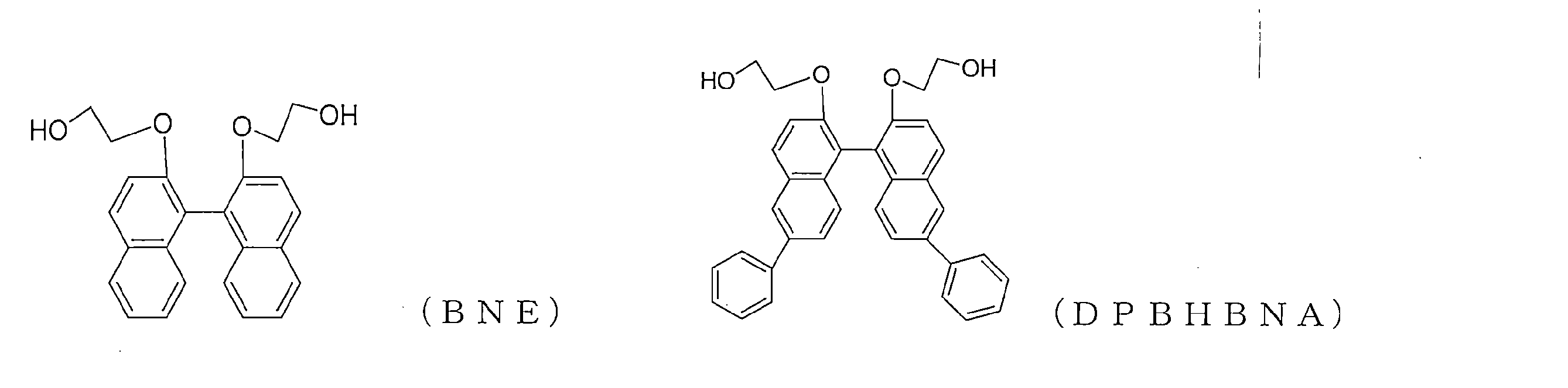
- structural unit (B) examples include those derived from 2,2'-bis(2-hydroxyethoxy)-1,1'-binaphthalene (BNE), DPBHBNA, and the like.
- thermoplastic resin according to one embodiment of the present invention preferably has a structural unit (C) derived from a monomer represented by the following general formula (7).
- R c and R d are each independently selected from the group consisting of a halogen atom, an alkyl group having 1 to 20 carbon atoms which may have a substituent, an alkoxyl group having 1 to 20 carbon atoms which may have a substituent, a cycloalkyl group having 5 to 20 carbon atoms which may have a substituent, a cycloalkoxyl group having 5 to 20 carbon atoms which may have a substituent, and an aryl group having 6 to 20 carbon atoms which may have a substituent.
- R c and R d are preferably a hydrogen atom, an aryl group having 6 to 20 carbon atoms which may have a substituent, or a heteroaryl group having 6 to 20 carbon atoms which contains one or more hetero ring atoms selected from O, N and S and which may have a substituent, more preferably a hydrogen atom, an aryl group having 6 to 20 carbon atoms which may have a substituent, and even more preferably a hydrogen atom, or an aryl group having 6 to 12 carbon atoms which may have a substituent.
- Y 1 is a single bond, a fluorene group which may have a substituent, or any one of the structural formulae represented by the following formulae (8) to (15), and is preferably a single bond or a structural formula represented by the following formula (8).
- R 61 , R 62 , R 71 , R 72 , R 81 and R 82 each independently represent a hydrogen atom, a halogen atom, an alkyl group having 1 to 20 carbon atoms which may have a substituent, or an aryl group having 6 to 30 carbon atoms which may have a substituent, or R 61 and R 62 , or R 71 and R 72 bond together to form a carbocyclic or heterocyclic ring having 1 to 20 carbon atoms which may have a substituent.
- r and s each independently represent an integer of 0 to 5,000.
- a and B are each independently an alkylene group having 1 to 5 carbon atoms, which may have a substituent, and preferably an alkylene group having 2 or 3 carbon atoms.
- p and q are each independently an integer from 0 to 4, and preferably 0 or 1.
- a and b are each independently an integer from 0 to 10, and preferably an integer from 0 to 5, and more preferably an integer from 0 to 2, for example, 0 or 1.
- structural unit (C) examples include BCFL (9,9-bis(4-hydroxy-3-methylphenyl)fluorene), BPEF (9,9-bis(4-(2-hydroxyethoxy)phenyl)fluorene), BPPEF (9,9-bis(4-(2-hydroxyethoxy)-3-phenylphenyl)fluorene), BNEF (9,9-bis[6-(2-hydroxyethoxy)naphthalen-2-yl]fluorene), bisphenol A, bisphenol AP, bisphenol AF, bisphenol B, bisphenol BP, bisphenol C, bis(4-hydroxyphenyl)-2,2-dichloroethylene, bisphenol E, bisphenol F, bisphenol G, bisphenol M (BPM), bisphenol S, bisphenol P, bisphenol PH, bisphenol TMC, bisphenol P-AP (4,4'-(1-phenylethylidene)bisphenol), bisphenol P-CDE (4,4'-cyclohexyl)phenyl, and bis
- the thermoplastic resin according to one embodiment of the present invention may contain a structural unit derived from a monomer represented by the following general formula (8).
- Each L 1 independently represents a divalent linking group
- R 3 and R 4 each independently represent a halogen atom or a substituent having 1 to 20 carbon atoms which may contain an aromatic group
- j3 and j4 each independently represent an integer of 0 to 4
- t represents an integer of 0 or 1.
- thermoplastic resin essentially contains the structural unit (A), but may also be a polymer containing the structural unit (B) but not containing the structural unit (C), a polymer containing the structural unit (C) but not containing the structural unit (B), a copolymer containing the structural unit (B) and the structural unit (C), a mixture of a polymer containing the structural unit (B) and a polymer containing the structural unit (C), or a combination thereof.
- Examples of the polymer containing the structural unit (C) but not containing the structural unit (B) include those having structural units of the following formulae (I-1) to (I-3), and examples of the copolymer having the structural unit (B) and the structural unit (C) include those having structural units of the following formulae (II-1) to (II-4).
- m and n each represent an integer of 1 to 10, preferably an integer of 1 to 5, and more preferably 1;
- the number of repeating units of formula (I-3) is an integer from 1 to 10, preferably an integer from 1 to 5, and more preferably 1.
- the polymer having multiple types of constitutional units either a block copolymer in which the values of m and n are large, for example, 100 or more, or a random copolymer can be used, but a random copolymer is preferred, and more preferably a random copolymer in which the values of m and n are 1 is used.
- m and n each independently represent an integer of 1 to 10, preferably an integer of 1 to 5, and more preferably 1.
- a block copolymer in which the values of m and n are large for example, 100 or more, or a random copolymer can be used, but a random copolymer is preferred, and more preferably a random copolymer in which the values of m and n are 1 is used.
- the molar ratio of the structural unit (B) to the structural unit (C) is preferably 1:99 to 99:1, more preferably 10:90 to 90:10, even more preferably 15:85 to 85:15, and particularly preferably 30:70 to 70:30.
- the mass ratio of the polymer having the structural unit (B) to the polymer having the structural unit (C) is preferably 1:99 to 99:1, more preferably 10:90 to 90:10, even more preferably 15:85 to 85:15, and particularly preferably 30:70 to 70:30.
- thermoplastic resin according to one embodiment of the present invention preferably further contains a structural unit derived from at least one monomer selected from the following monomer group:
- R1 and R2 each independently represent a hydrogen atom, a methyl group, or an ethyl group
- R3 and R4 each independently represent an aryl group, a hydrogen atom, a methyl group, an ethyl group, or an alkylene glycol having 2 to 5 carbon atoms
- i and ii each independently represent an integer of 1 to 3.
- impurities such as alcohol-based compounds such as phenol-based compounds that may be generated as by-products during production, and diol components or carbonate diesters that remain unreacted may be present.
- Impurities such as alcohol compounds such as phenol compounds and carbonic acid diesters can cause a decrease in strength and odor when molded into a molded article, so it is preferable that the content of these compounds is as small as possible.
- the content of the residual phenolic compounds is preferably 3,000 ppm by mass or less, more preferably 1,000 ppm by mass or less, and particularly preferably 300 ppm by mass or less, based on 100% by mass of the polycarbonate resin.
- the content of the remaining diol component is preferably 1,000 ppm by mass or less, more preferably 100 ppm by mass or less, and particularly preferably 10 ppm by mass or less, based on 100% by mass of the polycarbonate resin.
- the content of the remaining carbonate diester is preferably 1,000 ppm by mass or less, more preferably 100 ppm by mass or less, and particularly preferably 10 ppm by mass or less, based on 100% by mass of the polycarbonate resin.
- the content of compounds such as phenol and t-butylphenol is small, and it is preferable that the content of these compounds is within the above range.
- the content of the phenolic compound remaining in the polycarbonate resin can be measured by a method in which the phenolic compound extracted from the polycarbonate resin is analyzed by gas chromatography.
- the content of the alcohol-based compound remaining in the polycarbonate resin can also be measured by a method in which the alcohol-based compound extracted from the polycarbonate resin is analyzed by gas chromatography.
- the contents of the diol component and the carbonate diester remaining in the polycarbonate resin can also be measured by a method in which these compounds are extracted from the polycarbonate resin and analyzed by gas chromatography.
- the content of by-produced alcohol compounds such as phenolic compounds, diol components and carbonate diesters may be reduced to the point of being undetectable, but from the viewpoint of productivity, they may be present in small amounts as long as they do not impair the effect. Also, small amounts can improve the plasticity of the resin when it is melted.
- each of the remaining phenolic compounds, diol components, or carbonate diesters may be, for example, 0.01 ppm by mass or more, 0.1 ppm by mass or more, or 1 ppm by mass or more, relative to 100% by mass of the polycarbonate resin.
- the content of the remaining alcohol-based compound may be, for example, 0.01 ppm by mass or more, 0.1 ppm by mass or more, or 1 ppm by mass or more, relative to 100% by mass of the polycarbonate resin.
- the content of by-produced alcohol compounds such as phenolic compounds, diol components and carbonate diesters in the polycarbonate resin can be adjusted to fall within the above range by appropriately adjusting the polycondensation conditions and the settings of the equipment. It can also be adjusted by the conditions of the extrusion process after polycondensation.
- the amount of by-product alcohol compounds such as phenolic compounds remaining is related to the type of carbonic acid diester used in the polymerization of polycarbonate resin, the polymerization reaction temperature, and the polymerization pressure. By adjusting these factors, the amount of by-product alcohol compounds such as phenolic compounds remaining can be reduced.
- the content of by-produced alcohol compounds remaining in the obtained polycarbonate resin is 3000 ppm by mass or less relative to the polycarbonate resin (100% by mass).
- the content of the remaining alcohol compounds is preferably 3000 ppm by mass or less, more preferably 1000 ppm by mass or less, and particularly preferably 300 ppm by mass or less relative to 100% by mass of the polycarbonate resin.
- thermoplastic resin has a high refractive index, and the refractive index is preferably 1.500 to 1.700, more preferably 1.550 to 1.700, and particularly preferably 1.580 to 1.650.
- the refractive index can be measured by the method described in the examples below.
- the Abbe number of the thermoplastic resin is preferably 22.0 to 35.0, more preferably 22.0 to 33.0, even more preferably 23.0 to 32.0, and particularly preferably 23.0 to 30.0.
- the Abbe number can be measured by the method described in the examples below.
- one of the features of the thermoplastic resin is high heat resistance, and the glass transition temperature (Tg) is preferably 125 to 150° C., more preferably 125 to 145° C., even more preferably 125 to 140° C., and particularly preferably 127 to 135° C.
- the glass transition temperature can be measured by the method described in the examples below.
- the polystyrene-equivalent weight average molecular weight of the thermoplastic resin is preferably 10,000 to 100,000, more preferably 10,000 to 80,000, and particularly preferably 10,000 to 60,000.
- one of the features of the thermoplastic resin is that it has a low photoelastic coefficient, and the photoelastic coefficient is preferably 25 to 45, more preferably 25 to 38, and particularly preferably 28 to 38.
- the photoelastic coefficient can be measured by the method described in the examples below.
- one of the features of the thermoplastic resin is that it has a low water absorption, and the water absorption is preferably 0.40% or less, and more preferably 0.36% or less.
- the lower limit is usually about 0.1%.
- the water absorption can be measured by the method described in the examples below.
- one of the features of the thermoplastic resin is that the water absorption dimensional change rate is low, and the water absorption dimensional change rate is preferably 0.045% or less, and more preferably 0.040% or less. The lower limit is usually about 0.01%.
- the water absorption dimensional change rate can be measured by the method described in the examples below.
- thermoplastic resin composition containing the above-mentioned thermoplastic resin and an additive.
- the thermoplastic resin composition of this embodiment does not impair the desired effect of this embodiment.
- resins other than the thermoplastic resin of the present invention containing the structural unit (A) can be used in combination.
- Such resins are not particularly limited, but examples thereof include polycarbonate resins, polyester resins, polyester carbonates, etc.
- Resin (meth)acrylic resin, polyamide resin, polystyrene resin, cycloolefin resin, acrylonitrile-butadiene-styrene copolymer resin, vinyl chloride resin, polyphenylene ether resin, polysulfone resin, polyacetal resin, and methyl methacrylate-styrene copolymer resin.
- various known resins can be used, and one type can be added alone or two or more types can be added in combination to the thermoplastic resin composition.
- the thermoplastic resin composition preferably contains an antioxidant as the additive.
- an antioxidant it is preferable to contain at least one of a phenol-based antioxidant and a phosphite-based antioxidant.
- Phenolic antioxidants include 1,3,5-tris(3,5-di-tert-butyl-4-hydroxyphenylmethyl)-2,4,6-trimethylbenzene, 1,3,5-tris(3,5-di-tert-butyl-4-hydroxybenzyl)-1,3,5-triazine-2,4,6(1H,3H,5H)-trione, 4,4',4''-(1-methylpropanyl-3-ylidene)tris(6-tert-butyl-m-cresol), 6,6'-di-tert-butyl-4,4'-butylidene-m-cresol, ocladecyl 3-(3,5-di-tert-butyl-4-hydroxyphenyl)propionate, pentane
- phosphite antioxidants include 2-ethylhexyl diphenyl phosphite, isodecyl diphenyl phosphite, triisodecyl phosphite, triphenyl phosphite, 3,9-bis(octadecyloxy)-2,4,8,10-tetraoxy-3,9-diphosphaspiro[5.5]undecane, 3,9-bis(2,6-di-tert-butyl-4-methylphenoxy)-2,4,8,10-tetraoxa-3,9-diphosphaspiro[5.5]undecane, 2,2'-methylenbis(4,6-di-tert-butylphenyl)2-ethylhexyl phosphite, Examples of the phosphite include tris(2,4-di-tert-butylphenyl)phosphite, tris(nonylphenyl)
- the antioxidant is preferably contained in an amount of 1 ppm by weight to 3000 ppm by weight based on the total weight of the resin composition.
- the content of the antioxidant in the thermoplastic resin composition is more preferably 50 ppm by weight to 2500 ppm by weight, even more preferably 100 ppm by weight to 2000 ppm by weight, particularly preferably 150 ppm by weight to 1500 ppm by weight, and even more preferably 200 ppm by weight to 1200 ppm by weight.
- the thermoplastic resin composition preferably contains a release agent as the additive.
- the release agent include ester compounds, for example, glycerin fatty acid esters such as mono- and diglycerides of glycerin fatty acid, glycol fatty acid esters such as propylene glycol fatty acid esters and sorbitan fatty acid esters, higher alcohol fatty acid esters, full esters or mono fatty acid esters of aliphatic polyhydric alcohols and aliphatic carboxylic acids, etc.
- ester compounds for example, glycerin fatty acid esters such as mono- and diglycerides of glycerin fatty acid, glycol fatty acid esters such as propylene glycol fatty acid esters and sorbitan fatty acid esters, higher alcohol fatty acid esters, full esters or mono fatty acid esters of aliphatic polyhydric alcohols and aliphatic carboxylic acids, etc.
- ester compounds for example, glycerin fatty acid esters such
- sorbitan fatty acid esters such as sorbitan stearate, sorbitan laurate, sorbitan oleate, sorbitan trioleate, sorbitan tribehenate, sorbitan stearate, sorbitan tristearate, and sorbitan caprylate
- propylene glycol fatty acid esters such as propylene glycol monostearate, propylene glycol monooleate, propylene glycol monobehenate, propylene glycol monolaurate, and propylene glycol monopalmitate
- higher alcohol fatty acid esters such as stearyl stearate
- Glycerol fatty acid ester monoglycerides including: glycerol monohydroxystearates such as glycerol monostearate and glycerol mono 12-hydroxystearate, monoglycerides such as glycerol
- the release agent is preferably contained in an amount of 1 ppm by weight to 5000 ppm by weight based on the total weight of the resin composition.
- the content of the release agent in the thermoplastic resin composition is more preferably 50 ppm by weight to 4000 ppm by weight, even more preferably 100 ppm by weight to 3500 ppm by weight, particularly preferably 500 ppm by weight to 13000 ppm by weight, and even more preferably 1000 ppm by weight to 2500 ppm by weight.
- the thermoplastic resin composition may contain other additives in addition to the antioxidant and release agent described above.
- additives that may be contained in the thermoplastic resin composition include compounding agents, catalyst deactivators, heat stabilizers, plasticizers, fillers, ultraviolet absorbers, rust inhibitors, dispersants, defoamers, leveling agents, flame retardants, lubricants, dyes, pigments, bluing agents, nucleating agents, and clarifying agents.
- the content of the additives other than the antioxidant and the mold release agent in the thermoplastic resin composition is preferably 10 ppm by weight to 5.0% by weight, more preferably 100 ppm by weight to 2.0% by weight, and even more preferably 1000 ppm by weight to 1.0% by weight, but is not limited thereto.
- the above-mentioned additives may adversely affect the transmittance, and therefore it is preferable not to add them in excess, and for example, the total amount added is within the above-mentioned range.
- thermoplastic resin or thermoplastic resin composition of the present invention can be suitably used for optical members.
- an optical member containing the resin composition of the present invention is provided.
- the optical member includes, but is not limited to, an optical disk, a transparent conductive substrate, an optical card, a sheet, a film, an optical fiber, a lens, a prism, an optical film, a base, an optical filter, a hard coat film, and the like.
- the resin composition of the present invention is suitable for producing thin optical members in particular because it can be molded by a casting method with high flow.
- the optical member produced using the resin composition of the present invention may be an optical lens.
- the optical member produced using the resin composition of the present invention may be an optical film.
- an optical component containing the resin composition of the present invention is manufactured by injection molding, it is preferable to perform molding under conditions of a cylinder temperature of 260 to 350°C and a mold temperature of 90 to 170°C. More preferably, molding is performed under conditions of a cylinder temperature of 270 to 320°C and a mold temperature of 100 to 160°C. If the cylinder temperature is higher than 350°C, the resin composition will decompose and discolor, and if it is lower than 260°C, the melt viscosity will be high and molding will be difficult. Also, if the mold temperature is higher than 170°C, it will be difficult to remove a molded piece made of the resin composition from the mold. On the other hand, if the mold temperature is less than 90°C, the resin will harden too quickly in the mold during molding, making it difficult to control the shape of the molded piece, and it will be difficult to fully transfer the shape of the molded piece.
- the resin composition can be suitably used for optical lenses.
- the optical lenses produced using the resin composition of the present invention have a high refractive index and excellent heat resistance, and therefore can be used in fields where expensive high refractive index glass lenses have been used in the past, such as telescopes, binoculars, and television projectors, and are extremely useful.
- R1 and R2 each independently represent a hydrogen atom, a methyl group, or an ethyl group
- R3 and R4 each independently represent a hydrogen atom, a methyl group, an ethyl group, or an alkylene glycol having 2 to 5 carbon atoms.
- a lens molded from a resin containing a structural unit derived from any one of the monomers of the above formulas can be superimposed on the resin to be used as a lens unit.
- the optical lens of the present invention is preferably implemented as an aspherical lens if necessary.
- Aspherical lenses can reduce spherical aberration to essentially zero with a single lens, making it unnecessary to remove spherical aberration by combining multiple spherical lenses, which allows for weight reduction and reduced molding costs.
- Aspherical lenses are therefore particularly useful as camera lenses, among other optical lenses.
- the optical lens of the present invention has high molding fluidity and is therefore particularly useful as a material for optical lenses that are thin, small, and have complex shapes.
- Specific lens sizes are preferably 0.05 to 3.0 mm in thickness at the center, more preferably 0.05 to 2.0 mm, and even more preferably 0.1 to 2.0 mm in diameter, preferably 1.0 to 20.0 mm, more preferably 1.0 to 10.0 mm, and even more preferably 3.0 to 10.0 mm.
- the lens is preferably a meniscus lens with one convex side and one concave side.
- the optical lens of the present invention can be formed by any method such as metal molding, cutting, polishing, laser processing, electric discharge processing, etching, etc. Among these, metal molding is more preferable in terms of production costs.
- the resin composition can be suitably used for optical films.
- optical films produced using the polycarbonate resin of the present invention are excellent in transparency and heat resistance, and therefore are suitably used for liquid crystal substrate films, optical memory cards, and the like.
- the molding environment In order to prevent contamination of the optical film with foreign matter as much as possible, the molding environment must of course be a low-dust environment, preferably class 6 or less, more preferably class 5 or less.
- Weight average molecular weight The weight average molecular weight of the obtained resin was measured by gel permeation chromatography (GPC) and calculated in terms of standard polystyrene.
- GPC device Tosoh Corporation, HLC-8420GPC
- Detector RI detector
- Standard polystyrene Standard polystyrene kit PStQuick C, manufactured by Tosoh Corporation Sample solution: 0.2% by mass tetrahydrofuran solution
- Eluent tetrahydrofuran
- Eluent flow rate 0.6 mL/min
- Refractive Index (nD) A polycarbonate resin was molded into a V-block to prepare a test piece according to JIS B 7071-2:2018. The refractive index was measured at 23°C using a refractometer (Shimadzu Corporation KPR-3000).
- the obtained resin was dissolved in dichloromethane to obtain a resin solution.
- the resin solution was spread on a tray, and the solvent was evaporated to obtain a film having a thickness of 0.1 mm, which was used as a sample piece.
- the photoelastic coefficient was measured by an ellipsometer. Measurement method: The photoelastic coefficient was calculated by measuring the change in birefringence with respect to the change in load at a wavelength of 633 nm.
- Ellipsometer JASCO Corporation Ellipsometer M-220
- Synthesis Example 1 (Production of Compound (1-2)) 25.0 g of compound (2-2), 5.9 g of ethylene carbonate, 45.0 g of toluene, 0.62 g of potassium hydroxide, and 0.45 g of tetrabutylammonium bromide were charged into a four-neck flask, and the atmosphere in the flask was replaced with nitrogen. The liquid temperature in the flask was then raised to 105-110°C, and stirring was continued for 10 hours. The liquid temperature was then lowered to 90°C, 8.8 g of water was added, and the temperature was maintained for 1 hour.
- the temperature of the liquid was then increased to 85° C., and 3.4 g of 12% aqueous hydrochloric acid was added to neutralize the reaction liquid.
- the temperature was then lowered to 25° C., and the reaction liquid was cooled and stirred overnight.
- the crystals were then separated by filtration. 17.8 g of the filtered crystals and 178.0 g of cyclohexanone were charged into a four-neck flask and dissolved. 35.6 g of water was added to the flask and heated to 90°C. The mixture was stirred at that temperature for 30 minutes, left to stand, and the separated water layer was removed. This water washing operation was repeated three times.
- the resulting crystals were analyzed by HPLC, and the purity was found to be 98.6%.
- the crystals of the obtained compound (1-2) were subjected to differential scanning calorimetry, and as a result, the top temperature of the endothermic peak was found to be 209.4° C.
- the differential scanning calorimetry (DSC) data is shown in FIG.
- the crystals of the obtained compound (1-2) were subjected to powder X-ray diffraction (PXRD) measurement, and the diffraction angle 2 ⁇ (°) of the diffraction peak and the relative integrated intensity based on the peak with the largest integrated intensity were 30 or more. Some peaks are shown in Table 1 below.
- the PXRD measurement chart is shown in FIG.
- NMR analysis measuring device Fourier transform nuclear magnetic resonance AVANCE III HD 400 (manufactured by BRUKER) The measurement sample was dissolved in deuterated chloroform (CDCl 3 ), and 13 C-NMR and 1 H-NMR spectra were measured. 3 mg of the crystal obtained in Synthesis Example 1 was weighed into an aluminum pan, and the crystal was subjected to thermal analysis using a differential scanning calorimeter (DSC7020, Hitachi High-Tech Science Corporation) under the following operating conditions with aluminum oxide as a control. The top temperature of the endothermic peak that appeared in the analysis was taken as the melting point. (Operation Conditions) Heating rate: 10° C./min Measurement temperature range: 30 to 350°C Measurement atmosphere: open, nitrogen 50 mL/min.
- X-ray diffraction method 0.1 g of the compound obtained in the Examples was filled into the sample filling section of a glass test plate, and measurements were carried out using the following apparatus and under the following conditions.
- X-ray source CuK ⁇ Tube voltage: 40 kV Tube current: 15mA
- Scan axis: 2 ⁇ / ⁇ Mode: Continuous Measurement range: 2 ⁇ 5° to 90° Step: 0.02° Speed measurement time: 10°/min.
- Entrance slit 0.25° Receiving slit: 13.00 mm
- Example 1 As raw materials, 27.8234 g (0.0634 mol) of 9,9-bis[4-(2-hydroxyethoxy)phenyl]fluorene (BPEF) represented by the following structural formula, 17.2898 g (0.0272 mol) of 2,2'-[(1,3-phenylenebis(propane-2,2-diyl))bis(2-cyclohexyl-5-methyl-4,1-phenylene))bis(oxy))bis(ethan-1-ol) represented by the following structural formula (Bis3M6CM-2EO, crystal of compound (1-2)), 20.0000 g (0.0934 mol) of diphenyl carbonate (DPC), and 20 ⁇ l (5.0 ⁇ 10 ⁇ 7 mol) of a 2.5 ⁇ 10 ⁇ 2 mol/L aqueous sodium hydrogen carbonate solution were placed in a 300 mL reactor equipped with a stirrer and a distillation device, and the inside of the system was replaced with nitrogen.
- BPEF 9,9
- the reactor was immersed in an oil bath heated to 200° C. to initiate the transesterification reaction.
- the temperature was raised to 240° C. over 140 minutes, and the pressure was reduced to 0.1 kPa or less. After maintaining this for 30 minutes, nitrogen gas was introduced into the reaction system to return the pressure to 101.3 kPa, and a polycarbonate resin was obtained.
- the physical properties of the obtained resin are shown in Table 2.
- Example 2 Comparative Example 1
- a polycarbonate resin was obtained in the same manner as in Example 1, except that the dihydroxy compound (diol) in the raw material was one shown in Table 2.
- the physical properties of the obtained resin are shown in Table 2.
Landscapes
- Chemical & Material Sciences (AREA)
- Health & Medical Sciences (AREA)
- Chemical Kinetics & Catalysis (AREA)
- Medicinal Chemistry (AREA)
- Polymers & Plastics (AREA)
- Organic Chemistry (AREA)
- Physics & Mathematics (AREA)
- General Physics & Mathematics (AREA)
- Optics & Photonics (AREA)
- Organic Low-Molecular-Weight Compounds And Preparation Thereof (AREA)
- Polyesters Or Polycarbonates (AREA)
- Addition Polymer Or Copolymer, Post-Treatments, Or Chemical Modifications (AREA)
Abstract
Description
<1> 下記一般式(1)で表される化合物由来の構成単位(A)を含む熱可塑性樹脂である。
<2> 前記一般式(1)で表される化合物が、下記一般式(1A)又は(1B)で表される化合物である、上記<1>に記載の熱可塑性樹脂である。
<3> 前記一般式(1)で表される化合物におけるR3が、t-ブチル基又はシクロヘキシル基である、上記<1>に記載の熱可塑性樹脂である。
<4> 前記熱可塑性樹脂が、ポリカーボネート樹脂、ポリエステルカーボネート樹脂、又はポリエステル樹脂である、上記<1>に記載の熱可塑性樹脂である。
<5> 前記熱可塑性樹脂が、下記一般式(6)で表されるモノマー由来の構成単位(B)及び/又は下記一般式(7)で表されるモノマー由来の構成単位(C)を含む、上記<1>に記載の熱可塑性樹脂である。

Ra及びRbは、それぞれ独立に、水素原子、ハロゲン原子、置換基を有してもよい炭素数1~20のアルキル基、置換基を有してもよい炭素数1~20のアルコキシル基、置換基を有してもよい炭素数5~20のシクロアルキル基、置換基を有してもよい炭素数5~20のシクロアルコキシル基、置換基を有してもよい炭素数6~20のアリール基、O、N及びSから選択される1つ以上のヘテロ環原子を含む、置換基を有してもよい炭素数6~20のヘテロアリール基、置換基を有してもよい炭素数6~20のアリールオキシ基、及び、-C≡C-Rhからなる群より選択され、
Rhは置換基を有してもよい炭素数6~20のアリール基、又は、O、N及びSから選択される1つ以上のヘテロ環原子を含む、置換基を有してもよい炭素数6~20のヘテロアリール基を表し、
Xは、単結合であるか、又は置換基を有してもよいフルオレン基を表し、
A及びBは、それぞれ独立に、置換基を有してもよい炭素数1~5のアルキレン基を表し、
m及びnは、それぞれ独立に、0~6の整数を表し、
a及びbは、それぞれ独立に、0~10の整数を表す。)

Rc及びRdは、それぞれ独立に、水素原子、ハロゲン原子、置換基を有してもよい炭素数1~20のアルキル基、置換基を有してもよい炭素数1~20のアルコキシル基、置換基を有してもよい炭素数5~20のシクロアルキル基、置換基を有してもよい炭素数5~20のシクロアルコキシル基、及び、置換基を有してもよい炭素数6~20のアリール基からなる群より選択され、
Y1は、単結合、置換基を有してもよいフルオレン基、又は下記式(8)~(15)で表される構造式のうちいずれかであり、

R61、R62、R71、R72、R81及びR82は、それぞれ独立して、水素原子、ハロゲン原子、置換基を有してもよい炭素数1~20のアルキル基、又は、置換基を有してもよい炭素数6~30のアリール基を表すか、あるいは、R61及びR62、又はR71及びR72が互いに結合して形成する、置換基を有してもよい炭素数1~20の炭素環又は複素環を表し、
r及びsは、それぞれ独立して、0~5000の整数を表す。)
A及びBは、それぞれ独立に、置換基を有してもよい炭素数1~5のアルキレン基を表し、
p及びqは、それぞれ独立に、0~4の整数を表し、
a及びbは、それぞれ独立に、0~10の整数を表す。)
<6> 前記一般式(6)及び一般式(7)において、前記A及びBが、それぞれ独立に、炭素数2又は3のアルキレン基を表す、上記<5>に記載の熱可塑性樹脂である。
<7> 前記熱可塑性樹脂が、少なくとも、BPEF、BNE、BNEF、DPBHBNA、BPM、及びBCFLのいずれかに由来する構成単位を含む、上記<5>に記載の熱可塑性樹脂である。
<8> 前記熱可塑性樹脂が、更に、下記のモノマー群から選択される少なくとも一つのモノマーに由来する構成単位を含む、上記<1>に記載の熱可塑性樹脂である。
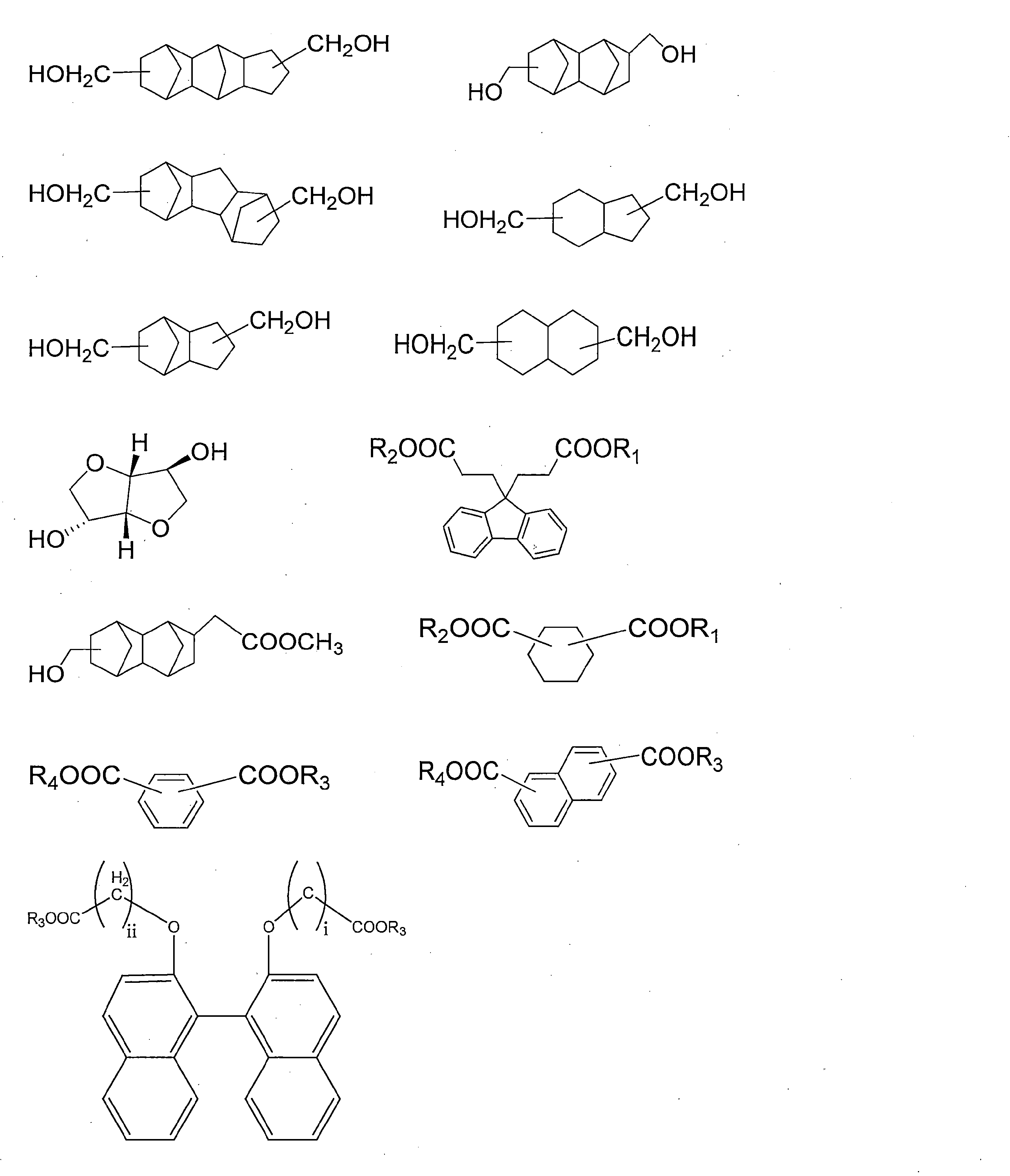
<9> 前記熱可塑性樹脂のポリスチレン換算の重量平均分子量(Mw)が、10,000~100,000である、上記<1>に記載の熱可塑性樹脂である。
<10> 前記熱可塑性樹脂の屈折率(nD)が、1.500~1.700である、上記<1>に記載の熱可塑性樹脂である。
<11> 前記熱可塑性樹脂のアッベ数(ν)が、22.0~35.0である、上記<1>に記載の熱可塑性樹脂である。
<12> 前記熱可塑性樹脂のガラス転移温度が、125~150℃である、上記<1>に記載の熱可塑性樹脂である。
<13> 前記熱可塑性樹脂の光弾性係数が、25~45である、上記<1>に記載の熱可塑性樹脂である。
<14> 前記熱可塑性樹脂の吸水率が、0.40%以下である、上記<1>に記載の熱可塑性樹脂である。
<15> 前記熱可塑性樹脂の吸水寸法変化率が、0.045%以下である、上記<1>に記載の熱可塑性樹脂である。
<16> 上記<1>に記載の熱可塑性樹脂を含む、光学レンズである。
本発明の一実施形態は、下記一般式(1)で表される化合物由来の構成単位(A)を含む熱可塑性樹脂である。
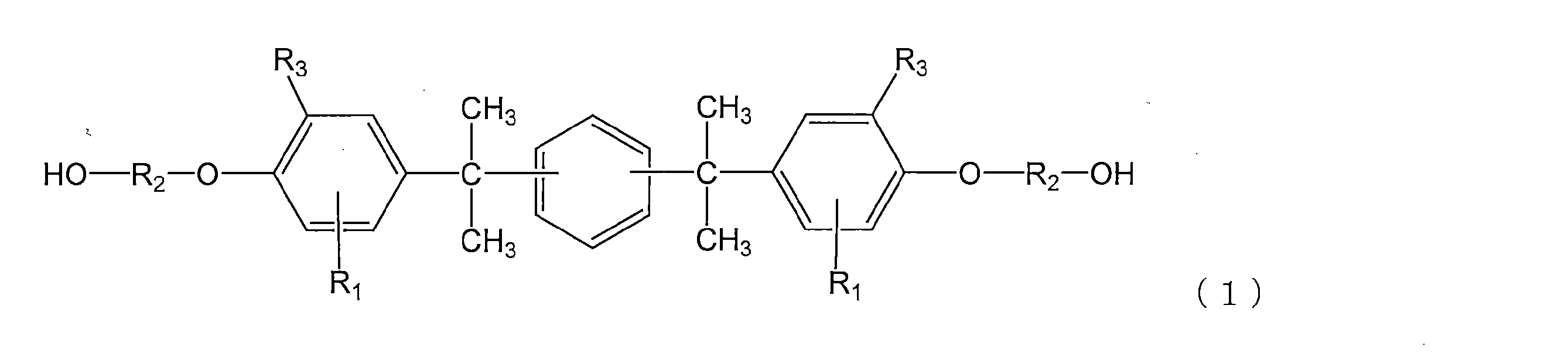
一般式(1)中のR1は、各々独立して水素原子、メチル基、エチル基、イソプロピル基 又はt-ブチル基が好ましく、各々独立して水素原子又はメチル基がより好ましく、共にメチル基が特に好ましい。
一般式(1)中のR1としては、2つのR1が共に同じ置換基であることが好ましい。
一般式(1)中のR1が炭素原子数1~4の直鎖状若しくは分岐鎖状のアルキル基である場合、ベンゼン環に結合する位置は、R3の結合位置が3位、酸素原子の結合位置が4位であるときに、5位又は6位であることが好ましい。
一般式(1)中のR2は、各々独立してメチレン基、1,2-エチレン基、1-メチル-1,2-エチレン基又は2-メチル-1,2-エチレン基であることが好ましく、共に1,2-エチレン基が特に好ましい。
一般式(1)中のR2としては、2つのR2が共に同じ置換基であることが好ましい。
一般式(1)中のR3は、各々独立して炭素原子数4~6の分岐鎖状若しくは環状のアルキル基が好ましく、各々独立して炭素原子数4~6の分岐鎖状の第3級アルキル基若しく炭素原子数5又は6の環状のアルキル基が好ましく、各々独立してt-ブチル基又はシクロヘキシル基がさらに好ましく、共にシクロヘキシル基が特に好ましい。
一般式(1)中のR3としては、2つのR3が共に同じ置換基であることが好ましい。


式(1-6)~(1-10)で表される化合物は、化合物(1B)の具体例である。その中でも化合物(1-6)、(1-7)、(1-9)及び(1-10)が好ましく、化合物(1-7)、(1-9)及び(1-10)がより好ましく、化合物(1-7)及び(1-9)がさらに好ましく、化合物(1-7)が特に好ましい。
本発明で使用される一般式(1)で表されるビス[1-メチル-1-(4-ヒドロキシアルコキシ-3-アルキルフェニル)エチル]ベンゼン]化合物については、その製造における出発原料、製造方法について特に制限はない。例えば、下記一般式(2)で表されるビスフェノール化合物とヒドロキシアルキレンオキシ化剤を反応させる製造方法が挙げられる。
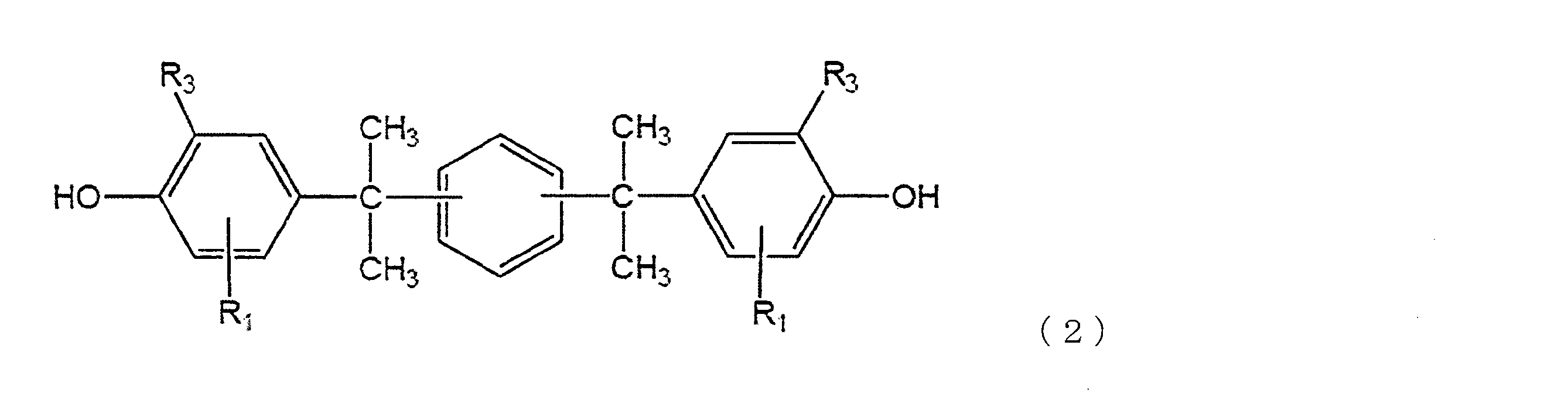
化合物(2)は、一般式(2A)で表される化合物(以下、化合物(2A)と称する場合がある)又は一般式(2B)で表される化合物(以下、化合物(2B)と称する場合がある)が好ましく、一般式(2A)で表される化合物が特に好ましい。

一般式(2A)及び一般式(2B)におけるR1及びR3は、一般式(1)の定義と同じであり、好ましい態様も同じである。
化合物(2)の具体例として、式(2-1)~(2-10)で表される化合物が挙げられる。

式(2-6)~(2-10)で表される化合物は、化合物(2B)の具体例である。その中でも化合物(2-6)、(2-7)、(2-9)及び(2-10)が好ましく、化合物(2-7)、(2-9)及び(2-10)がより好ましく、化合物(2-7)及び(2-9)がさらに好ましく、化合物(2-7)が特に好ましい。
使用するヒドロキシアルキレンオキシ化剤としては、一般式(3)で表されるカーボネー卜類(3)を用いることが好ましい。
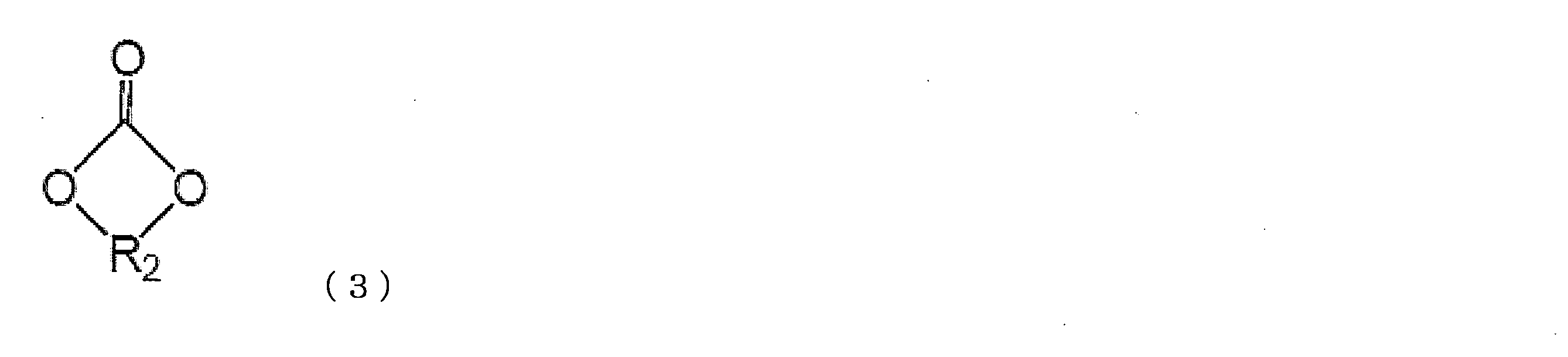
一般式(3)におけるR2は、一般式(1)の定義と同じであり、好ましい態様も同じである。
ヒドロキシアルキレンオキシ化剤として、一般式(3)で表されるカーボネート類(3)を使用した場合の本発明で使用される化合物を得る反応式を例示する。


化合物(2)とカーボネート類(3)の原料モル比は、化合物(2)/カーボネート類(3)が、通常は1/2~1/5の範囲であり、1/2~1/4の範囲が好ましく、1/2~1/3の範囲がさらに好ましく、1/2~1/2.5の範囲が特に好ましい。
上記製造方法において、反応時に塩基性触媒を使用することが好ましく、その塩基性触媒としては、一般に公知のものを用いることができる。具体的には、トリフェニルホスフィン、トリブチルホスフィン等のトリオルガノホスフィン化合物、1-メチルイミダゾール等のアミン触媒、炭酸カリウム、炭酸カルシウム、炭酸マグネシウム、水酸化マグネシウム、水酸化カルシウム、水酸化ナトリウム、炭酸水素ナトリウム、メトキシナトリウム、フェノキシナトリウム等のアルカリ触媒を例示できる。これらの塩基性触媒は、単独で用いても2種類以上を併用してもよい。
この塩基性触媒の使用量としては、化合物(2)の0.001~10重量%であり、好ましくは0.01~5重量%であり、より好ましくは0.1~5重量%である。
カーボネート類(3)を過剰量使用することで反応を無溶媒で行うことも可能であるが、経済性や操作性の観点から、通常は有機溶媒を用いて行うことが好ましい。
反応溶媒を用いる場合、反応不活性な各種公知の溶媒を使用することができる。かかる反応溶媒としては、例えば、トルエン、キシレン等の芳香族炭化水素溶媒、テトラヒドロフラン、ジオキサン、1,2-ジメトキシエタン等のエーテル溶媒、アセトン、メチルイソブチルケトン等の脂肪族ケトン溶媒、クロロホルム、1,2-ジクロルエタン等のハロゲン化炭化水素溶媒、ブタノール、エチレングリコール等の脂肪族アルコール溶媒、ジメチルホルム アミド、ジメチルスルホキシド等の極性溶媒等が挙げられる。その中でも、炭素原子数6~9の芳香族炭化水素溶媒又は炭素原子数3~9の脂肪族ケトン溶媒が好ましい。
反応溶媒の使用量に関しては特に制限はないが、化合物(2)に対して、0.5~10重量倍の範囲であることが好ましく、0.5~5重量倍の範囲であることがより好ましい。
上記製造方法において、反応時に相間移動触媒を使用することが好ましく、その相間移動触媒としては、一般に公知のものを用いることができる。好ましく用いることができる相間移動触媒の具体的として、第4級アンモニウム塩又は第4級ホスホニウム塩が挙げられ、第4級アンモニウム塩がより好ましい。第4級アンモニウム塩の具体例としては、テトラブチルアンモニウムクロリド、テトラブチルアンモニウムブロミド、テトラエチルアンモニウムクロリド、テトラエチルアンモニウムブロミド、テトラメチルアンモニウムクロリド、テトラメチルアンモニウムブロミドが挙げられる。第4級ホスホニウム塩の具体例としては、テトラブチルホスホニウムクロリド、テトラブチルホスホニウムブロミド、テトラフェニルホ スホニウムブロミドが挙げられる。これらの相間移動触媒は、単独で用いても2種類以上を併用してもよい。この相間移動触媒の使用量としては、化合物(2)の0.001~10重量%の範囲であり、0.01~1重量%の範囲が好ましい。
反応温度は反応が進行する温度であれば特に限定はされないが、通常は加熱下に行われる。例えば、使用する溶媒の種類にもよるが、通常50~250℃の範囲で行われ、好ましくは70~200℃の範囲であり、より好ましくは100℃~180℃で行われる。溶媒の還流下で反応が行われることがより好ましい。
反応時間は、反応温度、使用する化合物(2)、カーボネート類(3)、塩基性触媒、反応溶媒及び相間移動触媒の量と種類等によるが、通常は3~48時間程度にて行われる。当該反応においては、炭酸ガスの発生がおさまった時点を反応終了の目安とすることができる。
上記製造方法において塩基性触媒を用いる場合は、得られた反応液に、酸含有水(例えば、塩酸、硫酸)や酢酸、プロピオン酸等を加えて塩基性触媒を中和する中和工程を行うことが好ましい。後述の加水分解工程を行った後にこの中和工程を行ってもよい。
この上記製造方法における反応では、カーボネート類(3)を過剰量加えているため、反応終了後も反応液中にカーボネート類(3)が残存しており、この状態で加熱等処理を行うと、副反応が進行し、目的化合物である化合物(1)の純度及び収量が低下する恐れがある。 そのため、水を添加してカーボネート類(3)の加水分解工程を行うことが好ましい。使用する水の量としては、上記反応で使用したカーボネート類(3)の量に対して、1~10モル倍の範囲である。温度としては、反応液の沸点未満であればよいが、通常、室温から反応液の沸点未満の範囲である。具体的には、下限は10℃以上、より好ましくは20℃以上である。上限は使用する溶媒の沸点にもよるが、150℃以下であることが好ましい。
その後、必要に応じて、塩基性触媒や中和工程で生成した塩、加水分解工程により生成したグリコール類などの水溶性の不純物を除去するために、化合物(1)を溶解しかつ水と分離する溶媒(例えば、炭素原子数5~9の脂肪族ケトン溶媒)を加えて溶液として、水により洗浄を行う水洗工程を行ってもよく、水洗工程を行うことが好ましい。
上記の工程を経た液を、晶析、ろ過、蒸留、カラムクロマトグラフィー等による分離工程、乾燥工程等の工程を行うことで、目的化合物である化合物(1)を得ることができる。さらに純度を高めるため、常法に準じて、さらに、蒸留や再結晶、カラムクロマトグラフィーによる精製を行ってもよい。


ベンゼン類(4)おけるR1、R2及びR3は、一般式(1)の定義と同じであり、好ましい態様も同じである。
ベンゼン類(4)の具体例として、式(4-1)~(4-5)で表される化合物が挙げられる。

ジオール(5)として具体的には、例えば、1,4-ジ(2-ヒドロキシイソプロピル)ベンゼン、1,3-ジ(2-ヒドロキシイソプロピル)ベンゼン及び1,2-ジ(2-ヒドロキシイソプロピル)ベンゼンがあげられる挙げられる。その中でも、1,4-ジ(2-ヒドロキシイソプロピル)ベンゼン又は1,3-ジ(2-ヒドロキシイソプロピル)ベンゼンが好ましく、1,3-ジ(2-ヒドロキシイソプロピル)ベンゼンが特に好ましい。
反応は通常、溶媒の存在下に行われる。溶媒としては、反応を阻害しないものであれば特に制限はない。
上記製造方法は、大気雰囲気下、あるいは、不活性ガス雰囲気下のいずれで行ってもよいが、反応生成物の着色等を抑制するために、窒素、アルゴン等の不活性ガス雰囲気下が好ましい。
反応温度は、通常20~60℃の範囲であり、20~40℃の範囲であることが好ましい。
反応圧力は常圧条件下で行ってもよく、また、加圧条件下でも、あるいは減圧条件下で行ってもよいが、常圧条件下で行うことが好ましい。
得られた反応終了混合物は、常法に準じて、分離・精製することにより反応混合物から化合物(1)を得ることができる。
本発明で使用される化合物(1)のうち、式(1-2)で表される化合物(化合物(1-2):1,3-ビス[1-メチル-1-{4-(2-ヒドロキシエトキシ)-3-シクロヘキシル-6-メチルフェニル}エチル]ベンゼンの結晶は、化合物(1-2)を、結晶性を有する固体として取り扱うことができることから、工業的な製造に当たり、取り扱い性や輸送性に優れるため、非常に有用である。
本発明で使用される化合物(1-2)の結晶は、示差走査熱量分析による吸熱ピークのトップ温度は、205~215℃の範囲にあり、206~214℃の範囲にあることがより好ましく、207~213℃の範囲にあることがさらに好ましく、207~211℃の範囲にあることが特に好ましい。
また、本発明で使用される化合物(1-2)の結晶は、Cu-Kα線による粉末X線回折ピークパターンにおいて、回折角2θが7.1±0.2°、14.6±0.2°及び16.1±0.2°に回折ピークがある。それに加え、回折角2θが20.4±0.2°、21.4±0.2°、22.0±0.2°及び23.3±0.2°にピークを有していることがより好ましい。さらにそれに加えて、回折角2θが11.8±0.2°、12.4±0.2°及び18.5±0.2°にピークを有していることがさらに好ましい。
本発明で使用される化合物(1-2)の結晶の純度は、液体クロマトグラフィー分析による面積百分率において、90%以上であることが好ましく、93%以上であることがより好ましく、95%以上であることがさらに好ましく、98%以上であることが特に好ましい。
本発明で使用される化合物(1-2)の結晶は、化合物(1-2)と炭素原子数5~9の脂肪族ケトン溶媒を含む溶液から結晶を析出させることにより得ることができる。化合物(1-2)の結晶は、炭素原子数5~9の脂肪族ケトン溶媒に溶解した溶液を冷却させる、また溶液から炭素原子数5~9の脂肪族ケトン溶媒を留去させることにより、結晶を析出させて得ることもできるが、炭化水素溶媒を、前記溶液に混合して得ることもできる。中でも、化合物(1-2)と炭素原子数5~9の脂肪族ケトン溶媒を含む溶液に、さらに炭素原子数6~9の芳香族炭化水素溶媒を加えた溶液として、必要に応じて、さらに化合物(1-2)の溶液の溶解度を下げるために溶液を冷却して、析出させることが好ましい。
炭素原子数5~9の脂肪族ケトン溶媒としては、ジエチルケトン(炭素原子数5)、メチルイソブチルケトン(炭素原子数6)、メチルアミルケトン(炭素原子数7)、メチルへキシルケトン(炭素原子数8)等の炭素原子数5~9の鎖状脂肪族ケトン溶媒や、シクロペンタノン、シクロヘキサノン等の炭素原子数5~9の環状脂肪族ケトン溶媒を用いることができる。その中でも、炭素原子数5~9の環状脂肪族ケトン溶媒が好ましく、シクロペンタノン又はシクロヘキサノンがより好ましく、シクロヘキサノンが特に好ましい。この炭素原子数5~9の環状脂肪族ケトン溶媒を用いることで、結晶を析出させる前に溶液を水で洗浄し、塩基性触媒や中和工程で生成した塩、加水分解工程により生成したグリコール類などの水溶性の不純物を除去することもできる。
その脂肪族ケトン溶媒の使用量としては、化合物(1-2)の重量に対して、1~20重量倍の範囲であることが好ましく、2~15重量倍の範囲であることがより好ましく、2~10重量倍の範囲であることがさらに好ましく、2~8重量倍の範囲であることが特に好ましい。
炭素原子数6~9の芳香族炭化水素溶媒としては、ベンゼン、トルエン、キシレンなどを用いることができ、その中でも、炭素原子数7又は8の芳香族炭化水素溶媒が好ましく、トルエンが特に好ましい。
炭素原子数6~9の芳香族炭化水素溶媒以外の炭化水素溶媒としては、炭素原子数5~10の鎖状若しくは環状の脂肪族炭化水素溶媒が挙げられる。その具体例として、ペンタン、ヘキサン、ヘプタン、オクタン、イソオクタン、シクロペンタン、シクロヘキサンが挙げられる。その中でも炭素原子数6~8の鎖状の脂肪族炭化水素溶媒又は炭素原子数5又は6の環状の脂肪族炭化水素溶媒が好ましく、ヘプタン、オクタン、イソオクタン、シクロペンタン又はシクロヘキサンがより好ましい。
炭化水素溶媒の使用量としては、化合物(1-2)の量に対して、1~10重量倍の範囲であることが好ましく、1~7重量倍の範囲であることがより好ましく、1~5重量倍の範囲であることがさらに好ましく、また、炭素原子数5~9の脂肪族ケトン溶媒の量に対して0.1~4.0重量倍の範囲が好ましく、0.2~2.0重量倍の範囲がより好ましく、0.2~1.5重量倍の範囲がさらに好ましく、0.2~1.0重量倍の範囲が特に好ましい。
化合物(1-2)の炭素原子数5~9の脂肪族ケトン溶液に、炭化水素溶媒を混合する温度は、使用する脂肪族ケトンにもよるが、50~120℃の範囲であることが好ましく、50~100℃の範囲であることがより好ましく、50~90℃の範囲であることがさらに好ましい。
化合物(1-2)の結晶を析出させ始める温度としては、10~80℃の範囲であることが好ましく、30~70℃の範囲であることがより好ましい。

つまり、本発明の一実施形態の熱可塑性樹脂は、上記式で表される構成単位(A)以外にも、一般的にポリカーボネート樹脂やポリエステルカーボネート樹脂の構成単位として用いられる脂肪族ジヒドロキシ化合物から誘導される構成単位や芳香族ジヒドロキシ化合物から誘導される構成単位を含むことができる。
具体的には、脂肪族ジヒドロキシ化合物としては、様々なものが挙げられるが、特に、1,4-シクロヘキサンジメタノール、トリシクロデカンジメタノール、1,3-アダマンタンジメタノール、2,2-ビス(4-ヒドロキシシクロヘキシル)-プロパン、3,9-ビス(2-ヒドロキシ-1,1-ジメチルエチル)-2,4,8,10-テトラオキサスピロ[5.5]ウンデカン、2-(5-エチル-5-ヒドロキシメチル-1,3-ジオキサン-2-イル)-2-メチルプロパン-1-オール、イソソルビド、1,3-プロパンジオール、1,4-ブタンジオール、1,6-ヘキサンジオール等が挙げられる。
芳香族ジヒドロキシ化合物としては、様々なものを挙げることができるが、特に2,2-ビス(4-ヒドロキシフェニル)プロパン〔ビスフェノールA〕、ビス(4-ヒドロキシフェニル)メタン、1,1-ビス(4-ヒドロキシフェニル)エタン、2,2-ビス(4-ヒドロキシ-3,5-ジメチルフェニル)プロパン、4,4’-ジヒドロキシジフェニル、ビス(4-ヒドロキシフェニル)シクロアルカン、ビス(4-ヒドロキシフェニル)オキシド、ビス(4-ヒドロキシフェニル)スルフィド、ビス(4-ヒドロキシフェニル)スルホン、ビス(4-ヒドロキシフェニル)スルホキシド、及びビス(4-ヒドロキシフェニル)ケトン、ビスフェノキシエタノールフルオレン等を挙げることができる。
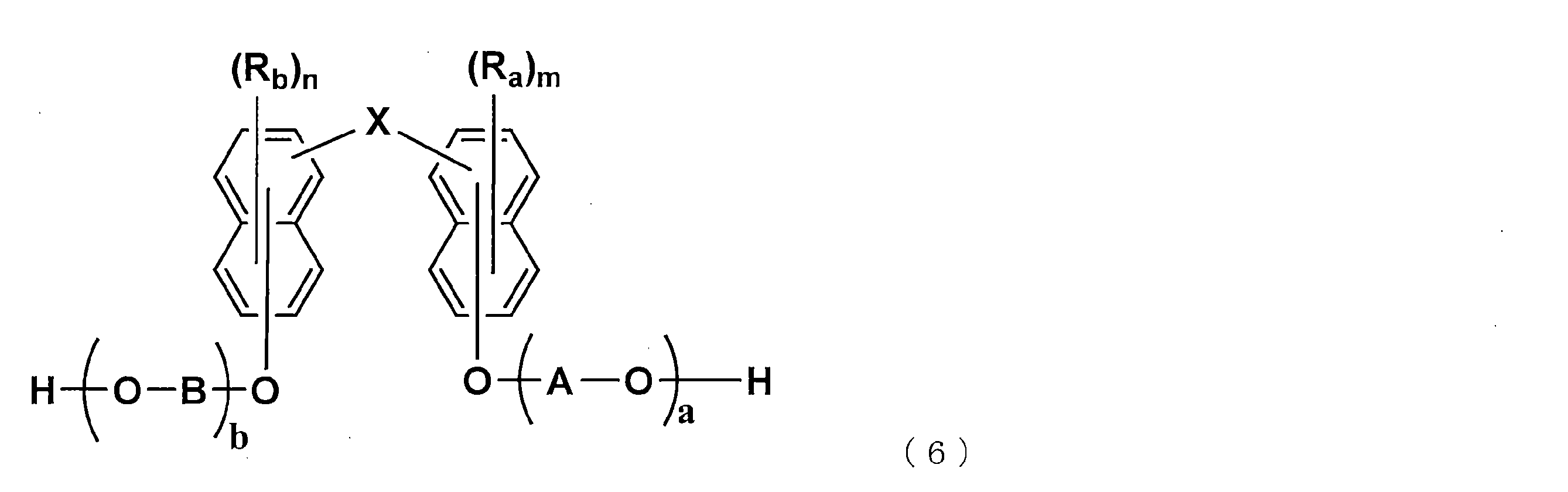
Ra及びRbは、好ましくは、水素原子、置換基を有してもよい炭素数6~20のアリール基、O、N及びSから選択される1つ以上のヘテロ環原子を含む、置換基を有してもよい炭素数6~20のヘテロアリール基であり、より好ましくは、水素原子、置換基を有してもよい炭素数6~20のアリール基であり、さらに好ましくは、水素原子、置換基を有してもよい炭素数6~12のアリール基である。
一般式(6)において、A及びBは、それぞれ独立に、置換基を有してもよい炭素数1~5のアルキレン基であり、好ましくは、炭素数2又は3のアルキレン基である。
一般式(6)において、m及びnは、それぞれ独立に、0~6の整数であり、好ましくは0~3の整数であり、より好ましくは0又は1である。
一般式(6)において、a及びbは、それぞれ独立に、0~10の整数であり、好ましくは1~3の整数であり、より好ましくは1又は2である。
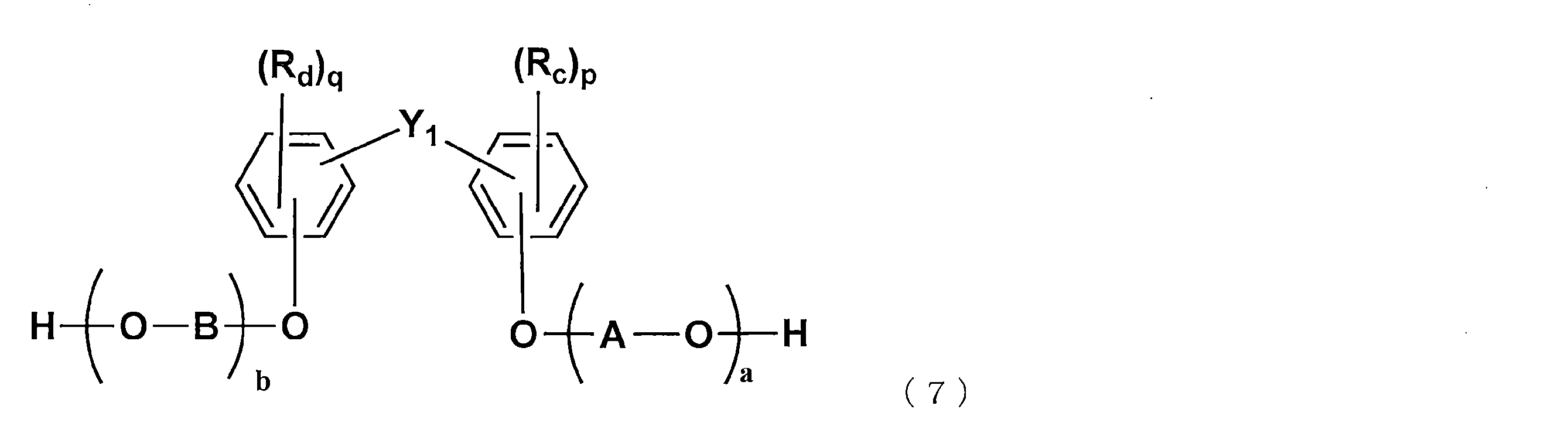
Rc及びRdは、好ましくは、水素原子、置換基を有してもよい炭素数6~20のアリール基、O、N及びSから選択される1つ以上のヘテロ環原子を含む、置換基を有してもよい炭素数6~20のヘテロアリール基であり、より好ましくは、水素原子、置換基を有してもよい炭素数6~20のアリール基であり、さらに好ましくは、水素原子、置換基を有してもよい炭素数6~12のアリール基である。
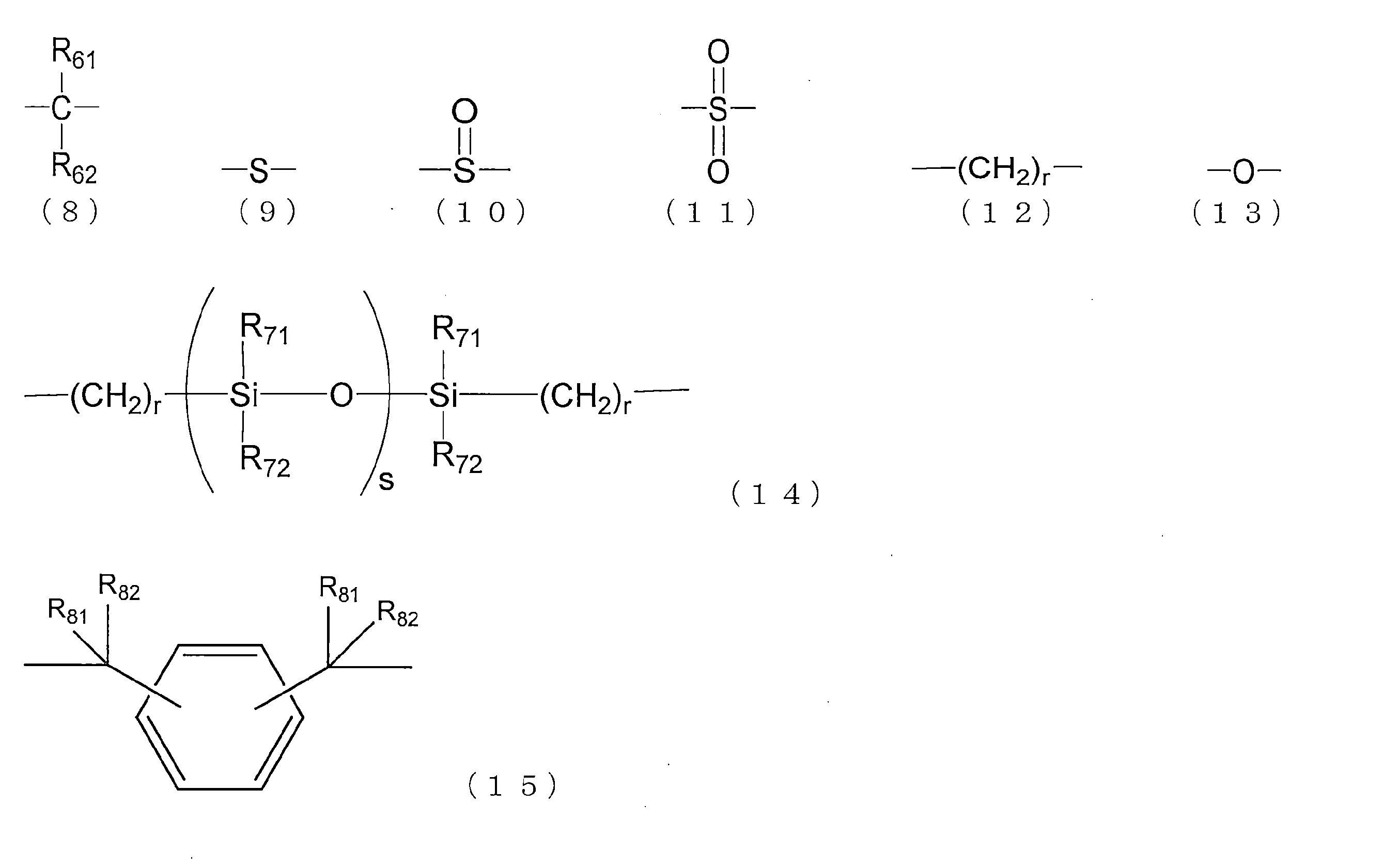
式(8)~(15)において、r及びsは、それぞれ独立して、0~5000の整数である。

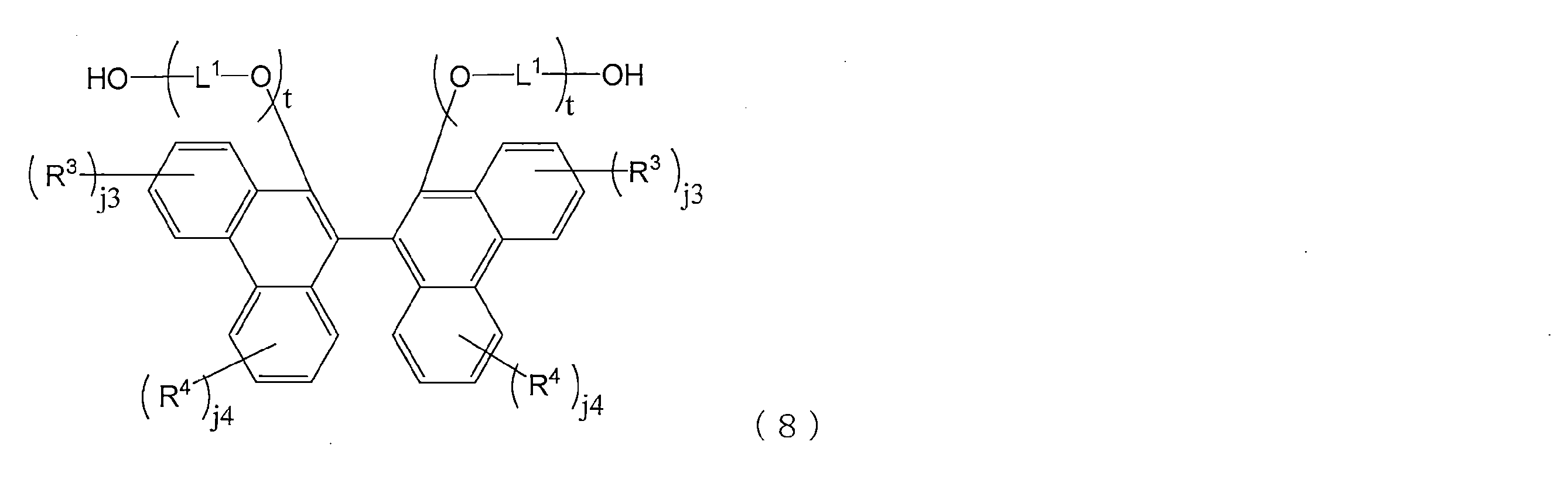
L1は、それぞれ独立に、2価の連結基を表し;
R3およびR4は、それぞれ独立に、ハロゲン原子、または芳香族基を含んでいてもよい炭素数1~20の置換基を表し;
j3およびj4は、それぞれ独立に、0~4の整数を表し;
tは、0または1の整数を表す。

式(I-3)の繰り返し単位数は、1~10の整数であり、好ましくは1~5の整数であり、より好ましくは1である。)
また、複数の種類の構成単位を有するポリマーとして、m及びnの値が例えば100以上と大きいブロック共重合体、及び、ランダム共重合体のいずれもが採用できるものの、ランダム共重合体が好ましく、より好ましくは、m及びnの値が1であるランダム共重合体が用いられる。
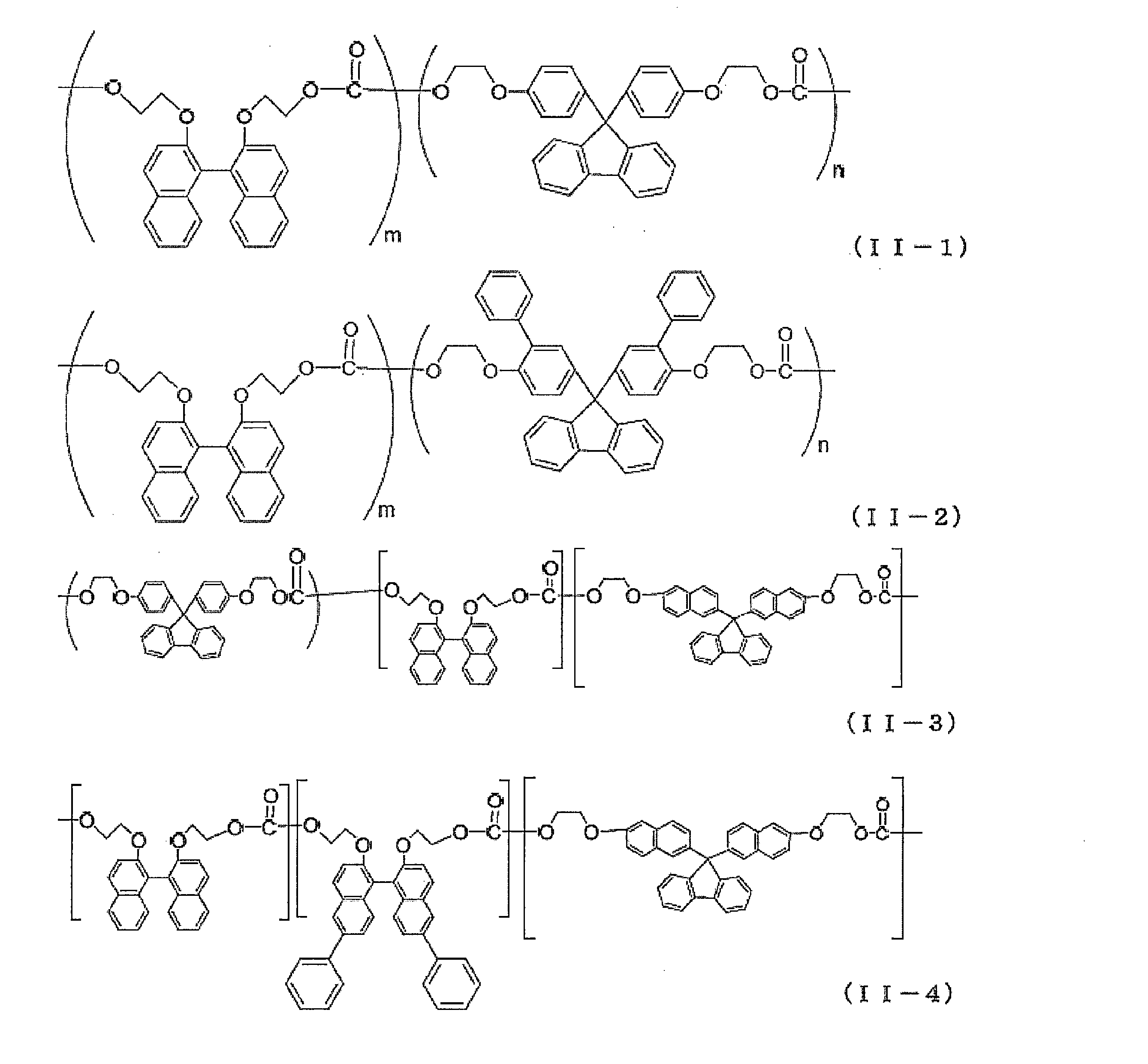
また、複数の種類の構成単位を有するポリマーとして、m及びnの値が例えば100以上と大きいブロック共重合体、及び、ランダム共重合体のいずれもが採用できるものの、ランダム共重合体が好ましく、より好ましくは、m及びnの値が1であるランダム共重合体が用いられる。
共重合体において、構成単位(B)と構成単位(C)とのモル比は、1:99~99:1であることが好ましく、10:90~90:10であることがより好ましく、15:85~85:15であることがさらに好ましく、30:70~70:30であることが特に好ましい。また、混合物においては、構成単位(B)を有するポリマーと構成単位(C)を有するポリマーとの質量比が、1:99~99:1であることが好ましく、10:90~90:10であることがより好ましく、15:85~85:15であることがさらに好ましく、30:70~70:30であることが特に好ましい。

不純物であるフェノール系化合物などのアルコール系化合物や炭酸ジエステルは、成形体としたときの強度低下や、臭気発生の原因ともなり得るため、これらの含有量は極力少ない程好ましい。
残存するジオール成分の含有量は、ポリカーボネート樹脂100質量%に対して、好ましくは1000質量ppm以下、より好ましくは100質量ppm以下、特に好ましくは10質量ppm以下である。
残存する炭酸ジエステルの含有量は、ポリカーボネート樹脂100質量%に対して、好ましくは1000質量ppm以下、より好ましくは100質量ppm以下、特に好ましくは10質量ppm以下である。
特に、フェノール、t-ブチルフェノールなどの化合物の含有量が、少ないことが好ましく、これらの化合物が上記範囲内であることが好ましい。
ポリカーボネート樹脂中に残存するアルコール系化合物の含有量についても、ポリカーボネート樹脂から抽出したアルコール系化合物を、ガスクロマトグラフィーを用いて分析する手法により測定することができる。
ポリカーボネート樹脂中に残存するジオール成分、炭酸ジエステルの含有量も、ポリカーボネート樹脂からこれらの化合物を抽出し、ガスクロマトグラフィーを用いて分析する手法により測定することができる。
残存するアルコール系化合物の含有量は、ポリカーボネート樹脂100質量%に対して、例えば、0.01質量ppm以上、0.1質量ppm以上、又は1質量ppm以上であってもよい。
(1)屈折率(nD)
本発明の一実施形態において、熱可塑性樹脂は高屈折率であることが特徴の一つであり、屈折率は、1.500~1.700であることが好ましく、1.550~1.700であることがより好ましく、1.580~1.650であることが特に好ましい。本発明において屈折率は、後述する実施例に記載の方法で測定することができる。
本発明の一実施形態において、熱可塑性樹脂のアッベ数は、22.0~35.0であることが好ましく、22.0~33.0であることがより好ましく、23.0~32.0であることが更に好ましく、23.0~30.0であることが特に好ましい。本発明においてアッベ数は、後述する実施例に記載の方法で測定することができる。
本発明の一実施形態において、熱可塑性樹脂は、高耐熱性であることが特徴の一つであり、ガラス転移温度(Tg)は、125~150℃であることが好ましく、125~145℃であることがより好ましく、125~140℃であることが更に好ましく、127~135℃であることが特に好ましい。本発明においてガラス転移温度は、後述する実施例に記載の方法で測定することができる。
本発明の一実施形態において、熱可塑性樹脂のポリスチレン換算重量平均分子量は、10,000~100,000であることが好ましく、10,000~80,000であることがより好ましく、10,000~60,000であることが特に好ましい。
本発明の一実施形態において、熱可塑性樹脂は、光弾性係数が低いことが特徴の一つであり、光弾性係数は、25~45であることが好ましく、25~38であることがより好ましく、28~38であることが特に好ましい。本発明において光弾性係数は、後述する実施例に記載の方法で測定することができる。
本発明の一実施形態において、熱可塑性樹脂は、吸水率が低いことが特徴の一つであり、吸水率は、0.40%以下であることが好ましく、0.36%以下であることがより好ましい。下限値は、通常、0.1%程度である。本発明において吸水率は、後述する実施例に記載の方法で測定することができる。
本発明の一実施形態において、熱可塑性樹脂は、吸水寸法変化率が低いことが特徴の一つであり、吸水寸法変化率は、0.045%以下であることが好ましく、0.040%以下であることがより好ましい。下限値は、通常、0.01%程度である。本発明において吸水寸法変化率は、後述する実施例に記載の方法で測定することができる。
本発明の別の実施形態は、上述した熱可塑性樹脂と添加剤とを含む熱可塑性樹脂組成物である。本実施形態の熱可塑性樹脂組成物は、本実施形態の所望とする効果を損なわない範囲で、上述した構成単位(A)を含む本発明の熱可塑性樹脂以外の樹脂を併用することができる。そのような樹脂としては、特に限定されないが、例えば、ポリカーボネート樹脂、ポリエステル樹脂、ポリエステルカーボネート樹脂、(メタ)アクリル樹脂、ポリアミド樹脂、ポリスチレン樹脂、シクロオレフィン樹脂、アクリロニトリル-ブタジエン-スチレン共重合樹脂、塩化ビニル樹脂、ポリフェニレンエーテル樹脂、ポリスルホン樹脂、ポリアセタール樹脂及びメチルメタクリレート-スチレン共重合樹脂からなる群より選択される少なくとも1つの樹脂が挙げられる。これらは種々既知のものを用いることができ、1種を単独で又は2種以上を併用して熱可塑性樹脂組成物に加えることができる。
熱可塑性樹脂組成物は、上記添加剤として酸化防止剤を含むことが好ましい。
酸化防止剤として、フェノール系酸化防止剤及びホスファイト系酸化防止剤の少なくとも一方を含むことが好ましい。
フェノール系酸化防止剤として、1,3,5-トリス(3,5-ジ-tert-ブチル-4-ヒドロキシフェニルメチル)-2,4,6-トリメチルベンゼン、1,3,5-トリス(3,5-ジ-tert-ブチル-4-ヒドロキシベンジル)-1,3,5-トリアジンe-2,4,6(1H,3H,5H)-トリオン、4,4’,4’’-(1-メチルプロパニル-3-イリデン)トリス(6-tert-ブチル-m-クレゾール)、6,6’-ジ-tert-ブチル-4,4’-ブチリデンジ-m-クレゾール、オクラデシル3-(3,5-ジ-tert-ブチル-4-ヒドロキシフェニル)プロピオネート、ペンタエリスリトール-テトラキス[3-(3,5-ジ-tert-ブチル-4-ヒドロキシフェニル)プロピオネート]、3,9-ビス{2-[3-(3-tert-ブチル-4-ヒドロキシ-5-メチルフェニル)プロピオニルオキシ]-1,1-ジメチルエチル}-2,4,8,10-テトラオキソスピロ[5.5]ウンデカン、ペンタエリスリトール-テトラキス[3-(3,5-ジ-tert-ブチル-4-ヒドロキシフェニル)プロピオネート]等が挙げられ、好ましくは、ペンタエリスリトール-テトラキス[3-(3,5-ジ-tert-ブチル-4-ヒドロキシフェニル)プロピオネート]である。
ホスファイト系酸化防止剤として、2-エチルヘキシルジフェニルフォスファイト、イソデシルジフェニルフォスファイト、トリイソデシルフォスファイト、トリフェニルフォスファイト、3,9-ビス(オクタデシルオキシ)-2,4,8,10-テトラオキシ-3,9-ジフォスファスピロ[5.5]ウンデカン、3,9-ビス(2,6-ジ-tert-ブチル-4-メチルフェノキシ)-2,4,8,10-テトラオキサ-3,9-ジフォスファスピロ[5.5]ウンデカン、2,2’-メチルエンビス(4,6-ジ-tert-ブチルフェニル)2-エチルヘキシルフォスファイト、トリス(2,4-ジtert-ブチルフェニル)フォスファイト、トリス(ノニルフェニル)フォスファイト、テトラ-C12-15-アルキル(プロパン-2,2-ジイルビス(4,1-フェニルエン))ビス(フォスファイト)、3,9-ビス(2,6-ジ-tert-ブチル-4-メチルフェノキシ)-2,4,8,10-テトラオキサ-3,9-ジフォスファスピロ[5.5]ウンデカン等が挙げられ、好ましくは、3,9-ビス(2,6-ジ-tert-ブチル-4-メチルフェノキシ)-2,4,8,10-テトラオキサ-3,9-ジフォスファスピロ[5.5]ウンデカンである。
酸化防止剤として、上述のいずれか1種類のみを用いても、2種類以上の混合物を用いてもよい。
熱可塑性樹脂組成物は、上記添加剤として離型剤を含むことが好ましい。
離型剤として、エステル化合物、例えば、グリセリン脂肪酸のモノ・ジグリセリド等のグリセリン脂肪酸エステル、プロピレングリコール脂肪酸エステル、ソルビタン脂肪酸エステル等のグリコール脂肪酸エステル、高級アルコール脂肪酸エステル、脂肪族多価アルコールと脂肪族カルボン酸とのフルエステルあるいはモノ脂肪酸エステル等が挙げられる。離型剤として、脂肪族多価アルコールと脂肪族カルボン酸とのエステルを用いる場合、モノエステル、フルエステル等、いずれも採用できるが、例えばモノエステル等のフルエステル以外であってもよい。
離型剤の具体例として、以下のものが挙げられる。
すなわち、ソルビタン ステアレート、ソルビタン ラウレート、ソルビタン オレート、ソルビタン トリオレート、ソルビタン トリベヘネート、ソルビタン ステアレート、ソルビタン トリステアレート、ソルビタン カプリレート等のソルビタン脂肪酸エステル;
プロピレングリコール モノステアレート、プロピレングリコール モノオレート、プロピレングリコール モノベヘネート、プロピレングリコール モノラウレート、プロピレングリコール モノパルミテート等のプロピレングリコール脂肪酸エステル;
ステアリル ステアレート等の高級アルコール脂肪酸エステル;
グリセリン モノステアレート、グリセリン モノ12-ヒドロキシステアレート等のグリセリン モノヒドロキシステアレート、グリセリン モノオレート、グリセリン モノベヘネート、グリセリン モノカプリレート、グリセリン モノカプレート、グリセリン モノラウレート等のモノグリセライド:グリセリンモノ・ジステアレート、グリセリンモノ・ジステアレート、グリセリンモノ・ジベヘネート、グリセリンモノ・ジオレート等のモノ・ジグリセライド:を含む、グリセリン脂肪酸エステルモノグリセライド;
グリセリン ジアセトモノ ラウレート等のグリセリン脂肪酸エステルアセチル化モノグリセライド;
クエン酸脂肪酸 モノグリセライド、コハク酸脂肪酸 モノグリセライド、ジアセチル酒石酸脂肪酸 モノグリセライド等のグリセリン脂肪酸エステル有機酸モノグリセライド;
ジグリセリン ステアレート、ジグリセリン ラウレート、ジグリセリン オレート、ジグリセリン モノステアレート、ジグリセリン モノラウレート、ジグリセリン モノミリステート、ジグリセリン モノオレート、テトラグリセリン ステアレート、デカグリセリン ラウレート、デカグリセリン オレート、ポリグリセリン ポリリシノレート等のポリグリセリン脂肪酸エステル等が挙げられる。
熱可塑性樹脂組成物には、上述の酸化防止剤及び離型剤以外にも、その他の添加剤を加えてもよい。例えば、熱可塑性樹脂組成物が含み得る添加剤として、配合剤、触媒失活剤、熱安定剤、可塑剤、充填剤、紫外線吸収剤、防錆剤、分散剤、消泡剤、レベリング剤、難燃剤、滑剤、染料、顔料、ブルーイング剤、核剤、透明化剤等が挙げられる。
熱可塑性樹脂組成物における酸化防止剤及び離型剤以外のその他の添加剤の含有量は、好ましくは10重量ppm~5.0重量%であり、より好ましくは100重量ppm~2.0重量%であり、さらに好ましくは1000重量ppm~1.0重量%であるが、これには限定されない。
上述の添加剤は、透過率に悪影響を与える可能性があり、過剰に添加しないことが好ましく、例えば、合計の添加量は上述の範囲内である。
本発明の熱可塑性樹脂又は熱可塑性樹脂組成物(以下、単に「樹脂組成物」と略す)は、光学部材に好適に用いることができる。本発明の一実施形態において、本発明の樹脂組成物を含む光学部材が提供される。本発明の一実施形態において、光学部材には、光ディスク、透明導電性基板、光カード、シート、フィルム、光ファイバー、レンズ、プリズム、光学膜、基盤、光学フィルター、ハードコート膜等が含まれるが、これらに限定されない。本発明の樹脂組成物は、高流動でキャスト法による成形が可能であるため、特に薄型の光学部材の製造に好適である。本発明の好ましい実施形態において、本発明の樹脂組成物を用いて製造される光学部材は、光学レンズであってよい。本発明の別の好ましい実施形態において、本発明の樹脂組成物を用いて製造される光学部材は、光学フィルムであってよい。
本発明の一実施形態において、樹脂組成物は、光学レンズに好適に用いることができる。本発明の樹脂組成物を用いて製造される光学レンズは、高屈折率であり、耐熱性に優れるため、望遠鏡、双眼鏡、テレビプロジェクター等、従来、高価な高屈折率ガラスレンズが用いられていた分野に用いることができ、極めて有用である。
例えばスマートフォンのレンズでは、構成単位(A)を含む熱可塑性樹脂から成形されたレンズと、式(II-1)~(II-4)のいずれかの構成単位を含む樹脂、あるいは、
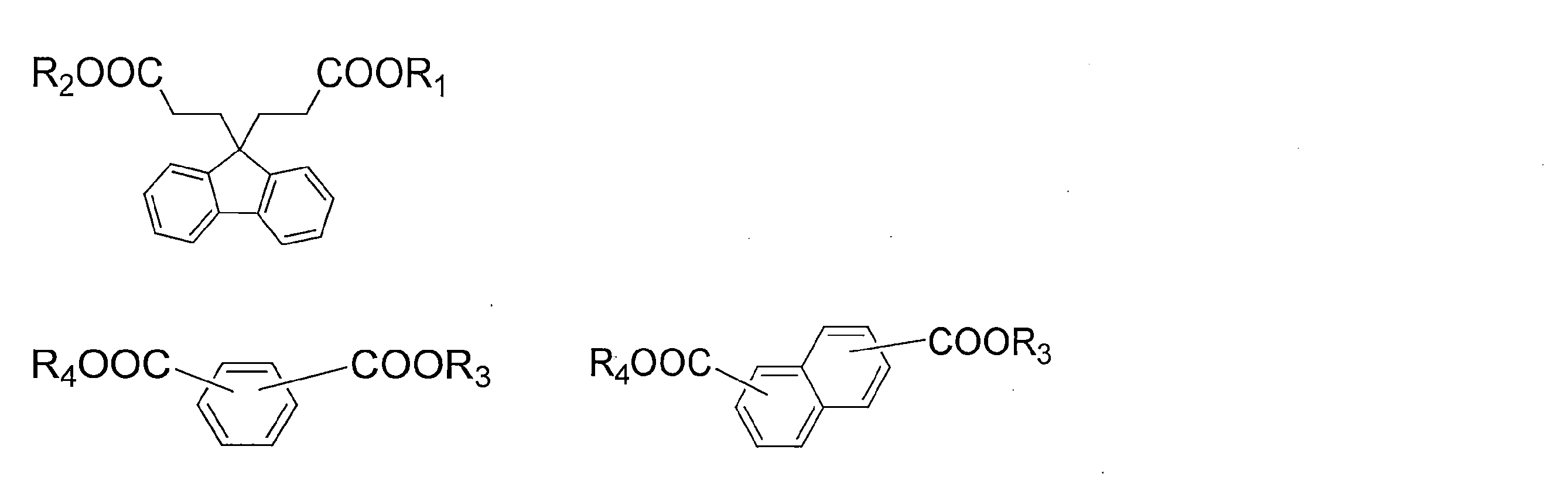
上記式のいずれかのモノマーに由来する構成単位を含む樹脂から成形されたレンズとを、重ね合わせてレンズユニットとして用いることができる。
本発明の光学レンズは、金型成形、切削、研磨、レーザー加工、放電加工、エッチングなど任意の方法により成形される。この中でも、製造コストの面から金型成形がより好ましい。
本発明の一実施形態において、樹脂組成物は、光学フィルムに好適に用いることができる。特に、本発明のポリカーボネート樹脂を用いて製造される光学フィルムは、透明性及び耐熱性に優れるため、液晶基板用フィルム、光メモリーカード等に好適に使用される。
光学フィルムへの異物の混入を極力避けるため、成形環境も当然低ダスト環境でなければならず、クラス6以下であることが好ましく、より好ましくはクラス5以下である。
得られた樹脂の重量平均分子量は、ゲル浸透クロマトグラフィー(GPC)法によって測定し、標準ポリスチレン換算で算出した。使用装置、カラム、及び測定条件は以下の通りである。
・GPC装置:東ソー(株)製、HLC-8420GPC
・カラム:東ソー(株)製、TSKgel SuperHM-M ×3本
東ソー(株)製、TSKgel guardcolumn SuperH-H ×1本
東ソー(株)製、TSKgel SuperH-RC ×1本
・検出器:RI検出器
・標準ポリスチレン:東ソー(株)製、標準ポリスチレンキット PStQuick C
・試料溶液:0.2質量%テトラヒドロフラン溶液
・溶離液:テトラヒドロフラン
・溶離液流速:0.6mL/min
・カラム温度:40℃
JIS K7121-1987に基づき示差熱走査熱量分析計により、10℃/分の昇温プログラムにて測定した。
示差熱走査熱量分析計:ティー・エイ・インスツルメント社製(TA Instruments)DSC2500
JIS B 7071-2:2018に基づき、ポリカーボネート樹脂を成形してVブロックを得て試験片とした。23℃にて屈折率計(島津製作所製KPR-3000)を用いて屈折率を測定した。
屈折率測定で用いたものと同様の試験片(Vブロック)を用い、屈折率計を用い、23℃下での波長486nm、589nm、656nmの屈折率を測定し、下記式を用いてアッベ数を算出した。
屈折率計:島津製作所製KPR-3000
ν=(nD-1)/(nF-nC)
nD:波長589nmでの屈折率
nC:波長656nmでの屈折率
nF:波長486nmでの屈折率
得られた樹脂をジクロロメタンに溶解し、樹脂溶液を得た。この樹脂溶液をバット上に広げ、溶媒を蒸発し、厚さ0.1mmのフィルムを得てこれをサンプル片とした。
エリプソメータにより、光弾性係数を測定した。
測定方法:波長633nmでの荷重変化に対する複屈折の変化を測定することにより光弾性係数を算出した。
エリプソメータ:日本分光株式会社製 エリプソメータ M-220
射出成形により得た試験片を熱風乾燥機にて6時間乾燥した。その後、試験片の質量を測定し、M0とした。次に、この試験片を高温高湿条件に制御した環境試験機に投入した。試験片を72時間後に取り出し、質量を測定し、Mtとした。吸水率(%)は以下の式より算出した。
吸水率(%)=(Mt-M0)/M0×100
なお、質量測定は23℃±2℃(21℃~25℃)に制御された環境で測定した。
射出成形により得た試験片を熱風乾燥機にて6時間乾燥した。その後、試験片の寸法を測定し、D0とした。次に、この試験片を高温高湿条件に制御した環境試験機に投入した。試験片を72時間後に取り出し、寸法を測定し、Dtとした。吸水寸法変化率(%)は以下の式より算出した。
寸法変化率(%)=(Dt-D0)/D0×100
なお、寸法測定は23℃±2℃(21℃~25℃)に制御された環境で測定した。
測定機器:画像寸法測定器LM-1100(株式会社KEYENCE製)
化合物(2-2)25.0g、エチレンカーボネート5.9g、トルエン45.0g、水酸化カリウム0.62g、テトラブチルアンモニウムブロミド0.45gを4つロフラスコに仕込み、フラスコ内を窒素で置換した。その後、フラスコ内の液温を105~110℃に昇温し、10時間攪拝を続けた。その後、液の温度を90℃に下げ、水を8.8g添加して、その温度で1時間保持した。
続けて、液の温度を85℃にして、12%塩酸水3.4g添加して反応液を中和した。その後、25℃に温度を下げて一晩冷却攪排を続けた。その後、ろ過により結晶を濾別した。
濾別した結晶17.8gとシクロヘキサノン178.0gを4つロフラスコに仕込み、溶解させた。フラスコ内に水を35.6g加えて、90℃に加熱した。その温度で30分間攪拝し、静置させて分離した水層を取り除く水洗操作を3回繰り返した。その水洗後の溶液を60℃に冷却して、トルエン53.4gを添加すると結晶が析出し始めた。そして、溶液を25℃まで冷却し、一晩攪拝を続けた。析出した結晶を濾別して、得られた結晶を乾燥することで、化合物(1-2)を8.7g取得した。化合物の分析方法は、表1の下に示す。
13C-NMR(400MHz、溶媒:CDCl3)δ<ppm>:21.57、26.46、27.23、30.96、33.45、37.33、43.09、61.91、69.75、115.96、122.33、124.42、127.66、132.47、134.79、140.02、151.15、153.55。
得られた結晶をHPLCにより分析した結果、純度は98.6%であった。
得られた化合物(1-2)の結晶の示差走査熱量分析をした結果、吸熱ピークのトップ温度は209.4℃であった。示差走査熱量分析(DSC)データを図1に示す。
得られた化合物(1-2)の結晶の粉末X線回折(PXRD)測定により現れた回折ピークの回折角2θ(°)と最も積分強度が大きいピークを基準とした相対積分強度が30以上であるピークを下記表1に示す。PXRD測定チャートを図2に示す。
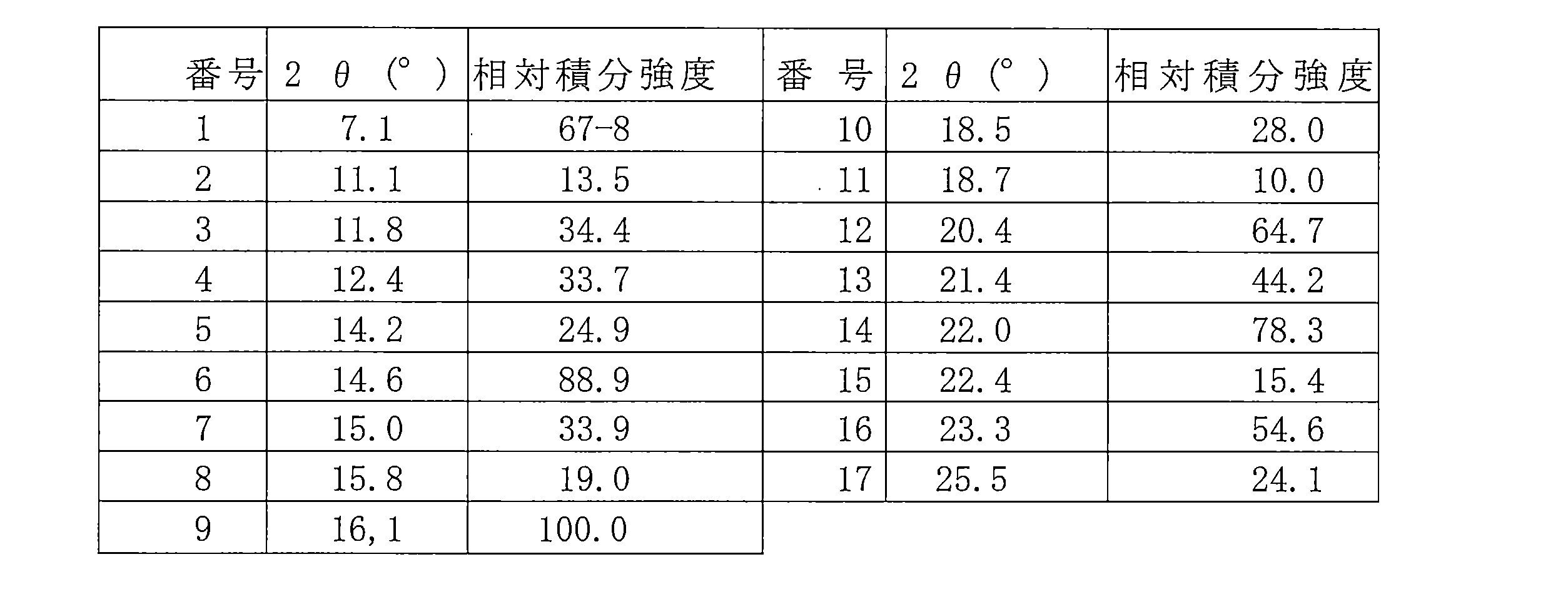
1.反応組成、純度分析(分析値は面積百分率)
測定装置:高速液体クロマトグラフィー分析装置((株)島津製作所製)
ポンプ:LC-20AD
カラムオーブン:CTO-20A
検出器:SPD-20A
検出波長:280nm
カラム:HALO-C18
オーブン温度:50℃
流量:0.7mL/min
移動相:(A)0.2体積%酢酸水溶液、(B)メタノール
グラジエント条件:(A)体積%(分析開始からの時間)
50%(0分)→80%(4分)→100%(14分)→100%(19分)
2.NMR分析測定装置:フーリエ変換核磁気共鳴AVANCE III HD 400(BRUKER製)
測定サンプルを重水素化クロロホルム(CDCl3)に溶解し、13C-NMR及び1H-NMRスペクトルを測定した。
3.熱分析
合成例1で得られた結晶3mgをアルミパンに秤量し、示差走査熱量測定装置(株式会社日立ハイテクサイエンス製:DSC7020)を用いて、酸化アルミニウムを対照として下記操作条件により結晶の熱分析を行った。分析により現れた吸熱ピークのトップ温度を融点とした。
(操作条件)
昇温速度:10℃/min
測定温度範囲:30~350℃
測定雰囲気:開放、窒素50mL/min.
4.X線回折法(XRD)
実施例で得られた化合物0.1gをガラス試験板の試料充填部に充填し、下記装置と下記条件により測定した。
[測定装置]
MiniFlex600-C/(株)リガク製
[測定条件]
X線源:CuKα
管電圧:40kV
管電流:15mA
スキャン軸:2θ/θ
モード:連続
測定範囲:2θ=5°~90°
ステップ:0.02°
スピード計測時間:10°/min.
入射スリット:0.25°
受光スリット:13.00mm
原料として、下記構造式で表される9,9-ビス[4-(2-ヒドロキシエトキシ)フェニル]フルオレン(BPEF)27.8234g(0.0634モル)、下記構造式で表される2,2’-[(1,3-フェニレンビス(プロパン-2,2-ジイル))ビス(2-シクロヘキシル-5-メチル-4,1-フェニレン))ビス(オキシ))ビス(エタン-1-オール)(Bis3M6CM-2EO、化合物(1-2)の結晶)17.2898g(0.0272モル)、ジフェニルカーボネート(DPC)20.0000g(0.0934モル)および2.5×10⁻²モル/リットルの炭酸水素ナトリウム水溶液20μl(5.0×10-7モル)を撹拌機及び留出装置付きの300mL反応器に入れ、系内を窒素置換した。この反応器を200℃に加熱したオイルバスに浸けエステル交換反応を開始した。140分かけて240℃まで昇温するとともに0.1kPa以下まで減圧し、30分間保持した後、反応系内に窒素ガスを導入し、101.3kPaに戻し、ポリカーボネート樹脂を得た。得られた樹脂の物性を表2に示す。
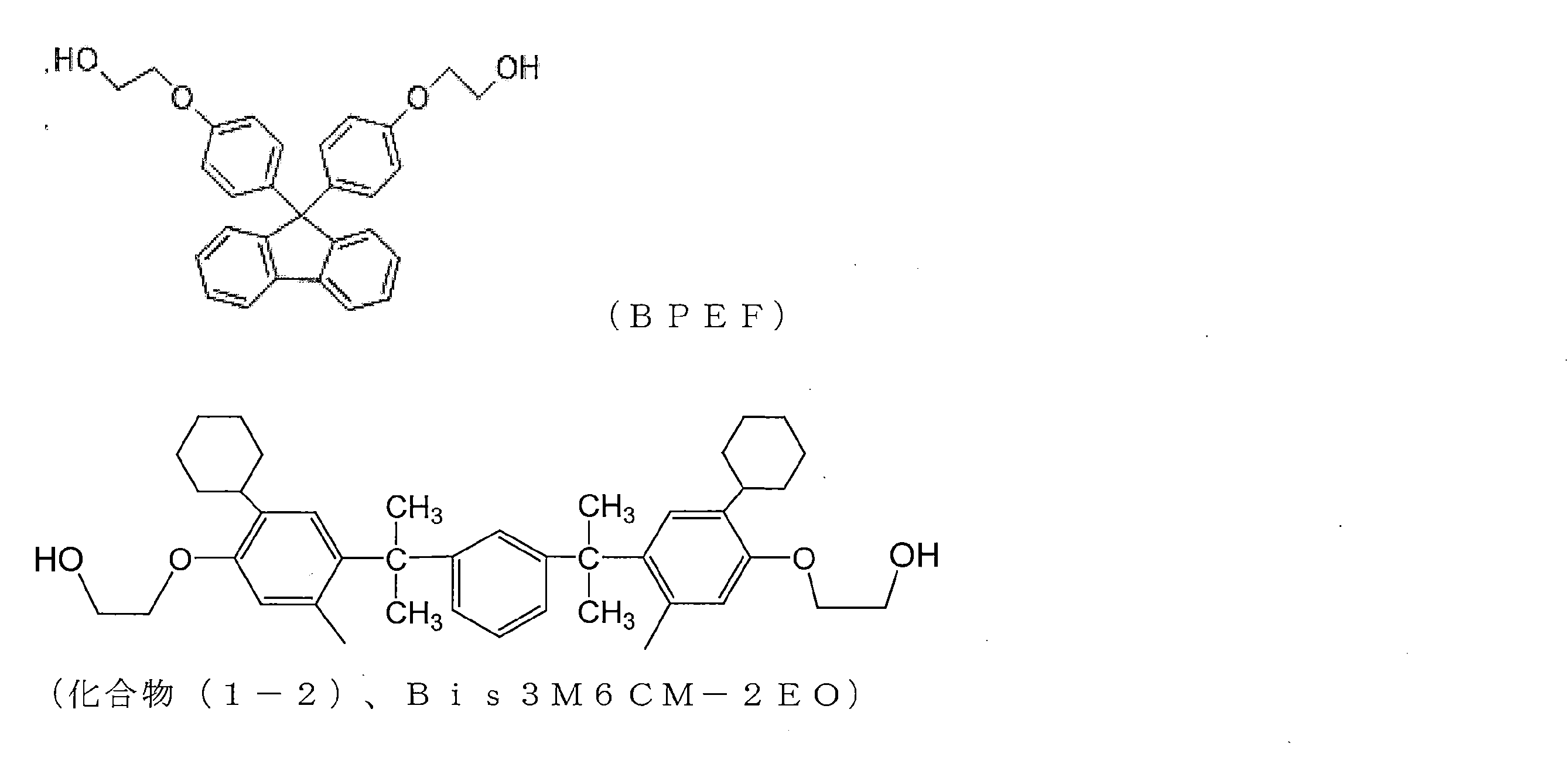
原料中のジヒドロキシ化合物(ジオール)を表2に記載のものとする以外は、実施例1と同様にしてポリカーボネート樹脂を得た。得られた樹脂の物性を表2に示す。
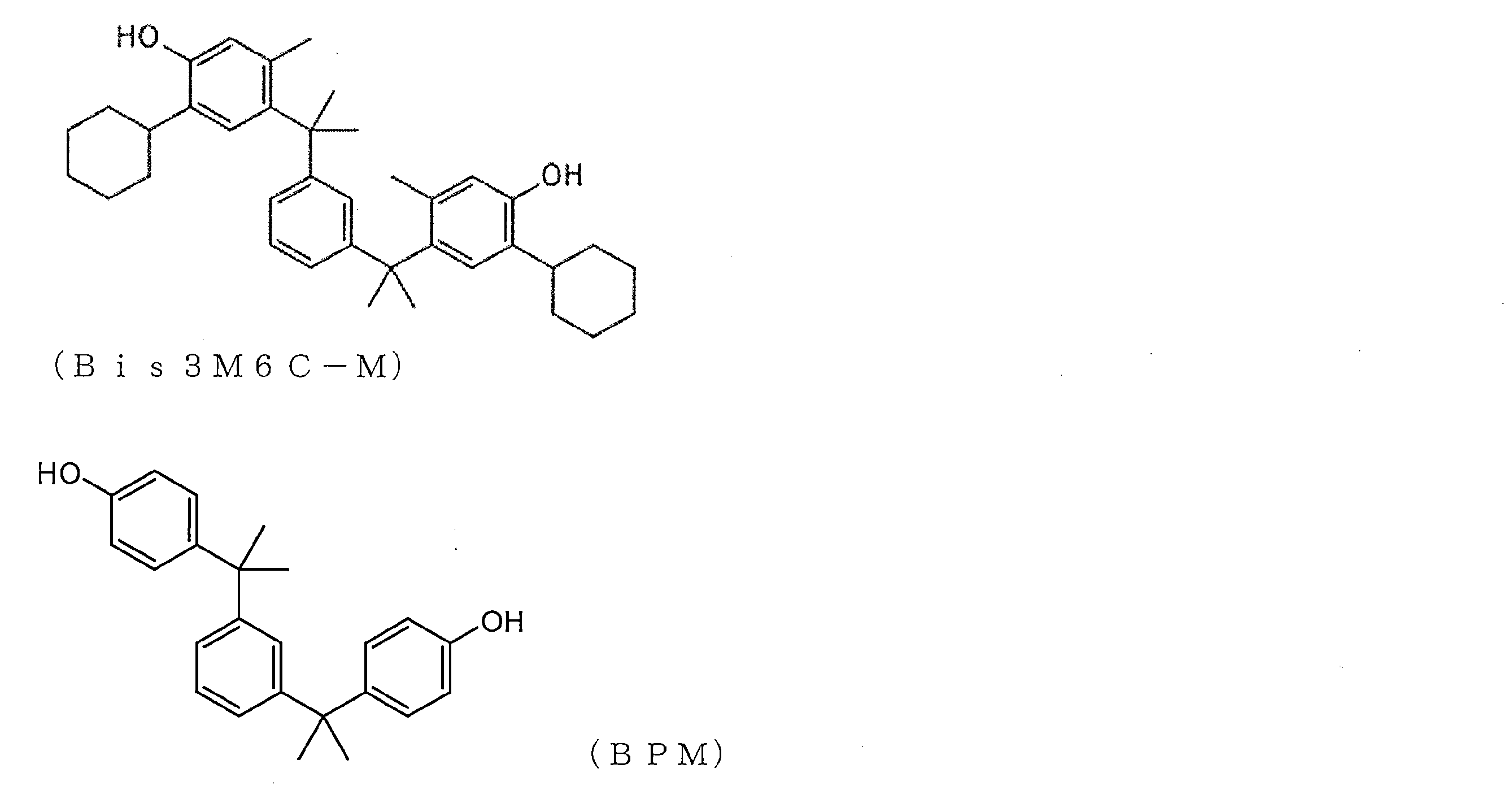

Claims (16)
- 下記一般式(1)で表される化合物由来の構成単位(A)を含む熱可塑性樹脂。

- 前記一般式(1)で表される化合物が、下記一般式(1A)又は(1B)で表される化合物である、請求項1に記載の熱可塑性樹脂。
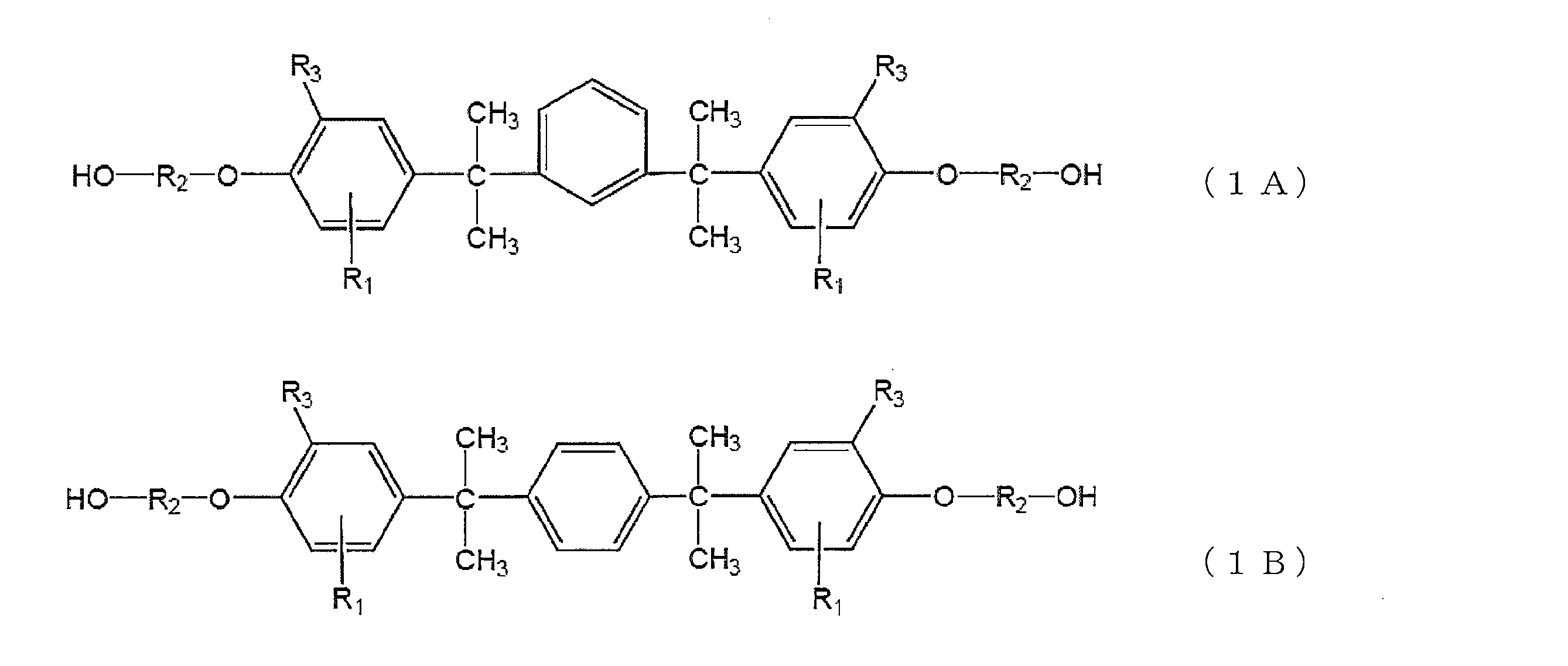
- 前記一般式(1)で表される化合物におけるR3が、t-ブチル基又はシクロヘキシル基である、請求項1に記載の熱可塑性樹脂。
- 前記熱可塑性樹脂が、ポリカーボネート樹脂、ポリエステルカーボネート樹脂、又はポリエステル樹脂である、請求項1に記載の熱可塑性樹脂。
- 前記熱可塑性樹脂が、下記一般式(6)で表されるモノマー由来の構成単位(B)及び/又は下記一般式(7)で表されるモノマー由来の構成単位(C)を含む、請求項1に記載の熱可塑性樹脂。
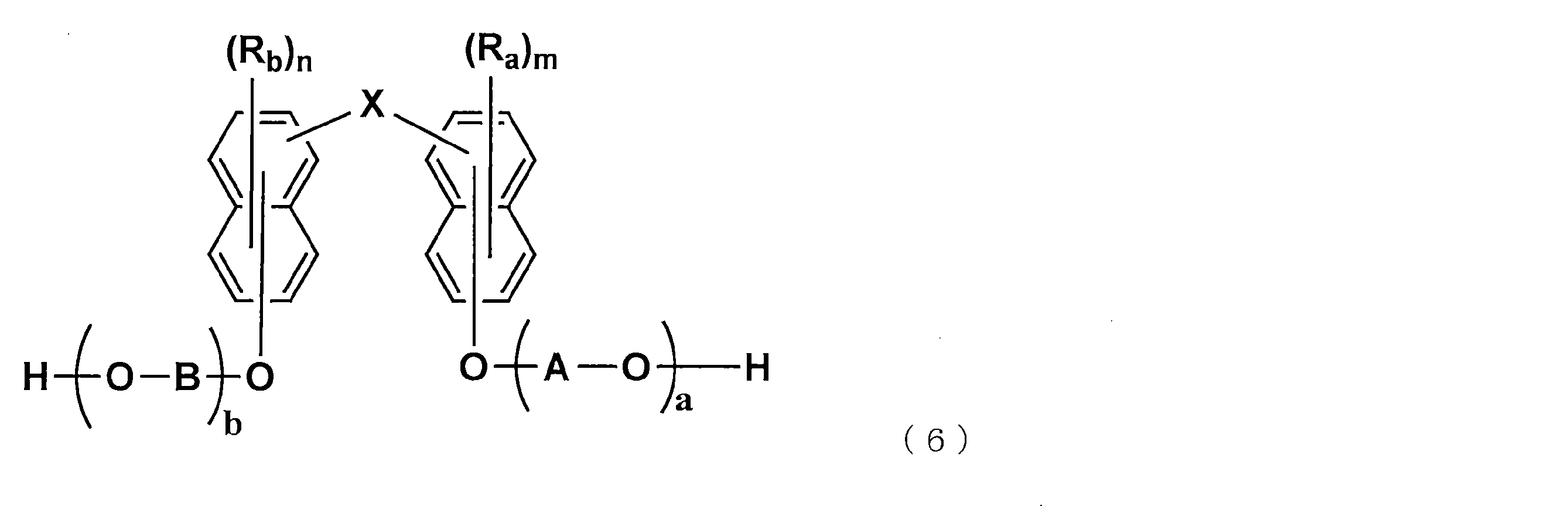
Ra及びRbは、それぞれ独立に、水素原子、ハロゲン原子、置換基を有してもよい炭素数1~20のアルキル基、置換基を有してもよい炭素数1~20のアルコキシル基、置換基を有してもよい炭素数5~20のシクロアルキル基、置換基を有してもよい炭素数5~20のシクロアルコキシル基、置換基を有してもよい炭素数6~20のアリール基、O、N及びSから選択される1つ以上のヘテロ環原子を含む、置換基を有してもよい炭素数6~20のヘテロアリール基、置換基を有してもよい炭素数6~20のアリールオキシ基、及び、-C≡C-Rhからなる群より選択され、
Rhは置換基を有してもよい炭素数6~20のアリール基、又は、O、N及びSから選択される1つ以上のヘテロ環原子を含む、置換基を有してもよい炭素数6~20のヘテロアリール基を表し、
Xは、単結合であるか、又は置換基を有してもよいフルオレン基を表し、
A及びBは、それぞれ独立に、置換基を有してもよい炭素数1~5のアルキレン基を表し、
m及びnは、それぞれ独立に、0~6の整数を表し、
a及びbは、それぞれ独立に、0~10の整数を表す。)
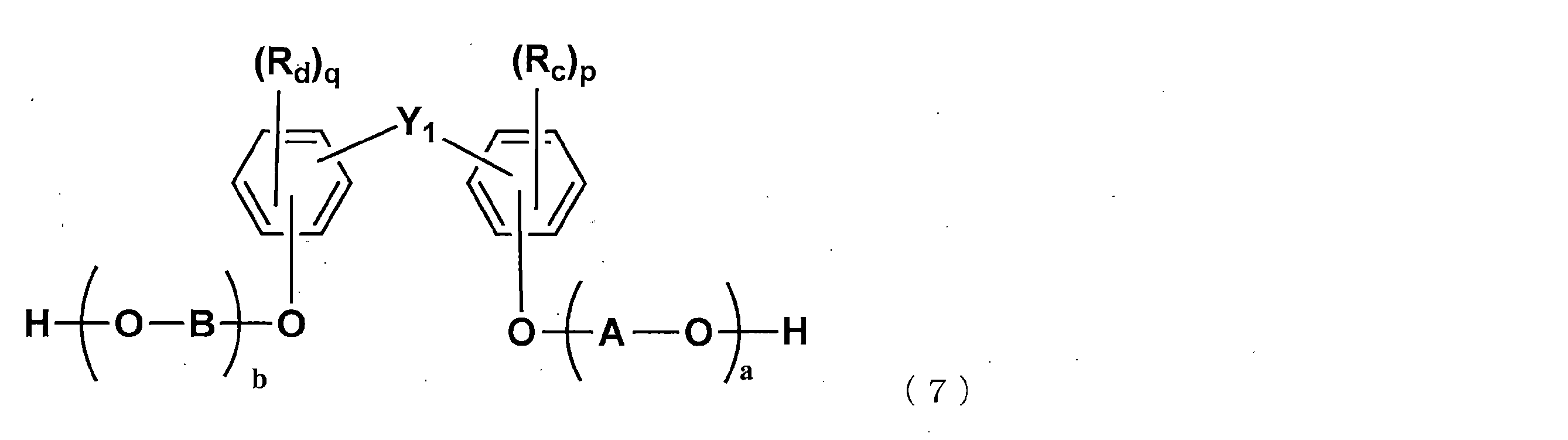
Rc及びRdは、それぞれ独立に、水素原子、ハロゲン原子、置換基を有してもよい炭素数1~20のアルキル基、置換基を有してもよい炭素数1~20のアルコキシル基、置換基を有してもよい炭素数5~20のシクロアルキル基、置換基を有してもよい炭素数5~20のシクロアルコキシル基、及び、置換基を有してもよい炭素数6~20のアリール基からなる群より選択され、
Y1は、単結合、置換基を有してもよいフルオレン基、又は下記式(8)~(15)で表される構造式のうちいずれかであり、

R61、R62、R71、R72、R81及びR82は、それぞれ独立して、水素原子、ハロゲン原子、置換基を有してもよい炭素数1~20のアルキル基、又は、置換基を有してもよい炭素数6~30のアリール基を表すか、あるいは、R61及びR62、又はR71及びR72が互いに結合して形成する、置換基を有してもよい炭素数1~20の炭素環又は複素環を表し、
r及びsは、それぞれ独立して、0~5000の整数を表す。)
A及びBは、それぞれ独立に、置換基を有してもよい炭素数1~5のアルキレン基を表し、
p及びqは、それぞれ独立に、0~4の整数を表し、
a及びbは、それぞれ独立に、0~10の整数を表す。) - 前記一般式(6)及び一般式(7)において、前記A及びBが、それぞれ独立に、炭素数2又は3のアルキレン基を表す、請求項5に記載の熱可塑性樹脂。
- 前記熱可塑性樹脂が、少なくとも、BPEF、BNE、BNEF、DPBHBNA、BPM、及びBCFLのいずれかに由来する構成単位を含む、請求項5に記載の熱可塑性樹脂。
- 前記熱可塑性樹脂が、更に、下記のモノマー群から選択される少なくとも一つのモノマーに由来する構成単位を含む、請求項1に記載の熱可塑性樹脂。

- 前記熱可塑性樹脂のポリスチレン換算の重量平均分子量(Mw)が、10,000~100,000である、請求項1に記載の熱可塑性樹脂。
- 前記熱可塑性樹脂の屈折率(nD)が、1.500~1.700である、請求項1に記載の熱可塑性樹脂。
- 前記熱可塑性樹脂のアッベ数(ν)が、22.0~35.0である、請求項1に記載の熱可塑性樹脂。
- 前記熱可塑性樹脂のガラス転移温度が、125~150℃である、請求項1に記載の熱可塑性樹脂。
- 前記熱可塑性樹脂の光弾性係数が、25~45である、請求項1に記載の熱可塑性樹脂。
- 前記熱可塑性樹脂の吸水率が、0.40%以下である、請求項1に記載の熱可塑性樹脂。
- 前記熱可塑性樹脂の吸水寸法変化率が、0.045%以下である、請求項1に記載の熱可塑性樹脂。
- 請求項1に記載の熱可塑性樹脂を含む、光学レンズ。
Priority Applications (4)
| Application Number | Priority Date | Filing Date | Title |
|---|---|---|---|
| CN202480030454.5A CN121195011A (zh) | 2023-05-12 | 2024-05-09 | 热塑性树脂和含有该热塑性树脂的光学透镜 |
| KR1020257026248A KR20260020904A (ko) | 2023-05-12 | 2024-05-09 | 열가소성 수지 및 그것을 포함하는 광학 렌즈 |
| EP24807106.0A EP4711398A1 (en) | 2023-05-12 | 2024-05-09 | Thermoplastic resin and optical lens including same |
| JP2025520534A JPWO2024237154A1 (ja) | 2023-05-12 | 2024-05-09 |
Applications Claiming Priority (2)
| Application Number | Priority Date | Filing Date | Title |
|---|---|---|---|
| JP2023-078986 | 2023-05-12 | ||
| JP2023078986 | 2023-05-12 |
Publications (1)
| Publication Number | Publication Date |
|---|---|
| WO2024237154A1 true WO2024237154A1 (ja) | 2024-11-21 |
Family
ID=93519081
Family Applications (1)
| Application Number | Title | Priority Date | Filing Date |
|---|---|---|---|
| PCT/JP2024/017197 Ceased WO2024237154A1 (ja) | 2023-05-12 | 2024-05-09 | 熱可塑性樹脂及びそれを含む光学レンズ |
Country Status (6)
| Country | Link |
|---|---|
| EP (1) | EP4711398A1 (ja) |
| JP (1) | JPWO2024237154A1 (ja) |
| KR (1) | KR20260020904A (ja) |
| CN (1) | CN121195011A (ja) |
| TW (1) | TW202511356A (ja) |
| WO (1) | WO2024237154A1 (ja) |
Citations (15)
| Publication number | Priority date | Publication date | Assignee | Title |
|---|---|---|---|---|
| US3544512A (en) * | 1968-01-22 | 1970-12-01 | Dow Chemical Co | Stabilized polyolefin compositions |
| US4746716A (en) * | 1985-12-27 | 1988-05-24 | Ppg Industries, Inc. | Compositions for producing polymers of high refractive index and low yellowness |
| JPH06222581A (ja) * | 1993-01-22 | 1994-08-12 | Fuji Xerox Co Ltd | 電子写真感光体 |
| JPH11171810A (ja) * | 1997-12-08 | 1999-06-29 | Jsr Corp | フェノール化合物およびその製造方法 |
| JP2000248058A (ja) * | 1999-03-04 | 2000-09-12 | Teijin Chem Ltd | 芳香族ポリカーボネート共重合体 |
| JP2001058968A (ja) * | 1999-06-14 | 2001-03-06 | Honshu Chem Ind Co Ltd | 1,3−ジ(2−p−ヒドロキシフェニル−2−プロピル)ベンゼンの製造方法 |
| JP2013056967A (ja) * | 2011-09-07 | 2013-03-28 | Dic Corp | 活性エネルギー線硬化型樹脂組成物、これを用いたコーティング剤 |
| WO2017078073A1 (ja) | 2015-11-04 | 2017-05-11 | 三菱瓦斯化学株式会社 | ポリカーボネート樹脂 |
| JP2018002893A (ja) | 2016-07-04 | 2018-01-11 | 帝人株式会社 | 熱可塑性樹脂 |
| JP2018002894A (ja) | 2016-07-04 | 2018-01-11 | 帝人株式会社 | 熱可塑性樹脂 |
| JP2018002895A (ja) | 2016-07-04 | 2018-01-11 | 帝人株式会社 | 熱可塑性樹脂 |
| JP2018059074A (ja) | 2016-10-06 | 2018-04-12 | 大阪ガスケミカル株式会社 | フルオレン骨格を有するポリエステル樹脂 |
| WO2023176736A1 (ja) * | 2022-03-14 | 2023-09-21 | 本州化学工業株式会社 | 新規な1,3-ビス(1-メチル-1-フェニルエチル)ベンゼン化合物 |
| JP2023138918A (ja) * | 2023-03-15 | 2023-10-03 | 三菱瓦斯化学株式会社 | 熱可塑性樹脂及びそれを含む光学レンズ |
| WO2023195504A1 (ja) * | 2022-04-07 | 2023-10-12 | 三菱瓦斯化学株式会社 | 熱可塑性樹脂及びそれを含む光学レンズ |
-
2024
- 2024-05-09 JP JP2025520534A patent/JPWO2024237154A1/ja active Pending
- 2024-05-09 KR KR1020257026248A patent/KR20260020904A/ko active Pending
- 2024-05-09 EP EP24807106.0A patent/EP4711398A1/en active Pending
- 2024-05-09 WO PCT/JP2024/017197 patent/WO2024237154A1/ja not_active Ceased
- 2024-05-09 CN CN202480030454.5A patent/CN121195011A/zh active Pending
- 2024-05-09 TW TW113117221A patent/TW202511356A/zh unknown
Patent Citations (15)
| Publication number | Priority date | Publication date | Assignee | Title |
|---|---|---|---|---|
| US3544512A (en) * | 1968-01-22 | 1970-12-01 | Dow Chemical Co | Stabilized polyolefin compositions |
| US4746716A (en) * | 1985-12-27 | 1988-05-24 | Ppg Industries, Inc. | Compositions for producing polymers of high refractive index and low yellowness |
| JPH06222581A (ja) * | 1993-01-22 | 1994-08-12 | Fuji Xerox Co Ltd | 電子写真感光体 |
| JPH11171810A (ja) * | 1997-12-08 | 1999-06-29 | Jsr Corp | フェノール化合物およびその製造方法 |
| JP2000248058A (ja) * | 1999-03-04 | 2000-09-12 | Teijin Chem Ltd | 芳香族ポリカーボネート共重合体 |
| JP2001058968A (ja) * | 1999-06-14 | 2001-03-06 | Honshu Chem Ind Co Ltd | 1,3−ジ(2−p−ヒドロキシフェニル−2−プロピル)ベンゼンの製造方法 |
| JP2013056967A (ja) * | 2011-09-07 | 2013-03-28 | Dic Corp | 活性エネルギー線硬化型樹脂組成物、これを用いたコーティング剤 |
| WO2017078073A1 (ja) | 2015-11-04 | 2017-05-11 | 三菱瓦斯化学株式会社 | ポリカーボネート樹脂 |
| JP2018002893A (ja) | 2016-07-04 | 2018-01-11 | 帝人株式会社 | 熱可塑性樹脂 |
| JP2018002894A (ja) | 2016-07-04 | 2018-01-11 | 帝人株式会社 | 熱可塑性樹脂 |
| JP2018002895A (ja) | 2016-07-04 | 2018-01-11 | 帝人株式会社 | 熱可塑性樹脂 |
| JP2018059074A (ja) | 2016-10-06 | 2018-04-12 | 大阪ガスケミカル株式会社 | フルオレン骨格を有するポリエステル樹脂 |
| WO2023176736A1 (ja) * | 2022-03-14 | 2023-09-21 | 本州化学工業株式会社 | 新規な1,3-ビス(1-メチル-1-フェニルエチル)ベンゼン化合物 |
| WO2023195504A1 (ja) * | 2022-04-07 | 2023-10-12 | 三菱瓦斯化学株式会社 | 熱可塑性樹脂及びそれを含む光学レンズ |
| JP2023138918A (ja) * | 2023-03-15 | 2023-10-03 | 三菱瓦斯化学株式会社 | 熱可塑性樹脂及びそれを含む光学レンズ |
Also Published As
| Publication number | Publication date |
|---|---|
| TW202511356A (zh) | 2025-03-16 |
| KR20260020904A (ko) | 2026-02-12 |
| EP4711398A1 (en) | 2026-03-18 |
| CN121195011A (zh) | 2025-12-23 |
| JPWO2024237154A1 (ja) | 2024-11-21 |
Similar Documents
| Publication | Publication Date | Title |
|---|---|---|
| EP4506392A1 (en) | Thermoplastic resin and optical lens including same | |
| US20250223398A1 (en) | Thermoplastic resin and optical lens including same | |
| JP2018002894A (ja) | 熱可塑性樹脂 | |
| WO2022270367A1 (ja) | 熱可塑性樹脂及びそれを含む光学レンズ | |
| JP2023138918A (ja) | 熱可塑性樹脂及びそれを含む光学レンズ | |
| JP7826948B2 (ja) | 熱可塑性樹脂及びそれを含む光学レンズ | |
| US12509579B2 (en) | Thermoplastic resin and optical lens including same | |
| TW202413482A (zh) | 自環式二醇化合物所得之樹脂及含該樹脂之光學鏡片 | |
| KR20260020904A (ko) | 열가소성 수지 및 그것을 포함하는 광학 렌즈 | |
| WO2024135717A1 (ja) | 熱可塑性樹脂及びそれを含む光学レンズ | |
| CN118974141A (zh) | 热塑性树脂以及包含该树脂的光学透镜 | |
| WO2025254046A1 (ja) | 熱可塑性樹脂及びそれを含む光学レンズ | |
| WO2025254042A1 (ja) | ビフェナントレンジカルボン酸化合物 | |
| CN118974139A (zh) | 热塑性树脂以及包含该树脂的光学透镜 | |
| WO2025234377A1 (ja) | 熱可塑性樹脂、それを含む樹脂組成物および成形体 |
Legal Events
| Date | Code | Title | Description |
|---|---|---|---|
| 121 | Ep: the epo has been informed by wipo that ep was designated in this application |
Ref document number: 24807106 Country of ref document: EP Kind code of ref document: A1 |
|
| ENP | Entry into the national phase |
Ref document number: 2025520534 Country of ref document: JP Kind code of ref document: A |
|
| WWE | Wipo information: entry into national phase |
Ref document number: 2025520534 Country of ref document: JP |
|
| WWE | Wipo information: entry into national phase |
Ref document number: 2024807106 Country of ref document: EP |
|
| NENP | Non-entry into the national phase |
Ref country code: DE |
|
| ENP | Entry into the national phase |
Ref document number: 2024807106 Country of ref document: EP Effective date: 20251212 |
|
| ENP | Entry into the national phase |
Ref document number: 2024807106 Country of ref document: EP Effective date: 20251212 |
|
| ENP | Entry into the national phase |
Ref document number: 2024807106 Country of ref document: EP Effective date: 20251212 |
|
| ENP | Entry into the national phase |
Ref document number: 2024807106 Country of ref document: EP Effective date: 20251212 |
|
| ENP | Entry into the national phase |
Ref document number: 2024807106 Country of ref document: EP Effective date: 20251212 |
|
| ENP | Entry into the national phase |
Ref document number: 2024807106 Country of ref document: EP Effective date: 20251212 |
|
| ENP | Entry into the national phase |
Ref document number: 2024807106 Country of ref document: EP Effective date: 20251212 |
|
| ENP | Entry into the national phase |
Ref document number: 2024807106 Country of ref document: EP Effective date: 20251212 |
|
| ENP | Entry into the national phase |
Ref document number: 2024807106 Country of ref document: EP Effective date: 20251212 |
|
| WWP | Wipo information: published in national office |
Ref document number: 2024807106 Country of ref document: EP |