WO2024225362A1 - 酸化アルミニウム質膜およびその製造方法ならびに積層体 - Google Patents
酸化アルミニウム質膜およびその製造方法ならびに積層体 Download PDFInfo
- Publication number
- WO2024225362A1 WO2024225362A1 PCT/JP2024/016175 JP2024016175W WO2024225362A1 WO 2024225362 A1 WO2024225362 A1 WO 2024225362A1 JP 2024016175 W JP2024016175 W JP 2024016175W WO 2024225362 A1 WO2024225362 A1 WO 2024225362A1
- Authority
- WO
- WIPO (PCT)
- Prior art keywords
- aluminum oxide
- oxide film
- less
- substrate
- film
- Prior art date
- Legal status (The legal status is an assumption and is not a legal conclusion. Google has not performed a legal analysis and makes no representation as to the accuracy of the status listed.)
- Ceased
Links
Images

Classifications
-
- C—CHEMISTRY; METALLURGY
- C23—COATING METALLIC MATERIAL; COATING MATERIAL WITH METALLIC MATERIAL; CHEMICAL SURFACE TREATMENT; DIFFUSION TREATMENT OF METALLIC MATERIAL; COATING BY VACUUM EVAPORATION, BY SPUTTERING, BY ION IMPLANTATION OR BY CHEMICAL VAPOUR DEPOSITION, IN GENERAL; INHIBITING CORROSION OF METALLIC MATERIAL OR INCRUSTATION IN GENERAL
- C23C—COATING METALLIC MATERIAL; COATING MATERIAL WITH METALLIC MATERIAL; SURFACE TREATMENT OF METALLIC MATERIAL BY DIFFUSION INTO THE SURFACE, BY CHEMICAL CONVERSION OR SUBSTITUTION; COATING BY VACUUM EVAPORATION, BY SPUTTERING, BY ION IMPLANTATION OR BY CHEMICAL VAPOUR DEPOSITION, IN GENERAL
- C23C14/00—Coating by vacuum evaporation, by sputtering or by ion implantation of the coating forming material
- C23C14/06—Coating by vacuum evaporation, by sputtering or by ion implantation of the coating forming material characterised by the coating material
- C23C14/08—Oxides
-
- C—CHEMISTRY; METALLURGY
- C23—COATING METALLIC MATERIAL; COATING MATERIAL WITH METALLIC MATERIAL; CHEMICAL SURFACE TREATMENT; DIFFUSION TREATMENT OF METALLIC MATERIAL; COATING BY VACUUM EVAPORATION, BY SPUTTERING, BY ION IMPLANTATION OR BY CHEMICAL VAPOUR DEPOSITION, IN GENERAL; INHIBITING CORROSION OF METALLIC MATERIAL OR INCRUSTATION IN GENERAL
- C23C—COATING METALLIC MATERIAL; COATING MATERIAL WITH METALLIC MATERIAL; SURFACE TREATMENT OF METALLIC MATERIAL BY DIFFUSION INTO THE SURFACE, BY CHEMICAL CONVERSION OR SUBSTITUTION; COATING BY VACUUM EVAPORATION, BY SPUTTERING, BY ION IMPLANTATION OR BY CHEMICAL VAPOUR DEPOSITION, IN GENERAL
- C23C14/00—Coating by vacuum evaporation, by sputtering or by ion implantation of the coating forming material
- C23C14/22—Coating by vacuum evaporation, by sputtering or by ion implantation of the coating forming material characterised by the process of coating
-
- H—ELECTRICITY
- H10—SEMICONDUCTOR DEVICES; ELECTRIC SOLID-STATE DEVICES NOT OTHERWISE PROVIDED FOR
- H10P—GENERIC PROCESSES OR APPARATUS FOR THE MANUFACTURE OR TREATMENT OF DEVICES COVERED BY CLASS H10
- H10P14/00—Formation of materials, e.g. in the shape of layers or pillars
- H10P14/20—Formation of materials, e.g. in the shape of layers or pillars of semiconductor materials
- H10P14/29—Formation of materials, e.g. in the shape of layers or pillars of semiconductor materials characterised by the substrates
Definitions
- the present invention relates to an aluminum oxide film, a method for producing the same, and a laminate.
- Patent Document 1 a laminate in which an epitaxial film (e.g., a GaN film) is formed on a substrate such as a GaN substrate has been used, for example, as part of a power semiconductor (Patent Document 1).
- an epitaxial film e.g., a GaN film
- the substrate When an epitaxial film is formed on a substrate by epitaxial growth, if the substrate has crystal defects, the crystal defects are likely to be transferred to the epitaxial film. Furthermore, if the substrate contains impurities (such as moisture and oxygen), the impurities may also be present in the epitaxial film.
- impurities such as moisture and oxygen
- the inventors therefore considered providing an aluminum oxide film containing aluminum oxide between the substrate and the epitaxial film as a highly shielding film.
- the present invention was made in consideration of the above points, and aims to provide a new aluminum oxide film.
- the present invention provides the following [1] to [24].
- the aluminum oxide film according to any one of the above [1] to [7] which is an amorphous film.
- the aluminum oxide film according to any one of the above [1] to [8] having a heat resistant temperature of 500° C. or higher.
- a laminate comprising a substrate and the aluminum oxide film according to any one of [1] to [9] above, in this order.
- the substrate is made of at least one material selected from the group consisting of GaN, AlN, ZnO, SiC, LiTaO3 , LiNbO3 , PZT, and Ga2O3 .
- the thickness of the substrate is 2.0 mm or less.
- the method for producing an aluminum oxide film according to [22] above, wherein the temperature of the substrate when the evaporated evaporation source is attached is 270° C. or higher.
- the present invention provides a novel aluminum oxide film.
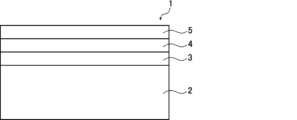
- FIG. 1 is a schematic diagram showing an example of a laminate.
- FIG. 2 is a schematic diagram showing an apparatus used for producing an aluminum oxide film.
- the aluminum oxide film of this embodiment (hereinafter also referred to as the "present aluminum oxide film”) contains aluminum oxide, has a porosity of less than 0.5 volume %, and has a Vickers hardness of 1300 HV or more.
- the present aluminum oxide film is provided on a substrate, and then an epitaxial film is formed on the present aluminum oxide film (that is, an epitaxial film is formed on the substrate via the present aluminum oxide film).
- This aluminum oxide film has a porosity and a Vickers hardness within the above-mentioned ranges, and is therefore very dense and hard. Therefore, even if the substrate has crystal defects or is contaminated with a large amount of impurities (such as moisture), the aluminum oxide film functions as a highly shielding film, and it is expected that defects in the substrate will not easily transfer to the epitaxial film.
- the aluminum oxide film is described in more detail below.
- the Vickers hardness of the present aluminum oxide film is 1300 HV or more, preferably 1500 HV or more, more preferably 1700 HV or more, even more preferably 1900 HV or more, particularly preferably 2100 HV or more, and most preferably 2300 HV or more.
- the Vickers hardness of the present aluminum oxide film is, for example, 3500 HV or less, and preferably 3000 HV or less.
- the Vickers hardness of the aluminum oxide film is determined in accordance with JIS Z 2244. More specifically, it is the Vickers hardness (HV0.005) determined when a test force of 0.049 N is applied using a diamond indenter with a facing angle of 136° using a micro Vickers hardness tester (HM-220, manufactured by Mitutoyo Corporation).
- the porosity of the present aluminum oxide film is less than 0.5% by volume, preferably 0.3% by volume or less, more preferably 0.2% by volume or less, and even more preferably 0.1% by volume or less.
- the porosity of the aluminum oxide film is determined as follows. First, a focused ion beam (FIB) is used to perform a slope process in the thickness direction from the surface of the aluminum oxide film toward the substrate at an angle of 52° on the aluminum oxide film and a portion of the substrate described below, thereby exposing a cross section. The exposed cross section is observed at a magnification of 20,000 times using a field emission scanning electron microscope (FE-SEM), and an image of the cross section is taken. The cross-sectional images are taken at a plurality of locations.
- FIB focused ion beam
- images are taken at a total of five locations, including one point at the center of the surface of the aluminum oxide film (or the surface of the substrate) and four points 10 mm away from the outer periphery, and the size of the cross-sectional images is 6 ⁇ m ⁇ 5 ⁇ m.
- the thickness of the aluminum oxide film is 5 ⁇ m or more
- cross-sectional images are taken at each of the plurality of locations so that the cross section of the aluminum oxide film can be observed in the thickness direction.
- the cross-sectional image is then analyzed using image analysis software (ImageJ, National Institute of Health) to determine the area of the pores in the cross-sectional image.
- the ratio of the area of the pores to the total cross-sectional area of the aluminum oxide film is calculated, and this is regarded as the porosity (unit: volume %) of the aluminum oxide film. Note that the area of pores that are too fine to be detected by the image analysis software (pores with a pore diameter of 20 nm or less) is regarded as 0.
- the present aluminum oxide film contains aluminum oxide (Al 2 O 3 ).
- the Al 2 O 3 content of the present aluminum oxide film is preferably 95 mass % or more, more preferably 98 mass % or more, and even more preferably 100 mass %.
- the aluminum oxide film produced by the method (the present production method) described below is composed substantially of Al 2 O 3 alone, and the Al 2 O 3 content satisfies the above range.
- the thickness of the aluminum oxide film is, for example, 0.1 ⁇ m or more, preferably 0.3 ⁇ m or more, more preferably 0.8 ⁇ m or more, even more preferably 1.5 ⁇ m or more, even more preferably 3 ⁇ m or more, particularly preferably 4 ⁇ m or more, and most preferably 5 ⁇ m or more.
- the thickness of the present aluminum oxide film is, for example, 15 ⁇ m or less, preferably 10 ⁇ m or less, and more preferably 6 ⁇ m or less.
- the thickness of the aluminum oxide film is measured as follows (the same applies to the thicknesses of the substrate and adhesive layer described below). A cross section of the aluminum oxide film is observed using a scanning electron microscope (SEM), the thickness of the aluminum oxide film is measured at any five points, and the average value of the five measured points is regarded as the thickness of the aluminum oxide film (unit: ⁇ m).
- SEM scanning electron microscope
- the coefficient of variation of the thickness of the present aluminum oxide film is preferably 0.04 or less, more preferably 0.03 or less, even more preferably 0.02 or less, even more preferably 0.01 or less, particularly preferably 0.005 or less, and most preferably 0.001 or less.
- the coefficient of variation of thickness is calculated by measuring the thickness at five points on the surface of the aluminum oxide film in the same manner as above, and dividing the standard deviation ⁇ of the five points by the average value ⁇ of the five points ( ⁇ / ⁇ ).
- the five points are one point (point P) on the surface of the aluminum oxide film, two points on a concentric circle with a radius of 50 mm centered on point P, and two points on a concentric circle with a radius of 95 mm centered on point P, for a total of five points.
- point P point on the surface of the aluminum oxide film
- the measurement is made at any five points on the surface of the aluminum oxide film.
- the number of hydrogen atoms in the present aluminum oxide film is small.
- the number of hydrogen atoms in the present aluminum oxide film is preferably 10 ⁇ 10 20 atoms/cm 3 or less, more preferably 6 ⁇ 10 20 atoms/cm 3 or less, even more preferably 4 ⁇ 10 20 atoms/cm 3 or less, particularly preferably 2 ⁇ 10 20 atoms/cm 3 or less, and most preferably 1 ⁇ 10 20 atoms/cm 3 or less.
- the hydrogen atoms in the aluminum oxide film are due to the influence of moisture contained in the substrate, which will be described later.
- the number of hydrogen atoms in the aluminum oxide film to be formed can be reduced by heating the substrate (pre-heating) before the aluminum oxide film is formed. Other methods for reducing the number of hydrogen atoms in the aluminum oxide film will be described later.
- the number of hydrogen atoms in the aluminum oxide film is determined using a secondary ion mass spectrometer (model IMS-6f, manufactured by Ametech Co., Ltd.) under conditions of primary ion species Cs + , primary acceleration voltage 15.0 kV, detection area ⁇ 8 ⁇ m, measurement depth 500 nm.
- the stress (internal stress, residual stress) of the aluminum oxide film is preferably compressive stress rather than tensile stress.
- the compressive stress of the present aluminum oxide film is preferably 1 MPa or more, more preferably 5 MPa or more, even more preferably 10 MPa or more, even more preferably 30 MPa or more, particularly preferably 50 MPa or more, and most preferably 80 MPa or more.
- the compressive stress of the present aluminum oxide film is preferably 600 MPa or less, more preferably 550 MPa or less, even more preferably 450 MPa or less, even more preferably 350 MPa or less, particularly preferably 250 MPa or less, and most preferably 150 MPa or less. That is, the compressive stress of the present aluminum oxide film is preferably 1 to 600 MPa.
- the compressive stress of the aluminum oxide film is determined as follows. An aluminum oxide film is formed on a quartz glass substrate, and the surface shape of the aluminum oxide film is measured using a surface shape measuring device (Surfcom NEX 241 SD2-13, manufactured by Tokyo Seimitsu Co., Ltd.).
- ⁇ is the film stress
- Y the Young's modulus of the substrate
- d is the thickness of the substrate
- ⁇ the Poisson's ratio of the substrate
- t is the thickness of the aluminum oxide film
- c is the radius of curvature.
- the average secondary particle size of an aluminum oxide film is preferably 100 nm or less, more preferably 70 nm or less, even more preferably 50 nm or less, even more preferably 30 nm or less, particularly preferably 20 nm or less, and most preferably 10 nm or less.
- the lower limit of the average secondary particle diameter is not particularly limited, and is, for example, 1 nm, preferably 2 nm, and more preferably 3 nm.
- the aluminum oxide film is observed at a magnification of 100,000 times using a scanning electron microscope (SEM) to obtain a surface SEM photograph of the aluminum oxide film.
- the aggregates that can be confirmed in the obtained surface SEM photograph are regarded as "secondary particles," and the circle-equivalent diameter of each secondary particle is calculated as the “secondary particle diameter.”
- the average value of the secondary particle diameters in one visual field is determined as the "average secondary particle diameter.”
- the present aluminum oxide film is one in which crystallization is suppressed (that is, it is an amorphous film).
- XRD X-ray diffraction
- the XRD pattern is obtained by XRD measurement in a micro 2D (two-dimensional) mode using an X-ray diffractometer (D8 DISCOVER Plus, manufactured by Bruker Corporation) under the following conditions.
- ⁇ X-ray source CuK ⁇ ray (output: 45kV, current: 120mA)
- Scanning range: 2 ⁇ 10° to 80°
- Step width 0.02°
- Detector Multi-mode detector EIGER (2D mode)
- ⁇ Input optical system Multilayer mirror + 1.0 mm ⁇ microslit + 1.0 mm ⁇ collimator
- ⁇ Receiver optical system OPEN
- the heat resistance temperature of the present aluminum oxide film is preferably 500° C. or higher, more preferably 600° C. or higher, further preferably 700° C. or higher, and particularly preferably 800° C. or higher.
- the heat resistance temperature of the aluminum oxide film is determined by carrying out the following test (heat resistance test). First, a sample of a laminate having an aluminum oxide film is heated in an air sintering furnace at a heating rate of 300° C./hr, heated at an arbitrary temperature T1 for 1 hour, cooled at a rate of 50° C./hr, and then taken out. Then, the presence or absence of cracks in the aluminum oxide film is confirmed using an optical microscope. Such a heat resistance test is carried out at temperatures T1 (in increments of 50° C.) from 100° C. to 800° C., and the maximum temperature T1 at which no cracks occur is determined as the heat resistance temperature of the aluminum oxide film.
- FIG. 1 is a schematic diagram showing an example of a laminate 1. As shown in FIG. The laminate 1 includes a substrate 2 and an aluminum oxide film 4 . 1, an adhesion layer 3 may be disposed between the substrate 2 and the aluminum oxide film 4. Furthermore, an epitaxial film 5 may be disposed on the surface of the aluminum oxide film 4 opposite to the substrate 2.
- the laminate of the present embodiment (hereinafter also referred to as the "present laminate") has the present aluminum oxide film as an aluminum oxide film. That is, the laminate of the present embodiment includes, in this order, a substrate and the aluminum oxide film. Each component of the laminate will now be described in detail.
- the substrate has at least a surface on which an aluminum oxide film (or an adhesion layer, which will be described later) is formed.
- this surface may be referred to as a "film-forming surface" for convenience.
- the aluminum oxide film is disposed on the film-forming surface side of the substrate.
- the material of the substrate is appropriately selected depending on the application of the laminate.
- the substrate is made of at least one material selected from the group consisting of, for example, GaN, AlN, ZnO, SiC, LiTaO3 , LiNbO3 , PZT, and Ga2O3 .
- PZT refers to lead zirconate titanate Pb(Zr,Ti) O3 .
- shape The shape of the substrate is not particularly limited and may be, for example, a flat plate, a ring, a dome, a concave or a convex shape, and is appropriately selected depending on the application of the laminate.
- the thickness of the substrate is appropriately selected depending on the application of the laminate.
- the thickness of the substrate is, for example, 2.0 mm or less, preferably 1.2 mm or less, more preferably 1.0 mm or less, even more preferably 0.8 mm or less, particularly preferably 0.6 mm or less, and most preferably 0.4 mm or less.
- the lower limit of the thickness of the substrate is not particularly limited, and is, for example, 0.1 mm, and preferably 0.2 mm.
- the surface roughness (arithmetic mean roughness Ra) of the substrate's film-forming surface is preferably 0.2 ⁇ m or less, more preferably 0.1 ⁇ m or less, even more preferably 0.05 ⁇ m or less, particularly preferably 0.01 ⁇ m or less, and most preferably 0.005 ⁇ m or less, because this makes it easier to obtain a hard aluminum oxide film.
- the surface roughness (arithmetic mean roughness Ra) of the film-forming surface of the substrate is preferably 0.0005 ⁇ m or more, more preferably 0.001 ⁇ m or more, even more preferably 0.002 ⁇ m or more, particularly preferably 0.003 ⁇ m or more, and most preferably 0.004 ⁇ m or more. That is, the substrate has a film-forming surface on which the aluminum oxide film is disposed, and the surface roughness of the film-forming surface is preferably 0.0005 ⁇ m or more and 0.2 ⁇ m or less in arithmetic mean roughness Ra.
- the surface roughness (arithmetic mean roughness Ra) of the coating surface is measured in accordance with JIS B 0601:2001.
- the maximum length of the film formation surface of the substrate is preferably 30 mm or more, more preferably 100 mm or more, even more preferably 200 mm or more, even more preferably 300 mm or more, particularly preferably 500 mm or more, very preferably 800 mm or more, and most preferably 1000 mm or more.
- maximum length means the maximum length of the deposition surface. Specifically, for example, if the deposition surface is a circle in plan view, it is the diameter of the circle, if the deposition surface is a ring in plan view, it is the outer diameter of the circle, and if the deposition surface is a rectangle in plan view, it is the length of the maximum diagonal line.
- the maximum length of the film-forming surface is, for example, 2000 mm or less, and preferably 1500 mm or less. That is, the substrate has a film-forming surface, which is the surface on which the aluminum oxide film is to be disposed, and the maximum length of the film-forming surface is preferably 30 mm or more.
- one or more adhesion layers may be provided between the substrate and the aluminum oxide film.
- the adhesion layer By forming the adhesion layer, the tensile stress of the aluminum oxide film is relieved to generate a compressive stress, and the adhesion of the aluminum oxide film to the substrate is increased.
- the number of layers in the adhesive layer is not particularly limited, but is preferably 5 layers or less, more preferably 4 layers or less, even more preferably 3 layers or less, particularly preferably 2 layers or less, and most preferably 1 layer.
- the adhesion layer is preferably an amorphous layer.
- XRD X-ray diffraction
- the adhesion layer preferably contains at least one selected from the group consisting of SiO2 and SiC.
- the content of SiO 2 and/or SiC in the adhesion layer is preferably 95 mass% or more, more preferably 98 mass% or more, and even more preferably 100 mass%.
- the adhesion layer manufactured by the method described later is substantially composed of only SiO 2 and/or SiC, and the content thereof satisfies the above range.
- the thickness of the adhesive layer is preferably 0.05 ⁇ m or more, more preferably 0.5 ⁇ m or more, further preferably 0.9 ⁇ m or more, and particularly preferably 1.0 ⁇ m or more.
- the thickness of the adhesive layer is preferably 3.0 ⁇ m or less, more preferably 2.0 ⁇ m or less, further preferably 1.5 ⁇ m or less, particularly preferably 1.3 ⁇ m or less. That is, the thickness of the adhesive layer is preferably 0.05 to 3.0 ⁇ m.
- the laminate of this embodiment may include an epitaxial film on the surface of the aluminum oxide film opposite to the substrate.
- the epitaxial film is a film formed by epitaxial growth on the film-forming surface of the substrate via an aluminum oxide film (or an adhesive layer and an aluminum oxide film).
- Specific examples of the epitaxial film include films obtained by epitaxially growing nitride semiconductors such as AlN, GaN, and InN.
- an epitaxial film obtained by epitaxially growing GaN is called a “GaN film.”
- the epitaxial film is preferably a GaN film.
- the laminate is used, for example, as a part of a power semiconductor, a piezoelectric element, or a MEMS (Micro Electro Mechanical Systems), although the application is not limited thereto.
- MEMS Micro Electro Mechanical Systems
- This production method is a method for producing the above-mentioned aluminum oxide film, and uses Al2O3 as the evaporation source by evaporating and attaching the evaporation source to a substrate while irradiating ions of at least one element selected from the group consisting of oxygen, argon, neon, krypton and xenon in a vacuum.
- This production method is also a method for producing the above-mentioned present laminate.
- This manufacturing method is a so-called ion-assisted deposition (IAD) method.
- IAD ion-assisted deposition
- an aluminum oxide film containing Al 2 O 3 is formed by evaporating an evaporation source (Al 2 O 3 ) while irradiating the substrate with ions in a vacuum and depositing the evaporated source on the substrate.
- a very dense and hard aluminum oxide film can be formed.
- the thicker the aluminum oxide film the more likely it is to develop cracks. Furthermore, as the area of the deposition surface increases, the area of the aluminum oxide film formed on the deposition surface also increases, and in this case too, the aluminum oxide film is prone to cracking.
- the aluminum oxide film obtained by the present manufacturing method is very dense and hard, and when an adhesive layer is formed, the tensile stress is alleviated, so that even if the thickness or area of the aluminum oxide film is increased, cracks are unlikely to occur.
- the surface roughness (arithmetic mean roughness Ra) of the substrate's film-forming surface is preferably in the range described above. This makes the aluminum oxide film that is formed denser and harder, and less prone to cracking.
- ALD Atomic Layer Deposition
- FIG. 2 is a schematic diagram showing an apparatus used for producing an aluminum oxide film.
- 2 includes a chamber 11.
- the inside of the chamber 11 can be evacuated to a vacuum by driving a vacuum pump (not shown).
- crucibles 12 and 13 and an ion gun 14 are arranged, and above these, a holder 17 is arranged.
- the holder 17 is integrated with the support shaft 16 and rotates with the rotation of the support shaft 16.
- a heater 15 is disposed.
- the substrate 2 described above is held with its film-forming surface facing downward by the holder 17.
- the substrate 2 held by the holder 17 rotates in accordance with the rotation of the holder 17 while being heated by the heater 15.
- the chamber 11 is equipped with quartz crystal film thickness monitors 18 and 19 .
- the evaporation source Al 2 O 3 filled in one or both of the crucibles 12 and 13 is evaporated.
- the evaporation source is melted and evaporated by irradiating it with an electron beam (not shown). In this manner, the evaporated evaporation source adheres to the film-forming surface of the substrate 2, forming an aluminum oxide film.
- the film formation is carried out in a vacuum.
- the pressure reached inside the chamber 11 at the start of film formation is preferably 1 ⁇ 10 ⁇ 4 Pa (0.01 ⁇ 10 ⁇ 2 Pa) or less, and more preferably 2 ⁇ 10 ⁇ 5 Pa (0.002 ⁇ 10 ⁇ 2 Pa) or less.
- the pressure inside the chamber 11 during film formation is preferably 6 ⁇ 10 ⁇ 2 Pa or less, more preferably 5 ⁇ 10 ⁇ 2 Pa or less, and even more preferably 3 ⁇ 10 ⁇ 2 Pa or less.
- the ultimate pressure inside the chamber 11 at the start of film formation is preferably 1 ⁇ 10 ⁇ 6 Pa (0.0001 ⁇ 10 ⁇ 2 Pa) or more, and more preferably 1 ⁇ 10 ⁇ 5 Pa (0.001 ⁇ 10 ⁇ 2 Pa) or more.
- the temperature of the substrate 2 during film formation is preferably 200° C. or higher, more preferably 250° C. or higher, even more preferably 270° C. or higher, even more preferably 320° C. or higher, particularly preferably 370° C. or higher, and most preferably 400° C. or higher.
- this temperature is preferably 600° C. or lower, more preferably 500° C. or lower, and even more preferably 450° C. or lower.
- the film formation rate is adjusted by controlling the conditions of the electron beam irradiated onto the evaporation source and the conditions of the ion beam of the ion gun 14 (current value, current density, etc.).
- the film formation rate (unit: nm/min) of each evaporation source is adjusted to a desired value.
- the film formation rate of the aluminum oxide film is preferably less than 80 nm/min, more preferably 70 nm/min or less, even more preferably 50 nm/min or less, particularly preferably 30 nm/min or less, and most preferably 20 nm/min or less, because a dense aluminum oxide film is easily obtained.
- the slower the film formation rate the easier it is to suppress crystallization of the resulting aluminum oxide film (the easier it is to obtain an amorphous film).
- the deposition rate of the aluminum oxide film is preferably more than 15 nm/min, more preferably 16 nm/min or more, and even more preferably 17 nm/min or more, because a dense aluminum oxide film is easily obtained. That is, the deposition rate of the aluminum oxide film is preferably more than 15 nm/min and less than 80 nm/min.
- a gas e.g., oxygen gas
- the ion gun 14 ionizes the supplied gas and emits ions (ion beam).
- the ions emitted from the ion gun 14 are irradiated onto the evaporated evaporation source, the film formation surface of the substrate 2, and the like.
- the flow rate of the gas supplied to the ion gun 14 is preferably 1 sccm or more, more preferably 1.5 sccm or more, and even more preferably 3 sccm or more.
- the flow rate of the gas supplied to the ion gun 14 is preferably 80 sccm or less, more preferably 70 sccm or less, and even more preferably 60 sccm or less.
- the ions emitted from the ion gun 14 are preferably ions of at least one element selected from the group consisting of oxygen, argon, neon, krypton, and xenon, more preferably ions of at least two elements selected from the group consisting of oxygen, argon, neon, krypton, and xenon, and even more preferably a combination of oxygen and argon ions.
- the flow rate ratio (Ar/O 2 ) (volume ratio) of argon gas (Ar) and oxygen gas (O 2 ) supplied to the ion gun 14 is preferably 1/50 or more, more preferably 1.5/50 or more, and further preferably 2/50 or more.
- this flow rate ratio (Ar/O 2 ) is preferably 4/50 or less, more preferably 3.5/50 or less, and further preferably 3/50 or less.
- the distance between the ion gun 14 and the substrate 2 is preferably 700 mm or more, and more preferably 900 mm or more, while the distance is preferably 1500 mm or less, and more preferably 1300 mm or less.
- the current value of the ion beam is preferably 1000 mA or more, and more preferably 1500 mA or more, whereas the current value of the ion beam is preferably 3000 mA or less, and more preferably 2500 mA or less.
- the ion beam current density is preferably 40 ⁇ A/cm 2 or more, more preferably 65 ⁇ A/cm 2 or more, even more preferably 75 ⁇ A/cm 2 or more, and particularly preferably 77 ⁇ A/cm 2 or more, because the resulting aluminum oxide film becomes harder.
- the ion beam current density is preferably 140 ⁇ A/cm 2 or less, more preferably 120 ⁇ A/cm 2 or less, and even more preferably 100 ⁇ A/cm 2 or less.
- the preheating temperature is preferably 300° C. or higher, more preferably 400° C. or higher, further preferably 450° C. or higher, and particularly preferably 500° C. or higher.
- the pre-heating temperature is, for example, 800° C. or less, preferably 750° C. or less, and more preferably 700° C. or less.
- the pre-heating time is preferably 60 minutes or more, more preferably 120 minutes or more, even more preferably 240 minutes or more, and particularly preferably 480 minutes or more.
- the pre-heating time is preferably 1200 minutes or less, more preferably 1000 minutes or less, further preferably 800 minutes or less, and particularly preferably 600 minutes or less.
- the pre-heating atmosphere is, for example, air.
- Adhesion Layer Before forming the aluminum oxide film, it is preferable to form the above-mentioned adhesion layer (not shown in FIG. 2) on the film-forming surface of the substrate 2 . As a result, at least the film-forming surface of the substrate is covered, so that moisture contained in the substrate is less likely to be contained in the aluminum oxide film that is formed.
- the adhesion layer is formed by carrying out ion-assisted deposition in the same manner as the aluminum oxide film.
- an adhesion layer made of SiO2 one or both of the crucibles 12 and 13 are filled with SiO2 as an evaporation source, and the evaporation source is evaporated while ions (ion beam) are irradiated from the ion gun 14, and adhered to the film formation surface of the substrate 2.
- the conditions for forming the adhesion layer are similar to those for forming the aluminum oxide film.
- the ions emitted from the ion gun 14 may be, for example, oxygen ions.
- the ions emitted from the ion gun 14 are preferably ions of an element other than oxygen (eg, argon).
- the epitaxial film is a film (eg, a GaN film) formed on an aluminum oxide film by epitaxial growth. After the aluminum oxide film (or the adhesive layer and the aluminum oxide film) is formed on the film-forming surface of the substrate 2, it is removed from the chamber 11 and epitaxial growth is carried out separately.
- the method of epitaxial growth is not particularly limited, and a conventionally known method such as MOCVD (Metal Organic Chemical Vapor Deposition) can be appropriately adopted.
- an aluminum oxide film (or an adhesion layer and an aluminum oxide film) was formed on the deposition surface of a substrate by the IAD method under the conditions shown in Table 1 below. All of the adhesion layers formed were amorphous layers. When no adhesion layer was formed, a "-" is entered in the "Adhesion Layer” column in Table 1 below.
- the substrate used was a circular substrate (thickness: 0.5 mm) having a film-forming surface with a maximum length (diameter) shown in Table 1 below.
- the substrate was preheated in the air while being held on a holder in a chamber The preheating temperature was 550° C.
- the preheating time was 600 minutes.
- Other manufacturing conditions not shown in Table 1 below were that the distance between the ion gun and the substrate was 1100 mm, and the current value of the ion beam was 2000 mA.
- the term "base material" in Table 1 is synonymous with the term "substrate.”
- Example 37 An aluminum oxide film was formed on the film-forming surface of the substrate by the ALD method, not the IAD method. In this case, "-" is entered in the "Manufacturing conditions" column in Table 1 below.
- the aluminum oxide films of Examples 1 to 33 had a porosity of less than 0.5 volume % and a Vickers hardness of 1300 HV or more.
- the Vickers hardness of the aluminum oxide films obtained in Examples 1 to 30 and Examples 32 to 33, in which argon and oxygen ions were irradiated from the ion gun was higher than that of Example 31, in which only oxygen ions were irradiated.
- Example 34 an example in which the Ra of the film-forming surface of the substrate was greater than those of Examples 1 to 33
- the Vickers hardness of the aluminum oxide film was less than 1300 HV.
- Example 35 an example in which the film formation rate was faster than Examples 1 to 33
- the porosity of the aluminum oxide film was 0.5 vol % or more.
- Example 36 an example in which the film formation rate was slower than Examples 1 to 33
- the porosity of the aluminum oxide film was 0.5 vol % or more.
- Example 37 an example using the ALD method
- the present invention provides a novel aluminum oxide film.
- Laminate 2 Substrate 3: Adhesion layer 4: Aluminum oxide film 5: Epitaxial film 11: Chamber 12, 13: Crucible 14: Ion gun 15: Heater 16: Support shaft 17: Holder 18, 19: Quartz film thickness monitor
Landscapes
- Chemical & Material Sciences (AREA)
- Chemical Kinetics & Catalysis (AREA)
- Engineering & Computer Science (AREA)
- Materials Engineering (AREA)
- Mechanical Engineering (AREA)
- Metallurgy (AREA)
- Organic Chemistry (AREA)
- Compounds Of Alkaline-Earth Elements, Aluminum Or Rare-Earth Metals (AREA)
- Laminated Bodies (AREA)
Priority Applications (1)
| Application Number | Priority Date | Filing Date | Title |
|---|---|---|---|
| JP2025516873A JPWO2024225362A1 (https=) | 2023-04-27 | 2024-04-24 |
Applications Claiming Priority (2)
| Application Number | Priority Date | Filing Date | Title |
|---|---|---|---|
| JP2023-072873 | 2023-04-27 | ||
| JP2023072873 | 2023-04-27 |
Publications (1)
| Publication Number | Publication Date |
|---|---|
| WO2024225362A1 true WO2024225362A1 (ja) | 2024-10-31 |
Family
ID=93256517
Family Applications (1)
| Application Number | Title | Priority Date | Filing Date |
|---|---|---|---|
| PCT/JP2024/016175 Ceased WO2024225362A1 (ja) | 2023-04-27 | 2024-04-24 | 酸化アルミニウム質膜およびその製造方法ならびに積層体 |
Country Status (2)
| Country | Link |
|---|---|
| JP (1) | JPWO2024225362A1 (https=) |
| WO (1) | WO2024225362A1 (https=) |
Citations (3)
| Publication number | Priority date | Publication date | Assignee | Title |
|---|---|---|---|---|
| JPH02208660A (ja) * | 1989-02-08 | 1990-08-20 | Minolta Camera Co Ltd | 電子写真用感光体 |
| JPH0499862A (ja) * | 1990-08-17 | 1992-03-31 | Limes:Kk | 硬質アルミナ薄膜の形成方法 |
| JP2019522104A (ja) * | 2016-07-15 | 2019-08-08 | アプライド マテリアルズ インコーポレイテッドApplied Materials,Incorporated | 拡散障壁層及び浸食防止層を有する多層コーティング |
-
2024
- 2024-04-24 JP JP2025516873A patent/JPWO2024225362A1/ja active Pending
- 2024-04-24 WO PCT/JP2024/016175 patent/WO2024225362A1/ja not_active Ceased
Patent Citations (3)
| Publication number | Priority date | Publication date | Assignee | Title |
|---|---|---|---|---|
| JPH02208660A (ja) * | 1989-02-08 | 1990-08-20 | Minolta Camera Co Ltd | 電子写真用感光体 |
| JPH0499862A (ja) * | 1990-08-17 | 1992-03-31 | Limes:Kk | 硬質アルミナ薄膜の形成方法 |
| JP2019522104A (ja) * | 2016-07-15 | 2019-08-08 | アプライド マテリアルズ インコーポレイテッドApplied Materials,Incorporated | 拡散障壁層及び浸食防止層を有する多層コーティング |
Also Published As
| Publication number | Publication date |
|---|---|
| JPWO2024225362A1 (https=) | 2024-10-31 |
Similar Documents
| Publication | Publication Date | Title |
|---|---|---|
| JP5896918B2 (ja) | 被覆切削工具 | |
| JP7833151B2 (ja) | イットリウム質保護膜およびその製造方法ならびに部材 | |
| CN107532272A (zh) | 基材的表面粗化方法、基材的表面处理方法、喷涂覆膜被覆部件及其制造方法 | |
| JP7154517B1 (ja) | イットリウム質保護膜およびその製造方法ならびに部材 | |
| JP2015007290A (ja) | 金属フッ化物光学素子のための気密接着酸化膜 | |
| CN110541153A (zh) | 一种沉积制备膜的方法及镀膜机 | |
| WO2024225362A1 (ja) | 酸化アルミニウム質膜およびその製造方法ならびに積層体 | |
| JP7239935B2 (ja) | 部品および半導体製造装置 | |
| US12545992B2 (en) | Plasma-resistant member having stacked structure and method for fabricating the same | |
| JP2007290933A (ja) | 耐食性部材とその製造方法およびこれを用いた半導体・液晶製造装置 | |
| CN108257848B (zh) | 紫外光产生用靶及其制造方法以及电子束激发紫外光源 | |
| JP6975972B2 (ja) | Yf3成膜体の製造方法 | |
| JP2006205558A (ja) | アルミナコーティング構造体およびその製造方法 | |
| TW202517585A (zh) | 釔質保護膜及其製造方法以及構件 | |
| TW202534181A (zh) | 釔質保護膜及其製造方法以及構件 | |
| US20250270685A1 (en) | Yttrium-based protective film, method for producing same, and member | |
| WO2025177799A1 (ja) | イットリウム質保護膜、部材およびその製造方法 | |
| JP2997357B2 (ja) | ガラス光学素子成形金型とその製造方法 | |
| WO2024101102A1 (ja) | 部材およびその製造方法 | |
| JP2892240B2 (ja) | ガラス成形用型およびその製造方法 | |
| JP2971226B2 (ja) | ガラス光学素子成形金型の製造方法 | |
| JPH03159978A (ja) | イオンミキシング法によるセラミックス表面への金属膜形成法 | |
| JP2007188954A (ja) | 圧電薄膜素子 | |
| JP2010202429A (ja) | 希土類酸化物膜とその作製方法 | |
| TW202238998A (zh) | 複合結構物及具備複合結構物之半導體製造裝置 |
Legal Events
| Date | Code | Title | Description |
|---|---|---|---|
| 121 | Ep: the epo has been informed by wipo that ep was designated in this application |
Ref document number: 24797107 Country of ref document: EP Kind code of ref document: A1 |
|
| ENP | Entry into the national phase |
Ref document number: 2025516873 Country of ref document: JP Kind code of ref document: A |
|
| WWE | Wipo information: entry into national phase |
Ref document number: 2025516873 Country of ref document: JP |
|
| NENP | Non-entry into the national phase |
Ref country code: DE |