WO2024214531A1 - 積層セラミック電子部品 - Google Patents
積層セラミック電子部品 Download PDFInfo
- Publication number
- WO2024214531A1 WO2024214531A1 PCT/JP2024/011939 JP2024011939W WO2024214531A1 WO 2024214531 A1 WO2024214531 A1 WO 2024214531A1 JP 2024011939 W JP2024011939 W JP 2024011939W WO 2024214531 A1 WO2024214531 A1 WO 2024214531A1
- Authority
- WO
- WIPO (PCT)
- Prior art keywords
- spacer
- multilayer ceramic
- laminate
- electronic component
- ceramic electronic
- Prior art date
- Legal status (The legal status is an assumption and is not a legal conclusion. Google has not performed a legal analysis and makes no representation as to the accuracy of the status listed.)
- Ceased
Links
Images


Classifications
-
- H—ELECTRICITY
- H01—ELECTRIC ELEMENTS
- H01G—CAPACITORS; CAPACITORS, RECTIFIERS, DETECTORS, SWITCHING DEVICES, LIGHT-SENSITIVE OR TEMPERATURE-SENSITIVE DEVICES OF THE ELECTROLYTIC TYPE
- H01G4/00—Fixed capacitors; Processes of their manufacture
- H01G4/002—Details
- H01G4/228—Terminals
- H01G4/232—Terminals electrically connecting two or more layers of a stacked or rolled capacitor
-
- H—ELECTRICITY
- H01—ELECTRIC ELEMENTS
- H01G—CAPACITORS; CAPACITORS, RECTIFIERS, DETECTORS, SWITCHING DEVICES, LIGHT-SENSITIVE OR TEMPERATURE-SENSITIVE DEVICES OF THE ELECTROLYTIC TYPE
- H01G2/00—Details of capacitors not covered by a single one of groups H01G4/00-H01G11/00
- H01G2/02—Mountings
- H01G2/06—Mountings specially adapted for mounting on a printed-circuit support
-
- H—ELECTRICITY
- H01—ELECTRIC ELEMENTS
- H01G—CAPACITORS; CAPACITORS, RECTIFIERS, DETECTORS, SWITCHING DEVICES, LIGHT-SENSITIVE OR TEMPERATURE-SENSITIVE DEVICES OF THE ELECTROLYTIC TYPE
- H01G2/00—Details of capacitors not covered by a single one of groups H01G4/00-H01G11/00
- H01G2/02—Mountings
- H01G2/06—Mountings specially adapted for mounting on a printed-circuit support
- H01G2/065—Mountings specially adapted for mounting on a printed-circuit support for surface mounting, e.g. chip capacitors
-
- H—ELECTRICITY
- H01—ELECTRIC ELEMENTS
- H01G—CAPACITORS; CAPACITORS, RECTIFIERS, DETECTORS, SWITCHING DEVICES, LIGHT-SENSITIVE OR TEMPERATURE-SENSITIVE DEVICES OF THE ELECTROLYTIC TYPE
- H01G4/00—Fixed capacitors; Processes of their manufacture
- H01G4/002—Details
- H01G4/005—Electrodes
- H01G4/012—Form of non-self-supporting electrodes
-
- H—ELECTRICITY
- H01—ELECTRIC ELEMENTS
- H01G—CAPACITORS; CAPACITORS, RECTIFIERS, DETECTORS, SWITCHING DEVICES, LIGHT-SENSITIVE OR TEMPERATURE-SENSITIVE DEVICES OF THE ELECTROLYTIC TYPE
- H01G4/00—Fixed capacitors; Processes of their manufacture
- H01G4/002—Details
- H01G4/018—Dielectrics
- H01G4/06—Solid dielectrics
- H01G4/08—Inorganic dielectrics
- H01G4/12—Ceramic dielectrics
-
- H—ELECTRICITY
- H01—ELECTRIC ELEMENTS
- H01G—CAPACITORS; CAPACITORS, RECTIFIERS, DETECTORS, SWITCHING DEVICES, LIGHT-SENSITIVE OR TEMPERATURE-SENSITIVE DEVICES OF THE ELECTROLYTIC TYPE
- H01G4/00—Fixed capacitors; Processes of their manufacture
- H01G4/002—Details
- H01G4/228—Terminals
-
- H—ELECTRICITY
- H01—ELECTRIC ELEMENTS
- H01G—CAPACITORS; CAPACITORS, RECTIFIERS, DETECTORS, SWITCHING DEVICES, LIGHT-SENSITIVE OR TEMPERATURE-SENSITIVE DEVICES OF THE ELECTROLYTIC TYPE
- H01G4/00—Fixed capacitors; Processes of their manufacture
- H01G4/30—Stacked capacitors
Definitions
- the present invention relates to multilayer ceramic electronic components.
- the present invention aims to provide a multilayer ceramic electronic component that can prevent solder from wetting onto the end faces of the external electrodes of a multilayer ceramic capacitor.
- the present invention provides a multilayer ceramic capacitor having a laminate in which ceramic layers and internal electrode layers are alternately stacked, the laminate having two laminate main surfaces facing each other in a first direction, two laminate side surfaces facing each other in a second direction intersecting the first direction, and two laminate end surfaces facing each other in a third direction intersecting the first direction and the second direction, and external electrodes arranged from the laminate end surfaces to the laminate main surfaces and connected to the internal electrode layers exposed on each of the two laminate end surfaces;
- the present invention provides a multilayer ceramic electronic component that includes two spacers arranged on one end face side of the laminate and the other end face side of the laminate, each of which has two spacer main surfaces facing in the first direction, two spacer side surfaces facing in the second direction, and two spacer end faces facing in the third direction, and when the spacer is divided into n regions in the second direction in a plan view seen from one of the spacer main surfaces, each of the n divided regions includes one protrusion protruding in the third
- the present invention provides a multilayer ceramic electronic component that can prevent solder from wetting onto the end faces of the external electrodes of a multilayer ceramic capacitor.
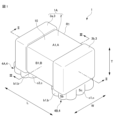
- FIG. 1 is a schematic perspective view of a multilayer ceramic electronic component 1 according to an embodiment of the present invention
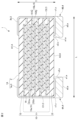
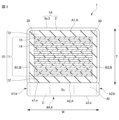
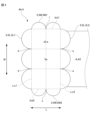
- 2 is a cross-sectional view of the monolithic ceramic electronic component 1 according to the embodiment taken along line II-II in FIG. 3 is a cross-sectional view of the monolithic ceramic electronic component 1 according to the embodiment taken along line III-III in FIG. 1 is a plan view of a portion of the multilayer ceramic electronic component 1 to which a second spacer 4B is attached, as viewed from the second spacer main surface a2 side.
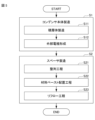
- 2 is a flowchart illustrating a method for manufacturing the multilayer ceramic electronic component 1.
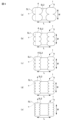
- 13A and 13B are diagrams showing modified forms of the spacer 4.
- FIG. 13A and 13B are diagrams showing modified forms of the spacer 4.
- FIG. 13A and 13B are diagrams showing modified forms of the spacer 4.
- FIG. 13A and 13B are diagrams showing modified forms of the spacer 4.
- FIG. 13 is a table showing the results of measuring the sound pressure levels of a multilayer ceramic electronic component 1 according to the present invention, in which a spacer 4 has convex portions 5L formed on the spacer end faces c, and the number n of the convex portions 5L is 2 to 8, and a comparative multilayer ceramic electronic component in which the number n of the convex portions 5L is 0.
- FIG. 13 is a table showing the results of measuring the sound pressure levels of a multilayer ceramic electronic component 1 according to the present invention, in which a spacer 4 having convex portions 5W formed on the spacer side surface b and the number m of convex portions 5W is 1 to 4, and a comparative multilayer ceramic electronic component in which the number m of convex portions 5W is 0.
- FIG. 1 is a schematic perspective view of the multilayer ceramic electronic component 1 according to the embodiment.
- FIG. 2 is a cross-sectional view of the multilayer ceramic electronic component 1 according to the embodiment taken along line II-II in FIG. 1.
- FIG. 3 is a cross-sectional view of the multilayer ceramic electronic component 1 according to the embodiment taken along line III-III in FIG. 1.
- the multilayer ceramic electronic component 1 is a substantially rectangular parallelepiped multilayer ceramic capacitor 1A having a laminate 2 and a pair of external electrodes 3 provided at both ends of the laminate 2, and a spacer 4 attached to the multilayer ceramic capacitor 1A.
- the laminate 2 also includes an inner layer portion 11 that includes multiple pairs of ceramic layers 14 and internal electrode layers 15.
- the terms used to indicate the orientation of the multilayer ceramic electronic component 1 are: the direction in which the ceramic layers 14 and the internal electrode layers 15 are stacked in the multilayer ceramic electronic component 1 is the height direction T (first direction); the direction in which the pair of external electrodes 3 are provided is the length direction L (third direction); and the direction that intersects both the length direction L and the height direction T is the width direction W (second direction). Note that in the embodiment, the width direction W is perpendicular to both the length direction L and the height direction T.
- Outer surface of laminate 2 Furthermore, of the six outer surfaces of the laminate 2, a pair of outer surfaces facing each other in the height direction T are referred to as the first laminate main surface A1 and the second laminate main surface A2, a pair of outer surfaces facing each other in the width direction W are referred to as the first laminate side surface B1 and the second laminate side surface B2, and a pair of outer surfaces facing each other in the length direction L are referred to as the first laminate end surface C1 and the second laminate end surface C2.
- first laminate main surface A1 and the second laminate main surface A2 when there is no need to distinguish between the first laminate main surface A1 and the second laminate main surface A2, they will be collectively referred to as the laminate main surface A, when there is no need to distinguish between the first laminate side surface B1 and the second laminate side surface B2, they will be collectively referred to as the laminate side surface B, and when there is no need to distinguish between the first laminate end surface C1 and the second laminate end surface C2, they will be collectively referred to as the laminate end surface C.
- the laminate 2 preferably has rounded ridges R1 including corners.
- the ridges R1 are the intersections of two surfaces of the laminate 2, i.e., the laminate main surface A and the laminate side surface B, the laminate main surface A and the laminate end surface C, or the laminate side surface B and the laminate end surface C.
- the laminate 2 comprises a laminate body 10 having an inner layer portion 11 and outer layer portions 12 arranged on both sides of the inner layer portion 11 in the height direction T, and side gap portions 30 provided on both sides of the laminate body 10 in the width direction W.
- the inner layer portion 11 includes a plurality of pairs of ceramic layers 14 and internal electrode layers 15 that are alternately laminated along the height direction T.
- the ceramic layer 14 is made of a ceramic material.
- the ceramic material is not particularly limited, but for example, a dielectric ceramic mainly composed of BaTiO3 is used.
- the ceramic material may be one in which at least one of subcomponents such as Mn compounds, Fe compounds, Cr compounds, Co compounds, and Ni compounds is added to the main component.
- the internal electrode layer 15 comprises a plurality of first internal electrode layers 15a and a plurality of second internal electrode layers 15b.
- the first internal electrode layers 15a and the second internal electrode layers 15b are arranged alternately. Note that, when there is no need to distinguish between the first internal electrode layers 15a and the second internal electrode layers 15b, they will be collectively referred to as the internal electrode layers 15.
- the first internal electrode layer 15a has a first opposing portion 152a facing the second internal electrode layer 15b, and a first extension portion 151a drawn from the first opposing portion 152a to the first laminate end face C1 side. The end of the first extension portion 151a is exposed to the first laminate end face C1 and is electrically connected to the first external electrode 3a described below.
- the second internal electrode layer 15b has a second opposing portion 152b facing the first internal electrode layer 15a, and a second extension portion 151b drawn from the second opposing portion 152b to the second laminate end face C2. The end of the second extension portion 151b is electrically connected to the second external electrode 3b described below. Charge is accumulated in the first opposing portion 152a of the first internal electrode layer 15a and the second opposing portion 152b of the second internal electrode layer 15b, and functions as a capacitor.
- the internal electrode layer 15 is preferably formed from a metal material such as Ni, Cu, Ag, Pd, Ag-Pd alloy, Au, etc.
- the side gap portion 30 is preferably made of a similar material as the ceramic layer 14 .
- the external electrodes 3 include a first external electrode 3a provided on the first laminate end face C1 and a second external electrode 3b provided on the second laminate end face C2. When there is no need to distinguish between the first external electrode 3a and the second external electrode 3b, they will be collectively referred to as the external electrode 3.
- the external electrodes 3 cover not only the laminate end face C, but also parts of the laminate main surface A and the laminate side face B on the laminate end face C side.
- the end of the first extension portion 151a of the first internal electrode layer 15a is exposed at the first laminate end face C1 and is electrically connected to the first external electrode 3a.
- the end of the second extension portion 151b of the second internal electrode layer 15b is exposed at the second laminate end face C2 and is electrically connected to the second external electrode 3b.
- the external electrode 3 may have a two-layer structure, for example, a base electrode layer and a plating layer.
- the plating layer may be one layer or two layers.
- a conductive resin layer may be provided between the base electrode layer and the plating layer.
- the base electrode layer is formed, for example, by applying and baking a conductive paste containing a conductive metal and glass.
- the conductive metal of the base electrode layer for example, Cu, Ni, Ag, Pd, Ag-Pd alloy, Au, etc. are preferably used.
- the plating layer is preferably made of plating of one metal selected from the group consisting of Cu, Ni, Su, Ag, Pd, Ag-Pd alloy, Au, etc., or an alloy containing the metal.
- the spacer 4 includes a first spacer 4A arranged on the first laminate end face C1 side on the second laminate main surface A2 side of the multilayer ceramic capacitor 1A, and a second spacer 4B arranged on the second laminate end face C2 side.
- the surface on which the spacer 4 is arranged is not limited to the second laminate main surface A2 side of the multilayer ceramic capacitor 1A.
- the spacer 4 may be arranged on one of the laminate side surfaces B of the multilayer ceramic capacitor 1A. In this case, the laminate side surface B becomes the mounting surface.
- first spacer 4A and the second spacer 4B are arranged at a fixed distance apart.
- the outer surface of the spacer main surfaces a facing the multilayer ceramic capacitor 1A is referred to as the first spacer main surface a1
- the outer surface on the other mounting side is referred to as the second spacer main surface a2.
- the first spacer main surface a1 of the spacer 4 faces the second laminate main surface A2 side of the multilayer ceramic capacitor 1A, and is connected to the external electrode 3 extending to the second laminate main surface A2.
- first spacer side surface b1 and the second spacer side surface b2 a pair of outer surfaces facing each other in the width direction W are referred to as the first spacer side surface b1 and the second spacer side surface b2.
- the surfaces of the first spacer 4A and the second spacer 4B that face each other are referred to as the second spacer end surface c2, and the surface facing outward on the other side is referred to as the first spacer end surface c1.
- first spacer main surface a1 and the second spacer main surface a2 when there is no need to distinguish between the first spacer main surface a1 and the second spacer main surface a2, they will be collectively referred to as the spacer main surface a, when there is no need to distinguish between the first spacer side surface b1 and the second spacer side surface b2, they will be collectively referred to as the spacer side surface b, and when there is no need to distinguish between the first spacer end surface c1 and the second spacer end surface c2, they will be collectively referred to as the spacer end surface c.
- the spacer 4 can be made of any conductive component, but is preferably made of a material whose main component is an intermetallic compound containing at least one high melting point metal selected from Cu and Ni and Sn as a low melting point metal. It may also be made of a conductive resin.
- the spacer 4 may be manufactured with a 50D (median diameter) of 5 ⁇ m, 31.5% Ni powder containing 10 wt% Cu, 58.5 wt% solder powder with a Cu composition containing 3 wt% Sn and 0.5 wt% Ag, and a total of 10 wt% phenolic resin, solvent, and additives.
- the spacer 4 may also be manufactured with a D50 of 5 ⁇ m and containing 31.5% Ni powder containing 10 wt% Cu, 58.5 wt% solder powder with a Cu composition containing 3 wt% Sn and 0.5 wt% Ag, and a total of 10 wt% rosin, solvent, and additive components.
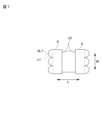
- Figure 4 is a plan view of the portion of the multilayer ceramic electronic component 1 to which the first spacer 4A is attached, viewed from the second spacer main surface a2 side. Note that the following explanation will be given using the first spacer 4A, but the second spacer 4B is similar, so the first spacer 4A and the second spacer 4B will be collectively referred to as the spacer 4.
- the spacer 4 has a protrusion 5 protruding outward when viewed in a plan view as shown in Fig. 4.
- the protrusion 5 includes a protrusion 5L protruding in the length direction L, and in the embodiment, further includes a protrusion 5W protruding in the width direction W.
- the contour of the protrusion 5 is preferably in the shape of a circular arc or an elliptical arc, more preferably in the shape of a semicircle, and in this embodiment, in the shape of a semicircle.
- the convex portion 5L protruding in the length direction L includes a convex portion 5L1 protruding from the first spacer end face c1, and in the embodiment, further includes a convex portion 5L2 protruding from the second spacer end face c2.
- the first spacer end face c1 is divided into n parts in the width direction W at point p.
- each of the n divided regions contains one convex portion 5L1. That is, in the plan view shown in FIG. 4, the spacer 4 contains n convex portions 5L1 that protrude in the length direction L from the first spacer end face c1.
- n is preferably 2 to 6, and in the embodiment shown in FIG. 4, n is 3.
- the second spacer end face c2 also includes a convex portion 5L2 protruding from the second spacer end face c2. That is, the second spacer end face c2 is divided into n parts in the width direction W in the plan view shown in FIG. 4 at a point q.
- each of the n divided regions includes one convex portion 5L2.
- the spacer 4 includes n convex portions 5L2 protruding from the second spacer end face c2 in the length direction L in the plan view shown in FIG. 4.
- n is preferably 2 to 6, and in the embodiment shown in FIG. 4, n is 3.
- the convex portion 5W protruding in the width direction W includes a convex portion 5W1 protruding from the first spacer side surface b1 and a convex portion 5W2 protruding from the second spacer side surface b2.
- the first spacer side surface b1 is divided into m parts in the length direction L at point r.
- each of the m divided regions contains one convex portion 5W1.
- the spacer 4 in the plan view shown in FIG. 4 contains m convex portions 5W1 that protrude in the width direction W from the first spacer side surface b1.
- m is preferably 1 or 2
- the second spacer side b2 also includes a convex portion 5W2 protruding from the second spacer side surface b2. That is, the second spacer side surface b2 is divided into m regions in the length direction L in the plan view shown in FIG. 4 at point s.
- each of the m divided regions includes one convex portion 5W2.
- the spacer 4 includes m convex portions 5W1 protruding in the width direction W from the second spacer side surface b2 in the plan view shown in FIG. 4.
- m is preferably 1 or 2
- m is 2.
- n division and m division are not limited to this, but are preferably equal divisions, and are equal divisions in this embodiment.
- Dividing the spacer end face c into n equal parts in the width direction W means, in the plan view shown in Figure 4, dividing the distance between the intersection of a line passing through the spacer end face c with a line passing through the first spacer side surface b1 and the intersection of the line passing through the second spacer side surface b2 into n equal parts.
- Dividing the spacer side surface b into m equal parts in the longitudinal direction L means equally dividing the area between the intersection of a straight line passing through the spacer side surface b with a straight line passing through the first spacer end surface c1 and the intersection of a straight line passing through the second spacer end surface c2 in the plan view shown in Figure 4.
- the line extending in the width direction W that passes through the most recessed position between the convex portions 5L and 5L is defined as a straight line passing through the spacer end face c, and if there are multiple recessed positions between the convex portions 5L and 5L and the multiple positions are different, the line extending in the width direction W that passes through the most recessed position among the most recessed positions is defined as a straight line passing through the spacer end face c.
- the line extending in the length direction L that passes through the recessed portion between convex portions 5W and 5W is defined as a straight line passing through the spacer side surface b, and if there are multiple recessed positions between convex portions 5W and 5W and the multiple positions are different, the line extending in the length direction L that passes through the most recessed position among the most recessed positions is defined as a straight line passing through the spacer side surface b. If there is one convex portion 5W, the line passing through the recessed portion between convex portions 5W and 5L is defined as a straight line passing through the spacer side surface b.
- the average area of the first spacer side surface b1 and the second spacer side surface b2 is Sb (shown in FIG. 1)
- the average area of the first spacer end surface c1 and the second spacer end surface c2 is Sc (shown in FIGS. 1 and 3)
- Sa/(Sb+Sc) when the convex portion 5 is not formed is S0
- Sa/(Sb+Sc) when the convex portion 5 is formed it is preferable that S1/S0 is 1.05 or more, and more preferably 1.12 or more.
- the areas Sa, Sb, and Sc can be measured as follows. If the multilayer ceramic electronic component 1 is mounted on a board with solder, it is removed from the board using, for example, a bond tester (DAGE (registered trademark), DAGE-5000). After that, images of each surface are obtained by laser scanning with a laser microscope (Keyence (registered trademark), VK-X1000, magnification 20x), and the areas Sa, Sb, and Sc are measured using analysis software (Keyence (registered trademark), multi-file analysis application). The same procedure is followed for a multilayer ceramic electronic component 1 that is not mounted on a board.
- a bond tester DAGE (registered trademark), DAGE-5000.
- images of each surface are obtained by laser scanning with a laser microscope (Keyence (registered trademark), VK-X1000, magnification 20x), and the areas Sa, Sb, and Sc are measured using analysis software (Keyence (registered trademark), multi-file analysis application).
- Keyence registered trademark
- multi-file analysis application multi-
- (Method of Manufacturing Multilayer Ceramic Electronic Component 1) 5 is a flow chart illustrating a method for manufacturing the multilayer ceramic electronic component 1.
- the method for manufacturing the multilayer ceramic electronic component 1 includes a multilayer ceramic capacitor manufacturing step S1 and a spacer manufacturing step S2.
- the multilayer ceramic capacitor manufacturing process S1 includes a laminate manufacturing process S11 and an external electrode forming process S12.
- a ceramic slurry containing ceramic powder, a binder, and a solvent is formed into a sheet shape on a carrier film using a die coater, a gravure coater, a microgravure coater, or the like to produce a ceramic green sheet for lamination that will become the ceramic layer 14.
- a conductive paste is printed in strips on the ceramic green sheet for lamination by screen printing, inkjet printing, gravure printing, or the like to produce a material sheet on which a conductive pattern that will become the internal electrode layer 15 is printed on the surface of the ceramic green sheet for lamination.
- the conductive paste may be formed into a desired pattern to form the side gap portion 30.
- the stacked material sheets and the ceramic green sheets for the outer layers are thermally pressed together to create a mother block.
- the mother block is then cut to produce the laminate body 10, and the side gap portion 30 is formed in the laminate body 10 to produce the laminate 2.
- Example electrode formation step S12 Next, a conductive paste containing a conductive metal and glass is applied to the end surface C of the laminate 2 and baked to form the external electrodes 3.
- the laminate is formed so as to cover not only main surface C but also part of main surface A and side surface B of the laminate. Through the above steps, the laminate ceramic capacitor 1A is manufactured.
- the spacer manufacturing process S2 includes an alignment process S21, a material paste placement process S22, and a reflow process S23.
- the multilayer ceramic capacitors 1A are arranged on a holding substrate in a predetermined alignment using a suction nozzle.
- the holding substrate is preferably capable of holding the multilayer ceramic capacitors 1A and is heat resistant.
- the holding substrate is preferably, for example, an alumina plate to which the metal material paste does not bond under reflow conditions, with a polyimide double-sided tape attached.
- the metal material paste may contain a resin, and in this case, the resin may be a phenol resin.
- a metal material paste that will become the spacers 4 is formed into a desired pattern using a squeegee by screen printing on the multilayer ceramic capacitors 1A aligned on the holding substrate.
- a masking jig is prepared and placed on the multilayer ceramic capacitors 1A aligned on the holding substrate.
- the masking jig has a plurality of through holes that penetrate from one main surface to the other main surface. Each of the through holes has a shape according to its purpose, and the shape of the spacers 4 is determined by the difference in the shape.
- the spacer 4 in the multilayer ceramic electronic component 1 of the embodiment described above has three convex portions 5L1 in total, one in each of the regions obtained by dividing the first spacer end face c1 into three equal parts in the width direction W, three convex portions 5L1 in total, one in each of the regions obtained by dividing the second spacer end face c2 into three equal parts in the width direction W, two convex portions 5W1 in total, one in each of the regions obtained by dividing the first spacer side face b1 into two equal parts in the length direction L, and two convex portions 5W2 in total, one in each of the regions obtained by dividing the second spacer side face b2 into two equal parts in the length direction L.
- Figures 6, 7, 8 and 9 show modified forms of the spacer 4.
- the spacer side surface b may not have a convex portion 5W.
- the number of convex portions 5L provided on the spacer end surface c may not be three.
- Figure 6 shows a form in which the spacer side surface b does not have a convex portion 5W.
- Figure 6(a) shows a form in which the two spacer end surfaces c are each divided into two equal parts in the width direction W, and each region is provided with one convex portion 5L in total.
- Figure 6(b) shows a form in which the two spacer end surfaces c are each divided into three equal parts in the width direction W, and each region is provided with one convex portion 5L in total.
- Figure 6(c) shows a form in which the two spacer end surfaces c are each divided into four equal parts in the width direction W, and each region is provided with one convex portion 5L in total.
- Figure 6(d) shows a form in which the two spacer end surfaces c are each divided into five equal parts in the width direction W, and each region is provided with one convex portion 5L in total.
- FIG. 6(e) shows a configuration in which the two spacer end faces c are each divided into six equal parts in the width direction W, with one protrusion 5L provided in each area, for a total of six protrusions 5L.
- the convex portion 5L may not be provided on the second spacer end face c2.
- Figure 7 shows a configuration in which the convex portion 5L is provided on the first spacer end face c1, but the convex portion 5 is not provided on the spacer side face b and the second spacer end face c2.
- FIG. 8 shows a configuration in which two spacer end surfaces c are each divided into three equal parts in the width direction W, and one convex portion 5L is provided in each region, for a total of three convex portions 5L, and one convex portion 5W is provided on each of the two spacer side surfaces b.
- the convex portions 5L provided on the spacer end faces c do not have to be provided at equal intervals.
- the number of convex portions 5 may differ between the first spacer 4A and the second spacer 4B.
- Figure 9 shows a configuration in which convex portions 5L (5L1, 5L2) protruding in the length direction L at uneven intervals are provided on each of the two spacer end faces c, and the two spacer side faces b have either no convex portions 5W protruding in the width direction W or one or two convex portions 5W (5W1, 5W2).
- the spacer 4 provided in the multilayer ceramic electronic component 1 of the present invention has a convex portion 5 that protrudes outward when viewed in the plan view shown in FIG. 4.
- the convex portion 5 includes a convex portion 5L that protrudes in the length direction L, and further includes a convex portion 5W that protrudes in the width direction W.
- the convex portion 5L that protrudes in the length direction L includes a convex portion 5L1 that protrudes from the first spacer end face c1, and further includes a convex portion 5L2 that protrudes from the second spacer end face c2.
- the first spacer end face c1 which is prone to solder wetting up when mounting the multilayer ceramic electronic component 1 on a substrate, includes the protruding convex portion 5L1. Therefore, when the solder tries to wet up the first spacer end face c1, the solder can be trapped between the convex portions 5L1. This makes it possible to suppress the solder from wetting up the first spacer end face c1 onto the external electrode 3 of the multilayer ceramic capacitor 1A. Therefore, sufficient suppression of squeal can be achieved.
- the multilayer ceramic electronic component 1 of the present invention includes protrusions 5W protruding in the width direction W. Then, when the solder tries to wet and rise up the spacer side surface b, the solder can be trapped between the protrusions 5W. This makes it possible to suppress the solder from wetting and rising up the spacer side surface b onto the external electrode 3 of the multilayer ceramic capacitor 1A. This therefore makes it possible to further suppress acoustic noise.
- the multilayer ceramic electronic component 1 of the present invention includes a protrusion 5L2 protruding from the second spacer end face c2.
- the solder can be trapped between the protrusions 5L2. This makes it possible to suppress the solder from wetting and rising up the second spacer end face c2 onto the external electrode 3 of the multilayer ceramic capacitor 1A. This makes it possible to further suppress noise.
- the dimensions of the multilayer ceramic capacitor 1A included in the multilayer ceramic electronic component 1 are as follows. Length direction L: 1.70 ⁇ 0.10 mm Width direction W: 0.90 ⁇ 0.10mm Height direction: 0.90 ⁇ 0.10mm Main component of internal electrode: Ni Main component of ceramic layer: BaTiO3 External electrode structure: Cu base electrode layer containing glass + Ni/Sn plating
- spacers 4 were formed in this multilayer ceramic capacitor 1A.
- a spacer 4 having a convex portion 5L formed on the spacer end face c These spacers 4 having the convex portion 5L formed on the spacer end face c have no convex portion 5W formed on the spacer side face b.
- the spacer 4 has one convex portion 5L formed in each of the n divided regions of each of the two spacer end faces c.
- five each of those in which n is 2 to 8 and five in which n is 0 were prepared as comparative examples.
- Spacer 4 with a convex portion 5W formed on the spacer side surface b These spacers 4 having the convex portion 5W formed on the spacer side surface b have no convex portion 5L formed on the spacer end surface c.
- the spacer 4 has one convex portion 5W formed in each of the m divided regions of each of the two spacer side surfaces b.
- the dimensions of the spacer 4 including the protrusion 5 are as follows. Length direction L: 0.45 mm ⁇ 0.05 mm Width direction W: 0.85mm ⁇ 0.05mm Height direction: 0.15mm ⁇ 0.05mm
- the above dimensions of the spacer 4 include the projections 5 when viewed in the plan view shown in Fig. 4. In other words, the projections 5 are not formed to protrude from the spacer 4 having the above dimensions.
- Spacer 4 contains 31.5% Cu-10wt%Ni powder with a D50 of 5 ⁇ m, 58.5wt% solder powder with a composition of Sn-3wt%Ag-0.5wt%Cu, and a total of 10wt% phenolic resin, solvent, and additives.
- FIG. 10 shows a table showing the average sound pressure level of five spacers 4 having convex portions 5L formed on their spacer end faces c, the five being multilayer ceramic electronic components 1 according to the present invention in which the number n of convex portions 5L is 2 to 8, and five being multilayer ceramic electronic components as a comparison in which the number n of convex portions 5L is 0, and the sound pressure levels of the five components were measured using the above-described verification method.
- FIG. 10 also shows the value of S1/S0 when the area of the second spacer main surface a2 is Sa, the average area of the first spacer side surface b1 and the second spacer side surface b2 is Sb, the average area of the first spacer end surface c1 and the second spacer end surface c2 is Sc, Sa/(Sb+Sc) when no protrusion 5 is formed is S0, and Sa/(Sb+Sc) when a protrusion 5 is formed is S1.
- the sound pressure level was 74.6 dB.
- the sound pressure level was lower than the comparative form in all cases, verifying that it has an effect of suppressing squeal.
- the sound pressure level was 70 dB or less, verifying that the effect of suppressing squeal is even greater.
- FIG. 11 shows a table showing the average sound pressure level of five spacers 4 having convex portions 5W formed on the spacer side surface b, where five of each of multilayer ceramic electronic components 1 according to the present invention having the number m of convex portions 5M ranging from 1 to 4 and five of each of multilayer ceramic electronic components having the number m of convex portions 5M of 0 as a comparative example were prepared and the sound pressure levels were measured using the above-described verification method.
- FIG. 11 also shows the value of S1/S0 when the area of the second spacer main surface a2 is Sa, the average area of the first spacer side surface b1 and the second spacer side surface b2 is Sb, the average area of the first spacer end surface c1 and the second spacer end surface c2 is Sc, Sa/(Sb+Sc) when no protrusion 5 is formed is S0, and Sa/(Sb+Sc) when a protrusion 5 is formed is S1.
- the sound pressure level was 74.6 dB.
- the sound pressure level was lower than the comparative form in all cases, verifying that it has an effect of suppressing squeal.
- the sound pressure level was 70 dB or less, verifying that the effect of suppressing squeal is even greater.
- convex portion 5L When convex portion 5L was formed on spacer end face c, convex portion 5W was not formed on spacer side face b. Also, when convex portion 5W was formed on spacer side face b, convex portion 5L was not formed on spacer end face c. However, if convex portion 5 is formed on a surface other than the surface on which convex portion 5 is formed, the amount of trapped solder increases, so it is thought that the effect of suppressing squeal will be the same or even greater.
- the spacer main surface a approaches a rectangle when viewed in a plane in the direction shown in FIG. 4.
- S1/S0 begins to approach 1
- the amount of solder trapped on the surface of the spacer 4 decreases.
- the effect of suppressing the wetting and rising of the solder on the second spacer end surface c2 to the external electrode 3 of the multilayer ceramic capacitor 1A weakens, and the sound pressure level increases as shown in FIGS. 10 and 11.
- the above describes an embodiment of the present invention, but the present invention is not limited to the embodiment, and can be implemented in various forms without departing from the gist of the present invention.
- the present invention includes the following combinations.
- a multilayer ceramic electronic component comprising two spacers arranged on one end face side of the laminate and the other end face side of the laminate, each of the spacers having two spacer main surfaces facing in the first direction, two spacer side surfaces facing in the second direction, and two spacer end faces facing in the third direction, and when the spacer is divided into n areas in the second direction in a plan view seen from one of the spacer main surfaces, each of the n divided areas includes one protrusion protruding in the third direction.
- each of the n equal parts includes one protrusion protruding in the third direction.
- ⁇ 3> The multilayer ceramic electronic component according to ⁇ 1> or ⁇ 2>, wherein n is 2 to 6.
- ⁇ 4> A multilayer ceramic electronic component according to any one of ⁇ 1> to ⁇ 3>, in which the protrusions are provided on both sides in the third direction.
- a multilayer ceramic electronic component according to ⁇ 1> in which when the spacer is divided into m regions in the third direction in a plan view from one of the spacer main surfaces, each of the m divided regions includes one protrusion protruding in the second direction.
- ⁇ 8> A multilayer ceramic electronic component according to any one of ⁇ 5> to ⁇ 7>, in which the convex portion is provided on both sides of two spacer side surfaces that face each other in the second direction of the spacer.
- a multilayer ceramic electronic component according to any one of ⁇ 1> to ⁇ 8>, in which the contour of the protrusion is semicircular.
- ⁇ 11> A multilayer ceramic electronic component according to ⁇ 10>, in which S1/S0 is 1.12 or more.
Landscapes
- Engineering & Computer Science (AREA)
- Power Engineering (AREA)
- Microelectronics & Electronic Packaging (AREA)
- Manufacturing & Machinery (AREA)
- Chemical & Material Sciences (AREA)
- Ceramic Engineering (AREA)
- Inorganic Chemistry (AREA)
- Fixed Capacitors And Capacitor Manufacturing Machines (AREA)
- Ceramic Capacitors (AREA)
Priority Applications (3)
| Application Number | Priority Date | Filing Date | Title |
|---|---|---|---|
| KR1020257030259A KR20250145674A (ko) | 2023-04-14 | 2024-03-26 | 적층 세라믹 전자부품 |
| JP2025513872A JPWO2024214531A1 (https=) | 2023-04-14 | 2024-03-26 | |
| US19/338,088 US20260018336A1 (en) | 2023-04-14 | 2025-09-24 | Multilayer ceramic electronic component |
Applications Claiming Priority (2)
| Application Number | Priority Date | Filing Date | Title |
|---|---|---|---|
| JP2023066335 | 2023-04-14 | ||
| JP2023-066335 | 2023-04-14 |
Related Child Applications (1)
| Application Number | Title | Priority Date | Filing Date |
|---|---|---|---|
| US19/338,088 Continuation US20260018336A1 (en) | 2023-04-14 | 2025-09-24 | Multilayer ceramic electronic component |
Publications (1)
| Publication Number | Publication Date |
|---|---|
| WO2024214531A1 true WO2024214531A1 (ja) | 2024-10-17 |
Family
ID=93059042
Family Applications (1)
| Application Number | Title | Priority Date | Filing Date |
|---|---|---|---|
| PCT/JP2024/011939 Ceased WO2024214531A1 (ja) | 2023-04-14 | 2024-03-26 | 積層セラミック電子部品 |
Country Status (4)
| Country | Link |
|---|---|
| US (1) | US20260018336A1 (https=) |
| JP (1) | JPWO2024214531A1 (https=) |
| KR (1) | KR20250145674A (https=) |
| WO (1) | WO2024214531A1 (https=) |
Citations (5)
| Publication number | Priority date | Publication date | Assignee | Title |
|---|---|---|---|---|
| JPH06188536A (ja) * | 1992-12-18 | 1994-07-08 | Mitsubishi Electric Corp | 混成集積回路装置 |
| JP2003133473A (ja) * | 2001-10-22 | 2003-05-09 | Kyocera Corp | 配線基板 |
| JP2014072241A (ja) * | 2012-09-27 | 2014-04-21 | Rohm Co Ltd | チップ部品 |
| JP2018190952A (ja) * | 2017-05-04 | 2018-11-29 | サムソン エレクトロ−メカニックス カンパニーリミテッド. | 積層型電子部品及びその実装基板 |
| US20200051746A1 (en) * | 2018-08-07 | 2020-02-13 | Samsung Electro-Mechanics Co., Ltd. | Multilayer electronic component |
Family Cites Families (1)
| Publication number | Priority date | Publication date | Assignee | Title |
|---|---|---|---|---|
| KR101630037B1 (ko) | 2014-05-08 | 2016-06-13 | 삼성전기주식회사 | 적층 세라믹 커패시터, 어레이형 적층 세라믹 커패시터, 그 제조 방법 및 그 실장 기판 |
-
2024
- 2024-03-26 WO PCT/JP2024/011939 patent/WO2024214531A1/ja not_active Ceased
- 2024-03-26 KR KR1020257030259A patent/KR20250145674A/ko active Pending
- 2024-03-26 JP JP2025513872A patent/JPWO2024214531A1/ja active Pending
-
2025
- 2025-09-24 US US19/338,088 patent/US20260018336A1/en active Pending
Patent Citations (5)
| Publication number | Priority date | Publication date | Assignee | Title |
|---|---|---|---|---|
| JPH06188536A (ja) * | 1992-12-18 | 1994-07-08 | Mitsubishi Electric Corp | 混成集積回路装置 |
| JP2003133473A (ja) * | 2001-10-22 | 2003-05-09 | Kyocera Corp | 配線基板 |
| JP2014072241A (ja) * | 2012-09-27 | 2014-04-21 | Rohm Co Ltd | チップ部品 |
| JP2018190952A (ja) * | 2017-05-04 | 2018-11-29 | サムソン エレクトロ−メカニックス カンパニーリミテッド. | 積層型電子部品及びその実装基板 |
| US20200051746A1 (en) * | 2018-08-07 | 2020-02-13 | Samsung Electro-Mechanics Co., Ltd. | Multilayer electronic component |
Also Published As
| Publication number | Publication date |
|---|---|
| KR20250145674A (ko) | 2025-10-13 |
| US20260018336A1 (en) | 2026-01-15 |
| JPWO2024214531A1 (https=) | 2024-10-17 |
Similar Documents
| Publication | Publication Date | Title |
|---|---|---|
| KR102951434B1 (ko) | 적층 세라믹 콘덴서 | |
| JP7292958B2 (ja) | 電子部品の実装構造体 | |
| KR102408016B1 (ko) | 칩형 전자 부품 | |
| JP5751080B2 (ja) | 積層セラミック電子部品 | |
| JP6714840B2 (ja) | 積層セラミック電子部品およびその製造方法 | |
| JP6481446B2 (ja) | 積層コンデンサの実装構造体 | |
| KR101698167B1 (ko) | 적층 세라믹 커패시터 | |
| JP7548287B2 (ja) | チップ型電子部品、電子部品の実装構造体および電子部品連 | |
| JP2017069417A (ja) | 積層コンデンサ | |
| KR20210130645A (ko) | 적층 세라믹 콘덴서 | |
| WO2024214531A1 (ja) | 積層セラミック電子部品 | |
| JP2022177518A (ja) | 積層セラミックコンデンサ | |
| JP2000315621A (ja) | 積層セラミック電子部品 | |
| WO2023210465A1 (ja) | 積層セラミックコンデンサ及び積層セラミックコンデンサの実装方法 | |
| US20260011503A1 (en) | Multilayer ceramic electronic component | |
| US20260018340A1 (en) | Multilayer ceramic electronic component | |
| WO2025017978A1 (ja) | 積層セラミックコンデンサ | |
| WO2026009896A1 (ja) | メタルマスクおよび積層セラミックコンデンサ用内部電極 | |
| WO2026054040A1 (ja) | 積層セラミックコンデンサ | |
| CN118575244A (zh) | 层叠陶瓷电容器 | |
| JP2004072015A (ja) | チップ型積層セラミックコンデンサ | |
| JPH04165611A (ja) | 積層フィルムコンデンサ及びその製造方法 | |
| JP2013219153A (ja) | 電子部品の製造方法 |
Legal Events
| Date | Code | Title | Description |
|---|---|---|---|
| 121 | Ep: the epo has been informed by wipo that ep was designated in this application |
Ref document number: 24788559 Country of ref document: EP Kind code of ref document: A1 |
|
| ENP | Entry into the national phase |
Ref document number: 1020257030259 Country of ref document: KR Free format text: ST27 STATUS EVENT CODE: A-0-1-A10-A15-NAP-PA0105 (AS PROVIDED BY THE NATIONAL OFFICE) |
|
| ENP | Entry into the national phase |
Ref document number: 2025513872 Country of ref document: JP Kind code of ref document: A |
|
| WWE | Wipo information: entry into national phase |
Ref document number: 2025513872 Country of ref document: JP |
|
| WWP | Wipo information: published in national office |
Ref document number: 1020257030259 Country of ref document: KR |
|
| NENP | Non-entry into the national phase |
Ref country code: DE |
|
| 122 | Ep: pct application non-entry in european phase |
Ref document number: 24788559 Country of ref document: EP Kind code of ref document: A1 |