WO2024210100A1 - フォルダブルデバイス用回路基板、フォルダブルデバイス、並びにフォルダブルデバイス用フィルム材及び積層板 - Google Patents
フォルダブルデバイス用回路基板、フォルダブルデバイス、並びにフォルダブルデバイス用フィルム材及び積層板 Download PDFInfo
- Publication number
- WO2024210100A1 WO2024210100A1 PCT/JP2024/013479 JP2024013479W WO2024210100A1 WO 2024210100 A1 WO2024210100 A1 WO 2024210100A1 JP 2024013479 W JP2024013479 W JP 2024013479W WO 2024210100 A1 WO2024210100 A1 WO 2024210100A1
- Authority
- WO
- WIPO (PCT)
- Prior art keywords
- circuit board
- foldable device
- resin layer
- base film
- layer
- Prior art date
- Legal status (The legal status is an assumption and is not a legal conclusion. Google has not performed a legal analysis and makes no representation as to the accuracy of the status listed.)
- Ceased
Links
Images

Classifications
-
- B—PERFORMING OPERATIONS; TRANSPORTING
- B32—LAYERED PRODUCTS
- B32B—LAYERED PRODUCTS, i.e. PRODUCTS BUILT-UP OF STRATA OF FLAT OR NON-FLAT, e.g. CELLULAR OR HONEYCOMB, FORM
- B32B27/00—Layered products comprising a layer of synthetic resin
-
- B—PERFORMING OPERATIONS; TRANSPORTING
- B32—LAYERED PRODUCTS
- B32B—LAYERED PRODUCTS, i.e. PRODUCTS BUILT-UP OF STRATA OF FLAT OR NON-FLAT, e.g. CELLULAR OR HONEYCOMB, FORM
- B32B7/00—Layered products characterised by the relation between layers; Layered products characterised by the relative orientation of features between layers, or by the relative values of a measurable parameter between layers, i.e. products comprising layers having different physical, chemical or physicochemical properties; Layered products characterised by the interconnection of layers
- B32B7/02—Physical, chemical or physicochemical properties
- B32B7/025—Electric or magnetic properties
-
- H—ELECTRICITY
- H05—ELECTRIC TECHNIQUES NOT OTHERWISE PROVIDED FOR
- H05K—PRINTED CIRCUITS; CASINGS OR CONSTRUCTIONAL DETAILS OF ELECTRIC APPARATUS; MANUFACTURE OF ASSEMBLAGES OF ELECTRICAL COMPONENTS
- H05K1/00—Printed circuits
- H05K1/02—Details
-
- H—ELECTRICITY
- H05—ELECTRIC TECHNIQUES NOT OTHERWISE PROVIDED FOR
- H05K—PRINTED CIRCUITS; CASINGS OR CONSTRUCTIONAL DETAILS OF ELECTRIC APPARATUS; MANUFACTURE OF ASSEMBLAGES OF ELECTRICAL COMPONENTS
- H05K1/00—Printed circuits
- H05K1/02—Details
- H05K1/03—Use of materials for the substrate
-
- H—ELECTRICITY
- H05—ELECTRIC TECHNIQUES NOT OTHERWISE PROVIDED FOR
- H05K—PRINTED CIRCUITS; CASINGS OR CONSTRUCTIONAL DETAILS OF ELECTRIC APPARATUS; MANUFACTURE OF ASSEMBLAGES OF ELECTRICAL COMPONENTS
- H05K3/00—Apparatus or processes for manufacturing printed circuits
- H05K3/22—Secondary treatment of printed circuits
- H05K3/28—Applying non-metallic protective coatings
Definitions
- This disclosure relates to circuit boards for foldable devices, foldable devices, and film materials and laminates for foldable devices.
- FPCs Flexible printed circuit boards
- a base film such as a polyimide film
- an adhesive layer provided on the base film
- a circuit for example, see Patent Document 1
- a coverlay that protects the circuit
- the circuit board placed at the bend of a foldable device may be repeatedly folded with an extremely small bending radius. Therefore, a stronger load may be repeatedly applied to the circuit board compared to when the circuit board is placed in a curved bent state. If a conventional FPC is placed at the bend of a foldable device, it may not be able to withstand the load caused by repeated folding with a small bending radius.
- the present disclosure relates to improving the resistance of a circuit board placed in a bending portion of a foldable device to loads caused by repeated folding at a small bending radius.
- the present disclosure includes at least the following: [1] A base film; A conductor pattern layer provided on the base film; A protective layer covering the conductor pattern layer; Equipped with At least one of the base film and the protective layer is an elastic resin layer exhibiting an elastic recovery rate of 50% or more, Used as a circuit board to be placed at the bend of a foldable device, Circuit board for foldable devices. [2] The circuit board for a foldable device according to [1], wherein both the base film and the protective layer are the elastic resin layers exhibiting an elastic recovery rate of 50% or more.
- the elastic resin layer is a cured product formed by curing a curable resin composition, and the tensile modulus of the cured product of the curable resin composition is 1.0 MPa or more and 120 MPa or less.
- the circuit board for a foldable device according to [1] or [2].
- a base film; A conductor pattern layer provided on the base film; A protective layer covering the conductor pattern layer; Equipped with At least one of the base film and the protective layer is an elastic resin layer containing an elastomer, Used as a circuit board to be placed at the bend of a foldable device, Circuit board for foldable devices.
- the elastomer contains a styrene-based elastomer having a monomer unit derived from styrene, and the proportion of the monomer unit derived from styrene in the styrene-based elastomer is 5% by mass or more and 40% by mass or less based on the total mass of the styrene-based elastomer;
- the circuit board for a foldable device according to any one of [4] to [6]. [8]
- the circuit board is disposed at the bending portion so that the foldable device is folded at the bending portion until a bending radius becomes a minimum of 1.0 mm or less.
- the circuit board for a foldable device according to any one of [1] to [7].
- a foldable device having a bending portion A foldable device comprising the circuit board for a foldable device according to any one of [1] to [7], which is disposed at the bent portion.
- the circuit board is disposed at the bending portion so that the foldable device is folded at the bending portion until a bending radius becomes a minimum of 1.0 mm or less.
- a curable resin layer is provided,
- the curable resin layer is a layer that forms an elastic resin layer exhibiting an elastic recovery rate of 50% or more upon curing,
- a circuit board having a base film, a conductive pattern layer provided on the base film, and a protective layer covering the conductive pattern layer, the circuit board being used to form the base film or the protective layer of a circuit board to be placed at a bending portion of a foldable device.
- the curable resin layer is a layer containing a curable resin composition, and a tensile modulus of a cured product of the curable resin composition is 1.0 MPa or more and 120 MPa or less.
- a curable resin layer is provided,
- the curable resin layer contains an elastomer and forms an elastic resin layer by curing,
- a circuit board having a base film, a conductive pattern layer provided on the base film, and a protective layer covering the conductive pattern layer, the circuit board being used to form the base film or the protective layer of a circuit board to be placed at a bending portion of a foldable device.
- Film material for foldable devices [14]
- the content of the elastomer in the curable resin layer is 70% by mass or more and 100% by mass or less based on the mass of the curable resin layer.
- the film material for a foldable device according to [13].
- the elastomer includes a styrene-based elastomer having a monomer unit derived from styrene, and the proportion of the monomer unit derived from styrene in the styrene-based elastomer is 5% by mass or more and 40% by mass or less based on the total mass of the styrene-based elastomer;
- the film material for a foldable device according to [13] or [14].
- the circuit board is disposed at the bending portion so that the foldable device is folded at the bending portion until a bending radius becomes a minimum of 1.0 mm or less.
- the elastic resin layer is a cured product formed by curing a curable resin composition, and the tensile modulus of the cured product of the curable resin composition is 1.0 MPa or more and 120 MPa or less.
- the laminate for a foldable device according to [17].
- An elastic resin layer; a conductor layer provided on the elastic resin layer; Equipped with The elastic resin layer contains an elastomer, A circuit board having a base film, a conductive pattern layer provided on the base film, and a protective layer covering the conductive pattern layer, the circuit board being used to form the base film and the conductive pattern layer of a circuit board to be placed at a bending portion of a foldable device.
- Laminate for foldable devices are examples of the circuit board.
- the content of the elastomer in the elastic resin layer is 70% by mass or more and 100% by mass or less based on the mass of the elastic resin layer.
- the elastomer contains a styrene-based elastomer having a monomer unit derived from styrene, and the proportion of the monomer unit derived from styrene in the styrene-based elastomer is 5% by mass or more and 40% by mass or less based on the total mass of the styrene-based elastomer;
- the circuit board is disposed at the bending portion so that the foldable device is folded at the bending portion until a bending radius becomes a minimum of 1.0 mm or less.
- the laminate for a foldable device according to any one of [17] to [21]. [1]'/[4]' Application of a circuit board to manufacture a foldable device having a bent portion.
- the circuit board comprises a base film, a conductive pattern layer provided on the base film, and a protective layer covering the conductive pattern layer. At least one of the base film or the protective layer is an elastic resin layer exhibiting a stretch recovery rate of 50% or more, or an elastic resin layer containing an elastomer.
- the circuit board is placed at the bent portion of the foldable device.
- the curable resin layer is a layer that forms an elastic resin layer exhibiting an elastic recovery rate of 50% or more upon curing, or a layer that contains an elastomer and forms an elastic resin layer upon curing.
- the film material is used to form a base film or a protective layer of a circuit board.
- the circuit board has the base film, a conductor pattern layer provided on the base film, and the protective layer that covers the conductor pattern layer. The circuit board is placed at the bent portion of the foldable device.
- a laminate comprising an elastic resin layer and a conductor layer provided on the elastic resin layer to manufacture a foldable device.
- the elastic resin layer exhibits an elastic recovery rate of 50% or more or contains an elastomer.
- the laminate is used to form a base film and a conductor pattern layer of a circuit board.
- the circuit board has the base film, the conductor pattern layer provided on the base film, and a protective layer covering the conductor pattern layer.
- the circuit board is placed at a bending portion of the foldable device.
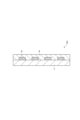
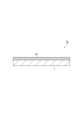
- FIG. 2 is a cross-sectional view showing an example of a circuit board. 1 is an example of a stress-strain curve obtained by a tensile test for measuring the stretch recovery rate.
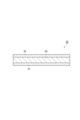
- FIG. 2 is a cross-sectional view showing an example of a laminate.
- FIG. 2 is a cross-sectional view showing an example of a film material.
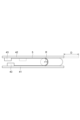
- FIG. 2 is a schematic diagram showing a method of an IPC bending test.
- layer includes a shape configuration that is formed over the entire surface when observed in a plan view, as well as a shape configuration that is formed on only a portion of the surface.
- the circuit board 5 at least one of the base film 1 or the protective layer 3 is an elastic resin layer.
- the circuit board 5 having an elastic resin layer as the base film 1 and/or the protective layer 3 can have excellent resistance to the load caused by repeated folding at a small bending radius. Therefore, the circuit board 5 can be used as a circuit board to be placed at the bending part of a foldable device. If both the base film 1 and the protective layer 3 are elastic resin layers, the resistance to the load caused by repeated folding at a small bending radius can be further improved.
- the elastic resin layer may exhibit an elastic recovery rate of 50% or more.
- the elastic recovery rate of the elastic resin layer may be 50% or more, 60% or more, 65% or more, 70% or more, 75% or more, 80% or more, 85% or more, or 90% or more, or may be 100% or less.
- the stretch recovery rate of the elastic resin layer can be the recovery rate when the elastic resin layer is tensile deformed to a strain of 20% in an environment of room temperature (23 ⁇ 2 ° C.).
- FIG. 2 is an example of a stress-strain curve obtained by a tensile test for measuring the stretch recovery rate.
- a test piece for measuring the stretch recovery rate may be cut out from the stretchable resin layer, or may be formed by curing a curable resin composition described below that is used to form the stretchable resin layer.
- the elastic resin layer may contain an elastomer. Elastic resin layers containing elastomers tend to exhibit a high elastic recovery rate.
- the elastomer may be a styrene-based elastomer containing monomer units derived from styrene.
- the proportion of monomer units derived from styrene in the styrene-based elastomer may be 5% by mass or more and 40% by mass or less based on the total mass of the styrene-based elastomer.
- the proportion of monomer units derived from styrene is within this range, the resistance of the circuit board to loads caused by repeated folding at a small bending radius may be further improved.
- the proportion of monomer units derived from styrene may be 8% by mass or more, or 10% by mass or more, based on the total mass of the styrene-based elastomer, and may be 35% by mass or less, 30% by mass or less, 25% by mass or less, 20% by mass or less, or 15% by mass or less.
- the elastomer may be, for example, a copolymer elastomer having at least one crosslinking group of an acid anhydride group or a carboxyl group.
- An example of a copolymer elastomer having an acid anhydride group is a maleic anhydride-modified elastomer, which is a copolymer containing a monomer unit derived from maleic anhydride.
- the maleic anhydride-modified elastomer may be a maleic anhydride-modified styrene-based elastomer or a maleic anhydride-modified hydrogenated styrene-based elastomer.
- the maleic anhydride-modified styrene-based elastomer and the maleic anhydride-modified hydrogenated styrene-based elastomer are styrene-based elastomers containing a monomer unit derived from maleic anhydride and a monomer unit derived from styrene.
- An example of a commercially available maleic anhydride-modified styrene-based elastomer is the styrene-based elastomer "Tufprene 912" manufactured by Asahi Kasei Corporation.
- the maleic anhydride-modified hydrogenated styrene-based elastomer can contribute to improving the weather resistance of the elastic resin.
- a hydrogenated styrene-based elastomer is an elastomer obtained by adding hydrogen to the unsaturated double bonds of a styrene-based elastomer having a soft segment containing an unsaturated double bond.
- An example of a hydrogenated styrene-based elastomer is a maleic anhydride-modified styrene-ethylene-butylene-styrene block copolymer.
- Examples of commercially available maleic anhydride-modified hydrogenated styrene-based elastomers include “FG1901” and “FG1924" from Kraton Polymer Japan Co., Ltd., and “Tuftec M1911”, “Tuftec M1913”, and “Tuftec M1943” from Asahi Kasei Corporation.
- elastomers include acrylic rubber, isoprene rubber, butyl rubber, styrene butadiene rubber, butadiene rubber, acrylonitrile butadiene rubber, silicone rubber, urethane rubber, chloroprene rubber, ethylene propylene rubber, fluororubber, vulcanized rubber, epichlorohydrin rubber, and chlorinated butyl rubber.
- the elastomer content in the elastic resin layer is adjusted so that the elastic resin layer exhibits an appropriate elastic recovery rate.
- the elastomer content may be 50% by mass or more, 55% by mass or more, 60% by mass or more, 65% by mass or more, 70% by mass or more, 75% by mass or more, or 80% by mass or more, or 100% by mass or less, 95% by mass or less, or 90% by mass or less, based on the mass of the elastic resin layer.
- the elastomer content in the curable resin layer described below, which is the elastic resin layer before curing, may also be within the same range.
- the stretchable resin layer may be a cured product formed by curing a curable resin composition containing an elastomer and a curable compound.
- the curable compound is a compound that cures the curable resin composition by a curing reaction, and an example of the curable compound is a compound having an epoxy group as a functional group.
- the content of the curable compound in the curable resin composition for forming the stretchable resin layer may be, for example, 10% by mass or more, or 15% by mass or more, or 50% by mass or less, 45% by mass or less, 40% by mass or less, or 35% by mass or less, based on the total mass of the elastomer and the curable compound.
- the compound having an epoxy group can be a monofunctional, bifunctional, or trifunctional or higher epoxy resin.
- the curable resin composition may contain a bifunctional epoxy resin, a trifunctional or higher epoxy resin, or a combination thereof.
- the epoxy resin include bisphenol A type epoxy resin, bisphenol F type epoxy resin, phenol novolac type epoxy resin, naphthalene type epoxy resin, dicyclopentadiene type epoxy resin, and cresol novolac type epoxy resin.
- the epoxy resin may contain an aliphatic chain-modified epoxy resin having an aliphatic chain.
- An example of a commercially available aliphatic chain-modified epoxy resin is EXA-4816 manufactured by DIC Corporation.
- the epoxy resin may contain a phenol novolac type epoxy resin, a cresol novolac type epoxy resin, a naphthalene type epoxy resin, a dicyclopentadiene type epoxy resin, or a combination thereof.
- the compound having an epoxy group can be used alone or in combination of two or more types.
- the curable resin composition for forming the elastic resin layer may further contain other components such as a curing agent, a curing accelerator, and an antioxidant, if necessary.
- the curing accelerator may contain an imidazole derivative (e.g., 1-benzyl-2-methylimidazole).
- the antioxidant may be a hindered phenol-based antioxidant.
- the curable resin composition may contain a solvent.
- the stretchable resin layer can be formed by a method including forming a curable resin layer by removing the solvent from the solvent-containing curable resin composition, and curing the curable resin layer.
- the tensile modulus of the cured product of the curable resin composition may be 1.0 MPa or more and 120 MPa or less.
- the elastic resin layer which is a cured product exhibiting a relatively low tensile modulus in this range, may further improve the resistance of the circuit board to loads caused by repeated folding at a small bending radius.
- the tensile modulus of the cured product of the curable resin composition may be 100 MPa or less, 80 MPa or less, 50 MPa or less, 30 MPa or less, 20 MPa or less, 15 MPa or less, or 10 MPa or less.
- the breaking elongation of the cured product of the curable resin composition may be 300% or more and 1000% or less, 350% or more, 390% or more, 450% or more, or 500% or more, or 900% or less, 800% or less, 700% or less, or 600% or less.
- the tensile modulus and breaking elongation of the cured product of the curable resin composition can be values obtained from the stress-strain curve obtained by a tensile test at room temperature (23 ⁇ 2°C) on a rectangular test piece of the cured product (length 40 mm, width 10 mm, thickness approximately 100 ⁇ m).
- the tensile test is performed under conditions of a chuck distance of 20 mm and a tensile speed of 50 mm/min.
- the tensile modulus can be obtained from the slope of the stress-strain curve in the stress range of 0.5 to 1.0 N.
- FIG. 3 is a cross-sectional view showing an example of a laminate plate that can be used for this purpose.
- the laminate plate 10 shown in FIG. 3 has the base film 1, which is an elastic resin layer, and a conductor layer 2A that covers part or all of one main surface of the base film 1.
- the conductor layer 2A may be provided on both sides of the base film 1.
- the conductor layer 2A may be a metal foil (e.g., copper foil).
- the conductor layer 2A may be in direct contact with the base film 1, or an adhesive layer may be provided between the base film 1 and the conductor layer 2A.
- the protective layer 3 When the protective layer 3 is an elastic resin layer, the protective layer 3 can be formed using a film material having a curable resin layer for forming the elastic resin layer.
- FIG. 4 is a cross-sectional view showing an example of a film material that can be used for this purpose.
- the film material 30 shown in FIG. 4 is composed of a support film 31, a curable resin layer 3A, and a protective film 32.
- the curable resin layer 3A is a layer containing the above-mentioned curable resin composition, and the elastic resin layer as the protective layer 3 is formed by curing the curable resin layer 3A.
- the support film 31 and the protective film 32 can be ordinary resin films.
- the circuit board 5 can be obtained by a method including preparing a laminate having a base film 1 and a conductor pattern layer 2, laminating a curable resin layer 3A covering the conductor pattern layer 2 on this laminate, and curing the curable resin layer 3A.
- the curable resin layer may be formed by applying a curable resin composition to the laminate.
- the conductor pattern layer 2 is a layer having a pattern that constitutes a circuit, and is formed by a normal method using a conductor such as a metal.
- the conductor pattern layer 2 may be a layer formed from a conductor foil (e.g., copper foil).
- the circuit board 5 may have a conductive via that penetrates the base film 1 and is connected to the conductor pattern layer 2.
- the conductor pattern layer 2 may be in direct contact with the base film 1, or an adhesive layer may be provided between the base film 1 and the conductor pattern layer 2.
- the thickness of the conductor pattern layer 2 may be, for example, 1 ⁇ m or more and 35 ⁇ m or less.
- the thickness of the base film 1 may be, for example, 5 ⁇ m or more and 200 ⁇ m or less.
- the base film 1 can be a normal resin film such as a polyimide film.
- the thickness of the protective layer 3 may be, for example, 5 ⁇ m or more and 200 ⁇ m or less.
- the protective layer 3 can be formed, for example, using a coverlay film for FPC.
- the circuit board having the elastic resin layer may be a multilayer printed wiring board further having a plurality of internal conductor pattern layers provided on the opposite side of the base film to the conductor pattern layer, and an interlayer adhesive layer provided between the internal conductor pattern layers.
- the interlayer adhesive layer of the multilayer printed wiring board may be an elastic resin layer.
- the foldable device in which the circuit board 5 is disposed is not particularly limited as long as it is a device having a foldable bent portion.
- Examples of foldable devices include foldable mobile devices such as foldable smartphones and foldable tablets, as well as foldable displays.
- the bent portion refers to the portion that bends when the foldable device is folded.
- the circuit board 5 is disposed within the device so as to be folded when the foldable device is folded.
- the circuit board 5 disposed in the bent portion of the foldable device may be folded so that the minimum bending radius is 1.0 mm or less, 0.5 mm or less, or 0.1 mm or less.
- the coating film was dried by heating for 20 minutes at 100°C in a dryer ("MSO-80TPS" manufactured by Futaba Scientific Co., Ltd.) to form a curable resin layer having a thickness of 100 ⁇ m or 50 ⁇ m.
- a PET film having the same release treatment as the carrier film was attached as a protective film to the formed curable resin layer with the release treatment surface facing the resin layer, thereby obtaining film materials #1 to #4.
- the film materials #1 to #4 having the release film and the curable resin layer were used for evaluating an elastic resin layer and a circuit board having the same. The evaluation results are also shown in Table 1.
- the proportion of styrene units shown in Table 1 is the proportion of monomer units derived from styrene based on the total mass of the elastomer in the resin varnish.
- the proportion of styrene units in the entire two types of elastomers was calculated from the blending ratio thereof.
- Stretch recovery rate The stretch recovery rate was measured under an environment of room temperature (23 ⁇ 2°C). A test piece with a length of 40 mm and a width of 5 mm was cut out from a 100 ⁇ m-thick elastic resin layer obtained in the same manner as in the tensile test. The tensile test of this test piece was performed twice using a microforce tester (Illinois Tool Works Inc.'s "Instron 5948"). The test piece was clamped between a pair of chucks, and a tensile stress was applied to the test piece at a tensile speed of 300 mm/min until the strain X became 20% in the first tensile test.
- a microforce tester Illinois Tool Works Inc.'s "Instron 5948”
- the chuck was then returned to the initial position, and a tensile test was performed again at a tensile speed of 300 mm/min.
- the strain Y (%) in the section where a load exceeding 0 N/ mm2 was applied to the test piece was measured until the strain X became 20% in the first tensile test.
- a conductor pattern with a width of 100 ⁇ m was formed on the copper foil of the conductor substrate by etching using an etching resist.
- a curable resin layer of the same film material as that used to form the base film was placed on the conductor pattern.
- the curable resin layer of the film material was laminated onto the conductor substrate on which the conductor pattern was formed by applying pressure using a vacuum pressure laminator under conditions of a pressure of 0.5 MPa, a temperature of 90°C, and a pressure time of 60 seconds.
- test circuit substrate 5 was produced, as shown in Figure 1, having a base film 1 which is an elastic resin layer, a conductor pattern layer 2 provided on the base film 1, and a protective layer 3 which is an elastic resin layer that seals the conductor pattern layer 2.
- FIG. 5 is a schematic diagram showing the method of the IPC bending test. Both ends of the circuit board 5 were fixed to a fixed plate 41 and a movable plate 42 arranged opposite to the fixed plate 41 by fixing members 43. The circuit board 5 was bent at its center, and the bending radius R was 0.4 mm. The movable plate 42 was reciprocated in a direction parallel to the fixed plate 41 in a section of sliding distance D, thereby applying a load by repeated bending to the circuit board 5. The sliding distance D was 1.5 mm, and the reciprocating frequency was 2 Hz. The number of reciprocations of the movable plate 42 until the conductor pattern broke or was destroyed was recorded as the number of bendings. As shown in Table 1, even under very strict test conditions with a bending radius of 0.4 mm, the number of bendings exceeded 1,000.
- a flexible printed circuit board was prepared that had a polyimide film, which is generally used for manufacturing flexible printed circuit boards, as the base film and a protective layer formed from a commercially available coverlay film.
- the number of bending cycles was less than 400.
Landscapes
- Engineering & Computer Science (AREA)
- Microelectronics & Electronic Packaging (AREA)
- Manufacturing & Machinery (AREA)
- Laminated Bodies (AREA)
- Non-Metallic Protective Coatings For Printed Circuits (AREA)
Priority Applications (2)
| Application Number | Priority Date | Filing Date | Title |
|---|---|---|---|
| JP2025512559A JPWO2024210100A1 (https=) | 2023-04-03 | 2024-04-01 | |
| KR1020257035270A KR20250170069A (ko) | 2023-04-03 | 2024-04-01 | 폴더블 디바이스용 회로 기판, 폴더블 디바이스, 및 폴더블 디바이스용 필름재 및 적층판 |
Applications Claiming Priority (2)
| Application Number | Priority Date | Filing Date | Title |
|---|---|---|---|
| JP2023-060221 | 2023-04-03 | ||
| JP2023060221 | 2023-04-03 |
Publications (1)
| Publication Number | Publication Date |
|---|---|
| WO2024210100A1 true WO2024210100A1 (ja) | 2024-10-10 |
Family
ID=92971919
Family Applications (1)
| Application Number | Title | Priority Date | Filing Date |
|---|---|---|---|
| PCT/JP2024/013479 Ceased WO2024210100A1 (ja) | 2023-04-03 | 2024-04-01 | フォルダブルデバイス用回路基板、フォルダブルデバイス、並びにフォルダブルデバイス用フィルム材及び積層板 |
Country Status (4)
| Country | Link |
|---|---|
| JP (1) | JPWO2024210100A1 (https=) |
| KR (1) | KR20250170069A (https=) |
| TW (1) | TW202444147A (https=) |
| WO (1) | WO2024210100A1 (https=) |
Citations (3)
| Publication number | Priority date | Publication date | Assignee | Title |
|---|---|---|---|---|
| JP2018056462A (ja) * | 2016-09-30 | 2018-04-05 | 住友ベークライト株式会社 | 配線基板および電子装置 |
| WO2019216352A1 (ja) * | 2018-05-11 | 2019-11-14 | 日立化成株式会社 | 導体基板、伸縮性配線基板、及び配線基板用伸縮性樹脂フィルム |
| JP2021009997A (ja) * | 2019-06-28 | 2021-01-28 | 日鉄ケミカル&マテリアル株式会社 | ポリイミドフィルム、金属張積層板及びフレキシブル回路基板 |
Family Cites Families (1)
| Publication number | Priority date | Publication date | Assignee | Title |
|---|---|---|---|---|
| JP3544930B2 (ja) | 2000-10-04 | 2004-07-21 | 日本メクトロン株式会社 | フレキシブルプリント基板およびそれを用いた電子機器 |
-
2024
- 2024-04-01 JP JP2025512559A patent/JPWO2024210100A1/ja active Pending
- 2024-04-01 TW TW113112404A patent/TW202444147A/zh unknown
- 2024-04-01 WO PCT/JP2024/013479 patent/WO2024210100A1/ja not_active Ceased
- 2024-04-01 KR KR1020257035270A patent/KR20250170069A/ko active Pending
Patent Citations (3)
| Publication number | Priority date | Publication date | Assignee | Title |
|---|---|---|---|---|
| JP2018056462A (ja) * | 2016-09-30 | 2018-04-05 | 住友ベークライト株式会社 | 配線基板および電子装置 |
| WO2019216352A1 (ja) * | 2018-05-11 | 2019-11-14 | 日立化成株式会社 | 導体基板、伸縮性配線基板、及び配線基板用伸縮性樹脂フィルム |
| JP2021009997A (ja) * | 2019-06-28 | 2021-01-28 | 日鉄ケミカル&マテリアル株式会社 | ポリイミドフィルム、金属張積層板及びフレキシブル回路基板 |
Also Published As
| Publication number | Publication date |
|---|---|
| TW202444147A (zh) | 2024-11-01 |
| JPWO2024210100A1 (https=) | 2024-10-10 |
| KR20250170069A (ko) | 2025-12-04 |
Similar Documents
| Publication | Publication Date | Title |
|---|---|---|
| US12454634B2 (en) | Adhesive composition, thermosetting adhesive sheet, and printed wiring board | |
| KR20200012764A (ko) | 수지 조성물 | |
| JP7769955B2 (ja) | 樹脂組成物、並びに、それを用いた樹脂フィルム、樹脂付金属箔、金属張積層板、及び配線基板 | |
| WO2020196745A1 (ja) | 伸縮性回路基板 | |
| TWI826445B (zh) | 導體基板、伸縮性配線基板及配線基板用伸縮性樹脂膜 | |
| JP2009007424A (ja) | 接着剤組成物、並びにそれを用いた接着シート及びカバーレイフィルム | |
| JP2010248380A (ja) | 接着剤組成物、並びにそれを用いた接着シート及びカバーレイフィルム | |
| JP4374395B1 (ja) | 接着フィルム | |
| TW202214808A (zh) | 黏接劑組成物 | |
| JP2023029398A (ja) | 導体基板、配線基板、ストレッチャブルデバイス及び配線基板の製造方法 | |
| JP5998762B2 (ja) | 粘着剤組成物及び粘着テープ | |
| CN109952817A (zh) | 导体基板、布线基板及布线基板的制造方法 | |
| JP2024010670A (ja) | 硬化性樹脂組成物、硬化性フィルム、及び、積層フィルム | |
| TWI754931B (zh) | Fpc用導電性黏著片材及使用此片材之fpc | |
| TWI753071B (zh) | 配線基板及其製造方法以及可拉伸元件 | |
| WO2024210100A1 (ja) | フォルダブルデバイス用回路基板、フォルダブルデバイス、並びにフォルダブルデバイス用フィルム材及び積層板 | |
| KR20200012773A (ko) | 수지 조성물 | |
| KR20170113286A (ko) | 프린트 배선판의 제조 방법 | |
| JP7287542B2 (ja) | 低誘電性接着剤組成物 | |
| JP2013028738A (ja) | 接着フィルム | |
| JP2010006921A (ja) | 接着剤組成物、並びにそれを用いた接着シート及びカバーレイフィルム | |
| JP5491297B2 (ja) | 接着性樹脂組成物、カバーレイ、接着性フィルム、金属張積層板及びフレキシブルプリント配線板 | |
| JP2010018676A (ja) | 難燃性接着剤組成物、ならびにそれを用いた接着シート、カバーレイフィルムおよびフレキシブル銅張積層板 | |
| TW202409238A (zh) | 硬化性樹脂組成物、硬化性膜及積層膜 | |
| JP2022018372A (ja) | 積層フィルム及び導体基板 |
Legal Events
| Date | Code | Title | Description |
|---|---|---|---|
| 121 | Ep: the epo has been informed by wipo that ep was designated in this application |
Ref document number: 24784885 Country of ref document: EP Kind code of ref document: A1 |
|
| ENP | Entry into the national phase |
Ref document number: 2025512559 Country of ref document: JP Kind code of ref document: A |
|
| WWE | Wipo information: entry into national phase |
Ref document number: 2025512559 Country of ref document: JP |
|
| ENP | Entry into the national phase |
Ref document number: 1020257035270 Country of ref document: KR Free format text: ST27 STATUS EVENT CODE: A-0-1-A10-A15-NAP-PA0105 (AS PROVIDED BY THE NATIONAL OFFICE) |
|
| WWE | Wipo information: entry into national phase |
Ref document number: KR1020257035270 Country of ref document: KR |
|
| NENP | Non-entry into the national phase |
Ref country code: DE |
|
| 122 | Ep: pct application non-entry in european phase |
Ref document number: 24784885 Country of ref document: EP Kind code of ref document: A1 |