WO2024203383A1 - 二軸配向ポリアリーレンスルフィドフィルム、二軸配向ポリアリーレンスルフィドフィルムの製造方法、電解質膜補強部材、燃料電池、および水電解装置 - Google Patents
二軸配向ポリアリーレンスルフィドフィルム、二軸配向ポリアリーレンスルフィドフィルムの製造方法、電解質膜補強部材、燃料電池、および水電解装置 Download PDFInfo
- Publication number
- WO2024203383A1 WO2024203383A1 PCT/JP2024/009959 JP2024009959W WO2024203383A1 WO 2024203383 A1 WO2024203383 A1 WO 2024203383A1 JP 2024009959 W JP2024009959 W JP 2024009959W WO 2024203383 A1 WO2024203383 A1 WO 2024203383A1
- Authority
- WO
- WIPO (PCT)
- Prior art keywords
- film
- polyarylene sulfide
- biaxially oriented
- temperature
- electrolyte membrane
- Prior art date
- Legal status (The legal status is an assumption and is not a legal conclusion. Google has not performed a legal analysis and makes no representation as to the accuracy of the status listed.)
- Ceased
Links
Images

Classifications
-
- B—PERFORMING OPERATIONS; TRANSPORTING
- B29—WORKING OF PLASTICS; WORKING OF SUBSTANCES IN A PLASTIC STATE IN GENERAL
- B29C—SHAPING OR JOINING OF PLASTICS; SHAPING OF MATERIAL IN A PLASTIC STATE, NOT OTHERWISE PROVIDED FOR; AFTER-TREATMENT OF THE SHAPED PRODUCTS, e.g. REPAIRING
- B29C55/00—Shaping by stretching, e.g. drawing through a die; Apparatus therefor
- B29C55/02—Shaping by stretching, e.g. drawing through a die; Apparatus therefor of plates or sheets
- B29C55/10—Shaping by stretching, e.g. drawing through a die; Apparatus therefor of plates or sheets multiaxial
- B29C55/12—Shaping by stretching, e.g. drawing through a die; Apparatus therefor of plates or sheets multiaxial biaxial
-
- C—CHEMISTRY; METALLURGY
- C08—ORGANIC MACROMOLECULAR COMPOUNDS; THEIR PREPARATION OR CHEMICAL WORKING-UP; COMPOSITIONS BASED THEREON
- C08J—WORKING-UP; GENERAL PROCESSES OF COMPOUNDING; AFTER-TREATMENT NOT COVERED BY SUBCLASSES C08B, C08C, C08F, C08G or C08H
- C08J5/00—Manufacture of articles or shaped materials containing macromolecular substances
- C08J5/18—Manufacture of films or sheets
-
- C—CHEMISTRY; METALLURGY
- C25—ELECTROLYTIC OR ELECTROPHORETIC PROCESSES; APPARATUS THEREFOR
- C25B—ELECTROLYTIC OR ELECTROPHORETIC PROCESSES FOR THE PRODUCTION OF COMPOUNDS OR NON-METALS; APPARATUS THEREFOR
- C25B13/00—Diaphragms; Spacing elements
- C25B13/04—Diaphragms; Spacing elements characterised by the material
-
- C—CHEMISTRY; METALLURGY
- C25—ELECTROLYTIC OR ELECTROPHORETIC PROCESSES; APPARATUS THEREFOR
- C25B—ELECTROLYTIC OR ELECTROPHORETIC PROCESSES FOR THE PRODUCTION OF COMPOUNDS OR NON-METALS; APPARATUS THEREFOR
- C25B9/00—Cells or assemblies of cells; Constructional parts of cells; Assemblies of constructional parts, e.g. electrode-diaphragm assemblies; Process-related cell features
- C25B9/17—Cells comprising dimensionally-stable non-movable electrodes; Assemblies of constructional parts thereof
- C25B9/19—Cells comprising dimensionally-stable non-movable electrodes; Assemblies of constructional parts thereof with diaphragms
-
- H—ELECTRICITY
- H01—ELECTRIC ELEMENTS
- H01M—PROCESSES OR MEANS, e.g. BATTERIES, FOR THE DIRECT CONVERSION OF CHEMICAL ENERGY INTO ELECTRICAL ENERGY
- H01M8/00—Fuel cells; Manufacture thereof
- H01M8/10—Fuel cells with solid electrolytes
- H01M8/1016—Fuel cells with solid electrolytes characterised by the electrolyte material
- H01M8/1018—Polymeric electrolyte materials
- H01M8/1058—Polymeric electrolyte materials characterised by a porous support having no ion-conducting properties
- H01M8/106—Polymeric electrolyte materials characterised by a porous support having no ion-conducting properties characterised by the chemical composition of the porous support
-
- H—ELECTRICITY
- H01—ELECTRIC ELEMENTS
- H01M—PROCESSES OR MEANS, e.g. BATTERIES, FOR THE DIRECT CONVERSION OF CHEMICAL ENERGY INTO ELECTRICAL ENERGY
- H01M8/00—Fuel cells; Manufacture thereof
- H01M8/10—Fuel cells with solid electrolytes
- H01M8/1016—Fuel cells with solid electrolytes characterised by the electrolyte material
- H01M8/1018—Polymeric electrolyte materials
- H01M8/1058—Polymeric electrolyte materials characterised by a porous support having no ion-conducting properties
- H01M8/1062—Polymeric electrolyte materials characterised by a porous support having no ion-conducting properties characterised by the physical properties of the porous support, e.g. its porosity or thickness
-
- B—PERFORMING OPERATIONS; TRANSPORTING
- B29—WORKING OF PLASTICS; WORKING OF SUBSTANCES IN A PLASTIC STATE IN GENERAL
- B29L—INDEXING SCHEME ASSOCIATED WITH SUBCLASS B29C, RELATING TO PARTICULAR ARTICLES
- B29L2007/00—Flat articles, e.g. films or sheets
-
- Y—GENERAL TAGGING OF NEW TECHNOLOGICAL DEVELOPMENTS; GENERAL TAGGING OF CROSS-SECTIONAL TECHNOLOGIES SPANNING OVER SEVERAL SECTIONS OF THE IPC; TECHNICAL SUBJECTS COVERED BY FORMER USPC CROSS-REFERENCE ART COLLECTIONS [XRACs] AND DIGESTS
- Y02—TECHNOLOGIES OR APPLICATIONS FOR MITIGATION OR ADAPTATION AGAINST CLIMATE CHANGE
- Y02E—REDUCTION OF GREENHOUSE GAS [GHG] EMISSIONS, RELATED TO ENERGY GENERATION, TRANSMISSION OR DISTRIBUTION
- Y02E60/00—Enabling technologies; Technologies with a potential or indirect contribution to GHG emissions mitigation
- Y02E60/30—Hydrogen technology
- Y02E60/50—Fuel cells
Definitions
- the present invention relates to a biaxially oriented polyarylene sulfide film, a method for producing a biaxially oriented polyarylene sulfide film, an electrolyte membrane reinforcing member, a fuel cell, and a water electrolysis device.
- the solid polymer membranes currently being considered for use in solid polymer fuel cells are proton-conductive ion exchange membranes with a thickness of approximately 50 to 100 ⁇ m, and cation exchange membranes made of perfluorosulfonic acid containing sulfonic acid groups, such as Nafion (registered trademark), are being widely considered.
- Patent Document 1 describes the use of a reinforcing member made of polyethylene naphthalate on the periphery of a fuel cell. Also disclosed is a reinforcing member for a solid electrolyte membrane in which the metal element-containing components of polyphenylene sulfide (hereinafter sometimes abbreviated as PPS) resin have been reduced (Patent Document 2). Also disclosed is a reinforcing member for an electrolyte membrane made of a laminate with a fluororesin (Patent Document 3). Additionally, a technology for reducing the thermal shrinkage of PPS film has been disclosed (Patent Document 4).
- PPS polyphenylene sulfide
- the object of the present invention is to solve the above problems. That is, to provide a polyarylene sulfide film that is resistant to breaking and wrinkles and distortions at temperatures above 100°C.
- a preferred embodiment of the present invention is as follows.
- PAS polyarylene sulfide
- Tg glass transition temperature
- Mw weight average molecular weight
- the biaxially oriented polyarylene sulfide film according to any one of (1) to (6) having a density of 1.3450 g/cm 3 or more and 1.3550 g/cm 3 or less.
- Ths1 heat-setting temperature
- Ths2 heat-setting temperature
- An electrolyte membrane reinforcing member according to (10) or (11), in which the thermal expansion coefficient measured in a temperature range of 100°C to 130°C in the direction in which the thermal expansion coefficient is highest is 40 ppm/°C or more and 65 ppm/°C or less, as measured in a temperature range of 100°C to 130°C. Measurement method: The long side direction and/or short side direction of the rectangle is set to 0°, and the thermal expansion coefficient is measured in a temperature range from 100° to 130°C by changing the direction in 10° increments. The value in the direction with the highest thermal expansion coefficient is calculated.
- a fuel cell comprising the electrolyte membrane reinforcing member according to any one of (10) to (12).
- a water electrolysis device comprising the electrolyte membrane reinforcing member according to any one of (10) to (12).
- the present invention can provide a polyarylene sulfide film with excellent durability and dimensional stability.
- the biaxially oriented polyarylene sulfide film of the present invention can be suitably used for automobiles, various parts of electric and electronic materials, circuit substrates, heat-resistant tape substrates, films for toner stirrers for printing, release films, and particularly for electrolyte membrane reinforcing members and film capacitors for fuel cells and water electrolysis devices that require durability and dimensional stability, and for battery current collector foil substrates for lithium ion secondary batteries, etc.
- FIG. 2 is a schematic oblique view showing a configuration example of an electrolyte membrane reinforced with a polyarylene sulfide film and an organic resin layer.
- a preferred embodiment of the present invention is a biaxially oriented polyarylene sulfide film having a polyarylene sulfide (PAS) resin as a main constituent, in which the ratio Y/ Y of the modulus of elasticity ( Y ) at 25° C. in a direction perpendicular to the main orientation axis to the modulus of elasticity (Y ) measured at 130° C. in a direction perpendicular to the main orientation axis is 0.25 to 0.80, and the heat shrinkage rate at 130° C. in the same direction is ⁇ 1.2% to 1.2%.
- PAS polyarylene sulfide
- the biaxially oriented polyarylene sulfide film is preferably a biaxially oriented film whose main component is polyarylene sulfide (hereinafter, PAS) resin.
- PAS polyarylene sulfide
- the film can be obtained by melt molding a resin composition whose main component is PAS resin into a sheet, biaxially stretching the sheet, and heat treating the sheet.
- the main component is PAS resin, which means that the film contains 80% by mass or more of PAS resin. It is also preferable that the film contains 90% by mass or more, and more preferably 95% by mass or more. If the PAS resin content is less than 80% by mass, the heat resistance, dimensional stability, electrical properties, and mechanical properties, which are characteristic of PAS films, may be impaired. Furthermore, if the film contains a large amount of components other than PAS resin, peeling, cracks, voids, etc. may occur at the interface with the PAS resin, accelerating deterioration and resulting in poor durability and barrier properties. Furthermore, in the present invention, recycled raw materials of PAS resin may also be used to the extent that the effects of the invention are not impaired.
- the PAS resin used in the present invention is a copolymer having a repeating unit of -(Ar-S)-.
- Ar include units represented by the following formulas (A) to (K).
- R1 and R2 are substituents selected from hydrogen, alkyl groups, alkoxy groups, and halogen groups, and R1 and R2 may be the same or different.
- a p-arylene sulfide unit represented by the above formula (A) is preferable, and representative examples thereof include polyphenylene sulfide, polysulfone, polyethersulfone, polyphenylene sulfide sulfone, polyphenylene sulfide ketone, and the like. From the viewpoints of film properties and economic efficiency, a particularly preferable p-arylene sulfide unit is preferably a p-phenylene sulfide unit.
- the PAS resin used in the present invention is preferably composed of p-phenylene sulfide units represented by the following structural formula as the main structural unit, which account for 80 mol% to 99.9 mol% of all repeating units. More preferably, it is 90 mol% to 99.9 mol%, and most preferably, it is 95 mol% to 99.9 mol%.
- the p-phenylene sulfide units account for less than 80 mol% of all repeating units, durability may be poor due to reduced crystallinity and reduced degree of orientation.
- Preferred copolymer units are:
- R represents an alkyl, nitro, phenylene, or alkoxy group.
- the weight average molecular weight of the biaxially oriented polyarylene sulfide film of the present invention is preferably 60,000 or more, more preferably 65,000 or more, and even more preferably 70,000 or more.
- the weight average molecular weight can be exemplified as a preferred range of 150,000 or less, more preferably 120,000 or less, and even more preferably 100,000 or less. By keeping it within this range, the tensile elongation and durability of the biaxially oriented film can be improved.
- the weight average molecular weight is a value measured using a gel permeation chromatograph (hereinafter sometimes abbreviated as GPC) equipped with a differential refractive index detector. More specifically, the value was calculated using GPC with a column temperature of 210°C and a detector temperature of 210°C, 1-chloronaphthalene as the eluent, a flow rate of 1.0 mL/min, and a 1-chloronaphthalene solution with a PAS concentration of 0.1% by mass, with polystyrene as the standard substance.
- GPC gel permeation chromatograph
- the ratio Y A130 /Y A25 of the modulus of elasticity at 25 ° C. in the direction perpendicular to the main orientation axis (Y A25 ) and the modulus of elasticity measured at 130 ° C. in the direction perpendicular to the main orientation axis (Y A130 ) is preferably 0.25 or more and 0.80 or less.
- the ratio of the modulus of elasticity indicates the ratio of the modulus of elasticity at 130 ° C. to the modulus of elasticity at 25 ° C., and an increase in the ratio of the modulus of elasticity indicates the formation of a strong thermostable structure that can suppress relaxation up to 130 ° C.
- thermostable structure when used as an electrolyte membrane reinforcing member of a fuel cell, the rigidity as a reinforcing member can be maintained in a usage environment where a temperature environment exceeding 100 ° C. is repeatedly used, and deformation of the electrolyte membrane in the usage environment can be suppressed. If the ratio of the modulus of elasticity in the direction perpendicular to the main orientation axis is less than 0.25, a strong thermostable structure cannot be formed, and durability may be poor.
- the ratio of the elastic modulus in the direction perpendicular to the main orientation axis is more preferably 0.27 or more, even more preferably 0.30 or more, and particularly preferably 0.33 or more.
- the ratio of the elastic modulus in the direction perpendicular to the main orientation axis is more preferably 0.75 or less, even more preferably 0.70 or less.
- the main orientation axis direction is determined by setting one of the directions as 0°, measuring the elastic modulus at 25°C while changing the direction in the film plane from -90° to 90° in 10° increments, and determining the direction with the highest elastic modulus value as the main orientation axis direction of the film.
- the direction perpendicular to the main orientation axis is the point in the film plane where orientation is least likely to occur and strength is weakest, so if the elastic modulus in the perpendicular direction satisfies the elastic modulus ratio described above, the film will have a stable structure in the film plane.
- the elastic modulus ratio tends to increase when the longitudinal stretching ratio is increased among the film-making conditions described below. Also, the elastic modulus ratio tends to decrease when the heat setting temperature is increased.
- the elastic modulus is determined by the method using a tensile tester described in the examples.
- the ratio YB130 / YB25 of the modulus of elasticity in the main orientation axis direction measured at 25°C (YB25) to the modulus of elasticity in the main orientation axis direction measured at 130 °C ( YB130 ) is preferably 0.25 or more and 0.80 or less.
- the ratio of the modulus of elasticity in the main orientation axis direction being within the above range indicates a state in which a strong thermally stable structure is formed in the film plane, and indicates that the structure is stable even at operating temperatures exceeding 100°C when used as a reinforcing member for an electrolyte membrane.
- the elastic modulus ratio in the main orientation axis direction is more preferably 0.27 or more, even more preferably 0.30 or more, and particularly preferably 0.33 or more.
- the elastic modulus ratio in the main orientation axis direction is more preferably 0.75 or less, and even more preferably 0.70 or less.
- the elastic modulus ratio in the main orientation axis direction can be controlled by the film formation conditions described later.
- the biaxially oriented polyarylene sulfide film of the present invention preferably has an elastic modulus measured at 130°C of 1.0 GPa or more in both the main orientation axis direction (Y B130 ) and the direction perpendicular to the main orientation axis (Y A130 ). If the elastic modulus measured at 130°C is within the above range, it indicates that a large amount of a strong thermally stable structure is formed even at an operating temperature exceeding 130°C, and when used as a reinforcing member for an electrolyte membrane, it is preferable because it can suppress deformation under the operating environment pressure and maintain thermal stability at the operating environment temperature, thereby improving durability.
- the elastic modulus measured at 130°C is less than 1.0 GPa, the rigidity is low and deformation including the electrolyte membrane may occur in an environment of an operating temperature exceeding 100°C, and thermal stability may be reduced, resulting in deterioration of durability.
- the elastic modulus measured at 130°C for both Y B130 and Y A130 is more preferably 1.2 GPa or more, and even more preferably 1.4 GPa or more.
- the elastic modulus measured at 130°C can be exemplified as a preferred range of 4.0 GPa or less, more preferably 3.5 GPa or less. Within this range, the orientation is not too high, and the heat shrinkage rate of the film can be set to a preferred range.
- the stretching ratio is increased, the elastic modulus measured at 130°C tends to be high, and when the heat setting temperature is increased, the elastic modulus measured at 130°C tends to be low.
- the biaxially oriented polyarylene sulfide film of the present invention preferably has an elastic modulus measured at 25° C. of 3.0 GPa or more in both the main orientation axis direction (Y B25 ) and the direction perpendicular to the main orientation axis (Y A25 ). If the elastic modulus measured at 25° C. is within the above range, it indicates that the molecular chains are aligned and the film strength is sufficient, and when used as a reinforcing member for an electrolyte membrane, deformation under the operating environment pressure can be suppressed, and durability is improved, which is preferable. If the elastic modulus measured at 25° C.
- the elastic modulus measured at 25°C is more preferably 3.3 GPa or more, and even more preferably 3.5 GPa or more, for both Y B25 and Y A25 .
- a preferred range for the elastic modulus measured at 25°C is 5.0 GPa or less. Within this range, the orientation does not increase too much, and the heat shrinkage rate of the film can be set within a preferred range.
- the stretching ratio is increased, the elastic modulus measured at 25°C tends to increase.
- the biaxially oriented polyarylene sulfide film of the present invention preferably has a 130°C heat shrinkage rate measured in a direction perpendicular to the main orientation axis of -1.2% or more and 1.2% or less. If the heat shrinkage rate in the direction perpendicular to the main orientation axis is within the above range, the dimensional change during processing and in an operating temperature environment exceeding 100°C is small, and internal residual stress is less likely to occur, improving dimensional stability and durability.
- the direction perpendicular to the main orientation axis is the width direction of the film, no tension is applied in the width direction, so that dimensional change due to heat shrinkage at the processing temperature may become dominant, and therefore it is preferable that the 130°C heat shrinkage rate in the direction perpendicular to the main orientation axis is within the above range. If the 130°C heat shrinkage rate in the direction perpendicular to the main orientation axis is less than -1.2%, it indicates expansion exceeding 1.2%, which may deteriorate dimensional stability or may generate residual stress in the usage environment, deforming the electrolyte membrane and reducing durability.
- the 130°C heat shrinkage rate in the direction perpendicular to the main orientation axis exceeds 1.2%, deformation during processing may become large and dimensional stability may deteriorate.
- the 130°C heat shrinkage rate in the direction perpendicular to the main orientation axis is more preferably -1.0% or more, and even more preferably -0.8% or more.
- the 130°C heat shrinkage rate in the direction perpendicular to the main orientation axis is more preferably 1.0% or less, and even more preferably 0.8% or less.
- the heat shrinkage rate is determined by the method described in the Examples.
- the biaxially oriented polyarylene sulfide film of the present invention preferably has a 130°C heat shrinkage rate in the main orientation axis direction of -1.2% or more and 1.2% or less. If the 130°C heat shrinkage rate is within the above range, the dimensional change during processing is small, and the dimensional stability can be improved. If the 130°C heat shrinkage rate in the main orientation axis direction is less than -1.2%, it indicates expansion exceeding 1.2%, which may deteriorate the dimensional stability or may generate residual stress in the usage environment, deforming the electrolyte membrane and reducing durability. If the 130°C heat shrinkage rate in the main orientation axis direction exceeds 1.2%, deformation during processing may become large and the dimensional stability may deteriorate.
- the 130°C heat shrinkage rate in the main orientation axis direction is more preferably -1.0% or more, and even more preferably -0.8% or more. Moreover, the 130°C heat shrinkage rate in the main orientation axis direction is more preferably 1.0% or less, and even more preferably 0.8% or less. Increasing the longitudinal stretch ratio under the film-making conditions described below tends to increase the 130°C heat shrinkage in that direction, and increasing the heat setting temperature tends to decrease the 130°C heat shrinkage in that direction.
- the biaxially oriented polyarylene sulfide film of the present invention preferably has a glass transition temperature (Tg) determined by temperature modulated differential scanning calorimetry (temperature modulated DSC) of 110°C or more and 140°C or less.
- Temperature modulated DSC is a method that can measure the glass transition temperature of a biaxially oriented film, which is difficult to determine by DSC (see SENI GAKKAISHI (Textiles and Industry) Vol. 65, No. 11 (2009)). The specific measurement method is the method described in the Examples. If the Tg determined by temperature modulated DSC is within the above range, it is preferable because rigidity can be maintained even at operating temperatures exceeding 100°C.
- the Tg determined by temperature modulated DSC is less than 110°C, the molecular chain orientation is insufficient, and durability may deteriorate in environments with operating temperatures exceeding 100°C. If the Tg measured by temperature modulated DSC exceeds 140°C, it indicates that the orientation of the molecular chains is extremely high, and the tensile elongation of the film decreases, and the film may break due to the tension during processing in the coating process or punching process, resulting in a decrease in yield.
- the Tg measured by temperature modulated DSC is more preferably 115°C or higher, and even more preferably 118°C or higher. Furthermore, the Tg measured by temperature modulated DSC is more preferably 135°C or lower. Regarding the Tg measured by temperature modulated DSC, among the film-forming conditions described below, if the stretch ratio is increased, the Tg tends to be higher. Furthermore, if the heat setting temperature is increased, the Tg tends to be lower.
- the biaxially oriented polyarylene sulfide film of the present invention preferably has a mobile amorphous amount of 5% or more and 25% or less relative to the entire film.
- the film mainly contains mobile amorphous, rigid amorphous with the ends fixed to the crystal, and crystal. If the mobile amorphous amount relative to the entire film is within the above range, it is preferable because it indicates that the amount of molecular chain movement is small at temperatures of 100°C or more, and durability can be improved.
- the mobile amorphous amount relative to the entire film is less than 5%, there will be a lot of crystals and rigid amorphous, and toughness will be lost, and film deterioration and cracking due to temperature cycles and vibrations in the usage environment may occur, resulting in durability. If the mobile amorphous amount relative to the entire film exceeds 25%, it indicates that there is a lot of amorphous that moves at temperatures of 100°C or more, and durability may deteriorate due to the progression of deterioration of the amorphous part in the usage environment.
- the mobile amorphous amount relative to the entire film is more preferably 12% or more. Moreover, the mobile amorphous amount relative to the entire film is more preferably 23% or less, and even more preferably 20% or less.
- the specific method for measuring the mobile amorphous amount relative to the entire film will be the method described in the examples.
- lowering the heat setting temperature tends to reduce the mobile amorphous amount relative to the entire film, but below a certain heat setting temperature, the mobile amorphous amount relative to the entire film tends to increase.
- Increasing the stretch ratio tends to reduce the mobile amorphous amount relative to the entire film.
- Increasing the temperature of the relaxation treatment tends to increase the mobile amorphous amount relative to the entire film.
- increasing the relaxation rate of the relaxation treatment tends to reduce the mobile amorphous amount relative to the entire film.
- performing the relaxation treatment in stages tends to reduce the mobile amorphous amount relative to the entire film.
- the biaxially oriented polyarylene sulfide film of the present invention preferably has a resonance parameter (Q value) of 4600 or more and 5200 or less, as determined by microwave orientation measurement.
- the Q value is measured using a molecular orientation meter (MOA-6015, manufactured by Oji Scientific Instruments) and is the average value of 10 measurements of the parameter (Q value) indicating the sharpness of the resonance of the biaxially oriented polyarylene sulfide film, and the detailed measurement method is as described in the Examples.
- the Q value increases as the orientation of the molecular chains in the film increases.
- the resonance parameter (Q value) is within the above range, it indicates that the molecular chains are sufficiently oriented, and molecular motion is suppressed to improve durability, which is preferable. If the resonance parameter (Q value) is less than 4600, it is not sufficiently oriented, and the mobility of the amorphous part may remain in the usage environment as a fuel cell or water electrolysis device, resulting in poor durability. If the resonance parameter (Q value) exceeds 5200, it indicates that the molecular chains are extremely oriented, and the tensile elongation of the film decreases, and the film may break due to the tension during processing in the coating process or punching process, resulting in a decrease in yield.
- the resonance parameter (Q value) is more preferably 4700 or more, even more preferably 4800 or more, and particularly preferably 4850 or more.
- the resonance parameter (Q value) is more preferably 5000 or less.
- the resonance parameter (Q value) tends to increase when the stretching ratio is increased, and the resonance parameter (Q value) tends to decrease when the stretching temperature is increased.
- the biaxially oriented polyarylene sulfide film of the present invention preferably has a micro endothermic peak temperature (T-meta) (°C) determined by differential scanning calorimetry (DSC) of (melting point (Tm) of the film - 100)°C or more and (Tm - 20)°C or less.
- T-meta micro endothermic peak temperature
- the micro endothermic peak temperature (T-meta) indicates that the film has been subjected to thermal history, and when T-meta is within the above range, orientation relaxation in the film formation process is suppressed, and a film with excellent durability can be obtained that is likely to form the thermally stable structure required for operating temperatures exceeding 100°C.
- T-meta when T-meta is less than (melting point (Tm) of the film - 100)°C, the thermal history is low and thermal dimensional change is large, which may deteriorate the dimensional stability.
- T-meta exceeds (Tm - 20), orientation relaxation progresses and durability at operating temperatures exceeding 100°C may deteriorate.
- T-meta is more preferably 200°C or higher and lower than 240°C, and even more preferably 210°C or higher and lower than 235°C.
- T-meta can be controlled by the heat setting temperature. T-meta varies depending on the film forming machine and film forming speed, but generally increases with increasing heat setting temperature.
- the biaxially oriented polyarylene sulfide film of the present invention preferably has a film density of 1.3450 g/cm 3 or more and 1.3550 g/cm 3 or less.
- the density is within the above range, it indicates that the crystallinity is increased while maintaining the oriented structure, and a film with excellent durability can be obtained that is easy to form a thermally stable structure required for an operating temperature exceeding 100 ° C.
- the density is less than 1.3450 g/cm 3 , crystallization does not progress and durability and dimensional stability may be poor.
- the density exceeds 1.3550 g/cm 3 , the crystallinity increases too much, so that the orientation decreases and durability may be poor.
- the density is more preferably 1.3480 g/cm 3 or more, and the film density is more preferably 1.3520 g/cm 3 or less.
- the density can be evaluated by the method described later. Among the film-forming conditions described later, the density tends to increase when the heat setting temperature is increased.
- the biaxially oriented polyarylene sulfide film of the present invention can be obtained by biaxial stretching.
- any of the inflation simultaneous biaxial stretching method, stenter simultaneous biaxial stretching method, and stenter sequential biaxial stretching method can be used.
- the thickness of the biaxially oriented polyarylene sulfide film of the present invention is not particularly limited, but from the viewpoint of film formability, the film thickness is preferably 0.5 ⁇ m or more and 300 ⁇ m or less.
- the film thickness is preferably 0.5 ⁇ m or more and 300 ⁇ m or less.
- electrolyte membrane reinforcing members from the viewpoint of handling, 10 to 150 ⁇ m is more preferable, 20 to 125 ⁇ m is even more preferable, and 35 to 100 ⁇ m is particularly preferable.
- the thickness is preferably 0.5 ⁇ m or more and 15 ⁇ m or less from the viewpoint of the balance between durability and thinning, and the thickness is more preferably 9.0 ⁇ m or less, even more preferably 6.0 ⁇ m or less, and most preferably 4.0 ⁇ m or less.
- the film thickness can be measured with a micrometer, and details will be described later.
- the method for producing the biaxially oriented polyarylene sulfide film of the present invention will be described using an example of a film production method in which polyphenylene sulfide resin (hereinafter sometimes abbreviated as PPS resin) is used as the polyarylene sulfide resin, but the present invention is not limited to this example.
- PPS resin polyphenylene sulfide resin
- Sodium sulfide and p-dichlorobenzene are mixed and reacted under high temperature and pressure in an amide polar solvent such as N-methyl-2-pyrrolidone (NMP).
- NMP N-methyl-2-pyrrolidone
- Copolymerization components such as m-dichlorobenzene and trihalobenzene can be added as necessary.
- Caustic potassium or alkali metal carboxylate is added as a polymerization degree regulator and the polymerization reaction is carried out at 230 to 290°C. After polymerization, the polymer is cooled, and the polymer is made into a water slurry and filtered through a filter to obtain a wet granular polymer.
- An amide polar solvent is added to this granular polymer, and the polymer is stirred and washed at a temperature of 30 to 100°C, washed several times with ion-exchanged water at 30 to 80°C, washed several times with an aqueous solution of a metal salt such as an aqueous solution of calcium acetate, and then dried to obtain a granular polymer of polyphenylene sulfide.
- This granular polymer is fed into a vented extruder and melt-extruded into a strand, cooled with water at a temperature of 25°C, and then cut into chips to produce PPS chips.
- the resulting PPS granular polymer is pre-melted and kneaded (pelletized) with polyphenylsulfone resin under the above-mentioned conditions to produce a master chip.
- PPS chips which have been dried under reduced pressure at 180°C for 3 hours as necessary, with the master batch in a specified ratio, feed the mixture to a full-flight single-screw extruder with the melting section set at 300-350°C, pass it through a filter, and then extrude it from a T-die type nozzle. It is then brought into close contact with a cooling drum with a surface temperature of 20-70°C while applying a static charge, and rapidly cooled and solidified to obtain an unstretched film in a substantially unoriented state.
- the unstretched film obtained above is biaxially stretched in a temperature range equal to or higher than the glass transition temperature (Tg) of the polyarylene sulfide resin using a sequential biaxial stretching machine or a simultaneous biaxial stretching machine, and then a one-stage or multi-stage heat treatment is performed at a temperature range of 150 to 280°C to obtain a biaxially oriented film.
- a sequential biaxial stretching method a stretching method in which stretching in one direction at a time is combined, such as a method in which stretching in the longitudinal direction is performed after stretching in the width direction
- a simultaneous biaxial stretching method a method in which stretching in the longitudinal direction and then the width direction is performed simultaneously
- a sequential biaxial stretching method in which stretching in the longitudinal direction is performed first and then in the width direction is shown as an example.
- the unstretched film is heated by a group of heating rolls and stretched in the longitudinal (MD) direction by 2.5 times or more, more preferably 3.0 times or more, even more preferably 3.3 times or more, particularly preferably 3.5 times or more, and most preferably 3.8 times or more in one or two or more stages (MD stretching).
- MD stretching By setting the MD stretching to the above range and arranging the molecular chains in the longitudinal direction, stress can be uniformly propagated during the transverse (TD) stretching described below, and the amorphous orientation in the transverse direction can be increased, thereby improving durability and dimensional stability.
- the MD stretching ratio can be exemplified as a preferred range of 5.0 times or less, more preferably 4.8 times or less, even more preferably 4.5 times or less, and particularly preferably 4.3 times or less. If this range is exceeded, the MD stretching will cause excessive orientation in one direction, which may deteriorate the film formability during transverse stretching.
- the stretching temperature is Tg to Tcc (heat-up crystallization peak temperature), preferably in the range of (Tg+5) to (Tcc-5) °C. It is then cooled with a group of cooling rolls at 20 to 50 °C.
- the stretching temperature for TD stretching is preferably 90°C or higher and 200°C or lower, more preferably 90°C or higher, and even more preferably 95°C or higher.
- the TD stretching temperature is more preferably 180°C or lower, and even more preferably 160°C or lower.
- the stretching ratio for TD stretching is preferably 1.2 times or higher and 4.0 times or lower.
- the TD stretching ratio is more preferably 3.0 times or higher, even more preferably 3.3 times or higher, and more preferably 3.8 times or lower, and even more preferably 3.6 times or lower.
- the ratio of the stretching ratio of the film in MD to TD is preferably greater than 1.0, more preferably 1.1 or more, and even more preferably 1.2 or more.
- the heat setting after stretching in two or more steps with different temperatures in a stepwise manner. It is preferable to perform the heat setting continuously.
- performing continuously means performing the heat setting in steps without a cooling step.
- the heat setting temperature it is preferable that the heat setting temperature Ths1 (°C) of the first step is 150°C or higher and 230°C or lower, and the heat setting temperature Ths2 (°C) of the final step is Ths1 or higher and 265°C or lower.
- the first step in the present invention refers to the step excluding the final step of the heat setting process performed in two or more steps.
- the first and second steps correspond to the first step
- the third step corresponds to the final step.
- the heat setting temperature in the first stage hereinafter sometimes abbreviated as Ths1
- the structure can be fixed at a temperature at which crystallization proceeds while orientation relaxation does not easily proceed, and orientation relaxation can be suppressed in the subsequent heat setting treatment, which is a preferred embodiment.
- Ths1 is preferably 150°C or more and 230°C or less, and Ths1 is more preferably 150°C or more, and even more preferably 160°C or more. Moreover, Ths1 is more preferably 200°C or less, and even more preferably 190°C or less.
- Ths2 By setting the heat setting temperature in the final stage (hereinafter sometimes abbreviated as Ths2) to Ths1 or more and 265°C or less, it is possible to remove the strain of stretching without relaxing the crystals and orientation structure formed in the previous stage, and it is preferable because durability and dimensional stability can be improved.
- Ths2 is more preferably 200°C or more, and even more preferably 215°C or more.
- Ths2 is more preferably 245°C or less, even more preferably less than 240°C, and most preferably 235°C or less.
- the heat setting time is preferably 1 second to 1000 seconds for each of the preceding heat setting stages, more preferably 1 second to 60 seconds, and even more preferably 1 second to 30 seconds.
- the heat setting time of the final stage is preferably 1 second to 1000 seconds, more preferably 1 second to 60 seconds, and even more preferably 1 second to 10 seconds.
- the total heat setting time is preferably not more than 2000 seconds, more preferably not more than 120 seconds, even more preferably not more than 30 seconds, and particularly preferably not more than 20 seconds.
- the heat setting process is preferably a process of two or more stages, but considering the total heat setting time, it is more preferable to have two or more stages and not more than three stages.
- the relaxation treatment is the ratio of the difference between the width between the clips before treatment and the width after treatment, based on the width between the clips before treatment.
- the wound PPS film may be transported under tension under certain temperature conditions and annealed.
- the annealing temperature is more preferably 130°C or more and 200°C or less. If it exceeds 200°C, flatness may deteriorate due to shrinkage deformation during annealing. If it is less than 130°C, the removal of distortion in the molecular structure by annealing may be incomplete, and durability and dimensional stability may deteriorate.
- the annealing temperature is preferably 150°C or more and 180°C or less.
- the annealing time is preferably 1 to 200 seconds, more preferably 10 to 100 seconds, and the annealing is performed while transporting at a speed of 1 to 100 m/min, to obtain the PAS film of the present invention.
- the polyarylene sulfide film or its film roll may be subjected to any processing such as molding, surface treatment, lamination, coating, printing, embossing, and etching, as necessary.
- any processing such as molding, surface treatment, lamination, coating, printing, embossing, and etching, as necessary.
- corona treatment it is preferable to carry out corona treatment as the surface treatment.
- the biaxially oriented polyarylene sulfide film of the present invention may contain inert particles to the extent that the effects of the invention are not impaired.
- inert particles include inorganic fillers such as silica, alumina, calcium carbonate, barium carbonate, barium titanate, barium sulfate, calcium silicate, magnesium oxide, titanium oxide, and zinc oxide, as well as particles of organic polymeric compounds that do not melt at 300°C (e.g., cross-linked polystyrene, etc.).
- Adding inert particles can improve the slipperiness of the film during the film stretching process, suppress the occurrence of wrinkles when the film runs between rolls, and maintain the surface irregularities of the film even when the temperature of the heat setting following the lateral stretching is increased, thereby suppressing surface scratches and improving running properties.
- the biaxially oriented polyarylene sulfide film of the present invention has excellent durability and can therefore be suitably used for automobiles, various electrical and electronic parts, circuit substrates, heat-resistant tape substrates, films for toner stirrers for printing, release films, and particularly for electrolyte membrane reinforcing members and film capacitors for fuel cells and water electrolysis devices that require durability and dimensional stability, as well as battery current collector foil substrates for lithium ion secondary batteries, etc.
- the electrolyte membrane reinforcing member is punched into a frame or picture frame shape and is attached to the peripheral portion of the electrolyte membrane.
- the frame-shaped electrolyte membrane reinforcing member has the center portion where the electrodes are stacked cut into the shape of the electrode, and the electrolyte membrane reinforcing member is present only on the peripheral portion.
- the electrolyte membrane reinforcing member can be used by attaching at least one electrolyte membrane reinforcing member to the peripheral portion of the electrolyte membrane. It is also a preferred embodiment to use two electrolyte membrane reinforcing members stacked together.
- one embodiment is to sandwich the peripheral portion of the electrolyte membrane and use one electrolyte membrane reinforcing member on each side of the electrolyte membrane. Furthermore, two or more electrolyte membrane reinforcing members may be stacked on each side of the electrolyte membrane with the peripheral portion of the electrolyte membrane sandwiched between them.
- the electrolyte membrane reinforcing member may be bonded to the electrolyte membrane via an organic resin layer, and known methods (e.g., JP 2015-2029 A, JP 2022-69952 A) can be applied to the biaxially oriented polyarylene sulfide film of the present invention.
- the electrolyte membrane reinforcing member of the present invention preferably includes a component having at least the biaxially oriented polyarylene sulfide film of the present invention, an organic resin layer, and the biaxially oriented polyarylene sulfide film of the present invention, in this order.
- the organic resin layer is used as an adhesive layer and is used to bond the biaxially oriented polyarylene sulfide, the organic resin layers to each other, and the electrolyte membrane.
- the organic resin layer may be thermosetting, thermoplastic (hot melt), or UV-curable.
- adhesives and/or pressure sensitive adhesives such as polyester resin, modified olefin resin, epoxy resin, acrylic resin, silicone resin, urethane resin, and ethylene vinyl resin can be used as the organic resin layer, and these can be provided by various coating methods (for example, gravure method, metaling bar method, reverse roll method, etc.).
- a hot melt adhesive is preferable from the viewpoint of handling of the film, and examples thereof include "Aronmelt” (registered trademark) PES-120L, PES-140H, PES-111EE, PES310S30, PES375S40, PPET1008, PPET1025, PPET2102, PPET1303S (all manufactured by Toagosei Co., Ltd.), Y-167, H-930-S, H-180S (all manufactured by Tanaka Chemical Co., Ltd.), and the like.
- the thickness of the organic resin layer is preferably in the range of 1 to 50 ⁇ m.
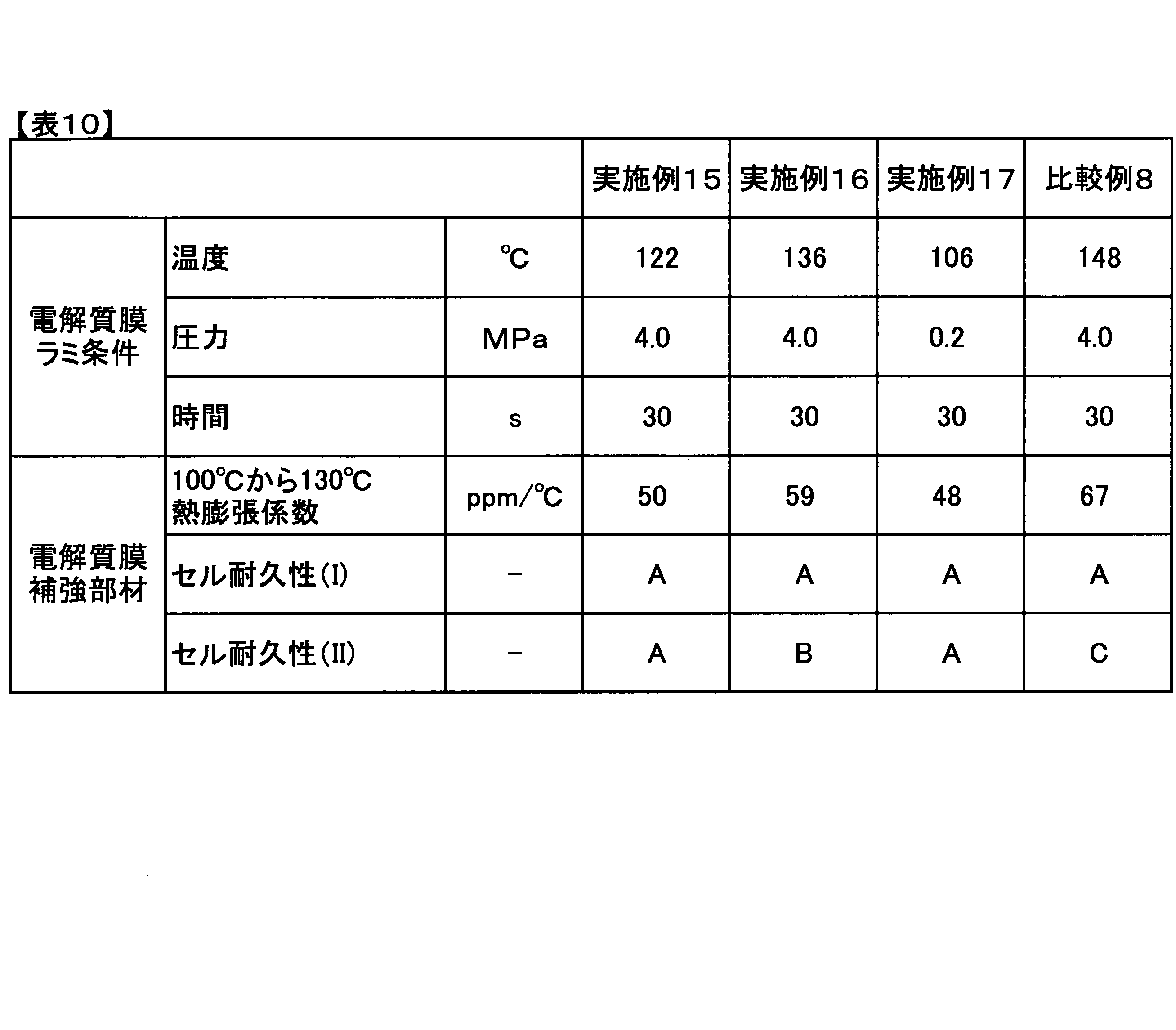
- the electrolyte membrane reinforcing member of the present invention preferably has a thermal expansion coefficient measured in the temperature range of 100°C to 130°C of 40 ppm/°C or more and 65 ppm/°C or less in the direction in which the thermal expansion coefficient is highest measured in the temperature range of 100°C to 130°C.
- the direction with the highest thermal expansion coefficient refers to the direction with the highest thermal expansion coefficient in the temperature range of 100°C to 130°C when the film is cut into a rectangular shape and the thermal expansion coefficient is measured in a temperature range of 100°C to 130°C by changing the direction every 10°, with the long side direction and/or the short side direction of the rectangle being 0°. If the thermal expansion coefficient is within the above range, it is preferable because the internal stress applied to the fastened electrolyte membrane reinforcing member is reduced when the operating temperature of 100°C or higher is applied, and durability can be improved.
- the thermal expansion coefficient is less than 40 ppm/°C, it indicates that the orientation is extremely high, and the film formability for producing the electrolyte membrane reinforcing member may be poor. If the thermal expansion coefficient exceeds 65 ppm/°C, when the operating temperature of 100°C or more is repeatedly applied, the internal stress may cause deterioration such as deformation and cracking, and durability may deteriorate.
- the thermal expansion coefficient is more preferably 60 ppm/°C or less.
- the detailed method for measuring the thermal expansion coefficient is the method described in the Examples. Among the film production conditions described above, the thermal expansion coefficient tends to decrease when the stretching ratio is increased, and the thermal expansion coefficient tends to increase when the heat setting temperature is increased. Furthermore, among the production conditions of the electrolyte membrane reinforcing member described later, the thermal expansion coefficient tends to increase when the processing temperature is increased.
- the cells used in fuel cells and water electrolysis devices have a structure in which a catalyst layer, an electrode substrate, and a separator are laminated in sequence on both sides of an electrolyte membrane that uses the biaxially oriented polyarylene sulfide film of the present invention as a reinforcing member.
- an electrolyte membrane with a catalyst layer laminated on both sides i.e., a layer structure of catalyst layer/electrolyte membrane/catalyst layer
- a catalyst-coated electrolyte membrane CCM
- an electrolyte membrane with a catalyst layer and a gas diffusion substrate laminated in sequence on both sides i.e., a layer structure of gas diffusion substrate/catalyst layer/electrolyte membrane/catalyst layer/gas diffusion substrate
- MEA membrane electrode assembly
- the manufacturing method for CCM is to apply and dry a catalyst layer paste composition for forming a catalyst layer on the surface of the electrolyte membrane, or to prepare only the catalyst layer on a substrate and then transfer the catalyst layer to laminate the catalyst layer on the electrolyte membrane (transfer method).
- the edge of the electrolyte membrane in this CCM and the peripheral edge of the opening of the film of the present application to which the organic resin layer has been cut into a frame shape are overlapped, and the CCM and electrolyte membrane reinforcement member are attached by heat pressing.
- the temperature during pressing of the film of the present application is preferably 50°C or higher and 140°C or lower. If the temperature is within the above range, the durability of the electrolyte membrane reinforcement member can be improved without impairing the properties of the biaxially oriented film. If the temperature during pressing is less than 50°C, the film will adhere from near room temperature, and will have adhesiveness even at room temperature, which may deteriorate the handling properties during manufacturing. If the temperature during pressing is more than 140°C, the biaxially oriented film will be subjected to excessive heat, which may cause structural changes and may result in poor dimensional stability and durability. The temperature during pressing is more preferably 130°C or lower, and even more preferably 120°C or lower.
- the pressing pressure is preferably 0.1 MPa or higher and 10 MPa or lower. If the pressing pressure is less than 0.1 MPa, the appearance may deteriorate due to wrinkles due to no pressure being applied. If the pressing pressure exceeds 10 MPa, the organic resin layer may deform, which may deteriorate the appearance.
- the pressing time is preferably 0.5 seconds or higher and 300 seconds or lower.
- the fuel cell and water electrolysis device of the present invention will be described below.
- the fuel cell of the present invention has an MEA that uses the biaxially oriented polyarylene sulfide film for reinforcing an electrolyte membrane of the present invention.
- the biaxially oriented polyarylene sulfide film for reinforcing an electrolyte membrane of the present invention in a fuel cell, the reinforcing effect can be increased even in a temperature range exceeding 100°C, leading to a longer life, etc.
- the water electrolysis device of the present invention has an MEA that uses the biaxially oriented polyarylene sulfide film for reinforcing an electrolyte membrane of the present invention.
- the biaxially oriented polyarylene sulfide film for reinforcing an electrolyte membrane of the present invention in a water electrolysis device, it has a stable reinforcing effect against the environment caused by output fluctuations, leading to a longer life, etc.
- a calibration curve was created in advance using a sample with a known mass ratio (for example, an olefin used as an incompatible resin), and the content of polyarylene sulfide resin was calculated from the ratio to the total amount of polyarylene sulfide and other substances.
- a known mass ratio for example, an olefin used as an incompatible resin
- a tensile test was performed using a tensile tester (RTG-1210 manufactured by A&D Company, Limited) with a sample film 10 mm wide set so that the chuck length was 50 mm, at a temperature of 25°C or 130°C and a tensile speed of 300 mm/min.
- RTG-1210 manufactured by A&D Company, Limited
- the elastic modulus was calculated by calculating the load difference at a calculation pitch of 0.2 mm within the measurement range of the displacement from 0 mm to 10 mm, with the start point of the displacement being 0 mm and the end point being 10 mm, and the second, third, and fourth coordinates from the maximum value were used as the original data to linearize the line by the least squares method, and the slope was taken as the elastic modulus. Five samples were cut so that the direction of the test length was in the desired direction, and the average was calculated.
- Measuring device RTG-1210 manufactured by A&D Company, Limited Sample size: length 150 mm x width 10 mm Chuck length: 50 mm Pull speed: 300 mm/min Measurement environment: 25°C 55% RH or 130°C Analysis conditions: displacement mode, start point: 0 mm, end point: 10 mm, pitch: 0.2 mm.
- Q1000 temperature modulation DSC
- Tg glass transition temperature
- ⁇ Cp specific heat difference
- ⁇ Cp0 represents the specific heat difference before and after the Tg of completely amorphous PPS
- ⁇ Cp0 0.2699 J / g ° C. is used. This value is based on (Wunderlich B., Thermal Analysis of Polymeric Materials, Appendix 1 (The ATHAS Data Bank), Springer (2005).).
- Resonance parameter (Q value) The film was cut into a 5 cm x 5 cm square and evaluated at a frequency of 15 GHz using a microwave molecular orientation meter (MOA-6015, manufactured by Oji Scientific Instruments Co., Ltd.). The film was rotated by 30° at a time, and measurements were taken at six points up to 150°, and the average value was calculated. Measurements were taken for one sample, and the average value of the minimum and maximum values of the orientation degree (Q) was adopted as the value. Measurements were taken 10 times for one sample, and the average value of the obtained values was taken as the Q value of that sample.
- MOA-6015 microwave molecular orientation meter
- Tm Melting point
- T-meta minute endothermic peak temperature
- a Rigaku DSC Thermo plus EVO2 DSCvesta-SL
- Tm melting point
- T-meta The melting point here was taken as the point at which the difference from the baseline of the DSC chart was maximum.
- the minute endothermic peak was observed in the first run of DSC and was not observed in the second run in which the temperature was raised to above Tm once and the thermal history was erased, so it can be confirmed by comparing both DSC charts. Measurements were performed three times for each sample, and the average values obtained were taken as the melting point (°C) and minute endothermic peak (T-meta) of the sample.
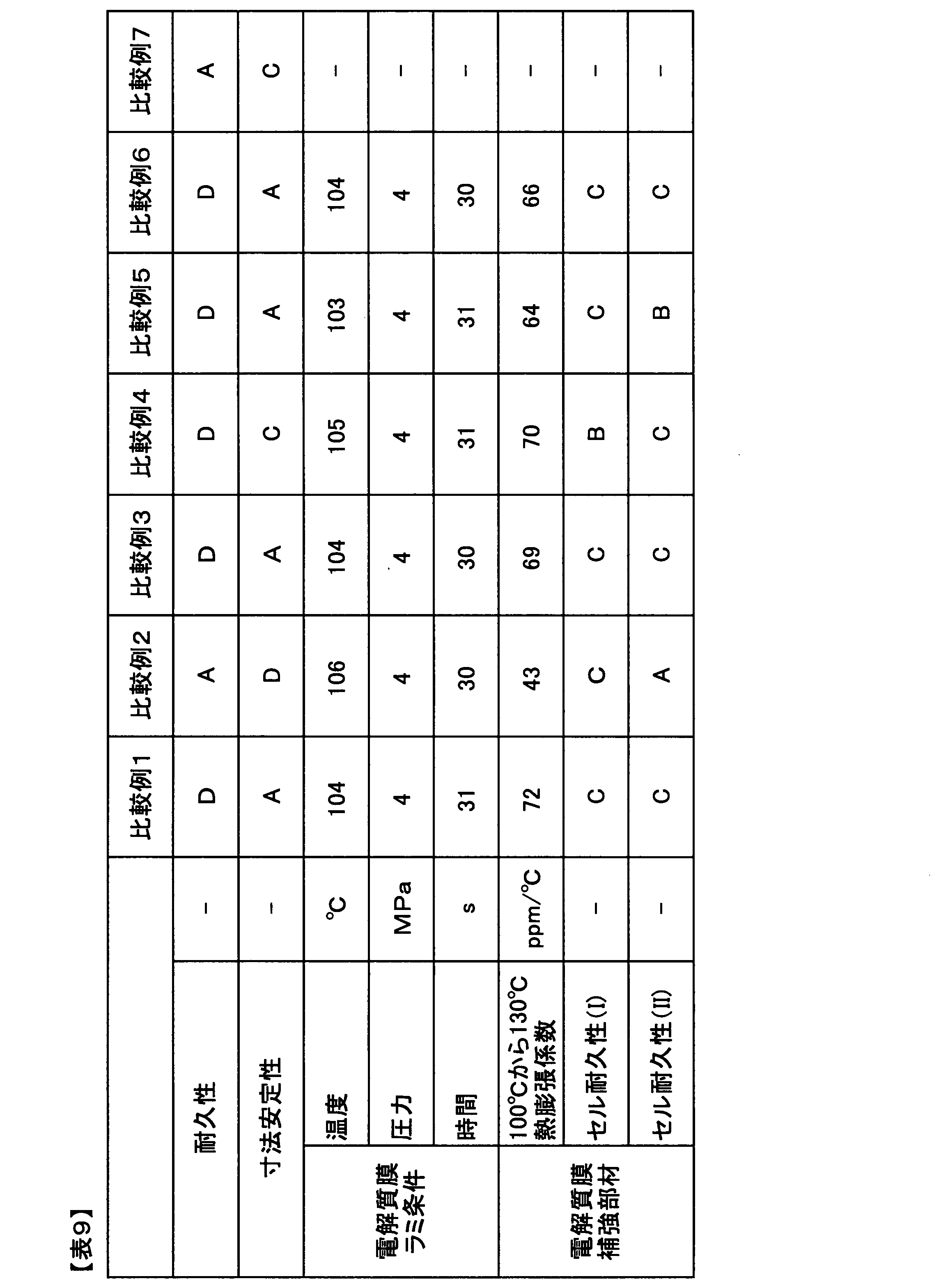
- the organic resin layers were layered so that they were in contact with each other and bonded under the conditions shown in the table to form a biaxially oriented polyarylene sulfide film/organic resin layer/biaxially oriented polyarylene sulfide film laminate, which was used for evaluating the thermal expansion coefficient.
- the thermal expansion coefficient was measured by cutting the above-mentioned sample into a rectangular shape, changing the direction by 10° in increments of 10° from the long side direction and/or the short side direction of the rectangle as 0°, and measuring the thermal expansion coefficient in the temperature range from 100°C to 130°C.
- the thermal expansion coefficient in the highest direction was recorded as the thermal expansion coefficient of the electrolyte membrane reinforcement member.
- the thermal expansion coefficient was measured in accordance with JIS K7197-1991 during the cooling process after heating to 200°C. If the initial sample length at 25°C and 65RH% is L0, the sample length at temperature T1 is L1 (mm), and the sample length at temperature T2 is L2 (mm), the average thermal expansion coefficient from T1 to T2 was calculated using the following formula.
- T2 100 (°C)
- T1 130 (°C)
- L0 20 mm.
- the breaking elongation retention rate represented by the following formula (1) was calculated from the average value in each direction. Durability was evaluated according to the following criteria. A: Breaking elongation retention rate is 85% or more. B: Breaking elongation retention rate is 80% or more. C: Breaking elongation retention rate is 75% or more. D: Breaking elongation retention rate is less than 75%. Measuring device: RTG-1210 manufactured by A&D Company, Limited.
- a 85 mm x 85 mm perfluorosulfonic acid resin (DuPont: "Nafion” (registered trademark) 117) was used as an electrolyte membrane, and polyarylene sulfide film laminates (outer circumference 100 mm x 100 mm, inner circumference 80 mm x 80 mm) were placed on both sides of the electrolyte membrane, with the films set around the electrolyte membrane as shown in Figure 1, and the organic resin layers were overlapped so as to be in contact with each other, and bonded under the conditions shown in the table.
- the electrolyte membrane reinforcing member was visually inspected for wrinkles, distortions, and other deformations, and the appearance of the electrolyte membrane reinforcing member was evaluated according to the following criteria. AA: Almost no deformation of the film is observed. A: The film is slightly warped, but does not affect its usability. B: The film is distorted, but usable. C: The film is distorted overall, but is still usable. D: The entire film is significantly distorted and cannot be used for practical purposes.
- a 50 mm x 50 mm perfluorosulfonic acid resin (DuPont: "Nafion” (registered trademark) 117) was used as an electrolyte membrane, and polyarylene sulfide film laminates (outer circumference 80 mm x 80 mm, inner circumference 48 mm x 48 mm) were placed on both sides of the electrolyte membrane, and the organic resin layers were placed on top of each other so that they were in contact with each other, and bonded under the conditions shown in the table to produce an electrolyte membrane with a subgasket.
- a pair of commercially available electrodes BASF fuel cell gas diffusion electrodes "ELAT (registered trademark) LT120ENSI” with 5 g/m 2 Pt, cut to 5 cm x 5 cm, were prepared, and stacked opposite each other to sandwich the electrolyte membrane, incorporated into a JARI standard cell (electrode area 25 cm 2 ), and tightened to a specified surface pressure to use as an evaluation cell.
- ELAT registered trademark
- JARI standard cell electrode area 25 cm 2
- the evaluation cell was placed in an environmental tester (Highly Accelerated Life Tester PC-R8D manufactured by Hirayama Manufacturing Co., Ltd.) set to 125°C, 2 atm, wet saturation mode, and 100% RH, and treated for 500 hours. Nitrogen gas was sealed into the gas flow path of the JARI standard cell to a pressure of 300 kPa, and the cell was left to stand for 1 hour. The presence or absence of gas leakage was evaluated based on the pressure change, and the durability of the cell was evaluated according to the following criteria. A: There is no change in the pressure of the enclosed gas, and there is no problem in practical use. B: The pressure of the filled gas was slightly reduced, but it was still usable. C: The pressure of the filled gas was reduced, causing gas leakage, and it was not usable.
- Cell durability An evaluation cell was prepared in the same manner as in the case of cell durability (I). The evaluation cell was subjected to 2000 cycles of -40°C for 30 minutes and 125°C for 30 minutes using a thermal cycle tester (thermal shock device TSE-11 manufactured by Espec Corporation), and the cell was subjected to 500 hours of treatment. Nitrogen gas was sealed in the gas flow path of the JARI standard cell to a pressure of 300 kPa, and the cell was allowed to stand for 1 hour. The presence or absence of gas leakage was evaluated based on the pressure change, and the durability of the cell was evaluated according to the following criteria. A: There is no change in the pressure of the enclosed gas, and there is no problem in practical use. B: The pressure of the filled gas was slightly reduced, but it was still usable. C: The pressure of the filled gas was reduced, causing gas leakage, and it was not usable.
- PPS granules 1 Preparation of polyphenylene sulfide resin granules (PPS granules 1) 1 kmol of 47% sodium hydrosulfide, 1.02 kmol of 47% sodium hydroxide, 1.6 kmol of N-methyl-2-pyrrolidone (NMP), 0.3 kmol of sodium acetate, and 100 kg of ion-exchanged water were charged into a 1 kiloliter SUS vessel equipped with a stirrer, and gradually heated to 235°C over about 180 minutes while stirring at 240 rpm and passing nitrogen through at normal pressure, distilling out 209 kg of water and 0.4 kg of NMP, and then cooling the reaction vessel to 160°C.
- PPS granules 1 1 kmol of 47% sodium hydrosulfide, 1.02 kmol of 47% sodium hydroxide, 1.6 kmol of N-methyl-2-pyrrolidone (NMP), 0.3 kmol of sodium acetate, and 100 kg
- the amount of hydrogen sulfide scattered was 0.02 kmol.
- p-DCB p-dichlorobenzene
- NMP 2.40 kmol
- the reaction vessel was then sealed under nitrogen gas.
- the temperature was raised from 160°C to 220°C over 100 minutes while stirring at 400 rpm, and the reaction was carried out at 220°C for 300 minutes.
- the temperature was raised from 220°C to 255°C over 60 minutes, 0.8 kmol of water was poured into the system over 10 minutes, and the reaction was continued for 440 minutes. Then, it was cooled from 255°C to 200°C over 100 minutes.
- Reference Example 4 Manufacturing method of PPS pellets (PPS2)
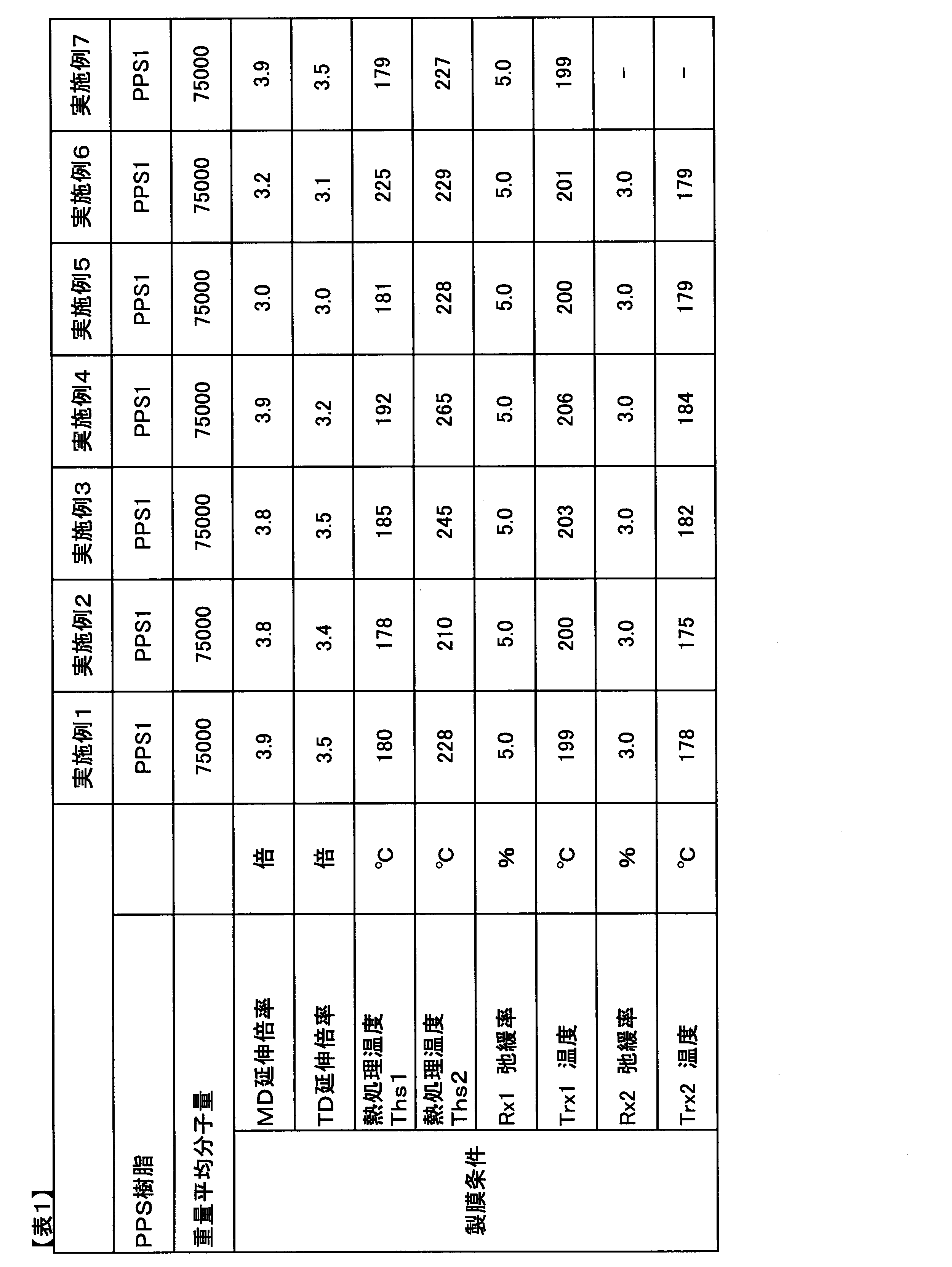
- Example 1 The PPS pellets (PPS1) prepared in Reference Example 3 were dried under reduced pressure at 180°C for 3 hours. Then, the pellets were fed to an extruder, melted at 310°C under a nitrogen atmosphere, and introduced into a T-die die. Then, the pellets were extruded from the T-die die into a sheet to form a molten monolayer sheet, and the molten monolayer sheet was cast onto a cast drum rotating at 3.5 m/min and maintained at a surface temperature of 25°C while being cooled and solidified by an electrostatic application method to obtain an unstretched film.
- PPS1 PPS pellets prepared in Reference Example 3 were dried under reduced pressure at 180°C for 3 hours. Then, the pellets were fed to an extruder, melted at 310°C under a nitrogen atmosphere, and introduced into a T-die die. Then, the pellets were extruded from the T-die die into a sheet to form a molten monolayer sheet, and the mol
- the unstretched film obtained was stretched (MD stretched) at a stretching temperature of 100°C in the longitudinal direction of the film by utilizing the difference in peripheral speed of the rolls, at a stretching temperature of 100°C, at a stretching ratio of 3.9 times in the longitudinal direction of the film, using a longitudinal stretching machine consisting of a group of heated rolls. Then, both ends of the film were held by clips, and the film was introduced into a tenter and stretched at a stretching temperature of 105 ° C.
- the first heat treatment (Ths1) was performed for 10 seconds with a tenter heated to 180 ° C.
- the second heat treatment (Ths2) was performed for 10 seconds with a tenter heated to 228 ° C.
- the first relaxation treatment (Rx1) was performed with a tenter at 199 ° C. at a relaxation rate of 5%
- the second relaxation treatment (Rx2) was performed with a tenter at 178 ° C. at a relaxation rate of 3%
- after cooling to room temperature the film edges were removed to obtain a biaxially oriented polyarylene sulfide film with a thickness of 50 ⁇ m.
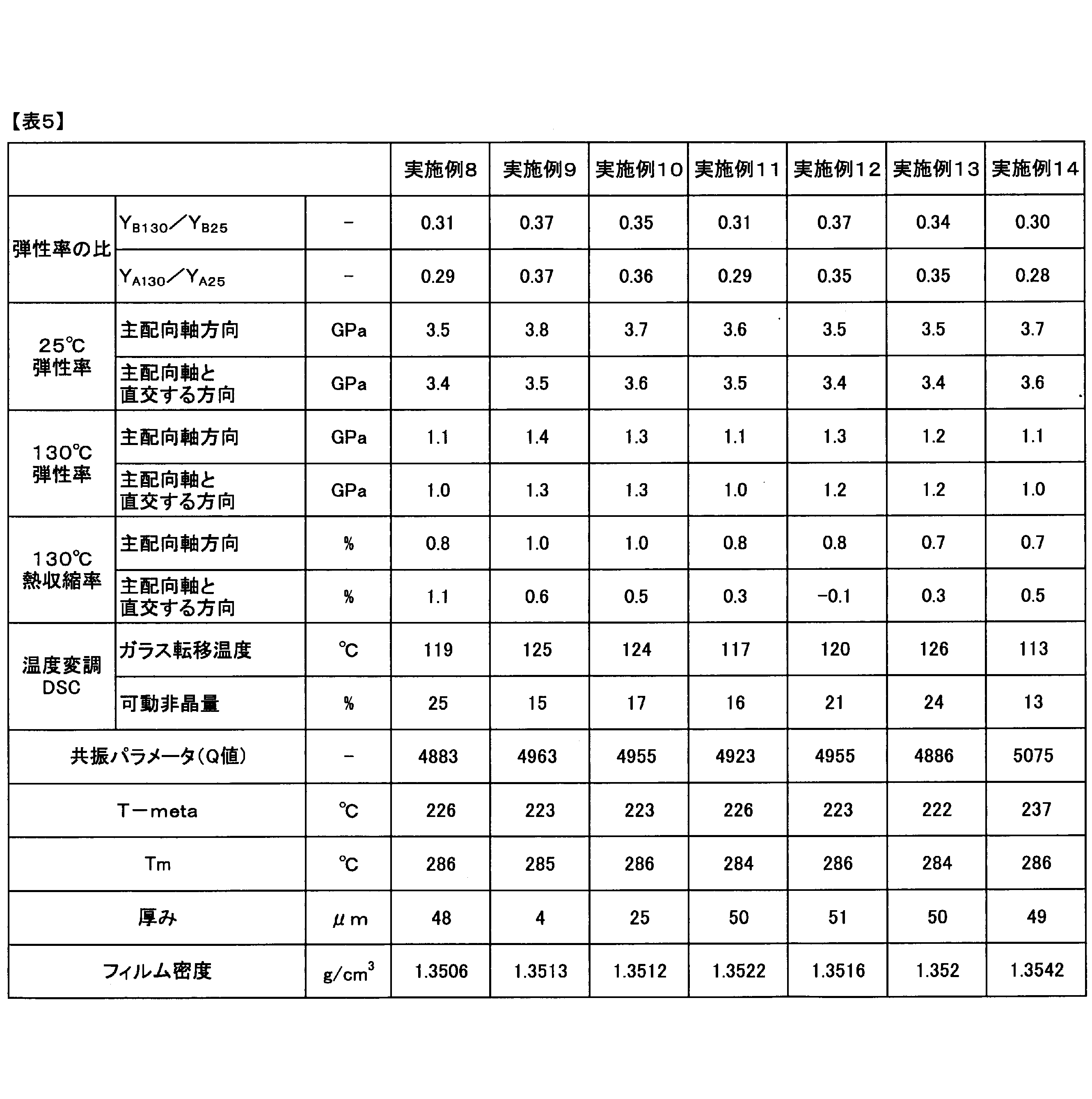
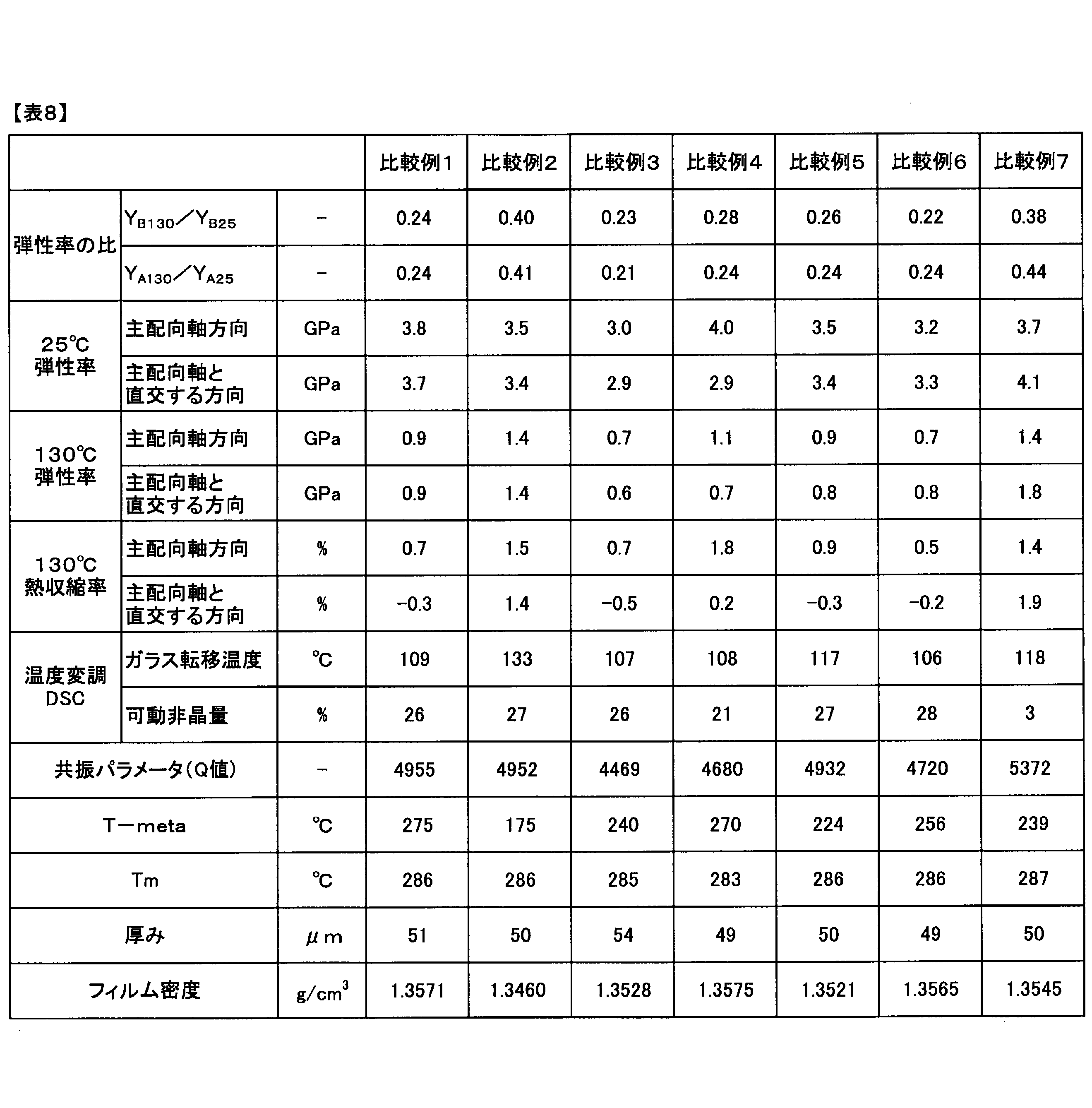
- Table 1 The physical properties and characteristics of the obtained film and electrolyte membrane reinforcing member are shown in Table.
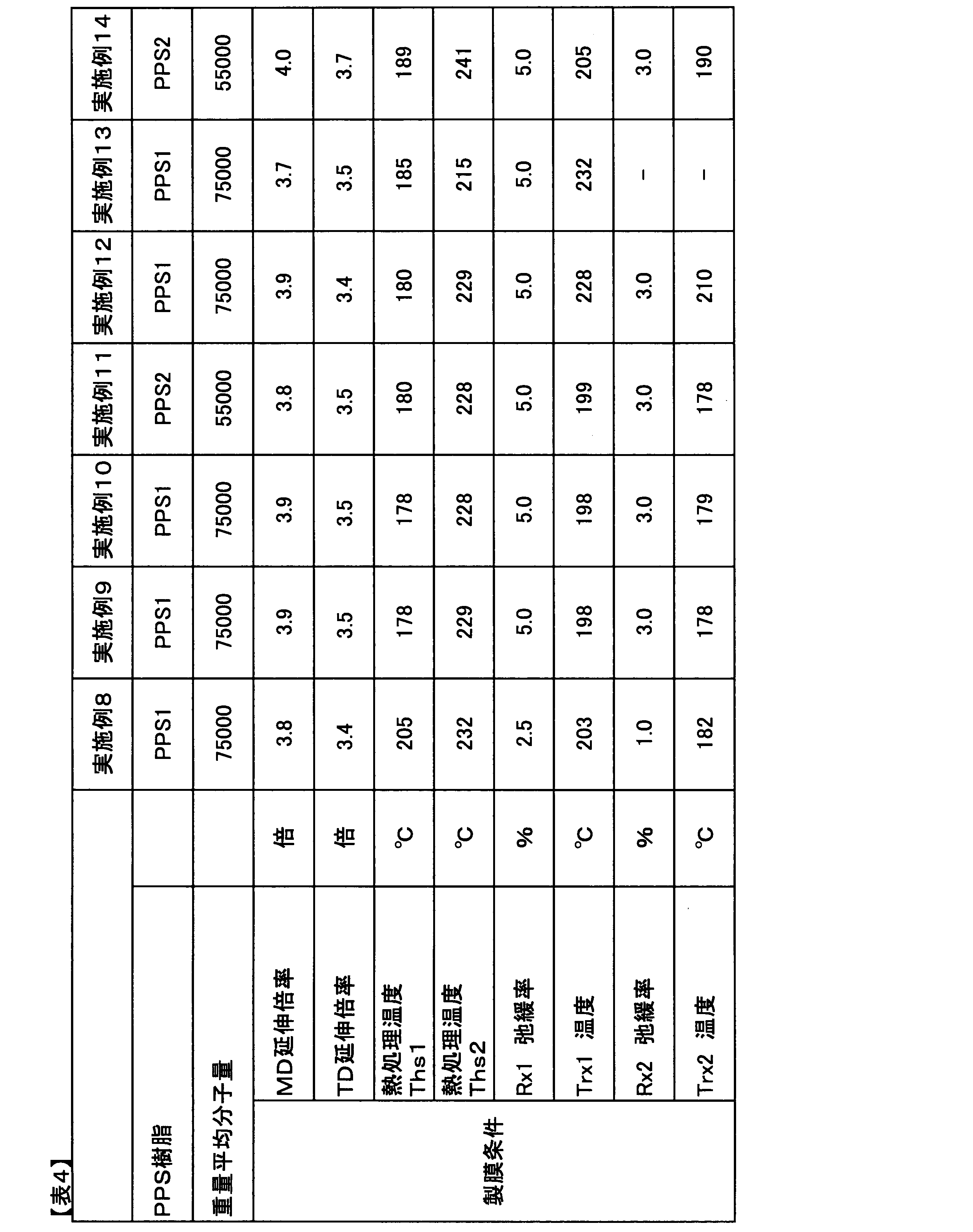
- Examples 2 to 14, Comparative Examples 1 to 6 A biaxially oriented polyarylene sulfide film was obtained in the same manner as in Example 1, except that the raw materials and film-forming conditions were changed to those shown in the table while adjusting the extrusion rate.
- Example 7 A biaxially oriented polyarylene sulfide film was produced in the same manner as in Example 1, except that the raw materials and film-forming conditions were changed to those shown in the table while adjusting the extrusion rate. Many stretching breaks were observed, and a small number of samples were taken to evaluate the properties.
- Examples 15 to 17, Comparative Example 8 The film obtained in Example 1 was used to form an electrolyte membrane reinforcing member, and the bonding conditions with the electrolyte membrane were changed to those shown in the table. The physical properties and characteristics of the electrolyte membrane reinforcing member are shown in the table.
Landscapes
- Chemical & Material Sciences (AREA)
- Engineering & Computer Science (AREA)
- Chemical Kinetics & Catalysis (AREA)
- Electrochemistry (AREA)
- Materials Engineering (AREA)
- Manufacturing & Machinery (AREA)
- Organic Chemistry (AREA)
- Metallurgy (AREA)
- General Chemical & Material Sciences (AREA)
- Sustainable Energy (AREA)
- Life Sciences & Earth Sciences (AREA)
- Sustainable Development (AREA)
- Health & Medical Sciences (AREA)
- Medicinal Chemistry (AREA)
- Polymers & Plastics (AREA)
- Mechanical Engineering (AREA)
- Manufacture Of Macromolecular Shaped Articles (AREA)
- Shaping By String And By Release Of Stress In Plastics And The Like (AREA)
- Fuel Cell (AREA)
Abstract
Description
(1)ポリアリーレンスルフィド(PAS)樹脂を主たる構成成分とし、主配向軸と直交する方向の25℃における弾性率(YA25)と、主配向軸と直交する方向の130℃で測定される弾性率(YA130)の比YA130/YA25が0.25以上0.80以下であって、同方向の130℃熱収縮率が-1.2%以上1.2%以下である二軸配向ポリアリーレンスルフィドフィルム。
(2)温度変調示差走査熱量測定(温度変調DSC)により求められるガラス転移温度(Tg)が110℃以上140℃以下であって、かつフィルム全体に対する可動非晶量が5%以上25%以下である二軸配向ポリアリーレンスルフィドフィルム。
(3)主配向軸方向の25℃における弾性率(YB25)と、主配向軸方向の130℃で測定される弾性率(YB130)の比YB130/YB25が0.25以上0.80以下であって、同方向の130℃熱収縮率が-1.2%以上1.2%以下である(1)または(2)に記載の二軸配向ポリアリーレンスルフィドフィルム。
(4)130℃で測定される弾性率が主配向軸方向、主配向軸と直交する方向いずれも1.0GPa以上である(1)~(3)のいずれかに記載の二軸配向ポリアリーレンスルフィドフィルム。
(5)マイクロ波方式配向測定により求められる共振性パラメータ(Q値)が4600以上5000以下である(1)~(4)のいずれかに記載の二軸配向ポリアリーレンスルフィドフィルム。
(6)重量平均分子量(Mw)が6万以上15万以下である(1)~(5)のいずれかに記載の二軸配向ポリアリーレンスルフィドフィルム。
(7)密度が1.3450g/cm3以上1.3550g/cm3以下である(1)~(6)のいずれかに記載の二軸配向ポリアリーレンスルフィドフィルム。
(8)示差走査熱量測定(DSC)により求められる微小吸熱ピーク温度(Tmeta)(℃)が(フィルムの融点(Tm)-100)℃以上(Tm-20)℃以下である(1)~(7)のいずれかに記載の二軸配向ポリアリーレンスルフィドフィルム。
(9)ポリアリーレンスルフィド樹脂組成物を溶融押出し冷却固化した後、フィルムを走行方向に延伸(MD延伸)し、次いで、フィルムをクリップで保持しフィルム幅方向に延伸(TD延伸)し二軸延伸フィルムとした後、前段の熱固定温度(Ths1)を150℃以上230℃以下としたうえで熱固定処理する工程、最終段の熱固定温度(Ths2)をThs1以上265℃以下としたうえで熱固定処理する工程を連続して行う(1)~(8)のいずれかに記載の二軸配向ポリアリーレンスルフィドフィルムの製造方法。
(10)(1)~(8)のいずれかに記載の二軸配向ポリアリーレンスルフィドフィルムを用いた電解質膜補強部材。
(11)二軸配向ポリアリーレンスルフィドフィルム、有機樹脂層、二軸配向ポリアリーレンスルフィドフィルムを少なくともこの順で有する構成部分を含む(10)に記載の電解質膜補強部材。
(12)100℃から130℃の温度範囲で測定される熱膨張係数が最も高い方向における、100℃から130℃の温度範囲で測定される熱膨張係数が40ppm/℃以上65ppm/℃以下である(10)または(11)に記載の電解質膜補強部材。
測定方法:矩形の長辺方向および/または矩形の短辺方向を0°として10°毎に方向を変えて100℃から130℃の温度範囲で熱膨張係数を測定した際に、熱膨張係数が最も高い方向の値を算出する。
(13)(10)~(12)のいずれかに記載の電解質膜補強部材を有する燃料電池。
(14)(10)~(12)のいずれかに記載の電解質膜補強部材を有する水電解装置。

繰り返し単位としては、上記の式(A)で表されるp-アリーレンスルフィド単位が好ましく、これらの代表的なものとして、ポリフェニレンスルフィド、ポリサルフォン、ポリエーテルサルフォン、ポリフェニレンスルフィドスルホン、ポリフェニレンスルフィドケトンなどが挙げられ、特に好ましいp-アリーレンスルフィド単位としては、フィルム物性と経済性の観点から、p-フェニレンスルフィド単位が好ましく例示される。






25℃で測定される弾性率はYB25およびYA25のいずれも、より好ましくは3.3GPa以上、さらに好ましくは3.5GPa以上である。また、25℃で測定される弾性率は5.0GPa以下を好ましい範囲として例示できる。この範囲内では配向が高まりすぎず、フィルムの熱収縮率を好ましい範囲とすることができる。後述する製膜条件の中でも延伸倍率を高倍率化すると25℃で測定される弾性率は高くなる傾向がある。
当該熱膨張係数が65ppm/℃を超えると100℃以上の動作温度が繰り返しかかった際に、内部応力によって変形や割れ等の劣化が進み耐久性が悪化する場合がある。当該熱膨張係数は、より好ましくは60ppm/℃以下である。なお、熱膨張係数の詳細な測定方法は実施例に記載の方法とする。上述したフィルムの製膜条件の中でも延伸倍率を高めると当該熱膨張係数は低くなる傾向にあり、熱固定温度を高くすると当該熱膨張係数は高くなる傾向にある。また、後述する電解質膜補強部材の製造条件の中でも加工温度を高くすると当該熱膨張係数は高くなる傾向にある。
(1)ポリアリーレンスルフィド樹脂の含有量
フィルムの赤外吸収スペクトルを赤外分光光度計(パーキンエルマー社製、spectorum100/ユニバーサルATR(1回反射、使用クリスタル:ダイヤモンド/ZnSe)を用いてATR法にて測定する。得られた赤外吸収スペクトルから、ポリアリーレンスルフィドのスルフィド結合に基づくφ-S伸縮振動基に起因するピークとそれ以外の物質に起因するピークの比からポリアリーレンスルフィド樹脂の含有量を求める。なお、ピーク高さ比を質量比に換算するために、予め質量比既知のサンプル(例えば非相溶樹脂として使用したオレフィン等)で検量線を作成してポリアリーレンスルフィドとそれ以外の物質の合計量に対する比率からポリアリーレンスルフィド樹脂の含有量を算出した。
まず主配向軸方向を特定した。いずれかの方向を0°とし、フィルム面内に-90°から90°まで10°毎に方向を変えて25℃における以下の方法で弾性率を測定し、最も弾性率の値が高い方向をフィルムの主配向軸方向とした。
測定装置:A&D Company,Limited製/RTG-1210
試料サイズ:試長150mm×幅10mm
チャック間長さ:50mm
引張り速度:300mm/min
測定環境:25℃55%RH、または130℃
解析条件:変位モード 開始点:0mm 終了点:10mm ピッチ:0.2mm。
フィルムを10mm×150mmの短冊状に試長の方向が主配軸方向および主配向軸と直交する方向に切り出し、中央100mmの部分に標線を付け、下記装置を用いて標線間の距離を測定した(熱処理前の標線間距離)。次いで、フィルムに3gの重りを吊るし130℃に昇温した状態の熱風オーブンで30分間熱処理し、上記と同様にして標線間の距離を測定した(熱処理後の標線間距離)。得られた標線間距離を下記式から、130℃熱収縮率を算出した。なお、主配向軸方向および主配向軸に直交する方向共に5サンプルずつ測定を実施し、その平均を求めた。
測長装置 :万能投影機
試料サイズ :試長150mm×幅10mm
熱処理装置 :ギアオーブン
熱処理条件 :130℃、30分
荷重 :3g
算出方法:
130℃熱収縮率(%)={(熱処理前の標線間距離)-(熱処理後の標線間距離)}/熱処理前の標線間距離×100
(4)ガラス転移温度(℃)、可動非晶量(%)
TA Instruments社製温度変調DSC(Q1000)を用い、試料5mgを窒素雰囲気下、0℃から200℃まで2℃/minの昇温速度、温度変調振幅±1℃、温度変調周期60秒で測定した。測定によって得られた曲線からJIS7121(2012)に準拠し高温側のベースラインを低温側に延長した直線と、階段状変化部分の曲線の勾配が最大になるような点で引いた接線との交点をガラス転移温度(Tg)とし、当該JISに準拠した、Tgより高温側のベースラインと、Tgより低温側のベースラインから求まる比熱差(ΔCp)を求め、以下式より可動非晶量(Xma)を算出した。
可動非晶量:Xma(%)=ΔCp /ΔCp0×100
ここで、ΔCp0は完全非晶PPSのTg前後での比熱差をあらわし、ΔCp0=0.2699J/g℃を用いる。当該値は(Wunderlich B., Thermal Analysis of Polymeric Materials,Appendix 1 (The ATHAS Data Bank),Springer(2005).)を参考としている。
PAS樹脂やフィルムの分子量は、GPCを用いて、ポリスチレン換算で算出した。GPCの測定条件を以下に示す。
装置:センシュー科学製SSC-7110
カラム:昭和電工製Shodex UT-G+Shodex UT-806M×2
溶離液:1-クロロナフタレン
検出器:示差屈折率検出器
カラム温度:210℃
プレ恒温槽温度:250℃
ポンプ恒温槽温度:50℃
検出器温度:210℃
流量:1.0mL/分
試料注入量:300μL (濃度:0.1質量%)
標準サンプル:ポリスチレン。
フィルムを5cm×5cmの正方形に切り出し、マイクロ波方式の分子配向計(王子計測機器株式会社製、MOA-6015)を用いて、周波数15GHzにて評価する。フィルムを30°ずつ回転させ、150°までの6点を測定し、その平均値を算出する。1サンプルにつき測定し、配向度(Q)の最小値と最大値の平均値を値として採用した。測定は1サンプルにつき10回実施し、得られた値の平均値をそのサンプルのQ値とした。
JIS K7121(1999)に従って示差走査熱量計として、リガク社製DSC(Thermo plus EVO2 DSCvesta-SL)を用いて、試料5mgをアルミニウム製パンに封入し、25℃から350℃まで、昇温速度20℃/分で昇温した。そのとき、観測される融解の吸熱ピークのピーク温度を融点(Tm)とし、150℃以上Tm℃以下の温度範囲で現れる微小な吸熱ピーク温度をT-metaとした。ここでの融点とはDSCチャートのベースラインからの差異が最大となる点とした。微小吸熱ピークはDSCのファーストランで観測され一度Tm以上に昇温し熱履歴を消したセカンドランでは観測されないことから、双方のDSCチャートを比較することにより確認できる。測定は1サンプルにつき3回実施し、得られた値の平均値をそのサンプルの融点(℃)および微小吸熱ピーク(T-meta)とした。
二軸配向ポリアリーレンスルフィドフィルムの任意の10箇所の厚みを、23℃65%RHの雰囲気下で接触式のアンリツ(株)製電子マイクロメータ(K-312A型)を用いて測定した。その10箇所の厚みの算術平均値を二軸配向ポリアリーレンスルフィドフィルムのフィルム厚み(単位:μm)とした。
JIS K7112に従って密度勾配管(NaBr水溶液、25℃)に略正方形(およそ5mm×5mm)にカットしたサンプルを投入し一晩経った後の勾配管の目盛りを読みとることで、測定を行った。なお、密度勾配管に密度が既知のフロートを4個投入し、そのフロートの位置と密度から検量線を予め作成しておき、その検量線を基に各サンプルの密度を算出した。なお、サンプルはそれぞれ3つずつ投入し、その平均値をそのサンプルのフィルム密度とした。
二軸配向ポリアリーレンスルフィドフィルムの場合、電解質膜補強部材の有機樹脂層としてホットメルト接着剤(東亞合成社製:“アロンメルト”(登録商標)PPET1303S)をポリアリーレンスルフィドフィルム上にバーコーターで塗布し、100℃に熱されたオーブンにて60秒間乾燥し、有機樹脂層厚み10μmの二軸配向ポリアリーレンスルフィド/有機樹脂層のポリアリーレンスルフィドフィルム積層体を得た。次に、2枚のポリアリーレンスルフィド積層体を有機樹脂層同士が接触するように重ね、表に示す条件で接合し二軸配向ポリアリーレンスルフィド/有機樹脂層/二軸配向ポリアリーレンスルフィド積層体とし熱膨張係数評価に供した。
昇温、降温速度:5℃/min
試料幅:4mm
荷重:29.4mN
(11)耐久性
サンプルフィルムを試長150mm×幅10mmに切り出した短冊状の試料片を、125℃・2atm・濡れ飽和モード・100%RHに設定した環境試験機(株式会社平山製作所製 高加速寿命試験装置PC-R8D)内に静置し、500時間の処理を実施し、試料片を取り出し、破断強度を測定する。試長の方向が主配向軸および主配向軸と直交する方向に平行になるように5サンプルずつ採取して測定を実施し、それぞれの平均値で評価を行う。各方向の平均値から、下記式(1)で表わされる破断伸度保持率を算出した。耐久性を下記基準で評価した。
A:破断伸度保持率が85%以上
B:破断伸度保持率が80%以上
C:破断伸度保持率が75%以上
D:破断伸度保持率が75%未満
測定装置:A&D Company,Limited製/RTG-1210
引張り速度:300mm/分
測定環境:25℃55%RH
破断伸度保持率(%)=(破断伸度X/初期の破断伸度X0)×100 ・・・(1)
(式中、破断伸度Xは、125℃、2atm、100%RHの条件で500時間処理後の破断伸度(単位:%)、破断伸度X0は処理前の初期の破断伸度(単位:%)をそれぞれ表す)。
主配向軸方向および主配向軸と直交する方向が、枠の辺と平行になるように、四角形の枠状に切り出したフィルム(外周100mm×100mm、内周80mm×80mm)を80℃に温められたプレス機上に設置し、10MPaとなるように加圧した。加圧した状態で130℃まで昇温し、1時間処理を実施後、加圧状態で80℃となるように降温させ、80℃にて圧力を開放し、フィルムを取り出した。処理前のフィルムと比較し、(2)で記載の130℃熱収縮率と併せ以下の基準で寸法安定性を評価した。
A:フィルムにしわ、ゆがみなどの変化が観察されず、主配向軸方向および主配向軸と直交する方向のいずれもフィルムの130℃熱収縮率が-1.0%以上1.0%以下である。
B:フィルムにしわ、ゆがみなどの変化がわずかに観察され、主配向軸方向および主配向軸と直交する方向のいずれかの方向でフィルムの130℃熱収縮率が-1.2%以上-1.0%未満、および/または1.0%を超えて1.2%以下である。
C:フィルムにしわ、ゆがみが観察され、主配向軸方向および主配向軸方向と直交する方向の主配向軸方向および主配向軸と直交する方向のいずれも130℃熱収縮率が-1.2%以上-1.0%未満、1.0%を超えて1.2%以下、および/または、いずれかの方向で130℃熱収縮率が-1.2%未満、または1.2%を超える。
D:フィルムにしわ、ゆがみが観察され、主配向軸方向および主配向軸方向と直交する方向のいずれもフィルムの130℃熱収縮率が-1.2%未満、または1.2%を超える。
有機樹脂層としてホットメルト接着剤(東亞合成社製:“アロンメルト”(登録商標)PPET1303S)をポリアリーレンスルフィドフィルム上にバーコーターで塗布し、100℃に熱されたオーブンにて60秒間乾燥し、有機樹脂層厚み10μmの二軸配向ポリアリーレンスルフィド/有機樹脂層のポリアリーレンスルフィドフィルム積層体を得た。
AA:フィルムの変形はほとんど見られない。
A:フィルムに若干ゆがみが見られるものの、実用に問題ない。
B:フィルムにゆがみが見られるが、実用できる。
C:フィルムに全体がゆがんでおり、実用はできる。
D:フィルム全体が大きくゆがみ、実用できない。
有機樹脂層としてホットメルト接着剤(東亞合成社製:“アロンメルト”(登録商標)PPET1303S)をポリアリーレンスルフィドフィルム上にバーコーターで塗布し、100℃に熱されたオーブンにて60秒間乾燥し、有機樹脂層厚み10μmの二軸配向ポリアリーレンスルフィド/有機樹脂層のポリアリーレンスルフィドフィルム積層体を得た。
次に、電解質膜として50mm×50mmのパーフルオロスルホン酸樹脂(デュポン社製:”ナフィオン”(登録商標)117)を用い、その両面にポリアリーレンスルフィドフィルム積層体(外周80mm×80mm、内周48mm×48mm)を電解質膜の周囲にフィルムをセットし、かつ有機樹脂層同士が接触するように重ね、表に示す条件で接合しサブガスケット付き電解質膜を作製した。市販の電極、BASF社製燃料電池用ガス拡散電極“ELAT(登録商標)LT120ENSI”5g/m2Ptがついたものを5cm×5cmにカットしたものを1対準備し、電解質膜を挟むように対向して重ね合わせ、JARI標準セル(電極面積25cm2)に組み込み、所定の面圧となるように締め付け評価セルとして用いた。
A:封入ガスの圧力の変化がなく、実用に問題ない。
B:封入ガスの圧力がわずかに低下したが、実用はできる
C:封入ガスの圧力が低下しガスリークが発生し、実用できない。
セル耐久性(I)と同様にして評価セルを作製した。評価セルを、冷熱サイクル試験機(エスペック株式会社製 冷熱衝撃装置TSE-11)をもちいて、-40℃30分、125℃30分を1サイクルとして、2000サイクル実施し、500時間の処理を実施し、JARI標準セルのガス流路より300kPaの圧力となるように窒素ガスを封入し1時間静置させた際の圧力変化によりガスリークのリーク有無を評価し、以下の基準でセルの耐久性評価とした。
A:封入ガスの圧力の変化がなく、実用に問題ない。
B:封入ガスの圧力がわずかに低下したが、実用はできる
C:封入ガスの圧力が低下しガスリークが発生し、実用できない。
撹拌機付きの1キロリットルSUS製容器に、47%水硫化ナトリウム1キロモル、47%水酸化ナトリウム1.02キロモル、N-メチル-2-ピロリドン(NMP)1.6キロモル、酢酸ナトリウム0.3キロモル、及びイオン交換水100キログラムを仕込み、240rpmで撹拌しながら常圧で窒素を通じながら235℃まで約180分かけて徐々に加熱し、水209キログラムおよびNMP0.4キログラムを留出したのち、反応容器を160℃に冷却した。また、硫化水素の飛散量は0.02キロモルであった。残留混合物に、p-ジクロロベンゼン(p-DCB)1.02キロモル、NMP2.40キロモルを加えた。続いて反応容器を窒素ガス下に密封した。400rpmで撹拌しながら160℃から220℃まで100分かけて昇温し、220℃で反応を300分間行った。次いで220℃から255℃に60分かけて昇温し、0.8キロモルの水を10分かけて系内に注水し、440分間反応を継続した。その後、255℃から200℃まで100分かけて冷却した。150℃に到達後、送風機を用い室温近傍まで急冷した。内容物を取り出し、1キロリットルのNMPを加えて85℃で30分撹拌した後、溶剤と固形物をふるい(80mesh)で濾別した。得られた固形物に、1キロリットルのNMPを加えて85℃で30分撹拌し、濾別した。得られた固形物に、1キロリットルの温水を加えて70℃で30分撹拌し、濾別する操作を3回繰り返した。得られた固形物に酢酸カルシウム一水和物0.3キログラムと水溶液1キロリットルの温水を加えて70℃で30分撹拌し、濾別した。得られた固形物に、1キロリットルの温水を加えて70℃で30分撹拌し、濾別する操作を3回繰り返した。これを、120℃5時間で減圧乾燥を行い、PPS顆粒1を得た。
参考例1の反応温度と時間について、160℃から270℃まで180分かけて昇温し、270℃で反応を135分間行い、270℃から200℃まで100分かけて冷却した以外は参考例1と同様の操作を行い、PPS顆粒2を得た。
参考例1で作製したPPS顆粒1を、315℃に加熱されたベント付き同方向回転式二軸混練押出機(日本製鋼所製、スクリュー直径30mm、スクリュー長さ/スクリュー直径=45.5)に投入し、滞留時間90秒、スクリュー回転数150回転/分で溶融押出してストランド状に吐出し、温度25℃の水で冷却した後、直ちにカッティングしてチップを作製し、重量平均分子量75,000、融点280℃のPPSペレット(PPS1)を得た。
参考例2で作製したPPS顆粒2を、315℃に加熱されたベント付き同方向回転式二軸混練押出機(日本製鋼所製、スクリュー直径30mm、スクリュー長さ/スクリュー直径=45.5)に投入し、滞留時間90秒、スクリュー回転数150回転/分で溶融押出してストランド状に吐出し、温度25℃の水で冷却した後、直ちにカッティングしてチップを作製し、重量平均分子量55,000、融点280℃のPPSペレット(PPS2)を得た。
参考例3で作製したPPSペレット(PPS1)を、180℃で3時間減圧乾燥した。次いで、押出機に供給し、窒素雰囲気下、310℃の温度で溶融させ、Tダイ口金に導入した。次いで、Tダイ口金内より、シート状に押出して溶融単層シートとし、該溶融単層シートを、3.5m/minで回転している、表面温度25℃に保たれたキャストドラム上に静電印加法で密着冷却固化させながらキャストし、未延伸フィルムを得た。得られた未延伸フィルムを加熱された複数のロール群からなる縦延伸機を用い、ロールの周速差を利用して延伸温度100℃でフィルムの長手方向に3.9倍の倍率で延伸(MD延伸)した。その後、フィルムの両端部をクリップで担持して、テンターに導き延伸温度105℃でフィルムの幅方向に3.5倍の倍率で延伸(TD延伸)し、180℃に加熱されたテンターで1回目の熱処理(Ths1)を10秒実施し、その後228℃に加熱されたテンターで2回目の熱処理(Ths2)を10秒行った。次いで、199℃のテンターで1回目の弛緩処理(Rx1)を弛緩率5%で実施し、引き続いて、178℃のテンターで2回目の弛緩処理(Rx2)を弛緩率3%で行い、室温まで冷却した後、フィルムエッジを除去し、厚み50μmの二軸配向ポリアリーレンスルフィドフィルムを得た。得られたフィルムと電解質膜補強部材の物性と特性を表に示す。
押出量を調整しつつ、原料や製膜条件を表に示した条件に変更した以外は実施例1と同様の方法で二軸配向ポリアリーレンスルフィドフィルムを得た。
押出量を調整しつつ、原料や製膜条件を表に示した条件に変更した以外は実施例1と同様の方法で二軸配向ポリアリーレンスルフィドフィルムを作製した。延伸破断が多く、わずかなサンプルを採取し、その特性を評価した。
実施例1で得られたフィルムを用いて、電解質膜との貼り合わせ条件を表に示す条件に変更した電解質膜補強部材の物性と特性を表に示す。




2:有機樹脂層
3:電解質膜
Claims (14)
- ポリアリーレンスルフィド(PAS)樹脂を主たる構成成分とし、主配向軸と直交する方向の25℃における弾性率(YA25)と、主配向軸と直交する方向の130℃で測定される弾性率(YA130)の比YA130/YA25が0.25以上0.80以下であって、同方向の130℃熱収縮率が-1.2%以上1.2%以下である二軸配向ポリアリーレンスルフィドフィルム。
- 温度変調示差走査熱量測定(温度変調DSC)により求められるガラス転移温度(Tg)が110℃以上140℃以下であって、かつフィルム全体に対する可動非晶量が5%以上25%以下である二軸配向ポリアリーレンスルフィドフィルム。
- 主配向軸方向の25℃における弾性率(YB25)と、主配向軸方向の130℃で測定される弾性率(YB130)の比YB130/YB25が0.25以上0.80以下であって、同方向の130℃熱収縮率が-1.2%以上1.2%以下である請求項1または2に記載の二軸配向ポリアリーレンスルフィドフィルム。
- 130℃で測定される弾性率が主配向軸方向、主配向軸と直交する方向いずれも1.0GPa以上である請求項1または2に記載の二軸配向ポリアリーレンスルフィドフィルム。
- マイクロ波方式配向測定により求められる共振性パラメータ(Q値)が4600以上5200以下である請求項1または2に記載の二軸配向ポリアリーレンスルフィドフィルム。
- 重量平均分子量(Mw)が6万以上15万以下である請求項1または2に記載の二軸配向ポリアリーレンスルフィドフィルム。
- 密度が1.3450g/cm3以上1.3550g/cm3以下である請求項1または2に記載の二軸配向ポリアリーレンスルフィドフィルム。
- 示差走査熱量測定(DSC)により求められる微小吸熱ピーク温度(Tmeta)(℃)が(フィルムの融点(Tm)-100)℃以上(Tm-20)℃以下である請求項1または2に記載の二軸配向ポリアリーレンスルフィドフィルム。
- ポリアリーレンスルフィド樹脂組成物を溶融押出し冷却固化した後、フィルムを走行方向に延伸(MD延伸)し、次いで、フィルムをクリップで保持しフィルム幅方向に延伸(TD延伸)し二軸延伸フィルムとした後、前段の熱固定温度(Ths1)を150℃以上230℃以下としたうえで熱固定処理する工程、最終段の熱固定温度(Ths2)をThs1以上265℃以下としたうえで熱固定処理する工程を連続して行う請求項1または2に記載の二軸配向ポリアリーレンスルフィドフィルムの製造方法。
- 請求項1または2に記載の二軸配向ポリアリーレンスルフィドフィルムを用いた電解質膜補強部材。
- 二軸配向ポリアリーレンスルフィドフィルム、有機樹脂層、二軸配向ポリアリーレンスルフィドフィルムを、少なくともこの順で有する構成部分を含む請求項10の電解質膜補強部材。
- 100℃から130℃の温度範囲で測定される熱膨張係数が最も高い方向における、100℃から130℃の温度範囲で測定される熱膨張係数が40ppm/℃以上65ppm/℃以下である請求項10に記載の電解質膜補強部材。
測定方法:矩形の長辺方向および/または矩形の短辺方向を0°として10°毎に方向を変えて100℃から130℃の温度範囲で熱膨張係数を測定した際に、熱膨張係数が最も高い方向の値を算出する。 - 請求項10に記載の電解質膜補強部材を有する燃料電池。
- 請求項10に記載の電解質膜補強部材を有する水電解装置。
Priority Applications (2)
| Application Number | Priority Date | Filing Date | Title |
|---|---|---|---|
| JP2024523154A JPWO2024203383A1 (ja) | 2023-03-29 | 2024-03-14 | |
| CN202480008391.3A CN120530009A (zh) | 2023-03-29 | 2024-03-14 | 双轴取向聚芳硫醚膜、双轴取向聚芳硫醚膜的制造方法、电解质膜增强构件、燃料电池及水电解装置 |
Applications Claiming Priority (2)
| Application Number | Priority Date | Filing Date | Title |
|---|---|---|---|
| JP2023-053087 | 2023-03-29 | ||
| JP2023053087 | 2023-03-29 |
Publications (1)
| Publication Number | Publication Date |
|---|---|
| WO2024203383A1 true WO2024203383A1 (ja) | 2024-10-03 |
Family
ID=92905965
Family Applications (1)
| Application Number | Title | Priority Date | Filing Date |
|---|---|---|---|
| PCT/JP2024/009959 Ceased WO2024203383A1 (ja) | 2023-03-29 | 2024-03-14 | 二軸配向ポリアリーレンスルフィドフィルム、二軸配向ポリアリーレンスルフィドフィルムの製造方法、電解質膜補強部材、燃料電池、および水電解装置 |
Country Status (4)
| Country | Link |
|---|---|
| JP (1) | JPWO2024203383A1 (ja) |
| CN (1) | CN120530009A (ja) |
| TW (1) | TW202438583A (ja) |
| WO (1) | WO2024203383A1 (ja) |
Citations (4)
| Publication number | Priority date | Publication date | Assignee | Title |
|---|---|---|---|---|
| JP2007250249A (ja) * | 2006-03-14 | 2007-09-27 | Toyota Motor Corp | シール一体型膜電極接合体 |
| JP2009132874A (ja) * | 2007-11-08 | 2009-06-18 | Toray Ind Inc | 二軸配向ポリアリーレンスルフィドフィルム、金属化フィルムおよびコンデンサー |
| JP2010070630A (ja) * | 2008-09-18 | 2010-04-02 | Toray Ind Inc | 二軸配向ポリアリーレンスルフィドフィルムおよびそれを用いてなる接着材料 |
| JP2021051994A (ja) * | 2019-09-20 | 2021-04-01 | 東レ株式会社 | 複合高分子電解質膜、触媒層付電解質膜、膜電極複合体および固体高分子形燃料電池 |
-
2024
- 2024-03-14 JP JP2024523154A patent/JPWO2024203383A1/ja active Pending
- 2024-03-14 WO PCT/JP2024/009959 patent/WO2024203383A1/ja not_active Ceased
- 2024-03-14 CN CN202480008391.3A patent/CN120530009A/zh active Pending
- 2024-03-21 TW TW113110438A patent/TW202438583A/zh unknown
Patent Citations (4)
| Publication number | Priority date | Publication date | Assignee | Title |
|---|---|---|---|---|
| JP2007250249A (ja) * | 2006-03-14 | 2007-09-27 | Toyota Motor Corp | シール一体型膜電極接合体 |
| JP2009132874A (ja) * | 2007-11-08 | 2009-06-18 | Toray Ind Inc | 二軸配向ポリアリーレンスルフィドフィルム、金属化フィルムおよびコンデンサー |
| JP2010070630A (ja) * | 2008-09-18 | 2010-04-02 | Toray Ind Inc | 二軸配向ポリアリーレンスルフィドフィルムおよびそれを用いてなる接着材料 |
| JP2021051994A (ja) * | 2019-09-20 | 2021-04-01 | 東レ株式会社 | 複合高分子電解質膜、触媒層付電解質膜、膜電極複合体および固体高分子形燃料電池 |
Also Published As
| Publication number | Publication date |
|---|---|
| CN120530009A (zh) | 2025-08-22 |
| JPWO2024203383A1 (ja) | 2024-10-03 |
| TW202438583A (zh) | 2024-10-01 |
Similar Documents
| Publication | Publication Date | Title |
|---|---|---|
| KR101482472B1 (ko) | 태양전지 이면 봉지용 폴리에스테르 필름 | |
| JP5256773B2 (ja) | 多孔性ポリプロピレンフィルム | |
| CN115149204B (zh) | 聚烯烃微多孔膜 | |
| KR102090003B1 (ko) | 금속 접착용 2축 연신 폴리아릴렌술피드 필름 | |
| CN101678604B (zh) | 双轴取向聚芳硫醚膜及其制造方法 | |
| CA2682178C (en) | Reinforcing film for the electrolyte membrane of a polymer electrolyte fuel cell | |
| WO2008029651A1 (en) | Seal film for solar cell module and solar cell module utilizing the same | |
| US20130130003A1 (en) | Back sheet for solar cell module and manufacturing method thereof | |
| CN107528035A (zh) | 层叠体 | |
| CN101981094A (zh) | 固体高分子型燃料电池的电解质膜增强用膜 | |
| KR20100117606A (ko) | 강산 폴리머 시트 제조용 필름 | |
| JP2007326362A (ja) | 積層ポリフェニレンスルフィドフィルムおよび積層ポリフェニレンスルフィドフィルムの製造方法。 | |
| JP5336269B2 (ja) | 固体高分子電解質膜補強用二軸延伸フィルム | |
| JP7845580B1 (ja) | 二軸配向ポリアリーレンスルフィドフィルム、二軸配向ポリアリーレンスルフィドフィルムロール、電解質膜補強部材、燃料電池、水電解装置、金属化フィルム、集電箔、二次電池、フィルムコンデンサ、モーター用電気絶縁紙、およびモーター | |
| JP2017132989A (ja) | 二軸配向ポリエステルフィルム | |
| JP2013110048A (ja) | 固体高分子電解質膜補強用積層フィルム | |
| JP2009045888A (ja) | 太陽電池裏面保護膜用フィルム | |
| JP7187914B2 (ja) | ポリアリーレンスルフィドフィルム | |
| CN101316705B (zh) | 双轴取向薄膜叠层板、电绝缘板和机器部件 | |
| CN106953054B (zh) | 一种长碳链聚酰胺多孔膜及其制备方法与用途 | |
| TW202438583A (zh) | 雙軸配向聚伸芳基硫醚膜、雙軸配向聚伸芳基硫醚膜的製造方法、電解質膜增強構件、燃料電池、及水電解裝置 | |
| CN111834582B (zh) | 聚烯烃层叠微多孔膜 | |
| JP2025058956A (ja) | 電解質膜補強用ポリアリーレンスルフィドフィルム、フィルムロール、電解質膜補強用フィルム、電解質膜補強部材、燃料電池、水電解装置 | |
| JP6572703B2 (ja) | ポリアリーレンスルフィドフィルム、及びそれを用いた金属・樹脂・フィルムの何れか1種以上との複合体からなる電池用部材、自動車用部材、電気・電子用部材 | |
| JP2022151663A (ja) | ポリアリーレンスルフィドフィルム、および、これを用いた複合体、電気電子用部材 |
Legal Events
| Date | Code | Title | Description |
|---|---|---|---|
| WWE | Wipo information: entry into national phase |
Ref document number: 2024523154 Country of ref document: JP |
|
| 121 | Ep: the epo has been informed by wipo that ep was designated in this application |
Ref document number: 24779512 Country of ref document: EP Kind code of ref document: A1 |
|
| WWE | Wipo information: entry into national phase |
Ref document number: 202480008391.3 Country of ref document: CN |
|
| WWP | Wipo information: published in national office |
Ref document number: 202480008391.3 Country of ref document: CN |
|
| NENP | Non-entry into the national phase |
Ref country code: DE |
|
| 122 | Ep: pct application non-entry in european phase |
Ref document number: 24779512 Country of ref document: EP Kind code of ref document: A1 |