WO2024203255A1 - 塩化ビニル樹脂組成物、塩化ビニル樹脂成形体、及び積層体 - Google Patents
塩化ビニル樹脂組成物、塩化ビニル樹脂成形体、及び積層体 Download PDFInfo
- Publication number
- WO2024203255A1 WO2024203255A1 PCT/JP2024/009440 JP2024009440W WO2024203255A1 WO 2024203255 A1 WO2024203255 A1 WO 2024203255A1 JP 2024009440 W JP2024009440 W JP 2024009440W WO 2024203255 A1 WO2024203255 A1 WO 2024203255A1
- Authority
- WO
- WIPO (PCT)
- Prior art keywords
- vinyl chloride
- chloride resin
- resin composition
- less
- resin molded
- Prior art date
- Legal status (The legal status is an assumption and is not a legal conclusion. Google has not performed a legal analysis and makes no representation as to the accuracy of the status listed.)
- Ceased
Links
Classifications
-
- B—PERFORMING OPERATIONS; TRANSPORTING
- B32—LAYERED PRODUCTS
- B32B—LAYERED PRODUCTS, i.e. PRODUCTS BUILT-UP OF STRATA OF FLAT OR NON-FLAT, e.g. CELLULAR OR HONEYCOMB, FORM
- B32B27/00—Layered products comprising a layer of synthetic resin
- B32B27/30—Layered products comprising a layer of synthetic resin comprising vinyl (co)polymers; comprising acrylic (co)polymers
-
- B—PERFORMING OPERATIONS; TRANSPORTING
- B32—LAYERED PRODUCTS
- B32B—LAYERED PRODUCTS, i.e. PRODUCTS BUILT-UP OF STRATA OF FLAT OR NON-FLAT, e.g. CELLULAR OR HONEYCOMB, FORM
- B32B27/00—Layered products comprising a layer of synthetic resin
- B32B27/40—Layered products comprising a layer of synthetic resin comprising polyurethanes
-
- B—PERFORMING OPERATIONS; TRANSPORTING
- B32—LAYERED PRODUCTS
- B32B—LAYERED PRODUCTS, i.e. PRODUCTS BUILT-UP OF STRATA OF FLAT OR NON-FLAT, e.g. CELLULAR OR HONEYCOMB, FORM
- B32B5/00—Layered products characterised by the non- homogeneity or physical structure, i.e. comprising a fibrous, filamentary, particulate or foam layer; Layered products characterised by having a layer differing constitutionally or physically in different parts
- B32B5/18—Layered products characterised by the non- homogeneity or physical structure, i.e. comprising a fibrous, filamentary, particulate or foam layer; Layered products characterised by having a layer differing constitutionally or physically in different parts characterised by features of a layer of foamed material
-
- C—CHEMISTRY; METALLURGY
- C08—ORGANIC MACROMOLECULAR COMPOUNDS; THEIR PREPARATION OR CHEMICAL WORKING-UP; COMPOSITIONS BASED THEREON
- C08K—Use of inorganic or non-macromolecular organic substances as compounding ingredients
- C08K5/00—Use of organic ingredients
- C08K5/04—Oxygen-containing compounds
- C08K5/10—Esters; Ether-esters
- C08K5/11—Esters; Ether-esters of acyclic polycarboxylic acids
-
- C—CHEMISTRY; METALLURGY
- C08—ORGANIC MACROMOLECULAR COMPOUNDS; THEIR PREPARATION OR CHEMICAL WORKING-UP; COMPOSITIONS BASED THEREON
- C08L—COMPOSITIONS OF MACROMOLECULAR COMPOUNDS
- C08L27/00—Compositions of homopolymers or copolymers of compounds having one or more unsaturated aliphatic radicals, each having only one carbon-to-carbon double bond, and at least one being terminated by a halogen; Compositions of derivatives of such polymers
- C08L27/02—Compositions of homopolymers or copolymers of compounds having one or more unsaturated aliphatic radicals, each having only one carbon-to-carbon double bond, and at least one being terminated by a halogen; Compositions of derivatives of such polymers not modified by chemical after-treatment
- C08L27/04—Compositions of homopolymers or copolymers of compounds having one or more unsaturated aliphatic radicals, each having only one carbon-to-carbon double bond, and at least one being terminated by a halogen; Compositions of derivatives of such polymers not modified by chemical after-treatment containing chlorine atoms
- C08L27/06—Homopolymers or copolymers of vinyl chloride
-
- C—CHEMISTRY; METALLURGY
- C08—ORGANIC MACROMOLECULAR COMPOUNDS; THEIR PREPARATION OR CHEMICAL WORKING-UP; COMPOSITIONS BASED THEREON
- C08L—COMPOSITIONS OF MACROMOLECULAR COMPOUNDS
- C08L71/00—Compositions of polyethers obtained by reactions forming an ether link in the main chain; Compositions of derivatives of such polymers
- C08L71/02—Polyalkylene oxides
Definitions
- the present invention relates to a vinyl chloride resin composition, a vinyl chloride resin molded body, and a laminate.
- Resins such as polyvinyl chloride resins are generally used in a variety of applications because of their excellent properties such as cold resistance, heat resistance, and oil resistance.
- automobile interior parts such as automobile instrument panels and door trims are formed using automobile interior materials such as a skin made of a resin molded body using a resin such as polyvinyl chloride resin, and a laminate in which the skin made of the resin molded body is backed with a foam such as polyurethane foam.
- the resin molded body that constitutes the skin of an automobile interior part such as an automobile instrument panel is manufactured by molding a resin composition containing a resin such as polyvinyl chloride resin, a plasticizer, and an additive using a powder molding method such as powder slush molding (see, for example, Patent Document 1).
- a vinyl chloride resin molded body is produced by powder slush molding a vinyl chloride resin composition containing vinyl chloride resin particles, a plasticizer such as a polyester-based plasticizer, and additives such as a hydrotalcite-based stabilizer, a zeolite-based stabilizer, and ⁇ -diketones.
- a plasticizer such as a polyester-based plasticizer
- additives such as a hydrotalcite-based stabilizer, a zeolite-based stabilizer, and ⁇ -diketones.
- a molded body is formed by backing a resin molded body with a polyurethane foam (hereinafter sometimes referred to as a "foamed polyurethane molded body")
- a resin molded body with a polyurethane foam hereinafter sometimes referred to as a "foamed polyurethane molded body”
- the resin molded body and the foamed polyurethane molded body are well bonded to each other without peeling off.
- the vinyl chloride resin composition of the above-mentioned conventional technology is used, there is still room for improvement in the adhesion of the resulting resin molding to a polyurethane foam molding.
- an object of the present invention is to provide a vinyl chloride resin composition that has excellent adhesion to foamed polyurethane articles. It is yet another object of the present invention to provide a resin molded article that has excellent adhesion to a polyurethane foam molded article, and a laminate that includes the resin molded article.
- the present inventors have conducted extensive research with the aim of solving the above problems. They have discovered that by incorporating polyetheramine as an adhesive into a vinyl chloride resin composition, it is possible to produce a resin molded article that exhibits excellent adhesion to polyurethane foam molded articles, and have thus completed the present invention.
- an object of the present invention is to advantageously solve the above-mentioned problems, and the present invention provides: [1] a polyvinyl chloride resin composition comprising a polyvinyl chloride resin, a plasticizer, and an adhesive, wherein the adhesive comprises a polyetheramine.
- a resin molded article formed by using a resin composition containing a polyetheramine as an adhesive can exhibit excellent adhesion to a polyurethane foam molded article.
- the adhesive contains at least one polyetheramine represented by any one of the following formulas (I) to (III).
- the adhesive contains the specific polyetheramine, it can exhibit even better adhesion to foamed polyurethane moldings.
- x, y, p, l, m, and n are each an integer, x is 1 or more and 35 or less, y is 1 or more and 35 or less, p is 1 or more and 70 or less, (l+n) is 1 or more and 10 or less, and m is 1 or more and 50 or less.
- the content of the adhesive is preferably 0.1 parts by mass or more and 15 parts by mass or less per 100 parts by mass of the vinyl chloride resin. If the content of the adhesive in the vinyl chloride resin composition is within the above range, a resin molded product can be formed that has even better adhesion to a polyurethane foam molded product, as well as excellent strength and heat shrinkage resistance.
- the plasticizer contains a polyester-based plasticizer. If the vinyl chloride resin composition contains a polyester-based plasticizer as a plasticizer, it can exhibit even better adhesion to foamed polyurethane moldings.
- the polyester plasticizer contains an adipic acid-based polyester. If the polyester plasticizer contained in the vinyl chloride resin composition is an adipic acid-based polyester that contains a structural unit derived from adipic acid, it can exhibit even better adhesion to foamed polyurethane moldings.
- the vinyl chloride resin composition according to any one of [1] to [5] above is preferably used for powder molding.
- the above resin composition for powder molding it is possible to easily obtain a resin molded article that can be used effectively as an automobile interior material, such as the skin for an automobile instrument panel.
- the vinyl chloride resin composition according to any one of [1] to [6] above is preferably used in powder slush molding.
- powder slush molding By using the above resin composition in powder slush molding, it is possible to more easily obtain a resin molded article that can be used effectively as an automobile interior material, such as the skin for an automobile instrument panel.
- the present invention aims to advantageously solve the above problems, and the present invention is [8] a vinyl chloride resin molded article obtained by molding any of the resin compositions described above in [1] to [7].
- the resin molded article obtained by molding the above-mentioned resin composition has excellent adhesion to polyurethane foam molded articles, and can be used well as an automobile interior material.
- the resin molded article of [8] above is preferably used for the skin of an automobile instrument panel.
- the resin molded article of the present invention for the skin of an automobile instrument panel, it is possible to manufacture an automobile instrument panel having a skin that has excellent adhesion to the polyurethane foam molded article.
- the present invention aims to advantageously solve the above problems, and is a laminate having [10] a polyurethane foam molded body and the vinyl chloride resin molded body of [8] or [9] above.
- the laminate having the polyurethane foam molded body and the resin molded body described above has a resin molded body portion in which the resin molded body and the polyurethane foam molded body are well bonded and are difficult to peel off.
- the laminate of [10] above is preferably used for an automobile instrument panel.
- the laminate of the present invention for an automobile instrument panel, the skin of the manufactured automobile instrument panel and the polyurethane foam molding can be well bonded to each other, making them less likely to peel off.
- the present invention it is possible to provide a vinyl chloride resin composition having excellent adhesion to polyurethane foam moldings. Furthermore, according to the present invention, it is possible to provide a resin molded article that has excellent adhesion to a polyurethane foam molded article. Furthermore, according to the present invention, it is possible to provide a laminate including the resin molded article.
- the resin composition of the present invention can be used, for example, when forming the resin molded article of the present invention.
- the resin molded article formed using the resin composition of the present invention can be suitably used, for example, as an automobile interior material, such as the skin of an automobile interior part, such as an automobile instrument panel or door trim.
- the resin molded article of the present invention can be used, for example, when forming the laminate of the present invention.
- the laminate formed using the resin molded article of the present invention can be suitably used, for example, as an automobile interior material used when producing automobile interior parts such as an automobile instrument panel and a door trim.
- the resin composition of the present invention is a vinyl chloride resin composition containing a vinyl chloride resin, a plasticizer, and an adhesive, and is characterized in that the adhesive contains a polyetheramine.
- the resin composition of the present invention may optionally further contain additives other than the vinyl chloride resin, plasticizer, and adhesive described above.
- the resin molded article formed using the resin composition of the present invention has excellent adhesion to a polyurethane foam molded article. Therefore, when a polyurethane foam molded article is backed on a resin molded article formed using the resin composition of the present invention, the resin molded article and the polyurethane foam molded article are well bonded to each other, forming a laminate that is difficult to peel off. Furthermore, when a laminate is produced by backing a resin molded article formed using the resin composition of the present invention with a foamed polyurethane molded article, the heat shrinkage resistance of the resin molded article in the laminate can be improved. Furthermore, a resin molded article formed using the resin composition of the present invention has excellent tensile properties (for example, tensile elongation, tensile strength, etc.), particularly, tensile properties at low temperatures.
- tensile properties for example, tensile elongation, tensile strength, etc.
- the resin composition of the present invention it is possible to obtain a resin molded article suitable for use as an automobile interior material, such as the skin for automobile instrument panels and the skin for door trim, which adheres well and is difficult to peel off when backed with a polyurethane foam molded article.
- the resin composition of the present invention is preferably used for powder slush molding among powder moldings.
- the vinyl chloride resin is not particularly limited as long as it can provide the desired effects of the present invention, and any known resin can be used.
- the vinyl chloride resin contained in the resin composition of the present invention is a component different from the plasticizer, adhesive, and optional additives described below.
- the glass transition temperature of the polyvinyl chloride resin is 50°C or higher and 100°C or lower.
- the vinyl chloride resin generally, particulate vinyl chloride resin is used.And, as the vinyl chloride resin, for example, one or more kinds of vinyl chloride resin particles can be contained, and optionally, one or more kinds of vinyl chloride resin microparticles can be further contained.
- the vinyl chloride resin preferably contains at least vinyl chloride resin particles, and more preferably contains vinyl chloride resin particles and vinyl chloride resin microparticles.
- the vinyl chloride resin can be produced by any of the conventionally known production methods, such as suspension polymerization, emulsion polymerization, solution polymerization, and bulk polymerization.
- the term "resin particles” refers to particles having a particle diameter of 30 ⁇ m or more
- the term “resin fine particles” refers to particles having a particle diameter of less than 30 ⁇ m.
- Vinyl chloride resins include homopolymers consisting of vinyl chloride monomer units, as well as vinyl chloride copolymers containing preferably 50% by mass or more, more preferably 70% by mass or more, of vinyl chloride monomer units.
- monomers (comonomers) that can be copolymerized with vinyl chloride monomers and that can constitute vinyl chloride copolymers include those described in International Publication No. 2016/098344. These components may be used alone or in combination of two or more types in any ratio.
- the vinyl chloride resin particles In the resin composition, the vinyl chloride resin particles usually function as a matrix resin (substrate).
- the vinyl chloride resin particles are preferably produced by a suspension polymerization method.
- the average degree of polymerization of the vinyl chloride resin constituting the vinyl chloride resin particles is preferably 800 or more, more preferably 1000 or more, more preferably 5000 or less, more preferably 3000 or less, and even more preferably 2800 or less. If the average degree of polymerization of the vinyl chloride resin constituting the vinyl chloride resin particles is the above lower limit or more, the physical strength of the resin molded body formed using the resin composition can be sufficiently ensured, while, for example, the tensile properties, particularly the tensile elongation, can be improved.
- a resin molded body having good tensile elongation can be suitably used as an automobile interior material such as the skin of an automobile instrument panel having excellent ductility, which breaks as designed without scattering fragments when an airbag is inflated and deployed.
- the average degree of polymerization of the vinyl chloride resin constituting the vinyl chloride resin particles is the above upper limit or less, the meltability of the resin composition can be improved.
- the average degree of polymerization of the vinyl chloride resin constituting the vinyl chloride resin particles may be 1,300 or more or 1,300 or less.
- the "average degree of polymerization" can be measured in accordance with JIS K6720-2.
- the average particle size of the vinyl chloride resin particles is usually 30 ⁇ m or more, preferably 50 ⁇ m or more, more preferably 100 ⁇ m or more, and preferably 500 ⁇ m or less, more preferably 200 ⁇ m or less. If the average particle size of the vinyl chloride resin particles is the above lower limit or more, the powder flowability of the resin composition can be improved. On the other hand, if the average particle size of the vinyl chloride resin particles is the above upper limit or less, the melting property of the resin composition can be improved, and the surface smoothness of the formed resin molded body can be improved.
- the average particle size of the vinyl chloride resin particles may be 115 ⁇ m or more or 115 ⁇ m or less. In the present invention, the "average particle size" can be measured as a volume average particle size by a laser diffraction method in accordance with JIS Z8825.
- the content of the vinyl chloride resin particles in the vinyl chloride resin is preferably 70% by mass or more, more preferably 80% by mass or more, and can be 100% by mass, and is preferably 95% by mass or less, and more preferably 90% by mass or less. If the content of the vinyl chloride resin particles in the vinyl chloride resin is equal to or more than the lower limit, the tensile elongation can be improved while the physical strength of the resin molded body formed using the resin composition is sufficiently ensured. On the other hand, if the content of the vinyl chloride resin particles in the vinyl chloride resin is equal to or less than the upper limit, the powder flowability of the resin composition can be improved.
- the vinyl chloride resin fine particles usually function as a dusting agent (powder flow improver).
- the vinyl chloride resin fine particles are preferably produced by an emulsion polymerization method.
- the average polymerization degree of the vinyl chloride resin constituting the vinyl chloride resin microparticles is preferably 500 or more, more preferably 700 or more, and more preferably 2600 or less, and more preferably 2400 or less. If the average polymerization degree of the vinyl chloride resin constituting the vinyl chloride resin microparticles as a dusting agent is equal to or higher than the lower limit, the powder fluidity of the resin composition can be improved and the tensile elongation of the resin molded article formed can be improved.
- the average polymerization degree of the vinyl chloride resin constituting the vinyl chloride resin microparticles is equal to or lower than the upper limit, the melting property of the resin composition can be improved and the surface smoothness of the resin molded article formed can be improved.
- the average degree of polymerization of the vinyl chloride resin constituting the vinyl chloride resin fine particles may be 800 or more or 800 or less.
- the average particle size of the vinyl chloride resin fine particles is usually less than 30 ⁇ m, preferably 10 ⁇ m or less, more preferably 5 ⁇ m or less, preferably 0.1 ⁇ m or more, and more preferably 1 ⁇ m or more. If the average particle size of the vinyl chloride resin fine particles is equal to or greater than the above lower limit, the powder flowability of the resin composition can be improved without excessively reducing the size of the particles as a dusting agent. On the other hand, if the average particle size of the vinyl chloride resin fine particles is equal to or less than the above upper limit, the melting property of the resin composition can be improved, and the surface smoothness of the resin molded body formed can be improved.
- the average particle size of the vinyl chloride resin fine particles may be 1.8 ⁇ m or more, or 1.8 ⁇ m or less.
- the content of the vinyl chloride resin microparticles in the vinyl chloride resin may be 0% by mass, but is preferably 5% by mass or more, more preferably 10% by mass or more, and preferably 30% by mass or less, and more preferably 20% by mass or less. If the content of the vinyl chloride resin microparticles in the vinyl chloride resin is equal to or greater than the lower limit, the powder flowability of the resin composition can be improved. On the other hand, if the content of the vinyl chloride resin microparticles in the vinyl chloride resin is equal to or less than the upper limit, the physical strength of the resin molding formed can be increased.
- ⁇ Plasticizer> By blending a plasticizer in the vinyl chloride resin composition, sufficient tensile properties (e.g., tensile elongation, tensile strength, etc.) can be imparted to the obtained resin molded body.
- a polyester-based plasticizer can be suitably used.
- the polyester-based plasticizer when a laminate is formed by backing a polyurethane foam molded body with a resin molded body formed using the resin composition, the polyester-based plasticizer is unlikely to migrate from the resin molded body to the polyurethane foam molded body even at high temperatures, so that the heat shrinkage resistance of the resin molded body can be improved.
- polyester-based plasticizer is not particularly limited, and examples of polyesters that can be used include polyesters containing structural units derived from adipic acid (adipic acid-based polyesters), polyesters containing structural units derived from sebacic acid (sebacic acid-based polyesters), and polyesters containing structural units derived from phthalic acid (phthalic acid-based polyesters). These polyesters may be used alone or in combination of two or more in any ratio. Among these, from the viewpoint of further improving the heat shrinkage resistance of the resin molded body, it is preferable to use an adipic acid-based polyester (a polyester containing a structural unit derived from adipic acid) as the polyester-based plasticizer.
- adipic acid-based polyester a polyester containing a structural unit derived from adipic acid
- the plasticizer preferably has a viscosity of 500 mPa ⁇ s or more, more preferably 1000 mPa ⁇ s or more, and preferably has a viscosity of 8000 mPa ⁇ s or less, more preferably 5000 mPa ⁇ s or less.
- the viscosity of the plasticizer may be 4000 mPa ⁇ s or more, or 4000 mPa ⁇ s or less.
- the "viscosity" can be measured at a temperature of 25°C in accordance with JIS Z8803.
- the content of the polyester-based plasticizer in the vinyl chloride resin composition is preferably 30 parts by mass or more, more preferably 50 parts by mass or more, even more preferably 70 parts by mass or more, even more preferably 80 parts by mass or more, even more preferably 90 parts by mass or more, and preferably 200 parts by mass or less, more preferably 180 parts by mass or less, even more preferably 150 parts by mass or less, even more preferably 130 parts by mass or less, and even more preferably 110 parts by mass or less, relative to 100 parts by mass of the vinyl chloride resin. If the content of the polyester-based plasticizer in the vinyl chloride resin composition is equal to or greater than the lower limit, the heat shrinkage resistance of the resin molded body formed can be improved. On the other hand, if the content of the polyester-based plasticizer in the vinyl chloride resin composition is equal to or less than the upper limit, the adhesion of the resin molded body formed to the polyurethane foam molded body can be sufficiently high.
- the vinyl chloride resin composition of the present invention may optionally further contain other plasticizers in addition to the polyester-based plasticizers described above.
- other plasticizers include, but are not limited to, plasticizers other than the polyester-based plasticizers described in WO 2016/098344. Among them, from the viewpoint of further improving the tensile properties of the resin molded body at low temperatures, it is preferable to use epoxidized vegetable oil, and it is more preferable to use epoxidized soybean oil.
- the content of the other plasticizers in the vinyl chloride resin composition is not particularly limited, but can be 0 parts by mass or more and 15 parts by mass or less per 100 parts by mass of the vinyl chloride resin.
- the adhesive is a component that can function mainly to increase adhesion to a polyurethane foam molded body.
- the adhesive must contain a polyetheramine.
- a polyetheramine as an adhesive, it is possible to increase adhesion at the interface between the polyurethane foam molded body and the vinyl chloride resin molded body, presumably due to the amino group and polyether structure that the polyetheramine has at least one end.
- the adhesive contains at least one polyetheramine represented by any one of the following formulas (I) to (III). These may be used alone or in combination.
- x, y, p, l, m, and n are each an integer, x is 1 or more and 35 or less, y is 1 or more and 35 or less, p is 1 or more and 70 or less, (l+n) is 1 or more and 10 or less, and m is 1 or more and 50 or less.
- These adhesives have a suitable degree of hydrophilicity, and therefore can act to further increase adhesion at the interface when a molded body is produced that comes into direct contact with a polyurethane foam molded body. Furthermore, the above adhesives can act to further increase adhesion at the interface between the polyurethane foam molded body and the polyvinyl chloride resin molded body, as well as the tensile properties of the resin molded body, particularly when a polyester-based plasticizer is used as the plasticizer.
- polyetheramines of formulas (I) to (III) are preferred, and polyetheramines of formula (III) are more preferred.
- x is preferably 32 or less, and more preferably 31 or less.
- y is preferably 3 or more, and is preferably 30 or less, and more preferably 29 or less.
- p is preferably 2 or more, preferably 30 or less, and more preferably 20 or less.
- the adhesion of the obtained resin molded product to the foamed polyurethane molded product can be further improved.
- (l+n) is preferably 2 or more, more preferably 3 or more, and preferably 8 or less, and more preferably 6 or less. Furthermore, m is preferably 5 or more, more preferably 9 or more, and preferably 45 or less, and more preferably 40 or less.
- the weight average molecular weight of the polyetheramine as an adhesive is preferably 100 or more, more preferably 200 or more, even more preferably 450 or more, and preferably 5000 or less, more preferably 4000 or less, and even more preferably 300 or less. If the weight average molecular weight is equal to or greater than the above lower limit, the heat shrinkage resistance of the resulting resin molded body can be further improved. If the weight average molecular weight is equal to or less than the above upper limit, the tensile properties can be improved.
- the weight average molecular weight of the polyetheramine can be determined as a polystyrene-equivalent value by gel permeation chromatography (GPC) using tetrahydrofuran (THF) as a solvent.
- the content of the above-mentioned specified adhesive in the vinyl chloride resin composition is preferably 0.1 parts by mass or more, more preferably 0.5 parts by mass or more, even more preferably 2 parts by mass or more, and preferably 15 parts by mass or less, more preferably 10 parts by mass or less, and even more preferably 7 parts by mass or less, relative to 100 parts by mass of the vinyl chloride resin. If the content of the above-mentioned specified adhesive in the vinyl chloride resin composition is equal to or greater than the above-mentioned lower limit, the adhesion of the formed resin molding to the foamed polyurethane molding can be further improved. On the other hand, if the content of the above-mentioned specified adhesive in the vinyl chloride resin composition is equal to or less than the above-mentioned upper limit, the heat shrinkage resistance of the formed resin molding can be further improved.
- the vinyl chloride resin composition of the present invention may further contain various additives in addition to the above-mentioned components.
- the additives are not particularly limited, and examples thereof include lubricants, stabilizers such as perchloric acid-treated hydrotalcite, zeolite, ⁇ -diketone, and fatty acid metal salts, release agents, dusting agents other than the above-mentioned vinyl chloride resin fine particles, impact resistance improvers, perchloric acid compounds other than perchloric acid-treated hydrotalcite (sodium perchlorate, potassium perchlorate, and the like), antioxidants, antifungal agents, flame retardants, antistatic agents, fillers, light stabilizers, foaming agents, and pigments.
- the additives that may be contained in the vinyl chloride resin composition of the present invention include, for example, those described in WO 2016/098344, and the preferred content thereof may be the same as that described in WO 2016/098344.
- the vinyl chloride resin composition of the present invention can be prepared by mixing the above-mentioned components.
- the method of mixing the vinyl chloride resin, the plasticizer, the adhesive, and various additives further blended as necessary is not particularly limited, and for example, the components other than the dusting agent (including the vinyl chloride resin fine particles) are mixed by dry blending, and then the dusting agent is added and mixed.
- the temperature during dry blending is not particularly limited, and is preferably 50°C or higher, more preferably 70°C or higher, and preferably 200°C or lower.
- the obtained resin composition is used in powder molding for forming a molded article that comes into direct contact with a polyurethane foam molded article using the vinyl chloride resin composition.
- the resin composition can be suitably used in powder slush molding.
- the resin molded body of the present invention is characterized in that it is obtained by molding the vinyl chloride resin composition described above by any method. Since the resin molded body of the present invention is formed using the vinyl chloride resin composition described above, it usually contains at least a vinyl chloride resin, a plasticizer composition, and the above-mentioned predetermined adhesive. That is, the resin molded body of the present invention usually contains at least a vinyl chloride resin, a plasticizer, and a polyetheramine. The resin molded body of the present invention has excellent adhesion to a polyurethane foam molded body.
- the resin molded body and the polyurethane foam molded body are well bonded to each other, and a laminate that is difficult to peel off can be formed.
- the resin molded body of the present invention is also excellent in heat shrinkage resistance and tensile properties at low temperatures. Therefore, the resin molded article of the present invention can be suitably used as an automobile interior material such as the surface of an automobile instrument panel.
- the mold temperature during powder slush molding is not particularly limited, but is preferably 200° C. or higher, more preferably 220° C. or higher, and is preferably 300° C. or lower, and more preferably 280° C. or lower.
- the following method can be used, for example, without any particular limitations. That is, the resin composition of the present invention is sprinkled onto a mold having a temperature in the above range, and left for 5 to 30 seconds, after which the excess resin composition is shaken off, and the product is left for 30 seconds to 3 minutes at any temperature. The mold is then cooled to 10°C to 60°C, and the obtained resin molded product of the present invention is demolded from the mold. Then, a sheet-like molded product having the shape of the mold is obtained.
- the laminate of the present invention comprises a polyurethane foam molded article and the above-mentioned resin molded article.
- the resin molded article usually constitutes one surface of the laminate.
- the laminate of the present invention is formed, for example, using the resin composition of the present invention and has a resin molded body having excellent adhesion to a polyurethane foam molded body, so that the resin molded body and the polyurethane foam molded body are well bonded to each other and are difficult to peel off. Therefore, the laminate of the present invention is suitably used as an automobile interior part, particularly an automobile interior material that forms an automobile instrument panel.
- the lamination method of the polyurethane foam molded body and the resin molded body is not particularly limited, and the following methods can be used, for example. That is, (1) a method in which the polyurethane foam molded body and the resin molded body are prepared separately, and then bonded together by heat fusion, heat adhesion, or using a known adhesive; (2) a method in which isocyanates and polyols, which are the raw materials for the polyurethane foam molded body, are reacted on the resin molded body to polymerize, and polyurethane is foamed by a known method, thereby directly forming the polyurethane foam molded body on the resin molded body; etc.
- the latter method (2) is preferred because of its simple process and the ease of firmly bonding the resin molded body and the polyurethane foam molded body even when laminates of various shapes are obtained.
- Example 1 Preparation of vinyl chloride resin composition> Of the ingredients shown in Table 1, the ingredients except for the plasticizer and the vinyl chloride resin fine particles as a dusting agent were put into a Henschel mixer and mixed. Then, when the temperature of the mixture rose to 80°C, all of the plasticizer was added, and the mixture was allowed to dry up (meaning a state in which the plasticizer is absorbed into the vinyl chloride resin particles as the vinyl chloride resin and the mixture becomes smooth), and mixing was continued until the maximum temperature reached 100°C or higher and 200°C or lower. Then, when the dried-up mixture was cooled to a temperature below 100°C, the vinyl chloride resin fine particles as a dusting agent were added, and a vinyl chloride resin composition was prepared.
- the obtained polyvinyl chloride resin molded sheet was used to evaluate the tensile properties (tensile strength, tensile elongation) at low temperatures. The results are shown in Table 1.
- tensile properties tensile strength, tensile elongation
- Table 1 The results are shown in Table 1.
- PO-EO
- the prepared mixture was then poured onto two vinyl chloride resin molded sheets placed in the mold as described above.
- the mold was then sealed by covering it with an aluminum plate measuring 348 mm x 255 mm x 10 mm.
- the mold was left for 5 minutes after sealing, forming a laminate in which the polyurethane foam molded body was backed by the vinyl chloride resin molded sheet (thickness: 1 mm) as a skin.
- the formed laminate was removed from the mold, and the vinyl chloride resin molded sheet in the laminate was evaluated for heat shrinkage resistance and adhesion to a polyurethane foam molded product. The results are shown in Table 1.
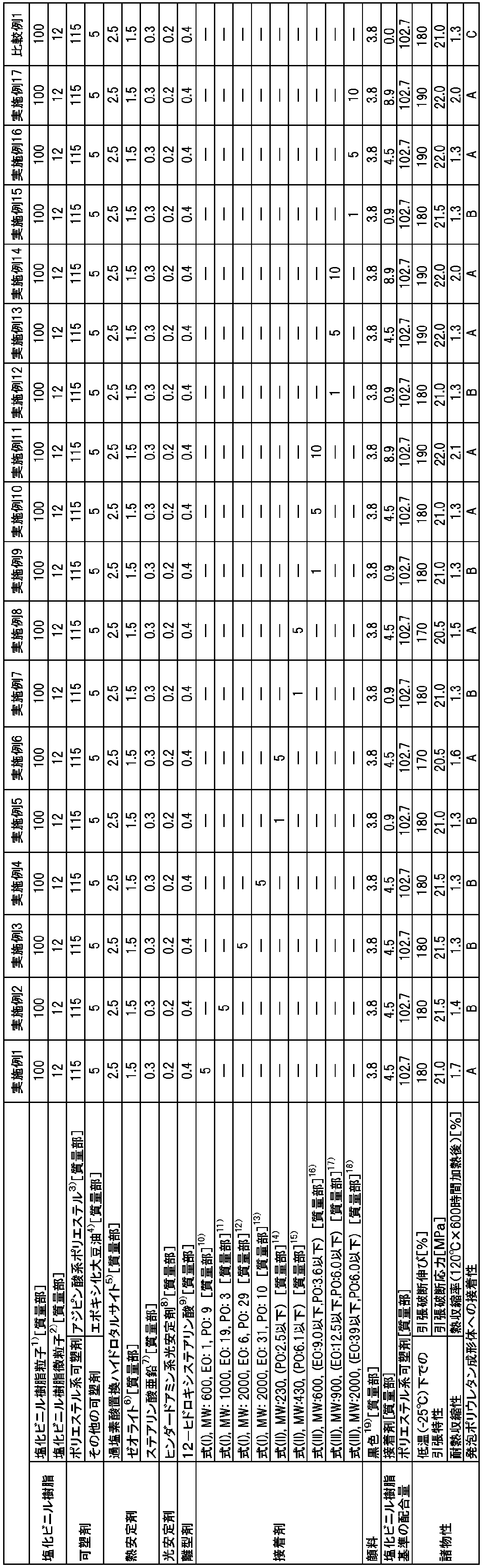
- Examples 2 to 17 Vinyl chloride resin compositions, vinyl chloride resin molded sheets, and laminates were prepared in the same manner as in Example 1, except that the amount and/or type of adhesive used in the preparation of the vinyl chloride resin compositions was changed as shown in Table 1. The vinyl chloride resin molded sheets and laminates obtained were then used to evaluate the tensile properties at low temperatures, heat shrinkage resistance, and adhesion to foamed polyurethane molded products of the vinyl chloride resin molded sheets. The results are shown in Table 1.
- Example 1 A vinyl chloride resin composition, a vinyl chloride resin molded sheet, and a laminate were prepared in the same manner as in Example 1, except that a specific adhesive was not added when preparing the vinyl chloride resin composition.
- the vinyl chloride resin molded sheet and laminate obtained were used to evaluate the tensile properties at low temperatures, heat shrinkage resistance, and adhesion to a polyurethane foam molded product of the vinyl chloride resin molded sheet. The results are shown in Table 1.
- the present invention it is possible to provide a vinyl chloride resin composition having excellent adhesion to polyurethane foam moldings. Furthermore, according to the present invention, it is possible to provide a resin molded article having excellent adhesion to a polyurethane foam molded article, and a laminate including the resin molded article.
Landscapes
- Chemical & Material Sciences (AREA)
- Health & Medical Sciences (AREA)
- Chemical Kinetics & Catalysis (AREA)
- Medicinal Chemistry (AREA)
- Polymers & Plastics (AREA)
- Organic Chemistry (AREA)
- Compositions Of Macromolecular Compounds (AREA)
Abstract
本発明は、塩化ビニル樹脂と、可塑剤と、接着剤としてのポリエーテルアミンとを含む、塩化ビニル樹脂組成物に関する。
Description
本発明は、塩化ビニル樹脂組成物、塩化ビニル樹脂成形体、及び積層体に関するものである。
塩化ビニル樹脂等の樹脂は、一般に、耐寒性、耐熱性、耐油性などの特性に優れているため、種々の用途に用いられている。
具体的には、例えば、自動車インスツルメントパネル及びドアトリム等の自動車内装部品の形成には、塩化ビニル樹脂等の樹脂を用いた樹脂成形体からなる表皮や当該樹脂成形体からなる表皮に発泡ポリウレタン等の発泡体を裏打ちしてなる積層体などの自動車内装材が用いられている。
具体的には、例えば、自動車インスツルメントパネル及びドアトリム等の自動車内装部品の形成には、塩化ビニル樹脂等の樹脂を用いた樹脂成形体からなる表皮や当該樹脂成形体からなる表皮に発泡ポリウレタン等の発泡体を裏打ちしてなる積層体などの自動車内装材が用いられている。
そして、自動車インスツルメントパネル等の自動車内装部品の表皮を構成する樹脂成形体は、例えば、塩化ビニル樹脂等の樹脂と、可塑剤と、添加剤とを含む樹脂組成物をパウダースラッシュ成形などの粉体成形の方法を用いて成形することにより製造されている(例えば、特許文献1参照)。
具体的には、例えば特許文献1では、塩化ビニル樹脂粒子と、ポリエステル系可塑剤などの可塑剤と、ハイドロタルサイト系安定剤、ゼオライト系安定剤及びβ-ジケトン類などの添加剤とを含む塩化ビニル樹脂組成物をパウダースラッシュ成形することにより、塩化ビニル樹脂成形体を製造している。
ここで、樹脂成形体にポリウレタンの発泡体(以下、「発泡ポリウレタン成形体」と称することがある。)を裏打ちしてなる成形体を形成した場合、樹脂成形体と発泡ポリウレタン成形体とが剥離せずに良好に接着することが求められる。
しかしながら、上記従来技術の塩化ビニル樹脂組成物を用いた場合、形成される樹脂成形体の発泡ポリウレタン成形体への接着性に改善の余地があった。
しかしながら、上記従来技術の塩化ビニル樹脂組成物を用いた場合、形成される樹脂成形体の発泡ポリウレタン成形体への接着性に改善の余地があった。
そこで、本発明は、発泡ポリウレタン成形体への接着性に優れる塩化ビニル樹脂組成物を提供することを目的とする。
さらに、本発明は、発泡ポリウレタン成形体への接着性に優れる樹脂成形体、及び、当該樹脂成形体を備える積層体を提供することを目的とする。
さらに、本発明は、発泡ポリウレタン成形体への接着性に優れる樹脂成形体、及び、当該樹脂成形体を備える積層体を提供することを目的とする。
本発明者は、上記課題を解決することを目的として鋭意検討を行った。そして、本発明者は、塩化ビニル樹脂組成物に配合する接着剤として、ポリエーテルアミンを配合することで、発泡ポリウレタン成形体に対して優れた接着性を発揮し得る樹脂成形体を製造可能となることを見出し、本発明を完成させた。
即ち、この発明は、上記課題を有利に解決することを目的とするものであり、本発明は、[1]塩化ビニル樹脂と、可塑剤と、接着剤とを含む、塩化ビニル樹脂組成物であって、前記接着剤が、ポリエーテルアミンを含むことを特徴とするものである。
このように、接着剤としてポリエーテルアミンを含む樹脂組成物を用いて形成される樹脂成形体は、発泡ポリウレタン成形体に対して優れた接着性を発揮することができる。
このように、接着剤としてポリエーテルアミンを含む樹脂組成物を用いて形成される樹脂成形体は、発泡ポリウレタン成形体に対して優れた接着性を発揮することができる。
[2]上記[1]の塩化ビニル樹脂組成物において、前記接着剤が下式(I)~(III)の何れかで表される少なくとも一種のポリエーテルアミンを含むことが好ましい。接着剤として上記特定のポリエーテルアミンを含有していれば、発泡ポリウレタン成形体に対して一層優れた接着性を発揮することができる。
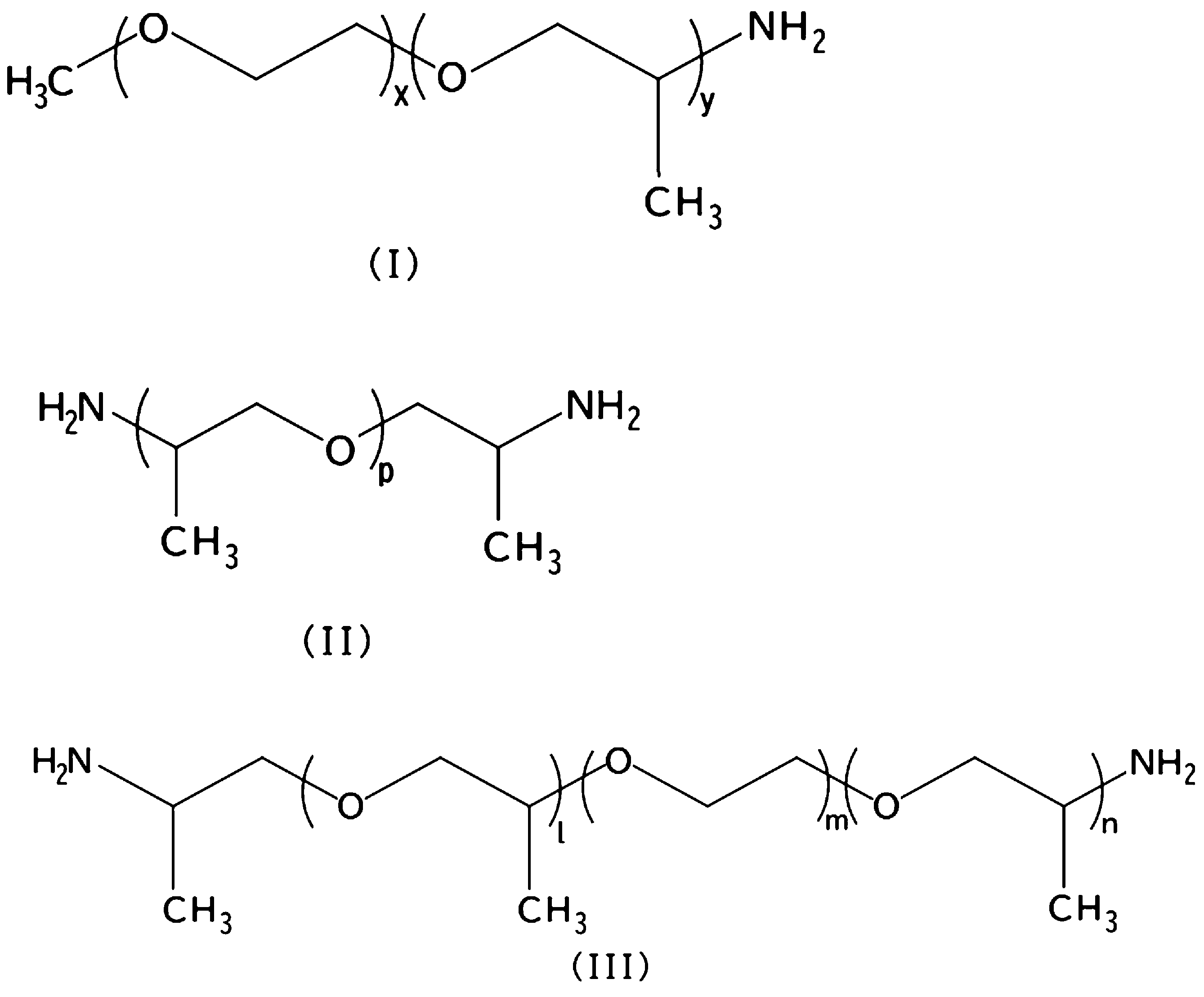 [上記式(I)~(III)において、x,y,p,l,m,nは、それぞれ整数であり、xは1以上35以下であり、yは1以上35以下であり、pは1以上70以下であり、(l+n)は1以上10以下であり、mは1以上50以下である。]
[3]上記[1]又は[2]の塩化ビニル樹脂組成物は、前記接着剤の含有量が、前記塩化ビニル樹脂100質量部に対して、0.1質量部以上15質量部以下であることが好ましい。塩化ビニル樹脂組成物における接着剤の含有量が上記範囲内であれば、発泡ポリウレタン成形体に対する接着性に一層優れるとともに、強度及び耐熱収縮性にも優れる樹脂成形体を形成することができる。
[4]上記[1]~[3]の何れかの塩化ビニル樹脂組成物において、前記可塑剤が、ポリエステル系可塑剤を含むことが好ましい。塩化ビニル樹脂組成物が可塑剤としてポリエステル系可塑剤を含有していれば、発泡ポリウレタン成形体に対して一層優れた接着性を発揮することができる。
[5]上記[4]の塩化ビニル樹脂組成物において、前記ポリエステル系可塑剤が、アジピン酸系ポリエステルを含有することが好ましい。塩化ビニル樹脂組成物に含有されるポリエステル系可塑剤が、アジピン酸由来の構造単位を含むアジピン酸系ポリエステルであれば、発泡ポリウレタン成形体に対して一層優れた接着性を発揮することができる。
[6]上記[1]~[5]の何れかの塩化ビニル樹脂組成物は、粉体成形に用いられることが好ましい。上記の樹脂組成物を粉体成形に用いれば、例えば、自動車インスツルメントパネル用表皮などの自動車内装材として良好に使用し得る樹脂成形体が容易に得られる。
[7]上記[1]~[6]の何れかの塩化ビニル樹脂組成物は、パウダースラッシュ成形に用いられることが好ましい。上記の樹脂組成物をパウダースラッシュ成形に用いれば、例えば、自動車インスツルメントパネル用表皮などの自動車内装材として良好に使用し得る樹脂成形体がより容易に得られる。
さらに、この発明は、上記課題を有利に解決することを目的とするものであり、本発明は、[8]上記[1]~[7]のいずれかの樹脂組成物を成形してなる、塩化ビニル樹脂成形体である。このように、上述した樹脂組成物を成形してなる樹脂成形体は、発泡ポリウレタン成形体への接着性に優れているため、自動車内装材として良好に使用することができる。
[9]上記[8]の樹脂成形体は、自動車インスツルメントパネル表皮用であることが好ましい。本発明の樹脂成形体を自動車インスツルメントパネルの表皮に使用すれば、発泡ポリウレタン成形体への接着性に優れた表皮を有する自動車インスツルメントパネルを製造することができる。
さらに、この発明は、上記課題を有利に解決することを目的とするものであり、本発明は、[10]発泡ポリウレタン成形体と、上記[8]又は[9]の塩化ビニル樹脂成形体とを有する、積層体である。発泡ポリウレタン成形体及び上述した樹脂成形体を有する積層体は、樹脂成形体と発泡ポリウレタン成形体とが良好に接着して、剥離し難い樹脂成形体部分を備えている。
[11]上記[10]の積層体は、自動車インスツルメントパネル用であることが好ましい。このように、本発明の積層体を自動車インスツルメントパネルに用いれば、製造される自動車インスツルメントパネルの表皮と発泡ポリウレタン成形体とを良好に接着して剥離し難くすることができる。
本発明によれば、発泡ポリウレタン成形体への接着性に優れる塩化ビニル樹脂組成物を提供することができる。
また、本発明によれば、発泡ポリウレタン成形体への接着性に優れる樹脂成形体を提供することができる。
また、本発明によれば、当該樹脂成形体を備える積層体を提供することができる。
また、本発明によれば、発泡ポリウレタン成形体への接着性に優れる樹脂成形体を提供することができる。
また、本発明によれば、当該樹脂成形体を備える積層体を提供することができる。
以下、本発明の実施形態について詳細に説明する。
本発明の樹脂組成物は、例えば、本発明の樹脂成形体を形成する際に用いることができる。そして、本発明の樹脂組成物を用いて形成した樹脂成形体は、例えば、自動車インスツルメントパネル及びドアトリム等の自動車内装部品が備える表皮などの、自動車内装材として好適に用いることができる。
さらに、本発明の樹脂成形体は、例えば、本発明の積層体を形成する際に用いることができる。そして、本発明の樹脂成形体を用いて形成した積層体は、例えば、自動車インスツルメントパネル及びドアトリム等の自動車内装部品を製造する際に用いる自動車内装材として好適に用いることができる。
本発明の樹脂組成物は、例えば、本発明の樹脂成形体を形成する際に用いることができる。そして、本発明の樹脂組成物を用いて形成した樹脂成形体は、例えば、自動車インスツルメントパネル及びドアトリム等の自動車内装部品が備える表皮などの、自動車内装材として好適に用いることができる。
さらに、本発明の樹脂成形体は、例えば、本発明の積層体を形成する際に用いることができる。そして、本発明の樹脂成形体を用いて形成した積層体は、例えば、自動車インスツルメントパネル及びドアトリム等の自動車内装部品を製造する際に用いる自動車内装材として好適に用いることができる。
(樹脂組成物)
本発明の樹脂組成物は、塩化ビニル樹脂と、可塑剤と、接着剤とを含む、塩化ビニル樹脂組成物であって、接着剤が、ポリエーテルアミンを含む、ことを特徴とする。
なお、本発明の樹脂組成物は、任意で、上述した塩化ビニル樹脂、可塑剤、及び接着剤以外の添加剤を更に含んでいてもよい。
本発明の樹脂組成物は、塩化ビニル樹脂と、可塑剤と、接着剤とを含む、塩化ビニル樹脂組成物であって、接着剤が、ポリエーテルアミンを含む、ことを特徴とする。
なお、本発明の樹脂組成物は、任意で、上述した塩化ビニル樹脂、可塑剤、及び接着剤以外の添加剤を更に含んでいてもよい。
そして、本発明の樹脂組成物を用いて形成した樹脂成形体は、発泡ポリウレタン成形体への接着性に優れている。したがって、本発明の樹脂組成物を用いて形成した樹脂成形体に対して発泡ポリウレタン成形体を裏打ちした場合、樹脂成形体と発泡ポリウレタン成形体とが良好に接着し、剥離し難い積層体を形成することができる。
また、本発明の樹脂組成物を用いて形成した樹脂成形体に対して発泡ポリウレタン成形体を裏打ちしてなる積層体を作製した場合、当該積層体における樹脂成形体の耐熱収縮性を向上させることができる。
さらに、本発明の樹脂組成物を用いて形成した樹脂成形体は、引張特性(例えば、引張伸び、引張強度等)、特に、低温下での引張特性にも優れている。
また、本発明の樹脂組成物を用いて形成した樹脂成形体に対して発泡ポリウレタン成形体を裏打ちしてなる積層体を作製した場合、当該積層体における樹脂成形体の耐熱収縮性を向上させることができる。
さらに、本発明の樹脂組成物を用いて形成した樹脂成形体は、引張特性(例えば、引張伸び、引張強度等)、特に、低温下での引張特性にも優れている。
したがって、本発明の樹脂組成物を使用すれば、発泡ポリウレタン成形体を裏打ちした場合に良好に接着して剥離し難い自動車インスツルメントパネル用表皮及びドアトリム用表皮などの、自動車内装材として好適な樹脂成形体を得ることができる。
なお、例えば、本発明の樹脂組成物を用いて、自動車内装材として良好に使用し得る樹脂成形体を容易に得る観点からは、本発明の樹脂組成物は、粉体成形の中でもパウダースラッシュ成形に用いられることが好ましい。
<塩化ビニル樹脂>
塩化ビニル樹脂としては、本発明の所望の効果が得られるものであれば、特に限定されることはなく、既知の樹脂を用いることができる。
なお、本発明の樹脂組成物に含まれる塩化ビニル樹脂は、後述する可塑剤、接着剤、及び、任意成分である添加剤とは異なる成分であるものとする。
塩化ビニル樹脂としては、本発明の所望の効果が得られるものであれば、特に限定されることはなく、既知の樹脂を用いることができる。
なお、本発明の樹脂組成物に含まれる塩化ビニル樹脂は、後述する可塑剤、接着剤、及び、任意成分である添加剤とは異なる成分であるものとする。
ここで、塩化ビニル樹脂のガラス転移温度は、50℃以上100℃以下であることが好ましい。
塩化ビニル樹脂としては、通常、粒子状の塩化ビニル樹脂を用いる。そして、塩化ビニル樹脂としては、例えば、1種類又は2種類以上の塩化ビニル樹脂粒子を含有することができ、任意に、1種類又は2種類以上の塩化ビニル樹脂微粒子を更に含有することができる。中でも、塩化ビニル樹脂は、少なくとも塩化ビニル樹脂粒子を含有することが好ましく、塩化ビニル樹脂粒子及び塩化ビニル樹脂微粒子を含有することがより好ましい。
そして、塩化ビニル樹脂は、懸濁重合法、乳化重合法、溶液重合法、塊状重合法など、従来から知られているいずれの製造法によっても製造し得る。
なお、本明細書において、「樹脂粒子」とは、粒子径が30μm以上の粒子を指し、「樹脂微粒子」とは、粒子径が30μm未満の粒子を指す。
そして、塩化ビニル樹脂は、懸濁重合法、乳化重合法、溶液重合法、塊状重合法など、従来から知られているいずれの製造法によっても製造し得る。
なお、本明細書において、「樹脂粒子」とは、粒子径が30μm以上の粒子を指し、「樹脂微粒子」とは、粒子径が30μm未満の粒子を指す。
また、塩化ビニル樹脂としては、塩化ビニル単量体単位からなる単独重合体の他、塩化ビニル単量体単位を好ましくは50質量%以上、より好ましくは70質量%以上含有する塩化ビニル系共重合体が挙げられる。そして、塩化ビニル系共重合体を構成し得る、塩化ビニル単量体と共重合可能な単量体(共単量体)の具体例としては、例えば、国際公開第2016/098344号に記載のものを使用することができる。また、これらの成分は、1種類を単独で用いてもよく、2種類以上を任意の比率で組み合わせて用いてもよい。
[塩化ビニル樹脂粒子]
樹脂組成物において、塩化ビニル樹脂粒子は、通常、マトリックス樹脂(基材)として機能する。なお、塩化ビニル樹脂粒子は、懸濁重合法により製造することが好ましい。
樹脂組成物において、塩化ビニル樹脂粒子は、通常、マトリックス樹脂(基材)として機能する。なお、塩化ビニル樹脂粒子は、懸濁重合法により製造することが好ましい。
-平均重合度-
そして、塩化ビニル樹脂粒子を構成する塩化ビニル樹脂の平均重合度は、800以上であることが好ましく、1000以上であることがより好ましく、5000以下であることが好ましく、3000以下であることがより好ましく、2800以下であることが更に好ましい。塩化ビニル樹脂粒子を構成する塩化ビニル樹脂の平均重合度が上記下限以上であれば、樹脂組成物を用いて形成した樹脂成形体の物理的強度を十分確保しつつ、例えば、引張特性、特には引張伸びを向上させることができる。そして、引張伸びが良好な樹脂成形体は、例えば、エアバッグが膨張、展開した際に、破片が飛散することなく設計通りに割れる、延性に優れた自動車インスツルメントパネルの表皮などの自動車内装材として好適に用いることができる。一方、塩化ビニル樹脂粒子を構成する塩化ビニル樹脂の平均重合度が上記上限以下であれば、樹脂組成物の溶融性を向上させることができる。
また、塩化ビニル樹脂粒子を構成する塩化ビニル樹脂の平均重合度は、1300以上であってもよいし、1300以下であってもよい。
なお、本発明において「平均重合度」は、JIS K6720-2に準拠して測定することができる。
-平均粒子径-
また、塩化ビニル樹脂粒子の平均粒子径は、通常30μm以上であり、50μm以上が好ましく、100μm以上がより好ましく、500μm以下が好ましく、200μm以下がより好ましい。塩化ビニル樹脂粒子の平均粒子径が上記下限以上であれば、樹脂組成物の粉体流動性を向上させることができる。一方、塩化ビニル樹脂粒子の平均粒子径が上記上限以下であれば、樹脂組成物の溶融性を向上させて、形成される樹脂成形体の表面平滑性を向上させることができる。
また、塩化ビニル樹脂粒子の平均粒子径は、115μm以上であってもよいし、115μm以下であってもよい。
なお、本発明において、「平均粒子径」は、JIS Z8825に準拠し、レーザー回折法により体積平均粒子径として測定することができる。
-含有割合-
そして、塩化ビニル樹脂中の塩化ビニル樹脂粒子の含有割合は、70質量%以上であることが好ましく、80質量%以上であることがより好ましく、100質量%とすることができ、95質量%以下であることが好ましく、90質量%以下であることがより好ましい。塩化ビニル樹脂中の塩化ビニル樹脂粒子の含有割合が上記下限以上であれば、樹脂組成物を用いて形成した樹脂成形体の物理的強度を十分確保しつつ引張伸びを向上させることができる。一方、塩化ビニル樹脂中の塩化ビニル樹脂粒子の含有割合が上記上限以下であれば、樹脂組成物の粉体流動性を向上させることができる。
そして、塩化ビニル樹脂中の塩化ビニル樹脂粒子の含有割合は、70質量%以上であることが好ましく、80質量%以上であることがより好ましく、100質量%とすることができ、95質量%以下であることが好ましく、90質量%以下であることがより好ましい。塩化ビニル樹脂中の塩化ビニル樹脂粒子の含有割合が上記下限以上であれば、樹脂組成物を用いて形成した樹脂成形体の物理的強度を十分確保しつつ引張伸びを向上させることができる。一方、塩化ビニル樹脂中の塩化ビニル樹脂粒子の含有割合が上記上限以下であれば、樹脂組成物の粉体流動性を向上させることができる。
[塩化ビニル樹脂微粒子]
樹脂組成物において、塩化ビニル樹脂微粒子は、通常、ダスティング剤(粉体流動性改良剤)として機能する。なお、塩化ビニル樹脂微粒子は、乳化重合法により製造することが好ましい。
樹脂組成物において、塩化ビニル樹脂微粒子は、通常、ダスティング剤(粉体流動性改良剤)として機能する。なお、塩化ビニル樹脂微粒子は、乳化重合法により製造することが好ましい。
-平均重合度-
そして、塩化ビニル樹脂微粒子を構成する塩化ビニル樹脂の平均重合度は、500以上が好ましく、700以上がより好ましく、2600以下が好ましく、2400以下がより好ましい。ダスティング剤としての塩化ビニル樹脂微粒子を構成する塩化ビニル樹脂の平均重合度が上記下限以上であれば、樹脂組成物の粉体流動性を向上させると共に、形成される樹脂成形体の引張伸びを向上させることができる。一方、塩化ビニル樹脂微粒子を構成する塩化ビニル樹脂の平均重合度が上記上限以下であれば、樹脂組成物の溶融性を向上させて、形成される樹脂成形体の表面平滑性を向上させることができる。
また、塩化ビニル樹脂微粒子を構成する塩化ビニル樹脂の平均重合度は、800以上であってもよいし、800以下であってもよい。
-平均粒子径-
また、塩化ビニル樹脂微粒子の平均粒子径は、通常30μm未満であり、10μm以下であることが好ましく、5μm以下であることがより好ましく、0.1μm以上であることが好ましく、1μm以上であることがより好ましい。塩化ビニル樹脂微粒子の平均粒子径が上記下限以上であれば、例えばダスティング剤としてのサイズを過度に小さくすることなく、樹脂組成物の粉体流動性を向上させることができる。一方、塩化ビニル樹脂微粒子の平均粒子径が上記上限以下であれば、樹脂組成物の溶融性を向上させて、形成される樹脂成形体の表面平滑性を向上させることができる。
また、塩化ビニル樹脂微粒子の平均粒子径は、1.8μm以上であってもよいし、1.8μm以下であってもよい。
-含有割合-
そして、塩化ビニル樹脂中の塩化ビニル樹脂微粒子の含有割合は、0質量%であってもよいが、5質量%以上であることが好ましく、10質量%以上であることがより好ましく、30質量%以下であることが好ましく、20質量%以下であることがより好ましい。塩化ビニル樹脂中の塩化ビニル樹脂微粒子の含有割合が上記下限以上であれば、樹脂組成物の粉体流動性を向上させることができる。一方、塩化ビニル樹脂中の塩化ビニル樹脂微粒子の含有割合が上記上限以下であれば、形成される樹脂成形体の物理的強度を高めることができる。
そして、塩化ビニル樹脂中の塩化ビニル樹脂微粒子の含有割合は、0質量%であってもよいが、5質量%以上であることが好ましく、10質量%以上であることがより好ましく、30質量%以下であることが好ましく、20質量%以下であることがより好ましい。塩化ビニル樹脂中の塩化ビニル樹脂微粒子の含有割合が上記下限以上であれば、樹脂組成物の粉体流動性を向上させることができる。一方、塩化ビニル樹脂中の塩化ビニル樹脂微粒子の含有割合が上記上限以下であれば、形成される樹脂成形体の物理的強度を高めることができる。
<可塑剤>
塩化ビニル樹脂組成物に可塑剤を配合することで、得られる樹脂成形体に十分な引張特性(例えば、引張伸び、引張強度等)を付与することができる。可塑剤としては、ポリエステル系可塑剤を好適に用いることができる。ポリエステル系可塑剤を用いることにより、樹脂組成物を用いて形成される樹脂成形体に発泡ポリウレタン成形体を裏打ちしてなる積層体を形成した場合に、ポリエステル系可塑剤は高温下であっても樹脂成形体から発泡ポリウレタン成形体へと移行し難いため、樹脂成形体の耐熱収縮性を向上させることができる。
塩化ビニル樹脂組成物に可塑剤を配合することで、得られる樹脂成形体に十分な引張特性(例えば、引張伸び、引張強度等)を付与することができる。可塑剤としては、ポリエステル系可塑剤を好適に用いることができる。ポリエステル系可塑剤を用いることにより、樹脂組成物を用いて形成される樹脂成形体に発泡ポリウレタン成形体を裏打ちしてなる積層体を形成した場合に、ポリエステル系可塑剤は高温下であっても樹脂成形体から発泡ポリウレタン成形体へと移行し難いため、樹脂成形体の耐熱収縮性を向上させることができる。
ポリエステル系可塑剤としては、特に限定されることはなく、例えば、アジピン酸由来の構造単位を含有するポリエステル(アジピン酸系ポリエステル)、セバシン酸由来の構造単位を含有するポリエステル(セバシン酸系ポリエステル)、及びフタル酸由来の構造単位を含有するポリエステル(フタル酸系ポリエステル)などのポリエステルを用いることができる。なお、これらのポリエステルは、1種を単独で用いてもよいし、2種以上を任意の比率で混合して用いてもよい。
中でも、樹脂成形体の耐熱収縮性を更に高める観点から、ポリエステル系可塑剤としては、アジピン酸系ポリエステル(アジピン酸由来の構造単位を含有するポリエステル)を用いることが好ましい。
中でも、樹脂成形体の耐熱収縮性を更に高める観点から、ポリエステル系可塑剤としては、アジピン酸系ポリエステル(アジピン酸由来の構造単位を含有するポリエステル)を用いることが好ましい。
可塑剤は、粘度が500mPa・s以上であることが好ましく、1000mPa・s以上であることがより好ましく、8000mPa・s以下であることが好ましく、5000mPa・s以下であることがより好ましい。
また、可塑剤の粘度は、4000mPa・s以上であってもよいし、4000mPa・s以下であってもよい。
なお、「粘度」は、JIS Z8803に準拠し、温度25℃で測定することができる。
また、可塑剤の粘度は、4000mPa・s以上であってもよいし、4000mPa・s以下であってもよい。
なお、「粘度」は、JIS Z8803に準拠し、温度25℃で測定することができる。
そして、塩化ビニル樹脂組成物中におけるポリエステル系可塑剤の含有量は、上記塩化ビニル樹脂100質量部に対して、30質量部以上であることが好ましく、50質量部以上であることがより好ましく、70質量部以上であることが更に好ましく、80質量部以上であることが一層好ましく、90質量部以上であることがより一層好ましく、200質量部以下であることが好ましく、180質量部以下であることがより好ましく、150質量部以下であることが更に好ましく、130質量部以下であることが一層好ましく、110質量部以下であることがより一層好ましい。塩化ビニル樹脂組成物中におけるポリエステル系可塑剤の含有量が上記下限以上であれば、形成される樹脂成形体の耐熱収縮性を向上させることができる。一方、塩化ビニル樹脂組成物中におけるポリエステル系可塑剤の含有量が上記上限以下であれば、形成される樹脂成形体の発泡ポリウレタン成形体への接着性を十分に高く確保することができる。
なお、本発明の塩化ビニル樹脂組成物は、任意で、上述したポリエステル系可塑剤以外に、その他の可塑剤を更に含んでいてもよい。そのようなその他の可塑剤としては、特に限定されることなく、国際公開第2016/098344号に記載の可塑剤のうち、上述したポリエステル系可塑剤以外の可塑剤などが挙げられる。中でも、形成される樹脂成形体の低温下での引張特性を更に高める観点から、エポキシ化植物油を用いることが好ましく、エポキシ化大豆油を用いることがより好ましい。塩化ビニル樹脂組成物中における上記その他の可塑剤の含有量は、特に限定されないが、上記塩化ビニル樹脂100質量部に対して、0質量部以上15質量部以下とすることができる。
<接着剤>
接着剤は、主として発泡ポリウレタン成形体に対する接着性を高めるように機能し得る成分である。接着剤としては、ポリエーテルアミンを含むことが必要である。接着剤としてポリエーテルアミンを含有することで、当該ポリエーテルアミンが少なくとも一方の末端に有するアミノ基、及び、ポリエーテル構造のためであると推察されるが、発泡ポリウレタン成形体と塩化ビニル樹脂成形体との界面における接着性を高めることができる。中でも、発泡ポリウレタン成形体に対する接着性を一層高める観点からは、接着剤が、下式(I)~(III)の何れかで表される少なくとも一種のポリエーテルアミンを含むことが好ましい。これらは、一種を単独で用いても、複数種を併用してもよい。
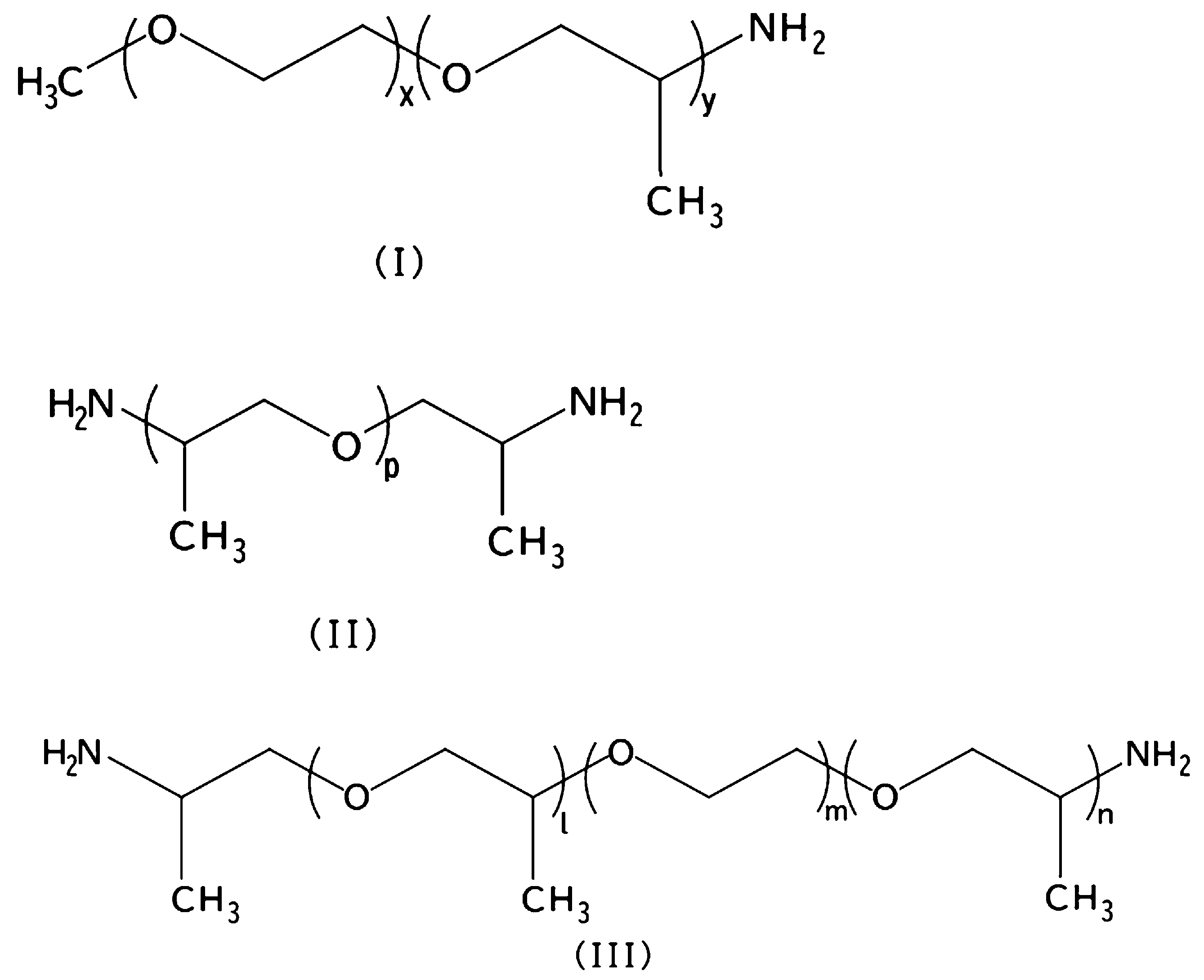 [上記式(I)~(III)において、x,y,p,l,m,nは、それぞれ整数であり、xは1以上35以下であり、yは1以上35以下であり、pは1以上70以下であり、(l+n)は1以上10以下であり、mは1以上50以下である。]
接着剤は、主として発泡ポリウレタン成形体に対する接着性を高めるように機能し得る成分である。接着剤としては、ポリエーテルアミンを含むことが必要である。接着剤としてポリエーテルアミンを含有することで、当該ポリエーテルアミンが少なくとも一方の末端に有するアミノ基、及び、ポリエーテル構造のためであると推察されるが、発泡ポリウレタン成形体と塩化ビニル樹脂成形体との界面における接着性を高めることができる。中でも、発泡ポリウレタン成形体に対する接着性を一層高める観点からは、接着剤が、下式(I)~(III)の何れかで表される少なくとも一種のポリエーテルアミンを含むことが好ましい。これらは、一種を単独で用いても、複数種を併用してもよい。
これらの接着剤は、適度な親水性を有するため、発泡ポリウレタン成形体に直接接触する成形体を製造したときに、その界面における接着性を一層高めるように作用し得る。さらに、上記の接着剤は、特に可塑剤としてポリエステル系可塑剤を用いた場合に、発泡ポリウレタン成形体と塩化ビニル樹脂成形体との界面における接着性、さらには、樹脂成形体の引張特性を一層高めるように作用することができる。
上記式(I)~(III)のポリエーテルアミンの中でも、樹脂成形体の発泡ポリウレタン成形体への接着性と、耐熱収縮性とを高いレベルで並立する観点からは、式(I)又は式(III)のポリエーテルアミンが好ましく、式(III)のポリエーテルアミンがより好ましい。
上記式(I)において、xは32以下であることが好ましく、31以下であることがより好ましい。また、上記式(I)において、yは3以上であることが好ましく、30以下であることが好ましく、29以下であることがより好ましい。x、yの値がそれぞれ上記範囲内であることで、得られる樹脂成形体の発泡ポリウレタン成形体への接着性を一層高めることができる。
上記式(II)において、pは2以上であることが好ましく、30以下であることが好ましく、20以下であることがより好ましい。pの値が上記範囲内であることで、得られる樹脂成形体の発泡ポリウレタン成形体への接着性を一層高めることができる。
上記式(III)において、(l+n)は2以上であることが好ましく、3以上であることがより好ましく、8以下であることが好ましく、6以下であることがより好ましい。また、mは5以上であることが好ましく、9以上であることがより好ましく、45以下であることが好ましく40以下であることがより好ましい。(l+n)、mの値がそれぞれ上記範囲内であることで、得られる樹脂成形体の発泡ポリウレタン成形体への接着性を一層高めることができる。
さらに、接着剤としてのポリエーテルアミンの重量平均分子量は、100以上であることが好ましく、200以上であることがより好ましく、450以上であることが更に好ましく、5000以下であることが好ましく、4000以下であることがより好ましく、300以下であることが更に好ましい。重量平均分子量が上記下限値以上であれば、得られる樹脂成形体の耐熱収縮性を一層高めることができる。また、重量平均分子量が上記上限値以下であれば、引張特性を高めることができる。なお、ポリエーテルアミンの重量平均分子量は、テトラヒドロフラン(THF)を溶媒としたゲル浸透クロマトグラフィー(GPC)により、ポリスチレン換算の値として求めることができる。
そして、塩化ビニル樹脂組成物中における上記所定の接着剤の含有量は、上記塩化ビニル樹脂100質量部に対して、0.1質量部以上であることが好ましく、0.5質量部以上であることがより好ましく、2質量部以上が更に好ましく、15質量部以下であることが好ましく、10質量部以下であることがより好ましく、7質量部以下であることが更に好ましい。塩化ビニル樹脂組成物中における上記所定の接着剤の含有量が上記下限以上であれば、形成される樹脂成形体の発泡ポリウレタン成形体に対する接着性を一層向上させることができる。一方、塩化ビニル樹脂組成物中における上記所定の接着剤の含有量が上記上限以下であれば、形成される樹脂成形体の耐熱収縮性を一層高めることができる。
<添加剤>
本発明の塩化ビニル樹脂組成物は、上述した成分以外に、各種添加剤を更に含有してもよい。添加剤としては、特に限定されることなく、滑剤;過塩素酸処理ハイドロタルサイト、ゼオライト、β-ジケトン、脂肪酸金属塩などの安定剤;離型剤;上記塩化ビニル樹脂微粒子以外のその他のダスティング剤;耐衝撃性改良剤;過塩素酸処理ハイドロタルサイト以外の過塩素酸化合物(過塩素酸ナトリウム、過塩素酸カリウム等);酸化防止剤;防カビ剤;難燃剤;帯電防止剤;充填剤;光安定剤;発泡剤;顔料;などが挙げられる。
本発明の塩化ビニル樹脂組成物は、上述した成分以外に、各種添加剤を更に含有してもよい。添加剤としては、特に限定されることなく、滑剤;過塩素酸処理ハイドロタルサイト、ゼオライト、β-ジケトン、脂肪酸金属塩などの安定剤;離型剤;上記塩化ビニル樹脂微粒子以外のその他のダスティング剤;耐衝撃性改良剤;過塩素酸処理ハイドロタルサイト以外の過塩素酸化合物(過塩素酸ナトリウム、過塩素酸カリウム等);酸化防止剤;防カビ剤;難燃剤;帯電防止剤;充填剤;光安定剤;発泡剤;顔料;などが挙げられる。
そして、本発明の塩化ビニル樹脂組成物が含み得る上述した添加剤としては、例えば、国際公開第2016/098344号に記載のものを使用することができ、その好適含有量も国際公開第2016/098344号の記載と同様とすることができる。
<塩化ビニル樹脂組成物の調製方法>
本発明の塩化ビニル樹脂組成物は、上述した成分を混合して調製することができる。
ここで、上記塩化ビニル樹脂と、可塑剤と、接着剤と、必要に応じて更に配合される各種添加剤との混合方法としては、特に限定されることなく、例えば、ダスティング剤(塩化ビニル樹脂微粒子を含む)を除く成分をドライブレンドにより混合し、その後、ダスティング剤を添加、混合する方法が挙げられる。ここで、ドライブレンドには、ヘンシェルミキサーの使用が好ましい。また、ドライブレンド時の温度は、特に制限されることなく、50℃以上が好ましく、70℃以上がより好ましく、200℃以下が好ましい。
本発明の塩化ビニル樹脂組成物は、上述した成分を混合して調製することができる。
ここで、上記塩化ビニル樹脂と、可塑剤と、接着剤と、必要に応じて更に配合される各種添加剤との混合方法としては、特に限定されることなく、例えば、ダスティング剤(塩化ビニル樹脂微粒子を含む)を除く成分をドライブレンドにより混合し、その後、ダスティング剤を添加、混合する方法が挙げられる。ここで、ドライブレンドには、ヘンシェルミキサーの使用が好ましい。また、ドライブレンド時の温度は、特に制限されることなく、50℃以上が好ましく、70℃以上がより好ましく、200℃以下が好ましい。
<樹脂組成物の用途>
そして、得られた樹脂組成物は、塩化ビニル樹脂組成物を用いて発泡ポリウレタン成形体に直接接触する成形体を形成するための粉体成形に用いられるものである。粉体成形の中でも、パウダースラッシュ成形に好適に用いることができる。
そして、得られた樹脂組成物は、塩化ビニル樹脂組成物を用いて発泡ポリウレタン成形体に直接接触する成形体を形成するための粉体成形に用いられるものである。粉体成形の中でも、パウダースラッシュ成形に好適に用いることができる。
(樹脂成形体)
本発明の樹脂成形体は、上述した塩化ビニル樹脂組成物を、任意の方法で成形することにより得られることを特徴とする。そして、本発明の樹脂成形体は、上述した塩化ビニル樹脂組成物を用いて形成されているため、通常、少なくとも、塩化ビニル樹脂と、可塑剤組成物と、上記した所定の接着剤とを含む。即ち、本発明の樹脂成形体は、通常、少なくとも、塩化ビニル樹脂と、可塑剤と、ポリエーテルアミンと、を含む。そして、本発明の樹脂成形体は、発泡ポリウレタン成形体への接着性に優れている。したがって、本発明の樹脂成形体に対して発泡ポリウレタン成形体を裏打ちした場合、樹脂成形体と発泡ポリウレタン成形体とが良好に接着し、剥離し難い積層体を形成することができる。また、本発明の樹脂成形体は、耐熱収縮性、及び低温下での引張特性にも優れている。
したがって、本発明の樹脂成形体は、自動車インスツルメントパネルの表皮などの自動車内装材として好適に用いることができる。
<樹脂成形体の形成方法>
ここで、パウダースラッシュ成形により樹脂成形体を形成する場合、パウダースラッシュ成形時の金型温度は、特に制限されることなく、200℃以上とすることが好ましく、220℃以上とすることがより好ましく、300℃以下とすることが好ましく、280℃以下とすることがより好ましい。
ここで、パウダースラッシュ成形により樹脂成形体を形成する場合、パウダースラッシュ成形時の金型温度は、特に制限されることなく、200℃以上とすることが好ましく、220℃以上とすることがより好ましく、300℃以下とすることが好ましく、280℃以下とすることがより好ましい。
そして、樹脂成形体を製造する際には、特に限定されることなく、例えば、以下の方法を用いることができる。即ち、上記温度範囲の金型に本発明の樹脂組成物を振りかけて、5秒以上30秒以下の間放置した後、余剰の樹脂組成物を振り落とし、さらに、任意の温度下、30秒以上3分以下の間放置する。その後、金型を10℃以上60℃以下に冷却し、得られた本発明の樹脂成形体を金型から脱型する。そして、金型の形状をかたどったシート状の成形体を得る。
(積層体)
本発明の積層体は、発泡ポリウレタン成形体と、上述した樹脂成形体とを有する。なお、樹脂成形体は、通常、積層体の一方の表面を構成する。
そして、本発明の積層体は、例えば、本発明の樹脂組成物を用いて形成され、発泡ポリウレタン成形体への接着性に優れた樹脂成形体を有しているため、樹脂成形体と発泡ポリウレタン成形体とが良好に接着していて、剥離し難い。したがって、本発明の積層体は、自動車内装部品、特に、自動車インスツルメントパネルを形成する自動車内装材として好適に用いられる。
本発明の積層体は、発泡ポリウレタン成形体と、上述した樹脂成形体とを有する。なお、樹脂成形体は、通常、積層体の一方の表面を構成する。
そして、本発明の積層体は、例えば、本発明の樹脂組成物を用いて形成され、発泡ポリウレタン成形体への接着性に優れた樹脂成形体を有しているため、樹脂成形体と発泡ポリウレタン成形体とが良好に接着していて、剥離し難い。したがって、本発明の積層体は、自動車内装部品、特に、自動車インスツルメントパネルを形成する自動車内装材として好適に用いられる。
ここで、発泡ポリウレタン成形体と樹脂成形体との積層方法は、特に限定されることなく、例えば、以下の方法を用いることができる。即ち、(1)発泡ポリウレタン成形体と、樹脂成形体とを別途準備した後に、熱融着、熱接着、又は、公知の接着剤などを用いることにより貼り合わせる方法;(2)樹脂成形体上で発泡ポリウレタン成形体の原料となるイソシアネート類とポリオール類などとを反応させて重合を行うと共に、公知の方法によりポリウレタンの発泡を行うことにより、樹脂成形体上に発泡ポリウレタン成形体を直接形成する方法;などが挙げられる。中でも、工程が簡素である点、及び、種々の形状の積層体を得る場合においても樹脂成形体と発泡ポリウレタン成形体とを強固に接着し易い点から、後者の方法(2)が好適である。
以下、本発明について実施例に基づき具体的に説明するが、本発明はこれら実施例に限定されるものではない。なお、以下の説明において、量を表す「%」及び「部」は、特に断らない限り、質量基準である。
そして、塩化ビニル樹脂成形シート(塩化ビニル樹脂成形体)の低温下での引張特性、耐熱収縮性、及び、発泡ポリウレタン成形体への接着性は、下記の方法で測定及び評価した。
そして、塩化ビニル樹脂成形シート(塩化ビニル樹脂成形体)の低温下での引張特性、耐熱収縮性、及び、発泡ポリウレタン成形体への接着性は、下記の方法で測定及び評価した。
<低温下での引張特性(引張強度、引張伸び)>
実施例、比較例で得られた塩化ビニル樹脂成形シートを、JIS K6251に記載の1号ダンベルで打ち抜き、JIS K7113に準拠して、引張速度200mm/分で、-25℃の低温下における引張破断伸び(%)及び引張破断応力(MPa)を測定した。引張破断伸びの値が大きいほど、塩化ビニル樹脂成形シートは低温下での引張伸びに優れている。また、引張破断応力の値が大きいほど、塩化ビニル樹脂成形シートは低温下での引張強度に優れている。
実施例、比較例で得られた塩化ビニル樹脂成形シートを、JIS K6251に記載の1号ダンベルで打ち抜き、JIS K7113に準拠して、引張速度200mm/分で、-25℃の低温下における引張破断伸び(%)及び引張破断応力(MPa)を測定した。引張破断伸びの値が大きいほど、塩化ビニル樹脂成形シートは低温下での引張伸びに優れている。また、引張破断応力の値が大きいほど、塩化ビニル樹脂成形シートは低温下での引張強度に優れている。
<耐熱収縮性>
実施例、比較例で得られた積層体の塩化ビニル樹脂成形シートに対して、短手方向の長さを三次元測定機(ミツトヨ社製「Crysta-Plus M443」)にて測定し、加熱前の実測値とした。
その後、当該積層体を120℃のギア式オーブン(東洋精機製作所社製「ギアオーブン」)内に保管して加熱を行い、600時間経過後にオーブンから積層体を取り出し、積層体の塩化ビニル樹脂成形シートの短手方向の長さを上記三次元測定機で測定し、加熱後の実測値とした。加熱前後の実測値を用いて、下記式で示される熱収縮率(%)を算出した。
熱収縮率[%]=100×(加熱前の実測値-加熱後の実測値)/加熱前の実測値
なお、熱収縮率の値が小さいほど、塩化ビニル樹脂成形シートの熱収縮が小さく、塩化ビニル樹脂成形シートは耐熱収縮性に優れていることを示す。
<発泡ポリウレタン成形体への接着性>
実施例、比較例で得られた塩化ビニル樹脂成形シートに発泡ポリウレタン成形体が裏打ちされてなる積層体を用いて、塩化ビニル樹脂成形シートを発泡ポリウレタン成形体から剥がした。剥がした後の塩化ビニル樹脂成形シートの表面のうち、発泡ポリウレタン成形体が裏打ちされた表面を目視で確認し、塩化ビニル樹脂成形シート(塩化ビニル樹脂成形体)のポリウレタン成形体への接着性を評価した。
目視確認した塩化ビニル樹脂成形シートの全面に発泡ポリウレタン成形体の表面部分が残っている場合を「フォーム破壊」(表1中のA評価)とし、塩化ビニル樹脂成形シートの表面の一部の箇所のみに発泡ポリウレタン成形体の表面部分が残り、他の箇所には発泡ポリウレタン成形体の表面部分が残らない場合を「一部界面剥離」(表1中のB評価)とし、塩化ビニル樹脂成形シート全面のいずれの箇所にも発泡ポリウレタン成形体の表面部分が残らない場合を「全部界面剥離」(表1中のC評価)とした。
なお、塩化ビニル樹脂成形シートの表面において、発泡ポリウレタン成形体の表面部分が残って箇所が多いほど、塩化ビニル樹脂成形シート(塩化ビニル樹脂成形体)の発泡ポリウレタン成形体への接着性が高いことを示す。
(実施例1)
<塩化ビニル樹脂組成物の調製>
表1に示す配合成分のうち、可塑剤と、ダスティング剤である塩化ビニル樹脂微粒子とを除く成分をヘンシェルミキサーに入れて混合した。そして、混合物の温度が80℃に上昇した時点で上記可塑剤を全て添加し、ドライアップ(可塑剤が、塩化ビニル樹脂である塩化ビニル樹脂粒子に吸収されて、上記混合物がさらさらになった状態をいう。)させて、最高温度が100℃以上200℃以下になるまで混合を継続した。その後、ドライアップさせた混合物が温度100℃未満に冷却された時点でダスティング剤である塩化ビニル樹脂微粒子を添加し、塩化ビニル樹脂組成物を調製した。
<塩化ビニル樹脂成形シートの形成>
得られた塩化ビニル樹脂組成物を、温度250℃に加熱したシボ付き金型に振りかけ、任意の時間放置して溶融させた後、余剰の塩化ビニル樹脂組成物を振り落とした。その後、当該塩化ビニル樹脂組成物を振りかけたシボ付き金型を、温度200℃に設定したオーブン内に静置し、静置から60秒経過した時点で当該シボ付き金型を冷却水で冷却した。金型温度が40℃まで冷却された時点で、塩化ビニル樹脂成形体としての、200mm×150mm×1mmの塩化ビニル樹脂成形シートを金型から脱型した。
得られた塩化ビニル樹脂成形シートを用いて、低温下での引張特性(引張強度、引張伸び)を評価した。結果を表1に示す。
<積層体の形成>
上記で得られた塩化ビニル樹脂成形シート(寸法:200mm×150mm×1mm)2枚を、200mm×300mm×10mmの金型の中に、シボ付き面を下にして敷いた。
別途、プロピレングリコールのプロピレンオキサイド・エチレンオキサイド(PO・EO)ブロック付加物(水酸基価28、末端EO単位の含有量=10%、内部EO単位の含有量4%)50質量部、グリセリンのPO・EOブロック付加物(水酸基価21、末端EO単位の含有量=14%)50質量部、水2.5質量部、トリエチレンジアミンのエチレングリコ-ル溶液(東ソー(株)製、商品名:「TEDA-L33」)0.2質量部、トリエタノールアミン1.2質量部、トリエチルアミン0.5質量部及び整泡剤(信越化学工業(株)製、商品名:「F-122」)0.5質量部からなるポリオール混合物と、ポリメチレンポリフェニレンポリイソシアネート(ポリメリックMDI))とを、インデックスが98になる比率で混合して混合液を調製した。そして、調製した混合液を、上述の通り金型中に敷かれた塩化ビニル樹脂成形シート2枚の上にそれぞれ注いだ。その後、348mm×255mm×10mmのアルミ板で金型に蓋をすることで金型を密閉した。金型を密閉してから5分間放置することにより、表皮としての塩化ビニル樹脂成形シート(厚さ:1mm)に発泡ポリウレタン成形体が裏打ちされてなる積層体が形成された。
形成された積層体を金型から取り出し、積層体における塩化ビニル樹脂成形シートについて、耐熱収縮性及び発泡ポリウレタン成形体への接着性を評価した。結果を表1に示す。
(実施例2~17)
塩化ビニル樹脂組成物の調製に用いる接着剤の配合量及び種類の双方又はいずれか一方を表1に示す通りに変更したこと以外は、実施例1と同様にして、塩化ビニル樹脂組成物、塩化ビニル樹脂成形シート、及び積層体を作製した。そして、得られた塩化ビニル樹脂成形シート及び積層体を用いて、塩化ビニル樹脂成形シートの低温下での引張特性、耐熱収縮性及び発泡ポリウレタン成形体への接着性を評価した。結果を表1に示す。
塩化ビニル樹脂組成物の調製に用いる接着剤の配合量及び種類の双方又はいずれか一方を表1に示す通りに変更したこと以外は、実施例1と同様にして、塩化ビニル樹脂組成物、塩化ビニル樹脂成形シート、及び積層体を作製した。そして、得られた塩化ビニル樹脂成形シート及び積層体を用いて、塩化ビニル樹脂成形シートの低温下での引張特性、耐熱収縮性及び発泡ポリウレタン成形体への接着性を評価した。結果を表1に示す。
(比較例1)
塩化ビニル樹脂組成物の調製に際して、所定の接着剤を配合しなかった以外は、実施例1と同様にして、塩化ビニル樹脂組成物、塩化ビニル樹脂成形シート、及び積層体を作製した。そして、得られた塩化ビニル樹脂成形シート及び積層体を用いて、塩化ビニル樹脂成形シートの低温下での引張特性、耐熱収縮性及び発泡ポリウレタン成形体への接着性を評価した。結果を表1に示す。
塩化ビニル樹脂組成物の調製に際して、所定の接着剤を配合しなかった以外は、実施例1と同様にして、塩化ビニル樹脂組成物、塩化ビニル樹脂成形シート、及び積層体を作製した。そして、得られた塩化ビニル樹脂成形シート及び積層体を用いて、塩化ビニル樹脂成形シートの低温下での引張特性、耐熱収縮性及び発泡ポリウレタン成形体への接着性を評価した。結果を表1に示す。
1)新第一塩ビ社製、製品名「ZEST(登録商標)1300SI」(懸濁重合法で調製、平均重合度:1300、平均粒子径:115μm)
2)新第一塩ビ社製、製品名「ZEST PQLTX」(乳化重合法で調製、平均重合度:800、平均粒子径:1.8μm)
3)ADEKA社製、製品名「アデカサイザー HPN-3130」(アジピン酸系ポリエステル、粘度(25℃):4,000mPa・s)
4)ADEKA社製、製品名「アデカサイザー O-130S」
5)協和化学工業社製、製品名「アルカマイザー(登録商標)5」
6)水澤化学工業社製、製品名「MIZUKALIZER DS」
7)堺化学工業社製、製品名「SAKAI SZ2000」
8)ADEKA社製、製品名「アデカスタブ(登録商標) LA-72」
9)ADEKA社製、製品名「アデカスタブ(登録商標) LS-12」
10)ハンツマン社製、製品名「JEFFAMINE M-600」(メトキシポリ(オキシエチレン/オキシプロピレン)-2-プロピルアミン、重量平均分子量:600、オキシエチレン構造繰り返し数:1、オキシプロピレン構造繰り返し数:9)
11)ハンツマン社製、製品名「JEFFAMINE M-1000」(メトキシポリ(オキシエチレン/オキシプロピレン)-2-プロピルアミン、重量平均分子量:1000、オキシエチレン構造繰り返し数:19、オキシプロピレン構造繰り返し数:3)
12)ハンツマン社製、製品名「JEFFAMINE M-2005」(メトキシポリ(オキシエチレン/オキシプロピレン)-2-プロピルアミン、重量平均分子量:2000、オキシエチレン構造繰り返し数:6、オキシプロピレン構造繰り返し数:29)
13)ハンツマン社製、製品名「JEFFAMINE M-2070」(メトキシポリ(オキシエチレン/オキシプロピレン)-2-プロピルアミン、重量平均分子量:2000、オキシエチレン構造繰り返し数:31、オキシプロピレン構造繰り返し数:10)
14)ハンツマン社製、製品名「JEFFAMINE D-230」(ポリオキシプロピレンジアミン、重量平均分子量:230、オキシプロピレン構造繰り返し数:2.5以下)
15)ハンツマン社製、製品名「JEFFAMINE D-400」(ポリオキシプロピレンジアミン、重量平均分子量:430、オキシプロピレン構造繰り返し数:6.1以下)
16)ハンツマン社製、製品名「JEFFAMINE ED-600」(ポリエーテルジアミン、重量平均分子量:600、オキシエチレン構造繰り返し数(式(III)のmの値):9.0以下、オキシプロピレン構造繰り返し数(式(III)の(l+n)の値):3.6以下)
17)ハンツマン社製、製品名「JEFFAMINE ED-900」(ポリエーテルジアミン、重量平均分子量:900、オキシエチレン構造繰り返し数(式(III)のmの値):12.5以下、オキシプロピレン構造繰り返し数(式(III)の(l+n)の値):6.0以下)
18)ハンツマン社製、製品名「JEFFAMINE ED-2003」(ポリエーテルジアミン、重量平均分子量:2000、オキシエチレン構造繰り返し数(式(III)のmの値):39以下、オキシプロピレン構造繰り返し数(式(III)の(l+n)の値):6.0以下)
19)大日精化社製、製品名「DA P 4720 ブラック」
なお、上記において、接着剤として用いたポリエーテルアミンにおける各構造単位の繰り返し数の値は平均値であり、メーカー公称値である。
表1より、接着剤として、ポリエーテルアミンを含む塩化ビニル樹脂を用いた実施例1~17では、発泡ポリウレタン成形体への接着性に優れた樹脂成形体を形成可能であることが分かる。
一方、上記所定の接着剤を配合しない塩化ビニル樹脂を用いた比較例1では、形成された樹脂成形体が発泡ポリウレタン成形体への接着性に劣ることが分かる。
一方、上記所定の接着剤を配合しない塩化ビニル樹脂を用いた比較例1では、形成された樹脂成形体が発泡ポリウレタン成形体への接着性に劣ることが分かる。
本発明によれば、発泡ポリウレタン成形体への接着性に優れる塩化ビニル樹脂組成物を提供することができる。
また、本発明によれば、発泡ポリウレタン成形体への接着性に優れる樹脂成形体、及び当該樹脂成形体を備える積層体を提供することができる。
また、本発明によれば、発泡ポリウレタン成形体への接着性に優れる樹脂成形体、及び当該樹脂成形体を備える積層体を提供することができる。
Claims (11)
- 塩化ビニル樹脂と、可塑剤と、接着剤とを含む、塩化ビニル樹脂組成物であって、
前記接着剤が、ポリエーテルアミンを含む、塩化ビニル樹脂組成物。 - 前記接着剤が下式(I)~(III)の何れかで表される少なくとも一種のポリエーテルアミンを含む、請求項1に記載の塩化ビニル樹脂組成物。
[上記式(I)~(III)において、x,y,p,l,m,nは、それぞれ整数であり、xは1以上35以下であり、yは1以上35以下であり、pは1以上70以下であり、(l+n)は1以上10以下であり、mは1以上50以下である。]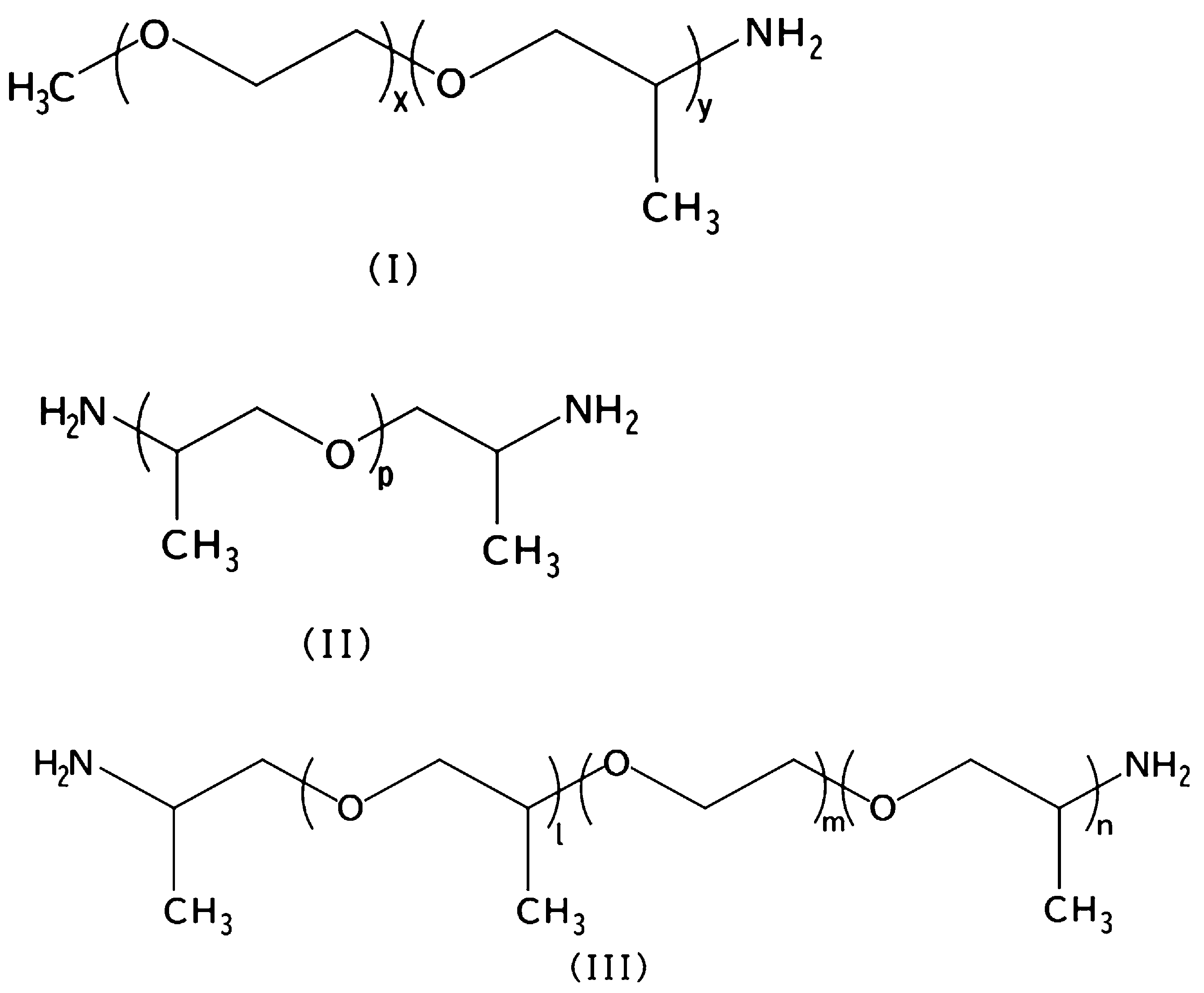
- 前記接着剤の含有量が、前記塩化ビニル樹脂100質量部に対して、0.1質量部以上15質量部以下である、請求項1に記載の塩化ビニル樹脂組成物。
- 前記可塑剤が、ポリエステル系可塑剤を含む、請求項1に記載の塩化ビニル樹脂組成物。
- 前記ポリエステル系可塑剤がアジピン酸系ポリエステルを含有する、請求項4に記載の塩化ビニル樹脂組成物。
- 粉体成形に用いられる、請求項1に記載の塩化ビニル樹脂組成物。
- パウダースラッシュ成形に用いられる、請求項1に記載の塩化ビニル樹脂組成物。
- 請求項1~7のいずれかに記載の塩化ビニル樹脂組成物を成形してなる、塩化ビニル樹脂成形体。
- 自動車インスツルメントパネル表皮用である、請求項8に記載の塩化ビニル樹脂成形体。
- 発泡ポリウレタン成形体と、請求項8に記載の塩化ビニル樹脂成形体とを有する、積層体。
- 自動車インスツルメントパネル用である、請求項10に記載の積層体。
Applications Claiming Priority (2)
| Application Number | Priority Date | Filing Date | Title |
|---|---|---|---|
| JP2023054244 | 2023-03-29 | ||
| JP2023-054244 | 2023-03-29 |
Publications (1)
| Publication Number | Publication Date |
|---|---|
| WO2024203255A1 true WO2024203255A1 (ja) | 2024-10-03 |
Family
ID=92904640
Family Applications (1)
| Application Number | Title | Priority Date | Filing Date |
|---|---|---|---|
| PCT/JP2024/009440 Ceased WO2024203255A1 (ja) | 2023-03-29 | 2024-03-11 | 塩化ビニル樹脂組成物、塩化ビニル樹脂成形体、及び積層体 |
Country Status (1)
| Country | Link |
|---|---|
| WO (1) | WO2024203255A1 (ja) |
Citations (5)
| Publication number | Priority date | Publication date | Assignee | Title |
|---|---|---|---|---|
| JPH02690A (ja) * | 1988-01-06 | 1990-01-05 | Mitsui Petrochem Ind Ltd | ハロゲン化ビニル系樹脂用接着剤組成物 |
| JPH03290479A (ja) * | 1990-04-06 | 1991-12-20 | Sanyo Chem Ind Ltd | プラスチゾル組成物 |
| CN108148348A (zh) * | 2016-12-05 | 2018-06-12 | 何明俊 | 一种led灯带材料及制备方法 |
| WO2021172076A1 (ja) * | 2020-02-27 | 2021-09-02 | 日本ゼオン株式会社 | 塩化ビニル樹脂組成物、塩化ビニル樹脂成形体および積層体 |
| WO2021261162A1 (ja) * | 2020-06-26 | 2021-12-30 | 日本ゼオン株式会社 | 塩化ビニル樹脂組成物、粉体成形用塩化ビニル樹脂組成物、塩化ビニル樹脂成形体および積層体の製造方法 |
-
2024
- 2024-03-11 WO PCT/JP2024/009440 patent/WO2024203255A1/ja not_active Ceased
Patent Citations (5)
| Publication number | Priority date | Publication date | Assignee | Title |
|---|---|---|---|---|
| JPH02690A (ja) * | 1988-01-06 | 1990-01-05 | Mitsui Petrochem Ind Ltd | ハロゲン化ビニル系樹脂用接着剤組成物 |
| JPH03290479A (ja) * | 1990-04-06 | 1991-12-20 | Sanyo Chem Ind Ltd | プラスチゾル組成物 |
| CN108148348A (zh) * | 2016-12-05 | 2018-06-12 | 何明俊 | 一种led灯带材料及制备方法 |
| WO2021172076A1 (ja) * | 2020-02-27 | 2021-09-02 | 日本ゼオン株式会社 | 塩化ビニル樹脂組成物、塩化ビニル樹脂成形体および積層体 |
| WO2021261162A1 (ja) * | 2020-06-26 | 2021-12-30 | 日本ゼオン株式会社 | 塩化ビニル樹脂組成物、粉体成形用塩化ビニル樹脂組成物、塩化ビニル樹脂成形体および積層体の製造方法 |
Similar Documents
| Publication | Publication Date | Title |
|---|---|---|
| CN112867592B (zh) | 粉体成型用氯乙烯树脂组合物、氯乙烯树脂成型体以及层叠体 | |
| JP7775824B2 (ja) | 塩化ビニル樹脂組成物、塩化ビニル樹脂成形体および積層体 | |
| WO2021261162A1 (ja) | 塩化ビニル樹脂組成物、粉体成形用塩化ビニル樹脂組成物、塩化ビニル樹脂成形体および積層体の製造方法 | |
| JP7160028B2 (ja) | 塩化ビニル樹脂組成物、塩化ビニル樹脂成形体および積層体 | |
| US20210363343A1 (en) | Vinyl chloride resin composition for powder molding, vinyl chloride resin molded body, and laminate | |
| WO2023054207A1 (ja) | 塩化ビニル樹脂組成物、塩化ビニル樹脂成形体および積層体 | |
| CN112969561A (zh) | 氯乙烯树脂组合物、氯乙烯树脂成型体以及层叠体 | |
| CN118369381A (zh) | 增塑剂组合物、树脂组合物、树脂成型体及层叠体 | |
| WO2024203254A1 (ja) | 塩化ビニル樹脂組成物、塩化ビニル樹脂成形体、及び積層体 | |
| JP7921161B2 (ja) | 粉体成形用塩化ビニル樹脂組成物、塩化ビニル樹脂成形体および積層体 | |
| JP7786106B2 (ja) | 塩化ビニル樹脂組成物、塩化ビニル樹脂成形体および積層体 | |
| WO2024070984A1 (ja) | 塩化ビニル樹脂組成物、塩化ビニル樹脂成形体および積層体 | |
| WO2023054638A1 (ja) | 塩化ビニル樹脂組成物、塩化ビニル樹脂成形体および積層体 | |
| EP3784726B1 (en) | Filled polyvinyl chloride composition | |
| CN110234702B (zh) | 氯乙烯树脂组合物、氯乙烯树脂成型体及层叠体 | |
| WO2024070506A1 (ja) | 塩化ビニル樹脂組成物、塩化ビニル樹脂成形体および積層体 | |
| WO2024203040A1 (ja) | 積層体及び積層体の製造方法 | |
| WO2023189509A1 (ja) | 塩化ビニル樹脂組成物、塩化ビニル樹脂成形体および積層体 | |
| JP2024065973A (ja) | 塩化ビニル樹脂組成物、塩化ビニル樹脂成形体および積層体 | |
| WO2023127608A1 (ja) | 塩化ビニル樹脂組成物、塩化ビニル樹脂成形体および積層体 | |
| JPH041252A (ja) | 粉末焼結成形用樹脂組成物 | |
| WO2019181379A1 (ja) | 塩化ビニル樹脂組成物、塩化ビニル樹脂成形体および積層体 |
Legal Events
| Date | Code | Title | Description |
|---|---|---|---|
| 121 | Ep: the epo has been informed by wipo that ep was designated in this application |
Ref document number: 24779385 Country of ref document: EP Kind code of ref document: A1 |
|
| NENP | Non-entry into the national phase |
Ref country code: DE |
|
| 122 | Ep: pct application non-entry in european phase |
Ref document number: 24779385 Country of ref document: EP Kind code of ref document: A1 |
|
| NENP | Non-entry into the national phase |
Ref country code: JP |