WO2024202657A1 - 表示装置 - Google Patents
表示装置 Download PDFInfo
- Publication number
- WO2024202657A1 WO2024202657A1 PCT/JP2024/005339 JP2024005339W WO2024202657A1 WO 2024202657 A1 WO2024202657 A1 WO 2024202657A1 JP 2024005339 W JP2024005339 W JP 2024005339W WO 2024202657 A1 WO2024202657 A1 WO 2024202657A1
- Authority
- WO
- WIPO (PCT)
- Prior art keywords
- light
- pixel
- display device
- shielding structure
- pixel region
- Prior art date
- Legal status (The legal status is an assumption and is not a legal conclusion. Google has not performed a legal analysis and makes no representation as to the accuracy of the status listed.)
- Ceased
Links
Images



Classifications
-
- G—PHYSICS
- G02—OPTICS
- G02F—OPTICAL DEVICES OR ARRANGEMENTS FOR THE CONTROL OF LIGHT BY MODIFICATION OF THE OPTICAL PROPERTIES OF THE MEDIA OF THE ELEMENTS INVOLVED THEREIN; NON-LINEAR OPTICS; FREQUENCY-CHANGING OF LIGHT; OPTICAL LOGIC ELEMENTS; OPTICAL ANALOGUE/DIGITAL CONVERTERS
- G02F1/00—Devices or arrangements for the control of the intensity, colour, phase, polarisation or direction of light arriving from an independent light source, e.g. switching, gating or modulating; Non-linear optics
- G02F1/01—Devices or arrangements for the control of the intensity, colour, phase, polarisation or direction of light arriving from an independent light source, e.g. switching, gating or modulating; Non-linear optics for the control of the intensity, phase, polarisation or colour
- G02F1/13—Devices or arrangements for the control of the intensity, colour, phase, polarisation or direction of light arriving from an independent light source, e.g. switching, gating or modulating; Non-linear optics for the control of the intensity, phase, polarisation or colour based on liquid crystals, e.g. single liquid crystal display cells
-
- G—PHYSICS
- G02—OPTICS
- G02F—OPTICAL DEVICES OR ARRANGEMENTS FOR THE CONTROL OF LIGHT BY MODIFICATION OF THE OPTICAL PROPERTIES OF THE MEDIA OF THE ELEMENTS INVOLVED THEREIN; NON-LINEAR OPTICS; FREQUENCY-CHANGING OF LIGHT; OPTICAL LOGIC ELEMENTS; OPTICAL ANALOGUE/DIGITAL CONVERTERS
- G02F1/00—Devices or arrangements for the control of the intensity, colour, phase, polarisation or direction of light arriving from an independent light source, e.g. switching, gating or modulating; Non-linear optics
- G02F1/01—Devices or arrangements for the control of the intensity, colour, phase, polarisation or direction of light arriving from an independent light source, e.g. switching, gating or modulating; Non-linear optics for the control of the intensity, phase, polarisation or colour
- G02F1/13—Devices or arrangements for the control of the intensity, colour, phase, polarisation or direction of light arriving from an independent light source, e.g. switching, gating or modulating; Non-linear optics for the control of the intensity, phase, polarisation or colour based on liquid crystals, e.g. single liquid crystal display cells
- G02F1/133—Constructional arrangements; Operation of liquid crystal cells; Circuit arrangements
- G02F1/1333—Constructional arrangements; Manufacturing methods
- G02F1/1343—Electrodes
-
- G—PHYSICS
- G02—OPTICS
- G02F—OPTICAL DEVICES OR ARRANGEMENTS FOR THE CONTROL OF LIGHT BY MODIFICATION OF THE OPTICAL PROPERTIES OF THE MEDIA OF THE ELEMENTS INVOLVED THEREIN; NON-LINEAR OPTICS; FREQUENCY-CHANGING OF LIGHT; OPTICAL LOGIC ELEMENTS; OPTICAL ANALOGUE/DIGITAL CONVERTERS
- G02F1/00—Devices or arrangements for the control of the intensity, colour, phase, polarisation or direction of light arriving from an independent light source, e.g. switching, gating or modulating; Non-linear optics
- G02F1/01—Devices or arrangements for the control of the intensity, colour, phase, polarisation or direction of light arriving from an independent light source, e.g. switching, gating or modulating; Non-linear optics for the control of the intensity, phase, polarisation or colour
- G02F1/13—Devices or arrangements for the control of the intensity, colour, phase, polarisation or direction of light arriving from an independent light source, e.g. switching, gating or modulating; Non-linear optics for the control of the intensity, phase, polarisation or colour based on liquid crystals, e.g. single liquid crystal display cells
- G02F1/133—Constructional arrangements; Operation of liquid crystal cells; Circuit arrangements
- G02F1/136—Liquid crystal cells structurally associated with a semi-conducting layer or substrate, e.g. cells forming part of an integrated circuit
- G02F1/1362—Active matrix addressed cells
- G02F1/1368—Active matrix addressed cells in which the switching element is a three-electrode device
Definitions
- This disclosure relates to a display device that is used, for example, as a light valve in a projector.
- Patent Document 1 discloses a liquid crystal device in which a light-shielding layer is provided under thin-film transistors (TFTs) that control the switching of the pixel electrodes, as well as under the TFTs of the precharge circuit and sampling circuit, on one of a pair of substrates that sandwich a liquid crystal layer and on which pixel electrodes are arranged in a matrix.
- TFTs thin-film transistors
- the display device of one embodiment of the present disclosure comprises a liquid crystal layer, a pixel region including a pixel circuit, a peripheral region including a peripheral circuit section provided around the pixel region, a first substrate having a light-shielding structure between the pixel region and the peripheral circuit section, and a second substrate disposed opposite the first substrate with the liquid crystal layer in between.
- a first substrate is disposed opposite a second substrate with a liquid crystal layer between them, and has a pixel region including a pixel circuit and a peripheral region including a peripheral circuit section disposed around the pixel region.
- a light-shielding structure is provided between the pixel region and the peripheral circuit section. This blocks stray light propagating from the pixel region to the peripheral region.
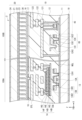
- 1 is a schematic cross-sectional view illustrating an example of a configuration of a liquid crystal display panel according to an embodiment of the present disclosure.
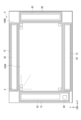
- 2 is a schematic plan view illustrating an example of a configuration of the liquid crystal display panel illustrated in FIG. 1 .
- 2 is a block diagram illustrating an example of a configuration of the liquid crystal display panel illustrated in FIG. 1.
- FIG. 2 is a diagram illustrating an example of a circuit configuration of a pixel.
- 2 is a diagram illustrating an example of a configuration of a projection type display device including the liquid crystal display panel shown in FIG. 1.
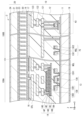
- 1 is a schematic cross-sectional view illustrating an example of a configuration of a liquid crystal display panel according to a first modified example of the present disclosure.
- FIG. 11 is a schematic cross-sectional view illustrating an example of a configuration of a liquid crystal display panel according to Modification 2 of the present disclosure.
- FIG. 8 is a schematic plan view illustrating an example of a configuration of the liquid crystal display panel illustrated in FIG. 7.
- 8 is a schematic diagram illustrating a detailed configuration of the light blocking structure of the liquid crystal display panel shown in FIG. 7.
- FIG. 11 is a schematic plan view illustrating an example of a configuration of a liquid crystal display panel according to a third modification of the present disclosure.
- FIG. 11 is a plan view schematic illustrating an example of a configuration of a liquid crystal display panel according to a fourth modified example of the present disclosure.
- Embodiment Example of a display device having a light-shielding structure between a pixel region and a peripheral region of a driving substrate
- Modifications 2-1 Modification 1 (another example of the configuration of the liquid crystal display panel) 2-2.
- Modification 2 another example of the configuration of the liquid crystal display panel) 2-3.
- Modification 3 another example of the configuration of the liquid crystal display panel) 2-4.
- Modification 4 another example of the configuration of the liquid crystal display panel
- Fig. 1 is a schematic diagram showing an example of a cross-sectional configuration of a display device (liquid crystal display panel 1) according to an embodiment of the present disclosure.
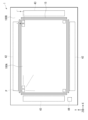
- Fig. 2 is a schematic diagram showing an example of a planar configuration of the liquid crystal display panel 1 shown in Fig. 1.
- Fig. 1 corresponds to line II' shown in Fig. 2.
- the liquid crystal display panel 1 is used, for example, as a light valve (e.g., light modulation elements 118A, 118B, 118C) of a projection type display device (projector 100, see Fig. 5) described later.
- a light valve e.g., light modulation elements 118A, 118B, 118C
- the liquid crystal display panel 1 of this embodiment has a liquid crystal layer between a drive substrate 10 and a counter substrate 20 arranged opposite each other.
- the drive substrate 10 has a pixel region 100A including a pixel circuit 50, and a peripheral region 100B including a peripheral circuit section 40 provided around the pixel region 100A.
- a light-shielding structure 15 is provided between the pixel region 100A and the peripheral circuit section 40.
- the drive substrate 10 corresponds to a specific example of a "first substrate” in the embodiment of the present disclosure.
- the counter substrate 20 corresponds to a specific example of a “second substrate” in the embodiment of the present disclosure.
- the liquid crystal layer 30 corresponds to a specific example of a "liquid crystal layer” in the embodiment of the present disclosure, and the light-shielding structure 15 corresponds to a specific example of a "light-shielding structure" in the embodiment of the present disclosure.
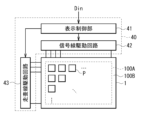
- FIG. 3 shows an example of the overall configuration of the liquid crystal display panel 1 shown in Fig. 1.
- the liquid crystal display panel 1 has a pixel region 100A in which a plurality of pixels P are arranged in a matrix, and a peripheral region 100B provided around the pixel region 100A.
- a peripheral circuit section 40 that drives the liquid crystal display panel 1 is provided in the peripheral region 100B.
- the peripheral circuit section 40 has, for example, a display control section 41, a signal line driving circuit 42, a scanning line driving circuit 43, and a level shifter 44.
- the liquid crystal display panel 1 displays an image based on an externally input video signal Din by actively driving each pixel P with a signal line drive circuit 42 and a scanning line drive circuit 43.
- the liquid crystal display panel 1 has a number of scanning lines WSL extending in the row direction, a number of signal lines DTL extending in the column direction, and a number of common potential lines COM extending in the row direction. Pixels P are provided at the intersections of the signal lines DTL and the scanning lines WSL.
- Each signal line DTL is connected to an output terminal (not shown) of a signal line drive circuit 42.
- Each scanning line WSL is connected to an output terminal (not shown) of a scanning line drive circuit 43.
- Each common potential line COM is connected to, for example, an output terminal (not shown) of a circuit that outputs a fixed potential.
- the display control unit 41 stores and holds the supplied video signal Din in a frame memory for each screen (for each display of one frame).
- the display control unit 41 for example, has a function of controlling the signal line drive circuit 42 and the scanning line drive circuit 43 that drive the liquid crystal display panel 1 so that they operate in conjunction with each other.
- the display control unit 41 for example, supplies the signal line drive circuit 42 with an image signal for one horizontal line based on the image signal held in the frame memory and a display timing control signal, and supplies the scanning line drive circuit 43 with a scan timing control signal.
- the signal line drive circuit 42 supplies, for example, a video signal Din for one horizontal line supplied from the display control unit 41 to each pixel P as a signal voltage. Specifically, the signal line drive circuit 42 supplies, for example, a signal voltage corresponding to the video signal Din to each pixel P constituting one horizontal line selected by the scanning line drive circuit 43 via a signal line DTL.
- the scanning line driving circuit 43 has a function of selecting a pixel P to be driven, for example, in response to a scanning timing control signal supplied from the display control unit 41. Specifically, the scanning line driving circuit 43 applies a selection pulse to the gate electrode (gate electrode 13B) of the transistor (pixel transistor 13) of the pixel P via the scanning line WSL, for example, to select one row of the pixels P formed in a matrix in the pixel region 100A as the pixel to be driven. Then, in these pixels P, one horizontal line is displayed in response to the signal voltage supplied from the signal line driving circuit 42. In this way, the scanning line driving circuit 43 sequentially scans one horizontal line at a time in a time-division manner, for example, to display the entire pixel region 100A.
- the level shifter 44 is a circuit that outputs a different DC bias voltage value with the same waveform as the input signal.
- the level shifter 44 converts a low-frequency digital signal input from the digital domain into a voltage in the analog domain, and shifts the analog voltage to adjust the operating point.
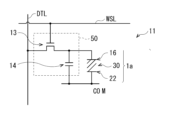
- FIG. 4 shows an example of the circuit configuration of the pixel P.
- Each pixel P is provided with a pixel circuit 50.
- Each pixel circuit 50 is provided corresponding to the intersection of the scanning line WSL and the signal line DTL.
- the pixel circuit 50 includes a pixel transistor 13 that writes a signal voltage to the pixel P, and a storage capacitance 14 that holds the voltage written to the pixel P.
- One electrode of the storage capacitance 14 is connected to the drain region of the semiconductor layer 13A, and the other electrode is connected to the common potential line COM.
- the liquid crystal display panel 1 has a liquid crystal layer 30 between the driving substrate 10 and the counter substrate 20 arranged opposite to each other.
- the driving substrate 10 has a pixel region 100A including a pixel circuit 50, and a peripheral region 100B including a peripheral circuit section 40 provided around the pixel region 100A.
- the pixel region 100A is provided with a plurality of scanning lines WSL and a plurality of signal lines DTL extending in, for example, the X-axis direction and the Y-axis direction, respectively, and intersecting with each other.
- pixel transistors 13 and storage capacitors 14 are provided as the pixel circuits 50.
- a signal line driving circuit 42, a scanning line driving circuit 43, and a level shifter 44 are provided around the pixel region 100A as the peripheral circuit section 40.
- a light-shielding structure 15 is further provided between the pixel region 100A and the signal line driving circuit 42, the scanning line driving circuit 43, and the level shifter 44.
- the drive substrate 10 has, for example, a support substrate 11 made of silicon (Si), an interlayer insulating layer 12, a scanning line WSL embedded in the interlayer insulating layer 12, a signal line DTL, a pixel transistor 13, a storage capacitor 14, a light-shielding structure 15, a signal line driving circuit 42, a scanning line driving circuit 43, and a level shifter 44, a pixel electrode 16, a planarization layer 17, an alignment film 18, and a polarizer 19.
- a support substrate 11 made of silicon (Si)
- an interlayer insulating layer 12 a scanning line WSL embedded in the interlayer insulating layer 12
- a signal line DTL a signal line DTL
- a pixel transistor 13 a storage capacitor 14
- a light-shielding structure 15, a signal line driving circuit 42, a scanning line driving circuit 43, and a level shifter 44
- a pixel electrode 16 a planarization layer 17, an alignment film 18, and a polarizer 19.
- the scanning lines WSL extend, for example, in the X-axis direction from the pixel region 100A to the peripheral region, and are electrically connected to the scanning line driving circuit 43.
- the scanning lines WSL are formed, for example, using polysilicon (Poly-Si).
- the scanning lines WSL also serve as a light-shielding film from the support substrate 11 side, and can be formed, for example, using a metal film such as tungsten (W), titanium (Ti), molybdenum (Mo), chromium (Cr), or tantalum (Ta), or an alloy film of these.
- the scanning lines WSL can also be formed as a laminated film of the above metal films and a Poly-Si film.
- the signal lines DTL extend, for example, in the Y-axis direction from the pixel region 100A to the peripheral region and are electrically connected to the signal line driving circuit 432.
- the scanning lines WSL are formed, for example, using polysilicon (Poly-Si).
- the interlayer insulating layer 12 is formed of, for example, silicon oxide (SiO 2 ), silicon nitride (Si 3 N 4 ), silicon oxynitride (SiON), SiCN or the like.
- the pixel transistor 13 has, for example, an LDD (Lightly Doped Drain) structure.
- the pixel transistor 13 has a semiconductor layer 13A and a gate electrode 13B that applies an electric field to the channel region of the semiconductor layer 13A.
- an interlayer insulating layer 12 is formed as a gate insulating film for insulating and isolating the semiconductor layer 13A and the gate electrode 13B from each other.
- the gate electrode 13B is electrically connected to the scanning line WSL, one of the source-drain regions of the semiconductor layer 13A is electrically connected to the signal line DTL, and the other of the source-drain regions is electrically connected to the pixel electrode 16.
- the semiconductor layer 13A has a channel region facing the gate electrode 13C, and further has LDD regions provided on both sides of the channel region, and source and drain regions provided further outside the LDD regions.
- the semiconductor layer 13A is formed using, for example, Poly-Si.
- the source and drain regions of the semiconductor layer 13A made of a Poly-Si film are doped with impurities such as n-type impurities to reduce resistance.
- the LDD region is doped with impurities so that the impurity concentration is lower than that of the source and drain regions.
- the gate electrode 13B is provided so as to straddle the semiconductor layer 13A in the X-axis direction via the gate insulating film (interlayer insulating layer 12).
- the region facing the gate electrode 13B is a channel region.
- the gate electrode 13B is formed of a conductive material.
- the gate electrode 13B is formed as a laminated film of, for example, a Poly-Si film 13B1 and a light-shielding metal film 13B2 (or an alloy film of these) such as W, Ti, Mo, Cr, and Ta.
- the metal film 13B2 is electrically connected to the scanning line WSL via an opening 12H1 provided on both sides of the semiconductor layer 13A extending in the Y-axis direction.
- the pixel transistor 13 has the semiconductor layer 13A extending in the Y-axis direction, but this is not limiting and the semiconductor layer 13A may extend in the X-axis direction.
- the signal line DTL extends in the Y-axis direction as in the present embodiment, it is more efficient in layout to have the semiconductor layer 13A extend in the Y-axis direction.
- the storage capacitance 14 is provided, for example, above the pixel transistor 13. Specifically, the storage capacitance 14 is provided at a position overlapping the semiconductor layer 13A and the gate electrode 13B in a planar view, and covers at least the channel region and LDD region of the semiconductor layer 13A and the gate electrode 13B.
- the storage capacitance 14 has a width similar to that of the scanning line WSL, for example, and is arranged at a position overlapping with a part of the scanning line WSL in a planar view. For example, the lower surfaces of the channel region and LDD region of the semiconductor layer 13A and the gate electrode 13B are covered by the scanning line WSL, and the upper surfaces are covered by the storage capacitance 14.
- the storage capacitor 14 is, for example, a stack of a first electrode 14A, a dielectric film 14B, a second electrode 14C, a dielectric film 14D, a third electrode 14E, a dielectric film 14F, and a fourth electrode 14G in this order.
- the first electrode 14A and the third electrode 14E are electrically connected.
- the second electrode 14C and the fourth electrode 14G are electrically connected.
- the storage capacitor 14 is a stacked type capacitive element, and can ensure a large holding capacity while suppressing the occupied area.
- the first electrode 14A and the third electrode 14E are electrically connected to the signal line DTL via wiring layers 121 and 122 provided in a layer above the storage capacitor 14.
- the second electrode 14C and the fourth electrode 14G are electrically connected to the common potential line COM via wiring layers 121 and 122 provided in a layer above the storage capacitor 14.
- the light-shielding structure 15 blocks stray light propagating from the pixel region 100A to the peripheral region 100B.
- the light-shielding structure 15 is provided between the pixel region 100A and the signal line driving circuit 42, the scanning line driving circuit 43, and the level shifter 44.
- the light-shielding structure 15 is provided between the pixel region 100A and the signal line driving circuit 42, and between the pixel region 100A and the scanning line driving circuit 43 along each side of the rectangular pixel region 100A.
- the light-shielding structure 15 is provided in the same layer as the semiconductor layer 13A.
- the light-shielding structure 15 is composed of, for example, a wiring 124 provided in the same layer as the scanning line WSL, a poly-Si film 13C1 provided in the same layer as the wiring (gate electrode 13B) spanning the semiconductor layer 13A of the pixel transistor 13, and a laminated film of a metal film 13C2 (or an alloy film of these) having light-shielding properties such as W, Ti, Mo, Cr, and Ta.
- the metal film 13C2 of the laminated film is electrically connected to the wiring 124 through the opening 12H1, similar to the metal film 13B2 of the gate electrode 13B.
- the light-shielding structure 15 is formed using the wiring layer (scanning line WSL, gate electrode 13B) formed in the pixel region 100A. Therefore, the light-shielding structure 15 can be formed without increasing the number of processes by simply modifying the mask pattern when forming the scanning line WSL and the gate electrode 13B.
- the pixel electrode 16 is provided for each pixel P and is electrically connected to, for example, the pixel transistor 13.
- the pixel electrode 16 is made of, for example, a transparent conductive film.
- the transparent conductive film include indium tin oxide (ITO), indium zinc oxide (IZO), zinc oxide (ZnO), and indium gallium zinc oxide (IGZO).
- the pixel electrodes 16 have, for example, a substantially rectangular shape and are arranged in a matrix in the display area 1A.
- the pixel electrodes 16 are formed using a metal material that is light reflective and mainly made of a low-resistance metal.
- metal materials include aluminum (Al), titanium (Ti), copper (Cu), silicon (Si), silver (Ag), or alloys thereof (e.g., Al-Cu alloys and Al-Si alloys).
- the planarization layer 17 is intended to planarize the surface of the drive substrate 10 facing the liquid crystal layer 30.
- the planarization layer 17 is formed of, for example, silicon oxide (SiO 2 ), silicon nitride (Si 3 N 4 ), silicon oxynitride (SiON), SiCN, or the like.
- the alignment film 18 controls the alignment of the liquid crystal layer 30, and is made of an inorganic material such as silicon oxide (SiO 2 ), diamond-like carbon, aluminum oxide (Al 2 O 3 ), etc.
- the alignment film 18 can be formed by using, for example, a vapor deposition method.
- the polarizing plate 19 is provided on the surface of the support substrate 11 opposite to the surface facing the liquid crystal layer 30.
- the polarizing plate 19 is arranged, for example, in a crossed Nicol configuration, so that only light (polarized light) with a specified vibration direction can pass through the polarizing plate.
- Each polarizing plate is made of, for example, polyvinyl alcohol (PVA) with iodine (I) compound molecules adsorbed and aligned.
- the counter substrate 20 has, for example, a light-transmitting support substrate 21, a counter electrode 22, an alignment film 23, and a polarizing plate 24.
- the counter electrode 22 and the alignment film 23 are provided on the surface of the support substrate 21 that faces the liquid crystal layer 30, and the polarizing plate 24 is provided on the surface of the support substrate 21 opposite the surface that faces the liquid crystal layer 30.
- the counter electrode 22 is provided over the entire surface of the display area 1A, for example as a common electrode for all pixels P.
- the counter electrode 22 is formed, for example, from a light-transmitting conductive material.
- light-transmitting conductive materials include indium tin oxide (ITO), indium zinc oxide (IZO), zinc oxide (ZnO), and indium gallium zinc oxide (IGZO).
- the alignment film 23 controls the alignment of the liquid crystal layer 30, and is made of an inorganic material such as silicon oxide ( SiO2 ), diamond-like carbon, or aluminum oxide ( Al2O3 ).
- the thickness of the alignment film 23 is, for example, 50 nm or more and 500 nm or less.
- the alignment film 18 can be formed by using, for example, a vapor deposition method.
- the polarizing plates 24 are arranged, for example, in a crossed Nicol configuration, so that only light (polarized light) with a specific vibration direction can pass through the polarizing plates.
- Each polarizing plate is made of, for example, polyvinyl alcohol (PVA) with iodine (I) compound molecules adsorbed and aligned.
- the liquid crystal layer 30 is composed of liquid crystals driven in, for example, VA (Vertical Alignment) mode, TN (Twisted Nematic) mode, ECB (Electrically Controlled Birefringence) mode, FFS (Fringe Field Switching) mode, or IPS (In Plane Switching) mode.
- the liquid crystal layer 30 is sealed by, for example, a thermosetting or UV-curing sealant that is commercially available for liquid crystal displays, which bonds the drive substrate 10 and the counter substrate 20 together.
- the liquid crystal layer 30 is formed by bonding the drive substrate 10 and the counter substrate 20 together using a sealant, injecting liquid crystal, and sealing the liquid crystal layer 30 with, for example, a UV-curing sealant.
- the liquid crystal layer 30 may be manufactured using, for example, an ODF (One Drop Fill) process.
- a video voltage is supplied to the liquid crystal layer 30 by a plurality of pixel electrodes 16 and a counter electrode 22.
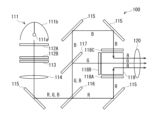
- FIG. 5 shows an example of the overall configuration of a projection display device (projector 100) equipped with the above-mentioned liquid crystal display panel 1.
- the projector 100 is, for example, a reflective 3-LCD type projection display device that performs light modulation using a transmissive liquid crystal display panel (Liquid Crystal Display: LCD).
- the projector 100 is, for example, a display device that projects an image onto a screen.
- the projector 100 is connected to an external image supply device such as a computer such as a PC or various image players via an I/F (interface), and projects an image onto a screen or the like based on an image signal input to the I/F.
- an external image supply device such as a computer such as a PC or various image players
- I/F interface
- Projector 100 includes light source 111, multi-lens arrays 112A and 112B, PbS array 113, focus lens 114, mirror 115, dichroic mirrors 116 and 117, light modulation elements 118A to 118C, dichroic prism 119, and projection lens 120.
- the liquid crystal display panel 1 of this embodiment is used for light modulation elements 118A to 118C.
- the light source 111 emits light emitted by the light emitting section 111a to a pair of multi-lens arrays 112A, 112B via the reflector 111b.
- Each of the pair of multi-lens arrays 112A, 112B has a structure in which multiple lens elements are arranged in an array, and focuses the light emitted from the light source 111.
- the PbS array 113 polarizes the light focused by the pair of multi-lens arrays 112A, 112B into light with a specified polarization direction, for example, P-polarized light.
- the focus lens 114 focuses the light converted by the PbS array 113 into light with a specified polarization direction.
- Dichroic mirror 116 transmits red light R from the light incident via focus lens 114 and mirror 115, and reflects green light G and blue light B.
- the red light R transmitted by dichroic mirror 116 is guided to light modulation element 118A via mirror 115.
- Dichroic mirror 117 transmits blue light B from the light reflected by dichroic mirror 116 and reflects green light G.
- the green light G reflected by dichroic mirror 117 is guided to light modulation element 118B.
- the blue light B transmitted by dichroic mirror 117 is guided to light modulation element 118C via mirror 115.
- the optical modulation elements 118A to 118C each modulate the incident color light, and the modulated color light is incident on the dichroic prism 1199.
- the dichroic prism 1199 combines the modulated color light into one optical axis.
- the combined color light is projected onto a screen or the like via the projection lens 120.
- three light modulation elements 118A-118C corresponding to the three primary colors of red, green, and blue are combined to display a wide range of colors.
- the liquid crystal display panel 1 can be applied to the above-mentioned projection display device (projector 100), as well as to electronic devices such as television devices, monitors for desktop personal computers, notebook personal computers, imaging devices such as video cameras and digital still cameras, PDAs (Personal Digital Assistants), and smartphones.
- projection display device projector 100
- electronic devices such as television devices, monitors for desktop personal computers, notebook personal computers, imaging devices such as video cameras and digital still cameras, PDAs (Personal Digital Assistants), and smartphones.
- a light shielding structure 15 is provided between a pixel region 100A including pixel circuits 50 and a peripheral circuit section 40 provided in a peripheral region 100B surrounding the pixel region 100A in a driving substrate 10 disposed opposite a counter substrate 20 with a liquid crystal layer 30 therebetween. This blocks stray light propagating from the pixel region 100A to the peripheral region 100B. This will be described below.
- Liquid crystal display panels used as light modulation devices (light valves) in projection display devices require improved light-shielding performance (light resistance) for pixel transistors to prevent leakage current caused by strong light from the light source and image quality degradation such as flicker.
- the light resistance of the pixel region is improved by providing a light-shielding structure in the upper or lower layer or horizontal direction of the transistors provided in the pixel region.
- the light resistance of the peripheral circuitry is improved by providing a light-shielding structure in the upper or lower layer of the peripheral circuitry.
- the above-mentioned liquid crystal device does not take into consideration the effects of light propagating in the horizontal direction, and issues include the occurrence of leakage current in the peripheral circuitry and a decrease in image quality due to abnormal driving of the peripheral circuits.
- a light-shielding structure 15 is provided between the pixel region 100A of the drive substrate 10 and the peripheral circuit section 40. This blocks stray light propagating from the pixel region 100A to the peripheral region 100B.
- the liquid crystal display panel 1 of this embodiment it is possible to reduce the occurrence of optical leakage current in the peripheral circuit section 40 due to stray light propagating from the pixel region 100A to the peripheral region 100B.
- This makes it possible to avoid driving abnormalities in, for example, the signal line driving circuit 42, the scanning line driving circuit 43, and the level shifter 44, thereby improving image quality.
- it is possible to reduce the occurrence of line defects and band-like unevenness due to abnormalities in the output waveform of the level shifter 44, for example.
- the light-shielding structure 15 is formed using wiring 124 provided in the same layer as the scanning lines WSL, and a laminated film of a Poly-Si film 13C1 and a metal film 13C2 provided in the same layer as the gate electrodes 13B of the pixel transistors 13. This makes it possible to form the light-shielding structure 15 without increasing the number of processes, simply by modifying the mask pattern used to form the scanning lines WSL and the gate electrodes 13B.
- FIG. 6 is a schematic diagram illustrating an example of a cross-sectional configuration of a display device (liquid crystal display panel 2) according to the first modification of the present disclosure.
- the light-shielding structure 15 is formed using wiring 124 provided in the same layer as the scanning lines WSL, and a laminated film of Poly-Si film 13C1 and metal film 13C2 provided in the same layer as the gate electrode 13B of the pixel transistor 13, but this is not limited to this.
- the liquid crystal display panel 2 of this modified example forms a light-shielding structure 65 using wiring 124 provided in the same layer as the scanning lines WSL, a laminated film of Poly-Si film 13C1 and metal film 13C2 provided in the same layer as the gate electrode 13B of the pixel transistor 13, and further a Poly-Si film 141 provided in the same layer as the first electrode 14A that constitutes the storage capacitance 14.
- the light-shielding structure made of the Poly-Si film 141 is provided, for example, on the pixel region 100A side of the light-shielding structure made of a laminated film of the Poly-Si film 13C1 and the metal film 13C2, and is formed, for example, over the side and bottom surfaces of the opening 12H2 that reaches the underside of the Poly-Si film 13C1.
- the light shielding structure 65 is formed of the wiring 124 provided in the same layer as the scanning line WSL, a light shielding structure consisting of a laminated film of a Poly-Si film 13C1 and a metal film 13C2 provided in the same layer as the gate electrode 13B of the pixel transistor 13, and a light shielding structure consisting of a Poly-Si film 141 provided in the same layer as the first electrode 14A constituting the storage capacitor 14.
- the Poly-Si film 141 is formed, for example, over the side and bottom surfaces of the opening 12H2 that reaches the lower surface of the Poly-Si film 13C1.
- FIG. 7 is a schematic diagram showing an example of a cross-sectional configuration of a display device (liquid crystal display panel 3) according to Modification 2 of the present disclosure.
- Fig. 8 is a schematic diagram showing an example of a planar configuration of the liquid crystal display panel 3 shown in Fig. 7.
- the liquid crystal display panel 3 of this modified example has a light shielding structure 75 (first light shielding structure 75A and second light shielding structure 75B) between the pixel region 100A and the peripheral circuit section 40, in which a plurality of light shielding portions 75a, 75b (see FIG. 9) are provided discretely and doubly along each side of the rectangular pixel region 100A.
- the light shielding structure 75 is composed of a first light shielding structure 75A and a second light shielding structure 75B in which a plurality of light shielding portions 75a, 75b are provided discretely and in duplicate along each side of the pixel region 100A.
- the first light shielding structure 75A is formed by forming a plurality of light shielding portions 75a discretely along each side of the pixel region 100A.
- a plurality of light shielding portions 75b are formed discretely along each side of the pixel region 100A, similar to the first light shielding structure 75A, to form a second light shielding structure 75B.
- the scanning line WSL extends to the peripheral region 100B, and the plurality of light shielding portions 75a and the plurality of light shielding portions 75b are each electrically connected to the scanning line WSL via the opening 12H1. That is, the same potential as the scanning line WSL is applied to each of the light-shielding portions 75a and the light-shielding portions 75b. This makes it possible to prevent coupling noise caused by the parasitic capacitance between the scanning line WSL and the light-shielding structure 75.
- Figure 9 shows the positional relationship between the multiple light-shielding portions 75a and the multiple light-shielding portions 75b.
- the multiple light-shielding portions 75a and the multiple light-shielding portions 75b are connected to the scanning lines WSL every other one.
- the pitch of the multiple scanning lines WSL aligned in the Y-axis direction corresponds to the pixel pitch.
- the multiple light-shielding portions 75a and the multiple light-shielding portions 75b are formed offset from each other by one pixel pitch in the Y-axis direction.
- each of the light-shielding portions 75a and 75b in the parallel direction is equal to or greater than the pixel pitch, and as shown in FIG. 9, the light-shielding portions 75a and 75b have an overlapping region X in the X-axis direction. This allows stray light propagating from the pixel region 100A to the peripheral region 100B to be blocked without passing through the gaps between adjacent light-shielding portions 75a and between adjacent light-shielding portions 75b.
- the light shielding structure 75 (first light shielding structure 75A and second light shielding structure 75B) in which the multiple light shielding portions 75a, 75b are provided discretely and in duplicate along each side of the rectangular pixel region 100A, for example, is provided between the pixel region 100A and the peripheral circuit section 40.
- the same potential as that of the scanning line WSL is applied to each of the multiple light shielding portions 75a and the multiple light shielding portions 75b, for example.
- each of the multiple light shielding portions 75a and the multiple light shielding portions 75b in the parallel direction is equal to or greater than the pixel pitch, and the multiple light shielding portions 75a and the multiple light shielding portions 75b have an overlapping region X in the X-axis direction. This makes it possible to block stray light propagating from the pixel region 100A to the peripheral region 100B while preventing coupling noise due to the parasitic capacitance between the scanning line WSL and the light shielding structure 75. This makes it possible to further improve image quality.
- FIG. 10 is a schematic diagram showing an example of a planar configuration of a display device (liquid crystal display panel 4) according to the third modification of the present disclosure.
- a light-shielding structure 15 is provided between the pixel region 100A and the signal line driving circuit 42 and between the pixel region 100A and the scanning line driving circuit 43 along each side of the rectangular pixel region 100A in a plan view, but this is not limited to this.
- the liquid crystal display panel 3 of this modified example has a continuous light-shielding structure 85 that surrounds the pixel region 100A.
- FIG. 11 is a schematic diagram showing an example of a planar configuration of a display device (liquid crystal display panel 5) according to the fourth modification of the present disclosure.
- a light-shielding structure 15 is provided between the pixel region 100A and the signal line driving circuit 42 and between the pixel region 100A and the scanning line driving circuit 43 along each side of the rectangular pixel region 100A in a plan view, but this is not limited to this.
- the liquid crystal display panel 4 of this modified example has a continuous light-shielding structure 95 that surrounds the periphery of the signal line driving circuit 42, the scanning line driving circuit 43, and the level shifter 44 provided in the peripheral region 100B.
- the present disclosure has been described above with reference to the embodiment and modifications 1 to 4, but the present disclosure is not limited to the above-mentioned embodiment, etc., and various modifications are possible.
- the projector 100 of the present disclosure is not limited to the configuration described in the above-mentioned embodiment, etc.
- a so-called three-panel projector 100 having three liquid crystal display panels (light modulation elements 118A-118B) is shown, but the present invention is not limited to this and can also be applied to a so-called two-panel projection display device having two liquid crystal panels or a single-panel projection display device.
- a transmissive projector 100 is shown, but this is not limiting. This technology can also be applied to, for example, a reflective projection display device, and similar effects can be obtained.
- the display device of the present disclosure can be applied to various display devices that modulate light from a light source via a liquid crystal display panel (e.g., liquid crystal display panel 1 (light modulation elements 118A-118B)) and display an image using a projection lens.
- a liquid crystal display panel e.g., liquid crystal display panel 1 (light modulation elements 118A-118B)
- the display device of the present disclosure can be applied to head-up displays, Augmented Reality (AR) glasses, etc.
- AR Augmented Reality
- the present technology can also be configured as follows. According to the present technology configured as follows, in a first substrate having a pixel region including a pixel circuit and a peripheral region including a peripheral circuit section provided around the pixel region and disposed opposite a second substrate with a liquid crystal layer therebetween, a light-shielding structure is provided between the pixel region and the peripheral region. This blocks stray light propagating from the pixel region to the peripheral circuit section, thereby making it possible to improve display quality.
- a liquid crystal layer a first substrate having a pixel region including a pixel circuit and a peripheral region including a peripheral circuit section provided around the pixel region, the first substrate having a light shielding structure provided between the pixel region and the peripheral circuit section; a second substrate disposed opposite the first substrate with the liquid crystal layer interposed therebetween.
- the pixel region includes a plurality of scanning lines and a plurality of signal lines intersecting with each other, and a plurality of pixel transistors provided at each of the intersections of the plurality of scanning lines and the plurality of signal lines as the pixel circuits;
- the light blocking structure is formed in the same layer as a semiconductor layer of the pixel transistor.
- the light-shielding structure is provided continuously so as to surround the pixel region.
- the light-shielding structure is provided continuously so as to surround the peripheral circuit unit.
- the light-shielding structure is composed of a plurality of light-shielding portions that are discretely provided so as to surround the pixel region.
- the doubly provided light-shielding structure includes a first light-shielding structure and a second light-shielding structure from the pixel region side,
Landscapes
- Physics & Mathematics (AREA)
- Nonlinear Science (AREA)
- Chemical & Material Sciences (AREA)
- Crystallography & Structural Chemistry (AREA)
- General Physics & Mathematics (AREA)
- Optics & Photonics (AREA)
- Mathematical Physics (AREA)
- Engineering & Computer Science (AREA)
- Microelectronics & Electronic Packaging (AREA)
- Liquid Crystal (AREA)
Priority Applications (1)
| Application Number | Priority Date | Filing Date | Title |
|---|---|---|---|
| JP2025509898A JPWO2024202657A1 (https=) | 2023-03-29 | 2024-02-15 |
Applications Claiming Priority (2)
| Application Number | Priority Date | Filing Date | Title |
|---|---|---|---|
| JP2023-054168 | 2023-03-29 | ||
| JP2023054168 | 2023-03-29 |
Publications (1)
| Publication Number | Publication Date |
|---|---|
| WO2024202657A1 true WO2024202657A1 (ja) | 2024-10-03 |
Family
ID=92904165
Family Applications (1)
| Application Number | Title | Priority Date | Filing Date |
|---|---|---|---|
| PCT/JP2024/005339 Ceased WO2024202657A1 (ja) | 2023-03-29 | 2024-02-15 | 表示装置 |
Country Status (2)
| Country | Link |
|---|---|
| JP (1) | JPWO2024202657A1 (https=) |
| WO (1) | WO2024202657A1 (https=) |
Citations (4)
| Publication number | Priority date | Publication date | Assignee | Title |
|---|---|---|---|---|
| JPH1073839A (ja) * | 1996-07-02 | 1998-03-17 | Sharp Corp | 液晶表示装置 |
| JP2009265622A (ja) * | 2008-04-01 | 2009-11-12 | Seiko Epson Corp | 電気光学装置及び電子機器 |
| US20180108649A1 (en) * | 2016-10-18 | 2018-04-19 | Boe Technology Group Co., Ltd. | Array substrate and display device |
| JP2022161827A (ja) * | 2021-04-09 | 2022-10-21 | 株式会社ジャパンディスプレイ | 表示装置 |
-
2024
- 2024-02-15 JP JP2025509898A patent/JPWO2024202657A1/ja active Pending
- 2024-02-15 WO PCT/JP2024/005339 patent/WO2024202657A1/ja not_active Ceased
Patent Citations (4)
| Publication number | Priority date | Publication date | Assignee | Title |
|---|---|---|---|---|
| JPH1073839A (ja) * | 1996-07-02 | 1998-03-17 | Sharp Corp | 液晶表示装置 |
| JP2009265622A (ja) * | 2008-04-01 | 2009-11-12 | Seiko Epson Corp | 電気光学装置及び電子機器 |
| US20180108649A1 (en) * | 2016-10-18 | 2018-04-19 | Boe Technology Group Co., Ltd. | Array substrate and display device |
| JP2022161827A (ja) * | 2021-04-09 | 2022-10-21 | 株式会社ジャパンディスプレイ | 表示装置 |
Also Published As
| Publication number | Publication date |
|---|---|
| JPWO2024202657A1 (https=) | 2024-10-03 |
Similar Documents
| Publication | Publication Date | Title |
|---|---|---|
| CN103034001B (zh) | 电光装置及电子设备 | |
| US8885134B2 (en) | Liquid crystal device and electronic apparatus | |
| JP3700697B2 (ja) | 電気光学装置及び電子機器 | |
| JP4306737B2 (ja) | 電気光学装置用基板及び電気光学装置、並びに電子機器 | |
| JP6028332B2 (ja) | 液晶装置、及び電子機器 | |
| WO2001082273A1 (en) | Electrooptical device | |
| US11081588B2 (en) | Electro-optical device and electronic apparatus | |
| JP2018101067A (ja) | 電気光学装置、電子機器 | |
| JP7392507B2 (ja) | 液晶装置および電子機器 | |
| JP2008216621A (ja) | 電気光学装置及び電子機器 | |
| JP5909919B2 (ja) | 電気光学装置及び電子機器 | |
| JP2003280020A (ja) | 電気光学装置及びその製造方法並びに電子機器 | |
| JP2018136477A (ja) | 電気光学装置、電子機器 | |
| JP5919890B2 (ja) | 電気光学装置、及び電子機器 | |
| JP6044700B2 (ja) | 電気光学装置、及び電子機器 | |
| JP2012155198A (ja) | 電気光学装置及び電子機器 | |
| JP2017083679A (ja) | 表示装置および電子機器 | |
| WO2024202657A1 (ja) | 表示装置 | |
| JP2008191518A (ja) | 電気光学装置用基板及び電気光学装置、並びに電子機器 | |
| JP2020034822A (ja) | 電気光学装置、電子機器 | |
| JP7110182B2 (ja) | 液晶表示パネルおよび電子機器 | |
| JP5849605B2 (ja) | 電気光学装置、及び電子機器 | |
| JP2012181308A (ja) | 電気光学装置および電子機器 | |
| JP4182766B2 (ja) | アクティブマトリクス基板、電気光学装置、電子機器 | |
| JP7512885B2 (ja) | 液晶装置、液晶装置の製造方法、および電子機器 |
Legal Events
| Date | Code | Title | Description |
|---|---|---|---|
| 121 | Ep: the epo has been informed by wipo that ep was designated in this application |
Ref document number: 24778802 Country of ref document: EP Kind code of ref document: A1 |
|
| ENP | Entry into the national phase |
Ref document number: 2025509898 Country of ref document: JP Kind code of ref document: A |
|
| WWE | Wipo information: entry into national phase |
Ref document number: 2025509898 Country of ref document: JP |
|
| NENP | Non-entry into the national phase |
Ref country code: DE |
|
| 122 | Ep: pct application non-entry in european phase |
Ref document number: 24778802 Country of ref document: EP Kind code of ref document: A1 |